Marine Reptiles


The first book of the Bible is named Genesis. The word “Genesis” means “beginning.” The book records how God brought the world into existence out of nothing. It also documents that God created all the swimming and flying creatures on the fifth day of Creation (Genesis 1:20-23), and land animals and humans on the sixth day of Creation (Genesis 1:24-30). In this issue of Discovery, we are going to learn about a fascinating group of creatures known as marine reptiles that God made on Day Five. The word “marine” describes things in the sea. That means that a marine reptile would be one that lives in the sea. Today, there are several reptiles that live in the sea, including sea snakes, sea turtles, and saltwater crocodiles. In the past, however, when God created all the first kinds of sea creatures, there were many more marine reptiles that have now gone extinct.
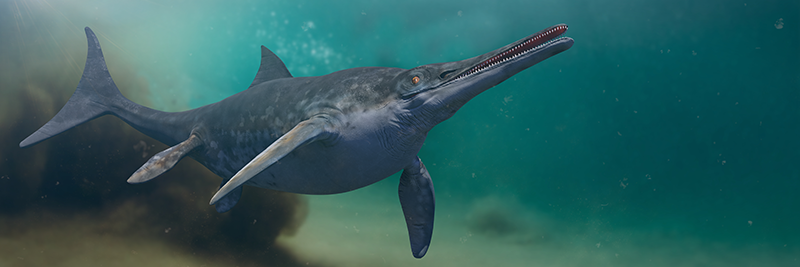
ICHTHYOSAURUS
The name Ichthyosaurus means “fish lizard.” This creature grew to be about 6 feet long. It had large eyes that it probably used to see in murky waters. It was shaped much like a dolphin and had four prominent flippers that helped it be a swift swimmer. As a reptile and not a fish, it would have needed to surface and breathe air, much like dolphins and whales. Scientists have found fossil remains of this reptile that included embryos of its babies, giving us evidence that it gave birth to live babies and did not lay eggs. Interestingly, the first fossil ever found of an Ichthyosaurus was discovered by a 12-year-old girl named Mary Anning in Dorset, England in 1812. As she grew up, she found many more fossils and became a well-known fossil hunter. Just think, there are most likely lots of fossils of unknown creatures out there that have not yet been discovered. How cool would it be if one of our Discovery readers found one and was able to use the media attention to point people to the Creator?
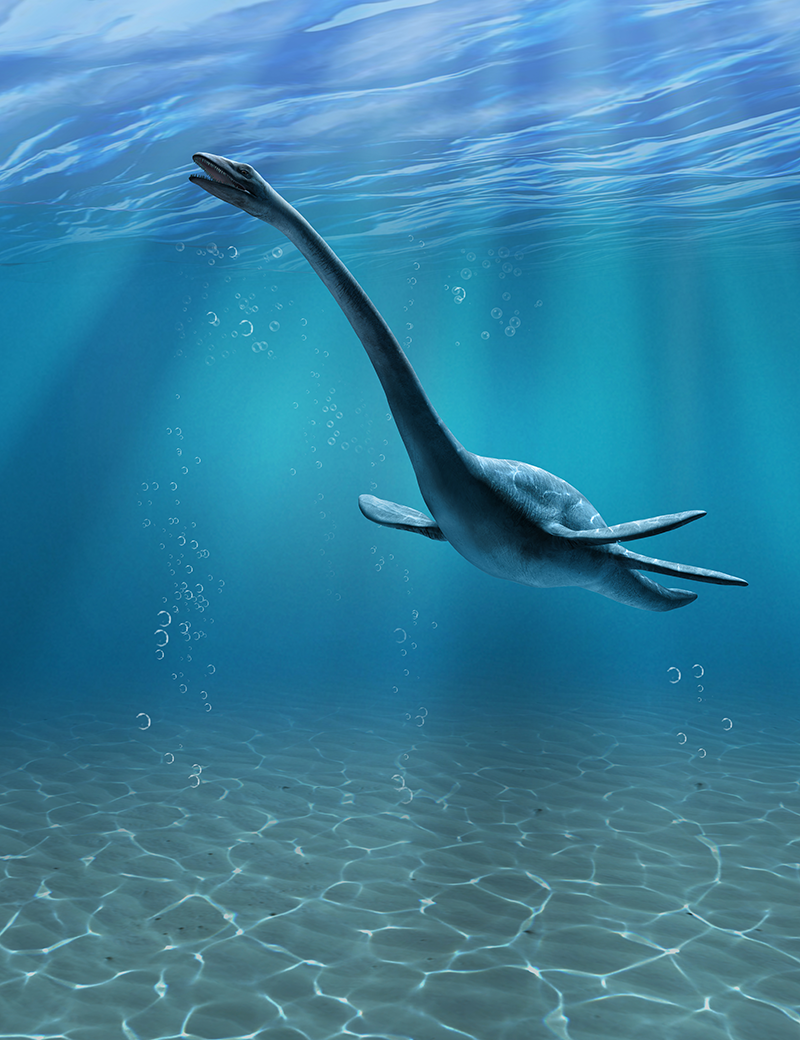
ELASMOSAURUS
The name Elasmosaurus means “metal-plated or thin-plated lizard.” It was given this name, because it has bone plates that line its chest and hip area. When you look at artists’ drawings of this creature, you may wonder why it was not called the “long-necked lizard.” The Elasmosaurus had 72 vertebrae in its neck, which is the second-highest number of any known animal ever to live. In early artistic works showing this lizard, artists would draw its neck being very flexible, almost like a snake. Modern studies of the neck indicate that it was not very flexible but was most likely straight and somewhat stiff. This reptile was a member of a group called plesiosaurs that lived in oceans and seas. While many of these creatures were “fearfully great lizards” (which is what the word dinosaur means), they are not classified as dinosaurs. Scientists who study and name these creatures only use the word dinosaur to describe land-living reptiles that had certain types of hip structures. So, in the same way that a Tyrannosaurus rex is a dinosaur, an Elasmosaurus is a plesiosaur. And what a plesiosaur it was! It could grow to be between 30-40 feet long and weigh up to 10,000 pounds. At the end of its long neck, this lizard had a small head that contained about 40 teeth, several of which were long and sharp. It was a predator that fed on other marine animals such as fish and squid. Like the other marine reptiles, it was not a fish and did not have gills. It breathed air and would have needed to surface regularly.
KRONOSAURUS
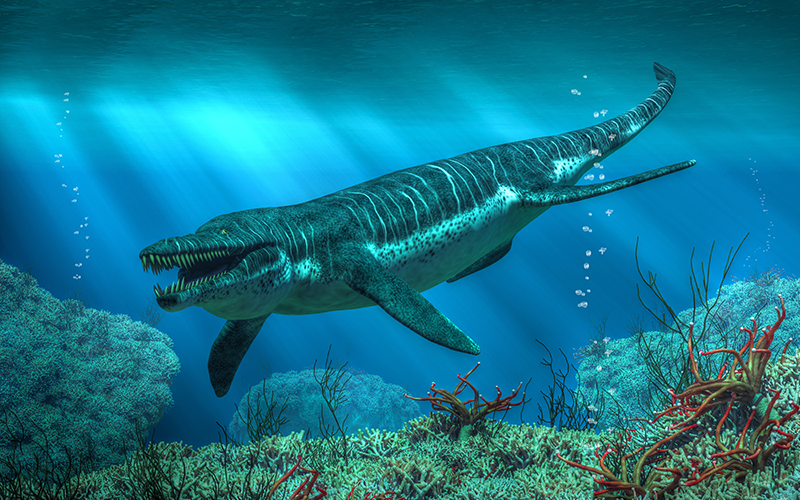
This massive marine reptile gets its name from the mythological Greek Titan named Kronos—the “lizard of Kronos.” Like the Elasmosaurus, it is a plesiosaur that lived in the oceans and seas. It could be about 35 feet long. Unlike the Elasmosaurus, it did not have a long neck. Instead, it had a much shorter neck and a larger head. Its head composed about one-third of its entire length. Scientists believe this was an apex predator that would have been able to eat most other creatures that swam in the seas with it. The fossils that have been found suggest that it ate sea turtles, sharks, other marine reptiles, and possibly even members of its own species. Research done on the jawbones and teeth of this animal indicates that it had an extremely powerful bite. Bite force is measured in a scientific unit of force called newtons (named after Isaac Newton). The average human has a bite force of about 700 newtons. A dog, such as a pitbull, has a bite force of about 1,000 newtons. The most powerful bite force of any living animal today is that of the saltwater crocodile, measured at 16,000 newtons. Where does the Kronosaurus rank on the bite force scale? Its estimated bite force was a whopping 30,000 newtons, almost twice the force of the most powerful bite of any creature alive today. Needless to say, you would not want to have been anywhere close to this reptile’s mouth when it decided to snap its bone-crushing jaws shut.
“SEA REX”
In Dorset, England in 2023, scientists uncovered the most complete pliosaur (which is a kind of plesiosaur) skull ever found. In fact, it holds the Guinness Book of World Records top spot for that distinction. It is a 6.5-foot skull that has about 95% of its surface area fossilized and still together. One remarkable aspect of the fossil is the number of teeth it contains. It has 130 razor sharp teeth! Because of its ferocious, huge mouth and teeth, it has been named “Sea Rex,” the “T-rex” of the sea.
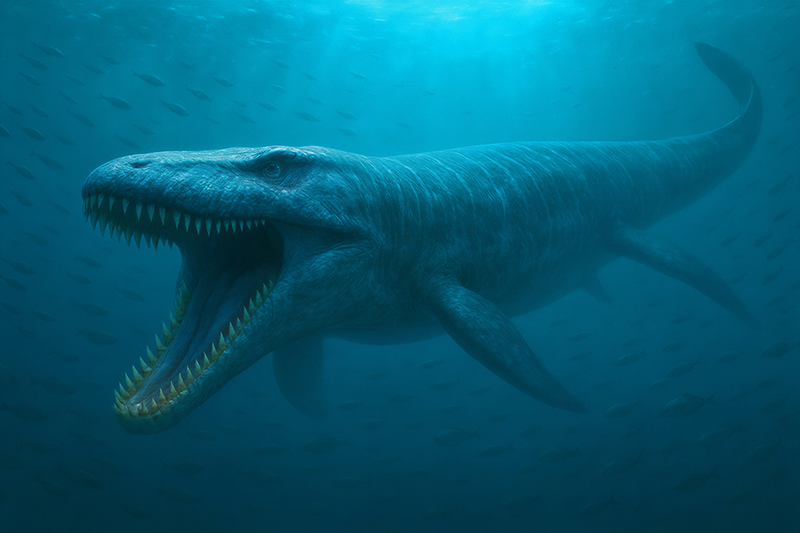
In the book of Job, God talks to Job about a fearsome sea creature named Leviathan. God draws attention to this animal to show Job that God made (and can control) even the largest and most dangerous beasts. God said to Job, “I will not conceal his limbs, his mighty power or his graceful proportions. Who can remove his outer coat? Who can approach him with a double bridle? Who can open the doors of his face, with his terrible teeth all around (Job 41:12-14)? Could “Sea Rex” be the Leviathan? Its huge head and massive mouth filled with 130 razor sharp teeth sound much like an animal with “terrible teeth all around.” In truth, however, we will probably never know if “Sea Rex” is the creature God was describing to Job as Leviathan. We can know, however, that God was talking to Job about a real creature that once lived, and “Sea Rex” helps us imagine what that beast may have looked like. We can also know that God created all the kinds of marine reptiles on Day Five of Creation, just one day before He created humans. And we can know that all God’s creatures are designed to bring Him glory. “Praise the Lord from the earth, you great sea creatures and all the depths” (Psalm 148:7).

REPRODUCTION & DISCLAIMERS: We are happy to grant permission for this article to be reproduced in part or in its entirety, as long as our stipulations are observed.