Titus 3:5 and the Washing of Regeneration


For most of the 2,000 years of the Christian Era, the “washing of regeneration” has been readily acknowledged as an allusion to water baptism. What’s more, the vast majority of Christendom did not place baptism in conflict with salvation like many today who insist that if baptism precedes and is necessary to salvation, then baptism would be a “work”—and “everyone knows we’re not saved by works.”1 Such thinking, only relatively recently popularized, is so foreign to New Testament teaching on salvation that it is difficult to fathom how it could have attained such a prominent foothold in contemporary Christian theology. Incredibly, no doubt due to the Holy Spirit’s eternal and timeless nature as deity, this passage anticipated the “wrong turn” that has been taken by correcting the components that compose the “no works so no baptism” dogma.
The Central Features of Salvation
Observe carefully how Titus 3:3-8 pinpoints four central features of redemption. First, we humans have been thoroughly and completely lost in sin due to our own actions (i.e., “foolish, disobedient, etc.”—vs. 3). Second, it took a kind and loving God to manifest Himself as our Savior (vs. 4). This divine initiative that was intended to save us was a clear manifestation of His mercy (vs. 5), and grace (vs. 7), and it was accomplished via Jesus Christ (vs. 6). Third, our salvation could not be achieved by human goodness or our own “works of righteousness,” i.e., works or actions that we enact in order to atone for our sin, save ourselves, and bring about our own justification/righteousness (vs. 5).2 Fourth, on the contrary, God made our salvation possible via “the washing of regeneration and renewing of the Holy Spirit” (vs. 5). A careful examination of each of these factors, together with awareness of the underlying language selected by the Holy Spirit, will clarify succinctly the role and function played by water baptism in the divine scheme of redemption. Consider the chart below.
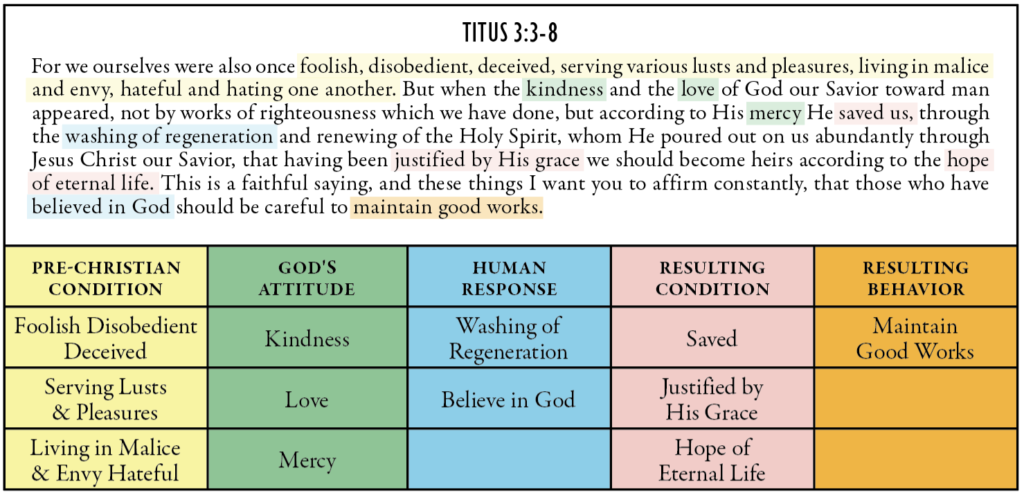
To summarize, according to this context, Who saved us? It was “God our Savior,” “the Holy Spirit,” and “Jesus Christ our Savior.” What did they make available to us? We could be “saved,” “justified,” and have “the hope of eternal life.” Where was this salvation made possible? In and through Jesus Christ our Savior—a reference to His unique role in the scheme of redemption by His death on the cross. Why would they desire to save us? It was due to their “kindness,” “love,” “mercy,” and “grace.” When was the moment in time that God bestowed these blessings and saved us? It was at the moment of “the washing of regeneration and renewing of the Holy Spirit.”
“Washing of Regeneration” and “Renewal of the Holy Spirit”?
So the question is—to what do these two expressions refer? Baptist grammarian Robertson conceded that the “washing of regeneration” refers to water baptism.3 The vast majority of commentators, theologians, and grammarians through the centuries have agreed. Look carefully at the syntax selected by the Holy Spirit. In verse 5, dia with the genitive is used, meaning “through.” Why would “regeneration,” i.e., being cleansed of sin in order to be saved, be coupled with the term “washing”? loutrovn (loutron) refers to a bath, washing, or ablution and is used only twice in the New Testament—here and in Ephesians 5:26 where spiritual cleansing is also in view. The verb form louvw (louo) is used five times in the New Testament,4 with its use in Hebrews 10:22 paralleling Titus 3:5 and Ephesians 5:26. A related word, a)polouvw (apolouo), used only twice in the New Testament, refers in both instances to cleansing of sin at the point of conversion (1 Corinthians 6:11; Acts 22:16).5
The Bible is its own best interpreter. Since the Holy Spirit is the Author of the entire Bible, He would naturally repeat and paraphrase Himself. A careful comparison of the Titus and Ephesians verses, along with John 3:5 and 1 Corinthians 12:13, enables the reader to clarify the precise meaning of the phrase “the washing of regeneration.” The following chart illustrates this comparison:
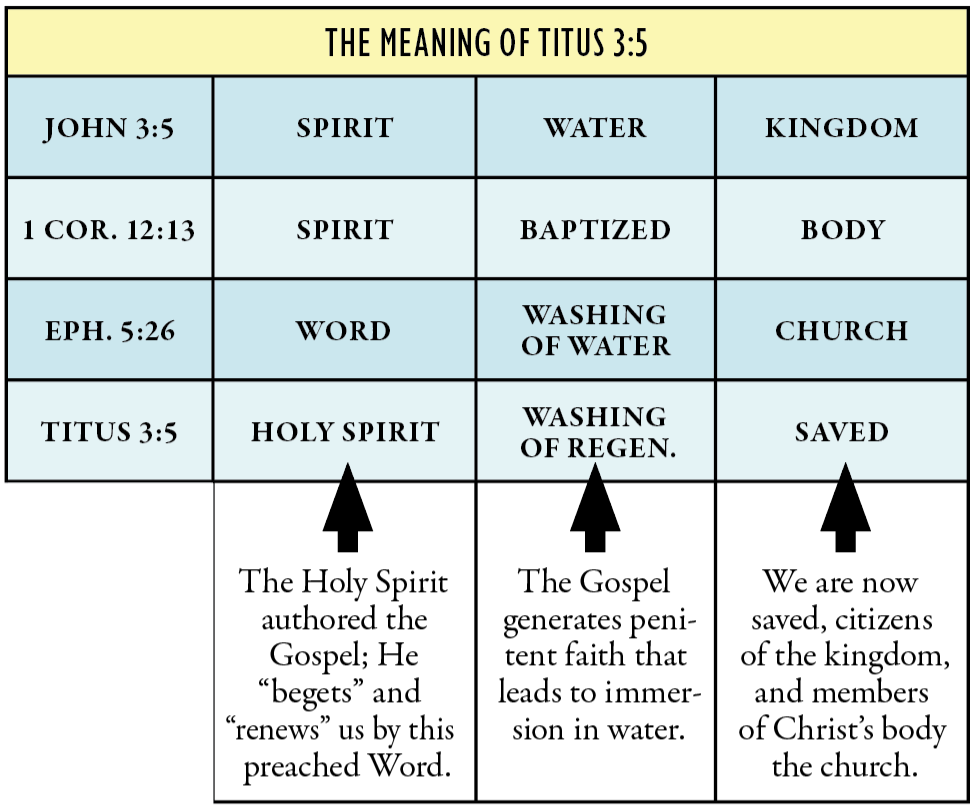
The “washing of regeneration” of Titus corresponds with “washing of water” in Ephesians, “baptized” in 1 Corinthians, and “water” in John 3.
Observe further that the term paliggenesiva$ (paliggenesias—“regeneration”) is a compound word composed of the two Greek words pavlin (palin—“again”) and gevnesi$ (genesis—“birth”).6 One cannot help but recall the conversation between Jesus and Nicodemus pertaining to a second birth—which entailed “water” (John 3:3-7). Further, in both cases, the Holy Spirit acted as the divine agent by which the plan of salvation was communicated. He conveys the message of salvation and terms of entrance into the kingdom via human spokesmen (“earthen vessels”—2 Corinthians 4:7). Hence, “renewal of the Holy Spirit” is achieved when an individual conforms to the specifications given by the Spirit in the Gospel, i.e., he hears the message and believes it (Romans 10:17), repents of his sins (Acts 3:19), confesses Christ with his mouth (Romans 10:9-10), and is immersed in water for the remission of sins (Acts 2:38). A person is “renewed” by the Spirit when he obeys the instructions of the Spirit to undergo the “washing of regeneration,” i.e., baptism.
One final observation regarding this verse. Follow the logic: If we are not saved by “works of righteousness which we have done,” but we are saved by the “washing of regeneration,” then it follows that the “washing of regeneration” cannot be classified as a “work of righteousness.” Hence, baptism is not a “work” or “deed” in the same sense that Paul uses those terms in passages like Romans 3:28 (“justified by faith apart from the deeds of the law”) and Ephesians 2:9 (“not of works, lest anyone should boast”). Commenting on these two verses, McGarvey insightfully noted:
But by works of law in this place Paul means such acts of obedience to law as would justify a man on the ground of innocence, and make him independent of the grace manifested in pardon…. Now baptism is certainly an act of faith, deriving its propriety from a positive command; and not a work of law in the sense attached to that expression by Paul; consequently, it may be required of a believer to be baptized before he is forgiven, and yet justification may be apart from “works of law”…. [T]he works excluded from the ground of salvation are works of perfect obedience, by which, if any man had wrought them, he would be saved on the ground of merit. This would exclude grace. But remission of sins is in its very nature a grace bestowed, and not a debt paid; and whether it is bestowed on certain conditions or on no condition, it remains a matter of grace. Only in case the works done are of such a nature that the person doing them deserves salvation, can grace be excluded; and in that case there would be no remission, because there would be no sins to be remitted. So, then, if God has seen fit to require the believer to be baptized before he forgives him, forgiveness is none the less a matter of grace than if he made no such requirement.7
Baptism is necessary to and precedes salvation. It is not to be considered a “work of righteousness” that is excluded from God’s bestowal of salvation.
Endnotes
1 For a discussion of this verse, see Eric Lyons (2020), “Ephesians 2:8-9: Contradictory, or Perfectly Consistent?” Reason & Revelation, 40[10]:110-113,116-119.
2 It is a misinterpretation of Scripture to assume that, since humans do not have it within their capability to achieve their own salvation, then no action on their part is required by God. The Bible repeatedly indicates that humans are required to perform “righteous acts,” i.e., actions that God, Himself, stipulates as prerequisite to His bestowal of blessing. When Peter sought to convince the Gentiles that they, too, were acceptable recipients of salvation and entrance into the kingdom, he contrasted their ethnicity, which was irrelevant to their salvation, with their obedience, which was relevant and essential. He styled this indispensable prerequisite to salvation: “whoever fears Him and works righteousness is accepted by Him” (Acts 10:35). Obviously, Peter did not believe that anyone can merit or earn their salvation. Nevertheless, he indicated that certain “acts of righteousness” performed by humans are necessary to salvation. This is no doubt the sense intended by him on the day of Pentecost when he declared: “Save yourselves from this crooked generation” (Acts 2:40, ASV, ESV, NRSV, NIV, et al.). Observe, however, that these righteous acts are stipulated by God—not man. For a man to do what God tells him to do in no way implies that the individual is somehow achieving his own salvation or that he is being saved by “works” rather than by “grace.” Cf. 1 John 3:7,10. The righteous acts that God requires humans to do before He will impart His gracious, undeserved forgiveness based on the blood of Christ are faith, repentance, oral confession of Jesus’ deity, and baptism. See John 6:29 where Jesus stated that believing is a “work” that God requires man to perform (cf. Galatians 5:6; Philippians 2:12; 1 Thessalonians 1:3; James 2:22). See Danker—“the deeds that God desires” [Frederick Danker (2000), Greek-English Lexicon of the New Testament (Chicago, IL: University of Chicago Press), p. 390] and Thayer—“the works required and approved by God” [Joseph Thayer (1977 reprint), A Greek-English Lexicon of the New Testament (Grand Rapids, MI: Baker), p. 248]. Likewise, repentance entails “works befitting repentance” (Acts 26:20). See also the expression “obedience of faith” in Romans 1:5 and 16:26 which refers to the obedient compliance that characterizes and defines the kind of faith set forth in the book. If faith, repentance, and oral confession with the mouth (Romans 10:9-10) all constitute physical and mental actions/works that an individual must perform before he can be saved, why would anyone balk at baptism as a prerequisite to salvation—a passive act that is done to the person by the baptizer? The reason man cannot save himself by his own actions is due to his having sinned. One sin necessitates that salvation be achieved on some basis other than man’s own goodness/conduct. All his good works and obedience cannot nullify the one sin he committed. Hence, God must “step in” and orchestrate the means of forgiveness, which He did in the sending of His Son. That act is the grace of the Bible. God must then, likewise, communicate to man precisely how he may take advantage of that forgiveness, i.e., what man must do in order for God to apply the cleansing benefits of Christ’s blood to man’s sin. Faith, repentance, oral confession, and immersion in water constitute the prerequisites that God stipulates as necessary in order for Him to forgive sin as His free gift and gracious mercy.
3 A.T. Robertson (1931), Word Pictures in the New Testament (Nashville, TN: Broadman), 4:607.
4 It refers to washing feet in John 13:10, washing a dead body in Acts 9:37, washing backs that had been beaten in Acts 16:33, and the washing of a pig in 2 Peter 2:22. Its occurrence in Revelation 1:5 in the Textus Receptus is a textual variant.
5 These word counts are taken from W.F. Moulton and A.S. Geden (1978), A Concordance to the Greek Testament (Edinburgh: T.&T. Clark), pp. 97,606.
6 Wesley Perschbacher, ed. (1990), The New Analytical Greek Lexicon (Peabody, MA: Hendrickson), p. 303; Thayer, p. 474. Thayer even uses the words “new birth” to define the term, along with “renewal, re-creation” and adds “the production of a new life consecrated to God, a radical change of mind for the better, (effected in baptism)” and cites Titus 3:5. Danker, also, cites Titus 3:5 as an instance where the term means “experience of a complete change of life, rebirth” (p. 752, italics in orig.).
7 J.W. McGarvey (1892), New Commentary on Acts of Apostles (Cincinnati, OH: Standard), pp. 247-248, emp. added.
Baptism and the Greek Made Simple

REPRODUCTION & DISCLAIMERS: We are happy to grant permission for this article to be reproduced in part or in its entirety, as long as our stipulations are observed.