The post Unalienable Rights and the Bible appeared first on Apologetics Press.
]]>Affirmed:
“[A]ll men are created equal, that they are endowed by their Creator with certain unalienable Rights.”3
Defined:
“Those sacred rights which God himself from the infinity of his benevolence has bestowed upon mankind.”4
Delineated:5
Life—God gave us life; no one is permitted to take that life, except under conditions the Creator gives by which it might be done by duly constituted authority.
Acts 17:25; 1 Timothy 6:13; Job 12:10; Isaiah 42:5; Daniel 5:23
Liberty—Freedom to make own decisions, control own actions, exercise own volition, change situations, move wherever one desires to move (under constraints of law)—the exercise of free will.[6]
Deuteronomy 30:19; Joshua 24:15; Ezekiel 18:4ff.; 1 Corinthians 9:17; Revelation 22:17
Pursuit of Happiness—Right to pursue one’s own advantage and enjoyment (within moral limits), including selection of vocation, profession, trade, or business.
Joshua 1:15; Psalm 128:2; Ecclesiastes 2:24; 3:13; 5:18; 1 Timothy 6:17
Private Property—Acquired by one’s own lawful, moral labor.
Genesis 2:15; 3:17-19; Ecclesiastes 3:13; Isaiah 65:22; Matthew 20:13-15; Acts 5:4; 1 Corinthians 9:4-10; Ephesians 4:28
Family Relations—A scriptural marriage.
Genesis 1:27; 2:24; Matthew 19:9; 1 Corinthians 7:1-2; 9:5
Family Relations—bear/rear/educate/care for one’s own children
John 9:23; Ephesians 5:31; 6:1; Colossians 3:20; Romans 1:30; Hebrews 13:4
Right to Worship—Pursue Christianity and worship God according to own understanding of the Bible—as long as not harmful or immoral.
Deuteronomy 6:13; Matthew 4:10; 2 Kings 17:36; 1 Chronicles 16:29; Psalm 96:9; John 4:23; Revelation 22:9
Self-Preservation—The right to defend/protect self, family, and property.
Genesis 9:6; 14:14-20; Exodus 22:2-3; Nehemiah 4:13-20; Esther 8:11; 9:5; Matthew 24:42-44; John 18:36; Hebrews 11:32-34; James 2:8
Endnotes
1 For more discussion of this topic, see Dave Miller (2017), God & Government (Montgomery, AL: Apologetics Press), pp. 13-36.
2 Kyle Butt (2008), “Dawkins Does Not Believe ‘Men’ Have Unalienable Rights,” https://apologeticspress.org/dawkins-does-not-believe-men-have-unalienable-rights-2477/.
3 “Declaration of Independence: A Transcription,” National Archives, https://www.archives.gov/founding-docs/declaration-transcript.
4 John Dickinson (1766), An Address to the Committee of Correspondence in Barbados. Occasioned by a Late Letter from Them to Their Agent in London (Philadelphia, PA: William Bradford), p. 4. John Dickinson (1732-1808) was a prominent Founder. He was homeschooled by a tutor and became an attorney/politician and served during the Revolution as a Militia Brigadier-General. He served as a member of the Continental Congress and a delegate to the U.S. Constitutional Convention of 1787. He served as Governor of both Delaware and Pennsylvania and was among the wealthiest men in the British American colonies. He wrote Letters from a Farmer in Pennsylvania, and was a signer of the Constitution. Like Dickinson, a host of the Founders alluded to and expounded on the notion of “unalienable rights.” For example, Dan Foster (1775), A Short Essay on Civil Government (Hartford, CT: Ebenezer Watson), pp. 17,24; Thomas Jefferson (1774), A Summary View of the Rights of British America (London: G. Kearsly), p. 19; William Wells (1865), The Life and Public Services of Samuel Adams (Boston, MA: Little, Brown & Co.), 3:325; Bird Wilson (1804), The Works of the Honourable James Wilson (Philadelphia, PA: Lorenzo Press), 1:104; 2:454.
5 This listing is not intended to be exhaustive.
6 For a discussion of slavery as depicted in the Bible, see Kyle Butt (2005), “The Bible & Slavery,” Reason & Revelation, 25[6]:41-47, June; Dave Miller (2005), “Philemon & Slavery,” Reason & Revelation, 4[6]:21-R, June; Eric Lyons (2018), “Did Paul Endorse Slavery?” Reason & Revelation, 38[1]:2-4, January.
The post Unalienable Rights and the Bible appeared first on Apologetics Press.
]]>The post Sexual Feelings Are Not the Standard of Morality appeared first on Apologetics Press.
]]>Though apparently quite uncommon, a coherent conversation about sexual conduct logically begins with whether we were created by a supreme, supernatural God or whether we evolved “naturally”7 from lower animals. If we are merely evolved animals, then we can reasonably “act like the animals we are”8 and do whatever we want. But, if humanity was created by the holy God of the Bible,9 and if we are going to be judged one day according to His holy will10 (Acts 17:30-31; 2 Corinthians 5:10), then absolute objective morality exists, and humanity should humbly and fully submit to God’s will and not our own—even when (yes, especially when) His will is difficult.11
Many are resistant to God’s will for their lives because they want to feel free to express themselves sexually—however and whenever they want. In Charles Bufe’s 2022 book titled 24 Reasons to Abandon Christianity, three reasons deal with sexual matters, including “Christianity’s morbid preoccupation with sex.”12 Bufe wrote: “Since its inception, Christianity has had an exceptionally unhealthy fixation on sex, to the exclusion of almost everything else…. This stems from the numerous ‘thou shalt nots’ relating to sex.”13 Bufe went on to list 1 Peter 2:11, Galatians 5:19, and Romans 8:6. Then, after quoting 1 Corinthians 7:1,14 Bufe wrote:
In addition to the misery produced by Christian intrusions into the sex lives of non-Christians, Christianity produces a great deal of misery among its own adherents through its insistence that sex, except the very narrow variety it sanctions, is evil, against God’s law. Christianity proscribes sex between unmarried people, sex outside of marriage,…homosexual relations, bestiality,…even “impure” thoughts.15
Though we would contend that waiting until marriage to have sexual relations and practicing monogamy throughout marriage is extremely enjoyable and rewarding, such an argument is not the point of this article. The thesis of this brief article is simply that if there is no God, then animal-like sexual desires can logically be fulfilled in any way a human being chooses. However, if an omniscient, omnipotent, eternal, loving, holy, and just Creator exists, and He has revealed His sovereign will about sexual matters to humanity,16 then objective standards (which, by definition, do not change with human opinions) exist, and humans are expected (by their Creator and Judge) to submit to them.
A person may sincerely feel “this way” or “that way,” but such feelings are not an objective moral compass. Objective morality transcends the whims of countries and cultures, as well as public and private opinions, whether in this century or in some other. By definition, objective truth cannot be changed by anyone’s “personal feelings, prejudices, and interpretations.”17
Feelings, Freedom, and Human Folly
From as far back as I can remember, I have craved sugar, milk chocolate, and all manner of sweet carbohydrates. I would love to eat a dozen Krispy Kreme® doughnuts every day (especially if the alternative is broccoli, cauliflower, and Brussels sprouts). At any given moment (and especially at meal times), I much prefer immediate and unrestrained gratification over self-control. Yet, continual self-indulgence often leads to serious, long-term physical problems. Thus, I frequently find myself not eating nearly as much as I desire (and I’m still several pounds overweight!).
Children may crave revenge for some perceived (or real) wrong committed against them, but good parents do not allow their children’s retaliatory feelings and actions to run rampant. People of all ages can feel irritable and angry about all manner of things, but that doesn’t mean that God “made them that way” or that He condones continual, childlike, ill-tempered thinking and behavior. Humans from a young age may covet money and material things, and people can choose to act upon such covetous thinking by stealing from others. Yet, such feelings and use of one’s freedom do not prove that such thoughts and actions “came from God” or are morally acceptable to the Moral Law Giver.18
Similarly, humans are sexual beings with the ability to have sexual feelings and engage in sexual acts. A study of secular and biblical history reveals that people have had all manner of sexual thoughts (and fantasies), many of which have been acted out. Should children be allowed to act upon their sexual desires whenever and however they want? Is there any objective moral code that governs whether children must obey their parents’ wishes, including about sex? Do parents have any real, objective moral right to tell their 11-year-olds or 15-year-olds what they can and can’t do sexually? Are parents cruel if they forbid their children from looking at pornography? Are they unkind for prohibiting their children from having sex? If God does not exist, and objective morality is a mere fantasy, then how can parents “rightly” forbid any sexual actions that their pre-teen or teenage children desire?
If God does not exist, pornography is not a problem, fornication is not wrong, and sexual activity with the same sex is not sinful.
- If there is no God, a married man who longs and lusts for women in addition to (or to the exclusion of) his wife has every right to follow through with his desires if he so chooses. (If not, why not?)
- What if a young woman’s husband is in a terrible car accident that left him paralyzed from below the neck? Surely the wife can rightly find sexual gratification with one or more other individuals? And if she chooses to leave her quadriplegic husband permanently for a man who could fulfill all of her sexual desires, who could say that such an action would be wrong?
- And what about men and women who want more than one spouse? Who says that monogamy should be the standard while polygamy and group marriages are unacceptable?
The list of sexual scenarios could go on and on. And, the list of opinions regarding what should be acceptable and what should not be is extremely diverse and completely subjective, if…there…is…no…God.
A Person’s Objective Purpose
Many seem unaware of the biblical teaching regarding one’s purpose in life. Our purpose is not to chase physical pleasures like animals. Such impulsive pursuits are only “right” if atheism is true. As Charles Darwin wrote in his autobiography: “A man who has no assured and ever present belief in the existence of a personal God or of a future existence with retribution and reward, can have for his rule of life, as far as I can see, only to follow those impulses and instincts which are the strongest or which seem to him the best ones.”19
People tend to look for purpose in hobbies, education, employment, politics, riches, vacations, or conservation. Many seem to have as their life goal to escape old age and death. Still, more seem to have their purpose in life all wrapped up in their sexual feelings and actions with no objective moral law to guide them.
Although God created the beautiful institution of marriage between one man and one woman, the purpose of life is not to get married. Our purpose is not to have sex—whether one time or 10,000 times. Jesus, the only perfect human being Who ever lived (2 Corinthians 5:21; Hebrews 4:15), never got married and thus never had sexual relations. What’s more, the man who wrote nearly half of the New Testament books (the apostle Paul) was not married (1 Corinthians 7:8).
King Solomon foolishly and sinfully accumulated 700 wives and 300 concubines (1 Kings 11:3), yet not one of them could provide him with real, objective meaning in his life. Even though he “had everything” and “experienced it all,”20 Solomon repeatedly stressed the meaninglessness of life “under the sun” (Ecclesiastes 1:9). That is, from a purely naturalistic, earthly perspective where one is searching for abiding happiness in the physical realm, “all is vanity and grasping for the wind” (1:14).
So what is our real, objective purpose in life? Truly, it is all about God. Our purpose is to “know” Him (Philippians 3:10), “trust” Him (Proverbs 3:5-6; John 3:16), “love” Him (Matthew 22:37-39), “follow” Him (Mark 8:34), “fear” Him (Ecclesiastes 12:13-14), “obey” Him (John 14:15; 1 John 5:3), “serve” Him (1 Thessalonians 1:9), and “praise” Him (1 Peter 1:7). We are here to “glorify” Him (1 Corinthians 6:20).
Flee Sexual Immorality
Just prior to the apostle Paul’s exhortation to the Christians in the sinfully sex-crazed city of Corinth21 to “glorify God in your body,” he commanded them to “[f]lee sexual immorality” (1 Corinthians 6:18-20). Some of the Corinthian Christians had already left behind various forms of sexual immorality (e.g., fornication, adultery, and homosexuality—1 Corinthians 6:9-11), while others were in need of repentance (e.g., the man who had his father’s wife—5:1). In order to fulfill our beautifully profound and primary purpose in life (to glorify God and not ourselves), we must be willing (among other things) to leave all forms of sexual immorality behind.
Similar to how Jesus is the one way to eternal life (John 14:6), God created one beautifully approved way to have sexual relations. At the end of the Creation, after God made Adam and Eve, “God saw everything that He had made, and indeed it was very good” (Genesis 1:31). What’s more, it was good for the first married couple to be together sexually. In fact, God instructed Adam and Eve to “be fruitful and multiply” (1:28). The Bible not only extols sexual relations for reproductive purposes, but God also created a man and a woman with the physical ability to have an enjoyable sexual relationship. The Old Testament book Song of Solomon celebratesthe sexual relationship between a man and a woman. It begins by speaking of the pleasures of kissing (1:2) and proceeds to tell of the enjoyment that two intimate lovers have together. Truly, a scriptural, sexual relationship between a husband and a wife is a good, lovely, and beautiful thing to be enjoyed throughout marriage, if possible. When an eligible man and an eligible woman join together in the bonds of holy matrimony, it is “honorable” and “the bed undefiled” (Hebrews 13:4). The apostle Paul wrote: “Let the husband render to his wife the affection due her, and likewise also the wife to her husband” (1 Corinthians 7:3).
Indeed, “Marriage is honorable among all, and the bed undefiled; but fornicators and adulterers God will judge” (Hebrews 13:4). Whether people like it or not, whether people evercome to understand God’s thoughts that underlie His laws on sexual matters (cf. Deuteronomy 29:29; Isaiah 55:8-9), the fact is, the Creator of humanity has repeatedly communicated in the last will and testament of Jesus Christ that sexual desires and actions are to be limited to the marriage bed between a lawful husband and wife (Matthew 19:1-9). Paul wrote:
For this is the will of God, your sanctification: that you should abstain from sexual immorality; that each of you should know how to possess his own vessel in sanctification and honor, not in passion of lust, like the Gentiles who do not know God…. For God did not call us to uncleanness, but in holiness. Therefore he who rejects this does not reject man, but God, who has also given us His Holy Spirit (1 Thessalonians 4:3-8).
Conclusion
If there is no God, then there are no objective standards of any kind for sexual relations (or anything else). We are free to allow our animal-like instincts and passions to run rampant in thought and deed without restraint. But, if God exists and the Bible is His Word, we are subject to a strict sexual moral code.
As immortal beings who are only in this physical world for a short time, we are to “abstain from fleshly lusts which war against the soul” and, instead, “pursue [the] righteousness” of God (1 Peter 2:11; 2 Timothy 2:22). We are to put away such things as lewdness, lusts, and all forms of sexual activity outside of a God-approved marriage (Galatians 5:19-21; 1 Corinthians 6:9-11; Romans 1:18-32).
The world, who knows neither God nor His Will, will “think it strange that you do not run with them in the same flood of dissipation, speaking evil of you.” But, the sobering truth is, “[t]hey will give an account to Him who is ready to judge the living and the dead” (1 Peter 4:3-5).
May God help Christians to sincerely follow the pure Prince of Peace and keep ourselves “unspotted from the world” (James 1:27). And, may we simultaneously let God’s light shine through us that we might help precious, misguided souls to give up any and all forms of sexual immorality and submit to the Savior’s will for their lives (Matthew 5:16; 1 Peter 2:11-12).
Endnotes
1 “Morality” (2024), Merriam-Webster, https://www.merriam-webster.com/dictionary/morality.
2 “Moral” (2024), Merriam-Webster, https://www.merriam-webster.com/dictionary/moral.
3 Outside of mere human opinion.
4 Jean-Paul Sartre (1989), “Existentialism is Humanism,” in Existentialism from Dostoyevsky to Sartre, ed. Walter Kaufman, trans. Philip Mairet (Meridian Publishing Company), http://www.marxists.org/reference/archive/sartre/works/exist/sartre.htm, bracketed item added.
5 Ibid.
6 William Provine (1988), “Scientists, Face It! Science and Religion are Incompatible,” The Scientist, 2[16]:10, September 5, http://classic.the-scientist.com/article/display/8667/.
7 In reality, there is nothing “natural” about life coming from non-life nor life evolving into totally different kinds of life (e.g., birds evolving into reptiles or reptiles evolving into mammals, etc.). Evolution’s tree of life defies the scientific Law of Biogenesis and is based upon blind faith.
8 Jo Marchant (2008), “We Should Act Like the Animals We Are,” New Scientist, 200[2678]:44-45, October 18-24.
9 Visit apologeticspress.org for a voluminous amount of evidence for the God of the Bible in article, book, and video formats.
10 The New Testament (Ephesians 2:11-16; Romans 7:4; Hebrews 8-10).
11 “Submitting” to God’s Will only when things are easy is not genuine submission, but “acting”—going through the motions of “submission” because it’s easy, convenient, socially acceptable, etc. True, trusting obedience to God is most often revealed during difficult times.
12 Charles Bufe (2022), 24 Reasons to Abandon Christianity (Tucson, AZ: See Sharp Press), ebook pp. 10-11.
13 Ibid., p. 169.
14 Regarding Paul’s statement to the Corinthians that for the unmarried man, “It is good for a man not to have sexual relations with a woman” (ESV).
15 Bufe, p. 182.
16 In the Bible, which we contend the evidence indicates is from a Supernatural Source. See Kyle Butt (2022), Is the Bible God’s Word (Montgomery, AL: Apologetics Press). See also Dave Miller (2020), The Bible Is From God: A Sampling of Proofs (Montgomery, AL: Apologetics Press) and “The Inspiration of the Bible” section of www.apologeticspress.org.
17 “Objective” (2024), Merriam-Webster, https://www.merriam-webster.com/dictionary/objective.
18 Or that the Moral Law Giver is a “Moral Monster” for condemning covetousness and theft.
19 Charles Darwin (1958), The Autobiography of Charles Darwin, ed. Nora Barlow (New York: W.W. Norton), p. 94, emp. added.
20 Read Ecclesiastes 1:16 and 2:1-10.
21 The inhabitants of Corinth were so sexually immoral that the verb korinthiazo (“to Corinthianize” or “act like Corinthians”) meant to commit sexual immorality. See Henry Foster (1974), The Preacher’s Complete Homiletic Commentary on the Epistles of St. Paul the Apostle to the Corinthians (Grand Rapids, MI: Baker), pp. 6-7.
The post Sexual Feelings Are Not the Standard of Morality appeared first on Apologetics Press.
]]>The post Biblical Roots for American Government appeared first on Apologetics Press.
]]>[EDITOR’S NOTE: A.P. auxiliary writer Robert Veil, Jr. formerly served as a district attorney for the Washington County State’s Attorney’s Office (Maryland), and previously maintained an active private law practice. He currently preaches in Martinsburg, West Virginia.]
It is a fact that many U.S. Americans do not understand the nature and beauty of our three-branch system of government. Even more to be lamented is the fact that most do not realize that the inspiration for such a brilliant system is found in the Bible itself.
The federal government of the United States of America consists of three distinct branches: the Legislative, the Executive, and the Judicial. These are created and described in that order by the first three Articles of the U.S. Constitution: (1) “All legislative powers herein granted shall be vested in a Congress of the United States, which shall consist of a Senate and House of Representatives.” (2) “The executive Power shall be vested in a President of the United States of America.” (3) “The judicial Power of the United States, shall be vested in one supreme Court, and in such inferior Courts as the Congress may from time to time ordain and establish.”1 Thus, the vital powers of government are identified and described in the first sentence of each of the first three Articles of our founding document. What could be more simple and yet profound in the establishment of a nation?
Now, here’s a question: How did our Founding Fathers understand that there are three vital powers of government? Why not two? Or, as with many nations, why not only one? Could it be that they were familiar with principles enunciated in the Bible centuries ago?
In Isaiah 33:22 (ASV), the Bible states, “For Jehovah is our judge, Jehovah is our lawgiver, Jehovah is our king; he will save us.” This text, written 700 years before Christ, envisions and clearly identifies the three essential functions of a fully operational government, namely the judicial, the legislative, and the executive. As our Constitution would later reiterate, God set forth the need for lawmaking, law enforcement or execution, and law interpreting. Isaiah wrote these lines by inspiration of the Holy Spirit (2 Timothy 3:16; 2 Peter 1:21).2
So what we have in Isaiah’s 8th-century B.C. prophecy is divine guidance that was, whether intentionally or not, followed by the Founding Fathers of the United States 2,500 years later. They implemented in the founding documents of our nation profound yet simple principles laid out by God in the Bible ages before.
We are not surprised that our Founding Fathers would have taken note of this, for they were, by and large, extremely Bible literate. They knew and appreciated the great value of the Bible, and this is reflected over and over in their work. It is reflected in the common law which they inherited and in the vast array of both criminal and civil laws which they furthered and made possible.3 Many of these we take for granted today, not even realizing their divine source.
Every properly functioning government must provide for the three types of power discussed above, but it was a biblical deduction on the part of our Founding Fathers that these three powers could work together and keep each other in “checks and balances.” The remarkable unity of these three branches no doubt largely accounts for the longevity and great success of the American experiment.
When God the Father (the divine Lawgiver) sent His Son to execute His will, Jesus Christ was acting as the divine Executive. And the Holy Spirit, Who provides order and clarity always, supplied the necessary judicial power for such an intelligent system to function smoothly. Working together in harmony and unity of purpose, the three Persons of the Godhead remind us of the three functions of all legitimate and effective governmental systems.
Nations that follow God’s way tend to advance and succeed. And nations which depart from God’s way tend to fail, sometimes after much misery. U.S. citizens should be thankful that we live in a nation founded upon godly principles. May we ever appreciate and strive to prolong such freedoms and blessings, which are ours only by the grace of God. And may we always give glory and honor to Him whose wisdom inspires every good and successful work.
Endnotes
1 Emp. added.
2 For a wealth of material on the inspiration of the Bible, visit apologeticspress.org. See also Kyle Butt’s and Dave Miller’s respective books, Is the Bible God’s Word? and The Bible Is From God; https://store.apologeticspress.org/products/apbkkb0004; https://store.apologeticspress.org/products/bible_is_from_god.
3 For more information, see Dave Miller’s excellent book, God & Government (Montgomery, AL: Apologetics Press), p. 103.
The post Biblical Roots for American Government appeared first on Apologetics Press.
]]>The post Emotional Religion appeared first on Apologetics Press.
]]>[NOTE: The following was written by A.P. board member Frank Chesser.]
Sin moved from the mind of Satan to the heart of Eve, destroyed her purity and innocence, soiled her soul with consequences for life, and broke the heart of God. Sin is the soothing sound of religious error that blinds the mind and calms the heart with a false sense of security, paving the road to eternal perdition upon which the masses of the Earth will travel. Sin is a husband and father, sitting in the dark of the night, shackled with the chains of lust, as the eyes of the mind feed on pornographic images moving across the screen of modern technology.
Sin is the subverted, seductive, insidious spirit of liberalism at war with the grace of God, defying law, eroding conviction, and driving the dagger of spiritual death into the heart of faith. Sin is a small, helpless baby, a portrait of perfect purity, whose brief life comes to a violent and tragic end under the abusive hands of human depravity. Sin is a perpetual stream of death that refuses to allow solace to inhabit a single moment of time.
Sin is man’s problem. Calvary is God’s remedy. Obedience to the Gospel is God’s means of reaching the cross and appropriating its benefits. Since God is sovereign and His will is paramount, He alone has the right to specify the conditions that man must meet in order to enjoy redemption, provided by God’s grace and the blood of His Son. Jesus said, “He that believeth and is baptized shall be saved; but he that believeth not shall be damned” (Mark 16:16, KJV). What is baptism? Baptism is faith refusing to be supplanted by emotion.
God designed man with an intellect, the ability to think and reason. The Bible addresses this aspect of man’s nature. “God, who at sundry times and in divers manners spake in time past unto the fathers by the prophets, hath in these last days spoken unto us by His Son” (Hebrews 1:1-2, KJV). This text contains four great truths: God is; God has spoken; God spoke in the past by the prophets; God has spoken to us by His Son.
These four truths embrace the whole of the Bible. Hebrews quotes from or alludes to the Pentateuch, the prophets, Psalms, and Proverbs. Jesus said He had fulfilled all things “which were written in the law of Moses, and in the prophets, and in the psalms, concerning me” (Luke 24:44). The Bible in its entirety is a revelation from God. It addresses the mind. It speaks to man’s intellect.
Psalm 119, the longest chapter in the Bible, presses this truth. With few exceptions, almost every verse uses some term that describes the Word of God. Repetitiously, the psalmist implores God to “teach” him and then uses words that pertain to the mind. God addressed the mind of Israel with the law He heralded from Mount Sinai. In his final sermon to Israel, Moses called upon the nation to hearken unto the statutes and judgments “which I teach you” (Deut 4:1).
Deuteronomy 6:4-9 is God’s prototype for securing the faith of each succeeding generation. It entails parental discernment of God’s oneness, loving God with the whole of one’s heart or mind, storing up His word in the heart and diligent instruction until the mind of each child was fortified with divine truth. The Gospel speaks to the mind. It must be taught (Matthew 28:19-20). The process by which God draws man to Himself through Christ involves teaching, hearing, and learning (John 6:44-45). Christianity is a taught religion.
The fourfold profitability of inspiration in doctrine, reproof, correction, and instruction in righteousness (2 Timothy 3:16) communicates to the mind of man, enabling him to be spiritually complete, “througly furnished unto all good works” (2 Timothy 3:17, KJV). All the principles by which God relates to man necessitates the mind being taught, instructed, and trained by divine revelation.
Grace teaches (Titus 2:11-12). The teaching of grace is validated by blood. The instruction of grace in the Old Testament was ratified by the blood of animals (Hebrews 9:18-22). The tutoring of grace in the New Testament has been authenticated by the blood of Christ (Matthew 26:28). Genesis 3:6 closed the door to fellowship and communion with God. Genesis 3:15 opened the door with grace and faith reaching for the cross.
Faith accesses grace and appropriates its provisions in Christ and the cross. Saving faith is dependent for its very existence on divine revelation. Faith needs instruction. Only the Word of God can provide the instruction that produces faith that pleases God and leads to heaven. “So then faith cometh by hearing, and the hearing by the word of God” (Romans 10:17, KJV). Biblical faith is an act of the mind that has been taught and trained by divine revelation.
Agape love is an act of the mind. Jesus speaks of loving God “with all thy mind” (Matthew 22:37, KJV). Agape love shares no kinship with emotions. It is not dependent upon or affected by emotions. It is a commanded love that even embraces one’s enemies (Matthew 5:44). It relies upon divine revelation for its actions. It cannot move until it hears God speak. “If ye love me, keep my commandments” (John 14:15, KJV). Agape love listens to the teachings of grace. When it is fully educated on a given subject, it moves faith to obey God. That which avails in Christ is “faith which worketh by love” (Galatians 5:6, KJV).
Jesus summed up these truths and principles when he said, “And ye shall know the truth, and the truth shall make you free” (John 8:32, KJV). The truth is the teaching of grace. This instruction of grace has been validated by blood. This education of grace produces faith and activates love. Emotions cannot know anything. Knowledge pertains to the mind. Only the mind can discern truth—an open and receptive mind that loves truth and can perceive the truth, know the truth, obey the truth, and be liberated from the dominion of sin by the truth.
Contemporary religion has supplanted the mind with emotion. It is no longer a matter of “God said,” rather it is “I feel.” When the Bible is referenced, man responds by expressing his feelings about its meaning. Human emotions have become the lens through which the Bible is viewed and the barometer by which its meaning is determined. Emotion inheres in Christianity. But these emotions issue from a mind that has been taught and trained by the Word of God.
It is a divine imperative for man to love God with all his heart, soul, and mind (Matthew 22:37). Mark and Luke add “strength.” The soul is the depository of emotions. Jesus uses two terms—heart and mind—for the intellect, the thinking and reasoning part of man. There is a world of difference in fleshly emotions that emanate from a man’s own self-centered will and spiritual emotions that spring from a heart that has been educated by divine revelation.
The religious world is drunk on distorted emotion. Claiming angelic visitation and divine revelations, Mohammed exalted himself to the status of a prophet. He rode across the sands of Arabia with a self-deceived mind and contorted emotions, constructing a religion with a blood-stained sword. Affirming Mohammed to be a false prophet and shredding the Koran in an assembly of Muslims would provoke a violent display of unrestrained emotions. Conversely, a Muslim’s denunciation of the deity of Christ and rending of the Bible in a congregation of Christians, while heard and viewed with righteous indignation, would be met with intact and controlled emotions. Only the Gospel can conquer, restrain, and govern human emotions.
Oriental mysticism is the product of mental deception and emotional deformity. Siddhartha Gautama erected the religion of Buddhism on the sandy soil of emotion. He abandoned his family and commenced an emotional quest for peace and enlightenment. He rejected knowledge, paid homage at the idol of “feelings,” and formed a religion that is the antithesis of Christianity. Hinduism can boast of no founder, date of origin, single guide book, or distinct body of doctrine. It is a self-willed, emotionally driven religion that allows each devotee to function as his own god and follow the leanings of his own feelings.
Taoism is a Chinese religion that rejects the concepts of absolute truth and goodness and views all components of the universe as enjoying some form of mystical union or oneness.
Jainism is the religion of asceticism. Some six centuries before Christ, Mahavira, its founder, left his family, joined a monastic order and pledged to assault his body with neglect. He wandered nude for twelve years across central India in search of Nirvana, a state of complete mental and emotional severance from physical desire. In the ecstasy of emotion, he claimed victory over his body and spent the last thirty years of his life preaching the ascetic manner of life.
Confucianism is based on the humanistic philosophy of Confucius that stresses goodness, but not God, and encourages men to live together in harmony. Shintoism is a Japanese religion that originally paid homage at the shrine of nature, but later Chinese influences broadened its scope of worship and reverence to include multiple gods, country, and the emperor.
Sikhism is a religion of India founded by Nanak fifteen centuries after Christ. Claiming an emotional experience in the presence of God, Nanak stressed constant repetition of the name of God, loss of individuality, and absorption into the one God.
Catholicism is a corrupt, man-made religion that bears no semblance to New Testament Christianity. It has supplanted God with the pope, the Bible with the catechism, truth with error, and Gospel simplicity with pomp and ceremony. Rapturous emotions compel knees to bow at the feet of the pope. His presence is venerated, and the sound of his voice is perceived to be the voice of God. The presence, prevalence, and perversion of Catholicism bears witness to the power of error to deceive the mind, subvert emotions, and bar the entrance of truth.
Denominationalism and subjectivism are religious twins. Adherents of denominationalism will seldom exchange their emotional experience for truth. One such man was confronted with biblical teaching on baptism. He acknowledged what Jesus said on the subject, then asserted, “I would not give up my salvation experience for a whole stack of Bibles.” An advocate of denominationalism admitted that he could not point to a single example in the book of Acts of someone who was saved as he claimed to have been. Thirty years after his religious “experience” he was yet so enraptured with the feeling that his “experience” produced that he rejected the truth and declared his intention to go to the judgment with a few minutes of emotional excitement as the only evidence he could provide for his salvation.
The church is replete with people who have ceased to drink from the biblical well in order to drink from the well of emotion. Their minds have been conquered by the spirit of liberalism. Liberalism and emotionalism are inseparable companions. They wear the same clothes, walk in the same shoes, breathe the same air, and live by the same heartbeat. Emotionalism is liberalism’s lifeblood. Sever them and both die. “What man hath joined together let not God part asunder” is their guiding principle of life.
Liberalism had rather feel than think. Thinking involves the mind. Liberalism views the mind as its enemy. Proper mental thought about God, self, sin, and all of their related parts strips liberalism of its influence. Liberalism is concerned about the moment, the temporal, the superficial, and squeezing all the emotional excitement it can out of each humanly devised religious experience. The light of truth and proper thinking about truth exposes the folly of liberalism. Liberalism shuns the light of truth and sober thinking like roaches run from the light of day.
Liberalism cannot comprehend controlled emotions, subservient emotions, feelings under the steady influence of a mind that has been educated in the school of divine revelation. Man’s emotional being needs the guiding control of divine law. A law is a rule of conduct. A mind properly instructed by the marvelous laws, precepts, and principles of God regulates emotions and enables them to be displayed properly. A mind vacant of the discipling power and influence of the laws and principles of the Bible means the emotional aspect of a man’s nature is virtually on its own. There is no end to the folly that can result from ungoverned emotions.
Liberalism possesses no appetite for the discipline offered by divine law. Liberalism loathes law. Its hatred for law knows no bounds. It views law as cold, staid, rigid, callous, and legalistic. In its consummate form, liberalism has decreed an end to law. It has constructed a pseudo-system of grace that totally excludes law. Having driven the stake of death through the heart of law, it stands triumphant over its grave, rejoicing over the end of prohibitions, restraints, and restrictions. Emotions are now free to pursue their desired course of conduct. The present apostasy of many in the church is a portrait of liberated emotions sailing on the sea of self-will. Even a transient expression of unrestrained emotion can have devastating consequences. God instructed Moses and Aaron to speak to the rock and water would come forth to quench the thirst of Israel. One can discern the uncontrolled emotion in the voice of Moses as he cried, “Hear now, ye rebels; must we fetch you water out of this rock?” (Numbers 20:10). God declared their emotional reaction to the murmurings of Israel to be an act of unbelief (Numbers 20:12). So serious was this sin that it barred the entrance of Moses and Aaron into the land of Canaan.
One of the great purposes of the Old Testament is to mold, shape, frame, and mature the mind into a state of deep reverence, soberness, contriteness, fear, and trembling at every thought of God, truth, and the ways of God in relation to self and sin. It is a vivid portrait of the nature and traits of God with much emphasis upon the sovereignty, holiness, justice, and wrath of God. Liberalism winces at this accentuation. It refuses to be swayed by it. It is so self-centered, arrogant, and defiant that it is incapable of perceiving the truth about anything external to itself. Having been schooled in the university of emotionalism, liberalism views itself as self-sufficient and in no need of instruction from some outside source.
Jesus Christ is the personification of love. He is love in the purest and most complete form. The cross bears witness to the depth of this love for every accountable being. The love of Christ is so great it “passeth knowledge” (Ephesians 3:19, KJV). Yet, relative to impenitent sin and error, there is anger in His eyes (Mark 3:5), wrath in His heart (Revelation 6:16-17), and warnings of hell from His lips (Matthew 10:28). The emotion of liberalism cannot abide this inspired depiction of Christ.
The mind of liberalism is so full of itself there is no room for anything else. Emotions reign supreme upon the throne of its heart. Any truth inconsistent with its feelings is not allowed entrance. In the theology of liberalism, if it feels good, it is right. The emotions of liberalism scoff at the concept of biblical authority. It views “book, chapter, and verse” preaching as old-fashioned and incompatible with today’s world. It disdains the stringency in divine commands. In liberalism’s world the warm glow of contented emotions is evidence of divine acceptance.
Satan knows if he can so influence an individual to cease thinking right about God, thinking that is formed and shaped by the Word of God, he can then tap into his emotions and win the war with his soul. The tragic status of the religious world and multiplied thousands in the church testifies to the success of his efforts. Emotions that are not under the supervision of a mind that affirms “O how I love thy law! It is my meditation all the day” (Psalm 119:97) are the devil’s playground.
No biblical subject is set forth with more simplicity and clarity than the subject of baptism; yet the Bible addresses no subject that will provoke a more intense emotional response with more swiftness than when one presses the truth on this vital subject. Fleshly emotions immediately rise to the surface, and the offended commence to express their feelings on the subject.
The concern of most people is not with what the Bible asserts about baptism. It is how they feel about it. They utilize their feelings as an emotional device to assess biblical teaching. They either accept or reject a biblical declaration based on how it relates to their feelings. They often respond on how it relates to their feelings. They often respond to a clear biblical statement with the proverbial “but,” followed by an expression of their feelings as to its meaning. In all probability, there is no subject in the Bible that has been met with more “buts” than baptism. “He that trusteth in his own heart is a fool” (Proverbs 28:26). “There is a way which seemeth right unto a man, but the end thereof are the ways of death” (Proverbs 14:12). It may seem right, look right, and feel right, but if it is not the truth of God, it will lead to spiritual death.
Jesus firmly pressed that one must be baptized to be saved (Mark 16:16). He put water in the new birth (John 3:5). Inspiration avers that believers must repent and be baptized for the remission of sins (Acts 2:38). A penitent believer was commanded to be baptized so his sins could be washed away (Acts 22:16). Baptism saves us (I Peter 3:21) because it puts us in contact with the blood of Christ. What is human submission to biblical baptism? It is faith refusing to be supplanted by emotion.
The post Emotional Religion appeared first on Apologetics Press.
]]>The post Repented “At” Jonah’s Preaching? appeared first on Apologetics Press.
]]>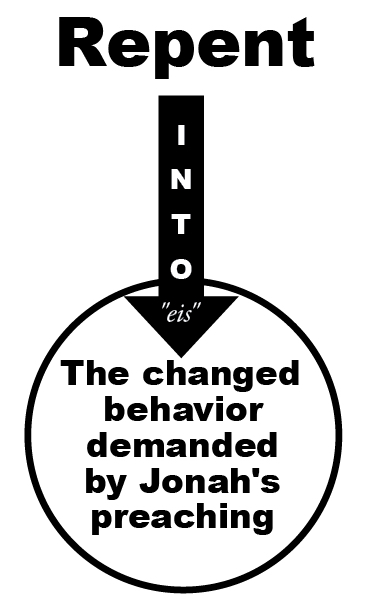
Jonah preached a succinct, simple, but demanding, message to pagan Gentiles. What was the result? Did they offer mere oral platitudes that paid lip service to religion—like the scribes and Pharisees? No, they truly repented. But, apart from Jesus informing us of their repentance, how do we know they repented, seeing that the Bible terms for repentance are not used in the Jonah account to describe their response? Because we are informed what, precisely, they did after hearing Jonah’s preaching: they proclaimed a fast, put on sackcloth, the king covered himself in sackcloth, sat in ashes, and sent forth a decree to all the Ninevites requiring abstinence from food and drink, and made loud entreaties to God (Jonah 3:5-9). Jonah 3:10 summarizes: “Then God saw their works, that they turned from their evil way; and God relented from the disaster that He had said He would bring upon them, and He did not do it.” Observe that their post-repentance activities are stylized “works” and that these extensive enactments were evidence of their repentance. Hence, they “repented into the preaching of Jonah.” Having been convinced by Jonah’s preaching to the point that they changed their thinking (i.e., repented), they then coupled their repentance with genuine compliance with the demands that Jonah laid before them. They repented into that state or condition demanded by Jonah’s preaching.1 A so-called “causal eis” does not exist.2
Endnotes
1 Jesus’ statement also constitutes an instance of the figure of speech known as “Metonymy of the Cause,” in which the cause or instrument is put for the thing effected by it. In this case, “preaching” was the instrument that Jesus mentioned, but what He was orally highlighting was the effect of Jonah’s preaching. For a discussion of this figure of speech, see E.W. Bullinger (1898), Figures of Speech Used in the Bible (Grand Rapids, MI: Baker, 1968 reprint), pp. 545ff.
2 For a discussion of the alleged “causal eis,” see Dave Miller (2019), Baptism and the Greek Made Simple (Montgomery, AL: Apologetics Press), pp. 39ff.
The post Repented “At” Jonah’s Preaching? appeared first on Apologetics Press.
]]>The post A Biblical Response to Cancel Culture appeared first on Apologetics Press.
]]>In recent years, many Christians (and those associated with Christianity) in the U.S. have felt the sting of cancel culture.
- On December 6, 2018 in West Point, Virginia, “the school board overseeing West Point High School voted unanimously to terminate the employment of French teacher Peter Vlaming” for refusing “to use a transgender student’s preferred pronoun, citing religious reasons.”4 Though Vlaming was “well-liked by his students, and did his best to accommodate their needs and requests,”5 and “consistently accommodated the [transgender] student by using the student’s preferred name instead of the student’s given name” (avoiding the use of any pronoun),6 Vlaming was ultimately fired for “something he couldn’t say.”7
- In January 2021, Twitter locked the account of Daily Citizen, a magazine owned by Focus on the Family. What was the magazine’s violation? They posted: “On Tuesday, President-elect Joe Biden announced that he had chosen Dr. Rachel Levine to serve as Assistant Secretary for Health at the Department of HHS. Dr. Levine is a transgender woman, that is, a man who believes he is a woman.”8 Twitter proceeded to send Daily Citizen an email pointing out that “repeated violations may lead to a permanent suspension of your account.”9
- It seems more than acceptable to be pro-abortion in the corporate world. However, when John Gibson, the CEO of Tripwire Interactive (a video game developer), tweeted on September 4, 2021, how proud he was of the U.S. Supreme Court for “affirming the Texas law banning abortion for babies with a heartbeat,” he was quickly canceled. Gibson’s tweet “drew fire on social media,”10 and the CEO found himself without a job only two days later when Tripwire announced the company was moving forward with a new interim CEO.
We could go on and on with examples such as these from just the past decade. The fact is, the U.S. has become increasingly more non-religious and immoral in the past 50 years11 and increasingly intolerant of what the Bible teaches about many things. Suffice it to say, being a Bible-believing, Jesus-following, Gospel-teaching Christian in 21st-century America (regardless of how genuinely kind you might be) may very well get you, your family, church, Christian school, podcast, Twitter account, etc. canceled one way or another.
Cancel Culture Is Nothing New for God’s People
Am I saddened that America is not nearly as religious as previous generations? Am I sickened by a society that has become increasingly more like the one Isaiah saw in Jerusalem 2,700 years ago—where people “call evil good, and good evil; who put darkness for light, and light for darkness; who put bitter for sweet, and sweet for bitter” (Isaiah 5:20)? Most certainly. Though America has always been far from perfect, it seems that sin has never been as publicly, prevalently, and perversely celebrated as it is today. Still, Christians must consider current events in light of history. We should be careful not to get too “bent out of shape” about cancel culture in light of the fact that cancel culture is nothing new for God’s people. Acting as if “this is so unbelievable” is pretty naïve in light of all that the Bible teaches.
When Abraham’s great-grandson Joseph died in Egypt, along with all of his generation, a new king arose “who did not know Joseph” (Exodus 1:8). Shortly thereafter, Pharaoh and the Egyptians began making the day-by-day lives of the Israelites increasingly miserable. “[T]hey set taskmasters over them to afflict them with their burdens” (1:11). “[T]he Egyptians made the children of Israel serve with rigor. And they made their lives bitter with hard bondage” (1:13-14). The king of Egypt even went so far as to cancel the ever-growing population of the Israelites by commanding the Hebrew midwives to kill all the newborn sons of the Israelites, sparing only the daughters (1:16). When this plan failed, “Pharaoh commanded all his people, saying, ‘Every son who is born you shall cast into the river’” (1:22).
Living as faithful spokesmen of God has been quite trying throughout most of world history. (It may be that preachers have never had it easier than in the United States over the past half-century.) The prophet Samuel feared King Saul would kill him for anointing David as the next king of Israel (1 Samuel 16:1-13). During the days of Queen Jezebel, she “massacred the prophets of the Lord,” which led Obadiah to hide 100 prophets in caves (1 Kings 18:4). [Yet, King Ahab called the prophet Elijah the “troubler of Israel” (1 Kings 18:17)!] When Jezebel threatened to end the life of Elijah, “he arose and ran for his life” (1 Kings 19:2-3). The faithful prophet Micaiah was insulted, struck, and imprisoned for speaking God’s unpopular truth to King Ahab (1 Kings 22:1-40). The prophet Jeremiah was threatened, beaten, put in stocks, and cast into a cistern full of mud and left to die (prior to being rescued—Jeremiah 20:1-2; 38:1-13).
Threatened by the arrival of the promised Messiah, the wicked King Herod the Great sought to kill baby Jesus and thus “sent forth and put to death all the male children who were in Bethlehem and in all its districts, from two years old and under” (Matthew 2:16). Herod Antipas imprisoned John the baptizer “for the sake of Herodias, his brother Philip’s wife; for he had married her. Because John had said to Herod, ‘It is not lawful for you to have your brother’s wife.’ Therefore Herodias held it against him and wanted to kill him” (Mark 6:17-19). She eventually got her wish. The courageous prophet of God and forerunner of Christ was permanently canceled by being beheaded. An executioner literally “brought his head on a platter” to the daughter of Herodias, who in turn “gave it to her mother” (Mark 6:27-28).
During Jesus’ ministry, the hard-hearted, hypocritical religious leaders of His day continually sought to cancel Him. As soon as the perfectly meek and sinless Son of God began to reveal Himself as the long-awaited Messiah in His hometown of Nazareth, “all those in the synagogue…were filled with wrath, and rose up and thrust Him out of the city; and they led Him to the brow of the hill on which their city was built, that they might throw Him down over the cliff” (Luke 4:16-30). Thankfully, Jesus escaped.
On another occasion, Jesus’ enemies “took up stones to throw at Him” (John 8:59). After Jesus raised Lazarus from the dead, the Jewish chief priests and Pharisees “plotted to put Him to death…from that day on” (John 11:53). Ultimately, Jesus was arrested, mocked, beaten, scourged, and nailed to a cross.
Early Christianity was born into a world of cancel culture. Jesus had prophesied that the apostles would “have tribulation” (John 16:33) and, indeed, they did. In Acts 2, on the first Pentecost after the death and resurrection of Jesus, the apostles were mocked as being drunk (Acts 2:13). Soon thereafter, the apostles were arrested three times. They were threatened, imprisoned, and beaten by their Jewish rulers (Acts 4-5). Herod killed the apostle James and then arrested Peter with the likely intention of killing him, too (12:1-4). Stephen was stoned to death for preaching Bible Truth to a “stiff-necked” people (7:51-60). Then “a great persecution arose against the church which was at Jerusalem,” and they were “scattered throughout the regions of Judea and Samaria” (8:1).
Shortly afterward, Saul, an oppressor of the Church, became a follower of Christ—a member of the very Church he previously sought to destroy (Acts 9:1-19). Not surprisingly, Saul (whose name was changed to Paul—13:9) became the oppressed rather than the oppressor. Paul was persecuted from the time he became a Christian (9:23-25) throughout the rest of his life. The attempted canceling of Paul and his preaching by Jews and Gentiles is a recurring theme in the book of Acts as well as in Paul’s epistles. To the church at Corinth he wrote about his “stripes above measure, in prisons more frequently, in deaths often” (2 Corinthians 11:23). He said: “From the Jews five times I received forty stripes minus one. Three times I was beaten with rods; once I was stoned” (2 Corinthians 11:24-25).
If the early Church could hear Christians in today’s America complain about cancel culture, I cannot help but think they would tell us to “toughen up.” Christians today in North Korea, China, or various Middle Eastern countries would gladly exchange their cruel and repressive cancel culture for ours. Could it be that our God above is looking down upon us wondering why we are not endeavoring to have a broader, more biblically and historically informed perspective on current events?
I’m not saying cancel culture is not real. I’m not suggesting we be unsympathetic toward anyone who has suffered the loss of a job, public humiliation, relentless criticism, emotional stress, financial difficulties, etc.—especially for righteousness’ sake. I’m not advocating we refrain from praying and voting for morally minded, potential U.S. leaders who might be able to help turn the tide of cancel culture on local, state, and national levels. But I am imploring God’s people not to act as if (1) we are the only ones to face cancel culture or (2) we have it that hard, comparatively speaking.
Resist the Cancel-Culture Mentality
The temptation to react to cancel culture with a similar canceling mentality is real. Like immature children, we are tempted to respond to ridicule with ridicule, to wrath with wrath, and to censorship with censorship. However, God calls us to a much higher standard. We can choose to be like the angry cancel-culture mob in Acts 7—an incensed crowd who “shouted with loud voices, and covered their ears and rushed” at Stephen (Acts 7:57, NASB), and “cast him out of the city and stoned him” (7:58). Or, we can choose to follow the instructions of God and be “swift to hear, slow to speak, slow to wrath; for the wrath of man does not produce the righteousness of God” (James 1:19-20). We can choose to cancel unkind classmates and co-workers, or we can choose to be Christ-like and “turn the other cheek” and “go the extra mile” (cf. Matthew 5:39,41). Jesus taught: “[I]f you love those who love you, what credit is that to you? For even sinners love those who love them. And if you do good to those who do good to you, what credit is that to you? For even sinners do the same” (Luke 6:32-33). “I say to you, love your enemies, bless those who curse you, do good to those who hate you, and pray for those who spitefully use you and persecute you, that you may be sons of your Father in heaven” (Matthew 5:44-45).
Jesus knew before He ever came to Earth that most people would either hate Him or care nothing for Him. He knew He was coming into a chaotic cancel culture, yet He still came for the purpose of saving souls. One thousand years before Christ, David prophesied that the Messiah would be “scorned by everyone, despised by the people.” The people would “mock” Him and “hurl insults, shaking their heads” (Psalm 22:6-7, NIV). They would “shoot out the lip” at the Lord (Psalm 22:7, NKJV). Isaiah prophesied that Jesus would be “despised and rejected by men, a Man of sorrows and acquainted with grief” (Isaiah 53:3). Sure enough, when Jesus stepped out of heaven to heal the sin-stained, broken souls of humanity, “He came to His own, and His own did not receive Him” (John 1:11).
Jesus willfully came to reside in and engage a world full of the cancel-culture mentality. He came to a people who would go so far to cancel Him that they brutally crucified Him. Yet, Jesus responded with love, open arms, and a forgiving spirit. Jesus communicated love from the cross to the very end. We don’t hear Him saying, “I’m going to get you for this,” but “Father, forgive them, for they do not know what they do” (Luke 23:34). He showed concern for others, including for the penitent thief dying next to Him.
Before Jesus’ crucifixion, His invitation was open: “Come to Me, all you who labor and are heavy laden, and I will give you rest” (Matthew 11:28). Ever since His crucifixion and resurrection, His invitation for anyone to receive eternal life has remained open: “And the Spirit and the bride say, ‘Come!’ And let him who hears say, ‘Come!’ And let him who thirsts come. Whoever desires, let him take the water of life freely” (Revelation 22:17).
This same Jesus said, “Go into all the world [even to cancel-culture] and preach the gospel to every creature” (Mark 16:15). Don’t withdraw from cancel culture and allow your light to go dim. Rather, even in—yes, especially in—a dark world, “Let your light so shine before men that they may see your good works and glorify your Father in heaven” (Matthew 5:16). As Peter said: “Always be ready to give a defense to everyone who asks you a reason for the hope that is in you, with meekness and fear” (1 Peter 3:15). As Paul wrote to the church at Colosse: “Conduct yourselves with wisdom toward outsiders, making the most of the opportunity” (Colossians 4:5, NASB).
Respond to Cancel Culture with…
So how should we engage a culture that seems to be growing less religious and more intolerant toward Christianity day by day? What biblical principles and precepts must we keep in the forefront of our minds as we face increasing amounts of intimidation and discrimination?
Courageous Determination to Be Faithful
Regardless of all that is going on around us and regardless of what happens to us, God expects His people to “not be afraid of what you are about to suffer” but “be faithful, even to the point of death” (Revelation 2:10).12 If Noah could be faithful and do “all that the Lord commanded him” (Genesis 7:5), even while living during a time when “the wickedness of man was great in the earth, and that every intent of the thoughts of his heart was only evil continually” (Genesis 6:5), then so can we. If Job could trust God and “not sin nor charge God with wrong” (Job 1:22; 13:15), even while his world caved in around him, we, too, can be faithful even when the world seems to be caving in around us. If Moses could face Pharaoh’s wrath with the courageous determination to follow the Lord, then so can we. If Joshua and Caleb could face the giants of their day, if Daniel could face a lion’s den, and if Shadrach, Meshach, and Abed-Nego could face a fiery furnace, then we have no excuses.
Are things hard now? Perhaps. Will things be much more challenging in the future? Probably. Regardless, “be strong and very courageous” (Joshua 1:7), “[f]or God has not given us a spirit of fear, but of power and of love and of a sound mind” (2 Timothy 1:7).
Though there are many “enemies of the cross of Christ: whose end is destruction, whose god is their belly, and whose glory is in their shame—who set their mind on earthly things,” God calls us to remember our heavenly citizenship (Philippians 3:18-20). With dogged determination, we are to be “reaching forward to those things which are ahead” and “press[ing] toward the goal for the prize of the upward call of God in Christ Jesus” (Philippians 3:13-14).
Patience
Cancel culture nearly always rushes to judgment. The mainstream media tends to be quick to pounce on people, especially those whom they dislike. Perhaps nowhere is quick-tempered impatience seen more than on social media—where lashing, gnashing, and trashing are commonplace and where drama is stirred 24/7.
Christians desperately need to take a deep breath, clear their minds daily, and cautiously navigate the tumultuous world around us, including and especially on social media. We need to meditate regularly upon the fact that Almighty God is “the God of patience” (Romans 15:5). Peter wrote about how “the Divine longsuffering waited in the days of Noah” (1 Peter 3:20)—seemingly for 120 years before judging the world with the Flood (Genesis 6:3).13 The Lord then waited some 400 years before judging the iniquity of the Amorites and the rest of the wicked Canaanite nations (Genesis 15:14-16). The Bible is clear in its portrayal of God: He is “longsuffering…not willing that any should perish but that all should come to repentance” (2 Peter 3:9). He “desires all men to be saved and to come to the knowledge of the truth” (1 Timothy 2:5).
With the perfect example of patience set before us in the very nature of the God we serve, how can Christians not strive to be patient and longsuffering toward the lost world around us (as well as each other)? “[T]he works of the flesh” include many sinful characteristics of cancel culture: “hatred, contentions, jealousies, outbursts of wrath, selfish ambitions, dissensions, heresies, envy…and the like” (Galatians 5:19-21). On the other hand, “the fruit of the Spirit is…longsuffering” (Galatians 5:22). Yes, God expects Christians to “walk worthy of the calling with which you were called…with longsuffering, bearing with one another in love” (Ephesians 4:1-2). So, rather than be quick-tempered and jump at the opportunities to try to cancel what we deem to be cancel culture, “let us not grow weary while doing good…. [A]s we have opportunity, let us do good to all” (Galatians 6:9-10).
Love
Hateful things are often said and done on social media. Hostility toward one group or another is often highlighted and fomented by various news outlets. Christians are often accused of being hateful for believing and teaching what the Bible says about many things, including God’s creation of two (and only two) genders (Genesis 1:27; 2:7,18-24), the sanctity of all human life (including the unborn),14 all forms of sexual immorality (Romans 1:26-32; 1 Corinthians 6:9-11), and the narrow road to eternal life going only through the Savior, Jesus Christ (John 14:6). The entirety of God’s Word has never been popular with the majority of humanity. The response sometimes (or oftentimes) is to accuse Christians of being hateful.
However the world acts (or reacts); whatever is said about Jesus, His Word, His Church, or individual Christians; regardless of what the world does, God’s instructions are clear: “love the Lord” and “love your neighbor as yourself” (Matthew 22:37-39). Never respond to hateful words or actions with a mean spirit. Christians are commanded to “detest what is evil” (Romans 12:9, NASB) while loving the precious soul who sadly commits it. If “Christ Jesus came into the world to save sinners” (1 Timothy 1:15), including murderers and persecutors of Christians (e.g., Saul), then are followers of Christ not to love sinners like Jesus did (John 3:16-17; Romans 5:6-8)? Certainly, we are.
As you interact with the unbelieving world on a regular basis, “Let your speech always be with grace, seasoned, as it were, with salt, so that you may know how you should respond to each person” (Colossians 4:6, NASB).
Avoid foolish and ignorant disputes, knowing that they generate strife…. [A] servant of the Lord must not quarrel but be gentle to all, able to teach, patient, in humility correcting those who are in opposition, if God perhaps will grant them repentance, so that they may know the truth and that they may come to their senses and escape the snare of the devil, having been taken captive by him to do his will (2 Timothy 2:23-26).
Sincerity
Paul warned, “Let love be without hypocrisy” (Romans 12:9). Peter similarly wrote: “[L]ove one another fervently with a pure heart…laying aside all malice, all deceit, hypocrisy, envy, and all evil speaking” (1 Peter 1:22; 2:1). Jesus called out many of the religious leaders of His day, saying, “[Y]ou…outwardly appear righteous to men, but inside you are full of hypocrisy and lawlessness” (Matthew 23:28). Thus, the Lord warns us “that unless your righteousness exceeds the righteousness of the scribes and Pharisees, you will by no means enter the kingdom of heaven” (Matthew 5:20).
Before Paul wrote to Timothy, instructing him to “preach the word” and “do the work of an evangelist” (2 Timothy 4:2,5), he first highlighted the vital “genuine [unhypocritical]15 faith that is in you” (2 Timothy 1:5). Furthermore, years prior to Paul penning 2 Timothy, he desired this young servant of Christ to accompany him on his second missionary journey (into some hostile, pagan cancel-culture societies—Acts 16-17). Note carefully, however, that Paul only wanted this after coming to learn that Timothy “was well spoken of by the brethren” (Acts 16:2-3). That is, those who knew him best were genuinely able to vouch for his sincere love for the Lord and His Church.
Cancel culture can often sniff out a hypocrite (especially one with whom they disagree) at lightning speed. However, such microscopic examination by the enemies of Christianity should be expected and even welcomed. Sincere Christians, though imperfect, should have nothing to hide. If we do, our prayer should be that our hypocrisy comes to light as soon as possible in the hopes of bringing about personal repentance and restoration so that as little damage as possible is done to the Lord’s Church.
To restore any lost reputation, Christians should begin living a simple, honest, sincere, loving, humble, patient, and persistent life one day at a time. Trying to force a restored reputation upon society will appear (especially to cancel culture) as insincere and as though you are trying to bully your way back into the good graces of others.16 Instead, let things come about more naturally over time, as a consequence of a genuine daily walk with the Lord. In the long run, as the old “Sheep Thief” story goes (where sheep thieves were caught and branded with the letters ST on their foreheads), a real penitent person will eventually become known as a sincere “saint” (and not the “sheep thief” that he once was).
Reason
Cancel culture is generally unreasonable. Canceling tactics often include shouting, bullying, threatening, slandering, discriminating, and trying to silence the opposition in the public square (whether in person or on social media). It seems rare for individuals and groups with a cancel-culture mentality to want to reason together in a cool, calm, and rational manner.
The prophet Isaiah responded to the moral corruption of his day (especially under King Ahaz’s reign—2 Chronicles 28:19) by calling his hearers to “[c]ome now, and let us reason together” (Isaiah 1:18). When the prophet Samuel addressed the nation of Israel at King Saul’s coronation, he did not deliver an emotionally based speech but “reason[ed]” with them (1 Samuel 12:7). Consider also the stark contrast between Elijah and the prophets of Baal. In hopes of getting the attention of the false god Baal, these emotionally charged, pretend prophets “leaped about the altar,” “cried aloud,” and “cut themselves, as was their custom, with knives and lances, until the blood gushed out on them” (1 Kings 18:26,28)—all for naught. Elijah, on the other hand, had a rational faith that was grounded in the Word of God. He said to God, “I have done all these things at Your Word” (1 Kings 18:36). His faith, as well as the message of faith that He preached, were rooted and grounded in the Heavenly revealed, rational Word of God.
When Jesus healed a demon-possessed man, His enemies illogically charged Him with casting out demons “by Beelzebub, the ruler of the demons” (Matthew 12:24). Jesus responded, not with hate speech, but with a sensible argument: “Every kingdom divided against itself is brought to desolation, and every city or house divided against itself will not stand. If Satan casts out Satan, he is divided against himself. How then will his kingdom stand? And if I cast out demons by Beelzebub, by whom do your sons cast them out? Therefore they shall be your judges” (Matthew 12:25-27).
In Ephesus, Paul had spent months in the local synagogue and years in the school of Tyrannus “reasoning” about Christianity. Paul “coveted no one’s silver or gold or apparel” (20:33). His message was true; his defense was logical; his intentions were honorable. The Ephesian idolaters, however, were the exact opposite. Whereas Paul reasoned that “they are not gods which are made with hands” (19:26), the pagan Ephesians were more concerned about money and tradition than truth and reason (19:25). They proceeded to be driven by angry emotions as “the whole city was filled with confusion, and rushed into the theater with one accord…. [M]ost of them did not even know why they had come together.” Yet, for two hours, “all with one voice cried out…‘Great is Diana of the Ephesians!’” (19:29,32,34). Imagine that—repeatedly shouting the same exact expression (“Megala a Artemis Ephesion”) for 120 minutes. Such mob-like tactics (1) seem somewhat characteristic of the cancel culture of our day and (2) are the very opposite of how New Testament Christians are to conduct themselves.
Do not miss the stark contrast between the true Gospel of Jesus Christ that Paul defended and the repetitive, emotionally charged nonsense that Demetrius and the pagan Gentiles preached. Paul “persuaded and turned away many people” from idolatry to the true and living God in Ephesus and “throughout almost all of Asia” (Acts 19:26). He did it without force or the threat of force. He did it without reverting to dishonest, foolish tactics. It was with crystal-clear arguments that could withstand scrutiny and with genuine love for the Lord and lost souls that Paul sought to persuade open-minded, honest-hearted people to follow the Lord Jesus Christ.
Continual Teaching
Finally, though Christians living within a cancel culture are to be loving, patient, and humbly submissive to those in positions of authority (whoever they may be—1 Peter 2:13-14,18; 5:5-6), we must never stop teaching the saving Gospel of Jesus Christ (Romans 1:16). We must never harass, badger, and be unkind, but we must continue to scatter “the seed…the word of God” (Luke 8:11). We may not convince many, or any at all but, like Noah, we will preach (2 Peter 2:5).
Jesus responded to cancel culture by becoming the greatest Teacher the world has ever known. He responded to the opposition’s “stop” with “go”—“Go into all the world and preach the Gospel to every creature” (Mark 16:15). When threatened and commanded by Jewish authorities “not to speak at all nor teach in the name of Jesus,” Peter and John said, “[W]e cannot but speak the things which we have seen and heard” (Acts 4:18-21). After the apostles’ third arrest and interrogation, the Jewish council asked, “Did we not strictly command you not to teach in this [Jesus’] name?” Peter and the apostles replied: “We ought to obey God rather than men” (Acts 5:28-29). After the apostles were beaten and commanded once again “that they should not speak in the name of Jesus” (Acts 5:40), they were released. How did these early disciples react to such intense cancel culture? They “rejoic[ed] that they were counted worthy to suffer shame for His name. And daily in the temple, and in every house, they did not cease teaching and preaching Jesus as the Christ” (Acts 5:41-42).
People may accuse us of being unloving because we teach what Jesus taught—a message of repentance (Mark 1:15; Luke 13:3,5; 24:47; Acts 2:38). Our peers may hate us for teaching like our Lord—about heaven and hell (Matthew 25:31-46; Mark 8:42-48; John 14:1-6). Still, with all the love we can muster and with all the courage that God will give us, we continually teach of the saving power of Jesus Christ. As we go about our daily lives, we do so “speaking the truth in love” (Ephesians 4:15).
Conclusion
Perhaps no other words in Scripture better pertain to Christians living, thriving, and teaching in a cancel culture than 1 Peter 3:14-16. Peter, who repeatedly experienced cancel culture’s threats, bullying, and abuse, exhorted first-century saints who were about to face a “fiery trial” (1 Peter 4:12), saying:
Do not fear their threats; do not be frightened. Always be prepared to give an answer to everyone who asks you to give the reason for the hope that you have. But do this with gentleness and respect, keeping a clear conscience, so that those who speak maliciously against your good behavior in Christ may be ashamed of their slander (1 Peter 3:14-16).17
And who but God knows, if your conduct is “honorable among the Gentiles…when they speak against you as evildoers, they may, by your good works which they observe, glorify God in the day of visitation” (1 Peter 2:12)?18
Endnotes
1 “Cancel Culture” (2022), Cambridge Dictionary, October 3, https://dictionary.cambridge.org/us/dictionary/english/cancel-culture.
2 E.g., Scott Gleeson (2021), “Joe Rogan, Who Says He Was Almost Vaccinated, Tells Others ‘Get Vaccinated and Then Get Sick,’” October 14, https://www.usatoday.com/story/news/nation/2021/10/14/joe-rogan-covid-vaccine/8448921002/.
3 J.K. Rowling (2020), “J.K. Rowling Writes About Her Reasons for Speaking Out on Sex and Gender Issues,” June 10, https://www.jkrowling.com/opinions/j-k-rowling-writes-about-her-reasons-for-speaking-out-on-sex-and-gender-issues/.
4 Thomas Wheatley (2019), “A Virginia Teacher Is Fighting for His Religious Freedom. Good for Him,” The Washington Post, October 9, https://www.washingtonpost.com/opinions/2019/10/09/virginia-teacher-is-fighting-his-religious-freedom-good-him/.
5 “Broad Support Filed at VA Supreme Court for High School Teacher Fired Over Pronoun Policy” (2022), Alliance Defending Freedom, May 24, https://adfmedia.org/case/vlaming-v-west-point-school-board.
6 Vlaming v. West Point School Board (2022), Alliance Defending Freedom, July 25, https://adflegal.org/case/vlaming-v-west-point-school-board.
7 “Broad Support….”
8 Jesse T. Jackson (2021), “Twitter Locks Out Focus on the Family Magazine for Calling a Transgender Woman a Man,” February 1, https://churchleaders.com/news/389324-twitter-locks-out-focus-on-the-family-magazine-for-calling-a-transgender-woman-a-man.html.
9 Ibid.
10 Khristopher J. Brooks (2021), “TripWire Interactive CEO Steps Down After Supporting Texas Abortion Law,” September 7, CBS News, https://www.cbsnews.com/news/tripwire-texas-abortion-john-gibson-gaming-tweet/.
11 “How the U.S. Religious Composition Has Changed in Recent Decades” (2022), Pew Research Center, September 13, https://www.pewresearch.org/religion/2022/09/13/how-u-s-religious-composition-has-changed-in-recent-decades/.
12 NIV.
13 Cf. Eric Lyons (2017), “Noah, the Flood, and 120 Years,” Apologetics Press, https://apologeticspress.org/noah-the-flood-and-120-years-5374/.
14 Eric Lyons (2011), “The Ungodly Irrationality Surrounding Unwanted Infants,” Apologetics Press, https://apologeticspress.org/the-ungodly-irrationality-surrounding-unwanted-infants-3506/.
15 From the Greek anupokritos, which is from hupokrites (from which we get our English word “hypocrite”).
16 Which, sadly, seems to be the case with some hard-hearted “Christian” hypocrites.
17 NIV.
18 It seems likely that this “day of visitation” is a reference to the day that a non-Christian becomes a child of God—when the Lord would, in a sense, “visit me with Your salvation” (Psalm 106:4).
The post A Biblical Response to Cancel Culture appeared first on Apologetics Press.
]]>The post Going Viral: Exploring Virus Mutations and Evolution Using SARS-CoV-2 appeared first on Apologetics Press.
]]>EDITOR’S NOTE: The following article was written by A.P. auxiliary staff scientist Dr. Deweese who holds a Ph.D. in Biochemistry from Vanderbilt University and serves as Professor of Biochemisty and Director of Undergraduate Research at Freed-Hardeman University.
Introduction
For the past two and a half years, the world has been given a front-row seat to the process of science as the pandemic of SARS-CoV-2 has made its way around the world and back again. This article examines the virus and its components with a goal to understand how the virus works and how it is changing over time. Further, we will seek to consider the implications of viral evolution and step back to think about how viruses fit into a biblical worldview. [For a more extensive study of the nature of SARS-CoV-2, see the online version of this article.]
Before January of 2020, relatively few individuals used the term “coronavirus” in everyday language, much less understood its implications. While there are a few different coronaviruses that cause things like the common cold, prior to SARS-CoV-2, only two had caused major problems in humans: severe acute respiratory syndrome coronavirus (SARS-CoV) and Middle East respiratory syndrome coronavirus (MERS-CoV). An outbreak of SARS-CoV occurred in 2002-2004, which infected over 8,000 people and killed nearly 10% of those infected.1 MERS-CoV was associated with the Arabian Peninsula and occurred from 2012-2015 with about a 30% death rate, but a very low transmission rate.2 As of October, 2021, there have been a total of 2,578 cases with 888 reported deaths (34.4%) since 2012.3 By contrast, SARS-CoV-2 has spread globally in just over two years with over 419 million cases worldwide and over 5.8 million deaths (~1.4% of those infected) so far according to the Johns Hopkins Coronavirus Resource Center.4 Unfortunately, these numbers do not clarify for us the difference between people who died from the effects of COVID versus those who died of other causes but had COVID.
In general, SARS-CoV and MERS-CoV are naturally found in rodents and/or bats but have undergone “zoonotic transmission” to infect humans.5 Zoonosis is a term used to describe a disease that has undergone “spillover” from vertebrate animals to humans.6 As you might guess, there are barriers and challenges that prevent many diseases from infecting different organisms. However, some barriers are not insurmountable. Many questions still surround how and what changes took place to give us SARS-CoV-2—were they natural mutations in animal populations or were they part of experimental efforts perhaps aiming to thwart an epidemic? There are those on various sides of these issues.7
This article is not intended to settle the question of the origin of the virus or to take a particular side. Instead, we want to ask more fundamental questions: what is different between SARS-CoV-2 and previous deadly coronaviruses? Why does it spread so quickly? What will happen moving forward? And what are the apologetic implications of the coronavirus?
What Do We Learn About Mutations and Natural Selection from SARS-CoV-2 Variants?
One way to study viruses is to see how the sequences vary from other known viruses. Interestingly, SARS-CoV-2 is only 79% similar to SARS-CoV.8 This means that both viruses share about 79% of the same sequence information. The closest sequences to SARS-CoV-2 are viruses isolated from bats found in Yunnan province 1000+ km from Wuhan, denoted RaTG13 and RmYN02.9 RaTG13 is the closest, sharing 96.2% identify, while the RmYN02 shares 93.3% identity with SARS-CoV-2 reference sequence (note that the reference sequence is the first sequence that was released by Chinese researchers before the variants). In this context, nucleotide “identity” means that two sequences are identical at that percentage of sites. Thus, 100% identity would mean that they have the same nucleotides at all possible sites. In a 30,000 nucleotide sequence, a 90% identity means that 27,000 sites match between two sequences.10
Throughout the pandemic, researchers have tracked the changes occurring in the genome of SARS-CoV-2 using advanced DNA sequencing technologies. As a result, there are now over four million SARS-CoV-2 viral sequences for us to compare in the public NCBI Virus Variation database.11 This is a bit of a unique situation because we’ve never had such a large pandemic occur while we have had the ability to sequence the genetic information of the virus in real-time worldwide. This massive effort has provided a way to track genomic changes (i.e., mutations in the virus) over time to see what types of changes are occurring and what types of changes are not occurring.
In general, we observe the changes typically seen in any organism: deletion, insertion, and single nucleotide changes. Single nucleotide changes are by far the most common. At this point, perhaps you are wondering how many changes are in the variants when compared to the reference sequence. In even the most extreme cases—like the Omicron variant—the total number of nucleotide changes (including insertions and deletions) is around 100 (less than 1%). Thus, for over 99% of the sequence there are no changes.
As of this writing, 10 variants are considered “Variants Being Monitored” (VBM) by the Centers for Disease Control, while two are listed as “Variants of Concern” (VOC): delta and omicron.12 In reviewing mutation data on these variants, most of the mutations tend to occur in the Spike protein-coding region with additional mutations in the ORF1ab region and some variants showing mutations in the nucleocapsid (N) protein-coding region.13 Mutations in the Spike protein tend to be focused within the amino terminal domain (the first part of the protein) or the RBD, as noted above. These are the regions that antibodies typically bind, especially those formed through vaccination with the mRNA vaccines.
As seen in Figure 1, Spike protein point mutation sites are mapped onto a three-dimensional model of the protein for the Omicron variant. The mutation sites are highlighted as red spheres. The region in red is the Receptor Binding Domain (RBD). The concentration of red spheres in this area underscores the importance of understanding how this region is changing and what impact that has on viral transmission and treatability. Mutations in this region can result in evasion of antibodies that target Spike protein.14 In other words, some of these mutations in the Spike protein make this region less able to be bound by antibodies from vaccination and/or prior infection. It is also worth noting that in addition to antibodies, T-cells also respond to SARS-CoV-2 and T-cell response includes binding to Spike (or other viral proteins). Notably, T-cell response in vaccinated and/or prior infected individuals still mostly retain the ability to recognize Omicron.15

Figure 1: Structure of Spike Protein Showing Region of Receptor Binding Domain. The image is a ribbon diagram of a structure generated using cryo-electron microscopy (PDB ID 6zGG). Spike protein is a trimer (three monomers) shown in blue, green, and orange. The receptor binding domain of the green monomer is colored red and spheres represent sites mutated in Omicron (Some sites are also mutated in other variants).
What can we learn from this? There are a few key takeaways for us to consider. First, mutations in SARS-CoV-2 are still rare in the sense that we do not see widespread mutation throughout the viral genome. This is due to the error correction mechanism and apparently a low tolerance of genetic change. The mutations that are occurring are enabling the virus to survive and spread more readily while causing more mild symptoms in general. Thus, you could argue that natural selection is filtering out mutations that do not benefit the virus. As noted by Dutch botanist and geneticist Hugo de Vries, however, “Natural selection may explain the survival of the fittest, but it cannot explain the arrival of the fittest.”16 Natural selection does not provide the mechanism for the origin of new information, which is necessary for the evolution of new viruses and organisms.17
Second, the types of changes we are seeing fall into the basic categories of insertions, deletions, and single-nucleotide changes. The largest insertion in the sequences examined was nine nucleotides. Interestingly, this sequence is not found anywhere in the virus or in any of the variants examined except Omicron. There is a similar sequence in the genome (about 4,000 nucleotides away) that is off by one nucleotide, but the author has not seen a lot of speculation around this sequence.
There are some limitations to this brief study. For instance, there are 10s to 100s of thousands of sequences for some of these variants. So, there will undoubtedly be variability among the various samples. Yet, even with such variability, the general themes noted above remain: no novel sets of information have been generated by the DNA changes observed. More specifically, no new proteins or enzymatic functions have been observed. Instead, mutation and selection appear to be at work on the existing protein-coding genes, which is why we see most mutations focused on regions like the Spike protein-coding sequence. In order for new features to develop as in the Neo-Darwinian model of evolution, new genetic information is needed, but we do not observe this occurring.18
SARS-CoV-2 is mutating, but it is also clear that it is still SARS-CoV-2 (i.e., we do not see new functions arising though we do see modification of functions). We are seeing first-hand what types of mutations are possible. Note that this does not necessarily mean that we know what is possible in a living organism—viral growth and mutation have unique constraints. Other studies have argued that mutations tend to modify or break existing features rather than build new ones.19 This appears to hold true in SARS-CoV-2.
Are Viruses a Form of “Natural Evil” that Support a Case Against God?
In considering the SARS-CoV-2 virus and its cost on our world, it is worth asking, why do we have viruses anyway? From a human perspective, it can often seem like all viruses are “bad.” Are viruses a “natural evil” created by God to plague the world? After all, the only time the media (or society more generally) tends to focus on viruses is in the context of the seasonal flu or in the case of an outbreak of some deadly virus—like MERS or SARS. In fact, the word “virus” originated from the Latin term for poison.20 Our language has clear implications for how we view viruses. Do viruses represent a “bad” design on the part of the Creator?
As a little exercise in considering the roles and purposes of viruses, let’s first ask: how many types of viruses are there? Current taxonomy of viral species by the International Committee on the Taxonomy of Viruses lists 10,434 species.21 It seems generally agreed that this is an under-representation of the total number of viruses in nature, as additional viruses continue to be discovered year by year. In support of this idea, it has been stated that there are ~1031 bacterial viruses (called bacteriophages) in the biosphere, which exceeds the estimate of the number of stars in the universe!22 Interestingly, only approximately 219 viruses have been found to infect humans. Of these viruses, relatively few cause disease or death in humans.23 Far fewer have been found to cause epidemics or pandemics.24 Yet, as humans, we generally focus on these few cases that cause disease rather than on the thousands of viruses (perhaps hundreds of thousands or millions?) that exist throughout nature.25
To be clear, the 1918 Spanish flu, HIV, SARS, MERS, and SARS-CoV-2 have all had a major impact on our world. Many lives were lost or dramatically changed because of these viruses and their associated epidemics or pandemics. Yet, the integral role of viruses in nature has not been all negative as will be pointed out below.
Second, if there are so many different viruses, what do they do? Are there natural and ecological functions and roles for viruses? The answer to that is yes. In fact, there are many functions and roles for viruses in nature. For example, bacteriophages, mentioned above, help control bacterial populations.26 In addition, bacteriophages can aid in transfer of genes between bacteria, serve as a nutrient repository, and defend bacteria against other bacteria.27 Further, viruses may also play similar roles in eukaryotes and higher organisms including symbiotic relationships.28 In humans, infection with GB-virus C has been associated with slowed progression of HIV infection, suggesting that this virus helps block HIV from infecting host cells.29 Some have argued that the roles of viruses worldwide are so important that life as we know it would not exist without viruses.30
So, does coronavirus have a natural role in bats or pangolins? This is a harder question to answer as few people are looking at this question—the general starting assumption is that viruses are “poison” or “pathogens.”31 Interestingly, this assumption, based upon evolutionary presuppositions, may be impeding our understanding of the roles of viruses in nature. Additional research will be needed to identify and explore such roles.
Consider for a moment: why would God allow viruses? Again, recall that most viruses do not cause problems and disease in humans, and it is reasonable to consider that many viruses have useful roles in nature. Could viruses be originally created entities that perhaps have also decayed since the Fall like our own genomes?32 If viruses were originally created by God to serve specific roles in nature, then it is possible that the nature and roles of viruses have been corrupted over time by genetic mutation.33 The biochemical components in viruses are highly sophisticated—for example, reverse transcriptase (making DNA from RNA), error-correction, self-assembly, etc. These complex systems are best explained in a design model.
This perspective on viruses being designed entities has proved to be a fruitful research endeavor.34 In fact, understanding the original design of viruses may help us identify the roles of viruses and how those roles have become corrupted over time. This may help us understand virulence and the ability of a virus to spread and mutate, which may help us predict future pandemic threats.
What can we expect moving forward? As we move forward, we can expect that SARS-CoV-2 will remain present continuing to change. The rate of change may slow since the virus is infecting fewer individuals than when it was spreading at its peak. Changes in the virus may enable it to continue to spread and possibly even cause new outbreaks, but the changes also seem to reduce the ability of the virus to cause serious illness in most people. Note that serious illness is still happening, especially in individuals with multiple risk factors, and we need to be serious about looking after those who are most at risk. The good news is that new treatments and approaches are becoming available to help minimize the health impact where possible.
Conclusion
SARS-CoV-2 has spread around the world over the last two and a half years and caused major loss of life. Though the virus has mutated during that time, no new genetic information has been generated nor have novel features developed as needed by a Neo-Darwinian model. Further, while the origin of this strain of the virus may remain contentious and debated, it is clear that viruses as a whole are designed entities fulfilling important roles in nature. It may be hard for us to identify those roles in the present time due to the genetic changes that have taken place in those viruses since the Fall in Genesis 3. Nevertheless, viewing viruses as designed entities that have experienced genetic change and decay since the Fall has served as a valuable framework for research in this area. In addition, this view helps remind us of God’s power in creation and of the consequences of sin that have been building since the Fall.
Endnotes
1 “Revised U.S. Surveillance Case Definition for Severe Acute Respiratory Syndrome (Sars) and Update on Sars Cases—United States and Worldwide, December 2003,” (2003), MMWR: Morbidity and Mortality Weekly Report, 52[49]:1202-1206.
2 B. Rha, J. Rudd, et al. (2015), “Update on the Epidemiology of Middle East Respiratory Syndrome Coronavirus (Mers-Cov) Infection, and Guidance for the Public, Clinicians, and Public Health Authorities—January 2015,” MMWR: Morbidity and Mortality Weekly Report, 64[3]:61-62.
3 WHO (2021), “Mers Situation Update.”
4 Coronavirus Resource Center Global Map (2022), Johns Hopkins University & Medicine, https://coronavirus.jhu.edu/map.html.
5 World Health Organization (2020), “Health Topics: Zoonosesd,” https://www.who.int/news-room/fact-sheets/detail/zoonoses.
6 K.G. Andersen, A. Rambaut, et al. (2020), “The Proximal Origin of Sars-Cov-2,” Nature Medicine, 26[4]:450-452; Y. Deigin, and R. Segreto (2021), “Sars-Cov-2’s Claimed Natural Origin Is Undermined by Issues with Genome Sequences of Its Relative Strains: Coronavirus Sequences Ratg13, Mp789 and Rmyn02 Raise Multiple Questions to Be Critically Addressed by the Scientific Community,” Bioessays, 43[7]:e2100015; M. Seyran, D. Pizzol, et al. (2021), “Questions Concerning the Proximal Origin of Sars-Cov-2” Journal of Medical Virology, 93[3]:1204-1206; J. van Helden, C.D. Butler, et al. (2021), “An Appeal for an Objective, Open, and Transparent Scientific Debate About the Origin of Sars-Cov-2,” Lancet, 398[10309]:1402-1404.
7 G.A. Rossi, O. Sacco, et al. (2020), “Differences and Similarities between Sars-Cov and Sars-Cov-2: Spike Receptor-Binding Domain Recognition and Host Cell Infection with Support of Cellular Serine Proteases,” Infection, 48[5]:665-669.
8 Hong Zhou, Xing Chen, et al. (2020), “A Novel Bat Coronavirus Closely Related to Sars-Cov-2 Contains Natural Insertions at the S1/S2 Cleavage Site of the Spike Protein,” Current Biology, 30[11]:2196-2203, e2193; Peng Zhou, Xing-Lou Yang, et al. (2020), “A Pneumonia Outbreak Associated with a New Coronavirus of Probable Bat Origin,” Nature, 579[7798]:270-273.
9 See the extended version of this article for a more technical discussion, https://apologeticspress.org/going-viral-exploring-virus-mutations-and-evolution-extended/.
10 E.L. Hatcher, S.A. Zhdanov, et al. (2017), “Virus Variation Resource-Improved Response to Emergent Viral Outbreaks,” Nucleic Acids Research, 45[D1]:D482-d490.
11 SARS-CoV-2 Variant Classification and Definitions (2022), CDC, https://www.cdc.gov/coronavirus/2019-ncov/variants/variant-classifications.html.
12 O’Toole, V. Hill, et al. (2022), “Tracking the International Spread of Sars-Cov-2 Lineages B.1.1.7 and B.1.351/501y-V2 [Version 1; Peer Review: 3 Approved],” Welcome Open Res, 6[121].
13 Chakraborty, A.R. Sharma, et al. (2022), “A Detailed Overview of Immune Escape, Antibody Escape, Partial Vaccine Escape of Sars-Cov-2 and Their Emerging Variants with Escape Mutations,” Frontiers in Immunology, 13:801522.
14 V. Naranbhai, A. Nathan, et al. (2022), “T Cell Reactivity to the Sars-Cov-2 Omicron Variant Is Preserved in Most but Not All Individuals,” Cell, 185[6]:1041-1051.e1046.
15 Hugo de Vries and Daniel Trembly MacDougal (1905), Species and Varieties, Their Origin by Mutation; Lectures Delivered at the University of California (Chicago, IL: The Open Court Publishing Company).
16 J.C. Sanford (2008), Genetic Entropy & the Mystery of the Genome (Waterloo, NY: FMS Publications).
17 Ibid.; Michael J. Behe (2019), Darwin Devolves : The New Science About DNA That Challenges Evolution (New York: Harper Collins).
18 Behe, 2019; M.J. Behe (2010), “Experimental Evolution, Loss-of-Function Mutations, and ‘the First Rule of Adaptive Evolution,’” Quarterly Review of Biology, 85[4]:419-445.
19 Harald Brüssow (2021), “On the Role of Viruses in Nature and What This Means for the Covid-19 Pandemic,” Microbial Biotechnology, 14[1]:79-81.
20 Peter J. Walker, Stuart G. Siddell, et al. (2020), “Changes to Virus Taxonomy and the Statutes Ratified by the International Committee on Taxonomy of Viruses (2020),” Archives of Virology, 165[11]:2737-2748.
21 F. Rohwer and R. Edwards (2002), “The Phage Proteomic Tree: A Genome-Based Taxonomy for Phage,” Journal of Bacteriology, 184[16]:4529-4535; Georgia Purdom and Joe Francis (2009), “More Abundant Than Stars,” Answers Research Journal, 2:85-95.
22 Mark Woolhouse, Fiona Scott, et al. (2012), “Human Viruses: Discovery and Emergence,” Philosophical Transactions of the Royal Society of London. Series B, Biological Sciences, 367[1604]:2864-2871.
23 Ibid.
24 Ibid.; M.E. Woolhouse, R. Howey, et al. (2008), “Temporal Trends in the Discovery of Human Viruses,” Proceedings: Biological Sciences, 275[1647]:2111-2115.
25 Purdom and Francis.
26 Z. Naureen, A. Dautaj, et al. (2020), “Bacteriophages Presence in Nature and Their Role in the Natural Selection of Bacterial Populations,” Acta Bio-Medica: Atenei Parmensis, 91[13-S]:e2020024.
27 Ibid.
28 M.J. Roossinck (2015), “Move over, Bacteria! Viruses Make Their Mark as Mutualistic Microbial Symbionts,” Journal of Virology, 89[13]:6532-6535; Marilyn J. Roossinck (2011), “The Good Viruses: Viral Mutualistic Symbioses,” Nature Reviews Microbiology, 9[2]:99-108.
29 Nirjal Bhattarai and Jack T. Stapleton (2012), “Gb Virus C: The Good Boy Virus?” Trends in Microbiology, 20[3]:124-130.
30 Purdom and Francis.
31 Roossinck.
32 Purdom and Francis.
33 Sanford.
34 Purdom and Francis.
The post Going Viral: Exploring Virus Mutations and Evolution Using SARS-CoV-2 appeared first on Apologetics Press.
]]>The post Monkey Pox: Homosexuality Is Bad for You, and God Called It Again appeared first on Apologetics Press.
]]>Let’s face it: we are prone to quickly view “rules” and “laws” that we don’t like as unnecessary and overly controlling—to be despised, eliminated, or, at the very least, ignored when possible. With very little deeper investigation, we will reject the oftentimes well-thought-out ordinances that govern our land, the instructions of a parent, or even the rules of God in Scripture. Rarely does it occur to us that we might be ignorant about the wise purposes behind various restrictions. Instead, we are quick to arrogantly assume that we know better than the authorities to which we are charged by God to submit (Romans 13:1-7; Hebrews 13:17; Titus 3:1; 1 Peter 2:13; Matthew 22:17-21).6
It is true that, as the American government and society at large moves ever farther from making laws that are based on biblical principles, those laws will become more unwise, irrational, and even evil. God’s rules, however, are guaranteed to be perfect: rational/reasonable, wise, just, and for our ultimate good. “And the Lord commanded us to observe all these statutes, to fear the Lord our God, for our good always, that He might preserve us alive, as it is this day” (Deuteronomy 6:24). God’s laws are not random or pointless. While human laws are not guaranteed to be for our good or to extend our lives, God’s laws are always for our ultimate good, and will, therefore, tend to improve our lives. And so it is with God’s rules about sexual behavior—in this case, specifically, homosexuality.
God implemented clear and decisive regulations against homosexuality—sexual relations with another person of one’s own gender:
“For this reason God gave them up to dishonorable passions. For their women exchanged natural relations for those that are contrary to nature; and the men likewise gave up natural relations with women and were consumed with passion for one another, men committing shameless acts with men and receiving in themselves the due penalty for their error” (Romans 1:26-27, ESV).
“Do you not know that the unrighteous will not inherit the kingdom of God? Do not be deceived. Neither fornicators, nor idolaters, nor adulterers, nor homosexuals,7 nor sodomites, nor thieves, nor covetous, nor drunkards, nor revilers, nor extortioners will inherit the kingdom of God. And such were some of you…” (1 Corinthians 6:9-11).
Again, when God outlaws a certain behavior, it must be for our ultimate good, regardless of whether or not we understand why or how that might be true in every case.8 As regards homosexuality, the rationale for God’s directives are abundantly clear.
As we have documented elsewhere,9 homosexuality is a toxic lifestyle that is both physically and psychologically detrimental to one’s health—not to mention the collateral damage caused for others in the process.10 Based on the statistical evidence, there can be no debate that the homosexual lifestyle is characterized by highly increased levels of sexual violence, substance abuse, psychological issues, shortened lifespans, suicide, and diseases such as Chlamydia, gonorrhea, syphilis, HPV, anal cancer, and HIV/AIDS. That truth is once again being highlighted by monkeypox, the latest worldwide outbreak of another disease that is undeniably associated with homosexual behavior.11 If we would but listen to the sexual commandments given by our loving God for our good, things would “go well” for us (Deuteronomy 4:40). Sadly, all too often, we refuse.
“Thus says the LORD: ‘Stand in the ways and see, and ask for the old paths, where the good way is, and walk in it; Then you will find rest for your souls. But they said, “We will not walk in it”’” (Jeremiah 6:16).12
Endnotes
1 Bradford Betz (2022), “Biden Administration Declares Monkeypox a Public Health Emergency,” Fox News on-line, August 4, https://www.foxnews.com/health/biden-administration-declare-monkeypox-public-health-emergency.
2 “Monkeypox Declared a Global Health Emergency by the World Health Organization” (2022), United Nations: UN News, July 23, https://news.un.org/en/story/2022/07/1123152.
3 Jason Arunn Murugesu (2022), “Monkeypox Emergency,” New Scientist, 255[3397]:7, July 30; “Monkeypox: Signs and Symptoms” (2022), Centers for Disease Control and Prevention, August 5, https://www.cdc.gov/poxvirus/monkeypox/symptoms.html; Tina Hesman Saey (2022), “Monkeypox Is a Global Health Crisis,” New Scientist, 202[3]:7, August 13.
4 Murugesu, emp. added.
5 “Take a temporary break from activities that increase exposure to monkeypox until you are two weeks after your second dose” [“Monkeypox: Safer Sex, Social Gatherings, and Monkeypox” (2022), Centers for Disease Control and Prevention, August 5, https://www.cdc.gov/poxvirus/monkeypox/sexualhealth/index.html].
6 Excepting, of course, any restrictions that violate God’s Law (Acts 5:29; Ephesians 6:1—“in the Lord”).
7 Or “catamites”—the individual in a homosexual relationship on the receiving end of the act.
8 While a small child may not understand why his parents require him to eat his vegetables, not play in the street, or touch the electrical socket, he should trust his parents to have good reasons for their rules.
9 Jeff Miller (2021), “Homosexuality: Society, Science, & Psychology [Part 3],” Reason & Revelation, 41[2]:15-20, https://apologeticspress.org/wp-content/uploads/2021/08/2102-web.pdf.
10 E.g., those who are passed diseases by others, the effect of unbridled sexual behavior on societies, etc. [Jeff Miller (2015), “God’s Word: Right About Sex,” Apologetics Press, March 22, https://apologeticspress.org/gods-word-right-about-sex-5138/.]
11 Specifically, men having sex with other men.
12 For a thorough study of the biblical, scientific, and psychological data regarding homosexuality, see Jeff Miller and Dave Miller (2021), Homosexuality: Scripture, Society, Science, and Psychology (Montgomery, AL: Apologetics Press).
Homosexuality: Scripture, Society, Science, & Psychology
The post Monkey Pox: Homosexuality Is Bad for You, and God Called It Again appeared first on Apologetics Press.
]]>The post Is Rash Judgment Sinful? appeared first on Apologetics Press.
]]>One of the alarming trends that has been repeatedly highlighted over the past few years in American society has been the increasing number of non-Christians and Christians alike who are quick to believe unsubstantiated claims. If the supposed “experts” say something, if the media reports it, or if enough people believe something, regardless of the evidence for or against it, many will accept it as true. Be it belief in a flat Earth, belief in evolution or an old Earth, disbelief in Creation or the global Flood, “blind” faith in God or an unbiblical religious doctrine, or the hasty attacks of individuals or organizations by “Cancel Culture” assassins,1 people are increasingly willing to throw caution to the wind and, like sheep, believe something without question or, at the very least, little question. Such behavior is to be expected as our society moves farther and farther away from valuing truth and closer and closer to doing what simply “feels” right to a person (cf. Deuteronomy 12:8; Judges 17:6; Proverbs 12:15). However, that mindset is dangerous and unbiblical. How so?
Fallacious
Arguing that something is true merely because a highly credentialed person—an “expert”—adheres to the position is a logical fallacy known as “appeal to authority.”2 Historically, those considered to be the “authorities” of a subject have often been wrong (e.g., John 7:47-48). Sound reasoning would restrain a person from drawing a conclusion until sufficient evidence has been provided to substantiate the conclusion.
Similarly, it may be true that most scientists have bought into the hoax of evolution, as was the case when scientists believed in geocentricity or that blood-letting was an appropriate prescription for curing ailments, but the number of believers in a certain idea does not prove the idea to be true. Does the fact that much of the world throughout history has believed in the legitimacy of sinful slavery prove abusive slavery to be moral? Arguing in such a way causes one to fall victim to yet another logical fallacy—the ad populum fallacy (i.e., appeal to the majority).3 What the majority believes and what the experts believe is irrelevant in determining the truth. The Bible warns against making judgments based upon such flimsy, incorrect reasoning (cf. Exodus 23:2; 1 Corinthians 1:26; 1 Kings 22:5-23).
Irrational
The importance of having sufficient evidence in arriving at truth cannot be overstated. In the field of philosophy, there is a general rule that is followed if a person wishes to be rational: the Law of Rationality. It says that one should only draw those conclusions that are warranted by the evidence.4 In other words, one should only believe what can be proved and demonstrated to be true.
Many within Christendom seem unaware that Scripture endorses and commands adherence to the same obvious axiom. “Test all things; hold fast what is good” (1 Thessalonians 5:21). The Bible explicitly prohibits having a “blind” faith (i.e., coming to believe something without adequate evidence). Scripture incessantly makes the point that we should come to a knowledge of the truth based on the evidence that has been provided to us. As did the “fair-minded” Bereans of Acts 17, God wants us to search for evidence that substantiates a claim before blindly believing it (vs. 11). Since many false teachers (i.e., liars) are in the world, He tells us to “not believe every spirit, but test the spirits” before believing them (1 John 4:1). Unlike fideism (i.e., blind “faith”)—which pits itself against reason5—Paul believed in establishing truth by reasoning from the evidence (Acts 26:25). In fact, Jesus told His audience not to believe Him if He did not substantiate His claims with evidence (John 10:37). “Doubting Thomas” was not in error for failing to have a blind faith. Rather, he was in error for having been witness to more evidence of the truth than nearly anybody who had ever lived or ever would live, and yet he still disbelieved, requiring even more direct, observational evidence than he had already received (John 20:24-29).
The “blind faith” idea is unbiblical, and that truth applies to more than how one arrives at those religious views in which he believes. It applies to how we arrive at any conclusion in life. “Test [prove—ASV] all things [examine everything carefully—NASB]; hold fast what is good” (1 Thessalonians 5:21). It applies to anything which we believe. Rather than blindly believing what someone tells us about, for example, a religious idea or a person, the Bible enjoins diligent study to arrive at the truth, emphasizing that most people will not be willing to engage in the soul-saving, diligent pursuit of truth that leads to life (Matthew 7:13-14). To most, then, religious truth will be forever elusive.
Unscriptural
Making rash judgments about what we decide to believe can be fallacious, is irrational, and, most importantly, is unbiblical. Besides the many passages cited above that enjoin the necessity of using sufficient evidence to arrive at conclusions, rash judgment about others violates the Bible’s teaching about assuming one’s innocence until he is proven to be guilty.
In Deuteronomy 19:15, God, through Moses, gave instruction concerning how Hebrew courts were to determine guilt when an alleged crime was committed. “One witness shall not rise against a man concerning any iniquity or any sin that he commits; by the mouth of two or three witnesses the matter shall be established.” Jesus re-affirmed the procedure in Matthew 18:16 with regard to how Christians are to sort out their differences. Paul re-affirmed the principle in 1 Timothy 5:19 with regard to how members are to bring accusations against wayward elders in the Lord’s Church.6 The implied situation, of course, is one in which an accused person has either denied guilt or has not even had an opportunity to deny or confess guilt, and where guilt/innocence cannot be determined through “diligent” inquiry, searching “out the matter” (Deuteronomy 17:4; 13:14). The timeless principle which God implemented throughout Scripture, then, forces His followers not to convict (either in a court or in their minds) any such individuals of wrongdoing without enough legitimate evidence.
Consider: based on God’s law, what would happen in Old Testament court situations where only one witness came forward to accuse another person of wrongdoing? The verdict for the person was to be “not guilty” or, more specifically, “not established guilt.” Notice, then, that it is God’s will that a person is to be presumed (or treated as) innocent in such cases, even if the person is actually guilty! In terms of human action/response to such situations, God would rather a wrongdoer “get away with murder” than for humans, with our limited knowledge, to punish an innocent person.7 The shedding of innocent blood is an abomination to the Lord (Proverbs 6:17). As He said through Solomon, “to punish the righteous is not good” (Proverbs 17:26). “Keep yourself far from a false matter; do not kill the innocent and righteous. For I will not justify the wicked” (Exodus 23:7).
In Matthew 5:22-26, Jesus addresses how brethren should handle conflict, stating in verse 22 that “whoever is angry with his brother without a cause shall be in danger of the judgment.” In other words, a person should not allow himself to think ill of his brother if he does not have a legitimate—that is, proven—reason to do so, else His disfavor is “without cause.” The “accused” should be assumed to be innocent in our minds. We should “give him the benefit of the doubt” and think the best of him, in the same way we would want to be treated by others (Matthew 7:12). After all, love “hopes all things” (1 Corinthians 13:7), rather than assuming guilt. As society moves farther away from a Christian, biblical mindset, we should expect to see less biblical love to be manifested, including how gracious we are towards those who may have wronged us.
A Christian must be extra careful not to judge someone as guilty without sufficient evidence. It is notable that under the Law of Moses, in court settings, bearing false witness against another (whether intended or not) would result in the same punishment for the witness that the accused would have received due to his testimony—including execution (Deuteronomy 19:18-19). Question: is it important to God that His followers not rashly and incorrectly draw conclusions about others?
Jesus, of course, was no stranger to being unfairly and rashly accused of sinful behavior. From condemnation of His eating with sinners and tax collectors (Matthew 9:10-11), to violating the Sabbath (Mark 2:23-24), to not encouraging His disciples to obey the elders’ traditions in washing their hands before eating (Matthew 15:2), to various healings which He conducted on the Sabbath Day (e.g., Luke 13:12-14; Matthew 12:9-148), to His claims of being equal with God (John 5:17-18), His jealous enemies were quick to jump to conclusions about His behavior and accuse Him of being sinful and even blasphemous. Instead of considering His sound refutation of their arguments and the preponderance of miraculous evidence that established the truth of His message (Mark 16:20; Hebrews 2:3-49) and proved God’s sanctioning of His behavior (John 5:36-37), His closed-minded, irrational, hard-hearted critics would ultimately kill Him due to their refusal to draw conclusions warranted by the evidence.
In John 5 we find one of the instances of Jesus healing an individual on the Sabbath day, resulting in an escalation of the Jewish leaders’ hatred towards Him and desire to execute Him. In John 7 Jesus directly addressed their incorrect interpretation and application of Sabbath regulations (vss. 22-23) and proceeded to get to the root of their error: “Do not judge according to appearance, but judge with righteous judgment” (vs. 24). Jesus told His critics not to believe something merely because of how it appears to be on the surface. Instead, humbly acknowledge that some things are not as they seem at first. Then, dig deeper. “Don’t judge a book by its cover” but, instead, get your facts straight before deciding guilt.
“But we wouldn’t want the guilty person to go free, right?” True, but who says such a person will ultimately go unpunished? In the end, our just God will ensure that any guilty person will be punished. In some cases, however, it is not our place to implement justice (Romans 12:19; Leviticus 19:18; Deuteronomy 32:35). In God’s sight, if we do not have enough evidence to prove guilt and implement discipline, it is not our place to do so. God’s rule is that, if there is going to be error in implementing judgment, humans should err on the side of the innocent.
Conclusion
It is easy for us to be arrogant, thinking that our personal judgment or opinion about something is sufficient to establish it as “basically” true, even when we do not have all the necessary facts to warrant that belief. We would, no doubt, acknowledge that others need all the facts, but apparently not us. We may not consciously tell ourselves so, but we pridefully, tacitly believe that our “exceptional” intuition is beyond that of those around us. We are not, however, omniscient. As weak and fallible humans, we need sufficient facts to be sure we are right and, even then, may still be wrong.10
What should we do, then, when we hear a negative story in the news or on social media about a politician, a suspect in a crime, a police officer, or a belief that seems to be held by “most” people—not a jury conviction, but mere stories or claims? How should we respond when someone is accused of sexual misconduct by the media? What about when we see video footage or pictures that seem to prove guilt at first glance (but which can be doctored or spun to support a narrative)? Should we assume that individual to be guilty—until proven innocent, simply because the media, an expert, or a friend said that the person is guilty? Should a person be considered innocent until claimed to be guilty or, rather, until proven to be guilty? Are allegations sufficient evidence to prove guilt? No, a person must dig deeper, gathering sufficient evidence to draw a conclusion. After all, “The first one to plead his cause seems right, until his neighbor comes and examines him” (Proverbs 18:17). We should never forget that Jesus would have looked guilty to many people. His actions were witnessed by more than an individual with a camera phone. Hundreds of people witnessed His alleged “Sabbath-breaking” actions and “blasphemous claims,” but since they did not have all the relevant facts, they were not in a position to judge His guilt.
The remaining option that is available to us if we cannot gather sufficient evidence to determine the truth: stay out of the matter, postponing judgment about the person or subject. Is it possible that many of us have “learned to be idle, wandering about from house to house [e.g., through social media], and not only idle but also gossips and busybodies, saying things which [we] ought not” (1 Timothy 5:13)? As Peter said, “But let none of you suffer…as a busybody in other people’s matters” (1 Peter 4:15). Are the duties assigned to us by the King of the Universe not enough to keep us busy virtually every moment of our day as His subjects? Have we noticed that the world around us is spiritually ablaze and in need of the cleansing blood of Christ that His subjects are charged with disseminating?
Imagine how different the world would be if we were willing only to draw those conclusions that are warranted by the evidence. What if scientists did not blindly accept naturalism, despite its popularity: the unobserved, unproven, and unprovable Big Bang, molecules-to-man evolution, and a billions-of-years-old Universe? What if they actually considered all of the evidence rather than ignoring the powerful evidence for God and biblical Creation? What if politicians and government officials gathered sufficient evidence before making decisions that would affect entire countries and even future generations? What if people gathered sufficient evidence before rashly making assumptions about others simply because of their skin color? What if people gathered enough evidence about the situation before condemning a police officer who used deadly force against a citizen? What if Americans gathered enough evidence before blindly believing what the biased media and politicians claim about someone, proceeding to “cancel” them before they have even been fairly heard and tried? What if Christians gathered enough evidence before thinking ill of and attacking their brethren? What if people gathered everything the Bible says on a subject before coming to premature conclusions (e.g., “faith only”)?
If the principle of “innocent until proven guilty”11 had been followed, Stephen would not have been stoned (Acts 7), Paul would not have persecuted Christians (Acts 8-9), and Jesus would not have been crucified. But consider: if we lived at the time of Christ, would we have been any different than the masses who followed the crowd, believing whatever they were being told, instead of testing all things and holding fast only to those things that are good/true (1 Thessalonians 5:21)? If it is our tendency to make premature judgments about others, why would we rashly assume that we would not be among those who rashly consented to Christ’s crucifixion? After all, Jesus looked guilty on the surface. A smart phone was not necessary because, once again, hundreds witnessed Him with their own eyes “working” on the Sabbath. The majority believed He was guilty, and the religious experts/scholars whom the people trusted had judged Him as worthy of death. So, should Jesus not have been executed? Would I have been among those in the mob seeking to execute Jesus as well, or would I have been like Nicodemus who recognized the need for more evidence before conviction should be made (John 7:50-52)?
Bottom line: according to Scripture, a person should be presumed to be innocent until proven to be guilty. A Christian should humbly acknowledge his limited knowledge and tendency to make mistakes and, when sufficient evidence is not available to determine the truth on a subject, give others the benefit of the doubt. It’s what God expects.
Endnotes
1 E.g., rash accusations against others of being racist, sexual abuse allegations, suggestions about police brutality, panic about COVID, the efficacy of masks, or adamancy about the necessity of others taking certain relatively new vaccines.
2 “Appeal to Authority” (2019), Logical Fallacies, http://www.logicalfallacies.info/relevance/appeals/appeal-to-authority/.
3 “Fallacies” (no date), The Writing Center: University of North Carolina at Chapel Hill, http://www.unc.edu/depts/wcweb/handouts/fallacies.html.
4 Lionel Ruby (1960), Logic: An Introduction (Chicago, IL: J.B. Lippincott), pp. 130-131.
5 “Fideism” (2015), Merriam-Webster On-line Dictionary, http://www.merriam-webster.com/dictionary/fideism.
6 Cf. 2 Corinthians 13:1; 1 Timothy 5:19; John 5:31ff.; 10:37; Concerning judging guilt for murder, specifically, see Numbers 35:30; Deuteronomy 17:6; Hebrews 10:28; Revelation 11:3; Matthew 26:60.
7 Even in the case of two or three witnesses, an innocent person could still be condemned. The witnesses, however, were to be carefully vetted (Deuteronomy 19:18) to make sure they were legitimate and reliable, making convictions of innocents less likely (assuming the court was not already biased against the accused, as in the case of Jesus’ “trial”).
8 Dave Miller (2015), “Did Jesus Break the Sabbath?” Reason & Revelation, 35[5]:56-59, https://apologeticspress.org/wp-content/uploads/2021/08/1505.pdf.
9 Dave Miller (2003), “Modern-Day Miracles, Tongue-Speaking, and Holy Spirit Baptism: A Refutation—EXTENDED VERSION,” Apologetics Press, https://apologeticspress.org/modern-day-miracles-tongue-speaking-and-holy-spirit-baptism-a-refutation-extended-version-1399/.
10 E.g., in cases where we unknowingly have insufficient evidence or misinterpret the evidence.
11 Dave Miller (2018), “Presumption of Innocence,” Apologetics Press, https://apologeticspress.org/presumption-of-innocence-5622/.
Is Christianity Logical?
The post Is Rash Judgment Sinful? appeared first on Apologetics Press.
]]>The post Young People Leave the Faith Because They Believe Christianity is ANTI-Science appeared first on Apologetics Press.
]]>Many young Christians have come to the conclusion that faith and science are incompatible. Yet they see the mostly helpful role science plays in the world they inhabit—in medicine, personal technology, travel, care of the natural world, and other areas. What’s more, science seems accessible in a way that the church does not; science appears to welcome questions and skepticism, while matters of faith seem impenetrable.1
He further noted that the research showed that 29% of 18-29 year-olds said that churches “are out of step with the scientific world we live in, while one-quarter (25 percent) described Christianity as anti-science.”2 He related the story of a Catholic man named Mike who became an atheist. Mike said: “It was tenth grade. I started learning about evolution. It felt like my first window into the real world. To be honest, I think that learning about science was the straw that broke the camel’s back. I knew from church that I couldn’t believe in both science and God, so that was it. I didn’t believe in God anymore.”3 Kinnaman summarized the research by saying: “Issues of science are one of the significant points of disconnection between the next generation and Christianity.”4
At Apologetics Press, we have known for over four decades that this is the case. We have listened to countless, heartbroken parents tell us how their faithful Christian children abandoned their faith in God for the more “honest, intellectual” approach presented by modern atheistic science. In truth, this tragic problem is one of the primary reasons Apologetics Press exists. Furthermore, this issue should cause every church leader, elder, preacher, parent, grandparent, and church member to ask themselves what can be done. Let’s look at several ways to approach the situation.
1. Recognize the Need to Teach on the Subject
Many people in the Lord’s Church grew up without being challenged by questions about how science and the Bible interact. Because of this, they do not recognize the fact that young people in the Church today are bombarded with information on a regular basis that demands that Christianity and science stand at opposite ends of the truth spectrum. The simple question that needs to be asked by every congregation of the Church is: What are we doing to help our young people understand the relationship between science, the Bible, and Christianity? What classes are scheduled to deal with the subject? What curriculum materials have we diligently assessed to be the most robust to deal with the issues? What special seminars or video series have we used (or plan to use) to help our youth through this very serious challenge to their faith? If the answers to these questions are, “nothing, very little, not much, and we don’t know,” then there is a good chance that many of the young people of that congregation will have trouble with their faith because of this unanswered challenge.
2. Teach the Truth: Science and the Bible are Compatible
The primary sentiment expressed by young Christians who leave the faith based on “science” is that science and the Bible cannot both be true. This is a false statement designed by Satan to force our young people to make a choice that should never be made. You can quickly see how sinister this approach is by comparing it to other false dilemmas.
- Do you want to be a thinking intellectual or do you want to be a Christian?
- Do you want to care about people and their rights, or do you want to be anti-choice on the abortion question?
- Do you want to love and be kind to people, or do you want to teach that God only saves those who believe in Jesus?
Each of these ideas is presented as if only one can be true. When addressing the question of science and the Bible, we discover that real science and a proper understanding of the Bible always agree with each other. Dr. Michael Houts, who holds a Ph.D. from MIT and works for NASA, has written an excellent article on this subject titled: “True Science is the Christian’s Friend.”5 While most young people are taught by secular education institutions that science and the Bible are incompatible, they have not been equipped with the truth that shows this idea to be false. An honest look at real science will always increase faith in the Bible.
3. Not All “Science” is Equal
The quote David Kinnaman included from Mike, the atheist, gives us insight into the real conflict. He stated that he started learning about evolution in 10th grade and that is when he realized that “learning about science was the straw that broke the camel’s back.” He equated evolution with science. Unfortunately he was not given the truth about the aspects of evolution that are unscientific.6 Often the information that young people are being told is real science, is nothing of the sort. It is our job as Christians to show our youth the difference and give them the tools to distinguish between truth and error. We should be determined to send our young people into the world knowing that they must “test all things” and “hold fast what is good” (1 Thessalonians 5:21). We cannot let them leave our congregations being so naïve as to think that everything an atheistic professor calls “science” is true science. There is a vast difference between legitimate science and false theories such as organic evolution, abiogenesis, and the inflationary Big Bang model.
4. Does Modern Science “Welcome Questions and Skepticism”?
Many of the young people who left Christianity in Barna’s research did so because they believed that “science appears to welcome questions and skepticism, while matters of faith seem impenetrable.” It is imperative that we show our young people the truth about this false idea. The brand of atheistic, evolutionary science that is taught in most educational systems today in no way welcomes honest inquiry. In fact, the exact opposite is true. Young people need to be shown the truth that all scientific discoveries and research that even mention the idea of intelligent design are rejected immediately.7 Valid scientific research that calls into question the billions-of-years timeframe of modern geology is dismissed. Scientific discoveries that disprove the Big Bang model are “cancelled” quickly.8
In 2007, the world’s leading atheist—Antony Flew—published a book in cooperation with Roy Varghese titled: There Is a God: How The World’s Most Notorious Atheist Became a Believer. Flew noted several times in the book that his life’s mantra was to “follow the argument wherever it leads.” He further confessed: “I reached the conclusion about the nonexistence of God much too quickly, much too easily, and for what later seemed to me the wrong reasons.”9 Flew proceeded in the book to document all the philosophical and modern scientific findings that drove him to the conclusion: “I have followed the argument where it has led me. And it has led me to accept the existence of a self-existent, immutable, immaterial, omnipotent, and omniscient Being.”10 How do you think the atheistic, “scientific” community accepted Dr. Flew’s conclusion? In the preface of the book, Roy Varghese discussed the responses of those in the scientific community who once lauded Flew as a champion. He wrote: “Curiously, the response to the AP story from Flew’s fellow atheists verged on hysteria…. Inane insults and juvenile caricatures were common in the freethinking blogosphere…. The advocates of tolerance were not themselves very tolerant. And, apparently, religious zealots don’t have a monopoly on dogmatism, incivility, fanaticism, and paranoia.”11 Our young people need to know that the modern atheistic, “scientific” community is extremely welcoming and open to questions, as long as you arrive at exactly and only the conclusions that they have decided are “scientific.”12
5. They Will Have to Make a Choice
While our young people will never have to choose between real science and the Bible, they will have to make a choice. In today’s secular culture, the majority of educators, professors, politicians, and world leaders believe and teach falsely about the Bible and science. The vast majority of university professors are openly atheistic and many have made it their personal goal to destroy the Christian faith in their young students. Young people will be forced to decide if they love the truth more than error, and if they are willing to stand for the truth even when such a stand will cost them something. The modern geological community has adopted a billions-of-years time frame that does not rest on robust science. If a young person wants to be a geologist today, he or she will be pressured to adopt this same time frame, in spite of real, scientific evidence that militates against it. If young people do not toe the modern “scientific” party line, they may find that universities and jobs that offer geology degrees and opportunities will not even let them into their programs. Ultimately, our young people will have to choose between believing the truth, and sacrificing the truth because they want something more, such as recognition, acceptance, academic advancement, or to be viewed as part of the intellectual elite.
The New Testament gives us an excellent example of this dilemma. In the book of John, the author presents many evidences that prove that Jesus is the Son of God. The miracles He performed and the prophecies He fulfilled verified the truth of His claims. So convincing were these evidences that the text says, “Nevertheless even among the rulers many believed in Him” (John 12:42). Their “belief,” however, was of little value to them. The text continues, “but because of the Pharisees they did not confess Him, lest they should be put out of the synagogue; for they loved the praise of men more than the praise of God” (John 12:42-43).
Our young people will be faced with a choice: not the choice between science and the Bible. The choice is between truth and error. Have we given them the foundation that adequately prepares them to stand for the truth when the rest of the world pressures them to believe a lie? As Jesus bluntly put it: “If the world hates you, you know that it hated Me before it hated you. If you were of the world the world would love its own. Yet because you are not of the world, therefore it hates you” (John 15:18-19). Let us not be so naïve as to think that Satan has infiltrated politics, sports, business, and most media outlets but somehow has left modern “science” alone.
Endnotes
1 David Kinnaman (2011), You Lost Me. Why Young Christians Are Leaving the Church…and Rethinking Faith (Grand Rapids: Baker), pp. 92-93.
2 Ibid., p. 136.
3 Ibid., p. 138.
4 Ibid., p. 132.
5 Mike Houts (2011), “True Science is the Christian’s Friend,” Apologetics Press, https://apologeticspress.org/true-science-is-the-christians-friend-3572/.
6 Mike Houts (2007), “Evolution is Religion, Not Science,” Apologetics Press, https://apologeticspress.org/evolution-is-religionnot-science-part-i-2299/.
7 Kyle Butt (2008), “The Catch-22 of Peer-Reviewed Journals,” Apologetics Press, https://apologeticspress.org/the-catch-22-of-peer-reviewed-journals-2508/.
8 “An Open Letter to the Scientific Community,” https://www.plasma-universe.com/an-open-letter-to-the-scientific-community/.
9 Antony Flew and Roy Varghese (2007), There Is a God: How The World’s Most Notorious Atheist Changed His Mind (New York: Harper Collins), pp. 12-13.
10 Ibid., p. 155.
11 Ibid., p. viii.
12 Kyle Butt, “Freethought: Not so Free After All,” Apologetics Press, https://apologeticspress.org/freethought-not-so-free-after-all-926/.
The post Young People Leave the Faith Because They Believe Christianity is ANTI-Science appeared first on Apologetics Press.
]]>The post Only the Creator has the Right to Define Gender appeared first on Apologetics Press.
]]>The only legitimate way to evaluate and regulate human behavior is to look to the Creator. He is the One Who, in the words of the Founders of the American Republic, “created” all men, “endowed” them with life, provides them with “the laws of nature and of nature’s God,” and Who functions as “the Supreme Judge of the world.”1 If human opinion becomes the standard for judging ethical behavior, nothing but confusion, contradiction, and inconsistency can result.
The latest glaring evidence of this sad circumstance is seen in the national “discussion” about whether men and women can change their gender—the result of a long, sinister trek that began with the skyrocketing divorce rates in the 1960s, the feminist movement that followed quickly thereafter, the gradual acceptance of homosexuality, culminating in the legalization of same-sex marriage in 2015.2 Powerful forces in American society—politicians, the Supreme Court, public school educators, and many more brazenly flaunt the definitions of marriage and gender that have prevailed throughout western civilization, and most certainly in America, from the beginning. These definitions did not originate with humans or nations. They came directly from the Creator of humanity and the Universe.
When God spoke the Creation into existence, His culminating act was to create the first human beings, decisively declaring the creation of only two genders: He further forthrightly declared: “God created man in His own image; in the image of God He created him; male and female He created them” (Genesis 1:27). There was no confusion about which was which. The DNA in every cell in the bodies of those first two human beings marked and defined their gender. When God further declared, “Therefore a man shall leave his father and mother and be joined to his wife, and they shall become one flesh” (Genesis 2:24), He clarified for all people for all time the question of gender. A “father” was/is a male, a “mother” was/is a female, even as the Hebrew word rendered “wife” is the normal word for “woman.”3 Jesus Christ reaffirmed the same thing (Matthew 19:4-6). One man for one woman has been the bedrock of civilization for 6,000 years, with exceptions confined to an immoral and depraved minority. Yet, now, a nation noted throughout the world for over two centuries as a bastion of Christianity has stunned humanity with an unprecedented leap into the quagmire of moral corruption and unrestrained devotion to sexual insanity.4
This unhappy state of affairs most certainly saddens those who yet retain a sense of Christian morality. Yet those who still believe in the God of the Bible are undaunted and unmoved by the frenzied intimidation and bullying that characterizes those who embrace immorality. For you see, only the Creator has the right to define gender, lawful marriage—and all other human behavior. Those who reject His will inevitably will suffer the consequences of their spurning of the Creator’s prescription for happiness and contentment in this life, and eternal security in the life to come.
Consider the similarity between our day and the social setting depicted for the Thessalonians, which speaks of the
unrighteous deception among those who perish, because they did not receive the love of the truth, that they might be saved. And for this reason God will send them strong delusion, that they should believe the lie, that they all may be condemned who did not believe the truth but had pleasure in unrighteousness (2 Thessalonians 2:10-12).
It gives Christians no comfort to be reminded of Jesus’ warning on those who have plunged themselves into wholesale depravity: “Woe to you who laugh now, for you shall mourn and weep” (Luke 6:25). The warning issued to Jeremiah’s contemporaries trumpets an eerie warning:
“Were they ashamed when they had committed abomination? No! They were not at all ashamed; nor did they know how to blush. Therefore they shall fall among those who fall; at the time I punish them, they shall be cast down,” says the LORD (Jeremiah 6:15).
Whatever people believe, say, or do, the fact remains that politicians do not decide truth, morality is defined by the Supreme Being, and some manmade Supreme Court is not the Supreme Court. Even as Sodom and Gomorrah discovered—there will be a day of reckoning. “Sodom and Gomorrah, and the cities around them in a similar manner to these, having given themselves over to sexual immorality and gone after strange flesh, are set forth as an example, suffering the vengeance of eternal fire” (Jude 7). God still declares: “It is mine to avenge; I will repay. In due time their foot will slip; their day of disaster is near and their doom rushes upon them” (Deuteronomy 32:35, NIV).
Endnotes
1 Declaration of Independence (1776), http://avalon.law.yale.edu/18th_century/declare.asp.
2 Bill Chappell (2015), “Supreme Court Declares Same-Sex Marriage Legal in All 50 States,” NPR, June 26, http://www.npr.org/sections/thetwo-way/2015/06/26/417717613/supreme-court-rules-all-states-must-allow-same-sex-marriages.
3 J. Weinstein (1978), A Practical Grammar of Classical Hebrew (Oxford: Clarendon Press), p. 314.
4 Dave Miller (2006), Sexual Anarchy (Montgomery, AL: Apologetics Press).
The post Only the Creator has the Right to Define Gender appeared first on Apologetics Press.
]]>The post America: A Democracy or A Republic? appeared first on Apologetics Press.
]]>As one example out of a myriad, consider that politicians and others routinely refer to “our democracy.” Yet the Founders were adamant in their insistence that they established a republic—not a democracy. These wise men had combed through the annals of world history and examined the governments that preceded them. They concluded that a republic is the best form of government, particularly since it goes hand in hand with the general doctrines of Christianity. They were forceful in their disdain for democracies. Consider a few examples from the pens of quintessential Founders:
- Declaration signer John Witherspoon stated: “Pure democracy cannot subsist long nor be carried far into the departments of state—it is very subject to caprice and the madness of popular rage.”1
- Declaration signer and second President John Adams stated: “Remember, democracy never lasts long. It soon wastes, exhausts, and murders itself. There never was a democracy yet that did not commit suicide.”2
- In a letter to John Adams on July 21, 1789, Declaration signer and physician Benjamin Rush called a democracy “one of the greatest evils.”3
- Noah Webster explained: “In democracy…there are commonly tumults and disorders…. Therefore a pure democracy is generally a very bad government. It is often the most tyrannical government on earth.”4
- Constitution signer and two-term President of the U.S. James Madison insisted that, “democracies have ever been spectacles of turbulence and contention; have ever been found incompatible with personal security, or the rights of property; and have, in general, been as short in their lives as they have been violent in their deaths.”5
Such statements could be multiplied.
But why the vehement disdain for a “democracy”? One must understand the Founder’s distinction between a democracy and a republic. A democracy is rule by the majority. If the majority of the citizens oppose slavery, homosexuality, polygamy, or abortion, then those behaviors will be illegal. If, on the other hand, the population shifts and a majority of the citizens endorse those behaviors, then those behaviors will be legalized, practiced, and promoted. In a democracy, the fickle feelings and subjective opinions of the people become law.
A republic, on the other hand, is representative rule based on unchanging moral principles that transcend human opinions and feelings. These unchanging moral principles are derived from and based upon the unchanging laws of God—what the Founders called “natural law.” As Constitution signer and U.S. Supreme Court Justice James Wilson expressed: “Human law must rest its authority ultimately upon the authority of that law which is Divine.”6 Or as Constitution signer Alexander Hamilton insisted: “The law…dictated by God Himself is, of course, superior in obligation to any other. It is binding over all the globe, in all countries, and at all times. No human laws are of any validity if contrary to this.”7 Noah Webster said it so well when he observed that “our citizens should early understand that the genuine source of correct republican principles is the Bible, particularly the New Testament, or the Christian religion.”8
Endnotes
1 John Witherspoon (1815), The Works of John Witherspoon (Edinburgh: J. Ogle), 7:101.
2 John Adams (1850-1856), The Works of John Adams, Second President of the United States, ed. Charles Adams (Boston, MA: Charles Little & James Brown), 6:484.
3 Benjamin Rush (1951), The Letters of Benjamin Rush, ed. L.H. Butterfield (Princeton, NJ: Princeton University Press), 1:523.
4 Noah Webster (1801), The American Spelling Book (Boston, MA: Isaiah Thomas & Ebenezer Andrews), pp. 103-104.
5 James Madison (1818), in Alexander Hamilton, John Jay, James Madison, The Federalist on the New Constitution (Philadelphia, PA: Benjamin Warner), p. 53, #10.
6 James Wilson (1804), The Works of the Honourable James Wilson, ed. Bird Wilson (Philadelphia, PA: Lorenzo Press), 1:105.
7 Alexander Hamilton (1961), The Papers of Alexander Hamilton, ed. Harold Syrett (New York: Columbia University Press), 1:87.
8 Noah Webster (1831), History of the United States (New Haven, CT: Durrie & Peck), p. v.
The post America: A Democracy or A Republic? appeared first on Apologetics Press.
]]>The post David & Jonathan: Homosexuals? appeared first on Apologetics Press.
]]>How the mighty have fallen in the midst of the battle! Jonathan was slain in your high places. I am distressed for you, my brother Jonathan; you have been very pleasant to me; your love to me was wonderful, surpassing the love of women (2 Samuel 1:25-26).
The Hebrew word for “love” in verse 26 carries a variety of meanings, but the primary meaning is the care and concern that one has for one’s fellow man (whether male or female). Hence, it is used as the opposite of hate,2 friendship (Proverbs 17:9: 27:5), as well as God’s love for His people (Hosea 11:4; Isaiah 63:9; Jeremiah 31:3; Zephaniah 3:17) and vice-versa (Jeremiah 2:2).3
It is true that the term can be used to refer to sexual lust, as in the case of Amnon. After raping his half-sister, the text informs us: “Then Amnon hated her exceedingly, so that the hatred with which he hated her was greater than the love with which he had loved her” (2 Samuel 13:15). The term “love” in this context refers exclusively to sexual desire—nothing more. The Song of Solomon uses the word to refer to the married love between a man and a woman (2:4,5; 5:8; 8:6,7; cf. Proverbs 5:19).
However, a significant difference exists between the comradery, friendship, and close connection sustained between two men who are lifelong friends, and the sexual relationship shared by two men. The former relationship has no hint whatsoever of sexual attraction, while the latter relationship is largely defined by the sexual connection. Indeed, it is the sexual activity that differentiates the two relationships. It is true that, like heterosexuals, two homosexuals can experience a variety of non-sexual feelings for each other, including friendship or a deep “soul-mate” connection. But this fact must not be allowed to obscure the real issue. The one has nothing to do with the other. The entire question comes down to whether two men have a God-given, God-authorized right to enact a sexual relationship with each other.
In the case of David and Jonathan, the circumstantial evidence suggests that they were simply close friends. They both were heavily involved in heterosexual marriages. They both had children from those marriages who received the priority that is typical of such marriages. For example, Jonathan desired a covenant between himself and David that would ensure the safety of his wife and family:
“And you shall not only show me the kindness of the LORD while I still live, that I may not die; but you shall not cut off your kindness from my house forever, no, not when the LORD has cut off every one of the enemies of David from the face of the earth.” So Jonathan made a covenant with the house of David, saying, “Let the LORD require it at the hand of David’s enemies” (1 Samuel 20:14-16).
Jonathan’s concern was that the same kindness that David showed to himself be extended to his family. Was Jonathan requesting that David enact the same sexual relationship with Jonathan’s kids that David showed to him? Or, rather, was he referring to the friendship and close-knit care and concern for each other that the two shared? The latter is in keeping with the context. Jonathan later reminded David: “May the LORD be between you and me, and between your descendants and my descendants, forever” (1 Samuel 20:42). Jonathan was concerned with sustaining, maintaining, and perpetuating his posterity through his marriage to a woman.
The fact is that no evidence whatsoever exists in the Bible that would lead one to believe that David and Jonathan sustained a sexual relationship with each other. In fact, a sober examination of the evidence leads even the defender of homosexuality to admit the fact, as in the admission made by a lesbian: “While the Bible doesn’t explicitly state that David and Jonathan were lovers, Jesus himself did not say anything directly about homosexuality in the Bible either. Scripture does not condemn loving, responsible homosexual relationships.”4 (For an examination of the validity of the claim regarding Jesus, see AP’s book Homosexuality: Scripture, Society, Science, & Psychology.)
Another factor to consider: The Law of Moses condemned homosexuality in no uncertain terms (Leviticus 18:22; 20:13). Indeed, it was a death-penalty offense. But if God readily condemned David for his violation of another Mosaic law pertaining to sexual contact, specifically, adultery (2 Samuel 11), why would He not have condemned David for homosexual contact as well? In fact, since Jonathan was married, he would have been “cheating” on his wife with David. Do homosexuals today who are in a “committed” relationship consider their partner as committing adultery if he has an “affair” with another man? To ask is to answer.
Endnotes
1 For example, Kittredge Cherry (2020), “David and Jonathan: Same-sex Love Between Men in the Bible,” Q Spirit, December 29, https://qspirit.net/david-jonathan-same-sex-love/.
2 Proverbs 10:12; 15:17; Psalm 109:4,5; Ecclesiastes 9:1,6.
3 Francis Brown, S.R. Driver, and Charles A. Briggs (1906), The Brown-Driver-Briggs Hebrew and English Lexicon (Peabody, MA: Hendrickson, 2000 reprint), p. 13.
4 Cherry (2020).
Homosexuality: Scripture, Society, Science, & Psychology
The post David & Jonathan: Homosexuals? appeared first on Apologetics Press.
]]>The post The Future of America: The “Glue” that Holds Us Together appeared first on Apologetics Press.
]]>“Blessed is the nation whose God is the LORD” (Psalm 33:12).
“[T]he Most High rules in the kingdom of men and gives it to whomever He chooses” (Daniel 4:32).
“But the LORD is in His holy temple. Let all the earth keep silence before Him” (Habakkuk 2:20).
The Bible is clear: God allows nations to rise and its citizens to make their own decisions. A nation may be permitted to maintain its national existence for a period of time, nevertheless, He eventually calls them to account for their behavior. While individuals will be judged on the day of Judgment, nations are judged in time, in history. The proliferation of anti-Christian ideologies in America, including Islam, Buddhism, Hinduism, and atheism, are manifestations of a nation moving away from the God of the Bible and the one true religion of Christianity. God is watching and waiting. For the moment, He is silent (Psalm 50:21). But rest assured, He will act in His own good time.
So, you see, while “freedom” and “liberty” are central to the essence of America and what it means to be American, freedom is not the overriding feature of American civilization that has given us our national identity. For even freedom itself arises from the existence of the God Who imparted to human beings unalienable rights that inherently entail freedom to exercise free will and make one’s own decisions before God. Every single one of these rights came from God—not government. God intends for governments to guarantee these God-given, divinely-originated features of human nature.1
Incredibly, those who were integral to the beginnings of America, who participated in the founding of the country, were familiar with this biblical principle and repeatedly articulated the principle in their organic utterances. They fully recognized that the critical principles of freedom they expounded are rooted in the “unalienable rights” that are inherent in the creation of human beings in the image of God (Genesis 1:26). Hence, they frequently intermingled their verbal pronouncements with allusions to the Christian principles that are indispensable to national survival. Indeed, while they opposed coercion pertaining to religious belief, they nevertheless viewed Christian morality and submission to Bible teaching as “the glue” which holds the Republic together.
As one simple proof, consider just one Founding Father whose qualification to witness to this truth is seen in the fact that he is the one and only individual to go down in American history as the “Father of our country.”2 He had served as a Colonel in the French & Indian War where he was the Aide-de-camp to the British General Edward Braddock, also serving as Commander of all Virginia forces. He then served as a member of the State House, Justice-of-the-Peace, and delegate to the 1774 Williamsburg Convention in his home state of Virginia. He then became a member of the Continental Congress where he was unanimously chosen Commander-in-Chief of the Continental Army throughout the American Revolution. After the termination of the War, he became President of the Constitutional Convention, where he signed the Constitution. He was then unanimously elected (twice) to be the first President of the United States. Declining a third term, he was appointed Commander of the U.S. Army. Here, indeed, was a quintessential Founding Father who accurately represents the tone and tenor of the Founding Era while demonstrating the delicate interweaving of freedom and Christian reliance upon God.
While serving as the Commander of military forces during the Revolution, he repeatedly reminded the members of the military of the critical need to remain in good stead with God and Christ while performing their duties. Neglecting to do so would inevitably result in their defeat. Consider the following 10 instances of official General Orders issued from 1775 to 1781 by this premiere Founder to the entire Continental Army.
1. GENERAL ORDERS—Head Quarters, Cambridge, July 4, 1775
The General most earnestly requires, and expects a due observance of those articles of war, established for the Government of the army, which forbid profane cursing, swearing and drunkeness; And in like manner requires and expects, of all Officers, and Soldiers, not engaged on actual duty, a punctual attendance on divine Service, to implore the blessings of heaven upon the means used for our safety and defence.3
According to this eminent Founder, Christian church attendance and supplication directed to God were necessary to military success and the founding of the country.
2. GENERAL ORDERS—Head Quarters, Cambridge, July 16, 1775
The Continental Congress having earnestly recommended, that “Thursday next the 20th. Instant, be observed by the Inhabitants of all the English Colonies upon this Continent, as a Day of public Humiliation, Fasting and Prayer; that they may with united Hearts and Voice unfeignedly confess their Sins before God, and supplicate the all wise and merciful disposer of events, to avert the Desolation and Calamities of an unnatural war.” The General orders, that Day to be religiously observed by the Forces under his Command, exactly in manner directed by the proclamation of the Continental Congress: It is therefore strictly enjoin’d on all Officers and Soldiers, (not upon duty) to attend Divine Service, at the accustomed places of worship, as well in the Lines, as the Encampments and Quarters; and it is expected, that all those who go to worship, do take their Arms, Ammunitions and Accoutrements and are prepared for immediate Action if called upon. If in the judgment of the Officers, the Works should appear to be in such forwardness as the utmost security of the Camp requires, they will command their men to abstain from all Labour upon that solemn day.4
In keeping with the directive of the Continental Congress, Washington instructed the military to confess their sins to God and engage in religious observance of a day in which God was to be supplicated and Christian worship attended to.
3. GENERAL ORDERS—Head Quarters, Cambridge, November 14, 1775
On the occasion of the invasion of Canada, Brigadier General Richard Montgomery captured Fort St Johns on November 3, 1775. Washington marked the achievement by issuing the following statement:
This moment a confirmation is arrived of the glorious Success of the Continental Arms, in the Reduction, and Surrender, of the Fortress of St. Johns; the Garrisons of that place and Chamblee being made Prisoners of war. The Commander in Chief is confident, the Army under his immediate direction, will shew their Gratitude to providence, for thus favouring the Cause of Freedom and America; and by their thankfulness to God, their zeal and perseverance in this righteous Cause, continue to deserve his future blessings.5
It is self-evident as to whom Washington gave credit for military success.
4. GENERAL ORDERS—Head Quarters, Cambridge, November 28, 1775
Having reduced Fort St. Johns to submission, General Montgomery proceeded to Montreal, where he was equally victorious. Washington’s General Orders note the event:
An Express last Night from General Montgomery, brings the joyful tidings of the Surrender of the City of Montreal, to the Continental Arms—The General hopes Such frequent Favors from divine providence will animate every American to continue, to exert his utmost, in the defence of the Liberties of his Country, as it would now be the basest ingratitude to the Almighty, and to their Country, to shew any the least backwardness in the public cause.6
Washington viewed military successes as “favors” from God.
5. GENERAL ORDERS—Head Quarters, Cambridge, February 26, 1776
All Officers, non-commissioned Officers and Soldiers are positively forbid[den] playing at Cards, and other Games of Chance. At this time of public distress, men may find enough to do in the service of their God, and their Country, without abandoning themselves to vice and immorality.7
In complete harmony with the Christian worldview, Washington viewed gambling as a vice that would sap the morality of the soldiers and hamper their participation in the war.
6. GENERAL ORDERS—Head Quarters, New York, August 3, 1776
That the Troops may have an opportunity of attending public worship, as well as take some rest after the great fatigue they have gone through; The General in future excuses them from fatigue duty on Sundays (except at the Ship Yards, or special occasions) until further orders. The General is sorry to be informed that the foolish, and wicked practice, of profane cursing and swearing (a Vice heretofore little known in an American Army) is growing into fashion; he hopes the officers will, by example, as well as influence, endeavour to check it, and that both they, and the men will reflect, that we can have little hopes of the blessing of Heaven on our Arms, if we insult it by our impiety, and folly; added to this, it is a vice so mean and low, without any temptation, that every man of sense, and character, detests and despises it.8
Observe that Washington understood that Christian morality must prevail throughout the military ranks if they were to have God’s backing and blessing. He was referring to the practice of taking God’s name in vain (Exodus 20:7). Further, the General expected the troops to attend Sunday morning Christian worship service, which he again addressed the next Spring.
7. GENERAL ORDERS—Head Quarters, Morristown, April 12, 1777
All the troops in Morristown, except the Guards, are to attend divine worship tomorrow morning at the second Bell; the officers commanding Corps, are to take especial care, that their men appear clean, and decent, and that they are to march in proper order to the place of worship.9
If such instructions were issued in the branches of military in our day, not only would they be viewed as archaic, superfluous, and of no value, they would be declared a violation of separation of church and state and subject to court martial or other legal action.
8. GENERAL ORDERS—Head Quarters, Morristown, May 26, 1777
George Washington’s concern for the deleterious effect of unchristian behavior among the troops was so great that it prompted him to issue a “Circular Letter” to his Brigadier Generals, impressing upon them his expectation that they would suppress such behavior and promote church attendance among the soldiers. The Brigadier Generals consisted of William Smallwood, Anthony Wayne, John Philip de Haas, William Woodford, Peter Muhlenberg, George Weedon, Thomas Conway, Philippe Hubert Preudhomme de Borre, and Charles Scott.
Let Vice, and Immorality of every kind, be discouraged, as much as possible, in your Brigade; and as a Chaplain is allowed to each Regiment, see that the Men regularly attend divine Worship. Gaming of every kind is expressly forbid, as the foundation of evil, and the cause of many Gallant and Brave Officer’s Ruin. Games of exercise, for amusement, may not only be permitted but encouraged.10
9. GENERAL ORDERS—Head Quarters, Valley Forge, May 2, 1778
In Washington’s mind, Christianity was of such supreme importance that he placed it above all other pursuits in life. He admonished the Continental Army:
The Commander in Chief directs that divine Service be performed every Sunday at 11 o’clock in those Brigades to which there are Chaplains—those which have none to attend the places of worship nearest to them. It is expected that officers of all Ranks will by their attendance set an Example to their men.
While we are zealously performing the duties of good Citizens and Soldiers we certainly ought not to be inattentive to the higher duties of Religion. To the distinguished Character of Patriot, it should be our highest Glory to add the more distinguished Character of Christian. The signal instances of providential Goodness which we have experienced and which have now almost crowned our labours with complete success, demand from us in a peculiar manner the warmest returns of Gratitude & Piety to the Supreme Author of all Good.11
According to this masterful military man, being a Christian was more important and stood higher than being a soldier or patriot. In fact, it is the highest glory a person can experience. The success which the Continental Army experienced—according to the Father of our country—was to be attributed to the God of the Bible—the Supreme Author of all good.
10. GENERAL ORDERS—Head Quarters, Before York, October 20, 1781
As the war drew to a close, Washington again reminded the men of the divine connection that watched over them.
In order to diffuse the general Joy through every Breast the General orders that those men belonging to the Army who may now be in confinement shall be pardoned released and join their respective corps. Divine Service is to be performed tomorrow in the several Brigades or Divisions. The Commander in Chief earnestly recommends that the troops not on duty should universally attend with that seriousness of Deportment and gratitude of Heart which the recognition of such reiterated and astonishing interpositions of Providence demand of us.
Conclusion
Throughout the prosecution of the war, Washington manifested his deeply held conviction that the favor and assistance of the God of the Bible was the ultimate key to military success. It is self-evident that God was never far from his mind in his life and death military deliberations. Did he represent the general tone and tenor of Americans? He absolutely did. The organic utterances of the Founders en masse are riddled with such indications.12 Today, our nation, together with its military, increasingly fails to give the God of heaven due respect and to seek His favor. The majority of Americans do not even attend church worship on Sunday mornings anymore.13 The “glue” that held us together is rapidly dissolving. If George Washington were alive today, what would he think about our massive moral and spiritual decline? What would he say to us?
As if speaking to us from the grave over two centuries later, here are his sobering thoughts expressed several years after Independence was achieved—anticipations that ought to alarm and haunt us:
I am sure there never was a people who had more reason to acknowledge a Divine interposition in their affairs than those of the United States; and I should be pained to believe that they have forgotten that Agency which was so often manifested during our revolution, or that they failed to consider the omnipotence of that God who is alone able to protect them.14
Endnotes
1 See Dave Miller (2017), God & Government (Montgomery, AL: Apologetics Press), pp. 13-40.
2 “George Washington: Father of Our Country” (2021), National Museum of American History (NMAH) and U.S. Citizenship and Immigration Services (USCIS), https://americanhistory.si.edu/citizenship/learn/independence/69/learn.
3 George Washington Papers, Series 3, Varick Transcripts, 1775-1785, Subseries 3G, General Orders, 1775-1783, Letterbook 1: July 4, 1775, General Orders, https://www.loc.gov/resource/mgw3g.001/?sp=5.
4 Ibid., July 16, 1775, General Orders, https://www.loc.gov/resource/mgw3g.001/?sp=22.
5 Ibid., November 14, 1775, General Orders, https://www.loc.gov/resource/mgw3g.001/?sp=114.
6 Ibid., November 28, 1775, General Orders, https://www.loc.gov/resource/mgw3g.001/?sp=129.
7 Ibid., February 26, 1776, General Orders, https://www.loc.gov/resource/mgw3g.001/?sp=191.
8 Ibid., August 3, 1776, General Orders, https://www.loc.gov/resource/mgw3g.001/?sp=335.
9 Ibid., April 12, 1777, General Orders, https://www.loc.gov/resource/mgw3g.002/?sp=72.
10 George Washington (1933), “Circular Letter, May 26, 1777,” The Writings of George Washington, ed. John Fitzpatrick (Washington, D.C.: Government Printing Office), 8:129.
11 Ibid., May 2, 1778, General Orders, https://www.loc.gov/resource/mgw3g.003/?sp=182.
12 Dave Miller (2008), The Silencing of God: The Dismantling of America’s Religious Heritage (Montgomery, AL: Apologetics Press); Dave Miller (2009), Christ and the Continental Congress (Montgomery, AL: Apologetics Press).
13 Dave Miller (2010), “Church Attendance and the Survival of the Republic,” https://apologeticspress.org/church-attendance-and-the-survival-of-the-republic-3688/.
14 George Washington (1836), “Letter to John Armstrong, March 11, 1792,” The Writings of George Washington, ed. Jared Sparks (Boston: Russell, Shattuck, & Williams), 10:222-223.
The post The Future of America: The “Glue” that Holds Us Together appeared first on Apologetics Press.
]]>The post Apologetics and the Scoffer appeared first on Apologetics Press.
]]>Rather than being a disconnected hodgepodge of unrelated maxims, Proverbs constitutes a distillation of wisdom gleaned from the Law of God. Wisdom is the general subject matter of the book, but the central theme is stated in 1:7—“the fear of the Lord is the beginning of knowledge, but fools despise wisdom and instruction” (cf. 9:10; 15:33). In other words, the starting point for life and the real essence of wisdom is fear of God. True living cannot commence without first a genuine respect for God. A healthy fear of the Lord entails a reverence for God that includes obedience and submission to His will (Job 28:28; Psalm 111:10; Ecclesiastes 12:13). A person’s life cannot even “get off the ground” until a humble respect for God and His will is in place. Once the prerequisite of genuine regard for God is intact, the individual is in a position to hear God and to begin the process of assimilating God’s wisdom as it relates to a variety of life’s characteristics, including pride/humility, wealth/poverty, folly, goodness, use of the tongue, vengeance, strife, gluttony, justice, love, lust, laziness, death, friends, and the family.
A SCOFFING SOCIETY
The last half-century in America has brought sweeping cultural changes. Many of the values and beliefs of our civilization have been jettisoned or significantly altered. As one example, consider the fact that society in general is less respectful, less serious, and less self-controlled. More people tend to be flippant and irreverent. Paul spoke of the importance of being sober-minded, serious, and reverent (Titus 1:2-8). It’s as if the further our nation moves away from God and His moral precepts, the more reckless, undisciplined, uncontrolled, and irreverent people become. Eventually, nothing is sacred or worthy of respectful, cautious, careful handling.
Such is the case with the “scoffer” of Proverbs. Various forms of the term (verb, participle, noun) occur some 18 times in the book. Depending on the translation, the noun form is generally translated “scorner” (KJV), “scoffer” (NKJV, ASV, NASB, RSV), or “mocker” (NIV). In identifying the meaning of the underlying Hebrew terms, the language authorities speak of “chatterers,” “overbearing tittle-tattle,” “arrogant men,” “rebels,” “to brag, speak boastfully,” “to put on airs,” “to scoff, deride,” “to encourage scorn.”1 They also speak of ridicule, scorn, and mockery, make fun of, in association with arrogance, wickedness, licentiousness, and folly.2 Our English dictionaries define “scorn” as “contempt or disdain felt toward a person or object considered despicable or unworthy; to reject or refuse with derision.” “Scoff” is defined as “to mock at or treat with derision or scorn.” “Mock” means “to treat with ridicule or contempt; deride, jeer.” A good summary description of the “scoffer” is seen in the comment by the classic Hebrew lexicographer William Gesenius: “a frivolous and impudent person, who despises scoffingly the most sacred precepts of religion, piety, and morals.”3
Characteristics of the Scoffer
Solomon had much to say about this prideful, stubborn approach to life. Proverbs 1:20-22 (NASB) reads:
Wisdom shouts in the street, she lifts her voice in the square;
At the head of the noisy streets she cries out;
At the entrance of the gates in the city she utters her sayings:
“How long, O naive ones, will you love being simple-minded?
And scoffers delight themselves in scoffing and fools hate knowledge?”
The scoffer is in the same class with fools and the naïve—those disinterested in acquiring the wisdom and knowledge that can only come from God. A “fool” in Proverbs is not someone who is mentally handicapped; it is the person who is morally deficient because he or she rejects the approach to life advocated by God. Proverbs 9:7-8 reads:
He who corrects a scoffer gets dishonor for himself,
And he who reproves a wicked man gets insults for himself.
Do not reprove a scoffer, or he will hate you,
Reprove a wise man and he will love you.
Observe that Solomon meant that if you impart correction and reproof to someone with a prideful attitude, you are wasting your time, “casting your pearls before swine” (Matthew 7:6), and will receive only abuse, hate, and resentment in return. We so often feel like it is our duty and mission in life to correct everyone around us. This passage teaches that we need to be more judicious and discriminating regarding when to “weigh in” on a matter that arises in another person’s life. We literally must make an assessment of such a person before we offer advice (Proverbs 26:4-5).4 That assessment would have to be based on “fruit” (Matthew 7:20).
Proverbs 9:12 states: “If you are wise, you are wise for yourself, and if you scoff, you alone will bear it.” In other words, by embracing and inculcating wisdom into your life, you will receive its benefits and be rewarded. On the other hand, if you scoff at wisdom and refuse to apply God’s insight to your circumstances, you will hurt yourself by being your own worst enemy. Past generations captured this concept well in the reference to those who would “cut off their nose to spite their face.”
Proverbs 14:6 says: “A scoffer seeks wisdom and does not find it, but knowledge is easy to him who understands.” By “seeking wisdom,” Solomon means that a scoffer’s pursuit of proper thinking and insight is a useless enterprise, since he is not actually interested in finding it. For him, the pursuit of wisdom is a vain exercise. But if our heart and attitude is right, and we are sincerely and sensibly seeking God’s perspective, we will find it. When Festus accused Paul of being driven insane by learning, Paul responded: “I am not mad, most noble Festus, but speak the words of truth and reason” (Acts 26:25). Spiritual insight and the wherewithal to function effectively in this life is available to those who sincerely, genuinely desire it. As Jesus explained: “If anyone wants to do His will, he shall know concerning the doctrine” (John 7:17).
Proverbs 15:12 informs us: “A scoffer does not love one who corrects him, nor will he go to the wise.” Again, the scoffer resents constructive criticism and helpful input that would make life go better for him and spiritually prepare him for eternity. His complete lack of interest in spiritual things, and his prideful, self-absorbed attitude means that he refuses to enlist the aid of those who could help him, those who have already “been around the block.”
Rearing a Scoffer
From whence come scoffers? How do they arise? How does a person become a scoffer? Proverbs addresses these questions as well. Proverbs 13:1 reads: “A wise son heeds his father’s instruction, but a scoffer does not listen to rebuke.” The very nature and attitude of a scoffer means that he will not listen to sage counsel from parents and others who would help him. It also means that he will not receive the benefits to be gained from being disciplined—either orally or physically. That is one reason why parents must start young in the administration of corporal punishment: “Foolishness is bound in the heart of a child; but the rod of correction shall drive it far from him” (Proverbs 22:15). One of the ways to head off having a scoffer for a son or daughter is to address the scoffing attitude early on. Spanking must have as its end to alter attitude. If the application of physical pain to the posterior does not alter the attitude, perhaps you did not get the job done and more diligence is needed.
Proverbs 17:21 says: “He who begets a scoffer does so to his sorrow, and the father of a fool has no joy.” Observe that “scoffer” is put in parallel construction with “fool,” showing the close connection between the two. Proverbs has much to say about parenting. Sometimes the unwillingness of the scoffer to listen to advice and to heed wise counsel is an indication that his parents did not get the job done early on. Parents must make a child listen to them. That’s not something that comes naturally for a child. A child must be made to show respect and to be attentive to parental guidance. Children are self-absorbed and consumed in their little world, so they must be brought to reality by parents who insist/demand that the child stop his preoccupation with trivialities, look the parent in the face, and pay attention to the parent’s instructions. Such respect and honor must be taught and demanded. Proverbs also has much to say about the fact that bringing a child under control in order to instill respect for authority and receptivity to wisdom takes corporal punishment (13:24; 19:18; 22:15; 23:13-14; 29:15,17). When such is done early in the child’s life, depending on the child, it will be needed rarely as time goes by.
On the other hand, when that aspect of childrearing is neglected or omitted, the adult that results is in need of firmer measures than mere verbal rebuke: “Strike a scoffer, and the simple will become wary; Rebuke one who has understanding, and he will discern knowledge” (Proverbs 19:25). Notice that there are people in society who will not be corrected by mere oral admonition. God Himself declares that physical punishment is necessary and appropriate. Yet, our society has degenerated so far from God that they would declare such punishment as “cruel and inhumane.” Remember that Eli’s own two sons—who were not mere boys—were in need of more than the verbal reprimands their father gave them (1 Samuel 2:23-25). They were in need of physical intervention and restraint (1 Samuel 3:13). Corporal and capital punishment were authored by God (Genesis 9:6; Proverbs 13:24; Romans 13:4).
Adult Criminal Behavior
Observe also the effect that the punishment of lawless people has on others in society: “Strike a scoffer, and the simple will become wary” (Proverbs 19:25). It is a fact that punishment of the lawbreaker is a deterrent to the spread of criminal behavior. God stated that principle repeatedly in the Old Testament, and even repeated it in the New (Deuteronomy 13:11; 17:13; 21:21; Acts 5:11; 1 Timothy 5:20). The Bible teaches the corollary of this principle as well. Where there is inadequate, insufficient, or delayed punishment, crime and violence increase. As Solomon stated in Ecclesiastes 8:11—“Because the sentence against an evil work is not executed speedily, therefore the heart of the sons of men is fully set in them to do evil.” This very phenomenon is occurring even now in our country—and even in the Church. The concept is repeated in Proverbs 21:11—“When the scoffer is punished, the simple is made wise; but when the wise is instructed, he receives knowledge.” Proverbs 19:29 reads: “Judgments are prepared for scoffers, and beatings for the backs of fools.” Question: Based on such declarations, does God want scoffers punished? To ask is to answer.
Yet, our criminal justice system, beginning in the 1960s, has been turned away from the original intent of the Founders. The architects of American jurisprudence sought to emulate Bible principles and inculcate into our laws the thinking of God. But in recent years, the entire system has shifted from concern for the rights of the victim to the rights of the criminal. Our prisons are full to overflowing, and lawlessness continues to increase. The godly concept of justice has fallen on hard times. As if describing our own society, Proverb 19:28 declares, “A disreputable witness scorns justice.” “Scorns” is the verb form of the word for scoffer. Those who are either lawbreakers themselves or who “approve of those” (Romans 1:32) who are, scoff at justice. Proverbs 14:9 adds: “Fools mock at sin.” That is precisely why John Adams, Signer of the Declaration of Independence, Vice-President under George Washington, and Second President of the United States, declared on October 11, 1798—“We have no government armed with power capable of contending with human passions unbridled by morality and religion…. Our constitution was made only for a moral and religious people. It is wholly inadequate to the government of any other.”5 The greater the numbers of Americans who scoff at justice and Christian morality, the more inevitable will be our national doom.
The Heart of the Scoffer & How to Handle It
Proverbs 21:24 pinpoints the central malady of the scoffer: “A proud and haughty man—‘Scoffer’ is his name; he acts with arrogant pride.” Here is the perennial problem of us all: pride. It reared its ugly head in the Garden, and it threatens us now. The scoffer is inherently prideful. The bottom line, taproot cause of all departure from God’s will is human pride. Pride is the attribute of thinking highly of self (Romans 12:3). Pride is self-centeredness. It is approaching life from the perspective of personal desire—what do Iwant? What will make me happy? What will bolster my status? What will enhance my circumstances? No wonder John summarized the nature of worldliness in terms of the three avenues through which Satan seeks to subvert people: the lust of the flesh, the lust of the eyes, and the pride of life (1 John 2:16). Even the lust of the flesh and eyes are actually further manifestations of pride. When our flesh and our eyes desire something which we should not have, the motivation behind the fleshly lust is the desire to enhance self. Selfishness is the essence of pride. The scoffer is eaten up by it.
Proverbs 22:10 gives additional advice on how to deal with the scoffer: “Cast out the scoffer, and contention will leave; yes, strife and reproach will cease.” Let’s get direct and practical on this one. What are the elders to do with a member of the church who stirs up trouble by mocking authority, righteousness, or serious matters? What should be done when a member badmouths the elders behind their backs, and undermines their authority because of a decision they’ve made? Solomon said: “Cast him out.” Paul agreed with Solomon. He told the church at Corinth regarding an impenitent fornicator: “[W]hen you are gathered together, along with my spirit, with the power of our Lord Jesus Christ, deliver such a one to Satan…. [P]urge out the old leaven…. Therefore ‘put away from yourselves the evil person’” (1 Corinthians 5:4-5,7,13).
So very much heartache, division, and confusion has been generated in the Church over the years simply because those causing division were not handled promptly and biblically. We have not taken God’s words seriously. We’ve lacked the faith and zeal to step up to the plate and act. We do not share God’s sentiments when He says: “The devising of foolishness is sin, and the scoffer is an abomination to men” (Proverbs 24:9). We have allowed the body of Christ to be torn asunder, because we did not listen to our God when He warned us that “Scoffers set a city aflame, but wise men turn away wrath” (Proverbs 29:8).
Who Are the Scoffers Today?
Who in our day fits the description of the scoffer from the book of Proverbs? First on the list would surely be many atheists, agnostics, skeptics, and evolutionists. The world population stats show that over one billion people on the planet claim no affiliation with religion in any form. They scoff at the idea of God and those who follow Him. They believe that the Universe and life on Earth came about solely through naturalistic processes without any divine intelligence. They scoff at anyone who thinks otherwise. They believe that only the physical Universe exists with nothing metaphysical—beyond the physical. In this category would be many of the radical animal rights people and environmentalists who think that animals are people and that it’s up to humans to save the planet. The Bible assessment of such individuals is simple: “The fool has said in his heart, ‘There is no God’” (Psalm 14:1; 53:1).
Observe that the Christian apologist who defends the existence of God and the inspiration of the Bible must be prepared to recognize and cope with what it feels like to be scoffed at. For example, legion are those today who scoff at the historicity of the Noahic Flood—though the geological evidence for such a catastrophic deluge is worldwide.6 The strategy of the scoffer is to make the recipient of his scoffing to feel pressure to give up his view and accept the thinking of the scoffer. The victim is made to feel that the scoffer possesses knowledge that the victim is not privy to; the scoffer’s condescending jab creates an air of authority designed to intimidate and bully the believer into submission and gather other followers from among his audience. The approach is effective and explains why Scripture warns about scoffers so often and how to handle them. No wonder Peter explained:
…knowing this first: that scoffers will come in the last days, walking according to their own lusts, and saying, “Where is the promise of His coming? For since the fathers fell asleep, all things continue as they were from the beginning of creation.” For this they willfully forget: that by the word of God the heavens were of old, and the earth standing out of water and in the water, by which the world that then existed perished, being flooded with water. But the heavens and the earth which are now preserved by the same word, are reserved for fire until the day of judgment and perdition of ungodly men (2 Peter 3:3-7).
Modern uniformitarian “geology” was developed by scoffers as a direct counter to biblical catastrophism and the Flood. The Christian must not capitulate to such deceitful tactics. The truth outweighs the counterfeit confidence of the scoffer.
Who else qualifies as a scoffer? Those people and organizations that seek to undermine the American way of life often merit the label when they mock and belittle those individuals who seek to uphold it. By “American way of life,” I mean the Christian moral principles on which the nation was founded. Organizations such as the ACLU, AUSCS, FFR, BLM, Antifa, and LGBTQ groups are feverishly attempting to silence God in our society by systematically expunging all references to God, Christ, and the Bible from our schools, our government, and public life. In close proximity to these groups are those liberal politicians who also have made it clear that they share the same anti-Christian views.7
Two premiere, politicized moral issues, that have become prominently championed by liberal politicians, liberal media, the educational system, Hollywood, and beyond, are abortion (which includes embryonic stem-cell research) and homosexuality (which has expanded to include transgenderism). Since the 1960s, the Feminist Movement and other subversive forces, have scoffed at the traditional American values that made our nation great. They have demeaned and ridiculed the home and family as God intended. They have celebrated sexual promiscuity and demanded the right to destroy unborn babies—to the tune of more than 63 million since 1973.8 Their lust for sexual license has led to the widespread acceptance of homosexuality—a catastrophic issue in the culture war that is raging across the country.9 The decline of sexual sensibility has sparked cries for the acceptance of polygamy and other forms of sexual deviancy. All such people are scoffers who scoff at God and His plan for the home—the basic building block of humanity. The faithful must not flinch in the face of such forceful coercion.
CONCLUSION
A fitting conclusion to this brief consideration of the scoffer is found in Proverbs 3:33-35. Ironically, the Lord Himself will heap back upon the scoffer his own scoffing, even as He will bring judgment on the scoffer in the end:
The curse of the LORD is on the house of the wicked,
But He blesses the home of the just.
Surely He scorns the scornful,
But gives grace to the humble.
The wise shall inherit glory,
But shame shall be the legacy of fools (Proverbs 19:29).
ENDNOTES
1 L. Koehler, W. Baumgartner, M.E.J. Richardson, & J.J. Stamm (1994-2000), The Hebrew and Aramaic Lexicon of the Old Testament (Leiden: E.J. Brill, electronic ed.), pp. 529,533-534.
2 William Gesenius (1847), Hebrew and Chaldee Lexicon (Grand Rapids, MI: Baker, 1979 reprint), pp. 435,440; William Holladay (1988), A Concise Hebrew and Aramaic Lexicon of the Old Testament (Grand Rapids, MI: Eerdmans), p. 176.
3 Ibid., p. 435.
4 Jeff Miller (2017), “Jesus Gave Him No Answer,” Reason & Revelation, 37[10]:112-113, 116; Eric Lyons (2004), “He Opened Not His Mouth,” Apologetics Press, https://apologeticspress.org/apcontent.aspx?category=6&article=1437.
5 John Adams (1854), The Works of John Adams, Second President of the United States, ed. Charles Adams (Boston, MA: Little, Brown, and Company), 9:229.
6 Jeff Miller (2019), “Was the Flood Global? Testimony from Scripture and Science,” Reason & Revelation,39[4]:38-41,44-47.
7 History demonstrates that socialism, communism, and Marxism have shown themselves to be antithetical to Christianity.
8 http://www.numberofabortions.com/.
9 See Jeff Miller and Dave Miller (2021), Homosexuality: Scripture, Society, Science, and Psychology (Montgomery, AL: Apologetics Press).
The post Apologetics and the Scoffer appeared first on Apologetics Press.
]]>The post Did Jesus Disagree With Moses on Divorce? appeared first on Apologetics Press.
]]>Before Jesus could complete His response as to whether there are any exceptions to the general rule forbidding divorce, His questioners, no doubt stung by the stringency of Jesus’ answer, sought to justify their rejection of such a narrow viewpoint by calling attention to the Mosaic injunction in Deuteronomy 24: “Why then did Moses command to give a certificate of divorce, and to put her away?” Their words constitute an allusion to Deuteronomy 24. Read carefully the passage as it occurs in the Pentateuch:
When a man takes a wife and marries her, and it happens that she finds no favor in his eyes because he has found some uncleanness in her, and he writes her a certificate of divorce, puts it in her hand, and sends her out of his house, when she has departed from his house, and goes and becomes another man’s wife, if the latter husband detests her and writes her a certificate of divorce, puts it in her hand, and sends her out of his house, or if the latter husband dies who took her as his wife, then her former husband who divorced her must not take her back to be his wife after she has been defiled; for that is an abomination before the LORD, and you shall not bring sin on the land which the LORD your God is giving you as an inheritance (Deuteronomy 24:1-4).
If this Old Testament passage provides a suitable answer to the Pharisees’ question, Jesus undoubtedly would have alluded to it. Instead, His response to their quibble clearly demonstrates that this passage does not provide the proper answer to their question concerning the propriety of divorce. He discounted the passage by offering a rebuttal to its applicability to the question at hand.
Moses Did Not Command Divorce
First, the Mosaic legislation, which included an acknowledgment that divorce was occurring in Israelite society, was a reflection of the hard hearts that existed at the time. No doubt, Egypt’s influence on the first two generations of Israelites included a relaxed view of divorce, establishing a practice that was underway even before God gave His covenant at Sinai. This acknowledgment in no way provided divine sanction for or approval of divorce. The Law neither commanded divorce nor established divorce as a right. After all, who would argue that God would overlook, sanction, or save those who possess hard hearts? Will anyone be in heaven that possesses a hard heart? To ask is to answer. Hence, Jesus’ pronouncement that the Mosaic provision pertained to “hard hearts” underscores the fact that it was not intended as a divine sanction of divorce—let alone a command (eneteilato) to do so. Such a command would, in fact, have been in direct conflict with God’s original intention as reflected in Jesus’ response on the occasion.
Meaning of “permitted”?
But if Moses did not “command” divorce, why did Jesus assert that Moses “allowed” it? What did He mean by His use of the term “allowed” (ESV/RSV), “suffered” (KJV/ASV), or “permitted” (NKJV/NASB)? The underlying word provided by Matthew is epetrepsen. This Greek word means “to allow someone to do something, allow, permit,”1 “to give over, to leave to the entire trust or management of any one; hence, to permit, allow, suffer.”2 The English words “allow” and “permit” do not necessarily imply permission or approval. For example, the Merriam-Webster Dictionary defines “allow” as “1a: permit; 1b: to fail to restrain or prevent.” For the latter definition, this example of usage is given: “allow the dog to roam.”3 You may not want your dog to roam the neighborhood, yet do nothing to prevent it. The Cambridge Dictionary defines “allow” as “to give permission for someone to do something, or to not prevent something from happening.”4 And the American Heritage Dictionary gives as the first meaning of “allow”: “To let do or happen; permit.”5 The word does not include the idea of sanction, authorization, or approval—let alone forgiveness. God allowed divorce in the sense that He tolerated it—like He does the wicked behavior of the world’s population throughout history. He “puts up with it.” He allows it to go on—without implying endorsement. As Greek expositor Alexander Bruce clarified—“permitted, not enjoined.”6
This understanding is confirmed by two additional Greek terms that are similarly used. In Paul’s address to the idolatrous Athenian philosophers, he courageously declared: “Truly, these times of ignorance God overlooked, but now commands all men everywhere to repent” (Acts 17:30). The Greek verb rendered “overlooked” (huperorao) is defined as “to overlook, disregard; to bear with,”7 “to indulgently take no notice of, overlook, disregard.”8 Paul was certainly not telling the Athenians that in the past God endorsed idolatry or did not reckon it as sin. Indeed, all those who entered eternity prior to Christianity in an idolatrous state will be eternally lost. Rather, Paul intended to impress his pagan audience with the fact that God had put up with a great deal of inexcusable polytheism through the centuries. But with the coming of Christianity, all who continued to worship false gods were under divine mandate to forsake their idolatry and turn to Christ.
The KJV translated the Greek word in this verse as “winked at”: “And the times of this ignorance God winked at.” What did “winked at” mean in 1611? Interestingly enough, William Shakespeare provides the answer. In his famous play Romeo & Juliet, the prince of Verona, Escalus, delivers a stinging rebuke to the grieving families who have gathered in the wake of the tragic deaths of their two children—deaths spawned by their two warring factions:
Where be these enemies? Capulet! Montague!
See, what a scourge is laid upon your hate,
That heaven finds means to kill your joys with love.
And I for winking at your discords too
Have lost a brace of kinsmen: all are punish’d.9
Escalus had, in fact, on more than one occasion, intervened with stern rebukes to urge the warring factions to cease and desist their hostilities—but to no avail. Hence, he “winked” at their discords in the sense that he allowed, tolerated, and permitted them to continue without forcibly preventing them. He certainly did not endorse, approve, or forgive their discordant activities throughout the period in which they occurred. But he did not stop or physically restrain them. He had hoped that his repeated verbal admonitions would have been heeded.
A second Greek term that reinforces the proper meaning of Jesus’ use of the word “allowed/permitted” is the synonym which occurs three times in Paul’s dark portrait of the Gentile world in his letter to the Romans:
- “God also gave them up to uncleanness” (1:24).
- “God gave them up to vile passions” (1:26)
- “God gave them over to a debased mind” (1:28).
The Greek term rendered “gave them up/over” (paradidomi) means “to give over, hand over, deliver up, turn over” and includes the idea to “abandon” as in “he abandoned them to impurity.”10 In addition to the three occurrences in Romans 1, the same word occurs in Stephen’s great speech before the High Priest and Jewish council, in which he described the generation that exited Egypt and constructed a golden calf to worship: “Then God turned and gave them up to worship the host of heaven” (Acts 7:42). A variety of English translation renderings make clear the meaning:
- NRSV: “But God turned away from them and handed them over to worship the host of heaven”
- NCV/ICB/EXB: “But God turned against them and did not try to stop them from worshiping the sun, moon, and stars.”
- NIRV: “But God turned away from them. He let them go on worshiping the sun, moon and stars.”
- NOG: ““So God turned away from them and let them worship the sun, moon, and stars.”
- ERV: “But God turned against them and let them continue worshiping the army of false gods in the sky.”
- DARBY/NASB1995: “But God turned and delivered them up to serve the host of heaven.”
Once again, it is plain to see that Jesus, Paul, and Stephen all referred to the same point, i.e., that God can tolerate and allow people to “go their own way” without His allowance implying endorsement, approval, or forgiveness.
“From the Beginning”
Second, observe that Jesus next redirected His questioners’ attention back to the two verses given in His initial response to their question—verses that pertain to the very “beginning” of the human race when God articulated His intention regarding marriage. His remark (“from the beginning it was not so”—vs. 8) presses the fact that God’s will for marriage is ultimately seen at the Creation when God articulated the guiding principle that answers the Pharisees’ question. Genesis 1:27 and Genesis 2:24 are intended to be normative injunctions enjoined upon all people for all time. Greek scholar Marvin Vincent presses this very point when he observes that the use of the perfect tense in Matthew 19:8 indicates a past action that continues to be active: “Notwithstanding Moses’ permission, the case has not been so from the beginning until now. The original ordinance has never been abrogated nor superseded, but continues in force.”11 In other words, the sole exception—the only ground for legitimate divorce—from the Garden of Eden to our present day, has always been fornication.12 This firm reality explains why even God divorced His spiritual spouse—Israel—on the sole grounds of adultery (Jeremiah 3:6-8).
The Meaning of Moses’ Directive
Third, careful analysis of the text of Deuteronomy 24 yields additional insights that clarify the Lord’s outright rejection of the passage as prototypical. Observe that the verses in question are lodged in a context of a particular type of legal material found in the Law of Moses known as casuistic law. This format for conveying legal obligations is couched in what logicians refer to as a “hypothetical syllogistic” arrangement—“If…then….”—in which the “if” portion of the statement is known as the “antecedent” while the “then” segment is the “consequent.” Grammarians identify the two segments as the “protasis” and the “apodosis.”
A protasis may have multiple conditions, joined together in English by the conjunction “and.” In Hebrew grammar, the conjunction is a single letter (the waw) which is prefixed to the subsequent word. Context must determine what conditions are part of the protasis, and at what point in the series the apodosis commences. In the case of Deuteronomy, however, it is evident that the protasis continues through verse 3 and the protasis (“then…”) commences with verse 4. Here are the conditions of the protasis:
- When a man takes a wife and marries her
- and it happens that she finds no favor in his eyes because he has found some uncleanness in her
- and he writes her a certificate of divorce, and puts it in her hand, and sends her out of his house
- and she has departed from his house
- and goes and becomes another man’s wife
- and if the latter husband detests her
- and he writes her a certificate of divorce, and puts it in her hand, and sends her out of his house, or if the latter husband dies who took her as his wife…
Each occurrence of “and” as bolded above is a waw in the Hebrew text. The apodosis now commences:13
Then her former husband who divorced her must not take her back to be his wife after she has been defiled; for that is an abomination before the LORD, and you shall not bring sin on the land which the LORD your God is giving you as an inheritance.
Observe carefully that the seven conditions of verses 1-3 are hypothetical, that is, they envision what some person or persons might do. They are not commands. They are not instructions on how to achieve a divorce. They assume that the perpetrator of the actions has made up his mind to divorce his wife regardless of God’s will on the matter—the “hard heart” of which Jesus spoke. Such is typically the case with the conditions of a protasis. For example, consider a similar construction in Exodus 21:29—
If the ox tended to thrust with its horn in times past, and it has been made known to his owner, and he has not kept it confined, so that it has killed a man or a woman, the ox shall be stoned and its owner also shall be put to death.
The four conditions of the protasis are not actions that are approved by God. They merely reflect circumstances that could potentially occur among people in a farm society. The apodosis is designed to provide God’s attempt to manage the unpleasant situation by providing after-the-fact assistance—not indicate God’s sanction of the events that led up to the dilemma at hand.14 Far from providing authority for divorce, Deuteronomy 24 was intended to be a limitation on divorce—an attempt to minimize and lessen its frequency. In the process, it served as a measure designed to address the mistreatment of women: “It prevented the husband from later claiming rights over this ex-wife.”15
Having disposed of the Pharisees’ quibble concerning Deuteronomy 24, Jesus brought His response to its logical climax by applying God’s original marriage law to the specific matter of divorce: “And (kai—“but”) I say to you, whoever divorces his wife, except for sexual immorality, and marries another, commits adultery; and whoever marries her who is divorced commits adultery” (vs. 9). In sharp contrast to the apparent widespread practice of divorce among the Jews of Jesus’ day, Jesus insisted that the original will of God, going all the way back to the beginning of the human race, was for a man and woman to remain married to each other for life. He forthrightly declared that the only way for that first marriage to terminate in a divorce that God approves is for one of the spouses (the innocent party) to divorce the other (the fornicator), solely on the ground of sexual infidelity. Jesus clarified for all people for all time Deity’s will concerning divorce: the one and only ground for divorce is illicit sexual intercourse. Hence, Jesus’ answer to the Pharisees’ original question (“Is it lawful for a man to divorce his wife for just any reason?”) was “no.”
Endnotes
1 Fredrick Danker (2000), A Greek-English Lexicon of the New Testament and Other Early Christian Literature (Chicago, IL: University of Chicago), third edition, p. 385, italics in orig.
2 Wesley J. Perschbacher, ed. (1990), The New Analytical Greek Lexicon (Peabody, MA: Hendrickson), p. 167.
3 The Merriam Webster Dictionary online, https://www.merriam-webster.com/dictionary/allow.
4 Cambridge Dictionary online, https://dictionary.cambridge.org/us/dictionary/english/allow.
5 American Heritage Dictionary, https://www.ahdictionary.com/word/search.html?q=allow.
6 Alexander Bruce (no date), The Synoptic Gospels in The Expositor’s Greek Testament (Grand Rapids, MI: Eerdmans), 1:246.
7 Perschbacher, p. 418.
8 Danker, p. 1034, italics in orig.
9 Act V, Scene iii, line 290ff. Other occurrences in Shakespeare of the use of “winked” are found in Cymbeline, V.iv.192; Hamlet, II.ii.137; Henry 5, V.ii.300; and King John, IV.ii.211. See https://www.shakespeareswords.com/Public/Searchresults.aspx?search=winking&WholeWordSearch=True.
10 Danker, p. 762; Perschbacher, p. 306.
11 Marvin Vincent (1946), Word Studies in the New Testament (Grand Rapids, MI: Eerdmans), 1:108, italics in orig.
12 No doubt Moses did not explicitly articulate this fact in his recounting of the events in the Garden since Adam and Eve were the only people on Earth and, hence, incapable of committing adultery.
13 A number of English translations demonstrate awareness of these grammatical principles and the commencement of the apodosis at verse 4. Among those that insert “then” at the beginning of verse 4 are the ESV, NASB, NIV, NKJV, RSV, NAB, and the Geneva Bible. The CEB has “in this case,” the CJB has “In such a case,” and the EHV has “in these circumstances.” The EXB, GNT, ICB, and NCV have “In either case.”
14. Additional instances of casuistic law that further illustrate the point include: Exodus 21:29; Numbers 35:22-25; Deuteronomy 10:11-12; 21:15-17; 22:25; 22:28-29.
15 Jack Lewis (1978), “From the Beginning It Was Not So…” in Your Marriage Can Be Great, ed. Thomas Warren (Jonesboro, AR: National Christian Press), p. 415.
The post Did Jesus Disagree With Moses on Divorce? appeared first on Apologetics Press.
]]>The post Origin of Gender appeared first on Apologetics Press.
]]>When God created gender, He clearly intended to set the stage for all of human history. He sought to convey for all time the interrelationship between men and women. In the New Testament, this interrelationship is discussed in considerable detail in 1 Timothy 2 where Paul explains gender roles as they relate to worship. However, Paul also discussed gender in one of his letters to the church at Corinth. His pronouncements on gender are clearly tied to how men and women in the church are to interact with each other. The respective roles of male and female in the church are affected and informed by gender.
Paul’s remarks demonstrate that gender, as it relates to role function in the church, is a matter of Creation—not culture (as some have alleged). He explains the origin of gender as it was instigated by God at Creation:
For man is not from woman, but woman from man…. Nevertheless, neither is man independent of the woman, nor woman independent of man, in the Lord. For as the woman was from the man, even so the man also is through the woman; but all things are from God (1 Corinthians 11:8,11-12).
The bolded words represent prepositions in the original language. The term rendered “from” is the Greek preposition ek which means “out of.” The man was not “out of” the woman, but rather, the woman was “out of” the man. He is referring very specifically—and literally—to the origin of the first woman on Earth. Her body was constructed from a portion of the man’s body. Her physical origin was literally dependent on having been taken “out of” the man’s body. No wonder Adam declared: “This is now bone of my bones and flesh of my flesh; She shall be called Woman, because she was taken out of Man” (Genesis 2:23). In Hebrew, the word for man is “ish.” Adam employed a play on words by building on the word for man to indicate a woman: “ish-ah.”
Three verses later, Paul further clarifies gender by stating that though the woman was “from/out of” man, nevertheless, the man is also “through” the woman. Here the Greek preposition is dia meaning “by/through.” Once again, Paul is speaking very literally. All men throughout human history (except for Adam) have come into this world through a woman. Women are the designated child bearers. Men have no reason to consider themselves—or their role—to be superior to women. God intends for the male to fulfill very precise responsibilities in and out of the church, and He likewise has created the female to do the same. Their respective roles are, indeed, rooted in the creation of gender by God at the very beginning of time.1
Endnotes
1 For a discussion of gender roles in the church, see Dave Miller (2014), “Male and Female Roles: Gender in the Bible,” Apologetics Press, http://apologeticspress.org /APContent.aspx?category=7&article=5007&topic=389; Dave Miller (2019), Female Leadership in the Church (Montgomery, AL: King Solomon Publications).
The post Origin of Gender appeared first on Apologetics Press.
]]>The post Concubines appeared first on Apologetics Press.
]]>In contrast, the Bible use of the term reflects a different meaning. A “concubine” in antiquity was, in fact, a wife. What distinguished her from other wives was the fact that she was of lower birth, sometimes even occupying a slave status. Bible scholars recognize this fact. For example, the Theological Wordbook of the Old Testament explains the term pilegesh: “A concubine was a true wife, though of secondary rank…. Thus, the concubine was not a kept mistress, and did not cohabit with a man unless married to him.”1 Professor of Oriental Languages, Biblical Archaeology and Dogmatics in Vienna, Johann Jahn, explains: “[A]lthough this connexion [sic] was in fact a marriage, and a legitimate one, it was not, nevertheless, celebrated and confirmed by the ceremonies [of the higher ranking wife].”2 English classical scholar Francis Newman noted: “A concubine, in ancient times, was only a wife of inferior rank, and the union was just as permanent as with a wife.”3 M’Clintock and Strong state that “concubine” “denotes in the Bible not a paramour, but only a female conjugally united to a man in a relation inferior to that of the regular wife…. Concubinage therefore, in a scriptural sense, means the state of cohabiting lawfully with a wife of second rank.”4 Biblical scholar, linguist, and Christian apologist, John Haley, adds his voice to the same point: “Moreover, a ‘concubine,’ in those days, was not simply a kept mistress, as the word might now imply, but was a wife of lower rank, who was wedded with somewhat less than the ordinary formalities.”5
In a country where social status and barriers are of minimal concern, it is difficult for us to grasp the magnitude of the chasm that existed between classes in ancient cultures, a chasm that stayed with a person throughout life regardless of advancements along the way. Hence, even if a woman of lower social rank married a man of higher social rank, she could still be treated with disrespect as “second class”—though fully a wife.
A good example of the true nature of concubinage is seen in the outrageous and gruesome experience of the Levite during the Dark Ages of Jewish history in Judges 19. A resident of the Tribe of Ephraim, he married a woman from Bethlehem of Judah. She is identified as a “concubine.” Without recounting the details of the chapter, it is noteworthy to observe that the Levite is identified as the “husband” of the concubine (vs. 3). Her father is identified as the Levite’s “father-in-law” (vss. 4,7,9) and the Levite is his “son-in-law” (vs. 5).
In the case of Solomon, the meaning of “concubines” is suggested in the very text where they are mentioned:
But King Solomon loved many foreign women, as well as the daughter of Pharaoh: women of the Moabites, Ammonites, Edomites, Sidonians, and Hittites—from the nations of whom the LORD had said to the children of Israel, “You shall not intermarry with them, nor they with you. Surely they will turn away your hearts after their gods.” Solomon clung to these in love. And he had seven hundred wives, princesses, and three hundred concubines; and his wives turned away his heart (1 Kings 11:1-3).
Observe three indicators in the text that aid in understanding the distinction between wives and concubines. First, we are told that Solomon loved many “foreign women”—and the countries of origin for these women are noted. Solomon is not specifically condemned for loving the women—but for marrying them. Second, the reason for the prohibition is that such foreign women would make him receptive to their false gods. Sure enough, the text states that “his wives turned away his heart.” But those who are specifically mentioned as the foreign women/wives are the 700 wives and 300 concubines. Why mention the concubines at all if they were not participants in the religious subversion of Solomon by his wives?
Third, observe the grammar of verse 3. In the NKJV, a comma occurs both before and after the term “princesses.” The word “princesses” is describing the word “wives” in contrast with the “concubines”—who were not princesses. In other words, the distinction being made is not between wives vs. non-wives. The distinction being drawn is between wives of noble birth vs. wives of low birth. Several English translations help to clarify this factor:
CSB/ESV/GNV/HCSB/MEV: “He had seven hundred wives who were princesses and three hundred who were concubines.”
CEB: “He had seven hundred royal wives and three hundred secondary wives.”
CJB: “He had 700 wives, all princesses, and 300 concubines.”
CEV: “Seven hundred of his wives were daughters of kings, but he also married three hundred other women.”
DRA: “And he had seven hundred wives as queens, and three hundred concubines.”
EHV: “He had seven hundred wives who held the rank of princess and three hundred concubines.”
GW/NOG: “He had 700 wives who were princesses and 300 wives who were concubines.”
ICB/NCV: “He had 700 wives who were from royal families. He also had 300 slave women who gave birth to his children.”
LEB: “He had seven hundred princesses and three hundred concubines.”
NET: “He had 700 royal wives and 300 concubines.”
NIV/NLT: “He had seven hundred wives of royal birth and three hundred concubines.”
NLV: “He had 700 wives, kings’ daughters, and 300 women who acted as his wives.”
NRSV: “Among his wives were seven hundred princesses and three hundred concubines.”
WYC: “And wives as queens were seven hundred to him, and three hundred secondary wives.”
Additional verses where “queens” and “concubines” are mentioned together, further implying the difference being simply one of social status, not marital status, include Song of Solomon 6:8-9 and Daniel 5:2-3,23.
Keep in mind that Hebrew had no technical term for “wife.” The normal word for “woman” (ishah) did “double duty” so that only context can determine whether “woman” or “wife” is being noted. Observe that it makes perfect sense to understand 1 Kings 11:3 as referring to all of Solomon’s foreign women. In fact, the word translated “women” in verse 1 is the plural form of “woman” (nishah), forms of which also occur in verses 3, 4, and 8. The word “concubines” is clearly intended to be included among the “foreign wives” who subverted Solomon’s heart.
These facts are further substantiated by an incident in the life of King David. When his son Absalom mounted a coup to dethrone his father, he complied with the advice of his counsellor Ahithophel to publicly defile David’s 10 concubines (2 Samuel 16:21-22). When David succeeded in foiling his son’s coup and returned to Jerusalem, the Bible says:
Now David came to his house at Jerusalem. And the king took the ten women, his concubines whom he had left to keep the house, and put them in seclusion and supported them, but did not go in to them. So they were shut up to the day of their death, living in widowhood (2 Samuel 20:3).
By definition, a “widow” is someone whose husband is deceased.6 Though the concubines were still alive, David was treating them as if their husband (himself) was dead.
Of course, the teaching of the New Testament, and the accurate application of Christianity to society, results in the elimination of polygamy and concubinage, as well as all other objectionable social institutions that conflict with the character of Deity. Indeed, “Christianity restores the sacred institution of marriage to its original character, and concubinage is ranked with fornication and adultery.”7 Nevertheless, awareness of the biblical meaning assigned to the word “concubine” enables the English reader to understand that Bible characters who possessed concubines were not guilty of taking “mistresses,” but were, in fact, married to them—and not merely engaging in extra-marital intimate relations.8 In any case, the Bible does not sanction the practice of unmarried sexual partners.
Endnotes
1 Victor Hamilton (1980), “pilegesh,” Theological Wordbook of the Old Testament, ed. R. Laird Harris, Gleason Archer Jr., and Bruce Waltke (Chicago, IL: Moody Press), 2:724.
2 Johann Jahn (1832), Biblical Archaeology (New York: J. Leavitt), p. 165, italics and brackets in orig.
3 Francis Newman (1853), A History of the Hebrew Monarchy (London: John Chapman), p. 102, italics in orig.
4 John M’Clintock and James Strong (1968 reprint), Cyclopaedia of Biblical, Theological, and Ecclesiastical Literature (Grand Rapids, MI: Baker), 2:459-460.
5 John Haley (1977 reprint), Alleged Discrepancies of the Bible (Grand Rapids, MI: Baker), p. 295, italics in orig.
6 L. Koehler, W. Baumgartner, M.E.J. Richardson, & J.J. Stamm (1994-2000), The Hebrew and Aramaic lexicon of the Old Testament (Leiden: E.J. Brill, electronic ed.), p. 58; Francis Brown, S.R. Driver, and Charles A. Briggs (1906), The Brown-Driver-Briggs Hebrew and English Lexicon (Peabody, MA: Hendrickson, 2000 reprint), p. 48.
7 M’Clintock and Strong, p. 460.
8 Another example is seen regarding Keturah who is said to be Abraham’s “wife” (Genesis 25:1) as well as his “concubine” (1 Chronicles 1:32) which, regardless of her rank, was nevertheless “a regular marriage”— H.C. Leupold (1950), Exposition of Genesis (Grand Rapids, MI: Baker), p. 689.
The post Concubines appeared first on Apologetics Press.
]]>The post Is God the Cause of Evil in the World? appeared first on Apologetics Press.
]]>In order to answer that question, one must first define terms and, more specifically, ascertain the meaning behind the original word from which an English translation is taken. After all, the current state of English is such that we use the word “evil” to refer to spiritual, moral evil, i.e., sin or wickedness. But is that the meaning of the Hebrew word that lies behind the word “evil” in this verse?
As a matter of fact, the Hebrew word translated “evil” (rah) has various shades of meaning. It often has the meaning of distress, misery, injury, calamity, and adversity.2 For example, consider its use in Amos 6:3—“Woe to you who put far off the day of doom” (NKJV). The NASB has “the day of calamity.” Jeremiah 42:6 reads in the ESV: “Whether it is good or bad, we will obey the voice of the Lord our God.” The NKJV has: “Whether it is pleasing or displeasing, we will obey the voice of the LORD our God.” Isaiah 31:2 renders the word “disaster” in the NKJV: “Yet He also is wise and will bring disaster.” In Micah 1:12 “good” is contrasted with “disaster.”
Ahab complained to Jehoshaphat that the prophet Micaiah never prophesied “good” concerning him, but only “evil” (1 Kings 22:8,18). He was referring to the misfortune that came upon himself.3 In the great admonition that Moses issued to the younger generation near the end of his life, he urged: “See, I have set before you today life and good, death and evil” (NKJV). The NASB rightly renders the verse: “See, I have set before you today life and prosperity, and death and adversity” (Deuteronomy 30:15). “Good” and “evil” here refer, not to sin or moral evil, but to “prosperity” vs. “adversity.” The previous generation grumbled against Moses in the desert: “And why have you made us come up out of Egypt, to bring us to this evil place?” (Numbers 20:5). They did not mean that the desert was immoral or sinful. They meant it was a “wretched place” (NASB/NRSV), a “terrible place” (CJB/ISV/NIV), a “horrible place” (EHV).
The NKJV renders Job 31:29 as: “If I have rejoiced at the destruction of him who hated me, or lifted myself up when evil found him.” A clearer rendering is: “If I have rejoiced at my enemy’s misfortune or gloated over the trouble that came to him” (NIV). What did Jacob mean when he explained to Pharaoh “few and evil have the days of the years of my life been” (Genesis 47:9)? He used the word to mean “poor, not beneficial.”4 The CJB renders it: “they have been few and difficult.” The NCV has: “short and filled with trouble.” Many additional verses manifest similar meanings for rah that have nothing to do with sin, moral evil, or wickedness.
One final observation regarding Isaiah 45:7. Based on the way Hebrew parallelism functions, the verse itself offers assistance in defining its use of the word “evil.” It is placed in antithesis to the word “peace.” The opposite of “peace” is not moral evil or wickedness—but physical disturbance, trouble, and adversity. The same is true in verse 11:
Therefore evil shall come upon you;
You shall not know from where it arises.
And trouble shall fall upon you;
You will not be able to put it off.
And desolation shall come upon you suddenly,
Which you shall not know.”
Hebrew parallelism in this verse demonstrates that “evil” = “trouble” = “desolation.”
Returning to verse 7, the NKJV reflects the parallelism nicely:
“I form the light and create darkness,
I make peace and create calamity;
I, the LORD, do all these things.”
God is not the author of evil. Intrinsic evil, by definition, refers to violations of God’s will, i.e., sin (1 John 3:4). Sin is committed when human beings5 exercise their free will and choose to transgress God’s laws, thus committing evil. Humans are the source of evil in the world—not God.6
Endnotes
1 In addition to the KJV and ASV, these translations also render the Hebrew term “evil”: BRG, DARBY, DRA, GNV, JUB, LEB, WYC, and YLT.
2 Francis Brown, S.R. Driver, and Charles A. Briggs (1906), The Brown-Driver-Briggs Hebrew and English Lexicon (Peabody, MA: Hendrickson, 2000 reprint), p. 948.
3 L. Koehler, W. Baumgartner, M.E.J. Richardson, & J.J. Stamm (1994-2000), The Hebrew and Aramaic lexicon of the Old Testament (Leiden: E.J. Brill, electronic ed.), p. 1252.
4 Ibid., p. 1250.
5 Satan and other angelic beings also chose to violate God’s will (e.g., John 8:44).
6 God’s allowance of suffering to exist in the world is likewise not evil. See Dave Miller (2015), Why People Suffer (Montgomery, AL: Apologetics Press); Dave Miller and Kyle Butt (2009), “The Problem of Human Suffering,” Apologetics Press, https://apologeticspress.org/APContent.aspx?category=12&article=890&topic=330.
The post Is God the Cause of Evil in the World? appeared first on Apologetics Press.
]]>The post Homosexuality: Society, Science, & Psychology [Part 3] appeared first on Apologetics Press.
]]>[EDITORS’ NOTE: This article is the third installment in a three-part series. Part I appeared in the December issue. Part II appeared in the January issue. Part III follows below, and continues, without introductory comments, where the second article ended.]
Homosexuality and Psychology
If They Can’t Help It, Then Why Can They Help It?
While a person born with certain conditions, like Down Syndrome or dwarfism, has no ability to change his condition, if a person can change his sexual orientation, it would be strong evidence against the inheritability argument. If “it’s in the genes,” then you cannot change it, and yet many can and have changed their sexual orientation, proving that a person is not genetically forced to be homosexual. That truth, besides being stated in Scripture (e.g., 1 Corinthians 6:9-11), has been substantiated by experimental evidence.
In 1998, for example, psychologist Warren Throckmorton, in response to the American Counseling Association’s “resolution expressing concerns about conversion therapy,” conducted a literature review of the “effectiveness and appropriateness of therapeutic efforts to change sexual orientation.” The result of his findings was that “efforts to assist homosexually oriented individuals who wish to modify their patterns of sexual arousal have been effective.”1
Nicolosi, Byrd, and Potts surveyed 882 homosexuals who were dissatisfied with their orientation and had “sought and experienced some degree of change.”2 After receiving therapy or attempting to change, the number of those who were previously exclusively homosexual dropped 88.4%, and
45.4% of the exclusively homosexual participants retrospectively reported having made major shifts in their sexual orientation. The exclusively homosexual participants also reported large and statistically significant decreases in the frequency of their homosexual behavior with a partner from before to after treatment or change. There was evidence that the changes in sexual orientation reported by many of the participants were long lasting. The average length of time that had elapsed since the participants reported the changes in their sexual orientation was 6.7 yr [sic]…. Twenty-three percent of the participants said that it had been 10 or more years since they had experienced the changes in their orientation.3
The number of individuals who previously identified as “exclusively” or “almost entirely homosexual,” or “more homosexual than heterosexual” dropped 61% after they attempted to change through therapy or self-help.4 “As a group, the participants reported large and statistically significant reductions in the frequency of their homosexual thoughts and fantasies that they attributed to conversion therapy or self-help. They also reported large improvements in their psychological, interpersonal, and spiritual well-being.”5
Robert Spitzer was instrumental in the removal of homosexuality from the psychiatric manual of disorders. However, in 2001 he presented a historic report of a study at the meeting of the American Psychiatric Association, later published in 2003. He studied 200 predominantly homosexual individuals “who reported at least some minimal change from homosexual to heterosexual orientation that lasted at least 5 years” after reparative therapy.6 Spitzer found that,
The majority of participants gave reports of change from a predominantly or exclusively homosexual orientation before therapy to a predominantly or exclusively heterosexual orientation in the past year…. For many reasons, it is concluded that the participants’ self-reports were, by-and-large, credible and that few elaborated self-deceptive narratives or lied. Thus, there is evidence that change in sexual orientation following some form of reparative therapy does occur in some gay men and lesbians.7
Before their therapy, the males were, on average, 91% interested in only other males (with 0% being completely heterosexual) and self-identified highly as homosexual (77%). The females were 88% interested in only other females and self-identified highly as homosexual (77%). After therapy, however, both males and females changed to being very highly heterosexual (males 23%, 8.5%; females 8%, 3%).8 In all 10 of the measures used to assess their homosexuality, “there was a marked reduction on all change measures.”9 Spitzer said, “Like most psychiatrists, I thought that homosexual behavior could be resisted—but that no one could really change their sexual orientation. I now believe that’s untrue—some people can and do change.”10
In their 2016 extensive survey of the biological, psychological, and social science literature, Mayer and McHugh found the following about sexual orientation change:
Longitudinal studies of adolescents suggest that sexual orientation may be quite fluid over the life course for some people, with one study estimating that as many as 80% of male adolescents who report same-sex attractions no longer do so as adults (although the extent to which this figure reflects actual changes in same-sex attractions and not just artifacts of the survey process has been contested by some researchers).11
One would certainly expect the homosexual community to vigorously contest the findings of Mayer and McHugh, since they so clearly refute the current dogma of the media and the bulk of the scientific community. Mayer and McHugh, however, were simply reporting the summarized results of hundreds of studies. Ironically, even lesbian activist psychologist Lisa Diamond agrees that sexual orientation is not fixed. In an interview for New Scientist, titled “Sexuality Is Fluid—It’s Time to Get Past ‘Born This Way,’” she stated that she believes people are “born with a sexual orientation,” but “also with a degree of sexual flexibility…. So there are gay people who are very fixedly gay and there are gay people who are more fluid, meaning they can experience attractions that run outside of their orientation.”12 Bottom line: the research agrees with what Scripture and common sense say, and what even hostile witnesses acknowledge—one’s sexual orientation can change.
Homosexuality: Psychologically and Physically Bad for You
In the introduction, we briefly considered reasons why God would have condemned homosexuality in Scripture. Recall that, whatever His reason, it would stem from His love for mankind: His unselfish concern for the well-being of humanity, His children. In the same way that a parent’s rules are made for the benefit of his children, who oftentimes cannot fully grasp the importance and value of those rules, God’s rules are “holy and just and good”13 and “for our good,”14 always.15 Keeping those laws will bring us happiness,16 wisdom, joy, and enlightenment.17 Importantly, obeying God’s laws will lengthen our lives18 and keep us alive.19
I recall a conversation I had with a college-aged atheist a few years ago, wherein he expressed his disdain for Christians for their “hateful” condemnation of homosexuals and for not “accepting them for who they are.” I clarified the biblical position on the matter: biblical Christians’ confrontation of wicked behavior is not hateful, but loving. How loving would it be not to warn a person who is unwittingly running towards a cliff that is hidden behind some shrubbery? How loving would it be not to warn a child about an oncoming car or the danger of touching fire? “Open rebuke is better than love carefully concealed” (Proverbs 27:5). That simple truth may be obvious to the spiritually-minded individual, but to many in the world (including the atheist to whom I was speaking), it is a new concept.
One proof of biblical inspiration is its scientific foreknowledge—its accuracy with regard to scientific and medical matters that were not discovered until centuries beyond the time they were written.20 God’s prohibition of homosexual activity and subsequent statements that His laws tend to promote life are a good example. Even if homosexuality were genetically determined (which it is not), the loving individual should strongly discourage the practice due to its deleterious physical and psychological effects. Consider the following seven.
Sexual Violence
- In 2013, then Director of the Centers for Disease Control and Prevention (CDC) Tom Frieden announced the release of a report on interpersonal and sexual violence. He explained, “We know that violence affects everyone, regardless of sexual orientation. This report suggests that lesbians, gay men and bisexuals in this country suffer a heavy toll of sexual violence and stalking committed by an intimate partner…. While intervening and providing services are important, prevention is equally critical.”21
- The CDC’s National Intimate Partner and Sexual Violence Survey revealed that bisexual women are 1.7 times more likely than heterosexual women to report experiencing intimate partner violence and 2.6 times more likely to report experiencing intimate partner sexual violence.22
Disease
- According to the CDC, “Sexually Transmitted Diseases (STDs) have been rising among gay and bisexual men, with increases in syphilis being seen across the country. In 2014, gay, bisexual, and other men who have sex with men accounted for 83% of primary and secondary syphilis cases where sex [sic] of sex partner was known in the United States. Gay, bisexual, and other men who have sex with men often get other STDs, including chlamydia and gonorrhea infections. HPV (Human papillomavirus), the most common STD in the United States, is also a concern for gay, bisexual, and other men who have sex with men. Some types of HPV can cause genital and anal warts and some can lead to the development of anal and oral cancers. Gay, bisexual, and other men who have sex with men are 17 times more likely to get anal cancer than heterosexual men. Men who are HIV-positive are even more likely than those who do not have HIV to get anal cancer.”23 “Gay, bisexual, and other men who have sex with men are the population most affected by HIV in the United States. In 2017, adult and adolescent gay and bisexual men made up 70% (27,000) of the 38,739 new HIV diagnoses in the United States and dependent areas.”24 Such statistics are particularly noteworthy when considering the fact that those who identify as “LGBT” make up only 4.5% of the population, according to a 2018 GALLUP poll.25
- In 2014, Psychologist Christopher Rosik responded to the World Medical Association’s 2013 statement that “homosexuality does not represent a disease” and which condemned conversion and reparative therapy.26 He cited studies that revealed an “overall 1.4 percent per-act probability of HIV transmission for anal sex and a 40.4 percent per-partner probability,” “roughly 18-times greater than that which has been estimated for vaginal intercourse.” While gay men represent “2-4 percent of the general population,” they made up “61 percent of new HIV/AIDS diagnoses” at the time.27
- According to Nicolosi, “the Los Angeles Times reported that the rate of rectal gonorrhea among gay and bisexual men in San Francisco rose 44 percent during a recent three-year period, while in Los Angeles, new syphilis cases among gay and bisexual men rose more than 1,680 percent.”28 Among gay and bisexual men, syphilis “has increased more than 365% since 2001, and is still on the rise” in Los Angeles.29
Substance Abuse
- According to the American Psychiatric Association’s Web site, “LGBTQ people also face disparities in the physical medical context, including increased tobacco use, HIV and AIDS, and weight-related problems.” Lesbian and bisexual women are three times as likely as heterosexuals to have a substance abuse disorder.30
- After surveying hundreds of relevant articles, Mayer and McHugh found that homosexuals have “1.5 times the risk of substance abuse” as heterosexuals.31
Shortened Lifespan
- With the above factors in mind, it should come as no surprise that several studies over the years have verified that homosexuals tend to live shorter lives: between 8 and 30 years less than everyone else.32
- Those who have contracted AIDS (a condition which, again, tends to be associated with homosexuality) live an even shorter life (10%).33
Psychological Issues
- Mayer and McHugh were “alarmed to learn that the LGBT community bears a disproportionate rate of mental health problems compared to the population as a whole.”34 They explain, “Compared to the general population, non-heterosexual subpopulations are at an elevated risk for a variety of adverse health and mental health outcomes. Members of the non-heterosexual population are estimated to have about 1.5 times higher risk of experiencing anxiety disorders than members of the heterosexual population, as well as roughly double the risk of depression.”35
- A literature study conducted by Neil Whitehead revealed that “a score of mental health conditions in almost every DSM [Diagnostic and Statistical Manual of Mental Disorders—JM] category are present in the general SSA [same-sex attraction—JM] population at rates three or more times greater than in the opposite-sex attraction (OSA) population. These conditions include bipolar disorder, obsessive-compulsive disorder, and schizophrenia, but more predominantly consist of mood disorders, depression, substance abuse, and suicidality. All need particular attention from therapists. People reporting SSA have a more widespread and intense psychopathological burden than probably any other group of comparable size in society, though college-age people may have more substance abuse problems.”36
Suicide
- According to the CDC, “Males in the United States are more likely to take their own life at nearly four times the rate of females and represent 79% of all U.S. suicides. Suicide is the seventh leading cause of death for males in the United States. Gay, bisexual, and other men who have sex with men are at even greater risk for suicide attempts, especially before the age of 25. A study of youth in grades 7-12 found that lesbian, gay, and bisexual youth were more than twice as likely to have attempted suicide as their heterosexual peers.”37
- Harvard University psychologist Mark Hatzenbuehler’s study of suicide attempts among lesbian, gay, and bisexual youth revealed that, of the 31,852 students in the study, “Lesbian, gay and bisexual youth were significantly more likely to attempt suicide in the previous 12 months, compared with heterosexuals (21.5% vs. 4.2%).”38
- According to the American Psychiatric Association’s Web site, “Alarmingly LGBTQ [lesbian, gay, bi-sexual, transgender, queer/questioning] people also have a nearly three time [sic] higher risk of suicide or suicidal behavior.”39
- Mayer and McHugh highlight from their extensive survey of the psychological literature that homosexuals have “nearly 2.5 times the risk of suicide” as the heterosexual community.40
Note that the above suicide statistics were revealed among homosexuals at a time when homosexuality is, by and large, accepted in American society, and even where it is not accepted, it is tolerated, with those who would speak out against it being threatened with severe public backlash.
Although a 2002 study was conducted prior to the point at which American acceptance of the homosexual lifestyle passed the 50% mark, it further verified Hatzenbuehler’s high suicide statistics among homosexuals. According to Paul, et al., 21% of homosexual men had made a suicide plan in their lifetime and 12% had attempted it, most before the age of 25.41
Keep in mind that while substance abuse, psychological issues, and suicide would be expected to be higher among homosexuals in response to unacceptance or mistreatment by the society in which they live, Mayer and McHugh highlight that the evidence that “discrimination and stigma contribute to the elevated risk of poor mental health” for homosexuals is “limited,”42 though one would predict it to be prevalent if significant. Rosik highlighted that the “relationship is small” according to studies,43 and “the incidence and type of psychological problems among gay and lesbian persons remains about the same whether they reside in tolerant and accepting environments or intolerant ones.”44
Children of Homosexuals
Mark Regnerus of the University of Texas at Austin conducted a study in 2012 to assess the effect that having homosexual parents has on a child. After collecting data from roughly 3,000 people, the study found that children who were raised in homes with same-sex parents, as opposed to homes that were intact with a mother and father, were (as adults):
- Over two times as likely to be unmarried while cohabitating with someone;
- 2.3 (gay parents, G)-to-3.8 (lesbian parents, L) times as likely to be on public assistance;
- 2.5 (G)-to-3.5 (L) times as likely to be unemployed;
- 2.4 (L)-to-4.8 (G) times as likely to be suicidal;
- 2.4 times as likely to be in therapy;
- 1.9 (G)-to-3.1 (L) times as likely to have had an affair;
- 2.5 (L)-to-3.1 (G) times as likely to have had a sexually transmitted disease;
- 3 (G)-to-11.5 (L) times as likely to have been sexually molested;
- 3.1 (G)-to-3.9 (L) times as likely to have been raped;
Such children were also more likely as adults to be unmarried, unhappy, depressed, unhealthy, less educated, and have lower income, according to the study. They were more likely to smoke marijuana, be arrested, and have multiple sexual partners, as well as get drunk on purpose. They were also more likely not to identify as entirely heterosexual.45
Summary
To summarize, in the words of Nicolosi and Nicolosi,
When the studies are taken as a whole, it is clear that a teenager who self-identifies as gay is at high risk for infection with HIV or another sexually transmitted disease; for psychiatric problems, including suicidal ideation; and for self-destructive behaviors, such as drug and alcohol abuse and prostitution…. The fact that these problems do not decrease in gay-friendly cities such as San Francisco and gay-tolerant countries such as the Netherlands supports the view that there must be factors at work that are intrinsic to the homosexual condition.46
God’s laws are for our good. Love demands that the practice of homosexuality be confronted and condemned for the good of homosexuals and society at large. Over half of the people in the United States approve of homosexuality. Translation: over half of the people in the United States do not love the homosexual community. “I call heaven and earth as witnesses today against you, that I have set before you life and death, blessing and cursing; therefore choose life, that both you and your descendants may live” (Deuteronomy 30:19).
If There’s No Gay Gene, Then What Causes Homosexual Attraction?
Some homosexuals are those who have so indulged the flesh that natural intercourse is no longer appealing to them. They need something else to arouse themselves. That form is likely what is described in Romans 1:24-28 and which is demonstrated in Genesis 18-19. Another category, however, involves those who have experienced or witnessed circumstances that have severely hurt them psychologically, who need compassion and assistance.
While there may be certain genetic traits that would make one more likely than another to engage in homosexual behavior if certain things happened to him, the fact that he must first have experienced certain circumstances in his life indicates that same sex attraction and homosexual behavior are ultimately results of “environmental” conditions—circumstances and experiences—many of which are out of the control of the individual, often having occurred when he or she was very young.
Gender Identity Disorder
The late psychologist Joseph Nicolosi of the National Association for Research and Therapy of Homosexuality, and founder and director of the Thomas Aquinas Psychological Clinic in California, explained the condition known as Gender Identity Disorder (GID) in A Parent’s Guide to Preventing Homosexuality. According to Nicolosi, GID can begin to show itself as early as two years old—long before the child’s brain has developed enough to even remember the experiences that led to his GID.47 Nicolosi explained that, in males, GID arises due to a child not being drawn into his own gender, or being rejected by his gender, or things happen that cause him essentially to reject his own gender. Many times, such a boy has a mother that constantly berates men, especially his father, making the boy not want to be a male. Such a boy might not, for instance, be physically coordinated enough to fit in with other boys (which has a genetic component), so he is viciously and incessantly made fun of by other boys—his “gender” rejects him. Ultimately, experiences occur that lead him to begin to feel on the outside of his gender—that he does not belong with other boys. Instead, he feels that he fits in better with females.
Meanwhile, his mother welcomes him into the female gender, where he becomes her daily “sidekick,” learning the life of a female, and she encourages feminine behavior and condemns masculine behavior. If the boy also becomes distanced from the father, or the father distances him (his father being his primary source of a masculine image), his feelings of rejection will cause him not to want to be like his father—which causes him, according to Nicolosi, to surrender his “natural masculine strivings. Then, when other boys shun the gender-confused boy (as indeed they will), they become more deeply mired in loneliness, and this loneliness and rejection only confirms their belief in their not being ‘good enough.’ This leads to the problem of idolizing other boys’ maleness.”48 When the hormones then hit in the adolescent years, in the words of one homosexual psychologist, “individuals become erotically or romantically attracted to those who were dissimilar or unfamiliar to them in childhood.” The “exotic becomes erotic.”49 The boy, who has not been drawn into his own gender, who fits in better with girls, begins to view boys as the mysterious, opposite gender. He idolizes them and their masculinity. When adolescent hormones arrive, the idolization of the “opposite” that they have longed to be, coupled with the added erotic feelings that accompany hormones, leads to homosexual attraction.
Nicolosi explains that lesbianism results from “the girl’s unconscious rejection of her feminine identity. Women who become lesbians have usually decided, on an unconscious level, that being female is either undesirable or unsafe.”50 So they reject their gender in response and try to become male. One can only imagine the kinds of traumatic things such girls have experienced. To deny that they need help and even attempt (successfully in 20 states51) to make it illegal to help homosexuals with therapy, is the epitome of calloused, unloving behavior.
Other GID Contributing Factors: Poor Fathers
According to the United States Census Bureau, in 2017 there were 74 million children under the age of 18 in America, and more than one in four of them live in single parent homes. Of those children, 84% live without a father. Translation: 23% of American children live without a father.52 And yet, sadly, Nicolosi highlighted the evidence that fathers play a significant role in causing and preventing GID.
Nicolosi emphasized, “In fifteen years, I have spoken with hundreds of homosexual men. Perhaps there are exceptions, but I have never met a single homosexual man who said he had a close, loving, and respectful relationship with his father.”53 “The majority of fathers of prehomosexual boys I have known are simply uninvolved, emotionally distant, and disconnected, especially from their sons.”54 He cites the published works of other psychologists as further support for that observation. Psychologists Seymour Fisher and Roger Greenberg said, “The reports concerning the male homosexual’s view of his father are overwhelmingly supportive of Freud’s hypothesis. With only a few exceptions, the male homosexual declares that father has been a negative influence in his life.”55 So while there is some inconsistency in studies about mothers, “one virtually unchanging variable is the poor relationship with fathers.”56 Fathers are often instrumental in causing GID and homosexual attraction.57
Other GID Contributing Factors: Sexual Abuse
Statistics reveal that sexual abuse is a significant contributing factor in causing GID. A 1994 report on sexual behavior in the United States revealed that sexual molestation of a child makes him/her three times more likely to identify as gay or lesbian.58 Mayer and McHugh’s 2016 report verified that sexual molestation is a common previous experience of homosexuals, stating that, “Compared to heterosexuals, non-heterosexuals are about two to three times as likely to have experienced childhood sexual abuse.”59 A study that was reported in the Archives of Sexual Behavior found that 46% of homosexual men and 22% of lesbian women reported homosexual molestation, compared to 7% of heterosexual men and 1% of heterosexual women reporting homosexual molestation.60 The study conducted by Nicolosi, Byrd, and Potts revealed that 60% of the 882 homosexual participants “said they experienced homosexual contact when they were a child.”61 Sexual abuse—especially homosexual sexual abuse—clearly plays a significant role in shaping one’s sexual identity. Environment, not biology, is the primary cause of GID.
With that fact in mind, parents should be on guard and attentive to their children. According to studies by the Director of the Crimes Against Children Research Center,62 “1 in 5 girls and 1 in 20 boys is a victim of child sexual abuse.” Also according to one of the studies, over the course of their lifetime, 28% of United States youth, ages 14-17, had been sexually victimized. “According to a 2003 National Institute of Justice report, 3 out of 4 adolescents who have been sexually assaulted were victimized by someone they knew well.” No doubt, such statistics will continue to rise as the United States delves ever deeper into sexual anarchy—causing homosexuality to become more and more prevalent in our country.63
Conclusion
In the same way that a parent gives a child rules for his own benefit—for his safety and happiness—God gave humans rules and guidelines that are for our good and happiness. No doubt, parents can be wrong in the rules that they give, since parents do not have perfect wisdom or omniscience. God the omniscient, Chief Psychologist of the Universe Who designed and created the human psyche, however, can be trusted to know the best way to live. Heterosexual behavior between one man and one woman for life is the biblically prescribed way to conduct ourselves sexually. If we wish to be safe and happy, we will abide by His instructions.
From the beginning, however, like the rebellious child who thinks he knows more than his parents, humans have rejected God’s way and put their trust in themselves instead of God and His Word. And still, our merciful God “is longsuffering toward us, not willing that any should perish but that all should come to repentance” (2 Peter 3:9). Homosexuals can “repent.” They can cease sexual activity that is prohibited by God and begin conducting themselves in the biblically prescribed way—the way that will lead to their happiness (Proverbs 29:18). “Do you not know that the unrighteous will not inherit the kingdom of God? Do not be deceived. Neither fornicators, nor idolaters, nor adulterers, nor homosexuals, nor sodomites, nor thieves, nor covetous, nor drunkards, nor revilers, nor extortioners will inherit the kingdom of God. And such were some of you. But you were washed, but you were sanctified, but you were justified in the name of the Lord Jesus and by the Spirit of our God” (1 Corinthians 6:9-11). To our homosexual friends: we love you and plead with you to change, for your own good. Christian community: we plead with you not to “approve of those who practice” homosexuality (Romans 1:26-32), but love homosexuals enough to stand against the societal promulgation of their physically, psychologically, and spiritually toxic lifestyle.
Endnotes
1 W. Throckmorton (1998), “Efforts to Modify Sexual Orientation: A Review of Outcome Literature and Ethical Issues,” Journal of Mental Health Counseling, 20[4]:283-304.
2 Joseph Nicolosi, A. Dean Byrd, and Richard W. Potts (2000), “Retrospective Self-reports of Changes in Homosexual Orientation: A Consumer Survey of Conversion Therapy Clients,” Psychological Reports, 86:1074.
3 Ibid., p. 1078.
4 Ibid., p. 1079.
5 Ibid., p. 1071.
6 Robert L. Spitzer (2003), “Can Some Gay Men and Lesbians Change Their Sexual Orientation? 200 Participants Reporting a Change from Homosexual to Heterosexual Orientation,” Archives of Sexual Behavior, 32[5]:403.
7 Ibid.
8 Ibid., p. 408.
9 Ibid., p. 410.
10 Robert Spitzer (2000), Interview by Reichenberg Fellowship, videotape, New York City, February 29 [as quoted in Nicolosi and Nicolosi, p. 140].
11 Mayer and McHugh, p. 7, emp. added.
12 Lisa Grossman (2015), “Sexuality Is Fluid—It’s Time to Get Past ‘Born This Way,’” New Scientist On-line, July 22, https://www.newscientist.com/article/mg22730310-100-sexuality-is-fluid-its-time-to-get-past-born-this-way/, emp. added.
13 Romans 7:12.
14 Deuteronomy 10:12-13.
15 Deuteronomy 6:24.
16 Proverbs 29:18.
17 Psalm 19:7-8.
18 Deuteronomy 11:21; 6:2; 32:46-47; Proverbs 3:2; 9:11.
19 Deuteronomy 6:24; Psalm 119:93.
20 Cf. Kyle Butt (2018), “Science and the Bible,” Reason & Revelation, 38[11]:122-131, http://apologeticspress.org/pub_rar/38_11/1811w.pdf.
21 “CDC Releases Data on Interpersonal and Sexual Violence by Sexual Orientation” (2013), CDC Newsroom, January 25, https://www.cdc.gov/media/releases/2013/p0125_nisvs.html, emp. added.
22 Mikel L. Walters, Jieru Chen, and Matthew J. Breiding (2013), “The National Intimate Partner and Sexual Violence Survey (NISVS): 2010 Findings on Victimization by Sexual Orientation,” National Center for Injury Prevention and Control, Centers for Disease Control and Prevention, https://www.cdc.gov/violenceprevention/pdf/nisvs_sofindings.pdf.
23 “Sexually Transmitted Diseases,” emp. added.
24 “HIV and Gay and Bisexual Men.”
25 Frank Newport (2018), “In U.S., Estimate of LGBT Population Rises to 4.5%,” GALLUP on-line, May 22, https://news.gallup.com/poll/234863/estimate-lgbt-population-rises.aspx.
26 “WMA Statement on Natural Variations of Human Sexuality” (2013), World Medical Association, October, https://www.wma.net/policies-post/wma-statement-on-natural-variations-of-human-sexuality/.
27 Christopher H. Rosik (2014), “NARTH Response to the WMA Statement on Natural Variations of Human Sexuality,” The Linacre Quarterly, 81[2]:111-114, May, https://www.ncbi.nlm.nih.gov/pmc/articles/PMC4028723/, emp. added.
28 Nicolosi and Nicolosi, p. 125.
29 “Information for Gay & Bisexual Men” (n.d.), County of Los Angeles Public Health, Accessed September 25, 2020, http://publichealth.lacounty.gov/dhsp/GayMen.htm.
30 Cabaj.
31 Mayer and McHugh, p. 8
32 P. Cameron, K. Cameron, and W.L. Playfair (1998), “Does Homosexual Activity Shorten Life?” Psychological Reports, 83[3]:847-66, December, https://pubmed.ncbi.nlm.nih.gov/9923159/; R.S. Hogg, S.A. Strathdee, K.J. Craib, et al. (1997), “Modelling the Impact of HIV Disease on Mortality in Gay and Bisexual Men,” International Journal of Epidemiology, 26[3]:657-61, June, https://academic.oup.com/ije/article/26/3/657/742184.
33 Paul Cameron, William L. Playfair, and Stephen Wellum (1994), “The Longevity of Homosexuals: Before and After the Aids Epidemic,” OMEGA Journal of Death and Dying, 29[3], November, https://journals.sagepub.com/doi/abs/10.2190/G94Q-XMFY-3G33-0XRE?journalCode=omea&; Paul Cameron and Kirk Cameron (2005), “Gay Obituaries Closely Track Officially Reported Deaths from AIDS,” Psychological Reports, 96[3]:693-7, June, https://pubmed.ncbi.nlm.nih.gov/16050624/.
34 Mayer and McHugh, p. 4.
35 Mayer and McHugh, p. 8.
36 Neil E. Whitehead (2010), “Homosexuality and Co-Morbidities: Research and Therapeutic Implications,” Journal of Human Sexuality, 2:124-175, emp. added.
37 “Suicide and Violence Prevention” (2016), Gay and Bisexual Men’s Health, Centers for Disease Control and Prevention, accessed September 16, 2020, https://www.cdc.gov/msmhealth/suicide-violence-prevention.htm.
38 Mark L. Hatzenbuehler (2011), “The Social Environment and Suicide Attempts in Lesbian, Gay, and Bisexual Youth,” Pediatrics, 127[5]:896-903, May, https://pediatrics.aappublications.org/content/127/5/896.
39 Cabaj.
40 Mayer and McHugh, p. 8.
41 Jay P. Paul, et al. (2002), “Suicide Attempts Among Gay and Bisexual Men: Lifetime Prevalence and Antecedents,” American Journal of Public Health, 92[8]:1338-1345, August, https://www.ncbi.nlm.nih.gov/pmc/articles/PMC1447240/.
42 Mayer and McHugh, p. 8.
43 E.g., Whitehead.
44 Rosik.
45 Mark Regnerus (2012), “How Different Are the Adult Children of Parents Who Have Same-Sex Relationships? Findings From the New Family Structures Study,” Social Science Research, 41:752-770.
46 Nicolosi and Nicolosi, p. 119, emp. added.
47 Ibid., p. 45.
48 Ibid., p. 51.
49 Daryl Bem (1996), “Exotic Becomes Erotic: A Developmental Theory of Sexual Orientation,” Psychological Review, 103[2]:320-335.
50 Nicolosi and Nicolosi, p. 148.
51 “List of U.S. Jurisdictions Banning Conversion Therapy” (2020), Wikipedia, Accessed September 17, 2020, https://en.wikipedia.org/wiki/List_of_U.S._jurisdictions_banning_conversion_therapy.
52 “America’s Families and Living Arrangements: 2017” (2017), United States Census Bureau, https://www.census.gov/data/tables/2017/demo/families/cps-2017.html.
53 Nicolosi and Nicolosi, p. 31, emp. added.
54 Ibid., p. 78.
55 As quoted in Nicolosi and Nicolosi, p. 73.
56 Ibid., p. 74.
57 See also P.R.O. Edogbanya, et al. (2016), “Homosexuality: Innate or Acquired?” MAYFEB Journal of Biology and Medicine, vol. 1, pp. 13-15.
58 E.O. Laumann, et al. (1994), The Social Organization of Sexuality: Sexual Practices in the U.S. (Chicago: University of Chicago Press), p. 344.
59 Mayer and McHugh, p. 7.
60 M. Tomeo (2001), “Comparative Data of Childhood and Adolescence Molestation in Heterosexual and Homosexual Persons,” Archives of Sexual Behavior, 30[5]:535-541.
61 Nicolosi, Byrd, and Potts, p. 1077.
62 “Child Sexual Abuse Statistics” (2020), National Center for Victims of Crime, Accessed September 17, 2020, https://victimsofcrime.org/child-sexual-abuse-statistics/.
63 See also Edogbanya, et al., pp. 15-16.
Consider this Book…
The post Homosexuality: Society, Science, & Psychology [Part 3] appeared first on Apologetics Press.
]]>