The post Who Was Muhammad? appeared first on Apologetics Press.
]]>At the age of 25, Muhammad married a 40-year-old, wealthy widow named Khadijah (cha-DEE-juh). Muhammad was able to retreat from the hustle and bustle of city life one month a year to a cave in Mt. Hira, a desert hill a few miles north of Mecca. The month was Ramadan, the month of heat. It was at this location in A.D. 610 at the age of 40 that Muhammad claimed he received a revelation from Allah. The messenger of Allah who supposedly brought him the revelation was the angel Gabriel. Muhammad claimed that over the next 23 years Gabriel brought him 114 revelations. These messages (called surahs) from Allah were eventually recorded in a book named the Quran, which means “the reading” or “the recitation.”
Within Muhammad’s hometown of Mecca is the Ka‘bah (KA-buh), a cube-shaped building that Arabs believe was built by Abraham and Ishmael. Muslims believe that an angel brought a celestial stone to Abraham, and that Abraham and Ishmael placed it into the eastern corner of the Ka‘bah. Allah then told Abraham to make a pilgrimage to Mecca. Over time, however, the Arabs grew idolatrous and used the building as a shrine dedicated to many pagan gods. Muhammad’s tribesmen were the guardians of the Ka‘bah, and hosted an annual pilgrimage made by Arabs from all over the country.
 Muhammad claimed that one night as he was sleeping, Gabriel awakened him and told him to climb onto Buraq—a heavenly horse. The two of them then flew to Jerusalem—to the site of what is now the Muslim mosque Dome of the Rock. Then they flew up through the “seven heavens” into the presence of Allah. Here Muhammad claims to have received the instruction for Muslims to offer prayer five times per day.
Muhammad soon found himself in direct conflict with the people of his mother tribe, the Quraysh (coo-RY-ish). As the ruling tribe of Mecca, the Quraysh were the guardians of the Ka‘bah and its pagan religion. Since Muhammad rejected their religion, they began to persecute him. He eventually had to flee his hometown to avoid being killed by the city leaders. In A.D. 622, he fled from Mecca to Medina. This migration is referred to by Muslims as the Hijra (HEEJ-ruh) and marks the beginning of the Islamic Calendar.
As Muhammad’s military strength began to grow, the Muslims fought their first battle with non-Muslims in the Battle of Badr. Though outnumbered, the Muslims were victorious, and reported that Allah had sent angels to fight alongside them. That same year, Muhammad claimed to receive a revelation ordering him to change the direction that Muslims face during prayer—from Jerusalem to Mecca. All Muslim mosques today have a prayer-niche called a Mihrab (MEER-uhb) that points the direction of Mecca.
Throughout these years, Muhammad and his army engaged in many battles. He also added many wives to his harem. He led a final pilgrimage from Medina to Mecca at the age of 63. In June of A.D. 632, he died of an unknown illness.
Muhammad was succeeded by Caliphs (rulers) who continued his efforts to spread Islam. During these years, a major disagreement among the Muslims resulted in a split. Some believed Muhammad’s successors should be family descendants of Muhammad. These became known as the Shi‘ites (SHEE-ites). Those who thought the Caliph could be chosen by the community became known as Sunnis.
In the meantime, Islamic armies invaded Syria and Iraq, Jerusalem, Egypt, Persia, North Africa, and Spain. In A.D. 732, Islamic forces crossed the Pyrennes Mountains and entered France. Armies that claimed to be Christian, led by Charles Martel, managed to halt the Islamic advance into Europe at the Battle of Tours. Islamic forces also pushed to the east of Arabia into India and to the edge of China, conquering Afghanistan and Pakistan, as well as parts of Asia. Eventually, various tribes from Turkey became the major force in Islam. They established the Ottoman Empire around 1453 with its capitol at Istanbul (formerly Constantinople), finally declining by World War I. Today, the false religion of Islam is reasserting its influence in the world—largely through immigration and terrorism.
The post Who Was Muhammad? appeared first on Apologetics Press.
]]>The post Was Jesus Crucified? appeared first on Apologetics Press.
]]>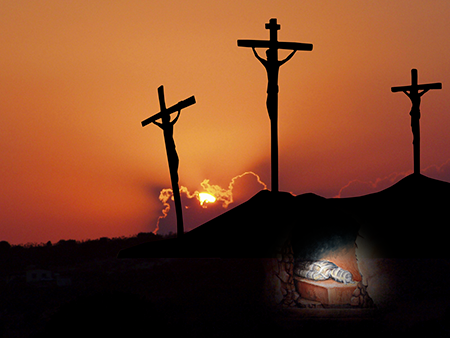 The crucifixion of Jesus was one of the saddest but most important events in the history of the world. When Christ was crucified, He took the sins of the world on Himself. Peter says that Jesus “bore our sins in His own body on the tree” (1 Peter 2:24). The crucifixion was so important that the apostle Paul wrote, “For I determined not to know anything among you except Jesus Christ and Him crucified” (1 Corinthians 2:2). The crucifixion helps us see that Jesus had power over death. He died on the cross, and three days later He defeated death and rose from the grave (Hebrews 2:14-15). If Jesus didn’t really die on the cross, then He could not rise from the grave.
Sadly, Muhammad and his teachings in the Quran deny that Jesus was crucified. The Quran states, “And because of their saying: We killed the Messiah son of Mary, Allah’s messenger—They killed him not nor crucified, but it appeared so to them and lo! those who disagree concerning it are in doubt thereof…they did not kill him for certain but Allah took him up unto Himself” (Surah 4:157-158). The Quran teaches that it only looked like Jesus was crucified, but He really stayed alive and was taken up into heaven. Therefore, the Quran denies that Jesus died, and it denies that He was resurrected.
 The apostle Paul knew there would be people such as Muhammad who would deny the resurrection. He wrote, “But if there is no resurrection of the dead, then Christ is not risen. And if Christ is not risen, then our preaching is vain and your faith is also vain…. And if Christ is not risen your faith is futile; you are still in your sins!” (1 Corinthians 15:13-17). Christ was crucified so that His blood can forgive the sins of those who obey Him. Thank God for that!
The post Was Jesus Crucified? appeared first on Apologetics Press.
]]>The post Islam and Jesus Christ appeared first on Apologetics Press.
]]> What is the answer to the math problem 2+2=__? Did you know there is only one right answer to this problem? The correct answer is 4. Let’s suppose that someone argues that the answer should be five, another person says the real answer is seven, and a third person claims the answer is nine. Just because some people disagree with the correct answer, that does not mean there are several correct answers, or that any answer is just as good as four. There is one correct answer and all the others are incorrect.
In a similar way, we could ask, how can a person be with God and go to heaven? There is only one correct answer to this question. Jesus Christ said, “I am the way, the truth, and the life. No one comes to the Father except through Me” (John 14:6). Many people say there are other ways to get to God. Some say through meditation. Others say through the teachings of Muhammad (muh-HAH-mud). Still others say by following rules in books written by councils instead of following Jesus’ words in the Bible. No matter what people say, the only way to God is through Jesus Christ.
 In this issue of Discovery we are learning about the religion of Islam. One of the main reasons we know it is not from God is because it denies that Jesus is God’s Son. Islam is a religion that was started by a man named Muhammad. He claimed to receive messages from God that he wrote down in a book called the Quran (coo-RON). When we look at these messages, however, we can know that they are not from God, because they deny that Jesus is God’s Son. In one place, the Quran says: “Praise be to Allah [this is the word the Quran uses for God] Who has revealed the Scripture unto His slave…to give warning of stern punishment from Him…and to warn those who say: Allah has chosen a son, a thing whereof they have no knowledge, nor had their fathers. Dreadful is the word that comes out of their mouths. They speak nothing but a lie” (Surah 18:1-5; a Surah is a division of the Quran, somewhat like the Bible is divided into books).
Notice that the Quran says that God does not have a Son, and anyone who says He does have a Son is lying. When we look into the Bible, however, we find that Jesus often taught that He is God’s Son. In Matthew 16, Jesus asked His disciples who they thought He was. Peter spoke up and said, “You are the Christ, the Son of the living God” (16:16). Jesus responded by saying, “Blessed are you, Simon Bar-Jonah, for flesh and blood has not revealed this to you, but My Father who is in heaven” (16:17). Notice that Jesus said that God had revealed to Peter that Jesus is God’s Son. That is the exact opposite of what the Quran teaches.


Many other places in the Bible teach that Jesus is God’s Son. In 1 John 2:22-23 we read, “Who is a liar but he who denies that Jesus is the Christ. He is antichrist who denies the Father and the Son. Whoever denies the Son does not have the Father either; he who acknowledges the Son has the Father also.” Jesus is the Son of God. One very important part of coming to God and being saved is believing that Jesus is God’s Son and being willing to confess that belief (Romans 10:9-10). Sadly, the Quran teaches the exact opposite.
There are many religions in the world that teach different things. But the only way to be right with God and go to heaven is to admit that Jesus is God’s Son and confess that belief. The Quran teaches that Jesus cannot be God’s Son. The Quran and Islam are wrong! Jesus Himself once said, “Therefore I said to you that you will die in your sins, for if you do not believe that I am He, you will die in your sins” (John 8:24). It is our prayer that all people in the world will believe that Jesus is God’s Son and obey His commandments so that they can be with God in heaven someday.
[Jesus is the Son of God: Luke 1:35, John 1:34, John 1:49, John 11:27, Matthew 27:54, John 10:36, Matthew 8:29, Matthew 16:16, John 2:22-23]
The post Islam and Jesus Christ appeared first on Apologetics Press.
]]>The post The Quran and the Muslim Bomb Blast In Pakistan appeared first on Apologetics Press.
]]>Perhaps at some point, the politically correct crowd reconsider their flawed notion that “Islam is a religion of peace, and such behavior does not represent true Islam.” This naïve, inaccurate depiction is inexcusable and unbelievably bizarre in view of the 1,400-year-long history of Islam throughout the world. It is fashionable to refer to the terrorists as “extremists” and “radicalized”—implying that they do not represent true Islam and the Quran. They are characterized as being guilty of embracing a “literalist” interpretation of the Quran. But this allegation fails to face the fact that the Quranic texts that advocate violence and killing to advance Islam are clearly literal and have been so taken by the vast majority of Islamic scholars for the last 1,400 years.3 Setting aside the Hadith which forthrightly promote violence, the Quran itself is riddled with admonitions for Muslims to commit precisely the violent actions and bloodshed being committed by the Islamic terrorists.
Read Surah 47:4 from the celebrated translation by Muslim scholar Mohammed Pickthall:
Now when ye meet in battle those who disbelieve, then it is smiting of the necks until, when ye have routed them, then making fast of bonds; and afterward either grace or ransom till the war lay down its burdens. That (is the ordinance). And if Allah willed He could have punished them (without you) but (thus it is ordained) that He may try some of you by means of others. And those who are slain in the way of Allah, He rendereth not their actions vain (Surah 47:4, emp. added).4
No one should be perplexed or surprised by the incessant practice of beheadings by ISIS and all terrorists, who are in a perpetual war with Christendom. The admonition to behead others comes straight from the Quran (cf. Surah 8:12). Abdullah Yusuf Ali makes the following comment on this passage in his widely reputable Muslim translation:
When once the fight (Jihad) is entered upon, carry it out with the utmost vigour, and strike home your blows at the most vital points (smite at their necks), both literally and figuratively. You cannot wage war with kid gloves (italics and parenthetical items in orig.).5
Many other verses in the Quran forthrightly endorse armed conflict and war to advance Islam (e.g., Surah 2:190ff.; 8:39ff.; 9:1-5,29; 22:39; 61:4; 4:101-104). Muslim historical sources themselves report the background details of those armed conflicts that have characterized Islam from its inception—including Muhammad’s own warring tendencies involving personal participation in and endorsement of military campaigns.6 Muslim scholar Pickthall’s own summary of Muhammad’s war record is an eye-opener: “The number of the campaigns which he led in person during the last ten years of his life is twenty-seven, in nine of which there was hard fighting. The number of the expeditions which he planned and sent out under other leaders is thirty-eight.”7
Islam stands in stark contrast to the religion of Jesus—Who never once took up the sword or encouraged anyone else to do so. The one time that one of His close followers took it upon himself to do so, the disciple was soundly reprimanded and ordered to put the sword away, with the added warning: “all who take the sword will perish by the sword” (Matthew 26:52). Indeed, when Pilate quizzed Jesus regarding His intentions, He responded: “My kingdom is not of this world. If My kingdom were of this world, My servants would fight, so that I should not be delivered to the Jews; but now My kingdom is not from here” (John 18:36)—the very opposite of Islamic teaching and practice. Whereas the Quran boldly declares, “And one who attacks you, attack him in like manner as he attacked you” (Surah 2:194; cf. 22:60), Jesus counters, “But whoever slaps you on your right cheek, turn the other to him also” and “love your enemies” (Matthew 5:39,44). Indeed, New Testament Christianity enjoins love for enemies (Matthew 5:44-46; Luke 6:27-36), returning good for evil, and overcoming evil with good (Romans 12:14,17-21).
So why does the politically correct crowd seem intent on ignoring 1,400 years of historical reality and unmistakable declarations within the Quran itself? It would appear that such blatant disregard is rooted in a single reason: an irrational regard for pluralism and bitter disdain for Christianity’s moral principles.
Endnotes
1 Annie Gowen, Shaiq Hussain, and Erin Cunningham (2016), “Death Toll in Pakistan Bombing Climbs Past 70,” The Washington Post, March 28, https://www.washingtonpost.com/world/death-toll-in-pakistan-easter-suicide-attack-rises-to-72-authorities-vow-to-hunt-down-perpetrators/2016/03/28/037a2e18-f46a-11e5-958d-d038dac6e718_story.html.
2 Ibid.
3 Nabeel Qureshi (2016), “The Quran’s Deadly Role in Inspiring Belgian Slaughter: Column,” USA Today, March 22, http://www.usatoday.com/story/opinion/2016/03/22/radicalization-isil-islam-sacred-texts-literal-interpretation-column/81808560/.
4 Mohammed Pickthall (no date), The Meaning of the Glorious Koran (New York: Mentor).
5 Abdullah Yusuf Ali (1934), The Meaning of the Holy Quran (Beltsville, MD: Amana Publications), 2002 reprint, p. 1315.
6 cf. Martin Lings (1983), Muhammad (Rochester, VT: Inner Traditions International), pp. 86,111.


The post The Quran and the Muslim Bomb Blast In Pakistan appeared first on Apologetics Press.
]]>The post Belgium Blasts and the Quran appeared first on Apologetics Press.
]]>Read Surah 47:4 from the celebrated translation by Muslim scholar Mohammed Pickthall:
Now when ye meet in battle those who disbelieve, then it is smiting of the necks until, when ye have routed them, then making fast of bonds; and afterward either grace or ransom till the war lay down its burdens. That (is the ordinance). And if Allah willed He could have punished them (without you) but (thus it is ordained) that He may try some of you by means of others. And those who are slain in the way of Allah, He rendereth not their actions vain (Surah 47:4, emp. added).3
No one should be perplexed or surprised by the incessant practice of beheadings by ISIS and all terrorists, who are in a perpetual war with Christendom. The admonition to behead others comes straight from the Quran (cf. Surah 8:12). Abdullah Yusuf Ali makes the following comment on this passage in his widely reputable Muslim translation:
When once the fight (Jihad) is entered upon, carry it out with the utmost vigour, and strike home your blows at the most vital points (smite at their necks), both literally and figuratively. You cannot wage war with kid gloves (italics and parenthetical items in orig.).4
Many other verses in the Quran forthrightly endorse armed conflict and war to advance Islam (e.g., Surah 2:190ff.; 8:39ff.; 9:1-5,29; 22:39; 61:4; 4:101-104). Muslim historical sources themselves report the background details of those armed conflicts that have characterized Islam from its inception—including Muhammad’s own warring tendencies involving personal participation in and endorsement of military campaigns.5 Muslim scholar Pickthall’s own summary of Muhammad’s war record is an eye-opener: “The number of the campaigns which he led in person during the last ten years of his life is twenty-seven, in nine of which there was hard fighting. The number of the expeditions which he planned and sent out under other leaders is thirty-eight.”6
Islam stands in stark contrast to the religion of Jesus—Who never once took up the sword or encouraged anyone else to do so. The one time that one of His close followers took it upon himself to do so, the disciple was soundly reprimanded and ordered to put the sword away, with the added warning: “all who take the sword will perish by the sword” (Matthew 26:52). Indeed, when Pilate quizzed Jesus regarding His intentions, He responded: “My kingdom is not of this world. If My kingdom were of this world, My servants would fight, so that I should not be delivered to the Jews; but now My kingdom is not from here” (John 18:36)—the very opposite of Islamic teaching and practice. Whereas the Quran boldly declares, “And one who attacks you, attack him in like manner as he attacked you” (Surah 2:194; cf. 22:60), Jesus counters, “But whoever slaps you on your right cheek, turn the other to him also” and “love your enemies” (Matthew 5:39,44). Indeed, New Testament Christianity enjoins love for enemies (Matthew 5:44-46; Luke 6:27-36), returning good for evil, and overcoming evil with good (Romans 12:14,17-21).
So why does the politically correct crowd seem intent on ignoring 1,400 years of historical reality and unmistakable declarations within the Quran itself? It would appear that such blatant disregard is rooted in a single reason: an irrational regard for pluralism and bitter disdain for Christianity’s moral principles.
Endnotes
1 CNBC.com Staff (2016), “The Belgium Terror Attacks: Complete Coverage,” CNBC, http://www.cnbc.com/2016/03/22/the-belgium-terror-attacks-complete-coverage.html.
2 Nabeel Qureshi (2016), “The Quran’s Deadly Role in Inspiring Belgian Slaughter: Column,” USA Today, March 22, http://www.usatoday.com/story/opinion/2016/03/22/radicalization-isil-islam-sacred-texts-literal-interpretation-column/81808560/.
3 Mohammed Pickthall (no date), The Meaning of the Glorious Koran (New York: Mentor).
4 Abdullah Yusuf Ali (1934), The Meaning of the Holy Quran (Beltsville, MD: Amana Publications), 2002 reprint, p. 1315.
5 cf. Martin Lings (1983), Muhammad (Rochester, VT: Inner Traditions International), pp. 86,111.
6 p. xxvi.
 |
 |
| Suggested Resources | |
The post Belgium Blasts and the Quran appeared first on Apologetics Press.
]]>The post Muhammad or Jesus? appeared first on Apologetics Press.
]]>Jesus (through John): “Who is a liar but he who denies that Jesus is the Christ?… Whoever denies the Son does not have the Father either” (1 John 2:22-23).
*********************
Muhammad: “Allah hath not chosen any son, nor is there any God along with Him” (Surah 23:91).
God: “This is My beloved Son, in whom I am well pleased. Hear Him!” (Matthew 17:5).
*********************
Muhammad: “[T]he Christians call Christ the Son of God…. Allah’s curse be on them: how they are deluded away from the Truth!” (Surah 9:30).
Jesus: “[H]e who does not believe is condemned already, because he has not believed in the name of the only begotten Son of God” (John 3:18). “Jesus…said, ‘Do you believe in the Son of God?’ He answered and said, ‘Who is He, Lord, that I may believe in Him?’ And Jesus said to him, ‘You have both seen Him and it is He who is talking with you’” (John 9:35-37).
*********************
Muhammad: “They slew him not nor crucified, but it appeared so unto them; and lo! those who disagree concerning it are in doubt thereof; they have no knowledge thereof save pursuit of a conjecture; they slew him not for certain, but Allah took him up unto Himself” (Surah 4:157-158).
Jesus: “‘And I, if I am lifted up from the earth, will draw all peoples to Myself.’ This He said, signifying by what death He would die” (John 12:32-33).
*******************
Muhammad: “[S]ay not ‘Three’—Cease! (it is) better for you!—Allah is only One God. Far is it removed from His transcendent majesty that he should have a son” (Surah 4:171-172).
Jesus: “Go therefore and make disciples of all the nations, baptizing them in the name of the Father and of the Son and of the Holy Spirit” (Matthew 28:19).
*********************
Muhammad: “They surely disbelieve who say: Lo! Allah is the Messiah, son of Mary…. Lo! whoso ascribeth partners unto Allah, for him Allah hath forbidden Paradise. His abode is the Fire” (Surah 5:72-74).
Jesus: “[I]f you do not believe that I am He, you will die in your sins” (John 8:24).
*********************
Muhammad: Polygamous, having multiple wives, as many as 12 at a time.
Jesus: Remained single, devoting Himself to His divine mission.
*********************
The Jesus of the Quran: A mere human prophet, finite in his attributes, like sinful man, flawed.
The Jesus of the Bible: Perfect, infinite in all of His attributes, unlike sinful man.
*********************
Islam is focused on Muhammad, who was merely a man.
Christianity is focused on Jesus, Who was God in the flesh.
*********************
OBSERVE:
According to Islam and the Quran—
If you believe that Jesus is the Son of God, you will be lost eternally in hell.
According to Christianity and the Bible—
If you do not believe that Jesus is the Son of God, you will be lost eternally in hell.
Jesus said: “Unless you believe that I AM, you will die in your sins” (John 8:24).
NOTE: The above verses from the Quran were taken from two celebrated Muslim translations:
Ali, Abdullah Yusuf (1934), The Qur’an (Elmhurst, NY: Tahrike Tarsile Quran), ninth edition.
Pickthall, Mohammed M. (1930), The Meaning of the Glorious Koran (New York: Mentor).
The post Muhammad or Jesus? appeared first on Apologetics Press.
]]>The post Don't Muslims and Christians Both Believe in Jesus? appeared first on Apologetics Press.
]]>“In a Muslim seminar, an Imam stated that both Christians and Muslims believe in Jesus, but of different faiths. What say you?”
A:
Muslims are quick to emphasize that they, too, believe in Jesus. Their claim is correct. After all, the Quran alludes to Jesus in a favorable light several times (e.g., Surah 3:45-51; 5:110; 21:91; et al.). But this claim is misleading, since it fails to own up to the fact that Christianity and Islam are in hopeless contradiction with each other regarding the most crucial contention of New Testament Christianity: the divinity of Christ. On this solitary point, Islam and Christianity, the Bible and the Quran, can never agree. This disagreement is of such momentous import and great magnitude as to make the inexorable incompatibility permanent.
You see, while the Quran speaks favorably of Jesus as a prophet of God, it vehemently denounces the deity of Christ. For example, consider Surah 18:1-5 (as translated by Muslim scholar Mohammed Pickthall)—
Praise be to Allah Who hath revealed the Scripture unto His slave…to give warning of stern punishment from Him…and to warn those who say: Allah hath chosen a son, (A thing) whereof they have no knowledge, nor (had) their fathers. Dreadful is the word that cometh out of their mouths. They speak naught but a lie.
And read Surah 19:88-93—
And they say: The Beneficent hath taken unto Himself a son. Assuredly ye utter a disastrous thing, whereby almost the heavens are torn, and the earth is split asunder and the mountains fall in ruins, that ye ascribe unto the Beneficent a son, when it is not meet for (the Majesty of) the Beneficent that He should choose a son. There is none in the heavens and the earth but cometh unto the Beneficient as a slave.
Or Surah 23:91—
Allah hath not chosen any son, nor is there any God along with Him (also 25:2; et al.).
These references demonstrate that the Quran depicts Jesus as a mere man—a prophet like Muhammad—who was created by God like all other created beings (Surah 5:75; cf. 42:9,13,21). Indeed, when Jesus is compared to any of the prophets (listed as Abraham, Ishmael, Isaac, and Jacob), Allah is represented as stating: “We make no distinction between any of them” (Surah 2:136; 3:84). Though the Quran seems to accept the notion of the virgin conception (Surah 21:91), to attribute divinity to Jesus, or to assign to Jesus equal rank with God, is to utter a “dreadful” and “disastrous” thing—to formulate “nothing but a lie”!
Here, indeed, is the number one conflict between Islam and Christianity—the deity, person, and redemptive role of Christ. If Christ is Who the Bible represents Him to be, then Islam and the Quran are completely fictitious. If Jesus Christ is Who the Quran represents Him to be, then Christianity is baseless and blasphemous. On this point alone, these two religions can never achieve harmony. But the New Testament is very, very clear: the heart, core, and soul of the Christian religion is allegiance to Jesus Christ as God, Lord, and Savior. Jesus identified Himself as the “I AM” of the Old Testament (John 8:58; cf. 20:28-31). In Colossians, Paul forcefully affirmed regarding Jesus—
He is the image of the invisible God, the firstborn over all creation. For by Him all things were created that are in heaven and that are on earth, visible and invisible, whether thrones or dominions or principalities or powers. All things were created through Him and for Him. And He is before all things, and in Him all things consist (1:15-17). For in Him dwells all the fullness of the Godhead bodily (2:9).
Such depictions of Jesus are frequent in the New Testament. Jesus was certainly a prophet, as the Quran affirms (Surah 4:163); but Jesus was not just a prophet. He was God in the flesh. In fact, oral confession of the deity of Christ is prerequisite to becoming a Christian (Romans 10:9-10). This singular point makes Christianity and Islam forever incompatible. One must be a Christian to be saved (John 14:6; Acts 4:12), and yet one cannot be a Christian without believing in, and verbally confessing, the deity of Christ, and then being immersed into Christ (Romans 6:1-4; Galatians 3:27). The Bible declares that Jesus was the final revelation of God to man (Hebrews 1:1-3). There have been no others.
The post Don't Muslims and Christians Both Believe in Jesus? appeared first on Apologetics Press.
]]>The post Husband and Wife in the Quran appeared first on Apologetics Press.
]]>One cannot but ponder the question: What if the Arabs had been Christians? To me it seems certain that the fatalistic teachings of Mohammed and the utter degradation of women is the outstanding cause for the arrested development of the Arab. He is exactly as he was around the year 700, while we have kept on developing. Here, I think, is a text for some eloquent sermon on the virtues of Christianity (1947, p. 43, emp. added).
No doubt 7th and 8th century Arabian culture contributed to Muhammad’s view of women. However, the Quran stands on its own for its advocacy of female inferiority. For example, in Mohammed Pickthall’s translation of the Quran, Surah 4:34 reads:
Men are in charge of women, because Allah hath made the one of them to excel the other, and because they spend of their property (for the support of women). So good women are the obedient, guarding in secret that which Allah hath guarded. As for those from whom ye fear rebellion, admonish them and banish them to beds apart, and scourge them. Then if they obey you, seek not a way against them. Lo! Allah is ever High, Exalted, Great (emp. added).
A host of Islamic translations confirm this translation. The words in bold in Abdullah Yusuf Ali’s translation are rendered: “refuse to share their beds, (And last) beat them (lightly).” Ahmed Raza Khan’s translation reads: “sleep apart from them, and beat them (lightly).” Maududi has “remain apart from them in beds, and beat them.” Wahiduddin Khan “refuse to share their beds, and finally hit them.” Shakir has “leave them alone in the sleeping-places and beat them.” Sarwar reads: “do not sleep with them and beat them.” Saheeh International reads: “forsake them in bed; and [finally], strike them.” Qaribullah and Darwish have: “desert them in the bed and smack them (without harshness).” Qarai reads: “keep away from them in the bed, and [as the last resort] beat them” (Tanzil Project, 2007-2014).
Observe two startling realizations from this passage:
(1) The Quran explicitly gives sanction to Muslim men to beat their wives. Some translators try to soften the directive by inserting qualifiers like “lightly” (Ali, Raza Kahn) and “without harshness” (Qaribullah and Darwish), but the Arabic text is unqualified. In stark contrast, the Bible, while assigning differing roles and responsibilities based on gender, nowhere suggests that men have a right to inflict physical punishment on women. The intimidating, overbearing role of men in Islam is proof that the religion was invented by a male.
(2) The command to banish a wife to a separate bed implies at least three concepts that cast Islam and the Quran in an unfavorable light.
First, the Bible and the Quran contradict each other on this point. Paul instructed the Corinthian Christians:
Nevertheless, because of sexual immorality, let each man have his own wife, and let each woman have her own husband. Let the husband render to his wife the affection due her, and likewise also the wife to her husband. The wife does not have authority over her own body, but the husband does. And likewise the husband does not have authority over his own body, but the wife does. Do not deprive one another except with consent for a time, that you may give yourselves to fasting and prayer; and come together again so that Satan does not tempt you because of your lack of self-control (1 Corinthians 7:2-5, emp. added).
The Quran says a man may sexually banish his wife, without her consent, as punishment for displeasing him. Yet Paul said a married couple is not to refrain from sexual relations except by mutual consent, and then only for a brief period. One cannot take the position that the Quran and the Bible are both from God. They contradict each other on many matters. Insisting that these differences are due to the Bible having being corrupted is an untenable and unsubstantiated explanation (Miller, 2005, p. 89; Miller, 2013).
Second, when one weighs both the Bible and the Quran’s portraits of deity, it quickly becomes self-evident to the unbiased observer which of the two books portrays the inspired view of women. The Bible contains the fair, compassionate, majestic perspective in taking into account both marriage partners as equals. As Peter stated so eloquently: “Husbands, likewise, dwell with them with understanding, giving honor to the wife, as to the weaker vessel, and as being heirs together of the grace of life, that your prayers may not be hindered” (1 Peter 3:7). Both male and female were made in God’s image (Genesis 1:27).
Third, observe further how the Quran exposes its human origin, demonstrating that it came from man, not God. Women are “wired” differently from men. They have one-tenth the testosterone of men (“Testosterone,” 2011). To suggest that a man could punish his wife by the cessation of sexual relations with her is undoubtedly written from the perspective of a man, and not from the vantage point of most women.
Comparing the Bible with the Quran is a useful exercise. The process calls the inspiration of the Quran into question. At the same time, the Bible’s superiority is reinforced.
REFERENCES
Austen, Ian (2012), “Afghan Family, Led by Father Who Called Girls a Disgrace, Is Guilty of Murder,” The New York Times, January 29, http://www.nytimes.com/2012/01/30/world/americas/afghan-family-members-convicted-in-honor-killings.html?_r=0.
“Father of Slain Teen Girls Upset That Daughter Dated Non-Muslim, Police Records Show” (2008), Associated Press, January 9, http://www.foxnews.com/story/2008/01/09/father-slain-teen-girls-upset-that-daughter-dated-non-muslim-police-records/.
Kotz, Pete (2009), “Faleh Almaleki Runs Over Daughter in Attempted ‘Honor Killing,’” True Crime Report, October 30, http://www.truecrimereport.com/2009/10/faleh_almaleki_runs_over_daugh.php.
“Melbourne Islamic Cleric Says its OK to Rape Your Wife,” (2009), Herald Sun, January 21, http://www.adelaidenow.com.au/news/rudd-condemns-rape-in-marriage-cleric/story-e6freol3-1111118630585.
Miller, Dave (2005), “Is Mark 16:9-20 Inspired?” Reason & Revelation, 25[12]:89-95, http://apologeticspress.org/apPubPage.aspx?pub=1&issue=572&article=433.
Miller, Dave (2013), “Has the Bible Been Corrupted?” Apologetics Press, https://apologeticspress.org/APContent.aspx?category=13&article=4649.
“Missouri Couple Sentenced to Die In Murder of Their Daughter, 16” (1991), The New York Times, December 20, http://www.nytimes.com/1991/12/20/us/missouri-couple-sentenced-to-die-in-murder-of-their-daughter-16.html.
Patton, George S. (1947), War As I Knew It (New York: The Great Commanders, 1994 edition).
“Raped ‘for reading Holy Bible’” (2007), News.com.au, April 17, http://www.news.com.au/national/raped-for-reading-holy-bible/story-e6frfkp9-1111113353497.
Schoetz, David (2008), “Daughter Rejects Marriage, Ends Up Dead,” ABC News, July 7, http://abcnews.go.com/US/story?id=5322587&page=1.
Tanzil Project (2007-2014), http://tanzil.net/#4:34.
“Testosterone” (2011), Lab Tests Online, American Association for Clinical Chemistry, http://labtestsonline.org/understanding/analytes/testosterone/tab/faq.
Thompson, Carolyn (2011), “Jury Convicts Muslim TV Exec of Beheading Wife,” Associated Press, February 9, http://www.foxnews.com/us/2011/02/07/closing-arguments-begin-new-york-beheading-murder-trial/.
The post Husband and Wife in the Quran appeared first on Apologetics Press.
]]>The post Does Song of Solomon Mention Muhammad? appeared first on Apologetics Press.
]]>In English, the verse reads: “His mouth is most sweet, yes, he is altogether lovely. This is my beloved, and this is my friend, O daughters of Jerusalem!” (NKJV). A phonetic transliteration of the underlying Hebrew text reads: Kheeco mahm-tah-keem vuh-coollo ma-kha-madeem zeh dodee veh-tseh ray-ee beh-note yerushalayim. Muslims claim that the bolded word, though translated “altogether lovely,” is the name of Muhammad (Naik, n.d.). Consider six linguistic evidences that dispute Naik’s claim:
- The second syllable (kha) utilizes the Hebrew letter heth which has a hard initial sound like the “ch” in the Scottish word “loch.” It is to be distinguished from the Hebrew letter he which is the same as the English letter “h.” If Muhammad was being referred to, the simple “h” would have been more linguistically appropriate.
- Muslims claim that the eem (or im) in ma-kha-madeem in the Hebrew language was “added for respect” (Naik). This claim is untrue and unsubstantiated. The letters constitute the standard form for changing a singular to a plural—like adding “s” or “es” in English (cf. Weingreen, 1959, pp. 35ff.). As the eminent Emil Rödiger (who was professor for oriental languages at the University of Halle and the student of the well-known German Orientalist, H.F.W. Gesenius) noted in his editorial comment in the prestigious Gesenius’ Hebrew Grammar: “The use of the plural as a form of respectful address is quite foreign to Hebrew” (Gesenius, 1898, p. 418).
- The meaning of the Hebrew ma-kha-madeem is different from the meaning of the word “Muhammad” in Arabic. According to Sheikh Abd al-Azîz, Grand Mufti of Saudi Arabia, the word “Muhammad” is derived from the Arabic root word hamd meaning “praise.” It is the emphatic passive participle of that root and can be translated as “the Oft-Praised One” (n.d.). However, the Hebrew term (makh-mahd) in the passage under consideration has a completely different meaning. It refers to “grace, beauty” (Gesenius, 1847, p. 464), “a desirable thing, delightfulness” (Brown, et al., 1906, pp. 326-327), “a pleasant thing” (Payne, 1980, 1:295), or “precious” (Holladay, 1988, p. 190). English translations render the term “altogether lovely” (NKJV, NIV), “wholly desirable” (NASB), and “altogether desirable” (ESV, RSV). No reputable English translation would render the underlying Hebrew as “praised one,” let alone as “Muhammad.” All Muslims have done is happen upon a Hebrew word that phonetically sounds somewhat like “Muhammad” and have erroneously concluded the word must be referring to him. Such handling of linguistic data is irresponsible—if not deceptive.
- Further, the claim that Muhammad is intended in the verse completely disregards the context and message of the book of Song of Solomon. The book consists of a dialogue between Solomon, his Shulamite bride-to-be, and the “daughters of Jerusalem,” with perhaps even God interjecting His comment (5:1b), as well as the Shulamite’s brothers (8:8-9). The term used in 5:16 that Muslims claim refers to Muhammad is also used in 2:3 to refer to the Shulamite’s beloved—“Like an apple tree among the trees of the woods, so is my beloved among the sons. I sat down in his shade with great delight.” “Great delight” is the Hebrew word also used in 5:16; in both cases the words of the Shulamite refer to her beloved—not Muhammad.
- Forms of the same Hebrew word are used elsewhere in the Old Testament, yet Muslims do not claim that those passages refer to Muhammad. Rightly so, since those verses cannot be forced to fit the notion that Muhammad is under consideration. For example, Isaiah 64:11 mourns the destruction of Jerusalem: “Our holy and beautiful temple, where our fathers praised You, is burned up with fire; and all our pleasant things are laid waste.” “Pleasant things” is a form of the same word in Song of Solomon 5:16. Would the Muslim contend that Muhammad was “laid waste” in Jerusalem? Additional occurrences of the same word—which dispel the misuse of the term by Muslims—are seen in 1 Kings 20:6; 2 Chronicles 36:19; Lamentations 1:10,11; Ezekiel 24:16,21,25; Hosea 9:9,16; Joel 3:5; et al. (Wigram, 1890, p. 687).
- Even if the Hebrew word “lovely/desirable” in Song of Solomon were the Hebrew equivalent of the Arabic word “praised one” (which it is not), it still would not follow that Muhammad is being referred to in the Bible. Instead, it would simply be an indication that the underlying word stands on its own as a term used for other applications. For example, the Hebrew word for “bitter” is mah-rah. It is used throughout the Old Testament to refer to the concept of bitter. Yet, due to her unpleasant circumstances in life, Naomi (whose name means “pleasant”) requested that her name be changed to “bitter” (mah-rah) to reflect her bitter predicament. It does not follow, however, that when the Hebrew word “bitter” appears in the Old Testament, it refers to Naomi. If parents today were to name their child John, it would not follow that they intended to reflect an association with others in history who have worn the name John—nor would references to John in the Bible constitute prophecies pointing to their son. Muslims have the cart before the horse. Their claim is equivalent to parents naming their child “wonderful” or “special”—and then claiming that an ancient writer had their child in mind when the writer used the word “wonderful” or “special” in referring to another person contemporary to the writer.
The truth of the matter is that the Bible nowhere refers to Muhammad. All other biblical passages purported to do so may likewise be shown to be misinterpreted and misapplied (Miller, 2003). The Bible contains within itself evidence that all non-Christian religions are false and contrary to the will of the God of the Universe (for more, see Miller, 2005).
REFERENCES
Al-Azîz, Sheikh Abd (no date), “The Meaning of the Prophet’s names ‘Muhammad’ and ‘Ahmad,’” Islam Today, http://en.islamtoday.net/quesshow-14-738.htm.
Brown, Francis, S.R. Driver, and Charles A. Briggs (1906), The Brown-Driver-Briggs Hebrew and English Lexicon (Peabody, MA: Hendrickson, 2000 reprint).
Gesenius, William (1847), Hebrew and Chaldee Lexicon (Grand Rapids, MI: Baker, 1979 reprint).
Gesenius, William (1898), Hebrew Grammar, ed. E. Kautzsch (Oxford: Clarendon Press).
Holladay, William (1988), A Concise Hebrew and Aramaic Lexicon of the Old Testament (Grand Rapids, MI: Eerdmans).
Miller, Dave (2003), “Is Muhammad Mentioned in the Bible?” Apologetics Press, http://apologeticspress.org/APContent.aspx?category=8&article=88&topic=46.
Miller, Dave (2005), The Quran Unveiled (Montgomery, AL: Apologetics Press).
Naik, Zakir (no date), “Prophet Muhammad (pbuh) in the Bible,” Islam 101, http://www.islam101.com/religions/christianity/mBible.htm.
Payne, J. Barton (1980), hamad in Theological Wordbook of the Old Testament, ed. R. Laird Harris, Gleason Archer, Jr. and Bruce Waltke (Chicago, IL: Moody).
Weingreen, J. (1959), A Practical Grammar for Classical Hebrew (Oxford: Clarenden Press), second edition.
Wigram, George W. (1890), The Englishman’s Hebrew and Chaldee Concordance of the Old Testament (Grand Rapids, MI: Baker, 1980 reprint).
The post Does Song of Solomon Mention Muhammad? appeared first on Apologetics Press.
]]>The post Does the Quran Encourage Violence? appeared first on Apologetics Press.
]]>Does the Quran encourage violence?
A.
Yes. The Quran—the holy book of Islam that 1.3 billion Muslims believe to be the word of God—is replete with explicit and implicit sanction and promotion of armed conflict, violence, and bloodshed by Muslims. Read Surah 47:4 from the celebrated translation by Muslim scholar Mohammed Pickthall:
Now when ye meet in battle those who disbelieve, then it is smiting of the necks until, when ye have routed them, then making fast of bonds; and afterward either grace or ransom till the war lay down its burdens. That (is the ordinance). And if Allah willed He could have punished them (without you) but (thus it is ordained) that He may try some of you by means of others. And those who are slain in the way of Allah, He rendereth not their actions vain (Surah 47:4, emp. added).
Many other verses in the Quran forthrightly endorse armed conflict and war to advance Islam. Muslim historical sources themselves report the background details of those armed conflicts that have characterized Islam from its inception—including Muhammad’s own warring tendencies involving personal participation in and endorsement of military campaigns (cf. Lings, pp. 86,111). Muslim scholar Pickthall’s own summary of Muhammad’s war record is an eye-opener: “The number of the campaigns which he led in person during the last ten years of his life is twenty-seven, in nine of which there was hard fighting. The number of the expeditions which he planned and sent out under other leaders is thirty-eight” (n.d., p. xxvi).
REFERENCES
Lings, Martin (1983), Muhammad (Rochester, VT: Inner Traditions International).
Pickthall, Mohammed M. (no date), The Meaning of the Glorious Koran (New York: Mentor).
The post Does the Quran Encourage Violence? appeared first on Apologetics Press.
]]>The post Christians Should Examine Islam appeared first on Apologetics Press.
]]>Now is the time for Christians to be informed. Now is the time for Christians to prepare themselves to help Muslims to see the truth. Five years ago, Apologetics Press released The Quran Unveiled, a volume intended to provide readers with an analysis of the fountain head of Islam: the Quran. Indeed, the authenticity of Islam rests on the credibility of the Quran. If the Quran is from God, it must possess the self-authenticating attributes and characteristics of divine inspiration. If it is not from God, though it may possess certain positive, even valuable, qualities, it must be rejected as disqualified to legislate human behavior in an absolute and ultimate sense. The primary purpose of The Quran Unveiled is to examine Islam’s holy book with a view toward ascertaining whether it is, in fact, of supernatural origin.
Apologetics Press continues to surge forward to maintain its cutting edge articulation of New Testament truth to current culture. Responding to the upsurge of Muslims into America is a part of this effort to teach the truth for Christ. We dare not ignore what is happening to the country. We must prepare ourselves to “make a defense” (1 Peter 3:15). In this month’s edition of Resources (inside R&R), you’ll find an advertisement with order information regarding how to purchase a copy of the book. We urge you to take advantage of these tools in your evangelistic efforts to point people to Jesus Christ.
The post Christians Should Examine Islam appeared first on Apologetics Press.
]]>The post Fort Hood and the Quran appeared first on Apologetics Press.
]]>This almost irrational refusal to link terrorism with Islam is apparently widespread even among mainstream Muslims (“U.S. Muslims…,” 2009). Nevertheless, some Muslims appear a little more willing to entertain the possibility that perhaps Islam and the Quran are responsible for the terrorists’ behavior: “For too long, we Muslims have been sticking fingers in our ears and chanting ‘Islam means peace’ to drown out the negative noise from our holy book. Far better to own up to it” (Manji, p. 78).
Own up to it, indeed. It may well be true that the vast majority of Muslims disapprove of the wanton acts of violence by Islamic terrorists happening around the globe. But the Quran—the holy book of Islam that 1.3 billion Muslims believe to be the word of God—is replete with explicit and implicit sanction and promotion of armed conflict, violence, and bloodshed by Muslims. Difficult to believe? Then read for yourself the following sections of the Quran from the celebrated translation by Muslim scholar Mohammed Pickthall:
Now when ye meet in battle those who disbelieve, then it is smiting of the necks until, when ye have routed them, then making fast of bonds; and afterward either grace or ransom till the war lay down its burdens. That (is the ordinance). And if Allah willed He could have punished them (without you) but (thus it is ordained) that He may try some of you by means of others. And those who are slain in the way of Allah, He rendereth not their actions vain (Surah 47:4, emp. added).
Fight in the way of Allah against those who fight against you, but begin not hostilities. Lo! Allah loveth not aggressors. And slay them wherever ye find them, and drive them out of the places whence they drove you out, for persecution is worse than slaughter. And fight not with them at the Inviolable Place of Worship until they first attack you there, but if they attack you (there) then slay them. Such is the reward of disbelievers. But if they desist, then lo! Allah is Forgiving, Merciful. And fight them until persecution is no more, and religion is for Allah. But if they desist, then let there be no hostility except against wrongdoers. The forbidden month for the forbidden month, and forbidden things in retaliation. And one who attacketh you, attack him in like manner as he attacked you. Observe your duty to Allah, and know that Allah is with those who ward off (evil) (Surah 2:190-194, emp. added).
Warfare is ordained for you, though it is hateful unto you; but it may happen that ye hate a thing which is good for you, and it may happen that ye love a thing which is bad for you. Allah knoweth, ye know not. They question thee (O Muhammad) with regard to warfare in the sacred month. Say: Warfare therein is a great (transgression), but to turn (men) from the way of Allah, and to disbelieve in Him and in the Inviolable Place of Worship, and to expel his people thence, is a greater with Allah; for persecution is worse that killing. And they will not cease from fighting against you till they have made you renegades from your religion, if they can (Surah 2:216-217, emp. added).
Muhammad was informed that warfare was prescribed for him! Though he may have hated warfare, it was actually good for him, and what he loved, i.e., non-warfare, was actually bad for him! And though under normal circumstances, fighting is not appropriate during sacred months, killing was warranted against those who sought to prevent Muslims from practicing their religion. Killing is better than being persecuted! A similar injunction states: “Sanction is given unto those who fight because they have been wronged; and Allah is indeed Able to give them victory” (Surah 22:39, emp. added). In fact, “Allah loveth those who battle for His cause in ranks, as if they were a solid structure” (Surah 61:4, emp. added).
In a surah titled “Repentance” that issues stern measures to be taken against idolaters, the requirement to engage in carnal warfare is apparent:
Freedom from obligation (is proclaimed) from Allah and His messenger toward those of the idolaters with whom ye made a treaty: Travel freely in the land four months, and know that ye cannot escape Allah and that Allah will confound the disbelievers (in His guidance). And a proclamation from Allah and His messenger to all men on the day of the Greater Pilgrimage that Allah is free from obligation to the idolaters, and (so is) His messenger. So, if ye repent, it will be better for you; but if ye are averse, then know that ye cannot escape Allah. Give tidings (O Muhammad) of a painful doom to those who disbelieve. Excepting those of the idolaters with whom ye (Muslims) have a treaty, and who have since abated nothing of your right nor have supported anyone against you. (As for these), fulfill their treaty to them till their term. Lo! Allah loveth those who keep their duty (unto Him). Then, when the sacred months have passed, slay the idolaters wherever ye find them, and take them (captive), and besiege them, and prepare for them each ambush. But if they repent and establish worship and pay the poor-due, then leave their way free. Lo! Allah is Forgiving, Merciful (Surah 9:1-5, emp. added).
The ancient Muslim histories elaborate on the occasion of these admonitions: “[T]he idolaters were given four months’ respite to come and go as they pleased in safety, but after that God and His Messenger would be free from any obligation towards them. War was declared upon them, and they were to be slain or taken captive wherever they were found” (Lings, 1983, p. 323).
Later in the same surah, “Fight against such of those who have been given the Scripture as believe not in Allah nor the Last Day, and forbid not that which Allah hath forbidden by His messenger, and follow not the religion of truth, until they pay the tribute readily, being brought low” (Surah 9:29, emp. added). “Those who have been given the Scripture” is a reference to Jews and Christians. The surah advocates coercion against Jews and Christians in order to physically force them to pay the jizyah—a special religious tax imposed on religious minorities (see Nasr, 2002, p. 166). Muslim translator Mohammed Pickthall explained the historical setting of this quranic utterance: “It signified the end of idolatry in Arabia. The Christian Byzantine Empire had begun to move against the growing Muslim power, and this Surah contains mention of a greater war to come, and instructions with regard to it” (p. 145). Indeed, the final verse of Surah 2 calls upon Allah to give Muslims “victory over the disbelieving folk” (vs. 286), rendered by Rodwell: “give us victory therefore over the infidel nations.” That this stance by the Quran was to be expected is evident from the formulation of the Second Pledge of Aqabah, in which the men pledged their loyalty and their commitment to protecting Muhammad from all opponents. This pledge included duties of war, and was taken only by the males. Consequently, the First Aqabah pact, which contained no mention of war, became known as the “pledge of the women” (Lings, p. 112).
Additional allusions to warfare in the Quran are seen in the surah, “The Spoils,” dated in the second year of the Hijrah (A.D. 623), within a month after the Battle of Badr:
And fight them until persecution is no more, and religion is all for Allah…. If thou comest on them in the war, deal with them so as to strike fear in those who are behind them…. And let not those who disbelieve suppose that they can outstrip (Allah’s purpose). Lo! they cannot escape. Make ready for them all thou canst of (armed) force and of horses tethered, that thereby ye may dismay the enemy of Allah and your enemy, and others beside them whom ye know not…. O Prophet! Exhort the believers to fight. If there be of you twenty stedfast they shall overcome two hundred, and if there be of you a hundred stedfast they shall overcome a thousand of those who disbelieve, because they (the disbelievers) are a folk without intelligence…. It is not for any Prophet to have captives until he hath made slaughter in the land. Ye desire the lure of this world and Allah desireth (for you) the Hereafter, and Allah is Mighty, Wise. Had it not been for an ordinance of Allah which had gone before, an awful doom had come upon you on account of what ye took. Now enjoy what ye have won, as lawful and good, and keep your duty to Allah. Lo! Allah is Forgiving, Merciful (Surah 8:39,57,59-60,65,67-69, emp. added; cf. 33:26).
Muslim scholar Pickthall readily concedes the context of these verses:
vv. 67-69 were revealed when the Prophet had decided to spare the lives of the prisoners taken at Badr and hold them to ransom, against the wish of Omar, who would have executed them for their past crimes. The Prophet took the verses as a reproof, and they are generally understood to mean that no quarter ought to have been given in that first battle (p. 144, emp. added).
So the Quran indicates that at the Battle of Badr, no captives should have been taken. The enemy should have been completely slaughtered, with no quarter given. This very fate awaited the Jewish Bani Qurayzah, when some 700 men were beheaded by the Muslims with Muhammad’s approval (Lings, p. 232). Likewise, members of a clan of the Bani Nadir were executed in Khaybar for concealing their treasure rather than forfeiting it to the Muslims (Lings, p. 267).
Another surah describes how allowances respecting the daily prayers were to be made for Muhammad’s Muslim warriors when engaged in military action:
And when ye go forth in the land, it is no sin for you to curtail (your) worship if ye fear that those who disbelieve may attack you. In truth the disbelievers are an open enemy to you. And when thou (O Muhammad) art among them and arrangest (their) worship for them, let only a party of them stand with thee (to worship) and let them take their arms. Then when they have performed their prostrations let them fall to the rear and let another party come that hath not worshipped and let them worship with thee, and let them take their precaution and their arms. Those who disbelieve long for you to neglect your arms and your baggage that they may attack you once for all. It is no sin for you to lay aside your arms, if rain impedeth you or ye are sick. But take your precaution. Lo! Allah prepareth for the disbelievers shameful punishment. When ye have performed the act of worship, remember Allah, standing, sitting and reclining. And when ye are in safety, observe proper worship. Worship at fixed hours hath been enjoined on the believers. Relent not in pursuit of the enemy (Surah 4:101-104, emp. added; cf. 73:20).
These verses show that the Quran implicitly endorses armed conflict and war to advance Islam.
Muslim historical sources themselves report the background details of those armed conflicts that have characterized Islam from its inception—including Muhammad’s own warring tendencies involving personal participation in and endorsement of military campaigns (cf. Lings, pp. 86,111). Muslim scholar Pickthall’s own summary of Muhammad’s war record is an eye-opener: “The number of the campaigns which he led in person during the last ten years of his life is twenty-seven, in nine of which there was hard fighting. The number of the expeditions which he planned and sent out under other leaders is thirty-eight” (n.d., p. xxvi).
What a contrast with Jesus—Who never once took up the sword or encouraged anyone else to do so! The one time that one of His close followers took it upon himself to do so, the disciple was soundly reprimanded and ordered to put the sword away, with the added warning: “all who take the sword will perish by the sword” (Matthew 26:52). Indeed, when Pilate quizzed Jesus regarding His intentions, He responded: “My kingdom is not of this world. If My kingdom were of this world, My servants would fight, so that I should not be delivered to the Jews; but now My kingdom is not from here” (John 18:36)—the very opposite of the Aqabah pact. And whereas the Quran boldly declares, “And one who attacks you, attack him in like manner as he attacked you” (Surah 2:194; cf. 22:60), Jesus counters, “But whoever slaps you on your right cheek, turn the other to him also” and “love your enemies” (Matthew 5:39,44). The New Testament record presents a far higher, more noble and godly ethic on the matter of violence and armed conflict. In fact, the following verses demonstrate how irrevocably deep the chasm is between the Quran and the New Testament on this point:
[L]ove your enemies, bless those who curse you, do good to those who hate you, and pray for those who spitefully use you and persecute you, that you may be sons of your Father in heaven; for He makes His sun rise on the evil and on the good, and sends rain on the just and on the unjust. For if you love those who love you, what reward have you? (Matthew 5:44-46).
But I say to you who hear: Love your enemies, do good to those who hate you, bless those who curse you, and pray for those who spitefully use you. To him who strikes you on the one cheek, offer the other also. And from him who takes away your cloak, do not withhold your tunic either. Give to everyone who asks of you. And from him who takes away your goods do not ask them back. And just as you want men to do to you, you also do to them likewise. But if you love those who love you, what credit is that to you? For even sinners love those who love them. And if you do good to those who do good to you, what credit is that to you? For even sinners do the same. And if you lend to those from whom you hope to receive back, what credit is that to you? For even sinners lend to sinners to receive as much back. But love your enemies, do good, and lend, hoping for nothing in return; and your reward will be great, and you will be sons of the Most High. For He is kind to the unthankful and evil. Therefore be merciful, just as your Father also is merciful (Luke 6:27-36).
What an amazing contrast! The New Testament says to love, bless, do good to, and pray for those who persecute you. The Quran says that “persecution is worse than killing” (Surah 2:217)—i.e., it is better to kill your persecutors than to endure their persecutions!
The standard Muslim attempt to justify the Quran’s endorsement of violence is that such violence was undertaken in self-defense (e.g., Surah 42:41). Consider the following Muslim explanation:
At the time when this surah (Surah 2—DM) was revealed at Al-Madinah, the Prophet’s own tribe, the pagan Qureysh at Mecca, were preparing to attack the Muslims in their place of refuge. Cruel persecution was the lot of Muslims who had stayed in Meccan territory or who journeyed thither, and Muslims were being prevented from performing the pilgrimage. The possible necessity of fighting had been foreseen in the terms of the oath, taken at Al-Aqabah by the Muslims of Yathrib before the Flight, to defend the Prophet as they would their own wives and children, and the first commandment to fight was revealed to the Prophet before his flight from Mecca; but there was no actual fighting by the Muslims until the battle of Badr. Many of them were reluctant, having before been subject to a rule of strict non-violence. It was with difficulty that they could accept the idea of fighting even in self-defence [sic]…. (Pickthall, p. 33, emp. added).
Apart from the fact that the claim that Muhammad’s advocacy of fighting was justifiable on the ground of self-defense is contrary to the historical facts (since the wars waged by Muhammad and the territorial expansion of Islam achieved by his subsequent followers cannot all be dismissed as defensive), this explanation fails to come to grips with the propriety of shedding of blood and inflicting violence—regardless of the reason. Muslim scholar Seyyed Nasr seems unconscious of the inherent self-contradiction apparent in his own remark:
The spread of Islam occurred in waves. In less than a century after the establishment of the first Islamic society in Medina by the Prophet, Arab armies had conquered a land stretching from the Indus River to France and brought with them Islam, which, contrary to popular Western conceptions, was not, however, forced on the people by the sword (2003, p. 17, emp. added).
In other words, Muslim armies physically conquered—by military force and bloodshed—various nations, forcing the population to submit to Muslim rule, but did not require them to become Muslims! One suspects that, at the time, the distinction escaped the citizens of those conquered countries, even as it surely does the reader.
True Christianity (i.e., that which is based strictly on the New Testament) dictates peace and non-retaliatory promotion of itself. The “absolute imperative” (Rahman, 1979, p. 22) of Islam is the submission/conversion of the whole world. In stark contrast, the absolute imperative of New Testament Christianity is the evangelism of the whole world, i.e., the dissemination of the message of salvation—whether people embrace it or not (Matthew 28:18-20; Mark 16:15-16; Luke 24:46-47). Absolutely no coercion is admissible from the Christian (i.e., New Testament) viewpoint. The Crusades, the Spanish Inquisition, and all other violent activities undertaken in the name of Christ and Christianity have been in complete conflict with the teaching of the New Testament. The perpetrators acted without the authority and sanction of Christ.
Islam seeks to bring the entire world into submission to Allah and the Quran—even using jihad, coercion, and force; Christianity seeks to go into the entire world and to announce the “good news” that God loves every individual, that Jesus Christ died for the sins of everyone, and that He offers salvation, forgiveness, and reconciliation. But, each person has free choice to accept or reject without any retaliation by Christians against those who choose to reject. Jesus taught His disciples, when faced with opposition and resistance, simply to walk away: “And whoever will not receive you nor hear your words, when you depart from that house or city, shake off the dust from your feet” (Matthew 10:14). In fact, on one occasion when a Samaritan village was particularly nonreceptive, some of Jesus’ disciples wished to command fire to come down from heaven to consume them! But Jesus rebuked them and said, “‘You do not know what manner of spirit you are of. For the Son of Man did not come to destroy men’s lives but to save them.’ And they went to another village” (Luke 9:55). Muhammad and the Quran stand in diametrical opposition to Jesus and the New Testament.
If the majority of Muslims were violent, that would not prove that Islam is a religion of violence. The vast majority of those who claim to be “Christian” are practicing a corrupted form of the Christian faith. So the validity of any religion is determined ultimately not by the imperfect, inaccurate practice of the religion by even a majority of its adherents, but by the official authority or standard upon which it is based, i.e., its Scriptures. The present discussion in the world regarding whether or not jihad includes physical force in the advancement of Islam is ultimately irrelevant (cf. Nasr, 2002, pp. 256-266). The Quran unquestionably endorses violence, war, and armed conflict. No wonder the Muslims who perpetrated suicide bombings, America’s 9/11, and yes, the Fort Hood massacre, manifest a maniacal, reckless abandon in their willingness to die by sacrificing their lives in order to kill as many “infidels” (especially Israelis, Brits, and Americans) as possible. They have read the following:
Now when ye meet in battle those who disbelieve, then it is smiting of the necks…. And those who are slain in the way of Allah, He rendereth not their actions vain. He will guide them and improve their state, and bring them in unto the Garden [Paradise—DM] which He hath made known to them (Surah 47:4-6, emp. added).
O ye who believe! Be not as those who disbelieved and said of their brethren who went abroad in the land or were fighting in the field: If they had been (here) with us they would not have died or been killed…. And what though ye be slain in Allah’s way or die therein? Surely pardon from Allah and mercy are better than all that they amass. What though ye be slain or die, when unto Allah ye are gathered?…. So those who…fought and were slain, verily I shall remit their evil deeds from them and verily I shall bring them into Gardens underneath which rivers flow—a reward from Allah (Surah 3:156-158,195, emp. added).
Even if the vast majority of Muslims in the world reject violence and refrain from terrorist activity (which is, seemingly, the case), it is still a fact that the Quran (as well as the example of Muhammad himself!) endorses the advancement of Islam through physical force. While Muslim apologist Seyyed Hossein Nasr insists that “the traditional norms based on peace and openness to others” characterize true Islam and the majority of Muslims, in contradistinction, he freely admits that at times Islam “has been forced to take recourse to physical action in the form of defense” (Nasr, 2002, pp. 112,110). This concession cannot be successfully denied in view of the Quran’s own declarations. Hence, the Muslim is forced to maintain the self-contradictory position that, yes, there have been times that Islam has been properly violent and, yes, the Quran does endorse violence, but, no, most Muslims are not violent, and then only in self-defense. As reprehensible and cowardly as Islamic terrorists have shown themselves to be in recent years, an honest reading of the Quran leads one to believe that they, at least, are more consistent with, and true to, their own Scriptures—as revolting an idea as that may be.
REFERENCES
Baker, Mike and Brett J. Blackledge (2009), “Fort Hood Suspect Said His Goodbyes Before Rampage,” The Associated Press, November 6, [On-line], URL: http://news.yahoo.com/s/ap/20091106/ap_on_re_us/us_fort_hood_shooting.
Brown, Matthew (2009), “Muslim Organizations Condemn Fort Hood Attack,” The Baltimore Sun, November 6, [On-line], URL: http://weblogs.baltimoresun.com/news/faith/2009/11/nidal_malik_hassan_allahu_akba.html.
Lings, Martin (1983), Muhammad (Rochester, VT: Inner Traditions International).
Manji, Irshad (2005), “When Denial Can Kill,” Time, 166[4]:78, July 25.
“Military Experts Discuss the Attack at Fort Hood” (2009), New York Post, November 8, [On-line], URL: http://www.washingtonpost.com/wp-dyn/content/article/2009/11/06/AR2009110602072.html.
Nasr, Seyyed Hossein (2002), The Heart of Islam (New York: HarperCollins).
Nasr, Seyyed Hossein (2003), Islam (New York: HarperCollins).
Pickthall, Mohammed M. (no date), The Meaning of the Glorious Koran (New York: Mentor).
Rahman, Fazlur (1979), Islam (Chicago, IL: University of Chicago Press), second edition.
Rodwell, J.M., trans. (1950 reprint), The Koran (London: J.M. Dent and Sons).
“U.S. Muslims Condemn Attack at Fort Hood” (2009), Council on American-Islamic Relations (CAIR), November 5, [On-line], URL: http://www.cair.com/ArticleDetails.aspx?ArticleID=26126&&name=n&&currPage=1.
The post Fort Hood and the Quran appeared first on Apologetics Press.
]]>The post The Quran vs. the New Testament: Conflicting Ethics appeared first on Apologetics Press.
]]>EDITORS’ NOTE: The following article is exerpted from Dave Miller’s newly released book The Quran Unveiled.
Anyone who has read both the Quran and the New Testament cannot help but be struck by the glaring disparity that exists between the two in their respective treatments of ethical matters. Two such matters are addressed in this article: polygamy and armed conflict. [NOTE: The translations of passages from the Quran in this article are taken from Muslim scholar Mohammed Pickthall’s celebrated translation.]
POLYGAMY
Those who have modeled their thinking after New Testament Christianity are, to say the least, a bit surprised, if not shocked and appalled, that Islam countenances polygamy. In fact, this feature of the Quran is a source of embarrassment to Muslim apologists, as evinced by the excuses they offer to soften its glaring presence (e.g., Rahman, 1979, p. 38). But the Christian mind must realize that Muhammad’s Islam arose out of Arabia in the sixth and seventh centuries A.D. The Arab culture was well known for the practice of polygamy, in which men were allowed as many wives as they chose. The Quran addressed this social circumstance by placing a limitation on the number of wives a man is permitted. The wording of the pronouncement comes in a surah titled “Women”: “And if ye fear that ye will not deal fairly by the orphans, marry of the women, who seem good to you, two or three or four; and if ye fear that ye cannot do justice (to so many) then one (only) or (the captives) that your right hands possess” (Surah 4:3; cf. 4:24-25,129; 23:6; 30:21; 70:30).
To appreciate the full extent of the Quran’s endorsement of polygamy, as well as to preserve context, the reader is asked to exercise the necessary patience to read two lengthy passages. The first is a transparent sanction of Muhammad’s own polygamous practices:
O Prophet! Lo! We have made lawful unto thee thy wives unto whom thou hast paid their dowries, and those whom thy right hand possesseth of those whom Allah hath given thee as spoils of war, and the daughters of thine uncle on the father’s side and the daughters of thine aunts on the father’s side, and the daughters of thine uncles on the mother’s side and the daughters of thine aunts on the mother’s side who emigrated with thee, and a believing woman if she give herself unto the Prophet and the Prophet desire to ask her in marriage—a privilege for thee only, not for the (rest of) believers—We are aware of that which We enjoined upon them concerning their wives and, those whom their right hands possess—that thou mayst be free from blame, for Allah is Forgiving, Merciful. Thou canst defer whom thou wilt of them and receive unto thee whom thou wilt, and whomsoever thou desirest of those whom thou hast set aside (temporarily), it is no sin for thee (to receive her again); that is better; that they may be comforted and not grieve and may all be pleased with what thou givest them. Allah knoweth what is in your hearts (O men) and Allah is Forgiving, Clement. It is not allowed thee to take (other) women henceforth, nor that thou shouldst change them for other wives even though their beauty pleased thee save those whom thy right hand possesseth. And Allah is Watcher over all things. O ye who believe!…. And when ye ask of them (the wives of the Prophet) anything, ask it of them from behind a curtain. That is purer for your hearts and for their hearts. And it is not for you to cause annoyance to the messenger of Allah nor that ye should ever marry his wives after him. Lo! that in Allah’s sight would be an enormity (Surah 33:50-53, emp. added).
These admonitions bear a remarkable resemblance to Mormon Joseph Smith’s own advocacy of plural marriages and the revelation allegedly received from God admonishing his own wife, Emma Smith, to be receptive to his polygamy:
 |
| Artist’s conception of Muhammad. |
Verily, I say unto you: A commandment I give unto mine handmaid, Emma Smith, your wife, whom I have given unto you, that she stay herself and partake not of that which I commanded you to offer unto her; for I did it, saith the Lord, to prove you all, as I did Abraham, and that I might require an offering at your hand, by covenant and sacrifice. And let mine handmaid, Emma Smith, receive all those that have been given unto my servant Joseph, and who are virtuous and pure before me; and those who are not pure, and have said they were pure shall be destroyed, saith the Lord God. For I am the Lord thy God, and ye shall obey my voice; and I give unto my servant Joseph that he shall be made ruler over many things; for he hath been faithful over a few things, and from henceforth I will strengthen him. And I command mine handmaid, Emma Smith, to abide and cleave unto my servant Joseph, and to none else. But if she will not abide this commandment she shall be destroyed, saith the Lord; for I am the Lord thy God, and will destroy her if she abide not in my law. But if she will not abide this commandment, then shall my servant Joseph do all things for her, even as he hath said; and I will bless him and multiply him and give unto him an hundredfold in this world, of fathers and mothers, brothers and sisters, houses and lands, wives and children, and crowns of eternal lives in the eternal worlds. And again, verily I say, let mine handmaid forgive my servant Joseph his trespasses; and then shall she be forgiven her trespasses, wherein she has trespassed against Me; and I, the Lord thy God, will bless her, and multiply her, and make her heart to rejoice (Doctrine and Covenants 132:51-56).
One would fully expect uninspired men to manifest the same modus operandi and concern for the same issues—especially as they reflect upon their own human desires (i.e., lusts) and preferences.
The second Quranic passage that acquaints the reader with the extent to which polygamy is not only permitted or tolerated, but also advocated and encouraged, is one titled “Banning.” The Hadith offer three traditions that provide the background details that help to make sense of the surah. The one generally preferred by Muslim commentators speaks of Hafsah finding the Prophet in her room with Mariyah—the Coptic girl given to Muhammad by the ruler of Egypt, who became the mother of his only son, Ibrahim—on a day that, according to his customary rotation among his wives, was assigned to A’ishah. The distress that Hafsah manifested was so disturbing to the Prophet that he vowed with an oath that he would have no more to do with Mariyah, and requested that Hafsah say nothing to A’ishah. But Hafsah, who was not nearly as distressed as she made out, with devilish glee, promptly informed A’ishah, bragging about how easily she had achieved the ejection of Mariyah—an accomplishment that pleased the other wives as well (see Pickthall, n.d., pp. 404-405; Lings, 1983, pp. 276-279). With these background details in mind, the reader is invited to read the surah that was elicited by the situation:
In the name of Allah, the Beneficent, the Merciful. O Prophet! Why bannest thou that which Allah hath made lawful for thee, seeking to please thy wives? And Allah is Forgiving, Merciful. Allah hath made lawful for you (Muslims) absolution from your oaths (of such a kind), and Allah is your Protector. He is the Knower, the Wise. When the Prophet confided a fact unto one of his wives and when she afterward divulged it and Allah apprised him thereof, he made known (to her) part thereof and passed over part. And when he told it her she said: Who hath told thee? He said: The Knower, the Aware hath told me. If ye twain turn unto Allah repentant, (ye have cause to do so) for your hearts desired (the ban); and if ye aid one another against him (Muhammad) then lo! Allah, even He, is his protecting Friend, and Gabriel and the righteous among the believers; and furthermore the angels are his helpers. It may happen that his Lord, if he divorce you, will give him in your stead wives better than you, submissive (to Allah), believing, pious, penitent, inclined to fasting, widows and maids. O ye who believe! Ward off from yourselves and your families a Fire whereof the fuel is men and stones, over which are set angels strong, severe, who resist not Allah in that which He commandeth them, but do that which they are commanded. (Then it will be said): O ye who disbelieve! Make no excuses for yourselves this day. Ye are only being paid for what ye used to do. O ye who believe! Turn unto Allah in sincere repentance! It may be that your Lord will remit from you your evil deeds and bring you into Gardens underneath which rivers flow, on the day when Allah will not abase the Prophet and those who believe with him. Their light will run before them and on their right hands: they will say: Our Lord! Perfect our light for us, and forgive us! Lo! Thou art Able to do all things. O Prophet! Strive against the disbelievers and the hypocrites, and be stern with them. Hell will be their home, a hapless journey’s end. Allah citeth an example for those who disbelieve: the wife of Noah and the wife of Lot, who were under two of our righteous slaves yet betrayed them so that they (the husbands) availed them naught against Allah and it was said (unto them): Enter the Fire along with those who enter. And Allah citeth an example for those who believe: the wife of Pharaoh when she said: My Lord! Build for me a home with thee in the Garden, and deliver me from Pharaoh and his work, and deliver me from evildoing folk; And Mary, daughter of ‘Imran, whose body was chaste, therefore We breathed therein something of Our Spirit. And she put faith in the words of her Lord and His Scriptures, and was of the obedient (Surah 66).
Observe that the surah is complete with threats of the fire of hell, as well as the allusion to the wives of Noah and Lot as examples of disobedient wives who went to hell. Can there be any doubt that the Quran approves of and encourages polygamy?
Setting aside the issue of why Muhammad was exempt from the limitation of four wives (Surah 33:50), the divine origin of the Quran is discredited on the basis of its stance on polygamy. In the first place, for all practical purposes the Quran authorizes a man to have as many wives as he chooses, since its teaching on divorce contradicts its teaching on marriage. Unlike the New Testament, which confines permission to divorce on the sole ground of sexual unfaithfulness (Matthew 19:9), the Quran authorizes divorce for any reason (e.g., Surah 2:226-232,241; 33:4,49; 58:2-4; 65:1-7). If a man can divorce his wife for any reason, then the limitation that confines a man to four wives is effectively meaningless—merely restricting a man to four legal wives at a time. Theoretically, in his lifetime, a man could have an unlimited number of wives—all with the approval of God!
In the second place, Jesus declared in no uncertain terms: “Whoever divorces his wife, except for sexual immorality, and marries another, commits adultery; and whoever marries her who is divorced commits adultery” (Matthew 19:9, emp. added). Jesus gave one, and only one, reason for divorce in God’s sight. In fact, even the Old Testament affirmed that God “hates divorce” (Malachi 2:16). The teaching of the Bible on divorce is a higher, stricter, nobler standard than the one advocated by the Quran. The two books, in fact, contradict each other on this point.
In the third place, why does the Quran stipulate the number “four”? Why not three or five wives? The number four would appear to be an arbitrary number with no significance—at least, none is given. Though the passage in question indicates the criterion of a man’s ability to do justice to those he marries, there is no reason to specify the number four, since men would vary a great deal in the number of women that they would have the ability to manage fairly.
The answer may be seen in the influence of the contemporaneous Jewish population of Arabia. Sixth-century Arabia was a tribal-oriented society that relied heavily on oral communication in social interactions. Muhammad would have been the recipient of considerable information conveyed orally by his Jewish, and even Christian, contemporaries. Many tales, fables, and rabbinical traditions undoubtedly circulated among the Jewish tribes of Arabia. The Jews themselves likely were lacking in much book-learning, having been separated from the mainstream of Jewish thought and intellectual development in their migration to the Arabian peninsula. The evidence demonstrates that the author of the Quran borrowed extensively from Jewish and other sources. The ancient Talmudic record (Arbah Turim, Ev. Hazaer, 1) stated: “A man may marry many wives, for Rabba saith it is lawful to do so, if he can provide for them. Nevertheless, the wise men have given good advice, that a man should not marry more than four wives” (as quoted in Rodwell, 1950, p. 411, emp. added; Tisdall, 1905, pp. 129-130). The similarity with the wording of the Quran is too striking to be coincidental. It can be argued quite convincingly that the magic number of four was drawn from currently circulating Jewish teaching.
In the fourth place, the polygamy countenanced by the Quran on Earth will be extended into the heavenly realm (Surah 13:23; 36:55; 40:8; 43:70). Of course, this viewpoint was explicitly contradicted by Jesus Christ (Matthew 22:30).
Islam and the Quran have a great many features that the Christian mind (i.e., one guided by the New Testament) finds ethically objectionable. Polygamy is simply one among many such ethical “difficulties.” The Bible and the Quran are in significant conflict on this subject.
ARMED CONFLICT, VIOLENCE, WAR, AND BLOODSHED
One would expect an uninspired book to contradict itself or speak ambiguously on various subjects, at times appearing both to endorse and condemn a practice. So it is with physical violence in the Quran. However, despite the occasional puzzling remark that may seem to imply the reverse, the Quran is replete with explicit and implicit sanction and promotion of armed conflict, violence, and bloodshed by Muslims. For example, within months of the Hijrah (the flight to Medina), Muhammad claimed to receive a revelation that clarified the issue:
Now when ye meet in battle those who disbelieve, then it is smiting of the necks until, when ye have routed them, then making fast of bonds; and afterward either grace or ransom till the war lay down its burdens. That (is the ordinance). And if Allah willed He could have punished them (without you) but (thus it is ordained) that He may try some of you by means of others. And those who are slain in the way of Allah, He rendereth not their actions vain (Surah 47:4, emp. added).
Fight in the way of Allah against those who fight against you, but begin not hostilities. Lo! Allah loveth not aggressors. And slay them wherever ye find them, and drive them out of the places whence they drove you out, for persecution is worse than slaughter. And fight not with them at the Inviolable Place of Worship until they first attack you there, but if they attack you (there) then slay them. Such is the reward of disbelievers. But if they desist, then lo! Allah is Forgiving, Merciful. And fight them until persecution is no more, and religion is for Allah. But if they desist, then let there be no hostility except against wrongdoers. The forbidden month for the forbidden month, and forbidden things in retaliation. And one who attacketh you, attack him in like manner as he attacked you. Observe your duty to Allah, and know that Allah is with those who ward off (evil) (Surah 2:190-194, emp. added).
Warfare is ordained for you, though it is hateful unto you; but it may happen that ye hate a thing which is good for you, and it may happen that ye love a thing which is bad for you. Allah knoweth, ye know not. They question thee (O Muhammad) with regard to warfare in the sacred month. Say: Warfare therein is a great (transgression), but to turn (men) from the way of Allah, and to disbelieve in Him and in the Inviolable Place of Worship, and to expel his people thence, is a greater with Allah; for persecution is worse that killing. And they will not cease from fighting against you till they have made you renegades from your religion, if they can (Surah 2:216-217, emp. added).
Muhammad was informed that warfare was prescribed for him! Though he may have hated warfare, it was actually good for him, and what he loved, i.e., non-warfare, was actually bad for him! And though under normal circumstances, fighting is not appropriate during sacred months, killing was warranted against those who sought to prevent Muslims from practicing their religion. Killing is better than being persecuted! A similar injunction states: “Sanction is given unto those who fight because they have been wronged; and Allah is indeed Able to give them victory” (Surah 22:39, emp. added). In fact, “Allah loveth those who battle for His cause in ranks, as if they were a solid structure” (Surah 61:4, emp. added).
In a surah titled “Repentance” that issues stern measures to be taken against idolaters, the requirement to engage in carnal warfare is apparent:
Freedom from obligation (is proclaimed) from Allah and His messenger toward those of the idolaters with whom ye made a treaty: Travel freely in the land four months, and know that ye cannot escape Allah and that Allah will confound the disbelievers (in His guidance). And a proclamation from Allah and His messenger to all men on the day of the Greater Pilgrimage that Allah is free from obligation to the idolaters, and (so is) His messenger. So, if ye repent, it will be better for you; but if ye are averse, then know that ye cannot escape Allah. Give tidings (O Muhammad) of a painful doom to those who disbelieve. Excepting those of the idolaters with whom ye (Muslims) have a treaty, and who have since abated nothing of your right nor have supported anyone against you. (As for these), fulfill their treaty to them till their term. Lo! Allah loveth those who keep their duty (unto Him). Then, when the sacred months have passed, slay the idolaters wherever ye find them, and take them (captive), and besiege them, and prepare for them each ambush. But if they repent and establish worship and pay the poor-due, then leave their way free. Lo! Allah is Forgiving, Merciful (Surah 9:1-5, emp. added).
The ancient Muslim histories elaborate on the occasion of these admonitions: “[T]he idolaters were given four months’ respite to come and go as they pleased in safety, but after that God and His Messenger would be free from any obligation towards them. War was declared upon them, and they were to be slain or taken captive wherever they were found” (Lings, 1983, p. 323).
Later in the same surah, “Fight against such of those who have been given the Scripture as believe not in Allah nor the Last Day, and forbid not that which Allah hath forbidden by His messenger, and follow not the religion of truth, until they pay the tribute readily, being brought low” (Surah 9:29, emp. added). “Those who have been given the Scripture” is a reference to Jews and Christians. The surah advocates coercion against Jews and Christians in order to physically force them to pay the jizyah—a special religious tax imposed on religious minorities (see Nasr, 2002, p. 166). Pickthall explains the historical setting of this Quranic utterance: “It signified the end of idolatry in Arabia. The Christian Byzantine Empire had begun to move against the growing Muslim power, and this surah contains mention of a greater  war to come, and instructions with regard to it” (p. 145). Indeed, the final verse of Surah 2 calls upon Allah to give Muslims “victory over the disbelieving folk” (vs. 286), rendered by Rodwell: “give us victory therefore over the infidel nations.” That this stance by the Quran was to be expected is evident from the formulation of the Second Pledge of Aqabah, in which the men pledged their loyalty and their commitment to protecting Muhammad from all opponents. This pledge included duties of war, and was taken only by the males. Consequently, the First Aqabah pact, which contained no mention of war, became known as the “pledge of the women” (Lings, p. 112).
Additional allusions to warfare in the Quran are seen in the surah, “The Spoils,” dated in the second year of the Hijrah (A.D. 623), within a month after the Battle of Badr:
And fight them until persecution is no more, and religion is all for Allah…. If thou comest on them in the war, deal with them so as to strike fear in those who are behind them…. And let not those who disbelieve suppose that they can outstrip (Allah’s purpose). Lo! they cannot escape. Make ready for them all thou canst of (armed) force and of horses tethered, that thereby ye may dismay the enemy of Allah and your enemy, and others beside them whom ye know not…. O Prophet! Exhort the believers to fight. If there be of you twenty stedfast they shall overcome two hundred, and if there be of you a hundred stedfast they shall overcome a thousand of those who disbelieve, because they (the disbelievers) are a folk without intelligence…. It is not for any Prophet to have captives until he hath made slaughter in the land. Ye desire the lure of this world and Allah desireth (for you) the Hereafter, and Allah is Mighty, Wise. Had it not been for an ordinance of Allah which had gone before, an awful doom had come upon you on account of what ye took. Now enjoy what ye have won, as lawful and good, and keep your duty to Allah. Lo! Allah is Forgiving, Merciful (Surah 8:39,57,59-60,65,67-69, emp. added; cf. 33:26).
Muslim scholar Pickthall readily concedes the context of these verses:
vv. 67-69 were revealed when the Prophet had decided to spare the lives of the prisoners taken at Badr and hold them to ransom, against the wish of Omar, who would have executed them for their past crimes. The Prophet took the verses as a reproof, and they are generally understood to mean that no quarter ought to have been given in that first battle (p. 144).
So the Quran indicates that at the Battle of Badr, no captives should have been taken. The enemy should have been completely slaughtered, with no quarter given. This very fate awaited the Jewish Bani Qurayzah, when some 700 men were beheaded by the Muslims with Muhammad’s approval (Lings, p. 232). Likewise, members of a clan of the Bani Nadir were executed in Khaybar for concealing their treasure rather than forfeiting it to the Muslims (Lings, p. 267).
Another surah describes how allowances respecting the daily prayers were to be made for Muhammad’s Muslim warriors when engaged in military action:
And when ye go forth in the land, it is no sin for you to curtail (your) worship if ye fear that those who disbelieve may attack you. In truth the disbelievers are an open enemy to you. And when thou (O Muhammad) art among them and arrangest (their) worship for them, let only a party of them stand with thee (to worship) and let them take their arms. Then when they have performed their prostrations let them fall to the rear and let another party come that hath not worshipped and let them worship with thee, and let them take their precaution and their arms. Those who disbelieve long for you to neglect your arms and your baggage that they may attack you once for all. It is no sin for you to lay aside your arms, if rain impedeth you or ye are sick. But take your precaution. Lo! Allah prepareth for the disbelievers shameful punishment. When ye have performed the act of worship, remember Allah, standing, sitting and reclining. And when ye are in safety, observe proper worship. Worship at fixed hours hath been enjoined on the believers. Relent not in pursuit of the enemy (Surah 4:101-104, emp. added; cf. 73:20).
These verses show that the Quran implicitly endorses armed conflict and war to advance Islam.
Muslim historical sources themselves report the background details of those armed conflicts that have characterized Islam from its inception—including Muhammad’s own warring tendencies involving personal participation in and endorsement of military campaigns (cf. Lings, pp. 86,111). Muslim scholar Pickthall’s own summary of Muhammad’s war record is an eye-opener: “The number of the campaigns which he led in person during the last ten years of his life is twenty-seven, in nine of which there was hard fighting. The number of the expeditions which he planned and sent out under other leaders is thirty-eight” (n.d., p. xxvi).
What a contrast with Jesus—Who never once took up the sword or encouraged anyone else to do so! The one time that one of His close followers took it upon himself to do so, the disciple was soundly rep rimanded and ordered to put the sword away, with the added warning: “all who take the sword will perish by the sword” (Matthew 26:52). Indeed, when Pilate quizzed Jesus regarding His intentions, He responded: “My kingdom is not of this world. If My kingdom were of this world, My servants would fight, so that I should not be delivered to the Jews; but now My kingdom is not from here” (John 18:36, emp. added)—the very opposite of the Aqabah pact. And whereas the Quran boldly declares, “And one who attacks you, attack him in like manner as he attacked you” (Surah 2:194; cf. 22:60), Jesus counters, “But whoever slaps you on your right cheek, turn the other to him also” and “love your enemies” (Matthew 5:39,44). The New Testament record presents a far higher, more noble and godly ethic on the matter of violence and armed conflict. In fact, the following verses demonstrate how irrevocably deep the chasm is between the Quran and the New Testament on this point:
[L]ove your enemies, bless those who curse you, do good to those who hate you, and pray for those who spitefully use you and persecute you, that you may be sons of your Father in heaven; for He makes His sun rise on the evil and on the good, and sends rain on the just and on the unjust. For if you love those who love you, what reward have you? (Matthew 5:44-46).
But I say to you who hear: Love your enemies, do good to those who hate you, bless those who curse you, and pray for those who spitefully use you. To him who strikes you on the one cheek, offer the other also. And from him who takes away your cloak, do not withhold your tunic either. Give to everyone who asks of you. And from him who takes away your goods do not ask them back. And just as you want men to do to you, you also do to them likewise. But if you love those who love you, what credit is that to you? For even sinners love those who love them. And if you do good to those who do good to you, what credit is that to you? For even sinners do the same. And if you lend to those from whom you hope to receive back, what credit is that to you? For even sinners lend to sinners to receive as much back. But love your enemies, do good, and lend, hoping for nothing in return; and your reward will be great, and you will be sons of the Most High. For He is kind to the unthankful and evil. Therefore be merciful, just as your Father also is merciful (Luke 6:27-36, emp. added).
What an amazing contrast! The New Testament says to love, bless, do good to, and pray for those who persecute you. The Quran says “persecution is worse than killing” (Surah 2:217)—i.e., it is better to kill your persecutors than to endure their persecutions!
The standard Muslim attempt to justify the Quran’s endorsement of violence is that such violence was undertaken in self-defense (e.g., Surah 42:41). Consider the following Muslim explanation:
At the time when this surah (Surah 2—DM) was revealed at Al-Madinah, the Prophet’s own tribe, the pagan Qureysh at Mecca, were preparing to attack the Muslims in their place of refuge. Cruel persecution was the lot of Muslims who had stayed in Meccan territory or who journeyed thither, and Muslims were being prevented from performing the pilgrimage. The possible necessity of fighting had been foreseen in the terms of the oath, taken at Al-Aqabah by the Muslims of Yathrib before the Flight, to defend the Prophet as they would their own wives and children, and the first commandment to fight was revealed to the Prophet before his flight from Mecca; but there was no actual fighting by the Muslims until the battle of Badr. Many of them were reluctant, having before been subject to a rule of strict non-violence. It was with difficulty that they could accept the idea of fighting even in self-defence [sic]…. (Pickthall, p. 33, emp. added).
Apart from the fact that the claim that Muhammad’s advocacy of fighting was justifiable on the ground of self-defense is contrary to the historical facts (since the wars waged by Muhammad and the territorial expansion of Islam achieved by his subsequent followers cannot all be dismissed as defensive), this explanation fails to come to grips with the propriety of shedding of blood and inflicting violence—regardless of the reason. Muslim scholar Seyyed Nasr seems unconscious of the inherent self-contradiction apparent in his own remark:
The spread of Islam occurred in waves. In less than a century after the establishment of the first Islamic society in Medina by the Prophet, Arab armies had conquered a land stretching from the Indus River to France and brought with them Islam, which, contrary to popular Western conceptions, was not, however, forced on the people by the sword (2003, p. 17, emp. added).
In other words, Muslim armies physically conquered—by military force and bloodshed—various nations, forcing the population to submit to Muslim rule, but did not require them to become Muslims! One suspects that, at the time, the technical distinction escaped the citizens of those conquered countries, even as it surely does the reader.
The Quran appears to have been somewhat influenced by the law of Moses in this regard. For example, the Quran states: “If ye punish, then punish with the like of that wherewith ye were afflicted” (Surah 16:126). Similarly, “O ye who believe! Retaliation is prescribed for you in the matter of the murdered; the freeman for the freeman, and the slave for the slave, and the female for the female…. And there is life for you in retaliation, O men of understanding, that ye may ward off (evil)” (Surah 2:178-179). One is reminded of the lex talionis [literally “law as (or of) retaliation”] of the law of Moses. However, whereas the Quran appears to enjoin retaliation, the lex talionis were not intended to promote retaliation. Enjoining retaliation would be in direct conflict with the nature of God. God is never vindictive. The New Testament law does not differ with the Old Testament in the areas of proper values, ethics, mercy, and justice. The “eye for an eye” injunctions of the Old Testament were designed to be prohibitive in their thrust, i.e., they humanely limited and restricted legal punishment to a degree in keeping with the crime. That is, they prevented dispensers of justice from punishing too harshly or too much. They were intended to inculcate into Israelite society the principle of confining retribution to appropriate parameters.
The fact that the author of the Quran failed to grasp this feature of God’s laws is evident in various Quranic injunctions: “As for the thief, both male and female, cut off their hands. It is the reward of their own deeds, an exemplary punishment from Allah. Allah is Mighty, Wise” (Surah 5:38, emp. added).
The adulterer and the adulteress, scourge ye each one of them (with) a hundred stripes. And let not pity for the twain withhold you from obedience to Allah, if ye believe in Allah and the Last Day. And let a party of believers witness their punishment…. And those who accuse honourable women but bring not four witnesses, scourge them (with) eighty stripes and never (afterward) accept their testimony—They indeed are evildoers (Surah 24:2,4, emp. added).
These latter verses conflict with Mosaic injunction on two significant points. First, on the one hand, it doubles the more reasonable and appropriate forty stripes (Deuteronomy 25:3)—a number that the Jews were so concerned not to exceed that they counted thirty-nine and stopped to allow for accidental miscount (2 Corinthians 11:24). On the other hand, this eighty increases to one hundred for adultery. Second, the requirement of four witnesses is an unreasonable number. The two or three witnesses of the Bible (Deuteronomy 17:6; 19:15; Matthew 18:16; 2 Corinthians 13:1; 1 Timothy 5:19) strikes a logical medium between the precariousness of only a single witness on the one hand, and the excessive and unlikely availability of the four witnesses required by the Quran.
It is true that the God of the Bible enjoined violent, armed conflict for the Israelites in the Old Testament. He did so in order to eliminate the morally corrupt Canaanite civilizations that lived in Palestine prior to the Israelite occupation of the land (Deuteronomy 9:4; 18:9-12; Leviticus 18:24-25,27-28). There simply was no viable solution to their condition except extermination. Their moral depravity was “full” (Genesis 15:16). They had slumped to such an immoral, depraved state, with no hope of recovery, that their existence on this Earth had to be ended—just like in Noah’s day when God waited while Noah preached for years but was unable to turn the world’s population from its wickedness (Genesis 6:3,5-7; 1 Peter 3:20; 2 Peter 3:5-9).
Additionally, since the nation of Israel was also a civil entity in its own right, the government was also charged with implementing civil retribution upon lawbreakers. However, with the arrival of New Testament Christianity—an international religion intended for all persons without regard to ethnicity or nationality—God has assigned to civil government (not the church or the individual) the responsibility of regulating secular behavior. God’s people who live posterior to the cross of Christ (i.e., Christians) are not charged by God with the responsibility of inflicting physical punishment on the evildoer. Rather, civil government is charged with the responsibility of maintaining order and punishing lawbreakers (Romans 13:1-7; Titus 3:1; 1 Peter 2:13-14). Observe Paul’s explanation of this dichotomy:
Let every soul be subject to the governing authorities. For there is no authority except from God, and the authorities that exist are appointed by God. Therefore whoever resists the authority resists the ordinance of God, and those who resist will bring judgment on themselves. For rulers are not a terror to good works, but to evil. Do you want to be unafraid of the authority? Do what is good, and you will have praise from the same. For he is God’s minister to you for good. But if you do evil, be afraid; for he does not bear the sword in vain; for he is God’s minister, an avenger to execute wrath on him who practices evil. Therefore you must be subject, not only because of wrath but also for conscience’ sake. For because of this you also pay taxes, for they are God’s ministers attending continually to this very thing. Render therefore to all their due: taxes to whom taxes are due, customs to whom customs, fear to whom fear, honor to whom honor (Romans 13:1-7, emp. added).
One translation (NIV) renders the boldface type in the above quote “an agent of wrath to bring punishment.” But this assignment of judicial and penal retribution to the government is a contrast in Paul’s discussion with what he wrote in the three verses prior to this quotation:
Beloved, do not avenge yourselves, but rather give place to wrath; for it is written, “Vengeance is Mine, I will repay,” says the Lord. Therefore “If your enemy is hungry, feed him; If he is thirsty, give him a drink; For in so doing you will heap coals of fire on his head.” Do not be overcome by evil, but overcome evil with good (Romans 12:19-21, emp. added).
Notice that the very responsibility that is enjoined on the government, i.e., “an avenger to execute wrath” by use of the sword in 13:4, is strictly forbidden to the individual Christian in 12:19, i.e., “do not avenge yourselves, but rather give place to wrath.” To “give place to wrath” means to allow God’s wrath to show itself in His own appointed way that, according to the next few verses, is by means of the civil government.
True Christianity (i.e., that which is based strictly on the New Testament) dictates peace and non-retaliatory promotion of itself. The “absolute imperative” (Rahman, 1979, p. 22) of Islam is the submission/conversion of the whole world. In stark contrast, the absolute imperative of New Testament Christianity is the evangelism of the whole world, i.e., the dissemination of the message of salvation—whether people embrace it or not (Matthew 28:18-20; Mark 16:15-16; Luke 24:46-47). Absolutely no coercion is admissible from the Christian (i.e., New Testament) viewpoint. The Crusades, the Spanish Inquisition, and all other violent activities undertaken in the name of Christ and Christianity have been in complete conflict with the teaching of the New Testament. The perpetrators acted without the authority and sanction of Christ.
Islam seeks to bring the entire world into submission to Allah and the Quran—even using jihad, coercion, and force; Christianity seeks to go into all the world and to announce the “good news” that God loves every individual, that Jesus Christ died for the sins of everyone, and that He offers salvation, forgiveness, and reconciliation. But, each person has free choice to accept or reject without any retaliation by Christians against those who choose to reject. Jesus taught His disciples, when faced with opposition and resistance, simply to walk away: “And whoever will not receive you nor hear your words, when you depart from that house or city, shake off the dust from your feet” (Matthew 10:14). In fact, on one occasion when a Samaritan village was particularly non-receptive, some of Jesus’ disciples wished to command fire to come down from heaven to consume them! But Jesus rebuked them and said, “‘You do not know what manner of spirit you are of. For the Son of Man did not come to destroy men’s lives but to save them.’ And they went to another village” (Luke 9:55). Muhammad and the Quran stand in diametrical opposition to Jesus and the New Testament.
If the majority of Muslims were violent, that would not prove that Islam is a religion of violence. The vast majority of those who claim to be “Christian” are practicing a corrupted form of the Christian Faith. So the validity of any religion is determined ultimately not by the imperfect, inaccurate practice of the religion by even a majority of its adherents, but by the official authority or standard upon which it is based, i.e., its Scriptures. The present discussion in the world regarding whether or not jihad includes physical force in the advancement of Islam is ultimately irrelevant (cf. Nasr, 2002, pp. 256-266). The Quran unquestionably endorses violence, war, and armed conflict. No wonder a substantial number of Muslims manifest a maniacal, reckless abandon in their willingness to die by sacrificing their lives in order to kill as many “infidels” (especially Israelis and Americans) as possible. They have read the following:
Now when ye meet in battle those who disbelieve, then it is smiting of the necks…. And those who are slain in the way of Allah, He rendereth not their actions vain. He will guide them and improve their state, and bring them in unto the Garden [Paradise—DM] which He hath made known to them (Surah 47:4-6, emp. added).
O ye who believe! Be not as those who disbelieved and said of their brethren who went abroad in the land or were fighting in the field: If they had been (here) with us they would not have died or been killed…. And what though ye be slain in Allah’s way or die therein? Surely pardon from Allah and mercy are better than all that they amass. What though ye be slain or die, when unto Allah ye are gathered?…. So those who…fought and were slain, verily I shall remit their evil deeds from them and verily I shall bring them into Gardens underneath which rivers flow—a reward from Allah (Surah 3:156-158,195, emp. added).
Even if the vast majority of Muslims in the world reject violence and refrain from terrorist activity (which would appear to be the case), it is still a fact that the Quran (as well as the example of Muhammad himself) endorses the advancement of Islam through physical force. While Muslim apologist Seyyed Hossein Nasr insists that “the traditional norms based on peace and openness to others” characterize true Islam and the majority of Muslims, in contradistinction, he freely admits that at times Islam “has been forced to take recourse to physical action in the form of defense” (Nasr, 2002, pp. 112,110). This concession cannot be successfully denied in view of the Quran’s own declarations. Hence, the Muslim is forced to maintain the self-contradictory position that, yes, there have been times that Islam has been properly violent and, yes, the Quran does endorse violence, but, no, most Muslims are not violent, and then only in self-defense. As reprehensible and cowardly as Islamic terrorists have shown themselves to be in recent years, an honest reading of the Quran leads one to believe that they, at least, are more consistent with, and true to, their own Scriptures.
CONCLUSION
While the Quran contains some commendable ethical regulations, it simply does not come up to the moral heights of the Bible. It approves various moral and social evils like polygamy, bloodshed, and illicit slavery (e.g., Surah 4:3,25,36,92; 5:89; 16:71; 23:6; 24:32-33,58; 30:28; 33:50-55; 58:3; 70:30; 90:13; cf. Philemon 16). It assigns to women an inferior status—even allowing beatings from husbands:
Men are in charge of women, because Allah hath made the one of them to excel the other, and because they spend of their property (for the support of women). So good women are the obedient, guarding in secret that which Allah hath guarded. As for those from whom ye fear rebellion, admonish them and banish them to beds apart, and scourge them. Then if they obey you, seek not a way against them. Lo! Allah is ever High Exalted, Great (Surah 4:34; cf. 4:11; 2:223,228,282; 38:45; 16:58-59; see also Brooks, 1995; Trifkovic, 2002, pp. 153-167).
The conflicting ethics advocated in the Quran are proof of the Quran’s human origin.
REFERENCES
Brooks, Geraldine (1995), Nine Parts of Desire (New York, NY: Anchor Books).
Doctrine and Covenants (1981 reprint), (Salt Lake City, UT: Church of Jesus Christ of Latter-day Saints).
Lings, Martin (1983), Muhammad (Rochester, VT: Inner Traditions International).
Nasr, Seyyed Hossein (2002), The Heart of Islam (New York: HarperCollins).
Nasr, Seyyed Hossein (2003), Islam (New York: HarperCollins).
Pickthall, Mohammed M. (n.d.), The Meaning of the Glorious Koran (New York: Mentor).
Rahman, Fazlur (1979), Islam (Chicago, IL: University of Chicago Press), second edition.
Rodwell, J.M., trans. (1950 reprint), The Koran (London: J.M. Dent and Sons).
Tisdall, W. St. Clair (1905), The Original Sources of the Quran (London: Society for Promoting Christian Knowledge).
Trifkovic, Serge (2002), The Sword of the Prophet (Boston, MA: Regina Orthodox Press).
The post The Quran vs. the New Testament: Conflicting Ethics appeared first on Apologetics Press.
]]>The post Violence and the Quran appeared first on Apologetics Press.
]]>Now when ye meet in battle those who disbelieve, then it is smiting of the necks until, when ye have routed them, then making fast of bonds; and afterward either grace or ransom till the war lay down its burdens. That (is the ordinance). And if Allah willed He could have punished them (without you) but (thus it is ordained) that He may try some of you by means of others. And those who are slain in the way of Allah, He rendereth not their actions vain (Surah 47:4, emp. added).
Fight in the way of Allah against those who fight against you, but begin not hostilities. Lo! Allah loveth not aggressors. And slay them wherever ye find them, and drive them out of the places whence they drove you out, for persecution is worse than slaughter. And fight not with them at the Inviolable Place of Worship until they first attack you there, but if they attack you (there) then slay them. Such is the reward of disbelievers. But if they desist, then lo! Allah is Forgiving, Merciful. And fight them until persecution is no more, and religion is for Allah. But if they desist, then let there be no hostility except against wrongdoers. The forbidden month for the forbidden month, and forbidden things in retaliation. And one who attacketh you, attack him in like manner as he attacked you. Observe your duty to Allah, and know that Allah is with those who ward off (evil) (Surah 2:190-194, emp. added).
Warfare is ordained for you, though it is hateful unto you; but it may happen that ye hate a thing which is good for you, and it may happen that ye love a thing which is bad for you. Allah knoweth, ye know not. They question thee (O Muhammad) with regard to warfare in the sacred month. Say: Warfare therein is a great (transgression), but to turn (men) from the way of Allah, and to disbelieve in Him and in the Inviolable Place of Worship, and to expel his people thence, is a greater with Allah; for persecution is worse than killing. And they will not cease from fighting against you till they have made you renegades from your religion, if they can (Surah 2:216-217, emp. added).
Muhammad was informed that warfare was prescribed for him! Though he may have hated warfare, it was actually good for him, and what he loved, i.e., non-warfare, was actually bad for him! And though under normal circumstances, fighting is not appropriate during sacred months, killing was warranted against those who sought to prevent Muslims from practicing their religion. Killing is better than being persecuted! A similar injunction states: “Sanction is given unto those who fight because they have been wronged; and Allah is indeed Able to give them victory” (Surah 22:39, emp. added). In fact, “Allah loveth those who battle for His cause in ranks, as if they were a solid structure” (Surah 61:4, emp. added).
In a surah titled “Repentance” that issues stern measures to be taken against idolaters, the requirement to engage in carnal warfare is apparent:
Freedom from obligation (is proclaimed) from Allah and His messenger toward those of the idolaters with whom ye made a treaty: Travel freely in the land four months, and know that ye cannot escape Allah and that Allah will confound the disbelievers (in His guidance). And a proclamation from Allah and His messenger to all men on the day of the Greater Pilgrimage that Allah is free from obligation to the idolaters, and (so is) His messenger. So, if ye repent, it will be better for you; but if ye are averse, then know that ye cannot escape Allah. Give tidings (O Muhammad) of a painful doom to those who disbelieve. Excepting those of the idolaters with whom ye (Muslims) have a treaty, and who have since abated nothing of your right nor have supported anyone against you. (As for these), fulfill their treaty to them till their term. Lo! Allah loveth those who keep their duty (unto Him). Then, when the sacred months have passed, slay the idolaters wherever ye find them, and take them (captive), and besiege them, and prepare for them each ambush. But if they repent and establish worship and pay the poor-due, then leave their way free. Lo! Allah is Forgiving, Merciful (Surah 9:1-5, emp. added).
The ancient Muslim histories elaborate on the occasion of these admonitions: “[T]he idolaters were given four months’ respite to come and go as they pleased in safety, but after that God and His Messenger would be free from any obligation towards them. War was declared upon them, and they were to be slain or taken captive wherever they were found” (Lings, 1983, p. 323).
Later in the same surah, “Fight against such of those who have been given the Scripture as believe not in Allah nor the Last Day, and forbid not that which Allah hath forbidden by His messenger, and follow not the religion of truth, until they pay the tribute readily, being brought low” (Surah 9:29, emp. added). “Those who have been given the Scripture” is a reference to Jews and Christians. The surah advocates coercion against Jews and Christians in order to physically force them to pay the jizyah—a special religious tax imposed on religious minorities (see Nasr, 2002, p. 166). Muslim translator Mohammed Pickthall explains the historical setting of this quranic utterance: “It signified the end of idolatry in Arabia. The Christian Byzantine Empire had begun to move against the growing Muslim power, and this Surah contains mention of a greater war to come, and instructions with regard to it” (p. 145). Indeed, the final verse of Surah 2 calls upon Allah to give Muslims “victory over the disbelieving folk” (vs. 286), rendered by Rodwell: “give us victory therefore over the infidel nations.” That this stance by the Quran was to be expected is evident from the formulation of the Second Pledge of Aqabah, in which the men pledged their loyalty and their commitment to protecting Muhammad from all opponents. This pledge included duties of war, and was taken only by the males. Consequently, the First Aqabah pact, which contained no mention of war, became known as the “pledge of the women” (Lings, p. 112).
Additional allusions to warfare in the Quran are seen in the surah, “The Spoils,” dated in the second year of the Hijrah (A.D. 623), within a month after the Battle of Badr:
And fight them until persecution is no more, and religion is all for Allah…. If thou comest on them in the war, deal with them so as to strike fear in those who are behind them…. And let not those who disbelieve suppose that they can outstrip (Allah’s purpose). Lo! they cannot escape. Make ready for them all thou canst of (armed) force and of horses tethered, that thereby ye may dismay the enemy of Allah and your enemy, and others beside them whom ye know not…. O Prophet! Exhort the believers to fight. If there be of you twenty stedfast they shall overcome two hundred, and if there be of you a hundred stedfast they shall overcome a thousand of those who disbelieve, because they (the disbelievers) are a folk without intelligence…. It is not for any Prophet to have captives until he hath made slaughter in the land. Ye desire the lure of this world and Allah desireth (for you) the Hereafter, and Allah is Mighty, Wise. Had it not been for an ordinance of Allah which had gone before, an awful doom had come upon you on account of what ye took. Now enjoy what ye have won, as lawful and good, and keep your duty to Allah. Lo! Allah is Forgiving, Merciful (Surah 8:39,57,59-60,65,67-69, emp. added; cf. 33:26).
Muslim scholar Pickthall readily concedes the context of these verses:
vv. 67-69 were revealed when the Prophet had decided to spare the lives of the prisoners taken at Badr and hold them to ransom, against the wish of Omar, who would have executed them for their past crimes. The Prophet took the verses as a reproof, and they are generally understood to mean that no quarter ought to have been given in that first battle (p. 144, emp. added).
So the Quran indicates that at the Battle of Badr, no captives should have been taken. The enemy should have been completely slaughtered, with no quarter given. This very fate awaited the Jewish Bani Qurayzah, when some 700 men were beheaded by the Muslims with Muhammad’s approval (Lings, p. 232). Likewise, members of a clan of the Bani Nadir were executed in Khaybar for concealing their treasure rather than forfeiting it to the Muslims (Lings, p. 267).
Another surah describes how allowances respecting the daily prayers were to be made for Muhammad’s Muslim warriors when engaged in military action:
And when ye go forth in the land, it is no sin for you to curtail (your) worship if ye fear that those who disbelieve may attack you. In truth the disbelievers are an open enemy to you. And when thou (O Muhammad) art among them and arrangest (their) worship for them, let only a party of them stand with thee (to worship) and let them take their arms. Then when they have performed their prostrations let them fall to the rear and let another party come that hath not worshipped and let them worship with thee, and let them take their precaution and their arms. Those who disbelieve long for you to neglect your arms and your baggage that they may attack you once for all. It is no sin for you to lay aside your arms, if rain impedeth you or ye are sick. But take your precaution. Lo! Allah prepareth for the disbelievers shameful punishment. When ye have performed the act of worship, remember Allah, standing, sitting and reclining. And when ye are in safety, observe proper worship. Worship at fixed hours hath been enjoined on the believers. Relent not in pursuit of the enemy (Surah 4:101-104, emp. added; cf. 73:20).
These verses show that the Quran implicitly endorses armed conflict and war to advance Islam.
Muslim historical sources themselves report the background details of those armed conflicts that have characterized Islam from its inception—including Muhammad’s own warring tendencies involving personal participation in and endorsement of military campaigns (cf. Lings, pp. 86,111). Muslim scholar Pickthall’s own summary of Muhammad’s war record is an eye-opener: “The number of the campaigns which he led in person during the last ten years of his life is twenty-seven, in nine of which there was hard fighting. The number of the expeditions which he planned and sent out under other leaders is thirty-eight” (n.d., p. xxvi).
What a contrast with Jesus—Who never once took up the sword or encouraged anyone else to do so! The one time that one of His close followers took it upon himself to do so, the disciple was soundly reprimanded and ordered to put the sword away, with the added warning: “all who take the sword will perish by the sword” (Matthew 26:52). Indeed, when Pilate quizzed Jesus regarding His intentions, He responded: “My kingdom is not of this world. If My kingdom were of this world, My servants would fight, so that I should not be delivered to the Jews; but now My kingdom is not from here” (John 18:36)—the very opposite of the Aqabah pact. And whereas the Quran boldly declares, “And one who attacks you, attack him in like manner as he attacked you” (Surah 2:194; cf. 22:60), Jesus counters, “But whoever slaps you on your right cheek, turn the other to him also” and “love your enemies” (Matthew 5:39,44). The New Testament record presents a far higher, more noble and godly ethic on the matter of violence and armed conflict. In fact, the following verses demonstrate how irrevocably deep the chasm is between the Quran and the New Testament on this point:
[L]ove your enemies, bless those who curse you, do good to those who hate you, and pray for those who spitefully use you and persecute you, that you may be sons of your Father in heaven; for He makes His sun rise on the evil and on the good, and sends rain on the just and on the unjust. For if you love those who love you, what reward have you? (Matthew 5:44-46).
But I say to you who hear: Love your enemies, do good to those who hate you, bless those who curse you, and pray for those who spitefully use you. To him who strikes you on the one cheek, offer the other also. And from him who takes away your cloak, do not withhold your tunic either. Give to everyone who asks of you. And from him who takes away your goods do not ask them back. And just as you want men to do to you, you also do to them likewise. But if you love those who love you, what credit is that to you? For even sinners love those who love them. And if you do good to those who do good to you, what credit is that to you? For even sinners do the same. And if you lend to those from whom you hope to receive back, what credit is that to you? For even sinners lend to sinners to receive as much back. But love your enemies, do good, and lend, hoping for nothing in return; and your reward will be great, and you will be sons of the Most High. For He is kind to the unthankful and evil. Therefore be merciful, just as your Father also is merciful (Luke 6:27-36).
What an amazing contrast! The New Testament says to love, bless, do good to, and pray for those who persecute you. The Quran says that “persecution is worse than killing” (Surah 2:217)—i.e., it is better to kill your persecutors than to endure their persecutions!
The standard Muslim attempt to justify the Quran’s endorsement of violence is that such violence was undertaken in self-defense (e.g., Surah 42:41). Consider the following Muslim explanation:
At the time when this surah (Surah 2—DM) was revealed at Al-Madinah, the Prophet’s own tribe, the pagan Qureysh at Mecca, were preparing to attack the Muslims in their place of refuge. Cruel persecution was the lot of Muslims who had stayed in Meccan territory or who journeyed thither, and Muslims were being prevented from performing the pilgrimage. The possible necessity of fighting had been foreseen in the terms of the oath, taken at Al-Aqabah by the Muslims of Yathrib before the Flight, to defend the Prophet as they would their own wives and children, and the first commandment to fight was revealed to the Prophet before his flight from Mecca; but there was no actual fighting by the Muslims until the battle of Badr. Many of them were reluctant, having before been subject to a rule of strict non-violence. It was with difficulty that they could accept the idea of fighting even in self-defence [sic]…. (Pickthall, p. 33, emp. added).
Apart from the fact that the claim that Muhammad’s advocacy of fighting was justifiable on the ground of self-defense is contrary to the historical facts (since the wars waged by Muhammad and the territorial expansion of Islam achieved by his subsequent followers cannot all be dismissed as defensive), this explanation fails to come to grips with the propriety of shedding of blood and inflicting violence—regardless of the reason. Muslim scholar Seyyed Nasr seems unconscious of the inherent self-contradiction apparent in his own remark:
The spread of Islam occurred in waves. In less than a century after the establishment of the first Islamic society in Medina by the Prophet, Arab armies had conquered a land stretching from the Indus River to France and brought with them Islam, which, contrary to popular Western conceptions, was not, however, forced on the people by the sword (2003, p. 17, emp. added).
In other words, Muslim armies physically conquered—by military force and bloodshed—various nations, forcing the population to submit to Muslim rule, but did not require them to become Muslims! One suspects that, at the time, the distinction escaped the citizens of those conquered countries, even as it surely does the reader.
The Quran appears to have been somewhat influenced by the Law of Moses in this regard. For example, the Quran states: “If ye punish, then punish with the like of that wherewith ye were afflicted” (Surah 16:126). Similarly, “O ye who believe! Retaliation is prescribed for you in the matter of the murdered; the freeman for the freeman, and the slave for the slave, and the female for the female…. And there is life for you in retaliation, O men of understanding, that ye may ward off (evil)” (Surah 2:178-179). One is reminded of the lex talionis [literally “law as (or of) retaliation”] of the Law of Moses. However, whereas the Quran appears to enjoin retaliation, the lex talionis were not intended to promote retaliation. Enjoining retaliation would be in direct conflict with the nature of God. God is never vindictive. The New Testament law does not differ with the Old Testament in the areas of proper values, ethics, mercy, and justice. The “eye for an eye” injunctions of the Old Testament were designed to be prohibitive in their thrust, i.e., they humanely limited and restricted legal punishment to a degree in keeping with the crime. That is, they prevented dispensers of justice from punishing too harshly or too much. They were intended to inculcate into Israelite society the principle of confining retribution to appropriate parameters.
The fact that the author of the Quran failed to grasp this feature of God’s laws is evident in various quranic injunctions: “As for the thief, both male and female, cut off their hands. It is the reward of their own deeds, an exemplary punishment from Allah. Allah is Mighty, Wise” (Surah 5:38, emp. added).
The adulterer and the adulteress, scourge ye each one of them (with) a hundred stripes. And let not pity for the twain withhold you from obedience to Allah, if ye believe in Allah and the Last Day. And let a party of believers witness their punishment…. And those who accuse honourable women but bring not four witnesses, scourge them (with) eighty stripes and never (afterward) accept their testimony—They indeed are evildoers (Surah 24:2,4, emp. added).
These latter verses conflict with Mosaic injunction on two significant points. First, on the one hand, it doubles the more reasonable and appropriate forty stripes (Deuteronomy 25:3)—a number that the Jews were so concerned not to exceed that they counted thirty-nine and stopped to allow for accidental miscount (2 Corinthians 11:24). On the other hand, this eighty increases to one hundred for adultery. Second, the requirement of four witnesses is an unreasonable number. The two or three witnesses of the Bible (Deuteronomy 17:6; 19:15; Matthew 18:16; 2 Corinthians 13:1; 1 Timothy 5:19) strikes a logical medium between the precariousness of only a single witness on the one hand, and the excessive and unlikely availability of the four witnesses required by the Quran.
It is true that the God of the Bible enjoined violent, armed conflict for the Israelites in the Old Testament. He did so in order to eliminate the morally corrupt Canaanite civilizations that inhabited Palestine prior to the Israelite occupation of the land (Deuteronomy 9:4; 18:9-12; Leviticus 18:24-25,27-28). There simply was no viable solution to their condition except extermination. Their moral depravity was “full” (Genesis 15:16). They had slumped to such an immoral, depraved state, with no hope of recovery, that their existence on this Earth had to be ended—just like in Noah’s day when God waited while Noah preached for years but was unable to turn the world’s population from its wickedness (Genesis 6:3,5-7; 1 Peter 3:20; 2 Peter 3:5-9).
Additionally, since the nation of Israel was also a civil entity in its own right, the government was also charged with implementing civil retribution upon lawbreakers. However, with the arrival of New Testament Christianity—an international religion intended for all persons without regard to ethnicity or nationality—God has assigned to civil government (not the church or the individual) the responsibility of regulating secular behavior. God’s people who live posterior to the cross of Christ (i.e., Christians) are not charged by God with the responsibility of inflicting physical punishment on the evildoer. Rather, civil government is charged with the responsibility of maintaining order and punishing lawbreakers (Romans 13:1-7; Titus 3:1; 1 Peter 2:13-14). Observe Paul’s explanation of this dichotomy:
Let every soul be subject to the governing authorities. For there is no authority except from God, and the authorities that exist are appointed by God. Therefore whoever resists the authority resists the ordinance of God, and those who resist will bring judgment on themselves. For rulers are not a terror to good works, but to evil. Do you want to be unafraid of the authority? Do what is good, and you will have praise from the same. For he is God’s minister to you for good. But if you do evil, be afraid; for he does not bear the sword in vain; for he is God’s minister, an avenger to execute wrath on him who practices evil. Therefore you must be subject, not only because of wrath but also for conscience’ sake. For because of this you also pay taxes, for they are God’s ministers attending continually to this very thing. Render therefore to all their due: taxes to whom taxes are due, customs to whom customs, fear to whom fear, honor to whom honor (Romans 13:1-7, NKJV, emp. added).
One translation (NIV) renders the boldface type in the above quote “an agent of wrath to bring punishment.” But this assignment of judicial and penal retribution to the government is a contrast in Paul’s discussion with what he wrote in the three verses prior to this quotation:
Beloved, do not avenge yourselves, but rather give place to wrath; for it is written, “Vengeance is Mine, I will repay,” says the Lord. Therefore “If your enemy is hungry, feed him; If he is thirsty, give him a drink; For in so doing you will heap coals of fire on his head.” Do not be overcome by evil, but overcome evil with good (Romans 12:19-21, NKJV, emp. added).
Notice that the very responsibility that is enjoined on the government, i.e., “an avenger to execute wrath” by use of the sword in 13:4, is strictly forbidden to the individual Christian in 12:19, i.e., “do not avenge yourselves, but rather give place to wrath.” To “give place to wrath” means to allow God’s wrath to show itself in His own appointed way that, according to the next few verses, is by means of the civil government.
True Christianity (i.e., that which is based strictly on the New Testament) dictates peace and non-retaliatory promotion of itself. The “absolute imperative” (Rahman, 1979, p. 22) of Islam is the submission/conversion of the whole world. In stark contrast, the absolute imperative of New Testament Christianity is the evangelism of the whole world, i.e., the dissemination of the message of salvation—whether people embrace it or not (Matthew 28:18-20; Mark 16:15-16; Luke 24:46-47). Absolutely no coercion is admissible from the Christian (i.e., New Testament) viewpoint. The Crusades, the Spanish Inquisition, and all other violent activities undertaken in the name of Christ and Christianity have been in complete conflict with the teaching of the New Testament. The perpetrators acted without the authority and sanction of Christ.
Islam seeks to bring the entire world into submission to Allah and the Quran—even using jihad, coercion, and force; Christianity seeks to go into all the world and to announce the “good news” that God loves every individual, that Jesus Christ died for the sins of everyone, and that He offers salvation, forgiveness, and reconciliation. But, each person has free choice to accept or reject without any retaliation by Christians against those who choose to reject. Jesus taught His disciples, when faced with opposition and resistance, simply to walk away: “And whoever will not receive you nor hear your words, when you depart from that house or city, shake off the dust from your feet” (Matthew 10:14). In fact, on one occasion when a Samaritan village was particularly nonreceptive, some of Jesus’ disciples wished to command fire to come down from heaven to consume them! But Jesus rebuked them and said, “ ‘You do not know what manner of spirit you are of. For the Son of Man did not come to destroy men’s lives but to save them.’ And they went to another village” (Luke 9:55). Muhammad and the Quran stand in diametrical opposition to Jesus and the New Testament.
If the majority of Muslims were violent, that would not prove that Islam is a religion of violence. The vast majority of those who claim to be “Christian” are practicing a corrupted form of the Christian faith. So the validity of any religion is determined ultimately not by the imperfect, inaccurate practice of the religion by even a majority of its adherents, but by the official authority or standard upon which it is based, i.e., its Scriptures. The present discussion in the world regarding whether or not jihad includes physical force in the advancement of Islam is ultimately irrelevant (cf. Nasr, 2002, pp. 256-266). The Quran unquestionably endorses violence, war, and armed conflict. No wonder a substantial number of Muslims manifest a maniacal, reckless abandon in their willingness to die by sacrificing their lives in order to kill as many “infidels” (especially Israelis and Americans) as possible. They have read the following:
Now when ye meet in battle those who disbelieve, then it is smiting of the necks…. And those who are slain in the way of Allah, He rendereth not their actions vain. He will guide them and improve their state, and bring them in unto the Garden [Paradise—DM] which He hath made known to them (Surah 47:4-6, emp. added).
O ye who believe! Be not as those who disbelieved and said of their brethren who went abroad in the land or were fighting in the field: If they had been (here) with us they would not have died or been killed…. And what though ye be slain in Allah’s way or die therein? Surely pardon from Allah and mercy are better than all that they amass. What though ye be slain or die, when unto Allah ye are gathered?…. So those who…fought and were slain, verily I shall remit their evil deeds from them and verily I shall bring them into Gardens underneath which rivers flow—a reward from Allah (Surah 3:156-158,195, emp. added).
Even if the vast majority of Muslims in the world reject violence and refrain from terrorist activity (which would appear to be the case), it is still a fact that the Quran (as well as the example of Muhammad himself) endorses the advancement of Islam through physical force. While Muslim apologist Seyyed Hossein Nasr insists that “the traditional norms based on peace and openness to others” characterize true Islam and the majority of Muslims, in contradistinction, he freely admits that at times Islam “has been forced to take recourse to physical action in the form of defense” (Nasr, 2002, pp. 112,110). This concession cannot be successfully denied in view of the Quran’s own declarations. Hence, the Muslim is forced to maintain the self-contradictory position that, yes, there have been times that Islam has been properly violent and, yes, the Quran does endorse violence, but, no, most Muslims are not violent, and then only in self-defense. As reprehensible and cowardly as Islamic terrorists have shown themselves to be in recent years, an honest reading of the Quran leads one to believe that they, at least, are more consistent with, and true to, their own Scriptures—as revolting an idea as that may be.
REFERENCES
Lings, Martin (1983), Muhammad (Rochester, VT: Inner Traditions International).
Nasr, Seyyed Hossein (2002), The Heart of Islam (New York: HarperCollins).
Nasr, Seyyed Hossein (2003), Islam (New York: HarperCollins).
Pickthall, Mohammed M. (no date), The Meaning of the Glorious Koran (New York: Mentor).
Rahman, Fazlur (1979), Islam (Chicago, IL: University of Chicago Press), second edition.
Rodwell, J.M., trans. (1950 reprint), The Koran (London: J.M. Dent and Sons).
The post Violence and the Quran appeared first on Apologetics Press.
]]>The post Polygamy and the Quran appeared first on Apologetics Press.
]]>Setting aside the issue of why Muhammad himself was exempt from this limitation (Surah 33:50—see Miller, “Muhammad’s Polygamy,” 2004), the divine origin of the Quran is discredited on the basis of its stance on polygamy. In the first place, for all practical purposes, the Quran authorizes a man to have as many wives as he chooses, since its teaching on divorce contradicts its teaching on marriage. Unlike the New Testament, which confines permission to divorce on the sole grounds of sexual unfaithfulness (Matthew 19:9), the Quran authorizes divorce for any reason (e.g., Surah 2:226-232,241; 33:4,49; 58:2-4; 65:1-7). If a man can divorce his wife for any reason, then the “command” that limits a man to four wives is effectively meaningless—merely restricting a man to four legal wives at a time. Theoretically, a man could have an unlimited number of wives—all with the approval of God!
In the second place, Jesus declared in no uncertain terms that “whoever divorces his wife, except for sexual immorality, and marries another, commits adultery; and whoever marries her who is divorced commits adultery” (Matthew 19:9, emp. added). Jesus gave one, and only one, reason for divorce in God’s sight. In fact, even the Old Testament affirmed that God “hates divorce” (Malachi 2:16). The teaching of the Bible on divorce is a higher, stricter, nobler standard than the one advocated by the Quran. The two books, in fact, contradict each other on this point.
In the third place, why does the Quran stipulate the number “four”? Why not three or five wives? The number four would appear to be an arbitrary number with no significance—at least, none is given. Though the passage in question indicates the criterion of a man’s ability to do justice to those he marries, there is no reason to specify the number four, since men would vary a great deal in the number of women that they would have the ability to manage fairly.
The answer may be seen in the influence of the contemporaneous Jewish population of Arabia. Sixth century Arabia was a tribal oriented society that relied heavily on oral communication in social interactions. Muhammad would have been the recipient of considerable information conveyed orally by his Jewish, and even Christian, contemporaries. Many tales, fables, and rabbinical traditions undoubtedly circulated among the Jewish tribes of Arabia. The Jews themselves probably were lacking in book-learning, having been separated from the mainstream of Jewish thought and intellectual development in their migration to the Arabian peninsula. The evidence demonstrates that the author of the Quran borrowed extensively from Jewish and other sources. The ancient Talmudic record (Arbah Turim, Ev. Hazaer, 1) stated: “A man may marry many wives, for Rabba saith it is lawful to do so, if he can provide for them. Nevertheless, the wise men have given good advice, that a man should not marry more than four wives” (see Rodwell, 1950, p. 411; Tisdall, 1905, pp. 129-130). The similarity with the wording of the Quran is too striking to be coincidental. It can be argued quite convincingly that the magic number of four was drawn from currently circulating Jewish teaching.
REFERENCES
Miller, Dave (2004), “Muhammad’s Polygamy,” http://apologeticspress.org/articles/2219.
Rodwell, J.M., trans. (1950 reprint), The Koran (London: J.M. Dent and Sons).
Tisdall, W. St. Clair (1905), The Original Sources of the Quran (London: Society for Promoting Christian Knowledge).
The post Polygamy and the Quran appeared first on Apologetics Press.
]]>The post Muhammad's Polygamy appeared first on Apologetics Press.
]]>Prophet Muhammad peace be upon him was a Messenger of God (filled with sympathy and mercy to people) and a leader for all Muslims. He didn’t practice polygamy for the sake of sexual pleasure at all. Most of his wives were either widows (older than him in age, too) or divorced women (also most of them were either older or same age). Only one of his wives was a virgin, and he only married her because her father was his best friend. He wanted to strengthen that relationship. And it was her father who offered her to our Prophet peace be upon him anyway.
If our beloved Prophet peace be upon him really seeked [sic] sexual pleasure, then he would’ve married young virgins from the Muslims. Back then, people loved Prophet Muhammad peace be upon him so much, that they would literally do anything for him. Certainly fathers would’ve given him their young virgin daughters if he wanted to. Many people offered him their young virgin bosomed daughters anyway to raise their families’ honor, but our Prophet never seeked [sic] that sexual privilege in life.
Because Prophet Muhammad peace be upon him was a smart political leader and a wonderful humble merciful true Messenger of Allah Almighty, he chose to marry the weak from his people to encourage the Muslim men to do the same; to create a balance in the Muslim society. Again, another emergency case that existed during Islam’s weak times that forced the Muslims (including Prophet Muhammad peace be upon him) to practice polygamy (Abdallah, n.d.).
Another defense of Muhammad’s polygamy is seen in the following general advocacy of the institution of polygamy [NOTE: “B.A.P.U.H.” stands for “Blessings and peace be upon him”]:
The ProphetB.A.P.U.H in his lifetime took eleven women in marriage. Majority of these marriages as described above were contracted due to cultural, social, political and moral necessity. In war when a large number of men are killed, the women outnumber men and in this situation, polygamy becomes a social and economic necessity. In case of chronically ill and infertile wife, polygamy prevents break up of marriage as the husband can contract another wife to have children. Polygamous instinct of men as compared to women is also recognised in science. Restriction of number of marriages to one for some men would most certainly encourage society to embark on adultery and prostitution. The modern world where such restrictions have been legally imposed is full of evidence to such evils.
It is universally recognised that laws, orders and limitations imposed on ordinary people are not enforced on special people chosen from among the people by themselves or by the Almighty Allah. Let us first take the rights of the leaders chosen by people such as kings, presidents, prime ministers, chief justices and general managers. They all enjoy special privileges, usually defined by the constitution or parliament of the country. When we do not object to these privileges given to ordinary men, how can we question the privileges given to the prophets? (“Polygamy,” n.d.).
Notice that the latter remarks justify Muhammad’s excessive polygamy on the basis of his special status as the prophet of Allah.
Of course, no one is in a position to know what was in Muhammad’s mind at the time these relationships were formed. Hence, no one can prove his motives to be either legitimate or illegitimate. If Muhammad’s polygamy is justifiable on the grounds that he was simply extending assistance to war widows, why not allow all Muslim men to take as many widowed wives as Muhammad? Even Muhammad could not accommodate all the widows of war. If their deprived and needy status was truly the issue, surely God would want all widows to be cared for in a similar fashion—thus opening the door to Muslim men besides Muhammad to marry more than four wives. The same may be said if polygamy is justifiable on the grounds of forming political alliances. Why not allow all Muslim men to assist with the strengthening of alliances, as well as the emancipation of conquered clans?
Regardless, these alleged justifications do not account for all of Muhammad’s marriages. A’ishah was only six years old when Muhammad claimed to receive dreams instructing him to marry her. He was past fifty at the time. What possible rationale can be offered to legitimize this intention? Much is made of the fact that Muhammad did not consummate the marriage at this point. Yet, it is admitted that he did so within three years when A’ishah was nine (see al-Bukhari, Vol. 5, Bk. 58, #234; Vol. 7, Bk. 62, #64). But whether he did so or not, the propriety of such a marriage, both in terms of the age of the child as well as the disparity in their respective ages, is appalling, repugnant, and, to say the least, unacceptable to the unbiased observer.
An even greater objection centers on Muhammad’s conduct with regard to the wife of Zayd, the freed slave whom Muhammad had adopted and reared as his own son. Seeing Zaynab, Zayd’s wife, in her home (some accounts say partially unclad) during Zayd’s absence, sparked the circumstances that led to Zayd divorcing his wife in order to accommodate Muhammad’s desire to have her. The shock waves that reverberated across the community elicited a string of curt, even stinging, revelations: (1) Surah 33:37, which declared the marriage of Muhammad to Zaynab as a “done deal”; (2) Surah 33:4-5,40, which clarified the previous revelation that forbade men from marrying the wives of sons by birth (4:23). The new revelation insisted that adopted sons were not included in the previous prohibition; (3) Surah 33:50-51, which granted special dispensation to Muhammad to exceed the Quran’s restrictive limitation of no more than four wives (4:3); and (4) Surah 33:53, which made three sweeping declarations. First, it chided visitors to Muhammad’s home for delaying their departure and overstaying their welcome. The guests who came to celebrate Muhammad’s marriage to Zaynab lingered longer than the Prophet preferred, delaying his desire to be alone with his newest wife. Second, it required all future conversations with Muhammad’s wives to be conducted with a veil or curtain separating the guest from the wife. Third, no Muslim was ever to marry one of Muhammad’s wives. Also, henceforth, Muslims were to invoke blessings on Muhammad (vs. 56).
Once again, for the unbiased, objective observer, this event brings the credibility of Muhammad and his revelations into serious question. In the first place, the Bible consistently represents God as impartial and perfect in justice (e.g., Deuteronomy 10:17; Acts 10:34; Romans 2:11; Ephesians 6:9; Colossians 3:25; 1 Peter 1:17). The God of the Bible simply would not grant special dispensation to one man over others. He would not exempt one person from a law while expecting others to keep it. Prophets and inspired spokesmen of God in the Bible were never given the right to sidestep laws of God—let alone laws that all men are under obligation to obey.
Second, how can Zaynab’s divorce from Zayd be morally justifiable on any grounds? Observe carefully the wording of the Surah that speaks to this point:
And it becometh not a believing man or a believing woman, when Allah and His messenger have decided an affair (for them), that they should (after that) claim any say in their affair; and whoso is rebellious to Allah and His messenger, he verily goeth astray in error manifest. And when thou saidst unto him on whom Allah hath conferred favor and thou hast conferred favor: Keep thy wife to thyself, and fear Allah. And thou didst hide in thy mind that which Allah was to bring to light, and thou didst fear mankind whereas Allah had a better right that thou shouldst fear Him. So when Zeyd had performed the necessary formality (of divorce) from her, We gave her unto thee in marriage, so that (henceforth) there may be no sin for believers in respect of wives of their adopted sons, when the latter have performed the necessary formality (of release) from them. The commandment of Allah must be fulfilled. There is no reproach for the Prophet in that which Allah maketh his due (33:36-38).
One cannot help but be suspicious. This surah is worded the way one would expect it to be worded if it were produced by a man, unguided by God, who was seeking to justify his desire for another man’s wife. Likewise, the unbiased observer surely is stunned, incredulous, and dismayed at the lax attitude toward divorce. Absolutely no justification existed for Zayd to divorce his wife—except to make her available to Muhammad, under the guise that it was an unhappy marriage (see Pickthall, p. 300).
What a far cry from the teaching of the New Testament. Jesus declared in no uncertain terms: “Whoever divorces his wife, except for sexual immorality, and marries another, commits adultery; and whoever marries her who is divorced commits adultery” (Matthew 19:9, emp. added). Jesus gave one, and only one, reason for divorce in God’s sight. In fact, even the Old Testament affirmed that God “hates divorce” (Malachi 2:16). The teaching of the Bible on divorce is a higher, stricter, nobler standard than the one advocated by the Quran. The two books, in fact, contradict each other on this point.
Separate from the question of Muhammad’s motives for contracting multiple marriages (whether to unite clans or aid widows), the more pressing question pertains to whether polygamy, itself, is a legitimate social institution—i.e., is it sanctioned by God? It certainly is true that plural marriages were commonplace in the Old Testament. Some prominent men of the Bible are said to have contracted multiple marriages, including Abraham, Jacob, David, and Solomon. Yet, this circumstance is simply reported (along with other violations of divine law) without any indication that God approved of it. One does not find the Bible stating explicitly that polygamy is God’s will. But that is precisely what the Quran does: “And if ye fear that ye will not deal fairly by the orphans, marry of the women, who seem good to you, two or three or four; and if ye fear that ye cannot do justice (to so many) then one (only) or (the captives) that your right hands possess” (Surah 4:3).
In contrast, quite the opposite is the case in the Bible. God ordained the institution of marriage at the very beginning of the Creation. He enjoined strict heterosexual monogamy (e.g., Genesis 2:24). Whatever human beings did throughout the centuries prior to Christ’s advent in their relaxation of the divine will on this point, God legislated one man for one woman for life. Disobedient man introduced polygamy into the world (Genesis 4:19). God tolerated (not endorsed) this sordid state of affairs prior to Christ, but with the institution of New Testament Christianity, God’s original intention for the human race received definitive reaffirmation and reinstatement: “Let each man have his own wife, and let each woman have her own husband” (1 Corinthians 7:2). Polygamy is sinful. Every New Testament passage that addresses the marriage relationship presupposes monogamy (e.g., Matthew 5:31-32; Mark 10:1-12; Ephesians 5:22-33; 1 Timothy 3:2; Titus 1:6; Hebrews 13:4).
Even as the church is represented as the bride of Christ (e.g., Ephesians 5:23-32), Jesus would no more have multiple brides than He would endorse men having multiple wives. In fact, God would be guilty of being a respecter of persons if He allowed men to have a plurality of wives, while disallowing women from having a plurality of husbands. Likewise, who could successfully deny that polygamy is damaging to the psyche and self-worth of women?
The Hadith confirms that Muhammad’s polygamy created jealousy, bickering, and bitter rivalry among his wives (see Brooks, p. 83). In fact, the Quran itself reflects this turmoil on the occasion of Muhammad adding to his harem the Coptic Christian slave girl, Mariyah. The bitter jealousy of his wives caused him to separate from her initially, only to reinstate her standing when the newly received surah commanded him to do so (Surah 66). The result was that Muhammad lived a month with Mariyah—undoubtedly spiting his other wives. Another surah then followed that reprimanded the wives and ordered them to make a choice as to whether they desired to be married to Muhammad (Surah 33). Was this special treatment extended to Mariyah, which punished the other wives by depriving them of their usual turn with Muhammad—a violation of the equal treatment clause of the Quran (Shorrosh, 1988, p. 65; cf. Lings, 1983, pp. 276-279)? Additionally, the consensus of the Islamic community has ever been that A’ishah was Muhammad’s favorite wife and that she received preferential treatment—a circumstance in direct violation of the Quran.
CONCLUSION
The religion of Islam and the Quran have a great many features that the Christian mind (i.e., one guided by the New Testament) finds objectionable. Polygamy is simply one among many such “difficulties.” The Bible and the Quran are in significant conflict on this subject.
REFERENCES
Abdallah, Osama (no date), “When is Polygamy Allowed in Islam?” http://www.answering-christianity.com/polygamy.htm.
al-Bukhari, Sahih (no date), The Hadith, http://www.sahih-bukhari.com/.
Brooks, Geraldine (1995), Nine Parts of Desire (New York, NY: Anchor Books).
Lings, Martin (1983), Muhammad (Rochester, VT: Inner Traditions International).
Pickthall, Mohammed M. (no date), The Meaning of the Glorious Koran (New York: Mentor).
“Polygamy” (no date), http://www.answering-christianity.com/islam_polygamy.htm.
Shorrosh, Anis A. (1988), Islam Revealed: A Christian Arab’s View of Islam (Nashville, TN: Thomas Nelson).
The post Muhammad's Polygamy appeared first on Apologetics Press.
]]>The post Is Muhammad Mentioned in the Bible? appeared first on Apologetics Press.
]]>Isaiah 29:12
First, Muslims appeal to Isaiah 29:12—“Then the book is delivered to one who is illiterate, saying, ‘Read this, please’; and he says, ‘I am not literate.’” Muslims insist that the book referred to in this verse is the Quran, that the one to whom the book was delivered is Muhammad, and that the one who ordered Muhammad to read the book is Gabriel. They claim that Muhammad fits the description of this individual, since Muhammad was illiterate when the angel Gabriel revealed the words of Allah to him.
To understand the context of the verse, one must remember that Isaiah, who lived in the 8th century B.C., is known as the “Messianic prophet” because he prophesied so many details about Jesus—not Muhammad. Isaiah 29 is in a context in which God pronounced woes on Judah for her sins at that time, i.e., 702 B.C. The context indicates that within a year, the great Assyrian king Sennacherib would lay siege to Jerusalem in 701 B.C. (vs. 3). Jerusalem (called “Ariel”) would be attacked by her enemies and punished for her crimes against God, and then those enemies would, themselves, also receive their just desserts (vss. 4-8). God’s people were in the throes of deliberate spiritual blindness, and Judah’s false prophets/seers were not helping the situation (vss. 9-10). Notice that Isaiah then described the unwillingness of the people of his day to heed the truth by comparing them to a literate person who is told to read something, but refuses, excusing himself by saying the document is sealed (vs. 11). It then is delivered to an illiterate person, but he excuses himself by saying he cannot read (vs. 12). The point is that the people of Isaiah’s day refused to pay attention to God’s Word spoken through His prophets. They did not want it! Verses 13-16 explain that because of their closed minds, they would all suffer for their rejection of His Word when the Assyrians arrived to besiege the city. But, as usual, God revealed a better day when people would listen (vss. 17ff.). Having examined the context, it is transparently evident that these verses have absolutely nothing to do with Muhammad!
Deuteronomy 18:18
A second verse that Muslims brandish in support of their claims is the promise of a coming prophet in Deuteronomy 18:18—“I will raise up for them a Prophet like you from among their brethren, and will put My words in His mouth, and He shall speak to them all that I command Him.” Muslims claim that the prophet to whom God referred was Muhammad.
Again, a simple examination of additional biblical evidence reveals that the statement made to Moses was divinely intended to refer to Jesus Christ—not Muhammad. Shortly after the establishment of the church of Christ and the Christian religion (in A.D. 30 in Jerusalem on the first Pentecost after the death and resurrection of Jesus—Acts 2), two of the twelve apostles, Peter and John, went to the Jewish temple and healed a lame man (Acts 3:1-11). When people began to gather in large numbers out of amazement at what had happened, Peter used the opportunity to preach the Christian message to them (Acts 3:12-26). He made several crucial points pertaining to the person of the Christ: (1) the recently crucified Jesus was, in fact, the One Whom the God of Abraham, Isaac, and Jacob had glorified (vs. 13); (2) God had raised Him from the dead (vs. 15); (3) it was the “name” (i.e., authority/power) of Jesus, and faith in Him, that procured the miraculous healing of the lame man (vs. 16); (4) the suffering of Christ was predicted previously by God through the prophets (vs. 18); (5) at the conclusion of human history, God will send Jesus back (not any of the prophets, let alone Muhammad)—an unmistakable reference to the Second Coming of Christ immediately preceding the Judgment (vss. 20-21; cf. Romans 14:10; 2 Corinthians 5:10; 2 Thessalonians 1:7ff.). It is at this point that Peter quoted from the passage in Deuteronomy and applied it to Jesus—not Muhammad (vss. 22ff.). Peter’s inspired application is unmistakable; he clearly identified Jesus as the fulfillment: “God, having raised up His Servant Jesus, sent Him to bless you, in turning away every one of you from your iniquities” (vs. 26). Observe further that God stated explicitly that the prophet that He would raise up would come “from your brethren” (vs. 15; cf. vs. 18). In context, He was speaking to Moses, who was a descendant of Isaac. Arabs descended from Ishmael, not Isaac. Muhammad was not from the brethren of Moses and the Jews–he was an Arab. Muhammad does not fit the prophecy of Deuteronomy 18.
John 14-16
A third attempt by Muslims to gain credibility for their viewpoint by linking their beliefs to the Bible concerns the multiple allusions to the Holy Spirit in John chapters 14, 15, and 16. John 16:7 reads: “Nevertheless I tell you the truth. It is to your advantage that I go away; for if I go not away, the Helper will not come unto you; but if I depart, I will send him to you.” Again, Muslims claim that Jesus was referring to Muhammad. Yet anyone who has spent even a minimal amount of effort examining the teaching of John chapters 14, 15, and 16 is astounded that anyone would claim that the “Helper” (NKNV), or “Comforter” (KJV), or “Counselor” (RSV, NIV)—the one who stands beside (paracletos)—is to be equated with Muhammad. The three chapters have as their setting Jesus giving His twelve apostles special encouragement and specific admonitions in view of His eminent departure from the Earth. He reassured them that even though He was about to exit the planet, He would not abandon them. They would not be left “orphans” (14:18). He would send in His place the Holy Spirit Who would teach them all things and bring to their remembrance those things that Jesus had taught them (14:26). The term translated “Helper” occurs three times in the context (14:26; 15:26; 16:7). Without question, Jesus was referring to the power and directional assistance that the apostles would receive from the Holy Spirit beginning on the day of Pentecost (Acts 1:8; 2:4). A simple reading of the three chapters makes this conclusion inescapable.
Since Muslims do not believe in the notion of Trinity (God in three persons—Matthew 28:19; 2 Corinthians 13:14), they reject the reality of the Holy Spirit. When the Holy Spirit is referred to in the Quran, it is speaking of the angel Gabriel (Surah 2:87,253; 16:102; see Pickthall, n.d., p. 40, note 3). But using their own reasoning, the “Helper” cannot refer to Muhammad since the context specifically identifies the “Helper” as the “Holy Spirit:” “But the Helper, the Holy Spirit, whom the Father will send in My name, He will teach you all things, and bring to your remembrance all things that I said to you” (14:26). If the Quran is correct, and the Holy Spirit is Gabriel, then John 14:26 teaches that the Helper is Gabriel—not Muhammad! No, John 16:7 does not refer to Muhammad.
John 1:19-21
A fourth passage brought forward in an effort to show biblical support for Muhammad’s claim to be a prophet of God is John 1:19-21—“Now this is the testimony of John, when the Jews sent priests and Levites from Jerusalem to ask him, ‘Who are you?’ He confessed, and did not deny, but confessed, ‘I am not the Christ.’ And they asked him, ‘What then? Are you Elijah?’ He said, ‘I am not.’ ‘Are you the Prophet?’ And he answered, ‘No.’” Muslims claim that the Jews were waiting for the fulfillment of three distinct prophecies. The first was the coming of Christ. The second was the coming of Elijah. The third was the coming of the Prophet. Muslims point out that the three questions that were posed to John the baptizer in this passage show this expectation to be true. They further maintain that since the Jews distinguished between the Christ and the Prophet, Jesus Christ was not the prophet mentioned in Deuteronomy 18:15,18.
Muslims certainly are correct in their observation that the Jews of Jesus’ day thought that the Christ and the Prophet were two separate personages. But the meaning and proper application of the Bible does not rest on the perceptions and misconceptions of mere humans. The Bible records the opinions and viewpoints of a wide range of individuals throughout human history—including Satan himself (Matthew 4:3,6,9)—even though their opinions and viewpoints were incorrect. The Bible does not authenticate such opinions simply by reporting them. The Jews were confused.
The real question is, does the Bible indicate whether the Christ and the Prophet were/are to be understood as the same person? As already noted, the apostle Peter certainly thought so (Acts 3:12ff.). So did the great evangelist and Christian martyr, Stephen. Standing before the highest-ranking body of the Jewish religion, the Sanhedrin, and in the presence of the highest-ranking religious figure in Judaism, the high priest, Stephen recalled the words of Moses from Deuteronomy (Acts 7:37), and then forthrightly declared Jesus to be the Just One Whom they had betrayed and murdered (vs. 52). The “Just One” is precisely the same person that Peter identified as the fulfillment of the Deuteronomy passage, i.e., Jesus Christ. Likewise, Paul referred to Jesus (not Muhammad) as the “Just One” (Acts 22:14). An objective appraisal of the biblical data yields the unmistakable conclusion that the Bible identifies the Prophet of Deuteronomy 18 as Jesus Christ—not Muhammad. Jesus is both the Christ and the Prophet.
Song of Solomon 5:16
A fifth passage alleged to be a reference to Muhammad is found in Song of Solomon 5:16, where it is claimed that Muhammad is actually referred to by name in Hebrew. In English, the verse reads: “His mouth is most sweet, yes, he is altogether lovely. This is my beloved, and this is my friend, O daughters of Jerusalem!” (NKJV). A phonetic transliteration of the underlying Hebrew text reads: Kheeco mahm-tah-keem vuh-coollo ma-kha-madeem zeh dodee veh-tseh ray-ee beh-note yerushalayim. Muslims claim that the bolded word, though translated “altogether lovely,” is the name of Muhammad (Naik, n.d.). Consider six linguistic evidences that dispute their claim:
1. The second syllable (kha) utilizes the Hebrew letter heth which has a hard initial sound like the “ch” in the Scottish word “loch.” It is to be distinguished from the Hebrew letter he which is the same as the English letter “h.” If Muhammad was being referred to, the simple “h” would have been more linguistically appropriate.
2. Muslims claim that the eem (or im) in ma-kha-madeem in the Hebrew language was “added for respect” (Naik). This claim is untrue and unsubstantiated. The letters constitute the standard form for changing a singular to a plural—like adding “s” or “es” in English (cf. Weingreen, 1959, pp. 35ff.). As the eminent Emil Rödiger (who was professor for oriental languages at the University of Halle and the student of the well-known German Orientalist, H.F.W. Gesenius) noted in his editorial comment in the prestigious Gesenius’ Hebrew Grammar: “The use of the plural as a form of respectful address is quite foreign to Hebrew” (p. 418).
3. The meaning of the Hebrew ma-kha-madeem is different from the meaning of the word “Muhammad” in Arabic. According to Sheikh Abd al-Azîz, Grand Mufti of Saudi Arabia, the word “Muhammad” is derived from the Arabic root word hamd meaning “praise.” It is the emphatic passive participle of that root and can be translated as “the Oft-Praised One” (n.d.). However, the Hebrew term (makh-mahd) in the passage under consideration has a completely different meaning. It refers to “grace, beauty” (Gesenius, 1979, p. 464), “a desirable thing, delightfulness” (Brown, et al., 1906, pp. 326-327), “a pleasant thing” (Payne, 1980, 1:295), or “precious” (Holladay, 1988, p. 190). English translations render the term “altogether lovely” (NKJV, NIV), “wholly desirable” (NASB), and “altogether desirable” (ESV, RSV). No reputable English translation would render the underlying Hebrew as “Muhammad.” All Muslims have done is happen upon a Hebrew word that phonetically sounds somewhat like “Muhammad” and have erroneously concluded the word must be referring to him. Such handling of linguistic data is irresponsible.
4. Further, the claim that Muhammad is intended in the verse completely disregards the context and message of the book of Song of Solomon. The book consists of a dialogue between Solomon, his Shulamite bride-to-be, and the “daughters of Jerusalem,” with perhaps even God interjecting His comment (5:1b), as well as the Shulamite’s brothers (8:8-9). The term used in 5:16 that Muslims claim refers to Muhammad is also used in 2:3 to refer to the Shulamite’s beloved—“Like an apple tree among the trees of the woods, so is my beloved among the sons. I sat down in his shade with great delight.” “Great delight” is the Hebrew word also used in 5:16; in both cases the words of the Shulamite refer to her beloved—not Muhammad.
5. Forms of the same Hebrew word are used elsewhere in the Old Testament, yet Muslims do not claim that those passages refer to Muhammad. Rightly so, since those verses cannot be forced to fit the notion that Muhammad is under consideration. For example, Isaiah 64:11 mourns the destruction of Jerusalem: “Our holy and beautiful temple, where our fathers praised You, is burned up with fire; And all our pleasant things are laid waste.” “Pleasant things” is a form of the same word in Song of Solomon 5:16. Would the Muslim contend that Muhammad was “laid waste” in Jerusalem? Additional occurrences of the same word—which dispel the misuse of the term by Muslims—are seen in 1 Kings 20:6; 2 Chronicles 36:19; Lamentations 1:10,11; Ezekiel 24:16,21,25; Hosea 9:9,16; Joel 3:5; et al. (Wigram, 1890, p. 687).
6. Even if the Hebrew word “lovely/desirable” in Song of Solomon were the Hebrew equivalent of the Arabic word “praised one,” it still would not follow that Muhammad is being referred to in the Bible. Instead, it would simply be an indication that the underlying word stands on its own as a term used for other applications. For example, the Hebrew word for “bitter” is mah-rah. It is used throughout the Old Testament to refer to the concept of bitter. Yet, due to her unpleasant circumstances in life, Naomi (meaning “pleasant”) requested that her name be changed to “bitter” (mah-rah) to reflect her bitter predicament. It does not follow, however, that when the Hebrew word “bitter” appears in the Old Testament it refers to Naomi. If parents today were to name their child John, it would not follow that they intended to reflect an association with others in history who have worn the name John. Muslims have the cart before the horse. Their claim is equivalent to parents naming their child “wonderful” or “special”—and then claiming that an ancient writer had their child in mind when the writer used the word “wonderful” or “special” in referring to another person contemporary to the writer.
conclusion
All of the above verses may be understood with a little study and consideration of context. Those who would attempt to use these verses to apply to Muhammad demonstrate that they have a very superficial, cursory understanding of the Bible. The truth is available for anyone who cares to “check it out.” But searching for the truth requires effort. It requires proper motivation, sincerity, and honesty. Yet it can be done. As Jesus said, “You shall know the truth, and the truth shall make you free” (John 8:32).
References
al-Azîz, Sheikh Abd (no date), “The Meaning of the Prophet’s names ‘Muhammad’ and ‘Ahmad,’” Islam Today, http://en.islamtoday.net/quesshow-14-738.htm.
Brown, Francis, S.R. Driver, and Charles A. Briggs (1906), The Brown-Driver-Briggs Hebrew and English Lexicon (Peabody, MA: Hendrickson, 2000 reprint).
Gesenius, William (1847), Hebrew and Chaldee Lexicon (Grand Rapids, MI: Baker, 1979 reprint).
Holladay, William (1988), A Concise Hebrew and Aramaic Lexicon of the Old Testament (Grand Rapids, MI: Eerdmans).
Naik, Zakir (no date), “Prophet Muhammad (pbuh) in the Bible,” Islam 101, http://www.islam101.com/religions/christianity/mBible.htm.
Payne, J. Barton (1980), hamad in Theological Wordbook of the Old Testament, ed. R. Laird Harris, Gleason Archer, Jr. and Bruce Waltke (Chicago, IL: Moody).
Pickthall, Mohammed M. (n.d.), The Meaning of the Glorious Koran (New York: Mentor).
Weingreen, J. (1959), A Practical Grammar for Classical Hebrew (Oxford: Clarenden Press), second edition.
Wigram, George W. (1890), The Englishman’s Hebrew and Chaldee Concordance of the Old Testament (Grand Rapids, MI: Baker, 1980 reprint).
The post Is Muhammad Mentioned in the Bible? appeared first on Apologetics Press.
]]>