The post Clarence Darrow: The Lawyer Who Couldn’t Beat the Bible appeared first on Apologetics Press.
]]>Only a few years before the Scopes trial, Darrow authored a short pamphlet titled Absurdities of the Bible. He sought to debunk Scripture through ridicule and rhetorical flair. Despite his impressive understanding of the legal system, Darrow’s approach to the Bible betrayed a conspicuous lack of familiarity with the book he aimed to discredit. His pamphlet featured a staggering amount of misinformation about the Bible, as well as theological illiteracy and a disregard for the Bible’s historical, cultural, and literary context.
What if we were to cross-examine Darrow’s treatment of the evidence? In Absurdities of the Bible, he makes the following blunders:
- Darrow used numerous logical fallacies in his pamphlet. One of his favorites is the strawman fallacy—he caricatures biblical content and treats texts as if all Christians read them with extreme literalness, ignoring genre and figures of speech. He employs ad hominem attacks, as in his description of Christians as decidedly anti-intellectual.2 Darrow makes a false analogy by highlighting miraculous birth stories outside of the biblical text, implying that the story of Jesus’ birth must be equally untrue.3 He often commits the fallacy of hasty generalization in condemning the text as morally bankrupt based on isolated and misinterpreted examples. Finally, he commits the fallacy of bifurcation—also known as the false dichotomy—in claiming that either a person uses reason and rejects the Bible or believes biblical stories at the expense of using any intelligence.4
- He claims that the Bible teaches a flat Earth,5 although it does not.6 Critics often mistakenly cite phenomenological language (describing how things appear to an observer, rather than how they objectively are; Ecclesiastes 1:5) or poetic phrases such as “the four corners of the earth” (Isaiah 11:12; Revelation 7:1; see also Ezekiel 7:2) as evidence (it should be telling that the overwhelming majority of texts that supposedly teach a flat Earth are poetic in nature).7
- Darrow’s mockery of the Balaam narrative in Numbers 22-24 mistakenly refers to the prophet as a Jew. He also refers to Asia as “a land of myth and fable and ignorance in the main.”8 Both statements could be read as ethnocentric in origin and as racially insensitive.
Darrow’s disparaging pamphlet is little more than an intellectually bankrupt screed. He often inserts details not found in the text and dishonestly exaggerates biblical details to accentuate their supposed absurdity. Darrow may have been a skilled lawyer, but when it came to understanding Christianity, he was far out of his depth. Between the Absurdities of the Bible and the Scopes “Monkey” Trial, Darrow had a winless record of 0-2 against Scripture.
For all his courtroom brilliance, the famed attorney gave little indication that he could participate in a serious engagement with the faith he so quickly dismissed.9 Darrow’s legacy is an object lesson in what happens when a sharp mind attempts to make a case without first understanding the evidence. He would have been much better served by approaching the Bible with a humble heart and diligence, sincerely desiring to know the truth.
Endnotes
1 For more information on the trial, see Eric Lyons (2025), “100 Years Later: Revisiting the Scopes ‘Monkey’ Trial,” Reason & Revelation, 45[7]:2-6,8-11, July, apologeticspress.org/100th-anniversary-of-the-scopes-monkey-trial/.
2 Clarence Darrow (1929), Absurdities of the Bible, Little Blue Book no. 1637 (Girard, KS: Haldeman-Julius), p. 5.
3 Ibid., pp. 7-8.
4 Ibid., pp. 9-10.
5 Ibid., p. 4.
6 See Justin Rogers (2017), “Does the Bible Teach a Flat Earth?” Reason & Revelation, 37[7]:74-77, July, apologeticspress.org/does-the-bible-teach-a-flat-earth-5428/.
7 The phrase “four corners of the earth” is an ancient phrase indicating “all the Earth.” It is derived from a royal title used by ancient kings in Mesopotamia. The first to refer to himself as the “King of the Four Corners of the Earth” (or “Four Quarters”) seems to have been Naram-Sin of Akkad (c. 2254-2218 B.C.). This title simply meant that Naram-Sin considered himself a universal sovereign over the entirety of the Earth. This phrase, like its biblical usage, did not communicate the concept of a flat Earth.
8 Darrow, Absurdities, pp. 6 and 9, respectively.
9 Here we might point out that Darrow debated the English writer and apologist G.K. Chesterton and appeared to have lost that debate in the eyes of many in the audience. The two met on January 18, 1931 in New York City to debate whether Christianity had been a force for good or ill in the world. Darrow took a hostile, sarcastic tone in attacking the Christian faith for its supposed historical abuses and stifling effect on intellectual progress. His attempts to bait Chesterton into getting angry failed, with Chesterton responding consistently with grace under fire. Although the debate did not produce a clear winner, much of the audience favored Chesterton, including those who did not share his spiritual perspective.
The post Clarence Darrow: The Lawyer Who Couldn’t Beat the Bible appeared first on Apologetics Press.
]]>The post Could There Really Have Been Over a Million Israelites by the Exodus? appeared first on Apologetics Press.
]]>How Many Israelites Exited Egypt?
Numbers 1:20-46 tallies by tribe the number of Israelites in the Exodus, with the exception of the tribe of Levi. Verse 46 gives the total tally: 603,550. The average population of each of the listed tribes is roughly 50,000.3 So, if we assume the tribe of Levi was similar, the tally rises to 650,000 individuals. However, women were not included in the figure (verse 2). If we assume there were approximately as many women as there were men, we infer that there would have been 1,300,000 adult Israelites at the Exodus.
According to verse 3, those individuals age 19 and below also were not included in the tally. If we assume that, at the time, the ) were, on average, living to age 70 (Psalm 90:10), then roughly 27% of the population was not included in Moses’ tally (if we assume all age brackets had approximately the same number of Hebrews).4 If so, the Hebrew population was roughly 1,780,000 at the Exodus.
Adult Male Isrealite Population at Exodus According to Numbers 1
| Reuben | 46,500 |
| Simeon | 59,300 |
| Gad | 45,650 |
| Judah | 74,600 |
| Issachar | 54,400 |
| Zebulun | 57,400 |
| Ephraim | 40,500 |
| Manasseh | 32,200 |
| Benjamin | 35,400 |
| Dan | 62,700 |
| Asher | 41,500 |
| Naphtali | 53,400 |
| Total: | 603,550 |
Could the Hebrew Population Be That High in 215 Years?
As described previously,5 one can use statistics to arrive at reasonable population estimates at different times in history, based upon certain assumptions. If the initial Hebrew population in Egypt was 79 individuals, the average lifespan of the Hebrews was 70, they continued having children for half of their lives, had 10 children on average (due to the extremely elevated birthrates implied in the text; Exodus 1:7,12,20), and typically lived to see the births of half of their grandchildren on average (i.e., the generation length is 1.5), after 215 years, the Hebrew population would have been 1,770,000 people. Keeping in mind that if the average number of children per couple was larger or the generation length was slightly longer (e.g., 10.1 children on average and a 1.6 generation length—both of which are highly plausible), the Hebrew population quickly grows by tens of thousands.
Perhaps more notable is the fact that these calculations assume that the Hebrews gave birth to all of those individuals, with no males marrying outside of the Israelite family (as did Joseph, each of the other sons of Jacob, and Moses, for instance). If such marriages occurred only a fraction of the time (like the individual mentioned in Leviticus 24:10), the Hebrew population grows even higher. If, for example, intermarriage with the Egyptians occurred in only 5% of marriages,6 the final potential Hebrew population rises to 2,374,328. A higher percentage of such intermarriages increases the Hebrew population further and decreases the average number of children that would have been born in each home.
Also notable is the fact that the population record given in Numbers 1 may be more difficult to harmonize with, for example, a 430-year sojourn in Egypt of Jacob’s family. With the same assumptions stated above, in order to match the Hebrew population at the time of the Exodus in 430 years, the average number of children per family must be roughly four (and with little intermarriage outside of the Hebrew lineage). This scenario would be difficult to reconcile with (1) the lack of birth control methods at the time; (2) the notable alarm exhibited by the Egyptians as they observed the Hebrew population growth (Exodus 1:9-10,12); or (3) the thrice highlighted abnormality of the population explosion being witnessed at the time (Exodus 1:7,12,20).
Bottom line: the biblical claim about the Hebrew population by the time of the Exodus, after only 215 years of reproduction in Egypt, is not unreasonable. On the contrary, Moses’ record provides further support for the Bible’s reliability and sheds light on the potential Hebrew home at the time of the Exodus.
Endnotes
1 See Jonathan Moore (2025), “When and Where Was Israel’s Sojourn in Egypt? The Long and Short of It (Part 1),” Reason & Revelation, 45[2]:2-9, February.
2 See Acts 7:14, adding to Stephen’s 75, Joseph, his wife, and two sons (who were already in Egypt).
3 50,296.
4 However, with the thrice highlighted elevated Hebrew birthrates at the time (Exodus 1:7,12,20), the percentage of Hebrew children in the population at the time may have been higher, depending upon how long the elevated birthrates occurred. If the child population bracket at the time of the Exodus was 25% higher (comprising 34% of the total population instead of 27%), the total Hebrew population rises to 1,970,000. However, if the elevated period was in effect for the entire 215-year period, the percentage of children in the population would have matched the other age brackets, lowering the estimated Hebrew population at the Exodus back to roughly 1,780,000.
5 Jeff Miller (2011), “Population Statistics and a Young Earth,” Reason & Revelation, 31[5]:41-47, May; see also Walter Lammerts, ed. (1971), Scientific Studies in Special Creation (Philadelphia, PA: Presbyterian and Reformed).
6 In the population algorithms, this scenario was modeled as each couple having 10.5 children on average instead of 10 children.
The post Could There Really Have Been Over a Million Israelites by the Exodus? appeared first on Apologetics Press.
]]>The post Biblical Consistency and the Believer’s Treatment of False Teachers appeared first on Apologetics Press.
]]>First, Scripture, indeed, repeatedly calls for Christians to love everyone—whether family, friends, fellow Christians, or enemies (Matthew 5:43-48; 22:36-40; Romans 12:9-21). We are to “[r]epay no one evil for evil” (Romans 12:17), but strive to “be kind to one another, tenderhearted, forgiving one another, even as God in Christ forgave” us (Ephesians 4:32). But Christian kindness and love are not antithetical to such things as, for example, punishing rule breakers. A father who loves his son, and would even die for him, will promptly discipline him for unruly conduct (Proverbs 13:24; Ephesians 6:4). A school principal may genuinely love and care for every student under his oversight, but he may occasionally have to expel a disorderly child from the school for at least two reasons: (1) so that the hundreds of other students who want to get an education can safely and successfully do so, and (2) in hopes that such drastic measures will cause the unruly child to awaken to his senses before it is too late (and he does something far worse as a teenager or as an adult). An uninformed outsider, who sees a father disciplining his son or a school principal punishing a student, may initially think less of these adults and wonder how they could call themselves Christians. The logical, more informed bystander, however, will quickly size up the situation and easily see the consistency in loving, disciplinary actions.
In the epistle of 2 John, the apostle expressed his concern for the eternal destiny of Christians, saying, “Watch yourselves, that you might not lose what we have accomplished, but that you may receive a full reward” (vs. 8, NASB). John was alarmed because deceptive false teachers who denied the incarnation of Jesus were a serious threat to the salvation of Christians. “For many deceivers have gone out into the world who do not confess Jesus Christ as coming in the flesh” (2 John 7). These false teachers (known as Gnostics) alleged that Christ could not have been incarnated because the flesh is inherently sinful. And, since the flesh is supposedly intrinsically evil, Gnostics taught that Christians did not need to resist fleshly temptations. Just “do whatever feels good” and know that such wicked actions are only physical and not spiritual. Allegedly, the soul could still be pure, even if the individuals themselves participated in wicked activity.2
The apostle John (who had “seen” and “handled” the actual body of Christ—1 John 1:1-4; i.e., Jesus did come in the flesh) repeatedly condemned the central teachings of certain Gnostics who were confusing and misleading first-century Christians.
Beloved, do not believe every spirit, but test the spirits, whether they are of God; because many false prophets have gone out into the world. By this you know the Spirit of God: Every spirit that confesses that Jesus Christ has come in the flesh is of God, and every spirit that does not confess that Jesus Christ has come in the flesh is not of God. And this is the spirit of the Antichrist, which you have heard was coming, and is now already in the world (1 John 4:1-3).
Whoever commits sin also commits lawlessness, and sin is lawlessness. And you know that He was manifested to take away our sins, and in Him there is no sin. Whoever abides in Him does not sin. Whoever sins has neither seen Him nor known Him. Little children, let no one deceive you. He who practices righteousness is righteous, just as He is righteous. He who sins is of the devil…. Whoever has been born of God does not sin (1 John 3:4-9).
False doctrine was a real and present danger in the first-century church, just as it is today. Christians were (and are) to be on “guard” because “some have strayed concerning the faith”—profane and idle babblers and teachers of contradictory doctrines of “what is falsely called knowledge” (Greek gnosis; 1 Timothy 6:20-21; cf. 2 Timothy 2:15-26). Denying the physical life, death, burial, and resurrection of the body of Christ was heresy, and thus John and others warned the early church of such deception. What’s more, claiming that “all unrighteousness is not sin,” was to directly contradict the Law of Christ. In truth, “the works of the flesh are evident,” and “those who practice such things will not inherit the kingdom of God” (Galatians 5:19,21). John wrote: “Whoever does not practice righteousness is not of God,” because “all unrighteousness is sin” (1 John 3:10; 5:17).
Christians are commanded to withdraw fellowship (lovingly, faithfully, and sorrowfully) from brethren who rebel against the teachings of Christ (cf. 1 Corinthians 5:1-13; 2 Thessalonians 3:6-15). Such actions by Christians and churches are taken for at least two reasons: (1) to keep the church and the Christian families that comprise her from being harmed spiritually by the defiantly unfaithful (whose very tolerated presence would have even more damaging effects than an incessantly disruptive student in a school room; cf. 1 Corinthians 5:6-7); and (2) in hopes of causing the wayward child of God to come to his senses (being “ashamed” of his sinful conduct; 2 Thessalonians 3:14; 1 Corinthians 5:5)—repenting of sin and being restored to the family of God.
Similarly, in 2 John 10-11, the apostle of the Lord instructed hospitable Christians to recognize the seriousness of greeting and housing deceptive false teachers. [NOTE: “The greeting was ‘Chairo!’ literally, goodspeed or God speed. This greeting was more than mere formality; it was an approval of the course being pursued by the one thus greeting, and included a desire for success in the effort attempted.”3] First-century roaming teachers and preachers “depended on the generosity of the members of the church” for their housing and hospitality.4 John the apostle, however, wanted the church to understand the serious threat that these dangerous false teachers posed to the precious bride of Christ. Doctrinal error is not something to “play with,” especially when such error involves the foundation of the Church (the life of Christ—2 John 7) and the denial of sin (the very thing that results in eternal death for the impenitent—Romans 6:23; Luke 13:3,5). By refusing to house and bid God-speed to deceptive teachers, the ungodly efforts of these misleading “messengers” would be greatly diminished. In time, they might choose to (or have to) stop their sowing of error altogether because of lack of opportunities, assistance, and encouragement. Such a result combined with genuine repentance would be the very thing for which Christians hope and pray.
Anyone who can see the reasonable and loving consistency of parents telling their children to “be nice to everyone,” but “don’t listen to these dangerous people” (showing them pictures of known child molesters), should be able to see the consistency of God’s message concerning Christian love and hospitality, and the way Christians react to false teachers who espouse damnable error. Children who shun dangerous sexual predators are protecting their own innocence, as well as keeping themselves and their families from a moment (or a lifetime) of grief. What’s more, the avoided, dangerous strangers are not given the opportunity to continue in their sins. Thus, the children’s obedient avoidance of them could be of great help to the sinful strangers in the highest way possible—if they awaken to their spiritual senses.
Christians are actually fulfilling the Law of Christ to “do good to all” (Galatians 6:2,10) even as we identify and refuse to embrace and fellowship false teachers. We are “doing good” to the “household of faith” by helping keep her pure and unaffected by cancer-spreading deceptive teachers (2 Timothy 2:17-18). Allowing error to spread would be tantamount to “rejoic[ing] in iniquity,” which is unloving (1 Corinthians 13:6). What’s more, the false teachers themselves are in no way encouraged to continue down the road of deceit. Rather, it is the hope and prayer of Christians that false teachers would become convicted of the error of their ways and repent before the Master Teacher (Luke 2:47; John 7:46) returns and judges them eternally for their doctrinal deceit (2 Peter 2).
[NOTE: Near the conclusion of his excellent commentary on 2 John, Guy N. Woods made an appropriate observation that both Christians and critics of 2 John 10-11 should consider: “John does not here forbid hospitality to strangers, or, for that matter, to false teachers when, in so doing, false teaching is neither encouraged nor done. Were we to find a teacher known to be an advocate of false doctrine suffering, it would be our duty to minister to his need, provided that in so doing we did not abet or encourage him in the propagation of false doctrine…. What is forbidden is the reception of such teachers in such fashion as to supply them with an opportunity to teach their tenets, to maintain an association with them when such would involve us in the danger of accepting their doctrines…. The test is, Does one become a partaker by the action contemplated? If yes, our duty is clear; we must neither receive them nor give them greeting; if No, the principle here taught is not applicable.”5]
Endnotes
1 Cf. Steve Wells (2015), “Should Believers Discuss Their Faith with Nonbelievers?” http://www.skepticsannotatedbible.com/contra/discuss.html.
2 For more information, see “Gnosticism” (1982), The International Standard Bible Encyclopedia (Grand Rapids, MI: Eerdmans), 2:484-490.
3 Guy N. Woods (1979), New Testament Epistles of Peter, John, and Jude (Nashville, TN: Gospel Advocate), p. 349, italics in orig.
4 I. Howard Marshall (1978), The Epistles of John (Grand Rapids, MI: Eerdmans), p. 74, emp. added.
5 Woods, pp. 349-350, emp. added.
The post Biblical Consistency and the Believer’s Treatment of False Teachers appeared first on Apologetics Press.
]]>The post Roman Jailer’s Attempted Suicide appeared first on Apologetics Press.
]]>The historical evidence indicates that Roman jailers were required to take personal responsibility for the prisoners committed to them. This fact is reflected in the text where we are told that the “magistrates”1 of the city “command[ed] the jailer to keep them securely. Having received such a charge, he put them into the inner prison and fastened their feet in the stocks” (Acts 16:23-24). This “charge” was serious business. Negligence in this matter meant inevitable death—perhaps even by slow, painful torture.
No doubt influenced by Roman protocol along this line, when Peter escaped from custody, King Herod “examined the guards and commanded that they should be put to death” (Acts 12:19). Likewise, when Paul was being taken to Rome along with many other prisoners, hurricane force wind eventually drove the ship aground. Amid the turbulence, the Roman soldiers, who were charged with the custody of the prisoners, had formed a plan: “And the soldiers’ plan was to kill the prisoners, lest any of them should swim away and escape” (Acts 27:42). It was only because Paul had befriended the centurion that the intention of the soldiers was thwarted.
Such instances illustrate Roman law pertaining to “the custody of criminals” (de custodia reorum), which meant the jailer would have faced the same punishment that was to be inflicted on the escaped prisoner.2 Rather than face disgrace and a painful execution, the jailer decided to end his own life. The Roman code of honor necessitated it.3 Due to Paul’s diligence and love for lost souls, praise be to God that this suicidal pagan became a Christian.
Endnotes
1 The Greek has strategoi, which is the term Greek historians used to refer to the Roman political and/or military office of praetor—another proof of Luke’s historical accuracy.
2 See Frederick Sawyer (1882), “Roman Law as Illustrated in the New Testament,” in The Sunday at Home Family Magazine (London: Religious Tract Society), 29[1490]:726, November 18; Alford, 2:183; W.J. Conybeare and J.S. Howson (1893), The Life and Epistles of St. Paul (London: Longmans, Green, & Co.), pp. 236-237; R.J. Knowling (no date), The Expositor’s Greek Testament: The Acts of the Apostles, ed. W. Robertson Nicoll (Grand Rapids, MI: Eerdmans), 2:351; William Ramsay (1897), Paul the Traveller and the Roman Citizen(Grand Rapids, MI: Baker, 1962 reprint), p. 222; p. 1701; Matthew Henry (1828), An Exposition of the Old and New Testament (London: Joseph Ogle Robinson), 3:839; Carl Ludwig von Bar (1916), A History of Continental Criminal Law, trans. Thomas Bell (Boston, MA: Little, Brown, & Co.), p. 47; Freeman, “Responsibility of Jailers,” p. 446; R.C.H. Lenski (1961), The Interpretation of the Acts of the Apostles (Minneapolis, MN: Augsburg), p. 676
3 J.W. McGarvey (1892), New Commentary on Acts of Apostles (Cincinnati, OH: Standard), 2:101.
The post Roman Jailer’s Attempted Suicide appeared first on Apologetics Press.
]]>The post The Interval Between Christ’s Death & Resurrection appeared first on Apologetics Press.
]]>- “on the third day” (Matthew 16:21; 17:23; Acts 10:40; 1 Corinthians 15:4)
- “in three days” (Matthew 26:61; John 2:19)
- “after three days” (Matthew 27:63; Mark 8:31)
- “three days and three nights” (Matthew 12:40)
On the surface, these four representations certainly appear to be inconsistent, if not contradictory. Indeed, to the English mind, these four phrases convey four different meanings. However, upon further investigation, we discover they are interchangeable expressions in the New Testament. The evidence from antiquity and from the Bible is decisive: “three days and three nights” in Oriental expression was an idiomatic allusion to any portions of the period. This fact stands proven and is undeniable based on at least three sources: (1) scholarly historical analysis of ancient idiomatic language; (2) biblical usage throughout the Old Testament; and (3) harmonization within the passion texts themselves.
HISTORICAL USAGE
First, a vast array of scholarly sources verifies the use of this idiom in antiquity. It constituted a loose form of speech to refer to two days and a portion of a third. A.T. Robertson referred to this usage as “the well-known custom of the Jews to count a part of a day as a whole day of twenty-four hours.”1 Likewise, in his monumental volume Figures of Speech Used in the Bible, E.W. Bullinger explains that “the expression ‘three days and three nights’ is an idiom which covers any parts of three days and three nights.”2 The highly respected 17th-century Hebraist John Lightfoot published a commentary on the New Testament, incorporating his vast grasp of Hebrew and Aramaic usage, including the Jewish Talmud and Mishna. In that commentary, he recounts the common usage of the phrase “three days and three nights” among the Gemarists, Babylonian Talmud, and Jerusalem Talmud, concluding: “So that according to this idiom, that diminutive part of the third day, upon which Christ arose, may be computed for the whole day, and the night following it.”3 The list of scholarly confirmation could be lengthened indefinitely.
BIBLICAL USAGE
Second, the Bible uses the same idiom throughout the Old Testament and continues into the New. For example, in the account of Joseph’s dealings with his brothers, Moses wrote: “So he put them all together in prison three days. Then Joseph said to them the third day, ‘Do this and live, for I fear God…’” (Genesis 42:17-18). Joseph put his brothers in prison for “three days” (vs. 17) and then released them “the third day” (vs. 18). The two expressions were viewed as equivalent.
In his pursuit of the Amalekites, David and his men came upon an Egyptian in the field, whom they nourished with food and drink:
So when he had eaten, his strength came back to him; for he had eaten no bread nor drunk water for three days and three nights. Then David said to him, “To whom do you belong, and where are you from?” And he said, “I am a young man from Egypt, servant of an Amalekite; and my master left me behind, because three days ago I fell sick” (1 Samuel 30:12-13).
The inspired writer states unequivocally that the Egyptian had taken no nourishment for “three days and nights,” which the Egyptian, in his explanation of his predicament, defined as “three days.”
On the occasion when Jeroboam returned from exile in Egypt and led the Israelites in a rebellious confrontation of the rightful king Rehoboam, we are informed:
Then Jeroboam and the whole assembly of Israel came and spoke to Rehoboam, saying, “Your father made our yoke heavy; now therefore, lighten the burdensome service of your father, and his heavy yoke which he put on us, and we will serve you.” So he said to them, “Depart for three days, then come back to me.” And the people departed (1 Kings 12:3-5).
Rehoboam then consulted with the elders of the nation, promptly rejecting their advice, and then consulted with the young men of his own generation who had grown up with him. Then the text reads: “So Jeroboam and all the people came to Rehoboam the third day, as the king had directed, saying, ‘Come back to me the third day’” (1 Kings 12:12). Lest we fail to grasp the fact that “for three days” and “the third day” are equivalent expressions, the inspired writer says so explicitly by equating them and then adding “as the king had directed.” The parallel account in 2 Chronicles completes the idiomatic usage by reading: “So he said to them, ‘Come back to me after (ע֛וֹד) three days’” (10:5). This latter allusion is not to—as a westerner would think—the fourth day, but to a point in time “on” the third day (vs. 12—בַּיּ֣וֹם). Hence, “after three days” equals “the third day.”
Yet another instance is found in the book of Esther. Having been elevated to a prominent position in the eyes of King Xerxes, Mordecai urged his cousin Esther to use her influence to save the Jews throughout the Persian Empire from annihilation by Haman. Here was her response:
“Go, gather all the Jews who are present in Shushan, and fast for me; neither eat nor drink for three days, night or day. My maids and I will fast likewise. And so I will go to the king, which is against the law; and if I perish, I perish!” So Mordecai went his way and did according to all that Esther commanded him. Now it happened on the third day that Esther put on her royal robes and stood in the inner court of the king’s palace, across from the king’s house, while the king sat on his royal throne in the royal house, facing the entrance of the house (Esther 4:16-5:1).
Esther did not change her mind regarding when she would approach the king. Rather, she did exactly what she told Mordecai she would do. Hence, “three days, night or day” is precisely the same timeframe as “on the third day.”
We see the same idiom in the New Testament. One example is the inspired account of the events leading up to the conversion of the first Gentiles in Acts 10. Several temporal indicators illustrate the principle:
- “ninth hour of the day” (vs. 3)
- “The next day” (“about the sixth hour”) (vs. 9)
- “On the next day” (vs. 23)
- “the following day” (vs. 24)
- “Four days ago” (“the ninth hour”) (vs. 30)
If we count the amount of time that transpired between the appearance of the angel to Cornelius (vs. 3) and the arrival of Peter at the house of Cornelius (vs. 24), we find it to be exactly three days, i.e., three 24 hour periods. Yet in Jewish reckoning, the period included three nights and parts of four days. Thus Peter described the interval as “four days” (vs. 30). See the chart below.
We are forced to conclude that the phrase “three days and three nights” is not to be taken literally. It was used figuratively in antiquity. Why take one expression out of the four that are used, interpret it literally (i.e., 72 hours), and then give it precedence over all the other passages? Jesus being in the grave “one complete day and night (24 hours) and the parts of two nights (36 hours in all) fully satisfy both the idiom and the history.”4 The English reader must not impose his own method of calculation upon an ancient, alternate method of reckoning time.
Another instance of the same idiom in the New Testament is seen in Paul’s stay in Ephesus. The text reads:
And he went into the synagogue and spoke boldly for three months, reasoning and persuading concerning the things of the kingdom of God. But when some were hardened and did not believe, but spoke evil of the Way before the multitude, he departed from them and withdrew the disciples, reasoning daily in the school of Tyrannus. And this continued for two years, so that all who dwelt in Asia heard the word of the Lord Jesus, both Jews and Greeks” (Acts 19:8-10).
Paul states plainly that he remained in Ephesus for two years and three months. Sometime later, in his rush to get to Jerusalem in time for Pentecost, he came to the seacoast town of Miletus from whence he sent word to the elders of the church in Ephesus to come meet with him. Among the stirring remarks that he delivered to them on that occasion were these words: “Therefore watch, and remember that for three years I did not cease to warn everyone night and day with tears” (Acts 20:31). Once again, it is apparent that the Semitic mind considered that any portion of a day or year could be counted as a whole day or year.
JEWISH USAGE
Third, it is abundantly clear from the accounts of Christ’s death and resurrection that this idiom was well recognized and utilized by the Jews at the time. Specifically, the chief priests and Pharisees confirmed use of the idiom when they sought an audience with the Roman Procurator Pilate:
On the next day, which followed the Day of Preparation, the chief priests and Pharisees gathered together to Pilate, saying, “Sir, we remember, while He was still alive, how that deceiver said, ‘After three days I will rise.’ Therefore command that the tomb be made secure until the third day, lest His disciples come by night and steal Him away, and say to the people, ‘He has risen from the dead.’ So the last deception will be worse than the first” (Matthew 27:62-64).
The Jewish leaders did not insist on the tomb of Jesus being secured for three 24-hour days. To the western mind, the phrase “after three days” indicates the need to maintain a guard until the fourth day had come. But not to the oriental mind. The phrases “after three days” and “until the third day” were, to them, equivalent expressions.
The evidence from both antiquity and the Bible is decisive: “Three days and three nights” was an idiom. This truth stands as a proven fact of history. Bullinger was correct when he emphatically stated: “It may seem absurd to Gentiles and to Westerns to use words in such a manner, but that does not alter the fact.”5
ENDNOTES
1 A.T. Robertson (1922), A Harmony of the Gospels (New York: Harper and Row), p. 290.
2 Bullinger, p. 845, emp. added.
3 John Lightfoot (1823), Horae Hebraicae et Talmudicae or Hebrew and Talmudical Exercitations upon the Gospels of St. Matthew and St. Mark (London: J.F. Dove), 11:202.
The post The Interval Between Christ’s Death & Resurrection appeared first on Apologetics Press.
]]>The post Genesis: Myth or History? appeared first on Apologetics Press.
]]>
What do we mean by “myth”? German theologian Rudolf Bultmann popularized the notion that, in order to properly interpret the text, the New Testament must be stripped of those elements that appear to be “mythical,” specifically, its supernatural features.1 “Myth,” therefore, in theological circles refers to a traditional, non-literal story in a particular culture that manifests that culture’s worldview. The story serves as a vehicle to convey a truth, without necessarily being historically true. The Bible’s depictions of heaven, hell, demons, evil spirits, and Satan are viewed as symbols for deeper meanings rather than being literally existent. Many theologians, and now many Americans, insist that the Bible is a pre-scientific document that is riddled with the errors that accompanied early man’s quest for knowledge, making many of its claims “mythical.”
Along with the onset of modern scientific discovery and understanding has come a widespread tendency to compromise the biblical text of Genesis 1-11. Otherwise conservative thinking Christians have not been immune to this deadly cancer that ultimately undermines the entire Bible and one’s ability to arrive at the truth. In the 1980s, it was discovered that raw evolution was being taught by two Abilene Christian University professors. One of the biology professors provided his class with a handout that included a photocopy of the first page of Genesis. In the margin he scrawled the words, “Hymn, myth.”2 Concerned about the backlash from its base, the university mobilized in an attempt to discredit the charge and sweep it under the proverbial carpet, but the evidence was decisive, as acknowledged even by objective outsiders as well as a Master’s thesis conducted 30 years later.3 The fact is that evolution has been taught on other Christian college campuses as well. The lack of outcry testifies to the fact that even Christians and their children have been adversely influenced by secular education.
It is amazing, even shocking, to see the extent to which the authority of the biblical text in general, and the book of Genesis in particular, has been undermined in the mind of the average American, especially in the last half century or so. In virtually every corner of our country, relaxed and compromised views of the Bible prevail—even among otherwise conservative Americans and those who profess to be Christian. Before leaving office, President Bush (“W”) was interviewed by Cynthia McFadden on ABC’s “Nightline.” When asked if he believed the Bible to be literally true, he responded: “You know. Probably not.… No, I’m not a literalist, but I think you can learn a lot from it, but I do think that the New Testament for example is…has got… You know, the important lesson is ‘God sent a son.’”4 When asked about creation and evolution, Bush said:
I think you can have both. I think evolution can—you’re getting me way out of my lane here. I’m just a simple president. But it’s, I think that God created the earth, created the world; I think the creation of the world is so mysterious it requires something as large as an Almighty and I don’t think it’s incompatible with the scientific proof that there is evolution.5
Myriad instances could be cited in which Americans manifest the degrading effects of skepticism, atheism, evolution, and liberal theology.
What a far cry from most of America’s history. It is hard to believe that—up until the 1960s—American education was thoroughly saturated with the biblical account of Creation.6 The book of Genesis was taken as a straight-forward account of the formation of the Universe and the beginning of human history. People took God at His Word. Though liberal theology swept through Europe in the late 19th century, which included attacks on the verbal, inerrant inspiration of the Scriptures, and though the Creation account began to be openly challenged at the 1925 Scopes trial in Dayton, Tennessee, still, the majority of Americans continued to accept the biblical account right on up to World War II. Since then, however, sinister forces have been chipping away at belief in the inspiration and integrity of the Bible. They have succeeded in eroding confidence in its trustworthiness and authority.
But there are no excuses. The evidence is available, and it is overwhelming. No one can stand before God at the end of time and justify himself for his rejection of Genesis as a straightforward record of literal history. Failure to take Genesis at face value can easily result in acceptance of views and/or practices that will jeopardize one’s standing with God.
New Testament Proof that Genesis is Literal History
If we had no other means by which to determine whether Genesis is myth or history, the New Testament alone is ample proof. Depending on how one calculates the material, the New Testament has at least 60 allusions to Genesis 1-11, with over 100 allusions to the entire book.7 Jesus and the writers of the New Testament consistently treated Genesis as literal history. As a matter of fact, every New Testament author refers to Genesis, and nearly every New Testament book does as well. Their handling of the Genesis text demonstrates that they considered the events to have actually occurred, rather than being mythical or legendary folklore that merely contains useful lessons.
Jesus
Consider a sampling of allusions made by Jesus:
- He specified the foundation of the marriage institution, quoting Genesis 1:27 and 2:24 as historical precedent and proof that carte blanche divorce is unacceptable to God (Matthew 19:4-5; Mark 10:6-8). Did He mean to ground marriage on fairytales?
- Jesus mentioned Abel as a real person whose blood was shed on account of his righteous behavior, just like other historical personages in human history (Matthew 23:35). If Abel was not an actual person who lived on Earth, neither was Zechariah, son of Berechiah, whom Jesus said the Jews “murdered between the Temple and the altar”—an actual physical location.
- Jesus declared Satan to be a “murderer from the beginning” and the father of lies—referring to the Fall (John 8:44; Genesis 3:4,19; cf. Romans 5:12; 1 John 3:8).
- Jesus referenced Moses’ writings as genuine representations of history (John 5:46), even warning, “But if you do not believe his writings, how will you believe My words?” (vs. 47).
- Jesus spoke of the “days of Noah” and the Flood as an actual historical event that has many parallels to the future coming of the Son of Man in terms of what people will be doing with their time (Matthew 24:37-39).
- Jesus compared Capernaum to Sodom (Genesis 18-19), saying, “for if the mighty works which were done in you had been done in Sodom, it would have remained until this day. But I say to you that it shall be more tolerable for the land of Sodom in the day of judgment than for you” (Matthew 11:23-24). Sodom would have had to have been an actual city for it to “have remained until this day” and for it to fare more tolerably in the Day of Judgment (cf. 10:15).
- The genealogical lists of Jesus’ physical lineage identify actual historical persons in the first century all the way back to persons originally named in Genesis, including Abraham, Isaac, Jacob, Judah, and Tamar (Matthew 1:1-2), as well as Adam, Seth, Enoch, and Noah (Luke 3:36-37).
Paul
Paul, likewise, treated persons, places, and incidents in Genesis as if historically real. Here is a sampling of some of his allusions:
- He quoted Genesis 1:3 to note how God caused light to shine out of darkness (2 Corinthians 4:6).
- Quoting Genesis 2:7, Paul said Adam was the first human being on Earth (1 Corinthians 15:45).
- He claimed that Adam was made from dust (1 Corinthians 15:47)—as Genesis records.
- He noted how the woman is “from” (ek—“out of”) man (1 Corinthians 11:8,12), referring to the fact that Eve was literally taken out of Adam’s body.
- Paul quoted Genesis 2:24 to verify how a man and woman “become one flesh” (1 Corinthians 6:16), comparing marriage to the church (Ephesians 5:31).
- Adam was as historically real as Christ and Moses, having introduced sin into the world, causing death to reign during the historical interval “from Adam to Moses” (Romans 5:14-15).
- Paul identified Adam and Eve by name, noting that Adam was created before the woman was created, and also noting the deception to which Eve succumbed (1 Timothy 2:13-14), which occurred via the “serpent” (2 Corinthians 11:3).
- Paul claimed that God’s deity and attributes have been evident “since the creation of the world” (Romans 1:20).
- Paul said that Jesus fulfilled the promises that had been made to “the fathers,” i.e., Abraham, Isaac, and Jacob (Romans 15:8).
- Paul quoted the promise God made to Abraham concerning Sarah giving birth to Isaac (Romans 9:9), and also mentions Jacob, Esau, and Rebecca by name (vss. 9-10).
Peter
Peter, too, endorsed the historicity of Genesis:
- He alluded to the watery mass at Creation from Genesis 1:12,6-7,9 (2 Peter 3:5).
- He regarded the Flood as an actual historical event, mentioning Noah by name and specifying the number of survivors as eight, and the Flood’s extent being global (1 Peter 3:20; 2 Peter 2:5; 3:6).
- Peter believed in the historical personage of Lot (Genesis 11-14,19) and that God actually turned “the cities of Sodom and Gomorrah into ashes” to make them “an example to those who afterward would live ungodly.” The incident also serves the purpose of demonstrating how God “knows how to deliver the godly out of temptations” (2 Peter 2:6-9). If the incident was not historical, it would serve no legitimate parallel purpose.
- Peter also noted the actual, historical relationship sustained by Sarah and Abraham (1 Peter 3:6).
Hebrews
The writer of the Hebrews letter bases his entire argument on the historicity of Genesis and the Old Testament system:
- His quotation of Psalm 102 includes the fact that even as God created the heavens and the Earth, so they will perish (1:10). Both circumstances require literal historicity.
- Alluding to the fact that God “finished” His creative activities—a direct allusion to Genesis 2:1—he then quotes Genesis 2:2 to call attention to the literal cessation of God’s actions on the seventh day of the week (4:3-4; cf. vs. 10—“as God did from His”).
- The comparison of Christ to Melchizedek (Genesis 14:18) in contrast with Aaron demands that both of these figures were actual historical personages (5:1-10; 6:20; 7:1-21).
- God’s promise to Abraham in Genesis 22:17 was a literal promise to a literal person (6:13-14).
- God’s creation of the Universe was by His “word” (11:3)—even as the Genesis record indicates that God spoke the created order into existence (“God said…”—1:3,6,9,11,14,20,24,26).
- Hebrews chapter 11 is a veritable “Who’s Who” of historical personalities from Genesis whose historicity is assumed: Cain and Abel (vs. 4), Enoch (vs. 5), Noah (vs. 7), Abraham (vss. 8-10), Sarah (vss. 11-12, who literally produced a multitude of descendants), Isaac (vss. 17-20), Jacob (vss. 20-21), and Joseph (vs. 22).
- Esau sold his birthright for food (12:16).
- Abel’s shed blood is as historically real as Christ’s (12:24).
Other New Testament Writers
The other writers show the same respect for bona fide history portrayed in Genesis. James refers to Abraham’s sacrifice of Isaac (2:21). Jude mentions Cain, Enoch, and Sodom and Gomorrah (vss. 7,11,14). He draws a comparison between the physical destruction of the cities with “the vengeance of eternal fire” that awaits the disobedient at the Judgment. John notes that Cain murdered his brother because of his own sinful actions (1 John 3:12). Even the book of Revelation, though highly figurative, nevertheless contains numerous allusions to Genesis that indicate an historical understanding of the book (e.g., 5:5; 10:6; 20:2; 22:2). To suggest that the book of Genesis is a compilation of interesting fables, myths, folklore, popular anecdotes, and stories, rather than actual history, is to suggest that the doctrines of Christianity are rooted in and dependent on fairytales and imaginary stories. Indeed, if the events of Genesis did not historically occur, the New Testament writers—and Jesus Himself—were either in error or flat out liars, since they unquestionably referred to the events of Genesis as being historically true.
Linguistic Proof that Genesis is Literal History
In addition to the New Testament’s inspired treatment of Genesis as an actual account of history, one could also simply examine the literary genre of Genesis. Many in our day insist that Genesis should not be read as literal history because it is written in poetic form and is not a literal description of actual events. But such a claim is, itself, linguistic gobbledygook. Written language, whether from man or God, can be deciphered in terms of its genre. One can identify the author’s use of linguistic elements and extract intended meaning from the words that are used. In other words, though the 50 chapters of Genesis contain figurative language—as does the entire Bible—nevertheless, one can easily distinguish between the literal and the figurative.
Entire volumes have been written on human communication, how human language functions, and how to derive meaning from written language. Many books have been produced that expound the discipline of hermeneutics—the process of interpreting language. These volumes provide self-evident, easily discernible rules and procedures for detecting figurative language. D.R. Dungan’s classic work, Hermeneutics, written in 1888, contains chapters on “Figurative Language,” “The Various Figures of the Bible,” and “Figures of Thought.”8 Clinton Lockhart’s 1901 volume Principles of Interpretation contains chapters on “Figurative Language,” “Poetry,” and “Types.”9 Christendom has produced many books that demonstrate the means by which biblical language may be understood, including Bernard Ramm’s Hermeneutics and Milton Terry’s 1883 volume Biblical Hermeneutics.10 Ascertaining whether Genesis and, specifically, the Creation account are “poetic,” “hymn,” or “myth” is not a matter of confusion or uncertainty—except for those who have an agenda and wish to concoct an elaborate smokescreen to avoid the obvious import of God’s Word.
Does Genesis 1 contain any figurative language? Certainly. But not anything that makes the chapter non-literal in its basic import. For example, the term “face” in Genesis 1:2, which is actually plural in the Hebrew (pah-neem—“faces”), is an idiomatic instance of pleonasm, a form of amplificatio, in which more words are used than the grammar requires: “And darkness was upon the faces of the deep.” The noun “deep” (which, itself, is a figurative term for the sea or ocean) is enhanced or emphasized by means of a second, redundant noun “faces.” Instead of simply saying, “darkness was upon the deep,” adding “faces” makes the statement “much more forcible and emphatic.”11 The use of “saw” in Genesis 1:4,10,12,18,21,25 is the figure of speech known as anthropopatheia in which human attributes are ascribed to God—specifically in this text, human actions.12 The expression in 1:9,10, “Let the dry appear,” is the figure of speech known as antimereia, the exchange of one part of speech for another, in this case, an adjective for a noun. “Dry” in the verses refers to the “land.”13 Genesis 1:11 uses polyptoton in which the same part of speech is repeated in a different inflection. Specifically, the verb “seeding” is repeated by means of its cognate noun “seed”: “Let the earth bring forth grass, the herb yielding seed,” literally, “seeding seed.”14 In other words, vegetation was created by God in a state of bearing seed, and not vice versa—which militates against the notion of evolution and underscores the instantaneous nature of the Creation. Indeed, this figurative language testifies to the literal nature of the Creation week.
So, yes, Genesis 1 (and perhaps every other chapter in the Bible) contains figurative language, as does our everyday language.15 But that language is detectable, discernible, and decipherable—and does not necessarily imply that the overall message being conveyed is not to be taken literally. None of the language of Genesis 1 even hints that the events described were imaginary as opposed to being actual historical occurrences. In fact, simply take your Bible and turn to Genesis chapter 1 and notice how many terms are used that have an obvious, undisputable literal import, including “earth,” “darkness,” “Spirit of God,” “waters,” “light,” “day,” “night,” “evening,” “morning,” “first,” “seas,” “grass,” “herb,” “seed,” “fruit,” “tree,” “seasons,” “years,” “stars,” “fowl,” “fish,” “cattle,” etc. Distinguishing between figurative and literal language is not that difficult. As a side note, Steven Boyd conducted a statistical analysis using logistic regression, in order to ascertain whether Genesis 1:1-2:3 is Hebrew poetry or historical narrative. He concluded: “The biblical creation account clearly is not poetry but instead is a literal description in real time of supernatural events.”16
Corroboration by Other Bible Passages
If the events described in the book of Genesis were not intended to be understood as literal history, one would expect the rest of the Bible to give some indication of that fact. Yet, on the contrary, several passages scattered from the Old Testament to the New Testament allude to the events in such a way that their historicity is assumed. Take, for example, specific verses regarding the creation of the Universe by God. The distinct impression is given in Genesis chapter 1 that God orally spoke everything into existence, rather than using some naturalistic, time-laden process. In what is obviously an actual historical setting, reported to us in a literal context of Scripture, Moses informs the Israelites situated at the base of Mt. Sinai—
Remember the Sabbath day, to keep it holy. Six days you shall labor and do all your work, but the seventh day is the Sabbath of the LORD your God. In it you shall do no work…. For in six days the LORD made the heavens and the earth, the sea, and all that is in them, and rested the seventh day. Therefore the LORD blessed the Sabbath day and hallowed it (Exodus 20:8-11).
No Israelite listening to this declaration in 1500 B.C. would have ever conceived the notion that God created everything in the Universe over a period of millions and billions of years. The correlation between the days of Genesis 1 and the six-day work week enjoined upon people under the Law of Moses would have been unmistakable and could have been understood in no other way but literally.
Another example is seen in Psalm 33—which is certainly written in standard Hebrew metrical verse—but poetry that conveys literal truth. Speaking of God’s creative powers, David declared:
By the word of the LORD the heavens were made, and all the host of them by the breath of His mouth. He gathers the waters of the sea together as a heap; He lays up the deep in storehouses. Let all the earth fear the LORD; Let all the inhabitants of the world stand in awe of Him. For He spoke, and it was done; He commanded, and it stood fast (Psalm 33:6-9).
The figurative elements of this poetic passage are seen in the notions of “breath” and “mouth”—physical attributes that would not literally, physically characterize God Who is “spirit” (John 4:24; cf. Luke 24:39). But the oral aspect of God speaking the physical realm into existence is literal, even as God literally and audibly spoke to people throughout history (e.g., Genesis 12:1ff.; 22:12; Exodus 3:4ff.; Matthew 3:17; 17:5).
Still another example is seen in the psalmist’s call for praise by inanimate creation:
Praise the LORD! Praise the LORD from the heavens; Praise Him in the heights! Praise Him, all His angels; Praise Him, all His hosts! Praise Him, sun and moon; Praise Him, all you stars of light! Praise Him, you heavens of heavens, and you waters above the heavens! (Psalm 148:1-4).
Here is an excellent instance of figurative language. Obviously, the Sun, Moon, stars, and waters cannot literally, audibly praise God. Yet, having been created by God, they reflect their Maker. They manifest attributes that demonstrate their divine origin (cf. Psalm 19:1ff.). Hence, the next verse declares: “Let them praise the name of the LORD, for He commanded and they were created” (vs. 5). Here is yet another forthright indication that the impression projected by the Genesis account, that God literally spoke the Universe into existence, is an accurate impression, in spite of the fact that in Psalm 148 this truth is couched in figurative language.
We must ever remember that the Bible is unlike any other book on the planet. It reflects its own divine origin by the attributes that it possesses. It does not divulge its divine message in a sterile vacuum in which a writer expounds lofty ideals, or by means of a listing of ethical “do’s and don’ts.” Rather, by means of the Bible, God conveys His message to mankind in history.17 We are introduced to the beginning of the Universe, the beginning of the human race, and thereafter we are treated to a sequential, historical narrative that guides us through 4,000 years of human history, climaxing with God’s own personal visit to the Earth. This is all history! And it is clearly intended to be understood literally.
Conclusion
The book of Genesis explains the Creation of the Universe, the corruption of humanity by sin, the catastrophe of the global Flood, and the confusion at Babel. Amazingly, it provides the foundation for anthropology, biology, astronomy, geology, and a host of other disciplines. Critical doctrines that impact all of humanity are rooted in the events described in Genesis, including the necessity of clothing—human modesty—and why we organize our lives in terms of a seven-day week. More crucial doctrines that pertain to eternity are also approached early on, including why humans sin, why humans die, and why Jesus would have to die on the cross. The very meaning of human existence is clarified by examining the book of Genesis.
Read carefully to Charles Darwin’s autobiographical statement regarding the shift that occurred in his thinking that led to his belief in evolution: “I had gradually come, by this time, to see that the Old Testament from its manifestly false history of the world and from its attributing to God the feelings of a revengeful tyrant, was no more to be trusted than the sacred books of the Hindoos, or the beliefs of any barbarian.”18 The integrity of the entire Bible is seriously undermined when anyone compromises the literal, historical nature of the book of Genesis, with its critical teaching on origins. Obstinately clinging to evolution, theistic or otherwise, and stubbornly insisting on a relaxed, devalued interpretation of Genesis, can only end in a diluted religion.
May we love God. May we love His Word. May we defend it against all efforts to destroy its integrity and message. May we pore over its contents—as if our lives, the lives of our family, and the lives of those we influence depend upon it. For, indeed, they do.
Endnotes
1 E.g., Rudolf Bultmann (1958), Jesus Christ and Mythology (New York: Charles Scribner’s Sons).
2 Bert Thompson (1986), Is Genesis Myth? (Montgomery, AL: Apologetics Press), p. 16. Wayne Jackson (1986), “The Teaching of Evolution at Abilene Christian University,” Christian Courier, 21[9]:33-35, January.
3 For example, John Morris of the Institute for Creation Research conducted a seminar on the campus of Abilene Christian University in the wake of the adamant denial of school authorities that their professors believed in evolution or an old Earth. He subsequently reported: “No tendency toward the teaching of organic evolution was encountered during the meetings, but it was obvious that several of the science professors held the old-earth position.” See Henry Morris, ed. (1987), “Abilene Christian University Sponsors Seminar on Creation and Age of the Earth,” Acts & Facts, 16[5]:4, May. Further, in his Master’s thesis written 30 years after the fact via an extensive use of primary sources, Paul Anthony engaged in an extensive investigation of the controversy and concluded: “[T]he evidence makes clear that Archie Manis and Ken Williams were indeed teaching evolution in their classes as an explanatory framework for most of the world’s diversity in plants and animals. They rejected young-earth creationism and denied that such an idea could be proven scientifically. And they accepted the basic concepts of evolution, such as natural selection and genetic mutation, as beyond dispute. Regardless of whether either man accepted fully the Darwinian system of all life’s descent from a single common ancestor, there is little doubt that when Bert Thompson accused them of teaching evolution without refutation–especially given that ACU never disputed the vast majority of the evidence he presented–he was correct in the basic facts of his allegations, notwithstanding either the university’s denials or his own acerbic style.” From Paul Anthony (2016), “Untruths and Propaganda”–Churches of Christ, Darwinism, and the 1985-1986 ACU Evolution Controversy, Digital Commons @ ACU, Electronic Theses and Dissertations, Paper 8, p. 127.
4 “Bush Says Creation ‘Not Incompatible’ With Evolution” (2008), Fox News, December 9, http://www.foxnews.com/politics/2008/12/09/bush-says-creation-incompatible-evolution#ixzz1OWvPq9Ma.
5 Ibid.
6 New England Primer (1805), pp. 31-32, http://public.gettysburg.edu/~tshannon/his341/nep1805contents.html; Noah Webster (1857), The Elementary Spelling Book (New York, NY: American Book Company), p. 29.
7 Lita Cosner (2010), “The Use of Genesis in the New Testament,” Creation Ministries International, http://creation.com/genesis-new-testament.
8 D.R. Dungan (1888), Hermeneutics (Delight, AR: Gospel Light), pp. 195-369.
9 Clinton Lockhart (1915), Principles of Interpretation (Delight, AR: Gospel Light), revised edition, pp. 156-197,222-228.
10 Bernard Ramm, et al. (1987), Hermeneutics (Grand Rapids, MI: Baker); Milton Terry (no date), Biblical Hermeneutics (Grand Rapids, MI: Zondervan), reprint.
11 E.W. Bullinger (1898), Figures of Speech Used in the Bible (Grand Rapids, MI: Baker, 1968 reprint), p. 406.
12 Ibid., p. 888.
13 Ibid., p. 495.
14 Ibid., p. 275.
15 A few English idioms that are commonly used and immediately understood virtually without thought include: “he’s on the phone,” “she’s under the gun,” “keep your eyes peeled,” “you drive me up the wall,” “he threw me a curve,” “I’m feeling blue,” “I need to stretch my legs,” “shoot the breeze,” “did you catch that,” etc.
16 Stephen Boyd (2005), “A Proper Reading of Genesis 1:1-2:3,” in Don DeYoung, Thousands…Not Billions (Green Forest, AR: Master Books), p. 168.
17 Cf. Ed Wharton (1977), Christianity: A Clear Case of History! (West Monroe, LA: Howard Book House).
18 Nora Barlow, ed. (1959), The Autobiography of Charles Darwin 1809-1882 with Original Omissions Restored (New York: Harcourt, Brace, and World), pp. 85-86.
The post Genesis: Myth or History? appeared first on Apologetics Press.
]]>The post More “Atheist-Making” Bible Verses You Need to Know appeared first on Apologetics Press.
]]>[EDITOR’S NOTE: Part I of this two-part series appeared in the December issue. Part II follows below and continues, without introductory comments, where the first article ended.]
#6—“God Wants You to Be Happy to Dash Babies Against the Rocks”1
Denominational-preacher-turned-atheist, Dan Barker, listed Psalm 137:8-9 as #1 on his list of “worst Old Testament verses.” He stated: “I have always thought this was the worst verse in the bible, and my opinion remains unchanged.”2 According to the Telegraph, this passage “is often omitted from readings in church,”3 apparently because “it’s just so bad, we’re too embarrassed to read it.”
So what does Psalm 137:8-9 say? “O daughter of Babylon, who are to be destroyed, happy the one who repays you as you have served us! Happy the one who takes and dashes your little ones against the rock!” According to some critics, God is suggesting that believers “should be happy,” even “blessed”—“to kill innocent babies of those who are keeping you from worshipping your own god.”4 But is this really what the text means? As is so often the case, the context of the passage has been ignored or dismissed, and the worst possible interpretation is touted as the correct interpretation.
What is this nine-verse psalm all about? It’s really quite simple to understand and interpret if a little time is taken and the context is considered. The Jewish psalmist was captive in Babylon (vs. 1). As he and others longed to return to their homeland of Judea, their Babylonian plunderers and captors requested entertaining songs about Jerusalem (vs. 3). The mournful psalmist did not want to sing and play joyful songs in Babylon, while he mourned being torn away from Zion (vss. 4-6). He recalls how the Edomites (in essence) cheered on the Babylonians’ destruction of Jerusalem (vs. 7). But then the inspired psalmist concluded in verses 8-9 with a prophecy about Babylon’s own downfall: “O daughter of Babylon, who are to be destroyed, happy the one who repays you as you have served us! Happy the one who takes and dashes your little ones against the rock!” The psalmist was really doing nothing more than what other Bible writers did: prophesying about the coming devastating destruction of Babylon at the hands of the Medes and Persians. Babylon was a mighty kingdom (Isaiah 13:19), but it was going to fall (21:9), and it would fall to “the Medes” (12:17; 21:2).
In Jeremiah 12:1, the prophet asked God about the Babylonians’ destruction of Judah, saying, “Why does the way of the wicked prosper? Why are those happy who deal so treacherously?” Jeremiah was not suggesting God commanded the Babylonians to rejoice about Judah’s destruction; rather, he was describing their doom. Jeremiah would later prophesy of Babylon’s destruction, saying: “Because you were glad, because you rejoiced, You destroyers of My heritage…Chaldea shall become plunder; all who plunder her shall be satisfied” (50:11,10). Like the Babylonians who “rejoiced” at Judah’s destruction, the Medes and Persians would be “happy” when they defeated Babylon. Again, God was not blessing the Medes and Persians with righteous happiness and satisfaction of their future destruction of Babylon, but was describing their feelings (however so wrong they were). Similarly, Psalm 137:8-9 only describes (not prescribes!) how the one who would conquer Babylon would be happy, even when he “dashes your little ones against the rock!”5
#7—“God Commands Wives to Submit to Their Husbands”
Believe it or not, according to The Telegraph of London, one of the “top 10 worst Bible passages” is Ephesians 5:22, in which Paul taught, “Wives, submit to your husbands as to the Lord.”6 In his book God: The Most Unpleasant Character in All Fiction, Dan Barker titled chapter nine simply “Misogynistic.” Immediately under this chapter title, Barker prominently displayed Genesis 3:16 as apparent proof of God’s alleged misogyny: “Your desire shall be for your husband, and he shall rule over you.”7 Later Barker wrote: “Women are second-class. Because of Eve’s insubordination, she was forced to become dependent on man. From then on, all women are inferior, so the bible says.”8
Is God really misogynistic? Does the Bible teach that women are actually inferior to men? And do women, according to the Scriptures, have to “submit to their husbands”?
Before answering these questions (which we are happy to do), let’s pause momentarily to ask what value atheistic, Darwinian evolution places upon women. The fact is, Charles Darwin himself wrote in The Descent of Man that “[t]he chief distinction in the intellectual powers of the two sexes is shown by man’s attaining to a higher eminence, in whatever he takes up, than can woman—whether requiring deep thought, reason, or imagination, or merely the use of the senses and hands…. [T]he average of mental power in man must be above that of woman…. [M]an has ultimately become superior to woman.”9 The Bible never teaches that men are more valuable than women, or that men should use their “intellectual powers” and physical strength to force women to do whatever they want. Yet, when atheistic evolution is taken to its logical conclusion, then “might makes right” and the “fittest” survive and excel to dominate and exploit the weaker to their own pleasure. Atheists simply have no logical moral grounds upon which to make a rational argument for why men should treat women with love and respect.
On the other hand, if God exists and the Bible is His Word, then a faithful man of God will love and cherish women. After all, the God of the Bible loves women. He loves “the world” (John 3:16), which is full of men and women. He created women (as He did men) “in His image” (Genesis 1:26-27). When God put on flesh and dwelt among mankind, He showed great compassion upon women (Luke 11:11-15; John 4:1-42; 19:25-27). He loves women so much that He freely offers them (as He does men) eternal life through Jesus’ sacrificial death (John 3:16; Luke 24:47; Romans 1:16). “There is neither Jew nor Greek, there is neither slave nor free, there is neither male nor female; for you are all one in Christ Jesus” (Galatians 3:29). Christian husbands and wives are “heirs together of the grace of life” (1 Peter 3:7). In truth, men and women are equal in their worth to God.
Furthermore, God not only loves women, He commands men to love, cherish, protect, and honor women. To the church at Colosse Paul wrote: “Husbands, love your wives and do not be bitter toward them” (Colossians 3:19). To husbands in Ephesus he commanded: “[L]ove your wives, just as Christ also loved the church and gave Himself for her…. So husbands ought to love their own wives as their own bodies; he who loves his wife loves himself…. [L]et each one of you in particular so love his own wife as himself” (Ephesians 5:25,28,33). Peter wrote that husbands are to dwell with their wives “with understanding, giving honor to the wife” (1 Peter 3:7).10
So what is the main problem that atheists and skeptics (especially in the 21st century) have with the biblical teachings about men and women? Largely that God created two (and only two) different sexes to have different roles in the home and in the Church. Yet, the omniscient, omnipotent, perfectly holy, loving, and just Creator of the Universe has every right to define the roles of His creation. A man may dislike that he was not created with the anatomical and physiological ability to carry a child in a womb for nine months, to give birth to a baby, or to nurse a newborn. He may prefer to be a follower in the family rather than the courageous leader God expects him to be (1 Corinthians 11:3). He may wish that he wasn’t assigned the role of selfless protector (Ephesians 5:25). If he was given the choice, he might rather take what he perceives (however so naively) to be the “easier role,” and just “submit” to his wife, and let “the buck stop” with her, and not feel the pressure of being the leader of the family.
Children may cry that their Creator is unfair because they must “obey [their] parents” (Ephesians 6:1). Teenagers may think it quite ignorant to have to submit to older people (1 Peter 5:5) “who don’t even know how to use a smart phone.” An unmarried man with no children may disdain God for detailing in the Bible that he’s not qualified to be an elder or deacon in the local church (1 Timothy 3:1-13; Titus 1:5-9)—even though he’s a billionaire and the CEO of a Fortune-500 company! “How could a poor, married farmer with 10 kids be more qualified to serve as an elder of a local church than a billionaire bachelor?!”
Similarly, a woman may dislike that Paul wrote that “the head of every man is Christ” and “the head of woman is man” (1 Corinthians 11:3). She may claim that the biblical teaching of man’s headship over women (Genesis 3:16) and the command for wives to “submit to” their husbands “made her an atheist.” She may openly despise Christianity, since, in the church, the apostle Paul taught, “I do not permit a woman to teach or to exercise authority over a man; rather, she is to remain quiet. For Adam was formed first, then Eve; and Adam was not deceived, but the woman was deceived and became a transgressor” (1 Timothy 2:12-14, ESV).11 Yet, none of this proves that God doesn’t exist or that the Bible is not His inspired revelation to humanity. It only demonstrates what has always been the case—most people do “what is right in their own eyes” (cf. Judges 17:6; 21:25). Like spoiled children who are angry at their parents (whose rules they deem “unfair” and do not understand the wisdom of), prideful people become angry with their “Father” in heaven. Most people refuse to bow to the will of their Creator. Most of humanity fails to “humble [themselves] under the mighty hand of God” (1 Peter 5:6). It should come as no surprise then that the same souls who refuse to “acknowledge God” (Romans 1:28, ESV) and to submit to Him, will also belittle His Word, especially those passages requiring humble, respectful submission of wives to their husbands.
#8—“God Commands Slaves To Submit to Their Masters”
It’s bad enough that the Bible teaches that wives are to submit to their husbands, but Scripture doesn’t stop there. The Bible writers actually command slaves to submit to their masters! How can anyone be okay with that kind of biblical teaching? How can any decent, morally minded person be a Bible-believing Christian when the Bible requires such rubbish?!”
Unsurprisingly, on most any list of “bad Bible passages” you will find one or more of the following verses:
- Ephesians 6:5—“Slaves, obey your earthly masters with fear and trembling” (ESV).
- Colossians 3:22—“Slaves, obey in everything those who are your earthly masters” (ESV).
- 1 Timothy 6:1—“Let all who are under a yoke as slaves regard their own masters as worthy of all honor” (ESV).
- 1 Peter 2:18—“Servants, be submissive to your master with all fear, not only to the good and gentle, but also to the harsh.”
According to Penn Jillette, there is a “celebration of slavery” in the Bible, which is another reason he gives for being an atheist.12 Number 10 on the Telegraph’s “Top 10 Worst Bible Passages” is 1 Peter 2:18. And, one of the self-professed “tantalizing tidbits” that Valerie Tarico listed in her Salon.com article (titled “11 Kinds of Bible Verses Christians Love to Ignore”), was the Bible’s treatment of slavery. According to Tarico, “The Good Book contains passages about…slavery that Evangelicals conveniently refuse to acknowledge…. The reality is that the Bible says much more in support of slavery than against it. Even the New Testament Jesus never says owning people is wrong. Instead, the Bible gives explicit instructions to masters and slaves. Awkward.”13
Americans often envision ancient slavery as the kind of oppressive bondage that was popular among some slave owners in North America in the 18th and 19th centuries, when millions of Africans were stolen from their homelands and shipped across the Atlantic. Certainly, some first-century slavery was similar, but often it was quite different. For example, slavery in New Testament times was not based on race. Many foreign soldiers and their families became slaves after being captured during times of war.14 What’s more, “[s]ome became slaves because they could not pay back the money they had borrowed. The government would also take people into slavery if they could not pay their taxes.”15
Consider the fact that the ancients would no doubt interpret certain modern American practices as forms of “slavery.” For example, hundreds of thousands of Americans who work, labor nearly one-third of every year for the government. That is, Americans are forced by the government with the threat of fines and imprisonment to pay over 100 days wages to local, state, and federal governments every year. According to irs.gov, U.S. citizens who fail to pay government-mandated taxes can be prosecuted and imprisoned for up to five years. (Imagine 1st-century slaves walking into a U.S. prison and seeing men and women living for years in a six-by-eight-foot prison cell for the same crime that they committed, which resulted in their enslavement. What might they call prisoners today who may be forced to pick up trash on the side of the Interstate or perform some other kind of labor? A kind of “slave.”) And what about the military draft—“the practice of ordering people by law to serve in the armed forces”?16 To this day, all 18-25-year-old males in the U.S. are required to register with the Selective Service System in case of “a crisis requiring a draft”17—a draft in which thousands or millions of men would be forced to go to war, and possibly die for their country, whether they wanted to or not. (I’m not suggesting that we should defraud the government, or that we should refuse to submit to its authority if the draft is reinstated; I am simply suggesting that “slavery” was broadly defined in the first century.) When people disparage Bible writers for commanding slaves to be obedient to their masters, we must understand that there were various kinds of slavery in the first century, including some forms that resemble certain practices today, which may be generally accepted and morally justified.
What’s more, the Bible does not celebrate and champion slavery, at least not the kind of slavery most people think of when they hear the term. In truth, Paul specifically condemned “kidnappers” (andrapodistais) or “menstealers” (KJV) as lawless and insubordinate individuals who practice that which is “contrary to sound doctrine” (1 Timothy 1:10). Greek authorities define this kidnapper as a “slave-dealer.”18 Far from endorsing such activity, Paul groups these men-stealing, slave traders with murderers, liars, and other ungodly sinners (1 Timothy 1:9-10).
So why does God require slaves to respect, honor, and even serve their masters? The fact is, Paul and Peter’s instruction for slaves to honor their masters is perfectly consistent with the rest of God’s Word regarding all Christians submitting to those in positions of authority. To the Christians living in the heart of the Roman Empire, Paul taught: “Let every soulbe subject to the governing authorities…. Render therefore to all their due: taxes to whom taxes are due, customs to whom customs, fear to whom fear, honor to whom honor” (Romans 13:1,7; cf. Matthew 22:21). Similarly, Peter wrote: “Therefore submit yourselves to every ordinance of man for the Lord’s sake, whether to the king as supreme, or to governors…. For this is the will of God…. Honor all people. Love the brotherhood. Fear God. Honor the king” (1 Peter 2:13-17). Was the Roman Empire corrupt in many ways? Certainly. Was a Christian’s submission to Rome a blanket endorsement of the Empire? Not at all. But Christians were (and are) to be humbly compliant.19
God expects all Christians to have a spirit of submission. Children are to submit to their parents (Ephesians 6:1-3). Young people are to be submissive to older people (1 Peter 5:5). Wives are to submit to their husbands (1 Peter 3:1-2). Members of local churches are to submit to their overseeing elders who rule over them (Hebrews 13:17; Acts 20:28). Local shepherds are to submit fully to the Chief Shepherd (1 Peter 5:1-4). In short, all Christians, including those in leadership positions, are to “be submissive to one another, and be clothed with humility, for ‘God resists the proud, but gives grace to the humble’” (1 Peter 5:5). And, yes, God expects His people to humbly “submit…to every authority instituted among men,” whether to kings or to slave masters (1 Peter 2:13,18, NIV).
God did not create the practice of slavery.20 And His instructions regarding a slave’s submission to his master were not given because God favors a master over his slave (Galatians 3:28), or because He simply wants some people to have harder lives than others. The specific purpose that Paul gave for Christian slaves submitting to their pagan masters was “so that the name of God and His doctrine may not be blasphemed” (1 Timothy 6:1).
God commands all Christians to do their best to make the most for the cause of Christ in whatever situation they find themselves. “Let each one remain in the same calling in which he was called. Were you called while a slave? Do not be concerned about it; but if you can be made free, rather use it. For he who is called in the Lord while a slave is the Lord’s freedman. Likewise he who is called while free is Christ’s slave” (1 Corinthians 7:21-23). Whether a person becomes a Christian while in slavery or in a terrible marriage, God wants His people to change from the inside out and have a positive spiritual impact on those around them—so that the souls of the lost might be saved (cf. 1 Peter 3:1-2). We are called to be obedient to parents, husbands, governing officials, and yes, even slave owners. “Let your light so shine before men, that they may see your good works and glorify your Father in heaven” (Matthew 5:16). Rather than giving people reasons to curse Christ and His doctrine, Christians are called to be obedient to all those in positions of authority “for the Lord’s sake” (1 Peter 2:13). We are called to be honorable at all times so that we may “put to silence the ignorance of foolish men” and “by your good works which they observe, glorify God in the day of visitation” (1 Peter 2:15,12). In short, “humble yourselves under the mighty hand of God, that He may exalt you in due time” (1 Peter 5:6).
Over time, with the spread of Christianity and with increasing numbers of slave masters becoming Christians, the physical lives of many slaves would have improved dramatically. As slave owners with honest and good hearts learned (1) to love the Lord with all their heart, soul, mind, and strength, and (2) to love their neighbors (including their slaves) as themselves (Matthew 22:36-40), they would give up “threatening,” just as God commands (Ephesians 6:9). As Christian slave owners contemplated treating others how they wanted to be treated (Matthew 7:12), they would give their slaves “what is just and fair,” knowing that they, too, had a Master in heaven (Colossians 4:1). As slave owners submitted to Christ, they would be transformed by the Gospel, learning to be “kindly affectionate” to everyone (Romans 12:2,10), including all those who served them.21 In short, far from endorsing sinful slavery, the Gospel, taken to its logical conclusion, would eventually lead truth-seeking masters and government officials to help bring an end to any kind of cruel, sinful captivity.22
Atheists may express repulsion for what the Bible teaches about slavery but, in truth, it’s the atheistic position that is quite irrational. After all, upon what logical grounds can an atheist ever call anything absolutely, objectively evil, including the kidnapping of people and forced servitude? And if “might makes right” and the “fittest survive” (and flourish), could an atheist not logically rationalize stronger people stealing and subjugating weaker people for their own purposes? If God does not exist, and man is nothing more than an evolved animal, it would be just as “right” to capture, enslave, and multiply human beings as it is to trap mice, encage rabbits, and breed dogs. Such is simply the case if atheism is true.
#9—“Christ Preached a Hell-Fire-and-Brimstone Eternal Punishment”
Last, but not least, the Bible’s teaching on the reality of eternal punishment for unbelievers has perhaps “made” more atheists than any other teaching of Scripture. After expressing that he did not “believe one can grant either superlative wisdom or the superlative goodness of Christ as depicted in the Gospels,” popular early-20th-century agnostic Bertrand Russell indicated that he was not concerned about what other people said about Christ, but “with Christ as He appears in the Gospels.”23 How so? In his widely distributed pamphlet “Why I Am Not a Christian,” Russell argued, “There is one very serious defect in Christ’s moral character, and that is that He believed in hell. I do not myself feel that any person who is really profoundly humane can believe in everlasting punishment. Christ certainly as depicted in the Gospel did believe in everlasting punishment.”24
Many Christians foolishly and hypocritically avoid the Bible’s teaching on hell, but refer regularly to Scripture’s allusion to heaven. Yet, as Russell and many other critics of Christ are very well aware, according to Jesus and the Bible writers, “eternal punishment” is just as much a reality as “eternal life.” After explaining to His disciples how God will separate the righteous from the wicked at the Judgment (Matthew 25:31-45), Jesus concluded by telling them that the wicked “shall go away into eternal punishment: but the righteous into eternal life” (25:46, ASV).25 Earlier He stated that the wicked will be sent away “into everlasting fire prepared for the devil and his angels” (Matthew 25:41). Hell’s fire “shall never be quenched” (Mark 9:43), the figurative “worm” that eats on the flesh of hell’s inhabitants “does not die” (Mark 9:48), and the wicked who find themselves in hell (due to their rejection of God’s gracious gift of salvation through Christ) “shall suffer the punishment of eternal destruction” (2 Thessalonians 1:9, RSV). As it was in Sodom, when God “rained fire and brimstone from heaven and destroyed them all, even so will it be in the day when the Son of Man is revealed” (Luke 17:29-30). Thus, as Jesus taught, “My friends, do not be afraid of those who kill the body, and after that have no more that they can do. But I will show you whom you should fear: Fear Him who, after He has killed, has power to cast into hell; yes, I say to you, fear Him!” (Luke 12:4-5).
Bertrand Russell accused Jesus’ preaching of being full of “vindictive fury against those people who would not listen to His [Jesus’] preaching.” “You do not,” he contrasted, “find that attitude in Socrates. You find him quite bland and urbane towards the people who would not listen to him; and it is, to my mind, far more worthy of a sage to take that line than to take the line of indignation.” He added:
I really do not think that a person with a proper degree of kindliness in his nature would have put fears and terrors of that sort into the world…. I must say that I think all this doctrine, that hell-fire is a punishment for sin, is a doctrine of cruelty. It is a doctrine that put cruelty into the world and gave the world generations of cruel torture; and the Christ of the Gospels, if you could take Him as His chroniclers represent Him, would certainly have to be considered partly responsible for that.
So there you have it: how can people believe and accept the message of the chroniclers of Christ (i.e., the Gospel writers), when such accounts are full of hell-fire-and-brimstone preaching?
Consider four reasons why Jesus’ and the Bible’s teachings on hell logically should not make anyone an atheist. First, Bertrand Russell stated that he did not “feel” that any “humane” person can believe in eternal punishment, and since Christ did, then He had a “defect” in His “moral” character. Yet, truth, objectivity, and logical argumentation are not based upon people’s feelings. Atheists cannot logically condemn the Bible’s teaching about hell as objectively “inhumane” and “immoral,” while simultaneously believing that human beings arose by chance from rocks and rodents over billions of years. If an eternal, supernatural Creator does not exist, then objective26 goodness and wickedness, justice and cruelty cannot logically exist. Actual good and evil, fairness and unfairness can only exist if there is some real, objective point of reference—“some objective standard…which is other than the particular moral code and which has an obligatory character which can be recognized.”27 Indeed, the best that atheists can “argue” about the biblical teaching of hell is that they “feel” like it is “immoral,” but they cannot actually prove such.
Second, atheists and agnostics also fail in their assessment of hell because they fail to grasp what the Bible teaches about the reality, offensiveness, and severity of sin. This failure should come as no surprise because a person cannot have a proper view of sin without having a proper view of God and the Bible. Once a person comes to know that God exists and the Bible is His Word,28 he then learns that there are no “white lies,” innocent “alternative lifestyles,” or mere “affairs.” There is only Truth or lies. There is only God’s infinite right way versus all of the prideful ways of man. There is only pure holiness versus repulsive unholiness. There is only light and darkness. And, since “God is light and in Him is no darkness at all” (1 John 1:5), His innately pure and holy nature will not allow Him to tolerate lawlessness (Habakkuk 1:13; Isaiah 59:1-2; 1 John 3:4).
Third, God’s perfect justice demands punishment for wrongdoing. The Bible reveals that God is 100% just. There is nothing unfair about Him. “Righteousness and justice are the foundation of Your throne,” exclaimed the psalmist (89:14). “All of His ways are justice, a God of truth and without injustice; righteous and upright is He” (Deuteronomy 32:4). A just judge is one who shows no partiality (Deuteronomy 1:17), and God “shows no partiality nor takes a bribe” (Deuteronomy 10:17). A corrupt judge allows the guilty to go unpunished, while a just judge pronounces righteous judgment upon lawbreakers. “[H]e who does wrong will be repaid for what he has done, and there is no partiality” (Colossians 3:25). The guilty cannot “buy” their way out of punishment. They can’t “flirt” their way out of righteous judgment. Similar to how citizens of an earthly kingdom rightly rejoice at the pronouncement of punishment for the wicked, humanity should rejoice that we have a just Judge who also punishes evildoers.
“But wait a minute! A just judge wouldn’t punish people forever!” Says who? Says the sinner who has a shallow, flippant view of the wretchedness of sin and the holiness of God? Says the sinner who did the crime but doesn’t like the time? Says the person who is not perfectly impartial? Says the person who knows virtually nothing compared to the omniscience of God? What’s more, aren’t just and fair sentences and punishments (even in the physical realm) often much, much longer than the amount of time the crime actually took to commit? A man can murder an innocent person in only one second and yet justly spend the next 1.5 billion seconds (or 50 years) in prison. Certainly the thought of being punished forever and ever is a sobering, scary thought, but in truth, only the omniscient, infinitely wise, and perfectly just Judge is in a position to decide appropriate punishment for unforgiven sin. In truth, a rejection of God based upon the biblical teaching of hell is a rejection based upon emotion, not evidence.
Fourth and finally, though “all have sinned and fall short of the glory of God” (Romans 3:23), and though all sinners deserve eternal punishment, because of God’s perfect love, no one has to go to hell. God has given us an all-powerful, spiritual lifeline (Romans 1:16). Indeed, “the wages of sin is death, but the gift of God is eternal life in Christ Jesus our Lord” (Romans 6:23). Some unbelievers love to talk about God’s “vindictive fury,” but they willfully ignore the overall theme of the Bible—“God is love” (1 John 4:8). He doesn’t want anyone to perish (2 Peter 3:9). God “desires all men to be saved” (1 Timothy 2:4). From the moment wretched sin entered the world, God began revealing His answer to the sin problem (Genesis 3:15; 12:1-3). Following thousands of years of promises and prophecies throughout the Old Testament pointing to the ultimate “Lamb of God Who takes away the sin of the world” (John 1:29), “God sent forth His son” to redeem the slaves of sin to become children of God (Galatians 4:4-5). “God so loved the world that He gave His only begotten Son, that whoever believes in Him should not perish but have everlasting life. For God did not send His Son into the world to condemn the world, but that the world through Him might be saved” (John 3:16-17). Indeed, God is so loving that He not only warned us of the eternal consequences of unforgiven sin,29 but even when we succumbed to sin, God took upon Himself the punishment for our sins, that we might be saved! So why will many people still go to eternal hell? Because they choose to. Because they “trampled the Son of God underfoot, counted the blood of the covenant by which [they were] sanctified a common thing, and insulted the Spirit of grace” (Hebrews 10:29).
Conclusion
The Word of God has been attacked and twisted since the beginning of time—ever since Satan changed what God said about eating the forbidden fruit, and lied to Eve (Genesis 2:16-17; 3:4). Sadly, nothing has changed in thousands of years of human history. Satan is the father of lies (John 8:44), and most people believe the lies he sells (Matthew 7:13-14).
No lie is more dangerous than that told by many modern atheists, agnostics, and skeptics—that the Bible is not the inspired Word of God. Yet, there is nothing to fear, because the truth has nothing to fear! Just as 2 + 2 does not have to worry about “4,” truth does not fear an honest investigation. In reality, if the biblical criticisms of unbelievers are fairly considered, then the faith of Christians will only grow stronger, and honest unbelievers will see the error of their ways. In a sense, then, I suppose we should thank critics of Christianity for bringing to our attention the scriptures they dislike.
Endnotes
1 Dan Barker (2016), “The 10 Worst Old Testament Verses by Dan Barker,” Freethought Today, April, https://ffrf.org/publications/freethought-today/item/26141-the-10-worst-old-testament-verses.
2 Ibid.
3 “Top 10 Worst Bible Passages” (2009), Telegraph, https://www.telegraph.co.uk/news/religion/6120373/Top-10-worst-Bible-passages.html.
4 “The 10 Worst Old Testament Verses by Dan Barker,” emp. added.
5 For further insight into Psalm 137, see Kyle Butt (2016), “Psalm 137:9—Dashing Babies’ Heads Against a Stone,” Apologetics Press, https://apologeticspress.org/apcontent.aspx?category=13&article=913.
6 “Top 10 Worst Bible Passages.”
7 Dan Barker (2016), God: The Most Unpleasant Character in All Fiction (New York: Sterling), p. 97, emp. added.
8 Ibid., p. 99.
9 Charles Darwin (1871), The Descent of Man and Selection in Relation to Sex (New York: The Modern Library, reprint), pp. 873-874, emp. added.
10 For more information on “The Biblical View of Women,” see Kyle Butt’s 2011 article by this title at http://apologeticspress.org/APContent.aspx?category=13&article=3654.
11 For further reading on the role of women in the church, see Dave Miller (2014), “Male and Female Roles: Gender in the Bible,” Apologetics Press, http://www.apologeticspress.org/APContent.aspx?category=11&article=5007&topic=389.
12 Penn Jillette (2010), “How Did You Become an Atheist?” BigThink, https://www.youtube.com/watch?v=E3rGev6OZ3w.
13 Valerie Tarico (2014), “11 Kinds of Bible Verses Christians Love to Ignore,” May 31, https://www.salon.com/2014/05/31/11_kinds_of_bible_verses_christians_love_to_ignore_partner/.
14 John Simkin (2014), “Slavery in the Roman Empire,” Spartacus Educational, http://spartacus-educational.com/ROMslaves.htm.
15 Simkin.
16 “Conscription,” Merriam-Webster.com, https://www.merriam-webster.com/dictionary/conscription, emp. added.
17 “Who Must Register” (2008), Selective Service System, https://web.archive.org/web/20090507213840/http://www.sss.gov/FSwho.htm.
18 Frederick Danker, William Arndt, and F.W. Gingrich (2000), Greek-English Lexicon of the New Testament (Chicago, IL: University of Chicago Press), p. 76.
19 The one exception being never to “obey man” if submission to him conflicted with a command from God. For example, to those who “commanded” Peter and John “not to speak at all nor teach in the name of Jesus” (Acts 4:17-18; 5:28), the apostles answered, “We ought to obey God rather than men” (Acts 5:29). “For we cannot but speak the things which we have seen and heard” (Acts 4:20).
20 Various forms of slavery have been commonplace throughout history. Virtually every ancient civilization used slaves [“History of Slavery” (no date), History World, www.historyworld.net/wrldhis/PlainTextHistories.asp?historyid=ac41]. Slavery was prevalent enough in Babylon in the 18th century B.C. to be mentioned numerous times in the Code of Hammurabi [“Code of Hammurabi, King of Babylon” (no date), https://archive.org/stream/cu31924060109703/cu31924060109703_djvu.txt]. What’s more, historians estimate that, by the time Paul wrote his New Testament epistles in the first century A.D., five to eight million slaves resided within the Roman Empire, including 15-25% of the total population of Italy [Walter Scheidel (2007), “The Roman Slave Supply,” pp. 3-6, https://www.princeton.edu/~pswpc/pdfs/scheidel/050704.pdf].
21 See Dave Miller’s article titled “Philemon and Slavery” (2005), https://apologeticspress.org/apcontent.aspx?category=11&article=560 to learn more about how “God would have slaves not to be treated as slaves.” The Gospel of Jesus Christ “effectively eradicates the forms of slavery that are deemed objectionable.”
22 If you would like to read a more extensive response to questions regarding slavery, and especially slavery in the Old Testament, see Kyle Butt (2005), “Defending the Bible’s Position on Slavery,” Reason & Revelation, 25[6]:41-47, June, https://www.apologeticspress.org/pub_rar/25_6/0506.pdf.
23 Bertrand Russell (1927), “Why I Am Not a Christian,” https://users.drew.edu/~jlenz/whynot.html, emp. added.
24 Ibid.
25 For a detailed response to annihilationists who claim “eternal” hell is not a reference to “time” or “duration,” but only an allusion to its “nature,” see Eric Lyons and Kyle Butt (2005), “The Eternality of Hell [Parts I & II],” Apologetics Press, Reason & Revelation, January & February, http://apologeticspress.org/APContent.aspx?category=11&article=1474&topic=427; http://apologeticspress.org/apcontent.aspx?category=11&article=1475.
26 Independent of people’s feelings.
27 Thomas B. Warren and Wallace I. Matson (1978), The Warren-Matson Debate (Jonesboro, AR: National Christian Press), p. 284.
28 See Eric Lyons and Kyle Butt (2017), Reasons to Believe (Montgomery, AL: Apologetics Press).
29 Though Bertrand Russell criticized Christ for preaching on hell, while praising Socrates for being “bland and urbane towards people who would not listen to him,” Socrates was not dealing with the absolute, most important message that man could ever hear: the way to eternal life versus the tragedy of eternal punishment. Logically speaking, Jesus’ warning others about hell was one of the most loving things that He (or anyone) could preach. After all, if His preaching on hell convinced men to follow God’s gracious “way” to eternal life (John 14:6), then He saved them from eternal death. No one thinks of firemen, policemen, or doctors as being unkind when they warn others of potential physical harm or death, so how could anyone logically argue that Jesus was being unkind when He warned His hearers of the greatest tragedy of all—eternal, spiritual separation from God?
 |
|
| Suggested Resources | |
The post More “Atheist-Making” Bible Verses You Need to Know appeared first on Apologetics Press.
]]>The post "Atheist-Making" Bible Verses You Need to Know appeared first on Apologetics Press.
]]>
It might surprise some Christians to learn that a number of prominent atheists and agnostics have alleged that, of all things, the Bible “made them” unbelievers. According to 20th-century British playwright, A.A. Milne, author of the Winnie the Pooh books, “The Old Testament is responsible for more atheism, agnosticism, and disbelief—call it what you will—than any book ever written.”1 Renowned British agnostic Bertrand Russell wrote a booklet in 1927 titled “Why I Am Not a Christian” (which eventually made its way onto the New York Public Library’s “Books of the Century” list).2 In the pamphlet, Russell commented on Jesus and the gospel accounts, saying, “I do not believe one can grant either superlative wisdom or the superlative goodness of Christ as depicted in the Gospels…. I am concerned with Christ as He appears in the Gospels, taking the Gospel narrative as it stands, and there one does find some things that do not seem to be very wise.”3
In more recent times, the YouTube channel BigThink featured popular American magician, actor, and entertainer Penn Jillette in a video titled, “How Did You Become an Atheist?” The video has been viewed over 2.2 million times. In it, Jillette stated: “I read the Bible, cover to cover. And I think that anyone who is thinking about maybe being an atheist, if you read the Bible…cover to cover, I believe you will emerge from that as an atheist…. The Bible itself will turn you atheist faster than anything.”4
What scriptures do these and other atheists contend will turn a Bible reader into an unbeliever? What, exactly, in the Bible would turn a person to atheism or agnosticism?
#1—“Lot Offered His Daughters to the Wicked Men of Sodom”
When Penn Jillette was asked, “Why would reading the Bible make you an atheist?” he said, “Because what we get told about the Bible is a lot of picking and choosing.” He then gave his first actual example of what will make a person an atheist, saying: “When you see Lot’s daughter gang raped and beaten and the Lord being okay with that.”5
Indeed, in an attempt to protect two guests in his house, Lot offered his two daughters to an angry mob of homosexuals in Sodom, saying, “See now, I have two daughters who have not known a man; please, let me bring them out to you, and you may do to them as you wish” (Genesis 19:8).6 As incomprehensible and detestable as Lot’s actions were, there is nothing in Genesis 19 or anywhere in Scripture that indicates God was “okay with that” (as Jillette contends). Quite the opposite, in fact. Genesis 19 actually reveals that the two guests, who were really angels sent by God, did not allow anything to happen to Lot’s daughters. Rather, they struck the wicked men of Sodom with blindness and later safely ushered Lot’s daughters (as well as Lot and his wife) out of the repulsively sinful city prior to God destroying it (19:12-25).
Still, some find it quite troubling that in the New Testament, Peter uses the term “righteous” three times in 2 Peter 2:7-8 to describe Lot: “God…delivered righteous Lot, who was oppressed by the filthy conduct of the wicked (for that righteous man, dwelling among them, tormented his righteous soul from day to day by seeing and hearing their lawless deeds).” Why did Peter repeatedly call Lot “righteous” when many see a different picture of Lot in Genesis? Was Lot really righteous?
One must keep in mind that, though a Bible writer may have recorded specific sins and foolish acts of an individual, such revelation does not mean that the person could not also have been righteous. Christ was the only perfect man ever to live (2 Corinthians 5:21; 1 Peter 2:22). Though Noah, Abraham, Moses, etc. were counted faithful (Hebrews 11:7-29), they occasionally disobeyed God’s will (cf. Numbers 20:1-12), and acted foolishly or cowardly (cf. Genesis 9:21; 12:12-20; 20:1-18). God never blessed their disobedience, only their faithfulness. Similarly, just because Peter called Lot righteous does not mean that Lot was perfect. Even the apostle Peter, who also served as an elder in the Lord’s church (1 Peter 5:1), was guilty at one time or another of having a lack of faith (Matthew 14:31), denying that he knew the Lord (Matthew 26:69-75), and hypocritically withdrawing himself from Gentiles (Galatians 2:11-14).
Furthermore, Peter’s statements about Lot’s righteousness must be considered in their proper context. Similar to how Noah was an island of righteousness surrounded by a sea of iniquity (2 Peter 2:5), Lot was surrounded by extremely “wicked,” “filthy,” “lawless” citizens of Sodom (2 Peter 2:7-8). Although Lot was far from perfect, he was not a wicked, lawless unrighteous citizen of Sodom; he was righteous. Lot separated himself from the unlawfulness of the inhabitants of Sodom and was even tormented “day to day by seeing and hearing their lawless deeds” (2 Peter 2:8).
Though Lot’s offering of his daughters to the sodomites is inexcusable (as it seems were Abraham’s actions in Egypt and Gerar when he allowed his wife to be taken by kings in order to preserve his life; see Genesis 12:10-20; 20:1-18), Genesis 19 clearly indicates the distinction between the righteousness of Lot and the wickedness of the inhabitants of Sodom. The sodomites even hinted at such when they declared that Lot “keeps acting as a judge” (Genesis 19:9). This was the distinction Peter made—not that Lot was perfect, but that he remained uncontaminated by the level of intense iniquity prevalent throughout Sodom. Like Christians today who strive to walk in the light, though they are imperfect (1 John 1:5-10), Lot was a righteous man, who also made some memorable mistakes.
#2—“God Told Abraham to Kill His Son”
Genesis 19:8 is only the proverbial tip of the iceberg of verses atheists contend will make a person an unbeliever. The very next example Penn Jillette gave in his popular six-minute video was “Abraham being willing to kill his son.”7 Not only was Abraham willing to kill his son Isaac, God actually instructed him to do so, saying, “Take now your son, your only son Isaac, whom you love, and go to the land of Moriah and offer him there as a burnt offering on one of the mountains of which I shall tell you” (Genesis 22:2). The Telegraph of London highlighted this verse as “No. 8” in its article, “Top 10 Worst Bible Passages.”8 In his 2009 debate with Kyle Butt, American atheist Dan Barker asked the audience to “remember the thing about when Abraham—he [God] asked Abraham to sacrifice his son, Isaac. By the way, Abraham should have said, ‘No way, I’m better than you, I’m not going to kill my son.’”9
Are Penn Jillette, Dan Barker, and other atheists right? Is this a good Bible verse to use to spread atheism? Should this passage of Scripture logically lead people away from the Bible and the God of Abraham to atheism?
Prior to a discussion of Genesis 22, one is compelled to ask the atheist upon what basis he deems the killing of a child as wrong or evil? As leading unbelievers have admitted, atheism logically implies, “Everything is permitted,”10 including murder. Do atheists not frequently justify the murder of unborn children? Renowned atheist Peter Singer indicated in 2000 that it would not even be wrong to kill a disabled child who had already been born. He wrote: “[K]illing a disabled infant is not morally equivalent to killing a person. Very often it is not wrong at all.”11 Thus, some of the world’s leading atheists have justified murdering human beings, even when doing so means the taking of the only life that a child will have (according to naturalistic atheism, which implies that there is no eternal afterlife). So how, exactly, can atheists objectively and non-hypocritically condemn God and Abraham in Genesis 22?
It Was a “Test”
Even still, Genesis 22 poses no real problem. Why? Because God did not actually intend for Abraham to kill his son as a burnt offering; God’s command was only a “test” (22:1). When a mother asks her young son (whom she watched from a distance make a mess), “Who did this?” the question is not asked for informational purposes. She is testing her son to see if he will tell the truth and take responsibility for his actions. When a teacher gives her class what appears to be an impossible-to-pass, closed-book test (the contents of which have never been covered in class), the students may initially think their teacher is being terribly unfair. However, the students later learn that the test was actually “a test” of their character: who all would be honest and take their “F” versus who would dishonestly cheat on the test in order to get an “A”? In the end, those who “failed” were actually given a “100,” while those who “passed” were given a “0.” At first, before all the facts were known, the teacher seemed quite unfair; but in the end, the students learned an important life-lesson, while also discovering that their teacher was actually very just and wise.
Scripture reveals that God has occasionally asked questions and made statements that were meant, not in the more normal ways, but as “teaching moments” or “tests.” In John 6, Jesus asked Philip about the great multitude who followed Him, saying, “Where shall we buy bread, that these may eat?” (John 6:5). But Jesus asked the question “to test him, for He Himself knew what He would do” (6:6). Would Philip and the apostles recall that Jesus miraculously had furnished more than 100 gallons of a tasty beverage at the wedding feast in Cana of Galilee (in John 2) and conclude that Jesus alone could just as easily miraculously feed thousands of people on this occasion if He so desired? Or, would the disciples worry themselves with the large number of people and the limited natural resources? Jesus knew they were not going to purchase food for the multitude, but He still asked the question—because it was a test of their faith. He made it a growing moment.
On another occasion, Jesus tested a Gentile woman (Matthew 15:21-28). Initially (and superficially), one might conclude that Jesus was rude and unloving to the woman who asked Him, “Have mercy on me, O Lord, Son of David! My daughter is severely demon-possessed” (15:22-27). However, many people miss the fact that Jesus was testing this Canaanite woman, while at the same time teaching His disciples (who earlier claimed that the Pharisees were offended at His preaching—15:12) how the tenderhearted respond to potential offensive truths. Unlike the hypocritical Jewish scribes and Pharisees who, earlier in the chapter, responded to Jesus’ “hard preaching” with hard-heartedness (Matthew 15:1-12), a Gentile woman seeking assistance from Jesus acknowledged her unworthiness and persistently pursued the Holy One for help, even in the face of a difficult, divinely orchestrated test. In the end, Jesus did what He knew He was going to do all along—He healed the humble woman’s demon-possessed daughter.12
So what does all of this have to do with Abraham in Genesis 22? Simply that God never actually wanted Abraham to sacrifice his son—anymore than Jesus wanted His disciples to purchase bread to feed thousands of people, or than He wanted to withhold healing from a Gentile woman’s daughter. Abraham’s faith was tested, and He passed the test without ever killing Isaac (Hebrews 11:17).
In fact, had Abraham actually killed Isaac, he would have disobeyed God, since at the moment when Abraham was about to slay his son, “The Angel of the Lord called to him from heaven, and said, ‘Abraham, Abraham!… Do not lay your hand on the lad, or do anything to him’” (Genesis 22:11-12).
Admittedly, God’s test of Abraham was a deep and difficult experience for the patriarch. But keep in mind that God knew all along (1) it was a test, and (2) that the passing of the test did not actually include Abraham killing Isaac. The patriarch demonstrated such great, trusting commitment to God that he would be willing not to withhold (22:12) even his most precious, promised son, if that is what his Master asked of him.13 Such complete trust is what God wants from anyone who seeks after Him (Matthew 16:24-25; Philippians 1:21).14
#3—“God Accepted Jephthah’s Daughter as a Human Sacrifice”
In “The 10 Worst Old Testament Verses by Dan Barker,” the co-president of the Freedom From Religion Foundation listed Judges 11:30-39 as #5–Jephthah burning his daughter “as an acceptable sacrifice to God.”15 This Bible passage also made The Telegraph’s top 10 list, coming in at #7.
Is it possible that Jephthah literally sacrificed his daughter as a “burnt offering” (Judges 11:29-40)? Yes, it’s possible. Sadly, many children in ancient history were sacrificed at the hands of powerful leaders, including some evil kings of Judah (2 Chronicles 28:1-3; 33:6-9). But if Jephthah actually sacrificed his daughter, he committed a grave sin, since literal human burnt offerings were condemned by God under the Law of Moses (Deuteronomy 12:31; 18:10).
Despite what Barker and others contend, there simply is no indication in the book of Judges (or anywhere else in Scripture) that God sanctioned Jephthah’s actions (and such silence on God’s part cannot reasonably be interpreted as approval). Admittedly, Judges 11:29 indicates that “the Spirit of the Lord came upon Jephthah,” but this occurred prior to his journey through Gilead, Manasseh, and Mizpah, and prior to his battle with the Ammonites, which included conquering 20 of their cities (11:33). Thus, the statement of Judges 11:29 references to a moment in time at least several weeks or months prior to Jephthah carrying out his rash vow. What’s more, having “the Spirit of the Lord” does not mean a person could never sin and do foolish things (e.g., Samson). This phrase is found seven times in Judges. It can indicate God’s consecration of a judge, such as in Othniel’s case, when “the Spirit of the Lord came upon him, and he judged Israel” (Judges 3:10). At other times, it refers more to the courage and superhuman strength that the Lord provided them, such as in Samson’s case (Judges 14:6; 14:19; 15:14). Jephthah was a courageous leader, but he was not without sin (Judges 11:3; Romans 3:23). If he literally sacrificed his daughter, he did so without God’s authorization.
In light of some of the statements later in Judges 11, it is quite reasonable to conclude that Jephthah actually only “sacrificed” his daughter in a figurative sense, similar to how the Levites (Numbers 3:12-13; 8:10-18) were symbolically offered before the Lord (cf. Exodus 13:2,12-16; 22:29-30). Consider that, upon learning of Jephthah’s vow, his daughter and her friends mourned for two months—though the text never indicates they mourned her death. What was their sorrow? They “bewailed her virginity” (Judges 11:38). In fact, three times her virginity is mentioned (11:37-39), the last of which is noted immediately following the revelation that Jephthah “carried out his vow with her which he had vowed. She knew no man” (11:39). These statements seem to indicate Jephthah’s daughter was likely “sacrificed” as a “burnt offering” at the tabernacle in the sense that she became one of the “serving women who assembled at the door of the tabernacle” (Exodus 38:8; cf. 1 Samuel 2:22). Perhaps like Anna centuries later, Jephthah’s daughter was “offered” to serve God “with fastings and prayers night and day,” never again to leave the area of the tabernacle (cf. Luke 2:36-38).
If Jephthah killed his daughter as a literal burnt offering, the repeated bewailing of her virginity makes no sense. (If someone was about to kill your unmarried daughter, would you feel the need to mourn her virginity—or her imminent death?) On the other hand, if Jephthah’s daughter was about to be “offered” to God to serve perpetually at the tabernacle, and to live the rest of her life as a single, childless servant of the Lord, it makes perfect sense that she and her friends would lament her lasting virginity. When we allow the Bible to explain the Bible, the symbolic offering of Jephthah’s daughter makes perfect sense. But regardless, there was no wrongdoing by God in the events of Judges 11.
#4—“God Killed All Sorts of People in the Bible”
On virtually every extensive list of Bible verses that should supposedly produce unbelievers is a reference to the God of the Bible being a blood thirsty murderer. In his New York Times best-selling book The God Delusion, Richard Dawkins (arguably the most famous atheist in the world today), called God, a “racist, infanticidal, genocidal…capriciously malevolent bully.”16 Both The Telegraph’s and Dan Barker’s list of “worst Bible passages” included examples of God instructing the Israelites to destroy various Canaanite nations. So how could a loving God instruct one group of people to kill and conquer other groups?
In truth, God’s actions in Israel’s conquest of Canaan were in perfect harmony with His supremely loving, merciful, righteous, just, and holy nature. How? First, because punishing evildoers is not unloving. Similar to how merciful parents, principals, policemen, and judges can justly administer punishment to rule-breakers and evildoers, so, too, can the all-knowing, all-loving Creator of the Universe (cf. Hebrews 12:3-11). Loving-kindness and corporal or capital punishment are not antithetical. Prior to conquering Canaan, God commanded the Israelites, saying,
You shall not hate your brother in your heart…. You shall not take vengeance nor bear any grudge against the children of your people, but you shall love your neighbor as yourself…. And if a stranger dwells with you in your land, you shall not mistreat him. The stranger who dwells among you shall be to you as one born among you, and you shall love him as yourself (Leviticus 19:17-18,33-34; cf. Romans 13:9).
The faithful Jew was expected, as are Christians, to “not resist an evil person” (Matthew 5:39) but rather “go the extra mile” (Matthew 5:41) and “turn the other cheek” (Matthew 5:39). “Love,” after all, “is the fulfillment of the law” (Romans 13:10; cf. Matthew 22:36-40). Interestingly, however, the Israelite was commanded to punish (even kill) lawbreakers, including (and especially) fellow Israelites. Just five chapters after commanding the individual Israelite to “not take vengeance,” but “love your neighbor as yourself” (Leviticus 19:18), God twice said that murderers would receive the death penalty (Leviticus 24:21,17).
Second, the Canaanite nations were punished because of their extreme wickedness. God did not cast out the Canaanites for being a particular race or ethnic group. God did not send the Israelites into the land of Canaan to destroy a number of righteous nations. On the contrary, the Canaanite nations were horribly depraved. They practiced “abominable customs” (Leviticus 18:30) and did “detestable things” (Deuteronomy 18:9, NASB). They practiced idolatry, witchcraft, soothsaying, and sorcery. They attempted to cast spells upon people and call up the dead (Deuteronomy 18:10-11). The inhabitants of Canaan would “burn even their sons and daughters in the fire to their gods” (Deuteronomy 12:30). The Canaanite nations were anything but “innocent.” They were so nefarious that God said they defiled the land and the land could stomach them no longer—“the land vomited out its inhabitants” (Leviticus 18:25). [Keep in mind that God warned Israel before ever entering Canaan, that if they forsook His law, they, too, would be severely punished (Deuteronomy 28:15ff.). Sure enough, similar to how God used the Israelites to bring judgment upon the inhabitants of Canaan in the time of Joshua, He used the pagan nations of Babylon and Assyria to judge and conquer Israel hundreds of years later.]
Third, unlike the impulsive, quick-tempered reactions of many men (Proverbs 14:29), the Lord is “slow to anger and great in mercy” (Psalm 145:8). He is “longsuffering…, not willing that any should perish but that all should come to repentance” (2 Peter 3:9). Immediately following a reminder to the Christians in Rome that the Old Testament was “written for our learning, that we through the patience and comfort of the Scriptures might have hope,” the apostle Paul referred to God as “the God of patience” (Romans 15:4-5). Throughout the Old Testament, the Bible writers portrayed God as longsuffering. When “the wickedness of man was great in the earth” in Noah’s day, and “every intent of the thoughts” of man’s “heart was only evil continually” (Genesis 6:5), “the Divine longsuffering waited” (1 Peter 3:20). It appears that God delayed flooding the Earth for 120 years as His Spirit’s message of righteousness was preached to a wicked world (Genesis 6:3 and 2 Peter 2:5). In the days of Abraham, God ultimately decided to spare the iniquitous city of Sodom, not if 50 righteous people were found living therein, but only 10 righteous individuals.
And what about prior to God’s destruction of the Canaanite nations? Did He respond to the peoples’ wickedness like an impulsive, reckless mad-man? Or was He, as the Bible repeatedly states and exemplifies, longsuffering? Indeed, God waited. He waited more than four centuries to bring judgment upon the inhabitants of Canaan. Although the Amorites were already a sinful people in Abraham’s day, God delayed in giving the descendants of the patriarch the Promised Land. He would wait until the Israelites had been in Egypt for hundreds of years, because at the time that God spoke with Abraham “the iniquity of the Amorites” was “not yet complete” (Genesis 15:16).17 In Abraham’s day, the inhabitants of Canaan were not so degenerate that God would bring judgment upon them. However, by the time of Joshua (more than 400 years later), the Canaanites’ iniquity was full, and God used the army of Israel to destroy them.
Yes, God is longsuffering, but His longsuffering is not an “eternal” suffering. His patience with impenitent sinners eventually ends. It ended for a wicked world in the days of Noah. It ended for Sodom and Gomorrah in the days of Abraham. And it eventually ended for the inhabitants of Canaan, whom God justly destroyed.
“But What About the Innocent Children in Canaan?”
The children of Canaan were certainly not guilty of their parents’ sins (cf. Ezekiel 18:20); they were sinless, innocent, precious human beings (cf. Matthew 18:3-5). So how could God justly take the lives of children “who have no knowledge of good and evil” (Deuteronomy 1:39)? In truth, as Dave Miller properly noted, “Including the children in the destruction of such populations actually spared them from a worse condition—that of being reared to be as wicked as their parents and thus face eternal punishment. All persons who die in childhood, according to the Bible, are ushered to Paradise and will ultimately reside in Heaven. Children who have parents who are evil must naturally suffer innocently while on Earth.”18 God, the Giver of life (Acts 17:25; Ecclesiastes 12:7), and only God has the right to take the life of His creation whenever He chooses (for the righteous purposes that He has). At times in history, God took the life of men out of righteous judgment. At other times (as in the case of children), it was for merciful reasons.19
#5—“God is Jealous and Insecure”
Richard Dawkins has alleged that “[t]he God of the Old Testament is arguably the most unpleasant actor in all fiction: jealous and proud of it.”20 Penn Jillette listed God being “jealous and insecure” seventh in his list of reasons for becoming an atheist.21 Dan Barker went so far as to say:
If we were forced to reduce the entire Old Testament to a single word, what would it be? It would not be “love.” There is not enough love there to fill a communion cup…. The one word that sums up the scenario between Genesis and Malachi is “jealousy.” Almost every page, every story, every act, every psalm, every prophecy, every command, every threat in those 39 ancient books points back to the possessiveness of one particular god who wanted to own and control his chosen lover by demanding total devotion. “Love me! I am better than the others! Don’t look at them—look at me!”22
Indeed, the Bible reveals in no uncertain terms that God is a “jealous God” (Exodus 20:5; Deuteronomy 4:24). The truth is, however, sometimes “jealously” is a good thing. The word “jealous” is translated in the Old Testament from the Hebrew word qin’ah, and in the New Testament from the Greek word zelos. The root idea behind both words is that of “warmth” or “heat.”23 The Hebrew word for jealousy carries with it the idea of “redness of the face that accompanies strong emotion”24—whether right or wrong. Depending upon the usage of the word, it can be used to represent both a good and an evil passion. In 1 Corinthians 13:4, Paul noted the negative side of jealousy when he wrote that “love is not jealous.”25 Interestingly, however, three times in this same context (1 Corinthians 12-14), Paul used this word in a good sense to encourage his brethren to “earnestly desire (zeeloúte)” spiritual gifts (12:31; 14:1,39). He obviously was not commanding the Corinthians to sin, but to do something that was good and worthwhile. Later, when writing to the church at Corinth, the apostle Paul was even more direct in showing how there was such a thing as “godly jealousy.” He stated: “I am jealous for you with godly jealousy” (2 Corinthians 11:2). Paul’s burning desire was for the church at Corinth to abide in the love of God. As a friend of the bridegroom (Christ), Paul used some of the strongest language possible to encourage the “bride” of Christ at Corinth to be pure and faithful.
In a similar way, Jehovah expressed His love for Israel in the Old Testament by proclaiming to be “a jealous God” (Exodus 20:5; Deuteronomy 4:24). He was not envious of the Israelites’ accomplishments or possessions, but was communicating His strong love for them. The Scriptures depict a spiritual marriage between Jehovah and His people. Sadly, during the period of the divided kingdom, both Israel and Judah were guilty of “playing the harlot” (Jeremiah 3:6-10). God called Israel’s idolatrous practice “adultery,” and for this reason He had “put her away and given her a certificate of divorce” (3:8).
The fact is, love has a virtuous jealous side. What atheist would not be “jealous” (in a good sense) of a wife, whom he loved with all of his heart, flirting with others in public and committing adultery with them in private? Most everyone understands there is a sense in which one can be “justly jealous.” Such is especially true in the marriage relationship. Israel was God’s chosen people. He had begun to set them apart as a special nation by blessing their “father” Abraham (Genesis 12:1-3). He blessed the Israelites with much numerical growth while living in Egypt. He delivered them from Egyptian bondage. And, among other things, He gave them written revelation, which, if obeyed, would bring them spiritually closer to Jehovah, and even would make them physically superior to other nations, in that they would be spared from various diseases (see Exodus 15:26). Like a bird that watches over her eggs and young with jealousy, preventing other birds from entering her nest, God watched over the Israelites with “righteous” jealousy, unwilling to tolerate the presence of false gods among his people (Exodus 20:3-6).
In addition, the Bible reveals that God is every person’s Maker (or Father by creation), Sustainer, Savior, and Judge. He was (and is) jealous, not only for Israel’s love, but for everyone’s—and for everyone’s own benefit. It is in everyone’s best interest to have a loving, submissive relationship with our heavenly Father (Ecclesiastes 12:7; Hebrews 12:9), even as it is in every child’s best interest to humbly submit to wise, loving, earthly fathers—who have the best interest of their own children in mind. What loving, protective father is not “angry” and “jealous” of his wayward son’s drug dealer, who keeps his son’s deadly addiction continuously supplied? Does a father not have a right to be jealous for his son’s best interest and overall life? If so, why does God not have a right to be jealous for the souls of His children?
God “desires all men to be saved and to come to the knowledge of the truth” (1 Timothy 2:4). He has a perfectly truthful and loving plan intended to save the world from punishment and to give us eternal happiness. For these reasons, He is “jealous” for our love, “not willing that any should perish but that all should come to repentance” (2 Peter 3:9).
Endnotes
1 As quoted in James A. Haught (1996), 2,000 Years of Disbelief: Famous People with Courage to Doubt (Amherst, NY: Prometheus), p. 251.
2 New York Public Library, https://www.nypl.org/voices/print-publications/books-of-the-century.
3 Bertrand Russell (1927), “Why I Am Not a Christian,” https://users.drew.edu/~jlenz/whynot.html, emp. added.
4 Penn Jillette (2010), “How Did You Become an Atheist?” BigThink, https://www.youtube.com/watch?v=E3rGev6OZ3w, emp. added.
5 Ibid.
6 He also later became drunk and impregnated his daughters, albeit unknowingly (Genesis 19:30-36).
7 Jillette.
8 “Top 10 Worst Bible Passages” (2009), The Telegraph, https://www.telegraph.co.uk/news/religion/6120373/Top-10-worst-Bible-passages.html, emp. added.
9 Debate: Does the God of the Bible Exist? Dan Barker vs. Kyle Butt (2009), Apologetics Press, https://www.youtube.com/watch?v=lnk4UCvY89U.
10 Jean-Paul Sartre (1989), “Existentialism is Humanism,” in Existentialism from Dostoyevsky to Sartre, ed. Walter Kaufman, trans. Philip Mairet (Meridian Publishing Company), http://www.marxists.org/reference/archive/sartre/works/exist/sartre.htm, emp. added.
11 Peter Singer (2000), Writings on an Ethical Life (New York: Harper Collins), p. 193, emp. added.
12 For more discussion on this test, see Eric Lyons and Kyle Butt (2011), “Was Jesus Unkind to the Syrophoenician Woman?” Apologetics Press, http://www.apologeticspress.org/AllegedDiscrepancies.aspx?article=3797&b=Matthew.
13 Although Abraham did not know that God was testing him (anymore than the disciples and the Gentile woman mentioned earlier knew that Jesus was testing them), Abraham stood firmly upon the promises of God. The Lord had guaranteed him saying, “Sarah your wife shall bear you a son, and you shall call his name Isaac; I will establish My covenant with him for an everlasting covenant, and with his descendants after him…. My covenant I will establish with Isaac, whom Sarah shall bear…. At the appointed time I will return to you, according to the time of life, and Sarah shall have a son” (Genesis 17:19,21; 18:14). “And the Lord visited Sarah as He had said, and the Lord did for Sarah as He had spoken. For Sarah conceived and bore Abraham a son in his old age, at the set time of which God had spoken to him. And Abraham called the name of his son who was born to him—whom Sarah bore to him—Isaac” (21:1-3). Once more God reminded Abraham that “in Isaac your seed shall be called” (21:12). The same God who tested Abraham’s faithfulness only a few verses later (in Genesis 22), is the same God Who had recently promised him that Isaac would have many offspring (Genesis 12:1-3; 13:16; 17:2,4-6,16). Thus, Abraham concluded that, though he might kill his son at God’s trying command, God would virtually immediately raise him from the dead.
Abraham’s insight and confidence is exhibited when he said to the young men who accompanied him and Isaac on part of their journey: “Stay here with the donkey; the lad and I will go yonder and worship, and we will come back to you” (Genesis 22:5). Notice that Abraham did not say that “I” will come back to you, but “we” (Abrahamand Isaac) “will come back to you.” As the Hebrews writer notes, Abraham was willing to offer up Isaac, “concluding that God was able to raise him up, even from the dead” (11:19).
14 For further insight into Genesis 22, see Dave Miller (2018), “God, Abraham, & Child Sacrifice,” Apologetics Press, http://apologeticspress.org/APContent.aspx?category=12&article=5570.
15 Dan Barker (2016), “The 10 Worst Old Testament Verses by Dan Barker,” Freethought Today, April, https://ffrf.org/publications/freethought-today/item/26141-the-10-worst-old-testament-verses.
16 Richard Dawkins (2006), The God Delusion (New York: Houghton Mifflin), p. 248.
17 “The Amorites were so numerous and powerful a tribe in Canaan that they are sometimes named for the whole of the ancient inhabitants, as they are here” [Robert Jamieson, et al. (1997), Jamieson, Fausset, Brown Bible Commentary (Electronic Database: Biblesoft)].
18 Dave Miller (2009), “Did God Order the Killing of Babies?” Apologetics Press, http://www.apologeticspress.org/apcontent.aspx?category=13&article=2810.
19 For an excellent, extensive discussion on the relationship between (a) the goodness of God, (b) the contradictory, hideousness of atheism, and (c) God bringing about the death of various infants throughout history, see Kyle Butt’s article “Is God Immoral for Killing Innocent Children?” (2009), Apologetics Press, http://www.apologeticspress.org/apcontent.aspx?category=11&article=260.
20 Dawkins, p. 31, emp. added.
21 Jillette.
22 Dan Barker (2016), God: The Most Unpleasant Character in All Fiction (New York: Sterling), p. 13.
23 E.J. Forrester (1996), “Jealousy,” International Standard Bible Encyclopaedia (Electronic Database Biblesoft).
24 Charles Lee Feinberg (1942), “Exegetical Studies in Zechariah: Part 10,” Bibliotheca Sacra, 99:428-439, October.
25 NASB; cf. Romans 13:13; 2 Corinthians 12:20.
|
|
| Suggested Resources | |
The post "Atheist-Making" Bible Verses You Need to Know appeared first on Apologetics Press.
]]>The post The Dead Sea Scrolls and the Bible appeared first on Apologetics Press.
]]>
[EDITOR’S NOTE: AP auxiliary writer Dr. Rogers is the Director of the Graduate School of Theology and Associate Professor of Bible at Freed-Hardeman University. He holds an M.A. in New Testament from Freed-Hardeman University as well as an M.Phil. and Ph.D. in Hebraic, Judaic, and Cognate Studies from Hebrew Union College-Jewish Institute of Religion.]
The discovery of the Dead Sea Scrolls is widely regarded as the greatest archaeological discovery of the 20th century. From 1947 to 1956 about 930 scrolls were found in 11 desert caves near Qumran, a site about 12½ miles southeast of Jerusalem. Other discoveries were made in about 11 other sites in the vicinity of the Dead Sea, but no place yielded the number of manuscripts as Qumran. The Qumran scrolls span four centuries, from the third century B.C. to the first century A.D., and are written in four languages, Hebrew, Aramaic, Greek, and Nabatean, in addition to discovered coins having Latin inscriptions. The Dead Sea Scrolls are important for the Old Testament in at least two major ways: (1) they allow us access to Old Testament manuscripts over 1,000 years older than we previously knew; and (2) they provide information about the formation of the Old Testament canon of Scripture.
The Discovery and Publication of the Dead Sea Scrolls
The story has been told often.1 A Bedouin shepherd threw a rock into a cave, heard a crash, and discovered the Dead Sea Scrolls. This story is not entirely true. First of all, the broken jar and discovery of the cave took place two days before the first scrolls were found. There was not one Bedouin shepherd, but three. One threw the rock, and another entered the cave two days later without the prior knowledge of his partners. The shepherds took only a few scrolls, and they had no idea what they were and how much they were worth. The scrolls removed from what became known as Cave 1 were the “Great Isaiah Scroll” (1QIsaa), the Habakkuk commentary (1QpHab), and the Community Rule (1QS).2 These were slightly damaged in transportation before they could be sold to a dealer of antiquities, and to a Syrian Orthodox monastery.
When the number and value of the scrolls were determined, other caves continued to be looted and their contents sold by the Ta‘amireh tribe to which the shepherds belonged. Once the importance of the scrolls was determined, both scholars and governmental organizations (initially, of Jordan, and later, of Israel) became involved in discovering additional caves and conducting formal excavations. The site of Qumran was excavated in five consecutive seasons under the leadership of Roland De Vaux of the Jerusalem-based École Bibliques (1951-1956). Eventually, 10 more caves were discovered in the area of Qumran, Cave 4 alone yielding fragments of nearly 600 manuscripts.3
The laborious task of deciphering, editing, and publishing the Dead Sea Scrolls is a drama unto itself. The original scholars entrusted with the task of publishing the Scrolls were exclusively Christian, and thus the interests of early researchers tended toward Christian backgrounds and the relationship of the Scrolls to the New Testament. This fact irked many non-Christian scholars, especially the Israelis. With the additions of Israeli scholars Elisha Qimron and Emanuel Tov to the publication team in the 1980s, this problem was rectified, and now scholars from all backgrounds work on the Dead Sea Scrolls.
In addition to the racial issues, the early publishing team was small and very slow to do their work. Between 1950 and 1990 only seven of the eventual 40 volumes in Oxford University Press’s Discoveries in the Judean Desert series had been completed. In the 1990s alone, however, 20 additional volumes in this series appeared. There are two reasons for the proliferation in publication: First, Emanuel Tov of the Hebrew University in Jerusalem became the general editor of the series in late 1990. His appointment followed an anti-Semitism scandal that resulted in then-director John Strugnell of Harvard University being removed from the post. The scandal was provoked by Strugnell’s comments in the Israeli newspaper, Ha-aretz.4
Second, Ben Zion Wachholder of Hebrew Union College in Cincinnati, Ohio, with the help of his student, Martin Abegg, produced a nearly complete text of the Scrolls from a previously published concordance.5 With the early use of computer databasing, Abegg was able to reverse-engineer the text of many Scrolls from the concordance. Although their publication was unauthorized both by the Israel Antiquities Authority and Oxford University, all agree their publication broke the hold on the Dead Sea Scrolls, and encouraged scholars to complete the work of official publication.6 Today all of the discovered, decipherable Scrolls have been published, and photographs of many of the Scrolls are available on the Internet.
This article provides two examples. Figure 1 is a photograph of two columns of the Great Isaiah Scroll, featuring Isaiah 53. This scroll is among the best preserved, and is not typical of the discovered manuscripts. Figure 2 is a more typical collection of fragments pieced together by specialists. Most of the Dead Sea Scrolls are, indeed, not so much scrolls as scraps.
 |
 |
| Figure 1: The Great Isaiah Scroll ( ISaiah 53) | Figure 2: A Portion of the Temle Scoll |
The Non-Biblical Manuscripts of the Dead Sea Scrolls
It surprises many people to hear the majority of the Dead Sea Scrolls are non-biblical. Of the approximately 930 scrolls discovered in the Judean desert, only 222 are biblical (i.e., less than 25%). The percentage of biblical scrolls is much higher at Judean desert sites other than Qumran. The biblical texts of Masada, for example, represent 47% of the total number of scrolls discovered.7 We may conclude Jews living in desert communities read many different books, and were not readers of the Bible alone. This does not necessarily mean, however, that secular books were read more than the Bible. In my personal library I have hundreds of books, but my Bibles take up only about a shelf and a half. Most of these books I do not read regularly, but my Bibles are in constant use. A similar situation might have existed for the Dead Sea communities. Still, the non-biblical Scrolls have relevance for how the Old Testament was understood and interpreted by some Jews prior to the time of the New Testament.
In order to better examine the non-biblical Scrolls, further classification is needed. So we shall first discuss works most certainly not written by members of the Qumran community, what Protestants might term “Apocrypha” as well as the so-called “Pseudepigrapha.” Then we shall turn to the “sectarian texts” that were either written by members of the Qumran sect or were formative for their development as a community.
Apocrypha and Pseudepigrapha
The term “apocrypha” is a Greek plural substantive meaning “things hidden.” The term is borrowed from the Church Fathers who used it frequently to refer to books outside of the canon of Scripture recognized by the church. The term “pseudepigrapha,” by contrast, properly refers to writings “falsely ascribed.” Based on this meaning, the term pseudepigrapha ought to be applied to books such as 1 Enoch (which was not written by the real Enoch), the Wisdom of Solomon (not written by Solomon), and so on. But the collection commonly called Pseudepigrapha now stands for almost any non-canonical book that does not belong to the Old Testament or to the Protestant “Apocrypha.”
Of the Catholic Church’s “deuterocanonicals” (in Protestant terms, “Apocrypha”), the Dead Sea Scrolls preserve five copies of Tobit, three of the Wisdom of Jesus ben Sirah (Ecclesiasticus), and one of the so-called Epistle of Jeremiah (not actually written by Jeremiah). The position of the Pseudepigrapha is much better. The mysterious book of 1 Enoch is represented in 12 copies from Qumran, and the book of Jubilees in no less than 13 and possibly as many as 16 copies (depending on whether the fragments represent additional manuscripts). There are also at least five additional compositions related to Jubilees, further attesting its importance. By manuscript count alone, Jubilees is better represented than all but four of the canonical Old Testament books (Psalms, Deuteronomy, Isaiah, and Genesis). Some scholars have suggested that both 1 Enoch and Jubilees were accepted as canonical Scripture in Qumran. This is certainly possible, although perhaps it is best to leave the question open. Popularity does not require canonicity (see more below).
Sectarian Texts
The Dead Sea Scrolls discovery unveiled many works that were previously unknown. Since they are associated exclusively with the Qumran sect, they are normally called “sectarian.” Indeed, some of these works relate specifically to life in the sectarian community. The most important are the Damascus Document (CD) and the Rule of the Community (1QS), which best inform us about life in the community. Other texts are legal in nature, such as the Temple Scroll (11QT) and miksat ma‘asei ha-Torah (4QMMT), roughly translated “some matters of the Law.” This latter text lists grievances the Qumran community had with the Temple and its officials in Jerusalem.
It will surprise many readers to know that some of the Qumran scrolls were written in “cryptic scripts.” Scholars believe these scripts are, in fact, based on the Hebrew language, but have never deciphered them.8 The original editor of these texts distinguished three different cryptic scripts: “Cryptic A,” “Cryptic B,” and “Cryptic C,” respectively. As far as we know, these cryptic scripts are used nowhere else. But they were in prominent use at Qumran. The leader of the Qumran community (the maskil, or “understanding one”) most likely communicated in Cryptic A himself, which represents no less than 55 manuscripts. Cryptic B is found in two manuscripts, and the text of origin remains undeciphered. Cryptic C is found in only one manuscript. It utilizes the paleo-Hebrew alphabet and five additional letters that cannot be identified. The individual who manages to decipher these cryptic scripts will earn lasting fame in the pantheon of scholarship!
More relevant for the text of the Old Testament and how we got the Bible are two categories of writings: the so-called works of rewritten Bible and the commentaries (pesharim, or “interpretations”). Geza Vermes coined the term “rewritten Bible” to refer to Jewish works written in either Hebrew or Aramaic that paraphrase the Scriptures, and insert their own expansions and interpretations.9 He primarily had in mind the book of Jubilees, the so-called Genesis Apocryphon (1QapGen), and Pseudo-Philo’s “Book of Biblical Antiquities.” The former two works were found among the Qumran scrolls.
These works of “rewritten Bible” are interpretive expansions of biblical literature. We learn many details, such as the name of Noah’s wife (“Emzara,” according to Jubilees 4:33), the reason why God chose Abram (he refused to participate in the building of the Tower of Babel, Pseudo-Philo chapter 6), and how Abram convinced Sarai to mislead about being his wife (he dreamt prophetically that she would save him, 1QapGen column 19). There is no indication that any of these expansions are to be accepted as legitimate, but they do teach us the ancient Hebrews were careful and inquisitive readers of the Bible. More importantly for us, the close following of the biblical text confirms that their Scriptures followed the exact storyline as ours. There is no evidence that the Bible has undergone massive changes over time, as some wish to allege. We read essentially the same Bible as they did.
The Old Testament Manuscripts of the Dead Sea Scrolls
The most celebrated of the Scrolls have been the Old Testament manuscripts. Although some scholars have asserted that fragments of certain New Testament verses can be located, most scholars agree that no New Testament copies, quotations, or fragments exist among the Dead Sea Scrolls.While the Qumran community did in fact exist at the time of Jesus and the Apostles, there is no evidence that any of the Dead Sea Jewish communities were aware of the early Christian movement. This means our discussion of biblical evidence must focus on the Old Testament. We shall begin by discussing the numbers of manuscripts we possess before moving to consider issues relating to the canonicity of the Old Testament.
Biblical Manuscripts by the Numbers
All Judean desert sites show a special respect for the Law of Moses. The Pentateuch represents 87 of the some 200 biblical Qumran scrolls, and 15 of the additional 25 texts discovered outside Qumran are of the Pentateuch.10 In other words, 45% of the total number of texts from the Judean desert are Pentateuchal. The Major Prophets represent 46 additional manuscripts, and the Minor Prophets 10 more. So Prophetic books account for nearly one-quarter of the whole. This leaves 25-30% for the rest of the Old Testament.
The Historical Books did not fare as well, with only 18 copies. To illustrate, just one small fragment about the size of a human hand represents all of 1 and 2 Chronicles, and no copies were identified of the Nehemiah section of Ezra-Nehemiah (which is a single book in Hebrew) or of the book of Esther. The Poetic Books, excluding Psalms, represent 14 manuscripts. But 39 manuscripts of Psalms alone were discovered, 36 of which are from Qumran. Broadly speaking, the popularity and dispersion of biblical scrolls in the Judean Desert matches very closely what we observe among the books quoted in the New Testament.
Among stand-alone books at Qumran, Psalms takes the crown (39 manuscripts), followed by Deuteronomy (33), Genesis (24), Isaiah (22), and Exodus (18). Interestingly, four of these five books were in the “top five list” of books quoted by Jesus: Psalms (11), Deuteronomy (10), Isaiah (8), and Exodus (7). In fact, Table 1 compares the number of Qumran manuscripts with the frequency of explicit quotation in the New Testament. Although books can be used without necessarily being quoted, Table 1 provides an interesting point of comparison.
| Biblical Book | Judean Desert Manuscripts |
New Testament Quotations |
| Psalms | 39 | 69 |
| Deuteronomy | 33 | 32 |
| Genesis | 24 | 24 |
| Isaiah | 22 | 51 |
| Exodus | 18 | 31 |
| Leviticus | 17 | 12 |
| Numbers | 11 | 1 |
| Minor Prophets | 10 | 25 |
| Daniel | 8 | 0 |
| Jeremiah | 6 | 4 |
| Ezekiel | 6 | 0 |
| Job | 6 | 1 |
| 1–2 Samuel | 4 | 3 |
| Ruth | 4 | 0 |
| Song of Songs | 4 | 0 |
| Lamentations | 4 | 0 |
| Judges | 3 | 0 |
| 1-2 Kings | 3 | 3 |
| Joshua | 2 | 1 |
| Proverbs | 2 | 5 |
| Ecclesiastes | 2 | 0 |
| Ezra | 1 | 0 |
| 1-2 Chronicles | 1 | 0 |
| Nehemiah | 0 | 1 |
| Esther | 0 | 0 |
| Table 1: Number of Dead Sea Scrolls by biblical book compared with New Testament quotations by biblical book11 | ||
The Biblical Manuscripts and the Old Testament Canon
So far we have discussed mostly facts. But what do these facts mean? It is prudent to remember that absence of evidence is not necessarily evidence of absence. In other words, if certain books are missing (such as Esther or Nehemiah) or are poorly represented (such as Chronicles or Ezra) among the Dead Sea Scrolls, we cannot on that basis alone conclude that the Qumran community rejected them from their biblical canon. And the opposite is true: if certain books are well represented among the Dead Sea Scrolls (such as Jubilees or 1 Enoch), we cannot on that basis alone conclude that the Qumran community accepted them into their biblical canon. What books people like to read and what books people consider inspired may, in fact, be different. We know from modern experience that certain books of the Bible are underappreciated and undertaught among Christians. Do we wish to exclude these books from the canon? Of course not. Again, popularity is not the same thing as canonicity.
The truth is that the Dead Sea Scrolls are of limited value in answering Old Testament questions of canonicity. They apparently did not think in those terms, and never addressed the question of which books were in and which ones were out. The better question is to ask what the Qumran sectarians considered authoritative. And in order to answer this question, we must move beyond simply counting manuscripts. We must attempt to understand how the biblical literature was used.
We shall start with the name of “Moses,” which occurs over 150 times in the sectarian manuscripts. All sections of the Pentateuch are quoted and interpreted as inspired literature. This should not surprise us, for the Pentateuch was the most popular portion of the Bible among all Jewish groups at the time of Jesus. But we can go further. The text of the Prophets is equally authoritative. The Pesher Habakkuk is a commentary that takes the book of Habakkuk as an inspired prophecy of the experiences of the Qumran community, and is interpreted clearly in this fashion. Other prophets, such as Isaiah and Ezekiel, are also quoted as authorities. While we cannot regard all of the prophets as equally authoritative based on the way they are quoted (Obadiah, for instance, is never quoted in this way), most of them can be regarded as both inspired and authoritative.
“David,” too, appears frequently as a sacred figure. The Qumran sectarians know the details of his life from Samuel and Chronicles. For example, “David’s actions ascended as the smoke of a sacrifice [before God] except for the blood of Uriah, but God forgave him” (CD 5.5–6). Such high estimation of David’s character explains how the Psalms he wrote would be considered authoritative. And the Psalms are frequently quoted as inspired in the Dead Sea Scrolls. In fact, the Old Testament as a whole can be characterized as “the Law, the Prophets, and David” (4QMMT fr. 14). Since the Hebrew Bible is generally divided into three parts—the Law, the Prophets, and the Writings—this threefold division is extremely important. Jesus’ own division of the Old Testament into “the Law, the Prophets, and the Psalms” is very similar (Luke 24:44).
Interestingly, although many books and parts of the Old Testament are quoted as authoritative, to my knowledge Jubilees, 1 Enoch, and none of the other Apocryphal or Pseudepigraphical books found among the Dead Sea Scrolls are quoted in this way. The sectarians may have borrowed language and ideas from these books, and may have been heavily influenced by their teachings, but they did not consider them on par with the books of the Old Testament. If these secondary books were considered in any sense authoritative, they appear never to be quoted as such and thus used as the basis for doctrine. This is telling. We can compare the situation to the role of a preacher in a church. Generations of congregants may know the preacher’s retelling of the Bible better than they know the Bible itself! Yet when asked if they consider their preacher as a voice on par with the authority of Scripture, they would likely reply with an indignant, “Of course not!” Acknowledged authority may well be different from unrealized influence.
The Dead Sea Scrolls and the Reliability of the Biblical Text
There is no doubt that the Bible has been transmitted faithfully to us through the centuries, and that the Dead Sea Scrolls further help to substantiate that truth. Some biblical apologists, however, have often exaggerated the “confirmation” the Dead Sea Scrolls offer the text of the Old Testament. Such comments are often made on the basis of the Great Isaiah Scroll alone, and are sometimes unwisely connected to a percentage evaluation. For example, I have heard several times, “the Dead Sea Scrolls confirm the text of the Old Testament in 99% of the cases.” Not only is such a figure untrue, this whole line of assertion paints an unrealistic picture of the evidence. First, most of the biblical Scrolls, as we have seen, are extremely fragmentary, and therefore cannot offer us a clear basis of comparison for the Bible as a whole. In fact, the only biblical book to be preserved among the Dead Sea Scrolls intact is the Great Isaiah Scroll. Even in the Pentateuch and the Psalms, where the evidence is good, whole sections of the biblical text are completely missing or extremely lacunose. In these cases, the Scrolls cannot confirm anything. And we are speaking here of the best-preserved books. The situation is worse for the other biblical books.
Second, many apologists exaggerate the similarities and ignore the differences between the texts that can be compared. For example, the traditional Hebrew Bible preserved in the two major Medieval manuscripts, the Aleppo and Leningrad Codices, respectively (the so-called Masoretic Text), fixes the height of Goliath as “six cubits and a span” (1 Samuel 17:4). But 4QSama, a Dead Sea Scrolls manuscript dating to the first century B.C., reads in this passage “four cubits and a span.” This means Goliath is about six feet, four inches tall instead of the Masoretic text’s gigantic nine feet, four inches tall. Further, the reading of 4QSama agrees with the translation of the Greek Old Testament, which read “four cubits and a span” well before the time of the Medieval manuscripts. Should we revise the height of Goliath in our Bibles? Most modern translations have chosen either to ignore our oldest Hebrew copy of this portion of Samuel, or to relegate the information to a footnote. Why?
Another example from Samuel can be located in a mysterious passage. The traditional Masoretic text has it as follows: “Then Nahash the Ammonite came up and encamped against Jabesh Gilead; and all the men of Jabesh said to Nahash, ‘Make a covenant with us, and we will serve you.’ And Nahash the Ammonite answered them, ‘On this condition I will make a covenant with you, that I may put out all your right eyes, and bring reproach on all Israel’” (1 Samuel 11:1-2, NKJV). Nowhere else in the Bible or in ancient Near Eastern literature do we read eye-gouging as a covenantal condition. This passage is exceedingly strange and impossible to explain. But if we look at the oldest Hebrew copy of Samuel, we gain a bit more clarity.
The NRSV is one of the few modern versions to use the text of 4QSama in their translation of this passage. As a prelude to 1 Samuel 11:1, the NRSV includes the words,
Now Nahash, king of the Ammonites, had been grievously oppressing the Gadites and the Reubenites. He would gouge out the right eye of each of them and would not grant Israel a deliverer. No one was left of the Israelites across the Jordan whose right eye Nahash, king of the Ammonites, had not gouged out. But there were seven thousand men who had escaped from the Ammonites and had entered Jabesh-gilead.
This note, found in the oldest Hebrew manuscript of Samuel, explains two important details. First, it explains the demand for the right eyes of the Reubenites and Gadites. Second, it explains why the men fled to Jabesh-Gilead and why Nahash besieged it. Not only is this reading in the oldest Hebrew copy of Samuel, it actually aids our understanding of the Bible. Yet most modern English translations reject it.
One more example shall suffice. Hebrew poetry is intricately designed in ways that English readers simply cannot appreciate. One of the most complex of their poetic forms is the acrostic poem. The author will compose a coherent poem beginning each line, verse, or stanza with subsequent letters of the Hebrew alphabet from ’aleph totav. Psalm 119 is one of the most famous and indeed one of the most beautiful pieces of literature in world history. Psalm 145 is an acrostic as well. But there is one problem: a verse is missing. Psalm 145 walks through every letter of the Hebrew alphabet with the exception of the letter nun. The Greek Old Testament always had this missing line, but the later Masoretic manuscripts had lost it somewhere along the way. Alas, due to the discovery of 11QPsa, the verse can now be restored: “God is faithful in his words and gracious in all his works.”
Let us pause here to make an important observation: these cases we have been discussing are unusual. In fact, there are relatively few examples of passages that are totally different in the Dead Sea Scrolls than they appear in the Medieval Hebrew manuscripts. And the majority of the passages that are different match some other known version of the Old Testament (usually the Greek translation). This means that the Old Testament has been copied and transmitted with remarkable accuracy. It is not a stretch to say the Hebrew Bible known to Jesus is essentially the same as the one known to us. All of this leads to the conclusion that the Dead Sea Scrolls sometimes complicate, but generally confirm, our knowledge of the Old Testament text.
Conclusion
The Dead Sea Scrolls are important for a number of reasons. First, they shed light on an otherwise known Jewish group. Actually, the people who wrote the Scrolls never refer to themselves as Jews. They are intriguingly vague about their identity. Second, the Scrolls indicate that certain books of the Bible were more popular than others, a conclusion we could draw similarly from the New Testament quotations of the Old Testament.
Third, the use of the Old Testament as an authoritative source for biblical interpretation and personal and community life matches material from the New Testament as well. Finally, the discovery of the Dead Sea Scrolls allows us to access Old Testament manuscripts more than 1,000 years older than we previously possessed. Before the discovery of the Scrolls, the oldest complete manuscript of any Old Testament book dated to the 10th century A.D. To be clear, if Moses wrote the Pentateuch in circa 1400 B.C., then our earliest copy of his complete work in Hebrew dated 2,400 years after it was written! It is with justification that the Dead Sea Scrolls are considered by many the most important biblical archaeological discovery of all time.
Endnotes
1 The scholar who was involved in and who investigated most carefully the discovery of the early scrolls is John C. Trever. His investigation is recorded in his 1965 book, The Untold Story of Qumran (Westwood, N.J.: Revell).
2 A digital interactive copy of these scrolls can be viewed at the following address: http://dss.collections.imj.org.il.
3 A twelfth cave was discovered in 2016, but this cave yielded no manuscripts. The geology of the region has changed greatly over the past 2,000 years, and it is probable that future caves will be discovered.
4 An English language version of the Israeli reporter’s interview of Strugnell was printed in the January/February, 1991 issue of Biblical Archaeology Review, (17[1]).
5 The work of Wachholder and Abegg was published in two volumes by the editor of the Biblical Archaeology Review in Hershel Shanks, ed. (1992), A Facsimile Edition of the Dead Sea Scrolls (Washington, D.C.: Biblical Archaeology Society).
6 A detailed account of the role of Hebrew Union College may be found in Jason Kalman (2013), Hebrew Union College and the Dead Sea Scrolls (Cincinnati: HUC Press).
7 See Emanuel Tov (2002), “The Biblical Texts from the Judean Desert,” in The Hebrew Bible as Book: The Hebrew Bible and the Judean Desert Discoveries, ed. Edward Herbert and Emanuel Tov (London: The British Library), p. 141.
8 The most recent editor of these texts presents much of his work in Stephen Pfann (2000), Discovery in the Judean Desert (Oxford: Clarendon), 36:515-574.
9 Geza Vermes (1973), Scripture and Tradition in Judaism (Leiden: Brill, second edition).
10 See Emanuel Tov, “The Biblical Texts from the Judean Desert,” p. 141.
11 For the Dead Sea Scrolls, I use the table published in Flint and VanderKam (2002), The Meaning of the Dead Sea Scrolls (San Francisco: Harper), p. 150, on whom I depend for much information in this section. For the New Testament quotations, I use the list compiled by Crossway (https://www.crossway.org/blog/2006/03/nt-citations-of-ot/).
The post The Dead Sea Scrolls and the Bible appeared first on Apologetics Press.
]]>The post Does Balaam's Talking Donkey Prove That the Bible Is a Book of Fables? appeared first on Apologetics Press.
]]>The fact is that this admittedly unusual incident differs in several particulars from the uninspired fairytales and fables that characterize mere human authors. Some commentators believe Balaam’s interaction with his donkey was simply a vision or trance-like state that only he experienced in his own mind.1 But Jamieson rightly labels this viewpoint as “inadmissible” because of “the improbability of a vision being described as an actual occurrence in the middle of a plain history.”2 Indeed, the account does not possess the characteristics or qualities of a fictitious narrative. The American Heritage Dictionary of the English Language defines “fable” as “1. A usually short narrative making an edifying or cautionary point and often employing as characters animals that speak and act like humans. 2. A story about legendary persons and exploits. 3. A falsehood; a lie.”3 Older dictionaries emphasize the fictitious nature of a fable: “A feigned story intended to enforce some moral precept; a fiction in general.”4 Webster’s original dictionary had “1. A feigned story or tale, intended to instruct or amuse; a fictitious narration intended to enforce some useful truth or precept.”5 The account of Balaam’s donkey does not match the definition of “fable.”
In the first place, as D.R. Dungan notes in his discussion of biblical hermeneutics, “a fable is an illustration made by attributing human qualities to animate and inanimate beings…. [T]he actors are selected from those beings which are incompetent to do such things…. [U]nlike the parable, its actors are unreal,…made to act a fictitious part.”6 Balaam’s donkey was not an imaginary creature that possessed human capabilities comparable to Brer Rabbit or the tortoise and the hare. The characters in fables never existed, never will exist, and are never alleged to exist. In contrast, this donkey was an actual, literal donkey owned by Balaam and on which he had ridden many times (vs. 30). The donkey remained nothing more than a donkey both before and after the supernatural interlude. The animal was able to speak only because God directly intervened to communicate His rebuke to Balaam, using the donkey as His mouthpiece. As Matthew Henry explains: “God opened the mouth of the [donkey]…. God enabled not only a dumb creature to speak, but a dull creature to speak to the purpose.”7 Or as Keil and Delitzsch note, God expressed Himself in “the rational words of human language, which an animal does not possess.”8 The donkey did not cease being a donkey, let alone become human in its nature—as do the characters in fables. Even the rationale offered was God’s argumentation intended to reason with Balaam and prod him to come to grips with his own irrational behavior and internal motives.
Comparable instances of the use of non-human vehicles of supernatural communication may be seen in Satan’s speech to Eve via a snake (Genesis 3:1ff.),9 as well as God speaking to Moses from within a burning bush (Exodus 3:4), and also speaking to Job out of a storm (Job 38:1; 40:1). In each of these instances, the harnessed object (whether animate or inanimate) used by the speaker was purely a physical medium through which the speaker conveyed a message—unlike what happens in a fable. This understanding of the use of Balaam’s donkey is reinforced and supported by the inspired apostle Peter’s remark concerning Balaam: “but he was rebuked for his iniquity: a dumb donkey speaking with a man’s voice restrained the madness of the prophet” (2 Peter 2:16). The donkey did not speak with his own voice. Rather, God spoke using a human voice via the donkey. Other renderings of the Greek further support this conclusion. The NASB reads: “but he received a rebuke for his own transgression, for a mute donkey, speaking with a voice of a man, restrained the madness of the prophet.” The NIV reads: “But he was rebuked for his wrongdoing by a donkey—a beast without speech—who spoke with a man’s voice and restrained the prophet’s madness.” The donkey did not function of its own accord—as do fictitious characters in fables. Rather, the donkey was merely being utilized by God to articulate the divine message. Like the burning bush, God enlisted the physical form of the animal to express Himself to Balaam. As Augustine explained: “God did not convert the soul of the [donkey] into that of a reasonable being, but, as it pleased Him, made her to utter sounds to restrain Balaam’s folly.”10
Interestingly, the Bible does, in fact, contain a smattering of fable. However, its use is easily distinguishable from the erroneous use alleged by skeptics. For example, Jotham related a fable in Judges 9:6-21 and Jehoash told a fable in 2 Kings 14:8-10. But even in these biblically rare instances of this type of figurative discourse, the fables are nothing more than literary devices used by the speakers to press their contemporaries with specific truths. The Bible nowhere portrays itself as fable. Rather, it purports to convey actual history.
In the second place, the Bible is filled with historical accounts of miraculous and supernatural events. The evidence indicates that the Universe had to be miraculously (i.e., supernaturally) created by an intelligent supernatural Being. Supernatural phenomena, therefore, have occurred in the past in connection with the activity of the supernatural Creator. The Bible, itself, has supernatural qualities that prove it to be from God.11 Since we know that supernatural phenomena have occurred in the past and that the Bible can be verified as being the product of the supernatural God of the Universe, if the Bible says that “the Lord opened the mouth of the donkey” so that it talked, then, we can know that it talked—albeit, supernaturally. As Seraphim explained:
The stumblingblock…lies in the reasonable speech of an unreasoning and speechless ass…expressed in the form of human speech, of which animals are not capable…. [T]he fact remains clearly indubitable that the ass spoke in a language comprehensible to Balaam, and that this was a supernatural event…. The speech of the ass was an act of Divine Omnipotence.12
Indeed, “the episode moves, from beginning to end, on miraculous ground.”13
While mere fables cannot be verified with actual evidence, the claims of Scripture rest upon mounds of evidence that substantiate them—both the natural and supernatural. If God could speak the entire physical realm into existence (Psalm 33:6,9), if He could create a physical body out of dirt and breathe into it a human spirit, endowing that individual with an intellect and ability to speak (Genesis 2:7ff.), if He could part a sea (Exodus 14:21; Hebrews 11:29) and rain down burning sulfur to destroy the cities of the plain (Genesis 19:24)—and the list goes on and on—then God could easily cause a brute beast momentarily to speak His words.
In the third place, the people, places, and events recorded in Scripture have proven time and again to be a matter of history—not fiction—firmly distinguishing its contents from make-believe fables.14 Even in the context of Numbers 22, the account gives no indication whatever that it is conveying mythical events. In fact, several features of the narrative have been historically authenticated, including the plains of Moab15 (vss. 1,4-7,8,10,14,21,36), the Jordan16 (vs. 1), Jericho17 (vs. 1), the Amorites18 (vs. 2), Midian19 (vss. 4,7), Pethor20 (vs. 5), Egypt (vss. 5,11), Arnon21 (vs. 36), Kirjath-huzoth22 (vs. 39), and Bamoth Baal23 (vs. 41). We’re not talking here of “Neverland” or other imaginary realms or mythical peoples, but actual, historically verifiable places and peoples, cultures and countries. The episode of Balaam’s talking donkey is ensconced firmly in the midst of actual history.24
The more one studies the Bible—with an open and honest heart (Luke 8:15)—the more one is struck with the wonder of divine inspiration. The self-authenticating nature of Scripture will inevitably drive the impartial person to the unalterable conclusion: the Bible is the Word of God.25
Endnotes
1 For example, see “Dissertation V: On the History and Character of Balaam” in John Jortin (1809), Six Dissertations upon Different Subjects (London: Richard Taylor), pp. 142ff. See also “Ass of Balaam” in John McClintock and James Strong (1879), Cyclopedia of Biblical, Theological, and Ecclesiastical Literature (Grand Rapids, MI: Baker, 1970 reprint), 1:477, and William Smith (1868), Dictionary of the Bible, ed H.B. Hackett (New York: Hurd & Houghton), 1:227-228.
2 Robert Jamieson in Robert Jamieson, A.R. Fausset, and David Brown (1882), A Commentary: Critical, Practical and Explanatory on the Old and New Testaments (Toledo, OH: Jerome B. Names), p. 247.
4 Samuel Johnson (1777), A Dictionary of the English Language (London: J. Mifflin), vol. 1.
5 Noah Webster (1828), An American Dictionary of the English Language (New York: S. Converse), 1:78.
6 D.R. Dungan (1888), Hermeneutics (Delight, AR: Gospel Light), pp. 244-245.
7 Matthew Henry (1961), Commentary on the Whole Bible (Grand Rapids, MI: Zondervan), p. 166.
8 C.F. Keil and F. Delitzsch (1976 reprint), Commentary on the Old Testament: The Pentateuch (Grand Rapids, MI: Eerdmans), 1:171.
9 See Gleason Archer (1974), A Survey of Old Testament Introduction (Chicago, IL: Moody Press), p. 201: “The serpent was a mere guise through which the tempter spoke to them.” The Hebrew term translated “serpent” is the normal word for “snake.” See also Revelation 12:9,15; 20:2.
10 As translated in Seraphim (1900), The Soothsayer Balaam (London: Rivingtons), p. 147. See also Charles Taylor (1832), “Ass of Balaam,” in Calmet’s Dictionary of the Holy Bible (London: Holdsworth & Ball), p. 113.
11 See the “Inspiration of the Bible” section at apologeticspress.org.
12 pp. 146-147, emp. added.
13 Marcus Kalisch (1877), Bible Studies, Part I: The Prophecies of Balaam (London: Longman, Greens & Co.), p. 142, emp. added.
14 See the “Factual Accuracy” section of “Inspiration of the Bible” at ApologeticsPress.org.
15 See “The Archaeology of Moab” (1997) in The Biblical Archaeologist, 60[4]:194-248, December.
16 See Jeremy Hutton (2019), “Jordan River in Israelite History,” https://www.bibleodyssey.org:443/en/places/related-articles/jordan-river-in-israelite-history; also William Francis Lynch (1849), Narrative Of The United States Expedition To The River Jordan And The Dead Sea (Philadelphia, PA: Lea & Blanchard).
17 “History of Archaeological Exploration at Tell es-Sultan/Jericho” (2015), Rome “La Sapienza” University, http://www.lasapienzatojericho.it/History.php.
18 “Amorite People,” Encyclopaedia Britannica, https://www.britannica.com/topic/Amorite.
19 Jacqueline Schaalje (2005), “Archaeology in Israel: Timna,” Jewish Magazine, October, http://www.jewishmag.com/95mag/timna/timna.htm; Isidore Singer and M. Seligsohn (1906), “Midian and Midianites,” Jewish Encyclopedia, http://www.jewishencyclopedia.com/articles/10804-midian-and-midianites.
20 See William Shea (1989), “The Inscribed Tablets from Tell Deir ‘Alla (Part 2),” Andrews University Seminary Studies, Summer, 27[2]:97-119, https://digitalcommons.andrews.edu/cgi/viewcontent.cgi?referer=https://en.wikipedia.org/&httpsredir=1&article=1911&context=auss.
21 See Bruce Routledge (2004), Moab in the Iron Age: Hegemony, Polity, Archaeology (Philadelphia, PA: The University of Pennsylvania Press), pp. 44ff.
22 M.G. Easton (1893), Illustrated Bible Dictionary (New York: Harper & Brothers), p. 410, https://archive.org/stream/illustratedbible00east#page/n11/mode/2up.
23 George Smith (1903), The Historical Geography of the Holy Land (New York: A.C. Armstrong & Son), p. 562; Morris Jastrow, Jr. and Frants Buhl (1906), “Bamoth-Baal (‘The Heights of Baal’),” Jewish Encyclopedia, http://jewishencyclopedia.com/articles/2431-bamoth-baal.
24 See Edward Wharton (1977), Christianity: A Clear Case of History! (West Monroe, LA: Howard Book House).
25 For more on the supernatural qualities of the Bible, see Kyle Butt (2007), Behold! The Word of God (Montgomery, AL: Apologetics Press).
The post Does Balaam's Talking Donkey Prove That the Bible Is a Book of Fables? appeared first on Apologetics Press.
]]>The post Did Solomon Err in Proverbs 6:7? appeared first on Apologetics Press.
]]>Go to the ant, you sluggard! Consider her ways and be wise, which, having no captain, overseer or ruler, provides her supplies in the summer, and gathers her food in the harvest. How long will you slumber, O sluggard? When will you rise from your sleep? (Proverbs 6:6-9).
Some have charged the Bible with error because Solomon stated that ants have no “captain, overseer, or ruler”—when “everyone knows” that ants have a queen. As with most allegations leveled against the inspiration of the Bible, a little study and deeper examination beneath the surface would dispel such premature assessments.
First, observe that the first of the three Hebrew terms in verse 7, rendered “captain” in the NKJV, refers to a magistrate or military leader—a person in authority who is the decider.1 The NASB and RSV render the term “chief,” the KJV has “guide,” while the NIV renders it “commander.” The second term, rendered “overseer” in the NKJV, refers to an “official, officer” or “magistrate”2—those who oversee the work of others. The third word means to “rule, have dominion over.”3 Clearly, all three terms used by Solomon in verse 7 connote the exertion of authority over others via guiding, commanding, overseeing, and ruling. These terms certainly characterize the function of most human queens.
Second, one must realize that mere humans—perhaps early entomologists or other naturalists—were responsible for assigning the term “queen” to one particular ant in an ant colony. As we’ve just noted, in the conventional sense of the term, a queen is a ruler who wields absolute power over her subjects. Whatever hierarchy exists between herself and her subjects, all are ultimately subject to her directives, guidance, and oversight of her kingdom. However, a study of life in an ant colony quickly reveals that the queen does not function as a “queen” in the conventional sense of that word. She does not govern, rule, direct, oversee, make decisions, or lead the colony. Keller and Gordon note: “there is neither a central authority at work here nor any hierarchy among the workers. Work arrangements depend entirely on individual initiatives within a system of self-organization.”4 Another writer elaborates: “Indeed, strictly speaking, ant-hives are republics—each individual having their own special office, and each performing it with assiduous diligence.”5
So why have researchers acquiesced to the term “queen”? Because the entire colony depends on her for their existence since she does only one thing: lay eggs. That’s it. Her “job is to lay eggs.”6 She is their progenitor—not leader: “Once she settles in and begins laying eggs, that’s all she does for the rest of her life.”7 Her importance is seen in that the colony would die out if she did not produce more ants. But that function does not accurately translate into her being thought of as a “queen.” No wonder that, toward the end of the 19th century, “some writers had dispensed with the term ‘queen’ altogether, finding it an inappropriate term to describe the founding female of the nest.”8 She wields no apparent authority, makes no decisions for the rest of the colony, or exercises control over them. The term “mother” is more apropos and descriptive of her actual role. As noted 19th-century naturalist and Vice President of both the American Entomological Society and the Academy of Natural Sciences, Henry McCook, explained: “Her queenhood is wholly fanciful, except in the first stages of her independent career. Her motherhood is the great fact of life to her and her fellows. It is as a mother that she is the destined foundress of a new community.”9
Third, a return to the context quickly clarifies Solomon’s point. The context shows that Solomon is addressing the problem of laziness. Ants do not have overlords or bosses that stand over them and direct their activity or keep them working. Instead of sleeping the day away and avoiding work, ants manifest initiative and industry. They do so without coercion from a hierarchy of authority or power. Instead, they manifest remarkable independence and individual responsibility. They do what needs to be done for the survival of the colony without a boss standing over them. So there is no error on Solomon’s part. In fact, his emphatic declaration, coupled with the reinforcement of not one but three specific descriptive terms (“captain,” “overseer,” “ruler”), only adds additional credence to the divine origin of Solomon’s remarks. The surface appearance of error is strictly due to the uninspired selection of the term “queen” to refer to the female ant that is responsible for egg production.
Endnotes
1 Francis Brown, S.R. Driver, and Charles A. Briggs (1906), The Brown-Driver-Briggs Hebrew and English Lexicon (Peabody, MA: Hendrickson, 2004 reprint), p. 892; William Gesenius (1847), Hebrew and Chaldee Lexicon (Grand Rapids, MI: Baker, 1979 reprint), p. 738.
2 Brown, Driver, and Briggs, p. 1009; Gesenius, p. 517.
3 Brown, Driver, and Briggs, p. 605; Gesenius, p. 817.
4 Laurent Keller and Elisabeth Gordon (2009), The Lives of Ants (Oxford: Oxford University Press), pp. 57-58.
5 “Natural History: The Ant, or Emmet” in James Hogg, ed. (1852), Hogg’s Instructor (Edinburgh: James Hogg), 9:246.
6 “Insects” (2000), Exploring Life Science (Tarrytown, NY: Marshall Cavendish Corporation), 6:439, https://apologeticspress.page.link/Exploring-Life-Science.
7 L. Patricia Kite (2001), Insect Facts and Folklore (Brookfield, CT: The Millbrook Press), p. 10.
8 Charlotte Sleigh (2003), Ant (London: Reaktion Books), p. 79.
9 Henry McCook (1909), Ant Communities and How They are Governed (New York: Harper & Brothers), p. 157. Cf. Lori Lach, Catherine Parr, and Kirsti Abbott (2010), Ant Ecology (Oxford: Oxford University Press).
The post Did Solomon Err in Proverbs 6:7? appeared first on Apologetics Press.
]]>The post Was the Flood Global? Testimony from Scripture and Science appeared first on Apologetics Press.
]]>
Some ask how the Flood of Genesis 6-9 could be a global Flood. There simply is not enough water on the Earth to cover “all the high mountains under the whole heaven…covering them fifteen cubits deep” (Genesis 7:19-20, ESV). After considering such apparent quandaries, many resort to interpreting the Flood of Genesis 6-9 as being, not worldwide, but local in its extent. Is the story of the Flood myth? Was the Flood a local, rather than a global, Flood?
The Testimony of Scripture
 |
First, Scripture simply leaves no room for a local Flood interpretation. Here are eight reasons why:
1. If the Flood was local, why waste several decades building an Ark (5:32; 7:6)? Why not just leave the area?
2. Why bring onto the Ark animals from all over the region if the Flood was local—representatives of “every living thing of all flesh” (6:19)? Since God actually sent the animals to Noah anyway (6:20), why not just send them out of the area instead?
3. How would the Ark be able to stay afloat for several months while the water receded if the Flood was local (8:3)? While the Ark could certainly stay afloat on a large lake for a long span of time, large lakes do not dry up or recede in only one year without catastrophic breaches which do not conform well to the uniformitarian assumption that many local Flood advocates hold. The description in the text seems to imply that the Ark was floating in a receding mass of water so large that it took months for it to drain away. As the Flood waters were receding, Noah sent out birds to determine if the Earth was sufficiently safe and dry to exit the Ark. The dove “found no resting place for the sole of her foot” (8:9), and yet doves will often travel farther than five miles in search of food.1
4. How could the biblical terminology—describing the water as covering “all the high mountains that are under the whole heaven” (7:19, ESV)—be reconciled with a local flood? How could water rise high enough locally to cover mountains if the Flood was not greater in its extent?
5. How could the biblically-stated purpose of destroying man (and beast) from the face of the whole Earth (6:13; 7:4) be accomplished with a local flood? Conservative estimates indicate there could have been 215,000,000 people on the planet by the time of the Flood—given the long life spans of the pre-Flood era, the robustness of the young human genome, and God’s command for humans to be fruitful, multiply, and fill the Earth (Genesis 1:28). Given that large buildings had likely not yet been engineered, such a large population would surely have been spread out a great distance, and yet all humans were killed. Further, Genesis 9:19 indicates that after the Flood, “the whole Earth was populated” through the three sons of Noah who were on the Ark with him—Shem, Ham, and Japheth.
6. God made a promise to man and the creatures of the Earth never to again destroy the Earth with a Flood in the way He had done (9:8-16). If the Flood was local, then God lied, breaking His covenant with man, since local floods occur all the time. A global Flood, however, has never again occurred.
7. Peter used the universal destruction of the Earth in the Flood to describe what judgment day will be like (2 Peter 3:6-7). If the Flood was not universal, then logically, judgment also will not be universal.
8. The Flood was so devastating to the Earth that seedtime, harvest, winter, summer, and even day and night were severely affected for many months (8:22). How could Earth processes have been thus affected if the Flood was merely local?
The Bible is clear: the Noahic Flood was global in its extent.
The Testimony of Science
Science is also clear on the universality of the Flood. A scientific theory is validated through testing its predictions. If a global, rather than a localized, Flood occurred, what would we predict we would find upon examination of the physical evidence? Here are nine scientific evidences that verify global Deluge predictions:
Scientific Evidence #1: Sedimentary Layers across Continents and Even Between Continents
Sedimentary rock is understood typically to be the result of sediment deposited by water. As would be predicted if a global Flood occurred, the bulk of the surface of the Earth is comprised of sedimentary rock. Some 80-90% of the Earth’s surface is covered with sediment or sedimentary rock, as opposed to igneous or metamorphic rocks.2 While in the geologic column the upper layers, known as the Cenozoic strata (often considered post-Flood by Creation geologists), are characterized by geographically localized beds of sedimentary rock, many of the Flood layers (Paleozoic and Mesozoic strata) traverse extensive regions. Paleozoic and Mesozoic strata can often be traced across continents and, in some cases, between continents.
For example, geologists have identified six “megasequences” of sedimentary rock layers at the Grand Canyon that can be followed across North America.3 The chalk beds of the cretaceous period (e.g., the “White Cliffs of Dover”) extend from Ireland through England, across the English channel into Europe, and on down to the middle East, Egypt, and even Kazakhstan.4 Even more notable is the fact that the same chalk beds—found sandwiched between the same strata—are found in the Midwestern USA and in Western Australia.5 Similarly, the Pennsylvanian coal beds of America extend into Britain, Europe, and even further—to the Caspian Sea of Russia.6 Additionally, the distinctly different Permian coal beds of the southern hemisphere extend between Australia, Antarctica, India, South Africa, and South America.7 Such widespread deposition of sediment speaks loudly in support of a global, aqueous event that deposited vast amounts of sediment in a process like none that we witness today.
Scientific Evidence #2: Marine Fossils on Continents and Mountains
If a Flood once covered the Earth, wherein the ocean floor was broken up and fountains of material were released on the Earth (Genesis 7:11; Proverbs 3:20) followed by all of the Earth’s mountains being covered with water (Genesis 7:19-20; ESV, NIV, RSV, NASB), one would predict marine fossils to be discovered over the entire Earth—on all continents and atop mountains.8 It is no secret that marine fossils are found well above sea level worldwide and at the summits of mountains. Even the tallest mountain range in the world—the mighty Himalayas—hosts marine fossils.9
Continental rock (including that which comprises mountains) and the basaltic rock that comprises the ocean floor are fundamentally different. The rock that raised to form mountains, therefore, was never at the base of the ocean. How, therefore, are the marine fossils found across continents and mountains to be explained? Did the continents “dip” down below sea level several times in the past to allow marine creatures to travel onto continents and be buried in several distinct layers? Since continental rock is less dense, it “floats” in the mantle like a cork—unable to dip in such a way.10 Instead, the ocean had to have risen high enough at some point to flood the continents, bringing with it the marine creatures that are found fossilized across continents—even in what are now mountains.
Scientific Evidence #3: Lack of Erosion (or Rapid Erosion) Between Rock Layers
Uniformitarian geology predicts the gradual deposition and erosion of sediment across the planet over long periods of time—present processes are the key to understanding the past. Uniformitarianism, therefore, would predict the joining surfaces between strata to be rough and uneven, with dips and plunges. After all, normal terrain has hills, valleys, riverbeds, and other geographic features that detract from smooth, level topography. If the Flood occurred, however, many of the strata found in the Paleozoic and Mesozoic layers were laid down while saturated with water and with little time between their sequential deposition. The joining surfaces of many strata, therefore, would be smooth and flat, with little evidence of erosion. The enormous, beautiful rock outcrops of the Grand Canyon allow visitors to see for themselves the distinctive sedimentary rock layers that characterize the Paleozoic era—what Creation geologists argue is the beginning of the Flood. One characteristic feature of those layers is that the joining surfaces of the layers are generally very smooth, with little evidence of the erosion or deposition processes that should characterize the rock layers if they were formed over long periods of time.11 The evidence indicates that the worldwide sedimentary layers of the geologic column were deposited rapidly in a worldwide aqueous event.
Scientific Evidence #4: Catastrophic Burial
Most living creatures do not fossilize upon dying. In order to fossilize, they must be buried rapidly and sequestered from oxygen which causes the rapid decomposition of soft-bodied animals. Fossilization, therefore, is a rarity, especially for land-dwelling creatures.12 The conditions must be just right. While individual dead carcasses might be envisioned as being covered and preserved from time to time by a localized mudslide or rapid sediment deposition process, non-catastrophic conditions that could kill and preserve the exquisite remains of a larger animal (e.g., a sauropod or large theropod dinosaur) are much more difficult to envision. And yet fossils of dinosaurs that were killed by an aqueous burial event are typical throughout the fossil record—just as the Flood model would predict. For instance, the classic dinosaur death pose—known as the opisthotonic posture—often characterizes dinosaur fossils when the articulated remains of a skeleton are discovered.13 The dinosaur’s head is “thrown back over the body, sometimes almost touching the spine,”14 as if drowning and gasping for air.
Even if localized, non-catastrophic conditions could reasonably explain the preservation of individual enormous creatures, the hundreds of fossil graveyards of the world with numerous preserved fossils at each site, demand catastrophic, aqueous conditions.15 The quick execution and burial of a group of animals is much harder to explain under uniformitarian circumstances, especially when that group of animals is comprised of dinosaurs. Upon close examination, the contemporary explanation of dinosaur graveyards does not hold up. Paleontologists speculate that many dinosaur graveyards are the result of dinosaurs dying during local flood season while crossing a river and being carried to a river bend and successively buried year after year. The physical evidence, however, does not substantiate this idea. In Newcastle, Wyoming, for instance, a dinosaur graveyard of over 5,000 disarticulated dinosaurs has been discovered organized into a graded bone bed. If dinosaur corpses were piling up on a river bend each year and being rapidly buried there, one would expect the bones to be found in a river current orientation with many of the skeletons articulated—the bones found joined together as skeletons or partial skeletons. Instead, the graveyard is comprised of randomly oriented, disarticulated bones. Furthermore, if the dinosaur bones were being deposited upon one another annually, one would predict bone beds at different levels representing successive events. The bones in the dinosaur graveyard, however, are organized in a single, graded bed, with larger bones at the bottom and smaller bones as you move upward—indicating a single, rapid, catastrophic event that was responsible for the destruction, transportation, and burial of the thousands of dinosaurs in the area, including Edmontosaurus, Triceratops, Pachycephalosaurus, and various varieties of Tyrannosaurus.
Many other fossils testify to catastrophic, rather than uniformitarian, flood conditions as predicted by the Flood model. From fossils of Triassic (middle Flood) ichthyosaurs being catastrophically buried while giving birth,16 to Jurassic (late Flood) Aspidorhynchus fish buried with Rhamphorhychus (pterosaur) in its jaws,17 to Eocene (late or soon after Flood) aspiration fossils—fish killed and buried while eating other fish:18 fossils that verify the predictions of the global Flood model abound.
Scientific Evidence #5: “Unearthly” Seismites
A seismite is a special rock layer that forms when an earthquake vibrates a layer of sediment (like sand) that is covered with water—like the soggy sand that is under water along a shoreline. When an earthquake happens, it shakes the soggy sand, and the water within it tries to escape upward from the sand as it settles, like magma from a volcano. If the sand were to dry out after the earthquake and lithify (i.e., turn to stone) and then you cut the sandstone in two and looked at the inside layers, you would see the squiggly lines caused by the movement of the shaken water. These are called fluid avulsion structures, and they are usually only a few centimeters thick today. If the Flood happened, and “all of the fountains of the great deep were broken up” (Genesis 7:11) and “the mountains rose, the valleys sank down” (Psalm 104:8, ESV), in conjunction with water saturated continents, the existence of seismites in the rock layers associated with the Flood would be predicted.
Not only have many such seismites been discovered, but in Lance Creek, Wyoming, dozens of distinct seismite layers have been discovered that are several meters thick, rather than a few centimeters thick like seismites forming today.19 Such abnormal seismites would be termed “unearthly” by geologists, since no known earthly process (i.e., none witnessed today) can account for their formation. These layers have been traced over several miles and are potentially continent wide. This means that (1) the whole area was once covered with massive amounts of water (enough to make several meters of sand soggy); and (2) several major earthquakes happened—dozens of earthquakes so intense that there is no modern reference point to interpret their strength. When comparing modern seismites and their correlated earthquakes with the Lance Creek seismites, one infers that the Lance Creek seismites necessarily were caused by an unknown, abnormal phenomenon—possibly the earthquakes generated by the rapid formation of the Rocky Mountains during the Flood when, for example, the Pacific oceanic plate collided with and subducted beneath the North American plate along the west coast of the United States.
Scientific Evidence #6: Long Distance Sediment Transportation
Sedimentary rock layers are the result of sediment being deposited by water, and in some cases, wind. Rivers, for example, will pick up dirt from their beds and banks, carry them along for a certain distance, gauged by the speed and depth of the river, and re-deposit the sediment, which may eventually become sedimentary rock if the conditions are right. The type of sedimentary rock will be based on the type of material that comprises the rock, and the type of material is based on the source of the sediment that the river is carrying. If a global, rather than merely local, flood occurred, one would predict that enormous amounts of sediment would have been transported great distances, as opposed to the smaller amounts of sediment that are transported shorter distances today.
Once again, when we examine the physical evidence in the Flood rock layers, we see certain kinds of sedimentary rock whose material source is hundreds and, in some cases, even thousands of miles away. The Coconino Sandstone in the Grand Canyon, with an average thickness greater than the length of a football field and surface area greater than the state of California, can be traced beyond Utah to the north. The source of the Supai Group at the Grand Canyon is postulated to be extremely far from the Grand Canyon, and the source of the Navajo Sandstone of Utah appears to be the Appalachian Mountains of the eastern United States—over 1,800 miles away.20 While the physical evidence is difficult to reconcile using the conventional paradigm of uniformitarianism, it verifies yet another prediction of the global Flood model.
Scientific Evidence #7: Cambrian Explosion
According to Genesis chapter one and following, a few thousand years ago, God directly created all “kinds” of life within four days, not by evolution over four billion years.21 Approximately 1,650 years after that initial Creation, the Flood occurred. If the Flood was, in fact, global in its extent, then it destroyed all birds and land-living creatures that were not on the vessel prepared for the eight survivors of that catastrophic event. Based on that information, Creation geologists can make several scientific predictions. Since the Earth is young and God did not create life through gradual evolution, and since the Flood was apparently the first (and only) major, global catastrophic event on the Earth post-Creation and catastrophic events are generally the cause of fossilization, the following would be predicted: (1) Very few fossils likely would have been formed prior to the Flood; (2) Transitional fossils between major phylogenic groups would be non-existent in the fossil record; (3) Instead, living creatures would appear fully formed, distinct, and functional the first time they appear in the fossil record; (4) When the global Flood began, we would predict a significant marker in the geologic column that represents the commencement of the worldwide Flood event; (5) We would further predict an explosion of fully formed fossils above that line, worldwide, representing the deaths of living creatures due to mud slides and other fossil-forming processes during the global Flood.
When one examines the fossil record, testing the validity of these global Flood predictions, we find that all five of the predictions are easily verified. One observes beginning at the base of the record, in the Pre-Cambrian layers (i.e., pre-Flood layers), very little is found by way of fossils—namely fully formed stromatolites (predictions 1 and 3). Above the Pre-Cambrian strata, a distinct line is observed that extends across the entire planet, called the “Great Unconformity” (prediction 4).22 That line marks the beginning of the Cambrian strata (i.e., the Flood) and an explosion of fully formed fossils—called the “Cambrian Explosion” by paleontologists (predictions 3 and 5). These fossils appear worldwide in sedimentary rock with absolutely no evolutionary history preserved in the fossil record (prediction 2), and to all intents and purposes, effectively reflect the beginning of the fossil record23—precisely what would be predicted if Creation and the global Flood occurred, and decisively contrary to the conventional evolutionary paradigm. One well-known evolutionary biologist even conceded concerning the fossils of the Cambrian: “It is as though they were just planted there, without any evolutionary history. Needless to say, this appearance of sudden planting has delighted creationists.”24 Even Charles Darwin recognized the Cambrian Explosion as a problem for his theory.25 The Cambrian Explosion not only falsifies evolutionary predictions, but it verifies at least five global Flood predictions.
Scientific Evidence #8: Flood Legends
If the Flood occurred, but was merely local in its extent, one would not expect a record of the limited event to have been passed down in separate societies worldwide. One might expect distinct legends of localized floods to be passed down within separate societies, but they would not show significant similarities if they were describing different events. If the Flood occurred and was global in its extent, however, it would be inconceivable to suppose that stories about such a catastrophic event would not be passed down through the ages to virtually all societies. Since the incident at Babel occurred soon after the Flood (Genesis 11), where God directly created several distinctly different oral languages, but apparently not written languages, stories of the Flood were likely not written down for many years. Instead, they were passed along orally—a medium more prone to inaccuracies in transmission. The event, therefore, would certainly be remembered, but many of the details would not generally be expected to be accurate.26 When comparing separate accounts of the event from different societies, if the details matched precisely, one would suspect collusion at some point between the societies (i.e., that the Flood stories originated from one later source, rather than from the original witnesses). Sure enough, once again, we find decisive evidence from archaeology of hundreds of worldwide, distinct but curiously similar legends of a catastrophic Flood.27 The details do not perfectly match, as predicted, but amazingly match in the essentials, suggesting a true, single event thousands of years ago that affected the whole world rather than a small geographic area.
Scientific Evidence #9: Rapid Deposition of Strata
As discussed earlier, uniformitarianism, the standard assumption used to interpret geologic observations today, would suggest that the sedimentary rock layers of the Earth were deposited gradually over millions of years. One would not expect sediment layers well below the surface to be soft after millions of years, but rather to have been lithified. If a global Flood occurred, then catastrophism, not uniformitarianism, is a better interpretive principle to be used in geology. If a global Flood occurred, then the sedimentary layers of the Paleozoic and Mesozoic layers (i.e., the Flood rock strata) were laid down rapidly—possibly in as little as one year’s time. Many of the strata below the surface at any point during the Flood, therefore, would still be soft—not yet lithified. Which prediction is borne out upon examination of the physical evidence? The global Flood model prediction is verified when we observe tightly folded rock strata, for example, in the Paleozoic Tapeats Sandstone and Muav Limestone of the Grand Canyon.28 Since rocks break, rather than bend, observing several meters of unbroken, tightly folded rock strata implies the layers were not yet rock when they were bent—precisely what would be expected if the global Flood occurred and laid down the worldwide sedimentary layers of the Mesozoic and Paleozoic eras.
Further evidence of the rapid deposition of strata is seen when we observe polystrate fossils. Polystrate fossils are individual fossils that span multiple (“poly”) strata (“strate”), such as fossilized trees and other organisms across the world.29 Surely only fanciful, blind “faith” would lead one to accept the postulate that a tree could remain dead, undecayed, and sticking out of the ground for hundreds of thousands or millions of years while sediment slowly accumulated around the tree, burying it. Polystrate fossils worldwide suggest rapid deposition of the sedimentary rock layers also worldwide.
Where Did the Water Go?
Both science and Scripture support a global Flood, but if the waters of the Flood really did once cover the Earth—even the mountains—where did the water go after the Flood? The water could not have disappeared from the Universe—it must be accounted for, unless God chose to suspend the First Law of Thermodynamics and directly remove the water from the Universe.
The account of the Flood event is certainly laced with God’s supernatural activity. He directly communicated with Noah, informing him how to build the Ark (Genesis 6:14-16), sent the animals to Noah (Genesis 6:20), personally shut the door of the Ark (Genesis 7:16), and apparently initiated the Flood (Genesis 6:17; 7:4,23). The possibility of other supernatural activity on God’s part, therefore, cannot be ignored. However, before assuming “God miraculously did it” as an explanation for everything that we do not know—which could lead to false conclusions, scientific laziness, and a lack of valuable knowledge about the natural realm and God’s amazing glory as reflected therein30—let us consider if there is another plausible explanation as to where the water from the Flood went.
If the entire current Earth’s atmosphere released its water, it would only cover the globe to a depth of about one inch above sea level.31 If all of the present land ice of the Earth melted—including glaciers, ice caps, and ice sheets—it would raise the sea level approximately 230 feet.32 If all of the water within the Earth’s crust was pumped onto the surface of the Earth, it would raise the sea level another 600 feet,33 which is much more significant, but when we consider that many of Earth’s mountains tower over the Earth above 25,000 feet in height, such numbers pale in significance.34 Where is the water from the Flood? Answer: apparently the same place it came from—primarily the oceans (Psalm 104:6-9).
While Scripture does not give many details about what occurred during the Flood, it does provide a few important clues.
- When the Flood began, the “fountains of the great deep (i.e., the oceans) were broken up”—all of them (Genesis 7:11; Proverbs 3:20). Such terminology suggests the breakup of the ocean floor and the release of water and magma from below the Earth’s surface onto the ocean floor. Using our knowledge of geology in the 21st century, such terminology suggests plate tectonics (i.e., the breakup and initiation of the movement of the plates that comprise the surface of the Earth) may have been activated at that point.
- The breakup of the great deep is mentioned, followed by (i.e., perhaps causing) the opening of the “windows of heaven”—intense rain (Genesis 7:11) for 40 days and nights (7:12).
- The waters “increased” (7:17)—“greatly increased” (vs. 18)—prevailing for 150 days (vs. 24)—roughly five months. After that point, “the fountains of the deep and the windows of heaven were also stopped, and the rain from heaven was restrained,” a great wind passed over the Earth, and therefore, the waters began to recede continually (8:1-3) until the Ark came to rest several weeks later (vs. 4).
- Psalm 104 (ESV) speaks of Creation and the Flood. Verses 6-9 refer to the Flood35 and tell us that the mountains rose and the valleys sank down during the event. While some higher elevation locations apparently existed prior to the Flood (7:19-20), the taller mountains formed during the Flood.
- Psalm 104:9 (ESV) indicates that the geologic activity that ensued in the Flood created a geographic setting that now disallows a global flood to occur again.
Is there physical evidence to support and further explain these statements in Scripture? Undeniably.
When the fountains of the great deep were broken up—apparently commencing plate tectonics36—magma from the mantle would have touched the waters of the ocean, superheating it and blasting it into the atmosphere as superheated vapor, where it came back down as rain. Many of Earth’s divergence zones37 stretch for hundreds of miles at the base of the oceans. Geyser-like activity would have, therefore, created worldwide fountains that drenched the continents with immense amounts of water for possibly weeks (40 days?) until the movement of Earth’s tectonic plates slowed.
We are able to observe today the effects of Earth’s tectonic plates as they move relative to one another, converging and subducting, diverging, and transforming. Most geologic activity on the Earth occurs along the margins of tectonic plates as they move—earthquakes, volcanoes, and mountain building, for example. Subducting plates angle downward, slowly diving into Earth’s mantle and dragging with them the ocean floor. On the rear side of the plate, plate divergence occurs—plates being pulled away from one another—forming gaps between plates, and new material surfaces from the mantle to fill the gaps, replacing the material that has been pulled towards the subduction zone. While plates move on the order of centimeters per year today (forming mountains and volcanoes very slowly), when plate tectonics began (i.e., at the beginning of the Flood), simulations show the rate would have been on the order of meters per second, forming mountains rapidly.38
If tectonic plates have always moved at the same slow rate that they are moving today, the subducting plate material would have heated and reached thermal equilibrium with the mantle material long before reaching the core/mantle boundary in its descent. If the global Flood model is correct, however, and the plates were moving rapidly at the onset of the Flood only a few thousand years ago, immense slabs of colder material from the ocean floor would be predicted to be piled at the core/mantle boundary that has not yet warmed to mantle temperatures. Sure enough, yet another Flood prediction was verified when technology progressed to the point that the Earth’s internal structure could be studied. Colder slabs of material were discovered piled under subduction zones, deep in the mantle in the mid-1990s.39
The new material replacing the cold, dense ocean floor that is pulled towards subduction zones is much hotter, and thus, less dense. The effect is that the new material “floats” higher in the mantle. As the ocean floor was rapidly replaced with new mantle material during the early weeks of the Flood, therefore, more and more of the ocean water was continually being displaced onto the land until the entire ocean floor was replaced. Geologists and geophysicists estimate that, at its peak height, the ocean floor would have been over 3,000 feet higher than its initial level.40 Plate motion would have slowed at that point, allowing the new ocean floor to cool, become denser once again and, therefore, float lower in the mantle—creating the valleys that would allow the Flood waters to return to the oceans. The new height of the mountains and the topography of the ocean floor now prohibit the possibility of the reoccurrence of a global Flood—as Psalm 104:9 implies.
Our ever increasing scientific knowledge continues to provide more and more clues that support and explain the global Deluge of Noah. Whether the Flood water was removed supernaturally or naturally, there is no quandary created for the global Flood model.
Conclusion
The Bible speaks of a major Flood, roughly 1,650 years after Creation. While skeptics scoff at the possibility of a global Flood and many Bible-believers scratch their heads in incredulity at such a prospect, both inspired Scripture and science agree: the Flood occurred—and it was global. Once again, there is no reason to question the validity of Scripture. When one carefully examines the evidence prior to drawing conclusions (1 Thessalonians 5:21), the claims of Scripture are verified, without exception. One need only “be diligent” as an unashamed worker, being careful to correctly handle God’s Word (2 Timothy 2:15).
Does it matter, though, whether or not the global Flood happened? Most certainly. Jesus called the attention of His audience back to the Flood in Matthew 24, warning:
But as the days of Noah were, so also will the coming of the Son of Man be. For as in the days before the flood, they were eating and drinking, marrying and giving in marriage, until the day that Noah entered the ark, and did not know until the flood came and took them all away, so also will the coming of the Son of Man be (vss. 37-39).
Sadly, mankind has forgotten the message that God’s Flood conveyed.The Flood was a physical depiction of how God feels about sin. The Flood is a reminder about God’s holiness, and the necessity of human repentance and obedience in order to be pleasing to Him. It is a reminder that judgment can always be just around the corner, when we least expect it. In 2 Peter 3:3-6, Peter reminded his audience of the Flood, and then warned:
But the day of the Lord will come as a thief in the night, in which the heavens will pass away with a great noise, and the elements will melt with fervent heat; both the earth and the works that are in it will be burned up. Therefore, since all these things will be dissolved, what manner of persons ought you to be in holy conduct and godliness (vss. 10-11)?
The global Flood of Noah is a reminder of the global judgment that looms in the future and God’s demand that we live a holy and godly life.
But the Flood is also a reminder of God’s grace. God, through Moses, went out of His way to repeatedly highlight how Noah was different—he consistently obeyed God (Genesis 6:22; 7:5,9,16). The Flood is a reminder that those who obediently submit to God can be saved through water—and receive the benefits of God’s grace—if we will only believe Him. Peter, once again, used the Flood in 1 Peter 3:
[T]he Divine longsuffering waited in the days of Noah, while the ark was being prepared, in which a few, that is, eight souls, were saved through water. There is also an antitype which now saves us—baptism (not the removal of the filth of the flesh, but the answer of a good conscience toward God), through the resurrection of Jesus Christ (vss. 20-21).41
Endnotes
1 Ronnie George (no date), Mourning Doves in Texas, Texas Parks & Wildlife Department, p. 11.
2 Kevin Charles Beck, et al. (2018), “Sedimentary Rock,” Encyclopaedia Britannica On-line, October 16, https://www.britannica.com/science/sedimentary-rock.
3 L.L. Sloss (1963), “Sequences of the Cratonic Interior of North America,” Geological Society of America Bulletin, no. 74, pp. 93-114.
4 D.V. Ager (1973), The Nature of the Stratigraphical Record (London: Macmillan), pp. 1-2.
5 Andrew Snelling (2008), “Transcontinental Rock Layers,” Answers Magazine, July-September, pp. 80-83, https://assets.answersingenesis.org/doc/articles/pdf-versions/flood_evidence_3.pdf.
6 Ager, pp. 6-7.
7 Snelling, p. 82.
8 Note that most of the Earth’s mountains likely were raised late in the Flood, after the fossils therein had already been laid down.
9 J.P. Davidson, W.E. Reed, and P.M. Davis (1997), “The Rise and Fall of Mountain Ranges,” in Exploring Earth: An Introduction to Physical Geology (Upper Saddle River, N.J.: Prentice Hall), pp. 242–247.
10 Andrew Snelling (2007), “High and Dry Sea Creatures,” Answers Magazine, October-December, pp. 81-83, https://answersingenesis.org/fossils/fossil-record/high-dry-sea-creatures/.
11 Steven Austin (1994), Grand Canyon: Monument to Catastrophe (Santee, CA: ICR).
12 “Under What Conditions Do Fossils Form?” (no date), American Geosciences Institute, https://www.americangeosciences.org/education/k5geosource/content/fossils/under-what-conditions-do-fossils-form.
13 “Articulated” means that the dinosaur skeleton is found intact, rather than dismantled with its bones reduced to pieces or missing.
14 Brian Switek (2017), “The Secret of the Dinosaur Death Pose,” Scientific American, March 1, https://blogs.scientificamerican.com/laelaps/the-secret-of-the-dinosaur-death-pose/.
15 David Bottjer, Walter Etter, James Hagadorn, and Carol Tang, eds. (2002), Exceptional Fossil Preservation: A Unique View on the Evolution of Marine Life (New York: Columbia University Press).
16 Christine Dell’Amore (2014), “Oldest Sea Monster Babies Found; Fossil Shows Reptiles Had Live Birth,” National Geogrpahic On-line, February 12, https://news.nationalgeographic.com/news/2014/02/140212-sea-monster-ichthyosaur-reptiles-paleontology-science-animals/.
17 Charles Choi (2012), “Caught in the Act: Ancient Armored Fish Downs Flying Reptile,” Live Science On-line, March 9, https://www.livescience.com/18958-armored-fish-attacks-pterosaur.html.
18 L. Grande (1984), “Paleontology of the Green River Formation, with a Review of the Fish Fauna,” Ed. 2, The Geological Survey of Wyoming Bulletin, 63, http://www.fossilmuseum.net/Fossil_Galleries/GreenRiverFish.htm.
19 Andrew Snelling (2017), “When Continents Collide,” Answers Magazine On-line, January 1, https://answersingenesis.org/geology/plate-tectonics/when-continents-collide/.
20 Austin, pp. 35-36; Andrew Snelling (2008), “Sand Transported Cross Country,” Answers Magazine On-line, October 1, https://answersingenesis.org/geology/sedimentation/sand-transported-cross-country/.
21 Eric Lyons (2014), “Creation and the Age of the Earth,” Reason & Revelation, 34[7]:86-94, http://apologeticspress.org/pub_rar/34_7/1407w1.pdf; Jeff Miller (2017), Science vs. Evolution (Montgomery, AL: Apologetics Press), second edition; Jeff Miller (2019), “21 Reasons to Believe the Earth is Young,” Reason & Revelation, 39[1]:2-5,8-11.
22 Austin, pp. 66-67.
23 Stephen J. Gould (1994), “The Evolution of Life on Earth,” Scientific American, 271:86, October.
24 Richard Dawkins (1986), The Blind Watchmaker (New York: W.W. Norton), p. 229.
25 “Discovery Of Giant Roaming Deep Sea Protist Provides New Perspective On Animal Evolution” (2008), UT News, November 20, http://news.utexas.edu/2008/11/20/giant_protist; Daniel Osorio, Jonathan Bacon, and Paul Whitington (1997), “The Evolution of Arthropod Nervous Systems,” American Scientist, 85[3]:244.
26 And one would expect local religious beliefs and superstitions to be interwoven with the historical facts.
27 Eric Lyons and Kyle Butt (2003), “Legends of the Flood,” Apologetics Press, http://apologeticspress.org/apcontent.aspx?category=6&article=64; Duane Gish (1992), Dinosaurs by Design (Green Forest, AR: New Leaf Publishing), p. 74; Robert Schoch (2003), Voyages of the Pyramid Builders (New York: Jeremy Parcher/Putnam), p. 249; Graham Hancock (1995), Fingerprints of the Gods (New York: Three Rivers Press), p. 190.
28 Andrew Snelling, “Rock Layers Folded, Not Fractured,” Answers 4, No. 2 (April-June 2009):80-83; Morris, pp. 108-113.
29 Michael Oard and Hank Giesecke (2007), “Polystrate Fossils Require Rapid Deposition,” CRS Quarterly, 43[3]:232-240, March; John Morris (2011), The Young Earth (Green Forest, AR: Master Books), pp. 102-105; Andrew Snelling (1995), “The Whale Fossil in Diatomite, Lompoc, California,” Creation Ex Nihilo Technical Journal, 9[2]:244-258.
30 Psalm 19:1; Romans 1:20; Psalm 111:2.
31 “The Water Cycle: Water Storage in the Atmosphere” (2018), United States Geological Survey, https://water.usgs.gov/edu/watercycleatmosphere.html.
32 “Facts About Glaciers” (2018), National Snow & Ice Data Center, https://nsidc.org/cryosphere/glaciers/quickfacts.html.
33 “Deborah Netburn” (2015), “There Are 6 Quintillion Gallons of Water Hiding in the Earth’s Crust,” Los Angeles Times, November 21, https://www.latimes.com/science/sciencenow/la-sci-sn-modern-groundwater-20151116-story.html.
34 Indirect evidence of immense stores of water in the mantle has been recently discovered, although unconfirmed at present [Becky Oskin (2014), “Rare Diamond Confirms That Earth’s Mantle Holds an Ocean’s Worth of Water,” Scientific American On-line, March 12, https://apologetcspress.page.link/ScientificAmericanMarch2014; Andy Coghlan (2017), “There’s as Much Water in Earth’s Mantle as in All the Oceans,” New Scientist On-line, June 7, https://www.newscientist.com/article/2133963-theres-as-much-water-in-earths-mantle-as-in-all-the-oceans/.]
35 Otherwise, if they refer to Creation, then verse nine was violated during the Flood when the water covered the Earth again.
36 Or as Creation scientists call it, Catastrophic Plate Tectonics.
37 I.e., places where tectonic plates are moving apart with new material from the mantle replacing the ocean floor.
38 Steven Austin, John Baumgardner, D. Russell Humphreys, Andrew Snelling, Larry Vardiman, and Kurt Wise (1994), “Catastrophic Plate Tectonics: A Global Flood Model of Earth History,” Proceedings of the Third International Conference on Creationism, ed. R.E. Walsh (Pittsburgh, PA: Creation Science Fellowship), pp. 609-621.
39 S.P. Grand (1994), “Mantle Shear Structure Beneath the Americas and Surrounding Oceans,” Journal of Geophysical Research, 99:11591-11621; J.E. Vidale (1994), “A Snapshot of Whole Mantle Flow,” Nature, 370:16–17.
40 Austin, et al.
41 See Dave Miller (2018), Baptism & the Greek Made Simple (Montgomery, AL: Apologetics Press), pp. 90-94.
 |
|
| Suggested Resources | |
The post Was the Flood Global? Testimony from Scripture and Science appeared first on Apologetics Press.
]]>The post "A Book of Jewish Fables"? appeared first on Apologetics Press.
]]>
With the widespread deterioration of interest in and respect for the Bible in the last half century in America, outspoken ridicule of the inspiration of the Bible has become commonplace in universities, the entertainment industry, and beyond. One such dismissal of the credibility of the Bible is seen in the smug exclamation: “The Bible is simply a book of Jewish fables and fairy tales.” Apart from the heartbreaking sadness in the heart of any Christian who hears such a brazen statement, the level of ignorance possessed by the speaker is appalling. After all, the United States of America was founded in the bosom of the Bible and it exerted a profound influence on American culture for nearly two centuries before it came under relentless attack by sinister forces in education, politics, entertainment, and organizations formed to undermine its influence. Nevertheless, the Bible deserves a fair consideration before being subjected to such a cavalier, unstudied dismissal.
Consider the dictionary definition of a “fable”:
- Merriam-Webster: “a fictitious narrative or statement: such as (a) a legendary story of supernatural happenings, (b) a narration intended to enforce a useful truth especially one in which animals speak and act like human beings”
- Cambridge Dictionary: “a short story that tells a moral truth, often using animals as characters.”
- Webster’s New World College Dictionary: “1. a fictitious story meant to teach a moral lesson: the characters are usually talking animals; 2. a myth or legend; 3. a story that is not true; falsehood.”
- Collins Dictionary defines “fairy tale” as “a story for children involving magical events and imaginary creatures.”
One cannot help but be reminded of the famed Aesop’s fables or the folktales of Uncle Remus and the Brothers Grimm. However, to suggest that the Bible as a literary entity may be largely characterized as fable betrays either a deep commitment to bias or an abject unacquaintance with the contents of the Bible.1
Overwhelming Evidence
An incredible array of evidences exists to demonstrate the supernatural origin of the Bible. For example, unlike fable, biblical literature is saturated with references to specific people and places that have been historically authenticated. Time and time again, when skeptics have challenged its historical claims, the Bible has been consistently vindicated. This brief article will provide the reader with a few examples (out of many) of amazing accuracy in each of six categories: history, geography, topography, science, medicine, and prophecy.
Historical Accuracy
At one time, skeptics insisted that the nation of the Hittites, mentioned so frequently in the Old Testament (nearly 60 occurrences of the term, e.g., Genesis 23:10; 26:34; Joshua 1:4), never existed. No known evidence was available to verify their historicity. This circumstance provided fodder for those who dismissed the divine authenticity of the Bible. As Wright explained in his 1884 volume The Empire of the Hittites:
Now, although the Bible is not a mere compendium of history, its veracity is deeply involved in the historic accuracy of its statements; but the Hittites had no place in classic history, and therefore it was supposed by some that the Bible references to them could not be true. There was a strong presumption that an important people could scarcely have dropped completely out of history, but the strong presumption did not warrant the unscientific conclusion that the Bible narrative was untrue. It was just possible that classic history might be defective regarding a people of whom sacred history had much to say…. The arguments against the historic accuracy of the Bible, based on its references to the Hittites, are never likely to appear again in English literature. The increasing light from Egypt and Assyria reveals to us, in broad outline and in incidental detail, a series of facts, with reference to the Hittites, in perfect harmony with the narratives of the Bible.2
It was Hugo Winckler who in 1906 excavated Bogazkale—the ancient capital of the Hittite Empire—an expansive site of over 400 acres.3 Since that time, studies of the ancient Hittites have proliferated. A veritable host of comparable discoveries could be cited that reinforce the same conclusion, including the fact that at least 63 people mentioned in the Old and New Testaments have been verified by actual inscriptional evidence.4 The New Testament writer Luke mentions 32 countries, 54 cities, and 9 Mediterranean islands, most of which have been historically verified. He even alludes to 95 people, 62 of whom are not mentioned elsewhere in Scripture, and 27 of whom were civil or military leaders.5 The Bible has repeatedly demonstrated itself to be historically accurate.
Geographically
The man who has gone down in history as the “Father of Biblical Geography” is Edward Robinson. He is credited with instigating the first serious and extensive explorations of Palestine in order to verify the Bible’s geographical accuracy.6 He succeeded in identifying nearly 200 biblical sites. Since that time, literally thousands more have been verified. For example, some scholars once considered the account of the Queen of Sheba’s visit to Solomon to be a bit of fictitious romance. However, not only has Sheba been located in southern Arabia, the Sabaean people were known for their trade exploits as reflected in the Queen’s camel caravan of spices, gold, and precious stones (1 Kings 10:2). As a book from antiquity, the Bible stands alone in the extent to which its geographical accuracy has been substantiated.
Topographically
Topography refers to the layout of land, i.e., the three-dimensional surface configuration of its physical features, including mountains, valleys, plains, elevations, etc. Incredibly, the Bible has shown itself to be topographically accurate. For example, we are informed in Genesis 12:8 that when Abraham moved from Moreh to the mountain east of Bethel, “he pitched his tent with Bethel on the west and Ai on the east.” Any map of Bible lands will confirm this configuration. In Joshua 7:2, “Joshua sent men from Jericho to Ai, which is beside Beth Aven, on the east side of Bethel.” This topographical arrangement is also easily verified. In Acts 8:26, Phillip was commanded to “go toward the south along the road which goes down from Jerusalem to Gaza.” Not only is Gaza southwesterly from Jerusalem, the elevation literally descends from Jerusalem to Gaza, from approximately 700 meters (2,300 feet) to 35 meters (115 feet). Such examples could be multiplied endlessly. The Bible is topographically accurate.
Scientifically
The Bible is also scientifically accurate—though it was never intended to function as a science book. While not written in modern scientific jargon, its passing allusions to scientific realities are represented accurately. Note the following listing of but a few scientific facts:
- The Laws of Thermodynamics: Genesis 2:1; 2:2; Isaiah 51:6; Psalm 102:26; Hebrews 1:11
- The water cycle (condensation-precipitation-evaporation): Ecclesiastes 1:7; 11:3; Amos 9:6
- Innumerable stars: Genesis 15:5; Jeremiah 33:22
- The parting of light: Job 38:24
- Trenches on the ocean floor: Job 38:16
These are but a small sampling of the Bible’s uncanny accuracy in matters of science.
Medically
The Bible manifests supernatural acquaintance with modern medical procedures that were far ahead of their time. Ancient civilizations certainly had their notions of medical thinking. But for the most part, their ideas are associated with superstition and ignorance. Not so with the Author of the Law of Moses. Consider just five:
- Avoiding communicable disease from dead bodies: Numbers 19:12
- The principle of quarantine: Leviticus 13:45-46
- Necessity of human waste disposal: Deuteronomy 23:12
- Optimum time for circumcision surgery: Leviticus 12:3
- Blood as the key to life: Leviticus 17:11-14
Prophetically
The Bible’s divine origin is particularly on display when one examines its predictive prophetic utterances. The general timeframe of the creation of the books of the Bible has been well established. A host of prophecies in the Old Testament can be demonstrated to have been spoken hundreds of years before their fulfillment. Again, here is a listing of only a few:
- The fall of Tyre: Ezekiel 26
- Zedekiah would not see Babylon: Ezekiel 12:8-13
- The destruction of Jerusalem in A.D. 70: Daniel 9:26
- The fall of Babylon: Isaiah 13-14; Jeremiah 50-51; et al.
- Babylon would be conquered by a man named Cyrus: Isaiah 44:28; 45:1-7
- The rise and fall of Alexander the Great: Daniel 8:5-8
Again, these are only a handful of the incredible number of inspired predictions that riddle the Bible, particularly the Old Testament. The Bible, in fact, contains hundreds of prophecies. Over 300 pertain to the life of Christ on Earth.
Summary
A “book of Jewish fables” or “fairy tales”? Such characterizations cannot—and never will be—sustained. No archaeologist’s spade will ever uncover the home of the seven dwarves or the palace of the wicked queen. But King Ahab’s ivory palace has been discovered and excavated (1 Kings 22:39).7 The location of the briar patch into which Brer Bear tossed Brer Rabbit never existed. But Hezekiah’s water tunnel really exists (2 Kings 20:20).8 Rumpelstiltskin, Hansel, and Gretel were not actual historical personages. But the Assyrian King Sargon II, whose historicity was initially questioned since his name occurred nowhere else in ancient literature, was found to have actually lived (Isaiah 20:1).9 Indeed, the Bible surpasses all other books in human history—which is precisely what one would expect if its Author is God. The great tragedy is that so many have dismissed the Bible on the flimsy ground of popular hearsay, depriving themselves of the marvelous self-authentication provided within its pages. Here, indeed, is the Word of God—a message from Deity Himself—announcing His desire that all people be saved in order to be with Him in heaven for all eternity, thereby avoiding the only possible alternative of endless suffering in hell.
Endnotes
1 Some have asserted that Balaam’s talking donkey in Numbers 22:28 is evidence of fable in the Bible. However, see Dave Miller and Jeff Miller (2019), “Does Balaam’s Talking Donkey Prove that the Bible is a Book of Fables?” Apologetics Press, http://apologeticspress.org/APContent.aspx?category=13&article=5660.
2 William Wright (1884), The Empire of the Hittites (New York: Scribner & Welford), pp. viii-ix. See also Sir Frederic Kenyon (1940), The Bible and Archaeology (London: George Harrap), pp. 81ff.
3 Joseph Free (1992), Archaeology and Bible History (Grand Rapids, MI: Zondervan, revised edition), p. 108.
4 Jack Lewis (1971), Historical Backgrounds of Bible History (Grand Rapids, MI: Baker), p. 178.
5 Bruce M. Metzger (2003), The New Testament: Its Background, Growth, Content (Nashville, TN: Abingdon Press), p. 171.
6 Frederick Bliss (1903), The Development of Palestine Exploration (London: Hodder & Stoughton), pp. 184-223, https://apologetcspress.page.link/The-Development-of-Palestine-Exploration.
7 Director of the British School of Archaeology in Jerusalem, John Crowfoot, directed the expedition that excavated the ancient city of Samaria from 1931 to 1935. Ahab reigned during the first half of the 9th century B.C.
8 Hezekiah lived from 715 to 687 B.C. Anticipating a possible siege of Jerusalem by the Assyrians, his engineers blocked the Gihon spring’s water outside the city and diverted it to the Pool of Siloam via a channel which they cut through stone beneath the city. An inscription verifying the work was found within the tunnel.
9 It was the French Consul General at Mosul, Paul-Émile Botta, who excavated Sargon’s palace at Khorsabad (Arabic-Dur-Sharrukin) from 1842 to 1844, bringing to light the existence of this Assyrian monarch. Sargon II reigned from 722 to 705 B.C. Cf. Jack Lewis (1999), Archaeology and the Bible (Henderson, TN: Hester Publications), p. 54.
The post "A Book of Jewish Fables"? appeared first on Apologetics Press.
]]>The post Proof of Bible Inspiration: The Passover appeared first on Apologetics Press.
]]>Now the LORD spoke to Moses and Aaron in the land of Egypt, saying, “This month shall be your beginning of months; it shall be the first month of the year to you. Speak to all the congregation of Israel, saying: ‘On the tenth day of this month every man shall take for himself a lamb, according to the house of his father, a lamb for a household. And if the household is too small for the lamb, let him and his neighbor next to his house take it according to the number of the persons; according to each man’s need you shall make your count for the lamb. Your lamb shall be without blemish, a male of the first year. You may take it from the sheep or from the goats. Now you shall keep it until the fourteenth day of the same month. Then the whole assembly of the congregation of Israel shall kill it at twilight. And they shall take some of the blood and put it on the two doorposts and on the lintel of the houses where they eat it. Then they shall eat the flesh on that night; roasted in fire, with unleavened bread and with bitter herbs they shall eat it…. And thus you shall eat it: with a belt on your waist, your sandals on your feet, and your staff in your hand. So you shall eat it in haste. It is the LORD’s Passover. For I will pass through the land of Egypt on that night, and will strike all the firstborn in the land of Egypt, both man and beast; and against all the gods of Egypt I will execute judgment: I am the LORD. Now the blood shall be a sign for you on the houses where you are. And when I see the blood, I will pass over you; and the plague shall not be on you to destroy you when I strike the land of Egypt. So this day shall be to you a memorial; and you shall keep it as a feast to the LORD throughout your generations’” (Exodus 12:1-14).
The average Jew no doubt connected the symbolic significance of being fully clothed for travel with their imminent hasty exodus from the land. The smearing of animal blood on their doorposts might have seemed odd, but it was specifically explained as the means by which God would “pass over” them when executing the plague against the firstborn of Egypt:
And it shall be, when your children say to you, “What do you mean by this service?” that you shall say, “It is the Passover sacrifice of the LORD, who passed over the houses of the children of Israel in Egypt when He struck the Egyptians and delivered our households” (Exodus 12:26-27).
However, two additional directives were given, one of which must have raised eyebrows:
In one house it shall be eaten; you shall not carry any of the flesh outside the house, nor shall you break one of its bones (Exodus 12:46).
Later generations of Israelites would have understood the significance of remaining in their homes while eating—since the blood on their doors kept their firstborn from being slain:
[N]one of you shall go out of the door of his house until morning. For the LORD will pass through to strike the Egyptians; and when He sees the blood on the lintel and on the two doorposts, the LORD will pass over the door and not allow the destroyer to come into your houses to strike you (Exodus 12:22-23).
But the second directive pertaining to the breaking of the bones of the lamb must have perplexed even that first generation of Israelites. The stipulation was repeated to the Israelites after their departure from Egypt:
On the fourteenth day of the second month, at twilight, they may keep it. They shall eat it with unleavened bread and bitter herbs. They shall leave none of it until morning, nor break one of its bones. According to all the ordinances of the Passover they shall keep it (Numbers 9:11-12).
Successive generations of Jews, no doubt, would have been very careful in butchering, carving, and eating the Passover lamb to avoid breaking bones. But why? Undoubtedly, Israelite children would have asked their parents, “Why does God not want us to break any of the lamb’s bones?” The parents would have had no definitive answer—since God had not explained Himself. No clue was given to the Jews through the centuries that might explain the significance of refraining from breaking the bones of the Passover lamb.
Over five centuries later, King David wrote an inspired psalm in which he expressed his gratitude for the protection and care of God in dealing with his enemies.1 In that Psalm, David extols the goodness of God in providing him with protection from his enemies—even to the point of preserving the bones of his body from being broken by those who wished him bodily harm:
Many are the afflictions of the righteous, but the LORD delivers him out of them all. He guards all his bones; not one of them is broken. Evil shall slay the wicked, and those who hate the righteous shall be condemned. The LORD redeems the soul of His servants, and none of those who trust in Him shall be condemned (Psalm 34:19-22).
No Jew in David’s day would have had any reason to extract more meaning from the psalm than that which appears at face value, i.e., God cares for His people (in this case, David) and guards them amid the onslaught of the wicked.
Over 1,000 years later, Jesus assumed bodily form on Earth (Hebrews 10:5). At the end of His 33 years, He was taken by the Romans at the behest of the Jews and crucified in keeping with Roman execution protocol. Here is John’s inspired report of the final details:
Therefore, because it was the Preparation Day, that the bodies should not remain on the cross on the Sabbath (for that Sabbath was a high day), the Jews asked Pilate that their legs might be broken, and that they might be taken away. Then the soldiers came and broke the legs of the first and of the other who was crucified with Him. But when they came to Jesus and saw that He was already dead, they did not break His legs. But one of the soldiers pierced His side with a spear, and immediately blood and water came out. And he who has seen has testified, and his testimony is true; and he knows that he is telling the truth, so that you may believe. For these things were done that the Scripture should be fulfilled, “Not one of His bones shall be broken” (John 19:31-36).2
Why did the Jews request that Jesus’ legs be broken? Archaeologist Vassilios Tzaferis3 explains:
Normally, the Romans left the crucified person undisturbed to die slowly of sheer physical exhaustion leading to asphyxia. However, Jewish tradition required burial on the day of execution. Therefore, in Palestine the executioner would break the legs of the crucified person in order to hasten his death and thus permit burial before nightfall. This practice, described in the Gospels in reference to the two thieves who were crucified with Jesus (John 19:18), has now been archaeologically confirmed. Since the victim we excavated was a Jew, we may conclude that the executioners broke his legs on purpose in order to accelerate his death and allow his family to bury him before nightfall in accordance with Jewish custom.4
This explanation squares with the biblical text: the reason given for the Jews’ request was their concern that the body of Jesus not remain on the cross once the Sabbath ensued. So the breaking of the leg bones of a crucifixion victim was directly connected to the hastening of the victim’s death. Further, the inspired writer juxtapositions the criminals’ status with Jesus’ status on the point of whether they were still alive. The soldiers broke the legs of the criminals, but the reason given for not breaking Jesus’ legs was that they “saw that He was already dead” (vs. 33).
Observe that both David’s words in Psalm 34 as well as John’s late first century quotation of those words in John 19 constitute ambiguous prophecies. Granted, John connected the Davidic messianic prophecy with the condition of Christ on the cross. But more than likely, neither he, nor David, nor any other Jew from 1,500 B.C. to A.D. 30 was able to fathom any further significance and “put it all together.” It was not until the apostle Paul wrote his letter to the church of Christ at Corinth (Cir. A.D. 55-57) that the wonder of Bible inspiration on this point achieved clarity.
In a context in which Paul urged the congregation to take public action against an immoral member, he added a remark that had relevance to their predicament, but which had a marvelous, broader significance for all Christians for all time: “For indeed Christ, our Passover, was sacrificed for us” (1 Corinthians 5:7). Just as Jesus predicted, the Passover found its fulfillment in the kingdom of God (Luke 22:16).5 After more than a millennium and a half of obscurity and virtual silence, suddenly the mysterious Mosaic prohibition was solved. The rationale for refraining from breaking any of the bones of the Passover lamb under the Law of Moses was that one day in the distant future, the Lord of Heaven and Earth would assume human form and take upon Himself the sins of the world by being executed on a Roman cross. And as that unjust sentence was being carried out, when Roman soldiers would ordinarily bring their sadistic torture to the culmination and climax of death by breaking the leg bones of the victim, they found that “He was already dead.” This incredible bit of minutia—this miniscule detail that went virtually unnoticed by those gathered on that occasion outside Jerusalem at the far flung outer extremities of the mighty Roman Empire—was of monumental significance and earth-shaking import. How could Moses or David have known that centuries far beyond their own day, unknown, unnamed Roman soldiers in first century A.D. Palestine would refrain from breaking the bones of the Messiah because “he was already dead”? They could not have known—not without supernatural assistance.
Three incredible details—the bones of the Passover Lamb of Mosaic religion were not to be broken, Jesus’ bones were not broken by the Romans, and His sacrifice on the cross enabling Him to be our Passover—intertwined to bring to fruition marvelous meaning from the mind of God for all mankind. In revealing the Old Testament, the Holy Spirit had in mind the coming of Christ and anticipated minute details about Him that neither the Old Testament prophets nor the New Testament apostles grasped:
Of this salvation the prophets have inquired and searched carefully, who prophesied of the grace that would come to you, searching what, or what manner of time, the Spirit of Christ who was in them was indicating when He testified beforehand the sufferings of Christ and the glories that would follow. To them it was revealed that, not to themselves, but to us they were ministering the things which now have been reported to you through those who have preached the gospel to you by the Holy Spirit sent from heaven—things which angels desire to look into (1 Peter 1:10-12).
Four human writers, each engaging his own mind to report inspired minutia, were nevertheless overseen by a single divine Mind (2 Peter 1:21). The Holy Spirit did just what Jesus said He would do: teach and explain things to them they could not grasp at the time (John 14:26; 15:26; 16:12-13). Indeed, who could have ever sorted out these profound mysteries? No mere human. What Moses wrote (Exodus 12:43-46; Numbers 9:11-12), followed by what David wrote (Psalm 34:19-20), supplemented by what John reported (John 19:31-36), and brought to climactic fulfillment with what Paul wrote (1 Corinthians 5:7), could only have been orchestrated by the infinite, eternal mind of Deity Who transcends time and place.
“Who has declared this from ancient time?
Who has told it from that time?
Have not I, the LORD?
And there is no other God besides Me,
A just God and a Savior;
There is none besides me” (Isaiah 45:21).
Endnotes
1 Scholars and commentators on the Psalms uniformly identify as the historical context of Psalm 34 the incident in 1 Samuel 21 in which David, in his efforts to elude Saul’s retribution, took refuge among the Philistines. See, for example, the classic treatments of the Psalms by Joseph Alexander (1873), The Psalms Translated and Explained (Grand Rapids, MI: Baker, 1975 reprint), p. 145; H.C. Leupold (1969 reprint), Exposition of the Psalms (Grand Rapids, MI: Baker), p. 278; F. Delitzsch (1976 reprint), Psalms (Grand Rapids, MI: Eerdmans), pp. 407ff.; Albert Barnes (1847), Notes on the Old Testament: Psalms (Grand Rapids, MI: Baker, 2005 reprint), p. 287ff.
2 Another Messianic psalm depicts the Messiah as being in such a depleted, emaciated, if not stretched, condition that His bones were “out of joint” and that He could count His bones (Psalm 22:14,17).
3 Prominent Greek archaeologist who excavated numerous sites within Israel including Ashkelon, Beth Shean, Capernaum, Kursi, Tel Dan, and in Jerusalem. He was a member of the Supreme Archaeological Council in Israel and served as the Director of Excavations and Surveys at the Israel Antiquities Authority from 1991 to 2001.
4 Taken from his article which reports his excavation of Second Temple tombs in Jerusalem, one of which contained the remains of a crucified man in his 20s: Vassilios Tzaferis (1985), “Crucifixion—The Archaeological Evidence,” Biblical Archaeology Review, January/February, 44-53, https://www.biblicalarchaeology.org/daily/biblical-topics/crucifixion/a-tomb-in-jerusalem-reveals-the-history-of-crucifixion-and-roman-crucifixion-methods/#end04. See also Alok Jha (2004), “How Did Crucifixion Kill?” The Guardian, April 8, https://www.theguardian.com/science/2004/apr/08/thisweekssciencequestions; Kristina Killgrove (2015), “This Bone Is The Only Skeletal Evidence For Crucifixion In The Ancient World,” Forbes, December 8, https://www.forbes.com/sites/kristinakillgrove/2015/12/08/this-bone-provides-the-only-skeletal-evidence-for-crucifixion-in-the-ancient-world/; Biblical Archaeology Society Staff (2011), “A Tomb in Jerusalem Reveals the History of Crucifixion and Roman Crucifixion Methods,” Bible History Daily, July 22, https://www.biblicalarchaeology.org/daily/biblical-topics/crucifixion/a-tomb-in-jerusalem-reveals-the-history-of-crucifixion-and-roman-crucifixion-methods/; Erkki Koskenniemi, Kirsi Nisula, and Jorma Toppari (2005), “Wine Mixed with Myrrh (Mark 15.23) and Crurifragium (John 19.31-32): Two Details of the Passion Narratives,” Journal for the Study of the New Testament, 27[4]:379-391.
5 Observe that Jesus was not referring to the Lord’s Supper in Luke 22:16—as He did in Matthew’s (26:29) and Mark’s (14:25) accounts where “fulfill” is not used—but to the Passover. The Passover, as originally instituted by God, had as its initial and partial meaning the recollection of the Israelites being shielded from the destroyer in Egypt (Exodus 12:23). But its ultimate and complete significance lay in the achievement of Christ on the cross. The aorist passive subjunctive verb that Luke used to report Jesus’ comments (pleirothei) means “to make full, complete, perfect,” “to consummate” (as in Matthew 5:17), and “to realize, accomplish” (as in Luke 1:20; 9:31; Acts 3:18). Perschbacher notes: “from the Hebrew, to set forth fully” and in the passive of time “to be fully arrived” [Wesley Perschbacher (1990), The New Analytical Greek Lexicon (Peabody, MA: Hendrickson), p. 332.] The Complete Jewish Bible (CJB) captures accurately the import: “For I tell you, it is certain that I will not celebrate it again until it is given its full meaning in the Kingdom of God.” Likewise the New Century Version (NCV): “I will not eat another Passover meal until it is given its true meaning in the kingdom of God.” The full and true meaning of the Mosaic Passover is only seen in Jesus’ sacrifice for sin.
The post Proof of Bible Inspiration: The Passover appeared first on Apologetics Press.
]]>The post Are Biblical Giants Mythical? appeared first on Apologetics Press.
]]>According to evolutionists, giants are not a mythical idea. In a science podcast broadcasted by Cambridge University, well-known paleoanthropologist of the University of Witwatersrand, Lee Berger, was interviewed. Berger discovered the australopithecus sediba2 and homo naledi3 fossils. The podcast group had an opportunity to visit the fossil collection at the University where Berger is a professor for a podcast. While there, they discussed the fossils of the museum. In the article following the interview, editor Chris Smith said, “One of the most interesting things that the fossil record reveals is that we went through a period of extreme giantism. These were people routinely over 7ft tall, they were huge.”4 Berger said, “You’ve probably heard the myth that ancient humans were tiny and some of them were tiny. But, as we moved through the period of 0.5 million to 300,000 years ago in Africa…, [t]hey go through a period of giantism.”5 Berger then proceeded to show the group an example of one of the giant femurs from a species dubbed homo heidelbergensis.6 Berger said, “They are huge. That’s so big we can’t even calculate how big this individual was.”7 Berger admitted that he cannot even gage the actual size of the individual and so surmises him to be over seven feet tall. Smith responded to Berger, asking him if the extreme size could just be an abnormality—an exception to the rule. Berger responded, saying, “No, because we found a lot of them. Everywhere we find them we find them enormous. These are what we call archaic homo sapiens. Some people refer to them as homo heidelbergensis. These individuals are extraordinary. They are giants.”8 Notice first that Berger acknowledges that homo heidelbergensis is definitely human (i.e., homo sapiens), just ancient and enormous. Second, notice that, according to Berger, the fossils are not abnormalities. There was a group of these large humans.
In case homo heidelbergensis is not sufficient evidence, Ralph von Koenigswald of the Netherlands Indies Geological Survey discovered enormous jawbones in 1944. Announcing the discovery, Time magazine ran an article titled “Giants in Those Days,” quoting from Genesis 6:4. According to the article,
Koenigswald first found a big jawbone which looked [human]…but was so massive that he thought it could not possibly be a man’s. Then he found a still larger jaw, the biggest ever discovered, which was unmistakably human…. Koenigswald named it Meganthropus paleojavanicus…. Koenigswald’s crowning find dwarfed even Meganthropus…. [H]e found three astounding teeth. They were six times as big as a modern man’s molars…. Weidenreich [of the American Museum of Natural History] is sure, from the pattern of their “biting surfaces, that they are definitely human.” He has named this man monster…Gigantanthropus. The…giants, Weidenreich thinks, were not freaks. Taking a fresh look at the thick-boned fossils of such other primitive human beings as Heidelberg Man, Weidenreich now believes that “gigantism and massiveness may have been a general or at least widespread character of early mankind.”9
So once again, we have evidence of enormous humans, and not merely “freaks,” but potentially a widespread characteristic of humanity. Humans are definitely capable of enormous size.10
Even today, thousands of years beyond the optimal period of human health and life longevity that characterized the pre-Flood world, humans are capable of immense size. According to Guinness World Records, the tallest man alive today is Sultan Kosen who is eight feet three inches tall.11 His immense height seems to have been caused by a pituitary condition which resulted in an over-production of growth hormone, providing scientific evidence of those genetic characteristics that can contribute to great size. Kosen, however, was short compared to the tallest man from the past who was officially measured: Robert Wadlow—eight feet eleven inches tall, just one inch shy of nine feet tall!12 He weighed in at 491 pounds at one point in his life.
Even evolutionists concede that humans are capable of, and have grown to, immense heights. The giants of the Bible were not mythical beings, but real humans—albeit, big ones.
Endnotes
1 E.g., 1 Samuel 17:4-7; 21:19-22; Nephilim: Genesis 6:4; Numbers 13:32-33; Rephaim: Deuteronomy 2:10-11,20; Deuteronomy 3:11,13; Joshua 12:4; 13:12; 17:15; 2 Samuel 21:16,18,20,22.
2 Jeff Miller (2015), “In the News: Sediba: Yet Another Paleo-Blunder,” Reason & Revelation, 35[6]:66.
3 Jeff Miller (2015), “Homo Naledi—Kind of Shady?” Reason & Revelation, 35[11]:129-131.
4 Chris Smith (2007), “Our Story: Human Ancestor Fossils,” The Naked Scientists, University of Cambridge, November 25.
5 Ibid.
6 Jeff Miller (2011), “Heidelberg Man: The Evolutionist’s Jawbone of Life,” Apologetics Press, http://www.apologeticspress.org/APContent.aspx?article=305.
7 Smith.
8 Ibid.
9 “Giants in Those Days” (1944), Time, Science, July 3.
10 It is possible (even likely) that humans, like plants, reptiles, and insects, were, in fact, larger in the pre-Flood era and for some time afterwards due to the optimized nature of the pre-Flood world. Homo heidelbergensis may be representative of many humans post-Flood. However, when the geologic column and fossil record are telescoped to the biblical timeframe, we realize that most homo species are actually just variety within the human kind, living at roughly the same time with each other. Many of the fossils of larger humans that are being discovered, therefore, are possibly representative of a “race” within the human kind, rather than a species representative of all humans over a long period of time.
11 “Tallest Man Ever” (2018), Guinness World Records On-line, http://www.guinnessworldrecords.com/world-records/tallest-man-ever.
12 Ibid.
The post Are Biblical Giants Mythical? appeared first on Apologetics Press.
]]>The post Jesus or Yeshua? appeared first on Apologetics Press.
]]>[EDITOR’S NOTE: A.P. auxiliary writer Dr. Rogers serves as Director of the Graduate School of Theology and Associate Professor of Biblical Studies at Freed-Hardeman University. He holds an M.A. in New Testament from F-HU as well as an M.Phil. and Ph.D. in Hebraic, Judaic, and Cognate Studies from Hebrew Union College-Jewish Institute of Religion.]
A minority of Christian voices through the centuries have insisted on stressing the Jewishness of Jesus.1 Already in the New Testament, we learn that some Christians were retaining Jewish customs and doctrines in an attempt to create a hybrid religion. These attempts met stern apostolic criticism (e.g., Galatians 5:2; Colossians 2:16). Generally, as Christianity transitioned from a majority-Jewish to a majority-Gentile religion, these voices were steadily muted. However, a resurgence of the Jewish Jesus movement has led a number of people to allege ecclesiastical conspiracies to “cover up” the Jewishness of Jesus. Among the sensational claims is the alleged “change” of the name of God’s Son from Yeshua to Jesus.
Before we analyze the rationale and legitimacy behind the question of the name, let us affirm two incontrovertible truths. First, Jesus was a Jew. Scripture is clear that the New Covenant was not inaugurated until the death of Christ (Hebrews 9:16-17). Therefore, Jesus (or Yeshua, if you like) lived His entire life as a Jew under the Law of Moses. The name has nothing to do with His Jewishness. Second, His name in Hebrew was indeed Yehōshūa‘, or more likely in Aramaic Yēshūa‘. Growing up in the Galilee region, Jesus would have almost certainly spoken Aramaic, and He would not have heard His name as “Jesus.” Indeed, the Syriac translations of the New Testament spell the name Yēshūa‘.2 The New Testament, however, is not written in Aramaic or in Syriac, but in Greek. And the English name “Jesus” is a transliteration based on the Latin, which is based on the Greek, which is in turn based on the original Aramaic.
Alleged Reasons for the Name “Change”
“Don’t believe everything you read on the Internet.” This maxim is taught to third-graders and college students alike. Still, it doesn’t seem to sink in. People continue to read websites that propagate fictional conspiracy theories to allege the name of God’s Son was changed from its pure Hebrew form to its current corruption. And here are a few of the most common reasons why.
First, it is alleged that early Christians—even the authors of the New Testament!—were racists. They wished to erase the Jewishness of Jesus from the record in an effort to make Him seem “Christian” and “Gentile.” This simply isn’t true. First, every author of the New Testament seems to possess a Jewish background of some kind, and most were born Jewish (cf. Galatians 2:15). Second, Paul can boast not only of his Jewish lineage (Philippians 3:5), but also claim, “I am a Pharisee” (present tense!) long after his conversion (Acts 23:6). Third, where there is racism in the New Testament, it is usually against Gentiles rather than Jews (Galatians 2:12-16; cf. Romans 2:14).
Second, some would never lay such an allegation as racism at the feet of the Apostles, but they have no qualms about hurling this insult at the Catholic Church. They believe the early church falsified manuscripts of the New Testament in order to erase “Yeshua” and insert the more Western-sounding “Jesus.” There is no evidence for such a claim. We have nearly 6,000 manuscripts of the Greek New Testament, and approximately 19,000 New Testament manuscripts in other early languages, such as Syriac, Coptic, and Latin. In addition to these direct copies, we have tens of thousands of pages of early Christian writings, some of which are from Jewish-Christian groups. The name of Jesus occurs hundreds of thousands of times collectively in these ancient documents, and none of them speaks to a conspiratorial name change. If the “change” from Yeshua to Jesus was an early Catholic conspiracy, it is the best-executed cover-up in world history.
Third, it is occasionally alleged that the name Jesus is an attempt to insert paganism into Christianity. A few (very, very few) argue the name “Jesus” means “hail Zeus.” I suspect someone somewhere noticed the pronunciation of the name, especially in a language such as Spanish, sounds strikingly like “Hey-Zoos.” This must be a furtive nod to the chief god of the Greek pantheon, right? Not in the slightest. The New Testament was not written in English or Spanish, but in Greek. In Greek, “hail Zeus” would be chaire zeu, which bears absolutely no phonetic resemblance to “Jesus.”
How Did We Get from Yeshua to Jesus?
Although Jesus probably grew up in Galilee hearing His name as Yēshūa‘, it is not the case that the Christian world moved from Yeshua to Jesus. This is because Yeshua and Jesus are not different names, but different pronunciations of the same name. Different languages hear sounds differently. The Hebrews of the Old Testament era heard the name of the Persian king as “Ahasuerus” whereas the Greeks heard it as “Xerxes” (compare ESV with NIV in Ezra 4:6). If your name is Peter in the United States or Great Britain, you are Petros in Greece, Pietro in Italy, Pierre in France, and Pedro in Spain. Did each of these languages change your name!? No. These languages simply pronounce the same name in different ways. And so it is with Jesus. The Greek Iēsous represents the Aramaic Yēshūa‘.
But what about the meaning of the name? Those who argue in favor of the superiority of the name Yeshua insist that the Hebrew form means “salvation” whereas the Greek form is meaningless. This is true, and I believe every Christian should know the name of Jesus in Hebrew and Aramaic means “salvation.” However, Peter-Petros-Pietro-Pierre-Pedro means “rock” only in the Greek language. It is meaningless in the others; yet none of us seems bothered by this problem, and no one insists on a consistent, universal pronunciation as Petros. Second, Matthew already felt the need to explain the name of Jesus in his Gospel (Matthew 1:21). And it is routine in the New Testament to translate the meaning of certain foreign words (e.g., Matthew 27:46; Mark 5:41; John 1:38, 41). If the inspired writers were content to use the medium of the Greek language, while also providing explanations, is it wrong of us to follow their example?
Third, there is more than one “Jesus” in the New Testament. In the genealogy of Christ a certain “Jesus son of Eliezer” is named (Luke 3:29). Then there is the Jesus also known as Justus (Colossians 4:11). Finally, the Old Testament hero Joshua is known in Greek transliteration as Iēsous, his name being indistinguishable in Greek from Jesus the Christ (Acts 7:45; Hebrews 4:8, KJV).
Conclusion
Technically, if the New Testament were written in Hebrew or Aramaic, Yeshua would have been the form the authors used. But it wasn’t. It was written in Greek. So the authors represented the name as it was known in Greek. The name “Jesus,” in fact, was well-established in Greek transliteration as Iēsous thanks to the Septuagint, where it is found over 250 times. The New Testament authors did not change the name from Yeshua to Jesus, nor did the early Catholic Church.
Whenever modern theorists insist on the name Yeshua, they are contending for a position the New Testament authors themselves never took. The name of Jesus appears over 900 times in the Greek New Testament, every single time as Iēsous. If one travels to Israel, one will find the name of Jesus is still pronounced “Yeshua” today. But not in China, nor in Russia, nor in any European, North, or South American country will he or she find this pronunciation. The spelling and pronunciation of the name of Jesus is not a matter of conspiracy, but of culture.
Endnotes
1 For a convenient survey of some of the early attempts, see Oskar Skarsaune and Reidar Hvalvik, eds. (2007), Jewish Believers in Jesus: The Early Centuries (Peabody, MA: Hendrickson).
The post Jesus or Yeshua? appeared first on Apologetics Press.
]]>The post Are Jesus' Words More Important Than the Bible Writers'? appeared first on Apologetics Press.
]]>[Editor’s Note: We are frequently asked at Apologetics Press why the AP Defending the Faith Study Bible is not a red-letter edition. Though there is nothing inherently wrong with having a red-letter Bible, putting Jesus’ words in red letters is a rather modern, man-made idea. The ancient manuscripts of the New Testament do not have red letters in them for all of Jesus’ words. A person should be careful not to assume that red-letter Bibles have all of (and only) Jesus’ direct quotations printed in red. Judgment calls must be made by publishers as to which words they put in red and which words they don’t. The simple fact is, whatever color publishers make the words of Jesus and the Bible writers, all of them deserve our utmost respect because all of them come from God. As the psalmist proclaimed: “The entirety of Your word is truth, and every one of your righteous judgments endures forever” (Psalm 119:160).]
Occasionally, Christians will make the statement that “Jesus’ words are more important than the words of the Bible writers.” Allegedly, the words of Christ deserve greater attention, allegiance, and admiration than the inspired words of Paul, Peter, James, and every other Bible writer. Some even go so far as to say, “Jesus’ teachings must be obeyed, while the teachings of the Bible writers could be overlooked.” After all, Jesus is the Son of God (Acts 9:20). He died for our sins (1 Corinthians 15:3). He saves us (Luke 19:10). The Bible writers were merely men—fallible men who made numerous mistakes in their lives, and whose salvation, like ours, comes only through Jesus Christ (John 14:6). So why should we consider their teachings on par with the teachings of Christ?
It clearly needs to be established that no one is equal to God. The Creator and Sustainer of the Universe is infinite in all of His glorious attributes. He alone is omnipotent, omnipresent, and omniscient. The Son of God is the only accountable person never to sin (Hebrews 4:15). It has always been wrong to attempt to put men, even Bible writers, on par with God (cf. Genesis 3:5; Ezekiel 28:1-8). Only the wicked try to elevate themselves to the status of deity. King Herod, for example, flirted with self-deification—and died in a horrific manner as a result (Acts 12:21-23). This incident stands in stark contrast to the reaction of a Bible writer, Paul, when the heathen at Lystra attempted to worship him. Rather than accept worship that is reserved only for God (Matthew 4:10), Paul and Barnabas refused it and rebuked those who attempted such worship (Acts 14:8-18).
Jesus, as God in the flesh (John 1:1-5,14,17), rightly accepted (and still accepts) His followers’ worship (John 9:35-38; Luke 24:52; Revelation 5:8-14). However, the fact that the words of the Bible writers deserve the same level of attention and allegiance as the words of Christ has nothing to do with attempting to put weak, finite, sinful humanity on par with God. To say that all of the words of the Bible deserve our utmost respect and attention is actually in harmony with what the Bible itself teaches.
First, the only reason we have the words of Christ is because God used men to write them down. Jesus did not write the gospel accounts; Matthew, Mark, Luke, and John all wrote about the life and teachings of Christ years after His death, resurrection, and ascension back into heaven. The apostle Paul also quoted Jesus occasionally (2 Corinthians 12:9; 1 Timothy 5:18; Acts 20:35; 22:7-21). To say that the words of Christ deserve man’s ultimate respect, while the words of the Bible writers warrant less appreciation, is to ignore the fact that God gave us the teachings of Christ through inspired men (Galatians 1:12; 1 Thessalonians 2:12; John 17:20).
Second, at times in the gospel accounts there is no clear way to know for sure if the Bible writers were quoting Jesus or simply narrating the inspired story. As commentator Leon Morris concluded:
All are agreed that from time to time in the Gospel [of John—EL] we have the meditations of the [e]vangelist, but it is difficult to know where they begin and end. In the first century there were no devices like quotation marks to show the precise limits of quoted speech. The result is that we are always left to the probabilities and we must work out for ourselves where a speech or quotation ends.1
For example, we cannot say for sure if John 3:16—arguably the most frequently quoted Bible verse in the world—is a direct quotation of Jesus or a comment by John. The great thing is, we do not have to know this in order to know the teachings of God. Whether John 3:16 is a direct quote from Jesus ornot, it is from God, and thus divinely authoritative.
Third, consider also the fact that Jesus quoted from the Old Testament numerous times throughout His ministry. He quoted from Deuteronomy (6:13,16; 8:3) when tempted by Satan in the wilderness (Matthew 4:1-11). When the conniving Pharisees asked Jesus a question about divorce (Matthew 19:1-10), the master Teacher directed their attention to God’s plan for marriage as recorded in the first book of the Bible (Genesis 1:27; 2:24; 5:2). When dying on the cross (Matthew 27:46), Jesus quoted from Psalm 22:1. Genesis, Deuteronomy, and the book of Psalms did not become authoritative when Jesus quoted from them; they were already authoritative, because they came from God. After quoting from the relatively obscure words in Psalm 82:6, Jesus said, “the Scripture cannot be broken” (John 10:35). That is, it is impossible for Scripture to be annulled, for its authority to be denied, or its truth to be withstood.2 “It cannot be emptied of its force by being shown to be erroneous.”3 Why? Because it was the authoritative, inspired, inerrant Word of God, even before Jesus quoted from it.
Indeed, the fact thatJesus quoted extensively from the Old Testament, appealing to it as the authoritative “Word of God” (Mark 7:13; John 10:35), is further proof that all of the Scriptures—not just the words Jesus spoke while on Earth—deserve our utmost respect. It is illogical and without biblical backing to suggest that the “Word of God” (whether the book of Genesis or the book of James) is somehow inferior to the “words of the Son of God.”4
Fourth, Jesus and the Bible writers even referred to narrational comments, and not just direct quotations from God, as being God’s Word. For example, when Jesus reminded His hypocritical hearers of God’s original design in marriage (Genesis 1-2), He quoted from Moses in Genesis 2:24. Yet Jesus explained that “He [God] who made them at the beginning…said” the words (Matthew 19:4-5). How could God have “said” this statement when Moses was not directly quoting God? Answer: If it is in Scripture, it is “God’s Word” (i.e., it was given by inspiration of God). When the writer of Hebrews quoted from the words of the psalmist (95:7-11), where nothing was said about this psalm being inspired by God, the Hebrews writer noted that these words were from “the Holy Spirit” (Hebrews 3:7-11). Why? Because the Holy Spirit guided the psalmist in what he wrote.
To treat the words of Moses, Paul, Peter, and other inspired penmen as “second class” Scripture is equivalent to saying that “God’s Word is not as important as God’s Word.” The fact is, “All Scripture is given by inspiration of God” (2 Timothy 3:16). Paul quoted from Jesus and the God-inspired prophet Moses when writing to Timothy and elevated both as “Scripture” (1 Timothy 5:18; cf. 2 Peter 3:15-16). Therefore, whether we are reading a direct quotation from God the Father (Matthew 3:17), or a statement made by God the Son, or a truth revealed by God the Spirit through one of His inspired spokesmen or penmen (1 Corinthians 2:10-16; 2 Peter 1:20-21), all of Scripture should be respected and rightly divided (2 Timothy 2:15). “I love Your commandments more than gold, yes, than fine gold!… Consider how I love Your precepts… My heart stands in awe of Your word. I rejoice in Your word as one who finds great treasure… I love your law… My soul keeps Your testimonies, and I love them exceedingly” (Psalm 119:127,159-163,165,167).
Endnotes
1 Leon Morris (1995), The Gospel According to John (Grand Rapids, MI: Eerdmans), revised edition, p. 202, emp. added.
2 See Benjamin Warfield (1970 reprint), The Inspiration and Authority of the Bible (Philadelphia, PA: Presbyterian & Reformed), pp. 138-140.
3 Morris, p. 468.
4 Since Jesus fulfilled the Old Law (Matthew 5:17), taking “it out of the way, having nailed it to the cross,” God’s people have been amenable to the New Law (Colossians 1:14; Hebrews 8:7-13). Regardless of what law man is under, however, it is still proper to acknowledge that all Scripture should be respected because it is all God’s Word.
The post Are Jesus' Words More Important Than the Bible Writers'? appeared first on Apologetics Press.
]]>The post Bible Inspiration: The Crucifixion Clothes appeared first on Apologetics Press.
]]>For example, composed by David in the 10th century B.C., Psalm 22 is unquestionably a messianic psalm—literally packed with minute details that forecast the death of the Messiah. In verse 18, the psalmist quotes Him as making the simple statement: “They divide My garments among them, and for My clothing they cast lots.” All four of the inspired New Testament evangelists of the first century A.D. allude to these incidental details that they report in connection with Jesus hanging on the cross (Matthew 27:35; Mark 15:24; Luke 23:34; John 19:23-24).
While commentators typically report that Roman law awarded the victim’s clothes as spoils for the Roman executioners,3 others question the historicity of such a claim.4 In any case, the soldiers that attended the cross consisted of a quaternion—four soldiers.5 Matthew and Luke state very simply that these soldiers divided His clothes and cast lots for them, with Luke adding “to determine what every man should take.” These “garments” (merei) likely included a head-dress, sandals, girdle, and outer garment.6 Apparently, according to John 19:23, the soldiers were able to decide ownership of these four clothing articles without gambling. If they were able to agree on consignment of the four articles—one clothes item for each soldier—why did they also cast lots? It is John who provides the added clarification:
Then the soldiers, when they had crucified Jesus, took His garments and made four parts, to each soldier a part, and also the tunic. Now the tunic was without seam, woven from the top in one piece. They said therefore among themselves, “Let us not tear it, but cast lots for it, whose it shall be,” that the Scripture might be fulfilled which says: “They divided My garments among them, and for My clothing they cast lots.” Therefore the soldiers did these things (John 19:23-24).
The tunic was indivisible and unique from the other clothes, and very likely more valuable. It stood alone as seamless and would need to be awarded to a single soldier only, rather than being ripped into four pieces. Hence, they agreed to gamble in order to decide ownership of the tunic.
Observe carefully that these four unnamed Roman military men, who just happened to be assigned crucifixion duty that day, and just happened to have charge of the condemned Jesus of Nazareth (who happened that day to wear a seamless tunic), were operating solely out of their own impulses. They were not Jews. They undoubtedly had no familiarity whatsoever with Jewish Scripture. They were not controlled by any external source. No unseen or mysterious force took charge of their minds, no disciple whispered in their ears to cause them to robotically or artificially fulfill a prophecy. Yet, with uncanny precision, words written by King David a millennium earlier came to stunning fruition—words that on the surface might seem to contradict each other: the clothes were to be divided into separate parts, yet lots would be cast over the clothes. Roman soldiers unwittingly fulfilled the predictions of ancient Scripture in what to them were no more than mere casual, insignificant actions associated with the execution of their military duty, in tandem with their covetous desire to profit from their victim by acquiring His material goods.
But that’s not all. The layers of complexity and sophistication of the doctrine of inspiration, like the layers of an onion, can be peeled back to reveal additional marvels. John informs us that the item of clothing, which necessitated the Roman soldiers’ need to resort to gambling to decide ownership, was “without seam, woven from the top in one piece.” Why mention this piece of minutia? What significance could possibly be associated with such a seemingly trivial detail? To gain insight into a possible explanation, one must dig deeper into Bible teaching. Since the Bible was authored by Deity, it naturally possesses a depth uncharacteristic of human writers. It reflects indication that its Author was unhampered by the passing of time or the inability to foresee or orchestrate future events. Such qualities are commensurate with the nature of divinity.
In 1500 B.C., God imparted the Law of Moses to the Israelites as the covenant requirements that would guide the nation of Israel through its national existence. This law included provision for the High Priest, the first being Aaron, the brother of Moses, commissioned by God Himself (Exodus 28). On the Day of Atonement (yom kippur), he alone entered the Holy of Holies within the Tabernacle/Temple to make atonement for himself and all the people (Leviticus 16). Bible typology—another bona fide proof of Bible inspiration—portrays Jesus as our High Priest (Hebrews 3:1; 4:14; 9:11; et al.). Very uniquely and critically, Jesus performs for Christians parallel functions to the High Priest that absolutely must be performed if we are to be permitted to be saved to live eternally with Deity in heaven.
Among the articles of clothing stipulated by God for the High Priest was the skillfully woven “tunic of fine linen thread” (Exodus 28:39). According to Josephus, this clothing item was seamless:
Now this vesture was not composed of two pieces, nor was it sewed together upon the shoulders and the sides, but it was one long vestment so woven as to have an aperture for the neck; not an oblique one, but parted all along the breast and the back.7
Coincidental? Perhaps. Nevertheless, John went out of his way to flag the point. And the Roman soldiers gambled for the seamless tunic of the Messiah—a tunic that subtly signaled His redemptive role as the one to make atonement for the world in the very act of dying on the cross. The handling of the clothes of Jesus Christ on the occasion of His crucifixion demonstrates the inspiration of the Bible and the divine origin of the Christian religion.
ENDNOTES
1 H.C. Leupold (1969 reprint), Exposition of the Psalms (Grand Rapids, MI: Baker), p. 8; cf. Gleason Archer (1974), A Survey of Old Testament Introduction (Chicago, IL: Moody Press), p. 440.
2 Albert Barnes (1847), Notes on the Old Testament: Psalms (Grand Rapids, MI: Baker, 2005 reprint), pp. 193ff.
3 E.g., Charles Erdman (1922), The Gospel of John (Philadelphia, PA: Westminster Press), p.161; J.W. McGarvey (no date), The Fourfold Gospel (Cincinnati, OH: Standard), p. 725.
4 E.g., Alfred Edersheim (1915), The Life and Times of Jesus the Messiah (New York: Longmans, Green, & Co.), 2:591-592.
5 William Davis (1870), Dictionary of the Bible, ed. H.B. Hackett (New York: Hurd & Houghton), 3:2651.
6 A.T. Robertson (1916), The Divinity of Christ (New York: Fleming H. Revel), p. 147.
7 Flavius Josephus (1974 reprint), The Works of Flavius Josephus: Antiquities of the Jews, trans. by William Whiston (Grand Rapids, MI: Baker), 3.7.4:203.
The post Bible Inspiration: The Crucifixion Clothes appeared first on Apologetics Press.
]]>The post Babel: More Historical Confirmation of the Bible appeared first on Apologetics Press.
]]>Consider another great event whose historicity is set forth in Scripture as factual:
Now the whole earth had one language and one speech. And it came to pass, as they journeyed from the east, that they found a plain in the land of Shinar, and they dwelt there. Then they said to one another, “Come, let us make bricks and bake them thoroughly.” They had brick for stone, and they had asphalt for mortar. And they said, “Come, let us build ourselves a city, and a tower whose top is in the heavens; let us make a name for ourselves, lest we be scattered abroad over the face of the whole earth.” …So the LORD scattered them abroad from there over the face of all the earth, and they ceased building the city. Therefore its name is called Babel, because there the LORD confused the language of all the earth; and from there the LORD scattered them abroad over the face of all the earth (Genesis 11:1-9).
The great Joseon (Chosun) nation was a Korean dynastic kingdom that flourished for five centuries (1392-1897).2 During the 17th century, Korea was largely closed to the West and somewhat of a mystery to Europeans. But for a group of wayfaring Dutchmen on a journey to Japan, that all changed in 1653 when their ship “De Sperwer” (The Sparrowhawk) was shipwrecked on Jeju (formerly Cheju-do) Island off the coast of South Korea. The 36 survivors were taken into custody by the local prefect and, within a year, transferred from the island to the capitol of Seoul on the mainland where they spent the next 12 years. At the end of 13 years, in September 1666, eight survivors managed to escape to Japan. One of those survivors, Hendrick Hamel, spent the ensuing year in Nagasaki writing an account of his observations and experiences in Korea, which was published in 1668 under the title Journal van de Ongeluckige Voyage van ‘t Jacht de Sperwer. In what was essentially the first Western account, Hamel provided the world with a firsthand description of Korean society and culture. Only recently was his account translated accurately by a Dutchman based on the original manuscript.3
Apart from his fascinating assessment of Korean life in the 17th century, Hamel provides a portrait of religious life, including the customs and practices of Confucianism. At one point in his narrative, he makes a passing remark concerning the beliefs held by the Confucian monks: “Many monks believe that long ago all people spoke the same language, but when people built a tower in order to climb into heaven the whole world changed.”4 Keep in mind that Hamel encountered the monks’ belief circa 1660. No one knows for how long this belief was part of the religious traditions of Korea. Hamel claims that “many” of the monks believed the matter, and that the event occurred “long ago.”
Observe that the belief of the non-Christian monks regarding the Tower of Babel contained four salient points that explicitly and directly connect with the biblical account:
- The entire world’s population spoke a single language;
- The people constructed a tower;
- Their stated goal was to climb into heaven;
- Their efforts affected the entire world.
All four of these features are included in the biblical record found in Genesis 11:
- “[T]he whole earth had one language and one speech” (vs. 1).
- “Come, let us build ourselves a city, and a tower” (vs. 4).
- “a tower whose top will reach into heaven” (vs. 4, NASB).
- “So the LORD scattered them abroad from there over the face of all the earth, and they ceased building the city” (vs. 8).
Christianity and the Bible have nothing to fear from the unbelief, skepticism, and hostility of infidelity. The more information surfaces from history and nature, the more the Bible is confirmed in its uncanny accuracy and supernatural endowment.5
Endnotes
1 See Kyle Butt and Harrison Chastain (2015), “Noah’s Flood and The Epic of Gilgamesh,” Apologetics Press, http://apologeticspress.org/APContent.aspx?category=13&article=5194&topic=100; Eric Lyons and Kyle Butt (2003), “Legends of the Flood,” Apologetics Press, http://apologeticspress.org/apcontent.aspx?category=9&article=64.
2 The following historical details are gleaned from Gari Ledyard (1971), The Dutch Come to Korea (Seoul, Korea: Royal Asiatic Society); Keith Pratt and Richard Rutt (2013), Korea: A Historical and Cultural Dictionary (London: Routledge).
3 Hendrik Hamel (1668), Hamel’s Journal: And, A Description of the Kingdom of Korea, 1653-1666, trans. Jean-Paul Buys (Seoul, Korea: Royal Asiatic Society, Korea Branch, 1994 edition).
4 Ibid., p. 61.
5 My thanks to Shane Fisher, missionary to Korea, for calling my attention to this fascinating incident.
The post Babel: More Historical Confirmation of the Bible appeared first on Apologetics Press.
]]>The post The Moon Is a Witness appeared first on Apologetics Press.
]]>Once I have sworn by My holiness; I will not lie to David: His seed shall endure forever, and his throne as the sun before Me; it shall be established forever like the moon, even like the faithful witness in the sky (Psalm 89:35-37).
The context of Psalm 89 pertains to the covenant and perpetuity of David’s seed line. God assured him that his throne would be established even as the Moon is established in its continual, unchanging, reliable function. But God added an additional remark concerning the Moon, describing it as “a faithful witness in the sky.”
Is this remark intended to remind David that the Moon serves as a witness to the Creator of the Moon? Was He saying that David could rely on God’s covenantal promise since He is the Creator of the Moon? It is most certainly true that “the heavens declare the glory of God; and the firmament shows His handiwork” (Psalm 19:1). The Moon, as well as the planets, Sun, and other stars all testify to the Source responsible for their creation, causing right-thinking people to stand in awe at His wondrous works (Psalm 8:1-5). But why would the Moon specifically be said to be a “witness”? First, we must ascertain the precise meaning of “witness.” The underlying Hebrew term means “witness, testimony, evidence” and refers to “someone who is witness to a fact or to an event, and who is able to confirm it in case of doubt.”1 Standard English dictionaries offer the following meanings of “witness”:
Cambridge Dictionary: “a person who sees an event happening, esp. a crime or an accident.”
Dictionary.com: “an individual who, being present, personally sees or perceives a thing; a beholder, spectator, or eyewitness.”
The American Heritage Dictionary: “One who can give a firsthand account of something seen, heard, or experienced.”
Witnesses, by definition, give “testimony,” i.e., “firsthand authentication of a fact” (Miriam-Webster).
So the essence of what it means to be a witness is to see something firsthand that may then be reported to those who did not see it firsthand; to report something seen to those who have not seen. In what way does the Moon “witness” to humanity, i.e., convey firsthand information to which it has access but to which humanity does not have access?
It is most certainly a stunning proof of the existence of an Almighty Power that made it. But the Moon did not see itself created. However, having been created, it now serves as a literal witness of something that it “sees” or “experiences” that humans on Earth cannot see: the light of the Sun. The Moon has no light of its own. Rather, it specifically reflects the light of the Sun that strikes its surface.2 When the Sun “sets” in the West, the rotation of the Earth causing it no longer to be visible to that part of the Earth, those living in that region of the Earth may still “see” the Sun and be certain of its continued existence by means of the reflected light of the Moon. The Moon literally “witnesses” to the reality of the Sun, conveying to night viewers of the sky the sunlight that they cannot see firsthand. Returning to our definition of a “witness,” the Moon literally “reports” what it is “seeing” firsthand to those who cannot see firsthand what is being reported. Every time we look up and see the Moon, we are simultaneously seeing its witness to the Sun. [Consider this image.]
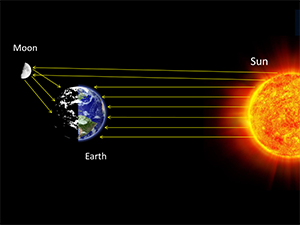
How could the psalmist have known of this incredible astronomical reality?3 His writing had to have been guided (2 Peter 1:20) by the Creator Who “set” the Moon in space “to give light on the earth” (Genesis 1:17). As the Sun reflected and witnessed to the perpetuity of David’s throne, so the Moon reflects and witnesses to the reality of the Sun. Incredibly, like the Moon,
[t]here was a man sent from God, whose name was John. This man came for a witness, to bear witness of the Light, that all through him might believe. He was not that Light, but was sent to bear witness of that Light. That was the true Light which gives light to every man coming into the world (John 1:6-9).
You and I did not see with our own eyes the presence of Deity on Earth when Jesus came from heaven to fulfill His divine role, and John served as an eyewitness to that reality, reflecting His glory to us. Likewise, the majestic Moon with its reflective capacity enables us to see the higher reality of a Creator who designed the Universe in such a way that we are beneficiaries of His cosmic marvels.
Endnotes
1 Francis Brown, S.R. Driver, and Charles A. Briggs (1906), The Brown-Driver-Briggs Hebrew and English Lexicon (Peabody, MA: Hendrickson, 2000 reprint), p. 729; L. Koehler, W. Baumgartner, M.E.J. Richardson, and J.J. Stamm (1994–2000), The Hebrew and Aramaic Lexicon of the Old Testament, electronic ed. (Leiden: E.J. Brill), p. 788. The two other occurrences of the term in the Psalms refer to false witnesses (27:12; 35:11).
2 Astronomers use the term “albedo” to refer to the reflectivity of the Moon and other celestial bodies. See, for example, G. Matthews (2008), “Celestial Body Irradiance Determination from an Underfilled Satellite Radiometer: Application to Albedo and Thermal Emission Measurements of the Moon Using CERES,” Applied Optics, 47[27]:4981-93, September 20; Jeff Medkeff (2002), “Lunar Albedo,” Notes on Lunar Features, https://web.archive.org/web/20080523151225/http://jeff.medkeff.com/astro/lunar/obs_tech/albedo.htm.
3 5th century B.C. Greek philosopher, Anaxagoras (499-428 B.C.), is credited with being the first to explain that the Moon shines by reflecting the Sun’s light. David lived 500 years earlier. See J.J. O’Connor and E.F. Robertson (1999), “Anaxagoras of Clazomenae,” School of Mathematics and Statistics, University of St Andrews, Scotland, http://www-history.mcs.st-and.ac.uk/Biographies/Anaxagoras.html.
The post The Moon Is a Witness appeared first on Apologetics Press.
]]>