The post Who Did Nebuchadnezzar See in the Furnace? appeared first on Apologetics Press.
]]>Full of fury, King Nebuchadnezzar ordered the furnace to be heated well beyond its usual temperature. Daniel’s three companions were then thrown into the furnace, which, in turn, resulted in the deaths of those who placed them there. The Bible then reads:
Then King Nebuchadnezzar was astonished; and he rose in haste and spoke, saying to his counselors, “Did we not cast three men bound into the midst of the fire?” They answered and said to the king, “True, O king.” “Look!” he answered, “I see four men loose, walking in the midst of the fire; and they are not hurt, and the form of the fourth is like the Son of God” (Daniel 3:24-25, NKJV).
The original manuscripts of the Bible do not typically include punctuation and capitalization. Translators must make those decisions as best they can. However, they sometimes create misimpressions by their decisions, forcing the English reader to interpret a passage incorrectly. Such is certainly the case with the words “the Son of God.” The English reader would inevitably understand the phrase “the Son of God” to be a reference to Jesus. The resulting conclusion is that Jesus made a pre-incarnate visit to the furnace to rescue Daniel’s companions.
However, surely a pagan Babylonian king would have no knowledge of Jesus Christ—let alone know what He looked like. For that matter, neither would Daniel or his three friends. While the Old Testament prophets prophesied of the coming Messiah, their understanding of His person would have been woefully incomplete, since the fulfillment of those prophecies was yet far into the future. (See 1 Peter 1:10-11.)
In addition to the fact that the manuscripts do not capitalize “son” and “God,” additional grammatical features are worthy of note. First, the Hebrew text has no article “the” before “son.” Hence, it can just as easily read “a” son of God. Second, the Hebrew word for “God” (elohim) is a generic term that must not be confused with the divine name (Yahweh/YHWH) that refers exclusively to the God of the Bible. Elohim has the same latitude of meaning as the English word “God.” The exact same word can refer to the God of the Bible, or it can be used to refer to any “god”—from the Hindu gods Vishnu and Durga to the gods of Native Americanism. The same Hebrew word for “God” is used, for example, in Exodus 20:23 to refer to “gods”: “You shall not make anything to be with Me—gods of silver or gods of gold you shall not make for yourselves.”1 God even used the term in the giving of the Ten Commandments to refer to false gods: “You shall have no other gods (elohim) before Me” (Exodus 20:3). Further, it so happens that the Hebrew term elohim is a plural noun. Hence, it can refer to “gods” plural.
It makes perfect sense, then, that what the heathen king Nebuchadnezzar intended by his declaration was that the fourth figure in the fiery furnace was like a son of the gods—i.e., a celestial being of some sort. The king, in fact, clarified his own statement after the three companions emerged unscathed from the furnace: “Blessed be the God of Shadrach, Meshach, and Abed-Nego, who sent His Angel and delivered His servants who trusted in Him” (vs. 28). Nebuchadnezzar simply considered the fourth being to be some sort of supernatural, angelic being who was sent by Daniel’s God to rescue them from the furnace.
Several English translations recognize these grammatical nuances. The 1901 American Standard Version has “a son of the gods.” A host of other translations also so translate the verse, including the ESV, NASB, NCV, NIV, RSV, WEB, and YLT. The CJB has “and the fourth looks like one of the gods.” The ISV has “resembles a divine being,” which captures the meaning perfectly.2
Endnotes
1 Such is the case in many passages throughout the Old Testament, including Exodus 12:12; 15:11; 18:11; 23:13,24,32,33; etc.
2 Again, some have suggested that the third being in the furnace was a preincarnate appearance of Jesus. While such is certainly a possibility, we cannot know with certainty. Compare, for example, such passages as Genesis 18:1 and 1 Corinthians 10:4. However, as noted, we can be certain that the pagan Babylonian monarch (as well as Daniel and the three Hebrew youths) was unacquainted with Jesus.
The post Who Did Nebuchadnezzar See in the Furnace? appeared first on Apologetics Press.
]]>The post Q&A: Number Endings in Genesis 5 appeared first on Apologetics Press.
]]>“When I read Genesis 5, the numbers appear mythical. I don’t mean in length, but the actual, statistical likelihood that there are ten zeros in the list and many fives. In fact, almost everything follows a zero. Adam lived 800 years after his son. Noah had his children at 500 years old, and the flood started when Noah was 600 years old, and he lived 350 years after the flood. Enoch was taken after 300 years. There is no deviation or variation. It’s like the author was either unable to do math, or made it too simple, or was just making it up—thus all the zeros. Can you help with this issue?”
A:
Normally, when people ask questions about the numbers in Genesis 5, the discussion centers on the long lifespans of the patriarchs (e.g., “How could Methuselah live to be 969 years old?”). This question, however, considers the likelihood of so many of the patriarchs’ lifespans, as well as their ages when they had sons, ending in 0 or 5. Are Moses’ numbers made up?
First, keep in mind that simply because something may initially seem improbable does not necessarily make it impossible or incorrect. Many Bible questions are more clearly answered once we delve more deeply into the biblical, historical, and cultural context. For example, in the first century, any part of a day could be computed for the whole day and the night following it. The Bible writers could truthfully equate “on the third,” “after three days,” and “three days and three nights” (even though such language may initially sound contradictory to us).
Second, there actually is some variation from “0” and “5” endings in Genesis 5. The lifespans of four of the ten patriarchs end in numbers other than 0 and 5. Seth died at 912, Jared at 962, Methuselah at 969, and Lamech at 777 (Genesis 5:8,20,27,31). Furthermore, the ages at which Jared, Methuselah, and Lamech had sons ended with numbers other than 0 and 5 (Genesis 5:18,25,28). A person may question the amount of variation within Genesis 5, but there is variation. What’s more, there is even more variation of numbers in Genesis 11 in the list of 10 Messianic ancestors between Noah’s son, Shem, and Abram (11:10-32).
Third, there obviously was some rounding of numbers up or down. Since there were no days, weeks, or months mentioned in Genesis 5, the numbers clearly include a rounding to the nearest year. Do we not often truthfully and acceptably round up or down all sorts of numbers? When someone asks (at 10:59), “What’s the time?” is it wrong to say it’s 11:00? Is it dishonest to say, “We just drove 800 miles,” when we actually drove 789 miles? Is it a lie to say a car costs $10,000 when it really costs $9,999? God neither lies nor approves of lying (Titus 1:2; Ephesians 5:25); however, rounding numbers (when no deceit is intended) is acceptable and often customary. In fact, the person who says, “I’m 22 years, 11 months, 28 days, 10 hours, 7 minutes, and 22 seconds old,” rather than simply saying “22” or “23,” is being excessively specific (and annoying). The rounding of numbers is often a welcomed relief.
Finally, even if all 10 patriarchs mentioned in Genesis 5 did have children or pass away at an age that ended in a 5 or 0 (which was not the case), such ages would not make the numbers wrong. They might seem statistically unlikely, but how many times in human history has something happened that seemed statistically unlikely? Has someone ever rolled a pair of dice 10 times and 10 times in a row got a total of 5 or 10? Probably. How many times could someone roll a pair of dice and not get combinations that equal seven? In 2009, a woman did this 157 times in a row, which reportedly is a 1 in 1.56 trillion chance. Yet, it happened.
Though the numbers in Genesis 5 may seem unusual at first glance, a more thorough consideration helps to clarify the matter. In truth, the number-endings are neither impossible nor unlikely.
Endnotes
1 See Eric Lyons (2004), “Did Jesus Rise ‘On” or ‘After’ the Third Day?” Apologetics Press, https://apologeticspress.org/did-jesus-rise-on-or-after-the-third-day-756/.
2 And is technically still rounding to the nearest second (and not tenth of a second or hundredth of a second, etc.).
3 Claire Suddath (2009), “Holy Craps! How a Gambling Grandma Broke the Record,” TIME, May 29, http://content.time.com/time/nation/article/0,8599,1901663,00.html.
4 Ibid.
5 For questions pertaining to some of the different numbers given in the Septuagint and the Samaritan Pentateuch, see the excellent article by Dr. Justin Rogers (2020), “Can I Trust the Numbers in Genesis 5?”, Apologetics Press, https://apologeticspress.org/can-i-trust-the-numbers-in-genesis-5-5849/.
The post Q&A: Number Endings in Genesis 5 appeared first on Apologetics Press.
]]>The post Can Sin vs. Cannot Sin? appeared first on Apologetics Press.
]]>If we say that we have no sin, we deceive ourselves, and the truth is not in us. If we confess our sins, He is faithful and just to forgive us our sins and to cleanse us from all unrighteousness…. If we say that we have not sinned, we make Him a liar, and His word is not in us.
These words are hardly surprising, since most people understand that they are not perfect and, in fact, have sinned many times. Yet reading further in 1 John, one encounters the follow startling remarks:
Whoever abides in Him does not sin. Whoever sins has neither seen Him nor known Him…. Whoever has been born of God does not sin, for His seed remains in him; and he cannot sin, because he has been born of God (1 John 3:6,9).
The skeptic might easily conclude that the Bible contradicts itself—or at least John did.
However, in Greek, tense generally refers to “kind of action” which consists of linear or punctiliar. “Linear” refers to continuous action, while “punctiliar” refers to point action, a single event. The verb rendered “have (not) sinned” (a perfect active indicative) in chapter 1 refers to point action in the past with abiding results. John was saying that Christians sin, but they commit isolated, less frequent acts of sin since they are no longer under the rule of sin, and they constantly repent and confess their sins (vs. 9).
Chapter 3, on the other hand, uses a present indicative of continuous action. It refers to habitual, ongoing sin without compunction, with sin ruling one’s life as in his pre-Christian state. John did not contradict himself. He simply called attention to the fact that Christians are certainly not perfect. We make mistakes like everyone does. However, having changed our minds (the meaning of “repent”) about our pre-Christian lifestyle, we have deliberately chosen to forsake the sinful behavior that characterized our lives as non-Christians. Those who have not become Christians, however, have no motivation to resist sin, striving every day to eliminate it from one’s mind and life.
The post Can Sin vs. Cannot Sin? appeared first on Apologetics Press.
]]>The post The Interval Between Christ’s Death & Resurrection appeared first on Apologetics Press.
]]>- “on the third day” (Matthew 16:21; 17:23; Acts 10:40; 1 Corinthians 15:4)
- “in three days” (Matthew 26:61; John 2:19)
- “after three days” (Matthew 27:63; Mark 8:31)
- “three days and three nights” (Matthew 12:40)
On the surface, these four representations certainly appear to be inconsistent, if not contradictory. Indeed, to the English mind, these four phrases convey four different meanings. However, upon further investigation, we discover they are interchangeable expressions in the New Testament. The evidence from antiquity and from the Bible is decisive: “three days and three nights” in Oriental expression was an idiomatic allusion to any portions of the period. This fact stands proven and is undeniable based on at least three sources: (1) scholarly historical analysis of ancient idiomatic language; (2) biblical usage throughout the Old Testament; and (3) harmonization within the passion texts themselves.
HISTORICAL USAGE
First, a vast array of scholarly sources verifies the use of this idiom in antiquity. It constituted a loose form of speech to refer to two days and a portion of a third. A.T. Robertson referred to this usage as “the well-known custom of the Jews to count a part of a day as a whole day of twenty-four hours.”1 Likewise, in his monumental volume Figures of Speech Used in the Bible, E.W. Bullinger explains that “the expression ‘three days and three nights’ is an idiom which covers any parts of three days and three nights.”2 The highly respected 17th-century Hebraist John Lightfoot published a commentary on the New Testament, incorporating his vast grasp of Hebrew and Aramaic usage, including the Jewish Talmud and Mishna. In that commentary, he recounts the common usage of the phrase “three days and three nights” among the Gemarists, Babylonian Talmud, and Jerusalem Talmud, concluding: “So that according to this idiom, that diminutive part of the third day, upon which Christ arose, may be computed for the whole day, and the night following it.”3 The list of scholarly confirmation could be lengthened indefinitely.
BIBLICAL USAGE
Second, the Bible uses the same idiom throughout the Old Testament and continues into the New. For example, in the account of Joseph’s dealings with his brothers, Moses wrote: “So he put them all together in prison three days. Then Joseph said to them the third day, ‘Do this and live, for I fear God…’” (Genesis 42:17-18). Joseph put his brothers in prison for “three days” (vs. 17) and then released them “the third day” (vs. 18). The two expressions were viewed as equivalent.
In his pursuit of the Amalekites, David and his men came upon an Egyptian in the field, whom they nourished with food and drink:
So when he had eaten, his strength came back to him; for he had eaten no bread nor drunk water for three days and three nights. Then David said to him, “To whom do you belong, and where are you from?” And he said, “I am a young man from Egypt, servant of an Amalekite; and my master left me behind, because three days ago I fell sick” (1 Samuel 30:12-13).
The inspired writer states unequivocally that the Egyptian had taken no nourishment for “three days and nights,” which the Egyptian, in his explanation of his predicament, defined as “three days.”
On the occasion when Jeroboam returned from exile in Egypt and led the Israelites in a rebellious confrontation of the rightful king Rehoboam, we are informed:
Then Jeroboam and the whole assembly of Israel came and spoke to Rehoboam, saying, “Your father made our yoke heavy; now therefore, lighten the burdensome service of your father, and his heavy yoke which he put on us, and we will serve you.” So he said to them, “Depart for three days, then come back to me.” And the people departed (1 Kings 12:3-5).
Rehoboam then consulted with the elders of the nation, promptly rejecting their advice, and then consulted with the young men of his own generation who had grown up with him. Then the text reads: “So Jeroboam and all the people came to Rehoboam the third day, as the king had directed, saying, ‘Come back to me the third day’” (1 Kings 12:12). Lest we fail to grasp the fact that “for three days” and “the third day” are equivalent expressions, the inspired writer says so explicitly by equating them and then adding “as the king had directed.” The parallel account in 2 Chronicles completes the idiomatic usage by reading: “So he said to them, ‘Come back to me after (ע֛וֹד) three days’” (10:5). This latter allusion is not to—as a westerner would think—the fourth day, but to a point in time “on” the third day (vs. 12—בַּיּ֣וֹם). Hence, “after three days” equals “the third day.”
Yet another instance is found in the book of Esther. Having been elevated to a prominent position in the eyes of King Xerxes, Mordecai urged his cousin Esther to use her influence to save the Jews throughout the Persian Empire from annihilation by Haman. Here was her response:
“Go, gather all the Jews who are present in Shushan, and fast for me; neither eat nor drink for three days, night or day. My maids and I will fast likewise. And so I will go to the king, which is against the law; and if I perish, I perish!” So Mordecai went his way and did according to all that Esther commanded him. Now it happened on the third day that Esther put on her royal robes and stood in the inner court of the king’s palace, across from the king’s house, while the king sat on his royal throne in the royal house, facing the entrance of the house (Esther 4:16-5:1).
Esther did not change her mind regarding when she would approach the king. Rather, she did exactly what she told Mordecai she would do. Hence, “three days, night or day” is precisely the same timeframe as “on the third day.”
We see the same idiom in the New Testament. One example is the inspired account of the events leading up to the conversion of the first Gentiles in Acts 10. Several temporal indicators illustrate the principle:
- “ninth hour of the day” (vs. 3)
- “The next day” (“about the sixth hour”) (vs. 9)
- “On the next day” (vs. 23)
- “the following day” (vs. 24)
- “Four days ago” (“the ninth hour”) (vs. 30)
If we count the amount of time that transpired between the appearance of the angel to Cornelius (vs. 3) and the arrival of Peter at the house of Cornelius (vs. 24), we find it to be exactly three days, i.e., three 24 hour periods. Yet in Jewish reckoning, the period included three nights and parts of four days. Thus Peter described the interval as “four days” (vs. 30). See the chart below.
We are forced to conclude that the phrase “three days and three nights” is not to be taken literally. It was used figuratively in antiquity. Why take one expression out of the four that are used, interpret it literally (i.e., 72 hours), and then give it precedence over all the other passages? Jesus being in the grave “one complete day and night (24 hours) and the parts of two nights (36 hours in all) fully satisfy both the idiom and the history.”4 The English reader must not impose his own method of calculation upon an ancient, alternate method of reckoning time.
Another instance of the same idiom in the New Testament is seen in Paul’s stay in Ephesus. The text reads:
And he went into the synagogue and spoke boldly for three months, reasoning and persuading concerning the things of the kingdom of God. But when some were hardened and did not believe, but spoke evil of the Way before the multitude, he departed from them and withdrew the disciples, reasoning daily in the school of Tyrannus. And this continued for two years, so that all who dwelt in Asia heard the word of the Lord Jesus, both Jews and Greeks” (Acts 19:8-10).
Paul states plainly that he remained in Ephesus for two years and three months. Sometime later, in his rush to get to Jerusalem in time for Pentecost, he came to the seacoast town of Miletus from whence he sent word to the elders of the church in Ephesus to come meet with him. Among the stirring remarks that he delivered to them on that occasion were these words: “Therefore watch, and remember that for three years I did not cease to warn everyone night and day with tears” (Acts 20:31). Once again, it is apparent that the Semitic mind considered that any portion of a day or year could be counted as a whole day or year.
JEWISH USAGE
Third, it is abundantly clear from the accounts of Christ’s death and resurrection that this idiom was well recognized and utilized by the Jews at the time. Specifically, the chief priests and Pharisees confirmed use of the idiom when they sought an audience with the Roman Procurator Pilate:
On the next day, which followed the Day of Preparation, the chief priests and Pharisees gathered together to Pilate, saying, “Sir, we remember, while He was still alive, how that deceiver said, ‘After three days I will rise.’ Therefore command that the tomb be made secure until the third day, lest His disciples come by night and steal Him away, and say to the people, ‘He has risen from the dead.’ So the last deception will be worse than the first” (Matthew 27:62-64).
The Jewish leaders did not insist on the tomb of Jesus being secured for three 24-hour days. To the western mind, the phrase “after three days” indicates the need to maintain a guard until the fourth day had come. But not to the oriental mind. The phrases “after three days” and “until the third day” were, to them, equivalent expressions.
The evidence from both antiquity and the Bible is decisive: “Three days and three nights” was an idiom. This truth stands as a proven fact of history. Bullinger was correct when he emphatically stated: “It may seem absurd to Gentiles and to Westerns to use words in such a manner, but that does not alter the fact.”5
ENDNOTES
1 A.T. Robertson (1922), A Harmony of the Gospels (New York: Harper and Row), p. 290.
2 Bullinger, p. 845, emp. added.
3 John Lightfoot (1823), Horae Hebraicae et Talmudicae or Hebrew and Talmudical Exercitations upon the Gospels of St. Matthew and St. Mark (London: J.F. Dove), 11:202.
The post The Interval Between Christ’s Death & Resurrection appeared first on Apologetics Press.
]]>The post "I Just Believe in One Less God Than You" appeared first on Apologetics Press.
]]>The problem with this “argument” is that it’s not an argument at all. It’s a neat little play on words, but when looked at closely, it is not a logical reason for anything. The idea being presented is that just because there are many wrong answers, then all the answers must be wrong. In fact, the statement implies that the “one less” answer is just the next step in the sequence. But let’s think through that. If there really is just one correct answer, then of course all the others would be incorrect. For instance, if a person were to say, “You don’t believe that 2+2 equals 5 or 6 or 7 etc., therefore 2+2 does not have an answer. See, I just believe in one less answer than you.” The problem with such reasoning is easy to see: If there is a singular answer, then the “one less” statement leaves out the one most important correct answer.
To further illustrate, when Thomas Edison invented the light bulb, the story is told that he said that after trying 10,000 different filaments, he had not failed; he just found 10,000 things that don’t work in a light bulb. Now suppose a person were to say, “Tell me why those 10,000 substances did not work and I will use the same reasoning to tell you why the one thing you say will work, won’t. I just believe in one less filament than you.” Again, the fault in the reasoning is evident. The characteristics of the filaments that don’t work are obviously different from the ones that do. Yes, it may be true that atheists believe in one less God than the God of the Bible. But the fact is, no other God is the all-powerful, all-knowing, all-good Creator of life Who came down to the Earth in human form and sacrificed His life for His human creatures simply because He loved them. Yes, atheists believe in one less God, but it is that God, and only that God, Who truly fits all the criteria to be the singularly correct answer (John 11:26).1
Endnotes
1 Eric Lyons and Kyle Butt (2014), “7 Reasons to Believe in God,” http://apologeticspress.org/apPubPage.aspx?pub=1&issue=1175.
The post "I Just Believe in One Less God Than You" appeared first on Apologetics Press.
]]>The post Bart Ehrman, the Afterlife, and Hell: Misrepresenting Jesus Again appeared first on Apologetics Press.
]]>Ehrman claims that the Old Testament teaches that once a person dies, there is no consciousness after death. That would mean that the Bible writers did not believe in a soul or spirit that lived on after the physical body died. Therefore, if we could show just one instance of the Old Testament representing a conscious, disembodied spirit of any person, it would refute Ehrman’s claim. Such an example is not difficult to find. In 1 Samuel 28 we read the intriguing story of King Saul disguising himself and visiting a spiritualist referred to as the medium of Endor. In the account, Saul asks the women to, “Bring up Samuel for me” (1 Samuel 28:11). The women states, “I saw a spirit ascending out of the earth” (vs. 13). The spirit turns out to be that of the physically dead prophet Samuel. He then appears to Saul and asks why Saul would disturb him. The spirit of Samuel then explains to Saul that because of his disobedience, “tomorrow you and your sons will be with me” (vs. 19). The next day Saul and his sons were killed in battle. Their bodies remained on the Earth, while their spirits went to be with Samuel. Regardless of whether or not you believe the story and it’s supernatural elements2, it cannot reasonably be denied that this story represents the belief that although Samuel’s body was dead, his disembodied spirit lived on.
The New Testament overwhelmingly supports the teaching that the soul lives on after death. The Sadducees based their belief system on similar thinking to what Ehrman adopts in his article. They claimed that once people die, there is no remaining soul or spirit. Acts 23:8 states, “For the Sadducees say that there is no resurrection—and no angel or spirit.” This group posed a situation to Jesus that they believed would prove their point. They presented the scenario to Jesus of a woman who had been married seven times, then asked Him, “Therefore, in the resurrection, whose wife of the seven will she be?” (Matthew 22:29). Jesus’ scathing response showed the Sadducees and those listening to the exchange that the denial of an immortal soul went against both the Old Testament and His own teachings. He said, “You are mistaken, not knowing the Scriptures nor the power of God…. But concerning the resurrection of the dead, have you not read what was spoken to you by God, saying, ‘I am the God of Abraham, the God of Isaac, and the God of Jacob’? God is not the God of the dead but of the living” (22:29-32). What was Jesus’ point? Abraham, Isaac, and Jacob were physically dead. But God is the God of the living, so they must be alive. But where are they alive? Not in bodily form. Their spirits, which the Sadducees denied, were still very much alive. Those who teach anything other than this truth simply “are mistaken, not knowing the Scriptures nor the power of God.” Sure, some ancient Jews misunderstood the teachings of the Old Testament; but they were just wrong, as are modern teachers who teach the same thing.
Paradise
Ehrman further insists that Jesus did not endorse “the view that departed souls go to paradise or everlasting pain.” On the contrary, Jesus absolutely and unequivocally endorsed and openly taught that the souls of those who were righteous went to paradise and the souls of the wicked were ushered into torment. One of the clearest examples of this teaching is found in Luke 16:19-30. Jesus related the events of the lives of a particular rich man and a poor beggar named Lazarus. “So it was that the beggar died, and was carried by the angels to Abraham’s bosom. The rich man also died and was buried. And being in torments in Hades, he lifted up his eyes and saw Abraham afar off, and Lazarus in his bosom. Then he cried and said, ‘Father Abraham, have mercy on me, and send Lazarus that he may dip the tip of his finger in water and cool my tongue; for I am tormented in this flame’” (Luke 16:22-25). The rich man went on to beg Abraham to send Lazarus back to Earth to talk to the rich man’s five brothers who were lost (vss. 25-31). Notice the elements of Jesus’ teaching. First, the physical bodies of both the rich man and Lazarus were dead. Second, their souls were then removed to an afterlife. Third, the afterlife consisted of two different destinations: one called “Abraham’s bosom,” which was a place of comfort; the other labeled as “torments,” which was a place of burning and pain. Fourth, this was not a final, bodily resurrection since the events on Earth were still happening at the time.
Jesus’ discussion with the thief on the cross provides further clarity of His view of the soul. When the thief acknowledged Jesus’ true identity, Jesus said to him, “Assuredly, I say to you, today you will be with me in Paradise” (Luke 23:43). Jesus knew His physical body was going to die, but His spirit and the spirit of the thief on the cross would be together in a place Jesus called Paradise. When we turn to Acts, we see that Jesus’ soul “was not left in Hades [the realm of the dead—KB]” (Acts 2:31). Jesus died, His soul went to the realm of the dead, specifically, to the destination known as Paradise, and was brought back three days later and reunited with His resurrected body. Jesus most certainly taught that righteous people go to Paradise when they die.
The Eternality of Hell
When we look closely at what Dr. Ehrman is saying, however, we see that he recognizes that Jesus believed in a resurrection. But, Ehrman insists this resurrection would involve “eternal life here on earth, instead of eternal bliss for souls.” He continued his thought that Jesus “did not believe in hell as a place of eternal torment.” “Jesus did not say souls would be tortured there. They simply would no longer exist.” Such a denial and twisting of Jesus’ actual teachings is painful for the conscientious Bible reader to stomach. In Jesus’ discussion of the end of the world and the destination of the righteous and the wicked, He said of the wicked, “And these will go away into everlasting punishment, but the righteous into eternal life” (Matthew 25:45). Ehrman insists that “everlasting punishment” simply means annihilation and has nothing to do with pain or discomfort. How did Jesus respond to such an idea? “So it will be at the end of the age. The angels will come forth, separate the wicked from among the just, and cast them into the furnace of fire. There will be wailing and gnashing of teeth” (Matthew 13:49).3 When Jesus told the story of the unforgiving servant, He said, “And his master was angry, and delivered him to the torturers until he should pay all that was due to him. So My heavenly Father also will do to you if each of you, from his heart, does not forgive his brother his trespasses” (Matthew 18:34-35). Everlasting punishment, wailing, gnashing of teeth, and torturers are all mental pictures designed by Jesus to help us see the unspeakably painful and perpetual nature of what will happen to a person’s soul in hell forever. Jesus clearly taught that souls would be “tortured” in hell for their refusal to accept God’s grace.4
The Fear of Death
Ehrman begins his article laying bare the fact that humans are scared of death “our constant companion.” He discusses how most of us try to ignore it or laugh it off, but even in our laughing at death such mockery is “rooted precisely in terror.” He explains that the fear of eternal torment and misery are quite ancient. And he suggests, “Possibly this is a good time to help people realize that it simply will not be that way.” Ehrman’s solution to the fear of death and punishment after death is to dismiss it with a wave of the hand and deny that an eternal hell exists. I know he wishes such were the case. In his book God’s Problem, he states, “As a result, when I fell away from my faith—not just in the Bible as God’s inspired word, but in Christ as the only way of salvation…I still wondered, deep down inside: could I have been right after all? What if I was right then but wrong now? Will I burn in hell forever? The fear of death gripped me for years and there are still moments when I wake up at night in a cold sweat.”5 Sadly, denying the reality of an eternal hell will not solve the problem anymore than denying cancer will make it go away.
Jesus and the inspired Bible writers understood humanity’s fear of death. That is the reason Jesus came to Earth. “He, Himself likewise shared in the same, that through death He might destroy him who had the power of death, that is, the devil, and release those who through fear of death were all their lifetime subject to bondage” (Hebrews 2:14-15). For Ehrman, his readers, and all humanity, there is only one solution to the fear of death and everlasting punishment. Jesus’ death and resurrection provide the only real hope any person can have. “I am the resurrection and the life. He who believes in Me, though he may die, he shall live. And whoever lives and believes in me shall never die” (John 11:26).
Endnotes
1 Bart Ehrman (2020), “What Jesus Really Said About Heaven and Hell,” Time, May 8, https://www.yahoo.com/news/jesus-really-said-heaven-hell-173203705.html. All quotes from Ehrman are taken from this article unless otherwise noted.
2 I would argue that everyone should believe the events happened as they are recorded since they are found in the Bible and the Bible can be shown to be the inerrant, inspired Word of God, see Behold! The Word of God, Apologetics Press, http://apologeticspress.org/pdfs/e-books_pdf/Behold%20the%20Word%20of%20God.pdf. However, it is not necessary to believe that the Bible is inspired to understand that it is teaching that Samuel’s disembodied spirit was very much alive, even though his body was in the grave. Furthermore, one cannot miss the teaching that Saul and his sons would somehow be with Samuel in the afterlife even though their physical bodies would be dead.
3 Emphasis added by author in all the Scriptures unless otherwise noted.
4 For an extensive discussion of the eternality of hell, see Eric Lyons and Kyle Butt, “The Eternality of Hell,” Apologetics Press, http://apologeticspress.org/apPubPage.aspx?pub=1&issue=561.
5 Bart Ehrman (2008), God’s Problem (New York: Harper Collins), p. 127.
The post Bart Ehrman, the Afterlife, and Hell: Misrepresenting Jesus Again appeared first on Apologetics Press.
]]>The post Does Balaam's Talking Donkey Prove That the Bible Is a Book of Fables? appeared first on Apologetics Press.
]]>The fact is that this admittedly unusual incident differs in several particulars from the uninspired fairytales and fables that characterize mere human authors. Some commentators believe Balaam’s interaction with his donkey was simply a vision or trance-like state that only he experienced in his own mind.1 But Jamieson rightly labels this viewpoint as “inadmissible” because of “the improbability of a vision being described as an actual occurrence in the middle of a plain history.”2 Indeed, the account does not possess the characteristics or qualities of a fictitious narrative. The American Heritage Dictionary of the English Language defines “fable” as “1. A usually short narrative making an edifying or cautionary point and often employing as characters animals that speak and act like humans. 2. A story about legendary persons and exploits. 3. A falsehood; a lie.”3 Older dictionaries emphasize the fictitious nature of a fable: “A feigned story intended to enforce some moral precept; a fiction in general.”4 Webster’s original dictionary had “1. A feigned story or tale, intended to instruct or amuse; a fictitious narration intended to enforce some useful truth or precept.”5 The account of Balaam’s donkey does not match the definition of “fable.”
In the first place, as D.R. Dungan notes in his discussion of biblical hermeneutics, “a fable is an illustration made by attributing human qualities to animate and inanimate beings…. [T]he actors are selected from those beings which are incompetent to do such things…. [U]nlike the parable, its actors are unreal,…made to act a fictitious part.”6 Balaam’s donkey was not an imaginary creature that possessed human capabilities comparable to Brer Rabbit or the tortoise and the hare. The characters in fables never existed, never will exist, and are never alleged to exist. In contrast, this donkey was an actual, literal donkey owned by Balaam and on which he had ridden many times (vs. 30). The donkey remained nothing more than a donkey both before and after the supernatural interlude. The animal was able to speak only because God directly intervened to communicate His rebuke to Balaam, using the donkey as His mouthpiece. As Matthew Henry explains: “God opened the mouth of the [donkey]…. God enabled not only a dumb creature to speak, but a dull creature to speak to the purpose.”7 Or as Keil and Delitzsch note, God expressed Himself in “the rational words of human language, which an animal does not possess.”8 The donkey did not cease being a donkey, let alone become human in its nature—as do the characters in fables. Even the rationale offered was God’s argumentation intended to reason with Balaam and prod him to come to grips with his own irrational behavior and internal motives.
Comparable instances of the use of non-human vehicles of supernatural communication may be seen in Satan’s speech to Eve via a snake (Genesis 3:1ff.),9 as well as God speaking to Moses from within a burning bush (Exodus 3:4), and also speaking to Job out of a storm (Job 38:1; 40:1). In each of these instances, the harnessed object (whether animate or inanimate) used by the speaker was purely a physical medium through which the speaker conveyed a message—unlike what happens in a fable. This understanding of the use of Balaam’s donkey is reinforced and supported by the inspired apostle Peter’s remark concerning Balaam: “but he was rebuked for his iniquity: a dumb donkey speaking with a man’s voice restrained the madness of the prophet” (2 Peter 2:16). The donkey did not speak with his own voice. Rather, God spoke using a human voice via the donkey. Other renderings of the Greek further support this conclusion. The NASB reads: “but he received a rebuke for his own transgression, for a mute donkey, speaking with a voice of a man, restrained the madness of the prophet.” The NIV reads: “But he was rebuked for his wrongdoing by a donkey—a beast without speech—who spoke with a man’s voice and restrained the prophet’s madness.” The donkey did not function of its own accord—as do fictitious characters in fables. Rather, the donkey was merely being utilized by God to articulate the divine message. Like the burning bush, God enlisted the physical form of the animal to express Himself to Balaam. As Augustine explained: “God did not convert the soul of the [donkey] into that of a reasonable being, but, as it pleased Him, made her to utter sounds to restrain Balaam’s folly.”10
Interestingly, the Bible does, in fact, contain a smattering of fable. However, its use is easily distinguishable from the erroneous use alleged by skeptics. For example, Jotham related a fable in Judges 9:6-21 and Jehoash told a fable in 2 Kings 14:8-10. But even in these biblically rare instances of this type of figurative discourse, the fables are nothing more than literary devices used by the speakers to press their contemporaries with specific truths. The Bible nowhere portrays itself as fable. Rather, it purports to convey actual history.
In the second place, the Bible is filled with historical accounts of miraculous and supernatural events. The evidence indicates that the Universe had to be miraculously (i.e., supernaturally) created by an intelligent supernatural Being. Supernatural phenomena, therefore, have occurred in the past in connection with the activity of the supernatural Creator. The Bible, itself, has supernatural qualities that prove it to be from God.11 Since we know that supernatural phenomena have occurred in the past and that the Bible can be verified as being the product of the supernatural God of the Universe, if the Bible says that “the Lord opened the mouth of the donkey” so that it talked, then, we can know that it talked—albeit, supernaturally. As Seraphim explained:
The stumblingblock…lies in the reasonable speech of an unreasoning and speechless ass…expressed in the form of human speech, of which animals are not capable…. [T]he fact remains clearly indubitable that the ass spoke in a language comprehensible to Balaam, and that this was a supernatural event…. The speech of the ass was an act of Divine Omnipotence.12
Indeed, “the episode moves, from beginning to end, on miraculous ground.”13
While mere fables cannot be verified with actual evidence, the claims of Scripture rest upon mounds of evidence that substantiate them—both the natural and supernatural. If God could speak the entire physical realm into existence (Psalm 33:6,9), if He could create a physical body out of dirt and breathe into it a human spirit, endowing that individual with an intellect and ability to speak (Genesis 2:7ff.), if He could part a sea (Exodus 14:21; Hebrews 11:29) and rain down burning sulfur to destroy the cities of the plain (Genesis 19:24)—and the list goes on and on—then God could easily cause a brute beast momentarily to speak His words.
In the third place, the people, places, and events recorded in Scripture have proven time and again to be a matter of history—not fiction—firmly distinguishing its contents from make-believe fables.14 Even in the context of Numbers 22, the account gives no indication whatever that it is conveying mythical events. In fact, several features of the narrative have been historically authenticated, including the plains of Moab15 (vss. 1,4-7,8,10,14,21,36), the Jordan16 (vs. 1), Jericho17 (vs. 1), the Amorites18 (vs. 2), Midian19 (vss. 4,7), Pethor20 (vs. 5), Egypt (vss. 5,11), Arnon21 (vs. 36), Kirjath-huzoth22 (vs. 39), and Bamoth Baal23 (vs. 41). We’re not talking here of “Neverland” or other imaginary realms or mythical peoples, but actual, historically verifiable places and peoples, cultures and countries. The episode of Balaam’s talking donkey is ensconced firmly in the midst of actual history.24
The more one studies the Bible—with an open and honest heart (Luke 8:15)—the more one is struck with the wonder of divine inspiration. The self-authenticating nature of Scripture will inevitably drive the impartial person to the unalterable conclusion: the Bible is the Word of God.25
Endnotes
1 For example, see “Dissertation V: On the History and Character of Balaam” in John Jortin (1809), Six Dissertations upon Different Subjects (London: Richard Taylor), pp. 142ff. See also “Ass of Balaam” in John McClintock and James Strong (1879), Cyclopedia of Biblical, Theological, and Ecclesiastical Literature (Grand Rapids, MI: Baker, 1970 reprint), 1:477, and William Smith (1868), Dictionary of the Bible, ed H.B. Hackett (New York: Hurd & Houghton), 1:227-228.
2 Robert Jamieson in Robert Jamieson, A.R. Fausset, and David Brown (1882), A Commentary: Critical, Practical and Explanatory on the Old and New Testaments (Toledo, OH: Jerome B. Names), p. 247.
4 Samuel Johnson (1777), A Dictionary of the English Language (London: J. Mifflin), vol. 1.
5 Noah Webster (1828), An American Dictionary of the English Language (New York: S. Converse), 1:78.
6 D.R. Dungan (1888), Hermeneutics (Delight, AR: Gospel Light), pp. 244-245.
7 Matthew Henry (1961), Commentary on the Whole Bible (Grand Rapids, MI: Zondervan), p. 166.
8 C.F. Keil and F. Delitzsch (1976 reprint), Commentary on the Old Testament: The Pentateuch (Grand Rapids, MI: Eerdmans), 1:171.
9 See Gleason Archer (1974), A Survey of Old Testament Introduction (Chicago, IL: Moody Press), p. 201: “The serpent was a mere guise through which the tempter spoke to them.” The Hebrew term translated “serpent” is the normal word for “snake.” See also Revelation 12:9,15; 20:2.
10 As translated in Seraphim (1900), The Soothsayer Balaam (London: Rivingtons), p. 147. See also Charles Taylor (1832), “Ass of Balaam,” in Calmet’s Dictionary of the Holy Bible (London: Holdsworth & Ball), p. 113.
11 See the “Inspiration of the Bible” section at apologeticspress.org.
12 pp. 146-147, emp. added.
13 Marcus Kalisch (1877), Bible Studies, Part I: The Prophecies of Balaam (London: Longman, Greens & Co.), p. 142, emp. added.
14 See the “Factual Accuracy” section of “Inspiration of the Bible” at ApologeticsPress.org.
15 See “The Archaeology of Moab” (1997) in The Biblical Archaeologist, 60[4]:194-248, December.
16 See Jeremy Hutton (2019), “Jordan River in Israelite History,” https://www.bibleodyssey.org:443/en/places/related-articles/jordan-river-in-israelite-history; also William Francis Lynch (1849), Narrative Of The United States Expedition To The River Jordan And The Dead Sea (Philadelphia, PA: Lea & Blanchard).
17 “History of Archaeological Exploration at Tell es-Sultan/Jericho” (2015), Rome “La Sapienza” University, http://www.lasapienzatojericho.it/History.php.
18 “Amorite People,” Encyclopaedia Britannica, https://www.britannica.com/topic/Amorite.
19 Jacqueline Schaalje (2005), “Archaeology in Israel: Timna,” Jewish Magazine, October, http://www.jewishmag.com/95mag/timna/timna.htm; Isidore Singer and M. Seligsohn (1906), “Midian and Midianites,” Jewish Encyclopedia, http://www.jewishencyclopedia.com/articles/10804-midian-and-midianites.
20 See William Shea (1989), “The Inscribed Tablets from Tell Deir ‘Alla (Part 2),” Andrews University Seminary Studies, Summer, 27[2]:97-119, https://digitalcommons.andrews.edu/cgi/viewcontent.cgi?referer=https://en.wikipedia.org/&httpsredir=1&article=1911&context=auss.
21 See Bruce Routledge (2004), Moab in the Iron Age: Hegemony, Polity, Archaeology (Philadelphia, PA: The University of Pennsylvania Press), pp. 44ff.
22 M.G. Easton (1893), Illustrated Bible Dictionary (New York: Harper & Brothers), p. 410, https://archive.org/stream/illustratedbible00east#page/n11/mode/2up.
23 George Smith (1903), The Historical Geography of the Holy Land (New York: A.C. Armstrong & Son), p. 562; Morris Jastrow, Jr. and Frants Buhl (1906), “Bamoth-Baal (‘The Heights of Baal’),” Jewish Encyclopedia, http://jewishencyclopedia.com/articles/2431-bamoth-baal.
24 See Edward Wharton (1977), Christianity: A Clear Case of History! (West Monroe, LA: Howard Book House).
25 For more on the supernatural qualities of the Bible, see Kyle Butt (2007), Behold! The Word of God (Montgomery, AL: Apologetics Press).
The post Does Balaam's Talking Donkey Prove That the Bible Is a Book of Fables? appeared first on Apologetics Press.
]]>The post What is a Saint? appeared first on Apologetics Press.
]]>The concept of a saint and sainthood is often misunderstood. Due to the teachings of certain religious groups, sainthood is supposedly only achieved by “super” Christians who lived an almost perfect life and did some type of verifiable miracle. After the person’s death, his or her life and actions are put through an extensive process of nominating, voting, and ultimately confirmation as a saint. When we look into the Bible, however, we see a completely different, and much simpler explanation of what a saint actually is.
The short answer to the sainthood question is that God refers to any person who becomes a Christian as a saint. The word “saint” is a form of the term “sanctify” and simply means one who is set apart in holy service to God. First Corinthians 1:2 gives us a clear example of this use of the term: “To the church of God that is in Corinth, to those sanctified in Christ Jesus, called to be saints together with all those who in every place call upon the name of the Lord Jesus Christ, both their Lord and ours.” Notice that the letter is written to all the members of the church in Corinth. They are all said to be sanctified, or set apart. Furthermore, Paul insists that all the Christians were “called to be saints” with “all those….” The Bible declares that all Christians, everywhere, are saints.
To better understand this idea, consider the concept of being “sanctified.” What group of people is sanctified, or set apart for holy service to God? In 1 Corinthians 6:9-10, Paul reminded the Corinthian church about sins they had committed in the past. He then stated, “But you were washed, but you sanctified, but you were justified in the name of the Lord Jesus and by the Spirit of our God” (vs. 11) Notice that all the Christians in Corinth were sanctified and set apart to God’s service, not just a chosen, elite group.
The beginning of Paul’s epistle to the Romans clarifies sainthood even further. Paul explains that He is a servant of Christ “separated,” or better translated “set apart,” to the Gospel of God (1:1). He then writes, “To all who are in Rome, beloved of God, called to be saints.” Again, take note of Paul’s use of the word “all” to refer to all the Christians in Rome who were “called” to be saints. How, then, is a person called to be a saint? Paul hints at that with his statement about being set apart “to the gospel of God.” In 2 Thessalonians 2:13-14, He more directly states that “God from the beginning chose you [the church of the Thessalonians—KB] for salvation through sanctification by the Spirit and belief in the truth, to which He called you by our gospel, for the obtaining of the glory of our Lord Jesus Christ.” God, through the inspired Paul, explains that any person who has become a Christian through belief and obedience to the Gospel (see 2 Thessalonians 1:7-8), has been sanctified and is considered a saint.
Depending on the translation you use, the terms saint or saints are used approximately 60 times in the New Testament. Even a brief look at those verses will show that the Bible contains no concept of a “Super Christian” being a saint. Paul concluded his letter to the Philippian church with these words: “Greet every saint in Christ Jesus. The brethren who are with me greet you. All the saints greet you” (4:21). He wanted the Philippians to understand that all Christians are saints. These saints were alive and well. Their lives had not been granted sainthood after their deaths. Nor did they have to verify that they had performed a documented miracle to achieve a higher level of holiness. What had they done to become saints? They simply obeyed the Gospel of Christ when it was preached to them, just as the 3,000 did on the Day of Pentecost in Acts 2.
It is sometimes tempting to compare our lives to others and view ourselves as “less holy.” We might even have stated in the past, when asked about our behavior, “Well, I’m no saint.” The fact is, however, that no one ever gained a level of holiness that could earn a place in heaven. Christians are holy, able to be called saints, not because they earned salvation or because they are super spiritual. On the contrary, God made “Him who knew no sin to be sin for us, that we might become the righteousness of God in Him [Christ—KB]” (2 Corinthians 5:21). All faithful Christians are holy saints, not because they are spiritual giants, but because of “the precious blood of Christ” which He shed “as of a lamb without blemish and without spot” (1 Peter 1:19).
The post What is a Saint? appeared first on Apologetics Press.
]]>The post What Is the “Firmament” of Genesis 1:6? appeared first on Apologetics Press.
]]>The translation “firmament,” however, is not so much a translation of the original Hebrew term as it is a transliteration of a term used in the Latin Vulgate (i.e., firmamentum) which was translated from the Greek Septuagint term (stereoma) that was used for the Hebrew raqia. The uninspired translators of the Septuagint, who were translating for an Egyptian pharaoh in Egypt,2 were apparently influenced by the then conventional belief in Egypt that the heavens are a stone vault.3 The Hebrew term raqia, however, does not suggest such a meaning. Rather, it refers to something that has been stretched, spread, or beaten out—like metal.4 The idea is that on day two, God divided the waters of Earth, spreading them out from one another and moving some above the Earth, and creating that which holds those waters apart—much like what a solid would do.
God then defined the raqia as “heaven(s)” (shamayim). Shamayim, however, was used in three distinct ways by the Hebrews (and by God through His inspired spokesmen). It could mean the sky or atmosphere where the birds fly and the clouds gather (Jeremiah 4:25; Matthew 6:26). It could mean outer space where the stars are situated (Genesis 1:14-15; Psalm 19:4,6; Isaiah 13:10), and it could also mean the place where God dwells (Psalm 2:4; Hebrews 9:24). Context must be used to determine which heaven is referenced. In this case, the heaven identified would affect one’s identification of the water that God separated.
The typical interpretation of raqia and “heaven” in Genesis 1:6 is that God created the sky on day two, separating water vapor in the sky (clouds) from liquid water. Most commentators and translators support this interpretation. Various Creation scientists have theorized that the waters above the firmament were not the sky, but rather, formed a water canopy like a bubble that burst at the Flood. The idea is attractive, as the greenhouse effect that would be generated helps theoretically to explain, for example, the long lifespans of the patriarchs of Genesis five. While the theory has strengths, its weaknesses have caused it to fall on hard times—namely, that simulations indicate the greenhouse effect caused by the canopy would be too severe. Unless the solar constant was reduced to 1/4th of its current value, water on the Earth would boil and life would be exterminated.5 Further, although there still may have been a canopy of some sort, the features of the canopy theory that made it attractive have been shown to be explainable in other ways.
Other Creation scientists have suggested that the second meaning of heaven is being referenced, and the raqia refers to outer space, since the stars were placed in the “heaven” that God created (vs. 17) and the birds created on day five are described as flying across the “face” of the heavens, rather than in the heavens (vs. 20). This interpretation would mean that the waters above the raqia would be water on the outskirts of the Universe, helping to explain why the stars appear to be accelerating outward, as though drawn by a distant gravitational source.6
Regardless of the meaning of raqia, the Bible does not support or endorse erroneous beliefs of mankind from antiquity. The Bible is accurate with regard to its scientific allusions 100% of the time.
Endnotes
1 Asimov (1981), In the Beginning (New York: Crown), p. 33; Schadewald, Robert J. (1983), “The Evolution of Bible-science,” Scientists Confront Creationism, ed. Laurie R. Godfrey (New York: W.W. Norton), p. 290.
2 The Septuagint Version of the Old Testament, with an English Translation (1970) (Grand Rapids, MI: Zondervan), pp. i-ii.
3 J. Barton Payne (1980), “raqia,” Theological Wordbook of the Old Testament, ed. R. Laird Harris, Gleason Archer, Jr. and Bruce Waltke (Chicago, IL: Moody), 2:862; James Orr, ed. (1956), “Astronomy,” The International Standard Bible Encyclopaedia (Grand Rapids, MI: Eerdmans), 1:315.
4 Orr, p. 315; L. Koehler, et al. (1994-2000), The Hebrew and Aramaic Lexicon of the Old Testament (Leiden: E.J. Brill, electronic ed.), p. 1290; F. Brown, S. Driver, and C. Briggs (1906), The Brown-Driver-Briggs Hebrew and English Lexicon (Peabody, MA: Hendrickson), p. 956.
5 Larry Vardiman (2003), “Temperature Profiles for an Optimized Water Vapor Canopy,” Proceedings of the Fifth International Conference on Creationism, ed. R.L. Ivey (Pittsburgh, PA: Creation Science Fellowship), http://static.icr.org/i/pdf/technical/Temperature-Profiles-for-an-Optimized-Water-Vapor-Canopy.pdf.
6 D. Russell Humphreys (1994), Starlight and Time (Colorado Springs, CO: Master Books); John G. Hartnett (2015), “A Biblical Creationist Cosmogony,” Answers Research Journal, 8:13-20, http://www.answersingenesis.org/arj/v8/creationist-cosmogony.pdf.
 |
|
| Suggested Resources | |
The post What Is the “Firmament” of Genesis 1:6? appeared first on Apologetics Press.
]]>The post Ruth, David, and a Moabite Mandate appeared first on Apologetics Press.
]]>Many skeptics question how David could be a descendant of Ruth, a Moabite, and yet also become the divinely chosen King of Israel (1 Samuel 16:1-13). After all, Moses wrote: “An Ammonite or Moabite shall not enter the assembly of the Lord; even to the tenth generation none of his descendants shall enter the assembly of the Lord forever” (Deuteronomy 23:3). So how could King David, the great-grandson of a Moabite woman, be allowed into the assembly of God?
First, one must consider the meaning of the phrase “shall not enter the assembly of the Lord.” Did Moses mean that Ammonites or Moabites (1) could not live within the borders of Israel, (2) could not become part of the Israelite community in general, (3) could not gather together and become part of an actual assembly of the Israelites (cf. Deuteronomy 5:22; 9:10; 10:4; 18:16), (4) could not become one of the elders or officials who often assembled together (cf. Deuteronomy 31:28,30), and/or (5) could not become part of the religious community (cf. Leviticus 21:17-21)—that is, were they forbidden “from participation in religious rites in the homes and at the tabernacle and later at the temple”1? While Moses and the original recipients of this command doubtlessly understood the precise meaning of Deuteronomy 23:3, those living 3,500 years this side of the giving of the Law of Moses (and who have never been accountable to that law), may never know for sure exactly what the Lord meant. And, if neither the Christian nor the skeptic can know for sure what the precise meaning of the “assembly of the Lord” is in Deuteronomy 23:3, then obviously no proven contradiction exists.
Second, different kinds of “outsiders” lived in and around the Israelites. With two-and-one-half tribes of Israel inhabiting the east side of the Jordan (Numbers 32), where the Moabites and Ammonites lived and where the Israelites were currently camping (Deuteronomy 1:5; 29:1) when Moses gave the Moabite/Ammonite restriction of Deuteronomy 23:3, he was referring to the non-converted, uncircumcised “alien” or “foreign” Moabite/Ammonite who was never to be allowed into the general Israelite community. Ruth may have been a Moabite ethnically, but religiously she was a dedicated follower of the LORD (Ruth 1:16-18), who participated in and abided by Mosaic law (Ruth 3:1-18; 4:1-12; Deuteronomy 25:5-10).2 Thus, she and her faithful descendants (including David) were rightly accepted in Israel.
Another reason Deuteronomy 23:3 would not have applied to Ruth and her offspring is simply because a non-Israelite mother in Israel (especially one who was a proselyte!) did not determine the nationality of her offspring. Joseph’s Egyptian wife did not make their sons Ephraim and Manasseh Egyptians (Genesis 41:50-52). Moses’ marriage to Zipporah, a Midianite (Exodus 2:11-25), did not disqualify their sons Gershom and Eliezer from being Israelites (Exodus 2:22; 18:1-4), nor did it make them Midianites. Salmon’s marriage to Rahab (the Jerichoan harlot) did not mean their son Boaz was a recognized Gentile of Jericho (Matthew 1:5). And the Moabitess Ruth, wife of Boaz, did not make their son Obed, their grandson Jesse, their great-grandson David, or their descendants Joseph and Mary (the earthly parents of Jesus) anything other than legitimate descendants of Abraham (Matthew 1:1-17; Luke 3:23-38)—according to the standard reckoning of Israelite heritage. In the eyes of all of Israel, David was an Israelite of the tribe of Judah—and was no more a Moabite than he was a Jerichoan.3
Although Boaz, Ruth, and David were imperfect people (Romans 3:23), who broke various Old Testament commandments (cf. Samuel 11-12), neither these three nor God (in appointing David as king over Israel) ignored or broke the law of Deuteronomy 23:3.
Endnotes
1 Earl Kalland (1992), The Expositor’s Bible Commentary: Deuteronomy (Grand Rapids, MI: Zondervan), 3:140.
2 Some think that Nehemiah 13:1,25,27 contradicts this explanation of Ruth and Deuteronomy 23:3. The social situation in Ezra and Nehemiah’s day (approximately 600 years after the time of Ruth), however, was quite different than what is found in the book of Ruth. Many of the Jews who had returned from 70 years of Babylonian captivity had taken for themselves “pagan” wives from among the Moabites, Ammonites, etc. (Ezra 9:1-2,14; 10:2,10-18,44; Nehemiah 13:23-30), rather than enter into lawful marriages with Jews or faithful converts to Judaism. The Old Testament prohibitions of marrying foreigners (Exodus 34:15-16; Deuteronomy 7:1-4) applied to pagan non-converts, not faithful proselytes.
3 He was the great-great-grandson of Rahab of Jericho, but David was not Jerichoan.
|
 |
| Suggested Resources | |
The post Ruth, David, and a Moabite Mandate appeared first on Apologetics Press.
]]>The post Jesus or Yeshua? appeared first on Apologetics Press.
]]>[EDITOR’S NOTE: A.P. auxiliary writer Dr. Rogers serves as Director of the Graduate School of Theology and Associate Professor of Biblical Studies at Freed-Hardeman University. He holds an M.A. in New Testament from F-HU as well as an M.Phil. and Ph.D. in Hebraic, Judaic, and Cognate Studies from Hebrew Union College-Jewish Institute of Religion.]
A minority of Christian voices through the centuries have insisted on stressing the Jewishness of Jesus.1 Already in the New Testament, we learn that some Christians were retaining Jewish customs and doctrines in an attempt to create a hybrid religion. These attempts met stern apostolic criticism (e.g., Galatians 5:2; Colossians 2:16). Generally, as Christianity transitioned from a majority-Jewish to a majority-Gentile religion, these voices were steadily muted. However, a resurgence of the Jewish Jesus movement has led a number of people to allege ecclesiastical conspiracies to “cover up” the Jewishness of Jesus. Among the sensational claims is the alleged “change” of the name of God’s Son from Yeshua to Jesus.
Before we analyze the rationale and legitimacy behind the question of the name, let us affirm two incontrovertible truths. First, Jesus was a Jew. Scripture is clear that the New Covenant was not inaugurated until the death of Christ (Hebrews 9:16-17). Therefore, Jesus (or Yeshua, if you like) lived His entire life as a Jew under the Law of Moses. The name has nothing to do with His Jewishness. Second, His name in Hebrew was indeed Yehōshūa‘, or more likely in Aramaic Yēshūa‘. Growing up in the Galilee region, Jesus would have almost certainly spoken Aramaic, and He would not have heard His name as “Jesus.” Indeed, the Syriac translations of the New Testament spell the name Yēshūa‘.2 The New Testament, however, is not written in Aramaic or in Syriac, but in Greek. And the English name “Jesus” is a transliteration based on the Latin, which is based on the Greek, which is in turn based on the original Aramaic.
Alleged Reasons for the Name “Change”
“Don’t believe everything you read on the Internet.” This maxim is taught to third-graders and college students alike. Still, it doesn’t seem to sink in. People continue to read websites that propagate fictional conspiracy theories to allege the name of God’s Son was changed from its pure Hebrew form to its current corruption. And here are a few of the most common reasons why.
First, it is alleged that early Christians—even the authors of the New Testament!—were racists. They wished to erase the Jewishness of Jesus from the record in an effort to make Him seem “Christian” and “Gentile.” This simply isn’t true. First, every author of the New Testament seems to possess a Jewish background of some kind, and most were born Jewish (cf. Galatians 2:15). Second, Paul can boast not only of his Jewish lineage (Philippians 3:5), but also claim, “I am a Pharisee” (present tense!) long after his conversion (Acts 23:6). Third, where there is racism in the New Testament, it is usually against Gentiles rather than Jews (Galatians 2:12-16; cf. Romans 2:14).
Second, some would never lay such an allegation as racism at the feet of the Apostles, but they have no qualms about hurling this insult at the Catholic Church. They believe the early church falsified manuscripts of the New Testament in order to erase “Yeshua” and insert the more Western-sounding “Jesus.” There is no evidence for such a claim. We have nearly 6,000 manuscripts of the Greek New Testament, and approximately 19,000 New Testament manuscripts in other early languages, such as Syriac, Coptic, and Latin. In addition to these direct copies, we have tens of thousands of pages of early Christian writings, some of which are from Jewish-Christian groups. The name of Jesus occurs hundreds of thousands of times collectively in these ancient documents, and none of them speaks to a conspiratorial name change. If the “change” from Yeshua to Jesus was an early Catholic conspiracy, it is the best-executed cover-up in world history.
Third, it is occasionally alleged that the name Jesus is an attempt to insert paganism into Christianity. A few (very, very few) argue the name “Jesus” means “hail Zeus.” I suspect someone somewhere noticed the pronunciation of the name, especially in a language such as Spanish, sounds strikingly like “Hey-Zoos.” This must be a furtive nod to the chief god of the Greek pantheon, right? Not in the slightest. The New Testament was not written in English or Spanish, but in Greek. In Greek, “hail Zeus” would be chaire zeu, which bears absolutely no phonetic resemblance to “Jesus.”
How Did We Get from Yeshua to Jesus?
Although Jesus probably grew up in Galilee hearing His name as Yēshūa‘, it is not the case that the Christian world moved from Yeshua to Jesus. This is because Yeshua and Jesus are not different names, but different pronunciations of the same name. Different languages hear sounds differently. The Hebrews of the Old Testament era heard the name of the Persian king as “Ahasuerus” whereas the Greeks heard it as “Xerxes” (compare ESV with NIV in Ezra 4:6). If your name is Peter in the United States or Great Britain, you are Petros in Greece, Pietro in Italy, Pierre in France, and Pedro in Spain. Did each of these languages change your name!? No. These languages simply pronounce the same name in different ways. And so it is with Jesus. The Greek Iēsous represents the Aramaic Yēshūa‘.
But what about the meaning of the name? Those who argue in favor of the superiority of the name Yeshua insist that the Hebrew form means “salvation” whereas the Greek form is meaningless. This is true, and I believe every Christian should know the name of Jesus in Hebrew and Aramaic means “salvation.” However, Peter-Petros-Pietro-Pierre-Pedro means “rock” only in the Greek language. It is meaningless in the others; yet none of us seems bothered by this problem, and no one insists on a consistent, universal pronunciation as Petros. Second, Matthew already felt the need to explain the name of Jesus in his Gospel (Matthew 1:21). And it is routine in the New Testament to translate the meaning of certain foreign words (e.g., Matthew 27:46; Mark 5:41; John 1:38, 41). If the inspired writers were content to use the medium of the Greek language, while also providing explanations, is it wrong of us to follow their example?
Third, there is more than one “Jesus” in the New Testament. In the genealogy of Christ a certain “Jesus son of Eliezer” is named (Luke 3:29). Then there is the Jesus also known as Justus (Colossians 4:11). Finally, the Old Testament hero Joshua is known in Greek transliteration as Iēsous, his name being indistinguishable in Greek from Jesus the Christ (Acts 7:45; Hebrews 4:8, KJV).
Conclusion
Technically, if the New Testament were written in Hebrew or Aramaic, Yeshua would have been the form the authors used. But it wasn’t. It was written in Greek. So the authors represented the name as it was known in Greek. The name “Jesus,” in fact, was well-established in Greek transliteration as Iēsous thanks to the Septuagint, where it is found over 250 times. The New Testament authors did not change the name from Yeshua to Jesus, nor did the early Catholic Church.
Whenever modern theorists insist on the name Yeshua, they are contending for a position the New Testament authors themselves never took. The name of Jesus appears over 900 times in the Greek New Testament, every single time as Iēsous. If one travels to Israel, one will find the name of Jesus is still pronounced “Yeshua” today. But not in China, nor in Russia, nor in any European, North, or South American country will he or she find this pronunciation. The spelling and pronunciation of the name of Jesus is not a matter of conspiracy, but of culture.
Endnotes
1 For a convenient survey of some of the early attempts, see Oskar Skarsaune and Reidar Hvalvik, eds. (2007), Jewish Believers in Jesus: The Early Centuries (Peabody, MA: Hendrickson).
The post Jesus or Yeshua? appeared first on Apologetics Press.
]]>The post Jephthah's Daughter, the Levites, and Symbolic Sacrifices appeared first on Apologetics Press.
]]>Is it possible that Jephthah literally sacrificed his daughter as a “burnt offering” (Judges 11:29-40)? Yes, it’s possible. (Sadly, many children in ancient history were sacrificed at the hands of powerful leaders, including some evil kings of Judah; 2 Chronicles 28:1-3; 33:6-9). But if Jephthah actually sacrificed his daughter, he committed a grave sin, since literal human burnt offerings were condemned by God (Deuteronomy 12:31; 18:10). Furthermore, if Jephthah actually burned his daughter in sacrifice to the Lord, he did so without God ever approving his actions (and such silence on God’s part cannot reasonably be interpreted as approval).1
A much better explanation to the Jephthah question centers around the fact that sometimes a “sacrifice” is offered in a figurative sense. In addition to modern man often speaking metaphorically of “sacrificing” money, sleep, time, energy, etc. for good causes, consider that such figurative sacrificing also took place in ancient Israel. In fact, hundreds of years before Jephthah’s day, ever since the Israelites escaped Egyptian bondage following the tenth plague (the death of the firstborn of Egypt), the people of Israel “offered” both man and beast to God. Jehovah “consecrated…all the firstborn, whatever opens the womb among the children of Israel, both of man and beast; it is Mine,” says the Lord (Exodus 13:2).
There is a sense in which “all males that open the womb” were “sacrificed to the Lord” (Exodus 13:15). But exactly how were all the firstborn males offered in a special way to God? Were they all literally sacrificed as a burnt offering? All the firstborn males among clean animals/livestock were literally burned, but not among the unclean. Unclean animals, such as the donkey, were “redeemed” with a lamb (Exodus 13:13; Numbers 18:15). That is, the donkey was to be delivered or rescued from a sacrificial death with a replacement.2 Similarly, “all the firstborn of man” among the Israelites were redeemed.
Rather than literally sacrifice the firstborn male children of the Israelites (as they did their livestock—Exodus 13:2,12-16; 22:29-30), God set apart the Levites for Himself for religious service (“that they may perform the work of the Lord,” Numbers 8:11).
God said: “I Myself have taken the Levites from among the children of Israel instead of every firstborn who opens the womb among the children of Israel. Therefore the Levites shall be mine, because all the firstborn are Mine. On the day that I struck all the firstborn in the land of Egypt, I sanctified to Myself all the firstborn in Israel, both man and beast. They shall be Mine: I am the Lord” (Numbers 3:12-13).
How were the clean animals given to the Lord? In literal sacrifices. How were the firstborn male humans given to the Lord? Not in literal burnt offerings, but in sacrificial service to God (cf. Romans 12:1).
Interestingly, Numbers 8 indicates that the consecration of the Levites was a type of offering—a symbolic wave offering. After God instructed the Israelites to “lay their hands on the Levites” (as they were “offering” them as a sacrifice to the Lord; cf. Leviticus 4:13-15), He said:
Aaron shall offer the Levites before the Lord as a wave offering from the people of Israel, that they may do the service of the Lord. Then the Levites shall lay their hands on the heads of the bulls, and you shall offer the one for a sin offering and the other for a burnt offering to the Lord to make atonement for the Levites. And you shall set the Levites before Aaron and his sons, and shall offer them as a wave offering to the Lord.
Thus you shall separate the Levites from among the people of Israel, and the Levites shall be mine. And after that the Levites shall go in to serve at the tent meeting, when you have cleansed them and offered them as a wave offering. For they are wholly given to me from among the people of Israel. Instead of all who open the womb, the firstborn of all the people of Israel, I have taken them for myself. For all the firstborn among the people of Israel are mine, both of man and of beast. On the day that I struck down all the firstborn in the land of Egypt I consecrated them for myself, and I have taken the Levites instead of all the firstborn among the people of Israel (Number 8:10-18).3
Like the Levites, who were symbolically offered before the Lord, it is very likely that Jephthah similarly “sacrificed” his daughter. She could have been “sacrificed” as a “burnt offering” at the tabernacle in the sense that she became one of the “serving women who assembled at the door of the tabernacle” (Exodus 38:8; cf. 1 Samuel 2:22). Perhaps like Anna centuries later, Jephthah’s daughter was “offered” to serve God “with fastings and prayers night and day,” never again to leave the area of the tabernacle (cf. Luke 2:36-38). Such a figurative offering makes perfect sense in light of the fact that Jephthah’s daughter and her friends never lamented her death. They mourned—just not her death. What was their sorrow? They “bewailed her virginity” (Judges 11:38). In fact, three times her virginity is mentioned (11:37-39), the last of which is noted immediately following the revelation that Jephthah “carried out his vow with her which he had vowed. She knew no man” (11:39).
If Jephthah sinfully killed his daughter as a literal burnt offering, the repeated bewailing of her virginity makes no sense.4 As Dave Miller concluded, such statements are “completely superfluous and callous…if she had been put to death.”5 On the other hand, if Jephthah’s daughter was about to be “offered” to God to serve perpetually at His tabernacle, and to live the rest of her life as a single, childless servant of the Lord, it makes perfect sense that she and her friends would lament her lasting virginity. When we allow the Bible to explain the Bible, the symbolic offering of Jephthah’s daughter makes perfect sense.
Endnotes
1 Admittedly, Judges 11:29 indicates that “the Spirit of the Lord came upon Jephthah” prior to his journey through Gilead, Manasseh, and Mizpah. Having “the Spirit of the Lord,” however, does not mean a person could never sin and do foolish things (e.g., Samson). This phrase is found seven times in Judges. It can indicate God’s consecration of a judge, such as in Othniel’s case, when “the Spirit of the Lord came upon him, and he judged Israel” (Judges 3:10). At other times, it refers more to the courage and superhuman strength that the Lord provided them, such as in Samson’s case (Judges 14:6; 14:19; 15:14). Jephthah was a courageous leader, but he was not without sin (Judges 11:3; Romans 3:23).
2 If the owner of the donkey did not want to redeem the donkey, he then had to “break its neck” (Exodus 13:15). However, he could not sacrifice it. In short, the donkey had to be redeemed or killed.
3 ESV, emp. added.
4 If someone was about to kill your unmarried daughter, would you feel the need to mourn her virginity or her imminent death?
5 Dave Miller (2013), “Jephthah’s Daughter,” Reason & Revelation, 33[8]:95, August, http://apologeticspress.org/apPubPage.aspx?pub=1&issue=1131&article=2179.
|
|
|
| Suggested Resources | |
The post Jephthah's Daughter, the Levites, and Symbolic Sacrifices appeared first on Apologetics Press.
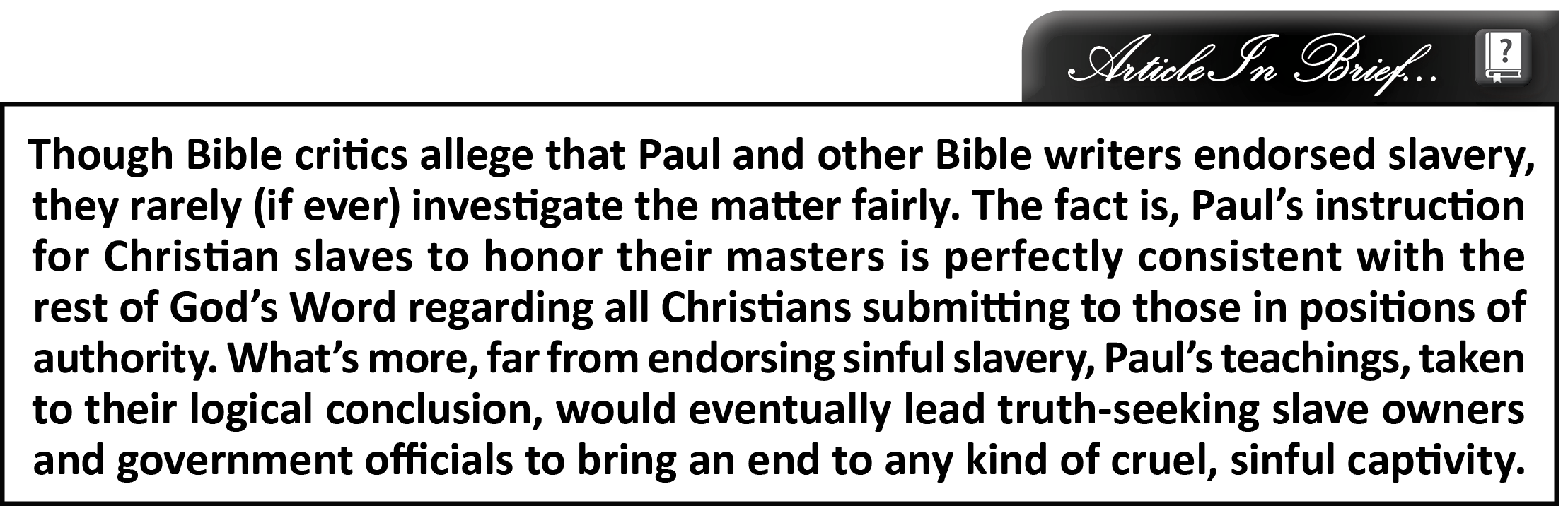
]]>The post Did Paul Endorse Slavery? appeared first on Apologetics Press.
]]>
Thousands of years prior to the establishment of the Lord’s Church, and long before Paul addressed the conduct of Christian slaves in the first century, various forms of slavery were commonplace. In fact, virtually every ancient civilization used slaves.1 Slavery was prevalent enough in Babylon in the 18th century B.C. to be mentioned numerous times in the Code of Hammurabi.2 The Egyptians enslaved hundreds of thousands of Israelites in the 16th century B.C. (Exodus 1; cf. Numbers 1:46). Historians estimate that, by the time Paul wrote his New Testament epistles in the first century A.D., five to eight million slaves resided within the Roman Empire,3 including 15-25% of the total population of Italy.4
“Slavery”—A Broad Term in the First Century
The English term “slave” is translated from the Greek word doulos. Some translations use the term “servant” (or “bondservant”), but doulos is best translated “slave” (especially since “in normal usage at the present time the two words [“slave” and “servant”—EL] are carefully distinguished”).5
So what is meant by “slave” or “slavery”? Americans often envision ancient slavery as the kind of oppressive bondage that was popular among many slave owners in North America in the 18th and 19th centuries, when millions of Africans were stolen from their homelands and shipped across the Atlantic. Certainly, some first-century slavery was similar, but often it was quite different. For example, slavery in New Testament times was not based on race. Many foreign soldiers and their families became slaves after being captured during times of war.6 What’s more, “[s]ome became slaves because they could not pay back the money they had borrowed. The government would also take people into slavery if they could not pay their taxes. There were also many cases of poor people selling their children as slaves to richer neighbours.”7
Consider the fact that the ancients would likely interpret certain modern American practices as forms of “slavery.” For example, hundreds of thousands of Americans who work, labor nearly one-third of every year for the government. That is, Americans are forced by the government with the threat of fines and imprisonment to pay over 100 days wages to local, state, and federal governments every year in the form of taxes. Many Americans hand over more money to the government each year than they spend on food, clothing, and shelter combined.8 According to irs.gov, U.S. citizens who fail to pay government-mandated taxes can be prosecuted and imprisoned for up to five years. And what about the military draft—“the practice of ordering people by law to serve in the armed forces”?9 To this day, all 18-25-year-old males in the U.S. are required to register with the Selective Service System in case of “a crisis requiring a draft”10—a draft in which thousands or millions of men would be forced to go to war, and possibly die for their country, whether they wanted to or not.
Please understand, I am not suggesting that we should defraud the government, or that we should refuse to submit to its authority if the draft is reinstated. I am simply suggesting that “slavery” was broadly defined in the first century. When people ask questions such as “Did Paul endorse slavery?” we must understand that there were various kinds of slavery in the first century, including some forms that resemble certain practices today which may be generally accepted and morally justified.
Define “Endorse”
Did Paul “endorse” slavery? The word “endorse” means “to publicly or officially say that you support or approve of (someone or something).”11 To endorse is to advocate or champion an idea, a thing, or a person. Did Paul “endorse” slavery? Did he champion it or publicly promote it as one advocates a particular product or political candidate? No, at least not the kind of slavery most people think of when they hear the term.
In truth, Paul specifically condemned “kidnappers” (andrapodistais) or “menstealers” (KJV) as lawless and insubordinate individuals who practice that which is “contrary to sound doctrine” (1 Timothy 1:10). Danker, et al. defines this kidnapper as a “slave-dealer.”12 Far from endorsing such activity, Paul groups these men-stealing, slave traders with murderers, liars, and other ungodly sinners (1 Timothy 1:9-10).
Yet, five chapters later Paul wrote: “Let as many bondservants [doulos, slaves] as are under the yoke count their own masters worthy of all honor, so that the name of God and His doctrine may not be blasphemed. And those who have believing masters, let them not despise them because they are brethren, but rather serve them because those who are benefited are believers and beloved. Teach and exhort these things” (1 Timothy 6:1-2). What did Paul instruct Timothy to teach the various Christian slaves in the first century? To respect, honor, and even serve their masters (i.e., to set a good example of Christianity before them).
Paul Endorsed Godly Submission, Not Sinful Forms of Slavery
Paul’s instruction for slaves to honor their masters is perfectly consistent with the rest of God’s Word regarding all Christians submitting to those in positions of authority. To the Christians living in the heart of the Roman Empire, Paul taught: “Let every soul be subject to the governing authorities…. Render therefore to all their due: taxes to whom taxes are due, customs to whom customs, fear to whom fear, honor to whom honor” (Romans 13:1,7; cf. Matthew 22:21).13 Similarly, Peter wrote: “Therefore submit yourselves to every ordinance of man for the Lord’s sake, whether to the king as supreme, or to governors…. For this is the will of God…. Honor all people. Love the brotherhood. Fear God. Honor the king” (1 Peter 2:13-17). Was the Roman Empire corrupt in many ways? Certainly. Was a Christian’s submission to Rome a blanket endorsement of the Empire? Not at all. But Christians were (and are) to be humbly compliant.
God expects all Christians to have a spirit of submission. Children are to submit to their parents (Ephesians 6:1-3). Young people are to be submissive to older people (1 Peter 5:5). Wives are to submit to their husbands (1 Peter 3:1-2). Members of local churches are to submit to their overseeing elders who rule over them (Hebrews 13:17; Acts 20:28). Local shepherds are to submit fully to the Chief Shepherd (1 Peter 5:1-4). In short, all Christians, including those in leadership positions, are to “be submissive to one another, and be clothed with humility, for ‘God resists the proud, but gives grace to the humble’” (1 Peter 5:5). And, yes, God expects His people to humbly “submit…to every authority instituted among men,” whether to kings or to slave masters (1 Peter 2:13,18, NIV).
Submission for a Higher Purpose
God did not create the practice of slavery. Furthermore, Paul’s inspired instructions regarding a slave’s submission to his master were not given because God favors a master over his slave (Galatians 3:28), or because He simply wants some people to have harder lives than others. The specific purpose that Paul gave for Christian slaves submitting to their pagan masters was “so that the name of God and His doctrine may not be blasphemed” (1 Timothy 6:1).
Imagine if Christian slave after slave in the first century became less submissive to their masters as they learned more about the equality of all mankind (Genesis 1:26-27). Consider how the reputation of Christianity would have been greatly tarnished in the eyes of the unbelieving world if Paul explicitly taught that all slaves should be set free. As William Barclay noted: “For the Church to have encouraged slaves to revolt and rebel and rise against their masters would have been fatal. It would simply have caused civil war, mass murder, and the complete discredit of the Church.”14
God, in His infinite wisdom, commands all men to do their best to make the most for the cause of Christ in whatever situation they find themselves. “Let each one remain in the same calling in which he was called. Were you called while a slave? Do not be concerned about it; but if you can be made free, rather use it. For he who is called in the Lord while a slave is the Lord’s freedman. Likewise he who is called while free is Christ’s slave” (1 Corinthians 7:21-23). Whether a person becomes a Christian while in slavery or in a terrible marriage, God wants His people to change from the inside out and have a positive spiritual impact on others. Be obedient to parents, husbands, governing officials, and yes, even slave owners. “Let your light so shine before men, that they may see your good works and glorify your Father in heaven” (Matthew 5:16). Rather than giving people reasons to curse Christ and His doctrine, be obedient to all those in positions of authority “for the Lord’s sake” (1 Peter 2:13). Be honorable at all times so that you may “put to silence the ignorance of foolish men” and “by your good works which they observe, glorify God in the day of visitation” (1 Peter 2:15,12; cf. 3:1-2). In short, “humble yourselves under the mighty hand of God, that He may exalt you in due time” (1 Peter 2:6).
Taking Paul’s Teaching to Its Logical Conclusion
Over time, with the spread of Christianity (cf. Acts 19:10,26; 21:20) and with increasing numbers of slave masters becoming Christians, the physical lives of many slaves would have improved dramatically. As slave owners with honest and good hearts learned (1) to love the Lord with all their heart, soul, mind, and strength, and (2) to love their neighbors (including their slaves) as themselves (Matthew 22:36-40), they would give up “threatening” (Ephesians 6:9). As Christian slave owners contemplated treating others how they want to be treated (Matthew 7:12), they would give their slaves “what is just and fair,” knowing that they, too, had a Master in heaven (Colossians 4:1). As slave owners submitted to Christ, they would be transformed by the Gospel, learning to be “kindly affectionate” to everyone (Romans 12:2,10), including all those who served them. In short, far from endorsing sinful slavery, Paul’s teachings, taken to their logical conclusion, would eventually lead truth-seeking masters and government officials to help bring an end to any kind of cruel, sinful captivity.15
Endnotes
1 “History of Slavery” (no date), History World, www.historyworld.net/wrldhis/PlainTextHistories.asp?historyid=ac41.
2 “Code of Hammurabi, King of Babylon” (no date), https://archive.org/stream/cu31924060109703/cu31924060109703_djvu.txt.
3 Walter Scheidel (2007), “The Roman Slave Supply,” p. 6, https://www.princeton.edu/~pswpc/pdfs/scheidel/050704.pdf.
4 Scheidel, pp. 3-6.
5 Frederick William Danker, William Arndt, and F.W. Gingrich (2000), Greek-English Lexicon of the New Testament (Chicago: University of Chicago), p. 260.
6 John Simkin (2014), “Slavery in the Roman Empire,” Spartacus Educational, http://spartacus-educational.com/ROMslaves.htm.
7 Simkin.
8 Scott Greenberg (no date), Tax Foundation, https://taxfoundation.org/tax-freedom-day-2016-april-24/.
9 “Conscription,” Merriam-Webster.com, https://www.merriam-webster.com/dictionary/conscription, emp. added.
10 “Who Must Register” (2008), Selective Service System, https://web.archive.org/web/20090507213840/http://www.sss.gov/FSwho.htm.
11 “Endorse,” Merriam-Webster.com, https://www.merriam-webster.com/dictionary/endorse.
12 Danker, et al., p. 76.
13 All bold text in Scripture quotations has been added for emphasis.
14 William Barclay (1956), The Letters to Timothy, Titus, and Philemon (Philadelphia: Westminster), p. 141.
15 For a more extensive response to questions regarding slavery, and especially slavery in the Old Testament, see Kyle Butt (2005), “Defending the Bible’s Position on Slavery,” Reason & Revelation, 25[6]:41-47, June, https://www.apologeticspress.org/pub_rar/25_6/0506.pdf.
The post Did Paul Endorse Slavery? appeared first on Apologetics Press.
]]>The post Did Moses write Deuteronomy 34? appeared first on Apologetics Press.
]]>Repeatedly in Scripture, the Holy Spirit indicated that Genesis through Deuteronomy was penned by the inspired writer Moses. Exodus 24:4 indicates that “Moses wrote all the words of Jehovah.” Deuteronomy 31:9 reveals that “Moses wrote this law and delivered it unto the priests…” (cf. Exodus 34:27; Numbers 33:2; etc.). Furthermore, Bible writers throughout the Old Testament credited Moses with writing the Pentateuch (also known as the Torah or “the Law”). A plain statement of this commonly held conviction is expressed in Joshua 8:32: “There in the presence of the Israelites, Joshua copied on stones the law of Moses, which he [Moses]had written” (NIV).1 Notice also that 2 Chronicles 34:14 states: “Hilkiah the priest found the Book of the law of Jehovah given by Moses” (cf. Ezra 3:2; 6:18; Nehemiah 13:1; Malachi 4:4). As Josh McDowell noted in his book, More Evidence that Demands a Verdict, these verses “refer to an actual written ‘law of Moses,’ not simply an oral tradition.”2 [NOTE: In the Hebrew Bible, Genesis through Deuteronomy was considered one unit, and thus frequently was called “the Law” or “the Book” (2 Chronicles 25:4; cf. Mark 12:26). They were not intended to be five separate volumes in a common category, but rather, are five divisions of the same book. Hence, the singular biblical references to “the Law” or “the Book.”]
The New Testament also shows no hesitation in affirming that Moses wrote the Pentateuch. John wrote: “The law was given through Moses” (John 1:17). With this Paul concurred, saying, “For Moses writes about the righteousness which is of the law, ‘The man who does those things shall live by them’” (Romans 10:5, NKJV). Jesus Himself claimed “the Law” came from Moses. In Mark 7:10 Jesus quoted from both Exodus 20 and 21, attributing the words to Moses. Mark also recorded a conversation Jesus had with the Pharisees regarding what “Moses permitted” and “wrote” in Deuteronomy chapter 24 (Mark 10:3-5; cf. Matthew 19:8). But, perhaps the most convincing passage of all is found in John 5:46-47 where Jesus said: “For if you believed Moses, you would believe Me; for he wrote about Me. But if you do not believe his writings, how will you believe My words?”
Even for those who are completely convinced by the evidence that Moses was the inspired writer of “the Law,” some respectfully question whether he actually penned the end of Deuteronomy, which records the death and burial of Moses, as well as “the changing of the guard,” from Moses to Joshua. How could Moses have recorded these things if he had already died?
First of all, is it possible that the same God Who gave Moses supernatural revelation about what happened at the beginning of the Creation of the Universe (which no human being witnessed) also supernaturally revealed to Moses what would happen at (and after) his death? To ask is to answer. Furthermore, God revealed a number of things to Moses about the future that he penned in the Pentateuch—from Israel’s future earthly kings (Genesis 36:31; Deuteronomy 17:14-15) to the coming of Jesus, the King of kings (Genesis 3:15; 12:1-3; 22:18; 49:10; Numbers 24:17; Deuteronomy 18:15-18). If Moses could write accurately through inspiration about events that would happen hundreds of years after his death, could he not also write about his impending death? Certainly he could.
It also may be, however, that a Bible believer could reasonably and respectfully make the case that, though Moses wrote the Pentateuch, the last few sentences in Deuteronomy could have been written by another inspired writer (possibly Joshua). Even J.W. McGarvey, who penned an entire volume defending the Mosaic authorship of Deuteronomy in 1902, believed that “the account of the death of Moses, and some comments on his career…undoubtedly came from the pen of some later writer or writers.”3
Consider a possible modern-day parallel: What if a mother wrote a 200-page book titled “10 Things to Remember when Educating Kids at Home,” but as she was finishing the final few sentences (after having already concluded her 10 main points) she suffered a stroke and died? Could her husband and children publish the book and call her the author even though they actually completed the final 10 sentences of the book? Surely few, if any, would think that such actions on the part of the family would be unfair or dishonest. However, if the mother was called the author but had not written any of the book, such attribution could legitimately be considered deceitful. Or, if she was called the author, but most of the material was written hundreds of years later, that, too, would be a false claim.
In short, the account of Moses’ death serves as no stumbling block to the Christian. Perhaps Moses recorded it by divine revelation prior to his death. Or, perhaps God used Joshua or someone else of His choosing to pen it by inspiration. Either way, one can still be confident that “the Book of the law of the Lord” was “given by Moses” (2 Chronicles 34:14).
Endnotes
1 All bold text in Scripture quotations has been added for emphasis.
2 McDowell, Josh (1975), More Evidence that Demands a Verdict (San Bernardino, CA: Campus Crusade for Christ), pp. 93-94.
3 McGarvey, J.W. (1902), The Authorship of the Book of Deuteronomy (Cincinnati, OH: Standard Publishing), p. 199.
The post Did Moses write Deuteronomy 34? appeared first on Apologetics Press.
]]>The post Hematidrosis: Did Jesus Sweat Blood? appeared first on Apologetics Press.
]]>Of the four gospel writers, only Dr. Luke referred to Jesus’ ordeal as “agony” (agonia). It is because of this agony over things to come that we learn during His prayer, “his sweat was as it were great drops of blood falling down to the ground” (Luke 22:44). Only Luke referred to Jesus’ sweat (idros)—a much used term in medical language. And only Luke referred to Jesus’ sweat as consisting of great drops of blood (thromboi haimatos)—a medical condition alluded to by both Aristotle and Theophrastus.1 The Greek term thromboi (from which we get thrombus, thrombin, et al.) refers to clots of blood.2 Bible scholar Richard Lenski commented on the use of this term: “‘As clots,’ thromboi, means that the blood mingled with the sweat and thickened the globules so that they fell to the ground in little clots and did not merely stain the skin.”3
The Greek word hosei (“as it were”) refers to condition, not comparison, as Greek scholar Henry Alford observed:
The intention of the Evangelist seems clearly to be, to convey the idea that the sweat was (not fell like, but was) like drops of blood;—i.e., coloured with blood,—for so I understand the ώσεί, as just distinguishing the drops highly coloured with blood, from pure blood…. To suppose that it only fell like drops of blood (why not drops of any thing else? And drops of blood from what, and where?) is to nullify the force of the sentence, and make the insertion of ἁίματος not only superfluous but absurd.4
We can conclude quite justifiably that the terminology used by the gospel writer to refer to the severe mental distress experienced by Jesus was intended to be taken literally, i.e., that the sweat of Jesus became bloody.5
A thorough search of the medical literature demonstrates that such a condition, while admittedly rare, does occur in humans. Commonly referred to as hematidrosis or hemohidrosis,6 this condition results in the excretion of blood or blood pigment in the sweat. Under conditions of great emotional stress, tiny capillaries in the sweat glands can rupture,7 thus mixing blood with perspiration. This condition has been reported in extreme instances of stress.8 During the waning years of the 20th century, 76 cases of hematidrosis were studied and classified into categories according to causative factors. The most frequent causes of the phenomenon were found to be “acute fear” and “intense mental contemplation.”9 While the extent of blood loss generally is minimal, hematidrosis also results in the skin becoming extremely tender and fragile,10 which would have made Christ’s pending physical insults even more painful.
From these factors, it is evident that even before Jesus endured the torture of the cross, He suffered far beyond what most of us will ever suffer. His penetrating awareness of the heinous nature of sin, its destructive and deadly effects, the sorrow and heartache that it inflicts, and the extreme measure necessary to deal with it, make the passion of Christ beyond comprehension.
Endnotes
1 William K. Hobart (1882), The Medical Language of St. Luke (Grand Rapids, MI: Baker, 1954 reprint), pp. 80-84.
2 W. Robertson Nicoll, ed. (no date), The Expositor’s Greek Testament (Grand Rapids, MI: Eerdmans), 1:631; M.R. Vincent (1887), Word Studies in the New Testament (Grand Rapids, MI: Eerdmans, 1946 reprint), 1:425.
3 R.C.H. Lenski (1961), The Interpretation of St. Luke’s Gospel (Minneapolis, MN: Augsburg), p. 1077.
4 Henry Alford (1874), Alford’s Greek Testament (Grand Rapids, MI: Baker, 1980 reprint), 1:648, italics in orig.; cf. A.T. Robertson (1934), A Grammar of the Greek New Testament in the Light of Historical Research (Nashville, TN: Broadman Press), p. 1140.
5 Cf. A.T. Robertson (1930), Word Pictures in the New Testament (Grand Rapids, MI: Baker), 2:272.
6 A.C. Allen (1967), The Skin: A Clinicopathological Treatise (New York: Grune and Stratton), second edition, pp. 745-747; “Hematidrosis” (2002), Dorland’s Illustrated Medical Dictionary, p. 832, https://goo.gl/U192fY.
7 R. Lumpkin (1978), “The Physical Suffering of Christ,” Journal of Medical Association of Alabama, 47:8-10.
8 See R.L Sutton, Jr. (1956), Diseases of the Skin (St. Louis, MO: Mosby College Publishing), eleventh edition, pp. 1393-1394.
9 J.E. Holoubek and A.B. Holoubek (1996), “Blood, Sweat, and Fear. ‘A Classification of Hematidrosis,’” Journal of Medicine, 27[3-4]:115-33. See also J. Manonukul, W. Wisuthsarewong, et al. (2008), “Hematidrosis: A Pathologic Process or Stigmata. A Case Report with Comprehensive Histopathologic and Immunoperoxidase Studies,” American Journal of Dermatopathology, 30[2]:135-139, April; E. Mora and J. Lucas (2013),“Hematidrosis: Blood Sweat,” Blood, 121[9]:1493, February 28.
10 P. Barbet (1953), A Doctor at Calvary: The Passion of Our Lord Jesus Christ as Described by a Surgeon (Garden City, NY: Doubleday Image Books), pp. 74-75; cf. Lumpkin, 1978.
The post Hematidrosis: Did Jesus Sweat Blood? appeared first on Apologetics Press.
]]>The post Does the Bible Teach a Flat Earth? appeared first on Apologetics Press.
]]>[Editor’s Note: AP auxiliary writer Dr. Rogers serves as an Associate Professor of Bible at Freed-Hardeman University. He holds an M.A. in New Testament from FHU as well as an M.Phil. and Ph.D. in Hebraic, Judaic, and Cognate Studies from Hebrew Union College-Jewish Institute of Religion.]
Earlier this year, basketball star Kyrie Irving drew headlines for advocating a flat Earth.1 The sports media lampooned Irving for several days until he finally admitted he was wrong.2 While Irving initially defended the “science” behind his claim, many others defend the flat Earth position because of what they read in the Bible. But what does the Bible really say about the shape of the Earth? For those with a high view of Scripture, the Bible stands as an unquestioned authority. If the Bible teaches the Earth is flat, then we must believe it, regardless of what pseudoscience says. Indeed, a number of theorists insist a spherical Earth is contrary to the teaching of Scripture. Are they correct?
Respect the Genre
Flat-Earth theorists marshal a number of biblical passages to defend their assertion (e.g., Joshua 10:12-13; 1 Chronicles 16:30; Psalm 93:1; 96:10; 104:5). One notices instantly that almost every passage cited in favor of the flat-Earth position occurs in a poetic context.3 To be responsible readers of the Bible, we must respect the genre of literature we are reading. Poetry is to be read differently than prose; it is more expressive, emotional, and metaphorical. In fact, taking biblical poetry literally would, in some cases, pervert clear scriptural teaching elsewhere, leading to the belief that there are many gods instead of one God (Exodus 15:11; Psalm 86:8), that humans are really gods (Psalm 82:6), that thunder is the voice of God (2 Samuel 22:14), that God slays sea monsters (Psalm 74:12-14), and that God has wings (Psalm 61:4). Obviously, these passages cannot be understood for what they literally say. So, a common-sense understanding of how poetry functions prevents us from making erroneous interpretive deductions. To insist that metaphorical language must be interpreted literally is to contradict the original authorial intent.
Respect the Audience
In addition to respecting the author’s intent, we must also respect the audience’s understanding. We often hear cosmic complexities expressed in phenomenological language. In other words, the world is explained as it appears on Earth, or in terms we can understand. Even today, we speak of the Sun “rising and setting,” even though virtually every fourth-grade science student knows that, scientifically, this is not the case. Thus, it should not surprise to find the Bible speaking in similar terms (Genesis 28:11; Joshua 10:13; the Hebrew idiom is the Sun “going”). We also describe rain as falling from the sky even though the truth of the water cycle is basic to any elementary ecology. So also Scripture describes rain as though it is contained in a storage compartment above the sky (Genesis 1:7; Psalm 148:4). For God to teach modern scientific astronomy and meteorology to an ancient Hebrew audience would do little good. We know God is not the author of confusion (1 Corinthians 14:33), and He always speaks truth (Titus 1:2), but He condescends to express truths in terms humans can understand (e.g., Job 38-41). To hold the Bible’s language to modern scientific standards is a failure to appreciate the original audience of Scripture. The authors were divinely inspired, but the audience was not.
Is the Earth Flat? What the Bible Says
So how do these considerations relate to the shape of the Earth? Despite the preceding qualifications about reading and interpreting Scripture, we cannot locate a single verse in the Bible that teaches the Earth is flat. Neither in prose nor in poetry, neither by means of phenomenological language nor metaphor, do we find Scripture communicating a flat Earth. The flat-Earth theory is an interpretive deduction, usually based on poetic hyperbole. But is a flat Earth even an accurate interpretive deduction? As we will see, it is far from obvious that the Bible teaches the Earth is flat.
Isaiah 40:22: A Flat-Earth?
The golden text for a spherical Earth is Isaiah 40:22: God “sits upon the circle of the earth.” It has been long argued that a ball must be intended, for God could not possibly sit atop something flat. Of course, such a literal reading ignores the poetic context and the obvious anthropomorphism. However, flat-Earth theorists point out (correctly, we may add) that the Hebrew term for “circle” (חוג,chūg) does not necessarily refer to a sphere. Instead, they say, the term refers to a disc, thereby communicating a flat Earth. Indeed, the ancient Greek translation renders the term γῦρος (gūros), or “ring.” Further, the term “on” (על, ‘al)can also be translated “above,” without implying contact with an object (e.g., NASB, ESV). So this passage does not necessarily communicate a spherical Earth, but neither does it imply a flat Earth.
The only direct parallel to the language of Isaiah 40:22 is Job 22:14. Here God poetically “walks on the circle [חוג, chūg] of the heavens.” Most modern English translations render the term commonly translated “circle” as “vault” in this context (e.g., ASV, RSV, ESV, NIV). A vault provokes images of the Earth having a rounded top, as though a bowl. In other words, the Earth is conceived (albeit poetically) with a convex lid. Why “circle” appears in English translations of Isaiah 40:22 and “vault” in Job 22:14 is beyond my understanding, although the NKJV is consistent in both.4 The term חוג (chūg) is used in both passages, and should probably be translated identically. And a convex “vault” is probably the better option than “circle.”
Ancient Near Eastern thinkers typically conceived of the Earth as having a bowl-shape, with a solid, convex top (Job 37:18) that was covered by water (Job 26:10).5 God poetically “engraves a vault” (חק חג, chōq chāg) over the Earth, perhaps indicating the horizon, or perhaps referring to the bell-shaped vault over the top of the sky (Job 26:10; Proverbs 8:27). The point is that God separates the Earth from the store place of water (cf. Genesis 1:7), and thus carves out a channel above the sky to contain it. Again, these passages occur in poetic contexts, and it can be dangerous to impose a literal meaning on figurative language, as we have discussed. Unlike God, Job’s friends did not necessarily have a perfect scientific understanding, and are, in any case, speaking hyperbolically in Hebrew poetry. Their words simply reflect a popular expression of God’s complete sovereignty over nature. Nevertheless, one thing is sure: there is no thought of a flat Earth anywhere. The “circle of the earth” is a metaphor to be sure, but not even metaphorically is it understood as flat.
It should be noted that the Hebrew Bible does not have an equivalent for the term “sphere,” which in modern Hebrew is the loanword ספירה (sefîrāh). The word “ball” (דור, dūr) occurs in English translations in Isaiah 22:18, but it is clear from Isaiah 29:3 (the only other place the noun occurs) that it refers to a “roll” of items that have encircled a central object. A related verb form is found one other time in the Bible to describe stacked and perhaps “bound” wood (Ezekiel 24:5). In other words, the shape of such an object is beyond the scope of the term. So, the authors of the Hebrew Bible simply lacked the vocabulary to describe a perfectly round object. We cannot expect them to say what they did not have the words to communicate.
Joshua 10:12-13: The Sun Stands Still
Flat-earth theorists also cite the interruption of the Sun to “prove” their theory. The passage reports, “The sun stopped [דמם, d-m-m] and the moon stood still [עמד, ‘-m-d] until the nation avenged its enemies…. The sun stood still [עמד, ‘-m-d] in the middle of the sky and did not hurry to go about an entire day” (Joshua 10:13). Flat-earth theorists, who apparently also defend a geocentric model of the solar system, argue this passage certifies their position. They argue that, according to the standard heliocentric model, the Sun’s standing still would not interrupt the day at all. The Earth, heliocentrists argue, revolves around the Sun. In order for the Bible and the heliocentric model to be true, the Earth would need to pause its rotation on its axis in order for the Sun to appear to stop. But the Bible does not say the Earth stops; it says the Sun stops. Therefore, flat-earth theorists, adopting a geocentric model, argue the Earth must be fixed, and the Sun revolves around it.6
This reasoning violates one of the principles we have discussed: a failure to account for the audience’s understanding. Joshua was not written to Israelites in outer space. From the point of view of those on Earth, the “day” (or “daylight,” the Hebrew יום, yōm meaning both) was extended. Since a day is measured by the Sun, the Sun must have stopped its “going” (בוא, bô’). Indeed, it appeared to them that “the sun stopped in the middle of the sky.” This is a clear use of phenomenological language, and it simply means this day was unusually long. Daylight was halted miraculously so as to allow God’s forces more time to conquer their foes. This is the simplest explanation, and was virtually uncontested until recent times.7 But even if this passage is used to defend a geocentric model of the Universe (wrongly, I believe), Joshua 10:13 still has no bearing on the shape of the Earth. Flat-Earth theorists will need to look elsewhere for evidence.
The “Immovable” Passages
A number of biblical passages assert the immovability of the Earth (e.g., 1 Chronicles 16:30; Psalm 93:1; 96:10; 104:5). These are often proposed as an “obvious” rationale for the Earth being flat. But they do not bear the weight loaded upon them. None of these passages necessarily implies a flat Earth, and even if they might be cited as evidence for geocentricity, note that each of them occurs in a poetic context. If we were to hold Bible-believing flat-Earth theorists to the literal implications of these passages, they would have to insist the Earth neither orbits the Sun nor rotates on its axis. And if the Earth is fixed immovably and permanently, God could never destroy it, for its dissolution would violate its immovability (2 Peter 3:10). But, of course, these poetic passages are not intended to be taken literally.
Since each passage employs similar language and is applied for the same purpose, we shall examine just one as representative. The relevant part of Psalm 96:10 states, “The world is fixed; it cannot be moved.” Two Hebrew words in particular deserve attention. One is the word “fix” or “establish” (כון, kūn). This term does not fundamentally refer to being fixed in position, but rather to being fixed in permanence. Such can be said of David’s kingdom being “established” forever (1 Samuel 20:31; 2 Samuel 7:16; 1 Kings 2:12), or of cities that are “established” (Habakkuk 2:12). These are acts of intended permanence.
In reference to the physical world, the term is not used of the Earth alone, but of the heavenly bodies as well. The Sun, Moon, and stars “are established” by God (Psalm 8:3), as are the “heavens” (Proverbs 3:19). Does this mean the Bible envisions no movement among the heavenly bodies? If one took these passages literally, he or she would be required to say there are no orbits or movements of any astral body anywhere in the Universe. This is, of course, untrue, for even the earliest astronomers could map the stars and motions of the various heavenly bodies, as they serve to mark “seasons, days, and years” (Genesis 1:14). So, if these poetic passages are pressed literally, the Bible teaches that the Earth and all cosmic bodies are static. Is this what the Bible intends to communicate? Of course not. In fact, Scripture elsewhere affirms the movement of heavenly bodies (Jude 13). The Bible simply means to teach that God has programmed His creation to act according to determined, reliable patterns; in that sense, he has “fixed” the world.
The other Hebrew term, מוט (mūt), is translated “be moved.” Because the Earth does not “move,” it must be flat, right? Well, the term does not fundamentally refer to movement of position. It is the opposite of being “fixed” as expressed by the term כון, (kūn). Scripture declares the righteous “shall not be moved” (Psalm 10:6; 21:7; Proverbs 10:30), not meaning, of course, that the righteous are paralyzed, but that they can feel secure in their life. To be movable in this sense is to be insecure, uncertain, and unreliable. The term מוט/(mūt) is often translated “slip” or “sway” (Psalm 66:9; 123:1), and can be used of poorly constructed objects that are destined to fall (Isaiah 40:20; 41:7).
The meaning of this term with regard to the world is understandable. The Earth is “set” in the sense that it is well-designed and well-constructed, and therefore functions without deviation, exactly as the Maker intended. It is secure, dependable, and reliable. The season for sowing and reaping, consistent rain, the course of the astral bodies—these are all evidence that the Earth is “immovable” in the author’s intended sense. Derek Kidner appropriately observes: “The first and last lines of verse 10 [Psalm 96] make it additionally clear that this is a prophecy of perfect government, not a pronouncement on—of all things!—the earth’s rotation.”8 The “fixed Earth” passages, when taken literally, do not make sense with the rest of Scripture. And even if one presses their literal meaning, they still do not teach the Earth is flat. The “fixed Earth” Scriptures are best read as poetic reflections on a world designed for the flourishing of life.
Conclusion
It seems that the typical passages cited in favor of the flat-Earth theory are drawn from a poetic context, and thus readers must be very careful about taking them literally. However, even if we choose to take every biblical passage literally, we still do not find a clear endorsement of flat-Earth theory. It should also be noted that even the supposed “spherical Earth” passages occur in poetic contexts, filled with metaphor and hyperbole. So, the Hebrew Bible has no official “position” on the shape of the Earth, whether round or flat. Descriptions of the shape of the Earth in the Bible must be classified with the Sun having wings (Malachi 4:2) or God having arms (Exodus 6:6; 1 Kings 5:3). These are obviously metaphors, and few rational readers would press them literally. But again, even if we take poetry literally, and ignore all hyperbole and metaphor in Scripture, we still find no clear statement that the Earth is flat.
Endnotes
1 http://www.nba.com/article/ 2017/02/18/commissioner-adam-silver-all-star-press-conference.
2 http://www.cleveland.com/cavs/index.ssf/2017/02/kyrie_irving_admits_science_su.html.
3 See Justin Rogers (2016), “How to Read Biblical Poetry,” Gospel Advocate, September, p. 11.
4 The NKJV has “circle” in both verses, and the KJV has “circuit” in the Job verse.
5 See David J.A. Clines (2006), Job 21-37 in Word Biblical Commentary (Nashville, TN: Nelson), p. 559.
6 On geocentricity, see B. Thompson and T. Major (1988), “Does the Bible Teach Geocentricity?” http://apologeticspress.org/apcontent.asp x?category=11&article=1151.
7 For a history of discussion, see David M. Howard, Jr. (1998), Joshua in The New American Commentary (Nashville, TN: Broadman and Holman), 5:238-249.
8 Derek Kidner (1975), Psalms 73-150: A Commentary on Books III-V of the Psalms in Tyndale Old Testament Commentary (Downer’s Grove, IL: IVP), p. 349.
The post Does the Bible Teach a Flat Earth? appeared first on Apologetics Press.
]]>The post A Flawed Assumption Many Make About Kings and Chronicles appeared first on Apologetics Press.
]]>First, consider the matter from purely a common-sense perspective. How could each book be a reference to the other book? It makes sense that one of the books could possibly refer to the other or could prophesy about the future existence of the other, but how could both be referring to each other as already being in existence? If one book was written before the other, then the other book obviously was not yet written, and therefore the reference to it already being in existence would be impossible and nonsensical. (Imagine the original recipients reading over 30 times about a book that was not yet in existence. If such a thing happened with a written record today, we would call it “fiction,” not history.) Thus, on the surface alone, it should be evident that at least one of these books is not referring to the other.
Second, the evidence favors Chronicles being written a century or so after Kings. The final event recorded in Kings is Jehoiachin’s release from prison in the 37th year of Babylonian captivity (2 Kings 25:27-30), which would have been in 560 B.C.6—the earliest date of the writing of Kings. On the other hand, Chronicles concludes in the first year of the Persian King Cyrus (in 538 B.C.),7 when he wrote his public proclamation allowing all Jews in his kingdom to return to Jerusalem to rebuild the Temple of Jehovah (2 Chronicles 36:22-23). Also, some of the Jewish descendants listed in the genealogies in Chronicles8 push the earliest date of the writing of Chronicles easily back to about 500 B.C. What’s more, if Ezra, “the skilled scribe in the law of Moses” (Ezra 7:6), wrote Chronicles (as Jewish tradition reasonably contends),9 the earliest date of Chronicles is moved back even further—to approximately 450 B.C.10 Thus, given the likely general time periods of the writing of Kings and Chronicles, it seems quite safe (and rational) to conclude that “the book of the chronicles of the kings” mentioned more than 30 times in Kings does not refer to Chronicles—a history written perhaps 100 years later.
Third, Kings appeals to “the book of the chronicles of the kings” for further details about various matters that are not recorded in 1 & 2 Chronicles. For example, regarding Nadab, the second king of Israel, 1 Kings 15:31 states: “Now the rest of the acts of Nadab, and all that he did, are they not written in the book of the chronicles of the kings of Israel?” However, none of Nadab’s acts are recorded in 1 & 2 Chronicles. (In fact, the inspired chronicler records very little activity of the kings of the northern kingdom.) What’s more, 1 Chronicles 9:1 refers to a vast amount of genealogical information (cf. 1 Chronicles 1:1-8:40) in “the book of the kings of Israel,” which quite clearly is not from 1 & 2 Kings. (There simply is very little genealogical information in 1 & 2 Kings other than the overall, general succession of the kings of Israel and Judah. And there certainly is nothing like what the chronicler records in 1 Chronicles 1:1-8:40.)
Finally, consider the fact that Kings and Chronicles mention a number of different books about which the inspired writers (a) were aware and (b) used (by inspiration) as reference books. Kings documents the existence of “the book of the acts of Solomon” (1 Kings 11:41), while Chronicles mentions “the book of Nathan the prophet,” “the prophecy of Ahijah the Shilonite,” “the visions of Iddo the seer” (1 Chronicles 9:29), “the chronicles of King David” (1 Chronicles 27:24), “the book of Jehu the son of Hanani” (2 Chronicles 20:34), etc.11 Thus, it was quite natural for the inspired writers of Kings and Chronicles to reference non-canonical records in their historical writings. After all, if the inspired apostle Paul could occasionally quote from pagan poets (Acts 17:28; Titus 1:12), couldn’t the inspired prophets who penned Kings and Chronicles refer to any number of relevant sources in their histories? To ask is to answer.
Rather than go through life assuming the Bible teaches “this” or “that,” let’s resolve to reason through God’s inspired revelation and draw only those conclusions warranted by the evidence. In the case at hand, we learn that in addition to God’s inspired books of Kings and Chronicles, there were various relevant, historical, non-canonical writings to which the penmen of Kings and Chronicles alluded (which were not each other). Taking special note of these facts not only helps us in properly understanding the text, but it can also aid us in responding to Bible critics who may assume contradiction on the part of the writers of Kings and Chronicles.
Endnotes
1 First and Second Kings were originally one book in the Hebrew Bible.
2 This phrase is found 18 times in reference to the book of the kings of Israel and 15 times in reference to the book of the kings of Judah.
3 First and Second Chronicles were originally one book in the Hebrew Bible.
4 This phrase is found seven times in reference to both Israel and Judah and three times in reference to Israel alone. In addition, the phrase “the book of the kings” is found once without any particular kingdom specified.
5 In fact, just recently I heard an otherwise great Bible lesson where a preacher misidentified these books in this manner.
6 If Jehoiachin was carried away into captivity in 597 B.C. (1 Kings 24:8-16), and he was in captivity for 37 years (1 Kings 25:27), then his release (and the closing of the book of Kings) would have taken place in 560 B.C.
7 See J. Barton Payne (1988), “1 & 2 Chronicles,” The Expositor’s Bible Commentary, ed. Frank E. Gaebelein (Grand Rapids, MI: Zondervan), 4:304.
8 Including two grandsons of Zerubbabel (1 Chronicles 3:17-21).
9 Cf. the language at the end of 2 Chronicles (36:22-23) and the beginning of Ezra (1:1-4).
10 See Payne, 4:304-306.
11 For more information on various non-canonical writings referenced in the Bible, see AP’s article “Are There Lost Books of the Bible?” (2003), www.apologeticspress.org/apcontent.aspx?category=13&article=66.
The post A Flawed Assumption Many Make About Kings and Chronicles appeared first on Apologetics Press.
]]>The post Does Matthew 18:11 Belong in the New Testament? appeared first on Apologetics Press.
]]>My resources are limited to find a decent enough answer for the passage at Mt. 18:11. I would like to know why or why not it should be in our Bibles.
A:
During the early centuries of Christianity, copies of New Testament books were made by Christians as those books came from the hands of the apostles. Then copies were made of copies, and then copies of copies of copies, and so on. It was inevitable that slight/minor changes would occur in some copies. In later years, New Testament books were copied by monks and even by professional copyists who did so for their living. Those who became very familiar with the synoptic Gospel accounts sometimes unnecessarily attempted to harmonize them with each other in those passages that are parallel, even though the Holy Spirit used different wording in, say Matthew, than He did in Luke, where the same incident is reported. Hence, copyists sometimes introduced words from one Gospel account into another to force them to be uniform in wording. That is clearly what happened with Matthew 18:11. Somewhere along the line, a copyist who was very familiar with Luke introduced the words of Luke 19:10 into the copy of Matthew 18 that he was making. The words are authentic from Luke’s pen, but were not written by Matthew. Many manuscript copies do not contain the verse, but the copies that ultimately influenced the KJV were copies that had the interpolation introduced. Observe that no doctrine of Scripture is placed in jeopardy and no new information is added to the text by such variants in certain copies, and the original text is still preserved in the aggregate of manuscripts. See our article at: http://apologeticspress.org/APContent.aspx?category=13&article=5196&topic=103.
The post Does Matthew 18:11 Belong in the New Testament? appeared first on Apologetics Press.
]]>The post The Date of Daniel: Does it Matter? appeared first on Apologetics Press.
]]>
[EDITOR’S NOTE: A.P. auxiliary writer Dr. Rogers serves as an Associate Professor of Bible at Freed-Hardeman University. He holds an M.A. in New Testament from Freed-Hardeman University as well as an M.Phil. and Ph.D. in Hebraic, Judaic, and Cognate Studies from Hebrew Union College-Jewish Institute of Religion.]
Predictive prophecy is one of the Bible’s grandest claims. Either the biblical prophets legitimately predicted the future, or they did not. And if they did not predict the future, then the prophets were either intentionally misrepresenting the future or were hopelessly delusional in thinking they could predict it. With so much at stake, then, it is no surprise that skeptics often target biblical prophecy. If they can prove just one part of one prediction false, then the inspiration of Scripture topples to the ground (cf. 2 Peter 1:21).
But the Bible itself applies an equally strict standard to prophets. The Mosaic Law advises:
But the prophet who presumes to speak a word in My name, which I have not commanded him to speak, or who speaks in the name of other gods, that prophet shall die. And if you say in your heart, “How shall we know the word which the LORD has not spoken?” When a prophet speaks in the name of the LORD, if the thing does not happen or come to pass, that is the thing which the LORD has not spoken; the prophet has spoken it presumptuously; you shall not be afraid of him (Deuteronomy 18:20-22, emp. added).
The Mosaic Law’s litmus test for a legitimate prophet was his (or her) ability to predict the future. Now some predictions are generic enough so as to present little problem for the skeptic. In the context of the passage cited above, for example, Moses predicts a coming “prophet like me” (Deuteronomy 18:15,18). No specific description of this prophet occurs, and no chronological constraints are applied. Thus, we must rely on the New Testament to inform us that Jesus is indeed the prophet in question (Acts 3:22; 7:37). Skeptics would allege the New Testament authors simply re-appropriated these words, which were never intended as a prophecy of Jesus.
Specific predictive prophecies, however, present a far greater problem for the skeptic. This is why the date of Daniel is so hotly contested. The critic alleges that Daniel must fit within the early second century B.C. and not within the time period in which the book places itself: the late sixth century B.C. They argue that this is the case simply because the characters and events represented as belonging to the sixth century are vague and the details allegedly erroneous, while descriptions of the late third and early second century B.C. are specific and accurate. In other words, Daniel claims not merely to assert generic predictions which could find “fulfillment” in any creative rereading. Rather, with the highest degree of accuracy, Daniel wrote about imperial successions (Daniel 2,7) and complicated dynastic intermarriages (Daniel 10-11), growing increasingly specific the further he moved from his own day. And he was correct about details that confuse even modern historians. The skeptic alleges: “This just cannot be!”
For this reason, virtually all liberal scholars (and even a few “conservative” ones) place the book of Daniel in the second century B.C. and denigrate every apparent prediction. Ernest Lucas, for example, a conservative, maintains that either a late date (denying predictive prophecy) or an early date (affirming predictive prophecy) “are consonant with belief in the divine inspiration and authority of the book.”1 Lucas seems to draw inspiration from John Goldingay, an evangelical scholar who asserts a theological rationale for the second century date: “Dating Daniel in the sixth century, indeed, brings not more glory to God but less. It makes it a less impressive and helpful document. It makes it seem more alien to me in my life of faith, for God does not treat me this way.”2 Goldingay presupposes that predictive prophecy would be theologically deficient to Daniel’s original audience, because it would not help them “today.” By this logic, all New Testament references to heaven and hell would be theologically deficient to Christians in the first century A.D., or even today.
Although Lucas and Goldingay claim to affirm biblical inspiration, notice what they allow: the author represents himself as being someone other than who he was, as belonging to an age in which he did not live, as claiming revelations that he never received, and predicting events that had already occurred! It is with good reason that E.B. Pusey long ago opened one of his famed lectures by laying out the stakes:
The book of Daniel is especially fitted to be a battlefield between faith and unbelief. It admits no half-measures. It is either divine or an imposture. To write any book under the name of another, and to give it out to be his, is, in any case, a forgery, dishonest in itself, and destructive of all trustworthiness. But the case as to the book of Daniel, if it were not his, would go far beyond even this. The writer, were he not Daniel, must have lied on a most frightful scale, ascribing to God prophecies which were never uttered, and miracles which are assumed never to have been wrought. In a word, the whole book would be one lie in the Name of God.3
So the date of Daniel most certainly matters to people of faith. Did Daniel know the future, or did he merely author history in the guise of a prophet? In this article, we shall sketch the major objections to an early date of Daniel, and offer some possible alternatives, establishing that a position of faith tolerates only a date for Daniel in the sixth century B.C.
HISTORICAL OBJECTIONS
One of the most famous prophecies in Scripture is Daniel’s scheme of empires, interpreted from Nebuchadnezzar’s dream (Daniel 2), and repeated in greater detail in the prophet’s own vision (Daniel 7). Since most liberal scholars presuppose the impossibility of accurate prediction, they are forced to squeeze Daniel’s four empires into a tighter window. The traditional view, attested from early Christian times, is that Daniel, living in the late sixth century B.C., prophesied the coming of the Roman Empire during whose time the Church was established (Daniel 2:44; cf. Luke 20:18). Even those who accept a late date, however, cannot allow the Roman Empire to be the fulfillment of Daniel’s vision. [See the resulting scheme in the chart]4
| Traditional View |
Liberal View |
| Babylonian Empire | Babylonian Empire |
| Medo-Persian Empire | Median Empire |
| Greek Empire | Persian Empire |
| Roman Empire | Greek Empire |
Now it is clear from the book of Daniel itself that the liberal scheme does not work. First, Daniel always combines the Medes and the Persians (5:28; 6:8,12,15). There is no recognition of separate empires within the book. Second, the context makes clear that the third empire (and not the fourth) is Greece: “And the male goat is the kingdom of Greece. The large horn that is between its eyes is the first king. As for the broken horn and the four that stood up in its place, four kingdoms shall arise out of that nation, but not with its power” (Daniel 8:21-22). The large horn would be none other than Alexander the Great, and the four kingdoms the subsequent divisions of his empire among his four generals (the “Diadochoi”).5
Beyond the scheme of empires, according to the skeptics a greater problem confronts the sixth-century interpretation: the closer the narrative gets to the material covering 167-164 B.C., it is alleged, the more reliable it becomes. If the author really lived in the sixth century B.C., he ought to have known the history of his own time better than events 350 years later. Three cases of sixth century Babylonian and Persian history are considered especially problematic. First, Daniel 1:1-2 presupposes a Babylonian siege and deportation the Bible nowhere else describes. Second, it is alleged that Daniel confuses the succession of Babylonian kings. Third, and considered most problematic, Daniel either confuses or invents Darius the Mede.
First, it is true that no other source confirms a Babylonian siege of Jerusalem, followed by a deportation, in the year 605 B.C. (this date corresponds to Jeremiah 25:1, although Daniel and Jeremiah use different dating schemes).6 But the Babylonian historian Berossus is quoted by Josephus as reporting that during his reign Nebuchadnezzar commanded prisoners of war be taken from “among the Jews, Phoenicians, Syrians and people of Egypt.”7 The book of Daniel makes clear that “some” of the young nobles were indeed carried away (Daniel 1:3). So some Babylonians had to be among the Jews at some point to carry away Jewish prisoners of war.
Nevertheless, we cannot corroborate from secular history a “siege” of Jerusalem in the year 605 B.C. But such an event is certainly possible. We know Nebuchadnezzar defeated an Egyptian-Assyrian alliance at Carchemish in the year 605 B.C. (Jeremiah 46:2). This most decisive battle took place in Northern Syria, and established Babylonian control over the entire Near East. Since we understand the Levant,8 including Judah, to be pro-Egyptian during this period (cf. Jeremiah 2:18; Ezekiel 17:15), it makes sense that Nebuchadnezzar would force these “western” territories to capitulate to his command. This would require laying siege to the major capital cities, including Jerusalem. Later in the year 605 B.C., possibly in the midst of his siege of Jerusalem, Nabopolassar, the reigning monarch and father of Nebuchadnezzar, died, forcing him to return to Babylon, leaving the western territories to claim the throne.9 There is certainly time for a brief Babylonian siege of Jerusalem in 605 B.C., especially when we consider Nebuchadnezzar was in the vicinity.
Second, Daniel allegedly confuses the order of the Babylonian kings. Daniel in fact mentions only two Babylonian kings: Nebuchadnezzar and Belshazzar, making the latter the son of the former (Daniel 5:2,11,18). The problem is that, first, Belshazzar was never actually a “king” of Babylon, and second, he was not even related to Nebuchadnezzar. Neither of these problems, however, creates difficulty for the Bible believer. When one reads the text carefully, he will notice that Belshazzar offers the honor of “third ruler” in his kingdom, indicating that he is himself second (Daniel 5:7,16, 29). Indeed, we know that Nabonidus, the last king of Babylon, spent the last 10 years of his reign in the wilderness of Teima, placing his own son, Belshazzar, on the throne in his absence.10 Daniel simply reflects historical reality.
As for Belshazzar being the “son” of Nebuchadnezzar, the term “father” in the Bible can mean “predecessor,” and does not necessarily imply a genetic relationship (e.g., Genesis 4:20-21). Further, Archer suggests the possibility that Nabonidus married one of Nebuchadnezzar’s daughters, thereby making the genetic grandfather of his son Nebuchadnezzar (for this use of the term father, see Genesis 28:13; 32:10).11 We cannot be certain of such an arrangement. In any case, the skeptical position is not as strong as it might at first appear, and perfectly reasonable alternatives can be offered.
Third, Daniel has Darius the Mede as the first Persian king after the Babylonians (6:1), with Cyrus (the actual first Persian king) as his successor (6:28). Further, Darius is called the son of Xerxes (9:1) when in fact Xerxes was the son of Darius I.12 Liberal scholars have generally abandoned the quest for the historical Darius, and have reached the conclusion that he never existed. H.H. Rowley writes in his widely influential treatment, “The claim of the book of Daniel to be a work of history, written by a well-informed contemporary, is shattered beyond repair by this fiction of Darius the Mede.”13
While no clear solution to Daniel’s Darius has presented itself, there are some plausible alternatives to the liberal position. It is possible that Darius is an alternative name for a figure we already know. We know that rulers of diverse ethnic groups commonly took “throne names” to appeal to their citizens (e.g., 1 Chronicles 5:26). The title of “king” was not necessarily reserved for the supreme monarch in the ancient Near East, and a number of lesser rulers could have been allowed to hold the title.14 So the general who actually overtook Babylon, Gubaru (or Ugbaru), may well be Daniel’s Darius.15
A different opinion is bolstered by the fact that Cyrus, the first king of the Persian empire, was age 62 when he began to reign, exactly as Daniel’s Darius (Daniel 5:31). Thus some wish to argue Cyrus “the Great” and Darius were one and the same. If we read the Aramaic waw in Daniel 6:28 adverbially, then it is possible to equate the two figures: “And this Daniel prospered in the reign of Darius, even in the reign of Cyrus the Persian.” If this suggestion is correct, then these two names could be gentilic tags—Darius “the Mede” indicating his presentation of himself to the Medes, and Cyrus “the Persian,” his presentation to the Persians. Since Cyrus is known to have been from the Median territories himself, Daniel generally presents him in the early days of his reign from the region of his origins.
As for the assertion that the father of Darius was Xerxes (Daniel 9:1), if Daniel’s Darius is a lesser ruler of the Persians, such as Gubaru, then Daniel preserves a name otherwise unknown. If, however, Darius and Cyrus are the same person, the Hebrew Ahasuerus (Daniel 9:1) may well represent the name of Cyrus’ grandfather, Astyages, from whom the former seized power (this reasoning may lie behind Josephus’ confused account in Antiquities 10.248). He just so happens to have been “a Mede by descent,” and the last king of the Median Empire. Whatever possible solution, the identity of Darius the Mede is most difficult. While we believe a plausible solution can be offered, it is essential to recognize humbly the lack of evidence supplied from comparative history.16
LINGUISTIC OBJECTIONS
Over 100 years ago, S.R. Driver wrote in his widely-circulated Introduction to the Literature of the Old Testament, “The verdict of the language of Daniel is thus clear. The Persian words presuppose a period after the Persian empire had been well established: the Greek words demand, the Hebrew supports and the Aramaic permits a date after the conquest of Palestine by Alexander the Great (B.C. 332).”17 Virtually no scholar would offer an unqualified endorsement of Driver’s “verdict” today. Still, the linguistic objections remain strongly asserted among the critics.
First, the book is written in two languages. It begins in Hebrew, and then switches in the middle of 2:4 to Aramaic, which continues uninterrupted through the end of chapter 7. Then with 8:1 the Hebrew resumes to the end of the book. Scholars once assumed that the book needed to be written partially in Aramaic because it belonged to a time when Hebrew was no longer understood among the common people. Since the discovery of the Dead Sea Scrolls, such a position is no longer tenable.
While the book utilizes an admittedly strange literary feature, the Hebrew-Aramaic-Hebrew structure does not require a late date. More recent discoveries of so-called “Imperial” Aramaic texts prove that the Aramaic of Daniel actually fits more closely the Aramaic of the fifth century B.C. than the much later Aramaic texts preserved among the Dead Sea Scrolls.18 The Dead Sea Scrolls have also assisted us in determining that the Hebrew sections of Daniel are far closer to the Hebrew of the biblical prophets than that of the later Hebrew compositions preserved among the Dead Sea Scrolls.19 The Hebrew and Aramaic sections of Daniel are certainly at home in the late sixth century.
More critical attention has been given to the Persian and Greek loanwords used in the book. Driver believed the Persian words “presuppose” a later date, but in fact this is not true. Kenneth Kitchen found that “the Persian words in Daniel are specifically, Old Persian words.”20 Since the transition to the Middle Persian dialect occurs around 300 B.C., we would expect an author in the second century to use a much different form of the Persian language. In addition, about half of the 20 or so Persian terms Driver isolated in Daniel are administrative, exactly the kind of language we would expect from an officer of the Persian court! The Persian terms actually serve to support a sixth century date for Daniel.
The Greek words are more problematic, at least on the surface. If Daniel were written in the sixth century, it is alleged, then he should not have known any Greek words at all, since he would have had no occasion to learn Greek. An early second century author, by contrast, would be well-acquainted with Greek. But again, this argument is based on faulty reasoning. First, it has been conclusively demonstrated that the Levant had contact with the Greek peoples well before the late sixth century B.C.21
Second, there are only three Greek words in question, and all three refer to musical instruments (3:5,7,10,15: qathrōs, קַתְרוֹס =kithara, κιθάρα; pesanthērîn, פְּסַנְתֵּרִין= psaltērion,ψαλτήριον; sūmpōnyāh, סוּמְפּוֹנְיָה=sumphōnia, συμφωνία). As Archer points out, the names of musical instruments generally remain fixed in the source language for centuries (e.g., piano, viola).22 Even though these terms are not attested until Plato (429-347 B.C.), it is likely the instruments were in existence long before. Even Collins, who is a major proponent of a second century date, acknowledges that “the evidence for Greek influence on Daniel is too slight to prove anything,” and “The date of the tales in Daniel must be established on other grounds.”23
Other than foreign loanwords in Daniel, the use of the term “Chaldean” has received a great deal of attention. The term in the Old Testament is generally used as a rough equivalent to “Babylonian” (e.g., Isaiah 43:14; Habakkuk 1:6). But Daniel uses the term in reference to a class of “wise men” (Daniel 2:2,4,5,10; 4:7; 5:7,11). It is alleged that Daniel, writing long after Greek culture and language had taken hold in Palestine, has been influenced by the Greek use of the term “astrologer.”
First, let us note that Daniel is not ignorant of the gentilic use of the term in the Old Testament (Daniel 1:4; 5:30; 9:1). Second, as Robert Dick Wilson argued long ago, Daniel’s “Chaldean” combines the Aramaic terms Kasdi (the people of Chaldea) and Kaldi (astrologers), an understandable phonetic shift for a sixth century author living in Babylon, but a puzzling mistake for a second century author living in Palestine.24 In fact, Daniel’s usage may well be closer to the original Babylonian Galdu than the rest of the Hebrew Bible.25 This objection, when properly understood from its linguistic environment, actually helps to support a date in the late sixth century B.C.
CANONICAL OBJECTIONS
The final objection to the reliability of Daniel is its placement in the Hebrew Bible. The English Old Testament, following the Latin Vulgate, places Daniel fourth in the order of Major Prophets. But in the Hebrew Bible, Daniel is not included in the Prophets, but rather in the Writings. The critics allege this to be proof of a late date. Daniel was composed, it is suggested, after the canon of Hebrew Prophets had been closed.26
It is true that from an early time, the Jews divided the Hebrew Bible into three parts: the Law (Torah), the Prophets (Nevi’im) and the Writings (Kethuvim), although not always using these exact terms.27 But we have no clear statement on exactly which books were included in the latter two divisions until late in the first century A.D. Josephus, our earliest author to comment on the individual books in the Hebrew canon, seems to include Daniel among the Prophets.
Josephus states that the Jews accept only 22 sacred books (which are equivalent to our 39 Old Testament books). He writes, “Five of these are the books of Moses,” and “the prophets after Moses wrote the history of what took place in their own times in thirteen books; the remaining four books contain hymns to God and instructions for people on life” (Against Apion, 1.38-40).28 John M.G. Barclay suggests in his notes on the passage cited above, “it is most likely that Josephus means: Joshua, Judges + Ruth, Samuel, Kings, Isaiah, Jeremiah + Lamentations, Ezekiel, the 12 [Minor Prophets], Chronicles, Ezra-Nehemiah (= Esdras), Daniel, Job, and Esther.”29 It is virtually certain that Josephus includes Daniel among the 13 Prophets, and not among the four books of the “Writings.” The canonical order of the Christian Bible actually appears in the case of Daniel to preserve an older tradition than the (now) traditional Hebrew Bible.
In addition to the evidence Josephus provides as to the canonical placement of Daniel, there can be no question that both the Dead Sea sectarians and Josephus regard Daniel to be a legitimate prophet (e.g., 4Q174; Antiquities 10.188,249,268). Daniel is in fact Josephus’ primary source of history in book 10 of his Antiquities, and indeed many Jewish authors at the time believed Daniel to have predicted the rise of the Roman empire (e.g., 2 Baruch 39; 4 Ezra 11-12; and Josephus himself, Antiquities 10.276). Jesus’ own prediction of the fall of Jerusalem is explicitly described as the fulfillment of Daniel’s prophetic announcement from Daniel 9 (Matthew 24:15). Were all these ancient Jewish figures hopelessly deceived by Daniel’s phony claims of prophetic power? Could Jesus have been wrong about Daniel’s ability to predict the future?
The critic might object that we have yet to explain how Daniel was transferred from the Prophets to the Writings in the Jewish canon. The answer is really quite simple: Daniel was not a prophet in the traditional sense. First, he is not called a prophet in the book. In fact, the only time the word “prophet” is used in Daniel, it describes the biblical prophet Jeremiah (9:2,24). Second, Daniel issues no prophetic sermons, nor does he work among the Jewish people. He is an inspired seer who receives visions of the future, and assists foreign monarchs. He shares more in common with Joseph than with any of the Scriptural Prophets. Daniel’s unique qualities apparently led the ultra-conservative Jewish rabbis to exclude him from the Prophets since he did not, like the other Prophets, serve the people of God.
THE POSITIVE EVIDENCE
Those who presuppose Daniel’s inability to predict the future assume a second century date without grasping the considerable objections to their view. First, even the most ardent critic must acknowledge the author’s tremendous command of sixth-century historical detail. Even though some questions, such as the identity of Darius the Mede, remain difficult, other matters of sixth century history could not have been easily understood by an author living 350 years later. The critic Robert Pfeiffer, for example, remarks:
We shall presumably never know how our author learned that the new Babylon was the creation of Nebuchadnezzar (4:30), as the excavations have proved…and that Belshazzar, mentioned only in Babylonian records, in Daniel, and in Bar[uch] 1:11, which is based on Daniel, was functioning as king when Cyrus took Babylon in 538 (chap. 5).30
The answer to Pfeiffer’s conundrum is simple: Daniel was there! He lived through the events he described, just as the book claims.
Second, although the critics make much of Daniel’s absence from the list of Jewish heroes in the Wisdom of Jesus Ben Sirah 44-50, this objection does not hold up. Ben Sirah is no more attempting a comprehensive list of faithful Israelites than is Hebrews 11. Daniel is excluded to be sure, but so are Job, Ezra, and several other faithful Israelites. In any case, this is an argument from silence, which simply cannot be sustained without positive evidence to substantiate it.
The fact is that other Intertestamental Period authors do mention Daniel as an honorable hero. The book of 1 Maccabees features Mattathias encouraging his sons to emulate the example of Daniel (2:59-60). Daniel is a popular character also at Qumran, with fragments of two manuscripts of the book dating to the second century B.C.31 In total, eight manuscripts of Daniel have turned up among the Dead Sea Scrolls. In addition, some Pseudo-Daniel compositions have emerged from authors who wished to imitate Daniel,32 along with imaginary compositions partially based on Daniel.33 All of this evidence, combined with the New Testament references to Daniel, points to the conclusion that Daniel was accepted as a legitimate prophet of God among the Jewish people.
CONCLUSION
So violent are the critical attacks on the book of Daniel that Josh McDowell chose to devote the third volume of his Evidence that Demands a Verdict series exclusively to the defense of Daniel.34 Indeed, the level of specificity with which Daniel predicts the future is troubling for the critic. This is why the ardent opponent of Christianity, the Greek philosopher Porphyry, already alleged in the third century A.D. that the book of Daniel was a forgery of the Maccabean Age (reported in Jerome’s Commentary on Daniel).35 The skeptical position has advanced little past Porphyry’s original pronouncement.
The Bible believer can appreciate the skeptic’s predicament. If the skeptic allows just one predictive prophecy to stand, then the Bible must be divine. So unbelievers must work feverishly to demolish the Bible’s reliability. They scratch and claw away at the data, insisting that everything in the Bible requires proof outside the Bible. They build mountainous theories on historical silence and critical presupposition. And they force believers to feel inadequate if they cannot discredit every skeptical assertion.
Yet the evidence forces the critic to a frightening conclusion: Daniel knows too much about the sixth century B.C. to be writing 350 years after the event, but he knows too much about late third and early second century B.C. to be writing 350 years before the event. So either the author was one of the most industrious historians who has ever lived, researching Babylonian and Persian records written in languages he most likely could not have read, and located in places almost certainly inaccessible, or he was a prophet of God, borne along by the Holy Spirit as Scripture indicates. There can be no compromise. “Daniel” was either a brilliantly researched, pseudonymous liar, or he was the great prophet Jewish and Christian tradition for over two millennia have claimed him to be. Let the reader decide.
ENDNOTES
1 Ernest C. Lucas (2002), Daniel, ed. David Baker and Gordon Wenham (Leicester/Downers Grove, IL: Apollos/IVP), p. 312.
2 John E. Goldingay (1977), “The Book of Daniel: Three Issues,” Themelios, 2:49.
3 E.B. Pusey (1885), Daniel the Prophet: Nine Lectures, Delivered in the Divinity School of the University of Oxford (New York: Oxford), p. 75.
4 John H. Walton (1994), Chronological and Background Charts of the Old Testament (Grand Rapids, MI: Zondervan), revised edition, p. 105.
5 The word means “successors” and refers to the rival generals of Alexander the Great who fought for control over his empire after his death in 323 B.C.
6 See Robert Dick Wilson (1917), Studies in the Book of Daniel (Grand Rapids, MI: Baker, 1972 reprint), 1:43-59.
7 Antiquities 10.219-224; Against Apion 1.133-139.
8 The term “Levant” conventionally refers to the region of Syria-Palestine.
9 See the so-called “Jerusalem Chronicle,” http://www.livius.org/sources/content/mesopotamian-chronicles-content/abc-5-jerusalem-chronicle/?.
10 Nabonidus Chronicle, 2.5ff., http://www.livius.org/cgcm/chronicles/abc7/abc7_nabonidus3.html.
11 Gleason L. Archer, Jr. (1994), A Survey of Old Testament Introduction (Chicago, IL: Moody), p. 426.
12 See the chronology of Richard A. Parker and Waldo H. Dubberstein (1942), Babylonian Chronology, 626 B.C.-A.D. 45: Oriental Institute Studies in Ancient Oriental Civilization 24 (Chicago, IL: University of Chicago Press), p. 1956.
13 H.H. Rowley (1935), Darius the Mede and the Four World Empires in the Book of Daniel: A Historical Study of Contemporary Theories (Cardiff: University of Wales Press, 1964 reprint), p. 59.
14 See Archer, 1994, pp. 425-430.
15 John C. Whitcomb Jr. (1959), Darius the Mede (Grand Rapids: Baker); Klaus Koch (1995), Die Reiche der Welt und der kommende Menschensohn: Studien zum Danielbuch, ed. Martin Rösel (Neukirchen-Vluyn: Neukirchener Verlag), pp. 125-139.
16 NOTE: A legitimate distinction exists between a contradiction on the one hand, and simply a lack of evidence to decide a question on the other. Cf. Kyle Butt (2010), “Responding to the Skeptic’s Attack Against Nazareth,” Apologetics Press, http://apologeticspress.org/APContent.aspx?category=13&article=3579&topic=82.
17 S.R. Driver (1897), An Introduction to the Literature of the Old Testament (Edinburgh: T.&T. Clark), p. 508, italics in orig.
18 Edwin M. Yamauchi (1967), Greece and Babylon: Early Contacts Between the Aegean and the Near East (Grand Rapids, MI: Baker); Zdravko Stefanovic (1992), The Aramaic of Daniel in the Light of Old Aramaic (Sheffield: Journal for the Study of the Old Testament Supplement 129).
19 Cf. R.K. Harrison (1979), Introduction to the Old Testament (Grand Rapids, MI: Eerdmans), p. 1125; Gleason L. Archer Jr. (1985), Daniel (Grand Rapids, MI: Zondervan), pp. 23-24.
20 Kenneth A. Kitchen (1970), “The Aramaic of Daniel,” in Notes on Some Problems in the Book of Daniel (London: Tyndale), p. 43, italics in orig.
21 Edwin M. Yamauchi (1981), “Daniel and Contacts Between the Aegean and the Near East Before Alexander,” Evangelical Quarterly, 53:37-47.
22 Archer, 1994, p. 431.
23 John J. Collins (1993), Daniel (Philadelphia, PA: Fortress), p. 20.
24 1:338-339.
25 Ibid., 1:326-366.
26 Driver, pp. 497-98.
27 E.g., 4Q397 [MMT] frgs 14-21; Prologue to the Greek translation of Ben Sirah; Luke 24:44.
28 John M.G. Barclay, trans. (2007), Flavius Josephus: Translation and Commentary. Volume 10: Against Apion (Leiden: Brill), pp. 29-30.
29 Ibid., p. 30.
30 Robert H. Pfeiffer (1952), Introduction to the Old Testament (London: Black), pp. 758-759.
31 4QDanc [4Q114] 4QDane [4Q116].
32 Ps-Dana–b [4Q243–44]; Ps-Danc [4Q245].
33 The “Prayer of Nabonidus” [4Q242]; “Four Kingdoms” [4Q552–53].
34 Josh McDowell (1979), Daniel in the Critics’ Den: Historical Evidence for the Authenticity of the Book of Daniel (San Bernandino, CA: Campus Crusade for Christ).
35 Gleason Archer, Jr., trans. (1958), Jerome’s Commentary on Daniel (Grand Rapids: Baker), www.tertullian.org/fathers/jerome_daniel_02_text.htm.
The post The Date of Daniel: Does it Matter? appeared first on Apologetics Press.
]]>The post 13 Objections to Baptism Answered appeared first on Apologetics Press.
]]>
Some churches historically have taught that water immersion is the dividing line between the lost and the saved. This means that a penitent believer remains unforgiven of sin until buried in the waters of baptism (Romans 6:4). Much of the denominational world disagrees with this analysis of Bible teaching, holding instead that one is saved at the point of “belief,” before and without water baptism. Consider some of the points that are advanced in an effort to minimize the essentiality of baptism for salvation.
Objection #1: “Jesus could not have been baptized for the remission of sins because He was sinless; therefore, people today are not baptized in order to be forgiven. They merely imitate Jesus’ example.”
The baptism to which Jesus submitted Himself was John’s baptism (Matthew 3:13; Mark 1:9). John’s baptism was for the remission of sins (Mark 1:4; Luke 3:3). This truth is particularly evident from the fact that when Jesus presented Himself to John for baptism, John sought to deter Him, noting that, if anything, Jesus needed to baptize John (Matthew 3:14). Jesus did not correct John, as many seek to do today, by falsely arguing that baptism is not for remission of sins. Rather, Jesus, in effect, agreed with John, but made clear that His baptism was an exception to the rule.
Jesus’ baptism was unique and not to be compared to anyone else’s baptism. Jesus’ baptism had the unique purpose of “fulfilling all righteousness” (Matthew 3:15). In other words, it was necessary for Jesus to submit to John’s baptism (1) to show His contemporaries that no one is exempt from submitting to God’s will and (2) more specifically, Christ’s baptism was God’s appointed means of pinpointing for the world the precise identity of His Son. It was not until John saw the Spirit of God descending on Jesus and heard the voice (“This is My Son…”) that he knew that “this is the Son of God” (John 1:31-34; Matthew 3:16-17).
Of course, John’s baptism is no longer valid (Acts 18:24-19:5). John’s baptism paralleled New Testament baptism in the sense that both were for the forgiveness of sins. But John’s baptism was transitional in nature, preparing Jews for their Messiah. Baptism after the cross is for all people (Matthew 28:19), in Jesus’ name (Luke 24:47; Acts 2:38; 19:5), into His death (Romans 6:3), in order to be clothed with Him (Galatians 3:27), and added to His church (Acts 2:47; 1 Corinthians 12:13). We must not use Jesus’ baptism to suggest that salvation occurs prior to baptism.
Objection #2: “The thief on the cross was not baptized, and he was saved.”
When we “handle aright the word of truth” (2 Timothy 2:15), we see that the thief was not subject to the New Testament command of immersion because this command was not given until after the thief’s death.¹ It was not until Christ was resurrected that He said, “He who believes and is baptized will be saved” (Mark 16:16). It was not until Christ’s death that the Old Testament ceased, signified by the tearing of the Temple curtain (Matthew 27:51). When Jesus died, He took away the Old Testament, “nailing it to the cross” (Colossians 2:14).
The word “testament” means “covenant” or “will.” The last will and testament of Christ is the New Testament, which consists of those teachings that apply to people after the death of Christ. If we expect to receive the benefits of the New Testament (salvation, forgiveness of sin, eternal life), we must submit to the terms of the will for which Christ is mediator (Hebrews 9:15), for “where a testament is, there must also of necessity be the death of the testator; for a testament is of force after men are dead; otherwise it is of no strength at all while the testator lives” (Hebrews 9:16-17).
So prior to the Lord’s death and the sealing of the New Testament, the baptism for the forgiveness of sins that would be in effect after the crucifixion was not a requirement for those who sought to be acceptable to God. Indeed, while Jesus was on Earth in person, He exercised His authority to forgive sin (Matthew 9:6). People now, however, live during the Christian era of religious history. Prior to Christ’s death, there were no Christians (Acts 11:26). For a person to reject water baptism as a prerequisite to salvation on the basis of what the thief did or did not do, is comparable to Abraham seeking salvation by building an ark—because that’s what Noah did to please God. It would be like the rich young ruler (Matthew 19) refusing Christ’s directive to sell all his possessions—because wealthy King David did not have to sell his possessions in order to please God.
The thief on the cross could not have been baptized the way the new covenant stipulates you and I must be baptized. Why? Romans 6:3-4 teaches that if we wish to acquire “newness of life,” we must be baptized into Christ’s death, be buried with Christ in baptism, and then be raised from the dead. There was no way for the thief to comply with this New Testament baptism—Christ had not died! Christ had not been buried! Christ had not been raised! In fact, none of God’s ordained teachings pertaining to salvation in Christ (2 Timothy 2:10), and in His body the Church (Acts 2:47; Ephesians 1:22-23), had been given. The church, which Christ’s shed blood purchased (Acts 20:28), had not been established, and was not set up until weeks later (Acts 2).2
We must not look to the thief as an example of salvation. Instead, we must obey “from the heart that form of doctrine” (Romans 6:17)—the form of Christ’s death, burial, and resurrection through baptism (Romans 6:3-4). Only then can we be “made free from sin to become the servants of righteousness” (Romans 6:18).
Objection #3: “The Bible says, ‘Christ stands at the door of your heart,’ and all we have to do to be forgiven of sin and become a Christian is to invite Him into our hearts.”
It is no doubt startling to discover that the Bible simply does not say such a thing. The phraseology is reminiscent of Revelation 3:20—the passage usually invoked to support the idea. But examine what Revelation 3:20 actually teaches. Revelation chapters 2 and 3 consist of seven specific messages directed to seven churches of Christ in Asia Minor in the first century. Thus, at the outset, we must recognize that Revelation 3:20 is addressed to Christians—not non-Christians seeking conversion to Christ.
Second, Revelation 3:20 is found among Christ’s remarks to the church in Laodicea. Jesus made clear that the church had moved into a lost condition. The members were unacceptable to God since they were “lukewarm” (3:16). They had become unsaved since their spiritual condition was “wretched and miserable and poor” (3:17). Thus, in a very real sense, Jesus had abandoned them by removing His presence from their midst. Now He was on the outside looking in. He still wanted to be among them, but the decision was up to them. They had to recognize His absence, hear Him knocking for admission, and open the door—all of which is figurative language indicating their need to repent (3:19). They needed to return to the obedient lifestyle essential to sustaining God’s favor (John 14:21,23).
Observe that Revelation 3:20 in no way supports the idea that non-Christians merely have to “open the door of their heart” and “invite Jesus in” with the assurance that the moment they mentally/verbally do so, Jesus comes into their heart and they are simultaneously saved from all past sin and have become Christians. The context of Revelation 3:20 shows that Jesus was seeking readmission into an apostate church.
Does the Bible teach that Christ comes into a person’s heart? Yes, but not in the way the religious world suggests. For instance, Ephesians 3:17 states that Christ dwells in the heart through faith. Faith can be acquired only by hearing biblical truth (Romans 10:17). When Bible truth is obeyed, the individual is “saved by faith” (Hebrews 5:9; James 2:22; 1 Peter 1:22). Thus Christ enters our lives when we “draw near with a sincere heart in full assurance of faith, having our hearts sprinkled from an evil conscience [i.e, repentance—DM] and our bodies washed with pure water [i.e., baptism—DM]” (Hebrews 10:22).
Objection #4: “A person is saved the moment he accepts Christ as his personal Savior—which precedes and therefore excludes water baptism.”
To suggest that all one has to do to receive the forgiveness of God and become a Christian is to mentally accept Jesus into his heart and make a verbal statement to that effect, is to dispute the declaration of Jesus in Matthew 7:21—“Not everyone who says to Me, ‘Lord, Lord,’ shall enter the kingdom of heaven, but he who does the will of My Father in heaven.” To be sure, oral confession of Christ is one of the prerequisites to salvation (Romans 10:10). But Jesus said there is more to becoming a blood-bought follower of His than verbally “calling on his name”3 or “inwardly accepting Him as Savior.” He stated that before we can even consider ourselves as God’s children (Christians), we must show our acceptance of His gift through outward obedience—“He that does the will of My Father.” Notice the significant contrast Jesus made: the difference between mental/verbal determination to accept and follow the Lord, versus verbal confession coupled with action or obedience (cf. James 2:14,17). This is why we must do everything the Lord has indicated must be done prior to salvation. Jesus is telling us that it is possible to make the mistake of claiming we have found the Lord, when we have not done what He plainly told us to do.
Jesus said: “Most assuredly, I say to you, unless one is born of water and the Spirit, he cannot enter the kingdom of God” (John 3:5). Jesus also stated: “He who believes and is baptized will be saved; but he who does not believe will be condemned” (Mark 16:16). Honestly, have you accepted Christ as your personal savior—in the way He said it must be done? He asks: “But why do you call Me ‘Lord, Lord,’ and do not do the things which I say?” (Luke 6:46, emp. added).
Objection #5: “We are clothed with Christ and become His children when we place our faith in Him.”
Read Galatians 3:26-27: “You are all children of God by faith in Christ Jesus, for as many of you as have been baptized into Christ have put on Christ.” The words “put on” (NKJV) are a translation of the Greek verb enduo which signifies “to enter into, get into, as into clothes, to put on.” Can we be saved prior to “putting Christ on” or “being clothed” with Christ? Of course not. But when and how does one put on Christ—according to Paul? When one is baptized in water. Those who teach we can be saved before baptism are, in reality, teaching we can be saved while spiritually naked and without Christ! Paul affirms that we “put on” Christ at the point of our baptism—not before.
Paul wrote these words to people who were already saved. They had been made “sons of God by faith.” But how? At what point had they “been clothed with Christ”? When were they made “sons of God by faith”? When were they saved? Paul makes the answer to these questions very plain: they were united with Christ, had put on Christ, and were clothed with Christ—when they were baptized. Saving faith does not exclude baptism—it includes baptism. Ask yourself if you have been clothed with Christ.
Objection #6: “Baptism is like a badge on a uniform that merely gives evidence that the person is already saved.”
The New Testament nowhere expounds the idea that baptism is merely a “badge” or “outward sign of an inward grace.” Yes, baptism can biblically be referred to as a symbolic act; but what does it symbolize? Previous forgiveness? No! Romans 6 indicates that baptism symbolizes the previous death, burial, and resurrection of Jesus. Thus the benefits of Jesus’ death, burial, and resurrection (remember, Jesus’ blood, which blots out sin, was shed in the context of His death, burial, and resurrection) are realized and received by the individual when he obediently (in penitent faith) submits to a similar ordeal, i.e., the death of his own “old man” or “body of sin” (Romans 6:6), burial (immersion into a watery tomb), and resurrection (rising from the watery tomb).
Denominational doctrine maintains that forgiveness of sin is received prior to baptism. If so, the “new life” of the saved individual would also begin prior to baptism. Yet Paul said the “new life” occurs after baptism. He reiterated this to the Colossians. The “putting off of the body of the flesh by Christ’s circumcision” (Colossians 2:11) is accomplished in the context of water immersion and being “risen with Him” (Colossians 2:12). Chapter 3 then draws the important observation: “If then you were raised with Christ [an undeniable reference to baptism—DM], seek those things which are above” [an undeniable reference to the new life which follows—not precedes—baptism].
Objection #7: “Baptism is a meritorious work, whereas we are saved by grace, not works.”
“Works” or “steps” of salvation do not imply that one “merits” his salvation upon obedient compliance with those actions. Rather, “steps” or “a process” signifies the biblical concept of preconditions, stipulations of faith, or acts of obedience—what James called “works” (James 2:17). James was not saying that one can earn his justification (James 2:24). Rather, he was describing the active nature of faith, showing that saving faith, faith that is alive—as opposed to dead and therefore utterly useless (2:20)—is the only kind that is acceptable to God, a faith that obeys whatever actions God has indicated must be done. The obedience of both Abraham and Rahab is set forth as illustrative of the kind of faith James says is acceptable. They manifested their trust by actively doing what God wanted done. Such obedient or active trust is the only kind that avails anything. Thus, an obedient response is essential.
The actions themselves are manifestations of this trust that justifies, not the trust itself. But notice that according to James, you cannot have one without the other. Trust, or faith, is dead, until it leads one to obey the specifications God assigned. Here is the essence of salvation that separates those who adhere to biblical teaching from those who have been adversely influenced by the Protestant reformers. The reformers reacted to the unbiblical concept of stacking bad deeds against good deeds in an effort to offset the former by the latter (cf. Islam). Unfortunately, the reactionary reformers went to the equally unacceptable, opposite extreme by asserting that man need “only believe” (Luther) or man can do nothing at all (Calvin). The truth is between these two unbiblical extremes.
From Genesis to Revelation, faith is the trusting, obedient reaction that humans manifest in response to what God offers. This is the kind of “justification by faith” that Paul expounded in Romans. Like red flags at the very beginning (1:5) and at the end (16:26) of his divinely inspired treatise, he defined what he meant by “faith” with the words “obedient faith” (hupakoein pisteos), i.e., faith that obeys, obedience which springs from faith.4 This fact is precisely why God declared His willingness to fulfill the promises He made to Abraham: “because Abraham obeyed My voice and kept My charge, My commandments, My statutes, and My laws” (Genesis 26:5). Hence, in Romans Paul could speak of the necessity of walking “in the steps of the faith which our father Abraham had” (Romans 4:12). Until faith obeys, it is useless and cannot justify.
The Hebrews writer made the same point in Hebrews 11. The faith we see in Old Testament “men of faith” availed only after they obeyed God-given stipulations. God rewards those who “diligently seek Him” in faith (vs. 6). Noah “became heir of the righteousness which is by faith” when he “prepared an ark.” If he had not complied with divine instructions, he would have been branded as “unfaithful.” The thing that made the difference, that constituted the line of demarcation between faith and lack of faith, was obedient action—what James called “works,” and Paul called “faith working through love” (Galatians 5:6). In this sense, even faith is a “work” (John 6:29). Hebrews 11 repeatedly reinforces this eternal principle: (1) God offers grace (which may at any point in history consist of physical blessings, e.g., healing, salvation from enemies, land or property, etc., or spiritual blessings, e.g., justification, forgiveness, salvation from sin, being made righteous, etc.); (2) man responds in obedient trust (i.e., “faith”) by complying with the stipulated terms; and (3) God bestows the blessing.
It would be wrong to think that man’s obedient response earns or merits the subsequent blessing. Such simply does not logically follow. All blessings God bestows on man are undeserved (Luke 17:10). His rich mercy and loving grace is freely offered and made available—though man never deserves such kindness (Titus 2:11). Still, a non-meritorious response is absolutely necessary if unworthy man is to receive certain blessings.
Objection #8: “Not only is baptism nonessential to salvation, even faith is a gift from God to a person. Man is so depraved that he is incapable of believing.”
Surely, God’s infinite justice would not permit Him to force man to desire God’s blessings. God’s intervention into man’s woeful condition was not in the form of causing man to desire help or miraculously generating faith within man. God intervened by giving His inspired Word, which tells how He gave His Son to make a way for man to escape eternal calamity. Faith is then generated in the individual by God’s words which the person must read and understand (Romans 10:17; Acts 8:30). The individual then demonstrates his faith in obedience.
Did the walls of Jericho fall down “by faith” (Hebrews 11:30)? Absolutely. But the salient question is: “When?” Did the walls fall the moment the Israelites merely “believed” that they would fall? No! Rather, when the people obeyed the divine directives. The walls fell “by faith” after the people met God’s conditions. If the conditions had not been met, the walls would not have fallen down “by faith.” The Israelites could not claim that the walls fell by their own effort, or that they earned the collapse of the walls. The city was given to them by God as an undeserved act of His grace (Joshua 6:2). To receive the free gift of the city, the people had to obey the divinely stipulated prerequisites.
Notice the capsuling nature of Hebrews 11:6. Faith or belief is not given by God. It is something that man does in order to please God. The whole chapter is predicated on the fundamental idea that man is personally responsible for mustering obedient trust. God does not “regenerate man by His call, thus enabling man to respond.” God “calls” individuals through, by means of, His written Word (2 Thessalonians 2:14). In turn, the written Word can generate faith in the individual (Romans 10:17). How unscriptural to suggest that man is so “totally depraved” that he cannot even believe, thus placing God in the position of demanding something from man (John 8:24) of which man is inherently incapable. But the God of the Bible would not be guilty of such injustice.
Some people approach passages like Romans 10:17 in this fashion: (1) God chooses to save an individual; (2) God gives him the free gift of faith; and (3) God uses the Gospel to stir up the faith which He has given the person. Yet neither Romans 10:17, nor any other passage, even hints at such an idea. The text states explicitly that faith comes from hearing Christ’s Word. Notice verse 14, where the true sequence is given: (1) the preacher preaches; (2) the individual hears the preached word; and (3) believes. This sequence is a far cry from suggesting that God miraculously imparts faith to a person, and then the Holy Spirit “stirs up” the faith. Such a notion has God giving man a defective faith which then needs to be stirred up. The text makes clear that God has provided for faith to be generated (i.e., originated) by the preached Word. God does not arbitrarily intervene and impose faith upon the hearts of a select group of individuals.
According to 1 Corinthians 1:21, mankind did not know God, so God transmitted His message through inspired preachers so that those who respond in faith would be saved. Paul wrote in Romans 1:16 that this gospel message is God’s power to save those who believe it. Notice that the Gospel is what Paul preached (vs. 15). Thus the preached message from God generates faith and enables people to be saved.
We see the same in Acts 2:37. What pierced the hearts of the listeners? Obviously, the sermon. Acts 2:37 is a demonstration of Romans 10:17—“faith comes by hearing…the word of God.” God did not change the hearts of the people miraculously; Peter’s words did. If denominational doctrine is correct, when the Jews asked the apostles what they should do, Peter should have said: “There’s nothing you can do. You are so totally depraved, you can’t do anything. God will regenerate you; He will cause you to believe (since faith is His ‘free gift’).” Yet, quite to the contrary, Peter told them that they needed to do some things. And they were things that God could not do for them.
First, they were required to “repent.” Biblical repentance is a change of mind (Matthew 21:29). A “turning” follows repentance (Acts 3:19) and consists of some specified action subsequent to the change of mind. John the Baptizer called this turning activity, which follows repentance and serves as evidence that repentance has occurred, “fruits” (Matthew 3:8). After being convicted (Acts 2:37—i.e., believing the truth of Peter’s contentions), they were told to “repent,” to change their minds about their previous course of life. What else were they to do?
Peter did not tell them to “repent and believe.” Their belief was already abundantly evident in their pricked hearts and their fervent petition for instructions. What was lacking? Peter said (i.e., God said) they still lacked baptism. Remember, the only difference between dead faith and saving faith is outward action—compliance with all actions that God specifies as necessary before He will freely bestow unmerited favor in the form of forgiveness.
Thus baptism marked the point at which God would count them righteous if they first believed and repented. Baptism served as the line of demarcation between the saved and the lost. Jesus’ blood could wash their sins away only at the point of baptism.
Objection #9: “The preposition ‘for’ in the phrase ‘for the remission of sins’ in Acts 2:38 means ‘because of.’ Hence, they were baptized because of sins for which they were forgiven when they believed.”
The English word “for” has, as one of its meanings, “because of.” However, the Greek preposition eis that underlies the English word “for” never has a causal function. It always has its primary, basic, accusative thrust: unto, into, to, toward. We must not go to the text, decide what we think it means, and assign a grammatical meaning that coincides with our preconceived understanding. We must begin with the inspired grammar and seek to understand every text in light of the normal, natural, common meaning of the grammatical and lexical construction. The same grammatical construction of Acts 2:38 is found in Matthew 26:28—“into the remission of sins” (eisaphesin hamartion). Jesus’ blood, the blood of the covenant, was undeniably shed for many “in order to acquire remission of sins.” This is the natural and normal meaning of the Greek preposition—toward, in the direction of. Had the Holy Spirit intended to say that baptism is “because of” or “on account of” past forgiveness, He would have used the Greek preposition that conveys that very idea: dia with the accusative.
Similarly, in Acts 2:38, if repentance is not “because of” remission of sins, neither is baptism. Regardless of person and number considerations, Peter told his hearers to do both things. The act of baptism (connected to the act of repentance by the coordinate conjunction) cannot be extricated from the context of remission of sins by any stretch.
Objection #10: “When the Philippian jailer asked what to do to be saved, he was simply told to believe on the Lord Jesus Christ.”
As further proof that God does not miraculously bestow faith on a person through the Holy Spirit, observe that Paul told the jailer that he (the jailer) had to believe; he did not answer the jailer’s question with: “You don’t have to do anything. God will give you faith.” On the contrary, Paul and Silas told him that he had to manifest faith in Jesus. But was this pagan jailer in a position at that moment to do so? No, he would have to be taught Who, how, and what to believe. No wonder, then, Luke records immediately: “they spoke the word of the Lord to him” (Acts 16:32). If Romans 10:17 can be trusted, the words which Paul and Silas proclaimed generated faith in the jailer. And those same words surely included the necessity of repentance and baptism, because the jailer immediately manifested the fruit of repentance (by washing their stripes), and likewise was immediately baptized (not waiting until morning or the weekend). Observe carefully Luke’s meticulous documentation, that it was only after the jailer believed, repented, and was baptized, that the jailer was in a position to rejoice. Only then did Luke describe the jailer as “having believed in God” (vs. 34), i.e., now standing in a state of perfected belief.5
Objection #11: “Saul was saved before and without baptism while he was on the road to Damascus when Jesus appeared to him.”
The actual sequence of events delineated in Acts shows that Saul was not saved while on the road to Damascus. Jesus identified Himself and then accused Saul of being a persecutor (Acts 9:5). Saul “trembled” and was “astonished” (hardly the description of a saved individual), and pleadingly asked what he should do—a clear indication that he had just been struck with his lost and undone condition.
This question has the exact same force as the Pentecostians’ question (Acts 2:37) and the jailer’s question (Acts 16:30). All three passages are analogous in their characterization of individuals who had acted wrongly (i.e., the Pentecostians had crucified Jesus, Saul was persecuting Christians, and the jailer had kept innocent Christians jailed). Likewise, in each instance, the candidates for conversion are portrayed as unhappy (i.e., the Pentecostians were “cut to the heart,” Saul “trembled” and “was astonished,” and the jailer “came trembling”—i.e., he was frightened). They were scared, miserable individuals, suddenly brought face to face with their horribly unacceptable status before God. Such is hardly an apt description for saved individuals. Where is the joy, peace, and excitement that comes when one’s sins have been washed away?
Saul was not forgiven on the road to Damascus—he still needed to be told what he “must do” (Acts 9:6). He still lacked “hearing the word of the Lord.” The only way for Saul to hear the Gospel was through the agency of a preacher (Romans 10:14; 1 Corinthians 1:21). Similarly, an angel told Cornelius (Acts 10:4) that his prayers and money had gone up for a memorial before God—yet he was unsaved. He needed to contact an inspired preacher, Peter, “who will tell you words by which you and all your household will be saved” (Acts 11:14). Likewise, before Saul could learn of God’s plan that he be the great “apostle of the Gentiles,” he first needed to hear the Gospel expounded and told how to respond to what God offered in Christ.
Rather than tell him what he needed to do to be saved, Jesus told him to go into the city, where a preacher (Ananias) would expound to him the necessity of salvation. Notice: Saul waited in Damascus for three days without food and drink, and was still blind. Here’s an individual who was still miserable, unhappy, and unsaved, awaiting instructions on how to change his unfortunate status. Acts 9:18 condenses Saul’s response to the preached Word, while Acts 22 elaborates a little further on the significance of Saul’s response. Ananias said, “And now why are you waiting? Arise and be baptized, and wash away your sins, calling on the name of the Lord” (Acts 22:16).
Notice Ananias’ inspired connection between baptism and sins being cleansed. If Saul was saved prior to baptism, it was wrong for Ananias to say that Saul still had sins that needed to be washed away. Ananias did not congratulate Saul because his sins already were washed away, and tell him that he needed to be baptized only as a “badge” or “outward symbol” or “picture” of what had already occurred. He plainly said Saul’s sins yet needed to be washed away. That can be accomplished only by Jesus’ blood in the act of baptism. The water does not cleanse the sin-stained soul—Jesus does. And Ananias clearly stated when (not how or by Whom) that occurs. If Saul’s penitent faith would not lead him to submit to water immersion, he could not have had his sins washed away by Jesus. Instead, he would have remained in opposition to Jesus. Remember, Scripture never portrays baptism as symbolic of previous sin removal. The only symbolism ever attached to the act of baptism is its (1) likeness to Jesus’ death, burial, and resurrection (Romans 6:3-5); (2) its comparison to the removal of sin like circumcision removes skin (Colossians 2:12); and (3) its likeness to Noah’s emergence from a sinful world (1 Peter 3:20-21). God literally (not symbolically) removes sin and justifies the individual by grace, through faith, at the point of baptism.
Objection #12: “If baptism is necessary to salvation, Jesus would have said, ‘but he who does not believe and is not baptized will be condemned’ in Mark 16:16. And besides, the last twelve verses of Mark 16 are not included in the oldest and best Greek manuscripts.”
The omission of “and is not baptized” in Mark 16:16 is completely logical and necessary. The first phrase (“he who believes and is baptized”) describes man’s complete response necessitated by the preaching of the Gospel: Faith must precede baptism, since obviously one would not submit to baptism if he did not first believe. It is non-essential to ascribe condemnation in the second clause to the individual who is not baptized, since the individual being condemned is the one who does not initially believe. The person who refuses to believe “is condemned already” (John 3:18) and certainly would not be interested in the next item of compliance—baptism. He who does not believe would obviously not be baptized—and even if he would, his failure to first believe disqualifies him from being immersed. Only penitent believers are candidates for baptism. An exact grammatical parallel would be: “He who goes to the store and buys coffee for his father will receive $5.00. He who does not go to the store will be spanked.” Obviously, if the child refuses to go to the store, he would not be in a position to buy coffee, and it would be redundant—even grammatically and linguistically inappropriate—to include the failure to purchase the coffee in the pronouncement of an impending spanking.
Are the last verses of Mark 16 uninspired? The textual evidence supporting the authenticity of Mark 16:9-20 is exceptional in light of the vast sources available for establishing the original text. While it is true that Vaticanus and Sinaiticus omit the last 12 verses, it is positively misleading to assume that “the validity of these verses is weak.” In fact, the vast number of witnesses are in favor of the authenticity of verses 9-20. The rejection of Vaticanus is less weighty in light of its comparable exclusion of the Pastoral Epistles, the last part of Hebrews, and Revelation. The rejection of Sinaiticus is similarly unconvincing, since it includes some of the Apocryphal books.6
Objection #13: “Romans 10:9-10 indicates that all one needs to do is believe and confess Jesus.”
The use of eis in Romans 10:10 cannot mean “because of.” Verse nine explicitly says one will be saved “if” he confesses and believes in the heart. Confession and faith are therefore prerequisites to forgiveness. They are God-ordained “responses” to the preached Word (vs. 8) and must occur before salvation is imparted by God. In other words, one’s soul is purified when he obeys the truth (1 Peter 1:22). Jesus provides eternal salvation to those who obey Him (Hebrews 5:9).
But is baptism excluded from salvation since only faith and confession are mentioned in Romans 10:9-10? Notice, four chapters earlier, the order of Romans 6:17-18: (1) slaves to sin; (2) person obeys; (3) made free from sin (righteous). Item (3) cannot occur unless item (2) occurs first. The “whole” of man is to reverence God and keep His commands (Ecclesiastes 12:13). To whom does God give the Holy Spirit? To those whom He arbitrarily chooses, without any consideration of the individual’s necessitated response? No. Acts 5:32 says God gives the Holy Spirit to those who obey Him. God has always conditioned the bestowal of spiritual blessing upon prior obedient response (Jeremiah 7:23; Genesis 26:4-5). Deuteronomy 5:10 says God shows mercy to those who love Him and keep His commands.
In Romans 10, Paul is not stressing the specific aspects of the conversion process. That is not the context. Rather, the context addresses whether one is acceptable to God in the Christian dispensation due to physical heritage (i.e., race/ethnicity), versus whether one is saved when one complies with God’s instruction. Paul was stressing that their nationality could not bring the Jews into God’s favor. Rather, people are saved when they render obedience to the Gospel. He quoted Joel 2:32, where the emphasis is on the word “whosoever” in contrast to “Jews only.” Verse 12 argues that God does not distinguish on the basis of race. The individual’s response to the preached Word is the deciding factor. However, Romans 10 does not reveal all of the details of that obedient response. One must be willing to search out the whole truth on such a subject.
If repentance is essential to salvation, one must concede that such teaching must come from some passage other than Romans 10. Does Romans 10:10 mean that repentance is unnecessary, just because it is unmentioned in the text? No, since repentance is required in chapter 2:4. If not, then why assume baptism to be nonessential simply because it is not mentioned in this particular text? It is enjoined in chapter 6:3-4. To ascertain the significance of baptism in God’s sight, one must go to passages that discuss that subject, rather than dismiss them in deference to verses on faith. If God says, “faith saves” (Romans 5:1), let us accept that truth. If God says, “baptism saves” (1 Peter 3:21), let us accept that truth, too! Jesus Himself said: belief + baptism = salvation (Mark 16:16), not belief = salvation + baptism.
Notice also, Romans 10:10,13 does not say that salvation can be acquired by mere verbal confession (e.g., “I accept Jesus into my heart as my personal Savior”). Why?
(1) Nowhere is the statement, “Accept Jesus as your personal Savior,” found in Scripture.
(2) Jesus forever dashed the idea of salvation by mental acceptance/verbal profession alone in Matthew 7:21 and Luke 6:46, where He showed that oral confession alone is unacceptable. In every age, there have been specified actions of obedience that God has required before He would count individuals as pleasing or acceptable. In fact, if faith is not coupled with the appropriate obedient action (like baptism), then such faith is unable to justify. Such faith is imperfect (James 2:17,20,26) and therefore cannot save!
(3) The phrase “call on the name of the Lord” is an idiomatic way to say: “respond with appropriate obedient actions.” It is the figure of speech known as synecdoche (i.e., the part stands for the whole). To “call” on God’s name is equivalent to saying, “Do what He tells you to do.” Isaiah 55:6 told the Jews of Isaiah’s day to call on God. Verse 7 explains how: (1) forsake wicked ways, (2) forsake wicked thoughts, (3) return to the Lord. To obey these three stipulations constituted “calling on God.”
Likewise, those in Jerusalem who “called on the Lord’s name” (Acts 9:14,21) had done so, not solely by verbal confession, but by repentance and baptism for forgiveness of sins (Acts 2:38). Similarly, Paul himself became a Christian, that is, he “called on the name of the Lord”—not by verbally confessing Christ—but by being baptized (Acts 22:16). For Paul, “calling on the Lord’s name” was equivalent to (not precedent to) being baptized. God washed his sins away by the blood of Jesus at the point of his baptism.
CONCLUSION
Though the bulk of Christendom for centuries has veered off into Calvinism and other post-first century theological thought, the meaning and design of baptism is determined by the New Testament. The verses in the New Testament that speak about baptism are definitive. They indicate that water immersion precedes salvation—along with faith, repentance, and confession of Christ’s deity. No objection has ever overturned this divinely intended function.
ENDNOTES
1 Although the thief may well have submitted to the precursor to NT baptism, i.e., John’s baptism, it also was “for the remission of sins” (Mark 1:4; Luke 3:3).
2 See also Dave Miller (2003), “The Thief on the Cross,” Apologetics Press, http://www.apologeticspress.org/APContent.aspx?category=11&article=1274&topic=86.
3 Cf. Eric Lyons (2004), “Calling on the Name of the Lord,” http://www.apologeticspress.org/articles/597.
4 Rudolf Bultmann (1968), “πιστεύω,” Theological Dictionary of the New Testament (Grand Rapids, MI: Eerdmans, 1982 reprint), 6:206; Fredrick William Danker (2000), “ὑπακοη,” A Greek-English Lexicon of the New Testament and Other Early Christian Literature (Chicago, IL: University of Chicago), third edition, p. 1028; James Denny (no date), “St. Paul’s Epistles to the Romans” in The Expositor’s Greek Testament, ed. W. Robertson Nicoll (Grand Rapids, MI: Eerdmans), 2:587; J.B. Lightfoot (1895), Notes on Epistles of St. Paul (London: Macmillan), p. 246; H.P.V. Nunn (1912), A Short Syntax of New Testament Greek (Cambridge: Cambridge University Press), p. 42; Geoffrey H. Parke-Taylor (1944), “A Note on ‘είς ὑπακοὴν πίστεως’ in Romans 1.5 and xvi.26,” The Expository Times, 55:305-306; A.T. Robertson (1931), Word Pictures in the New Testament (Nashville, TN: Broadman Press), 4:324; Marvin Vincent (1946), Word Studies in the New Testament (Grand Rapids, MI: Eerdmans), 3:5; W.E. Vine (1966), An Expository Dictionary of New Testament Words (Old Tappan, NJ: Fleming H. Revell), p. 123.
5 W.M. Ramsay (1915), The Bearing of Recent Discovery on the Trustworthiness of the New Testament (London: Houghton and Stoughton), p. 165.
6 For a more thorough discussion of this matter, see Dave Miller (2005), “Is Mark 16:9-20 Inspired?” Reason & Revelation, 25[12]:89-95, December, http://www.apologeticspress.org/articles/2780.
The post 13 Objections to Baptism Answered appeared first on Apologetics Press.
]]>