The post How Does God Prove That He Is God? appeared first on Apologetics Press.
]]>God’s Challenge to the Nations
In Isaiah 45, God speaks through Isaiah to Cyrus, the Persian king, over a century before Cyrus is even born.1 The Lord declares, “I call you by your name, I name you, though you do not know me” (Isaiah 45:4, ESV). This prophecy is stunning: God identifies Cyrus long before he appears in history and declares that he will be the instrument of Israel’s deliverance. Isaiah 46 continues this theme. Here, God contrasts Himself with the idols of Babylon, which must be carried on the backs of animals (Isaiah 46:1-2). These false gods are burdensome, helpless, and mute. In contrast, the Lord declares, “I am God, and there is no other; I am God, and there is none like me, declaring the end from the beginning and from ancient times things not yet done” (Isaiah 46:9-10, ESV).
This is a direct challenge to anyone who doubts God’s existence or God’s perfect knowledge of the future. Unlike the lifeless idols that require human hands to move them, God moves history itself. No pagan deity can do this. False gods and false conceptions of God must remain silent because they have no knowledge of the future. But the true God predicts and ensures what will happen.
Conclusion
God’s ability to declare the future is a display of His divinity. This is one reason why the prophecy of Cyrus is so significant. Cyrus does not know the God of Israel, yet he fulfills God’s will precisely as foretold. The Persian king’s actions are not outside of God’s influence but are part of His divine plan. This truth is meant to bring comfort to God’s people. If God alone knows the future, and if the future unfolds according to His purpose, then those who trust Him need not fear. The Israelites might have doubted their God, but Isaiah reminds them that their deliverance is already assured because the One who reveals the future remains Lord of the future.
The God of the Bible is God alone. He proves this through His perfect knowledge of the future. He alone declares the end from the beginning.
Endnotes
1 For evidence of the book of Isaiah being written in the 8th century B.C. (cf. Isaiah 1:1), 150 years before Cyrus of Persia lived, see Clyde M. Woods’ commentary on Isaiah; John Oswalt, The Book of Isaiah, chs 1-39; and E. J. Young, The Book of Isaiah.
The post How Does God Prove That He Is God? appeared first on Apologetics Press.
]]>The post Why Doesn’t God Just… appeared first on Apologetics Press.
]]>One line of questioning that often seems to seek exits instead of answers begins with the statement, “Why doesn’t God just…?” This type of question is often asked by leading atheists as a subtle argument against God’s character. Why doesn’t God just perform miracles for amputees? Why doesn’t God show Himself clearly so more people will believe? Why doesn’t God let everyone into heaven? Why doesn’t God stop bad people from harming good people? The list could go on and on.
Notice that there can be a subtle implication in questions phrased this way. The subliminal message is often something like this: If God cared about amputees, He would miraculously heal them all. Or, if God really loved people, He would never allow anyone to go to hell and would save all people. Or, God must not care that bad people harm good people, or maybe there is no God at all. We can see that it is often the case that people use the form of a question to attack God’s character or existence, while claiming to innocently be seeking answers to their questions. On the other hand, there are many who ask such questions who are truly seeking answers. Thus, we must all ask ourselves if we are really seeking answers.
In addition, it is important to understand that a question is not an argument against something. For instance, “Why doesn’t God just show Himself?” is not evidence that God does not love people or does not exist. It is simply a question that potentially has an excellent, logical, reasonable answer. Furthermore, when a person says something to the effect of, “I can’t think of a good reason why God doesn’t show Himself more clearly,” that does not mean an answer does not exist. Many people couldn’t think of anything that would sink the Titanic. Millions of people couldn’t think of any good reason not to use asbestos in factories.
Let us, then, briefly analyze the question: Why doesn’t God show Himself? This has been called the problem of Divine Hiddenness, and there are many materials available on the topic. I’d like to urge you, the reader, to stop right here and try this little exercise. If someone were to agree to pay you one million dollars if you could come up with a logical reason why a loving God might not openly show Himself to every human on the planet, do you think you would take some time to seriously consider the question?
I’m not going to answer the question in this article, but I would like you to consider something. At the beginning of the animated Disney movie “Beauty and the Beast,” a haggard, old woman knocks on the door of the castle where a haughty and spoiled prince lives. The night is stormy, cold, and wet and the poor old woman begs the prince to give her a dry place to stay. The hard-hearted prince callously sends her on her way. He soon learns of his costly mistake when the beggar reveals that she is a beautiful woman who was testing the prince. The prince’s pleas for forgiveness fall on deaf ears, because the woman could see that there was no love in his heart.
Why doesn’t God just show Himself? “There is no beauty that we should desire Him. He is despised and rejected by men, a Man of sorrows and acquainted with grief. And we hid, as it were, our faces from Him; He was despised and we did not esteem Him” (Isaiah 53:2-3). Could it be that God is showing Himself to all people, but some just don’t have eyes to recognize Him? [For more information, see Eric Lyons (2016), apologeticspress.org/why-doesnt-god-show-himself/.]
The post Why Doesn’t God Just… appeared first on Apologetics Press.
]]>The post Does God Know the Future? appeared first on Apologetics Press.
]]>Then it came to pass, when Pharaoh had let the people go, that God did not lead them by way of the land of the Philistines, although that was near; for God said, “Lest perhaps the people change their minds when they see war, and return to Egypt.” So God led the people around by way of the wilderness of the Red Sea. And the children of Israel went up in orderly ranks out of the land of Egypt (Exodus 13:17-18).
It has been suggested that here we have a case where God speaks of the future in conditional terms. It is claimed that God selected a certain route for the Exodus because of what the Israelites might have done otherwise—thus evoking the question, “Don’t we see God here considering the possibility—but not the certainty—that the Israelites would change their minds if they faced battle?” The implication is that God’s omniscience is limited to the extent that He could not know for sure ahead of time whether the Israelites might change their minds and desire to return to Egypt. Hence, God is omniscient only in those areas where knowledge is available, but He is not omniscient in those areas that are “unknowable”—as in the case of the Israelites’ potential decision to abandon their attempt to exit Egypt.
Such a view most certainly makes God appear to be a precarious leader of His people: “We better do it this way, no, wait, we might better do it that way.” Such thinking borders on disrespect and a demeaning view of God which misapprehends the nature of Deity—Who is infinite in all His attributes. It is difficult for we humans—who are so enmeshed in a time/space continuum—to grasp the eternality of God and the fact that He is not subject to time or, in any way, restricted, limited, or confined by time. As the creator of time, He exists outside of time. So when the Bible depicts Him speaking of the future, such references are for the benefit of humans.
The underlying Hebrew grammar in this passage does not suggest that God, Himself, was uncertain about or unaware of what the Israelites would ultimately do. Uncertainty is not built into the word, though it may be used in a sentence where uncertainty is involved. The English rendering “lest perhaps” (NKJV) or “lest peradventure” (ASV/KJV) is one word in the original. The premiere Hebrew lexicon of our day defines the Hebrew term [פֶּן־] as “so that not, lest”—which does not inherently or necessarily imply uncertain possibility. If there are passages where the notion of “perhaps/possibility” are present, but there are also many passages where the same Hebrew term is used with no notion of “perhaps” or “possibly,” then the element of possibility or uncertainty is not inherent in the Hebrew word. Consequently, we must refrain from imposing or forcing that element onto the passage. Consider these English translations that capture the thrust of Exodus 13:17—
Christian Standard Bible: “for God said, ‘The people will change their minds and return to Egypt if they face war.’”
Common English Bible: “God thought, If the people have to fight and face war, they will run back to Egypt.”
Holman Christian Standard Bible: “The people will change their minds and return to Egypt if they face war.”
The MSG: “for God thought, ‘If the people encounter war, they’ll change their minds and go back to Egypt.’”
These renderings rightly convey that God knew ahead of time that the Israelites would change their minds if they encountered the Philistine obstacle. It is stated in Scripture for the benefit of the reader.
Consider the following verses where the same Hebrew term is used that is used in Exodus 13:17—
Genesis 26:7—“The men who live there will kill me for Rebekah because she’s very beautiful” (CEB).1
Genesis 26:9—“I was afraid that you would kill me so that you could have her” (ERV).2
Genesis 31:31—“I thought that you would take your daughters from me by force” (NASB).3
Genesis 44:34—“Do not let me see the misery that would come on my father” (NIV).4
Judges 7:2—“Israel would boast against me” (NIV).5
Observe that, even if the wording of a number of translations leaves the inaccurate impression that God did not know what they would do, consider: To whom was God speaking when He made the statement, “Lest perhaps the people change their minds when they see war, and return to Egypt”? Moses had just completed an address to the entire nation regarding the necessity of an annual commemoration of their exit from Egypt. God must have been speaking to Moses and, perhaps, the elders of the nation, when He stated the rationale for His selected travel route. The verse simply reads, “and God said….” Surely, He was not just speaking into the air with no particular audience. Since they had just left Egypt, it makes perfect sense that, in His miraculous guidance of the nation via their divinely-designated leader, He spoke the words to Moses as an explanation for why he (Moses) was being instructed to take the route that avoided Philistine territory. In which case God was introducing into Moses’ mind the need for him as their leader to consider the possibility (which God knew to be a reality) that they might not follow through with their commitment to God. In that scenario, God would have been giving Moses a leadership lesson.
Built into God’s relationship with His people was the fact that He continuously placed before them two options: obey or disobey. He warned of punishment if they chose to disobey, but also refrained from punishment if they would repent and obey. So the “change of mind” that God often expressed in His dealings with Israel was not unanticipated or based on uncertainty within Himself as to what the people might do. He knew ahead of time whether they would repent, and so He reacted accordingly. There was no uncertainty or lack of knowledge involved on God’s part. Jonah 3:10 illustrates this consistent pattern: “Then God saw their works, that they turned from their evil way; and God relented from the disaster that He had said He would bring upon them, and He did not do it.” God’s changing responses were not due to His lack of knowledge, but to the people’s own free will decisions. Just because every verse does not offer this technical explanation as to God’s operations, we must, nevertheless, assume that it applies to all such situations. So His “change of mind” is simply the application of His intention to act in relation to their actions: “If they do this, I will do this; if they do that, this will be My response.” In other words, God accommodates human limitations by couching His actions in time-laden expressions. The issue is not whether God will change His mind (as in Numbers 14:19-20), but whether He knows ahead of time that He will do so. Changing His mind does not imply limited omniscience. Human free will is so delicate and sensitive that God goes out of His way not to interfere with it or short circuit the process necessary for free will to be exercised unimpeded.
Endnotes
1 Of 15 English translations, 7 have “will kill me,” 7 have “would kill him,” and 1 has “would kill me.”
2 Of 20 English translations, 14 have “lest I die,” 2 have “lest I should die,” 2 have “I would die,” and 2 have “I will/I’ll die.” Use of the term “lest” does not suggest only possibility, since the statement that Isaac makes indicates that he concocted the lie for the very reason that he was convinced they would (not might) kill him if they thought she was his wife.
3 Of 34 English translations, 3 have “lest thou/you take,” 3 have “lest thou shouldest take”/“lest you should take,” 1 has “lest thou wouldst take,” 1 has “lest thou wouldst violently take away,” 1 has “thou wouldst have taken,” 1 has “He’ll take his daughters,” and 24 have “thou/you wouldst/would take.” The context shows that Jacob was confident that Laban would (not might) take back his daughters by force.
4 Judah insisted to Joseph that if he and his brothers returned to Jacob without Benjamin, it would devastate their father—not might, may, possibly, or perhaps—but, rather, it would destroy him.
5 God required Gideon to reduce the size of his army for the expressed reason that if such were not done, the Israelites would—for certain—take credit for their victory. The NASB has, “for Israel would become boastful.” The New Revised Standard reads, “Israel would only take credit away from me.”
The post Does God Know the Future? appeared first on Apologetics Press.
]]>The post Our Triune God: One in Substance and Three in Person appeared first on Apologetics Press.
]]>[EDITOR’S NOTE: The following article was written by A.P. auxiliary writer Dr. Donnie DeBord (Th.M. and Ph.D. in Systematic Theology from Midwestern Baptist Theological Seminary). Dr. DeBord is an assistant professor of Systematic Theology and Bible at Freed-Hardeman University and teaches undergraduate and graduate courses on the Trinity.]
The doctrine of the Trinity remains misunderstood and neglected. Perhaps Christians see Trinitarian theology as impractical, too academic, or perhaps even unnecessary.1 Fred Sanders described the situation this way: “We tend to acknowledge the doctrine with a polite hospitality but not welcome it with any special warmth.”2 How can we believe or preach God’s good news until we know a bit about Who God is? In contrast with our contemporary neglect of the triune God, Paul could not help but praise God as he reflected on how the Father has blessed us through Christ and sealed us with the Spirit, all of which is for the ultimate glory of God (Ephesians 1:3-14).3
Similarly, Peter said the Christian’s life is bound up in the foreknowledge of the Father, sanctification by the Spirit, and obedience to Christ—all due to the sprinkling of Christ’s blood (1 Peter 1:1-2). What some may see as “a dull or peculiar irrelevance turns out to be the source of all that is good in Christianity. Neither a problem nor a technicality, the triune being of God is the vital oxygen of Christian life and joy.”4 Just as the cherubim praise the thrice holy God, we too can become better worshipers as we look closer into the nature of God. The best doxologies, Gilles Emory said, “do not regard an action of God…but rather they are focused directly on the glory of God and his sanctity. They do not express a wish, but rather they declare the reality of God.”5 I think Augustine was right when he said, “This is the fullness of our joy…to enjoy God the Trinity in whose image we have been made.”6
When working on my dissertation, I was advised to write an “elevator speech” explanation of what I was working on.7 So, how would we do this with the Trinity? It’s hard, but here is how I try to do it: our God exists as three persons who share the same substance.8
God Is One
Before we can appreciate the threeness of God, we must articulate the oneness of God. There is one God. Moses said, “Hear, O Israel: The LORD our God, the LORD is one” (Deuteronomy 6:4). God alone is God (Psalm 86:10). Besides Him, there is no God (Isaiah 44:6). Zechariah 14:9 confirms: “And the LORD will be King over all the earth; on that day the LORD will be the only one, and His name the only one.” Paul said, “there is no God but one” (1 Corinthians 8:4). God is one, and we are to be singularly devoted to Him. God said, “You shall have no other gods before me” (Exodus 20:3). The New Testament, even while affirming the deity of Christ and the Spirit, commands Christians to believe in one God (James 2:19; 1 Corinthians 8:6).9
While there are three divine persons, each shares in the singular divine substance. They do not each have their own divine substance apart from the other two. That would result in three divine beings—three gods. It is best to see that the Son and Spirit eternally share in the Father’s divine nature. This sharing is without beginning and any diminishment (John 1:1; 5:26; 10:38; 15:26). This precision helps us honor the oneness of God while also maintaining the threeness of God. Matthew Barrett summarized this truth this way: “There is in him no composition, nor can he be compounded by parts. If he could, then he would be a divided being (parts are divisible by definition), a mutable being (parts are prone to change), a temporal being (parts require a composer), and a dependent being (depending on these parts as if they precede him).”10 God’s nature is one in every way. God’s “oneness” is the most extreme unity.
Each Divine Person Is “the LORD”
“The LORD” has been used in Scripture to translate the divine name with which God revealed Himself to Moses. God said He is the “I AM” (Exodus 3:14). God subsequently revealed His glory to Moses by passing by him and proclaiming His name “I AM” or “The LORD” (Exodus 33:19). God’s name “I AM” or “the LORD” has been understood to communicate God’s aseity (that God exists independent of any cause), uniqueness (holiness), transcendence, and faithfulness. The Bible helps us see that the Father, Son, and Spirit share the same essence by describing each of them as “the LORD.” The New Testament uses the word “Lord” to refer to the Father (Luke 1:32), the Son (Luke 2:11), and the Spirit (2 Corinthians 3:17-18). This is appropriate because the three share that same divine nature. In the ancient world, to name something was to describe its substance. The Father, Son, and Spirit share in one name (Matthew 28:19).
It would not be appropriate to describe the Father, Son, and Spirit as the great “WE ARE.” “They” are “the I AM” because the three share the same substance. There is only one substance and one divine consciousness shared by three persons. It would be difficult to avoid the charge of polytheism if we believed there were three divine beings with their own divine substances, or three “centers of consciousness,” or a society of divine beings. Instead, God has revealed His nature in the name “I AM.”
There is a novel trinitarian theology labeled social trinitarianism, which teaches that God is three distinct individuals (three beings) rather than the historic position of God as one Being (i.e., substance) shared by three persons. Briefly, social trinitarianism is the idea that each member of the Trinity is fully divine and that the divine persons enjoy a loving relationship with one another as distinct beings.11 Social trinitarianism is defined this way: “Each of the divine persons must have something—be it his own distinct substance, his own distinct intellect, his own distinct act and faculty of will, or so on—which is his alone, and which the others do not have in the same way.”12 So, instead of one substance shared by three persons, social trinitarians believe there are three beings who share a set of attributes that make them regarded as gods. There are, it seems, three divine substances. This model sees the Trinity as a family, society, or team. This position is put forward in contrast to the historic model of the Trinity that begins with the oneness of God and proceeds to investigate how the three divine persons share the singular divine substance.
In this social-trinitarian model, the divine persons do not share a singular substance; they each have their own divine substance. This may seem like a small differentiation, but the implications are quite troubling. In this paradigm, it is difficult to explain how there are not three gods. Similarly, in this view, the divine persons are closer to three humans who share in human nature but interact and may have different and/or submissive wills to other members of the divine family.13
Social trinitarianism, I believe, should be rejected because the Bible repeatedly affirms the oneness of God rather than three beings who happen to share common attributes belonging to a genus we call god. Furthermore, it seems dangerous to affirm a distinct will and being to each of the divine persons. This would appear to encroach upon the oneness of God.14 Furthermore, the social trinitarian model is a conspicuous leap from historic trinitarian theology.
So, the Father, Son, and Spirit exist and act with one undivided and inseparable substance. Since the entire Trinity shares the same substance, we know that honor, authority, power, eternity, and mind is shared by each of the three persons. The Father, Son, and Spirit have no distinction in nature, attitude, or will (John 1:1).
God Is Three
Why isn’t there just one divine person? Why is there a Trinity? The oneness of God is taught clearly in Scripture and is, perhaps, easier to understand than the threeness of God, but the threeness of God is revealed as well. These are difficult concepts to reconcile. Apart from Scripture, we would have little reason to believe in the threeness or triunity of God. But, as Fred Sanders said, “God made it known that his unity was a triunity precisely when the Father sent the Son and the Holy Spirit in the fulfillment of the promise of redemption.”15 This Divine Triunity is taught in several ways, but it is beautifully displayed as the Father, Son, and Spirit are routinely placed together as the God who saves. As Michael Horton said, “The confession ‘one God in three persons’ arises naturally out of the triadic formulas in the New Testament in the context of baptism (Mt 28:19 and par.) and liturgical blessings and benedictions (Mt 28:19; Jn 1:18; 5:23; Ro 5:5-8; 1 Co 6:11; 8:6; 12:4-6; 2 Co 13:13-14; Eph 4:4-6; 2 Th 2:13; 1 Ti 2:5; 1 Pe 1:2).”16
God is eternally one but never lonely or isolated. “God is love” (1 John 4:8,16). This divine love is eternally and perfectly shared between the Father, Son, and Spirit. We see glimpses of this in Scripture as Jesus is described as the Father’s Son and the beloved Son. The Spirit is also described as “the Spirit of God” and “the Spirit of Christ.” Jesus’ pronouncement of the baptismal formula links the three persons to one name. Individuals are baptized “in the name of the Father and of the Son and of the Holy Spirit” (Matthew 28:19). Paul’s doxology groups the three together, saying, “The grace of the Lord Jesus Christ and the love of God and the fellowship of the Holy Spirit be with you all” (2 Corinthians 13:14). So, the three persons of God are linked together in worship and works of salvation.
The oneness and threeness of God are not math problems to be reconciled or contradictions requiring magical theological maneuvers to maintain the unity of Scripture. The oneness and threeness of God describe two categorically distinct truths: (1) there is one divine substance, and (2) three persons eternally share one divine substance. The oneness and threeness of God are mysteries revealed to us. We should accept them, marvel at them, and investigate these truths as best we can. God’s threeness is revealed to us in Scripture in several different ways. In each of these ways, we can see the one divine essence is shared by the three divine persons.
The One God Who Creates
Scripture opens with the truth that “God created the heavens and the earth” (Genesis 1:1). Even in the Old Testament, we see this creative act involved more than one divine person. Proverbs 8:22-36, for example, was understood by ancient Jews and Christians to refer to a second divine person present at Creation. While we may immediately think of God the Father in Genesis 1:1, John taught us the Son was “in the beginning with God” and that “[a]ll things were made through him, and without him was not anything made that was made” (John 1:2-3). Furthermore, it is in Christ that “all things hold together” (Colossians 1:17).
Moving forward in the Creation account, we find the Holy Spirit was active in creation as well. The Son was not alone in the work of creation. During the creation of the heavens and earth, “the Spirit of God was hovering over the face of the waters” (Genesis 1:2). The phrase “Spirit of God” is found around 24 more times in the Bible, and each time this refers to the Holy Spirit. The words describing the Spirit’s creative work in Genesis 1:2 are echoed in Luke 1:35 to describe the Spirit’s work in the creation of Christ’s human nature. Subsequently, Christians are said to have been born again by “water and the Spirit” (John 3:5; Titus 3:5-6). So, it is right to say God created the heavens and the Earth. We can see this was not an isolated work. Rather, it was the collective work of the triune God.
God the Son
The Bible also describes the Son’s relationship to the Father in such a way that affirms His deity as well as His distinct personhood. The Son is distinct from the Father but also eternally shares in the divine substance (John 1:1). Jesus calls God His own Father, but Jesus called God His Father differently than we can claim that God is our Father. When Jesus called God Father, He was claiming to be equal with the Father (John 5:18,26). The Son eternally receives His divine life from the Father (John 5:26). The Son is able to bring many sons to glory because He Himself is Son (Galatians 4:4-6).17 As the divine Son, He is installed as King by the Father and should be worshiped (Psalm 2:2,12; see Acts 4:25-26; Hebrews 1:5; Psalm 45:6-7; Hebrews 1:8-9).
The Gospel of John identified Christ as God by identifying Him with the I AM. The seven main I AM statements (John 6:35; 8:12; 10:9,11; 11:25; 14:6; 15:1) and other important I AM constructions (John 4:26; 6:20; 8:18,24,28,58; 13:19; 18:5,8) point to Jesus being the I AM. John’s presentation of Jesus as the “I AM” points his readers back to Exodus 3:14-15 and 33:17-20, where God reveals His nature in the proclamation of His name “Yahweh,” the great “I AM.”18
Since there is one divine substance, the Son was able to say, “Believe Me that I am in the Father and the Father is in Me” (John 14:11). This sharing of the singular divine essence is implied again as Jesus said, “The words that I say to you I do not speak on My own, but the Father, as He remains in Me, does His works” (14:10). The one divine essence is shared by Father, Son, and Spirit in such a way that Jesus can say “I am in the Father and the Father is in Me.” Since He shares the same nature, Jesus was able to say “[w]hoever has seen me has seen the Father” (14:9).
There is an eternal sharing or communication of the divine nature. John described it this way: “we have seen his glory, glory as of the only Son from the Father, full of grace and truth” (John 1:14). Colossians 1:15 describes Christ as “the image of the invisible God.” Hebrews 1:3 describes the Son as “the radiance of the glory of God and the exact imprint of his nature.” In this we can imagine the origin of glory and the glory radiating around the original glory. Christ’s Sonship seems to be a shorthand way of teaching that Jesus shares in the Father’s divine nature.19
Furthermore, Christ demonstrated His divinity (His sharing in the divine nature) as He performed divine works. Christ can forgive sins because He shares in the divine substance (Mark 2:1-12; Matthew 9:5-6). The Word both is God and is with God (John 1:1). In Isaiah 45:23, we learn that every knee should bow, and every tongue confess the LORD. Jesus is able to “explain” the Father because He is “God the only Son, who is in the arms of the Father” (John 1:18, NASB 2020).
Jesus said He would “give life” as a divine work (John 5:21,25). Jesus explained that He is able to give life because the Father has eternally shared His divine life with Him (John 5:26). The Son, because He shares in the singular divine substance, should be honored as the Father is honored (John 5:23). In Philippians 2:10-11, we see that every knee shall bow to Christ who, as Lord, shares in the divine substance. Finally, “perhaps no stronger assertion of Christ’s deity could be made than the announcement given by all of the apostles that there is no other name in heaven or on earth by which we may be saved (John 1:12; Acts 3:16; 4:12; 5:41; Romans 10:13; Philippians 2:9; 1 Peter 4:14; Revelation 2:13). This could mean only that Jesus of Nazareth was none other than Israel’s Great King, Yahweh, whose name alone was to be invoked.”20
God the Spirit
This Spirit is described as “God” (Acts 5:4) and the “Spirit of the Lord” (Acts 5:9). The Spirit was described as God when God’s people sinned against Him (Isaiah 63:10; Matthew 12:31-32; Acts 5:3). The Spirit is grouped with the Father and Son as the three share the one “name” or substance of Matthew 28:19. The Spirit is also included with the Father and Son in texts like 2 Corinthians 13:14 in which Paul prayed, “The grace of the Lord Jesus Christ and the love of God and the fellowship of the Holy Spirit be with you all.” The Spirit was present with the Father in Matthew 3:16 to confirm Jesus’ Sonship when He was baptized in the Jordan River.
The deity of the Spirit is demonstrated in the Spirit’s involvement in work only God can do. This exclusively divine activity is seen in the Spirit’s eternal pre-existence and work to bring about Creation (Genesis 1:2) and the regeneration of God’s people (John 3:3-5; Titus 3:5-7). The Spirit is omnipresent (Psalm 139:7-10). The Spirit is omniscient (Isaiah 40:13-14). The Spirit reveals the future (1 Timothy 4:1). The Spirit was described by the Son as “another Helper” and “the Spirit of truth” to be with the apostles instead of the incarnate Christ (John 14:16-18). God’s love is “poured into our hearts” through the Spirit (Romans 5:5). The Spirit, as a divine work, sanctifies God’s people (1 Peter 1:2). Christians are the “temple of God” because God’s Spirit dwells within them (1 Corinthians 3:16; 6:19).
The deity of the Spirit is also seen in the works of the Spirit during the incarnation of Christ. This divine work was prophesied in Isaiah 42:1-14 as God revealed that His Spirit would rest upon His chosen Servant. The Spirit, as a divine person, created the human nature of Christ in Mary’s womb (Luke 1:35; Matthew 1:18). Jesus’ miraculous work was completed through the Spirit’s direction and empowerment (John 3:34; Matthew 12:28). Finally, the Spirit is also said to have raised Christ’s body from the dead (Romans 8:11).21
Conclusion
The oneness and threeness of God demonstrate God’s perfection. Instead of isolation or loneliness, our triune God eternally enjoys His divine fullness. The three persons of God also remind us of our own Christian certainty. The Father, Son, and Spirit share their overflowing love with us and exalt us for their own glory. The triune God is our great comfort in every situation in life. We can know the Father, Son, and Spirit are at work to bring us home.
So, how do we speak of God appropriately? Speak of God as He has revealed Himself. This self-revelation of God from God is accommodative—it is as much as we can handle, but it is also accurate. We can know God as the one God who exists as God the Father, the Son of God, and the Spirit of God. The Father, Son, and Spirit are the three persons who share the same divine substance.
Our affections and worship should be singularly focused on God. And, as we focus on the oneness of God, we are also compelled to consider the three persons of God. We can agree with Gregory of Nazianzus, who said, “No sooner do I conceive of the one than I am illumined by the splendor of the three; no sooner do I distinguish them than I am carried back to the one.”22 Indeed, there is one divine essence. We have our hope in the one God, Who, through actions appropriate to the three persons, saved us and brought us to Himself for our salvation and His glory.
Endnotes
1 And sadly, some consider the concept self-contradictory, rejecting altogether the reality of the triune God.
2 Fred Sanders (2017), The Deep Things of God: How the Trinity Changes Everything (Wheaton, IL: Crossway), second edition, p. 13.
3 All Scripture references are from the ESV unless otherwise noted.
4 Michael Reeves (2012), Delighting in the Trinity: An Introduction to the Christian Faith (Downers Grove: IVP Academic), p. 18.
5 Gilles Emery (2011), The Trinity: An Introduction to Catholic Doctrine on the Triune God, Thomistic Ressourcement Book 1 (The Catholic University of America Press), p. 6.
6 Augustine, On the Trinity, 1.8.18.
7 An elevator speech is a brief explanation of what you are studying.
8 John Frame explained “substance” this way: “Substance means something like ‘what he really is.’ So, the Father really is God, the Son really is God, and the Spirit really is God. Or you can think of the one substance as the ‘Godness of God.’ All three persons have that Godness” [John Frame (2006), Salvation Belongs to the Lord: An Introduction to Systematic Theology (Philipsburg, NJ: P&R), p. 35].
9 John Owen said, “Hence it follows, that when the Scripture revealeth the Father, Son, and Holy Ghost to be one God, seeing it necessarily and unavoidably follows thereon that they are one in essence (wherein alone it is possible they can be one), and three in their distinct subsistences (wherein alone it is possible they can be three),—this is no less of divine revelation than the first principle from whence these things follow” [The Works of John Owen (n.d.), ed. William H. Goold (Edinburgh: T&T Clark), p. 379)].
10 Matthew Barrett (2021), Simply Trinity (Grand Rapids, MI: Baker), p. 137.
11 This theology begins with a combination of several post-Enlightenment ideas. First, the idea has roots in Hegelian philosophy, as it sees the basic distinction in ultimate reality as the Father/Son distinction rather than the Creator/creature distinction. Then there is the acceptation of the Schleiermachian idea that the Old Testament writings had to be against the polytheistic pagan deities, but now that the pagan deities are no longer heavily worshiped the plurality of God can be freely expounded. Finally, the influence of modernity’s emphasis on personality and relationship combines with Hegel and Schleiermacher to provide a brand-new way of looking at the Trinity. This model has three persons who choose to love each other and work together, but they are three different “people” just as you and I are different people. This novel view is popular, but it does not present God as one.
12 Michael Joseph Higgins (2023), “Simply Given: Self-Gift and Consubstantiality in Aquinas and Social Trinitarianism,” International Journal of Systematic Theology, p. 3.
13 This description is, admittedly, brief and overgeneralizing. For a better introductory description of the position, see “The Perfect Family: Our Model for Life Together Is Found in the Father, Son, and Holy Spirit” (1988) by Cornelius Plantinga in Christianity Today, March 4.
14 For more thorough responses to social trinitarianism, see chapters 8 and 9 of Stephen Holmes (2012) The Quest for the Trinity: The Doctrine of God in Scripture, History, and Modernity (Downers: IVP Academic) and Matthew Barrett (2021), Simply Trinity (Grand Rapids, MI: Baker).
15 Fred Sanders (2016), The Triune God in New Studies in Dogmatics, ed. Michael Allen and Scott Swain (Grand Rapids, MI: Zondervan), p. 37.
16 Michael Horton (2011), The Christian Faith: A Systematic Theology for Pilgrims on the Way (Grand Rapids, MI: Zondervan), p. 274.
17 “Son” or “Son of God” can refer to Adam, Israel, or the installation of a king by his father. The Bible also uses the word Son to refer specifically to the relationship between Father and Son. This shared relationship is built on their shared nature. “Son” or “sonship” can focus on a declaration of kingship or enthronement. While there are passages in which this ancient Near Eastern meaning is applied to the Son, it is also true that Sonship is a way in which Jesus affirmed His eternal equality with the Father. This is clear in John 5:17-18 and Hebrews 1. For a healthy discussion of Jesus as Son, see Herman Bavinck, Reformed Dogmatics, 2:274-275 and R.B. Jamieson (2021), The Paradox of Sonship: Christology in the Epistle to the Hebrews in Studies in Christian Doctrine and Scripture (Downers Grove, IL: IVP Academic; an Imprint of InterVarsity Press).
18 Keown said, “John does not use the construct neutrally or merely as an identification device. Most likely, they point to Jesus’ divinity in terms of Exodus 3:14 (LXX): ‘I am the one who is’ (egō eimi ho ōn). It also calls to mind Isaiah 40-55 where ‘I am’ is used as a title for God (Isa 43:10,25; 45:18; 46:4; 51:12; 52:6). This is confirmed by the Jews’ response; they recognized it as a radical claim to divinity and sought to kill him (John 5:18; 8:59; 10:33)” [Mark J. Keown (2018), Discovering the New Testament: An Introduction to Its Background, Theology, and Themes: The Gospels & Acts (Bellingham, WA: Lexham Press), 1:291].
19 This sharing in one divine substance is especially clear in 1 Corinthians 8:6 as Paul said, “[Y]et for us there is one God, the Father, from whom are all things and for whom we exist, and one Lord, Jesus Christ, through whom are all things and through whom we exist.” Bible readers are accustomed to reading “Lord” as a reference to God in the Old Testament. In the New Testament, the word “Lord” refers overwhelmingly to the Son rather than the Father.
20 Michael Horton (2011), The Christian Faith: A Systematic Theology for Pilgrims on the Way (Grand Rapids, MI: Zondervan), pp. 276-277.
21 Interestingly, the resurrection is also attributed to God’s work (Romans 6:4; Acts 2:32). Jesus said He laid down His own life so that He could “take it up again” (John 10:18, cf. John 2:19). Galatians 1:1 attributes the resurrection of Christ to the Father. So, who raised Jesus? The resurrection of Christ leads us to accept what is called “the doctrine of inseparable operations.” This just means that since the three divine persons share one divine nature, each person of God is involved in the works which are only appropriate for the individual persons. Only the Son of God could make us to be the sons and daughters of God. This work is especially appropriate for Him as Son. The Spirit is involved in this work, and the Father is involved in this work, but the Christian’s adoption to sonship is through the Son Who worked by the Spirit at the Father’s direction. The three persons of God share one divine essence, but there are three persons who operate as is fitting for each of them based on their eternal divine relations. This helps us understand a bit better how “through Him we both have access in one Spirit to the Father” (Ephesians 2:18).
22 Gregory Nazianzen, Orations, 40.41.
The post Our Triune God: One in Substance and Three in Person appeared first on Apologetics Press.
]]>The post God Is “A” Spirit? appeared first on Apologetics Press.
]]>In addition to inserting italicized words, English translations also contain words that were inserted by translators without being italicized. Again, perhaps most of the time, their decisions are well-intentioned and helpful. At other times, however, they can mislead the English reader. One such example is seen in Jesus’ encounter with the Samaritan woman at Jacob’s well. Among His remarks to her was the declaration that “God is Spirit, and those who worship Him must worship in spirit and truth” (John 4:24). Some translations insert the article “a” before “spirit.” This erroneous insertion of the indefinite article is unwarranted. Most English translations recognize this fact and render it accordingly.2
“God is spirit” is equivalent to comparable biblical constructions, including “God is light” (1 John 1:5) and “God is love” (1 John 4:8). In each case, we are being informed about the very nature and essence of God—not His personality.3 “Spirit,” “light,” and “love” are attributes of God. They are characteristics or qualities of His being. We humans possess a spirit and a physical body; but God is spirit. He is non-corporeal. Jesus said, “a spirit does not have flesh and bones” (Luke 24:39). Though in the eternal realm, “we will be like Him” and “we shall see Him as He is” (1 John 3:2), nevertheless, His being will most surely far surpass and transcend our spiritual, heavenly bodies (1 Corinthians 15:44,49).
The depiction of the nature and character of God in the Bible is unlike any other representation of deity by humans throughout history. The God of the Bible is not physical,4 but rather transcends the physical. As the Creator, He brought into being all that is physical when He created the Universe. Humans are created “in the image of God” (Genesis 1:27)—which refers to spiritual aspects of the divine nature. Our physical bodies are not created in His image, since He is non-physical. For Jesus to leave the spiritual realm to come to the Earth to die a physical death and shed physical blood on our behalf, a physical body had to be “prepared” (Hebrews 10:5) for Him to inhabit temporarily.
A host of descriptions of the spiritual nature of deity may be found in the Bible—though human limitations can hamper our comprehension and our ability to conceptualize fully the divine nature. In closing, consider these two:
Blessed be Your glorious name, which is exalted above all blessing and praise! You alone are the LORD; You have made heaven, the heaven of heavens, with all their host, the earth and everything on it, the seas and all that is in them, and You preserve them all. The host of heaven worships You” (Nehemiah 9:5-6).
But you have come to Mount Zion and to the city of the living God, the heavenly Jerusalem, to an innumerable company of angels, to the general assembly and church of the firstborn who are registered in heaven, to God the Judge of all, to the spirits of just men made perfect, to Jesus the Mediator of the new covenant, and to the blood of sprinkling that speaks better things than that of Abel. See that you do not refuse Him who speaks. For if they did not escape who refused Him who spoke on earth, much more shall we not escape if we turn away from Him who speaks from heaven, whose voice then shook the earth; but now He has promised, saying, “Yet once more I shake not only the earth, but also heaven.” Now this, “Yet once more,” indicates the removal of those things that are being shaken, as of things that are made, that the things which cannot be shaken may remain. Therefore, since we are receiving a kingdom which cannot be shaken, let us have grace, by which we may serve God acceptably with reverence and godly fear. For our God is a consuming fire (Hebrews 12:22-29).
Endnotes
1 For more on this thorny subject, see Jack Lewis (1991), Questions You’ve Asked About Bible Translations (Searcy, AR: Resource Publications), pp. 141-171; Walter Specht (1968), “The Use of Italics in English Versions of the New Testament,” Andrews University Studies, 6:88-109, January; John Eadie (1876), The English Bible (London: Macmillan), 2:180-285; William Wonderly (1956), “What About Italics?” Bible Translator, 7:114-116, July; F.H.A. Scrivener (1884), “On the Use of the Italic Type by the Translators, and on the Extension of their Principles by Subsequent Editors,” in The Authorized Edition of the English Bible (1611) (Cambridge: University Press), pp. 61-81.
2 English translations that include “a” are the ASV, AMPC, BRG, DARBY, DRA, GNV, GW, JUB, KJV, NOG, NMB, TPT, RGT, WYC, and YLC. Those that omit “a” are the AMP, CSB, CEB, CJB, CEV, DLNT, ERV, EHV, ESV, EXB, GNT, HCSB, ICB, ISV, PHILLIPS, LEB, TLB, MSG, MEV, MOUNCE, NABRE, NASB, NCV, NET, NIV, NKJV, NLV, NLT, NRSV, NTE, OJB, RSV, TLV, VOICE, and WEB.
3 Henry Alford (1980 reprint), Alford’s Greek Testament (Grand Rapids, MI: Baker), 1:732.
4 It is true that the Holy Spirit utilized anthropomorphisms to accommodate Himself to the finite human mind. But the Bible is consistent in its representation of deity as a non-physical, spiritual Being Whose eternal nature preceded the creation of physical matter. God created time, matter, and space—but He Himself exists outside of time and space.
The post God Is “A” Spirit? appeared first on Apologetics Press.
]]>The post Is God the Cause of Evil in the World? appeared first on Apologetics Press.
]]>In order to answer that question, one must first define terms and, more specifically, ascertain the meaning behind the original word from which an English translation is taken. After all, the current state of English is such that we use the word “evil” to refer to spiritual, moral evil, i.e., sin or wickedness. But is that the meaning of the Hebrew word that lies behind the word “evil” in this verse?
As a matter of fact, the Hebrew word translated “evil” (rah) has various shades of meaning. It often has the meaning of distress, misery, injury, calamity, and adversity.2 For example, consider its use in Amos 6:3—“Woe to you who put far off the day of doom” (NKJV). The NASB has “the day of calamity.” Jeremiah 42:6 reads in the ESV: “Whether it is good or bad, we will obey the voice of the Lord our God.” The NKJV has: “Whether it is pleasing or displeasing, we will obey the voice of the LORD our God.” Isaiah 31:2 renders the word “disaster” in the NKJV: “Yet He also is wise and will bring disaster.” In Micah 1:12 “good” is contrasted with “disaster.”
Ahab complained to Jehoshaphat that the prophet Micaiah never prophesied “good” concerning him, but only “evil” (1 Kings 22:8,18). He was referring to the misfortune that came upon himself.3 In the great admonition that Moses issued to the younger generation near the end of his life, he urged: “See, I have set before you today life and good, death and evil” (NKJV). The NASB rightly renders the verse: “See, I have set before you today life and prosperity, and death and adversity” (Deuteronomy 30:15). “Good” and “evil” here refer, not to sin or moral evil, but to “prosperity” vs. “adversity.” The previous generation grumbled against Moses in the desert: “And why have you made us come up out of Egypt, to bring us to this evil place?” (Numbers 20:5). They did not mean that the desert was immoral or sinful. They meant it was a “wretched place” (NASB/NRSV), a “terrible place” (CJB/ISV/NIV), a “horrible place” (EHV).
The NKJV renders Job 31:29 as: “If I have rejoiced at the destruction of him who hated me, or lifted myself up when evil found him.” A clearer rendering is: “If I have rejoiced at my enemy’s misfortune or gloated over the trouble that came to him” (NIV). What did Jacob mean when he explained to Pharaoh “few and evil have the days of the years of my life been” (Genesis 47:9)? He used the word to mean “poor, not beneficial.”4 The CJB renders it: “they have been few and difficult.” The NCV has: “short and filled with trouble.” Many additional verses manifest similar meanings for rah that have nothing to do with sin, moral evil, or wickedness.
One final observation regarding Isaiah 45:7. Based on the way Hebrew parallelism functions, the verse itself offers assistance in defining its use of the word “evil.” It is placed in antithesis to the word “peace.” The opposite of “peace” is not moral evil or wickedness—but physical disturbance, trouble, and adversity. The same is true in verse 11:
Therefore evil shall come upon you;
You shall not know from where it arises.
And trouble shall fall upon you;
You will not be able to put it off.
And desolation shall come upon you suddenly,
Which you shall not know.”
Hebrew parallelism in this verse demonstrates that “evil” = “trouble” = “desolation.”
Returning to verse 7, the NKJV reflects the parallelism nicely:
“I form the light and create darkness,
I make peace and create calamity;
I, the LORD, do all these things.”
God is not the author of evil. Intrinsic evil, by definition, refers to violations of God’s will, i.e., sin (1 John 3:4). Sin is committed when human beings5 exercise their free will and choose to transgress God’s laws, thus committing evil. Humans are the source of evil in the world—not God.6
Endnotes
1 In addition to the KJV and ASV, these translations also render the Hebrew term “evil”: BRG, DARBY, DRA, GNV, JUB, LEB, WYC, and YLT.
2 Francis Brown, S.R. Driver, and Charles A. Briggs (1906), The Brown-Driver-Briggs Hebrew and English Lexicon (Peabody, MA: Hendrickson, 2000 reprint), p. 948.
3 L. Koehler, W. Baumgartner, M.E.J. Richardson, & J.J. Stamm (1994-2000), The Hebrew and Aramaic lexicon of the Old Testament (Leiden: E.J. Brill, electronic ed.), p. 1252.
4 Ibid., p. 1250.
5 Satan and other angelic beings also chose to violate God’s will (e.g., John 8:44).
6 God’s allowance of suffering to exist in the world is likewise not evil. See Dave Miller (2015), Why People Suffer (Montgomery, AL: Apologetics Press); Dave Miller and Kyle Butt (2009), “The Problem of Human Suffering,” Apologetics Press, https://apologeticspress.org/APContent.aspx?category=12&article=890&topic=330.
The post Is God the Cause of Evil in the World? appeared first on Apologetics Press.
]]>The post Attributes of God appeared first on Apologetics Press.
]]>| Aseity | God is independent and needs no one. | Acts 17:25 |
| Eternality | God is everlasting. He is without beginning or end. | Exodus 3:14 Psalm 90:2 Isaiah 40:28 |
| Graciousness | God condescends to show us undeserved kindness. | 2 Chronicles 30:9 1 Peter 2:3 |
| Holiness | God is pure, morally perfect, and without spiritual defect. He is separate and distinct from everything and everyone in His moral and spiritual status. | Exodus 15:11 Leviticus 19:2 Numbers 23:19 Habakkuk 1:13 1 John 1:5 |
| Immanence | God’s presence is manifested in the world. | Isaiah 6:3 Acts 17:28 |
| Immutability | God cannot change. He remains unchanged in His infinity–His nature, character, essence, and attributes. | Psalm 102:27 Malachi 3:6 Hebrews 6:18 Hebrews 13:8 James 1:17 |
| Incomprehensibility | God is not able to be fully known | Isaiah 40:28 |
| Incorporeality | God is spirit–not flesh. He is a spiritual Being. | Luke 24:39 John 4:24 |
| Infinity | God is limitless in His attributes. | Psalm 90:2 Psalm 139:7-8 Matthew 19:26 Hebrews 4:13 |
| Jealousy | God possesses a zeal to protect that which is right, such as His relationship with His people. | Exodus 20:5 Numbers 25:1-18 |
| Mercy | God often withholds deserved punishment/retribution. | Nehemiah 9:31 Isaiah 55:7 Micah 7:18 |
| Omnibenevolence | God is all-loving–possessing a completely unselfish care and concern for what is best for the individual. | 1 John 4:16 |
| Omnipotence | God is all-powerful–able to do anything that infinite power can do. | Genesis 17:1 Job 42:2 Jeremiah 32:27 Matthew 19:26 Mark 10:27 |
| Omnipresence | God is aware of all that is happening everywhere, whether in the physical or spirit realm. | 1 King 8:27 Psalm 139:7-8 Proverbs 15:3 |
| Omnisapient | God is all-wise. | Romans 11:33 Romans 16:27 |
| Omniscience | God is all-knowing. He knows everything there is to be known. | 1 Chronicles 28:9 Psalm 147:4 Matthew 10:29-30 Hebrews 4:13 |
| Oneness | God is one and only, an essential unity, one in His divine essence–yet exists in three separate, distinct persons, forming the unified Godhead. | Deuteronomy 6:4 Romans 1:20 Colossians 2:9 Matthew 3:16-17 Matthew 28:19 2 Corinthians 13:14 John 14:26 |
| Patience/Longsuffering | God waits on and bears with people, giving them time to make the right decision. | Psalm 103:17 Romans 2:4 1 Peter 3:20 2 Peter 3:9 |
| Righteousness/Justice | God is just, fair, and impartial. He shows no favor or bias. He is always right. Every one of His actions is proper and correct. | Psalm 11:7 Acts 20:34 Romans 2:11 |
| Sovereignty | God is the absolute, supreme authority, ruler, and controller of the material and spiritual realms. | 1 Chronicles 29:11-12 Isaiah 45:18 Isaiah 46:9-10 Ezekiel–“sovereign LORD” |
| Transcendence | God transcends all space/time and is not subject to its limitations. | Isaiah 57:15 |
| Wrathful | God possesses appropriate disdain for evil. His anger is unemotional, impersonal, judicial, and proper in magnitude and duration. | Exodus 15:7 Ezra 9:14-15 Psalm 7:11 Romans 1:18 John 3:36 |
The post Attributes of God appeared first on Apologetics Press.
]]>The post God's Fierce Anger appeared first on Apologetics Press.
]]>A general attitude of permissiveness, laxity, and undiscriminating tolerance has blanketed American society. Many Christians comfortably relax in the presence of impenitent sin and open defiance of the laws of God—using the refrain that, after all, “nobody’s perfect.” Christians demonstrate a willingness to toy with unscriptural innovation—after all, “God wants us to be happy and to express ourselves.” Church members entertain fellowship with false religion—after all, “it’s sincerity that counts,” not whether you conform to the objective, absolute will of God. Churches lose their sense of alarm and urgency in providing wayward church members and the unevangelized with the divine antidote to sin and their lost condition.
Out of this context, voices have arisen that focus almost exclusively upon the love of God. Emphasis is repeatedly placed upon God’s compassion, mercy, and grace—to the neglect of other attributes of God. While one never can emphasize God’s love enough, one can be guilty of misrepresenting the true nature of that love. One can so present the love of God that the equally biblical doctrine of God’s wrath makes no sense, and eventually fades into irrelevance.
THE LOVE OF GOD
Many Bible passages detail the amazing love of God. Consider the following from the New Testament:
Now if God so clothes the grass of the field, which today is, and tomorrow is thrown into the oven, will He not much more clothe you, O you of little faith? For your heavenly Father knows that you need all these things (Matthew 6:30,32).
If you then, being evil, know how to give good gifts to your children, how much more will your Father who is in heaven give good things to those who ask Him! (Matthew 7:11).
For God so loved the world that He gave His only begotten Son, that whoever believes in Him should not perish but have everlasting life. For God did not send His Son into the world to condemn the world, but that the world through Him might be saved (John 3:16-17).
For when we were still without strength, in due time Christ died for the ungodly. For scarcely for a righteous man will one die; yet perhaps for a good man someone would even dare to die. But God demonstrates His own love toward us, in that while we were yet sinners, Christ died for us (Romans 5:6-8).
He who did not spare His own Son, but delivered Him up for us all, how shall He not with Him also freely give us all things? (Romans 8:32).
By this we know love, because He laid down His life for us. And we also ought to lay down our lives for the brethren (1 John 3:16).
In this the love of God was manifested toward us, that God has sent His only begotten Son into the world, that we might live through Him. In this is love, not that we loved God, but that He loved us and sent His Son to be the propitiation for our sins (1 John 4:8-10).
[T]he kindness and the love of God our Savior toward man appeared (Titus 3:4).
Even in the Old Testament, God’s amazing love is expressed repeatedly:
And the Lord passed before him and proclaimed, “The Lord, the Lord God, merciful and gracious, longsuffering, and abounding in goodness and truth, keeping mercy for thousands, forgiving iniquity and transgression and sin” (Exodus 34:6-7).
As far as the east is from the west, so far has He removed our transgressions from us (Psalm 103:12).
“Come now, and let us reason together,” says the Lord, “Though your sins are like scarlet, they shall be as white as snow; though they are red like crimson, they shall be as wool” (Isaiah 1:18).
I had great bitterness; but You have lovingly delivered my soul from the pit of corruption, for You have cast all my sins behind Your back (Isaiah 38:17).
I have blotted out, like a thick cloud, your transgressions, and like a cloud, your sins. Return to Me; for I have redeemed you (Isaiah 44:22).
He will again have compassion on us, and will subdue our iniquities. You will cast all our sins into the depths of the sea (Micah 7:19).
Of course, the Bible contains many more similar allusions. These few serve to summarize the basic nature of the incredible love of God. God loves every single human being. He wants every single person to obey Him so that He can usher every person into eternity in His presence. “God…is longsuffering toward us, not willing that any should perish but that all should come to repentance” (2 Peter 3:9). God “desires all men to be saved and to come to the knowledge of the truth” (1 Timothy 2:4).
THE WRATH OF GOD
But, having noted the reality of the wonderful love of God for all people, the reader is urged to integrate and harmonize this attribute of God with what the Scriptures teach about God’s wrath. Numerous passages in both the Old and New Testaments depict God as a God Who executes His wrath against people. Notice the following from the Old Testament:
For I, the Lord your God, am a jealous God, visiting the iniquity of the fathers on the children to the third and fourth generations of those who hate Me (Exodus 20:5).
[B]y no means clearing the guilty (Exodus 34:7).
[L]est the anger of the Lord your God be aroused against you and destroy you from the face of the earth (Deuteronomy 6:15).
For the Lord your God is God of gods and Lord of lords, the great God, mighty and awesome, who shows no partiality nor takes a bribe (Deuteronomy 10:17).
Then the anger of the Lord was aroused against this land, to bring on it every curse that is written in this book. And the Lord uprooted them from their land in anger, in wrath, and in great indignation, and cast them into another land, as it is this day (Deuteronomy 29:27-28).
Then My anger shall be aroused against them in that day, and I will forsake them, and I will hide My face from them, and they shall be devoured. And many evils and troubles shall befall them, so that they will say in that day, “Have not these evils come upon us because our God is not among us?” (Deuteronomy 31:17).
Moving to the New Testament, notice the following verses:
And I say to you, My friends, do not be afraid of those who kill the body, and after that have no more that they can do. But I will show you whom you should fear: Fear Him who, after He has killed, has power to cast into hell; yes, I say to you, fear Him! (Luke 12:4-5).
[S]ince it is a righteous thing with God to repay with tribulation those who trouble you, and to give you who are troubled rest with us when the Lord Jesus is revealed from heaven with His mighty angels, in flaming fire taking vengeance on those who do not know God, and on those who do not obey the gospel of our Lord Jesus Christ. These shall be punished with everlasting destruction from the presence of the Lord and from the glory of His power (2 Thessalonians 1:7-9).
God struck dead two Christians, a husband and wife, in the church at Jerusalem (Acts 5:1-11). The writer of Hebrews provided this sober warning:
For if we sin willfully after we have received the knowledge of the truth, there no longer remains a sacrifice for sins, but a certain fearful expectation of judgment, and fiery indignation which will devour the adversaries. Anyone who rejected Moses’ law died without mercy on the testimony of two or three witnesses. Of how much worse punishment, do you suppose, will he be thought worthy who has trampled the Son of God under foot, counted the blood of the covenant by which he was sanctified a common thing, and insulted the Spirit of grace? For we know Him who said, “Vengeance is Mine, I will repay,” says the Lord. And again, “The Lord will judge His people.” It is a fearful thing to fall into the hands of the living God (Hebrews 10:26-31).
He then added: “For our God is a consuming fire” (Hebrews 12:29). Given today’s religious climate, many people do not believe that such verses exist in the Bible. Or they ignore them or insist that they do not apply today. What a tragic mistake! The Bible is replete with such references to the wrath and justice of God, and it is imperative that we accept them and respond accordingly.
Consider the example of the great Judean king Hezekiah. He endeavored to bring the nation back into harmony with God’s written revelation. Why?
“…that His fierce wrath may turn away from us.” That expression is used three times in the context (2 Chronicles 29:10; 30:8; 32:26). King Josiah found himself in a similar circumstance. When he realized the extent to which the nation had departed from God’s will, he tore his robes and declared: “[G]reat is the wrath of the Lord that is poured out upon us, because our fathers have not kept the word of the Lord, to do after all that is written in this book” (2 Chronicles 34:21).
People in our day go merrily on their way, out of harmony with God’s written Word, consoling themselves with a false view of God’s love. They are like Jeremiah’s contemporaries, who tried to heal the hurt of the people “slightly.” “Slightly” meant they did not consider their neglect of God’s will to be all that serious. They said, “Peace, Peace” when there was no peace as long as they were out of harmony with the Scriptures (Jeremiah 6:14).
The time has come to approach the situation the way the prophets of God did. Read the Old Testament books written by the prophets—like Amos, Joel, and Habakkuk. As they did, we need to warn people today about the reality of God’s wrath and its inevitable occurrence. One day, all people will know what God’s wrath is. Listen again to the words of Paul in 2 Thessalonians 1:7-9: “[T]he Lord Jesus will be revealed from heaven with His mighty angels, in flaming fire taking vengeance on those who know not God, and who do not obey the gospel of our Lord Jesus Christ; who shall be punished with everlasting destruction from the presence of the Lord.”
It is absolutely imperative that we live our lives everyday with a correct understanding of both the love of God and the wrath of God. The same God Who speaks of the availability of an eternal home of bliss called heaven is the same God Who will provide an eternal place of conscious pain called hell. Consider closely Paul’s summary given to Christians in Rome, warning them of the danger of losing their salvation: “Therefore, consider the goodness and severity of God: on those who fell, severity; but toward you, goodness, if you continue in His goodness. Otherwise you also will be cut off ” (Romans 11:22).
Did you know that God cannot save everybody? “But I thought God can do anything?” Not true! The Bible certainly represents God as omnipotent—all-powerful (Romans 1:20; Ephesians 1:19). But we misunderstand the power of God if we think He somehow is going to gloss over people’s rejection of His words and save everyone. God simply cannot do that and still be God! God, as a loving Being whose nature demands that He grant humans free will, is powerless to save people who do not want to be saved. He cannot save people who refuse to take advantage of the antidote to sin that He has provided. He is incapable of saving those who reject the one and only means by which they can be forgiven of sin.
God made provision for human sin by sending His Son to die in place of us. Only the sacrifice of Christ had the atoning power to pay for our sin. But the very nature of the Universe is such that God gave us free moral agency. He cannot interfere with our own wills and coerce us to be saved. We must make the choice. We are responsible for all of our choices. If we wish to take advantage of the free gift of salvation available in Christ, we must freely choose to believe, to repent of our sins, to confess Jesus to be divine, and to be immersed in water for the forgiveness of our sins. Passage after passage in the New Testament indicates that this is the divine plan of salvation for human beings. Hear the Gospel message of salvation and choose to believe (Romans 10:17). Change your mind about your past sinful conduct (Acts 17:30). Confess with your mouth that Jesus is the Son of God (Romans 10:9-10). Then allow someone to baptize you, that is, immerse you in water with the understanding that in that action, the blood of Jesus will wash away your sins by the grace of God (Acts 2:38; Acts 22:16; Titus 3:5; 1 Peter 3:21).
If you deliberately reject these simple instructions on how to become a Christian, then you will have no one else to blame in eternity when you experience the wrath and punishment of God. When one becomes a Christian, then a new life commences. Now that person will study the Scriptures in order to learn how to live the Christian life. He or she will find out how God wants to be worshipped. “You mean, I can’t just worship God spontaneously out of my own inclinations?” Jesus said, “God is Spirit, and those who worship Him must worship in spirit and truth” (John 4:24).
A person also will determine which church Christ endorses, and refrain from associating with churches spawned by mere men. “You mean one church is not as good as another?” That’s correct. Jesus did not build a multiplicity of churches. He built only one (Ephesians 4:4; 1 Corinthians 12:20). He declared: “I will build My church” (Matthew 16:18).
A fitting summary regarding the nature of God and how all people must make preparation now for eternity is found in 2 Corinthians 5:10-11: “For we must all appear before the judgment seat of Christ, that each one may receive the things done in the body, according to what he has done, whether good or bad. Knowing, therefore, the terror of the Lord, we persuade men.”
The post God's Fierce Anger appeared first on Apologetics Press.
]]>The post Where Did God Come From? appeared first on Apologetics Press.
]]>The question “Where did God come from?” (or “What caused God?”) assumes that God had a cause. However, by definition, an eternal spirit (“the everlasting God”) cannot logically have a cause. Asking about God’s cause (or origin) is as incoherent as asking “Why matter is eternal?” Matter is not eternal. Matter is no more an eternal essence without a cause than God is a physical being with a cause. Asking “where did God come from?” is like asking “when did eternity start?” By definition, eternity never began. Eternity, by definition, is without beginning and end. By definition, so is God.
Consider that in nature, matter and energy are neither created nor destroyed. Scientists refer to this observed fact as the First Law of Thermodynamics. Evolutionists allege that the Universe began with the explosion of a ball of matter 13 to 14 billion years ago, yet they never have provided a reasonable explanation for the cause of the “original” ball of matter. Evolutionist David Shiga made an attempt a few years ago in an issue of New Scientist magazine in his cover story, “The Beginning: What Triggered the Big Bang.” Interestingly, in the last line of the article, Shiga admitted: “[T]he quest to understand the origin of the universe seems destined to continue until we can answer a deeper question: why is there anything at all instead of nothing?”1 The fact is, a logical, naturalistic explanation for the origin of the “original” ball of matter that supposedly led to the Universe does not exist. It cannot exist so long as the First Law of Thermodynamics is true (that matter and energy cannot create themselves).
Since the physical Universe exists, and yet it could not have created itself, then the Universe is either eternal, or else some thing or some One outside of the Universe must have created it. Relatively few scientists propose that the Universe is eternal. In fact, there would be no point in attempting to explain the “beginning” of the Universe (with a Big Bang, for example) if scientists believed it has always existed. What’s more, the Second Law of Thermodynamics, which states that matter and energy become less usable over time, has led scientists to conclude that the Universe has not always existed; that is, it is not eternal.2
So why don’t the laws of thermodynamics or the law of causality3 apply to God? Because these scientific laws, like all scientific laws, apply to what we find and study in nature. Again, by definition, God is not natural and thus logically is not subject to the laws of nature.
In short, if matter is not eternal, and it cannot create itself, then the only logical conclusion is that some thing or some One outside of nature (i.e., supernatural) caused the material Universe and everything in it. Christians call this Someone, “the everlasting God, the Lord, the Creator of the ends of the earth” (Isaiah 40:28).
Endnotes
1 David Shiga (2007), “The Universe Before Ours,” New Scientist, 194[2601]:33, April 28.
2 For additional information on the Laws of Thermodynamics, see Jeff Miller (2013), “Evolution and the Laws of Science: The Laws of Thermodynamics,” http://apologeticspress.org/APContent.aspx?article=2786.
3 This law states that “every material effect must have an adequate antecedent or simultaneous cause.” For more information, see Jeff Miller (2011), Evolution and the Laws of Science: The Law of Causality,” http://www.apologeticspress.org/apcontent.aspx?category=9&article=3716.
The post Where Did God Come From? appeared first on Apologetics Press.
]]>The post Where Was God During Hurricane Florence? appeared first on Apologetics Press.
]]> By NASA, NNVL [Public domain], via Wikimedia Commons
On September 14, 2018 Hurricane Florence made landfall just south of Wrightsville Beach, North Carolina. Like most hurricanes throughout history, this one left death and destruction in its wake. As shocking and heart-rending as such natural phenomena may seem, many other natural disasters have occurred in human history that exceed Florence, Harvey, Katrina, and even the 2004 Indian Ocean earthquake and tsunami in their toll of death and destruction. For example, throughout China’s history, extensive flooding has occurred countless times as a result of the mighty 3,000-mile-long Hwang Ho River. Several of the most terrible floods, with their ensuing famines, have been responsible for the deaths of more than a million people at a time. The southern levee of the river failed in Hunan Province in 1887, affecting a 50,000 square mile area.1 More than two million people died from drowning, starvation, or the epidemics that followed.2
In reality, such events have occurred repetitiously throughout the history of the world, and continue to do so—constantly: hurricanes, cyclones, earthquakes, tornados, floods, tsunamis, droughts, and volcano eruptions. In fact, natural disasters kill one million people around the world each decade, and leave millions more homeless, according to the United Nation’s International Decade for Natural Disaster Reduction.3
This circumstance inevitably elicits the pressing question: “WHY?” “Why would God allow such suffering and loss of life, inflicted on countless numbers of seemingly innocent people?” Regarding Florence, a five-year-old boy asked: “‘Daddy, where is God during the hurricane?’”4 Indeed, the number one argument marshaled by atheists to advocate their disbelief in God is the presence of widespread, seemingly purposeless suffering. They insist that if an infinite Being existed, He would exercise His perfect compassion and His omnipotence to prevent human suffering.5 Even for many people who do not embrace formal atheism, the fact that God apparently seems willing to allow misery and suffering to run rampant in the world, elicits a gamut of reactions—from perplexity and puzzlement to anger and resentment.
THE BIBLE HAS THE ANSWERS
But the Bible provides the perfect explanations for such occurrences. Its handling of the subject is logical, sufficient, and definitive. It sets forth the fact that God created the world to be the most appropriate, suitable environment in which humans are enabled to make their own decisions concerning their ultimate destiny (Genesis 1:27; Ecclesiastes 12:13-14). We humans have been provided with the ideal environment in which we may freely accept or reject God’s will for our lives. Natural disasters and nature’s destructive forces are the result of specific conditions that are necessary to God’s providing humanity with this ideal environment.
God is not blameworthy for having created such a world, since He had a morally justifiable reason for having done so. Human existence on Earth was not intended to be permanent. Rather, the Creator intended life on Earth to serve as a temporary interval of time for the development of one’s spirit. Life on Earth is a probationary period in which people are given the opportunity to attend to their spiritual condition as it relates to God’s will for living. Among other purposes, natural disasters provide people with conclusive evidence that life on Earth is brief and uncertain. God has even harnessed natural calamities for the purpose of punishing wickedness.6
Christians understand that no matter how catastrophic, tragic, or disastrous an event may be, it fits into the overall framework of soul-making—preparation for one’s departure from life into eternity. Likewise, the Christian knows that although the great pain and suffering caused by natural disasters may be unpleasant, and may test one’s mettle; nevertheless, such suffering is not intrinsically evil. Nor is it a reflection on the existence of an omnibenevolent God. The only intrinsic evil is violation of God’s will. What is required of all accountable persons is obedience to God’s revealed Word (given in the Bible)—even amid pain, suffering, sickness, disease, death, and, yes, hurricanes.
[NOTE: For further study on this thorny issue, see Thomas Warren (1972), Have Atheists Proved There Is No God? available at https://warrenapologetics.org/bookstore/have-atheists-proved-there-is-no-god and AP’s book Why People Suffer available at http://www.apologeticspress.org/store/Product.aspx?pid=247.]
ENDNOTES
1 “Hwang Ho” (2004), LoveToKnow 1911 Online Encyclopedia, http://32.1911encyclopedia.org/H/HW/HWANG_HO.htm.
2 “Huang He, or Hwang Ho” (2004), Britannica Student Encyclopedia, http://www.britannica.com/ebi/article?tocId=9274966.
3 “Disasters: A Deadly and Costly Toll Around the World” (1997), FEMA News, http://www.fema.gov/pdf/library/stats.pdf.
4 Bruce Ashford (2018), “‘Daddy, where is God during the hurricane?’” Fox News, September 16, http://www.foxnews.com/opinion/2018/09/15/daddy-where-is-god-during-hurricane.html.
5 E.g., Roy Jackson (2001), “The Problem of Evil,” The Philosopher’s Magazine Online, http://www.philosophers.co.uk/cafe/rel_six.htm; Jeffery Lowder (2004), “Logical Arguments From Evil,” Internet Infidels, http://www.infidels.org/library/modern/nontheism/atheism/evil-logical.html.
6 See Dave Miller (2005), “Is America’s Iniquity Full?” http://www.apologeticspress.org/articles/305.
The post Where Was God During Hurricane Florence? appeared first on Apologetics Press.
]]>The post God, Abraham, & Child Sacrifice appeared first on Apologetics Press.
]]>Does he [God] accept human sacrifice? In some verses yes, in some verses no. Remember the thing about when Abraham, he asked Abraham to sacrifice his son Isaac. By the way, Abraham should have said, “No way, I’m better than you, I’m not going to kill my son.”1
Ironically, due to the aimless, subjective nature of atheistic “ethics,” atheists have no objective basis or absolute standard by which to evaluate the taking of life—even animal or plant life. Yet, even very liberal thinkers have conceded circumstances under which it might be appropriate to terminate the life of a fellow human being (e.g., if a person were guilty of mass murder). The Bible quite properly identifies a variety of circumstances under which the taking of human life is moral and rational—including God’s own execution of large numbers of people throughout history (e.g., the Flood in Genesis 6-9). The Law of Moses included a minimum of 16 capital crimes.2 If at least one instance of taking human life is morally justifiable in the mind of the atheist, God cannot rightly be indicted for stipulating the instance. It becomes merely a matter of determining the ethical appropriateness of any given instance. It is no longer a matter of if it is morally right to require the death of a person, but simply when it is right to do so.
Another factor to consider in ascertaining whether God can rightly order the death of a person pertains to the very nature of human life itself in the great scheme of things. If humans possess an immortal soul, a spirit, then killing the body does not extinguish that life. As Jesus declared: “And I say to you, My friends, do not be afraid of those who kill the body, and after that have no more that they can do. But I will show you whom you should fear: Fear Him who, after He has killed, has power to cast into hell; yes, I say to you, fear Him!” (Luke 12:4-5). If there is an afterlife, terminating physical life on Earth is not actually a termination of that life, since conscious existence continues in the afterlife. Hence, again, the question is not whether human life may be terminated in this life, but only the conditions under which life may be taken and who is authorized to do so.
The passage in question is found in Genesis 22. The stated purpose of the incident pertains to God’s desire to “test” Abraham (Genesis 22:1), i.e., enable Abraham to recognize and demonstrate the level of his own faith in God. God’s instruction to Abraham is found in these words: “Take now your son, your only son Isaac, whom you love, and go to the land of Moriah, and offer him there as a burnt offering on one of the mountains of which I shall tell you” (Genesis 22:2). A series of events then transpire over a period of three days—giving Abraham sufficient time to assess in his own mind the depth of his faith and commitment to God. James spotlights this very feature:
Was not Abraham our father justified by works when he offered Isaac his son on the altar? Do you see that faith was working together with his works, and by works faith was made perfect? And the Scripture was fulfilled which says, “Abraham believed God, and it was accounted to him for righteousness.” And he was called the friend of God. You see then that a man is justified by works, and not by faith only (2:21-24, emp. added).
Observe that James wrote as if Abraham actually completed God’s directive (“offered”), which shows that the objective was to test Abraham’s willingness to obey—without actually completing the deed.
The Bible clearly affirms that God would never require an immoral act—including child sacrifice (Leviticus 18:21; 20:2). In the book of Kings, God condemned the Israelites for mimicking the abominable practice of the Amorites who offered their children as sacrifices to their pagan gods. He vehemently insisted: “I did not command them, nor did it come into My mind that they should do this abomination” (e.g., Jeremiah 32:35; cf. 19:5). It did not enter God’s mind to actually have Abraham kill his son. Here, then, is the salient question: is it morally wrong for God to test a person’s faith and commitment by ordering him to perform an act,3 while not actually intending to require (or allow) the person to do so?
The Bible is its own best interpreter, and if one honestly desires to arrive at the truth (John 7:17), and will do what the Bible itself insists is necessary to achieve that goal, i.e., apply oneself diligently to studying, examining, and weighing the biblical evidence (Acts 17:11; 2 Timothy 2:15), one can ascertain whether the Bible actually contradicts itself and whether God is morally irresponsible. The inspired writer of the book of Hebrews solves the dilemma posed by Dan Barker. Read carefully his assessment of Abraham’s action regarding his son:
By faith Abraham, when he was tested, offered up Isaac, and he who had received the promises offered up his only begotten son, of whom it was said, “In Isaac your seed shall be called,” concluding that God was able to raise him up, even from the dead, from which he also received him in a figurative sense (Hebrews 11:17-19, emp. added).
Observe that in Abraham’s mind, Isaac was as good as dead, i.e., he fully intended to sacrifice his son as directed. However, one cannot successfully maintain that Abraham was guilty of agreeing to commit an immoral act—since he fully believed that the death of his son would be immediately reversed. The strength of this conviction (which is the central feature of Abraham’s great faith) is further seen in the fact that he informed the servants: “Stay here with the donkey; the lad and I will go yonder and worship, and we will come back to you” (Hebrew plural, nasucach, Genesis 22:5, emp. added). Abraham fully recognized that the moral nature of deity would not sanction child sacrifice. God’s prior declaration, that Isaac would be the one through whom He would fulfill His promises to Abraham, was sufficient proof that God would circumvent his action by raising Isaac from the dead.
After a careful evaluation of the textual data, we are forced to conclude that, though God instructed Abraham to offer his son as a sacrifice, the purpose of the command was merely to enable Abraham to manifest the strength of his faith and trust in God, and that it did not enter God’s mind actually to have Abraham kill his son. Isaac was, in fact, a foreshadowing of the coming Christ. Incredibly, the perfect nature of God required that He sacrifice Himself in the person of His Son in our behalf: “He who did not spare His own Son, but delivered Him up for us all…demonstrates His own love toward us, in that while we were still sinners, Christ died for us” (Romans 8:32; 5:8).
Endnotes
1 Kyle Butt and Dan Barker (2009), The Butt/Barker Debate, Apologetics Press, http://apologeticspress.org/catalog/product_info.php/products_id/952.
The post God, Abraham, & Child Sacrifice appeared first on Apologetics Press.
]]>The post What About Those Who Never Hear the Gospel? appeared first on Apologetics Press.
]]>All human beings of accountable age and mind have sinned by violating God’s commands (Romans 3:9ff.,23; 1 John 3:4). Sin condemns a person to an eternal hell—there are no exceptions (Matthew 10:28; et al.). The only way a person can escape the consequences of his sin is to be forgiven by God.
But the nature of deity is such that God cannot merely wave aside sin and forgive. To do so would literally violate His infinitely holy, righteous/just nature. So God had to formulate a plan by which He could forgive human sin in harmony with His divinity. The one and only suitable means of atonement (“propitiation”—Romans 3:25; 1 John 2:2) was for God to come in person in the flesh and offer Himself for our sins. He did so through the person of Jesus Christ—God in the flesh. This incredible sacrifice/scheme of redemption is what the Gospel is all about: it is the Gospel—the good news that Jesus opened a way for humans to be forgiven.
However, that tremendous plan of salvation requires an obedient faith response (Romans 1:5; 16:26). That response consists of hearing and understanding the Gospel (Acts 8:30-32; Romans 10:17), believing that Gospel and the One Who offers it (John 8:24; Hebrews 11:6), repenting of sin (Acts 2:38; Luke 13:3), orally confessing the deity of Christ (Romans 10:9-10), and being immersed in water to contact the blood of Christ in order for sin to be cleansed (Romans 6:3-4; Acts 22:16).
In view of these plain biblical truths, it clearly follows that all persons who do not contact the blood of Christ cannot be forgiven by God. God is, in fact, powerless to forgive them. It would be completely contrary to His nature—and therefore ungodlike—for Him to try to forgive a person on some other basis than the blood of Christ. But the only way to contact the blood of Christ is to obey the Gospel (Romans 2:5-9). Those who do not obey the Gospel will be lost eternally in hell (2 Thessalonians 1:8; 1 Peter 4:17). It unmistakably and logically follows that God cannot and will not forgive anyone who has not been immersed into Christ—since they have not contacted the blood of Christ, the one and only means of atonement. We are forced to conclude that no one can be saved who does not hear the Gospel and obey it (Acts 4:12). If a person can be saved without hearing and obeying the Gospel, then Jesus did not need to come to Earth and die for sin.
With these facts in mind, the issue now shifts to a different question: Is God fair for condemning to hell all those who do not come into contact with the Gospel? The Bible offers a clear response. First, all human beings can and must come to the conclusion that God exists based on the readily available evidence of the incredible Creation that reflects the presence of the Creator. After all, “He did not leave Himself without witness, in that He did good, gave us rain from heaven and fruitful seasons, filling our hearts with food and gladness” (Acts 14:17). Indeed, “[t]he heavens declare the glory of God; and the firmament shows His handiwork. Day unto day utters speech, and night unto night reveals knowledge. There is no speech nor language where their voice is not heard. Their line has gone out through all the earth, and their words to the end of the world” (Psalm 19:1-4). “For since the creation of the world His invisible attributes are clearly seen, being understood by the things that are made, even His eternal power and Godhead, so that they are without excuse” (Romans 1:20).
This knowledge should motivate all persons to seek Him, as Paul explained to the Athenians: “that they should seek the Lord, in the hope that they might grope for Him and find Him, though He is not far from each one of us; for in Him we live and move and have our being” (Acts 17:27). In seeking Him, they will come into contact with Christianity and the Bible: “those who seek me diligently will find me” (Proverbs 8:17; cf. Matthew 7:7-8). For those persons who possess an honest, noble, and good heart (Luke 8:15), examination of the Bible will cause them to conclude that it is the only book on the planet that possesses the attributes of divine inspiration (John 7:17). Hence, they will learn about the Gospel and the need to obey.
Second, the Bible also teaches that all persons on the planet who have a heart that is receptive to the truth will have access to that truth via the providence of God. God will make certain (without performing any miracles) that they come into contact with His Word. When God spoke to Paul while in the city of Corinth and stated, “I have many people in this city” (Acts 18:10), He meant that there were individuals who would be receptive to the divine message once they encountered that message. Hence, Paul was God’s instrumentality for reaching those potential converts (cf. Acts 10:4ff.; 16:9ff.). World evangelism, i.e., announcing the Gospel to the world, is an ongoing task for the Church. All Christians who are yielded to the will of God, willing to be used in His service, will have opportunities to influence people with the truth. God’s purposes will not be thwarted. In His unfathomable providential dealings in the world, God can interface receptive hearts with those who will introduce them to the good news (Acts 8:30; 10:24ff.; Colossians 1:23). (The Internet has only enhanced this accessibility to the Gospel even further.) He will see to it that receptive hearts are contacted.
Third, observe that all those who will not accept the truth, even if presented to them, need not be confronted with that truth, since God knows they would reject it. So the question, “What about those who never hear the Gospel?” suggests that there are innocent, honest people who would accept the truth if they heard it, but never get a chance to hear it. No such people actually exist. All those who will accept God’s truth will be given an opportunity to accept it via God’s providence and their own honest searching (Matthew 7:7-8). All those who never hear the Gospel would not have accepted it anyway.
A fourth and final observation pertains to the fact that the Bible plainly teaches that the vast majority of humanity throughout the 6,000+ years of world history have not desired the truth and would not have received it if presented to them (Matthew 7:13-14; Luke 13:23-24; 1 Corinthians 1:26; 1 Peter 3:20). Hence, the task of getting the Gospel to those who will receive it is considerably reduced in magnitude. Indeed, the multi-pronged combination of avenues through which efforts are made to reach the lost, including missionaries, printed materials, word of mouth, radio/TV, Internet, et al., are such that those whose hearts are receptive will have the opportunity to access the truth.
The nature of God is such that He must allow all human beings to act as free will agents and make their own choices regarding their eternal destiny. Hence, He will not interfere with their will. Nevertheless, He has done everything He can possibly do to enable mankind to access the Gospel message so that all can be forgiven of sin and live with Him forever. After all, God “desires all men to be saved and to come to the knowledge of the truth” and He “is longsuffering toward us, not willing that any should perish but that all should come to repentance” (1 Timothy 2:4; 2 Peter 3:9).
The post What About Those Who Never Hear the Gospel? appeared first on Apologetics Press.
]]>The post The Eternality of God appeared first on Apologetics Press.
]]>The Universe is not eternal. For many years, evolutionists attempted to prove that the Universe never had a beginning. For, they reasoned, if scientists were to arrive at the conclusion that the Universe had a beginning, they must turn to the next logical question: What caused the beginning of the Universe? Attempting to answer that question makes rationally thinking evolutionists uncomfortable. Of course, scientists have shown definitively that the Universe has not always existed, and that it will not exist forever. Because it exists, therefore, someone, or something must have always existed. Astronomer Robert Jastrow observed: “The lingering decline predicted by astronomers for the end of the world differs from the explosive conditions they have calculated for its birth, but the impact is the same: modern science denies an eternal existence to the Universe, either in the past or in the future.”1 In her book, The Fire in the Equations, award-winning science writer Kitty Ferguson wrote in agreement:
Our late twentieth-century picture of the universe is dramatically different from the picture our forebears had at the beginning of the century. Today it’s common knowledge that all the individual stars we see with the naked eye are only the stars of our home galaxy, the Milky Way, and that the Milky Way is only one among many billions of galaxies. It’s also common knowledge that the universe isn’t eternal but had a beginning ten to twenty billion years ago, and that it is expanding.2
Furthermore, the First Law of Thermodynamics, which states that both matter and energy can be neither created nor destroyed, precludes the idea of an eternal Universe. The Second Law of Thermodynamics, which states that systems become more disorganized, rather than more organized, also establishes that the Universe had to have a starting point. Because matter exists, but has not always existed, then something or someone must have caused its beginning. Some have suggested that the Universe simply created itself. Sproul wrote:
For something to bring itself into being it must have the power of being within itself. It must at least have enough causal power to cause its own being. If it derives its being from some other source, then it clearly would not be either self-existent or self-created. It would be, plainly and simply, an effect. Of course, the problem is complicated by the other necessity we’ve labored so painstakingly to establish: It would have to have the causal power of being before it was. It would have to have the power of being before it had any being with which to exercise that power.3
Obviously, the idea that the Universe was, at one time, nonexistent, but then independently came into being, is contradictory.4 Creationists do not have to wonder about the start of the Universe; they understand that God is the cause, and the Universe is the effect. That event is recorded in the first few pages of the Bible (Genesis 1,2).
Humanity is not eternal in the same sense that God is eternal. Humans have immortal souls—souls that will never die (Romans 5:21; 6:22; Galatians 6:8), and bodies that will be resurrected and reunited with their souls (John 5:28-29). And, although humans can access eternal life (Matthew 25:46; 2 Corinthians 4:18), human beings are not eternal, because each human has a beginning. The beginning of humanity itself is described in Genesis 1-2. And, when the Earth ends (see 2 Peter 3:10-12), humanity on Earth will cease. The Greek word translated “eternal” in passages like Mark 10:17,30, Luke 18:18, and John 3:15 is aionios, a word that also is used to denote the eternality of God (Hebrews 9:14; 1 Peter 5:10). “Eternal,” then, has approximately three meanings in the New Testament: (1) without beginning (Romans 16:25; 2 Timothy 1:9; Titus 1:2); (2) without beginning or end (Hebrews 9:14); and (3) without end (Matthew 25:46; 2 Corinthians 4:18; 2 Thessalonians 1:9).5 Humans are eternal in that their souls will never end, but only God possesses eternality in the first two senses of the word.
Why are humans instructed to live in view of, and prepare for, eternity? A few of the many reasons include: (1) Christians will live for a much longer time in heaven than they will on Earth (Philippians 3:20; 1 Thessalonians 4:17); (2) dire consequences await those who refuse to prepare for eternity in this life (Matthew 9:44-48; Matthew 23:33; Luke 13:28; John 5:29); (3) and there are great blessings associated with eternal life (Matthew 8:11; Hebrews 9:24; 1 Peter 1:4, 3:22; Revelation 21:2,3, 22).
Marriage is not eternal. Some religious people teach that marriages will endure throughout eternity. For example, James Duke, representing the Mormon religion, wrote:
Latter-day Saints believe that life is more secure and more joyous when it is experienced in the sacred relationships of the eternal family. Those who maintain such worthy relationships on earth will live as families in the Celestial Kingdom following the resurrection. Thus, a person who lives a righteous life in mortality and who has entered into an eternal marriage may look forward to an association in the postmortal world with a worthy spouse, and with those who were earthly children, fathers, mothers, brothers, and sisters.6
Jesus, however, said that, after they are resurrected, no one will be married or given in marriage (Matthew 22:30). Marriage has been created by God, Who is eternal, for the enjoyment and benefit of mortal men, but the institution of marriage will end when Earth ends (Genesis 2:24; Proverbs 18:22; Hebrews 13:4).
Angels are not eternal. Here, we refer to spiritual messengers, and not humans (on occasion, human messengers are also called “angels” in the Bible).7 Angels, like humans, are created beings. Paul wrote: “For by Him all things were created that are in heaven and that are on earth, visible and invisible, whether thrones or dominions or principalities or powers” (Colossians 1:16). Nehemiah 9:6 reads: “You along are the Lord; You have made heaven, the heaven of heavens, with all their host, the Earth and everything on it, the seas and all that is in them, and You preserve them all. The host of heaven worships You” (emp. added; see Genesis 2:1; Exodus 20:11). Job 38:1-7 makes it clear that angels were eyewitnesses to the creation of the Universe, so we are left to wonder if the angels were created during the Creation week, or at some earlier time. Respected Bible scholar Herbert Lockyer commented:
The heavens include all that are in them created by God, and among these must be the angels (Genesis 2:1). Among the hosts of heaven the angels are the principal part. They are expressly called “the heavenly host” and “the armies of heaven” (Luke 2:13).8
We cannot be certain when the angels were created, but we do know that no other being beside God is eternal in the fullest sense of the word.9
The devil is not eternal. Deity is eternal in the fullest sense (Deuteronomy 33:27; Psalm 102:27), but Satan does not possess the qualities of Deity. Thompson commented:
Scripture affirms: “Greater is he [God] that is in you than he [Satan] that is in the world” (1 John 4:4). When he sought to “sift” the apostles as wheat, he first had to “ask for them” (Luke 22:31). Satan is not omnipresent. His position as “god of this world” (2 Corinthians 4:4) was “delivered unto him” (Luke 4:6). When he eventually is cast permanently into his place of eternal torment, the devil will be powerless to resist (Revelation 20:10).10
Wayne Jackson noted:
…[S]ince the devil is not of the nature of deity, it is obvious that he is a created being, for all things and beings (outside the class of deity) are the result of creation—“for in him were all things created, in the heavens and upon the earth, things visible and things invisible, whether thrones or dominions or principalities or powers” (Col. 1:16); this would include Satan as he originally was.11
While it is true that Satan will exist forever, it is obviously also true that he had a beginning. Genesis 1:31 reveals that all things which were created were, originally, “very good.” God did not create Satan to be humankind’s evil adversary; rather, Satan made the choice to become evil, and to work to convince others, both spiritual and human beings, to do wrong. Both Old and New Testament passages imply that Satan, at some point before he tempted Adam and Eve in the Garden of Eden, led a revolt, the result of which was the ejection of Satan and “his” angels from heaven (Job 4:18; Matthew 25:41; 2 Peter 2:4; Jude 6). There is every reason to believe that angels still have the ability to choose to do evil. Lloyd Ecrement observed: “They, therefore, have the ability to choose good or evil. It is possible, but certainly not necessary, for them to sin. If they choose evil rather than good, that is no reflection upon their Creator, but simply a rebellion against Him—they abuse the powers of reason and a free will given to them by God.”12 Little is known about why Satan chose to do evil initially, but it is easier to surmise why he chose to become the archenemy of God and man: he had once inhabited glory with God, but had been cast out.13
CONCLUSION
If a man composed a work in which he considered every temporal item, the work would be enormous, because the number of the things that will, at some point, cease to exist, is inestimable. However, there is only One Who possesses eternality. We should be impressed and thankful that our Creator is ageless, timeless, uninterrupted, and perpetual, not only in His existence, but in His personality and attributes. The truth of His message, like His very personage, never will change (Mark 13:31).
ENDNOTES
1 Robert Jastrowt (1977), Until the Sun Dies (New York: W.W. Norton), p. 30, emp. added.
2 Kitty Ferguson (1994), The Fire in the Equations: Science, Religion, and the Search for God (Grand Rapids, MI: Eerdmans), p. 89, emp. added.
3 R.C. Sproul (1994), Not a Chance (Grand Rapids, MI: Baker), pp. 179-180.
4 Jeff Miller (2013), “ Evolution and the Laws of Science: The Laws of Thermodynamics,” Apologetics Press, http://apologeticspress.org/APContent.aspx?category=9&article=2786&topic=336.
5 See William Arndt and F.W. Gingrich (1974 reprint), A Greek-English Lexicon of the New Testament and Other Early Christian Literature (Chicago, IL: University of Chicago Press), pp. 27-28; Gerhard Kittel, ed. (1981 reprint), Theological Dictionary of the New Testament (Grand Rapids, MI: Eerdmans), 1:208; A.T. Robertson (1934), A Grammar of the Greek New Testament In Light of Historical Research, (Nashville, TN: Broadman), p. 272.
6 James Duke (1992), “Eternal Marriage,” http://www.lightplanet.com/mormons/basic/family/marriage/eternal_eom.htm, emp. added.
7 See Haggai 1:13; Alden Bass and Bert Thompson (2001), “When Did God Create Angels?” /rr/rr2001/r&r0106b.htm, 2001.
8 Herbert W. Lockyer (1995), All the Angels in the Bible (Peabody, MA: Hendrickson), p. 14, emp. in orig.
9 See Bass and Thompson, 2001.
10 Bert Thompson (2001 reprint), “Satan—His Origin and Mission,” (Montgomery, AL: Apologetics Press), p. 4-5.
11 Wayne Jackson (1980), “Satan,” Great Doctrines of the Bible, ed. M.H. Tucker (Knoxville, TN: East Tennessee School of Preaching), p. 78, emp. and parenthetical in orig.
12 Lloyd Ecrement (1961), Man, the Bible, and Destiny (Grand Rapids, MI; Eerdmans), p. 33.
13 See Wayne Jackson (2004), “Spiritual Warfare Is Real, Difficult, and Dangerous,” http://www.christiancourier.com/penpoints/spiritualWarfare.htm; Thompson, pp. 7-8.
The post The Eternality of God appeared first on Apologetics Press.
]]>The post “Jesus Gave Him No Answer” appeared first on Apologetics Press.
]]>
“To err is human,” the poet rightly said, and apologists are humans. But as apologists, it is also inevitable that the writers and speakers for Apologetics Press will be unjustly criticized, viciously and publicly attacked, brazenly misrepresented, unethically plagiarized, or even outright lied about—and not infrequently. After all, Jesus predicted that persecution will come to those who attempt to speak the truth (John 15:18-20). From time to time, individuals will witness examples of such shocking behavior and ask us with incredulity, “Do you guys respond to that kind of behavior? And if so, how!?” Answers range from, “The best we can, though not always perfectly” to “sometimes better than at other times” to “not always in the wisest ways, but always with the desire to defend the faith and trying to speak the truth in love.” The real question in our minds, however, is not “How do we respond?” but how does God tell us to respond to that type of persecution?
Jude 3 tells us that we are to “contend earnestly for the faith,”1 but how? Jude 3 is a mandate, but it does not prescribe a manner. Scripture certainly has a lot to say about the attitudes we should have when we are publicly mistreated and the ways we should respond to people, making it clear that different people and situations often call for different approaches. While we should always speak the truth in love (Ephesians 4:15), it is also true that sometimes love demands different approaches. The New Testament tells us repeatedly that agape love is fundamental to Christianity.2 Without love, one simply cannot be a Christian (1 John 4:7-8). That single motivation—to love—would govern every decision and action that a Christian takes, if he would be perfect. After all, according to the New Testament and Jesus, Himself, sin ultimately boils down to a lack of agape3—love towards God and our fellow man.
Gathering all of the relevant passages on agape, we learn that it can be defined in the following way:
Having such concern for the well-being of someone else that I am willing to unselfishly act on that concern for that person’s well-being, no matter who it is or the cost to me.4
Notice, then, that love is not a feeling, but a choice (1 John 3:18). If we were to summarize the definition of agape in one word, it would be unselfishness, and it is always manifested through some form of a selfless act.5 That attitude encapsulates Who God is (1 John 4:7-8), while the opposite—being self-serving—is described as being demon-like (James 3:14-16). Truly, if we wish to be like God, we will unselfishly put ourselves aside and do what’s best for others, even when they are mistreating us.
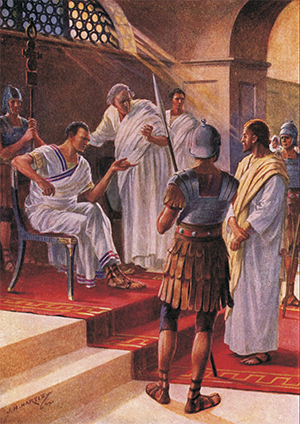 |
That said, a common misconception about biblical love is that it can be defined solely as being gentle, tolerant, and without judgment. If one were to be anything else in his evangelism or defense of truth, he would be unloving and guilty of sin—according to the common misconception. In truth, biblical love is not always manifested gently,6 with tolerance,7 or without judgment.8 In truth, different approaches are appropriate at different times. Sometimes rebuking—an approach we would not generally deem gentle—might be necessary (Luke 17:3), while at other times admonishing/warning (Romans 15:14), edifying/building up (Romans 14:19), or exhorting/encouraging (Titus 1:9) are appropriate. Notice, however, that in all cases, love is the motivation: a desire to do whatever is necessary to help others be pleasing to God—whether through gentle pleading (Galatians 6:1) or through “tough love” (Hebrews 12:5-11; Titus 1:13). Further, boldness is certainly encouraged for evangelists (Acts 4:29), but it is to be tempered with humility (2 Timothy 2:25), prudence (Proverbs 22:3), and being slow to speak (James 1:19), as Peter learned the hard way on more than one occasion.9 Knowing the best response for each situation would require more wisdom than any single human could have, which is why humbly gaining knowledge through experience (Proverbs 16:31), study (Proverbs 10:14), and counsel (Proverbs 11:14) is emphasized in Scripture.
Preparation for the day of persecution and challenges to your beliefs is also emphasized in Scripture. Peter reminds us to “always be ready to give a defense” (1 Peter 3:15), since there will be a day when a person will ask us why we have hope in God, if we are living as we should before them. So we should strive to “be ready, in season and out of season” (2 Timothy 4:2) to use whatever tactic might be appropriate in various situations—whether it be merely convincing them of the truth, or rebuking, or exhorting another Christian. Such readiness takes diligence—incessant study and preparation (2 Timothy 2:15; Acts 17:11).
That said, Who better to study to learn how to respond to public persecutions and challenges than the Chief Apologist, Himself—Jesus Christ? After all, it is He Whom the Christian must emulate. Reading through the gospel accounts, watching how Jesus chose to respond to His critics, is a fascinating practice. Jesus was never looking for a fight, but was always prepared to contend for the Faith and defend Himself when necessary, and chose to do so many times throughout His ministry. Typically, He did so seemingly dispassionately—using pure logic and reason.10 The word used to describe Him in 2 Corinthians 10:1 is “meek”—the word often used to describe, not a wild bull in a China shop, but a trained war horse: strength and fearlessness that is bridled or under control. Jesus recognized that He had ultimately nothing to lose by teaching the truth and, therefore, did not get “riled” up and respond defensively to skeptics and antagonists. That is not to say, however, that He never showed passion when the circumstance called for it; but He was always controlled in His responses, being fearless of the possible consequences. Oh that we all could emulate our Lord in this regard.
At times, we at Apologetics Press have been criticized for not responding to every comment on our Facebook page or choosing not to debate every person who wishes to engage us in a public debate (which apparently some do not realize happens often and would require several more full-time representatives than we have on staff). Of particular interest to those of us that study apologetics is the observation that, though Christ was always ready for a debate, He also knew when not to do so—whether because the timing was not right for a response, a response would be pointless (e.g., Matthew 21:27), or a response would even be detrimental to His ultimate cause. Just because a person challenged Him did not mean that He felt He needed to respond. Since the human inclination is to respond to every person, lest we be perceived as not having an answer and, hence, “losing the debate,” Jesus’ wisdom is awe-inspiring. In Matthew 7:6, while preaching the greatest sermon the world has ever heard, Jesus warned His audience that some people do not care about the truth and are like “swine”—unworthy of the valuable information we might wish to impart. If we choose to proceed and reason with the “pigs,” they are likely not only to stamp on the valuable jewels we have given them, but they will likely stampede us as well. In Proverbs 26:4, Solomon admonished the wise, “Do not answer a fool according to his folly, lest you also be like him.” The principle is clear: if the person or people to whom we are talking are not genuinely interested in the truth, to spend time trying to convince them of the truth would be wasteful and potentially even dangerous or counterproductive.
In Matthew 10, Jesus again warned His apostles that there will be those who “will not receive you nor hear your words” (vs. 14). In such cases, they were not to continue pressing the issue, but rather, “shake off the dust from your feet” and move on—a practice which Paul and Barnabas implemented in their evangelistic journeys as well (Acts 13:51). With that principle in mind, it is noteworthy to see Jesus’ implementation of that principle in His own life. At times, He chose to respond to challenges, depending on the audience, but at other times, He chose not to do so, in spite of how He might be perceived. For instance, when challenged by the chief priests and elders in the Temple to announce who gave Him authority to teach, after posing a question of His own, Jesus chose simply not to respond to their question (Matthew 21:23-27).
Surely the most notable example of Jesus practicing what He preached about remaining silent at times was what was prophesied about Him in Isaiah 53:7 regarding His crucifixion: “He was oppressed and He was afflicted, yet He opened not His mouth; He was led as a lamb to the slaughter, and as a sheep before its shearers is silent, so He opened not His mouth.” All four gospel records highlight Jesus’ refusal to respond to various attackers in the illegal trials leading up to His crucifixion.11 Again, His willingness to remain silent when most would respond defensively was a manifestation of such superhuman self-control that Pilate “marveled greatly” (Matthew 27:14).
The principle is clear: there are times when not responding to attacks is the best course of action. We would do well to gain the wisdom necessary to recognize those moments. We pray that God will grant to all Christians in the perilous times in which we live the wisdom to know when to fight and when to remain silent, as well as the boldness to fight when the time calls for it.
Endnotes
1 In 2 Timothy 2:24 the text says that “a servant of the Lord must not quarrel,” which commentators clarify as meaning not “striving contentiously” [Jamieson, Fausset, and Brown Commentary (2012), WORDsearch Corp, Electronic Database.]. The ESV, therefore, translates the word “quarrel” as “quarrelsome” (i.e., looking for a fight). One can “contend” without being “contentious.”
2 James 2:8; 1 John 3:13-18; 4:7; John 13:34-35; 1 Corinthians 13:1-3; 16:14; Colossians 3:14.
3 Matthew 22:36-40; Galatians 5:14; Romans 13:9-10.
4 Galatians 5:23; Romans 5:8; 1 John 4:10; John 3:16; John 15:13; Matthew 5:43-48; cf. Endnotes 2 and 3.
5 Matthew 7:12; 16:24; Philippians 1:15-17; 2:3-8; 1 Corinthians 10:24; 2 Corinthians 5:15.
6 Hebrews 12:6; Titus 1:13; Proverbs 15:10; 20:30; 27:5; Hosea 6:5. Consider Jesus’ behavior in John 2—overturning tables and making a whip of cords to drive the moneychangers and animals from the Temple. Consider also that sometimes loving a child involves physically striking him (Proverbs 13:24). Note that the term translated “gentle” in 2 Timothy 2:24 (apiov) means to be “kind toward someone”—a significant distinction in this case [William Arndt, F.W. Gingrich, and Frederick W. Danker (1979), A Greek-English Lexicon of the New Testament and Other Early Christian Literature (Chicago, IL: University of Chicago Press), second edition revised, p. 348]. The ESV, NIV, RSV, and NASB renderings capture this meaning. One can be kind to someone and simultaneously not necessarily be gentle, as the above passages indicate.
7 2 Thessalonians 3:6,14; Titus 3:10; Romans 16:17; 1 Timothy 5:20.
8 John 7:24; 2 Corinthians 5:10.
9 John 13:5-9; Matthew 16:22-23; 17:1-5.
10 Dave Miller (2011), “Jesus Used Logic,” Apologetics Press, http://apologeticspress.org/apcontent.aspx?category=11& article=3755; Dave Miller (2011), “Is Christianity Logical? [Part I],” Reason & Revelation, 31[6]:50-59, http://apologeticspress.org/apcontent.aspx? category=12&article=3869; Dave Miller (2011), “Jesus Was Logical,” Apologetics Press, https://www.apologeticspress.org/APContent.aspx?category=10&article=653&topic=71; Dave Miller (2011), “Jesus Was Rational,” Apologetics Press, http://apologeticspress.org/APContent.aspx?category=10&article=1245&topic=71.
11 E.g., Matthew 26:62-63; 27:13-14; Mark 14:60-61; 15:4-5; Luke 23:9; John 19:9.
The post “Jesus Gave Him No Answer” appeared first on Apologetics Press.
]]>The post Ezekiel’s Response to the Culture War of His Day appeared first on Apologetics Press.
]]>[NOTE: The following assessment by A.P. board member Frank Chesser is excerpted from his upcoming commentary on Ezekiel.]
Ezekiel 16 is a treasure house of nuggets of truth that Americans need to heed, ten of which will be addressed in this article. First, only divine revelation can enable a man to “know” his sin (vs. 2). Only by knowing God can a man know his sin. The Bible commences with God: “In the beginning God” (Genesis 1:1). It ends with God: “The grace of our Lord Jesus Christ be with you all. Amen” (Revelation 22:21). In between these bookends of divine truth is a library of sixty-six books that paint portraits of the nature of God, from whom all spiritual truths flow. Three words sum up the book of Isaiah and the whole of God’s revelation to man: “Behold your God” (Isaiah 40:9). When Isaiah beheld God in all of His glory, majesty and holiness, he saw the scope of his sin as never before (Isaiah 6:1-5).
Adam and Eve lost sight of the God they both saw and knew and plunged themselves and the world into darkness. “Wherefore, as by one man sin entered into the world, and death by sin; and so death passed upon all men, for that all have sinned” (Romans 5:12). The power of fleshly lust blinded the spiritual eyes of the righteous descendants of Seth to the beauty of God’s holiness as they gazed with delight upon the carnal daughters of Cain’s descendants and “they took them wives of all which they chose” (Genesis 6:2), acts of sin that produced a world of people void of a single righteous thought and opened the door to the global Flood. The first generation from Egypt never saw the God that Isaiah saw, and their lives testified to their spiritual sightlessness. God informed Samuel that from Egypt onward “they have forsaken me, and served other gods” (1 Samuel 8:8). They wanted a God of power that could liberate them from Egypt but not a God of holiness, justice, and wrath Whose very nature demanded, “Be ye holy; for I am holy” (1 Peter 1:16), and condemned and punished sin.
The idols that Israel brought out of Egypt were added to and multiplied, and they plagued the nation for most of its national life. Solomon allowed his love for God to be supplanted by his love for “many strange women” (1 Kings 11:1), and “his wives turned away his heart after other gods” (1 Kings 11:4). The northern kingdom inaugurated its national existence with roots in idolatry as Jeroboam “made two calves of gold, and said unto them, ‘It is too much for you to go up to Jerusalem; behold thy gods, O Israel, which brought thee up out of the land of Egypt’” (1 Kings 12:28). Israel became so enamored with lifeless pieces of wood and stone that God said, “Ephraim is joined to idols; let him alone” (Hosea 4:17), because His mercy upon them was gone (Hosea 1:6), He was no longer their God (Hosea 1:9), and He would “cause to cease the kingdom of the house of Israel” (Hosea 1:4). Except for a minute remnant, they lived their national life sightless of the God that Isaiah saw. They were powerless to know their sin because they rejected God’s revelation of Himself through the material Universe, the law, the prophets, and confirming miracles. God destroyed them in Assyrian captivity (2 Kings 17:21-23).
Under Rehoboam’s rule, the nation of Judah initiated their national life with idolatry as they “built them high places, and images, and groves, on every high hill, and under every green tree” (1 Kings 14:23). With a few exceptions, they followed king after king who led them in idol worship and all of its confederate sins. God told Isaiah that except for a “very small remnant” (Isaiah 1:9), Judah would never be able to see their sin because they refused to see Him (Isaiah 6:5-12). This very chapter is permeated with God’s condemnation of Judah’s idols and their affiliated sins. Ezekiel’s audience in Babylon was led by leaders with “idols in their heart” (14:3), who could not see and know their sin because they could not see the “glory of the Lord” that Ezekiel saw (1:28).
Second, covetousness is idolatry. Paul affirmed this truth in Colossians 3:5. Verse 3 of Ezekiel 16 illustrates it. Why does God point to Canaan as the place of Israel’s national birth? Not because they were actually born there, but because Israel coveted the gods of Canaan and the sins of the flesh that idol worship allowed. This covetous spirit inhered in Israel’s request for a king so they could “be like all the nations” (1 Samuel 8:20). God said, “they have rejected Me that I should not reign over them” (1 Samuel 8:7). This rebellious spirt was not something new in the hearts of Israel. It was Samuel’s appointment of his wicked sons as judges that opened the door for Israel to request a more formal system of government that would remove every vestige of their national distinctiveness and allow them total kinship with the heathen nations of the world.
Israel had already been living like pagans for over three centuries. When Joshua and those who served him died, “there arose another generation after them which knew not the Lord” (Judges 2:10). They did not know the Lord because they did not want to know the Lord. They were like the people of Judah, “for they proceed from evil to evil, and they know not me saith the Lord” (Jeremiah 9:3). Israel lived among the heathens in Canaan, intermarried with them, and adopted their gods as their own (Judges 3:5-7). They coveted the heathenish lifestyle that idolatry licensed. They loved their idols because they loved the “pleasures of sin” (Hebrews 11:25) that they vouchsafed to them. They “ceased not from their own doings, nor from their stubborn way” and “every man did that which was right in his own eyes” (Judges 2:19; 21:25).
Covetousness lusts, longs, yearns, and desires. It is selfishness in its purest form. It is determined to have its way regardless of the consequences. Eve desired self-rule to the ruin of her life in Eden (Genesis 3:5-6). The cities of the plain lusted for sexual sin to their utter destruction (Genesis 19). Achan “coveted” gold, silver, and a garment to the subversion of himself and his family (Joshua 7:21). David yearned for his neighbor’s wife to the detriment of his spiritual life, family, and stature in Israel and the world (2 Samuel 11-12). Amnon longed for his brother’s wife and paid for his covetousness with his life (2 Samuel 13). Solomon coveted “strange women” and strange gods (1 Kings 11:1,4-8), to his personal ruin and the ruin of Israel. A thief (John 12:6) and a traitor (John 18:2) were the products of Judas’ covetous spirit. Herod’s desire for personal acclaim led to his death on a bed of agony (Acts 12:21-23). Demas yearned for worldly pleasure (2 Timothy 4:10), Diotrephes for preeminence (3 John 9), and Israel for the gods of Canaan to the spiritual devastation of each.
Third, Israel misread God’s love, grace, and goodness. The nation is depicted as a new born infant, discarded and left to die, floundering in the blood of its birth, and void of human pity (16:4-5). God washed, cleaned, clothed, fed, loved, protected, preserved, and blessed Israel to her national maturity. Israel viewed God’s work as merit because they were fleshly descendants of Abraham and special in their own eyes. God denied repetitively their right to specialty and feelings of superiority to all other nations, but they refused to believe it. God affirmed that His spiritual blessings through Abraham embraced “all families of the earth” (Genesis 12:3), but Israel could see only themselves as recipients of God’s love and goodness. Three times in three verses (Deuteronomy 9:4-6), God asserted that they did not deserve the land of Canaan, and then reminded them that from Egypt to that moment, “ye have been rebellious against the Lord” (Deuteronomy 9:7). But nothing that God said or did in acts of judgment upon them could shake their feelings of national peerlessness.
It was God’s intention to reach Calvary with the seed of woman and Abraham (Genesis 3:15; 12:3). This was a work of pure love, grace, and goodness, and national Israel fought God every step of the way. They loathed the law of God and loved their idols. They thought they could sin with impunity (Jeremiah 7:8-10). The Old Testament closes with Israel’s corrupt priests’ horrendous accusation of God’s delighting in evildoers, robbing God of tithes and offerings, and affirming the vanity of serving God (Malachi 1-3). The New Testament opens with John the Baptist in spiritual combat with Pharisees and Sadducees yet clinging to Abraham as their spiritual savior (Matthew 3:7-9). Having pointed to the truth that makes man free, Jesus encountered this Jewish proclivity as some answered, “We be Abraham’s seed and were never in bondage to any man” (John 8:33). It took miraculous intervention (Acts 10) to convince Peter that what God said in Genesis 12:3, what Jesus said in John 3:16, and what Peter said in Acts 2:39 was the truth. Prior to embracing Christ and the Gospel, Paul considered his Jewishness as “gain” (Philippians 3:7). To this present hour, the love, grace, and goodness of God is sifted in the sieve of human reasoning.
Fourth, misplaced trust leads to spiritual ruin. “But you trusted in your own beauty, played the harlot” (vs. 15). Improper entities of trust assume many and diverse forms and all lead to spiritual decay. Moses warned Israel about displacing God with fortified walls as objects of their trust (Deuteronomy 28:32). Israel trusted in oppression and perverseness (Isaiah 30:12), military aid from Egypt (Isaiah 31:1), idols (Isaiah 42:17), wickedness (Isaiah 47:10), vanity (Isaiah 59:4), lying words (Jeremiah 7:8), the temple (Jeremiah 7:14), and in their own ways and mighty men (Hosea 10:13). God placed a curse upon “the man that trusted in man” (Jeremiah 17:5) and likened him to a shrub in the desert barely cleaving to life and without hope for betterment (Jeremiah 17:6). Paul warned about trusting in “uncertain riches” (1 Timothy 6:17).
Biblical faith involves trust and obedience. The Word of God is the basis of faith (Romans 10:17), and the faith that saves is the faith that obeys God. Jesus described faith as a work (John 6:28-29), and Paul spoke of the “work of faith” (1 Thessalonians 1:3) and the “obedience of faith” (Romans 16:26), because faith is active in its submission to the will of God. James said, “I will show thee my faith by my works” (James 2:18). The object of faith’s trust is God, not the works of righteousness that faith produces. The Pharisee was rejected because he trusted in himself and his own works instead of God (Luke 18:9-14). Misplaced trust negates Biblical faith.
Fifth, Israel abused blessings on loan from God (vss. 16-21). They honored their idols with gifts from God. They made, adorned, and paid homage to the works of their own hands with material endowments from God. Having abandoned all natural affection, they descended into the depths of human depravity by offering their children as sacrifices to their idols. God said these children were “born unto me” (vs. 20), and they have “slain my children” (vs. 21).
Israel was a steward of the blessings of God and so are all men. Stewardship does not imply ownership. A steward does not own anything. “For we brought nothing into this world, and it is certain we can carry nothing out” (1 Timothy 6:7). God allows man an accommodative usage of “my money, house, land, cars,” but these and all material things are gifts and blessings from God and on loan from God. God is the “possessor of heaven and earth” (Genesis 14:19); everything “under the whole heaven” (Job 41:11) belongs to Him; “The earth is the Lord’s, and the fullness thereof; the world and they that dwell therein” (Psalm 24:1), and all the silver and gold on Earth belongs to God (Haggai 2:8).
David pointed to the material riches that he and Israel had donated for the construction of the temple and asserted, “But who am I, and what is my people, that we should be able to offer so willingly after this sort? For all things come of thee, and of thine own have we given thee” (1 Chronicles 29:14). Joseph was the steward over Potiphar’s house and “all that he had he put into his hand” (Genesis 39:4), but not one thing belonged to Joseph. Even a man’s children belong to God. “Lo, children are an heritage of the Lord: and the fruit of the womb is his reward” (Psalm 127:3). Israel misused blessings and gifts on loan from God and so has the preponderance of humanity from time’s beginning.
Sixth, idolatry and sexual sin are twin sins. Illicit sexual conduct inheres in Ezekiel’s “eminent place” (vss. 24,31,39), his phrase “opened their feet to everyone that passed by” (vs. 25), and the “great of flesh” (vs. 26) comment that describes the fleshly lewd nature of Egyptian idolatry borrowed and made common in Israel’s own idolatrous practices. This chapter pulsates with sexual connotations. Physical whoredom follows spiritual whoredom like the night follows the day. Physical adultery is spiritual adultery’s shadow. It is idolatry’s cardinal sin. Balaam knew that idolatry and fornication were comrade sins and would bring divine judgment upon Israel that his initial efforts failed to achieve (Revelation 2:14; Numbers 25:1-9). If sexual lust in thought and act was idolatry’s only fruit, the worship of idols would yet have been as common in Israel as the rising of the Sun.
Seventh, memory failures beget ingratitude that often ends in spiritual death. The spirit of thanksgiving is as rare as was the good man in Israel (Micah 7:2). In an unsurpassed catalog of massive evils, ingratitude was at the top of the list (Romans 1:21). When a man refuses or neglects to reflect daily on the innumerable wonders of God’s love, grace, and goodness, he is paving the road to his own spiritual deterioration. Twice, Ezekiel points to Israel’s failure to remember the blessings of God in her national youth as one of the foundational reasons for her idolatry and companioned sins (vss. 22 and 43). Joseph languished two additional years in prison because the chief butler of Pharaoh did not “remember Joseph, but forgot him” (Genesis 40:23).
One negative report from ten spies drained Israel’s memory of God’s mighty miracles in Egypt onward and left them weeping all night in ingratitude and unbelief (Numbers 14:1-3). “Remember” was one of the key words that Moses used in his final sermon to the second generation from Egypt in the book of Deuteronomy. When David saw Bathsheba bathing, if he had supplanted inquiring about her (2 Samuel 11:3) with reflection and gratitude for God’s love and goodness, he would never have consummated his act of adultery. Remembering and thanking God continually for the blessings of 1 Kings 10 would have saved Solomon from the evils and consequences of 1 Kings 11. In conjunction with his wife, Jehoiada saved, protected, preserved, and aided Joash in becoming king and ruling over Judah until he died. At Jehoiada’s death, Joash forsook God, embraced idolatry, rejected the preaching and warnings of the prophets, and had Jehoiada’s son, Zechariah, stoned to death for rebuking him. Inspiration’s report of this tragedy reads, “Thus Joash the king remembered not the kindness which Jehoiada his father had done, but slew his son” (2 Chronicles 24:23-25). Memory failures and ingratitude accompany every continuous sin and sin of rebellion.
Eighth, the desires of the flesh are insatiable (vss. 28-34). Israel pursued political alliances with the heathen nations and claimed their gods as their own. Pagan nations were jealous and protective of their own gods, but Israel’s love affair with idols was indiscriminate. Multiplying gods meant multiplying opportunities for the flesh. When Syria was defeated by Israel, instead of forsaking their gods, the Syrians chose a different location for their conflict, declaring, “Their gods are gods of the hills, therefore they were stronger than we; but let us fight against them in the plain, and surely we shall be stronger than they” (1 Kings 20:23). Conversely, when Assyria’s military proved superior to Israel’s, Ahaz said, “Because the gods of the king of Syria help them, therefore will I sacrifice to them that they may help me. But they were the ruin of him and of all Israel” (2 Chronicles 28:23).
When a man’s life is void of God, it is void of reason. There is nothing rational about the flesh. It feels, but does not think. Severed from God, law, and restraints, it choses sin’s pleasures with reckless abandon. Noah’s contemporaries were dominated by the “flesh” (Genesis 6:3) and pursued its ravenous passions until their minds were empty of a single righteous thought. A lifetime of fleshly lust cannot quench the fires of its interest. It does not pause to consider its ways. It is ever open to new ways of expression. It is oblivious to shame. Were the prophets, priests, and wise men of Judah “ashamed when they had committed abomination? Nay, they were not at all ashamed, neither could they blush” (Jeremiah 8:12). The flesh does not need the darkness to conceal its baseness. It considers it a “pleasure to riot in the daytime” (2 Peter 2:13). It possesses “eyes full of adultery, and that cannot cease from sin” (2 Peter 2:14). Israel loved their gods of wood and stone because they allowed the flesh the freedom to pursue its uninhibited desired ends.
Ninth, greater responsibility is attached to superior spiritual advantages that demand a more severe judgment for sin (vss. 44-51). Jesus utilized this principle when He depicted the day of judgment as rendering a more intense degree of punishment for certain Galilean cities “wherein most of his mighty works were done, because they repented not” (Matthew 11:20) as compared with the pagan cities of Tyre, Sidon, and Sodom that did not enjoy such opportunities. Spiritual advantages abounded to the Jewish nation. Paul affirmed that Israel’s possession of the law of God was their chief advantage (Romans 3:1-2). Moses asserted that God’s statutes and judgments were so noteworthy that even the pagan nations would declare, “Surely this great nation is a wise and understanding people” (Deuteronomy 4:6) because of their possession of the righteous laws of God. Due to their unique spiritual advantages, Israel’s sin was highhanded rebellion against God.
In depicting His judgment through Babylon, God said, “Behold I am bringing such evil upon Jerusalem and Judah, that whosoever heareth of it, both his ears shall tingle” (2 Kings 21:12), and in describing God’s judgment on Jerusalem by the Roman army, Jesus said, “For there shall be great tribulation, such as was not since the beginning of the world to this time, no, nor ever shall be” (Matthew 24:21). The severity of their judgment would match the severity of their sin.
Tenth, following the darkness of the night is the comfort and solace of the day’s light (vss. 53-63). The deep darkness of sin needs the bright light of redemption. The world of Genesis 1-2 was a world of continuous light. The physical night was bathed in the light of perfection and innocence. Even the darkness of the night carried the brilliance of the day’s light in its bosom. The day closed in consummate physical and spiritual serenity and the night welcomed its return in an unaltered state. Genesis 3:6 ruined everything. The Sun was shrouded in sackcloth. Nature wept, and its tears displaced the dew of the Earth. In fig leaves, shame, and dread, Adam and Eve hid among the trees of Eden.
From the grave of despair, arose the resplendent light of redemption. The seed of woman (Genesis 3:15), of Abraham (Genesis 12:3), of Isaac (Genesis 26:4), and of Jacob (Genesis 28:14), was deposited in a small righteous remnant of Israel and Judah, secured in David (Acts 2:30), and assigned to Mary, “of whom was born Jesus, who is called Christ” (Matthew 1:16), who paid the penalty for the catastrophe of Genesis 3:6 and every subsequent sin until time’s end, and became the “author of eternal salvation unto all them that obey him” (Hebrews 5:9).
The post Ezekiel’s Response to the Culture War of His Day appeared first on Apologetics Press.
]]>The post Why Doesn’t God Just Appear to Us and Prove that He Exists? appeared first on Apologetics Press.
]]>Christians freely admit that there are many specific things that we do not know about the infinite, eternal, omnipotent, omniscient Creator of the Universe, including why He does or does not do certain things. “‘For My thoughts are not your thoughts, nor are your ways My ways,’ says the Lord. ‘For as the heavens are higher than the earth, so are My ways higher than your ways, and My thoughts than your thoughts’” (Isaiah 55:8-9). There is no way to know the mind of God unless He chooses to reveal some of His ways to us. Moses wrote: “The secret things belong to the Lord our God, but those things which are revealed belong to us and to our children forever, that we may do all the words of this law” (Deuteronomy 29:29, emp. added). So has God specifically revealed why He has not appeared to every human being in the history of the world to prove His existence to them? The fact is, God does not expressly address this question in the Bible; but He does reveal enough to us about Himself and His creation to draw the following conclusions.
First, even if God directly appeared to and spoke with every person on Earth, not everyone would believe in Him. After all, God revealed Himself to mankind in the first-century (John 1:1,14), speaking like “no man ever spoke” (John 7:46) and working all manner of miracles, including walking on water, healing the blind, reattaching severed body parts with the touch of His hand, and raising the dead. Yes, even though, for example, Jesus raised Lazarus from the dead, and came back from the dead Himself, many still did not believe in Him (John 11:45-53; 12:9-11)—they rejected Him despite the fact that He (God) appeared to them face to face.
In 2012, renowned atheist Richard Dawkins was questioned about his unbelief in God. Specifically, he was asked, “What proof, by the way, would change your mind?” He quickly responded by saying, “That is a very difficult and interesting question because, I mean, I used to think that if somehow, you know, great, big, giant 900-foot-high Jesus with a voice like Paul Robeson suddenly strode in and said, ‘I exist and here I am,’ but even that, I actually sometimes wonder if that would….”1 Though Dr. Dawkins was interrupted, he clearly left the impression that even if God appeared to him, taking the form of a “giant 900-foot-high Jesus” with a mighty voice, even that encounter would probably not convince him.
Sadly, not only would many continue in their unbelief if God actually did appear to them, many more would reject His authority over them, even if they acknowledged His existence. Judas was among the closest friends and disciples of Jesus. He was the treasurer of the group. Yet, he was a thief who eventually betrayed the Lord. One might argue that Judas never believed (cf. John 6:60-71), which would only further validate our first point. But if he truly believed in Jesus as the Son of God, then he ultimately chose money over the Master; he chose sin over the Savior. He was not, and will not be, the last to make such choices. In fact, before any human being ever came to know God and subsequently reject His will, there were a number of angelic beings who did. They are created heavenly beings (Colossians 1:16) who knew (and know) God, but willingly chose to reject His will for them (2 Peter 2:4; Jude 6). So wicked and rebellious to the God of heaven did Satan become that he even tried to tempt God to sin (Matthew 4:1-11). Make no mistake about it, in no way does acknowledging God’s existence directly translate into loving Him and submitting to His will (Matthew 7:21-23). In fact, atheist Dan Barker demonstrated such rebelliousness in the Butt/Barker debate when he stated that, though he believes God “doesn’t exist,” “[i]f there is a hell and if the atheists get to the end of their life and discover, ‘Yep, I was wrong, there is a God….’ Then I would say to that God…‘you go to hell…. You do not have my respect.’”2
Third, God has already given every accountable person on Earth an adequate amount of evidence to come to a knowledge of His existence. The very reality of a material Universe (which could not have sprung into existence from nothing; nor is it eternal),3 testifies to the existence of a Creator. “For every house is built by someone, but He who built all things is God” (Hebrews 3:4). In fact, “[s]ince the creation of the world His invisible attributes are clearly seen being understood by the things that are made, even His eternal power and Godhead, so that they are without excuse” (Romans 1:20). Since the time of Adam and Eve, mankind has been given the opportunity to see how “the things that are made” testify quite “clearly” on behalf of a powerful, invisible Creator. As the psalmist proclaimed, “The heavens declare the glory of God; and the firmament shows His handiwork. Day unto day utters speech, and night unto night reveals knowledge. There is no speech nor language where their voice is not heard. Their line has gone out through all the earth, and their words to the end of the world” (19:1-4).
So why doesn’t God appear to every person on Earth to prove that He exists? The short answer is: “Because He, as the sovereign Ruler of the Universe, chooses not to.” We may not know all of God’s reasons for why He chooses not to appear personally to every person on the Earth throughout every generation, but in no way does such a decision on His part prove (1) that He doesn’t exist, or (2) that He is unkind and unfair. The fact is, God has always given man adequate evidence for His existence—so much so that any person who refuses to acknowledge His existence is “without excuse” (Romans 1:20).
Endnotes
1 “Q&A: Religion and Atheism” (2012), ABC Australia, April 9, http;//www.abc.net.au/tv/qanda/txt/s3469101.htm, emp. added.
2 Kyle Butt and Dan Barker (2009), Butt/Barker Debate: Does the God of the Bible Exist? (Montgomery, AL: Apologetics Press), emp. added.
3 Jeff Miller (2013), “Evolution and the Laws of Science: The Laws of Thermodynamics,” Apologetics Press, /apcontent.aspx?category=9&article=2786.
The post Why Doesn’t God Just Appear to Us and Prove that He Exists? appeared first on Apologetics Press.
]]>The post The Trinity appeared first on Apologetics Press.
]]>
Definitions
As in all discussions dealing with a proper understanding of truth, an agreed upon and acceptable, sufficiently precise definition of the major terms must be set out in the beginning.
- Godhead or Divinity: A description of the totality, both of nature and personality, of the supernatural Creator of the world (see Lenski, 1961, p. 98).
- Nature: “The inherent character or basic constitution of a person or thing; essence” (“Nature,” 2015).
- Personality: A recognizable, distinct entity that has mind and desire. As described by Merriam-Webster: “The complex of characteristics that distinguishes an individual….The totality of an individual’s behavioral and emotional characteristics; a set of distinctive traits and characteristics” (“Personality,” 2015).
While most words that will be discussed concerning the Trinity, such as “personality,” “nature,” and even “divinity” or “Godhead,” are fairly easy to define, that does not mean the aspects of God that they describe are easy to understand. In fact, the Godhead is so complex and beyond human capability to fully understand, that any attempt to discuss God quickly reveals the limitations of the human mind. We can never fully understand the Godhead. As the apostle Paul so eloquently wrote about God’s revelation of the Gospel: “Oh, the depth and the riches both of the wisdom and the knowledge of God! How unsearchable are His judgments and His ways past finding out” (Romans 11:33). We should not conclude, however, that nothing can be known of God. Were that the case, to have any discussion about Him, say His name, or even to identify the concept of God, would be impossible for us. On the contrary, while we may not be able to understand fully all that the term “nature” of God entails, and while we may not be able to define the concept of a “personality” so that we comprehend everything about it, we can know enough about the terms “Godhead,” “nature,” and “personality” to say that the Godhead is three personalities in one nature.
The Basic Argument For The Trinity
The basic argument for the Trinity proceeds as follows:
- Premise one: the Bible teaches that the Godhead is one in nature.
- Premise two: the Bible teaches that God the Father is one personality of the Godhead.
- Premise three: the Bible teaches that the Holy Spirit is one personality of the Godhead.
- Premise four: the Bible teaches that Jesus the Son is one personality of the Godhead.
- Conclusion: Therefore, God is composed of three personalities in one nature.
The Godhead is One in Nature
Various Scriptures demonstrate that the Godhead is one in nature. One of the most well-known passages that relates this truth is Deuteronomy 6:4, which states: “Hear, O Israel: The Lord our God, the Lord is one!” A similar passage is found in Ephesians 4:4-6, which reads, “There is one body and one Spirit, just as you were called in one hope of your calling; one Lord, one faith, one baptism; one God and Father of all who is above all, and through all, and in you all.” In addition, Malachi 2:10 says, “Have we not all one Father? Has not one God created us?” The fact that God is one is clearly stated in the Bible.
The clear statements of God’s oneness lead some to deny that God is composed of three personalities. They suggest that if God is one, then He cannot be three in any way; so His oneness excludes the possibility that the Father, the Son, and the Holy Spirit are all God. As M. Davies wrote: “We have seen how that, throughout the Bible God is only described as being one being…. So it is to the Bible we must turn, and when we do, we do not find any evidence to suggest that God is made up of three beings” (2009). Thus, the critics of the doctrine of the Trinity do not differentiate between the concept of nature and that of personality. This idea will be expanded upon in the section dealing with common objections. It is included here simply to set up the argument for God’s oneness being in nature, and not personality.
The Bible says that “one God” created us (Malachi 2:10). A closer look, however, at the Creation of man shows that some type of multiplicity was involved. Genesis 1:26-27 states, “Then God said, ‘Let Us make man in Our image, according to Our likeness.… So God created man in His own image, in the image of God He created him; male and female He created them.” The Hebrew language used in this passage cannot be definitively used to prove a multiplicity, but it is written in such a way that certainly allows for the one God to have some aspect of multiplicity or plurality. A better understanding of this plurality is gained by looking at the verses in the Bible that discuss the Creation. John 1:1 explains, “In the beginning was the Word, and the Word was with God, and the Word was God. He was in the beginning with God. All things were made through Him, and without Him nothing was made that was made.” Later in the first chapter of John we learn that the Word “became flesh and dwelt among us.” Thus, the Word refers to Jesus, who was with God and was God and created all things along with the Father (John 1:14). We can see, then, that the oneness of the Creator must allow for at least some aspect of God to have a multiplicity of something.
In logical form, we could arrange the argument as follows. There is one God who created man. The concept of oneness either means that nothing about God can have any type of plurality, or that some aspect of God is completely unified but at least one other aspect of God can have multiplicity to it. It cannot be the case that nothing about God can have any multiplicity since the Bible gives at least one aspect of God (the Father and the Son) that has multiplicity. Therefore, some aspect of God is completely unified, but at least one aspect of God can have, and has, multiplicity.
Once we determine logically that at least one aspect of God has to be “one” and completely unified without multiplicity, we need to identify what that concept is. We see several ideas that are applied to God in His entirety. God is eternal, from everlasting to everlasting (Psalm 90:2; Deuteronomy 33:27). God’s eternality applies to the Father, as well as to God the Son, as is evidenced from the fact that Isaiah 9:6 describes the Messiah (Who is recognized in the New Testament as Jesus) as being called “Everlasting Father.” The concept of eternality equally applies to the Spirit, as the Hebrews writer stated, “How much more shall the blood of Christ, who through the eternal Spirit offered Himself without spot to God” (Hebrews 9:14, emp. added). Since the concept of eternality equally applies to the Father, the Son, and the Holy Spirit, then we have successfully determined at least one aspect of God that is completely unified and applies equally to every aspect of God. Such qualities compose the nature or essence of the being of God. And while it is true that we cannot know or understand all of the aspects of God’s essence, we can compile a list of ideas or attributes that make-up this unified whole that applies equally to the Father, Son, and Holy Spirit.
- God’s essence is immutable, or unchangeable (Psalm 103:17; Hebrews 13:8).
- God’s essence is morally perfect (Habakkuk 1:13; 1 Peter 2:22).
- God’s essence is founded on justice (Psalm 89:14; Matthew 23:23).
- God’s essence is love (1 John 4:8).
- God’s essence is eternal (Psalm 90:2; Deuteronomy 33:27; Isaiah 9:6).
The Bible provides a much more exhaustive list of the attributes of God’s nature or essence. This short list is provided to make the point that all three personalities of God (i.e., the Father, Son, and Holy Spirit), share one unified nature that applies equally to all of them.
The three personalities of God
Having established the fact that God is one in essence or nature, we can now move to dealing with the idea that God is three personalities. The burden of this portion of the article will be to establish that the three personalities of God are God the Father, God the Son, and God the Holy Spirit.
God the Father
The premise that one personality of the Godhead is the Father is one of the least disputed and easily proven concepts in this discussion. In fact, many people and religious groups consider the Father to be the only personality of God (which we will show is not the case), but very few who accept the Bible as the Word of God argue that God the Father is not God. This is the case because there are so many verses in the Bible that identify God in the personality of the Father. Let us examine a few of those. In 2 Peter 1:17, the text states that Jesus “received from God the Father honor and glory.” Jude 1 is written to those “who are called, sanctified by God the Father.” When Jesus was instructing His disciples to pray, He taught them to say, “Our Father in heaven, hallowed be Your name” (Matthew 6:9). Paul wrote to the Thessalonians, “Now may our God and Father Himself, and our Lord Jesus Christ, direct our way to you” (1 Thessalonians 3:11). As with other aspects of the argument, a much longer list could be compiled showing that the Bible refers to God the Father as being part of the Godhead. Thus, as our argument proceeds, we have now established that the Godhead has one unified nature, and has at least one personality, namely, God the Father.
God the Holy Spirit
Because of the way many people view the term “spirit,” it has often been the case that the Holy Spirit is misidentified. He is often referred to as an “it,” and some do not recognize the fact that He is a personality of the Godhead. The Scriptures, however, are clear that the Holy Spirit is a personality of the Godhead in the same way as the Father and the Son. First, recall that the Bible explains that the Spirit is eternal (Hebrews 9:14). That means that He is not a created being, but has always existed. In argument form we would say, God is the only being that is eternal. The Holy Spirit is eternal. Therefore, the Holy Spirit is God. In addition, we read that just as God knows all things, the Spirit does as well. First Corinthians 2:10-11 states, “But God has revealed them to us through His Spirit. For the Spirit searches all things, yes, the deep things of God…. Even so, no one knows the things of God except the Spirit of God.”
The book of Acts contains a memorable story about two early Christians named Ananias and Sapphira. These two sold a piece of property, gave the money to the church, but lied about the price of the land. When the apostle Peter rebuked them for their sin, he said, “Ananias, why has Satan filled your heart to lie to the Holy Spirit…. You have not lied to men but to God” (Acts 5:3-4). Notice that Peter stated that by lying to the Holy Spirit, Ananias had lied to God, equating God and the Holy Spirit. In addition, 1 Peter 1:2 says that the Christians there had participated in the “sanctification of the Spirit.” In 2 Thessalonians 5:23, the Bible says, “Now may the God of peace Himself sanctify you completely.” Again, we see that the work of sanctifying the Christian is accomplished by God, but is attributed to the Holy Spirit. This line of reasoning can be extended to other aspects of God’s action. In 2 Timothy, Paul states that “All Scripture is given by inspiration of God” (3:16). Peter explains that the Scriptures were produced when “holy men of God spoke as they were moved by the Holy Spirit” (2 Peter 1:21). We then can reason that God inspired the Scriptures, and the Holy Spirit inspired the Scriptures, thus the Holy Spirit is God.
Once we establish that the Holy Spirit is God, we next need to show that He is a person, not simply a nebulous force. We have defined the word “person” as a recognizable, distinct entity that has mind and desire. The Bible paints a consistent picture that the Holy Spirit, like the Father, is a person. First, the Scriptures state that the Holy Spirit can, and has, talked to people using language that those people can understand. In Acts 8:29, we read that “the Spirit said to Philip, ‘Go near and overtake this chariot.’” This was not a nebulous, impersonal force, but a recognizable voice used by a person to communicate His desire to a man named Philip. The apostle Paul explained that “the Spirit expressly says that in later times some will depart from the faith” (1 Timothy 4:1). Once again, the Spirit speaks in understandable language. In Revelation, the text says that “the Spirit and the bride say ‘Come!’” (22:17). Only a person with a will and identity could offer such an invitation. In addition, consider that the Holy Spirit can be blasphemed (Matthew 12:31-32), lied to (Acts 5:3), insulted or despised (Hebrews 10:29), and grieved (Ephesians 4:30) (Olbright, 1999, p. 25). The Holy Spirit is God, and has all the traits of a person. We therefore conclude that the Father is one personality of God, and the Holy Spirit is another personality of God, proving that the one God has a multiplicity of personalities.
God the Son
In addition to the Father and the Holy Spirit, the Bible mentions another person Who composes the Godhead—Jesus Christ the Son. In fact, the Bible mentions these three together. Matthew 28:19 quotes Jesus as saying that His followers should baptize disciples in the name of the “Father and of the Son and of the Holy Spirit.” Peter wrote that Christians were “elect according to the foreknowledge of God the Father, in sanctification of the Spirit, for obedience and sprinkling of the blood of Jesus” (1 Peter 1:2). A straightforward reading of these passages seems to put the three on equal footing. Some have contended, however, that even though Jesus is the Son of God (which the Scriptures teach in numerous places; see Matthew 14:33; 16:16; Mark 1:1; Luke 8:28; John 3:16-18; 2 Corinthians 1:19), that does not mean He was equal to God or had/has the same nature as God. Fred Pearce, who denies that Jesus is God, wrote: “But he is God’s Son, because he has been ‘begotten.’ The ruler is not God; he is the Son of God; and he began to exist on the day he was ‘begotten.’ Like all sons, he is preceded by his Father” (n.d.). Some have contended that God created Jesus first, and then Jesus created everything else. Thus, they would argue that Jesus is not God, but only the Son of God, a creation of God, or an elevated angel. Others would argue that Jesus was only a man and never claimed to be God or even an angel. The Bible, however, denies both of these positions, and presents a thorough and consistent picture of Jesus Christ the Son of God as God in nature and as a third personality of the Godhead. Consider the following three affirmations:
I. Jesus the Son is Referred to as God
The prophet Isaiah predicted that the Messiah would come in the form of a Child. That Messiah was going to be known as “Wonderful Counselor, Mighty God, Everlasting Father, Prince of Peace” (Isaiah 9:6). Notice specifically that the coming Child would be called Mighty God. In the New Testament, we see that Jesus was that Child, the anointed Messiah, the Son of David described in Isaiah 9:6. In John 4:25, the woman with whom Jesus talked at the well stated, “I know the Messiah is coming” to which Jesus responded, “I who speak to you am He” (John 4:26). When we put the premises together, the argument looks like this: The Messiah is Mighty God. Jesus Christ the Son of God is the Messiah. Therefore, Jesus Christ is Mighty God.
In the first chapter of John, the text says, “In the beginning was the Word, and the Word was with God, and the Word was God” (John 1:1). Again, notice that the Word is called God. Just a few verses later, the text explains that the “Word became flesh and dwelt among us” and that John “testified of Him” (John 1:14-15). In John 3:22-36, the person John testified about is Jesus Christ the Son of God. Putting the pieces together, we arrive at the following argument: The Word is God. Jesus Christ the Son is the Word. Therefore, Jesus Christ the Son is God. The apostle Thomas added his voice to this conclusion when he saw the wounds in Jesus’ body and proclaimed to Jesus, “My Lord and my God!” (John 20:28).
II. Jesus the Son is Worthy of and Accepted Worship
Matthew wrote a detailed account of Jesus being tempted by the devil in the wilderness. During that temptation, the devil enticed Jesus to fall down and worship him. Jesus responded by saying, “It is written, ‘You shall worship the Lord your God, and Him only you shall serve’” (Matthew 4:1). Jesus’ argument went as follows: All people are morally bound to worship only one being, that is, God. The devil is not God. Therefore, no one should ever worship the devil. From this line of reasoning, it is clear that anyone who is faithful to God will not encourage the worship of any being other than God. We see this truth played out in a number of episodes in the Bible. In Acts 14, Paul and Barnabas were in the city of Lystra when they healed a crippled man. The residents of the city were so enamored with the two, they began to worship them. Paul and Barnabas rushed in among the crowd and tried to stop their worship, crying out, “Men, why are you doing these things? We are also men with the same nature as you” (Acts 14:15). Their argument was similar to the one Jesus made. All people are morally bound to worship only one Being, that is, God. Paul and Barnabas are not God. Therefore, no people should ever worship Paul and Barnabas. The same thought process is used in Revelation 22:6-9. In that passage, the apostle John is introduced to an angel. The apostle “fell down to worship before the feet of the angel” (Revelation 22:8), but the angel said to him, “See that you do not do that. For I am your fellow servant…. Worship God” (Revelation 22:9). The angel’s argument can be laid out in the following way. God is the only Being any person should worship. I, an angel, am not God. Therefore, no person should ever worship me.
When we consider how Jesus responded to being worshiped, we can see that He readily accepted it as a proper response to His personality and power. On numerous occasions, the Bible records that people worshiped Jesus Christ. Matthew 14:33 says that his disciples “came and worshiped Him, saying, ‘Truly You are the Son of God.’” Jesus accepted the worship and did not rebuke them. In John 9:38, Jesus healed a man who had been born blind. Jesus then instructed the man to believe in the Son of God. The man responded by saying, “Lord, I believe!” then the text says, “And he worshiped Him” (see also Matthew 2:11; 28:9; John 20:28). As we analyze this argument, we see that Jesus said all people are morally bound to worship only God, and Jesus accepted worship as the proper attitude of people toward Him. Either Jesus violated Scripture and accepted worship contrary to the Bible’s teaching, or Jesus is God. Jesus never violated Scripture (Hebrews 4:15; John 8:46). Therefore, Jesus is God.
III. Jesus the Son is Equated with Jehovah
In the Hebrew Bible the special name for God is called the Tetragrammaton. It is composed of four Hebrew letters and is transliterated Jehovah or Yahweh. The actual pronunciation of the name has been lost since the original Hebrew did not have vowels. This name is used only to describe the eternal Creator God of the Universe. In Isaiah 6, the prophet records a time when he saw God in a vision. The angelic beings who stood around God’s throne addressed God as “Jehovah” of hosts in Isaiah 6:3 and used the same name (the Tetragrammaton) in verse five. There is no doubt that Isaiah was describing a vision of the eternal God. When we turn to the New Testament, we see the apostle John describing this scene from Isaiah. John writes that although He (Jesus) “had done so many signs before them, they did not believe” (John 12:38). He then references Isaiah 6:9-10, and says, “These things Isaiah said when he saw His glory and spoke of Him” (John 12:41). The fact that the pronoun “Him” in verse 41 is referring to Jesus is verified by the use of the pronoun to describe Jesus in verse 37 and verse 42. Thus, the argument can then be made as follows: Isaiah saw the glory of Jehovah God in Isaiah 6. John says that Isaiah saw the glory of Jesus and references the episode in Isaiah 6. Thus, John equates Jesus with Jehovah.
Additionally, other passages reference Jesus as being Jehovah. Isaiah 40:3 explains that a messenger would be sent as the forerunner of the Messiah. This messenger would be “the voice of one crying in the wilderness” who would “prepare the way of the Lord (Jehovah); make straight in the desert a highway for our God” (Isaiah 40:3). The New Testament applies this prophecy to John the Baptizer (John 1:11) and declares that John prepared the way for Jesus, thus equating Jesus with Jehovah. Again, the argument is as follows: Isaiah said the messenger would prepare the way for Jehovah. John was the messenger Isaiah predicted. He prepared the way for Jesus. Thus, Jesus is equated with Jehovah.
From these passages and the arguments they present, the Bible student is drawn to a concrete conclusion about Jesus the Son. Not only is Jesus directly called God, He accepted worship that is reserved only for God, and the holy name of Jehovah is applied to Jesus; thus Jesus is God. The idea that Jesus is a person who has a personality is undisputed. Therefore, Jesus is one personality of the Godhead [NOTE: For more information on the deity of Christ, see Miller, 2005 and the entire section of the Apologetics Press Web site dedicated to that topic under the heading “Deity of Christ” at http://apologeticspress.org/APContent.aspx?category=10.] We have now established that the Father, the Holy Spirit, and the Son are three personalities of the Godhead, and they are composed of one nature. Let us turn to some common objections to this conclusion.
Objections Considered
As with any subject pertaining to God and the Bible, an exhaustive list of objections and responses to them would be so extensive it would take hundreds or thousands of pages to complete. With that in mind, we will have to content ourselves with responses to a few of the more common objections to the thesis we have presented.
Objection 1:
The Word Trinity is Not in the Bible
The concept that the Godhead is three personalities—the Father, Son, and Holy Spirit—in one nature is often summarized as presenting a triune God. The term triune denotes a trinity of personalities in one unified nature. The noun form of the adjective is Trinity. The term Trinity is used by the vast majority of Christians, and others who accept the thesis of this article, to describe the nature and personalities of God. One primary objection to the use of this word, and the conclusion that it is used to describe, is that the term is not even used in the Bible. For example, one critic of the idea of the Trinity wrote:
But did you realize that, even though it is a common assumption among many sincere religious people, the word Trinity does not appear anywhere in the Bible? In fact, the word Trinity did not come into common use as a religious term until centuries after the last books of the Bible were completed—long after the apostles of Christ were gone from the scene! (“Is the Trinity…?” 2011, italics in orig.).
Supposedly, because the Bible does not use the term Trinity to describe God, then the idea of a Trinity is an extrabiblical idea that was forced into the text.
In truth, the objection that the term Trinity is not used in the Bible can be refuted by showing that there certainly are words used today that describe concepts in the Bible, but those words or terms are not in the text. For instance, the Bible never uses the term “atheist” or “atheism.” Can we argue from that fact that the Bible does not deal with the concept of a person who does not believe in God? No, since we can see that Psalm 14:1 states, “The fool has said in his heart, ‘There is no God.’” Our modern term “atheism” accurately describes a person who says, “There is no God,” even though the term is not used in the text. In addition, the Bible never uses the word “Sunday,” yet we use that word today to accurately describe the day the Bible calls “the first day of the week,” which came after the Sabbath. Incidentally, we use the word “Saturday” to describe the Sabbath, even though “Saturday” is never used in the Bible. These examples show the logical inconsistency of claiming that a concept is not taught in the Bible if the word we currently use to describe the concept is not in the Bible.
Objection 2:
If God is One, He Cannot Be Three
Another often heard objection to the thesis is the idea that if God is one, there is no way that He can be three. Those who use this argument quote verses such as Deuteronomy 6:4, “The Lord our God, the Lord is one!” and Ephesians 4:6 which says there is “one God and Father of all.” They argue that if God is one, as these verses say, then He cannot be three at the same time, because this would be a violation of the law of logic known as the Law of Contradiction.
In responding to this argument, it is helpful to review what the Law of Contradiction actually says. Warren states the law as: “Nothing can both have and not have a given characteristic (or property) in precisely the same respect” (1982, p. 23). Another way to state the law is that nothing can both be something, and not be that same thing at the same time, in the same way. The pertinent aspect of the Law of Contradiction as it relates to the Trinity discussion is the idea of a person or thing having a certain characteristic “in precisely the same respect” or “in the same way.” For instance, we could say that a person named Bob is very rich and very poor. While it seems contradictory at first, we could mean that he is physically and financially prosperous, but he is very shallow and spiritually poor. So, in one sense he is rich (monetarily) and in another sense he is poor (spiritually). Therefore, it can be true that he is both rich and poor at one and the same time. In the same way, God can both be one and be three at the same time precisely because the terms “one” and “three” apply to different aspects of God. When we use the word “one” we are discussing God’s eternal nature or essence. When we use the word “three” we are describing the personalities of God, not His nature. Thus, it is important to understand that the Godhead is three personalities in one nature. This statement does not violate the Law of Contradiction and accords with what the Bible says.
Objection 3:
Jesus Denied That He is God
Some who argue against the Trinity claim that Jesus did not view Himself as God, and on several occasions denied His deity. One of the passages most often used to bolster this claim is Mark 10:17. In this passage, a wealthy young man ran to see Jesus and asked Him, “Good teacher, what shall I do that I may inherit eternal life?” Jesus responded by saying, “Why do you call me good? No one is good but One, that is, God.” According to the skeptical view, Jesus is denying that He is God. But a closer look at Jesus’ comment reveals just the opposite to be the case. Notice that Jesus never denies that He is the “good teacher.” He simply makes the comment that there is only one Who is truly good, and that is God. Thus, if the young man’s statement is true that Jesus is the “good teacher” (and it is), and there is only one Who is “good,” and that is God, then Jesus is acknowledging His deity, not denying it. As with all discussion of Scripture, it is important to look at what the text actually says and not what other people claim the text says [NOTE: For a more complete list of answers to objections to Christ’s deity see Lyons, 2006; in addition, for a thorough case for the deity of Christ, see Butt and Lyons, 2006.]
Conclusion
A discussion of the nature and personalities of God is important for several reasons. First, if God includes information about Him in the Bible, then He must want humans to study and learn that information. Second, a misunderstanding of God’s personalities could result in a spiritually catastrophic conclusion that is at odds with God’s Word. If a person misunderstands that Jesus is the eternal God on par with the Father and Spirit, that person may never grasp the significance of the fact that God in the flesh came to Earth to die for his or her sins. Such a misunderstanding may also cause that person to fail to honor Christ as the Bible commands. Jesus stated “that all should honor the Son just as they honor the Father. He who does not honor the Son does not honor the Father who sent Him” (John 5:23). Only if a person understands that the Son is God just as the Father is God can that person honor the Son “just as” he or she honors the Father. Thus, a discussion of the Trinity is necessary to sound Christian doctrine and practice.
If a person approaches the sum of Scripture motivated by an earnest desire to know the truth about the Godhead, that person can, with complete confidence, infer from the biblical premises and implications that the Godhead is three personalities—the Father, Son, and Holy Spirit—in one nature.
References
Butt, Kyle and Eric Lyons (2006), Behold! The Lamb of God (Montgomery, AL: Apologetics Press).
Davies, Matt (2009), “God—A Single Entity and Not a Trinity,” The Gospel Truth, http://www.the-gospel-truth.info/bible-teachings/god-unity-or-trinity/.
“Is the Trinity Biblical?” (2011), United Church of God, http://www.ucg.org/bible-study-tools/booklets/is-god-a-trinity/is-the-trinity-biblical.
Lenski, R.C.H. (1961 reprint), The Interpretation of St. Paul’s Epistle to the Romans (Minneapolis, MN: Augsburg).
Lyons, Eric (2006), “Answering Christ’s Critics,” Apologetics Press, http://www.apologeticspress.org/APContent.aspx?category=6&article=578&topic=71.
Miller, Dave (2005), “Jesus’ Claims to Deity,” Apologetics Press, https://apologeticspress.org/apcontent.aspx?category=10&article=2465.
“Nature” (2015), Merriam-Webster, http://www.merriam-webster.com/dictionary/nature.
Olbright, Owen (1999), The Holy Spirit: Person and Work (Delight, AR: Gospel Light).
Pearce, Fred (no date),“Jesus: God the Son or the Son of God? Does the Bible Teach the Trinity?” http://www.christadelphia.org/pamphlet/jesus.htm.
“Personality” (2015), Merriam-Webster, http://www.merriam-webster.com/dictionary/personality.
Warren, Thomas B. (1982), Logic and the Bible (Ramer, TN: National Christian Press).
The post The Trinity appeared first on Apologetics Press.
]]>The post “The Abundance of Everything” appeared first on Apologetics Press.
]]>Isn’t America’s wealth an indication that the nation is pleasing to God?
A:
There’s no question that America’s unprecedented affluence and technological superiority have been the direct result of God showering the country with His blessings for over 200 years (Psalm 33:12). However, we must not think even for a moment that He will continue His favor indefinitely if we, as a nation, veer from the principles of Christian morality on which the Republic was founded. One cannot assume that since national existence remains intact and the bulk of the populace continues to enjoy lavish physical comforts that God is pleased or that He has no intention of “pulling the plug.” Indeed, tragically, America would seem to have entered the same phase of national status which God warned would one day characterize Israel of old if they jettisoned God’s commands and decrees from their lives.
Because you did not serve the LORD your God with joy and gladness of heart, for the abundance of everything, therefore you shall serve your enemies, whom the LORD will send against you, in hunger, in thirst, in nakedness, and in need of everything; and He will put a yoke of iron on your neck until He has destroyed you (Deuteronomy 28:47-48, emp. added).
If there was ever an accurate description of America’s condition, it would be that we enjoy “the abundance of everything.” Yet great spiritual poverty has spread like a scourge across the land. The abundance that Americans wallow in everyday should propel them to live godly lives before the great Governor of the Universe. Sadly, however, much of the population is rushing headlong down the precipice of moral depravity, wanton luxury, hedonism, and irreligion. We should fully expect the same outcome (2 Kings 17 and 25). Even as God expressed through the prophet Zechariah:
Thus says the Lord of hosts: “Execute true justice, show mercy and compassion everyone to his brother. Do not oppress the widow or the fatherless, the alien or the poor. Let none of you plan evil in his heart against his brother.” But they refused to heed, shrugged their shoulders, and stopped their ears so that they could not hear…refusing to hear the law and the words which the Lord of hosts had sent…. Thus great wrath came from the Lord of hosts…. Thus the land became desolate after them, so that no one passed through or returned; for they made the pleasant land desolate (7:8-14, emp. added).
America has most certainly been “the pleasant land.” But she can be made desolate—if God wills.
The post “The Abundance of Everything” appeared first on Apologetics Press.
]]>The post Is Christianity Still Needed In America? appeared first on Apologetics Press.
]]>[EDITOR’S NOTE: We receive many questions at A.P. from inquirers all over the world. We are devoting this issue of R&R to a few of these questions that we think may be of interest to a wider audience.]
Q:
“I agree that the historical proof is there that Christianity was the religion of the vast majority of the Founders and Americans ever since. But in the last half-century, America has changed drastically with the influx of many other worldviews and religious sentiments, and we seem to be doing just fine. So why would you say Christianity is still needed in America?”
A:
For the same reason it was needed at the beginning: it is the only way to sustain the kind of Republic we enjoy. The practice of Christian principles by the majority of the citizens is not necessary in a dictatorship, monarchy, communist or socialist state, atheistic country, Islamic country, etc. In all such ideological settings, the government is coercive and regulates everybody and everything. But to have the kind of freedom we have enjoyed in this country, where everyone is free to pursue moral happiness and exercise freedom of choice with regard to profession, travel, etc., the people must embrace Christian morality. The less of Christianity in the hearts and behavior of the population, the more need for government regulation. The more the people are self-controlled by Christian principles, the fewer laws are needed. Consider these quotes by Founders who articulated this principle plainly:
Patrick Henry:
I am not so much alarmed as at the apprehension of [France] destroying the great pillars of all government and of social life; I mean virtue, morality, and religion. This is the armor, my friend, and this alone, that renders us invincible. These are the tactics we should study. If we lose these, we are conquered, fallen indeed (as quoted in Henry, 1891, 2:591-592, emp. added).
James McHenry (signer of the Constitution andSecretary of War):
The Holy Scriptures…can alone secure to society, order and peace, and to our courts of justice and constitutions of government, purity, stability, and usefulness. In vain, without the Bible, we increase penal laws and draw entrenchments around our institutions. Bibles are strong entrenchments. Where they abound, men cannot pursue wicked courses (as quoted in Steiner, 1921, p. 14, emp. added).
John Adams (signer of Declaration of Independence, Vice-President under George Washington, and second President of the United States):
We have no government armed with power capable of contending with human passions unbridled by morality and religion…. Our constitution was made only for a moral and religious people. It is wholly inadequate to the government of any other (1854, 9:229).
Statesmen my dear Sir, may plan and speculate for Liberty, but it is Religion and Morality alone, which can establish the Principles upon which Freedom can securely stand…. The only foundation of a free Constitution, is pure Virtue, and if this cannot be inspired into our People, in a greater Measure, than they have it now, They may change their Rulers, and the forms of Government, but they will not obtain a lasting Liberty. They will only exchange Tyrants and Tyrannies (1976-2000, emp. added).
Benjamin Rush (signer of the Declaration of Independence):
I have been alternately called an aristocrat and a democrat. I am neither. I am a Christocrat. I believe all power…will always fail of producing order and happiness in the hands of man. He alone who created and redeemed man is qualified to govern him (as quoted in Ramsay, 1813, p. 103).
John Witherspoon (signer of the Declaration of Independence):
It is the prerogative of God to do what he will with his own; but he often displays his justice itself, by throwing into the furnace those, who, though they may not be visibly worse than others, may yet have more to answer for, as having been favoured with more distinguished privileges, both civil and sacred…. Nothing is more certain than that a general profligacy and corruption of manners makes a people ripe for destruction…. [W]hen the manners of a nation are pure, when true religion and internal principles maintain their vigour, the attempts of the most powerful enemies to oppress them are commonly baffled and disappointed…. [H]e is the best friend to American liberty, who is most sincere and active in promoting true and undefiled religion [Christianity—James 1:27], and who sets himself with the greatest firmness to bear down profanity and immorality of every kind (1777, pp. 16,33, emp. added).
Noah Webster (Father of American Scholarship and Education):
[T]hose who destroy the influence and authority of the Christian religion, sap the foundations of public order, of liberty, and of republican government (1832, pp. 310-311).
Jedidiah Morse (Father of American Geography):
To the kindly influence of Christianity we owe that degree of civil freedom, and political and social happiness which mankind now enjoys. In proportion as the genuine effects of Christianity are diminished in any nation, either through unbelief, or the corruption of its doctrines, or the neglect of its institutions; in the same proportion will the people of that nation recede from the blessings of genuine freedom, and approximate the miseries of complete despotism. All efforts to destroy the foundations of our holy religion, ultimately tend to the subversion also of our political freedom and happiness. Whenever the pillars of Christianity shall be overthrown, our present republican forms of government, and all the blessings which flow from them, must fall with them (1799, p. 11, emp. added).
Elias Boudinot (President of the Continental Congress):
[O]ur country should be preserved from the dreadful evil of becoming enemies to the religion of the Gospel, which I have no doubt, but would be introductive of the dissolution of government and the bonds of civil society (1801, p. xxii, emp. added).
George Washington (Father of our Country, first President of the United States):
Of all the dispositions and habits which lead to political prosperity, religion and morality are indispensable supports. In vain would that man claim the tribute of patriotism, who should labor to subvert these great pillars of human happiness, these firmest props of the duties of men and citizens. The mere politician, equally with the pious man, ought to respect and to cherish them. A volume could not trace all their connections with private and public felicity. Let it simply be asked: Where is the security for property, for reputation, for life, if the sense of religious obligation desert the oaths which are the instruments of investigation in courts of justice? And let us with caution indulge the supposition that morality can be maintained without religion. Whatever may be conceded to the influence of refined education on minds of peculiar structure, reason and experience both forbid us to expect that national morality can prevail in exclusion of religious principle. It is substantially true that virtue or morality is a necessary spring of popular government. The rule, indeed, extends with more or less force to every species of free government. Who that is a sincere friend to it can look with indifference upon attempts to shake the foundation of the fabric? (1796, pp. 22-23, emp. added).
Washington also said only God can protect our nation:
I am sure there never was a people who had more reason to acknowledge a Divine interposition in their affairs than those of the United States; and I should be pained to believe that they have forgotten that Agency which was so often manifested during our revolution, or that they failed to consider the omnipotence of that God who is alone able to protect them (1792, “Letter to…”).
Observe that these Founders (and many more—see Miller, 2009) insisted that Christianity is necessary to provide the people with proper moral behavior so that the Republic they established might be perpetuated. No other religion—Islam, Hinduism, Buddhism, or even Atheism—can provide the proper moral framework necessary to perpetuate the civil institutions and way of life created by the Founders and Framers.
The Bible teaches the same thing:
When the righteous are in authority, the people rejoice; but when a wicked man rules, the people groan. The king establishes the land by justice, but he who receives bribes overthrows it (Proverbs 29:2-4). No king is saved by the multitude of an army; a mighty man is not delivered by great strength. A horse is a vain hope for safety; neither shall it deliver any by its great strength. Behold, the eye of the Lord is on those who fear Him, on those who hope in His mercy (Psalm 33:16-18).
Further, consider this: If there is a God, and if He is the God of the Bible, and if His Word is expressed in the Bible alone, then according to that Word, (1) He is active in the affairs of nations (Daniel 4:17); (2) He blesses those who look to Him (Psalm 33:12); and (3) He will abandon and even punish the nation that spurns His will and chooses to live sinfully—which is precisely the direction our nation/citizens are swiftly headed. Hence, we should well expect national calamity to come in some form (economic collapse, infiltration by enemies, increase in diseases, natural calamity, etc. [Deuteronomy 28:15ff., et al.]).
To repeat: Systematically banning Christianity from our schools, our government, and the public square will have two results: (1) a massive increase in immorality, crime, and social anarchy, and (2) God’s disfavor and wrath will eventually be unleashed against the nation.
REFERENCES
Adams, John (1854), The Works of John Adams, Second President of the United States, ed. Charles Adams (Boston, MA: Little, Brown, and Company).
Adams, John (1976-2000), Letters of delegates to Congress, 1774-1789, ed. Paul Smith (Washington, D.C.: Library of Congress), Volume 4, http://memory.loc.gov/cgi-bin/query/r?ammem/hlaw:@field(DOCID+@lit(dg004210)).
Boudinot, Elias (1801), The Age of Revelation (Philadelphia, PA: Asbury Dickins), http://www.google.com/books?id=XpcPAAAAIAAJ.
Henry, William (1891), Patrick Henry; Life, Correspondence and Speeches (New York: Charles Scribner’s Sons), http://www.archive.org/details/pathenrylife01henrrich. See also George Washington Papers at the Library of Congress, 1741-1799: Series 4. General Correspondence. 1697-1799, Image 1071, “Patrick Henry to Archibald Blair,” January 8, 1799, http://memory.loc.gov/cgi-bin/ampage?collId=mgw4&fileName=gwpage113.db&recNum=1070.
Miller, Dave (2009), Christ & the Continental Congress (Montgomery, AL: Apologetics Press).
Morse, Jedidiah (1799), A Sermon, Exhibiting the Present Dangers and Consequent Duties of the Citizens of the United States of America (Charlestown, MS: Samuel Etheridge), http://www.archive.org/details/sermonexhibiting00morsrich.
Ramsay, David (1813), An Eulogium Upon Benjamin Rush, M.D. (Philadelphia, PA: Bradford & Inskeep).
Steiner, Bernard (1921), One Hundred and Ten Years of Bible Society Work in Maryland, 1810-1920 (Baltimore, MD: The Maryland Bible Society).
Washington, George (1792), “Letter to John Armstrong, March 11, 1792,” Letterbook 18
Image 110 of 359, George Washington Papers at the Library of Congress, 1741-1799: Series 2 Letterbooks, http://memory.loc.gov/cgi-bin/ampage?collId=mgw2&fileName=gwpage018.db&recNum=109.
Washington, George (1796), Address of George Washington, President of the United States…Preparatory to His Declination (Baltimore, MD: George & Henry Keating).
Webster, Noah (1832), History of the United States (New Haven, CT: Durrie & Peck).
Witherspoon, John (1777), The Dominion of Providence over the Passions of Men (Philadelphia, PA: Town & Country), http://books.google.com/books/about/The_Dominion_of_Providence_Over_the_Pass.html?id=HpRIAAAAYAAJ.
The post Is Christianity Still Needed In America? appeared first on Apologetics Press.
]]>The post Can God Do Everything? appeared first on Apologetics Press.
]]>Can God do everything?
A:
Both Christians and atheists generally have assumed that if the God depicted in the Bible exists, He can do anything—since He is represented as being all-powerful. However, this assumption is incorrect. The Bible does not claim that the omnipotence of God implies that He can do anything and everything. In reality, “omnipotence” by definition does not, and cannot, apply to that which does not lend itself to power. Skeptics and atheists have posed queries that they feel nullify the notion of omnipotence, thereby demonstrating the nonexistence of God. For example, “Can God create a boulder so large that He, Himself, cannot lift it?”
Separate and apart from the fact that God is not, Himself, physical, and that He created the entire physical Universe, though He is metaphysical and transcendent of the Universe, the question is a conceptual absurdity. It’s like asking, “Can God create a round square or a four-sided triangle?” No, He cannot—but not for the reasons implied by the atheist: that He does not exist or that He is not omnipotent. Rather, it is because the question is, itself, self-contradictory and incoherent. It is nonsensical terminology. Rather than saying God cannot do such things, it would be more in harmony with reality to say that such things simply cannot be done at all. God is infinite in power, but power meaningfully relates only to what can be done, to what is possible of accomplishment—not to what is impossible! It is absurd to speak of any power (even infinite power) being able to do what simply cannot be done. Logical absurdities do not lend themselves to being accomplished, and so, are not subject to power, not even to infinite power (see Warren, 1972, pp. 27ff.).
Further, to suggest that God is deficient or limited in power if He cannot create a rock so large that He cannot lift, is to imply that He could do so if He simply had more power. But this is false. Creating a rock that He, Himself, cannot lift, or creating a four-sided triangle, or making a ball that is at the same time both white all over and black all over, or creating a 90-year-old teenager, or making a car that is larger on the inside than it is on the outside—to propose such things is to affirm logical contradictions and absurdities. Such propositions do not really say anything at all. Though one can imagine logical absurdities that cannot be accomplished, they do not constitute a telling blow against the view that God is infinite in power.
So, no, the concept of “omnipotence” does not mean that there are no limits to what an omnipotent being can do. While God can do whatever is possible to be done, in reality, He will do only what is in harmony with His nature. In fact, the Bible pinpoints specific things that God cannot do. For example, the Bible states unequivocally that God cannot lie (Numbers 23:19; 1 Samuel 15:29; 2 Timothy 2:13; Titus 1:2). He is a Being whose very essence entails truthfulness. Falsehood is completely out of harmony with His divine nature.
Another impossibility pertaining to God’s power is the fact that He shows no partiality or favoritism (Deuteronomy 10:17; Romans 2:11; Colossians 3:25; 1 Peter 1:17). He is “open and above board”—evenhanded—with all His creatures. He can be counted on to interact with human beings as He said He would. His treatment of us centers on our own self-chosen behavior—not on our ethnicity or skin color (Acts 10:34-35; 1 Samuel 16:7).
A third instance that qualifies the meaning of “omnipotent” is seen in God’s inability to forgive the individual who will not repent and forsake sin (Joshua 24:19; Proverbs 28:13; Matthew 6:15; 18:35; Luke 13:3,5). As great and as magnificent as the mercy and forgiveness of God are, it is impossible for Him to bestow forgiveness upon the person who does not seek that forgiveness by meeting the pre-conditions of remission. God is literally powerless to bestow forgiveness through any other avenue than the blood of Jesus and obedience to the Gospel of Christ (Romans 1:16; 2:8; 2 Thessalonians 1:8; 1 Peter 4:17; John 3:5).
The more one studies the Bible, examining the attributes and characteristics of the God depicted there, the more one is struck with (1) the inspiration of the Bible—since its skillful handling of such matters places it beyond the charge of successful contradiction, and (2) awe at the infinitude of God. Not one of the factors discussed in this article reflects adversely upon the reality of God’s omnipotence. But it is abundantly clear that a person may so live as to render the God of heaven incapable of coming to that person’s aid. It is imperative that every human being recognizes the need to understand His will and to conform one’s behavior to that will. It is imperative that every individual avoid placing self in the precarious position of being in need of that which God cannot do.
REFERENCE
Warren, Thomas B. (1972), Have Atheists Proved There Is No God (Jonesboro, AR: National Christian Press).
The post Can God Do Everything? appeared first on Apologetics Press.
]]>