The post Is God the Cause of Evil in the World? appeared first on Apologetics Press.
]]>In order to answer that question, one must first define terms and, more specifically, ascertain the meaning behind the original word from which an English translation is taken. After all, the current state of English is such that we use the word “evil” to refer to spiritual, moral evil, i.e., sin or wickedness. But is that the meaning of the Hebrew word that lies behind the word “evil” in this verse?
As a matter of fact, the Hebrew word translated “evil” (rah) has various shades of meaning. It often has the meaning of distress, misery, injury, calamity, and adversity.2 For example, consider its use in Amos 6:3—“Woe to you who put far off the day of doom” (NKJV). The NASB has “the day of calamity.” Jeremiah 42:6 reads in the ESV: “Whether it is good or bad, we will obey the voice of the Lord our God.” The NKJV has: “Whether it is pleasing or displeasing, we will obey the voice of the LORD our God.” Isaiah 31:2 renders the word “disaster” in the NKJV: “Yet He also is wise and will bring disaster.” In Micah 1:12 “good” is contrasted with “disaster.”
Ahab complained to Jehoshaphat that the prophet Micaiah never prophesied “good” concerning him, but only “evil” (1 Kings 22:8,18). He was referring to the misfortune that came upon himself.3 In the great admonition that Moses issued to the younger generation near the end of his life, he urged: “See, I have set before you today life and good, death and evil” (NKJV). The NASB rightly renders the verse: “See, I have set before you today life and prosperity, and death and adversity” (Deuteronomy 30:15). “Good” and “evil” here refer, not to sin or moral evil, but to “prosperity” vs. “adversity.” The previous generation grumbled against Moses in the desert: “And why have you made us come up out of Egypt, to bring us to this evil place?” (Numbers 20:5). They did not mean that the desert was immoral or sinful. They meant it was a “wretched place” (NASB/NRSV), a “terrible place” (CJB/ISV/NIV), a “horrible place” (EHV).
The NKJV renders Job 31:29 as: “If I have rejoiced at the destruction of him who hated me, or lifted myself up when evil found him.” A clearer rendering is: “If I have rejoiced at my enemy’s misfortune or gloated over the trouble that came to him” (NIV). What did Jacob mean when he explained to Pharaoh “few and evil have the days of the years of my life been” (Genesis 47:9)? He used the word to mean “poor, not beneficial.”4 The CJB renders it: “they have been few and difficult.” The NCV has: “short and filled with trouble.” Many additional verses manifest similar meanings for rah that have nothing to do with sin, moral evil, or wickedness.
One final observation regarding Isaiah 45:7. Based on the way Hebrew parallelism functions, the verse itself offers assistance in defining its use of the word “evil.” It is placed in antithesis to the word “peace.” The opposite of “peace” is not moral evil or wickedness—but physical disturbance, trouble, and adversity. The same is true in verse 11:
Therefore evil shall come upon you;
You shall not know from where it arises.
And trouble shall fall upon you;
You will not be able to put it off.
And desolation shall come upon you suddenly,
Which you shall not know.”
Hebrew parallelism in this verse demonstrates that “evil” = “trouble” = “desolation.”
Returning to verse 7, the NKJV reflects the parallelism nicely:
“I form the light and create darkness,
I make peace and create calamity;
I, the LORD, do all these things.”
God is not the author of evil. Intrinsic evil, by definition, refers to violations of God’s will, i.e., sin (1 John 3:4). Sin is committed when human beings5 exercise their free will and choose to transgress God’s laws, thus committing evil. Humans are the source of evil in the world—not God.6
Endnotes
1 In addition to the KJV and ASV, these translations also render the Hebrew term “evil”: BRG, DARBY, DRA, GNV, JUB, LEB, WYC, and YLT.
2 Francis Brown, S.R. Driver, and Charles A. Briggs (1906), The Brown-Driver-Briggs Hebrew and English Lexicon (Peabody, MA: Hendrickson, 2000 reprint), p. 948.
3 L. Koehler, W. Baumgartner, M.E.J. Richardson, & J.J. Stamm (1994-2000), The Hebrew and Aramaic lexicon of the Old Testament (Leiden: E.J. Brill, electronic ed.), p. 1252.
4 Ibid., p. 1250.
5 Satan and other angelic beings also chose to violate God’s will (e.g., John 8:44).
6 God’s allowance of suffering to exist in the world is likewise not evil. See Dave Miller (2015), Why People Suffer (Montgomery, AL: Apologetics Press); Dave Miller and Kyle Butt (2009), “The Problem of Human Suffering,” Apologetics Press, https://apologeticspress.org/APContent.aspx?category=12&article=890&topic=330.
The post Is God the Cause of Evil in the World? appeared first on Apologetics Press.
]]>The post Where Was God During Hurricane Florence? appeared first on Apologetics Press.
]]>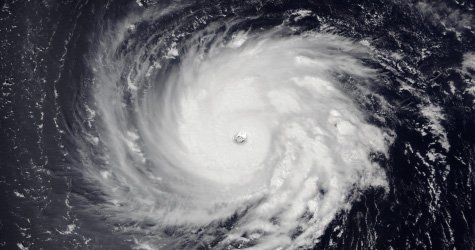 By NASA, NNVL [Public domain], via Wikimedia Commons
On September 14, 2018 Hurricane Florence made landfall just south of Wrightsville Beach, North Carolina. Like most hurricanes throughout history, this one left death and destruction in its wake. As shocking and heart-rending as such natural phenomena may seem, many other natural disasters have occurred in human history that exceed Florence, Harvey, Katrina, and even the 2004 Indian Ocean earthquake and tsunami in their toll of death and destruction. For example, throughout China’s history, extensive flooding has occurred countless times as a result of the mighty 3,000-mile-long Hwang Ho River. Several of the most terrible floods, with their ensuing famines, have been responsible for the deaths of more than a million people at a time. The southern levee of the river failed in Hunan Province in 1887, affecting a 50,000 square mile area.1 More than two million people died from drowning, starvation, or the epidemics that followed.2
In reality, such events have occurred repetitiously throughout the history of the world, and continue to do so—constantly: hurricanes, cyclones, earthquakes, tornados, floods, tsunamis, droughts, and volcano eruptions. In fact, natural disasters kill one million people around the world each decade, and leave millions more homeless, according to the United Nation’s International Decade for Natural Disaster Reduction.3
This circumstance inevitably elicits the pressing question: “WHY?” “Why would God allow such suffering and loss of life, inflicted on countless numbers of seemingly innocent people?” Regarding Florence, a five-year-old boy asked: “‘Daddy, where is God during the hurricane?’”4 Indeed, the number one argument marshaled by atheists to advocate their disbelief in God is the presence of widespread, seemingly purposeless suffering. They insist that if an infinite Being existed, He would exercise His perfect compassion and His omnipotence to prevent human suffering.5 Even for many people who do not embrace formal atheism, the fact that God apparently seems willing to allow misery and suffering to run rampant in the world, elicits a gamut of reactions—from perplexity and puzzlement to anger and resentment.
THE BIBLE HAS THE ANSWERS
But the Bible provides the perfect explanations for such occurrences. Its handling of the subject is logical, sufficient, and definitive. It sets forth the fact that God created the world to be the most appropriate, suitable environment in which humans are enabled to make their own decisions concerning their ultimate destiny (Genesis 1:27; Ecclesiastes 12:13-14). We humans have been provided with the ideal environment in which we may freely accept or reject God’s will for our lives. Natural disasters and nature’s destructive forces are the result of specific conditions that are necessary to God’s providing humanity with this ideal environment.
God is not blameworthy for having created such a world, since He had a morally justifiable reason for having done so. Human existence on Earth was not intended to be permanent. Rather, the Creator intended life on Earth to serve as a temporary interval of time for the development of one’s spirit. Life on Earth is a probationary period in which people are given the opportunity to attend to their spiritual condition as it relates to God’s will for living. Among other purposes, natural disasters provide people with conclusive evidence that life on Earth is brief and uncertain. God has even harnessed natural calamities for the purpose of punishing wickedness.6
Christians understand that no matter how catastrophic, tragic, or disastrous an event may be, it fits into the overall framework of soul-making—preparation for one’s departure from life into eternity. Likewise, the Christian knows that although the great pain and suffering caused by natural disasters may be unpleasant, and may test one’s mettle; nevertheless, such suffering is not intrinsically evil. Nor is it a reflection on the existence of an omnibenevolent God. The only intrinsic evil is violation of God’s will. What is required of all accountable persons is obedience to God’s revealed Word (given in the Bible)—even amid pain, suffering, sickness, disease, death, and, yes, hurricanes.
[NOTE: For further study on this thorny issue, see Thomas Warren (1972), Have Atheists Proved There Is No God? available at https://warrenapologetics.org/bookstore/have-atheists-proved-there-is-no-god and AP’s book Why People Suffer available at http://www.apologeticspress.org/store/Product.aspx?pid=247.]
ENDNOTES
1 “Hwang Ho” (2004), LoveToKnow 1911 Online Encyclopedia, http://32.1911encyclopedia.org/H/HW/HWANG_HO.htm.
2 “Huang He, or Hwang Ho” (2004), Britannica Student Encyclopedia, http://www.britannica.com/ebi/article?tocId=9274966.
3 “Disasters: A Deadly and Costly Toll Around the World” (1997), FEMA News, http://www.fema.gov/pdf/library/stats.pdf.
4 Bruce Ashford (2018), “‘Daddy, where is God during the hurricane?’” Fox News, September 16, http://www.foxnews.com/opinion/2018/09/15/daddy-where-is-god-during-hurricane.html.
5 E.g., Roy Jackson (2001), “The Problem of Evil,” The Philosopher’s Magazine Online, http://www.philosophers.co.uk/cafe/rel_six.htm; Jeffery Lowder (2004), “Logical Arguments From Evil,” Internet Infidels, http://www.infidels.org/library/modern/nontheism/atheism/evil-logical.html.
6 See Dave Miller (2005), “Is America’s Iniquity Full?” http://www.apologeticspress.org/articles/305.
The post Where Was God During Hurricane Florence? appeared first on Apologetics Press.
]]>The post Why People Suffer (Part III) appeared first on Apologetics Press.
]]>[EDITOR’S NOTE: The following article is excerpted from Dr. Miller’s book, Why People Suffer, available through Apologetics Press. Part I of this three-part series appeared in the January issue. Part II appeared in the February issue. Part III follows below and continues, without introductory comments, where the second article ended.]
Satan is the Archenemy of God and Man
While we are convinced that the age of miracles is over (see my discussion of the cessation of miracles in Miller, 2003), nevertheless, God continues to be very active in the world via non-miraculous, providential dealings. Similarly, so is Satan. The Bible repeatedly affirms and warns that Satan is the great adversary and deceiver who is constantly conniving to ensnare the righteous. Hence, he can use hardship and suffering as a tool to discourage a person and cause that person to blame God and abandon God’s will. The presence of Satan is yet another sub-cause of suffering in the world.
Consider a number of Bible passages that pinpoint this feature of Satan’s activity on Earth. Paul instructed Timothy that in his ministerial activities, it would be necessary for him humbly to correct “those who are in opposition, if God perhaps will grant them repentance, so that they may know the truth, and that they may come to their senses and escape the snare of the devil, having been taken captive by him to do his will” (2 Timothy 2:25-26, emp. added). Satan sets snares for us! Like the trapper that places a trap to catch a bear, so Satan seeks to take us captive by redirecting our service from God to his own evil machinations. Every time a Christian departs from the way of life, gives in to worldliness, and abandons the church, that person (though not conscious of the fact) has been taken captive by Satan to do his bidding. And he does so of his own free will and cannot bemoan, “The devil made me do it.”
What Paul called a “snare” in his communication to Timothy, he labeled “wiles” and “fiery darts” in his letter to the Ephesians. Read this passage carefully:
Put on the whole armor of God, that you may be able to stand against the wiles of the devil. For we do not wrestle against flesh and blood, but against principalities, against powers, against the rulers of the darkness of this age, against spiritual hosts of wickedness in the heavenly places. Therefore take up the whole armor of God, that you may be able to withstand in the evil day, and having done all, to stand. Stand therefore, having girded your waist with truth, having put on the breastplate of righteousness, and having shod your feet with the preparation of the gospel of peace; above all, taking the shield of faith with which you will be able to quench all the fiery darts of the wicked one (Ephesians 6:11-16, emp. added).
So when you or I experience some catastrophic setback, heartache, or physical hardship that momentarily stuns us and causes us to question God and our decision to be a Christian, we may well simply be the recipient of a clever scheme or ploy floated by Satan himself! Old cowboy shows frequently depicted the settlers “circling the wagons” when under attack by Indians. One of the tactics employed by the attackers was shooting flaming arrows at the settlers’ wagons, setting them on fire, and reducing the cover provided by the wagon and its cloth covering. Have you considered the fact that when you face some hardship, it may well be nothing more than Satan shooting a flaming arrow at you? If that be the case, how will you react? Surrender? Give up? Walk away from the wagon train of fellow settlers who are on their way to the Promised Land of heaven? Ask yourself this critical question: will you give Satan the satisfaction of winning?
In addition to a “snare,” “wiles,” and “fiery darts,” Paul noted “devices” in his letter to the Corinthian Christians. He urged them to forgive the wayward brother and reaffirm love to him when he has repented. Failure to do so would be unChristlike and it would open us up to a possible danger: “lest Satan should take advantage of us; for we are not ignorant of his devices” (2 Corinthians 2:11, emp. added). Observe that Satan has “devices,” or schemes, tricks, and ploys that he uses to try to take advantage of us, fool us, and capture us. No wonder Peter offered this pressing warning: “Be of sober spirit, be on the alert. Your adversary, the devil, prowls around like a roaring lion, seeking someone to devour” (1 Peter 5:8, NASB).
It is interesting, even ironic, that the Holy Spirit chose Peter to record this admonition. It was he who allowed himself to give in to fear and succumb to the satanic temptation to betray Jesus. And what about that occasion when he conversed with Jesus about His impending passion?
From that time Jesus began to show to His disciples that He must go to Jerusalem, and suffer many things from the elders and chief priests and scribes, and be killed, and be raised the third day. Then Peter took Him aside and began to rebuke Him, saying, “Far be it from You, Lord; this shall not happen to You!” But He turned and said to Peter, “Get behind Me, Satan! You are an offense to Me, for you are not mindful of the things of God, but the things of men” (Matthew 16:21-23, emp. added).
Jesus referred to Peter as Satan? At first glance, such a remark seems callous and unbecoming the Son of God. But on further reflection, Jesus was providing Peter with tremendous encouragement to get his thinking straight and thus to prepare himself for Satan’s assault—rather than aiding and abetting Satan. When you or I encounter adversity in our lives, we are apt to “knee jerk” and react incorrectly, even destructively. No doubt Peter was merely concerned about his Lord and desired His protection. He did not want Jesus hurt by those who desired to do Him physical harm. Hence, Peter was reacting out of fear and his own premature assessment of the situation. He was responding to life’s potentialities the way we typically do every day—from our own narrow perspective. We are rather proud of our personal opinions and our own impressions of circumstances around us. We need a healthy dose of James 1:19—“So then, my beloved brethren, let every man be swift to hear, slow to speak, slow to wrath.” We need to proceed cautiously and make certain that we are not allowing life’s threatening appearances to misassess what is happening. We must analyze life’s difficulties through spiritual lenses, not fleshly ones. We must learn to think spiritually. Doing so will help us to subdue the psychological and emotional fallout of suffering, and to frame that suffering in proper perspective. And it will aid us in avoiding becoming an “offense”—a stumbling block—to ourselves and others.
Our Nemesis
In writing to the Christians at Corinth, Paul described the impact of some unidentified physical ailment from which he suffered:
And lest I should be exalted above measure by the abundance of the revelations, a thorn in the flesh was given to me, a messenger of Satan to buffet me, lest I be exalted above measure. Concerning this thing I pleaded with the Lord three times that it might depart from me. And He said to me, “My grace is sufficient for you, for My strength is made perfect in weakness” (2 Corinthians 12:7-9, emp. added).
Observe carefully: Since Paul was blessed with the exalted role of being an inspired apostle of Christ, receiving direct revelations from God, it would have been easy for him to become prideful. Hence, God allowed Satan to afflict Paul (just as Satan had afflicted Job). Whatever this ailment may have been, it was of sufficient pain and torment that Paul repeatedly pleaded with God to remove it from his life. But God allowed it to remain because of the spiritual benefit Paul received as a result. Are we willing to endure suffering in order to receive spiritual improvement? What a tragedy it would have been if Paul had renounced God due to this “messenger of Satan.”
Please remember that all these depictions of Satan’s activity in human affairs are not mystical or supernatural. He operates through the ordinary circumstances of life. When a specific calamity comes our way, we will not be able to determine whether the occasion was generated by Satan, or if the occurrence is due to another explanation. Even Job did not know that Satan was the source of his suffering. We are given that insight, but so far as we know from the text, he was not informed that Satan was the instigator of his sufferings. God did not see fit to divulge the fact to him. Indeed, He did not need to do so—even as He need not step in and inform us. We simply need to be aware that the Bible teaches that Satan is one possible explanation for our sufferings—and then react accordingly.
We’re Being Sifted
Throughout Bible times, farmers grew wild cereal grains (such as rice, barley, oats, and wheat) in which the ripe seed is tightly enclosed by thin, dry, scaly “bracts” forming a dry husk (or hull) around the grain. Before the grain can be used, these seed casings must be removed, first through the process of threshing—which loosens and removes from the grain the casing, known at this point as chaff. This removal phase was traditionally achieved through pounding or milling the seed. Next, the loose chaff would have to be separated from the grain by means of winnowing. This phase was accomplished by tossing the grain upward into a light wind which would allow the heavier grain to fall back to the ground (usually into a wide collection basket) while blowing aside the lighter chaff which, in turn, was treated as a waste product by being ploughed into the soil or burned. The grain could be further purified by “sifting” through a sieve.
 |
 |
| Sifting the chaff | Rice Winnowing in Bali, Indonesia |
This interesting agricultural process is used in Scripture metaphorically to refer to the elimination of wickedness from the Earth and from one’s own life. John the Baptizer warned that Jesus would soon arrive on the scene, and that “His winnowing fan is in His hand, and He will thoroughly clean out His threshing floor, and gather His wheat into the barn; but He will burn up the chaff with unquenchable fire” (Matthew 3:12). He would eliminate the wicked in eternity. The psalmist stated that the wicked “are like chaff that the wind blows away” (1:4). Those striving to live righteously must be ever vigilant to remove the chaff from one’s life, even viewing suffering as a means to do so. Jesus forewarned Peter: “Simon, Simon! Indeed, Satan has asked for you, that he may sift you as wheat” (Luke 22:31). Satan apparently made the same request to God regarding Peter that he made concerning Job. He wanted to be allowed to test Peter to see whether he could handle the test. Sadly, he did not. Although, upon realization of his failure, he “got his act together” and became a great apostle in the church of Christ. We, too, can overcome life’s bitter challenges, even when we stumble on occasion, rising to reaffirm our commitment to remaining faithful even in the face of suffering and tribulation.
It’s a fact. Some of the suffering that comes our way in this life is generated by Satan, who seeks to deter us from serving God. He seeks to “hinder us” (1 Thessalonians 2:18). He is waging war against “those who keep the commandments of God and have the testimony of Jesus Christ” (Revelation 12:17). We ought to be emboldened on the occasion of tragedy to look Satan in the face (so to speak) and defiantly react: “Is that the best you can do?” Sadly, when Christians who are traumatized by some catastrophic event in their life “throw in the towel,” leave the church, and abandon their religious convictions, they are accommodating Satan! They are doing precisely what he sought to get them to do. The next time you face adversity, be sure to ask yourself: Will I give Satan the satisfaction of knowing he’s whipped me into submission and that he can count me in his camp?
Vindication of God
Another fundamental explanation the Bible gives for the existence of suffering, especially among Christians, is amply illustrated in the book of Job. You remember the occasion when Satan was allowed to present himself before God, and God asked him if he had noticed the righteous, spiritual condition of Job. Satan’s response was to insist that Job’s righteousness was due to God’s having blessed Job abundantly and protected Job from harm, and that if God were to recall those blessings, stripping Job of his prosperity and well-being, Job would “surely curse” God. Consequently, God gave Satan permission to have power over Job’s circumstances without harming his person (1:6-12). Satan left the presence of God, returned to Earth, and commenced to wreak havoc in Job’s life—to no avail. A second challenge of God by Satan resulted in God allowing Satan to physically harm Job’s person without taking his life.
Consider carefully what was going on in these encounters. Satan was claiming that humans choose to obey God purely out of self-interest—what they get out of it. God, on the other hand, contended that Job was following God out of disinterested love of deity. Ostensibly, God’s view was that even if Job was stripped of his material prosperity, his relatives, his friends, and even his health, he would still worship and serve God. Why? Because God is worthy of worship apart from the blessings and benefits He bestows on His creatures!
That’s not to deny that many people are religious because of some selfishly perceived benefit, whether physical, emotion, or psychological. Being a Christian and going to church may give one person a fertile field for business or sales prospects. It might give another the satisfaction that he/she is following in the footsteps of ancestors. It might provide a setting in which to enjoy social relations. More than one young man has admitted: “It’s a great place to meet good Christian girls and find a mate.” Humans are infected with a variety of motives and hidden angles in many phases of life—including religion. However, it does not follow that every person who is religious does so out of purely selfish motives. God noted that Job maintained his integrity, and that he remained a follower of God, even though he experienced tremendous heartache, exceptional physical catastrophe, and a diseased body.
So you see, God is worthy of our worship and devotion whether or not we receive any particular benefit. God is God! He is the great I AM! He is “worthy…to receive glory and honor and power” (Revelation 4:11) because He is the infinite, eternal Creator! He is the only worthy object of worship (Deuteronomy 6:13; Matthew 4:10). All human beings should “Serve the LORD with gladness; come before His presence with singing. Know that the LORD, He is God; It is He who has made us, and not we ourselves” (Psalm 100:2-3).
For the LORD is the great God, and the great King above all gods. In His hand are the deep places of the earth; the heights of the hills are His also. The sea is His, for He made it; and His hands formed the dry land. Oh come, let us worship and bow down; let us kneel before the LORD our Maker. For He is our God (Psalm 95:3-7).
“For the LORD your God is God of gods and Lord of lords, the great God, mighty and awesome, who shows no partiality nor takes a bribe” (Deuteronomy 10:17). He is the majestic Ruler of the Universe who defies human comprehension. When we bump up against bad things in life, instead of pining, “Why? Why me?,” in light of the infinitude and the magnitude of God, we ought to take a step back, bow our heads, and say, “Why not? Why not me? Do I really deserve anything less?” When we seriously reflect on the grandeur of God, our suffering seems trivial and paltry (Romans 8:18).
It was not uncommon to hear aged folk from the World War II generation speak of the frequent spankings they received in childhood from their parents in the words, “I got less than I deserved.” That humility—that mature appraisal of reality—is indispensable to facing the suffering of life and viewing God from the proper perspective. I repeat: the Bible teaches us that God is worthy of our worship because He is God, even if we receive nothing from Him—no physical blessings, no spiritual blessings, nothing—even if we were to be reduced to poverty and destitution, in the midst of our misery, we should still praise, honor, and glorify God for Who He is. Indeed, when we endure suffering, we vindicate God’s point to Satan: that He is worthy of honor and worship no matter what.
Verification of Faithfulness
Another explanation given in Scripture for why some people, specifically Christians, suffer in this world is to demonstrate spiritual genuineness. This powerful concept is seen in Job in the third cycle of speeches when Job responds to the charge of his friends, specifically Eliphaz, concerning Job’s doubtful spiritual condition. Please read his rebuttal carefully:
Even today my complaint is bitter; my hand is listless because of my groaning. Oh, that I knew where I might find Him, that I might come to His seat! I would present my case before Him, and fill my mouth with arguments. I would know the words which He would answer me, and understand what He would say to me. Would He contend with me in His great power? No! But He would take note of me. There the upright could reason with Him, and I would be delivered forever from my Judge. Look, I go forward, but He is not there, and backward, but I cannot perceive Him; When He works on the left hand, I cannot behold Him; when He turns to the right hand, I cannot see Him. But He knows the way that I take; when He has tested me, I shall come forth as gold. My foot has held fast to His steps; I have kept His way and not turned aside. I have not departed from the commandment of His lips; I have treasured the words of His mouth more than my necessary food (Job 23:2-12).
This tortured soul pours out his heart in this passage, and does so quite respectfully without indicting or blaming God. Out of great anguish and pain, he yearns for an opportunity to be in God’s presence in order to receive answers that would enable him to make sense of his devastated condition. He feels (naively) that perhaps he could present his case before God in view of the fact that he feels God seems to have some bone to pick with him. He is confident that God would not overwhelm him with His great power—but would give him due attention, listen to his concerns, and provide answers. The lack of direct contact with God—the thunderous silence that Job endured in the midst of his suffering—made him feel alone and unable to decipher his predicament.
 |
|
Touchstone set Wikimedia Commons (jcw) 2014 license CC-BY-SA-3.0 |
Job then makes a stirring statement: “But He knows the way that I take.” Job felt certain that despite the silence and his inability to secure an audience with God, nevertheless, God was surely aware of Job’s spiritual condition and how he had been living his life. Hence he asserted: “When He has tested me, I shall come forth as gold.” At first glance, one might think that Job was alluding to the metaphor of the furnace of affliction we discussed earlier. With that understanding, Job would have been saying that his sufferings serve the purpose of refining and purifying him. However, that is not the idea here. He is alluding to a “touchstone.” Prior to the more sophisticated chemical techniques used in modern metallurgical processes, the ancients used touchstones to ascertain the quality of raw ore. A touchstone was a finely grained, small tablet of dark stone used for assaying precious metal alloys. When soft metals (like gold or silver) are rubbed against it, a visible streak is left on the stone. Because different alloys of gold have different colors, one sample can be compared to samples of known purity in order to ascertain the quality of the gold.
Job’s point? He believed that his hardships and suffering were manifestations of God “rubbing” him against stone, i.e., afflicting him with tribulation. However, he was confident that when that process of testing his spiritual status was complete, he would be demonstrated to be pure gold. In other words, some of the suffering that comes to the Christian has as its purpose to showcase theism and Christianity by calling attention to the righteousness of the sufferer.
While Job did not boastfully believe he was sinless, he nevertheless was unconscious of any glaring deficiencies in his efforts to serve God—certainly none that would account for the intense agony he was enduring. In the climax of his rebuttals to his friends, he reflected on his adult behavior to see if he was deserving of his accusers’ allegations. His checklist of spirituality bodes well: he avoided illicit sexual desire; he treated fellow workers justly and kindly; he reached out to the poor, widows, orphans, and the needy; he refrained from covetousness; he avoided false religious allegiance; he loved his enemies; he was hospitable; and he confessed personal sin without fear of appearances (31:1-34). The conclusion of the book, as well as additional scriptural corroboration (Ezekiel 14:14,20; James 5:11), suggest that Job’s surmising was accurate. God was using Job to prove to Satan that some people are righteous and retain their righteousness regardless of their suffering.
God Likes Me!
Paul is a parallel example to Job on this very point. Recall, once again, Paul’s remarks concerning his “thorn in the flesh”:
And lest I should be exalted above measure by the abundance of the revelations, a thorn in the flesh was given to me, a messenger of Satan to buffet me, lest I be exalted above measure. Concerning this thing I pleaded with the Lord three times that it might depart from me. And He said to me, “My grace is sufficient for you, for My strength is made perfect in weakness.” Therefore most gladly I will rather boast in my infirmities, that the power of Christ may rest upon me. Therefore I take pleasure in infirmities, in reproaches, in needs, in persecutions, in distresses, for Christ’s sake. For when I am weak, then I am strong (2 Corinthians 12:7-10, emp. added).
Key in on the words “My grace is sufficient for you.” God’s use of the word “grace” refers to the favor that God showed to Paul by appointing him an apostle and using him in the promotion of Christianity. Essentially, God was telling Paul that it was unnecessary for Him to remove the “thorn” of suffering in his life, since he had God’s approval and acceptance. Question: are you willing to endure whatever suffering is thrown at you—whatever hardship, trial, setback, sickness, heartache, or pain—as long as you know that God loves you, accepts you, and considers you a faithful child? Sure you are! That is precisely why Job could exclaim: “Though He slay me, yet will I trust Him” (Job 13:15).
Here is another rich, encouraging passage on this point:
Blessed be the God and Father of our Lord Jesus Christ, who according to His abundant mercy has begotten us again to a living hope through the resurrection of Jesus Christ from the dead, to an inheritance incorruptible and undefiled and that does not fade away, reserved in heaven for you, who are kept by the power of God through faith for salvation ready to be revealed in the last time. In this you greatly rejoice, though now for a little while, if need be, you have been grieved by various trials, that the genuineness of your faith, being much more precious than gold that perishes, though it is tested by fire, may be found to praise, honor, and glory at the revelation of Jesus Christ, whom having not seen you love. Though now you do not see Him, yet believing, you rejoice with joy inexpressible and full of glory, receiving the end of your faith—the salvation of your souls (1 Peter 1:3-9).
Of all people on the Earth, Christians are those who have been the recipients of the mercy of God, a living hope, and an incorruptible inheritance. This spiritual assurance surpasses anything physical that may afflict us for now. If we remain faithful, focused on living a spiritual existence in harmony with God’s Word, yes, we will be “grieved by various trials,” but it will be only “for a little while.” And the pain and suffering that we endure will demonstrate the genuineness of our faith. Our faith, i.e., our obedient submission to Jesus Christ, is more precious than gold. Gold is physical and perishes; but our faith is spiritual and will carry us into eternity in triumph (Romans 8:18; 2 Corinthians 2:14; 2 Timothy 2:12; Revelation 2:10). Yes, our spiritual commitment may well be “tested by fire,” but hanging firm and staying faithful will result in praise, honor, and glory when Jesus returns. Pray tell, what else on this entire planet, in all of human history, even begins to compare with such a life? I repeat: only New Testament Christianity provides the proper perspective for facing suffering in this world. So the next time you find yourself afflicted, consider this: how do you know the distress you are experiencing is not simply one of those times when God is spotlighting your devotion to Him? His confidence in your spiritual stamina is such that He considers you capable of enduring the hardship and remaining faithful to Him!
conclusion
No matter what happens to the Christian in this world, that circumstance is temporary and only for the moment. Hardship is always accompanied by blessings, comfort, and encouragement that makes the tribulation bearable (cf. Job’s acquisition of more children). Our goal is to leave this land of the dying to go to the land of the living. To borrow the words of the old hymn, this world is not our home; we’re just passing through. The skeptic, atheist, and materialist have only this life with nothing to look forward to beyond the grave. No wonder the secular environmentalists and animal rights activists are trying to convince everyone to “save the planet.” To them, that is all there is to life. Hence, suffering is dysteleological—purposeless. But to the Christian, all of life’s events on Earth are mere “stepping stones”—the intermediate pathway from here to there.
Many years ago, popular radio commentator Paul Harvey expressed well the biblical view of what is happening to everyone in this life:
We are all under the sentence of death. Most rational persons learn to live with that certain uncertainty and enjoy a reasonably full life in spite of it. The mother never lived who did not wish she could, as Christ said He would, fold her children under her wing and protect them from harm. Even He couldn’t. For it is appointed to each of us, “once to die.” First our children must be brought face-to-face with the irrefutable finality of that judgment. Once they understand that Paradise is elsewhere, that we have to prove here that we deserve to be there, then your youngster will understand why it isn’t going to be easy. It isn’t supposed to be. This is the shakedown cruise. This earthly while separates the men from the boys. Don’t fear to confront your child with that fact. Youngsters want a challenge more than they want “peace and security.” They will go out of their way to manufacture danger. The present war scare will subside, but there will be other uncertainties to take its place. These are best faced by persons who, however scared, struggle forward through the dark toward the light (1962, 4-A, emp. added).
For the atheist and the skeptic, there is no light toward which one is pressing. Their “paradise” is purely physical—a dismal existence. But for the Christian, even the negative realities of life make perfect sense; at least we are in a position to put suffering in its place and assimilate the blows.
To recap, very real, very legitimate reasons are available to make sense of the existence of suffering in the world. Why do people suffer? Because…
- This world—with all its positive and negative elements—was designed to serve the singular purpose of providing humans with the ideal environment in which to decide where to spend eternity.
- All people sin and harm themselves and others.
- We can be improved, matured, strengthened, perfected, and made fit for time and eternity.
- Satan seeks to take as many people with him to hell as possible.
- God is vindicated by those who choose to love and obey Him apart from any benefits He may bestow upon them.
- Those who are faithful to God are verified in their spiritual genuineness through suffering.
These six realities provide ample explanation for the existence of suffering in the world. The God of the Bible exists and the one true religion is New Testament Christianity.
[NOTE: For additional information on this vital subject, see Dr. Miller’s book Why People Suffer and other materials available from Apologetics Press.]
References
Harvey, Paul (1962), “Letter From A Mother,” Evening Independent, 4A, January 10, http://goo.gl/vBUlIW.
Miller, Dave (2003), “Modern-Day Miracles, Tongue-Speaking, and Holy Spirit Baptism: A Refutation—EXTENDEDVERSION,” Apologetics Press, http://www.apologeticspress.org/apcontent.aspx?category=11&article=1399.
Why People Suffer
The post Why People Suffer (Part III) appeared first on Apologetics Press.
]]>The post Why People Suffer (Part II) appeared first on Apologetics Press.
]]>[EDITOR’S NOTE: The following article is excerpted from Dr. Miller’s book, Why People Suffer, available through Apologetics Press.]
The Decisions We Make—and Their Consequences
Once we understand the foundational meaning and purpose of life on Earth, we have the necessary vantage point from which to identify within this divinely orchestrated environment several specific subcauses of suffering that are subsumed under the broader, “umbrella” purpose of “soul making.” Among these, perhaps the #1 cause of human suffering is sin. This term is used in many different senses in current culture, but the Bible gives a very narrow, precise definition: violation of God’s law (1 John 3:4). Nothing else is sin. For mankind, sin occurs only in terms of human action in relation to the will of God. Only the Bible can inform humans as to what sin is. [NOTE: The New Testament is the portion of the Bible that is specifically applicable to human behavior today. However, though originally addressed to the Israelites, much may certainly be learned from the Old Testament (Romans 15:4; 1 Corinthians 10:1-13); see Warren, 1974, pp. 41-43].
For example, burning the toast is not sin, but lying about it is (Colossians 3:9). Though not intended to be exhaustive, consider the listing of sins on the next page taken from the New Testament that aids in conceptualizing sin properly (Romans 1:29-31; 1 Corinthians 6:9-10; Galatians 5:19-21; Ephesians 4:31; Colossians 3:5-8; Revelation 21:8).
 |
|
[NOTE: One must examine Scripture and consult Greek authorities |
A great deal of suffering, misery, heartache, pain, and unpleasantness is generated by human sin. In fact, like the first human pair (Genesis 3), we bring much, perhaps most, of our suffering on ourselves. Sin is the direct result of free moral agents making choices that violate God’s will (Romans 5:12; 1 John 3:4). Sin brought death into the world (Genesis 2:17; 3:16-19; Romans 8:18-23; 1 Corinthians 15:26). Prisons are full of individuals who are there due to their own decisions and their own actions. Likewise, much physical illness and disease is the result of humans making unwise, even detrimental, decisions regarding the use of our bodies (e.g., drugs, alcohol, tobacco, illicit sex, etc.).
Our Own Sin
Suffering from sin comes through two sources. First, we can suffer due to our own sin. When Peter wrote, “But let none of you suffer as a murderer, a thief, an evildoer, or as a busybody in other people’s matters…” (1 Peter 4:15), he acknowledged that many people, in fact, bring suffering and hardship upon themselves because they murder, steal, commit evil, and interfere in the lives of others. The police may very well shoot and kill or painfully wound a fleeing felon—instant suffering for sin. A person may smoke crack cocaine, receiving instant physical pleasure, but eventually resulting in horrible physical effects and even death. We can “sow the wind, and reap the whirlwind” (Hosea 8:7). We can choose to “sow to the flesh” and thus “reap corruption” (Galatians 6:8). No doubt about it: much suffering in human history has been self-inflicted.
The Sin of Others
The other source of suffering from sin is that which comes due to the sin of others. The drunk driver that careens into a car occupied by a family of dad, mom, and their two small children, killing some of the occupants and maiming the others, not only suffers from his own sin; he also causes the innocent to suffer due to his sin. Indeed, the consequences of a person’s own sins can wreak havoc on succeeding generations (Exodus 20:5). God explained to the first generation of Israelites out of Egypt that because of their sin—their unwillingness to trust and obey God by entering the Promised Land—they would have to meander aimlessly in the desert for 40 years. As a result, their children would have to “bear the brunt of your infidelity” (Numbers 14:33). The kids had to suffer for the sins of the parents. So it continues. Think of the drunken fathers across our land and the world who cause their battered wives and children to suffer.
Sin is far-reaching and extremely pervasive. Consider the decisions made by Arabian slave traders centuries ago to engage in what the Bible calls “manstealing” (1 Timothy 1:10—KJV), or kidnapping, by capturing individuals in Africa, crowding them into ships, and transporting them to America to be sold as slaves. Those decisions were made by people who you and I do not personally know. We had nothing to do with their decisions or their actions. Yet, those decisions, that inflicted immediate suffering on their victims, eventually led to civil war and thousands of additional deaths, and many years after the fact Americans are still suffering the consequences of those decisions. You and I can suffer for the sins of those who literally lived centuries before us. Such is the destructive, devastating, deadly effect of human sin.
Not Fair!
How are such circumstances fair? They are not. However, they do not reflect negatively on the justice of God or make Him blameworthy. In order to create the suitable environment for soul-making, free moral agency is inherently mandatory. And when humans are free to make their own decisions, they may well make wrong decisions. Blame, therefore, rests with the perpetrator—in the above instances, the drunk and the slave trader. Why blame God because persons, of their own free will, chose to drink alcohol and drive, or enslave their fellowman?
The very purpose of the created order would be thwarted if God intervened miraculously to prevent consequences every time humans chose to do wrong. God has literally done everything possible to discourage people from making wrong choices—short of interfering with their free will. He has provided evidence of Himself in nature (Psalm 19:1ff.; Romans 1:20). He has provided written communication (the Bible) that is self-evidently inspired, to define sin and inform people regarding the need to refrain from sinning. Given the nature of man (a thinking being with volition) and the nature of God (a perfect, infinite Being), this world must of necessity include the possibility that people will choose to sin and, in so doing, hurt themselves and others.
To suggest that this vale of soul-making could have been adjusted by God to eliminate pain and suffering while still allowing humans free choice is to suggest the possibility of a round square or a 90-year-old teenager. The very idea is nonsensical and self-contradictory. The atheist or agnostic who insists that God does not exist because of suffering in the world—for if He existed, He would have arranged for pain and suffering not to occur—has taken a nonsensical and self-contradictory viewpoint. As Warren cogently explained:
God is infinite in power, but power meaningfully relates only to what can be done, to what is possible of accomplishment—not to what is impossible! It is absurd to speak of any power (even infinite power) being able (having the power) to do what simply cannot be done…. Rather than saying that God cannot do such (with the implication that he is deficient in power, so that if only he had more power he could do it), one should say that such simply cannot be done—that such is not subject to power, not even to infinite power! (1972, p. 28, italics in orig.).
While God allows humans to exercise their own free will and commit sin, He is grieved by such choices. He desires that all people be saved (1 Timothy 2:4). He “is longsuffering toward us, not willing that any should perish but that all should come to repentance” (2 Peter 3:9). God asked this rhetorical question in the hearing of Ezekiel: “Do I have any pleasure at all that the wicked should die…and not that he should turn from his ways and live?” (Ezekiel 18:23). So we cannot indict God. We must admit: much of the pain, hardship, and suffering that we experience and see around us is the result of human sin.
We’re Being Persecuted
Some suffering is due to righteous living that evokes hatred and opposition from those who have chosen to live in sin. Why did Cain kill Abel—when Abel had done nothing personally to Cain? Answer:
And this is the condemnation, that the light has come into the world, and men loved darkness rather than light, because their deeds were evil. For everyone practicing evil hates the light and does not come to the light, lest his deeds should be exposed. But he who does the truth comes to the light, that his deeds may be clearly seen, that they have been done in God (John 3:19-21).
Cain had ample opportunity to get his attitude straight and bring his actions into harmony with God’s directives. God even gave him a pep talk: “Why are you angry? And why has your countenance fallen? If you do well, will you not be accepted? And if you do not do well, sin lies at the door. And its desire is for you, but you should rule over it” (Genesis 4:6-7). So why would Cain reject God’s words and kill his brother? He despised the light and did not want the light of his brother’s obedience to expose his own disobedience. As John further noted: “not as Cain who was of the wicked one and murdered his brother. And why did he murder him? Because his works were evil and his brother’s righteous” (1 John 3:12, emp. added).
Much suffering has been levied in human history by the unrighteous against the righteous (cf. Hebrews 11:24). Nero lined the roads leading to Rome with crucified Christians and even provided nighttime illumination by setting them on fire (Tacitus, Annals, XV.44). Christians are neither surprised nor bewildered by such treatment. Jesus, in fact, warned the faithful to expect it:
If the world hates you, you know that it hated Me before it hated you. If you were of the world, the world would love its own. Yet because you are not of the world, but I chose you out of the world, therefore the world hates you. Remember the word that I said to you, “A servant is not greater than his master.” If they persecuted Me, they will also persecute you. If they kept My word, they will keep yours also (John 15:18-20).
They will put you out of the synagogues; yes, the time is coming that whoever kills you will think that he offers God service…. These things I have spoken to you, that in Me you may have peace. In the world you will have tribulation; but be of good cheer, I have overcome the world (John 16:2,33).
Peter even stated that Christians ought to expect and anticipate hardship and suffering, and not be bewildered by it when it arrives—
Beloved, do not think it strange concerning the fiery trial which is to try you, as though some strange thing happened to you; but rejoice to the extent that you partake of Christ’s sufferings, that when His glory is revealed, you may also be glad with exceeding joy. If you are reproached for the name of Christ, blessed are you, for the Spirit of glory and of God rests upon you. On their part He is blasphemed, but on your part He is glorified (1 Peter 4:12-14).
The three Hebrew youths, Shadrach, Meshach, and Abed-nego, were ordered to worship the idolatrous image King Nebuchadnezzar had erected or be burned alive in a furnace of fire. When they refused, they were brought before the king to offer an explanation. What they said on that occasion ought to be the attitude of every faithful follower of the God of heaven in the face of persecution:
O Nebuchadnezzar, we have no need to answer you in this matter. If that is the case, our God whom we serve is able to deliver us from the burning fiery furnace, and He will deliver us from your hand, O king. But if not, let it be known to you, O king, that we do not serve your gods, nor will we worship the gold image which you have set up (Daniel 3:16-18).
These three men were sufficiently convicted of the reality of God that they recognized that it might not be His will to intervene and deliver them from the persecution of the king. They might have to die. Nevertheless, they still refused to deny spiritual reality and behave as if God does not exist. Their suffering was an insufficient pretext for denying God.
We ought to be like the farmer’s mule that fell into a pit. The farmer did not have the physical means to extract the mule, which would surely die a slow, agonizing death. So the farmer commenced to bury the mule by shoveling dirt into the pit. However, the stubborn mule refused to be buried. He shook each shovel full of dirt from his back and packed the dirt beneath him by stomping it with his hooves. Eventually, sufficient dirt accumulated under the mule’s hooves that he was able to simply step out of the pit. The mule refused to give up and be buried. We ought to have the same determination as we face the hardships of life. Shake ‘em off!
Self-Improvement: I Can Be a Better Person!
But there are other subcauses of suffering. Consider the old blacksmith who was a collector of iron. On a typical day, he would select a piece suitable to his purpose and begin his work by holding the metal among flames until it turned white from the intense heat. Placing it in this super-heated condition on an anvil, he would strike the piece of iron with his hammer. This initial treatment of the iron was a test—a test to see if the metal would “take temper” and thus be capable of being fashioned into a useful object. If the initial test was unsuccessful, the hunk of worthless metal would be tossed onto the scrap heap. If the initial test was successful, the piece of iron would next be plunged into water, and then once again subjected to the flames. Now the smithy could begin his work, repeating the cycle over and over again—heating, striking, and cooling. With time, patience, and hard work, the formless hunk of metal gradually emerges from the arduous, seemingly endless process as a meaningful, valuable article for use.
Isn’t life like that? It’s painful, prolonged, and painstaking. Life can feel hot, life can feel cold, and life can feel like we are being beaten down. But those very aspects of life can result in value, meaning, and capability that cannot be secured in any other way. The hardships of life can improve and perfect us—preparing us for eternity—if we will allow them to. We ought to beg God to enable us to take temper, endure the difficult process of molding and shaping, and not to throw us on the scrap heap as useless and incorrigible.
Furnace of Affliction
A common metaphor used in the Bible to describe life’s adversities is that of the smelting process of “extractive metallurgy.” When raw ore is mined from the ground, it must be refined and the impurities removed. Historically, the process by which this objective is achieved entails tremendous heat, although now chemical reducing agents are also used to decompose the ore, separating it from the silver, iron, copper, and other base metals. Reducing the ore to a liquid state in a furnace of fire allows the pure metal to separate from the dross or impurities.
God frequently alluded to the necessity of subjecting the ancient nation of Israel to this process, figuratively speaking. They had a history of defiance and rebellious rejection of God’s will for them. Israelite prophets forewarned their people of the impending disaster, insisting that the coming captivity was deserved. The foreign aggressor would be God’s rod of chastisement. But this calamity would also serve a useful purpose, figuratively represented by the smelting process.
Referring to the wickedness of Judah and the capital city of Jerusalem, Isaiah conveyed God’s intentions: “Therefore the Lord says…I will turn My hand against you, and thoroughly purge away your dross, and take away all your alloy” (Isaiah 1:24-25). “Behold, I have refined you, but not as silver; I have tested you in the furnace of affliction” (Isaiah 48:10; cf. Jeremiah 9:7). Zechariah announced: “I will bring the one-third through the fire, will refine them as silver is refined, and test them as gold is tested” (13:9). Malachi asked:
But who can endure the day of His coming? And who can stand when He appears? For He is like a refiner’s fire and like launderer’s soap. He will sit as a refiner and a purifier of silver; He will purify the sons of Levi, and purge them as gold and silver, that they may offer to the LORD an offering in righteousness (Malachi 3:2-3).
The psalmist summarized the principle by describing the process from beginning to end:
Oh, bless our God, you peoples! And make the voice of His praise to be heard, Who keeps our soul among the living, and does not allow our feet to be moved. For You, O God, have tested us; You have refined us as silver is refined. You brought us into the net; You laid affliction on our backs. You have caused men to ride over our heads; We went through fire and through water; but You brought us out to rich fulfillment (Psalm 66:8-12, emp. added).
The references to “the net,” “affliction on our backs,” men riding “over our heads,” and going through “fire and water” are likely figurative allusions to the very real threat of Assyrian conquest during the days of Hezekiah, which placed the nation in extreme danger and duress (2 Kings 18-19). All these references liken life’s difficulties and hardship to a furnace in which the recipients are subjected to intense heat. Pain? Yes. Torment? Yes. Anguish? Yes. But surviving and coming through the adversity results in renewal, reassurance, and fortitude for the future. Our spiritual defects are purged that we may be made fit for life and divine service.
The Great Physician
Another metaphor for suffering is taken from the field of medicine. Though Job’s friends fell short of their friendship responsibilities, they sometimes stumbled upon valuable nuggets of truth. Eliphaz was correct when he insisted that God can use adversity the same way a surgeon uses a scalpel: “Behold, happy is the man whom God corrects; therefore do not despise the chastening of the Almighty. For He bruises, but He binds up; He wounds, but His hands make whole” (Job 5:17-18, emp. added). When you think about it, what surgeons do is rather violent and seemingly barbaric—cutting the human body open, pounding, sawing, scraping—inflicting orchestrated, organized trauma upon a human being. The cardiologist that slices the chest and pries back the rib cage of the heart patient is inflicting considerable shock and distress that, without anesthesia, would be unbearable. Yet his actions are wholly calculated to save life and make well. Can we not see God in the same light?
Many Bible passages reinforce this reality. Paul, who endured many difficulties in life, was able to “glory in tribulations, knowing that tribulation produces perseverance; and perseverance, character; and character, hope. Now hope does not disappoint, because the love of God has been poured out in our hearts” (Romans 5:3-5). James said something very similar: “My brethren, count it all joy when you fall into various trials, knowing that the testing of your faith produces patience. But let patience have its perfect work, that you may be perfect and complete, lacking nothing” (1:2-4). So hardships and suffering in life literally alter us in good ways! We become more patient, more able to endure, more able to cope. Our character is shaped and improved. We grow stronger and mature—so much so that Paul actually gloried in tribulations, and James said we could consider suffering a joyous event. And this ongoing process is monitored and sustained by “the love of God poured out in our hearts.”
The Great Parent
Yet another metaphor comes from the family. Parental discipline operates on this same principle. If parents are fulfilling their role properly, they dispense two forms of discipline regularly to their children, delineated by Solomon: “The rod and rebuke give wisdom, but a child left to himself brings shame to his mother” (Proverbs 29:15, emp. added). Verbal admonition and instruction as well as corporal punishment are both indispensable to a well-rounded upbringing (Proverbs 13:24; 19:18; 22:15; 23:13-14; 29:15,17). Likewise our cosmic parent—the “father of our spirits” (Hebrews 12:9)—is deeply interested in bringing us to spiritual adulthood. Again, as Solomon encouraged: “My son, do not despise the chastening of the LORD, nor detest His correction; for whom the LORD loves He corrects, just as a father the son in whom he delights” (Proverbs 3:11-12).
Expounding on this very passage, the author of Hebrews explained:
If you endure chastening, God deals with you as with sons; for what son is there whom a father does not chasten? But if you are without chastening, of which all have become partakers, then you are illegitimate and not sons. Furthermore, we have had human fathers who corrected us, and we paid them respect. Shall we not much more readily be in subjection to the Father of spirits and live? For they indeed for a few days chastened us as seemed best to them, but He for our profit, that we may be partakers of His holiness. Now no chastening seems to be joyful for the present, but painful; nevertheless, afterward it yields the peaceable fruit of righteousness to those who have been trained by it (12:7-11, emp. added).
Sound reasoning! The person who whines or complains about chastening in life is like the prideful, resentful child that resists and rejects parental love and training. If we will submit ourselves to be trained by it, the unpleasant, even painful, suffering of life engenders “the peaceable fruit of righteousness.” This fact highlights again the purpose of the created order being a vale of soul-making. The ranting atheist who rails against God is the picture of childish arrogance and stubborn pride—the opposite of thoughtful humility. God can speak through the suffering that people receive—but will they listen? Are they looking in the right places for answers? Or, sadly, do they “refuse to retain God in their knowledge” (Romans 1:28)?
The fact is that God wants us to survive life’s hardships: “No temptation has overtaken you except such as is common to man; but God is faithful, who will not allow you to be tempted beyond what you are able, but with the temptation will also make the way of escape, that you may be able to bear it” (1 Corinthians 10:13, emp. added). He does not test us in order to cause us to fall (James 1:13). That is Satan’s desire and intention—not God’s (Matthew 4:1-11). The words translated “temptation” and “tempt” in these verses mean to “put to the proof” and “to test.” They do not carry any idea of trying to trip someone up or cause them to fall. A person may well fail a test—but neither the test nor the one who presents the test is blameworthy.
I Choose Pain?
But the fact is that we humans do not see any form of pain or suffering as desirable. As American civilization deteriorates morally and spiritually, the population has cultivated a voracious appetite for entertainment, amusement, pleasure, and physical stimulation. Hence, an avoidance syndrome characterizes many people in which they fill their lives with “fun and games” in order to distance themselves from anything that is deemed difficult, harsh, arduous, or unpleasant. Drugs and alcohol often become the “buffer” that many choose to shield themselves from psychological, emotional, and even physical suffering. But this evasion is destructive.
If given the choice to go to a funeral or to go to a party or ballgame, who would choose the funeral? Yet, wise Solomon set the record straight when he asserted:
Better to go to the house of mourning than to go to the house of feasting, for that is the end of all men; and the living will take it to heart. Sorrow is better than laughter, for by a sad countenance the heart is made better. The heart of the wise is in the house of mourning, but the heart of fools is in the house of mirth (Ecclesiastes 7:2-4).
Who can believe it? The Puritans were correct in discouraging too much leisure time (Miller, 1939). These three verses express profound truth and meaning regarding life. Mourning and sorrow—more specifically, the circumstances and occurrences that cause mourning and sorrow—are of tremendous value in living life in preparation for the end of life on Earth. Yet these are the very things that so many people use as their justification for dismissing God and rejecting Bible religion!
Paul articulated the same concept in a discussion of his own hardships and sufferings: “Therefore most gladly I will rather boast in my infirmities, that the power of Christ may rest upon me. Therefore I take pleasure in infirmities, in reproaches, in needs, in persecutions, in distresses, for Christ’s sake. For when I am weak, then I am strong” (2 Corinthians 12:9-10). Strength, i.e., moral and spiritual courage so necessary to living life peacefully, with confidence and contentment, comes through physical weakness and trauma? Absolutely. Paul insisted: “then I am strong.” Indeed. You don’t get diamonds without tremendous pressure. We are strongest and most valuable to God when we are subjected to hardship that brings us to our knees before the Supreme Ruler of the Universe—when we are “weak” from a human perspective.
Proving Grounds
As a child, during the summer months, I would accompany my father on his Borden milk route which took us west from Phoenix, Arizona to rural grocery stores and restaurants in need of dairy products. On one occasion, I observed that the purple mountains in the distance had what appeared to be white streaks or gashes on them. My father informed me that the land was part of International Harvester’s 4,000 acre Phoenix Proving Grounds to test their trucks and earth-moving equipment built by the Harvester’s industrial power division (operational from 1947 to 1983). The massive earthmovers would gouge the earth, turning over the soil to expose the limestone rocks and dirt beneath—hence, the white streaks.
 |
| International Harvester 27-75 earthmover being demonstrated in front of a grandstand at International Harvester’s Phoenix Proving Ground in 1953 (Credit: Wisconsin Historical Society. Image ID 39941)
|
Why would Harvester go to the trouble and expense of purchasing thousands of acres of land in a hot, rugged desert to create a “proving grounds”? Well, it’s one thing to conceive of and build a truck or tractor; it’s quite another to build one that is top quality and durable. Harvester sought to test their trucks and construction equipment under harsh desert conditions, putting their vehicles through torturous, rugged, merciless contact with rocks, boulders, cacti, and dry, hard ground. If their earthmovers could withstand that kind of torture, they would prove themselves as worthy to be sold to customers who would return again and again to purchase such quality, long-lasting, well-tested products. Indeed, the worth of the vehicles was evaluated by just how well they withstood the jarring, jagged, rock-strewn, abusive terrain to which they were subjected.
That’s a portrait of human life! That’s what you and I are enduring right now! This life is our proving ground. We are being tested, tried, and proved. We are undergoing harsh, rugged conditions—the hard knocks, jagged rocks, and searing heat of life’s trials and obstacles. We must face many hindrances and impediments, a host of stumbling blocks and barriers, and a multitude of snags and straits.
Consider for a moment what Paul faced as an apostle of Christ:
Are they ministers of Christ?—I speak as a fool—I am more: in labors more abundant, in stripes above measure, in prisons more frequently, in deaths often. From the Jews five times I received forty stripes minus one. Three times I was beaten with rods; once I was stoned; three times I was shipwrecked; a night and a day I have been in the deep; in journeys often, in perils of waters, in perils of robbers, in perils of my own countrymen, in perils of the Gentiles, in perils in the city, in perils in the wilderness, in perils in the sea, in perils among false brethren; in weariness and toil, in sleeplessness often, in hunger and thirst, in fastings often, in cold and nakedness—besides the other things, what comes upon me daily: my deep concern for all the churches (2 Corinthians 11:23-28).
Have you and I experienced such hardship? Will we ever? Yet observe Paul’s attitude about it all: “We are hard pressed on every side, yet not crushed; we are perplexed, but not in despair; persecuted, but not forsaken; struck down, but not destroyed” (2 Corinthians 4:8-9, emp. added). Yes, some seem to be beset with more tribulations. We cannot know all the “whys and wherefores” in such cases. But we can know that everyone faces hardship and suffering. It is part of life, part of being human. And the point is that we can make it! We can allow life’s adversities to propel us to our intended destiny. And be reminded of Paul’s earlier observation: “No temptation has overtaken you except such as is common to man; but God is faithful, who will not allow you to be tempted beyond what you are able.” You and I will not go through any adversity that others have not already gone through. Adversity is “common to man”—everyone faces it and people have been facing it for the entirety of human history. But God is trustworthy; we can count on Him to see us through the testing. “For in that He Himself has suffered, being tempted, He is able to aid those who are tempted” (Hebrews 2:18, emp. added).
Farmers Get It!
Farmers understand these principles. They literally live their lives in limbo. For most of American history, the average citizen lived on the farm. Hence, the average American understood firsthand the principle of endurance in the face of hardship. The farmer must sweat, toil, and work hard. But he has no guarantee that the fruit of his labors will be forthcoming. Many variables potentially threaten the outcome (weather, pestilence, etc.). For months, the farmer (and his family) must hope and pray that their arduous efforts will be rewarded. Their uncertainty and anticipation are forms of suffering. No wonder James used the farmer’s plight as an appropriate example of what life entails:
Therefore be patient, brethren, until the coming of the Lord. See how the farmer waits for the precious fruit of the earth, waiting patiently for it until it receives the early and latter rain. You also be patient. Establish your hearts, for the coming of the Lord is at hand (James 5:7-8).
So as we go through life, being tossed about by the unpleasant circumstances that come our way, we must ever be reminded that this is our proving grounds. We are being shaped for eternity. The old adage, “Heaven is a prepared place for a prepared people” is accurate. We are being prepared—if we will yield ourselves to the disciplinary processes that facilitate that preparation.
References
Miller, Perry (1939), The New England Mind: The 17th Century, Vol. 1 (Cambridge, MA: Harvard University Press).
Warren, Thomas (1972), Have Atheists Proved There Is No God? (Jonesboro, AR: National Christian Press).
Warren, Thomas (1974), When is An “Example” Binding? (Jonesboro, AR: National Christian Press).
Why People Suffer
The post Why People Suffer (Part II) appeared first on Apologetics Press.
]]>The post Why People Suffer (Part I) appeared first on Apologetics Press.
]]>When Calamity Strikes
No doubt about it: the amount of suffering in the world throughout human history has been staggering and unfathomable. Contemplate the following:
Natural disasters
The natural disasters that have happened in human history are innumerable. Here are a few just from the last five centuries that resulted in catastrophic loss of human life. On January 23, 1556, some 830,000 people died when the Shaanxi earthquake hit China. On April 10, 1815, the volcanic explosion of Mount Tambora in Indonesia killed 92,000. Throughout China’s history, extensive flooding has occurred countless times as a result of the mighty 3,000-mile-long Hwang Ho River. Several of the most terrible floods, with their ensuing famines, have been responsible for the deaths of more than a million people at a time. The southern levee of the river failed in Hunan Province in 1887, affecting a 50,000 square mile area. More than two million people died from drowning, starvation, or the epidemics that followed (“Huang He…,” 2004).
One of the deadliest epidemics in history was the global flu outbreak of 1918 which killed 50 million people worldwide (Vergano, 2014; Taubenberger and Morens, 2006). In 1931, one to four million people died from flooding in China. Half a million people died when the Bhola cyclone struck East Pakistan (now Bangladesh) on November 13, 1970. Between 650,000 and 779,000 died on July 28, 1976 as a result of the Tangshan earthquake in China. On April 26, 1989, 1,300 were killed when the Daulatpur-Salturia tornado struck Manikganj, Bangladesh. In 1999, over 15,000 died from torrential rains and mudslides in Venezuela. In 2003, 70,000 died from the European heat wave. The Indian Ocean tsunami that devastated Indonesia on December 26, 2004 killed 230,000.
These incidents do not even begin to convey the countless comparable occurrences of nature’s destruction throughout human history. In reality, such events have occurred repetitiously throughout the history of the world, and continue to do so—constantly: hurricanes, cyclones, earthquakes, tornados, floods, tsunamis, droughts, and volcanic eruptions. In fact, natural disasters kill one million people around the world each decade, and leave millions more homeless, according to the United Nation’s International Decade for Natural Disaster Reduction (“Disasters…,” 1997). Natural disasters have snuffed out the lives of untold billions.
Man’s Inhumanity to Man
 |
|
The Echelle or Rack |
Humans have unquestionably inflicted more suffering on each other than natural sources. Indeed, there is no end to the twisted machinations by which humans have imposed misery on each other. Consider but a tiny fraction from history. During the Middle Ages, tortures included the “chevalet,” in which an accused witch sat on a pointed metal horse with weights strung from her feet. Sexual humiliation torture included forced sitting on red-hot stools. “Gresillons” were designed to crush the tips of fingers and toes in a vice-like device. Excruciating pain was inflicted on victims by the Spanish Boot, used mostly in Germany and Scotland—a steel boot placed over the leg of the accused and tightened until the shin bone shattered. The “echelle” (more commonly known as the “rack”) consisted of the accused lying on a long table to be stretched violently. On many occasions, the victim’s limbs were pulled from their sockets and sometimes even torn from the body entirely. Sometimes a “tortillon” was used in conjunction with the rack which would severely squeeze and mutilate the genitals at the same time as the stretching. The “lift” also stretched the limbs of the accused, with the victim’s feet strapped to the ground and the arms tied behind the back while another rope tied to the hands pulled upwards, causing the arms to break even before the horrific portion of the stretching began. Drawing and quartering (chopped into four pieces), and even flaying alive, were also common in Medieval Europe (“Medieval Torture”).
Gladiatorial combat during the Roman Empire (circa 264 B.C. to A.D. 435) resulted in the death of some 3.5 million, while according to Josephus (vi.ix.3), the Jewish Revolt of 68-73 B.C. ended in 1.2 million Jews killed in Jerusalem by the Romans. Muhammad Shah, Sultan of Kulbarga, fought Bukka I, Raya of Vijayanagar in 1366 and massacred 500,000 Hindus.
 |
| Gladiatorial Combat wikimedia.org (Jean-Léon Gérôme) in public domain |
Zulu punishments in Africa in the early 19th century included a particularly barbaric form of impalement, called ukujoja, in which the victim was seated atop a sharply pointed stick elevated into the air. The weight of the victim’s body would bear down as the stick burrowed its way upward through body organs until finally reaching the heart and lungs to bring the release of death. Sometimes, a branched stick was used that would split once inserted (Berglund, 1976, p.195, note 89; Bourquin, 1979; cf. “Impalement,” n.d.).
During the 20th century, Stalin’s regime in Russia (1924-53) resulted in 20 to 30 million deaths of his own countrymen. In the People’s Republic of China, Mao Zedong’s regime (1949-1975) resulted in 40 million deaths. The Khmer Rouge in Cambodia (1975-1978) killed some 1.6 million people. Tyrants and dictators have extinguished from the Earth literally billions of human beings over the course of history.
The total number of casualties in World War I, both military and civilian, was about 37 million: 16 million deaths and 21 million wounded. Over 56 million deaths occurred in World War II (counting both military and civilian deaths). Over half a million died in the American Civil War. Some 1.2 million died in the Korean War. Estimates range from one to three million deaths from the Vietnam War.
More recently, tortures employed by terrorist groups include the forcible extraction of all 10 fingernails, all 10 toenails, and all 32 teeth—before executing the victim by such barbaric techniques as slow decapitation via a butcher knife. The 2001 terrorist attack by Muslim terrorists resulted in commandeered aircraft careening into buildings and killing over 2,500 unsuspecting innocent people. Imagine the unimaginable horror of mafia style thugs inserting a dental fixture into the mouth of their victim, forcing his mouth to remain open, while they release a venomous viper into his mouth which slithers down the esophagus and commences to perforate the stomach lining with fangs that inject venom, initiating an excruciating death. [See also “Common Methods of Torture…,” n.d.; “The 15 Most Brutal…,” n.d.]
Consider the unspeakable suffering inflicted on children by depraved adults. Like the UK rock star that admitted to attempting to rape an 11-month-old baby boy and also conspiring to rape a baby girl (Sieczkowski, 2013). Some 45% of rapes reported to the police in South Africa are child rapes, and 50% of South Africa’s children will be abused before the age of 18 (Krever, 2014). Consider the man in Louisiana who raped his eight-year-old stepdaughter, inflicting what the court styled “hurt and horror” on his victim (Miller, 2009). Large numbers of innocent children have been tortured, sexually abused, and discarded to endure a lifetime of unresolved torment and anguish. What’s more, the lives of over 50 million unborn children have been extinguished (in America alone—400 million in China [Morse, 2013]), without ever seeing the light of day, by the grizzly techniques of abortion doctors.
All such atrocities do not even include the host of circumstances that create untold suffering in the lives of millions: betrayal, divorce, depression, alcoholism, drug addiction, financial disaster (such as the loss of one’s job and house), and crime. For youth between the ages of 10 and 24, suicide is the third leading cause of death in the U.S. (“Teen Suicide…,” n.d.).
Seemingly Causeless Suffering
And what of the unprovoked and apparently undeserved host of heart-wrenching hardships to which the world of humanity is regularly subjected? Widespread and pervasive illness, sickness, and resulting death occur without any apparent connection to an individual’s own actions. In many cases, we inherit the genetic foibles of our ancestors that make us susceptible to heart disease, cancer, diabetes—and the list goes on and on. The average individual must endure the heart-breaking trauma of the death of loved ones—a spouse, parent, child, or dear friend—who die from unwarranted and undeserved physical ailments. Innocent children are born with debilitating birth defects through no fault of their own.
Think of the people in history who were forced to live in leper colonies—like the cinematic depiction of Judah Ben Hur’s mother and sister—quarantined from society to live in caves and squalor. What about the countries and societies throughout history whose populations have endured mass starvation from famine and drought?
Human error and freak accidents have claimed many lives. Automobile accidents kill and maim thousands. Many innocent people have died from plane crashes due to mechanical difficulties or pilot error. Many lives have been lost on ships at sea (like the Titantic). Accidental shootings, where guns discharge unexpectedly and unintentionally, cause death and suffering. Where’s the sense in the accidental drowning of children? Every day, about 10 people die from unintentional drowning—two of which are children under age 15. The U.S. Consumer Product Safety Commission says 390 children die annually in pool and spa drownings (“New CPSC Data…,” 2012). In fact, drowning ranks fifth among the leading causes of unintentional injury death in the United States (“Unintentional…”).
Need I go on? The world is literally drenched in heartache, misery, and agony. Life is saturated with horrific suffering. Multiplied billions of people have been the recipients of untold distress and misery throughout the millennia. Why? How can this be? Why do bad things happen to good people? Where is God? Does He really exist? How can He stand idly by while the teeming masses of humanity writhe in anguish and affliction? Or for that matter, why would He create a world in the first place—and then introduce humans into an environment where such circumstances prevail? Is He a sadistic monster that created humans so He could satiate a perverted desire to see others squirm in agony? “Come now, and let us reason together” (Isaiah 1:18).
The Beginning Point
No one has all the answers regarding the matter of suffering. However, that does not mean that we do not have logical, satisfactory explanations that are wholly sufficient to make sense of suffering. In fact, only the Christian worldview and the explanations provided by the Bible can enable a person to fit all the puzzle pieces together to make sense of suffering. Only the Bible provides a cohesive, sensible, satisfying whole.
Unsatisfactory Approaches
If the atheists and evolutionists are correct, the physical realm, with its human inhabitants, has no purpose but, rather, is a monumental “cosmic accident” (Gould, 1989, p. 44). Hence, suffering is meaningless and serves no ultimate purpose. It is simply a chance phenomenon in a nonsensical Universe. As Cornell University professor and atheist, Dr. Will Provine, maintained:
Let me summarize my views on what modern evolutionary biology tells us loud and clear—and these are basically Darwin’s views. There are no gods, no purposes, and no goal-directed forces of any kind. There is no life after death. When I die, I am absolutely certain that I am going to be dead. That’s the end of me. There is no ultimate foundation for ethics, no ultimate meaning in life, and no free will for humans, either (Provine and Johnson, 1994, 16[1], emp. added).
Atheists and skeptics maintain that if an infinite Being existed, He would exercise His perfect compassion and His omnipotence to prevent human suffering (e.g., Lowder, 2004; cf. Jackson, 2001). Even for many people who do not embrace formal atheism, the fact that God seems willing to allow misery and suffering to run rampant in the world, elicits a gamut of reactions—from perplexity and puzzlement to anger and resentment.
If the astrologer, the psychic, and the fatalist are correct, suffering is simply “fate.” “It’s written in the stars.” It has all been pre-programmed into the fabric of the Universe. Therefore, the only way to cope is to gain insight into the future by tapping into the psychic forces and cosmic patterns in hopes of anticipating what lies ahead. (Apparently, just knowing what lies ahead is advantageous, though little can be changed). If the Buddhist, Hindu, and the New Ager are correct, existence is cyclical and suffering is the result of passing repeatedly through multiple lives in an effort to “get it right” (whatever “right” is). Since we have no real recollection of mistakes we’ve made in past lives, the suffering now experienced is meaningless and ineffectual in helping us to correct our future lives. If Islam is correct, pain and suffering are the result of failing to submit to Allah, whose harsh, cruel response is to torment His creatures (see Miller, 2005, pp. 206-209).
The Approach that Satisfies
But there is a sensible alternative to these unsatisfactory approaches—one that soothes the natural longings of the human spirit and interfaces with our deepest yearnings: the Christian worldview. Consider: if the God of the Bible exists, He is the Creator responsible for the material Universe. So we simply must first ask: “Why did He create the Universe, specifically the Earth, and then create humans to inhabit the Earth?”
To set the stage for making sense of suffering, consider the following foundational truths that supply a consistent framework—a stable platform—from which one is able to approach life with certainty and confidence in the face of suffering:
- I can know that the God of the Bible exists.
- I can know that the Bible is His inerrant, inspired Word (and therefore I can know that it contains sufficient explanations to make sense of suffering).
These two “planks” each possess abundant evidence by which they may be substantiated. A consideration of that evidence is beyond the purview of this article. [NOTE: For the evidence that God exists and the Bible is His inspired Word, visit www.apologeticspress.org for a multitude of books and articles that supply that evidence.] Having established the existence of the God of the Bible and the divine inspiration of the Bible, a third plank follows that prepares the way for pinpointing specific reasons why suffering occurs.
3. The Bible teaches that our life on Earth is temporary and will end at death. When a person dies, his or her body goes into the grave, while the conscious spirit enters the hadean realm to await the final Judgment (see Luke 16:19-31). At some unknown point in the future, God will call a halt to human existence on Earth (1 Corinthians 15:20-58). The Second Coming of Christ will be accompanied by all spirits coming forth from hades to be resurrected in immortal bodies (John 5:28-29; 1 Thessalonians 4:13-18). All will then face God in judgment, receive the pronouncement of eternal sentencing, and then be consigned to heaven or hell for eternity (Matthew 25:31-46; Revelation 20:11-15). That being the case, the doctrine of reincarnation (a person experiencing multiple lives on Earth) is untrue, and every person gets only “one shot” at this life. Life will not be repeated and every person must live life with a vivid recognition that existence must be taken seriously in view of its inevitable end.
Since the Bible is the inspired Word of God (cf. Butt, 2007), it is the only document on the planet that was superintended by God when it was produced. The Bible, therefore, is the only reliable guide for ascertaining the meaning of life and human existence. Only the Bible can make sense of the circumstances that attend life on Earth. And, indeed, it provides the perfect explanations for the occurrence of suffering. Its handling of the subject is logical, sufficient, and definitive.
With these fundamental concepts in mind, one may turn to the biblical text in order to ferret out the basic purpose and central meaning of human existence as it relates to suffering. We begin by asking the logically prior question: What is the purpose of the created order?
The Purpose of the Universe: What Life is all About
When God created the Earth, He intended to provide a realm—a suitable environment—in which human beings could live and prepare for eternity. Hence, the purpose of the created order is to give every person an opportunity to decide where to spend eternity. In creating this “realm of spirit preparation,” God put into play every variable necessary to achieve this purpose. Humans must have access to all the necessary features, constituent elements, and characteristics of an environment that enables them to be truly free to make their own choice with respect to their eternal destiny. Humans must have free willand an environment in which to exercise their volition—their personal decision-making powers.
When God created beings in His own image (Genesis 1:26) as the objects of His infinite love (Psalm 33:5; Numbers 14:18; 1 John 4:7-16), those human beings had to be created with certain attributes that would enable them to decide their own eternal destiny. These essential attributes of humanness include: (1) free moral agency; (2) immortality and ongoing existence beyond the physical realm; (3) culpability for one’s own actions; (4) physical life that is spent in a physical realm as the one and only probationary period; and (5) recognition that a person’s eternal fate is determined by his/her response to God in this life (see Warren, 1972, p. 19).
Observe further, that these essential attributes of a human being are designed to go hand in hand with the essential characteristics of a Spirit-preparing world. In other words, God tailored the Earth to be conducive to the accomplishment of the central purpose of human beings making preparations for eternity. This earthly environment was designed to: (1) supply humans with their basic physical needs; (2) allow free moral agency; (3) allow humans to be challenged; and (4) allow humans to learn the things they most need to learn (see Warren, p. 47), including spiritual development.
The “Vale of Soul-Making”
With these variables in mind, we can make sense of the role of suffering in the world. The world was created by God for the central purpose of serving as—what English poet John Keats (1795-1821) designated—“the vale of soul-making”:
Call the world if you please “The vale of Soul-making.” Then you will find out the use of the world…. [H]ow then are Souls to be made?…How, but by the medium of a world like this?… Do you not see how necessary a World of Pains and troubles is to school an Intelligence and make it a soul? A Place where the heart must feel and suffer in a thousand diverse ways! (1895, pp. 326-327, emp. added).
Here is the most fundamental feature of human existence which functions as the context for enacting the prime directive for all of humanity. We humans are on this planet for a singular reason that trumps all other purposes, functions, and intentions of life. We are in the midst of our “probationary period.”
The Wisest Man’s Assessment
While this concept permeates the Bible, Solomon’s treatise, Ecclesiastes, provides a succinct expression of the principle. Solomon was declared to be unsurpassed in wisdom and insight into the meaning of life. Ecclesiastes is somewhat of an autobiography that reflects the details of Solomon’s life reported in the early chapters of 1 Kings. Being king and wielding great power and influence, he was in a position to immerse himself in the vicissitudes of life with all the typical endeavors to which humans have devoted themselves throughout time. Consider briefly his earthly pursuits and attainments.
- He devoted himself to great feats of labor, toil, and hard work. He involved himself in monumental construction projects—including a beautiful palace of cedar (that took 13 years to build) and a great religious temple (1 Kings 6-7). He built an extensive irrigation system to accommodate the gardens, orchards, groves, and vineyards that he developed (Ecclesiastes 2:4-6). He also constructed a fleet of ships (1 Kings 9:26).
- He sought to acquire knowledge, super intelligence, wisdom and insight, and to educate and enhance his intellect (1:13,16-17; 2:12ff.,21,26; 7:11-12,19,23-25). His intellectual prowess was such that he became an author, poet, composer, and lyricist, generating an unexcelled literary legacy that included authoring thousands of proverbs and over a thousand musical compositions (complete with singers and musical instruments of all kinds—Ecclesiastes 2:8). His vast research and acquired knowledge qualified him to be a botanist, zoologist, ornithologist, entomologist, and ichthyologist (1 Kings 4:29-34). People from all over the world visited him just to hear his unparalleled wisdom and insight (1 Kings 10:24).
- He amassed great wealth and possessions. He had countless servants, herds, and flocks. He acquired “silver and gold and the special treasures of kings and of the provinces” (Ecclesiastes 2:8). In fact, he accumulated tons upon tons of gold (1 Kings 9:28; 10:14-15). He regularly received gifts of gold, as well as great quantities of spices and precious stones (1 Kings 10:10,14). The drinking vessels in his palace were gold as well (1 Kings 10:21). His throne was made of ivory, overlaid with pure gold. Two lions stood beside the armrests. Six steps lead up to the throne with 12 lions, one on each side of the six steps (1 Kings 10:18-20). Every three years merchant ships arrived bringing more gold, silver, ivory, and exotic animals (vs. 22). The inspired writer gives this summary of King Solomon’s wealth: he “surpassed all the kings of the earth in riches and wisdom” (vs. 23).
- He wielded great military capability. He owned and operated thousands of horses, chariots, and horsemen (1 Kings 4:26-28). He gathered 1,400 chariots and 12,000 horsemen; he stationed these forces in several storage cities that he built to accommodate the chariots and cavalry (1 Kings 9:17-19; 10:26). He raised a significant labor force using the survivors of conquered countries (1 Kings 9:20-21).
- He secured significant political power, fame, and honor. He ruled over a considerable geographical area and received tribute and services from vassal kings (Ecclesiastes 8:4; 1 Kings 4:21-25; 5:1; 10:1).
- He had unprecedented access to fleshly, sexual pleasure—“the pleasures of men—many concubines” (Ecclesiastes 2:8—NASB; 7:26). It seems surreal that one man would have carnal access to literally hundreds of women, but such was the case with Solomon (1 Kings 11:1ff.; cf. Song of Solomon).
- It seems he also gave attention to assessing and resisting the aging process in order to retain youthfulness (Ecclesiastes 11:9-10; 12:1-6). American culture most certainly identifies with this concern with its emphasis on creams, gels, hair coloring, clothing, health clubs, and surgical procedures to prolong at least the illusion of youthfulness. [NOTE: Physical exercise, in moderation, does yield healthful benefits (1 Timothy 4:8).]
- He also gave attention to the pursuit of pleasure and physical stimulation (Ecclesiastes 2:1-11). He sought to stimulate his body and gratify his flesh with alcohol. He focused on mirth, laughter, and entertainment. Indeed, he fully indulged his fleshly appetites, declaring: “Whatever my eyes desired I did not keep from them. I did not withhold my heart from any pleasure” (Ecclesiastes 2:10).
In essence, Solomon claimed: “I’ve had it all, I’ve seen it all, I’ve done it all! I have immersed myself in all the pleasures and pursuits that earthly life has to offer.” Yet, he was forced to pronounce all these pursuits as “vanity” and a “chasing after the wind” when they are approached “under the Sun”—by which he meant apart from God. While many human endeavors are noble, pure, and worthwhile in themselves, no human endeavor is of any ultimate value unless undertaken in view of God and His will for human beings. Hence, Solomon brought his matchless treatise on the meaning of human existence to a grand conclusion by announcing the central premise of life—the defining principle that gives life meaning and makes existence justifiable: “Let us hear the conclusion of the whole matter: Fear God and keep His commandments, for this is man’s all. For God will bring every work into judgment, including every secret thing, whether good or evil” (Ecclesiastes 12:13-14). Here, indeed, is man’s raison d’etre—reason for existing. Every single feature of life—money and possessions, fame and power, intelligence/wisdom/knowledge, sex, youthfulness, pleasure, toil/work, advancement, etc.—is meaningless if not approached in view of God and His will. Life was literally designed by the Creator and intended to be centered on rendering obedience to Him. The only way to make sense of life—with its incessant suffering—is to assimilate this fundamental principle of existence into one’s being. Rather than merely living “under the Sun,” we must live life “under the Son.”
Logically, Suffering Makes Perfect Sense
We humans have been provided with the ideal environment in which we may freely accept or reject God’s will for our lives. As Christian philosopher Thomas Warren so eloquently explained, the one essential purpose which God had for creating the world was
the creation of a being (who would have descendants like himself) who would be capable of entering into fellowship with him, who would be capable of becoming a son of God, who (thus) would have to be capable of deciding freely to believe him, to love him with all of his heart, to submit to him in obedience, and whom God could love and eventually glorify (p. 44).
God created the ideal environment in which to achieve this purpose. Hence, He allows human beings to be subjected to unpleasant, tragic events—from nature’s destructive forces like earthquakes, floods, tornados, and hurricanes to sickness, pain, and death. Why? These are the result of specific conditions (to be discussed in Parts II and III of this series of articles) that are necessary to God’s providing humanity with this ideal environment. And they are “common to man” (1 Corinthians 10:13).
You see, when natural disasters occur, ravaging human life, no one can legitimately point the finger at God and pronounce Him blameworthy for having created such a world. Why? Because He had a morally justifiable reason for having done so. Human existence on Earth was not intended to be permanent. Rather, the Creator intended life on Earth to serve as a temporary interval of time for the development of one’s spirit. Life on Earth is a probationary period in which people are given the opportunity to attend to their spiritual condition as it relates to God’s will for living. Suffering due to natural disasters and the like provide people with conclusive evidence that life on Earth is brief and uncertain (see Warren, p. 58; Thompson, 1997). They help us to distinguish the temporary from the permanent. In the face of physical calamities, and the host of other features of the created order that can cause suffering, we humans would do well to contemplate our own fragility and finitude, and be driven to look beyond ourselves, and beyond the here and now, to a higher Power Who can inform us as to the meaning and purpose of life. Life is precarious—tomorrow may be too late.
Christians understand that no matter how catastrophic, tragic, or disastrous an event may be, it fits into the overall framework of soul-making—preparation for one’s departure from life into eternity. Likewise, the Christian knows that although the great pain and suffering one may experience may be unpleasant, and may test one’s mettle, nevertheless, such suffering is not intrinsically evil. Nor is it a reflection on the existence of an omnibenevolent God. The only intrinsic evil is violation of God’s will. What is required of all accountable persons is obedience to God’s revealed Word (given in the Bible)—even amidst pain, suffering, sickness, disease, death, and natural disasters.
REFERENCES
Berglund, Axel-Ivar (1976), Zulu Thought Patterns and Symbolism, http://books.google.com/books?id=G8fyWcqa-oEC&printsec=frontcover&dq=Zulu+Thought-patterns+and+Symbolism&hl=en&sa=X&ei=LT4WUtLfLeLy2QWN54CYBg&ved=0CC8Q6AEwAA#v=onepage&q=Zulu%20Thought-patterns%20and%20Symbolism&f=false.
Bourquin, S. (1979), “The Zulu Military Organization and the Challenge of 1879,” Military History Journal, [4]4, http://samilitaryhistory.org/vol044sb.html.
Butt, Kyle (2007), Behold! The Word of God (Montgomery, AL: Apologetics Press).
“Common Methods of Torture and Abuse in the People’s Republic of China” (no date), International Society for Human Rights (ISHR), http://www.ishr.org/countries/peoples-republic-of-china/methods-of-torture-in-the-peoples-republic-of-china/.
“Disasters: A Deadly and Costly Toll Around the World” (1997), FEMA News, http://www.fema.gov/pdf/library/stats.pdf.
“The 15 Most Brutal Methods of Execution of All Time” (no date), Brainz.org, http://brainz.org/15-most-brutal-methods-execution-all-time/.
Gould, Stephen J. (1989), Wonderful Life (New York: W.W. Norton).
“Huang He, or Hwang Ho” (2004), Britannica Student Encyclopedia, http://www.britannica.com/ebi/article?tocId=9274966.
“Impalement” (no date), http://en.wikipedia.org/wiki/Impalement.
Jackson, Roy (2001), “The Problem of Evil,” The Philosopher’s Magazine Online, http://www.philosophers.co.uk/cafe/rel_six.htm.
Josephus, Flavius (1974 reprint), The Wars of the Jews, trans. William Whiston (Grand Rapids, MI: Baker).
Keats, John (1895), The Letters of John Keats, ed. H. Buxton Forman (London: Reeves & Turner).
Krever, Mick (2014), “The End of Innocence: Photojournalist Documents Child Sexual Abuse,” CNN, February 26, http://amanpour.blogs.cnn.com/2014/02/26/the-end-of-innocence-in-south-africa-children-raping-children/.
Lowder, Jeffery (2004), “Logical Arguments From Evil,” Internet Infidels, http://www.infidels.org/library/modern/nontheism/atheism/evil-logical.html.
“Medieval Torture,” Medieval Warfare, http://www.medievalwarfare.info/torture.htm.
Miller, Dave (2005), The Quran Unveiled (Montgomery, AL: Apologetics Press).
Miller, Dave (2009), “The Supreme Court’s Sexual Insanity,” Apologetics Press, https://www.apologeticspress.org/apcontent.aspx?category=7&article=2730.
Morse, Anne (2013), “China: 400 Million Forced Abortions, Sterilizations Under One-Child Policy,” LifeNews.com, June 12, http://www.lifenews.com/2013/06/12/china-400-million-forced-abortions-sterilizations-uder-one-child-policy/.
“New CPSC Data Show Child Drownings in Pools and Spas Still A Leading Cause of Death” (2012), The U.S. Consumer Product Safety Commission, 12-186, May 24, http://www.cpsc.gov/en/Newsroom/News-Releases/2012/New-CPSC-Data-Show-Child-Drownings-In-Pools-and-Spas-Still-A-Leading-Cause-of-Death/.
Provine, W.B. and Phillip E. Johnson (1994), “Darwinism: Science or Naturalistic Philosophy?” Origins Research, 16(1), Fall/Winter, http://www.arn.org/docs/orpages/or161/161main.htm.
Sieczkowski, Cavan (2013), “Ian Watkins, Lostprophets Singer, Pleads Guilty To Attempted Rape Of Baby, Multiple Child Sex Offenses,” The Huffington Post, November 26, http://www.huffingtonpost.com/2013/11/26/ian-watkins-lostprophets-guilty-rape_n_4344037.html.
Taubenberger, Jeffery K. and David M. Morens (2006), “1918 Influenza: the Mother of All Pandemics,” Emerging Infectious Diseases, 12[1], January 2006, http://wwwnc.cdc.gov/eid/article/12/1/pdfs/05-0979.pdf.
“Teen Suicide Statistics” (no date), Statistic Brain, http://www.statisticbrain.com/teen-suicide-statistics/.
Thompson, Bert (1997), “Divine Benevolence, Human Suffering, and Intrinsic Value,” http://apologeticspress.org/apPubPage.aspx?pub=1&issue=468&article=209.
“Unintentional Drowning: Get the Facts,” Centers for Disease Control and Prevention, http://www.cdc.gov/homeandrecreationalsafety/water-safety/waterinjuries-factsheet.html.
Vergano, Dan (2014), “1918 Flu Pandemic That Killed 50 Million Originated in China, Historians Say,” National Geographic Daily News, January 23, http://news.nationalgeographic.com/news/2014/01/140123-spanish-flu-1918-china-origins-pandemic-science-health/.
Warren, Thomas (1972), Have Atheists Proved There Is No God? (Jonesboro, AR: National Christian Press).
Why People Suffer
The post Why People Suffer (Part I) appeared first on Apologetics Press.
]]>The post The Wrong Way to Deal with the Problem of Pain and Suffering: A Brief Critique of Harold Kushner’s Answer to Evil appeared first on Apologetics Press.
]]>I’m writing this critique for two primary reasons. First, it is extremely dangerous on a spiritual level to say things about God, or accept ideas about God, that are not true. Second, Kushner’s book was a national bestseller, and many people have adopted some form of his thinking, which is most likely due to the fact that Kushner has some good things to say. But the overriding thesis that God is too weak to deal with the pain and suffering in the world is lacking on a number of levels.
First, it goes against very clearly written biblical statements that insist that God is all-powerful. Genesis 17:1 explains that God said to Abraham, “I am Almighty God.” When the angel of the Lord speaks to Abraham, he asks the rhetorical question, “Is anything too hard for the Lord?” (Genesis 18:14). The obvious understood answer is “No,” not even circumventing the natural laws and arranging for the aged Abraham and Sarah to have a son. Job recognized God’s omnipotence when he said to God, “I know that you can do everything, that that no purpose of Yours can be willheld from You” (Job 42:2). Are we to believe that God brings the world into existence from nothing, by merely speaking it into existence (Hebrews 11:3), and that He upholds the entire Universe “by the word of His power” (Hebrews 1:3), but somehow He does not have the ability, power, or strength to cure the common cold? Such a premise is untenable.
A second major problem with Kushner’s thesis is that he refuses to accept the whole biblical explanation. Instead, he insists that any answer to the problem of evil must find a solution in the present, physical world. He does not admit into the discussion that eternity is sure and all wrongs will be made right at the end of time (Revelation 20:11-15). Instead, he demands that any answer to suffering that does not vindicate the righteous in this life is inadequate. When discussing life after death, Kushner says, “Neither I nor any other living person can know anything about the reality of that hope” (p. 28). He says he does believe that some part of a human’s spiritual being will survive after physical death, but he concludes, “since we cannot know for sure, we would be well advised to take this world as seriously as we can, in case it turns out to be the only one we will ever have, and to look for meaning and justice here” (p. 29). It is no wonder then that Kushner’s picture of God is so skewed, since he completely dismisses one of the most important answers that God Himself gives—that the next life will complete the eternal plan of justice and meaning. Since Kushner is a Jewish Rabbi, he dismisses the New Testament as the inspired Word of God and Jesus as God in the flesh; therefore, his thesis is crippled by a lack of understanding about the life to come. Jesus’ solemn promise in John 14:1-4 effectively derails Kushner’s thesis single-handedly. Let us be reminded of the words of the Lord, when He said: “Let not your heart be troubled, you believe in God, believe also in Me. In My Father’s house are many mansions; if it were not so, I would have told you. I go to prepare a place for you. And if I go to prepare a place for you, I will come again and receive you to Myself; that where I am, there you may be also.” Any answer to the problem of evil and suffering that does not factor in the surety of an afterlife cannot be accurate or sufficient.
Finally, another reason that Kushner’s thesis is inadequate and unnecessary is that reasonable solutions to the problem of evil and suffering have been put forth that do answer the issue and still maintain that God is all-powerful and all-loving. Thomas B. Warren’s book Have Atheists Proved There is No God? is one such work. Dave Miller’s book Why People Suffer offers an excellent summary of such arguments as well. It is simply not the case, as Kushner suggests, that a “rethinking” of all that has been taught or discussed on the subject is needed.
To those who understand God’s perfection and omnipotence, Kushner’s conclusion is nothing short of blasphemous. On the final page of the book, he says: “Are you capable of forgiving and loving God even when you have found out that He is not perfect…? Can you learn to love and forgive Him despite His limitations…as you once learned to forgive and love your parents even though they were not as wise, as strong, or as perfect as you needed them to be?” (p. 148). When reading Kushner’s conclusion, we are reminded of God’s anger against Job’s three friends. He told Job to deliver this message to Eliphaz the Temanite: “My wrath is aroused against you and your two friends, for you have not spoken of Me what is right, as My servant Job has” (Job 42:7). We can only imagine and conclude that such a response from God would be directed against Kushner as well.
References
Kushner, Harold (1981), When Bad Things Happen to Good People (New York: Avon).
The post The Wrong Way to Deal with the Problem of Pain and Suffering: A Brief Critique of Harold Kushner’s Answer to Evil appeared first on Apologetics Press.
]]>The post Reflections on My Debate with Bart Ehrman appeared first on Apologetics Press.
]]>Dr. Ehrman, a self-proclaimed agnostic, was there to affirm the proposition: “The pain and suffering in the world indicate that the Christian God does not exist.” I was there to deny that proposition and show that the pain and suffering in this world do not show that God does not exist. In this article, I would like to highlight some things that I learned from this debate.
Unbelief Likes to Hide Its Real Agenda
Almost a year prior to the event, Dr. Ehrman agreed to the proposition of the debate. He contracted to shoulder the affirmative position and show how the pain and suffering in the world indicate that the God of the Bible does not exist. When he issued his opening statements, however, he stated that he was not there to win a debate. In fact, throughout the evening, he said that he was not even trying to convince the audience of the accuracy of his position. He said that he did not mind if the listeners agreed with him or not. If the listeners wanted to believe something different from what he was saying, it was fine with him, as long as they had seriously thought it through. He made it a conspicuous point to insist that he was not trying to convert anyone, or even convince anybody of anything. It is interesting to note that Blair Scott, the atheist I debated in 2011, said almost the exact same thing.
There are two reasons why I find Dr. Ehrman’s approach perplexing. First, it shows a complete failure to do what he agreed to do with the proposition. If a debater agrees to affirm a certain proposition, then the debate can only proceed if he attempts to do that. Dr. Ehrman, in essence, said early on in his opening comments that he could not uphold his end of the debate and show that the pain and suffering in the world indicate that the Christian God does not exist.
Second, Dr. Ehrman’s statement that he was not trying to convince the audience of his point of view is simply not true. In the very act of saying he is not trying to convince you of anything, he is trying to convince you that he is not trying to convince you. You see, if he can convince you that he is not trying to convince you of anything, then when he tries to convince you that the Christian God does not exist, you may not even recognize what is happening. It is the classic “wolf in sheep’s clothing” technique. The phrase comes from a dangerous predator (a wolf) attempting to look innocent by donning the garb of a helpless sheep. If Ehrman can sheepishly suggest that he is not a big, bad unbeliever here to steal your faith, then you may not be on the defensive when he tries to do that very thing.
There are at least two ways to lay bare Dr. Ehrman’s deception. First, we could simply ask the common sense question: why is Dr. Ehrman writing books and doing debates if he does not care if he convinces anyone of his premises? If the situation is such that any point of view is equally valid, then, pray tell, why has Dr. Ehrman poured thousands of man hours into writing books that state that the biblical view of suffering is contradictory, or that pain and suffering indicate that the Christian God does not exist? What’s it all for? Is he simply spinning his wheels to collect royalties and honorariums from the sale of his books and from his speaking engagements, with no desire to see others adopt his point of view? Such would seem absurd. The mere fact that he has engaged in five debates on the topic of suffering (and numerous debates on various other topics) brings to light his disingenuous claim that he is not trying to convince people that the Christian God does not exist.
The second way to show the falsity of Dr. Ehrman’s claim that he is not trying to convince people of the correctness of his position is to show specific instances in our debate in which he tried to convince the audience of his position. That can easily be done. For example, throughout the debate, Dr. Ehrman insisted that the Bible writers made statements about suffering that are contradictory to one another. He stated that the books of Job and Ecclesiastes explicitly deny that there is an afterlife. And he quoted several verses from Ecclesiastes that supposedly “prove” that the book denies an afterlife. Was he trying to convince the audience that Ecclesiastes was not inspired and contradicted other books of the Bible? Absolutely. [NOTE: During the debate it was brought out that he was using the verses out of context and “conveniently” left out the other verses in the text that affirm an afterlife.] At another point in the debate, Dr. Ehrman said there is no afterlife and that this life is all there is. With such statements, he most certainly was trying to convince the audience that there is no afterlife.
From what I can tell, Dr. Ehrman has done as much or more than any single individual in modern times to destroy the Christian faith of literally thousands of people, young and old alike, across the globe. He has written four New York Times bestsellers, in each of which he boldly proclaims that the Bible is not God’s Word, Jesus was not, and never claimed to be, God, the Christian God does not exist, and the resurrection of Jesus never occurred. And then he stood before a live audience of 1,500 people and tried to convince them that he was not there to convince them of anything. Such a ploy is nothing short of dishonest. It would be my plea and prayer that every person who views the debate could see past such subtle and devious devices.
The Logical and Emotional Aspects of Suffering
The “problem of suffering,” as it is often called, is used by unbelievers to cast doubt on the existence of the God of the Bible. The tactic normally employed, and the one utilized by Dr. Ehrman, is to rattle off a series of statistics about death, disease, murder, war, genocide, natural disasters, and a host of other calamities and then finish the list with a question such as, “Are you telling me that a loving God allows that?” This is a well-known rhetorical device designed to appeal to your emotions. There is no logical argument made. There is nothing in the statement that would lead a person to correctly conclude, “Thus the Christian God does not exist.” It is simply an emotional appeal designed to leave the listener with the sense that something is wrong, when in reality, there has been no real evidence presented that verifies the conclusion.
The emotional appeal presented by unbelievers such as Dr. Ehrman has long been known to be a logical fallacy—an incorrect way to arrive at any conclusion. You can find this logical fallacy in virtually every list of logical fallacies. One sample that represents the standard discussion of the appeal to emotion states that an appeal to emotion is when a person attempts
to manipulate an emotional response in place of a valid or compelling argument. Appeals to emotion include appeals to fear, envy, hatred, pity, pride, and more. It’s important to note that sometimes a logically coherent argument may inspire emotion or have an emotional aspect, but the problem and fallacy occurs when emotion is used instead of a logical argument, or to obscure the fact that no compelling rational reason exists for one’s position. Everyone, bar sociopaths, is affected by emotion, and so appeals to emotion are a very common and effective argument tactic, but they’re ultimately flawed, dishonest, and tend to make one’s opponents justifiably emotional (“Appeal to Emotion,” 2014).
Throughout the debate, it was clear that Dr. Ehrman was not providing logical arguments for his belief that pain and suffering supposedly show that the God of the Bible does not exist. Instead, he was simply offering an emotional appeal. He never once offered rational or logical evidence to affirm his position. Instead, he kept insisting that humans are emotional beings, and suffering is emotional. In fact, he attempted to belittle the idea that we should even approach suffering from a logical standpoint. He stated that the concepts of suffering “couldn’t be solved like a mathematical formula.” And he said that it is not “whether 2+2=4 or not, it’s a matter of how to make sense of it all.” The irony of such a statement is that “to make sense of it all” demands that there be something more than emotion to our answer. “Making sense” means thinking correctly, logically, or rationally about something. It is impossible “to make sense” of anything without providing logical answers to the questions presented.
Dr. Ehrman’s raw appeal to emotion is misguided and inadequate. Any legitimate answer to suffering should have both a proper emotional and a logical aspect. Dr. Ehrman as much as admitted that he cannot provide a rational reason to accept his conclusion that the Christian God does not exist. In the course of the debate he conceded over and over that there is no logical reason to be an unbeliever. He rested his case on his emotional appeal. In contrast, however, Christianity and the Bible can offer both logical and emotional ways to validate the claims that an all-loving, all-powerful God exists. The Bible certainly offers logical reasons that explain suffering, such as—God giving people free will and them misusing it; some suffering resulting as a punishment for wicked deeds; some suffering being redemptive and bringing about a greater good; and the opportunity of an afterlife where all can be made right. The Bible also offers the only satisfactory emotional answer to suffering: that God, in the human form of Jesus Christ, came to Earth to share in our suffering. The battered body of the Lord Jesus Christ hanging on the cross for the sins of man provides the final emotional exclamation point to the logical answers to suffering provided in the Bible.
Ehrman Denies Objective Moral Values
I continue to be astonished at the admissions that unbelievers such as Dr. Ehrman and others I have debated make during our debates. For instance, when I debated Dan Barker in 2009, he admitted that, according to his view of atheism, it would be permissible to rape two million girls to save humanity. After such admissions, I am awestruck that other unbelievers continue to align themselves with such debased and immoral thinking. In my debate with Dr. Ehrman, he made some of the most serious and baffling admissions of any unbeliever that I have heard in any debate.
In my opening statements, I presented two problems for unbelief as it relates to suffering and God’s existence. First, I presented the moral argument for God’s existence, which states that if objective moral values exist, then God exists. Objective moral values do exist, therefore God exists. From what I had read from the pen of Dr. Ehrman and from what I had heard in his other debates, I assumed he would argue that there can be objective moral values without a Creator. After all, he is very fond of saying that this world is unfair, unjust, and that there is something wrong with it. If there really are objective concepts of fairness and justice, then those objective values must be explained. It was rather surprising when he abandoned the idea of objective moral values and stated that there are none. He argued that cultural anthropologists have “shown” that some cultures have differing sets of values, and therefore there cannot be any objective values. He insisted that there are “no moral absolutes,” and we do not need to provide any logical or philosophical reasons why we think something is wrong; we should simply be able to say that we think something is right or wrong, and that should suffice.
It was clear in the debate that Dr. Ehrman’s position (that there are no absolutes) is indefensible. During the discussion, it was brought up that the Nazis were doing what they thought was right by killing millions of Jews. Can we, as a different society and culture, tell the Nazis that they were violating some law that is higher than a cultural law? According to Dr. Ehrman’s position, we cannot. In fact, he insisted that there are no “moral imperatives.” A moral imperative is something that a person is bound by objective moral law to follow. When we begin a statement with, “you should…,” the “should” implies that there is something that you are obliged to do. Dr. Ehrman’s position is that there is nothing that one person can legitimately say another person “should” do. And yet, Dr. Ehrman often says (even though it contradicts his position) we “should” do this or that.
I have rarely heard an unbeliever in public in modern times so openly embrace moral relativism and deny moral absolutes. This denial of moral absolutes is not even embraced by some of the most hardnosed atheists, such as Sam Harris or Michael Ruse. In fact, Michael Ruse stated: “The man who says that it is morally acceptable to rape little children, is just as mistaken as the man who says that 2 + 2 = 5” (1982, p. 275). What Dr. Ehrman tried to do is say that there are no moral absolutes—no moral imperatives—but at the same time say we should still be able to say that some things are absolutely right and absolutely wrong. When he abandoned absolute moral values, he destroyed the foundation that would permit any person to say something is wrong, unfair, or unjust. In essence, he was saying that he might not like certain things, like someone beating a child for fun, but since there are no moral absolutes or imperatives, one culture cannot tell another culture that it is wrong for them to do it. [For a discussion of the moral argument, see Lyons, 2011).]
Easy Answers
Throughout the debate, and often in his writings, Dr. Ehrman claims that Christian apologists are providing easy answers and are not really wrestling with the reality of suffering. Ehrman is fond of saying, and said at least twice in the debate, that if there is an answer that can be given in 20 seconds that supposedly solves “the problem of suffering,” then it is almost certainly wrong. The implication of his statement is that his brand of unbelief does not provide these types of “easy” answers. In fact, during the debate, he claimed that he did not even have any answers, just questions. And he disparaged me for claiming to have answers, as though somehow, if a person claims to have any definite answers, he is doing something wrong.
This “easy answers” idea turns out to be inconsistent. Dr. Ehrman claims not to be giving answers to the problem of suffering, but that is not true. He is offering answers. On his blog he stated: “There is suffering because people are able to do nasty things when they want, and they often do them, usually because it advances their own purposes; and there is suffering because the universe we live in is a hard and cruel place that doesn’t give a rip about us or our needs and sometimes we get in the way of its workings” (Ehrman, 2013). His answer is that there is suffering because there is no loving God. As I stated in the debate, that answer takes far less than 20 seconds to state. And it is an answer, ironically, that is very “easy.” That is, without a God, we do not have to wrestle with things that seem unjust or unfair. Without a God, we do not have to demand that other people adhere to absolute moral values. Without a God, there is no “problem of suffering” because humans are just another living organism that happen to get in the way of the naturalistic workings of the Universe. Dr. Ehrman’s idea of an “easy answer” cannot be defined in any real sense. He means that any answer that includes God or an afterlife is “easy,” and his answers (that he does not call answers, because remember he is not trying to convince anyone of anything) that do not include God or an afterlife are not easy. I find it fitting that when C.S. Lewis was struggling through his unbelief, and he ran into the problem of trying to arrive at absolute moral values without God, he rejected unbelief and stated, “Consequently, atheism turns out to be too simple” (1952, pp. 45-46). “There is no God.” “This Universe is chaotic and cares nothing for us.” Those are some of the “easiest” and most unsatisfactory answers ever given to suffering.
The Bible Taken Out of Context
One issue on which Dr. Ehrman spent a considerable amount of time in his opening statements was his assertion that the Bible writers have different, and often contradictory, views of how to deal with suffering. Dr. Ehrman delights in saying that the book of Job claims that Job is such a “peon” (Ehrman’s word) that he shouldn’t even ask why he is suffering. Dr. Ehrman insists that the prophets viewed suffering as punishment: God bringing suffering into the lives of those who disobey. He contends that the apocalyptic writers had an altogether different view of suffering that contradicted that of the prophets. He claims that the apocalyptic view is that evil forces in this world are causing suffering, and those who are righteous are suffering because of these evil forces.
The contention that the Bible writers’ views on suffering are contradictory can only be made if you leave out large portions of what the books actually say. This point became clear in the debate when Dr. Ehrman claimed to hold to the view of Ecclesiastes—“that we should eat and drink for tomorrow we die.” When the entirety of the book is read, however, it is clear that the writer summed up the whole of man by saying that humans should fear God and keep His commandments (12:13-14). Dr. Ehrman claimed that the conclusion had been added on by a later writer. But there is no textual evidence that would lead to this conclusion. In fact, other verses in the book, such as 11:9, which says that God will bring each person into judgment for his deeds, or 7:29 that says that God made man upright but he has chosen to do evil, do not correspond with Dr. Ehrman’s unbelief. It is only when those verses are intentionally ignored that the teaching of the book could be construed to be contradictory to other teachings about suffering found in the Bible. Futhermore, Dr. Ehrman misses the point that Ecclesiastes was written to show that only when life is viewed from an earthly, materialistic perspective, is all life meaningless. When viewed in light of eternity, there is a purpose to this life (Ecclesiastes 12:13-14).
We can further see the flaws of Dr. Ehrman’s assessment in his dealing with apocalyptic literature. He insists that according to such literature, it is only the wicked who prosper, and it is the righteous who suffer at the hands of the evil spiritual forces. Yet a quick look at the book of Daniel shows this to be an oversimplified statement of what the writers actually said. Why are the Israelites in captivity? Because of their own sins. God is punishing them. Why are Daniel and his friends suffering? Because the righteous sometimes suffer. Does Daniel ever prosper? Yes, and he is elevated to one of the most honorable positions in the kingdom. Is there an afterlife in this book? Certainly since “those who sleep in the dust will arise, and some will go to everlasting life and some to shame and everlasting contempt” (12:2). Are some aspects of suffering redemptive? Yes, that is why Nebuchadnezzar in chapter four is humbled by God and then given his kingdom back after he repented. There is nothing in apocalyptic literature that cannot be reconciled with every other answer given in the Bible. In reality, the books of the Bible supplement one another in their dealing with suffering in order to give a broad answer to the many different aspects of the topic. Dr. Ehrman’s accusation that the Bible is contradictory on the theme of suffering is inaccurate and cannot be sustained.
The Tragedy of unbelief
Dr. Ehrman is one of the most well-known and highly credentialed unbelievers in the world. The flaws and inconsistencies in his positions are not due to a lack of intelligence. The flaws are inherent to unbelief. Since disbelief in God and the Bible as His Word is irrational, there will always be aspects of every unbeliever’s case that cannot be defended. Ultimately, the most heartbreaking failure of unbelief is the void it causes in the spiritual lives of its adherents. Even though unbelievers attempt to deny the spiritual dimension of their lives, this denial comes with tragic consequences. For instance, in his book on suffering, Dr. Ehrman wrote:
The Problem is this: I have such a fantastic life that I feel an overwhelming sense of gratitude for it; I am fortunate beyond words. But I don’t have anyone to express my gratitude to. This is a void deep inside me, a void of wanting someone to thank, and I don’t see any plausible way of filling it (2008, p. 128).
Dr. Ehrman has a deep void inside that he cannot fill because he attempts to deny that he is a spiritual being created in the image of God. One of the most basic human emotions in the face of blessings is the desire to thank the Giver of those blessings. By denying God’s existence, Ehrman has denied himself the opportunity to be a completely fulfilled human. It is for this reason that I come away from debates such as this one with a heavy heart of pity and sorrow for those who have chosen unbelief.
Another telling statement comes from Dr. Ehrman in his discussion of hell. He states:
As a result, when I fell away from my faith—not just in the Bible as God’s inspired word, but in Christ as the only way of salvation, and eventually from the view that Christ was himself divine, and beyond that from the view that there is an all-powerful God in charge of this world—I still wondered, deep down inside: could I have been right after all? What if I was right then but wrong now? Will I burn in hell forever? The fear of death gripped me for years, and there are still moments when I wake up at night in a cold sweat (2008, p. 127.)
Ehrman’s haunting admission brings to mind the only solution to this crippling fear. As the Hebrews writer stated, Jesus shared in humanity’s flesh and blood that “through death He might destroy him who had the power of death, that is, the devil, and release those who through fear of death were all their lifetime subject to bondage” (Hebrews 2:14-15). As much as Dr. Ehrman tries to deny that Jesus is the answer, many of his statements belie his inability to do so. In one of his blog posts, he stated:
When I was a Christian, acknowledging that the myth of the incarnation was a myth, I accepted the myth as saying something very profound. In that myth, the ultimate reality (call it God) did not come into the world in a blaze of power worthy of, well, a Roman emperor. He came as an impoverished child to an unwed mother in the midst of a world of pain and suffering; and this child grew in poverty and urged his followers to give of themselves for the sake of others, insisting that it was the poor, the oppressed, the marginalized, the hungry, the sick, the demon-possessed, the sinners, the outcasts who were the concern of that ultimate reality. That made a lot of sense to me. It still does (2012, emp. added).
After pouring over Dr. Ehrman’s materials, meeting him in a head-to-head debate, and praying for him frequently, I pity him most because he now lives a life with no hope and without God in this world. The answer to his struggle with suffering, to his attempts to “make sense of it all” is staring him in the face, in the person of Jesus Christ. But Bart refuses to accept the answer, and instead, attempts to satisfy himself with questions that leave him with a deep void in his life and frightened about eternity.
After the lights are out, and the final scene on life’s curtain is almost drawn, let us hear the conclusion of the whole matter: “Fear God and keep His commandments, for this is the whole duty of man” (Ecclesiastes 12:13). Would to God that Bart Ehrman and other unbelievers truly accepted the book of Ecclesiastes.
References
“Appeal to Emotion” (2014), Your Logical Fallacy Is, https://yourlogicalfallacyis.com/appeal-to-emotion.
Ehrman, Bart (2008), God’s Problem: How the Bible Fails to Answer Our Most Important Question—Why We Suffer (New York: Harper One).
Ehrman, Bart (2012), “Christmas Longings,” http://ehrmanblog.org/christmas-longings/.
Ehrman, Bart (2013), “Suffering and My Blog,” http://ehrmanblog.org/suffering-and-my-blog/.
Lewis, C.S. (1952), Mere Christianity (New York: Simon and Schuster).
Lyons, Eric (2011), “The Moral Argument for God’s Existence,” http://apologeticspress.org/APContent.aspx?category=12&article=4101&topic=95.
Ruse, Michael (1982), Darwinism Defended: A Guide to the Evolution Controversies (Reading, MA: Addison-Wesley).
The post Reflections on My Debate with Bart Ehrman appeared first on Apologetics Press.
]]>The post How long did it take Adam and Eve to get kicked out of the Garden of Eden? appeared first on Apologetics Press.
]]>Dear Melissa,
We don’t know how long Adam and Eve were in the Garden before they had to leave. Sadly, it doesn’t seem like they were there for long. There are two clues. First, God commanded them to “be fruitful and multiply, and fill the earth” (Genesis 1:28). This means they were to start having a family as soon as possible. And second, we don’t read anything about the children of Adam and Eve until after they have left the Garden (Genesis 4:1-2). It takes about nine months for a human baby to develop. So they might have lived in the Garden for less than a year!
The rest of the Bible is about God’s wanting to get us back. He wants to be able to walk and talk with us just as He did with Adam and Eve in those wonderful days before sin came into the world. Our new home won’t be the old Garden of Eden, because that was destroyed in the Flood. Instead, we can look forward to being in heaven where we can live with God forever (Revelation 22:1-5).
The post How long did it take Adam and Eve to get kicked out of the Garden of Eden? appeared first on Apologetics Press.
]]>The post Where Was God in Newtown, Connecticut? appeared first on Apologetics Press.
]]>Evil Did Occur—Which Proves Atheism Cannot be Right
It is a fact that the actions of the gunman were evil. He should not have killed 27 people and himself. Virtually every person who hears an account of his actions rightly understands that what he did was horribly wrong and evil. Yet, in a world without God, there is no way to contend that what he did was evil. Atheist Frederick Nietzsche understood this perfectly. He wrote: “We believe that severity, violence, slavery, danger in the street and in the heart, secrecy, stoicism, tempter’s art and devilry of ever kind—that everything wicked, terrible, tyrannical, predatory, and serpentine in man, serves as well for the elevation of the human species as its opposite” (2007, p. 35). You see, if humans are merely the product of mindless, random, naturalistic processes over millions of years, then how can any person claim to know that Adam Lanza did something evil. From where would the concept of evil originate if nature were all there is or was?
Charles Darwin was fully aware of the implications of atheism and godlessness. He wrote: “A man who has no assured and ever present belief in the existence of a personal God or of a future existence with retribution and reward, can have for his rule of life, as far as I can see, only to follow those impulses and instincts with are the strongest or which seem to him the best ones (1958, p. 94). Thus, if there really is no God, then Adam Lanza was simply following the instincts and impulses that seemed the strongest to him. If other products of natural processes (humans) do not like what he did, they cannot say it was evil, or wrong, all they would be able to say is that they do not have those same instincts or impulses. And yet, the truth of the matter is, something evil, wicked, and wrong did occur. If that is true, there must be a God.
In a very famous statement, C.S. Lewis captured this thought perfectly when he wrote:
My argument against God was that the universe seemed so cruel and unjust. But how had I got this idea of just and unjust? A man does not call a line crooked unless he has some idea of a straight line. What was I comparing this universe with when I called it unjust…? Of course, I could have given up my idea of justice by saying it was nothing but a private idea of my own. But if I did that, then my argument against God collapsed too—for the argument depended on saying that the world was really unjust, not simply that it did not happen to please my private fancies. Thus in the very act of trying to prove that God did not exist—in other words, that the whole of reality was senseless—I found I was forced to assume that one part of reality—namely my idea of justice—was full of sense. Consequently, atheism turns out to be too simple (Lewis, 1952, pp. 45-46, italics in orig.)
If something that was, in fact, evil, took place in Newtown on December 14, 2012, then there must be a God.
But What About the Children?
Once we establish the fact that the existence of evil does not militate against God’s existence, but actually establishes it, there is still the emotional question of how God could allow innocent children to die. In fact, it is often the case that atheists will attempt to draw attention away from the rational side of the discussion and argue from pure emotion. “How could a loving God let innocent children die?” they insist. Their contention is that God has, in some way, wronged the innocent children. Their allegation fails, however, when we understand the true nature of what has happened.
The Bible repeatedly stresses the idea that physical death is not complete loss, and can actually be beneficial to the one who dies. The Bible explains that every person has a soul that will live forever, long after physical life on this Earth is over (Matthew 25:46). The Bible consistently states the fact that the immortal soul of each individual is of much more value than that individual’s physical life on this Earth. Jesus Christ said: “For what profit is it to a man if he gains the whole world, and loses his own soul? Or what will a man give in exchange for his soul?” (Matthew 16:26).
Although the skeptic might object, and claim that an answer from the Bible is not acceptable, such an objection falls flat for one primary reason: the skeptic used the Bible to formulate his own argument. Where is it written that God is love? In the Bible, in such passages as 1 John 4:8. Where do we learn that God is all-powerful? Once again, that information comes directly from the Bible, read Genesis 17:1. Where, then, should we look for an answer to this alleged moral dilemma? The answer should be: the Bible. If the alleged problem is formulated from biblical testimony, then the Bible should be given the opportunity to explain itself. As long as the skeptic uses the Bible to formulate the problem, we certainly can use the Bible to solve the problem. One primary facet of the biblical solution is that every human has an immortal soul that is of inestimable value.
With the value of the soul in mind, let us examine several verses that prove that physical death is not necessarily evil. In a letter to the Philippians, the apostle Paul wrote from prison to encourage the Christians in the city of Philippi. His letter was filled with hope and encouragement, but it was also tinted with some very pertinent comments about the way Paul and God view death. In Philippians 1:21-23, Paul wrote: “For to me, to live is Christ, and to die is gain. But if I live on in the flesh, this will mean fruit from my labor; yet what I shall choose I cannot tell. For I am hard pressed between the two, having a desire to depart and be with Christ, which is far better” (emp. added).Paul, a faithful Christian, said that death was a welcome visitor. In fact, Paul said that the end of his physical life on this Earth would be “far better” than its continuation. For Paul, as well as for any faithful Christian, the cessation of physical life is not loss, but gain. Such would apply to innocent children as well, since they are in a safe condition and go to paradise when they die (see Butt, 2003).
Other verses in the Bible show that the loss of physical life is not inherently evil. The prophet Isaiah concisely summarized the situation when he was inspired to write: “The righteous perishes, and no man takes it to heart; merciful men are taken away, while no one considers that the righteous is taken away from evil. He shall enter into peace; they shall rest in their beds, each one walking in his uprightness” (57:1-2, emp. added). Isaiah recognized that people would view the death of the righteous incorrectly. He plainly stated that this incorrect view of death was due to the fact that most people do not think about the fact that when a righteous or innocent person dies, that person is “taken away from evil,” and enters “into peace.”
The psalmist wrote, “Precious in the sight of the Lord is the death of His saints” (Psalm 116:15). Death is not inherently evil. In fact, the Bible indicates that death can be great gain in which a righteous person is taken away from evil and allowed to enter peace and rest. God looks upon the death of His faithful followers as precious. Skeptics who charge God with wickedness because He has allowed the physical lives of innocent babies to be ended are in error. They refuse to recognize the reality of the immortal soul. Instead of the death of innocent children being an evil thing, it is often a blessing for that child to be taken away from a life of hardship and evil influence at the hands of a sinful society, and ushered into a paradise of peace and rest. In order for a skeptic to legitimately charge God with cruelty, the skeptic must prove that there is no immortal soul, and that physical life is the only reality—neither of which the skeptic can do. Failure to acknowledge the reality of the soul and the spiritual realm will always result in a distorted view of the nature of God. “The righteous perishes…while no one considers that the righteous is taken away from evil.”
What Should We Do?
Our hearts are breaking for those in Newtown who have suffered such tragic loss. No words can adequately describe such emotional pain. But instead of allowing the skeptical community to use the evil actions of Adam Lanza to push people into the despair of atheism and unbelief, we should use this opportunity to encourage those in Newtown, and worldwide, to seek their God and Creator in times of trouble. The apostle Paul wrote to the church at Corinthian: “Blessed be the God and Father of our Lord Jesus Christ, the Father of mercies and God of all comfort, who comforts us in all our tribulation, that we may be able to comfort those who are in any trouble, with the comfort with which we ourselves are comforted by God” (2 Corinthians 1:3-4). What can atheism tell the survivors?—that nothing evil was really done, and that their precious children have simply ceased to exist. Oh, how desperate. But what can Christianity offer those who mourn? We can acknowledge that evil was done, that innocent children were killed, but that their immortal souls are in paradise with their Creator. And that God offers all who will obey Him the opportunity to live forever. Thus, parents can be reunited with their children when the fleeting years of this brief earthly life are past. God, the God of all comfort, is the only One who can offer any hope or consolation in such a tragedy.
REFERENCES
Butt, Kyle (2003), “Do Babies Go to Hell When They Die?” Apologetics Press, http://www.apologeticspress.org/apcontent.aspx?category=13&article=1201.
Darwin, Charles (1958), The Autobiography of Charles Darwin, ed. Nora Barlow (New York: W.W. Norton).
Lewis, C.S. (1952), Mere Christianity (New York: Simon and Schuster).
Nietzsche, Friedrich (2007), Beyond Good and Evil, http://books.google.com/books?id=BAz7fkKhu30C&dq=%22We+believe+that+severity,+violence%22&source=gbs_summary_s&cad=0.
The post Where Was God in Newtown, Connecticut? appeared first on Apologetics Press.
]]>The post God, Haiti, and Suffering appeared first on Apologetics Press.
]]>As shocking and heart-rending as this event may seem, many other natural disasters have occurred in human history that compare with the Haiti earthquake in its devastation. In America alone, several earthquakes have exceeded the magnitude of the Haiti earthquake. On December 16, 1811, two earthquakes with approximate magnitudes of 8.0 struck southeast Missouri, followed by two additional earthquakes in the same area over the next two months, measuring 7.8 and 7.4 respectively. New Madrid, Missouri was destroyed, and the course of the Mississippi River was permanently changed, with land on one side of the river shifting to the opposite side of the riverbed (Fleury, 2008a). On April 18, 1906 an earthquake, with a magnitude estimated between 7.7 to 8.3 on the Richter scale, struck San Francisco, killing some 3,000 people and leaving another 250,000 homeless (Fleury, 2007b). On March 27, 1964, Alaska was struck by an earthquake measuring 9.2—the third largest recorded in the world—devastating Anchorage (Fleury, 2007a). On October 17, 1989 an earthquake with a surface magnitude of 7.1 struck 10 miles northeast of Santa Cruz, California, some 60 miles southeast of San Francisco and Oakland. Sixty-seven died, with 3,757 more injured and 12,000 made homeless (Fleury, 2008b).

Throughout China’s history, extensive flooding has occurred countless times as a result of the mighty 3,000-mile-long Hwang Ho River. Several of the most terrible floods, with their ensuing famines, have been responsible for the deaths of more than a million people at a time. The southern levee of the river failed in Hunan Province in 1887, affecting a 50,000 square mile area (“Hwang Ho,” 2004). More than 2 million people died from drowning, starvation, or the epidemics that followed (“Huang He…,” 2004). In contrast, though considered the costliest natural disaster in U.S. history, the death toll for hurricane Katrina in 2005 was about 1,600, with 1.7 million people displaced across the country (Janega, 2009; “Hurricanes,” n.d.). According to the U.S. Geological Survey, the earthquake that created the Indian Ocean tsunami of 2004 is estimated to have released the energy of 23,000 Hiroshima-type atomic bombs, resulting in more than 150,000 people dead or missing, and millions more homeless in 11 countries (“The Deadliest…?” 2005; “Earthquake and Tsunami…,” 2008).
In reality, such events have occurred repetitiously throughout the history of the world, and continue to do so—constantly: hurricanes, cyclones, earthquakes, tornados, floods, tsunamis, droughts, and volcano eruptions. In fact, natural disasters kill one million people around the world each decade, and leave millions more homeless, according to the United Nation’s International Decade for Natural Disaster Reduction (“Disasters…,” 1997).
This circumstance inevitably elicits the pressing question: “WHY?” “Why would God allow such loss of life, inflicted on countless numbers of seemingly innocent people?” The number one argument marshaled by atheists to advocate their disbelief in God is the presence of widespread, seemingly purposeless suffering. They insist that if an infinite Being existed, He would exercise His perfect compassion and His omnipotence to prevent human suffering (e.g., Lowder, 2004; cf. Jackson, 2001). Prominent atheist Richard Dawkins sarcastically declares:
We know what caused the catastrophe in Haiti. It was the bumping and grinding of the Caribbean Plate rubbing up against the North American Plate: a force of nature, sin-free and indifferent to sin, unpremeditated, unmotivated, supremely unconcerned with human affairs or human misery. The religious mind, however, hubristically appropriates the blind happenings of physics for petty moralistic purposes (2010).
For rabid atheistic evolutionists like Dawkins, to suggest that God uses natural phenomena for earthly purposes is hypocritical, “evil nonsense.” To them, the material realm has no ultimate purpose or meaning—other than what humans subjectively assign to it. Even for many people who do not embrace formal atheism, the fact that God apparently seems willing to allow misery and suffering to run rampant in the world, elicits a gamut of reactions—from perplexity and puzzlement to anger and resentment.
THE BIBLE HAS THE ANSWERS
If the Bible is the inspired Word of God (and it is—see Butt, 2007), then it is the only document on the planet that was superintended by God when it was produced. The Bible, therefore, is the only reliable guide for ascertaining the meaning of life and human existence. Only the Bible can make sense of the circumstances that attend life on Earth. And, indeed, it provides the perfect explanations for the occurrence of earthquakes and other natural phenomena. Its handling of the subject is logical, sufficient, and definitive.
“Vale of Soul-Making”
In order to make sense of various aspects of the created order, like earthquakes, one must ask the logically prior question: What is the purpose of the created order? If the atheists and evolutionists are correct, the physical realm, with its human inhabitants, has no purpose, but rather, is a monumental “cosmic accident” (Gould, 1989, p. 44). As Cornell University professor and atheist, Dr. Will Provine, maintained:
Let me summarize my views on what modern evolutionary biology tells us loud and clear—and these are basically Darwin’s views. There are no gods, no purposes, and no goal-directed forces of any kind. There is no life after death. When I die, I am absolutely certain that I am going to be dead. That’s the end of me. There is no ultimate foundation for ethics, no ultimate meaning in life, and no free will for humans, either (Provine and Johnson, 1994, 16[1], emp. added).
If, on the other hand, the God of the Bible exists, He is the Creator responsible for the material Universe. Why did He create the Universe, specifically the Earth, and then create humans to inhabit the Earth?
The Bible teaches that God created the world to be the most suitable environment in which humans are enabled to make their own decisions concerning their ultimate destiny (Genesis 1:27; Ecclesiastes 12:13-14). We humans have been provided with the ideal environment in which we may freely accept or reject God’s will for our lives—what Keats called, “The vale of Soul-making” (1899, p. 369). More specifically, the one essential purpose which God had for creating the world was
the creation of a being (who would have descendents like himself) who would be capable of entering into fellowship with him, who would be capable of becoming a son of God, who (thus) would have to be capable of deciding freely to believe him, to love him with all of his heart, to submit to him in obedience, and whom God could love and eventually glorify (Warren, 1972, p. 44).
Such an environment would necessarily have to possess certain characteristics conducive to the accomplishment of this central purpose. Those characteristics would include an environment that would supply man’s basic physical needs (since humans have physical bodies), allow him to be a free moral agent, to be challenged, and to learn the things he most needs to learn (Warren, p. 47). But why would God allow human beings to be subjected to unpleasant, tragic events—like earthquakes, floods, tornados, and hurricanes? A prominent biblical answer to that question is: natural disasters and nature’s destructive forces are the result of specific conditions that are necessary to God’s providing humanity with this ideal environment.
God is not blameworthy for having created such a world, since He had a morally justifiable reason for having done so. Human existence on Earth was not intended to be permanent. Rather, the Creator intended life on Earth to serve as a temporary interval of time for the development of one’s spirit. Life on Earth is a probationary period in which people are given the opportunity to attend to their spiritual condition as it relates to God’s will for living. Natural disasters provide people with conclusive evidence that life on Earth is brief and uncertain (see Warren, 1972; Thompson, 1997). In the face of physical calamities, we humans would do well to contemplate our own fragility and finitude, and be driven to look beyond ourselves to a higher Power Who can inform us as to our raison d’etre—our reason for existing.
Punishment for Sin
But does God ever harness natural phenomena—the forces of nature—as tools of chastisement to punish people for their sins? The Bible answers strongly in the affirmative (see Miller, 2005). Indeed, God did so many times in Bible history. He scourged Egypt with plagues of frogs, lice, flies, animal disease, boils, hail, and locusts (Exodus 8-10). He used seismic activity against Korah and his followers (Numbers 16:31-33; cf. Psalm 106:17). He punished the grumbling Israelites with venomous snakes (Numbers 21:6). He punished Ahab and idolatrous Israel with drought for three and a half years (1 Kings 17:1; Luke 4:25; James 5:17). He sent a hurricane-like wind upon the sea, causing Jonah and his shipmates to fear the destruction of the ship (Jonah 1:4ff.). Nahum announced God’s fury against the Assyrian Empire with the words: “The mountains quake before Him, the hills melt, and the earth heaves at His presence, yes, the world and all who dwell in it. Who can stand before His indignation? And who can endure the fierceness of His anger? His fury is poured out like fire, and the rocks are thrown down by Him” (1:5-6). Job acknowledged: “He removes the mountains, and they do not know when He overturns them in His anger; He shakes the earth out of its place, and its pillars tremble” (9:5-6; cf. Isaiah 2:19-21). The psalmist invites: “Come, behold the works of the LORD, Who has made desolations in the earth” (46:8). On the occasion of the giving of the Decalogue, “[t]he earth shook…. Sinai itself was moved at the presence of God, the God of Israel” (Psalm 68:8; cf. Exodus 19:18). Indeed, “[i]n His hand are the deep places of the earth; the heights of the hills are His also. The sea is His, for He made it; and His hands formed the dry land” (Psalm 95:4-5).
The prophet Joel interpreted a devastating locust plague as indicative of divine disfavor, punishment for sin, and motivation to repent: “It shall come as destruction from the Almighty.” (1:15). He repeatedly referred to the “day of the LORD” (1:15; 2:1,11,31; 3:14) as a point in time when God intervenes in the affairs of men in human history, harnessing the forces of nature, or even foreign armies, to take vengeance on those who need chastisement to bring them to their spiritual senses. In the context of Joel, the nation deserved the “day of the LORD” because of the rampant immorality and wickedness. The natural disaster she suffered was designed to elicit repentance, alter her behavior, and redirect her to spiritual reality.
The great prophet Amos also described the “day of the LORD” (5:18,20) in terms of physical catastrophe, including famine, drought, blight, and locusts (4:6-11; cf. 7:1). He added this chilling warning: “Prepare to meet your God!” (4:12). He declared that the God that formed and controls the constellations in the Universe, and can bring flood upon the land is the same God that “rains ruin upon the strong, so that fury comes upon the fortress”(5:9): “The LORD is His name” (vs. 8). The book of Revelation uses figurative, apocalyptic language to allude to this same feature of God’s activity in history—the use of natural phenomena as tools of chastisement (6:5-17; 8:7-12; cf. Summers, 1951, pp. 143-145,155ff.).
A word of caution: The Bible does not claim to provide humans with complete explanations regarding the forces operating within the physical Universe. But it does offer some clarification regarding natural calamities, shedding light on some of the reasons for phenomena like famines, earthquakes, and floods. It does not claim to offer every reason, and it certainly does not claim to explain every occurrence of a natural calamity. While one occurrence may be the direct result of God’s punitive punishment on people due to their wickedness, another such catastrophe may have no such specific intention. Rather, it could be the result of the entrance of sin into the world, or it may simply be the result of the coincidental, God-ordained physical forces necessary to the operation of the Universe (e.g., Matthew 6:45).
In any case, we are speaking specifically about natural phenomena—features of the created order that operate according to set laws throughout history. Such phenomena are to be distinguished from supernatural occurrences where God has stepped in and suspended the laws of nature that He, Himself, set into motion (e.g., Genesis 19:24; Exodus 7:20; Leviticus 10:2; 1 Kings 18:38). The only way to know when a natural disaster is due specifically to divine retribution is if an inspired prophet sent by God so interprets the event. No such prophets exist today (Miller, 2003a; Miller, 2003b). Nevertheless, we cannot assume that since the age of miracles has passed that God no longer intervenes in history via natural occurrences. God still rules in the kingdoms of men (Daniel 4:17), and it is still true that “[t]he effective, fervent prayer of a righteous man avails much” (James 5:16; cf. 1 Kings 18:41-45; McGarvey 1894, pp. 320 ff.). He still controls the forces of nature, “for He makes His sun rise on the evil and on the good, and sends rain on the just and on the unjust” (Matthew 5:45). Indeed, even now, it is Jesus Who is “upholding all things by the word of His power,” and “in Him all things consist” (Hebrews 1:3; Colossians 1:17). “[E]ven the winds and the sea obey Him” (Matthew 8:27). “O LORD God of hosts, Who is mighty like You, O LORD?…. You rule the raging of the sea; when its waves rise, You still them” (Psalm 89:8-9). God declared to Isaiah: “Indeed with My rebuke I dry up the sea, I make the rivers a wilderness; their fish stink because there is no water, and die of thirst” (Isaiah 50:2). God articulated through Jeremiah that a nation’s iniquities cause it to forfeit the benevolent aspects of the natural order (5:22-25).
There is every reason to believe that God still uses natural calamities as formative influences in the world. While punishment is certainly a proper purpose to such discipline, the fact is that God simply wants defiant people to repent. He gets a nation’s attention by such means to cause the people to reflect upon their life and behavior. He benevolently subjects them to hardship and calamity in this life to prepare them for the life to come. The physical suffering that anyone endures in this life is not worthy to be compared with the eternal punishment awaiting those who leave this life in a state of rebellion against God (cf. Romans 8:18).
Sadly, few throughout history get the message. Most are like those to whom God sent His Old Testament prophets. When the prophet Hosea announced the judgments of God against the people as divine chastisement, he regretfully had to report: “But they do not return to the LORD their God, nor seek Him for all this” (Hosea 7:10). When God sent enemies against Israel, Isaiah bemoaned: “For the people do not turn to Him who strikes them, nor do they seek the LORD of hosts” (9:13). Ezekiel described his contemporaries as “a rebellious nation…. For they are impudent and stubborn children” (2:3-4). Jeremiah said, “They are all stubborn rebels, walking as slanderers. They are bronze and iron; they are all corrupters” (6:28)—which brings us to America’s own spiritual condition. If America continues down its present pathway of immorality and defiant rejection of biblical principles, can America expect to suffer increasing instances of natural calamities?
THE FOUNDERS AGREED
The Founders of the American Republic agreed with the Bible on this point. They believed that while personal sin is addressed by God in eternity at the Judgment, national sins are punished in time, in the course of history. The “Father of our country,” George Washington, articulated this principle in his first inaugural address on Thursday, April 30, 1789:
[T]here is no truth more thoroughly established than that there exists in the economy and course of nature an indissoluble union between virtue and happiness; between duty and advantage; between the genuine maxims of an honest and magnanimous policy and the solid rewards of public prosperity and felicity; since we ought to be no less persuaded that the propitious smiles of Heaven can never be expected on a nation that disregards the eternal rules of order and right which Heaven itself has ordained (emp. added).
Washington believed that God’s treatment of America depended on America’s recognition of His moral and spiritual principles in her political activities. Disregarding Christian principles automatically means that a nation will forfeit the physical blessings available through God’s providential dealings.
Considered “The Father of the American Revolution,” Samuel Adams wrote a letter from Philadelphia to a friend, two months before the Declaration of Independence, on April 30, 1776, stating: “Revelation assures us that ‘Righteousness exalteth a Nation’—Communities are dealt with in this World by the wise and just Ruler of the Universe. He rewards or punishes them according to their general Character” (2006, p. 212, emp. added). After a passionate admonition to his fellow delegates at the Constitutional Convention to seek the favor and guidance of God in their deliberations, recognizing His providential kindness toward them, Benjamin Franklin insisted:
We have been assured, Sir, in the sacred writings, that “except the Lord build the House they labour in vain that build it.” I firmly believe this; and I also believe that without his concurring aid we shall succeed in this political building no better than the Builders of Babel: We shall be divided by our little partial local interests; our projects will be confounded, and we ourselves shall become a reproach and bye word down to future ages. And what is worse, mankind may hereafter from this unfortunate instance, despair of establishing Governments by Human Wisdom and leave it to chance, war and conquest (see Farrand, 1911, 1:451-452, emp. added).
The “Father of the Bill of Rights,” George Mason, insisted to his fellow constitutional delegates: “Every master of slaves is born a petty tyrant. They bring the judgment of heaven on a Country. As nations can not be rewarded or punished in the next world they must be in this. By an inevitable chain of causes & effects providence punishes national sins, by national calamities” (see Farrand, 2:370, emp. added). Delegate Luther Martin expressed the same viewpoint:
[I]t ought to be considered that national crimes can only be, and frequently are punished in this world, by national punishments; and that the continuance of the slave-trade, and thus giving it a national sanction and encouragement, ought to be considered as justly exposing us to the displeasure and vengeance of Him, who is equally Lord of all, and who views with equal eye the poor African slave and his American master (see Farrand, 3:211, emp. added).
Also speaking in the context of slavery, Thomas Jefferson warned: “I tremble for my country when I reflect that God is just: that His justice cannot sleep forever…. The almighty has no attribute which can take sides with us in such a contest” (1832, Query 18, pp. 170-171, emp. added).
The Founders went so far as to claim that the Revolutionary War itself was, to some extent, a punishment from God for the sins of the people. For example, on March 7, 1778, the Continental Congress issued a proclamation to the nation in which they alluded to “the evident tokens of his Displeasure” in permitting “the continuation of a cruel and desolating WAR in our land” (Journals of the…, 10:229). Their stated solution was for all Americans “to acknowledge his righteous Government, confess and forsake their evil Ways, and implore his Mercy” (10:229). On March 20, 1779, the Congress issued a similar proclamation, which commenced: “Whereas, in just Punishment of our manifold Transgressions, it hath pleased the Supreme Disposer of all Events to visit these United States with a calamitous War” (Journals of the…, 13:343, emp. added). Again, the solution was for the citizenry to be “sufficiently awakened to a Sense of their Guilt” and “taught to amend their Lives and turn from their Sins, that so he might turn from his Wrath” (13:343). The Congress felt the same way in March of 1780 when they stated to the nation: “It having pleased the righteous Governor of the World, for the punishment of our manifold offences, to permit the sword of war still to harass our country, it becomes us to endeavour, by humbling ourselves before him, and turning from every evil way, to avert his anger and obtain his favour and blessing” (Journals of the…, 16:252-253, emp. added). A year later, the Congress again called upon the nation to “confess and bewail our manifold sins and transgressions, and by sincere repentance and amendment of life, appease his righteous displeasure, and through the merits of our blessed Saviour, obtain pardon and forgiveness” (Journals of the…, 19:285, emp. added).
Both the Bible and the Founders of the American Republic stated unequivocally that God can and will allow natural calamities to be inflicted against peoples who commit iniquity and allow rampant immorality to prevail in society. Is it even remotely possible that Haiti is experiencing this phenomenon?
SUMMARY
Make no mistake: “I am no prophet, nor a prophet’s son” (Amos 7:14), and, as stated earlier, have no inspired link to deity by which to declare that Haiti is being punished for sin. No one should “speak falsely for God” (Job 13:7). Indeed, Pat Robertson misspoke when he boldly declared his assessment of the situation (Condon, 2010). Nevertheless, the evidence demonstrates that the country is particularly plagued by religious and moral factors among its population that are counterproductive to a healthy relationship with the God of the Universe. Haiti is notorious for its widespread practice of the false religion of voodoo (Guynup, 2004). Despite a heavy historical influence of Catholicism by way of the French colonials, “voodoo may be considered the country’s national religion. The majority of Haitians believe in and practice at least some aspects of voodoo” (Haggerty, 1989). What’s more, the country suffers from the highest incidence of HIV/AIDS outside of the African continent (Craythorne, 2006, p. 102). A 1989 Library of Congress study found that “[h]omosexual activity has contributed to the spread of AIDS in Haiti. AIDS transmission was also related to female and male prostitution. At least 50 percent of the female prostitutes in the capital city’s main prostitution center were believed to be infected with HIV” (Haggerty). In a recent study published in the Proceedings of the National Academy of Sciences, an international team of researchers concluded that the initial introduction of the aids virus into America came via Haiti: “HIV went directly from Africa to Haiti, then spread to the United States and much of the rest of the world beginning around 1969” (Avasthi, 2007; Gilbert, et al., 2007, 104[47]:18566-18570; cf. Owen, 2006). Meanwhile in Haiti, “[t]he average age for young people to begin sexual relations is 12, with many young boys and girls starting to have sex as early as eight years old” (Caistor, 2003).
In an article titled “Haiti’s Avoidable Death Toll,” George Mason University’s Distinguished Professor of Economics, Walter Williams, insists that the high death toll and national inability to address domestic calamity is due to Haiti’s “self-inflicted poverty”—the result of Marxist inspired “restrictions on economic liberty” (2010). Several of these restrictions are rooted in moral and spiritual degradation. Bribery and other forms of corruption are a way of life for Haitians. Indeed, Haiti has a worldwide reputation for corruption. The Corruption Perceptions Index (CPI) measures the perceived level of public-sector corruption in 180 countries and territories around the world. This index is a synthesis survey based on 13 different expert and business surveys. Haiti has been listed in the top 10 most corrupt nations for several years, taking the top spot in 2006, the number four spot in 2007 and 2008, and ranking 168 out of 180 in 2009 just behind Iran and eight other Muslim countries (“Corruption Perceptions…,” 2009). Williams observes:
Crime and lawlessness are rampant in Haiti. The U.S. Department of State website, long before the earthquake, warned, “There are no ‘safe’ areas in Haiti…. Kidnapping, death threats, murders, drug-related shootouts, armed robberies, home break-ins and car-jacking are common in Haiti.” The Australian Department of Foreign Affairs and Trade warns its citizens that, “The level of crime in Haiti is very high and the police have little ability to enforce laws. Local authorities often have limited or no capacity to provide assistance, even if you are a victim of a serious crime.” Crime anywhere is a prohibitive tax on economic development and the poorest people are its primary victims (2010; cf. “Protest Demonstration…,” 2005; “Violent Demonstration…,” 2009; “Travel Advice…,” 2010).
While it is tenuous for ignorant, limited man to attempt an overall assessment of a nation’s spiritual condition, sufficient evidence exists to conclude that the moral and religious conditions of Haiti are significantly impaired and contrary to God’s Word. Since, in the words of the Father of our country, “the propitious smiles of Heaven can never be expected on [such] a nation,” what Haiti needs in addition to material aid—and far more desperately—is instruction in the moral and spiritual principles of the New Testament.
CONCLUSION
Though politically incorrect, it is high time for the peoples of the world, from Muslim nations, Hindu nations, communistic/Marxist/socialist nations, to animistic, superstitious nations like Haiti, who openly acknowledge and envy America’s unprecedented wealth and progress (to the point that many are dying to get here), to likewise understand that America owes her incredible standing solely to the God of the Bible. He has blessed America because her founding principles openly acknowledged the one true God and sought to promote His religion and the moral principles of that religion (Miller, 2008; Miller, 2009). With widespread indications of the decline of Christianity mounting in America, Americans would do well to face reality: the corruption, immorality, and barbaric conditions that characterize many nations of the world will inevitably transform our own society into a nightmarish, immoral, social cesspool.
Do we really think that God will make an exception and exempt America from its own collection of natural calamities? Historical evidence exists to indicate that in 1811-1812, the town of New Madrid, Missouri was notoriously wicked:
Though it was prosperous as a business village and trading post, its inhabitants were noted for their impiety. All the worst elements of a frontier river town were to be found here in this place…. History says but little about the town prior to the earthquake, and that little is not to its credit. It is spoken of as the favorite resort of boatmen, who spent “their Sabbaths in drinking, gambling, and fighting.” Priest and preacher were unheard, or if they were listened to at all, it was with the utmost indifference (Musick, 1897, p. 143, emp. added).
San Francisco at the turn of the century was also widely recognized as a wicked city. The Barbary Coast was rampant with debauchery and every imaginable sexual sin from prostitution to homosexuality (cf. Boyd, 2003; Asbury, 1933). [NOTE: Another striking example is the report of history that at the time Pompey was obliterated by the eruption of Vesuvius in A.D. 79, its citizens were notorious for their rampant immorality (e.g., Connie Gill, 2005; N.S. Gill, 2005).]
Christians understand that no matter how catastrophic, tragic, or disastrous an event may be in this world, it fits into the overall framework of soul-making—preparation for one’s departure from life into eternity. Likewise, the Christian knows that, although the great pain and suffering caused by natural disasters may be unpleasant, and may test one’s mettle, nevertheless, such suffering is neither dysteleological (purposeless) nor intrinsically evil. Nor is it a reflection on the existence of an omnibenevolent, omnipotent God. The only intrinsic evil is violation of God’s will, i.e., sin (1 John 3:4). What is required of all accountable persons is obedience to God’s revealed Word—even amid pain, suffering, sickness, disease, death, and, yes, earthquakes.
REFERENCES
Adams, Samuel (2006), The Writings of Samuel Adams, Volume III (1773-1777), ed. Harry Alonzo Cushing (Teddington, Middlesex: Echo Library).
Asbury, Herbert (1933), The Barbary Coast (New York: Thunder’s Mouth Press).
Avasthi, Amitabh (2007), “AIDS Virus Traveled to Haiti, Then U.S., Study Says,” National Geographic News, October 29, [On-line], URL: http://news.nationalgeographic.com/news/2007/10/071029-aids-haiti.html.
Boyd, Nan (2003), Wide Open Town (Berkeley, CA: University of California Press).
Butt, Kyle (2007), Behold! The Word of God (Montgomery, AL: Apologetics Press).
Caistor, Nick (2003), “Haiti’s Aids and Voodoo Challenge,” BBC News, November 20, [On-line], URL: http://news.bbc.co.uk/2/hi/americas/3280749.stm.
Carroll, Rory (2010), “Haiti Homeless Reach 2 Million,” Guardian News, January 21, [On-line], URL: http://www.guardian.co.uk/world/2010/jan/21/haiti-homeless-reach-2-million.
Condon, Stephanie (2010), “Pat Robertson Haiti Comments Spark Uproar,” CBS News, January 14, [On-line], URL: http://www.cbsnews.com/blogs/2010/01/14/politics/politicalhotsheet/entry6096806.shtml.
“Corruption Perceptions Index” (2009), Transparency International, [On-line], URL: http://www.transparency.org/policy_research/surveys_indices/cpi/2009.
Craythorne, Jennifer (2006), Assimilating to Black America: How the Identity Choices of Haitian Immigrant and Haitian-American Students are Impacted by Racial and Economic Segregation, University of Florida Ph.D. Dissertation, [On-line], URL: http://etd.fcla.edu/UF/UFE0017320/craythorne_j.pdf.
Dawkins, Richard (2010), “Hear the Rumble of Christian Hypocrisy,” The Times Online, January 29, [On-line], URL: http://www.timesonline.co.uk/tol/comment/columnists/guest_contributors/article7007065.ece.
“The Deadliest Tsunami in History?” (2005), National Geographic News, January 7, [On-line], URL: http://news.nationalgeographic.com/news/pf/65467352.html.
“Disasters: A Deadly and Costly Toll Around the World” (1997), FEMA News, [On-line], URL: http://www.fema.gov/pdf/library/stats.pdf.
“Earthquake and Tsunami in the Indian Ocean, 26 December 2004” (2008), U.S. Geological Survey, July 28, [On-line], URL: http://walrus.wr.usgs.gov/tsunami/indianocean.html.
Farrand, Max, ed. (1911), The Records of the Federal Convention of 1787, ed. by Max Farrand (New Haven, CT: Yale University Press), [On-line], URL: http://tinyurl.com/yk3lbt4.
Fleury, Maureen (2007a), “The Great Alaskan Earthquake 1964,” December 8, [On-line], URL: http://earthquakes.suite101.com/article.cfm/the_great_alaskan_earthquake_1964.
Fleury, Maureen (2007b), “The 1906 San Francisco Earthquake,” December 15, [On-line], URL: http://earthquakes.suite101.com/article.cfm/the_1906_san_francisco_earthquake.
Fleury, Maureen (2008a), “New Madrid Earthquake USA 1811-1812,” June 18, [On-line], URL: http://earthquakes.suite101.com/article.cfm/new_madrid_earthquake_18111812.
Fleury, Maureen (2008b), “1989 San Francisco Earthquake,” April 29, [On-line], URL: http://earthquakes.suite101.com/article.cfm/1989_san_francisco_earthquake.
Gilbert, Thomas P., et al. (2007), “The Emergence of HIV/AIDS in the Americas and Beyond,” Proceedings of the National Academy of Sciences, 104[47]:18566-18570, November 20, [On-line], URL: http://www.pnas.org/content/104/47/18566.full?sid=e27a4f6a-638a-4938-b6e8-6650dea80ab4.
Gill, Connie (2005), “Brothel Pictures From Pompeii,” [On-line], URL: http://ancienthistory.about.com/od/pompeii/ss/BrothelsPompeii.htm.
Gill, N.S. (2005), “Erotic Images from Pompeii and Herculaneum,” [On-line], URL: http://ancienthistory.about.com/od/pompeii/a/SecretRoom.htm.
Gould, Stephen J. (1989), Wonderful Life (New York: W.W. Norton).
Guynup, Sharon (2004), “Haiti: Possessed by Voodoo,” National Geographic Channel, July 7, [On-line], URL: http://news.nationalgeographic.com/news/2004/07/0707_040707_tvtaboovoodoo.html.
Haggerty, Richard A., ed. (1989), Haiti: A Country Study (Washington, D.C.: GPO for the Library of Congress), [On-line], URL: http://countrystudies.us/haiti/41.htm.
“Haiti Earthquake of 2010” (2010), The New York Times, January 20, [On-line], URL: http://www.nytimes.com/info/haiti-earthquake-2010/.
Haven, Paul and Mike Melia (2010), “Haiti’s Mass Graves Swell; Doctors Fear More Death,” Associated Press, January 21, [On-line], URL: http://news.yahoo.com/s/ap/cb_haiti_earthquake.
“Huang He, or Hwang Ho”(2004), Britannica Student Encyclopedia, [On-line], URL: http://www.britannica.com/ebi/article?tocId=9274966.
“Humanitarian Response to the 2010 Haiti Earthquake” (2010), Wikipedia, [On-line], URL: http://en.wikipedia.org/wiki/Humanitarian_response_to_the_2010_Haiti_earthquake#cite_ref-0.
“Hurricanes” (no date), Morbidity and Mortality Weekly Report, U.S. Centers for Disease Control, [On-line], URL: http://www.cdc.gov/mmwr/mguide_nd.html. http://www.cdc.gov/mmwr/mguide_nd.html.
“Hwang Ho” (2004), LoveToKnow 1911 Online Encyclopedia, [On-line], URL: http://32.1911encyclopedia.org/H/HW/HWANG_HO.htm.
Indian Ocean-Earthquake/Tsunami-December 2004 (2010), “Table A: List of All Commitments/Contributions and Pledges,” United Nations Office for the Coordination of Humanitarian Affairs (OCHA), [On-line], URL: http://ocha.unog.ch/fts/reports/daily/ocha_R10_E14794_asof___1001291628.pdf.
Jackson, Roy (2001), “The Problem of Evil,” The Philosopher’s Magazine Online, [On-line], URL: http://www.philosophers.co.uk/cafe/rel_six.htm.
Janega, James (2009), “Katrina Victims Rebuilding Lives,” Chicago Tribune, August 28, [On-line], URL: http://archives.chicagotribune.com/2009/aug/28/local/chi-katrina-chicago_janegaaug28.
Jefferson, Thomas (1832), Notes on the State of Virginia (Boston, MA: Lilly and Wait).
Journals of the Continental Congress, 1774-1789 (1904-1937), ed. Worthington C. Ford, et al. (Washington, D.C.: Government Printing Office), Library of Congress, [On-line], URL: http://memory.loc.gov/ammem/amlaw/lwjc.html.
Kates, Brian (2010), “Haiti: Another Earthquake—6.1 Aftershock Rocks Shellshocked Port-au-Prince,” New York Daily News, January 20, [On-line], URL: http://www.nydailynews.com/news/world/2010/01/20/2010-01-20_60_earthquake_strikes_haiti_strong_aftershock_sends_people_ running_into_the_stre.html.
Keats, (1899), The Complete Poetical Works and Letters of John Keats, ed. Horace E. Scudder (New York: Houghton, Mifflin, & Co.), [On-line], URL: http://books.google.com/books?id= wIs6AAAAMAAJ&dq=George+and+Goergiana+Keats& source=gbs_navlinks_s.
Lowder, Jeffery (2004), “Logical Arguments From Evil,” Internet Infidels, [On-line], URL: http://www.infidels.org/library/modern/nontheism/atheism/evil-logical.html.
McGarvey, J.W. (1894), Sermons (Cincinnati, OH: Standard Publishing).
Miller, Dave (2003a), “Are There Modern-day Apostles?” [On-line], URL: http://www.apologeticspress.org/articles/2279.
Miller, Dave (2003b), “Modern-day Miracles, Tongue-Speaking, and Holy Spirit Baptism: A Refutation—Extended Version,” [On-line], URL: http://www.apologeticspress.org/articles/2569.
Miller, Dave (2005), “Is America’s Iniquity Full?” [On-line], URL: http://www.apologeticspress.org/articles/305.
Miller, Dave (2008), The Silencing of God: The Dismantling of America’s Christian Heritage (Montgomery, AL: Apologetics Press).
Miller, Dave (2009), Christ and the Continental Congress (Montgomery, AL: Apologetics Press).
Musick, John (1897), Stories of Missouri (New York: American Book Company).
Owen, James (2006), “AIDS Origin Traced to Chimp Group in Cameroon,” National Geographic News, May 25, [On-line], URL: http://news.nationalgeographic.com/news/2006/05/060525-aids-chimps.html.
“Protest Demonstration Notice” (2005), Embassy of the United States Port Au Prince Haiti, May 10, [On-line], URL: http://haiti.usembassy.gov/wm_15.html.
Provine, W.B. and Phillip E. Johnson (1994), “Darwinism: Science or Naturalistic Philosophy?” Origins Research 16(1), Fall/Winter, [On-line], URL: http://www.arn.org/docs/orpages/or161/161main.htm.
Summers, Ray (1951), Worthy is the Lamb (Nashville, TN: Broadman Press).
Thompson, Bert (1997), “Divine Benevolence, Human Suffering, and Intrinsic Value,” [On-line], URL: http://www.apologeticspress.org/articles/198.
“Travel Advice: Haiti” (2010), Australian Government Department of Foreign Affairs and Trade, February 10, [On-line], URL: http://www.smartraveller.gov.au/zw-cgi/view/Advice/Haiti.
“Tsunami Aid: Who’s Giving What” (2005), BBC News, January 27, [On-line], URL: http://news.bbc.co.uk/2/hi/asia-pacific/4145259.stm.
“Violent Demonstration on Friday, September 11, 2009” (2009), Warden Message No. 87, Embassy of the United States Port Au Prince Haiti, May 10, [On-line], URL: http://haiti.usembassy.gov/uploads/sV/lK/sVlKGYFf194bgkUOJuSEYQ/Warden-Message-no.-87.pdf.
Warren, Thomas (1972), Have Atheists Proved There Is No God? (Jonesboro, AR: National Christian Press).
Washington, George (1789), “First Inaugural Address,” The Avalon Project at Yale Law School, [On-line], URL: http://avalon.law.yale.edu/18th_century/wash1.asp.
Williams, Walter (2010), “Haiti’s Avoidable Death Toll,” The Patriot Post, January 20, [On-line], URL: http://patriotpost.us/opinion/walter-e-williams/2010/01/20/haitis-avoidable-death-toll/.
The post God, Haiti, and Suffering appeared first on Apologetics Press.
]]>The post The Problem of Evil appeared first on Apologetics Press.
]]>What, precisely, is the so-called “problem of evil”? Atheists like Barker note that the Bible depicts God as all-loving as well as all-powerful. This observation is certainly correct (e.g., 1 John 4:8; Genesis 17:1; Job 42:2; Matthew 19:26). Yet everyone admits that evil exists in the world. For God to allow evil and suffering either implies that He is not all-loving, or if He is all-loving, He lacks the power to eliminate them. In either case, the God of the Bible would not exist. To phrase the “problem of evil” more precisely, the atheist contends that the biblical theist cannot consistently affirm all three of the following propositions:
- God is omnipotent.
- God is perfect in goodness.
- Evil exists.
Again, the atheist insists that if God is omnipotent (as the Bible affirms), He is not perfect in goodness since He permits evil and suffering to run rampant in the world. If, on the other hand, He is perfect in goodness, He lacks omnipotence since His goodness would move Him to exercise His power to eliminate evil on the Earth. Since the Christian affirms all three of the propositions, the atheist claims that Christians are guilty of affirming a logical contradiction, making their position false. Supposedly, the “problem of evil” presents an insurmountable problem for the Christian theist.
In truth, however, the “problem of evil” is a problem for the atheist—not the Christian theist. First, atheistic philosophy cannot provide a definition of “evil.” There is no rational way that atheism can accurately label anything as “evil” or “good.” On February 12, 1998, William Provine, a professor in the Department of Ecology and Evolutionary Biology at the distinguished Cornell University, delivered the keynote address at the second annual Darwin Day. In an abstract of that speech on the Darwin Day Web site, Dr. Provine asserted: “Naturalistic evolution has clear consequences that Charles Darwin understood perfectly. 1) No gods worth having exist; 2) no life after death exists; 3) no ultimate foundation for ethics exists; 4) no ultimate meaning in life exists; and 5) human free will is nonexistent” (Provine, 1998, emp. added). Provine’s ensuing message centered on his fifth statement regarding human free will. Prior to delving into the “meat” of his message, however, he noted: “The first 4 implications are so obvious to modern naturalistic evolutionists that I will spend little time defending them” (1998, emp. added). If there is no foundation upon which to base any ethical conclusions, then how could an atheist label any action or occurrence as “evil,” “bad,” or “wrong”?
Frederick Nietzsche understood atheistic philosophy so well that he suggested that the bulk of humanity has misunderstood concepts such as “evil” and “good.” In his work Beyond Good and Evil, Nietzsche wrote: “We believe that severity, violence, slavery, danger in the street and in the heart, secrecy, stoicism, tempter’s art and devilry of every kind—that everything wicked, terrible, tyrannical, predatory, and serpentine in man, serves as well for the elevation of the human species as its opposite” (2007, p. 35, emp. added). Nietzsche’s point simply was that what we might call morally “evil,” actually helps humans evolve higher thinking capacities, quicker reflexes, or greater problem-solving skills. Thus, if an “evil” occurrence helps humanity “evolve,” then there can be no legitimate grounds for labeling that occurrence as “evil.” In fact, according to atheistic evolution, anything that furthers the human species should be deemed as “good.”
As C.S. Lewis made his journey from atheism to theism, he realized that the “problem of evil” presented more of a problem for atheism than it did for theism. He stated:
My argument against God was that the universe seemed so cruel and unjust. But how had I got this idea of just and unjust? A man does not call a line crooked unless he has some idea of a straight line. What was I comparing this universe with when I called it unjust…? Of course, I could have given up my idea of justice by saying it was nothing but a private idea of my own. But if I did that, then my argument against God collapsed too—for the argument depended on saying that the world was really unjust, not simply that it did not happen to please my private fancies. Thus in the very act of trying to prove that God did not exist—in other words, that the whole of reality was senseless—I found I was forced to assume that one part of reality—namely my idea of justice—was full of sense. Consequently, atheism turns out to be too simple (Lewis, 1952, p. 45-46, italics in orig.).
Theistic apologist, William Lane Craig, has summarized the issue quite well:
I think that evil, paradoxically, actually proves the existence of God. My argument would go like this: If God does not exist then objective moral values do not exist. (2) Evil exists, (3) therefore objective moral values exist, that is to say, some things are really evil. Therefore, God exists. Thus, although evil and suffering at one level seem to call into question God’s existence, on a deeper more fundamental level, they actually prove God’s existence (n.d.).
Craig and Lewis are correct. If evil actually exists in the world, and some things are not the way they “should” be, then there must be a standard outside of the natural world that would give meaning to the terms “evil” and “good”—and the atheistic assumption proves false.
AN EMOTIONAL APPEAL
In addition to the fact that “evil” cannot even be discussed without reference to God, Barker rested the force of his statement on an emotional appeal. He said: “All you have to do is walk into any children’s hospital and you know there is no God.” Is it really the case that anyone who walks into a children’s hospital is immediately struck by the overwhelming force of atheism? No, it is not true. In fact, it is the farthest thing from the truth. Anticipating Barker’s tactics, one of us [KB] visited the children’s hospital in Columbia, South Carolina and met a lady who volunteered there. When asked why she volunteered, she pointed to a bullet hole in her skull. She said that it was a blessing she was still alive and she wanted to give something back since God had allowed her to live. When asked if many of the volunteers in the hospital were religious, she responded that many of them were from churches in the area, i.e., churches that believe in the God of the Bible.
According to Barker’s “line of reasoning,” the lady with whom we talked should not believe in a loving God, the volunteers that gave their time to the hospital should not believe in a loving God, we should no longer believe in a loving God (since we walked through the hospital), nor should any other person who has visited that facility. The falsity of such reasoning is apparent. Seeing the suffering in a children’s hospital does not necessarily drive a person to atheism. Truth be told, most people who visit a children’s hospital, and even have children who are patients there, believe in the God of the Bible. Barker’s assertion does not stand up to rational criticism.
Furthermore, Barker’s emotional appeal can easily be turned on its head: Walk through any children’s hospital and observe the love, care, and concern that the parents, doctors, and volunteers show the children, and you know atheistic evolution cannot be true. After all, evolution is about the survival of the fittest, in which the strong struggle against the weak to survive in a never-ending contest to pass on their genes. If evolution were true, parents and doctors would not waste their valuable resources on children who will not pass on their genes. Only theism can account for the selfless devotion and care that you see in children’s hospitals.
SOME SUFFERING IS ACCEPTABLE
When the “problem of evil” is presented, it quickly becomes apparent that the term “evil” cannot be used in any meaningful way by an atheist. The tactic, therefore, is to swap the terms “suffering,” “pain,” or “harm” for the word “evil,” and contend that the world is filled with too much pain, harm, and suffering. Since it is evident that countless people suffer physical, emotional, and psychological harm, the atheist contends that, even though there is no real “evil,” a loving God would not allow such suffering. [NOTE: The atheist’s argument has not really changed. He is still contending that suffering is “bad” or “evil” and would not be present in a “good” world. In truth, he remains in the same dilemma of proving that evil exists and that suffering is objectively evil.]
At first glance, it seems that the atheist is claiming that a loving, moral God would not allow His creatures, the objects of His love, to suffer at all. Again, the atheist reasons that humans are supposed to be the objects of God’s love, yet they suffer. Thus, God does not love or does not have the power to stop the suffering—and therefore does not exist.
The thoughtful observer soon sees the problem with this line of reasoning, which even the skeptic is forced to admit: it is morally right to allow some suffering in order to bring about greater good. On numerous occasions, Dan Barker and his fellow atheists have admitted the validity of this truth. During the cross-examination period of the Butt/Barker Debate, Barker stated:
You can’t get through life without some harm…. I think we all agree that it is wrong to stick a needle into a baby. That’s horrible. But, if that baby needs a life-saving injection, we will cause that harm, we will do that. The baby won’t understand it, but we will do that because there is a greater good. So, humanistic morality understands that within certain situations, there is harm, and there’s a trade off of values (Butt and Barker, 2009, emp. added).
In his debate with Peter Payne, Barker stated: “Often ethics involves creating harm. Sometimes harm is good” (Barker and Payne, 2005, emp. added). In his book, Maybe Right, Maybe Wrong: A Guide for Young Thinkers, Barker wrote: “When possible, you should try to stop the pain of others. If you have to hurt someone, then hurt them as little as possible…. If you do have to hurt someone, then try to stop as soon as possible. A good person does not enjoy causing pain” (1992, p. 33, emp. added).
It becomes evident that the atheist cannot argue against the concept of God based on the mere existence of suffering, because atheists are forced to admit that there can be morally justifiable reasons for suffering. Once again, the argument has been altered. No longer are we dealing with the “problem of evil,” since without the concept of God, the term “evil” means nothing. Furthermore, no longer are we dealing with a “problem of suffering,” since the atheist must admit that some suffering could be morally justifiable in order to produce a greater good. The atheist must add an additional term to qualify suffering: “pointless.”
POINTLESS OR UNNECESSARY SUFFERING
Since the skeptic knows that some suffering could be morally justified, he is forced to argue against the biblical concept of God by claiming that at least some of the suffering in this world is pointless or unnecessary. The skeptic then maintains that any being that allows pointless suffering cannot be loving or moral. In his book The Miracle of Theism, J.L. Mackie noted that if the theist could legitimately show that the suffering in the world is in some way useful, then the concept of the God of the Bible “is formally possible, and its principle involves no real abandonment of our ordinary view of the opposition between good and evil” (1982, p. 154). In light of this fact, Mackie admitted: “[W]e can concede that the problem of evil does not, after all, show that the central doctrines of theism are logically inconsistent with one another” (p. 154). Did Mackie throw in the proverbial towel and admit that the “problem” of evil and suffering does not militate against God? On the contrary, he contended that even though some suffering or evil might be necessary or useful, there is far too much pointless evil (he terms it “unabsorbed evil”) in the world for the traditional God of the Bible to exist. He then concluded: “The problem, therefore, now recurs as the problem of unabsorbed evils, and we have as yet no way of reconciling their existence with that of a god of the traditional sort” (p. 155, emp. added). Notice how Mackie was forced to change the “problem of evil” to the “problem of unabsorbed evil.”
Dan Barker understands this alteration in the “problem of evil” and has used it himself. In a debate with Rubel Shelly, Dan used his standard argument that the suffering in a children’s hospital is enough to show God does not exist. Shelly responded with a lengthy rebuttal, bringing to light the idea that suffering in this world can be consistently reconciled with God’s purposes for mankind. In concluding his comments, Shelly stated: “The kind of world, apparently, that unbelief wants is a world where no wrong action could have bad effects or where we just couldn’t make wrong actions” (Barker and Shelly, 1999). Barker responded to Shelly’s comments, saying:
I’m not asking for a world that’s free of pain…. No atheist is asking that the world be changed or requiring that if there is a God, He be able to change it. I’m not asking for a world that’s free of consequences. I think pain and consequences are important to a rational education…. What I am asking for is for human beings to strive as much as possible for a world that is free of unnecessary harm (1999, emp. added).
Barker went on to describe a scenario in which a forest fire forces a baby fawn to flee its home. In the process, the fawn catches its leg in a snare and is consumed by the flames. Barker then stated that he believed no one’s soul or character was edified by the fawn’s suffering, thus it would be an example of unnecessary or useless suffering. Barker further admitted that even though some suffering is acceptable, there simply is far too much to be reconciled with a loving God. Here again, it is important to notice that Barker’s entire argument has been altered. It is no longer a “problem of evil (harm)” but now he has amended it to the “problem of unnecessary evil (harm).”
The next question that must be asked is: What would classify as “pointless,” “unnecessary,” or “unabsorbed” suffering? The simple answer that the atheistic position must suggest is that any suffering that the atheist does not deem necessary is pointless. As Timothy Keller points out, the fact is that Mackie and others use the term “pointless” to mean that they, themselves cannot see the point of it. Keller stated: “Tucked away within the assertion that the world is filled with pointless evil is a hidden premise, namely that if evil appears pointless to me, then it must be pointless” (2008, p. 23, italics in orig.). Keller further noted:
This reasoning is, of course, fallacious. Just because you can’t see or imagine a good reason why God might allow something to happen doesn’t mean there can’t be one. Again we see lurking within supposedly hard-nosed skepticism an enormous faith in one’s own cognitive faculties. If our minds can’t plumb the depths of the universe for good answers to suffering, well, then, there can’t be any! This is blind faith of a high order (p. 23).
Indeed, it is the atheist who lives by the blind faith that he mistakenly attributes to the theist.
THE PURPOSE OF HUMAN EXISTENCE
In his monumental volume, Have Atheists Proved There Is No God?, philosopher Thomas B. Warren undercut completely the atheist’s use of the problem of evil. He insightfully demonstrated that the Bible teaches that “God has a morally justifiable reason for having created the world…in which evil can (and does) occur” (1972, p. 16). What is that reason? God created the planet to be “the ideal environment for soul-making” (p. 16). God specifically created humans to be immortal, free moral agents, responsible for their own actions, with this earthly life being their one and only probationary period in which their eternal fate is determined by their response to God’s will during earthly life (p. 19). Hence, the world “is as good (for the purpose God had in creating it) as any possible world” since it was designed to function as man’s “vale of soul-making” (p. 19). The physical environment in which humans were to reside was specifically created with the necessary characteristics for achieving that central purpose. This environment would have to be so arranged that it would allow humans to be free moral agents, provide them with their basic physical needs, allow them to be challenged, and enable them to learn those things they most need to learn (p. 47).
Whereas the atheist typically defines “evil” as physical pain and suffering, the Bible, quite logically, defines evil as violation of God’s law (1 John 3:4). Observe, therefore, that the only intrinsic evil is sin, i.e., disobeying or transgressing the laws of God. Hence, pain and suffering are not intrinsically evil. (“[I]ntrinsic evil on the purely physical level does not exist” [p. 93]). In fact, animal pain, natural calamities, and human suffering are all necessary constituent variables in the overall environment designed for spiritual development. Such variables, for example, impress upon humans the very critical realizations that life on Earth is uncertain, precarious, and temporary. They also demonstrate that life on Earth is brief—that it will soon end (p. 58). Such realizations not only propel people to consider their spiritual condition, and the necessity of using this life to prepare for the afterlife, they prod people to contemplate God! Suffering, pain, and hardship encourage people to cultivate their spirits and to grow in moral character—acquiring virtuous attributes such as courage, patience, humility, and fortitude. Suffering can serve as discipline and motivation to spur spiritual growth and strength. It literally stimulates people to develop compassion, sympathy, love, and empathy for their fellowman (p. 81).
WHO IS IN THE BEST POSITION TO KNOW?
Since atheists cannot say that real, moral evil exists, they must adjust their objection and say that a loving God would not allow suffering. This position quickly becomes indefensible, so again the position is altered to posit that some suffering is morally permissible, but not pointless or unnecessary suffering. Who, then, is to determine if there truly exists unnecessary suffering that would negate the concept of God? Some atheists, such as Barker, are quick to set themselves up as the final judges who alone can set the proper limits of suffering. Yet, when those limits are analyzed, it again becomes apparent that the “problem of evil” is a legitimate problem only for the atheist.
In his book godless, Dan Barker stated: “There is no big mystery to morality. Morality is simply acting with the intention to minimize harm” (2008, p. 214). In his explanation about how to minimize harm, Barker wrote: “And the way to avoid making a mistake is to try to be as informed as possible about the likely consequences of the actions being considered” (p. 214). Reasoning from Barker’s comments about morality, if there truly is an omniscient God Who knows every consequence of every action that ever has been or ever will be taken, then that Being, and only that Being, would be in a position to speak with absolute authority about the amount and kind of suffering that is “necessary.” Barker and his fellow atheists may object to God’s tolerance for suffering, but were God to condescend to speak directly to them, He could simply respond by saying: “What you do not know is…,” and He could fill in the blank with a thousand reasons about future consequences that would legitimize the suffering He allows.
Indeed, this is precisely the tact God employed with Job, when He challenged Job’s knowledge and comprehension of the mysteries of the Universe:
Who is this who darkens counsel by words without knowledge? Now prepare yourself like a man; I will question you, and you shall answer Me. Where were you when I laid the foundations of the earth? Tell Me, if you have understanding. Have you comprehended the breadth of the earth? Tell Me, if you know all this. Do you know it, because you were born then, or because the number of your days is great? Shall the one who contends with the Almighty correct Him? He who rebukes God, let him answer it. Would you indeed annul My judgment? Would you condemn Me that you may be justified? (Job 38:2-4,18,21; 40:2,8).
God’s interrogation of Job elucidated the fact of humanity’s limited knowledge, especially as it relates to suffering. In contrast to this, Barker wrote:
Why should the mind of a deity—an outsider—be better able to judge human actions than the minds of humans themselves? Which mind is in a better position to make judgments about human actions and feelings? Which mind has more credibility? Which has more experience in the real world? Which mind has more of a right? (2008, p. 211).
Of course, Barker’s rhetorical questions were supposed to force the reader to respond that humans are in a better position to understand what actions are moral, or how much suffering is permissable. In light of his comments about knowing the consequences of actions, however, Barker’s position falls flat. Whose mind knows more about the consequences of all actions? Whose mind is in a better position to know what will happen if this action is permitted? Whose mind has the ability to see the bigger picture? And Who alone is in the position to know how much suffering is permissible to bring about the ultimate good for humankind? That would be the infinite, eternal, omniscient Creator—the God of the Bible.
REFERENCES
Barker, Dan (2008), godless (Berkeley, CA: Ulysses Press).
Barker, Dan (1992), Maybe Right, Maybe Wrong: A Guide for Young Thinkers (Amherst, NY: Prometheus).
Barker, Dan and Rubel Shelly (1999), Barker/Shelly Debate: Does God Exist? (Brentwood, TN: Faith Matters).
Barker, Dan and Peter Payne (2005), Barker/Payne Debate: Does Ethics Require God?, [On-line], URL: http://www.ffrf.org/about/bybarker/ethics_debate.php.
Butt, Kyle and Dan Barker (2009), Butt/Barker Debate: Does the God of the Bible Exist? (Montgomery, AL: Apologetics Press).
Craig, William Lane (no date), Pain and Suffering Debate, Part 1, [On-line], URL: http://www.youtube.com/watch?v=8ZTG5xyefEo.
Keller, Timothy (2008), The Reason for God (New York: Dutton).
Lewis, C.S. (1952), Mere Christianity (New York: Simon and Schuster).
Mackie, J.L. (1982), The Miracle of Theism: Arguments For and Against the Existence of God (Oxford: Clarendon Press).
Nietzsche, Friedrich (2007 reprint), Beyond Good and Evil (Raleigh, NC: Hayes Barton Press), [On-line], URL: http://books.google.com/books?id=C7sRYOPWke0C&pg=PA1&source=gbs_selected_pages&cad=0_1#PPP1,M1.
Provine, William (1998), “Evolution: Free Will and Punishment and Meaning in Life,” [On-line], URL: http://eeb.bio.utk.edu/darwin/DarwinDayProvineAddress.htm.
Warren, Thomas B. (1972), Have Atheists Proved There Is No God? (Ramer, TN: National Christian Press).
The post The Problem of Evil appeared first on Apologetics Press.
]]>The post God and Katrina appeared first on Apologetics Press.
]]>As shocking and heart-rending as this event may seem, many other natural disasters have occurred in human history that exceed Katrina and even the 2004 tsunami in their toll of death and destruction. For example, throughout China’s history, extensive flooding has occurred countless times as a result of the mighty 3,000-mile-long Hwang Ho River. Several of the most terrible floods, with their ensuing famines, have been responsible for the deaths of more than a million people at a time. The southern levee of the river failed in Hunan Province in 1887, affecting a 50,000 square mile area (“Hwang Ho,” 2004). More than 2 million people died from drowning, starvation, or the epidemics that followed (“Huang He,” 2004).
In reality, such events have occurred repetitiously throughout the history of the world, and continue to do so—constantly: hurricanes, cyclones, earthquakes, tornados, floods, tsunamis, droughts, and volcano eruptions. In fact, natural disasters kill one million people around the world each decade, and leave millions more homeless, according to the United Nation’s International Decade for Natural Disaster Reduction (“Disasters…,” 1997).
This circumstance inevitably elicits the pressing question: “WHY?” “Why would God allow such loss of life, inflicted on countless numbers of seemingly innocent people?” The number one argument marshaled by atheists to advocate their disbelief in God is the presence of widespread, seemingly purposeless suffering. They insist that if an infinite Being existed, He would exercise His perfect compassion and His omnipotence to prevent human suffering (e.g., Lowder, 2004; cf. Jackson, 2001). Even for many people who do not embrace formal atheism, the fact that God apparently seems willing to allow misery and suffering to run rampant in the world, elicits a gamut of reactions—from perplexity and puzzlement to anger and resentment.
THE BIBLE HAS THE ANSWERS
But the Bible provides the perfect explanations for such occurrences. Its handling of the subject is logical, sufficient, and definitive. It sets forth the fact that God created the world to be the most appropriate, suitable environment in which humans are enabled to make their own decisions concerning their ultimate destiny (Genesis 1:27; Ecclesiastes 12:13-14). We humans have been provided with the ideal environment in which we may freely accept or reject God’s will for our lives. Natural disasters and nature’s destructive forces are the result of specific conditions that are necessary to God’s providing humanity with this ideal environment.
God is not blameworthy for having created such a world, since He had a morally justifiable reason for having done so. Human existence on Earth was not intended to be permanent. Rather, the Creator intended life on Earth to serve as a temporary interval of time for the development of one’s spirit. Life on Earth is a probationary period in which people are given the opportunity to attend to their spiritual condition as it relates to God’s will for living. Natural disasters provide people with conclusive evidence that life on Earth is brief and uncertain. God has even harnessed natural calamities for the purpose of punishing wickedness (see Miller, “Is America’s Iniquity…?”, 2005). [NOTE: For further study on this thorny issue, see Thompson, 1997 and Warren, 1972.]
Christians understand that no matter how catastrophic, tragic, or disastrous an event may be, it fits into the overall framework of soul-making—preparation for one’s departure from life into eternity. Likewise, the Christian knows that although the great pain and suffering caused by natural disasters may be unpleasant, and may test one’s mettle; nevertheless, such suffering is not intrinsically evil. Nor is it a reflection on the existence of an omnibenevolent God. The only intrinsic evil is violation of God’s will. What is required of all accountable persons is obedience to God’s revealed Word (given in the Bible)—even amid pain, suffering, sickness, disease, death, and, yes, hurricanes.
REFERENCES
“Disasters: A Deadly and Costly Toll Around the World” (1997), FEMA News, [On-line], URL: http://www.fema.gov/pdf/library/stats.pdf.
“Huang He, or Hwang Ho” (2004), Britannica Student Encyclopedia, [On-line], URL: http://www.britannica.com/ebi/article?tocId=9274966.
“Hurricane Katrina” (2005), Wikipedia, [On-line], URL: http://en.wikipedia.org/wiki/Hurricane_Katrina.
“Hwang Ho” (2004), LoveToKnow 1911 Online Encyclopedia, [On-line], URL: http://32.1911encyclopedia.org/H/HW/HWANG_HO.htm.
Jackson, Roy (2001), “The Problem of Evil,” The Philosopher’s Magazine Online, [On-line], URL: http://www.philosophers.co.uk/cafe/rel_six.htm.
Lowder, Jeffery (2004), “Logical Arguments From Evil,” Internet Infidels, [On-line], URL: http://www.infidels.org/library/modern/nontheism/atheism/evil-logical.html.
Miller, Dave (2005), “Is America’s Iniquity Full,” [On-line], URL: http://www.apologeticspress.org/articles/305.
Thompson, Bert (1997), “Divine Benevolence, Human Suffering, and Intrinsic Value,” [On-line], URL: http://apologeticspress.org/apcontent.aspx?category=12&article=229.
Warren, Thomas (1972), Have Atheists Proved There Is No God? (Jonesboro, AR: National Christian Press).
The post God and Katrina appeared first on Apologetics Press.
]]>The post Where Is God When I Hurt? appeared first on Apologetics Press.
]]>Many great men and women in Bible history have preceded us in their attempts to live faithfully for God in the face of great hardship. Being human beings just like us, they faced the daily struggle to overcome self, sin, and Satan. They, too, had to cope with the stress and strain of life. They, too, had to endure hurt. We can learn from their behavior (Romans 15:4). If we will consider their lives and their reaction to the difficulties of life, we can receive from their example the necessary strength to endure. When we observe how they were mistreated and persecuted, and how they coped with their hurt, we can draw from them the needed encouragement to endure and achieve the victory.
STEPHEN
For example, in his efforts to live the Christian life, Stephen found himself standing before the highest legislative body of the Jewish nation—the 71 members of the Sanhedrin that included the High Priest as president. He was on trial for his life. Instead of offering a legal defense, he preached a sermon. He surveyed Israelite history, spotlighting their behavioral propensity for apostasy, and then he drove his sermon home with this grand conclusion:
You stiff-necked and uncircumcised in heart and ears! You always resist the Holy Spirit; as your fathers did, so do you. Which of the prophets did your fathers not persecute? And they killed those who foretold the coming of the Just One, of whom you now have become the betrayers and murderers, who have received the law by the direction of angels and have not kept it (Acts 7:51-53).
Here was this great man of God, on trial for his life, and yet no speech could ever be less calculated to gain one’s acquittal. Instead of defending himself to achieve his release, Stephen’s sermon placed his accusers on trial before the bar of God!
Their reaction? They were cut to the heart and gritted their teeth at him. They began yelling at the top of their lungs while they stopped up their ears. Then they ran at him, dragged him outside the city, and threw rocks at him until they beat the life from his body. Did Stephen experience great hurt? Yes, even unto death! Where was God? Right there with him! In fact, by the miraculous intervention of God, he was able to gaze upward into heaven itself and see the glory of God, and Jesus standing at His right hand. When you and I hurt, God and Christ are still there!
ELIJAH
Then there was Elijah (1 Kings 19). Upon hearing that Jezebel had “put out a contract” on his life, he literally “ran for his life” into the desert and hid in a cave. God spoke to him directly and said, “Elijah, what are you doing here?” His response showed a heart filled with desperation and despair when he insisted that he had been very zealous for the Lord, despite the fact that the Israelites had forsaken the covenant, torn down God’s altars, and killed God’s prophets. He felt he was the only one left—and they were trying to kill him, too! Here was a man who felt the crushing pressure of persecution. Here was a man who was hurting.
Yet, God had provided him with appropriate victories in life. When he went to meet his king (1 Kings 18), he was accused of making trouble for God’s people. But the truth was, it was Ahab who troubled Israel by forsaking God’s commands. He then challenged the hundreds of false prophets to meet him in a contest on Mt. Carmel to determine once and for all who is God. When those false prophets tried all day long to evoke a response from their god to ignite the sacrifice, they failed miserably. Elijah then gathered all the people around him as he repaired the altar of the Lord. Placing wood upon the altar and carefully arranging the sacrificial meat upon the wood, he ordered it to be doused with water, thoroughly saturating the entire sacrificial site. Then he offered a simple prayer to the God of heaven, which elicited fire that roared down out of the atmosphere, consuming the sacrifice, the wood, the altar stones, the water, and even the dust! That caused God’s people to get their thinking straight, and Elijah ordered the execution of the false prophets. Was Elijah a man who had to endure hurt? Yes! But God was with him!
DANIEL
And what of Daniel? Deported from his homeland while still a youth, he was placed in an unfriendly foreign culture and forced to learn the language and literature of the Babylonians. When his political enemies became jealous over his success and favor with the king, they finagled the law to get Daniel in trouble with the legal system. His crime? Praying to the one true God regularly! His punishment? Death by being thrown to lions. Talk about hurt! Yet, God was with him and stopped the mouths of the lions (Hebrews 11:33). Though he spent the night in the lions’ den, he was retrieved the next morning safe and sound. His accusers were substituted in his place, and the Bible says the lions tore them in pieces before their bodies hit the ground (Daniel 6:24). Did Daniel have to face hurt in life? Yes! But God was with him!
AMOS
Then there is Amos. He had no intention of being used by God as a prophet (Amos 7:14). He was spending his life tending sheep and sycamore trees that produced a fruit that had to be manually pierced to ripen. But when God commissioned him to travel from his home in southern Palestine to northern Palestine, and to present God’s words to those people, he went. But he was not well received. When he announced that Israel would be laid waste and the king himself would die by the sword, you can imagine the reaction. Amaziah the priest accused him of conspiracy to overthrow the government, and tried to intimidate him into leaving the country immediately. Amos responded by making clear that he was no prophet by profession, and would have been content to do the humble work he performed in his private life. But God had instructed him to prophesy, and that’s what he was going to do. Not only would Israel fall, but Amaziah’s own children would be killed and his own wife turned into a prostitute (Amos 7:17). Was Amos placed in a situation that brought hurt into his life? Criticism? Opposition? Yes! But God saw him through his hurt!
MICAIAH
Micaiah, too, faced the pressures and hurts of life. When the king of Israel and the king of Judah met to discuss the possibility of a mutual military campaign, the king of Judah wanted some reassurance from God that their efforts would be successful. Ahab paraded his 400 false prophets before Jehoshaphat, and the “yes men” offered the desired reassurance. But Jehoshaphat was uneasy and wanted some more credible indication. Ahab admitted that Micaiah could be consulted—“but I hate him, because he does not prophesy good concerning me, but evil” (1 Kings 22:8).
Micaiah was immediately summoned. The two kings sat upon their thrones, listening to the false prophets. One false prophet, Zedekiah, even dramatized his reassurance by holding up an iron replica of some ox horns and declaring that the kings would gore the Syrians to death. Meanwhile, the officer who had been sent to bring Micaiah to them, urged him to go along with the other prophets and reassure the king. But Micaiah said he would say what the Lord told him to say, and when questioned by the king, he sarcastically suggested that they go right ahead. When pressed to get serious, Micaiah predicted that the army would be scattered and Ahab would be killed. He then described how a lying spirit was directing the advice of the false prophets—whereupon Zedekiah walked over, slapped Micaiah across the face, and taunted him with the words, “Which way did the spirit from the Lord go from me to speak to you?” Micaiah said he would find out on that day of military calamity when he would run and hide in an inner chamber.
Micaiah was sent to prison for his courageous stand, and was placed on bread and water. But when the battle ensued, Ahab disguised himself for the specific purpose of avoiding Micaiah’s prediction. The Syrian king even assembled a “swat” team of 32 assassins, and charged them to avoid all conflict and concentrate solely on getting Ahab. But God did not use them to accomplish His prediction. Instead, the Bible informs us that a nameless archer drew back his bow and let his arrow fly “at random,” that is, aiming at no one in particular—no doubt just excited in the heat of battle. Out of all those soldiers who were occupying the battlefield, that arrow found its way to Ahab. And out of all the places on Ahab’s armor, that arrow struck in the crevice between the joints of the armor and punctured his wicked heart. His blood pooled in the bottom of his chariot and he was dead by sundown. Micaiah had to face hurt—but God was with him, and he lived to see the demise of those who inflicted the hurt.
JOHN
The Elijah of the New Testament faced the same thing. He had to stand up and confront the Pharisees and Sadducees face to face, label them “vipers,” insist upon repentance, and warn them of the wrath and unquenchable fire to come (Matthew 3:7-12). When he had the courage to inform the king that his marriage was unacceptable to God, the king’s illicit wife held it against John and wanted him eliminated. She got her way, and the executioner cut off John’s head, leaving only his headless corpse for his disciples to bury (Mark 6:14-29). Did John face hurt? Yes—even unto death! But was God with John? Jesus, Himself, said, “Assuredly, I say to you, among those born of women there has not risen one greater than John the Baptist” (Matthew 11:11). God knows our hurt, and He is there.
PAUL
Paul was a model of persecution. The list of his persecutions is lengthy (2 Corinthians 11:24-28). He received the customary 40 lashes (Deuteronomy 25:1-3)—minus one (2 Corinthians 11:24)—from the Jews on five separate occasions. Three times he received Roman beatings with rods (Acts 16:23). Three times he went through the harrowing experience of being shipwrecked (e.g., Acts 27:41ff.), and even drifted on the ocean all night and all day. He experienced the fatigue of frequent travels, the perils of waters, robbers, angry countrymen, and Gentiles. He suffered in the city and in the desert, in the sea and among false brethren. He went through weariness, toil, sleeplessness, hunger, thirst, fasting, cold, and nakedness. He was a hounded, hunted, harassed, and hurt man! He experienced the insecurity and fright that comes from vicious opposition. But the Lord said to him, “Don’t be afraid, but speak, and don’t keep silent, for I am with you, and no one will attack you to hurt you” (Acts 18:9-10). When he faced the hurtful pain of a “thorn in the flesh” to keep him humble, the Lord reassured him—even in the midst of his suffering—“My grace is sufficient for you” (2 Corinthians 12:9). He was able to conclude: “I take pleasure in infirmities, in reproaches, in needs, in persecutions, in distresses, for Christ’s sake. For when I am weak, then I am strong” (2 Corinthians 12:10). Infirmity, distress, reproach, persecution? These things hurt! But through it all—we are assured of the help of our Lord!
JESUS
But the supreme example of suffering and hurt is that of Jesus Christ Himself. Besides the lack of physical comforts (Matthew 8:20) and the frequent mistreatment He endured throughout His earthly ministry, finally He was seized by an angry mob carrying swords and clubs. He was positioned before a kangaroo court to face the accusations of false witnesses. He encountered the tirade of a raging High Priest who accused Him of blasphemy, and He had to hear the council’s condemnation to death. He had people spit in His face, beat Him, and strike Him with the palms of their hands as they mocked and taunted Him. He was bound and taken before the Roman authorities where He experienced the further humiliation of a jeering crowd who chose a notorious criminal over Him for release. He then suffered further indignities at the hands of Roman soldiers who stripped Him, pressed a crown of thorns down upon His head, spit on Him, and struck Him on the head with the reed they had made Him hold as a scepter. Finally, He endured the excruciating, horrifying death inflicted by a Roman cross, as passers-by blasphemed Him, shook their heads at Him, and taunted Him to save Himself. Even the robbers who were crucified with Him reviled Him. Where was God? Where is God when you or I hurt? Where is God when a Christian loses a child? He is right where He was when He lost His own Son.
Whatever suffering or hurt you or I may experience, pales in comparison to the hurt endured by our Lord. We need to remember: Sunday followed Friday. His suffering unto death provided an incredible result that you and I may share. “God commended His love toward us in that while we were yet sinners, Christ died for us” (Romans 5:8). Must we hurt?
For to this you were called, because Christ also suffered for us, leaving us an example, that you should follow His steps: “Who committed no sin, Nor was guile found in His mouth”; who, when He was reviled, did not revile in return; when He suffered, He did not threaten, but committed Himself to Him who judges righteously (1 Peter 2:21-23).
In fact, Jesus was “made a little lower than the angels, for the suffering of death…that He, by the grace of God, might taste death for everyone” and, in so doing, He is able to “bring many sons to glory…for in that He Himself has suffered, being tempted, He is able to aid those who are tempted” (Hebrews 2:9-10,18). Jesus suffered great hurt and harm, but He endured for us. May we endure for Him! We can and must be like Him. “Yes, and all who desire to live godly in Christ Jesus will suffer persecution” (2 Timothy 3:12).
CONCLUSION
In Revelation 19, we are treated to a spectacular portrait. Heaven opens and out comes a white horse whose rider has three names: “Faithful and True;” “The Word of God;” and “King of kings and Lord of lords.” In righteousness, He judges and makes war. His eyes are flames of fire. He wears on His head multiple crowns, and his clothing has been dipped in blood. Protruding out of His mouth is a sharp sword. He rides at the head of the mounted cavalry of heaven. The Christians who were first given this awesome picture had been undergoing intense, excruciating pain and suffering. But neither they nor we can visualize this marvelous scene without coming to at least one undeniable conclusion: God knows when we hurt and experience untold pain and suffering; but He is there, He is with us, He will not abandon us, and we must continue to trust Him.
The post Where Is God When I Hurt? appeared first on Apologetics Press.
]]>The post The Problem of Suffering appeared first on Apologetics Press.
]]>If we understand the intellectual problem of suffering, we may have a better chance of coming through the emotional side of the problem. However, my primary goal is to defend theism, and Christianity in particular, against the charges leveled by atheists. In so doing, I intend to show how one common tactic may distract us from a God-centered response.
THE ARGUMENT
The intellectual problem of suffering is a challenge unique to theists. By “theist” I mean anyone who believes in a Being Who exists beyond or outside the natural world, yet Who is able to be involved in the course of human events. This excludes deists, for example, who believe that a Supreme Being created the world, and left it alone. Christians, Jews, and Moslems, for the most part, count themselves as theists. Specifically, most readers of this article will be Christians who believe that God has attributes that are infinite in degree: that He is eternal, all-powerful, all-knowing, all-loving, and so on.
Then the following question arises: How do we reconcile the existence of suffering with the existence of an all-loving, all-knowing God? The argument goes something like this:
- If God is all-powerful, He could do something to prevent or end suffering.
- If God is all-loving, He would want to prevent or end suffering.
- There is a tremendous amount of suffering in the world.
- Therefore, God either is not all-loving or not all-powerful.
The reason I say that this is a problem for the theist is that the atheist does not believe in the first two premises. He rejects that there is a God Who could do something about suffering if He had the power, and he rejects that there is a God Who would do something about suffering if He had the inclination. He does not deny the third premise—that there is suffering. Like every human being, he faces the existential problem of suffering. As far as he is concerned, suffering just is: it is part of our unplanned, purposeless existence. We live, we die—end of story. Only for the sake of the present argument does the atheist grant God’s existence. All he is asking us to do, as theists, is reconcile or justify suffering, given that God is supposed to be an all-loving and all-powerful Being.
Skirting the Problem
Some people have tried to sidestep the problem by denying one of the three premises listed above. This was the approach taken by Harold Kushner, a Jewish rabbi who lost his son at an early age to a cruel and debilitating disease. God is infinitely good, Kushner concluded in his immensely popular book, When Bad Things Happen to Good People (1981), but He is not all-powerful.
Other theologians have suggested that God neither is infinitely powerful nor infinitely good, but only in the process of acquiring these attributes. So it is understandable that there should be imperfections in our world because God, while great, likewise is imperfect or incomplete. Like Kushner, their “solution” is to abandon the God of conventional theism (e.g., Edwards, 1972, p. 213). Unfortunately, as John M. Frame has observed, such a finite god offers no “sure hope for the overcoming of evil” (1994, p. 157). In the end, this god is not the God that most Christians would want to defend.
Finally, someone may wish to deny the third premise by maintaining that suffering is not real. What we call “suffering,” they might say, is just an illusion. This is the position of Eastern mysticism, not of theism. Spinoza, a radical Jewish philosopher, maintained that evil was mere deprivation. When we think we are suffering, all we are doing is acting like children who have been denied toys or candy. If only we had a complete picture of reality, Spinoza would say, we would know God, and nothing would appear imperfect. But for Spinoza, nature and God were one and the same. Again, this is not the God of theism. Most Christians, like most atheists, acknowledge that suffering is all too real. Indeed, that Jesus suffered for the sake of mankind is a vital element of the Christian faith (Matthew 16:21; Luke 24:26; Acts 17:3; Philippians 3:10; 1 Peter 2:20-25; 4:12-19; etc.).
Dismissing the Problem
So, let us say that we want to deal with this problem without giving up any of God’s essential characteristics. Where do we begin? One approach is to maintain that no explanation is necessary. We, as mere mortals, should not have to “justify the ways of God to Men” (to use a phrase of John Milton’s). Or, in the words of a Simon and Garfunkel song, “God has a plan, but it’s not available to the common man.” If God is Who we think He is, then there must be an explanation, but it is beyond our grasp.
Alvin Plantinga (1977) takes a more defensive approach. He points out that suffering, and the claims about God, are not contradictory. It is not like saying, for example,
Only birds have feathers.
Tweety has feathers.
Therefore, Tweety is not a bird.
Clearly, the last line contradicts the preceding lines. But where is the contradiction in affirming both that there is suffering, and that God is an all-loving and all-powerful Being? What a critic must do is supply some extra premises (e.g., Mackie, 1990, p. 26). He would have to insist, for instance, that the theist’s perfectly good God always would eliminate evil insofar as He could. That there is so much evil is supposed to show that God is not all-good. Further, a critic would have to insist that there are no limits to what this Being could do. That there is so much evil is supposed to show that God’s powers are limited.
The trouble is, these additional claims for what God would or could do fail to take into account a complete picture of God. For God to “eliminate evil insofar as He could” still may mean that we have a lot of evil in the world, because to reduce it any further might violate one of God’s other attributes. We simply do not know what conditions would make the existence of both God and evil logically contradictory (also see Pike, 1990, pp. 48,52). As to God’s power, there are no limits as to what He could bring to bear in any one situation. However, the actual power He uses would depend on other characteristics, such as grace, love, mercy, and so on. At the time of His arrest, the Son of God could have called on twelve legions of angels, but not without contradicting the promises of His Father in heaven (Matthew 26:52-56).
Plantinga has given us a good place to start. Theists could say, at least initially, that there is nothing irrational about believing in God and acknowledging the reality of evil. Still, people may think that this is a problem that Christians need to address. Have we got anything more to say?
Answering the Problem
One reason to suspect that there must be more answers is that the Bible—the foundation of our faith (Romans 10:17)—is not exactly silent on the subject. The Book of Job shows that God stood back and allowed a man to suffer at the hands of the Adversary. Job’s world collapsed around him. He lost his property, his children, and his health. During this time, he had no idea why these things were happening to him. Job’s wife told him to “curse God and die” (2:9). Three of his friends thought terrible sins must lie at the root of such misfortunes. Job himself came to question God’s goodness and power. In the end, of course, Job regained his faith, wealth, and much more.
But could we say that all these terrible events were necessary? Perhaps we can learn something from these events, but how can we justify the collateral damage? A great wind collapsed a house on Job’s children, killing everyone inside (1:18-19). Natural calamities killed his animals, and raiders killed his servants (1:15-17). Was all this death necessary to teach Job, and us, a lesson about suffering?
And what about the death of Christ? Maybe—just maybe—the skeptic might go along with us and agree that Jesus had to die to save us from our sins. But why did He have to die with such humiliation, with scourging and beatings, and a tortuous death on the cross? Why did God not do a better job of arranging events so that His own Son could die in a more humane way? Besides, if humankind is guilty, why not punish the whole of mankind? Why did it have to be taken out on Someone else?
To those outside the faith, all this makes no sense, yet it is central to Christianity. And therein lies the problem. When I say it “makes no sense,” I mean it makes no sense without appeal to religious concepts found in Scripture. “But why should I believe the Bible?,” a critic will respond. That is a good question, to which Christians can offer all sorts of good reasons, but that is not what the skeptic has asked us to do in this case. The fact is, every concept important to Christianity comes from the Bible, and so it is to the Bible we must go if we are to find answers that are consistent with the claims we are making about Christianity. Ultimately, I suspect, this is why well-grounded Christians remain immune to the atheists’ attacks on this front. To some degree or another, they know that suffering does not reflect badly on what they understand of God.
Likewise, if we introduce concepts such as sin, salvation, miracles, and so on, the atheist often will respond, “Yes, but they depend on the existence of God. If God does not exist, then these explanations disappear.” Again, whether God exists is beside the point. Atheists have challenged us to reconcile certain attributes of God with the existence of evil. They were not challenging us (on this occasion) to defend the existence of God. The very problem, as it is posed to us, grants that God exists.
This is such a common tactic that I must make this point absolutely clear: the atheist cannot accuse us of a contradiction within our faith, and then block us from introducing the entire content of that faith (as opposed to discussing just the logical claims that are made about God’s attributes). Perhaps this is why the argument gets bogged down in philosophy, when really, it is a theological issue. Marilyn McCord Adams agrees:
Where the internal coherence of a system of religious beliefs is at stake, successful arguments for its inconsistency must draw on premisses (explicitly or implicitly) internal to that system or obviously acceptable to its adherents; likewise for successful rebuttals or explanations of consistency (1990, p. 210).
SOME ANSWERS
The Origin of Suffering
As is often the case, the Book of Beginnings is the best place to start in dealing with fundamental questions. Genesis tells us that God put Adam and Eve in the Garden, and gave them access to the Tree of Life. They would live forever as long as they could eat from this tree (Genesis 3:22), but they were not immortal. God told them not to eat of the Tree of the Knowledge of Good and Evil, otherwise they would surely die (Genesis 2:17).
At some point, apparently not too long after the creation week, Satan tempted Eve to eat the forbidden fruit and she, in turn, convinced Adam to do the same. This brought judgment from God. He separated them from the Tree of Life, and promised that people would suffer, and that Satan would be defeated (Genesis 3:14-19). It is difficult to grasp the enormity of this situation. We suffer—even innocent children suffer—because of the sin of two people. How could God allow so much suffering to exist for so long?
God is Sovereign
From God’s perspective, the first step is not to answer a question like this, but to deal with our accusations. Job is a case in point. The old patriarch accused God of
- judging him falsely (9:20)
- wronging him (19:6)
- persecuting him (19:22)
- not judging the wicked (24:1-12), and
- ignoring all his good works (31:1ff.).
- Job’s cry, like our own, seems to be “Why God? Why?!”
God’s response was to ask some probing questions of Job:
Shall the one who contends with the Almighty correct Him? He who rebukes God, let him answer it…. Would you indeed annul My judgment? Would you condemn Me that you may be justified? (40:2,8).
In his questioning, Job assumed that God was at fault. His three friends—Eliphaz, Bildad, and Zophar—assumed that Job was at fault for some great sin that he must have committed, and God chastened them for this presumption, too (42:7ff.).
Finally, young Elihu recognized that, on occasion, suffering can have a purpose. God can use it to judge the wicked, strengthen the faithful, aid the oppressed, and bless the righteous. And yet, throughout his criticism of Job, the level-headed Elihu affirmed the sovereignty of God: “Why do you contend with Him? For He does not give an accounting of any of His words” (33:13).
Paul followed the same theme in Romans 9. The apostle was responding to a “not fair” claim on the part of Jewish Christians. Apparently, some of them felt that they, as descendants of Abraham, merited a greater share in the inheritance of God’s kingdom. Of course, as Paul pointed out in verse 8, it is the children of the promise, not the children of flesh, who were to be the children of God and, therefore, heirs of salvation. He illustrated this with the example of Esau and Jacob. Some might point out that Jacob’s having a higher place than his older brother was an injustice, but God had a plan that did not take into account manmade customs of inheritance. To anyone who would accuse God of being unjust in this case (vs. 14), Paul would remind them of God’s sovereignty: “I will have mercy on whom I will have mercy, and I will have compassion on whom I will have compassion” (vs. 15).
While he was at it, Paul dealt with another familiar accusation: “You will say to me then, ‘Why does He still find fault? For who has resisted His will?’” (vs. 19). In other words, “if the things that happen in my life are God’s will, then surely they are out of my control, and if my life is not my own, then why should God hold me responsible for the things I do? It’s not fair for us to suffer if God is supposed to be in control.” Again, Paul responded with a countercharge: “Who are you to reply against God? Will the thing formed say to him who formed it, ‘Why have you made me like this?’” (vs. 20). Our duty is to do what is right, not to worry about what God is doing and why.
On returning to the original question concerning Gentiles, Paul pointed out that God had been working throughout history to bring about His mercy. Along the way, He suffered the disobedience of Gentiles and Jews alike. God “endured with much longsuffering the vessels of wrath prepared for destruction” (vs. 22). But, by His teaching and the unveiling of a redemptive plan, God had made “known the riches of His glory on the vessels of mercy” (vs. 23). Both Jews and Gentiles were vessels filled with iniquity, but God rescued those whom He called, and has filled them with His mercy (vs. 24).
God is Just
Paul’s comments about mercy lead us to a second response: not only is God sovereign, but His mercy demonstrates that He is just. Mercy is revealed in God’s redemptive plan: “For God so loved the world that He gave His only begotten Son, that whoever believes in Him should not perish but have everlasting life” (John 3:16). God’s goal is redemption. He does not wish suffering on any of us; He wishes that we were with Him in heaven where there is no pain and suffering. Let us revisit Romans, but chapter 3 this time. Paul wrote: “for all have sinned and fall short of the glory of God, being justified freely by His grace through the redemption that is in Christ Jesus, whom God set forth as a propitiation [an appeasing sacrifice—TM] by His blood, through faith” (vss. 23-25a).
By justifying us, God shows that He is just; by making us righteous, He shows that He is righteous. We are justified through faith
…to demonstrate His righteousness, because in His forbearance God had passed over the sins that were previously committed, to demonstrate at the present time His righteousness, that He might be just and the justifier of the one who has faith in Jesus (vss. 25b-26).
Often we think of God’s justifying us, but here we see that God’s justness is revealed to us at the same time. This was not so evident to the people of the Old Testament who lacked the clear testimony of Christ’s sacrifice on the cross. If God already has revealed so much to us in history, we can only wait in wonder to see what will be revealed to us in the future: “If we hope for what we do not see, we eagerly wait for it with perseverance” (Romans 8:18,25).
In Frame’s view, Romans is the New Testament equivalent of Job. It is as much about the justification of God (a theodicy) as it is about the justification of man.
Romans confirms, therefore, what we have seen elsewhere in Scripture. (1) We have no right to complain against God, and when we do, we expose ourselves as disobedient. (2) God is under no obligation to give us an intellectually satisfying answer to the problem of evil. He expects us to trust him in spite of that. (3) God’s sovereignty is not to be questioned in connection with the problem of evil; it is rather to be underscored. (4) God’s word, his truth, is altogether reliable. (5) As a matter of fact, God is not unjust. He is holy, just, and good (Frame, 1994, p. 178).
CONCLUSION
God is all-good, God is all-powerful, and yes, there is an abundance of suffering. People have struggled with this apparent dilemma throughout the ages. Sometimes we mortals may try to vindicate our God by presuming to know His mind, but God says “I will be gracious to whom I will be gracious, and I will have compassion on whom I will have compassion” (Exodus 33:19). In short, God is sovereign. There is nothing wrong with asking “why” questions, but when they turn into accusations, we challenge His sovereignty. Why was this woman raped? Why did thousands die in a tropical cyclone? No one can answer these specific questions adequately, anymore than the two-year old can understand why she must undergo heart surgery (Adams, 1990, p. 217; see also Frame, 1994, pp. 150-151). The little girl does not hate her parents for the pain, but continues to love and trust them based on her life experience.
Given the tremendous amount of suffering in this world, could we not assume that God is sovereign, but some sort of malevolent ruler? On the contrary, Christ’s willing sacrifice on the cross has shown God to be just.
Well-grounded Christians, I am convinced, have a strong intuition that the atheists’ standard arguments on the problem of suffering are wrong. The answers they find have more to do with the “how” of Christian faith, than the “why” of presumption against God. They want to respond with Job, and they want to respond with Christ, because these examples make sense out of suffering for them, but the atheists always try to block this part of the conversation. They ridicule the Bible and the Christian experience. They give anecdotal stories about people who lost their faith in the face of suffering. They admit freely that the intellectual problem of suffering was crucial to their own walk away from faith. And, if all else fails, there is the old standby of incredulity: “I just can’t believe you [are stupid enough to] worship a God Who [is so heinous that He] would allow so much suffering in this world.” Yet the conditions of the discussion at the very outset assume that God exists. From that point on, it does not matter for the sake of argument whether the critics believe that the Bible is true, or that we all are sinners in need of salvation, or that God raised His Son from the grave. As Adams argues:
Just as philosophers may or may not find the existence of God plausible, so they may be variously attracted or repelled by Christian values of grace and redemptive sacrifice. But agreement on truth-value is not necessary to consensus on internal consistency. My contention has been that it is not only legitimate, but, given horrendous evils, necessary for Christians to dip into their richer store of valuables to exhibit the consistency of [an all-loving, all-powerful God] and [the existence of evil] (1990, p. 220).
This “richer store of valuables” for the Christian includes not only an intellectual acceptance of God’s sovereignty and justice, but an abiding experience of God in their lives. Hope for a better world has enabled Christians to survive the worst of times. This is not an explanation for why we have suffering, but a justification of God’s love, in that we would expect our Creator to endow us with the ability to find an essential worth in our own existence (Adams, 1990, p. 216).
Contrary to the atheists’ assertion, a Christian’s faith in God is not a humiliating emotional crutch, but a source of joy in overcoming the practical and existential problem of suffering. Christians, I believe, know within themselves that their faith has been a source of strength. All they see in the atheists’ charges is an allegation of internal inconsistency leveled by people who, frequently, know little to nothing of Scripture, and who, perhaps, never have experienced a full, spiritual life.
Only by being faithful to God can we attest to the perfect revealing of His redemptive plan, which is for us to live with Him forever. “Don’t you think it’s awful,” the atheist speaks with incredulity once more, “that God will condemn all those people who don’t bow down and worship Him and only Him?” What would be worse is if there were no God to punish the Neros, Hitlers, and child molesters of this world. There is a God, if there is any justice at all. In the meantime, the words of Peter remind us that the Lord “is not slow about His promise, as some count slowness, but is patient toward you, not wishing for any to perish but for all to come to repentance” (2 Peter 3:9). God is just before us; the only question that remains is: Are we just before Him?
REFERENCES
Adams, Marilyn McCord (1990), “Horrendous Evils and the Goodness of God,” The Problem of Evil, ed. Marilyn McCord Adams and Robert Merrihew Adams (Oxford, England: Oxford University Press; originally published in Proceedings of the Aristotelian Society, 1989, 63S:297-310), pp. 207-221.
Edwards, Rem (1972), Reason and Religion (New York: Harcourt Brace Jovanovich).
Frame, John M. (1994), Apologetics to the Glory of God: An Introduction (Phillipsburg, NJ: P&R).
Kushner, Harold (1981), When Bad Things Happen to Good People (New York: Shocken Books).
Mackie, J.L. (1990), “Evil and Omnipotence,” The Problem of Evil, ed. Marilyn McCord Adams and Robert Merrihew Adams (Oxford, England: Oxford University Press; originally published in Mind, 1955, 64:200-12), pp. 25-37.
Pike, Nelson (1990), “Hume on Evil,” The Problem of Evil, ed. Marilyn McCord Adams and Robert Merrihew Adams (Oxford, England: Oxford University Press; originally published in The Philosophical Review, 1963, 72:180-197), pp. 38-52.
Plantinga, Alvin (1977), God, Freedom, and Evil (Grand Rapids, MI: Eerdmans).
The post The Problem of Suffering appeared first on Apologetics Press.
]]>The post The Problem of Suffering: Further Arguments appeared first on Apologetics Press.
]]>Also, there is a real temptation to flee from theodicy to theodicy (a “theodicy,” literally, is a justification of God). The dynamic of the argument tends to go along the following lines: the atheist makes his charge, you make a defense, the atheist counters, and then you resort to another defense. This can keep going, but only for so long. Eventually, you may find yourself bringing up the first argument. Your opponent repeats his criticism, and you are back to where you started.
My feature article represents an attempt to break out of this cycle by making what is, in the atheists’ view, an illicit move (i.e., insisting that the entire content of faith has everything to do with sorting out an alleged contradiction within that faith). However, this is not going to stop the atheist from bringing up the usual theodicies only to criticize them, and so we should be aware of how this debate often proceeds.
For example, a popular theistic argument rests on the concept of free will. The idea here is that suffering came into the world through the bad choices of Adam and Eve. Their resulting expulsion from the Garden of Eden forced their descendants to face a hostile world “red in tooth and claw.” Humans continue to make the wrong decisions, which brings further suffering. Victims of drunk drivers are the classic examples of people who suffer for the wrong doings of others. Despite these terrible consequences, a world populated by free moral beings is supposed to be better than a world in which there is less evil, but which is populated by creatures who have little or no choice.
This argument is attractive because it has a biblical basis in the Fall, and because it seems highly intuitive. Most of us have a strong sense that we are free to choose, and that uncoerced people of sound mind are responsible for the choices they make. If we want to blame anybody for our woes, it must be ourselves, not God.
John Mackie’s well-known challenge against this view is to pose the following question of God: “Why could he not have made men such that they always freely choose the good?” (1990, p. 33). In this alternative world, there would be moral beings just like us, except they would choose to do right on every occasion.
The first reaction is to think that this demands a logical impossibility of God. If God creates beings who cannot sin, then He has created beings without free will. But this is not what the critic is asking: he thinks it is possible for an all-knowing, all-powerful God to create beings who could sin, but would not. If the Creator had made us in such a way that we could sin, and would sin, then this makes it seem as if we were destined to sin. If Adam and Eve had not sinned, eventually one of their descendants would have made the wrong choice. So, contrary to the intentions of the free-will argument, skeptics believe that God still must bear the brunt of the blame for suffering.
The critic may try to support this line of reasoning with what Christians claim for the life of Christ. After all, Jesus could have sinned, but did not. It is tempting to respond by pointing out His divine nature. However, if that nature shielded Christ from making the wrong choices, then it cannot be true that He was “in all points tempted as we are” (Hebrews 4:15). No doubt, Jesus had some special advantages, such as knowing God’s will perfectly. This could have helped Him avoid the sins of omission, or sins committed out of ignorance. Even so, there are times when we fail to do what we know is right. From a biblical standpoint, it is better to view the sinless life of Christ as an example (Philippians 2:5-8) and a prerequisite for His sacrifice on the cross (Hebrews 9:12-28), rather than proof of His deity.
Even if we can get past these doctrinal issues, the atheist will bring up the old philosophical debate between freedom and determinism. Traditionally, at least, critics of theism have allied themselves with some version of the latter view. This article is not the place to rehearse that debate, but anyone who wishes to use a free-will theodicy must be able to defend the notion of free will itself.
Given these sorts of difficulties, perhaps the reader can begin to see why I take the approach presented in the accompanying feature article. Notice that Mackie’s challenge is one of those “why” questions directed against God. It may be a good question, but that is not Mackie’s intent. In his view, God’s “failure to avail himself” of the possibility of creating free beings that would choose always to do right “is inconsistent with his being both omnipotent and wholly good” (Mackie, 1990, p. 33). But how do we know that this was a possibility open to God? Could God not have some good reason for creating a world in which evil might become a reality (Plantinga, 1977, pp. 26-28)? It seems that we are not in a position to discern that reason. Anyone may wish that God had been able to create a different kind of world, but to insist that God does not exist because we think He should or could have done otherwise is quite another matter.
Another argument, made famous by John Hick, takes as its starting point a statement by Irenaeus (a second-century “church father”): “the creation is suited to [the wants of] man; for man was not made for its sake, but creation for the sake of man” (Against Heresies, v.xxix.1). Hence, the creation has a human-centered purpose that, according to Hick, includes the molding and making of our souls in the fiery trials of pain and suffering (1992, p. 492). Borrowing a phrase from John Keats, he sees this present life as a “vale of Soul-making.” Individuals perfect their souls by responding appropriately to the evils of this world.
Again, this approach seems attractive at first glance. God “makes His sun rise on the evil and on the good, and sends rain on the just and on the unjust” (Matthew 5:45). As we see in the case of Job, how we respond to the trials of life matters a great deal to God. Yet even committed theists have questioned whether suffering is the most important ingredient in spiritual growth—important enough to create a world specifically for that purpose (e.g., Adams and Adams, 1990, p. 19; Frame, 1994, p. 164). In reality, some people respond negatively to suffering, and would rather “curse God and die.” Then there are those people who seem blessed beyond measure, yet have no interest in serving God. Other individuals seem incapable of deriving any benefit from suffering, such as the child who dies at an early age. And what do we say of the faithful Christian who never has experienced intense pain or deep sorrow? Has this blessing made him or her woefully imperfect? As far as the apostle Paul was concerned, his own sufferings meant nothing as long as he might “gain Christ and be found in Him” (Philippians 3:8-9). Clearly, a world with surplus evil or, for that matter, a preponderance of good, is not the crucial factor in perfecting one’s soul.
At best, the soul-making theodicy is a partial answer, but in no way does this compromise the Christian position. A critic may want to suggest that without Hick’s account we lack an explanation for why God placed man in a world with so much suffering. Here is that “why” question again: it assumes that our ignorance of God’s reasons reflects badly on Him, which it does not.
Finally, some theodicists have argued that this is not a perfect world, but is the best of all possible worlds. If God has the attributes we think He has, then apparently the world has to contain significant amounts of evil.
This view really serves as an umbrella for many of the other arguments. We could draw on the free-will argument, and insist that this world is the best place for including free moral beings. We could draw on the soul-making theodicy, and insist that this world is the best place for having evils that perfect our souls. In the final analysis, this may not be a perfect world, but it is the best way to that perfect world.
Critics, for the most part, simply have a hard time buying this argument. Is this world really the best that an all-powerful, all-loving God can do for us? Why did God not create a world in which moral beings can choose to do right or wrong, but always choose to do right? [We have seen that question already.] Why did God have to create moral creatures at all? Could He not have created a world in which there were beings unable to choose between right and wrong? At least in such a world, there would be no moral evil. Or, why create a world at all? Is it really better that a material world should exist, whether it is populated by moral or nonmoral beings? Supposedly, creation is a divine grace, but could God not have refrained from imparting this gift? Christians claim to know of a perfect world already—they call that place heaven. Why could God not create us in heaven?
Without knowing God’s mind, we do not have the answers to these questions. We do not know why God created us the way we are. We do not know why God created a world in which suffering was possible. We do not know why we must pass through a physical existence first. Does the Bible’s silence on these matters reflect badly on the Christian faith? By no means. Christianity never claimed to have every answer, but only those answers “that pertain to life and godliness” (2 Peter 1:2-3).
REFERENCES
Adams, Marilyn McCord and Robert Merrihew Adams (1990), The Problem of Evil (Oxford, England: Oxford University Press).
Frame, John M. (1994), Apologetics to the Glory of God: An Introduction (Phillipsburg, NJ: P&R).
Hick, John (1992), “The Irenaean Theodicy,” To Believe or not to Believe, ed. E.D. Klemke (New York: Harcourt Brace Jovanovich; originally published in Evil and the God of Love, 1966, chap. 13), pp. 482-494.
Mackie, J.L. (1990), “Evil and Omnipotence,” The Problem of Evil, ed. Marilyn McCord Adams and Robert Merrihew Adams (Oxford, England: Oxford University Press; originally published in Mind, 1955, 64:200-12), pp. 25-37.
Plantinga, Alvin (1977), God, Freedom, and Evil (Grand Rapids, MI: Eerdmans).
The post The Problem of Suffering: Further Arguments appeared first on Apologetics Press.
]]>The post The Value of Human Suffering appeared first on Apologetics Press.
]]>
I walked a mile with Pleasure
She chatted all the way,
But left me none the wiser
For all she had to say.
I walked a mile with Sorrow
And ne’er a word said she;
But oh, the things I learned from her
When Sorrow walked with me!
Atheism, of course, alleges that the problem of human suffering represents one of the more formidable arguments against the existence of a powerful and loving God. It is not my intention to respond to that baseless argument here; I have addressed it elsewhere in detail (see Jackson, 1983). At this point, it will suffice simply to say at that God has, as an expression of His love (1 John 4:8), granted mankind free will (Joshua 24:15; cf. Isaiah 7:15). That free will enables human beings to make their own choices. Foolish choices can have devastating consequences (e.g., suffering). Thus, the responsibility for unwise choices is man’s, not God’s. The problem of human suffering is not irreconcilable with the love of a benevolent Creator. In this article, we will limit our discussion to the benefits that suffering can provide—if we are wise enough to learn the lessons.
First, suffering highlights the fact that we are frail human beings; that is to say, we are not God. Some, however, have no greater ambition than to be their own God. They are “autotheists”—self-gods. They imagine that they are accountable to no one higher than themselves. To borrow the words of the infidel poet, William Ernest Henley, they are the masters of their fate, and the captains of their souls! These rebels submit to no law save the self-imposed law of their own arrogant minds. But when we humans suffer, we are forced to focus upon our own weakness. There is no remedy within us (see Job 6:13). It is hard to be haughty when you are hurting. Pain can be humbling; it can slap smart-aleckness out of us, and open our hearts to greater vistas.
Second, suffering can draw our interests toward the true God. When one is in a state of anguish that offers little respite, the natural inclination is to turn toward a higher source for help. Only a deliberate and forced stubbornness can quench that urge. When we are hurting, the “God of all comfort” (2 Corinthians 1:3) is waiting to help. Joe, a personal acquaintance of this writer, was taught the gospel of Christ and happily embraced it, being united with the Lord in baptism (Romans 6:3ff.). For a while, this likable gentleman in his mid-forties struggled to remain faithful against the powerful, negative influences of a family that had zero interest in spiritual matters. Finally, he drifted away from conscientious service. Then, Joe suffered a severe heart attack. He hastened back to the Savior and maintained a contented fidelity until, some months later, his spirit slipped quietly away into eternity. Suffering can get our attention! David once wrote: “In my distress I called upon Jehovah, and cried unto my God” (Psalm 18:6).
Third, suffering can assist us in seeing sin in all of its hideous gruesomeness. The Bible clearly teaches that this planet has been heir to suffering as a consequence of man’s sin. This principle is set forth clearly by Paul in his letter to the Roman saints. He affirmed that “through one man [Adam] sin entered into the world, and death through sin, so that death passed to all men, because all sinned” (Romans 5:12). At the beginning of human history, sin, in a manner of speaking, was “crouching at the door” (see Genesis 4:7); when grandmother Eve (and subsequently her husband) opened that door, horrible effects were allowed to descend upon their offspring (Genesis 3:22). And so death—with all its attendant evils—entered the human environment as a result of man’s rebellion against his Creator. When we suffer, it ought to be a sober reminder of how terrible sin is. While we cannot escape the physical consequences of sin’s high price, we can refresh our souls in divine forgiveness. When that is done, life becomes immeasurably easier.
Fourth, suffering aids us in seeing the real worth of things. When one passes through the experience of intense suffering, and perhaps comes to the threshold of death, the entire world can take on new meaning. The singing of the birds is more vivid than it ever has been. A fresh spring day makes the soul ecstatic. Family and friends take on a new preciousness. Christopher Reeve, who starred as “Superman” in the movies, was involved in a life-threatening accident, and discovered that in real life he was not as invincible as the character he portrayed. In recent interviews, Mr. Reeve commented that since being paralyzed, he has discovered a new zest for life. Indeed, suffering can provide a sharper vision of life’s priorities. As the poet John Dryden expressed it: “We, by our suff’rings, learn to prize our bliss” (Astraea Redux). He that hath an ear, let him hear what suffering whispers to the soul.
Fifth, suffering prepares us to be compassionate to others. There is an old adage that says, “Do not judge a man until you’ve walked a mile in his shoes.” I suggest another proverb: “One cannot comfort effectively until he has lain in the bed of suffering.” That may be a bit of an overstatement, but it contains a grain of truth. In the second chapter of Hebrews, the writer effectively argued that Jesus Christ, as our High Priest, is qualified to “succor” (ASV) or “aid” (NASV) those who are tempted. How is that so? Hear him: “For in that He Himself has suffered, being tempted, He is able to aid those who are tempted” (Hebrews 2:18, NKJV). The song lyric, “Are you weary? Are you heavyhearted? Tell it to Jesus; tell it to Jesus,” is wonderfully meaningful in light of this passage. It has been said that the difference between “sympathy” (from the Greek syn—with, and pathos—feeling) and “empathy” (en—in, and pathos) is that in the former instance one “feels with” (i.e., has feelings of tenderness for) those who suffer, whereas in “empathy” one almost is able to “get inside” the friend who suffers—because the one doing the comforting has been there!
Sixth, suffering sharpens our awareness that this Earth is not a permanent home. Peter sought to encourage early Christians (who were being persecuted) not to despair, by reminding them that they were but “sojourners and pilgrims” upon this Earth (1 Peter 2:11). The ancient patriarchs “confessed that they were strangers and pilgrims on the earth” and so they looked for “a better country, that is a heavenly [one]” (Hebrews 11:13-16). Paul reminded us that “the sufferings of this present time are not worthy to be compared with the glory which shall be revealed to us-ward” (Romans 8:18). It is not the will of God that men live upon this evil-plagued planet forever. We never will be “at home” until we are with the Lord (2 Corinthians 5:8), and suffering helps make us “home sick.” Henry Ward Beecher once said: “God washes the eyes by tears until they can behold the invisible land where tears shall come no more.”
Seventh, suffering enhances our ability to pray. Praying is an instinctive human response to severe hardship. But effective prayer is a learned exercise. On a certain occasion during His ministry, Jesus was praying. After He had finished, one of the disciples requested of Him: “Lord, teach us to pray, even as John also taught his disciples” (Luke 11:1). These Hebrew disciples had been praying all their lives; yet, they observed something in the intensity of Jesus’ prayers that sent them “back to school.” With Calvary ever looming before Him, Christ plumbed the depths of prayer. Note the following: “And being in agony he prayed more earnestly; and his sweat became as it were great drops of blood falling down upon the ground” (Luke 22:44). A song suggests: “Pray when you’re happy; pray when in sorrow.” One should pray frequently, and in all moods; under the burden of suffering, however, one will learn how to pray as he never has prayed before.
Eighth, suffering tempers the soul and helps prepare it for eternity. Peter wrote:
[N]ow for a little while, if necessary, ye have been distressed by various trials, that the proof of your faith, being more precious than gold which is perishable, even though tested by fire, may be found to result in praise and glory and honor at the revelation of Jesus Christ (1 Peter 1:6-7).
Just as precious metals are purified by the heat of fire, so life’s trials in general, and suffering for Christ in particular, build strength into the soul. Character does not happen by accident; rather, it is built! Out of the fires of suffering, the human spirit may emerge as precious as gold and as strong as steel.
Ninth, suffering nurtures the noblest virtues of which mankind is capable. Reflect for a moment upon the quality of courage. Civilizations universally perceive “courage” to be one of the prime traits of humanity, and, by way of contrast, cowardice is considered to be utterly reprehensible. Courage may be defined as the ability to act rationally in the face of fear. If, however, the human family were immune to hardship, danger, suffering, etc., there could be no “facing” it, hence, no courage. When we sit down to a delicious dinner with friends and loved ones on a balmy autumn evening, no courage is needed. Courage arises in the presence of danger. There are certain qualities that we simply cannot possess in the absence of hardship. Ralph Sockman wrote: “Without danger there would be no adventure. Without friction our cars would not start and our spirits would not soar. Without tears, eyes would not shine with the richest expressions” (1961, p. 66). And what of “patience”? John Chrysostom (347-407), one of the most influential figures among the “church fathers” of the post-apostolic period, described patience as “the mother of piety, fruit that never withers, a fortress that is never taken, a harbour that knows no storms” (as quoted in Barclay, 1974, p. 145). But could there ever be “patience” in the absence of difficulty?
Tenth, suffering separates the superficial from the stable. Paul cautioned the Corinthian saints against building up the church superficially. Some folks are of the “wood, hay, [and] stubble” variety, while others exhibit those qualities of “gold, silver [and] costly stones” (1 Corinthians 3:12-15). Saints of the latter category endure; those of the former do not. Why so? It simply is because the two groups are tested by “fire” (hardships), and that testing fire separates quality converts from those who really are not serious about their Christian commitment. Jesus once spoke of those who receive the gospel impulsively, and, for a while endure. Eventually, though, “tribulation and persecution” arise, and rather quickly the superficial fade away (see Matthew 13:20-21).
And so, while no one actively seeks suffering in his life, honesty compels us to admit that hardships do have value—great value. Certainly, the existence of suffering is not a valid reason for rejecting the Creator.
REFERENCES
Barclay, William (1974), New Testament Words (Philadelphia, PA: Westminster).
Jackson, Wayne (1983), The Book of Job—Analyzed and Applied (Abilene, TX: Quality).
Sockman, Ralph (1961), The Meaning of Suffering (New York: Women’s Division, Christian Service Boards of Missions, The Methodist Church).
The post The Value of Human Suffering appeared first on Apologetics Press.
]]>