The post Quantum Mechanics: Unveiling the Creator’s Design in the Fabric of Reality appeared first on Apologetics Press.
]]>In December 2024, the world celebrated a groundbreaking leap in quantum technology as Google revealed its quantum computing chip.1 Today, innovations like Google’s “Willow” chip demonstrate how scientists leverage quantum principles to create unprecedented computational power. Yet, even as we marvel at these achievements, some crucial questions remain unasked: What does quantum technology truly reveal about the nature of the Universe, and what does it mean for Christians as science continues to uncover deeper layers of complexity and mystery? Quantum mechanics, the study of subatomic particles, emerged in the early 20th century through the work of pioneers like Max Planck, a man whose views stood in stark contrast to many who study quantum physics today.2 In as much as quantum mechanics correctly describes the processes of nature, these processes and their mathematical relations were not invented by scientists—they were discovered as a pre-existing framework governing the Universe. Far from diminishing the Christian faith, quantum discoveries invite believers to marvel at a Universe that reflects the fingerprints of its Creator, a God Whose wisdom and design can be seen in what we understand and must therefore extend beyond our current understanding.
Quantum mechanics reveals an intricate framework governing the Universe, a framework so precise and complex that it invites us to question its origins. From the principles of superposition and entanglement to the unprecedented computational potential of quantum technologies, these discoveries point to an underlying order beyond mere chance. Just as DNA serves as a powerful analogy for intelligent design, quantum mechanics unveils a reality far deeper than human comprehension. This article explores the implications of quantum mechanics for understanding the nature of the Universe and highlights the evidence of an intelligent Creator woven into the fabric of reality. By examining the limitations of naturalistic explanations and the necessity of design, we are invited to see the quantum world as a reflection of divine Intelligence.
Classical Physics vs. Quantum Physics
Classical physics governs the macroscopic domain, encompassing the behavior of everyday objects like cars, airplanes, and celestial bodies. Its laws, including Newton’s laws of motion, provide an intuitive framework for understanding motion, gravity, and forces on a scale we can observe and experience directly.
Quantum physics, on the other hand, delves into the subatomic world of atoms and subatomic particles, where the application of classical physics no longer applies. This divergence arises because quantum phenomena follow principles beyond the laws of classical physics and are unique from our conventional understanding of the macroscopic world. These principles,3 such as indeterminate states, probabilistic measurements, and non-local effects, challenge classical intuition but remain grounded in physical realities like energy conservation and the impossibility of faster-than-light travel. For instance, wave-particle duality reveals that particles such as electrons and photons can behave both as discrete particles and as waves, depending on how they are observed. Similarly, the uncertainty principle, a cornerstone of quantum mechanics, asserts that it is fundamentally impossible to simultaneously measure both the position and momentum of a particle with absolute precision. This limitation challenges the rigid framework of cause-and-effect in classical mechanics, which assumes perfect predictability given sufficient data.
Another defining feature of quantum mechanics is the principle of superposition, which describes how particles can exist in multiple states simultaneously until they are measured. This principle, while counterintuitive, forms the basis for groundbreaking technologies like quantum computing, where superposition allows quantum bits (qubits) to perform complex calculations far beyond the capacity of classical computers.4
The divergence between classical and quantum physics becomes even more pronounced when considering their respective limitations. Classical physics fails to accurately describe phenomena at the quantum level, such as the behavior of electrons within an atom. Unlike planets orbiting a star, electrons do not follow fixed trajectories but are better represented as probabilistic “clouds” of potential locations. This distinction underscores the necessity of quantum mechanics for understanding the building blocks of matter.
Despite these differences, classical and quantum physics are not entirely disconnected. At larger scales and higher energies, the probabilistic effects of quantum mechanics average out, allowing classical physics to emerge as a valid approximation of quantum behavior. This transition is known as the classical limit,5 illustrating how the two frameworks are complementary rather than contradictory. Modern physics has even merged these domains through quantum field theory, which integrates quantum mechanics with the principles of special relativity, offering a unified description of particles and forces.
Ultimately, while classical physics provides an accessible framework for understanding the macroscopic world, quantum mechanics reveals the intricate and often bewildering rules governing the Universe at its most fundamental level. Though complex, quantum physics is not a loophole for fantastical claims like perpetual motion or time travel. It is a predictive framework that must be understood with scientific rigor and not misused for pseudoscientific narratives. These discoveries challenge us to think beyond the familiar and to appreciate the profound complexity and order underlying all of creation. Far from diminishing the awe of scientific inquiry, quantum mechanics invites us to explore deeper truths about the Cosmos.
Quantum Computers
These precise principles allow humanity to harness them for groundbreaking technologies like quantum computers. Creating quantum computers requires solving immense engineering challenges. These machines rely on qubits, the building blocks of quantum computation. Qubits are highly sensitive and implemented using advanced methods such as superconducting circuits, trapped ions, or photons.6 For instance, superconducting qubits operate at temperatures near absolute zero to reduce noise and energy loss, while trapped ion qubits use electromagnetic fields to isolate and manipulate ions.
Despite the incredible potential of quantum computers to solve problems beyond the reach of classical machines—such as factoring large numbers exponentially faster with Shor’s algorithm,7 employing Grover’s algorithm8 for database searching, or simulating complex molecules for drug discovery—current systems remain highly unstable and face numerous limitations. Quantum systems require precision and careful engineering to function. Any disturbance—temperature, radiation, or interference—causes decoherence, rendering the system ineffective.9
High error rates further complicate computations, requiring sophisticated error correction methods that drastically increase the number of qubits needed for reliable results.10 Additionally, the scalability of qubit systems remains a major hurdle, as maintaining quantum entanglement across large-scale devices while minimizing noise is an immense engineering challenge.11 Practical quantum computers also face severe hardware constraints, including limited qubit connectivity and the need for cryogenic cooling near absolute zero, which imposes significant energy demands.12 Moreover, current NISQ (Noisy Intermediate-Scale Quantum) devices are limited in their computational power, capable of performing only small-scale tasks without demonstrating clear quantum advantage for practical applications.13 Finally, while quantum computing excels at certain problems, theoretical constraints suggest that not all computational tasks benefit from quantum speed-up, limiting its applicability.14 These challenges demonstrate the significant gap between the theoretical promise of quantum computing and its current, practical limitations.
While quantum computers are astonishingly powerful, their existence and operation depend entirely on human intelligence and effort. Despite their speed and complexity, they cannot create, program, or assemble themselves. Every part of the quantum computer—from hardware design to error correction—requires human ingenuity. Humans must write algorithms and design the systems that harness these principles. Without explicit input, quantum computers cannot determine which problems to solve, and they remain idle, incapable of autonomous operation. None of these advancements occurred spontaneously; they resulted from careful planning, experimentation, and deliberate effort. This limitation highlights the broader truth that intelligence is required to create systems of order and purpose—a concept that extends beyond quantum computing to the very foundation of life itself.
Quantum Mechanics and the Origin of Life
The exploration of quantum mechanics and its potential role in the origin of life has sparked fascination, speculation, and debate. Academics Johnjoe McFadden, a professor of molecular genetics, and Jim Al-Khalili, a theoretical physicist from the University of Surrey, stand at the forefront of this discussion. Together, they direct the world’s first doctoral training center dedicated to quantum biology, a field that seeks to integrate quantum mechanics into biological processes. McFadden and Al-Khalili present a hypothesis that leans more toward the fanciful—if not outright fantastical—and yet is hailed by some as “science” in today’s discourse: quantum mechanics may have mediated the search for a self-replicating molecule—a proto-enzyme—in the alleged primordial soup. At the heart of their hypothesis lies quantum coherence—a phenomenon in quantum mechanics where matter particles exhibit wave-like properties and exist in multiple states simultaneously. Their idea is that quantum coherence could have played a fundamental role in overcoming the insurmountable challenges of abiogenesis, the concept of life arising from non-living matter.
By leveraging these states, McFadden and Al-Khalili suggest that quantum processes might have accelerated the search for functional self-replicating molecules in the chaotic prebiotic world. In essence, they invoke the strange principles of the quantum realm as a kind of “search engine” to explain the improbable transition from inanimate chemistry to life. While their ideas are creative and intriguing, they rely heavily on conjecture rather than empirical evidence. As critics have rightly pointed out, quantum mechanics may explain processes within living organisms but falls far short of solving the fundamental question of life’s origin. Even McFadden and Al-Khalili concede: “Of course, any scenario involving quantum mechanics in the origin of life three billion years ago remains highly speculative.”15
Physicists working with quantum systems must cool their equipment to near absolute zero and isolate it from environmental noise to maintain coherence. In contrast, the hypothesized primordial soup—a chaotic, warm environment teeming with unstable chemicals—lacks the controlled conditions necessary to sustain quantum coherence. For McFadden and Al-Khalili’s hypothesis to hold, quantum processes would need to survive long enough to locate a functional self-replicating molecule.16 This stretches the boundaries of plausibility and ignores the physical realities of quantum systems.
McFadden and Al-Khalili’s reliance on quantum mechanics to explain abiogenesis represents a form of “naturalism-of-the-gaps.” Just as some invoke time as a “magic wand” to solve the improbabilities of Darwinian evolution, quantum coherence is presented as the catalyst for overcoming the challenges of abiogenesis. However, this approach is intellectually unsatisfying and scientifically unconvincing. The principles of quantum mechanics are fascinating and powerful, but they cannot be used as a placeholder for evidence.
Theoretical physicist David Griffiths offers a well-founded cynicism toward such speculative claims: “In general, when you hear a physicist invoke the uncertainty principle, keep a hand on your wallet.”17 Griffiths’s caution highlights the need for skepticism when quantum mechanics is invoked to explain the unexplainable. While quantum processes undoubtedly play roles in biological systems, extrapolating these processes to the prebiotic world without evidence is a leap too far.
The Problem of Abiogenesis
Abiogenesis— The theory that life arose from non-living chemicals—remains one of the most significant hurdles for naturalistic explanations of life’s origin. Proponents of abiogenesis face multiple challenges, including the instability of RNA, the improbability of self-replication, and the unresolved issue of homochirality.
The Instability of RNA
RNA, a central molecule in the RNA world hypothesis, is proposed to have acted as both a gene and an enzyme in the early stages of life. However, RNA is inherently unstable, degrading rapidly without repair mechanisms. Even DNA, which is far more stable, requires complex cellular machinery to maintain its integrity. Nobel Prize-winning research has shown that living cells rely on intricate repair systems to prevent DNA damage.18 RNA, which is 100 times less stable than DNA, could not have survived the harsh conditions of the primordial soup long enough to support the emergence of life. Without these repair mechanisms, RNA would quickly degrade, rendering abiogenesis implausible.19
The Improbability of Self-Replication
The RNA world hypothesis assumes that a self-replicating ribozyme emerged spontaneously from a pool of prebiotic chemicals. Chemist Graham Cairns-Smith calculates the probability of a single molecule converting into RNA by chance at 1 in 10¹⁰⁹—a number so astronomically large it exceeds the total number of particles in the Universe.20 McFadden and Al-Khalili acknowledge this problem, admitting, “Clearly, we cannot rely on pure chance alone.”21 Their solution—quantum coherence as a search mechanism—introduces more speculation without addressing the underlying improbability.
The Problem of Homochirality
Life depends on the exclusive use of left-handed amino acids and right-handed sugars, a phenomenon known as homochirality. In biologically unaided chemistry, molecules form in a 50:50 mixture of left- and right-handed forms. For life to exist, a system must achieve and maintain this chemical asymmetry. Quantum mechanics offers no explanation for how homochirality could arise spontaneously in a prebiotic environment. Without a mechanism to produce homochirality, the RNA world hypothesis collapses.22
Max Planck and the Role of God in Quantum Mechanics
The foundational contributions of Max Planck, widely regarded as the father of quantum theory, provide a critical perspective in understanding the origins of quantum mechanics and its implications. Planck’s groundbreaking proposal in 1900—that energy is quantized—paved the way for modern physics, revolutionizing our understanding of the subatomic realm. Yet, unlike many modern scientists who divorce science from faith, Planck’s discoveries deepened his conviction in a Creator.
Far from attributing the laws of the Universe to random, mindless processes, Planck saw divine Intelligence behind the order he observed. He famously stated:
All matter originates and exists only by virtue of a force which brings the particles of an atom to vibration and holds this most minute solar system of the atom together. We must assume behind this force the existence of a conscious and intelligent Mind. This mind is the matrix of all matter.23
For Planck, the Universe’s complexity and structure revealed the work of a Creator, not chance. He explicitly rejected the materialistic worldview that dismisses God’s role in the cosmos:
There can never be any real opposition between religion and science; for the one is the complement of the other. Every serious and reflective person realizes, I think, that the religious element in his nature must be recognized and cultivated if all the powers of the human soul are to act together in perfect balance and harmony.24
Planck believed that science and religion shared a common goal: the pursuit of truth. He observed that both disciplines ultimately lead to God—science revealing Him at the end of rational inquiry and religion affirming Him as the foundation of faith. In his lecture, “Religion and Natural Science,” Planck remarked, “Both religion and science need for their activities the belief in God, and moreover, God stands for the former in the beginning, and for the latter at the end of the whole thinking.”25 This perspective stands in stark contrast to the speculative claims of naturalism, which seek to explain the origin of life and the Universe without acknowledging a Creator.
While quantum mechanics reveals intricate principles governing the fabric of reality, Planck understood that such principles could not exist without a Lawgiver. As he poignantly noted:
That God existed before there were human beings on Earth, that He holds the entire world, believers and non-believers, in His omnipotent hand for eternity, and that He will remain enthroned on a level inaccessible to human comprehension long after the Earth and everything that is on it has gone to ruins; those who profess this faith and who, inspired by it, in veneration and complete confidence, feel secure from the dangers of life under protection of the Almighty, only those may number themselves among the truly religious.26
Thus, Planck’s work provides a powerful rebuttal to those who attempt to use quantum mechanics as an explanation for life’s origin. The very existence of quantum principles, finely tuned and intelligible, points—not to randomness—but to a purposeful and intelligent Creator.
The Case for Intelligent Design
The complexity and precision required for life suggest an intelligent cause rather than random, unguided processes. Quantum mechanics itself reveals a profound order and design at the subatomic level, hinting at something deeper within creation. Some have suggested that quantum physics exposes a connection between consciousness and the very fabric of reality. If consciousness were merely a product of evolution, it would arise naturally from physical processes in the brain, much like heat radiates from fire. However, consciousness does not emerge in this way, so it cannot be solely attributed to evolution.
If quantum reality truly depends on consciousness, then consciousness must already exist wherever atoms are present. This implies that the existence of atoms inherently points to the existence of consciousness. Therefore, consciousness is not a byproduct of evolution but an independent and fundamental aspect of reality itself. The principles of superposition, entanglement, and coherence demonstrate that the Universe operates under finely tuned parameters. If the Universe operates according to such intricate and discoverable principles, it is reasonable to ask: who or what established these principles?
DNA, Quantum Computing, and Evidence of Design
Consider DNA, the code of life. DNA is far more advanced than any manmade computational system, including quantum computers. It contains a four-letter code (A, T, C, G) that stores the instructions for building and sustaining all living organisms. A single gram of DNA can hold up to 215 petabytes27 of information, equivalent to billions of books, vastly surpassing the data density of any quantum computer.
To compute the probability of even one gram of DNA arising by chance is an exercise in absurdity. Statistical biology estimates that the odds of even a single functional protein forming randomly are one in 10164.28 Considering that there are only approximately 1080 elementary particles in the Universe and only about 1018 seconds since the alleged Big Bang, the probability of 1/10164 represents an astronomically small likelihood. Even if every particle in the Universe participated in a unique interaction every second since the beginning of time, the total number of events would only amount to 1098. This is still vastly smaller than the number of possible amino acid combinations required for a single functional protein, making the formation of such a protein through random processes effectively impossible within evolutionary timescales and models for the Universe.29 When extended to the complexity of DNA, the improbability becomes so vast that it defies comprehension.30
DNA has long been recognized for its unparalleled integration of storage, replication, and functionality. While quantum systems focus primarily on processing rather than long-term storage, DNA’s redundancy, self-replication, and built-in mechanisms for reading and writing its code set it apart as uniquely suited for life’s complex requirements. The staggering complexity of the quantum realm pales in comparison to DNA, making the notion of its random origins even more implausible.
This comparison underscores a stark truth: while quantum computers demand intelligent design and deliberate effort, DNA—infinitely more complex—is claimed by some to have arisen by random processes. Such a claim is impossible to reconcile with the observable necessity of intelligence in creating order and functionality. How absurd and utterly irrational it would be for the designers of a quantum chip to examine their intricate creation and declare that the complexity of their computer and its programming “merely appeared to be designed.” Yet, this is precisely the stance taken by contemporary neo-Darwinian biologists such as Richard Dawkins, Francis Crick, and Richard Lewontin, who insist that biological organisms, despite their breathtaking intricacy and functionality, only seem to have been designed.31 Such a claim not only defies common sense but also diminishes the profound ingenuity evident in the natural world.
Rather, DNA reveals evidence of infinite Intelligence. Unlike quantum computers, which require constant external guidance, DNA operates autonomously. It self-replicates, adapts, and executes instructions without ongoing external input. Its ability to create diversity within species demonstrates foresight and functionality that no human-engineered system can replicate. Evolutionary models often argue that random mutations produced DNA’s complexity, yet such assumptions conflict with the observable necessity of intelligence in creating intricate systems.
The advancements in quantum computing and the complexities of DNA both point to a deeper truth. Intelligence and design are essential for creating systems of order, whether in the quantum realm or in biological life. Quantum computers showcase humanity’s ability to harness the laws of physics, but DNA reflects an intelligence far beyond human capability.32 These systems, both technological and biological, highlight the fingerprints of infinite Intelligence—a Creator Who designed life with purpose and precision.
A Biblical Perspective on Quantum Mechanics
From a biblical perspective, the order and complexity observed in quantum mechanics align with the belief in a Creator Who designed the Universe with purpose. Genesis 1:1 declares, “In the beginning God created the heavens and the earth.” The discoverable laws of physics, including quantum principles, reflect the intentionality of their Creator. Far from being random or purposeless, the Universe reveals a consistent, ordered structure that allows for scientific exploration and discovery.
The Apostle Paul affirms this truth in Romans 1:20: “For since the creation of the world, his invisible attributes—his eternal power and divine nature—have been clearly seen, because they are understood through what has been made. So people are without excuse” (NEV). The beauty and complexity of quantum mechanics serve as evidence of God’s craftsmanship, inviting humanity to marvel at His creation rather than attributing it to blind chance.33
Faith, Science, and the Creator
The exploration of quantum mechanics and its potential role in the origin of life highlights the limitations of naturalistic explanations. While McFadden and Al-Khalili offer creative hypotheses, their reliance on quantum coherence to overcome the challenges of abiogenesis is speculative and unsupported by evidence. The instability of RNA, the improbability of self-replication, and the problem of homochirality remain insurmountable hurdles for naturalistic theories.
By contrast, the order and complexity observed in quantum mechanics and DNA point to an intelligent Creator Who designed life with purpose and precision. Quantum mechanics reveals the fingerprints of a divine Lawgiver, while DNA showcases His infinite wisdom. Rather than invoking quantum principles as a “magic wand” to explain the unexplainable, we can acknowledge a Creator who made all things in an ordered manner. As Psalm 19:1 declares, “The heavens declare the glory of God; and the firmament shows His handiwork.”
In the end, faith and science are not at odds. Scientific discovery reveals the intricacy and beauty of God’s creation, inviting us to stand in awe of the One Who created the Universe and all life within it. The quantum realm reveals a depth of beauty, design, and complexity so vast that it mirrors the immeasurable expanse of the Universe itself—like peering through a telescope into eternity. Every discovery at this level, from the behavior of subatomic particles to the not yet fully described forces holding all things together, points to an underlying order that transcends randomness. Yet, as scientists delve into these mysteries, many elevate themselves, claiming to hold the Universe’s secrets, when in reality they are only uncovering God’s design. As the Scriptures remind us, “Professing to be wise, they became fools” (Romans 1:22). Intelligence without humility blinds the mind to the obvious truth: such complexity demands a Creator.
No one enters a museum and ignores the artists behind its masterpieces. To gaze upon the intricate workings of the quantum world, the ocean’s depths, or the heart of a distant black hole, and deny the Creator, is a failure of both reason and purpose. God invites us to see His fingerprints in every layer of creation, to admire Him, and to fall in love with the One Who designed it all. To refuse this invitation is not just a travesty; it is a rejection of the truth and a degradation of the very minds He lovingly bestowed upon us. The words of Max Planck echo this notion:
Under these conditions it is no wonder, that the movement of atheists, which declares religion to be just a deliberate illusion, invented by power-seeking priests, and which has for the pious belief in a higher Power nothing but words of mockery, eagerly makes use of progressive scientific knowledge and in a presumed unity with it, expands in an ever faster pace its disintegrating action on all nations of the earth and on all social levels. I do not need to explain in any more detail that after its victory not only all the most precious treasures of our culture would vanish, but—which is even worse—also any prospects at a better future.34
Endnotes
1 Chris Vallance (December 10, 2024), “Google Unveils ‘Mind-Boggling’ Quantum Computing Chip,” BBC News, https://www.bbc.com/news/articles/c791ng0zvl3o.
2 Einstein was well-known for his reluctance to accept the more counterintuitive implications of quantum physics. Yet, he deeply recognized that genuine scientific inquiry assumes the existence of a guiding consciousness. He once remarked that “anyone who devotes themselves seriously to science cannot help but be convinced that a spirit reveals itself in the laws of the Universe—a spirit far greater than that of humanity, before which we must humbly stand in awe” [Max Jammer (1999), Einstein and Religion: Physics and Theology (Princeton University Press), pp 92-93].
3 The process of uncovering these principles is fundamentally similar: follow clues, develop models, test them rigorously, and discover that most initial ideas are incorrect. Despite its reputation for strangeness, quantum physics is no different in its methodology. For instance, the concept that “the sum of the masses of isolated objects multiplied by the derivative of their positions with respect to time remains constant” was not immediately obvious. It took years of mathematical refinement and experimentation before this principle was named and simplified as “conservation of momentum.”
4 See R. Shankar (2019), Principles of Quantum Mechanics (Princeton, NJ: Springer), second edition.
5 The classical limit in quantum physics refers to the transition where quantum systems begin to exhibit classical behavior as certain parameters (e.g., large masses, high quantum numbers, or macroscopic scales) are reached. This concept helps explain how classical mechanics emerges as a limiting case of quantum mechanics. A foundational discussion of the classical limit is found in P.A.M. Dirac (1958), The Principles of Quantum Mechanics (Oxford: Oxford University Press), fourth edition, pp. 105-108.
6 Classical bits and quantum bits (qubits) operate under fundamentally different principles. Classical bits can exist in only two distinct states, 0 or 1, and these states can be fully measured, copied, or erased without altering the bit itself. Measurement of a classical bit is straightforward and does not change its state, ensuring stability and reproducibility. In contrast, quantum bits can exist not only in state 0 or state 1 but also in a superposition—a linear combination of both states. Unlike classical bits, qubits can only be measured partially, with the outcome determined probabilistically. Measurement of a qubit fundamentally alters its state, collapsing it into a single definite state. Additionally, quantum mechanics imposes limitations that prevent qubits from being perfectly copied (due to the no-cloning theorem) or completely erased, further distinguishing them from their classical counterparts.
7 P. Shor (1997), “Polynomial-Time Algorithms for Prime Factorization and Discrete Logarithms on a Quantum Computer,” SIAM Journal on Computing, 26[5]:1484.
8 Lov Grover (1996), “A Fast Quantum Mechanical Algorithm for Database Search,” in Proceedings of 28th ACM Symposium on Theory of Computing, pp. 212-219.
9 Michael A. Nielsen and Isaac L. Chuang (2010), Quantum Computation and Quantum Information (Cambridge: Cambridge University Press), pp. 144-152.
10 John Preskill (2018), “Quantum Computing in the NISQ Era and Beyond,” Quantum, 2:79.
11 Phillip Kaye, Raymond Laflamme, and Michele Mosca (2007), An Introduction to Quantum Computing (Oxford: Oxford University Press), pp. 112-120.
12 David P. DiVincenzo (2000), “The Physical Implementation of Quantum Computation,” Fortschritte der Physik, 48[9-11]:771-783.
13 Scott Aaronson (2013), Quantum Computing Since Democritus (Cambridge: Cambridge University Press), pp. 239-246.
14 N.D. Mermin (2007), Quantum Computer Science: An Introduction (Cambridge: Cambridge University Press), pp. 185-192.
15 Johnjoe McFadden and Jim Al-Khalili (2014), Life on the Edge: The Coming of Age of Quantum Biology (New York: Broadway Books), p. 183, emp. added.
16 McFadden and Al-Khalili (2014), pp. 173-196.
17 David J. Griffiths (2005), Introduction to Quantum Mechanics (Upper Saddle River, NJ: Pearson Prentice Hall), second edition, p. 105.
18 Gerald F. Joyce (1989), “RNA Evolution and the Origins of Life,” Nature, 338[6212]:217-224.
19 Ibid.
20 In his book, Seven Clues to the Origin of Life: A Scientific Detective Story, Cairns-Smith discusses the improbability of RNA molecules forming spontaneously in a prebiotic environment. He estimates that the formation of RNA from simple organic compounds would require approximately 140 specific steps, with each step having about six possible reactions, only one of which leads toward forming RNA. Thus, the probability of a starting molecule eventually converting into RNA is comparable to rolling a six on a die 140 times consecutively, which equates to a probability of (1/6)¹⁴⁰ or roughly 1 in 10¹⁰⁹. See A.G. Cairns-Smith (1985), Seven Clues to the Origin of Life: A Scientific Detective Story (Cambridge: Cambridge University Press), pp. 44-45.
21 McFadden and Al-Khalili (2014), p. 280.
22 For more information about the problem of homochirality in the beginning of life, see Joe Deweese (2023), “Homochirality and the Origin of Life,” Reason & Revelation, 43[11]:122-124, November.
23 Planck as cited in Hans Joachim Eggenstein (1984), In the Beginning Was the Matrix: Max Planck and the Origins of Quantum Theory (Munich: Philosophical Publishing House).
24 Max Planck (1932), Where Is Science Going? trans. James Murphy (New York: W.W. Norton), p. 168.
25 Max Planck (1958), Religion und Naturwissenschaft (Leipzig: Johann Ambrosius Barth Verlag), p. 27.
26 Max Planck (1950), A Scientific Autobiography and Other Papers, trans. Frank Gaynor (London: Williams and Norgate), p. 167.
27 A petabyte (PB) is a unit of digital data storage. 1 petabyte = 1,000 terabytes (TB) = 1,000,000 gigabytes (GB).
28 In his book, Signature in the Cell,Stephen Meyer derives this probability using a hypothetical protein that is 150 amino acids long. He estimates the ratio of functional folds to the total number of possible sequences to be 1/1074. He then accounts for the requirement that each bond between amino acids must be a peptide bond, which he calculates as a probability of 1/1045. Additionally, he includes the necessity for each amino acid to be a “left-handed” optical isomer to enable proper folding, assigning the same probability of 1/1045 for this factor. Combining these probabilities, he multiplies 1074×1045×1045 resulting in a final improbability estimate of 1/10164. See Meyer (2009), Signature in the Cell: DNA and the Evidence for Intelligent Design (San Francisco: HarperOne).
29 Meyer (2009).
30 George M. Church, Yuan Gao, and Sriram Kosuri (2012), “Next-Generation Digital Information Storage in DNA,” Science, 337[6102]:1628.
31 Stephen C. Meyer (2013), Darwin’s Doubt: The Explosive Origin of Animal Life and the Case for Intelligent Design (New York: HarperOne), p. 218.
32 The DNA in a single human cell is about two meters (six feet) long when uncoiled. In all cells of the human body, the total DNA length would span approximately 10 billion miles, enough to travel to Pluto and back. See B. Alberts, A. Johnson, J. Lewis, et al. (2002), Molecular Biology of the Cell, 4th ed. (New York: Garland Science).
33 For more information on Creation and quantum mechanics, see Jeff Miller (2013), “Can Quantum Mechanics Produce a Universe from Nothing?” Reason & Revelation, 33[2]:14-21, February; Jeff Miller (2017), “Quantum Mechanics: ‘No Universal Cause Necessary’?” Reason & Revelation, 37[6]:64-65, June;
34 Max Planck (1958), p. 7.
The post Quantum Mechanics: Unveiling the Creator’s Design in the Fabric of Reality appeared first on Apologetics Press.
]]>The post Science vs. the Big Bang & Evolution: A Concise Look appeared first on Apologetics Press.
]]>[NOTE: The following article is a special section within the Apologetics Press study Bible, currently scheduled to be released in 2020. In order to stay in keeping with the “concise” approach, the typical references have been omitted. The reader is referred to our Web site and monthly journal Reason & Revelation for citation of the many relevant articles on these subjects.]
Many within Christendom have attempted to create compatibility between naturalistic evolution (i.e., cosmic evolution—the Big Bang Theory plus Darwinian Evolution) and Scripture. Before even spending time attempting to reconcile Scripture with such theories, however, one should first consider whether evolution is even a rational scientific theory to begin with—supported by the evidence.
According to the Big Bang Theory, all matter and energy that comprise the Universe were originally in an infinitely dense “spec” (a singularity) roughly 14 billion years ago. That “cosmic egg” expanded faster than the speed of light for well less than one second (i.e., “inflation”), and now continues to expand indefinitely. Particles began forming in the first few seconds, atoms after 380,000 years, the first stars after 200-300 million years, and our solar system and Earth roughly nine billion years later.
According to the secular model, some 800 million years later (3.8 billion years ago), life sprang into existence on Earth and Darwinian evolution began. The initial single-celled organisms eventually evolved into multicellular organisms (and the earliest plants), which eventually evolved into invertebrates, which then evolved into vertebrates. Vertebrate fish evolved into amphibians, then reptiles, which gave rise to dinosaurs and mammals. Dinosaurs evolved into birds, and mammals ultimately evolved into primates. The genus homo, within the primate group, arrived some 2-3 million years ago, ultimately evolving into humans.
There are many problems with this “just so” story as proposed by naturalists. Here are 15 of them, some of which apply to naturalistic evolution exclusively, and some to both naturalistic and “supernaturalistic” evolution:
- The origin of laws of science: At the heart of science is man’s discovery of the laws of nature that govern the Universe, telling it how to behave. These laws exist, and yet there is absolutely no evidence from nature that such laws can “write” themselves into existence. One cannot be a naturalist and believe such a thing happens, since there is no evidence that such a thing could happen in nature. To believe that the laws of science could write themselves would require a blind “faith.”
- The origin of matter/energy: Not only would the laws that govern the Universe have to create themselves, but the physical material of the Universe would have to either be eternal or create itself. The Big Bang model asserts that the Universe began with all matter/energy in one place and it rapidly expanded eventually forming the Universe. Those who believe the matter of the Universe was the result of a quantum fluctuation must also believe in a quantum field of energy that “fluctuated.” No naturalistic model explains the origin of all matter/energy, but rather, what happened to that already existing material at the beginning. Again, upon examination of the scientific evidence from the natural realm, one discovers three relevant laws of science which prohibit a natural origin of the Universe. The First Law of Thermodynamics indicates that in nature, matter and energy do not create themselves from nothing. Energy can be converted into matter (and vice versa), but the sum total amount of matter/energy in the Universe must be constant. Either matter/energy in the natural realm were created by Something outside of the natural realm, or matter/energy are eternal. Few cosmologists today would accept the latter in light of the findings of the Second Law of Thermodynamics—entropy happens. We are steadily running out of usable energy—that is, the Universe is “wearing out” or “running down,” implying that it could not have existed forever or we would long since have exhausted all usable energy and be in a state of Universal heat death. The Law of Causality—perhaps the most fundamental of all scientific laws—indicates that every effect that we see in the natural realm always has a cause. Since the Universe is an effect, it requires a cause. Since matter/energy could not exist forever or create itself in a natural way, the Cause must be outside of (i.e., super-) nature.
- The Horizon/Flatness problems: Several decades ago cosmologists observed that the entire Universe appears to have the same temperature, implying that there had to be sufficient time for every location in the Universe to have exchanged its energy with other locations and come to equilibrium. Some places in the Universe, however, are too far from each other to have had time to exchange their energy if the Big Bang model is correct. This problem has been termed the Horizon problem. Further, based on the Big Bang model, if the Universe is billions of years old, when we examine the composition of energy in the Universe, the ratio of gravitational potential energy to kinetic energy in the Universe (i.e., Ω) should be either zero or enormous if the Universe is as old as is claimed. The evidence, however, indicates that Ω is estimated to be close to the very unlikely number one, making the Universe very close to “flat” in curvature (rather than “closed” or “open”). That discovery would seem to imply that either the Universe is not actually billions of years old, or that Ω was initially exactly one to within 15 significant figures—an occurrence so unlikely that it would appear that the Universe was finely tuned (i.e., designed).
- A lack of evidence for inflation: Inflation was invented, in part, to resolve the Horizon and Flatness problems and yet, to date, there is absolutely no evidence for inflation. Even if it were true, other problems would exist, such as what caused inflation and what caused it to stop? Although inflation is essential for the Big Bang model, accepting it amounts to grasping an irrational blind “faith,” and ironically, leading naturalistic cosmologists acknowledge that fact. Inflation theory is not science.
- A lack of evidence for dark energy: Big Bang theorists see the evidence for Universal expansion—a key observation undergirding the theory—but cannot (with their model) explain why the expansion of space appears to be accelerating, rather than decelerating, as would be expected based on the Big Bang model. In an attempt to be consistent with the blind “faith” theme of modern cosmology, dark energy was invented to attempt to explain the accelerated expansion. An enormous “fudge factor,” so to speak, was added to the cosmological equation. Presumably, an unknown, unobserved and possibly unobservable energy in space—an energy thought to make up 73% of the Universe, but which we do not know exists—is driving the accelerated expansion. The Big Bang model does not adequately explain the evidence.
- The smoothness problem: The Big Bang model relies on the fundamental assumption known as the Cosmological Principle—the idea that the Universe is uniform and homogeneous (i.e., spread out evenly). Once again, however, the actual observable evidence indicates that the Universe is not smooth, but rather, is “clumpy” (e.g., there exist stars, galaxies, clusters of galaxies, etc. that clump rather than spread out). The Universe is characterized by deviations from homogeneity. The Universe should be smooth if the Big Bang is true, but it is not.
- Missing antimatter: Energy can be transformed into matter, according to the First Law of Thermodynamics, but when it happens, an equal amount of antimatter (basically normal matter with a reversed charge on its particles) is always produced—without exception according to the laboratory evidence. So if the Big Bang is true and energy was transformed into all of the matter of the Universe at the beginning, there should have been an equal amount of matter and antimatter produced—but there clearly was not, or else when the two touched, they would have been immediately destroyed, releasing their energy. Today the Universe is virtually completely composed of regular matter. (Apparently the Big Bang did not occur.)
- The Fermi Paradox: If the Big Bang model is true, it would be inconceivable that other life—even advanced life—does not exist somewhere in the Universe with its billions of stars and even, presumably, more planets. Such life should have long ago colonized our region of the Universe, and yet there is absolutely no evidence for the existence of extraterrestrials. If one predicts that aliens should exist and should have been noticed by humans by now if the Big Bang Theory is true and that prediction fails upon examining the evidence, then the Big Bang Theory has been effectively falsified by the evidence.
- The Anthropic Principle: The “Anthropic Principle” is the term used by leading cosmologists to describe the incredibly fine-tuned nature of the Universe. Mounting evidence indicates that it seems to have been perfectly designed for life on Earth to exist. In order to by-pass the supernatural implication of the scientific evidence for design (i.e., that there must be a Designer for the Universe), many cosmologists are suggesting that our Universe is one of an infinite number within a “multiverse,” and we “happen” to live in the right one. Other cosmologists, however, point out that such a hypothesis not only requires a blind faith (having no evidence to support it, making it irrational), but it merely “moves the goal posts.” The sleight-of-hand only begs the question: what would cause the multiverse to exist—God?
- Origin of life: Even if the Big Bang happened, at some point, non-living substances had to spontaneously come to life. When we examine the evidence, however, we find that in nature, life always and exclusively comes from life—a fundamental biological rule known as the Law of Biogenesis. In order to be a naturalist, one must ignore the mountain of scientific evidence for biogenesis and blindly believe that something unnatural occurred at least once (i.e., abiogenesis). In short, one must cease to be a naturalist and become a super-naturalist like us. The problem of the first life spontaneously animating, however, is greater than is perhaps often considered. The first organism could not be simple, since it required an operating program to control its functions and also had to be equipped with a replication system, or its death would have promptly ended its evolutionary journey before it began. Absolutely no evidence exists that such a “just so” story could occur.
- Darwinian evolution (i.e., macroevolution) lacks solid evidence: After the hypothetical, original life spontaneously animated, Darwinists contend that it eventually evolved into all forms of life we see today. In order for a theory to be rational, however, it must have sufficient evidence to support it. Upon examination of the alleged evidences for evolution, however, they are found, without exception, to be either erroneous (e.g., alleged embryonic recapitulation; horse and whale evolution in the fossil record; vestigial organs and genes; transitional forms; human/chimp chromosome fusion; mitochondrial DNA; and radio-isotope dating techniques); irrelevant (e.g., natural selection, which explains the survival of the fittest, not their arrival; geographic distribution; evidences of microevolution, like “Darwin’s finches,” English peppered moths, the evolution of bacterial antibiotic resistance, epigenetics, and fruit fly evolution, which represent mere diversification within already existing kinds rather than evidence of evolution across phylogenic boundaries into distinctly different kinds of creatures); or inadequate (e.g., homologous structures and genetic similarities). Macroevolution is found to be merely a wishful dream conjured by naturalists, rather than a conclusion warranted by the actual scientific evidence.
- Origin of genetic information: A single-celled organism is substantially different from a human being, genetically speaking. In order for macroevolution to happen—evolving a single-celled organism into a distinctly different organism—nature must have a mechanism to generate new raw material or genetic information in living organisms over time. No such mechanism is known to exist. Rather, the observable evidence indicates that information is always and exclusively the product of a sender or mind. It is not generated spontaneously from nothing. Neo-Darwinists speculate that genetic mutations could be the mechanism that drives change, but according to the observable evidence, genetic mutations do not create new raw material. It’s not rocket science: without a mechanism to evolve a creature, a creature cannot evolve.
- Evidence of common ancestry lacking: A fundamental contention of naturalistic evolution is the proposition “relation through descent from a common ancestor”—all living organisms are related, however distantly. Not only is such a contention contrary to the observable evidence that life comes only from life and that of its kind (i.e., the Law of Biogenesis) and would require a mechanism for change which does not exist, but such a contention would imply that the fossil record should be replete with billions of fossils from the transitional species that link all organisms back to the original single-celled organism. Not only did Darwin himself acknowledge that the fossil record does not reveal that evidence (and admitted that the fossil record is, perhaps, the “most obvious and serious objection” which could be levied against his theory), but leading paleontologists admit it as well. For example, every alleged transitional fossil that has been discovered and attempted to be used as evidence that humans evolved from an ape-like creature has been found to be either fraudulent or inconclusive at best (without exception), even though there should be multiplied millions of those transitional fossils, making macroevolution beyond a doubt, and multiplied billions of the transitional fossils of every other species on the planet as well—a prediction which the fossil record does not bear out. Further, the fossil record is characterized by abrupt appearance of fully formed and functional species, stasis (i.e., little change of the species throughout its tenure in the geologic column, rather than evidence of change into distinctly different species), and then extinction—not evidence of evolution. The Cambrian Explosion at the base of the geologic column effectively constitutes a falsification of evolution, since the many fossilized creatures that are found there appear abruptly, fully formed and functional, exhibit complex design (e.g., the trilobite), and show no evidence of having evolved from previous life forms. Ironically, there is a paucity of fossils that are even alleged to be transitional forms, and they are all vertebrate species, which are known to represent only a minute portion of the complete fossil record (perhaps less than one percent). The bulk of the fossil record, however, is comprised of invertebrate species, and yet no transitional forms among the invertebrates are even known. Bottom line: the fossil record falsifies Darwinian evolution rather than verifying it.
- Uniformitarianism is false: At the heart of every old Earth dating technique (e.g., radioisotope dating techniques, ice core layering analysis, tree ring dating, etc.) is the assumption known as uniformitarianism—the principle that processes and rates currently observed have continued with the same rates and intensity throughout time, implying, for example, that geologic features are explainable by current processes (also implying an old age of the Earth and Universe)—“the present is the key to the past.” Once again, such an assumption does not hold up upon examination of the actual physical evidence. Catastrophic events (e.g., Mount St. Helens volcano eruptions; Mississippi River drainage; rapid canyon erosion from local flooding) are known to speed up “normal” rates and processes. Ironically, even secular geologists now acknowledge that strict uniformitarianism does not hold. The growing theory among secular scientists concerning how the dinosaurs went extinct, for example, involves a massive meteorite that struck the Earth 65 million years ago: a world-wide catastrophic event to be sure. What many geologists appear to ignore, however, is that yielding strict uniformitarianism and accepting catastrophism in any form acknowledges that all old Earth dating techniques could be flawed, since they are all based on the assumption of uniformitarianism.
- Evidence for an old Earth is lacking: In order to allow the time for cosmic evolution to occur, it is argued that the Universe must be many billions of years old. Even if it was true that time would allow cosmic evolution to occur (and there is no evidence that time has the power to bridge the many gaps in evolution that have already been alluded to), there is no solid evidence to substantiate the claim that the Universe is billions of years old. Uniformitarianism, a fundamental assumption of all evolutionary dating techniques and capable, if true, of allowing for billions of years of evolution, has already been shown to be false, and the oft’ cited radioisotope dating techniques are riddled with further erroneous assumptions. Such techniques (e.g., Rubidium-Strontium, Uranium-Lead, Potassium-Argon, and Carbon-14) assume (1) that the nuclear decay rate from parent to daughter isotope has been constant throughout time—a contention which recent scientific evidence has called into question; (2) the specimen being measured is a closed system, never having been affected by any outside force—a contention which has been observed to be illegitimate; and (3) the specimen was originally only comprised of the parent element—an assumption which has been disproved observationally time and again. Those issues are compounded by the many examples that indicate that the Earth is relatively young—far younger than the cosmic evolutionary timeline indicates.1
Conclusion: the many problems with cosmic evolution are not mere bumps in the road. They are uncrossable chasms which effectively falsify naturalism. One cannot believe in naturalism and simultaneously have a rational faith. Rather, his “faith” must be a blind one. In truth, there is no such thing as a naturalist, since every person must believe that something unnatural has occurred at least once (e.g., spontaneous generation of natural laws, matter/energy, life, and genetic information). A naturalist is really a supernaturalist in disguise, one who believes in a modern, “respectable” form of witchcraft—only without the existence of an actual witch to do the magic. The supernatural realm is demanded by the scientific evidence. One need only follow the evidence to arrive at God.
Endnotes
1 Jeff Miller (2019), “21 Reasons to Believe the Earth is Young,” Reason & Revelation, 39[1]:2-11, https://apologeticspress.org/apPubPage.aspx?pub=1&issue=1287.
 |
|
| Suggested Resources | |
The post Science vs. the Big Bang & Evolution: A Concise Look appeared first on Apologetics Press.
]]>The post Science as a Tool of Evangelism appeared first on Apologetics Press.
]]>Regardless of the specific approach, evangelistic efforts must focus on encouraging people to study the Bible, obey the Gospel, and remain faithful. Colossians 3:2 tells us: “Set your mind on things above, not on things on the earth.” Mark 8:36 states: “For what will it profit a man if he gains the whole world, and loses his own soul?” Acts 2:38 reads: “Repent, and let every one of you be baptized in the name of Jesus Christ for the remission of sins; and you shall receive the gift of the Holy Spirit.”
Topics that are easy to understand can often be effective in encouraging people to consider the Bible with an open mind. For example, most individuals will agree that they can make choices. The most important choice we will ever make is discussed in Joshua 24:15, which states:
[C]hoose for yourselves this day whom you will serve, whether the gods which your fathers served that were on the other side of the River, or the gods of the Amorites, in whose land you dwell. But as for me and my house, we will serve the Lord.
But how could we make even the simplest of choices if God had not given us a spirit? The answer is, we could not. From science we know that chemical and physical reactions follow the natural laws that God established. If humans were nothing more than a collection of several thousand trillion trillion (octillion) atoms undergoing a sophisticated chemical reaction (as atheists allege), then we could have no free will whatsoever. Acknowledgment that we can make choices is an acknowledgement of God, which can be an excellent first step in our efforts to evangelize. Once a person acknowledges God, we can then focus on helping them realize that the Bible is God’s inerrant Word, and that we need to live our lives accordingly.1
From science we know that life cannot make itself from non-living material.2 The fallacy of “spontaneous generation” can be discussed at any technical level desired. Perhaps the simplest way to initiate a conversation would be to point out that hundreds of billions of dollars have been spent in the field of biotechnology, with extremely sophisticated laboratories, and highly intelligent researchers. Yet, no one has ever come close to making life from non-living material. Even attempts to make simple, self-replicating molecules in highly contrived environments continue to fail. Given a few billion dollars, mankind was able to create the space shuttle. Does that somehow add credence to the idea that space shuttles can create themselves? Obviously not. Claiming life (which humans cannot make) could somehow create itself is vastly less scientific than claiming cell phones, cars, airplanes, or rockets (all of which humans can make) could make themselves.
Science has also shown us that information is being lost from the genome—not gained3—further refuting religions based on Darwin’s theory of evolution. Organs and structures once thought to be “vestigial” have been shown to have useful functions,4 and the whole concept of vestigial organs and structures is now viewed as nothing more than an example of scientific ignorance that was overcome by advances in real science. Homologous and analogous physical structures are exactly what Christians would expect given that God created all life. As the Bible states, it is the spiritual difference between humans and animals that make humans completely unique (Genesis 1:26-27). Ideas that contradict the Bible in areas related to the age of the Earth or the origin of the Universe have also been shown to be seriously flawed and based on arbitrary assumptions.5 In short, there are numerous areas of science that Christians can simply and effectively use in evangelism.
But what about topics that are difficult to discuss with individuals who are skeptical about everything? Many agnostics are committed to the idea that nothing can be known for certain. While our primary concern should be the effect that idea has on the agnostic’s willingness to study the Bible and obey the Gospel, the idea that “nothing can be known” can also affect secular conversations that we may have. Those conversations can, in turn, affect our ability to establish the trust necessary for effective evangelism.
Two contemporary examples include the idea of a “flat Earth” and the idea that the U.S. never landed astronauts on the Moon. While a person’s views on those subjects are unimportant compared to their view of Christ, useful conversations can still be had. Calm, logical discussions on secular topics can often lead to calm, logical discussions on spiritual topics.
Moon Landing
Interesting parallels can be drawn between the methods that are used in attempts to convince people that the U.S. did not land on the Moon and the methods that are used in attempts to convince people that the Bible is not God’s inerrant Word. For example, one argument used against the Moon landing is that there is a “geographical dependence” on whether or not a person believes we landed on the Moon. A Gallup Poll taken in 2001 showed that 5% of Americans believed the Moon landing was faked, and 6% did not know. At the same time 28% of Russians believed the landings were faked, and up to 75% of people in Cuba and in countries that were heavily influenced by Cuban teachers believed the landings were faked. If a person grew up near Cape Canaveral, knew people who worked on the Apollo program, witnessed Saturn V launches firsthand, and believed the U.S. landed on the Moon, his belief could be dismissed as a “geographical dependence.” The observation is made that if that same person had grown up in Cuba, he likely would not have believed in the Moon landing. But even if that suggestion were true, does it have any bearing at all on whether or not the U.S. actually landed on the Moon? Obviously not. Likewise, atheists will often observe that if a person grows up in an area where knowledge of the Bible is strong they are much more likely to become a Christian than a person who grows up in an area where there is no knowledge of the Bible, and where becoming a Christian is punishable by death. But does that “geographical dependence” have any bearing at all on whether or not the Bible is true? Again, obviously not.
Moon-landing skeptics and agnostics often ask that if we were able to land on the Moon, why have we not returned to the Moon? One answer could be that the initial goal was achieved (land a man on the Moon and return him safely to Earth) and that additional goals (such as establishing a lunar outpost) will be achieved in the future. In the same vein, people often ask, “If Christ came to Earth once, why has He not returned?” The Bible gives very clear answers, such as 2 Peter 3:9 which states: “The Lord is not slack concerning His promise, as some count slackness, but is longsuffering toward us, not willing that any should perish but that all should come to repentance.”
Skeptics and agnostics also point out that the Moon landings seemed too perfect. The U.S. first landed on the Moon with only six months to spare (to meet the stated objective), and the final Moon landing occurred just before the Soviet Union allegedly deployed technology that could prove the landings were fake. (The Soviet Union actually had adequate technology throughout the program.) All of the landings also occurred under the Nixon administration.
Similar accusations are also made against the Bible. Christ perfectly fulfilled all Old Testament prophecies, and the Bible (written by 40 different authors over a period of 1,600 years) is perfectly consistent. The obvious answer for this perfection is given in 2 Timothy 3:16-17:
All Scripture is given by inspiration of God, and is profitable for doctrine, for reproof, for correction, for instruction in righteousness, that the man of God may be complete, thoroughly equipped for every good work.
Numerous other methods are used to instill doubt concerning the U.S. Moon landing, but perhaps the most popular is “with all of the inconsistencies with the Moon landing claim, how can anyone still believe we landed on the Moon?” Numerous examples are then typically presented, including cross hatches in front of photographed objects, odd looking (non-parallel) shadows, a flag that appears to be “waving,” no blast craters from landers, no visible flame from ascent stages, high radiation levels in the Van Allen belts (how could the astronauts survive?), no stars visible in photographs, footprints in Moon dust are too well preserved, etc.6 Direct evidence of fraud is also mentioned. For example, in 2009 the Moon rock at the Rijkmuseum in Amsterdam was examined and found to be petrified wood. There is missing data (Apollo 11 telemetry), and a woman in Perth, Australia even claims to have seen a soft drink bottle in the frame while watching the Moon landing.
In an analogous fashion, the “numerous inconsistencies” approach is often used against the Bible.7 Questions include: “How could a loving God allow pain and suffering?” “How can God simultaneously be omniscient and give us free will?” “How can the Earth be less than 10,000 years old and the Universe appear the way it does?” “How could a virgin give birth?” “How could Jesus be resurrected from the dead?” In both cases, a good approach is to ask the skeptic which alleged inconsistency troubles him the most, and then spend whatever time is necessary fully addressing his concern. Logically sound explanations exist for all alleged contradictions with the Moon landing, just as logically sound explanations exist for all alleged contradictions within the Bible. In two extensive volumes, Eric Lyons examines and refutes many of the most popular allegations against the Bible.8
From the standpoint of positive evidence, there are also many analogies between belief in the Moon landing and belief in the Bible. Developing and launching a 7.8-million-pound thrust, 363-foot-tall rocket (the Saturn V) was a key aspect of the Moon landing, and millions of people saw the Saturn V launch with their own eyes. Likewise, Christ’s death, burial, and resurrection are a key aspect of Christianity, and hundreds of people saw the risen Christ with their own eyes (1 Corinthians 15:6). Hundreds (likely thousands) of people both inside and outside of the U.S. were involved in the preparations where they could have easily shown the Moon landing to be a hoax (if the landings had been), but no one did. Likewise hundreds (if not thousands) of people were in a position where they could have refuted Jesus’ death, burial, and resurrection had it not occurred, but they did not. In fact, those closest to Jesus (and those who would have needed to be involved in any type of fraud) were willing to die for their knowledge that Jesus is the Son of God.
One final analogy can be made relative to discussions about Moon landings. Just as the Moon landings will be reconfirmed when mankind returns to the Moon, the Bible will be reconfirmed when Christ returns to the Earth (Philippians 2:9-11).
Flat Earth
A similar subject of interest is the recent surge in belief in a flat Earth, seemingly led by a handful of professional athletes and others. As with discussions related to the Moon landing, it is important to keep our minds set on things above. While Romans 14:15 speaks specifically about food, the same sentiment applies to other subjects as well. We should not risk destroying “one for whom Christ died” over a disagreement related to a secular idea.
Two recent articles provide numerous facts and observations related to refuting the idea of a flat Earth—biblically and scientifically.9 If an agnostic or skeptic is committed to a belief, though, a “rescue mechanism” can almost always be devised to claim that, despite overwhelming evidence to the contrary, their belief is true. Ironically, the same techniques used to garner support for a flat Earth have been used to gain acceptance for the Big Bang, an equally false but more widely accepted cosmology. Observations that contradict either the flat Earth or the Big Bang theory are typically explained away through the use of sophisticated fudge factors, or by framing the theories in a way that any observation or piece of experimental evidence can be accommodated.10
First Corinthians 9:22 states “I have become all things to all men, that I might by all means save some.” Along those lines, it is important that we be able to discuss virtually any subject in a non-confrontational manner. Three ideas related to flat Earth discussions can involve contacting a friend, purchasing (or borrowing) a telescope, and working with a local university.
For instance, the mobility of 21st-century society and the ability to affordably travel and communicate over long distances have allowed many people to develop friendships around the world. If a person has a friend living a few time zones away (i.e., a few thousand miles east or west of him) and at roughly the same latitude, then a simple text or phone call can provide good evidence for a spherical Earth. For example, a call could be made near sunset, and the friend could be asked about the Sun’s position in the sky at his location. The spherical Earth model would exactly predict the response, which would be either “the Sun set a few hours ago” (if the friend lived to the east) or “the Sun won’t be setting for a few hours” (if the friend lived to the west). While there might be a set of “fudge factors” that could be applied to certain flat Earth models to allow for the same response, the use of those factors would show the models to be highly contrived at the very least. A friend living at very high latitudes (e.g., Fairbanks, Alaska; Iceland; Greenland; etc.) could also add to the discussion based on the extreme differences in solar position between winter and summer. A friend living in the opposite hemisphere (e.g. New Zealand, Tasmania, etc. for people living in the U.S.) could be used to obtain other useful data. All of the observations and discussions would show the consistency of a spherical Earth model, and present extreme difficulties for a flat Earth model.
Buying or borrowing a telescope can also be useful in many ways. Not only do telescopes allow detailed observation of God’s creation from Earth, but they also allow us more fully to appreciate Psalm 19:1, “The heavens declare the glory of God.”
From the standpoint of a flat Earth discussion, a telescope can (given clear skies) allow us to view objects on the horizon where the lower portion of the object is blocked because of the curvature of the Earth. A classic example is a ship traveling out to sea. As the ship gets further away, a greater portion of the ship “disappears” below the horizon. This effect is again exactly what is expected on a spherical Earth, and very difficult to explain in a flat Earth model.
Universities are often involved with the launch of high altitude balloons. While the curvature of the Earth is much more obvious from orbit, it can still be discerned from altitudes that can be attained by balloons. If a skeptic or agnostic feels that all international space programs are somehow “covering up” evidence for a flat Earth, perhaps more personal involvement with a local university would encourage them to think otherwise. Some universities have also begun launching experiments on sub-orbital and even orbital flights, which could provide even more opportunity for first-hand observations that the Earth is spherical.
Although beliefs—such as the U.S. never having landed on the Moon or the Earth being flat—are typically attributed to agnostics and skeptics, it is important to remember that both non-Christians and Christians alike can have inaccurate beliefs on secular topics. When discussing any secular topic, we need to remember to keep our mind set on things above. We should focus on spiritual issues and not worry too much about correcting false secular beliefs that have little bearing on eternity. However, it is also important to note that vigorously promoting a false secular belief can have a negative influence on our ability to evangelize. Christians should be very careful about accidentally losing influence by endorsing a secular fad that, while popular in certain circles, is ultimately incorrect.
Another observation concerning both belief in a faked Moon landing and belief in a flat Earth—no matter what the evidence—people can still choose to believe what they want to believe. Likewise, regardless of the evidence, an atheist or agnostic can, ironically, still choose to believe they have no free will, choose to believe that life somehow made itself, choose to believe that all of the information in the genome somehow created itself, and choose to believe the many other falsehoods required to deny God.
While science is an excellent tool for evangelism, we also know that faith comes by hearing, and hearing by the Word of God (Romans 10:17). We need to stay focused on encouraging people to read God’s Word, obey the Gospel, and remain faithful. Our ultimate commission is summarized in Matthew 28:19-20—
Go thereforeand make disciples of all the nations, baptizing them in the name of the Father and of the Son and of the Holy Spirit,teaching them to observe all things that I have commanded you; and lo, I am with you always, even to the end of the age.
ENDNOTES
1 Additional discussion concerning “free will” is given in Kyle Butt (2016), “Atheism and Free Will,” Reason and Revelation, 36[10]:110-118, October, http://apologeticspress.org.
2 Jeff Miller (2017), Science vs. Evolution (Montgomery, AL: Apologetics Press), second edition.
3 J.C. Sanford (2014), Genetic Entropy (FMS Publications).
4 Jerry Bergman and George Howe (1990), “Vestigial Organs” are Fully Functional (Creation Research Society).
5 Alex Williams and John Hartnett (2006), Dismantling the Big Bang (Master Books); Don DeYoung (2005), Thousands… Not Billions (Master Books).
6 “Moon Landing Conspiracy Theories” (2017), Wikipedia, http://en.wikipedia.org/wiki/Moon_landing_conspiracy_theories.
7 Kyle Butt (2013), A Christian’s Guide to Refuting Modern Atheism (Montgomery, AL: Apologetics Press).
8 Eric Lyons (2003/2005), The Anvil Rings: Volumes 1 & 2 (Montgomery, AL: Apologetics Press).
9 Branyon May and Alana May (2017), “Flat or Spherical Earth? Evaluating Astronomical Observations,” Reason and Revelation, 37[8]:86-95, August, http://apologeticspress.org; Justin Rogers (2017), “Does the Bible Teach a Flat Earth,” Reason and Revelation, http://apologeticspress.org/APContent.aspx?category=11&article=5428&topic=24#.
10 Additional discussion in Mike Houts (2015), “Assumptions and the Age of the Earth,” Reason and Revelation, 35[3]:26-34, March, http://apologeticspress.org.
The post Science as a Tool of Evangelism appeared first on Apologetics Press.
]]>The post Big Bang Problems Highlighted by the Evidence Again appeared first on Apologetics Press.
]]>There are several scientific problems with Big Bang Theory that illustrate that it is an unscientific, irrational theory that amounts to a blind faith in naturalism. Some of the problems include:
- the origin of the laws of science;2
- the origin of matter/energy;3
- the smoothness problem;4
- the lack of evidence for dark energy5—a fudge factor added to the Big Bang model to try to explain space observations in light of the Big Bang; and
- the lack of evidence for inflation6—an imaginary, but necessary, process at the beginning of the Big Bang that was invented to try to solve other Big Bang issues, including the horizon and flatness problems.
Those significant obstacles are not the extent of the problems with the Big Bang, as was highlighted yet again in major science magazines. The Fermi Paradox is the name given to the concept that if cosmic evolution (i.e., the Big Bang coupled with Darwinian Evolution) is true, it would be inconceivable that other life—even advanced life—does not exist somewhere in the Universe with its billions of stars and even more planets. Writing in New Scientist, University of Sydney astrophysicist Geraint Lewis explains: “The size of the universe suggests advanced alien civilisations, or at least evidence of them, ought to be out there. Signs in the shape of transmissions or megastructures should be obvious. Instead, we find nothing. This ‘eerie silence,’ as cosmologist Paul Davies [Arizona State University—JM] puts it, inspired physicist Enrico Fermi to ask: ‘Where are they?’”7 How is the naturalist to explain the Big Bang Theory’s blatant contradiction with the evidence? The response: maybe the aliens are sleeping. Lewis explains: “What if aliens are indeed out there, but are sleeping, awaiting a glorious future when the universe provides the right conditions for them to fulfil their ultimate ambitions?”8
It is shocking how far science has drifted from a reliance on being rational—only drawing conclusions warranted by the evidence. At least Lewis admits that “[e]voking sleeping aliens is a very long shot to solve Fermi’s paradox”9 and “is little more than guesswork” and “speculation” that “should be taken with a suitable pinch of salt”10—highlighting the fact that the Big Bang is still directly and hopelessly in contradiction to the observable evidence.
Add to Fermi’s Paradox another problem that still plagues Big Bang Theory: the missing antimatter in the Universe.Energy can be transformed into matter, according to the 1st Law of Thermodynamics,11 but when it happens, an equal amount of antimatter (basically normal matter with a reversed charge on its particles) is always produced—without exception according to the laboratory evidence. So if the Big Bang is true and energy was transformed into all of the matter of the Universe at the beginning, there should have been an equal amount of matter and antimatter produced—but there clearly was not, or else when the two touched, they would have been immediately destroyed, releasing their energy. Today the Universe is virtually completely composed of regular matter. Elizabeth Gibney, writing in Nature, explains the dilemma for Big Bang believers: “As far as physicists know, matter and antimatter should have been created in equal amounts in the early Universe and so blasted each other into oblivion. But that didn’t happen, and the origin of this fundamental imbalance remains one of the biggest mysteries in physics.”12
Do not these many and diverse problems with the best model put forth by naturalists effectively constitute a falsification of modern naturalism? It seems apparent that the evidence is pointing in a totally different direction than a naturalistic model. But if naturalism does not fit the evidence regarding the origin of the Universe, then what does? Something supernatural.
Endnotes
1 Branyon May, et al. (2003), “The Big Bang—A Biblical Critique,” Apologetics Press, http://apologeticspress.org/apcontent.aspx?category=12&article=56.
2 Jeff Miller (2012), “The Laws of Science—by God,” Reason & Revelation, 32[12]:137-140.
3 Jeff Miller (2013), “Evolution and the Laws of Science: The Laws of Thermodynamics,” Apologetics Press, http://apologeticspress.org/APContent.aspx?category=9&article=2786&topic=336.
4 J.V. Narlikar and T. Padmanabhan (1991), “Inflation for Astronomers,” Annual Review of Astronomy and Astrophysics, 29:325-362, September.
5 David N. Spergel (2015), “The Dark Side of Cosmology: Dark Matter and Dark Energy,” Science, 347[6226]:1100-1102, March.
6 Jeff Miller (2015), “Big Bang Inflation Officially Bites the Dust,” Reason & Revelation, 35[6]:62-65.
7 Geraint Lewis (2017), “Dream On,” New Scientist, 235[3137]:24, emp. added.
8 Ibid., p. 24.
9 Ibid., p. 24.
10 Ibid., p. 25.
11 Miller, 2013.
12 Elizabeth Gibney (2017), “The Antimatter Race,” Nature, 548[7665]:20, emp. added.
|
|
| Suggested Resources | |
The post Big Bang Problems Highlighted by the Evidence Again appeared first on Apologetics Press.
]]>The post Eclipses and the Totality of 2017 appeared first on Apologetics Press.
]]>So what causes an eclipse? Although the Sun is physically 400 times larger than the Moon, it is also 400 times farther away. The Moon is approximately 240,000 miles from Earth, while the Sun is 93 million miles away. Yet from our view on Earth, the Sun and the Moon appear to be about the same angular size. This correspondence in apparent size is why we on Earth are able to experience solar eclipses. This type of eclipse (solar) is when the Moon passes exactly through our view toward the Sun, and it blocks the Sun’s light casting a shadow of darkness on Earth during the daytime.
When we consider this amazing event, we find Earth is the only planet where life can view a total solar eclipse. Mars is the only other terrestrial planet with moons. However, they are irregularly shaped and too small to eclipse the Sun. The Gas Giant planets cannot host life to view any possible eclipses. God’s design of the Earth-Moon-Sun system includes the precise correspondence necessary for such a rare and unique event to occur. Humanity has made use of eclipses throughout history to mark time and probe further the details of the Sun and Moon.
The post Eclipses and the Totality of 2017 appeared first on Apologetics Press.
]]>The post Flat or Spherical Earth? Evaluating Astronomical Observations [Part 1] appeared first on Apologetics Press.
]]>[Editor’s Note: In the July issue of Reason & Revelation, Hebraist Dr. Justin Rogers addressed the matter of whether the Bible gives any credence to the notion of a flat Earth. In this month’s R&R, we consider whether science supports a flat Earth. AP scientist Dr. Branyon May holds a Ph.D. degree in Astrophysics from the University of Alabama. Alana May, his wife and co-author, holds an M.S. in Astrophysics from the University of Alabama.]

While the idea of a flat Earth is not a new one, it has been recently resurrected into mainstream pop culture. For a variety of reasons, many have adopted this view, or have begun looking toward it as a viable option. For some, the arguments contrasting a spherical versus a flat Earth are confusing and have caused frustration. This frustration has then led to a sense of doubt towards many previously accepted beliefs and facts. Such doubt towards authority has even caused some Christians to question their faith in God’s Word.
So what about humanity’s understanding for the shape of the Earth? Is the Earth spherical or flat? The best way to work through this discussion is to consider the observational evidences. One of the most definitive ways to directly see the spherical nature of Earth is through the images taken from space by various space agencies. However, because many people who hold to a flat Earth have also expressed concern about government conspiracy theories, we wish to present the space-based observations after we discuss some simple backyard-type observations. When considering new ideas, a bit of healthy caution is good, but can become unhealthy when conspiracy and paranoia consume the conversation over the facts and observations. Using the laws of nature and physics that God set in place, let’s investigate how we can know the Earth is, in fact, spherical.
Evaluating Observations of the Sun and Moon
Between Flat-Earth and Globe models, the Sun and the Moon have drastic differences in physical characteristics and scale dimensions. The Sun’s generally accepted location places it toward the center of Earth’s orbit at a distance of approximately 93 million miles, with a physical diameter of 864,600 miles. In contrast, Flat-Earth models describe the Sun as being 32 miles in diameter and orbiting above the surface of the Earth at a height of approximately 3,000 miles.1 Since by observation the Sun and Moon have equivalent angular sizes,2 Flat-Earth models must also place the Moon in an orbit coinciding with the Sun’s orbit at a distance of 3,000 miles and having the same 32-mile diameter.3 Such scales for the Moon are vastly different than the Moon’s generally accepted location in space, where it orbits the Earth at a distance of 238,900 miles and has a physical diameter of 2,160 miles. We should also note that between these two views there is a vast contrast in distance between the positions of the Sun and Moon. In the Flat-Earth model the two objects share similar planes of orbit, circling above Earth parallel to the ground. Therefore, their physical distances from each other would fluctuate substantially depending on where in their orbits they were. At least once during every month’s cycle the two would be physically very near to each other. By contrast, the standard heliocentric and spherical context describes the Moon’s position in orbit around the Earth, where its distance from the Sun would keep approximately the same 93-million-mile-physical-distance as Earth.
With such vast differences in scale these models must also describe vastly different physical characteristics for the Sun and Moon and, in fact, they do. Flat-Earth models describe the Sun and Moon in terms similar to spotlights moving above the Earth’s surface, illuminating in such a way as to produce periods of day and night. Resulting from this description, Flat-Earth models hold that the Moon is not reflecting the Sun’s light, but must instead be producing its own light. The physical characteristics of the Moon are therefore vastly different from the solid, rocky body and sunlight-reflecting surface usually discussed.
Eclipses
One means of testing these contrasting parameters is by evaluating eclipse events, where the Sun, Moon, and Earth experience well-defined and observable changes. First, the most obvious type of eclipse is a solar eclipse. In this type of eclipse the observed effect is for the New Moon to pass in front of the Sun eclipsing some or all of our view of the solar body. Due to the Sun and Moon having similar apparent sizes in the sky, a total solar eclipse can occur when the Moon’s path precisely crosses the Sun. A total solar eclipse causes a daytime period of dramatic darkening, allowing the less bright outer regions of the Sun’s atmosphere, including the chromosphere and corona, to become visible to observers. While these portions of the Sun’s atmosphere are always producing light, their levels of emission are much less than the extremely bright photosphere. Solar eclipses do not usually result in the total eclipse orientation, but rather will occur more often as partial eclipses where only part of the Sun is obscured by the Moon. What information do eclipse observations provide? Eclipses demonstrate several important facts, which we will expand on below, including: (1) the apparent sizes of the Sun and Moon are approximately equal, (2) the distances from Earth to the Sun and Earth to the Moon are not equal, and (3) the spherical shape of Earth.
Eclipses provide for us an important understanding about the positioning of the Sun, Moon, and Earth. We see from the fact that the Moon passes in front of the Sun that the two bodies must be at different distances. During a solar eclipse when the Moon obscures the Sun, the Moon’s distance is closer to Earth than the Sun’s. When we couple this with the first important fact mentioned, that the apparent sizes are approximately equal, then we are able to also understand that the Sun and Moon must be different in their true physical sizes. If two objects were the same true physical size, then placing one of them farther from you would cause it to appear smaller. Thus, since the Sun and Moon appear the same size, then the Sun (which is farther away) would have to be larger than the Moon (which is closer) in order to appear equal in size. As we consider a difference in distance between the more distant Sun and less distant Moon to be greater and greater, the necessary size of the Sun must be larger and larger to result in an observed equivalent, apparent size.
 Now that we have established they are not at the same distance, we can also explore how solar eclipses also help provide evidence for the distance factors of the Sun and Moon. A total solar eclipse occurs when the observer is located within the shadow cast by the Moon blocking the Sun’s light. Consider the shadow cast on a wall by placing an object in front of a light source. What happens to the shadow as the distance between the object and light source is decreased? The shadowed area becomes larger, and a viewer within the shadowed region would have to move farther to leave the shadowed area and lose this precise alignment. If the distance between the light source and object becomes larger, then the shadow that is cast on the wall will become smaller and subsequently the observer’s location in the shadow for an eclipse alignment must become more precise (i.e., since the shadow is smaller, there is less area located within the eclipse shadow region).
Total solar eclipses are very rare events to see on Earth, which tells us that the alignment of such an event requires certain precision. It first requires precision for the orbits and locations of the three bodies to be exactly aligned. Second, it requires that an observer be located within the area of the Moon’s shadow cast on Earth. This second requirement increases the rarity of seeing a total solar eclipse, because the area of the Moon’s shadow resulting in totality is small, at most only about 165 miles in diameter.4 The casting of a small shadow means there must be a significant distance between the Sun and Moon. In addition, the path of totality, which is the track that the Moon’s shadow takes as it moves across the Earth’s surface, is a very narrow strip. When seeking to see a total solar eclipse event, the location where you go to observe must be very precisely chosen within the track.
 If we focus on the second major type of eclipse, a lunar eclipse, then we see, not only further evidence for distances and orientations matching the heliocentric view, but also evidence for the spherical nature of Earth. Lunar eclipses occur when Earth is positioned between the Sun and Moon, and its shadow is cast across the Moon’s surface causing a darkening of the Moon. While solar eclipses only occur during the New Moon phase, lunar eclipses similarly occur only during the Full Moon phase. The precise alignment of the Sun, Moon, and Earth is emphasized by the fact that while lunar eclipses only occur during Full Moon phases, they do not occur every cycle and are quite rare. In contrast to a solar eclipse that involves one body, the Moon, obscuring the more distant Sun, a lunar eclipse involves the Earth’s shadow progressing across the Moon’s surface until it becomes completely engulfed. The evidence for a spherical Earth comes from the fact that as the lunar eclipse event begins the curvature of the Earth’s shadow can be seen advancing across the Moon’s surface. This provides direct observation for the circular shape of the Earth’s body, as well as the required orbit of the Moon to go around to the opposite side of Earth from the Sun. Both of these observable facts are contrary to Flat-Earth models, some of which postulate Earth as an indefinite plane5 or as a circular inhabitable region set in a rectangular block.6
Observing Objects Outside of Earth
As we consider the shape of our own planet, we can gain perspective by making direct observations of other celestial objects. By comparison of the physical features we observe in other objects, we can make application to the features we observe on Earth. A good starting place is to consider the planets in our own Solar System, objects that are generally the easiest to observe: Mercury, Venus, Mars, Jupiter, Saturn, Uranus, and Neptune. Each of these planets is conventionally described as being spherically round, so let’s discuss the observational evidence.
The planets Venus, Mars, Jupiter, and Saturn are the four easiest of the planets to observe with simple backyard telescopes or even binoculars. With these tools the casual observer can see that each of these objects has dimensions and shape, showing more than the spot of light seen with the naked eye. In a simple description, the planets are obviously round; but are they three-dimensionally round objects? During short times of observing, we are able to capture short picturesque views of the planets; but what happens as we continue our observations? If we simply make the effort to add repeated observations, we will be able to see the snapshot characteristics begin to show their dynamic and varying nature. With observations over a matter of days and weeks (even better over months), you will see Venus’ phase change, Mars’ apparent size and surface features change, Jupiter’s rotation, and Saturn’s ring orientation change.
 Let’s begin making a few specific observations. Beginning with the planet that has the largest average apparent size, we find Jupiter to be a beautifully banded planet. The roughly horizontal striations of Jupiter have varying colors from white to brownish-red. Overlapping the middle bands, you might see one of the most well-known features of Jupiter: the “Great Red Spot.” This feature serves as a good landmark and is one of Jupiter’s most fascinating features. Named for its appearance, this giant, oval-shaped region in Jupiter’s atmosphere has existed for several hundred years and is similar to features described by Galileo Galilei and Giovanni Cassini as far back as the 1600s. In fact, Giovanni Cassini used careful observations to track the movement of spot features, seemingly similar to the Great Red Spot, in order to conclude that Jupiter was indeed rotating about its axis. From the measurements, Cassini calculated a rotation speed for Jupiter of approximately 10 hours.7 Even with Cassini’s very primitive equipment, his calculation matches the currently measured rotation period of 9.925 hours.8
 The next planet has captivated astronomers’ attention as far back as the telescope: the red planet Mars offers intriguing observations. In a similar fashion to his calculations of Jupiter’s rotation, Giovanni Cassini also calculated the length of Mars’ rotation by measuring how long it took for surface features to make it back around to the same spot. Both Cassini and Dutch astronomer Christiaan Huygens independently calculated the rotation period of Mars to be similar to Earth’s at just over 24-hours.9 The similarity between Earth and what we see when observing Mars is much more than just a similar period of rotation. Mars has surface features such as large plains, expansive ravines, and elevated mountains. White regions aligned with its axis of rotation are similar to Earth’s icy polar regions. Mars also has varying atmospheric changes, which most notably include huge dust storms that can obscure large regions. As we consider a round, rotating planet with mountains and canyons, polar ice caps, and an atmosphere that at times is clear and other times is congested with dusty storms, we cannot help but think about days on Earth with beautiful sunny days and about camping excursions in quiet valleys, or maybe cloudy days that often bring sudden storms while hiking in the mountains. If Mars exists as a rotating, spherical planet with diverse landscapes, then so can Earth.
 |
| CREDIT: NASA and The Hubble Heritage Team (STScI/AURA); Acknowledgment: R.G. French (Wellesley College), J. Cuzzi (NASA/Ames), L. Dones (SwRI), and J. Lissauer (NASA/Ames) |
One of the most recognizable planets, the ringed-world of Saturn, provides an interesting context to consider. With Saturn we find the geometries of both a flat disk for the rings and a spherical body for the planet. Saturn’s ring system is a collection of particles surrounding the planet, individually orbiting Saturn as evidenced from spectroscopic studies showing differential rotation of ring material.10 Even in commercially available telescopes, Saturn and its beautiful rings can be readily seen. However, as we make repeated observations from year to year, we can watch as the ring orientation changes in its tilt with respect to our perspective from Earth.
In some years, Earth’s view is edge-on with Saturn’s ring plane, causing the rings to be barely visible, while other years, such as late 2017, the rings reach a tilt angle of 27° allowing the outermost A-ring to be visible in its full circumference. The changing tilt-angle of the rings is a regular cycle, oscillating in such a way that both the Northern and Southern Hemispheres of Saturn’s body will be directed towards Earth during the cycle. What this comparison provides is a single view contrasting a spherical versus flat geometry in space. If all of the planets were simply flat circles, then we should see the same type of drastic visual differences from their changing orientations that Saturn’s rings demonstrate, since Saturn’s rings are understood, even in the heliocentric model, to be approximately flat circles. Additionally, the fact that the ring-tilt observations are consistent for every observer on Earth shows that Saturn is a very distant object, so that even observers separated by great distances on Earth will have comparable views.
The more distant planets of Uranus and Neptune are harder to observe with smaller amateur equipment. However, with diligence and larger telescopes, their round bodies can be observed in similar nature as the other planets. The fact that both Uranus and Neptune have their own systems of orbiting moons helps us to understand their relative size and gravitational dominance in their regions of space. The brightest of Uranus’ moons, Titania and Oberon, have been studied for well over 200 years. Titania, the largest and brightest moon, completes an orbit every 8.7 days, while Oberon takes 13.5 days.11 The largest moon of Neptune, Triton, has been observed for over 150 years and has an orbital period of 5.9 days.12 Thus, when we compare our observations of Uranus and Neptune to those of Jupiter and Saturn, we see many similarities and, by extension, can understand Uranus and Neptune as large spherical bodies.
Simple observations of the Moon and Sun in the sky clearly show a circular body. Couple this simple observational fact with a few additional observations and we can understand them as three-dimensionally round, as well. For instance, in similar fashion to some of the planets, the Sun can easily be monitored over several days tracking visible photosphere features called sunspots, progressing across its surface. Sunspots are dark areas in the brightly visible layer of the Sun, called the photosphere. As we track a sunspot feature across the Sun’s apparent surface, we find that shape and orientation of their entire context shows its movement to be caused by the Sun’s overall rotation and not large atmospheric motion. Even small backyard telescopes with proper solar filters can be used to monitor the presence and movement of sunspots.
For the second brightest object in the sky, the Moon, our regular observations can be done even easier than trying to safely view the Sun. The most obvious observation of the Moon is that it progresses through a regular cycle of phases each month. As this cycle occurs, there is an obvious curvature seen in the visibly bright portion of the Moon. The shape of the Moon’s phase, defined by the dark and light regions, is not caused by any shadowing from Earth. Instead, the obvious curved shapes of a Gibbous or Crescent Moon are due to the overall spherical curvature of the Moon itself. As the Moon’s position relative to the Sun’s location changes, our view of the Moon’s sunlit portion changes, and we see the side of the Moon facing away from the Sun. The direct relationship between lunar phases and the Sun can be seen by how each phase corresponds with the Sun’s position, noting also that the phase of the Moon is approximately the same for every observer—evidence for the Moon having a large distance from Earth. Flat-Earth models have the Moon located quite close, and as such, the Moon’s phase would be dramatically different based on where the observer is located. Instead, a Full Moon is always found opposite the Sun in the sky for every observer. When the Sun is setting below the horizon, the Full Moon is rising above the horizon, and when the Full Moon is setting, the Sun will be rising. Conversely, when the lunar phase is a New Moon, both the Sun and Moon will be seen in the same direction. The sunlit portions and the oppositely shadowed regions of the Moon are the visible results of the spherical shape of the Moon.

Even further, as we gaze at the Full Moon, its varying surface features are obvious by the contrasting light and dark regions. Employ binoculars or a small telescope and you will have immediate access to a wealth of topographic variation: rough and smooth areas, large and small craters, elevated peaks and depressions. Focusing on the surface features, we find that the shadowing effect that the phases provide enhances our understanding of the three-dimensional aspect of the Moon. The boundary line produced by the curved shadow across the Moon’s surface (during the Gibbous or Crescent phase) is called the terminator. You will find as you observe the Moon that the terminator is a region of excellent viewing. “Why?,” you might ask. There is a subtle decrease in the brightness of this region, allowing it to be somewhat easier on the eyes. The brightness difference is caused by the fact that the shadows of visible features along the terminator become lengthened as the terminator line approaches them. First, this is one piece of evidence toward the Moon not producing its own light, as some Flat-Earth proponents suggest,13 but rather reflecting light from an outside source (the Sun). Second, the shadows become extended when features are near the terminator, showing to a greater degree a contrast in height above the lunar surface. Here we can begin to identify the differences between elevated and depressed features by where their shadow is cast. The Moon is a distant, three-dimensional body with a variety of topographic landscapes.
Evaluating Observations of the Constellations
As we view the night sky and trace out familiar patterns in the stars, we can begin to map out the constellations. It is these consistent arrangements of stars that allow us to map and chart the heavens. We can use the positions of constellations relative to other stars and constellations to help us determine, not only where lesser-known and less-obvious celestial objects are located, but to help us on Earth to navigate our own geography.
Similar to how Earth’s geography has been mapped through history to provide our current knowledge of how the major landforms are oriented, the entire sky has likewise been mapped to give us a relation for how each constellation is oriented and located relative to the others. Following the same process for how Earth’s maps were compiled, requiring not only exploration but a combining of knowledge from many diverse groups across the world, the constellation map of the sky has been compiled from astronomical observers from different regions of the Earth over long periods of time. This process of combination was not only a good arrangement but was necessary for a complete map, since the available view of the sky is dependent on your location on Earth. Observers in different locations will have different views, not only for similar times of night or seasons, but also may have access to view constellations not available to other regions.
First, the view of a single observer varies seasonally. The visible constellations follow a regular cycle throughout the period of a year, and then repeat the same exact cycle the next year, and every year after that. What this seasonal cycle illustrates is that for any single location, there will be constellations that can be viewed during the winter months but that are not visible during the summer months, and vice-versa. This variation means that the Sun’s position in the sky is independent of the star and constellation positions, and thus there must be two motions in process to account for the Sun’s position and the constellation positions. The fact that there are seasonal variations seen in the East to West changing of visible constellation positions supports the spherical curvature of Earth and its rotational axis motion that impacts the star’s positions.
Second, there are constellation variations based not only on seasonal changes but on the geographical locations of observers. If we consider different observers located in the midwest United States, in central Africa, and in Australia, we find that each will have dramatically different observations. The set of constellations visible will be very different for locations with large North-to-South separations, where many constellations will not be visible from the opposite location. Constellations that may be visible from two locations with smaller North-to-South separations will still have very different apparent positions in the sky. Thus the stars and constellations visible at a particular location correspond directly to an observer’s latitude, where observers located at dramatically different latitudes will have unique views. These variations show us that there is a North-to-South curvature of Earth, which is aligned with a preferred axis of East-to-West rotation. A Flat-Earth model is not able to describe these observations, where a spherical Earth provides a simple description for how they occur.
These observable facts make clear sense for a spherical Earth, as the relative positions on the globe would determine your outward facing view of the sky. Other regions of the sky are obscured by the curved body of Earth. The reason that some constellations may be completely unique based on your location, results from Earth’s globe having a rotating motion about its axis. Where an observer is located on the surface, relative to the axis of rotation, will define what regions of the sky may or may not be visible and which stars are circumpolar (meaning they circle the celestial pole and are continuously above the horizon). The nearer you are to one of Earth’s poles (North or South), the less of the total sky you are able to see. A person South of the Equator will never see the North Star, Polaris (located at the North Celestial Pole). A person North of the equator at latitudes greater than about 26 degrees will never see the Southern Cross (near the South Celestial Pole).14 This location-dependent view is why Australia and New Zealand have this prominent group of stars on their nation’s flags, but Northern Hemisphere nations do not.

Flat-Earth models have huge complications when trying to describe how the visibility of constellations varies based only on an observer’s latitude. Problems are further compounded when addressing the observations of completely different constellations visible to those located at far Northern and far Southern latitudes, and that there are not one but two celestial poles around which stars rotate.
Endnotes
1 Eric Dubay (2014), The Flat–Earth Conspiracy (Self-published), p. 89; See the phrase “under 4,000 miles” in Samuel Rowbotham (“Parallax”) (1865), Zetetic Astronomy: Earth Not a Globe! (Bath: S. Hayward), p. 74.
2 Both the Sun and Moon have an angular size of 0.5 degrees. “Angular size” measures how large in angular units, such as degrees, an object appears. Angular size is not a measure of the true physical size, but rather an apparent size based on the object’s distance.
3 See “The Moon” at the Flat Earth Society Web site: http://www.theflatearthsociety.org/tiki/tiki-index.php?page=The+Moon.
4 http://www.astronomy.ohio-state.edu/~pogge/Ast161/Unit2/eclipses.html. The August 21, 2017 total solar eclipse will only be about 70 miles in diameter, as measured from the NASA map projections. See https://eclipse2017.nasa.gov/sites/default/files/interactive_map/index.html.
5 “The Flat Earth Society, along with previous notable flatists such as Samuel Shenton and S. Rowbotham, believe there is no end to the Earth and that it continues indefinitely. The only edge to the earth is the one you are standing on.” Seehttps://theflatearthsociety.org/home/index.php/faq#173818.
6 See the flat Earth map on the cover of this issue of R&R created by Orlando Ferguson in 1893. Also at https://commons.wikimedia.org/wiki/File:Orlando-Ferguson-flat-earth-map.jpg.
7 Thomas Hockey (1999), Galileo’s Planet: Observing Jupiter Before Photography (Bristol, PA: IOP Publishing), pp. 31-32; C.A. Young (1886), “Rotation Time of the Red Spot on Jupiter,” The Sidereal Messenger, 5:289-293, http://adsabs.harvard.edu/abs/1886SidM….5..289Y.
8 C.A. Higgins, T.D. Carr, and F. Reyes (1996), “A New Determination of Jupiter’s Radio Rotation Period,” Geophysical Research Letters, 23:2653-2656.
9 “All About Mars” (no date), NASA, https://mars.nasa.gov/allaboutmars/mystique/history/1600/; Jim Plaxco (1999), Mars Timeline of Discovery: 1570 BC thru 1799, http://www.astrodigital.org/mars/timeline1.html.
10 Helen Sawyer Hogg (1963), “Out of Old Books: James Keeler and the Rings of Saturn,” Journal of the Royal Astronomical Society of Canada, 57:269, http://adsabs.harvard.edu/abs/1963JRASC..57..269S.
11 David Williams (2016), “Uranian Satellite Fact Sheet” (Greenbelt, MD: NASA Goddard Space Flight Center), https://nssdc.gsfc.nasa.gov/planetary/factsheet/uraniansatfact.html.
12 David Williams (2016), “Neptunian Satellite Fact Sheet” (Greenbelt, MD: NASA Goddard Space Flight Center), https://nssdc.gsfc.nasa.gov/planetary/factsheet/neptuniansatfact.html.
13 Dubay, pp. 78-81.
14 Bruce McClure (2017), “Northerners’ Guide to Southern Cross,” EarthSky, http://earthsky.org/favorite-star-patterns/the-southern-cross-signpost-of-southern-skies.
The post Flat or Spherical Earth? Evaluating Astronomical Observations [Part 1] appeared first on Apologetics Press.
]]>The post The Universe Just Got Much Bigger—On Paper appeared first on Apologetics Press.
]]>Every now and then I come across an article on modern “scientific” findings that absolutely stuns me, not necessarily because of the newest “findings,” but because of how casually information that was declared to be so scientifically accurate can be disregarded with a few computer keystrokes. Last week research was discussed that will forever change the way we look at the Universe (if you read the right article), and the irony is that you probably are not even aware of it.
For many years, cosmologists (scientists who study the Universe and its supposed origins) have explained to us that our Universe appears to be approximately 28 billion light years across. A light year is the distance light travels in one year. Since light travels at about 186,000 miles per second, the distance it covers in one year is about 5.9 trillion miles. That means if light were to start at one end of our Universe, travelling 186,000 miles per second, it would take 28 billion years to get to the other side. At least that is what we have been told for about a decade.
New studies, however, indicate that cosmologists have been wrong, on a grand scale, about the size of our Universe. Last week, Ed Oswald wrote an article for Yahoo! Tech titled, “How Big is the Universe? Attempting to Answer One of Astronomy’s Most Complex Questions.” In the article, he explained the complicated processes of how cosmologists attempt to measure the size of the Universe. Using the latest information, he wrote, “Physicists…now believe the radius of the observable universe is now roughly 46.5 billion light years away.”1 That is much bigger than we were told it appeared in years past. But Oswald does not stop there. He goes on to make clear that the galaxies that we see at the edge of our Universe are too “well-formed” to have appeared immediately following the Big Bang. (He incorrectly assumes the reality of the Big Bang.)2 That being the case, he mentions researchers at Oxford who believe that our Universe could be “as big as 250 times the size of our observable universe. Try to wrap your mind around that.”3
So what does all this mean? First, it shows us the serious limitations of science. We are often told to bow to the modern dating methods of the Universe, conform to the “real science” that proves the Bible false, and admit the validity of “current scientific findings.” Yet, we learn every day how limited and incorrect these often are. We are told that such is the nature of science; that it is a “self-correcting” endeavor, so that the most current material must be accurate. That simply is not the case. Many times, what passes for science in cosmology is not self-correcting, it is self-refuting. What we learn from situations in which the size of the Universe can greatly expand on paper is that those researchers who purported to present scientific facts about the Universe’s age, size, or composition were giving us nothing of the sort. They were wrong, the whole time. What happens, then, to the person who demanded that we shove the “modern scientific findings” into the biblical account and make it fit? He is left holding a battered Bible in one hand, and useless, “outdated” (read that as false) cosmology in the other.
Furthermore, the better we understand the Universe, the more we realize that atheistic, Big Bang explanations are not scientifically adequate to explain its origin. Before this latest “discovery,” the atheistic understanding of the origin of the Universe already had a real problem explaining how a tiny “singularity” could explode and bring into existence a 28-billion-light-year Universe. Now the problem has been further compounded, since the Universe appears to be much larger, maybe even 250 times bigger for all we know. Atheism’s conundrum is that to get a 93-billion-light-year Universe from a tiny singularity violates the Law of Cause and Effect that says for every material effect there must be a cause that was greater than it. What in the world is big enough to give us a 93-billion-light-year Universe? A tiny singularity smaller than the period at the end of this sentence is not a legitimate, scientific answer.
The apostle Paul wrote, “For since the creation of the world His [God’s] invisible attributes are clearly seen, being understood by the things that are made, even His eternal power and Godhead.” The only plausible explanation for a Universe that is 93 billion light years across is an eternal, all-powerful Creator.
Endnotes
1 Ed Oswald (2016), “How Big is the Universe? Attempting to Answer One of Astronomy’s Most Complex Questions,” Yahoo! Tech, https://www.yahoo.com/tech/big-universe-attempting-answer-one-230016820.html.
2 Branyon May, et al. (2003), “The Big Bang—A Scientific Critique,” Apologetics Press, http://www.apologeticspress.org/APContent.aspx?category=9&article=1453&topic=57.
3 Ibid.
The post The Universe Just Got Much Bigger—On Paper appeared first on Apologetics Press.
]]>The post The Cosmological Argument for the Existence of God appeared first on Apologetics Press.
]]>The rational person will only draw conclusions that are supported by the evidence (Ruby, 1960, pp. 130-131). The evidence from the natural realm indicates that every material effect must have an adequate antecedent (or simultaneous—Miller, 2012a) cause. The mass of a paper clip is not going to provide sufficient gravitational pull to cause a tidal wave. There must be an adequate cause for the tidal wave, like a massive, offshore, underwater earthquake (“Tsunamis,” 2000, pp. 1064, 2000). Leaning against a mountain will certainly not cause it to topple over. Jumping up and down on the ground will not cause an earthquake. If a chair is not placed in an empty room, the room will remain chairless. If matter was not made and placed in the Universe, we would not exist. There must be an adequate antecedent or simultaneous cause for every material effect. If this Law of Cause and Effect seems intuitive to you, then you understand why the Cosmological Argument is powerful, logical evidence for the existence of God.
Causality and History
The Law of Cause and Effect, or Law/Principle of Causality, has been investigated and recognized for millennia. From at least the time of Plato (1966, 1:96a-b) and Aristotle (2009, 1[3]) in the fourth century B.C., philosophers have pondered causality. In 1781, the renowned German philosopher Immanuel Kant wrote concerning the Principle of Causality in his Critique of Pure Reason that “everything that happens presupposes a previous condition, which it follows with absolute certainty, in conformity with a rule…. All changes take place according to the law of the connection of Cause and Effect” (Kant, 1781, emp. added). In the nineteenth century, German medical scientist and Father of Cellular Pathology, Rudolf Virchow, affirmed that “[e]verywhere there is mechanistic process only, with the unbreakable necessity of cause and effect” (1858, p. 115, emp. added). Fast forwarding another century, our increased understanding of the world still did not cause the law to be discredited. In 1934, W.T. Stace, professor of philosophy at Princeton University, in A Critical History of Greek Philosophy, wrote:
Every student of logic knows that this is the ultimate canon of the sciences, the foundation of them all. If we did not believe the truth of causation, namely, everything which has a beginning has a cause, and that in the same circumstances the same things invariably happen, all the sciences would at once crumble to dust. In every scientific investigation this truth is assumed (p. 6, emp. added).
The truth of causality is so substantiated that it is taken for granted in scientific investigation. It is “assumed.”
This principle is not some idea that can simply be brushed aside without consideration. If the Law of Causality were not in effect, science could not proceed—it would “crumble to dust” since, by its very nature, it involves gathering evidence and testing hypotheses in order to find regularities in nature. The goal of scientific experimentation is to determine what will happen (i.e., what will be the effect) if one does certain things (i.e., initiates certain causes). If there were no relationship between cause and effect, then nothing could be taken for granted. One day gravity may be in effect, and the next day it may not, and there would be no point in studying it, since it might be different tomorrow. There would be no such thing as a “scientific law,” since there would be no such thing as a “regularity,” which is fundamental to the definition of a law of science (McGraw-Hill Dictionary…, 2003, p. 1182).
Moving farther into the 20th century, the Law of Cause and Effect still had not been repealed. In 1949, Albert Einstein, in The World as I See It, under the heading “The Religiousness of Science,” wrote, “But the scientist is possessed by the sense of universal causation” (2007, p. 35, emp. added). In The Encyclopedia of Philosophy, renowned American philosopher and professor Richard Taylor wrote, “Nevertheless, it is hardly disputable that the idea of causation is not only indispensable in the common affairs of life but in all applied sciences as well” (1967, p. 57, emp. added).
Even today, when scientific exploration has brought us to unprecedented heights of knowledge, the age old Law of Causality cannot be denied. Today’s dictionaries define “causality” as:
- “the principle that nothing can happen without being caused” (“Causality,” 2009).
- “the principle that everything has a cause” (“Causality,” 2008).
The National Academy of Science’s guidebook, Teaching about Evolution and the Nature of Science, says, “One goal of science is to understand nature. ‘Understanding’ in science means relating one natural phenomenon to another and recognizing the causes and effects of phenomena…. Progress in science consists of the development of better explanations for the causes of natural phenomena” (1998, p. 42. emp. added). Notice that, according to the National Academy of Science (NAS), there can be no progress in science without causality. The NAS, though entirely naturalistic in its approach to science, recognizes causality to be fundamental to the nature of science. It is not, and cannot rationally be, denied—except when necessary in order to prop up a deficient worldview. Its ramifications have been argued for years, but after the dust settles, the Law of Cause and Effect still stands unscathed, having weathered the trials thrust upon it for thousands of years.
The Law of Causality—A Problem for Atheism
The Law of Causality is fundamental to science, and yet it stands in the way of the bulk of today’s scientific community due to their flawed definition of “science.” In an interview in 1994, the late, famous evolutionary astronomer Robert Jastrow, founder and former director of the Goddard Institute for Space Studies at NASA, said:
As Einstein said, scientists live by their faith in causation, and the chain of cause and effect. Every effect has a cause that can be discovered by rational arguments. And this has been a very successful program, if you will, for unraveling the history of the universe. But it just fails at the beginning…. So time, really, going backward, comes to a halt at that point. Beyond that, that curtain can never be lifted…. And that is really a blow at the very fundamental premise that motivates all scientists (as quoted in Heeren, 1995, p. 303, emp. added).
The scientific community today, by and large, incorrectly defines “science” in such a way that anything supernatural cannot be considered “scientific,” and therefore science “fails” in certain areas. Only natural phenomena are deemed worthy of being categorized “science.” According to the definition, if something cannot be empirically observed and tested, it is not “scientific.” [NOTE: The naturalistic community contradicts itself on this matter, since several fundamental planks of evolutionary theory are unnatural—they have never been observed and all scientific investigation has proven them to be impossible (e.g., spontaneous generation of life and the laws of science, macroevolution, etc.; cf. Miller, 2012b).] One result of this flawed definition is highlighted by Jastrow, himself, in the above quote. Contrary to Jastrow’s statement, the laws of science, by definition, do not “fail.” They have no known exceptions. So, it would be unscientific to claim, without conclusive evidence in support of the claim, that a law has failed.
This leaves atheistic evolutionists in a quandary when trying to explain how the effect of the infinitely complex Universe could have come about “unscientifically”—without a natural cause. Four decades ago, Jastrow wrote:
The Universe, and everything that has happened in it since the beginning of time, are a grand effect without a known cause. An effect without a known cause? That is not the world of science; it is a world of witchcraft, of wild events and the whims of demons, a medieval world that science has tried to banish. As scientists, what are we to make of this picture? I do not know (1977, p. 21).
When Jastrow says that there is no “known cause” for everything in the Universe, he is referring to the fact that there is no known natural cause. If atheism were true, if the material realm is all that exists, if naturalistic science can shed light on the matter of origins, there must be a natural explanation of what caused the Universe. Scientists and philosophers recognize that there must be a cause that would be sufficient to bring about matter and the Universe—and yet no natural cause is known. The McGraw-Hill Dictionary of Scientific and Technical Terms says that “causality,” in physics, is “the principle that an event cannot precede its cause” (p. 346). However, the atheist must concede that in order for his/her claim to be valid, the effect of the Universe did not precede its cause—rather, it actually came about without it! Such a viewpoint is hardly in keeping with science.
The Law of Causality—A Friend to Creationists
Instead of flippantly disregarding the truth of the Law of Causality because it contradicts naturalistic theories, why not recognize that the highly respected, exception-less Law of Causality is not the problem? Why not recognize the fact that naturalistic theories, such as the Theory of Evolution and the Big Bang Theory, are simply not in harmony with science on a fundamental level? Why not consider an option that does not contradict the Law? If one were to follow the evidence wherever it leads, rather than defining God out of science, one is led to the unavoidable conclusion that there must be Someone super-natural that caused the Universe to be. If every material (i.e., natural) effect must have a cause, then the ultimate Cause of the Universe must be supernatural.
Every material effect must have an adequate antecedent or simultaneous cause. Notice that creationists have absolutely no problem with the truth articulated by this God-ordained law from antiquity. In Hebrews 3:4, the Bible says that “every house is built by someone, but He who built all things is God.” A house must have a cause—namely, a builder. It will not build itself. Scientifically speaking, according to the Law of Cause and Effect, there had to be a Cause for the Universe. And that is the essence of the Cosmological Argument for the Existence of God.
The only book on the planet which contains characteristics that prove its production to be above human capability is the Bible (see Butt, 2007). The God of the Bible is its author (2 Timothy 3:16-17), and in the very first verse of the inspired material He gave to humans, He articulated with authority and clarity that He is the Cause Who brought about the Universe and all that is in it. “In the beginning, God created the heavens and the Earth” (Genesis 1:1).
Emile Borel was a famous French mathematician for whom the Borel lunar crater was named (O’Connor and Robertson, 2008). He once said concerning the amazing human brain that is able to author works of literature, “Now the complexity of that brain must therefore have been even richer than the particular work to which it gave birth” (1963, p. 125). The effect of the brain’s existence, like a work of literature, must have an adequate cause. In the same way, we know that the infinite Mind behind the creation of this infinitely complex Universe had to be, and was, more than adequate for the task of bringing it all into existence (Revelation 19:6).
Uncaused Cause?
“But if everything had to have a beginning, why does the same concept not apply to God? Doesn’t God need a cause, too? Who caused God?” First, notice that this statement is based on a misunderstanding of what the Law of Cause and Effect claims concerning the Universe. The law states that every material effect must have an adequate antecedent or simultaneous cause. A law of science is determined through the observation of nature—not super-nature. Since they have not observed the supernatural realm, scientists cannot apply the scientific Law of Causality to it. The laws of nature do not apply to non-material entities. The God of the Bible is a spiritual Being (John 4:24) and therefore is not governed by physical law. In the words of skeptic Michael Shermer, executive director of the Skeptics Society and columnist for Scientific American:
If God is a being in space and time, it means that He is restrained by the laws of nature and the contingencies of chance, just like all other beings of this world. An omniscient and omnipotent God must be above such constraints, not subject to nature and chance. God as creator of heaven and earth and all things invisible would need necessarily to be outside such created objects (2006, Ch. 8, emp. added).
Recall also what Professor W.T. Stace wrote in A Critical History of Greek Philosophy concerning causality. “[E]verything which has a beginning has a cause” (p. 6, emp. added). God, according to the Bible, had no beginning. Psalm 90:2 says concerning God, “Before the mountains were brought forth, or ever You had formed the earth and the world, even from everlasting to everlasting, You are God” (emp. added). The Bible describes God as a Being Who has always been and always will be—“from everlasting to everlasting.” He, therefore, had no beginning. Recall Hebrews 3:4 again, which indicates that God is not constrained by the Law of Cause and Effect, as are houses, but rather, presides as the Chief Builder—the Uncaused Causer—the Being Who initially set all effects into motion (John 1:3).
Again, philosophers recognize that, logically, there must be an initial cause of the Universe. [Those who attempt to sidestep the need for a Cause and argue the eternality of the physical Universe are in direct contradiction to the Law of Causality (since the Universe is a physical effect that demands a cause), as well as the Second Law of Thermodynamics, which indicates that nothing physical lasts forever (see Miller, 2013).] Aristotle, in Physics, discussed the logical line of reasoning that leads to the conclusion that the initial cause of motion must be something that is not, itself, in motion—an unmoved mover (1984, 1:428). Aquinas built on Aristotle’s reasoning and said:
Now whatever is in motion is put in motion by another…. For motion is nothing else than the reduction of something from potentiality to actuality…. It is therefore impossible that in the same respect and in the same way a thing should be both mover and moved, i.e., that it should move itself. If that by which it is put in motion be itself put in motion, then this also must needs be put in motion by another, and that by another again. But this cannot go on to infinity, because then there would be no first mover, and, consequently no other mover…. Therefore it is necessary to admit a first efficient cause, to which everyone gives the name of God (1952, 19:12,13, emp. added).
God, not being a physical, finite being, but an eternal, spiritual being (by definition), would not be subject to the condition of requiring a beginning. Therefore, the law does not apply to Him. Concerning the Law of Causality, Kant said that “everything which is contingent has a cause, which, if itself contingent, must also have a cause; and so on, till the series of subordinated causes must end with an absolutely necessary cause, without which it would not possess completeness” (2008, p. 284, emp. added). An uncaused Cause is necessary. Only God sufficiently fills that void.
Consider: in the same way that dimensional space—length, width, and height—are part of the physical Universe, time, itself, is as well. In the same way that space had to have a cause, time itself had to as well: time had a beginning. That means that its Creator logically could not have a beginning. A “beginning” implies a specific timeframe that has begun. Without time in existence, there could be no such thing as a “beginning.” So the Cause of the Universe could not have a beginning since He created time, itself. In essence, there was no such thing as a “beginning” until the uncaused Cause began something. [NOTE: If time was not created, then it exists apart from God and even God is subject to it. The Bible affirms, however, that time itself was created along with the Universe when it uses the phrase “in the beginning” in Genesis 1:1.]
Consider further: if there ever were a time in history when absolutely nothing existed—not even God—then nothing would continue to exist today, since nothing comes from nothing (in keeping with common sense and the First Law of Thermodynamics; Miller, 2013). However, we know something exists (e.g., the Universe)—which means something had to exist eternally, or we would eventually get to a point in past time when nothing existed, which we have already noted cannot be. That something that existed forever could not be physical or material, since such things do not last forever (cf. the Second Law of Thermodynamics; Miller, 2013). It follows that the eternal something must be non-physical or non-material. It must be mind rather than matter. Logically, there must be a Mind that has existed forever. That Mind, according to the Bible, is God. He, being spirit, is not subject to the Second Law of Thermodynamics and can exist forever—the uncreated Creator. While usable energy in the Universe is inevitably expended, according to the Second Law, moving the Universe ever closer to a state of completed deterioration and unusable energy, God’s power is “eternal” (Romans 1:20).
Of old You laid the foundation of the Earth, and the heavens are the work of Your hands. They will perish, but You will endure; yes, they will all grow old like a garment; like a cloak You will change them, and they will be changed. But You are the same, and Your years will have no end (Psalm 102:25-27, emp. added).
The Universe exists. It cannot be eternal according to the Second Law of Thermodynamics. It could not create itself according to the First Law of Thermodynamics. Its existence requires an adequate, supernatural Cause. The Bible calls Him Jehovah.
REFERENCES
Aquinas, Thomas (1952), Summa Theologica, trans. Fathers of the English Dominican Province (Chicago, IL: University of Chicago).
Aristotle (1984), Physics in The Complete Works of Aristotle, ed. Jonathan Barnes (Princeton, NJ: Princeton University Press).
Aristotle (2009), Metaphysics, trans. W.D. Ross, http://classics.mit.edu/Aristotle/metaphysics.1.i.html.
Borel, Emile (1963), Probability and Certainty (New York: Walker).
Butt, Kyle (2007), Behold! The Word of God (Montgomery, AL: Apologetics Press), http://apologeticspress.org/pdfs/e-books_pdf/Behold%20the%20Word%20of%20God.pdf.
“Causality” (2008), Concise Oxford English Dictionary (Oxford, U.K.: Oxford University Press), http://www.wordreference.com/definition/causality.
“Causality” (2009), Collins English Dictionary—Complete & Unabridged (New York: HarperCollins Publishers), tenth edition, http://dictionary.reference.com/browse/Causality?x=35&y=25.
Einstein, Albert (2007), The World As I See It (New York: BN Publishing).
Heeren, Fred (1995), Show Me God (Wheeling, IL: Searchlight Publications).
Jastrow, Robert (1977), Until the Sun Dies (New York: W.W. Norton).
Kant, Immanuel (1781), The Critique of Pure Reason, trans. J.M.D. Meiklejohn (London: Henry G. Bohn), 1878 edition, http://philosophy.eserver.org/kant/critique-of-pure-reason.txt.
Kant, Immanuel (2008), Kant’s Critiques: The Critique of Pure Reason, the Critique of Practical Reason, the Critique of Judgment (Radford, VA: Wilder Publications).
McGraw-Hill Dictionary of Scientific and Technical Terms (2003), pub. M.D. Licker (New York: McGraw-Hill), sixth edition.
Miller, Jeff (2012a), “Simultaneous Causation,” Apologetics Press, http://apologeticspress.org/APContent.aspx?category=9&article=687&topic=57.
Miller, Jeff (2012b), “The Atheistic Naturalist’s Self-Contradiction,” Apologetics Press, https://www.apologeticspress.org/APContent.aspx?category=9&article=4225&topic=296.
Miller, Jeff (2013), “Evolution and the Laws of Science: The Laws of Thermodynamics,” Apologetics Press, http://apologeticspress.org/APContent.aspx?category=12&article=2786.
O’Connor, John J. and Edmund F. Robertson (2008), “Felix Edouard Justin Emile Borel,” The MacTutor History of Mathematics Archive, http://www-history.mcs.st-andrews.ac.uk/Mathematicians/Borel.html.
Plato (1966), Plato in Twelve Volumes, trans. Harold North Fowler (Cambridge, MA: Harvard University Press), http://www.perseus.tufts.edu/hopper/text?doc=Perseus%3Atext%3A1999.01.0170%3Atext%3DPhaedo%3Asection%3D96a.
Ruby, Lionel (1960), Logic: An Introduction (Chicago, IL: J.B. Lippincott).
Shermer, Michael (2006), Why Darwin Matters (New York: Henry Holt), Kindle file.
Stace, W.T. (1934), A Critical History of Greek Philosophy (London: Macmillan).
Taylor, Richard (1967), “Causation,” in The Encyclopedia of Philosophy, ed. Paul Edwards (New York: Philosophical Library).
Teaching about Evolution and the Nature of Science (1998), National Academy of Sciences (Washington, DC: National Academy Press).
“Tsunamis” (2000), The Oxford Companion to the Earth, ed. Paul L. Hancock and Brian J. Skinner (Oxford, U.K.: Oxford University Press).
Virchow, Rudolf (1858), “On the Mechanistic Interpretation of Life,” in Disease, Life, and Man: Selected Essays, ed. by L.J. Rather (Stanford, CA: Stanford University Press), 1958 edition.
Science vs. Evolution
The post The Cosmological Argument for the Existence of God appeared first on Apologetics Press.
]]>The post Gravitational Waves Detected: What It Means to Us appeared first on Apologetics Press.
]]>Though many of the predictions of Einstein’s general theory of relativity have been verified repeatedly over the years, making it one of the most evidence-supported theories in science, his prediction of the existence of gravitational waves was not observed for decades. According to the theory, the occurrence of certain cosmological events (e.g., “spiraling neutron stars”1) should result in “ripples in the fabric of space and time”—gravitational waves.2 Sure enough, what is thought by many to have been the collision of two black holes 1.3 billion light years away from us, “sent a shudder through the Universe” that reached Earth five months ago.3 This discovery is a great victory for science and cosmology, but what does it mean to the alleged Big Bang and the Creation model?
Essentially nothing. Some of those who have contacted us concerning the new discovery were under the impression that it overturned the verdict last year that Big Bang gravitational waves were not discovered, as had been supposed.4 Recall that Big Bang inflation (i.e., the violent, rapid expansion of the Universe immediately after the supposed Big Bang) was proposed by evolutionary cosmologists to try to fix the Horizon and Flatness problems in the cosmos, which effectively falsified the Big Bang. If Big Bang inflation was true, however, gravitational waves from the inflation event should have accompanied it, but no evidence for those waves has ever surfaced. In 2014 the claim was made that Big Bang gravitational waves were discovered,5 but within months, the claim was invalidated.6 The waves recently discovered are not said to be Big Bang gravitational waves as those from 2014 were, but rather, what we might call Black Hole Collision gravitational waves—waves from an event that is thought to have transpired, not 13.8 billion years ago at the alleged Big Bang, but rather, 12.5 billion years later. In other words, gravitational waves can come from various phenomena beyond merely a “Big Bang,” as the current discovery attests. [NOTE: We do not subscibe to the Big Bang Theory or the idea that the Universe is billions of years old. Neither are reconcilable with Scripture or science. We are just responding to the idea that the discovery of gravitational waves helps prove the Big Bang.]
While the discovery might help cosmologists more easily detect gravitational waves from the cosmos in the future, the discovery does nothing to help “Big Bangers” validate their theory. The Big Bang still stands under the dark shroud of blind faith—evidence-less conjecture. In the words of Paul Steinhardt, theoretical physicist and professor at Princeton, “the inflationary paradigm is so flexible that it is immune to experimental and observational tests…. [T]he paradigm of inflation is unfalsifiable…. [I]t is clear that the inflationary paradigm is fundamentally untestable, and hence scientifically meaningless.”7
Endnotes
1 Gibney, Elizabeth (2016), “What To Look Out For in 2016,” Nature, 529[7584]:14.
2 Cho, Adrian (2016), “Gravitational Waves, Einstein’s Ripples in Spacetime, Spotted for First Time,” Science On-line, February 11, http://www.sciencemag.org/news/2016/02/gravitational-waves-einstein-s-ripples-spacetime-spotted-first-time.
3 Ibid.
4 Miller, Jeff (2015), “Big Bang Inflation Officially Bites the Dust,” Apologetics Press, https://www.apologeticspress.org/APContent.aspx?category=9&article=5164&topic=336.
5 Miller, Jeff (2014), “Was the Big Bang Just Proven by Astronomers?” Reason & Revelation, 34[6]:81-83, June, http://apologeticspress.org/APContent.aspx?category=9&article=4817.
6 Miller, 2015.
7Steinhardt, Paul (2014), “Big Bang Blunder Bursts the Multiverse Bubble,” Nature, 510[7503]:9, June 5.
The post Gravitational Waves Detected: What It Means to Us appeared first on Apologetics Press.
]]>The post Big Bang False. Eternal Universe True? appeared first on Apologetics Press.
]]>With the announcement that there is, once again, no evidence of inflation, one might predict that a new theory would emerge that solves the problem for naturalists, by perhaps resorting to an eternal Universe instead. Sure enough, a week and two days later, Phys.org announced the results of mathematical calculations completed by Ahmed Farag Ali of Benha University and the Zewail City of Science and Technology in Egypt and Saurya Das of the University of Lethbridge in Canada. Ali and Das acknowledged and highlighted the most fundamental problem with the Big Bang Theory, which creationists have long pointed out: if it’s true, how did it all start? Where did the singularity—the cosmic egg (i.e., the ylem) that “exploded”—come from? It could not create itself, according to the First Law of Thermodynamics, and if one argues that the First Law did not exist before the ylem, how did the First Law write itself into existence along with the appearance of matter and energy? If the First Law did exist, Who made it? All laws have law makers! [See Miller, 2013 for a thorough discussion of these matters.] Ali and Das claim to have resolved the problem by calculations that indicate that there was no Big Bang anyway—no singularity (Zyga, 2015). According to them, the Universe is eternal. What does this mean for creationists?
First, we wish to highlight that Ali and Das are in agreement with us that there is a major scientific problem with the Big Bang in the origin of the ylem. It could not have created itself. Such a suggestion is unscientific and unnatural—there is no scientific evidence from nature that such a thing could happen. Simply put, it would be supernatural—witchcraft without a witch. Second, we should highlight that the work of Ali and Das has not even been verified as legitimate by the scientific community at large. LiveScience, for example, noted with regard to their theory, “If [the] new theory turns out to be true, the universe may not have started with a bang” (Ghose, 2015, emp. added). As of the writing of this article, five months have passed since the announcement of Ali and Das’ work, and neither Science, Nature, Scientific American, New Scientist, or American Scientist have even weighed in on the discussion.
Third, we note that the eternality of the Universe is not a new concept. Before the Big Bang was en vogue, eternal models were popular (e.g., Sir Fred Hoyle’s Steady State model), but in time were rejected based on the observable evidence. For example, Robert Jastrow, evolutionary astronomer and former director of the Goddard Institute for Space Studies at NASA, wrote:
And concurrently there was a great deal of discussion about the fact that the second law of thermodynamics, applied to the Cosmos, indicates the Universe is running down like a clock. If it is running down, there must have been a time when it was fully wound up…. Now three lines of evidence—the motions of the galaxies, the laws of thermodynamics, the life story of the stars—pointed to one conclusion; all indicated that the Universe had a beginning (1978, pp. 48-49, 111).
Simply put, the Universe cannot be eternal, according to the Second Law of Thermodynamics. All available scientific evidence indicates that the matter and energy in the Universe is wearing out or decaying. Everything is moving towards disorder and chaos, and we are depleting usable energy. This trek towards disorder and decay is an irreversible process known as entropy. The unavoidable truth of entropy is why perpetual motion machines are understood to be impossible machines in the Universe. If the Universe is eternal, then it is a perpetual motion machine in defiance of the Second Law—which has no exceptions.
If, however, we base our conclusions on the actual scientific evidence, we are forced to conclude that the Universe could not have existed forever, or it would be completely out of usable energy—i.e., it would be completely worn out (see Miller, 2013 for further discussion on the Laws of Thermodynamics and the origin of the Universe). So the only way the Universe could be eternal is if there was Someone outside of the Universe countering entropy by adding usable energy to it on a Universal scale. But then this discussion would cease to be a discussion of nature and would move into the realm of super-nature, which the naturalist-infested, modern scientific community refuses even to consider.
Ultimately, there is no evidence that energy or matter are coming into the Universe—hence the existence of the First Law of Thermodynamics. So the Universe could not be eternal. If one believes anyway that it is, he is doing so against the scientific evidence. Since he is drawing conclusions not warranted by the evidence, he is being irrational (Ruby, 1960, pp. 130-131). In short, he has a “blind faith.”
REFERENCES
Cowen, Ron (2015), “Gravitational Waves Discovery Now Officially Dead,” Nature.com, January 30, http://www.nature.com/news/gravitational-waves-discovery-now-officially-dead-1.16830.
Ghose, Tia (2015), “Big Bang, Deflated? Universe May Have Had No Beginning,” LiveScience, February 26, http://www.livescience.com/49958-theory-no-big-bang.html.
Jastrow, Robert (1978), God and the Astronomers (New York: W.W. Norton).
McKee, Maggie (2015), “Big Bang Discovery Crumbles to Dust,” New Scientist, 225[3007]:10, February 7.
Miller, Jeff (2013), Science vs. Evolution (Montgomery, AL: Apologetics Press).
Miller, Jeff (2014), “Was the Big Bang Just Proven by Astronomers?” Reason & Revelation, 34[6]:81-83, June, http://apologeticspress.org/apPubPage.aspx?pub=1&issue=1156.
Miller, Jeff (2015), “Big Bang Inflation Evidence Officially Bites the Dust,” Reason & Revelation, 35[6]:62-65.
Ruby, Lionel (1960), Logic: An Introduction (Chicago, IL: J.B. Lippincott).
Spencer, Herbert (1882), First Principles: A System of Synthetic Philosophy (New York: D. Appleton & Company), fourth edition.
Steinhardt, Paul (2014), “Big Bang Blunder Bursts the Multiverse Bubble,” Nature, 510[7503]:9, June 5.
Zyga, Lisa (2015), “No Big Bang? Quantum Equation Predicts Universe Has No Beginning,” Phys.org, February 9, http://phys.org/news/2015-02-big-quantum-equation-universe.html.
The post Big Bang False. Eternal Universe True? appeared first on Apologetics Press.
]]>The post Big Bang Inflation Officially Bites the Dust appeared first on Apologetics Press.
]]>
The Rise and Fall of Bogus Evidence
In March of 2014, a wave of media attention was given to an announcement by cosmologists who gathered data at the South Pole using a special telescope (BICEP2). The headlines were bold.
- “Theory No More? Scientists Make ‘Big Bang’ Breakthrough with Find” (2014, emp. added).
- “Space Ripples Reveal Big Bang’s Smoking Gun” (Overbye, 2014, emp. added).
- “Big Bang’s ‘Smoking Gun’ Confirms Early Universe’s Exponential Growth” (Vergano, 2014, emp. added).
- “Scientists Find Cosmic Ripples from Birth of Universe” (2014, emp. added).
- “First Wrinkles in Spacetime Confirm Cosmic Inflation” (Cho and Bhattacharjee, 2014, p. 1296, emp. added).
- “The recent discovery of gravitational waves emerging from the Big Bang may point a way forward” (Afshordi, et al., 2014, p. 40, emp. added).
- “Detecting primordial gravitational waves is the closest thing to a proof of inflation that we are ever going to get” (Clark, 2014, p. 34, emp. added).
Apparently, inflation was proven. The facts were in. Empirical evidence for the beginning moments of the Big Bang had finally surfaced.
Under the Big Bang model, the Universe is theorized to be expanding outward from the point in space where the cosmic egg allegedly “exploded.” During the first moments after the Big Bang, Universal expansion occurred faster than the speed of light, according to the theory, and this is known as inflation. However, no direct evidence has ever substantiated the claim that the Universe inflated in the violent way implied by the Theory—only circumstantial evidence. According to the model, gravitational waves would accompany the initial, rapid expansion immediately after the “bang,” but no direct evidence has ever surfaced for their existence. The new discovery was hailed as the “first direct evidence” of Universal inflation (“Theory No More?…,” 2014; “Scientists Find Cosmic Ripples…,” 2014; Landau, 2014).
Subsequently, we published an article responding to the claims (cf. Miller, 2014). In typical fashion, we highlighted the rashness of modern naturalists and the media, who make wild claims without adequate evidence. The announcements are loud, and the retractions tend to be soft. Sure enough, within three months, by June of 2014, the alleged findings were studied further, and the excitement of the celebration began to rapidly evaporate. Nature published an article titled, “Big Bang Finding Challenged,” arguing that the signal from the alleged gravitational waves
was too weak to be significant, studies suggest…. [T]he new analyses suggest that the twisting patterns in the CMB polarization could just as easily be accounted for by dust in the Milky Way…. [W]hen the dust is fully accounted for, the signal that can be attributed to gravitational waves either vanishes or is greatly diminished (Cowen, 2014, emp. added).
Theoretical physicist of New York University and the Institute for Advanced Study at Princeton, Raphael Flauger, examined the evidence and concluded that “there’s no evidence for the detection of gravitational waves” (as quoted in Cowen, 2014, emp. added). Based on two independent analyses of the evidence, Nature concluded, “The astronomers who earlier this year announced that they had evidence of primordial gravitational waves jumped the gun” (Cowen, 2014, emp. added). In Nature, theoretical physicist and professor at Princeton Paul Steinhardt said that “serious flaws in the analysis have been revealed that transform the sure detection into no detection” (2014). In an October follow-up, Nature reported in an editorial titled “Dust to Dust,”
More than six months after the initial announcement that scientists had found evidence of gravitational waves—echoes of the Big Bang itself—the claim is hanging by a thread. Subsequent analysis showed that much of the signal could have been contaminated by galactic dust. The predictions of Nobel prizes for the team have faded. The champagne has gone flat. Extraordinary claims, as the saying almost goes, demand more scrutiny than usual to make sure they stand up (2014, emp. added).
The other major science news magazines gradually weighed in as well, distancing themselves from the claims made by the researchers. In June, New Scientist had conducted an interview with Andrei Linde, who is credited as one of the originators of cosmic inflationary theory. Linde said “they were a bit over-optimistic, and claiming the discovery of gravitational waves may have been premature” (as quoted in Schilling, 2014, emp. added), although he was quick to allege that the growing skepticism about the gravitational waves discovery in no way disproves his theory of cosmic inflation. Then in October, 2014, New Scientist reported that the data results from the Planck telescope “suggest that dust could indeed account for the pattern BICEP2 detected” (Slezak, 2014). The article, titled “The Rise and Fall of Cosmic Inflation,” stated, “Inflation is dead, long live inflation! The very results hailed this year as demonstrating a consequence of inflationary models of the universe…may now do the exact opposite. If the results can be trusted at all, they seemingly suggest inflation is wrong” (Slezak, emp. added). David Parkinson of the University of Queensland in Australia studied the waves to determine if they were the correct kind of waves to fit inflationary theory and discovered that they were not. “Contrary to what the BICEP2 collaboration said initially, Parkinson’s analysis suggests that the BICEP2 results, if legitimate, actually rule out any reasonable form of inflationary theory. ‘What inflation predicted was actually the reverse of what we found,’ says Parkinson” (as quoted in Slezak, emp. added). Not good for the Big Bang Theory, which relies on inflation to fix the Horizon and Flatness problems inherent in naturalistic cosmological theories.
In September, American Scientist chimed in, reporting that
cosmologists say the much-heralded claim may have been premature. The findings, if true, would provide the first direct observational evidence for cosmic inflation, a theory that posits that the universe expanded exponentially during the first fractions of a second of its existence…. New observations indicate that the team may have underestimated polarization from relatively nearby dust in our galaxy. Some or all of the signal originally attributed to primordial gravitational waves could be due to effects of local dust (Burke, 2014, emp. added).
Also in September, Science ran an article titled “Evidence for Cosmic Inflation Wanes,” with the sub-title, “The biggest result in cosmology in a decade fades into dust” (Cho, 2014, emp. added). In the issue, Princeton cosmologist David Spergel said, “We’ve gone from ‘They can’t prove that it isn’t dust’ to ‘It’s probably dust’” (as quoted in Cho). Cosmologist at Johns Hopkins University in Baltimore, Maryland Charles Bennett, mercifully said, “They just got overenthusiastic, but it’s tough to know when you really have something” (as quoted in Cho, emp. added).
Nature, New Scientist, American Scientist, Science, and finally, Scientific American jumped into the fray, reporting in October concerning the alleged gravitational waves discovery that
in the intervening months, the Planck satellite has reported new measurements that indicate the Milky Way may contain more dust than assumed by the BICEP2 team. Several groups have…concluded that it is possible that dust could reproduce all (or most of) the claimed BICEP2 polarization signal. Although these developments have dampened the exuberance of many in the physics community regarding the BICEP2 result, the BICEP2 team stands by its estimates—but it now admits that it cannot rule out a dust explanation (Krauss, 2014, p. 66, emp. added).
The printers were relatively silent over the next few months until late January, 2015, when Nature announced the official demise of the gravitational waves discovery under the title, “Gravitational Waves Discovery Now Officially Dead” (Cowen, 2015, emp. added). The team of astronomers that thought they had found the waves withdrew their claim, acknowledging that what they thought was gravitational waves from the Big Bang “can be entirely attributed to dust in the Milky Way rather than having a more ancient, cosmic origin” (Cowen, emp. added).
What Can Be Learned From This Debacle?
It was fun while it lasted,” New Scientist reported in February (McKee, 2015), but what do we learn from the bumpy ride? At the risk of beating a dead horse, let us say yet again: the modern scientific (i.e., naturalistic) community and the liberal media are consistently rash in their claims to have found evidence for naturalistic theories, and sadly, the general populace is quick to believe whatever they say. By the time the retraction is made, the damage is done. Mainstream Americans, whose attention spans are shockingly short due to the many distractions in our lives, have already moved on, believing that the truth has been officially determined. Many times, the “truth” being proclaimed is contrary to the Bible. The result: more and more individuals distrust the Bible, when all the while, the story that instigated the disbelief was wrong in the first place.
Even the evolutionary scientific community has had to admit its rashness in this instance. In September, 2014, Science reported, “A beleaguered claim that appeared to reveal the workings of the big bang may instead say more about how science is done in an age of incessant news coverage” (Cho). Science, which was one of the first to announce the alleged discovery, proceeded to pass the blame to the researchers. “Some researchers say the BICEP team made its result seem much stronger than it was by announcing it in a press conference and a press release that proclaimed the ‘first direct evidence of cosmic inflation’” (Cho). The BICEP2 team returned fire, arguing that they “felt pressure from the media to stake a definite claim, [University of Minnesota, Twin Cities, cosmologist Clement] Pryke says: ‘They’re trying to translate this into something that the public can understand, and they want a yes or no’” (Cho). In line with what we have long argued, Steinhardt concurred: “The sudden reversal should make the scientific community contemplate the implications for the future of cosmology experimentation and theory” (2014). Chiding the irresponsibility of the scientific community and the media for their rashness in reporting the gravitational waves discovery, he admonished that next time,
announcements should be made after submission to journals and vetting by expert referees. If there must be a press conference, hopefully the scientific community and the media will demand that it is accompanied by a complete set of documents, including details of the systematic analysis and sufficient data to enable objective verification (2014).
We are not holding our breath that the scientific community will listen to his admonitions. First, it is critical that researchers and media gain attention for their discoveries or stories if they want to gain grant money, Nobel Prizes, or Pulitzers (and fame). And second, if solid, empirical evidence were required for every claim made by naturalists, the majority of evolutionary biological information would cease to exist, as well as all of Big Bang cosmology, modern paleoanthropology, and uniformitarian geology. Nature, acknowledging the blunder by the media in how the supposed discovery was handled, but simultaneously claiming innocence, reported a meeting in October of the Council for the Advancement of Science Writing, at which a panel of scientists and journalists would “search for ‘lessons learned by scientists and science writers involved with the BICEP2’ story” (“Dust to Dust,” p. 274).
After citing the official retraction by the BICEP2 team, New Scientist summarized the state of Big Bang inflation as it currently stands:


The discovery of the apparent gravitational waves was hailed as the “smoking gun” for a theory that the infant universe experienced an epic growth spurt known as inflation. Physicists popped corks in elation and dreamed of a Nobel prize. But 11 months later, this smoking gun has itself gone up in smoke, and researchers are nursing a hangover. “We are pretty much back to where we were before,” says Alan Guth of the Massachusetts Institute of Technology, who proposed the theory of inflation in 1981 (McKee, 2015).
So where were we before?
In the midst of the fray in 2014, Paul Steinhardt, “who helped develop inflationary theory but is now a scathing critic of it” (Slezak), wrote a stinging critique of inflation and its alleged evidence from the gravitational waves. He argued that “[p]remature hype over gravitational waves highlights gaping holes in models for the origins and evolution of the Universe” (Steinhardt, 2014). He said,
The BICEP2 incident has also revealed a truth about inflationary theory. The common view is that it is a highly predictive theory. If that was the case and the detection of gravitational waves was the “smoking gun” proof of inflation, one would think that non-detection means that the theory fails. Such is the nature of normal science. Yet some proponents of inflation who celebrated the BICEP2 announcement already insist that the theory is equally valid whether or not gravitational waves are detected. How is this possible? The answer given by proponents is alarming: the inflationary paradigm is so flexible that it is immune to experimental and observational tests…. [T]he paradigm of inflation is unfalsifiable…. [I]t is clear that the inflationary paradigm is fundamentally untestable, and hence scientifically meaningless (2014, emp. added).
And that, folks, is the state of inflationary theory—and, we might add, the Big Bang Theory, upon which it rests.
REFERENCES
Afshordi, Niayesh, Robert B. Mann, and Razieh Pourhasan (2014), “The Black Hole at the Beginning of Time,” Scientific American, 311[2]:36-43, August.
Burke, Katie (2014), “Big Bang Breakthrough Disputed,” American Scientist, 102[5]:329, September-October.
Cho, Adrian (2014), “Evidence for Cosmic Inflation Wanes,” Science, 345[6204]:1547, September 26.
Cho, Adrian and Yudhijit Bhattacharjee (2014), “First Wrinkles in Spacetime Confirm Cosmic Inflation,” Science, 343[6177]:1296-1297, March 21.
Clark, Stuart (2014), “The End of the Beginning,” New Scientist, 222[2966]:32-35, April 26.
Cowen, Ron (2014), “Big Bang Finding Challenged,” Nature, 510[7503]:20, June 5.
Cowen, Ron (2015), “Gravitational Waves Discovery Now Officially Dead,” Nature.com, January 30, http://www.nature.com/news/gravitational-waves-discovery-now-officially-dead-1.16830.
“Dust to Dust” (2014), Nature, Editorial, 514[7522]:273-274, October 16.
Krauss, Lawrence M. (2014), “A Beacon from the Big Bang,” Scientific American, 311[4]:58-67, October.
Landau, Elizabeth (2014), “Big Bang Breakthrough Announced; Gravitational Waves Detected,” CNNTech On-line, March 18, http://www.cnn.com/2014/03/17/tech/innovation/big-bang-gravitational-waves/.
McKee, Maggie (2015), “Big Bang Discovery Crumbles to Dust,” New Scientist, 225[3007]:10, February 7.
Miller, Jeff (2014), “Was the Big Bang Just Proven by Astronomers?” Reason & Revelation, 34[6]:81-83, June, http://apologeticspress.org/APContent.aspx?category=9&article=4817.
Overbye, Dennis (2014), “Space Ripples Reveal Big Bang’s Smoking Gun,” New York Times On-line, March 17, http://www.nytimes.com/2014/03/18/science/space/detection-of-waves-in-space-buttresses-landmark-theory-of-big-bang.html?_r=0.
Schilling, Govert (2014), “Making Cosmic Waves,” One Minute Interview, New Scientist, 222[2974]:27, June 21.
“Scientists Find Cosmic Ripples from Birth of Universe” (2014), Fox News On-line, March 17, http://www.foxnews.com/science/2014/03/17/major-discovery-smoking-gun-for-big-bang-expansion-found/.
Slezak, Michael (2014), “The Rise and Fall of Cosmic Inflation,” New Scientist, 224[2989]:8, October 4.
Steinhardt, Paul (2014), “Big Bang Blunder Bursts the Multiverse Bubble,” Nature, 510[7503]:9, June 5.
“Theory No More? Scientists Make ‘Big Bang’ Breakthrough with Find” (2014), Fox News Mobile, March 18, http://www.foxnews.mobi/quickPage.html?page=22995&external=2582508.proteus.fma#quickPage_html_page_22995_content_102688773_pageNum_2.
Vergano, Dan (2014), “Big Bang’s ‘Smoking Gun’ Confirms Early Universe’s Exponential Growth,” National Geographic Daily News, March 17, http://news.nationalgeographic.com/news/2014/14/140317-big-bang-gravitational-waves-inflation-science-space/#.UymgsYXDWRg.
The post Big Bang Inflation Officially Bites the Dust appeared first on Apologetics Press.
]]>The post Was the Big Bang Just Proven by Astronomers? appeared first on Apologetics Press.
]]>Under the Big Bang model, the Universe is theorized to be expanding outward from the point in space where the cosmic egg allegedly exploded. However, no direct evidence has ever substantiated the claim that the Universe inflated in the violent way implied by the Theory—only circumstantial evidence. According to the model, gravitational waves would accompany the initial, rapid expansion immediately after the “bang,” but until now, no direct evidence has ever surfaced for their existence. The new discovery is being hailed as the “first direct evidence” of Universal inflation (“Theory No More?…,” 2014; “Scientists Find Cosmic Ripples…,” 2014; Landau, 2014). Does that mean the Big Bang has been proven? No.
First, it should be emphasized that the media seems to be admitting in unison, parroting what scientists have told them, that until now there has been no direct evidence of Big Bang inflation. What does that indicate about all of those who for years have whole-heartedly proclaimed the Big Bang Theory as a proven fact? Is it not true that they were holding to a blind faith in the Theory? If so, why have so many believed in the theory and scoffed at those who believe in Creation, claiming (falsely) that creationists have a blind faith? What about all the other tenets of naturalism held onto with such vigor that scientists and journalists have yet to admit are matters of blind faith? How are we to distinguish truth from misrepresentation? We have long argued that nothing should be believed without adequate evidence (the Law of Rationality), and the Bible verifies the importance of that truth (1 Thessalonians 5:21). The Creation model is supported by solid evidence and does not have to be accepted blindly. In truth, even believing in the idea of the Big Bang after the recent discovery is still irrational. How so?
Notice that if you read the news articles carefully, ignoring the clear bias for the Big Bang Theory exhibited in the titles, you will see disclaimers about the find: “if confirmed” (“Scientists Find Cosmic Ripples…”); “The new results, assuming they’re verified…. The new results do have to be verified” (Lemonick, 2014).
Because of how potentially important these results are, they must be viewed with skepticism, said David Spergel, professor of astrophysics at Princeton University. The measurement is a very difficult one to make and could easily be contaminated. There are, as it stands, some “oddities” in the results that could be concerning, he said. “I am looking forward to seeing these results confirmed or refuted by other experiments in the next year or two,” Spergel said (Landau, emp. added).
Evolutionary astrophysicist Stuart Clark, writing in New Scientist, added his disclaimer, cautiously stating, “If the result is confirmed…” (2014, p. 34). Clark quoted several others who agree. Astrophysicist Duncan Hanson of McGill University stated, “Some sort of confirmation is definitely needed” (p. 34). Cosmologist John Peacock at the Royal Observatory in Edinburgh, UK said, “Assuming this is confirmed,” it would be quite a discovery (p. 34). Cosmologist Hiranya Peiris of the University College London noted, “[A]s a scientist, I have to be skeptical” (Clark, p. 34). Summarizing: nothing has been proven. So there is still no direct evidence of Big Bang inflation—implying that those who accept the Big Bang are still fideists.
Second, that said, actual, conclusive evidence of inflation would still not prove the Big Bang. In the words of one of the science reporters cited in the articles above, “There’s no way for us to know exactly what happened some 13.8 billion years ago, when our universe burst onto the scene” (Landau). [NOTE: Even with that admission, notice the blatant bias towards the Big Bang Theory, as though its truth is a given, when this very reporter admits in her article that the discovery in question is the first direct evidence ever found for gravitational waves, and even these results “must be viewed with skepticism.”] Clark admitted that “we can’t even be sure there was a big bang,” even if inflation is true, since “inflation effectively erases the details of what went before” (p. 35). Einstein predicted the existence of gravitational waves (the purported discovery in March) in his General Theory of Relativity years ago (Aron, 2014), as well as the idea of Universal expansion, and yet a recently discovered Einstein document highlights his resistance to the idea of the Big Bang Theory, which he at one point called “abominable” (Castelvecchi, 2014). While he accepted gravitational waves and the idea that the Universe is expanding, he was still hesitant to subscribe to the Big Bang Theory. So, clearly the Big Bang is not a required inference from expansion and gravitational waves—there could be other causes. Clark admitted, “Other theories can give rise to similar patterns, so their existence is not itself proof of inflation” (p. 34). No wonder New Scientist published a list of scientists who are skeptical and even doubtful of the Big Bang in 2004 (Lerner, 2004)—a list that has since grown to include several hundred scientists (“An Open Letter…,” 2014). In short, discovering the existence of gravitational waves says nothing about what actually caused them in the first place, and in truth, there could be many possible causes other than inflation. Consider the following example: if a three-year-old were to sneak into the kitchen and eat some chips, in all likelihood there would be crumbs on the floor. There are chip crumbs on the floor in the kitchen. So there must be a three-year-old who snuck into the kitchen and ate some chips. Really? While inflation and the existence of gravitational waves should be the case if the Big Bang model were true, the opposite does not follow: inflation would not imply that the Big Bang is true.
Clark stated, “Such a potential breakthrough is in urgent need of corroboration, not least because as things stand not everything adds up” (p. 34, emp. added). The data do not harmonize with what was expected according to the theory of inflation, and according to Hanson, the results indicate inflationists “may have to extend the cosmology” (as quoted in Clark, p. 35). Clark translated Hanson’s words: “By that he means dreaming up even more outlandish versions of inflation” to harmonize the evidence (p. 35). We might ask why, considering a plausible explanation for the origin (i.e., creation) of the Universe has been on the table for centuries, in no need of revision.
The Creation model does not exclude the idea of Universal expansion. God could have simply created the Universe in such a way that expansion happens. But the idea that the Universe was originally crammed into a little ball that exploded, rapidly inflated at a rate above the speed of light, and over billions of years morphed into the Universe we see today, complete with complexity and life, definitely contradicts Scripture (Genesis 1; Exodus 20:11). Universal expansion, however, or the existence of gravitational waves, would not inherently contradict Creation. In fact, the concept of expansion might be exactly what is being alluded to in Isaiah 40:22, 44:24, Psalm 104:1-2, and Zechariah 12:1. The Hebrew word translated “stretches out” (referring to God’s activity on the heavens) in Isaiah 40:22, for instance, is an active participle which, according to Hebrew scholars indicates “a state of continued activity”—implying that the stretching might be continuing to occur today (Weingreen, 1959, p. 66). While Isaiah compares God’s activity to that of spreading out a tent to dwell in and stretching out a curtain, cosmologists who describe expansion today describe it like the expansion that occurs as a balloon stretches out (Davis, 2010)—a very similar concept to that of setting up a tent.
Bottom line: the Big Bang has not been proven. And further, it cannot be proven, because (1) the nature of the Big Bang precludes it from being verified, and (2) because a false idea cannot be legitimately proven. It has been shown to be false scientifically (May, et al., 2003). Further, a supernatural Creator is required in the equation, and naturalism, including the Big Bang Theory, does not allow Him (Miller, 2013). In truth, God told us how the Universe was created in a Book which proves itself to be His inspired Word, and it was not through a cosmic explosion (Butt, 2007). If the Bible is inspired, it must be right. True science will never contradict it.
REFERENCES
“An Open Letter to the Scientific Community” (2014), Cosmology Statement, http://homepages.xnet.co.nz/~hardy/cosmologystatement.html.
Aron, Jacob (2014), “Einstein’s Ripples: Your Guide to Gravitational Waves,” New Scientist Physics and Math On-line, March 17, http://www.newscientist.com/article/dn25243-einsteins-ripples-your-guide-to-gravitational-waves.html#.UymnpYXDWRg.
Butt, Kyle (2007), Behold! The Word of God (Montgomery, AL: Apologetics Press).
Castelvecchi, Davide (2014), “Einstein’s Lost Theory Uncovered,” Nature, 506:418-419, February 27, http://www.nature.com/news/einstein-s-lost-theory-uncovered-1.14767.
Clark, Stuart (2014), “The End of the Beginning,” New Scientist, 222[2966]:32-35, April 26.
Davis, Tamara M. (2010), “Is the Universe Leaking Energy?” Scientific American, 303[1]:38-43, July.
Landau, Elizabeth (2014), “Big Bang Breakthrough Announced; Gravitational Waves Detected,” CNN Tech On-line, March 18, http://www.cnn.com/2014/03/17/tech/innovation/big-bang-gravitational-waves/.
Lemonick, Michael D. (2014), “Cosmic Bulletins: Two Major Discoveries Rock Science,” Time On-line, March 17, http://time.com/24894/gravity-waves-expanding-universe/.
Lerner, Eric (2004), “Bucking the Big Bang,” New Scientist, 2448:20-22, May 22.
May, Branyon, Bert Thompson, and Brad Harrub (2003), “The Big Bang Theory—A Scientific Critique,” Apologetics Press, https://www.apologeticspress.org/APContent.aspx?category=9&article=1453&topic=57.
Miller, Jeff (2013), “Evolution and the Laws of Science: The Laws of Thermodynamics,” Apologetics Press, http://apologeticspress.org/APContent.aspx?category=9&article=%202786.
Overbye, Dennis (2014), “Space Ripples Reveal Big Bang’s Smoking Gun,” New York Times On-line, March 17, http://www.nytimes.com/2014/03/18/science/space/detection-of-waves-in-space-buttresses-landmark-theory-of-big-bang.html?_r=0.
“Scientists Find Cosmic Ripples from Birth of Universe” (2014), Fox News On-line, March 17, http://www.foxnews.com/science/2014/03/17/major-discovery-smoking-gun-for-big-bang-expansion-found/.
“Theory No More? Scientists Make ‘Big Bang’ Breakthrough with Find” (2014), Fox News Mobile, March 18, http://www.foxnews.mobi/quickPage.html?page=22995&external=2582508.proteus.fma#quickPage_html_page_22995_content_102688773_pageNum_2.
Vergano, Dan (2014), “Big Bang’s ‘Smoking Gun’ Confirms Early Universe’s Exponential Growth,” National Geographic Daily News, March 17, http://news.nationalgeographic.com/news/2014/14/140317-big-bang-gravitational-waves-inflation-science-space/#.UymgsYXDWRg.
Weingreen, J. (1959), A Practical Grammar for Classical Hebrew (Oxford: Clarendon Press).
The post Was the Big Bang Just Proven by Astronomers? appeared first on Apologetics Press.
]]>The post Water on Mars? appeared first on Apologetics Press.
]]>What’s the Significance to the Creationist of Finding Water on Mars?
A:
If naturalistic evolution were true, it would be inconceivable that extra-terrestrial life would not exist. So evolutionists are seemingly frantic in their search for such life. In September of 2013, the journal Science reported results from the Mars rover Curiosity’s exploration of the planet (Grotzinger, 2013). Fascinatingly, water was found in the Martian soil. What does this mean for creationists? Does it prove evolution?
NOVA, funded by the National Science Foundation, said in 2005, “If life is common, then we should be able to find signs of it beyond our own little planet. Unfortunately, the evidence has been elusive” (“Ingredients for Life”). Life has not been discovered anywhere in the Universe apart from Earth, but evolutionary scientists have long hoped at least to find indirect evidences of currently or previously existing life, even if they cannot find life itself (cf. Miller, 2012).
One example of indirect evidence for extra-terrestrial life that has been glaringly absent is evidence for the existence of liquid water in space. Chris McKay of NASA’s Ames Research Center explained in 2005:
The most important requirement for life is liquid water, and that’s the defining requirement for life in terms of our solar system. There’s plenty of energy. There’s plenty of carbon. There’s plenty of other elements on all the planets in our solar system. What’s rare, and which, as far as we know, only occurs now on Earth is liquid water (“Ingredients for Life”).
While one of Jupiter’s moons (Europa) is already known to be covered with ice, a key ingredient for life is liquid water. It seems that now there is evidence that liquid water does exist in space. Soil tests taken from the Curiosity rover indicate that Mars’ soil has 2% water by weight (Landau, 2013). To evolutionists, this is a significant find, since it eliminates one of the barriers preventing evolution from being true. According to NOVA, “Mars might be too cold and dry to harbor life today, but if water was once there, then perhaps life was too” (2005).
Keep in mind that the existence of water in space in no way provides positive proof of extra-terrestrial life or of evolution, in the same way that finding carbon in space provides no proof of extra-terrestrial life or evolution. (Does finding sugar in the kitchen prove that someone made cookies with it?) To the creationist, water and organic substances are merely materials that God created in the Universe on days one and four of the Creation week that serve His purposes for the Universe. The existence of water on Mars provides no more assistance in proving evolution than the existence of dirt. They are both merely products that God placed here. Notice these admissions by one of the reporters covering the Mars story:
Curiosity is not capable of detecting life directly; it wouldn’t confirm either modern life or ancient fossil organisms. It can, however, determine if the ancient environment was habitable—which the rover told us it was—and look for organic compounds. Finding those compounds wouldn’t prove the existence of life, either, because they can come from other sources. But the appearance of organic molecules would suggest that the environment is good at preserving them…. [S]o far, Curiosity has not directly detected organics in the soil (Landau, emp. added).
So nothing has been proven concerning extra-terrestrial life by the rover study. Once again, speculation and wishful thinking still rule the day for evolutionists. Scientists are still trying to figure out if life could exist in outer space—much less that it does or did. Bottom line: while finding liquid water may mark off one of the barriers facing evolution, it is not positive proof of life. It’s just one more step towards the starting line—not the finish line. In reality, evolution still isn’t even in the race with creation.
REFERENCES
Grotzinger, John P. (2013), “Analysis of Surface Materials by the Curiosity Mars Rover,” Science, 341[6153]:1475.
“Ingredients for Life” (2005), NOVA, December 17, http://www.pbs.org/wgbh/nova/education/evolution/ingredient-life-water.html.
Landau, Elizabeth (2013), “Water Discovered in Martian Soil,” CNN Tech, October 7, http://www.cnn.com/2013/09/30/tech/innovation/mars-water/.
Miller, Jeff (2012), “Space: The Womb of Life?” Reason & Revelation, 32[6]:62-64, http://apologeticspress.org/pub_rar/32_6/1206_V01.pdf.
The post Water on Mars? appeared first on Apologetics Press.
]]>The post In Science We Trust appeared first on Apologetics Press.
]]>[EDITOR’S NOTE: A.P. auxillary staff scientist Dr. Fausz holds a Ph.D. in Aerospace Engineering from Georgia Tech.]
Our society places a great deal of faith and trust in Science. The reverence that many in our society grant to Science is clearly illustrated in a 1998 article published in Science magazine. The article is a compilation of essays and poetry submitted by the students of Holmdel High School in New Jersey: writings which were, in fact, solicited by the 150th anniversary committee of Science (Jackel, et al., 1998).
For example, a young lady named Megan McIlroy begins her essay, titled “What Science Means to Society,” with the words, “In a society where all aspects of our lives are dictated by scientific advances in technology, science is the essence of our existence” (Jackel, et al., emp. added). The following is a poem written by Brian Sze in the same article:
“Seesaw of the Spirit”
As science develops, religion declines,
Because religion begins where science ends.
As more and more knowledge fills our minds,
Religious influence lessens.
Religion was based on assumed claims,
Which through time have been proved wrong.
But the Church has been too strict to change,
Which has been its downfall all along.
Creation gives us an account
Of man and woman’s first acts,
But evolution seems paramount,
Because it is supported by facts.
So now we are presented with a choice.
Scientific knowledge or conviction?
Everybody has a voice
In answering this controversial question
(Jackel, et al., emp. added).
In one additional example, Jenitta Kwong begins her essay, titled “Science as Livesaver,” with “Science is everything to me,” and in her concluding remarks suggests that, without science, “Life would be meaningless” (Jackel, et al.).
How is it that high school children come to the conclusion that Science dictates all aspects of our lives to the extent that life would have no meaning without Science? From what do they deduce that a presumed “seesaw” between science and religion culminates in a controversial question? It is difficult to believe that very many individual scientists or technologists would suggest such a philosophy regarding science and religion. Most likely, these sentiments reflect values that have been passed on to these children by certain educators, their parents, and/or various friends or mentors with whom they may have associated. In short, our society has in some way conveyed to these children that Science has a position of ultimate importance in their lives that is, sadly (and mistakenly), terminally at odds with faith and religion. Perhaps most strikingly, this misconception has also occurred with very little, if any, input from Science itself.
No doubt, science and technology have given us many conveniences that seem, at least in a shallow sense, to have vastly improved the quality of human existence, but is that enough to suggest that Science is everything? Is the importance placed on Science by our society warranted? More important, does Science pose a better explanation for the meaning of life than religion? To add context to these questions, it is useful to examine the statements and writings of those who hold a preeminent position in the scientific arena.
The fact is, Science goes farther than just claiming preeminence over religion and belief in God in many of these statements. In 2006, several scientists at a conference in La Jolla, California advocated militant eradication of God and religion from society to be replaced completely with the precepts of science. At this conference, cosmologist Stephen Weinberg stated: “The world needs to wake up from the long nightmare of religion…. Anything we scientists can do to weaken the hold of religion should be done, and may in fact be our greatest contribution to civilization.” And celebrated evolutionist Richard Dawkins said: “There’s a certain sort of negativity you get from people who say ‘I don’t like religion but you can’t do anything about it.’ That’s a real counsel of defeatism. We should roll our sleeves up and get on with it” (as quoted in Lyons and Butt, 2007).
Others have simply approached the debate by claiming that science makes God and religion irrelevant. Famous theoretical physicist Stephen Hawking recently wrote: “Because there is a law such as gravity, the Universe can and will create itself from nothing. Spontaneous creation is the reason there is something rather than nothing, why the Universe exists, why we exist,” adding, “It is not necessary to invoke God to light the blue touch paper and set the Universe going.” These statements appear in Hawking’s 2010 book titled, ironically, The Grand Design (Hawking and Mlodinow, p. 181). Hawking goes on to explain:
The question is: is the way the universe began chosen by God for reasons we can’t understand, or was it determined by a law of science? I believe the second. If you like, you can call the laws of science “God,” but it wouldn’t be a personal God that you could meet, and ask questions (p. xx).
Here Hawking again attempts to de-emphasize God in favor of Science. Even more, there is a subtle attempt in the last statement to replace God with Science in suggesting that the “laws of science” might be called “God.”
Accomplished scientists such as Hawking and Weinberg, high profile evolutionist Dawkins, and a group of high school students from New Jersey seem to be in agreement that Science holds a place of preeminence over everything, even overshadowing religious conviction. They present science as an omniscient benefactor that gives us everything we need and tells us everything we need to know—very much as many relate to God.
Science, though, has a few things to say about its own “omniscience” that have a direct bearing on the question of whether or not it has eliminated the need for God. Furthermore, these observations have much to say regarding the supposed preeminence of science in our society.
Scientifically Uncertain
Prior to the 20th century, science and the Universe were believed to be strictly and objectively “deterministic,” meaning that all constituent elements of the Universe could be uniquely characterized and even predicted by fixed natural laws with straightforward (though sometimes complex) closed-form mathematical representations or models. For example, mathematical equations can be formulated for the motion of an object in space using Newton’s Laws of Motion and for the orbits of planets and artificial satellites using Kepler’s Laws of Planetary Motion. This deterministic way of looking at the cosmos is often referred to as “classical physics” or “classical mechanics.” Interestingly, while many of the results of classical mechanics have been shown to have a limited domain of validity, engineers still successfully use the concepts daily in building bridges, designing automobiles, navigating aircraft, and launching satellites into near Earth orbit.
During the past century, however, the theory of relativity and theorems accompanying the birth and growth of the emerging field of quantum mechanics cast doubt on this view of determinism in the minds of many scientists. Most notably, the Heisenberg Uncertainty Principle of 1927 stipulated that the position and momentum of sub-atomic particles could not both be uniquely determined to an arbitrary degree of accuracy. That is, there will always be uncertainty in the measurement of at least one of these values that severely limits accuracy when one tries to measure both. Heisenberg’s result has since been extended to other pairs of measurements for subatomic particles, such as energy and spin. These momentous results present a fundamental limitation on the ability of Science to uniquely determine the complete state of the Universe at any given time.
Scientists initially believed that the uncertainty phenomenon was simply a consequence of taking measurements. For example, one might bounce a photon of light off of a subatomic particle and measure its position based on the return speed of the photon. In doing so, however, the momentum of the subatomic particle is changed and can no longer be determined accurately. Thus, the observer and his measurements have a profound effect on the resulting observation (Davies, 1984, p. 49). Dean Overman states: “What one observes depends to some extent on how one observes. The observer cannot be removed from the subject of the observation” (Overman, 1997, p. 29).
On the other hand, many scientists have interpreted the results of quantum mechanics to imply that the Universe itself is inherently non-deterministic. Scientific philosopher Paul Davies refers to this interpretation as “the ‘party line’ which maintains that quantum fuzziness is inherent in nature, and irreducible” (1984, p. 42). Thus, these scientists believe that quantum theory is an apt description of the reality of the Universe, rather than simply describing the effect the scientist has on the system when trying to take measurements. Notably, Albert Einstein, who helped formulate quantum theory, militantly disagreed with this interpretation as we see from one of his most well-known quotes, “God does not play dice.” Einstein believed that
behind the quantum world of unpredictable fuzziness and disorder lay a familiar classical world of concrete reality in which objects really possess well-defined properties such as location and speed and move according to deterministic laws of cause and effect (Davies, 1984, p. 42).
While scientists clearly do not agree on the correct interpretation of quantum theory, one thing that both sides agree on is that the uncertainty of the theory is inescapable and “irreducible,” as Davies describes it. The Uncertainty principle has a profound effect on the ability of Science to fully characterize the Universe. The “fuzziness” of quantum mechanics ensures that Science will remain unable to explain the Universe at its most basic level. Perhaps this can most readily be seen in the inability of Science to even determine the underlying meaning of its own quantum theory.
Mathematically Incomplete
In 1931, an Austrian mathematician named Kurt Gödel formulated and proved a theorem that stipulated “for any consistent mathematical system there exists within the system a well-formed statement that is not provable under the rules of the system” (Overman, p. 27). This result, known as Gödel’s First Incompleteness Theorem, implies that a mathematical system can be shown to be consistent, but will be unable to prove its own consistency within the rules of the system, thus cannot be shown to be “complete.” This fact has serious implications for scientific investigation, since mathematics is almost always utilized as a framework for organizing scientific thought and making application of resulting scientific principles. Scientific laws can be very often recognized more by their mathematical formulation than their narrative text. For instance, while many recognize the equation E=mc2 as a statement from the Relativity Theory of Albert Einstein, few would recognize the statements of the theory underlying that famous formulation.
Certainly, mathematical research subsequent to the work of Gödel has identified very specific, limited mathematical systems that are “self-consistent,” that is, they are both consistent and complete. However, these limited results are not relevant to consideration of the First Incompleteness Theorem in a context that involves formulating scientific understanding and characterization of the entire Universe as opposed to a limited mathematical system. Thus, Gödel’s theory presents a critical impediment to the idea that Science can ever remove the possibility of God from a full understanding of the Universe. As Overman explains:
Gödel’s theorem demonstrates that mathematics is incomplete because the system leaves unanswered the truth or falsity of certain mathematical propositions which are the logical results of valid mathematical inferences (p. 28).
Since Science relies almost entirely on mathematics for developing and expressing its premises and results, Gödel’s theorem and proof should give great pause to anyone placing their total confidence in Science. Mathematical incompleteness will not pervasively limit scientific endeavor since mathematical constructions of closed systems can be both consistent and complete. However, as Science continues to pursue an explanation and corresponding model of the Universe as a whole, “at any moment a contradiction could arise and shake the system down to its foundations” (Overman, p. 28) due to the inability to show both consistency and completeness of the mathematical framework involved.
The Unknowable
Related to the idea of “incompleteness” formulated by Gödel is the concept of “undecidability.” Researchers have conceived many undecidable problems in mathematics and logic. A well-known example from logic is the so called “liar’s paradox,” which is
contained in the statement by Epimenides, a Cretan, who asserts, “all Cretans are liars.” If one assumes that Epimenides is telling the truth, then he is lying. But he cannot be lying because we have assumed he is telling the truth (Overman, p. 26).
Conversely, if we assume Epimenides is lying, then his statement becomes self-contradictory. The liar’s paradox is a logically undecidable proposition.
As for mathematics, mathematician Gregory Chaitin formulated an uncomputable number known as Omega (Ω), which represents the probability that a computer program will halt when its input is a random string of binary numbers. In general, probabilities fall between 0 and 1, where zero represents an event having no chance of occurring (zero probability) and 1 represents certainty. Davies suggests that Ω is “close to 1, because most random inputs will appear as garbage to the computer” and cause it to crash (1992, p. 133). However, Davies goes on to point out that the expansion of Ω beyond the first few digits is totally random, which implies there can be no algorithmic means to generate Ω.
What is most interesting, though, about Chaitin’s result is that Ω is representative of “halting” problems for computer programs, in general, which have been shown to be mathematically undecidable. This prompts Davies to suggest: “So knowing merely the first few thousand digits of omega would give us access to a solution of all outstanding mathematical problems of this type” (1984, p. 134). However, since Ω is completely random beyond the first few digits, it is uncomputable. The implications of this fact are further discussed by Davies:
Unfortunately, being an uncomputable number, omega can never be revealed by constructive means, however long we work at it. Thus, short of a mystical revelation, omega can never be known to us. And even if we were to be given omega by divine transmission, we would not recognize it for what it was, because, being a random number, it would not commend itself to us as special in any respect (1992, p. 134).
This quote is truly remarkable. Of course, we might argue quite reasonably that if such a number were to be given “by divine transmission,” such a transmission might likely include an indication of the meaning and importance of the data. That would certainly be the proper way to view divine revelation.
However, Davies’ statements raise an engaging question regarding that which is unknowable. In some sense, all of nature is a form of divine transmission (“The heavens declare the glory of God; and the firmament shows His handiwork”—Psalm 19:1). Yet there is so much we do not understand and, it appears, can never understand. Perhaps it is true that the heavens also declare the boundaries of scientific knowledge. It certainly appears to be true that mathematics and science pose a hard limit on the extent of what Science can ultimately “know.”
Behold the Great and Powerful…Science?
In the movie classic The Wizard of Oz, there is the familiar, seminal moment when the true “Wizard of Oz” is about to be discovered by Dorothy and her companions. At that moment, the “Wizard” desperately and frantically states: “Pay no attention to that man behind the curtain!” (Fleming, 1939). Certainly, scientists are aware of the limitations implied by results such as the Incompleteness Theorems, the Uncertainty Principle, and the incomputable problems of mathematics. But this awareness does not stop Science, or at least certain of its most prominent representatives, from continuing to present Science as the omniscient benefactor that so many believe it to be. When scientific beliefs and theories, like manmade global warming and Darwinian evolution, are challenged, often the scientific community will attack the challenger, instead of addressing the merits of the challenge itself, almost as if to say, “Pay no attention to that man behind the curtain.”
But scientific achievement is replete with modern examples of its own limitations. Overman comments:
The limits of our reasoning powers raise the question whether scientific explanations for the origin of the laws of physics, the Big Bang, or the origin of life are issues which fall into…the indeterminate category represented by Gödel’s Incompleteness theorem (p. 28).
Origin of Universe
Scientists continue to be conflicted regarding how the entire Universe came into existence in the first place. The longest prevailing theory (besides divine Creation), of course, is the so-called Big Bang theory—still the front-runner according to many scientists. However, researchers like Stephen Hawking have exerted significant effort to replace the Big Bang Theory due to their inability to explain the Big Bang singularity and how it came into existence. In fact, Hawking once observed that, at the Big Bang singularity, “the laws of science and our ability to predict the future would break down” (1988, p. 117).
The difficulties with the Big Bang theory are, at least in part, a consequence of quantum theory and the Uncertainty Principle. As noted, the Uncertainty Principle limits accuracy in making measurements at a sub-atomic level. This limit, however, has an exact numerical characterization known as Planck’s constant, a physical constant associated with quantum mechanics that was first derived as the proportionality constant between the energy of a photon and the frequency of the photon’s wave form. In short, light can be treated as a particle (photon) or a wave, and Planck’s constant helps define the relationship between the two. As it turns out, Planck’s constant also happens to be the minimum amount of uncertainty that exists between the product of the momentum and position of a subatomic particle. It thus sets the boundary on the accuracy of those measurements in the formulation of the Uncertainty Principle.
This factor is related to uncertainty at the beginning of the Universe (according to the Big Bang model) due to another constant known as Planck time (Williams, 2010). Planck time is the time required for light to travel the distance of one Planck length. Both Planck time and Planck length are derived from Planck’s constant, the gravitational constant, and the speed of light. Remember that Planck’s constant provides a numerical limit on how accurately Science can characterize sub-atomic behavior. Thus, it might come as no surprise that Planck time imposes a hard limit on theoretical, naturalistic models of the beginning of the Universe. These models are unable to “predict” in any way what may have been occurring in the first 5.39×10-44 seconds (Planck time) of the Big Bang model. If you are not familiar with scientific notation, this number can be written as a decimal point followed by 43 zeros followed by 539. This is an extremely small amount of time, but large enough to befuddle scientists concerned with promoting the Big Bang theory. [NOTE: We are not claiming that scientists actually know what happened from Planck time onward, but merely noting that they cannot know what happened before.]
One of the most prominent theories on the beginning of the Universe in recent years suggests that our Universe is just one of a large number of possible universes brought about by quantum fluctuation. Hawking describes the theory this way:
One picture of the spontaneous quantum creation of the universe is then a bit like the formation of bubbles of steam in boiling water. Many tiny bubbles appear, and then disappear again. These represent mini-universes that expand but collapse again while still of microscopic size…. A few of the little bubbles, however, will grow large enough so that they will be safe from recollapse. They will continue to expand at an ever increasing rate…. These correspond to universes…in a state of inflation (Hawking and Mlodinow, 2010, pp. 136-137).
Note here that our own Universe is considered to be “in a state of inflation.” It is theorized that with such a large number of universes to “select” from, it is possible that a universe such as ours would exist. Specifically, Hawking says:
There seems to be a vast landscape of possible universes. However…universes in which life like us can exist are rare. We live in one which life is possible, but if the universe were only slightly different, beings like us could not exist (2010, p. 144).
This idea has mathematical tractability, subject of course to mathematical incompleteness and the potential of undecidability. With the inherent limitations of mathematics and logic, as well as the self-admitted impotence of Science with respect to predicting anything inside of Planck time, one might wonder how Professor Hawking can state with such certainty that universes like ours would be “rare.” In truth, we would have no way to know if every universe emerging from this hypothetical fluctuation wasn’t exactly like ours. Generally speaking, given the scientifically determined inability of Science to fully characterize our own Universe, verifying the existence and characterizing the nature of other possible universes seems quite a chore—pay no attention to that man behind the curtain.
Medical Science
Advances in medicine are often held up as some of the most impressive accomplishments of Science. Many of the essays in the Science article (mentioned at the beginning of this article—Jackel, et al., 1998) included references to advancements in the field of medicine. Eradicating Small Pox and treatment advances brought on by the Germ Theory of medicine are certainly some of the most impressive accomplishments of mankind. Even in the field of medicine, however, serious limitations in the ability to achieve desired results can be seen.
For example, the U.S. government claims that in 2013 it will spend $29.7 billion on AIDS research, and that at least $25 billion has been spent on AIDS research per year starting in 2009 (Kaiser…, 2013). That amounts to over $100 billion spent on AIDS research in the last five years without finding a cure. Certainly, new life-extending treatments have been developed as a result of this research. But the primary objective of scientific endeavors in AIDS research, that is, a final cure for the viral infection, remains unrealized with no indication that it is likely to come anytime soon.
Similarly, cancer research has been carried on throughout most of our lifetimes with enormous levels of government and private funding. Furthermore, it cannot be said that the money is simply spent by bureaucrats with Science having little say. A 1999 report on sources of cancer research funding indicates that one of the top funding agencies for cancer research publishes its results in the “open scientific literature” and “reviews its strategic research plan with the research community each year and publishes it” (McGeary and Burstein, 1999, p. 4) Again, many new treatments continue to be discovered, but a basic understanding of cancer, allowing for a cure instead of physically grueling treatments, still eludes researchers.
The science of medicine may one day cure AIDS, cancer, diabetes, heart disease, and maybe even the common cold. However, when Science is unable to design a camera that can remotely compare to the human eye, or a microphone that performs as well as the human ear, it is no surprise that Science doesn’t have sufficient understanding of the human body to cure a disease, even with incredible amounts of funding being poured into research. Until those goals of modern medicine are achieved, Science as a whole might prefer for us to pay no attention to that man behind the curtain.
Conclusion
Science is neither omniscient nor omnipotent. Gödel’s Incompleteness Theorem, the Uncertainty Principle of Quantum Mechanics, and the undecidable and uncomputable problems of mathematics and logic show us that scientific omniscience is impossible—which further implies that scientific omnipotence is unachievable.
Mathematical incompleteness tells us that facts from outside of the system are required to prove the system to be both consistent and complete. Science relies implicitly on mathematics for the useful formulation of scientific or natural laws. Furthermore, anything outside of the system (i.e., the physical Universe) is irrelevant to science since it cannot be observed and therefore cannot be measured and/or modeled. Perhaps even more fundamental, the uncertainty principle limits the ability of Science to characterize or measure that which is observable. Thus, in actuality, Science is impotent in the ability to understand even that which is in its purview.
Quantum theory is fundamental to one model of the beginning of our Universe, which suggests that many universes bubbled out of a quantum fluctuation and one of those bubbles grew into everything we can observe. This is ironic because it is the uncertainty principle of quantum theory and the concept of Planck time that places impassable limitations on the ability of Science to understand such a phenomenon. Thus, in order to formulate its model, Science is using the very tools that place some of the elements of the model outside of its bounds.
Hopefully, the answers to the questions at the beginning of this article are clear. Science as an omniscient benefactor is a non sequitur. Science is certainly not omniscient and has no hope of ever being so. It also follows that, while Science has shown much success in meeting some apparent needs of society, it is ultimately incapable of providing everything we need—such as cures for some of our most prevalent infirmities.
The true contributions of Science to our society should never be discounted. Society, though, should take much greater care in where it decides to place its trust. Conversely, Science would only make itself that much more of a boon to society by embracing its limitations and operating more fully within them, instead of hiding behind the wizard’s curtain and pretending to be the omniscient benefactor that society wants to make it.
In the biblical Old Testament, God challenged Job, saying, “Where were you when I laid the foundations of the Earth? Tell me, if you have understanding” (Job 38:4). The origin of our Universe represents one of the pursuits of Science that is, in fact, outside the normal bounds of scientific endeavor. It cannot be empirically modeled, no physical measurements can be made and, as God points out to Job, no man was there to make direct observation.
More to the point, God inspired Solomon, king of the Jews, to write: “He has made everything beautiful in its time. Also He has put eternity in their hearts, except that no one can find out the work that God does from beginning to end” (Ecclesiastes 3:11). Here we see that God not only wants us to understand that we were not there at the beginning of the Universe and have no basis of understanding that event, but also that He has created the Universe with built-in limitations on the extent of man’s ability to characterize it. He has made us fundamentally a part of the system. As Overman states: “[T]he observer cannot be removed from the subject of the observation” (p. 29). Paul Davies also discusses the profound impact that the observer has on the system being observed, as a consequence of quantum effects (1984, p. 49). Being part of the system, we have no hope of characterizing what we observe to its most fundamental level and, as Solomon relates to us, that is a direct consequence of God’s design.
So as we discuss the limitations of Science illustrated by scientific laws like the Uncertainty Principle and the Incompleteness Theorem, we see that we are merely discovering manifestations of design constraints that God Himself placed on the Universe when He created it. These principles were put in place by God’s design as sure as Newton’s Laws, Kepler’s Laws of Planetary Motion, or Einstein’s Relativity Theories were, providing further evidence for the existence of design in the Universe and the God Who developed that design. Furthermore, we see this all the more clearly through a realization of our own inherent limitations to understand His work “from beginning to end.”
[NOTE: Although neither God nor His creative activity can be directly observed, indirect evidence for His existence can be gathered through scientific observation (e.g., evidence of design that leads to the conclusion that He exists).]
REFERENCES
Davies, Paul (1984), Superforce: The Search for a Grand Unified Theory of Nature (New York: Simon & Schuster).
Davies, Paul (1992), The Mind of God: The Scientific Basis for a Rational World (New York: Simon & Schuster).
Fleming, Victor, Dir. (1939), The Wizard of Oz (Hollywood, CA: Warner Brothers Pictures).
Hawking, Stephen (1988), A Brief History of Time: From the Big Bang to Black Holes (New York: Bantam Books).
Hawking, Stephen and Leonard Mlodinow (2010), The Grand Design (New York: Bantam Books).
Jackel, Robert, et. al. (1998), “Science—Far More Than Required High School Coursework,” Science, 20:1858-1860, March.
Kaiser Family Foundation (2013), “U.S. Federal Funding for HIV/AIDS: The President’s FY 2014 Budget Request,” http://kff.org/hivaids/fact-sheet/u-s-federal-funding-for-hivaids-the-presidents-fy-2014-budget-request/.
Lyons, Eric and Kyle Butt (2007), “Militant Atheism,” Apologetics Press, http://www.apologeticspress.org/APContent.aspx?category=12&article=2051&topic=24.
McGeary, Michael and Michael Burstein (1999), “Sources of Cancer Research Funding in the United States,” National Cancer Policy Board, Institute of Medicine, http://www.iom.edu/~/media/Files/Activity%20Files/Disease/NCPF/Fund.pdf.
Overman, Dean (1997), A Case Against Accident and Self-Organization (Lanham, MD: Rowman & Littlefield).
Williams, Matthew (2010), “Planck Time,” Universe Today, http://www.universetoday.com/79418/planck-time/.
The post In Science We Trust appeared first on Apologetics Press.
]]>The post Directed Panspermia and Little, Green (Non-Existent) Men from Outer Space appeared first on Apologetics Press.
]]>If there is no God, as the atheist claims, then how did life originate? Did it spontaneously generate? More and more scientists are conceding that there’s just too much scientific evidence against abiogenesis for it to be palatable. After all, even the evolution-based biology and life science textbooks openly admit that the work of Pasteur, Spallanzani, and Redi disproved abiogenesis (e.g., Coolidge-Stolz, et al., 2005, pp. 36-37;National Geographic…, et al., 2005, p. 19; Miller and Levine, 2006, pp. 12-13). But if life did not create itself, it had to come from somewhere, and the atheist “cannot allow a Divine Foot in the door” (Lewontin, 1997, p. 31). So, where is he left? Outer space?
That is precisely what many in the evolutionary community are hoping for. Some, like distinguished British astronomer Fred Hoyle and Chandra Wickramasinghe, professor of astronomy and applied mathematics at University College, Cardiff, Wales, realizing that the import of the Law of Biogenesis cannot be ignored (see Miller, 2012a), have jettisoned abiogenesis theory in support of the alien seed theory, or “directed panspermia.” This theory speculates that life did not spontaneously generate on Earth, but rather was brought here by alien life forms 3.8 billion years ago and evolutionary development has since been directed by them (“Professor’s Alien Life…,” 2010; Hoyle, et al., 1984). Nobel laureate Sir Francis Crick, who co-discovered the double helix structure of the DNA molecule, suggested that life was sent here from other planets as well (1981). Famous atheist, theoretical physicist, and cosmologist of Cambridge University, Stephen Hawking, believes that aliens almost certainly exist, but believes humans should be leery about making contact with them, since they may raid our resources. According to him, we should use everything in our power to avoid contact. He said, “If aliens visit us, the outcome would be much as when Columbus landed in America, which didn’t turn out well for the Native Americans” (“Stephen Hawking Warns…,” 2010). Some have suggested that life simply fell to Earth from space after having evolved from the warm, wet nucleus of a comet (see Gribbin, 1981; Hoyle and Wickramasinghe, 1981). [NOTE: We have addressed this idea elsewhere (e.g., Miller, 2012b).] In Expelled: No Intelligence Allowed, well-known British evolutionary biologist Richard Dawkins, Oxford University’s Professor for Public Understanding of Science from 1995 to 2008, said concerning the possibility of intelligent design:
It could be that at some earlier time, somewhere in the Universe, a civilization evolved by, probably, some kind of Darwinian means, to a very, very high level of technology, and designed a form of life that they seeded onto, perhaps, this planet. Now that is a possibility, and an intriguing possibility. And I suppose it’s possible that you might find evidence for that, if you look at the details of our chemistry, molecular biology, you might find a signature of some kind of designer. And that designer could well be a higher intelligence from elsewhere in the Universe (Stein and Miller, 2008).
So, according to Dawkins, there could be a designer, and we could find evidence of that designer in the “details of our chemistry.” Does that sound familiar? It should. That is one of the fundamental arguments theists have made for centuries in support of the existence of God—the Teleological Argument. There is clear design in the Universe, and design demands a designer.
Ultimately, since there is no evidence for the existence of aliens, there can hardly be any evidence for their establishing life on Earth. Such an idea can hardly be in keeping with the evolutionist’s own beliefs about the importance of direct observation and experiment in science. Such a theory does nothing but tacitly admit (1) the truth of the Law of Biogenesis—in nature, life comes only from life; and (2) the necessity of a creator/designer in the equation—in this case, aliens.
However, notice: since aliens are beings of nature, they too must be governed by the laws of nature. Dawkins went on to say, “But that higher intelligence would, itself, had to have come about by some ultimately explicable process. It couldn’t have just jumped into existence spontaneously” (Stein and Miller, 2008). So, the alien creators, according to Dawkins, have been strapped with the laws of nature as well. Thus, the problem of abiogenesis is merely shifted to the alien’s abode, where the question of the origin of life must still be answered. No wonder evolutionary astrophysicist and astronomy journalist, Stuart Clark, rejects the alien seed theory. Writing in New Scientist, Clark stated that its probability is so “remote,” it should be left aside (2008, 199[2675]:30). Bottom line: A Being not governed by the laws of nature is needed to initiate life, according to the Law of Biogenesis. The Bible, a book containing supernatural characteristics, tells us Who that Being is. [NOTE: See Thompson, 2004 for more on the question of extraterrestrial life.]
REFERENCES
Clark, Stuart (2008), “Where Did Life Come From?” New Scientist, 199[2675]:30-31, September 27.
Coolidge-Stolz, Elizabeth, Jan Jenner, Marylin Lisowski, Donald Cronkite, and Linda Cronin Jones (2005), Life Science (Boston, MA: Prentice Hall).
Crick, Francis (1981), Life Itself: Its Origin and Nature (New York: Simon and Schuster).
Gribbin, John (1981), “Of a Comet Born,” Science Digest, 89[3]:14, April.
Hoyle, Fred and Chandra Wickramasinghe (1981), Evolution from Space (London: J.M. Dent & Sons).
Hoyle, Fred and Chandra Wickramasinghe (1984), Evolution from Space: A Theory of Cosmic Creationism (New York: Simon and Schuster).
Lewontin, Richard (1997), “Billions and Billions of Demons,” The New York Review, January 9.
Miller, Jeff (2012a), “The Law of Biogenesis,” Reason & Revelation, 32[1]:2-11, January, http://apologeticspress.org/apPubPage.aspx?pub=1&issue=1018&article=1722.
Miller, Jeff (2012b), “Space: The Womb of Life?” Reason & Revelation, 32[6]:62-64, June, http://apologeticspress.org/apPubPage.aspx?pub=1&issue=1032.
Miller, Kenneth R. and Joseph S. Levine (2006), Biology (Upper Saddle River, NJ: Prentice Hall).
National Geographic Education Division, Lucy Daniel, Peter Rillero, Alton Biggs, Edward Ortleb, and Dinah Zike (2005), Life Sciences (New York: McGraw-Hill/Glencoe).
“Professor’s Alien Life ‘Seed’ Theory Claimed” (2010), BBC News, February 1, http://news.bbc.co.uk/2/hi/uk_news/wales/south_east/8491398.stm.
Stein, Ben and Kevin Miller (2008), Expelled: No Intelligence Allowed (Premise Media).
“Stephen Hawking Warns Over Making Contact with Aliens” (2010), BBC News, April 25, http://news.bbc.co.uk/go/pr/fr/-/2/hi/uk_news/8642558.stm.
Teaching About Evolution and the Nature of Science(1998), National Academy of Sciences (Washington, DC: National Academy Press).
Thompson, Bert (2004), “Is There Intelligent Life in Outer Space?” Apologetics Press, http://apologeticspress.org/APContent.aspx?category=9&article=1129.
The post Directed Panspermia and Little, Green (Non-Existent) Men from Outer Space appeared first on Apologetics Press.
]]>The post Can Quantum Mechanics Produce a Universe from Nothing? appeared first on Apologetics Press.
]]>One of the popular rebuttals by the atheistic community is that quantum mechanics could have created the Universe. In 1905, Albert Einstein proposed the idea of mass-energy equivalence, resulting in the famous equation, E = mc2 (1905). We now know that matter can be converted to energy, and vice versa. However, energy and mass are conserved, in keeping with the First Law. In the words of the famous evolutionary astronomer, Robert Jastrow, “[T]he principle of the conservation of matter and energy…states that matter and energy can be neither created nor destroyed. Matter can be converted into energy, and vice versa, but the total amount of all matter and energy in the Universe must remain unchanged forever” (1977, p. 32). The idea of matter-energy conversion led one physicist to postulate, in essence, that the cosmic egg that exploded billions of years ago in the alleged “big bang”—commencing the “creation” of the Universe—could have come into existence as an energy-to-matter conversion.
In 1973, physicist Edward Tryon of the Hunter College of the City University of New York published a paper in the British science journal Nature titled, “Is the Universe a Vacuum Fluctuation?” He proposed the idea that the Universe could be a large scale vacuum energy fluctuation. He said, “In answer to the question of why it happened, I offer the modest proposal that our universe is simply one of those things which happen from time to time” (246:397, emp. added). Does it really? Cosmologist and theoretical physicist Alexander Vilenkin, Director of the Institute of Cosmology at Tufts University, said:
Now, what Tryon was suggesting was that our entire universe, with its vast amount of matter, was a huge quantum fluctuation, which somehow failed to disappear for more than 10 billion years. Everybody thought that was a very funny joke. But Tryon was not joking. He was devastated by the reaction of his colleagues… (2006, p. 184).
Though he was originally scoffed at, Tryon’s theory has gained traction among many prominent evolutionary scientists. After all, if true, according to Vilenkin, “such a creation event would not require a cause” for the Universe (pp. 184-185).
Speculation vs. Observation
The fact is, the idea that such an event could happen is pure speculation and conjecture. No such phenomenon—the conversion from energy to matter of an entire Universe—has ever been remotely observed. It is a desperate attempt to hold to naturalistic presuppositions, in spite of the evidence, when a supernatural option that is in keeping with the evidence is staring us in the face. Evolutionary physicist Victor Stenger said,
[T]he universe is probably the result of a random quantum fluctuation in a spaceless, timeless void…. So what had to happen to start the universe was the formation of an empty bubble of highly curved space-time. How did this bubble form? What caused it? Not everything requires a cause. It could have just happened spontaneously as one of the many linear combinations of universes that has the quantum numbers of the void…. Much is still in the speculative stage, and I must admit that there are yetno empirical or observational tests that can be used to test the idea of an accidental origin (1987, 7[3]:26-30, italics in orig., emp. added.).
No evidence. No scientific observation. Just speculation.
Writing in the Skeptical Inquirer in 1994, Ralph Estling voiced strong disapproval of the idea that the Universe could create itself out of nothing. He wrote:
I do not think that what these cosmologists, these quantum theorists, these universe-makers, are doing is science. I can’t help feeling that universes are notoriously disinclined to spring into being, ready-made, out of nothing, even if Edward Tryon (ah, a name at last!) has written that “our universe is simply one of those things which happen from time to time….” Perhaps, although we have the word of many famous scientists for it, our universe is not simply one of those things that happen from time to time (18[4]:430, parenthetical item in orig., emp. added).
Estling’s comments initiated a wave of controversy and letters to the Skeptical Inquirer, eliciting a response by Estling to his critics. Among other observations, he said, “All things begin with speculation, science not excluded. But if no empirical evidence is eventually forthcoming, or can be forthcoming, all speculation is barren…. There is no evidence, so far, that the entire universe, observable and unobservable, emerged from a state of absolute Nothingness” (1995, 19[1]:69-70, emp. added). Therefore, by naturalists’ own definition of science, such an idea is unscientific. There is no evidence that could prove such a thing. The creationist platform is in keeping with observational science and has positive evidence of a divine Being (e.g., the presence of intelligent design in nature, the existence of objective morality, the existence of a Universe which demands a cause, and the existence of a Book that contains supernatural characteristics). However, unlike the creationist platform, those who believe in Tryon’s theory are holding to a blind faith.
Whence Came Energy?
Second, even if such a thing were possible—that energy could be converted to matter in the way that Tryon has suggested—one must ask, “Where did the energy come from?” Alan Guth, professor of physics at M.I.T., wrote in response to Tryon: “In this context, a proposal that the universe was created from empty space is no more fundamental than a proposal that the universe was spawned by a piece of rubber. It might be true, but one would still want to ask where the piece of rubber came from” (1997, p. 273, emp. added).
Energy could not have popped into existence without violating the First Law of Thermodynamics. So in reality, when scientists argue that quantum mechanics creates something from nothing, they do not really mean “nothing.” The problem of how everything got here is still present. The matter generated in quantum theory is from a vacuum that is not void. Philip Yam of Scientific American wrote, “Energy in the vacuum, though, is very much real. According to modern physics, a vacuum isn’t a pocket of nothingness. It churns with unseen activity even at absolute zero, the temperature defined as the point at which all molecular motion ceases” (1997, p. 82, emp. added). Prominent humanist mathematician and science writer, Martin Gardner, wrote: “It is fashionable now to conjecture that the big bang was caused by a random quantum fluctuation in a vacuum devoid of space and time. But of course such a vacuum is a far cry from nothing” (2000, p. 303, emp. added). Amanda Gefter, writing in New Scientist, said, “Quantum mechanics tells us that the vacuum of space is not empty; instead, it crackles with energy” (2010, p. 29, emp. added). Physicist Richard Morris wrote:
In modern physics, there is no such thing as “nothing.” Even in a perfect vacuum, pairs of virtual particles are constantly being created [i.e., by briefly “borrowing” energy already in existence—JM] and destroyed. The existence of these particles is no mathematical fiction. Though they cannot be directly observed, the effects they create are quite real. The assumption that they exist leads to predictions that have been confirmed by experiment to a high degree of accuracy (Morris, 1990, p. 25, emp. added).
Astrophysicist Rocky Kolb, chairman of the Department of Astronomy and Astrophysics at the University of Chicago, wrote: “[A] region of seemingly empty space is not really empty, but is a seething froth in which every sort of fundamental particle pops in and out of empty space before annihilating with its antiparticle and disappearing” (1998, 26[2]:43, emp. added). Estling continued his extensive observations in response to his critics (mentioned above), saying:
Quantum cosmologists insist both on this absolute Nothingness and on endowing it with various qualities and characteristics: this particular Nothingness possesses virtual quanta seething in a false vacuum. Quanta, virtual or actual, false or true, are not Nothing, they are definitely Something, although we may argue over what exactly. For one thing, quanta are entities having energy, a vacuum has energy and moreover, extension, i.e., it is something into which other things, such as universes, can be put, i.e., we cannot have our absolute Nothingness and eat it too. If we have quanta and a vacuum as given, we in fact have a pre-existent state of existence that either pre-existed timelessly or brought itself into existence from absolute Nothingness (no quanta, no vacuum, no pre-existing initial conditions) at some precise moment in time; it creates this time, along with the space, matter, and energy, which we call the universe…. I’ve had correspondence with Paul Davies [eminent atheistic theoretical physicist, cosmologist, and astrobiologist of Arizona State University, who advocates the supposition that the Universe created itself from nothing—JM] on cosmological theory, in the course of which, I asked him what he meant by “Nothing.” He wrote back that he had asked Alexander Vilenkin what he meant by it and that Vilenkin had replied, “By Nothing I mean Nothing,” which seemed pretty straightforward at the time, but these quantum cosmologists go on from there to tell us what their particular breed of Nothing consists of. I pointed this out to Davies, who replied that these things are very complicated. I’m willing to admit the truth of that statement, but I think it does not solve the problem (1995, 19[1]:69-70, emp. added).
No wonder Jonathan Sarfati said:
Some physicists assert that quantum mechanics…can produce something from nothing…. But this is a gross misapplication of quantum mechanics. Quantum mechanics never produces something out of nothing…. Theories that the Universe is a quantum fluctuation must presuppose that there was something to fluctuate—their “quantum vacuum” is a lot of matter-antimatter potential—not “nothing” (1998, 12[1]:21, emp. added).
Vilenkin, while explaining the problems inherent in Tryon’s work, said:
A more fundamental problem is that Tryon’s scenario does not really explain the origin of the universe. A quantum fluctuation of the vacuum assumes that there was a vacuum of some pre-existing space. And we now know that “vacuum” is very different from “nothing.” Vacuum, or empty space, has energy and tension, it can bend and warp, so it is unquestionably something (2006, p. 185, ital. in orig., emp. added).
He went on to propose that quantum tunneling could be the answer to the creation of the Universe out of nothing. However, quantum tunneling starts with something and ends with something as well. Particles that can jump or tunnel through barriers still must initially exist to do so. Bottom line: according to renowned atheist, theoretical physicist, and cosmologist of Cambridge University, Stephen Hawking, in order to create a Universe, “you need just three ingredients”: matter, energy, and space (“Curiosity…,” 2011). These three ingredients must exist in order to create a Universe, according to Hawking. So, the problem remains. Where did the ingredients for the Universe soup come from? There must be an ultimate Cause of the Universe.
Non-Existent Quantum Law-Maker?
Third, even if one were to irrationally accept the premise that quantum theory allows for the possibility that Universes could pop into existence, in the words of astrophysicist Marcus Chown:
If the universe owes its origins to quantum theory, then quantum theory must have existed before the universe. So the next question is surely: where did the laws of quantum theory come from? “We do not know,” admits Vilenkin. “I consider that an entirely different question.” When it comes to the beginning of the universe, in many ways we’re still at the beginning (2012, p. 35, emp. added).
Martin Gardner said,
Imagine that physicists finally discover all the basic waves and their particles, and all the basic laws, and unite everything in one equation. We can then ask, “Why that equation?” It is fashionable now to conjecture that the big bang was caused by a random quantum fluctuation in a vacuum devoid of space and time. But of course such a vacuum is a far cry from nothing. There had to be quantum laws to fluctuate. And why are there quantum laws?… There is no escape from the superultimate questions: Why is there something rather than nothing, and why is the something structured the way it is? (2000, p. 303, emp. added).
In “Curiosity: Did God Create the Universe?” Stephen Hawking boldly claimed that everything in the Universe can be accounted for through atheistic evolution without the need of God. This is untrue, as we have discussed elsewhere (e.g., Miller, 2011), but it seems that Hawking does not even believe that assertion himself. He asked the question, “Did God create the quantum laws that allowed the Big Bang to occur? In a nutshell, did we need a god to set it all up so that the Big Bang could bang?” (“Curiosity…,” emp. added). He then proceeded to offer no answer to the question. In his critique of Hawking, Paul Davies highlighted this very fact, saying, “You need to know where those laws come from. That’s where the mystery lies—the laws” (“The Creation Question…,” 2011). Quantum mechanics, with its governing laws, simply do not leave room for the spontaneous generation of Universes.
Responses
But what if quantum theory could allow for spontaneous generation at the quantum level? What if the First Law of Thermodynamics does not apply at the unobservable molecular world of quantum mechanics but only to the macroscopic world that we can actually see? Even if that were the case (and there is no conclusive evidence to support the contention that there are any exceptions whatsoever to the First Law of Thermodynamics—see Miller, 2010a), according to the Big Bang model, the quantum level cosmic egg eventually became macroscopic through expansion or inflation. Such an event would have been the equivalent of a breach of the First Law, even under such a speculative definition.
But isn’t it true that “one usually assumes that the current laws of physics did not apply” at the beginning (Linde, 1994)? Assumptions must be reasonable. What evidence could be used to back such a grandiose assumption? And again, who would have written the laws at the moment they became viable? And further, if the laws of physics broke down at the beginning, one cannot use quantum law to bring about matter, which is precisely what the quantum fluctuation theory attempts to do. [NOTE: See Miller, 2010b for more on this contention.]
Conclusion
Can quantum mechanics create Universes from nothing? No. Quantum particle generation requires pre-existing energy—a far cry from nothing. Could quantum mechanics spontaneously create Universes from pre-existing (i.e., created by God) energy? There is no scientific evidence to support such a proposition. So it is speculation and conjecture—wishful thinking on par with postulating that aliens brought life to Earth (which some irrationally believe). Tiny quantum particles fluctuating—bouncing around—is one thing. The creation of the entire Universe through a quantum fluctuation? That’s another.
One who wishes to avoid acknowledging the existence of God should be expected to do almost anything to deny it. Reason will be thrown aside, and acceptance of far-fetched theories—theories that are so speculative that they belong in the fiction section of the library along with the The Wizard of Oz—will be latched onto as fact. The Bible gives the rationale for this irrational behavior by explaining that such a person has “itching ears” (2 Timothy 4:3). Such a person will “heap up…teachers” who will tell him what he wants to hear, who sound smart, and therefore, will make him feel good about the blatantly irrational position that he holds (vs. 3). He will turn his “ears away from the truth, and be turned aside to fables” (vs. 4). Thus, “professing themselves to be wise, they became fools” (Romans 1:22). The quantum fluctuation idea is simply another example of this same mentality, and the admonition to Christians is the same as it was in the first century: “But you be watchful in all things” (vs. 5). “Guard what was committed to your trust, avoiding the profane and idle babblings and contradictions of what is falsely called knowledge” (1 Timothy 6:20).
REFERENCES
Chown, Marcus (2012), “In the Beginning,” New Scientist, 216[2893]:33-35, December 1.
“The Creation Question: A Curiosity Conversation” (2011), Discovery Channel, August 7.
“Curiosity: Did God Create the Universe?” (2011), Discovery Channel, August 7.
Einstein, Albert (1905), “Does the Inertia of a Body Depend Upon Its Energy-Content?” Annals of Physics, 18:639-643, September.
Estling, Ralph (1994), “The Scalp-Tinglin’, Mind-Blowin’, Eye-Poppin’, Heart-Wrenchin’, Stomach-Churnin’, Foot-Stumpin’, Great Big Doodley Science Show!!!,” Skeptical Inquirer, 18[4]:428-430, Summer.
Estling, Ralph (1995), “Letter to the Editor,” Skeptical Inquirer, 19[1]:69-70, January/February.
Gardner, Martin (2000), Did Adam and Eve Have Navels? (New York: W.W. Norton).
Gefter, Amanda (2010), “Touching the Multiverse,” New Scientist, 205[2750]:28-31, March 6.
Guth, Alan (1997), The Inflationary Universe (New York: Perseus Books).
Jastrow, Robert (1977), Until the Sun Dies (New York: W.W. Norton).
Kolb, Rocky (1998), “Planting Primordial Seeds,” Astronomy, 26[2]:42-43.
Linde, Andrei (1994), “The Self-Reproducing Inflationary Universe,” Scientific American, 271[5]:48, November.
Miller, Jeff (2010a), “Couldn’t There Have Been Exceptions to the Laws of Science?” Apologetics Press, http://apologeticspress.org/APContent.aspx?category=12&article=3713.
Miller, Jeff (2010b), “Did the Laws of Science Apply in the Beginning?” Apologetics Press, http://apologeticspress.org/APContent.aspx?category=12&article=3710.
Miller, Jeff (2011), “A Review of Discovery Channel’s ‘Curiosity: Did God Create the Universe?’” Reason & Revelation, 31[10]:98-107, http://apologeticspress.org/apPubPage.aspx?pub=1&issue=1004&article=1687.
Miller, Jeff (2013), “Evolution and the Laws of Science: The Laws of Thermodynamics,” Apologetics Press, http://apologeticspress.org/APContent.aspx?category=9&article= 2786.
Morris, Richard (1990), The Edges of Science (New York: Prentice Hall).
Sarfati, Jonathan D. (1998), “If God Created the Universe, Then Who Created God?,” Creation Ex Nihilo Technical Journal, 12[1]:21.
Stenger, Victor J. (1987), “Was the Universe Created?,” Free Inquiry, 7[3]:26-30, Summer.
Tryon, Edward P. (1973), “Is the Universe a Vacuum Fluctuation?,” Nature, 246:396-397, December 14.
Vilenkin, Alex (2006), Many Worlds in One: The Search for Other Universes (New York: Hill and Wang).
Yam, Philip (1997), “Exploiting Zero-Point Energy,” Scientific American, 277[6]:82-85.
The post Can Quantum Mechanics Produce a Universe from Nothing? appeared first on Apologetics Press.
]]>The post Zero Energy Balance and Universes Popping Into Existence appeared first on Apologetics Press.
]]>The Problem for the Naturalist
According to the First Law of Thermodynamics, “energy can be neither created nor destroyed; it can only change forms” (Cengel and Boles, 2002, p. 166). This poses a problem for the atheist, since the energy and matter of the Universe had to come from somewhere. Hawking said:
The idea of inflation could also explain why there is so much matter in the universe. There are something like ten million million million million million million million million million million million million million million (1 with eighty zeros after it) particles in the region of the universe that we can observe. Where did they all come from? The answer is that, in quantum theory, particles can be created out of energy in the form of particle/antiparticle pairs. But that just raises the question of where the energy came from (1988, p. 129, emp. added, parenthetical item in orig.).
Evolutionary physicist Victor Stenger, in his book, God: The Failed Hypothesis, said:
[W]here does the energy come from? The law of conservation of energy, also known as the first law of thermodynamics, requires that energy come from somewhere. In principle, the creation hypothesis could be confirmed by the direct observation or theoretical requirement that conservation of energy was violated 13.7 billion years ago at the start of the big bang (2007, p. 116, ital. in orig., emp. added).
The Naturalist’s Response
Hawking believes he has an answer to this problem for the naturalist—one that is in keeping with the First Law:
The answer is that the total energy of the universe is exactly zero. The matter in the universe is made out of positive energy. However, the matter is all attracting itself by gravity…. Thus, in a sense, the gravitational field has negative energy. In the case of a universe that is approximately uniform in space, one can show that this negative gravitational energy exactly cancels the positive energy represented by the matter. So the total energy of the universe is zero (1988, p. 129).
Stenger concurs:
The first law allows energy to convert from one type to another as long as the total for a closed system remains fixed. Remarkably, the total energy of the universe appears to be zero (2007, p. 116).
So, in essence, these physicists assert that there would have been zero energy in the Universe before the alleged big bang (a theory which we do not support, cf. Thompson, et al., 2003), and then there would have been zero energy in the Universe after the big bang, since “matter energy” can be considered to be positive and “gravitational energy” can be considered to be negative. According to Hawking and Stenger, these two amounts cancel each other out, leaving zero energy in the Universe—zero energy before the bang, and zero energy after. Sound reasonable to you?
The Evidence from Science and Sense
First of all, notice that Hawking boldly proclaims two significant assumptions that cannot even remotely be verified. (1) The Universe must be “approximately uniform in space”; and (2) The “negative gravitational energy exactly cancels the positive energy represented by the matter. So the total energy of the universe is zero” (1988, p. 129, emp. added). How, pray tell, could Hawking know such things about this vast and infinitely complex Universe without being omniscient? Not only can he not know such things, but he cannot even claim such things with the meager evidence about the entirety of the Universe he has at his disposal. It is quite a leap to hold to such unverified assumptions. It is a blind faith in a proposition that cannot be established scientifically. The rational man’s beliefs are based on the evidence—not baseless speculation.
Second, notice that he says, “in a sense, the gravitational field has negative energy” (1988, p. 129, emp. added). The words, “in a sense,” are significant, because they highlight the fact that gravitational energy is not really inherently “negative.” We call it “negative” from a certain viewpoint when we have such a thing as a directional axis to compare its effect with; but, in actuality, gravitational energy is simply energy—regardless of its sign. Hawking, himself, used the term “energy” to describe gravity. Whether or not it is considered “negative” is not the question. The question in light of the First Law is, where did it come from?
Third, this line of reasoning implies that things could and should be popping into existence all around us all the time, as long as those items have enough negative gravitational energy to offset them. Particles, rocks, and infinitely complex Universes should be popping into existence, since such occurrences—according to these physicists—would not violate a natural law. But wait. That does not happen. It has never been observed to occur even once. And our common sense verifies that it will not happen. Science does not support such a hypothesis. The hypothesis is unscientific.
Fourth, consider: is there energy in the Universe today that would not have been in existence before the supposed big bang? Yes. If I were to ask Hawking and Stenger if energy exists in the Universe today, what do you suppose they would say? To ask is to answer. But the First Law prohibits the creation of energy. So, the question is not whether the energy balance before and after the big bang is still zero. The important question in light of the First Law is whether or not there is energy in the Universe today that was not there before the big bang. The answer would have to be, “yes.” In fact, there are, by Hawking’s own admission, “negative” and “positive” energies in existence. According to the First Law of Thermodynamics, they could not have created themselves. Therefore, God must exist.
In essence, Hawking and those who hold to his position are playing word games with “zero.” It is like the man who holds out an empty fist and asks a child, “What am I holding in my hand?” The child responds, “Nothing.” The man continues, “What is stronger than God?” The child responds, “Nothing.” The man then concludes, “So, what I’m holding in my hand is stronger than God.” In logic, this is known as a “fallacy of equivocation,” which the Collins English Dictionary defines as “a fallacy based on the use of the same term in different senses, esp. as the middle term of a syllogism, as the badger lives in the bank, and the bank is in the High Street, so the badger lives in the High Street” (2003, ital. in orig.; cf. Baum, 1975, pp. 477-478). While there is a Universal energy balance of zero in Hawking’s model, it does not mean that there is actually zero energy in the Universe. On the contrary, the exorbitant amount of energy in the Universe calls for an explanation that can only be given by the Creation model.
Conclusion
In the words of Stenger:
Conservation of energy [i.e., the First Law of Thermodynamics—JM] and other basic laws hold true in the most distant observed galaxy and in the cosmic microwave background, implying that these laws have been valid for over thirteen billion years [NOTE: we do not hold to this deep time supposition—JM]. Surely any observation of their violation during the puny human life span would be reasonably termed a miracle…. In principle, the creation hypothesis could be confirmed by the direct observation or theoretical requirement that conservation of energy was violated 13.7 billion years ago at the start of the big bang (pp. 115-116, emp. added).
It is truly ironic that Stenger, himself, while attempting to dismiss the necessity of the supernatural in explaining the origin of the Universe, “confirmed” the existence of God through the “theoretical requirement that conservation of energy was violated” in the beginning of time. It is sad that Stenger’s admission on this point illustrates that, prior to Hawking’s development of this argument, Stenger recognized the need for the supernatural in explaining the origin of energy, since no “scientific” argument was available. Why, sir, did you not accept God before that point? And why, sir, do you not accept Him now, since He alone can account for the existence of the awesome Universe in which we reside?
REFERENCES
Baum, Robert (1975), Logic(New York: Holt, Rinehart, and Winston).
Cengel, Yunus A. and Michael A. Boles (2002), Thermodynamics: An Engineering Approach (New York: McGraw-Hill), fourth edition.
Collins English Dictionary (2003), (New York: HarperCollins Publishers), http://www.thefreedictionary.com/Logical+fallacy%2FEquivocation.
Hawking, Stephen (1988), A Brief History of Time: From the Big Bang to Black Holes (New York: Bantam).
Hawking, Stephen (2010), The Grand Design (New York, NY: Bantam Books).
Miller, Jeff (2013), “Evolution and the Laws of Science: The Laws of Thermodynamics,” Apologetics Press, http://apologeticspress.org/APContent.aspx?category=9&article= 2786.
Stenger, Victor J. (2007), God: The Failed Hypothesis (Amherst, NY: Prometheus Books).
Thompson, Bert, Brad Harrub, and Branyon May (2003), “The Big Bang Theory—A Scientific Critique [Part 1],” Reason & Revelation, 23[5]:32-34,36-47.
The post Zero Energy Balance and Universes Popping Into Existence appeared first on Apologetics Press.
]]>The post Evolution and the Laws of Science: The Laws of Thermodynamics appeared first on Apologetics Press.
]]>The word “thermodynamics” originally was used in a publication by Lord Kelvin (formerly William Thomson), the man often called the Father of Thermodynamics because of his articulation of the Second Law of Thermodynamics in 1849 (Cengel and Boles, p. 2). The term comes from two Greek words: therme, meaning “heat,” and dunamis, meaning “force” or “power” (American Heritage…, 2000, pp. 558,1795). Thermodynamics can be summarized essentially as the science of energy—including heat, work (defined as the energy required to move a force a certain distance), potential energy, internal energy, and kinetic energy. The basic principles and laws of thermodynamics are understood thoroughly today by the scientific community. Thus, the majority of the work with the principles of thermodynamics is done by engineers who simply utilize the already understood principles in their designs. A thorough understanding of the principles of thermodynamics which govern our Universe can help an engineer to learn effectively to control the impact of heat in his/her designs.
THE FIRST AND SECOND LAWS OF THERMODYNAMICS
Though there are many important thermodynamic principles that govern the behavior of energy, perhaps the most critical principles of significance in the creation/evolution controversy are the First and Second Laws of Thermodynamics. What are these laws that, not only are vital to the work of an engineer, but central to this debate?
The First Law
The First Law of Thermodynamics was formulated originally by Robert Mayer (1814-1878). He stated: “I therefore hope that I may reckon on the reader’s assent when I lay down as an axiomatic truth that, just as in the case of matter, so also in the case of force [the term used at that time for energy—JM], only a transformation but never a creation takes place” (as quoted in King, 1962, p. 5). That is, given a certain amount of energy in a closed system, that energy will remain constant, though it will change form (see Figure 1). As evolutionist Willard Young says in defining the First Law, “Energy can be neither created nor destroyed, but can only be converted from one form to another” (1985, p. 8).
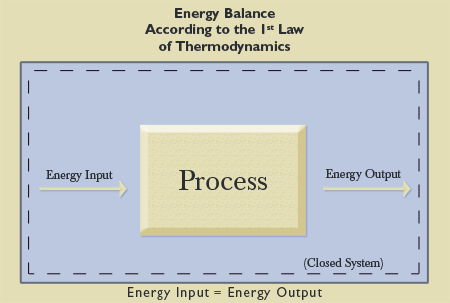 |
| Figure 1 |
This principle, also known as the “conservation of energy principle” (Cengel and Boles, p. 2), can be demonstrated by the burning of a piece of wood. When the wood is burned, it is transformed into a different state. The original amount of energy present before the burning is still present. However, much of that energy was transformed into a different state, namely, heat. No energy disappeared from the Universe, and no energy was brought into the Universe through burning the wood. Concerning the First Law, Young further explains that
the principle of the conservation of energy is considered to be the single most important and fundamental ‘law of nature’ presently known to science, and is one of the most firmly established. Endless studies and experiments have confirmed its validity over and over again under a multitude of different conditions (p. 165, emp. added).
This principle is known to be a fact about nature—without exception. One thermodynamics textbook, Fundamentals of Thermodynamics, says:
The basis of every law of nature is experimental evidence, and this is true also of the first law of thermodynamics. Many different experiments have been conducted on the first law, and every one thus far has verified it either directly or indirectly. The first law has never been disproved (Borgnakke and Sonntag, 2009, p. 116, emp. added).
That is why the McGraw-Hill Dictionary of Scientific and Technical Terms defines a scientific law as “a regularity which applies to all members of a broad class of phenomena” (2003, p. 1182, emp. added). Famous atheist, theoretical physicist, and cosmologist of Cambridge University, Stephen Hawking, concurred:
But what’s really important is that these physical laws, as well as being unchangeable, are universal. They apply not just to the flight of the ball, but to the motion of a planet and everything else in the Universe. Unlike laws made by humans, the laws of nature cannot ever be broken. That’s why they are so powerful…. [T]he laws of nature are fixed (“Curiosity: Did God Create the Universe?” 2011, emp. added).
The Second Law
In the nineteenth century, Lord Kelvin and Rudolph Clausius (1822-1888) separately made findings that became known as the Second Law of Thermodynamics (Suplee, 2000, p. 156). The Second Law builds on the First, stating that though there is a constant amount of energy in a given system that is merely transforming into different states, that energy is becoming less usable. Extending our wood burning illustration above, after the wood is burned, the total amount of energy is still the same, but transformed into other energy states. Those energy states (e.g., ash and dissipated heat to the environment) are less retrievable and less accessible (see Figure 2).
 |
| Figure 2 |
Well-known atheist, physicist, cosmologist, and astrobiologist of Arizona State University, Paul Davies, explained it this way:
[T]he celebrated second law of thermodynamics…says, roughly speaking, that in any change the Universe becomes a slightly more disorderly place; the entropy goes up, the information content goes down. This natural tendency towards disintegration and chaos is evident all around us (1978, 80[1129]:506).
This process is irreversible. Lord Kelvin stated that energy is “irrecoverably lost to man and therefore ‘wasted,’ although not annihilated” (Thomson, 1882, p. 189, ital. in orig.). This principle is known as entropy. Simply put, entropy states that nature is tending towards disorder and chaos. Will the paint job on your house maintain its fresh appearance over time? Will your son’s room actually become cleaner on its own, or will it tend toward disorder? Even without your son’s assistance, dust and decay take their toll. Although work can slow the entropy, it cannot stop it. Renowned evolutionary science writer Isaac Asimov explained:
Another way of stating the Second Law then is “The universe is constantly getting more disorderly!” Viewed that way we can see the Second Law all about us. We have to work hard to straighten a room, but left to itself it becomes a mess again very quickly and very easily. Even if we never enter it, it becomes dusty and musty. How difficult to maintain houses, and machinery, and our own bodies in perfect working order: how easy to let them deteriorate. In fact, all we have to do is nothing, and everything deteriorates, collapses, breaks down, wears out, all by itself—and that is what the Second Law is all about (1970, p. 6).
Entropy is simply a fact of nature. Entropy can be minimized in this Universe, but it cannot be eradicated. That is where engineers come in. Engineers work to discover ways of minimizing energy loss and maximizing useful energy before it is forever lost. Thousands of engineering jobs are dedicated to addressing this fundamental fact of the Second Law of Thermodynamics. Your energy bill is affected directly by it. If the Second Law was not fixed—unchanging—engineers could not develop the technology necessary to maximize usable energy, thereby lowering your energy costs.
Some engineers devote their entire careers to minimizing entropy in the generation of power from energy. All this effort is based on the principles established by the Second Law of Thermodynamics. These principles are established as fact in the scientific community. The American Heritage Dictionary of the English Language defines “law” as “a statement describing a relationship observed to be invariable between or among phenomena for all cases in which the specified conditions are met” (2000, p. 993, emp. added). Since laws are invariable, i.e., unchanging and constant, they have no exceptions. Otherwise, they would not be classified as laws. Tracy Walters, a mechanical engineer working in thermal engineering, observed:
It has been my experience that many people do not appreciate how uncompromising the Laws of Thermodynamics actually are. It is felt, perhaps, that the Laws are merely general tendencies or possibly only theoretical considerations. In reality, though, the Laws of Thermodynamics are hard as nails, and…the more one works with these Laws, the deeper respect one gains for them (1986, 9[2]:8, emp. added).
Evolutionist Jeremy Rifkin stated that “the Entropy Law will preside as the ruling paradigm over the next period of history. Albert Einstein said that it is the premier law of all science; Sir Arthur Eddington referred to it as the ‘supreme metaphysical law of the entire universe’” (1980, p. 6). Borgnakke and Sonntag, in Fundamentals of Thermodynamics, explain:
[W]e can say that the second law of thermodynamics (like every other law of nature) rests on experimental evidence. Every relevant experiment that has been conducted, either directly or indirectly, verifies the second law, and no experiment has ever been conducted that contradicts the second law. The basis of the second law is therefore experimental evidence (2009, p. 220, emp. added, parenthetical item in orig.).
Another thermal science textbook says, concerning the Second Law of Thermodynamics, “To date, no experiment has been conducted that contradicts the second law, and this should be taken as sufficient proof of its validity” (Cengel, Turner, and Cimbala, 2008, p. 266, emp. added).
IMPLICATIONS OF THE LAWS
When understood properly, the Laws of Thermodynamics apply directly to the creation/evolution controversy in precisely the same way they apply in the engineering world today (cf. Miller, 2007). In fact, these foundational truths, utilized daily by the engineering world, have eternally significant, spiritual implications in that they prove that God exists. How so?
If there is no God, the existence of the Universe must be explained without Him. The Big Bang theory claims that all matter in the Universe initially was condensed in a sphere smaller than the size of a period at the end of this sentence. That sphere exploded and helps to explain why the Universe, according to many cosmologists, appears to be expanding or inflating (see Thompson, et al., 2003, 23[5]:32-34,36-47). Even if the Big Bang were true (and it is not, cf. Thompson, et al.), this theory offers no explanation for the origin of that sphere. Evolutionist Alan Guth, a cosmologist and physics professor at M.I.T., admitted that “[i]nflation itself takes a very small universe and produces from it a very big universe. But inflation by itself does not explain where that very small universe came from” (as quoted in Heeren, 1995, p. 148). He further stated, “[A] proposal that the universe was created from empty space is no more fundamental than a proposal that the universe was spawned by a piece of rubber. It might be true, but one would still want to ask where the piece of rubber came from” (Guth, 1997, p. 273). So where could the “rubber” have come from?
The only logical possibilities for the origin of the matter and energy comprising the Universe are that they are responsible for their own existence (i.e., they popped into existence out of nothing—spontaneous generation or they always existed—eternality) or Someone is responsible for their existence (i.e., they were placed here by something outside of the Universe—Creation) (see Figure 3).
 |
| Figure 3 |
As the well-known philosopher and evolutionist from the 19th century, Herbert Spencer said, “Respecting the origin of the Universe three verbally intelligible suppositions may be made. We may assert that it is self-existent [i.e., eternal—JM]; or that it is self-created [i.e., spontaneously generated—JM]; or that it is created by an external agency” (1882, p. 30).
Possibility 1: Spontaneous Generation of the Universe
Consider the entire physical Universe as a system consisting of all mass, matter, and energy that exists in the Universe. If one believes in the Big Bang model, the system’s boundary would be outside of the blast radius of the Big Bang, or outside of the original cosmic dot that exploded. Without God (i.e., something outside of the bounds of the Universe—something supernatural), this Universe would have to be a closed system. Since our system encompasses the entire Universe, there is no more mass that can cross into our system from the outside, which necessitates our system being closed. If mass, matter, and energy could enter and/or exit the system, the system would be an open system[NOTE: The creationist contends that the Universe is an open system, since there is Someone outside of the natural Universe Who can cross the boundary and put matter and energy into the system. However, without God, the entire physical Universe as a system logically would have to be a closed system. Atheists must so believe in order to explain the Universe without God.].
Evolutionary physicist Victor Stenger, in his book, God: The Failed Hypothesis, said:
Conservation of energy [i.e., the First Law—JM] and other basic laws hold true in the most distant observed galaxy and in the cosmic microwave background, implying that these laws have been valid for over thirteen billion years. Surely any observation of their violation during the puny human life span would be reasonably termed a miracle…. In principle, the creation hypothesis could be confirmed by the direct observation or theoretical requirement that conservation of energy was violated 13.7 billion years ago at the start of the big bang (2007, pp. 115-116, emp. added).
The First Law of Thermodynamics states that in a closed system, the amount of energy present in that system is constant, though it transforms into other forms of energy. So, if the Universe as a whole initially contained no mass, matter, or energy, and then all of the mass, matter, and energy in the Universe spontaneously generated, the First Law would be violated. Without intervention from an outside force, the amount of mass, matter, and energy in the Universe would have remained constant (unchanged) at nothing. According to the scientific evidence, matter/energy could not have originally spontaneously generated. Thus, according to Stenger, the creation hypothesis is confirmed based on the scientific evidence. The initial creation of energy from nothing amounted to a miracle.
As was mentioned earlier, there are no exceptions to laws, or else they would not be laws. The First Law of Thermodynamics has no known exceptions. The Law is accepted as fact by all scientists in general and utilized by engineers in particular. Therefore, the Universe, composed of all mass, matter, and energy, could not have spontaneously generated (popped into existence on its own) without violating the exceptionless and highly respected First Law of Thermodynamics. The energy level of the Universe would not have been constant. Spontaneous generation would amount to the creation of energy from nothing (see Figure 4). The Universe could not have come into existence without the presence and intervention of a Force outside of the closed system of the entire physical Universe. The Universe therefore must be an open system that was created by a non-physical Force (i.e., a Force not composed of mass, matter, and energy) outside of the physical boundary of this Universe (above nature, or supernatural) with the capability of bringing it into existence out of nothing. That Force can be none other than a supernatural God. To develop a theory that requires the violation of that principle would be against the scientific evidence. It would be unscientific. The evidence from science indicates that matter could not and cannot spontaneously generate.
 |
| Figure 4 |
Unfortunately, though this truth is so glaringly obvious to many, there has been a recent surge of sentiment in the impossible notion that this Universe could have created itself—that something could come from nothing. British evolutionist Anthony Kenny (1980), physics professor from City University in New York, Edward Tryon (1984), and physicists Alan Guth from M.I.T. and Paul Steinhardt of Princeton (1984) are just a few who are open proponents of this notion. Stephen Hawking said, “Bodies such as stars or black holes cannot just appear out of nothing. But a whole universe can…. Because there is a law like gravity, the universe can and will create itself from nothing” (2010, p. 180). However, the truth still stands. Until the First Law of Thermodynamics ceases to be a fundamental law explaining this Universe, the spontaneous generation of this Universe from nothing is impossible.
No wonder Victor Stenger, a proponent of the idea of spontaneous generation, said, “I must admit that there are yet no empirical or observational tests that can be used to test the idea of an accidental origin” (1987, 7[3]:30). According to Stenger, the idea is “speculative” (p. 30). No solid evidence. Just speculation. Famous evolutionary astronomer, Robert Jastrow, the founder and former director of the Goddard Institute for Space Studies at NASA, said:
But the creation of matter out of nothing would violate a cherished concept in science—the principle of the conservation of matter and energy—which states that matter and energy can be neither created nor destroyed. Matter can be converted into energy, and vice versa, but the total amount of all matter and energy in the Universe must remain unchanged forever. It is difficult to accept a theory that violates such a firmly established scientific fact (1977, p. 32).
Science studies what occurs in nature, not super-nature. In nature, matter and energy can be neither created or destroyed, but “must remain unchanged forever.” This is a “firmly established fact.” Nothing comes from nothing. If a molecule will not pop into existence from nothing, a sphere containing all of the matter and energy of the entire Universe will certainly not pop into existence.
Possibility 2: Eternal Existence of the Universe
Again, considering the entire Universe as a system necessitates that it be a closed system. The Second Law of Thermodynamics states that though energy in a closed system is constant (First Law of Thermodynamics), that energy is transforming into less usable forms of energy (i.e., the Universe is “running down”). This process is irreversible. There is a finite amount of usable energy in the Universe (which explains the widespread interest in conserving energy). In the Big Bang model, that energy was originally in the cosmic egg that exploded, and now would be found within the blast radius of the original explosion. That usable energy is depleting according to the Second Law. Engineers strive to slow this inevitable depletion of energy, but it cannot be stopped.
If the Universe has always existed (i.e., it is eternal), but there is a finite amount of usable energy, then all usable energy already should be expended (see Figure 5). Yet, usable energy still exists. So, the Universe cannot have existed forever. It had to have a beginning. The eternality of matter would be the equivalent of a system with an energy input and 100% usable energy output (see Figure 6). It would be the equivalent of describing the Universe as a perpetual motion machine—a design that attempts to violate either the First or Second Law of Thermodynamics by, for instance, running forever without an energy input. No such machine has ever been designed, since such a machine would violate the laws of thermodynamics. Philip Yam, writing in Scientific American said, “Claims for perpetual-motion machines and other free-energy devices still persist, of course, even though they inevitably turn out to violate at least one law of thermodynamics” (1997, 277[6]:82).
 |
| Figure 5 |
 |
| Figure 6 |
No wonder evolutionists, themselves, have long conceded this truth. In his book, Until the Sun Dies, renowned evolutionary astronomer Robert Jastrow stated:
The lingering decline predicted by astronomers for the end of the world differs from the explosive conditions they have calculated for its birth, but the impact is the same: modern science denies an eternal existence of the Universe, either in the past or in the future (1977, p. 30, emp. added).
In his book, God and the Astronomers, Jastrow reiterated this truth:
And concurrently there was a great deal of discussion about the fact that the second law of thermodynamics, applied to the Cosmos, indicates the Universe is running down like a clock. If it is running down, there must have been a time when it was fully wound up…. Now three lines of evidence—the motions of the galaxies, the laws of thermodynamics, the life story of the stars—pointed to one conclusion; all indicated that the Universe had a beginning (1978, pp. 48-49, 111).
Evolutionist Kitty Ferguson, award-winning science writer, agreed. She said, “It’s also common knowledge that the universe isn’t eternal but had a beginning” (1994, p. 89). Any person who develops a theory that claims that the Universe could be a perpetual motion machine, is guilty of contradicting the solid evidence from science. They are being unscientific, and their unscientific mindset has resulted in an unscientific theory.
Possibility 3: The Inevitable Implication
What does the scientific evidence actually say about the matter of origins? Forget speculation, conjecture, hypothesis, and theory—wishful, hopeful thinking that there might be some way to avoid a supernatural explanation and the restrictions that Being might have on our desires. What does the evidence say?
To repeat, logically, there are only three possible explanations for the existence of matter in the Universe. Either it spontaneously generated, it is eternal, or it was created by a non-physical Being outside of the boundaries of the Universe. Atheists use the theory of evolution in an attempt to explain the existence and state of the Universe today. In order for the theory of evolution to be true, thereby accounting for the existence of mankind, either all of the mass, matter, and energy of the Universe spontaneously generated (i.e., it popped into existence out of nothing), or it has always existed (i.e., it is eternal.). Without an outside force (a transcendent, omnipotent, eternal, superior Being), no other options for the existence of the Universe are available. However, as the Laws of Thermodynamics prove, the spontaneous generation and the eternality of matter are logically and scientifically impossible. One and only one possible option remains: the Universe was created by the Creator. The scientific evidence points to the existence of God. Bottom line: God designed the laws of thermodynamics. Creationists believe them. Engineers use them. Atheists cannot harmonize them with their beloved theory.
CONCLUSION
Evolutionists claim that science and the idea of God are irreconcilable. “Only one of them can be true,” they say, “and you cannot prove there is a God.” Not all theistic models for the origin of the Universe are in keeping with science. For instance, according to Enuma Elish, the Babylonian creation account, the polytheistic Babylonians believed that matter is eternal (Pfeiffer, 1972, p. 226). This has been shown to be false. However, although not all Creation models are in harmony with the scientific evidence, one would expect the true Creation model to be in keeping with the evidence. The Laws of Thermodynamics, which science itself recognizes in its explanations of the phenomena in the Universe, were written by the Chief Engineer (cf. Miller, 2012). As expected, they prove to be in complete harmony with His existence, contrary to the claims of evolutionists. God, Himself, articulated these laws centuries ago in the Bible.
At the very beginning of the Bible, the First Law of Thermodynamics was expressed when Moses penned, “Thus the heavens and the Earth, and all the host of them, were finished. And on the seventh day, God ended His work which He had done, and He rested on the seventh day from all His work which He had done” (Genesis 2:1-2, emp. added). In Exodus 20:11, Moses wrote, “For in six days, the Lord made the heavens and the earth, the sea, and all that is in them, and rested (i.e., ceased) the seventh day.” Everything in the Universe was made in six days, and then the Lord stopped creating. Nothing else is coming into existence naturally. After the six days of Creation, the mass, matter, and energy creation process was terminated. As evolutionist Willard Young said regarding the First Law: “Energy can be neither created nor destroyed, but can only be converted from one form to another.” The thrust of the First Law of Thermodynamics was expressed in the Bible thousands of years ago, although it was not discovered and formally articulated by scientists until the 19th century.
Through the hand of the psalmist, God also stated centuries ago what scientists call the Second Law of Thermodynamics: “Of old You laid the foundation of the Earth, and the heavens are the work of your hands. They will perish, but You will endure; yes, they will all grow old like a garment; like a cloak You will change them, and they will be changed. But You are the same, and Your years will have no end” (102:25-27, emp. added). The Universe is wearing out—decaying, like an old shirt: the Second Law of Thermodynamics. Once again, the Creation model is in perfect harmony with science. The evolutionary model fails its thermodynamics test.
The inspired writer wrote in Hebrews 11:3, “By faith we understand that the worlds were framed by the word of God, so that the things which are seen were not made of things which are visible.” Paul declared in Acts 14:17, “Nevertheless He did not leave Himself without witness, in that He did good, gave us rain from heaven and fruitful seasons, filling our hearts with food and gladness.” The psalmist affirmed, “The heavens declare the glory of God; and the firmament shows His handiwork” (19:1). Paul assured the Romans, “For since the creation of the world His invisible attributes are clearly seen, being understood by the things that are made, even His eternal power and Godhead, so that they are without excuse” (1:20, emp. added). The scientific evidence points to God. There will be no excuse in the end for those who deny it.
In closing, we return to Lord Kelvin, the Father of Thermodynamics, for fitting final thoughts. In a short public speech in 1903, reported by The Times and followed up by an amending letter to the paper by Kelvin, Kelvin said:
I do not say that, with regard to the origin of life, science neither affirms nor denies Creative Power. Science positively affirms Creative Power…. It is not in dead matter that we live and move and have our being [Acts 17:28—JM], but in the creating and directive Power which science compels us to accept as an article of belief…. There is nothing between absolute scientific belief in a Creative Power, and the acceptance of the theory of a fortuitous concourse of atoms…. Forty years ago I asked Liebig, walking somewhere in the country if he believed that the grass and flowers that we saw around us grew by mere chemical forces. He answered, “No, no more than I could believe that a book of botany describing them grew by mere chemical forces”…. Do not be afraid of being free thinkers! If you think strongly enough you will be forced by science to the belief in God, which is the foundation of all Religion. You will find science not antagonistic but helpful to Religion (as quoted in Thompson, 1910, pp. 1097-1100, emp. added).
According to the Father of Thermodynamics, evolutionists are failing to “think strongly enough.” No wonder the psalmist asserted: “The fool has said in his heart, ‘There is no God’” (14:1).
REFERENCES
American Heritage Dictionary of the English Language (2000), (Boston, MA: Houghton Mifflin), fourth edition.
Asimov, Isaac (1970), “In the Game of Energy and Thermodynamics You Can’t Even Break Even,” Smithsonian Institute Journal, pp. 4-10, June.
Borgnakke, Claus and Richard E. Sonntag (2009), Fundamentals of Thermodynamics (Asia: John Wiley and Sons), seventh edition.
Cengel, Yunus A. and Michael A. Boles (2002), Thermodynamics: An Engineering Approach (New York: McGraw-Hill), fourth edition.
Cengel, Yunus A., Robert H. Turner, and John M. Cimbala (2008), Thermal-Fluid Sciences (New York, NY: McGraw-Hill).
“Curiosity: Did God Create the Universe?” (2011), Discovery Channel, August 7.
Davies, Paul (1978), “Chance or Choice: Is the Universe an Accident?” New Scientist, 80[1129]:506-508, November.
Ferguson, Kitty (1994), The Fire in the Equations: Science, Religion, and the Search for God (Grand Rapids, MI: Eerdmans).
Guth, Alan (1997), The Inflationary Universe (New York: Perseus Books).
Guth, Alan and Paul Steinhardt (1984), “The Inflationary Universe,” Scientific American, 250:116-128, May.
Hawking, Stephen (2010), The Grand Design (New York, NY: Bantam Books).
Heeren, Fred (1995), Show Me God (Wheeling, IL: Searchlight Publications).
Jastrow, Robert (1977), Until the Sun Dies (New York: W.W. Norton).
Jastrow, Robert (1978), God and the Astronomers (New York: W.W. Norton).
Kenny, Anthony (1980), The Five Ways: St. Thomas Aquinas’ Proofs of God’s Existence (South Bend, IN: University of Notre Dame Press).
King, A.L. (1962), Thermophysics (San Francisco, CA: W.H. Freeman).
McGraw-Hill Dictionary of Scientific and Technical Terms (2003), pub. M.D. Licker (New York: McGraw-Hill), sixth edition.
Miller, Jeff (2007), “God and the Laws of Thermodynamics: A Mechanical Engineer’s Perspective,” Reason & Revelation, 27[4]:25-31, April, http://www.apologeticspress.org/articles/3293.
Miller, Jeff (2012), “‘The Laws of Science’-by God,” Reason & Revelation, 32[12]:137-140, December, http://www.apologeticspress.org/apPubPage.aspx?pub=1&issue=1103&article=2072.
Moran, Michael J. and Howard N. Shapiro (2000), Fundamentals of Engineering Thermodynamics (New York: John Wiley & Sons), fourth edition.
Pfeiffer, Charles F. (1972), The Biblical World (Grand Rapids, MI: Baker Book House).
Rifkin, Jeremy (1980), Entropy: A New World View (New York: Viking).
Spencer, Herbert (1882), First Principles: A System of Synthetic Philosophy (New York: D. Appleton and Company), fourth edition.
Stenger, Victor J. (1987), “Was the Universe Created?,” Free Inquiry, 7[3]:26-30, Summer.
Stenger, Victor J. (2007), God: The Failed Hypothesis (Amherst, NY: Prometheus Books).
Suplee, Curt (2000), Milestones of Science (Washington, D.C.: National Geographic Society).
Thompson, Bert, Brad Harrub, and Branyon May (2003), “The Big Bang Theory—A Scientific Critique [Part 1],” Reason & Revelation, 23[5]:32-34,36-47.
Thompson, Silvanus P. (1910), The Life of William Thomson Baron Kelvin of Largs, Vol. 2, (London: MacMillan and Co.).
Thomson, William (1882), Mathematical and Physical Papers (Cambridge University Press).
Tryon, Edward P. (1984), “What Made the World?,” New Scientist, 101:14-16, March 8.
Walters, Tracy (1986), “A Reply to John Patterson’s Arguments,” Origins Research, 9[2]:8-9, Fall/Winter.
Yam, Philip (1997), “Exploiting Zero-Point Energy,” Scientific American, 277[6]82-85.
Young, Willard (1985), Fallacies of Creationism (Calgary, Alberta, Canada: Detselig Enterprises).
The post Evolution and the Laws of Science: The Laws of Thermodynamics appeared first on Apologetics Press.
]]>The post The Law of Causality and the Uncaused Cause appeared first on Apologetics Press.
]]>First, notice that this statement is based on a misunderstanding of what the Law of Cause and Effect claims concerning the Universe. The law states that every material effect must have an adequate antecedent or simultaneous cause. A law of science is determined through the observation of nature—not supernature. The laws of nature do not apply to non-material entities. The God of the Bible is a spiritual Being (John 4:24), and therefore is not governed by physical law. In 1934, professor of philosophy at Princeton University, W.T. Stace, wrote in A Critical History of Greek Philosophy concerning causality: “[E]verything which has a beginning has a cause” (1934, p. 6, emp. added). God, according to the Bible, had no beginning. Psalm 90:2 says concerning God, “Before the mountains were brought forth, or ever You had formed the earth and the world, even from everlasting to everlasting, You are God” (emp. added). The Bible describes God as a Being Who has always been and always will be—“from everlasting to everlasting.” He, therefore, had no beginning. Hebrews 3:4 again states, “every house is built by someone, but He who built all things is God,” indicating that God is not constrained by the Law of Cause and Effect as are houses, but rather, is the Chief Builder—the Uncaused Causer—the Being who initially set all effects into motion.
Further, scientists and philosophers recognize that, logically, there must be an initial, uncaused Cause of the Universe. [Those who attempt to argue the eternality of the Universe are in direct contradiction to the Law of Causality (since the Universe is a physical effect that demands a cause), as well as the Second Law of Thermodynamics, which indicates that nothing physical lasts forever (see Miller, 2007).] Aristotle, in Physics, discusses the logical line of reasoning that leads to the conclusion that the initial cause of motion must be something that is not, itself, in motion—an unmoved mover (1984, 1:428). Thomas Aquinas built on Aristotle’s reasoning and said:
Now whatever is in motion is put in motion by another…. For motion is nothing else than the reduction of something from potentiality to actuality…. It is therefore impossible that in the same respect and in the same way a thing should be both mover and moved, i.e., that it should move itself. If that by which it is put in motion be itself put in motion, then this also must needs be put in motion by another, and that by another again. But this cannot go on to infinity, because then there would be no first mover, and, consequently, no other mover…. Therefore it is necessary to admit a first efficient cause, to which everyone gives the name of God (1952, 19:12,13, emp. added).
God, not being a physical, finite being, but an eternal, spiritual being (by definition), would not be subject to the condition of requiring a beginning. Therefore, the law does not apply to Him. Concerning the Law of Causality, renowned German philosopher, Immanuel Kant, said that “everything which is contingent has a cause, which, if itself contingent, must also have a cause; and so on, till the series of subordinated causes must end with an absolutely necessary cause, without which it would not possess completeness” (Kant, 2008, p. 284, emp. added). An uncaused Cause is necessary. Only God sufficiently fills that void.
Consider: if there ever were a time in history, when absolutely nothing existed—not even God—then nothing would exist today, since nothing comes from nothing (in keeping with common sense and the Law of Thermodynamics, Miller, 2007). However, something exists (e.g., the Universe)—which means something had to exist eternally. That something could not be physical or material, since such things do not last forever (cf. Second Law of Thermodynamics, Miller, 2007). It follows that the eternal something must be non-physical or non-material. It must be mind rather than matter. Logically, there must be a Mind that has existed forever. That Mind, according to the Bible (which has characteristics proving it to be of supernatural origin, cf. Butt, 2007), is God. He, being spirit, is not subject to the Second Law of Thermodynamics.
Of old You laid the foundation of the earth, and the heavens are the work of Your hands. They will perish, but You will endure; yes, they will all grow old like a garment; like a cloak You will change them, and they will be changed. But You are the same, and Your years will have no end (Psalm 102:25-27, emp. added).
The point stands. The Law of Cause and Effect supports the creation model, not the atheistic evolutionary model. [NOTE: For more on the subject of an Uncaused Cause, see Colley, 2010; Lyons, 2007]
REFERENCES
Aquinas, Thomas (1952), Summa Theologica, trans. Fathers of the English Dominican Province (Chicago, IL: University of Chicago).
Aristotle (1984), Physics, in The Complete Works of Aristotle, ed. Jonathan Barnes (Princeton, NJ: Princeton University Press).
Butt, Kyle (2007), Behold! The Word of God (Montgomery, AL: Apologetics Press), http://www.apologeticspress.org/pdfs/e-books_pdf/Behold%20the%20Word%20of%20God.pdf.
Colley, Caleb (2010), “Aristotle’s ‘Unmoved Mover’ and Those Who Are ‘Without Excuse,” Apologetics Press, http://www.apologeticspress.org/APContent.aspx?category=12&article=3795.
Kant, Immanuel (2008), Kant’s Critiques: The Critique of Pure Reason, the Critique of Practical Reason, the Critique of Judgment (Radford, VA: Wilder Publications).
Lyons, Eric (2007), “What Caused God?,” Apologetics Press, http://www.apologeticspress.org/APContent.aspx?category=12&article=2216&topic=93.
Miller, Jeff (2007), “God and the Laws of Thermodynamics: A Mechanical Engineer’s Perspective,” Reason & Revelation, 27[4]:25-31, April, http://www.apologeticspress.org/articles/3293.
Miller, Jeff (2011), “God and the Laws of Science: The Law of Causality,” Apologetics Press, http://www.apologeticspress.org/article/3716.
Stace, W.T. (1934), A Critical History of Greek Philosophy (London: Macmillan).
The post The Law of Causality and the Uncaused Cause appeared first on Apologetics Press.
]]>The post Higgs Boson—The "God Particle"? (2nd Update) appeared first on Apologetics Press.
]]>[EDITOR’S NOTE: A.P. staff scientist Dr. Miller holds a Ph.D. from Auburn University in Mechanical Engineering with emphases in Thermal Science and Biomechanics.]
[NOTE—For the original article and a previous update, see Higgs Boson—The “God Particle”? and Higgs Boson—The “God Particle”? (Update), respectively]
We have been closely monitoring the progress of the search for the elusive “Higgs Boson” particle—presumptuously dubbed the “God Particle” by many scientists (see Miller, 2011a and Miller, 2011b for previous discussion). The hunt has been a roller coaster ride, with scientists thinking they have found the particle and then changing their minds time and again. The Higgs Boson particle is “thought to be the fundamental unit of matter” (“Has Quest for the Elusive…?” 2011). In theory, it could explain how other elementary particles have mass. The particle is a theoretical elementary particle that is predicted by the Standard Model of particle physics, but which had yet to be observed by physicists through experimentation, until now—or so scientists hope.
 |
| Scientists awaiting the latest update in the search for the Higgs Boson at the European Organization for Nuclear Research, July 4, 2012. [Image credit Associated Press, 2012] |
On July 4, 2012, scientists sent shockwaves through the world as they announced that they believe, with well over 99% certainty, that they have found the Higgs Boson particle using the Large Hadron Collider (LHC), a particle accelerator located in Switzerland (“The Elusive Particle…,” 2012; see May, 2012 for more information on the LHC). How significant is this find to the believer? If there is a “God Particle,” does that mean the “Big Bang” is true? Does it mean that this particle can create matter? Does it mean that there is no God?
 |
| The Large Hadron Collider (LHC), located in Switzerland |
Why do many call it the “God Particle”? Technically, according to the National Post, the name “God Particle” is an abbreviated form of its original, profane designation—“The God-d*** Particle” (a name used by Nobel physicist Leon Lederman as a draft title for a book), referring to the frustrations scientists have been going through trying to find the Higgs Boson. So, it actually had nothing to do with God. Apparently, however, the name was abbreviated to “The God Particle” to avoid offending readers—as though the abbreviated description is any less profane (“Higgs Boson Hunt Over…,” 2012). The result of this name designation has been to give the impression that the particle is “God-like” and somehow eliminates the necessity of a God in creating the Universe, while substantiating the Big Bang Theory. So, to Big Bang-believers today, the Higgs Boson is not just an energy particle which they believe gives an object its mass, but rather, it is “a theoretical energy particle which many scientists believe helped give mass to the disparate matter spawned by the Big Bang” (“Scientists Close In…,” 2010, emp. added). Big Bang theorists consider its existence “crucial to forming the cosmos after the Big Bang” (2010, emp. added). Therefore, the particle is “god-like” to such sadly deluded individuals, since it, in theory, “gives mass” and helped “form” the cosmos.
 |
| Former CERN director general Christopher Llewelyn-Smith, standing left, Lyn Evans, scientific director, standing second left, Herwig Schopper, standing center, Luciano Maiani, standing second right, and Robert Aymard, standing right, wave after the presentation of results during a scientific seminar to deliver the latest update in the search for the Higgs Boson. [Image credit Associated Press, 2012] |
In reality, the existence of the Higgs Boson in no way eliminates the need for God. Consider the following. In the 1600s, Creation scientist Isaac Newton, after observing an apple falling to the ground, “deduced that the same force which caused the apple to fall to the ground causes the moon to orbit the Earth” (Pinaire, 2000). From this concept, in time, Newton formally articulated what we now call “Newton’s Laws of Motion,” the second of which says, in essence, that the force an object applies is equal to its mass multiplied by its acceleration. So, an object’s weight on the Earth (i.e., “applied force” on the Earth) is equal to its mass times its acceleration (i.e., the acceleration due to gravity at the location where the object is on the Earth). Question: By discovering gravity, did Newton discover the “God Force” that keeps humans tied to the Earth? Did he disprove the need for God? Certainly not, and no one even suggested such an idea. He merely discovered one of the characteristics of the created order—one of the “ordinances” that God set up to have “dominion over the Earth” (Job 38:33).
 |
| A di-photon event from a Compact Muon Solenoid (CMS) experiment in search of the Higgs Boson. Also, the purpose of studying LHC particle collision events, according to teh European Organization of Nuclear Research (CERN). |
According to Rolf Heuer, the director of the European Organization for Nuclear Research (CERN) (the research center that houses the LHC), whether or not scientists have truly discovered the Higgs Boson still needs to be verified. Heuer said, “It’s a bit like spotting a familiar face from afar. Sometimes you need closer inspection to find out whether it’s really your best friend, or your best friend’s twin” (“Higgs Boson Hunt Over…,” 2012). Assuming the find truly is what it purports to be, the particle will simply be another step in expanding our understanding of how God set up the Universe. Newton discovered that force is equal to mass times acceleration. But the logical next step is to answer questions like, “How is there mass? What gives an object mass?” If scientists’ theory is correct, the Higgs Boson will simply help shed light on those questions—i.e., how did God set up the Universe in such a way that an object has mass? In other words, the Higgs Boson may help us to understand more about how God “framed” “the worlds”—showing us more about how “the things which are seen were not made of things which are visible” (Hebrews 11:3).
Also, the existence of the Higgs Boson in no way violates the First Law of Thermodynamics (i.e., creating energy or matter from nothing). In nature, nothing can be created or destroyed, but can only change forms, according to the First Law of Thermodynamics (Miller, 2007). So, only a Supernatural force can create something out of nothing. The Higgs Boson particle is not God.
And further, the existence of the Higgs Boson in no way disproves the existence of God. Someone had to create the Higgs Boson in the first place. And the existence of the Higgs Boson in no way verifies the Big Bang Theory, which is riddled with problems—as atheistic scientists themselves highlight frequently (see, for example, the recent article in New Scientist titled, “Bang Goes the Theory” [Gefter, 2012]).
As stated above, evolutionists consider the existence of the Higgs Boson “crucial to forming the cosmos after the Big Bang” (“Scientists Close In…,” 2010, emp. added). Notice that without the existence of this particle, Big Bang theorists recognize that the Universe could not even form after the Big Bang theoretically occurred. Its existence does not prove that the Universe did form in the manner suggested by the Big Bang Theory. Its existence does not even prove that the Universe could form after a hypothesized Big Bang occurred. Further, its existence does not prove that the Big Bang itself could occur at all. Its existence does not prove that matter could exist forever or pop into existence out of nothing, either one of which must be true in order for the Big Bang even to get started. And its existence certainly does not prove that the scientific laws governing the Universe could write themselves into existence. However, without the existence of the particle, theorists know that fundamental tenets of the Big Bang Theory could not happen. It’s another thing to say that they could happen. Thus, the discovery of the particle’s existence does not prove anything in the end, but only allows atheistic cosmologists to cross one of the many chasms that stand in the way of their theory even getting to the starting line in being considered a remote possibility. In other words, the Big Bang has not even reached square one in the realm of proof. It remains firmly in the realm of impossibility. Bottom line: the Creation model still stands as the most logical explanation for the origin of the Universe—the model that is in keeping with all the scientific evidence.
Much more is missing in the quest to substantiate the Big Bang than a little particle can solve, and the list of those missing entities continues to grow, and will continue to do so, until true science—science that is in keeping with the evidence—is allowed to flourish. It has become increasingly popular for cosmologists to label many of these missing “somethings” with the first word, “Dark.” The list of “dark,” missing entities is growing. In truth, if the scientific community would only let the “light” of truth into the picture, the darkness would disappear.
REFERENCES
“The Elusive Particle: 5 Implications of Finding Higgs Boson” (2012), Fox News, July 5, http://www.foxnews.com/scitech/2012/07/05/elusive-particle-5-implications-finding-higgs-boson/.
Gefter, Amanda (2012), “Bang Goes the Theory,” New Scientist, 214[2871]:32-37, June 30.
“Has Quest for the Elusive ‘God Particle’ Succeeded?” (2011), Fox News, April 25, http://www.foxnews.com/scitech/2011/04/25/quest-elusive-god-particle-succeeded/?test=faces.
“Higgs Boson Hunt Over: CERN Scientists at Large Hadron Collider Find ‘God Particle’” (2012), National Post, July 4, http://news.nationalpost.com/2012/07/04/higgs-boson-hunt-over-cern-scientists-at-large-hadron-collider-find-god-particle/.
May, Branyon (2012), “Is the Large Hadron Collider a Big Bang Machine?” Reason & Revelation, 32[4]:38-45, April, http://apologeticspress.org/apPubPage.aspx?pub=1&issue=1026.
Miller, Jeff (2007), “God and the Laws of Thermodynamics: A Mechanical Engineer’s Perspective,” Reason & Revelation, 27[4]:25-31, April, http://apologeticspress.org/articles/3293.
Miller, Jeff (2011a), “Higgs Boson–the ‘God Particle’?” Reason & Revelation, 31[6]:53, http://apologeticspress.org/apPubPage.aspx?pub=1&issue=977&article=1500.
Miller, Jeff (2011b), “Higgs Boson–Update,” Reason & Revelation, 31[10]:101, http://apologeticspress.org/article/4120.
Pinaire, Chris (2000), “Isaac Newton,” Wichita State University Department of Mathematics and Statistics, http://www.math.twsu.edu/history/Men/newton.html.
“Scientists Close In on God Particle” (2010), Fox News, July 27, http://www.foxnews.com/scitech/2010/07/27/scientists-closing-god-particle/.
The post Higgs Boson—The "God Particle"? (2nd Update) appeared first on Apologetics Press.
]]>