The post 3 Things We Can Learn From Atheists appeared first on Apologetics Press.
]]>#1—Atheists Rightly Point Out How Unloving and Cowardly Christians Are Who Do Not Evangelize
Penn Jillette is a famous comedian, actor, and entertainer, as well as a very outspoken atheist. In 2010, he made a five-minute personal video about a kind gentleman who handed him a Bible after one of his shows. Jillette said: “I believe he knew that I was an atheist. But he was not defensive and he looked me right in the eyes…. He was really kind, and nice, and sane…and talked to me and then gave me this Bible.”2
Although many (perhaps most) atheists do not want to be approached with the Gospel, Jillette went on to say:
I don’t respect people who don’t proselytize. I don’t respect that at all. If you believe that there is a Heaven and a Hell, and people could be going to Hell or not getting eternal life or whatever, and you think it’s not really worth telling them this because it would make it socially awkward…how much do you have to hate somebody to not proselytize? How much do you have to hate somebody to believe that everlasting life is possible and not tell them that?3
The fact is, Jillette was simply using logic in drawing this conclusion: If Christians believe what they say they believe about eternal life and eternal death (Matthew 25:46), then they will teach the Gospel to others in a kind, loving, Christ-like manner.4
#2—Atheists Correctly Call Out the Hypocrisy of Pretend Christianity, But They Illogically Conclude That Pretend Christianity Justifies a Rejection of the Real Thing
One atheist was reported to have said a few years ago: “We hear an awful lot from conservatives in the Bible Belt and on the TV about how we all should be living. Certainly a culture that teaches the conservative religious values of the Christian right must have clean living written all over it. And lots of ripe fruit from their morally superior lives abounding. It doesn’t. Far from it. People that talk the loudest may be the ones walking the slowest. Joining its history of Biblically correct bigotry and discrimination, it is an area with the highest divorce, murder, STD/HIV/AIDS, teen pregnancy,” etc.5 The fact is, many people who call themselves Christians do not walk in the light of the Lord, but sadly stroll in the devil’s darkness.
Consider one example. In 2014, 86% of Alabamians claimed to be Christians.6 In Montgomery, the state’s capital city of about 200,000 people,7 the proverbial phrase “you’ll find a church on every corner” rightly portrays this city of over 250 churches.8 Sadly, in 2015, this “Christian city” was statistically crowned “the most sexually diseased city in the nation.”9
Indeed, atheists should call out such blatant hypocrisy on the part of many “Christians.” In fact, they are doing what Christian parents, preachers, and Bible teachers should be doing continually—warning those who claim to be Christians not to live in sin, including any kind of sexual sin.10 No doubt, hypocrisy runs wild in “Christian America” today11 in part because (a) so many churches seem more interested in social gatherings and entertainment than preaching on sin and salvation,12 and (b) most churches appear too politically correct to address specific sinful situations in their midst, which only exacerbates the problems in churches across the country (cf. 1 Corinthians 5:1-13).
Still, for all the disheartening hypocrisy among the religious today, just as a counterfeit $100 bill does not prove that genuine $100 bills do not exist, counterfeit Christianity is not a logical reason to reject authentic Christianity. Neither Cain’s unacceptable religious sacrifice nor his murder of Abel made true worship and service to God illogical. What’s more, neither Judas’s thievery nor his betrayal of Jesus made the religion of Jesus invalid. God condemns hypocrisy (Matthew 5:20), but He gives everyone sufficient evidence to know the Truth and obey it (John 8:32)—to follow the evidence where it leads and to become real, genuine Christians, like Peter and Paul, Philip and Phoebe, and Aquila and Priscilla.
#3—Atheists Correctly Point Out the Illogical, Blind Faith of Many “Christians,” But They Fail to Acknowledge that Atheism (Not Christianity) is Based Upon “Blind Faith”
In his book The End of Faith, atheist Sam Harris addressed beliefs and the importance of evidence and reason. He was especially critical of Christians, saying:
Tell a devout Christian that his wife is cheating on him, or that frozen yogurt can make a man invisible, and he is likely to require as much evidence as anyone else, and to be persuaded only to the extent that you give it. Tell him that the book he keeps by his bed was written by an invisible deity who will punish him with fire for eternity if he fails to accept its every incredible claim about the universe, and he seems to require no evidence whatsoever.13
Sadly, Harris’s words seem to accurately describe many (perhaps most) who profess to be Christians. Rather than being real truth seekers and evidence followers, many are “Christians” because of mere feelings, emotions, preferences, and traditions. Atheists rightly call out such illogical, evidence-less faith. “That’s how I was raised,” or “I just feel it in my heart” are not real reasons to be a Christian (or anything else for that matter). To claim to be a Christian for irrational, mere feel-good reasons is unreasonable, unbiblical, and unChristlike. The fact is, God has always expected man to be reasonable, just as the prophets, the apostles, and Jesus were reasonable (1 Samuel 12:7; John 5:31-47; 10:37-38; Acts 26:22-25; 2 Peter 1:16). [For proof that reason and divine revelation go hand-in-hand, be sure to read Is Christianity Logical? available from Apologetics Press.14]
While atheists correctly point out the illogical, blind faith of many Christians, the truth is, the evidence actually disproves atheism and supports genuine Christianity.15 If, as the First Law of Thermodynamics indicates, in nature, matter and energy are neither created nor destroyed, then a Universe could not create itself from nothing.16 Thus, if naturalistic atheism is true (and at one time absolutely nothing existed),17 then there should be absolutely nothing today. Yet, here we are—an entire Universe, which is perhaps the greatest evidence for the existence of God. Indeed, matter demands a Maker. The existence of intricate, self-replicating life demands an original life Giver.18 Complex, functional design in nature demands a Designer, not an accidental explosion of a tiny ball of matter.19 Intelligence in the material realm demands an intelligent Creator (i.e., intelligence does not arise from dust, dirt, rocks, water, or mud, much less from “nothing”). The Bible’s supernatural attributes demand a supernatural Author.20 And the historical, miracle-working, resurrected-from-the-dead Jesus Christ demands a supernatural explanation.21
Conclusion
It can be helpful for atheists to point out any flaws in those who claim to be Christians. The truthful, logical criticisms of others combined with humble hearts can lead to necessary repentance and renewed dedication to our Creator, Savior, and Judge (Luke 13:3,5; Acts 2:38; 17:30-31). Let’s just be sure not to “throw the baby out with the bathwater.” While faithful Christians are still imperfect (1 John 1:5-10; 5:13), and while phony, hypocritical Christians have always been with us, such flaws are in no way a logical argument against the Flawless One (1 Peter 2:21-24), His Word, and the need to be faithful members of His Church.22 In fact, the evidence will lead any honest, good-hearted, seeking soul to this conclusion (Proverbs 8:17; Luke 8:4-15).
Endnotes
1 Recall how Jesus told the parable of the unjust steward in hopes of His hearers learning an important lesson (Luke 16:1-8)—seemingly that if an unrighteous man is willing to take drastic measures to prepare for his physical future, how much more should the righteous be willing to do in preparation for eternity?
2 Penn Jillette (2010), “A Gift of a Bible,” https://www.youtube.com/watch?v=6md638smQd8.
3 Ibid.
4 After all, Jesus’ main purpose was “to seek and to save that which was lost” (Luke 19:10). “Christ Jesus came into the world to save sinners” (1 Timothy 1:15). Jesus sent His apostles out with this same commission (Mark 16:15-16), and the early Church “went everywhere preaching the word” (Acts 8:4). Evangelizing is simply the natural response to having Christ-like, agape love for mankind.
5 James Veverka as quoted in B.A. Robinson (2000), “U.S. Divorce Rates for Various Faith Groups, Age Groups, & Geographic Areas,” http://www.religioustolerance.org/chr_dira.htm.
6 Kay Campbell (2015), “How Alabama’s ‘Religious Landscape’ Has Changed since 2007,” https://www.al.com/living/2015/05/us_religious_landscape.html.
7 “Montgomery, AL Population” (2021), World Population Review, https://worldpopulationreview.com/us-cities/montgomery-al-population.
8 According to www.churchfinder.com/churches/al/montgomery.
9 Kym Klass (2015), “Montgomery Rated Most Sexually Diseased City in Nation,” July 27, https://www.usatoday.com/story/news/2015/07/27/montgomery-rated-sexually-diseased-city-nation/30722091/.
10 Consider the many warnings that Paul made to various first-century churches about sin, including repeated admonitions about refraining from all manner of sexual immorality: Romans 1:24-32; 1 Corinthians 5:1-7:9; Galatians 5:19-21; Ephesians 5:1-14; Colossians 3:1-11; 1 Thessalonians 4:1-8.
11 The leading cause surely being the breakdown of the home, even among so many who claim to be Christians.
12 This is not a criticism of Christian fellowship and social gatherings, which are extremely important to the life of the Church. However, the preaching of the saving-from-sin Gospel of Christ (in all its power—Romans 1:16) must not take a back seat to anything in the life of God’s people.
13 Sam Harris (2005), The End of Faith (New York: W.W. Norton), p. 19.
14 https://store.apologeticspress.org/products/is-christianity-logical?_pos=1&_sid=a38615988&_ss=r.
15 For a brief, 100-page survey of evidences for God, the Bible, Jesus, and true belief in Jesus, see Eric Lyons and Kyle Butt (2017), Reasons to Believe (Montgomery, AL: Apologetics Press), https://store.apologeticspress.org/collections/books/products/apbkkbel0003.
16 For more information, see Jeff Miller (2013), Science vs. Evolution (Montgomery, AL: Apologetics Press), pp. 19-39, https://store.apologeticspress.org/collections/books/products/apbkjm001.
17 Atheistic cosmologist Stephen Hawking stated on national television in 2011, “Nothing caused the Big Bang” [“Curiosity: Did God Create the Universe?” (2011), Discovery Channel, August 7, emp. added].
18 See Jeff Miller, pp. 61-110.
19 See Dave Miller, ed. (2017), Does God Exist? (Montgomery, AL: Apologetics Press), pp. 62-126, https://store.apologeticspress.org/collections/books/products/apbkdm007.
20 See Kyle Butt (2007), Behold! The Word of God (Montgomery, AL: Apologetics Press), https://store.apologeticspress.org/collections/books/products/apbkkb0004.
21 See Kyle Butt and Eric Lyons (2006), Behold! The Lamb of God (Montgomery, AL: Apologetics Press), https://store.apologeticspress.org/collections/books/products/apbkkbel03.
22 See Dave Miller (2007), What the Bible Says About the Church of Christ (Montgomery, AL: Apologetics Press), https://store.apologeticspress.org/collections/books/products/apbkdm0018.
The post 3 Things We Can Learn From Atheists appeared first on Apologetics Press.
]]>The post The Despair of Atheism appeared first on Apologetics Press.
]]>
An implication is an idea that follows logically from a set of facts which are plainly stated. The concept of an implication is clearly seen in math. Take the Pythagorean Theorem, which says that for a right triangle the sum of the two shorter sides squared equals the longest side (the hypotenuse) squared—A2 + B2 = C2. So, if one short side is 3 and the other is 4, then we can know exactly what the longest side is, even though it is not stated or written down—it is 5. An implication is not less of a fact than what is stated or “seen.” It is just as factual, only not stated. Another clear example of an implication is seen in the famous syllogism: All men are mortal. Socrates is a man. Knowing those two explicit facts, what else can be known? If a person is thinking logically and correctly, then he or she can know a third piece of information that is included in the premises but not written down: therefore, Socrates is mortal.
All beliefs have implications. They may be difficult to uncover and piece together, but they are there and follow inescapably. If a person is rational and honest, there is no denying an implication. In light of that fact, what implications follow from the belief that there is no God? Many of these implications have been fleshed out in other places.1 This article will deal with only one: The concept of atheism implies that human life does not have any objective meaning. If atheism is true, then human life is meaningless.
At first glance, it may seem that the burden is to prove that atheism implies meaningless. That is not the case, since that task has already been done eloquently by many of those in the atheistic community. Leading atheists do not deny that their belief implies meaninglessness. On the contrary, they openly admit the implication, and spend the bulk of their discussions trying to incorporate the implication of meaninglessness into a “fulfilled” human life. Thus, instead of proving the implication, we will simply cite several unbelievers who have done so, and then proceed to show that it is impossible to live a fulfilled human life without the concept of objective meaning. Humans have been designed to understand that life has real meaning and purpose. When these concepts are denied, those who take time to consider the loss recognize that something is amiss. Humans intuitively know their lives have purpose. To deny that truth forces them into a state of cognitive dissonance of the worst kind. The only conceivable outcome of knowing that humans should (and do) have an objective purpose in their lives, while denying the fact, is a state of despair.
Atheism Implies that Life is Meaningless
A brief look at the writings of unbelievers reveals that meaninglessness naturally follows from the concept of atheism. Atheistic philosopher Alex Rosenberg penned a book titled The Atheist’s Guide to Reality: Enjoying Life Without Illusions. Harper’s magazine reviewed the book, saying: “Rosenberg is admirably frank about the implications of scientism [atheism—KB].” The back cover of the book quotes from the New York Times Book Review: “The work of a well-informed and imaginative philosopher.” At the beginning of the book, Rosenberg declared: “This book aims to provide the correct answers to most of the persistent questions…. Given what we know from the sciences, the answers are all pretty obvious….” He then provided a list of questions with his concise “pretty obvious” answers following each question:
- Is there a God? No.
- What is the nature of reality? What physics says it is.
- What is the purpose of the Universe? There is none.
- What is the meaning of life? Ditto.
- Why am I here? Just dumb luck.
- Does prayer work? Of course not.
- Is there a soul? Are you kidding?
- Is there free will? Not a chance!
- What happens when we die? Everything pretty much goes on as before, except us.
- What is the difference between right and wrong, good and bad? There is no moral difference between them.
- Why should I be moral? Because it makes you feel better than being immoral.
- Is abortion, euthanasia, suicide, paying taxes, foreign aid, or anything else you don’t like forbidden, permissible, or sometimes obligatory? Anything goes.
- What is love, and how can I find it? Love is the solution to a strategic interaction problem. Don’t look for it; it will find you when you need it.
- Does history have any meaning or purpose? It’s full of sound and fury, but signifies nothing.
- Does the human past have any lessons for our future? Fewer and fewer, if it ever had any to begin with.2
Graham Lawton, Executive Editor of New Scientist magazine, penned a brief article titled, “What is the Meaning of Life?” He began with his blunt, one line answer: “The harsh answer is ‘it has none.’” He went on to say: “Your life may feel like a big deal to you, but it’s actually a random blip of matter and energy in an uncaring and impersonal universe.”3 Stephen J. Gould, one of the most recognized evolutionary paleontologists of the 20th century, wrote about atheism’s meaninglessness with his customary flair: “We are here because one odd group of fishes had a peculiar fin anatomy that could transform into legs for terrestrial creatures; because the earth never froze entirely during an ice age; because a small and tenuous species, arising in Africa a quarter of a million years ago, has managed, so far, to survive by hook and by crook. We may yearn for a ‘higher answer’—but none exists.”4
Philosopher and self-professed atheist, Thomas Nagel, teaches and writes extensively on atheism’s implication of meaninglessness. In his brief book What Does it All Mean? A Very Short Introduction to Philosophy, he stated: “If you think about the whole thing, there seems to be no point to it at all. Looking at it from the outside, it wouldn’t matter if you had never existed. And after you have gone out of existence, it won’t matter that you did exist.”5 Eminent atheistic author, debater, and spokesperson Richard Dawkins boldly said: “The universe we observe has precisely the properties we should expect if there is, at bottom, no design, no purpose, no evil and no good, nothing but blind, pitiless indifference.”6 Edward O. Wilson quipped that “no species, ours included, possesses a purpose beyond the imperatives created by its genetic history.”7
The late William Provine, atheistic professor in the Department of Ecology and Evolutionary Biology at the distinguished Cornell University, stated: “Naturalistic evolution has clear consequences that Charles Darwin understood perfectly. 1) No gods worth having exist; 2) no life after death exists; 3) no ultimate foundation for ethics exists; 4) no ultimate meaning in life exists; and 5) human free will is nonexistent.”8
The existential philosopher Albert Camus, winner of the Nobel Prize in literature, struggled greatly with atheism’s lack of meaning and purpose. So great was his contemplation of it, he declared, “I therefore conclude that the meaning of life is the most urgent of questions.”9 Camus then championed the idea of the “absurd” man. He used a very specific meaning for the word “absurd.” In his writing, the concept of the absurd is the recognition and acceptance that life has no meaning, rhyme, or reason. He says of the absurd man: “He feels within him his longing for happiness and for reason. The absurd is born of this confrontation between the human need and the unreasonable silence of the world.”10 His whole book begins with the premise that atheism denies any meaning to the world, and proceeds to flesh out how a person can keep from committing suicide once he arrives at universal meaninglessness. Thus, he begins the book, saying: “There is but one truly serious philosophical problem, and that is suicide. Judging whether life is or is not worth living amounts to answering the fundamental question of philosophy.”11 And later in the book he concludes, about his entire book, discussion, and life: “Let me repeat. None of all this has any real meaning.”12
Creating Our Own Meaning?
If there is no God, then the implication that life ultimately has no real meaning cannot be denied. Knowing, however, that humans have an innate sense that their lives have meaning and need to have a purpose, atheism is burdened with the unenviable task of manufacturing meaning with no raw materials, whipping it into existence out of thin air. How does this work? One approach put forward by leading unbelievers is that we simply create our own, individual meaning in our lives. When asked about the meaning of life, Alom Shaha, author of The Young Atheist’s Handbook, stated:
Yes, of course I know that life is ultimately without meaning or purpose, but the trick is not to wake up every morning and feel that way. Cognitive dissonance? Embrace it. Create a sense of meaning and purpose by doing something useful with your life (I teach), being creative—I don’t mean that in a poncey hipster way, I mean make a curry, build some bookshelves, write a poem. And most importantly, find people you like and love and spend lots of time with them. I regularly have people over for dinner, throw parties for no other reason than I just want to spend time surrounded by the people I love. And if you’re really stuck, eat rice and dal. Physically filling yourself with the food you love really does fill the emptiness you may feel inside.13
Biology professor, author, and lecturer Jerry Coyne states: “What people cannot abide is the conviction that the Universe and life are pointless. Which is what really, science is telling us. Pointless in the sense that there is no externally imposed purpose or point in the Universe. As atheists, this is something that is manifestly true to us. We make our own meaning and purpose.”14
Dr. Pete Etchells, lecturer and science writer, expounded on the idea of creating our own meaning when he said:
Whenever I get involved in conversations about the meaning of life, and where everything’s headed, I can’t help but feel that there’s an underlying assumption that because these are “big” questions, they necessarily need big answers. There aren’t any, though. We’re not here for a universal purpose, and there is no grand plan, no matter how tempting it is to believe it. But that’s absolutely fine, because it means that if there aren’t any big answers, the little ones are all the more important. So every day, I take my dog for a walk in the field near my house. Sometimes I get to see a pretty sunset, but usually it’s either bucketing down and I get soaked, or cold, or the field is full of mud and bugs and dog [poop], and it’s a pain to navigate through. Whatever the situation, though, my dog has the most ridiculous fun ever, and being a part of that little moment of joy is what it’s all about.15
So, the answer to the meaning of life is make curry, build a bookshelf, or wander through a muddy field full of dog poop and watch your dog have fun? The problem with this “create-your-own-meaning” approach is twofold. First, it refuses to take the word “meaning” seriously. It is a semantic game in which the word can be applied to anything. Meaning “for you” might be watching your dog run, “for me” it might be watching paint dry, “for him” it might be watching grass grow, etc. Just because an activity may bring momentary tranquility or pleasure to a person does not endow it with any objective meaning. A person’s arbitrary attachment of the word “meaning” to something does not somehow create meaning in any real sense—not for that person or for others. Abraham Lincoln once sagely quipped: “How many legs does a calf have if you call its tail a leg? Four. Just because you call a tail a leg does not make it so.” Attaching the words “meaning” and “purpose” to a bowl of shrimp and grits or a sushi roll will never be sufficient to answer the “most urgent question” of life.
The second insurmountable problem for this approach of creating meaning is that those who propound it intentionally hide the dark truth that necessarily follows. They often paint a picture of self-created meaning in rosy terms of a tranquil couple viewing a sunset, a man walking his beloved dog, or a parent running and laughing with a child. What they are forced to omit, if they want to keep up the ruse, is that self-created “meaning” can manifest itself through any behavior, including genocide, serial killing, torture, terminal drug addiction, overdose, etc. Using the proponents’ own logic, a man could just as easily say he finds meaning in killing other people’s dogs in the park as in watching his own pet frolic playfully. As Sommers and Rosenberg accurately stated:
Darwinism thus puts the capstone on a process which since Newton’s time has driven teleology to the explanatory sideline. In short it has made Darwinians into metaphysical Nihilists denying that there is any meaning or purpose to the universe, its contents and its cosmic history. But in making Darwinians into metaphysical nihilists, the solvent algorithm should have made them into ethical nihilists too. For intrinsic values and obligations make sense only against a backdrop of purposes, goals, and ends which are not merely instrumental. But the Darwinian philosophers have shied away from this implication.16
If human existence has no real meaning, then neither do moral or ethical ideas. We may like to think that humans would adhere to some type of generally accepted guidelines, but we would have no grounds to insist that they do. I may “create my own meaning” by reading a book to a child, while another person may contend that they find meaning in killing their parents and cannibalism. There is no rational grounds upon which a person could argue that reading a book to a child is more meaningful than murder and cannibalism. After all, as Camus said, “Let me repeat. None of all this has any real meaning.” As philosopher John-Paul Sartre declared: “Everything is indeed permitted if God does not exist.”17 The create-your-own-meaning approach fails miserably.
Life Has No Meaning, But Just Act Like It Does?
Many unbelievers recognize that we cannot create meaning just by saying we have. They see the failure of attempts to infuse meaning where there is, or can be, none. Their approach is simple: Admit that life is meaningless in every sense, but live like there is a meaning. Dr. Loyal Rue is a strong proponent of what he calls a noble lie. Based on a naturalistic framework, he writes, “The universe is blind and aimless…. The universe is dead and void of meaning…. The universe just is.”18 He admits that, from a naturalistic standpoint, meaninglessness “is not something that one can argue away by showing that it results from fallacious thinking…. It is logically and empirically secure.”19 How does Dr. Rue suggest that humans approach meaninglessness? He concedes that we cannot live fulfilled lives with the truth before us. He proposes that we adopt a lie, a noble lie, that the Universe has real meaning, even though (according to atheism) it does not. His stated thesis is “to oppose a monstrous truth [meaninglessness—KB] with a noble lie.”20 Why does Dr. Rue insist we adopt this lie? Because, he says, “without such lies, we cannot live.”21 [One wonders why, in the face of life’s meaninglessness, Rue suggests a noble lie? If there is no objective meaning, purpose, or morality, would it not be just as acceptable to adopt an ignoble lie? According to Rue’s view, what would be wrong with telling yourself that the more people you kill, the more meaning your life has, or the more money you steal, the more meaningful you are? After all, if we simply make up lies to make ourselves feel better, a lie is a lie—and any lie will do.]
Thomas Nagel touched on this avoidance approach when he wrote:
Even if life as a whole is meaningless, perhaps that’s nothing to worry about. Perhaps we can recognize it and just go on as before. The trick is to keep your eyes on what’s in front of you…. Some people find this attitude perfectly satisfying. Others find it depressing, though unavoidable. Part of the problem is that some of us have an incurable tendency to take ourselves seriously. We want to matter to ourselves “from the outside.” If our lives as a whole seem pointless, then a part of us is dissatisfied…. Life may be not only meaningless but absurd.22
Notice that Nagel realizes that if you take your life “seriously” then it just won’t do to think about the meaninglessness of it all. What does he suggest? “The trick is to keep your eyes on what’s in front of you.” In other words, do not think about it. Act like it is not there. Ignore the lack of purpose and meaning. Atheism prides itself on rationality, enlightenment, and intellectual honesty. And yet denial, avoidance, and deceit must lie at the heart of unbelief in order for humans to be truly satisfied and live productive lives.
American film director, writer, actor, and comedian, Woody Allen, understands the problem he and his fellow atheists struggle to face. He stated:
This is my perspective and has always been my perspective on life. I have a very grim, pessimistic view of it. I always have since I was a little boy; it hasn’t gotten worse with age or anything. I do feel that it’s a grim, painful, nightmarish, meaningless experience and that the only way that you can be happy is if you tell yourself some lies and deceive yourself. But I am not the first person to say this or even the most articulate person. It was said by Nietzsche, it was said by Freud, it was said by Eugene O’Neill. One must have one’s delusions to live. If you look at life too honestly and clearly, life becomes unbearable because it’s a pretty grim enterprise, you will admit.23
In another interview, he said:
Then after a while, you start to realize, I’m taking the big picture here, that eventually you die and eventually the Sun burns out and the Earth is gone and eventually all stars and all the planets and the entire Universe goes, disappears and nothing is left at all. Nothing of Shakespeare’s or Beethoven. All gone. Michelangelo, all gone. And you think to yourself. It is a lot of noise and sound and fury. And where’s it going? It’s not going any place…. You know it just seems like a big, meaningless thing. You can’t actually live your life like that. Because if you do, you just sit there. Why do anything? Why get up in the morning and do anything?24
Allen, Nagel, Rue, and others are forced to admit that a meaningless, hopeless, purposeless Universe incapacitates the most optimistic unbelievers. Were they to attempt to put into practice a course of action consistent with their belief, then they would not even get up in the morning. In fact, there would be no real reason to do anything—ever. That is why Camus recognized the fact that the only real question to answer in such a world is why would a person want to stay alive at all?
Nothing left but Despair
What is left in a world where meaninglessness reigns supreme, but its human inhabitants are wired to need meaning in their lives? As Lawrence Krauss so brazenly reminds his readers and listeners: “And by the way, that’s the second of the two things I wanted to remind you of. The first is that you’re insignificant. And the second, the future is miserable.”25 French humanist, Voltaire, encapsulated this recognition of misery in his “Poem on the Lisbon Disaster,” in which he wrote: “What is the verdict of the vastest mind? Silence: the book of fate is closed to us. Man is a stranger to his own research; He knows not whence he comes, nor whither goes. Tormented atoms in a bed of mud, devoured by death, a mockery of fate.”26
So, humans are “insignificant,” “miserable,” “tormented atoms in a bed of mud.” Yet, atheism is not finished painting humanity’s sad plight with the pale colors of despair. Peter Atkins opined: “We are children of chaos, and the deep structure of change is decay. At root, there is only corruption, and the unstemmable tide of chaos. Gone is purpose; all that is left is direction. This is the bleakness we have to accept as we peer deeply and dispassionately into the heart of the Universe.”27
Albert Camus quoted Kirkegaard, who said: “If man had no eternal consciousness…what would life be but despair?” Camus then wrote: “This cry is not likely to stop the absurd man. Seeking what is true is not seeking what is desirable. If in order to elude the anxious question: ‘What would life be?’ one must, like the donkey, feed on the roses of illusion, then the absurd mind, rather than resigning itself to falsehood, prefers to adopt fearlessly Kierkegaard’s reply: ‘despair.’”28 Bertrand Russell bemoaned: “Brief and powerless is Man’s life; on him and all his race the slow, sure doom falls pitiless and dark. Blind to good and evil, reckless of destruction, omnipotent matter rolls on its relentless way; for Man, condemned today to lose his dearest, tomorrow himself to pass through the gate of darkness….”29
Into this chaos of bleakness, meaninglessness, insignificance, torment, and despair, Christianity offers a hope that can anchor the soul (Hebrews 6:19) and a truth that does not need a “noble lie” to make it palatable. Christianity provides the only system that can give humanity a reason to get up in the morning and live life to the fullest.
A Response to Atheism’s Despair
Madalyn Murray O’Hair was the founder of the American Atheist organization. She lived a life in complete rebellion against her God. Her rabid atheism prodded her to attack the idea of God whenever she could. But her atheism could not bring her joy, only a forlorn heart of desperation. When her personal belongings were auctioned, it was discovered that on six different pages of her writings was the heartbreaking cry: “Somebody, somewhere, love me!”30 The greatest tragedy of atheism is that it strips the world of everything meaningful, including real love.
Atheist Dan Barker admitted that, according to atheism, “In the end of the cosmos it’s not going to matter. You and I are like ants or rats or like pieces of broccoli, really, in the big picture…there is no value to our species…we are no different than a piece of broccoli in the cosmic sense.”31 As we have seen, according to atheism, humans are nothing more than matter in motion, “tormented atoms in a bed of mud.” Our actions will not determine where we spend eternity. And any “feeling” that one person may have for another person can only be “skin deep.” It can only be a product of the physical brain. As much as atheists try to discuss love, hope, honor, or any of the elevated human virtues, they cannot explain how such can exist in a world without God.
Sadly, just like O’Hair, there is a world full of people who want someone to love them, but they refuse to recognize that there is Someone Who does. Their Creator, God, loves them so much that He came to die on the cross for them. Jesus Christ, God in the flesh, gave His life to prove His love for humanity and to show humans that they are not cosmic accidents, but intentionally designed persons who have a meaning and purpose in life. And He gave His life so that those humans who choose to obey Him can live eternally in heaven. “For God so loved the world that He gave His only begotten Son, that whoever believes in Him should not perish but have everlasting life” (John 3:16).
But God’s love has a limit. He will not force anyone to believe in Him. He loves each person enough to let us all freely choose whether or not to believe in and obey Him. And our choice will determine our eternal destiny. Moses once wrote to the Israelites: “I call heaven and earth as witnesses today against you, that I have set before you life and death, blessing and cursing; therefore choose life” (Deuteronomy 30:19). The failure to choose the right beliefs and actions in this life has real consequences. These are not imagined consequences that have to be endowed with meaning by subjective, arbitrary feelings. On the contrary, the consequences are objectively real.
We are not ultimately like broccoli or rats. Our decisions really matter, for now and for eternity. Those who refuse to acknowledge God can have no hope for an afterlife or joy in death, only despair. Agnostic Bart Ehrman, who once claimed to be a Christian, wrote: “The fear of death gripped me for years, and there are still moments when I wake up at night in a cold sweat.”32 The Bible explains that Christ came to defeat death, and “release those who through fear of death were all their lifetime subject to bondage” (Hebrews 2:15). The only solution to the fear of death and the deep, abiding despair that stems from atheism is to seek God and His will. Madalyn Murray O’Hair’s cry, “Somebody, somewhere, love me!” echoes across the world from millions of voices who are trying to find love and hope apart from God. The irony of it all is that they have shut their ears to the voice of God, Who through His Son, calls from the cross, “I love you.” Instead of the bleak, tormented, useless, meaningless, purposeless, pitiless, miserable despair that atheism demands, let us turn our faces to the true light, hope, joy, and love that our Creator provides.33
Endnotes
1 Kyle Butt (2008), “The Implications of Atheism (Parts 1 & 2),” Apologetics Press, https://apologeticspress.org/apcontent.aspx?category=12&article=911.
2 Alex Rosenberg (2011), The Atheist’s Guide to Reality: Enjoying Life Without Illusions (New York: W.W. Norton), p. 3, emp. added.
3 Graham Lawton (2016), “What is the Meaning of Life?” New Scientist, 231[3089]:33, September 3, emp. added.
4 Stephen Gould (1988), “The Meaning of Life,” Life Magazine, December, https://www.maryellenmark.com/text/magazines/life/905W-000-037.html
5 Thomas Nagel (1987), What Does It All Mean? A Brief Introduction to Philosophy (Oxford, England: Oxford University Press), p. 96.
6 Richard Dawkins (1995), “God’s Utility Function,” Scientific American, 273[5]:85, November, emp. added.
7 Edward O. Wilson (1978), On Human Nature (Harvard University Press), http://staff.washington.edu/lynnhank/Wilson.html.
8 William Provine (1998), “Evolution: Free Will and Punishment and Meaning in Life,” http://eeb.bio.utk.edu/darwin/DarwinDayProvineAddress.htm, emp. added.
9 Albert Camus (1983), The Myth of Sisyphus, ed. Justin O’Brien (New York: Vintage), p. 4.
10 Ibid., p. 28.
11 Ibid., p. 3.
12 Ibid., p. 117.
13 As quoted in Tom Chivers’ article, “I Asked Atheists How They Find Meaning in a Purposeless Universe,” BuzzFeed, https://www.buzzfeed.com/tomchivers/when-i-was-a-child-i-spake-as-a-child, emp. added.
14 Jerry Coyne (2012), “The Odd Couple: Why Science and Religion Shouldn’t Cohabitate,” Speech to Glasgow Skeptics, December 21, https://www.youtube.com/watch?v=0wCIa_OQ-2s&noredirect=1, emp. added.
15 As quoted in Chivers, emp. added.
16 Tamler Sommers and Alex Rosenberg (2003), “Darwin’s Nihilistic Idea: Evolution and the Meanlessness of Life,” Biology and Philosophy, 18:653-658.
17 Jean-Paul Sartre (1989), “Existentialism is Humanism,” in Existentialism from Dostoyevsky to Sartre, ed. Walter Kaufman, trans. Philip Mairet (Meridian Publishing Company), http://www.marxists.org/reference/archive/sartre/works/exist/sartre.htm.
18 Loyal Rue (1994), By Grace and Guile: The Role of Deception in Natural History and Human Affairs (Oxford, England: Oxford University Press), p. 3.
19 Ibid.
20 Ibid.
21 As quoted in William Lane Craig, “The Absurdity of Life Without God,” Reasonable Faith, https://www.reasonablefaith.org/writings/popular-writings/existence-nature-of-god/the-absurdity-of-life-without-god.
22 Nagel, pp. 100-101.
23 Woody Allen interview, https://www.youtube.com/watch?v=5yVPS8XBoBE.
24 Woody Allen, YouTube video, https://www.youtube.com/watch?v=2MsuqvLIttk.
25 Quote from Lawrence Krauss as quoted in Austin Brown’s The Case for Utter Hopelessness: Why Atheism Leads to Unyielding Despair (2017), (Self Published), emp. added.
26 “Poem on the Lisbon Disaster” in Joseph McCabe (1912), Toleration and Other Essays by Voltaire (New York: G.P. Putnam’s Sons), http://people.whitman.edu/~iversojr/Candide/lisbon.htm, emp. added.
27 Peter Atkins (1984), The Second Law (New York: Scientific American), p. 200.
28 Camus, p. 40, emp. added.
29 Bertrand Russell (1910), “Free Man’s Worship,” https://users.drew.edu/jlenz/br-free-mans-worship.html, emp. added.
30 As quoted in an article by Chuck Colson (1999), “The Real Madelyn Murray O’Hair,” http://www.breakpoint.org/1999/06/the-atheists-god/.
31 Quoted from his debate with Paul Monata, July 10, 2006, posted on the radio program “The Infidel Guy,” https://drive.google.com/file/d/0BzBGd8nA3jj_N181TGI0MDB6YUE/view.
32 Bart Ehrman (2008), God’s Problem: How the Bible Fails to Answer Our Most Important Question—Why We Suffer (New York: HarperOne), p. 127.
33 See Eric Lyons and Kyle Butt (no date), Receiving the Gift of Salvation (Montgomery, AL: Apologetics Press).
The post The Despair of Atheism appeared first on Apologetics Press.
]]>The post If I Were an Atheist… appeared first on Apologetics Press.
]]>I would only tell the truth if it benefited me. And I would lie whenever I felt like I needed to in order to get what Iwanted, as quickly as I could, with as few repercussions as possible.
If I did ever get caught with the proverbial “hand in the cookie jar” (and I was an atheist), I would justifiably do and say whatever I could to get out of trouble. I would lie. I would use false flattery. I would intimidate. I would use physical force. Depending on the occasion, I might even explain that, logically, there is nothing evil or wrong with what I did, because there is no such thing as objective right and wrong, only what someone might subjectively perceive as such. I would explain that just because someone did not want me to “get in the cookie jar” doesn’t mean I couldn’t or shouldn’t. Nor did it mean it would be wrong—only that someone else didn’t want me to do something. But since I wanted to do it, then it was okay for me.
In school (as long as I didn’t think I would get caught), I would cheat as much as I wanted to in order to make the highest grades with the least amount of work. I would flirt and attempt to curry favor with female teachers in hopes of leniency and better grades. I would never help any of my classmates, since I would want to be valedictorian (unless I thought by helping others, I was actually improving my own situation even more somehow—such as by becoming more popular or attracting girls, which might become more important to me than having the highest grades in school). While a teenager, I would fulfill as many of my adolescent desires as possible, as much as possible, in any way possible (as long as the potential repercussions were worth it).
If I were an atheist, my sole motivation for working would be to get rich—to make the most amount of money, with the least amount of work, and to spend the money on the maximum amount of pleasure for myself. I would do or say whatever I needed to do or say to climb the ladder of success. I would not hesitate to lie and take credit for the work of others if I thought it would help me get what I wanted faster (again, with as few repercussions as possible). I would not make decisions based upon what’s best for others, or even what’s best for the company, but only what is best for me now—and perhaps in the future.
If I were an atheistic politician in a heavily “Christian” district or state, I would claim to be a Christian to get elected—after all, to atheism “the end justifies the means.” Since there is still a far greater number of theists in the U.S. than atheists, I would not admit to my atheism, except perhaps to other atheists behind closed doors. (If they, too, were taking atheism to its logical conclusion, they would clearly see my rationale for lying to the American people.) I would say whatever people wanted me to say in public and in private in order to get their votes and monetary support. Since most of the media seem more friendly to atheism and non-religion than to real, New Testament Christianity, I would count on the media to help cover-up some of my lies and inconsistencies. And, if and when one or more of my contradictory statements needed to be addressed publicly, I would basically do what I did as an unbelieving, undisciplined child—I would lie, flatter, distract, play the “poor me” card, or whatever it took to not take responsibility for my obvious lies (unless there was ever a moment that “taking responsibility” happened to be the best course of action for myself).
Again, I wouldn’t tell anyone exactly how I really felt about all of these things—not my parents, my boss, my friends, or my girlfriend. (I probably wouldn’t see the advantage of getting married.) I also wouldn’t tell my kids. (Actually, I probably wouldn’t want any kids since they cost too much money and energy, and if my girlfriend ever got pregnant I might encourage her to “abort the little blob of tissue”—again, if I were an atheist.) I wouldn’t tell anyone that I would be willing to lie, cheat, steal, envy, and even kill at any strategic moment, because I would want people to think that I was actually an authentic, gracious, courageous, honorable, honest, compassionate, respectable man of integrity.
I am not suggesting that all atheists act this way, but I am suggesting that if atheism were taken to its logical conclusion, it would look this way (and even far worse). And if I were really an atheist, I could see no logical reason not to act in accordance with all of my own fleshly desires. To quote Charles Darwin: “A man who has no assured and ever present belief in the existence of a personal God or of a future existence with retribution and reward, can have for his rule of life, as far as I can see, only to follow those impulses and instincts which are the strongest or which seem to him the best ones.”1 If I were an atheist, I would merely act like the evolved animal my school textbooks had always told me I was, and that I thought I was—guided by impulses and instincts to have as much good food, sex, money, pleasure, and power as possible (never really concerning myself with the needs of others). Life would always be about me, myself, and I. I would do whatever I wanted to do, since, to quote 20th-century atheistic philosopher Jean Paul Sartre, “Everything is indeed permitted if God does not exist.”2
Although renowned atheist Richard Dawkins could never prove that life’s sole purpose is to perpetuate one’s DNA, he is right about one thing: in the world of atheism, “[s]o long as DNA is passed on, it does not matter who or what gets hurt in the process. Genes don’t care about suffering, because they don’t care about anything.”3 He went on to expound upon the atheistic worldview, noting: “This universe that we observe has precisely the properties we should expect if there is, at bottom, no design, no purpose, no evil and no good, nothing but pitiless indifference.”4 Atheism, taken to its ultimate conclusion, makes for a very, very dark world—full of repugnant vices.
Genuine Christianity
By the grace of God, I’m not an atheist; I’m a Christian. And though I have failed miserably in my life to live up to the flawless standard of my perfect, loving, and just Creator and Savior, by His grace and mercy I’m determined to follow His holy Word and His righteous example (1 John 1:6-10): to love God with all my heart, soul, mind, and strength and to love my neighbor as myself (Matthew 22:37-40). I’m extremely motivated to be an honest husband, a dedicated dad, a faithful friend, a hard-working employee, and a loving leader because I believe in, and I’m guided by, a power much higher, brighter, and better than myself.
I joyfully live a life of submission to Almighty God:
- Because He created me.
- Because, as the all-knowing God, He knows far more than I do, and thus I should listen to Him and not myself.
I seek to live according to God’s purpose for my life:
- Because He loves me more than anyone else does; even more than my wife and kids, and my parents. (Why not listen to the One who knows me and loves me more than anyone else?)
- And if that’s not motivation enough, consider that eternal life awaits those who embrace God and the salvation that He provides through Jesus Christ, while eternal punishment awaits “those who do not obey the gospel of our Lord Jesus Christ” (2 Thessalonians 1:8).
It’s true that many Christians continually live hypocritical lives, illogically engaging in the very acts that Christ condemns (and which the philosophy of atheism, when taken to its logical conclusion, approves). But such foolish, unacceptable, eternally damning hypocrisy5 by some so-called Christians doesn’t mean it’s not logical to be real Christians. Genuine followers of Jesus have as their deepest and strongest desire in this life—to live with the Creator and Savior of the world in the next life, and to see as many people as possible (even enemies) choose the same rewarding path, by the grace of God.
Who will you choose to serve in this physical life that we have on Earth? Yourself, or your Creator? How you answer this question will determine where you live forever in the next life (Matthew 7:13-14; cf. Joshua 24:15). [*For information on what the Bible teaches about how to be saved from sin and become a Christian, please read our free e-book Receiving the Gift of Salvation at apologeticspress.org.]
Endnotes
1 Darwin (1958), The Autobiography of Charles Darwin, ed. Nora Barlow (New York: W.W. Norton), p. 94, emp. added.
2 Jean-Paul Sartre (1989), “Existentialism is Humanism,” in Existentialism from Dostoyevsky to Sartre, ed. Walter Kaufman, trans. Philip Mairet (Meridian Publishing), http://www.marxists.org/reference/archive/sartre/works/exist/sartre.htm.
3 Richard Dawkins (1995), “God’s Utility Function,” Scientific American, 273[5]:80, November.
4 Ibid., p. 85, emp. added.
5 Matthew 5:20; Romans 12:9; James 3:17; 1 Peter 2:1.
The post If I Were an Atheist… appeared first on Apologetics Press.
]]>The post Where Did God Come From? appeared first on Apologetics Press.
]]>The question “Where did God come from?” (or “What caused God?”) assumes that God had a cause. However, by definition, an eternal spirit (“the everlasting God”) cannot logically have a cause. Asking about God’s cause (or origin) is as incoherent as asking “Why matter is eternal?” Matter is not eternal. Matter is no more an eternal essence without a cause than God is a physical being with a cause. Asking “where did God come from?” is like asking “when did eternity start?” By definition, eternity never began. Eternity, by definition, is without beginning and end. By definition, so is God.
Consider that in nature, matter and energy are neither created nor destroyed. Scientists refer to this observed fact as the First Law of Thermodynamics. Evolutionists allege that the Universe began with the explosion of a ball of matter 13 to 14 billion years ago, yet they never have provided a reasonable explanation for the cause of the “original” ball of matter. Evolutionist David Shiga made an attempt a few years ago in an issue of New Scientist magazine in his cover story, “The Beginning: What Triggered the Big Bang.” Interestingly, in the last line of the article, Shiga admitted: “[T]he quest to understand the origin of the universe seems destined to continue until we can answer a deeper question: why is there anything at all instead of nothing?”1 The fact is, a logical, naturalistic explanation for the origin of the “original” ball of matter that supposedly led to the Universe does not exist. It cannot exist so long as the First Law of Thermodynamics is true (that matter and energy cannot create themselves).
Since the physical Universe exists, and yet it could not have created itself, then the Universe is either eternal, or else some thing or some One outside of the Universe must have created it. Relatively few scientists propose that the Universe is eternal. In fact, there would be no point in attempting to explain the “beginning” of the Universe (with a Big Bang, for example) if scientists believed it has always existed. What’s more, the Second Law of Thermodynamics, which states that matter and energy become less usable over time, has led scientists to conclude that the Universe has not always existed; that is, it is not eternal.2
So why don’t the laws of thermodynamics or the law of causality3 apply to God? Because these scientific laws, like all scientific laws, apply to what we find and study in nature. Again, by definition, God is not natural and thus logically is not subject to the laws of nature.
In short, if matter is not eternal, and it cannot create itself, then the only logical conclusion is that some thing or some One outside of nature (i.e., supernatural) caused the material Universe and everything in it. Christians call this Someone, “the everlasting God, the Lord, the Creator of the ends of the earth” (Isaiah 40:28).
Endnotes
1 David Shiga (2007), “The Universe Before Ours,” New Scientist, 194[2601]:33, April 28.
2 For additional information on the Laws of Thermodynamics, see Jeff Miller (2013), “Evolution and the Laws of Science: The Laws of Thermodynamics,” http://apologeticspress.org/APContent.aspx?article=2786.
3 This law states that “every material effect must have an adequate antecedent or simultaneous cause.” For more information, see Jeff Miller (2011), Evolution and the Laws of Science: The Law of Causality,” http://www.apologeticspress.org/apcontent.aspx?category=9&article=3716.
The post Where Did God Come From? appeared first on Apologetics Press.
]]>The post “If There Is a God, Let Him Strike Me Dead Right Now!” appeared first on Apologetics Press.
]]>Is it true that someone who has the power to do something should always do it when called upon to do it? For instance, suppose a criminal robs a bank and murders several people. A policeman arrives on the scene pointing his pistol at the criminal. The criminal drops his gun and begins to taunt the cop. “You gonna shoot me with that gun? I bet you don’t even have any bullets loaded. You are probably a terrible shot anyway. If you do have a loaded gun, and you think you could hit me, go ahead. Pull the trigger. Shoot me, if you are a cop.” If the policeman has a loaded gun and is a good shot, should he shoot the criminal, just to prove that he can? Of course not. There could be some very good reasons why the policeman, when taunted to show his power, refuses to respond.
Now think about our professor. He demands that God kill him on the spot to “prove” that God exists. He is taunting God just as the criminal did the policeman. Could there be legitimate reasons as to why God does not strike him dead? Certainly. Maybe the professor is going to convert to Christianity in several years and be a strong force for good in the world. Maybe the professor is going to teach one of his students something about medical science that leads that student to find a cure for cancer, and that student ends up being a Christian who gives God the glory for the discovery. Maybe the professor is going to have a child that rebels against his father’s atheism, becomes a Christian and does mission work for many years. Since God is the only being Who knows all the possible ramifications of every thought and action, only He would be in a position to know how to respond in such a situation.
Throughout the course of human history God has worked His will through miraculous and through what we would call natural means (often called providence). In many eras of history He has used both at the same time; but in some instances and epochs, He has worked primarily through providence with very little or no recognizable miraculous activity. It is important to understand this truth, since it is often affirmed that if God has worked miracles in the past to aid His people, then He “should” be doing the same today. For instance, agnostic professor Bart Ehrman demands, “If he [God] could do miracles for his people throughout the Bible, where is he today when your son is killed in a car accident, or your husband gets multiple sclerosis, or civil war is unleashed in Iraq, or the Iranians decide to pursue their nuclear ambitions?”1 This idea is well-illustrated on Marshall Brain’s website whywontgodhealamputees.com. According to Brain, the fact that God does not miraculously regrow limbs proves that He is imaginary. He says, “Nothing happens when we pray for amputated limbs. God never regenerates lost limbs through prayer…. Does God answer prayers? If so, then how do we explain this disconnection between God and amputees?”2
Notice that Brain, Ehrman, and the atheistic professor insist that if God is capable of miracles (or striking a person dead), then we should see those things happening today. But why must that be the case? Could it be that an all-knowing God has very good reasons why He is not at work in the same miraculous ways He worked in the past? In addition, the same Bible that tells us about God’s miracles also lays out a very strong case for God working through providential means. To demand that God must operate in the way that we insist He operate is more than slightly presumptuous, especially in light of the fact that He has given us ample information about other ways He works.
Ehrman and other unbelievers challenge Christians to produce modern miracles as evidence that God intervenes in the world today. They do so, however, refusing to recognize two important truths. First, even during the ages of human history when God performed miracles, He did not intervene to stop all suffering. People still got sick, had accidents, broke bones, suffered emotionally, and died. It is as if the skeptic insists that the Bible paints a picture of a God who swooped in miraculously to stop all suffering. Such was never the case. Miracles were isolated events designed to confirm the validity of the message of certain divine messengers.3 The Bible has never presented them as a wholesale answer to the problem of pain and suffering. Second, to insist that God must use miracles today just because He has the power to do so discounts the pervasive biblical theme of providence. Throughout history, one of God’s primary modes of operation has been to providentially work through natural laws. To deny that this is the case is to turn a deaf ear to a massive amount of biblical testimony.
Endnotes
1 Bart Erhman (2008), God’s Problem: How the Bible Fails to Answer Our Most Important Question—Why We Suffer (New York: HarperOne), p. 274.
2 Marshall Brain (2014), “Why Won’t God Heal Amputees?” http://whywontgodhealamputees.com/.
3 Dave Miller (2003), “Modern-Day Miracles, Tongue-Speaking, and Holy Spirit Baptism: A Refutation,” Apologetics Press, https://www.apologeticspress.org/APContent.aspx?category=11&article=264&topic=293.
The post “If There Is a God, Let Him Strike Me Dead Right Now!” appeared first on Apologetics Press.
]]>The post Why Be An Atheist? appeared first on Apologetics Press.
]]>Greed/Materialism—“I can make money by believing this viewpoint.”
Jealousy—“If I hold this viewpoint I will be held in higher esteem than others.”
Loyalty—“I believe this viewpoint because my parents did.”
Ambition—“I will advance in my career if I believe this viewpoint.”
Selfishness—“I want to believe this viewpoint because it makes me feel better.”
Sensualism—“I believe this viewpoint because I can indulge myself sexually.”
Ignorance—“I’m not sure why I believe this viewpoint, but I do.”
Bias/Prejudice—“I don’t believe that viewpoint because of who else believes it.”
Indifference—“I hold this viewpoint, but it really doesn’t matter much to me.”
Foolish Pride—“The smart people don’t believe that viewpoint.”
If God exists and the Bible is His Word, then what we believe and why we believe it are crucial and eternally significant.
Intellectuals throughout history have considered themselves superior to others based on their alleged intellectual prowess. The atheistic elite of our day ooze arrogance in their condescending dismissal of those who believe in God. They seek to give the impression that they believe what they believe due solely to a rational, unbiased, sensible analysis of facts that have, in turn, led them to the beliefs that they hold. On the other hand, those who do not consent to their infidelity are depicted as ignorant, biased, and stupid. Consider the frantic judgment leveled by prominent evolutionist Richard Dawkins of Oxford University: “It is absolutely safe to say that if you meet somebody who claims not to believe in evolution, that person is ignorant, stupid, or insane (or wicked, but I’d rather not consider that).”1
Despite such high and holy self-righteous declarations, the fact is that the very nature of error is such that a person can continue to embrace it only by means of impure motives. If an honest atheist is willing to examine the facts, he will either cease being an atheist or he will cease being honest. Hence, those who have distinguished themselves for their ongoing vociferous defense of their infidelity most assuredly possess one or more motives deep down in their hearts that enable them to dismiss the actual evidence that disproves their viewpoint.
Interestingly, atheists occasionally divulge their inner motives without particularly intending to do so. For example, in a makeshift “debate” conducted in 2010 on the campus of Caltech between atheists Sam Harris and Michael Shermer on the one hand, and Deepak Chopra and Jean Houston on the other, Sam Harris made the following observations:
Most of our neighbors believe in…a personal God who hears our prayers and occasionally answers them…. The God that our neighbors believe in is essentially an invisible person. It’s a Creator deity who created the universe to have a relationship with one species of primates. Lucky us. And He’s got galaxy upon galaxy to attend to, but he’s especially concerned with what we do, and he’s especially concerned with what we do while naked. He almost certainly disapproves of homosexuality.2
While we humans often constitute a hodge-podge of conflicting motives and inclinations, nevertheless, in our conversations we often unwittingly expose one or more of our hidden motives for believing what we believe. To ridicule Christians for holding to an ethical framework that was authored by the Creator of the Universe (Who created human sexuality) implies that the accuser disagrees with those restrictions on sexual behavior. But notice further that Harris implied something else: his belief in atheism enables him to not be concerned about his sexual behavior. The same motives that infected pagans throughout history in which their heathenism enabled them to be released from sexual inhibitions—from the Moabites3 in 1500 B.C. to the Ephesians4 in A.D. 60—are the same for atheists. Unbelief allows a person to be free to engage in whatever sexual activity he desires, whenever and with whomever. The intellectual sophistication and academic elitism that accompanies modern atheism is nothing more than a smokescreen to indulge the flesh. The reason Hollywood hates Christianity is because they want to be able to give full vent to their illicit fleshly appetites without feeling the guilt that comes from flaunting the moral restraints given by the Creator. Christians in Ephesus in the first century fully understood these ulterior motives that underlie one’s belief system. They lived in a city that hosted one of the seven wonders of the ancient world—the Temple of Artemis—dedicated to the goddess with her vulgar adornments.5 Paul spoke right to the soul of the population when he penned the following inspired words to the church—an apt evaluation of the unbelief that grips both atheism and much of the religious error of the world:
Now this I say and testify in the Lord, that you must no longer walk as the Gentiles do, in the futility of their minds. They are darkened in their understanding, alienated from the life of God because of the ignorance that is in them, due to their hardness of heart. They have become callous and have given themselves up to sensuality, greedy to practice every kind of impurity. But that is not the way you learned Christ! (Ephesians 4:17-20, ESV, emp. added).
Endnotes
1 Richard Dawkins (1989), “Book Review” (of Donald Johanson and Maitland Edey’s Blueprint), The New York Times, section 7, April 9, p. 3, emp. added.
2 Sam Harris (2010), “The Future of God Debate: Sam Harris and Michael Shermer vs. Deepak Chopra and Jean Houston,” Nightline Faceoff, ABC News, March 14, https://www.youtube.com/watch?v=0E99BdOfxAE; See also Dan Harris and Ely Brown (2010), “‘Nightline’ ‘Face-Off’: Does God Have a Future?” March 23, http://abcnews.go.com/Nightline/FaceOff/nightline-face-off-god-future/story?id=10170505.
3 Numbers 25:1-2.
4 Acts 19.
5 James Edwards (2016), “Archaeology Gives New Reality to Paul’s Ephesus Riot,” Biblical Archaeology Review, 42[4]:28-30, July/August.
The post Why Be An Atheist? appeared first on Apologetics Press.
]]>The post 7 Reasons the Multiverse Is Not a Valid Alternative to God [Part 1] appeared first on Apologetics Press.
]]>
If the laws of thermodynamics indicate that the Universe could not have created itself or existed forever,1 where did the Universe come from? If the laws themselves cannot write themselves into existence,2 where did they come from? A growing number of naturalists are, ironically, recognizing that there has to be something outside of nature to explain the existence of the Universe. As we have shown elsewhere, there really is no such thing as a naturalist.3 Unnatural events—things which have not been shown to be able to occur in nature—must have occurred in the past in order to explain the natural realm (e.g., abiogenesis, laws of science writing themselves, matter/energy spontaneously generating, non-designed design, etc., had to occur).
In order to avoid admitting that a supernatural Being exists, the theory being invoked by a growing number of naturalists is that a supernatural (though apparently God-less) realm exists called the multiverse. This multiverse is thought to explain where matter, energy, the laws of physics, and even the “mysterious” examples of “fine-tuning” we see in the Universe came from, all without resorting to the existence of God as the explanation. In the words of cosmologist Bernard Carr of Queen Mary University of London, “If you don’t want God, you’d better have a multiverse.”4 So, what is the multiverse? Is there evidence for the existence of such a place?
String Theory: Alleged Support for the Multiverse
The multiverse is the idea that the Universe is not the only Universe that exists: other Universes exist (10500, according to string theory5) outside our own, and those Universes can collide, creating Big Bangs of their own.6 Cosmologist and Professor of Physics at California Institute of Technology Sean Carroll explained: “If conditions are just right…[parts of one Universe—JM] can undergo inflation and pinch off to form a separate universe all its own—a baby universe. Our universe may be the offspring of some other universe.”7
Though the multiverse is not demanded by string theory, some cosmologists attempt to find support for it through string theory. Cosmologist and distinguished emeritus Professor of Mathematics and Applied Mathematics at the University of Cape Town in South Africa George Ellis, and Professor of Physics and Astronomy at Johns Hopkins University Joseph Silk said, “Fundamentally, the multiverse explanation relies on string theory.”8 So before responding to the multiverse theory, what is string theory?
Modern physics is comprised of two branches: general relativity—physics that governs the “large” realm that we can generally see (e.g., astronomy, astrophysics, and cosmology), and a distinctly different physics that governs the “tiny” realm—namely, at the level of particles, atoms, and what makes up matter (i.e., quantum mechanics). The problem is that the physics of these two separate branches do not work together when joined. They apply only to their separate domains—not to the domain of the other. “This [realization—JM] set the stage for more than a half-century of despair as physicists valiantly struggled, but repeatedly failed, to meld general relativity and quantum mechanics, the laws of the large and small, into a single all-encompassing description”9—the so-called “theory of everything.”
While the concept of “string theory” has been around for several decades, persistent problems with the theory made it unpopular as a candidate for the “theory of everything.” Then in 1984, John Schwarz and Michael Green made discoveries that re-energized hope that string theory could bridge the divide between general relativity and quantum mechanics. Writing in Discover magazine, Steve Nadis explained, “[T]his theory attempted to unify all the known forces into a single, elegant package. Some physicists hailed string theory as the long-sought ‘theory of everything.’”10 Before string theory, the smallest, most fundamental “stuff” that were thought to make up matter (e.g., electrons, protons, neutrons, and photons) were infinitesimal, dimensionless particles—tiny dots that, unlike everything else, could not be broken down or divided into anything else and without any “internal machinery” of their own. In string theory, however, a change in the composition of the fundamental particles is hypothesized. Instead, the particles that make up matter are thought to be tiny, one dimensional, vibrating strings. How those strings vibrate determines what kind of particle something is (its mass, electric charge, nuclear properties, etc.). That might not necessarily sound far-fetched, but the fact that string theory requires the existence of six or seven unobserved dimensions—dimensions beyond those that we can perceive (i.e., length, width, height, and time)—in order for it to work,11 definitely causes some physicists to scratch their heads in concern. Regardless, according to cosmologists and physicists Paul Steinhardt,12 Justin Khoury,13 Burt Ovrut,14 and Neil Turok,15 the “inspiration” for their belief in the multiverse
came from string theory, the most widespread approach to get Einstein’s general theory of relativity, which best describes space and time, to play nicely with quantum mechanics, which best describes everything else. String theory proposes that the various particles that make up matter and transmit forces are vibrations of tiny quantum-mechanical strings, including one that produces a “graviton,” an as-yet-undetected particle that transmits gravity. It also predicts the existence of extra dimensions beyond the four [i.e., length, width, height, and time—JM] of space and time we see.16
According to Ellis, “If we had proof that string theory is correct, its theoretical predictions could be a legitimate, experimentally based argument for a multiverse.”17
The Multiverse: Seven Problems for the Naturalist
Is the multiverse theory true? Is it even science? Does it have any supporting evidence? Does it solve the naturalist’s problem of explaining the Universe without God?
Problem #1: String Theory
Recall that, while string theory does not necessarily imply that the multiverse is true, the multiverse “relies on string theory.”18 The first problem, then, with the multiverse hypothesis is that string theory, upon which the multiverse relies, still has no tangible evidence to substantiate it. Many physicists since Green’s and Schwarz’s discoveries
hailed string theory as the long-sought “theory of everything.” Harvard University physicist Andrew Strominger, a leader in string theory for decades…[knew] that such assertions were overblown. And, sure enough, skepticism has seeped in over the years. No one has yet conceived of an experiment that could definitively verify or refute string theory. The backlash may have peaked in 2006, when several high-profile books and articles attacked the theory.19
Regarding string theory as it relates to the multiverse, George Ellis said, “String theory has moved from being a theory that explains everything to a theory where almost anything is possible…. But string theory is not a tried-and-tested theory; it is not even a complete theory.”20 Theoretical physicist and cosmologist of Arizona State University Lawrence Krauss admitted, “[W]e have, as of yet, no well-defined quantum theory of gravity—that is, a theory that describes gravity using the rules governing the behavior of matter and energy at the tiniest scales. String theory is perhaps the best attempt so far, but there is no evidence that it is correct or that it can consistently resolve all the problems that a complete quantum theory of gravity must address.”21 Astrophysicist Eric Chaison of the Harvard-Smithsonian Center for Astrophysics said, “Although the theory of superstrings is now causing great excitement in the physics community, there is to date not a shred of experimental or observational evidence to support it.”22 Tim Folger, writing in Discover magazine, admitted that “[a]lthough experimental evidence for string theory is still lacking, many physicists believe it to be their best candidate for a theory of everything.”23 Stuart Clark and Richard Webb, writing in New Scientist, acknowledged that “string theory has yet to make a single testable prediction.”24
So in spite of the lack of evidence for string theory, many physicists are still holding on to hope. Notice Strominger’s optimism: “String theory may not be the fabled theory of everything…, ‘but it is definitely a theory of something.’”25 But Silk and Ellis went further, acknowledging that string theory is “as yet unverified…. It is not, in our opinion, robust, let alone testable.”26 Notice that according to Silk and Ellis, not only is string theory unverified, it is not even testable. If it is not testable, how can it be scientific? And if other dimensions exist according to string theory, and we cannot even observe them, how can string theory qualify as a legitimate scientific theory? To ask is to answer.
Such problems have not gone unnoticed by some physicists. In 2014 in Nature, Ellis and Silk wrote an article titled “Defend the Integrity of Physics,” in which they rebuked theoretical physicists for the direction they have turned in their scientific endeavors regarding string theory. The need for tangible evidence before accepting a theory is becoming a thing of the past:
This year, debates in physics circles took a worrying turn. Faced with difficulties in applying fundamental theories to the observed Universe, some researchers called for a change in how theoretical physics is done. They began to argue—explicitly—that if a theory is sufficiently elegant and explanatory, it need not be tested experimentally, breaking with centuries of philosophical tradition of defining scientific knowledge as empirical. We disagree. As the philosopher of science Karl Popper argued: a theory must be falsifiable to be scientific. Chief among the “elegance will suffice” advocates are some string theorists [who rely on unobservable entities to validate their theories—JM]…. These unprovable hypotheses [i.e., string theory and the multiverse—JM] are quite different from those that related directly to the real world and that are testable through observations…. As we see it, theoretical physics risks becoming a no-man’s land between mathematics, physics and philosophy that does not truly meet the requirements of any. The issue of testability has been lurking for a decade. String theory and multiverse theory have been criticized in popular books and articles.27
So, string theorists are moving away from the long-standing definition of what constitutes “science.” Davide Castelvecchi, writing in Nature in 2015, said:
String theory is at the heart of a debate over the integrity of the scientific method itself. Is string theory science? Physicists and cosmologists have been debating the question for the past decade…. For a scientific theory to be considered valid, scientists often require that there be an experiment that could, in principle, rule the theory out—or “falsify” it, as the philosopher of science Karl Popper put it in the 1930s….28
According to Castelvecchi, string theory is the “principal example” of theoretical physicists straying “from this guiding principle—even arguing for it to be relaxed…. The strings are too tiny to detect using today’s technology—but some argue that string theory is worth pursuing whether or not experiments will ever be able to measure its effects, simply because it seems to be the ‘right’ solution to many quandaries.”29
String theory is not science. It is evidence-less speculation and conjecture. And some physicists recognize that the problem is even worse than a lack of evidence for string theory:
Joe Polchinski at the University of California at Santa Barbara and Raphael Bousso at the University of California at Berkeley calculated that the basic equations of string theory have an astronomical number of different possible solutions, perhaps as many as 101,000. Each solution represents a unique way to describe the universe. This meant that almost any experimental result would be consistent with string theory; the theory could never be proved right or wrong. Some critics say this realization dooms string theory as a scientific enterprise…. String theory is still very much a work in progress.30
Notice that scientists have correctly relied heavily on the ability to test, observe, and falsify scientific theories. Sadly, many scientists have moved to the extreme in their interpretation of that principle, claiming that since the supernatural realm cannot be empirically tested or observed, the existence of God or the Creation model should not be considered on the table of scientific discussion: it is essentially false by scientific definition, and pure naturalism is defined as true. The above scientists, however, are highlighting the fact that with regard to string theory, many scientists are now openly contradicting that long-held belief. But if supernatural options are now allowed in the discussion, why will these same scientists not allow the biblical explanation to be considered in the discussion, considering that the Bible has supernatural attributes and therefore provides positive evidence of the existence of the supernatural realm and its Ruler?31
To be clear, some physicists draw a marked distinction between string theory and the multiverse, arguing that string theory is “testable ‘in principle’ and thus perfectly scientific, because the strings are potentially detectable.”32 It may be that string theory will one day be verified, but the point is that, until it is verified, those who wish to point to the multiverse as “evidence” that God need not exist have absolutely no scientific foundation upon which to launch a campaign for the existence of the multiverse. Proponents of the multiverse hold to a belief in it without evidence—their faith is blind. Further, keep in mind, once again, even if string theory were true, it still would not mean that the multiverse is true. If string theory is not true, however, then the small shred of hope some naturalists have that string theory could provide a starting point based in fact for proving the existence of a multiverse disappears.
Problem #2: Inflation
According to cosmologist and Professor of Physics at Stanford University Andrei Linde, and cosmologist, physicist, and director of the Institute of Cosmology at Tufts University Alex Vilenkin, during Big Bang inflation33 (which they believe is still on-going) “different regions of the cosmos are budding off, undergoing inflation, and evolving into essentially separate universes. The same process will occur in each of those new universes in turn.”34 The multiverse theory is tied to inflation, as is Big Bang Theory, but as we have shown elsewhere, inflation has no evidence to support it.35 Writing in Nature in 2014, Paul Steinhardt, “who helped develop inflationary theory but is now a scathing critic of it,”36 wrote a stinging critique of inflation. His article was in response to the lack of evidence for Big Bang inflation after the then newly discovered alleged evidence for it (the discovery of Big Bang gravitational waves) was found to be false.37 In the article, titled “Big Bang Blunder Bursts the Multiverse Bubble,” he argued that “[p]remature hype over gravitational waves highlights gaping holes in models for the origins and evolution of the Universe.”38 He noted that the “progeny” of inflation is the multiverse, but said,
The BICEP2 incident [i.e., the erroneously hailed discovery of Big Bang inflation gravitational waves—JM] has also revealed a truth about inflationary theory. The common view is that it is a highly predictive theory. If that was the case and the detection of gravitational waves was the “smoking gun” proof of inflation, one would think that non-detection means that the theory fails. Such is the nature of normal science. Yet some proponents of inflation who celebrated the BICEP2 announcement already insist that the theory is equally valid whether or not gravitational waves are detected. How is this possible? The answer given by proponents is alarming: the inflationary paradigm is so flexible that it is immune to experimental and observational tests…. [I]nflation does not end with a universe with uniform properties, but almost inevitably leads to a multiverse with an infinite number of bubbles, in which the cosmic and physical properties vary from bubble to bubble [i.e., inflation implies a multiverse—the two stand or fall together—JM]. Scanning over all possible bubbles in the multiverse, everything that can physically happen does happen an infinite number of times. No experiment can rule out a theory that allows for all possible outcomes. Hence, the paradigm of inflation [and subsequently, the multiverse—JM] is unfalsifiable…. [I]t is clear that the inflationary paradigm is fundamentally untestable, and hence scientifically meaningless.39
Problem #2 for the multiverse, therefore, is that even if string theory were true, there is no evidence for Big Bang inflation—another necessary puzzle piece in multiverse theory.
Problem #3: No Evidence for the Multiverse
Even if string theory and inflation had evidence to substantiate their veracity, neither theory demands that the multiverse is a reality. The multiverse needs evidence of its own to substantiate it, and it has none. That means that, by definition, belief in the multiverse (like Big Bang inflation) is irrational, according to the Law of Rationality,40 and another example of naturalists’ blind “faith” in naturalism.
Ellis acknowledged concerning the multiverse: “We just do not know what actually happens, for we have no information about these regionsand never will…. All in all, the case for the multiverse is inconclusive. The basic reason is the extreme flexibility of the proposal: it is more a concept than a well-defined theory…. The key step in justifying a multiverse is extrapolation from the known to the unknown, from the testable to the untestable.”41 Ellis and Silk noted that “[f]undamentally, the multiverse explanation relies on string theory, which is as yet unverified, and on speculative mechanisms for realizing different physics in different sister universes.”42
Hugh Everett is credited with first proposing the popular “Many-Worlds Interpretation” of quantum physics: “a quantum ‘multiverse’ in which all possible outcomes are realized in a vast array of parallel worlds.” But after over 50 years since his proposal, according to theoretical physicist and professor at Columbia University Brian Greene, “we still do not know if his approach is right.”43 Evidence is still lacking. Michael Finkel, writing in National Geographic, said,
In recent years it’s become increasingly accepted among theoretical physicists that our universe is not all there is. We live, rather, in what’s known as the multiverse—a vast collection of universes, each a separate bubble in the Swiss cheese of reality. This is all highly speculative, but it’s possible that to give birth to a new universe you first need to take a bunch of matter from an existing universe, crunch it down, and seal it off.44
Theoretical physicist and cosmologist of the University of Cambridge Stephen Hawking has advanced the multiverse idea as well, but admits that it is “still just a theory. It’s yet to be confirmed by any evidence.”45 Astrophysicst Gregory Benford of the University of California at Irvine wrote in his book, What We Believe but Cannot Prove, “This ‘multiverse’ view represents the failure of our grand agenda and seems to me contrary to the prescribed simplicity of Occam’s Razor, solving our lack of understanding by multiplyingunseen entities into infinity.”46 Physicist Mark Buchanan, writing in New Scientist, authored an article titled “When Does Multiverse Speculation Cross into Fantasy?” Responding to Max Tegmark’s claims about the multiverse in Our Mathematical Universe, Buchanan said,
Tegmark tries hard to make the seemingly outlandish sound almost obvious and unavoidable, and offers taxonomy to help organize a zoo of imagined parallel universes…. These other domains—or “universes”—could well exist, although we currently have no observational evidence for them…. [T]here does seem to be something a little questionable with this vast multiplication of multiverses…. Multiverse champions seem quite happy, even eager, to invoke infinite numbers of other universes as mechanisms for explaining things we see in our own universe. In a sense, multiverse enthusiasts take a “leap of faith” every bit as big as the leap to believing in a creator, as physicist Paul Davies put it in an article in The New York Times.47
Philosopher Richard Dawid of Ludwig Maximillian University notes concerning the multiverse that “physicists have begun to use purely theoretical factors, such as the internal consistency of a theory or the absence of credible alternatives, to update estimates, instead of basing those revisions on actual data.”48 It is bewildering why scientists would not see Creation as a “credible alternative,” considering that it is based on evidence.49 Instead, they choose to throw out reason and make up imaginary realms without evidence. Is it possible that there is widespread bias against God in the scientific community?
There is no evidence for the multiverse, but that’s not the worst of it. Not only is there no evidence, but apparently, there can be no evidence. Theoretical physicist at the University of California, Santa Barbara, David Gross makes a distinction between string theory and the multiverse and sees multiverse theory as much more troubling than string theory, “because the other universes that it postulates probably cannot be observed from our own,even in principle.”50 Stephen Battersby, writing in New Scientist, stated in despair concerning the multiverse,
Our standard cosmology also says that space was stretched into shape just a split second after the big bang by a third dark and unknown entity called the inflation field. That might imply the existence of a multiverse of countless other universes hidden from our view, most of them unimaginably alien—just to make models of our own universe work. Are these weighty phantoms too great a burden for our observations to bear—a wholesale return of conjecture out of a trifling investment of fact, as Mark Twain put it?51
Notice: the other Universes of the multiverse are “hidden from our view”—unobservable “phantoms”—and yet the multiverse is needed “just to make models of our own universe work.” In other words, the existence of a supernatural realm—an unobservable reality beyond our Universe—is demanded in order to make sense of the Universe (more on that subject later).
Ellis explained:
The notion of parallel universes leapt out of the pages of fiction into scientific journals in the 1990s. Many scientists claim that megamillions of other universes, each with its own laws of physics, lie out there, beyond our visual horizon. They are collectively known as the multiverse. The trouble is that no possible astronomical observations can ever see those other universes. The arguments are indirect at best. And even if the multiverse exists, it leaves the deep mysteries of nature [e.g., why does anything exist?—JM] unexplained…. All the parallel universes lie outside our horizon and remain beyond our capacity to see, now or ever, no matter how technology evolves. In fact, they are too far away to have had any influence on our universe whatsoever. That is why none of the claims made by multiverse enthusiasts can be directly substantiated.52
Notice: according to Ellis, the multiverse is beyond our ability to see “now or ever, no matter how technology evolves.” “[N]one of the claims made by multiverse enthusiasts can be directly substantiated.” Recall that Ellis and Silk called the multiverse (and string theory) “imperceptible domains” and “unprovable hypotheses.”53 In the multiverse, they say, “Billions of universes—and of galaxies and copies of each of us—accumulate with no possibility of communication between them or of testing their reality.”54 Folger said, “For many physicists, the multiverse remains a desperate measure, ruled out by the impossibility of confirmation.”55 One would think such admissions would give more scientists pause, but those bent on blindly rejecting God seem to be, literally, beyond reason on the matter.
Joshua Sokol, writing in New Scientist, said concerning “neighbouring universe[s] leaking into ours,” “Sadly, if they do exist, other bubbles are nigh on impossible to learn about.”56 Amanda Gefter, also writing in New Scientist, discussed making predictions and testing them through observations in the Universe.“That’s not possible in an infinite multiverse: there are no definite predictions, only probabilities.”57 Clark and Webb discuss various difficulties with the idea that there are many Universes: “The second is how you get convincing evidence for the existence of any of them.”58 Lawson Parker, writing in National Geographic, explained that “[i]nflation theory says our universe exploded from…[a quantum energy] fluctuation—a random event that, odds are, had happened many times before. Our cosmos may be one in a sea of others just like ours—or nothing like ours. These other cosmos will very likely remain forever inaccessible to observation, their possibilities limited only by our imagination.”59 How convenient for naturalists to be able to propose a theory to explain away God, and that theory be immune to falsification since it is known from the start to be “forever inaccessible to observation.”
Endnotes
1 Jeff Miller (2013a), “Evolution and the Laws of Science: The Laws of Thermodynamics,” Apologetics Press, http://apologeticspress.org/APContent.aspx?category=9&article=2786&topic=57.
2 Jeff Miller (2012), “The Laws of Science—by God,” Reason & Revelation, 32[12]:137-140, http://apologeticspress.org/apPubPage.aspx?pub=1&issue=1103&article=2072.
3 Jeff Miller (2014), “There’s No Such Thing as a Naturalist,” Apologetics Press, http://apologeticspress.org/apcontent.aspx?category=12&article=5050.
4 As quoted in Tim Folger (2008), “Science’s Alternative to an Intelligent Creator: the Multiverse Theory,” DiscoverMagazine.com, November 10, http://discovermagazine.com/2008/dec/10-sciences-alternative-to-an-intelligent-creator.
5 Amanda Gefter (2009), “Multiplying Universes: How Many is the Multiverse?” NewScientist.com, October 31, https://www.newscientist.com/article/mg20427323-700-multiplying-universes-how-many-is-the-multiverse/.
6 Michio Kaku (n.d.), “Michio Kaku Explains String Theory,” YouTube.com, https://www.youtube.com/watch?v=kYAdwS5MFjQ.
7 Sean M. Carroll (2008), “The Cosmic Origins of Time’s Arrow,” Scientific American, 298[6]:56, June.
8 George Ellis and Joe Silk (2014), “Defend the Integrity of Physics,” Nature, 516[7531]:322, December, emp. added.
9 Brian Greene (2015), “Why String Theory Still Offers Hope We Can Unify Physics,” Smithsonian Magazine, January, http://www.smithsonianmag.com/science-nature/string-theory-about-unravel-180953637/?no-ist.
10 Steve Nadis (2016), “The Fall and Rise of String Theory,” Discover, 37[5]:18, June.
11 Nadis, p. 19.
12 Theoretical physicist, cosmologist, and Professor of Physics at Princeton University.
13 Particle physicist, cosmologist, and Associate Professor and Chair of Physics and Astronomy at the University of Pennsylvania.
14 High energy particle physicist, cosmologist, and Professor of Physics at the University of Pennsylvania.
15 Cosmologist, physicist, and Director of the Perimeter Institute for Theoretical Physics.
16 As noted in Amanda Gefter (2012), “Bang Goes the Theory,” New Scientist, 214[2871]:35, June 30, emp. added.
17 George F.R. Ellis (2011), “Does the Multiverse Really Exist?” Scientific American, 305[2]:42.
18 Ellis and Silk, p. 322.
19 Nadis, p. 18, emp. added.
20 Ellis, p. 42, emp. added.
21 Lawrence M. Krauss (2014), “A Beacon from the Big Bang,” Scientific American, 311[4]:67, emp. added.
22 Eric J. Chaison (2001), Cosmic Evolution (Cambridge, MA: Harvard University Press), p. 246, emp. added.
23 Folger, emp. added.
24 Stuart Clark and Richard Webb (2016), “Six Principles/Six Problems/Six Solutions,” New Scientist, 231[3092]:28-35, p. 35, emp. added.
25 As quoted in Nadis, p. 18.
26 Ellis and Silk, p. 322, emp. added.
27 Ellis and Silk, p. 321, emp. added.
28 Davide Castelvecchi (2015), “Feuding Physicists Turn to Philosophy,” Nature, 528[7583]:446, December 24, emp. added.
29 Ibid.
30 Tim Folger (2008), “Science’s Alternative to an Intelligent Creator: the Multiverse Theory,” DiscoverMagazine.com, November 10, emp. added.
31 Kyle Butt (2007), Behold! The Word of God (Montgomery, AL: Apologetics Press), /pdfs/e-books_pdf/ Behold%20the%20Word%20of%20God.pdf.
32 Castelvecchi, p. 447.
33 Inflation is generally understood to be the brief period of time at the beginning of the alleged Big Bang where the Universe is thought to have expanded faster than the speed of light.
34 As noted in Folger.
35 Jeff Miller (2015a), “Big Bang Inflation Officially Bites the Dust,” Reason & Revelation, 35[6]:62-65.
36 Michael Slezak (2014), “The Rise and Fall of Cosmic Inflation,” New Scientist, 224[2989]:8, October 4.
37 Miller, 2015a.
38 Paul Steinhardt (2014), “Big Bang Blunder Bursts the Multiverse Bubble,” Nature on-line, 510[7503]:9, June 5, http://www.nature.com/news/big-bang-blunder-bursts-the-multiverse-bubble-1.15346.
39 Ibid., emp. added.
40 Lionel Ruby (1960), Logic: An Introduction (Chicago, IL: J.B. Lippincott), pp. 126-127.
41 Ellis, pp. 41-43, emp. added.
42 Ellis and Silk, p. 322, emp. added.
43 Brian Greene (2013), “Roots of Reality,” New Scientist, 217[2906]:39, March 2.
44 Michael Finkel (2014), “Our Star, The Sun, Will Die A Quiet Death,” National Geographic, 225[3]:102, March, emp. added.
45 As quoted in David Shukman (2010), “Professor Stephen Hawking Says No God Created Universe,” BBC News, September 2, emp. added, http://www.bbc.co.uk/news/uk-11172158.
46 Gregory Benford (2006), What We Believe But Cannot Prove, ed. John Brockman (New York: Harper Perennial), p. 226, emp. added.
47 Mark Buchanan (2014), “When Does Multiverse Speculation Cross into Fantasy?” New Scientist, 221[2952]:46-47, January 18, emp. added, https://www.newscientist.com/article/mg22129 520-900-when-does-multiverse-speculation-cross-into-fantasy/.
48 As quoted in Castelvecchi, p. 447, emp. added.
49 Eric Lyons and Kyle Butt (2014), “7 Reasons to Believe in God,” Reason & Revelation, 34[10]:110-119, http://apologeticspress.org/apPubPage.aspx?pub=1&issue=1175; Jeff Miller (2015b), “How Can a Person Know Which God Exists?” Reason & Revelation, 35[5]:52-53, http://apologeticspress.org/apPubPage.aspx?pub=1&issue=1189&article=2506.
50 As noted in Castelvecchi, p. 447, emp. added.
51 Stephen Battersby (2013), “The Dark Side,” New Scientist, 217[2906]:41, March 2, emp. added.
52 Ellis, pp. 39-41, emp. added.
53 Ellis and Silk, p. 321.
54 Ibid., p. 322.
55 Folger.
56 Joshua Sokol (2015), “A Brush with a Universe Next Door,” New Scientist, 228[3045]:8, October 31, emp. added.
57 Gefter, 2012, p. 34, emp. added.
58 Clark and Webb, p. 35, emp. added.
59 Lawson Parker (2014), “Cosmic Questions,” , 225[4], April, center tearout, emp. added.
The post 7 Reasons the Multiverse Is Not a Valid Alternative to God [Part 1] appeared first on Apologetics Press.
]]>The post Faith: Believing the Truth Substantiated by Evidence appeared first on Apologetics Press.
]]>During the Q&A period, one of the atheists asked a question that I have often received when discussing science with naturalists: “How can faith (belief without evidence) be used to arrive at truth?” These atheists had been told by other theists that belief in God is not about evidence. It is a blind trust, regardless of the evidence—“fideism.” The Merriam-Webster Dictionary defines “fideism” as “reliance on faith rather than reason in pursuit of religious truth.”1 By faith, they mean a “firm belief in something for which there is no proof.”2 To many in Christendom, biblical faith is such an idea.
Imagine an empty container representing the truth on a subject. A person “pours” evidence into the container, trying to fill it to the brim and arrive at the complete truth on a matter. When it comes to religious faith, however, according to many in Christendom, the container cannot be completely filled. The space that is left at the top of the container, between the evidence and the brim, must be filled in with blind “faith.” So, according to them, belief in God, for instance, rests ultimately, not on the evidence, but irrational faith.
In truth, the Bible does not so define faith. The Greek word for faith used in the New Testament (pistis) is not a mystical word only applicable when discussing religious faith. It is the Grecian word equivalent to the English words “belief” or “trust.”3 When we “believe,” “trust,” or “have faith in” someone, that faith is based on evidence. If a parent, for example, has proven himself to be trustworthy, we believe him. If we do not know a person and have no evidence to substantiate his integrity, to believe in him would be a blind (evidence-less) faith, which would be irrational and unwise. Scripture incessantly makes the point that we should come to a knowledge of the truth based on the evidence that has been provided to us. According to Romans 1:20, so much evidence has been provided to come to the truth of God, that not to come to the right conclusion is “without excuse.” We can know the truth—not merely accept it “on faith”—and it will set us free (John 8:32). We should test or “prove all things” before believing them, only holding to that which is good or right (1 Thessalonians 5:21). As did the “fair-minded” Bereans of Acts 17, God wants us to search for evidence that substantiates a claim before blindly believing it (verse 11). Since many false teachers are in the world, He tells us to “not believe every spirit, but test the spirits” before believing them (1 John 4:1). Unlike blind faith (i.e., fideism)—which pits itself against reason4—Paul believed in establishing truth using reason (Acts 26:25). In fact, Jesus told His audience to not believe Him if He did not substantiate His claims with evidence (John 10:37).
The blind “faith” idea is unbiblical. The biblical portrait of faith would be more like evidence being “poured” into our truth container. The “evidence” rises to the top of the container and begins pouring over the top. Where “faith” comes in is when we look at the truth, verified by evidence, and choose whether or not to believe it. Most do not and will not (Matthew 7:13-14). It is their own choice, but it is not because God has not provided enough evidence to come to the truth. Rather, they have rejected the evidence which is readily available, due to their own personal motives.
As is always the case when I receive the question that the young men asked at the seminar, they are shocked when I respond that I do not agree that faith is “belief without evidence”—that our faith is in fact demanded by the evidence. On this occasion the atheists were shocked five times over, since all of the speakers on the panel nodded in agreement with those words.
Endnotes
1 “Fideism” (2015), Merriam-Webster On-line Dictionary, http://www.merriam-webster.com/dictionary/fideism, emp. added.
2 “Faith” (2017), Merriam-Webster On-line Dictionary, http://www.merriam-webster.com/dictionary/faith.
3 William Arndt, F.W. Gingrich, and Frederick W. Danker (1979), A Greek-English Lexicon of the New Testament and Other Early Christian Literature (Chicago, IL: University of Chicago Press), second edition revised, pp. 662-664.
4 “Fideism.”
 |
 |
| Suggested Resources | |
The post Faith: Believing the Truth Substantiated by Evidence appeared first on Apologetics Press.
]]>The post Atheism & Free Will appeared first on Apologetics Press.
]]>
Renowned atheist Carl Sagan began his immensely popular book Cosmos with these words: “The Cosmos is all that is or ever was or ever will be.”1 What do today’s atheists mean when they use the term Cosmos? The modern “scientific” idea is that the Cosmos is completely, entirely, and altogether materialistic, composed of matter and energy, and contains nothing immaterial or “not-matter.” The American Heritage Dictionary defines “materialism” as, “The theory that physical matter is the only reality and that everything, including thought, feeling, mind, and will, can be explained in terms of matter and physical phenomena.”2 As it now stands, the ideas of the Cosmos or of “nature” have been redefined to include only physical matter and energy. Evolutionists Hewlett and Peters demand that “to be scientific in our era is to search for solely natural explanations.”3 Physicist Paul Davies correctly stated, “The materialist believes that mental states and operation are nothing but physical states and operations.”4 Evolutionary biologist Richard Lewontin admitted that evolutionists “have a prior commitment, a commitment to naturalism…. Moreover, that materialism is absolute, for we cannot allow a Divine foot in the door.”5
What are the logical implications of the idea that everything in the Universe consists solely of matter and energy? At first glance, the materialistic idea may not seem very profound or Earth shattering, but a deeper probe into the concept reveals that some of the most fundamental aspects of humanity are at stake. In this article, we focus on one feature of humanity that must be denied if materialism is accepted: human free will. You see, if matter and energy are all that “really” exists, then the notion must be rejected that there is a human will that directs the decision-making process. In short, if you, as a person, have ever made a single real decision; if you have ever freely chosen to do or not do anything, then atheism cannot be true. This is the case because your decision would be the result of something “more than” matter. It could not be explained by a naturalistic “cause and effect” chain of chemical events. If there is a “you” inside your body that freely chooses this or rejects that, then the materialist understanding of the Universe is false.
Modern leaders in the atheistic community admit as much. Sam Harris, recognized in skeptical circles as one of the four leading voices of modern atheism, penned a book titled Free Will. In that short volume, he wrote: “Free will is an illusion. Our wills are simply not of our own making…. We do not have the freedom we think we have.”6 He further stated, “I cannot determine my wants…. My mental life is given to me by the cosmos.”7 Again, “People feel (or presume) an authorship of their thoughts and actions that is illusory.”8 And, “What I will do next, and why, remains, at bottom, a mystery—one that is fully determined by the prior state of the universe and the laws of nature (including the contributions of chance).”9 As he begins to summarize his views toward the end of the book, he says, “You will do whatever it is you do, and it is meaningless to assert that you could have done otherwise.”10
Why does Harris demand that free will is non-existent? His commitment to materialism paints him into this corner, which is obvious from his statement: “In improving ourselves and society, we are working directly with the forces of nature, for there is nothing but nature itself to work with.”11 On the second-to-last page he writes, “Am I free to change my mind? Of course not. It can only change me.”12
There are striking ironies in the position that Harris and others take as they deny their own free will and their readers’ as well. First, why in the world would these men write books and articles in an attempt to persuade anyone to believe their “no free will” position if the reader cannot decide for himself to change his mind? What is the point of trying to convince a person who believes in free will, if that “belief” is nothing more than the consequence of the cause-and-effect, natural processes that are banging around in his brain? If the reader does not have the ability to choose his or her belief, what is the point of trying to “show” the superiority of the “no-free-will” position? According to Harris and crew, you believe what you believe because of the physics of the Cosmos working in your brain, and how in the world words on a page could change those physics would indeed be a mystery worth uncovering. The fact that modern atheists are writing books to convince people that there is no free will belies the undeniable fact that humans have free will.
Second, Harris’ concluding statement brings to light another glaring difficulty in the no-free-will position. He says, “Am I free to change my mind? Of course not. It can only change me.”13 Wait just a minute. Who is the “I” or the “me” in the sentence? If there is no free will, and humans are simply the combined total of the physical processes at work in their brains, then there should be nothing more than the “mind” in Harris’ sentence. The fact that he can differentiate between “himself” and his “mind” shows that there is something more at work than determinism. A purely physical entity such as a rock or atom does not have the ability to think in terms of “I” or “me.” In truth, that Harris is conscious of an “I” or of a “self” contradicts his claim that free will does not exist.14
In addition, it seems humorous and superfluous for people such as Harris to write an “Acknowledgements” section in their books. Why thank people and acknowledge their contributions to your work if they could not have done otherwise? He writes, “I would like to thank my wife and editor, Annaka Harris, for her contributions to Free Will. As is always the case, her insights and recommendations greatly improved the book. I don’t know how she manages to raise our daughter, work on her own projects, and still have time to edit my books—but she does. I am extremely lucky and grateful to have her in my corner.”15 That’s all well and good, but since she has no free will, she didn’t choose to help Sam. It was thrust upon her by the nature of the Cosmos. Why thank a person who stays with you and helps you due to no choice or decision of her own, but due to an unalterable course of cause-and-effect actions in her brain? Why not thank the computer that “typed the words so faithfully as I hit the key strokes,” or the oxygen that “so generously entered my lungs and allowed my cells to function,” or the light that “so gracefully bounced from the screen (or page) to my eye, allowing me to see”? That Harris thanks his wife and not his computer gets to the point that there is something very different about the two entities. You thank a person because that person helped you (but could have chosen to do otherwise).
On February 12, 1998, William Provine, a professor in the Department of Ecology and Evolutionary Biology at the distinguished Cornell University, took to the podium on the campus of the University of Tennessee in Knoxville. He was invited to deliver the keynote address at the second annual Darwin Day, a day dedicated to commemorating the life and teachings of Charles Darwin. In an abstract of that speech on the Darwin Day Web site, Dr. Provine’s introductory comments are recorded in the following words: “Naturalistic evolution has clear consequences that Charles Darwin understood perfectly. 1) No gods worth having exist; 2) no life after death exists; 3) no ultimate foundation for ethics exists; 4) no ultimate meaning in life exists; and 5) human free will is nonexistent.”16 Provine’s ensuing message centered on his fifth statement regarding the lack of human free will.
Several years later, Provine continued to hold to this position. He appeared in the Ben Stein documentary Expelled: No Intelligence Allowed in 2008. In his discussion about Darwinian evolution, he said, “It starts by giving up an active deity, then it gives up the hope that there is any life after death. When you give those two up, the rest of it follows fairly easily. You give up the hope that there is an imminent morality. And finally, there’s no human free will. If you believe in evolution, you can’t hope for there being any free will. There’s no hope whatsoever in there being any deep meaning in life. We live, we die, and we’re gone.”17 The late Nobel Prize winner Francis Crick concurred with Provine. He wrote in his book The Astonishing Hypothesis: “‘You,’ your joys and your sorrows, your memories and your ambitions, your sense of personal identity and free will, are in fact no more than the behavior of a vast assembly of nerve cells and their associated molecules.”18
In his million-copy international best-selling book The Selfish Gene, renowned atheistic writer and speaker Richard Dawkins explained the evolutionary ideas that force atheism to deny human free will. He asserted that humans are “survival machines—robot vehicles blindly programmed to preserve selfish molecules known as genes.”19 Since Dawkins views humans as a compilation of physical genes fighting for survival, he must insist that these genes instinctively strive to live and pass on their information. That being the case, every human action must then be a product of the physical “gene” forces at work in the human body and brain. Human actions cannot be the result of some type of personality or free will according to this notion. In his attempt to flesh out his view more thoroughly and give answers to behaviors that have traditionally been attributed to human free will, he expounds on the selfish gene idea: “This gene selfishness will usually give rise to selfishness in individual behaviour.”20 When explaining the relationships that survival machines (humans) have with each other, he stoically quips:
To a survival machine, another survival machine (which is not its own child or another close relative) is part of its environment, like a rock or a river or a lump of food. It is something that gets in the way, or something that can be exploited. It differs from a rock or a river in one important respect; it is inclined to hit back. This is because it too is a machine that holds its immortal genes in trust for the future, and it too will stop at nothing to preserve them.21
Dawkins’ ultimate explanation for human behavior is that we do not choose the way we relate to each other, but are driven by our genes to use or exploit other humans to produce the greatest chance to pass on genetic information.
It is often the case that many atheists attempt to distance themselves from the views of Dawkins, Harris, and other free-will-deniers. They contend that, even though they are atheists, they still believe that humans have free will and choose their own behavior. They do this because they know, deep down in their heart of hearts, that they have chosen their behaviors in the past. The problem with their mode of operation, however, is that atheism necessarily implies that free will cannot exist. If humans actually make their own, personal decisions, then something must be at work that is more than nature—which is over and above the natural, physical movement of atoms. There must be a human mind, or soul, or spirit that is supernatural—that controls the movement of the physical body. A person can choose atheism, or he can accept human free will, but not both and still be logically consistent.
Atheist Dan Barker, prolific debater and author, feels the tension between atheism’s denial of free-will and the fact that humans know that they make personal choices. His solution is simply to redefine the term free will. In his debate with Peter Payne, Barker stated: “I happen to think that we have the illusion of freewill…. I’m a strict determinist. We are natural creatures. The material world is all there is. We actually don’t have what we would call libertarian freewill.”22 In his book, godless, Barker stated: “I am a determinist, which means that I don’t think complete libertarian free will exists. Since we don’t know the future…we have the illusion of free will, which to me is what ‘free will’ actually means.” Barker recognizes that humans certainly feel like they make decisions, but his atheism demands that they cannot do so. In order to hang on to his atheism, and allow for “free will,” he changes the definition of free will to “thinking that you are actually making a free will choice when you are not.”23
Barker is not the only atheist that is forced to turn to this “illusion of free will” idea. Anthony Cashmore, biologist at the University of Pennsylvania, penned an article alleging that human free will does not exist. He wrote: “It is my belief that, as more attention is given to the mechanisms that govern human behavior, it will increasingly be seen that the concept of free will is an illusion.”24 According to Cashmore, you are reading this article because your genes and your environment have forced you to. You are not responsible for your decision to read this article, and based on your alleged evolutionary history and your environment, you could not choose to be doing anything different than what you are doing now. You are literally a slave to your genes and your environment. As Cashmore wrote: “[A]n individual cannot be held responsible for either his genes or his environment. From this simple analysis, surely it follows that individuals cannot logically be held responsible for their behavior.”25
One of the most damaging lines of reasoning against the illusion idea put forth by Barker and Cashmore is the way in which these men attempt to convince their readers of its truth. Cashmore used five-and-a-half pages to argue that our society should disregard the outdated concept that humans are responsible for their behavior. Barker has been in more than 80 moderated debates attempting to bring people over to his view. But if Cashmore and Barker are right, then there is no way we can disregard the concept of free will, due to the simple fact that we did not choose it in the first place. If humans are not responsible for their beliefs or behaviors, then the generally held concept of free will is nothing more than an evolutionary, environmental by-product. According to their line of thinking, if we believe in free will at the present, and act on that belief, we are not responsible for it. If they are right, why in the world would they attempt to urge the scientific community to change its mind about free will, if the community does not have the power to change its mind? Why spend time and effort arguing against free will, if your audience does not have the freedom to choose to accept or reject your reasoning anyway? The fatal flaw of the “no free will” argument is that it demands that the person making the argument has the free will to do so, and it tacitly assumes the parties evaluating the argument have the power to accept or reject it.
If humans are survival machines that cannot make any real choices, then all “persuasive” arguments would be worthless. Those who believe in God are programmed and forced by their genes to do so. Those who believe there is no God are equally products of their bodily physics. If humans don’t change their minds, but, as Harris claims, their minds change them, then why attempt to change believers’ minds, since they don’t really have “minds” and their brains are going to “believe” whatever their genes tell them anyway? Atheists actually have to assume free will in order even to discuss the topic. It’s as if they are saying, “I want you to turn your eyes to look at me so that I can show you that you really can’t see anything.”
Television personality Bill Nye the “Science Guy” found himself in a terrible quandary when asked about human free will. In a video on the subject titled, “Hey Bill Nye, Do Humans Have Free Will?” he stated: “But clearly, I know I have made decisions based on things that happened around me that I wouldn’t have made without being informed by history or what I noticed. I know I have. Now if that turns out not to be true, I’d be very surprised.”26 Near the end of the video, however, he then backtracks and claims that our decisions really are the result of the quantum physics at work in our brains. Then he claims: “At some level there is randomness in what we think, because we are made of chemicals that have randomness.” Then he said, “I mean, I don’t mean to skirt your question.”27 Actually, skirting the question was exactly what he was doing. He has to admit that he makes choices, but his atheistic naturalism forces him to back peddle and attribute those “choices” to chemistry and physics. His video is the epitome of atheism’s failure to deal with the fact of human free will.
In June of 2015, evolutionary biologist Jerry Coyne delivered a lecture at the Imagine No Religion convention in Vancouver, Canada. His speech was titled, “You Don’t Have Free Will.” It is one of the clearest examples of the new age atheistic position. Based on his atheistic beliefs, he argues for a purely deterministic world in which human free will is nothing more than physical processing at work, molecules moving to the beat of the laws of physics. Addressing his primarily atheistic audience, he says, “Now many of you don’t accept that. You don’t believe that you are robots made out of meat, which is what I’m going to try to convince you of today.” He takes this position, because if atheism is true, and there is nothing supernatural, then (as he says), “Our behavior is absolutely determined by the laws of physics.”28
Coyne takes serious issue with his fellow atheists who claim to be naturalists and determinists, but who attempt to say that humans do have some kind of free will. He correctly shows that atheistic naturalism cannot permit any type of free will. Those atheists who are trying to accommodate both ideas, according to Coyne, are simply playing “semantic tricks” trying to convince people “that we are still okay even though we are meat robots.”29 Coyne went on to say, “As Anthony Cashmore said, ‘We have no more free will than a bowl of sugar.’” Coyne then added his own words, “We are bowls of sugar, just very complicated ones.” Coyne does an excellent job of proving that atheism demands that human free will cannot exist. What he fails to do, however, is prove that free will does not exist. He claims it. He asserts it. But he cannot prove his false assertion. The reason for that is simply because humans really do have free will.
At one point in his speech, he attempted to deal with the biggest problem that the “no-free-will” idea encounters. He tried to tackle the question of why he would try to persuade anyone to believe his view, since, according to his view, no one can choose any beliefs. His argument was that, just like kicking a dog teaches the dog to avoid harm, presenting the material he was presenting may “teach” a human to adopt his viewpoint, even though humans would just be reacting to his material, not choosing to believe it. So, Coyne says, “Why did I get out of bed this morning? I thought, I hope to persuade people, and that was determined by the laws of physics.” He goes on to say, “Even our very desire to try to change people’s minds. The fact that I’m up here trying to do this is determined by my own, you know, physical constitution and environment. That is the infinite regress and the sort of annoying thing about determinism. It’s turtles all the way down.”
Let’s analyze Coyne’s statement. Who is “annoyed” by this “infinite regress” of physics? Is it Coyne? Why, if he is just doing what his chemistry is forcing him to do, does he get “annoyed” at this? And who, exactly, is it that is getting annoyed at the situation? Is it Coyne’s physical, meat robot self? Obviously, the fact that he is “annoyed” speaks to there being something more to Coyne than molecules in motion.
No Moral Responsibility
Consider the chain of implications. First, if there is no God, then this material world must be all there is. There can be nothing supernatural. Second, if the physical world is all that exists, then all entities that are made of matter must be driven solely by physical laws. Third, since there is nothing supernatural (according to this view), then there can be nothing more-than-matter inside of humans that can choose anything. Free will cannot exist in an atheistic world. But do not stop there. If humans cannot make decisions, then what is the necessary implication of that belief? What would that mean in regard to morality, crime, punishment, etc.? The necessary implication is that humans are not morally responsible for any of their behavior, any more than a rock, squirrel, or turtle is.
In Coyne’s speech, after making one of his points about most of his audience being determinists, he said, “Almost all of you here don’t believe in moral responsibility. Think about that.” He went on to say that because of his belief in determinism, “I don’t consider myself morally responsible, because I don’t have a choice.” Cashmore said the same when he stated, “From this simple analysis, surely it follows that individuals cannot logically be held responsible for their behavior.”30 While the atheists who deny free will attempt to conjure up a world where no moral responsibility brings about a modern utopia, nothing could be further from the truth. The rapist blames his genes. The murderer blames his chemistry. The adulterer points the finger at his environment. The thief “cannot help himself.” The perjurer acted only in response to molecular motion in his brain. The school shooter followed his urge to kill as many students as possible. The suicide bomber could not have chosen otherwise. An environment saturated with such thinking would hardly be described as a utopia.
Along these lines, Coyne said, “Whether or not you are the kind of person who accepts other people’s notions of morality is something that you have no control over. And if you don’t, that’s something you don’t have any control over either.” Let that sink in. If you think it is “morally” acceptable to fly a plane into a building in an attempt to kill as many people as possible, you could not think otherwise and you are not “morally” responsible for doing anything wrong. Truly, the denial of moral responsibility is one of the most fallacious and harmful implications of the false idea of atheism.
If we are to be “scientific” about these matters, we must take what we know to be the case and find the explanation that best fits the facts. If we are honest, each of us knows that we have freely chosen attitudes and behaviors. We know that we could have chosen differently. And we often feel the guilt of having chosen wrong, or the triumphant feeling of having chosen right. In all honesty, you know that you could choose to quit reading this article right now, or you could continue. Your freedom is not an illusion, but is an actuality: a statement of the way things really are, not the way they only seem to be. Since that is the case, we must take the fact—our free will—and find an explanation that best fits the fact. Atheism cannot account for human free will. Atheists who are consistent with their belief are forced to admit this is a logical implication of it. Therefore, if humans have free will, and atheism implies that they do not, then atheism is false. On the other hand, the idea of a supernatural God endowing humans with a mind, consciousness, and soul fits perfectly with the fact of human free will. Thus, the person who is trying to “follow the evidence where it leads” must conclude that human free will proves a supernatural Creator exists.
Why Choose to Believe that We Have No Choice?
As I have studied atheistic books and writings and watched several videos, I’ve tried to put my finger on why atheists do not want to believe they choose. They all admit that humans think we are free to choose, but they insist that we are not really choosing anything. They maintain that there is really no “Sam Harris” upstairs, or Jerry Coyne “in there somewhere.” They insist that “Richard Dawkins” is just another name for the physical molecules that make up a certain body, and that there is no real soul or personality of a non-material nature “in there.” If there really is such a thing as free will (and there is), why would a group of people choose to deny it in spite of the evidence that proves it exists? Why don’t they want to be viewed as free moral agents who deserve praise for their morally correct actions and who deserve blame for their moral failures? An exhaustive list of possible reasons why this is the cause is impossible, but Coyne did give us one very telling idea.
Near the end of Coyne’s speech, he attempted to explain the benefits he sees in adopting the idea that free will does not exist (not to be tedious, but keep in mind that he does not really think you can adopt it; instead, you are forced to accept whatever your chemistry determines). He said that a benefit of denying free will is that you would have a “lack of regret for bad things that happen. It takes away a certain amount of guilt feelings from you. You don’t have to beat yourself up over, ‘I should have done this instead of that.’” There you have it. Humans, from the beginning of Creation, have looked for ways to plead “not guilty” in the face of their own sins. We have attempted to blame everyone else except ourselves for our moral failures. Humans have tried to blame God, their parents, their genes, their society, their spouses, their circumstances, and everything under the Sun for the selfish, sinful choices they have made. The next step with this approach is to say that, since we cannot choose our behavior, then “punishment is not justified for retribution (people get—or should get—what they deserve).”31
Notice the reasoning. If I can say that I cannot help myself (I cannot choose differently), then I do not have to feel guilty for the things I do wrong. Furthermore, if I did not choose the immoral actions that I committed, then neither society (nor God) can punish me for doing immoral things. Truly, the Proverbs writer accurately stated many years ago, “Evil men do not understand justice” (Proverbs 28:5). The atheistic position not only rejects the concept of free will, but then jettisons the concept of justice as well. Yet how acutely aware we humans are when injustice has been done to us.
In regard to the current situation, Romans 1 reads almost like a prophecy,
For the wrath of God is revealed from heaven against all ungodliness and unrighteousness of men, who suppress the truth in unrighteousness, because what may be known of God is evident in them, for God has shown it to them. For since the creation of the world His invisible attributes are clearly seen, being understood by the things that are made, even His eternal power and Godhead so that they are without excuse, because, although they knew God, they did not glorify Him as God, nor were thankful, but became futile in their thoughts and their foolish hearts were darkened. Professing to be wise, they became fools (1:18-22, emp. added).
“I was just a meat robot.” “My selfish genes drove me to….” “The physical properties in my brain forced me to act that way.” “I could not have chosen differently so I’m not morally responsible.” These and other empty excuses will not be accepted by the Maker on the Day of Judgment. “For we must all appear before the judgment seat of Christ, that each one may receive the things done in the body, according to what he has done, whether good or bad” (2 Corinthians 5:10).
Endnotes
1 Carl Sagan (1980), Cosmos (New York: Random House), p. 4.
2 American Heritage Dictionary of the English Language (2000), (Boston, MA: Houghton Mifflin), fourth edition.
3 Martinez Hewlett and Ted Peters (2006), “Theology, Religion, and Intelligent Design,” in Not in Our Classrooms, ed. Eugenie Scott and Glenn Branch (Boston, MA: Beacon Press), p. 75, emp. added.
4 Paul Davies (1983), God and the New Physics (New York: Simon & Schuster), p. 82.
5 Richard Lewontin (1997), “Billions and Billions of Demons,” in The New York Review of Books, 44[1]:31, January 9.
6 Sam Harris (2012), Free Will (New York: Free Press), p. 5, italics in orig.
7 Ibid., p. 19.
8 Ibid., p. 24.
9 Ibid., p. 40.
10 Ibid., p. 44.
11 Ibid., p. 63.
12 Ibid., p. 65, italics in orig.
13 Ibid., italics in orig.
14 For an extended discussion of consciousness and Creation, see Bert Thompson and Brad Harrub (2004), “The Origin of Consciousness: Part 2,” Reason & Revelation, 24[2]:9-15, https://goo.gl/M9Drix.
15 Harris, p. 67.
16 William Provine (1998), “Evolution: Free Will and Punishment and Meaning in Life,” http://eeb.bio.utk.edu/darwin/DarwinDayProvineAddress.htm, emp. added.
17 Ben Stein and Kevin Miller (2008), Expelled: No Intelligence Allowed (Premise Media), emp. added.
18 Francis Crick (1994), The Astonishing Hypothesis (London: Simon and Schuster), p. 3.
19 Richard Dawkins (2006), The Selfish Gene (Oxford, England: Oxford University Press), 30th Anniversary edition, p. xxi.
20 Ibid., p. 2.
21 Ibid., p. 66.
22 Dan Barker and Peter Payne (2005), “Does Ethics Require God?” http://www.ffrf.org/about/bybarker/ethics_debate.php.
23 Dan Barker (2008),godless (Berkeley, CA: Ulysses Press), p. 128.
24 Anthony Cashmore (2010), “The Lucretian Swerve: The Biological Basis of Human Behavior and the Criminal Justice System,” PNAS, 107:10, http://www.pnas.org/content/early/2010/02/04/0915161107.full.pdf+html.
25 Ibid.
26 Bill Nye (2016), Big Think, “Hey Bill Nye, Do Humans Have Free Will?” https://www.youtube.com/watch?v=ITdMa2bCaVc.
27 Ibid.
28 Jerry Coyne (2015), “You Don’t Have Free Will,” Imagine No Religion Convention, Vancouver, https://www.youtube.com/watch?v=Ca7i-D4ddaw.
29 Ibid. All other quotes from Coyne’s speech have the same bibliographic information unless otherwise noted.
30 Cashmore.
31 Coyne.
 |
|
| Suggested Resources | |
The post Atheism & Free Will appeared first on Apologetics Press.
]]>The post "No Proof of God…But the Universe Might Just Be a Simulation"? appeared first on Apologetics Press.
]]>Interestingly, Dr. Tyson recently made some outlandish comments at the 2016 Isaac Asimov Memorial Debate at the American Museum of Natural History about the nature of the Universe. According to Tyson, “the likelihood of the universe being a simulation ‘may be very high.’”3 News organizations reported that Tyson indicated “it’s not too hard to imagine that some other creature out there is far smarter than us” (emp. added).4 Perhaps we’re just “some sort of alien simulation.”5 Tyson went so far as to say, “[I]t is easy for me to imagine that everything in our lives is just the creation of some other entity for their entertainment. I’m saying, the day we learn that it is true, I will be the only one in the room saying, I’m not surprised.”6
Isn’t it baffling what evolutionary agnostics and atheists will believe and what they won’t (or don’t) believe? Dr. Tyson is a very educated scientist who seems to have no problem imagining that god-like aliens made our Universe for their pleasure despite the complete lack of evidence for such a belief. Yet, at the same time, Tyson refuses to believe in God because he does not believe there is enough evidence to come to the conclusion that God actually created the Universe for His own glory (Psalm 19:1-4; Isaiah 43:7) and to be inhabited by His human creatures (Isaiah 45:18), who are made in His image (Genesis 1:26-27).
One thing that Dr. Tyson did allude to that everyone should freely admit based upon the evidence: “[I]t is easy for me to imagine that everything in our lives is just the creation of some other entity” (emp. added). In truth, Creation makes sense.7 “For every house is built by someone, but He who built all things is God” (Hebrews 3:4, emp. added). “The heavens declare the glory” of the eternal, omnipotent Creator (Psalm 19:1), not some supposed alien civilization (who, in turn, would need an explanation for their existence if they really did exist).8 Sadly, men such as Dr. Tyson seem so open to the idea of “super” aliens, yet not to The Supernatural Creator, Who will judge our actions or lack thereof at the end of time (Ecclesiastes 12:13-14).
Endnotes
1 See Michael Brooks (2006), “In Place of God,” New Scientist, 192[2578]:8-11. See also Eric Lyons and Kyle Butt (2007), “Militant Atheism,” Reason & Revelation, 27[1]:1-5, /APContent.aspx?category=12&article=2051&topic=296.
2 “Neil deGrasse Tyson: Atheist or Agnostic?” (2012), Big Think, April 25, https://www.youtube.com/watch?v=CzSMC5rWvos.
3 Kevin Loria (2016), “Neil deGrasse Tyson Thinks There’s a ‘Very High’ Chance the Universe is just a Simulation,” Business Insider, http://www.businessinsider.sg/neil-degrasse-tyson-thinks-the-universe-might-be-a-simulation-2016-4/#.VypZthVrjq0.
4 Ibid.
5 Michael Lazar (2016), “Could the Universe Be a Simulation? Nel deGrasse Tyson Thinks It Might,” Huffington Post, May 1, http://www.huffingtonpost.com/michael-lazar/could-the-universe-be-a-s_b_9816034.html.
6 Ibid.
7 Eric Lyons (2010), “Science, Common Sense, and Genesis 1:1,” Apologetics Press, http://apologeticspress.org/APContent.aspx?category=9&article=3758&topic=93.
8 Cf. Bert Thompson (2004), “Is There Intelligent Life in Outer Space?” Apologetics Press, /apcontent.aspx?category=9 &article=1129.
The post "No Proof of God…But the Universe Might Just Be a Simulation"? appeared first on Apologetics Press.
]]>The post Atheism’s Contradictory Supernatural “Natural” Explanations appeared first on Apologetics Press.
]]>If such is the case, however, then how did nature get here to begin with? In nature, matter and energy do not appear from nothing (so says the First Law of Thermodynamics).1 In nature, nothing always comes from nothing and something always comes from something. So from whence came the first “something”? That is, where did nature itself come from? According to some of the world’s foremost atheistic evolutionists, something came from nothing. Atheistic cosmologist Stephen Hawking stated on national television in 2011, “Nothing caused the Big Bang.”2 In the book The Grand Design that Dr. Hawking co-authored, he and Leonard Mlodinow asserted: “Bodies such as stars and black holes cannot just appear out of nothing. But a whole universe can.”3 So, although it is not natural for something to come from nothing, many atheists assume that it did “in the beginning.”
And what about the first life form? From whence did it arrive? According to atheistic evolution, life was not created supernaturally by a supernatural Creator, rather life came from non-life; it spontaneously generated “naturally.” But does life ever come from non-life naturally? Never. As evolutionist Martin Moe observed, “[A] century of sensational discoveries in the biological sciences has taught us that life arises only from life.”4 It would take a miracle for life to come from non-life, yet atheists contend that no God exists to work in such a supernatural manner. So how did the first life get here? Atheists (who have “refused to have God in their knowledge”—Romans 1:28, ASV), contend that it must have arisen naturally, yet it did so in a way that breaks the natural Law of Biogenesis.5
Atheism can continue to deny the existence of a supernatural Creator, but it does so in the only way possible—illogically and self-contradictorily. Rather than irrationally endowing nature with the ability to act supernaturally while alleging nothing supernatural exists, the reasonable person should conclude that what happened supernaturally must be the effect of a supernatural Being at work.
In truth, both Heaven and Earth reveal that “the things which are seen were not made of things which are visible” (Hebrews 11:3). Rather, the supernatural “God created the heavens and the earth” (Genesis 1:1).
Endnotes
1 See Jeff Miller (2013), “Evolution and the Laws of Science: The Laws of Thermodynamics,” Apologetics Press, http://apologeticspress.org/apcontent.aspx?category=9&article=2786.
2 See “Curiosity: Did God Create the Universe?” (2011), Discovery Channel, August 7, emp. added.
3 2010, New York: Bantam Books, p. 180.
4 “Genes on Ice” (1981), Science Digest, 89[11]:36, emp. added.
5 For more information on the Law of Biogenesis, see Jeff Miller (2013), “The Law of Biogenesis—Parts 1 & 2,” Apologetics Press, http://apologeticspress.org/APContent.aspx?category=9&article=4165&topic=93.
The post Atheism’s Contradictory Supernatural “Natural” Explanations appeared first on Apologetics Press.
]]>The post Dawkins Calls Evil Good and Good Evil appeared first on Apologetics Press.
]]>It is a scary thing to admit that he is right, from a naturalistic perspective—the worldview that he holds. His thinking is a logical outgrowth of naturalism. If naturalism is correct, we are the end result of evolution, where the ultimate law of the Universe is “survival of the fittest”: might makes right; the strong survive. If naturalism is correct, it would make sense that one should do whatever is necessary to encourage the survival of the species, including helping nature eliminate the unfit (cf. Lyons, 2008). Why would one spend time, energy, and resources helping someone who is a significant “drain” on society? Why would one try to keep those around that are loaded with harmful mutations, syndromes, and disorders? From a naturalistic perspective, such behavior would be fighting against progress and evolution. It would be “immoral.”
The day after the public backlash from his comments, Dawkins attempted to calm the furor he generated by further clarifying his thinking on his website. He said,
For what it’s worth, my own choice would be to abort the Down fetus and, assuming you want a baby at all, try again. Given a free choice of having an early abortion or deliberately bringing a Down child into the world, I think the moral and sensible choice would be to abort…. I personally would go further and say that, if your morality is based, as mine is, on a desire to increase the sum of happiness and reduce suffering, the decision to deliberately give birth to a Down baby, when you have the choice to abort it early in the pregnancy, might actually be immoral from the point of view of the child’s own welfare…. In any case, you would probably be condemning yourself as a mother (or yourselves as a couple) to a lifetime of caring for an adult with the needs of a child…. [W]hat I was saying simply follows logically from the ordinary pro-choice stance that most of us, I presume, espouse (2014, emp. added).
What a selfish and scary society in which to live—reminiscent of Nazi Germany. Imagine being deemed unfit because of the effort others must exert to help you. Imagine being deemed “unfit” because of your ailments or aches and pains, your age, your race, your financial situation, your I.Q., your level of education, your psychological state, or worse, your beliefs. Who would have the right to be the fitness police? Who would be deemed the fitness judge? Dawkins? How is he qualified to deem what is moral and what isn’t, considering the fact that there is no such thing as “immorality” if naturalism is true (cf. Lyons, 2011)? [NOTE: See Butt, 2008 for a thorough discussion of other disconcerting implications of naturalism.]
If naturalists had their way in determining laws based on their standards of morality, progress would be hampered. As our growing understanding of genetics allows us to anticipate disorders that will likely arise in an individual, people that would even be deemed valuable by naturalists in the future if they were allowed to live would inevitably be wiped out. Famous atheist, theoretical physicist and cosmologist of Cambridge University, Stephen Hawking, was diagnosed, decades ago, with Amyotrophic Lateral Sclerosis (ALS, or Lou Gehrig’s Disease), is permanently in a wheelchair, must communicate through a computer system operated by his cheek, and must “have around-the-clock care” (Harmon, 2012). Ironically, he would have likely been killed off long before he became the famous naturalistic thinker and influence that he is now. Truly, the fact that people with such conditions have proven themselves to be of benefit to society is a strong argument against abortion of the “unfit.”
Eerily, the United States might not be as far from a society in which Dawkins’ thinking has free reign as we might think. According to a 2012 Gallup poll, 15% of Americans believe we owe our origins to naturalistic evolution (Newport). That figure translates to about one in every seven Americans who you meet on the street being naturalists. If those individuals follow out the logic of their worldview, they will be forced to think the same way Dawkins does about the “unfit.” This implication of the naturalistic mindset and the millions that are affirming naturalism highlights the paramount need for Christians to be prepared to defend the truth from the dangerous doctrine of naturalism. “Woe to those who call evil good and good evil.” [NOTE: See Miller, 2013 for a scientific refutation of naturalism.]
REFERENCES
Butt, Kyle (2008), “The Bitter Fruits of Atheism (Part I),” Reason & Revelation, 28[7]:49-55, July, http://apologeticspress.org/apPubPage.aspx?pub=1&issue=603.
Dawkins, Richard (2014), “Abortion & Down Syndrome: An Apology for Letting Slip the Dogs of Twitterwar,” Richard Dawkins Foundation for Reason & Science, August 21, https://richarddawkins.net/2014/08/abortion-down-syndrome-an-apology-for-letting-slip-the-dogs-of-twitterwar/.
Harmon, Katherine (2012), “How Has Stephen Hawking Lived to 70 with ALS?” Scientific American, January 7, http://www.scientificamerican.com/article/stephen-hawking-als/.
Hawkins, Kathleen (2014), “Richard Dawkins: ‘Immoral’ Not to Abort Down’s Foetuses,” BBC News Ouch, August 21, http://www.bbc.com/news/blogs-ouch-28879659.
Lyons, Eric (2008), “Save the Planet…Abort a Child!?” R&R Resources, 7[2]:8-R, February, http://apologeticspress.org/pub_rar/28_2/0802.pdf.
Lyons, Eric (2011), “The Moral Argument for the Existence of God,” Reason & Revelation, 31[9]:86-95, September, http://apologeticspress.org/pub_rar/31_9/1109.pdf.
Miller, Jeff (2013), Science vs. Evolution (Montgomery, AL: Apologetics Press).
Newport, Frank (2012), “In U.S., 46% Hold Creationist View of Human Origins,” GALLUP Politics, June 1, http://www.gallup.com/poll/155003/Hold-Creationist-View-Human-Origins.aspx.
The post Dawkins Calls Evil Good and Good Evil appeared first on Apologetics Press.
]]>The post Did God Create Us with a Desire to Sin? appeared first on Apologetics Press.
]]>For the sake of argument, we will assume for a moment that it is true that God created us with a desire to sin. First, if we grant that He created us with a “desire to sin,” is it not also true that He simultaneously created us with an ability to choose not to sin? In other words, He did not create us so that we had to sin. He clearly gave us freewill—the freedom to make our own decisions. Every capable human proves on a daily basis that he does, in fact, have the freedom to do or not to do various activities. We are not mindless robots that act solely on instinct. You can choose to read this sentence or not. No matter how intense a particular temptation is, it has been proven to be able to be resisted by man. Now, if God wanted us to sin, and had the power to cause us to sin, why would He create us with the ability to choose not to do so? That would not make sense. Ironically, at the very beginning of time, God directly stated that it is not He Who wants sin to rule over us. Sin has a “desire” to do so, but He created us with the ability to “rule over it” (Genesis 4:7).
Further, even if God did create us with a “desire to sin,” is it not also strange that He would give us a way of being cleansed or forgiven from that evil we desire to engage in? If He wanted us to fail, why would He do such a thing? The gift of forgiveness in the biblical model is a blatant inconsistency with such an idea, and serves as a formal proof that God does not want us to sin. Even more curiously, if He wanted us to sin, why would the system for forgiveness that He instituted entail His own agonizing death? Such a selfless act is not something a God would do who wanted us to sin and go to hell. Such behavior is, however, something a merciful God would do—a God Who wanted to give us independence and freedom of choice, and still give us a way to be forgiven when we make the wrong decisions.
That said, it simply is not accurate to say that God created Man with an inherent desire to do evil. If anything, since He gave us a conscience and inherent sense of justice or fairness, He created us with a pull or pressure to not do certain things. Every human being on the planet understands that there are some things that are fair, and some things that are not fair, and an unseared conscience pressures us to do the right thing by others.
Further, while we sometimes might desire to do evil, is it not also true that at other times we have a desire to do good? One could just as easily and equally ask the question, “Did God create us with a desire to do right?” Even the most hardened atheist or agnostic (e.g., Bart Ehrman2) admits that he wants (i.e., is tempted) to do good and does so (i.e., “succumbs” to that temptation) through various philanthropic activities. If God created us with a desire to sin, it must also be conceded that He created us with a desire to do good as well.
How can this apparent contradiction be explained? Is it not likely that God did not in fact create us with the desire to sin? We desire both activities at times because we have discovered that they both can make us feel good in different ways. That said, it is fair and consistent to conclude that God created us with that desire—i.e., the desire to feel good (i.e., to be happy, appreciate pleasure, to desire enjoyment and satisfaction), not purely the desire to do evil. For example, we were created to want to eat—to feel good from doing so—but not with the desire to be cannibals. Perhaps it would be better to describe it this way: God created us with the capacity to experience and appreciate feeling good. When we feel good, we naturally want to continue having that feeling. Those things with which we choose to fill the “feel good tank” up are our decisions as individuals with free will. Those decisions are no doubt influenced by many factors (e.g., experience, pride, our parents and teachers [Proverbs 22:6; 19:27], our friends [1 Corinthians 15:33; Proverbs 13:20], Satan [2 Corinthians 2:11], etc.), but the bad influences or evil desires are never from God. James 1:13-14 says, “Let no one say when he is tempted, ‘I am tempted by God’; for God cannot be tempted by evil, nor does He Himself tempt anyone. But each one is tempted when he is drawn away by his own desires and enticed.” We desire to do evil things because of the momentary pleasures or good feelings they can give, not because God wants us to do evil. The wise individual will recognize that not all pleasures should be engaged in at will. He will choose to endure temporary affliction if it is necessary to do right, rather than enjoying “the passing pleasures of sin” (Hebrews 11:25).
But why would He not create an environment where we have no interaction with others and cannot be deleteriously influenced by them? In such an environment, we would lose the blessings we receive from interacting with others as well (e.g., conversation, companionship, physical affection, kind words, medical attention, technological advancement, gifts, etc.). There is a reason why solitary confinement is used as a serious punishment within the prison system. Isolation and loneliness are unhealthy. “It is not good that man should be alone” (Genesis 2:18). Interaction with others, and the blessings we can have from those interactions, are gifts from God. We live on a planet with over seven billion others. Since we all live together, our free will inevitably affects those around us, for good or ill. If we could not affect others with our decisions, then we simultaneously would cease to have the free will to affect those people for good or ill. Only through creating an environment where all humans were forced to obey God could the temptation to disobey God be eliminated. But in such an environment, God would cease to be a loving God Who grants us freedom. He would be a dictator, forcing everyone to obey Him as mindless automatons.
But why would God give us the capacity to experience feeling good at all? If it makes us do evil, how is that a good thing? There is no doubt that God’s choice to allow us pleasure is a blessing to us, in spite of its dangers. Who would honestly argue that a life completely devoid of having pleasurable feelings or feeling good would be a good (i.e., pleasurable) one? The very idea is self-contradictory. For the same reason we long to make our children happy and give them joy in life, God created us to be able to experience the same. One would not expect an unloving God, One Who wanted humans to sin, to also create us to be able to experience pleasure and joy. Such a decision, however, would be perfectly in harmony with a loving, gracious God Who cares for us and wishes to bless us with happiness, in spite of the bad decisions we and others around us often make. So notice that the desire to feel good is not inherently evil. In fact, the Creator’s decision to instill in us the desire to feel good and to experience pleasure is actually a blessing, not a curse, as long as He gave us, along with the capacity for appreciating pleasure, the ability to distinguish the good kind of pleasure from the bad, either through instruction or creating an environment where we can learn from experience.
Is it not true that a loving parent wishes to maximize happiness or joy for his child? This includes giving that child an environment where he can have a certain degree of freedom and independence. He is not chained to his bed his whole life, but is given rules (i.e., advice), warnings about what will happen if the child chooses bad pleasures, and the freedom to decide whether or not to obey or disobey those rules. He can decide to believe his parents,that they know what will make him happy, or believe that his way will have a better result. A child might reason that he would be happier if he ignored his parents’ warnings, and touched the stove anyway. For a moment, the child experiences the pleasure we often feel from engaging our free will, and as he feels good from the freedom he pridefully believes that he has proven his parents wrong. A moment later, when he is burned, he discovers why his parents made the rule in the first place, and learns to trust (i.e., have faith in) them. But what about when he touches the stove and nothing happens because the stove is off? In such cases, a loving parent’s discipline is given in order to make sure the child does not happen to touch the stove the next time—when it is on. Though the child does not yet understand why the rule has been given in the first place (since nothing happened when he touched the stove the first time), he learns to obey his parents anyway, and in time, learns to trust their wisdom through the verification of that wisdom in numerous other rules and warnings. But why does the parent go through this procedure? Clearly, to maximize happiness for the child in the long run.
God has done the same for us. First, God created an environment conducive to learning right and wrong. Notice that the created order has a system of punishment worked into it to help us distinguish certain things on our own. For example, pleasure can generally be gained from sexual activity in any form, but that does not mean that all forms are going to maximize our happiness. So God communicated certain ways we should engage in such activity in order to maximize happiness. He also designed a natural system whereby when we deviate from His rules about sexual activity, pain and sorrow will come in some way (even if we do not always recognize that our behavior is the cause of it). While we have the freedom to reject God’s will, He still encourages us to do right through a system of punishment worked into the created order (e.g., venereal diseases; physical danger from a lack of sobriety or reckless, imprudent behavior; potential for drug overdoses; diseases and cancers that come from certain sins; depression; family strife; loneliness; etc.). Also in the created order are constant admonitions helping us to behave correctly (e.g., through pressure from our conscience to behave in certain ways, through lessons gained from our observations of others, as well as through the direct admonition given to us by others who have made bad decisions). Does the creation of such an environment sound more like the work of a God Who wants us to sin or not to sin? Does such a system prove that the Creator apparently wants to encourage us to obey Him, while also giving us independence and the freedom to disobey Him if we choose?
Second, as a loving parent would be expected to do, God was sure to give us direct instruction to warn us about the differences between good and bad pleasures. The Bible is clear in communicating explicitly that our happiness is a major motivation behind the rules that God gave us (e.g., Psalm 19:7-8). The rules in the Bible were not selected randomly merely to control humans, in the same way a loving parent’s rules are not so selected. The great Sermon on the Mount is begun with the Beatitudes—the Son of God’s rules of thumb for being happy (i.e., “blessed”) in life. In Deuteronomy 10:12-13, Moses reminds the Israelites that God’s rules were for their good. In Deuteronomy 6:24 he says that God’s laws are “for our good always, that He might preserve us alive.” God’s commandments are often about more than how to get to heaven. They affect our lives here and now. In Proverbs 29:18 Solomon warns his son that eliminating God’s rules (i.e., His “revelation”) from a society will certainly allow total, unbridled freedom in the behavior of that society (i.e., people will “cast off restraint”) and that conscience-free behavior will be thought to be the way to happiness. That total freedom, however, contrary to what we might think, will not bring people happiness. Solomon warns, “Happy is he who keeps [God’s] law.”
A child might think that having no rules about running out in the street will make him happy, but in truth, happiness in the long run comes from (1) having those rules, and (2) obeying his parents’ rules. We may not always agree at the moment with what He says will make us happy, just as a child does not always agree with his parents; but, as with a child, we are oftentimes simply not in a position to know in the long run what will be best for us and the people around us. A child would love to make those decisions on his own, and develop his own system of right and wrong. He thinks that he can do so effectively—just as adults sometimes think we know better than God what will make us happy. But the bottom line is that the parents know a lot more about what will bring lasting happiness, and so the parent teaches, makes rules, and enforces them—as does God. The difference is that humans are imperfect in designing and enforcing rules, because like a child, we also do not know everything we need to know to do it perfectly. Parents disciplined “us as seemed best to them” (Hebrews 12:10), but biblical rules were made by the omniscient Mind Who created the human mind. Who could possibly know better what will bring the human mind happiness than He Who created it?
Did God create us inherently to desire to do evil? No. God created us with the capacity to experience pleasure and happiness and the desire to pursue it. He created us to be able to enjoy pleasure and feel good, through our eyes, ears, tongues, noses, and nerves, as well as in our very souls. He created an environment where we can choose to fill our pleasure tanks in different ways—right and wrong ways—as a parent does with a child, and then He gave us valuable instruction about which are the best choices. By creating such a free environment, pain, suffering, and evil are inevitable, since humans will oftentimes reject God’s rules and admonitions. But with such inevitably bad decisions, He made sure to provide a means by which we can be forgiven, and eventually, live with Him in an environment free from all evil.
endnotes
1 Well-known reformation theologian John Calvin taught the doctrine that humans have a “sinful nature.” According to Calvin, sin has been passed down from Adam to all humans. Humans are, therefore, born in a state of “total depravity.” For a response to that false doctrine, see Caleb Colley (2010), “The Problematic Concept of a Sinful Human Nature,” Apologetics Press, http://apologeticspress.org/APContent.aspx?category=11&article=3749&topic=379; Kyle Butt (2004), “Do Children Inherit the Sin of Their Parents?” Apologetics Press, http://apologeticspress.org/apcontent.aspx?category=6&article=1378; Caleb Colley (2004), “Did David Authorize Infant Baptism?” Apologetics Press, http://apologeticspress.org/apcontent.aspx?category=11&article=1062; and Moises Pinedo (2009), “Are Children Born With Sin?” Apologetics Press, http://apologeticspress.org/apcontent.aspx?category=11&article=2697.
2 Kyle Butt and Bart Ehrman (2014), Butt/Ehrman Debate: Pain, Suffering, and God’s Existence (Montgomery, AL: Apologetics Press).
The post Did God Create Us with a Desire to Sin? appeared first on Apologetics Press.
]]>The post 7 Reasons to Believe in God appeared first on Apologetics Press.
]]>Although atheists contend that God does not exist and agnostics allege that there is a very high probability that He does not exist, theism is the rational belief that there is a God. A sincere pursuer of truth who follows the available evidence will come to the logical conclusion that God exists. Admittedly, this belief in the 21st century is not the result of seeing God’s Spirit or touching His actual essence (cf. John 4:24; Luke 24:39). What we have at our fingertips, however, is a mountain of irrefutable, indirect, credible evidence that testifies on God’s behalf. Consider seven lines of evidence that warrant the conclusion that an eternal, supernatural Creator (God) exists.
1. Matter Demands a Maker
No rational person denies the fact that matter exists. The Universe and every atom that makes it up is a reality. The logical question to ask is, “Where did it all come from?” From the Milky Way to the most-distant galaxy in the Universe—what was the cause? What made matter?
A study of the material Universe reveals that every physical effect must have an adequate antecedent or simultaneous cause (an idea known as the Law of Cause and Effect or the Law of Causality). The American flag that stood erect on the surface of the moon in 1969 was neither eternal nor without a cause. Its existence on the Moon demands a sufficient cause. The robotic rovers that have rolled across the surface of Mars since the early 21st century are the effect of adequate causes. No one believes that they popped into existence from nothing or that they are the result of any number of ridiculous, insufficient causes that could be suggested (e.g., an accidental explosion in a junk yard on Earth sent metal objects spiraling toward Mars that assembled themselves into the robotic rovers). Simply put, all material effects demand adequate causes (see Miller, 2011 for more information).
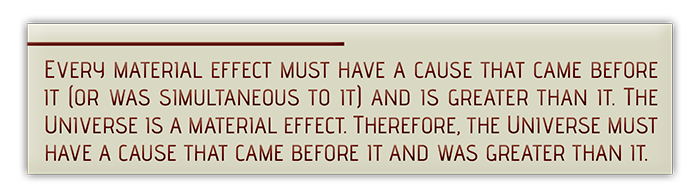
So what caused the Universe and all of the matter in the Universe? The theory that atheistic evolutionists have advanced for several decades now, which supposedly best explains our existence from a purely naturalistic perspective, is known as the Big Bang. Allegedly, approximately 14 billion years ago all of the matter and energy in the Universe was concentrated in a tiny ball of matter that exploded, causing the eventual formation of galaxies throughout the Universe.
The obvious problem with this explanation is that even if the Big Bang actually happened (and sound science argues against such a theory—see May, et al., 2003), a person must still explain whence came the “original” ball of matter. It must have an adequate cause. What do some leading atheists and agnostics around the world argue about the cause of matter? Atheistic cosmologist Stephen Hawking stated on national television in 2011, “Nothing caused the Big Bang” (“Curiosity…,” emp. added). In the book The Grand Design that Dr. Hawking co-authored, he and Leonard Mlodinow asserted: “Bodies such as stars and black holes cannot just appear out of nothing. But a whole universe can” (2010, p. 180, emp. added). In 2006, Todd Friel asked Dan Barker, one of America’s leading atheists, “Do you really believe that something came from nothing?” (emp. added). Barker responded with a simple, “Yes” (“Wretched…”).
The observable truth is, however, in nature, matter and energy are neither created nor destroyed. Scientists refer to this fact as the First Law of Thermodynamics. Though evolutionists have alleged that the Universe began with the explosion of a ball of matter several billion years ago, they never have provided a reasonable explanation for the cause of the “original” ball of matter. “Nothing” is not a reasonable explanation. In 2007, the pro-evolutionary New Scientist magazine ran a cover story titled “The Beginning: What Triggered the Big Bang?” in which the publication attempted to explain the origin of the Universe. But consider the last line of the featured article: “[T]he quest to understand the origin of the universe seems destined to continue until we can answer a deeper question: why is there anything at all instead of nothing?” (“The Universe…,” 194[2601]:33, emp. added). The implication of such a question is quite clear: if at one time in the past “nothing” existed, then nothing should exist today. A reasonable, naturalistic explanation for the origin of the “original” ball of matter that supposedly led to the Universe does not exist. One of the world’s leading atheists, Richard Dawkins, has basically admitted such.
In a panel discussion in 2012 on Australian national television, Dr. Dawkins was asked “how it is that something as enormous as the universes came from nothing?” Notice what Dawkins admitted: “Of course it’s counterintuitive that you can get something from nothing. Of course common sense doesn’t allow you to get something from nothing. That’s why it’s interesting. It’s got to be interesting in order to give rise to the universe at all. Something pretty mysterious had to give rise to the origin of the universe” (“Q&A…,” emp. added). Indeed, atheism’s explanation for the origin of matter is “not agreeing with what seems right or natural” (“Counterintuitive,” 2014). According to Dawkins’ own admissions, the idea of getting something from nothing in nature defies “common sense.” It is far from “sound and prudent judgment based on a simple perception of the situation or facts” (“Common Sense,” 2014).
What’s more, atheists cannot logically argue that the Universe is eternal. It seems that relatively few scientists even propose an eternal Universe anymore. (In fact, there would be no point in attempting to explain the “beginning” of the Universe in a Big Bang if atheists believed it always existed.) Furthermore, the Second Law of Thermodynamics, which states that matter and energy become less usable over time, has led most scientists to conclude that the Universe has not always existed (else we would be out of usable energy; see Miller, 2013). The fact is, the Universe had a beginning. Alex Vilenkin, cosmologist from Tufts University, pressed this fact in his book titled Many Worlds in One: “It is said that an argument is what convinces reasonable men and a proof is what it takes to convince even an unreasonable man. With the proof now in place, cosmologists can no longer hide behind the possibility of a past-eternal universe. There is no escape: they have to face the problem of acosmic beginning” (2006, p. 176, emp. added).
At one time in the past, the material Universe did not exist. Then, at some point, matter came into existence. But since matter is not eternal and cannot create itself from nothing, then something outside of the material realm must have brought matter into existence.
In short, matter demands a Maker. The evidence clearly indicates that the cause of the Universe is inexplicable without a supernatural Being. Something has to be eternally powerful, but we know it cannot be natural or material. Romans 1:20 says: “For since the creation of the world His invisible attributes are clearly seen, being understood by the things that are made, even His eternal power and Godhead, so that they are without excuse.” Without some type of eternal power, our Universe cannot exist, and the atheistic answer that our Universe created itself from nothing is the furthest thing from either a scientific or a rational explanation.
2. Life Demands a Life Giver
Life does not pop into existence from nothing. Neither the puppy at the pound nor the bacteria on the doorknob spontaneously generated. Every scientist, whether theist or atheist, knows this observation to be true.
In biology, one of the most widely recognized laws of science is the Law of Biogenesis. “Biogenesis” is composed of two words—“bio,” which means life, and “genesis,” which means beginning. Thus, this law deals with the beginning of life, and it simply says that in nature life comes only from previous life of its own kind. Over the years, the truthfulness of this law has been documented by thousands of scientists, most notably Louis Pasteur. His work dealt a crushing blow to the notion of spontaneous generation.
In 1933, evolutionist John Sullivan admitted that “it became an accepted doctrine that life never arises except from life. So far as the actual evidence goes, this is still the only possible conclusion” (p. 94, emp. added). Okay, but that was 1933. As we move further into the 20th century the obvious question was “Is it still the only possible conclusion?” What have we learned since the days of Louis Pasteur in the 19th century and John Sullivan in the first half of the 20th century? Observational science has reached the same conclusion experiment after experiment, year after year. The eminent evolutionist George Gaylord Simpson and his colleagues observed that “there is no serious doubt that biogenesis is the rule, that life comes only from other life, that a cell, the unit of life, is always and exclusively the product or offspring of another cell” (1965, p. 144, emp. added). Evolutionist Martin Moe noted that “a century of sensational discoveries in the biological sciences has taught us that life arises only from life” (1981, 89[11]:36, emp. added). More recently, staunch evolutionist Neil Shubin conceded the following in his book titled Your Inner Fish:
I can share with you one true law that all of us can agree upon. This law is so profound that most of us take it completely for granted. Yet it is the starting point for almost everything we do in paleontology, developmental biology, and genetics. This biological “law of everything” is that every living thing on the planet had parents. Every person you’ve ever known has biological parents, as does every bird, salamander, or shark you have ever seen…. To put it in a more precise form: every living thing sprang from some parental genetic information (2009, p. 174).
The importance of Shubin’s concession must not be missed. He recognizes that the actual scientific information verifies that life in the natural world must come from previously existing life. Yet he refuses to carry that fact to its proper conclusion: that life could not have sprung from non-living chemicals. Materialistic evolution cannot adequately account for or explain the most basic laws of science, not the least of which is the Law of Biogenesis.
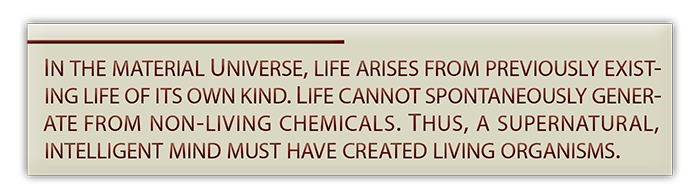
If it is the case that the “only possible conclusion” which scientific evidence demands is that in nature “life never arises except from life,” then, pray tell, how did the first life come into being? Did it somehow break the most fundamental natural law of biology and arise “naturally” from non-life? Or is there another possibility? The truth is, there is another possibility (which science has not disproved), but it is one that evolutionists such as John Sullivan admitted that “scientific men find very difficult of acceptance” (p. 94, emp. added). According to Sullivan, “So far as the actual evidence goes,” biogenesis “is still the only possible conclusion. But…it is a conclusion that seems to lead back to some supernatural creative act” (p. 94, emp. added). Do not miss the point: real, true, operational science indirectly supports a “supernatural creative act,” which implies a supernatural Creator.
Evolutionist and Harvard University Professor George Wald similarly admitted in an article he wrote titled “The Origin of Life” that there ultimately are two options for life’s origin: (1) spontaneous generation and (2) “the only alternative, to believe in a single, primary act of supernatural creation. There is no third position” (1954, p. 46). Sadly, though “[m]ost modern biologists, having reviewed with satisfaction the downfall of the spontaneous generation hypothesis,” they are “unwilling to accept the alternative belief in special creation” (p. 46). Rather than follow the evidence where it ultimately leads (to a supernatural Creator!), atheists would rather put their confidence in a theory that was disproven long ago. Antony Flew, who for five decades was the world’s leading atheistic thinker, was forced in the end to conclude: “The only satisfactory explanation for the origin of such ‘end-directed, self-replicating’ life as we see on earth is an infinitely intelligent Mind” (2007, p. 132; see Miller, 2012 for more information).
3. Design Demands a Designer
Everyday observation reveals and confirms the obvious fact that complex, functional design demands a designer. Paintings demand painters. Poems demand poets. Architecture demands architects. And on and on we could go. Everyone knows that cars and computers, pianos and projectors all require engineers, technicians, and tuners for them to exist and function properly. But what about the Universe as a whole? Can it be described accurately as “designed”? If so, what could such design imply about its origin?
No honest, informed person can deny that the Universe is extremely fine-tuned and functionally complex. From the Earth’s precise orbit around the Sun to a shorebird’s 15,000-mile yearly migration pattern, literally millions of examples of fine-tuned design in nature could be pondered. But consider just one example involving electrons and protons. The ratio of the mass of an electron to a proton is 1:1836, which means that a proton is 1,836 times more massive than an electron. Even with this mass difference, however, electrons and protons have the same electrical charge. Scientists suggest that if the electrical charge of the electron were altered by one part in 100 billion, our bodies would instantly explode (Barrow and Tipler, 1986, pp. 293, 296). Is such precision indicative of precise design? Most certainly.
The truth is, atheists frequently testify to the “design” in nature. Australian atheistic astrophysicist Paul Davies has admitted that the Universe (which according to atheists is the result of mindless, naturalistic, random processes) is “uniquely hospitable” (2007, p. 30), “remarkable” (p. 34), and “ordered in an intelligible way” (p. 30). He even admitted to the “fine-tuned properties” of the Universe. In a 2008 National Geographic article titled “Biomimetics: Design by Nature,” the word “design” (or one of its derivatives—designs, designed, etc.) appeared no less than seven times in reference to “nature’s designs.” The author, evolutionist Tom Mueller, referred to nature’s “sophistication” and “clever devices” (2008, p. 79) and praised nature for being able to turn simple materials “into structures of fantastic complexity, strength, and toughness” (p. 79). After learning of the uncanny, complicated maneuverability of a little blowfly, Mueller even confessed to feeling the need to regard the insect “on bended knee in admiration” (p. 82). Why? Because of its “mysterious” and “complicated” design. The fact is, as evolutionist Jerry Coyne admitted, “Nature resembles a well-oiled machine…. The more one learns about plants and animals, the more one marvels at how well their designs fit their ways of life” (2009, pp. 1,3).
But how can you get design without purpose, intelligence, and deliberate planning? The first three definitions the Merriam-Webster Online Dictionary gives for “design” (noun) are as follows: “1a: a particular purpose held in view by an individual or group…b: deliberate purposive planning… 2: a mental project or scheme in which means to an end are laid down; 3a: a deliberate undercover project or scheme” (“Design,” 2014, emp. added). After defining “design” as a drawing, sketch, or “graphic representation of a detailed plan…,” the American Heritage Dictionary of the English Languagenoted that design may be defined as “[t]he purposeful or inventive arrangement of parts or details” (“Design,” 2000, p. 492, emp. added). A design is preceded by “deliberate purposive planning,” “a detailed plan,” or an “inventive arrangement.” A design is the effect, not of time, chance, and unintelligent, random accidental explosions (what nonsense!), but of the purposeful planning and deliberate actions of an inventor or designer. Literally, by definition, design demands a designer; thus the designed Universe demands a Designer.

According to Paul Davies: “Our universe seems ‘just right’ for life. It looks as if…a super-intellect has been monkeying with physics” (2007, p. 30). Similarly, well-known skeptic Michael Shermer conceded, “The reason people think that a Designer created the world is because it looks designed” (2006, p. 65, emp. added).
Indeed, both honest observation and rational thought should lead every truth-seeking individual to the same conclusion that the psalmist came to 3,000 years ago: “The heavens declare the glory of God; and the firmament shows His handiwork” (19:1). “The whole earth is full of His glory” (Isaiah 6:3). Both the heavens and the Earth testify day after day and night after night to anyone and everyone who will listen (Psalm 19:2-4). “Lift up your eyes on high, and see Who has created these things” (Isaiah 40:26).
Since the Universe exhibits complex, functional design, and (by definition) complex, functional design demands a designer, then the Universe must have an intelligent designer. This argument for God is logically sound and observationally true. A person can know (without a doubt) that God exists if for no other reason than that the Universe’s design demands a Designer. “For every house is built by someone, but He Who built all things is God” (Hebrews 3:4).
4. Intelligence Demands an Intelligent Creator
Intelligence is defined as “the capacity to acquire and apply knowledge” (“Intelligence,” 2000, p. 910); “the ability to learn or understand things or to deal with new or difficult situations” (“Intelligence,” 2014). It is not difficult to identify certain things that have some measure of “intelligence,” while recognizing other things that have no intelligence. Man obviously has an extremely high level of intelligence. He has constructed spaceships that he can guide 240,000 miles to the Moon while both the Earth and the Moon are in motion. He has built artificial hearts that can extend the lives of the sick. He continues to construct computers that can process billions of pieces of information a second. He can write poetry, calculate where Mars will be 50 years from the present, and build everything from pianos to PlayStation video game consoles. Man is an intelligent being.
Although there is a great chasm between mankind and the animal kingdom, animals do possess a measure of intelligence. Dogs can learn to sit, stay, roll over, and play dead. Dolphins can learn to jump through hoops on command. Birds can make helpful “tools” from twigs in order to accomplish some basic tasks. A few years ago, two colorful, eight-legged cephalopods, known as cuttlefish, graced the cover of the journal New Scientist. The authors referred to this amazing sea creature as a “sophisticated,” “inventive,” eight-legged “genius” with “intelligence” and a “secret code” (Brooks, 2008).
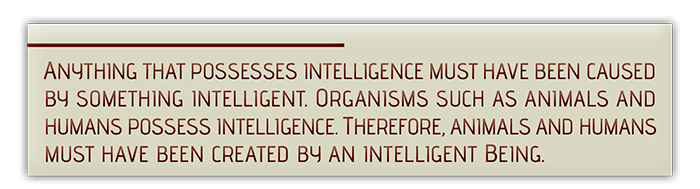
According to atheistic evolution, billions of years ago “nothing” caused a tiny ball of matter to explode. Then, billions of years after this Big Bang, galaxies began to form from lifeless, mindless, unintelligent particles floating around in space in massive clouds of dust. Allegedly, Earth eventually evolved from such a dust cloud. Hundreds of millions of years later, intelligent animals and humans evolved.
What humans have consistently observed in nature, however, is that intelligence demands previous intelligence. The reason that humans in the 21st century are intelligent is because our ancestors were intelligent. The reason that animals have some measure of intelligence is due to intelligent creatures that came before them. Dust does not give way to organized dust particles that have “the capacity to acquire and apply knowledge.” Water does not think. The mindless mud that evolutionists contend gave way to intelligent life on Earth is nothing but a delusional tale unsupported by everything we know from observation and experience. Neither “nothing” nor inorganic matter ever produces intelligent creatures. So how did the first intelligent creatures come to inhabit the Universe? Just as the first life demands a supernatural life Giver, so the first intelligent beings demand a self-existent, miracle-working Creator of intelligence.
5. Morality Demands a Moral Law Giver
Why do people generally think that some actions are “right” and some actions are “wrong,” regardless of their subjective opinions? Why do most people believe that it is “evil” or “wicked” (1) for an adult to torture an innocent child simply for the fun of it? (2) for a man to beat and rape a kind, innocent woman? or (3) for parents to have children for the sole purpose of abusing them sexually every day of their lives? Because, as evolutionist Edward Slingerland noted, humans have metaphysical rights—rights that are “a reality beyond what is perceptible to the senses” (“Metaphysical,” 2014)—and “rely on moral values” (as quoted in Reilly, 2007, 196[2629]:7). The fact is, most people, even many atheists, have admitted that real, objective good and evil exist.
Although objective morality may be outside the realm of the scientific method, every rational person can know that some actions are innately good, while others are innately evil. Antony Flew and Wallace Matson, two of the leading atheistic philosophers of the 20th century, forthrightly acknowledged the existence of objective morality in their debates with theistic philosopher Thomas B. Warren in the 1970s (see Warren and Flew, 1977; Warren and Matson, 1978). Atheist Michael Ruse admitted in his book Darwinism Defended that “[t]he man who says that it is morally acceptable to rape little children, is just asmistaken as the man who says that 2 + 2 = 5” (1982, p. 275, emp. added). Philosophers Francis Beckwith and Gregory Koukl said it well: “Those who deny obvious moral rules—who say that murder and rape are morally benign, that cruelty is not a vice, and that cowardice is a virtue—do not merely have a different moral point of view; they have something wrong with them” (1998, p. 59, emp. added).
Most rational people do not merely feel like rape and child abuse may be wrong; they are wrong—innately wrong. Just as two plus two can really be known to be four, every rational human can know that some things are objectively good, while other things are objectively evil. However, reason demands that objective good and evil can only exist if there is some real, objective point of reference. If something (e.g., rape) can be legitimately criticized as morally wrong, then there must be an objective standard—“some ‘higher law which transcends the provincial and transient’ which is other than the particular moral code and which has an obligatory character which can be recognized” (Warren and Matson, p. 284).
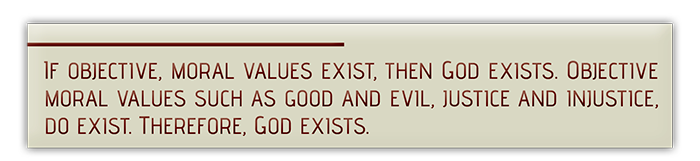
Recognition by atheists of anything being morally wrong begs the question: How can an atheistlogically call something atrocious, deplorable, evil, or wicked? According to atheism, man is nothing but matter in motion. Humankind allegedly evolved from rocks and slime over billions of years. How could moral value come from rocks and slime? Who ever speaks of “wrong rocks,” “moral minerals,” or “corrupt chemicals”? People do not talk about morally depraved donkeys, evil elephants, or immoral monkeys. Pigs are not punished for being immoral when they eat their young. Komodo dragons are not corrupt because 10% of their diet consists of younger Komodo dragons. Killer whales are not guilty of murder. Male animals are not tried for rape if they appear to forcibly copulate with females. Dogs are not depraved for stealing the bone of another dog. Moral value could not arise from rocks and slime.
The fact that humans even contemplate morality testifies to the huge chasm between man and animals and the fact that moral value could not have arisen from animals. Atheistic evolutionists have admitted that morals arise only in humans. George Gaylord Simpson, one of the most recognized atheistic evolutionists of the 20th century, confessed that “[g]ood and evil, right and wrong, concepts irrelevant in nature except from the human viewpoint, become real and pressing features of the whole cosmos as viewed morally because morals arise only in man” (1951, p. 179, emp. added). Atheists admit that people (i.e., even “atheists”) have “their own innate sense of morality” (“Do Atheists…?, n.d.). No rational person makes such admissions about animals. “Humans,” not animals, “rely on moral values” (as quoted in Reilly, 2007, 196[2629]:7).
The moral argument for God’s existence exposes atheism as the self-contradictory, atrocious philosophy that it is. Atheists must either reject the truthfulness of the moral argument’s first premise (“If objective moral value exists, then God exists”) and illogically accept the indefensible idea that objective morality somehow arose from rocks and reptiles, or (2) they must reject the argument’s second premise (“Objective moral values exist”), and accept the insane, utterly repulsive idea that genocide, rape, murder, theft, child abuse, etc. can never once be condemned as objectively “wrong.” What’s more, if atheism is true, individuals could never logically be punished for such immoral actions, since “no inherent moral or ethical laws” would exist (Provine, 1988, p. 10).
If there is no God, then there is no objective basis to say that some things are right and others are wrong. Reason demands that objective good and evil can only exist if there is some real, objective reference point outside of nature. The only reasonable answer to an objective moral law for humans is a supernatural, moral law Giver.
6. The Bible’s Supernatural Attributes Demand a Supernatural Author
Christians do not believe that God exists simply because the Bible teaches that He does, nor do Christians believe that the Bible is the Word of God simply because the Bible claims to be inspired by God. Anyone can make claims about whatever they wish. Simply because a person claims to have revelation from a supernatural Creator does not make it so (e.g., the Book of Mormon; see Miller, 2009). However, if the Bible possesses attributes that are super-human, then the Bible proves itself to be of supernatural origin and has indirectly proven the existence of the supernatural Author. American atheist Dan Barker alluded to the legitimacy of this argumentation for God’s existence in 2009 when he explained that one of the things which could falsify atheism would be if God spoke to man and gave him specific information about future events (see Butt and Barker, pp. 50-51).
Indeed, one extremely valuable line of evidence that confirms that the Bible is the inspired Word of God is the presence of accurate, predictive prophecy contained in its pages. Not only are the prophecies of the Bible fulfilled in minute detail with complete accuracy, but these fulfillments are often accomplished centuries after the prophecies were made. Even the skeptic understands that if this is the case, a supernatural agent must be responsible for the writing of the Bible. That is why the skeptic attempts to discredit the prophecies by claiming that they were written after the events or by claiming that they were not fulfilled in detail. By attempting to disparage the prophecies using these methods, the skeptic admits that if the prophecies were written centuries before the events, and if they are fulfilled in detail, then a supernatural agent is responsible for them. As the prophet Jeremiah wrote: “As for the prophet who prophecies of peace, when the word of the prophet comes to pass, the prophet will be known as one whom the Lord has truly sent” (28:9). Completely accurate, fulfilled prophecy is a characteristic that verifies the divine inspiration of the Bible.
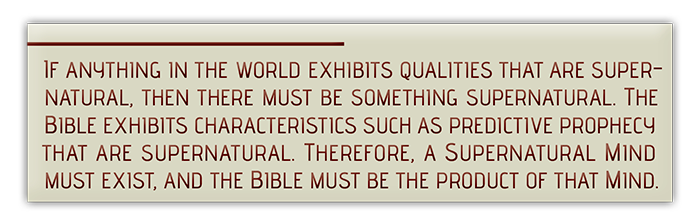
One such prophecy concerned a man named Cyrus and two nations: Babylon and the Medo-Persian Empire. Isaiah, who prophesied around 700 B.C., vividly described how God would destroy the powerful kingdom of Babylon, “the glory of kingdoms” (13:19). Writing as if it had already occurred (commonly known as the “prophetic perfect,” frequently employed in the Old Testament to stress the absolute certainty of fulfillment, e.g., Isaiah 53), Isaiah declared Babylon would fall (21:9). He then prophesied that Babylon would fall to the Medes and Persians (Isaiah 13; 21:1-10). Later, he proclaimed that the “golden city” (Babylon) would be conquered by a man named Cyrus (44:28; 45:1-7). This is a remarkable prophecy, especially since Cyrus was not born until almost 150 years after Isaiah penned these words.
Not only did Isaiah predict that Cyrus would overthrow Babylon, but he also wrote that Cyrus, serving as Jehovah’s “anointed” and “shepherd,” would release the Jews from captivity and assist them in their return to Jerusalem for the purpose of rebuilding the temple. Isaiah’s prophecies were recorded almost 200 years before Cyrus conquered Babylon (539 B.C.). Amazing! [NOTE: Secular history verifies that all of these events came true. There really was a man named Cyrus who ruled the Medo-Persian Empire. He did conquer Babylon. And just as Isaiah prophesied, he assisted the Jews in their return to Jerusalem and in the rebuilding of the temple.]
Truly, “no prophecy of Scripture is of any private interpretation, for prophecy never came by the will of man, but holy men of God spoke as they were moved by the Holy Spirit” (2 Peter 1:20-21). And, if men were inspired of God to write the Scriptures (2 Timothy 3:16), then God exists. In short, the Bible’s supernatural attributes logically demand a supernatural Author (see Butt, 2007 for more information).
7. The Historical, Miracle-Working, Resurrected Jesus Demands a Supernatural Explanation
Human beings can do many amazing things. They can run 26.2 miles without stopping. They can show remarkable courage in the face of great danger. They can even walk along a tightrope hundreds of feet above the ground. But there are certain actions that are humanly impossible. Humans cannot walk on water unassisted, give sight to the blind, instantly reattach severed ears with only their hands, or raise the dead. If ever such a “man” existed, his life would logically testify to the existence of a supernatural Being.
Atheists understand the rationality of this argument. Dan Barker once said on record, “If Jesus were to materialize” and work any number of miraculous deeds, atheism would be disproven (see Butt and Barker, p. 51), and thus theism would be established as a fact. The truth is, the very proof that Barker and other atheists request was provided 2,000 years ago when God put on flesh and came to Earth in the form of man. And He did not merely claim to be God; He did what a reasonable person could expect if God were ever to prove His divinity on Earth—He fulfilled precise prophecies and worked supernatural miracles, including coming back from the dead Himself. (For more information, see Butt and Lyons, 2006). The life and works of Jesus testify to the existence of a supernatural Being.
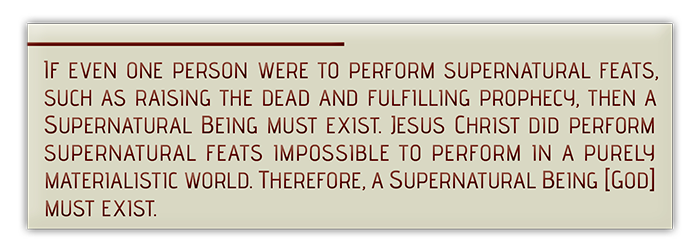
In 2012, renowned atheist Richard Dawkins was questioned about his unbelief in God. Specifically, he was asked, “What proof, by the way, would change your mind?” He quickly responded by saying, “That is a very difficult and interesting question because, I mean, I used to think that if somehow, you know, great, big, giant 900-foot high Jesus with a voice like Paul Robeson suddenly strode in and said, ‘I exist and here I am,’ but even that, I actually sometimes wonder if that would…” (“Q&A…,” 2012). So, though Dr. Dawkins raises the possibility of the legitimacy of disproving atheism with a 900-foot high, hypothetical Jesus, He continually rejects the historical, miracle-working, resurrected-from-the-dead Jesus Who walked the Earth 2,000 years ago. Sadly, such irrational, hard-hearted unbelief is nothing new. Even some in the very presence of Jesus in the first century, who testified to the supernatural feats that He worked, rejected Him (cf. John 11:45-53; 12:9-11). Thus, it should not be surprising that many will reject the Lord God today despite the evidence for His existence.
Conclusion
Atheists are fond of claiming that their way of thinking is logical, reasonable, and intellectual. Yet atheism irrationally says that everything came from nothing. Atheism says that an explosion caused exquisite order. It says that random chances produced precision and that life popped into existence in nature from non-life. Atheism contends that a well-designed Universe could come about without a Designer. Atheism says that fish and frogs are man’s distant forefathers and that intelligence is ultimately the result of non-intelligence. Atheism alleges that either man is on the same moral plane as a moose, or he actually evolved a sense of morality from amoral mice. While trying to convince others he is galloping confidently atop a stallion called Common Sense, atheism stumbles on the back of a donkey called Foolishness.
Theism, on the other hand, is absolutely rational. Why? Because (among other things) (1) matter demands a Maker; (2) life demands a Life Giver; (3) design demands a Designer; (4) intelligence demands an Intelligent Creator; (5) morality demands a Moral Law Giver; (6) the Bible’s supernatural attributes demand a Supernatural Author; and (7) the historical, miracle-working, resurrected Jesus demands a supernatural explanation (which demands God). Indeed, the Christian can say with all confidence, “I know that God exists.” As former atheist Antony Flew so eloquently concluded: “I must say again that the journey to my discovery of the Divine has thus far been a pilgrimage of reason. I have followed the argument where it has led me. And it has led me to accept the existence of a self-existent, immutable, immaterial, omnipotent, and omniscient Being” (2007, p. 155).
REFERENCES
Barrow, John D. and Frank Tipler (1986), The Anthropic Cosmological Principle (Oxford, England: Oxford University Press).
Beckwith, Francis and Gregory Koukl (1998), Relativism: Feet Firmly Planted in Mid-Air (Grand Rapids, MI: Baker).
Brooks, Michael (2008), “Do You Speak Cuttlefish?” New Scientist, 198[2653]:28-31, April 26.
Butt, Kyle (2007), Behold! The Word of God (Montgomery, AL: Apologetics Press).
Butt, Kyle and Eric Lyons (2006), Behold! The Lamb of God (Montgomery, AL: Apologetics Press).
Butt, Kyle and Dan Barker (2009), Does the God of the Bible Exist? (Montgomery, AL: Apologetics Press).
“Common Sense” (2014), Merriam-Webster Online Dictionary, http://www.merriam-webster.com/dictionary/common%20sense.
“Counterintuitive” (2014), Merriam-Webster Online Dictionary, http://www.merriam-webster.com/dictionary/counterintuitive.
Coyne, Jerry (2009) Why Evolution is True (New York: Viking).
“Curiosity: Did God Create the Universe?” (2011), Discovery Channel, August 7.
Davies, Paul (2007), “Laying Down the Laws,” New Scientist, 194[2610]:30-34, June 30.
“Design” (2000), American Heritage Dictionary of the English Language (Boston, MA: Houghton Mifflin), fourth edition.
“Design” (2014), Merriam-Webster Online Dictionary, http://www.merriam-webster.com/dictionary/design.
“Do Atheists Have Morals?” (no date), http://www.askanatheist.org/morals.html.
Flew, Antony and Roy Varghese (2007), There Is a God: How the World’s Most Notorious Atheist Changed His Mind (New York: Harper Collins).
Hawking, Stephen and Leonard Mlodinow (2010), The Grand Design (New York: Bantam Books).
“Intelligence” (2000), American Heritage Dictionary of the English Language (Boston, MA: Houghton Mifflin), fourth edition.
“Intelligence” (2014), Merriam-Webster Online Dictionary, http://www.merriam-webster.com/dictionary/intelligence.
May, Branyon, et al. (2003), “The Big Bang Theory—A Scientific Critique [Parts 1-2],” Reason & Revelation, 23[5-6]:33-47,49-63.
“Metaphysical” (2014), Merriam-Webster Online Dictionary, http://www.merriam-webster.com/dictionary/metaphysical.
Miller, Dave (2009), “Is the Book of Mormon from God? [Part 1],” http://www.apologeticspress.org/APContent.aspx?category=108&article=2787.
Miller, Jeff (2011), “God and the Laws of Science: The Law of Causality,” http://www.apologeticspress.org/APContent.aspx?category=12&article=3716.
Miller, Jeff (2012), “The Law of Biogenesis [Part 1],” http://www.apologeticspress.org/APContent.aspx?category=9&article=4165&topic=93.
Miller, Jeff (2013), “Evolution and the Laws of Science: The Laws of Thermodynamics,” http://www.apologeticspress.org/APContent.aspx?category=12&article=2786.
Moe, Martin (1981), “Genes on Ice,” Science Digest, 89[11]:36,95, December.
Mueller, Tom (2008), “Biomimetics: Design by Nature,” National Geographic, 213[4]:68-91, April.
Provine, William (1988), “Scientists, Face It! Science and Religion are Incompatible,” The Scientist, 2[16]:10, September 5, http://www.the-scientist.com/?articles.view/articleNo/9707/title/Scientists–Face-It–Science-And-Religion-Are-Incompatible/.
“Q&A: Religion and Atheism” (2012), ABC Australia, April 9, http://www.abc.net.au/tv/qanda/txt/s3469101.htm.
Reilly, Michael (2007), “God’s Place in a Rational World,” New Scientist, 196[2629]:7, November 10.
Ruse, Michael (1982), Darwinism Defended: A Guide to the Evolution Controversies (Reading, MA: Addison-Wesley).
Shermer, Michael (2006), Why Darwin Matters (New York: Henry Holt).
Shubin, Neil (2009), Your Inner Fish (New York: Vintage Books).
Simpson, George Gaylord (1951), The Meaning of Evolution (New York: Mentor).
Simpson, G.G., C.S. Pittendrigh, and L.H. Tiffany (1965), Life: An Introduction to Biology (New York: Harcourt, Brace, and World).
Sullivan, John (1933), The Limitations of Science (New York: Viking Press).
“The Universe Before Ours” (2007), New Scientist, 194[2601]:28-33, April 28.
Vilenkin, Alex (2006), Many Worlds in One: The Search for Other Universes (New York: Hill and Wang).
Wald, George (1954), “The Origin of Life,” Scientific American, 191[2]:44-53, August.
Warren, Thomas B. and Antony G.N. Flew (1977), Warren-Flew Debate (Jonesboro, AR: National Christian Press).
Warren, Thomas B. and Wallace I. Matson (1978), The Warren-Matson Debate (Jonesboro, AR: National Christian Press).
“Wretched: Nothing Made Everything” (2006), http://www.youtube.com/watch?feature=player_embedded&v=sK2yNkTuJkY.
The post 7 Reasons to Believe in God appeared first on Apologetics Press.
]]>The post "God’s Not Dead": A Movie Review appeared first on Apologetics Press.
]]> On March 21, 2014, the movie God’s Not Dead was released in 780 theaters across the country. Since then, more than 1,000 other theaters began showing the film, which grossed over $41 million in less than one month—pretty good for a movie with a budget of only $2 million (God’s Not Dead, 2014a).
Though many Christians and pro-Christian organizations around the country have been fairly complimentary of the film, general reviewers have not been so kind. RottenTomatoes.com rated the movie with one star, as only 15% of the website’s approved critics gave the movie a positive review (God’s Not Dead, 2014b). Although the Hollywood Reporter had a few positive things to say about the movie, in their “bottom line” they referred to it as a “simple-minded sermon” (Farber, 2014). Claudia Puig of USA Today has alleged that “the contrived premise of God’s Not Dead is anything but credible.” Puig dismissed the idea of a professor at a respected academic institution ever criticizing religion as “primitive superstition,” saying, “Even if a teacher believed this, it’s highly unlikely he would declare it to a class full of students” (2014, emp. added).
The fact of the matter is, belligerent criticism of theism and Christianity has been occurring on college campuses all over the country for years, and it is very appropriate for God’s Not Dead to raise awareness of such bullying from various intolerant, liberal professors. Sometime ago a gentleman, who had been a student at a well-known university in the southeastern United States, visited with us after one of our lectures and recounted how, at the beginning of one particular semester, a science professor asked students in the class to stand up if they believed in God. Seven individuals out of a fairly large class rose from their seats. The professor then went on to say that by the end of the semester not one of them would stand up when he asked that question. Sure enough, toward the end of the semester the professor posed the question again, “How many of you believe in God?” Only one student stood up. Several months later, another student from the same university confirmed that the same thing happened in one of her classes. There was obvious bullying and intimidation taking place. The often-overlooked fact is, theistic, creationist, and Christian-oriented students and professors are frequently the target of liberal, atheistic, and/or evolutionary professors and department heads (e.g., Kingkade, 2013; Bergman, 2008; Stein and Miller, 2008; see also Miller, 2011).
Perhaps the most powerful and pervasive message of God’s Not Dead is that any person who calls himself or herself a Christian must be willing to sacrifice everything for Christ. The hero of the movie, a young university freshman named Josh Wheaton, is willing to sacrifice his relationship with his fiancée, his university career, his future job, and his reputation to stand up for God’s existence. In a subplot, a young Muslim student is willing to sacrifice her family relationships for her belief in Christ. A freshman student from China is consistently urged by his father to stop thinking about “foolish” religious ideas and concentrate on his grades, but the young man refuses. And the girlfriend of the antagonistic atheistic professor breaks off their relationship because of her religious convictions.
This message of sacrifice is both biblical and extremely important in our increasingly self-centered society. Jesus said: “Whoever desires to come after Me, let him deny himself, and take up his cross, and follow Me…. For whoever is ashamed of Me and My words in this adulterous and sinful generation, of him the Son of Man also will be ashamed when He comes in the glory of His Father with the holy angels” (Mark 8:34,38). In all of our years as Christian apologists, we have seen countless “Christians” bowing to the secular standards of our day, afraid to stand for the truth of the Bible and God’s existence. We could recount stories of college freshmen too afraid of ruining their reputations or of getting a bad grade to stand up for their belief in God. We could tell of university professors who were so very concerned about tenure, their salary, or their teaching positions that they refused to speak or write about their faith in Christ because of the possible repercussions. How many school teachers have allowed their Christian influence to be silenced because they might lose their job? It truly is a shame to see the sacrifice of Jesus Christ on the cross and the complete dedication of His early followers who “rejoiced that they were counted worthy to suffer shame for His name” (Acts 5:41), and then witness certain “Christians” today who will not even acknowledge in public that they believe in God or His Word. Any faithful Christian would have to say “Amen,” to the movie’s main message that following Jesus requires complete sacrifice to His Will.
Unfortunately, the main message of the movie is overshadowed at times by the failure of the movie to accurately apply it. For instance, although Josh, the hero, is to be commended for his study and some of the effective arguments he used in class, at times during his defense he affirms error. For example, he implies that the Big Bang is scientifically and biblically credible, and that God could have used evolution as the process by which all life (including humans) came into existence. Not only is the Big Bang an unscientific idea (May, et al., 2003a), it is an unbiblical idea as well (May, et al., 2003b; Lyons, 2003). Additionally, the idea that God directed the process of evolution to produce life is equally unbiblical and antiscientific (Houts, 2007), though it is very appealing to our secular culture. In their attempt to make belief in God more palatable (by not making Josh, what Screenit.com calls, “a simple-minded believer who thinks the Earth was created…in just under a week”—God’s Not Dead, 2014c), the producers of the film fail to stand courageously against the foolish theories of cosmic and biological evolution and stand unashamedly for the truthfulness of the biblical account of Creation.
Furthermore, the movie completely misrepresents how God has commanded people to be saved. The clearest example of this false teaching comes at the end of the movie. In a tragic accident, the atheistic professor is struck by a car and is about to die. It just so happens that a denominational minister is on the scene. The minister begs the atheistic professor to call on the Lord, say a version of the “sinner’s prayer,” and receive Jesus into his heart. Yet such teaching is never found in the Bible (Lyons, 2004; Jackson, 2014). God requires faithful obedience to the Gospel plan of salvation in order to receive the gift of salvation (Lyons and Butt). Paul informed the Thessalonians that at the end of time Jesus Christ will be revealed from heaven “with His Mighty angels, in flaming fire taking vengeance on those who do not know God, and on those who do not obey the gospel of our Lord Jesus Christ” (2 Thessalonians 1:7-8, emp. added). What the atheistic professor did in the movie to be “saved” is not what the New Testament means when it says to “obey the Gospel” (cf. Romans 6:3-4; Matthew 7:21). Thus, in the very process of claiming to teach that people should be willing to sacrifice everything for Christ, the movie producers failed to heed their own message. Not only must we be willing to sacrifice our reputations, careers, and families, we must be willing to sacrifice any manmade doctrine that is not taught in Scripture. We must be willing to leave any group or teaching, even if it goes by the name “Christian,” if and when we find it does not correspond to God’s will found in the New Testament.
Overall, we believe that God’s Not Dead effectively highlights a serious problem in universities across the United States—showing some of the challenges that many Christian students face. We also believe that Christians should take to heart the overall message of the movie: the ultimate sacrifice for the sake of Christ and the cross. We would greatly caution viewers, however, to understand that the producer’s application of the theme is occasionally lacking. Yes, the movie’s approach to a defense of God’s existence is rational and biblical at times, but then at other times it is both biblically and scientifically unsound. What’s more, the film’s presentation of how God has instructed people to become Christians is at odds with the Bible. We all need to be reminded of the importance of sacrificing everything for Christ, including compromises with the world and any long-held false religious ideas.
REFERENCES
Bergman, Jerry (2008), Slaughter of the Dissidents: The Shocking Truth about Killing the Careers of Darwin Doubters (Southworth, WA: Leafcutter Press).
Farber, Stephen (2014), “God’s Not Dead: Film Review,” The Hollywood Reporter, http://www.hollywoodreporter.com/review/gods-not-dead-film-review-690393.
God’s Not Dead (2014a), Box Office Mojo, http://www.boxofficemojo.com/movies/?id=godsnotdead.htm.
God’s Not Dead (2014b), Rotten Tomatoes, http://www.rottentomatoes.com/m/gods_not_dead/#contentReviews.
God’s Not Dead (2014c), Screen It, http://www.screenit.com/ourtake/2014/gods_not_dead.html.
Houts, Michael (2007), “Evolution is Religion—Not Science [Part 1],” http://apologeticspress.org/APContent.aspx?category=97&article=2299.
Jackson, Wayne (2014), “The Sinner’s Prayer—Is it Biblical?” https://www.christiancourier.com/articles/368-sinners-prayer-is-it-biblical-the.
Kingkade, Tyler (2013), “Deandre Poole Keeps FAU Job After ‘Stomp on Jesus’ Controversy,” Huffington Post, June 24, http://www.huffingtonpost.com/2013/06/24/deandre-poole-fau-stomp-on-jesus_n_3490263.html.
Lyons, Eric (2003), “Man Has Been on Earth Since…,” https://www.apologeticspress.org/APContent.aspx?category=9&article=538&topic=56.
Lyons, Eric (2004), “Calling on the Name of the Lord,” http://apologeticspress.org/APContent.aspx?category=11&article=775&topic=379.
Lyons, Eric and Kyle Butt (n.d.), Receiving the Gift of Salvation, http://apologeticspress.org/pdfs/e-books_pdf/Receiving%20the%20Gift%20of%20Salvation.pdf.
May, Branyon, Bert Thompson, and Brad Harrub (2003a), “The Big Bang Theory—A Scientific Critique,” https://www.apologeticspress.org/APContent.aspx?category=9&article=1453&topic=57.
May, Branyon, Bert Thompson, and Brad Harrub (2003b), “The Big Bang Theory—A Biblical Critique,” http://apologeticspress.org/apcontent.aspx?category=12&article=56.
Miller, Jeff (2011), “Expelled—Again,” https://www.apologeticspress.org/APContent.aspx?category=12&article=3655.
Puig, Claudia (2014), “In ‘God’s Not Dead,’ Message is Lost Amid Melodrama,” USA Today, April 8, http://www.usatoday.com/story/life/movies/2014/04/08/review-gods-not-dead/7457995/.
Stein, Ben and Kevin Miller (2008), Expelled: No Intelligence Allowed (Premise Media).
The post "God’s Not Dead": A Movie Review appeared first on Apologetics Press.
]]>The post Water on Mars? appeared first on Apologetics Press.
]]>What’s the Significance to the Creationist of Finding Water on Mars?
A:
If naturalistic evolution were true, it would be inconceivable that extra-terrestrial life would not exist. So evolutionists are seemingly frantic in their search for such life. In September of 2013, the journal Science reported results from the Mars rover Curiosity’s exploration of the planet (Grotzinger, 2013). Fascinatingly, water was found in the Martian soil. What does this mean for creationists? Does it prove evolution?
NOVA, funded by the National Science Foundation, said in 2005, “If life is common, then we should be able to find signs of it beyond our own little planet. Unfortunately, the evidence has been elusive” (“Ingredients for Life”). Life has not been discovered anywhere in the Universe apart from Earth, but evolutionary scientists have long hoped at least to find indirect evidences of currently or previously existing life, even if they cannot find life itself (cf. Miller, 2012).
One example of indirect evidence for extra-terrestrial life that has been glaringly absent is evidence for the existence of liquid water in space. Chris McKay of NASA’s Ames Research Center explained in 2005:
The most important requirement for life is liquid water, and that’s the defining requirement for life in terms of our solar system. There’s plenty of energy. There’s plenty of carbon. There’s plenty of other elements on all the planets in our solar system. What’s rare, and which, as far as we know, only occurs now on Earth is liquid water (“Ingredients for Life”).
While one of Jupiter’s moons (Europa) is already known to be covered with ice, a key ingredient for life is liquid water. It seems that now there is evidence that liquid water does exist in space. Soil tests taken from the Curiosity rover indicate that Mars’ soil has 2% water by weight (Landau, 2013). To evolutionists, this is a significant find, since it eliminates one of the barriers preventing evolution from being true. According to NOVA, “Mars might be too cold and dry to harbor life today, but if water was once there, then perhaps life was too” (2005).
Keep in mind that the existence of water in space in no way provides positive proof of extra-terrestrial life or of evolution, in the same way that finding carbon in space provides no proof of extra-terrestrial life or evolution. (Does finding sugar in the kitchen prove that someone made cookies with it?) To the creationist, water and organic substances are merely materials that God created in the Universe on days one and four of the Creation week that serve His purposes for the Universe. The existence of water on Mars provides no more assistance in proving evolution than the existence of dirt. They are both merely products that God placed here. Notice these admissions by one of the reporters covering the Mars story:
Curiosity is not capable of detecting life directly; it wouldn’t confirm either modern life or ancient fossil organisms. It can, however, determine if the ancient environment was habitable—which the rover told us it was—and look for organic compounds. Finding those compounds wouldn’t prove the existence of life, either, because they can come from other sources. But the appearance of organic molecules would suggest that the environment is good at preserving them…. [S]o far, Curiosity has not directly detected organics in the soil (Landau, emp. added).
So nothing has been proven concerning extra-terrestrial life by the rover study. Once again, speculation and wishful thinking still rule the day for evolutionists. Scientists are still trying to figure out if life could exist in outer space—much less that it does or did. Bottom line: while finding liquid water may mark off one of the barriers facing evolution, it is not positive proof of life. It’s just one more step towards the starting line—not the finish line. In reality, evolution still isn’t even in the race with creation.
REFERENCES
Grotzinger, John P. (2013), “Analysis of Surface Materials by the Curiosity Mars Rover,” Science, 341[6153]:1475.
“Ingredients for Life” (2005), NOVA, December 17, http://www.pbs.org/wgbh/nova/education/evolution/ingredient-life-water.html.
Landau, Elizabeth (2013), “Water Discovered in Martian Soil,” CNN Tech, October 7, http://www.cnn.com/2013/09/30/tech/innovation/mars-water/.
Miller, Jeff (2012), “Space: The Womb of Life?” Reason & Revelation, 32[6]:62-64, http://apologeticspress.org/pub_rar/32_6/1206_V01.pdf.
The post Water on Mars? appeared first on Apologetics Press.
]]>The post God and the Laws of Science: Genetics vs. Evolution [Part 2] appeared first on Apologetics Press.
]]>[EDITOR’S NOTE: Part 1 of this two-part series appeared in the January issue. Part 2 follows below and continues, without introductory comments, where the first article ended.]
In answer to the question, “Can new information originate through mutations?” Gitt responded, “This idea is central in representations of evolution, but mutations can only cause changes in existing information. There can be no increase in information, and in general the results are injurious. New blueprints for new functions or new organs cannot arise; mutations cannot be the source of new (creative) information” (Gitt, 2007, Ch. 11, emp. added, parenthetical item in orig.). Meyer explains,
“[N]atural selection can ‘select’ only what random mutations first produce. And for the evolutionary process to produce new forms of life, random mutations must first have produced new genetic information for building novel proteins” (2009, Ch. 9). And again, that simply does not happen.
[M]utations of the kind that macroevolution doesn’t need (namely, viable genetic mutations in DNA expressed late in development) do occur, but those that it does need (namely, beneficial body plan mutations expressed early in development) apparently don’t occur. According to Darwin (1859, p. 108) natural selection cannot act until favorable variations arise in a population. Yet there is no evidence from developmental genetics that the kind of variations required by neo-Darwinism—namely, favorable body plan mutations—ever occur…. [M]utations in DNA alone cannot account for the morphological changes required to build a new body plan (Meyer, 2004, emp. added).
Mutation simply “does not constitute an adequate causal explanation of the origination of biological form in the higher taxonomic groups” (Meyer, 2004).
Meyer summarized the problem for neo-Darwinism:
Neo-Darwinism seeks to explain the origin of new information, form, and structure as a result of selection acting on randomly arising variation at a very low level within the biological hierarchy, namely, within the genetic text. Yet major morphological innovations depend on a specificity of arrangement at a much higher level of the organizational hierarchy, a level that DNA alone does not determine. Yet if DNA is not wholly responsible for body plan morphogenesis, then DNA sequences can mutate indefinitely, without regard to realistic probabilistic limits, and still not produce a new body plan. Thus, the mechanism of natural selection acting on random mutations in DNA cannot in principle generate novel body plans (2004, italics in orig., emp. added).
In the words of Sanford:
[E]ven when ignoring deleterious mutations, mutation/selection cannot create a single gene within the human evolutionary timescale. When deleterious mutations are factored back in, we see that mutation/selection cannot create a single gene, ever. This is overwhelming evidence against the Primary Axiom.In my opinion this constitutes what is essentially a formal proof that the Primary Axiom is false (2008, p. 139, emp. and italics in orig.).
Michael Behe, biochemist and Professor of Biological Sciences at Lehigh University, points out that some microorganisms have been shown to be able to rapidly adapt to new environments. However, in doing so, those organisms never develop new internal functions. According to Behe, their adaptations amount, not to innovation, but merely fine-tuning (2007).
So in the words of Gould, mutations do not “produce major new raw material.” They simply change something that already exists. They alter what is already present. They are variations within types of already existing genes. They might cause a fly to have extra wings, a fish to have extra eyes, or a person to have an extra toe; but mutations cannot create a new kind of creature. A mutation would not cause a wing to appear on a creature unless the creature already had wings in its genetic code. If a fish does not already have antlers in its genes, it is not going to grow them. If a dog does not have webbed duck feet or feathers in its genes, neither it nor its descendants are going to grow them. If a person does not have tank treads in his genes, he will never be able to roll over to his neighbor’s house, regardless of how long he (or his progeny) lives and mutates. Neo-Darwinian evolution simply cannot happen. Sanford lamented:
Very regrettably, evolutionists have treated two very different phenomenon, adaptation to environments and evolution of higher life forms, as if they were the same thing. We do not need to be geniuses to see that these are different issues. Adaptation can routinely be accomplished by loss of information or even developmental degeneration (loss of organs). However, development of higher life forms (representing more specified complexity) always requires a large increase in information (p. 202, italics in orig.).
And Darwinian evolution cannot provide it.
Information: If It’s Not a Product of Naturalistic Processes, Then…
East German scientist J. Peil wrote, “Information is neither a physical nor a chemical principle like energy and matter, even though the latter are required as carriers” (as quoted in Gitt, 2007, Ch. 3). The late American mathematician Norbert Wiener, previously professor of mathematics at M.I.T., graduate of Harvard University, and considered to be the originator of the field of cybernetics, long ago said, “Information is information, not matter or energy. No materialism which does not admit this can survive at the present day” (1965, p. 132). What does that truth imply about information?
In the words of Gitt, in what he calls “Theorem 1,” “[t]he fundamental quantity information is a non-material (mental) entity. It is not a property of matter, so that purely material processes are fundamentally precluded as sources of information” (Ch. 3, emp. added). He further explains, “Information is always based on the will of a sender who issues the information…. Information only arises through an intentional, volitional act” (Ch. 3). “[I]t is clear that the information present in living organisms requires an intelligent source…. Any model for the origin of life (and of information) based solely on physical and/or chemical processes, is inherently false” (Ch. 4, parenthetical item in orig.). Gitt proposes Theorem 29 as a summary of that truth: “Every piece of creative information represents some mental effort and can be traced to a personal idea-giver who exercised his own free will, and who is endowed with an intelligent mind” (Ch. 8). In other words, “[n]ew information can only originate in a creative thought process” (Ch. 8).
What about the findings from computerized evolutionary algorithms and ribozyme-engineering experiments? Don’t they prove neo-Darwinian evolution could happen? Meyer responds:
[M]inds can produce biologically relevant structures and forms of information, but without mind or intelligence little, if any, information arises…. [I]ntelligent agents can produce information. And since all evolutionary algorithms require preexisting sources of information provided by designing minds, they show the power—if not the necessity—of intelligent design….
[R]ibozyme-engineering experiments demonstrate the power—if not, again, the need for—intelligence to produce information—in this case, the information necessary to enhance the function of RNA enzymes…. Undirected materialistic causes have not demonstrated the capacity to generate significant amounts of specified information. At the same time, conscious intelligence has repeatedly shown itself capable of producing such information. It follows that mind—conscious, rational, intelligent agency—what philosophers call “agent causation,” now stands as the only cause known to be capable of generating large amounts of specified information starting from a nonliving state (2009, Ch. 15).
Radiologist Henry Quastler, who pioneered the use of isotopes to study cell kinetics and “was one of the first to apply Information Theory to biology” (Ducoff, 2007), long ago stated, “[C]reation of information is habitually associated with conscious activity” (Quastler, 1964, p. 16). If this be the case—if all the evidence points to an intelligent Designer for the origin of information—why reject the evidence? “Whatever information is—whether thought or an elaborate arrangement of matter—one thing seems clear. What humans recognize as information certainly originates from thought—from conscious or intelligent activity” (Meyer, 2009, Ch. 1, italics in orig.).
But Still…Couldn’t it Happen?
Even if genetic mutation could sporadically provide new information, there are other, even more significant issues. Meyer explains, “[A]ny minimally complex protocell resembling cells we have today would have required not only genetic information, but a sizable preexisting suite of proteins for processing that information” (2009, Ch. 9). And what’s more,
scientists investigating the origin of life must now explain the origin of at least three key features of life. First, they must explain the origin of the system for storing and encoding digital information in the cell, DNA’s capacity to store digitally encoded information. Second, they must explain the origin of the large amount of specified complexity or functionally specified information in DNA. Third, they must explain the origin of the integrated complexity—the functional interdependence of parts—of the cell’s information-processing system (2009, Ch. 5).
Sanford points out further how Darwinian evolution would still not be possible with sporadic instances of new information:
I believe the “going down” aspect of the genome is subject to concrete analysis. Such analysis persuasively argues that net information must be declining. If this is true [and the primary focus of his book illustrates that it is—JM], then even if it could be shown that there were specific cases where new information might be synthesized via mutation/selection, it would still be meaningless since such new information would promptly then begin to degenerate again. The net direction would still be down, and complex genomes could never have arisen spontaneously. If the genome is actually degenerating, it is…bad news for evolutionary theory. If mutation/selection cannot preserve the information already within the genome, it is difficult to imagine how it could have created all that information in the first place! We cannot rationally speak of genome-building when there is a net loss of information every generation! Halting degeneration is just a small prerequisite step before the much more difficult question of information-building can reasonably be opened for discussion (pp. 105-106, italics in orig.).
Wells argues that
even if scientists eventually observe the origin of a new species by natural selection, the observation would not mean that natural selection can also explain the origin of significantly new organs or body plans. But the fact that scientists have not observed even the first step in macroevolution means that “evolution’s smoking gun” is still missing. Despite the lack of direct evidence for speciation [i.e., the origin of new species—JM] by natural selection, Darwin’s followers still assume that he was essentially correct and regard changes within existing species as evidence for their theory (2011, p. 13, emp. added).
Once again, speculation and conjecture without supporting evidence rule the day in evolutionary circles and textbooks. All the while, mounds of evidence exist which indicate that new information is not possible through genetic mutation. So neo-Darwinian evolution is not possible.
Genetic Entropy:
The Unavoidable Trend
Mutations are, by definition, “errors”—mistakes in the replication of DNA (cf. Ayala, 1978, 239[3]:56-69). There are three possible kinds of mutations: bad, good, and neutral (i.e., those that have no net effect on a species one way or the other)—none of which add new raw material or information to the genome. Evolution hinges on the idea that beneficial mutations must be the trend, since evolution requires a progression in species (and those mutations must simultaneously add new raw material in order to evolve a new species).
However, in truth, the scientific evidence indicates that this trend is not the case. Renowned geneticist of Stanford University, Luigi Cavalli-Sforza, head of the International Human Genome Diversity Project, said, “Genetic mutations are spontaneous, chance changes, which are rarely beneficial, and more often have no effect or a deleterious one” (2000, p. 176, emp. added). Prominent evolutionary taxonomist, Ernst Mayr (professor emeritus of Harvard), wrote, “[T]he occurrence of beneficial mutations is rather rare” (2001, p. 98, emp. added). In fact, it has long been realized that, after eliminating the neutral mutations from the discussion, 99% of the remaining mutations are said to be actually harmful—not beneficial (Crow, 1997; Cartwright, 2000, p. 98; Winchester, 1951, p. 228; Martin, 1953, 41:100; Ayala, 1968, 162:1436; Morris, 1984, p. 203; Klotz, 1985, p. 181). This was recognized as long ago as 1950, when Nobel laureate and geneticist, Hermann J. Muller said, “The great majority of mutations, certainly well over 99%, are harmful in some way” (1950, 38:35, emp. added). Famous evolutionary geneticist of Rockefeller University, Theodosius Dobzhansky, admitted that beneficial mutations make up less than 1% of all mutations (as quoted in Davidheiser, 1969, p. 209).
Several decades of further research did not help matters. The late evolutionary geneticist of the University of Massachusetts in Amherst Lynn Margulis, and her co-author, science writer Dorion Sagan, referenced Muller’s historic work, emphasizing that “as was pointed out very early by Hermann J. Muller (1890-1967), the Nobel prizewinner who showed X-rays to be mutagenic in fruit flies, 99.9 percent of the mutations are [still—JM] deleterious. Even professional evolutionary biologists are hard put to find mutations, experimentally induced or spontaneous, that lead in a positive way to evolutionary change” (2002, pp. 11-12, emp. added). According to theoretical evolutionary geneticist Philip Gerrish of the University of New Mexico and Richard Lenski, experimental evolutionary biologist of Michigan State University, it seems that the best estimates for beneficial mutations are now “roughly one in a million” (1998, 102/103:132). That’s one ten-thousandth of one percent. Thomas Bataillon, evolutionary biologist of Aarhus University’s Bioinformatics Research Centre, and Santiago Elena, molecular and evolutionary geneticist of the Institute of Molecular and Cellular Plant Biology in Spain, argue that the rate of beneficial mutations is so low that it cannot even be measured (Bataillon, 2000; Elena, et al., 1998). Behe even argues, based on a thorough examination of relevant evolutionary experiments over the last few decades, that those mutations which are considered to be “beneficial” for an organism still typically involved a loss of function (i.e., a loss of genetic information)—not a gain. In the summary of his 2010 article in the Quarterly Review of Biology, he says, “The results of decades of experi-mental [sic] laboratory evolution studies strongly suggest that, at the molecular level, loss-of-FCT [i.e., loss of function—JM] and diminishing modification-of-function adaptive mutations predominate” (2010, p. 441). In truth, this circumstance should be expected, since mutations are, by definition, deviations from what would have occurred in the replication of DNA, if everything worked in the way that it should.
So mutations do not provide the progressive, beneficial trend required by evolution, but rather, reveal a digressive trend. Mutations, by and large, are deleterious, not beneficial to the genome. That is what the scientific evidence indicates—an avalanche of harmful mutations sweeping all species on the planet down the slope of deterioration, decay, and digression. This trend is in keeping with the Second Law of Thermodynamics—entropy is inevitable (see Sanford, 2008 for a decisive treatise on the truth of genetic entropy). The genome will inevitably deteriorate, not evolve. This trend is also supported by information theory (Gitt, 2007).
“Error catastrophe” is the term used to describe what happens when natural selection cannot adequately counter the loss of information that occurs due to deleterious mutations—a situation we are currently facing. During the final phase of degeneration, “mutational meltdown” occurs (Bernardes, 1996)—the “rapid collapse of the population and sudden extinction” of the species (Sanford, p. 220). Kevin Higgins and Michael Lynch, evolutionary biologists of Indiana University and the University of Oregon, respectively, argue that extinction is currently a significant risk for many mammals and other animals because of the existing state of deterioration in the genome due to mutations. “Under synchronous environmental fluctuations, the acceleration of extinction caused by mutation accumulation is striking…. [F]or a large globally dispersing metapopulation with mutation accumulation, the extinction time is just slightly longer than 100 generations” (2001, p. 2932). There is no doubt that genetic entropy is the trend, not genetic organization.
Behe argues, “[N]ot only does Darwinism not have answers for how information got into the genome, it doesn’t even have answers for how it could remain there” (as quoted in Sanford, 2008, back cover, emp. added). Genetic entropy prohibits it. No wonder Sanford wrote, “Degeneration is the precise antithesis of evolutionary theory. Therefore the reality of Genetic Entropy is positively fatal to Darwinism” (p. 206, italics in orig., emp. added). Expounding on that idea, he said:
If the genome must degenerate, then the Primary Axiom is wrong. It is not just implausible. It is not just unlikely. It is absolutely dead wrong. It is not just a false axiom. It is an unsupported and discredited hypothesis, and can be confidently rejected. Mutation/selection cannot stop the loss of genomic information, let alone create the genome! Why is this? It is because selection occurs on the level of the whole organism. It cannot stop the loss of information (which is immeasurably complex) due to mutation, and is happening on the molecular level. It is like trying to fix a computer with a hammer (p. 147, italics and emp. in orig.).
Due to entropy, the genetic trend is downward. But evolution demands an upward trend—not good for Darwinian evolution.
Notice again, however, that while deterioration destroys evolutionary theory, the trend towards deterioration is in keeping with the Creation model, which argues that the genome was originally pristine in the Garden before sin entered the world, initiating the decay process (Romans 5:12; Psalm 102:25-27). The natural trend all around us is clearly that living creatures are being swept down the proverbial mountainside in an avalanche of entropy. Yet evolutionary theory irrationally postulates that the trend for the mindless, accidental evolution of species has actually been up the mountain-side against an oppressive wall of tumbling snow.
Mutations: Not the Evolutionary Mechanism
No wonder, like Gould and Hayward, Margulis and Sagan strongly expressed their disagreement with the idea that genetic mutations could be the mechanism for evolution, as neo-Darwinism contends. They said, “[R]andom mutation, a small part of the evolutionary saga, has been dogmatically overemphasized” (2002, p. 15). “Many ways to induce mutations are known but none lead to new organisms. Mutation accumulation does not lead to new species or even to new organs or new tissues…. We show here that the major source of inherited variation is not random mutation” (pp. 11-12, emp. added). Evolutionist Pierre-Paul Grassé, who was the chair of evolution at the Sorbonne in Paris for over 30 years, said, “No matter how numerous they may be, mutations do not produce any kind of evolution” (1977, p. 103, emp. added). Nobel laureate, Sir Ernst Chain, who is credited with having purified penicillin in such a way that it could be used as an antibiotic, said years ago, “To postulate…that the development and survival of the fittest is entirely a consequence of chance mutations…seems to me a hypothesis based on no evidence and irreconcilable with the facts” (1970, p. 25, emp. added). As we have seen, such profound statements are still relevant today.
Indeed, due to the nature of genetics, mutations simply do not provide a mechanism for Darwinian evolution to occur. In the words of Sanford, “The demise of the Primary Axiom leaves evolutionary theory without any viable mechanism. Without any naturalistic mechanism, evolution is not significantly different from any faith-based religion” (2008, p. 206; cf. Houts, 2007). [NOTE: “Faith” is used by Sanford here to describe those who believe in God without evidence—an idea which the Bible does not support (cf. John 8:32; 1 Thessalonians 5:21; Acts 17:11; 1 John 4:1; Miller, 2013).] Neo-Darwinism has no mechanism for progressing towards new species, and the origin of the genetic code remains a mystery for naturalists. Evolutionist Douglas Hofstadter, physicist and Distinguished Professor of Cognitive Science at Indiana University in Bloomington once said:
There are various theories on the origin of life. They all run aground on this most central of all central questions: “How did the Genetic Code, along with the mechanisms for its translation (ribosomes and RNA molecules) originate?” For the moment, we will have to content ourselves with a sense of wonder and awe rather than with an answer (1980, p. 548, emp. added).
Writing in Nature, evolutionist John Maddox said, “[I]t is disappointing that the origin of the genetic code is still as obscure as the origin of life itself” (1994, 367:111, emp. added). The unfortunate truth is that so many, both theists and atheists alike, have been steamrolled into believing Darwinian religion by the naturalist crowd. Evolution has been foisted upon the minds of children and touted as scientific fact for decades, when all the while, upon closer examination of the evidence, evolution is found to be baseless in its attempt to explain the origin of species. All along, an explanation for the origin of the kinds of creatures we see on Earth has been available that does not contradict the scientific evidence.
The Bible and Genetics
In the words of famous atheist, theoretical physicist, and cosmologist of Cambridge University, Stephen Hawking, “[T]he Universe is a machine governed by principles or laws—laws that can be understood by the human mind…. But what’s really important is that these physical laws, as well as being unchangeable, are universal. They apply not just to the flight of the ball, but to the motion of a planet and everything else in the Universe” (“Curiosity…,” 2011, emp. added). As with everything else in the law-abiding Universe, reproduction behaves in accordance with governing laws. Life produces according to its kind.
REFERENCES
Ayala, Francisco (1968), “Genotype, Environment, and Population Numbers,” Science, 162:1436.
Ayala, Francisco (1978), “The Mechanisms of Evolution,” Scientific American, 239[3]:56-59, September.
Bataillon, T. (2000), “Estimation of Spontaneous Genome-wide Mutation Rate Parameters: Whither Beneficial Mutations?” Heredity, 84:497-501.
Behe, Michael (2007), The Edge of Evolution (New York: Free Press).
Behe, M.J. (2010), “Experimental Evolution, Loss-of-Function Mutations, and ‘The First Rule of Adaptive Evolution,’” The Quarterly Review of Biology, 85[4]:419-445.
Bernardes, A.T. (1996), “Mutation Load and the Extinction of Large Populations,” Physica ACTA, 230:156-173.
Cartwright, John (2000), Evolution and Human Behavior (London: Macmillan).
Cavalli-Sforza, Luigi Luca (2000), Genes, Peoples, and Languages (New York: North Point Press).
Chain, Ernst (1970), Social Responsibility and the Scientist in Modern Western Society (London: Council of Christians and Jews).
Crow, J.F. (1997), “The High Spontaneous Mutation Rate: Is it a Health Risk?” Proceedings of the National Academy of Sciences, U.S.A., 94:8380-8386.
“Curiosity: Did God Create the Universe?” (2011), Discovery Channel, August 7.
Darwin, Charles (1859), On the Origin of Species By Means of Natural Selection, or the Preservation of Favoured Races in the Struggle for Life (London: John Murray).
Davidheiser, Bolton (1969), Evolution and Christian Faith (Nutley, NJ: Presbyterian & Reformed).
Ducoff, Howard (2007), “University of Illinois Biophysics: The First Half-Century,” Center for Biophysics and Computational Biology: University of Illinois at Urbana-Champaign, http://biophysics.illinois.edu/program/history.html.
Elena, S.F., L. Ekunwe, N. Hajela, S.A. Oden, and R.E. Lenski (1998), “Distribution of Fitness Effects Caused by Random Insertion Mutations in Escherichia Coli,” Genetica, 102-103[1-6]:349-358.
Gerrish, Philip J. and Richard E. Lenski (1998), “The Fate of Competing Beneficial Mutations in an Asexual Population,” Genetica, 102/103:127-144.
Gitt, Werner (2007), In the Beginning was Information (Green Forest, AR: Master Books), Kindle file.
Grassé, Pierre-Paul (1977), The Evolution of Living Organisms (New York: Academic Press).
Higgins, Kevin and Michael Lynch (2001), “Metapopulation Extinction Caused by Mutation Accumulation,” Proceedings of the National Academy of Sciences, 98[5]:2928-2933.
Hofstadter, Douglas R. (1980), Godel, Escher, Bach: An Eternal Golden Braid (New York: Vintage Books).
Houts, Michael G. (2007), “Evolution is Religion—Not Science [Part I],” Reason & Revelation, 27[11]:81-87, November, http://apologeticspress.org/pub_rar/27_11/0711.pdf.
Klotz, John (1985), Studies in Creation (St. Louis, MO: Concordia).
Maddox, John (1994), “The Genesis Code by Numbers,” Nature, 367:111, January 13.
Margulis, Lynn and Dorion Sagan (2002), Acquiring Genomes: A Theory of the Origins of Species (New York: Basic Books).
Martin, C.P. (1953), “A Non-Geneticist Looks at Evolution,” American Scientist,41[1]:100-106, January.
Mayr, Ernst (2001), What Evolution Is (New York: Basic Books).
Meyer, Stephen C. (2004), “Intelligent Design: The Origin of Biological Information and the Higher Taxonomic Categories,” Proceedings of the Biological Society of Washington, 117[2]:213-239, http://www.discovery.org/a/2177.
Meyer, Stephen C. (2009), Signature in the Cell (New York: Harper Collins), Kindle file.
Miller, Jeff (2013), “Unlike Naturalists, You Creationists Have a Blind Faith,” Reason & Revelation, 33[7]:76-83, http://apologeticspress.org/apPubPage.aspx?pub=1&issue=1125&article=2164.
Morris, Henry M. (1984), The Biblical Basis for Modern Science (Grand Rapids, MI: Baker).
Muller, Hermann J. (1950), “Radiation Damage to the Genetic Material,” American Scientist, 38[1]:33-50,126, January.
Quastler, Henry (1964), The Emergence of Biological Organization (New Haven, CT: Yale University).
Sanford, J.C. (2008), Genetic Entropy & the Mystery of the Genome (Waterloo, NY: FMS Publications), Kindle file.
Wells, Jonathan (2011), The Myth of Junk DNA (Seattle, WA: Discovery Institute Press).
Wiener, Norbert (1965), Cybernetics: Or Control and Communication in the Animal and the Machine (Cambridge, MA: M.I.T.).
Winchester, A.M. (1951), Genetics (Boston, MA: Houghton-Mifflin).
The post God and the Laws of Science: Genetics vs. Evolution [Part 2] appeared first on Apologetics Press.
]]>The post God and the Laws of Science: Genetics vs. Evolution [Part 1] appeared first on Apologetics Press.
]]>In the nineteenth century, German scientist Rudolf Virchow expanded scientific understanding of the Law of Biogenesis. Virchow “recognized that all cells come from cells by binary fusion” (“Definition…,” 2006). In 1858, he made the discovery for which he is well-known—“omnis cellula e cellula”—“every cell originates from another existing cell like it” (Gallik, 2013, emp. added). The Encyclopaedia Britannica says, concerning Virchow, “His aphorism ‘omnis cellula e cellula’…ranks with Pasteur’s ‘omne vivum e vivo’ (‘every living thing [arises] from a [preexisting] living thing’) among the most revolutionary generalizations of biology” (see “Rudolf Virchow,” 1973, 23:35, emp. added, parenthetical items and brackets in orig.). So, in nature, life comes from life of its own kind.
In the words of the McGraw-Hill Dictionary of Scientific and Technical Terms, “biogenesis” is the “development of a living organism from a similar living organism” (2003, p. 239, emp. added). In the words of Stephen Meyer, whose doctoral dissertation at Cambridge University was in origin-of-life biology, “From ancient times, humans have known a few basic facts about living things. The first is that all life comes from life. Omne vivum ex vivo. The second is that when living things reproduce themselves, the resulting offspring resemble their parents. Like produces like” (2009, Ch. 3, italics in orig., emp. added). For the same reason that dog-like creatures do not give birth to cats, horse-like creatures do not produce pigs, and frog-like creatures do not have snakes, it is also true that ape-like creatures do not give rise to humans. However, if evolutionary theory is true, this is, in essence, what happened.
Even if a miraculous occurrence of abiogenesis were granted, this chasm still remains for the evolutionist to cross in order for his theory to be true. Perhaps you have seen the standard pictures illustrating the gradual evolution of man from ape-like creatures? Evolutionists draw such pictures and proudly pronounce such ideas to be plausible and even factual. The result: Millions of disciples have been made. However, the Law of Biogenesis stands in the way of this assertion, because evolution requires that creatures do not give rise to other creatures like themselves.
In the field of philosophy, there is a law of logic known as the Law of Excluded Middle, which says that every precisely stated proposition is either true or false (Jevons, 1888, p. 119). As long as one precisely states a proposition, it can be known to be either true or false. If we define a bald person as a person having fewer than 200 hairs on his head, then every person is either bald or not bald. Similarly, as long as we precisely define what a human being is (and scientists have done so), every creature either is or is not human. In order for evolution to be true, the evolutionist must argue that a non-human has, in fact, given rise to a human at some point in the past—either by birth or by transformation (i.e., a non-human suddenly transformed into a human while alive). A proponent of transformation would likely be scoffed at, and the birth of a human from a non-human would violate the Law of Biogenesis. So, again, evolutionary theory is left with a gaping chasm that it cannot cross in hopes of attaining validity.
In the timeless 1976 debate on the existence of God, philosopher and creationist Thomas Warren asked renowned, atheistic, evolutionary philosopher Antony Flew, of the University of Reading in England, questions pertaining to this quandary. Did a non-human being ever transform into or give birth to a human being? Flew could not answer this question in the affirmative and still retain credibility, in light of common sense, as well as the Law of Biogenesis. So, he rightly answered in the negative—tacitly yielding the evolutionary position (Flew and Warren, 1977, p. 248). When pressed further about the implications of his admission, unwilling to concede God, Flew moved into the realm of irrationality. He stated:
The position is that there are of course lots of cases where you can say without hesitation: “It is a lion, it is a horse, it is a man or it is not a man.” But it is, it seems to me a consequence of evolutionary theory that species shade off into one another. Hence when you are confronted by marginal cases, you cannot say this is definitely human or this is not definitely human (p. 25, emp. added).
So, there are creatures that are neither human nor non-human? As Warren stated in his rebuttal, such an illogical position denies the firmly established Law of Excluded Middle. As long as a “human” is precisely defined, everything is either human or not human. It is logically impossible to be neither human nor non-human. The more Warren pressed Flew on this matter, the more illogical Flew was required to become in order to hold to his position.
In his final speech on the first night of the debate, Flew shocked the audience when he stated: “About whether I have met anyone who was not unequivocally either human or non-human: yes, I am afraid I have. I have met people who were very senile. I have also met people who were mad…. Can we say that these former people are people any longer?” (p. 65). Senile and mad people are non-humans? There are several problems with such a position. First, common sense dictates that such people are still human. Second, as long as “human” is precisely defined, the Law of Excluded Middle still applies. Third, Flew tacitly (certainly unconsciously) acknowledged that the “senile” and “mad” are actually human by using the word “people” in conjunction with them. “I have met people who were very senile. I have also met people who were mad.” Fourth, notice that he argues that such people may be considered non-human. He does not say that they are neither human nor non-human. “Can we say that these former people are people any longer?” He therefore admitted, unwittingly, that any being can be defined as human or non-human, even if his definition of a human is a ridiculous one. [NOTE: Flew’s examples (i.e., senility and madness), even if they were erroneously conceded as legitimate examples of Darwinian evolution, were actually counterproductive to his case, since they would only illustrate that digression occurs in evolution, rather than progression.]
The bottom line is that every being is either human or non-human. In order for evolution to be true, a non-human had to give rise to a human at some point in the past—either by transformation or birth. Based on the scientific evidence, neither is possible. And yet, there is no other option for the evolutionist, unless he contends that the first human just popped intact into existence spontaneously—like a fairy or like a mythical dwarf springing from the ground. And yet this assertion would violate the First Law of Thermodynamics (cf. Miller, 2013), the Law of Biogenesis (cf. Miller, 2012), and, of course, reason itself. Life comes from life of its own kind. Period.
Even the evolutionary textbooks admit as much. Concerning the reproduction of living organisms, Prentice Hall’s textbook, Life Science, states: “Another characteristic of organisms is the ability to reproduce, or produce offspring that are similar to the parents. For example, robins lay eggs that develop into young robins that closely resemble their parents” (Coolidge-Stolz, et al., 2005, p. 35, emp. added). Robins make robins. There may be small differences in color, height, beak size, etc. However, the offspring is still a robin—not a shark and not a hawk. Evolutionary theory is not in keeping with the scientific evidence. However, the biblical model, once again, is in perfect harmony with the scientific evidence. God, the Being Who wrote the Law of Biogenesis, created life (Genesis 2:7; Acts 17:25) and made it to produce after its kind (Genesis 1:11,24).
Genetics vs. Evolution
But hasn’t genetics proved that evolution can happen through genetic mutations? Gregor Mendel is known by many today as the “Father of Genetics” (Considine, 1976, p. 1155). His work led to the series of genetic principles known as “Mendel’s laws” (Davis and Kenyon, 1989, p. 60). After his work was published in the Transactions of the Natural History Society of Brünn, his work was left essentially untouched and unknown for some 35 years, until other well-known geneticists conducted research which cited his. One of those—Hugo de Vries, a Dutch evolutionary botanist—is credited with having discovered the existence of genetic mutations (“Hugo de Vries,” 2013).
The Evolution of Evolution
The Law of Biogenesis’ claim that life reproduces according to its kind, while arguably macroscopic in its application to biogenesis, is in keeping with the evidence at the genetic level as well. It provides further support for that important concept: life reproduces according to its kind.
Darwin’s theory of evolution has, itself, evolved over the decades. With further scientific investigation into the legitimacy of Darwin’s theory, time and again, evolutionists have been forced to admit that the current version of evolution cannot do what they previously thought it could. It never completely lines up with the evidence. The alleged evolutionary timeline, therefore, must be revised constantly: dates change as to when various animals lived in the distant past; the order of evolutionary development is endlessly revised; new theories attempting to explain why various animals developed particular body parts are constantly being developed. The theory of evolution evolves.
And truly, the evolution of evolution is not a process that has been in effect for only a few decades. Evolution itself did not originate with Charles Darwin. Forms of evolution have been considered for millennia, at least as far back as the 600s B.C., with Thales and his Milesian school and the Ionian school (Conford, 1957). And for millennia, those ideas have had to be continually revised to attempt to stay in keeping with the latest scientific understanding.
While it is true that one should expect scientific theories to be revised to a certain extent over time—revisions amounting to fine-tuning—the evolutionary model is not merely revised. It periodically requires complete overhauls in broad, fundamental areas of the theory that evolutionists had previously proclaimed as established fact (cf. Thompson, 1981; www.apologeticspress.org). The late, distinguished astronomer Sir Fred Hoyle and Chandra Wickramasinghe, professor of astronomy and applied mathematics at University College, Cardiff, Wales, noted that we should “be suspicious of a theory if more and more hypotheses are needed to support it” (1981, p. 135). The Alcoholics Anonymous definition of “insanity” comes to mind: doing the same thing over and over, but expecting different results. At some point, when attempts to prove a theory result in multiple, successive roadblocks, the sane person must surely ponder, “Maybe we should scrap this theory and start over.”
Regardless, Darwin came along at the right time in history for evolutionary theory to “take off” and gain followers. This circumstance was due to various reasons, not the least of which is surely the fact that he gave the irreligious a “respectable” reason to reject God. The result: Darwin is typically considered the “Father” of evolution.
Natural Selection and Neo-Darwinism
As is implied by the title of Darwin’s famous book (i.e., The Origin of Species By Means of Natural Selection…, 1859), the fundamental premise of Darwinian evolution was originally natural selection. Natural selection is the idea that nature selects those species that are most “fit” or suited to a particular environment for survival. Those species which are not as well-suited, and which do not migrate to environments more conducive to their anatomy, will die out. That idea is largely true and observable, and the creationist has no problem with it. It does not contradict the evidence or the Creation model.
The problem is that Darwin believed natural selection could be the means by which his evolutionary theory could happen—the mechanism that would accommodate the idea that all forms of life came about from previously existing, less complex life, starting with a single cell eons ago. But while natural selection might filter the unfit from a given population, it is not capable of creating anything—especially species that are not only complex, but more complex than their ancestors. John Sanford, co-inventor of the “Biolistic Particle Delivery System” (i.e., the “gene gun”), is one of the few elite individuals with the title of “population geneticist.” His Ph.D. in plant breeding and genetics, and years of further research in genetic engineering, as well as his position as a professor at Cornell University, placed him on the front lines of the scientific community in gathering evidence for and against natural selection and evolution. His work in plant genetics led him from being an ardent atheistic evolutionist to being a creationist. In his book, Genetic Entropy & the Mystery of the Genome, Sanford explained:
For many people, including many biologists, natural selection is like a magic wand. There seems to be no limit to what one can imagine it accomplishing. This extremely naïve perspective toward natural selection is pervasive…. [N]atural selection is not a magic wand but is a very real phenomenon, it has very real capabilities and very real limitations. It is not all-powerful (2008, p. 46, italics in orig.).
Scientists have realized today that Darwin was wrong. Natural selection alone would not suffice to cause evolution to occur. Evolutionary paleontologist Stephen Jay Gould of Harvard University once explained, “The essence of Darwinism lies in a single phrase: natural selection is the creative force of evolutionary change. No one denies that selection will play a negative role in eliminating the unfit. Darwinian theories require that it create the fit as well” (1977, p. 28, emp. added). Therein lies the problem. Evolutionists recognize today that they cannot even claim that natural selection could create the fit. Hugo de Vries long ago said, “Natural selection may explain the survival of the fittest, but it cannot explain the arrival of the fittest” (1905, pp. 825-826, emp. added).
Bottom line: evolutionists have realized that natural selection cannot provide the mechanism required for evolutionary change. Enter neo-Darwinism, the version of evolution that is now en vogue. Neo-Darwinism, also known as the “Primary Axiom” (Sanford, 2008), attempts to revise Darwinism by contending that natural selection coupled with genetic mutations—random DNA accidents—provide the mechanism for evolution to occur. In the words of molecular and cell biologist Jonathan Wells of the Center for Science and Culture at the Discovery Institute in Seattle,
It was not until the 1930s that Darwinian evolution and Mendelian genetics were combined in what became known as the neo-Darwinian synthesis. According to neo-Darwinian theory, traits are passed on by genes that reside on microscopic thread-like structures in the cell called chromosomes, and new traits arise from accidental genetic mutations (2011, p. 18, emp. added).
According to neo-Darwinism, random mutations could accidentally create new species over time, and natural selection could eliminate the unfit ones, leaving the better, more evolved species in existence.
Concerning neo-Darwinism, molecular biologist John McFadden wrote: “Over millions of years, organisms will evolve by selection of mutant offspring which are fitter than their parents. Mutations are therefore the elusive source of the variation that Darwin needed to complete his theory of evolution. They provide the raw material for all evolutionary change” (2000, p. 65, emp. added). Years ago, George Gaylord Simpson and his co-authors said, “Mutations are the ultimate raw materials for evolution” (1957, p. 430). One genetics textbook put it this way: “Mutations constitute the raw material for evolution; they are the basis for the variability in a population on which natural (or artificial) selection acts to preserve those combinations of genes best adapted to a particular environment” (Snyder, et al., 1985, p. 353, parenthetical item in orig.). Is it true that mutations can provide the raw material and mechanism for Darwinian evolution to occur over millions of years? Do mutations eliminate the need for a supernatural Source to explain the origin of species?
Creating Information: A Prerequisite for Evolution
Recall Stephen Meyer, origin-of-life biologist and doctoral graduate of Cambridge University. In his book on the origin of genetic information, he discussed one of the greatest discoveries of the twentieth century—the structure of the DNA molecule by James Watson and Francis Crick. He noted that “when Watson and Crick discovered the structure of DNA, they also discovered that DNA stores information using a four-character chemical alphabet. Strings of precisely sequenced chemicals called nucleotide bases store and transmit the assembly instructions—the information—for building the crucial protein molecules and machines the cell needs to survive” (2009, Ch. 1). Information is packed into our genes, and its transfer during reproduction is critical. Without the transfer of information, there would be no such thing as life.
Information scientist, professor, and control engineer Werner Gitt, retired director of the Information Technology Division at the German Federal Institute of Physics and Technology, noted that,
The concept of “information” is not only of prime importance for informatics theories and communication techniques, but it is a fundamental quantity in such wide-ranging sciences as cybernetics, linguistics, biology, history, and theology. Many scientists therefore justly regard information as the third fundamental entity alongside matter and energy (2007, Ch. 3).
Meyer argues that “[o]ur actions show that we not only value information, but that we regard it as a real entity, on par with matter and energy” (2009, Ch. 1). Indeed, “[a]t the close of the nineteenth century, most biologists thought life consisted solely of matter and energy. But after Watson and Crick, biologists came to recognize the importance of a third fundamental entity in living things: information” (Ch. 3).
How does this third “fundamental entity in living things” relate to the evolution question? In order for evolution to occur, information would have to be created—at the beginning of life and at every macroevolutionary jump between living kinds. This presents a problem for evolution, which Bernd-Olaf Kuppers, biophysicist, professor of natural philosophy, and director of the Frege Centre for Structural Sciences at the University of Jena, summarized: “The problem of the origin of life is clearly basically equivalent to the problem of the origin of biological information” (1990, p. 170). In the book, In the Beginning was Information, Gitt makes the compelling argument that “[t]he question ‘How did life originate?’ which interests us all, is inseparably linked to the question ‘Where did the information come from?’… All evolutionary views are fundamentally unable to answer this crucial question” (Ch. 6). Neil Shubin, paleontologist and professor of organismal biology and anatomy at the University of Chicago wrote:
I can share with you one true law that all of us can agree upon. This law is so profound that most of us take it completely for granted. Yet it is the starting point for almost everything we do in paleontology, developmental biology, and genetics. This biological “law of everything” is that every living thing on the planet had parents. Every person you’ve ever known has biological parents, as does every bird, salamander, or shark you have ever seen…. To put it in a more precise form: every living thing sprang from some parental genetic information (2009, p. 174, emp. added).
The scientific evidence indicates that genetic information is always passed from parents (even though if evolution is true, originally there could not have been parents). It does not spring into existence. So how did it originate? How could it originate, without an initial Parent capable of creating genetic information?
Obviously, the existence of genetic information, its transfer from parent to offspring, and the mechanism—the software and the hardware—by which it transfers are critical to life. More importantly, their origin must be explained, since the creation/evolution debate hinges on that explanation. Under the evolutionary model, the first life had to be information rich, though being the product of non-living matter. From that life, an immense amount of other information had to be “written” into the genome over time through mutations during reproduction in order for humans to be in existence today. And yet, in the words of Gitt, “There is no known law of nature, no known process, and no known sequence of events which can cause information to originate by itself in matter” (Ch. 6).
While there are proposals attempting to explain the origin of the genetic code through natural means, according to Gitt, those proposals are “purely imaginary models. It has not been shown empirically how information can arise in matter” (Ch. 6). Naturalism simply cannot explain the origin of information. Gitt continues, “The basic flaw of all evolutionary views is the origin of the information in living beings. It has never been shown that a coding system and semantic information could originate by itself in a material medium, and the information theorems predict that this will never be possible. A purely material origin of life is thus precluded” (Ch. 11). Meyer explained, “[S]elf-organizational laws or processes of necessity cannot generate—as opposed to merely transmit—new information” (Ch. 15). After reviewing the many attempts over the years to explain the origin of information, Meyer summarized:
Every attempt to explain the origin of biological information either failed because it transferred the problem elsewhere or “succeeded” only by presupposing unexplained sources of information…. Every major origin-of-life scenario—whether based on chance, necessity, or the combination—failed to explain the origin of specified information. Thus, ironically, origin-of-life research itself confirms that undirected chemical processes do not produce large amounts of specified information starting from purely physical or chemical antecedents (Ch. 15, emp. added).
Several years ago, evolutionary scientists gathered in Mainz, Germany and discussed some of the problems that had yet to be solved by naturalists (and still have not been solved today) regarding origins. Klaus Dose of the Institute for Biochemistry at Johannes Gutenberg University wrote concerning the findings of the seventh “International Conference on the Origins of Life”:
A further puzzle remains, namely the question of the origin of biological information, i.e., the information residing in our genes today…. The Mainz report may have an equally important historical impact, because for the first time it has now been determined unequivocally by a large number of scientists that all evolutionary theses that living systems developed from poly-nucleotides which originated spontaneously, are devoid of any empirical base (1983, pp. 968-969, emp. added).
In other words, no scientist has any empirical evidence that biological information could spontaneously generate. But evolution requires the spontaneous generation of information. Without such a process, naturalistic evolution has no mechanism for the initial generation of information at the onset of life or for interkind transformation.
Mutations, Manuals, and New Information
Though neo-Darwinism has been proposed as the solution to rectify the inadequacy of natural selection in causing macroevolution, in reality, it has its own problems as well. Simply put, genetic mutations do not create new raw material or information—which is necessary for the kind of change required by evolutionary theory. Mutations cannot explain the origin of new information. Speaking to that issue, British engineer and physicist Alan Hayward, said years ago:
[M]utations do not appear to bring progressive changes. Genes seem to be built so as to allow changes to occur within certain narrow limits, and to prevent those limits from being crossed. To oversimplify a little: mutations very easily produce new varieties within a species, and might occasionally produce a new (though similar) species, but—despite enormous efforts by experimenters and breeders—mutations seem unable to produce entirely new forms of life (1985, p. 55, emp. added).
Gould said, concerning mutations, “A mutation doesn’t produce major new raw material. You don’t make a new species by mutating the species…. That’s a common idea people have; that evolution is due to random mutations. A mutation is not the cause of evolutionary change” (1980, emp. added). A mutation does not “produce major new raw material”? What does that mean?
Sanford likens the genome to an instruction manual for making human beings. In his analogy, letters correspond to nucleotides, words correspond to small clusters of nucleotides, “which combine to form genes (the chapters of our manual), which combine to form chromosomes (the volumes of our manual), which combine to form the whole genome (the entire library)” (2008, p. 2, italics in orig.). In the printing, re-typing, or digital copying of a book, errors—or mutations—will sometimes appear when you examine the finished product. For example, individual words could be garbled—a few letters of a word could be changed to other letters, termed codon errors in genetics. Duplication could occur—the idea that words, sentences, and even entire paragraphs could be duplicated somewhere within the book. Translocation could occur—where sections from one part of the book are moved and inserted elsewhere in the book. Deletion could occur—where segments of the book are simply lost.
Though these kinds of errors or mutations (and others) can occur, no new material is written when they do. No new information has been added to the book. A new sentence has not been written into the story. The problem with evolutionary theory is that it requires new sentences and even chapters to have been written through mutations in the genetic “book.” In fact, it requires sequels of the book to write themselves into existence through random mutation.
References
Conford, F.M. (1957), “Pattern of Ionian Cosmogony,” in Theories of the Universe, ed. Milton K. Munitz (Glencoe, IL: Free Press).
Considine, Douglas M. (1976), Van Nostrand’s Scientific Encyclopedia (New York: Van Nostrand Reinhold), fifth edition.
Coolidge-Stolz, Elizabeth, Jan Jenner, Marylin Lisowski, Donald Cronkite, and Linda Cronin Jones (2005), Life Science (Boston, MA: Prentice Hall).
Darwin, Charles (1859), On the Origin of Species By Means of Natural Selection, or the Preservation of Favoured Races in the Struggle for Life (London: John Murray).
Davis, Percival and Dean Kenyon (1989), Of Pandas and People (Dallas, TX: Haughton).
“Definition: Rudolf Virchow” (2006), Webster’s Online Dictionary with Multilingual Thesaurus Translation, http://www.webster-dictionary.org/definition/virchow.
De Vries, Hugo (1905), Species and Varieties: Their Origin by Mutation, ed. Daniel Trembly MacDougal (Chicago, IL: Open Court).
Dose, K. (1983), “The Origin of Life,” Nachrichten aus Chemie, Technik und Laboratorium, 31[12]:968-969.
Flew, Antony G.N. and Thomas B. Warren (1977), The Warren-Flew Debate on the Existence of God (Jonesboro, AR: National Christian Press).
Gallik, Stephen (2013), “Exercise 1. The Discovery of Cells. D. Schleiden, Schwann, Virchow and the Cell Theory,” The On-line Lab Manual for Cell Biology 4.0, http://stevegallik.org/cellbiologyolm_Ex001_P04.html.
Gitt, Werner (2007), In the Beginning was Information (Green Forest, AR: Master Books), Kindle file.
Gould, Stephen J. (1980), “Is a New and General Theory of Evolution Emerging?” Hobart College speech, 2-14-80; quoted in Luther Sunderland (1984), Darwin’s Enigma (San Diego, CA: Master Books).
Gould, Stephen Jay (1977), “The Return of Hopeful Monsters,” Natural History, 86[5]:12-16, May.
Hayward, Alan (1985), Creation or Evolution: The Facts and the Fallacies (London: Triangle Books).
Hoyle, Fred and Chandra Wickramasinghe (1981), Evolution from Space (London: J.M. Dent & Sons).
“Hugo de Vries” (2013), Encyclopaedia Britannica Online, http://www.britannica.com/EBchecked/topic/633337/Hugo-de-Vries.
Jevons, W. Stanley (1888), Elementary Lessons in Logic: Deductive & Inductive (New York: MacMillan).
Kuppers, Bernd-Olaf (1990), Information and the Origin of Life (Cambridge, MA: M.I.T. Press).
McFadden, John J. (2000), Quantum Evolution: The New Science of Life (New York: W.W. Norton).
McGraw-Hill Dictionary of Scientific and Technical Terms (2003), pub. M.D. Licker (New York: McGraw-Hill), sixth edition.
Meyer, Stephen C. (2009), Signature in the Cell (New York: Harper Collins), Kindle file.
Miller, Jeff (2012), “The Law of Biogenesis [Part I],” Reason & Revelation, 32[1]:1-5,9-11, January.
Miller, Jeff (2013), “Evolution and the Laws of Science: The Laws of Thermodynamics,” Apologetics Press, http://www.apologeticspress.org/APContent.aspx?category=9&article= 2786.
“Rudolf Virchow” (1973), Encyclopaedia Britannica (London: William Benton Publisher).
Sanford, J.C. (2008), Genetic Entropy & the Mystery of the Genome (Waterloo, NY: FMS Publications), Kindle file.
Shubin, Neil (2009), Your Inner Fish (New York: Vintage Books).
Simpson, George G., C.S. Pittendrigh, and L.H. Tiffany (1957), Life: An Introduction to Biology (New York: Harcourt, Brace).
Snyder, Leon A., David Freifelder, and Daniel L. Hartl (1985), General Genetics (Boston, MA: Jones and Bartlett).
Thompson, Bert (1981), The History of Evolutionary Thought (Montgomery, AL: Apologetics Press).
Wells, Jonathan (2011), The Myth of Junk DNA (Seattle, WA: Discovery Institute Press).
The post God and the Laws of Science: Genetics vs. Evolution [Part 1] appeared first on Apologetics Press.
]]>The post “Unlike Naturalists, You Creationists Have a Blind Faith” appeared first on Apologetics Press.
]]>“Blind Faith”—Many Have It
What is “blind faith”? What is meant by the accusation? The idea behind “blind faith” is that a person chooses to believe in something or someone (namely, God) without any supporting evidence. The portrait painted in our minds is that of a person who puts on a blindfold and steps up to a ledge. He cannot see what is beyond the ledge. He has no idea how far down the drop is—whether or not he will plummet to his death, break his legs, or simply fall down. He has no idea if there is water, a trampoline, or rocks at the bottom. He simply decides to believe that he will not die if he jumps off—that he will be safe. He has no evidence, only pure, baseless “faith.” So, he takes a “leap of faith.” Question: who in their right mind would do such a thing? Whoever has such a faith truly is naïve, an extremely emotionally, rather than rationally, charged individual, and possibly is in need of counseling, or has an agenda for having such a belief system.
Sadly many people have such a “faith.” Many people call themselves Christians, and claim to believe in the Bible, but clearly have not read it. They have a “blind faith” which, according to the Law of Rationality (Ruby, 1960, pp. 126-127), is irrational. Their belief in God is not based on the evidence, but is a blind leap into the dark without it. Philosphers call this phenomenon “fideism” (Popkin, 1967, 3:201-202). However, the biblical portrait of faith (Greek, pistis—translated equally as faith, belief, trust, or having confidence in; Arndt, et al., 1979, pp. 661-664) is not what some in Christendom have defined it to be nor what Hollywood has portrayed it to be. It is not “believing when common sense tells you not to,” as the 1947 movie, Miracle on 34th Street suggested (Seaton). It is not a “leap of faith” like Dr. Jones’ actions in Indiana Jones and the Last Crusade (Spielberg, 1989). The Bible does not advocate a “Feel, don’t think” mentality, like that encouraged by Qui-Gon Jinn in Star Wars (Lucas, 1999). Biblical faith is based on evidence (Hebrews 11:1). It is trust—comparable to the trust one has in a parent or friend—that is based on proof. We trust someone when he has proven himself to be trustworthy. When one listens to or reads revelation from God’s Word (i.e., what Bible believers call “special revelation”) and the information therein proves to be true, one develops faith in God (Romans 10:17). When one examines the evidence from the created order (i.e., what Bible believers call “general revelation”), and it points to the existence of a supernatural Being as Creator—rather than blind, random, accidental change over time—we learn to trust God based on that evidence.
In short: The biblical model of faith requires evidence. According to the biblical model, the truth of God can be known—not felt or accepted without proof—and it will set men free (John 8:32). Sincere truth seekers examine what they have been told and investigate its veracity by pondering the evidence, as did the “fair-minded” Bereans of Acts 17:11, before becoming Christians. In fact, God (through Paul in 1 Thessalonians 5:21) tells the creationist that he is expected to prove or test something before believing it—only accepting what has been proven right or good. Do such passages give the impression that the Bible advocates a blind, evidence-less faith?
Sadly, evidence-based faith is not the faith of many within Christendom. But “don’t throw the baby out with the bathwater.” Many of us base our view squarely on the evidence—such as the evidence presented below. [NOTE: See Miller, 2003a for more on the topic of “blind faith” and the Bible. Also, Miller, 2003b.]
But We Don’t
In order for a belief to not be “blind” or irrational, it needs supporting evidence. While the creationist does not claim to hold direct, observable evidence of God, since we cannot taste, touch, see, hear, or smell Him, the indirect evidence—a legitimate source of scientific evidence—is overwhelming. What supporting evidence do creationists put forth? A thorough treatment of this subject is outside the scope of this article, but hundreds of articles and books deal eloquently and credibly with the subject. [NOTE: See www.apologeticspress.org for a library of said material.]
In short, the creationist argues, among other things, that:
- The available evidence contradicts the atheistic model (cf. Miller, 2012b; Miller, 2013c), which logically leaves theism—the Creation model;
- The fundamental evidence that contradicts the naturalistic model, supports the contentions of the creation model, which never contradicts the scientific evidence;
- The existence and teachings of the laws of science demand a non-material, uncaused Cause for the Universe;
- There are numerous natural evidences in the Universe that exhibit the characteristics of intent, purpose, and complexity, which indicate a Mind behind them. Such attributes testify to the presence of intelligent design, which implies a Designer;
- Objective morality exists, which implies a higher Law that transcends mankind, which in turn demands a supernatural Author;
- A Book exists that contains certain characteristics that can only be explainable if it is what it says it is—the Word of the Creator.
These proofs, and many others, provide evidence that demands an explanation and cannot be satiated by naturalistic theories. Only supernatural Creation provides an answer in keeping with the evidence. The Creation model can hardly be deemed unscientific. Its legitimate followers cannot be brushed aside as “blind” believers. Such sweeping accusations are unfair and betray a prejudiced, stereotypical mindset, to say nothing of the fact that such accusations fall victim to the ad hominem logical fallacy (“Fallacies,” 2012).
Actually, Evolutionists Do
In truth, Creation is the reasonable choice—the one not beholden to evidence-less leaps of faith. It is not contingent on the baseless, mythical claim that aliens exist and initiated life on Earth (cf. Miller, 2013a); that abiogenesis—like magic from a fictional novel—is somehow possible (cf. Miller, 2012b); that non-humans give birth to humans, as they do in the tabloids (cf. Flew and Warren, 1977, pp. 25,45,65); or the fanciful idea that Universes spontaneously pop into existence (cf. Miller, 2013c). Indeed, atheistic evolution is simply well-packaged superstition. Creation is the option in keeping with reason and the evidence.
While some who call themselves “Christians,” do, indeed, have an unscriptural, blind faith, in truth, the same can be said of the evolutionary community—and more so. Why? (1) Because unlike evolution, the evidence does not contradict Creation but supports it, even though some have accepted Creation without that evidence; (2) because not all creationists hold to a blind faith. Some examine the evidence and draw the reasonable conclusion that a Creator exists. However, all naturalists must have a blind, evidence-less faith, since atheistic evolution is based on certain baseless, unprovable assumptions, including abiogenesis, naturalism, spontaneous generation or the eternality of matter, etc. (cf. Miller, 2013b and Kerkut, 1960 for other key, baseless evolutionary assumptions). Belief in those assumptions is purely blind. They (1) are not supported by the evidence, which classifies evolution as irrational; (2) actually contradict the evidence; and (3) even show the naturalist to be engaged in self-contradiction, which he blindly ignores when confronted with the evidence of his contradictions (cf. Miller, 2012a). It seems clear that it is the evolutionist—not the creationist—who holds to a blind faith.
Consider the following timeless quotes from various prominent evolutionists concerning the character of the naturalist’s faith:
- Robert Jastrow, evolutionary astronomer and founder and former director of the Goddard Institute for Space Studies at NASA: “At present, science has no satisfactory answer to the question of the origin of life on the earth. Perhaps the appearance of life on the earth is a miracle. Scientists [i.e., naturalists—JM] are reluctant to accept that view, but their choices are limited; either life was created on the earth by the will of a being outside the grasp of scientific understanding, or it evolved on our planet spontaneously, through chemical reactions occurring in nonliving matter lying on the surface of the planet. The first theory places the question of the origin of life beyond the reach of scientific inquiry. It is a statement of faith in the power of a Supreme Being not subject to the laws of science. The second theory is alsoan act of faith. The act of faith consists in assuming that the scientific view of the origin of life is correct, without having concrete evidence to support that belief” (1977, pp. 62-63, emp. added).
- John Sullivan, once a popular evolutionary science writer: “The hypothesis that life has developed from inorganic matter is, at present, still an article of faith” (1933, p. 95, emp. added).
- Richard Lewontin, evolutionary geneticist of Harvard University: “Our willingness to accept scientific claims against common sense is the key to an understanding of the real struggle between science and the supernatural. We take the side of science in spite of the patent absurdity of some of its constructs…, in spite of the tolerance of the scientific community for unsubstantiated just-so stories, because we have a prior commitment, a commitment to naturalism. It is not that the methods and institutions of science somehow compel us to accept a material explanation of the phenomenal world, but, on the contrary, that we are forced by our a priori adherence to material causes to create an apparatus of investigation and a set of concepts that produce material explanations, no matter how counter-intuitive, no matter how mystifying to the uninitiated. Moreover, that materialism is absolute, for we cannot allow a Divine Foot in the door”(1997, p. 31, 2nd and 4th emp. in orig.).
- G.A. Kerkut, British evolutionary physiologist: Spontaneous generation is “a matter of faith on the part of the biologist…. The evidence for what did happen is not available” (1960, p. 150, emp. added).
- Loren Eiseley, evolutionary anthropologist of the University of Pennsylvania: “With the failure of these many efforts, science was left in the somewhat embarrassing position of having to postulate theories of living origins which it could not demonstrate. After having chided the theologian for his reliance on myth and miracle, science found itself in the unenviable position of having to create a mythology of its own: namely, the assumption that what, after long effort, could not be proved to take place today, had, in truth, taken place in the primeval past” (1957, pp. 201-202, emp. added).
- Robert Hazen, evolutionary geologist who received his doctoral degree in Earth Science from Harvard University, a research scientist at the Carnegie Institution of Washington’s Geophysical Laboratory, and a professor of Earth Science at George Mason University: “I make an assumption that life emerged from basic raw materials through a sequence of events that was completely consistent with the natural laws of chemistry and physics. Even with this scientific approach, there is a possibility that we’ll never know—in fact, that we can’t ever know. It is possible that life emerged by an almost infinitely improbable sequence of difficult chemical reactions. If life is the result of an infinitely improbable succession of chemical steps, then any scientific attempt to understand life’s origin is doomed to failure; such a succession could not be duplicated in a program of lab experiments. If the origin of life was an infinitely improbable accident, then there’s absolutely nothing you or I or anyone else could do to figure out how it happened. I must tell you, that’s a depressing thought to someone like me who has devoted a decade to understanding the origin of life” (2005, emp. added).
- Fred Hoyle, distinguished atheistic British astronomer, and Chandra Wickramasinghe, professor of astronomy and applied mathematics at University College, Cardiff, Wales: “It is doubtful that anything like the conditions which were simulated in the laboratory existed at all on a primitive Earth, or occurred for long enough times and over sufficiently extended regions of the Earth’s surface to produce large enough local concentrations of the biochemicals required for the start of life. In accepting the ‘primeval soup theory’ of the origin of life, scientists have replaced religious mysteries which shrouded this question with equally mysterious scientific dogmas. The implied scientific dogmas are just as inaccessible to the empirical approach” (1978, p. 26, emp. added).
If these quotes from eminent evolutionists do not prove that naturalistic evolution is a religious faith, and a blind one at that, what would? It’s no wonder that the late Colin Patterson, senior paleontologist at the British Museum of Natural History in London, said about evolution, “One morning I woke up and something had happened in the night, and it struck me that I had been working on this stuff for twenty years and there was not one thing I knew about it. That’s quite a shock to learn that one can be misled so long. Either there was something wrong with me, or there was something wrong with evolutionary theory” (1981, emp. added). These quotes simply do not characterize true Christianity or the true Creation model—but they do characterize evolution.
Thus, it seems that the rank and file evolutionist’s self-incriminating, venomous accusations towards the creationist are well-represented by the Shakespearean quote, “The lady doth protest too much, methinks” (III.2). Be wary of the one who makes accusations the loudest and attempts to deflect attention from his own inadequacies.
Bottom line: The true model of origins will be based on the evidence. It will be the rational model. It will not contradict the evidence at every turn. So atheistic evolution is not the true model of origins.
REFERENCES
Arndt, William, F.W. Gingrich, and Frederick W. Danker (1979), A Greek-English Lexicon of the New Testament and Other Early Christian Literature (Chicago, IL: University of Chicago Press), second edition revised.
Eiseley, Loren (1957), The Immense Journey (New York: Random House).
“Fallacies” (2012), The Writing Center at UNC Chapel Hill, http://writingcenter.unc.edu/handouts/fallacies.
Flew, Antony G.N. and Thomas B. Warren (1977), The Warren-Flew Debate on the Existence of God (Jonesboro, AR: National Christian Press).
Hazen, Robert (2005), Origins of Life, audio-taped lecture (Chantilly, VA: The Teaching Company).
Hoyle, Fred and Chandra Wickramasinghe (1978), Lifecloud (New York: Harper & Row).
Jastrow, Robert (1977), Until the Sun Dies (New York: W.W. Norton).
Kerkut, George A. (1960), The Implications of Evolution (London: Pergamon).
Lewontin, Richard (1997), “Billions and Billions of Demons,” The New York Review, January 9.
Lucas, George, dir. (1999), Star Wars Episode I—The Phantom Menace, Lucasfilm.
Miller, Dave (2003a), “Blind Faith,” Apologetics Press, http://apologeticspress.org/apcontent.aspx?category=11&article=444.
Miller, Dave (2003b), “Modern-Day Miracles, Tongue-Speaking, and Holy Spirit Baptism: A Refutation–EXTENDED VERSION,” Apologetics Press, http://apologeticspress.org/apcontent.aspx?category=11&article=1399.
Miller, Jeff (2012a), “The Atheistic Naturalist’s Self-Contradiction,” Reason & Revelation, 32[5]:53, May, http://apologeticspress.org/apPubPage.aspx?pub=1&issue=1029&article=1763.
Miller, Jeff (2012b), “The Law of Biogenesis,” Reason & Revelation, 32[1]:2-11, January, http://apologeticspress.org/apPubPage.aspx?pub=1&issue=1018&article=1722.
Miller, Jeff (2013a), “Directed Panspermia and Little, Green (Non-Existent) Men from Outer Space,” Apologetics Press, http://apologeticspress.org/APContent.aspx?category=9&article=4620.
Miller, Jeff (2013b), “Don’t Assume Too Much: Not All Assumptions in Science Are Bad,” Reason & Revelation, 33[6]: 62-64,69-70, http://apologeticspress.org/apPubPage.aspx?pub=1&issue=1122&article=2153.
Miller, Jeff (2013c), “Evolution and the Laws of Science: the Laws of Thermodynamics,” Apologetics Press, http://apologeticspress.org/APContent.aspx?category=12&article=2786.
Patterson, Colin (1981), Written transcript made from audio tape of lecture presented at the American Museum of Natural History, November.
Popkin, Richard (1967), “Fideism” in The Encyclopedia of Philosophy (New York: McMillan).
Ruby, Lionel (1960), Logic: An Introduction (Chicago, IL: J.B. Lippincott).
Seaton, George (1947), Miracle on 34th Street, Twentieth Century Fox.
Shakespeare, William (2011), Hamlet, The Literature Network, http://www.online-literature.com/shakespeare/hamlet/10/.
Spielberg, Steven, dir. (1989), Indiana Jones and the Last Crusade, Paramount Pictures.
Sullivan, J.W.N. (1933), Limitations of Science (New York: Viking Press).
The post “Unlike Naturalists, You Creationists Have a Blind Faith” appeared first on Apologetics Press.
]]>The post Can God Do Everything? appeared first on Apologetics Press.
]]>Can God do everything?
A:
Both Christians and atheists generally have assumed that if the God depicted in the Bible exists, He can do anything—since He is represented as being all-powerful. However, this assumption is incorrect. The Bible does not claim that the omnipotence of God implies that He can do anything and everything. In reality, “omnipotence” by definition does not, and cannot, apply to that which does not lend itself to power. Skeptics and atheists have posed queries that they feel nullify the notion of omnipotence, thereby demonstrating the nonexistence of God. For example, “Can God create a boulder so large that He, Himself, cannot lift it?”
Separate and apart from the fact that God is not, Himself, physical, and that He created the entire physical Universe, though He is metaphysical and transcendent of the Universe, the question is a conceptual absurdity. It’s like asking, “Can God create a round square or a four-sided triangle?” No, He cannot—but not for the reasons implied by the atheist: that He does not exist or that He is not omnipotent. Rather, it is because the question is, itself, self-contradictory and incoherent. It is nonsensical terminology. Rather than saying God cannot do such things, it would be more in harmony with reality to say that such things simply cannot be done at all. God is infinite in power, but power meaningfully relates only to what can be done, to what is possible of accomplishment—not to what is impossible! It is absurd to speak of any power (even infinite power) being able to do what simply cannot be done. Logical absurdities do not lend themselves to being accomplished, and so, are not subject to power, not even to infinite power (see Warren, 1972, pp. 27ff.).
Further, to suggest that God is deficient or limited in power if He cannot create a rock so large that He cannot lift, is to imply that He could do so if He simply had more power. But this is false. Creating a rock that He, Himself, cannot lift, or creating a four-sided triangle, or making a ball that is at the same time both white all over and black all over, or creating a 90-year-old teenager, or making a car that is larger on the inside than it is on the outside—to propose such things is to affirm logical contradictions and absurdities. Such propositions do not really say anything at all. Though one can imagine logical absurdities that cannot be accomplished, they do not constitute a telling blow against the view that God is infinite in power.
So, no, the concept of “omnipotence” does not mean that there are no limits to what an omnipotent being can do. While God can do whatever is possible to be done, in reality, He will do only what is in harmony with His nature. In fact, the Bible pinpoints specific things that God cannot do. For example, the Bible states unequivocally that God cannot lie (Numbers 23:19; 1 Samuel 15:29; 2 Timothy 2:13; Titus 1:2). He is a Being whose very essence entails truthfulness. Falsehood is completely out of harmony with His divine nature.
Another impossibility pertaining to God’s power is the fact that He shows no partiality or favoritism (Deuteronomy 10:17; Romans 2:11; Colossians 3:25; 1 Peter 1:17). He is “open and above board”—evenhanded—with all His creatures. He can be counted on to interact with human beings as He said He would. His treatment of us centers on our own self-chosen behavior—not on our ethnicity or skin color (Acts 10:34-35; 1 Samuel 16:7).
A third instance that qualifies the meaning of “omnipotent” is seen in God’s inability to forgive the individual who will not repent and forsake sin (Joshua 24:19; Proverbs 28:13; Matthew 6:15; 18:35; Luke 13:3,5). As great and as magnificent as the mercy and forgiveness of God are, it is impossible for Him to bestow forgiveness upon the person who does not seek that forgiveness by meeting the pre-conditions of remission. God is literally powerless to bestow forgiveness through any other avenue than the blood of Jesus and obedience to the Gospel of Christ (Romans 1:16; 2:8; 2 Thessalonians 1:8; 1 Peter 4:17; John 3:5).
The more one studies the Bible, examining the attributes and characteristics of the God depicted there, the more one is struck with (1) the inspiration of the Bible—since its skillful handling of such matters places it beyond the charge of successful contradiction, and (2) awe at the infinitude of God. Not one of the factors discussed in this article reflects adversely upon the reality of God’s omnipotence. But it is abundantly clear that a person may so live as to render the God of heaven incapable of coming to that person’s aid. It is imperative that every human being recognizes the need to understand His will and to conform one’s behavior to that will. It is imperative that every individual avoid placing self in the precarious position of being in need of that which God cannot do.
REFERENCE
Warren, Thomas B. (1972), Have Atheists Proved There Is No God (Jonesboro, AR: National Christian Press).
The post Can God Do Everything? appeared first on Apologetics Press.
]]>