The post Hezekiah’s Passover and Situation Ethics appeared first on Apologetics Press.
]]>One pervasive cultural phenomenon in American society is the predilection to be averse to law, restriction, and limitation. “Freedom” gradually has come to be conceptualized as freedom from restraint. Those who do not embrace a lax, casual, and open attitude toward moral value and ethical behavior are labeled “intolerant” and “mean-spirited.” Even within Christian circles, stressing the need to conform strictly to the will of God in all matters of faith and practice can cause one to be labeled a “fundamentalist.” He is set aside as an immature and pharisaical misfit who simply has never “grown” to the point of grasping the grace of Jesus. He is “judgmental,” “negative,” and lacks “compassion.” And, yes, he is a “legalist.”
Listening carefully to the majority of those who bandy about the term “legalistic,” it is soon apparent that they understand the term to refer to too much attention to legal detail. In the 1960s, Joseph Fletcher, the “Father of Situation Ethics,” pinpointed the prevailing notion of “legalism”:
In this ethical strategy the “situational variables” are taken into consideration, but the circumstances are always subordinated to predetermined general “laws” of morality. Legalistic ethics treats many of its rules idolatrously by making them into absolutes.… In this kind of morality, properly labeled as legalism or law ethics, obedience to prefabricated “rules of conduct” is more important than freedom to make responsible decisions.1
It would be difficult to underestimate the cataclysmic consequences of this thinking on the moral fiber of human civilization.
Typical of the widespread misconception that “legalism” has to do with giving too much attention to complete obedience, is the illustration given by a preacher, college professor, and prominent marriage and family therapist in a university lecture titled “Getting Ahead: Taking Your Family With You”:
I found out when you’re dialing numbers…you have to dial about eighteen numbers to get started, and then you have to dial eighteen more—you know what I’m talking about? And if you miss, what? If you miss one—just one—you say ugly things to yourself, don’t you? Because you know you blew it again. It is amazing how legalistic the telephone company is.2
In other words, if God imparts, say, 10 laws to human beings, He would be guilty of being “legalistic” if He expected all 10 of them to be obeyed.
The very idea that obedience to God’s laws would one day be viewed as negative by those who profess adherence to Christianity, and then for this obedience to be denounced as “legalism,” is utterly incomprehensible. If such thinking were to take root throughout Christendom and throughout the nation, one would expect society’s standards of morality to be shaken at their very foundation, eliciting a corresponding widespread relaxation of moral behavior. Is this not precisely what has happened to American civilization in the last 60 years? And, in turn, this cultural trait has exerted a profound influence on Christendom.
2 Chronicles 30
One incident appealed to in an effort to find biblical sanction for the notion that “seeker sincerity” takes precedence over divinely-stipulated ritual3 took place in the waning years of the 8th century B.C. when 25-year-old Hezekiah ascended the throne of Judah. Hezekiah immediately spawned a restoration movement, instituting sweeping reforms that were calculated to bring the nation back into harmony with the written will of God. One goal was to reinstate observance of the Passover. For those who recognize that obedience to God in every particular is enjoined by God throughout the Bible (e.g., Deuteronomy 6:24; 10:12-13; 30:16; 32:46; Ecclesiastes 12:13; John 14:15; Romans 6:16; 1 John 5:3), what happened on this occasion must surely raise eyebrows:
For a multitude of the people, many from Ephraim, Manasseh, Issachar, and Zebulun, had not cleansed themselves, yet they ate the Passover contrary to what was written. But Hezekiah prayed for them, saying, “May the good Lord provide atonement for everyone who prepares his heart to seek God, the Lord God of his fathers, though he is not cleansed according to the purification of the sanctuary.” And the Lord listened to Hezekiah and healed the people (2 Chronicles 30:18-20, emp. added).
The reader is left with the impression that a number of individuals from the northern tribes ate the Passover in direct violation of the Law of Moses and yet were “excused” or accepted, despite their disobedience, on the basis of their earnest, sincere hearts. On this basis, some have further concluded that this incident proves that full compliance with Bible directives (like water immersion as opposed to sprinkling for baptism) is flexible and optional (i.e., will not affect salvation status) when the “seeker” is genuine and sincere.
It is quite surprising that those who wish to relax biblical rigidity in the practice of their religion would appeal to an Old Testament text. After all, these same antinomians often have been known to denigrate the Old Testament as legalistic and lacking grace. They have insisted that God was nit-picky and strict in requiring absolute obedience under the Mosaic system, but He has altered His treatment of people in the New Testament era. They claim that Jesus brought grace and people no longer have to be so concerned about legal detail. But having detected an obscure verse inconspicuously tucked away in the history of Judah that appears to give aid and comfort to their illegalistic propensities, they are eager to brandish it as a sure weapon of offense.
However, this hasty and premature assessment of a single passage pits itself against, not only the entirety of the rest of the Bible, but against the context of the passage itself. The general context is one of restoration—going back to the Word of God, reinstating pure Mosaic religion, and recovering and reinstituting the practice of correct procedures and stipulations with regard to the Temple and its seasonal observances. If the whole point of the general context is to get the people to obey God’s precise directions, why would the same context also intend to convey that disobeying God’s laws is permissible?
The Context
As a matter of fact, God anticipated the circumstances of this incident when He spoke to Moses centuries earlier. Observance of the Passover was first enjoined upon the Israelites shortly before their exit from Egypt (Exodus 12). A year later, while at Sinai, the Passover injunction was renewed (Leviticus 23:5-8; Numbers 9:1-5). However, on this latter occasion, Moses was faced with a special circumstance that required clarification from God:
Now there were certain men who were defiled by a human corpse, so that they could not keep the Passover on that day; and they came before Moses and Aaron that day. And those men said to him, “We became defiled by a human corpse. Why are we kept from presenting the offering of the Lord at its appointed time among the children of Israel?” And Moses said to them, “Stand still, that I may hear what the Lord will command concerning you.” Then the Lord spoke to Moses, saying, “Speak to the children of Israel, saying: ‘If anyone of you or your posterity is unclean because of a corpse, or is far away on a journey, he may still keep the Lord’s Passover. On the fourteenth day of the second month, at twilight, they may keep it. They shall eat it with unleavened bread and bitter herbs. They shall leave none of it until morning, nor break one of its bones. According to all the ordinances of the Passover they shall keep it’” (Numbers 9:6-12).
This legal description contains two significant features of Passover observance that show that God built into His own Passover regulation certain exceptions to the general rule. First, if a person had recently come into contact with a corpse, that person was exempt from observing the Passover on the regularly scheduled 14th day of the first month but could instead observe it exactly one month later—on the 14th day of the second month. Coming into contact with a corpse caused the individual to be ceremonially unclean (cf. Numbers 5:2; 19:11). When this occurred so near to the approach of Passover that appropriate “decontamination” procedures could not be completed in time for the 14th day of the first month, a God-ordained postponement was permissible.4
What if a person just happened to be unclean on the 14th day of both months? It is evident that such an individual would be excused from observing the Passover for that year. This corollary follows from verse 13: “But the man who is clean and is not on a journey, and ceases to keep the Passover, that same person shall be cut off from among his people, because he did not bring the offering of the Lord at its appointed time; that man shall bear his sin.”
A second exception to Passover observance was made for the individual who was “far away on a journey.” This stipulation implied that a person conceivably could be detained, incapacitated, or otherwise prevented from appearing and observing the Passover in Jerusalem. In Hezekiah’s day, the northern tribes had been similarly “detained,” i.e., were in the process of being taken into captivity by the Assyrians (2 Chronicles 30:6; cf. 2 Kings 17:6). Many of them had, in fact, chosen simply to cease their practice of Mosaic religion. But for those who were willing to reinstate their obedience to God, the exceptions provided in the Law of Moses were designed to offer accommodation.
Observe, however, that due to the past apostasy and negligence on the part of the southern kingdom, and though Hezekiah enacted an immediate reformation when he ascended the throne, repairs to the Temple and purification procedures were not completed until the 16th day of the first month (2 Chronicles 29:17). Thus the first legal observance time for the Passover (i.e., the 14th day of the first month) had already passed. The deadline for the second and final observance for the year (i.e., the 14th day of the second month) was approaching (2 Chronicles 30:2,15). Time was of the essence! Priests and Levites worked feverishly to achieve the mandatory ritual cleansings for themselves and the people (2 Chronicles 29:34; 30:3). However, despite their valiant efforts to accomplish the feat, their attempts to meet the deadline were about to fall short:
For there were many in the assembly who had not sanctified themselves; therefore the Levites had charge of the slaughter of the Passover lambs for everyone who was not clean, to sanctify them to the Lord. For a multitude of the people, many from Ephraim, Manasseh, Issachar, and Zebulun, had not cleansed themselves, yet they ate the Passover contrary to what was written (2 Chronicles 30:17-18).
Due to the sheer number that needed to be cleansed (“multitude”—vs. 18), and due to the increased numbers resulting from the influx from the apostate northern tribes (vs. 17), those yet unclean proceeded to partake of the Passover meal in violation of Mosaic injunction. Was this clear violation of God’s Word acceptable to God? That is, did He overlook, compromise, or brush aside His own instructions? Did He intend to leave the impression that strict obedience to His commands is optional if inconvenient? Will God save and accept those who, out of ignorance or neglect, fail to comply with His stated prerequisites for salvation—as long as their hearts are seeking Him?
To answer in the affirmative to these questions is to place a single passage in contradiction to a host of other Old and New Testament passages that discredit and invalidate such a conclusion (e.g., Leviticus 10:1-3; 1 Samuel 13:12-14; 15:22; 2 Samuel 6:1-8; 1 Chronicles 15:11-15; 2 Chronicles 26:16-18; Hebrews 10:28-31; 12:25). David made this point clear when his efforts to transport the Ark of the Covenant back to its rightful location were thwarted by God. His insightful, decisive conclusion on the fiasco ought to ring loudly in the ears of the liberal element in the Church today: “we did not consult Him about the proper order” (1 Chronicles 15:13, NKJV; “We did not inquire of him about how to do it in the prescribed way,” NIV; “we did not seek him according to the rule,” ESV). Similarly, Jeroboam’s adjustment of divinely-stipulated worship protocol, specifically the change in month, was condemned as “devised in his own heart” (1 Kings 12:33).
Likewise, the immediate text contains visible evidence to the contrary as well. In the first place, the whole point of Hezekiah’s restoration movement was to bring the nation back to complete compliance with the details of the Law of Moses. Second, observe in the context how frequent are the allusions to the fact that strict adherence to God’s detailed specifications was mandatory: “at the words of the Lord” (29:15); “the commandment of the Lord by his prophets” (29:25); “set in order” (29:35); “in the prescribed manner” (30:5); “at the word of the Lord” (30:12); “according to the Law of Moses” (30:16). If obeying details does not matter, why even have a restoration? To what were they trying to restore the people—except a careful compliance with God’s instructions pertaining to Temple ritual?
Third, the context also indicates that a number of details were strictly observed in harmony with Mosaic injunction: the specific day, i.e., the 14th day of the second month (vs. 15; Numbers 9:11), the specific place, i.e., Jerusalem (vs. 1; Deuteronomy 16:5-6), the slaughter of the Passover lambs (vs. 15; Deuteronomy 16:2), roasting the meat as opposed to eating it raw or boiling it (vs. 15; Exodus 12:9; Deuteronomy 16:7), and the sprinkling of the blood by the priests (vs. 16; 35:11). If God is not overly concerned with details, why would He not show comparable flexibility on these items? Why would God insist that He be obeyed on some details and not on others? Isn’t one detail as important or unimportant as another? By today’s unbiblical notion, all their attention to detail was “legalistic.”
The Grammar
There is another factor to consider. Due to the fact that Hebrew verbs do not indicate time or tense, but rather simply completed or incomplete action, English translations sometimes have difficulty reflecting the subtleties of the grammar, in this case, the ambiguity of the tense. The text could just as easily be translated to convey the idea that the people were in the process of eating or had even completed their eating before Hezekiah prayed to God on their behalf, requesting His forgiveness for their infraction.5 In other words, thousands—perhaps tens or hundreds of thousands—of people were present at the Passover observance. There was no way for Hezekiah personally to oversee the condition of every participant. The text clearly states that those who had not completed cleansing procedures prior to eating the Passover were from among the estranged and alienated northern tribes (vs. 18)—who had been long neglectful of Mosaic institutions. It is logical to assume in such a case that, as conscientious as Hezekiah was shown to be, as soon as he learned of their violation, he would have confronted the offenders, rebuked them for their violation of the law, urged them to repent, and then he would have prayed to God on their behalf.6
In fact, this passage parallels precisely the circumstances that often characterized Israelite history. The Israelites often deviated from divine protocol, only to have intercession made for them by Moses or some other faithful leader of the people. For example, on the day after the rebellion of Korah, the congregation asserted itself against Moses and Aaron, blaming them for the tragic events of the previous day. God instigated a plague against the people. Aaron implemented atonement procedures that eventually stayed the plague—but not before over 14,000 people died (Numbers 16:41-49). On another occasion, worship violations led to another divinely-implemented plague against the population. Once again, a valiant leader, Phinehas, acted quickly to minimize punishment, but not before 24,000 died (Numbers 25:1-13). These incidents reflect affinity with Hezekiah’s Passover, in that those who ate the Passover in violation of the law—though apparently sincere—were nevertheless susceptible to divine retribution (“wrath upon them from the Lord”7), perhaps in the form of not just spiritual, but physical, plague. Indeed, Hezekiah “believed the threatened plague to be a reality.”8 Due to their sin, they certainly “had cause to fear disease and even death”9—as the law warned (Leviticus 15:31). Hezekiah’s intervention, like those by Aaron and Phinehas, meant that the Lord “healed the people” (vs. 20).10 Indeed, the Hebrew word translated “healed” is “the strict word for physical healing.”11
Summary
Those who attempt to justify disobedience today misapply this incident from Old Testament history. The practice of Judaism entailed certain logistical features that share no comparison with the practice of New Testament Christianity. For example, the Passover involved a particular place on Earth (Jerusalem), a particular time/day once a year (14th day of Nisan), and specific rituals tied to specific men who qualified as priests. Consequently, a Jew could theoretically find himself in a predicament, through no fault of his own, that would legally disqualify him from observing the Passover. How is this circumstance parallel to whether baptism is immersion or sprinkling, or whether instrumental music may be used in Christian worship, wherein individuals have either failed to study and come to a knowledge of what God requires, or they have chosen to reject New Testament teaching on the subject? If the Ethiopian Eunuch could learn the truth in short order and ask the question, “See, here is water. What hinders me from being baptized?” (Acts 8:36), people today can do the same, and will have no excuse for failing to comply with God’s will on the matter—Hezekiah’s Passover notwithstanding.
A fairer analogy with this Old Testament text would be the situation wherein a Christian traveling to worship on Sunday (in compliance with mandatory assembling with the church—Hebrews 10:25; Matthew 6:33) experiences a mechanical breakdown with his automobile, physically preventing him from arriving at the assembly in time to observe the Lord’s Supper. Or an automobile accident or serious illness might prevent assembling. These scenarios come closer to matching the variables of 2 Chronicles 30 wherein Christians (versus non-Christians) are logistically hampered from compliance.
In any case, the Bible teaches with great clarity that one must be immersed in water prior to receiving forgiveness of sin (Acts 2:38; 10:47-48; 18:8; 22:16). Until one complies with this divinely-designated prerequisite to salvation, God is powerless to apply the blood of Christ to the believer’s sin-stained spirit (Romans 1:16; John 3:5; Romans 6:3-4; Revelation 1:5). Will God make exceptions to His own requirements? Only if He contradicts what He has already said in His Word (cf. “unless” in John 3:5). Another way to ask the question is: Can God forgive a person without the blood of Christ? The unqualified response to that question from Scripture is: no. Only through the blood of Christ may sin be forgiven (1 Peter 1:2,18-19; Acts 20:28).12
God Has Not Changed
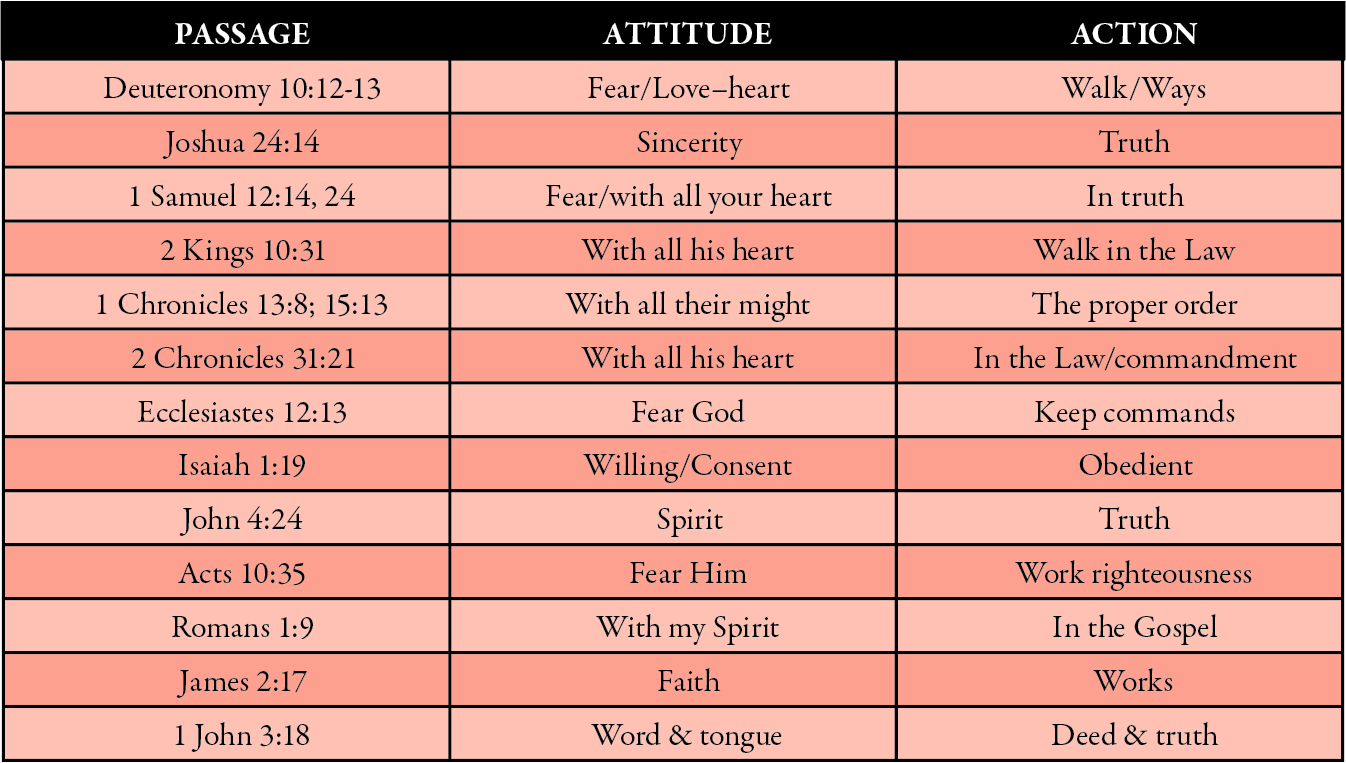
God has always required that man approach him “in truth,” i.e., according to the divine directives that He revealed to man. The only worship that has ever been acceptable to God has been that worship which has been undertaken with (1) a proper attitude, frame of mind, and disposition conducive to spirituality, and (2) faithfulness to the specific “legal” requirements that God pinpointed as the proper external acts to be performed. God has never accepted one without the other. He has, in fact, always required both—the right action along with the right attitude. Study carefully Table 1 below.13
| PASSAGE | ATTITUDE | ACTION |
| John 4:24 | Spirit | Truth |
| Joshua 24:14 | Sincerity | Truth |
| Ecclesiastes 12:13 | Fear God | Keep Commands |
| Acts 10:35 | Fear Him | Work Righteousness |
| James 2:17 | Faith | Works |
| 1 John 3:18 | Word & Tongue | Deed & Truth |
| Deuteronomy 10:12-13 | Fear/Love—Heart | Walk/Ways |
| Romans 1:9 | With my Spirit | In the Gospel |
It is a grave mistake to attempt to pit God’s Word against itself. To emphasize one dimension of obedience over the other is to hamper one’s acceptance by God. Bible history is replete with instances of those who possessed one without the other and were unacceptable to God. The Pharisees (Matthew 23:3), Ananias and Sapphira (Acts 5:2-4), and the people of Amos’ day (Amos 5:21-24) engaged in the external forms—but were unacceptable because of their insincerity. On the other hand, Paul (Acts 22:3; 23:1), Cornelius (Acts 10:1-2), and Uzzah (2 Samuel 6:6) all demonstrated genuine motives—but were unacceptable to God because of their failure to observe the correct legal forms.
Conclusion
Hezekiah’s Passover does not offer justification for violating specific worship regulations laid down by God’s Law. Nor does it offer justification for concluding that a person whose heart is turned toward God and Christ, but who has not complied with the prerequisites to salvation, i.e., belief, repentance, confession, and baptism for the remission of sins (Matthew 28:19-20; Acts 2:38; 22:16; John 8:24; Romans 10:9-10), may be saved. Those who seek to justify or excuse sprinkling for baptism, should look again at the Passover of Hezekiah’s day and ask themselves a question: Why would anyone wish to defend an action today on the basis of an action that stands as a historically long-term violation of the law, confessed to be a sin, a sin that had to be presented to God, and for which pardon had to be secured?
Endnotes
1 Joseph Fletcher (1967), Moral Responsibility (Philadelphia, PA: Westminster Press), p. 31, emp. added.
2 Paul Faulkner (1992), “Getting Ahead: Taking Your Family With You,” Freed-Hardeman University Lectureship, Cassette Tape (Henderson, TN: FHU), emp. added.
3 E.g., Rubel Shelly and John York (2003), The Jesus Proposal (Siloam Springs, AR: Leafwood); John Hicks and Greg Taylor (2004), Down in the River to Pray (Siloam Springs, AR: Leafwood).
4 NOTE: The theory that “ritualistic details” of God’s Word may be set aside, when a person is sincerely seeking from the heart, conflicts with the fact that God reconfirmed the necessity of complying with four legal details: (1) The alternate day had to be the 14th day of the second month—as opposed to just any day selected by the worshipper. As Keil observed: “The postponement of the Passover until the second month in special circumstances was provided for by the law, but the transfer of the celebration to another day of the month was not. Such a transfer would have been an illegal and arbitrary innovation, which we cannot suppose Hezekiah capable of [C.F. Keil and F. Delitzsch (1976 reprint), Commentary on the Old Testament (Grand Rapids, MI: Eerdmans), 3:455, emp. added]; (2) Only unleavened bread and bitter herbs were to be eaten (vs. 11); (3) none of the food was to be left until morning (vs. 12); and (4) The lamb’s bones were not to be broken (vs. 12). Apparently, God’s law is sufficiently inflexible as to disallow humans from excusing themselves from strict obedience. This truth is further demonstrated by the fact that, after articulating the exception to the general rule, God immediately reiterated the essentiality of meticulous compliance with His law: “But the man who is clean and is not on a journey, and ceases to keep the Passover, that same person shall be cut off from among his people, because he did not bring the offering of the Lord at its appointed time; that man shall bear his sin” (Numbers 9:13). The foreigner was likewise required to comply (vs. 14). Observe: if the liberal was correct in his assessment of Deity, such legal details would have been waived aside and God would have simply said: “These stipulations are optional. Don’t sweat the small stuff!”
5 Willem VanGemeren, ed. (1997), New International Dictionary of Old Testament Theology and Exegesis (Grand Rapids, MI: Zondervan), 4:1061.
6 To suggest that Hezekiah prayed for those who were ceremonially unclean before they ate the Passover, in order to get forgiveness before the sin was committed, is to suggest that the Medieval Catholic practice of selling indulgences was right!
7 Matthew Henry, (no date), Commentary on the Whole Bible: Joshua to Esther (New York: Fleming H. Revell), 2:1003.
8 George Williams (1960), The Student’s Commentary on the Holy Scriptures (Grand Rapids, MI: Kregel), sixth edition, p. 254.
9 Robert Jamieson, A.R. Fausset, and David Brown (no date), A Commentary on the Old and New Testaments (Grand Rapids, MI: Zondervan), p. 282; cf. Edward Curtis and Albert Madsen (1910), A Critical and Exegetical Commentary on the Books of Chronicles (New York: Charles Scribner’s Sons), p. 475.
10 cf. VanGemeren, 3:1163-1164.
11 P.C. Barker (1950), The Pulpit Commentary: II Chronicles (Grand Rapids, MI: Eerdmans), p. 361.
12 Dave Miller (2019), Baptism & the Greek Made Simple (Montgomery, AL: Apologetics Press), https://apologeticspress.org/wp-content/uploads/2022/02/Baptism-and-the-Greek-Web.pdf.
13 Taken from Dave Miller (1996), Piloting the Strait (Pulaski, TN: Sain Publications), pp. 184-185.
The post Hezekiah’s Passover and Situation Ethics appeared first on Apologetics Press.
]]>The post “As Often As” and the Lord’s Supper appeared first on Apologetics Press.
]]>In the same manner He also took the cup after supper, saying, “This cup is the new covenant in My blood. This do, as often as you drink it, in remembrance of Me.” For as often as you eat this bread and drink this cup, you proclaim the Lord’s death till He comes (1 Corinthians 11:25-26).
Some have alleged: “The phrase ‘as often as’ means that the Corinthians were permitted to partake of the Lord’s Supper as often as they chose to do so—anytime they decided to without any limitations on the day or the frequency.”
This viewpoint is characterized by two flaws: (1) it fails to grasp the grammar and context of the passage and (2) it fails to consider everything God says about the matter elsewhere in the New Testament.
The Grammar/Context:
Several phrases/words in the context indicate the notion of time: “do this” (vss. 24,25), “as often as” (vss. 25,26), “until” (vs. 26), and “when” (vs. 33). However, none of these words provide any assistance in ascertaining when or how often the Lord’s Supper is to be observed. Frequency, repetition, and consistency are certainly inherent in the construction of such expressions, but they do not specify the precise parameters of frequency. Paul’s remarks in 1 Corinthians 11 simply do not provide any assistance in ascertaining exact observance, although he indirectly clarifies the matter in chapter 16 where he links another act of worship with Sunday. J.W. McGarvey reflects this awareness in his comment on 11:26—“The constant observance of this feast through the centuries is one of the strongest of the external evidences of the truth of gospel history. By a chain of weekly links it will connect the first and second comings of our Lord; after which there will be no further need of symbols.”1
The contextual focus is on the perpetual nature of the Lord’s Supper until the end of time. Hence, when it is observed (without any indication of when that observance occurs, whether Sunday or some other day of the week), every time it is observed, it must be done for the purpose of remembering what Jesus did. God intended for the Lord’s Supper to be an ongoing, repetitious proclamation to Christians and outside observers of the reality of what Jesus did on the cross and the fact that He will come again. Findley paraphrases: “Paul assumes that celebration will be frequent, for he directs that, however frequent, it must be guided by the Lord’s instructions, so as to keep the remembrance of Him unimpaired.”2
The Greek word that the Holy Spirit selected in both verse 25 and verse 26, rendered “as often as” in the NKJV, is hosakis. This relative adverb is used three times3 in the New Testament with two of the three occurrences found in these two verses. According to respected Greek grammarian A.T. Robertson, the word is “only used with the notion of indefinite repetition.”4 In his discussion of general temporal clauses, he categorizes the term with other “Conjunctions Meaning ‘When.’”5 Hence, the term provides no insight by which one can ascertain any specificity to the repetition. It most certainly provides no indication that the reader is free to select his own frequency; nor does it exclude a stipulation of frequency that might be indicated elsewhere in the New Testament. Lexicographers provide the following synonymous meanings: “whenever,” “as often as,” “so many times as,” “how many times as,” “how often,” “how often soever,” “as many times as.”6 Observe that all these expressions are simply referring to the event occurring without specifying frequency.
English translations demonstrate that hosakis does not convey the idea that the Lord’s Supper may be taken anytime one chooses or that Sunday is not the singular day God intended. Consider the following chart that summarizes English translation7 usage:
| Translation | 1 Cor. 11:25 | 1 Cor. 11:26 |
|---|---|---|
| CEB | Every time you drink | Every time you eat |
| CEV | Drink this | When you eat |
| ERV | When you drink | Every time you eat |
| EXB | When you drink | Every time you eat |
| GW | Every time you drink | Every time you eat |
| GNT | Whenever you drink | Every time you eat |
| ICB | When you drink | Every time you eat |
| PHILLIPS | Whenever you drink | Whenever you eat |
| JUB | Each time that ye drink | Each time that you eat |
| NOG | Every time you drink | Every time you eat |
| NCB | Whenever you drink | Whenever you eat |
| NCV | When you drink | Every time you eat |
| NET | Every time you drink | Every time you eat |
| NIRV | Every time you drink | When you do this |
| NIV | Whenever you drink | Whenever you eat |
| NTE | Whenever you drink | Whenever you eat |
| VOICE | Whenever you drink | Every time you taste |
| WE | Every time you drink | Every time you eat |
Observe that “every time,” “when,” “whenever,” and “each time” are equivalent expressions. They convey repetition without specifying the day or time of observance. The text does not intend to imply that therefore Christians are free to pick and choose their own days. Rather, the language selected by the Holy Spirit in 1 Corinthians 11:25-26 provides no assistance in determining whether God intends for the Lord’s Supper to be observed on a particular day or at a particular time. If He so specified, the New Testament would have to so indicate elsewhere.
Summary
Neither the Greek nor the English convey the idea that Christians are free to select their own times for partaking of the Lord’s Supper. The reader must read that idea into the text. If the New Testament gave no further directives regarding the frequency or the day of the Lord’s Supper, the reader would be free to select his own observance occasions, deciding which days of the week and how often it would be observed. But the Lord gave us additional instructions on the matter.
Further Instructions from God
To be fair and honest with Scripture, one must gather everything the Bible has to say on a subject and reason about that material correctly to arrive at the totality of God’s will on that subject. Specifically, one must examine the New Testament to ascertain God’s will regarding observance of the Lord’s Supper. As it pertains to frequency of observance, the following verses clarify the matter by providing a complete picture: Acts 2:42,46; Acts 20:7; Acts 20:11; 1 Corinthians 16:1-2.8
Implications
Consider these implications of the foregoing. If God did not specify His intentions regarding frequency of observance of the Lord’s Supper, a person could partake one time after conversion and fulfill God’s expectations. If the Christian lives to be 90 years old, he would please God by the single observance.
Further, could the Jews have celebrated the Sabbath on days other than the Sabbath/Saturday? According to Deuteronomy 5:12-15, the Sabbath commemorated the Exodus—the deliverance of the Jews from Egyptian bondage. Could they not have reasoned—like those today who dislodge the Lord’s Supper from Sunday—that the perpetual commemoration of the Exodus could also be achieved on days other than Saturday? The Jews could not have known when to commemorate the Exodus unless God had so stipulated. If God had not given any indication of the day, the Jews would have been free to observe it on any day and their observance would not necessarily have to have even been weekly. But by associating commemoration of the Exodus with Saturday, the Jews were under obligation to conform to God’s directive and to do otherwise would have been sinful.
The fact is that the bulk of Christendom—though generally associating observance of the Lord’s Supper with Sunday—has felt free to alter and adjust God’s instructions on a variety of matters over the centuries, including tampering with the scriptural directive regarding Sunday. Yet His potent declarations remain in effect and offer somber warning to those who would presume to alter His directives:
- “You shall not add to the word which I command you, nor take from it, that you may keep the commandments of the Lord” (Deuteronomy 4:2).
- “Therefore you shall be careful to do as the Lord your God has commanded you; you shall not turn aside to the right hand or to the left” (Deuteronomy 5:32).
- “Whatever I command you, be careful to observe it; you shall not add to it nor take away from it” (Deuteronomy 12:32).
- “Do not add to His words, lest He rebuke you, and you be found a liar” (Proverbs 30:6).
- “Whoever transgresses and does not abide in the doctrine of Christ does not have God. He who abides in the doctrine of Christ has both the Father and the Son” (2 John 9).
- “He who rejects Me, and does not receive My words, has that which judges him—the word that I have spoken will judge him in the last day (John 12:48).
ENDNOTES
1 J.W. McGarvey (1916), Thessalonians, Corinthians, Galatians and Romans (Cincinnati, OH: The Standard Publishing Co.), p. 118, emp. added.
2 G.G. Findlay, “St. Paul’s First Epistle to the Corinthians,” in W. Robertson Nicoll, ed. (1900), The Expositor’s Greek Testament (Grand Rapids, MI: Eerdmans), 2:881, italics in orig.
3 W.F. Moulton, A.S. Geden, and H.K. Moulton (1978), A Concordance to the Greek Testament (Edinburgh: T.&T. Clark), fifth edition, p. 712.
4 A.T. Robertson (1934), A Grammar of the Greek New Testament in the Light of Historical Research (Nashville, TN: Broadman Press), p. 973; A.T. Robertson (1931), Word Pictures in the New Testament (Nashville, TN: Broadman), p. 165, emp. added.
5 Robertson, Grammar, p. 971.
6 Daniel Wallace (2000), The Basics of New Testament Syntax (Grand Rapids, MI: Zondervan), p. 209; H.E. Dana and Julius Mantey (1927), A Manual Grammar of the Greek New Testament (Toronto, Canada: Macmillan), p. 281; Charles Robson (1839), A Greek Lexicon to the New Testament (London: Whittaker & Co.), p. 322; John Pickering (1839), A Greek and English Lexicon (Boston: Hilliard, Gray, Little, & Wilkins), p. 653; Henry Liddell and Robert Scott (1901), A Greek-English Lexicon (Oxford: The Clarendon Press), p. 1082.
7 The translation abbreviations signify the following: CEB (Common English Bible), CEV (Contemporary English Version), ERV (Easy-to-Read Version), EXB (Expanded Bible), GW (God’s Word Translation), GNT (Good News Translation), ICB (International Children’s Bible), PHILLIPS (J.B. Phillips New Testament), JUB (Jubilee Bible 2000), NOG (Names of God Bible), NCB (New Catholic Bible), NCV (New Century Version), NET (New English Translation), NIRV (New International Reader’s Version), NIV (New International Version), NTE (New Testament for Everyone), VOICE (The Voice Bible), WE (Worldwide English New Testament).
8 For an extensive analysis of these verses and New Testament teaching on Sunday observance of the Lord’s Supper, see Dave Miller (2007), “Sunday & the Lord’s Supper,” https://apologeticspress.org/sunday-and-the-lords-supper-1254/.
The post “As Often As” and the Lord’s Supper appeared first on Apologetics Press.
]]>The post Q&A: David and Musical Instruments appeared first on Apologetics Press.
]]>“What made King David so special that he could dictate matters strictly reserved for ‘Thus says the Lord’? And, further, why did Solomon and other succeeding kings follow David’s expansion of musical instruments?”
A:
David committed several grievous sins in his lifetime, including his sin with Bathsheba, his unauthorized taking of the census, and the eating of the showbread (which Jesus said was “not lawful”—Matthew 12:4; Mark 2:26; Luke 6:4). However, overall, he seemed to have a committed heart most of the time. Like all of us, he stumbled on occasion (like Abraham, also). His intermittent failures were not likely to be attributed to “indifference,” but merely giving in to temptation and the pressure of the moment, again, like the rest of us. God did not brush aside those infractions, nor would He want us to draw the conclusion that David was somehow “special” and given greater leeway or forgiveness than the rest of us, nor that God approved of any action on David’s part in which he presumed to dictate worship protocol. God is consistent throughout human history in His insistence that His law be obeyed—by everybody—and He never authorizes violations of it. To violate God’s law is, by definition, “sin” (1 John 3:4), and sin must be forgiven in accordance with the divine prescription for atonement—no exceptions.
Regarding the introduction of instrumental music, the Bible plainly states that it was not David who made this change—but God Himself. Read 2 Chronicles 29:25—And he stationed the Levites in the house of the LORD with cymbals, with stringed instruments, and with harps, according to the commandment of David, of Gad the king’s seer, and of Nathan the prophet; for thus was the commandment of the LORD by his prophets.
Notice the line of authority in that verse: (1) God, (2) Nathan the prophet, (3) Gad the King’s Seer , and (4) David. So God authorized the introduction of instruments (for the Levites), doing so via the chain of authority from Himself to prophet, to seer, and then to David. It would make sense, then, that some passages would say that they were introduced “by the command of David.” But that is simply the Bible’s not infrequent way of shortening a concept. One must gather everything in the Bible on a particular subject and fit it together properly before drawing any conclusions (1 Thessalonians 5:21). David commanded/added instruments into Temple worship because he was authorized to do so by God Himself. See also 2 Chronicles 30:12 for this same sequence: “Also the hand of God was on Judah to give them singleness of heart to obey the command of the king and the leaders, at the word of the LORD.” The intermediate authorities who issued commands to the people were simply operating under the overall jurisdiction and instructions of God. Observe, then, that this clarification answers the second question: Solomon, Hezekiah, et al. added instruments because God authorized them to do so.
Of course, the lesson for Christians living today is to recognize that God has always acted in harmony with His principle of authority. All people are to worship God in accordance with His worship instructions specified in the New Testament. It so happens that since the cross, God confines all musical worship expression to vocal music—not instrumental (1 Corinthians 14:15; Ephesians 5:19; Colossians 3:16; James 5:13).

What About Amos 6:5?
Some have suggested that the use of instrumental music in worship in David’s day was condemned on the basis of the fact that the prophet Amos uttered “woe” on those who invented for themselves musical instruments like David (Amos 6:5). The context of the passage, however, clarifies the meaning of this statement as originally intended by the inspired prophet.
Like most of the Old Testament prophets, the primary mission of Amos was to rebuke God’s people for their disobedience in hopes of restoring them to the righteous living that God required and expected of them. After spotlighting the sins of the surrounding nations and announcing their punishment (chs. 1-2), Amos turned his attention to the Israelites’ own sins, including their dishonesty, unethical treatment of others, sexual immorality, oppression of the poor, and other acts of injustice. The population was particularly immersed in materialism—living in ease, luxury, and comfort while forsaking the priority of spiritual things. Amos’ response? “Woe to you who are at ease in Zion” (6:1). In his booklet on the minor prophets, Jack Lewis provides a fitting summary of their materialistic condition:
Women, whose insatiable desire for finery drives their husbands to oppression, stretched out on their couches of ivory, call each to her husband, “Mix us another drink” (4:1). The people have their summer houses and winter houses (3:15) and their beds of ivory (6:4). At ease in Zion, the people eat the finest food, anoint themselves with fine oil, and invent instruments of music like David for their entertainment, but do not concern themselves with the approaching ruin of their country.1
The passage has nothing to do with worship, comparing the Israelites of Amos’ day with David only in the matter of using instruments. Their use of instruments was directed to their wanton lifestyle in the midst of spiritually barren lives. In the same way that there was nothing inherently wrong with the Israelites having ivory couches, summer homes, and lambs and calves to eat, there was nothing inherently wrong with the invention (and use) of musical instruments. The problem was that their submersion in luxury dulled their spiritual appetites and caused them to turn against God.
ENDNOTE
1 Jack Lewis (1998), The Minor Prophets (Henderson, TN: Hester Publications), p. 19.
The post Q&A: David and Musical Instruments appeared first on Apologetics Press.
]]>The post Response to a Facebook Post: The Lord’s Supper on Sunday? appeared first on Apologetics Press.
]]>“Was the Lord’s Supper Made for Man or Man for the Lord’s Supper?”
This statement is an allusion to Jesus’ affirmation in Mark 2:27—“And He said to them, ‘The Sabbath was made for man, and not man for the Sabbath.’” The writer apparently assumes that the Lord’s Supper is a direct parallel to the Sabbath. It is not, but even if that were the case, what did Jesus mean by this statement? Did He mean that, since God intended the Sabbath to be a benevolent requirement in which both man and animal would be given a day of much needed rest, it was nothing more than a general guideline that could be altered or ignored at will if the situation necessitated it? And that, therefore, as a parallel, even if God indicated that the Lord’s Supper was to be observed on Sunday, He would not be so “nit-picky” or “legalistic” as to actually expect everyone to comply even if inconvenient?1 If so, how does one explain the following incident?
Now while the children of Israel were in the wilderness, they found a man gathering sticks on the Sabbath day. And those who found him gathering sticks brought him to Moses and Aaron, and to all the congregation. They put him under guard, because it had not been explained what should be done to him. Then the LORD said to Moses, “The man must surely be put to death; all the congregation shall stone him with stones outside the camp.” So, as the LORD commanded Moses, all the congregation brought him outside the camp and stoned him with stones, and he died (Numbers 15:32-36).
The fact that “the Sabbath was made for man” most certainly did not mean that God approved of violating the Sabbath. In reality, the meaning of Jesus’ statement in Mark 2:27 is that God built into the Sabbath law a compassionate regard for both man and animal—and no one should violate the very precepts that God designed for man’s good. While it was intended as a compassionate law for man’s good, it was not optional. However, the Jews of Jesus’ day had corrupted God’s original intentions by placing their own added restrictions and misinterpretations on the people, thereby losing sight of the original Sabbath laws.2 Further, the fact that every day belongs to God does not nullify the fact that God can and has set aside certain days and required people to observe those days in special ways (e.g., the Sabbath and the annual feast days under Moses and the Lord’s Supper under Christ).
“Some Look at Acts 20 As Creating a Law, I See a Narrative of a Miracle. Paul Brought a Man Back to Life. That’s Amazing.”
Yes, the performance of a miracle was certainly “amazing”—but why? Because it was intended to serve the purpose for which all miracles were performed by God’s emissaries: to confirm or authenticate the orally-presented Word.3 However, Luke’s report of Paul’s meeting with the Christians in Troas in Acts 20 surely had additional purposes—not the least of which was to clarify for all Christians for all time precisely what Jesus predicted would take place:
But the Helper, the Holy Spirit, whom the Father will send in My name, He will teach you all things, and bring to your remembrance all things that I said to you…. However, when He, the Spirit of truth, has come, He will guide you into all truth; for He will not speak on His own authority, but whatever He hears He will speak; and He will tell you things to come (John 14:26; 16:13).
In other words, the apostles were charged and empowered by God to set into place the legal parameters of the Christian religion, enabling the churches to worship and live in accordance with God’s directives. The observance of the Lord’s Supper by the early churches, like Troas, was intended to be prototypical. It was a demonstration of God’s intention for all the churches. Paul made this very point abundantly clear several times in his remarks to the church at Corinth in 1 Corinthians: “as I have given orders to the churches of Galatia” (16:1); “For I received from the Lord that which I also delivered to you” (11:23); “the rest I will set in order when I come” (11:34); “as in all the churches of the saints” (14:33); “the things which I write to you are the commandments of the Lord” (14:37).
Observe that the Facebook post suggests an underlying assumption that “law” is a negative, undesirable thing. But why would anyone speak derisively as if “law” is somehow bad or negative—and imply that God would not create laws for us? Throughout history, from the Garden forward, God has been a God of law. And His laws are neither “burdensome” (1 John 5:3) nor undesirable (Psalm 19:10). Quite the opposite, God’s law is “holy, and the commandment holy and just and good” (Romans 7:12). An attitude that desires to view the religion of Christ as devoid of law is a shameful attitude—the very opposite attitude of the psalmist who expressed “love” for God’s laws and saw them as desirable and indispensable (Psalm 119:97; 19:7-14).
“Don’t Let Anyone Judge You About Keeping or Not Keeping Holy Days and Feasts.”
This misuse of Colossians 2:16 misconstrues Paul’s remarks which pertained to outdated Jewish regulations: circumcision, sabbaths/feast days, New Moon, etc. The context demonstrates that he was saying that one must not allow himself to be judged for refusing to observe obsolete religion (i.e., the Law of Moses was no longer in effect—Hebrews 8:13; 9:15-17; Romans 7:6; Colossians 2:14). He was certainly not speaking of the religion of Christ. Those who practiced various doctrines that were not part of the religion of Christ were guilty of engaging in “the commandments and doctrines of men” and “self-imposed religion” (2:23). Likewise, observance of the Lord’s Supper on some day other than Sunday is a doctrine that came from the mind of man, not God. It is self-imposed—not God-imposed worship.4 In stark contrast, Sunday has been the premiere day of the week for the public worship of God via Christianity for 2,000 years, and the Lord’s Supper has always been associated with that first day of the week worship.
“Love God and Love Others, Those Are the Only ‘Must Do’s’ In the New Covenant.”
This allusion to Jesus’ remarks in Matthew 22:37-39 leaves the impression that loving God and loving fellowman excludes requirements like worshipping God “acceptably” (Hebrews 12:28). This misunderstanding of Jesus’ words advocates the notion that as long as we truly love God and others, there are no restrictions or requirements to which we are obligated to conform. Ripping Jesus’ words from their context, this view fails to realize that He was saying that the only way to love is to do so through God’s law. For example, when the law says, “Do not steal,” to steal would be unloving to the person from whom the person stole. The laws of Christ that forbid lying, cheating, committing adultery, etc. are divinely intended to specify how to conduct oneself in a loving way. Hence, as Paul made clear, love fulfills the law by obeying it (Romans 13:8-10). Jesus reiterated the same thing in John 14:15—“If you love Me, keep My commandments” and in John 15:14—“You are My friends if you do whatever I command you.” John did the same in 1 John 5:3—“For this is the love of God, that we keep His commandments. And His commandments are not burdensome.” No wonder the psalmist declared: “I obey your statutes, for I love them greatly” (Psalm 119:167). No wonder God stated emphatically to the Israelites of Jeremiah’s day: “Obey My voice, and I will be your God, and you shall be My people” (Jeremiah 7:23). So the only way, by definition, to love God and love our fellowman is by obeying God’s commands which, in turn, define how to love.
“If a Group Gets Together During the Week and Wants to Honor God and Remember the Sacrifice that Jesus Made, Who Are We to Judge Them?”
This mindset elevates human motives and preferences above God’s instructions. But God has always required both from people—good motives and conformity to His instructions. One cannot and must not elevate one above the other. The chart below demonstrates God’s will on the matter.
According to God, one may not “honor” Him without complying with His directives as to how to do so. Moses recalled God’s explicit articulation of this very fact immediately after He burned to death Aaron’s two sons: “By those who come near Me I will be treated as holy, and before all the people I will be honored” (Leviticus 10:3, NASB). When the two boys chose to offer “unauthorized fire” (vs. 1, ESV), they dishonored God. It would do no good to complain: “If those boys wanted to get together and honor God by sacrificing to Him, who are we to judge them?” The same may be said for many other individuals in Bible history who sought to approach God, but they did so without following divine protocols and were rejected accordingly, including Cain (Genesis 4:5), Saul (1 Samuel 13:9ff.; 15:20-23), Uzzah (2 Samuel 6:7; 1 Chronicles 15:13), Uzziah (2 Chronicles 26:16-18), et al. It is just this attitude that has led to a host of other alterations in Christian worship, including candle lighting services, sprinkling babies, instrumental music, choirs, rosary beads, the papacy—the list is endless. All such illicit innovations come from the mind of men and do not honor God (cf. Colossians 2:23).
Further, the querist asks: “Who are we to judge them?” The use of the word “judge” with regard to those who alter God’s worship directives by partaking of the Lord’s Supper during the week is also a misuse of Scripture. “Judge not that you be not judged” (Matthew 7:1) certainly does not exclude making accurate applications of Scripture in ascertaining correct worship. We are not guilty of unscripturally judging individuals simply because we point out that they have made changes to God’s Word and engage in “will worship.” Rather, Jesus made plain that He and His Word judges them (John 12:48). We’re simply observing, acknowledging, and calling attention to God’s own judgment on such conduct. Read 1 Corinthians 5:12-13.
“The Law of Sin and Death Was Nailed to the Cross.”
Paul stated that the law of sin and death, i.e., the law that pronounces spiritual death upon you when you sin (Romans 8:2), is still in effect. The only way a person can escape the guilt of sin is by the law of the spirit, i.e., the Gospel of Christ. Yet the only way to embrace the Gospel of Christ is via an obedient faith (Romans 1:5; 16:26) which includes such “do’s” as faith (Romans 5:1), repentance (Romans 2:4), oral confession (Romans 10:10), and immersion (Romans 6:3-4). These are divine obligations, i.e., “laws.” Does anyone honestly think that all law has been eliminated in Christ? If so, can we now lie, cheat, steal, and murder with impunity? Or does Jesus Christ have laws against such actions that remain in effect? He absolutely does! The New Testament is filled with laws from God to which both Christians and non-Christians are amenable. For example:
Now the works of the flesh are evident, which are: adultery, fornication, uncleanness, lewdness, idolatry, sorcery, hatred, contentions, jealousies, outbursts of wrath, selfish ambitions, dissensions, heresies, envy, murders, drunkenness, revelries, and the like; of which I tell you beforehand, just as I also told you in time past, that those who practice such things will not inherit the kingdom of God (Galatians 5:19-21).
“Let’s Come and Fellowship Around the Lord’s Table Not Because We Have To, But Because We Can, Through the Love and Grace That He Gave Us.”
Such statements imply that striving to conform precisely to God’s directives regarding the Lord’s Table makes a person guilty of observing the Lord’s Supper only because he has to—again, betraying an attitude of aversion toward law and a disrespectful attitude toward the God Who gave us His laws. But, as already noted, God requires both complete conformity to His specifications as well as a proper attitude of gratitude for His love and grace. The complete inconsistency and self-contradiction of such thinking is seen in the fact that the only way a person even knows about the Lord’s Supper is that it is set forth in Scripture. So why is the questioner not guilty of legalistic behavior for observing the Lord’s Supper, but the person who observes the Lord’s Supper when God said to do so is disingenuous and guilty of making laws God didn’t make? In fact, according to the same “reasoning,” the accuser is guilty of what he imagines in others if he conforms to any of the religious requirements of the New Testament—including prayer, singing, giving of his means, reading the Bible, and so forth. Are any of these actions necessary? If even one is viewed as required, the accuser is guilty of what he condemns in others.
“This Article (Which Is Just Another COC Denominational Creed) Is Another of the Many Reasons I’m No Longer A Part of the Church of Christ Denomination.”
This disparaging allusion to the church we read about in the Bible as a “denomination” is equally inaccurate, unscriptural, and indefensible. After all, Jesus did declare He would establish His church (Matthew 16:18), did He not? Is the questioner suggesting that that very church cannot exist today without being a denomination? If Isaiah, Micah, and Daniel could predict that God would eventually establish His kingdom/church on Earth (Isaiah 2:1-5; Micah 4:1-5; Daniel 2:44), and Jesus then stated emphatically that He was about to do so during the lifetime of His apostles (Mark 9:1), and He did just that 50 days after His crucifixion in the city of Jerusalem in Acts 2, why would anyone speak derisively of that church and act as if it could not possibly exist today—or that it is to be equated with the entire denominational world that consists of a host of conflicting doctrines and practices invented by mere men?5
Endnotes
1 Situation ethics is clearly condemned in Scripture. See Dave Miller (2004), “Situation Ethics—Extended Version,” https://apologeticspress.org/APContent.aspx?category=11&article=645&topic=38.
2 See Dave Miller (1996), Piloting the Strait (Pulaski, TN: Sain Publications), pp. 410ff.
3 E.g., Mark 16:20; Hebrews 2:3-4. See Dave Miller (2020), Modern-Day Miracles? Do Miracles, Tongue-Speaking, & Holy Spirit Baptism Occur Today? (Montgomery, AL: Apologetics Press)
4 Various English versions capture the meaning of the term Paul used in Colossians 2:23 to pinpoint the concept that Christians have no right to adjust, alter, or supplement God’s directives, including “will worship” (ASV/KJV/YLT), “self-imposed religion” (NKJV/NRSV/OJB), “self-made religion” (ESV/NASB/ISV), “made-up religion” (ERV), “part of a human religion” (NCV), “self-chosen holiness” (NMB); “vain religion” (Wycliffe), “self-imposed religious piety” (MOUNCE).
5 For more on the origin of the New Testament Church, see What the Bible Says About the Church of Christ, https://apologeticspress.org/pdfs/e-books_pdf/wtbsatcoc.pdf.
The post Response to a Facebook Post: The Lord’s Supper on Sunday? appeared first on Apologetics Press.
]]>The post Prophesying With Instruments? appeared first on Apologetics Press.
]]>“I heard a preacher on television say he can ‘prophesy’ using his trumpet. Is that possible?”
A:
An example of this activity is seen on the charismatic website New Zealand Prophetic Network in an article that asserts the following:
Holy Spirit ministry functions through many and varied means. One of the not so common today is that of musicians prophesying on their instruments: that is, the ability to play prophetically on their instruments in such a way as to release the anointing to the people…. This is the realm where musicians can play prophetically, whereby the anointed tune—even a new tune—can actually enable the Holy Spirit to interpret the feeling and/or message of the tune to our hearts. As we listen intently while the musician plays (can be singular or plural), we “pick-up” the heartbeat of God, and the theme of that heart beat is interpreted to us in the realm of our understanding. When that happens we can experience deep peace, joy, inspiration, even tears, as the Holy Spirit speaks. Yet no words have been spoken; only the playing of an anointed tune on an instrument.1
Those who make this claim seek justification for the practice in 1 Chronicles 25:1 which reads: “Moreover David and the captains of the army separated for the service some of the sons of Asaph, of Heman, and of Jeduthun, who should prophesy with harps, stringed instruments, and cymbals.” However, this claim is a misconception based on a faulty exegesis of the text. Even on the face of it, a trumpet or other mechanical instrument cannot “prophesy” since the word “prophesy” in Hebrew refers to speaking, i.e., articulating meaningful concepts via oral or written words.2 The only way a musical instrument can convey specific meanings is if it is used as a signaling device with a prearranged, mutually understood meaning attached to a specific tune or tones. Historically, armies have used trumpets and bugles to sound a particular movement by the troops—whether “charge,” “retreat,” “call to quarters,” etc. But the instrument itself has no intellectual content, meaning, or message inherent in the sound it is capable of making. Paul made this very point when he chided the Corinthian Christians for their failure to make certain that their tongue-speaking and prophesying was comprehended by the assembly. Noting that instruments are “without life,” even they must make sounds that are understood by those intended to be the recipients of the pre-decided message being conveyed (1 Corinthians 14:7).
When the Bible speaks of “prophesying with harps, etc.,” it is not suggesting that a harp can prophesy. Rather, the grammar of the passage makes clear that the prophesying is done by the human prophet who, in turn, is merely accompanied by the instrument. The word “with” in the NKJV flags this fact.3 It is made even clearer by a quick consideration of other English translations:
| 1 Chronicles 25:1 | |||
| prophesy | with | harps, stringed instruments, and cymbals | NKJV |
| for the ministry of prophesying | accompanied by | harps, lyres and cymbals | NIV |
| prophesied | to the accompaniment of | lyres and harps and cymbals | NABRE |
| to preach | and play | harps, lyres, and cymbals | NCV |
| prophesy | to the accompaniment of | harps, and lutes, and cymbals | WYC |
So why accompany a prophet’s message from God with musical instruments? History does not answer this question definitively. However, consider a couple of possibilities that do not contradict other plainly established biblical realities. First, perhaps the instruments were intended to capture the attention of the Israelites, who would have constituted a large assembled crowd, in an effort to announce the commencement of the proclamation of the prophet’s divine message. This circumstance would have been analogous to court musicians who herald the arrival of the king or queen—a “fanfare”—defined as “a short ceremonial tune or flourish played on brass instruments, typically to introduce something or someone important.”4 Second, since prophetic messages throughout the Old Testament are typically couched in standard Hebrew metrical verse, perhaps the instrumental accompaniment was intended to reinforce the rhythmic nature of Hebrew poetry. The Bible does not inform us as to the activities of scores of prophets that we know ministered to Israel by prophesying. Keep in mind that the predictive element of our English word “prophesy” is secondary and sometimes even nonexistent in Hebrew prophecy. The majority of Hebrew prophecy was simply inspired preaching in which the prophet instructed, rebuked, corrected, and challenged his hearers with regard to their misbehavior/misconduct. In such a case, the prophets were something like the roving minstrels of the Middle Ages who traveled around the countryside and from town-to-town conveying messages via poetry accompanied by their strumming on a lute.5 In this way, Hebrew prophets would have permeated Israelite society on a daily basis, reminding the people of their spiritual and moral responsibility to conform every day to God’s will. This very scenario seems to be what we find in 1 Samuel 10:5.6
In any case, when a televangelist in our day claims to “prophesy” simply by playing a tune on a trumpet or other instrument, he does so without biblical precedent for such claims. After all, instruments are “without life.”
Endnotes
1 Rodney Francis (2016), “Prophetic Ministry Through Musical Instruments and Singers,” NZ Prophetic Network, https://www.nzpropheticnetwork.com/prophetic-ministry-through-musical-instruments-and-singers-by-rodney-w-francis.
2 Francis Brown, S.R. Driver, and Charles A. Briggs (1906), The Brown-Driver-Briggs Hebrew and English Lexicon (Peabody, MA: Hendrickson, 2000 reprint), p. 612; William Gesenius (1847), Hebrew and Chaldee Lexicon (Grand Rapids, MI: Baker, 1979 reprint), p. 525-526.
3 The Hebrew word for “harp” is kin-nohr (which is plural in the text) and has the inseparable preposition B= as a prefix which means “with.” Also in verse 3.
4 “Fanfare” in Angus Stevenson, ed. (2010), Oxford Dictionary of English (Oxford: Oxford University Press), third edition, p. 632.
5 Of course, the use of musical instruments to worship God according to New Testament Christian worship protocol is unauthorized. See Dave Miller (2007), Richland Hills and Instrumental Music: A Plea to Reconsider (Montgomery, AL: Apologetics Press).
6 As further proof that the prophesying was distinct from the playing on an instrument, notice that Samuel informed Saul that God’s Spirit would come upon him and enable him to join in the prophesying. Obviously, that did not mean that Saul picked up an instrument and began playing it. In fact, Saul apparently could not soothe himself by playing an instrument, which provided the occasion for enlisting the instrumental skill possessed by David (1 Samuel 16:14ff.). See also 2 Kings 3:15. Observe further that no prophet could play a trumpet while simultaneously prophesying since the trumpet requires the use of the mouth and lips in order to play it—which would prevent the prophet from using his mouth in order to prophesy an intelligible message from God.
The post Prophesying With Instruments? appeared first on Apologetics Press.
]]>The post Is All of Life Worship? appeared first on Apologetics Press.
]]>[AP auxiliary writer Earl Edwards holds a B.A. from David Lipscomb University, an M.Th. from Harding School of Theology, and a D.Miss. from Trinity Evangelical Divinity School. Dr. Edwards was a missionary in Italy for 16 years and also served as director of the Florence Bible School. For 20 years he served as the Director of Biblical Graduate Studies at Freed-Hardeman University, where he continues to work as an adjunct faculty member.]
When the Bible uses the term “worship,” what is included? Does it include all of life as some theologians affirm? For example, one commentator says that Paul, in Romans 12:1, teaches that “all Christian living is worship offered up to God.”1 Is that correct?
Let’s take some typical passages from both testaments to see how inspired writers generally use the word “worship.” In the Old Testament, it is first used in Genesis 22:5 with reference to Abraham and Isaac when Abraham says to his servant, “I and the lad will go over there and worship (shāhāh) and return.”2 It is clear that Abraham is saying we will, “over there,” do an act of “worship” (i.e., offer Isaac as a sacrifice, do an act of obedience to God) which we are not doing over here at present. All of life is not worship as the term is used here.
Let’s move on to 2 Samuel 12:20 which speaks of David, who, after the loss of his child by Bathsheba, ceased grieving and “washed” and “anointed himself, and changed his clothes; and he came into the house of the Lord and worshiped (shāhāh).” Obviously while grieving and washing himself he was not worshiping; he did that later in “the house of the Lord.” That is, he performed some literal act in the Temple (probably praying or singing praises or sacrificing to God). So, here, too, all of life is not worship. In fact, one lexicon defines the Hebrew term used in both these passages (shāhāh) as “to bow down” before “a monarch” or “before God in worship.”3 But, as we will see later, for it to be acceptable worship to God, the outward “bowing” must be accompanied by an inward literal decision of the heart/mind to be submissive to God. Now this word shāhāh is the word which is translated by the English word “worship” in roughly 90% of the appearances of “worship” in any major version of our English Old Testament. It must be noted that even when God’s people bowed down and “multipl[ied] prayers,” God did “not listen” (Isaiah 1:15) when there was no corresponding inward decision of the heart/mind to be submissive, God required more than “lip service;” He desired “their hearts” (Isaiah 29:13). No wonder David was a man after God’s own heart, for he wrote (of God), “I will give You thanks with all my heart; I will sing praises to You before the gods. I will bow down toward Your holy temple and give thanks to Your name” (Psalm 138:1-2, emp. added). David did “bow” his head, but the real worship was in submitting “all” of his “heart.” As P.W. Crannell says of worship, “the OT idea is therefore the reverential attitude of mind or body or both”4 But, as seen from passages like Isaiah 1:15, and others, it is clear that acceptable worship for God must include that “reverential attitude” which will necessarily provoke a literal decision of the heart/mind to be submissive.
Thus, these usages of the term “worship” militate against accepting the idea that all of life is worship because acceptable worship necessarily includes the heart/mind. It must be intentional. One does not have to bow his head to present acceptable worship, but he must of necessity make a decision in his heart/mind to be submissive to his Creator. Acceptable worship must be done with heart/mind engaged, and no man can live with his heart/mind concentrating on his relationship to God 24/7. You can’t concentrate on God when you are studying how to get “your ox out of the ditch”!
Now let’s move to some typical usages of the term “worship” in the New Testament. John 12:20 speaks of certain “Greeks among those who were going up to worship (proskuneo) at the feast.” Acts 8:27 speaks of an Ethiopian who “had come to Jerusalem to worship (proskuneo).” Acts 24:11 quotes Paul as saying, “I went up to Jerusalem to worship (proskuneo).” In all three of these passages it is clear that the persons referenced were not worshiping while traveling; rather, they intended to worship in Jerusalem after arriving. This probably involved one or more of the following: prayers, songs of praise, and/or sacrifices. The term “worship” does not include all of life here. In fact, the original Greek word proskuneo means, according to Bauer’s lexicon, “to express in attitude or gesture one’s complete dependence on or submission to a high authority.”5 Thayer’s lexicon explains further that proskuneo came originally from two Greek words which meant “kiss” and “towards,” a gesture being done “in token of reverence.”6 Kittel’s Theological Dictionary of the New Testament says proskuneo “remains limited to a single act.”7 Now, proskuneo is the Greek word behind roughly 90% of the appearances of the word “worship” in any major version of our English New Testament. When this gesture is done towards our God, we learn from Jesus that it must be done “in spirit and in truth” in order to be acceptable worship (John 4:24). As Leon Morris says, “in spirit” means “a man must worship, not simply outwardly…but in his spirit.”8 In bowing to men just the outward gesture may suffice, but in worship to God the outward gesture (bowing, kissing, sacrificing, mouthing words of praise) is not sufficient; it must include the literal act of submission of the inner person (the heart/mind). This can’t be done while one is concentrating on “figuring one’s income taxes”! All of life is not worship. It is clear in both testaments and in all major translations that acceptable worship to our God requires the concentration of the worshiper’s inner person on submission to his Creator. That does not happen 24/7 in any life. Therefore, all of life is not worship.
It is against this background of the meaning of “worship” in both Testaments that we must approach the problem of how to translate logikēn latreian in Romans 12:1. The NASB renders that passage as follows: “Therefore, I urge you, brethren, by the mercies of God, to present your bodies a living and holy sacrifice, acceptable to God, which is your (logikēn latreian) spiritual service of worship.” The two options for translating latreian are “service” and “worship.” In fact, Bauer’s lexicon defines it as “service/worship (to God).”9 The NASB seems to try to straddle the fence and take in both concepts, but most major translations use either “worship” (RSV, NASB, ESV, NIV, etc.) or “service” (KJV, ASV, NKJV, etc.). To be candid, one must admit that the majority of current scholars (translators and commentators) favor using “worship” in this passage, but that does not guarantee that this is correct. (The major number of current scholars also oppose “baptism for the remission of sins.”)
No one doubts that latreia can sometimes mean “worship.” In fact, I think Paul uses it to mean “the temple worship” (NIV) in Romans 9:4. However, the same Paul uses it, I believe, with a more general meaning in Acts 26:7 where Luke quotes him as saying that Christians “hope to attain” the promise as “they earnestly serve” (latreuo—the verb cognate to latreia) God “night and day.” Now what such Christians did in this “night and day” lapse might include public worship and daily prayers, but it certainly would not be limited to such. It would also include sleep when the heart/mind could not be engaged in submitting itself to God. That’s probably why the NIV, and other translations also, render latreuo as “serve” instead of “worship” here in Acts 26:7. Marvin Vincent likewise says that here latreuo is “better [rendered] as serve.”10 So sometimes latreia is a more general term. K. Hess writes,
It was originally used predominantly of physical work, but was then used generally and could include cultic service…in the OT…it is not the meticulously performed cultus which is the true worship of God, but of [general] obedience to the voice of the Lord.11
Notice that latreia, according to Hess, can include worship, but it is not limited to such. It is sometimes a broader, more general, term. As Gary Workman wrote: “It is a fact that latreuo and latreia refer to service in general, and not worship in particular…. Service is broader than worship. All worship is service, but not all service is worship.”12
Now we come to Romans 12:1 and logikēn latreian. Probably the best translation of logikēn is “reasonable” (as in the NKJV). That is, it makes sense to an intelligent, human being. Then we deal with latreian.
As noticed, the examples of acceptable “worship” from both Testaments treated earlier in this study were literal acts of the person’s heart/mind submitting itself to God, possibly also accompanied by a physical act or gesture—like bowing, kissing toward, or sacrificing or praising with one’s lips.
Now, in interpreting latreian in Romans 12:1, Everett F. Harrison aptly notes that in this passage Paul uses latreian in a different sense. He says Paul “gives it a metaphorical turn.”13 That is, though Paul uses worship language—note terms like “present” (parastesai), “sacrifice” (thusian), “holy” (agian), and “acceptable” (euareston)—he is not speaking of literal worship. He is using “metaphorical” or figurative language. William Sanday and Arthur Headlam agree. They say Paul is “metaphorical” in his use of “sacrificial language.”14 Harrison continues his discussion of Romans 12:1 saying,
The problem to be faced is whether “worship” may not be too restricted a rendering, for worship, in the strict sense, is adoration of God, which does not fit well with the concept of bodies [mentioned earlier in the verse—bodies are not where the required submission takes place]. It is just at this point that the term “service” (KJV) has an advantage since it covers the entire range of the Christian’s life and activity…. Service is the proper sequel to worship.15
Harrison is saying that the interpretation of “metaphorical language” is controlled by a different set of rules. E.W. Bullinger has written an 1,100-page book on the use of figures of speech in the Bible and in its preface he says that we should decide we are dealing with a figure when it
seems to be at variance with the general teaching of the Scriptures, then we may reasonably expect that some figure is employed…. Commentators and interpreters, from inattention to the figures, have been led astray from the real meaning of many important passages of God’s Word; while ignorance of them has been the fruitful parent of error and false doctrine.16
For example, since literal baptism is in water (Acts 8:36), when Jesus speaks of a “baptism” He will undergo, which is the same as the “cup” He must drink (Mark 10:38-39; cf. Matthew 26:39)—His suffering on the cross, we know that has to be a figurative baptism. Here there is little chance of mistaking this for a literal baptism but, just to avoid all such possibility, one translator renders it, “Can you be overwhelmed in the immersion that submerges me?”17 In figurative language the rules are less restrictive. In literal language one is either born into a given family or he is adopted. He cannot be both. Instead, in God’s figurative family from one standpoint we become Christians by being “born of the water and the Spirit” (John 3:5); from another standpoint we have come into the family by “adoption as sons” (Romans 8:15). Likewise, when one thinks of the figurative foundation of the church, from one standpoint Christ is the entire foundation (1 Corinthians 3:11) whereas, from another standpoint, the apostles and prophets are a part of the foundation and Christ is the “cornerstone” (Ephesians 3:20). Figurative language is less restrictive. It is controlled by different rules.
Now Harrison is saying that Romans 12:1 should tip us off to the fact that, though worship words are used, we should understand that language to be figurative since “bodies” are mentioned in the same verse and real worship does not take place there, but in the inner person—the heart. Bullinger would probably add (if he were to comment on Romans 12:1) that thinking of the “sacrifice” here as literal “worship” leads one to a definition of “worship” which is “at variance with the general teaching of Scripture.”
In other words, since acceptable worship is a heart/mind activity, such “bodies” cannot do acceptable “worship” by themselves without the participation of the inner person. When the mocking soldiers at the crucifixion “worshiped” (proskuneo) Jesus (Mark 15:19), it certainly was not acceptable worship! Acceptable worship necessarily involves the submission of the heart/mind.
Now, since lexicons agree that “service” is sometimes a legitimate translation of latreia, why should one use “worship” here in Romans 12:1 when such a translation forces a definition of “worship” which goes against the normal usage of the term in both Testaments in all major translations?
Harrison’s argument in favor of “service” in Romans 12:1 is, in reality, the same, but in different words, as the one made by Hugo McCord when he wrote (of latreian),
Sometimes the word refers to a lifetime of service to God (Acts 24:14; Heb. 12:28), and the context of Romans 12:1 shows one’s offering his body as a living sacrifice is a lifetime of service not of meditation (which is what worship is).18
Gordon Fee seems to be making basically the same argument in his discussion of latreuo as it appears in Philippians 3:3. He says,
The verb, therefore, is not the one for “worship” in the sense of what the congregation does together as a gathered people, but represents the “service” of God’s people in terms of their devotion to him as evidenced in the way they live before him… [A]ll of life in the present is service and devotion to God.19
Now, the fact that it has that meaning in Philippians 3:3 does not necessarily signify it has the same meaning in Romans 12:1, but at least it shows that Fee believes that sometimes latreia is used by Paul to mean “service” (and we have already made the case that it is also so used in Romans 12:1).
CONCLUSION
All of life is not worship, but all of life is service. But let no one accuse this student of believing that as long as one goes to a church building on Sunday (and says he “worships”) that he can, therefore, live as he pleases during the week. The true worshiper will always remember that “Whatever you do in word or deed” you should “do all in the name of the Lord Jesus” (Colossians 3:17).
ENDNOTES
1 Jack Cottrell (1998), The College Press NIV Commentary: Romans (Joplin, MO: College Press), 2:312.
2 All Biblical quotations are from the New American Standard Bible (Anaheim, CA: Foundation Publishers), unless otherwise indicated.
3 Francis Brown, S.R. Driver, and Charles Briggs (1962), A Hebrew and English Lexicon of the Old Testament (London: Clarendon Press), p. 1005.
4 P.W. Crannell (1939), “Worship,” International Standard Bible Encyclopedia (Grand Rapids, MI: Eerdmans), 5:3110.
5 Walter Bauer, Frederick Danker, W.F. Arndt, and F.W. Gingrich (2000), A Greek-English Lexicon of the New Testament (Chicago, IL: University of Chicago Press), p. 882.
6 Joseph Thayer (1956), A Greek-English Lexicon of the New Testament (Edinburgh, Scotland: T&T Clark), p. 548.
7 Gerhard Kittel, ed. (1971), Theological Dictionary of the New Testament (Grand Rapids, MI: Eerdmans), 7:172.
8 Leon Morris (1971), The Gospel According to John (Grand Rapids, MI: Eerdmans), pp. 270-271, emp. added.
9 Bauer, p. 587.
10 Marvin Vincent (1969), Word Studies in the New Testament (Grand Rapids, MI: Eerdmans), 1:581.
11 K. Hess (1981), latreia in Dictionary of New Testament Theology, ed. Colin Brown (Grand Rapids, MI: Zondervan), 3:549-552, emp. added.
12 Gary Workman (1993), “What is Worship?” Spiritual Sword, June, p. 7.
13 Everett Harrison (1976), Expositor’s Bible Commentary (Grand Rapids, MI: Zondervan), 10:128.
14 William Sanday and Arthur Headlam (1900), International Critical Commentary: Romans. (Edinburgh, Scotland: T&T Clark), p. 353.
15 Harrison, p. 128.
16 E.W. Bullinger (1984), Figures of Speech Used in the Bible (Grand Rapids, MI: Baker), pp. xv-xvi, emp. added.
17 Hugo McCord (1988), McCord’s New Testament Translation of the Everlasting Gospel (Henderson, TN: Freed-Hardeman College), p. 87.
18 Hugo McCord (1982), “Worship,” Firm Foundation, June 1, p. 6.
19 Gordon Fee (1995), New International Commentary on the New Testament: Philippians (Grand Rapids: MI: Eerdmans), p. 300, emp. added.
The post Is All of Life Worship? appeared first on Apologetics Press.
]]>The post The Order of the Lord’s Supper appeared first on Apologetics Press.
]]>It is certainly the case that Jesus only instituted the Lord’s Supper one time. He either blessed the bread first or He blessed the cup first. He did not do it both ways. So can we make sense of the text in such a way that the Bible is not discredited, recognizing that Jesus did not do it both ways? On that lone night so long ago, when He instituted the Lord’s Supper, which way did He do it? Bread then cup, or cup then bread?
It is clearly the case that Bible writers do not always claim to be representing a particular event in chronological sequence. Luke could have easily been treating the Passover and Lord’s Supper incident topically. In such a case, no contradiction would exist. However, in this particular instance, a different explanation presents itself.
Read carefully Luke’s reporting of the event:
Then came the Day of Unleavened Bread, when the Passover must be killed. And He sent Peter and John, saying, “Go and prepare the Passover for us, that we may eat.” …When the hour had come, He sat down, and the twelve apostles with Him. Then He said to them, “With fervent desire I have desired to eat this Passover with you before I suffer; for I say to you, I will no longer eat of it until it is fulfilled in the kingdom of God.” Then He took the cup, and gave thanks, and said, “Take this and divide it among yourselves; for I say to you, I will not drink of the fruit of the vine until the kingdom of God comes.” And He took bread, gave thanks and broke it, and gave it to them, saying, “This is My body which is given for you; do this in remembrance of Me.” Likewise He also took the cup after supper, saying, “This cup is the new covenant in My blood, which is shed for you” (22:7-20, emp. added).
Observe carefully that Jesus instituted the Lord’s Supper on the tail end of the observance of the Jewish Passover. One must be careful to distinguish between the two, particularly since the same emblems were used for both, and since the former typifies the latter. The killing of the Passover lamb under Judaism anticipated the death of Jesus Who, in turn, became “our Passover” (1 Corinthians 5:7). Luke, more than Matthew and Mark, demonstrates this close parallelism.1
Luke actually has two allusions to “cup”—one in verse 17 and the other in verse 20. The first “cup” was taken during the Passover and the second “cup” was part of the institution of the Lord’s Supper.2 Hence, Luke does not differ from Matthew and Mark in specifying the same order for partaking of the Lord’s Supper, i.e., first the bread and then the cup. Luke’s use in verse 20 of “likewise” refers back to “He took bread,” and “after supper” refers both to the bread and the cup of the Lord’s Supper.
This fact is further supported by Paul in his recounting of the occasion in 1 Corinthians 11:23-29. Observe the indications of sequence he portrays—
For I received from the Lord that which I also delivered to you: that the Lord Jesus on the same night in which He was betrayed took bread; and when He had given thanks, He broke it and said, “Take, eat; this is My body which is broken for you; do this in remembrance of Me.” In the same manner He also took the cup after supper, saying, “This cup is the new covenant in My blood. This do, as often as you drink it, in remembrance of Me.” For as often as you eat this bread and drink this cup, you proclaim the Lord’s death till He comes. Therefore whoever eats this bread or drinks this cup of the Lord in an unworthy manner will be guilty of the body and blood of the Lord. But let a man examine himself, and so let him eat of the bread and drink of the cup. For he who eats and drinks in an unworthy manner eats and drinks judgment to himself, not discerning the Lord’s body (emp. added).
Observe that Paul goes out of his way to emphasize the order that Jesus instigated—bread/cup and eat/drink. He even clarified that the cup that is part of the Lord’s Supper was done “after supper,” i.e., after the Passover meal. So the “cup” of Luke 22:17-18 was the cup that was associated with the Passover meal—not the Lord’s Supper cup which is noted in verse 20 after the Passover meal and after the bread of the Lord’s Supper.
Another consideration pertains to the fact that Luke 22:17-20 constitutes a textual variant. However, the Committee for the UBS Greek text concluded that the cup-bread-cup sequence is authentic based on “the overwhelming preponderance of external evidence.”3 Further, Sir Frederic Kenyon and S.C.E. Legg offer the only plausible explanation for the existence of variants by noting:
The first cup given to the disciples to divide among themselves should be taken in connection with the previous verse (ver. 16) as referring to the eating of the Passover with them at the reunion in Heaven. This is followed by the institution of the Sacrament, to be repeated continually on earth in memory of Him. This gives an intelligible meaning to the whole, while at the same time it is easy to see that it would occasion difficulties of interpretation, which would give rise to the attempts at revision that appear in various forms of the shorter version.4
Hence, the first allusion to “cup” in verse 17 links back with the eating and drinking of the Passover meal in verses 15-16, while the second allusion to “cup” refers to the Lord’s Supper. Luke agrees with Matthew and Mark that, when Jesus instituted the Lord’s Supper, He first took the bread and then took the cup. There is no contradiction.
Endnotes
1 See J.W. McGarvey and Philip Y. Pendleton (no date), The Fourfold Gospel (Cincinnati, OH: The Standard Publishing Foundation), p. 646.
2 Ibid, p. 658. See also J.W. McGarvey (1910),Short Essays in Biblical Criticism (Cincinnati, OH: The Standard Publishing Company), pp. 342-343.
3 Bruce Metzger (1971), A Textual Commentary on the Greek New Testament (New York: United Bible Societies), p. 176.
4 Sir Frederic G. Kenyon and S.C.E. Legg (1937), “The Textual Data” in The Ministry and the Sacraments, ed. Roderic Dunkerley (London: SCM), pp. 285-286.
 |
|
| Suggested Resources | |
The post The Order of the Lord’s Supper appeared first on Apologetics Press.
]]>The post Jehovah's Witnesses and the Worship of Jesus appeared first on Apologetics Press.
]]>
According to Jehovah’s Witnesses, “Jesus is not God,” and thus should not be worshiped by Christians. The Watchtower, a magazine published twice a month by Jehovah’s Witnesses, has repeatedly made such claims through the years. In their September 15, 2005 issue, for example, they stated quite simply that the Scriptures “show that Jesus is not God Almighty.” The Jehovah’s Witnesses’ official website (jw.org), which republishes many items from The Watchtower, briefly answers the question “Do Jehovah’s Witnesses Believe in Jesus?,” concluding, “we do not worship Jesus, as we do not believe that he is Almighty God” (2015). After all, allegedly “in his prehuman existence, Jesus was a created spirit being…. Jesus had a beginning and could never be coequal with God in power or eternity” (“What Does the Bible…?,” 2000, emp. added). The October 15, 2004 issue of The Watchtower concluded a section about Jesus not being the true God with these words: “Jehovah, and no one else, is ‘the true God and life everlasting.’ He alone is worthy to receive exclusive worship from those whom he created.—Revelation 4:11” (p. 31). Since God alone is worthy of worship, and since Jehovah’s Witnesses believe that Jesus is only an angel and not God (see “The Truth About Angels,” 1995), He allegedly should not be worshiped.
God alone is worthy of worship
There is no argument over the fact that God alone is worthy of worship. Jehovah revealed His will to Moses on Mt. Sinai, saying, “You shall have no other gods before Me. You shall not make for yourself a carved image—any likeness of anything that is in heaven above, or that is in the earth beneath, or that is in the water under the earth; you shall not bow down to them nor serve them. For I, the Lord your God, am a jealous God” (Exodus 20:3-5). Regarding the Gentiles who were sent to live in Samaria after the Assyrians conquered the Northern Kingdom of Israel, the Bible says:
To this day they continue practicing the former rituals; they do not fear the Lord, nor do they follow their statutes or their ordinances, or the law and commandment which the Lord had commanded the children of Jacob, whom He named Israel, with whom the Lord had made a covenant and charged them, saying: “You shall not fear other gods, nor bow down to them nor serve them nor sacrifice to them; but the Lord, who brought you up from the land of Egypt with great power and an outstretched arm, Him you shall fear, Him you shall worship, and to Him you shall offer sacrifice” (2 Kings 17:34-36, emp. added).
The Bible reveals time and again that God alone is to be worshiped. Luke recorded that King Herod was eaten with worms because, instead of glorifying God Almighty, he allowed the people to glorify him as a god (Acts 12:21-23). Herod’s arrogant spirit stands in direct contrast to the reaction that Paul and Barnabas had when the citizens of Lystra attempted to worship them (Acts 14:8-18). After Paul healed a man who had been crippled from his birth, the people of Lystra shouted: “The gods have come down to us in the likeness of men.” They even called Paul and Barnabas by the names of their gods (Hermes and Zeus), and sought to worship them with sacrifice. Had these two preachers had the same arrogant spirit as Herod, they would have accepted worship, and felt as if they deserved such honor. Instead, these Christian men “tore their clothes and ran in among the multitude, crying out and saying, ‘Men, why are you doing these things? We also are men with the same nature as you’” (Acts 14:15). Paul recognized that it is unlawful for humans to worship other humans, and thus sought to turn the people’s attention toward God, and away from himself.
The Bible also reveals that man must refrain from worshiping angels. When the apostle John fell down to worship before the feet of the angel who had revealed to him the message of Revelation, the angel responded, saying, “See that you do not do that. For I am your fellow servant, and of your brethren the prophets, and of those who keep the words of this book. Worship God” (Revelation 22:9, emp. added; cf. 19:10). Angels, idols, and humans are all unworthy of the reverent worship that is due only to God. As Jesus reminded Satan: “It is written, ‘You shall worship the Lord your God, and Him only you shall serve’” (Matthew 4:10, emp. added).
Jesus Accepted Worship
The dilemma in which Jehovah’s Witnesses find themselves is that they believe Jesus was a good man and prophet, yet unlike good men and good angels who have always rejected worship from humanity, Jesus accepted worship. If worship is to be reserved only for God, and Jesus, the One “who knew no sin” (2 Corinthians 5:21; 1 Peter 2:22), accepted worship, then the logical conclusion is that Jesus believed that He was deity. Numerous times the Bible mentions that Jesus accepted worship from mankind. Matthew 14:33 indicates that those who saw Jesus walk on water “worshiped Him.” John 9:38 reveals that the blind man whom Jesus had healed, later confessed his belief in Jesus as the Son of God and “worshiped him.” After Mary Magdalene and the other women visited the empty tomb of Jesus, and the risen Christ appeared to them, “they came and held Him by the feet and worshiped Him” (Matthew 28:9). When Thomas first witnessed the resurrected Christ, he exclaimed, “My Lord and my God” (John 20:28). Later, when Jesus appeared to the apostles in Galilee, “they worshiped Him” on a mountain (Matthew 28:17). A few days after that, his disciples “worshiped Him” in Bethany (Luke 24:52). Time and time again Jesus accepted the kind of praise from men that is due only to God. He never sought to correct His followers and redirect the worship away from Himself as did the angel in Revelation or the apostle Paul in Acts 14. Nor did God strike Jesus with deadly worms for not redirecting the praise He received from men as He did Herod, who, when being hailed as a god, “did not give praise to God” (Acts 12:23).
Sadly, Jehovah’s Witnesses have attempted to circumvent the obvious references to Jesus accepting worship by changing the word “worship” in their New World Translation to “obeisance” every time the Greek word proskuneo (the most prominent word for worship in the New Testament) is used in reference to Jesus. Over 30 times in the New World Translation (first published by the Jehovah’s Witnesses Watchtower Bible and Tract Society in 1950) proskuneo is correctly translated “worship” when God the Father is the recipient of glory and praise. This Greek word occurs 14 times in the New Testament in reference to Jesus, yet not once do more recent editions of the New World Translation render it “worship;” instead, every time it is translated “obeisance.” Allegedly, Mary Magdalene, the apostles, the blind man whom Jesus healed, etc., never worshiped Jesus; rather, they only paid “obeisance” to Him.
In 21st-century English, people generally make a distinction between the verbs “worship” and “do obeisance.” Most individuals, especially monotheists, use the word worship in a positive sense when talking about God, whereas “obeisance” is used more often in reference to the general respect given to people held in high regard. The American Heritage Dictionary of the English Language defines “obeisance” as “1. A gesture or movement of the body, such as a curtsy, that expresses deference or homage. 2. An attitude of deference or homage,” whereas the verb “worship” is defined as “1. To honor and love as a deity. 2. To regard with ardent or adoring esteem or devotion” (2000, emp. added). The Watchtower Bible and Tract Society agrees with the distinction often made between these words in modern English: God should be “worshiped,” while Jesus (we are told) should only receive “obeisance” (i.e., the respect and submission one pays to important dignitaries and superiors).
The Greek word proskuneo, which appears in the New Testament 60 times, literally means “to kiss the hand to (towards) one, in token of reverence” (Thayer, 1962, p. 548; see also Mounce, 1993, p. 398). According to Greek scholars Arndt, Gingrich, and Danker, this word was used in ancient times “to designate the custom of prostrating oneself before a person and kissing his feet, the hem of his garment, the ground, etc.; the Persians did this in the presence of their deified king, and the Greeks before a divinity or something holy” (1979, p. 723). Admittedly, the word “obeisance” could be used on occasions to translate proskuneo. The problem is that Jehovah’s Witnesses make an arbitrary distinction between obeisance and worship when it comes to the token of reverence that Jesus in particular was given. They translate proskuneo as “obeisance” every time Jesus is the object, yet never when God the Father is the recipient of honor and praise.
As with other words in the Bible that have multiple meanings, the context can help determine the writer’s intended meaning. Consider the circumstances surrounding some of the occasions when Jesus is mentioned as the object of man’s devotion.
- In John chapter nine, Jesus miraculously healed a man who was “blind from his birth” (vs. 1). When the man upon whom this miracle was performed appeared before various Jews in the synagogue and called Jesus a prophet (vs. 17), he was instructed to “give glory to God,” not Jesus, because allegedly Jesus “is a sinner” (vs. 24). Later, after the man born blind was cast out of the synagogue, Jesus informed him of His true identity—that He was not just a prophet, but also “the Son of God.” At that moment, the gentleman exclaimed, “Lord, I believe,” and he worshiped Him (vs. 38). Although the Greek word proskuneo was used in ancient times of paying respect or doing obeisance to people, no such translation is warranted in this passage. In the Gospel of John, this word is found 11 times. In every instance, Jehovah’s Witnesses’ New World Translation renders it “worship,” except here in John 9:38 where it is arbitrarily translated “obeisance.”
- Following a day in which Jesus miraculously fed 5,000 men (not including women and children) with only five loaves of bread and two fish, Matthew recorded how Jesus literally walked on the water in the midst of the Sea of Galilee during a violent storm, saved Peter from drowning, and then walked onto a boat where He was met with those who “worshiped him, saying, ‘Truly You are the Son of God’” (Matthew 14:33). Jesus’ worshipers did not merely pay Him the same respect (or “obeisance”) that one pays a respected ruler, teacher, or master—people incapable of such feats. On the contrary, they recognized that Jesus had overcome the laws of nature, and that His actions warranted praise and adoration—not as a man, but as the “Son of God.” If Jesus was not worthy of such praise, why did He accept it? If Jesus was not to be adored, why did the angel of the Lord not strike Him with the same deadly worms with which he struck Herod (Acts 12:23)?
- After defeating death and rising from the grave, a sign which declared Him to be “the Son of God with power” (Romans 1:4), Jesus accepted worship (proskuneo) from Mary Magdalene and the other women who went to visit the tomb of Jesus (Matthew 28:8-9), as well as all of the apostles (Matthew 28:17). Jesus was not the only one ever to be resurrected from the dead, but He was the only resurrected individual the Bible mentions as afterwards receiving praise and adoration (i.e., worship) from man. The widow’s son of Zarephath (1 Kings 17:22), the son of a Shunammite (2 Kings 4:32-35), the daughter of Jairus (Mark 8:21-24,35-43), the widow of Nain’s son (Luke 7:11-16), Lazarus (John 11:1-45), Tabitha (Acts 9:36-43), and Eutychus (Acts 20:7-12) all were raised from the dead, but none received proskuneo. The Bible never reveals any resurrected person other than Jesus who ever received and accepted worship. Jesus’ followers recognized that His resurrection was different. It verified His claims of divinity.
- The disciples worshiped Jesus again at His ascension. After recording that Jesus was “carried up into heaven,” Luke wrote: “[T]hey worshiped Him, and returned to Jerusalem with great joy, and were continually in the Temple praising and blessing God” (Luke 24:52). Notice that the word “worshiped” (proskuneo) is used in this passage along with such words as “praising” and “blessing”—words that carry a religious connotation in connection with God. This fact highlights that the use of proskuneo in this context is not merely obeisance. Also, notice that the disciples offered worship to an “absent” Savior. It would make no sense to pay obeisance to a respected individual that has departed, but makes perfect sense if, rather, the individual is God and worthy of worship. The disciples did not just bow before some earthly ruler; they worshiped their Lord Who had defeated death 40 days earlier, and had just ascended up into heaven before their eyes.
Jesus did not receive proskuneo on these occasions because He was a great teacher, or because He was viewed at these moments simply as an earthly king. Rather, all of these instances of worship were surrounded by miraculous events that were done to prove He was Heaven sent, and that “in Him dwells all the fullness of the Godhead bodily” (Colossians 2:9). There is every reason to believe that on such occasions as these, Jesus’ disciples meant to pay divine, religious honor to Him, not mere civil respect or regard that earthly rulers often receive.
Waffling on the Worship of Jesus
To the church at Philippi the apostle Paul wrote: “Therefore God also has highly exalted Him [Jesus] and given Him the name which is above every name, that at the name of Jesus every knee should bow, of those in heaven, and of those on earth, and of those under the earth, and that every tongue should confess that Jesus Christ is Lord, to the glory of God the Father” (Philippians 2:9-11, emp. added). The reference to the bowing of the knee is an obvious allusion to worship (cf. Isaiah 45:23; Romans 1:4). Such worship, Paul wrote, would not only come from those on Earth, but also from “those in heaven” (Philippians 2:10). This statement harmonizes well with Hebrews 1:6. In a section in which the writer of Hebrews exalted Jesus above the heavenly hosts, he affirmed that even the angels worship Christ. He wrote: “Let all the angels of God worship (proskuneo) Him.” The KJV, ASV, NKJV, NASB, ESV, NIV, RSV and a host of other translations render proskuneo in this verse as “worship.” How does the Jehovah’s Witnesses’ New World Translation render this passage? Unfortunately, as with all other times in the NWT when Jesus is mentioned as being the object of proskuneo, the word is translated “do obeisance,” not “worship.” Hebrews 1:6 reads: “Let all God’s angels do obeisance to him” (NWT).
Interestingly, however, the NWT has not always rendered proskuneo in Hebrews 1:6 as “do obeisance.” When Jehovah’s Witnesses’ Watchtower Bible and Tract Society first printed the NWT in 1950, the verse actually rendered proskuneo as “worship” instead of “do obeisance.” Even the revised 1961 edition of the NWT translated proskuneo as “worship.” But, by 1971, Jehovah’s Witnesses had changed Hebrews 1:6 to read: “Let all God’s angels do obeisance to him.”
The fact is, the Watchtower Bible and Tract Society has been very inconsistent in their teachings on whether or not Jesus should be worshiped. In the past few decades Jehovah’s Witnesses’ flagship magazine (November 1964, p. 671) has claimed that “it is unscriptural for worshipers of the living and true God to render worship to the Son of God, Jesus Christ” (as quoted in Rhodes, 2001, p. 26; see also The Watchtower 2004, pp. 30-31). But, “from the beginning it was not so.” Notice what Jehovah’s Witnesses used to teach in The Watchtower (called Zion’s Watch Tower in the early days) regarding whether or not Jesus should be worshiped:
- “The wise men came at His birth to worship Him. (Matt. 2) The leper worshiped Him. They in the ship worshiped Him, as did also the ruler and woman of Canaan. Yet none were ever rebuked for it…. [T]o worship Christ in any form cannot be wrong” (Allen, 1880, emp. added).
- “[A]lthough we are nowhere instructed to make petitions to him, it evidently could not be improper to do so; for such a course is nowhere prohibited, and the disciples worshiped him” (Zion’s Watch Tower, 1892, emp. added).
- “Yes, we believe our Lord Jesus while on earth was really worshiped, and properly so” (Zion’s Watch Tower, 1898).
- “[W]hosoever should worship Him must also worship and bow down to Jehovah’s Chief One in that capital organization, namely, Christ Jesus…” (The Watchtower, 1945, p. 313).
For more than half a century, Jehovah’s Witnesses taught that it was acceptable to worship Jesus. Now, however, they claim it is unscriptural. Such inconsistency regarding the nature of Christ, which is no small matter, reveals to the honest truth seeker that the Watchtower Bible and Tract Society is an advocate of serious biblical error.
Sadly, Jehovah’s Witnesses not only reject the worship of Jesus because of their belief that He is not deity, they also must deny Him such religious devotion because they teach He actually is an angel. The Watchtower has taught such a notion for several years. The November 1, 1995 issue indicated, “The foremost angel, both in power and authority, is the archangel, Jesus Christ, also called Michael” (“The Truth About Angels”). More recently, an article appeared on the Jehovah’s Witnesses official website affirming “the Bible indicates that Michael is another name for Jesus Christ, before and after his life on earth…. [I]t is logical to conclude that Michael is none other than Jesus Christ in his heavenly role” (“Who Is Michael…?,” 2015). Since, according to Revelation 19:10 and 22:8-9, good angels do not accept worship, but rather preach the worship of God, and no other, Jehovah’s Witnesses must reject paying religious praise and devotion to Jesus. But, notice (again) how inconsistent Jehovah’s Witnesses have been. In only the fifth issue of Zion’s Watch Tower magazine (originally edited by Charles Taze Russell, the founder of The Watchtower Bible and Tract Society), regular contributing writer J.H. Paton stated about Jesus: “Hence it is said, ‘let all the angels of God worship him’: (that must include Michael, the chief angel, hence Michael is not the Son of God)…” (1879, p. 4, emp. added). Thus, at one time Jehovah’s Witnesses’ official publication taught that Jesus is not Michael the archangel, and that He should be worshiped. In the 21st century, however, Jehovah’s Witnesses teach that Jesus is Michael the archangel, and that He should not be worshiped. Clear contradictory statements like these found throughout the years in The Watchtower should compel current and potential members of this religious group to question their teachings in light of the Truth found in God’s Word.
“Worthy is the Lamb”
One additional passage to consider regarding the worship of Jesus is Revelation chapters four and five. In chapter four, the scene in this book of signs (cf. 1:1) is the throne room of God. The “Lord God Almighty” is described as sitting on His throne while “the living creatures give glory and honor and thanks to Him” (4:9). Also, “the twenty-four elders fall down before Him who sits on the throne and worship Him who lives forever and ever, and cast their crowns before the throne, saying: ‘You are worthy, O Lord, to receive glory and honor and power; for You created all things, And by Your will they exist and were created’” (4:10-11). In chapter five, the Lamb that was slain is introduced as standing “in the midst of the throne” (5:6). No one argues the fact that this Lamb is Jesus—the One Whom John the Baptizer twice called “The Lamb of God” (John 1:29,36), and Whom Peter called the “lamb without blemish and without spot” (1 Peter 1:19). Regarding this Lamb, the apostle John recorded the following in Revelation 5:11-14:
Then I looked, and I heard the voice of many angels around the throne, the living creatures, and the elders; and the number of them was ten thousand times ten thousand, and thousands of thousands, saying with a loud voice: “Worthy is the Lamb who was slain to receive power and riches and wisdom, and strength and honor and glory and blessing!” And every creature which is in heaven and on the earth and under the earth and such as are in the sea, and all that are in them, I heard saying: “Blessing and honor and glory and power be to Him who sits on the throne, and to the Lamb, forever and ever!” Then the four living creatures said, “Amen!” And the twenty-four elders fell down and worshiped Him who lives forever and ever (emp. added).
In this chapter, John revealed that both God the Father and Jesus are worthy to receive worship from all of creation. In fact, Jesus is given the same praise and adoration that the Father is given. Just as God is “worthy…to receive glory and honor and power” (4:11), so Jesus is “worthy…to receive power…and honor and glory…” (5:12). Indeed, “[b]lessing and honor and glory and power be to Him who sits on the throne, and to the Lamb, forever and ever” (5:13, emp. added). Although Jehovah’s Witnesses use Revelation 4:11 as a proof text for worshiping God the Father (see “What Does God…?,” 1996, p. 4), they reject and call unscriptural the worship that Jesus rightly deserves.
Conclusion
Jesus once stated during His earthly ministry, “[A]ll should honor the Son just as they honor the Father. He who does not honor the Son does not honor the Father who sent Him” (John 5:23). Sadly, Jehovah’s Witnesses refuse to honor Jesus in the same way they honor God the Father. While on Earth, Jesus was honored on several occasions. His followers worshiped Him. They even worshiped Him after His ascension into heaven (Luke 24:52). Unlike good men and angels in Bible times who rejected worship, Jesus unhesitatingly received glory, honor, and praise from His creation. Truly, such worship is one of the powerful proofs of the deity of Christ.
References
Allen, L.A. (1880), “A Living Christ,” Zion’s Watch Tower, March, https://archive.org/stream/1880ZionsWatchTower/1880_Watch_Tower_djvu.txt.
American Heritage Dictionary of the English Language (2000), (Boston, MA: Houghton Mifflin), fourth edition.
Arndt, William, F.W. Gingrich, and Frederick W. Danker (1979), A Greek-English Lexicon of the New Testament and Other Early Christian Literature (Chicago, IL: University of Chicago Press), second edition revised.
“Do Jehovah’s Witnesses Believe in Jesus?” (2015), http://www.jw.org/en/jehovahs-witnesses/faq/believe-in-jesus/.
Mounce, William D. (1993), Analytical Greek Lexicon of the New Testament (Grand Rapids, MI: Zondervan).
Paton, J.H. (1879), “The Name of Jesus,”Zion’s Watch Tower, November, https://archive.org/stream/1879ZionsWatchTower/1879_Watch_Tower_djvu.txt.
Rhodes, Ron (2001), The 10 Most Important Things You Can Say to a Jehovah’s Witness (Eugene, OR: Harvest House Publishers).
Thayer, Joseph (1962 reprint), Greek-English Lexicon of the New Testament (Grand Rapids, MI: Zondervan).
“The Truth About Angels” (1995), The Watchtower, November 1.
The Watchtower, 1945, October 15.
The Watchtower, 2004, October 15.
The Watchtower, 2005, September 15.
“What Does God Require of Us?” (1996), Watch Tower Bible and Tract Society of New York.
“What Does the Bible Say About God and Jesus?” (2000), Watch Tower Bible and Tract Society of Pennsylvania.
“Who Is Michael the Archangel?” (2015), http://www.jw.org/en/publications/books/bible-teach/who-is-michael-the-archangel-jesus/.
Zion’s Watch Tower, 1892, May 15, https://archive.org/stream/1892ZionsWatchTower/1892_Watch_Tower_djvu.txt.
Zion’s Watch Tower, 1898, July 15, https://archive.org/stream/1898ZionsWatchTower/1898_Watch_Tower_djvu.txt.
The post Jehovah's Witnesses and the Worship of Jesus appeared first on Apologetics Press.
]]>The post Are Songs and Prayers Sometimes One and the Same? appeared first on Apologetics Press.
]]>Are songs and prayers sometimes one and the same?
A.
Ask any five year old if there is a difference between singing and praying and you will likely receive the “you’ve-got-to-be-kidding-me” look. “Everyone knows there is a difference between singing and praying.” A song is composed of words and music. Its words are “uttered in musical tones and with musical inflections and modulations” (“Sing,” 2010). A prayer is “an address (as a petition) to God…in word or thought” (“Prayer,” 2010; cf. 1 Samuel 1:12-13). Prayers are without musical tones and inflections, right?
Although praying and singing are often two distinct acts of worship (cf. 1 Corinthians 14:15), sometimes they are one and the same. That is, occasionally (or perhaps oftentimes) petitions to God are sung to Him. The Greek word most frequently translated “prayer” in the New Testament is proseuche. It is defined simply as a “petition addressed to deity, prayer” (Danker, 2000, p. 878, emp. in orig.). In the Old Testament, the English word “prayer” is derived most frequently from the Hebrew word te phillâ. This word is found 76 times in the Old Testament. Interestingly, this word for prayer occurs most often (32 times) in the book of Psalms. Psalms are songs that were (and are) sung (cf. Psalm 105:2; 1 Chronicles 16:9; Colossians 3:16; James 5:13). The Israelites titled this collection of inspired poems tehillim, meaning “songs of praise or hymns” (“Psalms,” 1988).
Admittedly, simply because a song contains the word “prayer” (or “pray,” “praying,” etc.) does not make the song a type of prayer. However, as Harris, Archer, and Waltke observed in their Theological Wordbook of the Old Testament, “five Psalms are specifically called ‘prayers’ in their superscription (Ps 17, 86, 90, 102, 142)” (1980, p. 726). Bible publishers often add headings to each of the psalms in an attempt to help the reader easily recognize the subject matter. Thomas Nelson Publishers added the word “prayer” to the subject headings of some 25 psalms in their New King James translation of the book of Psalms. They also used prayer terminology (e.g., “a plea” or “an appeal”) to label several other psalms. Obviously, both the ancients (who gave us Psalms’ superscriptions) and certain modern-day Bible publishing companies have seen many of the psalms for what they are: prayers.
Consider a few of the psalms in which David and others prayed.
- “Hear me when I call, O God of my righteousness! You have relieved me in my distress; have mercy on me, and hear my prayer. How long, O you sons of men, will you turn my glory to shame? How long will you love worthlessness and seek falsehood? Selah” (4:1-2). [NOTE: “Selah” is found 71 times in the book of Psalms. Although its precise import is unknown, “it is generally agreed that Selah must be a musical or liturgical sign” (Wiseman, 1996, p. 1074).]
- “Hear a just cause, O LORD, attend to my cry; give ear to my prayer which is not from deceitful lips” (17:1).
- “And now, Lord, what do I wait for? My hope is in You…Selah. Hear my prayer, O Lord, and give ear to my cry” (39:7,11-12).
- “Save me, O God, by Your name, and vindicate me by Your strength. Hear my prayer, O God; give ear to the words of my mouth…Selah (54:1-3).
- “Give ear to my prayer, O God, and do not hide Yourself from my supplication. Attend to me, and hear me” (55:1-2).
- “Hear my cry, O God; attend to my prayer…. I will sing praise to your name forever” (61:1,8).
- “O LORD God of hosts, hear my prayer; give ear, O God of Jacob! Selah” (84:8).
- “Bow down Your ear, O LORD, hear me…. Give ear, O LORD, to my prayer” (86:1,6).
- “Hear my prayer, O LORD, and let my cry come to You…. Of old You laid the foundation of the earth, and the heavens are the work of Your hands” (102:1,25). [NOTE: According to Hebrews 1:8-12, the psalmist was actually speaking (i.e., praying) to Jesus, “the Son”.]
Consider also Habakkuk three. The prophet begins the chapter with these words: “A prayer of Habakkuk the prophet, on Shigionoth” (emp. added). It is evident, however, that Habakkuk’s prayer is also a type of song. First, the musical/liturgical term Selah is repeated three times (vss. 3,9,13). Second, when the prayer was repeated it was to be accompanied with “stringed instruments” (vs. 19). What’s more, though the exact meaning of “Shigionoth” in verse one is unknown, commentators are confident that it has some connection to music. Jamieson, Fausset, and Brown believe it is “a musical phrase ‘after the manner of elegies,’ or mournful odes” (1997). Barnes concludes that the term probably “means a psalm with music expressive of strong emotion, ‘erratic’ or ‘dithyrambi’ ” (1997).
Generally speaking, songs and prayers are distinguished by songs being uttered with musical tones and inflections, and prayers being worded without musical accompaniment. However, one lesson learned from the inspired book of Psalms, the ancient hymnbook of the Jews, as well as from Habakkuk three, is that prayers may also be sung. That is, a song that petitions our Heavenly Father and Savior is both a song and a prayer.
REFERENCES
Barnes, Albert (1997), Barnes’ Notes (Electronic Database: Biblesoft).
Danker, Frederick William, William Arndt, and F.W. Gingrich (2000), Greek-English Lexicon of the New Testament (Chicago, IL: University of Chicago Press).
Harris, R. Laird, Gleason Archer, Jr. and Bruce Waltke, eds. (1980), Theological Wordbook of the Old Testament (Chicago, IL: Moody).
Jamieson, Robert, et al. (1997), Jamieson, Fausset, Brown Bible Commentary (Electronic Database: Biblesoft).
“Prayer” (2010), Merriam-Webster, http://www.merriam-webster.com/dictionary/prayer.
“Psalms” (1988), The New Unger’s Bible Dictionary (Electronic Database: Biblesoft).
“Sing” (2010), Merriam-Webster, http://www.merriam-webster.com/dictionary/sing?show=0&t=1284488817.
Wiseman, D.J. (1996), “Selah,” New Bible Dictionary, ed. J.D. Douglas (Downers Grove, IL: InterVarsity Press), third edition.
The post Are Songs and Prayers Sometimes One and the Same? appeared first on Apologetics Press.
]]>The post Questions Regarding Handclapping While Singing appeared first on Apologetics Press.
]]>A: Yes. No logical difference exists between slapping one’s hand on a drum (which is clearly instrumental music), and slapping one’s hand against another hand. In fact, both actions are skin on skin.
Q: Is clapping while singing the same as tapping one’s foot while singing?
A: No. The two differ in both intent and kind. Tapping the foot is more of an unconscious, noiseless, unobtrusive (hidden) action in which the worshipper is attempting to synchronize himself with the other worshippers. His tapping is not intended to be a part of his musical expression/worship. Handclapping, however, stands on its own as an inherent mode of musical expression when it occurs in concert with singing, in precisely the same way that a mechanical instrument constitutes a parallel but separate mode of musical expression. Clapping supplements vocal sound/music with non-vocal sound/music. Logically, if a person has God’s approval to slap hands together while singing, another person has the same approval to stomp his feet on the floor, while another has the right to slap his thighs, while another can flick his cheek to make a tonal sound, and still another may snap his fingers. All of these actions share in common the use of body parts for musical purposes. But God has specified the precise musical expression He desires: the human voice, mouthing meaning-laden, spiritual words, accompanied by the instrument of the human mind/heart, in concert with other worshippers who do the same thing (Ephesians 5:19). To go beyond this is to “go beyond what is written” (1 Corinthians 4:6), “add to His words” (Proverbs 30:6), and “run ahead” (2 John 9—NIV).
Q: Should clapping be equated with instrumental music, though it does not interfere with singing?
A: Yes. While it is true that the person who plays an instrument that occupies his mouth (e.g., blowing a trumpet) cannot, while he is blowing, sing as required by God, and while it is true that clapping does not interfere with the use of the mouth in singing, nevertheless, both clapping and instrumental music are condemned on other grounds. Playing any instrument that does not occupy the mouth does not interfere with singing either. Yet, all instrumental music is still unscriptural—since it is unauthorized and represents an alternate method of musical expression from the one God enjoined (i.e., vocal music). Likewise, clapping hands, though it does not interfere with the mouth’s singing, represents an alternate method of rhythmical/musical expression than the one God specified.
Q: Isn’t clapping while singing the same as the song director waving his arm as he leads the singing?
A: No. Again, they differ both in purpose and kind. The song leader’s moving arm serves the sole purpose of keeping the worshippers together as they sing—in direct compliance with the “decent and in order” principle of scriptural worship (1 Corinthians 14:33,40). Clapping is not intended to keep worshippers together, or even to keep a single worshipper on beat. Culturally, clapping stands has its own means of musical expression—just like musical instruments. Waving the arm in song direction is not intended to be an act of worship offered to God in itself. It is only one necessary means of achieving the ordained act of worship (in this case, singing). It is parallel to the use of a songbook or announcing the song number. Clapping, like an instrument, is its own form of worship offering. Both handclapping and musical instruments may supplement or accompany vocal music, but both constitute rhythmical/musical expression in their own right.
Q: Is clapping parallel to eating meat—something that is scripturally permissible but should be omitted if it “offends” a brother?
A: No. The principles of Romans 14 pertain to matters that are religiously neutral. Whether to eat meat or not is an optional matter in God’s sight. If a person thinks it is sinful to eat meat, he should refrain—not because doing so is a violation of God’s law—but because he thinks it is sinful, and to eat meat would violate his conscience, which would be sinful. That brother needs to be taught God’s truth on the matter so that he grows to the point that he is able to eat meat without it bothering his conscience. Romans 14 has no application to either clapping or instrumental music. Both actions are sinful (whether they violate a person’s conscience or not) since they are unauthorized and represent alternative forms of musical expression. Adults and children who are in the habit of clapping their hands as they sing have no doubt developed that practice simply out of being in places where it is done. Few, if any, began the practice because they were studying their Bible one day and suddenly came to the conclusion that God wants them to clap as they sing. More likely, in imitation of the denominations (who are not known for their sober regard for textual analysis and seeking God’s authority for what they do), someone in churches of Christ began clapping in a youth setting or worship service, others joined in, and over time, it became commonplace. What God would have wanted done is for a wise, caring, perceptive, knowledgeable shepherd to have taught the misguided practitioners what the Bible teaches about “true worshippers” and worship “in spirit and in truth” (John 4:23-24). They needed someone to care enough to explain to them that worship of God must be done “acceptably with reverence and awe” (Hebrews 12:28—NIV).
Q: Is clapping permissible as long as it is a spontaneous, genuine, unplanned outpouring of a grateful heart directed to God?
A: No. Worship in God’s sight has never been left to the worshipper to define or create. For a preacher to insist that in the aftermath of his near death experience in the hospital in which he “flatlined,” he had a right while worshipping in the assembly to clap his hands out of deep emotion and gratitude for God, is an outrageous, inexcusable, biblically and logically indefensible claim—based on emotion. Such an “argument” suggests that a worshipper may logically do anything in worship to God—as long as it pours forth from a grateful, sincere heart. In other words, human emotions and subjective inclinations become the standard of authority for determining whether worship is acceptable to God. This viewpoint lies behind all denominational, charismatic worship actions—from blowing whistles or dancing in the aisles, to shrieking or rolling on the floor. Such actions should never be dignified by equating them with pure, New Testament worship. Marshall Keeble well remarked that when people get the Bible into their minds, you will find them abandoning such emotional displays, and they will approach worship “seated, clothed, and in their right mind.” The fact remains that ALL worship to God must be previously approved and santioned by Him—or it is vain worship (Matthew 15:9; Colossians 3:17).
The post Questions Regarding Handclapping While Singing appeared first on Apologetics Press.
]]>The post Does “Laud” in Romans 15:11 Authorize Clapping in Worship? appeared first on Apologetics Press.
]]>Let’s be honest: can there be any doubt that someone had to be looking for a place in the New Testament to impose his bias on the text? Even as a person could read Ephesians 5:19 over and over and over for the rest of his/her life and never see any instrumental music in that verse, even so, reading Romans 15:11 would never lead an unprejudiced person to conclude that God encourages or endorses handclapping in worship. The heart that approaches God’s Word with an agenda—a predisposition to find what he or she wants to find—is by biblical definition a wicked heart (Job 13:7; Jeremiah 23:16; Isaiah 8:20). To then compound that sin by teaching and promoting the concocted viewpoint is inexcusable and unconscionable. Corrupting the pure worship of the Almighty is deadly (Leviticus 10:1-3). Think of the innocent souls endangered by the wolves that advance their wild, unsubstantiated theories. Tragic. Sad, indeed.
The English term “laud” comes from the Latin word laudare (present active infinitive of laudō) meaning “to praise, commend, extol, honor, compliment.” This action is achieved orally with words. It has nothing to do with clapping. On the other hand, the English term “applaud” comes from the Latin word applaudere (from plaudō/plaudere), meaning “to strike, beat, clap.” Hence, “applaud” is defined as “to clap the hands (hit the palms of the hands together) as an expression of approval, appreciation, acclamation, etc.” (Lewis & Short, 1879). Conclusion: “laud” and “applaud” are separate and distinct Latin terms. They are not synonyms. (Interestingly, in Romans 15:11, Jerome’s Latin Vulgate had magnificate, to “magnify” or “extol”—et iterum laudate omnes gentes Dominum et magnificate eum omnes populi).
Of course, the Holy Spirit did not give us God’s Word in English or Latin. So we must go to the original languages to make certain we are grasping God’s intended meanings. The Greek term translated “laud Him” (NKJV) in Romans 15:11 is epainesatosan from epaineo meaning “to praise or commend.” The term occurs only six times in the New Testament, the other uses being Luke 16:8 and 1 Corinthians 11:2,17, and twice in vs. 22 (Moulton, et al., 1978, p. 351). In Luke, the master “commended” the unjust steward because he had acted shrewdly. In 1 Corinthians 11, the term is used to denote the “praise” (or lack of it) that Paul expressed toward the Corinthians—so translated all four times. Hence, in all six occurrences of the word, the idea of clapping is completely absent. Compare the following 20 English translations on Romans 15:11, where the word in question is indicated in bold type and underlined:
“Praise the Lord, all ye Gentiles; and laud him, all ye people” (KJV).
“Praise the Lord, all you Gentiles! Laud Him, all you peoples!” (NKJV).
“Praise the Lord, all ye Gentiles; And let all the peoples praise him” (ASV).
“Praise the Lord all you Gentiles, and let all the peoples praise him” (NASB).
“Praise the Lord, all you Gentiles, and sing praises to him, all you peoples” (NIV).
“Praise the Lord, all Gentiles, and let all the peoples praise him” (RSV).
“Praise the Lord, all you Gentiles, and let all the peoples extol him” (ESV).
“Praise the Lord, all you Gentiles, and let all the peoples praise him” (NAB).
“Praise the Lord, all ye Gentiles; and magnify him, all ye people” (Douay-Rheims).
“All Gentiles, praise the Lord; let all peoples praise him” (NEB).
“Praise the Lord, all you heathen, and let all nations sing his praises” (Goodspeed).
“Praise the Lord, all you Gentiles; let all the nations of the world do him honour” (Knox).
“All you nations, praise the Lord, and all the people should praise Him” (Beck).
“Let all the pagans praise the Lord, let all the peoples sing his praises” (Jerusalem Bible).
“Praise the Lord, all Gentiles; praise him, all peoples!” (TEV).
“Extol the Lord, all Gentiles, let all the peoples praise him” (Moffatt).
“Praise the Lord, all ye Gentiles, and let all the nations extol Him” (Weymouth).
“Praise Adonai, all Gentiles! Let all peoples praise him!” (Jewish N.T.).
“Praise the Lord, all ye gentiles; and let all the people praise him” (Phillips).
“Praise the Lord, all you Gentiles; and sing his praises, all you peoples” (Confraternity).
No known English translation translates Romans 15:11 with the word “clap.” Those who advocate such a meaning apparently think they know more about the original language than the hundreds of Greek scholars who produced our English translations.
Since Romans 15:11 is actually a quotation of Psalm 117:1, one must examine the underlying Hebrew term. That word is shahvach, which occurs eight times (in the Piel) in the Old Testament (Wigram, 1980, p. 1225). The Hebrew authorities (Davidson, 1848, p. 697; Gesenius, 1847, pp. 800-801; Holladay, 1971, p. 358; Brown, et al., 1906, p. 986) identify three meanings:
to soothe, calm, quiet, hush, or still, as in Psalm 89:10 (still the waves) and Proverbs 29:11 (calm one’s anger);
to pronounce happy, commend, or congratulate, as in Ecclesiastes 4:2;
to praise, laud, glorify, as in Psalm 63:4, 117:1, 145:4, 147:12, and Ecclesiastes 8:15.
It is meaning #3 that underlies the quotation of Psalm 117:1 in Romans 15:11. Like its Greek counterpart, it bears no connection to the meaning “clap.” The Hebrew language had other words for clapping (e.g., tahka—Nahum 3:19; sahphak—Job 27:23; nahcah—2 Kings 11:12; mahchah—Psalm 98:8).
Since the Bible is its own best interpreter, simply turn to Psalm 63:3 where the term is translated “shall praise.” The verse says, “Because Your lovingkindness is better than life, my lips shall praise You.” Would those who insist that the word means “clap” contend that lips clap? That would be an interesting thing to see.
May God help us to be content with simple New Testament worship (John 4:23-24). May we seek to have God’s permission (authority) for everything we do in worship (Colossians 3:17). May we refrain from fleshly expressions that have their origin in human will (Colossians 2:23), human impulse (2 Samuel 6:6), and human pride (2 Chronicles 26:16). May we worship God—not to please ourselves—but to please Him (Galatians 1:10).
REFERENCES
Brown, Francis, S.R. Driver, and Charles B. Briggs (1906), A Hebrew and English Lexicon of the Old Testament (Peabody, MA: Hendrickson, 2004 reprint).
Davidson, Benjamin (1848), The Analytical Hebrew and Chaldee Lexicon (Grand Rapids, MI: Zondervan, 1970 reprint).
Gesenius, William (1847), Hebrew-Chaldee Lexicon to the Old Testament (Grand Rapids, MI: Baker, 1979 reprint).
Holladay, William (1971), A Concise Hebrew and Aramaic Lexicon of the Old Testament (Grand Rapids, MI: Eerdmans).
Lewis, Charlton T. and Charles Short (1879), A Latin Dictionary (Oxford: Clarendon Press).
Moulton, W.F., A.S. Geden, and H.K. Moulton (1978), A Concordance to the Greek Testament (Edinburgh: T.&T. Clark), fifth edition.
Wigram, George V. (1980 reprint), The Englishman’s Hebrew and Chaldee Concordance of the Old Testament (Grand Rapids, MI: Baker).
The post Does “Laud” in Romans 15:11 Authorize Clapping in Worship? appeared first on Apologetics Press.
]]>The post Handclapping in Worship to God appeared first on Apologetics Press.
]]>The promoter of change is most conspicuous in his relentless assault upon pure worship—a typical, perennial ploy of Satan (e.g., Genesis 4:3,5; 1 John 3:12; Exodus 32:8; Leviticus 10:1-3; 1 Samuel 13:9-13; 1 Kings 12:28-30; 18:4; 2 Kings 22:17; 2 Chronicles 26:16-18; Psalms 78:58). Since, by definition, worship changes are not rooted in or sanctioned by Scripture, whence do such innovations arise? Obviously, if these items do not find their origin in Heaven, they must originate with man (Matthew 21:23-25). The human heart, unrestrained and unenlightened by divine guidance, inevitably pursues behaviors and practices that satiate fleshly appetites.
Current culture has groomed and conditioned the average person to be entertained. Television and the cinema have so developed in their sophistication that they are able to stimulate us and hold our attention with little or no effort on our part. In his bestseller, Amusing Ourselves to Death, Neil Postman described how we have allowed ourselves to shift away from rational assessment of truth in exchange for substanceless, emotional stimulation (1985, pp. 49-63). In religious practice, worshippers appear driven by that which is “better felt than told.”
Handclapping as Musical Accompaniment
One change that has made its way into worship assemblies is the act of handclapping.  Handclapping is occurring in two forms: as applause, and as a rhythmical accompaniment to singing. The latter practice is clearly unacceptable on the scriptural grounds that clapping hands is parallel to the use of any other body part or mechanical device that might be used to supplement vocal, verbal music. Clapping hands, snapping fingers, or rhythmically slapping the pew are logically equivalent to the mechanical instrument of music—all of which lack divine authorization in the New Testament. God authorizes and enjoins worshippers to sing meaning-laden words and to make music in/on the human heart (Ephesians 5:19; Colossians 3:16). Worshippers simply lack scriptural approval for adding other forms of musical accompaniment/expression. Please study carefully the following chart and observe that handclapping falls within the realm of nonvocal, instrumental music and, as such, is not a scripturally approved worship action. Only the left-hand column coincides with biblical specifications as articulated by God in Ephesians 5:19 and Colossians 3:16—
Handclapping as Applause
Handclapping also has been introduced into worship assemblies in the form of applause [NOTE: see the defense of applause in Norton, 1992]. The congregation is drawn into applause following sermons, for example. Probably most advocates (as well as opponents) of applause in our worship assemblies base their opinion on extrabiblical grounds. Those who are for applause say: “What’s wrong with it? I like it! It’s just an updated, modern way to say, ‘Amen.’” Those who are against applause say: “We’ve never done it. I’m uncomfortable with it. It cheapens solemnity.” Surely, a more biblically-rooted critique of handclapping is in order.
What is the significance of handclapping in American culture? The primary function of applause is to indicate personal approval. Webster’s dictionary defines “clap” as “to show pleasure at or approval of” (1965, p. 333). “Applaud” means “to praise or show approval of, commend” (p. 89). We applaud performers at football, baseball, and basketball games. We applaud musicians at concerts. We applaud actors and actresses at theatrical performances. We clap our hands on such occasions because we like what we see and hear. We personally enjoy and agree with what we observe. Clapping is a way for us overtly to validate and affirm our opinion of the performance.
Closely linked to a show of approval is the function of showing recognition. By applauding performers, we express our appreciation for their skill, proficiency, and talent. We are saying, “Congratulations! You are good! You have done well. I acknowledge your talent.”
A third function of handclapping is expression of excitement. We sometimes burst forth in spontaneous applause because we are personally excited, moved, or thrilled by a performance. In this case, handclapping is an outlet, a means of catharsis, a way to achieve emotional release, and a way to express joy.
A fourth function of applause is to manifest courtesy. For example, academicians clap their hands at the conclusion of the reading of a scholarly paper—not necessarily to convey or imply agreement or approval—but to be polite and courteous. Politicians on both sides of the aisle in congress applaud the President as he delivers his State of the Union speech. Clearly, this applause is a demonstration of etiquette—not agreement.
How does handclapping in American culture correlate with scriptural worship activity? To answer this question, two additional questions must be answered: (1) Is handclapping a legitimate replacement of, or alternative to, saying “amen”?, and (2) regardless of whether handclapping appears to be parallel to “amen,” does God approve the use of handclapping in worship?
The Use of “Amen” in the Bible
Our English word “amen” is a transliteration of a Hebrew word that means “firm” (see Thayer, 1901, p. 32; Dana and Mantey, 1927, p. 259). The root stem meant “to show oneself firm and dependable; to know oneself to be secure, have faith.” Thus, the term means “certain and true.” The Israelite would say “amen” in order to confirm or identify himself with a particular verbal declaration (Brown, 1975, 1:97). “Amen” served to affirm a statement as certain, valid, and binding (1:98). The use of the term in the Old Testament may be summarized as “an acknowledgment that the divine word is an active force: May it happen in just this way” (Botterweck and Ringgren, 1974, 1:321). Similarly, “amen” has reference to words and deeds of God to which the speaker submits himself (1:321). The Septuagint often translates the Hebrew word for “amen” as “genoito” (“may it be”), which “signifies what endures or is true, the spoken Word of God in the sense of its standing fast” (Kittel, 1964, 1:336). H.B. Hackett commented that “amen” in the Old Testament was “a word used in strong asseverations, fixing as it were the stamp of truth upon the assertion which it accompanied, and making it binding as an oath” (1896, 1:82).
So “amen” had essentially two uses in the Old Testament. First, it signified the individual’s acceptance (even sworn oath) of the statement (e.g., Numbers 5:22). In Deuteronomy 27, the people gave assent to the conditions under which a series of curses would be inflicted upon them for disobedience. Second, “amen” connoted truthfulness (1 Kings 1:36). Jesus used the term in this fashion as a prelude to His remarks, translated in the NASB as “most assuredly” (John 3:3,5,11).
Interestingly enough, the Old Testament refers a few times to the clapping of the hands together. [NOTE: Keep in mind that authority for handclapping in worship today cannot be secured from the Old Testament, any more than authority for other practices, including dancing, instrumental music, and burning incense. Yet, those grasping for justification for their innovations make the same argument for handclapping that is made for instrumental music. See J. Carroll Stark’s rationale during his debate with Joe Warlick in 1903 in Henderson, Tennessee in William Woodson (1979), Standing for Their Faith (Henderson, TN: J. & W. Publications), p. 90.] Handclapping sometimes occurred in the Old Testament as a cultural (not religious) expression of joy. For example, handclapping occurred at a coronation (2 Kings 11:12) or a military victory achieved for the nation by God (Psalm 47:1)—neither of which provides support for Christian worship. Used figuratively, even rivers and trees clap their hands (Psalm 98:8; Isaiah 55:12). But the most prominent use of handclapping in the Old Testament was as a manifestation of disdain, repudiation, and ill-will (Job 27:23; 34:37; Lamentations 2:15; Ezekiel 25:6; Nahum 3:19). Will the advocates of handclapping in the worship assembly urge this use of handclapping, along with boos, hisses, and catcalls? (cf. Orr, 1939, 1:665).
In the New Testament, “amen” is found 126 times. Two additional Greek terms are used to represent the same concept. The three are translated “so let it be, truly, amen” (Arndt and Gingrich, 1957, p. 45). Jesus often prefaced His remarks with a double amen, translated “Verily, verily” or “truly, truly.” In so doing, He affirmed that His sayings were reliable and true, valid and certain (Kittel, p. 338; cf. Brown, 1975, p. 99). Summarizing the New Testament evidence, “amen” was a vocal means by which an individual affirmed the certainty, truthfulness, and reliability of God’s Word. To say “amen” was to confirm the binding nature of those truths. To a lesser extent, the speaker was expressing assent and endorsement with the accompanying intention to submit himself to God’s truth.
Observations and Comparisons
Notice that the functions of handclapping in American culture do not match the biblical function associated with saying “amen.” Handclapping in our culture carries additional baggage than that which “amen” carried in the Bible. Applause in our society is generally a response to an entertaining performance. Our applause is focused upon the performer. We are showing approval and recognition of the performer’s talent, while expressing our own personal excitement and pleasure. Consider the comments of United Methodist bishop William Grove of Charleston, West Virginia, who considers applause inappropriate in worship because it turns the church into a theater and confuses people about the focus of worship (Clarion-Ledger, 1992, p. 3).
In stark contrast to this emphasis, the use of “amen” in the Bible focuses upon the message rather than the person presenting the message. “Amen” enables the worshipper to assert publicly the truthfulness of the spoken Word. “Amen” is not designed in any way to affirm the speaker, and thereby place him in the position of being a performer. Indeed, we ought not to extol or call attention to the vain talent of the preacher, nor praise his skilled “performance.” God wants our attention centered on the meaning of the message. God wants us to focus on the fact that God’s Word is being declared and, unlike man’s word, that it is notable and unique in its truthfulness, certainty, and rightness.
Notice also “amen” is not really designed to communicate the idea “I agree with that” or “I like that.” Biblically, it doesn’t really matter whether or not I agree with God’s Word. God’s Word is true, sure, authoritative, and binding—and it deserves to be affirmed as such whether or not anyone agrees with it. Consequently, handclapping in American culture is not parallel to saying “amen” in the Bible. Handclapping, therefore, is not a justifiable alternative to or replacement of “amen.”
Must Worship Be Authorized?
Perhaps more to the point in this discussion, the real issue is: are we free to do anything we want to do in worship? From Genesis to Revelation, God has insisted that all of our actions must be authorized, approved, and sanctioned by Him. Handclapping in worship for sermonic remarks is nothing more than our current cultural expression of emotion. Handclapping is our way of saying, “I’m really turned on, excited, by that!” Churches of Christ stand out in bold relief from the charismatic tidal wave that has swept over Christendom by insisting that the head (under the guidance of Scripture) must control the heart. We must not engage in mindless exhibition of feeling in our religious expressions (cf. 1 Kings 18:25-29; Matthew 6:7). “These things indeed have an appearance of wisdom in self-imposed religion [and] false humility” (Colossians 2:23). But rather, we must place ourselves under the control of the Spirit—Who tells us specifically and precisely how to conduct ourselves. [NOTE: For a detailed look at the principle of authority as expounded in the Bible, see the free booklet Surrendering to His Lordship among the PDF books on the AP website.]
We ought to be ashamed for even trying to defend emotional, human exclamations as God-originated or God-approved. If we are free to clap our hands in worship when we get excited, then we are free to scream, squeal, and shriek; we are free to turn somersaults down the aisle; we are free to stand on the pews and stomp our feet; and we are free to jump up and slap our hands together (like athletes) in the “hi-five” position. Likewise, we are free to boo, hiss, or throw tomatoes if we are not impressed with those conducting the worship. All such behaviors (though acceptable in a secular, entertainment-oriented context) in religion are unauthorized concoctions stemming from the unrestrained, unguided minds of mere men. They fail to respect, honor, and sanctify God as He instructs (cf. Leviticus 10:3). They reveal our human propensity to formulate worship behavior according to our own desires.
Conclusion
Handclapping existed in the Graeco-Roman world of the first century. It constituted one ritual among several others (i.e., snapping the finger and thumb, waving the flap of the toga or a handkerchief, etc.) by which degrees of approval were expressed. Consider the effect of this cultural custom on Christianity in view of the following observation:
When Christianity became fashionable the customs of the theatre were transferred to the churches. Paul of Samosata encouraged the congregation to applaud his preaching by waving linen cloths. Applause of the rhetoric of popular preachers became an established custom destined to disappear under the influence of a more reverent spirit (“Applause,” 1957, 2:138, emp. added).
Paul of Samosata was an elder in the church in Antioch around A.D. 260. Eventually censured for his practice, he did for the church of his day what the agents of change are doing for the church in our day. He introduced an unbiblical, unauthorized action into worship—an action that has no genuinely spiritual value, but which, in actuality, promotes a secular, fleshly approach to worship. History is repeating itself: “for they loved the praise of men more than the praise of God” (John 12:43); “How can you believe, who receive honor from one another, and do not seek the honor that comes from the only God?” (John 5:44).
May we learn to find contentment and satisfaction with the simple ways of God articulated in His Word. May we feel constrained to fashion worship behavior and religious ritual in strict compliance with His instruction. May we love Him enough to set aside personal preference, and to subdue emotional inclination, in exchange for the delightful, exciting, stimulating directions delineated in Scripture. May His words be ever in our hearts and on our tongues. Amen.
References
“Applause” (1957), Encyclopedia Britannica (Chicago, IL: Encyclopedia Britannica).
Arndt, W.F. and F.W. Gingrich (1957), A Greek-English Lexicon of the New Testament (Chicago, IL: University of Chicago Press).
Botterweck, G. Johannes and Helmer Ringgren, eds. (1974), Theological Dictionary of the Old Testament (Grand Rapids, MI: Eerdmans).
Brown, Colin, ed. (1975), Dictionary of New Testament Theology (Grand Rapids, MI: Zondervan.
Clarion-Ledger (1992), Jackson, MS, May 30, D1, as quoted in Preacher Talk, 8[6]:3, June.
Dana, H.E. and Julius R. Mantey (1927), A Manual Grammar of the Greek New Testament (Toronto: Macmillan).
Hackett, H.B., ed. (1896), Smith’s Dictionary of the Bible (Boston, MA: Houghton and Mifflin).
Kittel, Gerhard, ed. (1964), Theological Dictionary of the New Testament (Grand Rapids, MI: Eerdmans).
Miller, Dave (2012), Surrendering to His Lordship (Montgomery, AL: Apologetics Press).
Norton, Howard (1992), “Extremists Tend to Blur Biblical Boundaries,” The Christian Chronicle, 49[6], June.
Orr, James, ed. (1939), International Standard Bible Encyclopedia (Grand Rapids, MI: Eerdmans).
Postman, Neil (1985), Amusing Ourselves to Death (New York, NY: Penguin Books).
Thayer, Joseph H. (1901), A Greek-English Lexicon of the New Testament (Grand Rapids, MI: Baker, 1977 reprint).
Webster’s New Twentieth Century Dictionary (1965), (New York, NY: World Publishing), second edition.
The post Handclapping in Worship to God appeared first on Apologetics Press.
]]>The post Feelings Follow Facts appeared first on Apologetics Press.
]]>Christians are called to be spiritual people (Galatians 6:1). We are “partakers of…spiritual things” (Romans 15:27). We are to “walk by faith, not by sight” (2 Corinthians 5:7). We must “worship the Father in spirit” (John 4:23-24). We are building a “spiritual house…to offer up spiritual sacrifices” (1 Peter 2:5). Such spirituality leads us to feel an array of emotions: reverence for the Creator, compassion for the lost, hatred of evil, anticipation of the Lord’s return, etc. Sadly, however, many who call themselves followers of Christ think of Christianity simply as a “feel-good religion.” The mindset among many is, “Feelings first, knowledge later” (if ever). Like the prophets of Baal, they cry out with great emotion and leap around in hysteria (1 Kings 18:20-40). Like the Pharisees, they pray and do charitable deeds to be seen of men (Matthew 6:1-8). Like Cain, they make unacceptable offerings, rather than sacrifices “by faith” (Genesis 4:4-5; Hebrews 11:4; cf. Romans 10:17). The cornerstone of Christianity for such people is emotion rather than Christ (Ephesians 2:20), feelings rather than facts. They think they can be “spiritual” without knowing the Spirit-revealed Truth (John 16:13).
If Scripture teaches anything, it teaches that a faithful Christian’s feelings follow the digestion of biblical facts. Unlike Israel who had “a zeal for God, but not according to knowledge” (Romans 10:2), our enthusiasm for the Lord is to be rooted in the knowledge of God’s Word. Prior to becoming Christians, our hearts can be properly “pricked” only after we have heard the Gospel (Acts 2:14-37). We can be saved after we have “come to the knowledge of the Truth” (1 Timothy 2:4) and “receive with meekness the implanted word” (James 1:21). We can be cleansed and comforted after “taking heed” according to God’s Word (Psalm 119:9,50-52). We can go on our way rejoicing after receiving the Word (Acts 8:26-39). We can praise God “with uprightness of heart” after learning God’s righteous judgments (Psalm 119:7). We can worship in spirit after learning the truth (John 4:24; 17:17). We can be spiritual after taking hold of “the sword of the Spirit, which is the word of God” (Ephesians 6:17) and learning “the fruit of the Spirit” (Galatians 5:16-6:1).
Are we to worship God fervently? Certainly. Are we to be “zealous for good works” (Titus 2:14)? Definitely. Should the soul-saving message of Jesus Christ stir our souls intensely? Indeed. But, Christianity has never been rooted in raw human emotions. Spirituality is not equivalent to excitement. Faith is not a mere feeling. Christianity is grounded in God’s Word. Our salvation, spirituality, worship, work, and overall faithfulness to God are dependent on knowing God’s will. Remember, “[F]aith comes by hearing, and hearing by the word of God” (Romans 10:17).
The post Feelings Follow Facts appeared first on Apologetics Press.
]]>The post Is Mary the Mother of God? appeared first on Apologetics Press.
]]>First, although the Bible documents that Mary became the mother of Jesus and clearly teaches that Jesus is God, it never states, or even implies, that Mary was (or is) the “Mother of God.” For a theological syllogism to explain correctly the relationship between Mary and God, it must be based on biblical truth. We can propose correctly that (1) Jesus is God (Hebrews 1:8); (2) God became flesh (John 1:1,14); (3) therefore, Mary is the mother of Jesus according to the flesh (Romans 9:5), i.e., Jesus’ physical body.
Second, we should keep in mind that Deity is not constituted by a literal family—with fathers, mothers, sons, and daughters—like some of the gods of Greek and Roman mythology. Although we refer to the first and second Persons of the Godhead as the Father and the Son, these titles do not denote a literal familial bond, but emphasize Their united and divine nature. To refer to Mary as the “Mother of God” is to misunderstand the nature of Deity and misapply Scripture.
Third, consider the consequences which develop from such an inappropriate use of the syllogism aforementioned. Since the Bible records that Mary conceived by the Holy Spirit (Matthew 1:18), Catholics conclude that it is correct to refer to Mary as “the daughter of God the Father, Mother of Jesus Christ, and true spouse of the Holy Spirit” (Peffley, n.d., p. 3). If the Holy Spirit is Mary’s “husband” (and, therefore, Jesus’ “father”), and Jesus is God, would not the Holy Spirit be the “father” of God? This is not only a completely erroneous application of Scripture, but also blasphemous theology. Now let us consider some additional evidence from the Bible that further explains Mary’s relationship to God.
God does not have a physical mother.
Speaking to the Son, the Father declared, “Your throne, O God, is forever and ever” (Hebrews 1:8, emp. added). In God’s revelation to the apostle John, the resurrected Christ said, “I am the Alpha and the Omega, the Beginning and the End,…who is and who was and who is to come” (Revelation 1:8, emp. added). The Son did not have a beginning; He is the Beginning. “He was in the beginning with God” (John 1:1-2). Paul pointed out, “He is before all things, and in Him all things consist” (Colossians 1:17, emp. added).
The Son’s existence did not begin with His conception in Mary’s womb. He was alive in eternity (cf. Micah 5:2), and, at the right time in history, He became flesh (John 1:1,14). Paul put it this way: “But when the fullness of time had come, God sent forth His Son, born of a woman, born under the law” (Galatians 4:4). On the other hand, Mary came into a time-bound world long after the creation of the Universe. She, like all human beings, was not eternal. She was not divine, not “from everlasting to everlasting” (Micah 5:2). She could not have provided an eternal nature to her Son. He is Deity. He is the “eternally blessed God” (Romans 9:5).
Consider how Jesus explained His divine nature. When addressing the Pharisees, He asked them: “‘What do you think about the Christ? Whose Son is He?’ They said to Him, ‘The son of David.’ He said to them, ‘How then does David in the Spirit call Him ‘Lord’…. If David then calls Him ‘Lord,’ how is He his Son?’” (Matthew 22:42-45, emp. added). The Pharisees failed to answer the question correctly because they were thinking about the physical nature of the Messiah. While Christ was a physical descendant of David (cf. Luke 1:32; Matthew 1:1), according to His divine nature He did not have a physical father, since He Himself is before all (John 8:58). In the same way that David could not be the father of the divine Messiah since he called Him “Lord,” Mary cannot be the “Mother of God” since she calls Him “Lord” in Luke 1:38,46-47. The truth is, as Paul explains, “according to the flesh, Christ came” through the patriarchs, David, and, yes, Mary, but according to His deity, He is the “eternally blessed God” who is over all (Romans 9:5, emp. added).
Mary never was considered the “Mother of God.”
There is not a single verse in the Bible that describes Mary as the “Mother of God.” In fact, none of the inspired writers of either the Old or New Testament gave even a hint that she should be regarded as such. This idea is based purely on human tradition. Mary considered herself as a “maidservant of the Lord” (Luke 1:38, emp. added) and considered God as her “Savior” (Luke 1:47). Sadly, many have distorted this concept.
When speaking about the blessing of being chosen by God to be the mother of the Messiah, Mary declared: “For He [God] has regarded the lowly state of His maidservant” (Luke 1:48, emp. added). Certainly the words “lowly state” would be inappropriate to refer to Mary if she is the “Mother of God.” W.E. Vine has noted that the Greek word for “lowly state” is tapeinosis, which denotes “abasement, humiliation, or low estate” (1966, 3:23). Mary was conscious of the humble state of her human condition.
Additionally, the New Testament makes it very clear Who became flesh. It was God Who took on the form of a man (John 1:14) and was born of a woman (Galatians 4:4). The woman did not become “divine” in order to conceive the Son of God. The Bible mentions Mary as the mother of Jesus, but never as the “Mother of God” (cf. Mark 3:31; Luke 8:19; Acts 1:14; et al.).
Mary never was worshipped as the “Mother of God.”
Catholics worship Mary, claiming that she has “divine maternity” (“Dogmatic Constitution…,” 1964, 8.3). But if Mary is to be worshipped as the “Mother of God,” we should expect to find a biblical command to do so, or a biblical example of approved action. However, such commands and examples are nowhere to be found. From the first moment Mary appears in the biblical record, there is no indication of her being the object of worship of any kind. When God’s angel announced to Mary that she would give birth to the Messiah, the heavenly messenger did not worship her (Luke 1:26-38). The shepherds, who came to the stable, praised God—not Mary—for what they had witnessed (Luke 2:16-20). Later, the wise men came to a house and “saw the young Child with Mary His mother, and fell down and worshiped Him” (Matthew 2:11, emp. added)—not Mary. Simeon and Anna, who had waited their entire lives for the Messiah, recognized Jesus as the One sent by God. They did not offer any special acknowledgement or praise to Mary (Luke 2:21-38). Additionally, Jesus’ disciples never gave Mary any preeminence during their gatherings, much less worshipped her as the “Mother of God” (cf. Acts 1:14-26).
When Mary asked for Jesus’ help at the wedding in Cana, He said, “Woman, what does your concern have to do with Me?” (John 2:4, emp. added). He used the word “woman” not in a derogatory way but as an expression of respect and affection (cf. Matthew 15:28; John 19:26; 20:15; Lyons, 2004). He may have used “woman” instead of “mother” to emphasize that “in his calling Jesus knows no mother or earthly relative, [but] he is their Lord and Savior as well as of all men” (Lenski, 1961, p. 189).
Jesus made it clear that Mary had no preeminence among His followers or before God. On one occasion, “He stretched out His hand toward His disciples and said, ‘Here are My mother and My brothers!’” (Matthew 12:49, emp. added). Jesus wanted His disciples to understand that anyone who believed in Him and obeyed the will of the Father would be blessed as part of His family. But He did not say that any member of that family was worthy of worship or adoration.
Another incident in Jesus’ ministry is worth mentioning. While Jesus was teaching the multitudes, “a certain woman from the crowd raised her voice and said to Him, ‘Blessed is the womb that bore You, and the breasts which nursed You!’” (Luke 11:27). Jesus responded, “More than that, blessed are those who hear the word of God and keep it” (11:28, emp. added). Again, Jesus made it clear that there was nothing about Mary that elevated her above anyone else who heard the Word of God and obeyed it. Jesus Himself taught us not to consider His mother as the “Mother of God,” a person to be worshipped.
The title “Mother of God” is unbiblical, as are other titles given to Mary, such as “Mother of the Church,” “Mother of Mercy, Life, Gentleness, and Hope,” “Door to Heaven,” etc. Worship directed toward her (or any other mere human being), rather than to Almighty God, not only denigrates appreciation and respect for Deity, but also leads further into apostasy.
REFERENCES
“Dogmatic Constitution on the Church” (1964), Second Vatican Council [On-line], URL: http://www.vatican.va/ archive/hist_councils/ii_vatican_ council/documents/vatii_const_19641121_ lumen-gentium_en.html.
“Formula of Union Between Cyrill and John of Antioch” (no date), The Council of Ephesus [On-line], URL: http://www.ewtn.com/library/COUNCILS/EPHESUS.HTM.
Lenski, R.C.H. (1961), The Interpretation of St. John’s Gospel (Minneapolis, MN: Augsburg).
Lyons, Eric (2004), “How Rude!?,” [On-line], URL: http://apologeticspress.org/articles/593.
Peffley, Francis J. (no date), “Mary and the Mission of the Holy Spirit,” [On-line], URL: http://www.legionofmary.org/files/marymission.pdf.
Vine, W.E. (1966), An Expository Dictionary of New Testament Words (Old Tappan, NJ: Fleming H. Revell).
The post Is Mary the Mother of God? appeared first on Apologetics Press.
]]>The post Is the Papacy a Divine Institution? appeared first on Apologetics Press.
]]>Of whom was the former President of the United States speaking? He was referring to the late Karol Wojtyla, commonly known as Pope John Paul II. Having been considered the “successor of the apostle Peter” for 26 years, and the alleged heir of an endless hierarchical legacy, John Paul II influenced the hearts of many Catholics, as well as many other religious people. He was a representative of the monopolized throne of the Catholic Church—the papacy.
What is the papacy? Is there scriptural basis for this Catholic institution? Did God designate a legacy of “ecclesiastical leaders” on Earth? Apart from what people may think concerning this institution or its members, and apart from any eulogies, blessings, insults, or condemnations that religious people may offer concerning this ecclesiastical order, we must open the pages of the Bible, as well as the pages of history, to analyze whether the papacy (with its long list of members) is a divine institution, or simply a human invention that is unworthy of the religious honor bestowed upon it.
THE ALLEGED BIBLICAL BASIS FOR THE PAPACY
The papacy is an ecclesiastic system in which the pope (considered as the successor of the apostle Peter) oversees the government of the Catholic Church as its universal “head” (see Joyce, 1999). Although people may disagree with the basis for the papacy, the truth is that this ecclesiastical order does exist, and thus its existence needs to be explained. Since Catholicism teaches that the basis for the establishment of the papacy is divine and biblical, we must turn to the Bible to verify or refute this teaching.
Jesus said in Matthew 16:18, “And I also say to you that you are Peter, and on this rock I will build My church, and the gates of Hades shall not prevail against it.” This is the Bible verse to which the Catholic apologist quickly turns in order to defend the establishment of the papacy. Through an arbitrary interpretation of this verse—an interpretation which suggests that Jesus chose Peter, and ultimately his successors, to be the “rock” (foundation) upon which the church would be built—the Catholic Church has built a grand structure with a mere man as its head. But what did Jesus mean in this verse recorded by Matthew? Was He establishing a human hierarchy over the church? Was Jesus declaring that Peter was the “rock” of the church?
Before analyzing this passage, please think about it logically. From the reading of this verse, would anyone, without any preconceived religious idea, understand that Jesus was granting the title of “pope” to Peter? Would anyone arrive at the conclusion that a successive papacy was being established? In fact, absent any Catholic influence, the answer would be an emphatic “No!”
Matthew 16:18 relates an incident that took place in Caesarea Philippi, when the Lord asked His disciples, “Who do men say that I, the Son of Man, am?” (Matthew 16:13). The disciples answered by reciting the various popular opinions about Jesus’ identity. Then, Jesus, making the question more personal, asked His own disciples: “But who do you say that I am?” (Matthew 16:15, emp. added). To this second question, only the impulsive Peter dared to answer, “You are the Christ, the Son of the living God” (Matthew 16:16). Due to his response, Jesus addressed Peter with the declaration, “Upon this rock I will build my church” (16:18). Consequently, Jesus’ statement in Matthew 16:18 is connected exclusively to Peter’s confession concerning Christ’s deity and not to a future pontificate.
We must also examine the difference between two Greek words used in the text: “You are Peter (petros) and upon this rock (petra) I will build My church” (Matthew 16:18). In reference to Peter, the Holy Spirit recorded the Greek word petros—“a detached stone or boulder, or a stone that might be thrown or easily moved” (Vine, 1966, 3:302). In contrast, in reference to the “rock,” the Holy Spirit recorded the Greek word petra, which denotes a solid mass of rock (Vine, 3:302). Furthermore, these two words are in a different gender; the word petros is masculine, while the word petra is feminine (cf. Boles, 1952, pp. 344-345; Coffman, 1984, p. 248). Therefore, petros refers to the Aramaic name Jesus gave Peter (Cephas, John 1:42), while the word used for “rock” (petra) refers to the very foundation of the church, i.e., the truth that Jesus is the Son of God and the Messiah (cf. Matthew 16:16).
Although these two Greek words clearly show that Peter was neither the foundation nor the head of the church, it still is important to note what Peter himself said about the “rock.” Some Catholics, using their knowledge and speculations about the language of the text, will argue fervently that they understand, better than any other religious person, what Jesus was telling Peter. Nevertheless, if anyone could guarantee a proper understanding of Jesus’ message, it would have been Peter himself, who heard the words of Jesus firsthand.
In his first epistle, Peter, by divine inspiration, used the Greek word lithos to refer to Jesus: “Coming to Him as to a living stone (lithos), rejected indeed by men, but chosen by God and precious…. Therefore it is also contained in the Scripture, ‘Behold, I lay in Zion a chief cornerstone (lithos), elect, precious’…. ‘The stone (lithos) which the builders rejected has become the chief cornerstone’” (1 Peter 2:4-7). Then, in the following verse (2:8), the apostle interchangeably used lithos and petra—the same Greek word recorded in Matthew 16:18—when he described Jesus as “a stone (lithos) of stumbling and a rock (petra) of offense.” In Acts 4, Peter, speaking again by divine inspiration (vs. 8), said of Jesus: “This is the ‘stone (lithos) which was rejected by you builders, which has become the chief cornerstone’” (4:11). Without a doubt, Peter, more than any religious person of our modern times, conveyed the true meaning of the word used in Matthew 16:18.
We need to determine what the other apostles and early Christians believed concerning the “rock,” the foundation of the church. If Jesus referred to Peter as the “rock,” it is logical to think that this was the “truth” that those closest to Him understood and believed, and not the “truth” that some religious people “discovered” centuries later. The inspired apostle Paul told the Corinthians that the Israelites in the wilderness “all drank the same spiritual drink. For they drank of that spiritual Rock (petra) that followed them, and that Rock (petra) was Christ” (1 Corinthians 10:4). How much more clearly could it be stated? Since the Old Testament, the rock referred to Christ, not Peter. In Ephesians 2:20, Paul stated, “[H]aving been built on the foundation of the apostles and prophets, Jesus Christ Himself being the chief cornerstone…” (emp. added). By a study of these passages, it is obvious that the apostles and other Christians of the New Testament knew, believed, and taught that the “rock” referred to Christ, not Peter.
We also must consider Jesus’ teachings concerning the “rock.” In Luke 20:17 (following His parable of the wicked vinedressers), Jesus quoted the words of Psalm 118:22, as Peter did, which describe Him as “the living stone” (lithos). He went on to say, “Whoever falls on that stone (lithos) will be broken; but on whomever it falls, it will grind him to powder” (Luke 20:18; cf. Matthew 21:42,44; Mark 12:10). His comments were directed at the Jewish people, particularly the chief priests and scribes who showed disdain toward those sent by God, including the Messiah. These religious leaders knew “He was speaking of them” (Matthew 21:45), and understood that He was referring to Himself as the chief cornerstone that would crush any who disbelieved in Him.
If Jesus prophetically said, “Upon this rock I will build my church” (Matthew 16:18, emp. added), we would expect to find this prophecy’s fulfillment. The biblical evidence shows that the “rock” refers to Peter’s confession of Jesus’ deity, and by extension, to Jesus Himself. Jesus promised that He would build His church on the foundation of Who He is, “the Christ, the Son of the living God,” as described by Peter in Matthew 16:16. In fact, the realization that Jesus was the Son of God and the Messiah was the striking truth that compelled 3,000 people to believe in Jesus, repent, and be baptized to be part of the church of the Lord (Acts 2:36-47). In Jerusalem, on the Day of Pentecost, only 50 days after His resurrection, Christ fulfilled His prophecy that “upon this rock” (i.e., the fact that Jesus is God and the Messiah; Matthew 16:16; cf. Acts 2:22-36) He would build His church. On that memorable day, Peter stood before the crowds not to declare himself as the first “pope” of the church, or as the “father” of all believers. Rather, he stood humbly to give honor and acknowledge the deity of the One Who made the church a reality.
CONCLUSION
There is no biblical basis on which to defend the papacy. To adopt a rock (i.e., a foundation) other than that which is already laid, is to build upon a man-made foundation, which is unstable and one day will collapse. To accept a foundation other than Christ, is to usurp His God-given role as the Head of the church which He bought with His own blood (Acts 20:28). Paul wrote, “For no other foundation can anyone lay than that which is laid, which is Jesus Christ” (1 Corinthians 3:11, emp. added).
REFERENCES
Boles, H. Leo (1952), The Gospel According to Matthew (Nashville, TN: Gospel Advocate).
Coffman, James B. (1984), Commentary on the Gospel of Matthew (Abilene, TX: ACU Press).
Joyce, G.H. (1999), “Papacy” [“Papado”], [On-line], URL: http://www.enciclopediacatolica.com/p/papado.htm.
Mirás, Eduardo V. (no date), “What do People Say about John Paul II?: George Bush” [“¿Qué Dicen de Juan Pablo II?: George Bush”], [On-line], URL: http://www.aciprensa.com/juanpabloii/dicenjp.htm.
Vine, W.E. (1966), An Expository Dictionary of New Testament Words (Old Tappan, NJ: Fleming H. Revell).
The post Is the Papacy a Divine Institution? appeared first on Apologetics Press.
]]>The post Sunday and the Lord's Supper appeared first on Apologetics Press.
]]>The New Testament conveys specific information regarding the “what, when, how, and why” of the observance of the Lord’s Supper. Nevertheless, most within Christendom assign no significance to frequency. To them, one may partake of the Lord’s Supper once each month, quarter, or year. However, Scripture is in conflict with this thinking (Brownlow, 1945, pp. 168-175). The biblical view is that God intends for the church to observe the Lord’s Supper every first day of the week, i.e., every Sunday. A more recent wrinkle of innovation is the insistence that the Lord’s Supper may be observed on days of the week other than Sunday (e.g., Atchley, 1989; Hood, 1990, p. 15; Mayeux, 1989, 46:6). But what does the Bible teach?
Preliminary Considerations
Shortly before His death, Jesus observed the Old Testament feast of unleavened bread. In the process, He instituted the Lord’s Supper (1 Corinthians 11:20) and told His disciples that this “communion” (1 Corinthians 10:16) would be observed in the kingdom (Matthew 26:29). The bread and the fruit of the vine were to function as symbols for the body and blood of Jesus that soon would be offered on the cross as the sacrifice for the world. When is this practice of observing the Lord’s Supper to be done? On Sunday? Every Sunday? Only on Sunday?
One key consideration is the early church’s practice under the apostles’ guidance. After all, Jesus specifically predicted that after His departure from Earth, the Holy Spirit would enable the apostles to implement the teachings of Christ in the establishment of the church and the launching of the Christian religion (John 14:25-26; 15:26-27; 16:7-15). Just prior to His ascension, He commissioned the apostles to preach the Gospel (Matthew 28:18-20; Mark 16:15-16). Hence, the New Testament reports what early Christians and churches practiced as a direct result of the teachings of Christ as mediated through the apostles. How churches observed the Lord’s Supper, beginning in the book of Acts, is unquestionably a reflection of apostolic influence and inspired precedent. As McGarvey well noted:
It is axiomatic that the Lord, who instituted ordinances for observance in the church, knew the precise manner of their observance which would best secure the spiritual ends had in view; and consequently every loyal soul feels impelled to preserve them precisely in the manner of their first institution, when that can be ascertained…. [O]ur only safety…is to be found in copying precisely the form instituted by divine authority (1910, pp. 342-343).
A second key factor concerns the significance of Sunday. Does the New Testament assign any special meaning to Sunday? One cannot help but take note of the fact that Jesus’ resurrection took place on Sunday (Mark 16:1; Luke 24:1; John 20:1). After His resurrection, Jesus met with His disciples on Sunday (John 20:19,26). Pentecost was a Jewish feast day (Leviticus 23:15ff.), and it was on this feast day, ten days after the ascension of Jesus, that the church was established—on Sunday (see McGarvey, 1892, p. 19; Brewer, 1941, pp. 325-326). New Testament churches assembled on Sunday (Acts 20:7; 1 Corinthians 16:2). They observed the Lord’s Supper on that day (Acts 20:7). In harmony with Revelation 1:10, early Christians began calling Sunday “the Lord’s day” (Swete, 1911, p. 13). How can even the casual reader miss this repetition? Without a doubt, the day Sunday is infused with considerable religious significance.
Another implied factor is the deafening silence of the New Testament with regard to the special significance of Saturday (or any other day). Other than Sunday, Saturday is the only serious contender for a day of religious significance. However, observance of the Sabbath was unquestionably a feature of only Judaism, not Christianity—though the infant church was exclusively Jewish and initially reluctant to abandon Mosaic practice (Acts 11:19; 15:1,5; 21:12). The same is true with regard to early church history. While certainly not the deciding criterion for New Testament Christians, early church history confirms that Acts 20:7 is not an incidental reference. Observance of the Lord’s Supper on Sunday reflects the general practice of both the first-century churches as well as post-first-century churches. For example, the Didache, written shortly after the close of the first century, speaks of Christians coming together each Lord’s day and breaking bread (9:1-12; 14:1). Justin Martyr wrote in his First Apology (ch. 67), circa A.D. 152, of Christians meeting on Sunday and partaking of the communion (ch. 67). Milligan observed: “That the primitive Christians were wont to celebrate the Lord’s Supper on every first day of the week is evident…. During the first two centuries the practice of weekly communion was universal, and it was continued in the Greek church till the seventh century” (1975, p. 440). Johnson summarized the post-first century data:
[T]he early church writers from Barnabas, Justin Martyr, Irenaeus, to Clement of Alexandria, Origen and Cyprian, all with one consent, declare that the church observed the first day of the week. They are equally agreed that the Lord’s Supper was observed weekly, on the first day of the week (1891, 1:505, emp. added).
Still another consideration is the doctrinal significance that interconnects the Lord’s Supper and Sunday. Jesus’ death and resurrection were connected intimately to Sunday observance of the Supper (1 Corinthians 11:26). One cannot argue for a Sunday assembly without arguing for Sunday communion. In Deuteronomy 5:12-15, the Sabbath commemorated the Exodus—the deliverance of the Jews from Egyptian bondage. Sunday, in like manner, is the Christian’s day of deliverance. The Lord’s Supper is associated with this redemption and the very nature of the church. It is a corporate act and thus done by all members when the assembly comes together on Sunday. The Lord’s Supper on any other day weakens its doctrinal significance (see Ferguson, 1976, pp. 59-62). As Rex Turner so eloquently affirmed:
The first day of the week is Christ’s resurrection day. It is the greatest day in all the annals of history. What could be more appropriate, therefore, than for the disciples to assemble on Christ’s resurrection day, the first day of the week, to break the bread and to drink the fruit of the vine in commemoration of Christ’s death, his atoning blood, his resurrection, and his promise to come again? He who contends that Christians may with equal propriety and authority partake of the Lord’s Supper on some other day than the first day of the week has not grasped the real significance of what took place on that certain first day of the week, nor does he recognize how that the first day of the week is the Lord’s Day (Revelation 1:10) (1972, p. 80, emp. added).
Ultimately, the issue of observance frequency hinges on the verses that address the subject specifically. [NOTE: For an excellent analytical treatment of the passages of Scripture that impinge on the question of the Lord’s Supper, see Warren, 1975, pp. 148-156.]
SPECIFIC SCRIPTURES
ACTS 2:42,46
In Acts 2:42, we encounter the expression “breaking of bread.” The Greek expression “to break bread” (klasai arton), a literal rendering of the Hebrew idiom (paras lechem), was a common idiom meaning “to partake of food” (Bullinger, 1898, p. 839; Woods, 1976, p. 67; Harris, et al., 1980, 2:736; Gesenius, 1847, p. 690; Moule, 1961, p. 25; Behm, 1965, 3:729). The idiom developed from the fact that Hebrews baked their bread in the shape of thin round flat cakes (rather than loaves) that lent themselves more to breaking than cutting (Bullinger, p. 839; McClintock and Strong, 1867, 1:882). The idiom is clearly seen in Isaiah 58:7, Jeremiah 16:7, and Lamentations 4:4. Americans use a similar idiom when we speak of “getting a bite to eat.” However, figures of speech often do “double duty” by developing additional meanings. From the idiomatic meaning of eating a meal came a more technical use of the expression in Scripture. Since the Lord took bread and, in accordance with the Jewish practice where the father of the household prepared the bread for distribution to the family (see Arndt and Gingrich, 1957, p. 434; Rackham, 1901, p. 37; Behm, 1964, 1:477), apparently broke it into pieces (Matthew 26:26; Mark 14:22; Luke 22:19; 1 Corinthians 1:24), “breaking bread” sometimes is used in Scripture to refer to the Lord’s Supper (see Behm, 1965, 3:730; Klappert, 1976, 2:530; Reese, 1976, pp. 83, 734). One cannot assume that every occurrence of the idiom refers to the Lord’s Supper. Context must determine whether a common meal or the Lord’s Supper is intended (see chart).
| Literal Breaking | Figurative Breaking | |
| Common Meal | Matt. 14:19; 15:36Mark 6:41; 8:6,19
Luke 9:16; 24:30 Acts 27:35 |
Luke 24:35Acts 2:46 |
| Lord’s Supper | Matt. 26:26Mark 14:22
Luke 22:19 1 Cor. 11:24 |
Acts 2:42Acts 20:7,11 |
Contextual indicators in Acts 2:42 that point to the meaning of the Lord’s Supper include the use of the article “the” (in the Greek), indicating that a particular event, as opposed to a common meal, is under consideration (cf. 1 Corinthians 10:16; Nicoll, n.d., 2:95). The verse could well have been translated, “And they continued steadfastly in the apostles’ doctrine and the fellowship, in the breaking of the bread, and in the prayers.” Luke obviously was speaking of the formal worship activities of the Christians.
Second, “breaking bread” is listed among other unmistakably religious activities of the church: apostles’ doctrine, fellowship, and prayer. Third, the phrase “continued steadfastly” (imperfect tense) indicates a customary, habitual, ongoing practice—though the exact frequency is not indicated in this context. One has to go elsewhere to ascertain whether specific frequency is enjoined. Yet, from this passage one can see that the early church obviously partook more frequently than annually, since a year had not passed since the establishment of the church, and they already were worshiping “steadfastly.”
“Breaking bread” is again mentioned four verses later. Here, too, context must provide indication as to whether Acts 2:46 refers to observance of the Lord’s Supper or simply common meals. Arndt and Gingrich call attention to the use of the enclitic particle, te, occurring most frequently in the New Testament in the book of Acts. It appears twice in Acts 2:46 to convey the idea of “not only…but also” (1957, p. 807; cf. Robertson, 1934, p. 1179—“But te…te is strictly correlative”). Thayer identifies the term as a copulative enclitic particle that conveys an inner connection with what precedes. Hence, double use of the term in the same sentence, as in Acts 2:46, presents parallel or coordinate ideas—“as…so” (Thayer, 1901, pp. 616-617; Blass, et al., 1961, p. 230). Hence the use of the correlative conjunction (te) in verse 46 functions as a break in thought—a contrast—to guard against the impression that the disciples stayed in the temple 24 hours a day. Luke conveyed the idea that the disciples clustered together in the temple almost constantly after the momentous events of Pentecost, no doubt unwilling to miss any of the tremendous spiritual activities associated with the establishment of the church. However, they went to their private homes in order to carry on the routine amenities associated with common meals. So Jamieson, et al.: “in private, as contrasted with their temple-worship” (1871, p. 176, italics in orig.).
The parallel thought conveyed by the double use of te, evident throughout the context, is the unity or togetherness that the disciples enjoyed. While they participated together in their religious activities, they also continued their togetherness in their nonreligious acts of domestic socialization. English versions that capture the grammatical nuances of the verse include the NIV: “Every day they continued to meet together in the temple courts. They broke bread in their homes and ate together with glad and sincere hearts.” Observe that the allusion to being together in the temple courts is terminated with a period. The next sentence conveys a separate idea pertaining to the eating of common meals in their homes. The ASV translates the verse: “And day by day, continuing steadfastly with one accord in the temple, and breaking bread at home, they took their food with gladness and singleness of heart.” The daily meeting in the temple was a separate practice from breaking bread at home, where they ate their meals with gladness. Barnes observed: “[T]he expression ‘did eat their meat’ seems to imply that this refers to their common meals, and not to the Lord’s supper” (1847, p. 59, emp. added). “Breaking bread” (vs. 46) therefore refers, not to the Lord’s Supper, but to common meals. The term “food” (trophe; cf. “meat,” KJV), never used to refer to the Lord’s Supper, is explicative of the expression “breaking bread”—further proof that a common meal is under consideration (Jackson, 1991, p. 3).
In order to prove that Acts 2:46 refers to daily observance of the Lord’s Supper, one would have to both know and prove two unprovable points: (1) that “daily” is an adverbial temporal modifier that necessarily modifies the phrase “breaking bread at home,” and (2) that the phrase “breaking bread at home” refers specifically and exclusively to the Lord’s Supper (Warren, 1975, p. 151). One would have to know these two things before one could draw the conclusion that God sanctions partaking of the Lord’s Supper on some day other than Sunday. But one cannot know or prove these two points. Indeed, the grammatical evidence militates against them. Acts 2:46 provides no authority or evidence to warrant the conclusion that the church can partake of the Lord’s Supper on some day other than Sunday.
ACTS 20:7
In Acts 20, considerable information regarding the early church’s handling of the Lord’s Supper is divulged. Nothing in this or any other context indicates that the “many lights,” “upper room” (vs. 8), or “third story” (vs. 9) have anything to do with the Lord’s Supper. Thus the location and surrounding paraphernalia (e.g., number of trays/cups) are expedients. As such, they are permanently optional (cf. Warren, 1975, p. 140). Additional contextual features help to define the parameters of the passage.
First, the term “to break bread” is a first Aorist infinitive. Infinitives in Greek and English denote purpose of action of the principal verb (Summers, 1950, p. 132; Dana and Mantey, 1927, p. 214). The verb in the verse is “came together.” Thus the primary purpose for the assembly was to partake of the Lord’s Supper. This conclusion is also implied in Paul’s rebuke of the Corinthians: “Therefore when you come together in one place, it is not to eat the Lord’s Supper” (1 Corinthians 11:20). Alexander Campbell noted that Paul’s words demonstrate that partaking of the Lord’s Supper was “the chief object of meeting” (1972, p. 32). Observe carefully that even as the purpose for the assembly is declared forthrightly to be partaking of the Lord’s Supper, so the text states explicitly that this act was done on the first day of the week. [NOTE: For a discussion of the underlying Greek that authenticates the translation “first day of the week,” see McGarvey, 1910, pp. 306-307.]
Second, Luke used “when” as a stylistic device to denote a regular procedure that the reader should know and understand (see Dungan, 1891, 1:245-246; Gibson, 1990, pp. 4-5). The clause prefaced by the word “when” constitutes a side comment by Luke intended to flag a well-recognized, fully expected event. The significance of this feature is illustrated in the following paraphrase: “Now on the first day of the week—which everyone recognizes is the very day that Christians come together to observe the Lord’s Supper—Paul, ready to depart the next day, spoke to them….” A parallel to American culture may be seen in the statement: “On the fourth of July, when Americans celebrate the birth of their country, the President delivered a stirring speech to the nation” (cf. Nichol and Whiteside, 1920, 1:171). The main point to which Luke was driving was the preaching of Paul that lasted until midnight. However, subordinating an additional action within a separate clause, prefaced with “when,” shows that Luke was making reference to that which was recognized as standard protocol among Christians: Sunday observance of the Lord’s Supper. Indeed,
[w]e must remember that I Cor. had been previously written, and that the reference in I Cor. xvi.2 to “the first day of the week” for the collection of alms naturally connects itself with the statement here in proof that this day had been marked out by the Christian Church as a special day for public worship, and for “the breaking of the bread” (Nicoll, n.d., 2:424, emp. added).
Third, Paul spent an entire week in Troas—even though he was on a rushed schedule, in a hurry to get to Jerusalem (20:16). One would not delay a rushed trip simply to partake of a common meal or meals—which could have been eaten on any of the delayed days. It would seem he desired to meet with the entire church at the formal, weekly worship assembly—a circumstance he repeated both at Tyre (Acts 21:4) and Puteoli (Acts 28:14). Jamieson, Fausset, and Brown explain the timetable:
[A]rriving on a Monday, they stayed over the Jewish Sabbath and the Lord’s Day following; occupying himself, doubtless, in refreshing and strengthening fellowship with the brethren during the interval…. This…plainly indicates that the Christian observance of the day afterwards distinctly called “the Lord’s Day,” was already a fixed practice of the churches (1871, p. 208, emp. added).
Saturday Night or Sunday Night?
From the text it is apparent that on this occasion the disciples came together in the evening. Since we are informed that they came together “on the first day of the week,” the question remains whether the evening was our Saturday night or our Sunday night. The answer hinges on the matter of the reckoning of time in the first century, specifically, whether Luke’s narrative employs Jewish or Roman time. The following background information will resolve this question.
Days & Hours
Throughout history, cultures have differed in their counting of hours and days. The term “day” has a variety of meanings among cultures even in the Bible. The 24-hour rotation of the Earth on its axis is one meaning for the term “day,” i.e., a solar or astronomical day. But the point at which one begins to count this single revolution has differed from culture to culture. Scholars are largely agreed that the Babylonians counted their days from sunrise to sunrise, the Umbrians from noon to noon, the Athenians and Hebrews from sunset to sunset, and the Egyptians and Romans from midnight to midnight (Pliny, 1855, 2.79.77; Smith, 1868, 1:567; Hasel, 1979b, 1:878; Anthon, 1843, p. 361). Europe, America, and Western civilization have generally conformed to Roman time. Throughout the Bible, the Jews commenced their day in the evening—as stipulated by the Law of Moses in the phrase “from evening to evening” (Leviticus 23:32; cf. Exodus 12:18). Hence, for Jews the Sabbath (Saturday) began at sunset (approximately 6:00 p.m.) on what we delineate as Friday evening. Their Sabbath (Saturday) came to a close at approximately 6:00 p.m. on our Saturday evening, and their Sunday began at that time (see also Nehemiah 13:19; Psalm 55:17; cf. ereb boqer [evening-morning] in Daniel 8:14). Since the early church initially was composed entirely of Jews, and since Jews were scattered outside of Palestine throughout the Roman Empire, “the early churches…often followed the Jewish custom” (Johnson, 1891, 1:506) of reckoning time.
Another meaning for the word “day” corresponds to our word “daylight.” The phrase “night and day” (Mark 5:5) refers to the dark and light portions of a single, 24-hour day—with the word “day” referring to only half of the 24-hour day (Gibbs, 1982, 2:769; Hasel, 1979a, 1:877; Anthon, pp. 362,507). Jesus made this meaning clear when He asked, “Are there not twelve hours in the day?” (John 11:9, emp. added). He was using the word “day” to refer to the daylight hours as distinguished from the night. Luke uses the term the same way. In Acts 16:35, he wrote: “And when it was day, the magistrates sent the officers, saying, ‘Let those men go.’” He means “when it was daylight,” since the events leading up to his statement were post-midnight occurrences (vs. 25).
The Jews of Jesus’ day divided the daylight portion of the “day” into even smaller units, i.e., four units of three hours each beginning about 6:00 a.m. (Hasel, 1979b, 1:878; Robinson, 1881, p. 338; Robertson, 1922, p. 284). This mode permeates the New Testament. The darkness that prevailed during Christ’s crucifixion “from the sixth hour until the ninth hour” (Matthew 27:45; cf. Mark 15:33) is our noon to 3:00 p.m. Though Luke probably was a non-Jew, and though the initial recipient of the book, Theophilus, very likely was also a Gentile, it nevertheless is evident that Luke used the Jewish—not Roman—method of counting time in Luke and Acts. The “sixth hour” and “ninth hour” in Luke 23:44 are noon and 3:00 p.m. respectively. The “third hour of the day” in Acts 2:15 refers to 9:00 a.m. The “sixth hour” in Acts 10:9 is 12:00 noon. The “ninth hour” in Acts 3:1 and Acts 10:3,30 is 3:00 p.m. So certain of this reckoning were the NIV translators that they converted the “ninth hour” to the modern equivalent to aid the English reader: “Cornelius answered: ‘Four days ago I was in my house praying at this hour, at three in the afternoon” (Acts 10:30, emp. added; cf. vs. 3). Even the Roman authority Claudius Lysias was “following the Jewish method of counting time” (Jackson, 2005, p. 298) in Acts 23:23 when he alluded to “the third hour of the night” (i.e., 9:00 p.m.). Notice that all of Luke’s allusions to days and hours in Acts assume a Jewish reckoning of time. [NOTE: Matthew and Mark also followed Jewish time, while John—who wrote near the end of the first century—seems to have followed Roman time (cf. Smith, 1869, 2:1102; Robertson, 1922, p. 285; Lockhart, 1901, p. 28; Brewer, 1941, pp. 330-331; McGarvey, 1892, 2:181-182).] The same may be said even of Luke’s references to seasons, as Reese so insightfully observes in his comments on Acts 27:9:
It should be noted that Paul is using Jewish time here (as he does in Acts 20:16; 1 Corinthians 16:8; and Acts 18:21, KJV); or shall we say that Luke is using Jewish time in his account of what Paul said? Rather than speaking of sailing being dangerous from the Ides of November to the Ides of March, Luke uses the Jewish means of reckoning. In Jewish language, the sailing season was reckoned from the feast of Passover until the feast of Tabernacles (five days after the Day of Atonement) (1976, p. 897, emp. added).
Further, one must distinguish very carefully between the meaning “24-hour period” and “daylight” in the Bible’s use of “day.” For example, Luke informs us that Herod had James executed and intended to do the same to Peter: “Now it was during the Days of Unleavened Bread. So when he had apprehended him, he put him in prison, and delivered him to four squads of soldiers to keep him, intending to bring him before the people after Passover” (Acts 12:3-4, emp. added). Passover began on our Friday evening around 6:00 p.m. While sitting in prison during that night (vs. 6), Peter was released by an angel, so he went to the home of Mary (vs. 12) to report the incident, and then went elsewhere. Luke then states: “as soon as it was day, there was no small stir among the soldiers about what had become of Peter” (vs. 18, emp. added). “Day” in verse 18 refers to daylight, i.e., morning—not another or second day.
Another example is seen in Luke’s remark about the Jewish authorities: “And they laid hands on them [the apostles—DM], and put them in custody until the next day, for it was already evening” (Acts 4:3, emp. added). Observe that, by “next day,” Luke did not mean to refer to a different day, as if to say that the apostles were arrested on Monday, but placed in custody until Tuesday. Rather, using Jewish time, Luke was saying that the apostles were arrested at or after 6:00 p.m. (“it was already evening”) on a particular day, and then placed in custody until the next daylight period, i.e., the next morning of the same day. To illustrate, if the apostles were arrested after 6:00 p.m. on, say, our Monday, it already was their Tuesday, and the “next day” when the Sun rose would still be Tuesday. [NOTE: For yet another example of this use of “day,” see Acts 23, where Paul delivered his defense before the Jewish Council (vss. 1-10). Luke then states: “But the following night the Lord stood by him…” (vs. 11). The “following night” does not refer to the night of the next day, but rather to the dark hours that followed sequentially after Paul’s defense during the daylight hours (as reflected in the NASB rendering: “But on the night immediately following…”). Verse 12 then states: “And when it was day…”—referring to the daylight that followed the night of verse 11. See also Acts 23:31-32; 27:27-29.]
This linguistic usage comes into play in Acts 20. Since Luke was using Jewish time (as he does everywhere else in Acts), then the disciples came together on the evening of our Saturday—their Sunday—with Paul “ready to depart the next day,” i.e., the next period of daylight, which would be sometime after dawn the next morning—which would still be their (and our) Sunday. Conybeare and Howson comment: “It was the evening which succeeded the Jewish Sabbath. On the Sunday morning the vessel was about to sail” (1899, pp. 592-593).
Observe also that the Jewish (vs. Roman) method of reckoning time is inherent in the terminology in the above passages, in which 12 sequential hours are equated with “day,” i.e., daylight. Roy Lanier, Sr. explains:
But reckoning the day of twenty-four hours from 6 p.m. to 6 p.m. is the only way one can get twelve hours of night and twelve hours of day and get them in that order. Starting the period at midnight gives us approximately six hours of darkness, then twelve hours of light, and then another six hours of darkness, in that order. The Biblical day began with twelve hours of darkness and was followed by twelve hours of light (1984, 2:108).
Acts 20:11
When the worship was interrupted by the fall of Eutychus from the upper window, and Paul miraculously revived him, we read in verse 11: “Now when he had come up, had broken bread and eaten, and talked a long while, even till daybreak, he departed.” Commentators are divided as to the meaning of “broken bread” in this verse. Some insist that “broken bread” and “eaten” refer to a common meal (perhaps “love feast”) that the brethren shared with Paul before his departure. Others insist that “broken bread” refers to the Lord’s Supper.
One primary reason to equate “broken bread” in this verse with the eating of the Lord’s Supper is due to its connection to the same expression used previously in verse seven. The Greek places the article before “bread” in verse 11, i.e., “the bread,” as reflected in both the ASV and NASB. G.C. Brewer concluded from this grammatical feature: “In verse 7 we are told that they came together to break bread, and in verse 11 we are told that after the interruption they came to the upper chamber again and broke the bread—ton arton” (p. 331). Brewer’s point was not that the article preceding “bread” automatically proves that the Lord’s Supper is intended. Rather, his point was that
since bread was mentioned in the context (verse 7), and this, as all admit, was the Lord’s Supper, and no other bread was contemplated in the passage, then “the bread” in verse 11 would naturally refer to the bread just previously mentioned. If we allow the context to explain what bread is intended, we can have no doubt about its being the Lord’s Supper (p. 336, italics in orig., emp. added; see also Hackett, 1852, p. 283; cf. Johnson, 1891, 1:505).
In their famous Greek Grammar of the New Testament, Blass, Debrunner, and Funk lend further support to this interpretation of Acts 20:11, in their discussion of the use of the article with proper names (1961, pp. 135-136). They note that while proper names “do not as such take the article,” they may do so as the result of “anaphora” (i.e., “the use of a linguistic unit…to refer back to another unit”—American Heritage…, 2000, p. 65). In other words, if a proper name is used, arton (bread) in verse seven, and the same noun is used thereafter in the same context preceded by the article, ton arton (the bread) in verse 11, the second occurrence of the noun generally refers to the earlier occurrence. Blass, et al., give examples of two such instances—both also by Luke: (1) the use of the article with Saul (“the Saul”) in Acts 9:1 with reference to the earlier mention of him in Acts 8:3 where the article is not used, and (2) the use of the article with Damascus (“the Damascus”) in Acts 9:3 with anaphora to verse two where Damascus occurs without the article.
Using four participles and one verb in verse 11, Luke itemized five specific actions that followed the revival of Eutychus. In the ASV, those actions are: (1) gone up (i.e., returning to the third floor), (2) broken the bread, (3) eaten, (4) talked a long while, and (5) departed. Observe carefully that the term “eaten” is a separate participial action from the breaking of the bread. It would appear that “eaten” refers to a common meal that Paul ate after the Lord’s Supper was commemorated. Guy N. Woods commented: “We believe that the breaking of the bread in verse 11 refers to the Lord’s supper; and that the mention of the word eaten suggests a common meal” (Woods, 1976, p. 351, italics in orig.). Conybeare and Howson agree: “[T]hey celebrated the Eucharistic feast. The act of Holy Communion was combined, as was usual in the Apostolic age, with a common meal” (1899, p. 594). They further noted that “When he had eaten, v. 11…is distinguished in the Greek from the breaking bread” (p. 594, note 3, italics in orig.; see also Robertson, 1930, 3:342; Jamieson, et al., 1871, p. 208). The objection that the allusion to breaking bread is singular and that therefore it cannot refer to the Lord’s Supper, since Paul would not have taken the Lord’s Supper by himself, actually carries no force, since the same objection would apply to the idea that a common meal is intended. Would Paul have consumed a common meal by himself—especially since he was accompanied by several traveling companions who would have been in just as much need of sustenance before continuing the trip with Paul (cf. McGarvey, 1863, p. 249)?
In view of Luke’s use of Jewish time, it matters little whether the Lord’s Supper or a common meal is indicated. In either case, the disciples came together to partake of the Lord Supper “on the first day of the week”—not Saturday or Monday. Even those scholars who are inclined to believe that Luke used Roman time, nevertheless, speak with virtually one accord in affirming that the Lord’s Supper was observed on Sunday—not Monday. As H. Leo Boles insisted: “[I]f they ate the Lord’s Supper on Monday, they did not do what they met to do on the first day of the week” (1941, p. 319). He also explained:
Yes. The Jews and Romans had different ways of counting time. It matters not to us how they counted time. We have a time designated as the “first day of the week,” and the Lord’s people are to meet upon that day. Their time was divided into days, weeks, months, and years, as in ours. Their weeks had a first day, and our weeks have a first day. We can know the first day of our week, and can meet and worship on that day and receive the blessing of God (1985, p. 112).
Though DeWelt assumes a Jewish reckoning, he noted: “We might remark that the Lord’s Supper here called the ‘breaking of bread’ was partaken of on Sunday regardless of what time of reckoning for time is used. If you count the time from sundown to sundown (Jewish) it was on Sunday. If from midnight to midnight (Roman) it was on Sunday” (1958, p. 271, emp. added).
TWO QUIBBLES
Some argue that since the Jewish Christians could have observed the Lord’s Supper on our Saturday evening, we can, too. However, Saturday evening was not Saturday evening to a Jew—it was Sunday! The timing of our observance of the Lord’s Supper must conform to the reckoning of time indigenous to our culture. God expects Christians to observe the Supper on the first day of the week—however that day is reckoned in a given society. It will not do to say that we can partake of the Lord’s Supper on Saturday in Texas since at that moment in Australia it is already Sunday. A person living in Texas must observe the Lord’s Supper on Sunday as Sunday is reckoned in Texas. Otherwise, there would be no end to the resulting confusion, and the emphasis placed on Sunday in the New Testament would be rendered essentially meaningless. God will hold each of us accountable for observing the Supper on Sunday as that day is reckoned in our culture and geographical location.
Another quibble is the assertion that since Jesus instituted the Lord’s Supper on a Thursday—taking of it Himself along with His disciples—we can partake on days other than Sunday. It is true that Jesus instigated the Lord’s Supper on Thursday evening—the first day on which the Jews commenced preparations for the feast, which was the killing of the Passover lamb. But the thinking that says, “If He did it on Thursday, we can, too” fails on two counts. First, Jesus could have taught His disciples about a practice on one day, but intend for them to practice it on another, without being inconsistent. Second, the text plainly says that Jesus’ participation in this practice would take place “new…in my Father’s kingdom” (Matthew 26:29). In other words, He was giving them instruction on the observance of the Lord’s Supper that would be practiced in the church after its establishment. Therefore, one would have to look after Acts chapter two in order to see if Jesus intended any set frequency or particular day. We find precisely that—Sunday observance of the Lord’s Supper.
1 CORINTHIANS 11:23-39
Paul’s allusion to the institution of the Lord’s Supper by Jesus in his remarks to the Corinthians includes these words:
In the same manner He also took the cup after supper, saying, “This cup is the new covenant in My blood. This do, as often as you drink it, in remembrance of Me.” For as often as you eat this bread and drink this cup, you proclaim the Lord’s death till He comes (1 Corinthians 11:25-26).
Some have made the following allegation: “The phrase ‘as often as’ means that the Corinthians were permitted to partake of the Lord’s Supper as often as they chose to do so—anytime they decided to without any limitations on the day or the frequency.”
This viewpoint is characterized by two flaws: (1) it fails to grasp the grammar and context of the passage and (2) it fails to consider everything God says about the matter elsewhere in the New Testament.
The Grammar/Context:
Several phrases/words in the context indicate the notion of time: “do this” (vss. 24,25), “as often as” (vss. 25,26), “until” (vs. 26), and “when” (vs. 33). However, none of these words provide any assistance in ascertaining when or how often the Lord’s Supper is to be observed. Frequency, repetition, and consistency are certainly inherent in the construction of such expressions, but such phrases are indefinite and do not specify the precise parameters of frequency. Paul’s remarks in 1 Corinthians 11 simply do not provide any assistance in ascertaining exact observance, although he indirectly clarifies the matter in chapter 16 where he links another act of worship with Sunday. J.W. McGarvey reflects this awareness in his comment on 11:26—“The constant observance of this feast through the centuries is one of the strongest of the external evidences of the truth of gospel history. By a chain of weekly links it will connect the first and second comings of our Lord; after which there will be no further need of symbols” (McGarvey, 1916, p. 118, emp. added).
The contextual focus is on the perpetual nature of the Lord’s Supper until the end of time. Hence, when it is observed (without any indication of when that observance occurs, whether Sunday or some other day of the week), every time it is observed, it must be done for the purpose of remembering what Jesus did. God intended for the Lord’s Supper to be an ongoing, repetitious proclamation to Christians and outside observers of the reality of what Jesus did on the cross and the fact that He will come again. Findlay paraphrases: “Paul assumes that celebration will be frequent, for he directs that, however frequent, it must be guided by the Lord’s instructions, so as to keep the remembrance of Him unimpaired” (2:881, italics in orig.).
The Greek word that the Holy Spirit selected in both verse 25 and verse 26, rendered “as often as” in the NKJV, is hosakis. This relative adverb is used three times (Moulton, et al., p. 712) in the New Testament with two of the three occurrences found in these two verses. According to respected Greek grammarian A.T. Robertson, the word is “only used with the notion of indefinite repetition” (1934, p. 973, emp. added; Robertson, 1931, 4:165). In his discussion of general temporal clauses, he categorizes the term with other “Conjunctions Meaning ‘When’” (1934, p. 971). Hence, the term provides no insight by which one can ascertain any specificity to the repetition. It most certainly provides no indication that the reader is free to select his own frequency; nor does it exclude the stipulation of frequency that might be indicated elsewhere in the New Testament. Lexicographers provide the following synonymous meanings: “whenever,” “as often as,” “so many times as,” “how many times as,” “how often,” “how often soever,” “as many times as” (Wallace, p. 209; Dana & Mantey, p. 281; Robson, p. 322; Pickering, p. 653; Liddell & Scott, p. 1082). Observe that all of these expressions are simply referring to the event occurring without specifying frequency.
English translations demonstrate that hosakis does not convey the idea that the Lord’s Supper may be taken anytime one chooses or that Sunday is not the singular day God intended. Consider the following chart that summarizes English translation usage:
| Translation | 1 Cor. 11:25 | 1 Cor. 11:26 |
| CEB | Every time you drink | Every time you eat |
| CEV | Drink this | When you eat |
| ERV | When you drink | Every time you eat |
| EXB | When you drink | Every time you eat |
| GW | Every time you drink | Every time you eat |
| GNT | Whenever you drink | Every time you eat |
| ICB | When you drink | Every time you eat |
| PHILLIPS | Whenever you drink | Whenever you eat |
| JUB | Each time that ye drink | Each time that you eat |
| NOG | Every time you drink | Every time you eat |
| NCB | Whenever you drink | Whenever you eat |
| NCV | When you drink | Every time you eat |
| NET | Every time you drink | Every time you eat |
| NIRV | Every time you drink | When you do this |
| NIV | Whenever you drink | Whenever you eat |
| NTE | Whenever you drink | Whenever you eat |
| VOICE | Whenever you drink | Every time you taste |
| WE | Every time you drink | Every time you eat |
Observe that “every time,” “when,” “whenever,” and “each time” are equivalent expressions. They convey repetition without specifying the day or time of observance. The text does not intend to imply that therefore Christians are free to pick and choose their own days. Rather, the language selected by the Holy Spirit in 1 Corinthians 11:25-26 provides no assistance in determining whether God intends for the Lord’s Supper to be observed on a particular day or at a particular time. If He so specified, the New Testament would have to so indicate elsewhere.
Summary
Neither the Greek nor the English convey the idea that Christians are free to select their own times for partaking of the Lord’s Supper. The reader must read that idea into the text. If the New Testament gave no further directives regarding the frequency or the day of the Lord’s Supper, the reader would be free to select his own observance occasions, deciding which days of the week and how often it would be observed. But the Lord gave us additional instructions on the matter.
Further Instructions from God
To be fair and honest with Scripture, one must gather everything the Bible has to say on a subject and reason about that material correctly to arrive at the totality of God’s will on that subject. Specifically, one must examine the New Testament to ascertain God’s will regarding observance of the Lord’s Supper. As it pertains to frequency of observance, the following verses clarify the matter by providing a complete picture: Acts 2:42,46; Acts 20:7; Acts 20:11; 1 Corinthians 16:1-2. While 1 Corinthians 11:23-39 provides much detail, the main purpose of the passage pertains to the how of the Lord’s Supper, not the when. one must look elsewhere to see if any specific frequency is enjoined. All one need do is read forward to chapter 16. The Corinthians knew that they were to meet every first day of the week—as is evident from the use of kata in 1 Corinthians 16:2 (“every week”—see below). When Paul wrote, “Whenever you meet, you are to do such and so,” he knew that his readers already understood the intended specificity about the day (Sunday).
Implications
Consider the implications of the foregoing. If God did not specify His intentions regarding frequency of observance of the Lord’s Supper, a person could partake one time after conversion and fulfill God’s expectations. If the Christian lives to be 90 years old, he would please God by the single observance.
Further, could the Jews have celebrated the Sabbath on days other than the Sabbath/Saturday? According to Deuteronomy 5:12-15, the Sabbath commemorated the Exodus—the deliverance of the Jews from Egyptian bondage. Could they not have reasoned—like those today who dislodge the Lord’s Supper from Sunday—that the perpetual commemoration of the Exodus could also be achieved on days other than Saturday? The Jews could not have known when to commemorate the Exodus unless God had so stipulated. If God had not given any indication of the day, the Jews would have been free to observe it on any day and their observance would not necessarily have to have even been weekly. But by associating commemoration of the Exodus with Saturday, the Jews were under obligation to conform to God’s directive and to do otherwise would have been sinful.
The fact is that the bulk of Christendom—though generally associating observance of the Lord’s Supper with Sunday—has felt free to alter and adjust God’s instructions on a variety of matters over the centuries, including tampering with the scriptural directive regarding Sunday. Yet His potent declarations remain in effect and offer somber warning to those who would presume to alter His directives: “Do not add to His words, lest He rebuke you, and you be found a liar” (Proverbs 30:6).
1 CORINTHIANS 16:1-2
In 1 Corinthians 16:2, the term kata is distributive and means “every.” Macknight explains: “And as kata polin signifies every city; and kata mena, every month; and, Acts xiv. 23 kata ekklesian, in every church: so kata mian sabbatou signifies the first day of every week” (n.d., p. 208, italics and emp. in orig.; cf. Arndt and Gingrich, 1957, p. 407; for a discussion of the proper translation of sabbatou, see Lyons, 2006; McGarvey, 1910, pp. 306-307). English translations that reflect this feature of the Greek include the NIV and NASB. Thus Paul unquestionably invoked weekly contributions for the churches: “on the first day of every week.” Similarly, the Jews understood that the Sabbath observance—“remember the Sabbath day, to keep it holy” (Exodus 20:8)—applied to every Sabbath. Paul stated that he gave this same command for weekly Sunday collection to the Galatian churches as well (vs. 1). Here is an inspired apostle, under the guiding influence of the Holy Spirit Whom Jesus said would come, legislating frequency for first century churches. These churches obviously came together not only to offer a financial contribution and then go home. They met to engage in all acts of worship—the Lord’s Supper being premiere among them. Recognized theologian, avowed Pentecostal minister, and Professor Emeritus of New Testament Studies at Regent College, Gordon Fee, agrees with this contention, when he speaks of Sunday as—
a weekly reckoning with religious significance…. This language is well remembered in the Gospel traditions in relationship to the resurrection of Jesus from the dead. The fixed place of this terminology in those narratives implies that it had more than simply historical interest for the early church. This is verified further by the note in Acts 20:7, which implies most strongly that Paul and the others waited in Troas until the “first day of the week” precisely because that is when the Christians gathered for the breaking of bread, that is, their meal in honor of the Lord (1987, p. 814, emp. added).
CONCLUSION
Only by gathering everything the New Testament says on a subject and logically fitting it all together can one arrive at the truth. The conclusion to be drawn from this information is definitive and unquestionable. Since Christians met every Sunday (1 Corinthians 16:2), and a central purpose for such assemblies was to observe the Lord’s Supper (Acts 20:7) regularly and consistently (Acts 2:42), it follows that the early church partook of the Lord’s Supper every Sunday—and partook of it only on Sunday. H. Leo Boles well concluded: “There is no scriptural example or instruction authorizing the eating of the Lord’s Supper on any day except the first day of the week” (1985, p. 37). Rex Turner offers a fitting summary: “[T]he necessary and inescapable conclusion is that disciples must meet on, and only on, the first day of the week to break bread” (1972, p. 77).
REFERENCES
American Heritage Dictionary of the English Language (2000), (Boston, MA: Houghton Mifflin), fourth edition.
Anthon, Charles (1843), A Dictionary of Greek and Roman Antiquities (New York: American Book).
Arndt, William and F.W. Gingrich (1957), A Greek-English Lexicon of the New Testament and Other Early Christian Literature (Chicago, IL: University of Chicago Press).
Atchley, Rick (1989), in Monroe Hawley, “Acts As A Pattern for the Church Today (Part 3),” Audio Cassette (Searcy, AR: Harding University Lectures).
Barnes, Albert (1847), Notes on the New Testament: Acts (Grand Rapids, MI: Baker, 2005 reprint).
Behm, Johannes (1964), “artos,” Theological Dictionary of the New Testament, ed. Gerhard Kittel (Grand Rapids, MI: Eerdmans).
Behm, Johannes (1965), “klao, klasis, klasma,” Theological Dictionary of the New Testament, ed. Gerhard Kittel (Grand Rapids, MI: Eerdmans).
Blass, F., A. Debrunner, and Robert Funk (1961), A Greek Grammar of the New Testament and Other Early Christian Literature (Chicago, IL: University of Chicago Press).
Boles, H. Leo (1941), A Commentary on Acts of the Apostles (Nashville, TN: Gospel Advocate).
Boles, H. Leo (1985), Questions and Answers, Sermon Outlines and Bible Study Notes (Nashville, TN: Gospel Advocate).
Brewer, G.C. (1941), Contending For the Faith (Nashville, TN: Gospel Advocate).
Brownlow, Leroy (1945), Why I Am A Member of the Church of Christ (Fort Worth, TX: Brownlow Publishing).
Bullinger, E.W. (1898), Figures of Speech Used in the Bible (Grand Rapids, MI: Baker, 1968 reprint).
Campbell, Alexander (1972 reprint), “Lord’s Supper A Divine Institution,” in Around the Lord’s Table, ed. John Hinds (Nashville, TN: Gospel Advocate).
Conybeare, W.J. and J.S. Howson (1971 reprint), The Life and Epistles of Paul (Grand Rapids, MI: Eerdmans).
Dana, H.E. and Julius Mantey (1927), A Manual Grammar of the Greek New Testament (Toronto, Canada: Macmillan).
DeWelt, Don (1958), Acts Made Actual (Joplin, MO: College Press).
Didache (no date), ed. Roberts-Donaldson, [On-line], URL: http://www.earlychristianwritings.com/text/didache-roberts.html.
Dungan, D.R. (1891), “The Lord’s Supper,” in The Old Faith Restated, ed. J.H. Garrison (St. Louis, MO: Christian Publishing). Reprinted in John Hudson, ed., The Pioneers on Worship (Kansas City, MO: The Old Paths Book Club), pp. 93-114.
Fee, Gordon (1987), The First Epistle to the Corinthians, New International Commentary on the New Testament (Grand Rapids, MI: Eerdmans).
Ferguson, Everett (1976), “The Lord’s Supper and Biblical Hermeneutics,” Mission, September.
Findlay, G.G. (1900), “St. Paul’s First Epistle to the Corinthians,” in The Expositor’s Greek Testament, ed. W. Robertson Nicoll (Grand Rapids, MI: Eerdmans).
Gesenius, William (1847), Hebrew and Chaldee Lexicon to the Old Testament (Grand Rapids, MI: Baker, 1979 reprint).
Gibbs, J.G. (1982), “Hour,” The International Standard Bible Encyclopedia, ed. Geoffrey Bromiley (Grand Rapids, MI: Eerdmans).
Gibson, Steve (1990), “Ruminations on Acts 20:7,” The Restorer, 10[1]:4-5, January.
Hackett, H.B. (1852), A Commentary on the Original Text of the Acts of the Apostles (Boston, MA: J.P. Jewett).
Harris, R.L., G.L. Archer, Jr., and B.K. Waltke (1980), Theological Wordbook of the Old Testament (Chicago, IL: Moody).
Hasel, G.F. (1979a), “Day,” The International Standard Bible Encyclopedia, ed. Geoffrey Bromiley (Grand Rapids, MI: Eerdmans).
Hasel, G.F. (1979b), “Day and Night,” The International Standard Bible Encyclopedia, ed. Geoffrey Bromiley (Grand Rapids, MI: Eerdmans).
Hood, Kregg (1990), “Establishing Biblical Authority: A Fresh Look at A Familiar Issue (Part 2),” Image 6, May/June.
Jackson, Wayne (1991), “The Lord’s Supper in the Early Church,” The Edifier, 11:3, November 28.
Jackson, Wayne (2005), The Acts of the Apostles from Jerusalem to Rome (Stockton, CA: Christian Courier), second edition.
Jamieson, Robert, A.R. Fausset, and David Brown (1871), A Commentary on the Old and New Testaments (Grand Rapids, MI: Zondervan), [On-line], URL: http://www.ccel.org/ccel/jamieson/jfb.i.html.
Johnson, B.W. (1891), The People’s New Testament (St. Louis, MO: Christian Board of Education).
Klappert, Bertold (1976), “Lord’s Supper,” The New International Dictionary of New Testament Theology, ed. Colin Brown (Grand Rapids, MI: Zondervan).
Lanier, Roy, Sr. (1984), 20 Years of the Problem Page (Abilene, TX: Quality Publications).
Liddell, Henry and Robert Scott (1901), A Greek-English Lexicon (Oxford: The Clarendon Press).
Lockhart, Clinton (1901), Principles of Interpretation (Delight, AR: Gospel Light), revised edition.
Lyons, Eric (2006), “The First Day of the Week,” Apologetics Press, [On-line], URL: http://www.apologeticspress.org/articles/3157.
MacKnight, James (no date), Apostolical Epistles (Grand Rapids, MI: Baker).
Martyr, Justin (no date), First Apology, ed. Roberts-Donaldson, [On-line], URL: http://www.earlychristianwritings.com/justin.html.
Mayeux, Randy (1989), “Letter to the Editor,” Christian Chronicle, 46:6, June.
McClintock, John and James Strong (1867), Cyclopedia of Biblical, Theological, and Ecclesiastical Literature (Grand Rapids, MI: Baker, 1968 reprint).
McGarvey, J.W. (1863), A Commentary on Acts of Apostles (Bowling Green, KY: Guardian of Truth Foundation).
McGarvey, J.W. (1892), New Commentary on Acts of Apostles (Cincinnati, OH: Standard).
McGarvey, J.W. (1910), Biblical Criticism (Cincinnati, OH: Standard).
McGarvey, J.W. (1916), Thessalonians, Corinthians, Galatians and Romans (Cincinnati, OH: The Standard Publishing Co.).
Miller, Dave (2003), “Legalism,” Apologetics Press, [On-line], URL: http://www.apologeticspress.org/articles/2265.
Milligan, Robert (1975 reprint), The Scheme of Redemption (Nashville, TN: Gospel Advocate).
Moule, C.F.D. (1961), Worship in the New Testament Church (Richmond, VA: John Knox Press).
Moulton, W.F., A.S. Geden, and H.K. Moulton (1978), A Concordance to the Greek Testament (Edinburgh: T.&T. Clark), fifth edition.
Nichol, C.R. and R.L. Whiteside (1920), Sound Doctrine (Clifton, TX: Nichol Publishing).
Nicoll, W. Robertson (no date), The Expositor’s Greek Testament (Grand Rapids, MI: Eerdmans).
Pickering, John (1839), A Greek and English Lexicon (Boston: Hilliard, Gray, Little, & Wilkins).
Pliny the Elder (1855 edition), The Natural History,ed. Bostick, John and H.T. Riley (London: Taylor & Francis), [On-line], URL: http://www.perseus.tufts.edu/cgi-bin/ptext?doc=Perseus%3Atext%3A1999. 02.0137%3Ahead%3D%2382.
Rackham, Richard (1901), The Acts of the Apostles (London: Methuen & Co.).
Reese, Gareth (1976), New Testament History—Acts (Joplin, MO: College Press).
Robertson, A.T. (1922), A Harmony of the Gospels (New York: Harper & Row).
Robertson, A.T. (1930), Word Pictures in the New Testament (Nashville, TN: Broadman).
Robertson, A.T. (1931), Word Pictures in the New Testament (Nashville, TN: Broadman).
Robertson, A.T. (1934), A Grammar of the Greek New Testament in the Light of Historical Research (Nashville, TN: Broadman Press).
Robinson, Edward (1881), The Comprehensive Critical and Explanatory Bible Encyclopedia (Toledo, OH: H.W. Snow).
Robson, Charles (1839), A Greek Lexicon to the New Testament (London: Whittaker & Co.).
Smith, William (1868/1869), Dictionary of the Bible, ed. H.B. Hackett (New York: Hurd & Houghton).
Summers, Ray (1950), Essentials of New Testament Greek (Nashville, TN: Broadman).
Swete, Henry (1911), Commentary on Revelation (Grand Rapids, MI: Kregel, 1980 reprint).
Thayer, Joseph H. (1901), A Greek-English Lexicon of the New Testament (Grand Rapids, MI: Baker, 1977 reprint).
Turner, Rex (1972), Sermons and Addresses on the Fundamentals of the Faith (Montgomery, AL: Rex Turner).
Wallace, Daniel (2000), The Basics of New Testament Syntax (Grand Rapids, MI: Zondervan).
Warren, Thomas B. (1975), When Is An “Example” Binding? (Jonesboro, AR: National Christian Press).
Woods, Guy N. (1976), Questions and Answers (Henderson, TN: Freed-Hardeman College).
The post Sunday and the Lord's Supper appeared first on Apologetics Press.
]]>The post Richland Hills & Instrumental Music appeared first on Apologetics Press.
]]> Richland Hills & Instrumental Music
The post Richland Hills & Instrumental Music appeared first on Apologetics Press.
]]>The post Veils, Footwashing, and the Holy Kiss appeared first on Apologetics Press.
]]>This cultural inclination has infiltrated the church. It manifests itself among those who insist that we in the churches of Christ have been too narrow and dogmatic about our doctrinal positions. They say we have assumed that we’re right, and that other religious groups are wrong; we have made too much of some issues, and too little of others; and our rigid doctrinal stance has, in turn, caused us to be unloving and intolerant of alternative viewpoints and churches.
Of course, this entire line of thinking proceeds from a humanistic, pluralistic mindset. It constitutes the classic attempt to dodge accountability and responsibility. When Jesus said, “You shall know the truth and the truth shall make you free” (John 8:32), He was showing that we must be right about certain matters. We do not know everything. But we can know some things—those things that God expects us to know. We can know truth! We can know that we know (1 John 2:3). We can know which things we have to know, and we can know which things we do not have to know. But we must analyze each matter logically and scripturally.
For example, some have concluded that God wants women to wear head-coverings when they worship in the presence of men. They believe this conclusion follows from the teaching of 1 Corinthians 11:2-16. However, the wearing of a veil in Corinth conveyed a meaning within Graeco-Roman culture that is not conveyed in American culture. It was a cultural phenomenon (“judge in yourselves”—vs. 13). To them, the veil symbolized a woman’s submission to male authority (vs. 10). The removal of the veil symbolized a woman’s rejection of male authority, and was equivalent to the shameful practice of shaving the head—an act done by women of ill-repute (vs. 5-6). Since the symbolism of the veil in Corinthian culture was in harmony with the abiding principle of female submission to male leadership, Corinthian Christians were admonished to conform to the cultural practice.
The application of this injunction is that Christians, who find themselves in cultures today where a particular cultural symbol undergirds an abiding biblical principle, should conform to that cultural propriety. Head coverings have no such significance in American culture, and vary throughout the world (cf. Genesis 24:65; 29:25; 38:14-15; Song of Solomon 4:1,3; 6:7). If Paul intended for veils to be enjoined upon all Christian women in all cultures for all time, then three conclusions follow: a hat is no substitute; veils must be worn outside the worship assembly as well; and those who refuse must be urged to shave their heads.
Another area of confusion about which the truth may be ascertained is the “holy kiss.” Both Paul and Peter urged first-century Christians to greet each other with holy kisses (Romans 16:16; 1 Corinthians 16:20; 2 Corinthians 13:12; 1 Thessalonians 5:26; 1 Peter 5:14). Was this injunction intended to be an abiding feature of Christianity? Does God want Christians today to practice a “holy kiss,” even as He desires that baptism, prayer, and the Lord’s Supper be observed?
Kissing as a greeting predated Christianity (1 Samuel 20:41; 2 Samuel 20:9; Matthew 26:49; Luke 7:45; Acts 20:37). Americans typically have been unable to relate to kissing as a standard form of greeting. They shake hands or offer a pat on the back. However, hugging has become increasingly prominent in recent years. Paul could not have been commanding Christians to start kissing each other as a form of greeting—they were already doing so! Rather Paul was applying Christian principles to the existing and widespread cultural practice of kiss-greetings by urging them to keep their greeting holy. Far from enjoining kissing, he was requiring holy kissing. He was telling Christians to make their kiss-greetings a sanctified activity—set apart for, or in line with, proper Christian living. He was instructing them, “Since you kiss, when you kiss, make it holy—greet one another with a holy kiss.” In Peter’s case, his use of “love” is from agape referring, again, to the holy, pure, selfless love that ought to exist between Christians. No doubt, if Paul were writing to a 21st-century American audience, he would have said something like “greet each other with holy hugs”—implying that such touching, especially between males and females, carries an inherent sexual danger.1
A third practice that requires clarification in order to understand its proper application is foot washing. Jesus literally startled and shocked the disciples on the occasion when He insisted upon washing their feet (John 13:1-20). It is nearly as surprising to find religious groups today who believe that Jesus was instituting an abiding occurrence—a worship act to be observed ritualistically in the practice of Christianity.
As a matter of fact, the washing of feet in first-century Palestine was a common cultural amenity that was necessary due to the dry, dusty road conditions and the footwear of the day (i.e., sandals—Genesis 18:4; 19:2; 24:32; 43:24; Judges 19:21; 1 Timothy 5:10). In a typical middle-eastern setting, several social courtesies were ordinarily extended to guests. These expressions of hospitality included the kiss greeting, anointing, and caring for the guest’s animals, in addition to providing food and shelter (Genesis 18:4-5; 24:32; Judges 19:21; Ruth 3:3; 2 Samuel 12:20; Psalm 23:5; Ecclesiastes 9:8; Daniel 10:3; Matthew 6:17; Luke 7:44-46). Western culture typically has a completely different list of social amenities, including taking a guest’s coat, offering something to drink, and asking the guest to be seated.
In a culture where household servants were in abundant supply, the task of washing a guest’s dusty feet normally would have been performed by a servant of the host. This fact is what made Jesus’ action so repugnant to the disciples. They were disgusted that Jesus would lower Himself to perform such demeaning labor.
Since the disciples of Jesus already were practicing foot washing, Jesus was simply using the cultural custom to teach a spiritual principle. That is why He prefaced His action by noting they would not understand the significance of what He was about to do (John 13:7). That is why, when He finished, He asked, “Do you know what I have done to you?” (vs. 12). Obviously, they knew that He had washed their feet! If He was merely urging them to continue this common practice, they would have understood His injunction instantly. But that was not the point He was attempting to get across to them. He was teaching self-humiliation and forgiveness. We, too, must be humble enough to correct our mistakes and receive the forgiveness that Jesus offers. We must be willing to treat others better than ourselves by serving them and showing concern for the fulfillment of their needs. It would be a simple matter if we could fulfill this edict by ritualistically washing another’s feet. However, Jesus was conveying the fact that the humility and unassuming, servant-attitude that He wants us to display require a far more diligent, consistent dedication of one’s daily behavior.
Endnotes
1 Of course, kissing as a greeting in the ancient world was confined to the cheeks—not the lips.
The post Veils, Footwashing, and the Holy Kiss appeared first on Apologetics Press.
]]>The post Instrumental Music and the Principle of Authority appeared first on Apologetics Press.
]]>Who could successfully deny that current culture is characterized by disrespect for authority? The “do your own thing” mentality that has been so pervasive since the 1960s has resulted in subsequent generations viewing themselves as autonomous (self-governing) with no higher authority than oneself. Authority is seen to reside inherently within the individual. This circumstance is reminiscent of the dark ages of Jewish history (the period of the Judges) when “everyone did what was right in his own eyes” (Judges 21:25).
COLOSSIANS 3:17: “IN THE NAME OF”
If the Bible teaches anything, it teaches that all human beings are under obligation to submit to the authority of God and Christ. Paul articulated this extremely important principle in his letter to the Colossians: “And whatever you do in word or deed, do all in the name of the Lord Jesus” (3:17). What did the apostle mean by that statement? What is the meaning of the expression “in the name of the Lord”?
Luke corroborated Paul’s statement by providing the answer. Shortly after the establishment of the church of Christ on Earth (Acts 2), the Jewish authorities were extremely upset that the apostles were spreading Christian concepts throughout Jerusalem. So, they hauled Peter and John into their assembly and demanded to know, “By what power or by what name have you done this?” (Acts 4:7). The word “power” (dunamei) bears a close correlation to and relationship with the concept of authority (Perschbacher, 1990, p. 108), and is closely aligned with exousia—the usual word for authority (cf. Luke 4:36; Revelation 17:12-13). W.E. Vine listed both terms under “power” (1966, p. 196). “Authority” (exousia) refers to power, rule, authority, or jurisdiction (cf. Betz, 1976, 2:608)—“the power of authority, the right to exercise power” and “the right to act” (Vine, pp. 152,89,196). It includes the ideas of “absolute power” and “warrant” (Arndt and Gingrich, 1957, p. 277), as well as “the ‘claim,’ or ‘right,’ or ‘control,’ one has over anything” (Moulton and Milligan, 1982, p. 225). These religious leaders were demanding to know by what authority the apostles were acting. Who was giving them the right to teach what they were teaching? What authoritative source approved or sanctioned their particular actions? Peter’s answer was “by the name of Jesus Christ” (vs. 10). In other words, the apostles had not been advocating their own ideas. They were simply presenting what Jesus had previously authorized and commissioned them to present (cf. Matthew 16:19; 18:18; 28:18-20). He placed closure on the incident by concluding: “Nor is there salvation in any other, for there is no other name under heaven given among men by which we must be saved” (vs. 12). Salvation may be achieved only by the authority, approval, sanction, and requirements of Christ. No one else on the planet has any right or authorization to extend salvation to anyone.
“In the name of ” frequently is used in Scripture as a parallel expression to “by what power/authority.” Hans Bietenhard noted that the formula “in the name of Jesus” means “according to his will and instruction” (1976, 2:654). In Acts 4:7, therefore, “[n]ame and ‘power’…are used parallel to one another” (2:654). Vine said “name” in Colossians 3:17 means “in recognition of the authority of ” (1966, p. 100; cf. Perschbacher, p. 294). Moulton and Milligan said that “name” refers to “the authority of the person” and cited Philippians 2:9 and Hebrews 1:4 as further examples (p. 451). Observe carefully: “Therefore God also has highly exalted Him and given Him the name which is above every name, that at the name of Jesus every knee should bow, of those in heaven, and of those on earth” (Philippians 2:9-10, emp. added; cf. Ephesians 1:21). This is precisely what Jesus claimed for Himself when He issued the “Great Commission” to the apostles: “All authority has been given to Me in heaven and on earth” (Matthew 28:18, emp. added). Paul’s reference to the name of Jesus was a reference to the authority and jurisdiction of Christ. Jesus’ name being above every name means that His authority transcends all other authority. As Findlay explained: “ ‘The name of the Lord Jesus’ is the expression of his authority as ‘Lord’ ” (Spence and Exell, 1958, p. 155, emp. added). A.T. Robertson cited the use of onoma in Matthew 28:19 as another example where “name” “has the idea of ‘the authority of ’ ” (1934, p. 740).
After Moses presented God’s demands to Pharaoh, he returned to the Lord and complained that Pharaoh’s reaction was retaliatory: “For since I came to Pharaoh to speak in Your name, he has done evil to this people” (Exodus 5:23, emp. added). For Moses to speak in God’s name meant to speak only those things that God wanted said. After healing the lame man, Peter explained to the people: “And His name…has made this man strong” (Acts 3:16, emp. added). He meant that it was Christ’s authority and power that achieved the healing. Likewise, when Paul became annoyed at the condition of the demon possessed slave girl, he declared: “I command you in the name of Jesus Christ to come out of her” (Acts 16:18, emp. added). He, too, meant that he had Christ’s backing and authorization to do such a thing.
So when Paul stated that everyone is obligated to speak and act “in the name of the Lord Jesus” (Colossians 3:17), he was indicating that all human conduct must be conformed to the directives of Jesus Christ. Everything a person says or does must have the prior approval and sanction of God. Writing in 1855 from Glasgow, New Testament scholar John Eadie well summarized the thrust of Colossians 3:17: “It…strictly means—by his authority, or generally, in recognition of it. To speak in His name, or to act in His name, is to speak and act not to His honour, but under His sanction and with the conviction of His approval” (1884, 4:249, emp. added).
OLD TESTAMENT ILLUSTRATIONS
This biblical principle has enormous implications. No human being has the right to introduce into religious practice an activity for which the Scriptures provide no approval. We human beings are simply not free in God’s sight to fashion religion and morality according to our own desires. Cain learned that the hard way when he did not offer the precise sacrifice that God had designated (Genesis 4:5-7; Hebrews 11:4; 1 John 3:12). The lives of Nadab and Abihu were snuffed out by God because of what they viewed as a minor adjustment in their offering (Leviticus 10:1-2). They were the right boys, at the right time and place, with the right censers, and the right incense—but the wrong fire. This deviation from God’s precise specifications was “unauthorized” (NIV) fire “which He had not commanded them” (NKJV). The change failed to show God as holy and give Him the respect He deserves (Leviticus 10:3).
Saul was rejected by God when he presumed to offer a sacrifice he was not authorized to offer (1 Samuel 13:8-14). He was censured a second time for making slight adjustments in God’s instructions (1 Samuel 15:22-23). He lost his crown and the approval of God. Justifying his adjustments on the grounds that he was merely attempting to be “culturally relevant” would not have altered his status in God’s sight. Uzzah was struck dead simply because he touched the ark of the covenant—though his apparent motive was to protect the ark (2 Samuel 6:6-7). David admitted that they had deserved the Lord’s displeasure because they were not seeking God “after the due order” (1 Chronicles 15:13; cf. Numbers 4:15; 7:9; 10:21). In other words, God had given previous information concerning proper or authorized transportation of the ark, but these instructions were not followed. Their handling of the ark was not done “in the name of the Lord,” in that they did it their way instead of according to the divine prescription.
Notice that these cases involved people who were engaged in religious activities. These people were religious. They were not pagans, skeptics, or atheists. They were attempting to worship the one true God. They were believers! Yet their failure to comform precisely to divine instructions elicited the disapproval of God for the simple reason that their actions were not authorized.
NEW TESTAMENT ILLUSTRATIONS
The New Testament illustrates this principle repeatedly. Authority begins with God. He delegated authority to Jesus (Matthew 28:18; John 5:27). Only Jesus, therefore, has the authority to define and designate the parameters of human behavior in general, and religious practice in particular. Consequently, no human being on Earth has the right to do anything without the prior approval of Christ. John said that those who believe on Christ’s name (i.e., those who accept His authority) have the power or right to become children of God. In other words, faith is a necessary prerequisite that gives a person divine authority to become a child of God. All other human beings, i.e., unbelievers, lack divine sanction to become children of God.
A Roman centurion, an officer who commanded one hundred men, understood the principle of authority. He said to Jesus: “For I also am a man under authority, having soldiers under me. And I say to this one, ‘Go,’ and he goes; and to another, ‘Come,’ and he comes; and to my servant, ‘Do this,’ and he does it” (Matthew 8:9). This centurion recognized that individuals who are subject to the authority of a higher power must receive permission for everything they do. They must conform themselves precisely to the will of their superior.
Even the religious enemies of Jesus understood and acknowledged the principle of authority. One day when Jesus was teaching in the temple, the chief priests and elders confronted Him with this question: “By what authority are You doing these things? And who gave You this authority” (Matthew 21:23). Commenting on the use of the term “authority” in this passage, Betz noted that the Pharisees used the term exousia to refer to “the power to act which given as of right to anyone by virtue of the position he holds” (1976, p. 601). They were asking, in essence, “Who was it that conferred upon you this authority which you presume to exercise? Was it some earthly ruler, or was it God himself?” (Spence and Exell, 1961, 15:321). Even these religiously warped opponents of our Lord at least grasped correctly the concept that one must have prior approval from a legitimate authoritative source before one can advocate religious viewpoints. As Williams noted: “No one could presume to teach without a proper commission: where was his authorization?” (quoted in Spence and Exell, 1961, 15:320). If Jesus agreed with the majority of religionists today, He would have said, “What do you mean ‘by what authority’? God doesn’t require us to have authority for what we do in religion as long as we do not violate a direct command that forbids it, and as long as one is sincere.”
But Jesus was not in sympathy with today’s permissive, antinomian spirit. In fact, His response to the Jewish leaders showed that He fully agreed with the principle of authority. He proceeded to show them that His teaching was authorized by the same source that authorized the teaching of John the Immerser. Yet, these hardhearted religious leaders rejected John and, by implication, his source of authority. So neither would they accept Jesus Who received His authority from the same source (i.e., heaven). In any case, both Jesus and His enemies agreed that one must have God’s prior permission for what one advocates in religion.
What did Peter mean when he wrote, “If anyone speaks, let him speak as the oracles of God” (1 Peter 4:11)? He meant that whatever a person advocates in religion must be found in God’s Word. But everyone knows that baby dedication services, handclapping, instrumental music, choirs, praise teams, the worship of Mary, non-weekly observance of the Lord’s Supper, and church raffles are not authorized by God’s Word. Thus, their use violates the principle of authority—failing to “speak as the oracles of God.”
What did Paul mean when he wrote, “…that you may learn in us not to think beyond what is written” (1 Corinthians 4:6)? He meant that whatever we do in religion, first must be found in the Scriptures. But everyone knows that “sacred drama,” swaying arms, and religious observance of Christmas and Easter are not found in scripture. Their use violates the principle of authority—thinking and going “beyond what is written.”
ILLUSTRATIONS FROM SECULAR SOCIETY
Interestingly enough, even secular society acknowledges the principle of authority. The average American citizen will walk into a restaurant and see two doors. The first door has the word “Restrooms” on it, while the second door has the words “Authorized Personnel.” These messages are immediately interpreted to mean that the customer has authority to enter the door that reads “Restrooms,” while he or she is not permitted to enter the other door. In fact, one instantly knows that no authority exists to enter the second door—even though the sign does not explicitly command the customer not to enter the door. The sign does not indicate who may NOT enter. It only specifies who may enter—who has permission or authority to enter. The customer is under obligation to use reasoning powers, and to deduce that he or she has no authority to pass through the second door.
Entering the first door, the customer encounters two additional doors. The first door has a stick figure of a woman on it, while the second door has a stick figure of a man. Once again, the customer is expected to understand that only women are authorized to enter the first door, and only men have permission to pass through the second door—though the word “only” does not appear. People fathom the principle of authority so easily and so thoroughly that they can ascertain what they may or may not do even from pictures—stick figures! But when it comes to the Christian religion and those who wish to broaden the parameters of God’s Word, recognition of the principle of authority is set aside in exchange for irrational, emotional desire to do what one wants to do.
When a person purchases a new vacuum cleaner or a new car, the product comes with a factory warranty. This warranty provides the customer with free repair service for the specified warranty period. However, should a malfunction occur, the customer is instructed to take the product to a “Factory Authorized Representative.” Failure to do so will void the warranty. Does the average person understand the principle of authority in this case? Of course she does. She understands that the manufacturer has given prior approval to a select group of repairpersons that is authorized to repair the product. She understands that she has authority/permission to take the product to any of those places, but that she is not authorized to take the product anywhere else—even though other repairpersons are not specifically singled out as unacceptable repairpersons.
When a person enters the hospital for surgery, he or she signs a document authorizing the physician to operate on the patient. What would you think of a doctor, whom you have authorized to perform surgery on you, if he were to go out into the waiting room where, say, your child is awaiting your return, and commence to operate on your child? In addition to thinking he may be mentally ill, you would protest his lack of authority for his action. What if he justified his action by insisting that you did not specifically forbid his performing surgery on your loved one? Neither you—nor the medical and legal professions—would put up with such nonsense. Why? Normal people understand and live by the principle of authority. But religion is different. Nonsense and abnormality seem to have become the order of the day.
What if your doctor wrote you a prescription for antibiotics, and you took the prescription to the pharmacist, who then filled the prescription by giving you the antibiotic—laced with strychnine? Upon reading the label, you would immediately protest the pharmacist’s action and demand an explanation. Would the pharmacist be considered in her right mind if she offered as her explanation, “The doctor did not say I was not to give you the poison. I interpreted his silence to be permissive”? What if she insisted: “The doctor’s command neither prescribes nor prohibits strychnine”? Yet proponents of instrumental music insist that “New Testament commands to sing neither prescribe nor prohibit instrumental music.” Their statement is precisely parallel to: “The doctor’s command to give antibiotic neither prescribes nor prohibits strychnine.”
Suppose you send your child to the grocery store to purchase a gallon of 2% milk and a 1 lb. loaf of wheat bread. He returns with a gallon of 2% milk, a 1 lb. loaf of white bread, and a box of Twinkies . Do you pat him on the head and compliment him for his faithful obedience? Do you praise him for his effort and sincerity? Or do you challenge his behavior as being unauthorized? What if he justifies his actions by insisting that you said nothing about the purchase of white bread and Twinkies? Those who seek to justify instrumental music in worship declare: “You can’t open your Bible and show me where God forbids it.” So what if your child hands you the written note you sent to him and declares: “You can’t open your note and show me where you forbade it.” No, both you and he would know that he had engaged in unauthorized behavior. He did not have your permission to purchase white bread or Twinkies—even though you did not specifically forbid it.
When you place an order at a drive through window of a fast food restaurant, you expect them to conform to your instructions precisely, neither adding to nor subtracting from your order. Suppose at the speaker, you order a Chicken Sandwich Combo on a wheat bun, with waffle fries, and a large Diet Lemonade. You then pull forward to the window and the cashier says, “That will be $435.87,” as she and her co-workers begin handing bag after bag of food to you, bags that contain large quantities of every food item on the menu. You would immediately ask her to stop, and you would insist that you did not order all that food. What would you think if she responded: “You did not order a Chicken Sandwich Combo on a wheat bun, with waffle fries, and a large Diet Lemonade ONLY. You did not forbid us to give you additional food.” You would think this person is either joking—or crazy. The restaurant workers receive authority from you based on what you say to them—not based on what you do not say. You do not give them authority for their actions on the basis of your silence. You authorize them by your words, your instructions, your directions. If they go beyond the parameters of your words—though you do not specifically forbid such actions—they are proceeding without your authority. So it is with our relationship with God and His Word (cf. Deuteronomy 4:2; 5:32; 12:32; Joshua 1:7; Proverbs 30:6). God instructed us to worship Him by singing. He did not instruct us to worship Him by playing. Hence, to worship with instruments is to worship God without His approval.
AUTHORITY FOR EVERYTHING?
But does that mean that we must have authority for everything we do in religion? Everything? What about the many things we do that the Bible does not mention? For example, where is our authority for church buildings, pews, lighting, carpet, television programs, songbooks, and communion trays?
Consider the case of Noah. He was instructed by God to construct a large wooden boat. God’s instructions included such details as dimensions, type of wood, a door and window, and decks (Genesis 6:14-16). The principle of authority applied to Noah in the following fashion. He was authorized to build a boat, but not authorized to build an alternative mode of transportation (e.g., car, plane, or balloon). He was authorized to make the boat out of wood, but not authorized to make it out of some other material (e.g., plastic, steel, or fiberglass). He was authorized to use “gopher wood,” but not authorized to use some other kind of wood (e.g., oak, poplar, or pine). He was authorized to utilize whatever tools and assistance were necessary to comply with God’s command (e.g., hammers, nails, saws, hired help).
Consider the Great Commission. God commanded His emissaries to “Go” (Mark 16:15). The Bible describes with approval inspired preachers going by a variety of means, including by chariot (Acts 8:31), by rope and basket (Acts 9:25), on foot (Acts 14:14), and by ship (Acts 16:11). Gathering together everything in the Scriptures pertaining to this matter, it becomes clear that the mode of transportation was optional. Therefore, the Bible interpreter is forced to conclude that every mode is authorized today (including, for example, television) as long as it does not violate some other biblical principle (e.g., the principle of stewardship).
This process of gathering biblical evidence and drawing only warranted conclusions is divinely mandatory for every human being (see 1 Thessalonians 5:21; 1 John 4:1). We are under obligation to weigh the biblical data on every subject, and conclude only what God wants us to conclude. [For concise, definitive analyses of the principle of authority, see Warren, 1975; Deaver, 1987].
The Bible enjoins upon us the act of assembling together for worship (e.g., Acts 20:7; 1 Corinthians 5:4; 11:17-18; Hebrews 10:25). But it is physically impossible for a plurality of individuals to assemble together without an assembly place. To obey the requirement to assemble, one must assemble somewhere. We have approved instances of the early church assembling together in a third-story room (Acts 20:8-9), in private residences, as well as in non-private settings (1 Corinthians 16:19; 11:22; cf. Acts 20:20). We are forced to conclude that the location is optional and authorized, as long as it does not violate other biblical principles (cf. John 4:21). Hence, the Scriptures authorize church buildings and the necessary furnishings (e.g., carpet, chairs, electricity, air conditioning, lights, restrooms, indoor plumbing, microphones, drinking fountains).
The same may be said of songbooks. Christians are commanded to sing (Ephesians 5:19; Colossians 3:16), and to worship in an orderly manner (1 Corinthians 14:40). God wants us to sing the same song together (as opposed to singing different songs at the same time). Ways to comply with these stipulations would be to use songbooks, sheet music, or projectors that give the entire assembly access to the same song at the same time. Therefore, all such tools are authorized as expedient ways to comply with the command to sing.
Instrumental music in worship is not authorized. While some people may think it qualifies as an expedient—an aid to their singing—it does not. It may drown out their singing, or so overshadow their singing that they think it sounds better, but in actuality a musical instrument merely supplements singing. It is another form of music in the same way that seeing and hearing are two distinct ways of perceiving. Seeing does not aid hearing; it supplements one form of perception/observation with another. Singing with the voice and playing on a mechanical instrument are two separate ways of making music. Singing is authorized because the New Testament enjoins it (Ephesians 5:19; Colossians 3:16). God has told us He wants us to sing. Instrumental music is not authorized—not because Ephesians and Colossians exclude it or don’t mention it—but because no New Testament passage enjoins it. Nowhere does God inform us that He desires that we play on an instrument to Him. To do so is to “add to His words” (Proverbs 30:6) and to “go beyond what is written” (1 Corinthians 4:6).
The Lord’s Supper is to be eaten when the church is assembled for worship (Matthew 26:29; Acts 20:7; 1 Corinthians 11:20). God wants each worshipper to partake of both the bread and the grape juice. How may this be accomplished? Containers or trays are necessarily required—unless grapes are hand carried to each person who would then squeeze the juice into his or her own mouth. We do have the account of Jesus instituting the Lord’s Supper and apparently using a single cup. However, the context makes clear that the container was incidental—representing a figure of speech known as “metonymy of the subject,” in which the container is put for the contained (Dungan, 1888, p. 279). The content of the cup—the juice—was what they were to drink, and upon which they were to reflect symbolically. We are forced to conclude that the manner of distribution of the elements of the Lord’s Supper is authorized as optional.
CONCLUSION
Every single facet of our behavior, in and out of worship, may be determined in the same way. God so requires. He expects us to give heed to His Word, studying it carefully and consistently in order to know how to live life in harmony with His will. For true Christianity to be practiced, we must be true to God’s directions. We must be faithful to the book. Indeed, for Jesus to be the “Lord of my life” 24-7, I must ascertain His will in every decision of my life. Hezekiah “did what was good and right and true before the Lord his God” (2 Chronicles 31:20). To what do the words “good,” “right,” and “true” refer? The next verse explains: “And in every work that he began in the service of the house of God, in the law and in the commandment, to seek his God, he did it with all his heart” (2 Chronicles 31:32). Hezekiah was faithful to God, doing what was good, right, and true—in the sense that he obeyed precisely the law and commandment of God, and did so from the heart (cf. John 4:24).
Many churches that claim to be Christian have introduced into their belief and practice all sorts of activities, programs, and practices that have no basis in scripture—i.e., no indication from God that He approves. Upon what basis are these innovations justified? “Well, it meets our needs”; “It gets more people involved”; “It brings in lots of people”; “It generates enthusiasm”; “It allows us to get things done”; “We really like it”; “It stimulates interest”; “It keeps our young people’s attention”; “It creates a warm, accepting environment”; “it is a good mission strategy.” It is absolutely incredible that so many Christians could drift so far from biblical moorings. However, their failure to recognize the principle of Bible authority will not exempt them from God’s disfavor (1 Samuel 13:13).
When all is said and done, when we’ve gone through all the rationalizing as to why we do what we choose to do in religion, we still are faced with whether what we do is, in fact, in accordance with God’s instructions. By definition, being faithful to God entails conformity to divine directives—right doing (1 John 3:7; Acts 10:35). When one “transgresses (i.e., goes ahead), and does not abide in the doctrine of Christ” (2 John 9), he becomes unfaithful and removes himself from the benefits of God’s grace (2 Peter 2:20-22; Hebrews 10:26-31; Galatians 5:4). Remaining within the grace and favor of God is dependent upon our compliance with the all-important, God-ordained principle of authority.
Must we conform ourselves to the name of Christ? That is, in order to be saved, must I have His prior approval, His sanction, His authorization, for everything I do in religion? Listen to Peter: “Nor is there salvation in any other, for there is no other name under heaven given among men by which we must be saved” (Acts 4:12).
REFERENCES
Arndt, William and F.W. Gingrich (1957), A Greek-English Lexicon of the New Testament and Other Early Christian Literature (Chicago, IL: University of Chicago Press).
Betz, Otto (1976), “exousia,” The New International Dictionary of New Testament Theology, ed. Colin Brown (Grand Rapids, MI: Zondervan).
Bietenhard, Hans (1976), “onoma,” The New International Dictionary of New Testament Theology, ed. Colin Brown (Grand Rapids, MI: Zondervan).
Deaver, Roy (1987), Ascertaining Bible Authority (Austin, TX: Firm Foundation Publishing House).
Dungan, D.R. (1888), Hermeneutics (Delight, AR: Gospel Light).
Eadie, John (1884), A Commentary on the Greek Text of the Epistle of Paul to the Colossians (Grand Rapids, MI: Baker, 1979 reprint).
Moulton, James and George Milligan (1982 reprint), Vocabulary of the Greek New Testament Illustrated from the Papyri and Other Non-literary Sources (Grand Rapids, MI: Eerdmans).
Perschbacher, Wesley, ed. (1990), The New Analytical Greek Lexicon (Peabody, MA: Hendrickson).
Robertson, A.T. (1934), A Grammar of the Greek New Testament in the Light of Historical Research (Nashville, TN: Broadman).
Spence, H.D.M. and J.S. Exell, eds. (1958 reprint), “Colossians,” The Pulpit Commentary (Grand Rapids, MI: Eerdmans).
Spence, H.D.M. and J.S. Exell, eds. (1961 reprint), “St. Matthew,” The Pulpit Commentary (Grand Rapids, MI: Eerdmans).
Vine, W.E. (1966 reprint), An Expository Dictionary of New Testament Words (Old Tappan, NJ: Revell).
Warren, Thomas B. (1975), When Is An “Example” Binding? (Jonesboro, AR: National Christian Press).
The post Instrumental Music and the Principle of Authority appeared first on Apologetics Press.
]]>