The post Repented “At” Jonah’s Preaching? appeared first on Apologetics Press.
]]>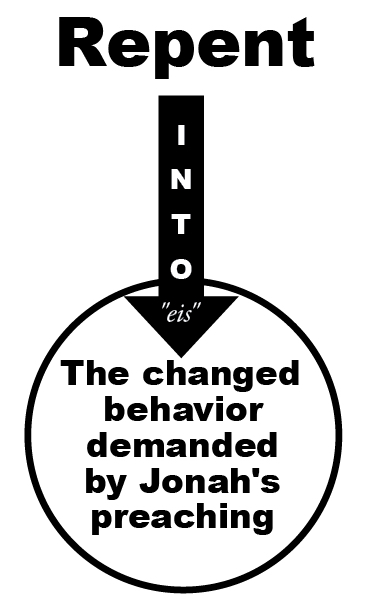
Jonah preached a succinct, simple, but demanding, message to pagan Gentiles. What was the result? Did they offer mere oral platitudes that paid lip service to religion—like the scribes and Pharisees? No, they truly repented. But, apart from Jesus informing us of their repentance, how do we know they repented, seeing that the Bible terms for repentance are not used in the Jonah account to describe their response? Because we are informed what, precisely, they did after hearing Jonah’s preaching: they proclaimed a fast, put on sackcloth, the king covered himself in sackcloth, sat in ashes, and sent forth a decree to all the Ninevites requiring abstinence from food and drink, and made loud entreaties to God (Jonah 3:5-9). Jonah 3:10 summarizes: “Then God saw their works, that they turned from their evil way; and God relented from the disaster that He had said He would bring upon them, and He did not do it.” Observe that their post-repentance activities are stylized “works” and that these extensive enactments were evidence of their repentance. Hence, they “repented into the preaching of Jonah.” Having been convinced by Jonah’s preaching to the point that they changed their thinking (i.e., repented), they then coupled their repentance with genuine compliance with the demands that Jonah laid before them. They repented into that state or condition demanded by Jonah’s preaching.1 A so-called “causal eis” does not exist.2
Endnotes
1 Jesus’ statement also constitutes an instance of the figure of speech known as “Metonymy of the Cause,” in which the cause or instrument is put for the thing effected by it. In this case, “preaching” was the instrument that Jesus mentioned, but what He was orally highlighting was the effect of Jonah’s preaching. For a discussion of this figure of speech, see E.W. Bullinger (1898), Figures of Speech Used in the Bible (Grand Rapids, MI: Baker, 1968 reprint), pp. 545ff.
2 For a discussion of the alleged “causal eis,” see Dave Miller (2019), Baptism and the Greek Made Simple (Montgomery, AL: Apologetics Press), pp. 39ff.
The post Repented “At” Jonah’s Preaching? appeared first on Apologetics Press.
]]>The post God Is “A” Spirit? appeared first on Apologetics Press.
]]>In addition to inserting italicized words, English translations also contain words that were inserted by translators without being italicized. Again, perhaps most of the time, their decisions are well-intentioned and helpful. At other times, however, they can mislead the English reader. One such example is seen in Jesus’ encounter with the Samaritan woman at Jacob’s well. Among His remarks to her was the declaration that “God is Spirit, and those who worship Him must worship in spirit and truth” (John 4:24). Some translations insert the article “a” before “spirit.” This erroneous insertion of the indefinite article is unwarranted. Most English translations recognize this fact and render it accordingly.2
“God is spirit” is equivalent to comparable biblical constructions, including “God is light” (1 John 1:5) and “God is love” (1 John 4:8). In each case, we are being informed about the very nature and essence of God—not His personality.3 “Spirit,” “light,” and “love” are attributes of God. They are characteristics or qualities of His being. We humans possess a spirit and a physical body; but God is spirit. He is non-corporeal. Jesus said, “a spirit does not have flesh and bones” (Luke 24:39). Though in the eternal realm, “we will be like Him” and “we shall see Him as He is” (1 John 3:2), nevertheless, His being will most surely far surpass and transcend our spiritual, heavenly bodies (1 Corinthians 15:44,49).
The depiction of the nature and character of God in the Bible is unlike any other representation of deity by humans throughout history. The God of the Bible is not physical,4 but rather transcends the physical. As the Creator, He brought into being all that is physical when He created the Universe. Humans are created “in the image of God” (Genesis 1:27)—which refers to spiritual aspects of the divine nature. Our physical bodies are not created in His image, since He is non-physical. For Jesus to leave the spiritual realm to come to the Earth to die a physical death and shed physical blood on our behalf, a physical body had to be “prepared” (Hebrews 10:5) for Him to inhabit temporarily.
A host of descriptions of the spiritual nature of deity may be found in the Bible—though human limitations can hamper our comprehension and our ability to conceptualize fully the divine nature. In closing, consider these two:
Blessed be Your glorious name, which is exalted above all blessing and praise! You alone are the LORD; You have made heaven, the heaven of heavens, with all their host, the earth and everything on it, the seas and all that is in them, and You preserve them all. The host of heaven worships You” (Nehemiah 9:5-6).
But you have come to Mount Zion and to the city of the living God, the heavenly Jerusalem, to an innumerable company of angels, to the general assembly and church of the firstborn who are registered in heaven, to God the Judge of all, to the spirits of just men made perfect, to Jesus the Mediator of the new covenant, and to the blood of sprinkling that speaks better things than that of Abel. See that you do not refuse Him who speaks. For if they did not escape who refused Him who spoke on earth, much more shall we not escape if we turn away from Him who speaks from heaven, whose voice then shook the earth; but now He has promised, saying, “Yet once more I shake not only the earth, but also heaven.” Now this, “Yet once more,” indicates the removal of those things that are being shaken, as of things that are made, that the things which cannot be shaken may remain. Therefore, since we are receiving a kingdom which cannot be shaken, let us have grace, by which we may serve God acceptably with reverence and godly fear. For our God is a consuming fire (Hebrews 12:22-29).
Endnotes
1 For more on this thorny subject, see Jack Lewis (1991), Questions You’ve Asked About Bible Translations (Searcy, AR: Resource Publications), pp. 141-171; Walter Specht (1968), “The Use of Italics in English Versions of the New Testament,” Andrews University Studies, 6:88-109, January; John Eadie (1876), The English Bible (London: Macmillan), 2:180-285; William Wonderly (1956), “What About Italics?” Bible Translator, 7:114-116, July; F.H.A. Scrivener (1884), “On the Use of the Italic Type by the Translators, and on the Extension of their Principles by Subsequent Editors,” in The Authorized Edition of the English Bible (1611) (Cambridge: University Press), pp. 61-81.
2 English translations that include “a” are the ASV, AMPC, BRG, DARBY, DRA, GNV, GW, JUB, KJV, NOG, NMB, TPT, RGT, WYC, and YLC. Those that omit “a” are the AMP, CSB, CEB, CJB, CEV, DLNT, ERV, EHV, ESV, EXB, GNT, HCSB, ICB, ISV, PHILLIPS, LEB, TLB, MSG, MEV, MOUNCE, NABRE, NASB, NCV, NET, NIV, NKJV, NLV, NLT, NRSV, NTE, OJB, RSV, TLV, VOICE, and WEB.
3 Henry Alford (1980 reprint), Alford’s Greek Testament (Grand Rapids, MI: Baker), 1:732.
4 It is true that the Holy Spirit utilized anthropomorphisms to accommodate Himself to the finite human mind. But the Bible is consistent in its representation of deity as a non-physical, spiritual Being Whose eternal nature preceded the creation of physical matter. God created time, matter, and space—but He Himself exists outside of time and space.
The post God Is “A” Spirit? appeared first on Apologetics Press.
]]>The post Was Jesus' Body "Broken"–Or Not? appeared first on Apologetics Press.
]]>Therefore, because it was the Preparation Day, that the bodies should not remain on the cross on the Sabbath (for that Sabbath was a high day), the Jews asked Pilate that their legs might be broken, and that they might be taken away. Then the soldiers came and broke the legs of the first and of the other who was crucified with Him. But when they came to Jesus and saw that He was already dead, they did not break His legs.… For these things were done that the Scripture should be fulfilled, “Not one of His bones shall be broken” (John 19:31-36).
To account for the Roman soldiers excluding Jesus from the customary breaking of the leg bones of crucifixion victims,1 John quotes the words of David in Psalm 34:19-20—“Many are the afflictions of the righteous, but the LORD delivers him out of them all. He guards all his bones; not one of them is broken.”
Despite this plain declaration regarding the bones of Jesus, in his directives to the Corinthians regarding the Lord’s Supper, Paul explained:
For I received from the Lord that which I also delivered to you: that the Lord Jesus on the same night in which He was betrayed took bread; and when He had given thanks, He broke it and said, “Take, eat; this is My body which is broken for you; do this in remembrance of Me” (1 Corinthians 11:23-24).
Notice the tension, if not seemingly outright contradiction, that is created by the word “broken” when juxtaposed with John’s quotation of Psalm 34:20 in John 19:36. How are these disparate remarks to be reconciled?
This alleged contradiction is easily dispelled by taking into consideration the transmission of the New Testament text. “Textual criticism” is the science of ascertaining the original wording of a text.2 Since we do not have the original autographs that came from the hands of the inspired writers, we must examine the copies that have survived and “sort out” the differences between them. This pursuit has been in progress for centuries and has, in fact, accomplished its purpose. Abundant evidence exists by which one can know that the books of the Bible have been transmitted accurately through the centuries. We can be confident that the Bible has been adequately preserved from error and continues to serve the purpose God intends for it to serve.
It so happens that the term “broken” in 1 Corinthians 11:24 is a “textual variant”—an instance where manuscripts differ with each other. Some English translations include the word, while others do not. For example, those that keep “broken” include the KJV, NKJV, GNV, MEV, NLV, NMB, OJB, WEB, and YLT. Those that omit the word “broken” constitute the vast majority of English translations, including the ASV, ESV, NASB, RSV, NRSV, NIV, and many others. Why the difference?
Without going into technical detail, here are several observations that come from the manuscript evidence. First, while the external evidence for the inclusion of “broken” is varied and diverse, it is not as ancient as the evidence for omitting “broken.” Second, generally speaking, when textual critics pore over manuscripts and their textual variants, they have discovered that the shorter reading is typically the original. The exclusion of “broken” is the shorter reading. Third, they have observed that the more difficult reading (i.e., difficult for the scribe to understand or reconcile) is generally the original. In this case, insertion of the word “broken” could have been due to the scribe’s tendency to want to clarify, explain, or make sense of in what way Jesus’ body was “for you.”
Fourth, verbal dissidence exists between the words “for you” and “broke” earlier in the same verse, suggesting that a copyist was unduly influenced by the presence of the earlier form of the word for “broken.” We know that not one of Jesus’ bones was broken on the cross—as forthrightly affirmed by John’s inspired commentary on the actions of the Roman soldiers at the cross. If “broken” was originally included in Paul’s letter, one must resort to making sense of the term. Did Paul intend to refer to the breaking or tearing of Jesus’ skin? Or was he merely speaking metaphorically, using the concept of “broken” in the sense that Jesus was a broken man—having experienced extensive physical and mental torture? These possibilities—which arguably settle the issue of an alleged discrepancy—nevertheless seem unlikely.
Of course, nothing doctrinally significant is at stake with this textual variant—which is most certainly the case with the overwhelming majority of variants. But the external and internal manuscript evidence leans more to the conclusion that Paul originally wrote: “This is my body, which is for you.” No contradiction exists between the words of John and the words of Paul.
Endnotes
1 For more on this custom, see Dave Miller (2020), The Bible is From God: A Sampling of Proofs (Montgomery, AL: Apologetics Press), pp. 61ff.
2 See Bruce Metzger (1968), The Text of the New Testament (New York: Oxford University Press).
The post Was Jesus' Body "Broken"–Or Not? appeared first on Apologetics Press.
]]>The post Can I Trust the Numbers in Genesis 5? appeared first on Apologetics Press.
]]>[EDITOR’S NOTE: AP auxiliary writer Dr. Rogers is the Director of the Graduate school of Theology and Associate Professor of Bible at Freed-Hardeman University. He holds an M.A. in New Testament from Freed-Hardeman University as well as an M.Phil. and Ph.D. in Hebraic, Judaic, and Cognate Studies from Hebrew Union College-Jewish Institute of Religion.]
The numbers in Genesis 5 have long raised challenges for readers of Scripture. The most obvious problem is with the surprisingly long lifespans recorded of ancient humanity. Many moderns simply find it difficult to believe anyone could live for 900 years! So that raises questions about the basic credibility of the Bible, or at least of the primeval history (Genesis 1-11).1 But Genesis 5 presents a more nuanced issue that does not appear obvious to readers of the Bible in modern translation. Because the standard modern-language versions translate the Masoretic Hebrew text primarily if not entirely, modern readers have no idea that the ancient translations vary quite strikingly in the numbers they provide. Before we begin our analysis of the situation, we might offer a brief word on the nature of the evidence. Then we will address the textual variations in Genesis 5.
The Masoretic Hebrew Text
The Hebrew Bible is extraordinarily ancient. The earliest parts were composed according to internal evidence as early as 1400 B.C. and the most recent around 430 B.C. This means the recovery of any original manuscript is all but hopeless. Indeed, the discovery of the Dead Sea Scrolls was a remarkable peek into fragments of the biblical text as old as the third century B.C. However, not enough remains from the Dead Sea Scrolls for us to compile a complete Hebrew Bible.2 This means we are reliant on the Masoretic Text. The Masoretic Text is very close to that of the Dead Sea Scrolls in many cases, and was probably standardized among the rabbis after the time of the New Testament. One confirmation is Jerome’s Latin Vulgate translation of the Hebrew Bible (A.D. 390-410), which reflects with few significant variants the Masoretic Text.
The Septuagint
The “Septuagint” is the name assigned among ancient authors to the Greek translation of the Old Testament, although this is a misnomer. The term septuaginta in Latin means “70,” and the number comes from the 2nd-century B.C. Letter of Aristeas which reports that 70 Jewish translators (or 72) were sent from Jerusalem to Alexandria, Egypt for the purpose of translating the Pentateuch. Ptolemy II (reigned 283-246 B.C.) requested the translation because he wanted the best books in the world contained in the library of Alexandria. Aristeas, however, speaks only of the Pentateuch (not the rest of the books), and modern scholars find Aristeas’ narrative fanciful and unreliable (the Hebrew scroll from which the Septuagint was translated was written with letters of gold, for example). It is now widely believed that the entirety of the Old Testament was translated into Greek sometime between the third and first centuries B.C. although we do not know where, why, and by whom.
The Samaritan Pentateuch
The Samaritan community (which still exists today) produced its own Pentateuch, which is the only part of the Hebrew Bible it regards as sacred. Like the Masoretic Text, whose earliest manuscript dates to the 10th century A.D., the Abisha Scroll is the earliest preserved text of the Samaritan Pentateuch, and it dates no earlier than the 12th century A.D. It is commonly claimed that 6,000 differences exist between the Samaritan Pentateuch and the Masoretic Text, but most of these are spelling variations and other minor variants. The Samaritan Pentateuch does, however, include explicit information that squares with its own theology against traditional Jewish doctrine, such as a command to worship on Mount Gerizim (cf. John 4:20). The Dead Sea Scrolls sometimes support readings that match the Samaritan Pentateuch in contrast with the Masoretic Text (although about a third of these match the Septuagint as well). This suggests that the Samaritan community sometimes preserves an ancient Hebrew recension3 transmitted in no other textual tradition.
Comparing the Evidence
The three textual traditions we have discussed all receive support from different manuscripts and biblical quotations found among the Dead Sea Scrolls, although the Masoretic Text is clearly the most dominant. Therefore, it is important for scholars to compare and contrast the ancient evidence in order to arrive at the earliest text. Much of the time such comparisons yield clear results. But in the case of Genesis 5 it is more complicated. The textual traditions disagree in many cases. The situation is further complicated by the unfortunate fact that the biblical manuscripts discovered among the Dead Sea Scrolls yielded no information sufficient for analysis in relation to the numbers of Genesis 5.
Table 1 offers a quick glance at the three texts. I take the Masoretic Hebrew as standard. Differences from the Masoretic Hebrew are noted in bold.
|
Person |
Masoretic Hebrew4 |
Septuagint |
Samaritan |
|
Adam |
130 + 800 = 930 years |
230+ 700 = 930 years |
130 + 800 = 930 years |
|
Seth |
105 + 807 = 912 years |
205 + 707= 912 years |
105 + 807 = 912 years |
|
Enosh |
90 + 815 = 905 years |
190 + 715= 905 years |
90 + 815 = 905 years |
|
Kenan |
70 + 840 = 910 years |
170 + 740= 910 years |
70 + 840 = 910 years |
|
Mahalalel |
65 + 830 = 895 years |
165 + 730= 895 years |
65 + 830 = 895 years |
|
Jared |
162 + 800 = 962 years |
162 + 800 = 962 years |
62 + 785 = 847 years |
|
Enoch |
65 + 300 = 365 years6 |
165 + 200= 365 years |
65 + 300 = 365 years |
|
Methuselah |
187 + 782 = 969 years |
167 + 802 = 969 years |
67 + 653 = 720 years |
|
Lamech |
182 + 595 = 777 years |
188 + 565 = 753 years |
53 + 600 = 653 years |
Several observations are in order. First, note that the Masoretic Hebrew and the Samaritan versions are largely in agreement. In only three places do we find discrepancies (Jared, Methuselah, and Lamech). Second, note that the Septuagint never agrees with the Samaritan version. This suggests no textual relationship between the two. It is true that the Septuagint agrees with the Hebrew version in its entirety only once. However, in every case except one, the disagreements concern the lesser numbers (the age of the patriarch at the birth of his first child plus the number of years from that point to his death). The Septuagint’s totals of the patriarchal lifespans are identical with the Masoretic Text (except with Lamech). Third, note that the ancient versions do not solve the alleged problem of the extreme ages of the patriarchs. The three differences in the Samaritan Pentateuch do in fact reduce the ages of three patriarchs, but is it any more believable that Methuselah, for example, lived to the age of 720 as opposed to 969?
How Did the Textual Corruption Occur?
A quick scan of the chart above obviously invites the question of textual corruption. All the texts cannot be right since they disagree. So which one is right, and how do we know? This question is impossible to answer with certainty, but perhaps we can offer a tentative explanation of how the corruption may have come to be.
First, according to our most ancient evidence (from Egypt and Babylonia), numbers were written pictographically. That is, numbers were symbols. This should not seem strange to us since the modern Arabic numerals are also symbols (1,2,3, etc.). Most ancient Near Eastern systems simply used tally marks for the first nine numbers (1= |, 2 = ||, 3 = |||, etc.). So to count 1–9 one needed simply to count tallies. The symbols change from there but the principle remains the same. In Hieroglyphic, for example, ⊓ is 10, but ⊓⊓ 20, ⊓⊓⊓ 30, and so on. The symbol changes again at 100, but the pattern repeats. Although symbolic variations exist among the various Near Eastern languages, the basic principles pretty well hold. This means by simply miscounting symbols, a scribe could be off by factors of 10 or even 100.
Most of the variations in the table above between the Septuagint and the Masoretic Text can be accounted for by a single scribe miscounting a single symbol. Of the Septuagint’s 17 differences, all but five can be attributed to miscounting a symbol for 100. This is a reduction of the variation over 70%! Although the numerical writing system does not account for every difference, it greatly reduces the number of variants.
Second, even after numbers are spelled in full, they remain subject to corruption in ancient manuscripts (not just the Bible). For example, no one today writes “one thousand and five hundred and eighty-seven.” Reading that number is much more confusing than reading “1,587.” Likewise, in ancient Hebrew one reads “two ten years and nine hundred years” in Seth’s case (912 years). Even assuming the numbers were initially transcribed accurately from the original, they could easily have been corrupted in the later manuscript tradition. The fact that the Samaritan Pentateuch and the Septuagint reflect greater variation toward the end of the patriarchal list may indicate scribal fatigue. The need to copy laboriously one number after the other may help to explain some of the problems in the transmission of numbers in Genesis 5.
Which Text Do We Believe?
While all ancient evidence of the text of Scripture is important, not all evidence is to be weighed equally. As a Greek translation, the Septuagint is one step removed from the Hebrew it translates. Since we do not have the manuscripts from which the Septuagint was translated, we cannot always know when the Septuagint reflects a different Hebrew text or when the translator(s) has made a mistake. The Samaritan Pentateuch has the advantage of being a Hebrew text that traces its lineage back to a very ancient textual tradition. But the Masoretic (or proto-Masoretic) Text is far more prominent among the Dead Sea Scrolls than the Samaritan version. This indicates the Samaritan tradition may be based on a fringe text considered inferior by the majority of Jews. Finally, the judgment of basically all English Bible translators since Jerome is not likely to be wrong. They have elected not to follow the Septuagint or the Samaritan Pentateuch for good reason. It is for good reason that the Masoretic Text is taken as the standard base for virtually all mainstream translations of the Old Testament.
Conclusion
The reader must keep in mind that all discussions concerning scribal errors and variations among manuscripts of the Bible may leave the impression that the text has been so corrupted that we cannot know God’s Word. This misimpression is understandable since textual criticism tends to focus on alleged problems of transmission and to ignore the remarkable accuracy with which the Bible has been copied. Hebrew scholar Bruce Waltke stresses that “in every era there was a strongtendency to preserve the text,”7 and that about “95 percent” of the Old Testament text is sound.8 If Waltke is correct, then textual critics deal only with about 5% of cases, and most of these involve problems that are easily solved.
I will conclude with an illustration. I can consult with many medical doctors, all of whom have legitimate education and licenses. But when it comes to a rare medical condition, surely I do not assume all doctors speak with equal authority. I respect the opinions of every medical professional, but I go to the Mayo Clinic for a reason: the treatment is generally regarded as better. The doctors are better educated and better able to diagnose and treat rare conditions. The numbers in Genesis 5 happen to be a rare case. It is unusual to find so much textual variation in the ancient evidence. In order to “heal” the differences in the text, I prefer to consult the textual tradition that is (1) oldest and (2) with the longest track record of trustworthiness. The Septuagint and the Samaritan Pentateuch are valuable textual traditions that ought to be respected. But they do not deserve the weight accorded the Masoretic Text. So, in the case of the numbers in Genesis 5, we cannot explain every variant (although we can give reasonable explanations for most). And all the numbers are extraordinarily high, at least from a modern perspective. Yet the Masoretic tradition deserves to be followed. You can trust your English translation.
Endnotes
1 See Appendix 2 in Creation Compromises (2000), (Montgomery, AL: Apologetics Press, second edition), pp. 357ff., http://apologeticspress.org/pdfs/e-books_pdf/cre_comp.pdf.
2 On the Dead Sea Scrolls see Justin Rogers (2019), “The Dead Sea Scrolls and the Bible,” Reason & Revelation, 39[11]:122-125,128-131, http://apologeticspress.org/apPubPage.aspx?pub=1&issue=1307.
3 A “recension” is a critical revision of an earlier text.
4 Most mainstream translations of the English Bible follow the Masoretic Hebrew closely.
5 I translate the Masoretic text and the Septuagint myself. I take the translation of the Samaritan Pentateuch from Benyamin Tsedaka, ed. (2013), The Israelite Samaritan Version of the Torah: First English Translation Compared with the Masoretic Version (Grand Rapids: Eerdmans).
6 All the ancient versions explain Enoch’s rather modest age as a result of the fact that “God took him” (i.e., he did not die).
7 Bruce K. Waltke, “How We Got the Hebrew Bible: The Text and Canon of the Old Testament,” pp. 27-50 in The Bible at Qumran: Text, Shape, and Interpretation, edited by Peter W. Flint (Grand Rapids: Eerdmans, 2001; the exact reference quoted here is found on p. 47).
8 Bruce K. Waltke, “Old Testament Textual Criticism,” pp. 156-86 in Foundations for Biblical Interpretation, edited by David S. Dockery, Kenneth A. Matthews, and R. Sloan (Nashville: Broadman and Holman, 1994; the exact reference quoted here is found on p. 158).
The post Can I Trust the Numbers in Genesis 5? appeared first on Apologetics Press.
]]>The post Has the Bible Been Transmitted To Us Accurately? appeared first on Apologetics Press.
]]>[Editor’s Note: This article is taken from Appendix 1 of the author’s book The Quran Unveiled.]
The science of textual criticism is a field of inquiry that has been invaluable in ascertaining the original reading of the New Testament text. Textual criticism involves “the ascertainment of the true form of a literary work, as originally composed and written down by its author.”1 The fact that the original autographs do not exist,2 and that only copies of copies of copies of the original documents have survived, has led some falsely to conclude that the original reading of the New Testament documents cannot be determined. For example, Mormons frequently attempt to establish the superiority of the Book of Mormon over the Bible by insisting that the Bible has been corrupted through the centuries in the process of translation (a contention shared by Islam in its attempt to explain the Bible’s frequent contradiction of the Quran). However, a venture into the fascinating world of textual criticism dispels this premature and uninformed conclusion.
The task of textual critics—those who study the extant manuscript evidence that attests to the text of the New Testament—is to examine textual variants (i.e., conflicting readings between manuscripts involving a word, verse, or verses) in an effort to reconstruct the original reading of the text. What has this field of inquiry concluded with regard to the integrity and genuineness of the Bible?
Is the Old Testament still Reliable?3
If there are scribal errors in today’s manuscript copies of the Old Testament, many wonder how we can be certain the text of the Bible was transmitted faithfully across the centuries. Is it not possible that it was corrupted so that its form in our present Bible is drastically different from the original source?
The accuracy of the Old Testament text was demonstrated forcefully by the discovery of the Dead Sea scrolls. Prior to 1947, the oldest Hebrew manuscripts of significant length did not date earlier than the ninth century A.D. However, when the Dead Sea scrolls were found (containing portions of all Old Testament books except Esther), this discovery pushed the record of the Old Testament text back almost 1,000 years. These copies were produced sometime between 200 B.C. and A.D. 100. One scroll found in the Qumran caves was of particular importance. It was a scroll of the book of Isaiah, which had only a few words missing. What was amazing about this scroll is that when it was compared to the text of Isaiah produced 900 years after it, the two matched almost word for word, with only a few small variations. In commenting on this comparative reading of the two texts, A.W. Adams observed:
The close agreement of the second Isaiah Scroll from the Dead Sea with the manuscripts of the ninth and tenth centuries shows how carefully the text tradition which they represent has been preserved…. We may therefore be satisfied that the text of our Old Testament has been handed down in one line without serious change since the beginning of the Christian era and even before.4
Amazingly, a comparison of the standard Hebrew texts with that of the Dead Sea scrolls has revealed that the two are virtually identical. The variations (about 5%) occurred only in minor spelling differences and minute copyists’ mistakes. Thus, as Rene Paché noted: “Since it can be demonstrated that the text of the Old Testament was accurately transmitted for the last 2,000 years, one may reasonably suppose that it had been so transmitted from the beginning.”5
Even within the various passages of Scripture, numerous references to copies of the written Word of God can be found. A copy of the “book of the law” was discovered in the Temple during the days of King Josiah (c. 621 B.C.), thus demonstrating that Moses’ writings had been protected over a span of almost 1,000 years (2 Kings 22). Other Old Testament passages speak of the maintenance of the Holy Writings across the years (Jeremiah 36; Ezra 7:14; Nehemiah 8:1-18).
During Jesus’ personal ministry, He read from a scroll of Isaiah in the synagogue at Nazareth, and called it “Scripture” (Luke 4:16-21)—a technical term employed in the Bible for a divine writing. Jesus endorsed the truth that the Old Testament Scriptures had been preserved faithfully. Even though Jesus read from a copy of Isaiah, He still considered it the Word of God. Hence, Scripture had been preserved faithfully in written form. Furthermore, even though Jesus condemned the scribes of His day for their many sins, never did He even intimate they were unfaithful in their work as scribes. Indeed, Jesus gave approval not only to copies, but even to translations (e.g., the Septuagint) of the Old Testament by reading and quoting from them.
One of the great language scholars of the Old Testament text was Dr. Robert Dick Wilson. A master of over 35 languages, Wilson carefully compared the text of the Old Testament with inscriptions on ancient monuments. As a result of his research, he declared: “We are scientifically certain that we have substantially the same text that was in the possession of Christ and the apostles and, so far as anybody knows, the same as that written by the original composers of the Old Testament documents.”6
Is the New Testament still Reliable?
What about the integrity of the New Testament? One may say unhesitatingly and confidently that the uncorrupted preservation of the New Testament has been thoroughly established. In evaluating the text of the New Testament, textual critics work with a large body of manuscript evidence, the amount of which is far greater than that available for any ancient classical author.7 As of 2018, the number of Greek manuscripts—whole and partial—that attest to the New Testament stands at an unprecedented 5,874.8 This figure does not include the other sources of evidence such as the superabundance of patristic citations and ancient versions. The best manuscripts of the New Testament are dated at roughly A.D. 350, with perhaps one of the most important of these being the Codex Vaticanus, “the chief treasure of the Vatican Library in Rome,” and the Codex Sinaiticus, which was purchased by the British from the Soviet Government in 1933.9 Additionally, the Chester Beatty papyri, made public in 1931, contain eleven codices (manuscript volumes), three of which contain most of the New Testament (including the Gospel accounts). Two of these codices boast a date in the first half of the third century, while the third is slightly later, being dated in the last half of the same century.10 The John Rylands Library vaunts even earlier evidence. A papyrus codex containing parts of John 18 dates to the time of Hadrian, who reigned from A.D. 117 to 138.11
Other attestation to the accuracy of the New Testament documents can be found in the writings of the so-called “apostolic fathers”—men who lived from A.D. 100 to 550, and who often quoted from the New Testament documents.12 Irenaeus, Clement of Alexandria, Tertullian, Tatian, Clement of Rome, and Ignatius (writing before the close of the second century) all provided citations from one or more of the Gospel accounts.13 Other witnesses to the authenticity of the New Testament are the Ancient Versions, which consist of the text of the New Testament translated into different languages. The Old Latin and the Old Syriac are the most ancient, being dated from the middle of the second century.14
The fact is, the New Testament enjoys far more historical documentation than any other volume ever known. Compared to the 5,700+ Greek manuscripts authenticating the New Testament, there are only 643 copies of Homer’s Iliad, which is undeniably the most famous book of ancient Greece. No one doubts the text of Julius Caesar’s Gallic Wars, but we have only 10 copies of it, the earliest of which was made 1,000 years after it was written. We have only two manuscripts of Tacitus’ Histories and Annals, one from the ninth century and one from the eleventh. The History of Thucydides, another well-known ancient work, is dependent upon only eight manuscripts, the oldest of these being dated about A.D. 900 (along with a few papyrus scraps dated at the beginning of the Christian era). And The History of Herodotus finds itself in a similar situation. “Yet no classical scholar would listen to an argument that the authenticity of Herodotus or Thucydides is in doubt because the earliest MSS [manuscripts—DM] of their works which are of any use to us are over 1,300 years later than the originals.”15 Thus Bruce declared: “It is a curious fact that historians have often been much readier to trust the New Testament records than have many theologians.”16 Even as far back as 1968, Bruce Metzger, longtime professor of New Testament language and literature at Princeton, stated: “The amount of evidence for the text of the New Testament…is so much greater than that available for any ancient classical author that the necessity of resorting to emendation is reduced to the smallest dimensions.”17 Truly, to have such abundance of copies for the New Testament from within 70 years of their writing is nothing short of astounding.18
In one sense, the work of the textual critic has been unnecessary, since the vast majority of textual variants involve minor matters that do not affect doctrine as it relates to one’s salvation. Even those variants that might be deemed doctrinally significant pertain to matters that are treated elsewhere in the Bible where the question of authenticity and originality is unobscured. No feature of Christian doctrine is at stake. As Ewert noted: “[V]ariant readings in our manuscripts do not affect any basic teaching of the NT.”19 Old Testament scholar Gleason Archer wrote in agreement:
In fact, it has long been recognized by the foremost specialists in textual criticism that if any decently attested variant were taken up from the apparatus at the bottom of the page and were substituted for the accepted reading of the standard text, there would in no case be a single, significant alteration in doctrine or message.20
Nevertheless, textual critics have been successful in demonstrating that currently circulating New Testaments do not differ substantially from the original autographs. When all of the textual evidence is considered, the vast majority of discordant readings have been resolved.21 One is brought to the firm conviction that we have in our possession the New Testament as God intended.
The world’s foremost textual critics have confirmed this conclusion. Sir Frederic Kenyon, longtime director and principal librarian at the British Museum, whose scholarship and expertise to make pronouncements on textual criticism was second to none, stated: “Both the authenticity and the general integrity of the books of the New Testament may be regarded as finally established.”22 The late F.F. Bruce, longtime Rylands Professor of Biblical Criticism at the University of Manchester, England, remarked: “The variant readings about which any doubt remains among textual critics of the New Testament affect no material question of historic fact or of Christian faith and practice.”23 J.W. McGarvey, declared by the London Times to be “the ripest Bible scholar on earth,”24 conjoined: “All the authority and value possessed by these books when they were first written belong to them still.”25 And the eminent textual critics Westcott and Hort put the entire matter into perspective when they said:
Since textual criticism has various readings for its subject, and the discrimination of genuine readings from corruptions for its aim, discussions on textual criticism almost inevitably obscure the simple fact that variations are but secondary incidents of a fundamentally single and identical text. In the New Testament in particular it is difficult to escape an exaggerated impression as to the proportion which the words subject to variation bear to the whole text, and also, in most cases, as to their intrinsic importance. It is not superfluous therefore to state explicitly that the great bulk of the words of the New Testament stand out above all discriminative processes of criticism, because they are free from variation, and need only to be transcribed.26
Writing over one hundred years ago in the late 19th century, and noting that the experience of two centuries of investigation and discussion had been achieved, these scholars concluded: “[T]he words in our opinion still subject to doubt can hardly amount to more than a thousandth part of the whole of the New Testament.”27 This means that 999/1000th of the text of the New Testament is the same today as when it came from the pens of the inspired writers. The miniscule portion that remains uncertain (1/1000th) consists of trivial details that have no material effect on matters of faith or doctrine. J.I. Packer, Board of Governors Professor of Theology at Regent College in Vancouver, British Columbia, summarized the facts: “[F]aith in the adequacy of the text is confirmed, so far as it can be, by the unanimous verdict of textual scholars that the biblical text is excellently preserved, and no point of doctrine depends on any of the small number of cases in which the true reading remains doubtful.”28 Indeed, again in the words of textual scholar F.F. Bruce: “By the ‘singular care and providence’ of God the Bible text has come down to us in such substantial purity that even the most uncritical edition of the Hebrew or Greek…cannot effectively obscure the real message of the Bible, or neutralize its saving power.”29 Therefore, the charge alleged by Muslims (and Mormons), that the Bible has been corrupted in transmission, is completely false.
The Quran Compared
Anyone who has taken time to investigate the manuscript evidence that exists for ascertaining the original state of the Bible knows that we have the Bible in its near-original condition—a claim that has not been established for the Quran. The attention given to ascertaining the original state of the Quranic text pales in comparison to that given to the Bible in general, and the New Testament in particular. As John Gilchrist observed:
[T]here is no translation of the Qur’an to compare with translations of the Bible such as the Revised Standard Version or New American Standard Version. These were done by committees of scholars and the result has been a remarkably consistent and accurate rendering of the original. Every well-known translation of the Qur’an has been the work of an individual and, to one degree or another in every case, the value of the final product is tempered by the presence of the author’s own personal convictions and interpretations.30
Of course, unsubstantiated claims are made for the transmission of the Quran: “[A]ll Muslims agree that the Quran is the verbatim revelation of God. They also agree about its text and content; that is, no variant texts are found among any of the schools.”31 The fact that Muslims claim unanimity of opinion regarding the purity of the Quranic text does not prove that the Quran has been exempt from the peculiar attribute of textual variation to which all documents from history are subject.
Ironically, the Quran itself offers both implicit and explicit endorsement of the integrity of the biblical text—at least in its condition at the time the Quran arose in the early seventh century:
And believe in that which I reveal, confirming that which ye possess already (of the Scripture), and be not first to disbelieve therein, and part not with My revelations for a trifling price, and keep your duty unto Me. Confound not truth with falsehood, nor knowingly conceal the truth…. Enjoin ye righteousness upon mankind while ye yourselves forget (to practice it)? And ye are readers of the Scripture! Have ye then no sense?…. O Children of Israel! Remember My favour wherewith I favoured you and how I preferred you to (all) creatures (Surah 2:41-42,44,47).32
Or do they say, “He has forged it”? Say: “Had I forged it, then can you obtain no single (blessing) for me from Allah. He knows best of that whereof you talk (so glibly)! Enough is He for a witness between me and you! And He is Oft‑Forgiving, Most Merciful.” Say: “I am no bringer of new‑fangled doctrine among the Messengers, nor do I know what will be done with me or with you. I follow but that which is revealed to me; I am but a Warner open and clear.” Say: “Do you see? If (this teaching) be from Allah, and you reject it, and a witness from among the Children of Israel testifies to its similarity (with earlier scripture), and has believed while you are arrogant, (how unjust you are!). Truly, Allah does not guide a people unjust.” The Unbelievers say of those who believe: “If (this Message) were a good thing, (such men) would not have gone to it first, before us!” And seeing that they do not guide themselves thereby, they will say, “This is an (old,) old falsehood!” And before this, was the Book of Moses as a guide and a mercy: and this Book confirms (it) in the Arabic tongue; to admonish the unjust, and as Glad Tidings to those who do right…. “O our people! We have heard a Book revealed after Moses, confirming what came before it” (Surah 46:8-12,30).33
Say: “O People of the Book! do you disapprove of us for no other reason than that we believe in Allah, and the revelation that has come to us and that which came before (us), and (perhaps) that most of you are rebellious and disobedient?…. If only they had stood fast by the Law, the Gospel, and all the revelation that was sent to them from their Lord, they would have enjoyed happiness from every side. There is from among them a party on the right course: but many of them follow a course that is evil. O Messenger! proclaim the (Message) which has been sent to you from your Lord. If you did not, you would not have fulfilled and proclaimed His Mission. And Allah will defend you from men (who mean mischief). For Allah guides not those who reject Faith. Say: “O People of the Book! You have no ground to stand upon unless you stand fast by the Law, the Gospel, and all the revelation that has come to you from your Lord.” It is the revelation that comes to you from your Lord, that increases in most of them their obstinate rebellion and blasphemy. But you do not grieve over (these) people without Faith. Those who believe (in the Qur’an), those who follow the Jewish (scriptures), and the Sabians and the Christians,—any who believe in Allah and the Last Day, and work righteousness,—on them shall be no fear, nor shall they grieve (Surah 5:59,66-69; cf. 2:62).34
And if thou (Muhammad) art in doubt concerning that which We reveal unto thee, then question those who read the Scripture (that was) before thee. Verily the Truth from thy Lord hath come unto thee. So be not thou of the waverers (Surah 10:95).35
These verses from the Quran provide confirmation of Muhammad’s belief in the accuracy of the Law and the Gospel (cf. Surah 87:18-19; 6:155-158). They even appeal to a Jew, contemporary to Muhammad, who verified that the Quran confirmed the Scripture that preceded it. Indeed, the Quran claims to be in unison and harmony with, and complementary to, previous Scripture (the Bible).
The underlying thought in all of these Quranic verses is that the Quran is to be accepted, reverenced, and obeyed every bit as much as the previous Scriptures (i.e., the Bible). These verses are worded in such a way that they assume the legitimacy and acceptability of the Bible. The Quranic criticism directed against Jews (and Christians) is not that they corrupted their Scriptures (cf. Surah 7:169-170). Rather, they are criticized for not concluding that Muhammad and the Quran were the confirmatory sequel to the previous revelations of Jews and Christians. In fact, when the Jews insisted to Muhammad that they had been given sufficient knowledge by means of the Torah—an admission made by the Quran itself [“Again, We gave the Scripture unto Moses, complete for him who would do good, an explanation of all things, a guidance and a mercy, that they might believe in the meeting with their Lord” (Surah 7:155)]—Muhammad responded with a new surah: “[I]f all the trees in the earth were pens, and the sea, with seven more seas to help it, (were ink), the words of Allah could not be exhausted” (Surah 31:27).36 If the Quran endorses the integrity of the Bible, and we have in existence manuscripts of the Bible that predate the Quran, then the accuracy and authenticity of the Bible stands vindicated—not only by the voluminous manuscript evidence—but even by the Quran itself.
To repeat: We can know that the Bible has been transmitted accurately through the centuries. The Bible is, in fact, the Word of God.
Endnotes
1 Sir Frederic Kenyon (1951 reprint), Handbook to the Textual Criticism of the New Testament (Grand Rapids, MI: Eerdmans), second edition, p. 1.
2 Philip Comfort (1990), Early Manuscripts and Modern Translations of the New Testament (Wheaton, IL: Tyndale House), p. 4.
3 Portions of this section are drawn from Wayne Jackson (1989), “Was the Old Testament Transmitted Faithfully?” Apologetics Press, http://www.apologeticspress.org/apcontent.aspx?category=105&article=1140.
4 Sir Frederic Kenyon (1939), Our Bible and the Ancient Manuscripts (London: Eyre and Spottiswoode), pp. 69,88.
5 Rene Paché (1971), The Inspiration and Authority of Scripture (Grand Rapids, MI: Eerdmans), p. 191.
6 Robert Dick Wilson (1929), A Scientific Investigation of the Old Testament (New York: Harper Brothers), p. 8.
7 David Ewert (1983), From Ancient Tablets to Modern Translations (Grand Rapids, MI: Zondervan), p. 139; Kenyon, 1951, p. 5; B.A. Westcott and F.J.A. Hort (1964 reprint), The New Testament in the Original Greek (New York: MacMillan), p. 565.
8 Michael Welte (2019), personal e-mail, September 17, Institute for New Testament Textual Research (Munster, Germany), http://www.uni-muenster.de/NTTextforschung/.
9 F.F. Bruce (1960), The New Testament Documents: Are They Reliable? (Grand Rapids, MI: Eerdmans), revised edition, p. 20.
10 Ibid., p. 21.
11 Ibid., p. 21.
12 Ibid., p. 22.
13 Donald Guthrie (1990), New Testament Introduction (Downers Grove, IL: InterVarsity Press), p. 24.
14 Bruce, p. 23.
15 Bruce, pp. 20-21.
16 Ibid., p. 19.
17 Bruce Metzger (1968), The Text of the New Testament (New York, NY: Oxford University Press), p. 86.
18 Norman Geisler and Ronald Brooks (1990), When Skeptics Ask (Wheaton, IL: Victor Books), pp. 159-160.
19 p. 145.
20 Gleason Archer (1982), An Encyclopedia of Bible Difficulties (Grand Rapids: Zondervan), p. 30, emp. added.
21 Metzger, p. 185.
22 Sir Frederic Kenyon (1940), The Bible and Archaeology (New York: Harper), p. 288.
23 pp. 19-20.
24 Dabney Phillips (1975), Restoration Principles and Personalities (University, AL: Youth In Action), p. 184; L.L. Brigance (1870), “J.W. McGarvey,” in J.W. McGarvey (1962 reprint), A Treatise on the Eldership (Murfreesboro, TN: DeHoff Publications), p. 4.
25 J.W. McGarvey (1956 reprint), Evidences of Christianity (Nashville, TN: Gospel Advocate), p. 17.
26 p. 564, emp. added.
27 Ibid., p. 565, emp. added.
28 J.I. Packer (1958), “Fundamentalism” and the Word of God (Grand Rapids, MI: Eerdmans), 1976 reprint, p. 90, emp. added.
29 As quoted in Packer, pp. 90-91.
30 John Gilchrist (1986), Muhammad and the Religion of Islam, http://answering-islam.org.uk/Gilchrist/Vol1/index.html.
31 Seyyed Hossein Nasr (2003), Islam (New York: HarperCollins), p. 8, emp. added.
32 Translation by Mohammed Pickthall (n.d.), The Meaning of the Glorious Koran (New York: Mentor), emp. added.
33 Translation by Abdullah Yusuf Ali (1934), The Qur’an (Elmhurst, NY: Tahrike Tarsile Quran), ninth edition, emp. added.
34 Ibid., emp. added.
35 Pickthall, emp. added.
36 Cf. Martin Lings (1983), Muhammad (Rochester, VT: Inner Traditions International), p. 78.
The post Has the Bible Been Transmitted To Us Accurately? appeared first on Apologetics Press.
]]>The post Question and Answer: Should Jesus Be Called "Yeshua"? appeared first on Apologetics Press.
]]>“Do you know if there’s any truth to the claim that Jesus should only be called ‘Yeshua’ or that the name ‘Jesus’ is a corruption done by pagans or occultists (it’s been claimed that KJV was influenced by freemasonry, or that it was supposed to sound like Zeus)? Additionally, what evidence is there that the NT was originally written in Greek (vs. Hebrew vs. Aramaic)?”
A:
The Hebrew word transliterated “Joshua” in our English versions of the Old Testament (pronounced yeah-HO-shoo-ah) is equivalent to the Greek term “Jesus” (pronounced ee-ay-SOOS). Though God Himself miraculously instigated several new languages at Babel (Genesis 11), we do not know what those languages were nor do we know what single language was spoken prior to that event. God has given no indication whatsoever that Hebrew, Aramaic, and Greek are “sacred” languages that must be emulated. Instead, what we learn from the Bible is that God fully expected His Word to be translated into the multitude of languages that He knew would come about gradually as societies, ethnic groups, and nations developed. There is no evidence in Scripture that God assigns special reverence to, or expects verbal exclusivity for, the names “God” or “Jesus” in a particular language. The Jews refused to pronounce the divine name (approximated by English words like “Jehovah” and “Yahweh”) and so historically did not know how to pronounce it. The claims of pagans and occultists are irrelevant. One must produce the evidence from Scripture that God commands a specific spelling or pronunciation. Hispanics have the same word, “Jesus,” which they name their children, pronounced “hay-SOOS.” It has the same spelling in both English and Spanish. By the reasoning of those cited, differing pronunciations of the same word are unacceptable. Their theory shows a woeful lack of understanding regarding the functioning of human language.
Regarding the second question, there are well over 5,000 Greek manuscripts of the New Testament, some dating back close to the first century. There is a mountain of evidence from historical and religious writers in the early centuries of Christianity that record the linguistic state of affairs at the time. Once again, where is the evidence that the New Testament was originally written in a language other than Koine Greek? The evidence does not exist. It is true that Jesus probably spoke Aramaic while He was on Earth. But God the Holy Spirit chose to communicate the divine will via the most common, prominent language of the day: Koine Greek. A host of Hellenistic Jews at the time spoke Greek and relied on the Greek translation of the Old Testament (the Septuagint; cf. Acts 6). In fact, most of the quotes of the Old Testament found in the New Testament are from that version. When people postulate an imaginary Aramaic New Testament that lies behind the Greek New Testament that we have, they are merely speculating without solid, sufficient evidence—which they are under obligation to produce.
However, let’s suppose that those who make such claims are right, that the New Testament was originally written in Aramaic. Why did God not see to it that it was preserved and passed down to us? Answer: we must not need it! We can confidently say that we have God’s Word intact in our 21st century based on the variety of proofs that exist by which the New Testament text has been recovered/ascertained (see Has the Bible Been Corrupted? available through AP).
The post Question and Answer: Should Jesus Be Called "Yeshua"? appeared first on Apologetics Press.
]]>The post The En-Gedi Scroll and the Accuracy of the Bible appeared first on Apologetics Press.
]]>One astounding fact about the Bible’s transmission is that new information continues to come to light, silencing the skeptic, and bolstering an already irrefutable case. One such discovery was made in 1970 near the area where the Dead Sea scrolls were found. A scroll known as the En-Gedi scroll came to light, but was badly damaged by fire and was unreadable with the technology available at the time.2 While the dating methods used to date the scroll are not completely reliable, experts place the date of the writing near A.D. 300. That means the scroll predates the Masoretic Text from which the King James Version was translated by about 500 years.
By using technology known as volume cartology, computer scientist Brent Seales and others were able to “map” the text and identify the writing. When they did, they found an ancient Hebrew text that coincided perfectly with the Masoretic Text of Leviticus 1:1-8. Newitz wrote:
What’s incredible about these chapters, according to archaeologist Emanuel Tov, is that they are virtually identical to the medieval Masoretic Text, written hundreds of years later. The En-Gedi scroll even duplicates the exact paragraph breaks seen later in the medieval Hebrew. The only difference between the two is that ancient Hebrew had no vowels, so these were added in the Middle Ages.3
Were this situation to have occurred with some other ancient text (such as the Quran or even the texts of ancient writers such as Herodotus or Thucydides), scholars would hail the event as unprecedented. In truth, however, this is a “run-of-the-mill” normal occurrence for the biblical text. The accusation that the biblical text has been miscopied or corrupted, in light of such evidence as the En-Gedi scroll, is vacuous and unsustainable.
Emanuel Tov went on to say this about the En-Gedi text: “[It is] 100 percent identical with the medieval texts, both in its consonants and in its paragraph divisions…. [T]he scroll brings us the good news that the ancient source of the medieval text did not change for 2,000 years.” Newitz added, “In other words, the Jewish community managed to retain some of the exact wording in passages from their biblical texts over centuries, despite massive cultural upheavals and changes to their languages.”4
Indeed, such text preservation is unparalleled when compared to all other ancient documents in the world. We should recognize and appreciate the Providential care by which the biblical text has come down to us. And we should let that knowledge spur us on to study the Holy Bible, knowing that the words we read are those that God inspired.
Endnotes
1 Dave Miller (2015), “3 Good Reasons to Believe the Bible Has Not Been Corrupted,” Reason & Revelation, 35[8]:86-89,92, http://apologeticspress.org/APContent.aspx?category=13&article=5196&topic=103. For more extensive information, see Neil Lightfoot (2003), How We Got the Bible (Grand Rapids, MI: Baker), third edition.
2 Annalee Newitz, “One of the World’s Oldest Biblical Texts Read for the First Time,” https://arstechnica.com/science/2016/09/scholars-use-x-rays-to-read-ancient-biblical-text-for-the-first-time/.
3 Ibid.
4 Ibid.
The post The En-Gedi Scroll and the Accuracy of the Bible appeared first on Apologetics Press.
]]>The post Does Matthew 18:11 Belong in the New Testament? appeared first on Apologetics Press.
]]>My resources are limited to find a decent enough answer for the passage at Mt. 18:11. I would like to know why or why not it should be in our Bibles.
A:
During the early centuries of Christianity, copies of New Testament books were made by Christians as those books came from the hands of the apostles. Then copies were made of copies, and then copies of copies of copies, and so on. It was inevitable that slight/minor changes would occur in some copies. In later years, New Testament books were copied by monks and even by professional copyists who did so for their living. Those who became very familiar with the synoptic Gospel accounts sometimes unnecessarily attempted to harmonize them with each other in those passages that are parallel, even though the Holy Spirit used different wording in, say Matthew, than He did in Luke, where the same incident is reported. Hence, copyists sometimes introduced words from one Gospel account into another to force them to be uniform in wording. That is clearly what happened with Matthew 18:11. Somewhere along the line, a copyist who was very familiar with Luke introduced the words of Luke 19:10 into the copy of Matthew 18 that he was making. The words are authentic from Luke’s pen, but were not written by Matthew. Many manuscript copies do not contain the verse, but the copies that ultimately influenced the KJV were copies that had the interpolation introduced. Observe that no doctrine of Scripture is placed in jeopardy and no new information is added to the text by such variants in certain copies, and the original text is still preserved in the aggregate of manuscripts. See our article at: http://apologeticspress.org/APContent.aspx?category=13&article=5196&topic=103.
The post Does Matthew 18:11 Belong in the New Testament? appeared first on Apologetics Press.
]]>The post The Strongest Argument Against Mark 16:9-20 appeared first on Apologetics Press.
]]>In ascertaining the genuineness of a textual variant, several factors are taken into consideration. The external evidence of age and geographical diversity of Greek manuscripts, ancient versions, and patristic citations are examined. Internal evidence is also weighed, taking into account transcriptional and intrinsic probabilities. The latter criterion centers on the style and vocabulary of the author in the book, as well as the usage of the author elsewhere and in the gospel accounts (cf. Metzger, 1978, pp. 209ff.).
Non-Markan Style?
The most persuasive piece of evidence that prompts some textual scholars to discount Mark 16:9-20 as genuine is the internal evidence. Though the Alands conceded that the “longer Marcan ending” actually “reads an absolutely convincing text” (1987, p. 287), in fact, the internal evidence weighs more heavily than the external evidence in the minds of many of those who support omission of the verses. Observe carefully the following definitive pronouncement of this viewpoint—a pronouncement that simultaneously concedes the strength of the external evidence in favor of the verses:
On the other hand, the section is no casual or unauthorised [sic] addition to the Gospel. From the second century onwards, in nearly all manuscripts, versions, and other authorities, it forms an integral part of the Gospel, and it can be shown to have existed, if not in the apostolic, at least in the sub-apostolic age. A certain amount of evidence against it there is (though very little can be shown to be independent of Eusebius the Church historian, 265-340 A.D.), but certainly not enough to justify its rejection, were it not that internal evidence clearly demonstrates that it cannot have proceeded from the hand of St. Mark (Dummelow, 1927, p. 73, emp. added).
Listen also to an otherwise conservative scholar express the same sentiment: “If these deductions are correct the mass of MSS [manuscripts—DM] containing the longer ending must have been due to the acceptance of this ending as the most preferable. But internal evidence combines with textual evidence to raise suspicions regarding this ending” (Guthrie, 1970, p. 77, emp. added). Alford took the same position: “The internal evidence…will be found to preponderate vastly against the authorship of Mark” (1844, 1:434, emp. added). Even Bruce Metzger admitted: “The long ending, though present in a variety of witnesses, some of them ancient, must also be judged by internal evidence to be secondary” (p. 227, emp. added).
So, in the minds of not a few scholars, if it were not for the internal evidence, the external evidence would be sufficient to establish the genuineness of the verses. What precisely, pray tell, is this internal evidence that is so powerful and weighs so heavily on the issue as to prod scholars to “jump through hoops” in an effort to discredit the verses? What formidable data exists that could possibly prompt so many to discount all evidence to the contrary?
Scholars direct attention to “the presence of 17 non-Marcan words or words used in a non-Marcan sense” (Metzger, p. 227). Alford made the same allegation over a century earlier: “No less than seventeen words and phrases occur in it (and some of them several times) which are never elsewhere used by Mark—whose adherence to his own peculiar phrases is remarkable” (p. 438). The reader is urged to observe carefully the implicit assumption of those who reject verses 9-20 on such a basis: If the last 12 verses of a document employ words and expressions (whether one or 17?) that are not employed by the writer previously in the same document, then the last 12 verses of the document are not the product of the original writer. Is this line of thinking valid?
Over a century ago, in 1869, John A. Broadus provided a masterful evaluation (and decisive defeat) of this very contention (pp. 355-362). Using the Greek text that was available at the time produced by Tregelles, Broadus examined the 12 verses that precede Mark 16:9-20 (i.e., 15:44-16:8)—verses whose genuineness are above reproach—and applied precisely the same test to them. Incredibly, he found in the 12 verses preceding 16:9-20 exactly the same number of words and phrases (17) that are not used previously by Mark! The words and their citations are as follows: tethneiken (15:44), gnous apo, edoreisato, ptoma (15:45), eneileisen, lelatomeimenon, petpas, prosekulisen (15:46), diagenomenou, aromata (16:1), tei mia ton sabbaton (16:2), apokulisei (16:3), anakekulistai, sphodra (16:4), en tois dexiois (16:5), eichen (in a peculiar sense), and tromos (16:8). The reader is surely stunned and appalled that textual critics would wave aside verses of Scripture as counterfeit and fraudulent on such fragile, flimsy grounds.
Writing a few years later, J.W. McGarvey applied a similar test to the last 12 verses of Luke, again, verses whose genuineness, like those preceding Mark 16:9-20, are above suspicion (1875, pp. 377-382). He found nine words that are not used by Luke elsewhere in his book—four of which are not found anywhere else in the New Testament! Yet, once again, no textual critic or New Testament Greek manuscript scholar has questioned the genuineness of the last 12 verses of Luke. Indeed, the methodology that seeks to determine the genuineness of a text on the basis of new or unusual word use is a concocted, artificial, unscholarly, nonsensical, pretentious—and clearly discredited—criterion.
CONCLUSION
For the unbiased observer, this matter is settled: the strongest piece of internal evidence mustered against the genuineness of Mark 16:9-20 is no evidence at all. Consequently, the reader of the New Testament may possess far more confidence that these verses are original than is typically given by current textual critics.
REFERENCES
Aland, Kurt and Barbara Aland (1987), The Text of the New Testament (Grand Rapids, MI: Eerdmans).
Alford, Henry (1844), Alford’s Greek Testament (Grand Rapids, MI: Baker), 1980 reprint.
Broadus, John A. (1869), “Exegetical Studies,” The Baptist Quarterly, [3]:355-362, July.
Dummelow, J.R., ed. (1927), A Commentary on the Holy Bible (New York, NY: MacMillan).
Guthrie, Donald (1970), New Testament Introduction (Downers Grove, IL: Inter-Varsity Press, third edition).
McGarvey, J.W. (1875), The New Testament Commentary: Matthew and Mark (Delight, AR: Gospel Light).
Metzger, Bruce M. (1978 reprint), The Text of the New Testament (New York, NY: Oxford University Press, second edition).
Miller, Dave (2005), “Is Mark 16:9-20 Inspired?” Reason & Revelation, 25[12]:89-95, http://apologeticspress.org/apPubPage.aspx?pub=1&issue=572&article=433.
The post The Strongest Argument Against Mark 16:9-20 appeared first on Apologetics Press.
]]>The post The Special Book appeared first on Apologetics Press.
]]>But what if I told you about a book that tells of real battles between men and giants? A book that describes a real creature with fire billowing from its mouth and smoke streaming from its nostrils. A book that tells of a sea being parted, and people walking through on dry land. This book tells of the long and gruesome war between the evil forces of darkness and the all-powerful Force of good. It is alive and exciting, but the best part about this book is that it is real life. It can never be turned off, unplugged, or shut down. It shows how ordinary humans can be transformed into God’s children.
Maybe you’ve heard of this book; in fact, you probably own one—the Bible. But do you know just how special this book is? Just in case you don’t know what a treasure you have, let me tell you some wonderful things about The Book.

Thousands of years ago, God spoke directly to people. He did not use a book to tell them how to live; He simply spoke to them like your mother or father speaks to you. Some of those men wrote down what God said to them so that their children, grandchildren, and even future generations would know the things God wanted them to do. Over the years, the writings of these men were put together in a book that we call the Bible. God used about 40 men to write the Bible—men who were very different from one another. Some of them were very rich kings, while others were just poor shepherds. Some of the men were very well educated, while others had little education at all. They wrote during different times in history. In fact, the Bible was written over a period of about 1,600 years. God instructed Moses to write the first books of the Old Testament in approximately 1500 B.C.And the apostle John wrote Revelation (the last book of the New Testament) in about A.D.100.
Amazingly, although many of the books of the Bible were written hundreds of years apart by different men, they still fit together so that they read like one story. Of course, they fit together so well because God was behind their writing, instructing each man what to write.
But how do we know that it has not been changed over the many hundreds of years since it was written? Is there proof that the books of the Bible we have in the 21stcentury are the same as the ones people had 500 or 1,000 years ago? Absolutely! And this issue of Discovery will show you some of that proof.
The post The Special Book appeared first on Apologetics Press.
]]>The post What Do the Dead Sea Scrolls Have To Do With the Bible? appeared first on Apologetics Press.
]]> Dear Reader,
In 1948, the way that the world viewed the Old Testament changed forever. An Arab boy was looking for a lost goat. He threw a rock into a small cave, and heard a sound like breaking pottery. Curious about the sound, he went into the cave and found some leather scrolls in jars with ancient writing on them. It turns out that hundreds of scrolls were hidden in these caves around the Dead Sea. The scrolls most likely were written by a group of people known as the Essenes.
But the most important things that were discovered in the caves were copies of many of the books of the Old Testament. These copies were produced from about 200 B.C. to A.D. 100, making them almost 900 years older than the oldest available copies of the Old Testament.
One scroll found in the Dead Sea caves was of particular importance. It was a scroll of the book of Isaiah (with only a few parts missing). What was amazing about this scroll was that when it was compared to the text of Isaiah produced 900 years after it, they matched almost word for word. Only a few small variations existed. The Dead Sea scrolls had proven to the world that the Old Testament had been copied faithfully and passed down to the current time. Once again, the world witnessed that God had made sure that His Word was accurately passed from one generation to the next!
The post What Do the Dead Sea Scrolls Have To Do With the Bible? appeared first on Apologetics Press.
]]>The post Serious Scribes appeared first on Apologetics Press.
]]>Sometimes kids get in trouble at school, and for punishment they are made to copy pages out of the dictionary or encyclopedia. Copying such pages is boring. But suppose you lived in a time when the printing press or the computer did not exist. If each school needed a dictionary, how would so many copies be produced? Well, someone would have to sit down and copy the original by hand. Such a person was called a scribe. Scribes copied almost any type of document imaginable—business receipts, legal documents, marriage certificates, and more.
Scribes took their jobs very seriously because the slightest mistake could make a big difference. For instance, suppose that a person bought a piece of land for 20 gold pieces. If the scribe did not pay close attention to his work, he might write 2 gold pieces or 200 gold pieces, drastically altering the original price.
But there was one group of scribes who took their jobs more seriously than all the rest. Those ancient scribes who copied the Old Testament went to great lengths to try not to make any mistakes. They knew that they were copying the Word of God, and they wanted to be absolutely sure that it was done right. For this reason, they made many rules concerning copies of the Old Testament. These rules included using a special kind of ink, making sure that each letter of a word was spaced exactly a hairsbreadth (the thickness of one hair) from its neighbor, and never writing even the smallest letter from memory.
One group of scribes, who were known as the Masoretes, made even stricter rules than the ones above. They counted every single verse, word, and letter of the Old Testament books that they copied. They also counted how many times a letter was used and which verse, word, and letter should be exactly in the middle of the book. The Masoretes were some of the world’s greatest perfectionists.
The post Serious Scribes appeared first on Apologetics Press.
]]>The post How Did We Get the New Testament? appeared first on Apologetics Press.
]]>Check the Time
Understanding when the original documents of the New Testament were written will help us determine how well they have been preserved. The earliest events recorded in the New Testament are those surrounding the birth of Jesus. He was born in approximately 4 B.C.(we date our calendars from the birth of Christ). He lived almost 33 years, and then was crucified. Therefore, since the New Testament tells about His life and death, it could not have been written much earlier than A.D.33. In fact, one book (Acts) tells about things that happened around A.D.30-60. When, exactly, was the New Testament written? We cannot be sure of the exact date when each book was written, but we do know that the entire New Testament was written between approximately A.D.35 and A.D.100.
Many Manuscripts
Thousands of manuscripts of the New Testament exist. A “manuscript” is a hand-written copy of an old document that was copied in its original language. Since the New Testament originally was written in Greek, the manuscripts also are written in Greek. Over 5,700 old manuscripts exist that contain all or part of the New Testament.

The fact that so many old copies of the New Testament exist is truly amazing, especially when it is compared to other ancient books. What is even more amazing is the time that they were produced. Some have been found that were copied only a few years after they were written. One manuscript known as the John Ryland’s Papyrus has portions of the Gospel of John written on it. It was found in Egypt, and dates back to A.D.125—just a few years after the New Testament was completed.
To tell the truth, uninspired books do not have a fraction of the evidence that the New Testament does to support its accuracy. God made sure that the Bible was passed down faithfully from one generation to the next. So the next time you read the New Testament, you can be sure that it is the Word of God.
The post How Did We Get the New Testament? appeared first on Apologetics Press.
]]>The post Ancient Writing Materials appeared first on Apologetics Press.
]]>Rock
 Can you imagine a schoolteacher asking her class to take out a clean piece of stone in order to take a spelling test? Yet, as silly as that sounds to us, flat slabs of rock probably were some of the first things used as “paper.” To write on these rock slabs, people used sharp pieces of metal or a hard stone. They would cut or engrave the words deep into the tablets of stone.
Moses used stone tablets for the Ten Commandments. We read in Exodus 34:1 that the Lord told him to “cut two tablets of stone.” Writing on stone was a way to ensure that the words were preserved for many generations.
Clay
Clay was another material ancient writers used. Clay had many qualities that made it a good writing material. For one, it was common and inexpensive. Also, it was easy to write on. When clay is moist, it is soft and can be engraved easily using a stone or stick. Once the clay dries, the words engraved in it become permanently set. Ezekiel mentioned a clay tablet in chapter 4, verse 1 of his book in the Old Testament. And many clay tablets—thousands of years old—have been found buried in the ground.


Popular Papyrus
 Near shallow lakes and rivers grew a tall reed called papyrus. It especially grew by the Nile River in Egypt. The ancient people would harvest this hollow reed, slit it down the middle, and roll it out flat. Then they would take these reeds and glue them together. After gluing many of the reeds together, a rock was used to smooth the surface of the papyrus so that people could write on it just like paper.
Papyrus was one of the most popular ways to write and send messages. The sheets were glued into long pieces that were rolled into scrolls. The scrolls mentioned in Revelation 5:1 were most likely papyrus. The apostles and other New Testament writers probably used papyrus to write their original books.
Many other materials were used to write, record, and document the past. Wood, leather, bone, and shells are a few. But the ones mentioned in this article were some of the most popular forms of writing materials. The next time we pick up a sheet of paper and ballpoint pen, or sit down to type on a computer, let’s be thankful for the great progress that our ancestors made in the area of writing. And let’s be thankful that these ancient people had ways to preserve the Word of God.
The post Ancient Writing Materials appeared first on Apologetics Press.
]]>The post Does the Bible Lie? appeared first on Apologetics Press.
]]>Obviously, the suspect had lied. He could not truthfully say in one breath that he bobbed for apples, and then in the next breath say that he never bobbed for apples in all his life. Either he had or he had not bobbed for apples; both his statements could not have been true.
Some people accuse the Bible of doing the exact same thing as the lying suspect. They claim that the Bible contradicts itself, which means that it says one thing in one place, and then says something totally opposite in another place.
The Christian claims that the Bible is the Word of God. Yet if it contradicts itself, then that would make God a liar. And since the Bible says that God cannot lie (Titus 1:2), then any book with contradictions in it could not have been inspired by God. Therefore, if a real contradiction could be found in the original autographs of the Bible, then it is not the Word of God.
The truth is, when all the facts are considered, each thing that people have found in the Bible that they thought was a contradiction has been shown to be something other than a true mistake. That is a powerful statement, considering the fact that no book in the world has been examined more closely than the Bible.
Good Rules to Follow
Generally, most of the things that people think are mistakes in the Bible can be solved by answering three simple questions: (1) Is the same person or thing being considered? (2) Is the same time period being discussed?; and (3) Is the same sense under consideration?
Think with me. Suppose that someone says, “Leroy Jones is rich,” and “Leroy Jones is poor.” Do those two statements contradict (go against) each other? Not necessarily. Many people are named Leroy Jones (O.K., maybe not all that many, but at least two). It could be that the Leroy Jones in Florida is rich, but the Leroy Jones in New York is poor. The same person or thing must be under consideration.
 |
|
| Leroy Jones in Florida | Leroy Jones in New York |

Further, the same time period must be under consideration. Leroy Jones could have made a fortune in his early twenties as an oil tycoon and been very rich, but after a terrible stock market crash could have lost everything he owned. At one time, then, he was rich, but now he is poor. The two statements could have been accurately describing his life at the time each was made.
 |
 |
| Young Leroy Jones | Old Leroy Jones |
Also, the statements must be talking about the same sense. Leroy Jones could have more money than anyone else in the entire world, but if he is not following God, then he is poor. On the other hand, he could have absolutely no money, but be rich in spiritual blessings. After all, “Has God not chosen the poor of this world to be rich in faith” (James 2:5)? Answering these three questions helps a lot in resolving the contradiction controversy.
 |
 |
| Leroy Jones is rich in the world’s eyes | Leroy Jones is rich in God’s eyes |
Adding Information to a Story
Sometimes, people accuse the Bible of making mistakes when the same story is told differently by different authors. For example, in Matthew 14:21 the Bible says that Jesus fed about five thousand men, and that He also fed women and children. But in Mark 6:44, it says that He fed about five thousand men. Mark never mentions the women and children. Is that a mistake? No, of course not. Did He feed about 5,000 men? Yes, and that makes Mark correct. Did Jesus feed about 5,000 men, along with some women and children? Yes, which makes Matthew right, too. Just because one account “adds” some things does not mean that the accounts contradict each other.
To illustrate this point, suppose you and your mother went to the mall. When you came home, your sister asked what you did at the mall. You told her about playing video games and eating cinnamon rolls. Your mother told her about all the good clothing stores you visited. Your mother’s details are different from yours, but they are not contradictory. She simply “added” some things to your story.
Everyday Conversation
Suppose that the weatherman comes on the television and announces, “the Sun will rise at 6:03 a.m. on Saturday.” Even though the Earth rotates and the Sun really is not rising at all, we have no problem understanding his comment. We call this “phenomenal” language—language that is used in everyday speech to refer to ordinary phenomena.
On occasion, the Bible also uses this type of language. In Psalm 50:1, the writer described the Sun as rising, and in 1 Corinthians 15:6 Paul described some of the Christians who had died as having “fallen asleep.” No one would accuse the weatherman of making a scientific mistake when he says that the Sun will rise. Likewise, the Bible should not be accused of making mistakes when it uses the same type of language.
No one has ever found one real contradiction in the Bible. Isn’t it wonderful that God has given us the Bible without any contradictions in it?
The post Does the Bible Lie? appeared first on Apologetics Press.
]]>The post Newsweek Article’s Attack on the Bible: So Misinformed It’s a Sin appeared first on Apologetics Press.
]]>In a way, Eichenwald’s attack on the Bible is reassuring to the Bible believer for the simple reason that Eichenwald uses information that has been refuted literally for centuries. His article consists of warmed-over skepticism that has so often been easily refuted; we at Apologetics Press already have articles on virtually every subject he mentions (www.apologeticspress.org). In another way, however, his article is troubling. Why, if his arguments are so easily answered, does the author feel that they will resonate with his audience or cause others to question the Bible? The most reasonable answer seems to be that he knows his audience is ignorant of the responses to his attacks. The Proverbs writer once stated, “The first one to plead his cause seems right, until his neighbor comes and examines him” (Proverbs 18:17). To those who have not given these matters much thought, Eichenwald’s information may seem legitimate and may cause one to doubt the Bible’s inspiration. However, when one examines this information, it will be seen for what it is—a thinly veiled, inept attack against the inspired Word of God.
The “Contradictions” in the Bible
The Birth of Jesus
One of the clearest examples of Eichenwald’s errant thinking is seen in his repetitious claim that the Bible is “loaded with contradictions.” In his section titled “No Three Kings,” he contends that the accounts of Jesus’ birth in Matthew and Luke are contradictory. He writes: “Jesus was born in a house in Bethlehem. No wise men showed up for the birth…. No angel appearing to Mary…. Not born in a manger….” Then he asks the reader: “Not the version you are familiar with…? You may not recognize this version, but it is a story of Jesus’ birth found in the Gospels. Two Gospels—Matthew and Luke—tell the story of when Jesus was born, but in quite different ways. Contradictions abound.”
Is it true that the versions of Jesus’ “birth” are filled with contradictions? Not at all. Let us see how he proceeds to fabricate contradictions that are not there. First, notice how he begins his section: “Jesus was born in a house in Bethlehem.” Note that he did not provide a verse reference for that claim—for good reason: there is no Bible passage that claims that Jesus was born in a house in Bethlehem. The account in Luke makes it clear that Jesus was born in Bethlehem (2:4) and, contrary to Eichenwald’s charge, in a manger (2:7,16)—i.e., a barn-animal feeding trough. Did an angel appear to Mary? The Gospels make no such claim, and therefore, cannot be said to contradict one another. An angel appeared to shepherds in the field at the time of Jesus’ birth (Luke 2:8-13) and to Mary before Jesus was conceived (Luke 1:26-31), but this does not contradict any other passage. Did wise men come to the birth? When we turn to Matthew’s account, the chapter begins its narrative about the wise men: “Now after Jesus was born in Bethlehem of Judea in the days of Herod the King…” (2:1). How long after Jesus was born in Bethlehem? The text does not say. In fact, king Herod asked the wise men what time Jesus’ star appeared (vs. 7), and based on that information, the evil king issued a decree to kill the young males in Bethlehem who were from “two years old and under” (vs. 16). Obviously, between the time the star appeared, and the time the wise men arrived, several months had elapsed. In fact, from Herod’s calculations to kill two year olds, it could have been as much as 18 months to two years. So, the story in Matthew 2 is not even a “birth” story. The Bible makes no claim that wise men were at Jesus’ birth. The only contradiction that can be levied concerning the appearance of the wise men is not a contradiction in the Bible, but a contradiction between what the Bible says and what people have erroneously claimed the Bible says—as with the case of the appearance of the angel to Mary.
Eichenwald has committed the very mistake that he accuses so many evangelicals of committing. Early in the article he bemoans the fact that many people who call themselves Christians do not even know what the text says. Sadly, he is right. Many Christians do not study the Bible as they should. He insists that his article is “designed to shine a light on a book that has been abused by people who claim to revere it but don’t read it.” Ironically, Eichenwald’s attack is filled with heat, but very little light. His examples of obvious “contradictions” in the “birth” accounts of Jesus are attacks against information that is not even in the Bible. In an article that purports to straighten out those who are biblically illiterate, to boldly proclaim that the Bible states that “Jesus was born in a house in Bethlehem”—when the Bible nowhere makes such a statement—is inexcusable, slipshod scholarship. [For more information, see the A.P. article: “When Did Jesus Go to Egypt?” (Lyons, 2011).]
In addition, Eichenwald claims that the genealogies in Matthew and Luke trace Jesus’ bloodline through Joseph, “Except…Joseph wasn’t Jesus’ father…. Mary, the mother of Jesus, can be the only parent with a bloodline to David, but neither Gospel makes mention of that.” This allegation has been decisively answered in the A.P. article titled, “The Genealogies of Matthew and Luke.” Here is the short answer to this alleged discrepancy:
Here is the precise purpose of Matthew’s genealogy: it demonstrated Jesus’ legal right to inherit the throne of David—a necessary prerequisite to authenticating His Messianic claim. However, an equally critical credential was His blood/physical descent from David—a point that could not be established through Joseph since “after His mother Mary was betrothed to Joseph, before they came together, she was found with child of the Holy Spirit” (Matthew 1:18, emp. added). This feature of Christ’s Messiahship was established through His mother Mary, who was also a blood descendant of David (Luke 1:30-32). Both the blood of David and the throne of David were necessary variables to qualify and authenticate Jesus as the Messiah (Miller, 2003, emp. in orig.).
Isn’t it interesting that Eichenwald left out the fact that Luke’s genealogy mentions Jesus “being (as was supposed) the son of Joseph” (Luke 3:24)? By using the phrase “as was supposed,” Luke demonstrates that Jesus was not the actual son of Joseph, just the perceived one. In addition, the Newsweek author neglected to mention that in Matthew 1:16, when the text says that “Jacob begot Joseph the husband of Mary, of whom was born Jesus,” the word “whom” (in the Greek) is in the feminine form. It could only be referring to Mary. Thus, neither of the genealogies states that Jesus was born to Joseph.
Alleged Contradictions in the Resurrection Accounts
Eichenwald continues his attack on the Bible, stating that the “stories in the four Gospels of Jesus’ death and resurrection differ as well.” He asserts: “And who went to anoint Jesus in his tomb? In Matthew, it was Mary and another woman named Mary, and an angel met them there. In Mark, it was Mary Magdalene, Mary the mother of James, and Salome, and a young man met them. In John, it was Mary alone; no one met her.” Supposedly, these “differing” accounts are so blatantly contradictory that no further examination need be applied to them. When we apply proper reasoning to this allegation, however, we see there are no contradictions.
For instance, what if John mentions one Mary while Matthew mentions Mary and another woman named Mary? This difference is not a contradiction. John would have had to qualify his statement by saying that “only” Mary or Mary “alone” went to the tomb. Did you notice that Eichenwald includes the word “alone” with Mary, but the biblical text never does? Just because one writer gives additional or supplemental information does not make him contradict the other account. [For more information, see the A.P. article titled, “The Resurrection Narratives” (Butt, 2002).] Consider Eichenwald’s own statement that at the Council of Nicaea, “Constantine arrived wearing jewels and gold on his scarlet robe and pearls on his crown.” Suppose that another person were to say that Constantine arrived with numerous courtiers and was wearing boots. Would that statement be a contradiction? Not in any way. Such accusations barely deserve to be answered—if it were not for their prevalence.
Two Accounts of Creation?
Eichenwald further suggests that “biblical scholars have concluded that two Jewish sects wrote many of the books. Each prepared its version of the Old Testament, and the two were joined together without any attempt to reconcile the many contradictions” (2014). Once again, the Newsweek writer conveniently mentions only those “biblical scholars” who happen to agree with him. What about the thousands of scholars that do not agree with this specious position? As an example of these “doublets,” he states: “The next time someone tells you the biblical story of Creation is true, ask that person, ‘Which one?’ Few of the Christian faithful seem to know the Bible contains multiple creation stories…. Careful readers have long known that the two stories contradict each other.” In truth, careful readers have long known just the opposite. As Wayne Jackson concluded: “When the texts of Genesis 1 and 2 have been considered carefully, one thing is clear: an objective evaluation reveals no discrepancies, nor is a dual authorship to be inferred. Devout students of the Bible should not be disturbed by the fanciful, ever-changing theories of the liberal critics” (See the A.P. article, “Are There Two Creation Accounts in Genesis?” [Jackson, 1991; Cf. McGarvey, 1910, p. 66]). [NOTE: In his section dealing with such doublets, Eichenwald mentions that “biblical scholars” have concluded that Moses did not write the Pentateuch. The evidence, however, reveals that Moses certainly did write these books. See the A.P. article “Mosaic Authorship of the Pentateuch—Tried and True” (Lyons, 2003; cf. McGarvey, 1902).]
The article also uses the Flood story as an example of doublets causing contradictions. Eichenwald says the “water flooded the earth for 40 days (Genesis 7:17), or 150 days (Genesis 7:24).” His careless use of the Scripture is painful to endure. The text does not say in Genesis 7:17 that the Flood stopped after 40 days. It simply details things that occurred at that time, such as the waters lifting the ark off the ground. The text in Genesis 7:24 specifically says that at the end of 150 days the water began to decrease. The previous 7:17 says nothing about the complete duration of the Flood or when the waters stopped rising. [NOTE: For an exhaustive list of answers to these types of alleged contradictions, see A.P.’s Web site category titled “Alleged Discrepancies.”]
Sunday As the Christian Day of Worship
The title of the Newsweek article, “The Bible: So Misunderstood It’s a Sin,” explains much about the author’s method of bashing. He approaches the subject in light of the idea that many Christians do not read or understand the Bible. One of the author’s grievous faults, however, is that it is apparent that he does not read or understand the Bible either, and he writes in a way that betrays this fact. For instance, when discussing the Christian day of worship, Eichenwald suggests that Constantine was responsible for establishing it as Sunday instead of the Sabbath (or Saturday). He alleges:
Things that are today accepted without much thought were adopted or reinforced at Nicaea. For example, the Old Testament was clear in declaring that God rested on the seventh day, making it the Sabbath. The seventh day of the week is Saturday, the day of Jewish worship and rest. (Jesus himself invoked the holiness of the Jewish Sabbath.) The word Sunday does not appear in the Bible, either as the Sabbath or anything else. But four years before Nicaea, Constantine declared Sunday as a day of rest in honor of the sun God…. Many theologians and Christian historians believe that it was at this moment, to satisfy Constantine and his commitment to his empire’s many sun worshippers, that the Holy Sabbath was moved by one day, contradicting the clear words of what ultimately became the Bible (2014).
Notice the author’s tactic. First, he says that both the Old Testament and Jesus invoked the Sabbath (our Saturday) as holy. Then he states that the Bible never even uses the word Sunday. And, lastly, he implies that Christians were not “officially” worshiping on this day prior to Constantine, but that Constantine changed the day of Christian worship to Sunday.
Eichenwald’s assertions regarding the day of Christian worship contradict both biblical and historical fact—and are easily answered. First, he confuses the issue when he says that the word “Sunday” is not even used in the Bible, since none of our modern names for the days of the week are used in the Bible. The term “Saturday” does not appear. You will not read the terms “Friday” or “Monday” in the original text either. Such is to be expected. The real question is: did the writers of the Bible have their own designation for the day that we call Sunday? Of course they did; it was called “the first day of the week,” Saturday (or Sabbath), being the last or seventh day of their week. We could ask, then, do we read about anything in the New Testament happening on the first day of the week? Absolutely. In fact, Jesus rose early “after the Sabbath, as the first day of the week began to dawn” (Matthew 28:1). Christians were to come together to give money to support the church’s work every “first day of the week” in the city of Corinth (1 Corinthians 16:2). And the book of Acts explains that the Christians gathered to partake of the Lord’s Supper (referred to as “breaking bread”) on the first day of the week (Acts 20:7).
Early Christian writers that lived in the 2nd and 3rd centuries verify this truth. As Eric Lyons wrote in the A.P. article titled “Did Paul Want Christians to Come Together on Saturday or Sunday?”:
Ignatius wrote in his letter to the Magnesians (believed to be penned around A.D. 110) how Christians “have come to the possession of a new hope, no longer observing the Sabbath, but living in the observance of the Lord’s Day” (1:62, emp. added; cf. Revelation 1:5). And, in chapter 67 of his First Apology (written around A.D. 150), Justin Martyr noted how Christians would gather together “on the day called Sunday” to read the writings of the apostles and prophets, instruct, pray, give, and eat of bread and wine (2005; see also the A.P. article, “The First Day of the Week” [Lyons, 2006]).
Biblical scholar Robert Milligan wrote, “That the primitive Christians were wont to celebrate the Lord’s Supper on every first day of the week is evident…. During the first two centuries the practice of weekly communion was universal, and it was continued in the Greek church till the seventh century” (1975, p. 440).
In addition to these facts, Eichenwald seems to be totally unaware of the overwhelming testimony of the New Testament that the Old Testament has been fulfilled and removed. Yes, the Old Testament mandated worship on the Sabbath—for the Jews; but Christ’s death and resurrection changed the law. As the Hebrews writer so concisely observed, “In that He says, ‘A new covenant,’ He has made the first obsolete” (8:13). And again Paul wrote that the Old Law, “was our tutor to bring us to Christ, that we might be justified by faith. But after faith has come, we are no longer under a tutor” (Galatians 3:25). Christians no longer sacrifice animals as the Israelites did, they no longer celebrate the Passover, and they no longer hallow Saturday as the Holy Day. Those are vestiges of the Old Law that have been removed. For Eichenwald to misunderstand such clear and repetitive New Testament teaching is disappointing to say the least. The testimony of the New Testament and early Christian writers proves that Sunday was the Christian day of worship centuries before Constantine arrived on the scene.
Jesus and Family Values
In the first paragraph of his article, Eichenwald caricatures certain “Christian” fanatics and caustically attacks them, demanding that “they are God’s fraud’s, cafeteria Christians who pick and choose which Bible verses they heed with less care than they exercise in selecting side orders for lunch.” As we have seen throughout this review, Eichenwald is often guilty of the very tactics he condemns others for using. As an example, consider his statements concerning Jesus and family values. He wrote:
Some of the contradictions are conflicts between what evangelicals consider absolute and what Jesus actually said. For example, evangelicals are always talking about family values. But to Jesus, family was an impediment to reaching God. In the Gospel of Matthew, he states, “And every one that hath forsaken houses, or brethren, or sisters, or father, or mother, or wife, or children, or lands, for my name’s sake, shall receive an hundredfold, and shall inherit everlasting life” (2014).
Talk about cafeteria style Bible interpretation! Eichenwald conveniently fails to include the fact that one of Jesus’ dying statements was to ensure that His mother was taken care of after His death (John 19:26-27). He leaves out the fact that Jesus’ apostles insisted that husbands are called to love their wives and give their very lives to protect them (Ephesians 5:25). In addition, children are to honor their parents (Ephesians 6:1), fathers are to train and discipline their children (Ephesians 6:4; Hebrews 12:7-11), families are to financially support their own (1 Timothy 5:8), and wives are to love their husbands and their children (Titus 2:4). In addition, Jesus insisted that God is like a loving Father who longs for the return of His children (Luke 15:11-32). It is only possible to question Jesus’ and the apostles’ family values if a handful of verses are ripped from their context.
What is Jesus really saying when He mentions that His followers are to “forsake” families or homes for His cause? The easy-to-understand message here is that a relationship with Jesus must be the most important relationship in the life of His followers. That means if a spouse were to demand that a Christian participate in pagan idol worship or the spouse was going to leave, then with much sadness but firm resolve, the Christian should let the spouse leave and not join in the pagan idol worship. If Hindu parents insist that if their college son becomes a Christian they will disown him, that son should follow Christ and be disowned by his parents. We can all understand that a person should never commit murder, theft, or adultery to preserve a close relationship with family or friends. Jesus was merely stating that the relationship with Him is the most important. [See the A.P. article “Hate Your Parents—or Love Them?” Butt, 2004).]
Has the Bible Been Corrupted?
One of the longest sections of the Newsweek article deals with the idea that the Bible has been corrupted over time, that we do not really know which books belong in the Bible, and that translation errors are so plentiful that we do not have the original message. Yet these allegations have been confronted and refuted time and time again. [Cf. A.P.’s soon-to-be released video series titled, “Has the Bible Been Corrupted?” in which such assertions are debunked.] Many books over the years have masterfully answered the skeptic in this regard, including such volumes as J.W. McGarvey’s Evidences of Christianity, F.F. Bruce’s The Canon of Scripture, Bruce Metzger’s The Text of the New Testament, and a host of others. The Newsweek article manifests abysmal, inexcusable ignorance of the long established facts of the matter.
For example, Eichenwald states that we do not have the original message of the Bible because the originals are lost and the translations are filled with errors and variations. He claims that
no television preacher has ever read the Bible. Neither has any evangelical politician. Neither has the pope. Neither have I. And neither have you. At best, we’ve all read a bad translation—a translation of translations of translations of hand-copied copies of copies of copies of copies, and on and on, hundreds of times (2014).
Supposedly, according to Eichenwald, since we don’t have the originals, and our translations are from copies that were written in other languages, there is no way we have actually read the Bible.
This naïve, uninformed view of message transmission cannot be maintained in light of the evidence. Are we to believe that since we have never seen Eichenwald’s original article that he personally typed or penned, then we cannot have the information he intended to present? Is it true that since some people read the article on-line, but others in printed form, then the original message is hopelessly lost? Is it true that anyone who reads the article in a language other than English has never really read the article, since it would be a translation? What Eichenwald and other skeptics are attempting to do is suggest that it is impossible to pass information accurately from one language to another, or from one printed page to another; but that suggestion is simply not true. If it is possible for a person to copy accurately a message once, it is possible to do so twice, and so on.
When we approach the Bible, we must simply ask, “Do we have the message that the original authors penned?” When we explore that question, we discover that the books of the New Testament are the most extensively verified books of ancient history. If we deny the Bible is verified, then we are saying that it is impossible for any information to be conveyed accurately from the past to the present. The skeptics’ attack is not against the Bible, per se; it is against the idea that we can know anything from ancient history. If it is possible to know what any writer has ever penned, then the skeptic’s accusations against the Bible cannot be sustained. When Eichenwald states, “And what biblical scholars now know is that later versions of the books differ significantly from earlier ones,” he implies there are so many variations in the manuscripts that the original message has been lost. This misleading exaggeration is a typical ploy by those who wish to discredit the integrity of the text of the Bible. What’s more, when he states, “Scribes added whole sections of the New Testament, and removed words and sentences that contradicted emerging orthodox beliefs,” he unwittingly admits that scholars have been able to identify and isolate those very words and sentences! In actuality, those manuscripts wherein scribes manifested doctrinal bias are in the small minority, do not represent the mass of manuscripts, and are identifiable.
Due to length constraints, a detailed analysis of textual variants is beyond the scope of this article. However, the sincere inquirer may easily access the analyses that have been made on each passage. For example, for a thorough discussion of the last 12 verses of Mark, see Miller, 2005; Scrivener, 1861, pp. 429ff; et al. For a discussion of the manuscript support pertaining to the woman taken in adultery (John 7:53-8:11), see Scrivener, pp. 439-443; Woods, 1989, p. 162; McGarvey, 1974, p. 16; Metzger, 1971, pp. 219-222; Jackson, 2011, p. 161; et al. For 1 John 5:7, see Woods, 1962, pp. 324-326; Metzger, 1971, pp. 716-718. For Luke 22:17-20, see Metzger, 1971, pp. 173-177. Any standard text on textual criticism discusses these and many other variants (e.g., Aland and Aland, 1987). If the reader desires the truth regarding the authenticity and integrity of the Bible, the evidence is available—if the individual is willing to spend the time and effort to weigh that evidence and arrive at the proper conclusion (1 Thessalonians 5:21; 1 John 4:1).
What Eichenwald fails to divulge are several facts that completely undermine and discredit his attack on the integrity and transmission of the Bible:
- God knew that the original autographs would not survive, and that His Word would have to be transmitted through the centuries via copies. The transmission process is sufficiently flexible for God’s Word to be conveyed adequately by uninspired, imperfect copyists.
- We know how the original New Testament books read because we have three surviving classes of evidence by which to reconstruct the original New Testament: Greek manuscripts, ancient versions, and patristic citations.
- The current number of Greek manuscript copies containing all or part of the New Testament now stands at 5,795. This amount of manuscript evidence for the text of the New Testament is far greater than that available for any ancient classical author.
- The time between the writing of the original books of the New Testament and the earliest surviving copies is relatively brief.
- Although no two manuscript copies agree in every detail, the degree of accuracy achieved by most scribes was remarkably high. The vast majority of textual variants involve minor matters that do not alter any basic teaching of the New Testament. No feature of Christian doctrine is at stake.
- Suitable solutions to these differences are detectable. Even if they weren’t, the original reading is one of the extant options. And even those variants that some might deem “doctrinally significant” pertain to matters that are treated elsewhere in the Bible where the question of genuineness/certainty is unquestioned.
- We can confidently affirm that we have 999/1000ths of the original New Testament intact. The remaining 1/1000th pertains to inconsequential details.
These observations have been verified by the greatest textual critics and linguistic scholars of the past two centuries. Their conclusions have not become outdated, but remain as valid today as when first formulated. If the integrity of the text of the Bible was fully authenticated in their day, it remains so today. Consider the following statements by some of these world class authorities.
Scholarly Verification of the Purity of the New Testament Text
F.F. Bruce (1910-1990) was a biblical scholar who taught Greek at the University of Edinburgh and the University of Leeds, chaired the Department of Biblical History and Literature at the University of Sheffield, received an honorary Doctor of Divinity from Aberdeen University, and served as the Rylands Professor of Biblical Criticism and Exegesis at the University of Manchester. He wrote over 40 books and served as Editor of The Evangelical Quarterly and Palestine Exploration Quarterly. Bruce declared: “The variant readings about which any doubt remains among textual critics of the N.T. affect no material question of historic fact or of Christian faith and practice” (1975, pp. 19-20, emp. added). As if anticipating the Newsweek article, he also stated:
In view of theinevitable accumulation of such errors over so many centuries, it may be thought that the original texts of the New Testament documents have been corrupted beyond restoration. Some writers, indeed, insist on the likelihood of this to such a degree that one sometimes suspects they would be glad if it were so. But they are mistaken. There is no body of ancient literature in the world which enjoys such a wealth of good textual attestation as the New Testament (1963, p. 178, emp. added).
Bruce further insisted:
Something more ought to be said, and said with emphasis. We have been discussing various textual types, and reviewing their comparative claims to be regarded as best representatives of the original New Testament. But there are not wide divergencies between these types, of a kind that could make any difference to the Church’s responsibility to be a witness and guardian of Holy Writ…. If the variant readings are so numerous, it is because the witnesses are so numerous. But all the witnesses, and all the types which they represent, agree on every article of Christian belief and practice (1963, p. 189, emp. added).
Bruce Metzger (1914-2007) was also a scholar of Greek, the New Testament, and New Testament Textual Criticism, serving as professor at Princeton Theological Seminary for 46 years. He was a recognized authority on the Greek text of the New Testament. He served on the board of the American Bible Society, was the driving force of the United Bible Societies’ series of Greek Texts, and served as Chairperson of the NRSV Bible Committee. He is widely considered one of the most influential New Testament scholars of the 20th century. Metzger stated:
…even if we had no Greek manuscripts today, by piecing together the information from these translations from a relatively early date, we could actually reproduce the contents of the New Testament. In addition to that, even if we lost all the Greek manuscripts and the early translations, we could still reproduce the contents of the New Testament from the multiplicity of quotations in commentaries, sermons, letters, and so forth of the early church fathers (as quoted in Strobel, 1998, p. 59).
Brooke Foss Westcott (1825-1901) was a British bishop, biblical scholar and theologian, serving as Bishop of Durham and holding the Regius Professorship of Divinity at Cambridge. His colleague, Fenton John Anthony Hort(1828-1892), was an Irish theologian who served as a Professor at Cambridge. Together, they pioneered the widely recognized Greek text The New Testament in the Original Greek in 1881. They are still considered to be renowned textual critics. They forthrightly asserted:
With regard to the great bulk of the words of the New Testament…there is no variation or other ground of doubt…. [T]he amount of what can in any sense be called substantial variation is but a small fraction of the whole residuary variation, and can hardly form more than a thousandth part of the entire text. Since there is reason to suspect that an exaggerated impression prevails as to the extent of possible textual corruption in the New Testament…we desire to make it clearly understood beforehand how much of the New Testament stands in no need of a textual critic’s labours (1882, pp. 2-3, emp. added).
These peerless scholars also insisted: “[I]n the variety and fullness of the evidence on which it rests the text of the New Testament stands absolutely and unapproachably alone among ancient prose writing” (p. 278, emp. added). They add: “The books of the New Testament as preserved in extant documents assuredly speak to us in every important respect in language identical with that in which they spoke to those for whom they were originally written” (p. 284).
Benjamin Warfield (1851-1921) was a Professor of Theology at Princeton Seminary from 1887 to 1921. He is considered to be the last of the great Princeton theologians. In his Introduction to the Textual Criticism of the New Testament, Warfield insightfully observed:
[S]uch has been the providence of God in preserving for His Church in each and every age a competently exact text of the Scriptures, that not only is the New Testament unrivalled among ancient writings in the purity of its text as actually transmitted and kept in use, but also in the abundance of testimony which has come down to us for castigating its comparatively infrequent blemishes…. The great mass of the New Testament, in other words, has been transmitted to us with no, or next to no, variation (1886, pp. 12-13,14, emp. added).
Richard Bentley (1662-1742) was an English classical scholar, critic, and theologian who served as Master of Trinity College, Cambridge and was the first Englishman to be ranked with the great heroes of classical learning. He was well-known for his literary and textual criticism, even called the “Founder of Historical Philology,” and credited with the creation of the English school of Hellenism. Here are his comments on the integrity of the New Testament text:
[T]he real text of the sacred writers does not now (since the originals have been so long lost) lie in any single manuscript or edition, but is dispersed in them all. ‘Tis competently exact indeed even in the worst manuscript now extant; nor is one article of faith or moral precept either perverted or lost in them (1725, pp. 68-69, emp. added).
Sir Frederic George Kenyon (1863-1952) was a widely respected, imminent British paleographer and biblical and classical scholar who occupied a series of posts at the British Museum. He served as President of the British Academy from 1917 to 1921 and President of the British School of Archaeology in Jerusalem. He made a lifelong study of the Bible as an historical text. In his masterful Our Bible and the Ancient Manuscripts, Kenyon affirmed:
One word of warning…must be emphasized in conclusion. No fundamental doctrine of the Christian faith rests on a disputed reading. Constant references to mistakes and divergencies of reading…might give rise to the doubt whether the substance, as well as the language, of the Bible is not open to question. It cannot be too strongly asserted that in substance the text of the Bible is certain. Especially is this the case with the New Testament. The number of manuscripts of the New Testament, of early translations from it, and of quotations from it in the oldest writers of the Church is so large, that it is practically certain that the true reading of every doubtful passage is preserved in some one or other of these ancient authorities. This can be said of no other ancient book in the world (1895, pp. 10-11, emp. added).
In his monumental The Bible and Archaeology, Kenyon further stated:
The interval then between the dates of original composition and the earliest extant evidence becomes so small as to be in fact negligible, and the last foundation for any doubt that the Scriptures have come down to us substantially as they were written has now been removed. Both the authenticity and the general integrity of the books of the New Testament may be regarded as finally established (1940, pp. 288-289, emp. added).
Indeed, “the Christian can take the whole Bible in his hand and say without fear of hesitation that he holds in it the true Word of God, faithfully handed down from generation to generation throughout the centuries” (1895, pp. 10-11).
Samuel Davidson (1806-1898) was an Irish biblical scholar who served as Professor of Biblical Criticism at Royal College of Belfast and Professor of Biblical Criticism in the Lancashire Independent College at Manchester. He authored many books on the text of the Bible. Referring to the work of textual criticism, Davidson concluded:
The effect of it has been to establish the genuineness of the New Testament text in all important particulars. No new doctrines have been elicited by its aid; nor have any historical facts been summoned by it from their obscurity. All the doctrines and duties of Christianity remain unaffected.… [I]n the records of inspiration there is no material corruption…. [D]uring the lapse of many centuries the text of Scripture has been preserved with great care…. Empowered by the fruits of criticism, we may well say that the Scriptures continue essentially the same as when they proceeded from the writers themselves (1853, 2:147, emp. added).
Frederick H.A. Scrivener (1813-1891) was a prominent and important New Testament textual critic of the 19th century. Having graduated from Trinity College, Cambridge, he taught classics at several schools in southern England. His expertise in textual criticism is self-evident in that he served as a member of the English New Testament Revision Committee (Revised Version), edited the Codex Bezae Cantabrigiensis and several editions of the Greek New Testament, collated the Codex Sinaiticus with the Textus Receptus, and was the first to distinguish the Textus Receptus from the Byzantine text. In his A Plain Introduction to the Criticism of the New Testament, Scrivener admitted:
[O]ne great truth is admitted on all hands—the almost complete freedom of Holy Scripture from the bare suspicion of wilful corruption; the absolute identity of the testimony of every known copy in respect to doctrine, and spirit, and the main drift of every argument and every narrative through the entire volume of Inspiration…. Thus hath God’s Providence kept from harm the treasure of His written word, so far as is needful for the quiet assurance of His church and people (1861, pp. 6-7, emp. added).
J.W. McGarvey (1829-1911) was a minister, author, educator, and biblical scholar. He taught 46 years in the College of the Bible in Lexington, Kentucky, serving as President from 1895 to 1911. He summarized the point: “All the authority and value possessed by these books when they were first written belong to them still” (1974, p. 17).
Elias Boudinot (1740-1821) was a prominent Founding Father of America. He served in the Continental Congress (1778-1779, 1781-1784), as its President in 1782-1783, and was the founding president of the American Bible Society. In his refutation of Thomas Paine’s Age of Reason, Boudinot explained: “[T]he facts upon which the Christian religion is founded, have a stronger proof, than any facts at such a distance of time; and that the books which convey them down to us, may be proved to be uncorrupted and authentic, with greater strength than any other writings of equal antiquity” (1801, p. 239, emp. added). This Founding Father’s view of the purity of the text of the New Testament was the view of the vast majority of the Founders.
With all the kindness one can muster, these imminent, well-studied, competent, peerless scholars, whose expertise in the field of Textual Criticism is unsurpassed, are far more qualified and accurate in their assessment of the credibility, integrity, and authenticity of the biblical text than the author of the Newsweek article.
conclusion
Here is the deeply disturbing predicament of our day:
- Outstanding scholarship of bygone days fully demonstrated the authenticity and integrity of the text of the Bible, forcefully refuting the skeptics to the extent that the skeptics gained little traction in western civilization. The textual evidence that has come to light in recent decades has added even more weight to the arguments for biblical integrity.
- But in recent years, such honest biblical scholarship has been succeeded by those who do not possess the same burning desire to seek the truth, but instead want to maintain their own infidelic agenda.
- These biased unbelievers have the brazen effrontery to foist false information upon their unsuspecting victims who are completely unaware of the facts and ill-equipped to handle the onslaught.
- Due to the propaganda to which the average citizen has been subjected (in an education system that long ago abandoned the pursuit of the truth)—professors and magazine writers know they will go largely unchallenged by the bulk of society.
Indeed, it is unfortunate that such articles as Eichenwald’s even need answering. There was a time when this type of anemic propaganda against the Bible would have immediately been dismissed for the slanted, biased, foolishness that it is. IfChristians will arm themselves with the evidence, and “always be ready to give a defense” to those who are attacking the Truth, God may grant that we see those times again. [NOTE: Those who are fearful that the integrity of the text of the Bible is compromised by the reality of textual variants need to be reminded that the world’s foremost textual critics have demonstrated that currently circulating copies of the New Testament do not differ substantially from the original (see Miller, 2005a, “Is Mark…,” 25[12]:89-95; Miller, 2010).]
REFERENCEs
Aland, Kurt and Barbara Aland (1987), The Text of the New Testament (Grand Rapids, MI: Eerdmans).
Bentley, Richard (1725), Remarks Upon a Late Discourse of Free Thinking (Cambridge: Cornelius Crownfield).
Boudinot, Elias (1801), The Age of Revelation (Philadelphia, PA: Asbury Dickins), http://www.google.com/books?id=XpcPAAAAIAAJ.
Bruce, F.F. (1963), The Books and the Parchments (Westwood, NJ: Fleming H. Revell).
Bruce, F.F. (1975 reprint), The New Testament Documents: Are They Reliable? (Grand Rapids, MI: Eerdmans).
Bruce, F.F. (1988), The Canon of Scripture (Downers Grove, IL: InterVarsity Press).
Butt, Kyle (2002), “The Resurrection Narratives,” Apologetics Press, http://www.apologeticspress.org/apcontent.aspx?category=6&article=294.
Butt, Kyle (2004), “Hate Your Parents or Love Them?” Apologetics Press, http://www.apologeticspress.org/apcontent.aspx?category=6&article=781.
Davidson, Samuel (1853), A Treatise on Biblical Criticism (Boston: Gould & Lincoln).
Eichenwald, Kurt (2014), “The Bible: So Misunderstood It’s a Sin,” http://www.newsweek.com/2015/01/02/thats-not-what-bible-says-294018.html.
Ignatius (1973 reprint), “Epistle of Ignatius to the Magnesians,” The Ante-Nicene Fathers (Grand Rapids, MI: Eerdmans).
Jackson, Wayne (1991), “Are There Two Creation Accounts in Genesis?” Apologetics Press, http://apologeticspress.org/apcontent.aspx?category=6&article=1131.
Jackson, Wayne (2011), A New Testament Commentary (Stockton, CA: Christian Courier).
Justin Martyr (1973 reprint), “The First Apology of Justin,” The Ante-Nicene Fathers (Grand Rapids, MI: Eerdmans).
Kenyon, Sir Frederic (1895), Our Bible and the Ancient Manuscripts (London: Eyre and Spottiswoode).
Kenyon, Sir Frederic (1940), The Bible and Archaeology (New York: Harper & Row).
Lyons, Eric (2003), “Mosaic Authorship of the Pentateuch—Tried and True,” Apologetics Press, http://www.apologeticspress.org/apcontent.aspx?category=13&article=36.
Lyons, Eric (2005), “Did Paul Want Christians to Come Together on Saturday or Sunday?” Apologetics Press, http://www.apologeticspress.org/APContent.aspx?category=23&article=1575.
Lyons, Eric (2006), “The First Day of the Week,” Apologetics Press, http://www.apologeticspress.org/apcontent.aspx?category=11&article=2022.
Lyons, Eric (2011), “When Did Jesus Go to Egypt?” Apologetics Press, http://apologeticspress.org/AllegedDiscrepancies.aspx?article=4132.
McGarvey, J.W. (1902), The Authorship of Deuteronomy (Cincinnati, OH: Standard).
McGarvey, J.W. (1910), Biblical Criticism (Cincinnati, OH: Standard).
McGarvey, J.W. (1974 reprint), Evidences of Christianity (Nashville, TN: Gospel Advocate).
Metzger, Bruce (1968), The Text of the New Testament (New York: Oxford University Press).
Metzger, Bruce (1971), A Textual Commentary on the Greek New Testament (New York: United Bible Societies).
Miller, Dave (2003), “The Genealogies of Matthew and Luke,” Apologetics Press, http://apologeticspress.org/APContent.aspx?category=13&article=932.
Miller, Dave (2005), “Is Mark 16:9-20 Inspired?” Reason & Revelation, 25(12):89-95, December, http://apologeticspress.org/apPubPage.aspx?pub=1&issue=572&article=433.
Milligan, Robert (1975 reprint), The Scheme of Redemption (Nashville, TN: Gospel Advocate).
Scrivener, F.H.A. (1861), A Plain Introduction to the Criticism of the New Testament (Cambridge: Deighton, Bell, & Co.).
Strobel, Lee (1998), The Case for Christ (Grand Rapids, MI: Zondervan).
Warfield, Benjamin B. (1886), An Introduction to the Textual Criticism of the New Testament (London: Hodder & Stoughton).
Westcott, B.F. and F.J.A. Hort (1882), The New Testament in the Original Greek (New York: Harper & Brothers).
Woods, Guy (1989), A Commentary on the Gospel According to John (Nashville, TN: Gospel Advocate).
Woods, Guy (1962), A Commentary on the New Testament Epistles of Peter, John, and Jude (Nashville, TN: Gospel Advocate).
The post Newsweek Article’s Attack on the Bible: So Misinformed It’s a Sin appeared first on Apologetics Press.
]]>The post Did the Hebrew Writers Borrow from Ancient Near Eastern Mythology? appeared first on Apologetics Press.
]]>Perhaps the most dominant viewpoint in biblical studies concerning the biblical text is that the Bible contains significant amounts of mythology borrowed from Israel’s neighbors (although we should quickly add that truth is not determined by majority opinion). This presumption has dominated biblical studies for nearly two centuries. But as additional texts have surfaced, more cautious scholars have backed away from this viewpoint. Indeed, myth was once seen as pure fiction, but now scholars are beginning to realize that this may not necessarily be the case. The belief that myth may contain small nuggets of historical truth is gaining popularity, even if we recognize that tales of the gods were nothing more than the work of inventive scribes. So where does this leave the Bible? The question we must ask is this: is the Bible pure myth, or is it something else?
We must first determine what we mean by “myth.” It is a notoriously difficult term to define, and scholars use it with a variety of nuances (see Kreeft and Tacelli, 1994, pp. 212-213). Some define it as any story including the supernatural. Most separate myth from legend, with the former being stories about the gods, and the latter being stories—with varying degrees of historical truth—about human beings. In modern parlance, some use it to refer to fiction, especially the body of stories about a particular character (e.g., the mythology of Superman or Captain America). But if we look at the term as it bears on the sacred texts of the religions in the ancient Near East, it has a clearly defined usage.
In his book The Bible Among the Myths, Old Testament scholar John Oswalt notes the radical differences between mythological texts and the Hebrew Bible (2009). The Bible and ancient myth came from two fundamentally different worldviews. Although he identifies nearly a dozen different points, we will examine four in particular.
THE MORAL CHARACTER OF DEITY
In the Bible, God’s moral character is identified with holiness and righteousness. To be more accurate, it is His character that defines holiness. His attributes set the standards for behavior. They are ethically and morally pure and upright. Furthermore, since He is perfect and cannot fundamentally change (Malachi 3:6), He can become neither any better nor any worse. His goodness is celebrated throughout the Bible (Psalm 16:2; 31:19; 107:1). He cannot be tempted or tempt another (James 1:17), or look upon evil with any measure of approval (Habakkuk 1:13). Individuals mirror God’s holiness, in part through ethical living (Leviticus 11:44; 1 Peter 1:16).
The gods of the ancient Near East often commit evil acts and frequently give themselves over to debauchery. In Egyptian myth, the chaotic god Seth murders his brother Osiris and dismembers the body. In an Egyptian myth titled “The Contendings of Horus and Seth,” Seth attempts to rape his nephew Horus during a contest over who will take Osiris’ place (Lichtheim, 2006, 2:219). Rape is a common theme in the Greek myths, where women and even goddesses are violated with a frequency that would shock many modern readers. In the Atrahasis Epic, the gods are outraged because humanity is keeping them awake at night. They attempt to silence humanity through various means, including disease and famine, and finally send a flood to destroy humanity for the sake of a good night’s sleep (see Foster, 1997). The gods are not above getting drunk, either. In one Ugaritic text, called “The Myth of El’s Banquet,” the Canaanite god El (or Ilu) becomes inebriated, and on his way home meets an unidentified animal which causes him to soil himself and fall down into his own excrement (see Pardee, 1997). Such inglorious stories are nowhere to be found in the Bible about God. The God of the Bible can in no way be compared to deities of human invention.
THE VIEW OF MANKIND
The biblical account of mankind’s creation is the most complete and noble of any in ancient Near Eastern literature. Other accounts of man’s creation must be pieced together from various fragments (as in Egypt), or else depict man as little more than an afterthought (as in Mesopotamia). Regardless of the specific tradition, the requirements are clear: man is created to serve the gods, to perform services for them, and, should they fail, incur divine wrath. As Walton observes:
while Israelites viewed man as created to rule, Mesopotamians viewed him as created to serve…. The fact that the Israelites viewed man as the centerpiece of creation afforded him a certain dignity, undergirded by the fact that he was created in the image of God. In contrast, Mesopotamians did not see man as created with dignity. Human beings achieved their dignity by the function they served (1989, p. 29).
He adds that humanity was originally created “in a barbarous state,” with humanity being “an unplanned afterthought, created for the sake of convenience” (p. 30).
The biblical account of Creation is vastly different from its Near Eastern counterparts. Man is the apex of creation. He has dignity because of who he is, not what he does. He is created as a kind of governor or viceroy charged with stewarding God’s creation (Genesis 1:28). Furthermore, this creation was prepared with man in mind (cf. Genesis 1:29-30), for his use and enjoyment. Although he is also created to worship his Creator, it is not a wearisome task. The New Testament further reveals that worship is also meant for the benefit of fellow believers (Acts 2:46-47; Ephesians 5:19), in addition to giving honor to God.
THE REQUIREMENTS OF DEITY
What the gods required of humanity in other cultures could not be known with any accuracy. The most a person could do was to infer the will of the gods based on their circumstances. If all was well and life was going smoothly, then it was apparent that the person was indeed doing the gods’ will. Should they suffer misfortune or tragedy, it must have meant that the person had offended the gods. It became their task to determine which god they might have offended through omens and offer the appropriate sacrifices. This was no easy task, and could be viewed as something of a guessing game. In contrast, God clearly outlined what He expected of mankind with precision through His spokesmen. His will is revealed clearly as a matter of public record, made known through readings to the people (Deuteronomy 31:9-13). The people were warned before punishment, rebuked afterwards, and told specifically what needed to be done to please God.
HISTORIOGRAPHY
The biblical authors had a worldview by which history was viewed as linear. The past, present, and future all had great importance. Specifically, the past served as a reminder, which God makes clear is important enough to signify with memorials, such as piles of stones (e.g., Joshua 4:19-24), or the institution of the Lord’s Supper (Matthew 26:17-30; Mark 14:12-26; Luke 22:7-39). The future is also important in the biblical worldview, as we see in the prophet Joel’s concern about the coming Day of the Lord (Joel 2:1-11), or Christ’s teaching about His impending return (Matthew 24:30; 1 Thessalonians 4:16-17). The biblical writers considered all phases of time to be important.
There was virtually no understanding of history in the modern sense among the cultures of the ancient Near East. The Near Eastern view of history was cyclical and assigned little importance to the past or to the future. The ancient Greek historian Herodotus (circa 484-425 B.C.) is called the “father of history” for good reason—prior to his time there was little or no recording or analysis of the past for its own sake. Historiography, as we know it, did not exist (an exception may be seen in the Babylonian chronicles, which record the history of Babylon from the eighth century through the third century B.C.). The past had very little importance outside its use as propaganda by monarchs interested in glorifying themselves (see Oswalt, 2009, pp. 111-137).
CONCLUSION
Mythology is much more than exciting stories filled with fantastic monsters, magic, and imaginative details. It is a way of thinking—a worldview. Careful comparison of the biblical text with myth makes it clear that the Bible and ancient Near Eastern mythology are not merely different from one another—they are radically so. Even a cursory reading is enough to give most people a feeling that the Bible and myth are quite different, even if they immediately may not be able to put their finger on why. Thanks to the discovery and study of ancient texts, the differences are easy to detect. The Bible, unlike Near Eastern mythology, has an air of dispassionate objectivity that puts it in a category by itself. The Bible and ancient mythology are so different from one another that any allegations of wholesale borrowing on the part of the biblical authors must be rejected by those who handle the ancient evidence with care.
REFERENCES
Foster, Benjamin R., trans. (1997), “Atra-Hasis” in The Context of Scripture, Vol. 1: Canonical Compositions from the Biblical World, ed. William W. Hallo and K. Lawson Younger (Leiden: Brill).
Kreeft, Peter and Ronald Tacelli (1994), The Handbook of Catholic Apologetics: Reasoned Answers to Questions of Faith (San Francisco, CA: Ignatius Press).
Lichtheim, Miriam (2006), Ancient Egyptian Literature, Volume 2: The New Kingdom (Berkeley, CA: University of California Press).
Oswalt, John N. (2009), The Bible Among the Myths: Unique Revelation or Just Ancient Literature? (Grand Rapids, MI: Zondervan).
Pardee, Dennis, trans. (1997), “Ilu on a Toot” in The Context of Scripture, Vol. 1: Canonical Compositions from the Biblical World, ed. William W. Hallo and K. Lawson Younger (Leiden: Brill).
Walton, John H. (1989), Ancient Israelite Literature in its Cultural Context (Grand Rapids, MI: Zondervan).
The post Did the Hebrew Writers Borrow from Ancient Near Eastern Mythology? appeared first on Apologetics Press.
]]>The post Bart Ehrman’s Forged: Next Verse Same as the First appeared first on Apologetics Press.
]]>One of the most curious success stories is that of Bart Ehrman. A professor at the highly respected University of North Carolina at Chapel Hill, Ehrman took many people by surprise when his book, Misquoting Jesus, rocketed to the top of the New York Times bestseller list. No one could have ever predicted that a book about textual criticism would have been so popular. After writing several bestselling books, appearing on talk shows, and receiving invitations to speak all across the United States, he could nearly be called an academic celebrity.
Ehrman’s style is popular-level and easy to read. It is also highly critical of the Bible. Those who have followed Ehrman’s career will note that he has grown increasingly strident in his criticism over time. In Misquoting Jesus he argues that the New Testament’s authors were guilty of inserting errors, often by mistake. In Jesus, Interrupted he muses that Christian scholars and ministers are somewhat dishonest about the “problem texts” of the Bible. Now he says that the New Testament authors were not just mistaken—they were liars.
In Forged: Writing in the Name of God, Why the Bible’s Authors Are Not Who We Think They Are, Ehrman contends that a number of New Testament books were forgeries created by others who had no connection to Jesus. His goal is to expose the alleged deception practiced by the early church, or at least those who wrote these supposedly fraudulent texts. Some of Ehrman’s assertions include: (1) Peter was illiterate and could not have written 1 and 2 Peter, (2) six of Paul’s epistles are forgeries, and (3) 1 Timothy is a forgery that has been used to oppress women. Throughout the book he claims repeatedly that he holds the same view to which the majority of scholars subscribe, although he rarely cites any authors who agree with him.
PSEUDEPIGRAPHY AND THE NEW TESTAMENT
In Forged, Ehrman discusses the subject of pseudepigraphy—the writing of books under false names—in the first few centuries of the early church. Although he has addressed the issue in previous books, this is his most extended discussion of the topic. According to Ehrman, there were two different types of pseudepigraphical books included in the New Testament. First, some books were supposedly published anonymously but later had authors’ names attached, such as the Gospels (although this could not have been possible, since the early church was virtually unanimous on their authorship. If they had been published anonymously, there would be no end to the debate). Second, some were forged in the names of other authors, usually biblical figures of considerable significance. This practice abounded in the early centuries of the church. Examples include the Gospel of Peter and the Gospel of Thomas, as well as numerous other gospels, apocalypses, and epistles. The second category is where Ehrman places six of Paul’s epistles.
Determining the authorship of any particular work is an oft-debated topic among scholars, given the fact that an author’s language may be influenced by a number of factors. While some scholars were incredibly skeptical of the Pauline authorship of several of the apostles’ letters a half century ago, scholarship has undergone some level of self-correction. Concerning Ehrman’s assertions that the majority of scholars deny the Pauline authorship of nearly half of Paul’s epistles, professor of New Testament for Doctoral Studies at Asbury Theological Seminary and St. Andrews University, Ben Witherington III states:
In fact the majority of English speaking commentators and specialists on documents such as 2 Thessalonians, Colossians and Ephesians think these documents also should be attributed to Paul, whatever scribes he may have used to produce them. I ought to know. I have researched and written commentaries on all these books. How many commentaries on books of the New Testament has Bart researched and written? None. Not one. And he should not be taken as a reliable guide on what the majority of commenting scholars think about these matters (2011).
In the case of 1 and 2 Timothy and Titus, as Witherington notes, scholars are becoming less dogmatic about the non-Pauline authorship of these letters. Donald Guthrie surveyed the Pauline authorship of these letters—as well as the difficulties in denying it—and concluded: “There has yet to be a satisfactory explanation of the composition of the Pastorals from the point of view of pseudonymous authorship” (Guthrie 1990, p. 62). Little has changed since Guthrie wrote those words. Ehrman does nothing to add to the discussion, doing little more than restating the same kinds of arguments that Guthrie and others since have found to be both tired and unsatisfactory.
NO DISCUSSION PERMITTED HERE
One of Ehrman’s constant problems is his refusal to admit that opposing opinions could be true. Rather than engaging in the kind of diplomatic language that is common among scholars, he dogmatically asserts his view as correct. There is virtually no interaction with opposing views. On the rare occasion when he might mention another viewpoint, it is dismissed quickly. He illustrates this approach in Jesus, Interrupted when he says that some of his conservative “students refuse to listen—it is almost as if they cover their ears and hum loudly so they don’t have to hear anything that might cause them to doubt their cherished beliefs about the Bible” (2009, p. 14). It does not appear to occur to him that his students may be intelligent in their own right and have investigated the issue for themselves. Apparently, conservative believers aren’t the only ones who allegedly engage in this practice. Those who write books critical of the Bible appear to be equally guilty.
Witherington has long been critical of Ehrman’s refusal to interact with scholars with whom he disagrees. This is especially true in the case of scholarly treatments of who scribes were and how they went about practicing their craft. Forged includes a discussion of the production of ancient documents, but Witherington notes that Ehrman seems to have given little thought to the role and duties of scribes in the ancient world. In other words, he is concerned with texts, but not with how they were produced or by whom. He explains:
I need to say from the outset and on first glance that there appears to be a rather large lacunae in the argument of this book, namely the failure to do this study after having studied in depth ancient scribal practices and the roles of scribes in producing ancient documents in ancient Israel. For example, I see no interaction whatsoever in this book with the landmark study of Karel Van der Toorn, Scribal Culture and the Making of the Hebrew Bible, in which it is demonstrated at length that scribes played a huge role in collecting, editing, and producing ancient documents, and that it was indeed a regular practice to name a scroll after either the originator of the tradition, or the first or a major contributor to the tradition (2011, italics and underline in orig.).
As in nearly all of his other popular-level books, Ehrman explains some of the things he considers to be contradictions. But the manner in which Ehrman describes these difficulties leaves the reader with the impression that in the last 2,000 years of biblical studies no one has ever thought through the difficult texts of the New Testament. To be sure, some of these problems are challenging (though none is without an adequate answer), but Ehrman leaves the impression that the only people who believe these supposed contradictions can be solved are those with a pre-commitment to biblical inerrancy. It is yet another example of Ehrman’s failure to interact with other viewpoints. Critics can accept the supposed reality of contradictions all too quickly, and Ehrman proves himself no exception. In an interview on the “Kirkus Reviews” website, Ehrman says:
The only people who take offense so far as I can tell are those for whom this kind of historical scholarship is blasphemy. My response to such people is that they need to look not only at the results of scholarship [as I lay them out in my books] but also at the evidence that makes these results convincing to scholars of all sorts of persuasions, Christian and non-Christian alike. The evidence that supports my claims in Forged is extremely compelling to most people who examine it (Pike, 2011, emp. in orig.).
As always, Ehrman presents his findings as the “result of scholarship,” implying that real scholarship—whoever or whatever that might be—agrees with him. In reality, numerous scholars disagree with him—not to mention the fact that the majority of his conclusions are simply false, regardless of the opinions of scholars. He consistently claims that his view is that of the majority, although he provides no defense of this assertion, nor does he point to other scholars who share his views. Instead, he engages in the curious habit of referring back to his own work rather than that of the mass of unnamed experts who allegedly agree with him.
In an article on the Huffington Post’s website, Ehrman insists:
Apart from the most rabid fundamentalists among us, nearly everyone admits that the Bible might contain errors—a faulty creation story here, a historical mistake there, a contradiction or two in some other place. But is it possible that the problem is worse than that—that the Bible actually contains lies?
Most people wouldn’t put it that way, since the Bible is, after all, sacred Scripture for millions on our planet. But good Christian scholars of the Bible, including the top Protestant and Catholic scholars of America, will tell you that the Bible is full of lies, even if they refuse to use the term. And here is the truth: Many of the books of the New Testament were written by people who lied about their identity, claiming to be a famous apostle—Peter, Paul or James—knowing full well they were someone else. In modern parlance, that is a lie, and a book written by someone who lies about his identity is a forgery (2011b).
Why is this alleged consensus of scholarship not forthcoming about the “truth” of these lies, mistakes, and contradictions? According to Ehrman, many scholars are ministers and professors who have to serve the needs of their clientele (see Ehrman, 2009, pp. 13-14). Ministers don’t want to be honest because either it conflicts with their personal faith, or they fear being fired by their elderships. Professors really do know the truth, Ehrman claims, but they cannot be honest about it, because they largely teach in colleges, seminaries, and divinity schools. They cannot denigrate the very texts they are teaching to Christian students without suffering repercussions from their constituency. Simply put, Ehrman implies Christian scholars are dishonest, if not duplicitous, and have engineered a conspiracy to keep the populace from learning the “truth.” Conspiracy theories like this have no place in any serious discussion of these issues.
THE CRITICS AREN’T ALWAYS CORRECT
On-line reviews of Ehrman’s work seem to fall into one of two main categories: (1) New Testament scholars who have critiqued Ehrman’s work and point out his tendency to sensationalize the issues, make unsubstantiated assertions, and downplay or ignore evidence that does not agree with his position, and (2) skeptics with an obvious lack of biblical knowledge who lament that the “fundamentalists” are too mired in their faith positions to take Ehrman seriously. That the latter group demonstrates little discernable awareness of the former is somewhat ironic.
In an interview on Salon.com, Gary Kamiya begins with the words, “Bart Ehrman’s career is testament to the fact that no one can slice and dice a belief system more surgically than someone who grew up inside it” (2009). Even so, those on the outside with little knowledge of the subject often make critical errors in their assessment of the situation. Like many other reviewers, Mr. Kamiya seems to be unfamiliar with the literature produced by scholars that answers Ehrman’s claims, points out his errors, and calls attention to the deficiencies in his work.
Though he is respected in academia for his work in textual criticism, Ehrman consistently proves he is no theologian. He continues to trot out some very strange arguments, such as the idea that the New Testament teaches women can only be saved by having children (2011a, pp. 94,100,103; see also 2006, p. 237). There is no question that 1 Timothy 2:15 is a difficult verse (Miller, 2005), but to think that Paul is actually saying that women can only be saved by bearing children borders on, if not crosses over into, the ridiculous. For Paul, salvation is not works-based (Ephesians 2:9). Surely Ehrman knows better than this, since he repeatedly touts his training at conservative denominational schools like Moody Bible College and Wheaton College. If he was as serious a student as he claims in his books, then he should know that this interpretation is both unbiblical and unsustainable.
Ehrman gives the impression that he is like other critics of the Bible who are interested in criticism rather than truth. While he claims to be a “happy agnostic” and repeatedly affirms that he is not a Christian, it seems that he has retained all the passion and zeal of an evangelist, if not an apologist. Indeed, a few have gone even farther and called him a “reverse fundamentalist.” This is not too far off the mark, as his tone over the course of the last couple of decades seems to have gotten much more combative. His earlier books had a softer approach, discussing the issue of unintentional “mistakes” and “errors” in the Bible. Forged straightforwardly and repeatedly labels the biblical authors as liars. One wonders if he has not taken a few steps down the same path as the new atheists, whose book sales are roughly proportionate to the amount of vitriol they contain. For example, as of July 2007, Richard Dawkins’ caustic The God Delusion vastly outperformed Daniel Dennett’s softer Breaking the Spell, selling 500,000 copies to Dennett’s paltry 64,000 at a rate of 9:1. If this is any indicator, then Ehrman’s new book should do well. This also brings up questions concerning Ehrman’s motivation for increasing public awareness about the “truth” of the Bible. In earlier works like Misquoting Jesus and Jesus, Interrupted he presents himself as a simple informer seeking greater levels of biblical awareness for the general public. Now he seems to be a crusader, or worse, a profiteer.
Ehrman is a highly entertaining storyteller. He has a vast knowledge of extrabiblical works full of fanciful miracle stories. He clearly believes that the Bible is not too different than these outrageous books, but his skill in pointing out their absurdities makes his own position more difficult to maintain. It is apparent that extrabiblical books were not inspired. Recounting their preposterous fictions only highlights their differences from the New Testament. The biblical authors did not include material featuring talking crosses, levitating virgins, bizarre miracles, and divine mischief. They concerned themselves with reporting historical facts. The uninspired authors seemed much more interested in telling weird stories.
Ehrman promises much but delivers little. Like his other published works, Forged makes grand claims supported with surprisingly little evidence, shows almost no interaction with other viewpoints, and, perhaps most importantly, continues to trot out the same tired arguments even though they have been answered by New Testament scholars in sources ranging from published books and articles to blogs and websites on the Internet. One of the strong points of Ehrman’s work is that he is a fine storyteller. For a respected academic, it is too bad that he has sullied his own reputation by offering materials that look less like the truth and more like tall tales.
REFERENCES
Ehrman, Bart D. (2006), Peter, Paul, and Mary: The Followers of Jesus in History and Legend (Oxford: Oxford University Press).
Ehrman, Bart D. (2009), Jesus, Interrupted: Revealing the Hidden Contradictions in the Bible (and Why We Don’t Know About Them) (New York: HarperOne).
Ehrman, Bart D. (2011a), Forged: Writing in the Name of God—Why the Bible’s Authors Are Not Who We Think They Are (New York: HarperOne).
Ehrman, Bart D. (2011b), “Who Wrote the Bible and Why it Matters,” March 25, http://www.huffingtonpost.com/bart-d-ehrman/the-bible-telling-lies-to_b_840301.html.
Guthrie, Donald (1990), The Pastoral Epistles (Downers Grove, IL: InterVarsity Press).
Kamiya, Gary (2009), “Jesus is Just Alright With Him,” April 3, http://www.salon.com/news/environment/atoms_eden/2009/04/03/jesus_interrupted.
Miller, Dave (2005), “Female Leadership and the Church,” Apologetics Press, http://apologeticspress.org/article/1407.
Pike, William E. (2011), “‘Forged’: Bart Ehrman on the Bible’s True Authors,” March 23, http://www.kirkusreviews.com/blog/question-and-answer/forged-bart-ehrman-bibles-true-authors/.
Witherington, Ben (2011), “Forged—Bart Ehrman’s New Salvo—The Introduction,” March 30, http://www.patheos.com/community/bibleandculture/2011/03/30/forged-bart-ehrmans-new-salvo-the-introduction/.
The post Bart Ehrman’s Forged: Next Verse Same as the First appeared first on Apologetics Press.
]]>The post Why Did God Postpone the Writing of the New Testament? appeared first on Apologetics Press.
]]>
 Why did God wait approximately 20 years after the church was established to begin writing the New Testament? Why such a long span of time?
A.
Normally when we discuss the penning of the New Testament, we do so in view of the fact that God inspired men to write about Jesus and His will for the church within only about 20-65 years of the Savior’s death and resurrection. Perhaps even more impressive is the abundant amount of evidence for the New Testament’s first-century origin. Due to the volume of ancient manuscripts, versions, and citations of the New Testament documents, even many liberal scholars have conceded that the New Testament must have been completed by the end of the first century. Whereas the extant copies of Plato, Thucydides, Herodotus, Tacitus, and many others are separated from the time these men wrote by 1,000 years, manuscript evidence for the New Testament reaches as far back as the early second century, which has led most scholars to rightly conclude that the New Testament is, indeed, a first-century production (cf. Lyons, 2007; Bruce, 1953, p. 16; Geisler and Nix, 1986, pp. 408,475; Comfort and Barrett, 2001). As Irwin H. Linton stated regarding the gospel accounts: “A fact known to all who have given any study at all to this subject is that these books were quoted, listed, catalogued, harmonized, cited as authority by different writers, Christian and Pagan, right back to the time of the apostles” (1943, p. 39).
Still, some wonder why God chose to wait approximately 20 years to begin writing the New Testament. Why didn’t the first-century apostles and prophets begin penning the New Testament as soon as the church was established?
The simple, straightforward answer is that we cannot say with certainty why God waited two decades to begin penning the New Testament. [NOTE: Conservative scholars generally agree that the earliest written New Testament documents, including Galatians and 1 and 2 Thessalonians, were likely written between A.D. 48-52.] We could ask any number of questions regarding why God did or did not do something: Why did God wait some 2,500 years after Creation and some 1,000 years after the Flood to write a perfect, inspired account of these events? Why did God only spend 11 chapters in the Bible telling us about the first approximately 2,000 years of human history and 1,178 chapters telling us about the next 2,000? Why did God discontinue special, written revelation for over 400 years (between Malachi and the New Testament)? There are many questions, even specific ones about the makeup of God’s written revelation, that remain unanswered, yet God simply has not revealed this information to us.
Having made that disclaimer, we can suggest a few logical reasons why God waited to inspire first-century apostles and prophets to pen the New Testament. First, the early church had the treasure of the Gospel “in earthen vessels” (2 Corinthians 4:7), meaning the apostles were miraculously guided by the Spirit in what they taught (Galatians 1:12; 1 Corinthians 2:10-16). The Spirit of God guided them “into all Truth” (John 16:13). Also, those on whom the apostles chose to lay their hands in the early churches received the miraculous, spiritual gifts of prophecy, knowledge, wisdom, etc. (Acts 8:14-17; 1 Corinthians 12:1-11). Even though the church lacked the inspired writings of Paul, Peter, and John for a few years, God did not leave His new Christians without direction and guidance. In a sense, they had walking, living New Testaments. When the miraculous age ended (1 Corinthians 13:8-10; see Miller, 2003), however, the church would need some type of continual guidance. Thus, during the miraculous age, God inspired the apostles and prophets to put in permanent form His perfect and complete revelation to guide the church until Jesus’ return (cf. 2 Timothy 3:16-17).
Second, it was necessary for God to delay the writing of the New Testament, instead of penning it immediately following the church’s establishment, because the books and letters that make up the New Testament were originally written for specific audiences and for specific purposes (though they are applicable to all Christians). For example, the epistles that Paul wrote to the church at Corinth could not have been written until there was a church at Corinth. If the church at Corinth was not established until the apostle Paul’s second missionary journey (ca. A.D. 49-52), then Paul obviously wrote to the Christians in Corinth after this time. Furthermore, since in 1 Corinthians Paul dealt with specific problems that had arisen in the church at Corinth (e.g, division, immorality, etc.), he could not have explicitly addressed these matters in detail until after they had come to pass. Thus, there was a need for time to pass before the New Testament documents were penned.
Although some may be bothered by the fact that God waited approximately 20 years to begin penning the New Testament through His inspired writers, we can rest assured that He had good reasons for this relatively brief postponement. Admittedly, God did not explicitly indicate why He delayed putting His last will and testament in written form. Yet logical reasons exist—most notably, the fact that the documents that make up the New Testament were written to specific peoples and for specific purposes.
REFERENCES
Bruce, F.F. (1953), The New Testament Documents—Are They Reliable? (Grand Rapids, MI: Eerdmans), fourth edition.
Comfort, Philip W. and David P. Barrett (2001), The Text of the Earliest New Testament Greek Manuscripts (Wheaton, IL: Tyndale House).
Geisler, Norman L. and William E. Nix (1986), A General Introduction to the Bible (Chicago, IL: Moody), revised edition.
Linton, Irwin H. (1943), A Lawyer Examines the Bible (Grand Rapids, MI: Baker), sixth edition.
Lyons, Eric (2007), “Inspired Writers and Competent Copyists,” Reason & Revelation, 27[3]:17-23, http://apologeticspress.org/apPubPage.aspx?pub=1&issue=587#.
Miller, Dave (2003), “Modern-Day Miracles, Tongue-Speaking, and Holy Spirit Baptism: A Refutation—Extended Version,” Apologetics Press, http://apologeticspress.org/apcontent.aspx?category=11&article=1399.
The post Why Did God Postpone the Writing of the New Testament? appeared first on Apologetics Press.
]]>The post Hebrew Vowels and Bible Integrity appeared first on Apologetics Press.
]]>If the Hebrew language originally had no vowels, how do we know we have the Old Testament text as God intended?
A.
It is true that the Hebrew alphabet originally had no vowels. For many centuries, Jews wrote the language without any vowels. But that did not mean that there was any doubt or irresolvable uncertainty about the meaning of the words. When Jews grew up learning their language, just like Americans, they grew up learning how to pronounce words and how to write them. The only reason vowels (which are actually a system of points [dots] and other diacritical markings) were invented was so that Jews who did not speak Hebrew (like the Hellenistic Jewish widows of Acts 6) and non-Jews would be able to pronounce the words. The most widely used pointing system was developed by the Masoretes between A.D. 600-1000 (“The Masoretes and…,” 2002; “Aaron ben…,” 2010). Working primarily in the Palestinian cities of Tiberius and Jerusalem, as well as in Babylonia (modern Iraq), these Jewish scribes/scholars were meticulous in their efforts to preserve the Hebrew text in their transcriptions (known as the Masoretic text). We now know they did an outstanding job, because as the Dead Sea Scrolls (discovered in the 1940s) have gradually been examined, it has become apparent that the condition of the Hebrew text in the second half of the first millennium A.D. was virtually the same as reflected in the Dead Sea Scrolls that date back to the first century B.C. Like the New Testament, the text of the Old Testament has been preserved to the extent that Christians may be assured that they are in possession of the Word of God as He intended.
REFERENCES
“Aaron ben Moses ben Asher” (2010), Jewish Virtual Library, http://www.jewishvirtuallibrary.org/jsource/biography/benAsher.html.
“The Masoretes and the Punctuation of Biblical Hebrew” (2002), British & Foreign Bible Society, http://lc.bfbs.org.uk/e107_files/downloads/masoretes.pdf.
The post Hebrew Vowels and Bible Integrity appeared first on Apologetics Press.
]]>