The post Did Paul Endorse Slavery? appeared first on Apologetics Press.
]]>
Thousands of years prior to the establishment of the Lord’s Church, and long before Paul addressed the conduct of Christian slaves in the first century, various forms of slavery were commonplace. In fact, virtually every ancient civilization used slaves.1 Slavery was prevalent enough in Babylon in the 18th century B.C. to be mentioned numerous times in the Code of Hammurabi.2 The Egyptians enslaved hundreds of thousands of Israelites in the 16th century B.C. (Exodus 1; cf. Numbers 1:46). Historians estimate that, by the time Paul wrote his New Testament epistles in the first century A.D., five to eight million slaves resided within the Roman Empire,3 including 15-25% of the total population of Italy.4
“Slavery”—A Broad Term in the First Century
The English term “slave” is translated from the Greek word doulos. Some translations use the term “servant” (or “bondservant”), but doulos is best translated “slave” (especially since “in normal usage at the present time the two words [“slave” and “servant”—EL] are carefully distinguished”).5
So what is meant by “slave” or “slavery”? Americans often envision ancient slavery as the kind of oppressive bondage that was popular among many slave owners in North America in the 18th and 19th centuries, when millions of Africans were stolen from their homelands and shipped across the Atlantic. Certainly, some first-century slavery was similar, but often it was quite different. For example, slavery in New Testament times was not based on race. Many foreign soldiers and their families became slaves after being captured during times of war.6 What’s more, “[s]ome became slaves because they could not pay back the money they had borrowed. The government would also take people into slavery if they could not pay their taxes. There were also many cases of poor people selling their children as slaves to richer neighbours.”7
Consider the fact that the ancients would likely interpret certain modern American practices as forms of “slavery.” For example, hundreds of thousands of Americans who work, labor nearly one-third of every year for the government. That is, Americans are forced by the government with the threat of fines and imprisonment to pay over 100 days wages to local, state, and federal governments every year in the form of taxes. Many Americans hand over more money to the government each year than they spend on food, clothing, and shelter combined.8 According to irs.gov, U.S. citizens who fail to pay government-mandated taxes can be prosecuted and imprisoned for up to five years. And what about the military draft—“the practice of ordering people by law to serve in the armed forces”?9 To this day, all 18-25-year-old males in the U.S. are required to register with the Selective Service System in case of “a crisis requiring a draft”10—a draft in which thousands or millions of men would be forced to go to war, and possibly die for their country, whether they wanted to or not.
Please understand, I am not suggesting that we should defraud the government, or that we should refuse to submit to its authority if the draft is reinstated. I am simply suggesting that “slavery” was broadly defined in the first century. When people ask questions such as “Did Paul endorse slavery?” we must understand that there were various kinds of slavery in the first century, including some forms that resemble certain practices today which may be generally accepted and morally justified.
Define “Endorse”
Did Paul “endorse” slavery? The word “endorse” means “to publicly or officially say that you support or approve of (someone or something).”11 To endorse is to advocate or champion an idea, a thing, or a person. Did Paul “endorse” slavery? Did he champion it or publicly promote it as one advocates a particular product or political candidate? No, at least not the kind of slavery most people think of when they hear the term.
In truth, Paul specifically condemned “kidnappers” (andrapodistais) or “menstealers” (KJV) as lawless and insubordinate individuals who practice that which is “contrary to sound doctrine” (1 Timothy 1:10). Danker, et al. defines this kidnapper as a “slave-dealer.”12 Far from endorsing such activity, Paul groups these men-stealing, slave traders with murderers, liars, and other ungodly sinners (1 Timothy 1:9-10).
Yet, five chapters later Paul wrote: “Let as many bondservants [doulos, slaves] as are under the yoke count their own masters worthy of all honor, so that the name of God and His doctrine may not be blasphemed. And those who have believing masters, let them not despise them because they are brethren, but rather serve them because those who are benefited are believers and beloved. Teach and exhort these things” (1 Timothy 6:1-2). What did Paul instruct Timothy to teach the various Christian slaves in the first century? To respect, honor, and even serve their masters (i.e., to set a good example of Christianity before them).
Paul Endorsed Godly Submission, Not Sinful Forms of Slavery
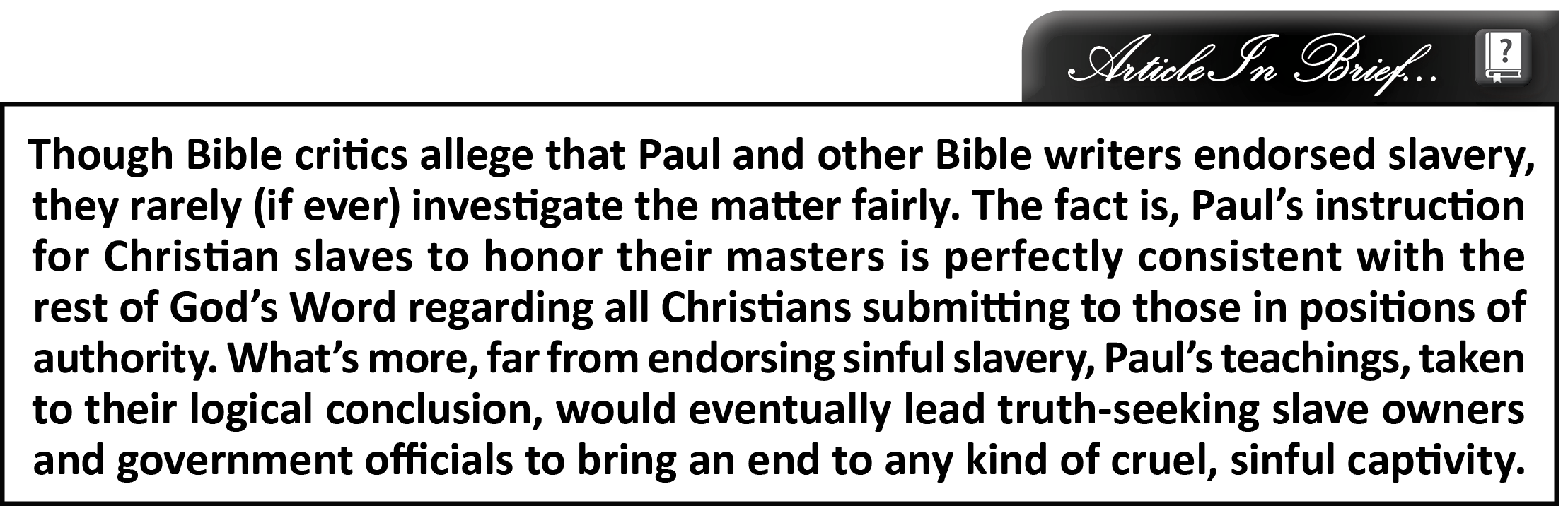
Paul’s instruction for slaves to honor their masters is perfectly consistent with the rest of God’s Word regarding all Christians submitting to those in positions of authority. To the Christians living in the heart of the Roman Empire, Paul taught: “Let every soul be subject to the governing authorities…. Render therefore to all their due: taxes to whom taxes are due, customs to whom customs, fear to whom fear, honor to whom honor” (Romans 13:1,7; cf. Matthew 22:21).13 Similarly, Peter wrote: “Therefore submit yourselves to every ordinance of man for the Lord’s sake, whether to the king as supreme, or to governors…. For this is the will of God…. Honor all people. Love the brotherhood. Fear God. Honor the king” (1 Peter 2:13-17). Was the Roman Empire corrupt in many ways? Certainly. Was a Christian’s submission to Rome a blanket endorsement of the Empire? Not at all. But Christians were (and are) to be humbly compliant.
God expects all Christians to have a spirit of submission. Children are to submit to their parents (Ephesians 6:1-3). Young people are to be submissive to older people (1 Peter 5:5). Wives are to submit to their husbands (1 Peter 3:1-2). Members of local churches are to submit to their overseeing elders who rule over them (Hebrews 13:17; Acts 20:28). Local shepherds are to submit fully to the Chief Shepherd (1 Peter 5:1-4). In short, all Christians, including those in leadership positions, are to “be submissive to one another, and be clothed with humility, for ‘God resists the proud, but gives grace to the humble’” (1 Peter 5:5). And, yes, God expects His people to humbly “submit…to every authority instituted among men,” whether to kings or to slave masters (1 Peter 2:13,18, NIV).
Submission for a Higher Purpose
God did not create the practice of slavery. Furthermore, Paul’s inspired instructions regarding a slave’s submission to his master were not given because God favors a master over his slave (Galatians 3:28), or because He simply wants some people to have harder lives than others. The specific purpose that Paul gave for Christian slaves submitting to their pagan masters was “so that the name of God and His doctrine may not be blasphemed” (1 Timothy 6:1).
Imagine if Christian slave after slave in the first century became less submissive to their masters as they learned more about the equality of all mankind (Genesis 1:26-27). Consider how the reputation of Christianity would have been greatly tarnished in the eyes of the unbelieving world if Paul explicitly taught that all slaves should be set free. As William Barclay noted: “For the Church to have encouraged slaves to revolt and rebel and rise against their masters would have been fatal. It would simply have caused civil war, mass murder, and the complete discredit of the Church.”14
God, in His infinite wisdom, commands all men to do their best to make the most for the cause of Christ in whatever situation they find themselves. “Let each one remain in the same calling in which he was called. Were you called while a slave? Do not be concerned about it; but if you can be made free, rather use it. For he who is called in the Lord while a slave is the Lord’s freedman. Likewise he who is called while free is Christ’s slave” (1 Corinthians 7:21-23). Whether a person becomes a Christian while in slavery or in a terrible marriage, God wants His people to change from the inside out and have a positive spiritual impact on others. Be obedient to parents, husbands, governing officials, and yes, even slave owners. “Let your light so shine before men, that they may see your good works and glorify your Father in heaven” (Matthew 5:16). Rather than giving people reasons to curse Christ and His doctrine, be obedient to all those in positions of authority “for the Lord’s sake” (1 Peter 2:13). Be honorable at all times so that you may “put to silence the ignorance of foolish men” and “by your good works which they observe, glorify God in the day of visitation” (1 Peter 2:15,12; cf. 3:1-2). In short, “humble yourselves under the mighty hand of God, that He may exalt you in due time” (1 Peter 2:6).
Taking Paul’s Teaching to Its Logical Conclusion
Over time, with the spread of Christianity (cf. Acts 19:10,26; 21:20) and with increasing numbers of slave masters becoming Christians, the physical lives of many slaves would have improved dramatically. As slave owners with honest and good hearts learned (1) to love the Lord with all their heart, soul, mind, and strength, and (2) to love their neighbors (including their slaves) as themselves (Matthew 22:36-40), they would give up “threatening” (Ephesians 6:9). As Christian slave owners contemplated treating others how they want to be treated (Matthew 7:12), they would give their slaves “what is just and fair,” knowing that they, too, had a Master in heaven (Colossians 4:1). As slave owners submitted to Christ, they would be transformed by the Gospel, learning to be “kindly affectionate” to everyone (Romans 12:2,10), including all those who served them. In short, far from endorsing sinful slavery, Paul’s teachings, taken to their logical conclusion, would eventually lead truth-seeking masters and government officials to help bring an end to any kind of cruel, sinful captivity.15
Endnotes
1 “History of Slavery” (no date), History World, www.historyworld.net/wrldhis/PlainTextHistories.asp?historyid=ac41.
2 “Code of Hammurabi, King of Babylon” (no date), https://archive.org/stream/cu31924060109703/cu31924060109703_djvu.txt.
3 Walter Scheidel (2007), “The Roman Slave Supply,” p. 6, https://www.princeton.edu/~pswpc/pdfs/scheidel/050704.pdf.
4 Scheidel, pp. 3-6.
5 Frederick William Danker, William Arndt, and F.W. Gingrich (2000), Greek-English Lexicon of the New Testament (Chicago: University of Chicago), p. 260.
6 John Simkin (2014), “Slavery in the Roman Empire,” Spartacus Educational, http://spartacus-educational.com/ROMslaves.htm.
7 Simkin.
8 Scott Greenberg (no date), Tax Foundation, https://taxfoundation.org/tax-freedom-day-2016-april-24/.
9 “Conscription,” Merriam-Webster.com, https://www.merriam-webster.com/dictionary/conscription, emp. added.
10 “Who Must Register” (2008), Selective Service System, https://web.archive.org/web/20090507213840/http://www.sss.gov/FSwho.htm.
11 “Endorse,” Merriam-Webster.com, https://www.merriam-webster.com/dictionary/endorse.
12 Danker, et al., p. 76.
13 All bold text in Scripture quotations has been added for emphasis.
14 William Barclay (1956), The Letters to Timothy, Titus, and Philemon (Philadelphia: Westminster), p. 141.
15 For a more extensive response to questions regarding slavery, and especially slavery in the Old Testament, see Kyle Butt (2005), “Defending the Bible’s Position on Slavery,” Reason & Revelation, 25[6]:41-47, June, https://www.apologeticspress.org/pub_rar/25_6/0506.pdf.
The post Did Paul Endorse Slavery? appeared first on Apologetics Press.
]]>The post The Bible and Slavery appeared first on Apologetics Press.
]]>Friction soon arose between those who wanted to maintain slavery, and those who wanted to outlaw the practice as inhumane and unjust. It can be argued convincingly that the American Civil War was fought primarily over this very issue. Politicians raged on both sides of the matter. Interestingly, so did religious people. Abolitionists, as well as pro-slavery advocates, went to the Bible to marshal arguments for their particular view. Abolitionists armed themselves with verses such as: “Therefore whatever you want men to do to you, do also to them: for this is the Law and the Prophets” (Matthew 7:12); or “There is neither Jew nor Greek, there is neither slave nor free, there is neither male nor female; for you all are one man in Christ Jesus” (Galatians 3:28). Religious pro-slavery activists fired impressive scriptural guns by quoting passages such as: “Servants, be submissive to your masters with all fear; not only to the good and gentle, but also to the harsh” (1 Peter 2:18); and “Servants, be obedient to those who are your masters according to the flesh, with fear and trembling, in sincerity of your heart, as to Christ” (Ephesians 6:5). Can we determine with accuracy what the Bible really says on the topic of slavery? Does the Bible condemn it as a social injustice? Does the Bible condone the practice? And how does the Bible’s position on slavery mesh with the idea of a loving God?
For years, skeptics have railed against the written Word, insisting that its pro-slavery tendencies should alert any reader who has a scrap of common sense to the idea that an all-loving God could not have inspired such atrocious material. Morton Smith and R. Joseph Hoffman, in a book titled What the Bible Really Says, commented:
[T]here is no reasonable doubt that the New Testament, like the Old, not only tolerated chattel slavery (the form prevalent in the Greco-Roman world of Paul’s time) but helped to perpetuate it by making the slaves’ obedience to their masters a religious duty. This biblical morality was one of the great handicaps that the emancipation movement in the United States had to overcome. The opponents of abolition had clear biblical evidence on their side when they argued (1989, pp. 145-146, parenthetical item in orig.).
Following a similar line of thinking, Ruth Green wrote that “it was the Old and New Testaments of the Bible that were the authority for keeping humanity in serfdom for centuries and for legitimizing slavery in America, making a bloody civil war necessary to give slaves human rights under our Constitution” (1979, p. 351).
Has the Bible been responsible for the oppression of slaves in the past? No, it has not. In fact, an in-depth look into the biblical account that reveals God’s attitude toward slavery shows just the opposite.
SLAVERY IN THE OLD TESTAMENT
In Matthew 19:3-10, the Pharisees came to Jesus, attempting to trap Him with questions about the Old Law. They asked: “Is it lawful for a man to divorce his wife for just any reason?” Jesus informed them that divorce was not in God’s plan from the beginning. Thinking they had trapped Him, they inquired: “Why, then, did Moses command to give a certificate of divorce and to put her away?” If it was in the Old Law, they suggested, then it must be God’s ideal will. But Jesus’ answer quickly stopped that line of thinking. He responded:
Moses, because of the hardness of your hearts, permitted you to divorce your wives, but from the beginning it was not so. And I say to you, whoever divorces his wife, except for sexual immorality, and marries another, commits adultery; and whoever marries her who is divorced commits adultery.
Jesus’ point was crystal clear—some things permitted in the Old Testament did not necessarily represent the ideal. Due to the hardness of ancient Israel’s heart, God tolerated (and regulated) some things under the Old Law that He did not endorse. As He did so, however, He progressively revealed His divine will to mankind, clarifying that will more fully through Christ.
Many of the injunctions found in the Old Testament pertaining to slavery fall into the category of regulating something that was “less than ideal.” Even in the Old Testament, God desired that all people love their neighbors as themselves (Leviticus 19:18). Yet, in a time when God used the children of Israel as His arm of justice to punish evildoers, certain questions arose. What was to be done, for example, with the survivors of those wicked nations? What was to be done with a man who was so far in debt that he could not repay his lender? These issues, and others like them, necessitated that God institute some form of humane regulations for “slavery.”
Often, those who attack the Bible skirt the real crux of the slavery issue. They point to verses in the Old Testament that offer a particular regulation for slavery. From there, they proceed to argue that the Bible is a vile book that does not condemn, but actually condones slavery. And, they argue, since all slavery is morally wrong, the Bible must not be the product of a loving God.
However, those who take such a position fail to consider that certain types of slavery are not morally wrong. For instance, when a man is convicted of murder, he often is sentenced to life in prison. During his life sentence, he is forced by the State to do (or not do) certain things. He is justly confined to a small living space, and his freedoms are revoked. Sometimes, he is compelled by the State to work long hours, for which he does not receive even minimum wage. Would it be justifiable to label such a loss of freedom as a type of slavery? Yes, it would. However, is his loss of freedom a morally permissible situation? Certainly. He has become a slave of the State because he violated certain laws that were designed to ensure the liberty of his fellow citizen, whom he murdered. Therefore, one fact that must be conceded by anyone dealing with the Bible and its position on slavery is the fact that, under some conditions, slavery is not necessarily a morally deplorable institution.
Taking that into account, we also must ask: Who has the right to determine when slavery can be imposed on a certain person or group of people? The answer, of course, is God. In the Old Testament, immoral nations who practiced unspeakable evils surrounded the Hebrews. In order to rid the world of their destructive influence, the children of Israel dealt with them in several ways. One of those ways included forcing the wicked nations into slavery. Many of the slave regulations in the Old Testament deal with the treatment of individuals and nations who had committed crimes against humanity that were worthy of death. The wicked people were graciously allowed to live, but they were subjected to slavery, much like a lifetime prison sentence in modern criminal cases. Let us look more closely at this situation. In Leviticus 18:21,24 we read that the Lord told Moses to instruct the Israelites as follows:
And you shall not let any of your descendants pass through the fire to Molech…. Do not defile yourselves with any of these things; for by all these the nations are defiled, which I am casting out before you.
In order to understand this scenario, it is important that we understand what the phrase, “pass through the fire to Molech,” means in verse 21. In brief, it means that the nations around the Israelites were burning their own children as human sacrifices to a pagan god named Molech (for further information on Molech and this practice, see Harrison, 1988, 3:401). Fitting this into our discussion, would it be morally permissible for God to allow a government (e.g., the Israelites) to punish those people who were viciously murdering their own children? We must answer in the affirmative. What punishment would be appropriate for a person who had committed such heinous crimes as to murder his or her own innocent children? The answer to that question rages even in our own society today when instances of child homicide arrive before the courts of our land. Legitimate answers often include the death penalty, or a life in prison in which many freedoms are revoked.
As additional evidence along these lines, in Exodus 22:1-3, the Bible discusses a situation in which a man was caught in the act of thievery. The thief was instructed to restore what he stole, returning four sheep, and five oxen, for every one stolen. The text further states: “He should make full restitution; if he has nothing, then he shall be sold for his theft” (vs. 3). Being sold into slavery was often a government-regulated punishment based on a criminal action. One can see, then, that it is morally permissible to revoke the freedoms of certain people or groups of people based on their inappropriate conduct.
Accordingly, many of the slavery regulations in the Old Testament pertained to people who deserved far worse. Dan Vander Lugt commented:
Old Testament laws regulating slavery are troublesome by modern standards, but in their historical context they provided a degree of social recognition and legal protection to slaves that was advanced for its time (Exodus 21:20-27; Leviticus 25:44-46). We must keep in mind that on occasion it was an alternative to the massacre of enemy populations in wartime and the starvation of the poor during famine (2001, p. 1).
A Mutually Beneficial Relationship
Frequently, “slavery” in Bible times was much more of an employer/employee relationship than an owner/slave situation. Even the words used to delineate between a hired servant and a slave are difficult to separate. As Herbert Lockyer noted:
In the ancient world, service and slavery were closely related, so much so that one can scarcely distinguish the one from the other. The original words used for “servants” and “service” carry a variety of meanings between which it is not always easy to determine what is meant (1969, p. 197).
Arndt and Gingrich documented that the Greek word doulos meant “slave,” but that it also was used “in a wider sense” to denote “any kind of dependence.” In 2 Corinthians 4:5, the apostles are called the douloi (plural of doulos) of the Christians. Christ took on the form of a doulos, as stated in Philippians 2:7. Paul designates himself as a doulos of Christ in Romans 1:1, Philippians 1:1, Galatians 1:10, and numerous other passages (1967, pp. 205-206). The term can describe a person who is obligated in some way, whether voluntarily or involuntarily, to another person. Due to this broad use, various translations have employed a wide range of words to render the meaning of doulos in English. Using Romans 1:1 as a case in point, the NKJV has “bondservant,” the New Living Translation has “slave,” the KJV and ASV have “servant,” and the Darby Bible has “bondman.”
The Hebrew word ebed is similar to the Greek doulos, in that it can be translated as “slave” or “servant.” In Exodus 4:10, Moses referred to himself as the “servant” (ebed) of God. Abraham called himself the ebed of the angels who came to visit him in Genesis 18:3. In Genesis 39:17-19, Potiphar’s wife described Joseph as the Hebrew ebed, and Genesis 24:2 talks about the eldest ebed in Abraham’s house, who “ruled over all he had.”
The purpose of including this brief description of the two most common terms for a slave is to show that our modern use of the word slave generally evokes mental images of cruelty, injustice, and bondage against a person’s will. While such ideas could be included in the biblical usage, they do not necessarily fit every time the words are used. Instead, the picture that we often see when the biblical words for “slave” are employed is a mutually beneficial arrangement similar to an employer/employee relationship. Job describes this relationship quite well:
If I have despised the cause of my manservant (ebed) or of my maidservant, when they contended with me; what then shall I do when God riseth up? And when he visiteth, what shall I answer him? Did not he that made me in the womb make him? And did not one fashion us in the womb (Job 31:13-15)?
Obviously, Job’s dealings with his slaves provided a mutually acceptable situation for master as well as slave.
To illustrate further the true nature of much Old Testament slavery, Abraham’s relationship with his slave Eliezer should be examined. In Genesis 15:2-3, Abraham lamented the fact that he was childless. In his dialogue with God, he stated that the heir of his wealth was Eliezer of Damascus. In verse three of chapter 15, Abraham described Eliezer as “one born in my house.” Later, in Genesis 24:2, Abraham’s oldest servant (probably Eliezer) “ruled over all that he had.” Add to this the fact that Abraham armed 318 trained servants (Hebrew ebed) to bring back Lot after he had been captured (Genesis 14:14-15). If the slave/owner relationship was anything less than mutually trusting, Abraham most likely would not have intentionally armed his slaves.
Due to the mutually beneficial nature of much Old Testament slavery, some slaves did not even want to leave their masters. Deuteronomy 15:16-17 deals with that very situation:
And if it happens that he [a slave—KB] says to you, “I will not go away from you,” because he loves you and your house, since he prospers with you, then you shall take an awl and thrust it through his ear to the door, and he shall be your servant forever. Also to your maidservant you shall do likewise.
Do the actions and words of Abraham’s slaves, or those found in Deuteronomy 15, seem like the actions and words of tyrannized, oppressed people? Hardly. Rather, they seem more like the words and actions of people enjoying a mutually beneficial and consensual relationship.
Even during New Testament times, slavery often provided a mutually beneficial relationship to both owner and slave. As Paul Copan remarked:
During Paul’s time, the master-slave relationship provided sufficient benefits and opportunities, such that it dampened any thoughts of revolutionary behavior. One freed slave had inscribed on his tombstone: “Slavery was never unkind to me….” More often than not, it was the free workers rather than slaves who were abused by foremen and bosses. (After all, an owner stood to have an ongoing loss if he abused his slave.) [2001, p. 172, parenthetical item and emp. in orig.].
But suppose a master did abuse his slaves in Old Testament times, and those slaves decided to run away. In Deuteronomy 23:15-16, God made it unlawful for runaway slaves to be returned to their masters. The text states:
You shall not give back to his master the slave who has escaped from his master to you. He may dwell with you in your midst, in the place which he chooses within one of your gates, where it seems best to him; you shall not oppress him.
This passage is particularly revealing because it shows how costly cruelty to slaves was. It also shows that slaves had the freedom to choose where, and with whom, they wanted to live. Wright noted that this passage proves that
[s]lavery as such is not protected or rendered sacrosanct under Israelite law. At the very least it can be said that such a law probably presumes that runaway slaves will be the exception, not the rule. This lends further weight to the view that normally slavery in Israel was not oppressively harsh. It would certainly not have been, if the spirit of the slavery laws of Exodus and Deuteronomy were put into practice (1983, pp. 181-182).
Add to this the fact that kidnapping a man and selling him as a slave was a crime punishable by death, as noted in Exodus 21:16: “He who kidnaps a man and sells him, or if he is found in his hand, shall surely be put to death.” Certainly, any parallel to slavery in early America can be easily refuted.
Also note that the slavery regulated in the Bible had absolutely nothing to do with race, color, or ethnic background. While it is true that certain nations, as a whole, were captured and enslaved because of their wicked, idolatrous practices, it is not true that they were enslaved due to their allegedly inferior nationality. Leviticus 19:34 states: “But the stranger who dwells among you shall be to you as one born among you, and you shall love him as yourself; for you were strangers in the land of Egypt: I am the Lord your God.” Deuteronomy 24:14 reads: “You shall not oppress a hired servant who is poor and needy, whether one of your brethren, or one of the aliens who is in your land within thy gates.” And, although certain regulations applied only to Hebrews who found themselves enslaved (Deuteronomy 15:12-14; Exodus 21:2), it was not because they were a “superior” race or nationality, but simply because they were citizens of the nation of Israel (a similar concept would be the fact that a person who is born in the USA is not inherently any less or any more valuable than any other person, but, under the law system of the United States, that person would possess certain rights and privileges that a non-citizen would not enjoy). Deuteronomy 10:17-19 illustrates God’s impartiality well:
For the Lord your God is God of gods and Lord of lords, the great God, mighty and awesome, who shows no partiality nor takes a bribe. He administers justice for the fatherless and widow, and loves the stranger, giving him food and clothing. Therefore, love the stranger; for you were strangers in the land of Egypt.
The New Testament further underscores the idea of human equality in passages such as Galatians 3:28: “There is neither Jew nor Greek, there is neither slave nor free, there is neither male nor female; for you are all one man in Christ Jesus.” Job’s statement regarding his slave’s equality—due to the fact that God formed him in the same way that God formed Job (31:15)—provides a perfect example of the biblical idea that all men possess the same inherent value. The idea that one nation or race is superior to another does not come from the Bible. Racism like that displayed by many during the slavery years of the United States has always been a sin (Acts 17:26-31).
A valid question naturally arises from the comment above, that, on occasion, nations as a whole were enslaved because of their wickedness. What about the children of those wicked men and women? Must they become slaves as well, suffering for their parents’ evil actions? First, let us acknowledge that, even today, children often suffer because of their parents’ poor decisions. Consider the sad and pitiful plight of a child whose father is an alcoholic or child abuser. That child will suffer physically, emotionally, and financially. Even in modern times, the children who are born in poverty or cruelty often remain slaves of those elements their entire lives. Second, let us ask a more pertinent question: Would it be better for that child to grow up in a country where the slave laws protected him or her, or would it be better for the child to have to “pass through the fire to Molech”? To ask is to answer, is it not? When nations were conquered by the Israelites, what was to happen to the nations’ children who remained alive? They could be left to die on their own, or they could be given homes, food, and jobs. Which of the two options is more humane? Again, to ask is to answer. Furthermore, if the child grew up and did not like his master, he or she could simply run away and live wherever he or she wanted (Deuteronomy 23:15-16).
As we consider further the situation of slaves in ancient Israel, it is interesting to note that every slave was entitled (by God) to have a part in the Sabbath rest once every week. Exodus 20:10 states:
[B]ut the seventh day is the Sabbath of the Lord your God. In it you shall do no work: you, nor your son, nor your daughter, nor your manservant, nor your maidservant, nor your cattle, nor your stranger who is within your gates (emp. added).
Along these same lines, every slave also was entitled to partake in the eight-day festivities surrounding the Feast of Weeks and the Feast of Tabernacles (Deuteronomy 16:9-17). The welcome rest provided on these occasions shows that God’s regulations for slavery in Israel were humane and fair. Furthermore, the year of Jubilee (Leviticus 25:10) provided freedom to “all the inhabitants” in the land of the children of Israel. [This provision included many of the slaves, with possible exceptions such as those slaves who had chosen to stay with their masters and have their ears pierced as a sign of their situation, and those slaves that were taken from other nations.]
And you shall consecrate the fiftieth year, and proclaim liberty throughout all the land to all its inhabitants. It shall be a Jubilee for you; and each of you shall return to his possession, and each of you shall return to his family.
Certainly, God kindly provided rest and freedom for slaves under the Old Testament in order to quell abuses that might arise.
Slaves of Debt
Another aspect of Old Testament slavery had to do with severe debt accumulation. In Old Testament times, no bankruptcy legislation held sway over the Israelites. What was to be done for the person who was drowning in a sea of debt? Was his lender simply to wave his hand and forgive the debt? Would that be a fair situation for the lender? Hardly. Therefore, many of the slave situations arose because of such debt. Herb Vander Lugt commented:
Remember too, at that time no nation had the ability to deal with people who had gotten themselves hopelessly in debt. So they were allowed to sell themselves into slavery (often temporarily) in exchange for release from their financial obligations (Ex. 21:2-4; Lev. 25:39-43; Dt.15:12) [1999, p. 11, parenthetical item in orig.].
Leviticus 25:47-49 provides an example of slavery caused by debt:
Now if a sojourner or stranger close to you becomes rich, and one of your brethren who dwells by him becomes poor, and sells himself to the stranger or sojourner close to you, or to a member of the stranger’s family, after he is sold he may be redeemed again. One of his brothers may redeem him; or his uncle or his uncle’s son may redeem him; or anyone who is near of kin to him in his family may redeem him; or if he is able he may redeem himself.
Would it be fair for a society to allow a person who had accumulated a huge amount of debt to sell his labor to another person to pay that debt? Yes, it would. However, God—aware that abuse might arise in any situation—even regulated debt slavery, and provided for the rights and privileges of the slave to be guarded.
DIFFICULT LAWS TO UNDERSTAND
Admittedly, even with all the humane slave laws contained in the Old Testament, there are certain laws that we, in modern times, have a difficult time understanding. For instance, Exodus 21:20 reads:
And if a man beats his male or female servant with a rod, so that he dies under his hand, he shall surely be punished. Notwithstanding, if he remains alive a day or two, he shall not be punished; for he is his property.
In the first place, how could God allow a slave owner to beat his slave at all? To answer this question, we must remember who many of the Old Testament slaves were. They were members of the wicked, sinful nations who had been delivered into the hands of the Israelites because of their immorality. Suppose that a slave from one of those nations had made up his mind to do as much damage to his owner as possible. The slave had the option of running away to a gentler owner whenever he wished (Deuteronomy 23:15-16). However, suppose that he chose to stay and steal from the owner, or break the owner’s equipment intentionally, or destroy the owner’s crops. What could the owner do to stop such sabotage? Herb Vander Lugt put it like this:
Then, too, no matter how well the slaves were treated, some might have been rebellious and defiant. Forgetting that they were alive because they were taken as war captives instead of being executed, they might have blamed their master for their slave status. They might have shown their resentment by destroying property, abusing fellow slaves, or refusing to work. The master may have had no other way to bring his slave in line than to use physical punishment (1999, p. 17).
As appalling as it is to the sensitivities of most United States citizens, many countries still employ some type of beating or bodily harm to deter crime (some readers may recall the controversy over “caning” in Singapore in the early 1990s). When a modern-day prisoner violates rules while incarcerated, more stringent punishment (such as solitary confinement) often is required. If a slave deserved the death sentence, yet was allowed to live under certain conditions—and then did not comply with those conditions—would it be feasible to suggest that his death sentence could be reinstated? Even though it seems harsh to us, Exodus 21:20 does not militate against the justice of God.
In fact, the more closely the passage is scrutinized, the more it manifests the idea that God was protecting the slave. Concerning the punishment that a master would receive if he did beat his slave to death, Christopher Wright noted that the word “punished” as used here actually means “avenged.” And,
in any other context [it] would mean that the guilty party would be liable to death himself at the hands of his victim’s family…. This law’s natural sense is that the murderous master was to be executed by the legal community on behalf of the slave, who had no family to avenge him (1983, p. 180).
While not all commentators are as confident as Wright is (that in this passage the death penalty is involved), there is no concrete case which argues that the death penalty is not at least a possibility in this situation. The authors of the Pulpit Commentary observed how this fear of punishment would protect the slave.
Involving, as the death of the slave did, criminal proceedings, and, on conviction, severe punishment, the mere danger of a fatal result ensuing would be a powerful deterrent from exceptional violence…. The mere risk of incurring such a penalty would inspire salutary caution (Spence and Exell, n.d., p. 179).
Adding additional weight to the argument that the restriction in Exodus 21:20 was for the benefit of the slave, Burton Coffman wrote:
This was a protective right granted to slaves that they should not be beaten to death! If that seems like a small blessing to us, let it be remembered that under the system in vogue all over the pagan world of that era, and extending down even till apostolical times, the Roman Law, in force all over the world, provided as a penalty against slaves, even for trivial and unintentional violations, that shame of the whole pagan world “flagellis ad mortem” (beaten to death), a penalty usually inflicted in the presence of all the other slaves of a master. God here provided that punishment should be meted out to a slave-owner for following that pagan custom (1985, pp. 309-310).
By way of summary, then, Exodus 21:20 documents that under certain circumstances, beating could be morally acceptable as punishment. This passage, however, provided rights that did not exist in other pagan cultures for the protection of the slave.
Exodus 21:26-27 provides another example of a law that seems difficult for us, in the present day, to understand as coming from a righteous God.
If a man strikes the eye of his male or female servant, and destroys it, he shall let him go free for the sake of his eye. And if he knocks out the tooth of his male or female servant, he shall let him go free for the sake of his tooth.
Again, let it be noted that physical punishment might be the only solution to an unruly, rebellious slave who should have received the death penalty. However, something else of interest emerges from this verse that, rather than expressing the cruelty of Old Testament laws regulating slavery, shows instead God’s care for those enslaved. The text states that the eyes and teeth of slaves should not be knocked out or destroyed. However, the nations around the Israelites did not adhere to any such standards. When the Philistines captured Samson, they “took him and put out his eyes; and brought him down to Gaza. They bound him with bronze fetters; and he became a grinder in the prison” (Judges 16:21). Also, when the Babylonian soldiers raided Israel, capturing King Zedekiah, “they killed the sons of Zedekiah before his eyes, put out the eyes of Zedekiah, bound him with bronze fetters, and took him to Babylon” (2 Kings 25:7). God’s regulations for the treatment of slaves provided the slaves with many more rights than they had in the nations surrounding Israel.
Another of the most startling regulations concerning slavery is found in Leviticus 19:20-22:
And whosoever lieth carnally with a woman, that is a bondmaid, betrothed to an husband, and not at all redeemed, nor freedom given her; she shall be scourged; they shall not be put to death, because she was not free. And he shall bring his trespass offering unto the Lord, unto the door of the tabernacle of the congregation, even a ram for a trespass offering (KJV).
Of course, skeptics have a heyday with this reading from the King James Version, which seems to indicate that if a free man has sexual intercourse with a slave woman who is betrothed, then the slave woman is to be scourged and the man simply supplies a ram as a trespass offering. However, upon further investigation, it can be seen that this passage says something far different.
In the first place, the translators of the KJV most likely mistranslated the part of the text “she shall be scourged.” The ASV translators rendered the passage as follows:
And whosoever lieth carnally with a woman that is a bondmaid, betrothed to a husband, and not at all redeemed, nor freedom given her; they shall be punished; they shall not be put to death, because she was not free. And he shall bring his trespass-offering unto Jehovah, unto the door of the tent of meeting, even a ram for a trespass-offering.
The NKJV translators offered this reading:
Whoever lies carnally with a woman who is betrothed to a man as a concubine, and who has not at all been redeemed nor given her freedom, for this there shall be scourging; but they shall not be put to death, because she was not free. And he shall bring his trespass offering to the Lord, to the door of the tabernacle of meeting, a ram as a trespass offering.
A brief look at these three translations shows that the recipient(s) of the punishment is not as clearly delineated as the KJV indicates. Keil and Delitzsch, in their commentary on the Pentateuch, noted that the scourging “referred to both parties, as is evident from the expression, ‘they shall not be put to death’” (1981, p. 422). G.J. Wenham has introduced another interesting solution regarding this passage by translating the disputed passage about scourging as “damages must be paid” (1979, p. 270). Concerning this translation he wrote:
This is the most problematic phrase in this law: literally, “there will be a biqqôret.” The word biqqôret occurs only here in the OT, and its meaning is therefore quite uncertain…. Other renderings of biqqôret have less to commend them. “An inquiry shall be held” (RSV; cf. NEB) is vacuous: every legal dispute would have involved inquiry. “She shall be scourged” (AV) goes back to an old Jewish interpretation, probably based on the dubious derivation of biqqôret from bâqâr, “ox, i.e., an oxhide scourge” (pp. 270-271, emp. added).
Taking these things into account, it appears that the passage does not indicate that the female should be scourged apart from the guilty male. Rather, whatever punishment was inflicted should be applied equally, except for the fact that the guilty male alone shoulders the responsibility of supplying the ram for the trespass offering.
According to God, the Israelites did not have absolute control over their slaves, as is evinced by the instructions in Exodus 21:20,26-27 and Leviticus 19:20. This idea was a departure from the generally accepted notions of slavery in the Near East during the Israelites’ day. “Any demeaning or oppressive treatment of slaves was condemned as wrong by biblical writers” (Copan, 2001, pp. 173-174). God’s laws in the Old Testament not only regulated slavery (so that those enslaved would be given many rights that they otherwise would not have had), but they also supplied the means whereby fairness could be meted out with regard to criminal activity and debt. Every regulation of slavery in the Old Testament can be shown to be in harmony with the principles of justice and fairness.
SLAVERY IN THE NEW TESTAMENT
As we look into the New Testament, we see a strikingly different picture with regard to the biblical injunctions pertaining to slavery. The New Testament does not contain the specific regulations dealing with slavery that can be found in the Old Testament. In fact, for the most part, the New Testament says very little in its regulation of slavery. And herein lies one of the skeptic’s primary challenges to the New Testament’s stance on slavery. If the New Testament is supposedly a book inspired by an all-loving God, why does it remain virtually silent on slavery? Smith and Hoffman, in their attack on the Bible, stated:
Slave-owning was the order of the day and, so far as we are told, Jesus never attacked the practice. He took the state of affairs for granted and shaped his parables accordingly…. If Jesus had denounced slavery, we should almost certainly have heard of his doing so (Smith and Hoffman, 1989, p. 143).
The other challenge to the New Testament’s stance on slavery centers on the passages that teach slaves to be humble and obedient servants to their masters. In Colossians 3:22, Paul commanded: “Slaves, obey your earthly masters in everything, not only while being watched and in order to please them, but wholeheartedly, fearing the Lord” (NRSV). Although several modern translations insert the word “servants” at the first of this verse, “slaves” is probably a better translation of the Greek word douloi in this passage (Arndt and Gingrich, 1967, p. 205). Other similar passages include 1 Peter 2:18-20, 1 Corinthians 7:21-24, and Ephesians 6:5-9. Ruth Green, after presenting her case to suggest that the Bible condones slavery, wrote:
Those who deny my contentions about the Bible should turn to the Epistles to see what Paul and Peter have to say about “servants” and masters. Here are only two examples: “Servants, be subject to your masters in all fear” (1 Peter 2:18). “Servants, be obedient to them that are your masters . . . with fear and trembling” (Ephesians 6:5). There are many more instructions about slavery in the Christian Holy Book (1979, p. 352).
Does the New Testament remain silent in its condemnation of all slavery? And why does it specifically instruct slaves to be obedient to their masters?
First, it must be acknowledged that many of the types of servanthood or slavery in the New Testament are identical to the morally permissible types discussed earlier in this article. For instance, much first-century slavery discussed in the Bible centered on the fact that a person had accrued massive debt, and thus had become a slave or servant due to this debt. As an example, in the Sermon on the Mount, Jesus said: “Agree with your adversary quickly, while you are on the way with him, lest your adversary deliver you to the judge, the judge hand you over to the officer, and you be thrown into prison. Assuredly, I say to you, you will by no means get out of there till you have paid the last penny” (Matthew 5:25-26). From Christ’s comments, it can be ascertained that the person in this text who does not make the effort to agree with his adversary could risk being thrown into prison until that person “paid the last penny.” This situation involved a revoking of individual freedoms due to the fact that the individual owed an unpaid debt—a debt that originally was owed to the adversary, or one that resulted from a fine imposed by a judge.
In Matthew 18:21-35, Jesus told a story about a servant who owed his master ten thousand talents. A talent was a huge sum of money that would be the modern equivalent of many thousands of dollars. It could easily have been the case that this servant had become a servant due to this enormous debt, or was being kept a servant because of the debt. Debt slavery was still a very real form of restitution in New Testament times. Such a condition absolutely cannot be used to argue that God is an unjust God for letting such take place.
Furthermore, it is a false notion that God condones something just because He mentions it without an immediate condemnation of it in the surrounding verses. Skeptics point to verses like 1 Peter 2:8 and Ephesians 6:5, and then insist that God condones abusive slavery because He instructs servants to be obedient to their masters. But, let us analyze that line of thinking. In Matthew 5:39, Christ instructed His listeners: “Do not resist an evil person. But whoever slaps you on your right cheek, turn the other to him also.” Because Jesus told His listeners to be kind and turn the other cheek, does that mean that He condones the actions of the one who did the slapping? Absolutely not! Or what about the fact that Paul, through divine inspiration, instructed his readers to be subject to civil governments and to pay taxes to those governments. Was Paul condoning all practices of all governments to whom his readers would be subject and pay taxes? Certainly not. God never has condoned such unjustified behavior on the part of any individual or group.
Biblical Principles and Abolition
As a concluding argument, let it be clearly stated that the principles set forth by Jesus and His apostles, if followed, would result in the abolition of all types of abusive relationships. Slavery would have been nonexistent if everyone from the first century forward had adhered to Jesus’ admonition in Matthew 7:12: “Therefore, whatever you want men to do to you, do also to them.” Any discussion of slavery would be moot if the world had heeded the words of Peter: “Finally, all of you be of one mind, having compassion for one another, love as brothers, be tenderhearted, be courteous” (1 Peter 3:8).
Truly, the teachings of the Lord and the apostles would have abolished slavery like no other social reform system ever known. As Herb Vander Lugt accurately observed:
Jesus and the apostles didn’t go on an anti-slavery crusade, because doing so would have been futile and a hindrance to their primary mission. The priority of Jesus was the provision of salvation. For the apostles it was the proclamation of the gospel. But both Jesus and the apostles undermined the basis for slavery by making it clear that God equally loves rich and poor, free and slave, male and female. The apostles also welcomed into the church and gave equal status to all who believed, regardless of race, gender, nationality, or social position (1999, p. 26).
Furthermore, an outright condemnation of kidnapping, or slave trading, is found in the New Testament. In 1 Timothy 1:9-10, Paul wrote:
We also know that law is made not for the righteous but for lawbreakers and rebels, the ungodly and sinful, the unholy and irreligious; for those who kill their fathers or mothers, for murderers, for adulterers and perverts, for slave traders and liars and perjurers—and for whatever else is contrary to the sound doctrine… (NIV, emp. added).
Other versions render the Greek word andrapodistais as “kidnappers,” or “menstealers,” but it also is translated slave dealers or slave traders (Arndt and Gingrich, 1967, p. 63). Therefore, in keeping with the Old Testament injunction that anyone kidnapping and selling a person involves himself in immoral conduct, Paul certainly distinguished between certain types of slavery practices that were inherently wrong, and others that were not intrinsically sinful.
CONCLUSION
The fact is, certain types of “slavery” not only are permissible, but sometimes necessary to the well-being of a society at large. For the biblical stance on slavery to be condemned as unjust, it must be established that the specific regulations of slavery described in the text are immoral and unfair. However, when closely scrutinized, the biblical stance on slavery aligns itself with true justice. All regulations found therein were established for the just treatment of all parties involved. Many times, slavery as regulated in the Old Testament was a mutually beneficial relationship between servant and master, similar to an employee/employer relationship. Furthermore, slavery often was a substitute for the death penalty—which certain nations deserved. Debt accumulation caused many free persons to sell their labor and become slaves.
The skeptic’s criticism that the New Testament does not speak against the abolition of slavery is misguided for any number of reasons. First, an attempt to generalize and condemn all types of slavery fails to take into account prison, personal debt, indentured servanthood, and a host of other morally permissible situations. Bankruptcy laws, prison terms, community service hours, and garnished wages are morally acceptable modern equivalents to certain types of slavery that were prevalent during the time of the biblical writers. Second, Jesus and the New Testament writers always condemned the mistreatment of any human being, instructing their followers to be kind, loving, and compassionate, whether they were slaves or masters of slaves.
In The Social Record of Christianity, atheist Joseph McCabe wrote: “Slavery is the last word that any Christian apologist ought to mention” (1935, p. 27). But he missed one of the main points in the Bible—that point being that everyone is a slave to something. As the apostle Paul wrote through inspiration:
Do you not know that to whom you present yourselves slaves to obey, you are that one’s slaves whom you obey, whether of sin leading to death, or of obedience leading to righteousness? But God be thanked that though you were slaves of sin, yet you obeyed from the heart that form of doctrine to which you were delivered. And having been set free from sin, you became slaves of righteousness (Romans 6:16-18).
Some people are slaves to drug addiction, sexual promiscuity, attitudes of pessimism and complaint, or any number of other vices. Others, however, are slaves to righteousness, teaching the Gospel, helping the sick, and taking care of the poor. We each must decide which master we will allow to control our lives. As the psalmist so beautifully stated it many years ago, “I had rather be a doorkeeper in the house of my God, than to dwell in the tents of wickedness” (Psalm 84:10).
God’s injunctions and instructions pertaining to slavery have a clear ring of justice, compassion, mercy, and kindness to them. When analyzed fairly and fully, the idea of slavery gives the honest person one more piece of evidence that points to the perfection of the God of the Bible.
REFERENCES
Arndt, William and F.W. Gingrich (1967), A Greek-English Lexicon of the New Testament and Other Early Christian Literature (Chicago, IL: University of Chicago Press).
Coffman, Burton (1985), Commentary on Exodus (Abilene, TX: ACU Press).
Copan, Paul (2001), That’s Your Interpretation: Responding to Skeptics Who Challenge Your Faith (Grand Rapids, MI: Baker).
Green, Ruth H. (1979), Born Again Skeptic’s Guide to the Bible (Madison, WI: Freedom from Religion Foundation).
Harrison, R.K. (1988), “Molech,” International Bible Encyclopedia, ed. Geoffrey W. Bromiley (Grand Rapids, MI: Eerdmans).
Keil, C.F. and Franz Delitzsch (1981 reprint), Biblical Commentaries on the Old Testament: The Pentateuch (Grand Rapids, MI: Eerdmans).
Lockyer, Herbert (1969), All the Trades and Occupations of the Bible (Grand Rapids, MI: Zondervan).
McCabe, Joseph (1935), The Social Record of Christianity (London: Watts and Co.).
Smith, Morton and R. Joseph Hoffman, eds. (1989), What the Bible Really Says (Buffalo, NY: Prometheus).
Spence, H.D.M. and J.S. Exell, eds. (no date), “Genesis/Exodus,” The Pulpit Commentary (Grand Rapids, MI: Eerdmans).
Vander Lugt, Dan (2001), Why Does the Bible Seem to Tolerate the Institution of Slavery?, [On-line], URL: http://www.gospelcom.net/rbc/questions/answer.php?catagory=bible&folde r=slavery&topic=Slavery&file=slavery.xml.
Vander Lugt, Herb (1999), What Does the Bible Really Say about Slavery? (Grand Rapids, MI: RBC Ministries).
Wenham, G.J. (1979), New International Commentary on the Old Testament: The Book of Leviticus (Grand Rapids, MI: Eerdmans).
Wright, Christopher (1983), An Eye for An Eye: The Place of Old Testament Ethics Today (Downers Grove: IL: InterVarsity Press).
The post The Bible and Slavery appeared first on Apologetics Press.
]]>The post Philemon and Slavery appeared first on Apologetics Press.
]]>But the church of this country is not only indifferent to the wrongs of the slave, it actually takes sides with the oppressors. It has made itself the bulwark of American slavery, and the shield of American slave-hunters. Many of its most eloquent Divines [preachers—DM], who stand as the very lights of the church, have shamelessly given the sanction of religion and the Bible to the whole slave system. They have taught that man may, properly, be a slave; that the relation of master and slave is ordained of God; that to send back an escaped bondman to his master is clearly the duty of all the followers of the Lord Jesus Christ; and this horrible blasphemy is palmed off upon the world for Christianity…. Fellow-citizens! I will not enlarge further on your national inconsistencies. The existence of slavery in this country brands your republicanism as a sham, your humanity as a base pretence, and your Christianity as a lie…. Standing with God and the crushed and bleeding slave on this occasion, I will, in the name of humanity which is outraged, in the name of liberty which is fettered, in the name of the constitution and the Bible, which are disregarded and trampled upon, dare to call in question and to denounce, with all the emphasis I can command, everything that serves to perpetuate slavery—the great sin and shame of America! (1852, emp. added).
Douglass was insistent and adamant: to propagate the form of slavery in America at that time was to disregard and trample upon the Bible (and the Constitution!), and to misrepresent and deny the very essence of Christianity and the will of Christ.
Douglass surely understood the New Testament correctly. In a succinct personal note to a fellow Christian (Philemon), the apostle Paul presented a fascinating glimpse into the Christian attitude toward slavery. In a masterpiece of pathos, Paul blended together tender affection, encouraging commendation, unanswerable logic, heartfelt sympathy, and respectful persuasion to convince Philemon to exude Christian compassion.
In examining the successive thoughts that Paul offers in verses 1-15 and 18-25, one is apt to miss the primary point that the apostle was making. Stripping away the side points that he musters along the way in building his appeal allows the central purpose of the letter to come into view as a result of Paul’s triple repetition of “receive him” in verses 12, 15, and 17. He folds the culminating objective in between the latter two verses. The climax is seen in his explicit allusion to the nature of the reception: to get Philemon to receive Onesimus back “no longer as a slave” (vs. 16).
Here is the real message of Philemon—and the Christian stance on slavery: God would have slaves not to be treated as slaves! This divine intention effectively eradicates the forms of slavery that are deemed objectionable. To treat a slave as an equal (“more than a slave”—vs. 16), and to treat him the way one wishes to be treated himself (Matthew 7:12), strips the institution of slavery of its objectionable traits. If already enslaved, who would not want to be the “slave” of a person who treats you as a dear, beloved brother? Paul’s directives to masters elsewhere in the New Testament focus on this same necessity of being just, fair, impartial, and non-threatening (Ephesians 6:9; Colossians 4:1). Recognizing that slavery would continue in the Roman Empire until Christian principles were able to gradually permeate and infiltrate its institutions, Paul gave sensible advice to Corinthian Christians:
Let each one remain in the same calling in which he was called. Were you called while a slave? Do not be concerned about it; but if you can be made free, rather use it. For he who is called in the Lord while a slave is the Lord’s freedman. Likewise he who is called while free is Christ’s slave (1 Corinthians 7:20-22, emp. added).
A Christian can be a Christian anytime, anywhere. His commitment to Christ is unaffected by his environment or what others may do to him. If he can (ethically and scripturally) improve his physical circumstances, then certainly he is authorized to do so. But if not, “let each one remain in the same calling in which he was called,” that is, one must fulfill one’s pre-baptism (legitimate) obligations (which, in the case of slavery, may entail financial or other matters). The Christian’s focus is to remain on being faithful to God—even in the midst of very unjust or inhumane circumstances. This is the consistent portrait given in the New Testament (e.g., Ephesians 6:5-8; Colossians 3:22-24). It certainly is no overstatement to insist that if Christianity, in its pure and accurate form, were implemented throughout the world, the evils of slavery would be eradicated.
REFERENCES
Douglass, Frederick (1852), Oration Delivered in Corinthian Hall, Rochester, http://books.google.com/books?id=1glyAAAAMAAJ&printsec=frontcover&dq=frederick+douglass&hl=en&sa=X&ei=cmlfT5zROISygwfG57yCCA&ved= 0CFcQ6AEwBg#v=onepage&q=frederick%20douglass&f=false.
The post Philemon and Slavery appeared first on Apologetics Press.
]]>