The post “Fornication” (Porneia) Defined in New Testament Greek Lexicons appeared first on Apologetics Press.
]]>Considerable confusion has existed over the years in various religious circles concerning Bible teaching about marriage, divorce, and remarriage. On one occasion, Jesus declared forthrightly in His response to inquiring Jews the sole grounds for legitimate divorce: “And I say to you, whoever divorces his wife, except for sexual immorality, and marries another, commits adultery; and whoever marries her who is divorced commits adultery” (Matthew 19:9, NKJV).1 A number of English translations render the word that Jesus used as “sexual immorality.”2 A number of others render the word “fornication.”3 Still others render it “unchastity,”4 “whoredom,”5 “unfaithfulness,”6 “immorality,”7 or “adultery.”8 Observe that while this diversity of rendering is subject to some confusion, they are in general agreement that the ground for divorce centers on sexual sin. In English, the exact nature of this “immorality” is imprecise.
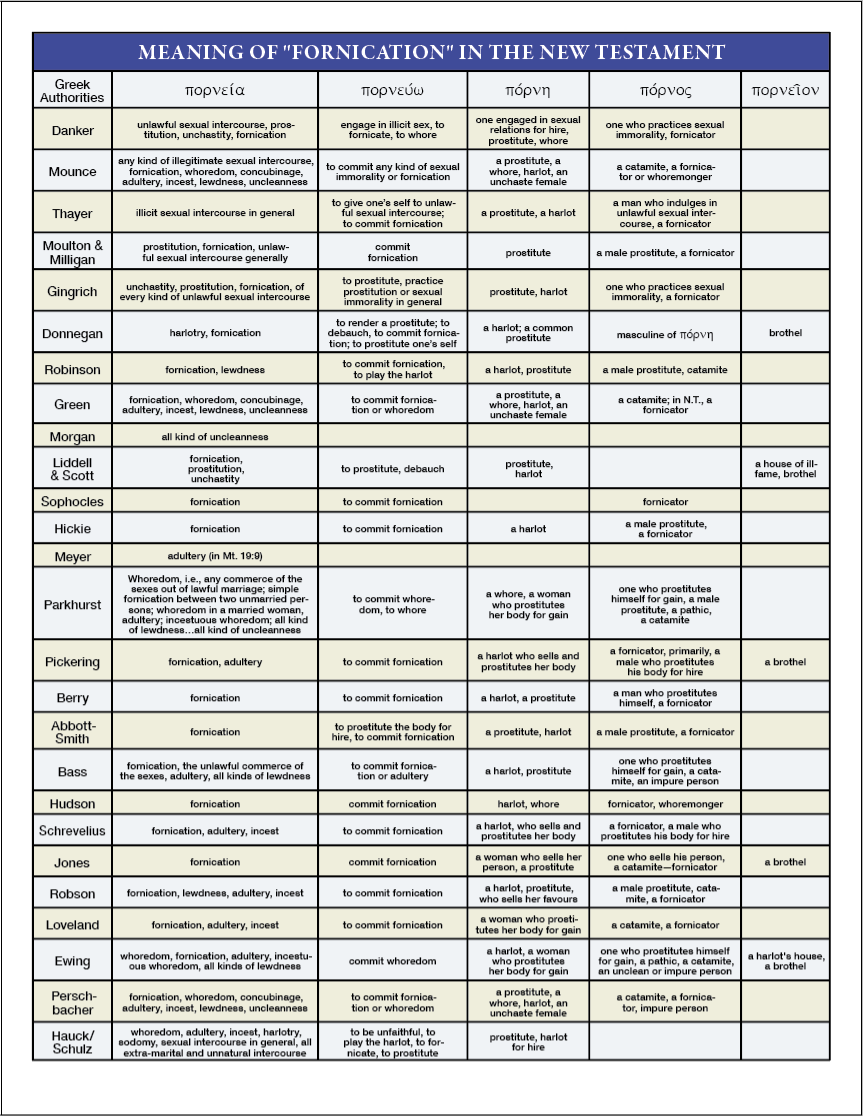
That’s where Greek lexicons and other linguistic authorities are helpful. The following chart provides a general survey of how numerous Greek lexicographers have defined the underlying term porneia (in Matthew 19:9) and its derivatives over the past 200+ years:9
Three Observations
Three important observations are in order. First, when the lexicographers note that porneia is fornication “of every kind,” “in general,” or “a class of crimes,” they are not referring to various types of sexual activity like touching, caressing, or kissing. Rather, they are referring to multiple forms or types of sexual intercourse, including homosexuality, bestiality, and adultery. “Fornication,” therefore, is a generic or “umbrella” term that encompasses different forms of sexual intercourse. See Figure 1, which illustrates the connection between the broad term “fornication” and more narrow terms that identify specific forms of fornication.
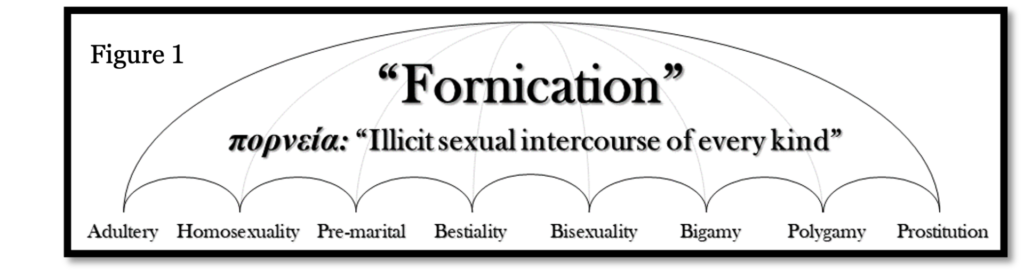
Notice, then, that “adultery” is simply a more narrow term than “fornication.”10 All adultery is fornication, but not all fornication is adultery. The eight terms listed in Figure 1 share in common the fact that each one involves actual sexual intercourse.
A second observation concerns the lexicographers’ use of terms to define porneia that are either archaic, or with the passing of time, have changed meaning. By examining older dictionaries that clarify the meanings of those English words, we can see that they further verify the intended meaning of porneia. Noah Webster’s 1848 An American Dictionary of the English Language defined “lewd” as “addicted to fornication or adultery” and “harlotry” is defined as “the trade or practice of prostitution; habitual or customary lewdness.”11 To act as a “whore” is “to have unlawful sexual commerce; to practice lewdness,” “to corrupt by lewd intercourse,” and “whoredom” is defined as “lewdness; fornication.”12 A “brothel” is “a house of lewdness; a house appropriated to the purposes of prostitution.”13 To “fornicate” is “to commit lewdness,” “fornication” is defined as “the incontinence or lewdness of unmarried persons, male or female; also, the criminal conversation of a married man with an unmarried woman” as well as “adultery” and “incest,” and a “fornicator” is “a lewd person.”14 “Unchaste” is defined as “not continent; not pure; libidinous; lewd.”15 “Continency” is defined as “the restraint of the passion for sexual enjoyment; resistance of concupiscence, forbearance of lewd pleasures; hence, chastity.”16 The underlying Greek term in Romans 13:13 rendered in various English translations as “lewdness” (NKJV), “chambering” (KJV), “sleeping around” (CEB), “beds” (DLNT), “sexual promiscuity” (MOUNCE), “debauchery” (RSV), and “sexual immorality” (ESV) is koitais from koitai, referring to the conjugal bed, and is defined as “sexual intercourse, whoredom.”17
A third observation concerns the claim by some that “fornication” refers exclusively to sexual activity between unmarried persons. It is certainly true that over time, words take on different meanings than they once conveyed. But, as we have seen, the meaning of the Greek term rendered “fornication” is decisive in its import. Even without that linguistic information, the English reader can know that the allegation is incorrect. Several passages make this fact plain. For example, the man in the Corinthian church who married his father’s wife was guilty of porneia (1 Corinthians 5:1). Likewise, John the baptizer condemned the incestuous (porneia) marriage of Herod the Tetrarch to his brother’s wife (Mark 6:17). According to Jude 7, the men of Sodom were guilty of porneia. As we have seen, homosexuality is one form of porneia. The Israelites committed porneia (ekporneusai—LXX) with the Moabite women, some of whom were undoubtedly married since they were leaders of the people (Numbers 25:1,4; 1 Corinthians 10:8). What’s more, it is evident from Matthew 5:32 and 19:9 that married people can commit porneia. To summarize, Figure 2 illustrates the broad application of the word “fornication” in Scripture.

Conclusion
The host of Greek authorities verify the fact that the Bible uses the term porneia to refer to physical sexual intercourse. Various derivatives of the word only further confirm this fact.
The older lexicons occasionally use English terms that today may not convey this singularly precise meaning. But by consulting both the drift of the context in which the terms are used as well as the English dictionaries that were contemporaneous with those Greek sources, one can conclude that those terms were intended as synonyms for physical sexual intercourse.
These synonymous terms include: “lewdness,” “unchastity,” “debauchery,” “whoredom,” “uncleanness,” “impurity,” “commerce,” “incontinence,” and “sexual immorality.”
While sinful in their own right, neither the viewing of pornography nor those sinful actions that precede sexual intercourse—which are embodied in such Bible terms as “lust” and “lasciviousness”—fall within the purview of the meaning of “fornication” in the New Testament.
Endnotes
1 Some scholars have challenged the textual legitimacy of the “exceptive” clause in this verse, but the point is moot since the clause occurs also in Matthew 5:32 where its textual legitimacy is firm. See Bruce Metzger (1994), A Textual Commentary on the Greek New Testament (New York, NY: United Bible Society, second edition), p. 38.
2 CSB, CJB, DLNT, EHV, ESV, EXB, HCSB, ISV, LEB, MEV, MOUNCE, NASB, NIV, NKJV, TLV, WEB. The CEB has the equivalent expression “sexual unfaithfulness.” The CEV has “some terrible sexual sin.” The ERV has “the problem of sexual sin.” The EXB and NCV have “his wife has sexual relations with another man.” The ICB has “his first wife has been unfaithful to him.” The NLV has “sex sins.” The RGT has “promiscuity.”
3 ASV, BRG, DARBY, DRA, JUB, KJV, TLB, MNB, OJB, WYC.
4 AMPC, NRSV, RSV.
5 GNV, YLT.
6 GW, GNT, PHILLIPS, NOG.
7 NASB1995, NET, NTE, TPT.
8 MSG, VOICE, WE.
9 Frederick Danker (2000), A Greek-English Lexicon of the New Testament and Other Early Christian Literature (Chicago, IL: University of Chicago), third edition, pp. 854-855; William Mounce (2006), Complete Expository Dictionary of Old and New Testament Words (Grand Rapids, MI: Zondervan), pp. 126,268,638-639,1251; Joseph Thayer (1901), A Greek-English Lexicon of the New Testament (New York: American Book Company), p. 532; James Moulton and George Milligan (1930), Vocabulary of the Greek New Testament Illustrated from the Papyri and Other Non-literary Sources (Grand Rapids, MI: Eerdmans, 1982 reprint), p. 529; F. Wilbur Gingrich (1965), Shorter Lexicon of the Greek New Testament (Chicago, IL: The University of Chicago Press), p. 180; James Donnegan (1836), A New Greek and English Lexicon (Boston, MA: Hilliard, Gray, & Co.), p. 1031; Edward Robinson (1836), A Greek and English Lexicon of the New Testament (Boston, MA: Crocker & Brewster), pp. 690-691; Thomas Green (1896), A Greek-English Lexicon to the New Testament (Boston, MA: H.L. Hastings), p. 152; Henry Liddell and Robert Scott (1901), A Greek-English Lexicon (Oxford: Clarendon Press), p. 1256; E.A. Sophocles (1914), Greek Lexicon of the Roman & Byzantine Periods (Cambridge, MA: Harvard University Press), p. 911; W.J. Hickie (1977 reprint), Greek-English Lexicon to the New Testament (Grand Rapids, MI: Baker), p. 157; Heinrich Meyer (1881), Critical & Exegetical Handbook to the Gospel of Matthew (Edinburgh: T.&T. Clark), 2:26; John Parkhurst (1804), Greek and English Lexicon to the New Testament (London: G.&J. Robinson), pp. 554-555; John Pickering (1832), A Greek and English Lexicon (Boston, MA: Hilliard, Gray, Little, & Wilkins), p. 741; Hector Morgan (1826), The Doctrine and Law of Marriage, Adultery, and Divorce (Oxford: J. Parker), 2:398; George Berry (1897), A New Greek-English Lexicon to the New Testament (New York: Hinds & Noble), p. 82; G. Abbott-Smith (1922), Manual Greek Lexicon of the New Testament (New York: Charles Scribner’s Sons), pp. 373-374; J.H. Bass (1844), A Greek & English Manual Lexicon to the New Testament (London: I.J. Chidley), p. 185; Charles Hudson (1892), A Critical Greek & English Concordance of the New Testament (London: Samuel Bagster & Sons), p 339; Cornelius Schrevelius (1826), The Greek Lexicon of Schrevelius (Boston, MA: Cummings, Hilliard, & Co.), p. 692; John Jones (1825), The Tyro’s Greek & English Lexicon (London: Longman, et al.), p. 1040; Charles Robson (1839), A Greek Lexicon to the New Testament (London: Whittaker & Co.), p. 387; Samuel Loveland (1828), A Greek Lexicon Adapted to the New Testament (Woodstock, VT: David Watson), p. 259; Greville Ewing (1827), A Greek & English Lexicon (Glasgow: James Duncan), pp. 714-715; Wesley J. Perschbacher, ed. (1990), The New Analytical Greek Lexicon (Peabody, MA: Hendrickson), p. 340; Friedrich Hauck and Siegfried Schulz (1982 reprint), “pornai, pornos, porneia, porneuo, ekporneuo” in Theological Dictionary of the New Testament, ed. Gerhard Friedrich (Grand Rapids, MI: Eerdmans), 6:579-595.
10 Hauck and Schulz agree: “moicheuo is narrower than porneia and refers solely to adultery” (6:581).
11 Noah Webster (1848), An American Dictionary of the English Language (New York: Harper & Brothers), pp. 593, 478.
12 Ibid., pp. 1136-1137.
13 Ibid., p. 129.
14 Ibid., p. 424.
15 Ibid., p. 1067.
16 Ibid., p. 222.
17 Thayer, p. 352; Samuel Bagster (no date), The Analytical Greek Lexicon (London: Samuel Bagster & Sons), p. 227.
The post “Fornication” (Porneia) Defined in New Testament Greek Lexicons appeared first on Apologetics Press.
]]>The post Sexual Feelings Are Not the Standard of Morality appeared first on Apologetics Press.
]]>Though apparently quite uncommon, a coherent conversation about sexual conduct logically begins with whether we were created by a supreme, supernatural God or whether we evolved “naturally”7 from lower animals. If we are merely evolved animals, then we can reasonably “act like the animals we are”8 and do whatever we want. But, if humanity was created by the holy God of the Bible,9 and if we are going to be judged one day according to His holy will10 (Acts 17:30-31; 2 Corinthians 5:10), then absolute objective morality exists, and humanity should humbly and fully submit to God’s will and not our own—even when (yes, especially when) His will is difficult.11
Many are resistant to God’s will for their lives because they want to feel free to express themselves sexually—however and whenever they want. In Charles Bufe’s 2022 book titled 24 Reasons to Abandon Christianity, three reasons deal with sexual matters, including “Christianity’s morbid preoccupation with sex.”12 Bufe wrote: “Since its inception, Christianity has had an exceptionally unhealthy fixation on sex, to the exclusion of almost everything else…. This stems from the numerous ‘thou shalt nots’ relating to sex.”13 Bufe went on to list 1 Peter 2:11, Galatians 5:19, and Romans 8:6. Then, after quoting 1 Corinthians 7:1,14 Bufe wrote:
In addition to the misery produced by Christian intrusions into the sex lives of non-Christians, Christianity produces a great deal of misery among its own adherents through its insistence that sex, except the very narrow variety it sanctions, is evil, against God’s law. Christianity proscribes sex between unmarried people, sex outside of marriage,…homosexual relations, bestiality,…even “impure” thoughts.15
Though we would contend that waiting until marriage to have sexual relations and practicing monogamy throughout marriage is extremely enjoyable and rewarding, such an argument is not the point of this article. The thesis of this brief article is simply that if there is no God, then animal-like sexual desires can logically be fulfilled in any way a human being chooses. However, if an omniscient, omnipotent, eternal, loving, holy, and just Creator exists, and He has revealed His sovereign will about sexual matters to humanity,16 then objective standards (which, by definition, do not change with human opinions) exist, and humans are expected (by their Creator and Judge) to submit to them.
A person may sincerely feel “this way” or “that way,” but such feelings are not an objective moral compass. Objective morality transcends the whims of countries and cultures, as well as public and private opinions, whether in this century or in some other. By definition, objective truth cannot be changed by anyone’s “personal feelings, prejudices, and interpretations.”17
Feelings, Freedom, and Human Folly
From as far back as I can remember, I have craved sugar, milk chocolate, and all manner of sweet carbohydrates. I would love to eat a dozen Krispy Kreme® doughnuts every day (especially if the alternative is broccoli, cauliflower, and Brussels sprouts). At any given moment (and especially at meal times), I much prefer immediate and unrestrained gratification over self-control. Yet, continual self-indulgence often leads to serious, long-term physical problems. Thus, I frequently find myself not eating nearly as much as I desire (and I’m still several pounds overweight!).
Children may crave revenge for some perceived (or real) wrong committed against them, but good parents do not allow their children’s retaliatory feelings and actions to run rampant. People of all ages can feel irritable and angry about all manner of things, but that doesn’t mean that God “made them that way” or that He condones continual, childlike, ill-tempered thinking and behavior. Humans from a young age may covet money and material things, and people can choose to act upon such covetous thinking by stealing from others. Yet, such feelings and use of one’s freedom do not prove that such thoughts and actions “came from God” or are morally acceptable to the Moral Law Giver.18
Similarly, humans are sexual beings with the ability to have sexual feelings and engage in sexual acts. A study of secular and biblical history reveals that people have had all manner of sexual thoughts (and fantasies), many of which have been acted out. Should children be allowed to act upon their sexual desires whenever and however they want? Is there any objective moral code that governs whether children must obey their parents’ wishes, including about sex? Do parents have any real, objective moral right to tell their 11-year-olds or 15-year-olds what they can and can’t do sexually? Are parents cruel if they forbid their children from looking at pornography? Are they unkind for prohibiting their children from having sex? If God does not exist, and objective morality is a mere fantasy, then how can parents “rightly” forbid any sexual actions that their pre-teen or teenage children desire?
If God does not exist, pornography is not a problem, fornication is not wrong, and sexual activity with the same sex is not sinful.
- If there is no God, a married man who longs and lusts for women in addition to (or to the exclusion of) his wife has every right to follow through with his desires if he so chooses. (If not, why not?)
- What if a young woman’s husband is in a terrible car accident that left him paralyzed from below the neck? Surely the wife can rightly find sexual gratification with one or more other individuals? And if she chooses to leave her quadriplegic husband permanently for a man who could fulfill all of her sexual desires, who could say that such an action would be wrong?
- And what about men and women who want more than one spouse? Who says that monogamy should be the standard while polygamy and group marriages are unacceptable?
The list of sexual scenarios could go on and on. And, the list of opinions regarding what should be acceptable and what should not be is extremely diverse and completely subjective, if…there…is…no…God.
A Person’s Objective Purpose
Many seem unaware of the biblical teaching regarding one’s purpose in life. Our purpose is not to chase physical pleasures like animals. Such impulsive pursuits are only “right” if atheism is true. As Charles Darwin wrote in his autobiography: “A man who has no assured and ever present belief in the existence of a personal God or of a future existence with retribution and reward, can have for his rule of life, as far as I can see, only to follow those impulses and instincts which are the strongest or which seem to him the best ones.”19
People tend to look for purpose in hobbies, education, employment, politics, riches, vacations, or conservation. Many seem to have as their life goal to escape old age and death. Still, more seem to have their purpose in life all wrapped up in their sexual feelings and actions with no objective moral law to guide them.
Although God created the beautiful institution of marriage between one man and one woman, the purpose of life is not to get married. Our purpose is not to have sex—whether one time or 10,000 times. Jesus, the only perfect human being Who ever lived (2 Corinthians 5:21; Hebrews 4:15), never got married and thus never had sexual relations. What’s more, the man who wrote nearly half of the New Testament books (the apostle Paul) was not married (1 Corinthians 7:8).
King Solomon foolishly and sinfully accumulated 700 wives and 300 concubines (1 Kings 11:3), yet not one of them could provide him with real, objective meaning in his life. Even though he “had everything” and “experienced it all,”20 Solomon repeatedly stressed the meaninglessness of life “under the sun” (Ecclesiastes 1:9). That is, from a purely naturalistic, earthly perspective where one is searching for abiding happiness in the physical realm, “all is vanity and grasping for the wind” (1:14).
So what is our real, objective purpose in life? Truly, it is all about God. Our purpose is to “know” Him (Philippians 3:10), “trust” Him (Proverbs 3:5-6; John 3:16), “love” Him (Matthew 22:37-39), “follow” Him (Mark 8:34), “fear” Him (Ecclesiastes 12:13-14), “obey” Him (John 14:15; 1 John 5:3), “serve” Him (1 Thessalonians 1:9), and “praise” Him (1 Peter 1:7). We are here to “glorify” Him (1 Corinthians 6:20).
Flee Sexual Immorality
Just prior to the apostle Paul’s exhortation to the Christians in the sinfully sex-crazed city of Corinth21 to “glorify God in your body,” he commanded them to “[f]lee sexual immorality” (1 Corinthians 6:18-20). Some of the Corinthian Christians had already left behind various forms of sexual immorality (e.g., fornication, adultery, and homosexuality—1 Corinthians 6:9-11), while others were in need of repentance (e.g., the man who had his father’s wife—5:1). In order to fulfill our beautifully profound and primary purpose in life (to glorify God and not ourselves), we must be willing (among other things) to leave all forms of sexual immorality behind.
Similar to how Jesus is the one way to eternal life (John 14:6), God created one beautifully approved way to have sexual relations. At the end of the Creation, after God made Adam and Eve, “God saw everything that He had made, and indeed it was very good” (Genesis 1:31). What’s more, it was good for the first married couple to be together sexually. In fact, God instructed Adam and Eve to “be fruitful and multiply” (1:28). The Bible not only extols sexual relations for reproductive purposes, but God also created a man and a woman with the physical ability to have an enjoyable sexual relationship. The Old Testament book Song of Solomon celebratesthe sexual relationship between a man and a woman. It begins by speaking of the pleasures of kissing (1:2) and proceeds to tell of the enjoyment that two intimate lovers have together. Truly, a scriptural, sexual relationship between a husband and a wife is a good, lovely, and beautiful thing to be enjoyed throughout marriage, if possible. When an eligible man and an eligible woman join together in the bonds of holy matrimony, it is “honorable” and “the bed undefiled” (Hebrews 13:4). The apostle Paul wrote: “Let the husband render to his wife the affection due her, and likewise also the wife to her husband” (1 Corinthians 7:3).
Indeed, “Marriage is honorable among all, and the bed undefiled; but fornicators and adulterers God will judge” (Hebrews 13:4). Whether people like it or not, whether people evercome to understand God’s thoughts that underlie His laws on sexual matters (cf. Deuteronomy 29:29; Isaiah 55:8-9), the fact is, the Creator of humanity has repeatedly communicated in the last will and testament of Jesus Christ that sexual desires and actions are to be limited to the marriage bed between a lawful husband and wife (Matthew 19:1-9). Paul wrote:
For this is the will of God, your sanctification: that you should abstain from sexual immorality; that each of you should know how to possess his own vessel in sanctification and honor, not in passion of lust, like the Gentiles who do not know God…. For God did not call us to uncleanness, but in holiness. Therefore he who rejects this does not reject man, but God, who has also given us His Holy Spirit (1 Thessalonians 4:3-8).
Conclusion
If there is no God, then there are no objective standards of any kind for sexual relations (or anything else). We are free to allow our animal-like instincts and passions to run rampant in thought and deed without restraint. But, if God exists and the Bible is His Word, we are subject to a strict sexual moral code.
As immortal beings who are only in this physical world for a short time, we are to “abstain from fleshly lusts which war against the soul” and, instead, “pursue [the] righteousness” of God (1 Peter 2:11; 2 Timothy 2:22). We are to put away such things as lewdness, lusts, and all forms of sexual activity outside of a God-approved marriage (Galatians 5:19-21; 1 Corinthians 6:9-11; Romans 1:18-32).
The world, who knows neither God nor His Will, will “think it strange that you do not run with them in the same flood of dissipation, speaking evil of you.” But, the sobering truth is, “[t]hey will give an account to Him who is ready to judge the living and the dead” (1 Peter 4:3-5).
May God help Christians to sincerely follow the pure Prince of Peace and keep ourselves “unspotted from the world” (James 1:27). And, may we simultaneously let God’s light shine through us that we might help precious, misguided souls to give up any and all forms of sexual immorality and submit to the Savior’s will for their lives (Matthew 5:16; 1 Peter 2:11-12).
Endnotes
1 “Morality” (2024), Merriam-Webster, https://www.merriam-webster.com/dictionary/morality.
2 “Moral” (2024), Merriam-Webster, https://www.merriam-webster.com/dictionary/moral.
3 Outside of mere human opinion.
4 Jean-Paul Sartre (1989), “Existentialism is Humanism,” in Existentialism from Dostoyevsky to Sartre, ed. Walter Kaufman, trans. Philip Mairet (Meridian Publishing Company), http://www.marxists.org/reference/archive/sartre/works/exist/sartre.htm, bracketed item added.
5 Ibid.
6 William Provine (1988), “Scientists, Face It! Science and Religion are Incompatible,” The Scientist, 2[16]:10, September 5, http://classic.the-scientist.com/article/display/8667/.
7 In reality, there is nothing “natural” about life coming from non-life nor life evolving into totally different kinds of life (e.g., birds evolving into reptiles or reptiles evolving into mammals, etc.). Evolution’s tree of life defies the scientific Law of Biogenesis and is based upon blind faith.
8 Jo Marchant (2008), “We Should Act Like the Animals We Are,” New Scientist, 200[2678]:44-45, October 18-24.
9 Visit apologeticspress.org for a voluminous amount of evidence for the God of the Bible in article, book, and video formats.
10 The New Testament (Ephesians 2:11-16; Romans 7:4; Hebrews 8-10).
11 “Submitting” to God’s Will only when things are easy is not genuine submission, but “acting”—going through the motions of “submission” because it’s easy, convenient, socially acceptable, etc. True, trusting obedience to God is most often revealed during difficult times.
12 Charles Bufe (2022), 24 Reasons to Abandon Christianity (Tucson, AZ: See Sharp Press), ebook pp. 10-11.
13 Ibid., p. 169.
14 Regarding Paul’s statement to the Corinthians that for the unmarried man, “It is good for a man not to have sexual relations with a woman” (ESV).
15 Bufe, p. 182.
16 In the Bible, which we contend the evidence indicates is from a Supernatural Source. See Kyle Butt (2022), Is the Bible God’s Word (Montgomery, AL: Apologetics Press). See also Dave Miller (2020), The Bible Is From God: A Sampling of Proofs (Montgomery, AL: Apologetics Press) and “The Inspiration of the Bible” section of www.apologeticspress.org.
17 “Objective” (2024), Merriam-Webster, https://www.merriam-webster.com/dictionary/objective.
18 Or that the Moral Law Giver is a “Moral Monster” for condemning covetousness and theft.
19 Charles Darwin (1958), The Autobiography of Charles Darwin, ed. Nora Barlow (New York: W.W. Norton), p. 94, emp. added.
20 Read Ecclesiastes 1:16 and 2:1-10.
21 The inhabitants of Corinth were so sexually immoral that the verb korinthiazo (“to Corinthianize” or “act like Corinthians”) meant to commit sexual immorality. See Henry Foster (1974), The Preacher’s Complete Homiletic Commentary on the Epistles of St. Paul the Apostle to the Corinthians (Grand Rapids, MI: Baker), pp. 6-7.
The post Sexual Feelings Are Not the Standard of Morality appeared first on Apologetics Press.
]]>