The post Romans 10:9-10: Going Beyond Salvation Slogans appeared first on Apologetics Press.
]]>Do these beautiful words from Romans 10 mean that sinners only need to confess a belief in Jesus to be saved? Does this passage mean that repentance and baptism are unnecessary for salvation? Do these verses teach that to become a Christian, we merely “Pray this Prayer: Dear Jesus, I am a sinner. I believe that You died and rose from the dead to save me from my sins. I want to be with you in heaven forever. Jesus forgive me of all my sins that I have committed against You. I open my heart to You now and ask You to come into my heart as my personal Lord and Savior. In Jesus’ name, Amen”?2
Romans in Context
The Bible is not hard to understand,3 but we are as unlikely to properly interpret an isolated biblical statement as we are to open a random 9,000-word letter,4 skip to the middle of it, read a couple of sentences, and accurately know what the author was communicating. Someone may misunderstand the statement, “I’ve been hiding it from everyone, even my wife, for the past three months. I hope she doesn’t suspect anything,” to mean that a man is being unfaithful to his wife. In reality, the husband is going to great lengths to plan an elaborate surprise birthday party for his cherished spouse.
A visitor to a local high school may walk by a classroom where two people are intensely arguing and think, “If someone doesn’t intervene, I’m going to have to. I can’t believe the teacher is tolerating such behavior.” However, upon further investigation, the passerby realizes the two individuals are in a drama class practicing their lines for an upcoming theatrical performance. Additional information and proper context are two of the most fundamental, key components to correctly understanding anything in life. From letters to lectures and from books to news reports, additional (and especially contextual) information is vital to a fair and accurate interpretation.
Overall Context of Romans
Paul’s letter to the Christians in Rome in approximately A.D. 56-575 is all about how the perfectly holy and just Creator lovingly and powerfully saves sinners—making sinners righteous—by means of the sacrificial death and resurrection of Jesus. Apart from God’s heavenly plan to justify sinners through Jesus’ free-will sacrifice (Romans 1:16-17; 5:6-11), there is no hope for anyone (3:10,22-23), even for the Jews, the descendants of Abraham, to whom was given the Law of Moses (2:1-3,17-24; 3:9-10,19-20). Though the Law of Moses had (and still has—15:4) some great benefits,6 it cannot save lawbreakers from the eternal consequences of sin (6:23).
Justification (i.e., being found “not guilty,” but “righteous” by God our Judge) is only through faith in Jesus, not trusting in the Law of Moses (or any other law) or in one’s ability to obey it perfectly. Only Jesus obeyed the Law of Moses flawlessly (5:18-19; 8:3-4; Hebrews 4:15); only Jesus, His perfect holiness, and His death on our behalf would appease the justice of God (3:23-26; 5:6-9); and only Jesus saves, not the law (cf. Acts 4:12). “[W]hat the law could not do…God did by sending His own Son” (Romans 8:3).7 “There is therefore now no condemnation to those who are in Christ Jesus” (8:1). Indeed, Jesus “justifies” (8:33), not the Law of Moses. Yet so many first-century Jews, tragically, were putting their confidence in the Law rather than in Jesus.
Immediate Context of Romans 9-11
Paul was “an Israelite, of the seed of Abraham, of the tribe of Benjamin” (11:1), and it distressed him with “great sorrow and continual grief” (9:2) that so many of his countrymen were lost in sin. He was so grieved by their stubborn8 commitment to the Law of Moses rather than to Jesus that he selflessly wrote: “I could wish that I myself were accursed from Christ for my brethren, my countrymen according to the flesh” (9:3).
In Romans chapters 9-11, Paul detailed in no uncertain terms that, while many Jews have rejected God’s plan to save sinners through Jesus, many Gentiles “have attained to righteousness, even the righteousness of faith” (9:30), just as the Jews’ Holy Scriptures prophesied (9:25-26; 10:19-20). The death, burial, and resurrection of Jesus is God’s power to save Jews and non-Jews (1:16). “For there is no distinction between Jew and Greek, for the same Lord over all is rich to all who call upon Him. For ‘whoever calls on the name of the Lord shall be saved’” (10:12-13). Sadly, rather than receiving Jesus as the cornerstone of their salvation, most Jews trusted in their law-keeping and in their expectations of a Messiah Who would reaffirm their own righteousness. In doing so, they stumbled over the Savior and stubbornly refused to acknowledge Him as the Deliverer of their souls (9:30-33).
In the middle of this hard-hitting section9 are the beautiful, deeply meaningful words of Romans 10:9-10: “[I]f you confess with your mouth the Lord Jesus and believe in your heart that God has raised Him from the dead, you will be saved. For with the heart one believes unto righteousness, and with the mouth confession is made unto salvation.”
5 Things to Remember When Reading Romans 10:9-10
Romans 10:9-10 was not meant to be a stand-alone, all-encompassing, quick, shallow, “accept Jesus into your heart,” altar-call-type salvation incantation. Just as Israel misunderstood the purpose of the Law of Moses and the very Messiah it pointed to, many professed Christians enthusiastically quote Romans 10:9-10, yet “not according to knowledge” (cf. 10:2). When stripped from its context and reduced to more of a slogan, these verses are dangerously, if not fatally, misunderstood10 to mean that repentance and/or baptism are not required to become a Christian and that a life of continued submissive obedience to Christ may be unnecessary.
To correctly understand Romans 10:9-10, we must allow the Bible to explain the Bible11—both in Romans and within the entire biblical message of salvation. If the Bible is the inspired Word of God, then it will be internally consistent with itself about whatever it teaches,12 including about being saved from our sins and living a faithful Christian life.
#1—Recognize What Paul Is and Is Not Contrasting
In Romans 9-11, Paul is contrasting Jews and Gentiles (i.e., their rejection and acceptance of Jesus), law and faith, works and grace (11:6), as well as stumbling (in unbelief) and standing (by faith—11:20). The Jews were doing things their way while God was calling them to submit to His way—through Jesus (10:3-4). If non-Christian Jews wanted to be saved, they had to move from an unbelief and denial of Jesus…to a knowledgeable, heartfelt belief in and confession of Him.
Neither in Romans 10 nor anywhere else in Romans is Paul contrasting belief and repentance, or confession and baptism, or faith in and obedience to Jesus—as if repentance, baptism, and obedience to God are unnecessary. In Romans 10, Paul was focusing on the Jews’ rejection of Jesus, the very One they needed to acknowledge to be saved. Until they came to a proper understanding of Who Jesus was, they were lost.
To illustrate, consider the case of a doctor who must try to convince his extremely skeptical patient that he is seriously ill and needs a specific medicine that the doctor is prescribing in order to live. The doctor is not immediately concerned with the details of the treatment plan—how often to take the pills, how many at a time, what time of day, or with or without food. None of that matters if the currently stubborn patient will not first accept that he’s sick and needs the cure. Similarly, Paul knows that if Jews want to be saved from their spiritual sickness, they must first understand and acknowledge Who the Answer is: Jesus. Otherwise, nothing else matters.
#2—Consider Paul’s Parallel Use of “Faith” and “Obedience”
While Paul contrasted several ideas in Romans 10, he also utilized some notable terms and concepts in important complementary ways, specifically faith and obedience, which many “faith-alone,” “just-accept-Jesus-into-your-heart” advocates are resistant to connect. Yet Paul did. Romans 10 verses 9-10 are bookended within Romans 10 and within the letter of Romans as a whole by evidence signifying that obedience to Jesus and confessed faith in Jesus are perfectly harmonious. That is, it’s not one without the other(s); they go together. A confessed faith is an obedient faith.
Paul noted at the beginning of the chapter how the Jews “did not know the righteousness of God”; “they did not submit to God’s righteousness” (10:3, NIV). This lack of submission underscores that true faith is not merely an intellectual assent but involves a willful alignment with God’s righteousness—a submissive obedience that flows from genuine belief. The reason, for example, that the Old Testament “priests of the Lord”—Hophni and Phinehas (sons of Eli)—were said to “not know the Lord,” is because they did not submit to His sovereign Will—they “were corrupt” (1 Samuel 1:3; 2:12). Indeed, only those who sincerely submit to God are those who really know Him (i.e., believe in Him).
Later in Romans 10, Paul wrote that though the Gospel is preached, “they have not all obeyed the gospel. For Isaiah says, ‘Lord, who has believed our report?’” (10:15-16). Some 700 years before Paul, Isaiah had uttered these words, prophesying that many Jews would not believe in the Messiah when He came (Isaiah 53:1; cf. John 12:37-38). Paul noted the fulfillment of Isaiah’s words and paralleled the Jews’ disbelief with disobedience. Those who had not “believed” were those who had “not all obeyed the gospel.” The apostle John similarly connected these important concepts: “Whoever believes in the Son has eternal life; whoever does not obey the Son shall not see life, but the wrath of God remains on him” (John 3:36, ESV).
Furthermore, in Romans 1:5 Paul began this epistle exalting the resurrected Jesus, saying, “[T]hrough Whom we received grace and apostleship for obedience of faith among all the nations for his name’s sake” (WEB). Paul then concludes the epistle with the same allusion to obedient faith,13 noting that the Gospel had been “made known to all nations for the obedience of faith” (16:26, KJV). To be obedient to the faith is to believe the Gospel; to believe the Gospel is to obey Jesus. If we want to be saved, we must “obey the Gospel.”
#3—Investigate the Meaning of “Obeying the Gospel”
Indeed, in the very chapter of Romans so frequently misused to teach that a sinner must just “accept Jesus into your heart” to be saved or to “say the sinner’s prayer,” Paul references obeying the Gospel, specifically referring to those Jews who “have not all obeyed the gospel” (10:16). But what does it mean to “obey” the Gospel? Ask the average person on the street who claims an affiliation with some denomination if he or she has “obeyed the Gospel,” and you will likely get a blank stare or perhaps a suspicious, confused look. Why? It seems that very few denominations use this biblical terminology,14 much less impress upon hearers the heavenly requirement—to “obey the Gospel.”
Paul used this same terminology in his second epistle to the church in Thessalonica in a very sobering context. Referring to the return of Jesus at the end of time, Paul wrote that the Lord would be “revealed from heaven with His mighty angels, in flaming fire taking vengeance on those who do not know God, and on those who do not obey the gospel of our Lord Jesus Christ” (2 Thessalonians 1:7-8). The apostle Peter also used this language in his first epistle, asking, “what will be the end of those who do not obey the gospel of God? Now ‘If the righteous one is scarcely saved, where will the ungodly and the sinner appear?’” (1 Peter 4:17-18; cf. Proverbs 11:31). If, as Peter and Paul clearly indicate, “obeying the Gospel” is directly tied to our eternal destiny, then everyone needs to know the Gospel and how to obey it! Thankfully, Paul specifically addressed this vital subject matter earlier in his epistle to the Romans.
In Romans 6:17-18, Paul wrote about the point in time in which the Roman Christians had originally “obeyed” the Gospel (when they initially left their previous lives of sin and became children of God—servants of God). “But God be thanked that though you were slaves of sin, yet you obeyed from the heart that form of doctrine to which you were delivered. And having been set free from sin, you became slaves of righteousness.” What is this doctrinal “form” (or “figure,” “model,” or “pattern”)15 that slaves of sin “obeyed from the heart” in order to become “slaves of righteousness”—to become Christians? Is it not what Paul had only just discussed in the immediate context of Romans 6?
What shall we say then? Shall we continue in sin that grace may abound? Certainly not! How shall we who died to sin live any longer in it? Or do you not know that as many of us as were baptized into Christ Jesus were baptized into His death? Therefore we were buried with Him through baptism into death, that just as Christ was raised from the dead by the glory of the Father, even so we also should walk in newness of life. For if we have been united together in the likeness of His death, certainly we also shall be in the likeness of His resurrection, knowing this, that our old man was crucified with Him, that the body of sin might be done away with, that we should no longer be slaves of sin. For he who has died has been freed from sin. Now if we died with Christ, we believe that we shall also live with Him, knowing that Christ, having been raised from the dead, dies no more. Death no longer has dominion over Him. For the death that He died, He died to sin once for all; but the life that He lives, He lives to God. Likewise you also, reckon yourselves to be dead indeed to sin, but alive to God in Christ Jesus our Lord (6:1-11).
The Gospel is the death, burial, and resurrection of Jesus (1 Corinthians 15:1-4). And this Good News—that a holy, just, and loving God makes sinners right[eous] through Jesus’ sacrificial death and resurrection—is the “form” or “pattern” that sinners “obey.” Paul clearly outlines in Romans 6 how the Christians in Rome had “obeyed from the heart that form of doctrine”; they “obeyed” the death, burial, and resurrection of Jesus. Specifically, Paul, looking back on their obedience to the Gospel, indicated that when, as sinners, they were “baptized into Christ Jesus,” they “were baptized into His death.” “Therefore we were buried with Him through baptism into death, that just as Christ was raised from the dead by the glory of the Father, even so we also should walk in newness of life” (Romans 6:3-4). Contextually speaking, “obey[ing] from the heart that form of doctrine” is being immersed into the watery grave of baptism, dying to the old man of sin, and rising from spiritual death (through the power of Jesus’ resurrection) as a new person, no longer a servant of sin, but a slave to the righteousness of God.
#4—Acknowledge the Foolishness of Isolating Bible Verses to the Exclusion of Others
“Are you saying that all a person must do to obey the Gospel is be baptized in water?”
“Not at all.”
“But you just said that when sinners are baptized into Jesus they become Christians.”
“According to Romans 6, being immersed in water is the actual point at which sinners become followers of Christ—when we sincerely die to the old man of sin and rise with Christ as a new spiritual creation of God in Christ Jesus.”
“But what about Romans 10:9-10?”
“Great question. Let’s talk more about Romans 10 and other New Testament passages.”
If a person is using the exclusionary, “this-verse-says-it-all” interpretation method (e.g., referring to Romans 10:9-10 to suggest that “all” a sinner must do to be saved is believe and confess Jesus), then it begs the question: What about other verses that say something different?
The fact is, various verses just before and after Romans 10:9-10 emphasize faith without mentioning confession:
- 9:32—The Jews were still lost because they did not seek righteousness “by faith.”
- 9:33—“[W]hoever believes on Him [Jesus] will not be put to shame” (cf. Isaiah 28:16).
- 10:4—“Christ is the culmination of the law so that there may be righteousness for everyone who believes” (NIV).
- 10:11—Once again, Paul quotes Isaiah 28:16 in reference to salvation found only in Jesus: “Whoever believes on Him will not be put to shame.”
There is nothing about the sweet confession of Jesus in these verses in Romans, as well as in many other New Testament passages. When the Philippian jailor asked Paul and Silas in Acts 16: “Sirs, what must I do to be saved?” Paul and Silas said: “Believe on the Lord Jesus Christ, and you will be saved” (16:30-31). When the Jews in Acts 2 asked Peter and the apostles, “Men and brethren, what shall we do?” Peter said: “Repent, and let every one of you be baptized in the name of Jesus Christ for the remission of sins” (2:37-38). All of these verses are as different from Romans 10:9-10 as Mark 16:15-16, where Jesus said: “Go into all the world and preach the gospel to every creature. He who believes and is baptized will be saved; but he who does not believe will be condemned.” We should no more exclude confession from believing (based upon Romans 9:32-33, 10:4, and 10:11) than we should exclude repentance and baptism from believing and confessing (based upon an isolated reading of Romans 10:9-10).
If the Bible is the inspired Word of God,16 and if, as the psalmist said to God, “The entirety of Your word is truth” (Psalm 119:160), then human beings do not have the authority to dismiss one verse for another. We must “rightly divid[e]” and “accurately handl[e] the word of truth” (2 Timothy 2:15, NASB) and never accept one truth to the exclusion of others.
Most Bible students seem to understand the rationality and importance of this holistic approach to Bible interpretation when considering a host of biblical subjects—from the genealogy of Jesus to His sinless life. Rarely does someone quote from Matthew 1:1 and contend that David and Abraham were the immediate earthly father and grandfather of Jesus, since other verses say otherwise. Likewise, virtually no one points to Romans 3:23 and says Jesus must have been a sinner because “all have sinned.” Such verse isolation would be an egregious misuse of Scripture, as Jesus is the one exception among accountable human beings—He never sinned (cf. Romans 8:3; 5:19; Hebrews 4:15).
It is also an egregious misuse of Scripture to contend that God calls sinners to “just accept Jesus into their hearts to be saved” or to “say the sinner’s prayer.”17 The fact is, Romans 10:9-10 actually proves that “faith alone” does not save, since Paul also detailed how such faith in Jesus Christ must be confessed.18 “Believing” and “confessing” are two different things, as we learn in John 12:42-43, where “among the rulers many believed in Him, but because of the Pharisees they did not confess Him, lest they should be put out of the synagogue; for they loved the praise of men more than the praise of God.”
Remember that Paul’s emphasis in Romans 10 was on the many Jews who disbelieved that Jesus was the Messiah. Paul was pleading with them to recognize Jesus for Who He is (and Who the Law of Moses said He was; 10:4)—the Rock of our salvation, Who at that time was still “a stumbling stone and rock of offense” to the many Jews who rejected Him (9:33). Logically speaking, there was no more reason to plead with disbelieving Jews to, for example, be baptized than there is today to impress upon Muslims, Hindus, or atheists to be baptized—if they know nothing about or care nothing about Jesus. Nothing else matters until Jesus matters! Nothing else means anything until Jesus means everything!
When sinners come to sincerely believe in their hearts and confess with their mouths the Lord Jesus, then they will do exactly what Paul reminded the Christians in Rome that they had previously done on their way to becoming Christians: “[A]s many of us as were baptized into Christ Jesus were baptized into His death”; “we were buried with Him through baptism into death, that just as Christ was raised from the dead by the glory of the Father, even so we also should walk in newness of life” (Romans 6:3-4).
It’s not Romans 6 without Romans 10, any more than it is Luke 24:47 without Mark 16:16 or Acts 2:37-38 without Acts 16:30-31. These verses (and the eternal spiritual truths that they teach) are as harmonious as the different resurrection accounts of Jesus. May we never isolate one passage to the exclusion of other verses, but recognize their perfectly supplemental, complementary nature, whether about the nature of Jesus or how to become a Christian.
#5—To “Call on the Name of the Lord” Means More Than Confessing Christ or Saying the “Sinner’s Prayer”
What did the apostle Paul—the one God used to communicate the marvelous message of Romans—what did he do to become a Christian? Paul (formerly Saul the sinner) was on his way to Damascus to persecute Christians when Jesus supernaturally appeared to him from heaven. Paul asked Jesus, “What shall I do?” to which Jesus responded, “Arise and go into the city, and you will be told what you must do” (Acts 9:4-6; 22:10). Paul (demonstrating his belief in Jesus) proceeded to Damascus (with some assistance) where he fasted for three days and was “praying” (Acts 9:8-11), awaiting further instructions.
As we see throughout the book of Acts and even as Romans 10:14-15 reminds us, God always uses people to teach people the Gospel. Even in Paul’s case, God used a man named Ananias, who said to Paul: “And now why are you waiting? Arise and be baptized, and wash away your sins, calling on the name of the Lord” (Acts 22:16). Notice carefully that Ananias, God’s specially chosen messenger to Paul, did not tell Paul that his sins were washed away when Paul spoke to Jesus on the road to Damascus (Acts 9:4-6), or when he fasted for three days (9:9), or when he prayed (9:11). Even though Paul had seen Jesus, talked to Jesus, and sincerely fasted and prayed, he had not yet “called upon the Lord.” Acts 22:16 indicates that he “called upon the Lord” and had his sins washed away by the blood of Jesus when he took the final step on his way to becoming a Christian—when he was “baptized into Christ Jesus” (Romans 6:3-4).
Paul’s “calling on the name of the Lord” harmonizes perfectly with what Peter instructed the thousands of people to do in Acts 2. Peter quoted from the prophecy of Joel and told those in Jerusalem on Pentecost that “whoever calls on the name of the Lord shall be saved” (Acts 2:21; Joel 2:32). The people in Acts 2 did not understand Peter’s quotation of Joel to mean that a sinner must pray to God for salvation. Their question in Acts 2:37 (“Men and brethren, what shall we do?”) indicates such. Furthermore, when Peter responded to their question and told them what to do to be saved, he did not say, “I’ve already told you what to do. You can be saved by petitioning God for salvation through prayer. Just call on His name.” On the contrary, Peter had to explain to them what it meant to “call on the name of the Lord.” Instead of repeating this statement when the crowd sought further guidance from the apostles, Peter commanded them, saying, “Repent, and let every one of you be baptized in the name of Jesus Christ for the remission of sins” (Acts 2:38).19
In Romans 10:13, Paul (like Peter in Acts 2) also quoted from Joel 2:32: “[W]hoever calls on the name of the Lord shall be saved.” When we allow “the Bible to explain the Bible,” we will not come to the erroneous conclusion that Paul is commanding the unbelieving Jews in Romans 10 to merely “cry out to the Lord” (cf. Matthew 7:21) or to “pray the sinner’s prayer.” Rather, with Paul’s own conversion in mind (his “calling on the name of the Lord”—Acts 22:16), as well as those on Pentecost (Acts 2), we realize that in Romans 10 Paul is pleading with (especially) the Jews, who “have not all obeyed the gospel” (Romans 10:16) to “call on the name of the Lord”—that is, to “obey the gospel.” And to “obey the Gospel” is to hear and believe the Gospel (Romans 10:17), to repent of sins (Romans 6:2,6; Acts 2:38), to make the good confession that Jesus Christ is the Son of God (Romans 10:9-10), and to be immersed in water for the remission of sins (Romans 6:3-4; Acts 2:38; 22:16). This is what it means for sinners to “call upon the name of the Lord.”20
Conclusion
Romans 10:9-10, though often quoted in isolation, must be interpreted in harmony with its immediate and overall context. Paul was not offering a shallow, minimalist formula for salvation. Rather, he was urging hardened, unbelieving Jews to confess the very Messiah they had rejected. Faith and confession are foundational, essential components of salvation, but not exclusive. In Romans—and the entire New Testament—faith, repentance, confession, and baptism are presented as inseparable steps of obeying the blessed Gospel of Christ and beginning one’s all-important journey of walking in the light of the Lord (1 John 1:5-10).
Endnotes
1 And perhaps John 3:16 and Ephesians 2:8-9, which we have addressed elsewhere: Eric Lyons (2019), “‘Believing’ in John 3:16,” Reason & Revelation, 39[9]:98-101,104-107, September, https://apologeticspress.org/believing-in-john-316-5723/; Eric Lyons (2000), “Ephesians 2:8-9: Contradictory, or Perfectly Consistent,” Reason & Revelation, 40[10]:110-113,116-119, October, apologeticspress.org/ephesians-28-9-contradictory-or-perfectly-consistent-5870/.
2 This “accept-Jesus-into-your-heart” kind of prayer is typical of what you will hear and read online, in print, and in person among many denominations. This particular wording of the “sinner’s prayer” has circulated widely in social media circles in recent years.
3 Some sections may be more difficult than others, but it is not difficult to learn what the Bible teaches about how to become a Christian and how to live the Christian life. Cf. Kyle Butt (2020), “Why Is the Bible So Hard to Understand?” Reason & Revelation, 40[4]:38-41,44-47, April, apologeticspress.org/why-is-the-bible-so-hard-to-understand-5775/.
4 A typical English translation of Paul’s letter to the Romans is a little over 9,000 words.
5 In Romans 15:25-26, Paul specifically mentions his upcoming journey to Jerusalem to deliver support from Christians in Macedonia and Achaia to poor saints in Judea (cf. 1 Corinthians 16:1-3; Acts 24:17). Thus, this letter was written before that time—apparently when Paul was in Greece on his third missionary journey (Acts 20:1-3; cf. Romans 16:1-2,23; 1 Corinthians 1:14).
6 The commands of God, even commandments under the Law of Moses, are “holy and just and good” (Romans 7:12). After all, the holy, just, and good God was the Author of the Law of Moses. The Old Testament helped the Jews understand sin (3:20). What’s more, it pointed forward to Jesus, the Messiah (10:4).
7 Emphasis in Bible quotations is added unless otherwise noted.
8 Romans 2:5; 10:21; 11:7-8.
9 Chapters 9-11.
10 Cf. 2 Peter 3:14-17.
11 Cf. Eric Lyons (2018), “Letting the Bible Explain Itself,” Reason & Revelation, 38[8]:86-88,92-95, August, apologeticspress.org/letting-the-bible-explain-itself-5589/.
12 See Kyle Butt and Eric Lyons (2015), “3 Good Reasons to Believe the Bible Is From God,” Reason & Revelation, 35[1]:2-5,8-11, January, apologeticspress.org/3-good-reasons-to-believe-the-bible-is-from-god-5089/.
13 For more information, see Dave Miller (2021), “The Obedience of Faith in Romans,” Reason & Revelation, 41[3]:34-35, March, https://apologeticspress.org/the-obedience-of-faith-in-romans-5955/.
14 It may be impossible to know with certainty, but general AI inquiries suggest that such language “is not especially common in most mainstream denominations…. It is infrequently used, and sometimes absent.”
15 From the Greek “tupos,” Frederick Danker, et al. (2000), Greek English Lexicon of the New Testament (Chicago, IL: University of Chicago), p. 1020.
16 2 Timothy 3:16-17; 2 Peter 1:20-21. For evidence of the Bible’s divine inspiration, see Kyle Butt (2022), Is the Bible God’s Word? (Montgomery, AL: Apologetics Press). See also Dave Miller (2020), The Bible Is From God: A Sampling of Proofs (Montgomery, AL: Apologetics Press); Kyle Butt and Eric Lyons (2021), Defending the Bible (Montgomery, AL: Apologetics Press); apologeticspress.org/category/inspiration-of-the-bible/.
17 The “sinner’s prayer” for salvation is nowhere found in the New Testament.
18 Cf. 1 Timothy 6:12-13.
19 For more information on why different answers are given in the New Testament to the same basic question (“What must I do to be saved?”), see Eric Lyons (2004), “One Question: Three Different Answers,” apologeticspress.org/one-question-three-different-answers-646/.
20 This is not to say becoming a Christian is always synonymous with “calling on the name of the Lord.” Abraham was obviously not baptized into Christ when he “called on the name of the Lord” (Genesis 12:8; cf. 4:26). What’s more, when the New Testament describes people who were already Christians “calling on the name of the Lord” (Acts 9:14,21; 1 Corinthians 1:2), it certainly does not mean that Christians were continually being immersed in water after having been baptized to become a Christian (cf. 1 John 1:5-10). Depending on when and where the phrase is used, “calling on the name of the Lord” may be referring to (1) becoming Christians, (2) worshiping God, or (3) faithful service to the Lord. However, it is never used in the sense that all a non-Christian sinner must do to be saved is to cry out and say, “Lord, Lord, save me.” The sinner’s prayer is without biblical backing.
The post Romans 10:9-10: Going Beyond Salvation Slogans appeared first on Apologetics Press.
]]>The post Why Did Jesus Have to Die? appeared first on Apologetics Press.
]]>If God is all-loving and all-powerful, then why did Jesus have to die in order for God to forgive sins?
A:
The Bible reveals that God is all-loving and all-powerful, but He is not only all-loving and all-powerful. That is, God is not a mere one- or two-sided Being. God is perfect in all of His attributes, including His holiness. God is 100% pure and holy. He is holy in the absolute sense. “[T]he Lord is upright;… there is no unrighteousness in Him” (Psalm 92:15). “God is light and in Him is no darkness at all” (1 John 1:5). The psalmist proclaimed of God: “No evil dwells with You” (5:4, NASB). Not one smidgen of sin can dwell in God or with God because even an iota of evil is against His innately pure and holy nature. Indeed, the “Lord God Almighty” is “[h]oly, holy, holy” (Revelation 4:8; Isaiah 6:3).1
In addition to God’s perfectly holy nature is His infinitely just nature. God’s “work is perfect; for all His ways are justice, a God of truth and without injustice; righteous and upright is He” (Deuteronomy 32:4). The psalmist declared to God: “Righteousness and justice are the foundation of Your throne” (89:14). Unlike earthly judges who often falter in the administration of justice, God “shows no partiality nor takes a bribe” (Deuteronomy 10:17). A corrupt judge allows the guilty to go unpunished, while a just judge pronounces righteous judgment upon lawbreakers (cf. Colossians 3:25).
God’s perfect holiness makes fellowship with wickedness literally impossible. God’s perfect justice requires punishment for any evil doing. Sin is so atrocious to God that the penalty for violating His law is death—an eternal separation from Him (Romans 6:23; 1 John 3:4). Every accountable human being at some point sins against God (Romans 3:10,23). We sin and thus separate ourselves from our holy Creator. We find ourselves (of our own doing) “dead in trespasses and sins” (Ephesians 2:1). We are lost in sin, “having no hope and without God” (Ephesians 2:12). And, as sinners, we have no power to save ourselves. There is nothing we can do. There is no plan that we could devise to escape the punishment from a perfectly holy and just God. A price must be paid for sin.
THIS is why Jesus came to Earth. He did not have to; He chose to. He came to satisfy God’s own (His own) perfect holiness and justice. “Christ died for our sins” (1 Corinthians 15:3). He willingly chose to pay the ultimate price for our sins, demonstrating that God is not only holy and just; He is love (1 John 4:8)! And, “[g]reater love has no one than this, than to lay down one’s life for his friends” (John 15:13).
God’s perfect love compelled Jesus to take our punishment upon Himself. “God, who is rich in mercy, because of His great love with which He loved us, even when we were dead in trespasses, made us alive together with Christ (by grace you have been saved)…. [I]n Christ Jesus you who once were far off have been brought near by the blood of Christ” (Ephesians 2:4-5,13). “For God so loved the world that He gave His only begotten Son, that whoever believes in Him should not perish but have everlasting life” (John 3:16).
God’s perfect holiness and justice demand that “the wages of sin is death” (Romans 6:23). But thanks be to God, that is not the end of the story! (At least it does not have to be.) What does the rest of Romans 6:23 say? “[B]ut the gift of God is eternal life in Christ Jesus our Lord.” Yes, God is both “just” and “the justifier”2 of the souls of humanity through the one and only sinless answer to the sin problem—Jesus Christ (Hebrews 4:15), Whose sole purpose in coming to Earth was to save the souls of sinful humankind (Matthew 1:21; Luke 19:10).
The most illogical, heart-wrenching, and terrible thing that a lost-in-sin human being can do is spurn the invitation from our loving God to accept the free gift of eternal salvation through Jesus.3 On the other hand, the two greatest things we can do with the one physical life that we have is (1) accept and follow Jesus, Who is the “the way, the truth, and the life” (John 14:6); and (2) tell others about why our Savior came to Earth (Matthew 28:18-20; Acts 8:4; Romans 1:16).
Endnotes
1 God’s almighty (all-powerful) nature does not contradict His holiness since God’s omnipotence does not mean He can do anything and everything. Scripture is clear, for example, that God “cannot lie” (Titus 1:2; Hebrews 6:18). Thus, the Bible’s teaching on the omnipotence of God is that He can do anything (1) that is logically possible to be done (e.g., He cannot create a square circle), and (2) that is in harmony with His holy will. [For more information, see Dave Miller (2009), “Things God Cannot Do,” https://apologeticspress.org/things-god-cannot-do-1240/.]
2 Through a trusting, biblical faith in Jesus, God made us “just” (or “right”) in the eyes of a perfectly just God (Romans 3:26).
3 To learn more about receiving the gift of salvation and becoming a follower of Christ, see AP’s free booklet at https://apologeticspress.org/wp-content/uploads/2021/08/Receiving-the-Gift-of-Salvation.pdf.
Behold! The Lamb of God
The post Why Did Jesus Have to Die? appeared first on Apologetics Press.
]]>The post Psalm 22:9 and Infant Salvation appeared first on Apologetics Press.
]]>Does Psalm 22:9 teach that God directly intervenes in a child’s heart and mind, miraculously instilling faith in that child’s mind, causing that child to possess self-aware comprehension of what it means to trust in Him? The verse reads in the New King James Version: “But You are He who took Me out of the womb; You made Me trust while on My mother’s breasts.” The verse certainly appears—on the surface—to attribute trust being formed in David by God while David was but a nursing infant. However, Scripture often speaks figuratively of God’s involvement in the lives of human beings. In fact, in the same verse, God is depicted as removing David from his mother’s womb. Does Scripture intend for the reader to conclude that God momentarily took human form and participated in the delivery of David—perhaps the attending Physician on call? Or is David actually speaking figuratively—as indicated by the context—that God’s care had been extended to him throughout life? To state the matter emphatically and unequivocally: Though David said, “You are He who took me out of the womb,” David could not have meant that God personally, physically, and literally took David out of his mother’s womb.
A Messianic Psalm
However, there’s more to consider. Psalm 22 is very clearly a Messianic psalm. Messianic psalms often can have a dualistic application, i.e., they can refer in part to the immediate, contemporary circumstances that the psalmist is facing, while also pointing 1,000 years into the future to indicate what Jesus would endure. They can also include features, some of which apply exclusively to Jesus. Consider some of the phrases of Psalm 22:
- Verse 1: “My God, My God, why have You forsaken Me?”—quoted by Jesus on the cross, uniquely referring to His sole circumstances.
- Verses 7-8: “All those who see Me ridicule Me; they shoot out the lip, they shake the head, saying, ‘He trusted in the LORD, let Him rescue Him; let Him deliver Him, since He delights in Him!’”—again, uniquely anticipating the actual words spoken by Jesus’ enemies while He was suspended on the cross:
Likewise the chief priests also, mocking with the scribes and elders, said, “He saved others; Himself He cannot save. If He is the King of Israel, let Him now come down from the cross, and we will believe Him. He trusted in God; let Him deliver Him now if He will have Him; for He said, I am the Son of God” (Matthew 27:41-43).
- Verses 14-15: “I am poured out like water, and all My bones are out of joint; My heart is like wax; it has melted within Me. My strength is dried up like a potsherd, and My tongue clings to My jaws; You have brought Me to the dust of death”—a graphic description of Jesus’ agony and depleted condition on the cross, including the stretching of the skeletal framework which caused the bones to separate and extend, the extreme thirst and resulting dehydration (cf. “I thirst”—John 19:28), and eventual death by asphyxiation with its fatal impact on the heart and chest cavity—which may well be described as the heart melting within.4
- Verses 16-18: “For dogs have surrounded Me; the congregation of the wicked has enclosed Me. They pierced My hands and My feet; I can count all My bones. They look and stare at Me. They divide My garments among them, and for My clothing they cast lots”—additional detail that characterizes a Roman crucifixion, including the piercing of hands and feet—which David surely never experienced since crucifixion was unfamiliar to the Jews of his day. Crucifixion was a public spectacle to which Jesus was subjected. And, again, all four Gospel writers pinpoint precisely the fact that the Roman soldiers cast lots for His clothing (Matthew 27:35; Mark 15:24; Luke 23:34; John 19:24)—a circumstance that David surely never faced.
Notice that verse 9 of the psalm is “sandwiched” in the midst of these Messianic anticipations. If the verse refers exclusively to Christ, it pertains to the divine mission that Jesus fulfilled by coming to Earth to provide atonement for mankind. This mission required Him to assume human form by being physically born as a baby via a human female. That infant body was specifically “prepared” (Hebrews 10:5) by God for Jesus—not David—to indwell. Consequently, verse 9 would refer to the submissive role that Jesus voluntarily assumed in order to accomplish the divine scheme of redemption. While in the midst of performing that role, Jesus repeatedly described Himself as being under the direct involvement of the Father, even to the point of stating: “For I have come down from heaven, not to do My own will, but the will of Him who sent Me” (John 6:38). Hence, verse 9 may well refer to nothing more than the submission that Jesus reflected when He left the eternal realm and assumed human form—all under the orchestration and guidance of the Godhead.5 Accordingly, it makes perfect scriptural sense to speak of God taking Jesus in bodily form out of Mary’s womb in a state of eternal trust/compliance with the divine will to save mankind.
“Faith/Trust” or Security?
However, let’s assume that verse 9 refers to David. Was David claiming that God instilled religious “faith” or “trust” within him while in a state of infancy? Apart from whether it is sensible to conclude that an infant is capable of having trust in God—even if instilled miraculously and directly by God—is verse 9 actually stating that God did so? Are there any linguistic indicators that aid the English reader in arriving at an accurate understanding of the verse? Yes, there are.
It is true that several English translations render the verse in such a way that God is represented as making or causing the psalmist to believe/trust Him while still in infancy. But, again, such language may be nothing more than a figurative way for David to indicate that God had been with him and cared for him throughout his entire life. However, the underlying Hebrew does not fully support this rendering. The premiere Hebrew lexicographers Koehler, et al., insist that the word means “to inspire confidence.”6 Brown, Driver, and Briggs have “cause to trust, make secure.”7 Parkhurst gives as the first meaning of the word “to hang close, cling” and gives Psalm 22:9 as a verse where that meaning is intended: “causing me to cling upon my mother’s breasts.”8 Davidson notes the exact same meaning in the Hiphil stem, citing the same verse: “to cause to cling to, or hang upon.”9 As a matter of fact, these Hebrew nuances are reflected in a number of English translations. For example, several render the phrase with the word “hope,” like the KJV: “thou didst make me hope” (also the AMPC, KJ21, BRG, GNV, WYC). Others have “made me feel secure” (NET, HCSB, CSB) while others have “made me feel safe” (ERV, CEB, EASY, GW, GNT, ISV, TLB, NOG, NRSV, RSV). Still others express a comparable meaning: “you protected me when I was a baby at my mother’s breast” (CEV). “You took care of me at my mother’s breasts” (EASY). “You made me trust [have confidence in] you” (EXB). “[Y]ou cradled me” (MSG). Each of these renderings correctly captures the meaning being conveyed by the original language. Even the renderings “trust” or “faith” are not referring to religious faith—as if the psalmist was suggesting that David “accepted Jesus as his Savior” while in the womb or shortly thereafter. Rather, they are referring to the reliance on God that David realized he had enjoyed his entire life. As a baby learns to feel secure and trust his mother through the comfort of breast feeding, so David would have learned to trust God throughout his life, from beginning to end.
The classic historical treatments of the psalms given by prominent commentators over the years confirm these linguistic considerations. For example, in his popular treatise on the psalms, Princeton Theological Seminary Hebrew and Greek instructor Joseph Alexander alludes to God’s delight in David, “for it was he that brought him life, and through the perils of infancy.”10 Specifically, he insists that the phrase “made me trust” “does not refer to the literal exercise of confidence in God—which could not be asserted of a suckling, but means gave me cause to trust or feel secure, in other words, secured me, kept me safe.”11 In his acclaimed Exposition of the Psalms, H.C. Leupold, Professor of Old Testament Theology, translates the phrase, “Thou didst make me to feel safe at my mother’s breast” and notes:
In the process of birth it was God who held a protecting hand over him and delivered him. In the tender years of extreme infancy it was He again who gave to the infant’s heart that assurance of safety that comes when the little one can nestle close to its mother’s breast…. Summing it up, it is as though he had said: “During every moment of my life till now thou hast been my God and hast sustained me.”12
Observe that Leupold is saying that it was David’s mother that made him feel safe as an infant—which David then attributed to the providential care of God—not the direct intervention of God.
Albert Barnes agreed with these observations on the verse. After noting the marginal alternate reading of “Keptest me in safety,” he observes: “the idea is, that from his earliest years he had been led to trust in God.”13 However, lest one get the idea that David was speaking literally of his infancy, he adds concerning the allusion to “my mother’s breast”: “This does not mean that he literally cherished hope then, but that he had done it in the earliest period of his life.”14 Again, the word “trust” refers to the reliance and reassurance that a person can experience due to the non-miraculous care that God extends—a care that He even extends to the unrighteous (Matthew 5:45).
Summary
There’s no doubt that a child can feel a sense of safety derived from a loving mother. But that infantile awareness does not mean that the child comprehends anything more than that the same person that the child can hear and smell is the one who, more than anyone else, holds and cares for the child. Actual trust can only come as the child’s mental faculties mature enough to grasp his/her surroundings. We come to trust our parents only as we grow, develop, and become sufficiently self-aware that we can conceptualize our nurturers.
The Bible makes abundantly clear that babies are not capable of sin, nor do they inherit alleged sin from Adam. To suggest such is to place the Bible into a state of hopeless self-contradiction. Human beings must reach an age of accountability in which they are mentally, emotionally, and spiritually capable of grasping the gravity of the situation, realizing that they have reached a point in their development that they are accountable to God and personally responsible for their own behavior.15 Until that time, they are deemed by God as “safe” and not culpable for their infantile and childish condition—a condition that Jesus, Himself, spotlighted as a state of innocence (Matthew 18:3). Psalm 22:9 does not teach that babies have the capacity to believe in God or that God miraculously imparts faith into their hearts.16
Endnotes
1 The Lutheran Church Missouri Synod (2023), “FAQs about Doctrine,” https://www.lcms.org/about/beliefs/faqs/doctrine#faith.
2 Tom Eckstein (no date), “Why Should We Baptize Infants?” Concordia Lutheran Church, https://www.con35.cordiajt.org/sermons-resources/concordiajt.cfm. See also Just and Sinner (2012), “Infant Faith,” October 24, 2012, http://justandsinner.blogspot.com/2012/10/infant-faith.html.
3 For more on Calvinism, see Kyle Butt (2004), “Do Children Inherit the Sin of Their Parents?” https://apologeticspress.org/do-children-inherit-the-sin-of-their-parents-1378/; Dave Miller (2017), “Flaws in Calvinism,” https://apologeticspress.org/flaws-in-calvinism-5387/; Robert Shank (1989), Elect in the Son (Minneapolis, MN: Bethany House).
4 For the medical aspects of the crucifixion of Christ, see William Stroud (1847), Treatise on the Physical Cause of the Death of Christ and Its Relation to the Principles and Practice of Christianity (London: Hamilton & Adams), p. 153. See also B. Thompson and B. Harrub (2002), An Examination of the Medical Evidence for the Physical Death of Christ (Montgomery AL: Apologetics Press); W.D. Edwards, W.J. Gabel, and F.E. Hosmer (1986), “On the Physical Death of Jesus Christ,” Journal of the American Medical Association, 255[11]:1455-1463, March 21.
5 The translators of the NKJV so understood the verse and thus capitalized both “He” and “Me” to convey to the English reader that Jesus—not David—is under consideration.
6 L. Koehler, W. Baumgartner, M.E.J. Richardson, & J.J. Stamm (1994-2000), The Hebrew and Aramaic Lexicon of the Old Testament (Leiden: E.J. Brill, electronic ed.), p. 120. Also Selig Newman (1834), A Hebrew and English Lexicon (London: Longman, Rees, Orme, Brown & Green), p. 58.
7 R. Whitaker, F. Brown, S.R. Driver, & C.A. Briggs (2004 reprint), The Brown-Driver-Briggs Hebrew-English Lexicon (Peabody, MA: Hendrickson), p. 105, emp. added.
8 John Parkhurst (1799), An Hebrew and English Lexicon (London: F. Davis), p. 61, italics in orig.
9 Benjamin Davidson (1848), The Analytical Hebrew and Chaldee Lexicon (Grand Rapids, MI: Zondervan, 1970 reprint), p. 78, italics in orig. See also T.K. Brown (1858), A Lexicon of the Hebrew Language (Southwick, England), p. 24.
10 Joseph Alexander (1975 reprint), The Psalms Translated and Explained (Grand Rapids, MI: Baker), p. 101.
11 Ibid., italics in orig., emp. added.
12 H.C. Leupold (1969 reprint), Exposition of the Psalms (Grand Rapids, MI: Baker), pp. 199-200, emp. added.
13 Albert Barnes (2005 reprint), Notes on the Old Testament: Psalms (Grand Rapids, MI: Baker), p. 197.
14 Ibid., italics in orig.
15 See, for example, Dave Miller (2002), “The Age of Accountability,” https://apologeticspress.org/the-age-of-accountability-1202/.
16 For additional analysis of Lutheran Church doctrine, see Kyle Butt (2005), What the Bible says about the Lutheran Church (Montgomery, AL: Apologetics Press).
The post Psalm 22:9 and Infant Salvation appeared first on Apologetics Press.
]]>The post “Christ Did Not Send Me To Baptize” appeared first on Apologetics Press.
]]>I thank God that I baptized none of you except Crispus and Gaius, lest anyone should say that I had baptized in my own name. Yes, I also baptized the household of Stephanas. Besides, I do not know whether I baptized any other. For Christ did not send me to baptize, but to preach the gospel, not with wisdom of words, lest the cross of Christ should be made of no effect (1 Corinthians 1:14-17).
This passage has often been used to maintain that the role of baptism is not one of essentiality in God’s redemptive scheme. It is alleged that if water baptism was necessary and prerequisite to salvation, Paul would not have declared that his divine mission did not include baptizing people. By making this statement, did Paul mean to imply that baptism is unnecessary to the remission of sins? Did he mean that baptism is something that God would not send a person to do since it is nonessential? A thoughtful analysis of this passage, as well as the rest of the New Testament, provides the answers to these questions.
In the first place, other individuals are explicitly said to have been sent by God to baptize—including Jesus Himself. Consider the following verses.
John 4:1-2—“Therefore, when the Lord knew that the Pharisees had heard that Jesus made and baptized more disciples than John (though Jesus Himself did not baptize, but His disciples)…”
Mark 1:4-5—“John came baptizing in the wilderness and preaching a baptism of repentance for the remission of sins.”
Luke 3:3—“And he went into all the region around the Jordan, preaching a baptism of repentance for the remission of sins.”
John 1:29-33—“The next day John saw Jesus coming toward him, and said, ‘Behold! The Lamb of God who takes away the sin of the world! This is He of whom I said, “After me comes a Man who is preferred before me, for He was before me.” I did not know Him; but that He should be revealed to Israel, therefore I came baptizing with water.’ And John bore witness, saying, ‘I saw the Spirit descending from heaven like a dove, and He remained upon Him. I did not know Him, but He who sent me to baptize with water said to me…’”
John 3:22-23—“After these things Jesus and His disciples came into the land of Judea, and there He remained with them and baptized. Now John also was baptizing in Aenon near Salim, because there was much water there. And they came and were baptized.”
Examine the relevant phrases from the above passages:
“Jesus made and baptized disciples.”
“John came baptizing and preaching a baptism.”
“John went preaching a baptism of repentance.”
“Therefore I (John) came baptizing with water.”
“He who sent me (John) to baptize with water.”
“There Jesus remained with them and baptized.”
Question: Are we to pit Paul against Jesus and John? Did Jesus and John do wrong by emphasizing baptism? Do the following three statements mean that the Bible contradicts itself?
“Jesus made and baptized more disciples than John.”
“He who sent me to baptize with water…”
“Christ did not send me to baptize.”
How do we reconcile the fact that John said that Christ sent him to baptize, while Paul said that Christ did not send him to baptize? If we are to conclude that baptism is not essential on the basis that Paul was not sent to do it, by the same “logic” we should conclude that baptism is essential on the basis that John was sent to do it.
Look again at 1 Corinthians 1—
I thank God that I baptized none of you except Crispus and Gaius, lest anyone should say that I had baptized in my own name. Yes, I also baptized the household of Stephanas. Besides, I do not know whether I baptized any other. For Christ did not send me to baptize, but to preach the gospel, not with wisdom of words, lest the cross of Christ should be made of no effect (vss. 14-17).
If Paul was not sent to baptize, why did he baptize Crispus, Gaius, the household of Stephanas, and perhaps others? Did he act out of harmony with Christ’s directive to him? Why did Paul baptize as few Corinthians as possible? Because baptism is unimportant? No. He states emphatically the reason for not personally baptizing more individuals: “lest anyone should say that I had baptized in my own name” (vs. 15). Why was Paul concerned that no one say that he baptized people in his own name? The answer is just the opposite of what is typically surmised. It was because baptism is an exceedingly important action that is intimately connected to salvation.
To Be “of” Christ
Examine verses 11-13—
For it has been declared to me concerning you, my brethren, by those of Chloe’s household, that there are contentions among you. Now I say this, that each of you says, “I am of Paul,” or “I am of Apollos,” or “I am of Cephas,” or “I am of Christ.” Is Christ divided? Was Paul crucified for you? Or were you baptized in the name of Paul?
What did Paul mean when he used the expression to be “of” someone? He clearly refers to an authoritative positioning of a person beneath another. To be “of” another in this context means to have been saved by and come under the jurisdiction of that other. This relationship is inherent in the three questions Paul asks the Corinthians—questions that pinpoint essential prerequisites to being counted “of” someone:
1. Is Christ divided?
2. Was Paul crucified for you?
3. Were you baptized in the name of Paul?
First, in order to be “of” someone, that someone must accordingly be qualified for others to follow him, devote themselves to him, and place themselves under his rule, Lordship, and control. That person must be “undivided.” To be undivided means that he must have no rivals (e.g., Paul, Apollos, etc.), he must be your sole Savior Who is unique and unsurpassed by all others. His followers constitute a single body, of which He is the Head. Hence, the indivisible Christ makes no allowance for other heads or bodies. Your loyalty must be directed to Christ alone. Second, that person must be crucified for you. Third, you must be baptized into his name.
In view of these realizations, three additional questions are in order: (1) Is Jesus’ unique, indivisible status (i.e., His divine identity) essential to salvation? Certainly. (2) Is Jesus’ crucifixion essential to salvation? Absolutely. (3) Is baptism in His name essential to salvation? If the answer to the first two questions is true, the third must be as well. Since the text, by implication, answers all three of these questions in the affirmative, it further follows that a person is not “of Christ” unless and until he is baptized into His name. Baptism is so important to salvation, Paul was glad he had baptized so few, so that he did not contribute to the division afflicting the Corinthian church. Due to the divisive climate in the church at Corinth, Paul ran the risk of leaving the impression that baptism was disconnected from salvation in Christ. As Willmarth explained: “lest the faith and reverence due to Christ might be ‘divided’—and a part transferred to the distinguished administrator.”1 Far from minimizing the importance of baptism, or proving that baptism is unessential to salvation, quite the opposite is the case. First Corinthians 1:17 proves the essentiality of baptism. Without a divine Lord, His crucifixion, and water baptism, there could be no Christians. No one could be “of Christ.”
Endnote
1 J.W. Willmarth (1877), “Baptism and Remission,” The Baptist Quarterly, ed. Henry Weston (Philadelphia, PA: American Baptist Publication Society), July, 11:313.
Baptism and the Greek Made Simple
The post “Christ Did Not Send Me To Baptize” appeared first on Apologetics Press.
]]>The post When Are We Saved? appeared first on Apologetics Press.
]]>[EDITOR’S NOTE: The following article was written by A.P. auxiliary writer Dr. Donnie DeBord (Th.M. and Ph.D. in Systematic Theology from Midwestern Baptist Theological Seminary). Dr. DeBord is an assistant professor of Systematic Theology and Bible at Freed-Hardeman University.]
When and how are sinners saved? Are sinners saved by faith or by works? Does God save without obedience? Faith and works are often put in contrast to one another when perhaps it would be better to understand belief and works as essential to faith. Abraham believed God’s promise in Genesis 12 and acted on faith. In Genesis 15, God reassured Abraham of the covenant. Abraham believed God and his faith was counted as righteousness (Genesis 15:6). Abraham’s faith was already proven to be an obedient faith. Paul later argued that Abraham was justified by faith without “works of the law” (Romans 4:1-12) to argue the superiority of “faith” over the Mosaic covenant, which was not given for centuries after Abraham. It seems that Paul wanted his readers in Rome to know they could be justified just like Abraham, who was justified by faith—obedient faith—without the law of Moses.1
Belief and works are two sides of the same coin. Those who are “just” or “righteous” are those who actively “live by faith” (Habakkuk 2:4; Romans 1:17; Galatians 3:11). What “matters” is “faith working through love” (Galatians 5:6). Hebrews 11:6 reminds us that to be a person of faith is to actively “draw near to God” (ESV) and then to be rewarded for seeking him. Abraham was justified by faith (Romans 4:1-3), but Abraham’s faith “was active along with his works, and faith was completed by his works.” Therefore, “a person is justified by works and not by faith alone” (James 2:22-24, ESV). To believe is to obey.
Christians are “justified by faith” (Romans 5:1) and “justified by works and not by faith alone” (James 2:24, ESV). This is no contradiction. Instead, belief and works are inseparable in the Christian life. Faith can be seen (Matthew 9:2). Christians are described as “faithful”—those who are actively living in the faith. The faithful servant is the one who is actively prepared for his Master’s return (Matthew 24:45; 25:23). Barnabas encouraged Christians to be “faithful to the Lord” (Acts 11:23, ESV).
Paul demonstrated the necessity of belief and action in Galatians 3:26-27 when he said: “you are all sons of God, through faith. For as many of you as were baptized into Christ have put on Christ.” Christians are “justified by faith,” and that justification by faith begins at baptism. The soon-to-be Christians in Acts 2 were “cut to the heart” and asked what they should do in Acts 2:37. It seems safe to say these individuals believed the truth about Jesus in verse 37. However, they were still “in sin” rather than “in Christ.” So, they were required to “[r]epent and be baptized” to receive the forgiveness of sins and the gift of the Holy Spirit. Their belief was incomplete without repentance and baptism.
Baptism is not a human work by which salvation is earned. Instead, baptism is a work of God in which salvation is bestowed. Colossians 2:11-14 shows that God is the primary worker in baptism. Christians are “buried with Him in baptism,” “raised with Him through faith,” “made alive together with Him,” and “forgiven.” The individual is baptized, but God is the one who works to bring about salvation. The struggle between belief and works is better seen as the union of trust and submission.
This union of belief and action is also demonstrated by Martin Luther in his “Treatise on Baptism.” There Luther said, “there is on earth no greater comfort than baptism, for through it we come under the judgment of grace and mercy, which does not condemn our sins, but drives them out by many trials.” Luther went on to say, “There is a fine sentence of St. Augustine, which says, ‘Sin is altogether forgiven in baptism; not in such wise that it is no longer present, but in such wise that it is not taken into account.’”2 Luther said “a man becomes in baptism guiltless, pure, and sinless…. This faith is of all things the most necessary, for it is the ground of all comfort.”3 Following Luther, it seems John Calvin also saw no contradiction between belief and obedience. Calvin said, “[T]hey who regarded baptism as nothing but a token and mark by which we confess our religion before men, as soldiers bear the insignia of their commander as a mark of their profession, have not weighed what was the chief point of baptism. It is to receive baptism with this promise: ‘He who believes and is baptized will be saved’ [Mark 16:16].”4 The premodern consensus was that God worked when individuals were baptized.
In this discussion, it is helpful to remember that neither faith nor works are meritorious acts by which salvation is earned. God “purchased [the church] with His own blood” (Acts 20:28). Paul said, “For by grace you have been saved through faith. And this is not your own doing; it is the gift of God, not a result of works, so that no one may boast” (Ephesians 2:8-9, ESV).5 Whoever desires may “take of the water of life without price” (Revelation 22:17, ESV). Salvation is received by those who believe (John 3:16) and obey (John 3:36).6 But salvation rests upon the promise and work of God. This great truth is summarized in Titus 3:4-7, as Paul taught that God “saved us” but “not because of works done by us in righteousness.” Rather, salvation is bestowed when belief is met with obedience in baptism, which is “the washing of regeneration.”
Endnotes
1 For a brief study of faith and obedience in Romans, see Dave Miller (2021), “The Obedience of Faith in Romans,” Reason & Revelation, March, 41[3]:34-35, apologeticspress.org/the-obedience-of-faith-in-romans-5955/.
2 Martin Luther, “A Treatise on the Holy Sacrament of Baptism 1519,” Works of Martin Luther, 1:62.
3 Ibid., 1:63.
4 John Calvin (1960), Institutes of the Christian Religion: Volume 2, ed. John T. McNeill, trans. Ford Lewis Battles (Louisville: Westminster), IV, xv, 2.
5 For a study on grace, faith, and works in Ephesians, see Eric Lyons (2020), “Ephesians 2:8-9: Contradictory, or Perfectly Consistent?,” Reason & Revelation, October, 40[10]:110-113,116-119, apologeticspress.org/ephesians-28-9-contradictory-or-perfectly-consistent-5870/.
6 For a study of faith and obedience in John 3, see Eric Lyons (2019), “‘Believing’ in John 3:16,” Reason & Revelation, September, 39[9]:98-101,104-107, apologeticspress.org/believing-in-john-316-5723/.
The post When Are We Saved? appeared first on Apologetics Press.
]]>The post Was Christ’s Death Retroactive? appeared first on Apologetics Press.
]]>Was Christ’s death retroactive for those who were obedient and faithful to God and had passed before the crucifixion? Or was His sacrifice not needed on their part?
A:
Christ’s sacrifice was/is certainly needed for every person of accountable age and mind who has lived on the Earth. All have sinned and therefore have earned hell by their own actions (Romans 6:23). Only the blood of Jesus can make it possible for them to be forgiven and acceptable to God.
Romans 3 explains: “for all have sinned and fall short of the glory of God, being justified freely by His grace through the redemption that is in Christ Jesus, whom God set forth as a propitiation by His blood, through faith, to demonstrate His righteousness, because in His forbearance God had passed over the sins that were previously committed, to demonstrate at the present time His righteousness, that He might be just and the justifier of the one who has faith in Jesus” (Romans 3:23-26). According to the Law of Moses, when those who were under that legal system performed the prescribed sacrifices as acts of atonement, they understood that they were forgiven. Read Leviticus chapters 4 and 5 where “he will be forgiven” is used 8 times. The psalmist summarized the appropriate attitude of the faithful, obedient Israelite: “For as the heavens are high above the earth, so great is His mercy toward those who fear Him; As far as the east is from the west, so far has He removed our transgressions from us” (Psalm 103:11-12). Or as Jeremiah expressed: “Through the LORD’s mercies we are not consumed, because His compassions fail not. They are new every morning” (Lamentations 3:22-23).
The New Testament explains that, in a technical sense, the blood of Christ was necessary for that forgiveness to occur. So how could they be forgiven before that blood was actually shed on a Roman cross in A.D. 30? Revelation 13:8 states that Jesus was “the Lamb slain from the foundation of the world.”1 Since God is an infinite, eternal Being who is not susceptible to time (in fact, He created time, and He exists outside of time), He could reckon people prior to the cross justified if they manifested obedient faith (Romans 1:5; 16:26). That is the commonality for all people throughout human history regarding the prerequisite to salvation—an obedient faith. Those who manifested that type of faith were counted by God to be justified based on the blood of Christ—even if prior to the cross.
Perhaps a useful illustration would be one I heard some years ago: Before all our instantaneous electronic capability, if a person paid his electric bill, he would write a check and mail it to the electric company. He would then consider his bill paid—if his wife asked, “Did you pay the electric bill?” he could truthfully say, “yes.” But, in actuality and technically, the check had to arrive at the electric company. They would open his envelope, remove the check and note in their records that he had sent the money. But, technically, the bill was still not actually paid. The electric company would send the man’s check to his bank. His bank would then cash the check and give that money to the electric company. At that point, the electric bill was actually and legally paid.
In like fashion, God could forgive people throughout human history as long as they engaged in the acts of faith that enabled Him to do so. But actually and legally, atonement was made by Christ on a Roman cross in A.D. 30. Nevertheless, the death of Christ was formulated in the mind of Deity in eternity prior to the creation of the Universe.
Endnotes
1 English translations treat the underlying Greek as follows: (1) “from the foundation of the world”—BRG, JUB, KJV, MEV, MOUNCE, NKJV, YLT; (2) “from the beginning of the world”—DRA, NMB, RGT, WYC; (3) “from the creation of the world”—NIV; (4) “since the foundation of the world”—DLNT, ISV; (5) “before the world was founded”—CJB; (6) “before the world was made”—NLT; (7) “before the foundation of the world”—OJB; (8) “before the creation of the world”—GW, NOG. See Greek grammarian A.T. Robertson (1960), Word Pictures in the New Testament (Nashville, TN: Broadman), 6:402.
The post Was Christ’s Death Retroactive? appeared first on Apologetics Press.
]]>The post Why Do You Believe “Obedience” Is Necessary to Salvation? appeared first on Apologetics Press.
]]>“I came upon your website due to the referral of a Christian brother who provided me a link to your article on John Quincy Adams’ views on Islam. Loved the article and will share it with others. When checking into your beliefs I note the following on your site under “What We Believe:’ ‘Salvation is by means of obedience to the Gospel system, involving faith in God and Christ, repentance from sin, confession of faith, and immersion in water for remission of past sins, coupled with a life of growing consecration and dedication.’ In all honesty, when I read Scripture I do not get that ‘salvation’ has anything whatsoever to do with a ‘Gospel system’ or ‘obedience’ thereof. Surely you cannot mean that our deeds and works can make us righteous or clean in the eyes of a perfect and entirely Holy God? Moreover, we cannot follow any kind of a ‘system’ or formula, regardless of how good it may be. Only Christ and His completed sacrifice, once for all, can save those who believe in Him, His Word, and His Resurrection. I think the most simple and direct quotes on how Salvation is ‘achieved’ (really awarded is the better and most accurate word) is from Romans 10:17 and Acts 10:34-46. In light of these verses, why would you take the stance you do on your website? Put another way, why do you believe salvation is had by any other way than as noted in the cited sections of Romans, Acts, and any number of other examples throughout Scripture of persons being saved?”
P.L., Palm Desert, CA
A:
It is true that the New Testament does not use the phrase “Gospel system,” but the concept is certainly biblical, even as we speak of the “Christian system” or the “Christian religion.” In Romans, the Gospel/grace system is contrasted with a strictly legal/law system. The point of Romans is that the Jews could not depend on their ethnic heritage (their genetic connection to Abraham with its covenant symbol of circumcision) or the Law of Moses to save them—because genetic connection is fleshly and avails nothing, and they did not diligently keep the Law of Moses given to them. No one can be saved by law alone, since everyone has violated God’s law and therefore stands condemned by the law. We needed a different approach to the sin problem, specifically, the Gospel (the good news that God inhabited human flesh in the person of His Son to atone for sin, i.e., our violations of God’s law). To be sure, the Gospel has law that we must obey, just like the Law of Moses; but it also has the means of ultimate atonement which the Law of Moses did not technically have (cf. Hebrews 10:4). Yes, the orchestration of that means of forgiveness is wholly God’s doing which we do not deserve. There is absolutely nothing we can do to atone for our own sin. This is the grace of the Bible (e.g., Titus 2:11).
However, it by no means follows that there is nothing that God requires of us before He will freely cleanse us. You, yourself, agree that a person must believe. So, you agree, in principle, with the idea that simply because there is action that a person must do to be saved, that action does not nullify the fact that salvation is a free gift and the individual does not earn or deserve salvation. The individual must believe—an act of human effort, called a “work” in John 6:29, i.e., a work that God requires humans to perform. Indeed, believing is also a command to be obeyed (John 8:24; 14:1; Acts 16:31; 1 John 3:23). But what does it mean to believe? It is not merely a mental act of accepting Jesus (as much of Christendom repeatedly affirms), since Paul defines the “faith” of Romans as an obedient faith (hupakoain pisteos) in 1:5 and 16:26. Romans uses forms of the word “obey” and “obedience” 10 times, and forthrightly declares that a person will be judged “according to his deeds” (2:6), and that “eternal life” will be given to “those who by patient continuance in doing good seek for glory, honor, and immortality,” while those who “do not obey the truth” will receive “indignation and wrath” (2:7-8). Romans 6:16 indicates that obedience precedes righteousness. So, yes, humans must perform deeds to be pleasing to God. The point that the Bible makes regarding those deeds is that they do not earn salvation for the individual; they do not wash away sin—since only the blood of Christ can do that. Christ’s blood is the cleansing agent. But when does God apply Christ’s blood to our sin-stained spirits? Answer: when a person “obey[s] the Gospel” (2 Thessalonians 1:8). How does one obey the Gospel? Acts is the “book of conversions” that gives example after example of instances wherein people obeyed the Gospel to become Christians. The chart below records only the explicitly stated actions that occurred in 10 cases of conversion to Christ in the book of Acts—actions that preceded salvation.
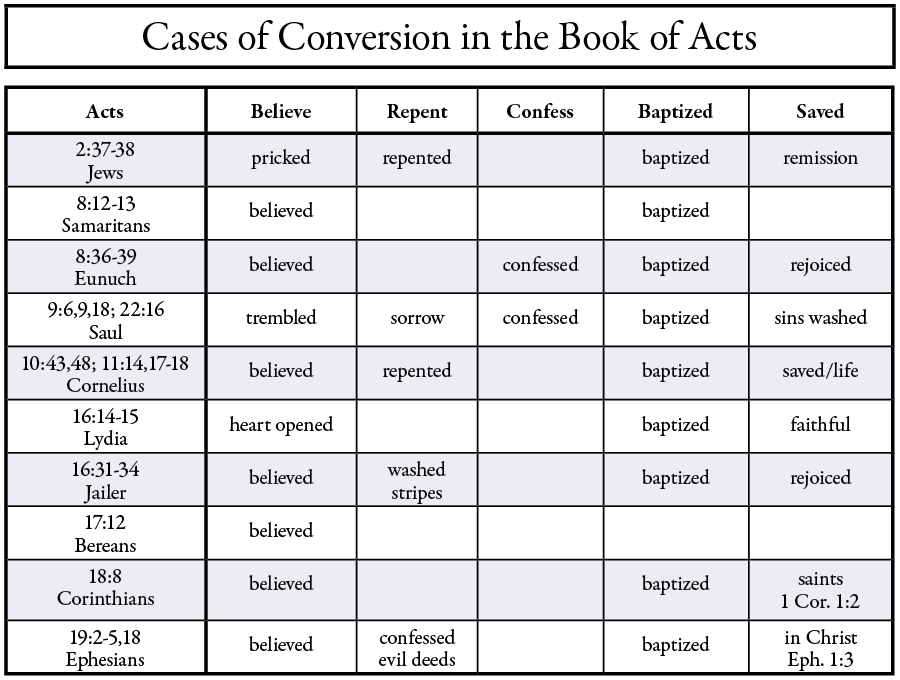
Romans was not actually intended to detail the conditions of salvation; rather, Romans explains the grounds/basis of salvation: the blood of Christ. Nevertheless, in passing, Romans happens to mention every single one of the prerequisite conditions of salvation with which humans must comply before God will grant forgiveness as a free, undeserved gift. Romans 10:17, as you note, indicates that a person must first hear the Gospel/Word of God, which is designed to create faith within. But Romans 10:9-10 makes clear that faith is not the only prerequisite to forgiveness. Oral confession with the mouth is also enjoined. Romans 2:4 indicates that repentance is necessary before God will forgive. And Romans 6:1-4 indicates that water immersion precedes salvation, since it is the contact point for the blood of Christ which was shed in His death. We must be baptized “into His death” to contact that blood. That is the point at which sin is washed away by the blood of Christ. No wonder, then, that Ananias told Saul/Paul to “[a]rise and be baptized, and wash away your sins, calling on the name of the Lord” (Acts 22:16). When does a person “call on the Lord”? When the believing, repenting, confessing person submits to water immersion (Acts 22:16). That explains why Peter declared that baptism “now saves us” (1 Peter 3:21)—in the sense that Christ’s blood saves us at the point of our baptism; and that is why that same Peter impressed upon those present in Acts 10 that the reception of Holy Spirit baptism directly from God upon the Gentiles was proof positive that Gentiles have the right to become Christians just as much as do the Jews. Once their eligibility for conversion was demonstrated by that miraculous act direct from God, Peter then pressed for their obedience in the words, “Can anyone forbid water, that these should not be baptized…?” (Acts 10:47). Why even bring up water at that moment if water immersion was not prerequisite to their forgiveness?
So faith, repentance, confession, and baptism are all indicated to precede remission of sin. We must obey these acts—not to atone for our sin, for only Jesus can do that—but to comply with God’s stated conditions—conditions that He authored (not us) and enjoined upon all who wish to be saved. That is why the Hebrews writer stated forthrightly that Jesus is “the author of eternal salvation to all who obey Him” (Hebrews 5:9). It is interesting that you quote Acts 10:34-35 which indicates that before a person is acceptable to Christ, that person must “fea[r] Him and wor[k] righteousness” (vs. 35). “He who practices righteousness is righteous, just as He is righteous” (1 John 3:7). In other words, belief, repentance, oral confession, and water immersion are righteous actions that humans must perform in order to receive the free gift of salvation available only in Christ, and be counted by Him as righteous.
Jesus said, “[b]lessed rather are those who hear the word of God and obey it.” (Luke 11:28, NIV). He also said, “If anyone loves me, he will obey my teaching. My Father will love him, and we will come to him and make our home with him” (John 14:23, NIV). Indeed, the day is coming when “the Lord Jesus is revealed from heaven with His mighty angels, in flaming fire taking vengeance on those who do not know God, and on those who do not obey the gospel of our Lord Jesus Christ” (2 Thessalonians 1:7-8).
Denominationalism has manifested a persistent refusal to distinguish between the grounds of salvation and the conditions of salvation—the compatible, scriptural distinction between Christ’s atonement and man’s obedience.
The post Why Do You Believe “Obedience” Is Necessary to Salvation? appeared first on Apologetics Press.
]]>The post “Not Under Law, But Grace” appeared first on Apologetics Press.
]]>This mentality insists that, while the central components of the Christian religion (1 Corinthians 15:3-4) are to remain intact, beyond those few “essentials,” worshippers are free to express themselves in accordance with their own heartfelt motions. Indeed, the worshipper is completely free in this regard, as long as no Scripture expressly forbids the motion. One of, if not the primary, justification for this antinomian spirit are those Bible passages that seem on the surface to denigrate law, speaking of it in negative terms as if it is to be treated suspiciously, if not brushed aside altogether. For example, Paul declared to Christians in Rome: “For sin shall not have dominion over you, for you are not under law but under grace” (6:14). This statement is interpreted by “grace only” advocates as: “Since God’s grace covers you, you must not worry about law-keeping!” But, in context, Paul was saying that since Christians have (1) renounced living a lifestyle of sinning without compunction, and (2) have obeyed the Gospel, they have placed themselves under a grace system (that provides forgiveness), rather than a strictly legal system that, by its very purpose, can only condemn. Verses 15-16 explains that just because we are under a grace system that provides forgiveness, we should not continue to live a life of sin like we did before we obeyed. To continue to live a life of sin, like we did before we obeyed the Gospel, would be to return to slavery—when we were slaves to sin.
A similar verse that is used to bolster the “no law” viewpoint is found among Paul’s remarks to the Galatian churches: “But if you are led by the Spirit, you are not under the law” (Galatians 5:18). Keep in mind that Paul’s letters to the Romans and Galatians address some of the same subject matter. In both letters, he makes the point that laws from God—whether those given to the Jews through Moses or those given by God to non-Jews from the Garden forward—result in condemnation when they are violated. God’s laws are intended to provide spiritual life (Romans 7:10; 10:5; Leviticus 18:5; Ezekiel 20:11,13). But once God’s law is violated, the law does not contain within itself the means by which the lawbreaker may be exonerated. All law can do is condemn you and state the punishment due for breaking law. But that does not mean that God’s laws are bad or negative! All of God’s laws are positive and good since they usher forth from God’s perfect nature. It took God stepping in to provide something in addition to law in order for the sinner to be rescued. So when Paul says we are not under law, he means we are not under law alone. Embracing the Gospel and the grace/forgiveness available via Christ enables us to be rescued—not from law—but from “the curse of the law” (Galatians 3:13). That is, He took our sins on Himself. He absorbed and made provision for satisfying the penalty of the law by dying in our behalf: “For He made Him who knew no sin to be sin for us, that we might become the righteousness of God in Him” (2 Corinthians 5:21).
Another misapplied passage is the statement that John set forth in his gospel account: “For the law was given through Moses, but grace and truth came through Jesus Christ” (John 1:17). This verse is often misinterpreted to mean we are not under law, since grace and truth exclude or eliminate law. This view is incorrect on three counts: (1) the law of Moses did not exclude truth. The psalmist declared concerning the law of Moses: “Your righteousness is an everlasting righteousness, and Your law is truth…. The entirety of Your word is truth” (Psalm 119:142,160); (2) God’s grace was available throughout the Old Testament: “Noah found grace in the eyes of the Lord” (Genesis 6:8). Moses found grace in God’s sight (Exodus 33:17). Ezra explained to the returning exiles that “now for a little while grace has been shown from the LORD our God” (Ezra 9:8). And the psalmist insisted that the LORD gives grace to those who walk uprightly (Psalm 84:11). (3) Christianity does not exclude law. Paul referred to the “law of Christ” (Galatians 6:2) and the “law towards Christ” (1 Corinthians 9:21). James alluded to the “law of liberty” (James 1:25) and “the royal law” (James 2:8). Hence, the meaning of John 1:17 lies in the fact that, though God’s law through Moses was intended for the good of its recipients (Deuteronomy 6:24; 10:13), nevertheless, that law was never intended to be the solution to sin. From eternity, God intended for the forgiveness of sin, i.e., “grace,” to be available only via the atoning sacrifice of Christ, i.e., the Gospel.
Definition
What, precisely, is the meaning of the word “grace”? The underlying Greek term charis has as its essential meaning “favor.” Danker1 identifies the following shades of meaning for the word—keeping in mind that the italicized words in the following delineations are intended to be the actual definitions (sample verses are included for each shade):
- “a winning quality or attractiveness that invites a favorable reaction, graciousness, attractiveness, charm, winsomeness.” Luke 4:22—“gracious words”; Colossians 4:6—“Let your speech always be with grace.”
- “a beneficent disposition toward someone, favor, grace, gracious care/help, goodwill.” Luke 2:40—“the grace of God was upon Him”; Acts 11:26—“they had been commended to the grace of God for the work which they had completed.”
- “practical application of goodwill, (a sign of) favor, gracious deed/gift, benefaction.” (a) by humans (Acts 24:27; 25:9—“wanting to do the Jews a favor”; 1 Corinthians 16:3; 2 Corinthians 8:4—“gift”; (b) by God (James 4:6b/1 Peter 5:5—“gives grace to the humble”).
- “exceptional effect produced by generosity, favor.” 2 Corinthians 8:1—“the grace of God bestowed on the churches of Macedonia”; 2 Corinthians 12:9—“My grace is sufficient for you.”
- “response to generosity or beneficence, thanks, gratitude.” Luke 17:9—“Does he thank that servant?”; 2 Timothy 1:3—“I thank God”; Hebrews 12:28—“let us have grace.”
To repeat, the essential meaning of charis as reflected in all five of these shades of meaning is “favor.”
Critical Clarification
God has given all human beings His law. All human beings are under divine obligation to obey that law. However, all human beings have broken that law. Hence, they are all rightly condemned. They have no means within themselves to achieve their own forgiveness. But God in His infinite goodness predetermined before He ever even created human beings to devise a plan for them to be forgiven. That plan consisted of sending Himself in the person of His Son to die and atone for sin. This redemptive scheme is, in fact, the grace of the New Testament and it has been presented to the world via the Gospel. This incredible provision in no way minimizes or eliminates the necessity of human beings devoting themselves to strict obedience to the laws of God. We are under divine obligation to (1) obey the Gospel (through faith, repentance, oral confession, and water immersion—Mark 16:16; Acts 2:38; Romans 10:9-10; Galatians 3:27) and (2) live a life of devoted conformity/obedience to the directives God has given for faithful living.
The “grace not law” mentality has misconstrued these concepts by advocating the notion that grace eliminates law, and that those who “live by grace” do not consider themselves under compulsion to give close attention to legal detail or to be concerned about law. They have been self-deluded into thinking that if they were to be concerned about law/legal restrictions, they would be guilty of “legalism” and failing to appreciate and live by “grace.” This sinister ideology is, in fact, dangerous and ultimately deadly to spiritual life. For example, a person may violate God’s laws governing marriage, divorce, and remarriage (Genesis 2:24; Malachi 2:16; Matthew 19:1-2; et al.) and entangle himself in an unscriptural, i.e., adulterous, marriage. The person who has embraced the “grace not law” theology will soothe and comfort himself by believing that “grace” enables him to remain in the marriage and God will simply forgive and brush aside his adultery. Never mind the fact that the law states plainly: “Now the works of the flesh are evident, which [include] adultery…which I tell you beforehand, just as I also told you in time past, that those who practice such things will not inherit the kingdom of God” (Galatians 5:19-22) and the “sexually immoral…shall have their part in the lake which burns with fire and brimstone” (Revelation 21:8). Grace does not excuse or accommodate a person in his violations of law; it merely enables him to be forgiven of his violations of law—if he repents. The “grace not law” viewpoint insists that one may continue to ignore law since we are under grace and law is no longer a relevant issue.
If “grace” is defined as “freedom from law,” it naturally follows that attention to legal detail becomes at the very least inappropriate and at most superfluous. Solomon well described the inevitable outcome of such thinking: “Where there is no revelation (i.e., law from God), the people cast off restraint; but happy is he who keeps the law” (Proverbs 29:18). The “grace not law” mindset would reword Solomon’s words: “Where there is no law, the people are freed from oppressive restriction to do what feels good, enjoying grace and relief from legalism.”
The hostility toward law that the “grace only” viewpoint engenders robs a person of the tremendous blessings afforded to those who respect and strive to conform to law: “The law of the LORD is perfect, converting the soul; the testimony of the LORD is sure, making wise the simple; the statutes of the LORD are right, rejoicing the heart; the commandment of the LORD is pure, enlightening the eyes” (Psalm 19:7-8). Psalm 119 extols the grandeur and indispensability of law, standing as a marvelous reminder of the abundant blessings and positive contributions to human life available only via God’s laws, commandments, statutes, testimonies, and precepts. Indeed, the law was specifically intended by God to provide life (Deuteronomy 30:15-16; Leviticus 18:5; Psalm 119:50; Romans 7:10).
Grace in Romans
The book of Romans provides the New Testament canon with a clear thesis statement of God’s scheme of redemption: the Gospel is God’s powerful means for saving people (1:16). The term for “grace” (charis) occurs 25 times in the book. Twice it is used by Paul to refer to his apostleship that was bestowed upon him by God—“the grace given to me” (12:3;15:15). Four times the word is used in its generic sense of “favor” with Paul expressing his desire that the grace of Jesus and God would be with the Romans (1:7; 16:20,24; cf. Galatians 2:9; Ephesians 3:7-8) and God extending His “favor” by bestowing spiritual gifts on the Roman Christians (12:6). The other 19 occurrences of the word in Romans—the vast majority—refer specifically to the Gospel. Consider the following chart that catalogs the meanings of charis in the book of Romans:
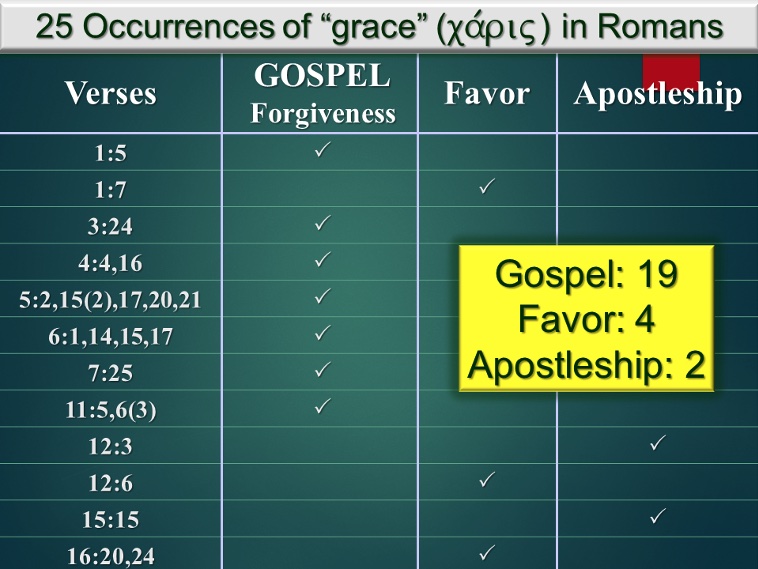
As Greek lexicographer Joseph Thayer explained: “the N.T. writers use xa/ri$ pre-eminently of that kindness by which God bestows favors even upon the ill-deserving, and grants to sinners the pardon of their offences, and bids them accept of eternal salvation through Christ.”2
To repeat: the grace of the Bible is God making it possible for people to be forgiven of their sin. But they must meet the pre-conditions of that forgiveness by conforming to the instructions/prescriptions God has given to receive that forgiveness. And people must maintain a sincere, attentive desire to comply with God’s laws, and to regularly repent and seek forgiveness when they make mistakes along the way. Herein lies the definition of what it means to “walk in the light” (1 John 1:7).
Concluding Observation
Perhaps the worst feature of the “grace only” doctrine is its blatant, inherent manifestation of disrespect for God Himself. After all, who gives us spiritual law? Who authored the Law of Moses? Who provides us with the “law of Christ” (Galatians 6:2)? Any denigration of law—any negative representation of biblical law—is an aspersion directed against God. No wonder Paul declared in no uncertain terms that “the law is holy, and the commandment holy and just and good” (Romans 7:12). Indeed, we would not even know what offends God—what sin is—if He had not given us law (Romans 3:20). Law is never depicted in Scripture as somehow “bad,” or negative, or undesirable, or oppressive. God’s commands are not “burdensome” (1 John 5:3)—they are not too hard for us. Indeed, they are like sweet honey to our mouths and far more precious than pure gold (Psalm 19:10). May we join wholeheartedly and genuinely with the psalmist in his exclamation: “Oh, how I love Your law! It is my meditation all the day” (Psalm 119:97).
Endnote
1 Frederick Danker (2000), A Greek-English Lexicon of the New Testament and Other Early Christian Literature (Chicago, IL: University of Chicago), third edition, pp. 1079-1080.
2 Joseph Thayer (1901), A Greek-English Lexicon of the New Testament (Grand Rapids, MI: Baker, 1977 reprint), p. 666.
The post “Not Under Law, But Grace” appeared first on Apologetics Press.
]]>The post Gentiles Received the Spirit Before Baptism? appeared first on Apologetics Press.
]]>While Peter was still speaking these words, the Holy Spirit fell upon all those who heard the word. And those of the circumcision who believed were astonished, as many as came with Peter, because the gift of the Holy Spirit had been poured out on the Gentiles also. For they heard them speak with tongues and magnify God. Then Peter answered, “Can anyone forbid water, that these should not be baptized who have received the Holy Spirit just as we have?” And he commanded them to be baptized in the name of the Lord. Then they asked him to stay a few days (Acts 10:44-48).
It is evident from this account that the Gentiles received the Spirit before they were baptized in water. Jesus stated emphatically: “I will pray the Father, and He will give you another Helper, that He may abide with you forever—the Spirit of truth, whom the world cannot receive” (John 14:16-17). If that be the case, how can water baptism be “for the remission of sins” (Acts 2:38) in order to be “clothed with Christ” (Galatians 3:27)? Does the Bible contradict itself? How can anyone receive the Spirit before he/she is clothed with Christ?
The answer to these questions lies in a deeper examination of the underlying language. In the first place, John 14:17 uses the Greek verb lambano, which is the usual word for “to take with the hand, lay hold of, any person or thing in order to use it,” “to take in order to carry away,” “to seize, take away forcibly.”1 In this verse, Jesus was not saying that unsaved persons cannot receive the Holy Spirit. Consider the context:
If you love Me, keep My commandments. And I will pray the Father, and He will give you another Helper, that He may abide with you forever—the Spirit of truth, whom the world cannot receive, because it neither sees Him nor knows Him; but you know Him, for He dwells with you and will be in you. I will not leave you orphans; I will come to you (John 14:15-18).
Jesus was assuring the disciples that, though He soon would be seized and taken away from them, nevertheless, He would send in His place the Holy Spirit—Whom His enemies could not take away. In fact, He would abide with them forever. Therefore, verse 17 says nothing about whether an unsaved individual can be the recipient of Holy Spirit activity.
The conversion of the Gentiles in Acts 10 is recounted by Peter in Acts 11 when he came to Jerusalem. Luke reports that “Peter explained it to them in order2 from the beginning” (vs. 4), suggesting that the account in Acts 10 is not necessarily in strict order. Peter explains how “he entered the man’s house” where Cornelius informed him that an angel had appeared and instructed him to “send men to Joppa, and call for Simon whose surname is Peter, who will tell you words by which you and all your household will be saved” (vss. 13-14). Observe carefully that Cornelius could not be saved until and without hearing inspired words that would instruct him how to be saved.
Having been informed about this fact by Cornelius, Peter next states: “And as I began to speak, the Holy Spirit fell upon them, as upon us at the beginning” (vs. 15). The Greek term rendered “began” (arxasthai) means “to begin,” “to denote what one begins to do.”3 “Peter had scarcely begun to speak.”4 Indeed, Peter was just beginning to speak, not having yet expressed the words of salvation. He had not yet been given the opportunity to convey the words by which Cornelius and his household could be saved. He was, in fact, interrupted in his efforts by their reception of the Spirit. Greek lexicographer Thayer makes this very point when he states that the word “indicates that a thing was but just begun when it was interrupted by something else.”5
Those who assume that reception of the Spirit on this occasion was proof of the Gentiles’ saved condition completely miss the very reason God administered Holy Spirit baptism to them. The Gentiles’ reception of the baptism of the Holy Spirit had nothing to do with their salvation. It merely served to prove to the Jews that the Gentiles had an equal right to enter the kingdom. Indeed, only two instances of Holy Spirit baptism are explicitly reported in the New Testament, and neither had anything to do with the salvation of the recipients.6 In the first instance, depicted in Acts 2, the purpose was to equip the apostles (who were already saved) to launch the Christian religion. The second instance (Acts 10) served the purpose of demonstrating to the Jewish Christians that non-Jews had a divine right to have access to the Gospel and enter the kingdom7—which explains precisely why, after such a powerful divine demonstration, Peter immediately called for water baptism, since that act is the divinely-designed entranceway into the Kingdom (Acts 10:47-48; John 3:5; 1 Corinthians 12:13).8
Endnotes
1 Thayer, p. 370, italics in orig.
2 The Greek word means “in sequence in time, space, or logic, in order, one after the other” [Danker, et al., p. 490, italics in orig.], “successively” [W.J. Hickie (1977 reprint), Greek-English Lexicon to the New Testament (Grand Rapids, MI: Baker), p. 92], “in succession” [Robertson, Word Pictures, 3:152].
3 Perschbacher, p. 55; Danker, et al., p. 140.
4 R.C.H. Lenski (1961 reprint), The Interpretation of the Acts of the Apostles (Peabody, MA: Hendrickson), p. 444.
5 Thayer, p. 78.
6 For an extensive examination of the phenomenon of “Holy Spirit Baptism” in the New Testament, see Dave Miller (2020), Modern-Day Miracles? Do Miracles, Tongue Speaking, & Holy Spirit Baptism Occur Today? (Montgomery, AL: Apologetics Press), pp. 39ff.
7 “also for the Greek”—Romans 1:16; 2:9,10.
8 For additional discussion, see Kyle Butt (2012), “If Cornelius Had theHoly Spirit, Doesn’t That Mean He Was Saved?” https://apologeticspress.org/if-cornelius-had-the-holy-spirit-doesnt-that-mean-he-was-saved-1693/.
Modern Day Miracles?
The post Gentiles Received the Spirit Before Baptism? appeared first on Apologetics Press.
]]>The post “Falling Away from Grace”? appeared first on Apologetics Press.
]]>

The Greek term translated “fallen” is from the verb pipto meaning “to fall.” In Galatians 5:4, the word has the preposition ek prefixed to it. This Greek preposition means primarily “out of.” Ekpipto, then, means literally “to fall out of.”1 One would need to be “in” a realm or sphere in order to “fall out of” it (see Figure 2). In the case of the Galatians, they had been converted to become Christians (Acts 18:23) and were counted as being in Christ’s church (Galatians 1:2-3).

Baptist Greek grammarian A.T. Robertson explains the language: “Ye did fall out of grace,” “ye left the sphere of grace in Christ and took your stand in the sphere of law as your hope of salvation.”2 Mounce adds: “to fall from, forfeit, lose.”3 Meyer noted: “Ye have forfeited the relation of being objects of divine grace.”4 And Eadie explains: “Christ’s method of justification is wholly of grace, and those who rely on law and merit are in opposition to grace—are fallen out of it.”5
These observations are buttressed by the fact that in the same verse, Paul says to the Christians: “You have become estranged from Christ.”6 The word means to “dissever from.”7 In addition to “estranged,” other translations have “severed” (ASV/ESV/RSV), “alienated” (NIV), and “cut yourselves off from Christ” (NRSV). Therefore, it is possible at one time to be within the grace of Christ and thereby saved, and then to so conduct oneself as to be severed from, to fall out of, and forfeit that grace.
Endnotes
1 Joseph Thayer (1977 reprint), A Greek-English Lexicon of the New Testament (Grand Rapids, MI: Baker), p. 198.
2 A.T. Robertson (1931), Word Pictures in the New Testament (Nashville, TN: Broadman Press), 4:309, emp. added.
3 Robert Mounce (2006), Mounce’s Complete Expository Dictionary of Old and New Testament Words (Grand Rapids, MI: Zondervan), p. 1137.
4 Heinrich Meyer (1884), Critical and Exegetical Handbook to the Epistles to the Galatians (New York: Funk & Wagnalls), p. 222, italics in orig.
5 John Eadie (1979 reprint), A Commentary on the Greek Text of the Epistle of Paul to the Galatians (Grand Rapids, MI: Baker), 1:384.
6 Frederick Danker, et al. (2000), Greek-English Lexicon of the New Testament (Chicago, IL: University of Chicago Press), p. 526.
7 Wesley Perschbacher, ed. (1990), The New Analytical Greek Lexicon (Peabody, MA: Hendrickson), p. 226.
The post “Falling Away from Grace”? appeared first on Apologetics Press.
]]>The post The Obedience of Faith in Romans appeared first on Apologetics Press.
]]>The extreme doctrine of justification by faith only, has so completely engrossed the mind of commentators, since the sixteenth century, that it seems never to have occurred to them, as even a possible fact, that Paul may not have been writing in their exclusive interest. They have regarded him as certainly of their order, and, as a consequence, have written him up into a partisan, only more partisan than themselves. The result has been that in many places their works are a complete perversion of the truth, and not an exhibition of it.2
Romans actually contrasts, on the one hand, the prevailing Jewish notion that they could be saved on the basis of their fleshly connection to Abraham and the Mosaic Law alone (a law which had been given exclusively to them) with, on the other hand, the sole necessity of rendering obedience to Christ and the Gospel. Romans emphasizes salvation by faith not flesh. The term “works” is not used to include actions humans perform that God requires (like water baptism). Baptism is not a “work” in the sense of the term as used in Romans. Rather, the context of Romans indicates that “works” refers to those actions that the Jews claimed enabled them to be acceptable to God without becoming Christians—circumstances surrounding the benefits accrued by them due to their ethnicity, their longstanding connection to Abraham.
Further, the essence of “faith” in Romans (and throughout the Bible) is trust that is accompanied by compliance with God’s directives—what James describes as a living, versus a dead, faith (James 2:17,26). The human actions that God requires precedent to His bestowal of physical or spiritual gifts are not seen by Him to be meritorious works by which a person earns or deserves the gift He provides. Rather, they are given by God as conditions.
Salvation is only “unconditional” in the sense that God enacted the means by which humans may be forgiven without any involvement on their part. In fact, God decided to provide the means of atonement for human sin before He ever created the first human beings. Jesus would (and did) come to offer Himself as the atonement/propitiation for sin without humans doing anything to bring it about (Romans 3:25). That decision was an eternal intention (Ephesians 3:11). Indeed, Jesus is “the Lamb slain from the foundation of the world” (Revelation 13:8). No human can perform any acts of legal merit by which he can save himself or atone for his own sin. On the other hand, salvation is “conditional” in the sense that God requires the exercise of the human will in the reception of salvation. Both mind and body must be brought into play. Faith itself is such an action—a “work” that man must perform in order to be pleasing to God (John 6:29). In this sense, the New Testament forcefully declares that you can—and must—save yourself (See Acts 2:40; Philippians 2:12).
The Holy Spirit established this definition of faith in the book of Romans—at the beginning as well as at the end. The Greek phrase he inspired Paul to utilize in 1:5 and 16:26 is hupakoein pisteos—“obedient faith” or the obedience which faith manifests or expresses. In his respected Greek grammar, Baptist scholar A.T. Robertson insisted that the phrase is to be understood as a “subjective genitive”3—“the obedience which springs from faith”4—rather than an “objective genitive” meaning “obedience to the faith.” The phrase, in fact, characterizes and clarifies the meaning of “faith” as used in Romans.
Several Greek authorities agree with this assessment. In the latest edition of the “BDAG” Greek lexicon most recently revised by Frederick Danker, after noting the objective genitive meaning, the author states: “But it may be better to render it more generally with a view to (promoting) obedience which springs from faith.”5 Writing in The Expository Times, Geoffrey H. Parke-Taylor of Wycliffe College commented specifically on the Greek phrase in Romans 1:5 and 16:26—
Surely in both cases “obedience that springs from faith” is intended, πίστεως being a genitive of source or material…. If “the faith” (i.e., a body of formulated doctrine), had been intended, doubtless the definite article would have been used…. The emphasis is on the obedience to God which comes as a result of faith in Christ…. Christ was not only the example to Gentile Christians of the perfect obedience which springs from perfect faith, but also the source of power whereby obedience to God could be realized in their own lives.6
In his A Short Syntax of New Testament Greek, H.P.V. Nunn notes “The Genitive of Source or Material” and gives as an example “The righteousness of faith (i.e., that springs from faith)”7—a parallel expression to “the obedience of faith.” Respected commentator J.B. Lightfoot interprets the phrase to mean “unto obedience which springs from faith.”8 In his Word Studies in the Testament, Marvin Vincent says, “Obedience of faith is the obedience which characterizes and proceeds from faith.”9
While Greek grammarians possess considerable unanimity on the matter, translators have struggled with the phrase and sent mixed signals to their English audiences. For example, the KJV has in the first occurrence of the phrase in Romans (1:5), “for obedience to the faith among all nations,” and in the second occurrence (16:26), “made known to all nations for the obedience of faith”—though the phrase is the same in both verses. The NKJV has “for obedience to the faith” in both verses. The ASV has “unto obedience of faith” in both verses. The NASB has “to bring about the obedience of faith” in 1:5 (as does the ESV in both verses) and “leading to obedience of faith” in 16:26. The RSV has “to bring about the obedience of faith” in both verses. The NIV has “to the obedience that comes from faith” in 1:5 and “so that all nations might believe and obey him” in 16:26. Though resorting somewhat to paraphrase, the renderings in the NIV fully capture the nuances of the phrase. Interestingly, the Complete Jewish Bible renders the phrase “trust-grounded obedience.” The International Standard Version (ISV) has “faithful obedience” in 1:5 and “the obedience that springs from faith” in 16:26. The Jubilee Bible 2000 (JUB) has “that they might hear and obey by faith” in 16:26. God’s Word Translation has “the obedience that is associated with faith.”10 The Voice translation has “obedient faith” in 1:5 and “faith-filled obedience” in 16:26, while the Message Bible (MSG) has “obedient trust” in 1:5 and “obedient belief” in 16:26.
Faith in the book of Romans includes obedience to external acts preceding forgiveness. Or as Greek lexicographer Joseph Thayer explained the meaning of pisteuo (“I believe”): “Used especially of the faith by which a man embraces Jesus, i.e., a conviction, full of joyful trust, that Jesus is the Messiah—the divinely appointed author of eternal salvation in the kingdom of God, conjoined with obedience to Christ.”11 No wonder Paul repeatedly uses the words “obedience” (1:5; 5:19; 6:16; 16:19,26) and “obey” (2:8-twice; 6:12; 6:16-twice).
In stark contradistinction with Paul, modern denominationalism insists that faith does not include any further acts of obedience; rather, one need only “accept Jesus as Savior” by saying, “I receive you into my heart as my personal Savior.” Hence, water baptism is considered non-essential to salvation. The Holy Spirit anticipated this unwarranted conclusion, not only by stressing the essentiality of water baptism in 6:3-4, but by positioning two “red flags”—one at the beginning (1:5) and one at the end (16:26) of this marvelous treatise. These majestic sentinels essentially warn readers regarding the nature and meaning of the “faith” which characterizes the book of Romans.
Endnotes
1 These activities included “hail Marys,” indulgences, assigned penance, gifts to build cathedrals, Stations of the Cross, etc.
2 Moses Lard (1875), Commentary on Paul’s Letter to Romans (Lexington, KY: Transylvania Printing and Publishing), p. v.
3 A.T. Robertson (1919), A Grammar of the Greek New Testament in the Light of Historical Research (New York: George Doran), p. 500.
4 A.T. Robertson (1931), Word Pictures in the New Testament (Nashville, TN: Broadman Press), 4:324.
5 Fredrick William Danker (2000), A Greek-English Lexicon of the New Testament and Other Early Christian Literature (Chicago, IL: University of Chicago), third edition, p. 1028.
6 Geoffrey H. Parke-Taylor (1944), “A Note on ‘e)i$ uJðáêïhn ðίóôåùò’ in Romans i.5 and xvi.26,” The Expository Times, 55:305-306, emp. added. He cites Acts 6:7 and Romans 10:8 as instances where the article indicates “the faith.”
7 H.P.V. Nunn (1912), A Short Syntax of New Testament Greek (Cambridge: Cambridge University Press), p. 42.
8 J.B. Lightfoot (1895), Notes on Epistles of Paul from Unpublished Commentaries (London: Macmillan), p. 246.
9 Marvin Vincent (1946), Word Studies in the New Testament (Grand Rapids, MI: Eerdmans), 3:5. See also W.E. Vine (1966), An Expository Dictionary of New Testament Words (Old Tappan, NJ: Fleming H. Revell), p. 123, who also takes the phrase as a subjective genitive and identifies “faith” as “the initial act of obedience.”
10 Also the Names of God Bible (NOG).
11 Joseph Thayer (1977 reprint), Greek-English Lexicon of the New Testament (Grand Rapids, MI: Baker), p. 511, italics in orig., emp. added.
The post The Obedience of Faith in Romans appeared first on Apologetics Press.
]]>The post Faith Reaching for Calvary appeared first on Apologetics Press.
]]>[NOTE: The following sermon was preached in Montgomery, AL in October 2019 by A.P. board member Frank Chesser.]
Sin is man’s worst enemy. It crouches at the door of the mind, eager to pollute the source of every human activity. It maintains constant surveillance over the mind, knowing that its capture means the ruin of a man. Sin enters the mind by invitation and supplants its light with darkness. An appalling enumeration of sins that characterized the Gentle world begins with the depiction, “their foolish heart was darkened” (Romans 1:21). John asserts that a man who hates his brother “is in darkness, and walks in darkness, and knows not where he goes, because that darkness has blinded his eyes” (1 John 2:11).
Only Christ and the Gospel can replace darkness with light. Jesus is the “light of the world” (John 8:12). The light of Christ is manifested through the Gospel and its appeal is to the mind, “for out of it are the issues of life” (Proverbs 4:23). The sounds of physical conflict are heard in communities, states, and nations around the world. Entire countries are enmeshed in combat. Implements of war interrupt the routine of life, and peace and serenity are supplanted by chaos, suffering, and death.
But the battlefield of the ages is the mind of man. Satan knows that the Gospel is man’s only hope, and the Gospel addresses the mind. Satan exerts strenuous, incessant effort to keep man’s mind under the dark canopy of sin and error “lest the light of the gospel of the glory of Christ, who is the image of God, should shine on them” (2 Corinthians 4:4). The transition from darkness to light occurs when man obeys the Gospel.
The cross is the pivotal point of all human history. The past, present, and future have as their center, the cross of Christ. The Gospel is God’s power to save, but without the cross, there is no Gospel. Remove the cross and all joy in birth, purpose in life, and hope in death have been destroyed. Erase the cross and every day of life is one unending tragedy. With the cross, everything matters; without the cross, nothing matters.
What is man’s greatest need? Man’s greatest need is not sensational preaching; it is cross-centered preaching. It is not human philosophy; it is Jesus Christ crucified. It is not physical adornment; it is a spirit dipped in blood. It is not a social Gospel; it is the Gospel of the cross. It is not Moses and Sinai; it is Christ and Calvary. “And I, brethren, when I came to you, did not come with excellence of speech or of wisdom declaring to you the testimony of God. For I determined not to know anything among you except Jesus Christ and Him crucified” (1 Corinthians 2:1-2).
From eternity, God knew the cross would be the price that would have to be paid for sin. Sin cannot correct itself. It cannot provide for its own cure. It cannot solve the problems it creates, heal the pain it causes, remove the barriers it constructs, restore the families it destroys, eliminate the suffering it produces, or stop the endless flow of unprepared souls into the world of eternal perdition. Man is powerless in the face of sin. The righteousness of all the righteous of all the ages cannot erase a single sin of a single sinner. The entire angelic host stood helplessly at the reality of Genesis 3:6. It took the perfect life of God’s Son in the flesh to qualify Him to conquer sin in the cross. The sinless life of Christ and His death on the cross enabled God to maintain His holiness, righteousness, and justice, and extend the blessing of reconciliation to all who would embrace the Gospel in the obedience of faith (Romans 3:23-26).
God foreknew the choice that man would make in Eden. How could this be? Because God is omniscient. God confidently asserted to ancient Israel, “I know the things that come into your mind” (Ezekiel 11:5). God knows the number of hairs on every head, and not even a small sparrow can fall from the heavens apart from His knowledge (Matthew 10:29-30). God’s foreknowledge did not negate Adam’s and Eve’s free will. God simply knew the course that man’s free will would take.
Divine foreknowledge of man’s choice in Eden was accompanied by foreknowledge of its only possible cure. Peter announced this truth on Pentecost when he said that Jesus was “delivered by the determined counsel and foreknowledge of God” (Acts 2:23). When a man chooses God by submitting to His will, God chooses him in Christ according to the divine principles intrinsic to the scheme of redemption ordained “before the foundation of the world” (Ephesians 1:4). God’s intent to save man by grace through the Gospel “was given to us in Christ Jesus before time began” (2 Timothy 1:9). God’s remedy for sin in the cross “was foreordained before the foundation of the world” (1 Peter 1:20). Jesus was God’s “Lamb slain from the foundation of the world” (Revelation 13:8). God’s plan to reconcile both Jews and Gentiles unto Himself “in one body through the cross” (Ephesians 2:16) was according to the “eternal purpose which he accomplished in Christ Jesus our Lord” (Ephesians 3:11).
Appropriating to one’s soul the sin cleansing power of the cross is accomplished “through faith in his blood” (Romans 3:25). The faith of the Gospel system that enables one to enjoy the forgiveness of sins by grace through blood is the faith that obeys God. It is the “work of faith” (1 Thessalonians 1:3). It is the “faith working through love” (Galatians 5:6). The greatest treatise ever written on the scheme of redemption opens with the phrase, “obedience of faith” (Romans 1:5), and it closes with the phrase “obedience of faith” (Romans 16:26). Between these two massive spiritual pillars is a divine commentary on the Gospel system and the faith that permits man to participate in its provisions.
Paul proceeds to portray the exceedingly sinful state of the Gentile world and its need of Gospel that centers in Christ and the cross (Romans 1:18-32). He then verified the like state of his own brethren in the flesh and depicts the whole of humanity to be “guilty before God” (Romans 3:19) because “all have sinned and fall short of the glory of God” (Romans 3:23). He points to man’s only hope in God’s spiritual healing by grace “through the redemption that is in Christ Jesus” (Romans 3:24) appropriated to one’s soul “by His blood, through faith” (Romans 3:25). He describes this divine plan as a “law of faith” (Romans 3:27) system that looks to the cross for its liberation from sin. He utilizes Abraham as an example of one who exhibited the obedience of faith that appropriates grace and the need of all men to possess the “faith of Abraham” (Romans 4:16) and not the blood of Abraham.
Consequently, every act of obedience to the will of God is faith making its appeal to the cross of Christ. Such was characteristic of those under the Old Testament, even though they did not possess all of the pieces to the spiritual puzzle of redemption. It was God’s design from eternity to unite all men in the one church by means of the cross of Christ and man’s obedience to the Gospel of Christ. The spiritual remnant from Adam to Pentecost of Acts 2 was unable to grasp the totality of this truth because of insufficient revelation (Ephesians 3:1-6). Even the prophets who prophesied of things concerning Christ and the church did not fully comprehend their own prophecies. Peter speaks of intense, studious efforts by the prophets to unravel some of the mysteries regarding their own prophetic declarations of the “sufferings of Christ and the glories that would follow” (1 Peter 1:11) and of angelic desire for deeper understanding of redemptive truths (1 Peter 1:12).
Though lacking a completed revelation, they were abundantly supplied with sufficient truths to enable them to live before God with a full faith. They understood the nature of God and sin. They perceived their sinful state and their inability to lift a finger to provide for their own redemption. They knew they were wholly dependent on God’s love, grace, and mercy. They understood that God was working toward the consummation of a plan that would secure their redemption. Jesus said, “Abraham rejoiced to see My day, and he saw it and was glad” (John 8:56). Every act of obedience under the Old Testament and every drop of sacrificial blood offered by the righteous remnant was an act of faith appealing to God’s love and grace for salvation that would culminate in Christ and the cross.
If not for the cross, what value could be attached to Abel’s offering? What benefit could be assigned to Noah’s conformity to the will of God and physical salvation from the Flood, if the cross had never become a reality? Severed from the cross, what gain could one perceive in Abraham’s departure from Ur and the and the offering of his son on the designated mountain in Moriah? Without Calvary, what advantage was it for Moses to suffer four decades of abuse from a nation of ingrates?
Of what value was compliance with the priesthood and sacrifice of Levi without the priesthood and sacrifice of Christ? If Jesus had not assumed flesh, lived a sinless life, and died on the cross, would there be any point in accentuating the difference between striking and speaking to the rock? What real gain could be cited for Israel’s battles and victory over her enemies in Canaan if Christ had not fought and conquered Satan and sin? Of what worth is the submissive disposition of Samuel, “Speak, for your servant hears” (1 Samuel 3:10), if Jesus had not prayed, “Father, if it is Your will, remove this cup from Me; nevertheless not My will, but Yours be done”? (Luke 22:42).
Eliminate the cross and what profit could be advanced for Judah’s return to Canaan following the Babylonian captivity and restoration of the Temple? Apart from the cross, what was the point of Nebuchadnezzar’s confession of the oneness and sovereignty of God? Is not Nineveh’s penitence irrevocably connected to Calvary? Where lies the significance in the preaching of the prophets if Jesus had not traveled the lonely road to Golgotha? What blessings followed those giants of faith who “were slain with the sword” (Hebrews 11:37) if Jesus had not been slain on the cross?
A completed Gospel was preached on Pentecost of Acts 2. When the remnant complied with the conditions of the Gospel in the obedience of faith, they were added to the church (Acts 2:47). Relative to salvation, faith now assumes a backward posture. It looks back to a consummated scheme of redemption in Christ and the cross. The power of faith is not in the action of faith; it is in the object of faith. There is no power to cure sin in expressions of faith. If demonstrations of faith could remedy sin, man could solve his own sin problem by his submission to the will of God.
Every command in the New Testament and every act of obedience to that command is faith appealing to the cross for redemption. Repentance is a command of God. He “commands all men everywhere to repent” (Acts 17:30). Repentance is “for the remission of sins” (Acts 2:38). A genuine change of heart regarding one’s sin followed by “fruits worthy of repentance” (Matthew 3:8) is not an attempt at self-absolution. A penitent heart understands that its power source is Calvary. Repentance is faith looking to the cross for forgiveness.
Jesus Christ is fully divine. He is deity in all fullness and essence. He is the “Mighty God” (Isaiah 9:6). Thomas confessed Him as “my Lord and my God” (John 20:28). “In the beginning was the Word, and the Word was with God, and the Word was God” (John 1:1); and that “Word” was Christ (John 1:14). Of His Son, God the Father affirmed, “Your throne, O God, is forever and ever; A scepter of righteousness is the scepter of Your kingdom” (Hebrews 1:8). Confessing the full deity of Christ is indispensable to one’s salvation (Romans 10:9-10). Confessing Christ is an exhibition of faith, looking to the object confessed for release from sin.
The Gospel of Christ that centers in the cross of Christ produces the church of Christ. The Gospel that Peter preached on Pentecost of Acts 2 took the minds of the hearers and anchored them to the cross. Submission to the Gospel in the obedience of faith effectuated the church. Jesus purchased the church “with His own blood” (Acts 20:28). Jesus earnestly desires for “all men to be saved and to come to the knowledge of the truth” (1 Timothy 2:4).
God sent His Son “as Savior of the world” (1 John 4:14), but Jesus can save only those “all who obey Him” (Hebrews 5:9). Those who obey Christ are added to the church of Christ (Acts 2:47), which is the “body” of Christ” (Colossians 1:18), and Jesus is “the Savior of the body” (Ephesians 5:23). Acceptance of the exclusive church, purchased by the exclusive Savior and produced by the exclusive Gospel is not bigotry. It is the humility of faith appealing to the cross for redemption.
Man is the offspring of God, made in the image of God. When man severs himself from God and pursues a life of carnal indulgence, he is spurning the most crucial aspect of his nature. Man’s need of God and of worship is as intrinsic to his nature as is heat in fire. Worship is requisite to man’s inner peace and spiritual serenity. It equips man to resist temptation and cope with adversity. It deepens conviction. It intensifies man’s loathing for sin and error and heightens his love for God and truth.
Worship fortifies the mind, the object of satanic onslaughts. It enriches spirituality. It provides solace for the grieving, hope to the despairing, and joy to the dispirited. It grows faith. Worship is manna from heaven to the hungry soul. It is living water that streams from the Rock of our salvation. It elevates the mind from the earthly and temporal to the spiritual and eternal. It allays the burdens of life. It quickens anticipation for heaven. Worship is indispensable to one’s spiritual life and his habitation in that “city which has foundations, whose builder and maker is God” (Hebrews 11:10).
What man calls worship is often a humanly contrived, self-pleasing, emotional experience that placates the flesh and dulls the spirit. It removes God as the object and enthrones man. It is physical, theatrical, and superficial. It stimulates the pulse and idles the mind. It is dramatic and noisy. Jokes and human-interest stories issuing from the pulpit are met with laughter and clapping. The preacher is idolized and applauded, while God is minimalized and marginalized. The participants leave with a distorted sense of spirituality, unchallenged minds, diminished convictions, appeased consciences, and a comfort zone for sin and enhanced toleration for those of varying religious persuasions. “And in vain they worship Me, teaching as doctrines the commandments of men” (Matthew 15:9).
Acceptable worship conforms to God’s pattern. It involves the right object, right act, and right motive. “God is Spirit, and those who worship Him must worship in spirit and truth” (John 4:24). One cannot come into God’s presence with an unauthorized act of worship that he likes and expect God to accept it. Nadab and Abihu attempted such presumptuousness, and God slew them. Unauthorized acts of worship insult the grace of God, nullify faith, and demonstrate irreverence for the cross of Christ.
Spirit-and-truth worship looks to the cross for its validation. The power of acceptable worship is in the power of the cross, not the act of worship. For two millenniums, “this do in remembrance of Me,” has reverberated in the minds of men in Sunday’s commemoration of the Lord’s Supper. Material gifts on the first day of each week reflect the goodness of God and His gifts to man, the pinnacle of which was the gift of His Son as the remedy for sin.
Prayers of faith on wings of grace take flight from the worship assembly and soar through the blood of Christ into the presence of God. With permission from Calvary, songs of the heart are allowed entrance into the throne room of heaven to join with the melodies of angels in praise and adoration to the majesty of God. Preaching that saves and edifies pivots around the cross and demonstrates its application to the whole of biblical instruction.
When Adam’s and Eve’s lips were soiled by the forbidden fruit, God commenced His journey toward Calvary. This redemptive voyage enjoyed its fruition in the death, burial, and resurrection of the sinless Christ. Prior to His return to the Father, Jesus decreed that the Gospel was to cover the earth. Upon hearing the Gospel, man was to believe and be baptized (Mark 16:15-16). The preponderance of humanity has never consented to the words of Christ. They declare their love for Christ while rejecting the will of Christ. They view teaching on the necessity of baptism for salvation as an affront to the grace of God and the cross of Christ. They assert that such teaching annuls faith and transforms the free gift of salvation into a meritorious system of works.
One can no more separate baptism from grace, blood, and faith than he can cleave blue from the sky. Baptism is faith complying with the teaching of grace. Baptism is the obedience of faith appropriating the provisions of grace in the cross. Baptism is a spiritual reenactment of the death, burial, and resurrection of Christ (Romans 6:3-4). The power of baptism is in the cross, not in the act of baptism. Baptism is the eye of faith riveted on the cross. It is the heart of faith beating for the cross. It is the trust of faith centered in the cross. It is the hands of faith laying hold of the cross. Baptism and all other acts of obedience to God is faith reaching for Calvary.
The post Faith Reaching for Calvary appeared first on Apologetics Press.
]]>The post 13 Objections to Baptism Answered appeared first on Apologetics Press.
]]>
Some churches historically have taught that water immersion is the dividing line between the lost and the saved. This means that a penitent believer remains unforgiven of sin until buried in the waters of baptism (Romans 6:4). Much of the denominational world disagrees with this analysis of Bible teaching, holding instead that one is saved at the point of “belief,” before and without water baptism. Consider some of the points that are advanced in an effort to minimize the essentiality of baptism for salvation.
Objection #1: “Jesus could not have been baptized for the remission of sins because He was sinless; therefore, people today are not baptized in order to be forgiven. They merely imitate Jesus’ example.”
The baptism to which Jesus submitted Himself was John’s baptism (Matthew 3:13; Mark 1:9). John’s baptism was for the remission of sins (Mark 1:4; Luke 3:3). This truth is particularly evident from the fact that when Jesus presented Himself to John for baptism, John sought to deter Him, noting that, if anything, Jesus needed to baptize John (Matthew 3:14). Jesus did not correct John, as many seek to do today, by falsely arguing that baptism is not for remission of sins. Rather, Jesus, in effect, agreed with John, but made clear that His baptism was an exception to the rule.
Jesus’ baptism was unique and not to be compared to anyone else’s baptism. Jesus’ baptism had the unique purpose of “fulfilling all righteousness” (Matthew 3:15). In other words, it was necessary for Jesus to submit to John’s baptism (1) to show His contemporaries that no one is exempt from submitting to God’s will and (2) more specifically, Christ’s baptism was God’s appointed means of pinpointing for the world the precise identity of His Son. It was not until John saw the Spirit of God descending on Jesus and heard the voice (“This is My Son…”) that he knew that “this is the Son of God” (John 1:31-34; Matthew 3:16-17).
Of course, John’s baptism is no longer valid (Acts 18:24-19:5). John’s baptism paralleled New Testament baptism in the sense that both were for the forgiveness of sins. But John’s baptism was transitional in nature, preparing Jews for their Messiah. Baptism after the cross is for all people (Matthew 28:19), in Jesus’ name (Luke 24:47; Acts 2:38; 19:5), into His death (Romans 6:3), in order to be clothed with Him (Galatians 3:27), and added to His church (Acts 2:47; 1 Corinthians 12:13). We must not use Jesus’ baptism to suggest that salvation occurs prior to baptism.
Objection #2: “The thief on the cross was not baptized, and he was saved.”
When we “handle aright the word of truth” (2 Timothy 2:15), we see that the thief was not subject to the New Testament command of immersion because this command was not given until after the thief’s death.¹ It was not until Christ was resurrected that He said, “He who believes and is baptized will be saved” (Mark 16:16). It was not until Christ’s death that the Old Testament ceased, signified by the tearing of the Temple curtain (Matthew 27:51). When Jesus died, He took away the Old Testament, “nailing it to the cross” (Colossians 2:14).
The word “testament” means “covenant” or “will.” The last will and testament of Christ is the New Testament, which consists of those teachings that apply to people after the death of Christ. If we expect to receive the benefits of the New Testament (salvation, forgiveness of sin, eternal life), we must submit to the terms of the will for which Christ is mediator (Hebrews 9:15), for “where a testament is, there must also of necessity be the death of the testator; for a testament is of force after men are dead; otherwise it is of no strength at all while the testator lives” (Hebrews 9:16-17).
So prior to the Lord’s death and the sealing of the New Testament, the baptism for the forgiveness of sins that would be in effect after the crucifixion was not a requirement for those who sought to be acceptable to God. Indeed, while Jesus was on Earth in person, He exercised His authority to forgive sin (Matthew 9:6). People now, however, live during the Christian era of religious history. Prior to Christ’s death, there were no Christians (Acts 11:26). For a person to reject water baptism as a prerequisite to salvation on the basis of what the thief did or did not do, is comparable to Abraham seeking salvation by building an ark—because that’s what Noah did to please God. It would be like the rich young ruler (Matthew 19) refusing Christ’s directive to sell all his possessions—because wealthy King David did not have to sell his possessions in order to please God.
The thief on the cross could not have been baptized the way the new covenant stipulates you and I must be baptized. Why? Romans 6:3-4 teaches that if we wish to acquire “newness of life,” we must be baptized into Christ’s death, be buried with Christ in baptism, and then be raised from the dead. There was no way for the thief to comply with this New Testament baptism—Christ had not died! Christ had not been buried! Christ had not been raised! In fact, none of God’s ordained teachings pertaining to salvation in Christ (2 Timothy 2:10), and in His body the Church (Acts 2:47; Ephesians 1:22-23), had been given. The church, which Christ’s shed blood purchased (Acts 20:28), had not been established, and was not set up until weeks later (Acts 2).2
We must not look to the thief as an example of salvation. Instead, we must obey “from the heart that form of doctrine” (Romans 6:17)—the form of Christ’s death, burial, and resurrection through baptism (Romans 6:3-4). Only then can we be “made free from sin to become the servants of righteousness” (Romans 6:18).
Objection #3: “The Bible says, ‘Christ stands at the door of your heart,’ and all we have to do to be forgiven of sin and become a Christian is to invite Him into our hearts.”
It is no doubt startling to discover that the Bible simply does not say such a thing. The phraseology is reminiscent of Revelation 3:20—the passage usually invoked to support the idea. But examine what Revelation 3:20 actually teaches. Revelation chapters 2 and 3 consist of seven specific messages directed to seven churches of Christ in Asia Minor in the first century. Thus, at the outset, we must recognize that Revelation 3:20 is addressed to Christians—not non-Christians seeking conversion to Christ.
Second, Revelation 3:20 is found among Christ’s remarks to the church in Laodicea. Jesus made clear that the church had moved into a lost condition. The members were unacceptable to God since they were “lukewarm” (3:16). They had become unsaved since their spiritual condition was “wretched and miserable and poor” (3:17). Thus, in a very real sense, Jesus had abandoned them by removing His presence from their midst. Now He was on the outside looking in. He still wanted to be among them, but the decision was up to them. They had to recognize His absence, hear Him knocking for admission, and open the door—all of which is figurative language indicating their need to repent (3:19). They needed to return to the obedient lifestyle essential to sustaining God’s favor (John 14:21,23).
Observe that Revelation 3:20 in no way supports the idea that non-Christians merely have to “open the door of their heart” and “invite Jesus in” with the assurance that the moment they mentally/verbally do so, Jesus comes into their heart and they are simultaneously saved from all past sin and have become Christians. The context of Revelation 3:20 shows that Jesus was seeking readmission into an apostate church.
Does the Bible teach that Christ comes into a person’s heart? Yes, but not in the way the religious world suggests. For instance, Ephesians 3:17 states that Christ dwells in the heart through faith. Faith can be acquired only by hearing biblical truth (Romans 10:17). When Bible truth is obeyed, the individual is “saved by faith” (Hebrews 5:9; James 2:22; 1 Peter 1:22). Thus Christ enters our lives when we “draw near with a sincere heart in full assurance of faith, having our hearts sprinkled from an evil conscience [i.e, repentance—DM] and our bodies washed with pure water [i.e., baptism—DM]” (Hebrews 10:22).
Objection #4: “A person is saved the moment he accepts Christ as his personal Savior—which precedes and therefore excludes water baptism.”
To suggest that all one has to do to receive the forgiveness of God and become a Christian is to mentally accept Jesus into his heart and make a verbal statement to that effect, is to dispute the declaration of Jesus in Matthew 7:21—“Not everyone who says to Me, ‘Lord, Lord,’ shall enter the kingdom of heaven, but he who does the will of My Father in heaven.” To be sure, oral confession of Christ is one of the prerequisites to salvation (Romans 10:10). But Jesus said there is more to becoming a blood-bought follower of His than verbally “calling on his name”3 or “inwardly accepting Him as Savior.” He stated that before we can even consider ourselves as God’s children (Christians), we must show our acceptance of His gift through outward obedience—“He that does the will of My Father.” Notice the significant contrast Jesus made: the difference between mental/verbal determination to accept and follow the Lord, versus verbal confession coupled with action or obedience (cf. James 2:14,17). This is why we must do everything the Lord has indicated must be done prior to salvation. Jesus is telling us that it is possible to make the mistake of claiming we have found the Lord, when we have not done what He plainly told us to do.
Jesus said: “Most assuredly, I say to you, unless one is born of water and the Spirit, he cannot enter the kingdom of God” (John 3:5). Jesus also stated: “He who believes and is baptized will be saved; but he who does not believe will be condemned” (Mark 16:16). Honestly, have you accepted Christ as your personal savior—in the way He said it must be done? He asks: “But why do you call Me ‘Lord, Lord,’ and do not do the things which I say?” (Luke 6:46, emp. added).
Objection #5: “We are clothed with Christ and become His children when we place our faith in Him.”
Read Galatians 3:26-27: “You are all children of God by faith in Christ Jesus, for as many of you as have been baptized into Christ have put on Christ.” The words “put on” (NKJV) are a translation of the Greek verb enduo which signifies “to enter into, get into, as into clothes, to put on.” Can we be saved prior to “putting Christ on” or “being clothed” with Christ? Of course not. But when and how does one put on Christ—according to Paul? When one is baptized in water. Those who teach we can be saved before baptism are, in reality, teaching we can be saved while spiritually naked and without Christ! Paul affirms that we “put on” Christ at the point of our baptism—not before.
Paul wrote these words to people who were already saved. They had been made “sons of God by faith.” But how? At what point had they “been clothed with Christ”? When were they made “sons of God by faith”? When were they saved? Paul makes the answer to these questions very plain: they were united with Christ, had put on Christ, and were clothed with Christ—when they were baptized. Saving faith does not exclude baptism—it includes baptism. Ask yourself if you have been clothed with Christ.
Objection #6: “Baptism is like a badge on a uniform that merely gives evidence that the person is already saved.”
The New Testament nowhere expounds the idea that baptism is merely a “badge” or “outward sign of an inward grace.” Yes, baptism can biblically be referred to as a symbolic act; but what does it symbolize? Previous forgiveness? No! Romans 6 indicates that baptism symbolizes the previous death, burial, and resurrection of Jesus. Thus the benefits of Jesus’ death, burial, and resurrection (remember, Jesus’ blood, which blots out sin, was shed in the context of His death, burial, and resurrection) are realized and received by the individual when he obediently (in penitent faith) submits to a similar ordeal, i.e., the death of his own “old man” or “body of sin” (Romans 6:6), burial (immersion into a watery tomb), and resurrection (rising from the watery tomb).
Denominational doctrine maintains that forgiveness of sin is received prior to baptism. If so, the “new life” of the saved individual would also begin prior to baptism. Yet Paul said the “new life” occurs after baptism. He reiterated this to the Colossians. The “putting off of the body of the flesh by Christ’s circumcision” (Colossians 2:11) is accomplished in the context of water immersion and being “risen with Him” (Colossians 2:12). Chapter 3 then draws the important observation: “If then you were raised with Christ [an undeniable reference to baptism—DM], seek those things which are above” [an undeniable reference to the new life which follows—not precedes—baptism].
Objection #7: “Baptism is a meritorious work, whereas we are saved by grace, not works.”
“Works” or “steps” of salvation do not imply that one “merits” his salvation upon obedient compliance with those actions. Rather, “steps” or “a process” signifies the biblical concept of preconditions, stipulations of faith, or acts of obedience—what James called “works” (James 2:17). James was not saying that one can earn his justification (James 2:24). Rather, he was describing the active nature of faith, showing that saving faith, faith that is alive—as opposed to dead and therefore utterly useless (2:20)—is the only kind that is acceptable to God, a faith that obeys whatever actions God has indicated must be done. The obedience of both Abraham and Rahab is set forth as illustrative of the kind of faith James says is acceptable. They manifested their trust by actively doing what God wanted done. Such obedient or active trust is the only kind that avails anything. Thus, an obedient response is essential.
The actions themselves are manifestations of this trust that justifies, not the trust itself. But notice that according to James, you cannot have one without the other. Trust, or faith, is dead, until it leads one to obey the specifications God assigned. Here is the essence of salvation that separates those who adhere to biblical teaching from those who have been adversely influenced by the Protestant reformers. The reformers reacted to the unbiblical concept of stacking bad deeds against good deeds in an effort to offset the former by the latter (cf. Islam). Unfortunately, the reactionary reformers went to the equally unacceptable, opposite extreme by asserting that man need “only believe” (Luther) or man can do nothing at all (Calvin). The truth is between these two unbiblical extremes.
From Genesis to Revelation, faith is the trusting, obedient reaction that humans manifest in response to what God offers. This is the kind of “justification by faith” that Paul expounded in Romans. Like red flags at the very beginning (1:5) and at the end (16:26) of his divinely inspired treatise, he defined what he meant by “faith” with the words “obedient faith” (hupakoein pisteos), i.e., faith that obeys, obedience which springs from faith.4 This fact is precisely why God declared His willingness to fulfill the promises He made to Abraham: “because Abraham obeyed My voice and kept My charge, My commandments, My statutes, and My laws” (Genesis 26:5). Hence, in Romans Paul could speak of the necessity of walking “in the steps of the faith which our father Abraham had” (Romans 4:12). Until faith obeys, it is useless and cannot justify.
The Hebrews writer made the same point in Hebrews 11. The faith we see in Old Testament “men of faith” availed only after they obeyed God-given stipulations. God rewards those who “diligently seek Him” in faith (vs. 6). Noah “became heir of the righteousness which is by faith” when he “prepared an ark.” If he had not complied with divine instructions, he would have been branded as “unfaithful.” The thing that made the difference, that constituted the line of demarcation between faith and lack of faith, was obedient action—what James called “works,” and Paul called “faith working through love” (Galatians 5:6). In this sense, even faith is a “work” (John 6:29). Hebrews 11 repeatedly reinforces this eternal principle: (1) God offers grace (which may at any point in history consist of physical blessings, e.g., healing, salvation from enemies, land or property, etc., or spiritual blessings, e.g., justification, forgiveness, salvation from sin, being made righteous, etc.); (2) man responds in obedient trust (i.e., “faith”) by complying with the stipulated terms; and (3) God bestows the blessing.
It would be wrong to think that man’s obedient response earns or merits the subsequent blessing. Such simply does not logically follow. All blessings God bestows on man are undeserved (Luke 17:10). His rich mercy and loving grace is freely offered and made available—though man never deserves such kindness (Titus 2:11). Still, a non-meritorious response is absolutely necessary if unworthy man is to receive certain blessings.
Objection #8: “Not only is baptism nonessential to salvation, even faith is a gift from God to a person. Man is so depraved that he is incapable of believing.”
Surely, God’s infinite justice would not permit Him to force man to desire God’s blessings. God’s intervention into man’s woeful condition was not in the form of causing man to desire help or miraculously generating faith within man. God intervened by giving His inspired Word, which tells how He gave His Son to make a way for man to escape eternal calamity. Faith is then generated in the individual by God’s words which the person must read and understand (Romans 10:17; Acts 8:30). The individual then demonstrates his faith in obedience.
Did the walls of Jericho fall down “by faith” (Hebrews 11:30)? Absolutely. But the salient question is: “When?” Did the walls fall the moment the Israelites merely “believed” that they would fall? No! Rather, when the people obeyed the divine directives. The walls fell “by faith” after the people met God’s conditions. If the conditions had not been met, the walls would not have fallen down “by faith.” The Israelites could not claim that the walls fell by their own effort, or that they earned the collapse of the walls. The city was given to them by God as an undeserved act of His grace (Joshua 6:2). To receive the free gift of the city, the people had to obey the divinely stipulated prerequisites.
Notice the capsuling nature of Hebrews 11:6. Faith or belief is not given by God. It is something that man does in order to please God. The whole chapter is predicated on the fundamental idea that man is personally responsible for mustering obedient trust. God does not “regenerate man by His call, thus enabling man to respond.” God “calls” individuals through, by means of, His written Word (2 Thessalonians 2:14). In turn, the written Word can generate faith in the individual (Romans 10:17). How unscriptural to suggest that man is so “totally depraved” that he cannot even believe, thus placing God in the position of demanding something from man (John 8:24) of which man is inherently incapable. But the God of the Bible would not be guilty of such injustice.
Some people approach passages like Romans 10:17 in this fashion: (1) God chooses to save an individual; (2) God gives him the free gift of faith; and (3) God uses the Gospel to stir up the faith which He has given the person. Yet neither Romans 10:17, nor any other passage, even hints at such an idea. The text states explicitly that faith comes from hearing Christ’s Word. Notice verse 14, where the true sequence is given: (1) the preacher preaches; (2) the individual hears the preached word; and (3) believes. This sequence is a far cry from suggesting that God miraculously imparts faith to a person, and then the Holy Spirit “stirs up” the faith. Such a notion has God giving man a defective faith which then needs to be stirred up. The text makes clear that God has provided for faith to be generated (i.e., originated) by the preached Word. God does not arbitrarily intervene and impose faith upon the hearts of a select group of individuals.
According to 1 Corinthians 1:21, mankind did not know God, so God transmitted His message through inspired preachers so that those who respond in faith would be saved. Paul wrote in Romans 1:16 that this gospel message is God’s power to save those who believe it. Notice that the Gospel is what Paul preached (vs. 15). Thus the preached message from God generates faith and enables people to be saved.
We see the same in Acts 2:37. What pierced the hearts of the listeners? Obviously, the sermon. Acts 2:37 is a demonstration of Romans 10:17—“faith comes by hearing…the word of God.” God did not change the hearts of the people miraculously; Peter’s words did. If denominational doctrine is correct, when the Jews asked the apostles what they should do, Peter should have said: “There’s nothing you can do. You are so totally depraved, you can’t do anything. God will regenerate you; He will cause you to believe (since faith is His ‘free gift’).” Yet, quite to the contrary, Peter told them that they needed to do some things. And they were things that God could not do for them.
First, they were required to “repent.” Biblical repentance is a change of mind (Matthew 21:29). A “turning” follows repentance (Acts 3:19) and consists of some specified action subsequent to the change of mind. John the Baptizer called this turning activity, which follows repentance and serves as evidence that repentance has occurred, “fruits” (Matthew 3:8). After being convicted (Acts 2:37—i.e., believing the truth of Peter’s contentions), they were told to “repent,” to change their minds about their previous course of life. What else were they to do?
Peter did not tell them to “repent and believe.” Their belief was already abundantly evident in their pricked hearts and their fervent petition for instructions. What was lacking? Peter said (i.e., God said) they still lacked baptism. Remember, the only difference between dead faith and saving faith is outward action—compliance with all actions that God specifies as necessary before He will freely bestow unmerited favor in the form of forgiveness.
Thus baptism marked the point at which God would count them righteous if they first believed and repented. Baptism served as the line of demarcation between the saved and the lost. Jesus’ blood could wash their sins away only at the point of baptism.
Objection #9: “The preposition ‘for’ in the phrase ‘for the remission of sins’ in Acts 2:38 means ‘because of.’ Hence, they were baptized because of sins for which they were forgiven when they believed.”
The English word “for” has, as one of its meanings, “because of.” However, the Greek preposition eis that underlies the English word “for” never has a causal function. It always has its primary, basic, accusative thrust: unto, into, to, toward. We must not go to the text, decide what we think it means, and assign a grammatical meaning that coincides with our preconceived understanding. We must begin with the inspired grammar and seek to understand every text in light of the normal, natural, common meaning of the grammatical and lexical construction. The same grammatical construction of Acts 2:38 is found in Matthew 26:28—“into the remission of sins” (eisaphesin hamartion). Jesus’ blood, the blood of the covenant, was undeniably shed for many “in order to acquire remission of sins.” This is the natural and normal meaning of the Greek preposition—toward, in the direction of. Had the Holy Spirit intended to say that baptism is “because of” or “on account of” past forgiveness, He would have used the Greek preposition that conveys that very idea: dia with the accusative.
Similarly, in Acts 2:38, if repentance is not “because of” remission of sins, neither is baptism. Regardless of person and number considerations, Peter told his hearers to do both things. The act of baptism (connected to the act of repentance by the coordinate conjunction) cannot be extricated from the context of remission of sins by any stretch.
Objection #10: “When the Philippian jailer asked what to do to be saved, he was simply told to believe on the Lord Jesus Christ.”
As further proof that God does not miraculously bestow faith on a person through the Holy Spirit, observe that Paul told the jailer that he (the jailer) had to believe; he did not answer the jailer’s question with: “You don’t have to do anything. God will give you faith.” On the contrary, Paul and Silas told him that he had to manifest faith in Jesus. But was this pagan jailer in a position at that moment to do so? No, he would have to be taught Who, how, and what to believe. No wonder, then, Luke records immediately: “they spoke the word of the Lord to him” (Acts 16:32). If Romans 10:17 can be trusted, the words which Paul and Silas proclaimed generated faith in the jailer. And those same words surely included the necessity of repentance and baptism, because the jailer immediately manifested the fruit of repentance (by washing their stripes), and likewise was immediately baptized (not waiting until morning or the weekend). Observe carefully Luke’s meticulous documentation, that it was only after the jailer believed, repented, and was baptized, that the jailer was in a position to rejoice. Only then did Luke describe the jailer as “having believed in God” (vs. 34), i.e., now standing in a state of perfected belief.5
Objection #11: “Saul was saved before and without baptism while he was on the road to Damascus when Jesus appeared to him.”
The actual sequence of events delineated in Acts shows that Saul was not saved while on the road to Damascus. Jesus identified Himself and then accused Saul of being a persecutor (Acts 9:5). Saul “trembled” and was “astonished” (hardly the description of a saved individual), and pleadingly asked what he should do—a clear indication that he had just been struck with his lost and undone condition.
This question has the exact same force as the Pentecostians’ question (Acts 2:37) and the jailer’s question (Acts 16:30). All three passages are analogous in their characterization of individuals who had acted wrongly (i.e., the Pentecostians had crucified Jesus, Saul was persecuting Christians, and the jailer had kept innocent Christians jailed). Likewise, in each instance, the candidates for conversion are portrayed as unhappy (i.e., the Pentecostians were “cut to the heart,” Saul “trembled” and “was astonished,” and the jailer “came trembling”—i.e., he was frightened). They were scared, miserable individuals, suddenly brought face to face with their horribly unacceptable status before God. Such is hardly an apt description for saved individuals. Where is the joy, peace, and excitement that comes when one’s sins have been washed away?
Saul was not forgiven on the road to Damascus—he still needed to be told what he “must do” (Acts 9:6). He still lacked “hearing the word of the Lord.” The only way for Saul to hear the Gospel was through the agency of a preacher (Romans 10:14; 1 Corinthians 1:21). Similarly, an angel told Cornelius (Acts 10:4) that his prayers and money had gone up for a memorial before God—yet he was unsaved. He needed to contact an inspired preacher, Peter, “who will tell you words by which you and all your household will be saved” (Acts 11:14). Likewise, before Saul could learn of God’s plan that he be the great “apostle of the Gentiles,” he first needed to hear the Gospel expounded and told how to respond to what God offered in Christ.
Rather than tell him what he needed to do to be saved, Jesus told him to go into the city, where a preacher (Ananias) would expound to him the necessity of salvation. Notice: Saul waited in Damascus for three days without food and drink, and was still blind. Here’s an individual who was still miserable, unhappy, and unsaved, awaiting instructions on how to change his unfortunate status. Acts 9:18 condenses Saul’s response to the preached Word, while Acts 22 elaborates a little further on the significance of Saul’s response. Ananias said, “And now why are you waiting? Arise and be baptized, and wash away your sins, calling on the name of the Lord” (Acts 22:16).
Notice Ananias’ inspired connection between baptism and sins being cleansed. If Saul was saved prior to baptism, it was wrong for Ananias to say that Saul still had sins that needed to be washed away. Ananias did not congratulate Saul because his sins already were washed away, and tell him that he needed to be baptized only as a “badge” or “outward symbol” or “picture” of what had already occurred. He plainly said Saul’s sins yet needed to be washed away. That can be accomplished only by Jesus’ blood in the act of baptism. The water does not cleanse the sin-stained soul—Jesus does. And Ananias clearly stated when (not how or by Whom) that occurs. If Saul’s penitent faith would not lead him to submit to water immersion, he could not have had his sins washed away by Jesus. Instead, he would have remained in opposition to Jesus. Remember, Scripture never portrays baptism as symbolic of previous sin removal. The only symbolism ever attached to the act of baptism is its (1) likeness to Jesus’ death, burial, and resurrection (Romans 6:3-5); (2) its comparison to the removal of sin like circumcision removes skin (Colossians 2:12); and (3) its likeness to Noah’s emergence from a sinful world (1 Peter 3:20-21). God literally (not symbolically) removes sin and justifies the individual by grace, through faith, at the point of baptism.
Objection #12: “If baptism is necessary to salvation, Jesus would have said, ‘but he who does not believe and is not baptized will be condemned’ in Mark 16:16. And besides, the last twelve verses of Mark 16 are not included in the oldest and best Greek manuscripts.”
The omission of “and is not baptized” in Mark 16:16 is completely logical and necessary. The first phrase (“he who believes and is baptized”) describes man’s complete response necessitated by the preaching of the Gospel: Faith must precede baptism, since obviously one would not submit to baptism if he did not first believe. It is non-essential to ascribe condemnation in the second clause to the individual who is not baptized, since the individual being condemned is the one who does not initially believe. The person who refuses to believe “is condemned already” (John 3:18) and certainly would not be interested in the next item of compliance—baptism. He who does not believe would obviously not be baptized—and even if he would, his failure to first believe disqualifies him from being immersed. Only penitent believers are candidates for baptism. An exact grammatical parallel would be: “He who goes to the store and buys coffee for his father will receive $5.00. He who does not go to the store will be spanked.” Obviously, if the child refuses to go to the store, he would not be in a position to buy coffee, and it would be redundant—even grammatically and linguistically inappropriate—to include the failure to purchase the coffee in the pronouncement of an impending spanking.
Are the last verses of Mark 16 uninspired? The textual evidence supporting the authenticity of Mark 16:9-20 is exceptional in light of the vast sources available for establishing the original text. While it is true that Vaticanus and Sinaiticus omit the last 12 verses, it is positively misleading to assume that “the validity of these verses is weak.” In fact, the vast number of witnesses are in favor of the authenticity of verses 9-20. The rejection of Vaticanus is less weighty in light of its comparable exclusion of the Pastoral Epistles, the last part of Hebrews, and Revelation. The rejection of Sinaiticus is similarly unconvincing, since it includes some of the Apocryphal books.6
Objection #13: “Romans 10:9-10 indicates that all one needs to do is believe and confess Jesus.”
The use of eis in Romans 10:10 cannot mean “because of.” Verse nine explicitly says one will be saved “if” he confesses and believes in the heart. Confession and faith are therefore prerequisites to forgiveness. They are God-ordained “responses” to the preached Word (vs. 8) and must occur before salvation is imparted by God. In other words, one’s soul is purified when he obeys the truth (1 Peter 1:22). Jesus provides eternal salvation to those who obey Him (Hebrews 5:9).
But is baptism excluded from salvation since only faith and confession are mentioned in Romans 10:9-10? Notice, four chapters earlier, the order of Romans 6:17-18: (1) slaves to sin; (2) person obeys; (3) made free from sin (righteous). Item (3) cannot occur unless item (2) occurs first. The “whole” of man is to reverence God and keep His commands (Ecclesiastes 12:13). To whom does God give the Holy Spirit? To those whom He arbitrarily chooses, without any consideration of the individual’s necessitated response? No. Acts 5:32 says God gives the Holy Spirit to those who obey Him. God has always conditioned the bestowal of spiritual blessing upon prior obedient response (Jeremiah 7:23; Genesis 26:4-5). Deuteronomy 5:10 says God shows mercy to those who love Him and keep His commands.
In Romans 10, Paul is not stressing the specific aspects of the conversion process. That is not the context. Rather, the context addresses whether one is acceptable to God in the Christian dispensation due to physical heritage (i.e., race/ethnicity), versus whether one is saved when one complies with God’s instruction. Paul was stressing that their nationality could not bring the Jews into God’s favor. Rather, people are saved when they render obedience to the Gospel. He quoted Joel 2:32, where the emphasis is on the word “whosoever” in contrast to “Jews only.” Verse 12 argues that God does not distinguish on the basis of race. The individual’s response to the preached Word is the deciding factor. However, Romans 10 does not reveal all of the details of that obedient response. One must be willing to search out the whole truth on such a subject.
If repentance is essential to salvation, one must concede that such teaching must come from some passage other than Romans 10. Does Romans 10:10 mean that repentance is unnecessary, just because it is unmentioned in the text? No, since repentance is required in chapter 2:4. If not, then why assume baptism to be nonessential simply because it is not mentioned in this particular text? It is enjoined in chapter 6:3-4. To ascertain the significance of baptism in God’s sight, one must go to passages that discuss that subject, rather than dismiss them in deference to verses on faith. If God says, “faith saves” (Romans 5:1), let us accept that truth. If God says, “baptism saves” (1 Peter 3:21), let us accept that truth, too! Jesus Himself said: belief + baptism = salvation (Mark 16:16), not belief = salvation + baptism.
Notice also, Romans 10:10,13 does not say that salvation can be acquired by mere verbal confession (e.g., “I accept Jesus into my heart as my personal Savior”). Why?
(1) Nowhere is the statement, “Accept Jesus as your personal Savior,” found in Scripture.
(2) Jesus forever dashed the idea of salvation by mental acceptance/verbal profession alone in Matthew 7:21 and Luke 6:46, where He showed that oral confession alone is unacceptable. In every age, there have been specified actions of obedience that God has required before He would count individuals as pleasing or acceptable. In fact, if faith is not coupled with the appropriate obedient action (like baptism), then such faith is unable to justify. Such faith is imperfect (James 2:17,20,26) and therefore cannot save!
(3) The phrase “call on the name of the Lord” is an idiomatic way to say: “respond with appropriate obedient actions.” It is the figure of speech known as synecdoche (i.e., the part stands for the whole). To “call” on God’s name is equivalent to saying, “Do what He tells you to do.” Isaiah 55:6 told the Jews of Isaiah’s day to call on God. Verse 7 explains how: (1) forsake wicked ways, (2) forsake wicked thoughts, (3) return to the Lord. To obey these three stipulations constituted “calling on God.”
Likewise, those in Jerusalem who “called on the Lord’s name” (Acts 9:14,21) had done so, not solely by verbal confession, but by repentance and baptism for forgiveness of sins (Acts 2:38). Similarly, Paul himself became a Christian, that is, he “called on the name of the Lord”—not by verbally confessing Christ—but by being baptized (Acts 22:16). For Paul, “calling on the Lord’s name” was equivalent to (not precedent to) being baptized. God washed his sins away by the blood of Jesus at the point of his baptism.
CONCLUSION
Though the bulk of Christendom for centuries has veered off into Calvinism and other post-first century theological thought, the meaning and design of baptism is determined by the New Testament. The verses in the New Testament that speak about baptism are definitive. They indicate that water immersion precedes salvation—along with faith, repentance, and confession of Christ’s deity. No objection has ever overturned this divinely intended function.
ENDNOTES
1 Although the thief may well have submitted to the precursor to NT baptism, i.e., John’s baptism, it also was “for the remission of sins” (Mark 1:4; Luke 3:3).
2 See also Dave Miller (2003), “The Thief on the Cross,” Apologetics Press, http://www.apologeticspress.org/APContent.aspx?category=11&article=1274&topic=86.
3 Cf. Eric Lyons (2004), “Calling on the Name of the Lord,” http://www.apologeticspress.org/articles/597.
4 Rudolf Bultmann (1968), “πιστεύω,” Theological Dictionary of the New Testament (Grand Rapids, MI: Eerdmans, 1982 reprint), 6:206; Fredrick William Danker (2000), “ὑπακοη,” A Greek-English Lexicon of the New Testament and Other Early Christian Literature (Chicago, IL: University of Chicago), third edition, p. 1028; James Denny (no date), “St. Paul’s Epistles to the Romans” in The Expositor’s Greek Testament, ed. W. Robertson Nicoll (Grand Rapids, MI: Eerdmans), 2:587; J.B. Lightfoot (1895), Notes on Epistles of St. Paul (London: Macmillan), p. 246; H.P.V. Nunn (1912), A Short Syntax of New Testament Greek (Cambridge: Cambridge University Press), p. 42; Geoffrey H. Parke-Taylor (1944), “A Note on ‘είς ὑπακοὴν πίστεως’ in Romans 1.5 and xvi.26,” The Expository Times, 55:305-306; A.T. Robertson (1931), Word Pictures in the New Testament (Nashville, TN: Broadman Press), 4:324; Marvin Vincent (1946), Word Studies in the New Testament (Grand Rapids, MI: Eerdmans), 3:5; W.E. Vine (1966), An Expository Dictionary of New Testament Words (Old Tappan, NJ: Fleming H. Revell), p. 123.
5 W.M. Ramsay (1915), The Bearing of Recent Discovery on the Trustworthiness of the New Testament (London: Houghton and Stoughton), p. 165.
6 For a more thorough discussion of this matter, see Dave Miller (2005), “Is Mark 16:9-20 Inspired?” Reason & Revelation, 25[12]:89-95, December, http://www.apologeticspress.org/articles/2780.
The post 13 Objections to Baptism Answered appeared first on Apologetics Press.
]]>The post Wisdom's Corner: Getting in the Fortress appeared first on Apologetics Press.
]]>Perhaps you have seen pictures of the large castles that have been built around the world. There are many large castles in Europe. Sometimes the castles had a deep ditch of water, called a moat, all the way around. The walls were very high so that it was difficult for enemies to get over them. Most of the time there was only one way into the castle. This entrance could be blocked by pulling up a drawbridge that crossed the moat.
In the Bible, God is called our fortress. Psalm 144:1-2 says,
Blessed be the Lord my Rock,
Who trains my hands for war,
And my fingers for battle—
My loving kindness .and my fortress,
My high tower and my deliverer,
My shield and the One in whom I take refuge,
Who subdues my people under me.
If we will study the Bible and learn what God wants us to do, He will be our fortress and high tower. The Hebrew word for ”high tower” in verse 2 means a refuge or a strong hold on a steep, rugged mountain.
When we are in danger from spiritual enemies, we can run to our Fortress and High Tower. He will protect us and keep us .safe. But we must know what He wants us .safe. But we must kn0w what He wants us to do. We must have the wisdom to know when we are under attack. The only way t0 have that wisdom is to study the Bible, God’s Word.
The post Wisdom's Corner: Getting in the Fortress appeared first on Apologetics Press.
]]>The post Can Someone go to Heaven Without Being Baptized appeared first on Apologetics Press.
]]>Thank you for writing. You have asked a very good question that many people have wondered about through the years. Before I answer your question though, let me ask you a couple of questions. Will “good people” who do not believe that Jesus is the Son of God go to heaven? According to the Bible, they will not. Jesus said, “If you do not believe that I am He, you will die in your sins” (John 8:24). And what about “good people” who may believe in Jesus, but do not turn away from their sins? Again, Jesus said, “Unless you repent (turn away from sin) you will all likewise perish” (Luke 13:3,5).
There are many people who help the poor, comfort the sick, and do a lot of “good things” throughout their lives, but who will not go to heaven (according to the Bible). Many atheists are very kind, but are not saved. Some Muslims are very nice people who do many “good works,” but since they do not believe Jesus is God’s Son, they will be lost (read Acts 4:12).
Likewise, there are many people who believe in Jesus and do many good works, but yet are still lost, because they have never been baptized. Jesus said, “Unless one is born of water (baptized) and the Spirit, he cannot enter the kingdom of God” (John 3:5).
When children get older they will one day need to “repent and be baptized …for the remission of sins” just as Peter instructed non-Christians to do nearly 2,000 years ago (Acts 2:38).
The post Can Someone go to Heaven Without Being Baptized appeared first on Apologetics Press.
]]>The post Be Baptized and Live Faithfully appeared first on Apologetics Press.
]]>Just before Jesus went back into heaven, He told His apostles to preach the Gospel to people of every nation. When the apostles preached, they were to tell people to be baptized into the name of the Father, the Son, and the Holy Spirit (Matthew 28:18-20).
When the apostle Peter preached on the first Day of Pentecost after the Lord was resurrected, members of his audience realized that they had broken God’s law. They asked what they needed to do, and Peter did exactly what Jesus told him to do. Peter told them to repent and be baptized for the remission—the forgiveness—of their sins (Acts 2:38). People cannot go to heaven unless they have been forgiven of their sins (Colossians 1:14). Sinners are baptized so that their sins can be washed away by the blood of Jesus (Acts 22:16).
 Have we finished obeying the Lord when we are baptized? Not completely. When we are baptized, we start our new journey as Christians, having made a commitment to serve God for the rest of our lives. We must continue to serve Him every day, living as Christ wants us to live, and not as the devil wants us to live. If we say that we are Christians, but do not live as Jesus wants us to live, we are not really Christians (1 John 1:6). Jesus said that we will go to heaven—if we are faithful until we die (Revelation 2:10). Being faithful means that God can depend on us to obey Him, and that our brothers and sisters in Christ know for sure that we are doing our best to go to heaven (James 1:21-22). Can God depend on you to be faithful until you die?
The post Be Baptized and Live Faithfully appeared first on Apologetics Press.
]]>The post Jesus Saves! appeared first on Apologetics Press.
]]>One of God’s attributes is that He is an absolutely holy Being (Revelation 4:8). Since He is holy, He cannot, and will not, ignore sin. The prophet Habakkuk wrote: “Your eyes are too pure to behold evil, and you cannot look on wrongdoing” (1:13). God also is absolutely just. Righteousness and justice are the very foundation of His throne (Psalm 89:14). The truth that results from the fact that God is both holy and just is this: sin must be punished!
If God were a vengeful Creator, He could have banished mankind from His presence forever. But He is not that kind of God! He is loving (1 John 4:8) and “rich in mercy” (Ephesians 2:4). So, how could God be just, and yet at the same time be merciful to sinners (Romans 3:26)? The answer: God would find someone to “stand in” for us—someone to endure His justice, and to bear our punishment. That “someone” would be Jesus Christ, the Son of God.
God “loved us, and sent His Son to be the propitiation for our sins” (1 John 4:10). “Propitiation” (pro-pish-ee-AY-shun) means “a sacrifice that substitutes for another.” Since Christ was tempted just like we are, yet never sinned (Hebrews 4:15), He alone could satisfy Heaven’s requirement for justice. Just as the lamb without blemish that was used in Old Testament sacrifices could be the (temporary) propitiation for the Israelites’ sins, so the “Lamb of God” (Jesus) could be the (permanent) propitiation for mankind’s sins. In spite of the fact that all sinners deserve to be lost, God provided a way to “escape the judgment of hell.”
But what does this have to do with us as humans? Jesus was the only One Who was qualified to serve as a sacrifice for our sins, because only His pure blood could wash away our sins, allowing us to stand justified before God on the Day of Judgment (Titus 3:7; Hebrews 10:19). What an amazing thought: Jesus saves!
The post Jesus Saves! appeared first on Apologetics Press.
]]>The post The Journey Toward Salvation appeared first on Apologetics Press.
]]>We are traveling from Earth to heaven, and God has provided us with the path to get there—the way of salvation. Those who try to take a “shortcut” will never reach the goal of eternity with God. Since no shortcut leads to heaven, we must find the one true path that God has told us to take. At the start of our path is the city of Hearing. In order to obey the Gospel, we must first hear the Gospel. Paul asked the question in Romans 10:14, “And how shall they believe in Him of whom they have not heard?” The only way to hear God is to listen to the very words of God that were recorded by the inspired writers in the Bible.
After we have heard and understood, then we come to a fork in the road: one way leads to Fort Believe, and the other leads to Rejection River. To get to heaven, we must follow the path of belief: “For if we believe that Jesus died and rose again, even so God will bring with Him those who sleep in Jesus” (1 Thessalonians 4:14). Paul is saying that we must believe in Jesus in order to be with Him in heaven. However, Fort Believe is not the end of our path to salvation and heaven; we must cross the Pass of Confession. To confess something is to say that you know it, believe, and admit it. “If you confess with your mouth the Lord Jesus and believe in your heart that God has raised Him from the dead, you will be saved” (Romans 10:9). To continue on our path to salvation, Paul says we must confess Christ.
Some of the Donner Party survived their shortcut, but no one survives a shortcut around God’s path to salvation. Our journey toward heaven doesn’t end at belief and confession, because there are more places we must reach. Read on.
The post The Journey Toward Salvation appeared first on Apologetics Press.
]]>The post Change Your Mind appeared first on Apologetics Press.
]]>When we do something wrong, we should be sad and sorry for that sin. But just being sorry is not enough. We must also repent. Paul said that “godly sorrow produces repentance to salvation” (2 Corinthians 7:10). That means that our sorrow will lead us to decide not to repeat the mistake. And then we will do what we can to correct our mistake. If we truly repent, we will try to undo the wrong we have done. For example, if we stole a toy from another person, to truly repent would mean that we would return the toy to the owner. If we disobeyed our parents, to repent would mean that we would tell them we are sorry, that we will try to do better, and then obey them.
To become a Christian, a person must repent of sin before he or she can be forgiven of those sins by the blood of Jesus. In fact, Jesus said if we do not repent, we will perish (Luke 13:3,5).
The post Change Your Mind appeared first on Apologetics Press.
]]>The post Two Accurate Answers appeared first on Apologetics Press.
]]>The reason for these different answers is because on each occasion the questioners were at different “locations” on the road to salvation. Think about salvation in terms of a trip someone is taking to a certain city. If a friend calls to ask how far it is from his house in Jackson, Tennessee, to a friend’s house in Neosho, Missouri, you would inform him that he is 475 miles from Neosho. If he calls you back the next day, informing you that he is now in Fort Smith, Arkansas, and asks about the distance to Neosho, you would give him a different answer. He now would be 130 miles from Neosho. Why did you give him two different answers? Because he was closer to his destination the second time he called. You gave him two different answers, yet both answers were correct.
The New Testament records different answers given to the question, “What must I do to be saved,” because the sinners who asked these questions were at different stages of understanding on the road to salvation. The non-Christian jailor from Philippi who asked Paul about salvation had not even heard about Christ when Paul informed him that he needed to believe in Jesus to be saved. Paul thus told him about Jesus, and what it meant to truly believe in Him, and then baptized the man and his household. The non-Christian Jews to whom Peter preached had already heard Peter’s sermon about Jesus when they asked their question about salvation (Acts 2:37). Peter knew that the Jews already had passed the point of belief (being “pricked in their heart”), and so they were told to “repent and be baptized” in order to obtain salvation (read Mark 16:16). Where a person is on his or her salvation “journey” determines what that person should do next.
The post Two Accurate Answers appeared first on Apologetics Press.
]]>