The post God’s Word: Right About Sex appeared first on Apologetics Press.
]]>J.D. Unwin was a British ethnologist and social anthropologist of Oxford and Cambridge Universities. He was no advocate for Christianity or religion. In his book, Sex and Culture, Unwin discusses the results of his study of 86 societies from over 5,000 years of history. These were selected due to the availability of the evidence that substantiated their regulations/expectations regarding sexual activity, and included various Melanesian societies as well as several African, Polynesian, Assamian, Paleo-Siberian, North American Indian, Babylonian, Athenian, Roman, Anglo-Saxon, and English societies. Each culture was categorized based on how strict its societal rules and expectations were concerning sexual activity, especially regarding acceptable female sexual behavior in a society. The studied societies were divided into seven classes of sexual regulation—three pre-nuptial and four post-nuptial categories. Regarding pre-marriage customs, some societies allowed (1) total sexual freedom before marriage; (2) some pre-marital activity and allowing for only “irregular or occasional” sexual activity; and (3) no sexual activity—invoking punishment or death to women who failed to remain virgins until marriage. Concerning post-nuptial allowances, some societies (1) considered polygamy acceptable as well as having no restriction on faithfulness. Neither party was “compelled to confine his or her sexual qualities to the other for his or her whole life”; (2) only considered monogamy acceptable, but again, neither party had to confine his/her sexual appetites to his/her spouse for life; (3) required wives to confine their sexual activity to their husband, but the husband could have other sexual partners through polygamous relationships (i.e., strict polygamy); and (4) required strict monogamy as the acceptable practice—where both the husband and wife were confined to each other sexually for life (pp. 341-343). Unwin’s discoveries about these categories are enlightening.
According to Unwin, the “first primary law which operates in all human societies” is that “the cultural condition of any society in any geographical environment is conditioned by its past and present methods of regulating the relations between the sexes [sexually—JM]” (p. 340). In every instance, when sexual restrictions in a society are at their highest level (i.e., strict pre-nuptial abstinence andstrict monogamy), the society inevitably progresses, and the more sexual activity is curbed in a society, the more the society progresses. When restrictions are lessened, the society inevitably stops progressing and begins to digress, ultimately disappearing if the restrictions are not again tightened. “[A] limitation of sexual opportunity [i.e., more sexual restraint in a society—JM] always is, and so far as I know always has been, accompanied by a rise in cultural condition” (p. 2). The rise occurs after the implemented rules have been in effect for “at least three generations” (p. 321). “Any extension of sexual opportunity [i.e., less sexual restraint in a society—JM] must always be the immediate cause of a cultural decline” (p. 326).
Unwin argues that the more lenient a society is in its sexual allowances, the more energy is inevitably used by that society in gratifying its sexual desires. The more strict a society is, the more that extra energy is used in expanding a society and progressing.
[P]sychological researches reveal that the placing of a compulsory check upon the sexual impulses, that is, a limitation of sexual opportunity, produces thought, reflection, and energy. Now the evidence is that a cultural advance has been caused by a factor which produces thought, reflection, and social energy…and that it occurs only when the sexual opportunity has been limited. I submit, therefore, that the limitation of the sexual opportunity must be regarded as the cause of the cultural advance…. If men and women are sexually free, their sexual desires will receive direct satisfaction; but if the sexual opportunity is limited, the impulses must be checked. Then the repressed desires will be expressed in another form…. [U]sually the tension produced by the emotional conflicts is exhibited in some form of mental and social energy, the intensity of that energy depending upon the intensity of the compulsory continence [i.e., the level of restriction placed on sexual activity—JM]. When the sexual opportunity of a society is reduced almost to a minimum, the resulting social energy produces “great accomplishments in human endeavor” and “civilization.” When the compulsory continence is of a less rigorous character, lesser energy is displayed (p. 317).
Among the accomplishments of extremely energetic societies are territorial expansion, conquest, colonization and the foundation of a widely flung commerce. All these things, and their like, are manifestations of what I call expansive social energy. A society which displays productive social energy develops the resources of its habitat and by increasing its knowledge of the material universe bends nature to its will. All such accomplishments as these imply the previous exertion of thought and reflection, these being necessary precursor to all human achievements (p. 315, italics in orig.).
Unwin noted that though he considers high restraint of sexual behavior to be the “immediate cause of social energy,” he is
content to conclude that it is the cause of social energy only in the sense of being an indispensable contributory factor; that is to say, even if other factors also are indispensable and operating, no social energy can be displayed unless the sexual opportunity is limited. Other things being equal, however, social energy will be exhibited by any society which places a compulsory limitation upon the sexual opportunity of its members. Conversely, in all cases any extension of sexual opportunity must result in a reduction of social energy. Such is the evidence from psychological research (p. 320, emp. added).
The inherent power of thought and the potential energy of the human organism can be exhibited only when the sexual impulses are controlled by the operation of social ordinances; and the amount of energy and the profundity of the thought depend upon the extent of the imitation which these ordinances impose. If the compulsory continence be great, the society will display great energy; if it be small, there will be a little energy. If there be no compulsory continence, there can be no energy; it remains potential (p. 339).
When we look at American society today, Unwin’s discoveries, if true, are eerie admonitions to consider, for according to Unwin, “as soon as the sexual opportunity of the society, or of a group within the society, was extended, the energy of the society, or of the group within it, decreased and finally disappeared” (p. 382, emp. added). Using modern layman terminology: unbridled cravings of any sort will tend to monopolize our mind and our time. If a society as a whole allows unbridled cravings to become widespread, then the society as a whole will have much of its mind-power and energy focused on fulfilling those lusts/addictions rather than on doing good for others and improving society. Statistics indicate that sexual anarchy rules the day in America. Pornography, adultery, divorce and remarriage, “shacking up” without even marrying (whether with one person or more than one), homosexuality, polygamy, and pedophilia are rampant in American society and are even encouraged in many cases through law, music, movies, and books. [See Apologetics Press’ book Sexual Anarchy (Miller, 2006) for documentation of America’s growing sexual insanity.]
Interestingly, in harmony with what a Christian would expect based on God’s Word, Unwin found that absolute monogamy led to the most advanced societies. “In the records of history, indeed, there is no example of a society displaying great energy for any appreciable period unless it has been absolutely monogamous. Moreover, I do not know of a case in which an absolutely monogamous society has failed to display great energy” (p. 369, emp. added). “Those societies which have maintained the custom [of absolute monogamy—JM] for the longest period have attained the highest position in the cultural scale which the human race has yet reached” (p. 25). “Generally speaking, in the past when they began to display great energy…, human societies were absolutely monogamous…. [T]he energy of the most developed civilized societies, or that of any group within them, was exhibited for so long as they preserved their austere regulations. Their energy faded away as soon as” this restriction was loosened (p. 343, emp. added).
Unwin argues that strict monogamy fosters an environment where advancement is more likely to be achieved in a society. He argues that the next rung down on the sexual regulation ladder (strict polygamy), does not lend itself to societal advancement. “An absolutely polygamous society preserves but does not increase its tradition. It does not possess the energy to adopt new ideas; it remains content with its old institutions” (p. 368, emp. added). Though admittedly he did not engage in a formal study of the subject, it is interesting to note what famous General George S. Patton observed during World War II about the North African Islamic countries (that practiced polygamy):
One cannot but ponder the question: What if the Arabs had been Christians? To me it seems certain that the fatalistic teachings of Mohammed and the utter degradation of women is the outstanding cause for the arrested development of the Arab. He is exactly as he was around the year 700, while we have kept on developing. Here, I think, is a text for some eloquent sermon on the virtues of Christianity (1947, p. 43, emp. added).
In Matthew 19, Jesus called His audience’s memory back to the beginning—when God defined marriage for mankind.
Have you not read that He who made them at the beginning ‘made them male and female’ [Genesis 1:27], and said, ‘For this reason a man shall leave his father and mother and be joined to his wife, and the two shall become one flesh’ [Genesis 2:24]? So then, they are no longer two but one flesh. Therefore what God has joined together, let not man separate (Matthew 19:4-6).
Scriptural marriage is intended by God to be comprised of one eligible man marrying one eligible woman, and the two becoming one flesh for life. Strict monogamy is the biblical definition of marriage. According to the Bible, sexual activity is good and to be encouraged in that setting (1 Corinthians 7:3-5; Hebrews 13:4; Proverbs 5; Song of Solomon). Unwin’s study helps us to see at least one reason why marriage was so defined.
[NOTE: Unwin’s study was obviously confined to societies in existence before the early 1900s when the study was conducted—most of which were likely isolated from significant influences by other cultures due to the state of technology before the 1900s (e.g., a lack of telephones, television, Internet, etc.), as well as natural, geographical limitations (i.e., inability to travel extensively between nations). Such a study might be more difficult today, since societies are, for the most part, not isolated, but rather, heavily influence each other. One society might be perceived to advance in contradiction to Unwin’s assertions, when in actuality, its advancement was merely due to, for example, its acquisition of technology from other societies, receiving aid from other societies, etc.—practices engaged in often today. That said, eliminating many of those influences from the equation, as Unwin’s study did by necessity, would logically seem to allow a more accurate assessment of the effect of sexual behavior on a society.]
REFERENCES
Miller, Dave (2006), Sexual Anarchy (Montgomery, AL: Apologetics Press).
Patton, George S. (1947), War As I Knew It (New York: The Great Commanders, 1994 edition).
Unwin, J.D. (1934), Sex and Culture (London: Oxford University Press).
The post God’s Word: Right About Sex appeared first on Apologetics Press.
]]>The post Is Christianity Still Needed In America? appeared first on Apologetics Press.
]]>[EDITOR’S NOTE: We receive many questions at A.P. from inquirers all over the world. We are devoting this issue of R&R to a few of these questions that we think may be of interest to a wider audience.]
Q:
“I agree that the historical proof is there that Christianity was the religion of the vast majority of the Founders and Americans ever since. But in the last half-century, America has changed drastically with the influx of many other worldviews and religious sentiments, and we seem to be doing just fine. So why would you say Christianity is still needed in America?”
A:
For the same reason it was needed at the beginning: it is the only way to sustain the kind of Republic we enjoy. The practice of Christian principles by the majority of the citizens is not necessary in a dictatorship, monarchy, communist or socialist state, atheistic country, Islamic country, etc. In all such ideological settings, the government is coercive and regulates everybody and everything. But to have the kind of freedom we have enjoyed in this country, where everyone is free to pursue moral happiness and exercise freedom of choice with regard to profession, travel, etc., the people must embrace Christian morality. The less of Christianity in the hearts and behavior of the population, the more need for government regulation. The more the people are self-controlled by Christian principles, the fewer laws are needed. Consider these quotes by Founders who articulated this principle plainly:
Patrick Henry:
I am not so much alarmed as at the apprehension of [France] destroying the great pillars of all government and of social life; I mean virtue, morality, and religion. This is the armor, my friend, and this alone, that renders us invincible. These are the tactics we should study. If we lose these, we are conquered, fallen indeed (as quoted in Henry, 1891, 2:591-592, emp. added).
James McHenry (signer of the Constitution andSecretary of War):
The Holy Scriptures…can alone secure to society, order and peace, and to our courts of justice and constitutions of government, purity, stability, and usefulness. In vain, without the Bible, we increase penal laws and draw entrenchments around our institutions. Bibles are strong entrenchments. Where they abound, men cannot pursue wicked courses (as quoted in Steiner, 1921, p. 14, emp. added).
John Adams (signer of Declaration of Independence, Vice-President under George Washington, and second President of the United States):
We have no government armed with power capable of contending with human passions unbridled by morality and religion…. Our constitution was made only for a moral and religious people. It is wholly inadequate to the government of any other (1854, 9:229).
Statesmen my dear Sir, may plan and speculate for Liberty, but it is Religion and Morality alone, which can establish the Principles upon which Freedom can securely stand…. The only foundation of a free Constitution, is pure Virtue, and if this cannot be inspired into our People, in a greater Measure, than they have it now, They may change their Rulers, and the forms of Government, but they will not obtain a lasting Liberty. They will only exchange Tyrants and Tyrannies (1976-2000, emp. added).
Benjamin Rush (signer of the Declaration of Independence):
I have been alternately called an aristocrat and a democrat. I am neither. I am a Christocrat. I believe all power…will always fail of producing order and happiness in the hands of man. He alone who created and redeemed man is qualified to govern him (as quoted in Ramsay, 1813, p. 103).
John Witherspoon (signer of the Declaration of Independence):
It is the prerogative of God to do what he will with his own; but he often displays his justice itself, by throwing into the furnace those, who, though they may not be visibly worse than others, may yet have more to answer for, as having been favoured with more distinguished privileges, both civil and sacred…. Nothing is more certain than that a general profligacy and corruption of manners makes a people ripe for destruction…. [W]hen the manners of a nation are pure, when true religion and internal principles maintain their vigour, the attempts of the most powerful enemies to oppress them are commonly baffled and disappointed…. [H]e is the best friend to American liberty, who is most sincere and active in promoting true and undefiled religion [Christianity—James 1:27], and who sets himself with the greatest firmness to bear down profanity and immorality of every kind (1777, pp. 16,33, emp. added).
Noah Webster (Father of American Scholarship and Education):
[T]hose who destroy the influence and authority of the Christian religion, sap the foundations of public order, of liberty, and of republican government (1832, pp. 310-311).
Jedidiah Morse (Father of American Geography):
To the kindly influence of Christianity we owe that degree of civil freedom, and political and social happiness which mankind now enjoys. In proportion as the genuine effects of Christianity are diminished in any nation, either through unbelief, or the corruption of its doctrines, or the neglect of its institutions; in the same proportion will the people of that nation recede from the blessings of genuine freedom, and approximate the miseries of complete despotism. All efforts to destroy the foundations of our holy religion, ultimately tend to the subversion also of our political freedom and happiness. Whenever the pillars of Christianity shall be overthrown, our present republican forms of government, and all the blessings which flow from them, must fall with them (1799, p. 11, emp. added).
Elias Boudinot (President of the Continental Congress):
[O]ur country should be preserved from the dreadful evil of becoming enemies to the religion of the Gospel, which I have no doubt, but would be introductive of the dissolution of government and the bonds of civil society (1801, p. xxii, emp. added).
George Washington (Father of our Country, first President of the United States):
Of all the dispositions and habits which lead to political prosperity, religion and morality are indispensable supports. In vain would that man claim the tribute of patriotism, who should labor to subvert these great pillars of human happiness, these firmest props of the duties of men and citizens. The mere politician, equally with the pious man, ought to respect and to cherish them. A volume could not trace all their connections with private and public felicity. Let it simply be asked: Where is the security for property, for reputation, for life, if the sense of religious obligation desert the oaths which are the instruments of investigation in courts of justice? And let us with caution indulge the supposition that morality can be maintained without religion. Whatever may be conceded to the influence of refined education on minds of peculiar structure, reason and experience both forbid us to expect that national morality can prevail in exclusion of religious principle. It is substantially true that virtue or morality is a necessary spring of popular government. The rule, indeed, extends with more or less force to every species of free government. Who that is a sincere friend to it can look with indifference upon attempts to shake the foundation of the fabric? (1796, pp. 22-23, emp. added).
Washington also said only God can protect our nation:
I am sure there never was a people who had more reason to acknowledge a Divine interposition in their affairs than those of the United States; and I should be pained to believe that they have forgotten that Agency which was so often manifested during our revolution, or that they failed to consider the omnipotence of that God who is alone able to protect them (1792, “Letter to…”).
Observe that these Founders (and many more—see Miller, 2009) insisted that Christianity is necessary to provide the people with proper moral behavior so that the Republic they established might be perpetuated. No other religion—Islam, Hinduism, Buddhism, or even Atheism—can provide the proper moral framework necessary to perpetuate the civil institutions and way of life created by the Founders and Framers.
The Bible teaches the same thing:
When the righteous are in authority, the people rejoice; but when a wicked man rules, the people groan. The king establishes the land by justice, but he who receives bribes overthrows it (Proverbs 29:2-4). No king is saved by the multitude of an army; a mighty man is not delivered by great strength. A horse is a vain hope for safety; neither shall it deliver any by its great strength. Behold, the eye of the Lord is on those who fear Him, on those who hope in His mercy (Psalm 33:16-18).
Further, consider this: If there is a God, and if He is the God of the Bible, and if His Word is expressed in the Bible alone, then according to that Word, (1) He is active in the affairs of nations (Daniel 4:17); (2) He blesses those who look to Him (Psalm 33:12); and (3) He will abandon and even punish the nation that spurns His will and chooses to live sinfully—which is precisely the direction our nation/citizens are swiftly headed. Hence, we should well expect national calamity to come in some form (economic collapse, infiltration by enemies, increase in diseases, natural calamity, etc. [Deuteronomy 28:15ff., et al.]).
To repeat: Systematically banning Christianity from our schools, our government, and the public square will have two results: (1) a massive increase in immorality, crime, and social anarchy, and (2) God’s disfavor and wrath will eventually be unleashed against the nation.
REFERENCES
Adams, John (1854), The Works of John Adams, Second President of the United States, ed. Charles Adams (Boston, MA: Little, Brown, and Company).
Adams, John (1976-2000), Letters of delegates to Congress, 1774-1789, ed. Paul Smith (Washington, D.C.: Library of Congress), Volume 4, http://memory.loc.gov/cgi-bin/query/r?ammem/hlaw:@field(DOCID+@lit(dg004210)).
Boudinot, Elias (1801), The Age of Revelation (Philadelphia, PA: Asbury Dickins), http://www.google.com/books?id=XpcPAAAAIAAJ.
Henry, William (1891), Patrick Henry; Life, Correspondence and Speeches (New York: Charles Scribner’s Sons), http://www.archive.org/details/pathenrylife01henrrich. See also George Washington Papers at the Library of Congress, 1741-1799: Series 4. General Correspondence. 1697-1799, Image 1071, “Patrick Henry to Archibald Blair,” January 8, 1799, http://memory.loc.gov/cgi-bin/ampage?collId=mgw4&fileName=gwpage113.db&recNum=1070.
Miller, Dave (2009), Christ & the Continental Congress (Montgomery, AL: Apologetics Press).
Morse, Jedidiah (1799), A Sermon, Exhibiting the Present Dangers and Consequent Duties of the Citizens of the United States of America (Charlestown, MS: Samuel Etheridge), http://www.archive.org/details/sermonexhibiting00morsrich.
Ramsay, David (1813), An Eulogium Upon Benjamin Rush, M.D. (Philadelphia, PA: Bradford & Inskeep).
Steiner, Bernard (1921), One Hundred and Ten Years of Bible Society Work in Maryland, 1810-1920 (Baltimore, MD: The Maryland Bible Society).
Washington, George (1792), “Letter to John Armstrong, March 11, 1792,” Letterbook 18
Image 110 of 359, George Washington Papers at the Library of Congress, 1741-1799: Series 2 Letterbooks, http://memory.loc.gov/cgi-bin/ampage?collId=mgw2&fileName=gwpage018.db&recNum=109.
Washington, George (1796), Address of George Washington, President of the United States…Preparatory to His Declination (Baltimore, MD: George & Henry Keating).
Webster, Noah (1832), History of the United States (New Haven, CT: Durrie & Peck).
Witherspoon, John (1777), The Dominion of Providence over the Passions of Men (Philadelphia, PA: Town & Country), http://books.google.com/books/about/The_Dominion_of_Providence_Over_the_Pass.html?id=HpRIAAAAYAAJ.
The post Is Christianity Still Needed In America? appeared first on Apologetics Press.
]]>The post The Next Domino: Polygamy appeared first on Apologetics Press.
]]>Those who resisted this undermining of the marriage institution argued that these steps would inevitably lead to additional distortions of God’s laws for human sexuality. It was not uncommon for preachers to argue against unscriptural divorce and remarriage by insisting that repentance necessitated the termination of such illicit marriages. One proof for this contention was the fact that if two men “married” each other, they would be living in a state or condition of ongoing sin (cf. Romans 6:2; Colossians 3:7). If they desired to please God, their only recourse would be to cease their sexual relationship. Many religious people found this line of reasoning difficult to accept. “After all,” they said, “two men cannot marry each other.” But here we are, over 50 years later. We can now see that the comparison between unscriptural heterosexual marriage and homosexual marriage was correct.
The gradual softening of attitudes toward homosexuality among large numbers of Americans has led the morally upright to articulate the next logical comparison. In keeping with the domino theory, if homosexuality is now to be accepted as normal, moral behavior—in direct conflict with Christian morality—then no grounds exists for opposing additional forms of sexual perversion: polygamy, incest, bestiality/zoophilia, pedophilia, etc. Americans, for the most part, have not become so morally depraved as to countenance incest, bestiality, and pedophilia—though these actions are increasingly asserting themselves in a quest for social acceptance (e.g., Hari, 2002; “Peter…,” n.d.; Singer, 2001; Moore, 2002; “NAMBLA…,” 2003). However, the next logical step that one would expect to follow on the heels of increasing acceptance of homosexuality would be the promotion of polygamy.
Sadly, tragically, those steps have been underway for several years and are intensifying. As is often the case, morally degenerate behavior is first championed by the Hollywood left in order to mainstream behavior that was once morally repugnant to Americans. After all, we saw it coming. When the highest court in the land issued its historically and constitutionally unprecedented ruling against all state sodomy laws (Lawrence…, 2003), almost instantly, a convicted Utah polygamist commenced the appeals process to have his bigamy convictions overturned (“Convicted Utah…,” 2003). Even Utah politicians have been fuzzy on whether the Constitution permits polygamy as freedom of religious expression (Fahys, 1998; Helprin, 1998). A significant push forward occurred when Tom Hanks produced a television series for HBO, “Big Love,” that explored the lives of a husband, his three wives, and seven children (“Polygamy Comes…,” 2006; Peyser, 2006; Krauthammer, 2006). More recently, The Learning Channel (TLC) commenced the airing in 2010 of Sister Wives, a so-called “reality television series” that centers on a man, his four wives, and their 17 children. The program is in its fourth season and continues to draw strong ratings (Kondolojy, 2013a; 2013b).
And now, a U.S. District Court judge in Utah has effectively struck down provisions in Utah law that criminalize polygamy, claiming that such restrictions are unconstitutional (“Federal Judge…,” 2013; Mears, 2013; The Times…, 2013). Incredibly, among other allegations, the judge claims that previous bans on polygamy in America were the result of a coercive “majoritarian consensus” that arose from “blatant racism” and the mistaken belief that Western morality (i.e., the Christian view of marriage) is superior to the “civilizationally and racially inferior” “non-European” peoples of the East (Brown v. Buhman, pp. 11ff.). Another glaring instance of politically correct gobbledygook gone to seed.
The fact that such nonsense and moral deterioration was predictable and inevitable in no way reduces the shock and repugnance that must surely be felt by those Americans who still retain some semblance of moral sensibility and ethical decency. Is there no end to the incessant parade of depravity and moral degeneracy to which the American public must be subjected? “Were they ashamed when they had committed abomination? No! They were not at all ashamed, nor did they know how to blush” (Jeremiah 6:15; 8:12).
Christian Values That Made America Great
Believe it or not, in the days when American civilization’s moral sanity was still intact, the reprehensible nature of polygamy (and other forms of sexual deviancy) by the vast majority of Americans was unquestioned. In the late 1800s, Mormons fled to Utah seeking respite from the widespread opposition to their cultic practices. As America extended its “manifest destiny” westward and more U.S. territories sought statehood, the admission of Utah and Idaho into the union came to the forefront of national concern. After all, their predominantly Mormon populations were practicing polygamy. But the judicial authorities did not shrink from their appointed responsibility, as is evident from the following three United States Supreme Court cases that addressed the matter.
In the 1885 Utah Territory case of Murphy v. Ramsey, the Court declared:
For certainly no legislation can be supposed more wholesome and necessary in the founding of a free, self-governing commonwealth, fit to take rank as one of the coordinate States of the Union, than that which seeks to establish it on the basis of the idea of the family, as consisting in and springing from the union for life of one man and one woman in the holy estate of matrimony; the sure foundation of all that is stable and noble in our civilization; the best guaranty of that reverent morality which is the source of all beneficent progress in social and political improvement (1885, emp. added).
Did you catch that? The only “sure foundation” of civilization and the best security for morality (which, in turn, initiates progress toward social and political improvement) is the family defined as one man for one woman for life. But now the foundation is crumbling and the guaranty is failing. Hence, as our morals continue to unravel, we ought fully to expect to see the erosion of all that is stable and noble in our civilization and the undermining of beneficent progress in social and political improvement. So it is.
In another U.S. Supreme Court case involving polygamy in the Territory of Utah, the defendant insisted that his bigamy was simply in keeping with his constitutional right to the free exercise of his religious beliefs as a member of the Church of Jesus Christ of Latter-Day Saints. He insisted that
the practice of polygamy was directly enjoined upon the male members thereof by the Almighty God, in a revelation to Joseph Smith, the founder and prophet of said church; that the failing or refusing to practice polygamy by such male members of said church, when circumstances would admit, would be punished, and that the penalty for such failure and refusal would be damnation in the life to come (Reynolds v. United States, 1879).
Unlike today’s liberal judges who legislate from the bench, the high court did not fall for the “freedom of religion” ploy, but vehemently disagreed and issued a sweeping repudiation of polygamy:
Polygamy has always been odious among the northern and western nations of Europe, and, until the establishment of the Mormon Church, was almost exclusively a feature of the life of Asiatic and of African people. At common law, the second marriage was always void (2 Kent, Com. 79), and from the earliest history of England polygamy has been treated as an offence against society…. From that day to this we think it may safely be said there never has been a time in any State of the Union when polygamy has not been an offence against society, cognizable by the civil courts and punishable with more or less severity. In the face of all this evidence, it is impossible to believe that the constitutional guaranty of religious freedom was intended to prohibit legislation in respect to this most important feature of social life. Marriage, while from its very nature a sacred obligation, is nevertheless, in most civilized nations, a civil contract, and usually regulated by law. Upon it society may be said to be built, and out of its fruits spring social relations and social obligations and duties, with which government is necessarily required to deal. In fact, according as monogamous or polygamous marriages are allowed, do we find the principles on which the government of the people, to a greater or less extent, rests (Reynolds…, emp. added).
Such legal declarations reflected the views of the vast majority of Americans for the first 180+ years of our national existence. Indeed, for most of American history, courts have had no trouble recognizing and reaffirming the idea of the family and the historic definition of marriage: one man for one woman for life. After all, this foundational premise was drawn directly from the Bible (Genesis 2:24, Matthew 19:1-12;
1 Corinthians 7:2).
In still another case, several men who wished to register to vote in the Territory of Idaho took the preparatory oath that required them to swear that they neither practiced polygamy nor belonged to any organization that encouraged its practice. Yet, when the men were discovered to be members of the Mormon Church, they were brought to trial and found guilty of procuring voting rights unlawfully—though the defense attorney argued that the oath constituted a “law respecting an establishment of religion” in violation of the First Amendment to the Constitution. Neither the District Court nor the Supreme Court accepted such fallacious and historically inaccurate thinking. Instead, they reaffirmed the essentiality of the Christian moral framework as the basis of civil society:
Bigamy and polygamy are crimes by the laws of all civilized and Christian countries. They are crimes by the laws of the United States, and they are crimes by the laws of Idaho. They tend to destroy the purity of the marriage relation, to disturb the peace of families, to degrade woman and to debase man. Few crimes are more pernicious to the best interests of society and receive more general or more deserved punishment. To extend exemption from punishment for such crimes would be to shock the moral judgment of the community. To call their advocacy a tenet of religion is to offend the common sense of mankind (Davis v. Beason, 1890, emp. added).
For the courts today, and Americans at large, to tolerate the airing all across the land of television programs that dignify the practice of polygamy (and other sexual aberrations), is to demonstrate not only the loss of common sense, but also the extent to which moral bankruptcy has become popular. The destruction of marriage and the family, the degrading of women and the debasing of men, are now the order of the day.
Polygamy is simply one more indication of our country’s half-century long venture into decadence and paganism, moving us ever closer to a complete moral, spiritual, and religious breakdown—and the inevitable collapse of our civilization. In still another court case, the State Supreme Court of Pennsylvania declared the attitude of the Founders and the nation as a whole in its utter rejection of pagan morality:
They never thought of tolerating paganism…on the ground of liberty of conscience. They could not admit this, as a civil justification of human sacrifices, or parricide, or infanticide, or thuggism, or of such modes of worship as the disgusting and corrupting rites of the Dionysia, and Aphrodisia, and Eleusinia, and other festivals of Greece and Rome. They did not mean that the pure, moral customs which Christianity has introduced, should be without legal protection, because some pagan, or other religionist, or anti-religionist, should advocate, as matter of conscience, concubinage, polygamy, incest, free love, and free divorce, or any of them. They did not mean, that phallic processions and satyric dances, and obscene songs, and indecent statues, and paintings of ancient or of modern paganism, might be introduced, under the profession of religion, or pleasure, or conscience, to seduce the young and the ignorant into a Corinthian degradation; to offend the moral sentiment of a refined Christian people; and to compel Christian modesty to associate with the nudity and impurity of Polynesian, or of Spartan women. No Christian people could possibly allow such things…. Every Christian man is sure, that it is his religion that has suppressed the pagan customs just alluded to, and that to it is due the large advance in justice, benevolence, truth, and purity that belongs to modern civilization; that it has purified and elevated the family relations; that it has so elevated the moral standards of society, that the indecencies, and cruelties, and cheats, of paganism are now condemned by custom and by law, as crimes (Commonwealth v. Nesbit, 1859, emp. added).
Little could a mid-nineteenth century Supreme Court have realized that their vivid description of paganism would someday serve as an accurate depiction of the present moral condition of America! They could not have imagined that a federal judge would one day ridicule their opposition to raw paganism and moral depravity by characterizing it as racism and an unjustified sense of “superiority.” Yet, incredibly, here we are. “Gay” marriage, now polygamy, with incest, bisexuality, pedophilia, polyamory, polyandry, group marriage, transvestism, transsexuality, bestiality and a host of additional degraded, horrifying perversions in tow.
Be assured, this ongoing, headlong rush down the precipice of moral decay is hastening the demise of the Republic. It beckons brazen encroachments of additional anti-Christian religion—like Islam with its full-fledged sanction of polygamy (Surah 4:3). It opens even further the floodgates of the sea of sexual corruption that continues to erode the foundations of civilization and drown men in perdition. If there is a God, and if that God is the God of the Bible, the outcome of this insanity is fully predictable. Words declared against another nation that departed from Bible principles are eerily apropos:
“Hear this now, O foolish people, without understanding, who have eyes and see not, and who have ears and hear not: Do you not fear Me?” says the LORD. “Will you not tremble at My presence, Who have placed the sand as the bound of the sea, by a perpetual decree, that it cannot pass beyond it? And though its waves toss to and fro, yet they cannot prevail; though they roar, yet they cannot pass over it. But this people has a defiant and rebellious heart; they have revolted and departed…. Shall I not punish them for these things?” says the LORD. “Shall I not avenge Myself on such a nation as this?” (Jeremiah 5:21-23,29, emp. added).
Hear the words of the psalmist concerning God’s intervention into national affairs:
You have rebuked the nations, You have destroyed the wicked; You have blotted out their name forever and ever…. The wicked shall be turned into hell, and all the nations that forget God…. Arise, O LORD, do not let man prevail; let the nations be judged in Your sight. Put them in fear, O LORD, that the nations may know themselves to be but men (Psalm 9:5,17,19-20, emp. added).
Such words are laughable to many Americans—even dismissed as mere Jewish fable. “Fools mock at sin” (Proverbs 14:9). “Can you mock Him as one mocks a man?” (Job 13:9). Nevertheless, these warnings forebode a coming accounting. It’s only a matter of time. “Righteousness exalts a nation, but sin is a reproach to any people” (Proverbs 14:34).
REFERENCES
Brown v. Buhman (2013), 2:11-cv-0652-CW, https://ecf.utd.uscourts.gov/cgi-bin/show_public_doc?211cv0652-78.
Commonwealth v. Nesbit (1859), Pa. 398; 1859 Pa. LEXIS 240.
“Convicted Utah Polygamist’s Appeal Invokes Gay Sex Ruling” (2003), Associated Press, December 12, http://www.religionnewsblog.com/5253/convicted-utah-polygamists-appeal-invokes-gay-sex-ruling.
Davis v. Beason (1890), 133 U.S. 333; 10 S. Ct. 299; 33 L. Ed. 637; 1890 U.S. LEXIS 1915.
Fahys, Judy (1998), “Leavitt Says Polygamy Might Be Constitutional,” The Salt Lake Tribune, July 24, http://www.polygamy.com/Legal/Leavitt-Says-Polygamy-Might-Be-Constitutional.htm.
“Federal Judge Rules Parts of Utah Anti-Polygamy Law Unconstitutional” (2013), CBS News, December 15, http://www.cbsnews.com/news/federal-judge-rules-parts-of-utah-anti-polygamy-law-unconstitutional/.
Hari, Johann (2002), “Forbidden Love,” Guardian Unlimited, January 9, http://www.guardian.co.uk/Archive/Article/0,4273,4331603,00.html.
Helprin, John (1998), “Polygamy Issue Has Politicians in Verbal Tangles,” Salt Lake Tribune, August 29, http://www.polygamyinfo.com/media%20plyg%2050%20trib.htm.
Kondolojy, Amanda (2013a), “‘Sister Wives’ Returns for a Fourth Season on TLC,” Zap2It, July 2, http://tvbythenumbers.zap2it.com/2013/07/02/sister-wives-returns-for-a-fourth-season-on-tlc/190033/.
Kondolojy, Amanda (2013b), “Sunday Cable Ratings: ‘Real Housewives of Atlanta’ Wins Night + ‘Thicker than Water’, ‘Sister Wives’ & More,” Zap2It, December 3, http://tvbythenumbers.zap2it.com/2013/12/31/sunday-cable-ratings-real-housewives-of-atlanta-wins-night-thicker-than-water-sister-wives-more/225638/.
Krauthammer, Charles (2006), “Should We Alter the State of Our Unions?,” New York Daily News, March 17, http://www.nydailynews.com/03-17-2006/news/col/story/400236p-339074c.html.
Lawrence v. Texas (2003), http://caselaw.lp.findlaw.com/cgi-bin/getcase.pl?court=US&navby=case&vol=000&invol=02-102.
Mears, Bill (2013), “Judge Strikes Down Part of Utah Polygamy Law in ‘Sister Wives’ Case,” CNN Justice, December 16, http://www.cnn.com/2013/12/14/justice/utah-polygamy-law/.
Miller, Dave (2006), Sexual Anarchy (Montgomery, AL: Apologetics Press).
Moore, Art (2002), “‘Nothing New’ in Book Condoning Child Sex,” World Net Daily, April 5, http://www.worldnetdaily.com/news/article.asp?ARTICLE_ID=27104.
Murphy v. Ramsey (1885), 114 U.S. 15; 5 S. Ct. 747; 29 L. Ed. 47; 1885 U.S. LEXIS 1732.
“NAMBLA: Who We Are” (2003), http://216.220.97.17/welcome.htm.
“Peter Singer” (no date), Wikipedia, http://www.fact-index.com/p/pe/peter_singer.html.
Peyser, Mark (2006), “Television: The Spouses of ‘Big Love,’” Newsweek, http://www.msnbc.msn.com/id/10511139/site/newsweek/.
“Polygamy Comes to TV” (2006), ET Online, March 6, http://et.tv.yahoo.com/tv/14071/.
Reynolds v. United States (1879), 98 U.S. 145; 25 L. Ed. 244; 1878 U.S. LEXIS 1374; 8 Otto 145.
Singer, Peter (2001), “Review of Dearest Pet: On Bestiality by Midas Dekkers,” http://www.nerve.com/Opinions/Singer/heavyPetting/main.asp.
The Times Editorial Board (2013), “Utah’s Anti-Polygamy Law: When a Man Loves 4 Women,” Los Angeles Times, December 19, http://www.latimes.com/opinion/editorials/la-ed-utah-polygamy-law-sister-wives-kody-brown-20131219,0,3804072.story#ixzz2sO4nqvjJ.
Whitehead, Barbara (1993), “Dan Quayle Was Right,” The Atlantic Monthly, http://www.theatlantic.com/politics/family/danquayl.htm.
The post The Next Domino: Polygamy appeared first on Apologetics Press.
]]>The post John Quincy Adams on Islam appeared first on Apologetics Press.
]]>
Consider, for example, the writings of an early President of the United States, John Quincy Adams. Not only did Adams live during the founding era (born in 1767), 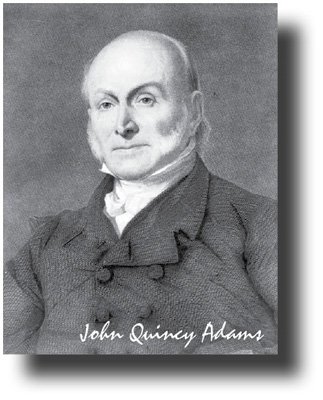 not only was his father a primary, quintessential Founder, but John Quincy was literally nurtured by his father in the vicissitudes and intricacies of the founding of the Republic. John Adams involved his son at an early age in his own activities and travels on behalf of the fledgling nation. John Quincy accompanied his father to France in 1778, became Secretary to the American Minister to Russia, was the Secretary to his father during peace negotiations that ended the American Revolution in 1783, served as U.S. foreign ambassador, both to the Netherlands and later to Portugal, under George Washington, to Prussia under his father’s presidency, and then to Russia and later to England under President James Madison. He served as a U.S. Senator, Secretary of State under President James Monroe, and then as the nation’s sixth President (1825-1829), and finally as a member of the U.S. House of Representatives, where he was a staunch and fervent opponent of slavery.
After his presidency, but before his election to Congress in 1830, John Quincy penned several essays dealing with one of the many Russo-Turkish Wars. In these essays, we see a cogent, informed portrait of the threat that Islam has posed throughout world history:
In the seventh century of the Christian era, a wandering Arab of the lineage of Hagar, the Egyptian, combining the powers of transcendent genius, with the preternatural energy of a fanatic, and the fraudulent spirit of an impostor, proclaimed himself as a messenger from Heaven, and spread desolation and delusion over an extensive portion of the earth. Adopting from the sublime conception of the Mosaic law, the doctrine of one omnipotent God; he connected indissolubly with it, the audacious falsehood, that he was himself his prophet and apostle. Adopting from the new Revelation of Jesus, the faith and hope of immortal life, and of future retribution, he humbled it to the dust, by adapting all the rewards and sanctions of his religion to the gratification of the sexual passion. He poisoned the sources of human felicity at the fountain, by degrading the condition of the female sex, and the allowance of polygamy; and he declared undistinguishing and exterminating war, as a part of his religion, against all the rest of mankind. THE ESSENCE OF HIS DOCTRINE WAS VIOLENCE AND LUST: TO EXALT THE BRUTAL OVER THE SPIRITUAL PART OF HUMAN NATURE.
Between these two religions, thus contrasted in their characters, a war of twelve hundred years has already raged. That war is yet flagrant; nor can it cease but by the extinction of that imposture, which has been permitted by Providence to prolong the degeneracy of man. While the merciless and dissolute dogmas of the false prophet shall furnish motives to human action, there can never be peace upon earth, and good will towards men. The hand of Ishmael will be against every man, and every man’s hand against him. It is, indeed, amongst the mysterious dealings of God, that this delusion should have been suffered for so many ages, and during so many generations of human kind, to prevail over the doctrines of the meek and peaceful and benevolent Jesus (Blunt, 1830, 29:269, capitals in orig.).
Observe that Adams not only documents the violent nature of Islam, in contrast with the peaceful and benevolent thrust of Christianity, he further exposes the mistreatment of women inherent in Islamic doctrine, including the degrading practice of polygamy.
A few pages later, Adams again spotlights the coercive, violent nature of Islam, as well as the Muslim’s right to lie and deceive to advance Islam:
The precept of the koran is, perpetual war against all who deny, that Mahomet is the prophet of God. The vanquished may purchase their lives, by the payment of tribute; the victorious may be appeased by a false and delusive promise of peace; and the faithful follower of the prophet, may submit to the imperious necessities of defeat: but the command to propagate the Moslem creed by the sword is always obligatory, when it can be made effective. The commands of the prophet may be performed alike, by fraud, or by force (Blunt, 29:274).
No Christian would deny that many Christians in history have violated the precepts of Christ by mistreating others and even committing atrocities in the name of Christ. However, Adams rightly observes that one must go against Christian doctrine to do so. Not so with Islam—since violence is sanctioned:
The fundamental doctrine of the Christian religion, is the extirpation of hatred from the human heart. It forbids the exercise of it, even towards enemies. There is no denomination of Christians, which denies or misunderstands this doctrine. All understand it alike—all acknowledge its obligations; and however imperfectly, in the purposes of Divine Providence, its efficacy has been shown in the practice of Christians, it has not been wholly inoperative upon them. Its effect has been upon the manners of nations. It has mitigated the horrors of war—it has softened the features of slavery—it has humanized the intercourse of social life. The unqualified acknowledgement of a duty does not, indeed, suffice to insure its performance. Hatred is yet a passion, but too powerful upon the hearts of Christians. Yet they cannot indulge it, except by the sacrifice of their principles, and the conscious violation of their duties. No state paper from a Christian hand, could, without trampling the precepts of its Lord and Master, have commenced by an open proclamation of hatred to any portion of the human race. The Ottoman lays it down as the foundation of his discourse (Blunt, 29:300, emp. added).
The Founders were forthright in their assessment of the nature and teachings of Islam and the Quran. Americans and their political leaders would do well to take a sober look at history. To fail to do so will be catastrophic.
REFERENCES
Blunt, Joseph (1830), The American Annual Register for the Years 1827-8-9 (New York: E. & G.W. Blunt), 29:267-402, [On-line], URL: http://www.archive.org/stream/p1americanannual29blunuoft.
The post John Quincy Adams on Islam appeared first on Apologetics Press.
]]>The post Sexual Depravity Continues to Expand appeared first on Apologetics Press.
]]>Indicators of this deepening plunge into the quagmire of moral degradation have been surfacing for several years. At the 1988 World Conference of Anglican/Episcopalian bishops in Lambeth, England, Resolution 26 pertaining to “Church and Polygamy” reads:
This Conference upholds monogamy as God’s plan, and as the ideal relationship of love between husband and wife; nevertheless recommends that a polygamist who responds to the Gospel and wishes to join the Anglican Church may be baptized and confirmed with his believing wives and children on the following conditions: (1) that the polygamist shall promise not to marry again as long as any of his wives at the time of his conversion are alive; (2) that the receiving of such a polygamist has the consent of the local Anglican community; (3) that such a polygamist shall not be compelled to put away any of his wives, on account of the social deprivation they would suffer…. (“Resolutions from…,” 1988, emp. added).
Ten years later at the same conference, African bishops succeeded in preventing a resolution against polygamy from appearing on the final agenda, since the practice of polygamy in Africa remains common (Miller, 1999).
The Netherlands essentially legalized polygamy by permitting the formation of a “civil union” (which differs from marriage only in name) of a man and two women (Belein, 2005a). Dutch government authorities have refused to annul the arrangement (Belein, 2005b). What’s more, Dutch registrars accept polygamous marriages contracted in countries where more than one wife is permitted (“Dutch Authorities…,” 2008). The accommodation is due to the large numbers of Muslim immigrants (“Netherlands Recognises…,” 2008). Few Americans are likely aware that the same thing is happening in the U.S. as more and more polygamous Muslims immigrate to America—with estimates ranging from 50,000 to 100,000 people (Hagerty, 2008). Since liberal American judges increasingly are looking to world courts to alter long-standing American jurisprudence, America is facing these same trends.
Ten years ago, Utah’s governor suggested that plural marriage may be protected under the First Amendment of the U.S. Constitution as an expression of religion (Fahys, 1998; Helprin, 1998). The Web site TruthBearer.org, devoted to “bringing Christian polygamy to the churches,” brazenly declares: “Until one grows toward loving wives as selflessly as Christ life-givingly loves the Churches, any personal thoughts about plural marriage should be foremost about growing to that level in Christ” (“Christian Polygamy…,” 2008, emp. added). [Never mind the fact that Christ has only one bride (Ephesians 5:22-33), and that He “loved the church and gave Himself for her” (vs. 25)—not “them.”] When the highest court in the land issued its historically and constitutionally unprecedented ruling against all state sodomy laws (Lawrence…, 2003), almost instantly, a convicted Utah polygamist commenced the appeals process to have his bigamy convictions overturned (“Convicted Utah…,” 2003). And more recently, as fully expected, Hollywood has been eager to take advantage of weakening standards and bolster sexual perversion. Tom Hanks produced a television series in 2006 for HBO, “Big Love,” that explores the lives of a husband, his three wives, and seven children (“Polygamy Comes…,” 2006; Peyser, 2006; Krauthammer, 2006).
When U.S. Supreme Court Justice Scalia penned the dissenting opinion for his fellow dissenters, Justices Rehnquist and Thomas, in Lawrence v. Texas, which made homosexuality a constitutional right, he correctly concluded that if homosexual marriages are to be legalized, no legal/rational basis exists upon which to forbid any other sexual relationship, regardless of the perversity involved:
State laws against bigamy, same-sex marriage, adult incest, prostitution…adultery, fornication, bestiality, and obscenity are likewise sustainable only in light of Bowers’ validation of laws based on moral choices. Every single one of these laws is called into question by today’s decision (Lawrence…, 2003, italics in orig., emp. added).
Scalia added: “This effectively decrees the end of all morals legislation…. [N]one of the above-mentioned laws can survive rational-basis review” (Lawrence…, emp. added; cf. Bonney, n.d.). The increasing encroachment of polygamy is a direct manifestation of Scalia’s prediction.
Is there no end to the incessant parade of depravity and moral degeneracy to which the American public must be subjected? “Were they ashamed when they had committed abomination? No! They were not at all ashamed, nor did they know how to blush” (Jeremiah 6:15; 8:12). The fact that polygamy was predictable and inevitable in no way reduces the shock and repugnance that must surely be felt by those Americans who still retain some semblance of moral sensibility and ethical decency.
AMERICA’S VANISHING VALUES
The Founders of American civilization and the vast majority of Americans since were unequivocal and adamant in their insistence on the reprehensible nature of polygamy—and the threat it poses to civilized society. In the late 1800s, Mormons fled to Utah seeking respite from the widespread opposition to their cultic practices. As America extended its “manifest destiny” westward and more U.S. territories sought statehood, the admission of Utah and Idaho into the union came to the forefront of national concern. After all, their predominantly Mormon populations were practicing polygamy. But the judicial authorities did not shrink from the appointed responsibility, as is evident from the following three United States Supreme Court cases that addressed the matter.
In the 1885 Utah Territory case of Murphy v. Ramsey, the Court declared:
For certainly no legislation can be supposed more wholesome and necessary in the founding of a free, self-governing commonwealth, fit to take rank as one of the coordinate States of the Union, than that which seeks to establish it on the basis of the idea of the family, as consisting in and springing from the union for life of one man and one woman in the holy estate of matrimony; the sure foundation of all that is stable and noble in our civilization; the best guaranty of that reverent morality which is the source of all beneficent progress in social and political improvement (1885, emp. added).
Did you catch that? The only “sure foundation” of civilization and the best security for morality (which, in turn, initiates social and political improvement) is the family defined as one man for one woman for life. But the foundation is crumbling and the guaranty is failing. Hence, as our morals continue to unravel, we ought fully to expect to see the erosion of all that is stable and noble in our civilization and the undermining of beneficent progress in social and political improvement.
In another U.S. Supreme Court case involving polygamy in the Territory of Utah, the defendant insisted that his bigamy was simply in keeping with his constitutional right to the free exercise of his religious beliefs as a member of the Church of Jesus Christ of Latter-Day Saints. He insisted that
the practice of polygamy was directly enjoined upon the male members thereof by the Almighty God, in a revelation to Joseph Smith, the founder and prophet of said church; that the failing or refusing to practice polygamy by such male members of said church, when circumstances would admit, would be punished, and that the penalty for such failure and refusal would be damnation in the life to come (Reynolds v. United States, 1879).
The high court vehemently disagreed and issued a sweeping repudiation of polygamy:
Polygamy has always been odious among the northern and western nations of Europe, and, until the establishment of the Mormon Church, was almost exclusively a feature of the life of Asiatic and of African people. At common law, the second marriage was always void (2 Kent, Com. 79), and from the earliest history of England polygamy has been treated as an offence against society…. From that day to this we think it may safely be said there never has been a time in any State of the Union when polygamy has not been an offence against society, cognizable by the civil courts and punishable with more or less severity. In the face of all this evidence, it is impossible to believe that the constitutional guaranty of religious freedom was intended to prohibit legislation in respect to this most important feature of social life. Marriage, while from its very nature a sacred obligation, is nevertheless, in most civilized nations, a civil contract, and usually regulated by law. Upon it society may be said to be built, and out of its fruits spring social relations and social obligations and duties, with which government is necessarily required to deal. In fact, according as monogamous or polygamous marriages are allowed, do we find the principles on which the government of the people, to a greater or less extent, rests (Reynolds…, emp. added).
Such legal declarations reflected the views of the vast majority of Americans for the first 180 years of our national existence. Indeed, for most of American history, courts have had no trouble recognizing and reaffirming the idea of the family and the historic definition of marriage: one man for one woman for life. After all, this foundational premise was drawn directly from the Bible (Genesis 2:24).
In still another case, several men who wished to register to vote in the Territory of Idaho took the preparatory oath that required them to swear that they neither practiced polygamy nor belonged to any organization that encouraged its practice. Yet, when the men were discovered to be members of the Mormon Church, they were brought to trial and found guilty of procuring voting rights unlawfully—though the defense attorney argued that the oath constituted a “law respecting an establishment of religion” in violation of the First Amendment to the Constitution. Neither the District Court nor the Supreme Court accepted such thinking. Instead, they reaffirmed the essentiality of the Christian moral framework as the basis of civil society:
Bigamy and polygamy are crimes by the laws of all civilized and Christian countries. They are crimes by the laws of the United States, and they are crimes by the laws of Idaho. They tend to destroy the purity of the marriage relation, to disturb the peace of families, to degrade woman and to debase man. Few crimes are more pernicious to the best interests of society and receive more general or more deserved punishment. To extend exemption from punishment for such crimes would be to shock the moral judgment of the community. To call their advocacy a tenet of religion is to offend the common sense of mankind (Davis v. Beason, 1890, emp. added).
For judicial and legal authorities today, and Americans at large, to permit the airing all across the land of a television program that dignifies the practice of polygamy, is to demonstrate not only the loss of common sense, it manifests the extent to which moral bankruptcy has become commonplace. The destruction of marriage and the family, the degrading of women, and the debasing of men, are the order of the day.
Polygamy is simply one more indication of our country’s half-century-long venture into decadence and paganism, moving us ever closer to a complete moral, spiritual, and religious breakdown—and the inevitable collapse of civilization. In still another court case, the State Supreme Court of Pennsylvania declared the attitude of the Founders and the nation as a whole in its utter rejection of pagan morality:
They never thought of tolerating paganism…on the ground of liberty of conscience. They could not admit this, as a civil justification of human sacrifices, or parricide, or infanticide, or thuggism, or of such modes of worship as the disgusting and corrupting rites of the Dionysia, and Aphrodisia, and Eleusinia, and other festivals of Greece and Rome. They did not mean that the pure, moral customs which Christianity has introduced, should be without legal protection, because some pagan, or other religionist, or anti-religionist, should advocate, as matter of conscience, concubinage, polygamy, incest, free love, and free divorce, or any of them.
They did not mean, that phallic processions and satyric dances, and obscene songs, and indecent statues, and paintings of ancient or of modern paganism, might be introduced, under the profession of religion, or pleasure, or conscience, to seduce the young and the ignorant into a Corinthian degradation; to offend the moral sentiment of a refined Christian people; and to compel Christian modesty to associate with the nudity and impurity of Polynesian, or of Spartan women. No Christian people could possibly allow such things…. Every Christian man is sure, that it is his religion that has suppressed the pagan customs just alluded to, and that to it is due the large advance in justice, benevolence, truth, and purity that belongs to modern civilization; that it has purified and elevated the family relations; that it has so elevated the moral standards of society, that the indecencies, and cruelties, and cheats, of paganism are now condemned by custom and by law, as crimes (Commonwealth v. Nesbit, 1859, emp. added).
Little could a mid-nineteenth-century Supreme Court have realized that their vivid description of paganism would one day serve as an accurate depiction of the present moral condition of America!
Unless Americans rise up in significant numbers and put an end to the downward slide into moral and sexual insanity, the nation must inevitably face destruction. “Righteousness exalts a nation, but sin is a reproach to any people” (Proverbs 14:34).
REFERENCES
Belein, Paul (2005a), “First Trio ‘Married’ in the Netherlands,” The Brussels Journal, September 27, [On-line], URL: http://www.brusselsjournal.com/node/301.
Belein, Paul (2005b), “Dutch Minister Not to Prevent Polygamy,” The Brussels Journal, November 1, [On-line], URL: http://www.brusselsjournal.com/node/421.
Bonney, Kim (no date), “Polygamy: The Next ‘Right’ to be Legalized?” CBN News, [On-line], URL: http://www.cbn.com/cbnnews/news/050721a.aspx.
“Christian Polygamy” (2008), TruthBearer.org, [On-line], URL: http://www.truthbearer.org/polygamy/.
Commonwealth v. Nesbit (1859), Pa. 398; 1859 Pa. LEXIS 240.
“Convicted Utah Polygamist’s Appeal Invokes Gay Sex Ruling” (2003), Associated Press, December 12, [On-line], URL: http://www.religionnewsblog.com/html/5253-.html.
Davis v. Beason (1889), 133 U.S. 333; 10 S. Ct. 299; 33 L. Ed. 637; 1890 U.S. LEXIS 1915.
“Dutch Authorities Now Recognizing Polygamous Marriages Contracted Abroad” (2008), CNA, August 15, [On-line], URL: http://www.catholicnewsagency.com/new.php?n=13538.
Fahys, Judy (1998), “Leavitt Says Polygamy Might Be Constitutional,” The Salt Lake Tribune, July 24, [On-line], URL: http://www.polygamy.com/Legal/Leavitt-Says-Polygamy-Might-Be-Constitutional.htm.
Hagerty, Barbara (2008), “Some Muslims in U.S. Quietly Engage in Polygamy,” NPR, May 28, [On-line], URL: http://www.npr.org/templates/story/story.php?storyId=90857818.
Helprin, John (1998), “Polygamy Issue Has Politicians in Verbal Tangles,” Salt Lake Tribune, August 29, [On-line], URL: http://www.polygamyinfo.com/media%20plyg%2050%20trib.htm.
Krauthammer, Charles (2006), “Should We Alter the State of Our Unions?,” New York Daily News, March 17, [On-line], URL: http://www.nydailynews.com/03-17-2006/news/col/story/400236p-339074c.html.
Lawrence v. Texas (2003), (02-102) 539 U.S. 558 (2003), [On-line], URL: http://www.law.cornell.edu/supct/html/02-102.ZD.html.
Miller, Stephen (1999), “Homosexuality, No; Polygamy, Yes?,” Independent Gay Forum, [On-line], URL: http://www.indegayforum.org/news/show/26792.html.
Murphy v. Ramsey (1885), 114 U.S. 15; 5 S. Ct. 747; 29 L. Ed. 47; 1885 U.S. LEXIS 1732.
“Netherlands Recognises Polygamous Marriages of Muslims” (2008), NIS News Bulletin, August 12, [On-line], URL: http://www.nisnews.nl/public/120808_1.htm.
Peyser, Mark (2006), “Television: The Spouses of ‘Big Love,’” Newsweek, [On-line], URL: http://www.msnbc.msn.com/id/10511139/site/newsweek/.
“Polygamy Comes to TV” (2006), ET Online, March 6, [On-line], URL: http://et.tv.yahoo.com/tv/14071/.
“Resolutions from 1988” (2008), The Lambeth Conference Official Website, [On-line], URL: http://www.lambethconference.org/resolutions/1988/1988-26.cfm.
Reynolds v. United States (1879), 98 U.S. 145; 25 L. Ed. 244; 1878 U.S. LEXIS 1374; 8 Otto 145.
The post Sexual Depravity Continues to Expand appeared first on Apologetics Press.
]]>The post Hindu Prayer in Congress appeared first on Apologetics Press.
]]>
 |
|
Varanasi, the City of Shiva, one of the holiest cities in India, where Hindu pilgrims come for prayer and worship on the Ganges River
|
May we meditate on the transcendental glory of the Deity Supreme, who is inside the heart of the Earth, inside the life of the sky and inside the soul of the heaven. May He stimulate and illuminate our minds. Lead us from the unreal to real, from darkness to light, and from death to immortality. May we be protected together. May we be nourished together. May we work together with great vigor. May our study be enlightening. May no obstacle arise between us. May the Senators strive constantly to serve the welfare of the world, performing their duties with the welfare of others always in mind, because by devotion to selfless work one attains the supreme goal of life. May they work carefully and wisely, guided by compassion, and without thought for themselves. United your resolve, united your hearts, may your spirits be at one, that you may long dwell in unity and concord. Peace, peace, peace be unto all (see Brown, 2007).
The architects of American civilization would be aghast. To give credence or credibility to pantheistic religion (“God” inside the Earth, sky, etc.), that advocates belief in thousands of “gods” while rejecting the one true God of the Bible, would be unthinkable in America in 1776. It was equally unthinkable for most Americans until the last 40-50 years. The politically correct climate now enshrouding America literally is suffocating the moral and religious sensibilities of society. The nod to Hinduism follows closely on the heels of the election of a Muslim to the U.S. House of Representatives as well as the first atheist in Congress (see Miller, 2006; Miller, 2007).
It was on June 28, 1787, in the Constitutional Convention in Philadelphia, that one of the least religious of the Founders, Benjamin Franklin, then in his 80s, rose to his feet and made the proposal that Congress open their sessions with prayer. Yet, on that occasion, the God, the religion, and the sacred Scriptures that Franklin had in mind were certainly not the gods, religion, and scripture of Hinduism. Here was his proposal in his own words [NOTE: Lest the reader miss the fact that Franklin’s speech is thoroughly saturated with allusions to the one true God and the Bible, such references are noted in bold and direct biblical citations are bracketed]:
In this situation of this Assembly, groping as it were in the dark to find political truth, and scarce able to distinguish it when presented to us, how has it happened, Sir, that we have not hitherto once thought of humbly applying to the Father of lights [James 1:17], to illuminate our understanding? In the beginning of the contest with Britain, when we were sensible of danger, we had daily prayer in this room for divine protection. Our prayers, Sir, were heard and they were graciously answered. And have we now forgotten that powerful friend? Or, do we imagine we no longer need his assistance? I have lived, Sir, a long time, and the longer I live, the more convincing proofs [Acts 1:3] I see of this truth—that God governs in the affairs of men [Daniel 4:17]. And if a sparrow cannot fall to the ground without his notice [Matthew 10:29], is it probable that an empire can rise without his aid? We have been assured, Sir, in the Sacred Writings, that “except the Lord build the House, they labor in vain that build it” [Psalm 127:1]. I firmly believe this; and I also believe that without his concurring aid we shall succeed in this political building no better than the Builders of Babel [Genesis 11]: We shall be divided by our partial local interests; our projects will be confounded, and we ourselves shall become a reproach and bye word down to future ages [Psalm 44:13-14; Jeremiah 24:9]. I therefore beg leave to move—that henceforth prayers imploring the assistance of Heaven, and its blessing on our deliberations, be held in this Assembly every morning before we proceed to business, and that one or more of the clergy of this city be requested to officiate in that service (1787, emp. and bracketed material added).

 Founders like Franklin would not have dignified pagan religion that constitutes a blatant insult to the God of the Universe—the One Whom they ardently implored to guide and protect them. Neither would they have accepted the idea that “sacred writings” include the Hindu Vedas.
For sure, the Founders of America desired religious freedom. Technically, by “religious freedom” they meant that all Protestant denominations should have the right to pursue their own interpretation of the Bible and to worship the God and Christ of the Bible according to their own consciences without governmental interference. As one of the Fathers of American Jurisprudence, Joseph Story, explained:
The real object of the [first] amendment was, not to countenance, much less to advance Mahometanism, or Judaism, or infidelity, by prostrating Christianity; but to exclude all rivalry among Christian sects, and to prevent any national ecclesiastical establishment, which should give to an hierarchy the exclusive patronage of the national government (1833, Vol. 3, Bk. 3, Ch. 44, Sec. 1871, emp. added). [NOTE: See the wording proposed by the “Father of the Bill of Rights,” George Mason, in Rowland, 1964, pp. 13-15.]
Nevertheless, the Founders were perfectly willing to extend the right of religious freedom to those who did not share the Protestant brand of the Christian religion. They opposed all religious persecution for the simple reason that Christian people love their fellowman and do not mistreat others (Matthew 7:12).
 |
|
The four-headed Brahma, Hindu god of Creation
|
But make no mistake: the Founders believed in the God of the Bible, and the vast majority of them believed in the validity of the Christian religion to the exclusion of all other gods and religions (see Miller, 2007). They would not have countenanced giving non-Christian religions any sort of public endorsement or favorable encouragement. This fact is demonstrated easily by their innumerable forthright declarations regarding the essentiality of Christianity as the foundation on which the Republic was founded (see Miller, 2005a; Miller, 2005b). It also is seen in the occasional explicit repudiation of such non-Christian religions as Islam, Buddhism, and Hinduism. Hindus typically were styled “hindoos,” “pagans,” “heathens,” and “idolaters.”
 |
|
Worshipers praying to Krishna in the Palace of Gold
|
For example, consider the remarks of John Jay, a brilliant Founder with a long and distinguished career in the formation and shaping of American civilization from the beginning. He not only was a member of the Continental Congress from 1774-1776, serving as its President from 1778-1779, but he also helped to frame the New York State Constitution and then served as the Chief Justice of the New York Supreme Court. He co-authored the Federalist Papers, was appointed as the first Chief Justice of the U.S. Supreme Court by George Washington (1789-1795), served as Governor of New York (1795-1801), and was the vice-president (1816-1821) and then second president (1821-1827) of the American Bible Society. At the annual meeting of the American Bible Society on May 9, 1822, Jay commented on the almost universal view of Americans at the time relative to non-Christian religions:
Although an immense heathen population in India was under the dominion, control, and influence of a Christian nation, yet it was deemed better policy to leave them in blindness than to risk incurring the inconveniences which might result from authorizing or encouraging attempts to relieve them from it. This policy has at length met with the neglect it deserved. The Gospel has been introduced into India, under the auspices of the British government; and various means are co-operating to advance its progress, and hasten the time when the King of saints will emancipate that people from the domination of the prince of darkness (1890, 4:484, emp. added).
Jay obviously viewed the non-Christian religions of India as “heathen” and the work of Satan (“the prince of darkness” being an allusion to the Devil [cf. Luke 22:53; Acts 26:18; 2 Corinthians 11:14; Ephesians 2:2]).
Where did the Founders get their ideas regarding polytheism, paganism, and idolatry? Their assessment of Hinduism was in complete harmony with the Bible’s own declarations:
Those who make an image, all of them are useless, and their precious things shall not profit; they are their own witnesses; they neither see nor know, that they may be ashamed. Who would form a god or mold an image that profits him nothing? Surely all his companions would be ashamed; and the workmen, they are mere men. Let them all be gathered together, let them stand up; yet they shall fear, they shall be ashamed together. The blacksmith with the tongs works one in the coals, fashions it with hammers, and works it with the strength of his arms. Even so, he is hungry, and his strength fails; he drinks no water and is faint. The craftsman stretches out his rule, he marks one out with chalk; he fashions it with a plane, he marks it out with the compass, and makes it like the figure of a man, according to the beauty of a man, that it may remain in the house. He cuts down cedars for himself, and takes the cypress and the oak; he secures it for himself among the trees of the forest. He plants a pine, and the rain nourishes it. Then it shall be for a man to burn, for he will take some of it and warm himself; yes, he kindles it and bakes bread; indeed, he makes a god and worships it; he makes it a carved image, and falls down to it. He burns half of it in the fire; with this half he eats meat; he roasts a roast, and is satisfied. He even warms himself and says, “Ah! I am warm, I have seen the fire.” And the rest of it he makes into a god, his carved image. He falls down before it and worships it, prays to it and says, “Deliver me, for you are my god!” They do not know nor understand…. A deceived heart has turned him aside (Isaiah 44:9-20, emp. added).

What profit is the image, that its maker should carve it, the molded image, a teacher of lies that the maker of its mold should trust in it, to make mute idols? Woe to him who says to wood, “Awake!” To silent stone, “Arise! It shall teach!” Behold, it is overlaid with gold and silver, yet in it there is no breath at all. But the Lord is in His holy temple. Let all the earth keep silence before Him (Habakkuk 2:18-20, emp. added).
Their idols are silver and gold, the work of men’s hands. They have mouths, but they do not speak; eyes they have, but they do not see; they have ears, but they do not hear; noses they have, but they do not smell; they have hands, but they do not handle; feet they have, but they do not walk; nor do they mutter through their throat. Those who make them are like them; so is everyone who trusts in them (Psalm 115:4-8, emp. added).

Every metal smith is put to shame by the carved image; for his molded image is falsehood, and there is no breath in them. They are futile, a work of errors; in the time of their punishment they shall perish (Jeremiah 51:17-18).
The attitude of the Founders toward Hindus may be seen in their attitude toward the Native American tribal groups that populated the North American continent at the time. Like Hindus, the Indians believed in many deities. In a letter dated May 2, 1788, addressed to a Moravian preacher named John Ettwein, George Washington applauded the efforts of a Christian organization whose stated mission efforts were for the purpose of “propagating the Gospel among the heathen”:
So far as I am capable of judging, the principles upon which the society is founded and the rules laid down for its government, appear to be well calculated to promote so laudable and arduous an undertaking, and you will permit me to add that if an event so long and so earnestly desired as that of converting the Indians to Christianity and consequently to civilization, can be effected, the Society of Bethlehem bids fair to bear a very considerable part in it (emp. added).
 |
|
Sri Venkateswara Swami Hindu Temple of Greater Chicago (Aurora, Illinois)
|
The exclusivity of Christianity also was made clear by General Washington during the Revolutionary War when he delivered a speech to the Delaware Indian Chiefs on May 12, 1779:
You do well to wish to learn our arts and ways of life, and above all, the religion of Jesus Christ. These will make you a greater and happier people than you are. Congress will do every thing they can to assist you in this wise intention; and to tie the knot of friendship and union so fast, that nothing shall ever be able to loose it (15:55, emp. added).
Another example of the Founders’ view of non-Christian religion is the discussion that took place on the floor of the North Carolina State Convention that met to debate ratification of the federal Constitution. On Wednesday, July 30, 1788, Henry Abbot (a minister) articulated serious concerns entertained by some of the delegates. They were unconvinced that the Constitution provided the same guarantees as the state constitution for citizens to practice Christianity according to their own interpretation of the Bible without interference from the federal government. They also were concerned that the absence of fixed religious test oaths might eventually be misconstrued to allow people who embraced false religions or even atheism to make encroachments:
Some are afraid, Mr. Chairman, that, should the Constitution be received, they would be deprived of the privilege of worshipping God according to their consciences, which would be taking from them a benefit they enjoy under the present constitution. They wish to know if their religious and civil liberties be secured under this system, or whether the general government may not make laws infringing their religious liberties…. The exclusion of religious tests is by many thought dangerous and impolitic. They suppose that if there be no religious test required, pagans, deists, and Mahometans might obtain offices among us, and that the senators and representatives might all be pagans…. I would be glad [if] some gentleman would endeavor to obviate these objections, in order to satisfy the religious part of the society (Elliot, 1836, 4:191-192, emp. added).
To their thinking, Hindus were included under the label “pagans.”
A response to Abbot was offered by James Iredell, who, since the Revolution, had served the state of North Carolina both as a judge on the state Superior Court as well as state attorney general, and was soon to be appointed to the U.S. Supreme Court by George Washington: “Mr. Chairman, nothing is more desirable than to remove the scruples of any gentleman on this interesting subject. Those concerning religion are entitled to particular respect” (Elliot, 4:192). He proceeded to explain at length that the establishment of one Christian sect above another always has led to persecution and war—as evidenced in Catholic countries as well as by the Church of England, from which they only recently had extricated themselves. Consequently, the restriction placed on Congress in the federal Constitution would prevent the government from interfering with the free practice of the Christian religion. He then remarked:
But it is objected that the people of America may, perhaps, choose representatives who have no religion at all, and that pagans and Mahometans may be admitted into offices. But how is it possible to exclude any set of men, without taking away that principle of religious freedom which we ourselves so warmly contend for? This is the foundation on which persecution has been raised in every part of the world. The people in power were always right, and every body else wrong. If you admit the least difference, the door to persecution is opened. Nor would it answer the purpose, for the worst part of the excluded sects would comply with the test, and the best men only be kept out of our counsels (Elliot, 4:494, emp. added).

Observe that Iredell conceded that in order for the Constitution to guarantee Christians the right to worship God according to their own conscience, non-Christians inevitably would be permitted the same constitutional protection. Indeed, as previously noted, the Founders never would have countenanced the persecution of atheists or those who espoused non-Christian religion. Are we to assume from this observation, however, that the Founders held non-Christian religions, like Hinduism, in high regard, or that they encouraged non-Christian religions in the public sector, or that they sanctioned all religions as equally authentic and credible? Absolutely not! As Iredell further explained:
But it is never to be supposed that the people of America will trust their dearest rights to persons who have no religion at all, or a religion materially different from their own. It would be happy for mankind if religion was permitted to take its own course, and maintain itself by the excellence of its own doctrines. The divine Author of our religion never wished for its support by worldly authority. Has he not said that the gates of hell shall not prevail against it? It made much greater progress for itself, than when supported by the greatest authority upon earth (Elliot, 4:194, emp. added).
 |
|
12th-century Hindu temples in the temple town of Kumbakonam in the Indian state of Tamil Nadu
|
Iredell reasoned that leaving the Constitution non-specific with regard to religion would prevent religious persecution. Further, tolerating non-Christian religions would not endanger the Founders’ assumption that Christianity would remain the worldview and moral framework that undergirds the nation. Why? Because he felt confident that Americans never would endanger their dearest rights by voting non-Christians (whether atheists, Muslims, or Hindus) into government. Inviting a Hindu to offer prayer in Congress is a step in that very direction. And did you notice Iredell’s allusion to “the divine Author of our religion”? What Author and what religion do you suppose he intended? He quoted that Author in his very next sentence: “Has he not said that the gates of hell shall not prevail against it?” Those words are the words of Jesus Christ as recorded in Matthew 16:18. The Author to Whom he referred was Christ, and Christ is the author of only one religion: Christianity—not Hinduism.
Iredell next discoursed on the essentiality of an oath to be taken by those who wish to serve in the government. He insisted that this oath should contain two critical components: belief in a Supreme Being and belief in a future state of rewards and punishments. He even cited a legal case in England that occurred some 40 years earlier, pertaining to:
a person who was admitted to take an oath according to the rites of his own country, though he was a heathen. He was an East Indian, who had a great suit in chancery, and his answer upon oath to a bill filed against him was absolutely necessary. Not believing either in the Old or New Testament, he could not be sworn in the accustomed manner, but was sworn according to the form of the Gentoo religion, which he professed, by touching the foot of a priest. It appeared that, according to the tenets of this religion, its members believed in a Supreme Being, and in a future state of rewards and punishments. It was accordingly held by the judges, upon great consideration, that the oath ought to be received; they considering that it was probable those of that religion were equally bound in conscience by an oath according to their form of swearing, as they themselves were by one of theirs; and that it would be a reproach to the justice of the country, if a man, merely because he was of a different religion from their own, should be denied redress of an injury he had sustained. Ever since this great case, it has been universally considered that, in administering an oath, it is only necessary to inquire if the person who is to take it, believes in a Supreme Being, and in a future state of rewards and punishments. If he does, the oath is to be administered according to that form which it is supposed will bind his conscience most. It is, however, necessary that such a belief should be entertained, because otherwise there would be nothing to bind his conscience that could be relied on; since there are many cases where the terror of punishment in this world for perjury could not be dreaded (Elliot, 4:197-198, emp. added).
 |
|
Lord Ganesha, the elephant-headed Hindu god of wisdom, in a temple in the Indian state of Karnataka
|
“Gentoo,” a corruption of the Portuguese term gentio meaning “heathen” or “gentile,” was coined by Europeans to refer to the idol-worshipping peoples of India, and to distinguish Hindus from Muslims (see Mish, 1986, p. 512; John, n.d.). Observe that Iredell was not advocating the equal acceptance of Hinduism. He simply offered the only means by which an essential, though non-Christian, witness can serve in a court case. Yet even those remarks are couched in the context of the difficulties posed by those who come to America but refuse to embrace the Christian worldview—since our entire justice system depends on a belief in the God of the Bible as well as heaven and hell. [Observe that neither of these two prerequisites to speaking in court was deemed a violation of the freedom of religion clause of the Constitution.]
The next to speak was the Governor of North Carolina—Samuel Johnston. Eight years earlier he had served as a member of the Continental Congress. He, too, was astonished that some were concerned that the Constitution provided insufficient guarantee of the priority and free exercise of Protestant religion to the exclusion of competing religions:
I read the Constitution over and over, but could not see one cause of apprehension or jealousy on this subject. When I heard there were apprehensions that the pope of Rome could be the President of the United States, I was greatly astonished. It might as well be said that the king of England or France, or the Grand Turk [a Muslim—DM], could be chosen to that office. It would have been as good an argument. It appears to me that it would have been dangerous, if Congress could intermeddle with the subject of religion. True religion is derived from a much higher source than human laws. When any attempt is made, by any government, to restrain men’s consciences, no good consequence can possibly follow (Elliot, 4:198, emp. added).
 |
|
Shiva, Hindu god of destruction, on Mauritius Island in the Indian Ocean
|
Observe that the governor argued that the odds of a non-Protestant getting into office were so infinitesimal as to merit little concern. Also, being the one true religion and having the backing of God Himself, Christianity can fend for itself without the “restraint” of human government. But then the governor offered a rather chilling prediction:
It is apprehended that Jews, Mahometans, pagans, &c., may be elected to high offices under the government of the United States. Those who are Mahometans, or any others who are not professors of the Christian religion, can never be elected to the office of President, or other high office, but in one of two cases. First, if the people of America lay aside the Christian religion altogether, it may happen. Should this unfortunately take place, the people will choose such men as think as they do themselves. Another case is, if any persons of such descriptions should, notwithstanding their religion, acquire the confidence and esteem of the people of America by their good conduct and practice of virtue, they may be chosen. I leave it to gentlemen’s candor to judge what probability there is of the people’s choosing men of different sentiments from themselves (Elliot, 4:198-199, emp. added).
Does the Constitution allow Americans to elect to political office, or invite to conduct prayer in Congress, people who do not profess the Christian religion? Yes, it does. Would Americans ever actually do that? The Founders’ prediction: very unlikely and highly improbable. But if it ever were to happen—it would be most unfortunate! Indeed, inviting a Hindu to lead Congress in prayer is equally unfortunate.
 |
|
Hindu deities on the Sri Mariamman Temple in Chinatown, Singapore. The blue-skinned, four-armed Vishnu (center right) has a thousand names that worshippers repeat as acts of devotion.
|
Governor Johnston then explained that, though each of the 13 states was populated heavily by professors of one or more of the various Protestant denominations, “there is no cause of fear that any one religion shall be exclusively established” (Elliot, 4:199)—further testimony to the fact that the single religion of the United States was almost entirely Christian (in the form of Protestant sects) to the exclusion of atheism and world religions such as Hinduism. But David Caldwell (also a minister) rose and reiterated the lingering concern that danger might arise:
In the first place, he said, there was an invitation for Jews and pagans of every kind to come among us. At some future period, said he, this might endanger the character of the United States. Moreover, even those who do not regard religion, acknowledge that the Christian religion is best calculated, of all religions, to make good members of society, on account of its morality. I think, then, added he, that, in a political view, those gentlemen who formed this Constitution should not have given this invitation to Jews and heathens. All those who have any religion are against the emigration of those people from the eastern hemisphere (Elliot, 4:199, emp. added).
In other words, Jews, pagans, and people from the eastern hemisphere (which certainly includes Hindus) would constitute a threat to the religious and moral foundation on which America was founded. They were right. After all, Hinduism is thoroughgoing pantheism. Orthodox Hindus are adamant that the nurture of cows lies at the core of Hindu dharma (a Sanskrit term that refers to the “right way of living” or the “correct understanding of nature”). The cow is aghanya—that which may not be slaughtered. While not necessarily worshipped as a god, Hindu scriptures, nevertheless, extol the cow as sacred (e.g., Rig veda viii, 102,15-16; vi, 28,1-8). World renowned Hindu Mahatma Gandhi insisted:
Cow protection is the gift of Hinduism to the world…. I would not kill a human being to protect a cow, as I will not kill a cow to save a human life, be it ever so precious. My religion teaches me that I should by personal conduct instill into the minds of those who might hold different views the conviction that cow-killing is a sin and that, therefore, it ought to be abandoned (as quoted in “Sacred Cow…,” 2004, emp. added).

The Founders did not share such outlandish notions. They believed the evidence for the existence of the one true God of the Bible and the truthfulness of the Christian religion was decisive.
Mr. Spencer rose to reaffirm the same two reassurances asserted by Governor Johnston:
It is feared…that persons of bad principles, deists, atheists, &c., may come into this country; and there is nothing to restrain them from being eligible to offices. He asked if it was reasonable to suppose that the people would choose men without regarding their characters…. But in this case, as there is not a religious test required, it leaves religion on the solid foundation of its own inherent validity, without any connection with temporal authority (Elliot, 4:200, emp. added).
Again, the delegates were concerned about the nation remaining firmly Christian in its overall thrust, but they realized they could not force everyone to take a religious oath without creating conflict. Therefore, (1) they relied on the good sense of the American people to refrain from appointing to political office any who do not possess Christian character, and (2) they assumed Christianity could demonstrate its own credibility and superiority without any help from human government.
Governor Johnston brought the discussion to a close with an amicable summary of the mutual sentiments of the delegates, as reported in the following words:
He admitted a possibility of Jews, pagans, &c., emigrating to the United States; yet, he said, they could not be in proportion to the emigration of Christians who should come from other countries; that, in all probability, the children even of such people would be Christians; and that this, with the rapid population of the United States, their zeal for religion, and love of liberty, would, he trusted, add to the progress of the Christian religion among us (Elliot, 4:200, emp. added).

The Founders were walking a tightrope. On one hand, they did not want to be coercive in the matter of religion. They did not want to cram Christianity down anyone’s throat. They wanted America free of religious persecution. On the other hand, they understood that the truthfulness and superiority of the Christian religion was the essential platform on which America’s political institutions were poised. So they assuaged their fears by consoling themselves with the thought that the American people would forever have the good sense to retain Christianity as the central religion of the nation, and that they would refrain from inviting into their national councils and halls of government anyone who did not share those religious and moral convictions. These early Americans surely would be incredulous, bewildered, and disgusted if they were here to witness a Hindu on the floor of the U.S. Senate chanting a Hindu prayer to gods “which by nature are no gods,” “the work of men’s hands—wood and stone” (Galatians 4:8; 2 Kings 19:18). “Let all be put to shame who serve carved images, who boast of idols” (Psalm 97:7).
REFERENCES
Brown, Jim (2007), “Hindu Shouted Down While Offering Opening Prayer for Senate Session,” One News Now, July 12, [On-line], URL: http://www.onenewsnow.com/2007/07/hindu_shouted_down_while_offer.php.
Burchfiel, Nathan (2007), “Hindu Prayer Will Open Senate Session in July,” CNS News, June 26, [On-line], URL: http://www.cnsnews.com/ViewCulture.asp?Page=/Culture/archive/200706/ CUL20070626a.html.
Elliot, Jonathan, ed. (1836), Debates in the Convention of the State of North Carolina, On the Adoption of the Federal Constitution (Washington, D.C.: Taylor & Maury), second edition, [On-line], URL: http://memory.loc.gov/ammem/amlaw/lwed.html.
Franklin, Benjamin (1787), “Constitutional Convention Address on Prayer,” [On-line], URL: http://www.americanrhetoric.com/speeches/benfranklin.htm.
Haniffa, Aziz (2007), “U.S. Senate Opens with Hindu Prayer,” Rediff India Abroad, July 12, [On-line], URL: http://www.rediff.com/news/2007/jul/12zed.htm.
Jay, John (1890), The Correspondence and Public Papers of John Jay 1763-1781, ed. Henry Johnston (New York: Burt Franklin).
John, Arul (no date), “Facts about India,” [On-line], URL: http://aruljohn.com/india/.
Miller, Dave (2005a), “The Christianity that Made America Great,” [On-line], URL: http://www.apologeticspress.org/articles/2729.
Miller, Dave (2005b), “Deism, Atheism, and the Founders,” [On-line], URL: http://www.apologeticspress.org/articles/650.
Miller, Dave (2006), “A Muslim Now in Congress?” [On-line], URL: http://www.apologeticspress.org/articles/3141.
Miller, Dave (2007), “First Atheist in Congress,” Reason & Revelation, 6[5]:17,20-R, May, [On-line], URL: http://www.apologeticspress.org/articles/3329.
Mish, Frederick, ed. (1986), Webster’s Ninth New Collegiate Dictionary (Springfield, MA: Merriam-Webster).
Rowland, Kate Mason (1964), The Life of George Mason 1725-1792 (New York: Russell & Russell).
“Sacred Cow, Divine Mother” (2004), Hinduism Today, April-June, [On-line], URL: http://www.hinduismtoday.com/archives/2004/4-6/16-17_vedas.shtml.
Story, Joseph (1833), Commentaries on the Constitution of the United States (Boston, MA: Hilliard, Gray & Co.), [On-line], URL: http://www.constitution.org/js/js_000.htm.
Washington, George (1788), “Letter to John Ettwein, May 2,” The Writings of George Washington from the Original Manuscript Sources, 1745-1799, ed. John C. Fitzpatrick, George Washington Papers at the Library of Congress, 1741-1799: Series 2, [On-line], URL: http://memory.loc.gov/cgi-bin/query/r?ammem/mgw:@field(DOCID+@lit( gw290383)).
Washington, George (1779), “Speech to the Delaware Chiefs,” in The Writings of George Washington from the Original Manuscript Sources 1745-1799, ed. John C. Fitzpatrick, [On-line], URL: http://etext.virginia.edu/etcbin/toccer-new2?id=WasFi15.xml&images =images/odeng&data=/texts/english/modeng/parsed&tag=public& part=40&division=div1.
The post Hindu Prayer in Congress appeared first on Apologetics Press.
]]>The post Destruction of Marriage Equals Destruction of America appeared first on Apologetics Press.
]]>Instances of the insane and suicidal determination to destroy society’s moral underpinnings are occurring with increasing frequency. One recent example involves a lesbian couple from Rhode Island. Though the Supreme Judicial Court of Massachusetts legalized same-sex marriage in 2004, a law remains on the books there that prevents issuance of a license to out-of-state couples if their home state would refuse to recognize their marriage. The Rhode Island couple filed suit in Massachusetts in an effort to gain recognition of their “marriage” in Massachusetts which, in turn, they hope will enable them to gain recognition in their home state. The superior court has now ruled in favor of the couple (Cote-Whitacre v…, 2006).
Similar pressure to conform to the politically correct agenda is seen in the widespread capitulation of America’s corporate community to threats, coercion, and intimidation by gay, lesbian, bisexual, and transgender activists. Though corporations have been targeted for many years, homosexual forces are stepping up their efforts to force corporations to include “sexual orientation” in their non-discrimination policies. To be “gay friendly” is defined as supporting transgender workers, offering “inclusive” health insurance and other benefits, requiring diversity training for employees, and spending advertising money with GLBT organizations (Unruh, 2006). In other words, force everyone to endorse (not merely tolerate) the homosexual lifestyle. Bully employees into silence by stifling all free speech that questions the morality of homosexuality.
The success of the gay rights community along this line is alarming and heart-breaking. The Human Rights Campaign (HRC), the largest national homosexual political organization, reports an unprecedented 138 major U.S. corporations as having earned a top rating of 100% in their accommodation of alternative sexual lifestyles (“America’s Pro-Homosexual Giants…,” 2006). Some corporations quietly acquiesce. Others seem to jump on board the homosexual bandwagon with vigorous militancy. For example, Wal-Mart, the largest retailer in the world, has asserted its enthusiastic support of the gay, lesbian, bisexual, transgender movement by initiating permission to join the National Gay and Lesbian Chamber of Commerce, as well as sponsoring the LGBT Diversity Week at a state university (“Wal-Mart Asks for…,” 2006; “Boise State…,” 2006). Likewise, Ford Motor Company is pursuing the same flagrant conduct (“Boycott…,” 2006). So are Walgreens (Sharp, 2005), Starbucks (Kleppinger, 2005), and many others. With the intense pressure to submit to political correctness, it is surprising that some major corporations are thus far resisting the intimidation by remaining unwilling to sign onto the homosexual agenda, including Reebok, Northwest Airlines, The Men’s Wearhouse, J.C. Penney, Nissan, Gallup, Kroger, Cooper Tire, Circuit City, Radio Shack, and Toys “R” Us (Unruh, 2006).
What is the ultimate outcome of this surrealistic inundation of America by outright paganism and moral depravity? What inevitably must happen to any country or society that enshrines morally deviant behavior by undermining the biblical definition of marriage? The social stability of that nation is placed in dire jeopardy. Its demise is inevitable (see Miller, 2005). Indeed, in 1848, the Supreme Court of South Carolina articulated the sentiment of the Founders and early Americans regarding what would happen to America if a sizeable portion of its citizenry ever abandoned Christian morality:
What constitutes the standard of good morals? Is it not Christianity? There certainly is none other. Say that cannot be appealed to and…what would be good morals? The day of moral virtue in which we live would, in an instant, if that standard were abolished, lapse into the dark and murky night of pagan immorality (City Council of Charleston…, emp. added).
The nation is headed swiftly in that direction. The destruction of marriage will inevitably result in the destruction of the nation.
REFERENCES
“America’s Pro-Homosexual Giants: 2006” (2006), WorldNetDaily, September 20, [On-line], URL: http://www.wnd.com/news/article.asp?ARTICLE_ID=52052.
“Boise State University Recognizes LGBT Diversity Week with Series of Events” (2006), Boise State Office of Communications and Marketing News Release, September 25, [On-line], URL: http://news.boisestate.edu/newsrelease/092006/0925gaydiversity.shtml.
“BoycottFord.com” (2006), American Family Association, [On-line], URL: http://www.boycottford.com/.
City Council of Charleston v. Benjamin (1848), 2 Strob. L. 508 (S. C. 1848).
Cote-Whitacre v. Department of Public Health (2006), Commonwealth of Massachusetts Superior Court, 446 Mass. 350,352, No. 04-2656, [On-line], URL: http://www.glad.org/marriage/Cote-Whitacre/9_29_06.pdf.
Flew, Antony G.N. and Thomas B. Warren (1977), Warren-Flew Debate (Jonesboro, AR: National Christian Press).
Kleppinger, Meghan (2005), Starbucks: A Habit Easily Broken,” WorldNetDaily, August 25, [On-line], URL: http://states.cwfa.org/articledisplay.asp?id=8788&department=FIELD&categoryid= nation.
Miller, Dave (2005), “Is America’s Iniquity Full?” [On-line], URL: http://www.apologeticspress.org/articles/305.
Sharp, Randy (2005), “Walgreens’ Wayward Wisdom—Supporting Gay Games,” Agape Press, October 21, [On-line], URL: http://headlines.agapepress.org/archive/10/afa/212005gst.asp.
Unruh, Bob (2006), “Corporate America Gets ‘Gay’-Friendlier,” WorldNetDaily, September 20, [On-line], URL: http://www.wnd.com/news/article.asp?ARTICLE_ID=52060.
“Wal-Mart Asks for, and Receives, Permission to Join Homosexual Marriage Group” (2006), American Family Association, [On-line], URL: http://www.afa.net/Petitions/IssueDetail.asp?id=210.
The post Destruction of Marriage Equals Destruction of America appeared first on Apologetics Press.
]]>The post New Hampshire and the Definition of Marriage appeared first on Apologetics Press.
]]>Earlier this month the same commission recommended a state constitutional marriage amendment to define marriage as between one man and one woman, while also forbidding polygamy. The amendment must first clear both houses of the legislature by a three-fifths majority vote. Having done so, the issue will then be decided by a two-thirds vote of the New Hampshire population, rather than activist judges (“Marriage in NH…,” 2005).
As the battle now stands, 39 states have marriage protections, including 18 constitutional amendments. Residents of Texas are slated to vote this week on a proposed constitutional amendment to ban same-sex marriages and civil unions in Texas (Ratcliffe, 2005). “For we do not wrestle against flesh and blood, but against principalities, against powers, against the rulers of the darkness of this age, against spiritual hosts of wickedness in the heavenly places” (Eph. 6:12).
REFERENCES
Jordahl, Steve (2005), “NH Commission Recommends Traditional Marriage,” Family News in Focus, October 26, [On-line], URL: http://www.family.org/cforum/fnif/news/a0038360.cfm.
“Marriage in NH: A Man, A Woman, A Vote” (2005), New Hampshire Union Leader, October 7, [On-line], URL: http://www.unionleader.com/articles_showa.html?article=61443.
Miller, Dave (2004), “Massachusetts and Gay Marriages,” [On-line], URL: http://www.apologeticspress.org/articles/2384.
Peterson, Kavan (2005), “Same-sex Unions—A Constitutional Race,” Stateline, [On-line], URL: http://www.stateline.org/live/ViewPage.action?siteNodeId=136&languageId= 1&contentId=20695.
Ratcliffe, R.G. (2005), “Same-sex Marriage Ban Going to Voters,” Houston Chronicle, May 24, [On-line], URL: http://www.chron.com/cs/CDA/ssistory.mpl/metropolitan/3192823.
The post New Hampshire and the Definition of Marriage appeared first on Apologetics Press.
]]>The post The Quran vs. the New Testament: Conflicting Ethics appeared first on Apologetics Press.
]]>EDITORS’ NOTE: The following article is exerpted from Dave Miller’s newly released book The Quran Unveiled.
Anyone who has read both the Quran and the New Testament cannot help but be struck by the glaring disparity that exists between the two in their respective treatments of ethical matters. Two such matters are addressed in this article: polygamy and armed conflict. [NOTE: The translations of passages from the Quran in this article are taken from Muslim scholar Mohammed Pickthall’s celebrated translation.]
POLYGAMY
Those who have modeled their thinking after New Testament Christianity are, to say the least, a bit surprised, if not shocked and appalled, that Islam countenances polygamy. In fact, this feature of the Quran is a source of embarrassment to Muslim apologists, as evinced by the excuses they offer to soften its glaring presence (e.g., Rahman, 1979, p. 38). But the Christian mind must realize that Muhammad’s Islam arose out of Arabia in the sixth and seventh centuries A.D. The Arab culture was well known for the practice of polygamy, in which men were allowed as many wives as they chose. The Quran addressed this social circumstance by placing a limitation on the number of wives a man is permitted. The wording of the pronouncement comes in a surah titled “Women”: “And if ye fear that ye will not deal fairly by the orphans, marry of the women, who seem good to you, two or three or four; and if ye fear that ye cannot do justice (to so many) then one (only) or (the captives) that your right hands possess” (Surah 4:3; cf. 4:24-25,129; 23:6; 30:21; 70:30).
To appreciate the full extent of the Quran’s endorsement of polygamy, as well as to preserve context, the reader is asked to exercise the necessary patience to read two lengthy passages. The first is a transparent sanction of Muhammad’s own polygamous practices:
O Prophet! Lo! We have made lawful unto thee thy wives unto whom thou hast paid their dowries, and those whom thy right hand possesseth of those whom Allah hath given thee as spoils of war, and the daughters of thine uncle on the father’s side and the daughters of thine aunts on the father’s side, and the daughters of thine uncles on the mother’s side and the daughters of thine aunts on the mother’s side who emigrated with thee, and a believing woman if she give herself unto the Prophet and the Prophet desire to ask her in marriage—a privilege for thee only, not for the (rest of) believers—We are aware of that which We enjoined upon them concerning their wives and, those whom their right hands possess—that thou mayst be free from blame, for Allah is Forgiving, Merciful. Thou canst defer whom thou wilt of them and receive unto thee whom thou wilt, and whomsoever thou desirest of those whom thou hast set aside (temporarily), it is no sin for thee (to receive her again); that is better; that they may be comforted and not grieve and may all be pleased with what thou givest them. Allah knoweth what is in your hearts (O men) and Allah is Forgiving, Clement. It is not allowed thee to take (other) women henceforth, nor that thou shouldst change them for other wives even though their beauty pleased thee save those whom thy right hand possesseth. And Allah is Watcher over all things. O ye who believe!…. And when ye ask of them (the wives of the Prophet) anything, ask it of them from behind a curtain. That is purer for your hearts and for their hearts. And it is not for you to cause annoyance to the messenger of Allah nor that ye should ever marry his wives after him. Lo! that in Allah’s sight would be an enormity (Surah 33:50-53, emp. added).
These admonitions bear a remarkable resemblance to Mormon Joseph Smith’s own advocacy of plural marriages and the revelation allegedly received from God admonishing his own wife, Emma Smith, to be receptive to his polygamy:
 |
| Artist’s conception of Muhammad. |
Verily, I say unto you: A commandment I give unto mine handmaid, Emma Smith, your wife, whom I have given unto you, that she stay herself and partake not of that which I commanded you to offer unto her; for I did it, saith the Lord, to prove you all, as I did Abraham, and that I might require an offering at your hand, by covenant and sacrifice. And let mine handmaid, Emma Smith, receive all those that have been given unto my servant Joseph, and who are virtuous and pure before me; and those who are not pure, and have said they were pure shall be destroyed, saith the Lord God. For I am the Lord thy God, and ye shall obey my voice; and I give unto my servant Joseph that he shall be made ruler over many things; for he hath been faithful over a few things, and from henceforth I will strengthen him. And I command mine handmaid, Emma Smith, to abide and cleave unto my servant Joseph, and to none else. But if she will not abide this commandment she shall be destroyed, saith the Lord; for I am the Lord thy God, and will destroy her if she abide not in my law. But if she will not abide this commandment, then shall my servant Joseph do all things for her, even as he hath said; and I will bless him and multiply him and give unto him an hundredfold in this world, of fathers and mothers, brothers and sisters, houses and lands, wives and children, and crowns of eternal lives in the eternal worlds. And again, verily I say, let mine handmaid forgive my servant Joseph his trespasses; and then shall she be forgiven her trespasses, wherein she has trespassed against Me; and I, the Lord thy God, will bless her, and multiply her, and make her heart to rejoice (Doctrine and Covenants 132:51-56).
One would fully expect uninspired men to manifest the same modus operandi and concern for the same issues—especially as they reflect upon their own human desires (i.e., lusts) and preferences.
The second Quranic passage that acquaints the reader with the extent to which polygamy is not only permitted or tolerated, but also advocated and encouraged, is one titled “Banning.” The Hadith offer three traditions that provide the background details that help to make sense of the surah. The one generally preferred by Muslim commentators speaks of Hafsah finding the Prophet in her room with Mariyah—the Coptic girl given to Muhammad by the ruler of Egypt, who became the mother of his only son, Ibrahim—on a day that, according to his customary rotation among his wives, was assigned to A’ishah. The distress that Hafsah manifested was so disturbing to the Prophet that he vowed with an oath that he would have no more to do with Mariyah, and requested that Hafsah say nothing to A’ishah. But Hafsah, who was not nearly as distressed as she made out, with devilish glee, promptly informed A’ishah, bragging about how easily she had achieved the ejection of Mariyah—an accomplishment that pleased the other wives as well (see Pickthall, n.d., pp. 404-405; Lings, 1983, pp. 276-279). With these background details in mind, the reader is invited to read the surah that was elicited by the situation:
In the name of Allah, the Beneficent, the Merciful. O Prophet! Why bannest thou that which Allah hath made lawful for thee, seeking to please thy wives? And Allah is Forgiving, Merciful. Allah hath made lawful for you (Muslims) absolution from your oaths (of such a kind), and Allah is your Protector. He is the Knower, the Wise. When the Prophet confided a fact unto one of his wives and when she afterward divulged it and Allah apprised him thereof, he made known (to her) part thereof and passed over part. And when he told it her she said: Who hath told thee? He said: The Knower, the Aware hath told me. If ye twain turn unto Allah repentant, (ye have cause to do so) for your hearts desired (the ban); and if ye aid one another against him (Muhammad) then lo! Allah, even He, is his protecting Friend, and Gabriel and the righteous among the believers; and furthermore the angels are his helpers. It may happen that his Lord, if he divorce you, will give him in your stead wives better than you, submissive (to Allah), believing, pious, penitent, inclined to fasting, widows and maids. O ye who believe! Ward off from yourselves and your families a Fire whereof the fuel is men and stones, over which are set angels strong, severe, who resist not Allah in that which He commandeth them, but do that which they are commanded. (Then it will be said): O ye who disbelieve! Make no excuses for yourselves this day. Ye are only being paid for what ye used to do. O ye who believe! Turn unto Allah in sincere repentance! It may be that your Lord will remit from you your evil deeds and bring you into Gardens underneath which rivers flow, on the day when Allah will not abase the Prophet and those who believe with him. Their light will run before them and on their right hands: they will say: Our Lord! Perfect our light for us, and forgive us! Lo! Thou art Able to do all things. O Prophet! Strive against the disbelievers and the hypocrites, and be stern with them. Hell will be their home, a hapless journey’s end. Allah citeth an example for those who disbelieve: the wife of Noah and the wife of Lot, who were under two of our righteous slaves yet betrayed them so that they (the husbands) availed them naught against Allah and it was said (unto them): Enter the Fire along with those who enter. And Allah citeth an example for those who believe: the wife of Pharaoh when she said: My Lord! Build for me a home with thee in the Garden, and deliver me from Pharaoh and his work, and deliver me from evildoing folk; And Mary, daughter of ‘Imran, whose body was chaste, therefore We breathed therein something of Our Spirit. And she put faith in the words of her Lord and His Scriptures, and was of the obedient (Surah 66).
Observe that the surah is complete with threats of the fire of hell, as well as the allusion to the wives of Noah and Lot as examples of disobedient wives who went to hell. Can there be any doubt that the Quran approves of and encourages polygamy?
Setting aside the issue of why Muhammad was exempt from the limitation of four wives (Surah 33:50), the divine origin of the Quran is discredited on the basis of its stance on polygamy. In the first place, for all practical purposes the Quran authorizes a man to have as many wives as he chooses, since its teaching on divorce contradicts its teaching on marriage. Unlike the New Testament, which confines permission to divorce on the sole ground of sexual unfaithfulness (Matthew 19:9), the Quran authorizes divorce for any reason (e.g., Surah 2:226-232,241; 33:4,49; 58:2-4; 65:1-7). If a man can divorce his wife for any reason, then the limitation that confines a man to four wives is effectively meaningless—merely restricting a man to four legal wives at a time. Theoretically, in his lifetime, a man could have an unlimited number of wives—all with the approval of God!
In the second place, Jesus declared in no uncertain terms: “Whoever divorces his wife, except for sexual immorality, and marries another, commits adultery; and whoever marries her who is divorced commits adultery” (Matthew 19:9, emp. added). Jesus gave one, and only one, reason for divorce in God’s sight. In fact, even the Old Testament affirmed that God “hates divorce” (Malachi 2:16). The teaching of the Bible on divorce is a higher, stricter, nobler standard than the one advocated by the Quran. The two books, in fact, contradict each other on this point.
In the third place, why does the Quran stipulate the number “four”? Why not three or five wives? The number four would appear to be an arbitrary number with no significance—at least, none is given. Though the passage in question indicates the criterion of a man’s ability to do justice to those he marries, there is no reason to specify the number four, since men would vary a great deal in the number of women that they would have the ability to manage fairly.
The answer may be seen in the influence of the contemporaneous Jewish population of Arabia. Sixth-century Arabia was a tribal-oriented society that relied heavily on oral communication in social interactions. Muhammad would have been the recipient of considerable information conveyed orally by his Jewish, and even Christian, contemporaries. Many tales, fables, and rabbinical traditions undoubtedly circulated among the Jewish tribes of Arabia. The Jews themselves likely were lacking in much book-learning, having been separated from the mainstream of Jewish thought and intellectual development in their migration to the Arabian peninsula. The evidence demonstrates that the author of the Quran borrowed extensively from Jewish and other sources. The ancient Talmudic record (Arbah Turim, Ev. Hazaer, 1) stated: “A man may marry many wives, for Rabba saith it is lawful to do so, if he can provide for them. Nevertheless, the wise men have given good advice, that a man should not marry more than four wives” (as quoted in Rodwell, 1950, p. 411, emp. added; Tisdall, 1905, pp. 129-130). The similarity with the wording of the Quran is too striking to be coincidental. It can be argued quite convincingly that the magic number of four was drawn from currently circulating Jewish teaching.
In the fourth place, the polygamy countenanced by the Quran on Earth will be extended into the heavenly realm (Surah 13:23; 36:55; 40:8; 43:70). Of course, this viewpoint was explicitly contradicted by Jesus Christ (Matthew 22:30).
Islam and the Quran have a great many features that the Christian mind (i.e., one guided by the New Testament) finds ethically objectionable. Polygamy is simply one among many such ethical “difficulties.” The Bible and the Quran are in significant conflict on this subject.
ARMED CONFLICT, VIOLENCE, WAR, AND BLOODSHED
One would expect an uninspired book to contradict itself or speak ambiguously on various subjects, at times appearing both to endorse and condemn a practice. So it is with physical violence in the Quran. However, despite the occasional puzzling remark that may seem to imply the reverse, the Quran is replete with explicit and implicit sanction and promotion of armed conflict, violence, and bloodshed by Muslims. For example, within months of the Hijrah (the flight to Medina), Muhammad claimed to receive a revelation that clarified the issue:
Now when ye meet in battle those who disbelieve, then it is smiting of the necks until, when ye have routed them, then making fast of bonds; and afterward either grace or ransom till the war lay down its burdens. That (is the ordinance). And if Allah willed He could have punished them (without you) but (thus it is ordained) that He may try some of you by means of others. And those who are slain in the way of Allah, He rendereth not their actions vain (Surah 47:4, emp. added).
Fight in the way of Allah against those who fight against you, but begin not hostilities. Lo! Allah loveth not aggressors. And slay them wherever ye find them, and drive them out of the places whence they drove you out, for persecution is worse than slaughter. And fight not with them at the Inviolable Place of Worship until they first attack you there, but if they attack you (there) then slay them. Such is the reward of disbelievers. But if they desist, then lo! Allah is Forgiving, Merciful. And fight them until persecution is no more, and religion is for Allah. But if they desist, then let there be no hostility except against wrongdoers. The forbidden month for the forbidden month, and forbidden things in retaliation. And one who attacketh you, attack him in like manner as he attacked you. Observe your duty to Allah, and know that Allah is with those who ward off (evil) (Surah 2:190-194, emp. added).
Warfare is ordained for you, though it is hateful unto you; but it may happen that ye hate a thing which is good for you, and it may happen that ye love a thing which is bad for you. Allah knoweth, ye know not. They question thee (O Muhammad) with regard to warfare in the sacred month. Say: Warfare therein is a great (transgression), but to turn (men) from the way of Allah, and to disbelieve in Him and in the Inviolable Place of Worship, and to expel his people thence, is a greater with Allah; for persecution is worse that killing. And they will not cease from fighting against you till they have made you renegades from your religion, if they can (Surah 2:216-217, emp. added).
Muhammad was informed that warfare was prescribed for him! Though he may have hated warfare, it was actually good for him, and what he loved, i.e., non-warfare, was actually bad for him! And though under normal circumstances, fighting is not appropriate during sacred months, killing was warranted against those who sought to prevent Muslims from practicing their religion. Killing is better than being persecuted! A similar injunction states: “Sanction is given unto those who fight because they have been wronged; and Allah is indeed Able to give them victory” (Surah 22:39, emp. added). In fact, “Allah loveth those who battle for His cause in ranks, as if they were a solid structure” (Surah 61:4, emp. added).
In a surah titled “Repentance” that issues stern measures to be taken against idolaters, the requirement to engage in carnal warfare is apparent:
Freedom from obligation (is proclaimed) from Allah and His messenger toward those of the idolaters with whom ye made a treaty: Travel freely in the land four months, and know that ye cannot escape Allah and that Allah will confound the disbelievers (in His guidance). And a proclamation from Allah and His messenger to all men on the day of the Greater Pilgrimage that Allah is free from obligation to the idolaters, and (so is) His messenger. So, if ye repent, it will be better for you; but if ye are averse, then know that ye cannot escape Allah. Give tidings (O Muhammad) of a painful doom to those who disbelieve. Excepting those of the idolaters with whom ye (Muslims) have a treaty, and who have since abated nothing of your right nor have supported anyone against you. (As for these), fulfill their treaty to them till their term. Lo! Allah loveth those who keep their duty (unto Him). Then, when the sacred months have passed, slay the idolaters wherever ye find them, and take them (captive), and besiege them, and prepare for them each ambush. But if they repent and establish worship and pay the poor-due, then leave their way free. Lo! Allah is Forgiving, Merciful (Surah 9:1-5, emp. added).
The ancient Muslim histories elaborate on the occasion of these admonitions: “[T]he idolaters were given four months’ respite to come and go as they pleased in safety, but after that God and His Messenger would be free from any obligation towards them. War was declared upon them, and they were to be slain or taken captive wherever they were found” (Lings, 1983, p. 323).
Later in the same surah, “Fight against such of those who have been given the Scripture as believe not in Allah nor the Last Day, and forbid not that which Allah hath forbidden by His messenger, and follow not the religion of truth, until they pay the tribute readily, being brought low” (Surah 9:29, emp. added). “Those who have been given the Scripture” is a reference to Jews and Christians. The surah advocates coercion against Jews and Christians in order to physically force them to pay the jizyah—a special religious tax imposed on religious minorities (see Nasr, 2002, p. 166). Pickthall explains the historical setting of this Quranic utterance: “It signified the end of idolatry in Arabia. The Christian Byzantine Empire had begun to move against the growing Muslim power, and this surah contains mention of a greater  war to come, and instructions with regard to it” (p. 145). Indeed, the final verse of Surah 2 calls upon Allah to give Muslims “victory over the disbelieving folk” (vs. 286), rendered by Rodwell: “give us victory therefore over the infidel nations.” That this stance by the Quran was to be expected is evident from the formulation of the Second Pledge of Aqabah, in which the men pledged their loyalty and their commitment to protecting Muhammad from all opponents. This pledge included duties of war, and was taken only by the males. Consequently, the First Aqabah pact, which contained no mention of war, became known as the “pledge of the women” (Lings, p. 112).
Additional allusions to warfare in the Quran are seen in the surah, “The Spoils,” dated in the second year of the Hijrah (A.D. 623), within a month after the Battle of Badr:
And fight them until persecution is no more, and religion is all for Allah…. If thou comest on them in the war, deal with them so as to strike fear in those who are behind them…. And let not those who disbelieve suppose that they can outstrip (Allah’s purpose). Lo! they cannot escape. Make ready for them all thou canst of (armed) force and of horses tethered, that thereby ye may dismay the enemy of Allah and your enemy, and others beside them whom ye know not…. O Prophet! Exhort the believers to fight. If there be of you twenty stedfast they shall overcome two hundred, and if there be of you a hundred stedfast they shall overcome a thousand of those who disbelieve, because they (the disbelievers) are a folk without intelligence…. It is not for any Prophet to have captives until he hath made slaughter in the land. Ye desire the lure of this world and Allah desireth (for you) the Hereafter, and Allah is Mighty, Wise. Had it not been for an ordinance of Allah which had gone before, an awful doom had come upon you on account of what ye took. Now enjoy what ye have won, as lawful and good, and keep your duty to Allah. Lo! Allah is Forgiving, Merciful (Surah 8:39,57,59-60,65,67-69, emp. added; cf. 33:26).
Muslim scholar Pickthall readily concedes the context of these verses:
vv. 67-69 were revealed when the Prophet had decided to spare the lives of the prisoners taken at Badr and hold them to ransom, against the wish of Omar, who would have executed them for their past crimes. The Prophet took the verses as a reproof, and they are generally understood to mean that no quarter ought to have been given in that first battle (p. 144).
So the Quran indicates that at the Battle of Badr, no captives should have been taken. The enemy should have been completely slaughtered, with no quarter given. This very fate awaited the Jewish Bani Qurayzah, when some 700 men were beheaded by the Muslims with Muhammad’s approval (Lings, p. 232). Likewise, members of a clan of the Bani Nadir were executed in Khaybar for concealing their treasure rather than forfeiting it to the Muslims (Lings, p. 267).
Another surah describes how allowances respecting the daily prayers were to be made for Muhammad’s Muslim warriors when engaged in military action:
And when ye go forth in the land, it is no sin for you to curtail (your) worship if ye fear that those who disbelieve may attack you. In truth the disbelievers are an open enemy to you. And when thou (O Muhammad) art among them and arrangest (their) worship for them, let only a party of them stand with thee (to worship) and let them take their arms. Then when they have performed their prostrations let them fall to the rear and let another party come that hath not worshipped and let them worship with thee, and let them take their precaution and their arms. Those who disbelieve long for you to neglect your arms and your baggage that they may attack you once for all. It is no sin for you to lay aside your arms, if rain impedeth you or ye are sick. But take your precaution. Lo! Allah prepareth for the disbelievers shameful punishment. When ye have performed the act of worship, remember Allah, standing, sitting and reclining. And when ye are in safety, observe proper worship. Worship at fixed hours hath been enjoined on the believers. Relent not in pursuit of the enemy (Surah 4:101-104, emp. added; cf. 73:20).
These verses show that the Quran implicitly endorses armed conflict and war to advance Islam.
Muslim historical sources themselves report the background details of those armed conflicts that have characterized Islam from its inception—including Muhammad’s own warring tendencies involving personal participation in and endorsement of military campaigns (cf. Lings, pp. 86,111). Muslim scholar Pickthall’s own summary of Muhammad’s war record is an eye-opener: “The number of the campaigns which he led in person during the last ten years of his life is twenty-seven, in nine of which there was hard fighting. The number of the expeditions which he planned and sent out under other leaders is thirty-eight” (n.d., p. xxvi).
What a contrast with Jesus—Who never once took up the sword or encouraged anyone else to do so! The one time that one of His close followers took it upon himself to do so, the disciple was soundly rep rimanded and ordered to put the sword away, with the added warning: “all who take the sword will perish by the sword” (Matthew 26:52). Indeed, when Pilate quizzed Jesus regarding His intentions, He responded: “My kingdom is not of this world. If My kingdom were of this world, My servants would fight, so that I should not be delivered to the Jews; but now My kingdom is not from here” (John 18:36, emp. added)—the very opposite of the Aqabah pact. And whereas the Quran boldly declares, “And one who attacks you, attack him in like manner as he attacked you” (Surah 2:194; cf. 22:60), Jesus counters, “But whoever slaps you on your right cheek, turn the other to him also” and “love your enemies” (Matthew 5:39,44). The New Testament record presents a far higher, more noble and godly ethic on the matter of violence and armed conflict. In fact, the following verses demonstrate how irrevocably deep the chasm is between the Quran and the New Testament on this point:
[L]ove your enemies, bless those who curse you, do good to those who hate you, and pray for those who spitefully use you and persecute you, that you may be sons of your Father in heaven; for He makes His sun rise on the evil and on the good, and sends rain on the just and on the unjust. For if you love those who love you, what reward have you? (Matthew 5:44-46).
But I say to you who hear: Love your enemies, do good to those who hate you, bless those who curse you, and pray for those who spitefully use you. To him who strikes you on the one cheek, offer the other also. And from him who takes away your cloak, do not withhold your tunic either. Give to everyone who asks of you. And from him who takes away your goods do not ask them back. And just as you want men to do to you, you also do to them likewise. But if you love those who love you, what credit is that to you? For even sinners love those who love them. And if you do good to those who do good to you, what credit is that to you? For even sinners do the same. And if you lend to those from whom you hope to receive back, what credit is that to you? For even sinners lend to sinners to receive as much back. But love your enemies, do good, and lend, hoping for nothing in return; and your reward will be great, and you will be sons of the Most High. For He is kind to the unthankful and evil. Therefore be merciful, just as your Father also is merciful (Luke 6:27-36, emp. added).
What an amazing contrast! The New Testament says to love, bless, do good to, and pray for those who persecute you. The Quran says “persecution is worse than killing” (Surah 2:217)—i.e., it is better to kill your persecutors than to endure their persecutions!
The standard Muslim attempt to justify the Quran’s endorsement of violence is that such violence was undertaken in self-defense (e.g., Surah 42:41). Consider the following Muslim explanation:
At the time when this surah (Surah 2—DM) was revealed at Al-Madinah, the Prophet’s own tribe, the pagan Qureysh at Mecca, were preparing to attack the Muslims in their place of refuge. Cruel persecution was the lot of Muslims who had stayed in Meccan territory or who journeyed thither, and Muslims were being prevented from performing the pilgrimage. The possible necessity of fighting had been foreseen in the terms of the oath, taken at Al-Aqabah by the Muslims of Yathrib before the Flight, to defend the Prophet as they would their own wives and children, and the first commandment to fight was revealed to the Prophet before his flight from Mecca; but there was no actual fighting by the Muslims until the battle of Badr. Many of them were reluctant, having before been subject to a rule of strict non-violence. It was with difficulty that they could accept the idea of fighting even in self-defence [sic]…. (Pickthall, p. 33, emp. added).
Apart from the fact that the claim that Muhammad’s advocacy of fighting was justifiable on the ground of self-defense is contrary to the historical facts (since the wars waged by Muhammad and the territorial expansion of Islam achieved by his subsequent followers cannot all be dismissed as defensive), this explanation fails to come to grips with the propriety of shedding of blood and inflicting violence—regardless of the reason. Muslim scholar Seyyed Nasr seems unconscious of the inherent self-contradiction apparent in his own remark:
The spread of Islam occurred in waves. In less than a century after the establishment of the first Islamic society in Medina by the Prophet, Arab armies had conquered a land stretching from the Indus River to France and brought with them Islam, which, contrary to popular Western conceptions, was not, however, forced on the people by the sword (2003, p. 17, emp. added).
In other words, Muslim armies physically conquered—by military force and bloodshed—various nations, forcing the population to submit to Muslim rule, but did not require them to become Muslims! One suspects that, at the time, the technical distinction escaped the citizens of those conquered countries, even as it surely does the reader.
The Quran appears to have been somewhat influenced by the law of Moses in this regard. For example, the Quran states: “If ye punish, then punish with the like of that wherewith ye were afflicted” (Surah 16:126). Similarly, “O ye who believe! Retaliation is prescribed for you in the matter of the murdered; the freeman for the freeman, and the slave for the slave, and the female for the female…. And there is life for you in retaliation, O men of understanding, that ye may ward off (evil)” (Surah 2:178-179). One is reminded of the lex talionis [literally “law as (or of) retaliation”] of the law of Moses. However, whereas the Quran appears to enjoin retaliation, the lex talionis were not intended to promote retaliation. Enjoining retaliation would be in direct conflict with the nature of God. God is never vindictive. The New Testament law does not differ with the Old Testament in the areas of proper values, ethics, mercy, and justice. The “eye for an eye” injunctions of the Old Testament were designed to be prohibitive in their thrust, i.e., they humanely limited and restricted legal punishment to a degree in keeping with the crime. That is, they prevented dispensers of justice from punishing too harshly or too much. They were intended to inculcate into Israelite society the principle of confining retribution to appropriate parameters.
The fact that the author of the Quran failed to grasp this feature of God’s laws is evident in various Quranic injunctions: “As for the thief, both male and female, cut off their hands. It is the reward of their own deeds, an exemplary punishment from Allah. Allah is Mighty, Wise” (Surah 5:38, emp. added).
The adulterer and the adulteress, scourge ye each one of them (with) a hundred stripes. And let not pity for the twain withhold you from obedience to Allah, if ye believe in Allah and the Last Day. And let a party of believers witness their punishment…. And those who accuse honourable women but bring not four witnesses, scourge them (with) eighty stripes and never (afterward) accept their testimony—They indeed are evildoers (Surah 24:2,4, emp. added).
These latter verses conflict with Mosaic injunction on two significant points. First, on the one hand, it doubles the more reasonable and appropriate forty stripes (Deuteronomy 25:3)—a number that the Jews were so concerned not to exceed that they counted thirty-nine and stopped to allow for accidental miscount (2 Corinthians 11:24). On the other hand, this eighty increases to one hundred for adultery. Second, the requirement of four witnesses is an unreasonable number. The two or three witnesses of the Bible (Deuteronomy 17:6; 19:15; Matthew 18:16; 2 Corinthians 13:1; 1 Timothy 5:19) strikes a logical medium between the precariousness of only a single witness on the one hand, and the excessive and unlikely availability of the four witnesses required by the Quran.
It is true that the God of the Bible enjoined violent, armed conflict for the Israelites in the Old Testament. He did so in order to eliminate the morally corrupt Canaanite civilizations that lived in Palestine prior to the Israelite occupation of the land (Deuteronomy 9:4; 18:9-12; Leviticus 18:24-25,27-28). There simply was no viable solution to their condition except extermination. Their moral depravity was “full” (Genesis 15:16). They had slumped to such an immoral, depraved state, with no hope of recovery, that their existence on this Earth had to be ended—just like in Noah’s day when God waited while Noah preached for years but was unable to turn the world’s population from its wickedness (Genesis 6:3,5-7; 1 Peter 3:20; 2 Peter 3:5-9).
Additionally, since the nation of Israel was also a civil entity in its own right, the government was also charged with implementing civil retribution upon lawbreakers. However, with the arrival of New Testament Christianity—an international religion intended for all persons without regard to ethnicity or nationality—God has assigned to civil government (not the church or the individual) the responsibility of regulating secular behavior. God’s people who live posterior to the cross of Christ (i.e., Christians) are not charged by God with the responsibility of inflicting physical punishment on the evildoer. Rather, civil government is charged with the responsibility of maintaining order and punishing lawbreakers (Romans 13:1-7; Titus 3:1; 1 Peter 2:13-14). Observe Paul’s explanation of this dichotomy:
Let every soul be subject to the governing authorities. For there is no authority except from God, and the authorities that exist are appointed by God. Therefore whoever resists the authority resists the ordinance of God, and those who resist will bring judgment on themselves. For rulers are not a terror to good works, but to evil. Do you want to be unafraid of the authority? Do what is good, and you will have praise from the same. For he is God’s minister to you for good. But if you do evil, be afraid; for he does not bear the sword in vain; for he is God’s minister, an avenger to execute wrath on him who practices evil. Therefore you must be subject, not only because of wrath but also for conscience’ sake. For because of this you also pay taxes, for they are God’s ministers attending continually to this very thing. Render therefore to all their due: taxes to whom taxes are due, customs to whom customs, fear to whom fear, honor to whom honor (Romans 13:1-7, emp. added).
One translation (NIV) renders the boldface type in the above quote “an agent of wrath to bring punishment.” But this assignment of judicial and penal retribution to the government is a contrast in Paul’s discussion with what he wrote in the three verses prior to this quotation:
Beloved, do not avenge yourselves, but rather give place to wrath; for it is written, “Vengeance is Mine, I will repay,” says the Lord. Therefore “If your enemy is hungry, feed him; If he is thirsty, give him a drink; For in so doing you will heap coals of fire on his head.” Do not be overcome by evil, but overcome evil with good (Romans 12:19-21, emp. added).
Notice that the very responsibility that is enjoined on the government, i.e., “an avenger to execute wrath” by use of the sword in 13:4, is strictly forbidden to the individual Christian in 12:19, i.e., “do not avenge yourselves, but rather give place to wrath.” To “give place to wrath” means to allow God’s wrath to show itself in His own appointed way that, according to the next few verses, is by means of the civil government.
True Christianity (i.e., that which is based strictly on the New Testament) dictates peace and non-retaliatory promotion of itself. The “absolute imperative” (Rahman, 1979, p. 22) of Islam is the submission/conversion of the whole world. In stark contrast, the absolute imperative of New Testament Christianity is the evangelism of the whole world, i.e., the dissemination of the message of salvation—whether people embrace it or not (Matthew 28:18-20; Mark 16:15-16; Luke 24:46-47). Absolutely no coercion is admissible from the Christian (i.e., New Testament) viewpoint. The Crusades, the Spanish Inquisition, and all other violent activities undertaken in the name of Christ and Christianity have been in complete conflict with the teaching of the New Testament. The perpetrators acted without the authority and sanction of Christ.
Islam seeks to bring the entire world into submission to Allah and the Quran—even using jihad, coercion, and force; Christianity seeks to go into all the world and to announce the “good news” that God loves every individual, that Jesus Christ died for the sins of everyone, and that He offers salvation, forgiveness, and reconciliation. But, each person has free choice to accept or reject without any retaliation by Christians against those who choose to reject. Jesus taught His disciples, when faced with opposition and resistance, simply to walk away: “And whoever will not receive you nor hear your words, when you depart from that house or city, shake off the dust from your feet” (Matthew 10:14). In fact, on one occasion when a Samaritan village was particularly non-receptive, some of Jesus’ disciples wished to command fire to come down from heaven to consume them! But Jesus rebuked them and said, “‘You do not know what manner of spirit you are of. For the Son of Man did not come to destroy men’s lives but to save them.’ And they went to another village” (Luke 9:55). Muhammad and the Quran stand in diametrical opposition to Jesus and the New Testament.
If the majority of Muslims were violent, that would not prove that Islam is a religion of violence. The vast majority of those who claim to be “Christian” are practicing a corrupted form of the Christian Faith. So the validity of any religion is determined ultimately not by the imperfect, inaccurate practice of the religion by even a majority of its adherents, but by the official authority or standard upon which it is based, i.e., its Scriptures. The present discussion in the world regarding whether or not jihad includes physical force in the advancement of Islam is ultimately irrelevant (cf. Nasr, 2002, pp. 256-266). The Quran unquestionably endorses violence, war, and armed conflict. No wonder a substantial number of Muslims manifest a maniacal, reckless abandon in their willingness to die by sacrificing their lives in order to kill as many “infidels” (especially Israelis and Americans) as possible. They have read the following:
Now when ye meet in battle those who disbelieve, then it is smiting of the necks…. And those who are slain in the way of Allah, He rendereth not their actions vain. He will guide them and improve their state, and bring them in unto the Garden [Paradise—DM] which He hath made known to them (Surah 47:4-6, emp. added).
O ye who believe! Be not as those who disbelieved and said of their brethren who went abroad in the land or were fighting in the field: If they had been (here) with us they would not have died or been killed…. And what though ye be slain in Allah’s way or die therein? Surely pardon from Allah and mercy are better than all that they amass. What though ye be slain or die, when unto Allah ye are gathered?…. So those who…fought and were slain, verily I shall remit their evil deeds from them and verily I shall bring them into Gardens underneath which rivers flow—a reward from Allah (Surah 3:156-158,195, emp. added).
Even if the vast majority of Muslims in the world reject violence and refrain from terrorist activity (which would appear to be the case), it is still a fact that the Quran (as well as the example of Muhammad himself) endorses the advancement of Islam through physical force. While Muslim apologist Seyyed Hossein Nasr insists that “the traditional norms based on peace and openness to others” characterize true Islam and the majority of Muslims, in contradistinction, he freely admits that at times Islam “has been forced to take recourse to physical action in the form of defense” (Nasr, 2002, pp. 112,110). This concession cannot be successfully denied in view of the Quran’s own declarations. Hence, the Muslim is forced to maintain the self-contradictory position that, yes, there have been times that Islam has been properly violent and, yes, the Quran does endorse violence, but, no, most Muslims are not violent, and then only in self-defense. As reprehensible and cowardly as Islamic terrorists have shown themselves to be in recent years, an honest reading of the Quran leads one to believe that they, at least, are more consistent with, and true to, their own Scriptures.
CONCLUSION
While the Quran contains some commendable ethical regulations, it simply does not come up to the moral heights of the Bible. It approves various moral and social evils like polygamy, bloodshed, and illicit slavery (e.g., Surah 4:3,25,36,92; 5:89; 16:71; 23:6; 24:32-33,58; 30:28; 33:50-55; 58:3; 70:30; 90:13; cf. Philemon 16). It assigns to women an inferior status—even allowing beatings from husbands:
Men are in charge of women, because Allah hath made the one of them to excel the other, and because they spend of their property (for the support of women). So good women are the obedient, guarding in secret that which Allah hath guarded. As for those from whom ye fear rebellion, admonish them and banish them to beds apart, and scourge them. Then if they obey you, seek not a way against them. Lo! Allah is ever High Exalted, Great (Surah 4:34; cf. 4:11; 2:223,228,282; 38:45; 16:58-59; see also Brooks, 1995; Trifkovic, 2002, pp. 153-167).
The conflicting ethics advocated in the Quran are proof of the Quran’s human origin.
REFERENCES
Brooks, Geraldine (1995), Nine Parts of Desire (New York, NY: Anchor Books).
Doctrine and Covenants (1981 reprint), (Salt Lake City, UT: Church of Jesus Christ of Latter-day Saints).
Lings, Martin (1983), Muhammad (Rochester, VT: Inner Traditions International).
Nasr, Seyyed Hossein (2002), The Heart of Islam (New York: HarperCollins).
Nasr, Seyyed Hossein (2003), Islam (New York: HarperCollins).
Pickthall, Mohammed M. (n.d.), The Meaning of the Glorious Koran (New York: Mentor).
Rahman, Fazlur (1979), Islam (Chicago, IL: University of Chicago Press), second edition.
Rodwell, J.M., trans. (1950 reprint), The Koran (London: J.M. Dent and Sons).
Tisdall, W. St. Clair (1905), The Original Sources of the Quran (London: Society for Promoting Christian Knowledge).
Trifkovic, Serge (2002), The Sword of the Prophet (Boston, MA: Regina Orthodox Press).
The post The Quran vs. the New Testament: Conflicting Ethics appeared first on Apologetics Press.
]]>The post Alabama Legislators Take a Stand on Same-Sex Marriage appeared first on Apologetics Press.
]]>The so-called “Bible Belt” is undoubtedly the final frontier for the defense of traditional American values—i.e., those drawn from the Bible. These moral principles were the ideals upon which the Founding Fathers launched the grand American experiment, and it is these moral principles that have characterized American civilization from the beginning—up until the last 50 years. Unless Christians are willing to step forward and speak out as the Bible teaches (thereby vocalizing the will of God on these critical moral issues), the nation will continue its downward spiral into moral degradation at an increasingly rapid rate.
After all, the Bible teaches that it is religious, moral, and spiritual factors that determine the course of a nation (e.g., the books of Kings; cf. 2 Chronicles 7:19ff.). The future of American civilization will be determined by its moral climate—viz., the moral and spiritual behavior of its citizenry. When any nation reaches the point at which it may be said, as was said of the Palestinian population of the fifteenth century B.C., that its iniquity is “full” (Genesis 15:16; Matthew 23:32; 1 Thessalonians 2:16), then that nation is ripe for destruction. Sadly, there can be little doubt that America is moving swiftly in that direction.
To compromise on this critical moral issue—to sit back and allow an immoral minority to alter the course of American history—is to allow the floodgate to be opened and to invite a rushing torrent of sexual disorientation and confusion to sweep over the land. This conclusion was recognized in the now infamous U.S. Supreme Court ruling in Lawrence v. Texas on June 26, 2003, in which all state sodomy laws were simultaneously eliminated. Justice Scalia, who penned the dissenting opinion for his fellow dissenters Justices Rehnquist and Thomas, referred to the “massive disruption of the current social order” that will result from the Court’s majority opinion. He then made the following penetrating observation that forecasts the inevitable:
State laws against bigamy, same-sex marriage, adult incest, prostitution,…adultery, fornication, bestiality, and obscenity are likewise sustainable only in light of Bowers’ [previous Supreme Court case—DM] validation of laws based on moral choices. Every single one of these laws is called into question by today’s decision (Lawrence, et al…, 2003, emp. added).
With the elimination of laws against homosexuality, the judicial system has no rational basis upon which to condemn any other sexual behavior as illegal and punishable by law, no matter how warped or perverted—whether bigamy, polygamy, or incest. Likewise, America is equally victim to those who wish to promote bestiality (sexual relations with animals), pedophilia (sexual relations with children), and necrophilia (sexual relations with dead bodies). Moral and sexual insanity is well underway. One cannot help but be reminded of the sexual anarchy that gripped the pagan civilizations in ancient times.
For this reason God gave them up to vile passions. For even their women exchanged the natural use for what is against nature. Likewise also the men, leaving the natural use of the woman, burned in their lust for one another, men with men committing what is shameful, and receiving in themselves the penalty of their error which was due. And even as they did not like to retain God in their knowledge, God gave them over to a debased mind, to do those things which are not fitting; being filled with all unrighteousness, sexual immorality, wickedness (Romans 1:26-29, emp. added).
You shall not lie with a male as with a woman. It is an abomination. Nor shall you mate with any animal, to defile yourself with it. Nor shall any woman stand before an animal to mate with it. It is perversion. Do not defile yourselves with any of these things; for by all these the nations are defiled, which I am casting out before you. For the land is defiled; therefore I visit the punishment of its iniquity upon it, and the land vomits out its inhabitants (Leviticus 18:22-25, emp. added).
God help us.
REFERENCES
“In the Hopper: House, Senate Bills for 2005” (2005), Montgomery Advertiser, January 30, [On-line], URL: http://www.montgomeryadvertiser.com/specialreports/legislature/storyV5BILLS30W.htm.
Lawrence, et al. v. Texas(2003), [On-line], URL: http://caselaw.lp.findlaw.com/cgi-bin/getcase.pl?court=US&navby=case&vol=000&invol=02-102.
The post Alabama Legislators Take a Stand on Same-Sex Marriage appeared first on Apologetics Press.
]]>The post Polygamy and the Quran appeared first on Apologetics Press.
]]>Setting aside the issue of why Muhammad himself was exempt from this limitation (Surah 33:50—see Miller, “Muhammad’s Polygamy,” 2004), the divine origin of the Quran is discredited on the basis of its stance on polygamy. In the first place, for all practical purposes, the Quran authorizes a man to have as many wives as he chooses, since its teaching on divorce contradicts its teaching on marriage. Unlike the New Testament, which confines permission to divorce on the sole grounds of sexual unfaithfulness (Matthew 19:9), the Quran authorizes divorce for any reason (e.g., Surah 2:226-232,241; 33:4,49; 58:2-4; 65:1-7). If a man can divorce his wife for any reason, then the “command” that limits a man to four wives is effectively meaningless—merely restricting a man to four legal wives at a time. Theoretically, a man could have an unlimited number of wives—all with the approval of God!
In the second place, Jesus declared in no uncertain terms that “whoever divorces his wife, except for sexual immorality, and marries another, commits adultery; and whoever marries her who is divorced commits adultery” (Matthew 19:9, emp. added). Jesus gave one, and only one, reason for divorce in God’s sight. In fact, even the Old Testament affirmed that God “hates divorce” (Malachi 2:16). The teaching of the Bible on divorce is a higher, stricter, nobler standard than the one advocated by the Quran. The two books, in fact, contradict each other on this point.
In the third place, why does the Quran stipulate the number “four”? Why not three or five wives? The number four would appear to be an arbitrary number with no significance—at least, none is given. Though the passage in question indicates the criterion of a man’s ability to do justice to those he marries, there is no reason to specify the number four, since men would vary a great deal in the number of women that they would have the ability to manage fairly.
The answer may be seen in the influence of the contemporaneous Jewish population of Arabia. Sixth century Arabia was a tribal oriented society that relied heavily on oral communication in social interactions. Muhammad would have been the recipient of considerable information conveyed orally by his Jewish, and even Christian, contemporaries. Many tales, fables, and rabbinical traditions undoubtedly circulated among the Jewish tribes of Arabia. The Jews themselves probably were lacking in book-learning, having been separated from the mainstream of Jewish thought and intellectual development in their migration to the Arabian peninsula. The evidence demonstrates that the author of the Quran borrowed extensively from Jewish and other sources. The ancient Talmudic record (Arbah Turim, Ev. Hazaer, 1) stated: “A man may marry many wives, for Rabba saith it is lawful to do so, if he can provide for them. Nevertheless, the wise men have given good advice, that a man should not marry more than four wives” (see Rodwell, 1950, p. 411; Tisdall, 1905, pp. 129-130). The similarity with the wording of the Quran is too striking to be coincidental. It can be argued quite convincingly that the magic number of four was drawn from currently circulating Jewish teaching.
REFERENCES
Miller, Dave (2004), “Muhammad’s Polygamy,” http://apologeticspress.org/articles/2219.
Rodwell, J.M., trans. (1950 reprint), The Koran (London: J.M. Dent and Sons).
Tisdall, W. St. Clair (1905), The Original Sources of the Quran (London: Society for Promoting Christian Knowledge).
The post Polygamy and the Quran appeared first on Apologetics Press.
]]>The post Muhammad's Polygamy appeared first on Apologetics Press.
]]>Prophet Muhammad peace be upon him was a Messenger of God (filled with sympathy and mercy to people) and a leader for all Muslims. He didn’t practice polygamy for the sake of sexual pleasure at all. Most of his wives were either widows (older than him in age, too) or divorced women (also most of them were either older or same age). Only one of his wives was a virgin, and he only married her because her father was his best friend. He wanted to strengthen that relationship. And it was her father who offered her to our Prophet peace be upon him anyway.
If our beloved Prophet peace be upon him really seeked [sic] sexual pleasure, then he would’ve married young virgins from the Muslims. Back then, people loved Prophet Muhammad peace be upon him so much, that they would literally do anything for him. Certainly fathers would’ve given him their young virgin daughters if he wanted to. Many people offered him their young virgin bosomed daughters anyway to raise their families’ honor, but our Prophet never seeked [sic] that sexual privilege in life.
Because Prophet Muhammad peace be upon him was a smart political leader and a wonderful humble merciful true Messenger of Allah Almighty, he chose to marry the weak from his people to encourage the Muslim men to do the same; to create a balance in the Muslim society. Again, another emergency case that existed during Islam’s weak times that forced the Muslims (including Prophet Muhammad peace be upon him) to practice polygamy (Abdallah, n.d.).
Another defense of Muhammad’s polygamy is seen in the following general advocacy of the institution of polygamy [NOTE: “B.A.P.U.H.” stands for “Blessings and peace be upon him”]:
The ProphetB.A.P.U.H in his lifetime took eleven women in marriage. Majority of these marriages as described above were contracted due to cultural, social, political and moral necessity. In war when a large number of men are killed, the women outnumber men and in this situation, polygamy becomes a social and economic necessity. In case of chronically ill and infertile wife, polygamy prevents break up of marriage as the husband can contract another wife to have children. Polygamous instinct of men as compared to women is also recognised in science. Restriction of number of marriages to one for some men would most certainly encourage society to embark on adultery and prostitution. The modern world where such restrictions have been legally imposed is full of evidence to such evils.
It is universally recognised that laws, orders and limitations imposed on ordinary people are not enforced on special people chosen from among the people by themselves or by the Almighty Allah. Let us first take the rights of the leaders chosen by people such as kings, presidents, prime ministers, chief justices and general managers. They all enjoy special privileges, usually defined by the constitution or parliament of the country. When we do not object to these privileges given to ordinary men, how can we question the privileges given to the prophets? (“Polygamy,” n.d.).
Notice that the latter remarks justify Muhammad’s excessive polygamy on the basis of his special status as the prophet of Allah.
Of course, no one is in a position to know what was in Muhammad’s mind at the time these relationships were formed. Hence, no one can prove his motives to be either legitimate or illegitimate. If Muhammad’s polygamy is justifiable on the grounds that he was simply extending assistance to war widows, why not allow all Muslim men to take as many widowed wives as Muhammad? Even Muhammad could not accommodate all the widows of war. If their deprived and needy status was truly the issue, surely God would want all widows to be cared for in a similar fashion—thus opening the door to Muslim men besides Muhammad to marry more than four wives. The same may be said if polygamy is justifiable on the grounds of forming political alliances. Why not allow all Muslim men to assist with the strengthening of alliances, as well as the emancipation of conquered clans?
Regardless, these alleged justifications do not account for all of Muhammad’s marriages. A’ishah was only six years old when Muhammad claimed to receive dreams instructing him to marry her. He was past fifty at the time. What possible rationale can be offered to legitimize this intention? Much is made of the fact that Muhammad did not consummate the marriage at this point. Yet, it is admitted that he did so within three years when A’ishah was nine (see al-Bukhari, Vol. 5, Bk. 58, #234; Vol. 7, Bk. 62, #64). But whether he did so or not, the propriety of such a marriage, both in terms of the age of the child as well as the disparity in their respective ages, is appalling, repugnant, and, to say the least, unacceptable to the unbiased observer.
An even greater objection centers on Muhammad’s conduct with regard to the wife of Zayd, the freed slave whom Muhammad had adopted and reared as his own son. Seeing Zaynab, Zayd’s wife, in her home (some accounts say partially unclad) during Zayd’s absence, sparked the circumstances that led to Zayd divorcing his wife in order to accommodate Muhammad’s desire to have her. The shock waves that reverberated across the community elicited a string of curt, even stinging, revelations: (1) Surah 33:37, which declared the marriage of Muhammad to Zaynab as a “done deal”; (2) Surah 33:4-5,40, which clarified the previous revelation that forbade men from marrying the wives of sons by birth (4:23). The new revelation insisted that adopted sons were not included in the previous prohibition; (3) Surah 33:50-51, which granted special dispensation to Muhammad to exceed the Quran’s restrictive limitation of no more than four wives (4:3); and (4) Surah 33:53, which made three sweeping declarations. First, it chided visitors to Muhammad’s home for delaying their departure and overstaying their welcome. The guests who came to celebrate Muhammad’s marriage to Zaynab lingered longer than the Prophet preferred, delaying his desire to be alone with his newest wife. Second, it required all future conversations with Muhammad’s wives to be conducted with a veil or curtain separating the guest from the wife. Third, no Muslim was ever to marry one of Muhammad’s wives. Also, henceforth, Muslims were to invoke blessings on Muhammad (vs. 56).
Once again, for the unbiased, objective observer, this event brings the credibility of Muhammad and his revelations into serious question. In the first place, the Bible consistently represents God as impartial and perfect in justice (e.g., Deuteronomy 10:17; Acts 10:34; Romans 2:11; Ephesians 6:9; Colossians 3:25; 1 Peter 1:17). The God of the Bible simply would not grant special dispensation to one man over others. He would not exempt one person from a law while expecting others to keep it. Prophets and inspired spokesmen of God in the Bible were never given the right to sidestep laws of God—let alone laws that all men are under obligation to obey.
Second, how can Zaynab’s divorce from Zayd be morally justifiable on any grounds? Observe carefully the wording of the Surah that speaks to this point:
And it becometh not a believing man or a believing woman, when Allah and His messenger have decided an affair (for them), that they should (after that) claim any say in their affair; and whoso is rebellious to Allah and His messenger, he verily goeth astray in error manifest. And when thou saidst unto him on whom Allah hath conferred favor and thou hast conferred favor: Keep thy wife to thyself, and fear Allah. And thou didst hide in thy mind that which Allah was to bring to light, and thou didst fear mankind whereas Allah had a better right that thou shouldst fear Him. So when Zeyd had performed the necessary formality (of divorce) from her, We gave her unto thee in marriage, so that (henceforth) there may be no sin for believers in respect of wives of their adopted sons, when the latter have performed the necessary formality (of release) from them. The commandment of Allah must be fulfilled. There is no reproach for the Prophet in that which Allah maketh his due (33:36-38).
One cannot help but be suspicious. This surah is worded the way one would expect it to be worded if it were produced by a man, unguided by God, who was seeking to justify his desire for another man’s wife. Likewise, the unbiased observer surely is stunned, incredulous, and dismayed at the lax attitude toward divorce. Absolutely no justification existed for Zayd to divorce his wife—except to make her available to Muhammad, under the guise that it was an unhappy marriage (see Pickthall, p. 300).
What a far cry from the teaching of the New Testament. Jesus declared in no uncertain terms: “Whoever divorces his wife, except for sexual immorality, and marries another, commits adultery; and whoever marries her who is divorced commits adultery” (Matthew 19:9, emp. added). Jesus gave one, and only one, reason for divorce in God’s sight. In fact, even the Old Testament affirmed that God “hates divorce” (Malachi 2:16). The teaching of the Bible on divorce is a higher, stricter, nobler standard than the one advocated by the Quran. The two books, in fact, contradict each other on this point.
Separate from the question of Muhammad’s motives for contracting multiple marriages (whether to unite clans or aid widows), the more pressing question pertains to whether polygamy, itself, is a legitimate social institution—i.e., is it sanctioned by God? It certainly is true that plural marriages were commonplace in the Old Testament. Some prominent men of the Bible are said to have contracted multiple marriages, including Abraham, Jacob, David, and Solomon. Yet, this circumstance is simply reported (along with other violations of divine law) without any indication that God approved of it. One does not find the Bible stating explicitly that polygamy is God’s will. But that is precisely what the Quran does: “And if ye fear that ye will not deal fairly by the orphans, marry of the women, who seem good to you, two or three or four; and if ye fear that ye cannot do justice (to so many) then one (only) or (the captives) that your right hands possess” (Surah 4:3).
In contrast, quite the opposite is the case in the Bible. God ordained the institution of marriage at the very beginning of the Creation. He enjoined strict heterosexual monogamy (e.g., Genesis 2:24). Whatever human beings did throughout the centuries prior to Christ’s advent in their relaxation of the divine will on this point, God legislated one man for one woman for life. Disobedient man introduced polygamy into the world (Genesis 4:19). God tolerated (not endorsed) this sordid state of affairs prior to Christ, but with the institution of New Testament Christianity, God’s original intention for the human race received definitive reaffirmation and reinstatement: “Let each man have his own wife, and let each woman have her own husband” (1 Corinthians 7:2). Polygamy is sinful. Every New Testament passage that addresses the marriage relationship presupposes monogamy (e.g., Matthew 5:31-32; Mark 10:1-12; Ephesians 5:22-33; 1 Timothy 3:2; Titus 1:6; Hebrews 13:4).
Even as the church is represented as the bride of Christ (e.g., Ephesians 5:23-32), Jesus would no more have multiple brides than He would endorse men having multiple wives. In fact, God would be guilty of being a respecter of persons if He allowed men to have a plurality of wives, while disallowing women from having a plurality of husbands. Likewise, who could successfully deny that polygamy is damaging to the psyche and self-worth of women?
The Hadith confirms that Muhammad’s polygamy created jealousy, bickering, and bitter rivalry among his wives (see Brooks, p. 83). In fact, the Quran itself reflects this turmoil on the occasion of Muhammad adding to his harem the Coptic Christian slave girl, Mariyah. The bitter jealousy of his wives caused him to separate from her initially, only to reinstate her standing when the newly received surah commanded him to do so (Surah 66). The result was that Muhammad lived a month with Mariyah—undoubtedly spiting his other wives. Another surah then followed that reprimanded the wives and ordered them to make a choice as to whether they desired to be married to Muhammad (Surah 33). Was this special treatment extended to Mariyah, which punished the other wives by depriving them of their usual turn with Muhammad—a violation of the equal treatment clause of the Quran (Shorrosh, 1988, p. 65; cf. Lings, 1983, pp. 276-279)? Additionally, the consensus of the Islamic community has ever been that A’ishah was Muhammad’s favorite wife and that she received preferential treatment—a circumstance in direct violation of the Quran.
CONCLUSION
The religion of Islam and the Quran have a great many features that the Christian mind (i.e., one guided by the New Testament) finds objectionable. Polygamy is simply one among many such “difficulties.” The Bible and the Quran are in significant conflict on this subject.
REFERENCES
Abdallah, Osama (no date), “When is Polygamy Allowed in Islam?” http://www.answering-christianity.com/polygamy.htm.
al-Bukhari, Sahih (no date), The Hadith, http://www.sahih-bukhari.com/.
Brooks, Geraldine (1995), Nine Parts of Desire (New York, NY: Anchor Books).
Lings, Martin (1983), Muhammad (Rochester, VT: Inner Traditions International).
Pickthall, Mohammed M. (no date), The Meaning of the Glorious Koran (New York: Mentor).
“Polygamy” (no date), http://www.answering-christianity.com/islam_polygamy.htm.
Shorrosh, Anis A. (1988), Islam Revealed: A Christian Arab’s View of Islam (Nashville, TN: Thomas Nelson).
The post Muhammad's Polygamy appeared first on Apologetics Press.
]]>