The post “Not Under Law, But Grace” appeared first on Apologetics Press.
]]>This mentality insists that, while the central components of the Christian religion (1 Corinthians 15:3-4) are to remain intact, beyond those few “essentials,” worshippers are free to express themselves in accordance with their own heartfelt motions. Indeed, the worshipper is completely free in this regard, as long as no Scripture expressly forbids the motion. One of, if not the primary, justification for this antinomian spirit are those Bible passages that seem on the surface to denigrate law, speaking of it in negative terms as if it is to be treated suspiciously, if not brushed aside altogether. For example, Paul declared to Christians in Rome: “For sin shall not have dominion over you, for you are not under law but under grace” (6:14). This statement is interpreted by “grace only” advocates as: “Since God’s grace covers you, you must not worry about law-keeping!” But, in context, Paul was saying that since Christians have (1) renounced living a lifestyle of sinning without compunction, and (2) have obeyed the Gospel, they have placed themselves under a grace system (that provides forgiveness), rather than a strictly legal system that, by its very purpose, can only condemn. Verses 15-16 explains that just because we are under a grace system that provides forgiveness, we should not continue to live a life of sin like we did before we obeyed. To continue to live a life of sin, like we did before we obeyed the Gospel, would be to return to slavery—when we were slaves to sin.
A similar verse that is used to bolster the “no law” viewpoint is found among Paul’s remarks to the Galatian churches: “But if you are led by the Spirit, you are not under the law” (Galatians 5:18). Keep in mind that Paul’s letters to the Romans and Galatians address some of the same subject matter. In both letters, he makes the point that laws from God—whether those given to the Jews through Moses or those given by God to non-Jews from the Garden forward—result in condemnation when they are violated. God’s laws are intended to provide spiritual life (Romans 7:10; 10:5; Leviticus 18:5; Ezekiel 20:11,13). But once God’s law is violated, the law does not contain within itself the means by which the lawbreaker may be exonerated. All law can do is condemn you and state the punishment due for breaking law. But that does not mean that God’s laws are bad or negative! All of God’s laws are positive and good since they usher forth from God’s perfect nature. It took God stepping in to provide something in addition to law in order for the sinner to be rescued. So when Paul says we are not under law, he means we are not under law alone. Embracing the Gospel and the grace/forgiveness available via Christ enables us to be rescued—not from law—but from “the curse of the law” (Galatians 3:13). That is, He took our sins on Himself. He absorbed and made provision for satisfying the penalty of the law by dying in our behalf: “For He made Him who knew no sin to be sin for us, that we might become the righteousness of God in Him” (2 Corinthians 5:21).
Another misapplied passage is the statement that John set forth in his gospel account: “For the law was given through Moses, but grace and truth came through Jesus Christ” (John 1:17). This verse is often misinterpreted to mean we are not under law, since grace and truth exclude or eliminate law. This view is incorrect on three counts: (1) the law of Moses did not exclude truth. The psalmist declared concerning the law of Moses: “Your righteousness is an everlasting righteousness, and Your law is truth…. The entirety of Your word is truth” (Psalm 119:142,160); (2) God’s grace was available throughout the Old Testament: “Noah found grace in the eyes of the Lord” (Genesis 6:8). Moses found grace in God’s sight (Exodus 33:17). Ezra explained to the returning exiles that “now for a little while grace has been shown from the LORD our God” (Ezra 9:8). And the psalmist insisted that the LORD gives grace to those who walk uprightly (Psalm 84:11). (3) Christianity does not exclude law. Paul referred to the “law of Christ” (Galatians 6:2) and the “law towards Christ” (1 Corinthians 9:21). James alluded to the “law of liberty” (James 1:25) and “the royal law” (James 2:8). Hence, the meaning of John 1:17 lies in the fact that, though God’s law through Moses was intended for the good of its recipients (Deuteronomy 6:24; 10:13), nevertheless, that law was never intended to be the solution to sin. From eternity, God intended for the forgiveness of sin, i.e., “grace,” to be available only via the atoning sacrifice of Christ, i.e., the Gospel.
Definition
What, precisely, is the meaning of the word “grace”? The underlying Greek term charis has as its essential meaning “favor.” Danker1 identifies the following shades of meaning for the word—keeping in mind that the italicized words in the following delineations are intended to be the actual definitions (sample verses are included for each shade):
- “a winning quality or attractiveness that invites a favorable reaction, graciousness, attractiveness, charm, winsomeness.” Luke 4:22—“gracious words”; Colossians 4:6—“Let your speech always be with grace.”
- “a beneficent disposition toward someone, favor, grace, gracious care/help, goodwill.” Luke 2:40—“the grace of God was upon Him”; Acts 11:26—“they had been commended to the grace of God for the work which they had completed.”
- “practical application of goodwill, (a sign of) favor, gracious deed/gift, benefaction.” (a) by humans (Acts 24:27; 25:9—“wanting to do the Jews a favor”; 1 Corinthians 16:3; 2 Corinthians 8:4—“gift”; (b) by God (James 4:6b/1 Peter 5:5—“gives grace to the humble”).
- “exceptional effect produced by generosity, favor.” 2 Corinthians 8:1—“the grace of God bestowed on the churches of Macedonia”; 2 Corinthians 12:9—“My grace is sufficient for you.”
- “response to generosity or beneficence, thanks, gratitude.” Luke 17:9—“Does he thank that servant?”; 2 Timothy 1:3—“I thank God”; Hebrews 12:28—“let us have grace.”
To repeat, the essential meaning of charis as reflected in all five of these shades of meaning is “favor.”
Critical Clarification
God has given all human beings His law. All human beings are under divine obligation to obey that law. However, all human beings have broken that law. Hence, they are all rightly condemned. They have no means within themselves to achieve their own forgiveness. But God in His infinite goodness predetermined before He ever even created human beings to devise a plan for them to be forgiven. That plan consisted of sending Himself in the person of His Son to die and atone for sin. This redemptive scheme is, in fact, the grace of the New Testament and it has been presented to the world via the Gospel. This incredible provision in no way minimizes or eliminates the necessity of human beings devoting themselves to strict obedience to the laws of God. We are under divine obligation to (1) obey the Gospel (through faith, repentance, oral confession, and water immersion—Mark 16:16; Acts 2:38; Romans 10:9-10; Galatians 3:27) and (2) live a life of devoted conformity/obedience to the directives God has given for faithful living.
The “grace not law” mentality has misconstrued these concepts by advocating the notion that grace eliminates law, and that those who “live by grace” do not consider themselves under compulsion to give close attention to legal detail or to be concerned about law. They have been self-deluded into thinking that if they were to be concerned about law/legal restrictions, they would be guilty of “legalism” and failing to appreciate and live by “grace.” This sinister ideology is, in fact, dangerous and ultimately deadly to spiritual life. For example, a person may violate God’s laws governing marriage, divorce, and remarriage (Genesis 2:24; Malachi 2:16; Matthew 19:1-2; et al.) and entangle himself in an unscriptural, i.e., adulterous, marriage. The person who has embraced the “grace not law” theology will soothe and comfort himself by believing that “grace” enables him to remain in the marriage and God will simply forgive and brush aside his adultery. Never mind the fact that the law states plainly: “Now the works of the flesh are evident, which [include] adultery…which I tell you beforehand, just as I also told you in time past, that those who practice such things will not inherit the kingdom of God” (Galatians 5:19-22) and the “sexually immoral…shall have their part in the lake which burns with fire and brimstone” (Revelation 21:8). Grace does not excuse or accommodate a person in his violations of law; it merely enables him to be forgiven of his violations of law—if he repents. The “grace not law” viewpoint insists that one may continue to ignore law since we are under grace and law is no longer a relevant issue.
If “grace” is defined as “freedom from law,” it naturally follows that attention to legal detail becomes at the very least inappropriate and at most superfluous. Solomon well described the inevitable outcome of such thinking: “Where there is no revelation (i.e., law from God), the people cast off restraint; but happy is he who keeps the law” (Proverbs 29:18). The “grace not law” mindset would reword Solomon’s words: “Where there is no law, the people are freed from oppressive restriction to do what feels good, enjoying grace and relief from legalism.”
The hostility toward law that the “grace only” viewpoint engenders robs a person of the tremendous blessings afforded to those who respect and strive to conform to law: “The law of the LORD is perfect, converting the soul; the testimony of the LORD is sure, making wise the simple; the statutes of the LORD are right, rejoicing the heart; the commandment of the LORD is pure, enlightening the eyes” (Psalm 19:7-8). Psalm 119 extols the grandeur and indispensability of law, standing as a marvelous reminder of the abundant blessings and positive contributions to human life available only via God’s laws, commandments, statutes, testimonies, and precepts. Indeed, the law was specifically intended by God to provide life (Deuteronomy 30:15-16; Leviticus 18:5; Psalm 119:50; Romans 7:10).
Grace in Romans
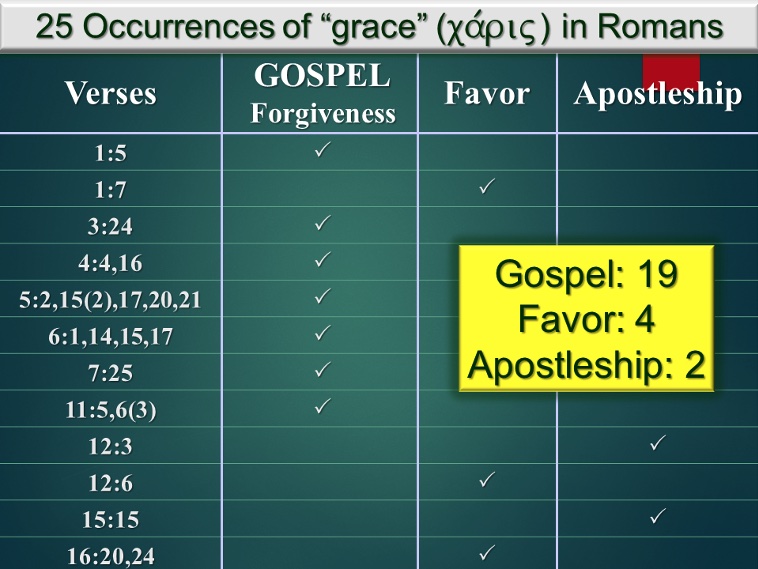
The book of Romans provides the New Testament canon with a clear thesis statement of God’s scheme of redemption: the Gospel is God’s powerful means for saving people (1:16). The term for “grace” (charis) occurs 25 times in the book. Twice it is used by Paul to refer to his apostleship that was bestowed upon him by God—“the grace given to me” (12:3;15:15). Four times the word is used in its generic sense of “favor” with Paul expressing his desire that the grace of Jesus and God would be with the Romans (1:7; 16:20,24; cf. Galatians 2:9; Ephesians 3:7-8) and God extending His “favor” by bestowing spiritual gifts on the Roman Christians (12:6). The other 19 occurrences of the word in Romans—the vast majority—refer specifically to the Gospel. Consider the following chart that catalogs the meanings of charis in the book of Romans:
As Greek lexicographer Joseph Thayer explained: “the N.T. writers use xa/ri$ pre-eminently of that kindness by which God bestows favors even upon the ill-deserving, and grants to sinners the pardon of their offences, and bids them accept of eternal salvation through Christ.”2
To repeat: the grace of the Bible is God making it possible for people to be forgiven of their sin. But they must meet the pre-conditions of that forgiveness by conforming to the instructions/prescriptions God has given to receive that forgiveness. And people must maintain a sincere, attentive desire to comply with God’s laws, and to regularly repent and seek forgiveness when they make mistakes along the way. Herein lies the definition of what it means to “walk in the light” (1 John 1:7).
Concluding Observation
Perhaps the worst feature of the “grace only” doctrine is its blatant, inherent manifestation of disrespect for God Himself. After all, who gives us spiritual law? Who authored the Law of Moses? Who provides us with the “law of Christ” (Galatians 6:2)? Any denigration of law—any negative representation of biblical law—is an aspersion directed against God. No wonder Paul declared in no uncertain terms that “the law is holy, and the commandment holy and just and good” (Romans 7:12). Indeed, we would not even know what offends God—what sin is—if He had not given us law (Romans 3:20). Law is never depicted in Scripture as somehow “bad,” or negative, or undesirable, or oppressive. God’s commands are not “burdensome” (1 John 5:3)—they are not too hard for us. Indeed, they are like sweet honey to our mouths and far more precious than pure gold (Psalm 19:10). May we join wholeheartedly and genuinely with the psalmist in his exclamation: “Oh, how I love Your law! It is my meditation all the day” (Psalm 119:97).
Endnote
1 Frederick Danker (2000), A Greek-English Lexicon of the New Testament and Other Early Christian Literature (Chicago, IL: University of Chicago), third edition, pp. 1079-1080.
2 Joseph Thayer (1901), A Greek-English Lexicon of the New Testament (Grand Rapids, MI: Baker, 1977 reprint), p. 666.
The post “Not Under Law, But Grace” appeared first on Apologetics Press.
]]>The post “Falling Away from Grace”? appeared first on Apologetics Press.
]]>

The Greek term translated “fallen” is from the verb pipto meaning “to fall.” In Galatians 5:4, the word has the preposition ek prefixed to it. This Greek preposition means primarily “out of.” Ekpipto, then, means literally “to fall out of.”1 One would need to be “in” a realm or sphere in order to “fall out of” it (see Figure 2). In the case of the Galatians, they had been converted to become Christians (Acts 18:23) and were counted as being in Christ’s church (Galatians 1:2-3).

Baptist Greek grammarian A.T. Robertson explains the language: “Ye did fall out of grace,” “ye left the sphere of grace in Christ and took your stand in the sphere of law as your hope of salvation.”2 Mounce adds: “to fall from, forfeit, lose.”3 Meyer noted: “Ye have forfeited the relation of being objects of divine grace.”4 And Eadie explains: “Christ’s method of justification is wholly of grace, and those who rely on law and merit are in opposition to grace—are fallen out of it.”5
These observations are buttressed by the fact that in the same verse, Paul says to the Christians: “You have become estranged from Christ.”6 The word means to “dissever from.”7 In addition to “estranged,” other translations have “severed” (ASV/ESV/RSV), “alienated” (NIV), and “cut yourselves off from Christ” (NRSV). Therefore, it is possible at one time to be within the grace of Christ and thereby saved, and then to so conduct oneself as to be severed from, to fall out of, and forfeit that grace.
Endnotes
1 Joseph Thayer (1977 reprint), A Greek-English Lexicon of the New Testament (Grand Rapids, MI: Baker), p. 198.
2 A.T. Robertson (1931), Word Pictures in the New Testament (Nashville, TN: Broadman Press), 4:309, emp. added.
3 Robert Mounce (2006), Mounce’s Complete Expository Dictionary of Old and New Testament Words (Grand Rapids, MI: Zondervan), p. 1137.
4 Heinrich Meyer (1884), Critical and Exegetical Handbook to the Epistles to the Galatians (New York: Funk & Wagnalls), p. 222, italics in orig.
5 John Eadie (1979 reprint), A Commentary on the Greek Text of the Epistle of Paul to the Galatians (Grand Rapids, MI: Baker), 1:384.
6 Frederick Danker, et al. (2000), Greek-English Lexicon of the New Testament (Chicago, IL: University of Chicago Press), p. 526.
7 Wesley Perschbacher, ed. (1990), The New Analytical Greek Lexicon (Peabody, MA: Hendrickson), p. 226.
The post “Falling Away from Grace”? appeared first on Apologetics Press.
]]>The post Ephesians 2:8-9: Contradictory, or Perfectly Consistent? appeared first on Apologetics Press.
]]>In his book The Encyclopedia of Biblical Errancy, longtime Bible skeptic Dennis McKinsey described “the biblical road to salvation” as “vague and conflicting.”1 He wrote:
[I]f one were to accept the Bible as God’s word and believe that heaven awaited those who gained entrance, one could never know for sure what must be done in order to reach heaven. The Bible is just too vague, too nebulous, too contradictory for even those who seek to follow its advice. This is because Scripture clearly outlines…different methods by which one can be saved and…the different methods are often either mutually exclusive, divergent, or contradictory. 2
In his monthly journal on alleged Bible contradictions, McKinsey commented on Ephesians 2:8-9, calling it
a passage contradictory within itself. It says you are saved through faith, while simultaneously calling salvation a gift of God. How can it be a gift when it must be earned? If you don’t make an effort, if you don’t have faith in Jesus, then you aren’t saved. How, then, can it be called a gift completely divorced from any works on your part? You must do something—believe in Jesus—in order to receive it.3
Bob Seidensticker of patheos.com lists “Faith saves (or do works save?)” as #6 in his “Top 20 Most Damning Bible Contradictions.” He quotes Ephesians 2:8-94 saying, “That seems clear enough until we find the opposite claim elsewhere in the Bible…. For something so important as getting into heaven and avoiding hell, the New Testament is surprisingly unclear.” Seidensticker then asks, “[M]aybe it’s repentance that saves…or maybe baptism?” and lists Acts 3:19, Luke 24:47, Acts 2:38, and Romans 6:4 as alleged proof of a biblical inconsistency pertaining to salvation.5
Is the Bible really “unclear” about salvation? Is the one sentence recorded in Ephesians 2:8-9 self-contradictory? Are McKinsey, Seidensticker, and other skeptics correct in their assessment of this passage of Scripture? How can these verses be consistent with other verses that teach the need for sinners to repent and be baptized? What rational response, if any, can be given from Scripture for all the differences skeptics cite?
Getting Context for Ephesians 2:8-9
Proper interpretation is impossible without consideration of the context in which statements are made. Even some of the simplest of sentences, such as “She’s cold,” cannot be understood without context. Does “She’s cold” refer to a woman who is physically chilly because of low temperatures? Does she have a “cold” demeanor about her and seem unfriendly? Is she “cold” during a basketball game, because she has missed a lot of shots? Or, is “she” even a woman? Perhaps “she” is someone’s pet Chihuahua that gets cold easily? Who can actually know what such a simple statement means without more information?
Ephesians 1:1
One of the best, most logical places to start when trying to understand any statement is “at the beginning.” Before abruptly jumping into Ephesians 2:8-9, it would be wise to go back to Ephesians 1:1 and learn some relevant information about the man who penned the letter and the people to whom he wrote.
Paul
“Paul, an apostle of Jesus Christ” was not always a Christian. One might say that previously he was “Saul the sinner.”6 In fact, “Christ Jesus came into the world to save sinners, of whom” Paul humbly stated “I am chief” (1 Timothy 1:15). How so? He “persecuted this Way [followers of Jesus] to the death, binding and delivering into prisons both men and women” (Acts 22:4). He said of his prior life as a non-Christian:
I myself thought I must do many things contrary to the name of Jesus of Nazareth…. [M]any of the saints I shut up in prison…; and when they were put to death, I cast my vote against them. And I punished them often in every synagogue and compelled them to blaspheme; and being exceedingly enraged against them, I persecuted them even to foreign cities (Acts 26:9-11).
Paul meekly remarked: “I am the least of the apostles, who am not worthy to be called an apostle, because I persecuted the church of God. But by the grace of God I am what I am, and His grace toward me was not in vain” (1 Corinthians 15:9-10).
How could one of the world’s most notorious persecutors of God’s saved people come to be saved? How could a man guilty of so many atrocities be forgiven? Because, as Paul reminded the Ephesians, “God…is rich in mercy,” has “great love with which He loved us,” and “when we were dead in trespasses, made us alive together with Christ (by grace you have been saved)” (2:4-5). Yes, “according to the riches of His grace” (Ephesians 1:7), God will save even the “chief” of sinners.
But how and when exactly was Paul, the penman of Ephesians, saved? For that information, we have to refer back to the book of Acts. In chapter 22, we learn that when Saul the sinner asked Jesus, “What shall I do, Lord?” Jesus (Who had miraculously appeared to him on the road to Damascus) said, “Arise and go into Damascus, and there you will be told all things which are appointed for you to do” (Acts 22:9-10). Saul then journeyed to Damascus and was told by God’s servant Ananias, “Arise, and be baptized, and wash away your sins, calling on the name of the Lord”7 (Acts 22:16). Did he do just that? Indeed, he did. “[H]e arose and was baptized” (Acts 9:18). Was Paul saved by grace, through faith, and not of works? Absolutely. Did he have his sins washed away when he was baptized? For sure. Did he see any inconsistency in these matters? Not at all. In fact, after becoming a Christian himself, Paul preached the necessity of baptism,8 including in the city of Ephesus (Acts 19:1-5).
The Early Ephesian Church
As Paul was winding down his second missionary journey, he briefly stopped off in the grand city of Ephesus with Aquila and Priscilla and reasoned with the Jews in the synagogue (Acts 18:18-19). Paul then quickly departed for Antioch of Syria (from which he had begun his journey about three years earlier), but he left behind his two faithful Christian companions (Acts 18:18-21). Thus, the Lord’s church existed in Ephesus at least since the time that Aquila and Priscilla were there.
A devout Alexandrian preacher named Apollos then came to Ephesus and “taught accurately the things of the Lord, though he knew only the baptism of John.” Thankfully, Aquila and Priscilla “took him aside and explained to him the way of God more accurately” (Acts 18:24-26).
Upon Paul’s return to Ephesus (early on during his third major missionary journey), he found 12 disciples there (Acts 19:1) and discovered that they, too, only knew of the baptism of John, and knew nothing of the Holy Spirit (19:2-3). Similar to Aquila and Priscilla teaching Apollos “the way of God more accurately,” Paul enlightened these men on the doctrine and baptism of Christ, after which “they were baptized in the name of the Lord Jesus” (19:4-5).
This was the early church in Ephesus. These individuals (and likely others who were becoming disciples of Christ—Acts 19:17-20,26) were some of those who spent upwards of three years with Paul (20:31), including two years listening to him “reasoning daily in the school of Tyrannus” (19:9-10). This was the early church who received the epistle we call Ephesians. These were the Christians (along with others) who were reminded that “by grace you have been saved through faith, and that not of yourselves; it is the gift of God, not of works, lest anyone should boast” (Ephesians 2:8-9). Like “Saul the sinner” who was baptized into Christ for the remission of sins, these disciples also understood the perfect harmony of being saved by grace through faith apart from works as they submitted to the Lord in baptism.
Ephesians Chapters 1-3
The book of Ephesians is naturally divided into two parts. The first three chapters remind the young church of the amazing blessings of being in Christ—in the redeemed, forgiven, blessed Church of Christ (1:22-23). Chapters 4-6 remind the church in very plain and practical language to act like faithful followers of Christ—“to walk worthy of the calling with which you were called” (4:1).
Ephesians 2:8-9 is embedded in the heart of the first section of Ephesians in which Paul reminds the church of—something every Christian continually needs to celebrate—the gracious salvation from sin found in Christ.
- 1:3—God has “blessed us with every spiritual blessing in the heavenly places in Christ.”
- 1:7—“In Him we have redemption through His blood, the forgiveness of sins, according to the riches of His grace.”
- 1:11—The heavenly “inheritance” is found in Christ.
- 2:5—Sinners are made “alive together with Christ” and saved “by grace.”
- 2:13—Sinners “who once were far off” have been brought near to God “by the blood of Christ” and placed “in Christ Jesus.”
- 3:7—Paul became a servant of Christ “according to the gift of the grace of God…by the effective working of His power.”
- 3:11-12—The grand plan to save sinful man “was according to the eternal purpose” of God, “which He accomplished in Christ Jesus our Lord in whom we have boldness and access with confidence through faith in Him.”
Repentance and Baptism in Ephesians
Although skeptics allege that repentance and baptism contradict Ephesians 2:8-9,9 Paul certainly didn’t believe so. In addition to what we have already learned about Paul’s conversion to Christ, as well as the early Ephesian Christians’ baptism “in the name of the Lord Jesus,” the book of Ephesians itself bears witness to the fact that Paul saw no contradiction between (a) being saved “by grace…through faith…not of works,” and (b) repenting and being baptized.
Repentance
In the same paragraph of Scripture in which Ephesians 2:8-9 resides, Paul reminded these early Christians in the Roman province of Asia that “we all once conducted ourselves in the lusts of our flesh” and were “children of wrath” (2:3). Without knowing anything else, the clear implication of this statement is that they were once non-Christians who “walked” as “sons of disobedience” (2:2), but now are “in Christ” and act (or are supposed to act) completely different. They changed. They repented. While they once “walked” in darkness disobediently (2:1-3), they now are God’s “workmanship, created in Christ Jesus for good works, which God prepared beforehand that we should walk in them” (2:10).
Christians are to “no longer walk as the rest of the Gentiles walk in the futility of their mind” (4:17). Children of God, who are recipients of the grace of God, are supposed to have repented, having “put off…the old man,” and “put on the new man” (4:22,24). While “no fornicator, unclean person, nor covetous man, who is an idolater, has any inheritance in the kingdom of Christ and God” (5:5), Christians are “imitators of God…and walk in love…. But fornication and all uncleanness or covetousness, let it not even be named among you”—that is, among repentant Christians (5:1-3).
Anyone who takes the time to read and digest Ephesians in its entirety, should quickly come to realize that repentance is implied and described throughout the letter. Surely this should have some bearing on a fair reading and interpretation of Ephesians 2:8-9.
Baptism
But what about baptism? Are we to believe that such verses as Acts 2:38 and Romans 6:3-4 (which skeptic Bob Seidensticker specifically cited in his “Top 20 Most Damning Bible Contradictions” article) are inconsistent with Ephesians 2:8-9? Is being “baptized in the name of Jesus Christ for the remission of sins” (Acts 2:38) really incompatible with being saved “by grace…through faith…not of works”?
In addition to the fact that (1) Paul himself was baptized (Acts 22:16; 9:18), and (2) the Ephesians were baptized (Acts 19:1-5), (3) within the book of Ephesians Paul listed baptism among one of the most fundamental, unifying teachings of Scripture. Paul begged the Christians in Ephesus to endeavor “to keep the unity of the Spirit in the bond of peace” (4:3). He then listed seven essential “ones” upon which Christian unity is based: “There is one body and one Spirit, just as you were called in one hope of your calling; one Lord, one faith, one baptism; one God and Father of all, who is above all, and through all, and in you all” (4:4-6). These seven ones are solid facts that undergird the Christian religion. And included in this exalted list, only a few verses away from Ephesians 2:8-9, is Paul’s mention of “baptism.”
Furthermore, in Ephesians 5:25-26, Paul noted how Jesus “loved the church and gave Himself for her, that He might sanctify and cleanse her with the washing of water by the word.” Pray tell, what is this “washing of water”? Is it not logical to conclude it’s the same water baptism to which the Ephesians had already submitted after hearing Paul teach “the word” of God (Acts 19:1-5)? Did Paul, the penman of this statement in Ephesians 5, not comply with the command to “be baptized, and wash away your sins” (Acts 22:16)? Shouldn’t it be clear that this reference to “the washing of water” in Ephesians 5:26 is the same “one baptism” that Paul had just highlighted one chapter earlier?
Do skeptics really expect us to believe that the apostle Paul was so incompetent and so prone to mistakes that he would pen such a beautiful statement as Ephesians 2:8-9 and then repeatedly contradict it throughout the same brief letter with implied and explicit references to repentance and baptism? Could it be that Paul’s teachings on faith, grace, repentance, baptism, and works are actually in perfect harmony with one another and that any perceived contradictions are mere misunderstandings on the part of the reader?
So What Does Ephesians 2:8-9 Mean?
“By Grace”
Just as it is humanly impossible to will oneself to return from physical death (once the soul has departed the body—Genesis 35:18), it is spiritually impossible to come back on one’s own accord from spiritual death. At one time the Ephesians were “dead in trespasses and sins” (2:1). They had “no hope” (2:12). Like all lost sinners, they were separated from God (Isaiah 59:2), on the path to eternal destruction (2 Thessalonians 1:8-9), and utterly incapable of devising and enacting a plan to save themselves—to bring themselves back into fellowship with God and have eternal life with him. “But God, Who is rich in mercy, because of His great love with which He loved us, even when we were dead in trespasses, made us alive together with Christ (by grace you have been saved)…. For by grace you have been saved through faith, and that not of yourselves; it is the gift of God, not of works, lest anyone should boast” (Ephesians 2:4-5,8-9).
Jesus did what no human being ever could do for himself: Jesus became the perfectly holy sacrifice Who voluntarily chose to take the just punishment for our sins (“death”—Romans 6:23) upon Himself in order to appease the infinite holiness and justice of God. Indeed, we are saved “by grace”! We are saved by God! There was no and is no “manmade” or “woman-willed” way to save ourselves. Salvation is not of human ingenuity. It is not the result of some great accomplishment on the part of mankind. The plan of salvation from spiritual death is God’s plan, accomplished in the death, burial, and resurrection of Christ! Plain and simple: salvation is undeserved and unearned. It is “not of yourselves; it is the gift of God, not of works, lest anyone should boast.”
A saved sinner no more “earned salvation” than a drowning man “earns a rescue.” I know a man who was once swept out to sea without a life jacket, a life preserver, or even a piece of floating wood to hold on to—and without any way to communicate to anyone. He repeatedly tried to swim the long way back to shore, but the strong wind and outgoing tide kept taking him farther and farther away. At last, he gave up trying to swim back to shore. At this point, he was exhausted and knew that his life was in someone else’s hands. If he was going to be saved from drowning in the open ocean, it would be the result of someone else’s work and not his own.
Thankfully, only a few hours later, this helpless man’s life was saved by the U.S. Coast Guard. His physical salvation was “not of himself” and “not of his works.” Even if asked to “hold on to the life preserver,” “put on the life jacket,” or “step up into the boat,” he would simply be following the instruction to be saved. He did not celebrate his rescue by boasting in “how he saved himself.” He acknowledged his rescuers, who used their time, money, energy, and talents to graciously save him from certain death. Similarly, spiritual salvation is “by grace,” “the gift of God.”
“Through Faith…Not of Works”
Although critics of Scripture often make the “contradiction” claim about Ephesians 2:8-9, most people seem unaware of what actually constitutes a real contradiction. The Law of Contradiction is one of the most fundamental principles of logic. It states, as Aristotle noted, “that the same attribute cannot at the same time belong and not belong to the same subject and in the same respect.”10 In other words, if the same thing is said both to be and not be (1) for the same person, place, or thing, (2) at the same time, and (3) in the same sense (or respect), then a genuine contradiction exists. However, if one of the three aforementioned variables is untrue or is unknown, a person cannot logically contend that a contradiction necessarily exists.
So what does this have to do with Ephesians 2:8-9? Simply this: most people seem to assume that the word “works” (Greek ergon) is used in one (and only one) sense in the Bible; however, the word is used in at least four different ways in the New Testament.
- There are “sinful works,” which Paul calls “works of darkness” in Ephesians 5:11 and “works of the flesh” in Galatians 5:19. The Ephesians obviously were not saved by “works of darkness.”
- Paul often refers to “works” in the sense of “works of the law” of Moses (Romans 3:28; Galatians 2:16)—the old, annulled Law of Moses (Hebrews 8:7-13), which Paul mentions in Ephesians 2:15 as having been abolished.11
- Paul occasionally addresses meritorious works by which we are not saved (Titus 3:4-7), since, as noted earlier, sinful man could never “earn” salvation and spiritual blessings from our perfectly holy and just God.
- Then there are works resulting from obedience of faith (James 2:14-24; Acts 26:20; Luke 17:10). These “works” are the active responses of those who trust in the gracious, saving plan and power of God.
Which “Works”?
In addition to Christians not being saved by the works of the Jewish law (Ephesians 2:15), Paul said in Ephesians 2:8 that salvation “was not of yourselves.” The apostle stressed this to Titus when he wrote that we are saved, “not by works of righteousness which we have done, but according to His mercy” (3:5). Then he highlighted to Timothy the fact that we are saved by the “power of God,” and “not according to our works” (2 Timothy 1:8-9). Man neither orchestrated nor carried out God’s one, acceptable scheme of redemption from sin. We don’t earn salvation; it’s impossible. The overall and immediate context of Ephesians seems clear that these meritorious works (and possibly the works of the law of Moses) are the kinds of works to which Paul was referring in Ephesians 2:8-9.
Self-Contradictory?
Many skeptics assume that the “not-of-works” salvation of Ephesians 2:8-9 is an indictment on all Christian “works” or “actions,” including faith, repentance, and baptism. Skeptic Dennis McKinsey called Ephesians 2:8-9 “contradictory within itself” because (a) salvation is not of works, yet (b) salvation is through faith. He asked: “How…can it be called a gift completely divorced from any works on your part?… How can it be a gift when it must be earned?… [Y]ou must do something…in order to receive” salvation. 12 McKinsey is exactly right that “you must do something” to receive salvation, but that “something” is not the kind of negative works Paul alluded to in Ephesians 2:8-9. McKinsey (like many others) simply confuses two different “senses” of the word “works,” and in the process wrongly assumes that there is a contradiction where none exists.
The first three aforementioned works certainly do not lead to salvation, but the last category (works resulting from obedience of faith; cf. Romans 1:5; 16:26) can be rightly called the “works of God.” This phrase does not mean works performed by God; rather, the intent is “works required and approved by God.”13 Consider what Jesus taught in John 6:27-29: “Do not labor for the food which perishes, but for the food which endures to everlasting life…. Then they said to Him, ‘What shall we do, that we may work the works of God?’ Jesus answered and said to them, This is the work of God, that you believe in Him whom He sent.” Within this context in John 6, Christ made it clear that there are “works” that humans must do to receive eternal life. Moreover, the passage affirms that believing itself is a work (“This is the work of God, that you believe in Him whom He sent”). Thus, McKinsey is correct that “faith” is a type of “work,” just not the type Paul mentions in Ephesians 2:9.
What Must We “Do” to Be Saved?
Is “Doing” “Earning”?
The gift of salvation is not, as McKinsey asserts, “completely divorced from any works on your part.” We must “do” something—but the “doings” (or “works”) are a part of the approved, trusting-in-God, obedient acts that Paul and the other New Testament writers consistently addressed—in perfect harmony with one another. Think about it: when Paul (the non-Christian) looked up to Jesus and asked, “What shall I do, Lord?” (Acts 22:9), Jesus did not respond by saying, “Do? There is nothing to do.” On the contrary, Jesus said there were things “to do” (Acts 22:10), including being “baptized” (22:16). Later, when Paul was imprisoned in Philippi and was asked by the jailor, “What must I do to be saved?” Paul told him to “do” something: to “believe on the Lord Jesus Christ” (Acts 16:31).
But how can a person “do” anything to receive the gift of salvation and it not be “earned”? Even if the works resulting from obedience of faith are not the kind of works Paul alludes to in Ephesians 2:9, doesn’t any kind of “work” (including “faith”) nullify the idea of salvation being a gift? Not at all. Think about it: If a friend wanted to give you $1,000,000,000, but said that in order to receive the billion dollars you had to pick up a check at his house, take it to the bank, sign it, and cash it, would any rational person conclude that this gift was earned? Of course not. Even though some effort was exerted to receive the gift, the effort was not a work of merit, but an action of compliance—a joyful work of obedience.
Many scriptures indicate that man’s efforts are often not categorized as works of merit. For example, God graciously gave the Israelites freedom from Egyptian bondage, but they still had to put forth some effort by walking from Egypt, across the Red Sea, and into the Wilderness of Shur (Exodus 15:22). Israel did not deserve manna from heaven; it was a free gift from God. Nevertheless, if they wanted to eat it, they were required to put forth effort in gathering it (Exodus 16; Numbers 11). Israel did not “earn” the land of Canaan (it was a gift—Deuteronomy 6:10-12,23), but they still exerted much effort (i.e., they worked) in possessing it. God gave the Israelites the city of Jericho (Joshua 6:2). But He gave it to them only after they followed His instructions and encircled the city for seven days (Hebrews 11:30). These Old Testament examples clearly teach that something can be a gift from God, even though conditions must be met in order for the gift to be received.14 That is, people must “do” something to receive the gift—namely, obey (2 Thessalonians 1:8; 1 Peter 4:17).
Why Different Things to Do?
Why was the Philippian jailor told to “Believe on the Lord Jesus Christ, and you will be saved” (16:30-31), while thousands in Acts 2 were told to “Repent…and be baptized in the name of Jesus Christ for the remission of sins” (2:37-38), and Paul was told to “Arise and be baptized, and wash away your sins, calling on the name of the Lord” (22:16)? Why are three different answers given to the same general question about being saved? Is the New Testament “surprisingly unclear” about “getting into heaven and avoiding hell,” as Seidensticker claims?15 Is “the biblical road to salvation…vague and conflicting,” as McKinsey alleges?16
The reason that three different answers were given to the question of salvation is because on each occasion the questioners were at different “locations” on the road to salvation. The Philippian jailor was commanded to believe in Christ, because he had not yet heard and believed the saving message of Jesus (Acts 16:31-32). It would have been pointless for Paul and Silas to command the jailor to repent or be baptized when he had not yet even heard the Gospel. If today, a Muslim, Hindu, or Buddhist, asked a Christian the same question the Philippian jailor asked Paul and Silas, the same answer would need to be given. The Jews on Pentecost had already heard Peter’s sermon when they asked their question about salvation (Acts 2:37). Peter knew that they already believed, and that such belief came from hearing the message he preached (cf. Romans 10:17). The Jews had passed the point of belief (being “pricked in their heart”), and were told to “repent…and be baptized” in order to receive salvation (cf. Mark 16:16).
Still, someone might wonder why Ananias neglected to tell Saul to believe or repent when he informed him about how to have his sins washed away. The reason: Saul already was a penitent believer in Christ by the time he came in contact with Ananias. Saul did not need to be told to believe or repent, since he had already done so. He knew the Lord existed, having spoken directly with Him on the road to Damascus, and he expressed a penitent attitude by praying to God and fasting for three days (Acts 9:9,11). At this point, Saul lacked only one thing: he needed to be baptized (Acts 22:16).
The reason these sinners were told three different things regarding salvation was because they were at different starting points when they asked the question, “What must I do to be saved?” The unbeliever was told to believe. The believers were told to repent. And the penitent believer was told to be baptized. The three statements may be different, but they are not contradictory. For a person to become a child of God, he or she must do all three.17
Conclusion
Just as a recipe is not meant to be read and followed in part, nor are the ingredients meant to be understood in contradiction to each other, the Bible will never be properly understood until the complementary nature of it is considered. Paul reminded the elders of the church at Ephesus that he had taught them the “whole counsel of God” (Acts 20:27), but he didn’t teach it all in one passage. Rather than cherry-picking one verse here and one verse there and forcing one’s own preferred meaning onto the text, an honest and conscientious Bible student will interpret statements in their context and in light of all that Scripture says on the matter (Psalm 119:160).
When the beautiful statement in Ephesians 2:8-9 is given a fair hearing, one discovers that it is neither self-contradictory nor inconsistent with any other statement of Scripture. Man is saved, not by works of merit, but by God’s grace through a trusting, obedient faith.18
Endnotes
1 Dennis McKinsey (1995), The Encyclopedia of Biblical Errancy (Amherst, NY: Prometheus), p. 332.
2 Ibid., p. 313.
3 Dennis McKinsey (1996), “Dialogue and Debate,” Biblical Errancy, 149:1116, May.
4 As well as Romans 3:28.
5 Bob Seidensticker (2018), “Top 20 Most Damning Bible Contradictions (2 of 4),” Cross Examined, October 22, https://www.patheos.com/blogs/crossexamined/2018/10/top-20-most-damning-bible-contradictions-2-of-4/.
6 From Acts 7:58-13:9, Luke only referred to Paul as “Saul” (from Tarsus). After Saul’s conversion to Christ, and once he began his first missionary journey, Luke noted that “Saul…also is called Paul” (Acts 13:9). From that point forward (other than when Paul was detailing his past conversion to Christ in Acts chapters 22 and 26), the New Testament writers (including Paul) never used the name “Saul” again, only “Paul.”
7 For an explanation of “calling on the name of the Lord,” see http://apologeticspress.org/apcontent.aspx?category=6&article=775.
8 Acts 16:14-15,30-34; 18:4-8; cf. Romans 6:1-4; 1 Corinthians 6:9-11; Galatians 3:26-29; Colossians 2:11-12.
9 It also is often claimed by many confused individuals within “Christendom” that baptism is unnecessary for salvation since we are saved “by grace…though faith…not of works.”
10 Aristotle (n.d.), Metaphysics, trans. W.D. Ross, http://classics.mit.edu/Aristotle/metaphysics.4.iv.html, 4:3.
11 “Having abolished in His flesh the enmity, that is, the law of commandments contained in ordinances….” Cf. Romans 6:14; Galatians 3:10; Galatians 4:5; Colossians 2:14.
12 McKinsey (1996), 149:1116.
13 J.H. Thayer (1977), Greek-English Lexicon of the New Testament (Grand Rapids, MI: Baker), p. 248, emp. added.
14 For more information on the complementary nature between (1) the gift of grace and (2) obedient faith, see “Taking Possession of What God Gives: A Case Study in Salvation,” http://apologeticspress.org/apPubPage.aspx?pub=1&issue=555.
15 Seidensticker.
16 McKinsey (1995), p. 332.
17 Read John 8:24; Luke 13:3,5; Matthew 28:19; Mark 16:16.
18 For more information on a saving, biblical faith, see “‘Believing’ in John 3:16,” http://www.apologeticspress.org/APContent.aspx?category=11&article=5723.
The post Ephesians 2:8-9: Contradictory, or Perfectly Consistent? appeared first on Apologetics Press.
]]>The post Faith Reaching for Calvary appeared first on Apologetics Press.
]]>[NOTE: The following sermon was preached in Montgomery, AL in October 2019 by A.P. board member Frank Chesser.]
Sin is man’s worst enemy. It crouches at the door of the mind, eager to pollute the source of every human activity. It maintains constant surveillance over the mind, knowing that its capture means the ruin of a man. Sin enters the mind by invitation and supplants its light with darkness. An appalling enumeration of sins that characterized the Gentle world begins with the depiction, “their foolish heart was darkened” (Romans 1:21). John asserts that a man who hates his brother “is in darkness, and walks in darkness, and knows not where he goes, because that darkness has blinded his eyes” (1 John 2:11).
Only Christ and the Gospel can replace darkness with light. Jesus is the “light of the world” (John 8:12). The light of Christ is manifested through the Gospel and its appeal is to the mind, “for out of it are the issues of life” (Proverbs 4:23). The sounds of physical conflict are heard in communities, states, and nations around the world. Entire countries are enmeshed in combat. Implements of war interrupt the routine of life, and peace and serenity are supplanted by chaos, suffering, and death.
But the battlefield of the ages is the mind of man. Satan knows that the Gospel is man’s only hope, and the Gospel addresses the mind. Satan exerts strenuous, incessant effort to keep man’s mind under the dark canopy of sin and error “lest the light of the gospel of the glory of Christ, who is the image of God, should shine on them” (2 Corinthians 4:4). The transition from darkness to light occurs when man obeys the Gospel.
The cross is the pivotal point of all human history. The past, present, and future have as their center, the cross of Christ. The Gospel is God’s power to save, but without the cross, there is no Gospel. Remove the cross and all joy in birth, purpose in life, and hope in death have been destroyed. Erase the cross and every day of life is one unending tragedy. With the cross, everything matters; without the cross, nothing matters.
What is man’s greatest need? Man’s greatest need is not sensational preaching; it is cross-centered preaching. It is not human philosophy; it is Jesus Christ crucified. It is not physical adornment; it is a spirit dipped in blood. It is not a social Gospel; it is the Gospel of the cross. It is not Moses and Sinai; it is Christ and Calvary. “And I, brethren, when I came to you, did not come with excellence of speech or of wisdom declaring to you the testimony of God. For I determined not to know anything among you except Jesus Christ and Him crucified” (1 Corinthians 2:1-2).
From eternity, God knew the cross would be the price that would have to be paid for sin. Sin cannot correct itself. It cannot provide for its own cure. It cannot solve the problems it creates, heal the pain it causes, remove the barriers it constructs, restore the families it destroys, eliminate the suffering it produces, or stop the endless flow of unprepared souls into the world of eternal perdition. Man is powerless in the face of sin. The righteousness of all the righteous of all the ages cannot erase a single sin of a single sinner. The entire angelic host stood helplessly at the reality of Genesis 3:6. It took the perfect life of God’s Son in the flesh to qualify Him to conquer sin in the cross. The sinless life of Christ and His death on the cross enabled God to maintain His holiness, righteousness, and justice, and extend the blessing of reconciliation to all who would embrace the Gospel in the obedience of faith (Romans 3:23-26).
God foreknew the choice that man would make in Eden. How could this be? Because God is omniscient. God confidently asserted to ancient Israel, “I know the things that come into your mind” (Ezekiel 11:5). God knows the number of hairs on every head, and not even a small sparrow can fall from the heavens apart from His knowledge (Matthew 10:29-30). God’s foreknowledge did not negate Adam’s and Eve’s free will. God simply knew the course that man’s free will would take.
Divine foreknowledge of man’s choice in Eden was accompanied by foreknowledge of its only possible cure. Peter announced this truth on Pentecost when he said that Jesus was “delivered by the determined counsel and foreknowledge of God” (Acts 2:23). When a man chooses God by submitting to His will, God chooses him in Christ according to the divine principles intrinsic to the scheme of redemption ordained “before the foundation of the world” (Ephesians 1:4). God’s intent to save man by grace through the Gospel “was given to us in Christ Jesus before time began” (2 Timothy 1:9). God’s remedy for sin in the cross “was foreordained before the foundation of the world” (1 Peter 1:20). Jesus was God’s “Lamb slain from the foundation of the world” (Revelation 13:8). God’s plan to reconcile both Jews and Gentiles unto Himself “in one body through the cross” (Ephesians 2:16) was according to the “eternal purpose which he accomplished in Christ Jesus our Lord” (Ephesians 3:11).
Appropriating to one’s soul the sin cleansing power of the cross is accomplished “through faith in his blood” (Romans 3:25). The faith of the Gospel system that enables one to enjoy the forgiveness of sins by grace through blood is the faith that obeys God. It is the “work of faith” (1 Thessalonians 1:3). It is the “faith working through love” (Galatians 5:6). The greatest treatise ever written on the scheme of redemption opens with the phrase, “obedience of faith” (Romans 1:5), and it closes with the phrase “obedience of faith” (Romans 16:26). Between these two massive spiritual pillars is a divine commentary on the Gospel system and the faith that permits man to participate in its provisions.
Paul proceeds to portray the exceedingly sinful state of the Gentile world and its need of Gospel that centers in Christ and the cross (Romans 1:18-32). He then verified the like state of his own brethren in the flesh and depicts the whole of humanity to be “guilty before God” (Romans 3:19) because “all have sinned and fall short of the glory of God” (Romans 3:23). He points to man’s only hope in God’s spiritual healing by grace “through the redemption that is in Christ Jesus” (Romans 3:24) appropriated to one’s soul “by His blood, through faith” (Romans 3:25). He describes this divine plan as a “law of faith” (Romans 3:27) system that looks to the cross for its liberation from sin. He utilizes Abraham as an example of one who exhibited the obedience of faith that appropriates grace and the need of all men to possess the “faith of Abraham” (Romans 4:16) and not the blood of Abraham.
Consequently, every act of obedience to the will of God is faith making its appeal to the cross of Christ. Such was characteristic of those under the Old Testament, even though they did not possess all of the pieces to the spiritual puzzle of redemption. It was God’s design from eternity to unite all men in the one church by means of the cross of Christ and man’s obedience to the Gospel of Christ. The spiritual remnant from Adam to Pentecost of Acts 2 was unable to grasp the totality of this truth because of insufficient revelation (Ephesians 3:1-6). Even the prophets who prophesied of things concerning Christ and the church did not fully comprehend their own prophecies. Peter speaks of intense, studious efforts by the prophets to unravel some of the mysteries regarding their own prophetic declarations of the “sufferings of Christ and the glories that would follow” (1 Peter 1:11) and of angelic desire for deeper understanding of redemptive truths (1 Peter 1:12).
Though lacking a completed revelation, they were abundantly supplied with sufficient truths to enable them to live before God with a full faith. They understood the nature of God and sin. They perceived their sinful state and their inability to lift a finger to provide for their own redemption. They knew they were wholly dependent on God’s love, grace, and mercy. They understood that God was working toward the consummation of a plan that would secure their redemption. Jesus said, “Abraham rejoiced to see My day, and he saw it and was glad” (John 8:56). Every act of obedience under the Old Testament and every drop of sacrificial blood offered by the righteous remnant was an act of faith appealing to God’s love and grace for salvation that would culminate in Christ and the cross.
If not for the cross, what value could be attached to Abel’s offering? What benefit could be assigned to Noah’s conformity to the will of God and physical salvation from the Flood, if the cross had never become a reality? Severed from the cross, what gain could one perceive in Abraham’s departure from Ur and the and the offering of his son on the designated mountain in Moriah? Without Calvary, what advantage was it for Moses to suffer four decades of abuse from a nation of ingrates?
Of what value was compliance with the priesthood and sacrifice of Levi without the priesthood and sacrifice of Christ? If Jesus had not assumed flesh, lived a sinless life, and died on the cross, would there be any point in accentuating the difference between striking and speaking to the rock? What real gain could be cited for Israel’s battles and victory over her enemies in Canaan if Christ had not fought and conquered Satan and sin? Of what worth is the submissive disposition of Samuel, “Speak, for your servant hears” (1 Samuel 3:10), if Jesus had not prayed, “Father, if it is Your will, remove this cup from Me; nevertheless not My will, but Yours be done”? (Luke 22:42).
Eliminate the cross and what profit could be advanced for Judah’s return to Canaan following the Babylonian captivity and restoration of the Temple? Apart from the cross, what was the point of Nebuchadnezzar’s confession of the oneness and sovereignty of God? Is not Nineveh’s penitence irrevocably connected to Calvary? Where lies the significance in the preaching of the prophets if Jesus had not traveled the lonely road to Golgotha? What blessings followed those giants of faith who “were slain with the sword” (Hebrews 11:37) if Jesus had not been slain on the cross?
A completed Gospel was preached on Pentecost of Acts 2. When the remnant complied with the conditions of the Gospel in the obedience of faith, they were added to the church (Acts 2:47). Relative to salvation, faith now assumes a backward posture. It looks back to a consummated scheme of redemption in Christ and the cross. The power of faith is not in the action of faith; it is in the object of faith. There is no power to cure sin in expressions of faith. If demonstrations of faith could remedy sin, man could solve his own sin problem by his submission to the will of God.
Every command in the New Testament and every act of obedience to that command is faith appealing to the cross for redemption. Repentance is a command of God. He “commands all men everywhere to repent” (Acts 17:30). Repentance is “for the remission of sins” (Acts 2:38). A genuine change of heart regarding one’s sin followed by “fruits worthy of repentance” (Matthew 3:8) is not an attempt at self-absolution. A penitent heart understands that its power source is Calvary. Repentance is faith looking to the cross for forgiveness.
Jesus Christ is fully divine. He is deity in all fullness and essence. He is the “Mighty God” (Isaiah 9:6). Thomas confessed Him as “my Lord and my God” (John 20:28). “In the beginning was the Word, and the Word was with God, and the Word was God” (John 1:1); and that “Word” was Christ (John 1:14). Of His Son, God the Father affirmed, “Your throne, O God, is forever and ever; A scepter of righteousness is the scepter of Your kingdom” (Hebrews 1:8). Confessing the full deity of Christ is indispensable to one’s salvation (Romans 10:9-10). Confessing Christ is an exhibition of faith, looking to the object confessed for release from sin.
The Gospel of Christ that centers in the cross of Christ produces the church of Christ. The Gospel that Peter preached on Pentecost of Acts 2 took the minds of the hearers and anchored them to the cross. Submission to the Gospel in the obedience of faith effectuated the church. Jesus purchased the church “with His own blood” (Acts 20:28). Jesus earnestly desires for “all men to be saved and to come to the knowledge of the truth” (1 Timothy 2:4).
God sent His Son “as Savior of the world” (1 John 4:14), but Jesus can save only those “all who obey Him” (Hebrews 5:9). Those who obey Christ are added to the church of Christ (Acts 2:47), which is the “body” of Christ” (Colossians 1:18), and Jesus is “the Savior of the body” (Ephesians 5:23). Acceptance of the exclusive church, purchased by the exclusive Savior and produced by the exclusive Gospel is not bigotry. It is the humility of faith appealing to the cross for redemption.
Man is the offspring of God, made in the image of God. When man severs himself from God and pursues a life of carnal indulgence, he is spurning the most crucial aspect of his nature. Man’s need of God and of worship is as intrinsic to his nature as is heat in fire. Worship is requisite to man’s inner peace and spiritual serenity. It equips man to resist temptation and cope with adversity. It deepens conviction. It intensifies man’s loathing for sin and error and heightens his love for God and truth.
Worship fortifies the mind, the object of satanic onslaughts. It enriches spirituality. It provides solace for the grieving, hope to the despairing, and joy to the dispirited. It grows faith. Worship is manna from heaven to the hungry soul. It is living water that streams from the Rock of our salvation. It elevates the mind from the earthly and temporal to the spiritual and eternal. It allays the burdens of life. It quickens anticipation for heaven. Worship is indispensable to one’s spiritual life and his habitation in that “city which has foundations, whose builder and maker is God” (Hebrews 11:10).
What man calls worship is often a humanly contrived, self-pleasing, emotional experience that placates the flesh and dulls the spirit. It removes God as the object and enthrones man. It is physical, theatrical, and superficial. It stimulates the pulse and idles the mind. It is dramatic and noisy. Jokes and human-interest stories issuing from the pulpit are met with laughter and clapping. The preacher is idolized and applauded, while God is minimalized and marginalized. The participants leave with a distorted sense of spirituality, unchallenged minds, diminished convictions, appeased consciences, and a comfort zone for sin and enhanced toleration for those of varying religious persuasions. “And in vain they worship Me, teaching as doctrines the commandments of men” (Matthew 15:9).
Acceptable worship conforms to God’s pattern. It involves the right object, right act, and right motive. “God is Spirit, and those who worship Him must worship in spirit and truth” (John 4:24). One cannot come into God’s presence with an unauthorized act of worship that he likes and expect God to accept it. Nadab and Abihu attempted such presumptuousness, and God slew them. Unauthorized acts of worship insult the grace of God, nullify faith, and demonstrate irreverence for the cross of Christ.
Spirit-and-truth worship looks to the cross for its validation. The power of acceptable worship is in the power of the cross, not the act of worship. For two millenniums, “this do in remembrance of Me,” has reverberated in the minds of men in Sunday’s commemoration of the Lord’s Supper. Material gifts on the first day of each week reflect the goodness of God and His gifts to man, the pinnacle of which was the gift of His Son as the remedy for sin.
Prayers of faith on wings of grace take flight from the worship assembly and soar through the blood of Christ into the presence of God. With permission from Calvary, songs of the heart are allowed entrance into the throne room of heaven to join with the melodies of angels in praise and adoration to the majesty of God. Preaching that saves and edifies pivots around the cross and demonstrates its application to the whole of biblical instruction.
When Adam’s and Eve’s lips were soiled by the forbidden fruit, God commenced His journey toward Calvary. This redemptive voyage enjoyed its fruition in the death, burial, and resurrection of the sinless Christ. Prior to His return to the Father, Jesus decreed that the Gospel was to cover the earth. Upon hearing the Gospel, man was to believe and be baptized (Mark 16:15-16). The preponderance of humanity has never consented to the words of Christ. They declare their love for Christ while rejecting the will of Christ. They view teaching on the necessity of baptism for salvation as an affront to the grace of God and the cross of Christ. They assert that such teaching annuls faith and transforms the free gift of salvation into a meritorious system of works.
One can no more separate baptism from grace, blood, and faith than he can cleave blue from the sky. Baptism is faith complying with the teaching of grace. Baptism is the obedience of faith appropriating the provisions of grace in the cross. Baptism is a spiritual reenactment of the death, burial, and resurrection of Christ (Romans 6:3-4). The power of baptism is in the cross, not in the act of baptism. Baptism is the eye of faith riveted on the cross. It is the heart of faith beating for the cross. It is the trust of faith centered in the cross. It is the hands of faith laying hold of the cross. Baptism and all other acts of obedience to God is faith reaching for Calvary.
The post Faith Reaching for Calvary appeared first on Apologetics Press.
]]>The post Flaws In Calvinism appeared first on Apologetics Press.
]]>Total Depravity = All men have inherited the sin of Adam through their parents and are morally unable to choose to follow God and be saved because of their own depraved, sinful nature which extends to every part of their personality.
Bible Responses
Ezekiel 18:19-23—“Yet you say, ‘Why should the son not bear the guilt of the father?’ Because the son has done what is lawful and right, and has kept all My statutes and done them, he shall surely live. The soul who sins shall die. The son shall not bear the guilt of the father, nor the father bear the guilt of the son. The righteousness of the righteous shall be upon himself, and the wickedness of the wicked shall be upon himself…. ‘Do I have any pleasure at all that the wicked should die?’ says the Lord GOD, ‘and not that he should turn from his ways and live?’”
Ezekiel 28:15—“You were perfect in your ways from the day you were created, till iniquity was found in you.”
Psalm 106:37-38—“They even sacrificed their sons and their daughters to demons, and shed innocent blood, the blood of their sons and daughters.”
Zechariah 12:1—“Thus says the LORD, who stretches out the heavens, lays the foundation of the earth, and forms the spirit of man within him.”
Matthew 18:2-3—“Then Jesus called a little child to Him, set him in the midst of them, and said, ‘Assuredly, I say to you, unless you are converted and become as little children, you will by no means enter the kingdom of heaven.’”
Matthew 19:14—“But Jesus said, ‘Let the little children come to Me, and do not forbid them; for of such is the kingdom of heaven.’”
Romans 7:9—“I was once alive apart from the Law; but when the commandment came, sin became alive and I died.”
Unconditional Election = God chose from eternity to save certain people, not based upon any foreseen virtue, faith, or anticipated acceptance of the Gospel. God chose to extend mercy to those He has specifically chosen and to withhold mercy from those not chosen. Those chosen receive salvation through Christ alone. Those not chosen receive wrath and damnation.
Bible Responses
Luke 13:3—“I tell you, no; but unless you repent you will all likewise perish.”
John 3:16—“For God so loved the world that He gave His only begotten Son, that whoever believes in Him should not perish but have everlasting life.”
John 8:24—“Therefore I said to you that you will die in your sins; for if you do not believe that I am He, you will die in your sins.”
Acts 10:34-35—“Then Peter opened his mouth and said: ‘In truth I perceive that God shows no partiality. But in every nation whoever fears Him and works righteousness is accepted by Him.’”
Romans 2:5-11—“God…will render to each one according to his deeds: eternal life to those who by patient continuance in doing good seek for glory, honor, and immortality; but to those who are self-seeking and do not obey the truth, but obey unrighteousness—indignation and wrath, tribulation and anguish, on every soul of man who does evil, of the Jew first and also of the Greek; but glory, honor, and peace to everyone who works what is good, to the Jew first and also to the Greek. For there is no partiality with God.”
1 Peter 1:17—“And if you call on the Father, who without partiality judges according to each one’s work, conduct yourselves throughout the time of your stay here in fear.”
Revelation 22:17—“Whoever desires, let him take the water of life freely.”
Limited Atonement = Christ died only for those whom God specifically pre-decided to save—the elect—but not for any others.
Bible Responses
1 Timothy 2:3-4—“For this is good and acceptable in the sight of God our Savior, who desires all men to be saved and to come to the knowledge of the truth.”
1 Timothy 2:5-6—“For there is one God and one Mediator between God and men, the Man Christ Jesus, who gave Himself a ransom for all.”
Titus 2:11-12—“For the grace of God that brings salvation has appeared to all men, teaching us that, denying ungodliness and worldly lusts, we should live soberly, righteously, and godly in the present age.”
1 John 2:2—“And He Himself is the propitiation for our sins, and not for ours only but also for the whole world.”
John 3:17—“For God did not send His Son into the world to condemn the world, but that the world through Him might be saved.”
2 Peter 3:9—“The Lord is not slack concerning His promise, as some count slackness, but is longsuffering toward us, not willing that any should perish but that all should come to repentance.”
Acts 10:34—“God shows no partiality.”
Romans 2:11—“For there is no partiality with God.”
Irresistible Grace = God’s saving grace is applied to those whom He has determined to save (the elect), overcoming their resistance to the call of the Gospel, bringing them to a saving faith. This means that when God sovereignly purposes to save someone, that individual certainly will be saved (even against his will if necessary). This purposeful influence of God’s Holy Spirit, Who creates faith within the individual, cannot be resisted.
Bible Responses
Deuteronomy 30:19—“I call heaven and earth as witnesses today against you, that I have set before you life and death, blessing and cursing; therefore choose life.”
Joshua 24:15—“Choose for yourselves this day whom you will serve, whether the gods which your fathers served that were on the other side of the River, or the gods of the Amorites, in whose land you dwell. But as for me and my house, we will serve the LORD.”
Luke 7:30—“But the Pharisees and lawyers rejected the will of God for themselves, not having been baptized by him.”
John 12:42-43—“Nevertheless even among the rulers many believed in Him, but because of the Pharisees they did not confess Him, lest they should be put out of the synagogue; for they loved the praise of men more than the praise of God.”
Acts 7:51—“You stiffnecked and uncircumcised in heart and ears! You always resist the Holy Spirit; as your fathers did, so do you.”
Acts 13:46—“Then Paul and Barnabas grew bold and said, ‘It was necessary that the word of God should be spoken to you first; but since you reject it, and judge yourselves unworthy of everlasting life, behold, we turn to the Gentiles.’”
Perseverance of the Saints = Since God is sovereign and His will cannot be frustrated by humans or anything else, those whom God has called into communion with Himself will continue in faith until the end. They cannot be eternally lost.
Bible Responses
Galatians 5:4—“You [Christians] have become estranged from Christ, you who attempt to be justified by law; you have fallen from grace.”
2 Peter 2:20-22—“For if, after they have escaped the pollutions of the world through the knowledge of the Lord and Savior Jesus Christ, they are again entangled in them and overcome, the latter end is worse for them than the beginning. For it would have been better for them not to have known the way of righteousness, than having known it, to turn from the holy commandment delivered to them. But it has happened to them according to the true proverb: ‘A dog returns to his own vomit,’ and, ‘a sow, having washed, to her wallowing in the mire.’”
Hebrews 4:11—“Let us therefore be diligent to enter that rest, lest anyone fall according to the same example of disobedience.”
Hebrews 6:4-6—“For it is impossible for those who were once enlightened, and have tasted the heavenly gift, and have become partakers of the Holy Spirit, and have tasted the good word of God and the powers of the age to come, if they fall away, to renew them again to repentance, since they crucify again for themselves the Son of God, and put Him to an open shame.”
Hebrews 10:38-39—“‘Now the just shall live by faith; but if anyone draws back, My soul has no pleasure in him.’ But we are not of those who draw back to perdition, but of those who believe to the saving of the soul.”
James 5:19-20—“Brethren, if anyone among you wanders from the truth, and someone turns him back, let him know that he who turns a sinner from the error of his way will save a soul from death and cover a multitude of sins.”
Revelation 2:5—“Remember therefore from where you have fallen; repent and do the first works, or else I will come to you quickly and remove your lampstand from its place—unless you repent.”
Revelation 3:5—“He who overcomes shall be clothed in white garments, and I will not blot out his name from the Book of Life; but I will confess his name before My Father and before His angels.”
Revelation 22:19—“If anyone takes away from the words of the book of this prophecy, God shall take away his part from the Book of Life.”
The post Flaws In Calvinism appeared first on Apologetics Press.
]]>The post Finding the Right Answer to the Right Question appeared first on Apologetics Press.
]]>Man’s sin, along with God’s grace and sovereignty, should drive every person to ask a most foundational (and logical) question: “What does God want me to do?” If Jesus is my Creator; if He has all authority in heaven and on Earth; and if He is the only Savior of mankind, what does He want me to do?
While Jesus was still living, a young man once recognized the Son of God’s authority, knelt before Him, and asked, “What shall I do that I may inherit eternal life?” (Mark 10:17, emp. added). After the first recorded gospel message following Jesus’ death, resurrection, and ascension into heaven, the convicted hearers asked: “What shall we do?” (Acts 2:37). When Jesus revealed Himself to Saul on the road to Damascus, the persecutor of Christians immediately asked, “What shall I do?” (Acts 22:10). A heathen Philippian jailor, who found himself in dire circumstances, all the while in the presence of a singing-and-praying Paul and Silas, was likewise compelled to ask, “What must I do to be saved?”(Acts 16:30, emp. added).
What is the answer to this question? What is a person to do to be saved? Through the years I have heard and read a number of professed Christians say things like, “God loves you. There’s nothing for you to do.” “We do nothing to become righteous.” “We do nothing to get salvation.” “Salvation is from nothing we do ourselves.”
Interestingly, not one of those in the New Testament was told these sorts of things—that he did not need to do anything. The very opposite is true, in fact. Though all are saved by the grace of God (Ephesians 2:8-9), each time the question, “What shall I/we do?” was asked in the New Testament, the hearers were always told to do something. While the Law of Moses was still in effect, Jesus told the rich young ruler, in essence, to repent (Mark 10:21-22). [Jesus instructed the young man to get rid of the “one” thing in his life (his great possessions) that was keeping him from committing his life to Christ.] The Philippian jailor was told to “believe on the Lord Jesus Christ” (Acts 16:31). The thousands in Jerusalem on the Day of Pentecost were told to “repent…and be baptized” (Acts 2:38). When Saul asked what he needed to do, Jesus told him what he had to do. Saul had to go wait for the word of the Lord in Damascus where Jesus sent Ananias to tell Saul what he “must do” in order to have his sins cleansed by the blood of Christ (Acts 9:6). And what was it Saul had “to do”? By the authority of Christ, Ananias told Saul, “Arise and be baptized, and wash away your sins, calling on the name of the Lord” (Acts 22:16).
Friend, don’t buy the lie that so many false teachers in the 21st century are selling: there is something for you to do in order to become a Christian and live the Christian life. No, it is not any kind of meritorious work (Titus 3:5). We could no more earn salvation than I could earn $999 quadrillion in my lifetime. But, we must submit ourselves to God and do what He says in order to receive the free, gracious gift of salvation, which comes only through Jesus Christ.
[NOTE: To learn more about becoming a follower of Christ, listen to our free audio book (or buy as a track) Receiving the Gift of Salvation.]
The post Finding the Right Answer to the Right Question appeared first on Apologetics Press.
]]>The post Salvation Principles and Relevant Commands appeared first on Apologetics Press.
]]>Essential to the salvation of all men is God’s grace. Without it, we would have “no hope” of being saved (Ephesians 2:12). Jesus taught this principle in parables (cf. Matthew 18:27; Luke 15:20-23), while Paul specifically reminded Christians, “For by grace you have been saved through faith, and that not of yourselves; it is the gift of God, not of works, lest anyone should boast” (Ephesians 2:8-9). Salvation is “not by works of righteousness which we have done, but according to His [God’s] mercy” (Titus 3:5).
Another scriptural salvation principle is that God saves only those who understand they are lost. The Lord did not “put away” King David’s sin until he confessed, “I have sinned against the Lord” (2 Samuel 12:13). In Jesus’ parable of the Pharisee and tax collector (Luke 18:9-14), the tax collector, rather than the self-righteous Pharisee, ultimately “went down to his house justified” (vs. 14), because he “would not so much as raise his eyes to heaven, but beat his breast, saying, “God, be merciful to me a sinner” (vs. 13). The tax collector recognized his lost state and humbly appealed to the only One Who could save Him—God. The penitent thief on the cross provides another noble example of one who owned up to his sinful ways and turned to God for help (Luke 23:40-43). The thief admitted that the brutal crucifixion was his just and “due reward,” while professing that “this Man [Jesus] has done nothing wrong” (vs. 41). He then appealed to Christ for salvation, saying, “Lord, remember me when You come into Your kingdom.” (vs. 42).
Can Bible students learn principles of salvation from King David’s repentance, the tax collector’s humility, and the thief’s sincere appeal to Christ? Most certainly. However, one must be careful not to confuse learning principles of salvation with learning the specific things non-Christians must do today in order to receive the gift of salvation.
An immigrant who aspires to become a law-abiding, American citizen can learn a great deal by studying the lives of 19th century immigrants. Understanding the obstacles they went through to get to America and eventually become legal U.S. citizens can inspire 21st century immigrants to do the same. One can learn about the need for patience, persistence, and perseverance. Yet, for a 21st century immigrant to become a U.S. citizen, he must familiarize himself with the current laws of naturalization, and then obey those laws. Knowledge of 19th century citizenship laws may help in the naturalization process, but ultimately, a person living today must abide by 21st century rules and regulations.
Similarly, Bible students can learn a great deal from the humble, contrite, determined individuals who lived prior to Jesus’ death on the cross. Christians do themselves a disservice if they fail to consider David’s contrite heart (read Psalm 51), the rich young ruler’s proper question (“What shall I do that I may inherit eternal life?”—Mark 10:17), and the thief’s sincere plea to Christ for salvation (Luke 23:42; cf. Romans 15:4; 1 Corinthians 10:11). Throughout Scripture we can glean godly principles relating to man’s salvation. Bible students, however, must not confuse the application of biblical principles with the obedience to relevant commands. All people living this side of the cross of Christ are saved under a different law than that under which David, the thief on the cross, the rich young ruler, and even Jesus lived. God’s New Testament came into effect after Christ’s death, and this testament reveals the explicit instructions that non-Christians must obey in order to become Christians. “For where there is a testament, there must also of necessity be the death of the testator. For a testament is in force after men are dead, since it has no power at all while the testator lives” (Hebrews 9:16-17, emp. added).
After Jesus’ death and subsequent resurrection, He and His apostles taught that non-Christians come into a right relationship with God only after they confess faith in Christ (Mark 16:16; Romans 10:9-10), repent of their sins (Acts 2:38; 3:19), and are immersed in water for the forgiveness of sins (Mark 16:16; Acts 2:38; 22:16). These are specific prerequisites for receiving salvation. They must be followed by all of those who live on this side of the cross of Christ (cf. Colossians 2:14; 2 Thessalonians 1:7-9).
Appealing to the thief on the cross (Luke 23:39-43), the paralytic of Galilee (Matthew 9:1-7), or the sinful woman whom Jesus forgave (Luke 7:36-50) in order to learn specifically what God wants non-Christians today to do to be saved, is to wrongly divide the word of truth. A person is “rightly dividing” (NKJV) or “handling accurately the word of truth” (2 Timothy 2:15, NASB) when he understands that the relevant commands for salvation are found after Jesus’ death. Making the distinction between learning from the righteous ways of those before the cross (cf. Romans 15:4) and obeying the specific commands given after the cross, is vital to a proper understanding of God’s will and a right relationship with Him.
The post Salvation Principles and Relevant Commands appeared first on Apologetics Press.
]]>The post Question & Answer: Faith a Gift from God? appeared first on Apologetics Press.
]]>Does Ephesians 2:8-9 teach that faith is a gift from God?
“For by grace you have been saved through faith, and that not of yourselves; it is the gift of God, not of works, lest anyone should boast.”
A.
For centuries, various Bible commentators have differed on the precise reference of the pronoun “that” in Ephesians 2:8. Does “that” (touto) refer to faith, as many have stated (e.g., Augustine, Chrysostom, Lenski, et al.), or, does “that” refer to salvation from sin? Is faith the “gift of God,” or is this gift salvation by grace through faith?
Admittedly, from a cursory reading of the passage in Ephesians 2:8, it may appear that the relative pronoun that has faith as its grammatical antecedent. Those who advocate the view that faith itself is a gift (i.e., a miraculous imposition) from God, often point out that in this verse, “faith” is the nearest antecedent of “that” (“For by grace you have been saved through faith, and that not of yourselves; it is the gift of God”).
However, when one examines Ephesians 2:8 in the language in which it was originally written (Greek), he learns that the pronoun that (touto) is neuter in gender, while the word faith (pistis) is feminine. Since the general rule in Greek grammar is for the gender and number of a relative pronoun to be the same as its antecedent (Mounce, 1993, p. 111), then some extenuating linguistic circumstance, special idiomatic use, or other similarly mitigating factor would need to be demonstrated to justify linking “that” to “faith.” If such reasonable justification cannot be made, then one is compelled to continue studying the passage in order to know assuredly what “that” gift of God is.
When no clear antecedent is found within a text, Greek scholar William Mounce wisely recommends that the Bible student study the context of the passage in question in order to help determine to what the relative pronoun (like “that”) is referring (1993, p. 111). The overall context of the first three chapters of Ephesians is man’s salvation found in Christ. Examine, for example, the following passages from the remainder of the book.
- “In Him we have redemption through His blood, the forgiveness of sins, according to the riches of His grace” (1:7).
- The heavenly “inheritance” is found in Christ (1:11).
- After believing in, and acting upon, the good news of salvation through Christ, the Christians in Ephesus were “sealed with the Holy Spirit of promise” (1:13).
- Sinners are made “alive with Christ,” and are saved “by grace” (2:5).
- Sinners are brought near to God “by the blood of Christ” (2:13).
- Paul became a servant of Christ “according to the gift of the grace of God…by the effective working of His power” (3:7).
Not only is the theme of salvation the overall context of the first three chapters of the book of Ephesians, but the immediate context of Ephesians 2:8-9 is salvation, not faith. These two verses thoroughly document how a person is saved, not how a person believes.
- Salvation is by grace.
- Salvation is through faith.
- Salvation is not of yourselves.
- Salvation is the gift of God.
- Salvation is not of works.
Paul was not providing an exposition on faith in his epistle to the Ephesians. Rather salvation was his focus. Faith is mentioned as the mode by which salvation is accepted. Salvation is through faith. Just as water is received into a house in twenty-first-century America through a pipeline, a sinner receives salvation through obedient faith (cf. Romans 1:5; 16:26). The main focus of Paul’s message in Ephesians 2:8-9 was salvation (i.e., the living “water that springs up into everlasting life”—cf. John 4:14), not the mode of salvation.
Admittedly, faith might be categorized as a gift from God in the broad sense in which all things come from God (e.g., the bread for which we work is an indirect gift from God—cf. Matthew 6:9-13), but faith is not a direct gift from God given to some and not to others. As Paul wrote in his letter to the church at Rome, “faith comes by hearing, and hearing by the word of God” (Romans 10:17). Faith in Christ as the Son of God is found only in those who have first heard the Word of God, and then believed (cf. John 20:31).
REFERENCES
Mounce, William D. (1993), Basics of Biblical Greek (Grand Rapids, MI: Zondervan).
The post Question & Answer: Faith a Gift from God? appeared first on Apologetics Press.
]]>The post Is Faith a Gift from God? appeared first on Apologetics Press.
]]>“For by grace you have been saved through faith. And this is not your own doing; it is the gift of God, not a result of works, so that no one may boast” (Ephesians 2:8-9, ESV).
For centuries, Bible commentators have differed on the precise reference of the pronoun “this” (“that” in KJV, ASV) in Ephesians 2:8. Does “this” (touto) refer to faith, as many have stated (e.g., Augustine, Chrysostom, Westcott, Lenski, etc.), or, does “this” refer to salvation from sin? Is faith “the gift of God,” or is this gift salvation by grace through faith?
Admittedly, from a cursory reading of Ephesians 2:8, it may appear that the demonstrative pronoun this has faith as its grammatical antecedent. Those who believe that faith is a gift (i.e., miraculous imposition) from God, often point out that in this verse “faith” is the nearest antecedent of “this” (“For by grace you have been saved through faith. And this is not your own doing; it is the gift of God”). However, when one examines Ephesians 2:8 in the language in which it was written originally (Greek), he finds that the pronoun this (touto) is neuter in gender, while the word faith (pistis) is feminine. Since the general rule in Greek grammar is for the gender and number of a pronoun to be the same as its antecedent (Mounce, 1993, p. 102,109,), then some extenuating linguistic circumstance, special idiomatic use, or other mitigating factor would need to be demonstrated to justify linking “this” to “faith.” If such reasonable justification cannot be made, then one is compelled to continue studying the passage in order to know assuredly what “this” gift of God is.
When no clear antecedent is found within a text, Greek scholar William Mounce wisely recommends that the Bible student study the context of the passage in question in order to help determine what a pronoun is referring to (1993, p. 111). The overall context of the first three chapters of Ephesians is man’s salvation found in Christ.
- “In Him we have redemption through His blood, the forgiveness of sins, according to the riches of His grace” (1:7).
- The heavenly “inheritance” is found in Christ (1:11).
- After believing in the good news of salvation through Christ, the Ephesians were “sealed with the Holy Spirit of promise” (1:13).
- Sinners are made “alive with Christ” and saved “by grace” (2:5).
- Sinners are brought near to God “by the blood of Christ” (2:13).
- Paul became a servant of Christ “according to the gift of the grace of God…by the effective working of His power” (3:7).
Not only is the theme of salvation the overall context of the first three chapters of Ephesians, but the immediate context of Ephesians 2:8-9 is of salvation, not of faith. These two verses thoroughly document how a person is saved, not how a person believes.
- Salvation is by grace.
- Salvation is through faith.
- Salvation is not of yourselves.
- Salvation is the gift of God.
- Salvation is not of works.
Paul was not giving an exposition on faith in his letter to the Ephesians. Salvation was his focus. Faith is mentioned as the mode by which salvation is accepted. Salvation is through faith. Just as water is received into a house in twenty-first-century America through a pipeline, a sinner receives salvation through obedient faith. The main focus of Paul’s message in Ephesians 2:8-9 was salvation (the living “water that springs up into everlasting life”—cf. John 4:14), not the mode of salvation.
Faith is not a direct gift from God given to some but not others. Rather, as Paul wrote to the church at Rome, “faith comes by hearing, and hearing by the word of God” (Romans 10:17). Faith in Christ as the Son of God is only found in those who have first heard the Word of God, and then believed (cf. John 20:31).
REFERENCES
Mounce, William D. (1993), Basics of Biblical Greek (Grand Rapids, MI: Zondervan).
The post Is Faith a Gift from God? appeared first on Apologetics Press.
]]>