The post Romans 10:9-10: Going Beyond Salvation Slogans appeared first on Apologetics Press.
]]>Do these beautiful words from Romans 10 mean that sinners only need to confess a belief in Jesus to be saved? Does this passage mean that repentance and baptism are unnecessary for salvation? Do these verses teach that to become a Christian, we merely “Pray this Prayer: Dear Jesus, I am a sinner. I believe that You died and rose from the dead to save me from my sins. I want to be with you in heaven forever. Jesus forgive me of all my sins that I have committed against You. I open my heart to You now and ask You to come into my heart as my personal Lord and Savior. In Jesus’ name, Amen”?2
Romans in Context
The Bible is not hard to understand,3 but we are as unlikely to properly interpret an isolated biblical statement as we are to open a random 9,000-word letter,4 skip to the middle of it, read a couple of sentences, and accurately know what the author was communicating. Someone may misunderstand the statement, “I’ve been hiding it from everyone, even my wife, for the past three months. I hope she doesn’t suspect anything,” to mean that a man is being unfaithful to his wife. In reality, the husband is going to great lengths to plan an elaborate surprise birthday party for his cherished spouse.
A visitor to a local high school may walk by a classroom where two people are intensely arguing and think, “If someone doesn’t intervene, I’m going to have to. I can’t believe the teacher is tolerating such behavior.” However, upon further investigation, the passerby realizes the two individuals are in a drama class practicing their lines for an upcoming theatrical performance. Additional information and proper context are two of the most fundamental, key components to correctly understanding anything in life. From letters to lectures and from books to news reports, additional (and especially contextual) information is vital to a fair and accurate interpretation.
Overall Context of Romans
Paul’s letter to the Christians in Rome in approximately A.D. 56-575 is all about how the perfectly holy and just Creator lovingly and powerfully saves sinners—making sinners righteous—by means of the sacrificial death and resurrection of Jesus. Apart from God’s heavenly plan to justify sinners through Jesus’ free-will sacrifice (Romans 1:16-17; 5:6-11), there is no hope for anyone (3:10,22-23), even for the Jews, the descendants of Abraham, to whom was given the Law of Moses (2:1-3,17-24; 3:9-10,19-20). Though the Law of Moses had (and still has—15:4) some great benefits,6 it cannot save lawbreakers from the eternal consequences of sin (6:23).
Justification (i.e., being found “not guilty,” but “righteous” by God our Judge) is only through faith in Jesus, not trusting in the Law of Moses (or any other law) or in one’s ability to obey it perfectly. Only Jesus obeyed the Law of Moses flawlessly (5:18-19; 8:3-4; Hebrews 4:15); only Jesus, His perfect holiness, and His death on our behalf would appease the justice of God (3:23-26; 5:6-9); and only Jesus saves, not the law (cf. Acts 4:12). “[W]hat the law could not do…God did by sending His own Son” (Romans 8:3).7 “There is therefore now no condemnation to those who are in Christ Jesus” (8:1). Indeed, Jesus “justifies” (8:33), not the Law of Moses. Yet so many first-century Jews, tragically, were putting their confidence in the Law rather than in Jesus.
Immediate Context of Romans 9-11
Paul was “an Israelite, of the seed of Abraham, of the tribe of Benjamin” (11:1), and it distressed him with “great sorrow and continual grief” (9:2) that so many of his countrymen were lost in sin. He was so grieved by their stubborn8 commitment to the Law of Moses rather than to Jesus that he selflessly wrote: “I could wish that I myself were accursed from Christ for my brethren, my countrymen according to the flesh” (9:3).
In Romans chapters 9-11, Paul detailed in no uncertain terms that, while many Jews have rejected God’s plan to save sinners through Jesus, many Gentiles “have attained to righteousness, even the righteousness of faith” (9:30), just as the Jews’ Holy Scriptures prophesied (9:25-26; 10:19-20). The death, burial, and resurrection of Jesus is God’s power to save Jews and non-Jews (1:16). “For there is no distinction between Jew and Greek, for the same Lord over all is rich to all who call upon Him. For ‘whoever calls on the name of the Lord shall be saved’” (10:12-13). Sadly, rather than receiving Jesus as the cornerstone of their salvation, most Jews trusted in their law-keeping and in their expectations of a Messiah Who would reaffirm their own righteousness. In doing so, they stumbled over the Savior and stubbornly refused to acknowledge Him as the Deliverer of their souls (9:30-33).
In the middle of this hard-hitting section9 are the beautiful, deeply meaningful words of Romans 10:9-10: “[I]f you confess with your mouth the Lord Jesus and believe in your heart that God has raised Him from the dead, you will be saved. For with the heart one believes unto righteousness, and with the mouth confession is made unto salvation.”
5 Things to Remember When Reading Romans 10:9-10
Romans 10:9-10 was not meant to be a stand-alone, all-encompassing, quick, shallow, “accept Jesus into your heart,” altar-call-type salvation incantation. Just as Israel misunderstood the purpose of the Law of Moses and the very Messiah it pointed to, many professed Christians enthusiastically quote Romans 10:9-10, yet “not according to knowledge” (cf. 10:2). When stripped from its context and reduced to more of a slogan, these verses are dangerously, if not fatally, misunderstood10 to mean that repentance and/or baptism are not required to become a Christian and that a life of continued submissive obedience to Christ may be unnecessary.
To correctly understand Romans 10:9-10, we must allow the Bible to explain the Bible11—both in Romans and within the entire biblical message of salvation. If the Bible is the inspired Word of God, then it will be internally consistent with itself about whatever it teaches,12 including about being saved from our sins and living a faithful Christian life.
#1—Recognize What Paul Is and Is Not Contrasting
In Romans 9-11, Paul is contrasting Jews and Gentiles (i.e., their rejection and acceptance of Jesus), law and faith, works and grace (11:6), as well as stumbling (in unbelief) and standing (by faith—11:20). The Jews were doing things their way while God was calling them to submit to His way—through Jesus (10:3-4). If non-Christian Jews wanted to be saved, they had to move from an unbelief and denial of Jesus…to a knowledgeable, heartfelt belief in and confession of Him.
Neither in Romans 10 nor anywhere else in Romans is Paul contrasting belief and repentance, or confession and baptism, or faith in and obedience to Jesus—as if repentance, baptism, and obedience to God are unnecessary. In Romans 10, Paul was focusing on the Jews’ rejection of Jesus, the very One they needed to acknowledge to be saved. Until they came to a proper understanding of Who Jesus was, they were lost.
To illustrate, consider the case of a doctor who must try to convince his extremely skeptical patient that he is seriously ill and needs a specific medicine that the doctor is prescribing in order to live. The doctor is not immediately concerned with the details of the treatment plan—how often to take the pills, how many at a time, what time of day, or with or without food. None of that matters if the currently stubborn patient will not first accept that he’s sick and needs the cure. Similarly, Paul knows that if Jews want to be saved from their spiritual sickness, they must first understand and acknowledge Who the Answer is: Jesus. Otherwise, nothing else matters.
#2—Consider Paul’s Parallel Use of “Faith” and “Obedience”
While Paul contrasted several ideas in Romans 10, he also utilized some notable terms and concepts in important complementary ways, specifically faith and obedience, which many “faith-alone,” “just-accept-Jesus-into-your-heart” advocates are resistant to connect. Yet Paul did. Romans 10 verses 9-10 are bookended within Romans 10 and within the letter of Romans as a whole by evidence signifying that obedience to Jesus and confessed faith in Jesus are perfectly harmonious. That is, it’s not one without the other(s); they go together. A confessed faith is an obedient faith.
Paul noted at the beginning of the chapter how the Jews “did not know the righteousness of God”; “they did not submit to God’s righteousness” (10:3, NIV). This lack of submission underscores that true faith is not merely an intellectual assent but involves a willful alignment with God’s righteousness—a submissive obedience that flows from genuine belief. The reason, for example, that the Old Testament “priests of the Lord”—Hophni and Phinehas (sons of Eli)—were said to “not know the Lord,” is because they did not submit to His sovereign Will—they “were corrupt” (1 Samuel 1:3; 2:12). Indeed, only those who sincerely submit to God are those who really know Him (i.e., believe in Him).
Later in Romans 10, Paul wrote that though the Gospel is preached, “they have not all obeyed the gospel. For Isaiah says, ‘Lord, who has believed our report?’” (10:15-16). Some 700 years before Paul, Isaiah had uttered these words, prophesying that many Jews would not believe in the Messiah when He came (Isaiah 53:1; cf. John 12:37-38). Paul noted the fulfillment of Isaiah’s words and paralleled the Jews’ disbelief with disobedience. Those who had not “believed” were those who had “not all obeyed the gospel.” The apostle John similarly connected these important concepts: “Whoever believes in the Son has eternal life; whoever does not obey the Son shall not see life, but the wrath of God remains on him” (John 3:36, ESV).
Furthermore, in Romans 1:5 Paul began this epistle exalting the resurrected Jesus, saying, “[T]hrough Whom we received grace and apostleship for obedience of faith among all the nations for his name’s sake” (WEB). Paul then concludes the epistle with the same allusion to obedient faith,13 noting that the Gospel had been “made known to all nations for the obedience of faith” (16:26, KJV). To be obedient to the faith is to believe the Gospel; to believe the Gospel is to obey Jesus. If we want to be saved, we must “obey the Gospel.”
#3—Investigate the Meaning of “Obeying the Gospel”
Indeed, in the very chapter of Romans so frequently misused to teach that a sinner must just “accept Jesus into your heart” to be saved or to “say the sinner’s prayer,” Paul references obeying the Gospel, specifically referring to those Jews who “have not all obeyed the gospel” (10:16). But what does it mean to “obey” the Gospel? Ask the average person on the street who claims an affiliation with some denomination if he or she has “obeyed the Gospel,” and you will likely get a blank stare or perhaps a suspicious, confused look. Why? It seems that very few denominations use this biblical terminology,14 much less impress upon hearers the heavenly requirement—to “obey the Gospel.”
Paul used this same terminology in his second epistle to the church in Thessalonica in a very sobering context. Referring to the return of Jesus at the end of time, Paul wrote that the Lord would be “revealed from heaven with His mighty angels, in flaming fire taking vengeance on those who do not know God, and on those who do not obey the gospel of our Lord Jesus Christ” (2 Thessalonians 1:7-8). The apostle Peter also used this language in his first epistle, asking, “what will be the end of those who do not obey the gospel of God? Now ‘If the righteous one is scarcely saved, where will the ungodly and the sinner appear?’” (1 Peter 4:17-18; cf. Proverbs 11:31). If, as Peter and Paul clearly indicate, “obeying the Gospel” is directly tied to our eternal destiny, then everyone needs to know the Gospel and how to obey it! Thankfully, Paul specifically addressed this vital subject matter earlier in his epistle to the Romans.
In Romans 6:17-18, Paul wrote about the point in time in which the Roman Christians had originally “obeyed” the Gospel (when they initially left their previous lives of sin and became children of God—servants of God). “But God be thanked that though you were slaves of sin, yet you obeyed from the heart that form of doctrine to which you were delivered. And having been set free from sin, you became slaves of righteousness.” What is this doctrinal “form” (or “figure,” “model,” or “pattern”)15 that slaves of sin “obeyed from the heart” in order to become “slaves of righteousness”—to become Christians? Is it not what Paul had only just discussed in the immediate context of Romans 6?
What shall we say then? Shall we continue in sin that grace may abound? Certainly not! How shall we who died to sin live any longer in it? Or do you not know that as many of us as were baptized into Christ Jesus were baptized into His death? Therefore we were buried with Him through baptism into death, that just as Christ was raised from the dead by the glory of the Father, even so we also should walk in newness of life. For if we have been united together in the likeness of His death, certainly we also shall be in the likeness of His resurrection, knowing this, that our old man was crucified with Him, that the body of sin might be done away with, that we should no longer be slaves of sin. For he who has died has been freed from sin. Now if we died with Christ, we believe that we shall also live with Him, knowing that Christ, having been raised from the dead, dies no more. Death no longer has dominion over Him. For the death that He died, He died to sin once for all; but the life that He lives, He lives to God. Likewise you also, reckon yourselves to be dead indeed to sin, but alive to God in Christ Jesus our Lord (6:1-11).
The Gospel is the death, burial, and resurrection of Jesus (1 Corinthians 15:1-4). And this Good News—that a holy, just, and loving God makes sinners right[eous] through Jesus’ sacrificial death and resurrection—is the “form” or “pattern” that sinners “obey.” Paul clearly outlines in Romans 6 how the Christians in Rome had “obeyed from the heart that form of doctrine”; they “obeyed” the death, burial, and resurrection of Jesus. Specifically, Paul, looking back on their obedience to the Gospel, indicated that when, as sinners, they were “baptized into Christ Jesus,” they “were baptized into His death.” “Therefore we were buried with Him through baptism into death, that just as Christ was raised from the dead by the glory of the Father, even so we also should walk in newness of life” (Romans 6:3-4). Contextually speaking, “obey[ing] from the heart that form of doctrine” is being immersed into the watery grave of baptism, dying to the old man of sin, and rising from spiritual death (through the power of Jesus’ resurrection) as a new person, no longer a servant of sin, but a slave to the righteousness of God.
#4—Acknowledge the Foolishness of Isolating Bible Verses to the Exclusion of Others
“Are you saying that all a person must do to obey the Gospel is be baptized in water?”
“Not at all.”
“But you just said that when sinners are baptized into Jesus they become Christians.”
“According to Romans 6, being immersed in water is the actual point at which sinners become followers of Christ—when we sincerely die to the old man of sin and rise with Christ as a new spiritual creation of God in Christ Jesus.”
“But what about Romans 10:9-10?”
“Great question. Let’s talk more about Romans 10 and other New Testament passages.”
If a person is using the exclusionary, “this-verse-says-it-all” interpretation method (e.g., referring to Romans 10:9-10 to suggest that “all” a sinner must do to be saved is believe and confess Jesus), then it begs the question: What about other verses that say something different?
The fact is, various verses just before and after Romans 10:9-10 emphasize faith without mentioning confession:
- 9:32—The Jews were still lost because they did not seek righteousness “by faith.”
- 9:33—“[W]hoever believes on Him [Jesus] will not be put to shame” (cf. Isaiah 28:16).
- 10:4—“Christ is the culmination of the law so that there may be righteousness for everyone who believes” (NIV).
- 10:11—Once again, Paul quotes Isaiah 28:16 in reference to salvation found only in Jesus: “Whoever believes on Him will not be put to shame.”
There is nothing about the sweet confession of Jesus in these verses in Romans, as well as in many other New Testament passages. When the Philippian jailor asked Paul and Silas in Acts 16: “Sirs, what must I do to be saved?” Paul and Silas said: “Believe on the Lord Jesus Christ, and you will be saved” (16:30-31). When the Jews in Acts 2 asked Peter and the apostles, “Men and brethren, what shall we do?” Peter said: “Repent, and let every one of you be baptized in the name of Jesus Christ for the remission of sins” (2:37-38). All of these verses are as different from Romans 10:9-10 as Mark 16:15-16, where Jesus said: “Go into all the world and preach the gospel to every creature. He who believes and is baptized will be saved; but he who does not believe will be condemned.” We should no more exclude confession from believing (based upon Romans 9:32-33, 10:4, and 10:11) than we should exclude repentance and baptism from believing and confessing (based upon an isolated reading of Romans 10:9-10).
If the Bible is the inspired Word of God,16 and if, as the psalmist said to God, “The entirety of Your word is truth” (Psalm 119:160), then human beings do not have the authority to dismiss one verse for another. We must “rightly divid[e]” and “accurately handl[e] the word of truth” (2 Timothy 2:15, NASB) and never accept one truth to the exclusion of others.
Most Bible students seem to understand the rationality and importance of this holistic approach to Bible interpretation when considering a host of biblical subjects—from the genealogy of Jesus to His sinless life. Rarely does someone quote from Matthew 1:1 and contend that David and Abraham were the immediate earthly father and grandfather of Jesus, since other verses say otherwise. Likewise, virtually no one points to Romans 3:23 and says Jesus must have been a sinner because “all have sinned.” Such verse isolation would be an egregious misuse of Scripture, as Jesus is the one exception among accountable human beings—He never sinned (cf. Romans 8:3; 5:19; Hebrews 4:15).
It is also an egregious misuse of Scripture to contend that God calls sinners to “just accept Jesus into their hearts to be saved” or to “say the sinner’s prayer.”17 The fact is, Romans 10:9-10 actually proves that “faith alone” does not save, since Paul also detailed how such faith in Jesus Christ must be confessed.18 “Believing” and “confessing” are two different things, as we learn in John 12:42-43, where “among the rulers many believed in Him, but because of the Pharisees they did not confess Him, lest they should be put out of the synagogue; for they loved the praise of men more than the praise of God.”
Remember that Paul’s emphasis in Romans 10 was on the many Jews who disbelieved that Jesus was the Messiah. Paul was pleading with them to recognize Jesus for Who He is (and Who the Law of Moses said He was; 10:4)—the Rock of our salvation, Who at that time was still “a stumbling stone and rock of offense” to the many Jews who rejected Him (9:33). Logically speaking, there was no more reason to plead with disbelieving Jews to, for example, be baptized than there is today to impress upon Muslims, Hindus, or atheists to be baptized—if they know nothing about or care nothing about Jesus. Nothing else matters until Jesus matters! Nothing else means anything until Jesus means everything!
When sinners come to sincerely believe in their hearts and confess with their mouths the Lord Jesus, then they will do exactly what Paul reminded the Christians in Rome that they had previously done on their way to becoming Christians: “[A]s many of us as were baptized into Christ Jesus were baptized into His death”; “we were buried with Him through baptism into death, that just as Christ was raised from the dead by the glory of the Father, even so we also should walk in newness of life” (Romans 6:3-4).
It’s not Romans 6 without Romans 10, any more than it is Luke 24:47 without Mark 16:16 or Acts 2:37-38 without Acts 16:30-31. These verses (and the eternal spiritual truths that they teach) are as harmonious as the different resurrection accounts of Jesus. May we never isolate one passage to the exclusion of other verses, but recognize their perfectly supplemental, complementary nature, whether about the nature of Jesus or how to become a Christian.
#5—To “Call on the Name of the Lord” Means More Than Confessing Christ or Saying the “Sinner’s Prayer”
What did the apostle Paul—the one God used to communicate the marvelous message of Romans—what did he do to become a Christian? Paul (formerly Saul the sinner) was on his way to Damascus to persecute Christians when Jesus supernaturally appeared to him from heaven. Paul asked Jesus, “What shall I do?” to which Jesus responded, “Arise and go into the city, and you will be told what you must do” (Acts 9:4-6; 22:10). Paul (demonstrating his belief in Jesus) proceeded to Damascus (with some assistance) where he fasted for three days and was “praying” (Acts 9:8-11), awaiting further instructions.
As we see throughout the book of Acts and even as Romans 10:14-15 reminds us, God always uses people to teach people the Gospel. Even in Paul’s case, God used a man named Ananias, who said to Paul: “And now why are you waiting? Arise and be baptized, and wash away your sins, calling on the name of the Lord” (Acts 22:16). Notice carefully that Ananias, God’s specially chosen messenger to Paul, did not tell Paul that his sins were washed away when Paul spoke to Jesus on the road to Damascus (Acts 9:4-6), or when he fasted for three days (9:9), or when he prayed (9:11). Even though Paul had seen Jesus, talked to Jesus, and sincerely fasted and prayed, he had not yet “called upon the Lord.” Acts 22:16 indicates that he “called upon the Lord” and had his sins washed away by the blood of Jesus when he took the final step on his way to becoming a Christian—when he was “baptized into Christ Jesus” (Romans 6:3-4).
Paul’s “calling on the name of the Lord” harmonizes perfectly with what Peter instructed the thousands of people to do in Acts 2. Peter quoted from the prophecy of Joel and told those in Jerusalem on Pentecost that “whoever calls on the name of the Lord shall be saved” (Acts 2:21; Joel 2:32). The people in Acts 2 did not understand Peter’s quotation of Joel to mean that a sinner must pray to God for salvation. Their question in Acts 2:37 (“Men and brethren, what shall we do?”) indicates such. Furthermore, when Peter responded to their question and told them what to do to be saved, he did not say, “I’ve already told you what to do. You can be saved by petitioning God for salvation through prayer. Just call on His name.” On the contrary, Peter had to explain to them what it meant to “call on the name of the Lord.” Instead of repeating this statement when the crowd sought further guidance from the apostles, Peter commanded them, saying, “Repent, and let every one of you be baptized in the name of Jesus Christ for the remission of sins” (Acts 2:38).19
In Romans 10:13, Paul (like Peter in Acts 2) also quoted from Joel 2:32: “[W]hoever calls on the name of the Lord shall be saved.” When we allow “the Bible to explain the Bible,” we will not come to the erroneous conclusion that Paul is commanding the unbelieving Jews in Romans 10 to merely “cry out to the Lord” (cf. Matthew 7:21) or to “pray the sinner’s prayer.” Rather, with Paul’s own conversion in mind (his “calling on the name of the Lord”—Acts 22:16), as well as those on Pentecost (Acts 2), we realize that in Romans 10 Paul is pleading with (especially) the Jews, who “have not all obeyed the gospel” (Romans 10:16) to “call on the name of the Lord”—that is, to “obey the gospel.” And to “obey the Gospel” is to hear and believe the Gospel (Romans 10:17), to repent of sins (Romans 6:2,6; Acts 2:38), to make the good confession that Jesus Christ is the Son of God (Romans 10:9-10), and to be immersed in water for the remission of sins (Romans 6:3-4; Acts 2:38; 22:16). This is what it means for sinners to “call upon the name of the Lord.”20
Conclusion
Romans 10:9-10, though often quoted in isolation, must be interpreted in harmony with its immediate and overall context. Paul was not offering a shallow, minimalist formula for salvation. Rather, he was urging hardened, unbelieving Jews to confess the very Messiah they had rejected. Faith and confession are foundational, essential components of salvation, but not exclusive. In Romans—and the entire New Testament—faith, repentance, confession, and baptism are presented as inseparable steps of obeying the blessed Gospel of Christ and beginning one’s all-important journey of walking in the light of the Lord (1 John 1:5-10).
Endnotes
1 And perhaps John 3:16 and Ephesians 2:8-9, which we have addressed elsewhere: Eric Lyons (2019), “‘Believing’ in John 3:16,” Reason & Revelation, 39[9]:98-101,104-107, September, https://apologeticspress.org/believing-in-john-316-5723/; Eric Lyons (2000), “Ephesians 2:8-9: Contradictory, or Perfectly Consistent,” Reason & Revelation, 40[10]:110-113,116-119, October, apologeticspress.org/ephesians-28-9-contradictory-or-perfectly-consistent-5870/.
2 This “accept-Jesus-into-your-heart” kind of prayer is typical of what you will hear and read online, in print, and in person among many denominations. This particular wording of the “sinner’s prayer” has circulated widely in social media circles in recent years.
3 Some sections may be more difficult than others, but it is not difficult to learn what the Bible teaches about how to become a Christian and how to live the Christian life. Cf. Kyle Butt (2020), “Why Is the Bible So Hard to Understand?” Reason & Revelation, 40[4]:38-41,44-47, April, apologeticspress.org/why-is-the-bible-so-hard-to-understand-5775/.
4 A typical English translation of Paul’s letter to the Romans is a little over 9,000 words.
5 In Romans 15:25-26, Paul specifically mentions his upcoming journey to Jerusalem to deliver support from Christians in Macedonia and Achaia to poor saints in Judea (cf. 1 Corinthians 16:1-3; Acts 24:17). Thus, this letter was written before that time—apparently when Paul was in Greece on his third missionary journey (Acts 20:1-3; cf. Romans 16:1-2,23; 1 Corinthians 1:14).
6 The commands of God, even commandments under the Law of Moses, are “holy and just and good” (Romans 7:12). After all, the holy, just, and good God was the Author of the Law of Moses. The Old Testament helped the Jews understand sin (3:20). What’s more, it pointed forward to Jesus, the Messiah (10:4).
7 Emphasis in Bible quotations is added unless otherwise noted.
8 Romans 2:5; 10:21; 11:7-8.
9 Chapters 9-11.
10 Cf. 2 Peter 3:14-17.
11 Cf. Eric Lyons (2018), “Letting the Bible Explain Itself,” Reason & Revelation, 38[8]:86-88,92-95, August, apologeticspress.org/letting-the-bible-explain-itself-5589/.
12 See Kyle Butt and Eric Lyons (2015), “3 Good Reasons to Believe the Bible Is From God,” Reason & Revelation, 35[1]:2-5,8-11, January, apologeticspress.org/3-good-reasons-to-believe-the-bible-is-from-god-5089/.
13 For more information, see Dave Miller (2021), “The Obedience of Faith in Romans,” Reason & Revelation, 41[3]:34-35, March, https://apologeticspress.org/the-obedience-of-faith-in-romans-5955/.
14 It may be impossible to know with certainty, but general AI inquiries suggest that such language “is not especially common in most mainstream denominations…. It is infrequently used, and sometimes absent.”
15 From the Greek “tupos,” Frederick Danker, et al. (2000), Greek English Lexicon of the New Testament (Chicago, IL: University of Chicago), p. 1020.
16 2 Timothy 3:16-17; 2 Peter 1:20-21. For evidence of the Bible’s divine inspiration, see Kyle Butt (2022), Is the Bible God’s Word? (Montgomery, AL: Apologetics Press). See also Dave Miller (2020), The Bible Is From God: A Sampling of Proofs (Montgomery, AL: Apologetics Press); Kyle Butt and Eric Lyons (2021), Defending the Bible (Montgomery, AL: Apologetics Press); apologeticspress.org/category/inspiration-of-the-bible/.
17 The “sinner’s prayer” for salvation is nowhere found in the New Testament.
18 Cf. 1 Timothy 6:12-13.
19 For more information on why different answers are given in the New Testament to the same basic question (“What must I do to be saved?”), see Eric Lyons (2004), “One Question: Three Different Answers,” apologeticspress.org/one-question-three-different-answers-646/.
20 This is not to say becoming a Christian is always synonymous with “calling on the name of the Lord.” Abraham was obviously not baptized into Christ when he “called on the name of the Lord” (Genesis 12:8; cf. 4:26). What’s more, when the New Testament describes people who were already Christians “calling on the name of the Lord” (Acts 9:14,21; 1 Corinthians 1:2), it certainly does not mean that Christians were continually being immersed in water after having been baptized to become a Christian (cf. 1 John 1:5-10). Depending on when and where the phrase is used, “calling on the name of the Lord” may be referring to (1) becoming Christians, (2) worshiping God, or (3) faithful service to the Lord. However, it is never used in the sense that all a non-Christian sinner must do to be saved is to cry out and say, “Lord, Lord, save me.” The sinner’s prayer is without biblical backing.
The post Romans 10:9-10: Going Beyond Salvation Slogans appeared first on Apologetics Press.
]]>The post Why Do You Believe “Obedience” Is Necessary to Salvation? appeared first on Apologetics Press.
]]>“I came upon your website due to the referral of a Christian brother who provided me a link to your article on John Quincy Adams’ views on Islam. Loved the article and will share it with others. When checking into your beliefs I note the following on your site under “What We Believe:’ ‘Salvation is by means of obedience to the Gospel system, involving faith in God and Christ, repentance from sin, confession of faith, and immersion in water for remission of past sins, coupled with a life of growing consecration and dedication.’ In all honesty, when I read Scripture I do not get that ‘salvation’ has anything whatsoever to do with a ‘Gospel system’ or ‘obedience’ thereof. Surely you cannot mean that our deeds and works can make us righteous or clean in the eyes of a perfect and entirely Holy God? Moreover, we cannot follow any kind of a ‘system’ or formula, regardless of how good it may be. Only Christ and His completed sacrifice, once for all, can save those who believe in Him, His Word, and His Resurrection. I think the most simple and direct quotes on how Salvation is ‘achieved’ (really awarded is the better and most accurate word) is from Romans 10:17 and Acts 10:34-46. In light of these verses, why would you take the stance you do on your website? Put another way, why do you believe salvation is had by any other way than as noted in the cited sections of Romans, Acts, and any number of other examples throughout Scripture of persons being saved?”
P.L., Palm Desert, CA
A:
It is true that the New Testament does not use the phrase “Gospel system,” but the concept is certainly biblical, even as we speak of the “Christian system” or the “Christian religion.” In Romans, the Gospel/grace system is contrasted with a strictly legal/law system. The point of Romans is that the Jews could not depend on their ethnic heritage (their genetic connection to Abraham with its covenant symbol of circumcision) or the Law of Moses to save them—because genetic connection is fleshly and avails nothing, and they did not diligently keep the Law of Moses given to them. No one can be saved by law alone, since everyone has violated God’s law and therefore stands condemned by the law. We needed a different approach to the sin problem, specifically, the Gospel (the good news that God inhabited human flesh in the person of His Son to atone for sin, i.e., our violations of God’s law). To be sure, the Gospel has law that we must obey, just like the Law of Moses; but it also has the means of ultimate atonement which the Law of Moses did not technically have (cf. Hebrews 10:4). Yes, the orchestration of that means of forgiveness is wholly God’s doing which we do not deserve. There is absolutely nothing we can do to atone for our own sin. This is the grace of the Bible (e.g., Titus 2:11).
However, it by no means follows that there is nothing that God requires of us before He will freely cleanse us. You, yourself, agree that a person must believe. So, you agree, in principle, with the idea that simply because there is action that a person must do to be saved, that action does not nullify the fact that salvation is a free gift and the individual does not earn or deserve salvation. The individual must believe—an act of human effort, called a “work” in John 6:29, i.e., a work that God requires humans to perform. Indeed, believing is also a command to be obeyed (John 8:24; 14:1; Acts 16:31; 1 John 3:23). But what does it mean to believe? It is not merely a mental act of accepting Jesus (as much of Christendom repeatedly affirms), since Paul defines the “faith” of Romans as an obedient faith (hupakoain pisteos) in 1:5 and 16:26. Romans uses forms of the word “obey” and “obedience” 10 times, and forthrightly declares that a person will be judged “according to his deeds” (2:6), and that “eternal life” will be given to “those who by patient continuance in doing good seek for glory, honor, and immortality,” while those who “do not obey the truth” will receive “indignation and wrath” (2:7-8). Romans 6:16 indicates that obedience precedes righteousness. So, yes, humans must perform deeds to be pleasing to God. The point that the Bible makes regarding those deeds is that they do not earn salvation for the individual; they do not wash away sin—since only the blood of Christ can do that. Christ’s blood is the cleansing agent. But when does God apply Christ’s blood to our sin-stained spirits? Answer: when a person “obey[s] the Gospel” (2 Thessalonians 1:8). How does one obey the Gospel? Acts is the “book of conversions” that gives example after example of instances wherein people obeyed the Gospel to become Christians. The chart below records only the explicitly stated actions that occurred in 10 cases of conversion to Christ in the book of Acts—actions that preceded salvation.
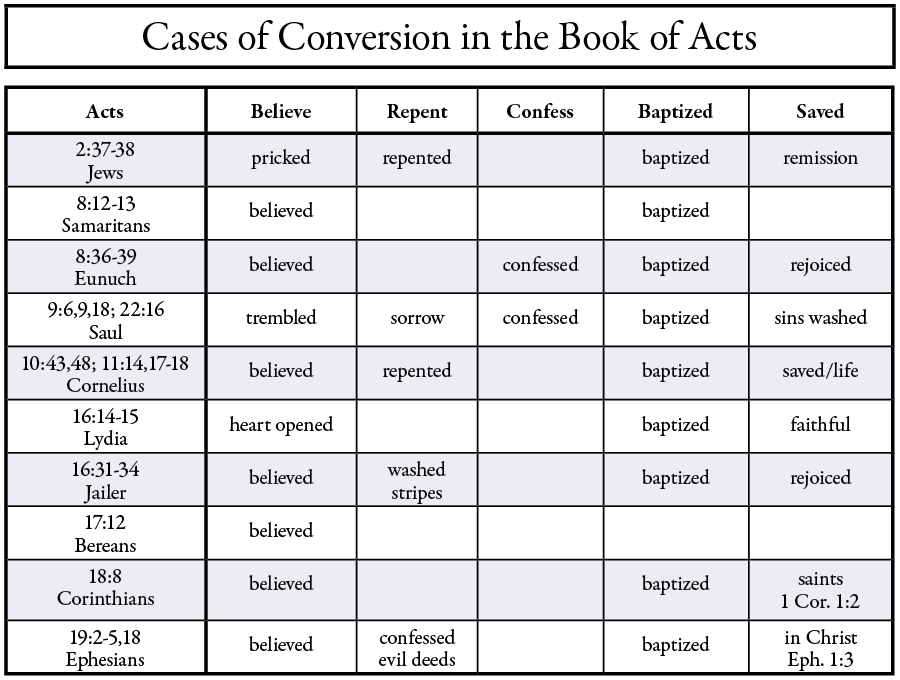
Romans was not actually intended to detail the conditions of salvation; rather, Romans explains the grounds/basis of salvation: the blood of Christ. Nevertheless, in passing, Romans happens to mention every single one of the prerequisite conditions of salvation with which humans must comply before God will grant forgiveness as a free, undeserved gift. Romans 10:17, as you note, indicates that a person must first hear the Gospel/Word of God, which is designed to create faith within. But Romans 10:9-10 makes clear that faith is not the only prerequisite to forgiveness. Oral confession with the mouth is also enjoined. Romans 2:4 indicates that repentance is necessary before God will forgive. And Romans 6:1-4 indicates that water immersion precedes salvation, since it is the contact point for the blood of Christ which was shed in His death. We must be baptized “into His death” to contact that blood. That is the point at which sin is washed away by the blood of Christ. No wonder, then, that Ananias told Saul/Paul to “[a]rise and be baptized, and wash away your sins, calling on the name of the Lord” (Acts 22:16). When does a person “call on the Lord”? When the believing, repenting, confessing person submits to water immersion (Acts 22:16). That explains why Peter declared that baptism “now saves us” (1 Peter 3:21)—in the sense that Christ’s blood saves us at the point of our baptism; and that is why that same Peter impressed upon those present in Acts 10 that the reception of Holy Spirit baptism directly from God upon the Gentiles was proof positive that Gentiles have the right to become Christians just as much as do the Jews. Once their eligibility for conversion was demonstrated by that miraculous act direct from God, Peter then pressed for their obedience in the words, “Can anyone forbid water, that these should not be baptized…?” (Acts 10:47). Why even bring up water at that moment if water immersion was not prerequisite to their forgiveness?
So faith, repentance, confession, and baptism are all indicated to precede remission of sin. We must obey these acts—not to atone for our sin, for only Jesus can do that—but to comply with God’s stated conditions—conditions that He authored (not us) and enjoined upon all who wish to be saved. That is why the Hebrews writer stated forthrightly that Jesus is “the author of eternal salvation to all who obey Him” (Hebrews 5:9). It is interesting that you quote Acts 10:34-35 which indicates that before a person is acceptable to Christ, that person must “fea[r] Him and wor[k] righteousness” (vs. 35). “He who practices righteousness is righteous, just as He is righteous” (1 John 3:7). In other words, belief, repentance, oral confession, and water immersion are righteous actions that humans must perform in order to receive the free gift of salvation available only in Christ, and be counted by Him as righteous.
Jesus said, “[b]lessed rather are those who hear the word of God and obey it.” (Luke 11:28, NIV). He also said, “If anyone loves me, he will obey my teaching. My Father will love him, and we will come to him and make our home with him” (John 14:23, NIV). Indeed, the day is coming when “the Lord Jesus is revealed from heaven with His mighty angels, in flaming fire taking vengeance on those who do not know God, and on those who do not obey the gospel of our Lord Jesus Christ” (2 Thessalonians 1:7-8).
Denominationalism has manifested a persistent refusal to distinguish between the grounds of salvation and the conditions of salvation—the compatible, scriptural distinction between Christ’s atonement and man’s obedience.
The post Why Do You Believe “Obedience” Is Necessary to Salvation? appeared first on Apologetics Press.
]]>The post “Not Under Law, But Grace” appeared first on Apologetics Press.
]]>This mentality insists that, while the central components of the Christian religion (1 Corinthians 15:3-4) are to remain intact, beyond those few “essentials,” worshippers are free to express themselves in accordance with their own heartfelt motions. Indeed, the worshipper is completely free in this regard, as long as no Scripture expressly forbids the motion. One of, if not the primary, justification for this antinomian spirit are those Bible passages that seem on the surface to denigrate law, speaking of it in negative terms as if it is to be treated suspiciously, if not brushed aside altogether. For example, Paul declared to Christians in Rome: “For sin shall not have dominion over you, for you are not under law but under grace” (6:14). This statement is interpreted by “grace only” advocates as: “Since God’s grace covers you, you must not worry about law-keeping!” But, in context, Paul was saying that since Christians have (1) renounced living a lifestyle of sinning without compunction, and (2) have obeyed the Gospel, they have placed themselves under a grace system (that provides forgiveness), rather than a strictly legal system that, by its very purpose, can only condemn. Verses 15-16 explains that just because we are under a grace system that provides forgiveness, we should not continue to live a life of sin like we did before we obeyed. To continue to live a life of sin, like we did before we obeyed the Gospel, would be to return to slavery—when we were slaves to sin.
A similar verse that is used to bolster the “no law” viewpoint is found among Paul’s remarks to the Galatian churches: “But if you are led by the Spirit, you are not under the law” (Galatians 5:18). Keep in mind that Paul’s letters to the Romans and Galatians address some of the same subject matter. In both letters, he makes the point that laws from God—whether those given to the Jews through Moses or those given by God to non-Jews from the Garden forward—result in condemnation when they are violated. God’s laws are intended to provide spiritual life (Romans 7:10; 10:5; Leviticus 18:5; Ezekiel 20:11,13). But once God’s law is violated, the law does not contain within itself the means by which the lawbreaker may be exonerated. All law can do is condemn you and state the punishment due for breaking law. But that does not mean that God’s laws are bad or negative! All of God’s laws are positive and good since they usher forth from God’s perfect nature. It took God stepping in to provide something in addition to law in order for the sinner to be rescued. So when Paul says we are not under law, he means we are not under law alone. Embracing the Gospel and the grace/forgiveness available via Christ enables us to be rescued—not from law—but from “the curse of the law” (Galatians 3:13). That is, He took our sins on Himself. He absorbed and made provision for satisfying the penalty of the law by dying in our behalf: “For He made Him who knew no sin to be sin for us, that we might become the righteousness of God in Him” (2 Corinthians 5:21).
Another misapplied passage is the statement that John set forth in his gospel account: “For the law was given through Moses, but grace and truth came through Jesus Christ” (John 1:17). This verse is often misinterpreted to mean we are not under law, since grace and truth exclude or eliminate law. This view is incorrect on three counts: (1) the law of Moses did not exclude truth. The psalmist declared concerning the law of Moses: “Your righteousness is an everlasting righteousness, and Your law is truth…. The entirety of Your word is truth” (Psalm 119:142,160); (2) God’s grace was available throughout the Old Testament: “Noah found grace in the eyes of the Lord” (Genesis 6:8). Moses found grace in God’s sight (Exodus 33:17). Ezra explained to the returning exiles that “now for a little while grace has been shown from the LORD our God” (Ezra 9:8). And the psalmist insisted that the LORD gives grace to those who walk uprightly (Psalm 84:11). (3) Christianity does not exclude law. Paul referred to the “law of Christ” (Galatians 6:2) and the “law towards Christ” (1 Corinthians 9:21). James alluded to the “law of liberty” (James 1:25) and “the royal law” (James 2:8). Hence, the meaning of John 1:17 lies in the fact that, though God’s law through Moses was intended for the good of its recipients (Deuteronomy 6:24; 10:13), nevertheless, that law was never intended to be the solution to sin. From eternity, God intended for the forgiveness of sin, i.e., “grace,” to be available only via the atoning sacrifice of Christ, i.e., the Gospel.
Definition
What, precisely, is the meaning of the word “grace”? The underlying Greek term charis has as its essential meaning “favor.” Danker1 identifies the following shades of meaning for the word—keeping in mind that the italicized words in the following delineations are intended to be the actual definitions (sample verses are included for each shade):
- “a winning quality or attractiveness that invites a favorable reaction, graciousness, attractiveness, charm, winsomeness.” Luke 4:22—“gracious words”; Colossians 4:6—“Let your speech always be with grace.”
- “a beneficent disposition toward someone, favor, grace, gracious care/help, goodwill.” Luke 2:40—“the grace of God was upon Him”; Acts 11:26—“they had been commended to the grace of God for the work which they had completed.”
- “practical application of goodwill, (a sign of) favor, gracious deed/gift, benefaction.” (a) by humans (Acts 24:27; 25:9—“wanting to do the Jews a favor”; 1 Corinthians 16:3; 2 Corinthians 8:4—“gift”; (b) by God (James 4:6b/1 Peter 5:5—“gives grace to the humble”).
- “exceptional effect produced by generosity, favor.” 2 Corinthians 8:1—“the grace of God bestowed on the churches of Macedonia”; 2 Corinthians 12:9—“My grace is sufficient for you.”
- “response to generosity or beneficence, thanks, gratitude.” Luke 17:9—“Does he thank that servant?”; 2 Timothy 1:3—“I thank God”; Hebrews 12:28—“let us have grace.”
To repeat, the essential meaning of charis as reflected in all five of these shades of meaning is “favor.”
Critical Clarification
God has given all human beings His law. All human beings are under divine obligation to obey that law. However, all human beings have broken that law. Hence, they are all rightly condemned. They have no means within themselves to achieve their own forgiveness. But God in His infinite goodness predetermined before He ever even created human beings to devise a plan for them to be forgiven. That plan consisted of sending Himself in the person of His Son to die and atone for sin. This redemptive scheme is, in fact, the grace of the New Testament and it has been presented to the world via the Gospel. This incredible provision in no way minimizes or eliminates the necessity of human beings devoting themselves to strict obedience to the laws of God. We are under divine obligation to (1) obey the Gospel (through faith, repentance, oral confession, and water immersion—Mark 16:16; Acts 2:38; Romans 10:9-10; Galatians 3:27) and (2) live a life of devoted conformity/obedience to the directives God has given for faithful living.
The “grace not law” mentality has misconstrued these concepts by advocating the notion that grace eliminates law, and that those who “live by grace” do not consider themselves under compulsion to give close attention to legal detail or to be concerned about law. They have been self-deluded into thinking that if they were to be concerned about law/legal restrictions, they would be guilty of “legalism” and failing to appreciate and live by “grace.” This sinister ideology is, in fact, dangerous and ultimately deadly to spiritual life. For example, a person may violate God’s laws governing marriage, divorce, and remarriage (Genesis 2:24; Malachi 2:16; Matthew 19:1-2; et al.) and entangle himself in an unscriptural, i.e., adulterous, marriage. The person who has embraced the “grace not law” theology will soothe and comfort himself by believing that “grace” enables him to remain in the marriage and God will simply forgive and brush aside his adultery. Never mind the fact that the law states plainly: “Now the works of the flesh are evident, which [include] adultery…which I tell you beforehand, just as I also told you in time past, that those who practice such things will not inherit the kingdom of God” (Galatians 5:19-22) and the “sexually immoral…shall have their part in the lake which burns with fire and brimstone” (Revelation 21:8). Grace does not excuse or accommodate a person in his violations of law; it merely enables him to be forgiven of his violations of law—if he repents. The “grace not law” viewpoint insists that one may continue to ignore law since we are under grace and law is no longer a relevant issue.
If “grace” is defined as “freedom from law,” it naturally follows that attention to legal detail becomes at the very least inappropriate and at most superfluous. Solomon well described the inevitable outcome of such thinking: “Where there is no revelation (i.e., law from God), the people cast off restraint; but happy is he who keeps the law” (Proverbs 29:18). The “grace not law” mindset would reword Solomon’s words: “Where there is no law, the people are freed from oppressive restriction to do what feels good, enjoying grace and relief from legalism.”
The hostility toward law that the “grace only” viewpoint engenders robs a person of the tremendous blessings afforded to those who respect and strive to conform to law: “The law of the LORD is perfect, converting the soul; the testimony of the LORD is sure, making wise the simple; the statutes of the LORD are right, rejoicing the heart; the commandment of the LORD is pure, enlightening the eyes” (Psalm 19:7-8). Psalm 119 extols the grandeur and indispensability of law, standing as a marvelous reminder of the abundant blessings and positive contributions to human life available only via God’s laws, commandments, statutes, testimonies, and precepts. Indeed, the law was specifically intended by God to provide life (Deuteronomy 30:15-16; Leviticus 18:5; Psalm 119:50; Romans 7:10).
Grace in Romans
The book of Romans provides the New Testament canon with a clear thesis statement of God’s scheme of redemption: the Gospel is God’s powerful means for saving people (1:16). The term for “grace” (charis) occurs 25 times in the book. Twice it is used by Paul to refer to his apostleship that was bestowed upon him by God—“the grace given to me” (12:3;15:15). Four times the word is used in its generic sense of “favor” with Paul expressing his desire that the grace of Jesus and God would be with the Romans (1:7; 16:20,24; cf. Galatians 2:9; Ephesians 3:7-8) and God extending His “favor” by bestowing spiritual gifts on the Roman Christians (12:6). The other 19 occurrences of the word in Romans—the vast majority—refer specifically to the Gospel. Consider the following chart that catalogs the meanings of charis in the book of Romans:
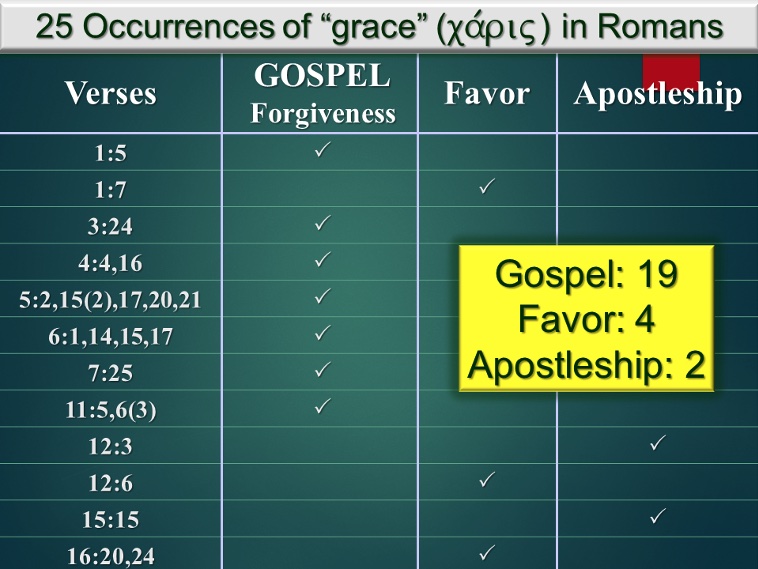
As Greek lexicographer Joseph Thayer explained: “the N.T. writers use xa/ri$ pre-eminently of that kindness by which God bestows favors even upon the ill-deserving, and grants to sinners the pardon of their offences, and bids them accept of eternal salvation through Christ.”2
To repeat: the grace of the Bible is God making it possible for people to be forgiven of their sin. But they must meet the pre-conditions of that forgiveness by conforming to the instructions/prescriptions God has given to receive that forgiveness. And people must maintain a sincere, attentive desire to comply with God’s laws, and to regularly repent and seek forgiveness when they make mistakes along the way. Herein lies the definition of what it means to “walk in the light” (1 John 1:7).
Concluding Observation
Perhaps the worst feature of the “grace only” doctrine is its blatant, inherent manifestation of disrespect for God Himself. After all, who gives us spiritual law? Who authored the Law of Moses? Who provides us with the “law of Christ” (Galatians 6:2)? Any denigration of law—any negative representation of biblical law—is an aspersion directed against God. No wonder Paul declared in no uncertain terms that “the law is holy, and the commandment holy and just and good” (Romans 7:12). Indeed, we would not even know what offends God—what sin is—if He had not given us law (Romans 3:20). Law is never depicted in Scripture as somehow “bad,” or negative, or undesirable, or oppressive. God’s commands are not “burdensome” (1 John 5:3)—they are not too hard for us. Indeed, they are like sweet honey to our mouths and far more precious than pure gold (Psalm 19:10). May we join wholeheartedly and genuinely with the psalmist in his exclamation: “Oh, how I love Your law! It is my meditation all the day” (Psalm 119:97).
Endnote
1 Frederick Danker (2000), A Greek-English Lexicon of the New Testament and Other Early Christian Literature (Chicago, IL: University of Chicago), third edition, pp. 1079-1080.
2 Joseph Thayer (1901), A Greek-English Lexicon of the New Testament (Grand Rapids, MI: Baker, 1977 reprint), p. 666.
The post “Not Under Law, But Grace” appeared first on Apologetics Press.
]]>The post 13 Objections to Baptism Answered appeared first on Apologetics Press.
]]>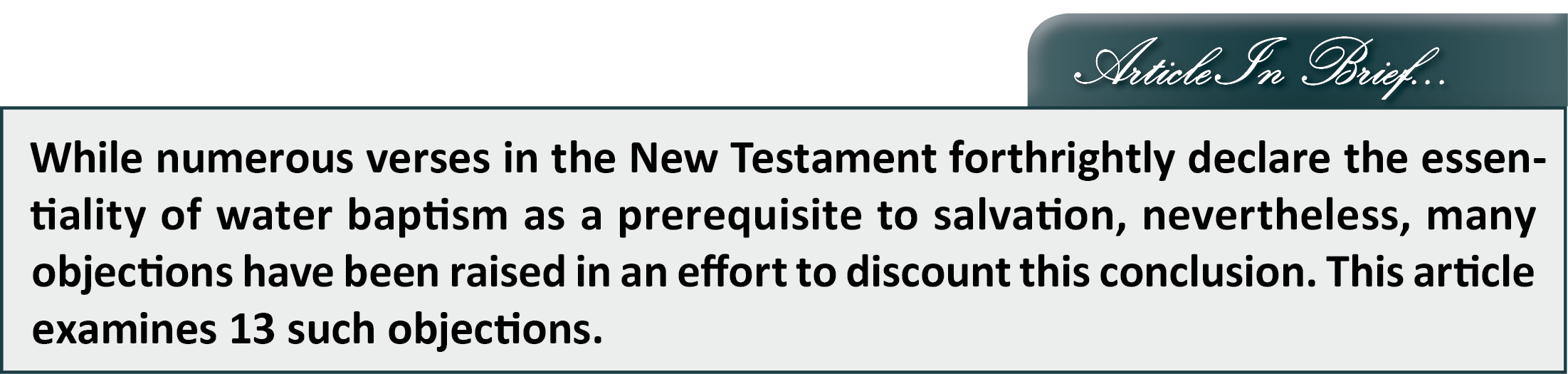
Some churches historically have taught that water immersion is the dividing line between the lost and the saved. This means that a penitent believer remains unforgiven of sin until buried in the waters of baptism (Romans 6:4). Much of the denominational world disagrees with this analysis of Bible teaching, holding instead that one is saved at the point of “belief,” before and without water baptism. Consider some of the points that are advanced in an effort to minimize the essentiality of baptism for salvation.
Objection #1: “Jesus could not have been baptized for the remission of sins because He was sinless; therefore, people today are not baptized in order to be forgiven. They merely imitate Jesus’ example.”
The baptism to which Jesus submitted Himself was John’s baptism (Matthew 3:13; Mark 1:9). John’s baptism was for the remission of sins (Mark 1:4; Luke 3:3). This truth is particularly evident from the fact that when Jesus presented Himself to John for baptism, John sought to deter Him, noting that, if anything, Jesus needed to baptize John (Matthew 3:14). Jesus did not correct John, as many seek to do today, by falsely arguing that baptism is not for remission of sins. Rather, Jesus, in effect, agreed with John, but made clear that His baptism was an exception to the rule.
Jesus’ baptism was unique and not to be compared to anyone else’s baptism. Jesus’ baptism had the unique purpose of “fulfilling all righteousness” (Matthew 3:15). In other words, it was necessary for Jesus to submit to John’s baptism (1) to show His contemporaries that no one is exempt from submitting to God’s will and (2) more specifically, Christ’s baptism was God’s appointed means of pinpointing for the world the precise identity of His Son. It was not until John saw the Spirit of God descending on Jesus and heard the voice (“This is My Son…”) that he knew that “this is the Son of God” (John 1:31-34; Matthew 3:16-17).
Of course, John’s baptism is no longer valid (Acts 18:24-19:5). John’s baptism paralleled New Testament baptism in the sense that both were for the forgiveness of sins. But John’s baptism was transitional in nature, preparing Jews for their Messiah. Baptism after the cross is for all people (Matthew 28:19), in Jesus’ name (Luke 24:47; Acts 2:38; 19:5), into His death (Romans 6:3), in order to be clothed with Him (Galatians 3:27), and added to His church (Acts 2:47; 1 Corinthians 12:13). We must not use Jesus’ baptism to suggest that salvation occurs prior to baptism.
Objection #2: “The thief on the cross was not baptized, and he was saved.”
When we “handle aright the word of truth” (2 Timothy 2:15), we see that the thief was not subject to the New Testament command of immersion because this command was not given until after the thief’s death.¹ It was not until Christ was resurrected that He said, “He who believes and is baptized will be saved” (Mark 16:16). It was not until Christ’s death that the Old Testament ceased, signified by the tearing of the Temple curtain (Matthew 27:51). When Jesus died, He took away the Old Testament, “nailing it to the cross” (Colossians 2:14).
The word “testament” means “covenant” or “will.” The last will and testament of Christ is the New Testament, which consists of those teachings that apply to people after the death of Christ. If we expect to receive the benefits of the New Testament (salvation, forgiveness of sin, eternal life), we must submit to the terms of the will for which Christ is mediator (Hebrews 9:15), for “where a testament is, there must also of necessity be the death of the testator; for a testament is of force after men are dead; otherwise it is of no strength at all while the testator lives” (Hebrews 9:16-17).
So prior to the Lord’s death and the sealing of the New Testament, the baptism for the forgiveness of sins that would be in effect after the crucifixion was not a requirement for those who sought to be acceptable to God. Indeed, while Jesus was on Earth in person, He exercised His authority to forgive sin (Matthew 9:6). People now, however, live during the Christian era of religious history. Prior to Christ’s death, there were no Christians (Acts 11:26). For a person to reject water baptism as a prerequisite to salvation on the basis of what the thief did or did not do, is comparable to Abraham seeking salvation by building an ark—because that’s what Noah did to please God. It would be like the rich young ruler (Matthew 19) refusing Christ’s directive to sell all his possessions—because wealthy King David did not have to sell his possessions in order to please God.
The thief on the cross could not have been baptized the way the new covenant stipulates you and I must be baptized. Why? Romans 6:3-4 teaches that if we wish to acquire “newness of life,” we must be baptized into Christ’s death, be buried with Christ in baptism, and then be raised from the dead. There was no way for the thief to comply with this New Testament baptism—Christ had not died! Christ had not been buried! Christ had not been raised! In fact, none of God’s ordained teachings pertaining to salvation in Christ (2 Timothy 2:10), and in His body the Church (Acts 2:47; Ephesians 1:22-23), had been given. The church, which Christ’s shed blood purchased (Acts 20:28), had not been established, and was not set up until weeks later (Acts 2).2
We must not look to the thief as an example of salvation. Instead, we must obey “from the heart that form of doctrine” (Romans 6:17)—the form of Christ’s death, burial, and resurrection through baptism (Romans 6:3-4). Only then can we be “made free from sin to become the servants of righteousness” (Romans 6:18).
Objection #3: “The Bible says, ‘Christ stands at the door of your heart,’ and all we have to do to be forgiven of sin and become a Christian is to invite Him into our hearts.”
It is no doubt startling to discover that the Bible simply does not say such a thing. The phraseology is reminiscent of Revelation 3:20—the passage usually invoked to support the idea. But examine what Revelation 3:20 actually teaches. Revelation chapters 2 and 3 consist of seven specific messages directed to seven churches of Christ in Asia Minor in the first century. Thus, at the outset, we must recognize that Revelation 3:20 is addressed to Christians—not non-Christians seeking conversion to Christ.
Second, Revelation 3:20 is found among Christ’s remarks to the church in Laodicea. Jesus made clear that the church had moved into a lost condition. The members were unacceptable to God since they were “lukewarm” (3:16). They had become unsaved since their spiritual condition was “wretched and miserable and poor” (3:17). Thus, in a very real sense, Jesus had abandoned them by removing His presence from their midst. Now He was on the outside looking in. He still wanted to be among them, but the decision was up to them. They had to recognize His absence, hear Him knocking for admission, and open the door—all of which is figurative language indicating their need to repent (3:19). They needed to return to the obedient lifestyle essential to sustaining God’s favor (John 14:21,23).
Observe that Revelation 3:20 in no way supports the idea that non-Christians merely have to “open the door of their heart” and “invite Jesus in” with the assurance that the moment they mentally/verbally do so, Jesus comes into their heart and they are simultaneously saved from all past sin and have become Christians. The context of Revelation 3:20 shows that Jesus was seeking readmission into an apostate church.
Does the Bible teach that Christ comes into a person’s heart? Yes, but not in the way the religious world suggests. For instance, Ephesians 3:17 states that Christ dwells in the heart through faith. Faith can be acquired only by hearing biblical truth (Romans 10:17). When Bible truth is obeyed, the individual is “saved by faith” (Hebrews 5:9; James 2:22; 1 Peter 1:22). Thus Christ enters our lives when we “draw near with a sincere heart in full assurance of faith, having our hearts sprinkled from an evil conscience [i.e, repentance—DM] and our bodies washed with pure water [i.e., baptism—DM]” (Hebrews 10:22).
Objection #4: “A person is saved the moment he accepts Christ as his personal Savior—which precedes and therefore excludes water baptism.”
To suggest that all one has to do to receive the forgiveness of God and become a Christian is to mentally accept Jesus into his heart and make a verbal statement to that effect, is to dispute the declaration of Jesus in Matthew 7:21—“Not everyone who says to Me, ‘Lord, Lord,’ shall enter the kingdom of heaven, but he who does the will of My Father in heaven.” To be sure, oral confession of Christ is one of the prerequisites to salvation (Romans 10:10). But Jesus said there is more to becoming a blood-bought follower of His than verbally “calling on his name”3 or “inwardly accepting Him as Savior.” He stated that before we can even consider ourselves as God’s children (Christians), we must show our acceptance of His gift through outward obedience—“He that does the will of My Father.” Notice the significant contrast Jesus made: the difference between mental/verbal determination to accept and follow the Lord, versus verbal confession coupled with action or obedience (cf. James 2:14,17). This is why we must do everything the Lord has indicated must be done prior to salvation. Jesus is telling us that it is possible to make the mistake of claiming we have found the Lord, when we have not done what He plainly told us to do.
Jesus said: “Most assuredly, I say to you, unless one is born of water and the Spirit, he cannot enter the kingdom of God” (John 3:5). Jesus also stated: “He who believes and is baptized will be saved; but he who does not believe will be condemned” (Mark 16:16). Honestly, have you accepted Christ as your personal savior—in the way He said it must be done? He asks: “But why do you call Me ‘Lord, Lord,’ and do not do the things which I say?” (Luke 6:46, emp. added).
Objection #5: “We are clothed with Christ and become His children when we place our faith in Him.”
Read Galatians 3:26-27: “You are all children of God by faith in Christ Jesus, for as many of you as have been baptized into Christ have put on Christ.” The words “put on” (NKJV) are a translation of the Greek verb enduo which signifies “to enter into, get into, as into clothes, to put on.” Can we be saved prior to “putting Christ on” or “being clothed” with Christ? Of course not. But when and how does one put on Christ—according to Paul? When one is baptized in water. Those who teach we can be saved before baptism are, in reality, teaching we can be saved while spiritually naked and without Christ! Paul affirms that we “put on” Christ at the point of our baptism—not before.
Paul wrote these words to people who were already saved. They had been made “sons of God by faith.” But how? At what point had they “been clothed with Christ”? When were they made “sons of God by faith”? When were they saved? Paul makes the answer to these questions very plain: they were united with Christ, had put on Christ, and were clothed with Christ—when they were baptized. Saving faith does not exclude baptism—it includes baptism. Ask yourself if you have been clothed with Christ.
Objection #6: “Baptism is like a badge on a uniform that merely gives evidence that the person is already saved.”
The New Testament nowhere expounds the idea that baptism is merely a “badge” or “outward sign of an inward grace.” Yes, baptism can biblically be referred to as a symbolic act; but what does it symbolize? Previous forgiveness? No! Romans 6 indicates that baptism symbolizes the previous death, burial, and resurrection of Jesus. Thus the benefits of Jesus’ death, burial, and resurrection (remember, Jesus’ blood, which blots out sin, was shed in the context of His death, burial, and resurrection) are realized and received by the individual when he obediently (in penitent faith) submits to a similar ordeal, i.e., the death of his own “old man” or “body of sin” (Romans 6:6), burial (immersion into a watery tomb), and resurrection (rising from the watery tomb).
Denominational doctrine maintains that forgiveness of sin is received prior to baptism. If so, the “new life” of the saved individual would also begin prior to baptism. Yet Paul said the “new life” occurs after baptism. He reiterated this to the Colossians. The “putting off of the body of the flesh by Christ’s circumcision” (Colossians 2:11) is accomplished in the context of water immersion and being “risen with Him” (Colossians 2:12). Chapter 3 then draws the important observation: “If then you were raised with Christ [an undeniable reference to baptism—DM], seek those things which are above” [an undeniable reference to the new life which follows—not precedes—baptism].
Objection #7: “Baptism is a meritorious work, whereas we are saved by grace, not works.”
“Works” or “steps” of salvation do not imply that one “merits” his salvation upon obedient compliance with those actions. Rather, “steps” or “a process” signifies the biblical concept of preconditions, stipulations of faith, or acts of obedience—what James called “works” (James 2:17). James was not saying that one can earn his justification (James 2:24). Rather, he was describing the active nature of faith, showing that saving faith, faith that is alive—as opposed to dead and therefore utterly useless (2:20)—is the only kind that is acceptable to God, a faith that obeys whatever actions God has indicated must be done. The obedience of both Abraham and Rahab is set forth as illustrative of the kind of faith James says is acceptable. They manifested their trust by actively doing what God wanted done. Such obedient or active trust is the only kind that avails anything. Thus, an obedient response is essential.
The actions themselves are manifestations of this trust that justifies, not the trust itself. But notice that according to James, you cannot have one without the other. Trust, or faith, is dead, until it leads one to obey the specifications God assigned. Here is the essence of salvation that separates those who adhere to biblical teaching from those who have been adversely influenced by the Protestant reformers. The reformers reacted to the unbiblical concept of stacking bad deeds against good deeds in an effort to offset the former by the latter (cf. Islam). Unfortunately, the reactionary reformers went to the equally unacceptable, opposite extreme by asserting that man need “only believe” (Luther) or man can do nothing at all (Calvin). The truth is between these two unbiblical extremes.
From Genesis to Revelation, faith is the trusting, obedient reaction that humans manifest in response to what God offers. This is the kind of “justification by faith” that Paul expounded in Romans. Like red flags at the very beginning (1:5) and at the end (16:26) of his divinely inspired treatise, he defined what he meant by “faith” with the words “obedient faith” (hupakoein pisteos), i.e., faith that obeys, obedience which springs from faith.4 This fact is precisely why God declared His willingness to fulfill the promises He made to Abraham: “because Abraham obeyed My voice and kept My charge, My commandments, My statutes, and My laws” (Genesis 26:5). Hence, in Romans Paul could speak of the necessity of walking “in the steps of the faith which our father Abraham had” (Romans 4:12). Until faith obeys, it is useless and cannot justify.
The Hebrews writer made the same point in Hebrews 11. The faith we see in Old Testament “men of faith” availed only after they obeyed God-given stipulations. God rewards those who “diligently seek Him” in faith (vs. 6). Noah “became heir of the righteousness which is by faith” when he “prepared an ark.” If he had not complied with divine instructions, he would have been branded as “unfaithful.” The thing that made the difference, that constituted the line of demarcation between faith and lack of faith, was obedient action—what James called “works,” and Paul called “faith working through love” (Galatians 5:6). In this sense, even faith is a “work” (John 6:29). Hebrews 11 repeatedly reinforces this eternal principle: (1) God offers grace (which may at any point in history consist of physical blessings, e.g., healing, salvation from enemies, land or property, etc., or spiritual blessings, e.g., justification, forgiveness, salvation from sin, being made righteous, etc.); (2) man responds in obedient trust (i.e., “faith”) by complying with the stipulated terms; and (3) God bestows the blessing.
It would be wrong to think that man’s obedient response earns or merits the subsequent blessing. Such simply does not logically follow. All blessings God bestows on man are undeserved (Luke 17:10). His rich mercy and loving grace is freely offered and made available—though man never deserves such kindness (Titus 2:11). Still, a non-meritorious response is absolutely necessary if unworthy man is to receive certain blessings.
Objection #8: “Not only is baptism nonessential to salvation, even faith is a gift from God to a person. Man is so depraved that he is incapable of believing.”
Surely, God’s infinite justice would not permit Him to force man to desire God’s blessings. God’s intervention into man’s woeful condition was not in the form of causing man to desire help or miraculously generating faith within man. God intervened by giving His inspired Word, which tells how He gave His Son to make a way for man to escape eternal calamity. Faith is then generated in the individual by God’s words which the person must read and understand (Romans 10:17; Acts 8:30). The individual then demonstrates his faith in obedience.
Did the walls of Jericho fall down “by faith” (Hebrews 11:30)? Absolutely. But the salient question is: “When?” Did the walls fall the moment the Israelites merely “believed” that they would fall? No! Rather, when the people obeyed the divine directives. The walls fell “by faith” after the people met God’s conditions. If the conditions had not been met, the walls would not have fallen down “by faith.” The Israelites could not claim that the walls fell by their own effort, or that they earned the collapse of the walls. The city was given to them by God as an undeserved act of His grace (Joshua 6:2). To receive the free gift of the city, the people had to obey the divinely stipulated prerequisites.
Notice the capsuling nature of Hebrews 11:6. Faith or belief is not given by God. It is something that man does in order to please God. The whole chapter is predicated on the fundamental idea that man is personally responsible for mustering obedient trust. God does not “regenerate man by His call, thus enabling man to respond.” God “calls” individuals through, by means of, His written Word (2 Thessalonians 2:14). In turn, the written Word can generate faith in the individual (Romans 10:17). How unscriptural to suggest that man is so “totally depraved” that he cannot even believe, thus placing God in the position of demanding something from man (John 8:24) of which man is inherently incapable. But the God of the Bible would not be guilty of such injustice.
Some people approach passages like Romans 10:17 in this fashion: (1) God chooses to save an individual; (2) God gives him the free gift of faith; and (3) God uses the Gospel to stir up the faith which He has given the person. Yet neither Romans 10:17, nor any other passage, even hints at such an idea. The text states explicitly that faith comes from hearing Christ’s Word. Notice verse 14, where the true sequence is given: (1) the preacher preaches; (2) the individual hears the preached word; and (3) believes. This sequence is a far cry from suggesting that God miraculously imparts faith to a person, and then the Holy Spirit “stirs up” the faith. Such a notion has God giving man a defective faith which then needs to be stirred up. The text makes clear that God has provided for faith to be generated (i.e., originated) by the preached Word. God does not arbitrarily intervene and impose faith upon the hearts of a select group of individuals.
According to 1 Corinthians 1:21, mankind did not know God, so God transmitted His message through inspired preachers so that those who respond in faith would be saved. Paul wrote in Romans 1:16 that this gospel message is God’s power to save those who believe it. Notice that the Gospel is what Paul preached (vs. 15). Thus the preached message from God generates faith and enables people to be saved.
We see the same in Acts 2:37. What pierced the hearts of the listeners? Obviously, the sermon. Acts 2:37 is a demonstration of Romans 10:17—“faith comes by hearing…the word of God.” God did not change the hearts of the people miraculously; Peter’s words did. If denominational doctrine is correct, when the Jews asked the apostles what they should do, Peter should have said: “There’s nothing you can do. You are so totally depraved, you can’t do anything. God will regenerate you; He will cause you to believe (since faith is His ‘free gift’).” Yet, quite to the contrary, Peter told them that they needed to do some things. And they were things that God could not do for them.
First, they were required to “repent.” Biblical repentance is a change of mind (Matthew 21:29). A “turning” follows repentance (Acts 3:19) and consists of some specified action subsequent to the change of mind. John the Baptizer called this turning activity, which follows repentance and serves as evidence that repentance has occurred, “fruits” (Matthew 3:8). After being convicted (Acts 2:37—i.e., believing the truth of Peter’s contentions), they were told to “repent,” to change their minds about their previous course of life. What else were they to do?
Peter did not tell them to “repent and believe.” Their belief was already abundantly evident in their pricked hearts and their fervent petition for instructions. What was lacking? Peter said (i.e., God said) they still lacked baptism. Remember, the only difference between dead faith and saving faith is outward action—compliance with all actions that God specifies as necessary before He will freely bestow unmerited favor in the form of forgiveness.
Thus baptism marked the point at which God would count them righteous if they first believed and repented. Baptism served as the line of demarcation between the saved and the lost. Jesus’ blood could wash their sins away only at the point of baptism.
Objection #9: “The preposition ‘for’ in the phrase ‘for the remission of sins’ in Acts 2:38 means ‘because of.’ Hence, they were baptized because of sins for which they were forgiven when they believed.”
The English word “for” has, as one of its meanings, “because of.” However, the Greek preposition eis that underlies the English word “for” never has a causal function. It always has its primary, basic, accusative thrust: unto, into, to, toward. We must not go to the text, decide what we think it means, and assign a grammatical meaning that coincides with our preconceived understanding. We must begin with the inspired grammar and seek to understand every text in light of the normal, natural, common meaning of the grammatical and lexical construction. The same grammatical construction of Acts 2:38 is found in Matthew 26:28—“into the remission of sins” (eisaphesin hamartion). Jesus’ blood, the blood of the covenant, was undeniably shed for many “in order to acquire remission of sins.” This is the natural and normal meaning of the Greek preposition—toward, in the direction of. Had the Holy Spirit intended to say that baptism is “because of” or “on account of” past forgiveness, He would have used the Greek preposition that conveys that very idea: dia with the accusative.
Similarly, in Acts 2:38, if repentance is not “because of” remission of sins, neither is baptism. Regardless of person and number considerations, Peter told his hearers to do both things. The act of baptism (connected to the act of repentance by the coordinate conjunction) cannot be extricated from the context of remission of sins by any stretch.
Objection #10: “When the Philippian jailer asked what to do to be saved, he was simply told to believe on the Lord Jesus Christ.”
As further proof that God does not miraculously bestow faith on a person through the Holy Spirit, observe that Paul told the jailer that he (the jailer) had to believe; he did not answer the jailer’s question with: “You don’t have to do anything. God will give you faith.” On the contrary, Paul and Silas told him that he had to manifest faith in Jesus. But was this pagan jailer in a position at that moment to do so? No, he would have to be taught Who, how, and what to believe. No wonder, then, Luke records immediately: “they spoke the word of the Lord to him” (Acts 16:32). If Romans 10:17 can be trusted, the words which Paul and Silas proclaimed generated faith in the jailer. And those same words surely included the necessity of repentance and baptism, because the jailer immediately manifested the fruit of repentance (by washing their stripes), and likewise was immediately baptized (not waiting until morning or the weekend). Observe carefully Luke’s meticulous documentation, that it was only after the jailer believed, repented, and was baptized, that the jailer was in a position to rejoice. Only then did Luke describe the jailer as “having believed in God” (vs. 34), i.e., now standing in a state of perfected belief.5
Objection #11: “Saul was saved before and without baptism while he was on the road to Damascus when Jesus appeared to him.”
The actual sequence of events delineated in Acts shows that Saul was not saved while on the road to Damascus. Jesus identified Himself and then accused Saul of being a persecutor (Acts 9:5). Saul “trembled” and was “astonished” (hardly the description of a saved individual), and pleadingly asked what he should do—a clear indication that he had just been struck with his lost and undone condition.
This question has the exact same force as the Pentecostians’ question (Acts 2:37) and the jailer’s question (Acts 16:30). All three passages are analogous in their characterization of individuals who had acted wrongly (i.e., the Pentecostians had crucified Jesus, Saul was persecuting Christians, and the jailer had kept innocent Christians jailed). Likewise, in each instance, the candidates for conversion are portrayed as unhappy (i.e., the Pentecostians were “cut to the heart,” Saul “trembled” and “was astonished,” and the jailer “came trembling”—i.e., he was frightened). They were scared, miserable individuals, suddenly brought face to face with their horribly unacceptable status before God. Such is hardly an apt description for saved individuals. Where is the joy, peace, and excitement that comes when one’s sins have been washed away?
Saul was not forgiven on the road to Damascus—he still needed to be told what he “must do” (Acts 9:6). He still lacked “hearing the word of the Lord.” The only way for Saul to hear the Gospel was through the agency of a preacher (Romans 10:14; 1 Corinthians 1:21). Similarly, an angel told Cornelius (Acts 10:4) that his prayers and money had gone up for a memorial before God—yet he was unsaved. He needed to contact an inspired preacher, Peter, “who will tell you words by which you and all your household will be saved” (Acts 11:14). Likewise, before Saul could learn of God’s plan that he be the great “apostle of the Gentiles,” he first needed to hear the Gospel expounded and told how to respond to what God offered in Christ.
Rather than tell him what he needed to do to be saved, Jesus told him to go into the city, where a preacher (Ananias) would expound to him the necessity of salvation. Notice: Saul waited in Damascus for three days without food and drink, and was still blind. Here’s an individual who was still miserable, unhappy, and unsaved, awaiting instructions on how to change his unfortunate status. Acts 9:18 condenses Saul’s response to the preached Word, while Acts 22 elaborates a little further on the significance of Saul’s response. Ananias said, “And now why are you waiting? Arise and be baptized, and wash away your sins, calling on the name of the Lord” (Acts 22:16).
Notice Ananias’ inspired connection between baptism and sins being cleansed. If Saul was saved prior to baptism, it was wrong for Ananias to say that Saul still had sins that needed to be washed away. Ananias did not congratulate Saul because his sins already were washed away, and tell him that he needed to be baptized only as a “badge” or “outward symbol” or “picture” of what had already occurred. He plainly said Saul’s sins yet needed to be washed away. That can be accomplished only by Jesus’ blood in the act of baptism. The water does not cleanse the sin-stained soul—Jesus does. And Ananias clearly stated when (not how or by Whom) that occurs. If Saul’s penitent faith would not lead him to submit to water immersion, he could not have had his sins washed away by Jesus. Instead, he would have remained in opposition to Jesus. Remember, Scripture never portrays baptism as symbolic of previous sin removal. The only symbolism ever attached to the act of baptism is its (1) likeness to Jesus’ death, burial, and resurrection (Romans 6:3-5); (2) its comparison to the removal of sin like circumcision removes skin (Colossians 2:12); and (3) its likeness to Noah’s emergence from a sinful world (1 Peter 3:20-21). God literally (not symbolically) removes sin and justifies the individual by grace, through faith, at the point of baptism.
Objection #12: “If baptism is necessary to salvation, Jesus would have said, ‘but he who does not believe and is not baptized will be condemned’ in Mark 16:16. And besides, the last twelve verses of Mark 16 are not included in the oldest and best Greek manuscripts.”
The omission of “and is not baptized” in Mark 16:16 is completely logical and necessary. The first phrase (“he who believes and is baptized”) describes man’s complete response necessitated by the preaching of the Gospel: Faith must precede baptism, since obviously one would not submit to baptism if he did not first believe. It is non-essential to ascribe condemnation in the second clause to the individual who is not baptized, since the individual being condemned is the one who does not initially believe. The person who refuses to believe “is condemned already” (John 3:18) and certainly would not be interested in the next item of compliance—baptism. He who does not believe would obviously not be baptized—and even if he would, his failure to first believe disqualifies him from being immersed. Only penitent believers are candidates for baptism. An exact grammatical parallel would be: “He who goes to the store and buys coffee for his father will receive $5.00. He who does not go to the store will be spanked.” Obviously, if the child refuses to go to the store, he would not be in a position to buy coffee, and it would be redundant—even grammatically and linguistically inappropriate—to include the failure to purchase the coffee in the pronouncement of an impending spanking.
Are the last verses of Mark 16 uninspired? The textual evidence supporting the authenticity of Mark 16:9-20 is exceptional in light of the vast sources available for establishing the original text. While it is true that Vaticanus and Sinaiticus omit the last 12 verses, it is positively misleading to assume that “the validity of these verses is weak.” In fact, the vast number of witnesses are in favor of the authenticity of verses 9-20. The rejection of Vaticanus is less weighty in light of its comparable exclusion of the Pastoral Epistles, the last part of Hebrews, and Revelation. The rejection of Sinaiticus is similarly unconvincing, since it includes some of the Apocryphal books.6
Objection #13: “Romans 10:9-10 indicates that all one needs to do is believe and confess Jesus.”
The use of eis in Romans 10:10 cannot mean “because of.” Verse nine explicitly says one will be saved “if” he confesses and believes in the heart. Confession and faith are therefore prerequisites to forgiveness. They are God-ordained “responses” to the preached Word (vs. 8) and must occur before salvation is imparted by God. In other words, one’s soul is purified when he obeys the truth (1 Peter 1:22). Jesus provides eternal salvation to those who obey Him (Hebrews 5:9).
But is baptism excluded from salvation since only faith and confession are mentioned in Romans 10:9-10? Notice, four chapters earlier, the order of Romans 6:17-18: (1) slaves to sin; (2) person obeys; (3) made free from sin (righteous). Item (3) cannot occur unless item (2) occurs first. The “whole” of man is to reverence God and keep His commands (Ecclesiastes 12:13). To whom does God give the Holy Spirit? To those whom He arbitrarily chooses, without any consideration of the individual’s necessitated response? No. Acts 5:32 says God gives the Holy Spirit to those who obey Him. God has always conditioned the bestowal of spiritual blessing upon prior obedient response (Jeremiah 7:23; Genesis 26:4-5). Deuteronomy 5:10 says God shows mercy to those who love Him and keep His commands.
In Romans 10, Paul is not stressing the specific aspects of the conversion process. That is not the context. Rather, the context addresses whether one is acceptable to God in the Christian dispensation due to physical heritage (i.e., race/ethnicity), versus whether one is saved when one complies with God’s instruction. Paul was stressing that their nationality could not bring the Jews into God’s favor. Rather, people are saved when they render obedience to the Gospel. He quoted Joel 2:32, where the emphasis is on the word “whosoever” in contrast to “Jews only.” Verse 12 argues that God does not distinguish on the basis of race. The individual’s response to the preached Word is the deciding factor. However, Romans 10 does not reveal all of the details of that obedient response. One must be willing to search out the whole truth on such a subject.
If repentance is essential to salvation, one must concede that such teaching must come from some passage other than Romans 10. Does Romans 10:10 mean that repentance is unnecessary, just because it is unmentioned in the text? No, since repentance is required in chapter 2:4. If not, then why assume baptism to be nonessential simply because it is not mentioned in this particular text? It is enjoined in chapter 6:3-4. To ascertain the significance of baptism in God’s sight, one must go to passages that discuss that subject, rather than dismiss them in deference to verses on faith. If God says, “faith saves” (Romans 5:1), let us accept that truth. If God says, “baptism saves” (1 Peter 3:21), let us accept that truth, too! Jesus Himself said: belief + baptism = salvation (Mark 16:16), not belief = salvation + baptism.
Notice also, Romans 10:10,13 does not say that salvation can be acquired by mere verbal confession (e.g., “I accept Jesus into my heart as my personal Savior”). Why?
(1) Nowhere is the statement, “Accept Jesus as your personal Savior,” found in Scripture.
(2) Jesus forever dashed the idea of salvation by mental acceptance/verbal profession alone in Matthew 7:21 and Luke 6:46, where He showed that oral confession alone is unacceptable. In every age, there have been specified actions of obedience that God has required before He would count individuals as pleasing or acceptable. In fact, if faith is not coupled with the appropriate obedient action (like baptism), then such faith is unable to justify. Such faith is imperfect (James 2:17,20,26) and therefore cannot save!
(3) The phrase “call on the name of the Lord” is an idiomatic way to say: “respond with appropriate obedient actions.” It is the figure of speech known as synecdoche (i.e., the part stands for the whole). To “call” on God’s name is equivalent to saying, “Do what He tells you to do.” Isaiah 55:6 told the Jews of Isaiah’s day to call on God. Verse 7 explains how: (1) forsake wicked ways, (2) forsake wicked thoughts, (3) return to the Lord. To obey these three stipulations constituted “calling on God.”
Likewise, those in Jerusalem who “called on the Lord’s name” (Acts 9:14,21) had done so, not solely by verbal confession, but by repentance and baptism for forgiveness of sins (Acts 2:38). Similarly, Paul himself became a Christian, that is, he “called on the name of the Lord”—not by verbally confessing Christ—but by being baptized (Acts 22:16). For Paul, “calling on the Lord’s name” was equivalent to (not precedent to) being baptized. God washed his sins away by the blood of Jesus at the point of his baptism.
CONCLUSION
Though the bulk of Christendom for centuries has veered off into Calvinism and other post-first century theological thought, the meaning and design of baptism is determined by the New Testament. The verses in the New Testament that speak about baptism are definitive. They indicate that water immersion precedes salvation—along with faith, repentance, and confession of Christ’s deity. No objection has ever overturned this divinely intended function.
ENDNOTES
1 Although the thief may well have submitted to the precursor to NT baptism, i.e., John’s baptism, it also was “for the remission of sins” (Mark 1:4; Luke 3:3).
2 See also Dave Miller (2003), “The Thief on the Cross,” Apologetics Press, http://www.apologeticspress.org/APContent.aspx?category=11&article=1274&topic=86.
3 Cf. Eric Lyons (2004), “Calling on the Name of the Lord,” http://www.apologeticspress.org/articles/597.
4 Rudolf Bultmann (1968), “πιστεύω,” Theological Dictionary of the New Testament (Grand Rapids, MI: Eerdmans, 1982 reprint), 6:206; Fredrick William Danker (2000), “ὑπακοη,” A Greek-English Lexicon of the New Testament and Other Early Christian Literature (Chicago, IL: University of Chicago), third edition, p. 1028; James Denny (no date), “St. Paul’s Epistles to the Romans” in The Expositor’s Greek Testament, ed. W. Robertson Nicoll (Grand Rapids, MI: Eerdmans), 2:587; J.B. Lightfoot (1895), Notes on Epistles of St. Paul (London: Macmillan), p. 246; H.P.V. Nunn (1912), A Short Syntax of New Testament Greek (Cambridge: Cambridge University Press), p. 42; Geoffrey H. Parke-Taylor (1944), “A Note on ‘είς ὑπακοὴν πίστεως’ in Romans 1.5 and xvi.26,” The Expository Times, 55:305-306; A.T. Robertson (1931), Word Pictures in the New Testament (Nashville, TN: Broadman Press), 4:324; Marvin Vincent (1946), Word Studies in the New Testament (Grand Rapids, MI: Eerdmans), 3:5; W.E. Vine (1966), An Expository Dictionary of New Testament Words (Old Tappan, NJ: Fleming H. Revell), p. 123.
5 W.M. Ramsay (1915), The Bearing of Recent Discovery on the Trustworthiness of the New Testament (London: Houghton and Stoughton), p. 165.
6 For a more thorough discussion of this matter, see Dave Miller (2005), “Is Mark 16:9-20 Inspired?” Reason & Revelation, 25[12]:89-95, December, http://www.apologeticspress.org/articles/2780.
The post 13 Objections to Baptism Answered appeared first on Apologetics Press.
]]>The post Query from a Reader appeared first on Apologetics Press.
]]>I came upon your website due to the referral of a Christian brother who provided me a link to your article on John Quincy Adams’ views on Islam. Loved the article and will share it with others…. When checking into your beliefs I noted the following at this link under “What We Believe:” “Salvation is by means of obedience to the Gospel system, involving faith in God and Christ, repentance from sin, confession of faith, and immersion in water for remission of past sins, coupled with a life of growing consecration and dedication.”
In all honesty, when I read Scripture I do not get that “salvation” has anything whatsoever to do with a “Gospel system” or “obedience” thereof. Surely you cannot mean that our deeds and works can make us righteous or clean in the eyes of a perfect and entirely Holy God? Moreover, we cannot follow any kind of a “system” or formula, regardless of how good it may be. Only Christ and His completed sacrifice, once for all, can save those who believe in Him, His Word and His Resurrection. I think the most simple and direct quotes on how Salvation is “achieved” (really awarded is the better and most accurate word) is from Romans 10:17 and Acts 10:34-46….
In light of these verses, why would you take the stance you do in the above noted quote from your website? Put another way, why do you believe salvation is had by any other way than as noted in the above quoted sections of Romans, Acts and any number of other examples, throughout Scripture, of persons being saved?
P.L., Palm Desert, CA
Dear P.L.:
Thank you for your interest in our work, and your willingness to study God’s Word, and write us. You are to be commended for your desire to think through what the Bible teaches on the extremely important matter of salvation. Here are some thoughts for you to consider:
It is true that the New Testament does not use the phrase “Gospel system,” but the concept is certainly biblical, even as we speak of the “Christian system” or the “Christian religion.” In Romans, the Gospel/Grace system is contrasted with a strictly legal/law system. The point of Romans is that the Jews could not depend on their ethnic heritage (their genetic connection to Abraham with the covenant symbol of circumcision) or the Law of Moses to save them—because (1) genetic connection is fleshly and avails nothing, and (2) they did not keep the Law of Moses given to them. No one can be saved by law alone, since everyone has violated God’s law and therefore stands condemned. We needed a different approach to the sin problem, specifically, the Gospel (the good news that God inhabited human flesh in the person of His Son to atone for sin). The Gospel has law that we must obey, just like the Law of Moses, but it also has the means of ultimate atonement which the Law of Moses did not technically have (cf. Hebrews 10:4). Yes, the orchestration of that means of forgiveness is wholly God’s doing which we do not deserve. There is absolutely nothing we can do to atone for our own sin.
However, it by no means follows that there is nothing that God requires of us before He will freely cleanse us. You, yourself, agree that a person must believe. So there is something that humans must do to be saved—without assuming they earn or deserve their salvation. They must believe—an act of human effort, called a “work” in John 6:29, i.e., a work that God requires humans to perform (see Methodist lexicographer Joseph Thayer who defines “works” in John 6 as “the works required and approved by God” [1901, p. 248]). But what does it mean to believe? It is not merely a mental act of accepting Jesus (as much of Christendom incessantly maintains), since Paul defined the “faith” of Romans as an “obedient faith” (hupakoain pisteos) in 1:5 and 16:26. Romans uses forms of the word “obey” and “obedience” 10 times, and forthrightly declares that a person will be judged “according to his deeds” (2:6), and that “eternal life” will be given to “those who by patient continuance in doing good seek for glory, honor, and immortality,” while those who “do not obey the truth” will receive “indignation and wrath” (2:7-8). Romans 6:16 indicates that obedience precedes righteousness.
So, yes, humans must perform deeds to be pleasing to God. The point that the Bible makes regarding those deeds is that they do not earn salvation for the individual—they do not wash away sin—since only the blood of Christ can do that. Christ’s blood is the cleansing agent. But when does God apply Christ’s blood to our sin-stained spirits? Answer: when a person “obey[s] the Gospel” (2 Thessalonians 1:8). How does one obey the Gospel? Acts is the “book of conversions” that gives example after example of instances wherein people obeyed the Gospel to become Christians. Please access the free pdf book at http://www.apologeticspress.org/pdfs/e-books_pdf/wtbsatcoc.pdf and scroll to page 21 where you will see a chart that records only the explicitly stated actions that occurred in 10 cases of conversion to Christianity in the book of Acts—actions that preceded salvation.
Romans was not actually intended to detail the conditions of salvation; rather, Romans explains the grounds or basis of salvation—the blood of Christ. Nevertheless, in passing, Romans happens to mention every single one of the prerequisite conditions of salvation with which humans must comply before God will grant forgiveness as a free, undeserved gift. Romans 10:17, as you note, indicates that a person must first hear the Gospel/Word of God, which is designed to create faith within. But Romans 10:9-10 makes clear that faith is not the only prerequisite to forgiveness. Oral confession with the mouth is also enjoined. Romans 2:4 indicates that repentance is necessary before God will forgive. And Romans 6:1-4 indicates that water immersion precedes salvation, since it is the contact point for the blood of Christ which was shed in His death. We must be baptized “into His death” to contact that blood. That is the point at which sin is washed away by the blood of Christ. No wonder, then, that Ananias told Saul/Paul to “arise and be baptized, and wash away your sins, calling on the name of the Lord” (Acts 22:16). When does a person achieve “calling on the Lord”? When the believing, repenting, confessing person submits to water immersion (Acts 22:16). That explains why Peter declared that baptism “now saves us” (1 Peter 3:21)—in the sense that Christ’s blood saves us at the point of our baptism; and that is why that same Peter impressed upon those present in Acts 10 that the reception of Holy Spirit baptism directly from God upon the Gentiles was proof positive that Gentiles had the right to become Christians just as much as the Jews. Once their eligibility for conversion was demonstrated by that miraculous act direct from God, Peter then pressed for their obedience in the words, “Can anyone forbid water, that these should not be baptized…?” (Acts 10:47). Why even bring up water at that moment if water immersion was not prerequisite to their forgiveness?
So faith, repentance, confession, and baptism are all indicated to precede remission of sin. We must obey these acts—not to atone for our sin, for only Jesus can do that—but to comply with God’s stated conditions. Those pre-conditions to salvation were authored by Him (not us), and He enjoined them upon all who wish to be saved. That is why the Hebrews writer stated forthrightly that Jesus is “the author of eternal salvation to all who obey Him” (Hebrews 5:9, emp. added). It is interesting that you quote Acts 10:34-35 which indicates that before a person is acceptable to Christ, that person must “fear Him and work righteousness” (vs. 35). In other words, believe and obey—actions that humans must perform in order to receive the free gift of salvation available only in Christ.
Denominationalism manifests a persistent inability and/or unwillingness to distinguish between the grounds of salvation and the conditions of salvation—the difference between Christ’s atonement and man’s obedience. Yet, the Bible from beginning to end demonstrates this distinction. Indeed, Jesus Himself said: “Not everyone who says to Me, ‘Lord, Lord,’ shall enter the kingdom of heaven, but he who does the will of My Father in heaven” (Matthew 7:21). “But why do you call Me ‘Lord, Lord,’ and do not do the things which I say?” (Luke 6:46). Or as Paul expressed to the Galatians: “For you are all sons of God through faith in Christ Jesus. For as many of you as were baptized into Christ have put on Christ” (Galatians 3:26-27). The Galatians had become sons of God through faith when they were baptized in water.
REFERENCE
Thayer, J.H. (1901), A Greek-English Lexicon of the New Testament (Grand Rapids, MI: Baker, 1977 reprint).
The post Query from a Reader appeared first on Apologetics Press.
]]>The post Romans 14: Faith vs. Opinion appeared first on Apologetics Press.
]]>God did this very thing at the beginning of human history. On the one hand, Adam and Eve were placed under very specific articles of “faith.” For one, they were not to eat of the Tree of the Knowledge of Good and Evil. That stipulation was a matter of “faith,” i.e., God had legislated the matter. But the original pair was also given considerable latitude in exercising their own opinions. They could eat the fruit of any other tree on Monday, select another tree from which to eat on Tuesday, and still another on Wednesday. Eating from the Tree of Knowledge was a matter of “faith,” while eating any other tree was a matter of “opinion.”
Romans 14
Having defined our terms, let us turn our attention to two chapters in the New Testament that provide us with valuable information in sorting out the application of these principles in everyday life. Romans 14 has been a passage that has been used frequently in recent years to foster fellowship with denominationalism. They have contended that those denominational beliefs and practices with which churches of Christ disagree are not to be allowed to affect fellowship. For example, they have insisted that instrumental music in worship is strictly a matter of personal preference and tradition, and should be decided individually based on conscience. An appeal is made to Romans 14 to equate the use of the instrument with the eating of meat. It is then argued that those who are more spiritually mature may use the instrument in their worship to God. Those whose consciences prevent them from using the instrument are free to refrain from doing so. But they are the “weaker brother” and must not withhold fellowship from those who do use the instrument.
The first observation that is critical in making sense of this chapter is the fact that this context applies only to matters of opinion and indifference—not to matters of faith or doctrine. In his commentary on Romans, Moses Lard recognized this point when he wrote, “In matters of indifference, each man is a law to himself” (p. 412). He further stated, “it shows what liberty we have in the absence of divine command” (p. 412). In his commentary on Romans, David Lipscomb understood Romans chapter fourteen in the same fashion (1943, pp. 242ff.).
But what are “matters of indifference”? Matters of indifference refer to those practices that are indifferent to God—not to the individual. Obviously, the individual who believes he should not eat meat views his position as a serious “doctrinal” matter and, therefore, hardly “indifferent.” But we must understand that Romans 14 is speaking of those matters that are, in actuality, indifferent in the sight of God. For example, God has commanded Christians to spread the Gospel. The how of this action, whether by Internet, television, or automobile, is a matter of indifference to God. He authorizes us to use various means based upon our own good sense—our own consciences.
It is a misuse of Romans 14 to apply its teaching to any matter that is not indifferent to God. For example, God has specified that in order for a person to become a Christian, he/she must be immersed in water. Suppose a man believes that baptism can be by immersion, sprinkling, or pouring. To him, the “mode” of baptism is a matter of opinion—not faith. So he thinks that the person who limits the “mode” of baptism to strictly immersion is “narrow” and “weak in faith.” He would maintain that it is fine for his critic to be immersed if he so chooses, but this “weaker brother” should not bind his opinion on those who are “stronger” by insisting that only those who are immersed may be fellowshipped. This “stronger” fellow might even appeal to Romans 14 as support for his stance.
Yet, what this fellow would be failing to realize is that Romans 14 applies to matters of option that are indifferent to God. Where God has given His guidelines, all must conform to those specifications. Baptism, in God’s sight, is strictly immersion. Those who insist upon obeying God in this regard are not “weaker brethren.” Rather, they are faithful brethren; and those who differ are unfaithful to God.
Just as God has specified the action and design of baptism, He has been very specific with regard to the action of music in worship. If the use of the mechanical instrument in worship to God was optional, that is, if God left people free to offer musical worship in any form they so chose, then Romans 14 would be one passage that would be germane to such a discussion. But God has not left music in worship unaddressed. Neither has He left the question of the legitimacy of the denominations unaddressed. Denominationalism represents a departure from God’s simple will for His church. Romans 14 is of no help in assessing the legitimacy of either instrumental music or denominationalism.
Observe, then, that the one who is “weak in faith” in this chapter refers to the Christian whose knowledge, and therefore faith, has been insufficient in sorting out a particular issue that, in God’s sight, is a matter of opinion. Where the brother is “weak” is in the fact that he thinks that the issue under consideration is not a matter of opinion, but is, in fact, a matter of faith. The specific issues that Paul discusses pertain to the eating of certain foods and the observing of certain days. Regarding the former, one brother thinks that all foods may be eaten by Christians, while another brother thinks that Christians should be vegetarians. Regarding the latter, one brother thinks that certain days must be set aside and observed in special ways, while another brother recognizes no such requirements.
What is God’s view on this matter? Clearly, God’s view is that Christians are free to eat all foods. Jews had not been free in this regard. The Law of Moses contained numerous dietary regulations. But with the coming of Christianity, no such dietary regulations have been enjoined. Imposing such regulations on others constitutes “doctrines of demons,” as Paul explained in referring to those who were “commanding to abstain from foods which God created to be received with thanksgiving by those who believe and know the truth. For every creature of God is good, and nothing is to be refused if it is received with thanksgiving; for it is sanctified by the word of God and prayer” (1 Timothy 4:3-5). You remember the vision that Peter had in which he was commanded to kill and eat certain animals, to which he responded that he had never eaten anything that was “common or unclean.” The voice responded: “What God has cleansed you must not call common” (Acts 10:15). Paul states this point very emphatically in Romans 14:14—“I know and am convinced by the Lord Jesus that there is nothing unclean of itself.”
So the Christian who understands that no restrictions apply to food under Christianity is the one who has grasped God’s view correctly. The Christian who thinks he should not eat certain foods is “weak in faith,” that is, his faith/belief on that particular point remains immature and uninformed by the Word of God (from whence faith arises). Due to previous beliefs and/or actions, likely learned while a non-Christian, his conscience was trained by his belief that he should not eat that particular food. A specific example would be a Jew who lived his whole life abstaining from pork which was deemed “unclean.” When he became a Christian, he might not immediately sort out the change. And even when he became aware of the correct viewpoint, it would be very difficult for him to start eating pork without his conscience bothering him. That is precisely why Paul insists that neither the stronger nor the weaker should “dispute” (vs. 1), “despise” (vs. 3), “judge” (vs. 4), or “show contempt” (vs. 10) for each other. Instead, both should want to show proper regard for each other’s consciences and spiritual well-being, and strive to encourage each other to be right with God and prepared for judgment (vss. 11-12).
The same may be said for the observance of a particular day. The context shows that the days under consideration are those that have no religious significance, i.e., they are days that are indifferent to God—like a birthday. The only day that has been legislated by God under Christianity is Sunday, the first day of the week. Christians are to assemble for worship on that day and approach God through the five avenues of worship that He, Himself, has stipulated (e.g., Acts 20:7; 1 Corinthians 16:2). Sunday worship, therefore, is a matter of faith—not opinion. But other days, like birthdays, or national holidays like July 4, are matters of option that the Christian is free to observe. For the Jew who had lived his life observing the Sabbath, to suddenly not be required to abstain from labor on that day, he likely would have felt both a sense of release, but also a sense of fright and uncertainty. He would have to go through a period of struggling with and re-educating his conscience to bring his “head knowledge” into harmony with his feelings and long-term, deeply ingrained habit, before his conscience would not condemn him for Sabbath activity.
Notice, then, that the context refers to the observance of days that are religiously neutral and indifferent to God. They do not involve the observer in any unscriptural religious practice. Placing in juxtaposition this admonition in Romans 14 with a similar one in Galatians 4 will help us to see the distinction:
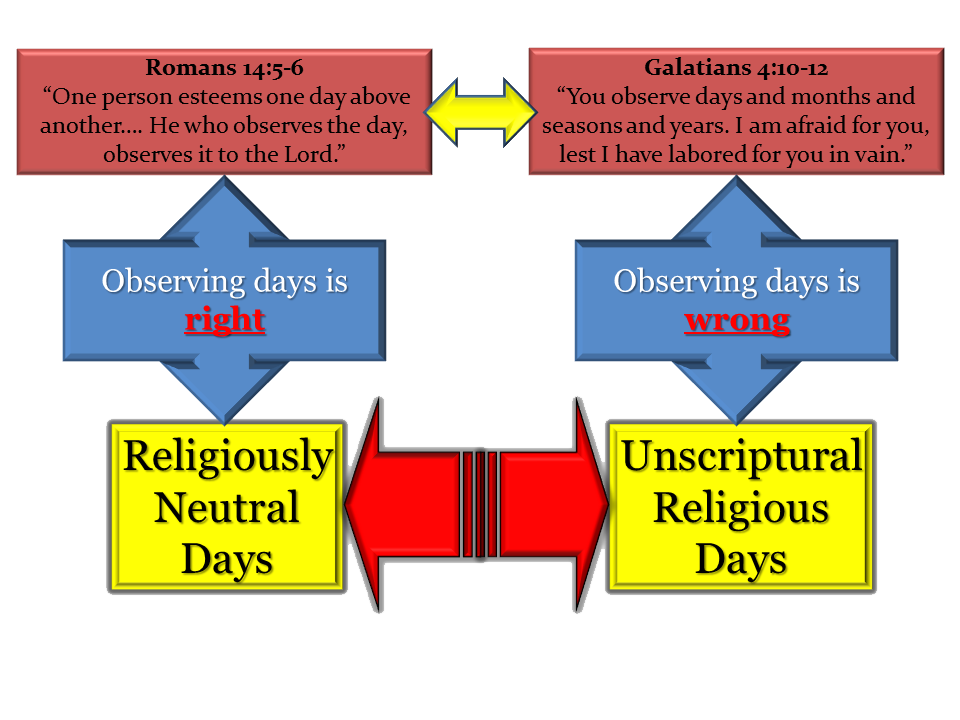
Again, Paul is not endorsing those who create their own “holy days” which they practice religiously. Christendom has generated an entire “Christian calendar” with numerous observances linked to events that occurred in the life of Christ (e.g., Ash Wednesday, Good Friday, Lent, etc.). All such observances are unscriptural since they presume to impose human thinking onto biblical precept, and dictate to God how to practice Christianity. Has God clearly indicated what event, if any, in the life of Christ He wants observed or commemorated? Absolutely—even stipulating the precise procedures to be enacted. He authorizes Christians to observe the death of Christ, every first day of the week, using bread and grape juice to symbolize the body and blood, and to think about His sacrifice while also taking an introspective look at one’s self (1 Corinthians 11:20-34). Beyond that, if God had wanted other events in Christ’s life to be commemorated, He would have said so.
But could a Jewish Christian continue to observe the Sabbath? Yes, if he did so without linking its observance to religious obligation. Since he could no longer be justified by the Old Law (Galatians 5:4), he must not observe it as if it is binding upon himself to be pleasing to God, and he must not bind it on others.
Paul issued another directive to be followed by the more mature Christians toward those Christians who had not yet assimilated proper teaching on the subject of food and days. The brother who recognizes that God permits the eating of a particular food must refrain from eating that food item under the following condition: if his eating would tempt or encourage or incite the brother who thinks it is wrong to eat it, to go ahead and eat it. The brother who thinks eating a particular food is wrong (even if, in God’s sight, it is not wrong) sins if he eats it. He has committed the sin of damaging or defiling his conscience.
1 Corinthians 8
This sin is clarified more vividly in the similar discussion that Paul directed to the Corinthian Christians regarding the eating of food that had been previously used in a pagan offering to an idol: 1 Corinthians 8. Paul insisted that no pagan gods exist (vs. 4) and, as long as a person does not intend to honor or worship a fake god, eating food that had been offered to them was optional. However, “there is not in everyone that knowledge; for some, with consciousness of the idol, until now eat it as a thing offered to an idol; and their conscience, being weak, is defiled” (vs. 7). The term “conscience” in verses 7, 10, and 12 of 1 Corinthians 8 is suneidasis and refers to that inward faculty of moral/spiritual awareness that was created by God. We must not act in ways that damage (or “sear”—1 Timothy 4:2) our consciences. To do so is sin. The Christian who thinks a particular practice is wrong, when it is not wrong in God’s sight, should be about the business of re-educating his conscience, getting his thinking straight as informed by the Word of God. By that process, in time he will be able to rise above his immature assessment and feel fully “at home” with God’s view of the matter.
Furthermore, returning to Romans 14, the more mature Christian sins if his eating an authorized food prods the immature Christian to go against his conscience and consume a food that he thinks is wrong (“evil”—vs. 20) for the Christian to consume. The mature Christian is guilty of “grieving” (vs. 15), “destroying” (vss. 15,20), “offending” (vs. 21), “making weak” (vs. 21), and causing the weaker brother to “stumble” (vs. 21). In Paul’s treatment of this matter in 1 Corinthians 8, the stronger brother that so conducts himself is guilty of causing the weak brother to “perish” (vs. 11) by “wounding his weak conscience” (vs. 12).
Some Applications
Many churches have undergone internal disruption over an infinite variety of disagreements. These disagreements might be over what color of drapes ought to hang in front of the baptistery or what carpet should be on the floor. Dissension might occur over whether to build a new auditorium or multipurpose room, how to equip the kitchen, which songbooks or Bibles to buy for the pews, or whether a preacher ought to be hired or fired. Some attempt to derail the majority’s decision and get their own way by appealing to Romans 14. They insist that implementing the decision of the elders or the majority of the men would “offend” them. This tactic has been used far and wide to stymie the work of the church and prevent many positive actions from going forward.
In such instances, Romans 14 is misapplied in at least two ways: (1) Paul did not use the term “offend” merely to mean that a brother disagrees with or feels hurt by the decision. “Offend” is not defined as “ruffled feathers.” He used the term to refer to the weaker brother being led into sin. Specifically, Paul said the mature Christian ought to forego committing an action (like eating a particular food), if doing so would cause the immature Christian to engage in the same behavior in direct violation of his conscience. Placing red rather than beige curtains in front of the baptistery would hardly cause the dissenting brother to sin! (2) Those who use this tact would never cast themselves in the role of the weaker brother. They consider themselves the stronger brothers.
The fact is that if such individuals have scriptural grounds for objecting to a particular decision, rather than objecting solely out of personal opinion or preference, they should stake their case on scriptural grounds. Unfortunately, the church has always been plagued by some brethren whose ego, pride, and perhaps lust for power (like Diotrephes—3 John 9), drives them to attempt to control the church. In stark contrast, mature Christians will be extremely flexible, open-minded, and accommodative when it comes to matters of opinion in the church.
Another consideration regarding Romans 14 that helps us to distinguish between faith and opinion is seen in verses 22-23—
Do you have faith? Have it to yourself before God. Happy is he who does not condemn himself in what he approves. But he who doubts is condemned if he eats, because he does not eat from faith; for whatever is not from faith is sin.
To “have faith” in a viewpoint/doctrine means that we are familiar with God’s view of the matter, knowing it to be optional and a matter of opinion. To “doubt” is to lack complete awareness or knowledge of a divine doctrine and/or to have hesitation to accept and enact it in one’s life. Specifically in the context, if a brother was uncertain about (doubted) whether he should eat a particular food, he would be guilty of sin if he went ahead and ate the food, because he would not be doing so “from faith,” i.e., he would be engaging in the action without being fully informed (by God’s Word) or fully convinced that such an action was acceptable to God. Since “faith comes by…hearing the word of God” (Romans 10:17), any action that a person engages in that does not have the authority/permission of God’s Word behind it, is a sinful action.
But how may the average Christian distinguish between matters of faith and matters of opinion? When a question or issue arises in the church, how do we know whether it is optional or obligatory? The answer is that we must study God’s Word carefully in order to apply its principles to the matter at hand. Excellent books have been written by Christians over the years detailing proper exegetical procedure for ascertaining God’s will on matters that are not specifically alluded to in Scripture. These include Thomas Warren’s When Is An “Example” Binding? and Logic and the Bible, Roy Deaver’s Ascertaining Bible Authority, D.R. Dungan’s Hermeneutics, et al. Such books help the student of the Bible to think through the principles involved in understanding God’s Word and applying that Word to the multitude of circumstances that arise in our lives. God’s Word was obviously written with a view toward the average human being capable of understanding God’s will for his or her life. Of course, diligence and effort must be brought to bear on the task (2 Timothy 2:15; Acts 17:11). But with adequate effort and interest in knowing God’s will, the goal can be achieved. No one can stand before God at the end of time and legitimately maintain that he was unable to recognize matters of faith and opinion.
CONCLUSION
May God help us to “pursue the things which make for peace and the things by which one may edify another” (Romans 14:19). May we never “do anything by which our brother stumbles or is offended or is made weak” (vs. 21). May God help us to grow spiritually every day, that we might be people who are “strong in faith” (Romans 4:20), well able to distinguish between matters of opinion vs. matters of faith.
REFERENCES
Lard, Moses (1875), Commentary on Paul’s Letter to the Romans (Delight, AR: Gospel Light Publishing).
Lipscomb, David (1943), Romans (Nashville, TN: Gospel Advocate).
The post Romans 14: Faith vs. Opinion appeared first on Apologetics Press.
]]>The post Exclusivism and Christ’s Church appeared first on Apologetics Press.
]]> Churches of Christ (Romans 16:16) have long been demonized for their insistence that all peoples are required to render obedience to the God of heaven, and that this obedience means that people must not tamper with God’s Word by inventing new churches, doctrines, creeds, and religions. They have insisted that the Bible depicts for humanity the religion of God, i.e., New Testament Christianity. Catholicism, Protestant denominationalism, and the plethora of manmade churches that have sprung up over the centuries are departures from “the faith” (1 Timothy 4:1). They have maintained that it is possible—and necessary—for a person to go back behind all denominational creeds and affiliations, and to be simply a New Testament Christian, a member of the New Testament church.
This biblical posture has brought down upon members of churches of Christ a great deal of abuse, ridicule, and antagonism. The revulsion manifests itself in such accusations as: “You think you’re the only ones going to heaven.” Especially with the massive shifting that has taken place in American culture in the last 50 years, with “political correctness” and the “I’m Okay, You’re Okay” mentality having thoroughly saturated national consciousness, anything that smacks of “exclusivity” is immediately demeaned and dismissed as “intolerant,” “mean-spirited,” “judgmental,” and even “a cult.” This mindset has literally infiltrated and infected most Americans. Take, for example, the following statement regarding the name for the church of the Bible:
The truth is that the name “Church of Christ” carries the baggage of an exclusivistic mentality to many people in our culture. “Oh, yeah,” somebody says, “those are the people who think they’re the only ones going to heaven.” One lady said that she never would have come into our building if she had known we are a “Church of Christ.” Once she came in and experienced the presence of God in this body, however, she isn’t about to leave! She and her children—from a very different denominational background—are reveling in the experience of Christ in this community of faith (Shelly, 1998, emp. added).
What does it mean to be “exclusivistic”? The dictionary definition of “exclusive” is “excluding or tending to exclude; not allowing something else; incompatible; not divided or shared with others; not accompanied by others; single or sole; excluding some or most, as from membership or participation” (American…, 2000, p. 620). A simple perusal of the New Testament reveals that the church of the New Testament is the church of Christ. He built her (Matthew 16:18). He gave Himself for her (Ephesians 5:25), and purchased her with His own blood (Acts 20:28). He loves her, nourishes her, and wishes to maintain her holy, unblemished nature (Ephesians 5:25-27,29). Christ’s church is not to be equated with the denominational churches that mere humans have established. This is where the name for the church becomes an important factor. Christ’s church will wear His name. Granted, a church may wear His name and claim to be His church when, in fact, it is not. But a church that identifies itself by some denominational designation that draws attention away from the founder (i.e., Christ) to some point of doctrine or lesser spiritual aspect cannot rightly be said to be His church.
Alas, such reasoning is almost universally rejected in today’s permissive climate of indiscriminate acceptance and toleration. Certainly, to suggest that there is “one church” (Ephesians 4:4a), and that every accountable person is obligated to submit to Christ’s plan of salvation in order to be added to that one church, is to be guilty of “exclusivism.” That is the very nature and essence of truth; it is narrow and exclusionary. But is there any indication elsewhere in the Bible that God’s will is exclusive? Does the Bible teach that the correct approach to life and religion is, in actuality, very narrow, rigid, and restrictive? Does the Bible endorse the current climate of toleration, acceptance, and openness?
Consider one brief illustrative incident. At the very beginning of human history, God placed the first man and woman in a beautiful garden paradise. He gave them wide latitude in exercising their own discretion with regard to daily dietary decisions (Genesis 2:16). However, He placed upon them one restriction: they were to refrain from eating the fruit from one particular tree (Genesis 2:17). Satan took issue with this restriction, and urged Eve to do the same (Genesis 3:4-5). She succumbed to his prodding, and to her own fleshly appetites, and ate of the fruit, encouraging her husband to do likewise. The result? Sin was introduced into the world, and the first family was changed forever and permanently banished from the beautiful garden. Question: was the restriction placed upon Adam and Eve by God exclusivistic? That is, did His instructions to them “not allow something else”? Were God’s directives “incompatible” with what Eve wanted to do? Was God’s command “not divided or shared with others” and “not accompanied by others”? Was God’s “my way or the highway” attitude inappropriate? To ask is to answer.
You “do the math.” Check out instance after instance, example after example in the Bible from beginning to end. Apply the definition of “exclusive” to each biblical account in order to determine if, in fact, God’s requirements are “exclusivistic.” Examine the cases of Cain and Abel (Genesis 4:1-8), Noah (Genesis 6:22), Abraham (Genesis 26:5), Moses (Exodus 17:6; Numbers 20:7-12), Nadab and Abihu (Leviticus 10:1-3), the Israelites (Numbers 14:20-23; 21:4-9; Joshua 6; 9:14; 1 Samuel 8), Eli (1 Samuel 3:13), Saul (1 Samuel 13:11-14; 15), King David (1 Samuel 21:1-6; 2 Samuel 11; 24), Uzzah (2 Samuel 6:6-7; 1 Chronicles 15:13), Jereboam (1 Kings 12:26-33), Samaria (2 Kings 17:7ff.; 18:12), Josiah (2 Kings 22:13ff.), King Uzziah (2 Chronicles 26:16-21), the Jews who returned from exile (Ezra 9-10), Ananias and Sapphira (Acts 5:1-11). The inevitable, indisputable conclusion to which the honest heart is driven is that God’s instructions to humans have always been exclusivistic.
Make no mistake: no human and no church have a “corner on truth.” Gospel salvation is available to all: “For the grace of God that brings salvation has appeared to all men” (Titus 2:11); “And the Spirit and the bride say, ‘Come!’ And let him who hears say, ‘Come!’ And let him who thirsts come. Whoever desires, let him take the water of life freely” (Revelation 22:17). God decides who will be saved and who will be lost. However, He has given us His Word to inform us as to His will and His decisions. He says that He wants everyone to be saved (1 Timothy 2:4). He says that He does not want even one person to perish in hell (2 Peter 3:9). But He also says that most people will spend eternity in hell (Luke 13:23-24). He is most certainly inclusive in that He offers salvation to all without partiality. But He is equally exclusive in that he requires a proper response of obedience to His directives (John 14:15).
We would do well to jettison our petty jealousies, pride, and political loyalties, devote ourselves to ascertaining the precise parameters of God’s directives, and then focus on conforming to His will—“bringing into captivity every thought to the obedience of Christ” (2 Corinthians 10:5). He is “the author of eternal salvation unto all them that obey Him” (Hebrews 5:9). There are only two possible courses in life: “sin unto death, or obedience unto righteousness” (Romans 6:16). Jesus Himself declared that the former approach to life is “wide” and “broad,” and that most people go that direction (Matthew 7:13). He also stated that the latter approach is “strait” and “narrow” (i.e., exclusivistic!), and few people muster the gumption to confine themselves to that rigid, strict course (Matthew 7:14; Luke 13:23-24). Faithful Christians will remain undaunted when demonized as “exclusivistic,” since they are merely teaching and advocating that which God instituted. After all, an objective appraisal of the Bible reveals that Jesus, Himself, was an exclusionist. God is, in reality, the God of exclusivism!
REFERENCES
American Heritage Dictionary of the English Language(2000), (Boston, MA: Houghton Mifflin), fourth edition.
Shelly, Rubel (1998), “What Is Your Church’s Name?” Lovelines, 24[5], February 4.
The post Exclusivism and Christ’s Church appeared first on Apologetics Press.
]]>The post Laying On of Hands appeared first on Apologetics Press.
]]>Now when the apostles who were at Jerusalem heard that Samaria had received the word of God, they sent Peter and John to them, who, when they had come down, prayed for them that they might receive the Holy Spirit. For as yet He had fallen upon none of them. They had only been baptized in the name of the Lord Jesus. Then they laid hands on them, and they received the Holy Spirit. And when Simon saw that through the laying on of the apostles’ hands the Holy Spirit was given, he offered them money, saying, “Give me this power also, that anyone on whom I lay hands may receive the Holy Spirit” (Acts 8:14-19, emp. added).
Since the New Testament expounds no other means by which any person may receive ability to perform miracles, it inevitably follows that no person living on Earth today has miraculous capability. Holy Spirit baptism was unique, exclusive, and limited at the beginning of the church, and no apostles are alive today to impart miraculous ability to anyone.
Some have challenged the exclusivity of the role of the apostles in their unique ability to impart miraculous capability by calling attention to the admonition given by Paul to Timothy: “Do not neglect the gift that is in you, which was given to you by prophecy with the laying on of the hands of the eldership” (1 Timothy 4:14, emp. added). Based on this verse, some insist that the apostles were not the only conduit through which God would/will impart miraculous ability. Does the New Testament clarify this situation?
In 2 Timothy 1:6, Paul plainly declared that the “gift of God” which Timothy possessed was conferred “through the laying on of my hands.” How does one harmonize 1 Timothy 4:14 with 2 Timothy 1:6? Was Timothy’s miraculous ability conferred upon him by Paul, by the eldership, or by both? The grammar of the text provides the answer. In 2 Timothy 1:6, where Paul claimed sole credit for imparting the gift to Timothy, the Holy Spirit employed the Greek preposition dia with the genitive, which means “through” or “by means of ” (Machen, 1923, p. 41; Dana and Mantey, 1927, p. 101). However, in 1 Timothy 4:14, where Paul included the eldership in the action of impartation, he employed a completely different Greek preposition—meta. The root meaning of meta is “in the midst of ” (Dana and Mantey, p. 107). It denotes “the attendant circumstances of something that takes place”—the “accompanying phenomena” (Arndt and Gingrich, 1957, pp. 510-511, emp. added). It means “in association with” or “accompanied by” (Moule, 1959, p. 61; Thayer, 1901, p. 404; cf. Robertson, 1934, p. 611). In other words, Paul—as an apostle—imparted the miraculous gift to Timothy. It came from God through Paul. However, on that occasion, the local eldership of the church was present and participated with Paul in the event, lending their simultaneous support and accompanying commendation. After examining the grammatical data on the matter, Nicoll concluded: “[I]t was the imposition of hands by St. Paul that was the instrument used by God in the communication of the charisma to Timothy” (1900, 4:127; cf. Jamieson, et al., n.d., 2:414; Williams, 1960, p. 956). Consequently, 1 Timothy 4:14 provides no proof that miraculous capability could be received through other means in addition to apostolic imposition of hands and the two clear instances of Holy Spirit baptism.
[NOTE: For a more thorough study of miracles, see “Modern-Day Miracles, Tongue-Speaking, and Holy Spirit Baptism: A Refutation—EXTENDED VERSION”]
REFERENCES
Arndt, William and F.W. Gingrich (1957), A Greek-English Lexicon of the New Testament and Other Early Christian Literature (Chicago, IL: University of Chicago Press).
Dana, H.E. and Julius Mantey (1927), A Manual Grammar of the Greek New Testament (Toronto, Canada: Macmillan).
Jamieson, Robert, A.R. Fausset, and David Brown (no date), A Commentary on the Old and New Testaments (Grand Rapids, MI: Zondervan).
Machen, J. Gresham (1923), New Testament Greek for Beginners (Toronto, Canada: Macmillan).
Miller, Dave (2003), “Modern-Day Miracles, Tongue-Speaking, and Holy Spirit Baptism: A Refutation—EXTENDED VERSION,” /apcontent.aspx?category=11&article=1399.
Moule, C.F.D. (1959), An Idiom-Book of New Testament Greek (Cambridge: University Press, 1977 reprint).
Nicoll, W. Robertson, ed. (1900), The Expositor’s Greek Testament (Grand Rapids, MI: Eerdmans).
Robertson, A.T. (1934), A Grammar of the Greek New Testament in the Light of Historical Research (Nashville, TN: Broadman Press).
Thayer, J.H. (1901), Greek-English Lexicon of the New Testament (Grand Rapids, MI: Baker, 1977 reprint).
Williams, George (1960), The Student’s Commentary on the Holy Scriptures (Grand Rapids, MI: Kregel), sixth edition.
The post Laying On of Hands appeared first on Apologetics Press.
]]>The post What the Bible Says About…Series appeared first on Apologetics Press.
]]>The onslaught of atheism and evolution over the past 50 years has naturally culminated in the present Culture War in which the nation is now embroiled. Consequently, A.P. is making every effort to “step up to the plate” and provide appropriate responses to the anti-Christian currents swirling throughout society. Not only are we articulating God’s view on such vital matters as abortion, homosexuality, and embryonic stem-cell research, we are also addressing the sinister assault that is chipping away at the foundational values on which the country was established (e.g., The Silencing of God/Christ & the Continental Congress). We are even endeavoring to prepare people to react to the non-Christian encroachments of the world religions (e.g., Islam).
In the midst of this spiritual “warfare” (1 Timothy 1:18), we also feel the pressing need to occasionally address unbiblical notions within Christendom that threaten people’s spiritual safety. This intention lies behind the development of our “What the Bible Says About…” book series. “For though we walk in the flesh, we do not war according to the flesh. For the weapons of our warfare are not carnal but mighty in God for pulling down strongholds, casting down arguments and every high thing that exalts itself against the knowledge of God, bringing every thought into captivity to the obedience of Christ” (2 Corinthians 10:3-5). We have no desire to offend, insult, or hurt anyone. On the other hand, to be faithful to God, we must be about the business of “speaking the truth in love” (Ephesians 4:15) on vital topics that affect salvation.
We believe you will find the volumes already produced in this series to be gentle, loving, and tactful in the treatment of denominational doctrines. Our sole intention is to encourage all people to lay aside human ideas and personal preferences, and to embrace God’s truth. Jesus said: “The truth will make you free” (John 8:32). That’s all we want—for ourselves and for others. “For we do not wrestle against flesh and blood, but against principalities, against powers, against the rulers of the darkness of this age, against spiritual hosts of wickedness in the heavenly places” (Ephesians 6:12). Please consider using these volumes to assist you in teaching others God’s truth.
What the Bible Says About the Baptist Church
What the Bible Says About the Catholic Church
What the Bible Says About the Church of Christ
What the Bible Says About the Lutheran Church
The post What the Bible Says About…Series appeared first on Apologetics Press.
]]>The post What Should We Call the Church? appeared first on Apologetics Press.
]]>There is only one place to turn to find out what followers of Jesus Christ should be called: God’s Word (see Butt, 2007). God created man, saved man, and has every right to tell man what to do and how to do it. The teachings of Jesus Christ and His apostles and prophets in God’s revealed Word is man’s ultimate authority and the book by which the world will be judged (Matthew 28:18; John 12:48; Colossians 3:17). If the saved want to please God in every area of their lives, including the religious name they wear, God’s Word must be consulted.
It is helpful, first of all, to understand something about the word “church.” The Greek word ekklesia, translated “church” in most English Bibles, was generally understood in the first-century Roman-ruled world simply to mean “assembly”—a gathering of people, whether for a secular or a religious purpose (Danker, et al., 2000, pp. 303-304; Thayer, 1962, pp. 195-196). Three times in Acts 19, Luke used the term ekklesia to describe a disorderly, secular assembly at Ephesus (vss. 32,39,41). The Septuagint translators used the term ekklesia more than 200 years before Christ in their Greek translation of the Old Testament to describe a group of 400,000 Israelite soldiers (Judges 20:2). In short, the word ekklesia was used before and after the time of Christ in reference to any kind of assembly. In the New Testament, however, it most often refers to obedient followers of Jesus Christ—those who have been called “out (Greek ek) of darkness into His marvelous light” (1 Peter 2:9, emp. added).
Several times in the New Testament, the term “church” is linked together with the Greek term theos (God), and thus one easily can ascertain the fact that the Church to which obedient believers belong is the Church begun and owned by God. Paul wrote “to the church of God which is at Corinth” (1 Corinthians 1:2; 2 Corinthians 1:1, emp. added), and later commanded the Corinthians to “[g]ive no offense…to the church of God” (1 Corinthians 10:32-33, emp. added). He confessed to the churches of Galatia that he had “persecuted the church of God” before becoming a Christian (Galatians 1:13, emp. added). Paul also wrote to the Christians in Thessalonica, reminding them how they “became imitators of the churches of God which are in Judea” (1 Thessalonians 2:14, emp. added), and even boasted of them “among the churches of God” for their endurance through persecution (2 Thessalonians 1:3-4, emp. added). One must not miss the point that the Church of the New Testament is God’s Church. It is of divine origin and established according to Deity’s “eternal purpose” (Ephesians 3:11). Certainly then, the name “church of God” is a biblical name to wear. “Children of God” (John 1:12; Romans 8:16; 1 John 3:1-2) are members of the “church of God.”
The Bible writers also referred to the “church of God” as the body or Church of Christ. Why would God’s Church be called Christ’s Church? Consider the following:
- Jesus is Deity (John 1:1,3,23; 10:30,33; 20:28; cf. Isaiah 9:6).
- Jesus said the Church was “His” (Matthew 16:18).
- Jesus paid for the Church with His own blood (Acts 20:28).
- Jesus saved the Church from eternal destruction (John 3:16; Acts 4:12; Ephesians 5:23)
- Jesus is “the head of the body, the church” (Colossians 1:18,24; Ephesians 5:22-23).
- Jesus is the bridegroom and the Church is His bride (Ephesians 5:22-32; Revelation 21:9; cf. Matthew 25:1-13).
- Jesus is returning to take His faithful Church to a new home (John 14:1-3; Matthew 25:1-13; 1 Corinthians 15:24; 1 Thessalonians 4:13-18).
Sincere, open-minded, obedient followers of Jesus Christ (i.e., Christians—Acts 11:26) who read the New Testament wondering what they should call the Church of which they are members, will come to the following conclusion: Though God did not assign one particular title for the Church, there are biblical designations that Christians can wear “by faith” (Romans 10:17), namely “Church of God” and “Church of Christ.” [NOTE: This is not to say that everyone who wears one of these names is a faithful follower of Jesus Christ. Sadly, many who wear both of these names dishonor God with unscriptural acts of worship, a variety of false teachings, lukewarm lives, etc.) A faithful follower of Jesus Christ must be committed to assembling with Christians who not only wear a scriptural, non-divisive name, but also who practice authorized, unadulterated, New Testament Christianity (see Miller, 2007).]
Nowhere in the New Testament was the Church called Baptist, Methodist, Presbyterian, Lutheran, Pentecostal, Catholic, Guardian Angels’, etc. In fact, the Christians in Corinth were specifically warned about wearing divisive names that bring honor to men and imply that the Church is divided (1 Corinthians 1:10-17; cf. John 17:20-21). Sadly, millions of “Christians” around the world continue to call themselves by names other than those God has authorized in Scripture.
In addition to Scripture’s numerous examples of the Church being called God’s or Christ’s, common sense demands such biblical designations. Consider two examples.
- If Christ owns the Church, should the Church not wear His name? If a man (we’ll call him Ricky) worked 20 years, saved his money, and bought a house, whose house is it? It is Ricky’s house. If anyone ever put a sign in front of Ricky’s house that said the house was any person’s other than Ricky’s, he would be doing that which is unauthorized and displeasing to Ricky. Only he who owns the house has the right to name it. The Church is “the house of God” (1 Timothy 3:15, emp. added), no one else’s. Christians should call His “house” by no other name.
- If my wife informed me today that she wanted to wear another man’s name, I would be terribly hurt and “jealous with godly jealousy” (2 Corinthians 11:2-4). Perhaps it wasn’t another man’s name, but simply a name that correlates with something she likes. Say, for example, instead of Jana Lyons, she wanted to be called Jana Homeschooler. Would that bother me? It most certainly would. I love homeschooling, but I am seriously opposed to my wife calling herself by any other name than Lyons. Similarly, if the Church is the bride of Christ, why would any church claiming to be in love with Jesus and married to Him spiritually ever call themselves by another name? God is a jealous God (Exodus 20:5) and nothing in Scripture authorizes His Church to call herself anything other than after Him.
When the Jewish Sanhedrin brought Peter and John before them not many days after the Church had been established (Acts 4) and inquired “by what name” they had been teaching, Peter exclaimed:
[B]y the name of Jesus Christ of Nazareth, whom you crucified, whom God raised from the dead, by Him this man stands here before you whole. This is the stone which was rejected by you builders, which has become the chief cornerstone. Nor is there salvation in any other, for there is no other name under heaven given among men by which we must be saved (Acts 4:8,10-12, emp. added).
The Bible may not give one official title for the Church, but both reason and revelation demand that Christians put off party names and simply call themselves after the One Who saved them. When Jesus comes back to receive His bride and take her home, she better be wearing His name and no one else’s.
REFERENCES
Butt, Kyle (2007), Behold! The Word of God (Montgomery, AL: Apologetics Press).
Danker, Frederick William, William Arndt, and F.W. Gingrich, (2000), Greek-English Lexicon of the New Testament (Chicago, IL: University of Chicago Press).
Miller, Dave (2007), What the Bible Says About the Church of Christ, http://apologeticspress.org/pdfs/e-books_pdf/wtbsatcoc.pdf.
Thayer, J.H. (1962), Greek-English Lexicon of the New Testament (Grand Rapids, MI: Baker).
The post What Should We Call the Church? appeared first on Apologetics Press.
]]>The post God’s Love and Christian Perseverance appeared first on Apologetics Press.
]]>But, do not mistake Christ’s love (1 John 4:8), the power of His soul-cleansing blood (1 Peter 1:18-19), or the promise of spiritual safety (Romans 8:35-39) for a free pass to disobey the Master without suffering eternal consequences (cf. Romans 6:1). Although many have bought into the doctrine of “once saved, always saved” (i.e., a Christian can never fall out of favor with God), Scripture repeatedly denies such a claim.
In the Sermon on the Mount, Jesus said: “For if you forgive men their trespasses, your heavenly Father will also forgive you. But if you do not forgive men their trespasses, neither will your Father forgive your trespasses” (Matthew 6:14-15). What will happen to a forgiven Christian who becomes unforgiving? God will not forgive him of his sins. What happened to the servant who was previously forgiven an enormous debt, but later failed to forgive the small debt of another? “His master was angry, and delivered him to the torturers” (Matthew 18:34). “So,” Jesus said, “My heavenly Father also will do to you if each of you, from his heart, does not forgive his brother his trespasses” (18:35). When a person receives the gift of salvation (through confessed faith, repentance, and immersion in water—Acts 2:38; 8:26-40; 16:30-34; 22:16) and becomes a Christian, God forgives him of his debt. If he, however, becomes hardened and unforgiving, God will “deliver him to the torturers” (Matthew 18:34; 25:31-46).
The Bible nowhere teaches that Christians who, for example, lose their first love or who become lukewarm are still in a right relationship with God. Jesus never said that hypocrites are still saved. To the Christians in Ephesus who had lost their first love, Jesus said, “Remember therefore from where you have fallen; repent and do the first works, or else I will come to you quickly and remove your lampstand from its place—unless you repent” (Revelation 2:5, emp. added). Christians who become lukewarm cannot remain in that state and expect to receive “the crown of righteous” on Judgment Day. Lukewarm Christians must “repent,” or, Jesus said, “I will vomit you out of My mouth” (Revelation 3:19,15-16). Unlike imperfect, yet saved, Christians who are striving to “walk in the light” (1 John 1:5-10), impenitent Christians defiantly living in sin are in a lost state and must repent in order to begin walking in the light again. A Christian should not expect to inherit heaven if he does not remain faithful to Christ. Jesus taught: “Be faithful until death, and I will give you the crown of life” (Revelation 2:10).
Christians should rejoice that no one can forcefully take the gift of salvation away from them. But, it is possible for Christians to lose hold of their own salvation (i.e., “fall from grace,” Galatians 5:4) by willfully becoming disobedient to the Master, Jesus Christ. Christians may choose to walk in darkness (becoming unforgiving, unmerciful, lukewarm, etc.), and thus forfeit their eternal life with God in Whom there “is no darkness at all” (1 John 1:5). Or, Christians can choose to “walk in the light as He is in the light,” and forever remain in a saved state, having the blood of Jesus Christ continually cleanse all sin (1 John 1:7-9).
REFERENCES
Lyons, Eric and Kyle Butt (no date), Receiving the Gift of Salvation, [On-line], URL: http://apologeticspress.org/pdfs/e-books_pdf/Taking%20Possesion%20of%20God%20Gifts.pdf.
The post God’s Love and Christian Perseverance appeared first on Apologetics Press.
]]>The post Infant Baptism appeared first on Apologetics Press.
]]>[t]he sheer gratuitousness of the grace of salvation is particularly manifest in infant Baptism. The Church and the parents would deny a child the priceless grace of becoming a child of God were they not to confer Baptism shortly after birth (1250).
Some well-meaning people who disagree with infant baptism have opposed it strictly because they see it as an imposition of one’s will on someone who is incapable of making his or her own decisions. While making one’s own choices is critical in regard to salvation, the argument against imposing the wishes of others on someone else should not be the determining factor in whether or not infant baptism is practiced. The only determinant should be whether God authorizes or requires it. After all, if God has commanded us to baptize babies, we should obey His command, even if the world calls it an imposition. But, if there is no biblical reason to follow this practice, we should not impose something purposeless on our children. With this understanding, the following parallel has been drawn:
If my newborn son is born with an illness, should I deny him medicine arguing that he is not consciously receiving it? Would I say that it would be better to wait until he has sufficient ability to reason? (Domínguez, 2006, emp. added).
Of course, infant baptism might be a necessity if original sin were passed down through the generations. However, children do not inherit the sins of their parents, so, ultimately, no one can inherit the sin of Adam (cf. Exodus 32:32-33; Deuteronomy 24:16; 2 Kings 14:6; 2 Chronicles 25:4; Jeremiah 31:30; Ezekiel 18:20; Pinedo, 2009). Therefore, babies and little children do not have “sickly souls,” nor do they need baptism for spiritual healing. No one would give penicillin to a baby who is not sick and does not need it. No one would take his newborn son to the hospital so that he could undergo surgery to remove a nonexistent tumor. Similarly, no one should subject a baby to a baptism that is designed to forgive sins which he or she cannot commit (cf. Mark 16:16; Acts 2:38; 22:16; 1 Peter 3:21).
The Bible never gives a command, provides an example, or implies that infant baptism should be administered. There is not a single Bible verse that mentions it. Therefore, some Catholics have tried to find biblical support for infant baptism by arguing from the silence of Scripture. Using Matthew 28:19 and Mark 16:15, where Jesus commissioned His disciples to preach and baptize, it has been suggested that the disciples would “consequently go forward in the practice of infant baptism, unless restrained and prohibited by a special interdict” (Hibbard, 1843, p. 95). This argument is fallacious because it suggests that where the Bible does not record a prohibition, everything is acceptable. The Bible does not prohibit “pet baptism.” So, should we proceed to “baptize” them?
Others have suggested that the word “creature” in Mark 16:15 may include babies. However, this word is limited by the context in which it appears. The Greek word for “creation” (ktisis) is used to designate the act of creation or the creative actions in progress. It also refers to the product of creation (see Vine, 1966, 1:254,255). In its general usage, this word includes not only babies, but also the totality of what was created, i.e., animals and plants, as well as everything inanimate. Fortunately, the context helps us to understand that baptism should be performed on “every creature” who is able to be taught the Gospel and believe it (Mark 16:15-16). This automatically excludes animals, plants, and inanimate things—as well as babies and little children who cannot yet understand or believe the Gospel.
In Matthew 28:19, Jesus told the apostles to “[g]o therefore and make disciples of all nations” (emp. added). A disciple is a person who learns at the feet of another. This certainly cannot include infants. In verse 20, Jesus told His apostles to teach the new disciples to “observe all things” that He commanded. The disciples were not only to learn, but also to observe or practice what they had learned. The truth is obvious: the Gospel was preached to, heard, and believed by people who were able to understand, believe, and obey.
But, what about the biblical accounts of entire families being baptized? Is it possible that babies were members of those families, and that they were also baptized? The Catholic Catechism explores this “possibility” and states:
There is explicit testimony to this practice from the second century on, and it is quite possible that, from the beginning of the apostolic preaching, when whole “households” received baptism, infants may also have been baptized (1994, 1252, emp. added).
Some Catholic leaders have gone even further. In his book, The Faith of our Fathers, Archbishop James C. Gibbons declared:
The Acts of the Apostles and the Epistles of St. Paul, although containing only a fragmentary account of the ministry of the Apostles, plainly insinuate that the Apostles baptized children as well as grown persons. We are told, for instance, that Lydia “was baptized, and her household,” by St. Paul; and that the jailer “was baptized, and all his family.” The same Apostle baptized also “the household of Stephanas” (1891, p. 308, emp. added).
Although at first glance this argument may seem valid, it is actually an assumption lacking biblical support. First, it is hasty to conclude that when the Bible writers referred to the “household” of someone, they always included every member of the family. Second, there is no biblical evidence that those households included babies or young children. Since there is no way to prove that there were babies in the households in question, nor that the word “household” necessarily included babies, these passages do not endorse infant baptism.
In fact, the context of these passages in Acts speaks loudly against infant baptism. Concerning the Philippian jailer, Luke tells us exactly which members of “all his family” (Acts 16:33) were baptized. They were those who were taught the Word by Paul and Silas (16:32), and those who rejoiced with the jailer, having “believed in God” (16:34). Can babies be taught the Word and believe in God, understand the sacrifice of His Son, and immediately act upon faith? Can they rejoice as a result of their obedient faith? Concerning Lydia, Luke tells us that “the Lord opened her heart to heed the things spoken by Paul” (Acts 16:14). Those who were baptized had hearts and minds that were open to the Word. Do babies have open hearts and discerning minds? The New Testament clearly teaches that baptism was performed on people who were taught the Word, who had open hearts, who carefully listened to and obeyed the Word, and who rejoiced because they made the conscious decision to follow Christ.
Using Colossians 2:11-12, another attempt to defend infant baptism has been based on the idea that baptism “replaces” circumcision. According to this argument, since “circumcision was done to infants,” then infant baptism is a biblical practice (“Infant Baptism,” n.d.). Although Paul used circumcision to illustrate the time when people “put off” sin and become Christians (in baptism—Romans 6:3-4; Galatians 3:27), he never taught, promoted, or commanded infant baptism (cf. Lyons, 2003). Consider these points: (1) Paul made a comparison between circumcision and baptism, not infant baptism. The comparison was between the “cutting off” (of the flesh) in circumcision and the spiritual “cutting off” (of sin) which occurs at baptism. (2) Circumcision was commanded only for the descendants of Abraham, and proselytes (Genesis 17:12-13; Exodus 12:48), but baptism is for all nations (Matthew 28:19-20; Mark 16:15-16). (3) Circumcision was performed only on male babies (Genesis 17:10), but baptism is for men and women (Galatians 3:28; Acts 8:12). (4) Circumcision was performed on the male infant’s eighth day (Genesis 17:12), but baptism is to be performed when one believes and repents (Mark 16:16; Acts 2:38). (5) Many people were circumcised before becoming Christians (Philippians 3:5), and others were circumcised afterward even though it was optional (Acts 16:3; cf. 15:1-29). If baptism replaced circumcision, how could they both be performed at the same time, among the same people, and under the same covenant (Brents, 1874, pp. 345-347)? (6) Paul declared that in Christ Jesus neither circumcision is worth anything, nor uncircumcision (Galatians 5:6). Colossians 2:11-12 does not justify nor advocate infant baptism.
If the Bible does not support infant baptism, when and how did this practice begin? Catholics acknowledge that “[i]n the course of the fourth century it became quite common for people to be born into Christian families, and by the next century, in the whole Mediterranean world, this was the common pattern. This means that the process of baptism changed considerably. Infant baptism became the general pattern” (Orlandis, 1993, p. 35; cf. Koch, 1997, p. 116). In A.D. 418, the Council of Carthage officially accepted this practice and enacted a condemnation for those who opposed it (see “Canons,” n.d., 2). This is one more piece of evidence that infant baptism is not commanded by God, but rather is a man-made tradition.
Finally, according to Catholicism, what happens to the babies who do not receive baptism soon after they are born? According to the Catholic Catechism, babies are born with sin, and should be baptized so they may be “freed from the power of darkness and brought into the realm of the freedom of the children of God” (1994, 1250). In other words, little babies are condemned in spiritual darkness and separated from any spiritual blessing. The provincial Council of Cologne even declared that “[f]aith teaches us that infants…are excluded from the kingdom of heaven if they die [unbaptized]” (quoted in “The Existence of Limbo…,” 2006, bracketed item in orig.) Nevertheless, it is also declared that
[a]s regards children who have died without Baptism, the Church can only entrust them to the mercy of God, as she does in her funeral rites for them. Indeed, the great mercy of God who desires that all men should be saved, and Jesus’ tenderness toward children which caused him to say: “Let the children come to me, do not hinder them,” allow us to hope that there is a way of salvation for children who have died without Baptism (Catechism…, 1994, 1261, emp. added).
On one hand, Catholicism asserts that little children, without baptism, are in spiritual bondage, while, on the other hand, it wants us to believe that “there is a way of salvation for those children who died without baptism.” Does this mean that little children are contaminated with original sin at birth but are liberated from this sin at death? If there is a “way of salvation for those children who died without baptism,” why should Catholics baptize their babies at all?
Such incongruity can only be the result of a doctrine that lacks biblical authority. Infants are gifts from God, pure and unblemished by the world (Psalm 127:3). As they grow, precious little ones can learn what sin is, and what its consequences are. Hopefully, as accountable persons they will realize their need for forgiveness from God, and, ultimately, they will choose between believing and being baptized to be saved (Mark 16:16), and disobeying and living eternally separated from God (2 Thessalonians 1:9).
REFERENCES
Brents, T.W. (1874), The Gospel Plan of Salvation (Bowling Green, KY: Guardian of Truth Foundation, 1987 reprint).
“Canons” (no date), Council of Carthage [On-line], URL: http://www.seanmultimedia.com/Pie_Council_Of_Carthage_May_1_418.html.
Catechism of the Catholic Church (1994), (Mahwah, NY: Paulist Press).
Domínguez, J. (2006), “Baptism of Children, Infants, and Babies” [“Bautismo de los Niños, de los Infantes, de los Bebés”], [On-line], URL: http://biblia.com/cpb/bautismo.htm.
“The Existence of Limbo: A Common Doctrine from Which It Would be Rash to Depart…” (2006), [On-line], URL: http://www.tldm.org/news8/Limbo.htm#_ednref20#_ednref20.
Gibbons, James C. (1891), The Faith of Our Fathers (Baltimore: John Murphy).
Hibbard, F.G. (1843), Christian Baptism: In Two Parts (New York: G. Lane & P.P. Sandford).
“Infant Baptism” (no date), Catholic Answers, [On-line], URL: http://www.catholic.com/library/infant_baptism.asp.
Koch, Carl (1997), A Popular History of the Catholic Church (Winona, MN: Saint Mary’s Press).
Lyons, Eric (2003), “Does Baptism Replace Circumcision?,” [On-line], URL: http://apologeticspress.org/articles/2287.
Orlandis, José (1993), A Short History of the Catholic Church, trans. Michael Adams (New York: Scepter).
Pinedo, Moisés (2009), “Are Children Born With Sin?,” [On-line], URL: http://apologeticspress.org/articles/240109.
Vine, W.E. (1966), An Expository Dictionary of New Testament Words (Old Tappan, NJ: Fleming H. Revell).
The post Infant Baptism appeared first on Apologetics Press.
]]>The post Does “Baptism into Moses” Justify Infant Baptism? appeared first on Apologetics Press.
]]>In 1 Corinthians 10, the inspired apostle did not discuss baptism, how to obtain forgiveness of sin, or entrance into the church. Paul referenced the sins of the children of Israel to warn the Christians in Corinth (see Mare, 1976, pp. 248-249). The meaning of baptism (in 1 Corinthians 10:2) is both literal and figurative. The Israelites were baptized—not in the sense that they were baptized for religious reasons, but in the sense that they were literally surrounded by water, though the water did not touch them. This is a legitimate use of the word “baptism.” When a body is buried in a cemetery, for example, the body is “immersed” in the ground (surrounded by dirt), though a casket prevents any dirt from actually touching the body. In that sense, the children of Israel were submerged in the Red Sea. Paul also wrote of baptism in a figurative sense: the Israelites were “baptized into Moses,” in that they devoted themselves to his leadership and, through him, God’s leadership. G.G. Findlay explained:
The cloud, shading and guiding the Israelites from above, and the “sea” making a path for them through its midst and drowning their enemies behind them, were glorious signs to “our fathers” of God’s salvation; together they formed a washing of regeneration (Titus 3:5), inaugurating the national covenant life; as it trode the miraculous path between upper and nether waters, Israel was born into its Divine estate. Thus “they all received their baptism unto Moses, entering through him into acknowledged fellowship with God; even so the Corinthians in the use of the same symbolic element had been baptized unto Christ (cf. Romans 6:3f., Galatians 3:27)” [n.d., p. 857, parenthetical items in orig.].
Baptism into Christ is not mandated by Exodus 14:22, though the example of the Red Sea crossing metaphorically foreshadows baptism into Christ, as does the water of the Flood (1 Peter 3:20-21; see Lenski, 1937, p. 391). In Exodus 14, however, the children of Israel crossed the Red Sea in order to save their physical lives, not to save their eternal souls (plus, the “baptism” of Exodus 14 was instituted by Moses hundreds of years before the baptism of Christ came into effect). There is no identification of the proper candidate for baptism in either 1 Corinthians 10:2 or Exodus 14:22, so infant baptism cannot be justified by either passage.
If the Holy Spirit did not author a discussion of baptism into Moses in order to authorize infant baptism, why did He write about baptism into Moses? First, observe that when the children of Israel were baptized “into Moses,” they made a conscious decision to completely follow Moses’ leadership. Some Israelites had been quite critical of Moses’ leadership because he brought the people out of Egyptian slavery (Exodus 14:10-12). Others likely admired Moses, and were willing to follow Moses and Aaron out of Egypt, but following Moses across the parted Red Sea necessitated a higher level of trust. It was not a given that all the people would be eager to obey Moses’ command to “go forward” (verse 15). Following Moses’ instruction was not the only option available to the children of Israel (though choosing to disobey Moses meant almost certain death). Before crossing the Red Sea, the children of Israel made a commitment to obey Moses, and, in turn, to serve God. In the same way, people are baptized into Christ when they decide to stop sinning and serve the Lord, i.e., they are separated from the world and consecrated to God (Acts 2:37-38; Acts 22:16; see Kistemaker, 2002, p. 322). This point destroys infants’ candidacy for baptism.
Second, notice that the waters of the Red Sea, in dividing, did not save the children of Israel on its own—water is, by itself, incapable of defying the Law of Gravity. It was only by the power of God, in moving the waters, that Israel was preserved. Similarly, the waters of baptism are not magical or miraculous. It is not the water itself that washes away sin and saves souls. Rather, it is God Who forgives sin when someone is baptized, and He continues to forgive the sins of those who penitently serve Him (Matthew 26:28; Acts 8:13; 22:16; Romans 4:7,8; 1 Peter 3:21; 1 John 1:7). However, God never said that He would forgive the sins of one who did not believe on Him (or could not believe on Him, i.e., those incapable of belief need no forgiveness, because they have not sinned; see 2 Thessalonians 2:14; Romans 10:16; McGarvey, n.d., p. 40).
Third, most of the children of Israel who crossed the Red Sea as a result of their obedience to Moses died in the wilderness because they disobeyed God sometime after they crossed the sea. Similarly, just because someone is baptized into Christ and forgiven of sin, does not mean that he can never lose his salvation or fall out of favor with God. To the contrary, the Bible teaches that one can lose his salvation (Galatians 5:1,4; Hebrews 3:1,12; James 5:19,20).
Fourth, the example of the Israelites crossing the Red Sea should make every Christian more appreciative of the sacrifice of Christ. Just as God provided the only means of physical escape to the captive Israelites, God has provided us with the blood of Christ, which cleanses our souls from sin, providing the only means of escape from eternal spiritual death. God used the cloud and the Red Sea to “separate” an identified people—His chosen people. Today, the church makes up God’s spiritual Israel—those who are saved are members of the Lord’s church (Galatians 3; Ephesians 1:22-23; Hebrews 8).
REFERENCES
Findlay, G.G. (no date), The Expositor’s Greek Testament, ed. W. Robertson Nicoll (Grand Rapids, MI: Eerdmans).
Lenski, Robert C.H. (1937), The Interpretation of I and II Corinthians (Minneapolis, MN: Augsburg).
Mare, W. Harold (1976), The Expositor’s Bible Commentary: 1 Corinthians, ed. Frank E. Gaebelein (Grand Rapids, MI: Zondervan).
McGarvey, J.W. (no date), Commentary on Acts (Cincinnati, OH: Standard).
The post Does “Baptism into Moses” Justify Infant Baptism? appeared first on Apologetics Press.
]]>The post Modern-Day Miracles, Tongue-Speaking, and Holy Spirit Baptism: A Refutation–EXTENDED VERSION appeared first on Apologetics Press.
]]>“Come now, and let us reason together.” (Isaiah 1:18). It is absolutely imperative that we examine Scripture—not our feelings, not what someone else says happened to them, and not our own experience. The only sure and certain approach is to ask: What does the Bible teach? The reader must ask: “Do I honestly believe the Bible to be the Word of God?” Answers to critical questions of human existence require that a person be willing to spend time in the Word, “rightly dividing the word of truth” (2 Timothy 2:15). One must “search the scriptures” (Acts 17:11). One must be honest and willing to go where the evidence takes him. If you had to choose between what you genuinely think you have experienced or seen firsthand and what the Bible actually says, which would you choose? You must ask yourself: “Will I honestly accept God’s written Word on the matter of miracles?” If you will, I invite you to join me in an examination of what the Bible teaches pertaining to miracles.
THE DEFINITION OF MIRACLES
First of all, what exactly is a “miracle”? How does the Bible use the word? The three central terms used in the Bible to designate a supernatural (as contrasted with a natural) manifestation are: (1) “miracle” (dunamis); (2) “sign” (semeion); and (3) “wonder” (teras). All three terms occur together in Acts 2:22, Hebrews 2:4, and 2 Corinthians 12:12. Related terms include “work” (ergon) and “mighty deed” (kratos). The occurrence of a miracle in the Bible meant that God worked outside the laws of nature. W.E. Vine, whose Greek scholarship, according to F.F. Bruce, was “wide, accurate and up-to-date” (Vine, 1952, Foreword), stated that “miracle” (dunamis) is used in the New Testament of “works of a supernatural origin and character, such as could not be produced by natural agents and means” (1952, p. 75, emp. added). Otfried Hofius noted that a “sign” (semeion) “contradicts the natural course of things” (1976, 2:626, emp. added) and, similarly, “wonder” (teras) referred to events that “contradict the ordered unity of nature” (2:633, emp. added). Thus a miracle in the Bible was not merely an event that was astonishing, incredible, extraordinary, or unusual–like the the birth of a baby, or a flower, or the narrow avoidance of an accident. A miracle in the Bible was a supernatural act. It was an event that was contrary to the usual course of nature (Arndt and Gingrich, 1957, p. 755). The miraculous is not to be confused with the providential, where God operates within the usual course of nature.
THE DESIGN OF MIRACLES
Second, it is absolutely imperative that one recognizes the purpose of the miraculous. Miracles in the New Testament served the singular function of confirmation. When an inspired speaker stepped forward to declare God’s Word, God validated or endorsed the speaker’s remarks by empowering the speaker to perform a miracle. Many New Testament passages articulate this fact quite plainly. For example, the apostles “went forth, and preached everywhere, the Lord working with them, and confirming the word by the signs that followed” (Mark 16:20, emp. added). The Hebrews writer asked: “[H]ow shall we escape, if we neglect so great a salvation, which at the first began to be spoken by the Lord, and was confirmed to us by those who heard, God also bearing witness both with signs and wonders, with various miracles, and gifts of the Holy Spirit” (Hebrews 2:3-4). Referring to the initial proclamation of the Gospel to the Samaritans, Luke stated: “And the multitudes with one accord heeded the things spoken by Philip, hearing and seeing the miracles which he did” (Acts 8:6). The apostles prayed to God: “[G]rant to Your servants that with all boldness they may speak Your word, by stretching out Your hand to heal, and that signs and wonders may be done” (Acts 4:29-30).
These passages, and many others (e.g., Acts 13:12; 14:3; 15:12; Romans 15:18-19; 1 Corinthians 2:4; 1 Thessalonians 1:5; cf. Exodus 4:30), show that the purpose of miracles was to authenticate the oral/spoken word as God’s Word. Miracles legitimized and verified the teaching of God’s messengers, as over against the many false teachers (like Simon in Acts 8:9, or Pharaoh’s magicians in Exodus 7:11) who attempted to mislead the people. In the late 19th century, Greek lexicographer Joseph Thayer worded this point well when he noted that “sign” (semeion) was used in the New Testament “of miracles and wonders by which God authenticates the men sent by him, or by which men prove that the cause they are pleading is God’s” (1901, p. 573). Even the miracles that Jesus performed were designed to back up His claim (i.e., spoken words) to be deity. Consider two examples: (1) Using the parallel term “works” (a key word in the book of John), Jesus remarked to Philip, “Believest thou not that I am in the Father, and the Father in Me? the words that I say unto you I speak not from myself: but the Father abiding in me doeth his works. Believe Me that I am in the Father, and the Father in Me: or else believe Me for the very works’ sake” (John 14:10-11, emp. added); (2) Nicodemus said to Jesus: “Rabbi, we know that thou art a teacher come from God; for no one can do these signs that thou doest except God be with him” (John 3:2, emp. added). This pattern is repeated in the New Testament many times over (e.g., John 2:23; 5:36; 6:14; 7:31; 10:37-38,41-42; 20:30-31; Acts 2:22). In other words, Jesus performed signs and miracles to prove His divine identity and thereby authenticate His message. His message, in turn, generated faith in those who chose to believe His teachings (cf. Romans 10:17). Here is the consistent sequence presented in Scripture:
Signs → Word → Faith
(1) Signs confirmed the Word; (2) the Word was presented to hearers; and (3) faith was created (by the Word) in those who received it.
An excellent demonstration of this process is provided by Luke in his report of the conversion of the Roman proconsul, Sergius Paulus. Elymas the sorcerer attempted to thwart Paul’s effort to teach Sergius the Gospel. So Paul performed a miracle by striking Elymas blind. Luke next recorded: “Then the proconsul, when he saw what was done, believed, being astonished at the teaching of the Lord” (Acts 13:12, emp. added). One might well expect the text to have said that Sergius was astonished at the miracle that Paul performed. But Luke was careful to report the situation with precision. The miracle that Paul performed captured Sergius’ attention, causing him to recognize the divine origin of Paul’s Gospel message. The Gospel message, in turn, generated faith in the proconsul—in harmony with Paul’s later affirmation to Christians in Rome that faith comes by hearing the Word of God (Romans 10:17). Over and over again in the New Testament, a close correlation is seen between the performance of miracles and the preaching of the Word of God (cf. Mark 6:12-13; Luke 9:2,6).

Other Purposes: Super-Spiritual?
But some maintain that there are other reasons for divine healing and tongue-speaking. Some say tongue-speaking is a sign that the tongue-speaker is super-spiritual. Others say miraculous healing serves the purpose of making the believer well—a mere act of mercy to relieve his pain and suffering. They say God does not want us to suffer, and so He will heal us just to ease our pain in this life because we are His children.
Regarding the first claim, in Paul’s admonitions directed to the church of Christ at Corinth, he insisted that the person who possessed the ability to speak in tongues was not spiritually superior to the one who had no such ability. The tongue-speaker had a responsibility to utilize his gift appropriately, i.e., to help others (1 Corinthians 14:6,9,12,19). His gift no more placed him in a spiritually superior position than did any other gift possessed by any other member—whether the ability was miraculous or non-miraculous (1 Corinthians 12:11-27). Tongue-speaking was simply one miraculous capability among many bestowed by God without regard to a member’s spiritual status, let alone his spiritual superiority over another member (1 Corinthians 12:7-11,28-30).
Other Purposes: To Make Well?
Regarding the second claim, certainly, the compassion of God was evident when people received miraculous healing in New Testament times. And, surely, relief from suffering would have been a side effect of being healed. But the Bible teaches that relieving suffering was not the purpose of miracles. Such a purpose would contradict—even thwart—the divine intent of this created Earth as a place where hardship exists to prepare us for eternity (see Warren, 1972). Death and sin entered the world due to human choice, and God allows the circumstances caused by human decisions to take their course. God is not going to interfere with the natural order of things to show partiality to some over others. The Christian is subject to the same diseases, the same tragedies, and the same physical death that befall non-Christians: “for dust thou art, and unto dust shalt thou return” (Genesis 3:19). The Bible, in fact, warns Christians that they can expect to be the recipients of all sorts of hardship, opposition, temptation, and suffering (e.g., 1 Corinthians 10:13; 2 Timothy 3:12; 1 Peter 4:12-17). Commenting on the purpose of miracles, J.W. McGarvey wrote: “[T]o say that they were wrought for the single purpose of showing divine compassion toward the sick, and those oppressed by the devil, would be to ignore a purpose which is easily discerned, which is openly avowed by Christ himself, and which is of much greater importance (1910, p. 354). That purpose was “to support his proclamation…a necessary proof of the claim of Jesus” (pp. 355-356).
If God’s intention was to exempt Christians from sickness and disease, He certainly has fallen down on the job, since the vast majority of Christians throughout the last 2,000 years have experienced the exact same afflictions suffered by unbelievers. If miracles in the first century had as their object to improve the health or physical well-being of the recipient, then Jesus and the apostles were failures, because they left untouched a lot of sick and dying folk! Jesus healed the minority of the sick people of Palestine, and healed none outside of that tiny geographical region (with the exception of the Canaanite woman’s daughter). In fact, one would be forced to conclude that God’s compassion did not extend to everybody. But the Bible affirms that God loves the entire world of humanity (John 3:16; Romans 5:8). Hence, miracles did not have as their central purpose to demonstrate God’s compassion, nor to ease pain, sickness, and suffering. Writing in 1898, McGarvey made the following observations:
[U]nlike these modern advocates of “divine healing,” the apostles were never known to go about exhorting people to come forward for the healing of the body. They effected miraculous cures in a few instances, “as a sign to the unbelievers,” but they never proclaimed, either to saints or sinners, that the healing of all diseases was a part of the gospel which they were sent to preach. These so-called faith-cure churches, therefore, and the preachers who officiate in them as “divine healers,” or what not, are not modeled after the apostolic type, but are misleading the people by humbuggery (p. 351).
Insufficient Faith?
The usual rebuttal to these observations is that the reason some people do not receive a miracle is that “they do not have sufficient faith.” But this objection is likewise unscriptural. It is true that some individuals in the New Testament were commended for the faith that they possessed prior to being the recipient of a miracle (e.g., Mark 5:34). It does not automatically follow, however, that faith was a necessary prerequisite to miraculous reception. Many people were not required to have faith as a prerequisite. For example, all individuals who were raised from the dead obviously were not in a position to “have faith” (e.g., John 11:44). Nor did those possessed by demons have faith before being healed, since they were not in their right mind (e.g., Luke 9:42; 11:14). The man who was blind from birth actually showed uncertainty regarding the identity of Jesus (John 9:11-12,17,25,35-36). The man who was healed by Jesus as he laid beside a pool of water, in fact, did not even know who healed him (John 5:13). On one occasion, Jesus healed a paralytic after observing, not his faith, but the faith of his companions (Mark 2:5). Additional texts indicate that many who received the benefits of miracles were not required to have faith (Luke 13:12; 14:4; Acts 3:1-10).
The opposite was true as well. There were individuals who possessed faith, and yet were not healed of their ailments. The apostle Paul obviously had plenty of faith. He had an “infirmity” that was so painful that he called it “a thorn in the flesh” and “a messenger of Satan” (2 Corinthians 12:7-10). Yet his earnest prayers to God for relief did not result in his being healed. Timothy was a faithful and effective servant of the Lord. He had “frequent illnesses” and stomach trouble of such severity as to warrant Paul referring to it by inspiration. But rather than simply healing him, or telling him to “pray for healing,” Paul advised him to use a little wine as a tonic (1 Timothy 5:23). Another Christian worker and companion of Paul in his evangelistic travels, Trophimus (Acts 20:4: 21:29), had to be left at Miletus due to his sickness (2 Timothy 4:20). Epaphroditus was an extremely valuable worker in the kingdom of Christ, so much so that Paul referred to him as “my brother and fellow-worker and fellow-soldier…and minister to my need” (Philippians 2:25). When he became sick “nigh unto death” (Philippians 2:27,30)—likely due to his exhausting kingdom activity and service to Paul—Paul did not heal him. These examples demonstrate that personal faith was not prerequisite to the reception of a miracle in the first century. Miracles were inextricably bound to the authentication of the spoken Word of God.
But what about those verses that seem to indicate that faith did have something to do with whether a miracle would be forthcoming? For instance, what of Matthew’s observation that when Jesus went to His own country, He “did not many mighty works there because of their unbelief ” (Matthew 13:58)? Notice that the text cannot be correlating the presence of the miraculous with the presence of belief. After all, “not many” implies that some miracles were performed—even though unbelief was rampant. The point that Matthew was making, therefore, was that when Jesus performed a few miracles to authenticate His oral claim to deity, the evidence was rejected, making it superfluous for Christ to offer any further miraculous demonstrations. Albert Barnes explained this matter succinctly:
We are not to suppose that his [Jesus—DM] power was limited by the belief or unbelief of men; but they were so prejudiced, so set against him, that they were not in a condition to judge of evidence and to be convinced. … It would have been of no use, therefore, in proving to them that he was from God, to have worked miracles. … He gave sufficient proof of his mission, and left them in their chosen unbelief without excuse (1956, p. 150, emp. in orig.).
Jesus was simply doing what He instructed the Twelve to do: “whatsoever place shall not receive you, and they hear you not, …shake off the dust that is under your feet” (Mark 6:11). He also had said: “[N]either cast your pearls before the swine” (Matthew 7:6). If performing additional miracles would have confirmed the Word, Jesus would have performed them.
John actually settled this question for the unbiased searcher. He worded the thematic statement of his Gospel record in the following words: “Many other signs therefore did Jesus in the presence of the disciples, which are not written in this book: but these are written, that ye may believe that Jesus is the Christ, the Son of God; and that believing ye may have life in His name” (John 20:30-31, emp. added). John said that belief occurs after the miracle—not before, in order to receive a miracle! The New Testament teaches the very opposite of those who claim that miracles occur today. They say a person must have faith before he or she can receive a miracle. The New Testament teaches that miracles were performed to authenticate the divine origin of the speaker’s message and/or identity. The message, in turn, generated faith in the hearer (cf. Romans 10:17). Hence, miracles preceded faith. Even tongue-speaking was designed to convince the unbeliever to give heed to the message (1 Corinthians 14:22).
What About Elders?
Some have suggested that James 5:14-15 indicates that elders can heal people today. But James refers to the first century phenomenon of supernatural healing that is mentioned as one of the gifts available to the first century church (1 Corinthians 12:9,30; see also Mark 6:13). Yet, as demonstrated above, all such miraculous gifts have ceased. Elders in the first century churches would have acquired the ability to heal by receiving the laying on of the apostles’ hands. The olive oil, though used medicinally in the first century, was merely a symbol of Christ’s power to heal, which the elders would have applied to the sick person as they prayed for God to heal the individual. The miraculous healing was not imparted by either the oil or the elders’ hands, but by “the prayer of faith” (vs. 15). Such miraculous intervention on God’s part would have been immediate with complete and full recovery. Those who believe these verses apply today are inevitably stymied when the sick individual is not instantaneously healed, and then must resort to excuses and unscriptural explanations. It is obvious from the text that the illness referred to is a life-threatening one, since “save” in verse 15 refers, not to spiritual salvation, but to physical salvation, i.e., he will be made well (cf. “the Lord will raise him up”). When they bring elders to pray over a person who has been diagnosed with terminal cancer, does he recover? What if the elders pray over and anoint a person who lost his hand or arm in an accident? Will his arm be restored? Again, the desire to have miraculous healing in the church today fails completely to grasp why healing occurred in Bible times: not merely to make people well, but to spotlight the validity of God’s Word as conveyed by His emissaries.
Summary
A good summary passage that pinpoints precisely the purpose of miracles throughout the Bible is seen in the incident concerning the widow of Zarephath to whom Elijah was sent for assistance in surviving the famine during the reign of King Ahab. When her son’s serious illness culminated in his death, Elijah brought the boy back to life, raising him from the dead. Her subsequent verbal observation summarizes succinctly the function of the miraculous: “Now by this I know that you are a man of God, and that the word of the LORD in your mouth is the truth” (1 Kings 17:24). The miracle fulfilled its intended purpose: to verify that, as a genuine emissary of the one true God, Elijah was a communicator of God’s Word. The restoration of the life of her son–though magnificent and thrilling in itself–was secondary to the verified realization that Elijah was a legitimate communicator of the Word of the one true God.
THE DURATION OF MIRACLES
These observations bring us to a third extremely critical realization: once God revealed the entirety of the information that He wished to make available to mankind (later contained in what we call the New Testament), the need for miraculous confirmation of the oral Word came to an end. Now, people can sit down with a New Testament, the written Word of God, and, with honest and diligent study, conclude that it is God’s Word. Many preachers and teachers today have failed to acknowledge this crucial biblical factor. They fail to face the fact that we have absolutely no need for the miraculous. Since the purpose of miracles has been achieved, the miracles, themselves, have ceased. I repeat: the Bible teaches that miracles are no longer necessary. We have everything we need to function in this life, to be pleasing to God, and to survive spiritually (2 Peter 1:3). Spiritual maturity is now within the grasp of every single individual who chooses to access the means to maturity—the written Word of God. To insist that we have need for the miraculous today is to undermine, and to cast aspersions upon, the all-sufficiency of God’s Word (cf. 1 Corinthians 1:22; 2 Timothy 3:16-17).
The most detailed treatment of the phenomena of miracles in the New Testament, including tongue-speaking, healing, and prophecy, is 1 Corinthians 12, 13, and 14. These three chapters were written to Christians at Corinth because miracles were being abused and misused. Chapter 12 defines the miracles. Chapter 13 indicates their duration. Chapter 14 explains their disposition. In 1 Corinthians 12, Paul argued that the body (the church) should function harmoniously by using miraculous gifts properly. In 1 Corinthians 13, Paul argued that love is a more excellent attribute than miraculous gifts. After all, miraculous gifts (i.e., prophecy, tongue-speaking, supernatural knowledge, etc.) were going to fail, cease, vanish, and be done away (13:8). These miraculous gifts are identified in the text with the expression “in part” (13:9-10). The “in part,” or miraculous, would cease and be done away when the “perfect” had come. But to what does the “perfect” refer?
The Greek word translated “perfect” is teleios. The term does not refer to “perfect” in the sense typically understood by the average modern English reader, i.e., to be sinless. Following this faulty notion, some have concluded that the “perfect” refers to Jesus—since He has been the only perfect person. Other interpretations apply “perfect” to heaven (the only perfect place that will be free of sin and imperfection), or Christian maturity and perfect love (the perfect condition or quality). But, in context, Paul was not contrasting qualities or places. He was contrasting quantities, i.e., those things that were incomplete and partial (miraculous gifts) with that which would be total and complete (the fully revealed Word of God). The inaccuracy of these interpretations is seen further in the Greek definition of teleios. The word refers to totality, that which is whole, brought to its end, finished, and lacking nothing necessary to completeness (Delling, 1972, 8:73; Arndt and Gingrich, 1957, p. 816; Thayer, 1901, p. 618). When referring to persons, teleios refers to being full-grown, adult, and mature (Arndt and Gingrich, 1957, p. 817; Thayer, 1977, p. 618). Used in its neuter form, Paul was referring to a thing—not a person—something that, when completed or finished, would replace the incomplete or partial, i.e., the miraculous gifts—which clearly had only temporary significance. Commenting on the abolition of the miraculous gifts of prophecy and supernatural knowledge (mentioned in vss. 8 and 9), W.R. Nicoll observed that “these charisms are partial in scope, and therefore temporary: the fragmentary gives place to the complete” (1900, 2:900, emp. added). Kenneth Wuest agreed: “In I Corinthians 13:10, the word means ‘complete,’ and is contrasted to that which is incomplete” (1943a, pp. 117-118). Whereas James used the term teleios to refer to the all-sufficiency of God’s Word in its ability to achieve everything it was intended to do (James 1:25), the exegete is forced to conclude that Paul’s use of “perfect” referred to the completed revelation or totally revealed New Testament Scriptures. The revelation of God’s will was completed in its entirety when the final book of the New Testament, Revelation, was written by John prior to A.D. 100.
Paul offered a useful illustration to clarify his point. When the church possessed only bits and pieces of God’s will, as revealed through scattered miraculous gifts and the gradual production, between approximately A.D. 57 and A.D. 95, of the written documents from the inspired writers of the New Testament, it could not achieve full spiritual maturity. It therefore was like a child (13:11). It lacked the necessary constituent elements to reach spiritual adulthood. However, when the totality of God’s will, which became the New Testament, had been revealed, the church then had the means available to become “a man” (13:11). Once the church had access to all of God’s written Word, the means by which the Word was given (i.e., miraculous gifts) would be obsolete, useless, and therefore “put away” (13:11). Notice that in this illustration, Paul likened miracles to “childish things” (13:11). In other words, miracles were the spiritual equivalents of pacifiers that were necessary while the church was in a state of infancy. Now that the church has access to “all truth” (John 16:13), the use of tongue-speaking and other miraculous enhancements in the church today would be comparable to an adult man or woman sucking on a pacifier!
Paul then explained his point by making a contrast between the initial necessity of miracles to reveal and confirm God’s Word, and the idea of looking through a clouded mirror (see Workman, 1983, p. 8). Once the entire contents of the New Testament had been revealed, the miraculous gifts no longer would be necessary. Having all of God’s revealed Word would enable one to be face to face with that Word rather than “looking through a clouded mirror,” i.e., having partial access. Paul wrote (13:11): “Now I know in part [i.e., my knowledge of God’s revelation is incomplete and partial due to limited access via the miraculous element—DM], but then [i.e., when all of God’s Word is revealed—DM] shall I know fully even as also I was fully known [i.e., I shall be made to know or taught thoroughly (which is the figure of speech known as heterosis of the verb in which the intransitive is put for the transitive—see Bullinger, 1898, p. 512)—DM].”
Paul made essentially the same point to the Ephesians that he made to the Corinthians. Miracles—the “gifts” given by Christ (Ephesians 4:8)—were to last “till the unity of the faith and the knowledge of the Son of God” (Ephesians 4:13, emp. added). Two significant observations emerge from this latter verse. First, the word translated “till” (Middle English for “until”) is mechri, and was used as a conjunction to indicate the terminus ad quem [finishing point] of the miraculous offices (mentioned in vs. 11) bestowed as gifts by Christ. [For treatments of the use of mechri in this verse, see Thayer, 1977, p. 408; Arndt and Gingrich, 1957, p. 517; Moulton and Milligan, 1982, p. 407; Blass, et al., 1961, pp. 193-194; Robertson, 1934, pp. 974-975; Dana and Mantey, 1927, p. 281; see also the use of the term in Mark 13:30 and Galatians 4:19]. Nicoll observed: “The statement of the great object of Christ’s gifts and the provision made by Him for its fulfillment is now followed by a statement of the time this provision and the consequent service are to last” (1900, 3:332, emp. in orig.). Paul was “[s]pecifying the time up to which this ministry and impartation of gifts are to last” (Vincent, 1890, p. 390, emp. added).
Second, the phrase “the unity of the faith and the knowledge of the Son of God” often is misunderstood to refer to the eventual unifying of all believers in Christ. But this conclusion cannot be correct. Both Scripture and common sense dispel such a notion. Complete unity within Christendom will never occur. Those who profess affiliation with Christianity are in a hopeless state of disunity. Catholicism and Protestant denominationalism are fractured into a plethora of factions and splinter groups—literally thousands of divisions and disagreements. Besides, Protestant denominationalism did not exist in the New Testament era, and the New Testament neither countenances nor legitimizes any such “manifestation” of Christianity. Nor will unity ever be achieved even within churches of Christ. The first-century congregations did not attain complete internal unity. Nor have the post first-century congregations achieved unity within.
In contrast with this interpretation, notice the use of the articles in the phrases: “the faith” and “the knowledge.” Contextually, Paul was referring to the system of faith alluded to so often in the New Testament. Jude urged his readers to “contend earnestly for the faith” (Jude 3). Paul referred to himself when he quoted others as saying, “He that once persecuted us now preacheth the faith of which he once made havoc” (Galatians 1:23). Luke reported that “a great company of the priests were obedient to the faith” (Acts 6:7). Elymas sought to “turn aside the proconsul from the faith” (Acts 13:8). The early disciples were exhorted to “continue in the faith” (Acts 14:22). Due to Paul’s repeat visits in Lycaonia, “the churches were strengthened in the faith” (Acts 16:5).
So “the faith” and “the knowledge” refer to the completed body of information that constitutes the Christian religion. Indeed, eight verses earlier (Ephesians 4:5), Paul already had referred to “the faith” as the summation and totality of Christian doctrine—now situated in the repository of the New Testament. An honest exegete is driven to conclude that once the precepts of New Testament Christianity were revealed on Earth, the miraculous element no longer was necessary. Miracles lasted until “the faith” was completely revealed. They had served their purpose, in the same way that scaffolding is useful while a building is under construction. However, once construction is complete, the scaffolding is removed and discarded as unnecessary and superfluous paraphernalia.
THE TEMPORARY NATURE OF MIRACLES
| |
|
1 Corinthians 12-14
|
Ephesians 4
|
| “Gifts” (12:4,9, 28,30,31) | “Gifts” (4:7-8) |
| “no schism in the body” (12:25) | “joined and knit together” (4:16) |
| “one body, many members” (12:12,14,18-20,27) | “whole body, every part” (4:16) |
| “apostles, prophets, teachers” (12:29) | “apostles, prophets, pastor-teachers” (4:11) |
| “prophecies, knowledge” (13:8) | “prophets, evangelists, pastor-teachers” (4:11) |
| “fail, cease, vanish, done away” (13:8-10) | “until” (4:13) “we come to the unity of the faith” (4:13) |
| “when perfect comes” (13:10) | “the knowledge/the fullness of Christ” (4:13) |
| “shall know” (13:12) | “the knowledge/the fullness of Christ” (4:13) |
| “child” (13:11) | “children” (4:14) |
| “man” (13:11) | “man” (4:13) |
| “put away childish things” (13:11) | “grow up” (4:15) |
| “love” (13:1-8) | “love” (4:15-16) |
| “edification of the church” (14:3-5,12,17) | “edifying the body of Christ” (4:12) |
THE DISPLAY AND DISPOSITION OF MIRACLES
Fourth, the actual exercise of miraculous gifts by Christians is addressed in 1 Corinthians 14. In this context, Paul used the term “gifts” (charismata, from charisma) in a technical sense (like pneumatika) to refer to miraculous abilities, designated by Thayer “extraordinary powers…by the Holy Spirit” (1901, p. 667, emp. added; cf. Arndt and Gingrich, 1957, p. 887). Hans Conzelmann stated that the term indicated that “[t]he operations are supernatural” and of “supernatural potency” (1974, 9:405, emp. added). [The word is so used in the Pauline corpus in 10 of its 16 occurrences (Romans 1:11; 12:6; 1 Corinthians 1:7; 12:4,9,28,30,31; 1 Timothy 4:14; 2 Timothy 1:6). The only other occurrence of the word in the New Testament was Peter’s comparable use, i.e., to refer to supernatural ability (1 Peter 4:10)—see Moulton, et al., 1978, p. 1005]. In the Corinthian context of chapter 14, special attention was given by Paul to two of the miraculous gifts in particular: prophecy and tongue-speaking. Several relevant points occur with regard to the gift of tongue-speaking that help one to understand both the temporary nature of miracles as well as their irrelevance to a contemporary pursuit and practice of New Testament Christianity.
Tongue-Speaking
First, in 1 Corinthians 14, the term “unknown” (in regard to tongues) was italicized in the KJV because it does not appear in the original Greek text (14:2,4,13-14,19,27). By inserting this word into their translation, the translators were attempting to aid the English reader. They undoubtedly were hoping to convey the idea that the languages to which Paul referred were unknown to the speaker, i.e., the speaker had no prior training by which to learn or know the language. He spoke the language strictly by God’s miraculous empowerment. “Unknown” certainly was not intended to convey the idea that the tongues were unknown to all humans and, as such, were non-earthly, non-human languages.
Second, the events reported at the very beginning of the Christian religion (Acts 2) set the precedent for understanding that tongue-speaking entailed no more than the ability to speak a foreign human language (which the speaker had not studied) to people from a variety of geographical locales (e.g., Parthians, Medes, Arabians—Acts 2:9-11). The unbiased Bible student must conclude that what is described in detail in Acts 2 is the same phenomenon alluded to in 1 Corinthians 14. All tongue-speaking in the Bible consisted of known human languages (ideally known to the very audience being addressed) that were unknown (i.e., unstudied, unlearned) by the one who was speaking the language.
Third, there is simply no such thing as an “ecstatic utterance” in the New Testament. The tongue-speaking of 1 Corinthians 14 entailed human language—not incoherent gibberish. A simple reading of the chapter demonstrates that known human languages are under consideration. For example, Paul paralleled tongue-speaking with the use of the trumpet in warfare. If the bugler sounded meaningless noise, the military would be thrown into confusion. It was imperative for the bugler to blow the proper notes and tones, i.e., meaningful musical “language,” so that the army would understand what was being communicated (whether to charge, engage, or retreat). Sound without sense fails to achieve the very purpose of tongue-speaking. Paul then stated:
So likewise ye, unless ye utter by the tongue speech easy to be understood, how shall it be known what is spoken? for ye will be speaking into the air. There are, it may be, so many kinds of languages in the world, and no kind is without signification. If then I know not the meaning of the language, I shall be to him that speaketh a barbarian, and he that speaketh will be a barbarian unto me (1 Corinthians 14:9-11, emp. added).
Obviously, Paul was referring to human languages—those that exist “in the world.” He envisioned a scenario where two individuals, who spoke different languages, are attempting to communicate with each other. If one speaks in Spanish and the other in German, as they attempt to speak to one another, each would be a “foreigner” to the other. Neither would understand what the other was attempting to say. Hence the need for tongue-speaking, i.e., the ability to speak human language unknown to the speaker but known to the recipient.
Later in the chapter, Paul quoted Isaiah 28:11-12 where God threatened the Israelites with the fact that their failure to listen to Him (by means of the words spoken by His prophets) meant that He soon would be communicating to them through the language of their Assyrian conquerors—conquerors whom God would send against them. This powerful illustration presupposes the fact that in both Isaiah and 1 Corinthians, human languages are under consideration. After quoting Isaiah, Paul drew the conclusion that tongue-speaking was intended by God to be directed to unbelievers. Why? Because it would prove to the unbeliever that the tongue-speaker, who did not possess the natural ability to speak that language, was being empowered by God to speak in the language spoken by the unbeliever. The unbeliever would recognize the divine origin of the tongue-speaker’s ability, and thereby be willing to consider the words being spoken as the instructions of God. Again, an examination of 1 Corinthians 14 yields the result that no contextual justification exists for drawing the conclusion that the Bible refers to, let alone endorses, the notion of “ecstatic” speech.
Tongues of Angels?
But what about Paul’s passing reference to the “tongues of angels” in 1 Corinthians 13:1? Would not this reference prove that tongue-speaking could involve languages beyond those spoken by humans? In the first place, consider the role, purpose, and activity of angels described in the Bible. The word “angel” (Greek—angelos; Hebrew—malak) simply means “messenger”—one who “speaks and acts in the place of the one who has sent him” (Bietenhard, 1975, 1:101; Botterweck, et al., 1997, 8:308; Grundmann, 1964, 1:74ff; Gesenius, 1847, p. 475; Arndt and Gingrich, 1957, p. 7). It does not mean merely “to send,” but rather “to send a messenger/message” (Ringgren, 1997, 8:310). It is true that angels in both the Old and New Testaments carried out a wide range of activities beyond message-bearing, including: worshipping God (Revelation 5:11-12); comforting, aiding, and protecting (Daniel 6:22; Matthew 4:11; Luke 22:43; Acts 5:19; Hebrews 1:14); and executing judgment and inflicting punishment and death (e.g., Matthew 13:49; Acts 12:23). But it still remains true to say that the meaning of the term “angel” is a messenger—one who communicates a spoken message. Therefore, their principal role in God’s scheme of things was to function as messengers to humans (Grundmann, 1964, 1:74). Consequently, angels always are represented in Scripture as communicating in human language.
In the second place, what logical reason exists for humans to speak in an alleged “angelic” language that is different from human language? What would be the spiritual benefit? The Bible certainly makes no provision for humans to communicate with angels in such a language, nor would there be any need for an angel to communicate to a human in a non-earthly language. The whole point of 1 Corinthians 12-13 was to stress the need to function in the church in ways that were meaningful and understandable. Since God, by His very nature, never would do anything that is superfluous, unnecessary, or frivolous, it follows that He would not bestow upon a human being the ability to speak in a non-human language. The ability would serve no purpose! The Bible simply offers no rationale nor justification for identifying the “tongues of angels” in 1 Corinthians 13:1 with some heavenly, otherworldly, non-earthly languages.
In the third place, if, in fact, the “tongues of angels” refers to known human languages, what was Paul’s point? Since angels were God’s appointed spokesmen, they naturally would perform their assignment in such a way that God would be represented as He would want to be. God’s own angelic emissaries would have complied with their responsibility in such a way and manner that they would have God’s approval. In other words, angels would naturally articulate God’s message as well as it could be expressed (i.e., perfectly). When God inspired mere humans to communicate His will, He integrated their own educational background, stylistic idiosyncrasies, and vocabulary into their oral and literary productions. No such need would have existed for angels. Their communications would have been unfiltered through human agency. Their announcements would have been the epitome and pinnacle of eloquence and oratorical skill.
Perhaps, then, Paul was not drawing a contrast between human and nonhuman languages at all. Before referring to the “tongues of angels,” he referred to “the tongues of men.” Why would Paul say, “Though I speak with the tongues of men”? After all, isn’t that precisely what all adult humans do? We humans speak at least one human language! Paul must have been referring, then, not to the ability to speak a human language, but to the ability to speak all human languages. No tongue-speaker in the first-century church had the ability to speak all human languages. In fact, the textual evidence indicates that most tongue-speakers probably had the ability to speak only one human language—which he, himself, did not understand—thus necessitating the need for an inspired interpreter (1 Corinthians 12:30; 14:26-28). Paul could apparently speak more languages than any of the others (1 Corinthians 14:18). If the “tongues of men” referred to the number of human languages (rather than referring to the ability to speak a human language), then the “tongues of angels” would refer—not to the ability to speak an angelic language—but to the ability to speak human languages the way angels do.
Here, then, would have been Paul’s point: even if a tongue-speaker could speak every human language known to man, and even if that tongue-speaker could speak those human languages with the efficiency, skill, and perfection that God’s angelic messengers have spoken them in history, without love, the ability would be wasted. With this understanding of the text, Paul was not contrasting human with nonhuman language. He was encompassing both the quantity (if I could speak all human languages) and the quality (if I could speak them perfectly) of speaking human language.
One final point on the matter of the “tongues of angels” merits mention. Even if the expression actually refers to angelic tongues that are nonhuman, it still is likely that tongue-speakers were incapable of speaking such languages. Why? Paul was speaking hypothetically and hyperbolically. No human being (with the exception of perhaps Jesus) has ever been able to speak in all human languages. For Paul to suggest such was to pose a hypothetical situation. It was to exaggerate the facts. So Paul’s meaning was: “even if I were capable of speaking all human languages—which I’m not.” Likewise, no human being has ever been able to speak the tongues of angels. So Paul’s meaning was: “even if I were capable of speaking the languages of angels—which I’m not.” This conclusion is supported further by the verse that follows the reference to the “tongues of angels.” There, Paul used two additional hypothetical events when he said, “if I…know all mysteries and all knowledge” and “if I have all faith, so as to remove mountains” (1 Corinthians 13:2). But no one on the planet (with the exception of deity) has understood all mysteries and all knowledge, nor has had faith that could literally remove mountains. Again, Paul was merely saying, “even if I could do such things—which I can’t.”
Fourth, Paul stated very clearly that tongue-speaking was a sign to unbelievers—not believers (14:22). Tongue-speaking was to be done in their presence, to convince them of the truth being spoken, i.e., to confirm the Word. The tongue-speaking being practiced today is done in the presence of those who already believe that tongue-speaking is occurring and, when an unbeliever, who is skeptical of the genuineness of the activity, makes an appearance in such an assembly, the claim often is made that tongue-speaking cannot occur because of the presence of unbelief. Once again, the New Testament teaches the very opposite of those who claim the ability to speak in tongues today.
Fifth, the recipient of a miraculous gift in the New Testament could control himself (14:32). He was not overwhelmed by the Holy Spirit so that he began to babble or flail about. Tongue-speaking today is frequently practiced in a setting where the individuals who claim to be exercising the gift are speaking uncontrollably at the very time that others are either doing the same thing or engaging in some other action. This overlapping activity is in direct violation of three of Paul’s commands: (1) that each individual take their turn one at a time; (2) that no more than three tongue-speakers speak per service; and (3) that tongue-speakers remain silent if no interpreter is present (14:27-28).
The claim by many today to be able to speak in tongues is simply out of harmony with New Testament teaching. Anyone can babble, make up sounds, and claim he or she is speaking in tongues. But such conduct is no sign today. It is precisely the same phenomenon that pagan religions have practiced through the centuries. In the New Testament, however, no one questioned the authenticity of tongue-speaking. Why? The speaker was speaking a known human language that could be understood by those present who knew that language and knew that that particular speaker did not know that language beforehand. As McGarvey observed about Acts 2: “Not only did the apostles speak in foreign languages that were understood by the hearers, some understanding one and some another, but the fact that this was done by Galileans, who knew only their mother tongue, was the one significant fact that gave to Peter’s speech which followed all of its power over the multitude” (1910, p. 318). If and when self-proclaimed tongue-speakers today demonstrate that genuine New Testament gift, their message could be accepted as being from God. But no one today has demonstrated that genuine New Testament gift.
Holy Spirit Baptism
Where does the baptism of the Holy Spirit fit into this discussion? Today’s alleged practitioners typically associate the expression “Holy Spirit baptism” with the phenomenon that enables the believer to speak in tongues, heal someone, or work other miracles. In other words, Holy Spirit baptism is simply a generic reference to miraculous empowerment. Anyone who can speak in a tongue or perform any other miraculous action is said to have been baptized in the Holy Spirit. He is said to be “Spirit-filled.” However, it might surprise the reader to find that the Bible alludes to Holy Spirit baptism in a very narrow, specialized, even technical sense. Just because a person could speak in tongues or work miracles did not necessarily mean he had been baptized in the Holy Spirit.
The very first allusion to Holy Spirit baptism in the New Testament is John’s statement: “I indeed baptize you in water unto repentance: but he that cometh after me…will baptize you in the Holy Spirit” (Matthew 3:11, emp. added). From this statement alone, one might be tempted to assume that Christians in general would be baptized in the Holy Spirit. But this assumption would be a premature conclusion. John was not addressing a Christian audience. He was speaking to Jews. Nothing in the context allows the interpreter to distinguish John’s intended recipients of the promise of Holy Spirit baptism—whether all humans, all Jews, all Christians, or merely some of those in one or more of these categories. Likewise, the exact recipients of the baptism of fire (i.e., hell) are not specified. However, as is often the case in the Bible, the specific recipients of this promise are clarified in later passages.
Just before His ascension, Jesus told the apostles to wait in Jerusalem until “clothed with power from on high” (Luke 24:49). In John chapters 14-16, Jesus made several specific promises to the apostles concerning the coming of the Spirit—the “Comforter” or “Helper” (parakletos)—upon them, to empower them to do the peculiar work of an apostle (i.e., to recall the words Jesus had spoken to them, to speak and write by inspiration, and to launch the Christian religion). If these verses apply to all Christians, then all Christians ought to have been personally guided “into all the truth” (John 16:13), and thus would have absolutely no need of written Scripture (John 14:26). However, in context, these verses clearly refer to the apostolic office.
Jesus further clarified the application of Holy Spirit baptism when He told the apostles that the earlier statement made in Luke 24:49 applied to them, and would come to pass “not many days hence” (Acts 1:4-5). Jesus also stated that the “power” that they would receive would be from the Holy Spirit, which would enable them to witness to the world what they had experienced by being with Jesus (Acts 1:8). Notice very carefully that on this occasion Jesus made an explicit reference to the very statement that John had uttered previously in Matthew 3: “for John indeed baptized with water; but ye [apostles—DM] shall be baptized in the Holy Spirit not many days hence” (Acts 1:5, emp. added). Jesus specifically and explicitly identified the Holy Spirit baptism that He would administer (in keeping with John’s prediction) would take place within a few days, and would be confined to the apostles.
All one need do is turn the page to see the promise of Holy Spirit baptism achieve dramatic and climactic fulfillment in Acts 2 when the Spirit was poured out only upon the apostles. The antecedent of “they” in Acts 2:4 is “the apostles” in Acts 1:26. The apostles were the ones who spoke in tongues and taught the people. They were the recipients of the baptism of the Holy Spirit, as is evident from the following contextual indicators: (1) “are not all these that speak Galileans?” (2:7); (2) “Peter, standing up with the eleven” (2:14); (3) “they…said unto Peter and the rest of the apostles” (2:37); (4) Peter quoted Joel 2:28-32 and applied it to that occasion as proof that the apostles were not intoxicated; and (5) the text even states explicitly that the signs and wonders were “done through the apostles” (2:43). This pattern continues in the book of Acts: “And by the hands of the apostles were many signs and wonders wrought among the people” (5:12); “the Lord, who bare witness unto the word of his grace, granting signs and wonders to be done by their hands” (14:3); “what signs and wonders God had wrought…through them” (15:12).
The next direct reference to Holy Spirit baptism consisted of Peter describing the experience of the Gentiles in Acts 10. Referring to their empowerment to speak in tongues, Peter explicitly identified it as being comparable to the experience of the apostles in Acts 2. Note his explanation: “And as I began to speak, the Holy Spirit fell on them, even as on us [apostles—DM] at the beginning. And I remembered the word of the Lord, how he said, John indeed baptized with water; but ye shall be baptized in the Holy Spirit. If then God gave unto them the like gift as he did also unto us [apostles—DM]…” (Acts 11:15-17, emp. added). Peter unmistakably linked the baptism of the Holy Spirit predicted by John in Matthew 3:11, and applied by Jesus to the apostles in Acts 1:5, with the unique and exclusive bestowal of the same on the first Gentile candidates of salvation. If the baptism of the Holy Spirit had occurred between Acts 2 and Acts 10, why did Peter compare the Gentiles’ experience with the experience of the apostles—rather than comparing it with many other Christians who allegedly would have received it during the intervening years? The answer lies in the fact that the baptism of the Holy Spirit did not occur during the intervening years. Baptism of the Holy Spirit was a unique and infrequent occurrence that came directly from deity.
This understanding harmonizes with additional facts. The great prophecy of the Old Testament, which made special reference to the coming New Testament era as the dispensation of the Spirit, incorporated a most noteworthy expression. God declared, “I will pour out my Spirit upon all flesh” (Joel 2:28). Peter repeated it on the day of Pentecost (Acts 2:17). What did God mean by the expression “all flesh”? Members of the charismatic community insist that “all flesh” means “all Christians.” They maintain that every Christian can receive the baptism of the Holy Spirit. They claim that to narrow the application of the promise of Holy Spirit baptism to a select group of individuals would deprive all other Christians of the opportunity to receive miraculous power. However, upon what biblical basis may such a claim be made?
Those who claim the presence of miraculous gifts are guilty of the very thing they condemn—narrowing the expression “all flesh.” Surely no one would take the position that it means all animal flesh—since animals are not the recipients of God’s spiritual provisions. Nor would anyone contend that it means all human flesh—since all wicked, disobedient, unbelieving people would hardly expect, let alone desire, to receive God’s Spirit. Those who agree that the expression “all flesh” must undoubtedly be qualified to exclude the animals and the unbelieving will nonetheless insist that narrowing the meaning to less than “all Christians” is unjustifiable.
To understand the proper meaning and application of the expression “all flesh,” one must examine the biblical use of the expression. “All flesh” often is used in the Bible to refer to the bulk of humanity (e.g., Genesis 6:12-13). It also can include all animal flesh (e.g., Genesis 6:17,19). However, with God’s special utilization of the descendants of Abraham in His scheme of redemption, “all flesh” often has the more technical meaning of “all nationalities.” The primary reason for this specialized use of the expression was due to the fact that most of the Old Testament was written against the backdrop of the presence of the nation of Israel. God is certainly “no respecter of persons” (Romans 2:11; Ephesians 6:9; Colossians 3:25; 1 Peter 1:17; Acts 10:34-35). He does not favor one ethnic group over another. However, since His redemptive intention included bringing Jesus into the world for the benefit of all, someone had to be selected through whom Jesus’ arrival might be achieved. That man was Abraham (Galatians 3:8,16) and, consequently, his descendents.
As a result of this circumstance, the Jewish writers of the Bible frequently divided humanity into only two racial groupings, i.e., Jew and non-Jew (Gentile). For example, in what is obviously a strongly Messianic passage, Isaiah (the “Messianic prophet”) predicted the coming of John the baptizer who would prepare the way for Jesus. He exclaimed: “The glory of the Lord shall be revealed, and all flesh shall see it together” (40:5). The reference to “all flesh” was an unmistakable reference to the availability of salvation to both Jew and Gentile in the Christian era, as evinced by Luke’s quotation of the passage (Luke 3:6). The same is true in another prophecy that Isaiah uttered pertaining to the coming Christian era: “All flesh shall come to worship before Me” (Isaiah 66:23; cf. Ezekiel 20:48; 21:4-5). The Jews of Isaiah’s day would not have been very pleased with Isaiah’s declarations, since they most certainly would have understood him to be predicting the incorporation of Gentiles into God’s favor—which the Jews felt they alone enjoyed.
Paul cinched the meaning of “all flesh” in his premiere treatise on justification by faith. He drew a clear distinction between the two ethnic categories by first declaring the sins of the Gentiles (Romans 1:18-32) and then declaring the sins of the Jews (Romans 2:1-3:8). Notice carefully his concluding remarks as he brought the first section of the book to its climax: “What then? are we [the Jews—DM] better than they [the Gentiles—DM]? No, in no wise: for we before laid to the charge both of Jews and Greeks, that they are all under sin” (Romans 3:9, emp. added). He then quoted a series of Old Testament verses, which verified his emphasis upon the two (and only two) categories of human flesh, using two significant terms: “none” and “all.” “None” means neither Jew nor Gentile. “All” means both Jew and Gentile. Then he articulated his grand and climactic conclusion: “because by the works of the law shall no flesh be justified” (Romans 3:20, emp. added). “No flesh” referred to Jew and Gentile. In other words, neither Jew nor Gentile could be justified by law alone. “No flesh” and “all flesh” were technical allusions to the two categories of human flesh, i.e., Jew and non-Jew (cf. John 17:2).
Observe, then, that the first recipients of Holy Spirit baptism, as we have seen, were the Jewish apostles on the day of Pentecost in Acts 2. It equipped them to establish the church and to write, speak, and confirm inspired truth. The second recipients of Holy Spirit baptism were the Gentile members of the household of Cornelius in Acts 10. It convinced Jewish Christians that Gentiles were fit prospects for the reception of the Gospel, and valid candidates for entrance into the kingdom (Acts 10:34-35,45; 11:18). So Joel’s statement, that God would pour out His Spirit on “all flesh,” applied to the outpouring on Jews in Acts 2 and on Gentiles in Acts 10. The only other conceivable occurrence of Holy Spirit baptism would have been Paul, who would have received direct miraculous ability from God as well. His reception was obviously unique because (1) he was not an apostle when the Twelve received the Spirit, and (2) he was “one born out of due time” (1 Corinthians 15:8). Holy Spirit baptism, then, filled two unique and exclusive purposes: (1) to prepare the apostles for their apostolic (not Christian) roles, and (2) to provide divine demonstration that Gentiles were to be allowed to become Christians.
One additional consideration deserves comment regarding Joel’s prophecy. If “all flesh” referred exclusively to the Jewish apostles and the first Gentile converts, why did Joel include “sons, daughters, old men, young men, servants, and handmaids” in the reception of God’s Spirit (Joel 2:28-29)? As was typical of Hebrew prophecy, progressive, sequential, and complete fulfillment would be forthcoming. A prophecy could possess several features that found fulfillment in a variety of circumstances. It is apparent, on the basis of the references already discussed (e.g., Matthew 3:11; Acts 1:5; 11:15-17), that only the first part of Joel’s prophecy was fulfilled on the day of Pentecost. The “last days” (Acts 2:17) referred to the entire Christian dispensation from Pentecost to the Judgment. The outpouring of the Spirit, therefore, would include more than just the baptism of the Holy Spirit that was confined to the Jewish apostles on Pentecost and the Gentiles a few years later. Though the peculiar phenomenon of Holy Spirit baptism was limited to those two specific ethnic groups (i.e., the twelve apostles and the household of Cornelius), additional activity of the Spirit would include the impartation of miraculous gifts through the laying on of the apostles’ hands (discussed below). This conclusion is evident from the fact that no “daughters” or “handmaids” received Holy Spirit baptism on Pentecost. Nor is there any evidence of the occurrence of “dreams” or “visions” on Pentecost. With the Holy Spirit’s expanded presence in the instigation of Christianity in the first century came the eventual impartation of miraculous ability separate and apart from Holy Spirit baptism. The broadened fulfillment of Joel’s prophecy (subsequent to Acts 2) is seen in the references to Philip’s daughters who prophesied (Acts 21:9) and in the occurrence of visions (Acts 9:10; 10:3,10; 16:9). However, these miraculous manifestations, though included in Joel’s prophecy, were not instances of Holy Spirit baptism. The common link in the Holy Spirit’s outpouring on Pentecost and the manifestations of the Spirit thereafter was the baptism of the Holy Spirit on the apostles—who were the keys to the further distribution of miraculous power in the early years of Christianity.
1 Corinthians 12:13
But what about Paul’s statement to the Corinthians? He wrote: “For in one Spirit were we all baptized into one body…and were all made to drink of one Spirit” (1 Corinthians 12:13). Some have insisted that this verse teaches that the baptism of the Holy Spirit is imparted to all Christians. Careful analysis of the verse, however, demonstrates that Paul was not referring to the baptism of the Holy Spirit that was received only twice in the New Testament (if you omit Paul). If the Corinthians had been baptized in the Holy Spirit, Paul likely would have worded the verse: “We were all baptized in one Spirit into one body.” This wording would have made it plain that their baptism was Holy Spirit baptism. However, Paul connected “baptized” with “into one body,” and placed “in one Spirit” before both “baptized” and “into one body.” Did he mean to say that their baptism entailed being indwelt with the Spirit, or having the Spirit overwhelm (i.e., immerse) them, or come upon them, i.e., that the Holy Spirit, Himself, was what the Corinthians had received or been baptized in?
The grammar of the passage provides a decisive and definitive answer. The word “Spirit” is in the instrumental case in Greek, indicating personal agency. The personal agent in the passage who did the baptizing is the Holy Spirit. His baptizing resulted in the placement of the individuals into the one body of Christ. The verb is aorist, showing that Paul was referring to a once-for-all act in the past. Wuest explained: “It is not the baptism with the Spirit or of the Spirit, in the sense that the Holy Spirit is the element which is applied to us. It is the baptism by the Spirit. This baptism does not bring the Spirit to us in the sense that God places the Spirit upon or in us. Rather, this baptism brings the believer into vital union with Jesus Christ” (1943b, p. 86, emp. added). The Corinthians were the beneficiaries—not of the Spirit—but of the Spirit’s guidance or assistance. They were baptized by the Spirit (cf. KJV, NKJV, NASV, RSV, NIV).
Further grammatical evidence in the context supports this conclusion. Earlier in the chapter, Paul said that no person could say that Jesus is Lord “but in the Holy Spirit” (vs. 3). A person could say Jesus is Lord without being in the Spirit or having the Holy Spirit in or on him. But a person could not say Jesus is Lord if the Holy Spirit had not revealed such information about Jesus—as He did by empowering the apostles to produce written revelation. A few verses later, Paul pinpointed several gifts that were given “through the Spirit,” “according to the same Spirit,” and “in the same Spirit” (vss. 8-9, ASV). All three phrases are equivalent, and refer to the Holy Spirit’s action, not the state of being in the Holy Spirit. Paul’s summary of the section verifies that this meaning is intended: “But one and the same Spirit works all these things, distributing to each one individually as He wills” (vs. 11).
In view of these contextual details, one is forced to conclude that in verse 13, Paul could be referring to no other baptism than the baptism enjoined by Christ in the Great Commission, i.e., the “one baptism” of Ephesians 4:5, the baptism which Paul, himself, administered to the Corinthians (Acts 18:8)—water baptism. The Holy Spirit was the agent through Whom Christ enjoined water baptism by means of the preached message. When a person complies with the instruction to be baptized in water, that person is baptized into the one body of Christ. Other verses in the New Testament confirm this understanding. Jesus announced: “[U]nless one is born of water and the Spirit, he cannot enter the kingdom of God” (John 3:5). Jesus meant what Paul meant, that when one obeys the teaching of the Spirit to be baptized in water, he is granted entrance into the kingdom. Paul reiterated this same teaching on two other occasions. To the Ephesian church, he pointed out that Jesus gave His life for the church “that He might sanctify and cleanse it with the washing of water by the word” (Ephesians 5:26). He meant that an individual is permitted to be a part of the cleansed church of Christ when he submits to water baptism in accordance with the Holy Spirit’s inspired Word. Likewise, Paul told young Titus that Jesus “saved us, through the washing of regeneration and renewing of the Holy Spirit” (Titus 3:5). Again, he meant that one is saved (and hence added to the body) at the point of water immersion, in which spiritual renewal is extended by the Holy Spirit.
We are forced to conclude that 1 Corinthians 12:13 does not refer to Holy Spirit baptism (see also McGarvey, 1910, pp. 254-256, and Reese, 1976, p. 76). The two instances of Holy Spirit baptism previously discussed (i.e., in Acts 2 and 10) stand unmistakably in stark contrast with the baptism alluded to by Paul in 1 Corinthians 12:13. The Corinthian baptism placed the Corinthians into the body of Christ, i.e., at their conversion. But when the apostles were baptized in the Holy Spirit on the day of Pentecost, they were already saved. When the household of Cornelius was baptized in the Holy Spirit, they were not yet saved and were inducted into the body of Christ only after Peter called for “water” (Acts 10:47-48).
Laying on of Hands
If Acts 2 and Acts 10 are the only instances of Holy Spirit baptism in the New Testament, how then do we account for the fact that many others in the New Testament performed miracles or spoke in tongues? If they were not recipients of Holy Spirit baptism, how did they get the ability? The New Testament dictates only one other way to receive miraculous capability: through the laying on of the apostles’ hands. Only the apostles possessed the ability to transfer miraculous capability to others. This phenomenon is described succinctly by Luke:
Then laid they their hands on them, and they received the Holy Spirit. Now when Simon saw that through the laying on of the apostles’ hands the Holy Spirit was given, he offered them money, saying, Give me also this power, that on whomsoever I lay hands, he may receive the Holy Spirit. But Peter said unto him, Thy silver perish with thee, because thou hast thought to obtain the gift of God with money. Thou hast neither part nor lot in this matter: for thy heart is not right before God” (Acts 8:17-21, emp. added).
This description establishes two important facts: (1) only the apostles had the ability to impart to others the ability to perform miracles; and (2) those other than the apostles who could perform miracles received their ability indirectly through the apostles—not directly from God via Holy Spirit baptism.
This fascinating feature of the existence of the miraculous in the first century makes it possible to understand how other individuals received their supernatural powers. For example, Philip, who was not an apostle, possessed the ability to perform miracles (Acts 8:6,13). If he was not an apostle, and he did not receive direct ability from God via baptism of the Holy Spirit, where, then, did he derive his ability? Luke informs us that Philip previously received the laying on of the apostles’ hands (Acts 6:5-6). Likewise, the first Christians in Ephesus were enabled to speak in tongues when the apostle Paul laid his hands on them (Acts 19:6). Even Timothy received his gift from the laying on of Paul’s hands (2 Timothy 1:6).
Some have challenged the exclusivity of the role of the apostles in their unique ability to impart the miraculous element by calling attention to the admonition given by Paul to Timothy: “Neglect not the gift that is in thee, which was given thee by prophecy, with the laying on of the hands of the presbytery” (1 Timothy 4:14, emp. added). Even though Paul plainly declared that the “gift of God” which Timothy possessed was conferred “through the laying on of my hands” (2 Timothy 1:6), how does one explain the fact that Paul also stated that Timothy’s gift came through the presbytery (i.e., the eldership) as well? Once again, the grammar of the text provides the answer. In 2 Timothy 1:6, where Paul claimed sole credit for imparting the gift to Timothy, he employed the Greek preposition dia with the genitive, which means “through” or “by means of ” (Machen, 1923, p. 41; Dana and Mantey, 1927, p. 101). However, in 1 Timothy 4:14, where Paul included the eldership in the action of impartation, he employed a completely different Greek preposition—meta. The root meaning of meta is “in the midst of ” (Dana and Mantey, p. 107). It denotes the attendant circumstances of something that takes place—the accompanying phenomena (Arndt and Gingrich, 1957, pp. 510-511). It means “in association with” or “accompanied by” (Moule, 1959, p. 61; Thayer, 1901, p. 404; cf. Robertson, 1934, p. 611). In other words, Paul—as an apostle—imparted the miraculous gift to Timothy. It came from God through Paul. However, on that occasion, the local eldership of the church was present and participated with Paul in the event, lending their simultaneous support and accompanying commendation. After examining the grammatical data on the matter, Nicoll concluded: “[I]t was the imposition of hands by St. Paul that was the instrument used by God in the communication of the charisma to Timothy” (1900, 4:127; cf. Jamieson, et al., n.d., 2:414; Williams, 1960, p. 956). Consequently, 1 Timothy 4:14 provides no proof that miraculous capability could be received through other means in addition to apostolic imposition of hands and the two clear instances of Holy Spirit baptism.
CONCLUSION
In light of all the biblical data set forth in this study, certain conclusions are quite evident. Since there are no apostles living today, and since Holy Spirit baptism was unique to the apostles (Acts 2) and the first Gentile converts (Acts 10), there is no Holy Spirit baptism today. Likewise, there is no miraculous healing today. There are no tongue-speakers today. The miraculous element in the Christian religion was terminated by God near the close of the first century. Once the last apostle died, the means by which miraculous capability was made available was dissolved. With the completion of God’s revelation to humanity, now available in the Bible, people living today have all that is needed to be complete and to enjoy the fullness of Christian existence (2 Timothy 3:16-17; 2 Peter 1:3; Ephesians 4:14).
The alleged miracles and tongue-speaking of today simply do not measure up to the Bible’s description of the miraculous. They are unverifiable, ambiguous, and counterfeit. Today’s “divine healing” consists of vague, unseen, non-quantifiable aches and pains like arthritis and headaches. But in the New Testament, people were raised from the dead—even days after death (e.g., John 11:17). Severed body parts were instantly restored (e.g., Luke 22:50-51). People who had been born blind had their sight restored (e.g., John 9:1). Those lame from birth were empowered to walk (Acts 3:2). First-century miracles were not limited only to certain ailments and psychosomatic illnesses that could be cured through natural means, or by mental adjustments on the part of the infirm. Jesus healed “all kinds of sickness and all kinds of disease” (Matthew 4:23, emp. added). No disease or sickness was exempt in the New Testament (cf. Acts 28:8-9). Where are these instances today? When has anyone restored a severed limb lost in an accident? When has a self-proclaimed “faith-healer” raised anyone from the dead? Where are the miracle workers who have healed the blind, the crippled, the paralyzed, and those whose infirmities have been documented as having been in existence for many years (John 5:3,5)? Where are the televangelists who will go to the children’s hospitals and rectify birth defects and childhood diseases? Where are those who have ingested poison or been bitten by a venomous snake and remained unharmed (Mark 16:18; Acts 28:3-5)? An honest searcher for the truth is forced to conclude that the miraculous age has passed.
But human beings always are looking for something new, something exciting, and something flashy. They grasp for the attractive and the appealing, they want the easy way out, and they want something that makes them feel religious and secure—without having to face up to personal responsibilities. Hence, there will always be those who, instead of searching the Scriptures to find out whether these things are so (Acts 17:11), will simply disengage their minds, their spiritual sense, and their ability to assess “the words of truth and reason” (Acts 26:25).
Genuine Christianity today consists of simply taking the written Word of God, and studying it carefully in order to learn what God expects of us: simple meditation and reflection upon the Word of God—no brass bands or circus theatrics, no flash of light, or dream, or vision, no sudden rush attributable to the Holy Spirit. The pathway to heaven consists of honest, intensive investigation of written revelation, and a life of diligent self-discipline and self-denial that strives to incorporate spiritual attributes into one’s life—attributes like patience, compassion, kindness, humility, forgiveness, honesty, integrity, peace of soul, joy, and clean, moral living. There are no short cuts to spirituality. The miraculous is no answer. Even in the first century, miracles were not designed to develop these spiritual attributes.
Certainly, God loves us and has promised to care for us (e.g., Matthew 6:33). But His workings in the Universe and in our lives are undertaken today providentially through the natural laws that He set into motion. After the first century, He has not—and will not—violate His own purposes by interfering with these laws in order to perform a miracle. In the final analysis, we are under obligation to seek His assistance by listening to the instructions found in His written Word. Only words from God, then and now, will equip us and prepare us for eternity. As Peter said to Jesus, “Lord, to whom shall we go? thou hast the words of eternal life” (John 6:68, emp. added). Jesus said to the Father, “Sanctify them in the truth: thy word is truth” (John 17:17, emp. added). When Satan attempted to prod Jesus into performing a miracle, Jesus said to him, “Man shall not live by bread alone, but by every word that proceedeth out of the mouth of God” (Matthew 4:4, emp. added).
[NOTE: To listen to an audio sermon on this subject, click here.]
REFERENCES
Arndt, William and F.W. Gingrich (1957), A Greek-English Lexicon of the New Testament and Other Early Christian Literature (Chicago, IL: University of Chicago Press).
Barnes, Albert (1956 reprint), Notes on the New Testament: Matthew and Mark (Grand Rapids, MI: Baker).
Bietenhard, Hans (1975), “Angel,” The New International Dictionary of New Testament Theology, ed. Colin Brown (Grand Rapids, MI: Zondervan).
Blass, F., A. Debrunner, and Robert Funk (1961), A Greek Grammar of the New Testament and Other Early Christian Literature (Chicago, IL: University of Chicago Press).
Botterweck, G. Johannes, Helmer Ringgren, and Heinz-Josef Fabry, eds. (1997), Theological Dictionary of the Old Testament (Grand Rapids, MI: Eerdmans).
Bullinger, E.W. (1898), Figures of Speech Used in the Bible (Grand Rapids, MI: Baker, 1968 reprint).
Conzelmann, Hans (1974), “charismata,” Theological Dictionary of the New Testament, ed. Gerhard Kittel and Gerhard Friedrich (Grand Rapids, MI: Eerdmans).
Dana, H.E. and Julius Mantey (1927), A Manual Grammar of the Greek New Testament (Toronto, Canada: Macmillan).
Delling, Gerhard (1972), Theological Dictionary of the New Testament, ed. Gerhard Friedrich (Grand Rapids, MI: Eerdmans).
Gesenius, William (1847), Hebrew-Chaldee Lexicon to the Old Testament (Grand Rapids, MI: Baker, 1979 reprint).
Grundmann, Walter (1964), “angelos,” Theological Dictionary of the New Testament, ed. Gerhard Kittel (Grand Rapids, MI: Eerdmans).
Hofius, Otfried (1976), “Miracle,” The New International Dictionary of New Testament Theology, ed. Colin Brown (Grand Rapids, MI: Zondervan).
Jamieson, Robert, A.R. Fausset, and David Brown (no date), A Commentary on the Old and New Testaments (Grand Rapids, MI: Zondervan).
Machen, J. Gresham (1923), New Testament Greek for Beginners (Toronto, Canada: Macmillan).
McGarvey, J.W. (1910), Biblical Criticism (Cincinnati, OH: Standard).
Moule, C.F.D. (1959), An Idiom-Book of New Testament Greek (Cambridge: University Press, 1977 reprint).
Moulton, W.F., A.S. Geden, and H.K. Moulton (1978), A Concordance to the Greek Testament (Edinburgh: T.&T. Clark), fifth edition.
Moulton, James and George Milligan (1982 reprint), Vocabulary of the Greek New Testament Illustrated from the Papyri and Other Non-literary Sources (Grand Rapids, MI: Eerdmans).
Nicoll, W. Robertson, ed. (1900), The Expositor’s Greek Testament (Grand Rapids, MI: Eerdmans).
Reese, Gareth (1976), New Testament History—Acts (Joplin, MO: College Press).
Ringgren, Helmer (1997), “malak,” Theological Dictionary of the Old Testament, ed. G. Johannes Botterweck, Helmer Ringgren, and Heinz-Josef Fabry (Grand Rapids, MI: Eerdmans).
Robertson, A.T. (1934), A Grammar of the Greek New Testament in the Light of Historical Research (Nashville, TN: Broadman Press).
Thayer, J.H. (1901), Greek-English Lexicon of the New Testament (Grand Rapids, MI: Baker, 1977 reprint).
Vincent, M.R. (1890), Word Studies in the New Testament (Grand Rapids, MI: Eerdmans, 1946 reprint).
Vine, W.E. (1952), An Expository Dictionary of New Testament Words (Old Tappan, NJ: Revell).
Warren, Thomas B. (1972), Have Atheists Proved There Is No God (Jonesboro, AR: National Christian Press).
Williams, George (1960), The Student’s Commentary on the Holy Scriptures (Grand Rapids, MI: Kregel), sixth edition.
Workman, Gary (1983), “That Which Is Perfect,” The Restorer, 3[9]:6-9, September.
Wuest, Kenneth S. (1943a), Treasures from the Greek New Testament (Grand Rapids, MI: Eerdmans).
Wuest, Kenneth S. (1943b), Untranslatable Riches from the Greek New Testament (Grand Rapids, MI: Eerdmans).
The post Modern-Day Miracles, Tongue-Speaking, and Holy Spirit Baptism: A Refutation–EXTENDED VERSION appeared first on Apologetics Press.
]]>The post Modern-Day Miracles, Tongue-Speaking, and Holy Spirit Baptism: A Refutation appeared first on Apologetics Press.
]]>[EDITOR’S NOTE: The printed version of this article in this month’s issue of Reason & Revelation is the abbreviated form of a much more comprehensive study of this topic. To view the extended version, click here.]
Numerous religious groups commonly claim the assistance of the Holy Spirit in their lives. Famed religious television personalities boldly announce the active influence of the Holy Spirit even as they speak. Supposedly, the Holy Spirit talks to them personally, heals viewers instantaneously, and enables them to babble uncontrollably in an “unknown tongue.” All of this, then, is claimed to be “proof positive” of the baptism of the Holy Spirit. Do miracles still happen? Can people speak in tongues today? Does God, in the twenty-first century, supernaturally countermand the laws of nature and heal people miraculously?
“Come now, and let us reason together,” Isaiah said (1:18). It is absolutely imperative that we examine Scripture—not our feelings, not what someone else says happened to them, and not our own experience. The only sure and certain approach is to ask: What does the Bible teach? The reader must ask: “Do I honestly believe the Bible to be the Word of God?” One must be honest, and willing to go where the evidence takes him. If you had to choose between what you genuinely think you have experienced or seen firsthand, and what the Bible actually says, which would you choose? You must ask yourself: “Will I honestly accept God’s written Word on the matter of miracles?” If you will, I invite you to join me in an examination of what the Bible teaches pertaining to miracles.
THE DEFINITION OF MIRACLES
First of all, what exactly is a “miracle”? How does the Bible use the word? The three central terms used in the Bible to designate a supernatural (as contrasted with a natural) manifestation are: (1) “miracle” (dunamis); (2) “sign” (semeion); and (3) “wonder” (teras). All three terms occur together in Acts 2:22, Hebrews 2:4, and 2 Corinthians 12:12. Related terms include “work” (ergon) and “mighty deed” (kratos). The occurrence of a miracle in the Bible meant that God worked outside the laws of nature. W.E. Vine, whose Greek scholarship, according to F.F. Bruce, was “wide, accurate and up-to-date” (Vine, 1952, Foreword), stated that the word “miracle” (dunamis) is used in the New Testament of “works of a supernatural origin and character, such as could not be produced by natural agents and means” (1952, p. 75, emp. added). Otfried Hofius noted that a “sign” (semeion) “contradicts the natural course of things” (1976, 2:626, emp. added) and, similarly, “wonder” (teras) was used to refer to events that “contradict the ordered unity of nature” (2:633, emp. added).
Thus, a miracle in the Bible was not just an event that was astonishing, incredible, extraordinary, or unusual (e.g., the birth of a baby or the narrow avoidance of an accident). A miracle in the Bible was a supernatural act. It was an event that was contrary to the usual course of nature (Arndt and Gingrich, 1957, p. 755). The miraculous must not to be confused with the providential, where God operates in harmony with the usual course of nature.
THE DESIGN OF MIRACLES
Second, it is absolutely imperative that one recognizes the purpose of the miraculous. Miracles in the New Testament served the singular function of confirmation. When an inspired speaker stepped forward to declare God’s Word, God validated or endorsed the speaker’s remarks by empowering the speaker to perform a miracle. Many New Testament passages articulate this fact quite plainly. For example, the apostles “went forth, and preached everywhere, the Lord working with them, and confirming the word by the signs that followed” (Mark 16:20, emp. added). The writer of Hebrews asked:
[H]ow shall we escape, if we neglect so great a salvation; which having at the first been spoken through the Lord, was confirmed unto us by them that heard; God also bearing witness with them, both by signs and wonders, and by manifold powers, and by gifts of the Holy Spirit (Hebrews 2:3-4, emp. added).
Referring to the initial offering of the Gospel to the Samaritan people, Luke stated: “[A]nd the multitudes gave heed with one accord unto the things that were spoken by Philip when they heard and saw the signs which he did” (Acts 8:6, emp. added).
These passages, and many others (e.g., Acts 4:29-30; 13:12; 14:3; 15:12; Romans 15:18-19; 1 Corinthians 2:4; 1 Thessalonians 1:5; cf. Exodus 4:30), show that the purpose of miracles was to authenticate the oral/spoken word as God’s Word. Miracles legitimized and verified the teachings of God’s messengers, as over against the many false teachers (like Simon in Acts 8:9, or Pharaoh’s magicians in Exodus 7:11) who attempted to mislead the people. Greek lexicographer Joseph Thayer noted that “sign” (semeion) was used in the New Testament “of miracles and wonders by which God authenticates the men sent by him, or by which men prove that the cause they are pleading is God’s” (1901, p. 573). Even the miracles that Jesus performed were designed to back up His claim (i.e., spoken words) to be deity (John 3:2; 14:10-11)—a pattern that is repeated in the New Testament many times over (e.g., John 2:23; 5:36; 6:14; 7:31; 10:37-38,41-42; 20:30-31; Acts 2:22). In other words, Jesus performed signs and miracles to prove His divine identity and thereby authenticate His message. His message, in turn, generated faith in those who chose to believe His teachings (cf. Romans 10:17). Here is the consistent sequence presented in Scripture: Signs → Word → Faith. (1) Signs confirmed the Word; (2) the Word was presented to hearers; and (3) faith was created (by the Word) in those who received it.
An excellent demonstration of this process was provided by Luke in his report of the conversion of the Roman proconsul, Sergius Paulus. Elymas the sorcerer tried to thwart Paul’s effort to teach Sergius the Gospel. So Paul performed a miracle and struck Elymas blind. Luke next recorded: “Then the proconsul, when he saw what was done, believed, being astonished at the teaching of the Lord” (Acts 13:12, emp. added). One might well expect the text to have said that Sergius was astonished at the miracle that Paul performed. But Luke was careful to report the situation with precision. The miracle that Paul performed captured Sergius’ attention, causing him to recognize the divine origin of Paul’s Gospel message. The Gospel message, in turn, generated faith in the proconsul—in harmony with Paul’s later affirmation to Christians in Rome that faith comes by hearing the Word of God (Romans 10:17). Over and over again in the New Testament, a close correlation is seen between the performance of miracles and the preaching of the Word of God (cf. Mark 6:12-13; Luke 9:2,6).
But some maintain that there are other reasons for instances of divine healing and tongue-speaking. Tongue-speaking is said to be a sign that the tongue-speaker is super-spiritual. Others say that miraculous healing serves the purpose of making the believer well—a simple act of mercy to relieve his pain and suffering. They say God does not want us to suffer, and so He will heal us just to ease our pain in this life because we are His children.
Regarding the first claim, Paul insisted that the person who possessed the ability to speak in tongues was not spiritually superior to the one who had no such ability (1 Corinthians 14:6,9,12,19). Tongue-speaking was simply one miraculous capability among many bestowed by God without regard to a member’s spiritual status, let alone his spiritual superiority over another member (1 Corinthians 12:7-11,28-30).
Regarding the second claim, certainly, the compassion of God was evident when people received miraculous healing in New Testament times. And, surely, relief from suffering would have been a side effect of being healed. But the Bible teaches that relieving suffering was not the purpose of miracles. Such a purpose would contradict—even thwart—the divine intent of this created Earth as a place where hardship exists to prepare us for eternity (see Warren, 1972). Death and sin entered the world due to human choice. God allows the circumstances caused by human decisions to take their course. He does not interfere with the natural order of things to show partiality to some over others. The Christian is subject to the same diseases, tragedies, and physical death that befall non-Christians: “…for dust thou art, and unto dust shalt thou return” (Genesis 3:19). Christians can expect all sorts of hardship and suffering (e.g., 1 Corinthians 10:13; 2 Timothy 3:12; 1 Peter 4:12-17). Commenting on the purpose of miracles, J.W. McGarvey wrote:
[T]o say that they were wrought for the single purpose of showing divine compassion toward the sick, and those oppressed by the devil, would be to ignore a purpose which is easily discerned, which is openly avowed by Christ himself, and which is of much greater importance (1910, p. 354).
That purpose was “to support his proclamation…a necessary proof of the claim of Jesus” (pp. 355-356).
If God’s intention was to exempt individual Christians from sickness and disease, He certainly has fallen down on the job, since the vast majority of Christians throughout the last 2,000 years have experienced the exact same afflictions suffered by unbelievers. If miracles in the first century had as their object the improvement of the health of the recipient, then Jesus and the apostles were dismal failures, because they left untouched a lot of sick folk! Jesus healed a minority of the sick people of Palestine, and healed none outside of that tiny geographical region (an exception being the Canaanite woman’s daughter). In fact, one would be forced to conclude that God’s compassion did not extend to everybody. But the Bible affirms that God loves the entire world of humanity (John 3:16; Romans 5:8). Hence, miracles did not have as their central purpose to show God’s compassion, nor to ease pain and suffering. McGarvey noted:
[U]nlike these modern advocates of “divine healing,” the apostles were never known to go about exhorting people to come forward for the healing of the body. They effected miraculous cures in a few instances, “as a sign to the unbelievers,” but they never proclaimed, either to saints or sinners, that the healing of all diseases was a part of the gospel which they were sent to preach. These so-called faith-cure churches, therefore, and the preachers who officiate in them as “divine healers,” or what not, are not modeled after the apostolic type, but are misleading the people by humbuggery (p. 351).
The usual rebuttal to these observations is that the reason some people do not receive a miracle is because “they do not have sufficient faith.” But this objection is likewise unscriptural. It is true that some individuals in the New Testament were commended for the faith that they possessed prior to being the recipient of a miracle (e.g., Mark 5:34). It does not automatically follow, however, that faith was a necessary prerequisite to miraculous reception. Many people were not required to have faith. For example, all individuals who were raised from the dead obviously were not in a position to “have faith” (e.g., John 11:44). Nor did those possessed by demons, since they were not in their right mind (e.g., Luke 9:42; 11:14). The man who was blind from birth actually showed uncertainty regarding the identity of Jesus (John 9:11-12,17,25,35-36). The man who was healed by Jesus as he laid beside a pool of water, in fact, did not even know who healed him (John 5:13). On one occasion, Jesus healed a paralytic after observing, not his faith, but the faith of his companions (Mark 2:5). Additional texts indicate that many who received the benefits of miracles were not required to have faith (Luke 13:12; 14:4; Acts 3:1-10).
The opposite was true as well. There were individuals who possessed faith, and yet were not healed of their ailments. Timothy was a faithful and effective servant of the Lord. He had “frequent illnesses” and stomach trouble of such severity as to warrant Paul referring to it by inspiration. But rather than simply healing him, or telling him to “pray for healing,” Paul told him to use “a little wine” as a tonic (1 Timothy 5:23).
Actually, John settled this question for the unbiased inquirer when he wrote that “many other signs therefore did Jesus in the presence of the disciples, which are not written in this book: but these are written, that ye may believe that Jesus is the Christ, the Son of God; and that believing ye may have life in His name” (John 20:30-31, emp. added). John said that belief occurs after the miracle—not before, in order to receive a miracle! The New Testament teaches the very opposite of those who claim that miracles occur today. They say a person must have faith before he or she can receive a miracle. The New Testament teaches that miracles were performed to authenticate the divine origin of the speaker’s message and/or identity. The message, in turn, generated faith in the hearer (cf. Romans 10:17). Hence, miracles preceded faith.
THE DURATION OF MIRACLES
These observations bring us to a third extremely critical realization: once God revealed the entirety of the information that He wished to make available to mankind (later contained in what we call the New Testament), the need for miraculous confirmation of the oral Word came to an end. Now, people can sit down with a New Testament and, with honest and diligent study, conclude that it is God’s Word. Since the purpose of miracles has once and forever been achieved, the miracles, themselves, have ceased. I repeat: the Bible teaches that miracles are no longer necessary. Spiritual maturity is now within the grasp of every single individual who chooses to access the means to maturity—the written Word of God.
In 1 Corinthians 13, Paul argued that love is a more excellent attribute than miraculous gifts. After all, miraculous gifts (i.e., prophecy, tongue-speaking, supernatural knowledge, etc.) were going to fail, vanish, cease, and be done away (13:8). These gifts are identified in the text with the expression “in part” (13:9-10). The “in part,” or miraculous, would cease when the “perfect” had come. But to what does the “perfect” refer?
The Greek word translated “perfect” is teleios. The term does not refer to “perfect” in the sense typically understood by the modern English reader, i.e., to be sinless. Following this faulty notion, some have concluded that the “perfect” refers to Jesus—since He has been the only perfect person. Other interpretations apply “perfect” to heaven (the only perfect place), or Christian maturity and perfect love (the perfect condition or quality). But, in context, Paul was not contrasting qualities or places. He was contrasting quantities, i.e., those things that were incomplete and partial (miraculous gifts) with that which would be total and complete (the fully revealed Word of God). The inaccuracy of these interpretations is seen further in the Greek definition of teleios. The word refers to totality, that which is whole, brought to its end, finished, and lacking nothing necessary to completeness (Delling, 1972, 8:73; Arndt and Gingrich, 1957, p. 816; Thayer, 1901, p. 618). Used in its neuter form, Paul was referring to a thing—not a person—something that, when completed or finished, would replace the incomplete or partial, i.e., the miraculous gifts—which had only temporary significance. Commenting on the abolition of the miraculous gifts of prophecy and supernatural knowledge (mentioned in vss. 8 and 9), W.R. Nicoll correctly observed that “these charisms are partial in scope, and therefore temporary: the fragmentary gives place to the complete” (1900, 2:900, emp. added). Kenneth Wuest agreed: “In I Corinthians 13:10, the word means ‘complete,’ and is contrasted to that which is incomplete” (1943, pp. 117-118). The exegete is forced to conclude that Paul’s use of “perfect” referred to the completed revelation or totally revealed New Testament Scriptures. The revelation of God’s will was completed in its entirety when the final book of the New Testament, Revelation, was written by John prior to A.D. 100.
Paul offered a useful illustration to clarify his point. When the church possessed only small bits and pieces of God’s will, as revealed through scattered miraculous gifts and the gradual production, between approximately A.D. 57 and A.D. 95, of the written documents from the inspired writers of the New Testament, it could not achieve full spiritual maturity. It therefore was like a child (13:11). It lacked the necessary elements to reach spiritual adulthood. However, when the totality of God’s will, which became the New Testament, had been revealed, the church then had the means available to become “a man” (13:11). Once the church had access to all of God’s written Word, the means by which the Word was given (i.e., miraculous gifts) would be obsolete, useless, and therefore “put away” (13:11). Notice that Paul likened miracles to “childish things” (13:11). In other words, miracles were the spiritual equivalents of pacifiers that were necessary while the church was in a state of infancy. Since we now have access to “all truth” (John 16:13), the use of tongue-speaking and other miraculous enhancements in the church today would be comparable to an adult man or woman who continued to use a pacifier!
Paul then explained his point by comparing the initial necessity of miracles to reveal and confirm God’s Word, with the idea of looking through a clouded mirror (see Workman, 1983, p. 8). Once the entire contents of the New Testament had been revealed, the miraculous gifts no longer would be necessary. Having all of God’s revealed Word would enable one to be face to face with that Word, rather than “looking through a clouded mirror,” i.e., having partial access. Paul wrote (13:11):
Now I know in part [i.e., my knowledge of God’s revelation is incomplete and partial due to limited access via the miraculous element—DM], but then [i.e., when all of God’s Word is finally revealed—DM] shall I know fully, even as also I was fully known [i.e., I shall be made to know or taught thoroughly (which is the figure of speech known as heterosis of the verb in which the intransitive is put for the transitive—see Bullinger, 1898, p. 512)—DM].
Paul made the same point to the Ephesians. Miracles—the “gifts” given by Christ (Ephesians 4:8)—were to last “till the unity of the faith and the knowledge of the Son of God” (Ephesians 4:13, emp. added). Two significant observations emerge from this latter verse. First, the word translated “till” (Middle English for “until”) is mechri, and was used as a conjunction to indicate the terminus ad quem [finishing point] of the miraculous offices (mentioned in vs. 11) bestowed as gifts by Christ. [For treatments of the use of mechri in this verse, see Thayer, 1977, p. 408; Arndt and Gingrich, 1957, p. 517; Moulton and Milligan, 1982, p. 407; Blass, et al., 1961, pp. 193-194; Robertson, 1934, pp. 974-975; Dana and Mantey, 1927, p. 281; see also the use of the term in Mark 13:30 and Galatians 4:19]. Nicoll observed:
The statement of the great object of Christ’s gifts and the provision made by Him for its fulfillment is now followed by a statement of the time this provision and the consequent service are to last (1900, 3:332, emp. in orig.).
Paul was “[s]pecifying the time up to which this ministry and impartation of gifts are to last” (Vincent, 1890, p. 390, emp. added).
Second, the phrase “the unity of the faith and the knowledge of the Son of God” often is misunderstood to refer to the eventual unifying of all believers in Christ. But this conclusion cannot be correct. Both Scripture and common sense dispel such a notion. Complete unity within Christendom will never occur. Those who profess affiliation with Christianity are in a hopeless state of disunity. Catholicism and Protestant denominationalism are fractured into a plethora of factions and splinter groups—literally thousands of divisions and disagreements. Nor will unity ever be achieved even within churches of Christ. Even first-century congregations did not attain complete internal unity.
In contrast with this interpretation, notice the use of the articles in the phrases: “the faith” and “the knowledge.” Contextually, Paul was referring to the system of faith alluded to so often in the New Testament. Jude urged his readers to “contend earnestly for the faith” (Jude 3). Paul referred to himself when he quoted others as saying, “He that once persecuted us now preacheth the faith of which he once made havoc” (Galatians 1:23). Luke reported that “a great company of the priests were obedient to the faith” (Acts 6:7). Elymas the sorcerer sought to “turn aside the proconsul from the faith” (Acts 13:8). The early disciples were exhorted to “continue in the faith” (Acts 14:22). As a result of Paul’s repeat visits to Lycaonia, “the churches were strengthened in the faith” (Acts 16:5).
So “the faith” and “the knowledge” refer to the completed body of information that constitutes the Christian religion. Indeed, eight verses earlier (Ephesians 4:5), Paul already had referred to “the faith” as the summation and totality of Christian doctrine—now situated in the repository of the New Testament. An honest exegete is driven to conclude that once the precepts of New Testament Christianity had been revealed on Earth, the miraculous element no longer was necessary. Miracles lasted until “the faith” was completely revealed. They had served their purpose, in the same way that scaffolding is useful while a building is under construction. However, once construction is complete, the scaffolding is removed and discarded as unnecessary and superfluous paraphernalia.
THE DISPLAY AND DISPOSITION OF MIRACLES
Fourth, the actual exercise of miraculous gifts by Christians is addressed in 1 Corinthians 14. In this context, Paul used the term “gifts” (charismata, from charisma) in a technical sense (like pneumatika) to refer to miraculous abilities, designated by Thayer “extraordinary powers…by the Holy Spirit” (1901, p. 667, emp. added; cf. Arndt and Gingrich, 1957, p. 887). Hans Conzelmann stated that the term indicated that “[t]he operations are supernatural” and of “supernatural potency” (1974, 9:405, emp. added). [The word is so used in the Pauline corpus in ten of its sixteen occurrences (Romans 1:11; 12:6; 1 Corinthians 1:7; 12:4,9,28,30-31; 1 Timothy 4:14; 2 Timothy 1:6). The only other occurrence of the word in the New Testament was Peter’s comparable use, i.e., to refer to supernatural ability (1 Peter 4:10)—see Moulton, et al., 1978, p. 1005]. Several relevant points occur in regard to the gift of tongue-speaking that help one to understand both the temporary nature of miracles, as well as their irrelevance to a contemporary pursuit and practice of New Testament Christianity.
Tongue-Speaking
First, the term “unknown” (in regard to tongues) is italicized in the KJV because it does not appear in the original Greek text (14:2,4,13-14,19,27). By inserting this word into their translation, the translators were attempting to aid the English reader. They undoubtedly were hoping to convey the idea that the languages to which Paul referred were unknown to the speaker, i.e., the speaker had no prior training by which to learn or know the language. He spoke the language strictly by God’s miraculous empowerment. “Unknown” certainly was not intended to convey the thought that the tongues were unknown to all humans and, as such, were non-earthly languages.
Second, the events reported at the very beginning of the Christian religion (Acts 2) set the precedent for understanding that tongue-speaking entailed no more than the ability to speak a foreign human language (which the speaker had not studied) to people from a variety of geographical locales (e.g., Parthians, Medes, Arabians—Acts 2:9-11). The unbiased Bible student must conclude that what is described in some detail in Acts 2 is the same phenomenon alluded to in 1 Corinthians 14. All tongue-speaking in the Bible consisted of known human languages (ideally, known to the very audience being addressed) that were unknown (i.e., unstudied, unlearned) by the one who was speaking the language.
Third, there is simply no such thing as an “ecstatic utterance” in the New Testament. The tongue-speaking of 1 Corinthians 14 entailed human language—not incoherent gibberish. A simple reading of the chapter demonstrates that known human languages are under consideration. For example, Paul paralleled tongue-speaking with the use of the trumpet in warfare. If a bugler sounded meaningless noise, the military would be thrown into confusion. It was imperative for the bugler to blow the proper notes and tones, i.e., meaningful musical “language,” so that the army would understand clearly what was being communicated (whether to charge, engage, or retreat). “Sound without sense” fails to achieve the very purpose of tongue-speaking. Paul stated:
So likewise ye, unless ye utter by the tongue speech easy to be understood, how shall it be known what is spoken? for ye will be speaking into the air. There are, it may be, so many kinds of languages in the world, and no kind is without signification. If then I know not the meaning of the language, I shall be to him that speaketh a barbarian, and he that speaketh will be a barbarian unto me (1 Corinthians 14:9-11, emp. added).
Obviously, Paul was referring to human languages—those that exist “in the world.” He envisioned a scenario where two individuals, who spoke different languages, are attempting to communicate with each other. If one speaks in Spanish and the other in German, as they attempt to speak to one another, each would be a “foreigner” to the other. Neither would be able to understand what the other was attempting to say. Hence the need for tongue-speaking, i.e., the ability to speak human language unknown to the speaker but known to the recipient. Again, an examination of 1 Corinthians 14 yields the result that no contextual justification exists for drawing the conclusion that the Bible refers to, let alone endorses, the notion of “ecstatic” speech.
Fourth, Paul clearly stated that tongue-speaking was a sign to unbelievers—not to believers (14:22). Tongue-speaking was to be done in their presence, to convince them of the truth being spoken, i.e., to confirm the Word. The tongue-speaking being practiced today is done in the presence of those who already believe that tongue-speaking is occurring and, when an unbeliever, who is skeptical of the genuineness of the activity, makes an appearance in such an assembly, the claim often is made that tongue-speaking cannot occur because of the presence of unbelief. Once again, the New Testament teaches the very opposite of those who claim the ability to speak in tongues today.
Fifth, the recipient of a miraculous gift in the New Testament could control himself (14:32). He was not overwhelmed by the Holy Spirit so that he began to babble or flail about. Tongue-speaking today is frequently practiced in a setting where the individuals who claim to be exercising the gift are speaking uncontrollably at the very time that others are either doing the same thing or engaging in some other activity. This overlapping activity is in direct violation of three of Paul’s commands: (1) that each individual take their turn one at a time; (2) that no more than three tongue-speakers speak per service; and (3) that tongue-speakers remain silent if no interpreter is present (14:27-28).
The claim by many today to be able to speak in tongues is simply out of harmony with New Testament teaching. Anyone can babble, make up sounds, and claim that he or she is speaking in tongues. But such conduct is no sign today. It is precisely the same phenomenon that various pagan religions have practiced throughout the centuries. During New Testament times, however, no one questioned the authenticity of tongue-speaking. Why? The speaker was speaking a known human language that could be understood by those present who knew that language and knew that the speaker did not know that language beforehand. As McGarvey observed about Acts 2:
Not only did the apostles speak in foreign languages that were understood by the hearers, some understanding one and some another, but the fact that this was done by Galileans, who knew only their mother tongue, was the one significant fact that gave to Peter’s speech which followed all of its power over the multitude (1910, p. 318).
If and when self-proclaimed tongue-speakers today demonstrate that genuine New Testament gift, their message could be accepted as being from God. But no one today has demonstrated that genuine New Testament gift.
Holy Spirit Baptism
Where, then, does the baptism of the Holy Spirit fit into this discussion? Today’s alleged practitioners typically associate the expression “Holy Spirit baptism” with the phenomenon that enables the believer to speak in tongues, heal someone, or work other miracles. In other words, Holy Spirit baptism is simply a generic reference to miraculous empowerment. Anyone who can speak in a tongue or perform any other miraculous action is said to have been baptized in the Holy Spirit. He is said to be “Spirit filled.” However, it might surprise the reader to learn that the Bible alludes to Holy Spirit baptism in a very narrow, specialized, even technical sense. Just because a person could speak in tongues or work miracles did not necessarily mean he had been baptized in the Holy Spirit.
The very first allusion to Holy Spirit baptism in the New Testament is John’s statement: “I indeed baptize you in water unto repentance: but he that cometh after me…will baptize you in the Holy Spirit” (Matthew 3:11, emp. added). From this statement alone, one might assume that Christians in general would be baptized in the Holy Spirit. But this assumption would be a premature conclusion. John was not addressing a Christian audience. He was speaking to Jews. Nothing in the context allows the reader to distinguish John’s intended recipients of the promise of Holy Spirit baptism—whether all humans, all Jews, all Christians, or merely some of those in one or more of these categories. The specific recipients of this promise are clarified in later passages.
Just before His ascension, Jesus told the apostles to wait in Jerusalem until they were “clothed with power from on high” (Luke 24:49). In John chapters 14-16, He made several specific promises to the apostles concerning the coming of the Spirit—the “Comforter/Helper” (parakletos)—upon them, to empower them to do the peculiar work of an apostle (i.e., to recall the words Jesus had spoken to them, to speak and write by inspiration, and to launch the Christian religion). If these verses apply to all Christians, then all Christians ought to have been personally guided “into all truth” (John 16:13), and thus would have absolutely no need of written Scripture (John 14:26). However, in context, these verses clearly refer to the apostolic office.
Jesus further clarified the application of Holy Spirit baptism when He told the apostles that the earlier statement made in Luke 24:49 applied to them, and, in fact, would come to pass “not many days hence” (Acts 1:4-5). Jesus also stated that the “power” that they would receive would be from the Holy Spirit, which would enable them to witness to the world what they had experienced by being with Christ (Acts 1:8). Notice carefully that on this occasion, Jesus made an explicit reference to the very statement that John had uttered previously in Matthew 3: “For John indeed baptized with water; but ye [apostles—DM] shall be baptized in the Holy Spirit not many days hence” (Acts 1:5, emp. added). Jesus explicitly stated that the Holy Spirit baptism He would administer (in keeping with John’s prediction) would occur within a few days, and would be confined to the apostles.
All one need do is turn the page to see the promise of Holy Spirit baptism achieve climactic fulfillment in Acts 2 as the Spirit was poured out only upon the apostles. The antecedent of “they” in Acts 2:4 is “the apostles” in Acts 1:26. The apostles were the ones who spoke in tongues and taught the people. They were the recipients of the baptism of the Holy Spirit, as is evident from the following contextual indicators: (1) “are not all these that speak Galileans?” (2:7); (2) “Peter, standing up with the eleven” (2:14); (3) “they…said unto Peter and the rest of the apostles” (2:37); (4) Peter quoted Joel 2:28-32, and applied it to that occasion as proof that the apostles were not intoxicated; and (5) the text even states explicitly that the signs and wonders were “done through the apostles” (2:43). This pattern continues in the book of Acts: “And by the hands of the apostles were many signs and wonders wrought among the people” (5:12); “the Lord, who bare witness unto the word of his grace, granting signs and wonders to be done by their hands” (14:3); “what signs and wonders God had wrought…through them” (15:12).
The next direct reference to Holy Spirit baptism consisted of Peter describing the experience of the Gentiles in Acts 10. Referring to their empowerment to speak in tongues, Peter explicitly identified it as being comparable to the experience of the apostles in Acts 2. Note his explanation:
And as I began to speak, the Holy Spirit fell on them, even as on us [apostles—DM] at the beginning. And I remembered the word of the Lord, how he said, John indeed baptized with water; but ye shall be baptized in the Holy Spirit. If then God gave unto them the like gift as he did also unto us [apostles—DM]… (Acts 11:15-17, emp. added).
Peter unmistakably linked the baptism of the Holy Spirit predicted by John in Matthew 3:11, and applied by Jesus to the apostles in Acts 1:5, with the unique and exclusive bestowal of the same on the first Gentile candidates of salvation. If the baptism of the Holy Spirit had occurred between Acts 2 and Acts 10, why did Peter compare the Gentiles’ experience with the experience of the apostles—rather than comparing it with many other Christians who allegedly would have received it at some point during the intervening years? The answer lies in the fact that the baptism of the Holy Spirit did not occur during those intervening years. Baptism of the Holy Spirit was a unique and infrequent occurrence that came directly from Deity.
This understanding harmonizes with additional facts. The great prophecy of the Old Testament, which made special reference to the coming New Testament era as the dispensation of the Spirit, incorporated a most noteworthy expression. God had declared: “I will pour out my Spirit upon all flesh” (Joel 2:28, emp. added). Peter repeated it on the day of Pentecost (Acts 2:17). “All flesh” was a technical expression used by the Jewish writers of the Bible, who frequently divided humanity into only two racial groupings, i.e., Jew and non-Jew (Gentile). The reader is urged to study carefully Isaiah 40:5 (cf. Luke 3:6) and Isaiah 66:23 as well as Paul’s use of “we” vs. “they” and “both,” “all,” “none,” and “no flesh” (Romans 3:9-20). “No flesh” and “all flesh” were technical allusions to the two categories of human flesh, i.e., Jew and non-Jew.
Observe, then, that the very first recipients of Holy Spirit baptism were the Jewish apostles on the day of Pentecost in Acts 2. The second recipients of Holy Spirit baptism were Gentiles who were members of the household of Cornelius (Acts 10). The occurrence of that event convinced Jewish Christians that Gentiles were fit prospects for the reception of the Gospel, and thus were valid candidates for entrance into the kingdom (Acts 10:34-35,45; 11:18). Thus, Joel’s remark, that God would pour out His Spirit on “all flesh,” applied to the outpouring on Jews in Acts 2 and Gentiles in Acts 10. The only other conceivable occurrence of Holy Spirit baptism would have been Paul, who would have received direct miraculous ability from God as well. His reception obviously was unique because (1) he was not an apostle when the Twelve received the Spirit, and (2) he was “one born out of due time” (1 Corinthians 15:8). Holy Spirit baptism, then, filled two unique and exclusive purposes: (1) to prepare the apostles for their apostolic (not Christian) roles, and (2) to provide divine demonstration that Gentiles could become Christians.
Laying on of Hands
If Acts 2 and 10 are the only instances of Holy Spirit baptism in the New Testament, how, then, do we account for the fact that numerous others in the New Testament performed miracles or were able to speak in tongues? If they, too, were not recipients of Holy Spirit baptism, how did they receive the ability to do what they did? The New Testament dictates only one other way that one could obtain a miraculous capability: through the laying on of the apostles’ hands. Only the apostles possessed the ability to transfer miraculous capabilities to others—a phenomenon that was described succinctly by Luke:
Then laid they their hands on them, and they received the Holy Spirit. Now when Simon saw that through the laying on of the apostles’ hands the Holy Spirit was given, he offered them money, saying, “Give me also this power, that on whomsoever I lay hands, he may receive the Holy Spirit.” But Peter said unto him, “Thy silver perish with thee, because thou hast thought to obtain the gift of God with money. Thou hast neither part nor lot in this matter” (Acts 8:17-21, emp. added).
This description establishes two important facts: (1) only the apostles were able to impart to others the ability to perform miracles; and (2) those other than the apostles who could perform miracles received their ability indirectly through the apostles—not directly from God via Holy Spirit baptism.
This fascinating feature of the miraculous in the first century makes it possible to understand how other individuals received their supernatural powers. For example, Philip possessed the ability to perform miracles (Acts 8:6,13). Since he was not an apostle, and since he did not receive direct ability from God via baptism of the Holy Spirit, where, then, did he derive his ability? Philip previously had received the laying on of the apostles’ hands (Acts 6:5-6). Likewise, the first Christians in Ephesus were enabled to speak in tongues—when the apostle Paul laid his hands on them (Acts 19:6). Even Timothy received his gift from the laying on of Paul’s hands (2 Timothy 1:6).
Some have challenged the exclusivity of the role of the apostles in their unique ability to impart the miraculous element by drawing attention to the admonition given by Paul to Timothy: “Neglect not the gift that is in thee, which was given thee by prophecy, with the laying on of the hands of the presbytery” (1 Timothy 4:14, emp. added). How does one explain the fact that Paul stated that Timothy’s gift had come through the presbytery (i.e., the eldership) as well? Once again, the grammar of the text provides the definitive answer. In 2 Timothy 1:6, where Paul claimed sole credit for imparting the gift to Timothy, he employed the Greek preposition dia with the genitive, which means “through” or “by means of ” (Machen, 1923, p. 41; Dana and Mantey, 1927, p. 101). However, in 1 Timothy 4:14, where Paul included the eldership in the action of impartation, he employed a completely different Greek preposition—meta. The root meaning of meta is “in the midst of ” (Dana and Mantey, p. 107). It refers to the attendant circumstances of an event that takes place—the accompanying phenomena (Arndt and Gingrich, 1957, pp. 510-511). It means “in association with” or “accompanied by” (Moule, 1959, p. 61; Thayer, 1901, p. 404; cf. Robertson, 1934, p. 611). In other words, Paul—as an apostle—imparted the miraculous gift to Timothy. It came from God through Paul. However, on that occasion, the local eldership of the church was present and participated with Paul in the event, lending their simultaneous support and accompanying commendation. After examining the grammatical data on the matter, Nicoll concluded: “[I]t was the imposition of hands by St. Paul that was the instrument used by God in the communication of the charisma to Timothy” (1900, 4:127; cf. Jamieson, et al., n.d., 2:414; Williams 1960, p. 956). Consequently, 1 Timothy 4:14 offers no proof that miraculous capability could be received through other means in addition to apostolic imposition of hands and/or the two clear instances of Holy Spirit baptism.
CONCLUSION
In light of the biblical data set forth in this study, certain conclusions become quite evident. Since there are no apostles living today, and since Holy Spirit baptism was unique to the apostles (Acts 2) and the first Gentile converts (Acts 10), there is no Holy Spirit baptism today, there is no miraculous healing today, and there can be no tongue-speaking. The miraculous element in the Christian religion was terminated by God near the close of the first century. Once the last apostle died, the means by which miraculous capabilities were made available was dissolved. With the completion of God’s revelation to humanity (now available in the Bible), people living today have all that is needed to be complete and to enjoy the fullness of Christian existence (2 Timothy 3:16-17; 2 Peter 1:3).
The alleged miracles and tongue-speaking of today simply do not measure up to the Bible’s description of the miraculous. They are unverifiable, ambiguous, and counterfeit. Today’s “divine healing” consists of vague, unseen, non-quantifiable aches and pains like arthritis, headaches, and the like. In the New Testament, however, people were raised from the dead—even days after death (e.g., John 11:17). Severed body parts were restored instantaneously (e.g., Luke 22:50-51). People who had been born blind had their sight restored (e.g., John 9:1). Those lame from birth were empowered to walk (Acts 3:2). First-century miracles were not limited only to certain ailments and psychosomatic illnesses that could be cured through natural means, or by “mental adjustments” on the part of the infirm. Jesus healed “all kinds of sickness and all kinds of disease” (Matthew 4:23, emp. added). No disease or sickness was exempt in the New Testament (cf. Acts 28:8-9). Where are these types of occurrences today? When has anyone restored a severed limb lost in an accident? When has a self-proclaimed “faith-healer” raised anyone from the dead? Where are the miracle workers who are healing the blind, the crippled, and those whose infirmities have been documented as having existed for many years (John 5:3,5)? Where are the televangelists who will go into children’s hospitals and rectify birth defects, cancer, and childhood diseases? Where are the modern-day miracle workers who have ingested poison or been bitten by a venomous snake—yet remained unharmed (Mark 16:18; Acts 28:3-5)? An honest searcher for the truth is inevitably forced to conclude that the miraculous age has passed.
Human beings always are looking for something new, exciting, and flashy. They want something that makes them feel religious and secure—without having to face up to personal responsibilities. Hence, there will always be those who will simply disengage their minds, their spiritual sense, and their intention to assess “the words of truth and reason” (Acts 26:25).
Genuine Christianity today consists of simply taking the written Word of God, and studying it carefully in order to learn what God expects of us—no brass band, no circus theatrics, no flash of light, no dream or vision, no sudden rush attributable to the Holy Spirit. There simply are no short cuts to spirituality. The miraculous is no answer.
[NOTE: To listen to an audio sermon on this topic, click here.]
REFERENCES
Arndt, William and F.W. Gingrich (1957), A Greek-English Lexicon of the New Testament and Other Early Christian Literature (Chicago, IL: University of Chicago Press).
Blass, F., A. Debrunner, and Robert Funk (1961), A Greek Grammar of the New Testament and Other Early Christian Literature (Chicago, IL: University of Chicago Press).
Bullinger, E.W. (1898), Figures of Speech Used in the Bible (Grand Rapids, MI: Baker, 1968 reprint).
Conzelmann, Hans (1974), “charismata,” Theological Dictionary of the New Testament, ed. G. Kittel and G. Friedrich (Grand Rapids, MI: Eerdmans).
Dana, H.E. and Julius Mantey (1927), A Manual Grammar of the Greek New Testament (Toronto, Canada: Macmillan).
Delling, Gerhard (1972), Theological Dictionary of the New Testament, ed. Gerhard Friedrich (Grand Rapids, MI: Eerdmans).
Hofius, Otfried (1976), “Miracle,” The New International Dictionary of New Testament Theology, ed. Colin Brown (Grand Rapids, MI: Zondervan).
Jamieson, R., A.R. Fausset, and D. Brown (no date), A Commentary on the Old and New Testaments (Grand Rapids, MI: Zondervan).
Machen, J. Gresham (1923), New Testament Greek for Beginners (Toronto, Canada: Macmillan).
McGarvey, J.W. (1910), Biblical Criticism (Cincinnati, OH: Standard).
Moule, C.F.D. (1959), An Idiom-Book of New Testament Greek (Cambridge, England: Cambridge University Press, 1977 reprint).
Moulton, W.F., A.S. Geden, and H.K. Moulton (1978), A Concordance to the Greek Testament (Edinburgh: T.&T. Clark), fifth edition.
Moulton, James and George Milligan (1982 reprint), Vocabulary of the Greek New Testament Illustrated from the Papyri and Other Non-literary Sources (Grand Rapids, MI: Eerdmans).
Nicoll, W. Robertson, ed. (1900), The Expositor’s Greek Testament (Grand Rapids, MI: Eerdms).
Robertson, A.T. (1934), A Grammar of the Greek New Testament in the Light of Historical Research (Nashville, TN: Broadman Press).
Thayer, J.H. (1901), Greek-English Lexicon of the New Testament (Grand Rapids, MI: Baker, 1977 reprint).
Vincent, M.R. (1890), Word Studies in the New Testament (Grand Rapids, MI: Eerdmans, 1946 reprint).
Vine, W.E. (1952), An Expository Dictionary of New Testament Words (Old Tappan, NJ: Revell).
Warren, Thomas B. (1972), Have Atheists Proved There Is No God (Jonesboro, AR: National Christian Press).
Williams, George (1960), The Student’s Commentary on the Holy Scriptures (Grand Rapids, MI: Kregel), sixth edition.
Workman, Gary (1983), “That Which Is Perfect,” The Restorer, 3[9]:6-9, September.
Wuest, Kenneth (1943), Treasures from the Greek New Testament (Grand Rapids, MI: Eerdmans).
[EDITOR’S NOTE: The printed version of this article in this month’s issue of Reason & Revelation is the abbreviated form of a much more comprehensive study of this topic. To view the unedited version, click here.]
The post Modern-Day Miracles, Tongue-Speaking, and Holy Spirit Baptism: A Refutation appeared first on Apologetics Press.
]]>The post Is Denominationalism Scriptural? appeared first on Apologetics Press.
]]>When we go to the New Testament and examine God’s Word with a view toward ascertaining what His will is with regard to religion, we find that there is a clearly defined system of religion—God’s religion—in the New Testament. It is the religion of Christ that has come to be called Christianity. We also find that Satan does everything he can to blur the distinctions that God wants observed. We should not be surprised at that. Think about the great hoaxes that have been perpetrated upon mankind. For instance, the doctrine of evolution is almost universally believed by the scientific elite of many societies. So it is with many political, philosophical, and religious systems of thought like Communism, Buddhism, and Hinduism. Those who have examined the evidence—objective truth—on these matters know that those systems of thought simply are not true. Yet large numbers of people adhere to them. Large numbers of people believe the tenets of those systems.
In 2 Corinthians 2:11, Paul spoke about the fact that Satan endeavors to take advantage of people. He said that we should not let Satan take advantage of us, “for we are not ignorant of his devices.” The word “devices” could easily have been translated “schemes.” We must be aware of the fact that Satan uses deceitful, deceptive ploys in an effort to trick people to get them to believe and practice various things that simply are not true. In a similar statement, Paul used the phrase “wiles of the devil” (Ephesians 6:11). Most people are oblivious to this fact. Many people do not even believe that Satan exists—anymore than they believe that God exists. Yet if the New Testament is true, it is clear there is a Satan, and he will do all he can to fool, trick, and deceive people. He wants to blur distinctions that God wants observed—distinctions that are scriptural and biblical.
It is clear that this is the case with denominationalism. Consider the following dictionary definitions (American, 2000, p. 485). The term “denominate” means “to give a name to; designate.” “Denomination” is “[a] large group of religious congregations united under a common faith and name and organized under a single administrative and legal hierarchy; a name or designation, especially for a class or group.” “Denominator” refers to “[t]he expression written below the line in a common fraction that indicates the number of parts into which one whole is divided.” “Denominationalism” is “[t]he tendency to separate into religious denominations; sectarianism.” Think about these meanings for just a moment. The very word “denomination” means a named or designated division. Denominationalism occurs when religious people and groups divide and segregate themselves on the basis of different designations or church affiliations and different doctrines.
Have you gone to the New Testament and read Jesus’ prayer for unity in John chapter 17? There He prayed against religious division, and prayed to God that believers in Christ would be unified! Paul made the same point to the church of Christ in Corinth: “I beseech you brothers by the name of our Lord Jesus Christ that you all speak the same thing and that there be no divisions among you” (1 Corinthians 1:10). Here is a passage that says denominations are not even to exist! “Let there be no divisions among you.” If a denomination is a “designated division,” then denominationalism is clearly unscriptural! It is against the will of Christ. The passage continues, “but that you be perfectly joined together in the same mind and in the same judgment.”
I assure you, I have nothing against any particular religious group. I have no biases or prejudices against any one church or denomination. But we must go to Scripture and be objective in our appraisal of New Testament truth. It is clear when we go to the Bible that denominationalism, though viewed innocently by millions of people worldwide, is an approach to religion that is out of harmony with New Testament teaching. God does not want denominations to exist. He wants all of us to understand His will in the New Testament, and then to bring our lives into conformity and our spirits into submission to that will.
DENOMINATIONALISM VERSUS
NEW TESTAMENT CHRISTIANITY
Denominationalism conflicts with New Testament teaching on a variety of subjects. Consider New Testament teaching on the subject of the one church. Passages like Isaiah 2:1-5 and Daniel 2:44 predicted that one day God would set up a kingdom, a church, a house—what Isaiah called the “Lord’s house.” In Matthew 3:2, John the baptizer preached that people should repent and get ready because the kingdom of heaven was at hand. In Matthew 16:18, Jesus said, “Upon this rock I will build my church.” In Mark 9:1, He said, “[T]here are some standing here who will not taste of death till they see the kingdom of God come with power.” These passages speak of the same institution. In Acts 2, we find the actual establishment of Christ’s church on Earth. Jesus Christ Himself built His church in the city of Jerusalem in approximately A.D. 30 on the day of Pentecost. Its inception is described in Acts 2.
In Colossians 1:13, Paul spoke of Christians as those who had been removed by God from darkness and translated into the kingdom of His dear Son. In Ephesians 1:22-23, the body of Christ is referred to as the church, and later we are told that there is only one (4:4). Those two passages alone should cause us to recognize that the existence of denominations is out of harmony with God’s will. Ephesians 4:4 says there is one body. That body is the church of our Lord. He established it; He built it; He purchased it with His own blood (Acts 20: 28). If there is only one church, God is not pleased with the division, the named designations, of competing churches with various names, doctrines, and practices. In 1 Timothy 3:15, Paul wrote to Timothy that he might know how to conduct himself in the house of God, which is the church of the living God. Most people just do not realize that New Testament truth is that simple, that plain, and that uncomplicated. The denominationalism that has gripped western civilization is so entrenched and so entangled in the minds of people that they seem to be unable to detach themselves from it, and to go back to the New Testament to get a clear conception of the New Testament church. They seem unable or unwilling to embrace pure New Testament teaching and to repudiate all denominationalism.
Another concept that we find clearly depicted on the pages of the New Testament is the idea of scriptural names, that is, names for both the church itself and names for individual members of that church. In Romans 16:16 we find the expression “churches of Christ.” In 1 Corinthians 1:2, we have a reference to “the church of God.” In 1 Corinthians 3:16, we find “the temple of God.” And in Ephesians 4:12, we have the phrase “the body of Christ.”
These expressions are not intended to be technical nor formal names for the church. They are descriptions. They are labels that describe Christ’s church. Additional ones may be found as well. Most of the time in the New Testament, Christ’s church is just referred to as “the church.” But here is the point: Most of the names that people are giving to their churches today are not in the New Testament. They therefore are formulating names and founding churches that cannot be found in the New Testament. That’s denominationalism!
The same thing is true with regard to the names that God wants individual Christians to wear. In Isaiah 62:2, the prophet foretold that God with His own mouth would give a name to His people. We find the fulfillment of that prophecy in Acts 11:26. The name that God wants individual members of His church to wear is the name “Christian.” In Romans 1:7, we find the term “saints,” and in Acts 5:14, we find the term “believer.” In other passages we find the word “disciple” and family names like “brother” and the “family of God.” The names that denominations and their members wear are conspicuously absent from the New Testament.
New Testament truth on the matter of names is simple. How contrary to that New Testament pattern are the churches and the individuals who have taken the names of men and applied them to themselves and their churches. Some churches designate themselves by a particular practice or doctrine. I urge you to study your New Testament and realize that God is not pleased with manmade names. He will not sanction or extend His grace to groups and individuals who have chosen to stray from His will and His pattern for religion. Those who formulate for themselves their own religions, their own churches, and their own names, will be rejected by God. The Bible records that down through the annals of human history, God has never tolerated human invention in religion.
The same is true with regard to worship. The New Testament contains specific instruction concerning how God wants to be worshipped. Yet in the denominational world, all sorts of worship practice may be found. For instance, in the New Testament, Christians met for worship on the first day of the week—Sunday. Acts of worship took place on other days—for example, New Testament Christians could and did pray anytime, anywhere. But Sunday is pinpointed in New Testament Christianity as the special day on which Christians gather together to worship God (Acts 20:7). Christians are required by God to attend worship assemblies. Yet many people in our day never attend worship services, and apparently think, “Hey, I can be a Christian at home and worship God in my own way; nothing says that I have to go to church to worship with other Christians.” Most people have not read their New Testaments. The Bible teaches the necessity of assembling in Hebrews 10:25. Jesus said, “Seek first the kingdom of God” (Matthew 6:33). He was referring to the church. So if I am going to put the church first and seek it first in my life, obviously I am going to assemble with the church—fellow Christians—for worship on Sunday.
A further contrast between denominationalism and the New Testament church pertains to what Jesus would have us to do in the realm of music in the church. In Ephesians 5:19, Paul wrote: “[S]peaking to one another in psalms and hymns and spiritual songs.” New Testament instructions for musical worship are that simple and unencumbered. There is no authority in the New Testament for playing musical instruments in worship to God. There is no authority in the New Testament for performance groups like choirs and praise teams. The music in the New Testament is very clearly congregational, vocal singing. It’s that simple.
We also find that communion, the Lord’s Supper, was served in the New Testament to Christians on the first day of the week. Acts 2:46 and 20:7, and 1 Corinthians 11:20-34 and 16:1-3 inform us that the Lord’s Supper in the New Testament church was observed every first day of the week. All Christians partook of both the fruit of the vine and the bread. In addition, every first day of the week Christians are to contribute a percentage of their income to a general treasury so that the church may carry on its work. Acts 2:42 speaks of the importance of continuing in prayer. Praying is a part of Christian worship. The same verse speaks of continuing in the apostles’ doctrine, i.e., the teaching, preaching, and examining doctrinal truth. These five acts of worship are part and parcel of public worship assemblies—no more and no less. Indeed, God wants all religious groups that do not follow God’s specifications for worship to close their doors (Malachi 1:10).
Yet churches all over the land are not patterned after the one church of the Bible. They have unscriptural names for their church and for their individual members. Their worship services engage in many practices that are not taught in the New Testament. Their activities are mere inventions and doctrines of men (Matthew 15:9). Do we want to be exactly what Jesus wants us to be according to the New Testament?
The same is true with God’s plan of salvation. What does the New Testament teach with reference to how one becomes a Christian? So much diversity and widespread misconception exists. Most religious groups teach salvation is solely by faith, without any further acts of obedience. They say that all you have to do is “accept Jesus as your savior,” which means orally saying, “I believe in Jesus Christ, I accept him into my heart as my personal savior.” Denominationalism teaches that at that moment the person is forgiven of sin and he becomes a Christian. The New Testament does teach that a non-Christian must believe (Mark 16:16)—but that is not all. He or she also must repent of sins (Luke 13:3; Acts 2:38), confess Christ with the mouth (Romans 10:10), and then be immersed in water with the understanding that the blood of Jesus washes away sin at the point of water baptism. Acts 22:16 indicates that it was at the moment that Saul was immersed in water that his sins were washed away (cf. Galatians 3:27; 1 Peter 3:21). Most people in the religious world believe that a person is forgiven of sins before they are immersed. But, once again, that is a departure from New Testament teaching.
The New Testament is equally explicit on the subject of Christian living. It is frightening that American civilization as we have known it is deteriorating and moving away from the fundamental behaviors that were common to our way of life from our inception as a nation. But it is happening. Many people are showing the same lack of knowledge and disrespect for God’s instructions in this area as they are in the other areas we have noted. Our society is getting farther away from the Bible. Many do not even believe the Bible to be a supernatural, inspired (i.e., God-breathed) book. They think it is just a collection of Jewish myths, a bunch of fairy tales, and the writings of mere men.
We have reason for alarm. Any civilization that does not structure itself around the mind of God as revealed on the pages of the Bible, cannot last for long. Look back over the centuries of human history and you will see this truth. Every nation that rejected God and His principles for living, eventually deteriorated from the inside out and fell to pieces, crumbling into the dust of human history. American civilization is rushing headlong down that same course. So what does the Bible teach concerning Christian living and Christian morality?
For example, regarding marriage, Genesis 2:24 and Matthew 19:9 are sufficient to demonstrate how far our society has deviated from God’s will. Those verses show that God’s will is that one man (never married before) marry one woman (never married before) and that those two individuals remain married for the rest of their lives. Only death should separate them. And only one exception is given to that rule. If one of those mates is sexually unfaithful, God permits the other mate, the innocent partner, to divorce the guilty mate for fornication, i.e., for sexual unfaithfulness, and to marry an eligible partner. The New Testament is that clear and that simple. Yet our society as a whole is so far from that simple teaching that it is frightening to consider whether we could ever recover our spiritual and moral senses.
What about the use of alcohol? People all over our society consume alcoholic beverages in restaurants, in homes, on airplanes, and at ball games. You cannot go to a football game without people freely drinking alcoholic beverages without giving it a second thought. They appear oblivious and unconcerned about the fact that the Bible speaks definitively and decisively against consuming intoxicating beverages (e.g., Proverbs 23:29-35). If you are honest and love God and desire to follow His will, you will examine what the Bible teaches on this matter.
What else is occurring in our society? People use foul language and take God’s name in vain. How often do we hear people say, “O my God”? The expression has saturated our society. But the Bible condemns the vain use of God’s name (Exodus 20:7; Ephesians 4:29). It is sin, and it offends God. Likewise, the practice of lying and deceiving is commonplace, though God hates such acts (Proverbs 6:17; Ephesians 4:25).
What about gambling? The lottery has been legalized in most states, along with horse racing and other forms of gambling. Large numbers of people flock to these activities as if they are perfectly acceptable and moral. My friend, I don’t mean to offend you in any way, but I am telling you that the Bible speaks decisively and clearly against these practices. They are immoral, they are unchristian, and they are ungodly (Matthew 7:12; Ephesians 4:28; 5:3; 2 Thessalonians 3:10; 1 Timothy 6:9-10).
Our society says, “People ought to be free to believe what they want. Don’t be judgmental. You don’t have any right to say they are wrong.” But such propaganda is wrong. God has a right. He is the Creator, and He said in His Word that we must know His truth, and we must be right about that truth, and we must obey that truth (Hebrews 5:9). Jesus said, “If you love Me, keep My commandments” (John 14:15). He also said, “[Y]ou shall know the truth, and the truth shall make you free” (John 8:32). Paul spoke about the time when people would not want to hear healthy teaching (2 Timothy 4:3). They would reject it. But God wants all men to be saved and to come to the knowledge of the truth (1 Timothy 2:4).
The New Testament teaches that we must stay with God’s words. We are not free to deviate, or to believe and practice whatever we choose. We must not do it (2 John 9; 1 Corinthians 4:6; Galatians 1:8). In the final analysis, denominationalism is what results when humans assert their own religious inclinations, formulate their own religious doctrines, and originate their own churches. Solomon’s words ought to cause every single person to refrain from affiliation with denominationalism: “Every word of God is pure. He is a shield to those who put their trust in Him. Do not add to His words lest He reprove you and you be found a liar” (Proverbs 30:5-6).
REFERENCES
American Heritage Dictionary of the English Language (2000), (Boston, MA: Houghton Mifflin), fourth edition.
The post Is Denominationalism Scriptural? appeared first on Apologetics Press.
]]>The post The Age of Accountability appeared first on Apologetics Press.
]]>Calvinism further maintains that, due to this inherited spiritual depravity, babies are born with a corrupt nature. Babies, therefore, are born depraved and, by definition, are in a “lost” state. The only way for babies to be saved is for them to be one of the elect—a predetermined few whom God arbitrarily decided to save while condemning all others. Hence, free will does not enter into the question of salvation. The Calvinist maintains that people cannot choose to receive salvation from God. They are in a lost condition due to their corrupt spiritual nature, and do not have the ability even to desire salvation, let alone to attain it.
While several lines of argumentation from the Bible can be advanced to refute the Calvinist’s viewpoint with regard to depravity, one in particular merits notice: the Bible’s teaching regarding the spiritual condition of children. Long ago, the prophet Ezekiel, after contrasting the behavior of a father with his son, stated unequivocally: “The soul who sins shall die. The son shall not bear the guilt of the father, nor the father bear the guilt of the son” (18:20; cf. vss. 2-19). Jesus, Himself, demonstrated the spiritually safe condition of children when He stated: “Assuredly, I say to you, unless you are converted and become as little children, you will by no means enter the kingdom of heaven” (Matthew 18:3). Adults must become like children if they wish to be saved! Children hardly can be spiritually depraved! Christ followed up this declaration with a comparable observation: “Let the little children come to Me, and do not forbid them; for of such is the kingdom of heaven” (Matthew 19:14).
Since all people are the “offspring of God” (Acts 17:29), they come into this world innocent of sin. That is why Paul, in pointing out that God preplanned to bring Christ into the world through Jacob rather than Esau, stated that the decision was made prior to the birth of the boys: “[F]or the children not yet being born, nor having done any good or evil” (Romans 9:11, emp. added). Likewise, God declared that the King of Tyre, like everyone else, had come into the world guiltless, but had become sinful due to his own choices: “You were perfect in your ways from the day you were created, till iniquity was found in you” (Ezekiel 28:15). If, at conception, God “forms the spirit of man within him” (Zechariah 12:1), why would anyone wish to insist that man’s spirit is, nevertheless, corrupt?
Another interesting realization is gleaned from Paul’s argumentation in Romans—a book unquestionably designed to expound the foundational premise of salvation available in Christ through the Gospel. In chapter seven, Paul contrasts the pre-Christian condition of the sinner with the post-cross availability of full forgiveness. The Law of Moses was, in fact, a tremendous law. It was authored by God Himself. It was specifically designed for the perpetual good of the people to whom it was addressed, i.e., the Israelites (Deuteronomy 6:24; 10:13). Like all law from God, it enabled people to recognize sin as sin (Romans 3:20; 7:7). In short, the law was “holy, and the commandment holy and just and good” (Romans 7:12). However, law did/does not contain within itself the ability to absolve those who violate its precepts. An outside force, one that is above and beyond the law, is necessary to rectify the effects of law infractions (i.e., sin). The Bible refers to this force as “propitiation” (Romans 3:25; Hebrews 2:17; 1 John 2:2; 4:10) or “atonement” (Romans 5:11, KJV). Of course, this propitiation is the blood of Jesus.
As Paul expounded these spectacular spiritual realities, he imparted a significant truth regarding the innocence of children, i.e., their non-depraved status. Paul stated: “For apart from the law sin was dead” (Romans 7:8). He meant that prior to him becoming subject to the law, he was not guilty of any sin. He continued: “I was alive once without the law, but when the commandment came, sin revived and I died” (Romans 7:9). When was Paul “alive once without the law”? The only time in a person’s life when he or she is spiritually alive in the absence of law is before he or she is a responsible, accountable adult. A person is not subject to the law of God until he or she is mature enough to understand and to be responsible for behavior. Here is the “age of accountability” to which so many have made reference over the years. Paul was saying that at the time he was a child he was “alive,” i.e., spiritually safe. But when he reached adulthood, and had to face the law’s assessment of his adult decision-making, sin “revived,” i.e., it sprang into existence in his life (see Arndt and Gingrich, 1957, p. 53), “began to live and flourish” (Alford, 1852, 2:380), and he “died,” i.e., he became spiritually dead in sin. This “age of accountability” is not pinpointed in Scripture as a specific age—for obvious reasons: it naturally differs from person to person since it depends upon a variety of social and environmental factors. Children mature at different rates and ages as their spirits are fashioned, shaped, and molded by parents, teachers, and life’s experiences.
It is imperative that every person of an accountable mind and age realize the responsibility that exists. Current culture is characterized by a tendency to evade responsibility for one’s action. Lawbreakers blame parents, genes, and society for their actions. But if the Bible teaches anything, it teaches that every single accountable human being will one day stand before God and give account for his or her own actions. “For we shall all stand before the judgment seat of Christ” and “each of us shall give account of himself to God” (Romans 14:10,12).
REFERENCES
Alford, Henry (1852), Alford’s Greek Testament (Grand Rapids, MI: Baker, 1980 reprint).
Arndt, William and F.W. Gingrich (1957), A Greek-English Lexicon of the New Testament and Other Early Christian Literature (Chicago, IL: University of Chicago Press).
Palmer, Edwin (1972), The Five Points of Calvinism (Grand Rapids, MI: Baker).
Steele, David and Curtis Thomas (1963), The Five Points of Calvinism (Grand Rapids, MI: Baker).
The post The Age of Accountability appeared first on Apologetics Press.
]]>The post Choose the God of Your Choice? appeared first on Apologetics Press.
]]>Religious conditions in the first century were such that most people believed in a multiplicity of gods (e.g., Acts 17:16). But, in reality, there was only one God (Ephesians 4:6). The fact that men fabricated elaborate trappings like images, temples, etc., and took their religion seriously, did not alter the fact that they were involved in vain worship and false religion (cf. Matthew 15:9; 2 Peter 2:1). Telling them that there was only one God, or that one god was not just as good as another, would not have been a popular teaching. In fact, the doctrine of “one God” was perceived as a genuine threat to the polytheism of the day, and as a serious challenge to the Empire’s religious health. Polytheism had so permeated first-century society that acceptance of the doctrine of “one God” was virtually inconceivable for most people.
History repeats itself many times over. Our day is really no different from those first-century environmental factors. While Americans historically have rejected the notion of “many gods” (although even this foundational truth is changing), the concept of “many churches” has been embraced fully. The prevailing attitude is “attend the church of your choice,” and “one church is as good as another.” But the concept of multiple churches is as foreign to the New Testament as is the idea of multiple gods. The exact same passage that affirms only one God (Ephesians 4:6), affirms only one church (Ephesians 4:4; 1:22-23). Either out of ignorance, discontent, or pride, men have taken it upon themselves to fabricate their own churches, stylizing doctrine, organization, worship, and name according to their own desires. Some never seem to realize that Jesus did not leave anyone free to fashion his or her own church (Matthew 15:9; 16:18). All false doctrines, false teachers, and false churches will be rejected (Matthew 15:13).
Let us not encourage people to “join the church of your choice.” Rather, let us urge them to respond obediently to the Gospel of Christ—through faith, repentance, and water baptism (Acts 2:38)—so that they may be “added” (Acts 2:47) to the church of Christ’s choice (Matthew 16:18; Ephesians 5:23).
The post Choose the God of Your Choice? appeared first on Apologetics Press.
]]>The post Unity, Division, Doctrine, and Jesus' Prayer appeared first on Apologetics Press.
]]>In addition to the division that sometimes exists within individual congregations, churches of Christ currently are experiencing a significant cleavage brotherhoodwide. Such division has occurred in the past over a variety of issues, including instrumental music, multiple communion containers, support of orphan homes, located preachers, and cooperation among congregations in mission work.
Beyond the division that exists within churches of Christ is the widespread division that exists within “Christendom.” Look at the multiplicity of religious groups, churches, and movements that claim affinity and affiliation with Christ and Christianity: the Protestant denominational world, Catholicism, the so-called “cults” (a term historically applied to Mormonism, Seventh Day Adventism, Christian Science, and Jehovah’s Witnesses), and the prolific spawning of “nondenominational” community churches. Beyond the division that exists within “Christendom,” look at the religious smorgasbord that exists among the world religions, including Hinduism, Buddhism, and Islam—involving billions of people.
What is the solution to division? Can division be eliminated? How does God want us to achieve unity? Perhaps the premiere proposal being advanced to solve the matter of division today is—de-emphasize doctrine! This relaxation of doctrinal stance manifests itself in at least two ways. Some reduce the fervency with which they hold to doctrinal positions. Doctrinal viewpoints that previously were unquestioned—and for which compromise would have been considered intolerable—now are being softened and held as mere opinion. Those who continue to affirm the importance of those same doctrinal viewpoints are labeled “legalists” or “radicals.”
Other brethren cope with division by attempting to reduce the number of doctrinal viewpoints that one must firmly hold. This maneuver has given rise to the notion of “unity in diversity,” and a so-called “core doctrine” classification scheme. Those who travel this route insist that many of our past doctrines (like the exclusion of instrumental music, the use of choirs, and female leadership in worship) should not be considered matters of fellowship. They say that, ultimately, the only doctrinal belief that matters is Jesus. If a person acknowledges God as Father and Jesus as Lord, he or she should be considered a saved believer, and in full fellowship with every other Christian (see Miller, 1996, pp. 282-331 for a more complete discussion of this concept).
Several writers and speakers appeal to Jesus’ prayer for unity in John chapter seventeen as evidence of this alleged need to override doctrinal concerns for the sake of unity. One well-known writer and speaker has stressed that, when Jesus got ready to depart the planet, His final remarks—His parting words—did not pertain to instrumental music or doctrinal soundness, but to unity: the need for believers to be one (John 17:21).
Appealing to Jesus’ prayer for unity as justification for replacing unity based on truth with unity based on undiscriminating acceptance, and an emotional sense of togetherness, is both unfortunate and unscriptural. If the reader will take the time to read John 17, one will see that the unity for which Jesus called was unity based on correct doctrine. Notice His repetitious reference to the “truth,” the “word,” and the need for “keeping” and “receiving” that word (John 17:6,8,14,17,19). Clearly, obedience to a body of doctrinal truth must precede unity.
Jesus also identified how unity is to be achieved among believers: “through their word” (John 17:20). In other words, people must hear the word that the apostles preached which, in addition to the Lordship of Christ, includes the gospel plan of salvation (faith, repentance, confession, and baptism for the remission of sins), as well as faithful Christian living. The compliance that occurs as a result of “their word” automatically brings unity and fellowship with Christ and each other (1 John 1:3,6-7).
Further, those of whom Jesus spoke in His prayer were clearly those who would become New Testament Christians. He was speaking with reference to the church of Christ—not the world with its denominationalism (John 17:9,16). Until one obeys the gospel plan of salvation, one is not a genuine believer in Christ. It is possible to be a “believer”—in the sense that one recognizes Who Jesus is, acknowledges that fact, and even offers a measure of commitment—and still not be acceptable to God (John 8:30,31,44; 12:42; Acts 8:13,20-23). The believers for whom Jesus prayed were members of the church of Christ—not members of denominations that profess faith in Christ. Jesus was praying for unity in His church. To identify adherents of denominationalism as “believers” is to redefine the term in an unscriptural sense.
How ironic that the very passage, to which agents of change frequently appeal in order to advance their agenda of change, finds its most pertinent application today in them! They are tampering with the foundational principles of Christianity in order to broaden the borders of the kingdom. In so doing, they are guilty of creating division, and are wreaking havoc on the body of Christ! Jesus prayed that such damage might not happen.
To understand Jesus’ prayer in John 17 as a call to make unity top priority—even over truth and doctrine—is to misconstrue the entire book of John. The purpose of John’s gospel account was to prove the deity of Christ in order to elicit an obedient belief. He selected seven signs as evidence to verify Christ’s claim. Belief is based on truth (forms of which are used some 40 times), and knowing (used 87 times). John made it clear that it is not enough to acknowledge the deity of Christ. One must listen to Christ’s words, and then comply with them (e.g., John 6:63,68; 8:31; 12:48; 14:24). Contextually, unity among believers is possible only when the believers commit themselves to the doctrine that Christ imparted.
If one desires to be sensitive to context, and engage in genuine exposition of the Word, the prominent passage in the New Testament that addresses division within the body of Christ is 1 Corinthians. The entire letter constitutes Paul’s plea for Christians to be united. The theme is stated in 1:10: “Now I plead with you, brethren, by the name of our Lord Jesus Christ, that you all speak the same thing, and that there be no divisions among you, but that you be perfectly joined together in the same mind and in the same judgment” (NKJV). The rest of the book delineates one doctrinal item after another in order to correct divisive Corinthian conduct. These items include their sexual behavior (chs. 5-7), their use of food in relation to idolatry (chs. 8-10), disorders in the worship assembly [including female leadership (11:1-16), Lord’s Supper (11:17-34) and the use of miraculous gifts (chs. 12-14)], misconceptions about the resurrection (ch. 15), and the collection (16:1-4).
Their aberrant (i.e., divisive) behavior was directly due to their doctrinal error. Consequently, the solution was not to de-emphasize doctrine! The solution was not to lessen or downplay doctrinal commitment. The solution was not to relegate all but one or two doctrines to an optional status. The solution is clearly stated: speak the same thing! Be joined together in the same mind and judgment! Christians have the divine obligation to study their Bibles, and to arrive at the truth on every matter that God sets forth as essential. God’s doctrine concerning salvation, worship, the church, and Christian living is critical, and every believer must come to knowledge of that doctrine, and submit to it.
Ironically, those who push for unity at the expense of truth and doctrine are now compromising even on the essentiality of water baptism for the remission of sins. Yet in the very context where division within the body of Christ is discussed, Paul advanced an argument that showed the necessity of baptism. In rebuking the factious Corinthians, he asked: “Is Christ divided? Was Paul crucified for you? Or were you baptized in the name of Paul?” (1:13). Notice that Paul gave two prerequisites to salvation. Before an individual can say “I am of ” another person, first, the person would have to have been crucified for that individual, and second, the individual would have to be baptized in the name of the person. Christ was crucified for all of us. But you and I cannot legitimately say we are “of Christ” until we have been baptized in His name! Unity and fellowship cannot be extended to anyone who has not been baptized to be saved!
Countless sermons have been preached in recent years recounting the division that has plagued churches of Christ. The preacher inevitably insists that our factions are due to our over-emphasis upon doctrinal purity, and our insistence upon being doctrinally correct on every point possible. He then affirms that if we will cease our concern for doctrinal accuracy, or focus upon a few commonalities that we share with the denominational world, we can achieve the unity God demands. It never seems to dawn on such agents of change that the denominational world (which they want us to emulate, embrace, and fellowship) are hopelessly divided and are splintered into as many factions as we—maybe more! Frank S. Mead documented many years ago in his Handbook of Denominations that all of the mainline denominations (Baptists, Lutherans, Methodists, Presbyterians) are divided into multiple groups, as are virtually all other religious groups—Catholics, Pentecostals, and Mormons, as well as the Moslems, Buddhists, and Hindus. Neither unity nor division proves that a group possesses God’s truth (cf. Mead, 1979).
The pathway to unity is simple. God’s truth can be ascertained and known (John 7:17; 8:32). All who truly submit themselves to the Word of God can and will be united. Those who do not conform to the parameters of truth will automatically be separated from the obedient. But they will be held responsible for the disunity that results. Cain was responsible for the break between himself and his brother—not Abel—because of his own departure from the instructions of God! (cf. Genesis 4:3-8; Hebrews 11:4; 1 John 3:12). Those who remain faithful to God’s words will continue to enjoy the unity that Jesus said was possible. Doctrine, and compliance with that doctrine, take precedence over unity. No wonder Jesus declared: “Do you suppose that I came to give peace on earth? I tell you, not at all, but rather division” (Luke 12:51).
REFERENCES
Mead, Frank S. (1979), Handbook of Denominations (Nashville, TN: Abingdon).
Miller, Dave (1996), Piloting the Strait: A Guidebook for Assessing Change in Churches of Christ (Pulaski, TN: Sain Publications).
The post Unity, Division, Doctrine, and Jesus' Prayer appeared first on Apologetics Press.
]]>The post The Unique Church appeared first on Apologetics Press.
]]>Indeed, Scripture describes this divine intention as “eternal.” Central to the great purposes of God from eternity has been, not only the sending of His Son as an atonement for sin, but the creation of the church of Christ—the blood-bought body of Jesus and living organism of the redeemed. Listen to Paul’s affirmation: “To the intent that now unto the principalities and powers in heavenly places might be known by the church the manifold wisdom of God, according to the eternal purpose which he purposed in Christ Jesus our Lord” (Ephesians 3:10-11). It is difficult for human beings to fathom “eternal.” There are times when the notion of “everlasting” is abbreviated—like Jonah 2:6 where Jonah said he was in the fish’s stomach “forever.” It must have seemed like it to him. So the word can be used in an abbreviated way. In Philemon 15, Paul said Onesimus would be with Philemon aionion—“forever when he returns to you.” But the context limits the meaning to just until he dies.
But when we speak of deity (e.g., Psalm 90:1-2) or the church, we are talking about everlasting, eternal, forever. Hebrews 12:28 asserts confidently: “Wherefore we, receiving a kingdom which…” will someday end? No! Rather, “a kingdom that is unshakable,” destined to be around forever—an eternal institution. No wonder Daniel was informed: “The saints of the most high shall take the kingdom and possess the kingdom forever, even forever and ever” (Daniel 7:18). With that grand purpose in mind, God gradually began foreshadowing through promise and prophecy the eventual accomplishment of that purpose.
Some 750 years before Christ came to Earth, Isaiah announced the eventual establishment of the “Lord’s house” in the “last days” in Jerusalem (Isaiah 2:1-4). At about the same time, Micah enunciated essentially the same facts (Micah 4:1-3). Some 500 years before Christ, Daniel declared to a pagan king that during the days of the Roman kings, the God of heaven would set up a kingdom that would never be destroyed (Daniel 2:44). He also stated that the “Son of man” would pass through the clouds, come to the ancient of days, and be given an indestructible kingdom (Daniel 7:13-14). Thus, the church, which existed initially in purpose in the mind of God, now existed in promise and prophecy in the utterances of His spokesmen.
With the appearance of John the baptizer and Jesus on the Earth, the church of Christ entered a new phase of existence. Now, more than ever before, the kingdom was presented with a sense of immediacy, nearness, and urgent expectation. Now, God’s emissaries actively prepared for its imminent appearance. John exclaimed: “[T]he kingdom of heaven is at hand” (Matthew 3:2). Jesus echoed His harbinger with precisely the same point: “[T]he kingdom of heaven is at hand” (Matthew 4:17). As John made preparations for the Lord (Matthew 3:3; 11:10; Isaiah 40:3; Malachi 3:1), so the Lord made preparations for the kingdom. He announced His intention personally to establish His church (Matthew 16:18). He declared that it would occur during the lifetime of His earthly contemporaries (Mark 9:1).
Just prior to His departure from Earth, Jesus further noted that the apostles would be witnesses of His death and resurrection, and would preach repentance and remission of sins in His name among all nations, beginning at Jerusalem. He would even send the promise of the Father upon them, which would entail being “endued with power from on high” (Luke 24:46-49). This power was to be equated with Holy Spirit immersion (Acts 1:4-5,8).
Now that the kingdom had existed in purpose, promise, and prophecy, and in preparation, the time had come for the church to come forth in perfection. After urging the apostles to “tarry in Jerusalem,” Jesus ascended into a cloud and was ushered into heaven. The apostles returned to Jerusalem and for ten days awaited the fulfillment of the Savior’s words.
Then it happened. With stunning splendor, after centuries of eager anticipation (1 Peter 1:10-12), God poured out His Spirit upon the Twelve on the first Pentecost after Christ’s resurrection (Acts 2). This miraculous outpouring enabled these one dozen “ambassadors” (2 Corinthians 5:20) to present a stirring defense of Christ’s resurrection, convicting some in the audience with the guilt of the crucifixion. Peter then simultaneously detailed the conditions of forgiveness and the terms of entrance into the kingdom of Christ. These terms consisted of being pricked in the heart, repenting of sins, and being immersed in water (Acts 2:37-38).
The church of Christ was now perfected into existence on the Earth, consisting of approximately 3,000 members—all of Jewish descent. From this moment forward, the kingdom of Christ on the Earth was a reality. To its Jewish citizenry, were added the first Gentile converts in Acts 10, when those of the household of Cornelius obeyed the same terms of entrance that their Jewish counterparts had obeyed some ten to fifteen years earlier. By the cross, Christ had made “in Himself one new man from the two, thus making peace, and that He might reconcile them both to God in one body” (Ephesians 2:15-16).
This “one body” is totally unique, and is unlike any other entity on the face of the Earth. She is distinguished by several unique and exclusive characteristics:
First, she wears the name of her head, owner, and savior—Christ (Daniel 7:14; Matthew 16:18; Romans 16:16; Ephesians 1:23; 4:12; Revelation 11:15). Her members wear the divinely bestowed name of “Christian” (Isaiah 62:1-2; Acts 11:26; 1 Peter 4:16).
Second, her organization was arranged by God to consist of Jesus as head, elders/pastors/bishops as the earthly overseers or managers, deacons as the designated workers/ministers, evangelists as the proclaimers of the good news, teachers as instructors in the faith, and all the other members, who are active in serving the Lord (Acts 6:1-3; 14:23; 20:17,28; Philippians 1:1; 1 Timothy 3:1-13; Titus 1:5-9; Hebrews 13:17; 1 Peter 5:1-4).
Third, her unique mission consists of bringing glory to God (1 Corinthians 6:20). As Peter explained: “If anyone speaks, let him speak as the oracles of God. If anyone ministers, let him do it as with the ability which God supplies, that in all things God may be glorified through Jesus Christ, to whom belong the glory and the dominion forever and ever. Amen” (1 Peter 4:11). This task is accomplished by disseminating the Gospel of Christ to the human race (Matthew 28:18-20; Mark 16:15-16; Luke 24:46-47; Acts 8:4; Romans 10:14; Philippians 2:15-16; Hebrews 5:12-14); by endeavoring to keep Christians faithful (Romans 14:19; 15:1-3; Ephesians 4:12; Jude 20-24); and by manifesting a benevolent lifestyle (Matthew 25:31-46; Galatians 6:10; James 2:1-17). In short, every member of the church is to strive for complete conformity to the will of Christ (Matthew 22:37-38; 2 Corinthians 5:9; 10:5; Ecclesiastes 12:13).
Fourth, her entrance requirements are unlike any other entity on the face of the Earth. The individual who is struck with the heinousness of sin, recognizing the purpose of Jesus’ atoning sacrifice through His death upon the cross, comes to believe in Jesus as the Son of God and the New Testament as the only authentic expression of His will. This belief leads him to repent of his sins, to orally confess Jesus as the Christ, and to be baptized in water, with the understanding that as he rises from the waters of baptism, he is forgiven of sin and added to the church by Christ (Mark 16:16; Hebrews 11:6; Acts 2:38,47; Romans 6:1-6; 10:9-10). These terms of entrance were given by Jesus to the apostles, who declared them on the occasion of the establishment of the church (Matthew 16:19; Acts 2).
Fifth, her instruction manual is likewise exclusive and unique. The Bible, consisting of both Old and New Testaments, constitutes her one and only authentic and authoritative guide (Galatians 1:6-9; 1 Thessalonians 2:13; 2 Timothy 2:15; Acts 17:11; 2 Peter 3:16). These 66 books, written by some 40 men over a period of 1,600 years, are actually the product of the Holy Spirit, Who empowered the writers to pen only what God wanted written (2 Samuel 23:2; 1 Corinthians 2:9-13; 2 Timothy 3:16-17; 1 Peter 1:10-12; 2 Peter 1:20-21). The Bible is thus verbally inspired of God, inerrant, and all-sufficient.
Many other characteristics of the church of Christ could be cited. But these five are sufficient to show that the church is easily identifiable and not to be confused with any other religious group. It was inevitable that people would deviate from the simple guidelines given in Scripture (1 Timothy 4:1; 2 Peter 2:1-2). The result has been the formulation of unbiblical doctrines, unscriptural practices, and unauthorized churches (Matthew 15:9,13; 2 John 9-11).
The Scriptures make clear that God never has and never will sanction such a state of affairs. The only hope of any individual is to be in the one true church living faithfully to God’s desires. Many in our day are working overtime to obscure and blur the distinction between the New Testament church and the manmade, counterfeit churches that exist in abundance. They seem oblivious to the fact that no denominations are ever found in the Bible. Many people do not seem even to be aware of the fact that the Bible describes a single church—Christ’s church.
Yet anyone who cares to consult the inspired guidebook can see that the church described in the Bible is easily identifiable today. The matter may be easily determined upon the basis of two criteria. First, can one know how to become a Christian? If so, then the church can be identified, i.e., those who have obeyed the one and only Gospel plan of salvation. Second, can one know how to live the Christian life faithfully and obediently before God? If so, one can identify those who continue to constitute the saved body, the church.
In light of these simple truths, no legitimate claim may be made by denominational bodies to consider themselves as churches of Christ. The pluralistic mindset that has permeated our thinking has prodded us to be more accepting of other viewpoints and to “lighten up” in our opposition to false religion. For some years now, we have been goaded and prodded into feeling guilty about claiming certainty about anything, let alone biblical truth. But the truth continues to be that denominations are manmade divisions, unmitigated departures from the faith.
Denominationalism is about the best thing Satan has come up with to subvert the truth of the Bible and to bring otherwise religious people under his influence. The world religions, as well as those who embrace humanistic philosophies like atheism, by definition, have rejected the one true God and have capitulated to Satan. So where do you suppose Satan is going to focus the brunt of his assault upon the Earth? The more he is able to muddy the waters and to obscure the certainty of the truth, the more chance he has of luring people into his clutches.
We are at a moment in history when Satan is making great inroads into the church, and scoring impressive victories against the cause of Christ. As the book of Judges records a cyclical pattern among God’s people of apostasy, punishment, repentance, faithfulness, and then back into apostasy, we are at the point in history where apostasy holds sway. This periodic purging process seems to be an inevitable recurrence. What God would have us to do is to stand confidently and courageously upon His will, unmoved and unintimidated by the overwhelming forces that pressure us to succumb. In this fashion, the justice of God will be made evident at the Judgment and, in the meantime, impetus is given to the redeemed to strengthen themselves in the struggle to stay loyal to the Master. Every possible soul must be “snatched out of the fire” (Jude 23).
While the Lord would have us to demonstrate concern and compassion for the lost denominational world, He also would have us exercise discretion in the extent to which we fellowship and affiliate with such groups. Regardless of the fashionable sentiments prevalent among some in our day, the Bible still delineates God’s disapproval of the righteous associating with error and false religion. When we become proud of our ability to mingle with denominationalism—manifesting acceptance and tolerance of their unbiblical beliefs—we are guilty of the very attitude that Paul condemned in 1 Corinthians 5:2, that Jesus condemned in Revelation 2:15-16, and that John condemned in 2 John 11.
We need to return to the Old Testament, and learn afresh the lessons that Israel failed repeatedly to learn. We need to stand at Elijah’s side and breath deeply his spirit of confrontation as he boldly distinguished between true and false religion (1 Kings 18:17-40). We need to follow Phinehas into the tent and learn to identify with his jealous intolerance of disobedience and defiance to the will of God (Numbers 25:1-15). We need to step across the line to stand at Moses’ side and witness the calm fury with which he sought to expunge sin (Exodus 32:25-28). We need to identify ourselves with the young king Josiah and feel the same sense of horror and tearful concern as we watch him burn, break, desecrate, destroy, cut down, stamp, and slay everything and everyone who represented unauthorized religious practice (2 Kings 22 and 23).
Perhaps once we have honestly filled our minds with these inspired accounts, and allowed these truths to penetrate and permeate our being, we will possess the proper frame of mind to view denominationalism, and all other alternatives to the one church, in the same way that God views them. Maybe then we will perceive counterfeit churches and rival religions with the depth of righteous anger and displeasure that God perceives them. Until then, we will be gripped by an unconcerned, blasé, live-and-let-live mentality that will allow Satan to proceed with his subversion of humanity. If we do not stand up and proclaim the distinctiveness of the one true church of Christ, nobody else will, and we will lose our souls along with them. If Noah had not been comfortable with standing in a minute minority in an effort to stem the tide, the tide would have swept him away in the Flood along with the rest.
Do you love the church for which Jesus shed His blood? Do you? Do you love the body of Christ deeply enough to temper your concern for the lost with a righteous regard for the purity and loyalty of that body? Rather than obscure the reality and identity of the unique church of Christ, we would do well to take note of the clearly defined borders of the kingdom, that we might be able to give our attention to bringing in those on the outside. Fellowship with the unfruitful works of darkness is not the answer; teaching and exposing them is (Ephesians 5:11).
If we would truly fathom that the church of Christ is distinctive, exclusive, and unique; if we would truly view fraternization with the denominations as traitorous; if we would love the genuine body of Christ with the same fervency and jealousy with which Jesus loves her; then we would be in a position to proclaim with Paul: “Unto Him be glory in the church by Christ Jesus throughout all ages, world without end” (Ephesians 3:21).
RFERENCES
Hardeman, N.B. and Ben M. Bogard (1938), The Hardeman-Bogard Debate (Nashville, TN: Gospel Advocate).
The post The Unique Church appeared first on Apologetics Press.
]]>