The post Making Sense of Life and Death appeared first on Apologetics Press.
]]>Earthly-thinking humans fear death because they do not want to go out of existence forever. All one knows is being alive, existent, and self-aware. Humans know and crave continual mindfulness while fearing mindless nonexistence. People generally do not want their conscious state to cease permanently. They do not want to be separated forevermore from those whom they love. They do not want to forever cease doing the many things that bring them pleasure and happiness. They do not want to give up what they have in this (perceived) one and only life.
The atheistic (naturalistic) view of death is “the end.” At the end of physical life is “nothingness.” The very best that humanity has to look forward to is complete nonexistence. People have no choice in the matter. Since, according to atheists, the physical realm and physical life are all that exist, death is the total termination of a human being.
Killing…and Criticism of the God of the Bible
Atheists and agnostics often question how anyone can claim to believe in a God Who is said to have ended the lives of humans—of millions or perhaps even billions of human lives throughout history. How could a kind Creator “destroy man…from the face of the earth” in the days of Noah (Genesis 6:7)? How could a gracious God rain “brimstone and fire on Sodom and Gomorrah” (Genesis 19:24), “turning the cities…into ashes” (2 Peter 2:6), and destroying all the people (Luke 17:29)? How could a loving Lord kill both parents and their children during these events and many others (e.g., Joshua 9-11)?1
Some time ago, I spoke with a nice gentleman in the waiting room of a doctor’s office. I quickly found out that he was an atheist. When I asked why he was an atheist, he immediately said: “Because God is a murderer.” This gentleman simply could not harmonize (1) a “kind Creator” with (2) a “killer.”
Does Atheism Not Justify the Killing of Humans?
One is compelled first to ask the atheist upon what basis he deems the killing of a human being as wrong or evil? If we all came from nothing, are going to be nothing, and nothing is objectively of more value than anything else, then choosing to stop a human heart from beating is no more “wrong” than smashing a clump of clay, burning a tree, or frying a chicken. As leading unbelievers have admitted, atheism logically implies, “Everything is permitted,”2 including murder. After all, according to naturalistic evolution, “We are animals.”3 Allegedly, “You are an animal, and share a common heritage with earthworms….”4 Thus, according to atheist Jo Marchant, “We should act like the animals we are.”5 And, among other things, animals regularly kill animals (often even their own kind) as well as human beings.
Do atheists not frequently justify the murder of unborn humans who are fully developed physically? Renowned atheist Peter Singer indicated in 2000 that it would not even be wrong to kill a disabled child who had already been born. He wrote: “[K]illing a disabled infant is not morally equivalent to killing a person. Very often it is not wrong at all.”6
Thirteen years later, the Journal of Medical Ethics published an article by secular bioethicists Dr. Alberto Giubilini7 and Dr. Francesca Minerva8 in which they argued “that what we call ‘after-birth abortion’ (killing a newborn) should be permissible in all the cases where abortion is, including cases where the newborn is not disabled.”9 Taking atheism to its logical conclusion, they continued, declaring:
The alleged right of individuals (such as fetuses and newborns) to develop their potentiality, which someone defends, is over-ridden by the interests of actual people (parents, family, society) to pursue their own well-being…. Actual people’s well-being could be threatened by the new (even if healthy) child-requiring energy, money and care which the family might happen to be in short supply of….10
Giubilini and Minerva concluded, saying:
If criteria such as the costs (social, psychological, economic) for the potential parents are good enough reasons for having an abortion even when the fetus is healthy…then the same reasons which justify abortion should also justify the killing of the potential person when it is at the stage of a newborn….
[W]e do not put forward any claim about the moment at which after-birth abortion would no longer be permissible, and we do not think that in fact more than a few days would be necessary for doctors to detect any abnormality in the child. In cases where the after-birth abortion were requested for non-medical reasons, we do not suggest any threshold, as it depends on the neurological development of newborns, which is something neurologists and psychologists would be able to assess.
[W]e do not claim that after-birth abortions are good alternatives to abortion…. However, if a disease has not been detected during the pregnancy, if something went wrong during the delivery, or if economical, social or psychological circumstances change such that taking care of the offspring becomes an unbearable burden on someone, then people should be given the chance of not being forced to do something they cannot afford.11
Yes, some leading atheists have been bold enough to take their earthly, naturalistic, evolutionary ideas to their logical conclusion (at least theoretically), arguing for the killing of healthy, innocent newborns, even when others would love to adopt the children.12
Thus, some of the world’s leading atheists have justified murdering human beings, even when doing so means the taking of the only life that child will have (according to naturalistic atheism). So how exactly can atheists objectively and non-hypocritically condemn God for taking the lives of various human beings?
The Biblical View of Life and Death
Does a defendant have a right to a fair trial? Does he get a chance to take the stand and testify on his own behalf? If the God of the Bible is going to be criticized for His taking of human life at times throughout history, then it is only fair to allow the Bible to explain God’s actions (to the extent that it does). Instead of hastily condemning the Creator as an unjust, unloving murderer, an honest-hearted, fair-minded person would give God a sufficient hearing.
Did You Create Yourself?
Where did you come from? Did you come into existence of your own will and power? Where did the first humans come from? How did the Universe and everything in it come into being?
Whereas atheistic evolution contends we are ultimately the result of one big cosmic accident, the Bible says just the opposite. The all-knowing, all-powerful, eternal God intentionally “made the heavens and the earth, the sea, and all that is in them,” including human beings (Exodus 20:11; Genesis 1:26-27). Out of nothing, He created everything. Out of non-life, He made life. “[A]ll things were created by Him and for Him” (Colossians 1:16, NIV). “All things came into being by Him, and apart from Him nothing came into being that has come into being” (John 1:3, NASB). “[I]n Him all things hold together” (Colossians 1:17, NASB). Even now, He is “upholding all things by the word of His power” (Hebrews 1:3). “[H]e Himself gives to all mankind life and breath and everything. And He made from one man every nation of mankind to live on all the face of the earth” (Acts 17:25-26, ESV).
A biblical view of God, life, and death cannot possibly be grasped without first understanding that God created everything, and thus He owns everything. God rhetorically asked the patriarch Job, “Who has been first to give to Me, that I should repay him? Whatever is under the entire heaven is Mine” (Job 41:11, NASB). “Indeed heaven and the highest heavens belong to the Lord your God, also the earth with all that is in it” (Deuteronomy 10:14). “The earth is the Lord’s, and all its fullness, the world and those who dwell therein” (Psalm 24:1). “It is He Who has made us, and not we ourselves;13 we are His people and the sheep of His pasture” (Psalm 100:3).
Adam and Eve did not give themselves life, nor did we bring ourselves into being. “It is He Who made us” (Psalm 100:3, NIV). Thus, “We are His people” by creation. By His own doing, God created and owns the Universe and “those who dwell therein” (Psalm 24:1), including you and me. Though perhaps not the deepest nor the most meaningful way to make sense of life and death, the fact is, the Creator can do with the lives of His creation whatever He so chooses (in harmony with His Divine will).14 When Jesus prophesied of the God-glorifying way in which the apostle Peter would die (John 21:18-19), impetuous Peter wanted to know how the apostle John would die: “But Lord, what about this man?” (21:21). How did the Creator and the One Who has “[a]ll authority…in heaven and on earth” respond to His dear friend Peter (Matthew 28:18)? Jesus said: “If it is My will that he remain until I come, what is that to you? Follow me!” (John 21:22, RSV). In response to his immense suffering, Job reasoned: “Naked I came from my mother’s womb, and naked shall I return there. The Lord gave, and the Lord has taken away; blessed be the name of the Lord” (Job 1:21).
Interestingly, in 2016, Dr. Neil deGrasse Tyson, one of America’s most well-known agnostic evolutionary astrophysicists, made some telling admissions at the American Museum of Natural History about the nature of the Universe. According to Dr. Tyson, “the likelihood of the universe being a simulation ‘may be very high.’”15 News organizations reported that Tyson indicated “it’s not too hard to imagine that some other creature out there is far smarter than us.”16 Perhaps we’re just “some sort of alien simulation.”17 Tyson went so far as to say, “[I]t is easy for me to imagine that everything in our lives is just the creation of some other entity for their entertainment. I’m saying, the day we learn that it is true, I will be the only one in the room saying, I’m not surprised.”18
Though he contends that he’s never seen evidence of the existence of God, Dr. Tyson has no problem admitting that he would not be surprised if god-like aliens made our Universe for their pleasure. Question: if such were the case (theoretically speaking), would the aliens not own their creation and have the right to do with it as they please?19
Truly, human life and death only begin to make sense upon first coming to the conclusion that (1) God exists,20 and (2) He created us. What’s more, by creation, He owns us and has the authority and right to remove us from the Earth, just as He had the right to put us here to begin with. This is not to say that God caused all or even most deaths throughout history. But make no mistake about it, if God, in His all-knowing, holy, just, and loving ways, chose to remove you or me from this Earth, He has every right to do so (without Him being morally defective).
Did You Create Your Soul?
We cannot begin to understand the depth of the life-and-death question until we come to the acknowledgment that we are more than mere matter. We are not measly “meat machines.” We are not simply chemicals bouncing around in circles. Those who are critical of the Creator’s handling of human life and death must recognize that the physical death of our body is not the end.
God formed Adam’s body “from the dust of the ground” (Genesis 2:7, NIV) and Eve’s body from Adam’s side (Genesis 2:21). Since then, humankind multiplied21 according to God’s created Law of Biogenesis. Just as vegetation and animals have reproduced “according to their kind” since Creation (Genesis 1:11-12,21,24-25), Adam and Eve and all of their descendants have multiplied after their kind. More important, every time a human being is “formed…in the womb” (Jeremiah 1:5) according to the Creator’s laws of biology and sexual reproduction, God also “forms the spirit of man within him” (Zechariah 12:1). God is “the Father of spirits” (Hebrews 12:9). Indeed, when we die, “the dust returns to the earth as it was, and the spirit returns to God Who gave it” (Ecclesiastes 12:7, ESV).
From the beginning to the end of the Bible, readers are informed and repeatedly reminded that we are actually immortal souls who inhabit physical bodies on a physical Earth for a relatively short period of time. At death, the spirit separates from the body. When Rachel died, Genesis 35:18 says, “her soul was departing”; it separated from her lifeless body. After the death of Jairus’ daughter, Jesus commanded her to “arise,” after which “her spirit returned, and she arose immediately” (Luke 8:54,55). Implied in this statement is the fact that her spirit had departed from her body at death. As James wrote: “[T]he body without the spirit is dead” (James 2:26). Where did the spirits of Rachel and Jairus’ daughter go? To the realm of departed spirits, known as sheol in the Old Testament and hades in the New Testament (cf. Psalm 16:10; Acts 2:27; Luke 16:23). At the crucifixion, Jesus told the penitent thief on the cross, “[T]oday you will be with Me in Paradise” (Luke 23:43). The reason Jesus could truthfully make this statement is that, while Christ’s dead body was placed in a tomb for three days, His spirit went to the part of the hadean realm known as paradise (Acts 2:27; Luke 23:43), along with the spirit of the thief on the cross.22
According to Scripture, man neither created his body nor his soul. Both logically belong to God by creation. He brought human bodies and souls into existence, and when we die, all souls return to God (ultimately) for judgment (Ecclesiastes 12:7,14). Thus, Jesus taught: “My friends, do not be afraid of those who kill the body, and after that have no more that they can do. But I will show you whom you should fear: Fear Him who, after He has killed, has power to cast into hell; yes, I say to you, fear Him!” (Luke 12:4-5).
Are You the Perfect Judge?
Whereas humanity is quite limited in knowledge and is flawed with sin by choice,23 including being susceptible to such things as dishonesty, self-deception, greed, and injustice, the Creator is supremely good (Mark 10:18), all-loving (1 John 4:8), perfectly holy (Leviticus 11:44-45), and 100% just. “His work is perfect; for all His ways are justice, a God of truth and without injustice; righteous and upright is He” (Deuteronomy 32:4). The psalmist declared of God: “Righteousness and justice are the foundation of Your throne; mercy and truth go before Your face” (Psalm 89:14). God “shows no partiality nor takes a bribe” (Deuteronomy 10:17; cf. Acts 10:34-35). There never has been and never will be a Judge as good as God. He knows everything, sees everything, and judges everyone perfectly—in complete harmony with His holy, loving, and just nature.
But the atheist says that God is a murderer. How could a good and loving God kill millions or billions of people? First, killing evildoers is not necessarily antithetical to love. Loving, merciful police officers, who are constantly saving the lives of the innocent, have the authority (from God and governments—Romans 13:1-4) to kill a wicked person who is murdering others. (Do atheists not want terrorists killed when doing such would stop the killing of others, including their loved ones?) Kind, just judges have the authority to sentence depraved child rapists to death. Loving-kindness and corporal or capital punishment are not antithetical.
Prior to conquering Canaan, God commanded the Israelites, saying,
You shall not hate your brother in your heart…. You shall not take vengeance, nor bear any grudge against the children of your people, but you shall love your neighbor as yourself…. And if a stranger dwells with you in your land, you shall not mistreat him. The stranger who dwells among you shall be to you as one born among you, and you shall love him as yourself (Leviticus 19:17-18,33-34; cf. Romans 13:9).
The faithful Jew was expected, as are Christians, to not resist an evil person (Matthew 5:39) but rather go the extra mile (Matthew 5:41) and turn the other cheek (Matthew 5:39). “Love,” after all, “is the fulfillment of the law” (Romans 13:10; cf. Matthew 22:36-40). Interestingly, however, the Israelite was commanded to punish (even kill) lawbreakers, including (and especially) fellow Israelites. Just five chapters after commanding the individual Israelite to “not take vengeance,” but “love your neighbor as yourself” (Leviticus 19:18), God twice said that murderers would receive the death penalty (Leviticus 24:21,17).
Second, unlike the foolish, impulsive, quick-tempered reactions of humanity (Proverbs 14:29), the Lord is “slow to anger and great in mercy” (Psalm 145:8). He is “longsuffering…, not willing that any should perish but that all should come to repentance” (2 Peter 3:9). Immediately following a reminder to the Christians in Rome that the Old Testament was “written for our learning, that we through the patience and comfort of the Scriptures might have hope,” the apostle Paul referred to God as “the God of patience” (Romans 15:4-5). Throughout the Old Testament, the Bible writers portrayed God as longsuffering.
- Though in Noah’s day, “the wickedness of man was great in the earth” and “every intent of the thoughts of his heart was only evil continually” (Genesis 6:5), “the Divine longsuffering waited” (1 Peter 3:20). (It seems as though God delayed flooding Earth for 120 years as His Spirit’s message of righteousness was preached to a wicked world—Genesis 6:3; 2 Peter 2:5.)
- In the days of Abraham, God ultimately decided to spare the iniquitous city of Sodom, not if 50 righteous people were found living therein, but only 10 righteous individuals (Genesis 18:16-33).
- And what about prior to God’s destruction of the Canaanite nations? Did God quickly decide to cast them out of the land? Did He respond to the peoples’ wickedness like an impulsive, reckless madman? Or was He, as the Bible repeatedly states and exemplifies, longsuffering? Indeed, God waited. He waited more than four centuries to bring judgment upon the inhabitants of Canaan. Although the Amorites were already a sinful people in Abraham’s day, God delayed in giving the descendants of the patriarch the Promised Land. He would wait until the Israelites had been in Egypt for hundreds of years because at the time that God spoke with Abraham, “the iniquity of the Amorites” was “not yet complete” (Genesis 15:16).24 In Abraham’s day, the inhabitants of Canaan were not so degenerate that God would bring judgment upon them. However, by the time of Joshua (more than 400 years later), the Canaanites’ iniquity was full, and God used the army of Israel to destroy them.
Yes, God is longsuffering, but His longsuffering is not an “eternal” suffering. His patience with impenitent sinners eventually ends. It ended for a wicked world in the days of Noah. It ended for Sodom and Gomorrah in the days of Abraham. And it ultimately ended for the inhabitants of Canaan, whom God justly destroyed.
But What About All of the Innocent Whom God Has Killed?
The children in the Flood, in Sodom and Gomorrah, and in the land of Canaan were not guilty of their parents’ sins (cf. Ezekiel 18:20); they were sinless, innocent, precious human beings (cf. Matthew 18:3-5).25 So how could God justly take the lives of children, any children, who “have no knowledge of good and evil” (Deuteronomy 1:39)?
First, as we noted earlier, God owns all life and has the right to remove us from the Earth (for the righteous purposes that He has), just as He had the right to put us here to begin with. At times in history, God took the physical lives of wicked human beings out of righteous judgment. At other times (as in the case of children), lives were taken for merciful reasons.
But how could the killing of innocent children by the Creator ever be loving and merciful? Surely it would be when such an ending of physical life among terribly wicked human beings immediately results in the innocent being ushered into paradise (cf. Luke 16:22a; 23:43).26 No one ever says, “God was mean” for cutting short Enoch’s righteous earthy life, taking him away from his family and friends, and ushering him into a blessed afterlife (Genesis 5:21-24; Hebrews 11:5). No one condemns the Creator for taking Elijah “up by a whirlwind into heaven” (2 Kings 2:11) rather than dying of natural causes and being “buried at a good old age,” as was Abraham (Genesis 15:15; 25:8). Admittedly, the ascensions of Enoch and Elijah were not immediately preceded by deaths in a flood or fire, but were the ultimate effects not the same? Enoch, Elijah, as well the innocent in Sodom, etc., were on Earth one moment…and in paradise the next. It surely brought God no joy to see the innocent suffer momentarily alongside their wicked counterparts whom He judged, but to borrow the words of the apostle Paul: “[T]he sufferings of this present time are not worthy to be compared with the glory which shall be revealed in us” (Romans 8:18). By the grace of God, “[O]ur light affliction, which is but for a moment, is working for us a far more exceeding and eternal weight of glory” (2 Corinthians 4:17).
Consider one other comparison. The New Testament repeatedly reveals that Jesus will return at some point in the future (Matthew 24:36-25:46; Acts 1:11). Jesus “will descend from heaven with a shout, with the voice of an archangel, and with the trumpet of God” (1 Thessalonians 4:16). When He does return, the normal earthly existence that every human being on the planet has at that time, will immediately cease. The (perhaps) billions of people on the Earth at that moment may not die a normal death, but in a sense, they might as well have. Their temporal, mortal bodies will be changed into bodies fit for eternity. Our current “flesh and blood” will neither inherit heaven nor hell.27 Thus, in reality, God taking the lives of innocent human beings in periods of earthly judgment upon the wicked throughout history (transporting the innocent into paradise) is no more inappropriate than God discontinuing the “normal” earthly lives of billions of people upon the return of Jesus.28 The fact is, the ending of human life as we know it neither makes God a bloodthirsty murderer nor is it something that humanity has to dread. In truth, God actually wants everyone to be able to look forward to it.
You Do Not Have to Be Scared to Die
Instinctively, all living creatures, including humans, seem to want to live. Antelopes do not walk up to lions in hopes of being eaten. Seals do not waddle up to hungry polar bears on purpose. Animals and humans seek to escape death, not seek it out. People (including Christians) often exert much mental and physical effort to keep from drowning, being run over by a car, getting shot, or catching some deadly disease. Even the apostle Paul eluded “deaths often” (2 Corinthians 11:23-27). The Creator seems to have hardwired into His creation a desire to preserve our physical lives. It is natural (and involuntary) simply to breathe. If someone tries to suffocate us, survival instincts kick in as we “fight for life.”
Having a desire to live, and even to live a long life (Genesis 15:15; 25:8; Ephesians 6:2-3), is certainly not unnatural or sinful. However, in His infinite love and wisdom, God has made it so that no one has to be scared of mankind’s most dreaded foe: death. We may instinctively not want to die, but intellectually and emotionally, no one has to be scared to die (Hebrews 2:14-15). In fact, such hopeful confidence in a peaceful, painless, and spectacular life after death is the message of the Gospel.
“[A]ll have sinned and fall short of the glory of God” (Romans 3:23). And, since God is 100% pure, holy, and just, and cannot fellowship sin,29 “the wages of sin is death” (Romans 6:23)—an eternal separation from God and all that is good (2 Thessalonians 1:9). The Good News is that “the gift of God is eternal life in Christ Jesus our Lord” (Romans 6:23). Jesus, the “lamb without blemish and without spot” (1 Peter 1:19), was the perfectly pure sacrifice Who took the punishment of our sin upon Himself and died in our place. “God so loved the world that He gave His only begotten Son, that whoever believes in Him should not perish but have everlasting life. For God did not send His Son into the world to condemn the world, but that the world through Him might be saved” (John 3:16-17).
The apostle Paul began 1 Corinthians 15 by reminding the Christians in Corinth that “the Gospel” is summarized in these words: “Christ died for our sins according to the Scriptures…was buried, and…He rose again the third day” (15:1-4). Paul concluded this same chapter by asking, “’O Death, where is your sting? O Hades, where is your victory?‘… But thanks be to God, who gives us the victory through our Lord Jesus Christ” (15:55,57). Jesus’ victorious resurrection from the dead has made death’s sting impotent. Death is only momentary, not eternal. By the grace of God, something much better lies ahead for all who trust in Jesus.
Through Jesus’ perfect life, painful crucifixion, and triumphant resurrection, God defeated the devil30 and turned death upside down. While most people are “scared to death” of death, God says, “Precious in the sight of the Lord is the death of His saints” (Psalm 116:15). While billions of people are paralyzed by the fear of dying, Paul says, “to die is [actually] gain” (Philippians 1:21). Why? Because for the Christian, “to depart and be with Christ…is far better” than anything this world has to offer (Philippians 1:23).
An eternal afterlife with the Lord certainly beats all the earthly stress, suffering, and sorrow. But, it also beats the best day you have ever had. Much better than any rest, relaxation, or recreation, much better than any wedding day, birthday, or holiday, is the day that a born-again child of God leaves this physical realm to go be with God (John 3:3,5). Paul rejoiced that “we are always confident, knowing that while we are at home in the body we are absent from the Lord…. We are confident, yes, well pleased rather to be absent from the body and to be present with the Lord” (2 Corinthians 5:6,8).
Conclusion
Atheism says there is nothing to look forward to after this physical life. Agnosticism says life beyond the grave is unknowable. Skepticism scoffs at anyone who claims any understanding of life after death. Yet, Jesus said, “[Y]ou shall know the truth, and the truth shall make you free…. I am the resurrection and the life. He who believes in Me, though he may die, he shall live. And whoever lives and believes in Me shall never die”31 (John 8:32; 11:25-26).
Yes, the way of Jesus Christ is to “always be ready to give a defense to everyone who asks you a reason for the hope that is in you” (1 Peter 3:15). This hope (an expectation of resurrection and eternal life) is based on real, rightly-believed reasons,32 which logically lead to an eruption of positive feelings and emotions about the “inheritance which is imperishable and undefiled and will not fade away, reserved in heaven for you” (1 Peter 1:4, NASB). Until that time, Christians can and should joyfully meditate on, look forward to, and “eagerly wait for the Savior, the Lord Jesus Christ, who will transform our lowly body that it may be conformed to His glorious body” (Philippians 3:20-21; cf. 2 Peter 3:10-13).
How can a person make sense of life and death? How can we realistically not fear it but actually look forward to it? (1) Know God. (2) Know His Word. (3) Know Jesus. And by God’s grace, (4) faithfully and fervently “seek those things which are above, where Christ is, sitting at the right hand of God. Set your mind on things above, not on things on the earth. For you died, and your life is hidden with Christ in God. When Christ Who is our life appears, then you also will appear with Him in glory” (Colossians 3:1-4).33
Endnotes
1 In his New York Times best-selling book The God Delusion (2006), Dr. Richard Dawkins (arguably the most famous atheist in the world today), called God an “infanticidal, genocidal…capriciously malevolent bully,” p. 248.
2 Jean-Paul Sartre (1989), “Existentialism is Humanism,” in Existentialism from Dostoyevsky to Sartre, ed. Walter Kaufman, trans. Philip Mairet (Ogden, UT: Meridian Publishing Company), http://www.marxists.org/reference/archive/sartre/works/exist/sartre.htm, emp. added.
3 Jo Marchant (2008), “We Should Act Like the Animals We Are,” New Scientist, 200[2678]:44, October 18-24.
4 George B. Johnson (1994), Biology: Visualizing Life (New York: Holt, Rinehart, & Winston), p. 453.
5 Marchant, p. 44.
6 Peter Singer (2000), Writings on an Ethical Life (New York: Harper Collins), p. 193, emp. added.
7 Dr. Giubilini is a “Senior Research fellow on the Oxford Martin Programme on Collective Responsibility for Infectious Disease” (https://www.practicalethics.ox.ac.uk/people/dr-alberto-giubilini).
8 Dr. Francesca Minerva is currently a research fellow at the University of Milan. Much of her work is in the area of applied ethics. She is also the co-founder and co-editor of the Journal of Controversial Ideas. For more information, see www.francescaminerva.com.
9 Alberto Giubilini and Francesca Minerva (2013), “After-Birth Abortion: Why Should the Baby Live?” Journal of Medical Ethics, 39[5]:261, https://jme.bmj.com/content/medethics/39/5/261.full.pdf, emp. added; https://jme.bmj.com/content/39/5/261.
10 Ibid., 39[5]:263.
11 Ibid., emp. added.
12 Giubilini and Minerva wrote: “What we are suggesting is that, if interests of actual people should prevail, then after-birth abortion should be considered a permissible option for women who would be damaged by giving up their newborns for adoption” (39[5]:263).
13 “We are His” (ASV, NIV, RSV).
14 That is, God’s perfect attributes of honesty, love, holiness, justice, etc. have never been and will never be compromised in His interaction with and treatment of His human creation.
15 Kevin Loria (2016), “Neil deGrasse Tyson Thinks There’s a ‘Very High’ Chance the Universe is just a Simulation,” Business Insider, https://www.businessinsider.com/neil-degrasse-tyson-thinks-the-universe-might-be-a-simulation-2016-12.
16 Ibid., emp. added.
17 Michael Lazar (2016), “Could the Universe Be a Simulation? Neil deGrasse Tyson Thinks It Might,” Huffington Post, May 1, http://www.huffingtonpost.com/michael-lazar/could-the-universe-be-a-s_b_9816034.html.
18 Ibid.
19 And would any human have the right to challenge the aliens as being under a particular code of ethics?
20 See https://apologeticspress.org/category/existence-of-god/. See also https://apologeticspress.org/issue/does-god-exist/.
21 Genesis 1:28. Cf. Genesis 3:20b.
22 For more discussion on what happens when we die, see Dave Miller (2002), “One Second After Death,” https://apologeticspress.org/one-second-after-death-1188/.
23 Everyone who has reached the level of mental maturity (sometimes referred to as “the age of accountability”), so that he or she understands what sin is (cf. 1 John 3:4; 5:17), has sinned (Romans 3:10,23; 1 John 1:8).
24 “The Amorites were so numerous and powerful a tribe in Canaan that they are sometimes named for the whole of the ancient inhabitants, as they are here” [Robert Jamieson, et al. (1997), Jamieson, Fausset, Brown Bible Commentary (Electronic Database: Biblesoft)].
25 See Kyle Butt (2002), “Do Babies Go to Hell When They Die?” Apologetics Press, https://apologeticspress.org/do-babies-go-to-hell-when-they-die-1201/.
26 Children living among very wicked people are exposed to depraved behavior which they almost always begin to emulate. For God to remove children from such an iniquitous environment is quite compassionate.
27 “[F]lesh and blood cannot inherit the kingdom of God,” so faithful followers of God “shall all be changed—in a moment, in the twinkling of an eye, at the last trumpet” (1 Corinthians 15:50-52). They will “be caught up…in the clouds to meet the Lord in the air” (1 Thessalonians 4:17). On the other hand, all those who rejected Jesus as their Creator, Savior, and King—those who refused to submit to Him in this life—will be sentenced by Jesus to “everlasting punishment” “prepared for the devil and his angels” (Matthew 25:46,41). Those individuals will have some kind of form that will feel the pain of eternal punishment in a place of “fire that shall never be quenched” (Mark 9:43).
28 What’s more, death itself, for everyone at any time, in a sense is “God ending their lives.” We may call the death of a 100-year-old person a “natural death,” but it is God Who designed death and allows it to happen (apart from the Tree of Life). Thus, death is merely a “timing” and “manner” issue, and not an “if” question.
29 Habakkuk 1:13; Isaiah 59:1-2; 1 John 1:5-10.
30 Genesis 3:15; Hebrews 2:14.
31 That is, “Though he die a temporal death, he shall not continue under its power for ever; but shall have a resurrection to life eternal” [Adam Clarke (1996), Adam Clarke’s Commentary (Electronic Database: Biblesoft)].
32 E.g., the resurrection of Jesus—1 Peter 1:3.
33 For a free PDF copy of Receiving the Gift of Salvation, see https://apologeticspress.org/issue/receiving-the-gift-of-salvation/.
The post Making Sense of Life and Death appeared first on Apologetics Press.
]]>The post A Man Who Walked Into Eternity appeared first on Apologetics Press.
]]>


One of the most interesting “snapshots” in the Bible is of a man named Enoch. Enoch is mentioned in the list of some of the earliest people on Earth that we find in Genesis 5. When his name is first mentioned, we learn he was the son of Jared. The Bible, however, explains something special about Enoch. The text says, “Enoch walked with God three hundred years, and had sons and daughters. So all the days of Enoch were three hundred and sixty-five years. And Enoch walked with God; and he was not, for God took him” (Genesis 5:23-24). Wow! What in the world does it mean that Enoch “walked with God” and “was not”? The text says that all others “died,” but Enoch simply “was not.” In the book of Hebrews we learn that “Enoch was taken away so that he did not see death” (Hebrews 11:5). Enoch never died.
 Have you ever thought about what that could have been like? Was it a happy event or a sad event? You might wonder how going to be with God would be a sad event. I don’t mean it would have been sad for Enoch. But notice that the Bible says that Enoch had sons and daughters. One of his sons was Methuselah, who was born when Enoch was 65 years old. That means when Enoch left the world, Methuselah was 300 years old. When Methuselah was 187, he had a son named Lamech, who would have been Enoch’s grandson. He would have been around for 113 years before Enoch left. So, what are we getting at? Enoch had sons and daughters, grandsons and granddaughters, and probably great grandchildren, maybe great, great, great….grand children. We don’t know how many. Maybe hundreds.
Since we know Enoch was a righteous person, then we know he would have been kind and good. He would have done his best to raise his children and their children to know about God and God’s wonderful love and care. He would have been a generous, loving man who tried to help as many people as possible. Most of the people listed in Genesis 5 lived to be more than 800 years old. Do you think that Enoch’s parents and children thought he would live to be that old as well? How do you think they felt when he was gone, having lived on Earth not even half of the time that his father or son did? Surely Enoch’s family missed him.
 And how do you imagine it happened that one day Enoch “was not” there anymore? The Bible says He walked with God for 300 years (Genesis 5:22). It seems that Enoch had a habit of spending time with God. Maybe he went for long walks in the morning or evening praying and talking to his Creator? What would it have been like for him one day to go out “walking with God” and not come home? It makes you wonder if he just walked straight up into heaven or if God just sort of “zapped” him from Earth into Paradise. We will never know for sure, but it is interesting for us to think about.
We also learn that Enoch was a prophet. The New Testament book of Jude tells us that Enoch prophesied about what would happen at the end of the world when Jesus Christ comes at the Day of Judgment (Jude 14). Isn’t it amazing to think that God was using people as far back as Enoch to tell about things that Jesus Christ would do in the future?
The truth is, God is still looking for people to “walk with Him.” We may not be prophets, and we may not avoid physical death, but we can still walk with God by keeping His commandments and praying to Him. Imagine how excited we will be if we live a righteous life, then one day get to hear God say to us, “Well done, good and faithful servant. Enter into the joys of your lord” (Matthew 25:23).
The post A Man Who Walked Into Eternity appeared first on Apologetics Press.
]]>The post Boy Came Back from Heaven? appeared first on Apologetics Press.
]]>Manmade religion typically relies heavily on subjective experience that the perpetrators expect people to accept based solely on personal “testimony.” However, such an approach to arriving at truth is in stark contrast with Bible teaching. God has always insisted that humans must weigh the evidence and draw only those conclusions warranted by that evidence (Miller, 2011). When God revealed new information, He never expected anyone to merely accept the word of another—even a prophet from God—without confirmation by an undeniable miraculous sign that demonstrates divine authenticity (John 10:37; see Miller, 2003a).
What’s more, the Bible speaks definitively concerning the afterlife. Since the Bible can be shown to be the inspired, infallible Word of God (Butt, 2007), it can be relied on to provide accurate information regarding life after death. It does not answer all our questions, but it gives sufficient information by which one can know with certainty the general parameters of life beyond the grave. The Bible teaches that for all individuals who died in Bible history, in every case, a miracle was necessary to restore the separated spirit of the individual to the body. This return of a person’s spirit constituted a resurrection. But miracles served a very specific purpose in Bible times—a purpose no longer needed (Miller, 2003a). Since God has chosen not to work miracles today (1 Corinthians 13:8-11; Ephesians 4:8-13), and no resurrections will occur until the general resurrection (John 5:25-29; Luke 14:14; 1 Corinthians 15:12ff.), there is no such thing as an “out-of-body experience” (for more discussion, read Miller, 2013).
Further, the Bible lays out a fairly complete treatment of afterlife (see Miller, 2003b). Briefly, God gives people this life on Earth to prepare their spirits for their eternal abode. When a person dies, his or her body goes into the grave, while the conscious spirit enters the hadean realm to await the final Judgment. At the Second Coming of Christ, all spirits will come forth from hades and be resurrected in immortal bodies. All will then face God in judgment, receive the pronouncement of eternal sentence, and then be consigned to heaven or hell for eternity (read Luke 16:19-31; cf. Miller, 2003b).
As usual, people could spare themselves a lot of hype and sensationalism that ends in embarrassment, disillusion, and resentment if they would simply consult the sure Word of God and order their thinking and life according to its precepts.
For the word of God is living and powerful, and sharper than any two-edged sword, piercing even to the division of soul and spirit, and of joints and marrow, and is a discerner of the thoughts and intents of the heart. And there is no creature hidden from His sight, but all things are naked and open to the eyes of Him to whom we must give account (Hebrews 4:12-13).
All Scripture is given by inspiration of God, and is profitable for doctrine, for reproof, for correction, for instruction in righteousness, that the man of God may be complete, thoroughly equipped for every good work (2 Timothy 3:16-17).
These were more fair-minded than those in Thessalonica, in that they received the word with all readiness, and searched the Scriptures daily to find out whether these things were so (Acts 17:11, emp. added).
REFERENCES
Butt, Kyle (2007), Behold! The Word of God (Montgomery, AL: Apologetics Press).
Miller, Dave (2003a), “Modern-Day Miracles, Tongue-Speaking, and Holy Spirit Baptism: A Refutation–EXTENDED VERSION,” Apologetics Press, http://apologeticspress.org/apcontent.aspx?category=11&article=1399.
Miller, Dave (2003b), “One Second After Death,” Apologetics Press, https://www.apologeticspress.org/APContent.aspx?category=11&article=1188&topic=74.
Miller, Dave (2011), “Is Christianity Logical? Parts 1&2,” Reason & Revelation, 31[6]:50-52,56-59; 31[7]:62-64,68-71, http://apologeticspress.org/apPubPage.aspx?pub=1&issue=977.
Miller, Dave (2013), “What About ‘Out-of-Body Experiences’?” Apologetics Press, https://www.apologeticspress.org/APContent.aspx?category=11&article=4694&topic=74.
Zylstra, Sarah Eekhoff (2015), “The ‘Boy Who Came Back from Heaven’ Retracts Story,” Christianity Today, January 15, http://www.christianitytoday.com/gleanings/2015/january/boy-who-came-back-from-heaven-retraction.html?paging=off.
The post Boy Came Back from Heaven? appeared first on Apologetics Press.
]]>The post What About “Out-of-Body Experiences”? appeared first on Apologetics Press.
]]>A brief perusal of the history of medical science reveals that, at one time, conventional wisdom held that a person was dead when breathing ceased. It was thought that the “breath of life” had departed from the individual, leaving him “dead.” As medical science advanced, it was determined that a person’s heart could still be beating though the person had stopped breathing. He had not actually died, and hence, “mouth-to-mouth” resuscitation enabled a person to start breathing again. At that point of medical understanding, it was thought that when the heart stopped beating (determined by placing one’s ear to the chest of the person), the individual had died. However, with additional advancements and understanding, it was determined that it was possible to restart the heart, through cardio-vascular resuscitation, compressions of the chest cavity, injection of powerful drugs directly into the heart, massaging the heart directly, and eventually defibrillation, in which an electrical shock is delivered to the heart with a defibrillator. The current definition of “dead” is associated more with the cessation of brain activity. A typical definition of “flatline” is “to die or be so near death that the display of one’s vital signs on medical monitoring equipment shows a flat line rather than peaks and troughs” (Farlex, n.d.). “Flatlining” can refer either to heart or brain activity or both, depending on who is using the term.
Does the inerrant Word of God have any insight into this question? Yes, it does. The Bible teaches that God places within each prenatal person at conception a spirit that makes each individual a unique personality that will survive physical death, living on immortally throughout eternity (Zechariah 12:1). At death, the spirit separates from the body and exists in a conscious condition in the spirit realm (1 Samuel 28:15; Luke 16:19-31). James 2:26 provides a precise, technical definition of death: “[F]or as the body without the spirit is dead….” In other words, the separation of one’s spirit from one’s body results in physical death, i.e., the death of the body, not the spirit. Thus the Bible defines physical “death” as separation—not “extinction” or “annihilation” (Thayer, 1901, p. 282; Vine, 1940, p. 276). Once the spirit of a person exits the body, he or she is “dead” (Genesis 35:18; 1 Kings 17:21-22). Science will undoubtedly never develop a test for ascertaining when the spirit exits the body. After all, “a spirit does not have flesh and bones” (Luke 24:39).
In order for a person’s dead body to come to life again, the spirit would have to reenter it. The term that the Bible uses to refer to such an occurrence is “resurrection.” The only way resurrection can occur is by means of supernatural intervention by an individual who possesses authority and power from God to miraculously cause the spirit to return to the body. Instances of deceased people in Bible history whose spirits returned to their dead bodies include the following:
- When the widow of Zaraphath’s son became sick and died, the prophet Elijah asked God to “let this child’s soul come back to him” (1 Kings 17:21). God granted the request and the child’s soul returned to his body.
- Elisha restored the life of a Shunammite woman’s son who had died after complaining of severe head pain—perhaps a brain hemorrhage (2 Kings 4).
- When Lazarus died, his body was in an advanced state of decay by the time Jesus arrived on the scene four days later to raise him from the dead. He brought back Lazarus’ spirit into his body with the words, “Lazarus, come forth!” (John 11:43).
- Among the supernatural events that accompanied the death of Christ on the cross, “the veil of the temple was torn in two from top to bottom; and the earth quaked, and the rocks were split, and the graves were opened; and many bodies of the saints who had fallen asleep were raised; and coming out of the graves after His resurrection, they went into the holy city and appeared to many” (Matthew 27:51-53). Only God could have brought the spirits of these individuals back from the hadean realm and reinserted them into their buried bodies.
- When Tabitha/Dorcas became sick and died in the town of Joppa, her body was washed and laid in an upper room. The apostle Peter was in Lydda at the time, so urgent word was sent to him to come to Joppa. Clearing the room of the mourners upon his arrival, he “knelt down and prayed. And turning to the body he said, ‘Tabitha, arise.’ And she opened her eyes, and when she saw Peter she sat up” (Acts 9:40).
Such occurrences were rare, and always meant that the resurrected individual later died again (Jesus excepted—Acts 13:34; Romans 6:9; cf. Enoch [Genesis 5:24; Hebrews 11:5] and Elijah [2 Kings 2:11] who never died). In every case, a miracle was necessary to restore the separated spirit of the individual to the body. Miracles served a very specific purpose in Bible times—a purpose no longer needed (Miller, 2003). Since God has chosen not to work miracles today (1 Corinthians 13:8-11; Ephesians 4:8-13), and no resurrections will occur until the general resurrection (John 5:25-29; Luke 14:14; 1 Corinthians 15:12ff.), there is no such thing as an “out-of-body experience.”
But then how does one account for the numerous reports of tunnels, lights, and feelings of warmth? The mind is an incredible, divinely designed wonder capable of far more than we know or comprehend. When anesthesia is applied to the respiratory system and bloodstream in order to prevent awareness of pain, causing a patient to become unconscious, the parts of the body that perceive (i.e., seeing, hearing, etc.) continue to function. The mind is still hearing what is being said in the operating room, whether or not the person is able later to recall the conversation. Temperature and other bodily sensors are still operative. Additionally, the mind’s ability to dream realistic dreams is surely a factor to consider. These and other features of the mind and body adequately account for the unsubstantiated allegations of “out-of-body experiences.”
One final thought: if “near death” and “out-of-body” experiences are authentic, where are the comparable reports of those who encounter the scorching, threatening fires of hell or hades (cf. Luke 16:23ff.)? Where are the accounts of individuals being warned to correct their behavior and live godly lives—as Paul admonished Titus: “For the grace of God that brings salvation has appeared to all men, teaching us that, denying ungodliness and worldly lusts, we should live soberly, righteously, and godly in the present age” (Titus 2:11-12)? For those acquainted with the stabilizing influence of the Bible, all such experiences are meaningless and provide no assistance for ascertaining the meaning and purpose of life—in view of eternity. The inspired writer of Hebrews succinctly summarized the point: “[I]t is appointed for men to die once, but after this the judgment” (9:27).
[NOTE: For an audio sermon on the topic of afterlife, click here.]
REFERENCES
Farlex (no date), The Free Dictionary, http://www.thefreedictionary.com/flatlining.
Miller, Dave (2003), “Modern-Day Miracles, Tongue-Speaking, and Holy Spirit Baptism: A Refutation—EXTENDED VERSION,” Apologetics Press, http://www.apologeticspress.org/APContent.aspx?category=11&article=1399&topic=293.
Miller, Dave (2005), “Afterlife and the Bible,” Apologetics Press, http://www.apologeticspress.org/apcontent.aspx?category=11&article=1478.
Thayer, J.H. (1901), A Greek-English Lexicon of the New Testament (Grand Rapids, MI: Baker, 1977 reprint).
Vine, W.E. (1966 reprint), An Expository Dictionary of New Testament Words (Old Tappan, NJ: Revell).
The post What About “Out-of-Body Experiences”? appeared first on Apologetics Press.
]]>The post Do We Die to Sin Before Baptism or In Baptism? appeared first on Apologetics Press.
]]> Q:
Q:
Do we die to sin before baptism or in baptism?
A:
Sometimes this question is asked in an effort to discount the divinely ordained necessity of baptism for the remission of sins. The claim is made that if a person “dies to sin” before baptism, then that person is saved before baptism since “he who has died has been freed from sin” (Romans 6:7). In truth, however, the expression found in Romans 6:6 (“our old man was crucified”) refers to the biblical doctrine of repentance—the “change of mind” that must occur within a person prior to baptism. Another metaphor used in Scripture to refer to the same change is seen in Hebrews 10:22 in the phrase “having our hearts sprinkled from an evil conscience.” Since one cannot literally sprinkle anything on one’s heart/mind, this is a figurative expression that refers to a person changing his attitude about sin—cleansing his mind concerning the desire to practice sin. Hence, a person must “die to sin” in the sense that he has changed his thinking about sin and disobedience, making a mental commitment to cease sin. He dies to the love and practice of sin. As Paul explained to the Galatians: “And those who are Christ’s have crucified the flesh with its passions and desires” (Galatians 5:24).

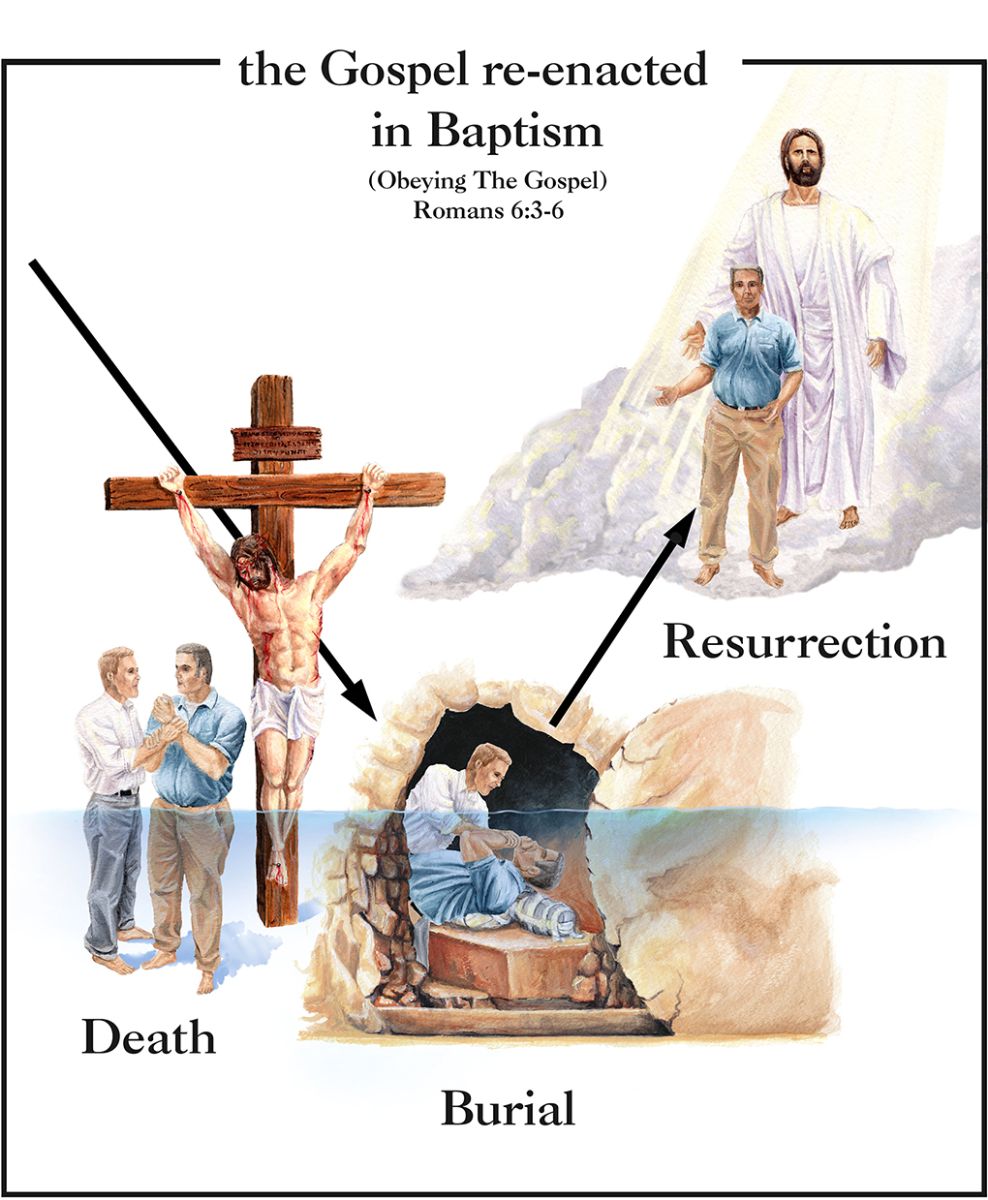
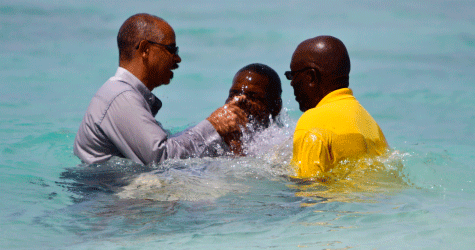
Observe, however, that while a person dies to sin at that moment in his own mind, he is not forgiven of sin by God at that point. Forgiveness occurs in the mind of God when the penitent believer allows himself to be lowered into the watery grave of baptism. That is the moment we contact the blood of Christ which was shed in Christ’s death. Hence, Romans 6:3-4 explains that when we are baptized in water, we are baptized into Christ’s death—the contact point for forgiveness. Being “buried with Him through baptism into death” is the point at which we are cleansed of sin, thus enabling us to “walk in newness of life.” According to the sequence stipulated in the passage, we cannot have “newness of life” until after we come up out of the waters of baptism. While many within Christendom have come to reject the role of water in God’s scheme of redemption, the New Testament repeatedly affirms it (e.g., John 3:5,23; Acts 8:36,38-39; 10:47; Hebrews 10:22; 1 Peter 3:20-21). [NOTE: For a comparison of Romans 6 to the parallel teaching of Colossians 2 and 3, see: http://www.apologeticspress.org/APContent.aspx?category=11&article=1232&topic=379.]
The post Do We Die to Sin Before Baptism or In Baptism? appeared first on Apologetics Press.
]]>The post One Second After Death appeared first on Apologetics Press.
]]>The Bible teaches that human beings are composite creatures. We possess a fleshly body that is composed of physical elements made from “the dust of the ground” (Genesis 2:7). This physical body is animated by a life force or life principle that we share in common with the animal kingdom (although, in the Genesis creation account, a distinction seems to be made between animals and man in the direct source of this life principle—Genesis 1:20-21,24; 2:7). In any case, the Scriptures also teach that human beings are unlike the animals in that humans also possess a spiritual dimension that transcends the body and physical life on Earth.
God places within each prenatal person at conception a spirit that makes each individual a unique personality. Zechariah 12:1 observed that God “forms the spirit of man within him.” Our spirits are what makes each one of us a distinct entity, a person that will survive physical death and live on immortally throughout eternity.
A number of Hebrew and Greek words are used in the Bible to identify various facets of our beings (e.g., nephesh, ruach, neshamah, leb, and basar in the Old Testament and psuche, pneuma, nous, soma, and sarx in the New Testament). These words are somewhat fluid, and are used in a variety of ways—sometimes interchangeably, sometimes in contradistinction to each other. They are translated by many different English words (e.g., “soul,” “spirit,” “breath,” “wind,” “heart,” “mind,” “self,” “body,” “flesh,” et al.). It is a mistake to seize upon a passage where “soul” refers to the entirety of a person’s being and conclude that man does not possess a spirit that is distinct from his animated body. Some religious thinkers tend to limit the Hebrew word ruach (soul or spirit) to an impersonal vital power that becomes individualized only in the nephesh (whole person). Thus, it is claimed that the soul or spirit cannot exist independently of the body, so that when the “life force” exits the body, the person ceases to exist.
But, by avoiding human philosophies and focusing solely upon the Bible, we learn that each person possesses a conscious spirit that ultimately leaves the body and exists separately from it in the spirit realm. For example, Genesis 35:18 states: “[I]t came to pass, as her soul was in departing, (for she died).” The author of the book of 1 Kings wrote that Elijah prayed, “let this child’s soul come into him again…and the soul of the child came into him again, and he revived” (17:21-22). Psalm 86:13 says, “You have delivered my soul from the depths of Sheol.” The term sheol refers to the entire realm of the dead, where both the saved and the lost await Judgment.1
The Bible defines “death” as “separation”—not “extinction.” 2 Physical death occurs when the spirit exits the body. James 2:26 notes: “[F]or as the body without the spirit is dead.” In other words, the separation of one’s spirit from one’s body results in physical death. Spiritual death, on the other hand, entails separation from God due to sin (Isaiah 59:2). So “death” involves the idea of separation—not extinction or unconsciousness.
A clear depiction of existence beyond death is seen in Luke 16:19-31. Some argue that this section of Scripture is a parable, which is incorrect since the story does not contain the usual indicators of parabolic discourse. However, even if the passage were a parable, a parable is not a fairy tale. Bible parables parallel true-life situations to teach a basic lesson of truth. They draw from reality and that which people understand as actual earthly existence and genuine conditions in order to drive home a spiritual point. After reading Luke 16:19-31, observe the following textual details:
- Both men are said to have died.
- Wherever Lazarus went, angels were used to transport him there.
- The rich man was buried.
- The rich man was in hades.
- The rich man was being tormented in flames.
- The rich man could see and recognize Lazarus and Abraham.
- Abraham referred to the rich man’s former existence as “your lifetime.”
- Abraham made clear that their respective locations were irreversible.
- The rich man’s brothers were still occupying his father’s house on Earth.
- The Law of Moses was still in effect.
- The rich man’s plea to send Lazarus to his living relatives would require Lazarus to return “from the dead” (vs. 30) and to “rise from the dead” (vs. 31).
The term translated “hell” in Luke 16:23 in the KJV is the Greek word hades, and is not to be confused with the word gehenna. “Gehenna” is found 12 times in the New Testament, and refers to the place of eternal, everlasting punishment—the “lake of fire” where Satan, his angels, and all wicked people will be consigned after the Second Coming of Jesus and the Judgment (Matthew 25:41; Rev. 20:15). So gehenna is hell. “Hades,” on the other hand, occurs 10 times in the New Testament, and always refers to the unseen realm of the dead—the receptacle of disembodied spirits where all people who die await the Lord’s return. At that time, our spirits will be reunited with our resurrection bodies (1 Corinthians 15:35-54).
Luke 16 shows us that hades contains two regions. One is referred to as the “bosom of Abraham” (which simply means “near” or “in the presence of ” Abraham—cf. John 1:18). The other region in hades is described as tormenting flame. Every other passage in the New Testament that refers to hades harmonizes with this description of the intermediate realm of the dead where the deceased await the resurrection and judgment.
For example, while fastened to the cross, Jesus told the thief, “Today, you will be with Me in Paradise” (Luke 23:43). The word paradise is of Persian derivation, and means a “garden” or “park.” Where was it that Jesus and the thief went on that very day? Certainly not to extinction. Extinction would not be “paradise”! Nor did they go to the grave together. The thief was not placed in the tomb with Jesus, and the tomb certainly would not be a “paradise.” Nor did Jesus go to heaven, for in John 20:17 after His resurrection, Jesus reassured Mary that He had not yet ascended to the Father. So where is “paradise”? Where did Jesus and the thief go after dying on the cross? Where had Jesus been for those three days between His death and resurrection?
Peter gave the answer to that question in his sermon in Acts 2 when he quoted Psalm 16. Acts 2:27 states that God would not abandon Christ’s soul in hades nor allow Christ to undergo decay. So while Christ’s body was placed in a tomb for three days, Christ’s spirit went to hades. Peter argued that David, who penned the 16th Psalm, was not referring to himself. How do we know? David’s body was still in the tomb (Acts 2:29). David’s spirit was still in the hadean realm because Peter also said that David had not yet ascended into heaven (Acts 2:34). Acts 2, by itself, proves that a person does not go straight to heaven or hell when he dies, and that a person does not become extinct, cease to exist, or pass into a state of unconsciousness at death.
Jesus previously predicted that His death and entrance into the hadean realm would not prevent Him from accomplishing His divine purposes. Matthew 16:18 reads: “Upon this rock I will build My church; and the gates of Hades shall not prevail against it.” In other words, though He would die on the cross, though His body would be placed in the tomb, and though His spirit would descend into hades, nevertheless, the gates of hades would not prevent Him from coming back out of hades (i.e., being resurrected) and then setting up the kingdom a few days later in Acts 2. At that time, Peter and the apostles employed the “keys of the kingdom” (Matthew 16:19) with the help of the Holy Spirit sent by Jesus (Acts 2:33).
It was through Jesus’ death and subsequent departure from hades that Jesus rendered powerless “him who had the power of death, that is, the devil” (Hebrews 2:14; cf. 1 Corinthians 15:26,54-57). Jesus’ personal victory over death and the hadean realm explains why He could declare in Revelation 1:18—“I am He who lives; and was dead, and behold, I am alive forevermore. Amen. And I have the keys of hades and of death.”
While Jesus, the thief, and Lazarus went to the paradise portion of hades, the rich man went to the unpleasant area which included torment and flame. This undoubtedly is the same region of hades, referred to in 2 Peter 2:4, where angels who sinned were committed by God.3 The term that Peter used was tartarosas, or Tartarus, and is described as “chains of darkness” where they are “reserved for judgment.” The parallel in Jude 6 speaks of these angels as having abandoned their proper place and having failed to keep their own domain. They are depicted as existing in “everlasting chains under darkness unto the judgment of the great day.” The Greek term refers to “that part of Hades, where the wicked were confined and tormented,”4 “the abode of the damned.”5 This realm is undoubtedly where the rebellious Israelites went (Isaiah 5:14) as well as the king of Babylon (Isaiah 14:9-15).
The Hebrew word for this specific area of hades is abaddon.6 Its root meaning carries the idea of “destruction”7 but, specifically, refers to the “place of destruction,”8 the “underworld,”9 the “place of ruin in Sheol for lost or ruined dead,”10 “the place of torment,”11 “abyss,”12 “the abysmal abode of the departed,”13 “the world of the dead in its utterly dismal, destructive, dreadful aspects.”14 The word occurs six times in the Old Testament and is usually rendered “Destruction” in English translations. Indicators that it refers to the same area in hades as Tartarus may be seen in the psalmist’s query: “Shall Your lovingkindness be declared in the grave? Or Your faithfulness in the place of destruction?” (Psalm 88:11). The implication is that in the Tartarus/Abaddon portion of hades, God’s lovingkindness and faithfulness, i.e., acceptance and salvation, are absent—unlike the paradise portion of hades.
Another indicator is seen in Job’s denial of the accusation of his “friends” that he had been guilty of sin, insisting, “For that would be wickedness; Yes, it would be iniquity deserving of judgment. For that would be a fire that consumes to destruction, and would root out all my increase” (Job 31:11-12).15 While a number of translations render the word “destruction,” many simply transliterate the word “Abaddon”—indicating the place where God’s fire of judgment is currently directed. The NASB has: “For it would be fire that consumes to Abaddon, and would uproot all my increase.” The CEB renders the word “underworld” while the Complete Jewish Bible has, “a fire that would burn to the depths of Abaddon, uprooting all I produce.”
Sometimes the generic term sheol is used very specifically to either Paradise or Abaddon. For example, the Abaddon region of the hadean realm must be in view in Moses’ allusion to the anger of God which kindles fire that “shall burn to the lowest part of Sheol” (Deuteronomy 32:22)—sheol being the general Hebrew equivalent of the Greek hades. The same may be said for Solomon’s use of the term in Proverbs 9:18 when he refers to the eternal destination of the man who succumbs to the illicit sexual solicitations of the woman of ill repute: “But he does not know that the dead are there, that her guests are in the depths of hell.” The word rendered “hell” in the NKJV is sheol, but obviously the Abaddon portion of hades is being noted.16
Interestingly, the New Testament transliterates the Hebrew term abaddon in Revelation 9:11, associating the term with the Greek equivalent apollyon, linking the terms to the angel of the bottomless pit. In keeping with the figurative nature of apocalyptic language, the place name is affixed to an angelic being who is depicted as the angel of the underworld, the king or ruler reigning over Abaddon, the realm of the dead.17 Swete notes that the figure depicts Destruction personified, which occurs in Sheol.18
Notice what will happen to this intermediate receptacle of spirits. In Revelation 20, beginning in verse 11, we are presented with a portrait of the final Judgment before the great white throne of God. Everyone who has ever lived will be there. Verse 13 says that “death and hades” will be cast into the lake of fire. That means that hades will be cast into hell. The unseen realm of the dead, where conscious spirits reside until judgment, will have served its purpose, and all people who have ever lived will then be consigned to one of two places: heaven or hell.
“For we must all appear before the judgment seat of Christ; that each one may receive the things done in the body, according to what he has done, whether good or bad” (2 Corinthians 5:10). “[I]t is appointed for men to die once, but after this the judgment” (Hebrews 9:27). “Do not marvel at this; for the hour is coming in which all who are in the graves will hear His voice and come forth—those who have done good, to the resurrection of life; and those who have done evil, to the resurrection of condemnation” (John 5:28-29). Paul referred to the occasion “when the Lord Jesus is revealed from heaven with His mighty angels, in flaming fire taking vengeance on those who do not know God, and on those who do not obey the gospel of our Lord Jesus Christ. These shall be punished with everlasting destruction from the presence of the Lord and from the glory of His power” (2 Thessalonians 1:7-9).
Look carefully at the word “everlasting.” Does the human spirit exist beyond physical death and the grave in a conscious state? Or, at death, does the soul cease to exist in a state of “soul sleep”? Does a person’s consciousness become extinct? Is the soul annihilated at death? The Sadducees denied the existence of the spirit realm. According to Acts 23:8, they denied the immortality of the soul, believing in “neither angel nor spirit.” Josephus stated that the Sadducees believed that “souls die with the bodies.”19 There are religious groups today who teach the same thing.
In Luke 20, Jesus showed the fallacy of such thinking by showing that when Moses was at the burning bush in Exodus 3, God declared Himself to be the God of Abraham, Isaac and Jacob. At the time God made that statement, the bodies of those three patriarchs had been in the grave for hundreds of years. Yet Jesus concluded: “For He is not the God of the dead but of the living” (Luke 20:38). That proves that Abraham, Isaac, and Jacob—though separated from their physical bodies—were still in existence. They were not extinct. They would one day be reunited with their new bodies in the resurrection (I Cor. 15:35-54).
Many other passages indicate the perpetuation of conscious spiritual life beyond physical death. Revelation 6:9-11 speaks of the souls of those who had been martyred for the Christian cause. They are depicted as spirits—not bodies—who are conscious, who are aware of the means by which they were killed, and who knew that their blood had not yet been avenged.
In 2 Corinthians 12:2-4, Paul described an experience that he, or someone he knew, had in the “third heaven.” The “third heaven” in scriptural thought is the spirit realm where God and other celestial beings reside (Deuteronomy 10:14; 26:15; 1 Kings 8:27,30). It often is referred to as the “heaven of heavens”—a Semitism wherein the genitive is used for the superlative degree—meaning the highest or ultimate heaven (cf. “Song of songs,” “King of kings,” “Lord of lords”). The “first heaven” is the Earth’s atmosphere—the “sky”—where the birds fly (Genesis 1:20; 8:2; Isaiah 55:10; Luke 13:19). The “second heaven” is “outer space”—where the Sun, Moon, and stars are situated (Genesis 15:5; 22:17; Deuteronomy 4:19; Nahum 3:16). Twice Paul stated that he was not certain whether the person described was “in the body, or out of the body” (vss. 2-3). That proves that Paul acknowledged the possibility of the spirit of a human being existing in a conscious state apart from the body. To say that the spirit ceases to exist at death makes Paul imply what is not true.
Both accounts, of the rich man and Lazarus in Luke 16, and the thief on the cross in Luke 23:43, prove that conscious existence continues after the death of the body. Hebrews 12:23 speaks of “the spirits of just men made perfect”—a reference to deceased saints who remained faithful to God during their life on Earth, but who had since passed into the spirit realm. That passage makes no sense if “spirits” refers to the wind or breath of a person. These people were like Stephen in Acts 7:59 who, as life was being stoned from his body, said to the Lord whom he could see in the heavens: “Lord Jesus, receive my spirit.” If “spirit” is simply the life force of the body that goes extinct the moment it no longer animates the body, then Stephen was speaking out of ignorance to think that he had a spirit that could be received by Jesus.
The Bible frequently speaks of the ultimate state of both the good and the wicked as being “eternal.” For example, read Hebrews 6:2 which speaks of “eternal judgment,” or 2 Thessalonians 1:9 which speaks of “eternal destruction,” or Revelation 20:10 where Satan will be cast into the lake of fire and brimstone, and tormented there “day and night forever and ever.” Jude 7 speaks of those who will suffer “the vengeance (punishment) of eternal fire.”
Matthew 18:8-9 identifies the fire of hell (gehenna) as “everlasting fire.” The parallel passage in Mark 9:43 states that this fire “shall never be quenched.” Mark 9:48 states that hell is a place “where their worm does not die and the fire is not quenched.” The image is taken from Isaiah 66:24, and is unquestionably intended to make the point that the fire of hell will be unquenchable—always burning, yet never consuming.
In His description of the final Judgment in Matthew 25:46, Jesus used the same word aionion (“eternal”) to refer to the respective conditions of both the good and evil people who inhabited the Earth. If eternal punishment is not “eternal,” then life eternal is not “eternal” either. The word “punishment” clearly implies pain that is inflicted. Listen to Peter, who said, “The Lord knows how to deliver the godly out of temptation, and to keep the unrighteous under punishment for the day of judgment” (2 Peter 2:9). The same word is used to refer to the punishment that the apostles narrowly avoided in Acts 4:21.
Some say the word “destroy” (or “destruction”) means “annihilation” (or “extinction”). They go to a passage like Matthew 10:28 where Jesus said, “And do not fear those who kill the body but cannot kill the soul. But rather fear Him who is able to destroy both soul and body in hell.” They insist that “destroy” in this passage means “annihilation.” But that cannot be. For if physical death inflicted by one’s fellowman brings extinction and unconsciousness of the soul, what is there to fear from God? Why would Jesus say there is no need to fear other people—who can take your physical life? For in taking your physical life, they also would cause your soul to be annihilated, in which case they have as much power as God, and the comparison that Jesus makes is no comparison at all. If the soul dies with the body, then he who kills the body kills the soul, too.
The parallel passage in Luke 12:4-5 makes this point even clearer. Luke wrote: “Do not be afraid of those who kill the body, and after that have no more that they can do. But I will show you whom you should fear: Fear Him who, after He hath killed, has power to cast into hell; yes, I say to you, fear Him!” If physical death brings annihilation of the soul, then it is ridiculous to speak of casting the soul into hell after killing the body.
In addition, the Greek term that underlies our English word “destroy” does not mean “annihilation.” W.E. Vine, in his Expository Dictionary of New Testament Words, explained: “The idea is not extinction but ruin, loss, not of being, but of well-being.”20 He cited Matthew 10:28 as an example, as well as John 17:12 where Judas, who had not yet hung himself, was called the “son of perdition.” Obviously, Judas was not extinct or annihilated. But he was destroyed in the sense that he lost spiritual well-being. He had perished spiritually.
Lexicographer Joseph Thayer agreed with this assessment when he said that “destroy” in Matthew 10:28 means “to devote or give over to eternal misery.”21 Albrecht Oepke commented on the meaning of destroy: “definitive destruction, not merely in the sense of extinction of physical existence, but rather of an eternal plunge into Hades.”22
What must be concluded from these passages of Scripture? God gives people this life on Earth to prepare their spirits for their eternal abode. When a person dies, his or her body goes into the grave, while the conscious spirit enters the hadean realm to await the final Judgment. At the Second Coming of Christ, all spirits will come forth from hades and be resurrected in immortal bodies. All will then face God in judgment, receive the pronouncement of eternal sentence, and then be consigned to heaven or hell for eternity. Read carefully the inspired words of the apostle Peter:
Therefore, since all these things shall be dissolved, what manner of persons ought you to be in holy conduct and godliness, looking for and hastening the coming of the day of God, because of which the heavens will be dissolved being on fire, and the elements will melt with fervent heat? …You therefore, beloved, since you know these things beforehand, beware lest you also fall from your own steadfastness, being lead away with the error of the wicked; but grow in the grace and knowledge of our Lord and Savior Jesus Christ. To Him be the glory both now and forever. Amen” (2 Peter 3:11-12,17-18). שּׁאוֹﬥ
Endnotes
1 G. Gerleman (1997), “שּׁאוֹﬥ Realm of the Dead,” Theological Lexicon of the Old Testament, ed. Ernst Jenni and Claus Westermann (Hendrickson), 3:1279-1282; H. Buis (1976), “Sheol,” The Zondervan Pictorial Encyclopedia of the Bible (Grand Rapids, MI: Regency), 5:395. Walter Elwell, ed. (1988), Baker Encyclopedia of the Bible (Grand Rapids, MI: Zondervan), 2:1948-1949.
2 J.W. Fradersdorff (1875), “Death,” A Copious Phraseological English-Greek Lexicon (London: Rivingtons), p. 141—“death is the separation of the soul from the body”; E.A. Sophocles (1914), “Thanatos,” Greek Lexicon of the Roman & Byzantine Periods (Cambridge: Harvard University Press), p. 569—“the separation of the ψυχή from the σώμα.” W.E. Vine (1966), Expository Dictionary of New Testament Words (Old Tappan, NJ: Fleming Revell), p. 276—“the separation of the soul (the spiritual part of man) from the body (the material part).”
3 Cf. Reese who argues that Tartarus is a separate and distinct realm where only supernatural beings (angels and demons) are confined and thus not to be equated with the “torment” side of hades—where only wicked humans are confined—Gareth Reese (1976), A Critical and Exegetical Commentary on the Book of Acts (Joplin, MO: College Press), pp. 137-140. The fact that 2 Peter 2:4 mentions only the wicked angels as being confined to Tartarus does not prove that they are the only beings there, or that no humans are there, or that it is not the same place as the section within hades where the rich man is. The same is true for the word “abyss”; The relevant verses harmonize with the idea that “abyss,” “abaddon,” and “tartarus” are the same place as depicted in Luke 16.
4 Wesley Perschbacher (1990), The New Analytical Greek Lexicon (Peabody, MA: Hendrickson), p. 402; Thomas Green (1890), A Greek-English Lexicon to the New Testament (New York: John Wiley & Sons), p. 185. “A Greek name for the underworld, especially the abode of the damned”—G. Abbott-Smith (1922), A Manual Greek Lexicon of the New Testament (New York: Charles Scribner’s Sons), p. 440. Also
5 G. Abbott-Smith (1922), A Manual Greek Lexicon of the New Testament (New York: Charles Scribner’s Sons), p. 440.
6 The Hebrew term bor (“pit”) also sometimes refers to the Tartarus/Abaddon side of hades, e.g., Psalm 28:1; 88:4,6; Isaiah 14:15; 38:18; Ezekiel 26:20; 31:14; 32:18.
7 John Parkhurst (1799), An Hebrew and English Lexicon (London: F. Davis), p. 2.
8 Benedikt Otzen (1977), “abhadh,” Theological Dictionary of the Old Testament, ed. G. Johannes Botterweck and Helmer Ringgren (Grand Rapids, MI: Eerdmans), 1:23. Also Benjamin Davidson (1848), The Analytical Hebrew and Chaldee Lexicon (Grand Rapids, MI: Zondervan), p. 11; “Abaddon” (1988), Baker Encyclopedia of the Bible, ed. Walter Elwell (Grand Rapids, MI: Baker), 1:4; John M’Clintock and James Strong (1968 reprint), Cyclopaedia of Biblical, Theological, and Ecclesiastical Literature (Grand Rapids, MI: Baker), 1:3.
9 L. Koehler, W. Baumgartner, M.E.J. Richardson, & J.J. Stamm (2000), The Hebrew and Aramaic Lexicon of the Old Testament (Leiden: E.J. Brill, electronic ed.), p. 3. Also Eugene Merrill (1997), /oDb^a&, New International Dictionary of Old Testament Theology & Exegesis, ed. Willem VanGemeren (Grand Rapids, MI: Zondervan), 1:226; Otzen, 1:23.
10 F. Brown, S. Driver, and C. Briggs (1907), The Brown-Driver-Briggs Hebrew and English Lexicon (Peabody, MA: Hendrickson), p. 2; “[T]he nethermost of the two regions into which [the Rabbins] divided the underworld”—M’Clintock and Strong, 1:3; “[T]he place or condition of utter ruin reserved for the wicked in Sheol (the realm or abode of the dead)”—K.L. Barker (1976), “Abaddon,” The Zondervan Pictorial Encyclopedia of the Bible, ed. Merrill Tenney (Grand Rapids, MI: Regency), 1:?.
11 William Wallace Duncan (1841), A New Hebrew & English Lexicon (London: Thomas Tegg), p. 1.
12 Davidson, p. 11.
13 R.K. Harrison (1969), Introduction to the Old Testament (Grand Rapids, MI: Eerdmans), p. 1020.
14 W.J. Beecher (1979), “Abaddon,” in The International Standard Bible Encyclopedia, ed. Geoffrey Bromiley (Grand Rapids, MI: Eerdmans), 1:2.
15 Notice that Job apparently did not view Abaddon as only for angels/demons and not for humans since he associated its burning with what he would deserve (if he were guilty as his “friends” claimed).
16 Another Hebrew term in the Old Testament—שָׁחַת—can refer to the suffering side of Sheol (Ezekiel 28:8) as well as to the overall realm of Sheol (Psalm 16:10; 30:9; Isaiah 38:17; Jonah 2:6). Due to the nature of the spiritual realm, more narrow terms—like “Paradise,” “Abaddon,” “Tartarus,” and “Abyss” can be used to refer to the broader term “Hades” and vice-versa. See also William Holladay (1988), A Concise Hebrew & Aramaic Lexicon of the Old Testament (Leiden: E.J. Brill), p. 1—“realm of the dead.”
17 Beecher, 1:2; Joachim Jeremias (1964), ) abaddon, Theological Dictionary of the New Testament, ed. Gerhard Kittel (Grand Rapids, MI: Eerdmans), 1:4; A. Oepke (1964), a) apollyon, Theological Dictionary of the New Testament, ed. Gerhard Kittel (Grand Rapids, MI: Eerdmans), 1:394-396; Elwell, 1:4; Koehler, et al., p. 3; J.W. Roberts (1974), The Revelation to John (The Apocalypse) (Austin, TX: Swete), p. 81—“a Hebrew term for Sheol, the region of the dead.”
18 H.B. Swete (1906), The Apocalypse of St. John (London: Macmillan), p. 117.
19 Flavius Josephus (1974 reprint), “Antiquities of the Jews,” The Works of Flavius Josephus, trans. William Whiston (Grand Rapids, MI: Baker), XVIII.I.4, p.3.
20 W.E. Vine (1966 reprint), An Expository Dictionary of New Testament Words (Old Tappan, NJ: Revell), p. 302.
21 J.H. Thayer (1901), A Greek-English Lexicon of the New Testament (1977 reprint), (Grand Rapids, MI: Zondervan), p. 64; “eternal death”—Frederick Danker (2000), A Greek English Lexicon of the New Testament (Chicago: University of Chicago Press), p. 116.
22 Oepke, 1:396.
The post One Second After Death appeared first on Apologetics Press.
]]>The post Different Views of Death appeared first on Apologetics Press.
]]>I recently read of a case that illustrates the bleakness faced by the unbeliever when he is forced to face the prospect of death’s separations.
Marie Curie was undoubtedly the most prominent woman scientist of all time. She was twice awarded the Nobel Prize. She was married to Pierre Curie, a prominent scientist in his own right. On April 19, 1906, Pierre was run over by a galloping team of horses pulling a heavy wagon. His head was crushed by one of the wheels and he died instantly.
In a biography about her mother, Eve Curie describes how Marie was devastated by the accident. She clung to Pierre’s corpse as he was dressed for the funeral. She kissed him repeatedly. From that day, Eve says, she became “a pitiful and incurably lonely woman” (p. 247). For a long time she wrote notes to him each day in her diary. Here is one of those notations: “Your coffin was closed and I could see you no more…. We saw you go down into the deep, big hole…. They filled the grave and put sheaves of flowers on it, everything is over. Pierre is sleeping his last sleep beneath the earth; it is the end of everything, everything, everything” (p. 249).
Obviously Madame Curie had utterly no hope of ever seeing her beloved husband again. Years before, Marie had abandoned whatever faith she had. Eve writes that her mother “gave her [daughters] no sort of pious education. She felt herself incapable of teaching them dogmas in which she no longer believed: above all she feared for them the distress she had known when she lost her faith” (p. 268).
How very sad. Death is not the end of everything. Rather, it is the beginning. It is the beginning of eternity. May we so bind our families together in service to God that when our parting comes, it will be a “sweet sorrow.”
REFERENCES
Curie, Eve (1937), Madame Curie: A Biography (Garden City, NY: Doubleday).
The post Different Views of Death appeared first on Apologetics Press.
]]>