The post Is Peter the Rock/Foundation of the Church? appeared first on Apologetics Press.
]]>When Jesus came into the region of Caesarea Philippi, He asked His disciples, saying, “Who do men say that I, the Son of Man, am?” So they said, “Some say John the Baptist, some Elijah, and others Jeremiah or one of the prophets.” He said to them, “But who do you say that I am?” Simon Peter answered and said, “You are the Christ, the Son of the living God.” Jesus answered and said to him, “Blessed are you, Simon Bar-Jonah, for flesh and blood has not revealed this to you, but My Father who is in heaven. And I also say to you that you are Peter, and on this rock I will build My church, and the gates of Hades shall not prevail against it. And I will give you the keys of the kingdom of heaven, and whatever you bind on earth will be bound in heaven, and whatever you loose on earth will be loosed in heaven” (Matthew 16:13-20).
Did Jesus intend to convey the idea that the church is built on Peter or that Peter was the head of the church?
The word for “Peter” in Greek is petros (masculine gender) and means a “stone.”1 In contrast, the word for “rock” is petra (feminine gender) and refers to “bedrock or massive rock formations, rock as distinguished from stones.”2 It is true that, assuming Jesus spoke Aramaic, the Aramaic word for both Peter and rock (kepha) are the same.3 However, God did not inspire the writers of the New Testament to write His Word in Aramaic.4 Rather, He inspired them to write in Greek—and the Greek text makes a clear distinction between petra and petros. Interestingly, so does the Latin Vulgate. Anticipating confusion, the Holy Spirit could have easily caused the same word to be used twice, or He could have had Matthew simply state that the Church would be built “on you.”
Contextually, the “rock” upon which Jesus built His Church was the truth that Peter had just articulated: “You are the Christ, the Son of the living God” (Matthew 16:16). This truth is, indeed, the great ledge-rock foundation of the Church. Both Christ’s headship over the Church and His undergirding foundation are stated emphatically in the New Testament:
And He put all things under His feet, and gave Him to be head over all things to the church, which is His body, the fullness of Him who fills all in all (Ephesians 1:22-23).
And He is the head of the body, the church, who is the beginning, the firstborn from the dead, that in all things He may have the preeminence (Colossians 1:18).
For no other foundation can anyone lay than that which is laid, which is Jesus Christ (1 Corinthians 3:11; cf. Ephesians 2:20).
In fact, Peter Himself forthrightly declared Jesus to be the “living stone” (lithos—1 Peter 2:4). He then applied Isaiah 28:16 and Psalm 118:22 to Jesus as the “chief cornerstone”5 (1 Peter 2:6-7). And he also quoted Isaiah 8:14 and applied it to Jesus as well, indicating Him to be “A stone of stumbling and a rock of offense” (vs. 8). The Hebrew synonymous parallelism makes “stone” (from lithos) and “rock” (from petra) the same. Peter is clearly not the petra of Matthew 16:18. Rather, Jesus is—specifically, that He is the Christ, the Son of God.
Endnotes
1 Frederick Danker, et al. (2000), Greek-English Lexicon of the New Testament (Chicago, IL: University of Chicago Press), second edition, p. 809.
2 Ibid., emp. and italics in orig. See the use of petra to refer to such formations (as opposed to stones) in Matthew 27:60; Mark 15:46; Luke 8:6,13 (on the rock—ESV, NKJV, RSV, NIV, etc.). Also Exodus 17:6 and Numbers 20:7-8,10-11 and Paul’s typological comparison to Christ as “that spiritual Rock” (1 Corinthians 10:4)—hardly a small stone. See also the use of petra in parallelism with lithos in Romans 9:32-33, as opposed to the use of petros.
3 In fact, Jesus bestowed the name “Cephas” on Peter (John 1:42) and Paul so referred to Peter in 1 Corinthians (1:12; 3:22; 9:5; 15:5; Galatians 1:18; 2:9,11,14). However, Jesus specifically alluded to petra as the foundation on which His church would be built.
4 The New Testament includes a few Aramaic words found in the following verses: Matthew 5:22; 6:24; 27:46; Mark 5:41; 7:34; 10:51; 11:9; 14:36; 15:34; Luke 16:9,11,13; John 1:42; 20:16; Acts 9:36,40; Romans 8:15; 1 Corinthians 16:22; Galatians 4:6.
5 The Greek has “head of the corner,” with “head” being the Greek term kephale. Jesus is the “head”—not Peter.
The post Is Peter the Rock/Foundation of the Church? appeared first on Apologetics Press.
]]>The post Cutting the Roots—But Still Expecting Fruit appeared first on Apologetics Press.
]]>[EDITOR’S NOTE: A.P. auxiliary writer Robert Veil, Jr. formerly served as a district attorney for the Washington County State’s Attorney’s Office (Maryland), and previously maintained an active private law practice. He currently preaches in Martinsburg, West Virginia.]
 Here’s a quote from the U.S. Supreme Court which may surprise you: “Where can the purest principles of morality be learned so clearly or so perfectly as from the New Testament? Where are benevolence, the love of truth, sobriety, and industry, so powerfully and irresistibly inculcated as in the sacred volume?”1 That statement, part of the official records of the nation’s highest court, was made by Justice Joseph Story, appointed by President James Madison in 1811. Known as the “Father of American Jurisprudence,” Story had earlier written, “Christianity ought to receive encouragement from the state, so far as is not incompatible with the private rights of conscience, and the freedom of religious worship. An attempt to level all religions, and to make it a matter of state policy to hold all in utter indifference, would have created universal disapprobation, if not universal indignation.”2
The interesting backstory to this Supreme Court case involves the death of Stephen Girard in 1831. At that time, Girard was the richest man in America. In his will, he provided for the establishment of Girard College in Philadelphia, PA. But the will was challenged by his familial heirs, who argued that it was void because by excluding scholarly instructors from the various sects, it was adverse to the principles of Christianity. The argument was eloquently presented by Daniel Webster, Esq., but was ultimately rejected by the Supreme Court. Interestingly, while the Court agreed with Webster that Christianity is part of the common law of Pennsylvania, it went on to recognize that support for Christianity is so natural and desirable that it is generally intended and presumed in our legal documents. Statements in a will which could conceivably be understood as opposed to Christianity will not be so interpreted without clear and plain evidence to that effect. In other words, if it is possible to interpret the will in agreement with the principles of Christianity, it must be so interpreted, and allowed to stand.
I find this case fascinating because it provides insight into the mindset of our Founding Fathers, including the Supreme Court in its early days. They not only recognized the principles of Christianity as part of and consistent with the common law, they found it unusual or unthinkable that anyone would question this. They saw it as harmful that documents such as wills should be interpreted otherwise. Justice Story agreed with Daniel Webster as to the honorable and necessary role of Christianity in our nation’s legal system. But he went on to affirm that such recognition is to be presumed as natural and obvious. In 1844, these Founding Fathers and statesmen would not have dreamed of questioning or denying the critical place of Christianity in our laws.
Story’s recognition that Christianity was deeply valuable to society, and that “it ought to receive encouragement from the state” would seem odd or unthinkable to many modern observers. The prevailing view of so many today is that church and state should somehow be “separated” and our country would get along quite well without the principles of Christianity. But that’s not the way the Founding Fathers saw it. They recognized Christianity as part of the common law, critical to our nation’s health and strength. They knew that the principles taught by Christ in the New Testament make for a prosperous and successful land.
Those who deny these truths are like the man who expects fruit from the tree after cutting away its roots. He destroys that which made the tree strong, and which gives it its nourishment and productivity, then demands that it produce as it did before. He cannot understand why the tree appears to be weak and sickly, struggling to match its former glory.
The roots of America’s strength run deeply into the Word of God. The eternal principles of truth and honesty, fair dealing, charity and integrity, sobriety and industry, mutual respect and good will form a bedrock upon which all great civilizations are built. To the extent that we honor and respect such godly principles, we can look for His protection and blessings. And as surely as we cut off and turn away from them, we need not expect the fruit of His divine approval.
ENDNOTES
1 Vidal et al. v. Girard’s Executors, 43 US 127 – U.S. Supreme Court (1844).
2 Joseph Story (1833), Commentaries on the Constitution of the United States (Boston, MA: Hilliard, Gray, & Co.).
The post Cutting the Roots—But Still Expecting Fruit appeared first on Apologetics Press.
]]>The post God, the Founders, and the Purpose of Human Government appeared first on Apologetics Press.
]]>
The American people have been experiencing a significant level of confusion regarding the purpose of civil government. Perhaps the prevailing sentiment of the population is that the core purpose of government is to collect money from citizens (via the IRS) so that elected politicians can make decisions regarding the distribution and dispersal of those funds. This serious misconception has led to a plethora of errors and harmful societal circumstances: a bloated, insatiable federal government that is in the throes of unprecedented, debilitating debt, a corresponding failure of elected officials to focus on their true purpose, a host of citizens who think the government exists to redistribute monetary assistance to them, and the list goes on. Meanwhile, the central purpose of government—the very reason the Founders established a federal government—is being neglected to the extent that citizens are encountering increasing danger to their lives. Perhaps even more tragic, the very government intended to be “of the people, by the people, and for the people” has assumed an adversarial role in which it persecutes those who hesitate to go along with its oppressive socialistic, anti-Christian, “politically correct” agenda.
What’s more, many Americans have been indoctrinated in the public school system with the idea that “separation of church and state” is true, that the government should have nothing to do with religion—except to suppress it in government, school, and public life.1 This indoctrination is so thorough and pervasive that few consider the fact that God has expressed His view on the subject. Indeed, the sole source of infallibly correct thinking—the Bible—addresses these concerns, articulating very precisely the divine purpose of civil government. What does the inspired Word of God say regarding the purpose of human government?
The Bible
Perhaps before answering that question, we should ask the prior question: “Did God intend for humans to form a government?” Yes, He did. The Bible states definitively: “Let every soul be subject to the governing authorities. For there is no authority except from God, and the authorities that exist are appointed by God” (Romans 13:1, emp. added). Another inspired apostle stated: “Therefore submit yourselves to every ordinance of man for the Lord’s sake, whether to the king as supreme, or to governors, as to those who are sent by him” (1 Peter 2:13-14). Jesus, Himself, had previously expressed what His apostles later wrote. He implied the validity of human government when He declared: “Render to Caesar the things that are Caesar’s, and to God the things that are God’s” (Mark 12:17). Nebuchadnezzar’s dream included the realization “that the living may know that the Most High rules in the kingdom of men, gives it to whomever He will, and sets over it the lowest of men” (Daniel 4:17). So, yes, human government is authorized and ordained by God and fully in keeping with His principle of authority that pervades all of life.2
What, then, does the Bible say about the purpose of the divinely authorized entity of human government? The Bible states explicitly that the central purpose and role of government is to maintain order, peace, protection, safety, and stability in society which, in turn, enables citizens to live their lives in freedom. Consider, for example, Paul’s lengthy discussion of civil government in his admonitions to Christians in the capital city—the heart—of the Roman Empire:
For rulers are not a terror to good works, but to evil. Do you want to be unafraid of the authority? Do what is good, and you will have praise from the same. For he is God’s minister to you for good. But if you do evil, be afraid; for he does not bear the sword in vain; for he is God’s minister, an avenger to execute wrath on him who practices evil (Romans 13:3-4, emp. added).
Observe: “a terror to evil works” (vs. 3) and “an avenger to execute wrath on him who does evil” (vs. 4). Peter expressed these same thoughts when he also addressed the subject:
Therefore submit yourselves to every ordinance of man for the Lord’s sake, whether to the king as supreme, or to governors, as to those who are sent by him for the punishment of evildoers and for the praise of those who do good (1 Peter 2:13-14, emp. added).
Observe:“for the punishment of evildoers” and “praise of those who do good” (vs. 14). Commenting on this passage, Guy N. Woods remarked: “the design, incidentally, of all civil authority—was (a) to punish the wicked, and (b) encourage good works by protecting those engaged therein.”3 In his remarks to Timothy, Paul again noted this same purpose:
Therefore I exhort first of all that supplications, prayers, intercessions, and giving of thanks be made for all men, for kings and all who are in authority, that we may lead a quiet and peaceable life in all godliness and reverence (1 Timothy 2:1-2, emp. added).
Observe again: “that we may lead a quiet and peaceable life” (i.e., protected from those who would disturb that peace). Even the pagan attorney Tertullus, who acted on behalf of the high priest in bringing formal charges against Paul before the Roman governor Felix, noted in passing the purpose of civil government:
And when he was called upon, Tertullus began his accusation, saying: “Seeing that through you we enjoy great peace, and prosperity is being brought to this nation by your foresight, we accept it always and in all places, most noble Felix, with all thankfulness” (Acts 24:2-3, emp. added).
Observe: through the civil magistrate, i.e., the government, “we enjoy great peace, and prosperity,” i.e., we are protected from those who would disrupt the peace, enabling us freely to exercise our right to pursue our vocations and the prosperity such brings. The government does not guarantee, let alone provide, prosperity; it simply ensures a peaceful atmosphere in which citizens can pursue their vocations and earn their living unhampered by thugs, thieves, and other criminals.
Hence, while not discounting subsidiary functions, the Bible states very succinctly that the essential thrust of human government—its core function—is to maintain order, peace, protection, safety, and stability in society so that citizens may be permitted to live their own lives and have the freedom to make their own decisions. This arrangement is God’s will. However, recall again Paul’s words to Timothy:
Therefore I exhort first of all that supplications, prayers, intercessions, and giving of thanks be made for all men, for kings and all who are in authority, that we may lead a quiet and peaceable life in all godliness and reverence (1 Timothy 2:1-2, emp. added).
Why should we pray for the government? So that our lives might be “quiet and peaceable”—the objective and purpose of the government as intended by God. But what is the purpose of having a peaceful, undisturbed, unmolested life? So that we might live life “in all godliness and reverence.” God wants people to make wise, spiritual decisions as they live their lives in anticipation of eternity. That is their purpose for existence (Ecclesiastes 12:13). But whether they do or don’t, civil government is divinely designed to create an environment where citizens are not molested by internal or external assailants.
america’s founders
Every American ought to be grateful to live in a country where its Founding Fathers understood God’s view of human government and, consequently, implemented that same view in their efforts to establish the Republic. They were very forthright in their expression of the purpose of government and what they envisioned were the enumerated sub-purposes. Hear them:
Though not an American Founder, the British empiricist philosopher and physician John Locke (1632-1704), widely regarded as one of the most influential of Enlightenment thinkers, exerted a considerable influence on the thinking of the Founders. They certainly agreed with his assessment of the purpose of human government: “The great and chief end, therefore, of men’s uniting into commonwealths, and putting themselves under government, is the preservation of their property,” with “property” defined as “their lives, Liberties and estates.”4 Another Englishman with whom the Founders agreed on this point was British jurist, judge, and politician of the Founding Era Sir William Blackstone (1723-1780), most noted for his Commentaries on the Laws of England which profoundly influenced the Founders and the formation of American law.5 He explained: “For the principal aim of society is to protect individuals in the enjoyment of those absolute rights, which are vested in them by the immutable laws of nature.”6
Apart from these weighty influences, the Founders themselves expressed pointed views of the purpose of government. In a sermon preached in Cambridge before the Massachusetts House of Representatives on May 30, 1770, prominent New England preacher Samuel Cooke pinpointed the true intention of government: “Civil government…the sole end and design of which is…the public benefit, the good of the people; that they may be protected in their persons, and secured in the enjoyment of all their rights, and to be enabled to lead quiet and peaceable lives in all godliness and honesty.”7 Five years later, on May 31, 1775, a month after the commencement of the Revolutionary War, Harvard College President Samuel Langdon delivered a sermon to the Massachusetts Congress titled “Government Corrupted by Vice, and Recovered by Righteousness.” Distinguished scholar, theologian, and charter member of the American Academy of Arts and Sciences, and delegate to the New Hampshire convention that adopted the U.S. Constitution, he, too, understood the central role of government:
Thanks be to God that he has given us, as men, natural rights, independent of all human laws whatever…. By the law of nature, any body of people, destitute of order and government, may form themselves into a civil society, according to their best prudence, and so provide for their common safety and advantage.8
On July 6, 1775, one year before declaring independence, the Continental Congress issued a declaration articulating precisely why they felt compelled to take up arms against their mother country. Obviously, they felt the government had gone awry (notice the extent to which they connect the purpose of government with God’s will on the matter):
If it was possible for men, who exercise their reason, to believe, that the Divine Author of our existence intended a part of the human race to hold an absolute property in, and an unbounded power over others, marked out by his infinite goodness and wisdom, as the objects of a legal domination never rightfully resistible, however severe and oppressive, the Inhabitants of these Colonies might at least require from the Parliament of Great Britain some evidence, that this dreadful authority over them, has been granted to that body. But a reverence for our great Creator, principles of humanity, and the dictates of common sense, must convince all those who reflect upon the subject, that government was instituted to promote the welfare of mankind, and ought to be administered for the attainment of that end.9
In our own native land, in defence of the freedom that is our birth-right, and which we ever enjoyed till the late violation of it—for the protection of our property, acquired solely by the honest industry of our fore-fathers and ourselves, against violence actually offered, we have taken up arms.10
The Founding Fathers, en masse, believed that the role of government was to protect its citizens.
| John Jay |
 |
John Jay was a brilliant Founder with a long and distinguished career in the formation and shaping of American civilization from the beginning. He not only was a member of the Continental Congress from 1774-1776, serving as its President from 1778-1779, he also helped to frame the New York State Constitution and then served as the Chief Justice of the New York State Supreme Court. He co-authored the Federalist Papers, was appointed as the first Chief Justice of the U.S. Supreme Court by George Washington, served as Governor of New York, and was the vice-president of the American Bible Society from 1816 to 1821. Here was his description of the purpose of government:
[W]ickedness rendered human government necessary to restrain the violence and injustice resulting from it. To facilitate the establishment and administration of government, the human race became, in the course of Providence, divided into separate and distinct nations. Every nation instituted a government, with authority and power to protect it against domestic and foreign aggressions. Each government provided for the internal peace and security of the nation, by laws for punishing their offending subjects. The law of all the nations prescribed the conduct which they were to observe towards each other, and allowed war to be waged by an innocent against an offending nation, when rendered just and necessary by unprovoked, atrocious, and unredressed injuries.11
Jay insightfully observed that God instituted human government in order to enact a restraining influence on the propensity of human beings to harm each other.
Alexander Hamilton was another prominent Founder, serving as an artillery Captain and Lieutenant-Colonel/Aide-de-camp to General Washington in the Revolutionary War. He was a member of the Continental Congress, a signer of the U.S. Constitution, co-author of the Federalist Papers, and Secretary of the Treasury under President Washington. In The Federalist, No. 15, dated December 1, 1787, Hamilton asked: “Why has government been instituted at all? Because the passions of men will not conform to the dictates of reason and justice without constraint.”12 Government is intended to constrain lawbreakers.
Another patriot preacher of the Founding era was Samuel West, who served as a chaplain during the Revolutionary War and was an influential member of the Convention that formed the Constitution of the State of Massachusetts, and also of the Convention for the adoption of the Constitution of the United States. In an election-day sermon preached before the Massachusetts House of Representatives on May 29, 1776, sometimes titled “On the Right to Rebel against Governors,” West noted the role of government:
Men of unbridled lusts, were they not restrained by the power of the civil magistrate, would spread horror and desolation all around them. This makes it absolutely necessary that societies should form themselves into politic bodies, that they may enact laws for the public safety, and appoint particular penalties for the violation of their laws, and invest a suitable number of persons with authority to put in execution and enforce the laws of the state, in order that wicked men may be restrained from doing mischief to their fellow-creatures, that the injured may have their rights restored to them, that the virtuous may be encouraged in doing good, and that every member of society may be protected and secured in the peaceable, quiet possession and enjoyment of all those liberties and privileges which the Deity has bestowed upon him, i.e., that he may safely enjoy and pursue whatever he chooses, that is consistent with the public good. This shows that the end and design of civil government cannot be to deprive man of their liberty or take away their freedom; but, on the contrary, the true design of civil government is to protect men in the enjoyment of liberty.13
Constitution signer, co-author of the Federalist Papers, and fourth U.S. President, James Madison, in a speech at the Virginia Convention in 1829, stated: “It is sufficiently obvious, that persons and property are the two great subjects on which Governments are to act; and that the rights of persons, and the rights of property, are the objects, for the protection of which Government was instituted. These rights cannot well be separated.”14 Quintessential Founder Thomas Jefferson pinpointed this same function of government in his second presidential inaugural address, likewise linking God and religion to its purpose:
Let us, then, with courage and confidence pursue our own Federal and Republican principles, our attachment to union and representative government.… entertaining a due sense of our equal right to the use of our own faculties, to the acquisitions of our own industry, to honor and confidence from our fellow-citizens, resulting not from birth, but from our actions and their sense of them; enlightened by a benign religion, professed, indeed, and practiced in various forms, yet all of them inculcating honesty, truth, temperance, gratitude, and the love of man; acknowledging and adoring an overruling Providence, which by all its dispensations proves that it delights in the happiness of man here and his greater happiness hereafter—with all these blessings, what more is necessary to make us a happy and a prosperous people? Still one thing more, fellow-citizens—a wise and frugal Government, which shall restrain men from injuring one another, shall leave them otherwise free to regulate their own pursuits of industry and improvement, and shall not take from the mouth of labor the bread it has earned. This is the sum of good government, and this is necessary to close the circle of our felicities.15
 Declaration signer Samuel Adams, considered the “Firebrand of the Revolution” and “The Father of the American Revolution,” was vociferous in his pronouncements of the proper role of the government. In his monumental “Rights of the Colonists,” he explained:
Government was instituted for the purposes of common defence…. [T]he grand end of civil government, from the very nature of its institution, is for the support, protection, and defence of those very rights; the principal of which, as is before observed, are Life, Liberty, and Property.16
Writing in the Boston-Gazette on Monday, December 19, 1768 under the pseudonym “Vindex,” Adams expounded that “the only true basis of all government [are] the laws of God and nature. For government is an ordinance of Heaven, design’d by the all-benevolent Creator, for the general happiness of his rational creature, man.”17 Alluding to the “fundamental principle of nature and the constitution, that what is a man’s own, is absolutely his own, and that no man can have a right to take it from him without his consent,” Adams maintained:
It is against the plain and obvious rule of equity, whereby the industrious man is intitled [sic] to the fruits of his industry: It weakens the best cement of society, as it renders all property precarious: And it destroys the very end for which alone men can be supposed to submit to civil government; which is not for the sake of exalting one man, or a few men, above their equals, that they may be maintained in splendor and greatness; but that each individual, under the joint protection of the whole community, may be the Lord of his own possession, and sit securely under his own vine.18
So to Adams, the purpose for a community of people to form a government is to create “joint protection” for all citizens as each exerts his own efforts to prosper. Adams’ allusion to each person being enabled to sit under his own vine is taken from the Old Testament prophet Micah (4:4). That same year, in a letter sent by the Massachusetts House of Representatives to their agent in London, Dennis DeBerdt, the purpose of government is identified in the words: “The security of right and property is the great end of government.”19
As tensions increased between the Americans and Britain, the First Provincial Congress of Massachusetts issued a letter to newly appointed British military Governor Lieutenant General Thomas Gage, appealing to him to cease and desist from the hostile preparations being made, which included the construction of military fortifications at the entrance to Boston. The letter, dated Thursday, October 13, 1774, contains a reminder of the proper purpose of government:
Your excellency must be sensible that the sole end of government is the protection and security of the people. Whenever, therefore, that power, which was originally instituted to effect these important and valuable purposes, is employed to harass, distress, or enslave the people, in this case it becomes a curse rather than a blessing.20
In “A Bill for Proportioning Crimes and Punishments,” Thomas Jefferson offered a further description of the purpose of human government:
Whereas, it frequently happens that wicked and dissolute men, resigning themselves to the dominion of inordinate passions, commit violations on the lives, liberties, and property of others, and, the secure enjoyment of these having principally induced men to enter into society, government would be defective in its principal purpose, were it not to restrain such criminal acts, by inflicting due punishments on those who perpetrate them.21
Prominent Founder John Adams stated the purpose succinctly in these words: “Property must be secured, or liberty cannot exist.”22 The state constitution of Massachusetts, believed to be largely the work of Adams, provides a more extensive definition of the purpose of government in its Preamble:
The end of the institution, maintenance, and administration of government, is to secure the existence of the body politic, to protect it, and to furnish the individuals who compose it with the power of enjoying in safety and tranquility their natural rights, and the blessings of life: and whenever these great objects are not obtained, the people have a right to alter the government, and to take measures necessary for their safety, prosperity and happiness.23
Though Thomas Paine fell into disrepute in the 1790s all across America when he published The Age of Reason, nevertheless, he was a significant Founder at the beginning. His wording of the purpose of government was given in his treatise The Rights of Man for the Use and Benefit of All Mankind:
Government is nothing more than a national association; and the object of this association is, the good of all, as well individually, as collectively. Every man wishes to pursue his occupation, and to enjoy the fruits of his labours, and the produce of his property, in peace and safety, and with the least possible expence. When these things are accomplished, all the objects for which government ought to be established, are answered.24
Another Founding era preacher, Dan Foster of Connecticut, articulated the same sentiment in his “A Short Essay on Civil Government:”
For ‘tis for the good of the state and people, that every one and the whole community, may enjoy their persons and properties free of all molestations, invasions, rapines and invasions whatsoever, that civil government is erected; and these great ends must be kept in sight and direct…. Our proposition asserts that the people have a natural and inherent right to appoint and constitute a [government] over them, for their civil good, liberty, protection, peace and safety…. to defend and secure to the people the quiet and peaceable enjoyment of their persons and properties.25
Harvard graduate and Founding era preacher from Duxbury, Massachusetts, Charles Turner, delivered an election sermon before the Massachusetts-Bay government in 1773, declaring:
God would have His civil ministers to prove, a terror to evil works; to punish evil doers—by salutary laws, honestly and honorably executed, to save the state from foreign injurious invaders…and to prevent the peoples suffering, from one another, as to life, property, or any of their rights.26
These citations could be multiplied extensively. They may be summarized in the words of the Declaration of Independence which the Founders crafted to articulate clearly the infringements of the British government under which they lived:
We hold these truths to be self-evident, that all men are created equal, that they are endowed by their Creator with certain unalienable Rights, that among these are Life, Liberty and the pursuit of Happiness. That to secure these rights, Governments are instituted among Men, deriving their just powers from the consent of the governed, —That whenever any Form of Government becomes destructive of these ends, it is the Right of the People to alter or to abolish it, and to institute new Government, laying its foundation on such principles and organizing its powers in such form, as to them shall seem most likely to effect their Safety and Happiness.27
conclusion
It’s as if rank and file Americans at the inception of the nation were widely educated in the principles of government and were attuned to the essentiality of government fulfilling its God-assigned responsibilities. Make no mistake: the freedom which they believed was endangered by the usurpations of the British government was not the 1960s “do your own thing” “freedom” which promoted the overthrow of the prevailing social mores in America. Far from it. They would have viewed such “freedom” to be licentiousness and immoral. Rather, they envisioned the freedom that they considered inherent in the creation of human beings by God—the unalienable right to live on the Earth in order to make one’s own choices in anticipation of eternity.
When the government loses sight of the function for which it was created, citizens are hampered in their efforts to achieve the purpose for which they were created: to obey God. Tragically, more than ever before in its 230 year history, America is experiencing severe convulsion due to the distortion of the role of government that prevails on virtually every level—local, state, and federal. Government has assumed a measure of control over the lives of its citizens that it has no right to exert, exceeding the limits envisioned by both God and the Founders. Citizens are being threatened, bullied, harassed, and intimidated by government to accept a redefinition of marriage and to embrace gender confusion as normal. They are being pressured to ignore the threat to national security posed by the blanket acceptance of foreigners who disdain the religion of Christ and the values upon which the Republic was built.28 The government has placed Americans under severe, nonconsensual financial burdens.29
It is bad enough that the government has ventured into illicit areas of activity. But, in the meantime, it has neglected, if not forsaken, its central purpose of providing adequate security for its law-abiding citizens. Is it coincidental that prisons are full while the government wages war on religious expression? Ask yourself these questions: Do I feel safer or less safe than at any other time in my life? Do I feel that my life and my property (i.e., home and possessions) are more secure or less secure? In my attempt to live a peaceful, serene, undisturbed lifestyle, do I feel the government is a friend and ally, or is it hostile and part of the problem?
The time has come for the nation to return to its moorings. The time has come for a massive spiritual and moral awakening, lest God say to America what He said to Israel of old: “‘Shall I not punish them for these things?’ says the LORD. ‘And shall I not avenge Myself on such a nation as this?’” (Jeremiah 5:9,29; 9:9).
Endnotes
1 See the DVD Separation of Church and State? available at: http://apologeticspress.org/store/Product.aspx?pid=106.
2 For a discussion of the crucial principle of authority, see Dave Miller (2012), Surrendering to His Lordship (Montgomery, AL: Apologetics Press).
3 Guy N. Woods (1962), A Commentary on the New Testament Epistles of Peter, John, and Jude (Nashville, TN: Gospel Advocate), p. 72.
4 John Locke (1821), Two Treatises of Government (London: Whitmore & Fenn), Book II, Chapter IX, p. 295.
5 Thomas Jefferson noted that the standing sentiment of American lawyers was that “Blackstone is to us what the Alcoran is to the Mahometans”—“Thomas Jefferson to John Tyler, May 26, 1810,” The Thomas Jefferson Papers at the Library of Congress,” http://hdl.loc.gov/loc.mss/mtj.mtjbib020310.
6 Sir William Blackstone (1765), Commentaries on the Laws of England (Oxford: Clarendon Press), Book I, Chapter I, 1:120, emp. added.
7 Samuel Cooke (1770), The True Principles of Civil Government, A Sermon Preached at Cambridge, in the Audience of His Honor Thomas Hutchinson, Esq; Lieutenant-Governor and Commander in Chief; The Honorable His Majesty’s Council, and the Honorable House of Representatives, of the Province of the Massachusetts-Bay in New-England, May 30th, 1770 (Boston, MA: Edes and Gill), p. 159, http://quod.lib.umich.edu/e/evans/N09097.0001.001?rgn=main;view=fulltext.
8 Samuel Langdon (1775), Government Corrupted by Vice, and Recovered by Righteousness (Watertown, MA: Benjamin Edes), p. 23, italics in orig., emp. added.
9 Continental Congress (1775), A Declaration by the Representatives of the United Colonies of North America, Now Met in General Congress at Philadelphia, Setting Forth the Causes and Necessity of Their Taking Up Arms, Journals of the Continental Congress, 1774-1789, 2:140,156, emp. added, http://goo.gl/OrJ371.
10 Ibid., emp. added.
11 William Jay (1833), The Life of John Jay (New York: J.&J. Harper), 2:393-394, emp. added.
12 Alexander Hamilton, John Jay, and James Madison (1911), The Federalist or the New Constitution (New York: E.P. Dutton), pp. 71-72, emp. added.
13 Samuel West (1776), A Sermon Preached Before the Honorable Council, and the Honorable House of Representatives, of the Colony of the Massachusetts-Bay, in New-England. May 29, 1776. Being the Anniversary for the Election of the Honorable Council for the Colony (Boston, MA: John Gill), pp. 13-14, emp. added.
14 Ritchie and Cook, eds. (1830), Proceedings and Debates of the Virginia State Convention of 1829-30 (Richmond, VA: Samuel Shepherd), p. 537, emp. added.
15 Thomas Jefferson (1801), “First Inaugural Address,” The Avalon Project at Yale Law School, emp. added, http://avalon.law.yale.edu/19th_century/jefinau1.asp.
16 William Wells (1866), The Life and Public Services of Samuel Adams (Boston, MA: Little, Brown, & Co.), 1:504, emp. added.
17 The Boston-Gazette, and Country Journal (1768), No. 716, Monday, December 19, 1768, p. 1.
18 Ibid., italics in orig., emp. added.
19 The Boston-Gazette, and Country Journal (1768), No. 679, Monday, April 4, p. 1, emp. added.
20 William Lincoln, ed. (1838), The Journals of each Provincial Congress of Massachusetts in 1774 and 1775, and of the Committee of Safety (Boston, MA: Dutton and Wentworth), p. 17.
21 Thomas Jefferson (1853), “A Bill for Proportioning Crimes and Punishments,” in The Writings of Thomas Jefferson, ed. H.A. Washington (Washington, D.C.: Taylor & Maury), 1:147, emp. added.
22 John Adams (1805), Discourses on Davila (Boston, MA: Russell and Cutler), p. 92.
23 Constitution of the Commonwealth of Massachusetts, “Preamble,” emp. added, https://malegislature.gov/laws/constitution.
24 Thomas Paine (1795), The Rights of Man for the Use and Benefit of All Mankind (London: Daniel Isaac Eaton), p. 97, emp. added.
25 Dan Foster (1775), A Short Essay on Civil Government (Hartford, CT: Ebenezer Watson), pp. 14,27, emp. added.
26 Charles Turner (1773), A Sermon Preached Before His Excellency Thomas Hutchinson, Esq; Governor: The Honorable His Majesty’s Council, and the Honorable House of Representatives, of the Province of the Massachusetts-Bay in New-England, May 26th. 1773 (Boston, MA: Richard Draper), pp. 10-11, italics in orig., emp. added.
27 Declaration of Independence (1776), Library of Congress, emp. added, http://hdl.loc.gov/loc.rbc/pe.76546.
28 See Dave Miller (2016), “Should Christians Favor Accepting Syrian Refugees?” Reason & Revelation, 36[4]:45-47.
29 Writing ca. 1817, James Madison noted: “The people of the U. S. owe their Independence & their liberty, to the wisdom of descrying in the minute tax of 3 pence on tea, the magnitude of the evil comprized [sic] in the precedent. Let them exert the same wisdom, in watching against every evil lurking under plausible disguises, and growing up from small beginnings.” If the Founders were outraged over the violation of the principle underlying a three cent tax, they would be incredulous at the extent to which Americans tolerate oppressive governmental taxation without their knowledge—let alone consent (e.g., the tax on cell phone bills that funds free phone giveaways). See “Detached Memoranda,” The Founders’ Constitution, ed. Philip Kurland and Ralph Lerner (Chicago, IL: The University of Chicago Press), Volume 5, Amendment I (Religion), Document 64, http://press-pubs.uchicago.edu/founders/documents/amendI_religions64.html.
 |
||
| Suggested Resources | ||
The post God, the Founders, and the Purpose of Human Government appeared first on Apologetics Press.
]]>The post Is Christianity Still Needed In America? appeared first on Apologetics Press.
]]>[EDITOR’S NOTE: We receive many questions at A.P. from inquirers all over the world. We are devoting this issue of R&R to a few of these questions that we think may be of interest to a wider audience.]
Q:
“I agree that the historical proof is there that Christianity was the religion of the vast majority of the Founders and Americans ever since. But in the last half-century, America has changed drastically with the influx of many other worldviews and religious sentiments, and we seem to be doing just fine. So why would you say Christianity is still needed in America?”
A:
For the same reason it was needed at the beginning: it is the only way to sustain the kind of Republic we enjoy. The practice of Christian principles by the majority of the citizens is not necessary in a dictatorship, monarchy, communist or socialist state, atheistic country, Islamic country, etc. In all such ideological settings, the government is coercive and regulates everybody and everything. But to have the kind of freedom we have enjoyed in this country, where everyone is free to pursue moral happiness and exercise freedom of choice with regard to profession, travel, etc., the people must embrace Christian morality. The less of Christianity in the hearts and behavior of the population, the more need for government regulation. The more the people are self-controlled by Christian principles, the fewer laws are needed. Consider these quotes by Founders who articulated this principle plainly:
Patrick Henry:
I am not so much alarmed as at the apprehension of [France] destroying the great pillars of all government and of social life; I mean virtue, morality, and religion. This is the armor, my friend, and this alone, that renders us invincible. These are the tactics we should study. If we lose these, we are conquered, fallen indeed (as quoted in Henry, 1891, 2:591-592, emp. added).
James McHenry (signer of the Constitution andSecretary of War):
The Holy Scriptures…can alone secure to society, order and peace, and to our courts of justice and constitutions of government, purity, stability, and usefulness. In vain, without the Bible, we increase penal laws and draw entrenchments around our institutions. Bibles are strong entrenchments. Where they abound, men cannot pursue wicked courses (as quoted in Steiner, 1921, p. 14, emp. added).
John Adams (signer of Declaration of Independence, Vice-President under George Washington, and second President of the United States):
We have no government armed with power capable of contending with human passions unbridled by morality and religion…. Our constitution was made only for a moral and religious people. It is wholly inadequate to the government of any other (1854, 9:229).
Statesmen my dear Sir, may plan and speculate for Liberty, but it is Religion and Morality alone, which can establish the Principles upon which Freedom can securely stand…. The only foundation of a free Constitution, is pure Virtue, and if this cannot be inspired into our People, in a greater Measure, than they have it now, They may change their Rulers, and the forms of Government, but they will not obtain a lasting Liberty. They will only exchange Tyrants and Tyrannies (1976-2000, emp. added).
Benjamin Rush (signer of the Declaration of Independence):
I have been alternately called an aristocrat and a democrat. I am neither. I am a Christocrat. I believe all power…will always fail of producing order and happiness in the hands of man. He alone who created and redeemed man is qualified to govern him (as quoted in Ramsay, 1813, p. 103).
John Witherspoon (signer of the Declaration of Independence):
It is the prerogative of God to do what he will with his own; but he often displays his justice itself, by throwing into the furnace those, who, though they may not be visibly worse than others, may yet have more to answer for, as having been favoured with more distinguished privileges, both civil and sacred…. Nothing is more certain than that a general profligacy and corruption of manners makes a people ripe for destruction…. [W]hen the manners of a nation are pure, when true religion and internal principles maintain their vigour, the attempts of the most powerful enemies to oppress them are commonly baffled and disappointed…. [H]e is the best friend to American liberty, who is most sincere and active in promoting true and undefiled religion [Christianity—James 1:27], and who sets himself with the greatest firmness to bear down profanity and immorality of every kind (1777, pp. 16,33, emp. added).
Noah Webster (Father of American Scholarship and Education):
[T]hose who destroy the influence and authority of the Christian religion, sap the foundations of public order, of liberty, and of republican government (1832, pp. 310-311).
Jedidiah Morse (Father of American Geography):
To the kindly influence of Christianity we owe that degree of civil freedom, and political and social happiness which mankind now enjoys. In proportion as the genuine effects of Christianity are diminished in any nation, either through unbelief, or the corruption of its doctrines, or the neglect of its institutions; in the same proportion will the people of that nation recede from the blessings of genuine freedom, and approximate the miseries of complete despotism. All efforts to destroy the foundations of our holy religion, ultimately tend to the subversion also of our political freedom and happiness. Whenever the pillars of Christianity shall be overthrown, our present republican forms of government, and all the blessings which flow from them, must fall with them (1799, p. 11, emp. added).
Elias Boudinot (President of the Continental Congress):
[O]ur country should be preserved from the dreadful evil of becoming enemies to the religion of the Gospel, which I have no doubt, but would be introductive of the dissolution of government and the bonds of civil society (1801, p. xxii, emp. added).
George Washington (Father of our Country, first President of the United States):
Of all the dispositions and habits which lead to political prosperity, religion and morality are indispensable supports. In vain would that man claim the tribute of patriotism, who should labor to subvert these great pillars of human happiness, these firmest props of the duties of men and citizens. The mere politician, equally with the pious man, ought to respect and to cherish them. A volume could not trace all their connections with private and public felicity. Let it simply be asked: Where is the security for property, for reputation, for life, if the sense of religious obligation desert the oaths which are the instruments of investigation in courts of justice? And let us with caution indulge the supposition that morality can be maintained without religion. Whatever may be conceded to the influence of refined education on minds of peculiar structure, reason and experience both forbid us to expect that national morality can prevail in exclusion of religious principle. It is substantially true that virtue or morality is a necessary spring of popular government. The rule, indeed, extends with more or less force to every species of free government. Who that is a sincere friend to it can look with indifference upon attempts to shake the foundation of the fabric? (1796, pp. 22-23, emp. added).
Washington also said only God can protect our nation:
I am sure there never was a people who had more reason to acknowledge a Divine interposition in their affairs than those of the United States; and I should be pained to believe that they have forgotten that Agency which was so often manifested during our revolution, or that they failed to consider the omnipotence of that God who is alone able to protect them (1792, “Letter to…”).
Observe that these Founders (and many more—see Miller, 2009) insisted that Christianity is necessary to provide the people with proper moral behavior so that the Republic they established might be perpetuated. No other religion—Islam, Hinduism, Buddhism, or even Atheism—can provide the proper moral framework necessary to perpetuate the civil institutions and way of life created by the Founders and Framers.
The Bible teaches the same thing:
When the righteous are in authority, the people rejoice; but when a wicked man rules, the people groan. The king establishes the land by justice, but he who receives bribes overthrows it (Proverbs 29:2-4). No king is saved by the multitude of an army; a mighty man is not delivered by great strength. A horse is a vain hope for safety; neither shall it deliver any by its great strength. Behold, the eye of the Lord is on those who fear Him, on those who hope in His mercy (Psalm 33:16-18).
Further, consider this: If there is a God, and if He is the God of the Bible, and if His Word is expressed in the Bible alone, then according to that Word, (1) He is active in the affairs of nations (Daniel 4:17); (2) He blesses those who look to Him (Psalm 33:12); and (3) He will abandon and even punish the nation that spurns His will and chooses to live sinfully—which is precisely the direction our nation/citizens are swiftly headed. Hence, we should well expect national calamity to come in some form (economic collapse, infiltration by enemies, increase in diseases, natural calamity, etc. [Deuteronomy 28:15ff., et al.]).
To repeat: Systematically banning Christianity from our schools, our government, and the public square will have two results: (1) a massive increase in immorality, crime, and social anarchy, and (2) God’s disfavor and wrath will eventually be unleashed against the nation.
REFERENCES
Adams, John (1854), The Works of John Adams, Second President of the United States, ed. Charles Adams (Boston, MA: Little, Brown, and Company).
Adams, John (1976-2000), Letters of delegates to Congress, 1774-1789, ed. Paul Smith (Washington, D.C.: Library of Congress), Volume 4, http://memory.loc.gov/cgi-bin/query/r?ammem/hlaw:@field(DOCID+@lit(dg004210)).
Boudinot, Elias (1801), The Age of Revelation (Philadelphia, PA: Asbury Dickins), http://www.google.com/books?id=XpcPAAAAIAAJ.
Henry, William (1891), Patrick Henry; Life, Correspondence and Speeches (New York: Charles Scribner’s Sons), http://www.archive.org/details/pathenrylife01henrrich. See also George Washington Papers at the Library of Congress, 1741-1799: Series 4. General Correspondence. 1697-1799, Image 1071, “Patrick Henry to Archibald Blair,” January 8, 1799, http://memory.loc.gov/cgi-bin/ampage?collId=mgw4&fileName=gwpage113.db&recNum=1070.
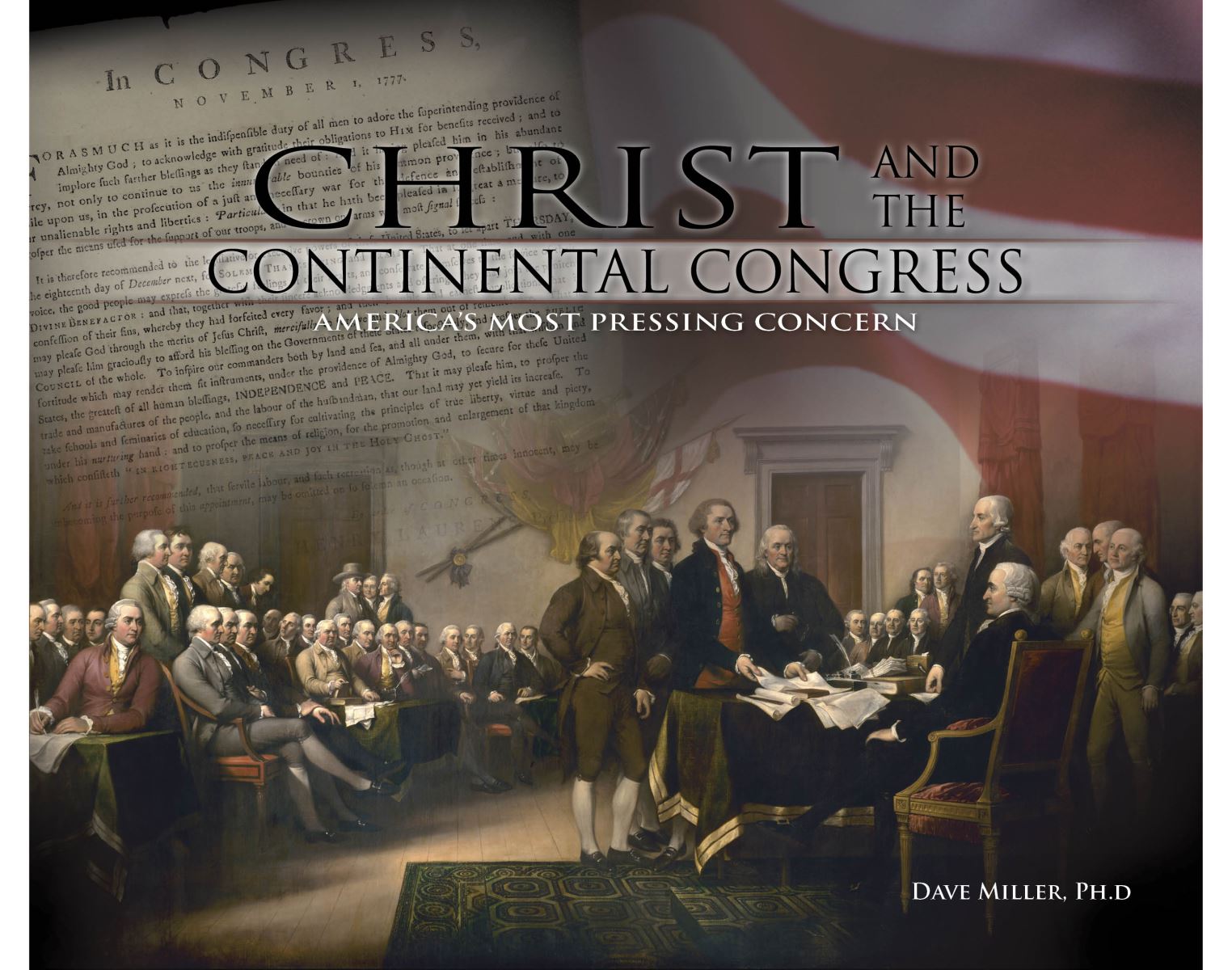
Miller, Dave (2009), Christ & the Continental Congress (Montgomery, AL: Apologetics Press).
Morse, Jedidiah (1799), A Sermon, Exhibiting the Present Dangers and Consequent Duties of the Citizens of the United States of America (Charlestown, MS: Samuel Etheridge), http://www.archive.org/details/sermonexhibiting00morsrich.
Ramsay, David (1813), An Eulogium Upon Benjamin Rush, M.D. (Philadelphia, PA: Bradford & Inskeep).
Steiner, Bernard (1921), One Hundred and Ten Years of Bible Society Work in Maryland, 1810-1920 (Baltimore, MD: The Maryland Bible Society).
Washington, George (1792), “Letter to John Armstrong, March 11, 1792,” Letterbook 18
Image 110 of 359, George Washington Papers at the Library of Congress, 1741-1799: Series 2 Letterbooks, http://memory.loc.gov/cgi-bin/ampage?collId=mgw2&fileName=gwpage018.db&recNum=109.
Washington, George (1796), Address of George Washington, President of the United States…Preparatory to His Declination (Baltimore, MD: George & Henry Keating).
Webster, Noah (1832), History of the United States (New Haven, CT: Durrie & Peck).
Witherspoon, John (1777), The Dominion of Providence over the Passions of Men (Philadelphia, PA: Town & Country), http://books.google.com/books/about/The_Dominion_of_Providence_Over_the_Pass.html?id=HpRIAAAAYAAJ.
The post Is Christianity Still Needed In America? appeared first on Apologetics Press.
]]>The post Cockeyed Conclusions About Connecticut appeared first on Apologetics Press.
]]> In the wake of the horrifying rampage in Connecticut that left 20 children and six adults shot to death, reactions from the anti-Christian media and liberal politicians are exactly what you would expect: “We’ve got to get rid of the guns!” Never mind the fact that murder goes back to the beginning of the human race when Cain killed his brother—without a gun. Guns have been around only a few hundred years; people have been killing each other for thousands of years. You do the math. If there were no guns—clubs, rocks, and sharpened sticks would do the job. Building a bomb or setting the school on fire would accomplish the same or worse. Shall we outlaw rocks, sticks, matches, and fertilizer?
Legion are the emotional, irrational explanations that have inundated the Web: “Adam Lanza and his mother both spent time at an area gun range” (Thomas, 2012); “Technology has rendered the 2nd Amendment to the U.S. Constitution obsolete” (“Adam Lanza’s…,” 2012); “New York mayor demands action on gun control” (“Connecticut…New York…,” 2012)”; “Connecticut Governor calls for a federal framework for gun control laws” (“Connecticut…State’s…,” 2012).“Time to get rid of the guns!” (Mackey, 2012); “The gunman had hundreds of rounds of ammunition!” (“Connecticut…Gunman…,” 2012); “The mother and father are Republicans” (Swain and Sanchez, 2012). Even the National Rifle Association missed the point when it announced, “The N.R.A. is prepared to offer meaningful contributions to help make sure this never happens again” (“NRA News Release…,” 2012). As if money can fix morality.
Interestingly, regarding the propriety of citizens having free access to guns, prominent Founder Thomas Jefferson approvingly quoted (1926, p. 314) from the celebrated Italian jurist, philosopher, and politician, Cesare Beccaria’s 1764 treatise, An Essay on Crimes and Punishments, words which are hauntingly prophetic of our present predicament:
Cesare Beccaria (1738-1794) The laws of this nature are those which forbid to wear arms, disarming those only who are not disposed to commit the crime which the laws mean to prevent. Can it be supposed, that those who have the courage to violate the most sacred laws of humanity, and the most important of the code, will respect the less considerable and arbitrary injunctions, the violation of which is so easy, and of so little comparative importance? Does not the execution of this law deprive the subject of that personal liberty, so dear to mankind and to the wise legislator? and does it not subject the innocent to all the disagreeable circumstances that should only fall on the guilty? It certainly makes the situation of the assaulted worse, and of the assailants better, and rather encourages than prevents murder, as it requires less courage to attack unarmed than armed persons (1983, p. 91, emp. added).

Yet, as American society’s Christian moorings continue to erode, and immoral human behavior rapidly replaces traditional American values, the left continues to trot out their insane assessments and godless “solutions”—completely missing the only explanation and the only solution. If only Americans would take the time to reread their Bibles and go back to the Founding Fathers to see the clear and unmistakable explanation for our predicament. This is not rocket science. It is not that difficult to see with clarity what is happening.
The Central Issue and Solution
The fact is that the Creator of the human race is the sole Author and Source of objective morality. Otherwise, moral distinctions would simply be the product of the subjective whims of humans. Morality would thus legitimately vary from person to person and country to country. One society might decide to legalize pedophilia while another might make it illegal—and both would be “right” in the sense that each person would be free to formulate his own moral standards. The result would be complete and utter social anarchy in which every person would be equally free to believe and behave however he or she chooses. Sound like America? What has happened? How can such profound change come over an entire civilization?The Founders of the American Republic anticipated just this social scenario—and even described the circumstances under which it would occur. The Founders predicted that if Americans do not retain an ardent commitment to the moral principles of Christianity, civil society will wane.
Consider the following prophetic voices. In the 1811 New York State Supreme Court case of The People v. Ruggles, the “Father of American Jurisprudence,” James Kent, explained the importance of punishing unchristian behavior, when he wrote that Americans are a “people whose manners are refined, and whose morals have been elevated and inspired with a more enlarged benevolence, by means of the Christian religion” (1811, emp. added). The gentility of the American spirit has historically been contrasted with those peoples “whose sense of shame would not be affected by what we should consider the most audacious outrages upon decorum” (1811, emp. added).
The Founders understood that the Bible presents the only logical and sane assessment of reality: an objective standard, authored by the Creator, which exists for the entire human race—what Thomas Jefferson identified as “one code of morality for men whether acting singly or collectively” (1789). That standard resides within the confines of the Christian religion as articulated in the New Testament. Unless human civilization gauges its moral behavior according to that objective, absolute framework, moral and spiritual chaos in society will be the end result—even if all the guns in the world were dumped into the ocean. In the words of Charles Carroll, a signer of the Declaration of Independence: “Without morals a republic cannot subsist any length of time; they, therefore, who are decrying the Christian religion, whose morality is so sublime and pure…are undermining the solid foundation of morals, the best security for the duration of free governments” (as quoted in Steiner, 1907, p. 475, emp. added).
Yet, for some 50 years now, Americans have been pummeled with the humanistic notion that morality can be maintained in society to the exclusion of Christianity. With almost prophetic anticipation, the very first president of the United States—the Father of our country—anticipated and addressed this sinister misnomer. After serving his country for two terms as president, George Washington delivered his farewell address to the nation, articulating forcefully the key to achieving security and protection for our lives:
Of all the dispositions and habits which lead to political prosperity, religion and morality are indispensable supports. In vain would that man claim the tribute of patriotism, who should labor to subvert these great pillars of human happiness, these firmest props of the duties of men and citizens. The mere politician, equally with the pious man, ought to respect and to cherish them. A volume could not trace all their connections with private and public felicity. Let it simply be asked: Where is the security for property, for reputation, for life, if the sense of religious obligation desert the oaths which are the instruments of investigation in courts of justice? And let us with caution indulge the supposition that morality can be maintained without religion. Whatever may be conceded to the influence of refined education on minds of peculiar structure, reason and experience both forbid us to expect that national morality can prevail in exclusion of religious principle. It is substantially true that virtue or morality is a necessary spring of popular government. The rule, indeed, extends with more or less force to every species of free government. Who that is a sincere friend to it can look with indifference upon attempts to shake the foundation of the fabric? (1796, pp. 22-23, emp. added).
Declaration of Independence signer Benjamin Rush stated: “[T]he only foundation for a useful education in a republic is to be laid in religion. Without this there can be no virtue, and without virtue there can be no liberty, and liberty is the object and life of all republican governments” (1806, p. 8, emp. added). Dr. Rush further stated:
We profess to be republicans, and yet we neglect the only means of establishing and perpetuating our republican forms of government, that is, the universal education of our youth in the principles of Christianity by the means of the Bible. For this Divine Book, above all others, favors that equality among mankind, that respect for just laws, and those sober and frugal virtues, which constitute the soul of republicanism (pp. 112-113, emp. added).
Dr. Rush also insisted:
I wish to be excused for repeating here, that if the Bible did not convey a single direction for the attainment of future happiness, it should be read in our schools in preference to all other books, from, its containing the greatest portion of that kind of knowledge which is calculated to produce private and public temporal happiness…. By withholding the knowledge of this [Christian] doctrine from children, we deprive ourselves of the best means of awakening moral sensibility in their minds (pp. 100,105, emp. and bracketed item added).
Over the past 50 years or so, the liberal establishment has convinced society that evil actions are merely the result of “disturbed,” “mentally ill,” and “genetically predisposed” people who are not, in the final analysis, responsible for their behavior. But both the Bible and the Founders insisted that a failure to fill one’s mind and thoughts with pure, righteous, virtuous concepts found in the Bible inevitably leads to a confused mind, a reckless lifestyle, and harm to society. In his scathing repudiation of Thomas Paine’s The Age of Reason, Continental Congress president Elias Boudinot insisted: “[O]ur country should be preserved from the dreadful evil of becoming enemies to the religion of the Gospel, which I have no doubt, but would be introductive of the dissolution of government and the bonds of civil society” (1801, p. xxii, emp. added). Dr. Benjamin Rush added his blunt observation: “Without the restraints of religion and social worship, men become savages” (1951, 1:505, emp. added). Noah Webster stated: “[R]eligion has an excellent effect in repressing vices [and] in softening the manners of men” (1794, Vol. 2, Ch. 44, emp. added).
The Founders believed that, should Christian principles be jettisoned by Americans, manners would be corrupted, and social anarchy and the fall of the Republic would naturally follow. Declaration signer and “The Father of the American Revolution,” Samuel Adams, issued a solemn warning in a letter to James Warren on February 12, 1779: “A general dissolution of the principles and manners will more surely overthrow the liberties of America than the whole force of the common enemy” (1908, 4:124). In his inaugural address as the Governor of Massachusetts in 1780, Founder John Hancock insisted that both our freedom and our very existence as a Republic will be determined by public attachment to Christian morality: “Manners, by which not only the freedom, but the very existence of the republics, are greatly affected, depend much upon the public institutions of religion and the good education of youth” (as quoted in Brown, 1898, p. 269, emp. added). The words of Declaration signer John Witherspoon are frightening: “Nothing is more certain than that a general profligacy and corruption of manners make a people ripe for destruction” (1802, 3:41, emp. added). In contrasting the general religion of Christianity with Islam, John Quincy Adams likewise explained:
The fundamental doctrine of the Christian religion, is the extirpation of hatred from the human heart. It forbids the exercise of it, even towards enemies. There is no denomination of Christians, which denies or misunderstands this doctrine. All understand it alike—all acknowledge its obligations; and however imperfectly, in the purposes of Divine Providence, its efficacy has been shown in the practice of Christians, it has not been wholly inoperative upon them. Its effect has been upon the manners of nations. It has mitigated the horrors of war—it has softened the features of slavery—it has humanized the intercourse of social life (1830, p. 300, emp. added).
We are a blind and hard-hearted people if we refuse to recognize the truth and validity of these observations. Fixating on guns, and other peripheral issues, sidesteps the eternal reality that when a society is organized and geared to respect God and His Word, aberrant behavior will still occur, but it will be far more infrequent that what America is now experiencing. Though mocked, ridiculed, and hotly denied, the truth remains that Connecticut, Columbine, and a host of other tragic occurrences America is experiencing, are the result of banishing God from our schools, our government, and our civic institutions. It is the natural result of teaching three generations of Americans that they owe their ultimate origin to rocks, slime, and soup which produced them over millions of years. It is the result of over half of Americans no longer attending church. It is the inevitable result of demeaning the Bible in universities and the corresponding loss of respect for inspired writ as seen in the failure of most Americans to read and study it. As the ancient prophet Hosea, in quoting God, forcefully declared many millennia ago concerning another nation: “My people are destroyed for lack of knowledge. Because you have rejected knowledge, I also will reject you…. Because you have forgotten the law of your God, I also will forget your children. The more they increased, the more they sinned against Me; I will change their glory into shame” (4:6-7, emp. added).
A good summary of the attitude of the Founders regarding the key to a tranquil, nonviolent society is seen in an “election sermon” preached by Chandler Robbins before the joint assembly of government officials of Massachusetts on May 25, 1791 which included the Governor, John Hancock (the first to sign the Declaration of Independence), the Lieutenant-Governor, Samuel Adams (the “Father of the American Revolution”), and both houses of the state government. Robbins articulated the widespread sentiments of his fellow citizens that now, more than two centuries later, sound haunting and eerily prophetic:
Our advantages for happiness as a people are great, almost beyond a parallel, bounteous Heaven has, with liberal profusion, poured his blessings upon our land, has given us a name and distinction among the kingdoms of the earth, we are spread over a great continent, so that…“we make a WORLD within ourselves…. We enjoy the divine WORD—are favored with the glorious privilege of the GOSPEL OF CHRIST. Indeed, there seems to be nothing wanting, to complete our character and our happiness as a community, but the spirit and practice of real religion. The want of this, it must be acknowledged, has the most threatening aspect upon our nation. The diffusive and rapid progress of declared infidelity and deism, of licentiousness and skepticism, the disregard of divine institutions, the practical contempt of the gospel of our Salvation, the awful dishonor, which, with unblushing confidence, many have openly cast upon the ETERNAL SON OF GOD, whom we are commanded to “honor as we honor the FATHER,” because he is “the brightness of his glory, and the express image of his person.” In fine, the torrent of immorality, profaneness and impiety, which daily increased among us, exhibit but a sad presage, if persisted in, of impending miseries on our land. It is, in the nature of things, impossible it should eventually go well with a people of the above description, and who remain impenitent and unreformed…. It is manifest therefore, that righteousness alone can truly exalt our nation—that RELIGION is the only basis, on which true happiness can be founded, either in communities or individuals. Let this then, be the object of universal concern (pp. 5-51, italics and caps in orig., emp. added).
A sizeable percentage of our politicians and citizens don’t get it. Yet the truth is so simple and plain, echoed in Robbins’ allusion to Proverbs 14:34—“Righteousness exalts a nation, but sin is a reproach to any people.” Mark it down: as more and more Americans lose their connection to the nation’s spiritual and moral roots—the Christian religion—the more our nation will be plunged into the nightmarish onslaught of events like the one which occurred in Newtown, Connecticut.
CONCLUSION
It is fully to be expected—it is absolutely inevitable—that as society expels God and Christianity, civility and morality among the people decreases. As people abandon Christian morality, more laws must be made to restrain their evil deeds. As more laws are made to restrain a lawless people, the less freedom those people enjoy. I repeat: Morality and religion are absolutely necessary to achieve and retain freedom. Once Americans abandon the Christian moral framework, they will inevitably clamor for more prisons, more security forces, more screening devices, and yes, fewer guns. But these “solutions” are merely temporary band aids that will not fix the problem and, in actuality, create more problems. The truth is that only two options lie before us, pinpointed in the 1840s by the Speaker of the U.S. House, Robert Winthrop: “Men, in a word, must necessarily be controlled either by a power within them or by a power without them; either by the Word of God or by the strong arm of man; either by the Bible or by the bayonet” (1852, p. 172, emp. added). Observe: Americans have banned the Bible from the public square and have opted for the bayonet—more government control and fewer freedoms.
What was going on in that child’s life that would enable him to so conduct himself? Not the existence of guns! The Left does not want to go to the root of the problem—because their very philosophy and belief system has already dismissed God and Christian morality as irrelevant, if not harmful. They recoil at the thought of promoting self-restraint and strict Christian morality. Hence, to them, the problem must lie elsewhere. (Although, they are perfectly happy to blame God for the killings.) But this 20-year-old boy was not born with the propensity to kill children. Even his suspected autism is not responsible for the violence. His attitude and behavior was developed and nurtured during his formative years. His training, experiences, and personal choices made him who he became. Not his genes, not the presence of guns in the world, not visits to the gun range, and certainly not the existence of “Bible-thumping, right wing radical Christians.” The Bible plainly teaches that a stable home environment, with both biological parents present nurturing their children in the principles of Christianity, are the most effective aids to producing successful, productive, law-abiding citizens. The Founders wholeheartedly affirmed this approach to life and realized that the societal environment most conducive to producing stable citizens and a happy country is one that is based on and rooted in the moral principles of the Bible. Yet this boy’s personal life very likely possessed features that contributed to his degeneration to a “debased mind” (Romans 1:28), even enabling him to kill his own mother by shooting her in the face (Swain and Sanchez, 2012). This was a troubled child, to say the least. His troubled condition did not arise from the presence of guns. Until America faces the reality of what creates the increasing numbers of troubled children, society will continue to reap the consequences.
REFERENCES
“Adam Lanza’s Weapons” (2012), New York Post, December 18, http://www.nypost.com/p/news/opinion/editorials/adam_lanza_weapons_NU2tb0tIf9hNsOCZkPJ1XP.
Adams, John Quincy (1830), The American Annual Register (New York: E. & G.W. Blunt).
Adams, Samuel (1904-1908), The Writings of Samuel Adams, ed. Harry Cushing (New York: G.P. Putnam’s Sons).
Beccaria, Cesare (1983), An Essay on Crimes and Punishments (Boston, MA: International Pocket Library, http://books.google.com/books?id=InuKBpD_ 21YC&printsec=frontcover&dq=Cesare+Beccaria,+An+Essay+on+Crimes+ %26+Punishments&hl=en&sa=X&ei=TkzTUJ-ZNIH88gScxoGoCg&ved =0CDQQ6AEwAA).
Boudinot, Elias (1801), The Age of Revelation (Philadelphia, PA: Asbury Dickins), http://www.google.com/books?id=XpcPAAAAIAAJ.
Brown, Abram (1898), John Hancock, His Book (Boston, MA: Lee & Shepard Publishers), http://www.archive.org/details/johnhancock00browrich.
“Connecticut School Shooting: Gunman Had Hundreds of Rounds of Ammunition” (2012), Chicago Tribune, December 16, http://www.chicagotribune.com/news/chi-connecticut-school-shooting-victims-20121216,0,5491415.story?page=2.
“Connecticut School Shooting: New York Mayor Demands Action on Gun Control” (2012), The Telegraph, December 17, http://www.telegraph.co.uk/news/worldnews /northamerica/usa/9751633/Connecticut-school-shooting-New-York-mayor -demands-action-on-gun-control.html.
“Connecticut School Shooting: State’s Governor Calls for Action on Gun Control” (2012), The Telegraph, December 17, http://www.telegraph.co.uk/news/worldnews /northamerica/usa/9751905/Connecticut-school-shooting-states-governor- calls-for-action-on-gun-control.html.
Jefferson, Thomas (1789), “Letter to James Madison,” The Works of Thomas Jefferson in Twelve Volumes, ed. Paul Leicester Ford, http://memory.loc.gov/cgi-bin/query/r?ammem/mtj:@field(DOCID+@lit (tj050135)).
Jefferson, Thomas (1926), The Commonplace Book of Thomas Jefferson: A Repertory of His Ideas on Government, ed. Gilbert Chinard (Baltimore: Johns Hopkins Press).
Mackey, Robert (2012), “Dec. 18 Updates on Connecticut Shooting Aftermath,” The New York Times, December 19, http://thelede.blogs.nytimes.com/2012/12/18/latest-updates-on-connecticut-shooting-aftermath/.
“NRA News Release on December Press Conference” (2012), The National Rifle Association of America, http://www.nrablog.com/.
The People v. Ruggles(1811), 8 Johns 290 (Sup. Ct. NY.), N.Y. Lexis 124.
Robbins, Chandler (1791), A Sermon Preached Before His Excellency John Hancock, Esq., Governour, His Honor Samuel Adams, Esq., Lieutenant-Governour, the Honourable the Council, and the Honourable the Senate and House of Representatives of the Commonwealth of Massachusetts, May 25, 1791 Being the Day of General Election (Boston, MA: Thomas Adams), http://openlibrary.org/works/OL1743074W /A_sermon_preached_before_His_Excellency_Jonh_sic_Hancock_Esq. _governour_His_Honor_Samuel_Adams_Esq._.
Rush, Benjamin (1806), Essays, Literary, Moral and Philosophical (Philadelphia, PA: Thomas & William Bradford).
Rush, Benjamin (1951), Letters of Benjamin Rush, ed. L.H. Butterfield (Princeton, NJ: The American Philosophical Society).
Steiner, Bernard (1907), The Life and Correspondence of James McHenry (Cleveland, OH: Burrows Brothers).
Swain, Jon, and Raf Sanchez (2012), “Connecticut School Shooting: Adam Lanza Was Assigned Psychologist,” The Telegraph, December 17, http://www.telegraph.co.uk/news/worldnews/northamerica/ usa/9750422/Connecticut-school-shooting-Adam-Lanza-was-assigned- psychologist.html.
Thomas, Pierre, et al. (2012), “Connecticut School Shooting: Adam Lanza and Mother Visited Gun Ranges,” ABC News, December 16, http://abcnews.go.com/Blotter/connecticut-school-shooting-adam-lanza-mother-visited-gun/story?id=17992396.
Washington, George (1796), Address of George Washington, President of the United States…Preparatory to His Declination (Baltimore, MD: George & Henry Keating).
Webster, Noah (1794), “The Revolution in France,” in Political Sermons of the American Founding Era: 1730-1805, ed. Ellis Sandoz (Indianapolis, IN: Liberty Fund), 1998 edition, http://oll.libertyfund.org/title/817/69415.
Winthrop, Robert (1852), Addresses and Speeches on Various Occasions (Boston, MA: Little, Brown, & Co.).
Witherspoon, John (1802), The Works of the Rev. John Witherspoon (Philadelphia, PA: William Woodard).
The post Cockeyed Conclusions About Connecticut appeared first on Apologetics Press.
]]>The post Founders En Masse Advocated Christianity appeared first on Apologetics Press.
]]>The failure of the average citizen to examine the facts and assess the gravity of the situation is inexcusable. In reality, the religious orientation of the architects of American civilization, and their view regarding its importance to the establishment and perpetuation of the Republic, is easily ascertainable. Rather than wade through the myriad pages and books that purport to depict American history accurately, all one need do is simply reread the organic utterances issued by the Founders as they orchestrated the founding.
Though not including all those who rightly wear the appellation “Founder,” nevertheless, the Continental Congress comprised a substantial portion of those men, and they may clearly be designated quintessential Founders (see Miller, 2009, p. 3). They certainly constitute a representative cross section of the men who brought the Republic into existence. Consider one sample among many in which the Continental Congress en masse issued a proclamation to the entire population of the country on March 19, 1782:
The United States in Congress assembled…think it their indispensable duty to call upon the several states, to set apart the last Thursday in April next, as a day of fasting, humiliation and prayer…that He would incline the hearts of all men to peace, and fill them with universal charity and benevolence, and that the religion of our Divine Redeemer, with all its benign influences, may cover the earth as the waters cover the seas (Journals of…, 22:137-138, emp. added).
The “Divine Redeemer” is Jesus Christ. Calling for Christ’s religion to “cover the earth as the waters cover the seas” is a direct allusion to two Old Testament passages—Isaiah 11:9 and Habakkuk 2:14.
The Founders insisted that the stability of the Republic depends on the Christian religion, with its moral principles and spiritual framework. They felt that though other religions may certainly be tolerated in America, the peculiar doctrines and practices of those religions must not be allowed to alter the laws and institutions of the nation. Nor must those doctrines and practices do any physical harm to Americans or violate Christian morality (e.g., polygamy, homosexuality, and abortion). The Founders would be horrified at the notion of “political correctness” and its corrosive, destructive influence. They would have difficulty believing that Americans would ever even consider allowing Sharia law to be included in our courts, schools, or government. The Founders never asked that Hinduism cover the Earth, nor Islam, Buddhism, or Atheism. Rather, they begged God to cover the Earth with the religion of Christ as thoroughly and completely as the waters cover the oceans of the world.
REFERENCES
Journals of the Continental Congress, 1774-1789 (1904-1937), ed. Worthington C. Ford, et al. (Washington, D.C.: Government Printing Office), Library of Congress, http://memory.loc.gov/ammem/amlaw/lwjc.html.
Miller, Dave (2009), Christ and the Continental Congress (Montgomery, AL: Apologetics Press).
The post Founders En Masse Advocated Christianity appeared first on Apologetics Press.
]]>The post How To Offend God appeared first on Apologetics Press.
]]>The Founders of the American Republic most certainly shared this greater concern (Miller, 2009). They repeatedly expressed their conviction that the successful establishment of the nation was dependent on the approval of God. They insisted that it was imperative that Americans not be guilty of offending Him or earning His displeasure, lest their entire national enterprise fail. For example, four months before officially declaring independence from Great Britain, the Continental Congress issued a proclamation to the entire country:
In times of impending calamity and distress; when the liberties of America are imminently endangered…, it becomes the indispensable duty of these hitherto free and happy colonies, with true penitence of heart, and the most reverent devotion, publickly [sic] to acknowledge the over ruling providence of God; to confess and deplore our offences against him; and to supplicate his interposition for averting the threatened danger…. Desirous, at the same time, to have people of all ranks and degrees duly impressed with a solemn sense of God’s superintending providence, and of their duty, devoutly to rely, in all their lawful enterprises [sic], on his aid and direction, Do earnestly recommend, that Friday, the Seventeenth day of May next, be observed by the said colonies as a day of humiliation, fasting, and prayer; that we may, with united hearts, confess and bewail our manifold sins and transgressions, and, by a sincere repentance and amendment of life,appease his righteous displeasure, and, through the merits and mediation of Jesus Christ, obtain his pardon and forgiveness; humbly imploring his assistance…. (Journals of…, 4:208-209, emp. added).
Subsequent proclamations contained similar sentiments regarding the wrath of God, including such phrases as: “to acknowledge GOD in all his Ways, and more especially to humble themselves before him when evident tokens of his Displeasure are manifested” (Journals of…, 10:229-230, emp. added); “that so he might turn from his Wrath” (Journals of…, 13:343-344, emp. added); “humbling ourselves before him, and turning from every evil Way to avert his Anger and obtain his Favour” (Journals of…, 16:252-253, emp. added; cf. 19:284-286).
Who, today, believes the perpetuation of a blessed America depends on appeasing God’s righteous displeasure over the sins of Americans? How many Americans are actually and vitally concerned about offending God? Perhaps a key indicator was the number one concern of the vast majority of Americans during the last presidential election—the economy, not morality (“Economy Top Issue…,” 2010)! Since the Bible is proven to be the only book on the planet that conveys the will of God (Butt, 2007), what does it say about offending God? How are Americans offending God today, and consequently endangering the existence of the Republic? The Bible delineates a number of such offenses that merit divine displeasure, but please consider three.
When Harry Reid invited a Hindu priest to open a session of the U.S. Senate with a Hindu prayer, neither he nor a host of others apparently gave the slightest thought to whether such an action was an offense to the God of the Universe. After all, political correctness demands that all religions and ideologies be celebrated and treated as equally authentic. To fail to do so would be “intolerant” and “judgmental”—the only ultimate evil in the minds of many. But to give credence or credibility to pantheistic religion (“God” inside the Earth, sky, etc.; see Miller, 2007b) that advocates belief in thousands of “gods” and that cow-killing is a sin, while rejecting the one true God of the Bible, would be unthinkable in America in 1776. It was equally unthinkable for most Americans until the last 40-50 years. The politically correct climate now enshrouding America literally is suffocating the moral and religious sensibilities of society. The nod to Hinduism follows closely on the heels of the election of a Muslim to the U.S. House of Representatives, as well as the first atheist in Congress (see Miller, 2006; Miller, 2007a).
But wait! The fact is that the God of the Bible exists, He is the only one that exists, and both atheism and polytheism are an affront to His righteous character (cf. Warren and Flew, 1976; Butt and Barker, 2009). Consequently, human behavior that violates His will displeases Him. Rather than being overly concerned with whether our Christian beliefs offend our misguided fellow human beings, we would do well to show greater concern for whether our behavior offends God.
Second, whereas at one time in American culture, the average citizen understood the concept that using God’s name in vain was taboo, now it is common place. Both adults and children regularly use God’s name in a flippant, thoughtless, frivolous way (“Oh, my God!”). Yet, God informed the Israelites that such disrespectful misuse of His name would bring His displeasure: “You shall not take the name of the LORD your God in vain, for the LORD will not hold him guiltless who takes His name in vain” (Deuteronomy 5:11, emp. added). God holds guilty those who misuse His high and holy name.
Third, the gross and flagrant immorality that has blanketed American civilization, becoming commonplace and comfortable to the population, is an offense to the God of Heaven. The very actions that most Americans disdained for most of American history are now widespread, rampant, and defiantly defended or downplayed: stealing, lying, murder, covetousness, adultery, homosexuality, pre-marital and extra-marital sex, rape, gambling, intoxication, the killing of the unborn, and the list goes on and on. The Great Governor of the Universe is offended by such conduct, and historically, He will allow it to progress only so long and so far (e.g., Genesis 6:5-7; 19:24-25; 15:16; Deuteronomy 7:1-4). Legion are the nations that were destroyed for their wickedness, now lying in rubble, ruins, and the dust of antiquity (see Miller, 2005).
Writing from Mount Vernon on June 29, 1788, the Father of our country, George Washington, wrote a letter to Major General Benjamin Lincoln. In that letter, remarks were made to which every American today ought to pay earnest heed:
No one can rejoice more than I do at every step the people of this great Country take to preserve the Union, establish good order and government, and to render the Nation happy at home and respectable abroad. No Country upon Earth ever had it more in its power to attain these blessings than United America. Wondrously strange then, and much to be regretted indeed would it be, were we to neglect the means, and to depart from the road which Providence has pointed us to, so plainly; I cannot believe it will ever come to pass. The great Governor of the Universe has led us too long and too far on the road to happiness and glory, to forsake us in the midst of it. By folly and improper conduct, proceeding from a variety of causes, we may now and then get bewildered; but I hope and trust that there is good sense and virtue enough left to recover the right path before we shall be entirely lost (1788, emp. added).
The only remedy and the only hope for America to perpetuate its national existence is to swallow the antidote prescribed by God Himself:
Now it shall come to pass, if you diligently obey the voice of the LORD your God, to observe carefully all His commandments which I command you today, that the LORD your God will set you high above all nations of the earth. And all these blessings shall come upon you and overtake you, because you obey the voice of the LORD your God… But it shall come to pass, if you do not obey the voice of the LORD your God, to observe carefully all His commandments and His statutes which I command you today, that all these curses will come upon you and overtake you: The LORD will send on you cursing, confusion, and rebuke in all that you set your hand to do, until you are destroyed and until you perish quickly, because of the wickedness of your doings in which you have forsaken Me (Deuteronomy 28:1-2,15,20, emp. added).
REFERENCES
Butt, Kyle (2007), Behold! The Word of God (Montgomery, AL: Apologetics Press).
Butt, Kyle and Dan Barker (2009), Butt/Barker Debate: Does the God of the Bible Exist? (Montgomery, AL: Apologetics Press).
“Economy Top Issue for Voters; Size of Gov’t. May Be More Pivotal” (2010), Gallup, October 26, http://www.gallup.com/poll/144029/Economy-Top-Issue-Voters-Size-Gov-May-Pivotal.aspx.
Journals of the Continental Congress, 1774-1789 (1904-1937), ed. Worthington C. Ford, et al. (Washington, D.C.: Government Printing Office), Library of Congress, http://memory.loc.gov/ammem/amlaw/lwjc.html.
Miller, Dave (2005), “Is America’s Iniquity Full?” http://apologeticspress.org/apcontent.aspx?category=7&article=1528.
Miller, Dave (2006), “A Muslim Now in Congress?” http://apologeticspress.org/APContent.aspx?category=7&article=1999.
Miller, Dave (2007a), “First Atheist in Congress,” Reason & Revelation, 6[5]:17,20-R, May, http://apologeticspress.org/APContent.aspx?category=7&article=2140.
Miller, Dave (2007b), “Hindu Prayer in Congress,” Reason & Revelation, 27[8]:57-63, August, http://apologeticspress.org/apPubPage.aspx?pub=1&issue=592.
Miller, Dave (2009), Christ & the Continental Congress (Montgomery, AL: Apologetics Press).
Warren, Thomas B. and Antony Flew (1976), The Warren-Flew Debate (Jonesboro, AR: National Christian Press).
Washington, George (1788), “George Washington to Benjamin Lincoln, June 29, 1788,” George Washington Papers at the Library of Congress, 1741-1799: Series 2 Letterbooks, Letterbook 15, Image 172 of 341, The Writings of George Washington from the Original Manuscript Sources, 1745-1799, ed. John C. Fitzpatrick, http://memory.loc.gov/cgi-bin/ampage?collId=mgw2&fileName=gwpage015.db&recNum=171.
The post How To Offend God appeared first on Apologetics Press.
]]>The post The Founders Wanted the Gospel Preached? appeared first on Apologetics Press.
]]>On October 20, 1779, the Continental Congress issued a proclamation to the entire nation:
Whereas it becomes us humbly to approach the throne of Almighty God, with gratitude and praise for the wonders which his goodness has wrought…above all, that he hath diffused the glorious light of the gospel, whereby, through the merits of our gracious Redeemer, we may become the heirs of his eternal glory: therefore, Resolved, That it be recommended to the several states, to appoint Thursday, the 9th of December next, to be a day of public and solemn thanksgiving to Almighty God for his mercies, and of prayer for the continuance of his favor and protection to these United States (Journals of…, 15:1191-1193, emp. added).
“The glorious light of the gospel” is an allusion to 2 Corinthians 4:4, and “heirs of his eternal glory” is a reference to 2 Timothy 2:10. Diffusing the Gospel of Christ was of paramount importance to the Founders. However imperfectly they conceptualized the pure, nondenominational, New Testament Gospel, they thanked God that the Gospel had been thoroughly diffused throughout America.
One year later in October of 1780, they issued another proclamation to the country’s population in which they thanked God for “continuing to us the enjoyment of the gospel of peace” (Journals of…, 18:950-951)—an expression taken from the New Testament books of Romans (10:15) and Ephesians (6:15). And then on October 18, 1783, with the Revolutionary War drawing to a close, they again proclaimed to all Americans their gratitude for numerous blessings bestowed by God, “and above all, that he hath been pleased to continue to us the light of the blessed gospel [an allusion to 2 Corinthians 4:4—DM], and secured to us in the fullest extent the rights of conscience in faith and worship” (Journals of…, 25:699-701, emp. added).
America has drifted so far from her moorings that the average citizen no longer sees the critical need for the Gospel of Jesus Christ to be disseminated throughout the population. Indeed, Americans have, in fact, become so enamored with the innocuous and inane notions of political correctness and celebrating diversity that many are openly hostile to Christianity and its vital historical role in the founding and perpetuation of our nation. (Ironically and hypocritically, all other religions are encouraged and affirmed by the same citizens. Cf. the U.S. House resolution commending Islam, H. Res. 635, 2007). Elias Boudinot, president of the Continental Congress (1782-1783), expressed his “anxious desire” that “our country should be preserved from the dreadful evil of becoming enemies to the religion of the Gospel, which I have no doubt, but would be introductive of the dissolution of government and the bonds of civil society” (1801, p. xxii, emp. added). The Founders would be heartsick that American society has gone from vibrant respect for Gospel precepts, to indifference, to being ashamed, and now to outright rejection. The apostle Paul’s declaration ought to be deeply imprinted on every true American’s heart and soul: “For I am not ashamed of the gospel of Christ, for it is the power of God to salvation” (Romans 1:16). Indeed, only the Gospel can save our souls—and only the precepts of that same Gospel of Jesus Christ can rescue our nation.
REFERENCES
Boudinot, Elias (1801), The Age of Revelation (Philadelphia, PA: Asbury Dickins), http://www.google.com/books?id=XpcPAAAAIAAJ.
Journals of the Continental Congress, 1774-1789 (1904-1937), ed. Worthington C. Ford, et al. (Washington, D.C.: Government Printing Office), Library of Congress, http://memory.loc.gov/ammem/amlaw/lwjc.html.
U.S. House (2007), “Recognizing the Commencement of Ramadan, the Islamic Holy Month of Fasting and Spiritual Renewal, and Expressing Respect to Muslims in the United States and Throughout the World on This Occasion, and For Other Purposes,” H. Res. 635, October 2, Sponsor Eddie Johnson [D-TX].
The post The Founders Wanted the Gospel Preached? appeared first on Apologetics Press.
]]>The post Freedom Without Religion? appeared first on Apologetics Press.
]]>Declaration signer and physician, Dr. Benjamin Rush, explained the mode of education to be adopted “so as to secure to the state all the advantages to be derived from the proper instruction of youth”:
“[T]he only foundation for a useful education in a republic is to be laid in Religion. Without this there can be no virtue, and without virtue there can be no liberty, and liberty is the object and life of all republican governments” (1804, p. 8). The “religion” to which Dr. Rush alluded was the Christian religion. Observe: without Christian virtue/morality, there can be no liberty.
On October 20, 1779, the Continental Congress—an entity that represents a host of the Founders of America—issued a proclamation to the entire nation that contains the quintessential answer to the question: “On what does American freedom depend?” Please read it closely:
Whereas it becomes us humbly to approach the throne of Almighty God, with gratitude and praise for the wonders which his goodness has wrought in conducting our forefathers to this western world; for his protection to them and to their posterity amid difficulties and dangers; for raising us, their children, from deep distress to be numbered among the nations of the earth; …and above all, that he hath diffused the glorious light of the gospel, whereby, through the merits of our gracious Redeemer, we may become the heirs of his eternal glory: therefore, Resolved, That it be recommended to the several states, to appoint Thursday, the 9th of December next, to be a day of public and solemn thanksgiving to Almighty God for his mercies, and of prayer for the continuance of his favor and protection to these United States; …that he would grant to his church the plentiful effusions of divine grace, and pour out his holy spirit on all ministers of the gospel; that he would bless and prosper the means of education, and spread the light of Christian knowledge through the remotest corners of the earth; …that he would in mercy look down upon us, pardon our sins and receive us into his favor, and finally, that he would establish the independence of these United States upon the basis of religion and virtue, and support and protect them in the enjoyment of peace, liberty and safety as long as the sun and moon shall endure, until time shall be no more. Done in Congress, the 20th day of October, one thousand seven hundred and seventy-nine, and in the 4th year of the independence of the United States of America.
Samuel Huntington, President.
Attest, Charles Thomson, Secretary (Journals of…, 1904-1937, 15:1191-1193, emp. added).
There you have it—if you can accept it. The Founders of America—the very ones who initiated the incredible freedom that characterizes our country and for which she is renowned—maintained that that freedom depends on citizen commitment to the Christian religion. So does spiritual freedom. As Jesus Himself explained: “If you abide in My word, you are My disciples indeed. And you shall know the truth, and the truth shall make you free…. Therefore if the Son makes you free, you shall be free indeed” (John 8:31-32,36).
REFERENCES
Journals of the Continental Congress, 1774-1789 (1904-1937), ed. Worthington C. Ford, et al. (Washington, D.C.: Government Printing Office), Library of Congress, http://memory.loc.gov/ammem/amlaw/lwjc.html.
Rush, Benjamin (1804), Essays, Literary, Moral, and Philosophical (Philadelphia, PA: Thomas and William Bradford), http://books.google.com/books?id=xtUKAAAAIAAJ&printsec=frontcover&dq=benjamin+rush&cd=2#v=onepage&q&f=false.
The post Freedom Without Religion? appeared first on Apologetics Press.
]]>The post Hollywood is UnAmerican appeared first on Apologetics Press.
]]>Hollywood did not exist prior to the 20th century. Its influence on American civilization over the last century has been catastrophic. The invention of the camera, cinema, television, and the multitude of electronic formats now available have significantly transformed daily living. These inventions, though harmless in themselves, have provided citizens with the means of entertainment unparalleled in human history. What’s more, the influence of Hollywood and the entertainment industry has so encroached on moral and spiritual sensibilities that political leaders, news organizations, and even church leaders routinely incorporate into their roles homage to Hollywood personalities and entertainers.
The Bible plainly teaches that, while some diversion is appropriate, the obsession with pleasure and frivolous amusement that has come to dominate many Americans is sinful and destructive to spiritual health and mental sobriety (1 Timothy 5:6; 2 Timothy 3:4; Titus 3:3; James 4:1-3; 5:5; 2 Peter 2:13; 1 Thessalonians 5:1-11). Since the Founders of America were so whetted to the Christian religion and familiar with their Bibles, they were well aware of the harmful effects of entertainment in general, and the acting profession in particular, on efforts to preserve the American way of life. So much so that the Continental Congress considered the following two resolutions on October 12, 1778:
Whereas true religion and good morals are the only solid foundations of public liberty and happiness:
Resolved, That it be, and it is hereby earnestly recommended to the several states, to take the most effectual measures for the encouragement thereof, and for the suppressing of theatrical entertainments, horse racing, gaming, and such other diversions as are productive of idleness, dissipation, and a general depravity of principles and manners.
Resolved, That all officers in the army of the United States, be, and hereby are strictly enjoined to see that the good and wholesome rules provided for the discountenancing of prophaneness and vice, and the preservation of morals among the soldiers, are duly and punctually observed (Journals of…, 12:1001, emp. added).
Four days later (Friday, October 16, 1778), Congress considered a resolution that was intended to exclude from public office those who participated in the entertainment industry:
Whereas frequenting play houses and theatrical entertainments has a fatal tendency to divert the minds of the people from a due attention to the means necessary for the defence of their country, and the preservation of their liberties:
Resolved, That any person holding an office under the United States, who shall act, promote, encourage or attend such plays, shall be deemed unworthy to hold such office, and shall be accordingly dismissed (Journals of…, 12:1018, emp. added).
Most Americans would probably laugh out loud upon reading these statements. They would consider such thinking archaic, old-fashioned, ludicrous, and outright wrong. They see no danger to national security when the propensity for entertainment characterizes those we trust to protect and govern us. They certainly see no connection between the widespread devotion to frivolous entertainment within the general population, and the resulting “idleness, dissipation, and a general depravity of principles and manners.”
How does one convince such people otherwise? The only way to do so is to nurture their spirit with the profound words of Jesus Christ and the spiritual nourishment available from the Bible. If they will not expose their minds to the uplifting, spiritually enriching Word of God, they are doomed to develop a degenerate, depraved mind that pursues pleasure. Listen carefully to the observation issued by the Holy Spirit to the Ephesians:
This I say, therefore, and testify in the Lord, that you should no longer walk as the rest of the Gentiles walk, in the futility of their mind, having their understanding darkened, being alienated from the life of God, because of the ignorance that is in them, because of the hardening of their heart; who, being past feeling, have given themselves over to lewdness, to work all uncleanness with greediness. But you have not so learned Christ, if indeed you have heard Him and have been taught by Him, as the truth is in Jesus: that you put off, concerning your former conduct, the old man which grows corrupt according to the deceitful lusts, and be renewed in the spirit of your mind, and that you put on the new man which was created according to God, in true righteousness and holiness (Ephesians 4:17-24, emp. added).
What better description of an increasing number of Americans? And what will be the outcome for the nation? According to the Founders, Americans will be unable to defend their country and preserve their liberties. May God enable us to renew our minds (Romans 12:2). May we be “lovers of God” rather than “lovers of pleasure” (2 Timothy 3:4).
REFERENCES
Bella (2009), “Kris Allen is American Idol Winner 2009!” Celebrity News, May 20, [On-line], URL: http://www.thinkfashion.com/blogs/stylosity_hollywood_hookup/archive/2009/05/20/kris-allen-wins-american-idol-2009.aspx.
Journals of the Continental Congress (1904-1937), (Washington, DC: Government Printing Office), [On-line], URL: http://memory.loc.gov/cgi-bin/ampage?collId=lljc&fileName=012/lljc012.db&recNum=159&itemLink=r?ammem/hlaw:@field(DOCID+@lit(jc01240))%230120160&linkText=1.
“2008 Official Presidential General Election Results” (2009), Presidential Election Commission, [On-line], URL: http://www.fec.gov/pubrec/fe2008/2008presgeresults.pdf.
The post Hollywood is UnAmerican appeared first on Apologetics Press.
]]>The post America’s Most Pressing Concern appeared first on Apologetics Press.
]]>Beyond the economy, contemplate for a moment a few of the other issues that occupy the concern of many Americans:
| Socialism | Illegal immigration | Massive Government Spending |
| Public Education | Environmental issues | COVID |
| Domestic & Foreign Terrorism | Foreign affairs | Social security and Medicare |
Many other issues might be listed, but these are sufficient to make the point: Most Americans are more concerned about physical and financial matters than spiritual matters. When one contemplates the multitude of pressing concerns, it is easy to feel “scattered” and overwhelmed as to (1) what the real problem is and (2) the antidote.
While these matters certainly merit the attention and due concern of citizens, the fact of the matter is that the Founders of our Republic pinpointed a much more critical, logically prior issue. Consider the forthright remarks of three:
In a letter written to fellow Founder and signer  of the federal Constitution, James McHenry, on November 4, 1800, Declaration signer Charles Carroll of Carrollton declared:
[W]hat motive can be stronger than the belief, founded on revelation, that a virtuous life will be rewarded by a happy immortality? Without morals a republic cannot subsist any length of time; they therefore who are decrying the Christian religion, whose morality is so sublime and pure…are undermining the solid foundation of morals, the best security for the duration of free governments (as quoted in Steiner, 1907, p. 475, emp. added).
Consider carefully the admonitions of Founder Noah Webster regarding the indispensable nature of Christianity to the existence of our Republic:
[O]ur citizens should early understand that the genuine source of correct
republican principles is the Bible, particularly the New Testament or the Christian religion…. [T]he religion which has introduced civil liberty, is the religion of Christ and his apostles, which enjoins humility, piety, and benevolence; which acknowledged in every person a brother, or a sister, and a citizen with equal rights. This is genuine Christianity, and to this we owe our free constitutions of government…. [T]he Christian religion ought to be received, and maintained with firm and cordial support. It is the real source of all genuine republican principles…. The religion of Christ and his apostles, in its primitive simplicity and purity, unencumbered with the trappings of power and the pomp of ceremonies, is the surest basis of a republican government…. [T]hose who destroy the influence and authority of the Christian religion, sap the foundations of public order, of liberty, and of republican government…. (1832, pp. v,247,310-311, emp. added).
The United States commenced their existence under circumstances wholly novel and unexampled in the history of nations. They commenced with civilization, with learning, with science, with constitutions of free government, and with that best gift of God to man, the Christian religion (as quoted in Scudder, 1881, p. 242, emp. added).
In his 1780 inaugural address as the governor of his home state of Massachusetts, Declaration signer John Hancock reminded his fellow citizens of the importance of Christianity to the perpetuation of the nation:
Sensible of the importance of Christian piety and virtue to the order and happiness of a state, I cannot but earnestly commend to you every measure for their
support and encouragement…. A due observation of the Lord’s Day is not only important to internal religion, but greatly conducive to the order and benefit of civil society…. Manners, by which not only the freedom, but the very existence of the republics, are greatly affected, depend much upon the public institutions of religion and the good education of youth (as quoted in Brown, 1898, p. 269, emp. added).
There you have it. The Founders repeatedly articulated the #1 concern—the paramount, ultimate, most pressing issue facing the nation. Without this singular, critically important quality—if America does not get this one matter correct—the economy will be the least of our worries. Stated succinctly, that all-consuming, quintessential, premiere concern is: We the citizens, and our leaders, must reinstate acknowledgement of God and His religion (i.e., Christianity), and turn to Him in humble, penitent obedience. According to the Founders themselves, the God of the Bible was solely responsible for the establishment and perpetuation of the Republic. And that national recognition is the only thing that will preserve and sustain us, as it has done for over two centuries. Even if we could snap our fingers and fix all our economic woes instantaneously, without God’s favor we remain in deadly danger. Indeed, rather than fearing terrorists or economic depression, the time has come to reinstate a healthy, sober fear of God (Proverbs 1:7,29-33; Ecclesiastes 12:13; Hebrews 10:31; 12:29—see Miller, 2003; Miller, 2009).
Unless America can get this one, critical issue sorted out; unless a sizable percentage of Americans will go back to God, Christ, and the Bible, and recognize their foremost need of receiving divine favor; unless citizens can restore moral and sexual sanity to their behavior based on Christian principles, the country is destined to destruction. “Righteousness exalts a nation, but sin is a reproach to any people” (Proverbs 14:34). May God bless America.
REFERENCES
Brown, Abram (1898), John Hancock: His Book (Boston, MA: Lee & Shepard Publishers).
“Economy, Jobs Easily Top Problems in Americans’ Minds” (2010), Gallup, September 21, http://www.gallup.com/poll/143135/Economy-Jobs-Easily-Top-Problems-Americans-Minds.aspx.’
“Economy Top Issue for Voters; Size of Gov’t. May Be More Pivotal” (2010), Gallup, October 26, http://www.gallup.com/poll/144029/Economy-Top-Issue-Voters-Size-Gov-May-Pivotal.aspx.
Miller, Dave (2003), “Who Believes in Hell Anymore?” http://apologeticspress.org/articles/2258.
Miller, Dave (2009), “God’s Fierce Anger,” http://apologeticspress.org/articles/2242.
Scudder, Horace (1881), Noah Webster (Boston, MA: Houghton, Mifflin, & Co.).
Steiner, Bernard (1907), The Life and Correspondence of James McHenry (Cleveland, OH: Burrows Brothers).
Webster, Noah (1832), History of the United States (New Haven, CT: Durrie & Peck).
The post America’s Most Pressing Concern appeared first on Apologetics Press.
]]>The post Church Attendance and the Survival of the Republic appeared first on Apologetics Press.
]]>
John Hancock –
Founding Father
The polling data grows more dismal every year. For several years, polls have shown that only 39% of Americans say they attend worship at least once a week (“How Religious…,” 2009; cf. Newport, 2010). However, more recent research suggests that the actual “head counts” of those who actually show up for weekly church services is half that figure, i.e., 17.7% (Barnes and Lowry, 2018). That means that the vast majority of Americans no longer attend church of any kind. It is hard to believe that the nation could shift from a time when most Americans attended church on Sundays for Christian (not Hindu, Muslim, or Buddhist) worship, to a time when most Americans do not attend worship. It is hard even to imagine a time when the “Blue Laws” were in effect—laws that encouraged church attendance by prohibiting commercial activity on Sundays—and were endemic to American culture from the colonial period forward. Yet, here we are, with Americans growing increasingly irreligious, drifting further and further from Christian morality and civility. Indeed, church services historically have been a central means of disseminating Christian values to the population.
The Founders of the American Republic stated explicitly that the promotion of the Christian religion in America, particularly via church attendance, is essential for the preservation of the country and the civil institutions of the government. For example, John Hancock, whose signature is so conspicuous and prominent on the Declaration of Independence, in his inaugural address as governor of Massachusetts, expressed to his fellow citizens:
A due observation of the Lord’s Day is not only important to internal religion, but greatly conducive to the order and benefit of civil society. It speaks to the senses of mankind, and, by a solemn cessation from their common affairs, reminds them of a Deity and their accountableness to the great Lord of all. Whatever may be necessary to the support of such an institution, in consistence with a reasonable personal liberty, deserves the attention of civil government (as quoted in Brown, 1898, p. 269).
Among the many corrosives now eating away at American civilization is the widespread citizen neglect of Sunday Christian worship. This failure to publicly acknowledge the God of the Bible and the priority of the Christian religion is one more indication of the coming demise of the nation. “Now on the first day of the week, when the disciples came together to break bread…” (Acts 20:7).
REFERENCES
Barnes, Rebecca and Lindy Lowry (2018), “7 Startling Facts: An Up Close Look at Church Attendance in America,” Outreach Magazine, April 10, https://churchleaders.com/pastors/pastor-articles/139575-7-startling-facts-an-up-close-look-at-church-attendance-in-america.html.
Brown, Abram (1898), John Hancock: His Book (Boston, MA: Lee & Shepard Publishers).
“How Religious Is Your State?” (2009), The Pew Forum on Religion & Public Life, December 21, http://pewforum.org/docs/?DocID=504.
Newport, Frank (2010), “Mississippians Go to Church the Most; Vermonters, Least,” Gallup, February 17, http://www.gallup.com/poll/125999/Mississippians-Go-Church-Most-Vermonters-Least.aspx.
The post Church Attendance and the Survival of the Republic appeared first on Apologetics Press.
]]>The post What the Founders Said [Part II] appeared first on Apologetics Press.
]]>[EDITOR’S NOTE: Part I of this two-part series appeared in the August issue. Part II follows below, and continues, without introductory comments, where the first article ended.]
ABOUT THE UNIVERSAL SPREAD OF CHRISTIANITY
The Continental Congress was composed of scores of men who bear the appellation “Founders” of America. During the past half century, we have been assured that they advocated “inclusion,” “diversity,” and the notion that all religions and ideologies ought to be “celebrated” as equally authentic. We have been told that they certainly did not advocate the public promotion of Christianity. Is this viewpoint correct? Were the Founders “deists” who advocated religious neutrality? (see Miller, 2005; Miller, 2008). What, specifically, did they say on the matter? The following excerpts are from their proclamations, taken directly from the Journals of the Continental Congress at the Library of Congress. The first was issued on November 1, 1777:
FORASMUCH as it is the indispensable Duty of all Men to adore the superintending Providence of Almighty God; to acknowledge with Gratitude their Obligation to him for Benefits received, and to implore such further Blessings as they stand in Need of…. It is therefore recommended to the legislative or executive Powers of these UNITED STATES to set apart THURSDAY, the eighteenth Day of December next, for SOLEMN THANKSGIVING and PRAISE…that it may please him…to prosper the Means of Religion, for the promotion and enlargement of that Kingdom, which consisteth “in Righteousness, Peace and Joy in the Holy Ghost” (Journals of…, 9:854-851, emp. added).
The “kingdom” to which they referred is the kingdom of Christ, as indicated by their allusion to Romans 14:17. Another proclamation came on March 20, 1779:
RESOLVED, THAT it be recommended to the several States to appoint the First Thursday in May next to be a Day of Fasting, Humiliation, and Prayer to Almighty God…that he will diffuse useful knowledge, extend the influence of true religion, and give us that peace of mind, which the world cannot give (Journals of…, 13:343-344, emp. added).
“True religion” is a reference to Christianity—to the exclusion of all other religions. They called upon the entire nation to petition God to extend the influence of Christianity! The “peace of mind which the world cannot give” is a direct allusion to the words of Jesus (John 14:27) and Paul (Philippians 4:7).
On October 20, 1779, Congress issued still another supplication proclamation:
Whereas it becomes us humbly to approach the throne of Almighty God, with gratitude and praise for the wonders which his goodness has wrought…above all, that he hath diffused the glorious light of the gospel, whereby, through the merits of our gracious Redeemer, we may become the heirs of his eternal glory: therefore, Resolved, That it be recommended to the several states, to appoint Thursday, the 9th of December next, to be a day of public and solemn thanksgiving to Almighty God for his mercies, and of prayer for the continuance of his favor and protection to these United States (Journals of…, 15:1191-1193, emp. added).
“The glorious light of the gospel” is an allusion to 2 Corinthians 4:4, and “heirs of his eternal glory” is a reference to 2 Timothy 2:10. Diffusing the Gospel of Christ was of paramount importance to the Founders. They thanked God that the Gospel had been thoroughly diffused throughout America.
One year later, in yet another proclamation to the nation, the Founders again reiterated their desire that Christianity be promoted:
It is therefore recommended to the several states to set apart Thursday, the seventh day of December next, to be observed as a day of public thanksgiving and prayer…that it may please him to…build up his churches in their most holy faith and to cause the knowledge of Christianity to spread over all the earth (Journals of…, 18:950-951, emp. added).
“Most holy faith” is an allusion to Christianity, taken from Jude 20.
In March of 1781, they again advocated the spread of the Christian religion throughout the world:
The United States in Congress assembled, therefore do earnestly recommend, that Thursday the third day of May next, may be observed as a day of humiliation, fasting and prayer…that it may please him to bless all schools and seminaries of learning, and to grant that truth, justice and benevolence, and pure and undefiled religion, may universally prevail (Journals of…, 19:284-286, emp. added).
“Pure and undefiled religion” is yet another allusion to Christianity, drawn from James 1:27. The Founders insisted that it must be spread “universally.” Another comparable declaration came on March 19, 1782:
The United States in Congress assembled…think it their indispensable duty to call upon the several states, to set apart the last Thursday in April next, as a day of fasting, humiliation and prayer…that He would incline the hearts of all men to peace, and fill them with universal charity and benevolence, and that the religion of our Divine Redeemer, with all its benign influences, may cover the earth as the waters cover the seas (Journals of…, 22:137-138, emp. added).
The “Divine Redeemer” is Jesus Christ. Calling for Christ’s religion to “cover the earth as the waters cover the seas” is taken from Isaiah 11:9 and Habakkuk 2:14. The Founders never asked that Hinduism cover the Earth, nor Islam, Buddhism, or Atheism. Rather, they begged God to cover the Earth with the religion of Christ as thoroughly and completely as the waters cover the oceans of the world.
Later that year, on October 11, the Congress issued another proclamation to the nation:
[T]herefore, the United States in Congress assembled…do hereby recommend it to the inhabitants of these states in general, to observe, and request the several states to interpose their authority in appointing and commanding the observation of Thursday, the twenty-eighth day of November next, as a day of solemn thanksgiving to God for all his mercies: and they do further recommend to all ranks, to testify their gratitude to God for his goodness, by a cheerful obedience to his laws, and by promoting, each in his station, and by his influence, the practice of true and undefiled religion (Journals of…, 23:647, emp. added).
Finally, with the Revolutionary War ended, on October 18, 1783 the Continental Congress issued a final supplication proclamation to the country:
[T]he United States in Congress assembled do recommend it to the several States, to set apart the second Thursday in December next, as a day of public thanksgiving, that all the people may then assemble to celebrate with grateful hearts and united voices, the praises of their Supreme and all bountiful Benefactor, for his numberless favors and mercies…and above all, that he hath been pleased to continue to us the light of the blessed gospel…that he may be pleased…to cause pure religion and virtue to flourish, to give peace to all nations, and to fill the world with his glory (Journals of…, 25:699-701, emp. added).
As if they wanted to make absolutely certain that there would be no question in the eyes of the world and in us their posterity, the Founders stated once again their insistence that among the multitude of blessings, favors, and mercies bestowed upon them by God, above them all, was their gratitude that God had perpetuated Christianity—“the light of the blessed gospel”—among them. They earnestly desired that God’s glory would fill the world (an allusion to Psalm 72:19). Oh, that our political leaders and all Americans would share that desire!
Can there be any question? No. The Continental Congress, quintessential Founders of the Republic, issued numerous organic utterances that undeniably demonstrate their inherent, intimate attachment to God, Jesus Christ, and Christianity. Did the Founders advocate the universal spread of Christianity? Absolutely. They repeatedly called upon the entire nation to request that God might see fit to spread Christianity throughout the world. They were familiar with—and firmly believed—the words of Habakkuk 2:14: “For the earth will be filled with the knowledge of the glory of the Lord, as the waters cover the sea.”
THE GREAT FOUNDATION OF PUBLIC PROSPERITY
Much is being said these days about the state of the economy. From the near collapse of the mortgage industry to the bankruptcy of a major American auto manufacturer, widespread discussion has occupied the attention of the federal government, the media, economists, and the average American. And what are the solutions being offered to rectify America’s economic woes and secure public prosperity? You name it. Everything from government bail outs and borrowing from China to increasing taxes on citizens. Since we long ago banned God, Christianity, and the Bible from the public square (á la ACLU “separation of church and state”), few seem willing even to contemplate the fact that spirituality and religion have anything to do with the economic condition of the nation. The fact is, they have everything to do with it.
It should, therefore, be somewhat of a shock to learn what the architects of American civilization had to say about the economy, specifically, what constitutes the foundation of public prosperity and national happiness. With the Revolutionary War reaching its conclusion, the Continental Congress issued a proclamation to the entire nation on October 11, 1782, calling for a day of thanksgiving directed to the God of the Bible:
It being the indispensable duty of all nations, not only to offer up their supplications to Almighty God, the giver of all good, for his gracious assistance in a time of public distress, but also in a solemn and public manner to give him praise for his goodness in general, and especially for great and signal interpositions of his Providence in their behalf; therefore, the United States in Congress assembled, taking into their consideration the many instances of divine goodness to these states, in the course of the important conflict in which they have been so long engaged; the present happy and promising state of public affairs; and the events of the war in the course of the year now drawing to a close, particularly the harmony of the public councils, which is so necessary to the success of the public cause,…do hereby recommend it to the inhabitants of these states in general, to observe, and request the several states to interpose their authority in appointing and commanding the observation of Thursday, in the 28 day of November next, as a day of solemn thanksgiving to God for all his mercies: and they do further recommend to all ranks, to testify their gratitude to God for his goodness, by a cheerful obedience to his laws, and by promoting, each in his station, and by his influence, the practice of true and undefiled religion, which is the great foundation of public prosperity and national happiness.
Done in Congress at Philadelphia, the eleventh day of October, in the year of our LORD one thousand seven hundred and eighty-two, and of our Sovereignty and Independence, the Seventh.John Hanson, President.
Charles Thomson, Secretary (Journals of…, 1904-1937, 23:647, emp. added).
Can you believe it? The “great foundation of public prosperity” is “the practice of true and undefiled religion”? What religion is that? “Pure and undefiled religion,” alluded to in the New Testament passage James 1:27, is nothing other than the religion of Christ. Who today believes, from the President on down to the average American, that promoting God’s laws throughout America via the Christian religion—in government, schools, and public life—is the key to achieving prosperous, happy citizens? Nevertheless, it is true. Even as prominent Founder Noah Webster, in eerily prophetic fashion, declared:
If a republican government fails to secure public prosperity and happiness, it must be because the citizens neglect the Divine commands and elect bad men to make and administer the laws (1832, pp. 337, emp. added).
God’s warnings to the nation of Israel are strikingly parallel to America:
When you have eaten and are full, then you shall bless the LORD your God for the good land which He has given you. Beware that you do not forget the LORD your God by not keeping His commandments, His judgments, and His statutes which I command you today, lest—when you have eaten and are full, and have built beautiful houses and dwell in them; and…your silver and your gold are multiplied, and all that you have is multiplied; when your heart is lifted up, and you forget the LORD your God…then you say in your heart, “My power and the might of my hand have gained me this wealth.” Then it shall be, if you by any means forget the LORD your God, and follow other gods, and serve them and worship them, I testify against you this day that you shall surely perish. As the nations which the LORD destroys before you, so you shall perish, because you would not be obedient to the voice of the LORD your God (Deuteronomy 8:10-20).
What better description could be found of America’s current predicament? Compare another one that likewise sounds as if it were written to predict America’s shift from the greatest, most blessed and independent nation on Earth to a nation in decline, dependant on other nations, and heading toward its ultimate demise:
Now it shall come to pass, if you diligently obey the voice of the LORD your God, to observe carefully all His commandments which I command you today, that the LORD your God will set you high above all nations of the earth. And all these blessings shall come upon you and overtake you, because you obey the voice of the LORD your God: Blessed shall you be in the city, and blessed shall you be in the country. Blessed shall be the fruit of your body, the produce of your ground and the increase of your herds, the increase of your cattle and the offspring of your flocks. Blessed shall be your basket and your kneading bowl. Blessed shall you be when you come in, and blessed shall you be when you go out.
The LORD will cause your enemies who rise against you to be defeated before your face; they shall come out against you one way and flee before you seven ways. The LORD will command the blessing on you in your storehouses and in all to which you set your hand…. Then all peoples of the earth shall see that you are called by the name of the LORD, and they shall be afraid of you. And the LORD will grant you plenty of goods…. The LORD will open to you His good treasure, the heavens, to give the rain to your land in its season, and to bless all the work of your hand. You shall lend to many nations, but you shall not borrow. And the LORD will make you the head and not the tail; you shall be above only, and not be beneath, if you heed the commandments of the LORD your God, which I command you today, and are careful to observe them. So you shall not turn aside from any of the words which I command you this day, to the right hand or to the left, to go after other gods to serve them. But it shall come to pass, if you do not obey the voice of the LORD your God, to observe carefully all His commandments and His statutes which I command you today, that all these curses will come upon you and overtake you (Deuteronomy 28:1-15, emp. added).
In these perilous times, the psalmist’s plea to God for national security is one that ought to be on the hearts and lips of every American:
God be merciful to us and bless us, and cause His face to shine upon us.
That Your way may be known on earth, Your salvation among all nations.
Let the peoples praise You, O God; let all the peoples praise You.
Oh, let the nations be glad and sing for joy! For You shall judge the people righteously, and govern the nations on earth. Let the peoples praise You, O God;
Let all the peoples praise You. Then the earth shall yield her increase;
God, our own God, shall bless us.
God shall bless us, and all the ends of the earth shall fear Him (Psalm 67:1-7).
The Bible repeatedly articulates the same point: “Blessed is the nation whose God is the LORD” (Psalm 33:12).
ABOUT THE SINS OF AMERICANS
The religious, spiritual condition of Americans is at an all-time low. Commitment to the Christian religion and the precepts of Jesus Christ has waned significantly in the past half century. Religion has been relegated to strictly private, personal tastes. And Christianity is perceived by many to be simply one religion among many, receiving no position of priority in the country. Hence, whatever any person believes with regard to moral behavior is considered acceptable and essentially irrelevant to the overall condition of the nation.
In vivid contrast, the Founders of the country believed and voiced vigorously their belief that the religious, spiritual, and moral condition of the citizenry of America was integral and critical to the establishment and ongoing success of the Republic. More specifically, they believed in the God of the Bible and the religion of Christ, and they were convinced that the nation would be blessed by God only insofar as the citizens obeyed the teaching of the Bible, and received forgiveness for their sins. Hard to believe? Consider a few of the official pronouncements of the Continental Congress, again, a body composed of scores of men who served during the Revolutionary War and the birth of the nation, and who bear the appellation “Founders” of America.
On March 16, 1776, four months before declaring independence, Congress issued a fasting and prayer proclamation to the entire nation that particularly spotlights their attitude regarding sin:
In times of impending calamity and distress; when the liberties of America are imminently endangered by the secret machinations and open assaults of an insidious and vindictive administration, it becomes the indispensable duty of these hitherto free and happy colonies, with true penitence of heart, and the most reverent devotion, publickly to acknowledge the over ruling providence of God; to confess and deplore our offences against him; and to supplicate his interposition for averting the threatened danger, and prospering our strenuous efforts in the cause of freedom, virtue, and posterity.
The Congress, therefore…do earnestly recommend, that Friday, the Seventeenth day of May next, be observed by the said colonies as a day of humiliation, fasting, and prayer; that we may, with united hearts, confess and bewail our manifold sins and transgressions, and, by a sincere repentance and amendment of life, appease his righteous displeasure, and, through the merits and mediation of Jesus Christ, obtain his pardon and forgiveness (Journals of the…, 4:208-209, emp. added).
The Congress felt it their duty to urge Americans to “confess and bewail our manifold sins and transgressions.” What in the world does that have to do with attending to the pressing matters of founding a new nation and prosecuting a war? They felt it was a critical factor in the success of their endeavor. Indeed, if you do not have God’s approval and assistance, you are on your own—dependent on your own precarious capabilities.
Just a year and a half into the War with Great Britain, Congress issued another proclamation on November 1, 1777, that included the following excerpt:
It is therefore recommended to the legislative or executive Powers of these UNITED STATES to set apart THURSDAY, the eighteenth Day of December next, for SOLEMN THANKSGIVING and PRAISE: That at one Time and with one Voice, the good People may express the grateful Feelings of their Hearts, and consecrate themselves to the Service of their Divine Benefactor; and that, together with their sincere Acknowledgments and Offerings, they may join the penitent Confession of their manifold Sins, whereby they had forfeited every Favor; and their humble and earnest Supplication that it may please GOD through the Merits of JESUS CHRIST, mercifully to forgive and blot them out of Remembrance (Journals of…, 9:854-851, emp. added).
How did the Founders believe the favor of God would be forfeited? By sin. How might the sins of Americans be neutralized in order to preserve the favor of God? They said Americans must humble themselves, repent and confess their sins to God, and beg His forgiveness based on the sacrifice of Christ on the cross.
A year later, on November 17, 1778, the Continental Congress reiterated the same principle:
Resolved, That it be, and hereby is recommended to the legislative or executive authority of each of the said states, to appoint Wednesday, the 30th day of December next, to be observed as a day of public thanksgiving and praise, that all the people may, with united hearts, on that day, express a just sense of his unmerited favors…. And it is further recommended, that, together with devout thanksgiving, may be joined a penitent confession of our sins, and humble supplication for pardon, through the merits of our Savior; so that, under the smiles of Heaven, our public councils may be directed, our arms by land and sea prospered, our liberty and independence secured, our schools and seminaries of learning flourish, our trade be revived, our husbandry and manufactures increased, and the hearts of all impressed with undissembled piety, with benevolence and zeal for the public good (Journals of…, 12:1138-1139, emp. added).
Observe that the favor and support of God (“the smiles of Heaven”) are what ensure national success. And what ensures national success is “devout thanksgiving” to God, “confession of our sins,” and “humble supplication for pardon” through Christ. Are America’s citizens, together with our politicians, judges, and educators, willing to perform such acts of contrition? If not, only one possible outcome awaits us.
A year and a half later, on March 20, 1779, the Congress issued another nationwide proclamation:
WHEREAS, in just Punishment of our manifold Transgressions, it hath pleased the Supreme Disposer of all Events to visit these United States with a calamitous War, through which his Divine Providence hath hitherto in a wonderful Manner conducted us…. AND WHEREAS, there is but too much Reason to fear that notwithstanding the Chastisements received and Benefits bestowed, too few have been sufficiently awakened to a Sense of their Guilt, or warmed with Gratitude, or taught to amend their Lives and turn from their Sins, that so he might turn from his Wrath: AND WHEREAS, from a Consciousness of what we have merited at his Hands, and an Apprehension that the Malevolence of our disappointed Enemies, like the Incredulity of Pharaoh, may be used as the Scourge of Omnipotence to vindicate his slighted Majesty, there is Reason to fear that he may permit much of our Land to become the Prey of the Spoiler, our Borders to be ravaged, and our Habitations destroyed:
RESOLVED, THAT it be recommended to the several States to appoint the First Thursday in May next to be a Day of Fasting, Humiliation, and Prayer to Almighty God, that he will be pleased to avert those impending Calamities which we have but too well deserved: That he will grant us his Grace to repent of our Sins, and amend our Lives, according to his Holy Word (Journals of…, 13:343-344, emp. added).
Were you taught in school that the Founders believed that one of the reasons Americans had to endure a war with Great Britain was because of the sins of Americans? The Founders stated explicitly that the antidote to offending God due to sin was for Americans to repent of their sins and amend their lives, i.e., stop living out of harmony with God’s Word. According to the Founders, failure to do so will result in “impending calamities which we have but too well deserved.”
Six months later, on October 20, 1779, another congressional proclamation likewise sought forgiveness for sin:
Resolved, That it be recommended to the several states, to appoint Thursday, the 9th of December next, to be a day of public and solemn thanksgiving to Almighty God for his mercies, and of prayer for the continuance of his favor and protection to these United States…that he would in mercy look down upon us, pardon our sins and receive us into his favor (Journals of…, 15:1191-1193, emp. added).
Two years later, on March 19, 1782, a similar proclamation went forth across the nation:
The United States in Congress assembled, therefore, taking into consideration our present situation, our multiplied transgressions of the holy laws of our God, and his past acts of kindness and goodness towards us, which we ought to record with the liveliest gratitude, think it their indispensable duty to call upon the several states, to set apart the last Thursday in April next, as a day of fasting, humiliation and prayer, that our joint supplications may then ascend to the throne of the Ruler of the Universe, beseeching Him to diffuse a spirit of universal reformation among all ranks and degrees of our citizens (Journals of…, 22:137-138, emp. added).
The Founders of these United States claimed that the establishment of the Republic was achieved by the blessing of God. They also insisted that maintaining His favor was absolutely necessary in order for the Republic to be perpetuated. They further believed that retaining God’s favor depended on Americans conforming themselves to the teachings of the Bible and receiving forgiveness for their violations of it. If they were correct (and they most certainly were), then the nation is in the midst of deadly national peril. Generally speaking, neither our political leaders nor the rank and file of Americans are striving to retain God’s favor by living according to His will and seeking forgiveness for their sins. We would do well to listen soberly to the words of God to another nation long ago:
For what great nation is there that has God so near to it, as the Lord our God is to us, for whatever reason we may call upon Him? And what great nation is there that has such statutes and righteous judgments…? Therefore you shall be careful to do as the Lord your God has commanded you; you shall not turn aside to the right hand or to the left. You shall walk in all the ways which the Lord your God has commanded you, that you may live and that it may be well with you, and that you may prolong your days in the land which you shall possess (Deuteronomy 4:7-8; 5:32-33, emp. added).
Take as one example among many the sin of gambling which has become so prominant in recent years via casinos, lotteries, and race tracks. American civilization has declined to such an extent that most citizens today would be surprised to learn that, from the very beginning of our nation until about 50 years ago, the majority of Americans viewed gambling as immoral. In fact, the Founding Fathers forthrightly addressed the issue of gambling. The Continental Congress passed a resolution on October 12, 1778, declaring their condemnation of gambling:
Whereas true religion and good morals are the only solid foundations of public liberty and happiness: Resolved, That it be, and it is hereby earnestly recommended to the several states, to take the most effectual measures for the encouragement thereof, and for the suppressing theatrical entertainments, horse racing, gaming, and such other diversions as are productive of idleness, dissipation, and a general depravity of principles and manners (Journals of…, 12:1001, emp. added).
The laws of Connecticut included a prohibition against gambling:
Gaming is an amusement, the propensity of which is deeply implanted in human nature. Mankind in the most unpolished state of barbarism and in the most refined periods of luxury and dissipation, are attached to this practice with an unaccountable ardor and fondness. To describe the pernicious consequences of it, the ruin and desolation of private families, and the promotion of idleness and dissipation, belong to a treatise on ethics (as quoted in Swift, 1796, 2:351).
In a letter to Martha Jefferson in 1787, Thomas Jefferson commented on the degrading influence of gambling:
In a world which furnishes so many employments which are useful, so many which are amusing, it is our own fault if we ever know what ennui [boredom—DM] is, or if we are ever driven to the miserable resources of gaming, which corrupts our dispositions, and teaches us a habit of hostility against all mankind (as quoted in Forman, 1900, p. 266).
In his proposal for a revision of the laws in his home state of Virginia, Jefferson offered the following “Bill to Prevent Gaming,” which restricted the holding of public office to non-gamblers:
Any person who shall bet or play for money, or other goods, or who shall bet on the hands or sides of those who play at any game in a tavern, racefield, or other place of public resort, shall be deemed an infamous gambler, and shall not be eligible to any office of trust or honor within this state (1950, 2:306).
Ironically, as Commander-in-Chief of all U.S. military forces, George Washington frequently addressed the deleterious effect of gambling on the soldiers of the Continental Army he commanded. In General Orders issued on February 26, 1776, Washington admonished:
All officers, non-commissioned officers and soldiers are positively forbid [sic] playing at cards, and other games of chance. At this time of public distress, men may find enough to do in the service of their God, and their Country, without abandoning themselves to vice and immorality (1931, 4:347, emp. added).
The majority view of America and its Founders from day one has been that gambling in its various forms is a vice that is destructive of the moral fabric of society—a view they gleaned from the Bible (see Miller and Butt, 2003). Yet, casinos and bingo parlors are springing up all over the country as the wicked forces of organized gambling are waging a relentless war to spread their evil influence throughout America.
With uncanny anticipation, George Washington declared to his troops on May 8, 1777: “As few vices are attended with more pernicious consequences, in civil life; so there are none more fatal in a military one, than that of Gaming; which often brings disgrace and ruin upon officers, and injury and punishment upon the Soldiery” (8:28, emp. added). Tragically, if the Continental Congress was correct in its claim that “true religion and good morals are the only solid foundations of public liberty and happiness,” then America is moving swiftly down a road that will result in “a general depravity of principles and manners” and the dissolution of “public liberty and happiness.”
CONCLUSION
The Founders were extremely astute men who understood the nuts and bolts of establishing a successful government. Despite their differences, they nevertheless agreed that the government should refrain from hindering a free society’s pursuit of Christian principles. To them, governmental interference in or discouragement of Christianity was unthinkable. Quite the contrary, they saw Christianity as the key to national progress and survival.
Sadly, even tragically, American civilization is suffering from a variety of moral and religious maladies that threaten the very existence of the Republic. In a letter written to Secretary of War James McHenry on November 4, 1800, Declaration signer Charles Carroll foretold the outcome of an America removed from Christian morality:
[W]ithout morals a republic cannot subsist any length of time; they therefore who are decrying the Christian religion, whose morality is so sublime & pure, who denounces against the wicked eternal misery, & insures to the good eternal happiness, are undermining the solid foundation of morals, the best security for the duration of free governments (as quoted in Steiner, 1907, p. 475, emp. added).
The solutions are readily available for all who care to seek them. We must return to the God of the Bible, the religion of Christ, and the moral principles derived therefrom. God help us to achieve a great spiritual awakening in hopes of avoiding the inevitable demise of a nation that turns its back on Him (cf. Deuteronomy 28). “Thus says the LORD of hosts: ‘Consider your ways!’” (Haggai 1:5,7). Indeed,
Let all the earth fear the Lord; Let all the inhabitants of the world stand in awe of Him…. The Lord brings the counsel of the nations to nothing; He makes the plans of the peoples of no effect. The counsel of the Lord stands forever, the plans of His heart to all generations. Blessed is the nation whose God is the Lord (Psalm 33:8-12, emp. added).
REFERENCES
Forman, S.E. (1900), The Life and Writings of Thomas Jefferson (Indianapolis, IN: Bowen-Merrill).
Jefferson, Thomas (1950), The Papers of Thomas Jefferson (Princeton, NJ: Princeton University Press).
Journals of the Continental Congress, 1774-1789 (1904-1937), ed. Worthington C. Ford, et al. (Washington, D.C.: Government Printing Office), Library of Congress, http://memory.loc.gov/ammem/amlaw/lwjc.html.
Miller, Dave and Kyle Butt (2003), “Christians, Gambling, and the Lottery,” http://www.apologeticspress.org/articles/2301.
Miller, Dave (2005), “Deism, Atheism, and the Founders,” http://www.apologeticspress.org/articles/650.
Miller, Dave (2008), “The Founders: Atheists & Deists or Theists & Christians?,” http://www.apologeticspress.org/articles/3847.
Steiner, Bernard (1907), The Life and Correspondence of James McHenry (Cleveland, OH: Burrows Brothers).
Swift, Zephaniah (1796), A System of Laws of the State of Connecticut (Windham, CT: John Byrne).
Washington, George (1931), The Writings of George Washington from the Original Manuscript Sources, 1745-1799 (Washington, D.C.: United States Government Printing Office).
Webster, Noah (1832), History of the United States (New Haven, CT: Durrie & Peck).
The post What the Founders Said [Part II] appeared first on Apologetics Press.
]]>The post What the Founders Said [Part I] appeared first on Apologetics Press.
]]>[EDITOR’S NOTE: The August and September issues of Reason & Revelation are being devoted to examining what the Founders of the American Republic said regarding a number of vital topics that are even now impacting Americans. May we soberly listen and reflect.]
The several hundred men who were responsible for orchestrating the founding of America were very explicit in their pronouncements about their intentions. They left a wealth of writings that articulate their genius. Indeed, these intelligent, well-educated men combed through the annals of human history in order to learn from the mistakes of the past. They examined the human governments that riddle the halls of history in order to construct the best possible government. Their conclusion: the form of government that “fits hand in glove” with the Christian religion (the religion professed by the vast majority of Americans at the time) is a Republic. Listen carefully to prominent Founder Noah Webster:
[O]ur citizens should early understand that the genuine source of correct republican principles is the Bible, particularly the New Testament or the Christian religion…. Almost all the civil liberty now enjoyed in the world owes its origin to the principles of the Christian religion…. [C]ivil liberty has been gradually advancing and improving, as genuine Christianity has prevailed…. [T]he religion which has introduced civil liberty, is the religion of Christ and his apostles, which enjoins humility, piety, and benevolence; which acknowledges in every person a brother, or a sister, and a citizen with equal rights. This is genuine Christianity, and to this we owe our free constitutions of government (1838, pp. v,273-274, emp. added).
In what way is our Republic dependent on Christianity? If Noah Webster (and the scores of other Founders and Framers who expressed similar sentiments) was correct, what specific features of the Republic are dependent on Christianity and Bible principles if America is to be perpetuated? Please consider what the Founders said…
ABOUT THE BASIS OF INDEPENDENCE
One of the fundamental attributes of the United States of America from its inception has been “liberty.” That is, Americans have enjoyed an unprecedented level of freedom, with minimal government intrusion, that enables them, within the bounds and confines of Christian morality, to pursue their dreams and goals, thereby achieving for themselves a standard of living and progress unparalleled in human history. Indeed, the freedom that characterizes American civilization has been the envy of the world for over two centuries. People by the thousands continue to yearn to come to America’s shores, as reflected by the inscription within the Statue of Liberty: “Give me your tired, your poor, your huddled masses yearning to breathe free” (“Statue of Liberty…”).
The salient question is: from whence does this independence derive? What is the source of this incredible state of affairs? On what is America’s freedom based and on what does it continue to depend? Whereas the singular answer to the question was understood by the vast majority of Americans for the first century and a half of the life of the Republic, these days, a host of answers are continually articulated by political leaders and citizens alike that show a fundamental ignorance of America’s origins. For example, some would say that America’s independence is rooted in a fundamental human desire to be free, unhampered by the interference of human government or other authorities. This explanation bears a close resemblance to the 1960s attitude that clamored for freedom to pursue unrestrained, immoral behavior—to “do your own thing.” The Founders would not dignify such with the noble term “freedom.” They would use the biblical term “licentiousness” (see, for example, Washington, 1790; West, 1776) to describe such behavior, i.e., sinful in the sight of God. Others claim that at the root of America’s independence was the desire to be released from the overbearing control of British rule. They believe that such matters as “taxation without representation” and the coercive quartering of British troops in private homes lay at the basis of the desire for independence. While these, and other, circumstances were certainly part of the overall situation, the Founders did not consider them to be the basis of freedom.
Further, the “politically correct” crowd insists that the basis of American independence is pluralism and multiculturalism. That is, they claim that the Founders intended to create an environment in which all religions and ideologies could be embraced and “celebrated.” They believe that the real strength of America lies in “diversity”—the amalgamation, acceptance, and promotion of conflicting cultural, linguistic, and religious beliefs and practices. To them, America is intended to be a haven of security and affirmation for everyone—from the atheist to the homosexual—regardless of religious or moral viewpoint. Such thinking is a perverse and outrageous misrepresentation of the Founders.
Still others have come to believe that the real foundation of America’s freedom is to be found in the federal government’s intrusive effort to achieve economic equality for all Americans (i.e., socialism). They believe that the essential purpose of government is to extract money from the wealthiest citizens and redistribute those funds to the needy and the poor. They believe the government should take care of its citizens, by guaranteeing them a job, sending them a monthly check, providing them with such services as health care, etc. The Founders would be horrified at this perspective as well.
Here is the truth of the matter. On October 20, 1779, the Continental Congress—an entity that represents a host of the Founders of the country—issued a proclamation to the entire nation that contains the quintessential answer to the question: “On what was American independence founded?” Please read it closely:
Whereas it becomes us humbly to approach the throne of Almighty God, with gratitude and praise for the wonders which his goodness has wrought in conducting our forefathers to this western world; for his protection to them and to their posterity amid difficulties and dangers; for raising us, their children, from deep distress to be numbered among the nations of the earth; …and above all, that he hath diffused the glorious light of the gospel, whereby, through the merits of our gracious Redeemer, we may become the heirs of his eternal glory: therefore, Resolved, That it be recommended to the several states, to appoint Thursday, the 9th of December next, to be a day of public and solemn thanksgiving to Almighty God for his mercies, and of prayer for the continuance of his favor and protection to these United States; …that he would grant to his church the plentiful effusions of divine grace, and pour out his holy spirit on all ministers of the gospel; that he would bless and prosper the means of education, and spread the light of Christian knowledge through the remotest corners of the earth; …that he would in mercy look down upon us, pardon our sins and receive us into his favor, and finally, that he would establish the independence of these United States upon the basis of religion and virtue, and support and protect them in the enjoyment of peace, liberty and safety as long as the sun and moon shall endure, until time shall be no more. Done in Congress, the 20th day of October, one thousand seven hundred and seventy-nine, and in the 4th year of the independence of the United States of America.
Samuel Huntington, President.
Attest, Charles Thomson, Secretary (Journals of…, 1904-1937, 15:1191-1193, emp. added).
Establish the independence of the United States on religion and virtue? In view of such remarkable assertions by quintessential Founders of America, it is evident that a vast number of Americans have no clue regarding the foundation of the Republic. They are completely oblivious to the key to genuine freedom. Hence, they are unfamiliar with what is necessary to perpetuate the Republic (Deuteronomy 28:1 ff.). If the average American does not even understand (let alone promote) the basis on which our independence was established, how can we hope to sustain that freedom? Sadly, we cannot.
ABOUT THE PURSUIT OF HAPPINESS
Imagine asking the six billion plus people on the planet, “What would make you happy?” The majority would undoubtedly respond by referring to physical things or conditions that they believe would make them content—everything from cars, houses, clothes, food, and electronic gadgets, to financial security and business success, to exemption from sickness, suffering, heartache, aging, and adversity. In other words, most people believe that their happiness is directly tied to their physical and emotional status in life.
In contrast, the Bible teaches that, as a matter of fact, we humans do not really know what will make us happy (Jeremiah 10:23). We think we do—but we actually do not. We recognize this phenomenon in children. Think of the boy who is so very certain that if he could just have the latest, popular toy, he would be truly fulfilled and never ask for anything else. Or the girl who is absolutely convinced that if she could just have a certain boy as her boyfriend, she would find complete happiness. So we adults have a list in our minds of those things or accomplishments that we think would bring us into a state of ultimate fulfillment and satisfied contentment.
Yet the Bible articulates clearly that the alluring, beckoning baubles of this world cannot provide any meaningful, ultimate happiness. Instead, it teaches that true contentment resides in one’s submission to the will of God—living a spiritual life rather than relying on the temporary stimulation of fleshly appetites that are short-lived (Hebrews 11:25). The psalmist explains: “Blessed [i.e., happy—DM] is everyone who fears the Lord, who walks in His ways. When you eat the labor of your hands, you shall be happy, and it shall be well with you” (128:1-2). “Happy are the people whose God is the Lord!” (Psalm 144:15). “Happy is he who has the God of Jacob for his help, whose hope is in the Lord his God” (Psalm 146:5). “He who heeds the word wisely will find good, and whoever trusts in the Lord, happy is he” (Proverbs 16:20). “Where there is no revelation, the people cast off restraint; but happy is he who keeps the law” (Proverbs 29:18). The Bible clearly teaches that genuine happiness may be achieved in only one way: obeying God’s directives—found only in the Bible. As John Quincy Adams reminded his son:
[G]reat is my veneration for the Bible, and so strong my belief, that when duly read and meditated on, it is of all books in the world, that which contributes more to make men good, wise, and happy…. I call it the source of all human virtue and happiness…. [Man] must hold his felicity and virtue on the condition of obedience to [God’s] will (1850, pp. 9,27-28, emp. added).
This pursuit is, in fact, the entirety of human existence (Ecclesiastes 12:13).
It should come as no surprise that the Founders of American civilization understood this principle and wove it into their official utterances. After all, since they were setting up a government and launching a new nation, they were extremely sensitive to the factors that would ensure the success of such a venture. Take, for example, two proclamations formulated by the Continental Congress to the entire country about a year before the close of the Revolutionary War, the first issued on March 19, 1782:
The goodness of the Supreme Being to all his rational creatures, demands their acknowledgments of gratitude and love; his absolute government of this world dictates, that it is the interest of every nation and people ardently to supplicate his favor and implore his protection…. The United States in Congress assembled, therefore, taking into consideration our present situation, our multiplied transgressions of the holy laws of our God, and his past acts of kindness and goodness towards us, which we ought to record with the liveliest gratitude, think it their indispensable duty to call upon the several states, to set apart the last Thursday in April next, as a day of fasting, humiliation and prayer, that our joint supplications may then ascend to the throne of the Ruler of the Universe, beseeching Him to diffuse a spirit of universal reformation among all ranks and degrees of our citizens; and make us a holy, that so we may be an happy people (Journals of…, 22:137-138, emp. added).
How did the architects of American civilization believe Americans could achieve happiness? By being holy—by being submissive to “the holy laws of our God.” They believed that human happiness is integrally linked to the spiritual condition of the people—and that spirituality is tied to God and His Word.
Seven months later, on October 11, 1782, Congress issued another proclamation:
It being the indispensable duty of all nations, not only to offer up their supplications to Almighty God, the giver of all good, for his gracious assistance in a time of distress, but also in a solemn and public manner to give him praise for his goodness in general, and especially for great and signal interpositions of his Providence in their behalf; therefore, the United States in Congress assembled…do hereby recommend it to the inhabitants of these states in general, to observe, and request the several states to interpose their authority in appointing and commanding the observation of Thursday, the twenty-eighth day of November next, as a day of solemn thanksgiving to God for all his mercies: and they do further recommend to all ranks, to testify their gratitude to God for his goodness, by a cheerful obedience to his laws, and by promoting, each in his station, and by his influence, the practice of true and undefiled religion, which is the great foundation of public prosperity and national happiness (Journals of…, 23:647, emp. added).
The practice of “true and undefiled religion,” i.e., Christianity, is “the great foundation of…national happiness”? But we are being told that the happiness of a people depends on a strong economy, health care for every citizen, a monthly check from the government, ready access to abortion, same-sex marriage, and amnesty for illegal aliens. Not according to the Founders! The entire nation’s happiness depends on a majority of its citizens pursuing the Christian religion.
If these pronouncements were not enough, consider one made by the Father of our country, George Washington. After serving as the Commander-in-Chief of the American revolutionary forces, and then serving two terms as the nation’s first president, George Washington delivered his “Farewell Address” to the nation before retiring to private life. In that speech, he pinpointed the critical foundation for the survival of the nation:
Of all the dispositions and habits which lead to political prosperity, religion and morality are indispensable supports. In vain would that man claim the tribute of patriotism, who should labor to subvert these great pillars of human happiness, these firmest props of the duties of men and citizens. The mere politician, equally with the pious man, ought to respect and to cherish them. A volume could not trace all their connections with private and public felicity (1796, emp. added).
The Christian religion, and the standard of morality it provides, are the “great pillars of human happiness” that are intricately woven into the fabric of human civilization to enable “private and public felicity [happiness—DM]”? Indeed. The wild pursuit of happiness ongoing in America via entertainment, lust, and immorality is doomed to complete failure. The outcome will inevitably end in national tragedy. As Moses informed the Israelites concerning their occupation of the Promised Land:
Set your hearts on all the words which I testify among you today, which you shall command your children to be careful to observe—all the words of this law. For it is not a futile thing for you, because it is your life, and by this word you shall prolong your days in the land (Deuteronomy 32:46-47, emp. added).
ABOUT THE PURPOSE OF GOVERNMENT
The Founders were very specific in articulating the purpose and role of government. While there were certainly disagreements among them regarding the extent to which a centralized government should involve itself in public affairs, most of them would be aghast at the extent to which the federal government now intrudes into the lives of citizens. They would also be astounded to see the extent to which religion, specifically Christianity, has been banned from the political sphere. They would be shocked at the prevailing mentality that insists that the nation as a whole, and its elected representatives in particular, should refrain from expressing publicly any connection to Christianity. It is, in fact, difficult for the average American today to conceive that the Founders would have given their official sanction to Christianity and encouraged its practice for the good of the nation. Yet, that is precisely what the Founders believed en masse. They believed that government had a prominent role to play in the promotion of Christianity throughout the nation and the world.
On March 16, 1776, four months before declaring independence, the Continental Congress issued a proclamation to the entire nation. Observe their implied understanding of the role of government by the specific appeals they made, particularly regarding the critical importance of Christianity:
In times of impending calamity and distress; when the liberties of America are imminently endangered by the secret machinations and open assaults of an insidious and vindictive administration, it becomes the indispensable duty of these hitherto free and happy colonies, with true penitence of heart, and the most reverent devotion, publickly to acknowledge the over ruling providence of God; to confess and deplore our offences against him; and to supplicate his interposition for averting the threatened danger, and prospering our strenuous efforts in the cause of freedom, virtue, and posterity.
The Congress, therefore…do earnestly recommend, that Friday, the Seventeenth day of May next, be observed by the said colonies as a day of humiliation, fasting, and prayer;…That he would be graciously pleased to bless all his people in these colonies with health and plenty, and grant that a spirit of incorruptible patriotism, and of pure undefiled religion, may universally prevail;…. And it is recommended to Christians of all denominations, to assemble for public worship, and abstain from servile labour on the said day (Journals of the…, 4:208-209, emp. added).
To the Founders, patriotism and Christianity go hand in hand. The fate of the new nation was dependent on the extent to which Americans devoted themselves to practicing the precepts of Christianity. The Congress included as part of their official governmental role to promote the universal spread of Christianity.
On November 1, 1777, they directed additional remarks to the country:
It is therefore recommended to the legislative or executive Powers of these UNITED STATES to set apart THURSDAY, the eighteenth Day of December next, for SOLEMN THANKSGIVING and PRAISE:…That it may please him…to prosper the Means of Religion, for the promotion and enlargement of that Kingdom, which consisteth “in Righteousness, Peace and Joy in the Holy Ghost” (Journals of…, 9:854-851, emp. added).
The quoted phrase at the end of their proclamation is from Romans 14:17 and refers to the Christian religion.
On March 20, 1779, their proclamation to the nation included the following:
RESOLVED, THAT it be recommended to the several States to appoint the First Thursday in May next to be a Day of Fasting, Humiliation, and Prayer to Almighty God…that he will diffuse useful knowledge, extend the influence of true religion, and give us that peace of mind, which the world cannot give (Journals of…, 13:343-344, emp. added).
Again, the Continental Congress conceptualized their role to include urging citizens to request God to spread Christianity. The peace of mind which “the world cannot give” is an allusion to the words of Jesus and Paul taken from John 14:27 and Philippians 4:7.
On March 19, 1782, they proclaimed:
The United States in Congress assembled, therefore…think it their indispensable duty to call upon the several states,…beseeching Him…that He would incline the hearts of all men to peace, and fill them with universal charity and benevolence, and that the religion of our Divine Redeemer, with all its benign influences, may cover the earth as the waters cover the seas (Journals of…, 22:137-138, emp. added).
On October 11, 1782, their proclamation included these words:
[T]he United States in Congress assembled…recommend to all ranks, to testify their gratitude to God for his goodness, by a cheerful obedience to his laws, and by promoting, each in his station, and by his influence, the practice of true and undefiled religion (Journals of…, 23:647, emp. added).
“True and undefiled religion,” a paraphrase of James 1:27, is yet another reference to the religion of Christ. Who, today, considers such admonitions to fall within the purview of elected officials?
One of the Fathers of American Jurisprudence, Joseph Story, summarized the attitude of the Founders and most Americans in his monumental work Commentaries on the Constitution of the United States. His lucid, cogent clarification of the interpenetration of religion and government is desperately needed today:
How far any government has a right to interfere in matters touching religion, has been a subject much discussed by writers upon public and political law…. [T]he right of a society or government to interfere in matters of religion will hardly be contested by any persons, who believe that piety, religion, and morality are intimately connected with the well being of the state, and indispensable to the administration of civil justice. The promulgation of the great doctrines of religion, the being, and attributes, and providence of one Almighty God; the responsibility to him for all our actions, founded upon moral freedom and accountability; a future state of rewards and punishments; the cultivation of all the personal, social, and benevolent virtues; these never can be a matter of indifference in any well ordered community. It is, indeed, difficult to conceive, how any civilized society can well exist without them. And at all events, it is impossible for those, who believe in the truth of Christianity, as a divine revelation, to doubt, that it is the especial duty of government to foster, and encourage it among all the citizens and subjects. This is a point wholly distinct from that of the right of private judgment in matters of religion, and of the freedom of public worship according to the dictates of one’s conscience. The real difficulty lies in ascertaining the limits, to which government may rightfully go in fostering and encouraging religion…. Now, there will probably be found few persons in this, or any other Christian country, who would deliberately contend, that it was unreasonable, or unjust to foster and encourage the Christian religion generally, as a matter of sound policy, as well as of revealed truth. In fact, every American colony, from its foundation down to the revolution…did openly, by the whole course of its laws and institutions, support and sustain, in some form, the Christian religion; and almost invariably gave a peculiar sanction to some of its fundamental doctrines. And this has continued to be the case in some of the states down to the present period, without the slightest suspicion, that it was against the principles of public law, or republican liberty. Indeed, in a republic, there would seem to be a peculiar propriety in viewing the Christian religion, as the great, basis, on which it must rest for its support and permanence, if it be, what it has ever been deemed by its truest friends to be, the religion of liberty…. Probably at the time of the adoption of the constitution, and of the amendment to it, now under consideration, the general, if not the universal, sentiment in America was, that Christianity ought to receive encouragement from the state, so far as was not incompatible with the private rights of conscience, and the freedom of religious worship. An attempt to level all religions, and to make it a matter of state policy to hold all in utter indifference, would have created universal disapprobation, if not universal indignation (1833, Vol. III, Ch. 44, Paragraphs 1865-1868, emp. added).
American history is replete with the application of this principle. American government was founded on Christian principles—and its perpetuation depends on the continuation of those principles by a substantial portion of its citizenry. In complete harmony with the spirit of the Founders, consider the words of a 20th century President, Calvin Coolidge, who expressed the prevailing sentiments of the nation on Wednesday, March 4, 1925, when he commenced his presidency with the following words:
Here stands our country, an example of tranquility at home, a patron of tranquility abroad. Here stands its Government, aware of its might but obedient to its conscience. Here it will continue to stand, seeking peace and prosperity,…attentive to the intuitive counsel of womanhood, encouraging education, desiring the advancement of religion, supporting the cause of justice and honor among the nations. America seeks no earthly empire built on blood and force. No ambition, no temptation, lures her to thought of foreign dominions. The legions which she sends forth are armed, not with the sword, but with the cross. The higher state to which she seeks the allegiance of all mankind is not of human, but of divine origin. She cherishes no purpose save to merit the favor of Almighty God (1925, emp. added).
Whatever varied functions and activities the government is to involve itself in, according to the original design of the Republic, according to the Founders themselves, America actually has only one purpose: to merit the favor of God. When the government and Americans at large lose sight of that singular, all-encompassing principle, the foundations of the Republic have been significantly compromised. God help us to return to our moorings.
ABOUT THE PURPOSE OF SCHOOLS
American public schools, especially the university, have become counterproductive to the continuation of the American way of life. In his book Freefall of the American University, Jim Nelson Black describes the decline of the American educational process:
Grade inflation, the proliferation of junk courses, and the loss of a core curriculum,…historical revisionism, moral relativism, and an emphasis on the flawed ideologies of race and gender continue virtually unchallenged…. The crisis in higher education is not only the risk of indoctrination through the vagaries of pluralism, tolerance, and diversity but also the fact that “value-neutral” socialization and radical sexual indoctrination are robbing many young Americans of their future…. The university campus is no longer a center of higher learning but a socialist conspiracy that feeds on itself, fueled by fear-mongering on the Left and apathy on the Right (2004, pp. ix,xi,xiv).
Marlin Maddoux also provides an eye-opening assessment of American schools:
While America wasn’t looking, Reading, Writing, and Arithmetic was largely replaced by Moral Relativism and Secular Humanism in our kindergartens, grade schools, and universities…. In fact, the public school system has done more to undermine the basic principles of freedom, free enterprise, patriotism, and Christianity than any other single institution (2006, inside flap, p. 76).
What an unbelievable turnaround from the intention of those who established the Republic. Their viewpoint regarding public education was articulated many times during the course of the founding of America. One such declaration came in a proclamation to the nation by the Continental Congress on November 1, 1777:
It is therefore recommended to the legislative or executive Powers of these UNITED STATES to set apart THURSDAY, the eighteenth Day of December next, for SOLEMN THANKSGIVING and PRAISE: That at one Time and with one Voice, the good People may express the grateful Feelings of their Hearts, and consecrate themselves to the Service of their Divine Benefactor;…That it may please him…[t]o take Schools and Seminaries of Education, so necessary for cultivating the Principles of true Liberty, Virtue and Piety, under his nurturing Hand (Journals of…, 9:854-851, emp. added).
Another affirmation of the role of schools was made by the Congress in a national proclamation issued on March 19, 1782:
The United States in Congress assembled, therefore, taking into consideration our present situation, our multiplied transgressions of the holy laws of our God, and his past acts of kindness and goodness towards us, which we ought to record with the liveliest gratitude, think it their indispensable duty to call upon the several states, to set apart the last Thursday in April next, as a day of fasting, humiliation and prayer, that our joint supplications may then ascend to the throne of the Ruler of the Universe, beseeching Him to diffuse a spirit of universal reformation among all ranks and degrees of our citizens;…that He would grant success to all engaged in lawful trade and commerce, and take under his guardianship all schools and seminaries of learning, and make them nurseries of virtue and piety (Journals of…, 22:137-138, emp. added).
Declaration signer and physician, Dr. Benjamin Rush, explained the mode of education to be adopted “so as to secure to the state all the advantages to be derived from the proper instruction of youth”:
[T]he only foundation for a useful education in a republic is to be laid in Religion. Without this there can be no virtue, and without virtue there can be no liberty, and liberty is the object and life of all republican governments…. [T]he religion I mean to recommend in this place, is that of the New Testament…. [A]ll its doctrines and precepts are calculated to promote the happiness of society, and the safety and well being of civil government. A Christian cannot fail of being a republican…for every precept of the Gospel inculcates those degrees of humility, self-denial, and brotherly kindness, which are directly opposed to the pride of monarchy and the pageantry of a court. A Christian cannot fail of being useful to the republic, for his religion teacheth him, that no man “liveth to himself” (1804, pp. 8-9).
I lament, that we waste so much time and money in punishing crimes, and take so little pains to prevent them. We profess to be republicans, and yet we neglect the only means of establishing and perpetuating our republican forms of government, that is, the universal education of our youth in the principles of Christianity, by means of the Bible; for this divine Book, above all others, favours that equality among mankind, that respect for just laws, and all those sober and frugal virtues, which constitute the soul of republicanism (1804, pp. 112-113, emp. added).
It is evident that whatever benefits might be received from education, according to the Founders of American civilization, the central role of schools of learning in a Republic is to instill within children Christian virtue and piety, which undergird the principles of true freedom. No wonder the school textbooks that characterized education from the very beginning of the country right up to WW2 were saturated with allusions to God, the Bible, and Christianity (e.g., the New England Primer; McGuffey’s Readers; the “Blue Back Speller”; cf. Miller, 2008, pp. 53-68). The only hope for the survival of the Republic is for education to return to the teaching of Christian principles. In the words of Jesus Christ: “Take My yoke upon you and learn from Me, for I am gentle and lowly in heart, and you will find rest for your souls” (Matthew 11:29, emp. added).
REFERENCES
Adams, John Quincy (1850), Letters of John Quincy Adams to His Son on the Bible and Its Teachings (Auburn, MA: James Alden).
Black, Jim Nelson (2004), Freefall of the American University (Nashville, TN: WND Books).
Coolidge, Calvin (1925), “Inaugural Address,” The Avalon Project at Yale Law School, http://www.yale.edu/lawweb/avalon/presiden/inaug/coolidge.htm.
Journals of the Continental Congress, 1774-1789 (1904-1937), ed. Worthington C. Ford, et al. (Washington, D.C.: Government Printing Office), Library of Congress, http://memory.loc.gov/ammem/amlaw/lwjc.html.
Maddoux, Marlin (2006), Public Education Against America (New Kensington, PA: Whitaker House).
Miller, Dave (2008), The Silencing of God: The Dismantling of America’s Christian Heritage (Montgomery, AL: Apologetics Press).
Rush, Benjamin (1804), Essays, Literary, Moral, and Philosophical (Philadelphia, PA: Thomas and William Bradford), http://books.google.com/books?id=xtUKAAAAIAAJ&printsec=frontcover&dq=benjamin+rush&cd=2#v=onepage&q&f=false.
“Statue of Liberty National Monument” (no date), http://www.libertystatepark.com/emma.htm.
Story, Joseph (1833), Commentaries on the Constitution of the United States (Boston, MA: Hilliard, Gray, & Co.)
Washington, George (1790), “First Annual Message, January 8, 1790,” http://www.founding.com/founders_library/pageID.2222/default.asp.
Washington, George (1796), “Farewell Address,” The Avalon Project at Yale Law School, http://www.yale.edu/lawweb/avalon/washing.htm.
Webster, Noah (1838), History of the United States (Cincinnati, OH: Burgess & Crane), http://books.google.com/books?id=zRFLAAAAYAAJ&printsec=frontcover&dq=history+of+the+united+states+noah+webster&cd=1#v=onepage&q&f=false.
The post What the Founders Said [Part I] appeared first on Apologetics Press.
]]>The post America’s Lost Invincibility appeared first on Apologetics Press.
]]>The Founders thought otherwise. They insisted that America’s greatness does not lie in her achievements, material progress, or ability to protect herself by military means. Far from it. Instead, they repeatedly explained that America’s greatness and her ability to prolong her existence as a nation depend exclusively on the spiritual, religious, and moral condition of her people. Specifically, the Founders insisted that the citizens’ attachment to God, Christ, the Bible, and the Christian religion would determine the future of the nation. If a sizable percentage of the citizenry does not continue to maintain Christian virtue and morality, as defined by the Bible, the nation would lose its ability to survive.
Consider, for example, the remarks of Patrick Henry in his observations concerning the state of France after their bloody revolution:
But, as to France, I have no doubt in saying, that to her it will be calamitous. Her conduct has made it the interest of the great family of mankind to wish the downfall of her present government; because its existence is incompatible with that of all others within its reach. And, whilst I see the dangers that threaten ours from her intrigues and her arms, I am not so much alarmed as at the apprehension of her destroying the great pillars of all government and of social life; I mean virtue, morality, and religion. This is the armor, my friend, and this alone, that renders us invincible. These are the tactics we should study. If we lose these, we are conquered, fallen indeed (as quoted in Henry, 1891, 2:591-592, emp. added).
John Witherspoon echoed precisely the same sentiment: “He who makes a people virtuous makes them invincible” (1815, 9:231, emp. added). And Declaration signer and “The Father of the American Revolution,” Samuel Adams, likewise issued a solemn warning in a letter to James Warren on February 12, 1779:
While the people are virtuous, they cannot be subdued; but when once they lose their virtue, they will be ready to surrender their liberties to the first external or internal invader (1908, 4:124, emp. added).
These three Founders sound a sober warning to Americans in the 21st century. Our schools, courts, and centers of government continue to dismantle the Christian connections that have always characterized the nation. With the cleansing of our religious moorings is also the eradication of the virtue and morality that comes only from Christianity. As Americans continue to jettison Christian virtue and morality, the nation is brought closer and closer to the brink of destruction. Accordingly, the invincibility for which America has been known around the world is swiftly waning. Even now, we are in the process of surrendering our liberties to alternative ideologies (e.g., socialism), and our increasing vulnerability must inevitably result in America being conquered. “Righteousness exalts a nation, but sin is a reproach to any people” (Proverbs 14:34).
REFERENCES
Adams, Samuel (1904-1908), The Writings of Samuel Adams, ed. Harry Cushing, 4 vols. (New York: G.P. Putnam’s Sons).
Henry, William (1891), Patrick Henry; Life, Correspondence and Speeches (New York: Charles Scribner’s Sons), [On-line], URL: http://www.archive.org/details/pathenrylife01henrrich. See also George Washington Papers at the Library of Congress, 1741-1799: Series 4. General Correspondence. 1697-1799, Image 1071, “Patrick Henry to Archibald Blair,” January 8, 1799, [On-line], URL: http://memory.loc.gov/cgi-bin/ampage?collId=mgw4&fileName=gwpage113.db&recNum=1070.
Witherspoon, John (1815), The Works of John Witherspoon (Edinburgh: J. Ogle).
The post America’s Lost Invincibility appeared first on Apologetics Press.
]]>The post George Washington Said “Live as Christians” appeared first on Apologetics Press.
]]> influx of those who do not share the Christian worldview (i.e., Muslims), and the clamor of the “politically correct” crowd to allow open homosexuality, instigating further deterioration of moral standards. Indeed, society at large is undergoing the same dilution. In stark contrast, the Founders of America were insistent on the critical role played by Christianity in the founding of the Republic. For example, issuing General Orders from Headquarters, New York, July 9, 1776, General George Washington emphasized to the Continental Army the critical importance of living as Christians during the period of seeking national independence:
The Hon. Continental Congress having been pleased to allow a Chaplain to each Regiment, with the pay of Thirty-three Dollars and one third per month—The Colonels or commanding officers of each regiment are directed to procure Chaplains accordingly; persons of good Characters and exemplary lives—To see that all inferior officers and soldiers pay them a suitable respect and attend carefully upon religious exercises. The blessing and protection of Heaven are at all times necessary but especially so in times of public distress and danger—The General hopes and trusts, that every officer and man, will endeavour so to live, and act, as becomes a Christian Soldier defending the dearest Rights and Liberties of his country (George Washington…, emp. added).
The one facet of paramount importance to the success of the nation and the military (i.e., commitment to God and Christianity) is the very feature of American civilization being systematically jettisoned. God help us to rise up and stop this travesty. The words directed to Israel of old are apropos:

They have acted corruptly toward him; to their shame they are no longer his children, but a warped and crooked generation. Is this the way you repay the LORD, O foolish and unwise people? Is he not your Father, your Creator, who made you and formed you? …You deserted the Rock, who fathered you; you forgot the God who gave you birth…. They are a nation without sense, there is no discernment in them. If only they were wise and would understand this and discern what their end will be! (Deuteronomy 32:5-6,18,28-29, NIV).
REFERENCE
George Washington Papers at the Library of Congress, 1741-1799: Series 3: Letterbooks. Varick Transcripts: Continental Army Papers. 1775-1783, Subseries G, Letterbook 1, Image 308 of 419, [On-line], URL: http://memory.loc.gov/cgi-bin/query/r?ammem/mgw:@field(DOCID+@lit(gw050226)).
The post George Washington Said “Live as Christians” appeared first on Apologetics Press.
]]>The post Deconstructing the Establishment Clause appeared first on Apologetics Press.
]]>[Editor’s Note: The following article was written by A.P. auxiliary staff writer, Kevin Cain, who holds degrees from Freed-Hardeman University (B.S., M.Min.) and the Doctor of Jurisprudence from South Texas College of Law. A former Briefing Attorney of The First Court of Appeals, his current practice focuses on litigation at the trial and appellate levels in both State and Federal Courts.]
One wonders whether the Founding Fathers ever envisioned the intense…at times, malevolent…discourse these simple, instructive words would evoke throughout the land for over 200 years. Should “In God We Trust” be removed from our currency? Should the opening of Court not begin with an incantation to God to “save the United States and this Honorable Court”? Indeed, should reference to an awareness of God be stricken from the federal Constitutional oath of office? Or from the revered Declaration of Independence? Where does the injunction of the First Amendment lead us? (Doe v. Tangipahoa…, 2009).
I was in my car listening to a talk radio program where the subject of the day was the “separation of church and State.” The callers’ opinions were all across the board from the far left to the far right and everything in between. One gentleman finally called in and had the nerve to assert that the First Amendment nowhere contains the phrase “separation of church and State.” And then the fireworks began. Caller after caller (including the host) blasted this neophyte for claiming the First Amendment did not contain this purported phrase.
In reality, the First Amendment has two religious clauses. It states, “Congress shall make no law respecting an establishment of religion, or prohibiting the free exercise thereof” (Bill of Rights, 1789, emp. added). The first clause is known as the Establishment Clause, and the second is known as the Free Exercise Clause. Not only is the phrase “separation of church and State” conspicuously absent from this short sentence we call the First Amendment, but it is not anywhere to be found in the entire Constitution of the United States (nor in any law passed by Congress).
THE ORIGIN OF “SEPARATION OF CHURCH AND STATE”
Why is it, then, that so many people mistakenly, yet sincerely, believe that this phrase is somewhere found within the First Amendment? More importantly, why do so many believe that this phrase means that the government can have no involvement in religion or recognition of God in any form whatsoever? The origin of this phrase can be traced back to an 1802 letter penned by Thomas Jefferson to the Danbury Baptist Association. The Danbury Baptist Association of Connecticut wrote a letter to President Thomas Jefferson expressing concern over their lack of state constitutional protection of religious liberty and against a government establishment of religion. Specifically, the Danbury Baptists stated in their letter to President Jefferson, “Our Sentiments are uniformly on the side of Religious Liberty—That Religion is at all times and places a matter between God and individuals—That no man ought to suffer in name, person, or effects on account of his religious Opinions—That the legitimate Power of civil government extends no further than to punish the man who works ill to his neighbor” (“Danbury Baptist…,” 1801). The Danbury Baptists were concerned that a religious majority might establish a state religion at the expense of the liberties of religious minorities.
Thomas Jefferson responded by letter dated January 1, 1802. He agreed with the Danbury Baptists’ views on religious liberty and the separation of civil government from involvement with religious doctrine and practice. Jefferson wrote: “I contemplate with sovereign reverence that act of the whole American people which declared that their legislature should ‘make no law respecting an establishment of religion, or prohibiting the free exercise thereof,’ thus building a wall of separation between Church & State” (“Jefferson’s Letter…,” 1802, emp. added). Jefferson’s statement regarding “a wall of separation between Church & State” was a mere recognition that the government would not endorse or back a single religious group to the detriment of other Christian sects. However, the use of that phrase today bears no relation to what President Jefferson meant when he penned those words in 1802.
THE HISTORICAL CONTEXT OF “SEPARATION OF CHURCH AND STATE”
Many take the view that the Framers of the First Amendment intended for the government to be completely detached from any religious activity and neutral in all religious matters. In other words, they equate the phrase “separation of church and State” with absolute refusal by the government not only to engage in any religious activity, but also to passively allow any religious activity in the public sphere. This interpretation is far removed from the context or meaning of the phrase coined by Jefferson in 1802, much less the First Amendment.
To understand what the First Amendment does and does not mean, it would be helpful to look to the writings and religious/political sentiments expressed by the author and primary proponent of the First Amendment. James Madison submitted the original draft of the First Amendment to Congress, and Thomas Jefferson was one of the key supporters of the First Amendment.
It is clear from Madison’s own writings that he was concerned with the union of church and State as was prevalent in Europe at that time. The First Amendment was designed to prevent the government from joining forces with a particular religious organization as a government-endorsed religion. This can be seen in the original proposed draft of the First Amendment submitted by Madison. “The civil rights of none shall be abridged on account of religious belief or worship, nor shall any national religion be established, nor shall the full and equal rights of conscience be in any manner, or on any pretext, infringed” (Wallace v. Jaffree, 1985, emp. added). “[Madison’s] original language ‘nor shall any national religion be established’ obviously does not conform to the ‘wall of separation’ between church and State idea which latter-day commentators have ascribed to him” (Wallace v. Jaffree, 1985). Ironically, when the original draft of the First Amendment was later revised and debated in the House on August 15, 1789, Representative Peter Sylvester of New York expressed his dislike for the revised version, because it might have a tendency “to abolish religion altogether” (Wallace v. Jaffree, 1985). However, Madison stated during this debate that “he apprehended the meaning of the words to be, that Congress should not establish a religion, and enforce the legal observation of it by law, nor compel men to worship God in any manner contrary to their conscience, or that one sect might obtain a pre-eminence, or two combined together, and establish a religion to which they would compel others to conform” (Annals of Congress, 1789, 1:758). While the Supreme Court has never adopted this interpretation of the Establishment Clause, this is the exact meaning articulated by its own author, James Madison. After reviewing this same historical context of the Establishment Clause, Chief Justice Rehnquist concluded:
It seems indisputable from these glimpses of Madison’s thinking, as reflected by actions on the floor of the House in 1789, that he saw the Amendment as designed to prohibit the establishment of a national religion, and perhaps to prevent discrimination among sects. He did not see it as requiring neutrality on the part of government between religion and irreligion (Wallace v. Jaffree, 1985).
Moreover, James Madison was a religious man who strongly believed that all public officials and governmental leaders should publicly profess their belief in Christianity:
I have sometimes thought there could not be a stronger testimony in favor of religion or against temporal enjoyments, even the most rational and manly, than for men who occupy the most honorable and gainful departments and [who] are rising in reputation and wealth, publicly to declare their unsatisfactoriness by becoming fervent advocates in the cause of Christ; and I wish you may give in your evidence in this way (“Madison Letter…,” 1773, emp. added).
Madison was also one of the drafters who passed the Virginia Constitution, which carries the phrase, “It is the mutual duty of all to practice Christian forbearance, love, and charity toward each other” (The Proceedings of…, 1776, p. 103). Simply put, Madison was a strong believer that governmental leaders, legislators, and even legislation should recognize and espouse submission to Christ.
In his first inaugural address, James Madison recognized that the destiny and prosperity of a nation are directly linked to the blessings and guidance given by God.
In these my confidence will under every difficulty be best placed, next to that which we have all been encouraged to feel in the guardianship and guidance of that Almighty Being whose power regulates the destiny of nations, whose blessings have been so conspicuously dispensed to this rising Republic, and to whom we are bound to address our devout gratitude for the past, as well as our fervent supplications and best hopes for the future (Madison, 1809).
In other words, Madison subscribed to the position that religion should have a place in the role of government. Moreover, Madison expressed a clear belief that the fate of a government was intertwined with its dependence upon and relationship with God.
Thomas Jefferson was also outspoken and clear in his opposition to a church-sponsored religion that superimposed its will on the people. Jefferson stated that he was unequivocally opposed to the government endorsing a state or national religion, much like the system that so many of our Founding Fathers left behind in England. “I am for freedom of religion, and against all maneuvers to bring about a legal ascendency of one sect over another” (Jefferson, 1799). Jefferson was especially opposed to Roman Catholicism and any manifestation of entanglement of church and State where the church assumes the role of civil government. “But a short time elapsed after the death of the great reformer of the Jewish religion [i.e., Jesus—KC], before his principles were departed from by those who professed to be his special servants [i.e., Roman Catholicism, for which Jefferson had little tolerance], and perverted into an engine for enslaving mankind, and aggrandizing their oppressors in Church and State” (Jefferson, 1810).
Jefferson was not an enemy of religion; rather, he embraced and promoted religion. In his first inaugural address, Jefferson, like Madison, linked national prosperity to a national dependence on God and religion:
Let us, then, …enlightened by a benign religion, professed, indeed, and practiced in various forms, yet all of them inculcating honesty, truth, temperance, gratitude, and the love of man; acknowledging and adoring an overruling Providence, which by all its dispensations proves that it delights in the happiness of man here and his greater happiness hereafter—with all these blessings, what more is necessary to make us a happy and a prosperous people? (Jefferson, 1801).
In his second inaugural address, Jefferson made similar statements, but with a clearer endorsement of the God of the Bible:
I shall need, too, the favor of that Being in whose hands we are, who led our forefathers, as Israel of old, from their native land, and planted them in a country flowing with all the necessaries and comforts of life; who has covered our infancy with his providence, and our riper years with his wisdom and power; and to whose goodness I ask you to join with me in supplications, that he will so enlighten the minds of your servants, guide their councils, and prosper their measures, that whatsoever they do, shall result in your good, and shall secure to you the peace, friendship, and approbation of all nations (Jefferson, 1805).
Simply put, Jefferson publically called upon the God of the Israelites and the God of the Bible, and likewise called upon the citizenry of this country to pray to that same God. This is clearly not the wall of separation that so many have misconstrued from Jefferson’s letter to the Danbury Baptists. Jefferson did not state we should all go home and privately pray to the supreme being of our choice. Rather, Jefferson used the office of the President of these United States to direct this nation to call upon the God of the Bible in prayer to beseech the blessings and guidance of the one true God. Whatever that “wall of separation” may be, it is certainly not what so many scholars and citizens presume it to mean today.
Interestingly, at about this same time in history when the First Amendment was ratified (December 15, 1791), the United States government was engaged in numerous acts that many would presume to be unconstitutional today under a contemporary interpretation of the First Amendment. However, these governmental actions simply demonstrate that Congress did not intend for the First Amendment to be a literal wall of separation between church and State.
The Northwest Ordinance, passed by Congress in 1789, provided that “[r]eligion, morality, and knowledge, being necessary to good government and the happiness of mankind, schools and the means of education shall forever be encouraged” (1789, 1:52). Like Madison and Jefferson in their inaugural addresses, Congress also drew a direct link between religion and government and recognizing that government and proper education cannot stand without religion and morality.
On the day after the House of Representatives voted to adopt the final version of the First Amendment Establishment Clause, Representative Elias Boudinot proposed a resolution asking the President to issue a Thanksgiving Day Proclamation to “recommend to the people of the United States a day of public thanksgiving and prayer, to be observed by acknowledging with grateful hearts the many and signal favors of Almighty God” (Annals of Congress, 1789, 1:949). This resolution was passed on September 25, 1789. Within two weeks, George Washington responded:
Now, therefore, I do recommend and assign Thursday, the 26th day of November next, to be devoted by the people of these States to the service of that great and glorious Being who is the beneficent author of all the good that was, that is, or that will be; that we may then all unite in rendering unto Him our sincere and humble thanks for His kind care and protection of the people of this country previous to their becoming a nation; for the signal and manifold mercies and the favorable interpositions of His providence in the course and conclusion of the late war; for the great degree of tranquility, union, and plenty which we have since enjoyed; for the peaceable and rational manner in which we have been enabled to establish constitutions of government for our safety and happiness, and particularly the national one now lately instituted; for the civil and religious liberty with which we are blessed, and the means we have of acquiring and diffusing useful knowledge; and, in general, for all the great and various favors which He has been pleased to confer upon us (Washington, 1789).
Likewise, in President Washington’s farewell address in 1796, he declared:
Of all the dispositions and habits which lead to political prosperity, religion and morality are indispensable supports. In vain would that man claim the tribute of patriotism, who should labor to subvert these great pillars of human happiness…. The mere politician, equally with the pious man, ought to respect and to cherish them (1796, emp. added).
President Washington made clear that a government cannot exist without “religion and morality.” These events and actions of the government, near the time the Establishment Clause was enacted, demonstrate that the First Amendment was not designed to extract all religion from the government. To the contrary, the political leaders of the day, the Framers, congressmen, and even the Presidents surrounding the time the Establishment Clause was passed, were clear advocates for governmental endorsement of religion in general, and Christianity in particular.
Contrast the language and endorsement of religion from Washington, Madison, and Jefferson (and nearly every President that followed) with the state of the First Amendment today. Presidents Washington, Madison, and Jefferson used the federal office of the President to persuade the people to submit to the moral guidelines of the Bible and pray to the God of the Bible. Compare that with the United States Supreme Court which held in 1985 that a public school could not allow a moment of silence for students to pray to the supreme being of their choice (Wallace v. Jaffree, 1985). What has happened in our national history that we have devolved from a point in time where our highest ranking national leader could actively promote prayer and submission to the God of the Bible, but today schools cannot passively even allow a moment of silence at the start of the day? As Justice Rehnquist stated in his dissent in Wallace v. Jaffree: “It is impossible to build sound constitutional doctrine upon a mistaken understanding of constitutional history, but unfortunately the Establishment Clause has been expressly freighted with Jefferson’s misleading metaphor for nearly 40 years” (1985).
MAKING A LANDFILL OUT OF A MOLE-HILL
From this simple phrase, “separation of church and State,” much has been presumed and contorted to satisfy the trends and leanings of our culture. When a straightforward application of the First Amendment does not reach the desired result, obscure and complicated tests are fashioned to bewilder and lead to a conclusion that unassuming and sober-minded people would never reach. A multi-pronged and amorphous test can allow anyone to reach whatever conclusion they desire. This dilemma is especially true when looking at the judicial application of the Establishment Clause in the last 50 years.
Over the years, the United States Supreme Court has fashioned several tests when scrutinizing the Establishment Clause of the First Amendment. There is much debate about whether all these tests are still viable, whether one test overrules another, or whether the tests are merely fact-specific as to their application. One thing is clear: these tests do not reflect the sentiment of the Founding Fathers and the states that drafted, supported, and passed this amendment into law.
It is no surprise that media sources, entertainers, academia, and the government have veered further to the left, and grown more liberal and tolerant in the arena of morality. Unfortunately, courts have likewise followed the same path, reflecting the same liberal trends we see in every other facet of contemporary culture. While many who misinterpret the First Amendment clamor for freedom of religion, they have actually traveled down a path toward freedom from religion, which eventually results in hostility toward religion. Likewise, courts’ interpretations of the Establishment Clause have moved in a direction that is more offensive and antagonistic toward religion (or, at a minimum, allows others to superimpose irreligion over religion).
This simple language known as the Establishment Clause has spawned a flurry of judicially created tests and paradigms that further confuse and muddy the waters of the religious/political landscape. Rather than providing a reasoned interpretation leading to predictable results, these tests serve as the springboard to allow courts to manipulate the outcome of a case when applying the Establishment Clause—an amendment whose meaning was once clear and obvious. However, when a test only serves to further confuse and create more questions than it answers, its usefulness is short-lived, and its purpose is suspect at best.
THE LEMON TEST
The first Establishment Clause test created by the United States Supreme Court is a three-part analysis often referred to as the Lemon test. The Lemon test derives its name from the 1971 case styled Lemon v. Kurtzman, in which the Court ruled that a state program providing aid to religious elementary and secondary schools violated the Establishment Clause (Lemon v. Kurtzman, 1971). Under the Lemon test, a court must (1) determine whether the law or government action in question has a bona fide secular purpose; (2) determine whether the state action has the primary effect of advancing or inhibiting religion; and (3) consider whether the action excessively entangles religion and government. These criteria are sometimes referred to respectively as the (1) “effects” prong, (2) the “purpose” prong, and (3) the “entanglement” prong. There is a lack of consensus as to how this test is to be applied. Are courts required to satisfy all three prongs, or do they merely balance these factors? Are all elements needed, or are only some needed, and if so, which elements are required and which are discretionary? Moreover, there is a question as to whether the Lemon test is still good law today, or has it been effectively overruled by the many other tests subsequently created by the United States Supreme Court.
LEMON WITH A TWIST
In 1997, the United States Supreme Court appeared to modify the Lemon test in Agostini v. Felton. The Court combined the last two elements of the Lemon test, using only the purpose prong and a modified version of the effects prong (Agostini v. Felton, 1997). The Agostini Court delineated three principal criteria to determine whether government action has the primary effect of advancing religion: (1) government indoctrination, (2) defining the recipients of government benefits based on religion, and (3) excessive entanglement between government and religion (1997). In other words, we started with a three-pronged test which has now been modified into a two-pronged test by integrating two of the original prongs and adding a new three-part inquiry to help explain the new prong. Anyone confused yet? But the tests do not stop here.
THE COERCION TEST
The “coercion test” owes its genesis to Justice Anthony Kennedy’s dissent in County of Allegheny v. ACLU. Under the coercion test, the government violates the Establishment Clause if it (1) provides direct aid to religion in a way that would tend to establish a state church, or (2) coerces people to support or participate in religion against their will (County of Allegheny v. ACLU, 1989). What would or would not coerce a person is the subject of great debate among scholars and judges, and is clearly a highly subjective standard. However, the coercion test is more strictly applied when involving grades K through 12. In Lee v. Weisman, the Supreme Court observed that “there are heightened concerns with protecting freedom of conscience from subtle coercive pressure in the elementary and secondary public schools” (1992). However, Lee v. Weisman also illustrates the subjectivity and lack of predictability when applying the coercion test. In that case, Justice Kennedy wrote the majority opinion, and Justice Scalia wrote a dissent. Both justices are professed devout Catholics and former altar boys. Both applied the same coercion test and came to opposite results: Justice Kennedy found that the prayer at issue in that case violated the Establishment Clause, while Justice Scalia found that the same prayer did not violate the Establishment Clause (1992). Given this lack of clarity, it seems only judicially natural that another ambiguous test should be crafted to further confuse and bewilder the legal landscape regarding the Establishment Clause.
THE ENDORSEMENT TEST
Under Justice Sandra Day O’Connor’s “endorsement test,” government action violates the Establishment Clause if it amounts to an “endorsement of religion” (Lynch v. Donnelly, 1984). Under the endorsement test, government action or legislation is invalid if it creates a perception in the mind of a “reasonable observer” that the government is either endorsing or disapproving of religion. Justice O’Connor wrote: “The Establishment Clause prohibits government from making adherence to a religion relevant in any way to a person’s standing in the political community” (1984). A person is coerced under the coercion test “when the government conveys ‘a message to non-adherents that they are outsiders, not full members of the political community, and an accompanying message to adherents that they are insiders, favored members of the political community’” (1984). The endorsement test is often applied when the government is actively expressing itself, such as graduation prayers, religious signs on government property, and religion in school curriculum. As expected, there is considerable disagreement as to what constitutes a “reasonable observer” under the endorsement test. Apparently, the reasonable observer is whatever the judge decides this hypothetical person to be. As such, the reasonable observer will vary from judge to judge. However, does the reasonable observer vary based on the jurisdiction? For example, the “reasonable observer” in Muscle Shoals, Alabama will be quite different from the “reasonable observer” in San Francisco, California. Moreover, on what basis is the decision made that the observer in Muscle Shoals is unreasonable, other than the superimposed, yet subjective, opinion of a judge who unilaterally decides that to be the case? With more questions and more unresolved issues, surely another test or two is called for.
NEUTRALITY
The concept of neutrality in Establishment Clause decisions requires that the government neither be an ally nor an adversary of religion. This analysis (not so much a formal test as a relaxed analysis) is often applied in cases involving funding or some form of aid given to religious organizations or schools (Zelman v. Simmons-Harris, 2002; Mitchell v. Helms, 2000). The focus in this approach is an inquiry into the individual’s or institution’s control over the funds and equal treatment between religious and non-religious groups.
THE FABRIC OF AMERICA TEST
This test, if it can, in fact, be called a “test,” originates from the case of Marsh v. Chambers. After observing the extensive history of government-paid chaplains and legislative prayer, the United States Supreme Court concluded: “In light of the unambiguous and unbroken history of more than 200 years, there can be no doubt that the practice of opening legislative sessions with prayer has become part of the fabric of our society” (Marsh v. Chambers, 1983). It is disputed as to whether this is actually a test or, rather, a mere anomaly in Supreme Court jurisprudence, or a unique application of one of the other Establishment Clause tests. Nevertheless, the United States Supreme Court held that prayer to open the Nebraska Legislative Session was not unconstitutional because of its long history. As such, the Court ruled that this practice was a part of the fabric of America and, hence, did not violate the Establishment Clause (1983). According to the logic of Marsh v. Chambers, if a practice was instituted a long time ago, the initiators of this practice must have had a secular or non-religious purpose in mind, but if the practice is more recent, the instigators clearly had a religious purpose in mind. This amorphous and backwards approach would presume that Americans are becoming more and more religious, in spite of every secular indicator to the contrary.
MUCH LEARNING IS DRIVING YOU MAD!
At this point in our analysis, the words of Festus come to mind, when he shouted, “Paul, you are beside yourself. Much learning is driving you mad!” (Acts 26:24). While Paul was clearly not insane, but was speaking words that were reasonable and true (vs. 25), “reason” and “truth” are not the words that come to mind when surveying the dizzying array of Establishment Clause tests that courts have concocted to reflect the leanings and trends of our contemporary culture. While sifting through all this madness—these tests, multiple elements, sub-elements, and new tests—it now becomes clear how we have digressed from a simple, straightforward Establishment Clause with a clear original purpose and history, and how we now find ourselves living in an age where the government has not only sterilized itself from all Christian religion, but is even hostile and adverse toward Christianity. Scholarly smokescreens, guised in complex and multifarious tests created over an extended period of time, hope to eventually erase history and overrule the original intent of constitutional language.
It is important to know the many tests that courts have contrived in an effort to further estrange and remove religion from our government, communities, schools, and way of life. We should be familiar with these tests so that we can combat those who try to use them to justify their anti-religious views. We should combat them with the historical context of our Founding Fathers, even the authors of the First Amendment itself. Without this knowledge, some people may even be convinced that phrases like “separation of church and State” are actually found somewhere in the pages of our Constitution. Rewriting history is a deceptive and popular way to persuade people. While it is obviously inconsistent and insincere to close one’s eyes to reality and history, it is not without precedent. As George Orwell described it:
And if all others accepted the lie which the Party imposed—if all records told the same tale—then the lie passed into history and became the truth. “Who controls the past” ran the Party slogan, “controls the future: who controls the present controls the past” (1949, Part 1, Chapter 3).
Or, as Reich Minister of Propaganda in Nazi Germany under Hitler, Joseph Goebbels, put it:
If you tell a lie big enough and keep repeating it, people will eventually come to believe it. The lie can be maintained only for such time as the State can shield the people from the political, economic and/or military consequences of the lie. It thus becomes vitally important for the State to use all of its powers to repress dissent, for the truth is the mortal enemy of the lie, and thus by extension, the truth is the greatest enemy of the State (1941).
We should be aware of the historical context and proper meaning of the First Amendment. We should also be aware of the alleged “arguments” and “legal tests” that have mutated over the years, allowing courts to confuse and delude people into an interpretation and application of the First Amendment that would be unrecognizable to its framers.
REFERENCES
Annals of Congress (1789), [On-line], URL: http://memory.loc.gov/ammem/amlaw/lwac.html.
Agostini v. Felton, 521 U.S. 203 (1997).
Bill of Rights (1789), The National Archives, [On-line], URL: http://www.archives.gov/exhibits/charters/bill_of_rights.html.
Constitution of the United States (1789), [On-line], URL: http://www.archives.gov/exhibits/charters/constitution.html.
County of Allegheny v. ACLU, 492 U.S. 573 (1989).
“Danbury Baptist Association’s Letter to Thomas Jefferson” (1801), October 7, [On-line], URL: http://www.stephenjaygould.org/ctrl/dba_jefferson.html.
Doe v. Tangipahoa Parish School Bd., WL 1789425, F.Supp.2d (E.D. La., 2009).
Goebbels, Joseph (1941), Die Zeit ohne Beispiel (Munich: Zentralverlag der NSDAP), [On-line], URL: http://thinkexist.com/quotes/joseph_goebbels/.
Jefferson, Thomas (1799), “Letter to Elbridge Gerry, January 26, 1799,” [On-line], URL: http://www.positiveatheism.org/hist/jeff1055.html.
Jefferson, Thomas (1801), “First Inaugural Address,” The Avalon Project at Yale Law School, [On-line], URL: http://avalon.law.yale.edu/19th_century/jefinau1.asp.
Jefferson, Thomas (1805), “Second Inaugural Address,” The Avalon Project at Yale Law School, [On-line], URL: http://avalon.law.yale.edu/19th_century/jefinau2.asp.
Jefferson, Thomas (1810), “Letter to Samuel Kercheval, January 19, 1810,” Image 530, The Thomas Jefferson Papers Series 1. General Correspondence. 1651-1827, Library of Congress, [On-line], URL: http://memory.loc.gov/cgi-bin/ampage?collId=mtj1&fileName=mtj1page044.db&recNum=529&itemLink=%2Fammem%2Fcollections%2Fjefferson_papers%2Fmtjser1.html&linkText=6.
“Jefferson’s Letter to the Danbury Baptists” (1802), January 1, Library of Congress, [On-line], URL: http://www.loc.gov/loc/lcib/9806/danpre.html.
Lee v. Weisman, 505 U.S. 577 (1992).
Lemon v. Kurtzman, 403 U.S. 602 (1971).
Lynch v. Donnelly, 465 U.S. 668 (1984).
Madison, James (1809), “First Inaugural Address, Saturday, March 4,” [On-line], URL: http://www.bartleby.com/124/pres18.html.
“Madison Letter to Bradford” (1773), The RJ&L Religious Liberty Archive, September 25, [On-line], URL: http://churchstatelaw.com/historicalmaterials/8_7_1.asp.
Marsh v. Chambers, 463 U.S. 783 (1983).
Mitchell v. Helms, 530 U.S. 793 (2000).
Northwest Ordinance (1789), Statutes at Large, Library of Congress, [On-line], URL: http://rs6.loc.gov/cgi-bin/ampage?collId=llsl&fileName=001/llsl001.db&recNum=175.
Orwell, George (1949), 1984, [On-line], URL: http://www.george-orwell.org/1984.
The Proceedings of the Convention of Delegates, Held at the Capitol in the City of Williamsburg, in the Colony of Virginia, on Monday the 6th of May, 1776 (1776), (Williamsburg, VA: Alexander Purdie).
Wallace v. Jaffree, 472 U.S. 38 (1985).
Washington, George (1789), “The Thanksgiving Proclamation” in The Papers of George Washington, [On-line], URL: http://gwpapers.virginia.edu/documents/thanksgiving/transcript.html.
Washington, George (1796), “Farewell Address,” The Avalon Project at Yale Law School, [On-line], URL: http://avalon.law.yale.edu/18th_century/washing.asp.
Zelman v. Simmons-Harris, 536 U.S. (2002).
The post Deconstructing the Establishment Clause appeared first on Apologetics Press.
]]>The post Religion in America Fading appeared first on Apologetics Press.
]]>So what? What does it matter if the Christian religion has less and less impact on Americans? Quite simply, the nation will unravel and culminate its illustrious existence in disaster. So said the Founders of the Republic (cf. Miller, 2008), and so says the Bible (e.g., 2 Chronicles 7:14-22).
REFERENCES
“How Religious Is Your State?” (2009), The Pew Forum on Religion & Public Life, December 21, [On-line], URL: http://pewforum.org/docs/?DocID=504.
Miller, Dave (2008), The Silencing of God: The Dismantling of America’s Religious Heritage (Montgomery, AL: Apologetics Press).
The post Religion in America Fading appeared first on Apologetics Press.
]]>The post Borrowing from Other Nations appeared first on Apologetics Press.
]]>So what? Is that bad? After leading the nation for 40 years, before departing this life, Moses delivered a magnificent speech to the new generation of Israelites pertaining to their imminent occupation of the Promised Land. In his farewell remarks, God empowered him to articulate critical factors necessary to national survival. He also delineated the specific curses that would afflict the nation if it turned its back on God and His Word, as well as the specific blessings that would enrich the nation if the citizens maintained their commitment to God. Here are insightful, relevant social, political, and economic factors that beckon the attention of the United States of America.
Consider just one: In view of the economic woes facing our own nation, one feature in particular ought to give every American pause. It is listed first in the series of blessings that would characterize the nation if its citizens and leaders would “diligently obey the voice of the Lord your God, to observe carefully all His commandments” (Deuteronomy 28:1). That blessing? “You shall lend to many nations, but you shall not borrow” (vs. 12). If, on the other hand, the nation declined spiritually by failing to obey God and keep His commandments, aliens would lend to them (vs. 44).
Economists, politicians, and all Americans should beware. The God of the Bible has articulated precisely the details of national success as well as national catastrophe. We would do well to give sober consideration to them. America is moving swiftly down a pathway to destruction—and that end result will be due to a single factor: America’s shift away from offering due respect and submission to God and Jesus Christ. The solution?
If you diligently obey the voice of the Lord your God,…the Lord your God will set you high above all nations of the earth. And all these blessings shall come upon you and overtake you, because you obey the voice of the Lord your God (Deuteronomy 28:1-2).
REFERENCES
Hodges, Michael (2009), “America’s Total Debt Report,” Grandfather Economic Report, June, [On-line], URL: http://mwhodges.home.att.net/nat-debt/debt-nat.htm.
Ip, Greg (2009), “We’re Borrowing Like Mad. Can the U.S. Pay It Back?” The Washington Post, January 11.
Zuckerman, Mort (2009), “Drowning in Debt: Obama’s Spending and Borrowing Leaves U.S. Gasping for Air,” New York Daily News, October 10.
The post Borrowing from Other Nations appeared first on Apologetics Press.
]]>The post Are You a Patriot? appeared first on Apologetics Press.
]]>In stark contrast stands the “Father of our country”—George Washington. Not only did he lead the Continental Army to victory over the British, thus enabling the launching of the Republic, he also served as our first President (twice). He was unquestionably a quintessential Founder, a critical cog in the overall scheme of things. Before retiring to private life after a distinguished career of public service, Washington delivered his “Farewell Address” to the nation. In that impressive pronouncement, he articulated the foundational keys to the success of the Republic:
Of all the dispositions and habits which lead to political prosperity, religion and morality are indispensable supports. In vain would that man claim the tribute of patriotism, who should labor to subvert these great pillars of human happiness, these firmest props of the duties of men and citizens. The mere politician, equally with the pious man, ought to respect and to cherish them (1796, emp. added).
The Father of our country insisted that the two fundamental pillars on which the Republic is poised are the Christian religion, and the moral principles that are derived there from. These, he said, are the great pillars of human happiness and the firmest props incumbent on citizens. Anyone who does anything to undermine Christianity is no friend of the Republic! He or she is certainly no patriot!
If George Washington were alive today to witness the widespread assault on the Christian religion in government, schools, and public life, he would undoubtedly be aghast, and incredulous that so many would pretend to be good citizens and loyal Americans—while actively pursuing a course that will surely hasten the demise of the Republic.
Set your hearts on all the words which I testify among you today, which you shall command your children to be careful to observe—all the words of this law. For it is not a futile thing for you, because it is your life, and by this word you shall prolong your days in the land (Deuteronomy 32:46-47).
REFERENCES
Washington, George (1796), “Farewell Address,” The Avalon Project at Yale Law School, [On-line], URL: http://www.yale.edu/lawweb/avalon/washing.htm.
The post Are You a Patriot? appeared first on Apologetics Press.
]]>