The post Titus 3:5 and the Washing of Regeneration appeared first on Apologetics Press.
]]>The Central Features of Salvation
Observe carefully how Titus 3:3-8 pinpoints four central features of redemption. First, we humans have been thoroughly and completely lost in sin due to our own actions (i.e., “foolish, disobedient, etc.”—vs. 3). Second, it took a kind and loving God to manifest Himself as our Savior (vs. 4). This divine initiative that was intended to save us was a clear manifestation of His mercy (vs. 5), and grace (vs. 7), and it was accomplished via Jesus Christ (vs. 6). Third, our salvation could not be achieved by human goodness or our own “works of righteousness,” i.e., works or actions that we enact in order to atone for our sin, save ourselves, and bring about our own justification/righteousness (vs. 5).2 Fourth, on the contrary, God made our salvation possible via “the washing of regeneration and renewing of the Holy Spirit” (vs. 5). A careful examination of each of these factors, together with awareness of the underlying language selected by the Holy Spirit, will clarify succinctly the role and function played by water baptism in the divine scheme of redemption. Consider the chart below.

To summarize, according to this context, Who saved us? It was “God our Savior,” “the Holy Spirit,” and “Jesus Christ our Savior.” What did they make available to us? We could be “saved,” “justified,” and have “the hope of eternal life.” Where was this salvation made possible? In and through Jesus Christ our Savior—a reference to His unique role in the scheme of redemption by His death on the cross. Why would they desire to save us? It was due to their “kindness,” “love,” “mercy,” and “grace.” When was the moment in time that God bestowed these blessings and saved us? It was at the moment of “the washing of regeneration and renewing of the Holy Spirit.”
“Washing of Regeneration” and “Renewal of the Holy Spirit”?
So the question is—to what do these two expressions refer? Baptist grammarian Robertson conceded that the “washing of regeneration” refers to water baptism.3 The vast majority of commentators, theologians, and grammarians through the centuries have agreed. Look carefully at the syntax selected by the Holy Spirit. In verse 5, dia with the genitive is used, meaning “through.” Why would “regeneration,” i.e., being cleansed of sin in order to be saved, be coupled with the term “washing”? loutrovn (loutron) refers to a bath, washing, or ablution and is used only twice in the New Testament—here and in Ephesians 5:26 where spiritual cleansing is also in view. The verb form louvw (louo) is used five times in the New Testament,4 with its use in Hebrews 10:22 paralleling Titus 3:5 and Ephesians 5:26. A related word, a)polouvw (apolouo), used only twice in the New Testament, refers in both instances to cleansing of sin at the point of conversion (1 Corinthians 6:11; Acts 22:16).5
The Bible is its own best interpreter. Since the Holy Spirit is the Author of the entire Bible, He would naturally repeat and paraphrase Himself. A careful comparison of the Titus and Ephesians verses, along with John 3:5 and 1 Corinthians 12:13, enables the reader to clarify the precise meaning of the phrase “the washing of regeneration.” The following chart illustrates this comparison:

The “washing of regeneration” of Titus corresponds with “washing of water” in Ephesians, “baptized” in 1 Corinthians, and “water” in John 3.
Observe further that the term paliggenesiva$ (paliggenesias—“regeneration”) is a compound word composed of the two Greek words pavlin (palin—“again”) and gevnesi$ (genesis—“birth”).6 One cannot help but recall the conversation between Jesus and Nicodemus pertaining to a second birth—which entailed “water” (John 3:3-7). Further, in both cases, the Holy Spirit acted as the divine agent by which the plan of salvation was communicated. He conveys the message of salvation and terms of entrance into the kingdom via human spokesmen (“earthen vessels”—2 Corinthians 4:7). Hence, “renewal of the Holy Spirit” is achieved when an individual conforms to the specifications given by the Spirit in the Gospel, i.e., he hears the message and believes it (Romans 10:17), repents of his sins (Acts 3:19), confesses Christ with his mouth (Romans 10:9-10), and is immersed in water for the remission of sins (Acts 2:38). A person is “renewed” by the Spirit when he obeys the instructions of the Spirit to undergo the “washing of regeneration,” i.e., baptism.
One final observation regarding this verse. Follow the logic: If we are not saved by “works of righteousness which we have done,” but we are saved by the “washing of regeneration,” then it follows that the “washing of regeneration” cannot be classified as a “work of righteousness.” Hence, baptism is not a “work” or “deed” in the same sense that Paul uses those terms in passages like Romans 3:28 (“justified by faith apart from the deeds of the law”) and Ephesians 2:9 (“not of works, lest anyone should boast”). Commenting on these two verses, McGarvey insightfully noted:
But by works of law in this place Paul means such acts of obedience to law as would justify a man on the ground of innocence, and make him independent of the grace manifested in pardon…. Now baptism is certainly an act of faith, deriving its propriety from a positive command; and not a work of law in the sense attached to that expression by Paul; consequently, it may be required of a believer to be baptized before he is forgiven, and yet justification may be apart from “works of law”…. [T]he works excluded from the ground of salvation are works of perfect obedience, by which, if any man had wrought them, he would be saved on the ground of merit. This would exclude grace. But remission of sins is in its very nature a grace bestowed, and not a debt paid; and whether it is bestowed on certain conditions or on no condition, it remains a matter of grace. Only in case the works done are of such a nature that the person doing them deserves salvation, can grace be excluded; and in that case there would be no remission, because there would be no sins to be remitted. So, then, if God has seen fit to require the believer to be baptized before he forgives him, forgiveness is none the less a matter of grace than if he made no such requirement.7
Baptism is necessary to and precedes salvation. It is not to be considered a “work of righteousness” that is excluded from God’s bestowal of salvation.
Endnotes
1 For a discussion of this verse, see Eric Lyons (2020), “Ephesians 2:8-9: Contradictory, or Perfectly Consistent?” Reason & Revelation, 40[10]:110-113,116-119.
2 It is a misinterpretation of Scripture to assume that, since humans do not have it within their capability to achieve their own salvation, then no action on their part is required by God. The Bible repeatedly indicates that humans are required to perform “righteous acts,” i.e., actions that God, Himself, stipulates as prerequisite to His bestowal of blessing. When Peter sought to convince the Gentiles that they, too, were acceptable recipients of salvation and entrance into the kingdom, he contrasted their ethnicity, which was irrelevant to their salvation, with their obedience, which was relevant and essential. He styled this indispensable prerequisite to salvation: “whoever fears Him and works righteousness is accepted by Him” (Acts 10:35). Obviously, Peter did not believe that anyone can merit or earn their salvation. Nevertheless, he indicated that certain “acts of righteousness” performed by humans are necessary to salvation. This is no doubt the sense intended by him on the day of Pentecost when he declared: “Save yourselves from this crooked generation” (Acts 2:40, ASV, ESV, NRSV, NIV, et al.). Observe, however, that these righteous acts are stipulated by God—not man. For a man to do what God tells him to do in no way implies that the individual is somehow achieving his own salvation or that he is being saved by “works” rather than by “grace.” Cf. 1 John 3:7,10. The righteous acts that God requires humans to do before He will impart His gracious, undeserved forgiveness based on the blood of Christ are faith, repentance, oral confession of Jesus’ deity, and baptism. See John 6:29 where Jesus stated that believing is a “work” that God requires man to perform (cf. Galatians 5:6; Philippians 2:12; 1 Thessalonians 1:3; James 2:22). See Danker—“the deeds that God desires” [Frederick Danker (2000), Greek-English Lexicon of the New Testament (Chicago, IL: University of Chicago Press), p. 390] and Thayer—“the works required and approved by God” [Joseph Thayer (1977 reprint), A Greek-English Lexicon of the New Testament (Grand Rapids, MI: Baker), p. 248]. Likewise, repentance entails “works befitting repentance” (Acts 26:20). See also the expression “obedience of faith” in Romans 1:5 and 16:26 which refers to the obedient compliance that characterizes and defines the kind of faith set forth in the book. If faith, repentance, and oral confession with the mouth (Romans 10:9-10) all constitute physical and mental actions/works that an individual must perform before he can be saved, why would anyone balk at baptism as a prerequisite to salvation—a passive act that is done to the person by the baptizer? The reason man cannot save himself by his own actions is due to his having sinned. One sin necessitates that salvation be achieved on some basis other than man’s own goodness/conduct. All his good works and obedience cannot nullify the one sin he committed. Hence, God must “step in” and orchestrate the means of forgiveness, which He did in the sending of His Son. That act is the grace of the Bible. God must then, likewise, communicate to man precisely how he may take advantage of that forgiveness, i.e., what man must do in order for God to apply the cleansing benefits of Christ’s blood to man’s sin. Faith, repentance, oral confession, and immersion in water constitute the prerequisites that God stipulates as necessary in order for Him to forgive sin as His free gift and gracious mercy.
3 A.T. Robertson (1931), Word Pictures in the New Testament (Nashville, TN: Broadman), 4:607.
4 It refers to washing feet in John 13:10, washing a dead body in Acts 9:37, washing backs that had been beaten in Acts 16:33, and the washing of a pig in 2 Peter 2:22. Its occurrence in Revelation 1:5 in the Textus Receptus is a textual variant.
5 These word counts are taken from W.F. Moulton and A.S. Geden (1978), A Concordance to the Greek Testament (Edinburgh: T.&T. Clark), pp. 97,606.
6 Wesley Perschbacher, ed. (1990), The New Analytical Greek Lexicon (Peabody, MA: Hendrickson), p. 303; Thayer, p. 474. Thayer even uses the words “new birth” to define the term, along with “renewal, re-creation” and adds “the production of a new life consecrated to God, a radical change of mind for the better, (effected in baptism)” and cites Titus 3:5. Danker, also, cites Titus 3:5 as an instance where the term means “experience of a complete change of life, rebirth” (p. 752, italics in orig.).
7 J.W. McGarvey (1892), New Commentary on Acts of Apostles (Cincinnati, OH: Standard), pp. 247-248, emp. added.
Baptism and the Greek Made Simple
The post Titus 3:5 and the Washing of Regeneration appeared first on Apologetics Press.
]]>The post “Unless” One Is Born of Water? appeared first on Apologetics Press.
]]>Logicians, philosophers, and mathematicians define “if and only if” as a “biconditional logical connective between statements” and, therefore, a statement of material equivalence.1 So an “if and only if” statement indicates a necessary and sufficient condition. The logical force of Jesus’ use of “unless” is that I will enter the kingdom if and only if I am born of water and the Spirit. As an example, the statement “Unless the fruit is a banana, I cannot eat it” is logically equivalent to “I can eat fruit if and only if the fruit is a banana,” which is also logically equivalent to saying, “I can eat the fruit if the fruit is a banana, and I can eat no other fruit.”
Observe that in an exceptive clause, when a single condition is specified, it constitutes the one and only means by which the stated goal may be achieved. Respected Greek grammarian A.T. Robertson gives examples of this construction under his discussion of four classes of the conditional sentence.2 Consider the following 10 instances:
1. Matthew 26:42—“Again, a second time, He went away and prayed, saying, ‘O My Father, if this cup cannot pass away from Me unless I drink it, Your will be done.’”
Logical Force: The “cup” of crucifixion could be achieved if and only if Jesus “drank” it, i.e., endured it.
2. Mark 3:27—“No one can enter a strong man’s house and plunder his goods, unless he first binds the strong man. And then he will plunder his house.”
Logical Force: A strong man’s house can be entered and plundered if and only if the strong man is first bound.
3. Mark 4:22—“For there is nothing hidden which will not be revealed, nor has anything been kept secret but that it should come to light.”
Logical Force: Things were kept secret if and only if they would later be divulged.
4. John 3:27—“John answered and said, ‘A man can receive nothing unless it has been given to him from heaven.’”
Logical Force: A man can receive divine information from heaven if and only if God wills/allows it.
5. John 10:37—“If I do not do the works of My Father, do not believe Me.”
Logical Force: Believe Me if and only if I perform miraculous works of God.
6. John 15:6—“If anyone does not abide in Me, he is cast out as a branch and is withered; and they gather them and throw them into the fire, and they are burned.”
Logical Force: A person can avoid hell if and only if he abides in Christ.
7. John 16:7—“It is to your advantage that I go away; for if I do not go away, the Helper will not come to you; but if I depart, I will send Him to you.”
Logical Force: The Helper would come to the apostles if and only if Jesus went away.
8. 1 Corinthians 9:16—“For if I preach the gospel, I have nothing to boast of, for necessity is laid upon me; yes, woe is me if I do not preach the gospel!”
Logical Force: Paul could avoid woe if and only if he preached the Gospel.
9. 2 Timothy 2:5—“And also if anyone competes in athletics, he is not crowned unless he competes according to the rules.”
Logical Force: An athlete is crowned if and only if he competes according to the rules.
10. Revelation 2:22—“Indeed I will cast her into a sickbed, and those who commit adultery with her into great tribulation, unless they repent of their deeds.”
Logical Force: Jezebel could avoid a sickbed and tribulation if and only if she repented of her deeds.
Consider three additional biblical illustrations of this grammatical principle:3
Luke 10:6—“And if a son of peace is there, your peace will rest on it; if not, it will return to you.”
Logical Force: Your peace will return to you if and only if a son of peace is in the house.
Luke 13:9—“And if it bears fruit, well. But if not, after that you can cut it down.”
Logical Force: Cut it down if and only if it does not bear fruit.
Revelation 2:5—“Remember therefore from where you have fallen; repent and do the first works, or else I will come to you quickly and remove your lampstand from its place—unless you repent.”
Logical Force: The Ephesian Christians could avoid the removal of their lampstand if and only if they repented.
Observe that in each of these cases, the logical force of the underlying Greek is “if and only if.” Only on the sole grounds of the stated condition may the action be accomplished or avoided. Whatever other stipulations/prerequisites are given that may be equally essential (e.g., believe), nevertheless, the use of e)aVn mh\ demands that the condition stipulated by the exceptive clause be met.
John 3:5
The application of this grammatical principle to John 3:5 lies in the words selected by Jesus to clarify for Nicodemus the only way to achieve the new birth: “Jesus answered, ‘Most assuredly, I say to you, unless one is born of water and the Spirit, he cannot enter the kingdom of God.’” Jesus’ use of “unless” implies the following logically equivalent statements:
- All those born of water and Spirit may enter the kingdom.
- No persons not born of water and Spirit may enter the kingdom.
- All persons not born of water and Spirit are persons who may not enter the kingdom.
- No persons not born of water and Spirit may enter the kingdom.4
A person may enter the kingdom of God if and only if he is born of water and the Spirit. There are no other/additional ways by which one might enter the kingdom. Jesus’ use of the word “water” is an unmistakable reference to water baptism.5 Hence, a person may enter into the kingdom of God if and only if he is baptized in water. Consider the graphic below.

Notice that the logical force of “unless” necessitates that water immersion is the one and only entrance into the kingdom of Christ. Other alleged entrances into the kingdom—whether “faith only,” “accept Jesus as your Savior,” “the sinner’s prayer,” “just believe,” or predestination—are ineffectual. While faith, repentance, and oral confession all precede salvation,6 the “doorway” or entrance point into the kingdom is water baptism. Water baptism constitutes the actual threshold that enables the unforgiven individual to pass into the kingdom of Christ. Baptism is the “dividing line” between the world and the kingdom. No wonder Jesus proclaimed: “He who believes and is baptized will be saved” (Mark 16:16). No wonder Ananias announced to Paul: “Now why do you delay? Get up and be baptized, and wash away your sins, calling on His name” (Acts 22:16, NASB). No wonder Paul declared: “For by one Spirit we were all baptized into one body” (1 Corinthians 12:13). And no wonder Peter declared: “baptism now saves you…through the resurrection of Jesus Christ” (1 Peter 3:21, NASB).7
Endnotes
1 See, for example, university math professor Bruce Ikenaga’s discussion at: https://sites.millersville.edu/bikenaga/math-proof/logical-connectives/logical-connectives.html; also I.M. Copi, C. Cohen, D.E. Flage (2006), Essentials of Logic (Upper Saddle River, NJ: Pearson Education, second edition), p. 197; UHM university professor Tom Ramsey, “If and Only If,” https://www.math.hawaii.edu/~ramsey/Logic/Iff.html; Rudolf Carnap (1958), Introduction to Symbolic Logic and Its Applications (New York: Dover), p. 8; E. Mendelson (1997), Introduction to Mathematical Logic, 4th edition (London: Chapman & Hall), p. 14. See also Irving Copi (1972), Introduction to Logic (New York: Macmillan), p. 343—“exceptive propositions are most conveniently regarded as quantified biconditionals.”
2 A.T. Robertson (1934), A Grammar of the Greek New Testament in the Light of Historical Research (Nashville, TN: Broadman Press), pp. 1004ff.
3 F. Blass, A. Debrunner, and Robert Funk (1961), A Greek Grammar of the New Testament and Other Early Christian Literature (Chicago, IL: University of Chicago Press), p. 254.
4 For further discussion of the logical import of exceptive statements, see Lionel Ruby (1950), Logic: An Introduction (Chicago, IL: J.B. Lippincott), pp. 208,270; Virginia Klenk (1983), Understanding Symbolic Logic (Englewood Cliffs, NJ: Prentice Hall), pp. 350-353; Robert Sharvy (1977), Logic: An Outline (Totowa, NJ: Littlefield, Adams, & Co.), p. 38; Norman Geisler and Ronald Brooks (1990), Come, Let Us Reason (Grand Rapids, MI: Baker), p. 126; Robert Baum (1975), Logic (New York: Holt, Rinehart, & Winston), p. 55.
5 Some have suggested that “water” is being used figuratively to refer to the Holy Spirit. At least three contextual indicators suggest otherwise: (1) The word “water” is used again in the same context (18 verses later) with an obvious literal import: “Now John also was baptizing in Aenon near Salim, because there was much water there. And they came and were baptized” (John 3:23); (2) If “water” in John 3:5 refers to the Spirit, then the sentence becomes nonsensical: “unless one is born of the Spirit and the Spirit…”; (3) John alludes to a remark of Jesus in 7:38 in which “water” is used figuratively for the Holy Spirit’s impending role once the New Testament Era commenced—a role which Jesus elaborated on in chapters 13-17 which would pertain to the apostolic role in the establishment and spread of the Kingdom. Observe, however, that John had to provide an explanatory remark in order to clarify the fact. The New Testament consistently represents water immersion—literal H2O—as integral to God’s plan of salvation: Matthew 3:11,16; Mark 1:8,10; Luke 3:16; John 1:26,31,33; Acts 8:36,38,39; 10:47; Ephesians 5:26; 1 Peter 3:20-21. No wonder when it became evident to those assembled that Gentiles had the right to be saved and become Christians, Peter issued a rhetorical question: “Can anyone forbid water, that these should not be baptized…? And he commanded them to be baptized” (Acts 10:47-48).
6 e.g., Romans 10:17; Acts 2:38; Romans 10:9-10.
7 Of course, water has no saving power. Rather, the Bible teaches that God forgives a person based solely on the blood of Jesus. The question is not how God saves, but when. The New Testament plainly teaches that God forgives sin based on Christ’s blood when the penitent, confessing believer submits to water immersion. See Dave Miller (2019), Baptism & the Greek Made Simple (Montgomery, AL: Apologetics Press). Also Dave Miller (2021), “Does the Water Regenerate?” Reason & Revelation, 41[11]:131, November, https://apologeticspress.org/does-the-water-regenerate/. Some have argued that “water” in John 3:5 refers to Christ’s blood or to the amniotic fluid that accompanies the physical birth of a child. For a response to these claims, see Dave Miller (2005), “Baptism and the New Birth,” https://apologeticspress.org/baptism-and-the-new-birth-1516/. For further study, see Receiving the Gift of Salvation, https://apologeticspress.org/issue/receiving-the-gift-of-salvation/.
The post “Unless” One Is Born of Water? appeared first on Apologetics Press.
]]>The post “Christ Did Not Send Me To Baptize” appeared first on Apologetics Press.
]]>I thank God that I baptized none of you except Crispus and Gaius, lest anyone should say that I had baptized in my own name. Yes, I also baptized the household of Stephanas. Besides, I do not know whether I baptized any other. For Christ did not send me to baptize, but to preach the gospel, not with wisdom of words, lest the cross of Christ should be made of no effect (1 Corinthians 1:14-17).
This passage has often been used to maintain that the role of baptism is not one of essentiality in God’s redemptive scheme. It is alleged that if water baptism was necessary and prerequisite to salvation, Paul would not have declared that his divine mission did not include baptizing people. By making this statement, did Paul mean to imply that baptism is unnecessary to the remission of sins? Did he mean that baptism is something that God would not send a person to do since it is nonessential? A thoughtful analysis of this passage, as well as the rest of the New Testament, provides the answers to these questions.
In the first place, other individuals are explicitly said to have been sent by God to baptize—including Jesus Himself. Consider the following verses.
John 4:1-2—“Therefore, when the Lord knew that the Pharisees had heard that Jesus made and baptized more disciples than John (though Jesus Himself did not baptize, but His disciples)…”
Mark 1:4-5—“John came baptizing in the wilderness and preaching a baptism of repentance for the remission of sins.”
Luke 3:3—“And he went into all the region around the Jordan, preaching a baptism of repentance for the remission of sins.”
John 1:29-33—“The next day John saw Jesus coming toward him, and said, ‘Behold! The Lamb of God who takes away the sin of the world! This is He of whom I said, “After me comes a Man who is preferred before me, for He was before me.” I did not know Him; but that He should be revealed to Israel, therefore I came baptizing with water.’ And John bore witness, saying, ‘I saw the Spirit descending from heaven like a dove, and He remained upon Him. I did not know Him, but He who sent me to baptize with water said to me…’”
John 3:22-23—“After these things Jesus and His disciples came into the land of Judea, and there He remained with them and baptized. Now John also was baptizing in Aenon near Salim, because there was much water there. And they came and were baptized.”
Examine the relevant phrases from the above passages:
“Jesus made and baptized disciples.”
“John came baptizing and preaching a baptism.”
“John went preaching a baptism of repentance.”
“Therefore I (John) came baptizing with water.”
“He who sent me (John) to baptize with water.”
“There Jesus remained with them and baptized.”
Question: Are we to pit Paul against Jesus and John? Did Jesus and John do wrong by emphasizing baptism? Do the following three statements mean that the Bible contradicts itself?
“Jesus made and baptized more disciples than John.”
“He who sent me to baptize with water…”
“Christ did not send me to baptize.”
How do we reconcile the fact that John said that Christ sent him to baptize, while Paul said that Christ did not send him to baptize? If we are to conclude that baptism is not essential on the basis that Paul was not sent to do it, by the same “logic” we should conclude that baptism is essential on the basis that John was sent to do it.
Look again at 1 Corinthians 1—
I thank God that I baptized none of you except Crispus and Gaius, lest anyone should say that I had baptized in my own name. Yes, I also baptized the household of Stephanas. Besides, I do not know whether I baptized any other. For Christ did not send me to baptize, but to preach the gospel, not with wisdom of words, lest the cross of Christ should be made of no effect (vss. 14-17).
If Paul was not sent to baptize, why did he baptize Crispus, Gaius, the household of Stephanas, and perhaps others? Did he act out of harmony with Christ’s directive to him? Why did Paul baptize as few Corinthians as possible? Because baptism is unimportant? No. He states emphatically the reason for not personally baptizing more individuals: “lest anyone should say that I had baptized in my own name” (vs. 15). Why was Paul concerned that no one say that he baptized people in his own name? The answer is just the opposite of what is typically surmised. It was because baptism is an exceedingly important action that is intimately connected to salvation.
To Be “of” Christ
Examine verses 11-13—
For it has been declared to me concerning you, my brethren, by those of Chloe’s household, that there are contentions among you. Now I say this, that each of you says, “I am of Paul,” or “I am of Apollos,” or “I am of Cephas,” or “I am of Christ.” Is Christ divided? Was Paul crucified for you? Or were you baptized in the name of Paul?
What did Paul mean when he used the expression to be “of” someone? He clearly refers to an authoritative positioning of a person beneath another. To be “of” another in this context means to have been saved by and come under the jurisdiction of that other. This relationship is inherent in the three questions Paul asks the Corinthians—questions that pinpoint essential prerequisites to being counted “of” someone:
1. Is Christ divided?
2. Was Paul crucified for you?
3. Were you baptized in the name of Paul?
First, in order to be “of” someone, that someone must accordingly be qualified for others to follow him, devote themselves to him, and place themselves under his rule, Lordship, and control. That person must be “undivided.” To be undivided means that he must have no rivals (e.g., Paul, Apollos, etc.), he must be your sole Savior Who is unique and unsurpassed by all others. His followers constitute a single body, of which He is the Head. Hence, the indivisible Christ makes no allowance for other heads or bodies. Your loyalty must be directed to Christ alone. Second, that person must be crucified for you. Third, you must be baptized into his name.
In view of these realizations, three additional questions are in order: (1) Is Jesus’ unique, indivisible status (i.e., His divine identity) essential to salvation? Certainly. (2) Is Jesus’ crucifixion essential to salvation? Absolutely. (3) Is baptism in His name essential to salvation? If the answer to the first two questions is true, the third must be as well. Since the text, by implication, answers all three of these questions in the affirmative, it further follows that a person is not “of Christ” unless and until he is baptized into His name. Baptism is so important to salvation, Paul was glad he had baptized so few, so that he did not contribute to the division afflicting the Corinthian church. Due to the divisive climate in the church at Corinth, Paul ran the risk of leaving the impression that baptism was disconnected from salvation in Christ. As Willmarth explained: “lest the faith and reverence due to Christ might be ‘divided’—and a part transferred to the distinguished administrator.”1 Far from minimizing the importance of baptism, or proving that baptism is unessential to salvation, quite the opposite is the case. First Corinthians 1:17 proves the essentiality of baptism. Without a divine Lord, His crucifixion, and water baptism, there could be no Christians. No one could be “of Christ.”
Endnote
1 J.W. Willmarth (1877), “Baptism and Remission,” The Baptist Quarterly, ed. Henry Weston (Philadelphia, PA: American Baptist Publication Society), July, 11:313.
Baptism and the Greek Made Simple
The post “Christ Did Not Send Me To Baptize” appeared first on Apologetics Press.
]]>The post Hezekiah’s Passover and Situation Ethics appeared first on Apologetics Press.
]]>One pervasive cultural phenomenon in American society is the predilection to be averse to law, restriction, and limitation. “Freedom” gradually has come to be conceptualized as freedom from restraint. Those who do not embrace a lax, casual, and open attitude toward moral value and ethical behavior are labeled “intolerant” and “mean-spirited.” Even within Christian circles, stressing the need to conform strictly to the will of God in all matters of faith and practice can cause one to be labeled a “fundamentalist.” He is set aside as an immature and pharisaical misfit who simply has never “grown” to the point of grasping the grace of Jesus. He is “judgmental,” “negative,” and lacks “compassion.” And, yes, he is a “legalist.”
Listening carefully to the majority of those who bandy about the term “legalistic,” it is soon apparent that they understand the term to refer to too much attention to legal detail. In the 1960s, Joseph Fletcher, the “Father of Situation Ethics,” pinpointed the prevailing notion of “legalism”:
In this ethical strategy the “situational variables” are taken into consideration, but the circumstances are always subordinated to predetermined general “laws” of morality. Legalistic ethics treats many of its rules idolatrously by making them into absolutes.… In this kind of morality, properly labeled as legalism or law ethics, obedience to prefabricated “rules of conduct” is more important than freedom to make responsible decisions.1
It would be difficult to underestimate the cataclysmic consequences of this thinking on the moral fiber of human civilization.
Typical of the widespread misconception that “legalism” has to do with giving too much attention to complete obedience, is the illustration given by a preacher, college professor, and prominent marriage and family therapist in a university lecture titled “Getting Ahead: Taking Your Family With You”:
I found out when you’re dialing numbers…you have to dial about eighteen numbers to get started, and then you have to dial eighteen more—you know what I’m talking about? And if you miss, what? If you miss one—just one—you say ugly things to yourself, don’t you? Because you know you blew it again. It is amazing how legalistic the telephone company is.2
In other words, if God imparts, say, 10 laws to human beings, He would be guilty of being “legalistic” if He expected all 10 of them to be obeyed.
The very idea that obedience to God’s laws would one day be viewed as negative by those who profess adherence to Christianity, and then for this obedience to be denounced as “legalism,” is utterly incomprehensible. If such thinking were to take root throughout Christendom and throughout the nation, one would expect society’s standards of morality to be shaken at their very foundation, eliciting a corresponding widespread relaxation of moral behavior. Is this not precisely what has happened to American civilization in the last 60 years? And, in turn, this cultural trait has exerted a profound influence on Christendom.
2 Chronicles 30
One incident appealed to in an effort to find biblical sanction for the notion that “seeker sincerity” takes precedence over divinely-stipulated ritual3 took place in the waning years of the 8th century B.C. when 25-year-old Hezekiah ascended the throne of Judah. Hezekiah immediately spawned a restoration movement, instituting sweeping reforms that were calculated to bring the nation back into harmony with the written will of God. One goal was to reinstate observance of the Passover. For those who recognize that obedience to God in every particular is enjoined by God throughout the Bible (e.g., Deuteronomy 6:24; 10:12-13; 30:16; 32:46; Ecclesiastes 12:13; John 14:15; Romans 6:16; 1 John 5:3), what happened on this occasion must surely raise eyebrows:
For a multitude of the people, many from Ephraim, Manasseh, Issachar, and Zebulun, had not cleansed themselves, yet they ate the Passover contrary to what was written. But Hezekiah prayed for them, saying, “May the good Lord provide atonement for everyone who prepares his heart to seek God, the Lord God of his fathers, though he is not cleansed according to the purification of the sanctuary.” And the Lord listened to Hezekiah and healed the people (2 Chronicles 30:18-20, emp. added).
The reader is left with the impression that a number of individuals from the northern tribes ate the Passover in direct violation of the Law of Moses and yet were “excused” or accepted, despite their disobedience, on the basis of their earnest, sincere hearts. On this basis, some have further concluded that this incident proves that full compliance with Bible directives (like water immersion as opposed to sprinkling for baptism) is flexible and optional (i.e., will not affect salvation status) when the “seeker” is genuine and sincere.
It is quite surprising that those who wish to relax biblical rigidity in the practice of their religion would appeal to an Old Testament text. After all, these same antinomians often have been known to denigrate the Old Testament as legalistic and lacking grace. They have insisted that God was nit-picky and strict in requiring absolute obedience under the Mosaic system, but He has altered His treatment of people in the New Testament era. They claim that Jesus brought grace and people no longer have to be so concerned about legal detail. But having detected an obscure verse inconspicuously tucked away in the history of Judah that appears to give aid and comfort to their illegalistic propensities, they are eager to brandish it as a sure weapon of offense.
However, this hasty and premature assessment of a single passage pits itself against, not only the entirety of the rest of the Bible, but against the context of the passage itself. The general context is one of restoration—going back to the Word of God, reinstating pure Mosaic religion, and recovering and reinstituting the practice of correct procedures and stipulations with regard to the Temple and its seasonal observances. If the whole point of the general context is to get the people to obey God’s precise directions, why would the same context also intend to convey that disobeying God’s laws is permissible?
The Context
As a matter of fact, God anticipated the circumstances of this incident when He spoke to Moses centuries earlier. Observance of the Passover was first enjoined upon the Israelites shortly before their exit from Egypt (Exodus 12). A year later, while at Sinai, the Passover injunction was renewed (Leviticus 23:5-8; Numbers 9:1-5). However, on this latter occasion, Moses was faced with a special circumstance that required clarification from God:
Now there were certain men who were defiled by a human corpse, so that they could not keep the Passover on that day; and they came before Moses and Aaron that day. And those men said to him, “We became defiled by a human corpse. Why are we kept from presenting the offering of the Lord at its appointed time among the children of Israel?” And Moses said to them, “Stand still, that I may hear what the Lord will command concerning you.” Then the Lord spoke to Moses, saying, “Speak to the children of Israel, saying: ‘If anyone of you or your posterity is unclean because of a corpse, or is far away on a journey, he may still keep the Lord’s Passover. On the fourteenth day of the second month, at twilight, they may keep it. They shall eat it with unleavened bread and bitter herbs. They shall leave none of it until morning, nor break one of its bones. According to all the ordinances of the Passover they shall keep it’” (Numbers 9:6-12).
This legal description contains two significant features of Passover observance that show that God built into His own Passover regulation certain exceptions to the general rule. First, if a person had recently come into contact with a corpse, that person was exempt from observing the Passover on the regularly scheduled 14th day of the first month but could instead observe it exactly one month later—on the 14th day of the second month. Coming into contact with a corpse caused the individual to be ceremonially unclean (cf. Numbers 5:2; 19:11). When this occurred so near to the approach of Passover that appropriate “decontamination” procedures could not be completed in time for the 14th day of the first month, a God-ordained postponement was permissible.4
What if a person just happened to be unclean on the 14th day of both months? It is evident that such an individual would be excused from observing the Passover for that year. This corollary follows from verse 13: “But the man who is clean and is not on a journey, and ceases to keep the Passover, that same person shall be cut off from among his people, because he did not bring the offering of the Lord at its appointed time; that man shall bear his sin.”
A second exception to Passover observance was made for the individual who was “far away on a journey.” This stipulation implied that a person conceivably could be detained, incapacitated, or otherwise prevented from appearing and observing the Passover in Jerusalem. In Hezekiah’s day, the northern tribes had been similarly “detained,” i.e., were in the process of being taken into captivity by the Assyrians (2 Chronicles 30:6; cf. 2 Kings 17:6). Many of them had, in fact, chosen simply to cease their practice of Mosaic religion. But for those who were willing to reinstate their obedience to God, the exceptions provided in the Law of Moses were designed to offer accommodation.
Observe, however, that due to the past apostasy and negligence on the part of the southern kingdom, and though Hezekiah enacted an immediate reformation when he ascended the throne, repairs to the Temple and purification procedures were not completed until the 16th day of the first month (2 Chronicles 29:17). Thus the first legal observance time for the Passover (i.e., the 14th day of the first month) had already passed. The deadline for the second and final observance for the year (i.e., the 14th day of the second month) was approaching (2 Chronicles 30:2,15). Time was of the essence! Priests and Levites worked feverishly to achieve the mandatory ritual cleansings for themselves and the people (2 Chronicles 29:34; 30:3). However, despite their valiant efforts to accomplish the feat, their attempts to meet the deadline were about to fall short:
For there were many in the assembly who had not sanctified themselves; therefore the Levites had charge of the slaughter of the Passover lambs for everyone who was not clean, to sanctify them to the Lord. For a multitude of the people, many from Ephraim, Manasseh, Issachar, and Zebulun, had not cleansed themselves, yet they ate the Passover contrary to what was written (2 Chronicles 30:17-18).
Due to the sheer number that needed to be cleansed (“multitude”—vs. 18), and due to the increased numbers resulting from the influx from the apostate northern tribes (vs. 17), those yet unclean proceeded to partake of the Passover meal in violation of Mosaic injunction. Was this clear violation of God’s Word acceptable to God? That is, did He overlook, compromise, or brush aside His own instructions? Did He intend to leave the impression that strict obedience to His commands is optional if inconvenient? Will God save and accept those who, out of ignorance or neglect, fail to comply with His stated prerequisites for salvation—as long as their hearts are seeking Him?
To answer in the affirmative to these questions is to place a single passage in contradiction to a host of other Old and New Testament passages that discredit and invalidate such a conclusion (e.g., Leviticus 10:1-3; 1 Samuel 13:12-14; 15:22; 2 Samuel 6:1-8; 1 Chronicles 15:11-15; 2 Chronicles 26:16-18; Hebrews 10:28-31; 12:25). David made this point clear when his efforts to transport the Ark of the Covenant back to its rightful location were thwarted by God. His insightful, decisive conclusion on the fiasco ought to ring loudly in the ears of the liberal element in the Church today: “we did not consult Him about the proper order” (1 Chronicles 15:13, NKJV; “We did not inquire of him about how to do it in the prescribed way,” NIV; “we did not seek him according to the rule,” ESV). Similarly, Jeroboam’s adjustment of divinely-stipulated worship protocol, specifically the change in month, was condemned as “devised in his own heart” (1 Kings 12:33).
Likewise, the immediate text contains visible evidence to the contrary as well. In the first place, the whole point of Hezekiah’s restoration movement was to bring the nation back to complete compliance with the details of the Law of Moses. Second, observe in the context how frequent are the allusions to the fact that strict adherence to God’s detailed specifications was mandatory: “at the words of the Lord” (29:15); “the commandment of the Lord by his prophets” (29:25); “set in order” (29:35); “in the prescribed manner” (30:5); “at the word of the Lord” (30:12); “according to the Law of Moses” (30:16). If obeying details does not matter, why even have a restoration? To what were they trying to restore the people—except a careful compliance with God’s instructions pertaining to Temple ritual?
Third, the context also indicates that a number of details were strictly observed in harmony with Mosaic injunction: the specific day, i.e., the 14th day of the second month (vs. 15; Numbers 9:11), the specific place, i.e., Jerusalem (vs. 1; Deuteronomy 16:5-6), the slaughter of the Passover lambs (vs. 15; Deuteronomy 16:2), roasting the meat as opposed to eating it raw or boiling it (vs. 15; Exodus 12:9; Deuteronomy 16:7), and the sprinkling of the blood by the priests (vs. 16; 35:11). If God is not overly concerned with details, why would He not show comparable flexibility on these items? Why would God insist that He be obeyed on some details and not on others? Isn’t one detail as important or unimportant as another? By today’s unbiblical notion, all their attention to detail was “legalistic.”
The Grammar
There is another factor to consider. Due to the fact that Hebrew verbs do not indicate time or tense, but rather simply completed or incomplete action, English translations sometimes have difficulty reflecting the subtleties of the grammar, in this case, the ambiguity of the tense. The text could just as easily be translated to convey the idea that the people were in the process of eating or had even completed their eating before Hezekiah prayed to God on their behalf, requesting His forgiveness for their infraction.5 In other words, thousands—perhaps tens or hundreds of thousands—of people were present at the Passover observance. There was no way for Hezekiah personally to oversee the condition of every participant. The text clearly states that those who had not completed cleansing procedures prior to eating the Passover were from among the estranged and alienated northern tribes (vs. 18)—who had been long neglectful of Mosaic institutions. It is logical to assume in such a case that, as conscientious as Hezekiah was shown to be, as soon as he learned of their violation, he would have confronted the offenders, rebuked them for their violation of the law, urged them to repent, and then he would have prayed to God on their behalf.6
In fact, this passage parallels precisely the circumstances that often characterized Israelite history. The Israelites often deviated from divine protocol, only to have intercession made for them by Moses or some other faithful leader of the people. For example, on the day after the rebellion of Korah, the congregation asserted itself against Moses and Aaron, blaming them for the tragic events of the previous day. God instigated a plague against the people. Aaron implemented atonement procedures that eventually stayed the plague—but not before over 14,000 people died (Numbers 16:41-49). On another occasion, worship violations led to another divinely-implemented plague against the population. Once again, a valiant leader, Phinehas, acted quickly to minimize punishment, but not before 24,000 died (Numbers 25:1-13). These incidents reflect affinity with Hezekiah’s Passover, in that those who ate the Passover in violation of the law—though apparently sincere—were nevertheless susceptible to divine retribution (“wrath upon them from the Lord”7), perhaps in the form of not just spiritual, but physical, plague. Indeed, Hezekiah “believed the threatened plague to be a reality.”8 Due to their sin, they certainly “had cause to fear disease and even death”9—as the law warned (Leviticus 15:31). Hezekiah’s intervention, like those by Aaron and Phinehas, meant that the Lord “healed the people” (vs. 20).10 Indeed, the Hebrew word translated “healed” is “the strict word for physical healing.”11
Summary
Those who attempt to justify disobedience today misapply this incident from Old Testament history. The practice of Judaism entailed certain logistical features that share no comparison with the practice of New Testament Christianity. For example, the Passover involved a particular place on Earth (Jerusalem), a particular time/day once a year (14th day of Nisan), and specific rituals tied to specific men who qualified as priests. Consequently, a Jew could theoretically find himself in a predicament, through no fault of his own, that would legally disqualify him from observing the Passover. How is this circumstance parallel to whether baptism is immersion or sprinkling, or whether instrumental music may be used in Christian worship, wherein individuals have either failed to study and come to a knowledge of what God requires, or they have chosen to reject New Testament teaching on the subject? If the Ethiopian Eunuch could learn the truth in short order and ask the question, “See, here is water. What hinders me from being baptized?” (Acts 8:36), people today can do the same, and will have no excuse for failing to comply with God’s will on the matter—Hezekiah’s Passover notwithstanding.
A fairer analogy with this Old Testament text would be the situation wherein a Christian traveling to worship on Sunday (in compliance with mandatory assembling with the church—Hebrews 10:25; Matthew 6:33) experiences a mechanical breakdown with his automobile, physically preventing him from arriving at the assembly in time to observe the Lord’s Supper. Or an automobile accident or serious illness might prevent assembling. These scenarios come closer to matching the variables of 2 Chronicles 30 wherein Christians (versus non-Christians) are logistically hampered from compliance.
In any case, the Bible teaches with great clarity that one must be immersed in water prior to receiving forgiveness of sin (Acts 2:38; 10:47-48; 18:8; 22:16). Until one complies with this divinely-designated prerequisite to salvation, God is powerless to apply the blood of Christ to the believer’s sin-stained spirit (Romans 1:16; John 3:5; Romans 6:3-4; Revelation 1:5). Will God make exceptions to His own requirements? Only if He contradicts what He has already said in His Word (cf. “unless” in John 3:5). Another way to ask the question is: Can God forgive a person without the blood of Christ? The unqualified response to that question from Scripture is: no. Only through the blood of Christ may sin be forgiven (1 Peter 1:2,18-19; Acts 20:28).12
God Has Not Changed
God has always required that man approach him “in truth,” i.e., according to the divine directives that He revealed to man. The only worship that has ever been acceptable to God has been that worship which has been undertaken with (1) a proper attitude, frame of mind, and disposition conducive to spirituality, and (2) faithfulness to the specific “legal” requirements that God pinpointed as the proper external acts to be performed. God has never accepted one without the other. He has, in fact, always required both—the right action along with the right attitude. Study carefully Table 1 below.13
| PASSAGE | ATTITUDE | ACTION |
| John 4:24 | Spirit | Truth |
| Joshua 24:14 | Sincerity | Truth |
| Ecclesiastes 12:13 | Fear God | Keep Commands |
| Acts 10:35 | Fear Him | Work Righteousness |
| James 2:17 | Faith | Works |
| 1 John 3:18 | Word & Tongue | Deed & Truth |
| Deuteronomy 10:12-13 | Fear/Love—Heart | Walk/Ways |
| Romans 1:9 | With my Spirit | In the Gospel |
It is a grave mistake to attempt to pit God’s Word against itself. To emphasize one dimension of obedience over the other is to hamper one’s acceptance by God. Bible history is replete with instances of those who possessed one without the other and were unacceptable to God. The Pharisees (Matthew 23:3), Ananias and Sapphira (Acts 5:2-4), and the people of Amos’ day (Amos 5:21-24) engaged in the external forms—but were unacceptable because of their insincerity. On the other hand, Paul (Acts 22:3; 23:1), Cornelius (Acts 10:1-2), and Uzzah (2 Samuel 6:6) all demonstrated genuine motives—but were unacceptable to God because of their failure to observe the correct legal forms.
Conclusion
Hezekiah’s Passover does not offer justification for violating specific worship regulations laid down by God’s Law. Nor does it offer justification for concluding that a person whose heart is turned toward God and Christ, but who has not complied with the prerequisites to salvation, i.e., belief, repentance, confession, and baptism for the remission of sins (Matthew 28:19-20; Acts 2:38; 22:16; John 8:24; Romans 10:9-10), may be saved. Those who seek to justify or excuse sprinkling for baptism, should look again at the Passover of Hezekiah’s day and ask themselves a question: Why would anyone wish to defend an action today on the basis of an action that stands as a historically long-term violation of the law, confessed to be a sin, a sin that had to be presented to God, and for which pardon had to be secured?
Endnotes
1 Joseph Fletcher (1967), Moral Responsibility (Philadelphia, PA: Westminster Press), p. 31, emp. added.
2 Paul Faulkner (1992), “Getting Ahead: Taking Your Family With You,” Freed-Hardeman University Lectureship, Cassette Tape (Henderson, TN: FHU), emp. added.
3 E.g., Rubel Shelly and John York (2003), The Jesus Proposal (Siloam Springs, AR: Leafwood); John Hicks and Greg Taylor (2004), Down in the River to Pray (Siloam Springs, AR: Leafwood).
4 NOTE: The theory that “ritualistic details” of God’s Word may be set aside, when a person is sincerely seeking from the heart, conflicts with the fact that God reconfirmed the necessity of complying with four legal details: (1) The alternate day had to be the 14th day of the second month—as opposed to just any day selected by the worshipper. As Keil observed: “The postponement of the Passover until the second month in special circumstances was provided for by the law, but the transfer of the celebration to another day of the month was not. Such a transfer would have been an illegal and arbitrary innovation, which we cannot suppose Hezekiah capable of [C.F. Keil and F. Delitzsch (1976 reprint), Commentary on the Old Testament (Grand Rapids, MI: Eerdmans), 3:455, emp. added]; (2) Only unleavened bread and bitter herbs were to be eaten (vs. 11); (3) none of the food was to be left until morning (vs. 12); and (4) The lamb’s bones were not to be broken (vs. 12). Apparently, God’s law is sufficiently inflexible as to disallow humans from excusing themselves from strict obedience. This truth is further demonstrated by the fact that, after articulating the exception to the general rule, God immediately reiterated the essentiality of meticulous compliance with His law: “But the man who is clean and is not on a journey, and ceases to keep the Passover, that same person shall be cut off from among his people, because he did not bring the offering of the Lord at its appointed time; that man shall bear his sin” (Numbers 9:13). The foreigner was likewise required to comply (vs. 14). Observe: if the liberal was correct in his assessment of Deity, such legal details would have been waived aside and God would have simply said: “These stipulations are optional. Don’t sweat the small stuff!”
5 Willem VanGemeren, ed. (1997), New International Dictionary of Old Testament Theology and Exegesis (Grand Rapids, MI: Zondervan), 4:1061.
6 To suggest that Hezekiah prayed for those who were ceremonially unclean before they ate the Passover, in order to get forgiveness before the sin was committed, is to suggest that the Medieval Catholic practice of selling indulgences was right!
7 Matthew Henry, (no date), Commentary on the Whole Bible: Joshua to Esther (New York: Fleming H. Revell), 2:1003.
8 George Williams (1960), The Student’s Commentary on the Holy Scriptures (Grand Rapids, MI: Kregel), sixth edition, p. 254.
9 Robert Jamieson, A.R. Fausset, and David Brown (no date), A Commentary on the Old and New Testaments (Grand Rapids, MI: Zondervan), p. 282; cf. Edward Curtis and Albert Madsen (1910), A Critical and Exegetical Commentary on the Books of Chronicles (New York: Charles Scribner’s Sons), p. 475.
10 cf. VanGemeren, 3:1163-1164.
11 P.C. Barker (1950), The Pulpit Commentary: II Chronicles (Grand Rapids, MI: Eerdmans), p. 361.
12 Dave Miller (2019), Baptism & the Greek Made Simple (Montgomery, AL: Apologetics Press), https://apologeticspress.org/wp-content/uploads/2022/02/Baptism-and-the-Greek-Web.pdf.
13 Taken from Dave Miller (1996), Piloting the Strait (Pulaski, TN: Sain Publications), pp. 184-185.
The post Hezekiah’s Passover and Situation Ethics appeared first on Apologetics Press.
]]>The post What Must Be Confessed Prior to Baptism? appeared first on Apologetics Press.
]]>Must a preacher say something before he baptizes a person and, if so, what must he say?
A:
The New Testament does not prescribe any words for the preacher to oralize before he baptizes an individual. The New Testament accounts of conversion give no indication that words must be spoken prior to immersion—even as it gives no qualifications for the one doing the baptizing.1 Acts 2:38 (“in the name of Jesus Christ”) and Matthew 28:19-20 (“in the name of the Father and of the Son and of the Holy Spirit”) are not prescriptive, but strictly explanatory—not intended to be indications of any oral formula to be expressed. Each of the two passages provides explanation as to the design of baptism, i.e., water immersion has as its purpose to mark the point at which an individual receives “remission of sins” (Acts 2:38) and submits himself to the “name,” i.e., authority, of the Godhead, thus entering “into” (eis) that condition (Matthew 28:19).2
Preachers are certainly authorized to give explanation and/or teaching prior to the immersion—usually to make certain that the one being baptized clearly understands the significance of what is happening. Such clarifications can also benefit observers. Since this instruction is permissible any time prior to the baptism—whether a week, a day, or a minute before the actual immersion—anything said is simply further instruction that God approves. To summarize, the New Testament gives no instruction regarding what the preacher may or must say prior to baptizing an individual.
Observe, on the other hand, that the New Testament is very specific regarding the oral confession that a person must make prior to his or her baptism. The oral confession uttered by the Ethiopian Eunuch in some older translations (Acts 8:37) is a textual variant. Textual critics note that its historicity is undoubtedly accurate, even if not a part of the original text.3 However, two additional passages clarify the same thing: First, Paul stated that the “good confession” was made by Jesus Himself when He was arraigned before Pilate (1 Timothy 6:12-13). Mark’s account reads: “Again the high priest asked Him, saying to Him, ‘Are You the Christ, the Son of the Blessed?’ And Jesus said, ‘I am’” (Mark 14:61-62). This claim to be the Son of God was, in fact, the legal grounds upon which the Jews accused Him before Pilate: “The Jews answered him, ‘We have a law, and according to our law He ought to die, because He made Himself the Son of God’” (John 19:7). Other verses stress the necessity of this central acknowledgement: Matthew 16:16; 27:54; Mark 5:7; Luke 2:11; John 1:49; 20:28; Philippians 2:11. Second, Paul explicitly stated in Romans 10:9-10 the fact that a person must make an oral confession (“with the mouth”) prior to baptism: “because, if you confess with your mouth that Jesus is Lord and believe in your heart that God raised him from the dead, you will be saved. For with the heart one believes and is justified, and with the mouth one confesses and is saved” (ESV).
In each of these cases, what is being orally confessed is that the one being baptized believes in the deity of Christ. This admission is, in fact, the very heart of Christianity. Everything connected to Christ and Christianity (including the cross and atonement) relies upon and is dependent upon Christ’s person, i.e., His divinity. God took on the likeness of a human being in the flesh (Philippians 2:5-11). This explains why the Holy Spirit inspired John to write an entire Gospel account pressing that very fact. He enumerated seven “signs” by which a person could know “that Jesus is the Christ, the Son of God” (John 20:31). That is the confession God requires. It lies at the heart of what it means to be a Christian (Matthew 16:18-20). “Christians” who actually dismiss the deity of Christ are antithetical to the entire notion of being a Christian.
Hence, the oral confession prior to baptism is not confessing one’s sins, or “confessing Jesus as my Savior,” or “confessing that I’m going to make Jesus the Lord of my life.” These are certainly things that ought to be a part of one’s conversion to Christ. They would surely be included in the confession of Matthew 10:32. Should I make Jesus the Lord of my life when I become a Christian? Certainly. Should my obedience to Him be a recognition of Him as the only One who can save me? Absolutely. But these realizations are not equivalent to the oral confession that must precede baptism that “Jesus is the Christ, the Son of God.”
Endnotes
1 Kyle Butt (2011), “Who Can Baptize Another Person?” Apologetics Press, https://apologeticspress.org/who-can-baptize-another-person-766/.
2 Dave Miller (2019), Baptism & the Greek Made Simple (Montgomery, AL: Apologetics Press), pp. 14-20.
3 Bruce Metzger (1971), A Textual Commentary on the Greek New Testament (New York: United Bible Societies), p. 360.
Baptism and the Greek Made Simple
The post What Must Be Confessed Prior to Baptism? appeared first on Apologetics Press.
]]>The post Why Do You Believe “Obedience” Is Necessary to Salvation? appeared first on Apologetics Press.
]]>“I came upon your website due to the referral of a Christian brother who provided me a link to your article on John Quincy Adams’ views on Islam. Loved the article and will share it with others. When checking into your beliefs I note the following on your site under “What We Believe:’ ‘Salvation is by means of obedience to the Gospel system, involving faith in God and Christ, repentance from sin, confession of faith, and immersion in water for remission of past sins, coupled with a life of growing consecration and dedication.’ In all honesty, when I read Scripture I do not get that ‘salvation’ has anything whatsoever to do with a ‘Gospel system’ or ‘obedience’ thereof. Surely you cannot mean that our deeds and works can make us righteous or clean in the eyes of a perfect and entirely Holy God? Moreover, we cannot follow any kind of a ‘system’ or formula, regardless of how good it may be. Only Christ and His completed sacrifice, once for all, can save those who believe in Him, His Word, and His Resurrection. I think the most simple and direct quotes on how Salvation is ‘achieved’ (really awarded is the better and most accurate word) is from Romans 10:17 and Acts 10:34-46. In light of these verses, why would you take the stance you do on your website? Put another way, why do you believe salvation is had by any other way than as noted in the cited sections of Romans, Acts, and any number of other examples throughout Scripture of persons being saved?”
P.L., Palm Desert, CA
A:
It is true that the New Testament does not use the phrase “Gospel system,” but the concept is certainly biblical, even as we speak of the “Christian system” or the “Christian religion.” In Romans, the Gospel/grace system is contrasted with a strictly legal/law system. The point of Romans is that the Jews could not depend on their ethnic heritage (their genetic connection to Abraham with its covenant symbol of circumcision) or the Law of Moses to save them—because genetic connection is fleshly and avails nothing, and they did not diligently keep the Law of Moses given to them. No one can be saved by law alone, since everyone has violated God’s law and therefore stands condemned by the law. We needed a different approach to the sin problem, specifically, the Gospel (the good news that God inhabited human flesh in the person of His Son to atone for sin, i.e., our violations of God’s law). To be sure, the Gospel has law that we must obey, just like the Law of Moses; but it also has the means of ultimate atonement which the Law of Moses did not technically have (cf. Hebrews 10:4). Yes, the orchestration of that means of forgiveness is wholly God’s doing which we do not deserve. There is absolutely nothing we can do to atone for our own sin. This is the grace of the Bible (e.g., Titus 2:11).
However, it by no means follows that there is nothing that God requires of us before He will freely cleanse us. You, yourself, agree that a person must believe. So, you agree, in principle, with the idea that simply because there is action that a person must do to be saved, that action does not nullify the fact that salvation is a free gift and the individual does not earn or deserve salvation. The individual must believe—an act of human effort, called a “work” in John 6:29, i.e., a work that God requires humans to perform. Indeed, believing is also a command to be obeyed (John 8:24; 14:1; Acts 16:31; 1 John 3:23). But what does it mean to believe? It is not merely a mental act of accepting Jesus (as much of Christendom repeatedly affirms), since Paul defines the “faith” of Romans as an obedient faith (hupakoain pisteos) in 1:5 and 16:26. Romans uses forms of the word “obey” and “obedience” 10 times, and forthrightly declares that a person will be judged “according to his deeds” (2:6), and that “eternal life” will be given to “those who by patient continuance in doing good seek for glory, honor, and immortality,” while those who “do not obey the truth” will receive “indignation and wrath” (2:7-8). Romans 6:16 indicates that obedience precedes righteousness. So, yes, humans must perform deeds to be pleasing to God. The point that the Bible makes regarding those deeds is that they do not earn salvation for the individual; they do not wash away sin—since only the blood of Christ can do that. Christ’s blood is the cleansing agent. But when does God apply Christ’s blood to our sin-stained spirits? Answer: when a person “obey[s] the Gospel” (2 Thessalonians 1:8). How does one obey the Gospel? Acts is the “book of conversions” that gives example after example of instances wherein people obeyed the Gospel to become Christians. The chart below records only the explicitly stated actions that occurred in 10 cases of conversion to Christ in the book of Acts—actions that preceded salvation.
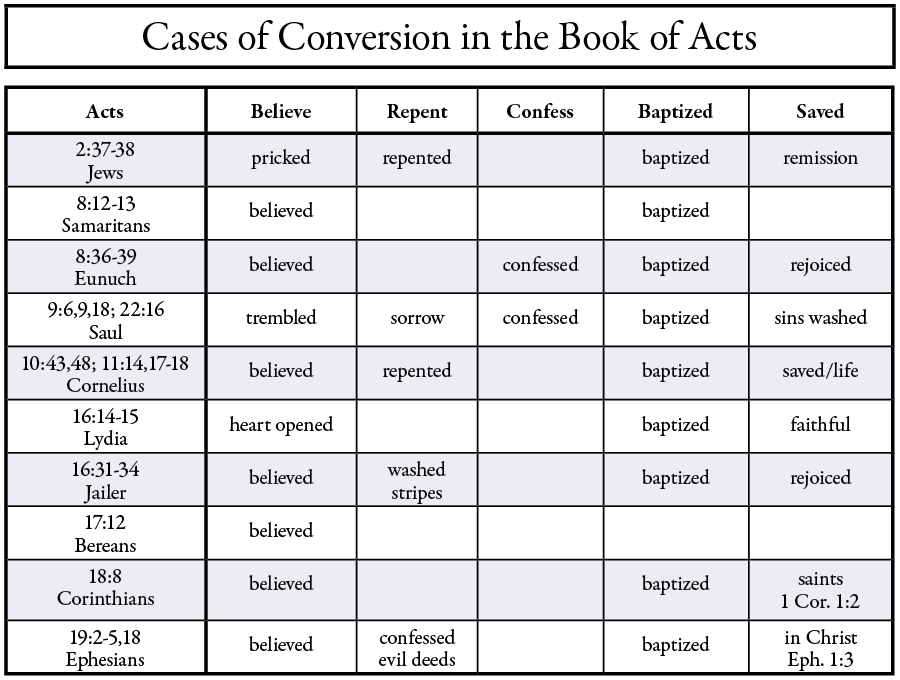
Romans was not actually intended to detail the conditions of salvation; rather, Romans explains the grounds/basis of salvation: the blood of Christ. Nevertheless, in passing, Romans happens to mention every single one of the prerequisite conditions of salvation with which humans must comply before God will grant forgiveness as a free, undeserved gift. Romans 10:17, as you note, indicates that a person must first hear the Gospel/Word of God, which is designed to create faith within. But Romans 10:9-10 makes clear that faith is not the only prerequisite to forgiveness. Oral confession with the mouth is also enjoined. Romans 2:4 indicates that repentance is necessary before God will forgive. And Romans 6:1-4 indicates that water immersion precedes salvation, since it is the contact point for the blood of Christ which was shed in His death. We must be baptized “into His death” to contact that blood. That is the point at which sin is washed away by the blood of Christ. No wonder, then, that Ananias told Saul/Paul to “[a]rise and be baptized, and wash away your sins, calling on the name of the Lord” (Acts 22:16). When does a person “call on the Lord”? When the believing, repenting, confessing person submits to water immersion (Acts 22:16). That explains why Peter declared that baptism “now saves us” (1 Peter 3:21)—in the sense that Christ’s blood saves us at the point of our baptism; and that is why that same Peter impressed upon those present in Acts 10 that the reception of Holy Spirit baptism directly from God upon the Gentiles was proof positive that Gentiles have the right to become Christians just as much as do the Jews. Once their eligibility for conversion was demonstrated by that miraculous act direct from God, Peter then pressed for their obedience in the words, “Can anyone forbid water, that these should not be baptized…?” (Acts 10:47). Why even bring up water at that moment if water immersion was not prerequisite to their forgiveness?
So faith, repentance, confession, and baptism are all indicated to precede remission of sin. We must obey these acts—not to atone for our sin, for only Jesus can do that—but to comply with God’s stated conditions—conditions that He authored (not us) and enjoined upon all who wish to be saved. That is why the Hebrews writer stated forthrightly that Jesus is “the author of eternal salvation to all who obey Him” (Hebrews 5:9). It is interesting that you quote Acts 10:34-35 which indicates that before a person is acceptable to Christ, that person must “fea[r] Him and wor[k] righteousness” (vs. 35). “He who practices righteousness is righteous, just as He is righteous” (1 John 3:7). In other words, belief, repentance, oral confession, and water immersion are righteous actions that humans must perform in order to receive the free gift of salvation available only in Christ, and be counted by Him as righteous.
Jesus said, “[b]lessed rather are those who hear the word of God and obey it.” (Luke 11:28, NIV). He also said, “If anyone loves me, he will obey my teaching. My Father will love him, and we will come to him and make our home with him” (John 14:23, NIV). Indeed, the day is coming when “the Lord Jesus is revealed from heaven with His mighty angels, in flaming fire taking vengeance on those who do not know God, and on those who do not obey the gospel of our Lord Jesus Christ” (2 Thessalonians 1:7-8).
Denominationalism has manifested a persistent refusal to distinguish between the grounds of salvation and the conditions of salvation—the compatible, scriptural distinction between Christ’s atonement and man’s obedience.
The post Why Do You Believe “Obedience” Is Necessary to Salvation? appeared first on Apologetics Press.
]]>The post Gentiles Received the Spirit Before Baptism? appeared first on Apologetics Press.
]]>While Peter was still speaking these words, the Holy Spirit fell upon all those who heard the word. And those of the circumcision who believed were astonished, as many as came with Peter, because the gift of the Holy Spirit had been poured out on the Gentiles also. For they heard them speak with tongues and magnify God. Then Peter answered, “Can anyone forbid water, that these should not be baptized who have received the Holy Spirit just as we have?” And he commanded them to be baptized in the name of the Lord. Then they asked him to stay a few days (Acts 10:44-48).
It is evident from this account that the Gentiles received the Spirit before they were baptized in water. Jesus stated emphatically: “I will pray the Father, and He will give you another Helper, that He may abide with you forever—the Spirit of truth, whom the world cannot receive” (John 14:16-17). If that be the case, how can water baptism be “for the remission of sins” (Acts 2:38) in order to be “clothed with Christ” (Galatians 3:27)? Does the Bible contradict itself? How can anyone receive the Spirit before he/she is clothed with Christ?
The answer to these questions lies in a deeper examination of the underlying language. In the first place, John 14:17 uses the Greek verb lambano, which is the usual word for “to take with the hand, lay hold of, any person or thing in order to use it,” “to take in order to carry away,” “to seize, take away forcibly.”1 In this verse, Jesus was not saying that unsaved persons cannot receive the Holy Spirit. Consider the context:
If you love Me, keep My commandments. And I will pray the Father, and He will give you another Helper, that He may abide with you forever—the Spirit of truth, whom the world cannot receive, because it neither sees Him nor knows Him; but you know Him, for He dwells with you and will be in you. I will not leave you orphans; I will come to you (John 14:15-18).
Jesus was assuring the disciples that, though He soon would be seized and taken away from them, nevertheless, He would send in His place the Holy Spirit—Whom His enemies could not take away. In fact, He would abide with them forever. Therefore, verse 17 says nothing about whether an unsaved individual can be the recipient of Holy Spirit activity.
The conversion of the Gentiles in Acts 10 is recounted by Peter in Acts 11 when he came to Jerusalem. Luke reports that “Peter explained it to them in order2 from the beginning” (vs. 4), suggesting that the account in Acts 10 is not necessarily in strict order. Peter explains how “he entered the man’s house” where Cornelius informed him that an angel had appeared and instructed him to “send men to Joppa, and call for Simon whose surname is Peter, who will tell you words by which you and all your household will be saved” (vss. 13-14). Observe carefully that Cornelius could not be saved until and without hearing inspired words that would instruct him how to be saved.
Having been informed about this fact by Cornelius, Peter next states: “And as I began to speak, the Holy Spirit fell upon them, as upon us at the beginning” (vs. 15). The Greek term rendered “began” (arxasthai) means “to begin,” “to denote what one begins to do.”3 “Peter had scarcely begun to speak.”4 Indeed, Peter was just beginning to speak, not having yet expressed the words of salvation. He had not yet been given the opportunity to convey the words by which Cornelius and his household could be saved. He was, in fact, interrupted in his efforts by their reception of the Spirit. Greek lexicographer Thayer makes this very point when he states that the word “indicates that a thing was but just begun when it was interrupted by something else.”5
Those who assume that reception of the Spirit on this occasion was proof of the Gentiles’ saved condition completely miss the very reason God administered Holy Spirit baptism to them. The Gentiles’ reception of the baptism of the Holy Spirit had nothing to do with their salvation. It merely served to prove to the Jews that the Gentiles had an equal right to enter the kingdom. Indeed, only two instances of Holy Spirit baptism are explicitly reported in the New Testament, and neither had anything to do with the salvation of the recipients.6 In the first instance, depicted in Acts 2, the purpose was to equip the apostles (who were already saved) to launch the Christian religion. The second instance (Acts 10) served the purpose of demonstrating to the Jewish Christians that non-Jews had a divine right to have access to the Gospel and enter the kingdom7—which explains precisely why, after such a powerful divine demonstration, Peter immediately called for water baptism, since that act is the divinely-designed entranceway into the Kingdom (Acts 10:47-48; John 3:5; 1 Corinthians 12:13).8
Endnotes
1 Thayer, p. 370, italics in orig.
2 The Greek word means “in sequence in time, space, or logic, in order, one after the other” [Danker, et al., p. 490, italics in orig.], “successively” [W.J. Hickie (1977 reprint), Greek-English Lexicon to the New Testament (Grand Rapids, MI: Baker), p. 92], “in succession” [Robertson, Word Pictures, 3:152].
3 Perschbacher, p. 55; Danker, et al., p. 140.
4 R.C.H. Lenski (1961 reprint), The Interpretation of the Acts of the Apostles (Peabody, MA: Hendrickson), p. 444.
5 Thayer, p. 78.
6 For an extensive examination of the phenomenon of “Holy Spirit Baptism” in the New Testament, see Dave Miller (2020), Modern-Day Miracles? Do Miracles, Tongue Speaking, & Holy Spirit Baptism Occur Today? (Montgomery, AL: Apologetics Press), pp. 39ff.
7 “also for the Greek”—Romans 1:16; 2:9,10.
8 For additional discussion, see Kyle Butt (2012), “If Cornelius Had theHoly Spirit, Doesn’t That Mean He Was Saved?” https://apologeticspress.org/if-cornelius-had-the-holy-spirit-doesnt-that-mean-he-was-saved-1693/.
Modern Day Miracles?
The post Gentiles Received the Spirit Before Baptism? appeared first on Apologetics Press.
]]>The post Hebrews 10:22 and the Necessity of Baptism appeared first on Apologetics Press.
]]>Therefore, brethren, having boldness to enter the Holiest by the blood of Jesus, by a new and living way which He consecrated for us, through the veil, that is, His flesh, and having a High Priest over the house of God, let us draw near with a true heart in full assurance of faith, having our hearts sprinkled from an evil conscience and our bodies washed with pure water. Let us hold fast the confession of our hope without wavering, for He who promised is faithful (Hebrews 10:19-23).
In addition to the host of passages that explicitly affirm the essentiality of water baptism for salvation, the grammar of Hebrews 10:22 provides additional verification. “Let us draw near,” or as Greek scholar Kenneth Wuest renders it, “let us keep on drawing near,”1 is a present middle/passive subjunctive verb used for exhortation—a “hortatory subjective.”2 This drawing nearer to God is to be accompanied by “a true heart in full assurance of faith.” The term rendered “full assurance” refers to a “state of complete certainty, full assurance, certainty.”3 The recipients of the book already possessed faith (when they became Christians), but they now needed to mature their faith and bring it to a more complete state of assurance, conviction, and certainty (particularly since they were tending to revert back to their Jewish conceptions).4 This admonition is followed by two Perfect passive participles.5 The Perfect tense in Greek connotes “completed action with a resulting state of being.” Perfect passive participles describe action that is either coincident with or antecedent to the principal verb.6 Hence, the actions of “having been sprinkled” and “having been washed” occurred before the admonition to “keep on drawing near to God.” As Marcus Dods explains: “These participles express not conditions of approach to God which are yet to be achieved, but conditions already possessed.”7 Mounce conveys the thrust of the perfect passive participle even more forcefully: “since our hearts have been….”8 The following two participles, therefore, refer back to the point in time of their conversion—when they accessed the “blood of Jesus” (vs. 19). As Carl Moll noted in his comments on verse 22: “We thus refer the language, not to sanctification, but to justification on the ground of a propitiation.”9
The first participle speaks of “having had our hearts sprinkled from an evil conscience.”10 In keeping with the subject matter of Hebrews, the notion of “sprinkled” undoubtedly harks back to and echoes the Law of Moses practice of sprinkling people and objects with various liquids (including water as well as blood) for purification purposes. However, it is a physical impossibility for one literally to sprinkle his heart, mind, and conscience. Hence, the writer is using figurative language. But how/when did they “sprinkle their hearts”? The answer lies in the fact that before one can become a Christian, one must alter his heart and mind, i.e., repent (Luke 13:3,5; Acts 2:38; 3:19; et al.). The Greek term for “repentance” literally means “a change of mind.”11 So the author and recipients of the book of Hebrews came to faith in Christ, and then repented of their sins. If, instead, the “sprinkling” here refers to the cleansing power of Christ’s blood, the design of baptism remains the same, since the two participles indicate coincident (with each other) actions. The former possible meaning is inviting since Romans 6 distinguishes between the “death” to sin that occurs in the mind of the prospective convert at the point of repentance which precedes the spiritual death or termination of sin which occurs in the mind of God at the point of burial in water.
The next participle, which describes action that occurred coincident with the sprinkling, adds “having had our body washed with pure water” (again, Wuest’s literal rendering). Observe that the use of the term “body” (singular-soma), not sarx (“flesh”) indicates a literal washing of the physical body with H2O—unlike the figurative use of sprinkling in the previous participle.12 The only activity associated with Christianity that involves water applied to the body is baptism. Lenski insisted that “the New Testament knows of only one washing, namely baptism.”13 Writing in the 19th century, Robert Milligan noted: “Indeed, nearly all eminent expositors are now agreed that there is here a manifest reference to the ordinance of Christian baptism.”14 To summarize, in Hebrews 10:22, the inspired writer urges his Christian audience to continue to draw closer to God, even as they had commenced that approach when they first believed, repented of their sins, and were baptized.
One other observation that merits consideration: in the very next verse, the writer admonishes his readers to “hold fast the confession of our hope without wavering.” The term “confession” is the noun form (homologian) of the verb that means to confess. The New Testament plainly declares that one of the prerequisites to initial salvation/forgiveness—in addition to faith, repentance, and baptism—is oral confession with the mouth (Romans 10:9-10). Macknight rightly notes: “The apostle in this exhortation referred to that confession of their hope of salvation through Christ, which the primitive Christians made at baptism.”15 If that is the confession that the writer has in mind in verse 23, then the writer alludes to all four prerequisites to salvation in two verses: faith, repentance, confession, and baptism.
Endnotes
1 Kenneth Wuest (2002 reprint), The New Testament: An Expanded Translation (Grand Rapids, MI: Eerdmans), p. 529; Also R.C.H. Lenski (2001 reprint), The Interpretation of the Epistle to the Hebrews and of the Epistle of James (Peabody, MA: Hendrickson), p. 347.
2 William Davis (1923), Beginner’s Grammar of the Greek New Testament (New York: Harper & Row), p. 76; H.E. Dana and Julius Mantey (1955), A Manual Grammar of the Greek New Testament (Toronto: Macmillan), p. 171; Ray Summers (1950), Essentials of New Testament Greek (Nashville, TN: Broadman Press), p. 108).
3 Frederick Danker, rev. and ed. (2000), A Greek-English Lexicon of the New Testament and other Early Christian Literature (Chicago, IL: The University of Chicago Press), p. 827.
4 See the meaning in Colossian 2:2 and Hebrews 6:11, as well as the verb form used in Romans 4:21, Colossians 4:12, and Romans 14:5.
5 Summers, p. 103; Davis, p. 156.
6 Davis, p. 157.
7 Marcus Dods (no date), “The Epistle to the Hebrews,” in The Expositor’s Greek Testament, ed. W. Robertson Nicoll (Grand Rapids, MI: Eerdmans), 4:346-347, emp. added.
8 Robert Mounce and William Mounce (2011), The Mounce Reverse-Interlinear New Testament (Grand Rapids, MI: Zondervan), emp. added. See also NCV and ISV.
9 Carl Moll (1870), The Epistle to the Hebrews (New York: Charles Scribner), p. 175, italics in orig.
10 Translated by Wuest, p. 529.
11 Danker, p. 640.
12 See Henry Alford (1874), Alford’s Greek Testament (Grand Rapids, MI: Baker, 1980 reprint), 4:196.
13 p. 350.
14 Robert Milligan (1950), The New Testament Commentary: Epistle to the Hebrews (Nashville, TN: Gospel Advocate), 9:282-283.
15 James MacKnight (no date), A New Literal Translation, from the Original Greek of all the Apostolical Epistles (Grand Rapids, MI: Baker), p. 556, emp. added.
Baptism and the Greek Made Simple
The post Hebrews 10:22 and the Necessity of Baptism appeared first on Apologetics Press.
]]>The post Does the Water Regenerate? appeared first on Apologetics Press.
]]>Do you believe that when a person is baptized that it is the water itself that regenerates? Or do you believe that when a person is baptized it is the washing by the Holy Spirit that regenerates?
A:
The water certainly has no cleansing power whatsoever. The only reason why Peter could say that “baptism saves” (1 Peter 3:21) is because that is the point at which we are forgiven of sin based on the sacrifice of Christ. Hence, it is Christ’s blood—and only His blood—that cleanses sin (1 Peter 1:18-19; Revelation 1:5). [Recall that Peter clarified his “baptism saves” statement by adding “through the resurrection of Jesus Christ.” So baptism “now saves” via the atoning work of Christ, i.e., His death, burial, and resurrection—which is the Gospel (cf. 1 Corinthians 15:3-4).] The H2O of baptism is parallel to the water of the Jordan in 2 Kings 5. Naaman’s leprosy was not cleansed by those waters—but by God Himself the moment Naaman met the terms/conditions of cleansing (i.e., immersing 7 times). Similarly, the waters of the Pool of Siloam possessed no healing power. It was solely Jesus who restored sight to the blind man—on the condition that the man would go to that pool and apply the water to the mud Jesus had smeared on his eyes (John 9:7). Neither water nor mud, then or now, has any cleansing capability. They were merely mediums/conduits Jesus used to impart the blessing of physical cleansing to the blind man. The same may be said of the waters of baptism. God has always used physical conditions as preludes to His blessings, but the power remains within God’s own mind. Hence, salvation occurs in God’s mind the very moment a person complies with God’s stipulated condition(s). Water baptism is not the HOW of salvation—but, rather, the WHEN.
Regarding the “washing of regeneration and renewing of the Holy Spirit” (Titus 3:5) by allowing Scripture to interpret itself [see AP’s book Baptism & the Greek Made Simple, p. 142], it becomes apparent that the Holy Spirit regenerates people via His Gospel message which instructs the individual to be immersed in water. The term “Spirit” in John 3:5, 1 Corinthians 12:13, and Titus 3:5 all refer to the message (“word”—Ephesians 5:26) that the Holy Spirit provided via inspired writers/spokesmen. When that same message is presented to hearers today, requiring them to manifest faith, repentance, oral confession, and immersion in water (Romans 10:17; 2:4; 10:9-10; 6:3-4), and the individual complies with those prerequisites to salvation, when that individual rises from the water of baptism, he/she may then be said to have been regenerated by the Holy Spirit (i.e., based on the blood sacrifice of Christ, the Holy Spirit regenerated the individual by means of His stipulated prerequisites to cleansing by that blood). The Holy Spirit regenerates people via their obedience to the Gospel. Notice how Peter words it: “Since you have purified your souls in obeying the truth through the Spirit in sincere love of the brethren, love one another fervently with a pure heart, having been born again, not of corruptible seed but incorruptible, through the word of God which lives and abides forever” (1 Peter 1:22-23). “Through the Spirit” is a textual variant that may not have been in the original text, but it is nevertheless an accurate representation of the facts, since the only way for anyone to receive salvation from God is for Him to tell us how we may do so. God did so via the Gospel message authored by the Holy Spirit. When we read Scripture and implement its instructions in our lives, we are being influenced and instructed by the Spirit.
Baptism and the Greek Made Simple
The post Does the Water Regenerate? appeared first on Apologetics Press.
]]>The post The Obedience of Faith in Romans appeared first on Apologetics Press.
]]>The extreme doctrine of justification by faith only, has so completely engrossed the mind of commentators, since the sixteenth century, that it seems never to have occurred to them, as even a possible fact, that Paul may not have been writing in their exclusive interest. They have regarded him as certainly of their order, and, as a consequence, have written him up into a partisan, only more partisan than themselves. The result has been that in many places their works are a complete perversion of the truth, and not an exhibition of it.2
Romans actually contrasts, on the one hand, the prevailing Jewish notion that they could be saved on the basis of their fleshly connection to Abraham and the Mosaic Law alone (a law which had been given exclusively to them) with, on the other hand, the sole necessity of rendering obedience to Christ and the Gospel. Romans emphasizes salvation by faith not flesh. The term “works” is not used to include actions humans perform that God requires (like water baptism). Baptism is not a “work” in the sense of the term as used in Romans. Rather, the context of Romans indicates that “works” refers to those actions that the Jews claimed enabled them to be acceptable to God without becoming Christians—circumstances surrounding the benefits accrued by them due to their ethnicity, their longstanding connection to Abraham.
Further, the essence of “faith” in Romans (and throughout the Bible) is trust that is accompanied by compliance with God’s directives—what James describes as a living, versus a dead, faith (James 2:17,26). The human actions that God requires precedent to His bestowal of physical or spiritual gifts are not seen by Him to be meritorious works by which a person earns or deserves the gift He provides. Rather, they are given by God as conditions.
Salvation is only “unconditional” in the sense that God enacted the means by which humans may be forgiven without any involvement on their part. In fact, God decided to provide the means of atonement for human sin before He ever created the first human beings. Jesus would (and did) come to offer Himself as the atonement/propitiation for sin without humans doing anything to bring it about (Romans 3:25). That decision was an eternal intention (Ephesians 3:11). Indeed, Jesus is “the Lamb slain from the foundation of the world” (Revelation 13:8). No human can perform any acts of legal merit by which he can save himself or atone for his own sin. On the other hand, salvation is “conditional” in the sense that God requires the exercise of the human will in the reception of salvation. Both mind and body must be brought into play. Faith itself is such an action—a “work” that man must perform in order to be pleasing to God (John 6:29). In this sense, the New Testament forcefully declares that you can—and must—save yourself (See Acts 2:40; Philippians 2:12).
The Holy Spirit established this definition of faith in the book of Romans—at the beginning as well as at the end. The Greek phrase he inspired Paul to utilize in 1:5 and 16:26 is hupakoein pisteos—“obedient faith” or the obedience which faith manifests or expresses. In his respected Greek grammar, Baptist scholar A.T. Robertson insisted that the phrase is to be understood as a “subjective genitive”3—“the obedience which springs from faith”4—rather than an “objective genitive” meaning “obedience to the faith.” The phrase, in fact, characterizes and clarifies the meaning of “faith” as used in Romans.
Several Greek authorities agree with this assessment. In the latest edition of the “BDAG” Greek lexicon most recently revised by Frederick Danker, after noting the objective genitive meaning, the author states: “But it may be better to render it more generally with a view to (promoting) obedience which springs from faith.”5 Writing in The Expository Times, Geoffrey H. Parke-Taylor of Wycliffe College commented specifically on the Greek phrase in Romans 1:5 and 16:26—
Surely in both cases “obedience that springs from faith” is intended, πίστεως being a genitive of source or material…. If “the faith” (i.e., a body of formulated doctrine), had been intended, doubtless the definite article would have been used…. The emphasis is on the obedience to God which comes as a result of faith in Christ…. Christ was not only the example to Gentile Christians of the perfect obedience which springs from perfect faith, but also the source of power whereby obedience to God could be realized in their own lives.6
In his A Short Syntax of New Testament Greek, H.P.V. Nunn notes “The Genitive of Source or Material” and gives as an example “The righteousness of faith (i.e., that springs from faith)”7—a parallel expression to “the obedience of faith.” Respected commentator J.B. Lightfoot interprets the phrase to mean “unto obedience which springs from faith.”8 In his Word Studies in the Testament, Marvin Vincent says, “Obedience of faith is the obedience which characterizes and proceeds from faith.”9
While Greek grammarians possess considerable unanimity on the matter, translators have struggled with the phrase and sent mixed signals to their English audiences. For example, the KJV has in the first occurrence of the phrase in Romans (1:5), “for obedience to the faith among all nations,” and in the second occurrence (16:26), “made known to all nations for the obedience of faith”—though the phrase is the same in both verses. The NKJV has “for obedience to the faith” in both verses. The ASV has “unto obedience of faith” in both verses. The NASB has “to bring about the obedience of faith” in 1:5 (as does the ESV in both verses) and “leading to obedience of faith” in 16:26. The RSV has “to bring about the obedience of faith” in both verses. The NIV has “to the obedience that comes from faith” in 1:5 and “so that all nations might believe and obey him” in 16:26. Though resorting somewhat to paraphrase, the renderings in the NIV fully capture the nuances of the phrase. Interestingly, the Complete Jewish Bible renders the phrase “trust-grounded obedience.” The International Standard Version (ISV) has “faithful obedience” in 1:5 and “the obedience that springs from faith” in 16:26. The Jubilee Bible 2000 (JUB) has “that they might hear and obey by faith” in 16:26. God’s Word Translation has “the obedience that is associated with faith.”10 The Voice translation has “obedient faith” in 1:5 and “faith-filled obedience” in 16:26, while the Message Bible (MSG) has “obedient trust” in 1:5 and “obedient belief” in 16:26.
Faith in the book of Romans includes obedience to external acts preceding forgiveness. Or as Greek lexicographer Joseph Thayer explained the meaning of pisteuo (“I believe”): “Used especially of the faith by which a man embraces Jesus, i.e., a conviction, full of joyful trust, that Jesus is the Messiah—the divinely appointed author of eternal salvation in the kingdom of God, conjoined with obedience to Christ.”11 No wonder Paul repeatedly uses the words “obedience” (1:5; 5:19; 6:16; 16:19,26) and “obey” (2:8-twice; 6:12; 6:16-twice).
In stark contradistinction with Paul, modern denominationalism insists that faith does not include any further acts of obedience; rather, one need only “accept Jesus as Savior” by saying, “I receive you into my heart as my personal Savior.” Hence, water baptism is considered non-essential to salvation. The Holy Spirit anticipated this unwarranted conclusion, not only by stressing the essentiality of water baptism in 6:3-4, but by positioning two “red flags”—one at the beginning (1:5) and one at the end (16:26) of this marvelous treatise. These majestic sentinels essentially warn readers regarding the nature and meaning of the “faith” which characterizes the book of Romans.
Endnotes
1 These activities included “hail Marys,” indulgences, assigned penance, gifts to build cathedrals, Stations of the Cross, etc.
2 Moses Lard (1875), Commentary on Paul’s Letter to Romans (Lexington, KY: Transylvania Printing and Publishing), p. v.
3 A.T. Robertson (1919), A Grammar of the Greek New Testament in the Light of Historical Research (New York: George Doran), p. 500.
4 A.T. Robertson (1931), Word Pictures in the New Testament (Nashville, TN: Broadman Press), 4:324.
5 Fredrick William Danker (2000), A Greek-English Lexicon of the New Testament and Other Early Christian Literature (Chicago, IL: University of Chicago), third edition, p. 1028.
6 Geoffrey H. Parke-Taylor (1944), “A Note on ‘e)i$ uJðáêïhn ðίóôåùò’ in Romans i.5 and xvi.26,” The Expository Times, 55:305-306, emp. added. He cites Acts 6:7 and Romans 10:8 as instances where the article indicates “the faith.”
7 H.P.V. Nunn (1912), A Short Syntax of New Testament Greek (Cambridge: Cambridge University Press), p. 42.
8 J.B. Lightfoot (1895), Notes on Epistles of Paul from Unpublished Commentaries (London: Macmillan), p. 246.
9 Marvin Vincent (1946), Word Studies in the New Testament (Grand Rapids, MI: Eerdmans), 3:5. See also W.E. Vine (1966), An Expository Dictionary of New Testament Words (Old Tappan, NJ: Fleming H. Revell), p. 123, who also takes the phrase as a subjective genitive and identifies “faith” as “the initial act of obedience.”
10 Also the Names of God Bible (NOG).
11 Joseph Thayer (1977 reprint), Greek-English Lexicon of the New Testament (Grand Rapids, MI: Baker), p. 511, italics in orig., emp. added.
The post The Obedience of Faith in Romans appeared first on Apologetics Press.
]]>The post What Is the Purpose of Baptism? (Part 2) appeared first on Apologetics Press.
]]>Another grammatical factor in Matthew 28:19-20 concerns the occurrence of the preposition eis in the phrase “baptizing them in (eis) the name of the Father and of the Son and of the Holy Spirit” (ESV). The standard meaning of the underlying Greek preposition connotes “into” and is generally distinguished from the preposition en (“in”). The translation of “into” is given in the American Standard Version, the margin of the English Standard Version, and others (e.g., Beck, Weymouth, et al.).
[Editor’s Note: Part I of this two-part series appeared in the September issue. Part II follows below, and continues, without introductory comments, where the second article ended. Both articles are taken from AP’s soon-to-be released book Baptism & the Greek Made Simple.]
“Go therefore and make disciples of all the nations, baptizing them in the name of the Father and of the Son and of the Holy Spirit, teaching them to observe all things that I have commanded you; and lo, I am with you always, even to the end of the age. Amen” (Matthew 28:19-20).
While it is true that eis and en are etymologically related and sometimes even interchanged,1 they are not synonymous. In his classic work on the Greek idiom of the New Testament, C.F.D. Moule (leading scholar of the New Testament, Professor of Divinity at Cambridge for 25 years) noted that “where en = in, eis would rather = into,” and contrasted with pros, “eis tends to include the idea of entry.”2 Nigel Turner observed that Matthew “is more careful than any NT author to preserve the distinction between eis and en.”3 A.T. Robertson insisted that in its use of eis in Matthew 28:19, “the notion of sphere is the true one.”4 In his volume on Greek syntax, Nigel Turner insists that even with potential confusion between the two prepositions, “in Mt…we can always presume that eis has its full sense even where one might suspect that it stood for en (e.g., Mt 28 19 baptism into the name, i.e. a relationship as the goal of baptism).”5 R.T. France agrees: “The eis which introduces the baptismal formula in Matt 28:19 and in most of the other NT baptism texts is perhaps to be understood as drawing attention to the new relationship and allegiance into which the one baptized is thus introduced”6—“implying entrance into an allegiance.”7
Marvin Vincent was a Presbyterian minister and professor of New Testament Exegesis and Criticism at Union Theological Seminary in New York City. In his multi-volume work Word Studies in the New Testament, Vincent provides this somewhat lengthy commentary on eis in Matthew 28:19—
Rev., correctly, “into the name.” Baptizing into the name has a twofold meaning. 1. Unto, denoting object or purpose…. 2. Into, denoting union or communion with…. Baptizing into the name of the Holy Trinity implies a spiritual and mystical union with him…. When one is baptized into the name of the Trinity, he professes to acknowledge and appropriate God in all that he is and in all that he does for man.8
The Abingdon Bible Commentary notes: “Baptizing into the name of means baptizing them so that they are entered as the possession of the Father.”9 Alford offers a comparable assessment: “It is unfortunate again here that our English Bibles do not give us the force of this ei)$. It should have been into…. It imports, not only a subjective recognition hereafter by the child of the truth implied in to onoma [“the name”—DM]…, but an objective admission into the covenant of Redemption—a putting on of Christ.”10 Milligan described the shift as “our transfer from the kingdom of darkness into the Kingdom or Church of Christ.”11

Summary: Though these linguistic experts vary in their terminology, they are unanimous in their recognition of the significance of eis in Matthew 28:19 as it relates to the design of baptism. A person has not entered into a new relationship and allegiance with God, or come into union or communion with God, or gained admission into the covenant of redemption, or put on Christ, and is not a possession of the Father (different ways to say the same thing) until the act of baptism. [See graphic above.] Use of the Greek preposition “into” indicates that when one is baptized in water, the individual is being transferred from one sphere or realm into another, from not having a relationship with deity into having one. Hence, water immersion is unmistakably the dividing line between the lost and the saved, the unforgiven and the forgiven, the non-Christian and the Christian.
The Greek Noun Onoma
Another nuance in Matthew 28:19-20 to be considered is the occurrence of the term onoma (“name”) in the phrase “baptizing them in the name (onoma) of the Father and of the Son and of the Holy Spirit” (ESV). While the term has a variety of shades of meaning in usage, “in the name of” frequently is used in Scripture as a parallel expression to “by the power or authority of” (e.g., Act 4:7). Hans Bietenhard, Swiss Reformed theologian and Professor of New Testament at the University of Bern, noted that the formula “in the name of Jesus” means “according to his will and instruction.”12 Specifically, in Matthew 28:19, “The literal meaning is that baptism symbolically13 assigns the person baptized to Christ for forgiveness of sins.”14 W.E. Vine, English biblical scholar and theologian, defined onoma in its use in Matthew 28:19 as “in recognition of the authority of (sometimes combined with the thought of relying or resting on).”15 A.T. Robertson cited the use of onoma in Matthew 28:19 as another example where “name” has “the idea of ‘the authority of’”16—“a common one in the Septuagint and the papyri for power or authority.”17 Joseph Thayer was a biblical scholar, late Professor of sacred literature at Andover Seminary and Professor of New Testament Criticism in the Harvard Divinity School, who served as a member of the American Bible Revision Committee resulting in the American Standard Version, and also produced an influential Greek lexicon at the time. Delineating one usage of onoma as “chiefly Hebraistic,” Thayer explains the meaning of Matthew 28:19 as, “by baptism to bind any one to recognize and publicly acknowledge the dignity and authority of one.”18 He defines baptidzo with eis onoma as “to profess the name of one whose follower we become.”19 Referring back to verse 18, Meyer keys into this notion of authority and notes that “all nations should be brought under His government, and made subject to His sway.”20 Boles well notes the significance of “name”:
The name of the Father and of the Son and of the Holy Spirit means the combined authority of the Godhead. To be baptized into this is to be brought by baptism into actual subjection to the combined authority of heaven. To be baptized into the name of these three brings one into covenant relation with the Godhead.21
Submitting to authority is closely related to the notion of submitting one’s self to the ownership of another in order to become his possession, as noted by Crain: “The phrase ‘into the name of’ indicates becoming the possession of the triune God.”22 F.F. Bruce agrees:
I suggest that eis to onoma implies a transference of ownership…. This is noteworthy in the baptismal formulae of the New Testament: baptism “into the name” of the Triune God (Matt. 28.19), or “into the name of the Lord Jesus” (Acts 8.16; 19.5; cf. I Cor. I.13,15), is the sign [indicator—DM] that He is Lord and that the baptized person belongs to Him.23
Similarly, James Moulton, British philologist and professor of Classical Greek and other languages at the University of Manchester, and George Milligan, biblical scholar and Kimmer at Warwick University, made the following remarks concerning Matthew 28:19—
The phrase eis (to) onoma tinos is frequent in the papyri with reference to payments made “to the account of any one”…. The usage is of interest in connexion with Mt 28:19, where the meaning would seem to be “baptized into the possession of the Father, etc.”24
Likewise Alexander Souter similarly explained: “When the preposition eis with a noun in the accus. follows, it appears to indicate that through this ceremony the baptized person becomes the property of the person indicated after ei)$.”25 The classic lexicon most recently revised by Frederick Danker says that “into the name” means that “[t]hrough baptism…those who are baptized become the possession of and come under the dedicated protection of the one whose name they bear.”26
A. Lukyn Williams, English New Testament scholar at Cambridge and Principal of Moore Theological College in New South Wales, explained that the translation of “in” came from the influence of the Latin Vulgate “which does not give the right force to the expression.”27 Instead, the use of eis
signifies into the power and influence of the Holy Trinity, into faith in the three Persons of God, and the duties and privileges consequent on that faith, into the family of God and obedience unto its Head. The “into” shows the end and aim of the consecration of baptism…. So being baptized into the Name of God implies being placed in subjection to and communion with God himself, admitted into covenant with him.28
Seventeenth-century biblical commentator Matthew Poole explained “in the name” as meaning “in the authority, or…into the profession of the trinity of the persons in the one Divine Being…obliging them to worship and serve God the Father, Son, and Holy Ghost.”29 Meyer explains:
Here, where the baptidzein eis to onoma is regarded as that through which the matheteuein is operated, and through which, accordingly, the introduction into spiritual fellowship with, and ethical dependence upon Christ is brought about, it must be understood as denoting that by baptism the believer passes into that new phase of life in which he accepts the name of the Father (of Christ) and of the Son and of the Holy Spirit as the sum of his creed and confession.30
Observe, again, that all of these scholars are in essential agreement as to the design of baptism as it relates to the use of “name” in Matthew 28:19. Whether the significance pertains to transference of ownership of the baptized individual, or thereby becoming a possession of God, or being placed in subjection to and communion with God, or being admitted to His covenant, or being introduced into spiritual fellowship with Him, the design of baptism remains the same. Barnes summarizes:
So to be baptized in the name of the Father, or unto the Father, means publicly, by a significant rite, to receive his system of religion; to bind the soul to obey his laws; to be devoted to him; to receive, as the guide and comforter of the life, his instructions, and to trust to his promises. To be baptized unto the Son, in like manner, is to receive him as the Messiah—our Prophet, Priest, and King—to submit to his laws, and to receive him as a Saviour.31
Summary
Drawing together the linguistic insights generated by these two features of the Greek, observe that “baptizing them in (eis/into) the name (onoma/authority) of the Father and of the Son and of the Holy Spirit” refers to the transference of the individual into the sphere of the authority of deity. As McGarvey observed:
The name of the Father and of the Son and of the Holy Spirit means the combined authority of all the manifestations of God. To be baptized into this, is to be brought by baptism into actual subjection to it. He that is baptized is brought into subjection by that act to the Father, to the Son, and to the Holy Spirit.32
While deity actually wields authority over the entire Universe (cf. vs. 18; Ephesians 1:21; Colossians 1:15ff.), no human has willingly placed himself under that jurisdiction or submitted to that authority until he submits to water immersion. A person submits himself to the authority of the Godhead when, having been taught the Gospel generating faith, repentance, and oral confession, he then is baptized into that sphere of authority. Conversely, until a person enacts the divinely designated means by which a person places himself under God’s authority, he remains under the authority and power of Satan. Ownership has not been transferred to deity.
Conclusion
Matthew 28:19-20 teaches that a person is neither a disciple of Christ, nor in submission to the authority of God, until that person has been baptized in water. The unsaved person must pass through the waters of baptism in order to become a disciple of Christ and submit himself to the authority of deity. As British Baptist G.R. Beasley-Murray stated emphatically: “In the New Testament… baptism is conversion-baptism. Conversion was fulfilled and expressed in baptism. Baptism was conversion…assumed in the Missionary Commission of Matt. xxviii. 18-20.”33 Or as Schlatter explained: “The apostolic preaching culminated in the offer of baptism; the primitive sermon was a baptismal sermon. Its purpose was not merely the acceptance of an idea: it demanded a definite act.”34 The person who thinks he became a Christian,35 a disciple of Christ, and was saved the moment he “believed” in Jesus—before and without being baptized—was mistaken and did not become a disciple of Christ in accordance with Jesus’ own directive.
Endnotes
1 Scholars have debated endlessly the nuances of meaning to be found in the parallel expressions “in the name,” “on the name,” and “into the name.” While it makes sense to permit each preposition to maintain its own usual, central thrust and thereby convey a variety of nuances, so far as this study is concerned, it is enough to note that the design of each is the same, i.e., to demonstrate the altered status of the individual from lost to saved, from non-Christian to Christian. Eis vividly portrays this transference. Cf. C.F.D. Moule (1977 reprint), An Idiom-Book of New Testament Greek (New York: Cambridge University Press), second edition, p. 50; F.J. Foakes Jackson and Kirsopp Lake (1933), The Beginnings of Christianity: The Acts of the Apostles (London: Macmillan), p. 124—“A convert knew perfectly well that when he said that he had been baptized in the name of Jesus he meant that someone had said ‘I baptize you in the name of Jesus’ or something similar, and that in consequence he had attained the way of Salvation.”
2 p. 67, italics in orig.; cf. Nigel Turner (1963), Syntax, in A Grammar of New Testament Greek, ed. James Moulton (Edinburgh: T. & T. Clark), 3:254.
3 Nigel Turner (1976), Style, in A Grammar of New Testament Greek, ed. James Moulton (Edinburgh: T. & T. Clark), 4:42. Carson agrees with this observation: “Matthew…apparently avoids the confusion of eis (strictly ‘into’) and en (strictly ‘in’) common in Hellenistic Greek; and if so, the preposition ‘into’ strongly suggests a coming-into-relationship-with or a coming-under-the-Lordship-of…. It is a sign both of entrance into Messiah’s covenant community and of pledged submission to his lordship” (p. 597, emp. added).
4 1934, p. 592.
5 1963, 3:255, italics in orig., emp. added.
6 R.T. France (2007), The Gospel of Matthew (Grand Rapids, MI: Eerdmans), p. 1116, italics in orig., emp. added.
8 Marvin Vincent (1946 reprint), Word Studies in the New Testament (Grand Rapids, MI: Eerdmans), 1:149-150, italics in orig.
9 Eiselen, p. 995, italics in orig., emp. added; also Alan M’Neile (1965), The Gospel According to St. Matthew (New York: St. Martin’s Press), p. 436.
11 Robert Milligan (1975), Exposition and Defense of the Scheme of Redemption (Nashville, TN: Gospel Advocate), p. 405.
12 Hans Bietenhard (1976), “onoma,” The New International Dictionary of New Testament Theology, ed. Colin Brown (Grand Rapids, MI: Zondervan), 2:654.
13 Observe that the insertion of the word “symbolically” constitutes subjective interpretation rather than objective linguistic analysis. The same may be said for the theory that maintains that, since a person already has received the saving grace of God by which sins have been cleansed the moment he believes, then baptism serves the purpose of providing an outward demonstration or public declaration that the person has already been saved. The claim is that baptism is a symbol—a visible expression of the forgiveness already received at the point of faith. Hence, baptism is “an outward sign of an inward grace,” a post-conversion “testimony” or “public profession” that the person is already saved, like a “badge” or “uniform” worn by a policeman—merely an outward indication of what the wearer has already become. For example, after praising Mantey’s “causal” eis concept, Kenneth Wuest states: “Thus, we have the scriptural meaning of water baptism. It is the testimony of the person to the fact of his salvation. The only proper recipient of water baptism therefore is one who has received the Lord Jesus as his personal Saviour, and is trusting in His precious blood for salvation from sin”—(1943), Treasures from the Greek New Testament for the English Reader (Grand Rapids, MI: Eerdmans), p. 78, emp. added. The only problem with such theologizing is that the New Testament makes no distinction between actual forgiveness and an alleged post-salvation “symbolical” forgiveness. If a person is forgiven, it would be superfluous to “symbolize” that forgiveness after-the-fact. Once a person dismisses the plain and self-evident import of the New Testament’s repetitive declaration that baptism is for the remission of sins, it follows that he must invent an alternative purpose for baptism. The “symbol,” “testimony,” “picture,” and “badge” concepts are undoubtedly creative and as good as any that might be fabricated to avoid the obvious fact that the New Testament posits remission of sin coincident with water baptism and not before. The only problem is that no shred of biblical evidence, grammatical or otherwise, exists to substantiate them. Baptist scholar J.W. Willmarth rightly asked: “Where is the example of the use of ei)$ to denote a relation between an act as a symbol and some past event or accomplished fact, which such symbol is intended to set forth as emblem or declaration or commemoration?” “If it be but a MERE symbol, or object lesson, or a profession of accomplished facts, what meaning is there in language? or how shall we ever hope to understand the Gospel, as it fell from inspired lips, clothed with human words?”—J.W. Willmarth (1877), “Baptism and Remission,” The Baptist Quarterly, ed. Henry Weston (Philadelphia, PA: American Baptist Publication Society), July, 11:299,317, capitals in orig. Or as J.W. McGarvey explained: “It is a common assumption that Saul’s sins had been really forgiven before his immersion, and Ananias required him only to formally wash them away. But this is a mere combination of words to hide the absence of an idea. How can a man formally do a thing which has already been really done, unless it be by going through a form which is empty and deceptive? If Saul’s sins were already washed away, then he did not wash them away in immersion, and the language of Ananias was deceptive. But it is an indisputable fact, that at the time Ananias gave him this command he was still unhappy, and, therefore, unforgiven. Immediately after he was immersed, he was happy; and the change took place in the mean time, which connects it with his immersion”—(1872), Commentary on Acts of Apostles (Lexington, KY: Transylvania Printing & Publishing), seventh edition, p. 135, italics in orig. Albrecht Oepke, associate professor and New Testament Chair at the University of Leipzig, in his discussion of “the saving significance of baptism” and its “connection with purification from the guilt of sin,” debunks the “symbol” idea: “The significance of baptism thus depends on the fact that it is a real action of the holy God in relation to sinful man. Hence both a superstitious and also a purely symbolical understanding are excluded…. To baptism as a mere rite or realistically developed symbol no such incomparable efficacy could be ascribed in the NT world of thought”—from his article “ꞵάπτω, ꞵαπτίζω” in Gerhard Kittel, ed. (1964), Theological Dictionary of the New Testament (Grand Rapids, MI: Eerdmans), 1:540. Or as J.J. Van Oosterzee explained: “Baptism is styled ‘laver of regeneration,’ not because it obligates to regeneration, nor because it is the symbol of regeneration, but because it is really the means of regeneration, if truly desired and received in faith (which is tacitly assumed in respect to those adult Christians who by their own free act were baptized)”—(1870), The Epistle of Paul to Titus (New York: Charles Scribner), p. 20, italics in orig.
The premiere passages in the New Testament that assign symbolic value to baptism simply do not expound the post-conversion concept. True, baptism is, indeed, a symbol. But what does baptism symbolize? It symbolizes: (1) Christ’s death, burial, and resurrection, as per Romans 6:3-4; (2) the act of “cutting off” as in circumcision (sin vs. skin), as per Colossians 2:11; and (3) the waters of the Noahic Flood, as per 1 Peter 3:20-21. How could anyone get out of these explicitly stated symbolic meanings that baptism symbolizes past forgiveness that was achieved prior to being immersed? Jettisoning theological presuppositions enables the honest exegete to conclude that the Bible nowhere expounds a post-forgiveness role for baptism. Quite the contrary, the symbolism which the New Testament explicitly associates with water baptism (i.e., Christ’s burial, cutting of skin, and Flood waters) further verifies the essentiality of immersion as a mandatory prerequisite to forgiveness. See Dave Miller (2003), “Is Baptism a Symbol?” Apologetics Press, http://apologeticspress.org/APContent.aspx?category=11&article=1232&topic=379.
15 W.E. Vine (1966 reprint), An Expository Dictionary of New Testament Words (Old Tappan, NJ: Revell), p. 100, emp. added; cf. Wesley Perschbacher, ed. (1990), The New Analytical Greek Lexicon (Peabody, MA: Hendrickson), p. 294.
16 1934, p. 649, emp. added. Paul undoubtedly intended to key into this concept when he chided the Corinthians for their divisive ways by posing three critical questions, the third of which was: “Or were you baptized in (eis-into) the name of Paul?” (1 Corinthians 1:13). The question obviously echos Matthew 28:19. Paul sought to prick the Corinthians with the fact that when they were baptized in water, they were placing themselves under (eis-into) the authority of Christ—not Paul, Apollos, Cephas, or anyone else.
Observe also that his remarks in 1 Corinthians 1:10-17 further underscore the absolute essentiality of water baptism to salvation: “For it has been declared to me concerning you, my brethren, by those of Chloe’s household, that there are contentions among you. Now I say this, that each of you says, ‘I am of Paul,’ or ‘I am of Apollos,’ or ‘I am of Cephas,’ or ‘I am of Christ.’ Is Christ divided? Was Paul crucified for you? Or were you baptized in the name of Paul?” (vss. 11-13). What did Paul mean when he used the expression to be “of” someone (“I” [ Ἐγὼ] with the genitive of the person)? He alluded to an authoritative positioning of a person beneath another. To be “of” another means to have been saved by and come under the jurisdiction of that other and, hence, to “belong to” (R.C.H. Lenski [1943], The Interpretation of St. Matthew’s Gospel [Minneapolis, MN: Augsburg], p. 42; cf. ISV,NRSV,RSV) or “follow” (NIV,CJB,CEV,ESV, GNT,NCV,WEB) that person. This relationship is inherent in the three questions Paul asks the Corinthians—questions that pinpoint essential prerequisites to being counted “of” someone. First, in order to be “of” someone, that someone must accordingly be qualified for others to follow him, devote themselves to him, and place themselves under his exclusive rule, Lordship, and control. That person must be “undivided.” To be undivided means that he must have no rivals (e.g., Paul, Apollos, etc.), or competing factions, he must be your sole Savior Who is singular, unique, and unsurpassed by all others. His followers constitute a single body, of which He is the only Head. Hence, the indivisible Christ makes no allowance for other heads, lords, or bodies. He possesses “right over all” (Henry Alford [1874], Alford’s Greek Testament [Grand Rapids, MI: Baker, 1980 reprint], 2:477). Your loyalty must be directed to Christ alone. Second, that person must be crucified for you. Third, you must be baptized into his name. As discussed in the section on onoma, to be baptized into the name entails submitting oneself to the authority of the one named, or as explained by John Locke, “to enter himself a Disciple of him into whose Name he was baptized, with Profession to receive his Doctrine and Rules, and submit to his Authority”—(1751), A Paraphrase and Notes on the Epistles of St. Paul to the Galatians, I&II Corinthians, Romans, and Ephesians (London: S. Birt, J. Walthoe, et al.), p. 94, emp. added. (Also Macknight, p. 144; Robertson, Word Pictures, 4:75).
In view of these realizations, three additional questions are in order: (1) Is Jesus’ unique, indivisible status(i.e., His divine identity) essential to salvation? Certainly. (2) Is Jesus’ crucifixionessential to salvation? Absolutely. (3) Is baptism in His name essential to salvation? If the answer to the first two questions is “yes,” the third must be as well. Since the text, by implication, answers all three of these questions in the affirmative, it further follows that a person is not “of Christ” unless and until he is baptized into His name. Baptism is so important to salvation, Paul was glad he had baptized so few, so that he did not contribute to the division afflicting the Corinthian church. Due to the divisive climate in the church at Corinth, Paul ran the risk of leaving the impression that baptism was disconnected from salvation in Christ. As Willmarth explained: “lest the faith and reverence due to Christ might be ‘divided’—and a part transferred to the distinguished administrator” (p. 313). “We should note how inseparably connected in Paul’s thought were the sacrifice of the cross and the baptism which makes us partakers in its benefits”—J.W. McGarvey (1916), Thessalonians, Corinthians, Galatians and Romans (Cincinnati, OH: Standard), p. 54. Indeed, as Paul stressed later in the same epistle, the Corinthians had been baptized into one body—the body of Christ (12:13). Chapter 12:12 is a virtual commentary on the “schisms” (1:10—Σꭓίσματα): “For as the body is one and has many members, but all the members of that one body, being many, are one body, so also is Christ.” Even as Christ is undivided, so His body (the church) is to be undivided. Far from minimizing the importance of baptism, or proving that baptism is unessential to salvation, quite the opposite is the case. 1 Corinthians 1:13 proves the essentiality of baptism. Without a divine Lord, His crucifixion, and water baptism, there could be no Christians. No one could be “of Christ.”
17 A.T. Robertson (1930), Word Pictures in the New Testament (Nashville, TN: Broadman Press), 1:245, emp. added.
18 Joseph Thayer (1977 reprint), A Greek-English Lexicon of the New Testament (Grand Rapids, MI: Baker), p. 447, emp. added.
21 H. Leo Boles (1952), The Gospel According to Matthew (Nashville, TN: Gospel Advocate), pp. 564-565, emp. added. See also Lange (1884), 1:557—“a baptism under the authority of, and unto the authority of the triune God.” Also G.G. Findlay (no date), St. Paul’s First Epistle to the Corinthians in The Expositor’s Greek Testament, ed. W. Robertson Nicoll (Grand Rapids, MI: Eerdmans), p. 766—“‘The name’ connotes the nature and authority of the bearer.” For more discussion of the concept of authority, see Dave Miller (2012), Surrendering to His Lordship (Montgomery, AL: Apologetics Press).
22 Sellers Crain (2011), Truth for Today Commentary: Matthew 14-28 (Searcy, AR: Resource Publications), p. 484.
23 F.F. Bruce (1963), The Books and the Parchments (Westwood, NJ: Fleming H. Revell), p. 66, emp. added.
24 James Moulton and George Milligan (1930), Vocabulary of the Greek New Testament Illustrated from the Papyri and Other Non-literary Sources (Grand Rapids, MI: Eerdmans, 1982 reprint), p. 451, first emp. in orig., second emp. added.
25 Alexander Souter (1917), A Pocket Lexicon to the Greek New Testament (Oxford: Clarendon Press), p. 46. Souter served as professor of New Testament Greek and Exegesis at Mansfield College, Oxford, and later succeeded William Ramsay as Regius Professor of Humanity at the University of Aberdeen. He published an edition of the New Testament Greek text on which the English Revised Version of 1881 was based (the British precursor to the ASV).
26 Frederick Danker, rev. and ed. (2000), “ὄνομα,” A Greek-English Lexicon of the New Testament and other Early Christian Literature (Chicago, IL: The University of Chicago Press), p. 713.
30 p. 302, italics in orig., emp. added. Cf. David Schneider (2017), “Reconsidering the Greek Preposition ‘EIS’ in the Baptismal Theology of Matthew 28 and Romans 6,” Concordia Theology, https://goo.gl/6dDhgW—“Baptized ‘into the name’ pictures the person being transferred from outside God’s name to inside the name—God’s family—with all of the family blessings and responsibilities.”
31 p. 323. Cf. Lars Hartman (2013), Approaching New Testament Texts and Contexts: Collected Essays II (Tubingen, Germany: Mohr Siebeck), pp. 145ff. See also Murray Harris (1978), “Prepositions and Theology in the Greek New Testament,” in Colin Brown, ed., The New International Dictionary of New Testament Theology (Grand Rapids, MI: Zondervan), 3:1209, who summarizes three views: “it may denote a transference of ownership” in which “the person being baptized passes into the possession of the Triune God,” or it can denote “to endow a person, through baptism, with the benefits of the salvation accomplished by Jesus Christ,” or “denoting the fundamental reference or purpose of some thing, rite or action.” Observe that all three of these views presuppose that baptism precedes salvation. Cf. Wilhelm Heitmuller (1903), Im Namen Jesu (Gottingen: Vandenhoeck & Ruprecht).
32 J.W. McGarvey (1875), The New Testament Commentary: Matthew and Mark (Delight, AR: Gospel Light Publishing), p. 254, italics in orig., emp. added.
33 G.R. Beasley-Murray (1966), Baptism Today and Tomorrow (New York: St. Martin’s Press), pp. 93-94.
34 Adolf von Schlatter (1955), The Church in the New Testament Period, trans. Paul Levertoff (London: SPCK Publishing), p. 26.
35 Johannes Lindblom believed that maqhteuvsate (“make disciples”—DM) could just as rightly be rendered Хριστιανοὺς ποιήσατε (“make Christians”—DM) in (1919), Jesu missions-och dopbefallning, Matt. 28:18-20, tillika en studie överdet kristna dopets ursprung (Stockholm: Svenska Kyrkans Diakonistyrelses Bokförlag), p. 132.
The post What Is the Purpose of Baptism? (Part 2) appeared first on Apologetics Press.
]]>The post What Is the Purpose of Baptism? (Part 1) appeared first on Apologetics Press.
]]>[Editor’s Note: This article is the first installment in a two-part series taken from AP’s soon-to-be released book Baptism & the Greek Made Simple.]
“Go therefore and make disciples of all the nations, baptizing them in the name of the Father and of the Son and of the Holy Spirit, teaching them to observe all things that I have commanded you; and lo, I am with you always, even to the end of the age. Amen” (Matthew 28:19-20).
The declaration of Jesus just prior to His exit from the Earth (Matthew 28:19-20) constitutes the “marching orders” for the apostles in promulgating the spread of Christianity in the first century. Embedded within this “Great Commission” is one of the key prerequisites to being saved: water baptism. The precise wording expressed by Jesus provides clarification in ascertaining the essentiality of baptism.
Greek Present Participles
Consider Matthew’s use of participles in this passage. In Greek, a participle indicates action as it relates to the main verb.1 Present participles indicate action that occurs at the same time as the action of the main verb. Consider the following affirmations of this important point by prominent Greek grammarians:
- J. Gresham Machen [early 20th-century Presbyterian theologian, professor of New Testament at Princeton Seminary, founder of Westminster Theological Seminary, author of the Greek grammar New Testament Greek for Beginners]—“The present participle, therefore, is used if the action denoted by the participle is represented as taking place at the same time as the action denoted by the leading verb, no matter whether the action denoted by the leading verb is past, present or future.” 2
- Ray Summers [20th-century professor of New Testament and Greek at Southwestern Baptist Theological Seminary, Southern Baptist Theological Seminary, and Baylor University, author of the Greek grammar Essentials of New Testament Greek]—“The time of action in participles is indicated in the relation of the action of the participle to the action of the main verb…. The present participle indicates action which is contemporaneous with the action of the main verb.” 3
- H.E. Dana and Julius Mantey [20th-century Baptist seminary professors of New Testament Interpretation, authors of the Greek grammar A Manual Grammar of the Greek New Testament]—“Simultaneous action relative to the main verb is ordinarily expressed by the present.” 4
- A.T. Robertson [early 20th-century eminent professor of New Testament at Southern Baptist Theological Seminary, author of Short Grammar of the Greek New Testament as well as A Grammar of the Greek New Testament in the Light of Historical Research]—“The present participle gets its time from the principal verb.” 5
- James Hadley [19th-century professor of Greek at Yale, member of the American Committee for the revision of the New Testament and president of the American Oriental Society; first rate linguist, with knowledge of Greek, Latin, Sanskrit, Hebrew, Arabic, Armenian, and several Celtic languages]—“The participles denote time relatively to that of the verb on which they depend. The present and perfect participles denote time relatively present, the aorist participle time relatively past, the future participle time relatively future.” 6
- William Goodwin [19th-century classical scholar and Eliot professor of Greek at Harvard University, first director of the American School for Classical Studies at Athens, president of the American Philological Association]—“The tenses of the participle…are present, past, or future relatively to the time of the verb with which they are connected.” 7
- William Mounce [21st-century New Testament Greek scholar, chaired the ESV translation committee, directed the Greek Program at Gordon-Conwell Theological Seminary, and author ofBasics of Biblical Greek]—“[T]he time of the participle is relative to the time of the main verb. The present participle describes an action occurring at the same time as the main verb.” 8
- Raphael Kuhner [19th-century German classical scholar educated at the University of Göttingen, taught in the Hanover Lyceum, produced a large, two-volume Greek grammar translated by William Jelf, with an enlarged third edition in four volumes produced by Friedrich Blass and Bernhard Gerth]—“The action or state denoted by the participle is, therefore, usually prior to that denoted by the verb with which it is connected, sometimes coincident.” 9
- James Moulton [early 20th-century philologist and Greek scholar, Tutor at Didsbury College, Fellow of King’s College, Cambridge, Greenwood Professor of Hellenistic Greek and Indo-European Philology at Manchester University, Doctor of Letters, University of London. Produced Prolegomena, the first volume in the highly acclaimed series A Grammar of New Testament Greek]—“the linear action in a participle, connected with a finite verb in past or present time, partakes in the time of its principal.”10
While many more could be cited,11 these observations from respected Greek grammarians of the last two centuries demonstrate a simple but certain truth regarding the use of participles in the Greek language of the New Testament. Robison demonstrated the same usage among the apostolic fathers.12
Before turning to the Greek grammar of Matthew 28:19-20, consider the following examples in English that illustrate the function of the present participle as it relates to the main verb:
Example #1: “Go make pancakes, mixing the batter in the porcelain bowl, pouring it on the griddle.”
“Make (pancakes)” serves as the main verb of the sentence. “Mixing” and “pouring” are present participles. They refer to action that occurs at the same time as the main verb. In other words, “mixing the batter” and “pouring it on the griddle” describe how to achieve the action of the main verb. Mixing the batter and pouring it on the griddle do not refer to action that is subsequent to the action of the main verb. They do not occur after the pancakes are made. Rather, they represent actions that are contemporaneous with the action of the main verb.
Example #2: “Go clean the yard, mowing the lawn, raking the leaves.”
The main verb of this sentence is “clean (the yard)” followed by the two present participles “mowing” and “raking.” Being present participles, “mowing” and “raking” represent action that occurs simultaneous with the action of the main verb. The father is not instructing his son to clean the yard, and then after doing so, to subsequently mow the yard and rake the leaves. Rather, mowing the yard and raking the leaves indicate how the action of the main verb (clean the yard) is to be achieved.
Turning now to the Greek grammar of Matthew 28:19-20, our Lord uttered an imperative directive couched in the main verb matheteusate frommatheteuo—“to make disciples.”13 The apostles were to go throughout the world and “make disciples.” Jesus clarified this directive with two present participles: “teaching” and “baptizing.” Southern Baptist scholar of New Testament Greek A.T. Robertson says these two participles in this passage are “modal participles,”14 i.e., they identify the manner, means, or method by which the action of the main verb is accomplished. Samuel Green agreed, listing Matthew 28:19 as an example of the “modal” use, “setting forth the manner in which the given action was performed.”15 Dana and Mantey state that the “Modal Participle” “may signify the manner in which the action of the main verb is accomplished.”16 Hence, they pinpoint the mode by which the action of the main verb is achieved (also “manner or means”).17
Observe that the English reader might be tempted to interpret Jesus’ command to mean that the apostles were first to make disciples, i.e., convert people to Christianity, and then baptize them, and then after baptizing them to teach them additional Christian doctrine. However, the Greek grammar of the passage, i.e., Matthew’s inspired Greek translation of Jesus’ (perhaps Aramaic) remarks, weighs heavily against this interpretation and clarifies succinctly Jesus’ intended meaning.18
The main verb of the sentence, “make disciples,” is followed by two present participles that represent actions that occur at the same time as the action of the main verb. “Teaching” (didaskontes) and “baptizing” (baptidzontes) are actions that occur simultaneous with “making disciples,” i.e., they indicate what Jesus meant when He directed the apostles to go throughout the nations and convert people. To make disciples, the apostles were required to teach people the Gospel, including the necessity of observing all of Jesus’ commands, and then to baptize them in water. Those individuals who complied with these two actions were thereby made disciples.19 Alexander Bruce, 19th-century Scottish theologian and chair of Apologetics and New Testament Exegesis in the Free Church Hall in Glasgow, who authored the commentary on Matthew in Nicoll’s series The Expositor’s Greek Testament, wrote: “baptism the condition of discipleship = make disciples by baptizing.” 20 In his commentaries on the Greek Testament, another 19th-century scholar, English churchman, theologian, and textual critic, Henry Alford, specifically noted concerning Matthew 28:19-20: “Both these present participles are the conditioning components of the imperative aor. preceding.” 21 In other words, being taught and baptized are the conditions for becoming a disciple. As Matthew Poole explained: “make disciples…must be first by preaching and instructing them in the principles of the Christian faith…. I cannot be of their mind, who think that persons may be baptized before they are taught…. They were first to preach and to baptize amongst the Jews, and then thus to disciple all nations.” 22 Hence, John Lightfoot explained: “Make disciples: Bring them in by baptism…. When they are under baptism, they are no longer under heathenism; [baptism] puts a difference between those who are under the discipleship of Christ, and those who are not.” 23 Or as British Baptist scholar and professor of New Testament Interpretation G.R. Beasley-Murray noted: “the participles describe the manner in which a disciple is made…. It is when a hearer believes and is baptized that he becomes a full disciple; which is the same as saying that a disciple is made such in baptism by faith…. Baptizing belongs to the means by which a disciple is made.” 24
American theologian, ordained Presbyterian minister, and graduate of Princeton Theological Seminary, Albert Barnes, explained the import of the participles in his commentary: “This word properly means disciple, or make disciples of. This was to be done, however, by teaching, and by administering the rite of baptism.” 25 R.C.H. Lenski, Lutheran scholar whose 12-volume series of commentaries on the New Testament (from a traditional Lutheran perspective) contains a literal translation of the Greek texts, observes: “Two participles of means then state how all nations are to be made into disciples: by baptizing them and by teaching them.” 26 Professor of New Testament Studies at Dallas Theological Seminary, founder and executive director of the Center for the Study of New Testament Manuscripts, Daniel Wallace, insists that the two participles (baptizing and teaching)
should not be taken as attendant circumstance. First, they do not fit the normal pattern for attendant circumstance participles (they are present tense and follow the main verb). And second, they obviously make good sense as participles of means: i.e., the means by which the disciples were to make disciples.” 27
R.T. France, New Testament scholar and Principal of Wycliffe Hall, Oxford, explains that “Baptizing and ‘teaching’ (v. 20) are participles dependent on the main verb, make disciples; they further specify what is involved in discipleship.” 28 And A. Lukyn Williams insightfully observes: “The imperative aorist matheteusate is, as it were, decomposed by the two following present participles, ‘baptizing’ and ‘teaching’…. The present participle denotes the mode of initiation into discipleship. Make them disciples by baptizing them.” 29 Or as Norrisian Professor of Divinity at Cambridge and Lord Bishop of Winchester, Edward Harold Browne, explained in the well-respected Smith’s Dictionary of the Bible: “Make disciples of all nations by baptizing them…[T]hey were to be made disciples, admitted into the fellowship of Christ’s religion, by baptism.”30 And Heinrich Meyer, noted German Protestant theologian, in his Kritisch-ex-egetischer Kommentar zum Neuen Testament, observed that it is in the “baptizing” where “discipling” “is to be consummated, not something that must be done after the matheteusate.” 31
In view of these decisive linguistic considerations, examine the following three sentences together:
- “Go make pancakes, mixing the batter in the porcelain bowl, pouring it on the griddle.”
- “Go clean the yard, mowing the lawn, raking the leaves.”
- “Go make disciples…, baptizing them…, teaching them….”
Now ask and answer three questions based solely on the grammar:
- Can pancakes be made without mixing batter and pouring the batter on the griddle? Answer: No.
- Can the yard be cleaned without mowing the lawn and raking the leaves? Answer: No.
- Can disciples of Christ be made without teaching and baptizing them? Answer: No.
Endnotes
1 “The participle has not time in itself. Time with the participle is purely relative; it gets its time from the verb with which it is used”—William Davis (1923), Beginner’s Grammar of the Greek New Testament (New York: Harper & Row), p. 99; cf. John Huddilston (1961), Essentials of New Testament Greek (New York: Macmillan), p. 73.
2 J. Gresham Machen (1923), New Testament Greek for Beginners (Toronto: Macmillan), pp. 105-106, emp. added.
3 Ray Summers (1950), Essentials of New Testament Greek (Nashville, TN: Broadman Press), pp. 89-90, emp. added.
4 H.E. Dana and Julius Mantey (1955), A Manual Grammar of the Greek New Testament (Toronto: Macmillan), p. 230, emp. added.
5 A.T. Robertson (1909), Short Grammar of the Greek New Testament (New York: A.C. Armstrong & Son), p. 197.
6 James Hadley (1885), A Greek Grammar for Schools and Colleges (New York: D. Appleton), p. 272, italics in orig., emp. added.
8 William Mounce (2003), Basics of Biblical Greek (Grand Rapids, MI: Zondervan), p. 255, emp. added.
9 Raphael Kuhner (1872), Grammar of the Greek Language, trans. B.B. Edwards & S.H. Taylor (New York: D. Appleton & Co.), p. 471, italics in orig., emp. added.
10 James H. Moulton (1906), A Grammar of New Testament Greek: Prolegomena (Edinburgh: T.&T. Clark), second edition, p. 126, emp. added.
11 e.g., Ernest Burton (1898), Syntax of the Moods and Tenses in New Testament Greek (Edinburgh: T.&T. Clark), p. 54; H.P.V. Nunn (1973 reprint), A Short Syntax of New Testament Greek (Cambridge: Cambridge University Press), p. 123; Jeremy Duff (2005), The Elements of New Testament Greek (Cambridge: Cambridge University Press), p. 85.
12 Henry Robison (1913), Syntax of the Participle in the Apostolic Fathers (Chicago: University of Chicago), pp. 11ff.
13 James Moulton (1919), A Grammar of New Testament Greek: Accidence and Word Formation (Edinburgh: T.&T. Clark), 2:400.
14 A.T. Robertson (1934), A Grammar of the Greek New Testament in the Light of Historical Research (Nashville, TN: Broadman), p. 1128.
15 Samuel Green (1886), Handbook to the Grammar of the Greek Testament (New York: Fleming H. Revell), p. 332.
16 p. 228. Also Curtis Vaughan and Virtus Gideon (1979), A Greek Grammar of the New Testament (Nashville, TN: Broadman), pp. 157,160—“The circumstantial participle (sometimes called ‘adverbial’) defines the circumstances under which the action of a verb takes place…. The circumstantial participle may be modal, denoting the manner in which the action of the main verb is effected.” Classical scholar Herbert Weir Smyth agreed: “The circumstantial participle expresses simply circumstance or manner in general. It may imply various other relations, such as time, manner, means, cause, purpose, concession, condition, etc…. The time denoted by the participle is only relative to that of the governing verb;” “The action set forth by the present participle is generally coincident (rarely antecedent or subsequent) to that of the leading verb”—(1963), Greek Grammar (Cambridge: Harvard University Press), pp. 457,419.
17 See also Burton, p. 172—“The participle expressing manner or means often denotes the same action as that of the principal verb…. [A]s respects its modal function it is a participle of manner or means.” Also Cleon Rogers Jr. and Cleon Rogers III (1998), The New Linguistic and Exegetical Key to the Greek New Testament (Grand Rapids, MI: Zondervan), p. 66.
18 “Two or more participles…unconnected by kaiv, are frequently…joined to one principal verb”—George Winer (1870),A Treatise on the Grammar of the New Testament Greek, trans. W.F. Moulton (Edinburgh: T.&T. Clark), p. 433. Lange notes that “there is no kaiv before didavskonte$, so that baptizing and teaching are not strictly coordinate, as two successive acts”—John Lange (1884), A Commentary on the Holy Scriptures: Matthew (New York: Charles Scribner’s Sons), 1:558. Again, in other words, both occur coincident with “make disciples.”
19 Word order in Greek is far more flexible than in English (“The freedom of the Greek from artificial rules and its response to the play of the mind is never seen better than in the order of words in the sentence”—Robertson, 1934, p. 417), which explains the sequence of the participle “baptizing” occurring before the participle “teaching,” even though in actual point of time a person logically would have to be taught before he could be baptized. One beauty of Koine Greek is the way participles minimize this confusion by deriving their “time” from the action of the principal verb. Again, Robertson noted concerning aorist participles: “It is needless to press the point…that the order of the participle is immaterial” (p. 861). Since both participles in this instance are present participles, both refer to activity that must be associated with the action of the main verb. Though they follow the verb, their action cannot occur after the action of the main verb. (A future participle would more appropriately serve that function). Both actions must occur in concert with “make disciples.” No linguistic justification exists for assigning the action of one of the present participles (“baptizing”) as occurring concurrently with the leading verb while assigning the action of the other present participle (“teaching”) as occurring subsequent to the action of the leading verb. Note further, as a point of clarification, that the two present participles do not indicate simultaneous action with each other—but rather both are contemporaneous with the leading verb. Some writers demonstrate confusion on this point by assigning the “teaching” to post-baptism indoctrination. While the New Testament certainly requires new converts to continue their study and instruction after their conversion, Jesus’ use of present participles demonstrates that He was referring to the teaching that is initially necessary to enable a person to become His disciple. Both “baptizing” and “teaching” are necessary in order to become a disciple of Christ. New Testament scholar William Hendriksen succinctly summarized the point: “In such a construction it would be completely wrong to say that because the word baptizing precedes the word teaching, therefore people must be baptized before they are taught…. The concepts ‘baptizing’ and ‘teaching’ are simply two activities, in co-ordination with each other, but both subordinate to ‘make disciples.’ In other words, by means of being baptized and being taught a person becomes a disciple”—William Hendriksen (1973), Exposition of the Gospel According to Matthew (Grand Rapids, MI: Baker), p. 1000, italics in orig. Though Carson sends mixed signals in this regard, he at least states plainly that “matheteuo entails both preaching and response…. The NT can scarcely conceive of a disciple who is not baptized or is not instructed. Indeed, the force of this command is to make Jesus’ disciples responsible for making disciples of others, a task characterized by baptism and instruction”—D.A. Carson (1984), Matthew in The Expositor’s Bible Commentary, ed. Frank Gaebelein (Grand Rapids, MI: Zondervan), 8:597. Stanley Porter explains that “the syntax probably indicates that the action of the two participles is logically concurrent in that the two actions of baptizing and teaching indicate, at least in part, what it means to make disciples,” and so inserts into his “interpretative translation” just before “baptizing” the word “including” (pp. 251-252). Though he ends up applying “teaching” to post-baptism instruction in obedience, he rightly concludes: “The command to make disciples is defined by two further prominent concepts, grammaticalized by two participles: baptism and teaching”—(2015), Linguistic Analysis of the Greek New Testament (Grand Rapids, MI: Baker), p. 253. Note further that Mark’s wording of the “Great Commission” places “preach the Gospel” parallel to Matthew’s “make disciples.” So where Matthew has make disciples by teaching and baptizing, Mark has save people by preaching the Gospel to them, causing them to believe and be baptized. Matthew and Mark intended to say the same thing. Observe in summary: Even if a solid linguistic case could be made proving that “teaching” refers to post-conversion teaching that follows baptism, nevertheless, the design of baptism remains the same, since the “baptizing” occurs simultaneous with “make disciples,” i.e., baptism is essential to salvation, pinpointing the moment when a penitent believer becomes a disciple of Christ.
20 Alexander Bruce (no date), The Expositor’s Greek Testament, ed. W. Robertson Nicoll (Grand Rapids, MI: Eerdmans), 1:339.
21 Henry Alford (1874), Alford’s Greek Testament (Grand Rapids, MI: Baker, 1980 reprint), 1:306, emp. added.
22 Matthew Poole (no date), A Commentary on the Holy Bible: Matthew-Revelation (Peabody, MA: Hendrickson), 3:146.
23 John Lightfoot (1979 reprint), A Commentary on the New Testament from the Talmud and Hebraica: Matthew-Mark (Grand Rapids, MI: Baker), pp. 379-380, italics in orig.
24 G.R. Beasley-Murray (1976 reprint), Baptism in the New Testament (Grand Rapids, MI: Eerdmans), pp. 88-89, italics in orig. It is surely eye-opening for renowned Baptist pastor and President of the Southern Baptist Theological Seminary in the late 19th century, John Broadus, to acknowledge the undeniable grammatical function of the present participles in this passage (“‘disciple by baptizing…by teaching’; and so many understand it”) only to dismiss the clear import of the language in order to evade the contradiction between his personal doctrinal belief and the words of our Lord. John Broadus (1886), Commentary on the Gospel of Matthew (Philadelphia, PA: American Baptist Publication Society), p. 594.
25 Albert Barnes (1956 reprint), Notes on the New Testament: Matthew and Mark (Grand Rapids, MI: Baker), p. 323, italics in orig.
26 R.C.H. Lenski (1943), The Interpretation of St. Matthew’s Gospel (Minneapolis, MN: Augsburg), p. 1173. Or as Johann Albrecht Bengel noted: “The verb, maqhteuvein, signifies to make disciples; it includes baptism and teaching”—(1858), Gnomon of the New Testament (Edinburgh: T.&T. Clark), 1:489, italics in orig., emp. added. Commenting on “make disciples,” Eiselen notes: “Make disciples. This describes a comprehensive duty of which baptizing and teaching form a part”—Frederick Eiselen, ed. (1929), The Abingdon Bible Commentary (New York: Abingdon-Cokesbury Press), p. 995, italics in orig.
27 Daniel Wallace (1996), Greek Grammar Beyond the Basics (Grand Rapids, MI: Zondervan), p. 645, italics in orig., emp. added.
28 R.T. France (1985), The Gospel According to Matthew (Grand Rapids, MI: Eerdmans), 2002 reprint, p. 414, italics in orig.
29 A. Lukyn Williams (1961 reprint), “Matthew,” The Pulpit Commentary, ed. H.D.M. Spence and J.S. Exell (Grand Rapids, MI: Eerdmans), p. 645, italics in orig., emp. added.
30 Frederick Meyrick (1868), “Baptism,” in William Smith’s Dictionary of the Bible, rev. and ed. H.B. Hackett (Grand Rapids, MI: Baker, 1971 reprint), 1:236,240, emp. added. Also A.J. Maas (1898), The Gospel According to Matthew (St. Louis, MO: B. Herder), p. 315.
31 Heinrich Meyer (1881), Critical and Exegetical Commentary on the New Testament: The Gospel of St. Matthew (Edinburgh: T.&T. Clark), p. 301, italics in orig.
The post What Is the Purpose of Baptism? (Part 1) appeared first on Apologetics Press.
]]>The post In the Old Testament, since they did not have to be baptized, would they have to say, what we call today, the Sinner’s Prayer? appeared first on Apologetics Press.
]]>In the Old Testament, since they did not have to be baptized, would they have to say, what we call today, the Sinner’s Prayer?
Levi Dollahite, Bremen, GA
Dear Levi,
I am glad to see that you are thinking seriously about what the Bible teaches. You have asked an excellent question. The answer has several parts. First, the Bible actually teaches that the Israelites were baptized. In 1 Corinthians 10:1-2, we read that “all our fathers were under the cloud, all passed through the sea, all were baptized into Moses in the cloud and in the sea.” These verses are talking about the time that God’s people left Egypt and walked through the Red Sea on dry ground. Since they had water on either side, and the cloud of water above them, they were “immersed” (which is the meaning of the word baptize) in water. Second, it is important to understand that baptism in the New Testament was different from the Old Testament. After Jesus died, was buried, and rose again, Peter and the apostles preached that those who believe in Christ should be baptized in the name of the Father, Son, and Holy Spirit (Matthew 28:19), for the forgiveness of their sins (Acts 2:38). When that happens, a person is baptized “into Christ” (Galatians 3:27), not “into Moses” as the Israelites were. Third, to answer the final part of your question, the Sinner’s Prayer is never mentioned in the Bible. Nobody in the New Testament was ever instructed to say it, and nobody in the Old Testament was either. It is not found in the Bible anywhere. People who misunderstood God’s teaching on baptism in the New Testament made up the Sinner’s Prayer. But God, in the Bible, never wrote it down or asked anyone to say it. Thanks for the great question.
The post In the Old Testament, since they did not have to be baptized, would they have to say, what we call today, the Sinner’s Prayer? appeared first on Apologetics Press.
]]>The post 13 Objections to Baptism Answered appeared first on Apologetics Press.
]]>
Some churches historically have taught that water immersion is the dividing line between the lost and the saved. This means that a penitent believer remains unforgiven of sin until buried in the waters of baptism (Romans 6:4). Much of the denominational world disagrees with this analysis of Bible teaching, holding instead that one is saved at the point of “belief,” before and without water baptism. Consider some of the points that are advanced in an effort to minimize the essentiality of baptism for salvation.
Objection #1: “Jesus could not have been baptized for the remission of sins because He was sinless; therefore, people today are not baptized in order to be forgiven. They merely imitate Jesus’ example.”
The baptism to which Jesus submitted Himself was John’s baptism (Matthew 3:13; Mark 1:9). John’s baptism was for the remission of sins (Mark 1:4; Luke 3:3). This truth is particularly evident from the fact that when Jesus presented Himself to John for baptism, John sought to deter Him, noting that, if anything, Jesus needed to baptize John (Matthew 3:14). Jesus did not correct John, as many seek to do today, by falsely arguing that baptism is not for remission of sins. Rather, Jesus, in effect, agreed with John, but made clear that His baptism was an exception to the rule.
Jesus’ baptism was unique and not to be compared to anyone else’s baptism. Jesus’ baptism had the unique purpose of “fulfilling all righteousness” (Matthew 3:15). In other words, it was necessary for Jesus to submit to John’s baptism (1) to show His contemporaries that no one is exempt from submitting to God’s will and (2) more specifically, Christ’s baptism was God’s appointed means of pinpointing for the world the precise identity of His Son. It was not until John saw the Spirit of God descending on Jesus and heard the voice (“This is My Son…”) that he knew that “this is the Son of God” (John 1:31-34; Matthew 3:16-17).
Of course, John’s baptism is no longer valid (Acts 18:24-19:5). John’s baptism paralleled New Testament baptism in the sense that both were for the forgiveness of sins. But John’s baptism was transitional in nature, preparing Jews for their Messiah. Baptism after the cross is for all people (Matthew 28:19), in Jesus’ name (Luke 24:47; Acts 2:38; 19:5), into His death (Romans 6:3), in order to be clothed with Him (Galatians 3:27), and added to His church (Acts 2:47; 1 Corinthians 12:13). We must not use Jesus’ baptism to suggest that salvation occurs prior to baptism.
Objection #2: “The thief on the cross was not baptized, and he was saved.”
When we “handle aright the word of truth” (2 Timothy 2:15), we see that the thief was not subject to the New Testament command of immersion because this command was not given until after the thief’s death.¹ It was not until Christ was resurrected that He said, “He who believes and is baptized will be saved” (Mark 16:16). It was not until Christ’s death that the Old Testament ceased, signified by the tearing of the Temple curtain (Matthew 27:51). When Jesus died, He took away the Old Testament, “nailing it to the cross” (Colossians 2:14).
The word “testament” means “covenant” or “will.” The last will and testament of Christ is the New Testament, which consists of those teachings that apply to people after the death of Christ. If we expect to receive the benefits of the New Testament (salvation, forgiveness of sin, eternal life), we must submit to the terms of the will for which Christ is mediator (Hebrews 9:15), for “where a testament is, there must also of necessity be the death of the testator; for a testament is of force after men are dead; otherwise it is of no strength at all while the testator lives” (Hebrews 9:16-17).
So prior to the Lord’s death and the sealing of the New Testament, the baptism for the forgiveness of sins that would be in effect after the crucifixion was not a requirement for those who sought to be acceptable to God. Indeed, while Jesus was on Earth in person, He exercised His authority to forgive sin (Matthew 9:6). People now, however, live during the Christian era of religious history. Prior to Christ’s death, there were no Christians (Acts 11:26). For a person to reject water baptism as a prerequisite to salvation on the basis of what the thief did or did not do, is comparable to Abraham seeking salvation by building an ark—because that’s what Noah did to please God. It would be like the rich young ruler (Matthew 19) refusing Christ’s directive to sell all his possessions—because wealthy King David did not have to sell his possessions in order to please God.
The thief on the cross could not have been baptized the way the new covenant stipulates you and I must be baptized. Why? Romans 6:3-4 teaches that if we wish to acquire “newness of life,” we must be baptized into Christ’s death, be buried with Christ in baptism, and then be raised from the dead. There was no way for the thief to comply with this New Testament baptism—Christ had not died! Christ had not been buried! Christ had not been raised! In fact, none of God’s ordained teachings pertaining to salvation in Christ (2 Timothy 2:10), and in His body the Church (Acts 2:47; Ephesians 1:22-23), had been given. The church, which Christ’s shed blood purchased (Acts 20:28), had not been established, and was not set up until weeks later (Acts 2).2
We must not look to the thief as an example of salvation. Instead, we must obey “from the heart that form of doctrine” (Romans 6:17)—the form of Christ’s death, burial, and resurrection through baptism (Romans 6:3-4). Only then can we be “made free from sin to become the servants of righteousness” (Romans 6:18).
Objection #3: “The Bible says, ‘Christ stands at the door of your heart,’ and all we have to do to be forgiven of sin and become a Christian is to invite Him into our hearts.”
It is no doubt startling to discover that the Bible simply does not say such a thing. The phraseology is reminiscent of Revelation 3:20—the passage usually invoked to support the idea. But examine what Revelation 3:20 actually teaches. Revelation chapters 2 and 3 consist of seven specific messages directed to seven churches of Christ in Asia Minor in the first century. Thus, at the outset, we must recognize that Revelation 3:20 is addressed to Christians—not non-Christians seeking conversion to Christ.
Second, Revelation 3:20 is found among Christ’s remarks to the church in Laodicea. Jesus made clear that the church had moved into a lost condition. The members were unacceptable to God since they were “lukewarm” (3:16). They had become unsaved since their spiritual condition was “wretched and miserable and poor” (3:17). Thus, in a very real sense, Jesus had abandoned them by removing His presence from their midst. Now He was on the outside looking in. He still wanted to be among them, but the decision was up to them. They had to recognize His absence, hear Him knocking for admission, and open the door—all of which is figurative language indicating their need to repent (3:19). They needed to return to the obedient lifestyle essential to sustaining God’s favor (John 14:21,23).
Observe that Revelation 3:20 in no way supports the idea that non-Christians merely have to “open the door of their heart” and “invite Jesus in” with the assurance that the moment they mentally/verbally do so, Jesus comes into their heart and they are simultaneously saved from all past sin and have become Christians. The context of Revelation 3:20 shows that Jesus was seeking readmission into an apostate church.
Does the Bible teach that Christ comes into a person’s heart? Yes, but not in the way the religious world suggests. For instance, Ephesians 3:17 states that Christ dwells in the heart through faith. Faith can be acquired only by hearing biblical truth (Romans 10:17). When Bible truth is obeyed, the individual is “saved by faith” (Hebrews 5:9; James 2:22; 1 Peter 1:22). Thus Christ enters our lives when we “draw near with a sincere heart in full assurance of faith, having our hearts sprinkled from an evil conscience [i.e, repentance—DM] and our bodies washed with pure water [i.e., baptism—DM]” (Hebrews 10:22).
Objection #4: “A person is saved the moment he accepts Christ as his personal Savior—which precedes and therefore excludes water baptism.”
To suggest that all one has to do to receive the forgiveness of God and become a Christian is to mentally accept Jesus into his heart and make a verbal statement to that effect, is to dispute the declaration of Jesus in Matthew 7:21—“Not everyone who says to Me, ‘Lord, Lord,’ shall enter the kingdom of heaven, but he who does the will of My Father in heaven.” To be sure, oral confession of Christ is one of the prerequisites to salvation (Romans 10:10). But Jesus said there is more to becoming a blood-bought follower of His than verbally “calling on his name”3 or “inwardly accepting Him as Savior.” He stated that before we can even consider ourselves as God’s children (Christians), we must show our acceptance of His gift through outward obedience—“He that does the will of My Father.” Notice the significant contrast Jesus made: the difference between mental/verbal determination to accept and follow the Lord, versus verbal confession coupled with action or obedience (cf. James 2:14,17). This is why we must do everything the Lord has indicated must be done prior to salvation. Jesus is telling us that it is possible to make the mistake of claiming we have found the Lord, when we have not done what He plainly told us to do.
Jesus said: “Most assuredly, I say to you, unless one is born of water and the Spirit, he cannot enter the kingdom of God” (John 3:5). Jesus also stated: “He who believes and is baptized will be saved; but he who does not believe will be condemned” (Mark 16:16). Honestly, have you accepted Christ as your personal savior—in the way He said it must be done? He asks: “But why do you call Me ‘Lord, Lord,’ and do not do the things which I say?” (Luke 6:46, emp. added).
Objection #5: “We are clothed with Christ and become His children when we place our faith in Him.”
Read Galatians 3:26-27: “You are all children of God by faith in Christ Jesus, for as many of you as have been baptized into Christ have put on Christ.” The words “put on” (NKJV) are a translation of the Greek verb enduo which signifies “to enter into, get into, as into clothes, to put on.” Can we be saved prior to “putting Christ on” or “being clothed” with Christ? Of course not. But when and how does one put on Christ—according to Paul? When one is baptized in water. Those who teach we can be saved before baptism are, in reality, teaching we can be saved while spiritually naked and without Christ! Paul affirms that we “put on” Christ at the point of our baptism—not before.
Paul wrote these words to people who were already saved. They had been made “sons of God by faith.” But how? At what point had they “been clothed with Christ”? When were they made “sons of God by faith”? When were they saved? Paul makes the answer to these questions very plain: they were united with Christ, had put on Christ, and were clothed with Christ—when they were baptized. Saving faith does not exclude baptism—it includes baptism. Ask yourself if you have been clothed with Christ.
Objection #6: “Baptism is like a badge on a uniform that merely gives evidence that the person is already saved.”
The New Testament nowhere expounds the idea that baptism is merely a “badge” or “outward sign of an inward grace.” Yes, baptism can biblically be referred to as a symbolic act; but what does it symbolize? Previous forgiveness? No! Romans 6 indicates that baptism symbolizes the previous death, burial, and resurrection of Jesus. Thus the benefits of Jesus’ death, burial, and resurrection (remember, Jesus’ blood, which blots out sin, was shed in the context of His death, burial, and resurrection) are realized and received by the individual when he obediently (in penitent faith) submits to a similar ordeal, i.e., the death of his own “old man” or “body of sin” (Romans 6:6), burial (immersion into a watery tomb), and resurrection (rising from the watery tomb).
Denominational doctrine maintains that forgiveness of sin is received prior to baptism. If so, the “new life” of the saved individual would also begin prior to baptism. Yet Paul said the “new life” occurs after baptism. He reiterated this to the Colossians. The “putting off of the body of the flesh by Christ’s circumcision” (Colossians 2:11) is accomplished in the context of water immersion and being “risen with Him” (Colossians 2:12). Chapter 3 then draws the important observation: “If then you were raised with Christ [an undeniable reference to baptism—DM], seek those things which are above” [an undeniable reference to the new life which follows—not precedes—baptism].
Objection #7: “Baptism is a meritorious work, whereas we are saved by grace, not works.”
“Works” or “steps” of salvation do not imply that one “merits” his salvation upon obedient compliance with those actions. Rather, “steps” or “a process” signifies the biblical concept of preconditions, stipulations of faith, or acts of obedience—what James called “works” (James 2:17). James was not saying that one can earn his justification (James 2:24). Rather, he was describing the active nature of faith, showing that saving faith, faith that is alive—as opposed to dead and therefore utterly useless (2:20)—is the only kind that is acceptable to God, a faith that obeys whatever actions God has indicated must be done. The obedience of both Abraham and Rahab is set forth as illustrative of the kind of faith James says is acceptable. They manifested their trust by actively doing what God wanted done. Such obedient or active trust is the only kind that avails anything. Thus, an obedient response is essential.
The actions themselves are manifestations of this trust that justifies, not the trust itself. But notice that according to James, you cannot have one without the other. Trust, or faith, is dead, until it leads one to obey the specifications God assigned. Here is the essence of salvation that separates those who adhere to biblical teaching from those who have been adversely influenced by the Protestant reformers. The reformers reacted to the unbiblical concept of stacking bad deeds against good deeds in an effort to offset the former by the latter (cf. Islam). Unfortunately, the reactionary reformers went to the equally unacceptable, opposite extreme by asserting that man need “only believe” (Luther) or man can do nothing at all (Calvin). The truth is between these two unbiblical extremes.
From Genesis to Revelation, faith is the trusting, obedient reaction that humans manifest in response to what God offers. This is the kind of “justification by faith” that Paul expounded in Romans. Like red flags at the very beginning (1:5) and at the end (16:26) of his divinely inspired treatise, he defined what he meant by “faith” with the words “obedient faith” (hupakoein pisteos), i.e., faith that obeys, obedience which springs from faith.4 This fact is precisely why God declared His willingness to fulfill the promises He made to Abraham: “because Abraham obeyed My voice and kept My charge, My commandments, My statutes, and My laws” (Genesis 26:5). Hence, in Romans Paul could speak of the necessity of walking “in the steps of the faith which our father Abraham had” (Romans 4:12). Until faith obeys, it is useless and cannot justify.
The Hebrews writer made the same point in Hebrews 11. The faith we see in Old Testament “men of faith” availed only after they obeyed God-given stipulations. God rewards those who “diligently seek Him” in faith (vs. 6). Noah “became heir of the righteousness which is by faith” when he “prepared an ark.” If he had not complied with divine instructions, he would have been branded as “unfaithful.” The thing that made the difference, that constituted the line of demarcation between faith and lack of faith, was obedient action—what James called “works,” and Paul called “faith working through love” (Galatians 5:6). In this sense, even faith is a “work” (John 6:29). Hebrews 11 repeatedly reinforces this eternal principle: (1) God offers grace (which may at any point in history consist of physical blessings, e.g., healing, salvation from enemies, land or property, etc., or spiritual blessings, e.g., justification, forgiveness, salvation from sin, being made righteous, etc.); (2) man responds in obedient trust (i.e., “faith”) by complying with the stipulated terms; and (3) God bestows the blessing.
It would be wrong to think that man’s obedient response earns or merits the subsequent blessing. Such simply does not logically follow. All blessings God bestows on man are undeserved (Luke 17:10). His rich mercy and loving grace is freely offered and made available—though man never deserves such kindness (Titus 2:11). Still, a non-meritorious response is absolutely necessary if unworthy man is to receive certain blessings.
Objection #8: “Not only is baptism nonessential to salvation, even faith is a gift from God to a person. Man is so depraved that he is incapable of believing.”
Surely, God’s infinite justice would not permit Him to force man to desire God’s blessings. God’s intervention into man’s woeful condition was not in the form of causing man to desire help or miraculously generating faith within man. God intervened by giving His inspired Word, which tells how He gave His Son to make a way for man to escape eternal calamity. Faith is then generated in the individual by God’s words which the person must read and understand (Romans 10:17; Acts 8:30). The individual then demonstrates his faith in obedience.
Did the walls of Jericho fall down “by faith” (Hebrews 11:30)? Absolutely. But the salient question is: “When?” Did the walls fall the moment the Israelites merely “believed” that they would fall? No! Rather, when the people obeyed the divine directives. The walls fell “by faith” after the people met God’s conditions. If the conditions had not been met, the walls would not have fallen down “by faith.” The Israelites could not claim that the walls fell by their own effort, or that they earned the collapse of the walls. The city was given to them by God as an undeserved act of His grace (Joshua 6:2). To receive the free gift of the city, the people had to obey the divinely stipulated prerequisites.
Notice the capsuling nature of Hebrews 11:6. Faith or belief is not given by God. It is something that man does in order to please God. The whole chapter is predicated on the fundamental idea that man is personally responsible for mustering obedient trust. God does not “regenerate man by His call, thus enabling man to respond.” God “calls” individuals through, by means of, His written Word (2 Thessalonians 2:14). In turn, the written Word can generate faith in the individual (Romans 10:17). How unscriptural to suggest that man is so “totally depraved” that he cannot even believe, thus placing God in the position of demanding something from man (John 8:24) of which man is inherently incapable. But the God of the Bible would not be guilty of such injustice.
Some people approach passages like Romans 10:17 in this fashion: (1) God chooses to save an individual; (2) God gives him the free gift of faith; and (3) God uses the Gospel to stir up the faith which He has given the person. Yet neither Romans 10:17, nor any other passage, even hints at such an idea. The text states explicitly that faith comes from hearing Christ’s Word. Notice verse 14, where the true sequence is given: (1) the preacher preaches; (2) the individual hears the preached word; and (3) believes. This sequence is a far cry from suggesting that God miraculously imparts faith to a person, and then the Holy Spirit “stirs up” the faith. Such a notion has God giving man a defective faith which then needs to be stirred up. The text makes clear that God has provided for faith to be generated (i.e., originated) by the preached Word. God does not arbitrarily intervene and impose faith upon the hearts of a select group of individuals.
According to 1 Corinthians 1:21, mankind did not know God, so God transmitted His message through inspired preachers so that those who respond in faith would be saved. Paul wrote in Romans 1:16 that this gospel message is God’s power to save those who believe it. Notice that the Gospel is what Paul preached (vs. 15). Thus the preached message from God generates faith and enables people to be saved.
We see the same in Acts 2:37. What pierced the hearts of the listeners? Obviously, the sermon. Acts 2:37 is a demonstration of Romans 10:17—“faith comes by hearing…the word of God.” God did not change the hearts of the people miraculously; Peter’s words did. If denominational doctrine is correct, when the Jews asked the apostles what they should do, Peter should have said: “There’s nothing you can do. You are so totally depraved, you can’t do anything. God will regenerate you; He will cause you to believe (since faith is His ‘free gift’).” Yet, quite to the contrary, Peter told them that they needed to do some things. And they were things that God could not do for them.
First, they were required to “repent.” Biblical repentance is a change of mind (Matthew 21:29). A “turning” follows repentance (Acts 3:19) and consists of some specified action subsequent to the change of mind. John the Baptizer called this turning activity, which follows repentance and serves as evidence that repentance has occurred, “fruits” (Matthew 3:8). After being convicted (Acts 2:37—i.e., believing the truth of Peter’s contentions), they were told to “repent,” to change their minds about their previous course of life. What else were they to do?
Peter did not tell them to “repent and believe.” Their belief was already abundantly evident in their pricked hearts and their fervent petition for instructions. What was lacking? Peter said (i.e., God said) they still lacked baptism. Remember, the only difference between dead faith and saving faith is outward action—compliance with all actions that God specifies as necessary before He will freely bestow unmerited favor in the form of forgiveness.
Thus baptism marked the point at which God would count them righteous if they first believed and repented. Baptism served as the line of demarcation between the saved and the lost. Jesus’ blood could wash their sins away only at the point of baptism.
Objection #9: “The preposition ‘for’ in the phrase ‘for the remission of sins’ in Acts 2:38 means ‘because of.’ Hence, they were baptized because of sins for which they were forgiven when they believed.”
The English word “for” has, as one of its meanings, “because of.” However, the Greek preposition eis that underlies the English word “for” never has a causal function. It always has its primary, basic, accusative thrust: unto, into, to, toward. We must not go to the text, decide what we think it means, and assign a grammatical meaning that coincides with our preconceived understanding. We must begin with the inspired grammar and seek to understand every text in light of the normal, natural, common meaning of the grammatical and lexical construction. The same grammatical construction of Acts 2:38 is found in Matthew 26:28—“into the remission of sins” (eisaphesin hamartion). Jesus’ blood, the blood of the covenant, was undeniably shed for many “in order to acquire remission of sins.” This is the natural and normal meaning of the Greek preposition—toward, in the direction of. Had the Holy Spirit intended to say that baptism is “because of” or “on account of” past forgiveness, He would have used the Greek preposition that conveys that very idea: dia with the accusative.
Similarly, in Acts 2:38, if repentance is not “because of” remission of sins, neither is baptism. Regardless of person and number considerations, Peter told his hearers to do both things. The act of baptism (connected to the act of repentance by the coordinate conjunction) cannot be extricated from the context of remission of sins by any stretch.
Objection #10: “When the Philippian jailer asked what to do to be saved, he was simply told to believe on the Lord Jesus Christ.”
As further proof that God does not miraculously bestow faith on a person through the Holy Spirit, observe that Paul told the jailer that he (the jailer) had to believe; he did not answer the jailer’s question with: “You don’t have to do anything. God will give you faith.” On the contrary, Paul and Silas told him that he had to manifest faith in Jesus. But was this pagan jailer in a position at that moment to do so? No, he would have to be taught Who, how, and what to believe. No wonder, then, Luke records immediately: “they spoke the word of the Lord to him” (Acts 16:32). If Romans 10:17 can be trusted, the words which Paul and Silas proclaimed generated faith in the jailer. And those same words surely included the necessity of repentance and baptism, because the jailer immediately manifested the fruit of repentance (by washing their stripes), and likewise was immediately baptized (not waiting until morning or the weekend). Observe carefully Luke’s meticulous documentation, that it was only after the jailer believed, repented, and was baptized, that the jailer was in a position to rejoice. Only then did Luke describe the jailer as “having believed in God” (vs. 34), i.e., now standing in a state of perfected belief.5
Objection #11: “Saul was saved before and without baptism while he was on the road to Damascus when Jesus appeared to him.”
The actual sequence of events delineated in Acts shows that Saul was not saved while on the road to Damascus. Jesus identified Himself and then accused Saul of being a persecutor (Acts 9:5). Saul “trembled” and was “astonished” (hardly the description of a saved individual), and pleadingly asked what he should do—a clear indication that he had just been struck with his lost and undone condition.
This question has the exact same force as the Pentecostians’ question (Acts 2:37) and the jailer’s question (Acts 16:30). All three passages are analogous in their characterization of individuals who had acted wrongly (i.e., the Pentecostians had crucified Jesus, Saul was persecuting Christians, and the jailer had kept innocent Christians jailed). Likewise, in each instance, the candidates for conversion are portrayed as unhappy (i.e., the Pentecostians were “cut to the heart,” Saul “trembled” and “was astonished,” and the jailer “came trembling”—i.e., he was frightened). They were scared, miserable individuals, suddenly brought face to face with their horribly unacceptable status before God. Such is hardly an apt description for saved individuals. Where is the joy, peace, and excitement that comes when one’s sins have been washed away?
Saul was not forgiven on the road to Damascus—he still needed to be told what he “must do” (Acts 9:6). He still lacked “hearing the word of the Lord.” The only way for Saul to hear the Gospel was through the agency of a preacher (Romans 10:14; 1 Corinthians 1:21). Similarly, an angel told Cornelius (Acts 10:4) that his prayers and money had gone up for a memorial before God—yet he was unsaved. He needed to contact an inspired preacher, Peter, “who will tell you words by which you and all your household will be saved” (Acts 11:14). Likewise, before Saul could learn of God’s plan that he be the great “apostle of the Gentiles,” he first needed to hear the Gospel expounded and told how to respond to what God offered in Christ.
Rather than tell him what he needed to do to be saved, Jesus told him to go into the city, where a preacher (Ananias) would expound to him the necessity of salvation. Notice: Saul waited in Damascus for three days without food and drink, and was still blind. Here’s an individual who was still miserable, unhappy, and unsaved, awaiting instructions on how to change his unfortunate status. Acts 9:18 condenses Saul’s response to the preached Word, while Acts 22 elaborates a little further on the significance of Saul’s response. Ananias said, “And now why are you waiting? Arise and be baptized, and wash away your sins, calling on the name of the Lord” (Acts 22:16).
Notice Ananias’ inspired connection between baptism and sins being cleansed. If Saul was saved prior to baptism, it was wrong for Ananias to say that Saul still had sins that needed to be washed away. Ananias did not congratulate Saul because his sins already were washed away, and tell him that he needed to be baptized only as a “badge” or “outward symbol” or “picture” of what had already occurred. He plainly said Saul’s sins yet needed to be washed away. That can be accomplished only by Jesus’ blood in the act of baptism. The water does not cleanse the sin-stained soul—Jesus does. And Ananias clearly stated when (not how or by Whom) that occurs. If Saul’s penitent faith would not lead him to submit to water immersion, he could not have had his sins washed away by Jesus. Instead, he would have remained in opposition to Jesus. Remember, Scripture never portrays baptism as symbolic of previous sin removal. The only symbolism ever attached to the act of baptism is its (1) likeness to Jesus’ death, burial, and resurrection (Romans 6:3-5); (2) its comparison to the removal of sin like circumcision removes skin (Colossians 2:12); and (3) its likeness to Noah’s emergence from a sinful world (1 Peter 3:20-21). God literally (not symbolically) removes sin and justifies the individual by grace, through faith, at the point of baptism.
Objection #12: “If baptism is necessary to salvation, Jesus would have said, ‘but he who does not believe and is not baptized will be condemned’ in Mark 16:16. And besides, the last twelve verses of Mark 16 are not included in the oldest and best Greek manuscripts.”
The omission of “and is not baptized” in Mark 16:16 is completely logical and necessary. The first phrase (“he who believes and is baptized”) describes man’s complete response necessitated by the preaching of the Gospel: Faith must precede baptism, since obviously one would not submit to baptism if he did not first believe. It is non-essential to ascribe condemnation in the second clause to the individual who is not baptized, since the individual being condemned is the one who does not initially believe. The person who refuses to believe “is condemned already” (John 3:18) and certainly would not be interested in the next item of compliance—baptism. He who does not believe would obviously not be baptized—and even if he would, his failure to first believe disqualifies him from being immersed. Only penitent believers are candidates for baptism. An exact grammatical parallel would be: “He who goes to the store and buys coffee for his father will receive $5.00. He who does not go to the store will be spanked.” Obviously, if the child refuses to go to the store, he would not be in a position to buy coffee, and it would be redundant—even grammatically and linguistically inappropriate—to include the failure to purchase the coffee in the pronouncement of an impending spanking.
Are the last verses of Mark 16 uninspired? The textual evidence supporting the authenticity of Mark 16:9-20 is exceptional in light of the vast sources available for establishing the original text. While it is true that Vaticanus and Sinaiticus omit the last 12 verses, it is positively misleading to assume that “the validity of these verses is weak.” In fact, the vast number of witnesses are in favor of the authenticity of verses 9-20. The rejection of Vaticanus is less weighty in light of its comparable exclusion of the Pastoral Epistles, the last part of Hebrews, and Revelation. The rejection of Sinaiticus is similarly unconvincing, since it includes some of the Apocryphal books.6
Objection #13: “Romans 10:9-10 indicates that all one needs to do is believe and confess Jesus.”
The use of eis in Romans 10:10 cannot mean “because of.” Verse nine explicitly says one will be saved “if” he confesses and believes in the heart. Confession and faith are therefore prerequisites to forgiveness. They are God-ordained “responses” to the preached Word (vs. 8) and must occur before salvation is imparted by God. In other words, one’s soul is purified when he obeys the truth (1 Peter 1:22). Jesus provides eternal salvation to those who obey Him (Hebrews 5:9).
But is baptism excluded from salvation since only faith and confession are mentioned in Romans 10:9-10? Notice, four chapters earlier, the order of Romans 6:17-18: (1) slaves to sin; (2) person obeys; (3) made free from sin (righteous). Item (3) cannot occur unless item (2) occurs first. The “whole” of man is to reverence God and keep His commands (Ecclesiastes 12:13). To whom does God give the Holy Spirit? To those whom He arbitrarily chooses, without any consideration of the individual’s necessitated response? No. Acts 5:32 says God gives the Holy Spirit to those who obey Him. God has always conditioned the bestowal of spiritual blessing upon prior obedient response (Jeremiah 7:23; Genesis 26:4-5). Deuteronomy 5:10 says God shows mercy to those who love Him and keep His commands.
In Romans 10, Paul is not stressing the specific aspects of the conversion process. That is not the context. Rather, the context addresses whether one is acceptable to God in the Christian dispensation due to physical heritage (i.e., race/ethnicity), versus whether one is saved when one complies with God’s instruction. Paul was stressing that their nationality could not bring the Jews into God’s favor. Rather, people are saved when they render obedience to the Gospel. He quoted Joel 2:32, where the emphasis is on the word “whosoever” in contrast to “Jews only.” Verse 12 argues that God does not distinguish on the basis of race. The individual’s response to the preached Word is the deciding factor. However, Romans 10 does not reveal all of the details of that obedient response. One must be willing to search out the whole truth on such a subject.
If repentance is essential to salvation, one must concede that such teaching must come from some passage other than Romans 10. Does Romans 10:10 mean that repentance is unnecessary, just because it is unmentioned in the text? No, since repentance is required in chapter 2:4. If not, then why assume baptism to be nonessential simply because it is not mentioned in this particular text? It is enjoined in chapter 6:3-4. To ascertain the significance of baptism in God’s sight, one must go to passages that discuss that subject, rather than dismiss them in deference to verses on faith. If God says, “faith saves” (Romans 5:1), let us accept that truth. If God says, “baptism saves” (1 Peter 3:21), let us accept that truth, too! Jesus Himself said: belief + baptism = salvation (Mark 16:16), not belief = salvation + baptism.
Notice also, Romans 10:10,13 does not say that salvation can be acquired by mere verbal confession (e.g., “I accept Jesus into my heart as my personal Savior”). Why?
(1) Nowhere is the statement, “Accept Jesus as your personal Savior,” found in Scripture.
(2) Jesus forever dashed the idea of salvation by mental acceptance/verbal profession alone in Matthew 7:21 and Luke 6:46, where He showed that oral confession alone is unacceptable. In every age, there have been specified actions of obedience that God has required before He would count individuals as pleasing or acceptable. In fact, if faith is not coupled with the appropriate obedient action (like baptism), then such faith is unable to justify. Such faith is imperfect (James 2:17,20,26) and therefore cannot save!
(3) The phrase “call on the name of the Lord” is an idiomatic way to say: “respond with appropriate obedient actions.” It is the figure of speech known as synecdoche (i.e., the part stands for the whole). To “call” on God’s name is equivalent to saying, “Do what He tells you to do.” Isaiah 55:6 told the Jews of Isaiah’s day to call on God. Verse 7 explains how: (1) forsake wicked ways, (2) forsake wicked thoughts, (3) return to the Lord. To obey these three stipulations constituted “calling on God.”
Likewise, those in Jerusalem who “called on the Lord’s name” (Acts 9:14,21) had done so, not solely by verbal confession, but by repentance and baptism for forgiveness of sins (Acts 2:38). Similarly, Paul himself became a Christian, that is, he “called on the name of the Lord”—not by verbally confessing Christ—but by being baptized (Acts 22:16). For Paul, “calling on the Lord’s name” was equivalent to (not precedent to) being baptized. God washed his sins away by the blood of Jesus at the point of his baptism.
CONCLUSION
Though the bulk of Christendom for centuries has veered off into Calvinism and other post-first century theological thought, the meaning and design of baptism is determined by the New Testament. The verses in the New Testament that speak about baptism are definitive. They indicate that water immersion precedes salvation—along with faith, repentance, and confession of Christ’s deity. No objection has ever overturned this divinely intended function.
ENDNOTES
1 Although the thief may well have submitted to the precursor to NT baptism, i.e., John’s baptism, it also was “for the remission of sins” (Mark 1:4; Luke 3:3).
2 See also Dave Miller (2003), “The Thief on the Cross,” Apologetics Press, http://www.apologeticspress.org/APContent.aspx?category=11&article=1274&topic=86.
3 Cf. Eric Lyons (2004), “Calling on the Name of the Lord,” http://www.apologeticspress.org/articles/597.
4 Rudolf Bultmann (1968), “πιστεύω,” Theological Dictionary of the New Testament (Grand Rapids, MI: Eerdmans, 1982 reprint), 6:206; Fredrick William Danker (2000), “ὑπακοη,” A Greek-English Lexicon of the New Testament and Other Early Christian Literature (Chicago, IL: University of Chicago), third edition, p. 1028; James Denny (no date), “St. Paul’s Epistles to the Romans” in The Expositor’s Greek Testament, ed. W. Robertson Nicoll (Grand Rapids, MI: Eerdmans), 2:587; J.B. Lightfoot (1895), Notes on Epistles of St. Paul (London: Macmillan), p. 246; H.P.V. Nunn (1912), A Short Syntax of New Testament Greek (Cambridge: Cambridge University Press), p. 42; Geoffrey H. Parke-Taylor (1944), “A Note on ‘είς ὑπακοὴν πίστεως’ in Romans 1.5 and xvi.26,” The Expository Times, 55:305-306; A.T. Robertson (1931), Word Pictures in the New Testament (Nashville, TN: Broadman Press), 4:324; Marvin Vincent (1946), Word Studies in the New Testament (Grand Rapids, MI: Eerdmans), 3:5; W.E. Vine (1966), An Expository Dictionary of New Testament Words (Old Tappan, NJ: Fleming H. Revell), p. 123.
5 W.M. Ramsay (1915), The Bearing of Recent Discovery on the Trustworthiness of the New Testament (London: Houghton and Stoughton), p. 165.
6 For a more thorough discussion of this matter, see Dave Miller (2005), “Is Mark 16:9-20 Inspired?” Reason & Revelation, 25[12]:89-95, December, http://www.apologeticspress.org/articles/2780.
The post 13 Objections to Baptism Answered appeared first on Apologetics Press.
]]>The post Finding the Right Answer to the Right Question appeared first on Apologetics Press.
]]>Man’s sin, along with God’s grace and sovereignty, should drive every person to ask a most foundational (and logical) question: “What does God want me to do?” If Jesus is my Creator; if He has all authority in heaven and on Earth; and if He is the only Savior of mankind, what does He want me to do?
While Jesus was still living, a young man once recognized the Son of God’s authority, knelt before Him, and asked, “What shall I do that I may inherit eternal life?” (Mark 10:17, emp. added). After the first recorded gospel message following Jesus’ death, resurrection, and ascension into heaven, the convicted hearers asked: “What shall we do?” (Acts 2:37). When Jesus revealed Himself to Saul on the road to Damascus, the persecutor of Christians immediately asked, “What shall I do?” (Acts 22:10). A heathen Philippian jailor, who found himself in dire circumstances, all the while in the presence of a singing-and-praying Paul and Silas, was likewise compelled to ask, “What must I do to be saved?”(Acts 16:30, emp. added).
What is the answer to this question? What is a person to do to be saved? Through the years I have heard and read a number of professed Christians say things like, “God loves you. There’s nothing for you to do.” “We do nothing to become righteous.” “We do nothing to get salvation.” “Salvation is from nothing we do ourselves.”
Interestingly, not one of those in the New Testament was told these sorts of things—that he did not need to do anything. The very opposite is true, in fact. Though all are saved by the grace of God (Ephesians 2:8-9), each time the question, “What shall I/we do?” was asked in the New Testament, the hearers were always told to do something. While the Law of Moses was still in effect, Jesus told the rich young ruler, in essence, to repent (Mark 10:21-22). [Jesus instructed the young man to get rid of the “one” thing in his life (his great possessions) that was keeping him from committing his life to Christ.] The Philippian jailor was told to “believe on the Lord Jesus Christ” (Acts 16:31). The thousands in Jerusalem on the Day of Pentecost were told to “repent…and be baptized” (Acts 2:38). When Saul asked what he needed to do, Jesus told him what he had to do. Saul had to go wait for the word of the Lord in Damascus where Jesus sent Ananias to tell Saul what he “must do” in order to have his sins cleansed by the blood of Christ (Acts 9:6). And what was it Saul had “to do”? By the authority of Christ, Ananias told Saul, “Arise and be baptized, and wash away your sins, calling on the name of the Lord” (Acts 22:16).
Friend, don’t buy the lie that so many false teachers in the 21st century are selling: there is something for you to do in order to become a Christian and live the Christian life. No, it is not any kind of meritorious work (Titus 3:5). We could no more earn salvation than I could earn $999 quadrillion in my lifetime. But, we must submit ourselves to God and do what He says in order to receive the free, gracious gift of salvation, which comes only through Jesus Christ.
[NOTE: To learn more about becoming a follower of Christ, listen to our free audio book (or buy as a track) Receiving the Gift of Salvation.]
The post Finding the Right Answer to the Right Question appeared first on Apologetics Press.
]]>The post Query from a Reader appeared first on Apologetics Press.
]]>I came upon your website due to the referral of a Christian brother who provided me a link to your article on John Quincy Adams’ views on Islam. Loved the article and will share it with others…. When checking into your beliefs I noted the following at this link under “What We Believe:” “Salvation is by means of obedience to the Gospel system, involving faith in God and Christ, repentance from sin, confession of faith, and immersion in water for remission of past sins, coupled with a life of growing consecration and dedication.”
In all honesty, when I read Scripture I do not get that “salvation” has anything whatsoever to do with a “Gospel system” or “obedience” thereof. Surely you cannot mean that our deeds and works can make us righteous or clean in the eyes of a perfect and entirely Holy God? Moreover, we cannot follow any kind of a “system” or formula, regardless of how good it may be. Only Christ and His completed sacrifice, once for all, can save those who believe in Him, His Word and His Resurrection. I think the most simple and direct quotes on how Salvation is “achieved” (really awarded is the better and most accurate word) is from Romans 10:17 and Acts 10:34-46….
In light of these verses, why would you take the stance you do in the above noted quote from your website? Put another way, why do you believe salvation is had by any other way than as noted in the above quoted sections of Romans, Acts and any number of other examples, throughout Scripture, of persons being saved?
P.L., Palm Desert, CA
Dear P.L.:
Thank you for your interest in our work, and your willingness to study God’s Word, and write us. You are to be commended for your desire to think through what the Bible teaches on the extremely important matter of salvation. Here are some thoughts for you to consider:
It is true that the New Testament does not use the phrase “Gospel system,” but the concept is certainly biblical, even as we speak of the “Christian system” or the “Christian religion.” In Romans, the Gospel/Grace system is contrasted with a strictly legal/law system. The point of Romans is that the Jews could not depend on their ethnic heritage (their genetic connection to Abraham with the covenant symbol of circumcision) or the Law of Moses to save them—because (1) genetic connection is fleshly and avails nothing, and (2) they did not keep the Law of Moses given to them. No one can be saved by law alone, since everyone has violated God’s law and therefore stands condemned. We needed a different approach to the sin problem, specifically, the Gospel (the good news that God inhabited human flesh in the person of His Son to atone for sin). The Gospel has law that we must obey, just like the Law of Moses, but it also has the means of ultimate atonement which the Law of Moses did not technically have (cf. Hebrews 10:4). Yes, the orchestration of that means of forgiveness is wholly God’s doing which we do not deserve. There is absolutely nothing we can do to atone for our own sin.
However, it by no means follows that there is nothing that God requires of us before He will freely cleanse us. You, yourself, agree that a person must believe. So there is something that humans must do to be saved—without assuming they earn or deserve their salvation. They must believe—an act of human effort, called a “work” in John 6:29, i.e., a work that God requires humans to perform (see Methodist lexicographer Joseph Thayer who defines “works” in John 6 as “the works required and approved by God” [1901, p. 248]). But what does it mean to believe? It is not merely a mental act of accepting Jesus (as much of Christendom incessantly maintains), since Paul defined the “faith” of Romans as an “obedient faith” (hupakoain pisteos) in 1:5 and 16:26. Romans uses forms of the word “obey” and “obedience” 10 times, and forthrightly declares that a person will be judged “according to his deeds” (2:6), and that “eternal life” will be given to “those who by patient continuance in doing good seek for glory, honor, and immortality,” while those who “do not obey the truth” will receive “indignation and wrath” (2:7-8). Romans 6:16 indicates that obedience precedes righteousness.
So, yes, humans must perform deeds to be pleasing to God. The point that the Bible makes regarding those deeds is that they do not earn salvation for the individual—they do not wash away sin—since only the blood of Christ can do that. Christ’s blood is the cleansing agent. But when does God apply Christ’s blood to our sin-stained spirits? Answer: when a person “obey[s] the Gospel” (2 Thessalonians 1:8). How does one obey the Gospel? Acts is the “book of conversions” that gives example after example of instances wherein people obeyed the Gospel to become Christians. Please access the free pdf book at http://www.apologeticspress.org/pdfs/e-books_pdf/wtbsatcoc.pdf and scroll to page 21 where you will see a chart that records only the explicitly stated actions that occurred in 10 cases of conversion to Christianity in the book of Acts—actions that preceded salvation.
Romans was not actually intended to detail the conditions of salvation; rather, Romans explains the grounds or basis of salvation—the blood of Christ. Nevertheless, in passing, Romans happens to mention every single one of the prerequisite conditions of salvation with which humans must comply before God will grant forgiveness as a free, undeserved gift. Romans 10:17, as you note, indicates that a person must first hear the Gospel/Word of God, which is designed to create faith within. But Romans 10:9-10 makes clear that faith is not the only prerequisite to forgiveness. Oral confession with the mouth is also enjoined. Romans 2:4 indicates that repentance is necessary before God will forgive. And Romans 6:1-4 indicates that water immersion precedes salvation, since it is the contact point for the blood of Christ which was shed in His death. We must be baptized “into His death” to contact that blood. That is the point at which sin is washed away by the blood of Christ. No wonder, then, that Ananias told Saul/Paul to “arise and be baptized, and wash away your sins, calling on the name of the Lord” (Acts 22:16). When does a person achieve “calling on the Lord”? When the believing, repenting, confessing person submits to water immersion (Acts 22:16). That explains why Peter declared that baptism “now saves us” (1 Peter 3:21)—in the sense that Christ’s blood saves us at the point of our baptism; and that is why that same Peter impressed upon those present in Acts 10 that the reception of Holy Spirit baptism directly from God upon the Gentiles was proof positive that Gentiles had the right to become Christians just as much as the Jews. Once their eligibility for conversion was demonstrated by that miraculous act direct from God, Peter then pressed for their obedience in the words, “Can anyone forbid water, that these should not be baptized…?” (Acts 10:47). Why even bring up water at that moment if water immersion was not prerequisite to their forgiveness?
So faith, repentance, confession, and baptism are all indicated to precede remission of sin. We must obey these acts—not to atone for our sin, for only Jesus can do that—but to comply with God’s stated conditions. Those pre-conditions to salvation were authored by Him (not us), and He enjoined them upon all who wish to be saved. That is why the Hebrews writer stated forthrightly that Jesus is “the author of eternal salvation to all who obey Him” (Hebrews 5:9, emp. added). It is interesting that you quote Acts 10:34-35 which indicates that before a person is acceptable to Christ, that person must “fear Him and work righteousness” (vs. 35). In other words, believe and obey—actions that humans must perform in order to receive the free gift of salvation available only in Christ.
Denominationalism manifests a persistent inability and/or unwillingness to distinguish between the grounds of salvation and the conditions of salvation—the difference between Christ’s atonement and man’s obedience. Yet, the Bible from beginning to end demonstrates this distinction. Indeed, Jesus Himself said: “Not everyone who says to Me, ‘Lord, Lord,’ shall enter the kingdom of heaven, but he who does the will of My Father in heaven” (Matthew 7:21). “But why do you call Me ‘Lord, Lord,’ and do not do the things which I say?” (Luke 6:46). Or as Paul expressed to the Galatians: “For you are all sons of God through faith in Christ Jesus. For as many of you as were baptized into Christ have put on Christ” (Galatians 3:26-27). The Galatians had become sons of God through faith when they were baptized in water.
REFERENCE
Thayer, J.H. (1901), A Greek-English Lexicon of the New Testament (Grand Rapids, MI: Baker, 1977 reprint).
The post Query from a Reader appeared first on Apologetics Press.
]]>The post Do We Die to Sin Before Baptism or In Baptism? appeared first on Apologetics Press.
]]>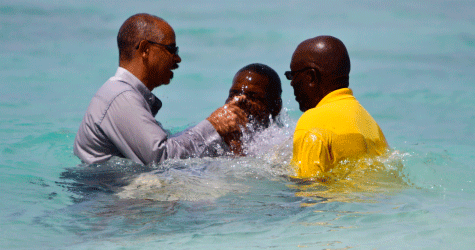 Q:
Q:
Do we die to sin before baptism or in baptism?
A:
Sometimes this question is asked in an effort to discount the divinely ordained necessity of baptism for the remission of sins. The claim is made that if a person “dies to sin” before baptism, then that person is saved before baptism since “he who has died has been freed from sin” (Romans 6:7). In truth, however, the expression found in Romans 6:6 (“our old man was crucified”) refers to the biblical doctrine of repentance—the “change of mind” that must occur within a person prior to baptism. Another metaphor used in Scripture to refer to the same change is seen in Hebrews 10:22 in the phrase “having our hearts sprinkled from an evil conscience.” Since one cannot literally sprinkle anything on one’s heart/mind, this is a figurative expression that refers to a person changing his attitude about sin—cleansing his mind concerning the desire to practice sin. Hence, a person must “die to sin” in the sense that he has changed his thinking about sin and disobedience, making a mental commitment to cease sin. He dies to the love and practice of sin. As Paul explained to the Galatians: “And those who are Christ’s have crucified the flesh with its passions and desires” (Galatians 5:24).

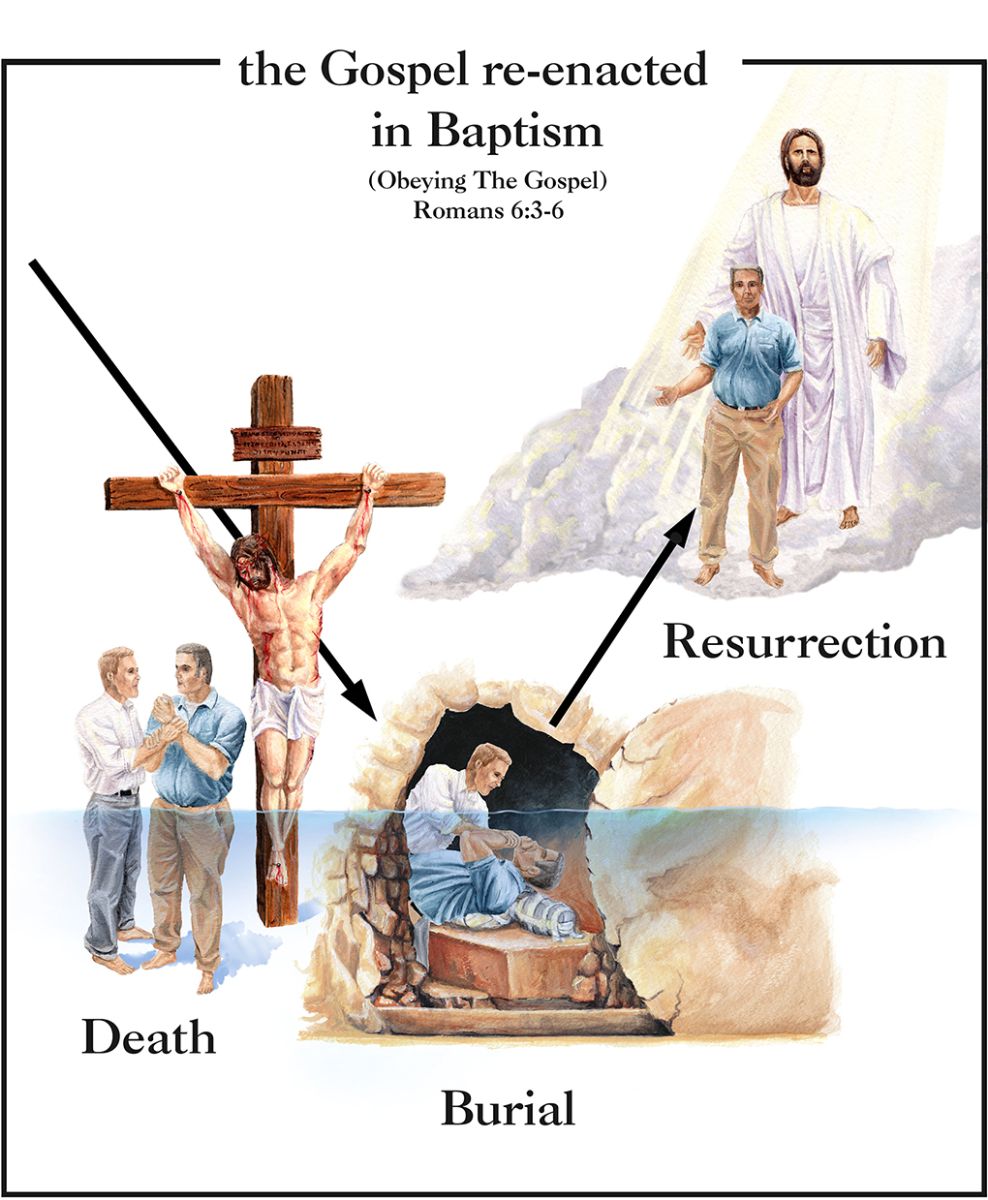
Observe, however, that while a person dies to sin at that moment in his own mind, he is not forgiven of sin by God at that point. Forgiveness occurs in the mind of God when the penitent believer allows himself to be lowered into the watery grave of baptism. That is the moment we contact the blood of Christ which was shed in Christ’s death. Hence, Romans 6:3-4 explains that when we are baptized in water, we are baptized into Christ’s death—the contact point for forgiveness. Being “buried with Him through baptism into death” is the point at which we are cleansed of sin, thus enabling us to “walk in newness of life.” According to the sequence stipulated in the passage, we cannot have “newness of life” until after we come up out of the waters of baptism. While many within Christendom have come to reject the role of water in God’s scheme of redemption, the New Testament repeatedly affirms it (e.g., John 3:5,23; Acts 8:36,38-39; 10:47; Hebrews 10:22; 1 Peter 3:20-21). [NOTE: For a comparison of Romans 6 to the parallel teaching of Colossians 2 and 3, see: http://www.apologeticspress.org/APContent.aspx?category=11&article=1232&topic=379.]
The post Do We Die to Sin Before Baptism or In Baptism? appeared first on Apologetics Press.
]]>The post Remembering the Role of Supplementation When Learning about Salvation appeared first on Apologetics Press.
]]>Are football referees supposed to know only a few of the rules in order to officiate a game correctly? Is a baker content in knowing only one of the ten ingredients that go into a pineapple upside-down cake? Would you be pleased if the only traffic law that truck drivers knew was the law regarding on what side of the road to drive? The answer to all of these questions is obvious. People generally understand the need to learn the entire rulebook, driver’s manual, or recipe. Knowing just part of these things will result in chaos and negative consequences. Likewise, taking only a part of God’s Word, to the neglect of the rest of His Word, is a recipe for confusion and disaster. Since the “entirety” of Scripture is truth (Psalm 119:160), all of God’s Word on any subject must be considered.
Most Bible students seem to understand the importance of the holistic approach to Bible interpretation when considering any number of topics, including the aforementioned genealogy of Christ and His perfect, sinless nature. Sadly, however, when it comes to the question regarding what a person must do to be saved, this rational approach to Bible interpretation is discarded.
Consider, for example, John 3:16: “For God so loved the world that he gave His only begotten Son, that whoever believes in Him should not perish but have everlasting life.” Many people have the idea that this one sentence is all they need to know to be saved. I once had a conversation with a man who said that the only part of the Bible that he needed was John 3:16. It did not matter what any other verse says. As long as he knew John 3:16 and believed what it said, he believed he was saved.
Notice, however, one problem (among many) that such a shallow interpretation of the Bible causes. If every student of the Bible picked a different verse and lifted that one verse above all others as “my little recipe for salvation,” then “Christianity” would be in a constant state of contradiction. Someone could say that nothing else matters except baptism because 1 Peter 3:21 says that “baptism now saves you—not the removal of dirt from the flesh, but an appeal to God for a good conscience—through the resurrection of Jesus Christ” (NASB, emp. added). Does 1 Peter 3:21 teach that a person must be immersed to be saved? Yes. But anyone who claims that immersion in water is all a person must do to be saved would be wrong. Likewise, anyone who claims that a mere mental assent that Jesus is the Son of God is the only thing necessary for salvation would be equally wrong (cf. James 2:19).
The fact is, the Bible teaches that a person must believe and be baptized to be saved (Mark 16:16). A person must believe in Jesus and confess His name to receive salvation (Romans 10:9-10). A person must repent and be baptized to have his sins forgiven (Acts 2:38). Additionally, a person must remain faithful until death in order to receive the crown of life (Revelation 2:10).
Bible students will never properly understand Scripture if they adopt an interpretation method that pits one inspired passage against another. They will never understand what to do to be saved if they elevate one verse to the exclusion of all others. The truth is, the Bible is in perfect harmony with itself. One passage will never contradict another, but they will supplement each other. John 3:16 is a wonderful, truthful passage of Scripture. But, so is 1 Peter 3:20-21. And so is Mark 16:16, as well as the rest of Scripture. “Be diligent to present yourself approved to God as a workman who does not need to be ashamed, handling accurately the word of truth” (2 Timothy 2:15, NASB, emp. added).
The post Remembering the Role of Supplementation When Learning about Salvation appeared first on Apologetics Press.
]]>The post Two Different Questions: What and When? appeared first on Apologetics Press.
]]>The Bible makes clear that Jesus saves. “[A]ccording to His mercy He saved us” (Titus 3:5). It is by His grace that we have hope of eternal life (Ephesians 2:5,8-9). We are “justified by His blood, we shall be saved from wrath through Him” (Romans 5:9). We are “redeemed…with the precious blood of Christ” (1 Peter 1:18-19). “Jesus Christ…loved us and washed us from our sins in His own blood” (Revelation 1:5). As Jesus ate with His disciples the night before His crucifixion, He said, “For this is My blood of the new covenant, which is shed for many for the remission of sins” (Matthew 26:28). What is it that saves a sinner from eternal separation from God? What is the remedy for sin? Without any doubt, “the blood of Christ” is what saves us (Hebrews 9:14). The idea of water having some kind of spiritual regenerative power is never taught in Scripture, nor have I ever met a member of the Lord’s church who believed such.
Another question altogether is when something happens. Naaman was healed of his leprosy (by the power of God!) when he washed in the Jordan River seven times (2 Kings 5:1-19). The blind man of John chapter nine was healed of his blindness (by Jesus!) when he washed in the pool of Siloam. And what about a sinner? When does the blood of Christ save one who is separated from God spiritually? The answer to that question is found in such passages as Acts 22:16 and Acts 2:38 (among others), which discuss water baptism. Once Saul (later called Paul) came to believe and confess that Jesus was indeed the Son of God, and expressed sorrow for his sins (cf. Acts 9:5-11), Ananias, whom God had sent to Saul, instructed him to “arise and be baptized, and wash away your sins, calling on the name of the Lord” (Acts 22:16). A sinner has his sins washed away when he is “baptized.” [NOTE: The participial phrase, “calling on the name of the Lord,” describes what Paul was doing when he was baptized and had his sins washed away (cf. Acts 2:21,38)—see Miller, 2003; Lyons, 2004.] Sadly, many have read Acts 22:16 and rejected the necessity of baptism because they approach their study of this verse with the wrong question in mind. This verse does not tell us what saves, but rather when a person is saved, i.e., has his sins washed away. Passages of Scripture such as those previously noted (e.g., Matthew 26:28, 1 Peter 1:18-19, Revelation 1:5) answer what saves, but in order to find out when a person is saved, one must consult passages like Acts 22:16 and Acts 2:38.
In short, the blood of Christ is what saves a sinner. But the blood of Christ washes away sins when a sinner confesses faith in Christ, repents, and is baptized “for the remission of sins” (Acts 2:38; Mark 16:16; Acts 22:16). May God help us to understand the difference between what and when, especially in regard to salvation.
REFERENCES
Lyons, Eric (2004), “Calling on the Name of the Lord,” [On-line], URL: http://www.apologeticspress.org/articles/597.
Miller, Dave (2003), “The Bible is its Own Best Interpreter,” [On-line], URL: http://www.apologeticspress.org/articles/2293.
The post Two Different Questions: What and When? appeared first on Apologetics Press.
]]>The post Dying Before Baptism? appeared first on Apologetics Press.
]]>The “God-would-not-do-that” argument can be used against almost any commandment in the Bible. For instance, the Bible repeatedly says that a person must believe that Jesus is the Son of God (Romans 10:11; John 8:24; et al.). Suppose, then, that a Christian had just begun to tell the story of Jesus to an older gentleman, when suddenly that gentleman has a massive heart attack and dies without getting to hear the rest of the story, and thus did not have the opportunity to believe. Should we, therefore, do away with the biblical command to believe in Jesus Christ, simply because a theoretical scenario can be concocted in which a potential convert dies moments before his compliance? To ask is to answer. Nor, with a wave of the hand, can we do away with the biblical command to be baptized for the forgiveness of sins (Acts 2:38).
Consider also the fact that the Bible plainly states that God wants all people to be saved. In 2 Peter 3:9, the inspired apostle wrote: “The Lord is not slack concerning His promise, as some count slackness, but is longsuffering toward us, not willing that any should perish but that all should come to repentance.” The Old Testament prophet Ezekiel was instructed by God to convey this message to the Israelites on God’s behalf: “‘As I live,’ says the Lord God, ‘I have no pleasure in the death of the wicked, but that the wicked turn from his way and live’” (Ezekiel 33:11). The apostle Paul told the young preacher Timothy that God “desires all men to be saved and to come to the knowledge of the truth” (1 Timothy 2:3-4). Therefore, if a person truly and honestly wants to become a Christian by being baptized for the forgiveness of his sins as God commanded, then God (Who wants all to be saved and is watchful of each individual human) certainly would provide an opportunity for that person to obey His commandment to be baptized. If no sparrow falls to the ground apart from God’s knowledge (Matthew 10:29), and God is no respecter of persons (Acts 10:34), then we can be sure that His providential care will ensure that each person is given a fair opportunity to respond to His commands.
REFERENCES
Lyons, Eric and Kyle Butt (2004), “Taking Possession of What God Gives: A Case Study in Salvation,” [On-line], URL: http://www.apologeticspress.org/articles/2546.
The post Dying Before Baptism? appeared first on Apologetics Press.
]]>