The post Preparing to Give an Answer: God’s Defense Recipe in 1 Peter 3:15 appeared first on Apologetics Press.
]]>The English word “apologetics” is often confused with the word “apologize,” yet the two words are nearly exact opposites. There certainly is a time and a place for Christians to express regret and apologize for our many mistakes and sins, but Christian apologetics has nothing to do with such remorse. A pitcher in baseball might apologize for hitting a batter with a 90-mile-per-hour fastball (since that’s not an authorized part of the game), but a dodgeball player has no need to say he’s sorry for striking another player with a ball. On the contrary, he may logically defend himself, offering a 180-degree-different kind of “apology.”
The English word “apologetics” is derived from the Greek noun apologia meaning a “reply” or “defense,” and the Greek verb apologeomai meaning to “defend oneself” and, more specifically, “to speak in one’s own defense against charges presumed to be false.”1 More than anyone else in the New Testament, “apologetics” is associated with the apostle Paul. To those in Corinth who questioned Paul’s claim of apostleship, he gave a “defense” (1 Corinthians 9:3). In his joyful letter to the church in Philippi, Paul reminded them that he was “appointed for the defense of the Gospel” (Philippians 1:16-17; 1:7).
A few years before Paul became a follower of Christ, Jesus prophesied that His disciples would “answer” or “defend” the truth of Jesus Christ “before kings and rulers” (Luke 21:14,12). This prophecy came into clear fulfillment during Paul’s missionary journeys and imprisonments (cf. Acts 9:15), as the Lord used him to reason with and “reply” before all manner of rulers.2 Before Governor Felix, Paul gave an “answer” (NKJV) or “defense” (NASB). About two years later, Paul “made his defense” (NIV) before Governor Festus (Acts 25:8), and then again before Festus and King Agrippa II (26:1-2), even denying Festus’ charge of insanity by pointing out that his apologia was grounded in “truth and reason” (26:25).
Though the word apologia is used only once in the New Testament in association with the apostle Peter, it is this apostle (Peter, and not Paul) whom the Holy Spirit used to give us perhaps the most complete (yet concise) picture of God-approved defenders of Christianity. Peter used the term apologia one time in 1 Peter, yet the apostle clearly details how Christians are to be Christ-like defenders. Indeed, Peter gives the Lord’s Church a perfect recipe for defending divine doctrine.
To Christians who were scattered throughout various parts of the northern half of Asia Minor in roughly the early-to-mid 60s A.D. (1:1),3 Peter wrote: “But sanctify the Lord God in your hearts, and always be ready to give a defense to everyone who asks you a reason for the hope that is in you, with meekness and fear” (3:15).
Written to Christians, Not “Clergy”
While Jesus and the apostle Paul are the two premier apologists in Scripture, we must not make the tragic mistake of thinking that apologetics is only for “the preacher.” Too many Christians for far too long have incorrectly assumed that “ordained clergy” are those engaged in Christian apologetics—not the “regular Christian” husband and wife, mom and dad, or the baker, banker, and bus driver. Peter makes clear in his first epistle that he was writing, not to “apostles, prophets, and preachers,” but to Christians (1 Peter 4:16)—to “pilgrims” (1:1), the “elect” (1:2), the “begotten” (1:3), “children” of God (1:14). He was writing to any and all of God’s people in various provinces in Asia Minor—followers of Christ whom he describes as “a chosen generation, a royal priesthood, a holy nation, His own special people” (2:9). In this letter, Peter specifically addressed various members of the body of Christ, including servants (2:18-25), wives (3:1-6), husbands (3:7), elders (5:1), and “younger people” (5:5). But overall, he was addressing “you” (1 Peter 5:1)4—Christians in local churches.
After expressly challenging “husbands” (1 Peter 3:7) to honor their wives and be the kind of godly men in the home that the Lord calls them to be,5 Peter went back to addressing “all of you” (3:8). When he wrote “always be ready to give a defense” (3:15), Peter was not addressing evangelists. He was not challenging some “special class of clergy.” He was talking to “all” Christians, to “followers of what is good” (3:13), to those who have been baptized in water for the remission of sins (3:20-21; cf. Acts 2:38).
Certainly, there are essential leadership roles for elders, deacons, and evangelists to fulfill in the Lord’s Church.6 Peter, in fact, has some very important commands for elders in chapter 5. However, the “defense” instruction of 1 Peter 3:15 is for all disciples of Christ.
When “a great persecution broke out against the church at Jerusalem” several years earlier, “all except the apostles were scattered throughout Judea and Samaria” (Acts 8:1).7 What did these dispersed disciples of Christ do? They “went everywhere preaching (euangelizo) the word” (Acts 8:4). They evangelized! “There is no evidence, nor is there any probability, that all these persons were ‘ordained’ to preach.”8 They were “just members” of the Church of Christ: “ordinary,”9 “common Christians.”10 Likewise, the dispersed Christians in Asia Minor to whom Peter wrote to “always be ready to give a defense” were just that—“Christians.” Indeed, Christian apologetics is for all of God’s people!
For Sincere Saints, Not Counterfeit Christians
Furthermore, according to Peter, Christian apologetics is for those with a “good conscience” who exemplify genuine, “good conduct in Christ” (1 Peter 3:16). Like Peter,11 Christians are imperfect people who stumble and fall along the way. Yet, we are to be real people of God, who “walk in the light” and “confess our sins” to one another (1 John 1:7,9; James 5:16). Having been “redeemed…with the precious blood of Christ” (1 Peter 1:18-19) and “called…out of darkness,” conscientious, God-approved Christian defenders walk in “His marvelous light” (2:9), “laying aside all…hypocrisy” (2:1). “[A]s obedient children, not conforming yourselves to the former lusts…but as He who called you is holy, you also be holy in all your conduct” (1:14-15).
Much of the time, long before any non-Christian listens to an apologia from a disciple of Christ, he will have inspected (to some degree) the life of this “so-called Christian.” Thus, Peter says to “abstain from fleshly lusts which war against the soul, having your conduct honorable among the Gentiles, that when they speak against you as evildoers, they may, by your good works which they observe, glorify God in the day of visitation” (2:12).12 In fact, it could be that for some (and perhaps many) unbelievers much less “defense” would be necessary in their conversion if they first saw continual, sincere righteous living on the part of the Christian. Only a few verses prior to 1 Peter 3:15, the apostle noted how some unbelieving husbands “without a word may be won by the conduct of their wives, when they observe your chaste conduct” (3:1-2).13
Consider that before the apostle Paul ever wrote to Timothy, instructing him to “preach the word” and “do the work of an evangelist” (2 Timothy 4:2,5), he first highlighted the vital “genuine [unhypocritical]14 faith that is in you” (2 Timothy 1:5). Furthermore, years prior to Paul penning 2 Timothy, he desired this young servant of Christ to accompany him on his second missionary journey. Note carefully, however, that Paul only wanted this after coming to learn that Timothy “was well spoken of by the brethren” (Acts 16:2-3). Indeed, God’s recipe for Christian apologetics includes, first and foremost, this primary ingredient: a sincere saint.
It should come as no surprise that just before Peter commanded Christians to “be ready to give a defense,” he first said to “sanctify the Lord God in your hearts” (3:15). To “sanctify” (hagiazo) is “to treat as holy;” to regard in “reverence.”15 The word “sanctify” is derived from the Greek hagios, which pertains to “being dedicated or consecrated to the service of God.”16 Similar to Jesus’ prayer to the Father, “hallowed (hagiazo) be Your name” (Matthew 6:9), Peter said, “sanctify Christ as Lord in your hearts” (NASB). Peter was actually quoting from Isaiah 8:13: “The Lord of hosts, Him you shall hallow” (Hebrew qadash). How do we “hallow,” “sanctify,” or “set apart as holy” the Lord? Since God is by His very nature 100% “holy” (1:16) and needs absolutely no help from humanity in being holy, in what sense do we set Him apart as holy?
Peter said to sanctify the Lord “in your hearts.” Of the millions of thoughts that flood our minds, of all the memories, people, and things we hold dear in our hearts, One is specially set apart far and above all others—in the center of our being, on the throne of our hearts—the King of kings and Lord of lords, Jesus Christ. God wants Christians to give a defense only after they have hallowed Christ in their lives. Not an outward, hollow “holiness,” which manifests itself in “going through the motions” with Pharisee-like actions, but an inward, genuine, heart-felt reverence for Jesus Christ, which naturally impacts everything the Christian does—how we think, act, and talk—including how we “give a defense.” Sooner or later, hypocrisy only harms the Christian’s influence and defense, while an authentic surrendering to Jesus as Lord of our lives is the greatest aid in the apologist’s arsenal. “Sanctify” first; “Defend” second: always, always in that order.
Courageous, God-Fearing Followers
Peter also detailed that genuine faithfulness from the inside-out is fundamental to Christian apologetics because followers of Christ often are called upon to give a defense in trying times. Peter knew a thing or two about suffering. Very soon after the establishment of the Church in Acts 2, Peter and John were repeatedly arrested, imprisoned, interrogated, threatened, and beaten (Acts 4-5). Peter was in Jerusalem during a time when “a great persecution arose against the church…at Jerusalem,” as Saul “made havoc of the church, entering every house, and dragging off men and women, committing them to prison” (Acts 8:1,3). Later, when “Herod the king stretched out his hand to harass some from the church,” including killing the apostle James, the king then arrested and imprisoned Peter (Acts 12:1-4), very likely with the intention of killing him, too (were it not for Peter’s divine deliverance from prison—Acts 12:5-19).
The Lord used this often-persecuted apostle to pen a letter to distressed Christians (likely sometime between A.D. 64-68)17 during the reign of the Roman Emperor Nero. Though there may not have been widespread, official imperial persecutions of Christians until a few decades later, Nero was no friend to Christians. The historian Tacitus (who was also no fan of Christianity) noted how Nero, in A.D. 64, blamed Christians for the Great Fire in Rome. According to Tacitus: “Nero fabricated scapegoats—and punished with every refinement the notoriously depraved Christians (as they were popularly called).”18 Whether Peter had this or other Roman persecutions in mind when writing 1 Peter, we do not know. Regardless, as the book of Acts reveals, persecution was present in one place or another since the birth of the Lord’s Church, and the Christian “pilgrims of the Dispersion” in Asia Minor were not exempt. It seems they had already endured some difficulties (1:6-7), and Peter forewarned that more lay on the horizon.
Beloved, do not think it strange concerning the fiery trial which is to try you, as though some strange thing happened to you; but rejoice to the extent that you partake of Christ’s sufferings, that when His glory is revealed, you may also be glad with exceeding joy. If you are reproached for the name of Christ, blessed are you…. But let none of you suffer as a murderer, a thief, an evildoer, or as a busybody in other people’s matters. Yet if anyone suffers as a Christian, let him not be ashamed, but let him glorify God in this matter…. Therefore let those who suffer according to the will of God commit their souls to Him in doing good, as to a faithful Creator (4:12-19).
Peter’s apologetics exhortation is firmly and deeply embedded in an epistle and immediate context of suffering. In the verses directly before and after 1 Peter 3:15, the apostle speaks of imminent Christian persecution: “when they defame you as evildoers, those who revile your good conduct in Christ may be ashamed” (3:16). “And even if you should suffer for righteousness’ sake, you are blessed” (3:14; cf. Matthew 5:10-12). We are blessed if we endure suffering innocently19 like Christ20 (2:19-24). We are blessed if such suffering brings spiritual maturity and heavenly clarity in an otherwise potentially “cares-of-this-world” kind of earthly, sinful focus on life. Furthermore, we are blessed to grow spiritually from such suffering, including increasing in courage for Christ. In fact, Peter directly connected “suffering” (3:14a) and apologetics (3:15) with being courageous, as he quoted from Isaiah 8:12, saying, “And do not be afraid of their threats, nor be troubled” (3:14b).
Rather than cower fearfully in the face of manmade persecution and allow such fear to warp how we think, live, and “give a defense,” Isaiah challenged his hearers to fear God. “The Lord of hosts, Him you shall hallow; let Him be your fear, and let Him be your dread” (Isaiah 8:13). Peter includes these thoughts both at the beginning and end of 1 Peter 3:15: (a) “sanctify the Lord God in your hearts” (which we’ve already examined), and (b) giving a defense “with…fear.” This “fear” is not in sinful fear of what man (or Satan) might do. Jesus explained: “[D]o not fear them…. Whatever I tell you in the dark, speak in the light; and what you hear in the ear, preach on the housetops. And do not fear those who kill the body but cannot kill the soul. But rather fear Him who is able to destroy both soul and body in hell” (Matthew 10:26-28). Indeed, as Peter rhetorically asked, “And who is he who will harm you if you become followers of what is good?… Do not be afraid of their threats, nor be troubled” (3:13-14). After all, as Peter reminded these young churches of the words of Psalm 34, our omniscient, omnipotent God is bigger than any problem that may come our way: “For the eyes of the Lord are on the righteous, and His ears are open to their prayers; but the face of the Lord is against those who do evil” (3:12). Thus, “fear” God (1 Peter 1:17; 2:17; 3:15). As we “speak in the light” (Matthew 10:27) about the joy of our salvation, our total respect, reverence, and genuine, soul-stirring awe for our Savior and King serves as the rock-solid foundation of our apologia.
Is it not encouraging that God used the imperfect (but penitent) Peter to write these words? Recall that Peter cowered on the Sea of Galilee, fearfully denied Jesus three times, and even had a hypocritical moment later in life when he, for fear of some Jewish Christians, played favoritism and shunned his Gentile brethren (Galatians 2:11-14). It is this apostle (likely toward the end of his life) whom the Holy Spirit used to exhort struggling, flawed followers of Christ to courageously stand their ground, to “not be afraid,” and to “always be ready to give a defense to everyone who asks you a reason for the hope that is in you.” Indeed, regardless of “whenever, wherever, and by whomever it is challenged,”21 we must speak up and explain the “reason for the hope” that is in us.
Full of Hope, With Eyes on the Prize
In one very real sense, biblical, Christian apologetics is not an intimidating graduate course or an overwhelming 800-page step-by-step book on how to answer nearly every challenge under the Sun. It’s not some dreaded Bible study or debate. The apologia of 1 Peter 3:15 is the natural response to the Lord being #1 in our lives (which at some point will likely include great books, classes, studies, and possible debates). Christian apologetics, on the most basic level, is the natural response of being in love with the Lord and living as sojourners in a foreign land with our eyes on the prize. Does a young woman who is righteously head-over-heels in love with her fiancé not have a natural glow and excitement about her? Is she not ready to defend and tell the world about her one love who is soon to sweep her off her feet and take her across the threshold of their new home? Likewise, the child of God loves to talk about her Father. The once-dead sinner loves to talk about his Savior. The bride of Christ loves to talk about her Husband and the reasons for her confident expectation of seeing Him face to face in heaven one day.
Peter called the Christians in Asia Minor “pilgrims” (1:1; 2:11) and “sojourners” (2:11). He reminded them how to conduct themselves “throughout the time of your stay here” (1:17). The simple yet profound fact about life on Earth is, we are all “just passing through” (like a brief stay in a hotel). Christians, however, live here with hope (the full expectation) of receiving (by the grace of God) “an inheritance incorruptible and undefiled and that does not fade away, reserved in heaven for you” (1:4). As the sojourner Abraham left his homeland to dwell “in a foreign country” and “waited for the city which has foundations, whose builder and maker is God” (Hebrews 11:9-10), “our citizenship is in heaven, from which we also eagerly wait for the Savior, the Lord Jesus Christ” (Philippians 3:20). Many a dying, non-Christian has longed for some kind of “hope” of happiness after this life is over; the faithful child of God is overjoyed to “give a defense…for the hope” that is in us.
A Hope Anchored firmly in Facts
Though the genuine hope of the Christian stirs up the strongest of emotions,22 do not make the grave mistake of thinking that the Christian’s hope is founded on emotion. Nothing could be further from the truth. Our feelings are founded on facts. Our hope is firmly anchored in the truths of the Gospel—of the death, burial, and resurrection of Jesus Christ (1 Corinthians 15:1-4). Peter was clear, saying, “[W]e did not follow cunningly devised fables when we made known to you the power and coming of our Lord Jesus Christ, but were eyewitness of His majesty” (2 Peter 1:16). When Peter and the apostles were accused of being drunk on the first Pentecost following the death, burial, and resurrection of Jesus (Acts 2:13), Peter responded with a reasoned defense, not a mere emotional appeal. He reminded his hearers that God “attested” (apodedeigmenon) to the miracles that Jesus worked while He was alive and in their midst (Acts 2:22). That is, God “demonstrated”23 proof of the divine origin, message, and mission of Christ in such a way that people could actually see the evidence and make an informed, rational decision about Him (cf. John 10:37-38).
What’s more, the assembly on Pentecost knew that Jesus had been “put to death” only days earlier (Acts 2:23), but unlike the tomb of King David, Jesus’ tomb was empty only three days later. Unlike the body of David, which saw corruption, the dead body of Christ had been raised and would never see corruption. Yes, Peter directed the assembly to evaluate the evidence for Jesus’ resurrection, including the implied empty tomb (Acts 2:24,29-32), the fulfillment of Psalm 16:8-11 (Acts 2:25-31), and the witnesses who stood before them testifying that they had actually seen the risen Savior (Acts 2:32).
The nearly 3,000 individuals who obeyed the Gospel on Pentecost were not swayed by flowery words, phony miracles, or mere emotional appeals. They were “cut to the heart” by evidence-based preaching. They reacted to a sermon filled with sensible argumentation and properly applied Scriptures.24 They responded to the apologia of Christ—to Christian apologetics.
About 30 years following the events in Acts 2, Peter reminded the persecuted Christian pilgrims in 1 Peter that the hope for which they were to give a defense is a “living hope through the resurrection of Jesus Christ from the dead” (1:3). Indeed, the evidence proves that “God…raised Him from the dead and gave Him glory, so that your faith and hope are in God” (1:21).
Prepare to Answer
Since our hope is evidence-based, it is paramount to learn the reasons for our hope—for our own eternal benefit and for the benefit of others (as we teach and answer questions). Unlike the miraculously inspired apostles to whom Jesus said, “Therefore settle it in your hearts not to meditate beforehand on what you will answer (apologeomai); for I will give you a mouth and wisdom which all your adversaries will not be able to contradict or resist” (Luke 21:14-15), Christians today must prepare themselves to give a defense. We must “get ready.”
Peter said, “If anyone speaks, let him speak as the oracles of God” (4:11). If so, then we must first learn the Word of God. We first learn enough to reasonably conclude why we should become Christians—“having been born again…through the word of God” (1:23). Then, “like newborn babes, desire the pure milk of the word, that you may grow thereby” (2:2). After all, “All Scripture is given by inspiration of God, and is profitable for doctrine, for reproof, for correction, for instruction in righteousness, that the man of God may be complete, thoroughly equipped for every good work” (2 Timothy 3:16-17). When Jesus was challenged by Satan, the Lord quoted Scripture and used it accurately (Matthew 4:1-11). When Jesus was challenged by the Pharisees and others, He logically pointed out flaws in their irrational arguments, while also making perfect reference to and application of the Old Testament (cf. Matthew 5; 12:1-14,22-30). Indeed, “the weapons of our warfare are not carnal but mighty in God for pulling down strongholds, casting down arguments and every high thing that exalts itself against the knowledge of God, bringing every thought into captivity to the obedience of Christ” (2 Corinthians 10:4-5). As we patiently prepare ourselves to answer those who ask us a reason for the hope that is in us, let’s “grow in the grace and knowledge of our Lord and Savior Jesus Christ” (2 Peter 3:18).
Defend with the right attitude
In our reasoning with others of the hope that is in us, we must keep in mind what Peter noted at the end of 1 Peter 3:15—that our defense is to be made “with meekness and fear.” Christians are to try to be Christ-like at all times, including when we defend the truth. Our teaching is to be characterized “with gentleness and reverence” (3:15, NASB). We are to “honor all people” as we “fear God” (2:17). As we “proclaim the praises of Him” who called us “out of darkness into His marvelous light,” we must be “clothed with humility” (2:9; 5:5).
About 15 years ago, a man who identified himself as a Catholic priest wrote an unsolicited letter to Apologetics Press. We had never heard of this gentleman before reading his note. Although, sadly, he is very misled in his adherence to Catholic doctrine,25 consider some of his analysis of a handful of preachers in the Church of Christ. [NOTE: He refers to preachers as “elders.”]
As a Roman Catholic priest who follows non-Catholic religions with some interest…I have observed a lot of meanness, rudeness, and lack of basic civility among CoC [Church of Christ—EL] elders, especially recently. How does one explain this? In general (no doubt there are exceptions perhaps many), Christian love seems deficient in the way they seek to promote truth.
In general, they strike me as tending to be suspicious, rash and uncharitable in their judgments about other people’s motives, prone to arrogance, and even too eager to call someone a liar, more so than the average pagan in the streets. These comments are based on only my limited experience, to be sure, and sometimes, no doubt, I am guilty of some of the very same sins and character flaws.
I was considering doing some kind of oral interaction with an elder or two about Catholic matters. Now it looks to me like this would be a royal invitation to verbal abuse, misrepresentation, and even character assassination….
Some members of the Lord’s Church might tend to dismiss this criticism with a wave of the hand, but we believe this gentleman was right in his assessment and denouncement of some who attempt to “defend the truth” yet do so in an unchristlike manner.26 What’s more, we all need to be reminded of the necessity and seriousness of “speaking the truth in love” (Ephesians 4:15). We must examine ourselves and ensure that our teachings and defense of the truth are done lovingly and patiently, confidently yet kindly, neither rudely nor arrogantly (1 Corinthians 13).
Keep in mind what the apostle Paul wrote to Timothy shortly before commanding him to “preach the word” (2 Timothy 4:2). He described “a servant of the Lord” as one who “must not quarrel but be gentle to all, able to teach, patient, in humility correcting those who are in opposition” (2 Timothy 2:24-25).
Peter repeatedly reminds Christians to be humble in all areas of life. We are to be submissive to governing authorities (2:13), to masters (2:18), (wives) to husbands (3:1), to elders (5:5), and in general “to one another” (5:5).27 With this same submissive spirit, Christians are called upon to give a defense “with gentleness and reverence” (3:15, NASB). Yes, let’s teach and preach while being “clothed with humility, for ‘God resists the proud, but gives grace to the humble.’ Therefore humble yourselves under the mighty hand of God, that He may exalt you in due time” (3:5-6).
Conclusion
First Peter 3:15 is embedded within a marvelous epistle that provides clear context and commentary on a perfect apologetics passage. Every sincere-hearted Christian should draw encouragement from this verse to follow God courageously in the face of suffering and persecution. With a Christ-like attitude, with our eyes firmly fixed on the ultimate prize, and with our hope anchored in the facts of the Gospel, we, indeed, can give a reasonable defense. And, we can rejoice in the fact that honest and good-hearted unbelievers will eventually “glorify God in the day of visitation” (1 Peter 2:12).
Endnotes
1 Frederick Danker, et al. (2000), Greek English Lexicon of the New Testament (Chicago, IL: University of Chicago), pp. 116-117.
2 Including teaching Sergius Paulus, the proconsul of Cyprus (Acts 13:4-12), on his first missionary journey and standing before Gallio, proconsul of Achaia (Acts 18:11-17), on his second missionary journey.
3 All chapter and verse citations that do not have a Bible book listed are from 1 Peter.
4 The phrase “among you” in this verse is another clear indication that he was writing to “regular Christians.”
5 Not cruel masters who lord over their wives, but Christ-like men who (are commanded to) “dwell with them with understanding, giving honor to the wife, as to the weaker vessel, and as being heirs together of the grace of life, that your prayers may not be hindered” (3:7).
6 Acts 14:23; 1 Timothy 3:1-13; Philippians 1:1; Ephesians 4:11-12.
7 NIV.
8 Albert Barnes (1997), Notes on the Old and New Testaments: Acts (Electronic Database: Biblesoft).
9 R.C.H. Lenski (2001), The Interpretation of the Acts of the Apostles, (US: Hendrickson), p. 314.
10 Barnes.
11 Matthew 27:69-75; Galatians 2:11-14.
12 It seems likely that this “day of visitation” is a reference to the day that a non-Christian becomes a child of God—when the Lord would, in a sense, “visit me with Your salvation” (Psalm 10-6:4).
13 Considering how many Christians, including countless church leaders, have struggled with sexual purity, Peter’s repeated reminders to be “chaste,” “pure,” and “holy in all your conduct” cannot be overemphasized. Disciples of Christ who fail to put away lewdness, lusts, revelries, etc. (4:3), and who hypocritically “give a defense,” do (and have done!) much damage to the cause of Christ. Sadly, this damage can be exponentially greater in our day of instant Internet search engines, 24-hour news coverage, and social media.
14 From the Greek anupokritos, which is from hupokrites (from which we get our English word “hypocrite”).
15 Danker, p. 10.
16 Ibid., pp. 10-11.
17 Cf. Peter Davids (1990), The First Epistle of Peter (Grand Rapids, MI: Eerdmans), p. 10.
18 Tacitus (1952 reprint), The Annals and the Histories, trans. Michael Grant (Chicago: William Benton), 15.44, parenthetical comment in orig.
19 Though on an imperfect, fallen level (Romans 3:23).
20 Who did so on a flawless level.
21 Dick Sztanyo, as quoted in Kyle Butt (2001), “What Is Apologetics?” https://www.apologeticspress.org/apcontent.aspx?category=12&article=826.
22 From excitement for what’s to come after this life is over, to the joy of talking about it, to sadness for those who do not currently have it.
23 R.J. Knowling (2002), The Expositor’s Greek New Testament, ed. W. Robertson Nicoll (Peabody, MA: Hendrickson), 2:82.
24 See Dave Miller (2019), Is Christianity Logical? (Montgomery, AL: Apologetics Press), pp. 49-50.
25 Moises Pinedo (2008), What the Bible Says About the Catholic Church (Montgomery, AL: Apologetics Press), https://apologeticspress.org/pdfs/e-books_pdf/wtbsatcc.pdf.
26 We actually know the handful of preachers to whom he was referring, as other parts of his letter revealed their identity. It is also noteworthy that the Catholic priest humbly acknowledged his own shortcomings in his critique.
27 An apologist is no more to be arrogant than an elder is to be domineering (1 Peter 5:3).
The post Preparing to Give an Answer: God’s Defense Recipe in 1 Peter 3:15 appeared first on Apologetics Press.
]]>The post Apologetics Is Evangelism appeared first on Apologetics Press.
]]>Kyle Butt, one of our AP authors, said this about apologetics:
You walk up to the man on the street and tell him that Jesus Christ loves him and died so he could receive forgiveness of his sins. You explain that everyone should obey Jesus because He is the Son of God. The man wants to know how you know this information. You inform him that the Bible, the inspired Word of God, declares it to be true. He wants to know two things: (1) How can you prove that there is a God?; and (2) How can you prove that the Bible is His Word? He is not being belligerent or cantankerous; he simply wants some good evidence that would warrant the total overhaul of his life you are asking him to make.
It is now your responsibility to present solid, rational arguments that prove the things you have affirmed. You must defend the propositions you have presented. You are appointed for the defense of the Gospel (Philippians 1:17).1
Notice: apologetics is crucial to evangelism. When a person engages in apologetics, he is simultaneously evangelizing by exposing error and/or teaching truth.
Several times over the years I have been asked the question, sometimes even with indignance, “Why is your organization called ‘Apologetics’ Press? You have nothing to be apologetic for!” Just a few months ago, we received an e-mail that said, “I am leary of your name—Apologetics—I am a servant of the Living God and have no need to apologize for anything but I am seeking an answer….” Ironically, this individual was inadvertently requesting the very thing she thought she had no need for. The word “apologetics” is derived from the Greek word apologia, which means to give a defense or reply.2 Christians are commanded to “always be ready to apologian (give a defense) to everyone who asks you a reason for the hope that is in you” (1 Peter 3:15). Apologetics Press, therefore, was founded to assist Christians in following that divine directive: to give a defense of New Testament Christianity—countering attacks by enemies of the cross and providing answers to those sincerely seeking evidence for Christianity.
Apologetics is an important aspect of the Christian’s walk. One does not have to read far in Scripture to find examples of God and His followers defending the truth through logical argumentation and reasoning from the evidence, or those who were supposed to be His followers failing to defend properly the truth and choosing instead to succumb to erroneous doctrines (starting with Adam and Eve). In fact, examples of apologetics are in nearly every chapter of Holy Writ, whether directly or indirectly. Jesus, Himself, was an apologist—the Master Apologist.3 Paul engaged in apologetics constantly throughout his ministry, as did other New Testament evangelists, defending the truth of Jesus’ messiahship, deity, and resurrection.4 In fact, it could be argued that apologetics is the primary mode of evangelism used in Scripture. If Christians are commanded by our Ruler to “contend earnestly for the faith” (Jude 3), to “always be ready to give a defense” (1 Peter 3:15), and to “persuade men” (2 Corinthians 5:11), apologetics is central to implementing our Commander’s orders.
The bottom line is that apologetics is crucial in being able to reach others with the Gospel. False concepts must be countered and evidence provided in order to build a foundation for the obedient faith that saves. Regardless of whether or not we as Christians choose to support apologetics efforts, we should all be clear about the fact that God intends for all Christians to be apologists. It is our responsibility to prepare ourselves for that endeavor. Souls are at stake.
Endnotes
1 Kyle Butt (2001), “What is Apologetics?” Apologetics Press, https://apologeticspress.org/APContent.aspx?category=12&article=826.
2 William Arndt, F.W. Gingrich, and Frederick W. Danker (1979), A Greek-English Lexicon of the New Testament and Other Early Christian Literature (Chicago, IL: University of Chicago Press), second edition revised, p. 96.
3 Dave Miller (2011), “Jesus Was Rational,” Apologetics Press, http://apologeticspress.org/apcontent.aspx?category=10&article =1245; Dave Miller (2011), “Is Christianity Logical? [Part I],” Apologetics Press, http://apologeticspress.org/APContent.aspx?category=12&article=3869.
4 Eric Lyons (2016), “Apologetics and the Growth of the Early Church,” Reason & Revelation, 36[6]:62-71, http://apologeticspress.org/pub_rar/36_6/1606w.pdf.
The post Apologetics Is Evangelism appeared first on Apologetics Press.
]]>The post Apologetics and the Growth of the Early Church appeared first on Apologetics Press.
]]>
To say that the first-century church was a growing church would be a major understatement. The early church did not merely grow; she exploded onto the scene and continued multiplying in number for many years. About 3,000 souls obeyed the Gospel the very day the church was born in Jerusalem almost 2,000 years ago (Acts 2:41). To that number, “the Lord added…daily those who were being saved” (2:47). Despite attempts to stifle the preaching of Jesus and the growth of His church, “many of those who heard the word believed; and the number of the men1 came to be about five thousand” (Acts 4:4). “Believers were increasingly added to the Lord, multitudes of both men and women” (5:14). In Jerusalem, “the disciples multiplied greatly;” even “a great many” of the Jewish priests were “obedient to the faith” (6:7). In Samaria, “the multitudes with one accorded heeded the things spoken by Philip” (8:6); “both men and women were baptized” (8:12). Indeed, “the church throughout all Judea and Galilee and Samaria…continued to increase” (9:31, NASB).
After Paul’s conversion to Christ, He took the Gospel to Cilicia where the young “churches were strengthened in the faith, and increased in number daily” (16:5). Later, “all who dwelt in Asia [Minor] heard the word of the Lord Jesus, both Jews and Greeks” (19:10). Even Paul’s enemies testified to how “throughout almost all Asia, this Paul has persuaded and turned away many people” from idolatry (19:26). Paul and his companions also carried the Gospel to Europe, where “a great multitude of the devout Greeks, and not a few of the leading women” joined them (17:4). And what did Paul learn upon his return to Jerusalem following his third missionary journey? That “many myriads of Jews” had come to believe in Jesus (21:20). That is, within less than 30 years, the Lord’s church had increased to become many tens of thousands of Christians strong.2
Causes of Growth in the Early Church
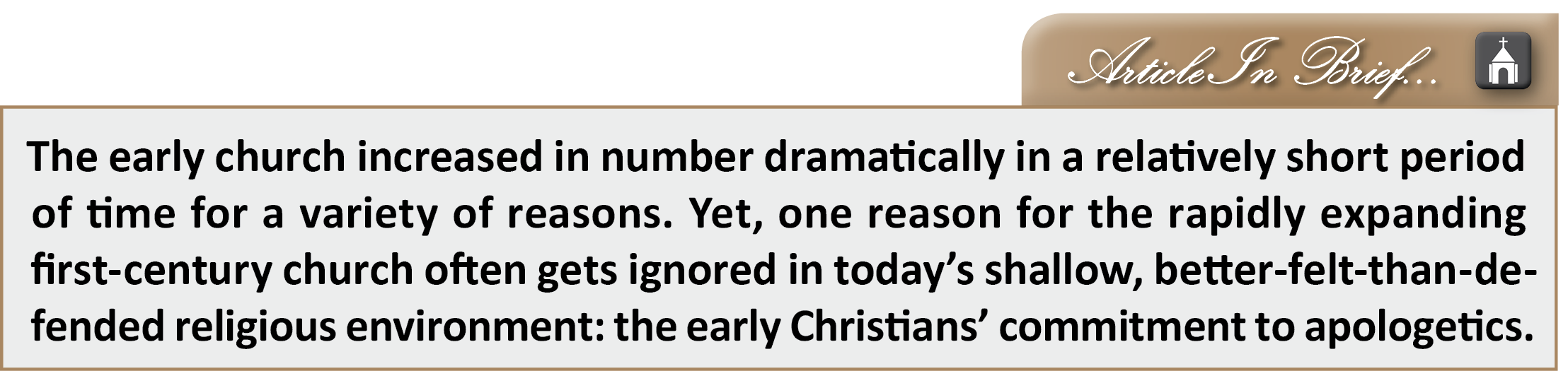
The early church increased in number so dramatically in a relatively short period of time for a variety of reasons. First, the church of Christ was not established at “just anytime” in history. “Before time began” God purposed to offer salvation to the world through Christ Jesus (2 Timothy 1:9). God planned for Jesus to come to Earth and for His church to be established at a special and specific point in time in human history, which God chose and foretold. So, “when the fullness of time had come” (Galatians 4:4), that is, “the time which God in His infinite wisdom counted best,”3 Jesus came to Earth and subsequently established His promised, prophesied, and prepared-for church.4 Thus, a rapidly growing early church should come as no surprise.
Still, human beings have free will. Simply because God foreknew that the early Christians would multiply in number throughout the world does not mean He overrode their ability to reject the Gospel or to reach out to others with it (even if they did initially obey it). The early church grew so rapidly because the apostles, evangelists, and early Christians were courageous in their constant teaching and preaching of the Word of God. The Christians increased in number because they put a priority on souls and eternal salvation rather than upon materialism and temporary, earthly matters. Despite negative peer pressure, poverty, and persecution, the early church grew because so many disciples were committed (individually and collectively) to telling the world that the Savior, the promised Messiah, had died and risen from the dead, and “commands all men everywhere to repent” (Acts 17:30). They were a praying and preaching people who would not be stopped.5 In fact, for so many early Christians, death was the only thing that would keep them from spreading the Good News of Jesus.6 Ironically, it was the death of Stephen and the great persecution that arose against the church in Jerusalem which actually assisted in the spread of the Gospel in Judea, Samaria, Phoenicia, Cyprus, and many other places around the world (Acts 8:1-4; 11:19-20).
A Major (Yet Often-Overlooked) Contributing Factor to the Early Church’s Growth
Indeed, the kingdom of Christ grew so rapidly in the first century for a number of noteworthy reasons (which, incidentally, Christians in every generation desperately need to emulate in their work for the Lord). Yet, one reason for the rapidly expanding early church often gets ignored in today’s shallow, better-felt-than-told religious environment: the first-century Christians’ commitment to apologetics.
What Is Apologetics?
Sometime ago a Christian lady e-mailed our offices at Apologetics Press, saying, “I am leery of your name…apologetics…. I am a servant of the Living God and have no need to apologize for anything. But I am seeking an answer and saw your site. So please if you may, answer me this….” In truth, we were happy to respond to Jennifer and let her know that apologetics is, in fact, all about giving answers (and not “apologizing,” as so many think of it in 21st-century America). The English word apologetics is derived from the Greek apologia, meaning, “defense.”7 God does not want Christians to “apologize” (be sorry for) their allegiance to the Lord. Rather, as Peter declared, “[S]anctify the Lord God in your hearts, and always be ready to give a defense (apologian) to everyone who asks you a reason for the hope that is in you, with meekness and fear” (1 Peter 3:15). The word apologetics can apply to almost any subject matter, but most often it is discussed in the context of Christian apologetics. God expects Christians to give an outward defense of their inward hope. He wants His people, not to take up swords in an attempt to spread Christianity with carnal warfare, but to charge ahead with “knowledge” and “the word of truth” (2 Corinthians 6:6-7). Disciples of Christ look to “destroy arguments and every proud obstacle to the knowledge of God, and take every thought captive to obey Christ” (2 Corinthians 10:5, RSV). God desires for Christians to base their actions upon Truth that is honestly and logically defended rather than false doctrine, which is dishonestly or naively accepted and emotionally driven.
Admittedly, the early Christians were full of emotions. They joyfully recognized that the long-awaited, much-anticipated Messiah had just recently come into the world and established His spiritual kingdom.8 They penitently acknowledged their sins (Acts 2:37; 8:24). They lovingly sacrificed their material possessions in order to help the poor among them (4:32-37). They were concerned for the safety of their brethren who preached openly in the face of their enemies (21:12). They rejoiced “that they were counted worthy to suffer shame” for the name of Jesus (4:41) and courageously continued “preaching the kingdom of God and teaching the things which concern the Lord Jesus Christ with all confidence” (28:31). But in the end, whatever feelings they had, whatever emotions they felt—these sensations were not the driving force behind their allegiance to Jesus Christ. The early church grew in faith and number, not because they had a better-felt-than-told kind of religion, but because they sincerely believed Truth (cf. John 8:21-36), which they were joyfully committed to spreading and defending.
Luke’s Opening of Acts
Luke, the physician and inspired writer of Acts, sets the “defense” tone from the very beginning of his brief history of the first 30 years of the Lord’s church. In the first sentence, He reminds his readers of his previous account (the Gospel of Luke), where he recorded those things that Jesus did and taught. In the very next sentence, he concisely, yet reasonably, addressed one critical piece of evidence that would be repeated throughout Acts9 and that lies at the heart of the Good News: Jesus’ resurrection from the dead. How did Luke briefly convey the resurrection of Christ? Was it merely an unverifiable “hope” that he communicated? Did he make an emotionally based appeal using flowery words? Not at all. From the very outset, Luke set an apologetic tone for the book of Acts.
Luke indicated that to the apostles Jesus “presented Himself alive after his suffering by many proofs, appearing to them during forty days and speaking about the kingdom of God” (1:3, ESV). Notice that Luke affirms that Jesus “presented” (parestasen) Himself alive. Jesus’ dead body was not stolen and buried elsewhere. He did not just escape the tomb to leave everyone in doubt about a possible resurrection. He “presented” or “showed” (NIV) Himself. Luke used this term 13 times in Acts, including in Acts 9:41 where, after God raised Dorcas from the dead, Luke noted that Peter “called the saints and widows” and “presented her alive” to them. He proved to them that she was no longer dead. Likewise, the once-lifeless body of the Lord rose from the dead, and then, over the next 40 days, Jesus repeatedly presented Himself alive to the apostles—offering “many proofs.”
Jesus did not offer vague, subliminal messages to His apostles in order to convince them of His resurrection. He did not offer mere whispers in the wind. Luke reminds his readers that Jesus offered “many proofs” (pollois tekmanriois). According to Danker, Arndt, and Gingrich, tekmanriois is “that which causes something to be known in a convincing and decisive manner.”10 No wonder several reputable translations include the word “infallible” or “convincing” alongside “proofs” in Acts 1:3.11 Jesus did not just offer a little support of His resurrection; He gave many “surely and plainly known,”12 convincing proofs that He had risen from the dead.
So, to what exactly is Luke referring? No doubt to some of the very proofs that he discussed in his “former account” (and that the other gospel writers gave in their treatises). During the 40 days that Jesus was on Earth after His resurrection and prior to His ascension, He appeared to several individuals at different times, including on one occasion to more than 500 disciples (1 Corinthians 15:5-8). When He appeared to the apostles, He showed them His pierced hands and feet and challenged them to “handle” Him in order to “see” that He was not a mere spirit, “for a spirit does not have flesh and bones” as Jesus had (Luke 24:39). As further physical proof of His “flesh and bones” bodily resurrection, Jesus actually ate with the apostles (Luke 24:41-43). (If you want to prove to someone that you are a real, physical being, eating actual food in their presence would certainly be appropriate confirmation.) Lastly, the Master Teacher taught them the Scriptures (Luke 24:44-49). Indeed, as Luke testified, Jesus gave an apologia—He “presented Himself alive after his suffering by many proofs, appearing to them during forty days and speaking about the kingdom of God” (Acts 1:3, emp. added).
Peter’s Defense on Pentecost
On the first Pentecost after the death, burial, and resurrection of Jesus, Peter stood before thousands of Jews and reasoned with them about becoming followers of the recently crucified descendant of David. Consider that his sermon was not an emotionally based appeal for his hearers to “repent…and be baptized” (Acts 2:38). No, in contrast to incoherent, drunken babblers (2:15), Peter testified that what the assembly was hearing and witnessing—the apostles miraculously speaking in languages which they had never studied (2:6,8,11)—was a fulfillment of Joel’s 800-year-old prophecy. Furthermore, Peter reminded his hearers that God “attested” (apodedeigmenon) to the miracles that Jesus worked while He was alive and in their midst. That is, God “demonstrated”13 proof of the divine origin, message, and mission of Christ in such a way that people could actually see the evidence and make an informed, rational decision about Him.
The assembly on Pentecost knew that Jesus had been “put to death” only days earlier (2:23), but unlike the tomb of King David, Jesus’ tomb was empty only three days later. Unlike the body of David, which saw corruption, the dead body of Christ had been raised and would never see corruption. Notice that Peter directed the assembly to evaluate the evidence for Jesus’ resurrection, including the implied empty tomb (2:24,29-32), the fulfillment of Psalm 16:8-11 (2:25-31), and the witnesses who stood before them testifying that they had actually seen the risen Savior (2:32).
The some 3,000 individuals who obeyed the Gospel on Pentecost were not swayed by flowery words, phony miracles, or mere emotional appeals. They were “cut to the heart” by reason-and-revelation-based preaching. They reacted to a sermon filled with sensible argumentation and properly applied Scriptures. They responded to the apologia of Christ—to Christian apologetics.
Apologetics and the Preaching of Paul
How did the second greatest missionary the world has ever known (the first being Jesus, of course; Luke 19:10) go about publicly and privately proclaiming the Word of God? What did he say to people? How did he lay out the Gospel before his hearers? Was he like so many modern-day preachers and televangelists who appear infatuated with entertaining audiences with emotionally based productions? Did he ramble on about needing a mere “self-help,” feel-good religion to get through the trials of life and onward to heaven? What did God do through Paul that resulted in so many people in the first century hearing the Gospel and becoming dedicated servants in the Kingdom of God?
Christians do not have to wonder or speculate what Paul did. The inspired book of Acts details more about Paul’s work and teachings than anyone else’s in the early church. Just read Acts and you will find that from the time Paul became a Christian until the close of the book (28:30-31), he preached rational, well-argued, truth-based, thought-provoking sermons, “proving (sumbibazon) that…Jesus is the Christ” (9:22). The Greek word sumbibazon means “to present a logical conclusion;” to “demonstrate.”14 Paul gave evidence that lead honest-hearted people to the logical conclusion that, indeed, Jesus is the promised, prophesied Messiah: the Savior of mankind.
Though space will not allow for an exhaustive review of all of Paul’s work as an evangelist, consider some of what Luke recorded about Paul’s preaching on just his second and third missionary journeys. Pay close attention to the words that Paul himself used in his preaching and that Luke, one of Paul’s traveling companions (16:10-16), recorded in describing Paul’s work.
Thessalonica
After planting the church in Philippi and being asked to depart the city by the unjust and cowardly magistrates (16:11-40), Paul travelled to Thessalonica and entered a Jewish synagogue (which was his custom—17:2).15 There he “reasoned with them from the Scriptures, explaining and demonstrating that the Christ had to suffer and rise again from the dead, and saying, ‘This Jesus whom I preach to you is the Christ’” (17:3-4).
In contrast to his jealous, unbelieving enemies, who used intimidation tactics and mob-like violence to bring about a chaotic scene within the city (17:5-9), the life-changing Gospel of Christ that Paul preached was built upon facts that he explained and demonstrated using the Old Testament Scriptures and the historical life of Christ. To “explain” (dianoigo) is to “open” or to “interpret.”16 Just as Jesus “opened the Scriptures” to the uninformed disciples on the road to Emmaus (Luke 24:32), God used Paul “to open the sense of the Scriptures” to the Thessalonians.17 He demonstrated (paratithami) to them by “pointing out” what they were missing.18 Paul was pointing out or “bringing forward in proof passages of Scripture” and making “plain to the understanding the meaning.”19 As Wayne Jackson so capably observed:
The apostle’s method of argument, impeccably logical, was to: 1) Appeal to the authoritative Old Testament scriptures; 2) Direct attention to the prophecies concerning “the Christ;” 3) Introduce the fact of history relative to Jesus of Nazareth (e.g., His suffering, death, and resurrection); 4) Press the conclusion that Jesus fulfills the declarations regarding the promised Messiah.
This must be the foundation of all gospel preaching. Christianity is grounded in solid, provable history. There are facts to be believed or else man cannot be a Christian. No teacher who neglects this method of instruction can be effective in producing genuine converts.20
Those who were persuaded to become followers of Christ 2,000 years ago in Thessalonica responded to Truth and to the fair and reasonable interpretation of it.
Berea
The Bereans were open-hearted, honest investigators. Rather than immediately shut their ears at the teaching of Paul because of some bias, or rather than naively believing everything they heard without serious investigation, the Bereans “were more fair-minded than those in Thessalonica, in that they received the word with all readiness, and searched the Scriptures daily to find out whether these things were so” (17:11). The Bereans had a more noble disposition than the many envious, strife-causing Thessalonian Jews. The Bereans listened enthusiastically (prothumias)21 to the teachings of Paul and Silas and searched or examined (anakrino) the Old Testament Scriptures daily. The Greek word anakrino means to “engage in careful study of a question;” to “question, examine.”22 It is to “sift up and down;” “to make careful and exact research as in a legal process.”23 In fact, Luke used this word elsewhere in the context of “a judicial inquiry or investigation.”24 Indeed, similar to how Pilate “examined” (anakrino) Jesus and found no fault with Him concerning the things of which He was being accused (Luke 23:14), the Bereans examined the Scriptures daily to see whether the things that Paul preached were true.
And how did the Bereans respond to the Word of God? “Many of them believed, and also not a few of the Greeks, prominent women as well as men” (17:12). “Many” people who made a continual, careful examination of the Scriptures came to the conclusion that what Paul preached was true. Consider this important implication: if the Bereans were honest-hearted individuals who seriously investigated the teachings of Paul, and yet came to the reasoned conclusion that Paul’s word was factual, then Paul’s preaching was of such high caliber that it could withstand a daily, judicial-type inquiry. Yes, the early church grew out of the New Testament apostles’ and prophets’ commitment to “testable teaching” and “provable preaching.” Indeed, Christian apologetics played a critical role in the spiritual and numerical growth of the early church in Berea.
Athens
Paul journeyed from Berea down to Athens, where he found a city “full of idols” (17:16). Notice that he became emotionally agitated (“provoked;” paroxuneto) by the thoroughly idolatrous and spiritually ignorant city. “His spirit was aroused within him (by anger, grief, or a desire to convert them)”25—or perhaps all three. He was not provoked in a sinful manner (cf. 1 Corinthians 13:5), but with righteous exasperation he was moved to preach to a thoroughly pagan people. Interestingly, Paul’s emotional, inward stirring did not lead to an irrational, substanceless, emotional rant. On the contrary, upon given the opportunity to speak in the midst of the Council of the Areopogus,26 Paul delivered a masterful apologia before those who questioned his beliefs and teachings.
Paul did not begin with the Old Testament prophecies about the Messiah, which was his normal approach when reasoning with the Jews.27 Paul never even directly quoted from the Scriptures. Why? Because Paul knew that his audience on this occasion consisted of pagan Gentile philosophers who knew little-to-nothing about the Old Testament and certainly did not view it as divinely inspired and authoritative. So, Paul began with something the Greeks recognized—an altar with the inscription “TO THE UNKNOWN GOD” (17:23).
Paul enlightened the Athenians about this Deity (the true God) Whom they publicly acknowledged not knowing (17:18,23). He spoke powerful truths about the foolishness of idolatry, but seemingly as inoffensively as possible. Rather than attack the Athenians as ignorant idolaters, He reasoned with them about the existence of “God, who made the world and everything in it,” Who is “Lord of heaven and earth,” and “does not dwell in temples made with hands. Nor is He worshiped with men’s hands, as though He needed anything, since He gives to all life, breath, and all things” (17:24-25). The God Paul served and preached is the omnipotent Creator of the Universe and, marvelously, all human beings are His offspring.28 The clear conclusion that Paul wanted his hearers to understand is that the true Divine Nature could not possibly be represented by anything made of gold, silver, or stone. “God certainly must be conceived as being infinitely greater than man whom he has made; hence he cannot be like…anything that is far beneath man, namely metal and stone although it be worked up ever so artistically by man’s art and thought.”29
Although some mocked Paul when he later testified to the resurrection of Jesus (17:32), others were convinced by his sound reasoning “and believed,” including Dionysius the Areopagite, “one of the twelve judges of the Athenian Court,”30 the Council of the Areopagus (17:34). Indeed, Paul’s public apologia on the supremacy of the true God of the Universe (over manmade idols) had a positive impact on those who were sincerely interested in truth.
Ephesus
Whereas on Paul’s second missionary journey he only briefly visited the city of Ephesus (Acts 18:19-21), on his next mission trip he remained there for the next three years.31 He began his work by teaching a dozen disciples of John the Baptizer “the way of God more accurately” (cf. 18:26), which logically led to these honest-hearted souls being “baptized in the name of the Lord Jesus” (19:1-7). Paul then spent the next three months in the synagogue “reasoning and persuading concerning the things of the kingdom of God” (19:8). To “reason” (dialegomai) like Paul frequently did is “to engage in speech interchange;” to “converse, discuss, argue;”32 “to say thoroughly;”33 used especially “of instructional discourse.”34 Paul was an instructor of Truth that he could (and did) defend. He rightly divided the Old Testament Scriptures and accurately applied the relevant prophecies to Jesus and His kingdom. However, eventually “some were hardened and did not believe, but spoke evil of the Way before the multitude” (19:9). Thus, Paul chose to take the disciples with him to the school of Tyrannus,35 where he spent the next two years “reasoning (dialegomai) daily” with them, “so that all who dwelt in Asia heard the word of the Lord Jesus, both Jews and Greeks” (19:9-10).
Although Paul decimated the illogicality of idolatry in Athens on his second missionary journey (Acts 17), perhaps nowhere in the book of Acts is the contrast between true, Christian apologetics and the irrationality of idolatry made clearer than in Ephesus (Acts 19). Paul had spent months in the local synagogue and years in the school of Tyrannus “reasoning” about Christianity. Furthermore, God worked amazing miracles through Paul as further proof that the apostle’s message was of divine origin and not merely a tall tale repeated in attempts to become rich and famous (19:11; cf. Hebrews 2:3-4). Paul “coveted no one’s silver or gold or apparel” (20:33). His message was true; his defense was logical; and his intentions were honorable. The Ephesian idolaters, however, were the exact opposite. In fact, they did not even attempt to hide their religion-for-earthly-gain mindset. “Demetrius, a silversmith, who made silver shrines of Diana, brought no small profit to the craftsmen. He called them together with the workers of similar occupation, and said: ‘Men, you know that we have our prosperity by this trade,’” and, if Paul is not silenced, “this trade of ours” is “in danger of falling into disrepute” and “the temple of the great goddess Diana may be despised and her magnificence destroyed” (19:24-25,27). Whereas Paul reasoned that “they are not gods which are made with hands” (19:26), the pagan Ephesians were more concerned about money and tradition than truth and reason (19:25). They proceeded to be driven by angry emotions as “the whole city was filled with confusion, and rushed into the theater with one accord…. [M]ost of them did not even know why they had come together,” yet for two hours “all with one voice cried out…‘Great is Diana of the Ephesians!’” (19:29,32,34). Imagine that—repeatedly shouting the same exact expression (“Megala a Artemis Ephesion”) for 120 minutes. As Lenski noted, such is “typical mob psychology. There was no leader, no sense, no object and purpose, no consideration even of the foolishness of its own demonstration.”36 Can you imagine repeating the same phrase hundreds of times for 120 minutes? Even the unbelieving city clerk of Ephesus could see that there was no legitimate “reason which we may give to account for this disorderly gathering” (19:40).
Again, do not miss the stark contrast between the true Gospel of Jesus Christ that Paul defended and the repetitive, emotionally charged nonsense that Demetrius and the pagan Gentiles preached. Paul “persuaded and turned away” (from idolatry to the true and living God) “many people” in Ephesus and “throughout almost all Asia” (19:26). He did it without force or the threat of force. He did it without reverting to dishonest, better-felt-than-told, foolish tactics (which were not only characteristic of the Ephesians, but also of many modern-day, phony faith-healers, covetous prosperity preachers, and the like). Paul sought to persuade open-minded, honest-hearted people to follow the Lord Jesus Christ with crystal-clear arguments that could withstand scrutiny, with Scripture that was rightly divided, and with genuine love for the Lord and lost souls.
Conclusion
The Acts of the Apostles could be titled Acts of the Apologists, for what the apostles and early disciples did throughout the book of Acts was repeatedly give rational defenses of the Christian faith. Though critics of Christianity often suggest that the Bible advocates a blind faith, the Bible writers themselves expressly noted that they “did not follow cunningly devised fables…but were eyewitnesses of His majesty” (2 Peter 1:16). The apostles bore witness of things that they had actually “looked upon” and “handled” (1 John 1:1-2). They followed the example of the Lord, Who was (and is) the Master logician.37 They continually offered evidence for the case of Christianity as they spoke “words of truth and reason” (Acts 26:25).
And what was the result? What effect did such unadulterated, courageous gospel teaching, preaching, and defending have on the world? Within 30 years of the death, burial, and resurrection of Christ the Gospel had been “proclaimed in all creation under heaven” (Colossians 1:23) and many tens of thousands of souls turned to the Lord (Acts 21:20). May God help His church in the 21st century to have the same passion for lost souls and commitment to rationally defending the Way of Jesus Christ that the early church admirably exemplified.
Endnotes
1 Though the Greek aner may sometimes refer to both men and women (cf. Luke 11:31), “this word here appears to be used of men only” (R.J. Knowling [2002], The Expositor’s Greek New Testament, ed. W. Robertson Nicoll [Peabody, MA: Hendrickson], 2:123-124). Cf. Matthew 14:21; Mark 6:44. Thus, only a few weeks after the Lord’s church had been established, it seems that she consisted of 5,000 men, plus all of the female Christians.
2 The word “myriad” is transliterated from the Greek muriades, which may mean strictly “ten thousand” or an indefinite “very large number” (Frederick Danker, et al. [2000], Greek English Lexicon of the New Testament [Chicago, IL: University of Chicago], p. 661). Considering that Luke had just used this word two chapters earlier to communicate “ten thousand” (19:19; where five muriadesis understood to mean 50,000), it seems appropriate to conclude that “many tens of thousands of Jews” had become Christians by the time Paul returned to Jerusalem.
3 Adam Clarke (1996), Adam Clarke’s Commentary (Electronic Database: Biblesoft).
4 Genesis 12:1-4; Isaiah 2:2-3; Micah 4:1-2; Daniel 2:1-44; Matthew 3:1-3; Matthew 10:7; Mark 9:1; Matthew 16:18.
5 Acts 4:18-31; 5:25-32,40-42.
6 Consider the dedication of Peter and John (Acts 4-5), of Paul (14:19-22), and the many Christians who “went everywhere preaching the word,” even as their lives were in great danger (8:1-4).
7 Frederick Danker, et al. (2000), Greek English Lexicon of the New Testament (Chicago, IL: University of Chicago), p. 117.
8 Cf. John 4:25-42; Acts 2:30-47; 8:12.
9 Acts 2:24-36; 3:15; 4:10,33; 5:30; 10:40; 13:30-37; 17:3,31.
10 Danker, et al., p. 994, emp. added.
11 KJV; NKJV; NASB; etc.
12 J.H. Thayer (1962), Greek-English Lexicon of the New Testament (Grand Rapids, MI: Zondervan), p. 617.
13 Knowling, 2:82.
14 Danker, et al., p. 957, emp. added.
15 Cf. Acts 9:20; 13:5,14; 17:10; 18:4; etc.
16 Danker, et al., p. 234.
17 “Dianoigoo” (2003), Thayer’s Abridged (Electronic Database: Biblesoft).
18 Danker, et al., p. 772.
19 Knowling, 2:358.
20 Wayne Jackson (2005), The Acts of the Apostles: From Jerusalem to Rome (Stockton, CA: Christian Courier Publications), p. 202, emp. added.
21 With “eagerness, rushing forward.” In Berea, they “joyfully welcomed” Paul and Silas (A.T. Robertson [1997], Robertson’s Word Pictures in the New Testament [Electronic Database: Biblesoft]). Christians today should have the same Berean-type eagerness to study and learn the foundational truths of Christianity. Until such serious individual investigation takes place, one’s faith will be weak, and his defense of Christianity even weaker.
22 Danker, et al., p. 66.
23 Robertson.
24 Knowling, 2:362.
25 Danker, et al., p. 780.
26 Areopagus means “the hill of Ares,” the Greek god of war (which corresponds to the Roman “Mars”). According to F.F. Bruce, “The Council of the Areopagus,” was “so called because the hill of Ares was its original meeting place. In NT times, except for investigating cases of homicide, it met in the ‘Royal Porch’ in the Athenian market-place (agora), and it was probably here that Paul was brought before the Areopagus (Acts 17:19) and not, as AV puts it, ‘in the midst of Mars’ hill’ (v. 22). It was the most venerable institution in Athens, going back to legendary times, and, in spite of the curtailment of much of its ancient powers, it retained great prestige, and had special jurisdiction in matters of morals and religion. It was therefore natural that ‘a preacher of foreign divinities’ (Acts 17:18) should be subjected to its adjudication” (“Areopagus” [1996], New Bible Dictionary, ed. J.D. Douglas [Downers Grove, IL: InterVarsity Press, third edition], p. 79).
27 Acts 13:17-41; 17:2-4,11.
28 Paul even quoted from the Athenians’ own poets to prove his point (Acts 17:28).
29 R.C.H. Lenski (2001 reprint), The Interpretation of the Acts of the Apostles (Peabody, MA: Hendrickson), p. 734.
30 Lenski, p. 740.
31 Acts 19:8,10; 20:31.
32 Danker, et al., p. 232.
33 “Dialegomai: 1256” (1999), Enhanced Strong’s Lexicon (Electronic Database: Biblesoft).
34 Danker, et al., p. 232.
35 Tyrannus “is usually supposed to have been the lecturer who taught” in “the lecture hall of Tyrannus,” but it is possible that he was merely the owner of the building (F.F. Bruce [1988], The Book of the Acts [Grand Rapids, MI: Eerdmans], p. 366).
36 Lenski, p. 812.
37 For more information on the logic and sound argumentation Jesus used throughout His ministry, see Dr. Dave Miller’s excellent two-part Reason & Revelation article titled “Is Christianity Logical?” (2011, 31[6-7]:50-52,56-59,62-64,68-71, http://www.apologeticspress.org/APContent.aspx?category=11&article=3869&topic=92).
The post Apologetics and the Growth of the Early Church appeared first on Apologetics Press.
]]>The post What is Apologetics? appeared first on Apologetics Press.
]]>Most likely when you hear or read the word apologetics, you think of the word apologize. The two words sound very similar, yet they mean totally different things. When we apologize for something we have done, that means we tell someone we are sorry. You may apologize to someone because you accidentally hit him with a ball, or maybe because you pushed him down. However, when you defend your words or actions, then you are using apologetics. If you hit someone with a ball while playing a game like dodge ball, or if you push someone down while playing football, you might be able to defend yourself by saying, “I am following the rules of the game.”
The word “apologetics” comes from the Greek noun apologian (ah-po-lo-GEE-un), which means “an answer” or “a defense.” So if you hear someone discussing “apologetics,” you can be confident that they are talking about how to provide an answer in response to a question, or how to provide a defense in response to a challenge. (As you can see, this is very different from apologizing.)
The word “apologetics” can apply to almost any subject matter, but you will likely hear it used most frequently to refer to Christianity. It is the task of Christian apologetics to provide answers to questions such as: How do we know God exists?; What evidence is there that Jesus really lived?; How can I know that the Bible is God’s Word?; and Did we evolve from ape-like creatures, or did God create mankind? It is the purpose of apologetics to respond to questions like these with reasonable evidence.

In this issue of Discovery we are focusing on the general subject of Christian apologetics in hopes that you will see the value of learning, loving, and spreading the many wonderful reasons to believe in God, His Word, and His Son. We at Apologetics Press are thankful that we can play a small part in answering some of your questions and helping you become a defender of the Christian faith.
The post What is Apologetics? appeared first on Apologetics Press.
]]>The post Jesus: The Great Apologist appeared first on Apologetics Press.
]]>Notice how Jesus, the Great Apologist, used apologetics in John chapter five. Jesus was speaking to a group of hostile Jews about God the Father and His own equality with Him (John 5:17-30). He did not expect people to believe that He was God simply because He said that He was God. In fact, Jesus said, “If I bear witness of Myself” (without offering any evidence), “My witness is nottrue” (5:31). That is, merely claiming something to be true doesn’t make it so; real evidence must be offered.
Jesus then proceeded to give four lines of evidence that would prove to anyone with an honest heart and an open mind that He was the Christ, the Son of God (John 5:31-47). First, the faithful prophet of God, John the Baptizer, testified that Jesus was “the Lord,” “Who takes away the sin of the world” (1:23,29). Second, the supernatural miracles that Jesus worked provided powerful proof that He was more than a mere man. Third, God the Father testified that Jesus was His Son. (The Father spoke both through the prophets, as well as on His own from heaven at Jesus’ baptism.) Finally, Jesus defended His Godhood by pointing to the fact that the Old Testament Scriptures supernaturally foretold of Him—predicting His birth, life, death, resurrection, and much more.
As you can see, Jesus took apologetics seriously. He did not come to Earth and merely claim to be the Son of God, asking people to believe mystical things that cannot be proven. On the contrary, Jesus logically defended His deity. He gave people the evidence upon which to build a rock-solid, meaningful faith. He expects us to be able to examine the evidence, believe it, and be able to defend the Truth. That is Christian apologetics!
The post Jesus: The Great Apologist appeared first on Apologetics Press.
]]>The post Christianity: Founded on Facts appeared first on Apologetics Press.
]]>The truth is, the faith found in the Bible is always based on real evidence. Let me show you how that works. During the time that Elijah was a prophet, the evil King Ahab began worshipping the false idol named Baal. Many of the people of Israel followed their wicked king and left the true God. Elijah arranged a contest on the top of Mount Carmel. Four hundred and fifty prophets of Baal came to meet him. Elijah explained that the prophets of Baal should build an altar and put a sacrifice on it, and he would build another altar to the true God and put a sacrifice on it. Then, the prophets of Baal would ask their god to send fire and burn up their sacrifice. Elijah would pray to God to send fire to burn up the sacrifice on his altar. Whichever god (or God) sent fire was the true God.
 All of Israel gathered to see which God would send fire. The prophets of Baal cried out to Baal. They danced around. They cut themselves with knives and lances. Since Baal was just an idol, and not really a god, nothing happened for hours and hours. Then, during the time of the evening sacrifice, Elijah prayed to the God of Israel. The prophet did not have to wait long. God sent a blast of fire from heaven that burned up the sacrifice, burned up the stones, and burned up the dirt around the altar. When all the people who were watching the contest saw the fire burn up Elijah’s sacrifice, they fell on their faces and said, “The Lord, He is God. The Lord, He is God” (1 Kings 18:39).
You see, Elijah knew that the prophets of Baal had a “strong feeling in their heart” that Baal was a true God, but they did not have any evidence for their belief. They did not have the kind of faith that the Bible talks about. When Elijah presented them with real evidence, they could form a true faith, based on the fact that God sent fire down from heaven.
God has always provided plenty of evidence to prove His truth. The Creation shows His power. The fulfilled prophecies, miracles, and resurrection of Christ prove that Jesus is God’s Son. The correct predictive prophecy and perfect factual accuracy prove the Bible is God’s Word. The truth about Christianity has never been based simply on strong feelings and emotions. Unlike every other religion in the world, Christianity has always been founded on facts and evidence that can be used to show that it is the one true religion of the one true God.
The post Christianity: Founded on Facts appeared first on Apologetics Press.
]]>The post Why is Apologetics Important? appeared first on Apologetics Press.
]]>First, apologetics is important be-cause the Bible tells us to be ready to answer questions people might want to ask us about our faith. Writing in the New Testament, the apostle Peter said: “Always be ready to give a defense to everyone who asks you a reason for the hope that is in you” (1 Peter 3:15). This isn’t something we do just if it happens to be convenient. It is a command from God. We should always be ready to give a defense, or an answer. The Greek word we mentioned earlier for “defense” or “answer” is apologian, which is the same word Peter used in this passage.
Second, apologetics is important because the Bible provides us with examples of how God expects us to defend Him, His Son, and His Word. The apostle Paul said that he was set “for the defense of the gospel” (Philippians 1:17). There’s that word again—apologian. Paul spent his entire life as a Christian defending Christianity against all kinds of attacks. Some people of Paul’s day said that they didn’t believe Jesus was God’s Son. So Paul provided an apologian—a defense that proved Jesus was exactly Who He claimed to be.
Third, apologetics is important because it helps us teach people the truth about how to become a Christian and have eternal life with God. In Acts 2, the story is told of how Peter preached to the very people who had killed God’s Son. When they heard Peter’s sermon, they were sorry for what they had done. They wanted to be forgiven, so they asked: “What shall we do?” (Acts 2:37). Peter gave them an apologian—an answer to their question. He told them what they had to do to be forgiven of their sins, and how they could become Christians (read Acts 2:38).
Yes, apologetics is important. Apologetics helps us obey God’s command to defend Christianity. Apologetics helps us teach people the truth about what they must do to become Christians. Apologetics is a valuable tool that God’s people should know how to use. We hope this issue of Discovery will help you use apologetics.
The post Why is Apologetics Important? appeared first on Apologetics Press.
]]>