The post Unalienable Rights and the Bible appeared first on Apologetics Press.
]]>Affirmed:
“[A]ll men are created equal, that they are endowed by their Creator with certain unalienable Rights.”3
Defined:
“Those sacred rights which God himself from the infinity of his benevolence has bestowed upon mankind.”4
Delineated:5
Life—God gave us life; no one is permitted to take that life, except under conditions the Creator gives by which it might be done by duly constituted authority.
Acts 17:25; 1 Timothy 6:13; Job 12:10; Isaiah 42:5; Daniel 5:23
Liberty—Freedom to make own decisions, control own actions, exercise own volition, change situations, move wherever one desires to move (under constraints of law)—the exercise of free will.[6]
Deuteronomy 30:19; Joshua 24:15; Ezekiel 18:4ff.; 1 Corinthians 9:17; Revelation 22:17
Pursuit of Happiness—Right to pursue one’s own advantage and enjoyment (within moral limits), including selection of vocation, profession, trade, or business.
Joshua 1:15; Psalm 128:2; Ecclesiastes 2:24; 3:13; 5:18; 1 Timothy 6:17
Private Property—Acquired by one’s own lawful, moral labor.
Genesis 2:15; 3:17-19; Ecclesiastes 3:13; Isaiah 65:22; Matthew 20:13-15; Acts 5:4; 1 Corinthians 9:4-10; Ephesians 4:28
Family Relations—A scriptural marriage.
Genesis 1:27; 2:24; Matthew 19:9; 1 Corinthians 7:1-2; 9:5
Family Relations—bear/rear/educate/care for one’s own children
John 9:23; Ephesians 5:31; 6:1; Colossians 3:20; Romans 1:30; Hebrews 13:4
Right to Worship—Pursue Christianity and worship God according to own understanding of the Bible—as long as not harmful or immoral.
Deuteronomy 6:13; Matthew 4:10; 2 Kings 17:36; 1 Chronicles 16:29; Psalm 96:9; John 4:23; Revelation 22:9
Self-Preservation—The right to defend/protect self, family, and property.
Genesis 9:6; 14:14-20; Exodus 22:2-3; Nehemiah 4:13-20; Esther 8:11; 9:5; Matthew 24:42-44; John 18:36; Hebrews 11:32-34; James 2:8
Endnotes
1 For more discussion of this topic, see Dave Miller (2017), God & Government (Montgomery, AL: Apologetics Press), pp. 13-36.
2 Kyle Butt (2008), “Dawkins Does Not Believe ‘Men’ Have Unalienable Rights,” https://apologeticspress.org/dawkins-does-not-believe-men-have-unalienable-rights-2477/.
3 “Declaration of Independence: A Transcription,” National Archives, https://www.archives.gov/founding-docs/declaration-transcript.
4 John Dickinson (1766), An Address to the Committee of Correspondence in Barbados. Occasioned by a Late Letter from Them to Their Agent in London (Philadelphia, PA: William Bradford), p. 4. John Dickinson (1732-1808) was a prominent Founder. He was homeschooled by a tutor and became an attorney/politician and served during the Revolution as a Militia Brigadier-General. He served as a member of the Continental Congress and a delegate to the U.S. Constitutional Convention of 1787. He served as Governor of both Delaware and Pennsylvania and was among the wealthiest men in the British American colonies. He wrote Letters from a Farmer in Pennsylvania, and was a signer of the Constitution. Like Dickinson, a host of the Founders alluded to and expounded on the notion of “unalienable rights.” For example, Dan Foster (1775), A Short Essay on Civil Government (Hartford, CT: Ebenezer Watson), pp. 17,24; Thomas Jefferson (1774), A Summary View of the Rights of British America (London: G. Kearsly), p. 19; William Wells (1865), The Life and Public Services of Samuel Adams (Boston, MA: Little, Brown & Co.), 3:325; Bird Wilson (1804), The Works of the Honourable James Wilson (Philadelphia, PA: Lorenzo Press), 1:104; 2:454.
5 This listing is not intended to be exhaustive.
6 For a discussion of slavery as depicted in the Bible, see Kyle Butt (2005), “The Bible & Slavery,” Reason & Revelation, 25[6]:41-47, June; Dave Miller (2005), “Philemon & Slavery,” Reason & Revelation, 4[6]:21-R, June; Eric Lyons (2018), “Did Paul Endorse Slavery?” Reason & Revelation, 38[1]:2-4, January.
The post Unalienable Rights and the Bible appeared first on Apologetics Press.
]]>The post Biblical Roots for American Government appeared first on Apologetics Press.
]]>[EDITOR’S NOTE: A.P. auxiliary writer Robert Veil, Jr. formerly served as a district attorney for the Washington County State’s Attorney’s Office (Maryland), and previously maintained an active private law practice. He currently preaches in Martinsburg, West Virginia.]
It is a fact that many U.S. Americans do not understand the nature and beauty of our three-branch system of government. Even more to be lamented is the fact that most do not realize that the inspiration for such a brilliant system is found in the Bible itself.
The federal government of the United States of America consists of three distinct branches: the Legislative, the Executive, and the Judicial. These are created and described in that order by the first three Articles of the U.S. Constitution: (1) “All legislative powers herein granted shall be vested in a Congress of the United States, which shall consist of a Senate and House of Representatives.” (2) “The executive Power shall be vested in a President of the United States of America.” (3) “The judicial Power of the United States, shall be vested in one supreme Court, and in such inferior Courts as the Congress may from time to time ordain and establish.”1 Thus, the vital powers of government are identified and described in the first sentence of each of the first three Articles of our founding document. What could be more simple and yet profound in the establishment of a nation?
Now, here’s a question: How did our Founding Fathers understand that there are three vital powers of government? Why not two? Or, as with many nations, why not only one? Could it be that they were familiar with principles enunciated in the Bible centuries ago?
In Isaiah 33:22 (ASV), the Bible states, “For Jehovah is our judge, Jehovah is our lawgiver, Jehovah is our king; he will save us.” This text, written 700 years before Christ, envisions and clearly identifies the three essential functions of a fully operational government, namely the judicial, the legislative, and the executive. As our Constitution would later reiterate, God set forth the need for lawmaking, law enforcement or execution, and law interpreting. Isaiah wrote these lines by inspiration of the Holy Spirit (2 Timothy 3:16; 2 Peter 1:21).2
So what we have in Isaiah’s 8th-century B.C. prophecy is divine guidance that was, whether intentionally or not, followed by the Founding Fathers of the United States 2,500 years later. They implemented in the founding documents of our nation profound yet simple principles laid out by God in the Bible ages before.
We are not surprised that our Founding Fathers would have taken note of this, for they were, by and large, extremely Bible literate. They knew and appreciated the great value of the Bible, and this is reflected over and over in their work. It is reflected in the common law which they inherited and in the vast array of both criminal and civil laws which they furthered and made possible.3 Many of these we take for granted today, not even realizing their divine source.
Every properly functioning government must provide for the three types of power discussed above, but it was a biblical deduction on the part of our Founding Fathers that these three powers could work together and keep each other in “checks and balances.” The remarkable unity of these three branches no doubt largely accounts for the longevity and great success of the American experiment.
When God the Father (the divine Lawgiver) sent His Son to execute His will, Jesus Christ was acting as the divine Executive. And the Holy Spirit, Who provides order and clarity always, supplied the necessary judicial power for such an intelligent system to function smoothly. Working together in harmony and unity of purpose, the three Persons of the Godhead remind us of the three functions of all legitimate and effective governmental systems.
Nations that follow God’s way tend to advance and succeed. And nations which depart from God’s way tend to fail, sometimes after much misery. U.S. citizens should be thankful that we live in a nation founded upon godly principles. May we ever appreciate and strive to prolong such freedoms and blessings, which are ours only by the grace of God. And may we always give glory and honor to Him whose wisdom inspires every good and successful work.
Endnotes
1 Emp. added.
2 For a wealth of material on the inspiration of the Bible, visit apologeticspress.org. See also Kyle Butt’s and Dave Miller’s respective books, Is the Bible God’s Word? and The Bible Is From God; https://store.apologeticspress.org/products/apbkkb0004; https://store.apologeticspress.org/products/bible_is_from_god.
3 For more information, see Dave Miller’s excellent book, God & Government (Montgomery, AL: Apologetics Press), p. 103.
The post Biblical Roots for American Government appeared first on Apologetics Press.
]]>The post America: A Democracy or A Republic? appeared first on Apologetics Press.
]]>As one example out of a myriad, consider that politicians and others routinely refer to “our democracy.” Yet the Founders were adamant in their insistence that they established a republic—not a democracy. These wise men had combed through the annals of world history and examined the governments that preceded them. They concluded that a republic is the best form of government, particularly since it goes hand in hand with the general doctrines of Christianity. They were forceful in their disdain for democracies. Consider a few examples from the pens of quintessential Founders:
- Declaration signer John Witherspoon stated: “Pure democracy cannot subsist long nor be carried far into the departments of state—it is very subject to caprice and the madness of popular rage.”1
- Declaration signer and second President John Adams stated: “Remember, democracy never lasts long. It soon wastes, exhausts, and murders itself. There never was a democracy yet that did not commit suicide.”2
- In a letter to John Adams on July 21, 1789, Declaration signer and physician Benjamin Rush called a democracy “one of the greatest evils.”3
- Noah Webster explained: “In democracy…there are commonly tumults and disorders…. Therefore a pure democracy is generally a very bad government. It is often the most tyrannical government on earth.”4
- Constitution signer and two-term President of the U.S. James Madison insisted that, “democracies have ever been spectacles of turbulence and contention; have ever been found incompatible with personal security, or the rights of property; and have, in general, been as short in their lives as they have been violent in their deaths.”5
Such statements could be multiplied.
But why the vehement disdain for a “democracy”? One must understand the Founder’s distinction between a democracy and a republic. A democracy is rule by the majority. If the majority of the citizens oppose slavery, homosexuality, polygamy, or abortion, then those behaviors will be illegal. If, on the other hand, the population shifts and a majority of the citizens endorse those behaviors, then those behaviors will be legalized, practiced, and promoted. In a democracy, the fickle feelings and subjective opinions of the people become law.
A republic, on the other hand, is representative rule based on unchanging moral principles that transcend human opinions and feelings. These unchanging moral principles are derived from and based upon the unchanging laws of God—what the Founders called “natural law.” As Constitution signer and U.S. Supreme Court Justice James Wilson expressed: “Human law must rest its authority ultimately upon the authority of that law which is Divine.”6 Or as Constitution signer Alexander Hamilton insisted: “The law…dictated by God Himself is, of course, superior in obligation to any other. It is binding over all the globe, in all countries, and at all times. No human laws are of any validity if contrary to this.”7 Noah Webster said it so well when he observed that “our citizens should early understand that the genuine source of correct republican principles is the Bible, particularly the New Testament, or the Christian religion.”8
Endnotes
1 John Witherspoon (1815), The Works of John Witherspoon (Edinburgh: J. Ogle), 7:101.
2 John Adams (1850-1856), The Works of John Adams, Second President of the United States, ed. Charles Adams (Boston, MA: Charles Little & James Brown), 6:484.
3 Benjamin Rush (1951), The Letters of Benjamin Rush, ed. L.H. Butterfield (Princeton, NJ: Princeton University Press), 1:523.
4 Noah Webster (1801), The American Spelling Book (Boston, MA: Isaiah Thomas & Ebenezer Andrews), pp. 103-104.
5 James Madison (1818), in Alexander Hamilton, John Jay, James Madison, The Federalist on the New Constitution (Philadelphia, PA: Benjamin Warner), p. 53, #10.
6 James Wilson (1804), The Works of the Honourable James Wilson, ed. Bird Wilson (Philadelphia, PA: Lorenzo Press), 1:105.
7 Alexander Hamilton (1961), The Papers of Alexander Hamilton, ed. Harold Syrett (New York: Columbia University Press), 1:87.
8 Noah Webster (1831), History of the United States (New Haven, CT: Durrie & Peck), p. v.
The post America: A Democracy or A Republic? appeared first on Apologetics Press.
]]>The post The Future of America: The “Glue” that Holds Us Together appeared first on Apologetics Press.
]]>“Blessed is the nation whose God is the LORD” (Psalm 33:12).
“[T]he Most High rules in the kingdom of men and gives it to whomever He chooses” (Daniel 4:32).
“But the LORD is in His holy temple. Let all the earth keep silence before Him” (Habakkuk 2:20).
The Bible is clear: God allows nations to rise and its citizens to make their own decisions. A nation may be permitted to maintain its national existence for a period of time, nevertheless, He eventually calls them to account for their behavior. While individuals will be judged on the day of Judgment, nations are judged in time, in history. The proliferation of anti-Christian ideologies in America, including Islam, Buddhism, Hinduism, and atheism, are manifestations of a nation moving away from the God of the Bible and the one true religion of Christianity. God is watching and waiting. For the moment, He is silent (Psalm 50:21). But rest assured, He will act in His own good time.
So, you see, while “freedom” and “liberty” are central to the essence of America and what it means to be American, freedom is not the overriding feature of American civilization that has given us our national identity. For even freedom itself arises from the existence of the God Who imparted to human beings unalienable rights that inherently entail freedom to exercise free will and make one’s own decisions before God. Every single one of these rights came from God—not government. God intends for governments to guarantee these God-given, divinely-originated features of human nature.1
Incredibly, those who were integral to the beginnings of America, who participated in the founding of the country, were familiar with this biblical principle and repeatedly articulated the principle in their organic utterances. They fully recognized that the critical principles of freedom they expounded are rooted in the “unalienable rights” that are inherent in the creation of human beings in the image of God (Genesis 1:26). Hence, they frequently intermingled their verbal pronouncements with allusions to the Christian principles that are indispensable to national survival. Indeed, while they opposed coercion pertaining to religious belief, they nevertheless viewed Christian morality and submission to Bible teaching as “the glue” which holds the Republic together.
As one simple proof, consider just one Founding Father whose qualification to witness to this truth is seen in the fact that he is the one and only individual to go down in American history as the “Father of our country.”2 He had served as a Colonel in the French & Indian War where he was the Aide-de-camp to the British General Edward Braddock, also serving as Commander of all Virginia forces. He then served as a member of the State House, Justice-of-the-Peace, and delegate to the 1774 Williamsburg Convention in his home state of Virginia. He then became a member of the Continental Congress where he was unanimously chosen Commander-in-Chief of the Continental Army throughout the American Revolution. After the termination of the War, he became President of the Constitutional Convention, where he signed the Constitution. He was then unanimously elected (twice) to be the first President of the United States. Declining a third term, he was appointed Commander of the U.S. Army. Here, indeed, was a quintessential Founding Father who accurately represents the tone and tenor of the Founding Era while demonstrating the delicate interweaving of freedom and Christian reliance upon God.
While serving as the Commander of military forces during the Revolution, he repeatedly reminded the members of the military of the critical need to remain in good stead with God and Christ while performing their duties. Neglecting to do so would inevitably result in their defeat. Consider the following 10 instances of official General Orders issued from 1775 to 1781 by this premiere Founder to the entire Continental Army.
1. GENERAL ORDERS—Head Quarters, Cambridge, July 4, 1775
The General most earnestly requires, and expects a due observance of those articles of war, established for the Government of the army, which forbid profane cursing, swearing and drunkeness; And in like manner requires and expects, of all Officers, and Soldiers, not engaged on actual duty, a punctual attendance on divine Service, to implore the blessings of heaven upon the means used for our safety and defence.3
According to this eminent Founder, Christian church attendance and supplication directed to God were necessary to military success and the founding of the country.
2. GENERAL ORDERS—Head Quarters, Cambridge, July 16, 1775
The Continental Congress having earnestly recommended, that “Thursday next the 20th. Instant, be observed by the Inhabitants of all the English Colonies upon this Continent, as a Day of public Humiliation, Fasting and Prayer; that they may with united Hearts and Voice unfeignedly confess their Sins before God, and supplicate the all wise and merciful disposer of events, to avert the Desolation and Calamities of an unnatural war.” The General orders, that Day to be religiously observed by the Forces under his Command, exactly in manner directed by the proclamation of the Continental Congress: It is therefore strictly enjoin’d on all Officers and Soldiers, (not upon duty) to attend Divine Service, at the accustomed places of worship, as well in the Lines, as the Encampments and Quarters; and it is expected, that all those who go to worship, do take their Arms, Ammunitions and Accoutrements and are prepared for immediate Action if called upon. If in the judgment of the Officers, the Works should appear to be in such forwardness as the utmost security of the Camp requires, they will command their men to abstain from all Labour upon that solemn day.4
In keeping with the directive of the Continental Congress, Washington instructed the military to confess their sins to God and engage in religious observance of a day in which God was to be supplicated and Christian worship attended to.
3. GENERAL ORDERS—Head Quarters, Cambridge, November 14, 1775
On the occasion of the invasion of Canada, Brigadier General Richard Montgomery captured Fort St Johns on November 3, 1775. Washington marked the achievement by issuing the following statement:
This moment a confirmation is arrived of the glorious Success of the Continental Arms, in the Reduction, and Surrender, of the Fortress of St. Johns; the Garrisons of that place and Chamblee being made Prisoners of war. The Commander in Chief is confident, the Army under his immediate direction, will shew their Gratitude to providence, for thus favouring the Cause of Freedom and America; and by their thankfulness to God, their zeal and perseverance in this righteous Cause, continue to deserve his future blessings.5
It is self-evident as to whom Washington gave credit for military success.
4. GENERAL ORDERS—Head Quarters, Cambridge, November 28, 1775
Having reduced Fort St. Johns to submission, General Montgomery proceeded to Montreal, where he was equally victorious. Washington’s General Orders note the event:
An Express last Night from General Montgomery, brings the joyful tidings of the Surrender of the City of Montreal, to the Continental Arms—The General hopes Such frequent Favors from divine providence will animate every American to continue, to exert his utmost, in the defence of the Liberties of his Country, as it would now be the basest ingratitude to the Almighty, and to their Country, to shew any the least backwardness in the public cause.6
Washington viewed military successes as “favors” from God.
5. GENERAL ORDERS—Head Quarters, Cambridge, February 26, 1776
All Officers, non-commissioned Officers and Soldiers are positively forbid[den] playing at Cards, and other Games of Chance. At this time of public distress, men may find enough to do in the service of their God, and their Country, without abandoning themselves to vice and immorality.7
In complete harmony with the Christian worldview, Washington viewed gambling as a vice that would sap the morality of the soldiers and hamper their participation in the war.
6. GENERAL ORDERS—Head Quarters, New York, August 3, 1776
That the Troops may have an opportunity of attending public worship, as well as take some rest after the great fatigue they have gone through; The General in future excuses them from fatigue duty on Sundays (except at the Ship Yards, or special occasions) until further orders. The General is sorry to be informed that the foolish, and wicked practice, of profane cursing and swearing (a Vice heretofore little known in an American Army) is growing into fashion; he hopes the officers will, by example, as well as influence, endeavour to check it, and that both they, and the men will reflect, that we can have little hopes of the blessing of Heaven on our Arms, if we insult it by our impiety, and folly; added to this, it is a vice so mean and low, without any temptation, that every man of sense, and character, detests and despises it.8
Observe that Washington understood that Christian morality must prevail throughout the military ranks if they were to have God’s backing and blessing. He was referring to the practice of taking God’s name in vain (Exodus 20:7). Further, the General expected the troops to attend Sunday morning Christian worship service, which he again addressed the next Spring.
7. GENERAL ORDERS—Head Quarters, Morristown, April 12, 1777
All the troops in Morristown, except the Guards, are to attend divine worship tomorrow morning at the second Bell; the officers commanding Corps, are to take especial care, that their men appear clean, and decent, and that they are to march in proper order to the place of worship.9
If such instructions were issued in the branches of military in our day, not only would they be viewed as archaic, superfluous, and of no value, they would be declared a violation of separation of church and state and subject to court martial or other legal action.
8. GENERAL ORDERS—Head Quarters, Morristown, May 26, 1777
George Washington’s concern for the deleterious effect of unchristian behavior among the troops was so great that it prompted him to issue a “Circular Letter” to his Brigadier Generals, impressing upon them his expectation that they would suppress such behavior and promote church attendance among the soldiers. The Brigadier Generals consisted of William Smallwood, Anthony Wayne, John Philip de Haas, William Woodford, Peter Muhlenberg, George Weedon, Thomas Conway, Philippe Hubert Preudhomme de Borre, and Charles Scott.
Let Vice, and Immorality of every kind, be discouraged, as much as possible, in your Brigade; and as a Chaplain is allowed to each Regiment, see that the Men regularly attend divine Worship. Gaming of every kind is expressly forbid, as the foundation of evil, and the cause of many Gallant and Brave Officer’s Ruin. Games of exercise, for amusement, may not only be permitted but encouraged.10
9. GENERAL ORDERS—Head Quarters, Valley Forge, May 2, 1778
In Washington’s mind, Christianity was of such supreme importance that he placed it above all other pursuits in life. He admonished the Continental Army:
The Commander in Chief directs that divine Service be performed every Sunday at 11 o’clock in those Brigades to which there are Chaplains—those which have none to attend the places of worship nearest to them. It is expected that officers of all Ranks will by their attendance set an Example to their men.
While we are zealously performing the duties of good Citizens and Soldiers we certainly ought not to be inattentive to the higher duties of Religion. To the distinguished Character of Patriot, it should be our highest Glory to add the more distinguished Character of Christian. The signal instances of providential Goodness which we have experienced and which have now almost crowned our labours with complete success, demand from us in a peculiar manner the warmest returns of Gratitude & Piety to the Supreme Author of all Good.11
According to this masterful military man, being a Christian was more important and stood higher than being a soldier or patriot. In fact, it is the highest glory a person can experience. The success which the Continental Army experienced—according to the Father of our country—was to be attributed to the God of the Bible—the Supreme Author of all good.
10. GENERAL ORDERS—Head Quarters, Before York, October 20, 1781
As the war drew to a close, Washington again reminded the men of the divine connection that watched over them.
In order to diffuse the general Joy through every Breast the General orders that those men belonging to the Army who may now be in confinement shall be pardoned released and join their respective corps. Divine Service is to be performed tomorrow in the several Brigades or Divisions. The Commander in Chief earnestly recommends that the troops not on duty should universally attend with that seriousness of Deportment and gratitude of Heart which the recognition of such reiterated and astonishing interpositions of Providence demand of us.
Conclusion
Throughout the prosecution of the war, Washington manifested his deeply held conviction that the favor and assistance of the God of the Bible was the ultimate key to military success. It is self-evident that God was never far from his mind in his life and death military deliberations. Did he represent the general tone and tenor of Americans? He absolutely did. The organic utterances of the Founders en masse are riddled with such indications.12 Today, our nation, together with its military, increasingly fails to give the God of heaven due respect and to seek His favor. The majority of Americans do not even attend church worship on Sunday mornings anymore.13 The “glue” that held us together is rapidly dissolving. If George Washington were alive today, what would he think about our massive moral and spiritual decline? What would he say to us?
As if speaking to us from the grave over two centuries later, here are his sobering thoughts expressed several years after Independence was achieved—anticipations that ought to alarm and haunt us:
I am sure there never was a people who had more reason to acknowledge a Divine interposition in their affairs than those of the United States; and I should be pained to believe that they have forgotten that Agency which was so often manifested during our revolution, or that they failed to consider the omnipotence of that God who is alone able to protect them.14
Endnotes
1 See Dave Miller (2017), God & Government (Montgomery, AL: Apologetics Press), pp. 13-40.
2 “George Washington: Father of Our Country” (2021), National Museum of American History (NMAH) and U.S. Citizenship and Immigration Services (USCIS), https://americanhistory.si.edu/citizenship/learn/independence/69/learn.
3 George Washington Papers, Series 3, Varick Transcripts, 1775-1785, Subseries 3G, General Orders, 1775-1783, Letterbook 1: July 4, 1775, General Orders, https://www.loc.gov/resource/mgw3g.001/?sp=5.
4 Ibid., July 16, 1775, General Orders, https://www.loc.gov/resource/mgw3g.001/?sp=22.
5 Ibid., November 14, 1775, General Orders, https://www.loc.gov/resource/mgw3g.001/?sp=114.
6 Ibid., November 28, 1775, General Orders, https://www.loc.gov/resource/mgw3g.001/?sp=129.
7 Ibid., February 26, 1776, General Orders, https://www.loc.gov/resource/mgw3g.001/?sp=191.
8 Ibid., August 3, 1776, General Orders, https://www.loc.gov/resource/mgw3g.001/?sp=335.
9 Ibid., April 12, 1777, General Orders, https://www.loc.gov/resource/mgw3g.002/?sp=72.
10 George Washington (1933), “Circular Letter, May 26, 1777,” The Writings of George Washington, ed. John Fitzpatrick (Washington, D.C.: Government Printing Office), 8:129.
11 Ibid., May 2, 1778, General Orders, https://www.loc.gov/resource/mgw3g.003/?sp=182.
12 Dave Miller (2008), The Silencing of God: The Dismantling of America’s Religious Heritage (Montgomery, AL: Apologetics Press); Dave Miller (2009), Christ and the Continental Congress (Montgomery, AL: Apologetics Press).
13 Dave Miller (2010), “Church Attendance and the Survival of the Republic,” https://apologeticspress.org/church-attendance-and-the-survival-of-the-republic-3688/.
14 George Washington (1836), “Letter to John Armstrong, March 11, 1792,” The Writings of George Washington, ed. Jared Sparks (Boston: Russell, Shattuck, & Williams), 10:222-223.
The post The Future of America: The “Glue” that Holds Us Together appeared first on Apologetics Press.
]]>The post The Declaration of Independence appeared first on Apologetics Press.
]]>The Declaration of Independence is the premiere document that launched America as a new nation. Here is a quintessentially political document—a public expression of national concerns intended to articulate justification for declaring a separation from England in order to form a new nation. If the Founders intended to keep God out of national life, here was the perfect opportunity to manifest that intention. However, in this relatively brief document, they used the following phrases:
- “Nature’s God” = an 18th-century way to refer to the God Who created nature
- “all men are created equal” and “endowed by their Creator” = the same Creator as the One noted in Genesis 1-2 as opposed to some alleged evolutionary ancestor
- “appealing to the Supreme Judge of the world” = the God who rules and judges nations (Daniel 4:17)
- “with a firm reliance on the protection of divine Providence” = 18th-century language for the God of the Bible
Astounding! The 56 signers of the Declaration of Independence, in risking their very lives, put their signatures to a political (not religious) document that acknowledged and appealed to the God of the Bible four times! Here is the true nature and focus of the formation of the great Republic whose independence and very existence depend upon the God Who enabled her origin and blessed her beyond all other nations in human history.
The post The Declaration of Independence appeared first on Apologetics Press.
]]>The post Cutting the Roots—But Still Expecting Fruit appeared first on Apologetics Press.
]]>[EDITOR’S NOTE: A.P. auxiliary writer Robert Veil, Jr. formerly served as a district attorney for the Washington County State’s Attorney’s Office (Maryland), and previously maintained an active private law practice. He currently preaches in Martinsburg, West Virginia.]
 Here’s a quote from the U.S. Supreme Court which may surprise you: “Where can the purest principles of morality be learned so clearly or so perfectly as from the New Testament? Where are benevolence, the love of truth, sobriety, and industry, so powerfully and irresistibly inculcated as in the sacred volume?”1 That statement, part of the official records of the nation’s highest court, was made by Justice Joseph Story, appointed by President James Madison in 1811. Known as the “Father of American Jurisprudence,” Story had earlier written, “Christianity ought to receive encouragement from the state, so far as is not incompatible with the private rights of conscience, and the freedom of religious worship. An attempt to level all religions, and to make it a matter of state policy to hold all in utter indifference, would have created universal disapprobation, if not universal indignation.”2
The interesting backstory to this Supreme Court case involves the death of Stephen Girard in 1831. At that time, Girard was the richest man in America. In his will, he provided for the establishment of Girard College in Philadelphia, PA. But the will was challenged by his familial heirs, who argued that it was void because by excluding scholarly instructors from the various sects, it was adverse to the principles of Christianity. The argument was eloquently presented by Daniel Webster, Esq., but was ultimately rejected by the Supreme Court. Interestingly, while the Court agreed with Webster that Christianity is part of the common law of Pennsylvania, it went on to recognize that support for Christianity is so natural and desirable that it is generally intended and presumed in our legal documents. Statements in a will which could conceivably be understood as opposed to Christianity will not be so interpreted without clear and plain evidence to that effect. In other words, if it is possible to interpret the will in agreement with the principles of Christianity, it must be so interpreted, and allowed to stand.
I find this case fascinating because it provides insight into the mindset of our Founding Fathers, including the Supreme Court in its early days. They not only recognized the principles of Christianity as part of and consistent with the common law, they found it unusual or unthinkable that anyone would question this. They saw it as harmful that documents such as wills should be interpreted otherwise. Justice Story agreed with Daniel Webster as to the honorable and necessary role of Christianity in our nation’s legal system. But he went on to affirm that such recognition is to be presumed as natural and obvious. In 1844, these Founding Fathers and statesmen would not have dreamed of questioning or denying the critical place of Christianity in our laws.
Story’s recognition that Christianity was deeply valuable to society, and that “it ought to receive encouragement from the state” would seem odd or unthinkable to many modern observers. The prevailing view of so many today is that church and state should somehow be “separated” and our country would get along quite well without the principles of Christianity. But that’s not the way the Founding Fathers saw it. They recognized Christianity as part of the common law, critical to our nation’s health and strength. They knew that the principles taught by Christ in the New Testament make for a prosperous and successful land.
Those who deny these truths are like the man who expects fruit from the tree after cutting away its roots. He destroys that which made the tree strong, and which gives it its nourishment and productivity, then demands that it produce as it did before. He cannot understand why the tree appears to be weak and sickly, struggling to match its former glory.
The roots of America’s strength run deeply into the Word of God. The eternal principles of truth and honesty, fair dealing, charity and integrity, sobriety and industry, mutual respect and good will form a bedrock upon which all great civilizations are built. To the extent that we honor and respect such godly principles, we can look for His protection and blessings. And as surely as we cut off and turn away from them, we need not expect the fruit of His divine approval.
ENDNOTES
1 Vidal et al. v. Girard’s Executors, 43 US 127 – U.S. Supreme Court (1844).
2 Joseph Story (1833), Commentaries on the Constitution of the United States (Boston, MA: Hilliard, Gray, & Co.).
The post Cutting the Roots—But Still Expecting Fruit appeared first on Apologetics Press.
]]>The post Let Them Eat Wedding Cake: The Supreme Court Rules in Favor of Colorado Baker (But Only Him) appeared first on Apologetics Press.
]]>[Editor’s Note: The following article was written by A.P. auxiliary staff writer, Kevin Cain, who holds degrees from Freed-Hardeman University (B.S., M.Min.) and the Doctor of Jurisprudence from South Texas College of Law. A former Briefing Attorney of The First Court of Appeals, his current practice focuses on litigation at the trial and appellate levels in both State and Federal Courts.]
 Justice Kennedy (who authored the 5-4 Obergefell opinion recognizing constitutional protections for gay marriage) strikes again authoring the majority opinion on the long-awaited Colorado baker and gay wedding cake case.1 While many were looking forward to the Supreme Court addressing the issue of conflicting interests (gay rights versus free exercise of religion), the Supreme Court side-stepped this issue and resolved this particular case in such a way that it will have little impact on other cases in the future. Justice Kennedy was joined by six other justices with two justices dissenting, making the opinion a 7-2 split.
This case involved a Colorado baker who refused on religious grounds to bake a cake for a gay wedding. The gay couple filed a charge against the baker alleging discrimination on the basis of sexual orientation under the Colorado Anti-Discrimination Act. The Commission found that the baker discriminated based on sexual orientation. Justice Kennedy recognized that this case raised a difficult issue regarding the balance of the protection of “the rights and dignity of gay persons” versus “the right of all persons to exercise fundamental freedoms under the First Amendment.” Unfortunately, the Court did not resolve this dilemma. Yes, the ruling was a big win for a Colorado baker, but not a big win for the conservative right or liberal left as some had hoped.
The Court held that the Commission’s treatment of the baker violated the State’s duty to refrain from enforcing laws with hostility toward religion. The Court focused on hostile statements made toward the baker during the State Commission’s formal hearing to determine if the baker had discriminated against the gay couple in violation of Colorado law. The commissioners endorsed the view that religious beliefs cannot legitimately be carried into the public sphere. Another commissioner suggested that the baker can believe “what he wants to believe,” but cannot act on his religious beliefs “if he decides to do business in this state.” This hostility was contrasted with the Commission’s inconsistent treatment allowing other bakers in Colorado to refuse service to patrons who wanted wedding cakes with an anti-gay message. As such, the Court held “the Commission’s treatment of [the baker’s] case violated the State’s duty under the First Amendment not to base laws or regulations on hostility to a religion or religious viewpoint.”
The unfortunate result of this ruling is that the Court found unconstitutional conduct in the manner in which the Commission implemented the law as opposed to the law itself. Rather than decide whether First Amendment rights must give way to the right to not be discriminated against based on sexual orientation, the Supreme Court focused on the manner in which the Commission implemented this law. While this focus is disappointing, it is not surprising from a legal standpoint. Courts of appeal throughout this nation will frequently resolve an issue using the path of least resistance principle. For example if there is a threshold procedural issue (Did the party timely file their appeal?) and a substantive issue (Was their evidence to support the verdict of murder?), most courts will resolve the entire appeal on the threshold procedural issue without addressing the substantive issue. It is the simplest and cleanest way to resolve this appeal, and it would not be out of the ordinary for the U.S. Supreme Court to resolve this gay wedding cake appeal the way it did. Disappointing—yes; unusual—no.
This unresolved legal issue means it may be constitutional for a state to find that a baker discriminated by refusing on moral grounds to bake a cake for a gay wedding so long as the state commission does not use “hostile” language in reaching its conclusion. Simply put, this opinion from the Supreme Court has very limited future application, especially when the state commission is smart enough to reach the religiously hostile outcome it desires without using religiously hostile language. The Court recognized the limited precedential impact of this opinion when it stated, “The outcome of cases like this in other circumstances must await further elaboration in the courts.” This is just another way of saying, “Sorry, folks. The decision you were waiting for was not reached. Feel free to try again and bring us another case in a few years.” However, the outcome of the next similar case that makes its way back to the Supreme Court may very likely be decided based on the justice who replaces Justice Kennedy.2 And, the next time a similar case makes it back to the Supreme Court on a similar issue where the Court ultimately reaches the critical substantive issue, you can expect a 5-4 split.
Justice Kennedy definitely left the impression that this type of case would have a different outcome so long as the state does not use language that is hostile toward religion, while concluding that a business owner’s religious practices must give way to gay rights. For example, the Court stated that “any decision in favor of the baker would have to be sufficiently constrained, lest all purveyors of goods and services who object to gay marriages for moral and religious reasons in effect be allowed to put up signs saying ‘no good or services will be sold if they will be used for gay marriages,’ something that would impose a serious stigma on gay persons.”
There was one final concerning statement from the opinion in the gay wedding case opinion. Justice Kennedy commented that “the religious and philosophical objections to gay marriage are protected views and in some instances protected forms of expression.” Notice that religious “views” or beliefs are always protected (for now), but the “expression” of these views is protected in “some instances.” This is reminiscent of the language in Obergefell where Justice Kennedy similarly wrote that it “must be emphasized that religions, and those who adhere to religious doctrines, may continue to advocate with utmost, sincere conviction that, by divine precepts, same-sex marriage should not be condoned. The First Amendment ensures that religious organizations and persons are given proper protection as they seek to teach the principles that are so fulfilling and so central to their lives and faiths, and to their own deep aspirations to continue the family structure they have long revered.”3
This statement from the Supreme Court in Obergefell was pure dicta. “Dicta” is a statement made in a judicial opinion that is completely unnecessary to the resolution of the case. Therefore, it should be asked why this statement was made in light of the fact that it has no precedential value and was completely unnecessary to the resolution of the legal issues on appeal. It appears that Justice Kennedy was not trying to reassure the “religious right” that their First Amendment rights remain fully intact. Rather, this statement appears to be a veiled warning that simply holding religious views may be the only right remaining for those who oppose gay marriage, but don’t push it. In other words, the court is subtly telling those “religious” types out there to keep your opinions out of the public arena and don’t act on this belief that gay marriage is sinful. That is not just this author’s interpretation of Justice Kennedy’s dicta, but also that of Justice Alito.
Justice Alito, in his dissent in Obergefell, interpreted this dicta from Justice Kennedy with the following statement: “I assume that those who cling to old beliefs will be able to whisper their thoughts in the recesses of their homes, but if they repeat those views in public, they will risk being labeled as bigots and treated as such by governments, employers, and schools.”4 This is consistent with Justice Kennedy’s comment in the Colorado baker case implying that religious beliefs may not be protected by the First Amendment when they transition from sincere convictions to external teaching and doctrine. This latest opinion from Justice Kennedy may mark the beginning of this shift in First Amendment thinking from the Supreme Court eroding the protections of the Free Exercise clause. This thinking highlights, yet again, the importance of the nomination of the justice who eventually replaces Justice Kennedy, the Supreme Court justice who is often the swing vote in many controversial cases that impact our culture.
Here is a simple response that every follower of Christ can put into action today. As Paul instructed Timothy in 1 Timothy 2:1-2, “First of all, then, I urge that supplications, prayers, intercessions, and thanksgivings be made for all people, for kings and all who are in high positions, that we may lead a peaceful and quiet life, godly and dignified in every way.”
ENDNOTES
1 All quotes, unless otherwise noted, come from Masterpiece Cakeshop, Ltd. v. Colorado Civil Rights Commissions, 2018 WL 2465172, S.Ct. (U.S. June 4, 2018).
2 See Kevin Cain (2018), “Justice Kennedy: You Will Hear of Retirement and Rumors of Retirement,” Apologetics Press, http://apologeticspress.org/APContent.aspx?category=7&article=5530&topic=35.
3 Obergefell v. Hodges, 135 S.Ct. 2584 (2015).
4 Obergefell v. Hodges, 135 S.Ct. 2584 (2015).
The post Let Them Eat Wedding Cake: The Supreme Court Rules in Favor of Colorado Baker (But Only Him) appeared first on Apologetics Press.
]]>The post Justice Kennedy: You Will Hear of Retirement and Rumors of Retirement appeared first on Apologetics Press.
]]>[Editor’s Note: The following article was written by A.P. auxiliary staff writer, Kevin Cain, who holds degrees from Freed-Hardeman University (B.S., M.Min.) and the Doctor of Jurisprudence from South Texas College of Law. A former Briefing Attorney of The First Court of Appeals, his current practice focuses on litigation at the trial and appellate levels in both State and Federal Courts.]
 Rumors are flying again (this time from U.S. Senator Dean Heller) that Supreme Court Justice Anthony Kennedy will retire this summer.1 This is not the first time rumors have circulated about the elusive retirement of Justice Kennedy. The topic seems to come up at least once or twice a year lately. His retirement is of particular interest because he is the second oldest justice sitting on the United States Supreme Court (Ginsburg is 84, Kennedy is 81, and Breyer is 79). He has also been serving longer than any other justice on this bench. However, his retirement has been of particular interest because he has been what is frequently referred to as the “swing vote” on the Supreme Court—meaning, he often decides the outcome of many Supreme Court cases which people often ascribe to “conservative” or “liberal” ideologies.
Kennedy was appointed to the United States Supreme Court by President Reagan in 1988. While it was initially thought that he would be a solid conservative on the bench, his rulings have waffled back and forth on the conservative-liberal spectrum. His vote is often the deciding vote between four Supreme Court liberals and four Supreme Court conservatives to determine the outcome of that case.
Here is a brief overview of some of the more noteworthy cases where Justice Kennedy sided with the left:
- Kennedy joined the plurality opinion in Planned Parenthood v. Casey2 reaffirming Roe v. Wade and the right to abortion under the Due Process Clause.
- Kennedy authored the 6-3 majority opinion in Romer v. Evans3 invalidating a Colorado Constitutional provision denying homosexuals the right to bring discrimination claims.
- Kennedy authored the 6-3 majority opinion in Lawrence v. Texas4 invalidating criminal laws against homosexual sodomy under the Due Process Clause.
- Kennedy authored the 5-4 majority opinion in Kennedy v. Louisiana5 holding that the Eighth Amendment (“cruel and unusual punishment”) bars the death penalty for the rape of a child where the crime did not result, and was not intended to result, in the victim’s death, because the death penalty should not be expanded to instances where the victim’s life was not taken.
- Kennedy authored the 5-4 majority opinion in United States v. Windsor6 holding Section 3 of the Defense of Marriage Act (defining marriage as a union between a man and woman) was unconstitutional.
- Kennedy authored the 5-4 majority opinion in Obergefell v. Hodges7 which holds that all states must allow same-sex couples to marry.
The following are some prominent cases where Justice Kennedy sided with the right:
- Kennedy joined the 5-4 majority in Hodgson v. Minnesota8 upholding a law requiring both parents to be notified when their minor daughter wanted an abortion.
- Kennedy joined the 5-4 majority in Boy Scouts of America v. Dale9 upholding the Boy Scouts right to ban homosexuals from being scoutmasters.
- Kennedy joined the 5-4 majority in District of Columbia v. Heller10 striking down the ban on handguns in the District of Columbia.
- Kennedy authored the 5-4 majority opinion in Florence v. County of Burlington (2012)11 holding that people admitted to the general jail population may be subjected to strip searches even when there is no reason to suspect contraband.
Ever since the Obergefell opinion on gay marriage, people are beginning to wake up to the belief that the judiciary (and the Supreme Court in particular) may be the most powerful and influential branch of the U.S. government. The exclusive right to interpret the laws and Constitution of the United States is a powerful tool. For example, Congress can pass a law defining marriage as between a man and a woman, but the U.S. Supreme Court can strike down that law as unconstitutional. In fact, that is just what Justice Kennedy did in United States v. Windsor. The only recourse the public has in that situation is to petition Congress to amend the Constitution, which is a very rare occurrence. The last two amendments to our Constitution took place in 1992 and 1971. In other words, when the Supreme Court says something is unconstitutional, that is usually the end of the matter. Simply put, a U.S. Supreme Court justice may not be a high profile position, but it is a very powerful one nonetheless.
With a stroke of the pen, Justice Kennedy changed the history of the United States by holding that all states are forced by the Constitution to recognize same-sex marriages. The homosexual community has been emboldened and the pressure is on. People are losing their jobs and are being shouted down and physically intimidated for having the conviction to stand by the Bible when it comes to calling sin “sin.” Have you noticed more and more TV shows and movies where homosexual characters are more prominent than ever? If you just followed the pseudo-reality of TV shows and movies, one would think that nearly half the population is homosexual. Have you noticed how businesses are subtly interjecting homosexual couples into their commercials? A company selling homes shows a quick montage of scenes depicting the joys of home ownership, including kids playing in a park, a mom and dad holding up a baby, two men holding hands, and grandparents going for a walk. It is quick and subtle, but this sin is all around us, and the United States Supreme Court says it is sanctioned and protected by the Constitution—all because one man who stands between an ideologically splintered court decided to swing to the left.
This is why so many are talking about and interested in when Justice Kennedy will retire. If Justice Kennedy were to retire soon, it would allow President Trump to fill a second Supreme Court seat after nominating Neil Gorsuch to replace Antonin Scalia, who died in 2016. It would be hard to overestimate the importance of the role of the President when he nominates the next Supreme Court justice, a justice who does not serve for a term, but is appointed for life. And the role of a Supreme Court justice is an incredibly powerful position. No disrespect intended, but when someone has the exclusive ability to interpret the law for all, that can (it shouldn’t, but it can) unfortunately turn into the role of creating the law as well. Therefore, please pray for your government and political leaders that they will make decisions that will allow us to lead quiet and peaceful lives (1 Timothy 2:2).
ENDNOTES
1 Google Search: https://www.google.com/search?q=justice+kennedy+retirement&rlz=1C1LDJZ_enUS639US661&source=lnms&tbm=nws&sa=X&ved=0ahUKEwin5oeS_OvZAhUFbq0KHUKbDTQQ_AUICigB&biw=996&bih=566.
2 Planned Parenthood v. Casey, 505 U.S. 833 (1992).
3 Romer v. Evans, 517 U.S. 620 (1996).
4 Lawrence v. Texas, 539 U.S. 558 (2003).
5 Kennedy v. Louisiana, 554 U.S. 407 (2008).
6 United States v. Windsor, 570 U.S. 12 (2013).
7 Obergefell v. Hodges, 135 S. Ct. 2071, 576 U.S. (2015).
8 Hodgson v. Minnesota, 497 U.S. 417 (1990).
9 Boy Scouts of America v. Dale, 530 U.S. 640 (2000).
10 District of Columbia v. Heller, 554 U.S. 570 (2008).
11 Florence v. Board of Chosen Freeholders, 566 U.S. 318 (2012).
The post Justice Kennedy: You Will Hear of Retirement and Rumors of Retirement appeared first on Apologetics Press.
]]>The post God, the Founders, and the Purpose of Human Government appeared first on Apologetics Press.
]]>
The American people have been experiencing a significant level of confusion regarding the purpose of civil government. Perhaps the prevailing sentiment of the population is that the core purpose of government is to collect money from citizens (via the IRS) so that elected politicians can make decisions regarding the distribution and dispersal of those funds. This serious misconception has led to a plethora of errors and harmful societal circumstances: a bloated, insatiable federal government that is in the throes of unprecedented, debilitating debt, a corresponding failure of elected officials to focus on their true purpose, a host of citizens who think the government exists to redistribute monetary assistance to them, and the list goes on. Meanwhile, the central purpose of government—the very reason the Founders established a federal government—is being neglected to the extent that citizens are encountering increasing danger to their lives. Perhaps even more tragic, the very government intended to be “of the people, by the people, and for the people” has assumed an adversarial role in which it persecutes those who hesitate to go along with its oppressive socialistic, anti-Christian, “politically correct” agenda.
What’s more, many Americans have been indoctrinated in the public school system with the idea that “separation of church and state” is true, that the government should have nothing to do with religion—except to suppress it in government, school, and public life.1 This indoctrination is so thorough and pervasive that few consider the fact that God has expressed His view on the subject. Indeed, the sole source of infallibly correct thinking—the Bible—addresses these concerns, articulating very precisely the divine purpose of civil government. What does the inspired Word of God say regarding the purpose of human government?
The Bible
Perhaps before answering that question, we should ask the prior question: “Did God intend for humans to form a government?” Yes, He did. The Bible states definitively: “Let every soul be subject to the governing authorities. For there is no authority except from God, and the authorities that exist are appointed by God” (Romans 13:1, emp. added). Another inspired apostle stated: “Therefore submit yourselves to every ordinance of man for the Lord’s sake, whether to the king as supreme, or to governors, as to those who are sent by him” (1 Peter 2:13-14). Jesus, Himself, had previously expressed what His apostles later wrote. He implied the validity of human government when He declared: “Render to Caesar the things that are Caesar’s, and to God the things that are God’s” (Mark 12:17). Nebuchadnezzar’s dream included the realization “that the living may know that the Most High rules in the kingdom of men, gives it to whomever He will, and sets over it the lowest of men” (Daniel 4:17). So, yes, human government is authorized and ordained by God and fully in keeping with His principle of authority that pervades all of life.2
What, then, does the Bible say about the purpose of the divinely authorized entity of human government? The Bible states explicitly that the central purpose and role of government is to maintain order, peace, protection, safety, and stability in society which, in turn, enables citizens to live their lives in freedom. Consider, for example, Paul’s lengthy discussion of civil government in his admonitions to Christians in the capital city—the heart—of the Roman Empire:
For rulers are not a terror to good works, but to evil. Do you want to be unafraid of the authority? Do what is good, and you will have praise from the same. For he is God’s minister to you for good. But if you do evil, be afraid; for he does not bear the sword in vain; for he is God’s minister, an avenger to execute wrath on him who practices evil (Romans 13:3-4, emp. added).
Observe: “a terror to evil works” (vs. 3) and “an avenger to execute wrath on him who does evil” (vs. 4). Peter expressed these same thoughts when he also addressed the subject:
Therefore submit yourselves to every ordinance of man for the Lord’s sake, whether to the king as supreme, or to governors, as to those who are sent by him for the punishment of evildoers and for the praise of those who do good (1 Peter 2:13-14, emp. added).
Observe:“for the punishment of evildoers” and “praise of those who do good” (vs. 14). Commenting on this passage, Guy N. Woods remarked: “the design, incidentally, of all civil authority—was (a) to punish the wicked, and (b) encourage good works by protecting those engaged therein.”3 In his remarks to Timothy, Paul again noted this same purpose:
Therefore I exhort first of all that supplications, prayers, intercessions, and giving of thanks be made for all men, for kings and all who are in authority, that we may lead a quiet and peaceable life in all godliness and reverence (1 Timothy 2:1-2, emp. added).
Observe again: “that we may lead a quiet and peaceable life” (i.e., protected from those who would disturb that peace). Even the pagan attorney Tertullus, who acted on behalf of the high priest in bringing formal charges against Paul before the Roman governor Felix, noted in passing the purpose of civil government:
And when he was called upon, Tertullus began his accusation, saying: “Seeing that through you we enjoy great peace, and prosperity is being brought to this nation by your foresight, we accept it always and in all places, most noble Felix, with all thankfulness” (Acts 24:2-3, emp. added).
Observe: through the civil magistrate, i.e., the government, “we enjoy great peace, and prosperity,” i.e., we are protected from those who would disrupt the peace, enabling us freely to exercise our right to pursue our vocations and the prosperity such brings. The government does not guarantee, let alone provide, prosperity; it simply ensures a peaceful atmosphere in which citizens can pursue their vocations and earn their living unhampered by thugs, thieves, and other criminals.
Hence, while not discounting subsidiary functions, the Bible states very succinctly that the essential thrust of human government—its core function—is to maintain order, peace, protection, safety, and stability in society so that citizens may be permitted to live their own lives and have the freedom to make their own decisions. This arrangement is God’s will. However, recall again Paul’s words to Timothy:
Therefore I exhort first of all that supplications, prayers, intercessions, and giving of thanks be made for all men, for kings and all who are in authority, that we may lead a quiet and peaceable life in all godliness and reverence (1 Timothy 2:1-2, emp. added).
Why should we pray for the government? So that our lives might be “quiet and peaceable”—the objective and purpose of the government as intended by God. But what is the purpose of having a peaceful, undisturbed, unmolested life? So that we might live life “in all godliness and reverence.” God wants people to make wise, spiritual decisions as they live their lives in anticipation of eternity. That is their purpose for existence (Ecclesiastes 12:13). But whether they do or don’t, civil government is divinely designed to create an environment where citizens are not molested by internal or external assailants.
america’s founders
Every American ought to be grateful to live in a country where its Founding Fathers understood God’s view of human government and, consequently, implemented that same view in their efforts to establish the Republic. They were very forthright in their expression of the purpose of government and what they envisioned were the enumerated sub-purposes. Hear them:
Though not an American Founder, the British empiricist philosopher and physician John Locke (1632-1704), widely regarded as one of the most influential of Enlightenment thinkers, exerted a considerable influence on the thinking of the Founders. They certainly agreed with his assessment of the purpose of human government: “The great and chief end, therefore, of men’s uniting into commonwealths, and putting themselves under government, is the preservation of their property,” with “property” defined as “their lives, Liberties and estates.”4 Another Englishman with whom the Founders agreed on this point was British jurist, judge, and politician of the Founding Era Sir William Blackstone (1723-1780), most noted for his Commentaries on the Laws of England which profoundly influenced the Founders and the formation of American law.5 He explained: “For the principal aim of society is to protect individuals in the enjoyment of those absolute rights, which are vested in them by the immutable laws of nature.”6
Apart from these weighty influences, the Founders themselves expressed pointed views of the purpose of government. In a sermon preached in Cambridge before the Massachusetts House of Representatives on May 30, 1770, prominent New England preacher Samuel Cooke pinpointed the true intention of government: “Civil government…the sole end and design of which is…the public benefit, the good of the people; that they may be protected in their persons, and secured in the enjoyment of all their rights, and to be enabled to lead quiet and peaceable lives in all godliness and honesty.”7 Five years later, on May 31, 1775, a month after the commencement of the Revolutionary War, Harvard College President Samuel Langdon delivered a sermon to the Massachusetts Congress titled “Government Corrupted by Vice, and Recovered by Righteousness.” Distinguished scholar, theologian, and charter member of the American Academy of Arts and Sciences, and delegate to the New Hampshire convention that adopted the U.S. Constitution, he, too, understood the central role of government:
Thanks be to God that he has given us, as men, natural rights, independent of all human laws whatever…. By the law of nature, any body of people, destitute of order and government, may form themselves into a civil society, according to their best prudence, and so provide for their common safety and advantage.8
On July 6, 1775, one year before declaring independence, the Continental Congress issued a declaration articulating precisely why they felt compelled to take up arms against their mother country. Obviously, they felt the government had gone awry (notice the extent to which they connect the purpose of government with God’s will on the matter):
If it was possible for men, who exercise their reason, to believe, that the Divine Author of our existence intended a part of the human race to hold an absolute property in, and an unbounded power over others, marked out by his infinite goodness and wisdom, as the objects of a legal domination never rightfully resistible, however severe and oppressive, the Inhabitants of these Colonies might at least require from the Parliament of Great Britain some evidence, that this dreadful authority over them, has been granted to that body. But a reverence for our great Creator, principles of humanity, and the dictates of common sense, must convince all those who reflect upon the subject, that government was instituted to promote the welfare of mankind, and ought to be administered for the attainment of that end.9
In our own native land, in defence of the freedom that is our birth-right, and which we ever enjoyed till the late violation of it—for the protection of our property, acquired solely by the honest industry of our fore-fathers and ourselves, against violence actually offered, we have taken up arms.10
The Founding Fathers, en masse, believed that the role of government was to protect its citizens.
| John Jay |
 |
John Jay was a brilliant Founder with a long and distinguished career in the formation and shaping of American civilization from the beginning. He not only was a member of the Continental Congress from 1774-1776, serving as its President from 1778-1779, he also helped to frame the New York State Constitution and then served as the Chief Justice of the New York State Supreme Court. He co-authored the Federalist Papers, was appointed as the first Chief Justice of the U.S. Supreme Court by George Washington, served as Governor of New York, and was the vice-president of the American Bible Society from 1816 to 1821. Here was his description of the purpose of government:
[W]ickedness rendered human government necessary to restrain the violence and injustice resulting from it. To facilitate the establishment and administration of government, the human race became, in the course of Providence, divided into separate and distinct nations. Every nation instituted a government, with authority and power to protect it against domestic and foreign aggressions. Each government provided for the internal peace and security of the nation, by laws for punishing their offending subjects. The law of all the nations prescribed the conduct which they were to observe towards each other, and allowed war to be waged by an innocent against an offending nation, when rendered just and necessary by unprovoked, atrocious, and unredressed injuries.11
Jay insightfully observed that God instituted human government in order to enact a restraining influence on the propensity of human beings to harm each other.
Alexander Hamilton was another prominent Founder, serving as an artillery Captain and Lieutenant-Colonel/Aide-de-camp to General Washington in the Revolutionary War. He was a member of the Continental Congress, a signer of the U.S. Constitution, co-author of the Federalist Papers, and Secretary of the Treasury under President Washington. In The Federalist, No. 15, dated December 1, 1787, Hamilton asked: “Why has government been instituted at all? Because the passions of men will not conform to the dictates of reason and justice without constraint.”12 Government is intended to constrain lawbreakers.
Another patriot preacher of the Founding era was Samuel West, who served as a chaplain during the Revolutionary War and was an influential member of the Convention that formed the Constitution of the State of Massachusetts, and also of the Convention for the adoption of the Constitution of the United States. In an election-day sermon preached before the Massachusetts House of Representatives on May 29, 1776, sometimes titled “On the Right to Rebel against Governors,” West noted the role of government:
Men of unbridled lusts, were they not restrained by the power of the civil magistrate, would spread horror and desolation all around them. This makes it absolutely necessary that societies should form themselves into politic bodies, that they may enact laws for the public safety, and appoint particular penalties for the violation of their laws, and invest a suitable number of persons with authority to put in execution and enforce the laws of the state, in order that wicked men may be restrained from doing mischief to their fellow-creatures, that the injured may have their rights restored to them, that the virtuous may be encouraged in doing good, and that every member of society may be protected and secured in the peaceable, quiet possession and enjoyment of all those liberties and privileges which the Deity has bestowed upon him, i.e., that he may safely enjoy and pursue whatever he chooses, that is consistent with the public good. This shows that the end and design of civil government cannot be to deprive man of their liberty or take away their freedom; but, on the contrary, the true design of civil government is to protect men in the enjoyment of liberty.13
Constitution signer, co-author of the Federalist Papers, and fourth U.S. President, James Madison, in a speech at the Virginia Convention in 1829, stated: “It is sufficiently obvious, that persons and property are the two great subjects on which Governments are to act; and that the rights of persons, and the rights of property, are the objects, for the protection of which Government was instituted. These rights cannot well be separated.”14 Quintessential Founder Thomas Jefferson pinpointed this same function of government in his second presidential inaugural address, likewise linking God and religion to its purpose:
Let us, then, with courage and confidence pursue our own Federal and Republican principles, our attachment to union and representative government.… entertaining a due sense of our equal right to the use of our own faculties, to the acquisitions of our own industry, to honor and confidence from our fellow-citizens, resulting not from birth, but from our actions and their sense of them; enlightened by a benign religion, professed, indeed, and practiced in various forms, yet all of them inculcating honesty, truth, temperance, gratitude, and the love of man; acknowledging and adoring an overruling Providence, which by all its dispensations proves that it delights in the happiness of man here and his greater happiness hereafter—with all these blessings, what more is necessary to make us a happy and a prosperous people? Still one thing more, fellow-citizens—a wise and frugal Government, which shall restrain men from injuring one another, shall leave them otherwise free to regulate their own pursuits of industry and improvement, and shall not take from the mouth of labor the bread it has earned. This is the sum of good government, and this is necessary to close the circle of our felicities.15
 Declaration signer Samuel Adams, considered the “Firebrand of the Revolution” and “The Father of the American Revolution,” was vociferous in his pronouncements of the proper role of the government. In his monumental “Rights of the Colonists,” he explained:
Government was instituted for the purposes of common defence…. [T]he grand end of civil government, from the very nature of its institution, is for the support, protection, and defence of those very rights; the principal of which, as is before observed, are Life, Liberty, and Property.16
Writing in the Boston-Gazette on Monday, December 19, 1768 under the pseudonym “Vindex,” Adams expounded that “the only true basis of all government [are] the laws of God and nature. For government is an ordinance of Heaven, design’d by the all-benevolent Creator, for the general happiness of his rational creature, man.”17 Alluding to the “fundamental principle of nature and the constitution, that what is a man’s own, is absolutely his own, and that no man can have a right to take it from him without his consent,” Adams maintained:
It is against the plain and obvious rule of equity, whereby the industrious man is intitled [sic] to the fruits of his industry: It weakens the best cement of society, as it renders all property precarious: And it destroys the very end for which alone men can be supposed to submit to civil government; which is not for the sake of exalting one man, or a few men, above their equals, that they may be maintained in splendor and greatness; but that each individual, under the joint protection of the whole community, may be the Lord of his own possession, and sit securely under his own vine.18
So to Adams, the purpose for a community of people to form a government is to create “joint protection” for all citizens as each exerts his own efforts to prosper. Adams’ allusion to each person being enabled to sit under his own vine is taken from the Old Testament prophet Micah (4:4). That same year, in a letter sent by the Massachusetts House of Representatives to their agent in London, Dennis DeBerdt, the purpose of government is identified in the words: “The security of right and property is the great end of government.”19
As tensions increased between the Americans and Britain, the First Provincial Congress of Massachusetts issued a letter to newly appointed British military Governor Lieutenant General Thomas Gage, appealing to him to cease and desist from the hostile preparations being made, which included the construction of military fortifications at the entrance to Boston. The letter, dated Thursday, October 13, 1774, contains a reminder of the proper purpose of government:
Your excellency must be sensible that the sole end of government is the protection and security of the people. Whenever, therefore, that power, which was originally instituted to effect these important and valuable purposes, is employed to harass, distress, or enslave the people, in this case it becomes a curse rather than a blessing.20
In “A Bill for Proportioning Crimes and Punishments,” Thomas Jefferson offered a further description of the purpose of human government:
Whereas, it frequently happens that wicked and dissolute men, resigning themselves to the dominion of inordinate passions, commit violations on the lives, liberties, and property of others, and, the secure enjoyment of these having principally induced men to enter into society, government would be defective in its principal purpose, were it not to restrain such criminal acts, by inflicting due punishments on those who perpetrate them.21
Prominent Founder John Adams stated the purpose succinctly in these words: “Property must be secured, or liberty cannot exist.”22 The state constitution of Massachusetts, believed to be largely the work of Adams, provides a more extensive definition of the purpose of government in its Preamble:
The end of the institution, maintenance, and administration of government, is to secure the existence of the body politic, to protect it, and to furnish the individuals who compose it with the power of enjoying in safety and tranquility their natural rights, and the blessings of life: and whenever these great objects are not obtained, the people have a right to alter the government, and to take measures necessary for their safety, prosperity and happiness.23
Though Thomas Paine fell into disrepute in the 1790s all across America when he published The Age of Reason, nevertheless, he was a significant Founder at the beginning. His wording of the purpose of government was given in his treatise The Rights of Man for the Use and Benefit of All Mankind:
Government is nothing more than a national association; and the object of this association is, the good of all, as well individually, as collectively. Every man wishes to pursue his occupation, and to enjoy the fruits of his labours, and the produce of his property, in peace and safety, and with the least possible expence. When these things are accomplished, all the objects for which government ought to be established, are answered.24
Another Founding era preacher, Dan Foster of Connecticut, articulated the same sentiment in his “A Short Essay on Civil Government:”
For ‘tis for the good of the state and people, that every one and the whole community, may enjoy their persons and properties free of all molestations, invasions, rapines and invasions whatsoever, that civil government is erected; and these great ends must be kept in sight and direct…. Our proposition asserts that the people have a natural and inherent right to appoint and constitute a [government] over them, for their civil good, liberty, protection, peace and safety…. to defend and secure to the people the quiet and peaceable enjoyment of their persons and properties.25
Harvard graduate and Founding era preacher from Duxbury, Massachusetts, Charles Turner, delivered an election sermon before the Massachusetts-Bay government in 1773, declaring:
God would have His civil ministers to prove, a terror to evil works; to punish evil doers—by salutary laws, honestly and honorably executed, to save the state from foreign injurious invaders…and to prevent the peoples suffering, from one another, as to life, property, or any of their rights.26
These citations could be multiplied extensively. They may be summarized in the words of the Declaration of Independence which the Founders crafted to articulate clearly the infringements of the British government under which they lived:
We hold these truths to be self-evident, that all men are created equal, that they are endowed by their Creator with certain unalienable Rights, that among these are Life, Liberty and the pursuit of Happiness. That to secure these rights, Governments are instituted among Men, deriving their just powers from the consent of the governed, —That whenever any Form of Government becomes destructive of these ends, it is the Right of the People to alter or to abolish it, and to institute new Government, laying its foundation on such principles and organizing its powers in such form, as to them shall seem most likely to effect their Safety and Happiness.27
conclusion
It’s as if rank and file Americans at the inception of the nation were widely educated in the principles of government and were attuned to the essentiality of government fulfilling its God-assigned responsibilities. Make no mistake: the freedom which they believed was endangered by the usurpations of the British government was not the 1960s “do your own thing” “freedom” which promoted the overthrow of the prevailing social mores in America. Far from it. They would have viewed such “freedom” to be licentiousness and immoral. Rather, they envisioned the freedom that they considered inherent in the creation of human beings by God—the unalienable right to live on the Earth in order to make one’s own choices in anticipation of eternity.
When the government loses sight of the function for which it was created, citizens are hampered in their efforts to achieve the purpose for which they were created: to obey God. Tragically, more than ever before in its 230 year history, America is experiencing severe convulsion due to the distortion of the role of government that prevails on virtually every level—local, state, and federal. Government has assumed a measure of control over the lives of its citizens that it has no right to exert, exceeding the limits envisioned by both God and the Founders. Citizens are being threatened, bullied, harassed, and intimidated by government to accept a redefinition of marriage and to embrace gender confusion as normal. They are being pressured to ignore the threat to national security posed by the blanket acceptance of foreigners who disdain the religion of Christ and the values upon which the Republic was built.28 The government has placed Americans under severe, nonconsensual financial burdens.29
It is bad enough that the government has ventured into illicit areas of activity. But, in the meantime, it has neglected, if not forsaken, its central purpose of providing adequate security for its law-abiding citizens. Is it coincidental that prisons are full while the government wages war on religious expression? Ask yourself these questions: Do I feel safer or less safe than at any other time in my life? Do I feel that my life and my property (i.e., home and possessions) are more secure or less secure? In my attempt to live a peaceful, serene, undisturbed lifestyle, do I feel the government is a friend and ally, or is it hostile and part of the problem?
The time has come for the nation to return to its moorings. The time has come for a massive spiritual and moral awakening, lest God say to America what He said to Israel of old: “‘Shall I not punish them for these things?’ says the LORD. ‘And shall I not avenge Myself on such a nation as this?’” (Jeremiah 5:9,29; 9:9).
Endnotes
1 See the DVD Separation of Church and State? available at: http://apologeticspress.org/store/Product.aspx?pid=106.
2 For a discussion of the crucial principle of authority, see Dave Miller (2012), Surrendering to His Lordship (Montgomery, AL: Apologetics Press).
3 Guy N. Woods (1962), A Commentary on the New Testament Epistles of Peter, John, and Jude (Nashville, TN: Gospel Advocate), p. 72.
4 John Locke (1821), Two Treatises of Government (London: Whitmore & Fenn), Book II, Chapter IX, p. 295.
5 Thomas Jefferson noted that the standing sentiment of American lawyers was that “Blackstone is to us what the Alcoran is to the Mahometans”—“Thomas Jefferson to John Tyler, May 26, 1810,” The Thomas Jefferson Papers at the Library of Congress,” http://hdl.loc.gov/loc.mss/mtj.mtjbib020310.
6 Sir William Blackstone (1765), Commentaries on the Laws of England (Oxford: Clarendon Press), Book I, Chapter I, 1:120, emp. added.
7 Samuel Cooke (1770), The True Principles of Civil Government, A Sermon Preached at Cambridge, in the Audience of His Honor Thomas Hutchinson, Esq; Lieutenant-Governor and Commander in Chief; The Honorable His Majesty’s Council, and the Honorable House of Representatives, of the Province of the Massachusetts-Bay in New-England, May 30th, 1770 (Boston, MA: Edes and Gill), p. 159, http://quod.lib.umich.edu/e/evans/N09097.0001.001?rgn=main;view=fulltext.
8 Samuel Langdon (1775), Government Corrupted by Vice, and Recovered by Righteousness (Watertown, MA: Benjamin Edes), p. 23, italics in orig., emp. added.
9 Continental Congress (1775), A Declaration by the Representatives of the United Colonies of North America, Now Met in General Congress at Philadelphia, Setting Forth the Causes and Necessity of Their Taking Up Arms, Journals of the Continental Congress, 1774-1789, 2:140,156, emp. added, http://goo.gl/OrJ371.
10 Ibid., emp. added.
11 William Jay (1833), The Life of John Jay (New York: J.&J. Harper), 2:393-394, emp. added.
12 Alexander Hamilton, John Jay, and James Madison (1911), The Federalist or the New Constitution (New York: E.P. Dutton), pp. 71-72, emp. added.
13 Samuel West (1776), A Sermon Preached Before the Honorable Council, and the Honorable House of Representatives, of the Colony of the Massachusetts-Bay, in New-England. May 29, 1776. Being the Anniversary for the Election of the Honorable Council for the Colony (Boston, MA: John Gill), pp. 13-14, emp. added.
14 Ritchie and Cook, eds. (1830), Proceedings and Debates of the Virginia State Convention of 1829-30 (Richmond, VA: Samuel Shepherd), p. 537, emp. added.
15 Thomas Jefferson (1801), “First Inaugural Address,” The Avalon Project at Yale Law School, emp. added, http://avalon.law.yale.edu/19th_century/jefinau1.asp.
16 William Wells (1866), The Life and Public Services of Samuel Adams (Boston, MA: Little, Brown, & Co.), 1:504, emp. added.
17 The Boston-Gazette, and Country Journal (1768), No. 716, Monday, December 19, 1768, p. 1.
18 Ibid., italics in orig., emp. added.
19 The Boston-Gazette, and Country Journal (1768), No. 679, Monday, April 4, p. 1, emp. added.
20 William Lincoln, ed. (1838), The Journals of each Provincial Congress of Massachusetts in 1774 and 1775, and of the Committee of Safety (Boston, MA: Dutton and Wentworth), p. 17.
21 Thomas Jefferson (1853), “A Bill for Proportioning Crimes and Punishments,” in The Writings of Thomas Jefferson, ed. H.A. Washington (Washington, D.C.: Taylor & Maury), 1:147, emp. added.
22 John Adams (1805), Discourses on Davila (Boston, MA: Russell and Cutler), p. 92.
23 Constitution of the Commonwealth of Massachusetts, “Preamble,” emp. added, https://malegislature.gov/laws/constitution.
24 Thomas Paine (1795), The Rights of Man for the Use and Benefit of All Mankind (London: Daniel Isaac Eaton), p. 97, emp. added.
25 Dan Foster (1775), A Short Essay on Civil Government (Hartford, CT: Ebenezer Watson), pp. 14,27, emp. added.
26 Charles Turner (1773), A Sermon Preached Before His Excellency Thomas Hutchinson, Esq; Governor: The Honorable His Majesty’s Council, and the Honorable House of Representatives, of the Province of the Massachusetts-Bay in New-England, May 26th. 1773 (Boston, MA: Richard Draper), pp. 10-11, italics in orig., emp. added.
27 Declaration of Independence (1776), Library of Congress, emp. added, http://hdl.loc.gov/loc.rbc/pe.76546.
28 See Dave Miller (2016), “Should Christians Favor Accepting Syrian Refugees?” Reason & Revelation, 36[4]:45-47.
29 Writing ca. 1817, James Madison noted: “The people of the U. S. owe their Independence & their liberty, to the wisdom of descrying in the minute tax of 3 pence on tea, the magnitude of the evil comprized [sic] in the precedent. Let them exert the same wisdom, in watching against every evil lurking under plausible disguises, and growing up from small beginnings.” If the Founders were outraged over the violation of the principle underlying a three cent tax, they would be incredulous at the extent to which Americans tolerate oppressive governmental taxation without their knowledge—let alone consent (e.g., the tax on cell phone bills that funds free phone giveaways). See “Detached Memoranda,” The Founders’ Constitution, ed. Philip Kurland and Ralph Lerner (Chicago, IL: The University of Chicago Press), Volume 5, Amendment I (Religion), Document 64, http://press-pubs.uchicago.edu/founders/documents/amendI_religions64.html.
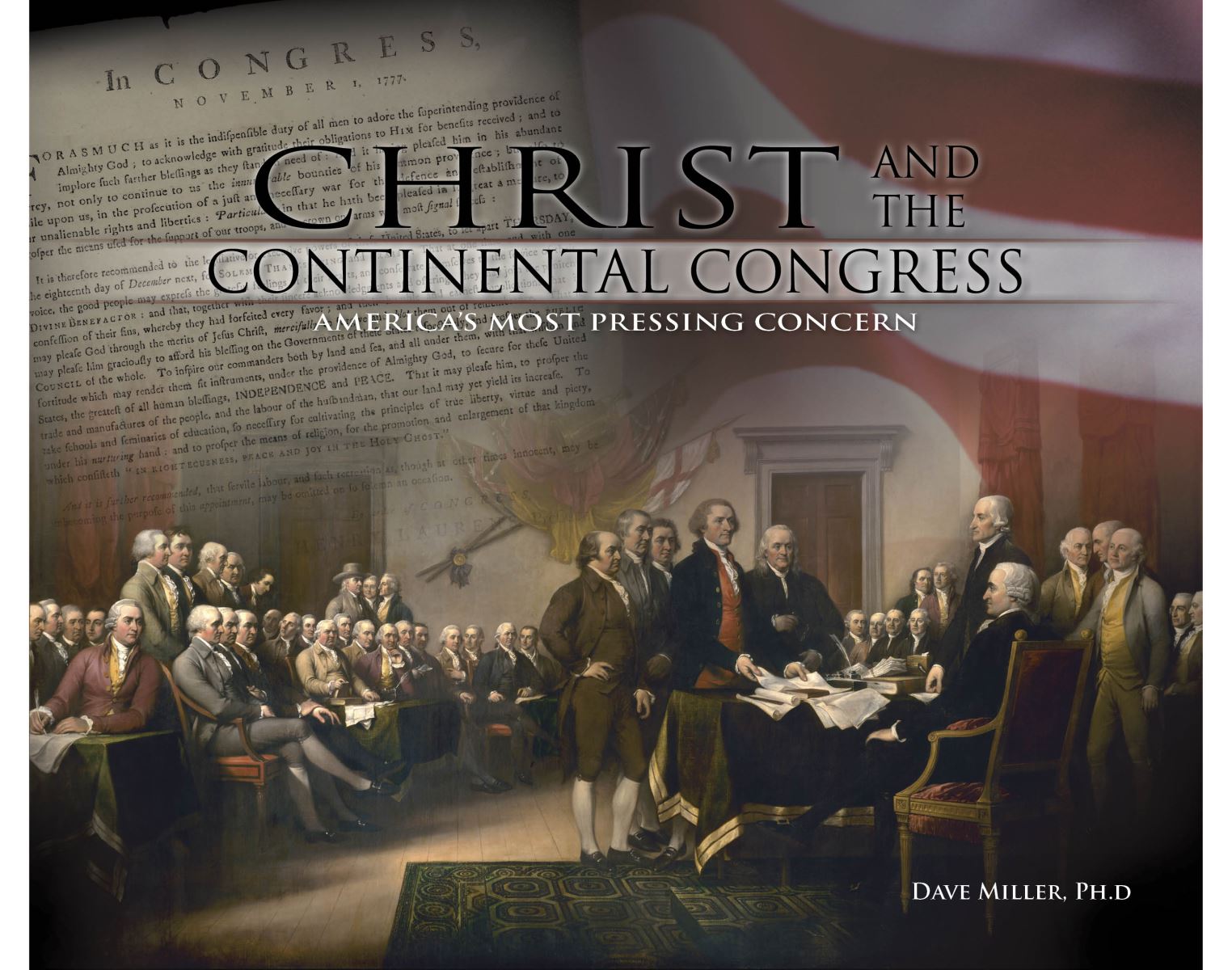 |
||
| Suggested Resources | ||
The post God, the Founders, and the Purpose of Human Government appeared first on Apologetics Press.
]]>The post The Supreme Court is Not THE Supreme Court appeared first on Apologetics Press.
]]>[NOTE: The following uplifting words are based on a sermon by A.P. board member Frank Chesser preached on Sunday, June 28, 2015 in Montgomery, Alabama in response to the Supreme Court ruling on homosexual marriages.]
 There are twin sins that could serve as bookends for all other sins—abortion and homosexuality. From a biblical perspective, these sins are so monumentally evil, that a nation’s embracement of them is a solicitation for divine judgment. On January 22, 1973, the Supreme Court of the United States legalized the slaughter of babies in the womb. Forty-two years has witnessed human intrusion into the mother’s womb, the workshop of God, extracting from the hands of God a work in progress, and crushing it into pieces with brutal tools of death. This sin has resulted in figurative oceans of abortive blood, waves of scarlet, washing against the seashore of the mind of God with unceasing cries for divine vengeance. When God’s judgment befell Judah, one of the reasons cited was the rivers of innocent blood with which Manasseh flooded Jerusalem that the “Lord would not pardon” (2 Kings 24:4). Homosexual conduct is an abomination for which God demanded the death penalty under the Old Testament (Leviticus 20:13). It is vile and unnatural (Romans 1:26). Homosexuals in Sodom and Gomorrah were “exceedingly wicked and sinful before the Lord” (Genesis 13:13). They were pursuers of “strange flesh” and are “set forth as an example, suffering the vengeance of eternal fire” (Jude 7). Legalizing such unspeakable sins is a call for the judgment of God. Hopefully, reflection upon the following points will prove helpful in this dark national hour brought about by the recent endorsement by the Supreme Court of homosexual marriages.
1. The Supreme Court’s decision was an expression of freewill. Freewill is a gift of God. It prevents man from being a robot clothed in flesh. It enables love to be a reality, the greatest of the triune traits of 1 Corinthians 13:13. But it is fraught with fearful consequences. A tragic choice of freewill made Genesis 3:6 an actuality and Calvary a necessity. Five Justices exhibited their freewill in the legalization of homosexual marriages. Some may question the value of our prayers for God to cast the deciding vote in this decision. It was God’s desire to cast His vote through one more Justice who would stand for righteousness, but it was not to be. We are haunted by God’s affirmation to Ezekiel, “And I sought for a man among them, that should make up the hedge, and stand in the gap before me for the land, that I should not destroy it; but I found none” (Ezekiel 22:30). God cannot overrule man’s freewill.
2. Sin has an aggressive nature. Sin is the most aggressive thing known to man. It is not stagnant. It never stands still. It is constantly moving forward in search of its next victim. Its appetite is insatiable. Sin was not satisfied with Genesis 3:6. It devised the false worship of Genesis 4:5, the murder of Genesis 4:8 and the world-wide wickedness of Genesis 6:5. Sin was not content with the success of its bloody assault upon the womb. It moved on to tamper with the pattern of marriage, divinely instituted by God. The vote of five Justices on the Supreme Court has opened the door to a dark and foreboding world that will prove to be a national disaster of epic proportions.
3. We should not be surprised. The nation has been moving in this direction for several decades. This decision is simply the end result of years of decadent behavior that has unraveled the moral fiber of the nation. The pace was fairly slow leading up to homosexual marriages until recently when the executive branch of our federal government, with tacit legislative approval, placed its unequivocal sanction upon homosexual unions. The homosexual community, many in the entertainment industry, the music industry, and all supporters of this aberrant lifestyle, released a collective sigh of victory. The Supreme Court took the final step in endorsing this profligate lifestyle. Sin is an alien concept to the minds of many Americans. It is no longer a part of the vocabulary of the general public. The average person could not define sin if his very life depended upon it. A new glossary of terms has been invented to extract the sinfulness out of sin and whitewash sinful acts into respectability. Hence, homosexuality is now just an “alternate lifestyle.” Should we expect a world that hates Christ (John 15:18) and the truth that comes from Christ (which demands purity and holiness of life) to possess and exhibit repugnance for moral degeneracy?
4. We need to face reality. We are likely not going to be able to change the direction of this country. It will probably never again be what it once was. This has been proven by history when tracing the rise and fall of nations and empires. It is not possible to restore the moral and spiritual foundation upon which America was constructed. We have very likely gone too far in the wrong direction to reverse our national course. We may not like the thrust of these words, but it would be foolish to argue against them. The Bible and the whole history of man testify to the truthfulness of these sentiments. There will be no Jonah-like sign (Luke 11:30) to provoke America to repentance. Refusing to accept the reality of our national state of decline will only negate our resolve to make what difference we can by shining the Gospel where we are and taking essential steps to victoriously confront whatever difficulties face us in the future.
5. Our situation today is not new. Several thousand years of human experience and national history bear witness to this truth. Many nations have preceded ours and are now buried beneath the aging dust of the Earth, and they all followed the same course. “The wicked shall be turned into hell, and all the nations that forget God” (Psalm 9:17). God destroyed the nation of Israel in Assyrian captivity because of its sin (2 Kings 17). A spiritual remnant in Judah returned from Babylonian captivity, but their national glory was gone forever. Divine judgment could purge America in some sense, but it would be most unwise to base one’s hope on a restoration of its former moral national climate and greatness.
6. Trials are inevitable. Loving God and truth beckons the world’s hatred (John 15:18-19). Persecution is like a shadow to godly living (2 Timothy 3:12). Inspiration warns against viewing trials as something “strange” (1 Peter 4:12). No nation can declare war upon the most innocent of the Earth and put a legal stamp of approval upon what God calls vile, wicked, unnatural, and an abomination and escape the judgment of God. “For the wrath of God is revealed from heaven against all ungodliness and unrighteousness of men” (Romans 1:18). There will be trials to bear under the hand of God’s wrath.
7. Trials are bearable. First Corinthians 10:13 should mightily comfort the spiritual mind with God’s promise that He will not allow His people to be tried above their ability to endure. He will aid us every step of the way. He is our “refuge and strength, a very present help in trouble” (Psalm 41:1). There was one occasion in Paul’s life when all human assistance failed him (2 Timothy 4:16), but he hastened to affirm, “Notwithstanding, the Lord stood with me, and strengthened me” (2 Timothy 4:17).
8. God is sovereign. The term “sovereignty” denotes supreme power and authority. God alone is sovereign. He is transcendent to all that is. He controls the universe. He is the “Almighty God” (Genesis 17:1) and the “possessor of heaven and earth” (Genesis 14:19). He is “exalted as head above all” (1 Chronicles 29:11). Jehoshaphat averred, “rulest not thou over all the kingdoms of the heathen and in thine hand is there not power and might, so that none is able to withstand thee?” (2 Chronicles 20:6). Nebuchadnezzar learned this truth by bitter experience (Daniel 4:35). When Habakkuk expressed concern over what he viewed as a delay in God’s judgment upon Judah (Habakkuk 1:2-4), he was informed that Babylon was on its way with the sword of violence in its hand (Habakkuk 1:5-11). God is going to attend to the moral chaos in America in His own time and way, and in harmony with His own nature and will. Let us resolve to be among the righteous remnant and beseech Him for wisdom, courage and preservation in this dark and dreary hour.
9. The Supreme Court is not THE Supreme Court. Five Justices have declared war on God and His will for the sanctity of the marital state. They have declared “evil good, and good evil” (Isaiah 5:20). They are void of moral perception. Judah was unable to apprehend the folly of idolatry (Isaiah 44:9-20), and these Justices are incapable of discerning basic moral evil. “There is no fear of God before their eyes” (Romans 3:18). When time is no more, they will stand before the Supreme Judge of all the Earth and give an account for joining the “god of this world” (2 Corinthians 4:4) in mightily enlarging the chasm between America and God, and perhaps driving the dagger of death into its national heart.
10. This world is not our home. Abraham recognized that even the land of promise was a “strange country” (Hebrews 11:9). Many others joined him in confessing “that they were strangers and pilgrims on the earth” (Hebrews 11:13). It does not take long to get old and arrive at the point in life when the time of our “departure is at hand” (2 Timothy 4:6). There is an incorruptible, undefiled eternal inheritance “reserved in heaven” (1 Peter 1:4) for the righteous servant of every age.
11. What should be our response? Refuse to allow the spiritually deranged decision of three women and two men to unduly affect your life. Greet the dawn and dusk of each day with a growing love for God, truth and righteousness. Do not crack the door of your life and allow Satan to “get an advantage” (2 Corinthians 2:11) of you. Love the saved and the lost; all of them. Do not permit dark days to rob you of your joy. “Rejoice in the Lord always; and again I say, Rejoice” (Philippians 4:4). Never quit. Never give up. Do not allow the Devil to defeat you with the rod of discouragement. Let every heartbeat sing with ceaseless gratitude for dew drops of mercy from heaven, the cross of Calvary, and exult in every good blessing that flows from the loving and generous hand of God. Lean on God, your family, and your brethren. Fill your mind with the mind of God as revealed in the Bible. Pray fervently. “Keep yourselves in the love of God, looking for the mercy of our Lord Jesus Christ unto eternal life” (Jude 21). May God bless us to this end.
The post The Supreme Court is Not THE Supreme Court appeared first on Apologetics Press.
]]>The post Judge Strikes Down Tax-Exempt Status for Ministerial Housing Allowance appeared first on Apologetics Press.
]]>In Judge Crabb’s opinion and order, she held that 26 U.S.C. section 107(2) violates the Establishment Clause of the First Amendment of the U.S. Constitution. This provision states:
In the case of a minister of the gospel, gross income does not include—
(1) the rental value of a home furnished to him as part of his compensation; or
(2) the rental allowance paid to him as part of his compensation, to the extent used by him to rent or provide a home and to the extent such allowance does not exceed the fair rental value of the home, including furnishings and appurtenances such as a garage, plus the cost of utilities (26 U.S.C. § 107).
Interestingly, the plaintiff did not challenge section 107(1), but only section 107(2). While the court held that only subsection 2 was unconstitutional, this appears on its face to be blatantly inconsistent with the fact that the court’s holding is based in part on the language “minister of the gospel.” This is language that applies to both subsections.
One could easily argue that the reason why the court did not hold section 107(1) to be unconstitutional was because it was not challenged by the plaintiff, and therefore, that issue was not before the court. However, the plaintiff did not even move for judgment in this case. This matter came before the court when the defendant moved for summary judgment. So how did the court grant judgment in favor of the plaintiff when the plaintiff did not move for judgment before Judge Crabb. The district court sua sponte (on its own initiative) decided to abandon the role of a neutral party and moved for judgment on behalf of the plaintiff (an incredibly rare procedure). Therefore, if the court wanted to resolve the constitutionality of section 107(1), it could have done so sua sponte. This is just one example of many where this opinion goes awry.
Nevertheless, the court held that section 107(2) (tax exemption for a minister’s housing allowance) violated the Establishment Clause because it violated the Lemon Test. Under the Lemon Test, a court must (1) determine whether the law or government action in question has a bona fide secular purpose; (2) determine whether the state action has the primary effect of advancing or inhibiting religion; and (3) consider whether the action excessively entangles religion and government (Lemon v. Kurtzman, 1971).
Without going into the substance and details of the analysis (guaranteed to cure all forms of insomnia), this is not the first time Judge Crabb has demonstrated hostility toward religion in her judicial opinions. This Carter-appointed district judge authored an opinion in 2010 holding that the National Day of Prayer was unconstitutional because it violated the Establishment Clause (Freedom From Religion Foundation, Inc. v. Obama, 2010). She employed the same analysis using the Lemon Test to reach the result that the National Day of Prayer was unconstitutional. Notice that the same special interest group (Freedom From Religion Foundation) was the plaintiff in this case as well. Apparently, their primary goal is to free our government from religion and ensure that we have a godless form of government. Nevertheless, the good news in all this is that the Seventh Circuit Court of Appeals reversed Judge Crabb’s hostile opinion striking down the National Day of Prayer (Freedom From Religion Foundation, Inc. v. Obama, 2011). The Seventh Circuit held that the plaintiff did not have standing because it had not been injured. In other words, the Freedom From Religion Foundation is just a group that likes to stick their nose into litigation where it does not belong (a very down-to-earth explanation of what it means to not have standing before a court).
The same defect plagues the plaintiff in Judge Crabb’s opinion regarding the minister’s housing allowance. The defendant in that case argued and preserved for appeal the issue of standing. As such, if and when the defendant in that case appeals Judge Crabb’s opinion, they will appeal to the Seventh Circuit, the same appellate court that has previously held that this same plaintiff does not have standing to challenge these types of statutes. However, even if the Seventh Circuit finds that the plaintiff does have standing, the court will then address the merits of the constitutionality challenge to determine if the statute regarding the tax-exempt status of ministers’ housing allowance violates the First Amendment. And, there is a legitimate chance that the court will correct Judge Crabb’s anti-religion opinion. Regardless of who wins or loses before the Seventh Circuit Court of Appeals, this is the type of case that is likely to find its way before the U.S. Supreme Court. Therefore, it will be some time before this issue will be resolved.
Have you ever noticed that when some renegade judge with an axe to grind comes out with some ridiculous ruling or appellate opinion, you hear about it all over the internet, Facebook, Twitter, blog posts, and even national news and radio? However, when that same ruling or opinion gets reversed or struck down on appeal, there is little in the way of hype or publicity to equal the coverage that accompanied the original bad news. I guess that is how the media (and our minds) work. A little bad news goes a long way toward gaining attention and scaring some people into taking notice. However, good news rarely makes it above the fold these days. That notwithstanding, I look forward to the day when I can report to you that the Seventh Circuit has yet again reversed another hostile opinion from Judge Crabb, or even better, the U.S. Supreme Court has weighed in on the subject and established sound precedent holding that the ministerial housing allowance exception does not violate the Establishment Clause—precedent that binds every federal court.
But if at the end of the day, Judge Crabb’s opinion survives appellate scrutiny, and higher courts hold that the ministerial housing allowance exception is unconstitutional, I am confident that I know exactly what hundreds and thousands of evangelists and preachers for the body of Christ all over the United States will do. They will continue to preach the whole counsel of God, they will continue to preach in season and out of season, they will continue to pray for the government, obey the government, pay taxes, and honor the government. Why will they respond this way? Because as blessed as we are to be citizens of this wonderful country, we serve a God who calls us to be citizens of a heavenly kingdom. Why will evangelists do what is right regardless of the law? Because these fine servants and preachers of God’s good news are not preaching for the tax exemptions (although that is certainly a help), but they preach in order to seek and save the lost. Why will preachers react in this godly manner? Because the position, policy, and practice of this nation cannot hinder the proclamation of God’s saving message.
REFERENCES
26 U.S.C. § 107.
Freedom From Religion Foundation, Inc. v. Lew, No 11-cv-626-bbc (W.D. Wis., Nov. 21, 2013).
Freedom From Religion Foundation, Inc. v. Obama, 705 F.Supp.2d 1039 (W.D. Wis. 2010).
Freedom From Religion Foundation, Inc. v. Obama, 641 F.3d 803 (7th Cir. 2011).
Lemon v. Kurtzman, 403 U.S. 602 (1971).
The post Judge Strikes Down Tax-Exempt Status for Ministerial Housing Allowance appeared first on Apologetics Press.
]]>The post Were the Founding Fathers “Tolerant” of Islam? [Part II] appeared first on Apologetics Press.
]]>[Editor’s Note: This article is the second installment of a two-part critique of an article written by James Hutson, Library of Congress Manuscript Division Chief, on the Founding Fathers’ attitudes toward Islam. Part I appeared in the March issue. Part II follows below and continues, without introductory comments, where the first article ended.]
Hutson observes that in their 1780 state constitution, “[o]fficials in Massachusetts afforded the most ample liberty of conscience…to Deists, Mahometans, Jews and Christians” (2002)—an allusion to Samuel West’s discussion of tax assessments for the support of the public teaching of religion and morality. This observation is accurate as long as one clearly understands that “liberty of conscience” specifically meant no governmental intrusion, but did not extend to the encouragement or promotion of Islam in public life. Proof of this contention is seen in the Third Article of the 1780 constitution itself, in which the legislature was authorized “to make suitable provision…for the institution of the public worship of God and for the support and maintenance of public Protestant teachers of piety, religion, and morality in all cases where such provision shall not be made voluntarily.” The constitution also stated that “every denomination of Christians, demeaning themselves peaceably and as good subjects of the commonwealth, shall be equally under the protection of the law; and no subordination of any sect or denomination to another shall ever be established by law” (Constitution of…, 1780, I.III, emp. added). Hutson fails to divulge that the constitution stipulated that the governor was required to “declare himself to be of the Christian religion” (Constitution of…, II.II.I.II, emp. added), and that any who wished to serve as governor, lieutenant governor, counselor, senator, or representative were required to take an oath of office which included: “I…do declare that I believe the Christian religion, and have a firm persuasion of its truth” (Constitution of…, II.II.V.I, emp. added). Notice that these stipulations inherently excluded Muslims holding office in that state—proof that the Founders’ definition of “tolerance” differs significantly from Hutson’s characterization.
 Samuel West, himself, was a strong advocate of the teaching of Christian morality and virtue by the state. He believed that the promotion of Christianity by the state did not interfere with the right of a Muslim to worship as he chooses—“till he disturbs the public or bothers others in their religious worship” (as quoted in Green, 2010, p. 50). But he most certainly did not countenance, and would not have countenanced, equal promotion of Islam in society. Hutson’s allusion to Massachusetts Supreme Court Chief Justice Parsons’ “resounding” affirmation of religious liberty in 1810 is equally misleading. The reference is to the opinion of the court in Barnes vs. Falmouth, penned by Parsons, which centered on the constitutionality of the Third Article of the Constitution of Massachusetts quoted above. Parsons clarified the meaning of “liberty of conscience” as the right of the “Protestant or Catholick [sic], Jew, Mahometan, or Pagan” to have his own “religious opinion and worship,” free from governmental persecution or coercion. Yet the Massachusetts constitution made provision for the “publick [sic] teaching of the precepts and maxims of the religion of protestant christians to all the people”—the very thing Parsons and the court defended and insisted was not antithetical to religious liberty for those who do not profess Christianity. What’s more, Parsons brought his masterful opinion to a grand conclusion that further verifies that the essentiality and priority of Christianity was assumed:
[T]he people are to be applauded, as well for their benevolence as for their wisdom, that in selecting a religion [Christianity—DM], whose precepts and sanctions might supply the defects in civil government, necessarily limited in its power, and supported only by temporal penalties, they adopted a religion founded in truth; which in its tendency will protect our property here, and may secure to us an inheritance in another and a better country (“Defence of the…,” 1820, p. 7, emp. added).
Once again, the sanitized version of America’s history confuses religious tolerance with endorsement, promotion, and accommodation, and fails to discern the distinction made by the Founders between religious tolerance on the one hand, and their firm belief in the priority of the Christian religion on the other.
 Hutson cites Ezra Stiles (Yale College president from 1778-1795) as supporting the notion that Muslim morals are “far superior to the Christian.” This claim is a preposterous misrepresentation of the facts. Stiles’ comments came in a sermon preached before the governor and legislature of Connecticut in 1783. In extolling the glory of America with its purest form of Christianity in the world, Stiles alluded to the fact that “Sir William Temple, Sale, and other learned deists, fond of depreciating Christian virtue by comparisons, have extolled and celebrated the Mohammedan, Chinese, and other Oriental morals, as far superior to the Christian” (1783). But Stiles disagreed with their assessment. He insisted that, in contrast to all other religions, “the more Christianity prevails in a country, civil society will be more advanced, ferocious manners will give way to the more mild, liberal, just, and amiable manners of the gospel.” He stated his belief that “[a] time will come when six hundred millions of the human race shall be ready to drop their idolatry and all false religion, when Christianity shall triumph over superstition, as well as Deism, and Gentilism, and Mohammedanism.” Ezra Stiles provides no support for the encouragement of Islam in America. He believed it to be “false religion,” along with superstition, deism, and paganism.
In discussing the religious beliefs of people as those beliefs relate to citizenship in a republic, the Founders clearly believed that Christianity is the one religion that most fully coincides with the republican principles they espoused. They considered Christianity the “one true religion.” [NOTE: The Continental Congress repeatedly referred to Christianity as “true religion” in their proclamations to the American public; see the June 1775, March 1779, and October 1782 proclamations in Miller, 2009 and Miller, 2012.] Benjamin Franklin stated pointedly: “History will also afford frequent Opportunities of showing the Necessity of a Public Religion, from its Usefulness to the Public; the Advantage of a Religious Character among private Persons; the Mischiefs of Superstition, &c. and the Excellency of the Christian Religion above all others ancient or modern” (1840, 1:573, emp. added). Since adherents of other religions would wish to be included in the grand American experiment, the Founders naturally gave some consideration to the ability of professors of non-Christian religion to fit into the American political and social framework. It is in this context that the Founders acknowledged Islam’s belief in afterlife. Due to their conviction that no one was a fit citizen in a Republic if he did not believe in a future state of rewards and punishments, i.e., heaven and hell, as sufficient motivation to tell the truth and refrain from licentious behavior, as noted earlier, they banned atheists from serving as witnesses in court. They recognized, however, that though Islam contained many objectionable and absurd beliefs (including the notion that the faithful Muslim will be rewarded with virgins in paradise—a point noted by Hutson from the Boston newspaper), at least it indoctrinated its adherents with a firm belief in punishment and reward in the afterlife.
But observe that such an acknowledgement hardly constitutes proof of their approval of the bulk of Islam’s tenets, or their desire to leave the impression that Islam ought to be welcomed with open arms and held up in America as a  credible religion on a par with Christianity. Even Hutson’s allusion to the comment made by Declaration signer Dr. Benjamin Rush is taken wholly out of context when he notes that Rush stated he had “rather see the opinions of Confucius or Mohammed inculcated upon our youth than see them grow up wholly devoid of a system of religious principles.” Rush obviously considered “the opinions of Confucius or Mohammed” as merely the lesser of two evils, i.e., better some religion than no religion. He would be shocked to think that anyone today would take his remark as supportive or even friendly toward either Confucius or Mohammed. Examine the statement in its original context in the essay Dr. Rush penned titled, “Of the Mode of Education Proper in a Republic,” in which he described the mode of education that should be adopted “so as to secure to the state all the advantages to be derived from the proper instruction of youth.” He specifically stressed the importance of instruction in the Christian religion:
[T]he only foundation for a useful education in a republic is to be laid in Religion. Without this there can be no virtue, and without virtue there can be no liberty, and liberty is the object and life of all republican governments.
Such is my veneration for every religion that reveals the attributes of the Deity, or a future state of rewards and punishments, that I had rather see the opinions of Confucius or Mahomed inculcated upon our youth, than see them grow up wholly devoid of a system of religious principles. But the religion I mean to recommend in this place, is that of the New Testament (1798, p. 8, emp. added).
Dr. Rush then proceeded to declare the superiority and priority of Christianity in a republic, even clarifying, “I wish to be excused for repeating here, that if the bible did not convey a single direction for the attainment of future happiness, it should be read in our schools in preference to all other books” (p. 100, emp. added). No provision whatsoever was made by him or any other Founder for the use of the Quran in our schools or courts.
Hutson’s mention of the petition from the group of citizens from Chesterfield County, Virginia calling for religious liberty for “Jews, Mehometans and Christians” must also be understood in its historical setting. Patrick Henry had proposed a bill “establishing a provision for the teachers of the Christian religion” in which the teachers would receive financial remuneration from the state (1784). The fact is that the citizens behind the Chesterfield County petition were concerned that the bill was detrimental to “the true interests of Christianity” (Virginia General Assembly, 1828, p. 36, emp. added). Their concern was that government support of religion tends to corrupt it by showing partiality to one Christian sect over others and interfering with the rights of Christian conscience, thereby violating civil and natural rights. Neither side in the debate intended to leave the impression that Islam is a true religion, nor did they intend to promote Islam in Virginia as equally authentic or deserving of a place of equal status with Christianity.
James Madison’s rebuttal to Henry’s bill, Memorial and Remonstrance against Religious Assessments, demonstrates that all parties concerned were not interested in offering sanction to Islam. Notice Madison’s 12th reason for opposing the bill:
Because the policy of the Bill is adverse to the diffusion of the light of Christianity. The first wish of those who enjoy this precious gift ought to be that it may be imparted to the whole race of mankind. Compare the number of those who have as yet received it with the number still remaining under the dominion of false Religions (1785, emp. added).
According to Madison, all religions except Christianity are “false Religions” that need the enlightenment that Christianity provides. He believed that Henry’s bill would interfere with imparting Christianity to the whole world. The Chesterfield petition may be juxtaposed with the one presented by the citizens of Surrey County, which insisted that the bill was, in fact, “consistent with the principles of equal liberty, tending to promote the great interests of religion, and founded on the experience and practice of all Christian nations” (Virginia…, p. 36, emp. added). So those who opposed the bill were concerned that, by intruding into the realm of religion, the government might eventually usurp its role, overstep its power, and interfere with the free exercise of the Christian religion by the varying sects.
To repeat, it is imperative that the discussion of religious freedom in America in the 21st century be framed and shaped by the Founders’ insistence that (1) all non-Christian religions are to be tolerated—as long as they do not advocate violence or immorality, and (2) the existence of the Republic, and all the features of the American way of life that are the envy of the world, depend on a majority of Americans maintaining their belief in and practice of the general principles of the Christian religion. In the words of prominent Founder, Noah Webster, regarding the indispensable nature of Christianity to the existence of our Republic:
[O]ur citizens should early understand that the genuine source of correct republican principles is the Bible, particularly the New Testament or the Christian religion…. [T]he religion which has introduced civil liberty, is the religion of Christ and his apostles, which enjoins humility, piety, and benevolence; which acknowledged in every person a brother, or a sister, and a citizen with equal rights. This is genuine Christianity, and to this we owe our free constitutions of government…. [T]he Christian religion ought to be received, and maintained with firm and cordial support. It is the real source of all genuine republican principles…. The religion of Christ and his apostles, in its primitive simplicity and purity, unencumbered with the trappings of power and the pomp of ceremonies, is the surest basis of a republican government…. [T]hose who destroy the influence and authority of the Christian religion, sap the foundations of public order, of liberty, and of republican government… (1832, pp. v,247,310-311, emp. added).
The United States commenced their existence under circumstances wholly novel and unexampled in the history of nations. They commenced with civilization, with learning, with science, with constitutions of free government, and with that best gift of God to man, the Christian religion (as quoted in Scudder, 1881, p. 242, emp. added).
Conclusion
Let it be repeated once again that, having a Christian mindset, the vast majority of the Founders were for religious tolerance, meaning that they were willing for those who embraced non-Christian religions to come to the country and not be persecuted. However, under no circumstances should such tolerance be misconstrued to mean that the Founders intended to convey credibility to such religions, implying that those beliefs would be beneficial to America’s way of life if incorporated into its public institutions. Even the Founders’ consistent depiction of Muslims as “Mahometans” (a term offensive to Muslims) demonstrates their antipathy towards Islam, since they regarded the religion as the concocted invention of Muhammad—not the God of the Bible.
Indeed, a number of the Founders went on record explicitly denigrating the religion of Islam. One “Father of American Jurisprudence,” the brilliant New York State Supreme Court Chief Justice James Kent, labeled “Mahomet” as an “impostor” (The People v…, 1811). Son of John Adams and 6th President John Quincy Adams insisted that Muhammad possessed “the fraudulent spirit of an impostor,” and the notion that he was a prophet and apostle of God was an “audacious falsehood” (Blunt, 1830, 29:269). In his masterful refutation of Thomas Paine’s Age of Reason, one time president of the Continental Congress, Elias Boudinot, also labeled Muhammad an “impostor” (1801, p. 37) and insightfully observed that
Mahomet aimed to establish his pretensions to divine authority, by the power of the sword and the terrors of his government; while he carefully avoided any attempts at miracles in the presence of his followers, and all pretences to foretell things to come. His acknowledging the divine mission of Moses and Christ confirms their authority as far as his influence will go while their doctrines entirely destroy all his pretensions to the like authority…. And now, where is the comparison between the supposed prophet of Mecca, and the Son of God; or with what propriety ought they to be named together?…The difference between these characters is so great, that the facts need not be further applied (pp. 36,39, emp. added).
This premiere Founder merely expressed the sentiments of the bulk of the Founders as well as the rank and file of American citizens.
American Revolutionary War patriot and hero, best known for the capture of Fort Ticonderoga, Ethan Allen, likewise considered “Mahomet” an “impostor.” In his Reason, The Only Oracle of Man, Allen stated:
Mahomet taught his army that the “term of every man’s life was fixed by God, and that none could shorten it, by any hazard that he might seem to be exposed to in battle or otherwise,” but that it should be introduced into peacable [sic] and civil life, and be patronized by any teachers of religion, is quite strange, as it subverts religion in general, and renders the teaching of it unnecessary…. [We] are liable to be imposed upon by impostors, or by ignorant and insidious teachers,whose interest it may be to obtrude their own systems on the world for infallible truth,as in the instance of Mahomet (1854, pp. 17,35-36, emp. added).
[NOTE: Sadly, in later life, Allen broke with the majority of the country and Founders in his published rejection of Christianity and the Bible.] The Father of American Geography, Jedidiah Morse, cogently articulated the rationale of the Founders and most early Americans when he explained:
The foundations which support the interest of Christianity, are also necessary to support a free and equal government like our own. In all those countries where there is little or no religion, or a very gross and corrupt one, as in Mahometan and Pagan countries, there you will find, with scarcely a single exception, arbitrary and tyrannical governments, gross ignorance and wickedness, and deplorable wretchedness among the people. To the kindly influence of Christianity we owe that degree of civil freedom, and political and social happiness which mankind now enjoy. In proportion as the genuine effects of Christianity are diminished in any nation, either through unbelief, or the corruption of its doctrines, or the neglect of its institutions; in the same proportion will the people of that nation recede from the blessings of genuine freedom, and approximate the miseries of complete despotism (1799, emp. added).
One final thought: Due to the widespread expulsion of God, the Bible, and Christianity from America’s social and political life, fomented by the liberal forces of “political correctness, diversity, and tolerance,” the encroachments of anti-Christian ideologies (like Islam) must inevitably hasten the demise of the American Republic as she has existed for over two centuries. To suggest that America can assimilate Islam and Sharia law into its national life and  remain free and prosperous is naiveté in the extreme (cf. “McDonald’s Settles…,” 2013). As General George S. Patton observed, having witnessed the impact of Islam on the countries of North Africa,
One cannot but ponder the question: What if the Arabs had been Christians? To me it seems certain that the fatalistic teachings of Mohammed and the utter degradation of women is the outstanding cause for the arrested development of the Arab. He is exactly as he was around the year 700, while we have kept on developing. Here, I think, is a text for some eloquent sermon on the virtues of Christianity (1947, p. 43, emp. added).
To echo the words of Jedidiah Morse, the “tyrannical governments” and “deplorable wretchedness” that continues to characterize Islamic countries around the world will necessarily characterize America if and when Islam is allowed to permeate the nation’s institutions.
[NOTE: For a discussion of the legitimacy of Islam and the Quran, see Miller, 2005.]
REFERENCES
Allen, Ethan (1854), Reason, The Only Oracle of Man (Boston, MA: J.P. Mendum, Cornhill), http://tinyurl.com/Allen-Ethan-1854-Reason.
Blunt, Joseph (1830), The American Annual Register for the Years 1827-8-9 (New York: E. & G.W. Blunt), 29:267-402, http://www.archive.org/stream/p1americanannual29blunuoft.
Boudinot, Elias (1801), The Age of Revelation, http://books.google.com/books?id=XpcPAAAAIAAJ&printsec=frontcover&source=gbs_ge_summary_r&cad=0#v=onepage&q=mahomet&f=false.
Constitution of Massachusetts, 1780, http://www.nhinet.org/ccs/docs/ma-1780.htm.
“Defence of the Third Article of the Massachusetts Declaration of Rights; as delivered by Chief Justice Parsons, as the Opinion of the Supreme Judicial Court, in the case of Barnes vs. Falmouth” (1820), (Worcester: Manning & Trumbull), http://books.google.com/books?id=cCYwAAAAYAAJ&printsec=frontcover#v=onepage&q&f=false.
Green, Steven (2010), The Second Disestablishment (New York: Oxford University Press).
Franklin, Benjamin (1840), The Works of Benjamin Franklin, ed. Jared Sparks (Boston, MA: Hilliard Gray & Company), http://books.google.com/books?id=Op5YAAAAMAAJ&pg=PA158& dq=Proposals+Relating+to+the+Education+of+Youth+in+Pennsylvania&hl=en&sa=X&ei =fxnCUPC5Coju9ASxvIGgAw&ved=0CFMQ6AEwCA#v=onepage&q=public k%20religion&f=false.
Henry, Patrick (1784), “A Bill Establishing a Provision for Teachers of the Christian Religion,” Virginia House of Delegates, December 24, 1784.
Hutson, James (2002), “The Founding Fathers and Islam: Library Papers Show Early Tolerance for Muslim Faith,” Information Bulletin, Library of Congress, May, http://www.loc.gov/loc/lcib/0205/tolerance.html.
Madison, James (1785), Memorial and Remonstrance Against Religious Assessments, Bill of Rights Institute, http://billofrightsinstitute.org/founding-documents/primary-source-documents/memorial-and-remonstrance/.
“McDonalds Settles 700,000 Suit Over Islamic Diet in US” (2013), Associated Press, January 22, http://www.foxnews.com/us/2013/01/22/mcdonald-settles-700000-suit-over-islamic-diet-in-us/.
Miller, Dave (2005), The Quran Unveiled (Montgomery, AL: Apologetics Press).
Miller, Dave (2009), Christ and the Continental Congress (Montgomery, AL: Apologetics Press).
Miller, Dave, ed. (2012), Continental Congress Proclamation Packet (Montgomery, AL: Apologetics Press).
Morse, Jedidiah (1799), A Sermon, Exhibiting the Present Dangers and Consequent Duties of the Citizens of the United States of America (Hartford, CT: Hudson and Goodwin), http://www.archive.org/details/sermonexhibiting00morsrich.
Patton, George S. (1947), War As I Knew It (New York: The Great Commanders, 1994 edition).
The People v. Ruggles (1811), 8 Johns 290 (Sup. Ct. NY.), N.Y. Lexis 124.
Rush, Benjamin (1798), Essays, Literary, Moral and Philosophical (Philadelphia, PA: Thomas and Samuel Bradford).
Scudder, Horace (1881), Noah Webster (Boston, MA: Houghton, Mifflin, & Co.).
Stiles, Ezra (1783), “The United States Elevated to Glory and Honor. A Sermon, Preached before His Excellency Jonathan Trumbull, Governor and Commander in Chief, and the Honorable General Assembly of the State of Connecticut, Convened at Hartford, at the Anniversary Election, May 8th, 1783,” (New Haven: Thomas & Samuel Green), http://www.belcherfoundation.org/united_states_elevated.htm.
Virginia General Assembly (1828), Monday, November 14, 1785, Journal of the House of Delegates of the Commonwealth of Virginia Begun and Held in the City of Richmond, in the County of Henrico, on Monday the Seventeenth Day of October, in the Year of Our Lord One Thousand Seven Hundred and Eighty-Five (Richmond, VA: Thomas W. White), http://books.google.com/books?id=QcGTdl0n0YEC&printsec=frontcover&source=gbs_ge_summary_r&cad=0#v=onepage&q&f=false.
Webster, Noah (1832), History of the United States (New Haven, CT: Durrie & Peck).
The post Were the Founding Fathers “Tolerant” of Islam? [Part II] appeared first on Apologetics Press.
]]>The post Were the Founding Fathers “Tolerant” of Islam? [Part I] appeared first on Apologetics Press.
]]>[Editor’s Note: This article is the first installment of a two-part critique of an article written by James Hutson, Library of Congress Manuscript Division Chief, on the Founding Fathers’ attitude toward Islam.]
One prominent misconception pertaining to the liberty envisioned by the Founding Fathers of America concerns their intentions with regard to non-Christian religions. Case in point: Manuscript Division Chief of the Library of Congress, James Hutson, wrote an article, titled “The Founding Fathers and Islam” (which routinely receives sanction on Muslim Web sites and blogs [e.g., Amanullah, 2007; Shadia, 2012; “How Did the U.S…?” 2011; Pakistanis…, 2011; Nuha, 2012; The Islam Factor, 2008; Islamic News Updates, 2011]), in which he suggests that
it is clear that the Founding Fathers thought about the relationship of Islam to the new nation and were prepared to make a place for it in the republic…. The Founders of this nation explicitly included Islam in their vision of the future of the republic…[and] would have incorporated it into the fabric of American life (2002, emp. added).
Such expressions as “prepared to make a place for it,” “explicitly included,” and “would have incorporated it” are ambiguous and vague at the least, and misleading at worst. They leave the impression that the Founders were pluralistic and welcomed Islam as a viable, authentic religion that ought to receive society’s equal encouragement and acceptance along with Christianity, further implying that other non-Christian religions, and even the irreligious and atheist, should be given the same consideration. It is disconcerting that such a prominent person in a governmental organization as influential as the Library of Congress would propagate the myth of political correctness to the detriment of the nation and the disparagement of our nation’s Founders. The pervasive propaganda of political correctness has so colored the average American’s perspective that it is commonplace to superimpose current conceptions back onto the Founding era. Nevertheless, the documentary evidence clearly demonstrates that the Founders did not share this “politically correct,” sanitized version of history.
The Founders would not have favored integrating Islam into our schools, government, and other civil institutions. Far from it. In his discussion of freedom of religion in his monumental Commentaries on the Constitution of the United States, Father of American Jurisprudence Joseph Story clarified the meaning of the First Amendment with regard to the priority of Christianity:
[I]t is impossible for those, who believe in the truth of Christianity, as a divine revelation, to doubt, that it is the especial duty of government to foster, and encourage it among all the citizens and subjects….
Indeed, in a republic, there would seem to be a peculiar propriety in viewing the Christian religion, as the great basis, on which it must rest for its support and permanence, if it be, what it has ever been deemed by its truest friends to be, the religion of liberty.
Probably at the time of the adoption of the constitution, and of the amendment to it, now under consideration, the general, if not the universal, sentiment in America was, that Christianity ought to receive encouragement from the state, so far as was not incompatible with the private rights of conscience, and the freedom of religious worship. An attempt to level all religions, and to make it a matter of state policy to hold all in utter indifference, would have created universal disapprobation, if not universal indignation (1833, 44.723-726.3.3.1865-1868, emp. added).
Indeed, the First Amendment was never intended to “level all religions” (and Islam can hardly be stylized “the religion of liberty”). Story further explained that
the real object of the [First] amendment was not to countenance, much less to advance Mahometanism, or Judaism, or infidelity by prostrating Christianity; but to exclude all rivalry among Christian sects and to prevent any national ecclesiastical establishment which should give to a hierarchy the exclusive patronage of the national government(1833, 3:728, emp. added).
It is imperative that we not misconstrue the Founders’ strong emphasis on religious freedom and tolerance as an indication that they viewed all religion as legitimate or conducive to the principles of the Republic. Their central concern was “disestablishment,” i.e., preventing the federal government from establishing one Christian sect as the  state religion. Their idea of “freedom of religion” was first and foremost freedom to pursue the Christian religion unhindered by the federal government, and only secondarily freedom to practice non-Christian religion. This truth is verified by the discussions surrounding the wording of the First Amendment. George Mason—who has gone down in American history as the Father of the Bill of Rights—proposed the following wording: “All men have an equal, natural and unalienable right to the free exercise of religion, according to the dictates of conscience; and that no particular sect or society of Christians ought to be favored or established by law in preference to others” (as quoted in Rowland, 1892, 1:244, emp. added). While Mason’s proposal did not make the final cut, it nevertheless establishes the historical context of the Founders’ discussion, demonstrating that their concern was first and foremost for the free exercise of the Christian religion. Using similar terminology, Mason had previously crafted The Virginia Declaration of Rights—the very document which influenced both Thomas Jefferson’s wording of the Declaration of Independence as well as James Madison’s draft of the Bill of Rights that was added to the federal Constitution. Article XVI reads:
That religion, or the duty which we owe to our Creator, and the manner of discharging it, can be directed only by reason and conviction, not by force or violence, and therefore all men are equally entitled to the free exercise of religion, according to the dictates of conscience; and that it is the mutual duty of all to practise Christian forbearance, love, and charity towards each other (Mason, 1776, emp. added).
 To the Founders, “tolerance” was not to be equated with approval or agreement, let alone encouragement that would imply an equal place should be made for non-Christian religion in government, schools, etc. The Founders were no more willing to encourage Islam than they were interested in encouraging the spread of atheism, paganism, or Native American religion. [NOTE: Atheists, though few in number at the time in America, were not allowed to serve as witnesses in court—see Story, 1851, 2:8-9; Swift, 1796, 2:238.] For example, the Father of our country, George Washington, delivered a speech to the Delaware Indian chiefs on May 12, 1779: “You do well to wish to learn our arts and ways of life, and above all, the religion of Jesus Christ. These will make you a greater and happier people than you are. Congress will do everything they can to assist you in this wise intention” (15:55, emp. added). Far from encouraging the superstitious idolatry of much of Native American religion, the Founders (including the Congress!) urged Indians to convert to Christianity. The same may be said for all other non-Christian ideologies—including the inherently godless economic philosophies of socialism, Marxism, fascism, and atheistic communism. Indeed, their words and actions denigrate such thought systems. They believed that non-Christian philosophies and religions were false and ultimately detrimental to genuine liberty.
J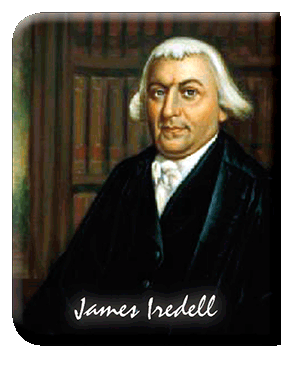 ames Iredell, a U.S. Supreme Court judge appointed by George Washington, articulated this point succinctly in 1788 in the debates on the wording of the Constitution:
But it is objected that the people of America may perhaps choose representatives who have no religion at all, and that pagans and Mahometans may be admitted into offices…. But it is never to be supposed that the people of America will trust their dearest rights to persons who have no religion at all, or a religion materially different from their own (Elliot, 1836, 4:194, emp. added).
Samuel Johnston, governor of North Carolina and member of the Constitution ratifying convention in 1788, likewise felt confident that Muslims should not, and hopefully would not, be allowed to become mainstream in American politics and public institutions—except in only two cases:
By Alexisrael – Own work, CC BY-SA 3.0, https://commons.wikimedia.org/w/index.php?curid=31345949 It is apprehended that Jews, Mahometans, pagans, &c., may be elected to high offices under the government of the United States. Those who are Mahometans, or any others who are not professors of the Christian religion, can never be elected to the office of President or other high office, but in one of two cases. First, if the people of America lay aside the Christian religion altogether, it may happen. Should this unfortunately take place, the people will choose such men as think as they do themselves. Another case is, if any persons of such descriptions should, notwithstanding their religion, acquire the confidence and esteem of the people of America by their good conduct and practice of virtue, they may be chosen. I leave it to gentlemen’s candor to judge what probability there is of the people’s choosing men of different sentiments from themselves (Elliot, 4:198-199, emp. added).

Constitution signer Richard Dobbs Spaight echoed the same prevailing sentiment:
As to the subject of religion…[n]o power is given to the general government to interfere with it at all…. No [Christian—DM] sect is preferred to another. Every man has a right to worship the Supreme Being in the manner he thinks proper. No test is required. All men of equal capacity and integrity are equally eligible to offices…. I do not suppose an infidel, or any such person, will ever be chosen to any office unless the people themselves be of the same opinion (Elliot, 1836, 4:208, emp. added).
Implicit in all three of these Founders’ observations is the fact that Christianity was the underlying belief system on which the Republic was poised. The Founders were unanimous in their desire that the Constitution provide no pretext for governmental interference in the free exercise of the Christian religion by the citizenry. So the only way that atheism or Islam could ever make headway in America’s social and civil institutions is if the people themselves abandon their Christian values. Tragically, their words were prophetic.
WHAT THEY MEANT BY “RELIGOUS FREEDOM”
The Founders’ idea of religious freedom was actually quite simple and sensible—in contrast with the self-contradictory and inconsistent view of today’s vacuous notions of tolerance and political correctness. The facts show that the mass of the Founders, with few exceptions, believed that the Christian worldview and Christian principles must be the foundation of the Republic (see, for example, the 15 proclamations issued by the Continental Congress from 1775 to 1783 in Miller, 2009). Consequently, their view of religious freedom and tolerance amounted essentially to the prevention of religious persecution. Those who practiced no religion or a non-Christian religion could come to America and not be persecuted for the simple reason that the bulk of the Founders and the mass of American citizens embraced Christian principles that forbid persecuting one’s fellowman (e.g., Matthew 5:38-47; Luke 6:27-36).
The Founders had felt the sting of persecution in their disagreement with the state religion (i.e., the Church of England). They were well familiar with their mother country’s long history of religious oppression, depending on whether a Catholic or a Protestant monarch was on the throne. The Founders’ “forefathers” were the pilgrims who fled England specifically on account of religious persecution. Hence, the Founders and Framers wanted the new Republic to dispense with such coercion—in complete harmony with the nature of God Himself, who created humans to be freewill agents who make their own decisions with regard to their eternal destiny. Further, because the Founders had grown up in an environment that promulgated Christian principles, they understood and embraced Jesus’ admonition to treat others the way they themselves wished to be treated (Matthew 7:12). Thomas Jefferson’s query posed to the ambassador of Tripoli reflects this principle: “We took the liberty to make some inquiries concerning the grounds of their pretensions to make war upon nations who had done them no injury, and observed that we considered all mankind as our Friends who had done us no wrong, nor had given us any provocation” (“Letter from the…,” 1786, emp. added). To the Founders, permitting non-Christian peoples to live in our country without persecution was not tantamount to “celebrating diversity” or endorsing what they considered to be false religion. Rather, doing so was first and foremost an affirmation of their desire that all peoples be allowed to pursue happiness without governmental intrusion or coercion.
TWO CRITICAL EXCEPTIONS
However, we must hasten to emphasize that the Founders placed two important qualifications on religious tolerance. First, religious toleration extended only so far as the religion in question did not engage in a practice that is deemed by Christian standards to be immoral. For example, in a case that went all the way to the Pennsylvania Supreme Court in 1815, The Commonwealth v. Sharpless, the defendant was convicted for displaying in his home an obscene painting of a man and woman in an “indecent posture”—an offense against Christian morality (1815). Likewise, in a number of Supreme Court cases, instances of Mormon polygamy were prosecuted as violations of Christian morality—though the defense argued that the practice was justifiable on the grounds of freedom of religion (e.g., Reynolds v. United States, 1879; Murphy v. Ramsey, 1885; Davis v. Beason, 1890). The Founders never envisioned the First Amendment providing sanction for any behavior that is deemed by Christian standards to be immoral or “licentious.” Yet, now that Islam is making significant encroachments into American society, with its brazen advocacy of polygamy (Surah 4:3; cf. 4:24-25,129; 23:6; 30:21; 70:30), the erosion of Christian morality and the appalling ignorance of the founding principles among the population will inevitably sanction such immorality under the guise of tolerance and “religious freedom.”
A second exception that clarifies the notion of religious freedom is seen in the Founders’ insistence that religious freedom did not extend to any action that would bring physical harm to self or other citizens. Actions like Buddhist priests setting themselves on fire in the street, or temple priestesses providing sexual services to devotees, or brothels, or businesses that peddle pornography would not have been tolerated by the Founders under the guise of “freedom of religion” (Commonwealth v. Nesbit, 1859). That means that Islam’s fifteen hundred yearlong historical propensity for engaging in street violence, suicide bombing, and the execution of those who refuse to submit to Allah—actions that are endemic to Islam and the Quran (e.g., Surah 47:4)—are not to be tolerated as protected religious practice. The number of incidents in America of Islamic “honor killings” is mounting (“Missouri Couple…,” 1991; Schoetz, 2008; Thompson, 2011; Tang, 2011; Myers, 2011; Daily Mail…, 2012)—a natural by-product of political correctness, a misunderstanding of the principle of religious freedom, and the loss of the average American’s commitment to Christian morality. Religious freedom notwithstanding, the Founders were wary of any infiltration of the nation’s institutions by “Mahometans” in light of their religious inclinations toward physical violence (cf. Miller, 2005).
TOLERANCE?
With these observations in mind, what is one to make of Hutson’s allusions to incidents in which the Founders seemingly manifested “inclusive” sentiments? Consider the following point-by-point examination of each document cited by Hutson as proof of his claim regarding the Founders. First, the importation of Muslim slaves into the colonies offers no support whatsoever to the idea that the Founders were “prepared to make a place” for Islam in the Republic—any more than they sought to accommodate the pagan animism of African slaves or the polytheism of Native Americans. Hutson admits as much when he concedes that “there is no evidence that the Founders were aware of the religious convictions of their bondsmen.”
Second, the toleration proposed by John Locke in his A Letter Concerning Toleration has, as its context, first and foremost, the toleration that ought to be extended by Christian sects to each other. While he certainly advocates  that the same civil rights be extended to Jews, pagans, and “Mahometans”—he articulates several very clearly defined exceptions. Specifically, in a section dealing with those whom the civil magistrate cannot tolerate, he pinpoints:
- Those whose religious opinions are contrary to “those moral rules which are necessary to the preservation of civil society” (1796, p. 53);
- The religion that “teaches expressly and openly, that men are not obliged to keep their promise” (p. 54);
- “[T]hose that will not own and teach the duty of tolerating all men in matters of mere religion…and that they only ask leave to be tolerated by the magistrate so long, until they find themselves strong enough to [seize the government]” (p. 55);
- All those who see themselves as having allegiance to another civil authority (p. 56). Specifically, Locke gives the example of the Muslim who lives among Christians and would have difficulty submitting to the government of a “Christian nation” when he comes from a Muslim country where the civil magistrate was also the religious authority. Locke notes that such a person would have grave difficulty serving as a soldier in his adopted nation (cf. the 2009 Fort Hood shooting spree by a Muslim soldier who shouted, “Allahu Akbar” as he opened fire, killing 13 and wounding 32; see Stewart, 2010).
- “[T]hose are not at all to be tolerated who deny the being of a God” (p. 56).
Four of these five exceptions inarguably describe Muslim behavior across the world since the inception of Islam. Indeed, what Hutson fails to divulge is that much of Locke’s discussion of religious intolerance (manifested primarily by Catholicism during periods of English history) resembles the very intolerance that typically characterizes Islamic countries around the world.
Hutson further alleges that Thomas Jefferson adopted Locke’s view of toleration (which, as just noted, was not an endorsement or encouragement of Islam), “in demanding recognition of the religious rights of the ‘Mahamdan.’” While it is true that Jefferson championed religious rights for all men, he did so with the same reservations and exceptions set forth by Locke. Evidence of his view 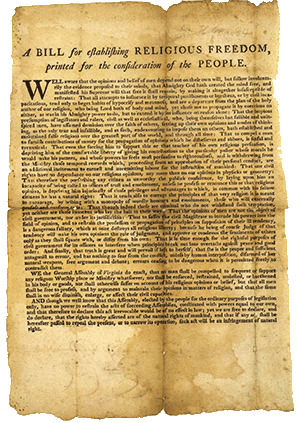 of Islamic aggression is seen in his revulsion of the Muslim terrorism that characterized the Barbary States leading up to and during his presidency. His “intolerant” response was to send the U.S. Marines against them (Miller, 1997). It is true that, in his autobiography, Jefferson stated that the Virginia Act for Establishing Religious Freedom was “meant to comprehend, within the mantle of its protection, the Jew and the Gentile, the Christian and Mahometan, the Hindoo, and infidel of every denomination” (1821, p. 40). Yet, even that document verifies the clearly Christian orientation of the assemblage of Founders who passed it, and the distinction they made between religious toleration versus incorporating non-Christian religion into the fabric of America’s civil institutions. The statute begins:
An Act for establishing religious Freedom.
Whereas, Almighty God hath created the mind free; That all attempts to influence it by temporal punishments or burthens, or by civil incapacitations tend only to beget habits of hypocrisy and meanness, and therefore are a departure from the plan of the holy author of our religion, who being Lord, both of body and mind yet chose not to propagate it by coercions on either, as was in his Almighty power to do… (Jefferson, 1786, emp. added).
Pray tell, to whom was Jefferson and his colleagues referring when they referred to “the holy author of our religion”? Unquestionably, they were referring to Jesus Christ, the Author of the Christian religion (see Miller, 2008). This statute once again simply underscores the fact that, while the Founders advocated toleration of non-Christian religions, they themselves recognized the reality and priority of the Christian religion and would not have endorsed any statute that would have relegated Christianity to a position of equal validity with other ideologies. They would not have wanted their pronouncements to be misconstrued to promote the inculcation of false religious systems or “infidelity” into the civil institutions of the United States—including all levels of government, our courts, and our schools.
Hutson’s citation of Richard Henry Lee as corroboration of pluralism or political correctness is contextually dispelled by the fact that, though opposed to the establishment of a state religion, he, along with Patrick Henry, “were advocates of a proposition to make every man contribut e something to the support of the Christian religion, as the only sure basis of private and public morality” (Lee, 1825, 1:237, emp. added). The very letter from whence Hutson drew his quotation, written by Lee to James Madison on November 26, 1784, articulates the point that Lee favored citizen support of the Christian religion by means of a tax, noting that religion is “the guardian of morals” (Lee, 1914, 2:304-305; Nelson, 2001, p. 297). Further, throughout his life he avowed belief in the divine origin of the Christian religion and considered its morality to be the necessary foundation of the Republic (Lee, 1914, 1:248).
Appointed by Congress to a committee (along with Samuel Adams and Daniel Roberdeau) to prepare a proclamation to thank God for America’s military victories, Lee is believed to be the penman of the proclamation that was issued by the Continental Congress on November 1, 1777. The proclamation requested that God forgive Americans of their sins “through the merits of Jesus Christ” and that He would “prosper the Means of Religion, for the promotion and enlargement of that Kingdom, which consisteth ‘in Righteousness, Peace and Joy in the Holy Ghost’” (Journals of…, 9:854-851). The quotation within the proclamation is taken from Romans 14:17. This is also the man who, in a letter to Continental Congress president Henry Laurens on October 15, 1779, noted that “our holy religion teaches us to pray ‘Lead us not into temptation’”—a reference to Christianity and Matthew 6:13 (Lee, 1914, 2:162). Such organic utterances serve to clarify, define, and limit the Founders’ view of liberty and “tolerance.”
Look, once again, at the Virginia Act (p. 33). Extending religious tolerance to non-Christian religions is juxtaposed with “temporal punishments,” “civil incapacitations,” and “coercions.” This fact, again, proves that “relig ious freedom”—as envisioned by the Founders—referred to freedom from interference and persecution by human government. And, again, ironically, Islam’s history verifies its intolerance of non-Islamic religions. The only rational conclusion to be drawn from these facts is that the Founders, if they were living today, would see the encroachments of Islam into America as a fundamental and insidious danger to the religious liberty they championed.
Hutson points to George Washington’s suggestion that Muslims be exempted from a Virginia bill that provided for taxes for Christian worship—a move that certainly indicates toleration, but hardly implies “inclusion” or “incorporation” into the fabric of American life. Likewise, Washington’s welcoming “Mahometans” as workers on his Mount Vernon estate says nothing about his views regarding whether Islam should be encouraged or promoted in tandem with Christianity. In fact, in the letter Hutson cites, in which Washington was looking to hire a “House Joiner and Bricklayer” for his estate from a group of Palatine (German) tradesmen, in addition to “Mahometans,” he specifically included “Jews or Christians of any Sect, or they may be Atheists” (Washington, 1784). His inclusion of Jews, Muslims, and atheists proves he did not intend to make a statement about “tolerance” or who are fit citizens in a Republic. A more accurate assessment of Washington’s sentiments in that regard is seen in the General Orders he
issued to the Continental Army from Headquarters at Valley Forge on Saturday, May 2, 1778:
While we are zealously performing the duties of good Citizens and soldiers we certainly ought not to be inattentive to the higher duties of Religion. To the distinguished Character of Patriot, it should be our highest Glory to add the more distinguished Character of Christian (1778, emp. added).

REFERENCES
Amanullah, Shahed (2007), “Muslims in Government: The Founding Fathers and Islam,” Altmuslim.com, January 3, http://www.patheos.com/blogs/altmuslim/2007/01/the_founding_fathers_and_islam/.
Commonwealth v. Nesbit (1859), Pa. 398; 1859 Pa. LEXIS 240.
The Commonwealth v. Sharpless (1815), 2 Serg. & Rawle 91; 1815 Pa. LEXIS 81.
Daily Mail Reporter (2012), “Man Who Murdered His Daughters in Shocking Muslim ‘Honour Killing’ is Working as a New York City Cab Driver,” May 30, http://www.dailymail.co.uk/news/article-2152369/Yaser-Said-Man-murdered-daughters-shocking-Muslim-honour-killing-working-New-York-City-cab-driver.html.
Davis v. Beason (1890), 133 U.S. 333; 10 S. Ct. 299; 33 L. Ed. 637; 1890 U.S. LEXIS 1915.
Elliot, Jonathan, ed. (1836), Debates in the Convention of the State of North Carolina, On the Adoption of the Federal Constitution (Washington, D.C.: Taylor & Maury), second edition, http://memory.loc.gov/ammem/amlaw/lwed.html.
Green, Steven (2010), The Second Disestablishment (New York: Oxford University Press).
“How Did the U.S. Founding Fathers View Islam?” (2011), IslamiCity.com, Article Ref: IC1103-4605, April 6, http://www.islamicity.com/articles/Articles.asp?ref=IC1103-4605.
Hutson, James (2002), “The Founding Fathers and Islam: Library Papers Show Early Tolerance for Muslim Faith,” Information Bulletin, Library of Congress, May, http://www.loc.gov/loc/lcib/0205/tolerance.html.
The Islam Factor (2008), November 2, http://islamfactor.org/index.php?showtopic=3354.
Islamic News Updates (2011), April 6, http://groups.yahoo.com/group/IslamicNewsUpdates/message/9254.
Jefferson, Thomas (1786), Act for Establishing Religious Freedom, http://www.virginiamemory.com/online_classroom/shaping_the_constitution/doc/religious_freedom.
Jefferson, Thomas (1821), Autobiography (New York: Library of America), http://etext.virginia.edu/etcbin/toccer-new2?id=JefAuto.xml&images=images/modeng&data=/texts/english/modeng/parsed&tag=public&part=all.
Journals of the Continental Congress, 1774-1789 (1904-1937), ed. Worthington C. Ford, et al. (Washington, D.C.: Government Printing Office), Library of Congress, http://memory.loc.gov/ammem/amlaw/lwjc.html.
Lee, Richard Henry (1914), Letters of Richard Henry Lee, ed. James Ballagh (New York: Macmillan).
Lee, Richard (1825), Memoir of the Life of Richard Henry Lee (Philadelphia, PA: H.C. Carey & I. Lea).
“Letter from the American Peace Commissioners (Thomas Jefferson & John Adams) to John Jay” (1786), The Thomas Jefferson Papers Series 1. General Correspondence. 1651-1827, Library of Congress, March 28, http://hdl.loc.gov/loc.mss/mtj.mtjbib001849.
Locke, John (1796), A Letter Concerning Toleration (Huddersfield, England: J. Brook), http://tinyurl.com/Locke-John-google.
Mason, George (1776), The Virginia Declaration of Rights, Library of Congress, http://www.loc.gov/exhibits/treasures/trt006.html.
Miller, Dave (2005), “Violence and the Quran,” Apologetics Press, http://apologeticspress.org/APContent.aspx?category=8&article=1491.
Miller, Dave (2008), The Silencing of God (Montgomery, AL: Apologetics Press).
Miller, Dave (2009), Christ and the Continental Congress (Montgomery, AL: Apologetics Press).
Miller, Nathan (1997), The U.S. Navy, A History (Annapolis, MD: Naval Institute Press), third edition.
“Missouri Couple Sentenced to Die in Murder of Their Daughter, 16” (1991), The New York Times, December 20, http://www.nytimes.com/1991/12/20/us/missouri-couple-sentenced-to-die-in-murder-of-their-daughter-16.html.
Murphy v. Ramsey (1885), 114 U.S. 15; 5 S. Ct. 747; 29 L. Ed. 47; 1885 U.S. LEXIS 1732.
Myers, Amanda (2011), “Arizona ‘Honor Killing’: Iraqi Immigrant Sentenced to 34½ Years in Prison for Running Over, Killing Daughter,” The Huffington Post, April 15, http://www.huffingtonpost.com/2011/04/15/arizona-honor-killing-iraqi-immigrant-sentenced_n_849999.html.
Nelson, John (2001), A Blessed Company (Chapel Hill, NC: The University of North Carolina Press).
Nuha (2012), http://nuha38317.blogspot.com/2012_01_01_archive.html.
Pakistanis for Peace (2011), https://pakistanisforpeace.wordpress.com/tag/george-washington/.
Reynolds v. United States (1879), 98 U.S. 145; 25 L. Ed. 244; 1878 U.S. LEXIS 1374; 8 Otto 145.
Rowland, Kate Mason (1892), The Life of George Mason, 1725–1792 (New York: G.P. Putnam’s Sons), http://chnm.gmu.edu/revolution/d/270/.
Schoetz, David (2008), “Daughter Rejects Marriage, Ends Up Dead,” ABC News, July 7, http://abcnews.go.com/US/story?id=5322587&page=1.
Shadia, Mona (2012), “Islam’s Influence on the Founding Fathers,” Muslim Council of America Foundation, http://muslimcouncilofamerica.org/islams-influence-on-the-founding-fathers/.
Stewart, Phil (2010), “Fort Hood Shooting Was Terrorism, U.S. Says,” Reuters, January 15, http://www.reuters.com/article/2010/01/15/us-usa-shooting-pentagon-idUSTRE60E5TA20100115.
Story, Joseph (1833), Commentaries on the Constitution of the United States (Boston, MA: Hilliard, Gray, & Co.).
Story, Joseph (1851), Life and Letters of Joseph Story, ed. William Story (Boston, MA: Charles Little & James Brown).
Swift, Zephaniah (1796), A System of the Laws of the State of Connecticut (Windham, CT: John Byrne).
Tang, Terry (2011), “Faleh Hassan Almaleki Guilty: Jury Convicts Iraqi Immigrant For ‘Honor Killing’,” The Huffington Post, February 22, http://www.huffingtonpost.com/2011/02/22/iraqi-immigrant-guilty-honor-killing_n_826840.html.
Thompson, Carolyn (2011), “Jury Convicts New York TV Executive of Beheading Wife,” Associated Press, February 8, http://www.foxnews.com/us/2011/02/07/closing-arguments-begin-new-york-beheading-murder-trial/#ixzz28kCe5EYz
Washington, George (1778), “General Orders, May 2, 1778,” George Washington Papers at the Library of Congress, http://memory.loc.gov/cgi-bin/ampage?collId=mgw3&fileName=mgw3g/gwpage003.db&recNum=181.
Washington, George (1779), “Speech to the Delaware Chiefs,” in The Writings of George Washington from the Original Manuscript Sources 1745-1799, ed. John C. Fitzpatrick, http://preview.tinyurl.com/Washington-G-1779.
Washington, George (1784), “George Washington to Tench Tilghman, March 24, 1784,” George Washington Papers at the Library of Congress, http://tinyurl.com/George-Washington-Islam.
The post Were the Founding Fathers “Tolerant” of Islam? [Part I] appeared first on Apologetics Press.
]]>The post Cockeyed Conclusions About Connecticut appeared first on Apologetics Press.
]]> In the wake of the horrifying rampage in Connecticut that left 20 children and six adults shot to death, reactions from the anti-Christian media and liberal politicians are exactly what you would expect: “We’ve got to get rid of the guns!” Never mind the fact that murder goes back to the beginning of the human race when Cain killed his brother—without a gun. Guns have been around only a few hundred years; people have been killing each other for thousands of years. You do the math. If there were no guns—clubs, rocks, and sharpened sticks would do the job. Building a bomb or setting the school on fire would accomplish the same or worse. Shall we outlaw rocks, sticks, matches, and fertilizer?
Legion are the emotional, irrational explanations that have inundated the Web: “Adam Lanza and his mother both spent time at an area gun range” (Thomas, 2012); “Technology has rendered the 2nd Amendment to the U.S. Constitution obsolete” (“Adam Lanza’s…,” 2012); “New York mayor demands action on gun control” (“Connecticut…New York…,” 2012)”; “Connecticut Governor calls for a federal framework for gun control laws” (“Connecticut…State’s…,” 2012).“Time to get rid of the guns!” (Mackey, 2012); “The gunman had hundreds of rounds of ammunition!” (“Connecticut…Gunman…,” 2012); “The mother and father are Republicans” (Swain and Sanchez, 2012). Even the National Rifle Association missed the point when it announced, “The N.R.A. is prepared to offer meaningful contributions to help make sure this never happens again” (“NRA News Release…,” 2012). As if money can fix morality.
Interestingly, regarding the propriety of citizens having free access to guns, prominent Founder Thomas Jefferson approvingly quoted (1926, p. 314) from the celebrated Italian jurist, philosopher, and politician, Cesare Beccaria’s 1764 treatise, An Essay on Crimes and Punishments, words which are hauntingly prophetic of our present predicament:
Cesare Beccaria (1738-1794) The laws of this nature are those which forbid to wear arms, disarming those only who are not disposed to commit the crime which the laws mean to prevent. Can it be supposed, that those who have the courage to violate the most sacred laws of humanity, and the most important of the code, will respect the less considerable and arbitrary injunctions, the violation of which is so easy, and of so little comparative importance? Does not the execution of this law deprive the subject of that personal liberty, so dear to mankind and to the wise legislator? and does it not subject the innocent to all the disagreeable circumstances that should only fall on the guilty? It certainly makes the situation of the assaulted worse, and of the assailants better, and rather encourages than prevents murder, as it requires less courage to attack unarmed than armed persons (1983, p. 91, emp. added).

Yet, as American society’s Christian moorings continue to erode, and immoral human behavior rapidly replaces traditional American values, the left continues to trot out their insane assessments and godless “solutions”—completely missing the only explanation and the only solution. If only Americans would take the time to reread their Bibles and go back to the Founding Fathers to see the clear and unmistakable explanation for our predicament. This is not rocket science. It is not that difficult to see with clarity what is happening.
The Central Issue and Solution
The fact is that the Creator of the human race is the sole Author and Source of objective morality. Otherwise, moral distinctions would simply be the product of the subjective whims of humans. Morality would thus legitimately vary from person to person and country to country. One society might decide to legalize pedophilia while another might make it illegal—and both would be “right” in the sense that each person would be free to formulate his own moral standards. The result would be complete and utter social anarchy in which every person would be equally free to believe and behave however he or she chooses. Sound like America? What has happened? How can such profound change come over an entire civilization?The Founders of the American Republic anticipated just this social scenario—and even described the circumstances under which it would occur. The Founders predicted that if Americans do not retain an ardent commitment to the moral principles of Christianity, civil society will wane.
Consider the following prophetic voices. In the 1811 New York State Supreme Court case of The People v. Ruggles, the “Father of American Jurisprudence,” James Kent, explained the importance of punishing unchristian behavior, when he wrote that Americans are a “people whose manners are refined, and whose morals have been elevated and inspired with a more enlarged benevolence, by means of the Christian religion” (1811, emp. added). The gentility of the American spirit has historically been contrasted with those peoples “whose sense of shame would not be affected by what we should consider the most audacious outrages upon decorum” (1811, emp. added).
The Founders understood that the Bible presents the only logical and sane assessment of reality: an objective standard, authored by the Creator, which exists for the entire human race—what Thomas Jefferson identified as “one code of morality for men whether acting singly or collectively” (1789). That standard resides within the confines of the Christian religion as articulated in the New Testament. Unless human civilization gauges its moral behavior according to that objective, absolute framework, moral and spiritual chaos in society will be the end result—even if all the guns in the world were dumped into the ocean. In the words of Charles Carroll, a signer of the Declaration of Independence: “Without morals a republic cannot subsist any length of time; they, therefore, who are decrying the Christian religion, whose morality is so sublime and pure…are undermining the solid foundation of morals, the best security for the duration of free governments” (as quoted in Steiner, 1907, p. 475, emp. added).
Yet, for some 50 years now, Americans have been pummeled with the humanistic notion that morality can be maintained in society to the exclusion of Christianity. With almost prophetic anticipation, the very first president of the United States—the Father of our country—anticipated and addressed this sinister misnomer. After serving his country for two terms as president, George Washington delivered his farewell address to the nation, articulating forcefully the key to achieving security and protection for our lives:
Of all the dispositions and habits which lead to political prosperity, religion and morality are indispensable supports. In vain would that man claim the tribute of patriotism, who should labor to subvert these great pillars of human happiness, these firmest props of the duties of men and citizens. The mere politician, equally with the pious man, ought to respect and to cherish them. A volume could not trace all their connections with private and public felicity. Let it simply be asked: Where is the security for property, for reputation, for life, if the sense of religious obligation desert the oaths which are the instruments of investigation in courts of justice? And let us with caution indulge the supposition that morality can be maintained without religion. Whatever may be conceded to the influence of refined education on minds of peculiar structure, reason and experience both forbid us to expect that national morality can prevail in exclusion of religious principle. It is substantially true that virtue or morality is a necessary spring of popular government. The rule, indeed, extends with more or less force to every species of free government. Who that is a sincere friend to it can look with indifference upon attempts to shake the foundation of the fabric? (1796, pp. 22-23, emp. added).
Declaration of Independence signer Benjamin Rush stated: “[T]he only foundation for a useful education in a republic is to be laid in religion. Without this there can be no virtue, and without virtue there can be no liberty, and liberty is the object and life of all republican governments” (1806, p. 8, emp. added). Dr. Rush further stated:
We profess to be republicans, and yet we neglect the only means of establishing and perpetuating our republican forms of government, that is, the universal education of our youth in the principles of Christianity by the means of the Bible. For this Divine Book, above all others, favors that equality among mankind, that respect for just laws, and those sober and frugal virtues, which constitute the soul of republicanism (pp. 112-113, emp. added).
Dr. Rush also insisted:
I wish to be excused for repeating here, that if the Bible did not convey a single direction for the attainment of future happiness, it should be read in our schools in preference to all other books, from, its containing the greatest portion of that kind of knowledge which is calculated to produce private and public temporal happiness…. By withholding the knowledge of this [Christian] doctrine from children, we deprive ourselves of the best means of awakening moral sensibility in their minds (pp. 100,105, emp. and bracketed item added).
Over the past 50 years or so, the liberal establishment has convinced society that evil actions are merely the result of “disturbed,” “mentally ill,” and “genetically predisposed” people who are not, in the final analysis, responsible for their behavior. But both the Bible and the Founders insisted that a failure to fill one’s mind and thoughts with pure, righteous, virtuous concepts found in the Bible inevitably leads to a confused mind, a reckless lifestyle, and harm to society. In his scathing repudiation of Thomas Paine’s The Age of Reason, Continental Congress president Elias Boudinot insisted: “[O]ur country should be preserved from the dreadful evil of becoming enemies to the religion of the Gospel, which I have no doubt, but would be introductive of the dissolution of government and the bonds of civil society” (1801, p. xxii, emp. added). Dr. Benjamin Rush added his blunt observation: “Without the restraints of religion and social worship, men become savages” (1951, 1:505, emp. added). Noah Webster stated: “[R]eligion has an excellent effect in repressing vices [and] in softening the manners of men” (1794, Vol. 2, Ch. 44, emp. added).
The Founders believed that, should Christian principles be jettisoned by Americans, manners would be corrupted, and social anarchy and the fall of the Republic would naturally follow. Declaration signer and “The Father of the American Revolution,” Samuel Adams, issued a solemn warning in a letter to James Warren on February 12, 1779: “A general dissolution of the principles and manners will more surely overthrow the liberties of America than the whole force of the common enemy” (1908, 4:124). In his inaugural address as the Governor of Massachusetts in 1780, Founder John Hancock insisted that both our freedom and our very existence as a Republic will be determined by public attachment to Christian morality: “Manners, by which not only the freedom, but the very existence of the republics, are greatly affected, depend much upon the public institutions of religion and the good education of youth” (as quoted in Brown, 1898, p. 269, emp. added). The words of Declaration signer John Witherspoon are frightening: “Nothing is more certain than that a general profligacy and corruption of manners make a people ripe for destruction” (1802, 3:41, emp. added). In contrasting the general religion of Christianity with Islam, John Quincy Adams likewise explained:
The fundamental doctrine of the Christian religion, is the extirpation of hatred from the human heart. It forbids the exercise of it, even towards enemies. There is no denomination of Christians, which denies or misunderstands this doctrine. All understand it alike—all acknowledge its obligations; and however imperfectly, in the purposes of Divine Providence, its efficacy has been shown in the practice of Christians, it has not been wholly inoperative upon them. Its effect has been upon the manners of nations. It has mitigated the horrors of war—it has softened the features of slavery—it has humanized the intercourse of social life (1830, p. 300, emp. added).
We are a blind and hard-hearted people if we refuse to recognize the truth and validity of these observations. Fixating on guns, and other peripheral issues, sidesteps the eternal reality that when a society is organized and geared to respect God and His Word, aberrant behavior will still occur, but it will be far more infrequent that what America is now experiencing. Though mocked, ridiculed, and hotly denied, the truth remains that Connecticut, Columbine, and a host of other tragic occurrences America is experiencing, are the result of banishing God from our schools, our government, and our civic institutions. It is the natural result of teaching three generations of Americans that they owe their ultimate origin to rocks, slime, and soup which produced them over millions of years. It is the result of over half of Americans no longer attending church. It is the inevitable result of demeaning the Bible in universities and the corresponding loss of respect for inspired writ as seen in the failure of most Americans to read and study it. As the ancient prophet Hosea, in quoting God, forcefully declared many millennia ago concerning another nation: “My people are destroyed for lack of knowledge. Because you have rejected knowledge, I also will reject you…. Because you have forgotten the law of your God, I also will forget your children. The more they increased, the more they sinned against Me; I will change their glory into shame” (4:6-7, emp. added).
A good summary of the attitude of the Founders regarding the key to a tranquil, nonviolent society is seen in an “election sermon” preached by Chandler Robbins before the joint assembly of government officials of Massachusetts on May 25, 1791 which included the Governor, John Hancock (the first to sign the Declaration of Independence), the Lieutenant-Governor, Samuel Adams (the “Father of the American Revolution”), and both houses of the state government. Robbins articulated the widespread sentiments of his fellow citizens that now, more than two centuries later, sound haunting and eerily prophetic:
Our advantages for happiness as a people are great, almost beyond a parallel, bounteous Heaven has, with liberal profusion, poured his blessings upon our land, has given us a name and distinction among the kingdoms of the earth, we are spread over a great continent, so that…“we make a WORLD within ourselves…. We enjoy the divine WORD—are favored with the glorious privilege of the GOSPEL OF CHRIST. Indeed, there seems to be nothing wanting, to complete our character and our happiness as a community, but the spirit and practice of real religion. The want of this, it must be acknowledged, has the most threatening aspect upon our nation. The diffusive and rapid progress of declared infidelity and deism, of licentiousness and skepticism, the disregard of divine institutions, the practical contempt of the gospel of our Salvation, the awful dishonor, which, with unblushing confidence, many have openly cast upon the ETERNAL SON OF GOD, whom we are commanded to “honor as we honor the FATHER,” because he is “the brightness of his glory, and the express image of his person.” In fine, the torrent of immorality, profaneness and impiety, which daily increased among us, exhibit but a sad presage, if persisted in, of impending miseries on our land. It is, in the nature of things, impossible it should eventually go well with a people of the above description, and who remain impenitent and unreformed…. It is manifest therefore, that righteousness alone can truly exalt our nation—that RELIGION is the only basis, on which true happiness can be founded, either in communities or individuals. Let this then, be the object of universal concern (pp. 5-51, italics and caps in orig., emp. added).
A sizeable percentage of our politicians and citizens don’t get it. Yet the truth is so simple and plain, echoed in Robbins’ allusion to Proverbs 14:34—“Righteousness exalts a nation, but sin is a reproach to any people.” Mark it down: as more and more Americans lose their connection to the nation’s spiritual and moral roots—the Christian religion—the more our nation will be plunged into the nightmarish onslaught of events like the one which occurred in Newtown, Connecticut.
CONCLUSION
It is fully to be expected—it is absolutely inevitable—that as society expels God and Christianity, civility and morality among the people decreases. As people abandon Christian morality, more laws must be made to restrain their evil deeds. As more laws are made to restrain a lawless people, the less freedom those people enjoy. I repeat: Morality and religion are absolutely necessary to achieve and retain freedom. Once Americans abandon the Christian moral framework, they will inevitably clamor for more prisons, more security forces, more screening devices, and yes, fewer guns. But these “solutions” are merely temporary band aids that will not fix the problem and, in actuality, create more problems. The truth is that only two options lie before us, pinpointed in the 1840s by the Speaker of the U.S. House, Robert Winthrop: “Men, in a word, must necessarily be controlled either by a power within them or by a power without them; either by the Word of God or by the strong arm of man; either by the Bible or by the bayonet” (1852, p. 172, emp. added). Observe: Americans have banned the Bible from the public square and have opted for the bayonet—more government control and fewer freedoms.
What was going on in that child’s life that would enable him to so conduct himself? Not the existence of guns! The Left does not want to go to the root of the problem—because their very philosophy and belief system has already dismissed God and Christian morality as irrelevant, if not harmful. They recoil at the thought of promoting self-restraint and strict Christian morality. Hence, to them, the problem must lie elsewhere. (Although, they are perfectly happy to blame God for the killings.) But this 20-year-old boy was not born with the propensity to kill children. Even his suspected autism is not responsible for the violence. His attitude and behavior was developed and nurtured during his formative years. His training, experiences, and personal choices made him who he became. Not his genes, not the presence of guns in the world, not visits to the gun range, and certainly not the existence of “Bible-thumping, right wing radical Christians.” The Bible plainly teaches that a stable home environment, with both biological parents present nurturing their children in the principles of Christianity, are the most effective aids to producing successful, productive, law-abiding citizens. The Founders wholeheartedly affirmed this approach to life and realized that the societal environment most conducive to producing stable citizens and a happy country is one that is based on and rooted in the moral principles of the Bible. Yet this boy’s personal life very likely possessed features that contributed to his degeneration to a “debased mind” (Romans 1:28), even enabling him to kill his own mother by shooting her in the face (Swain and Sanchez, 2012). This was a troubled child, to say the least. His troubled condition did not arise from the presence of guns. Until America faces the reality of what creates the increasing numbers of troubled children, society will continue to reap the consequences.
REFERENCES
“Adam Lanza’s Weapons” (2012), New York Post, December 18, http://www.nypost.com/p/news/opinion/editorials/adam_lanza_weapons_NU2tb0tIf9hNsOCZkPJ1XP.
Adams, John Quincy (1830), The American Annual Register (New York: E. & G.W. Blunt).
Adams, Samuel (1904-1908), The Writings of Samuel Adams, ed. Harry Cushing (New York: G.P. Putnam’s Sons).
Beccaria, Cesare (1983), An Essay on Crimes and Punishments (Boston, MA: International Pocket Library, http://books.google.com/books?id=InuKBpD_ 21YC&printsec=frontcover&dq=Cesare+Beccaria,+An+Essay+on+Crimes+ %26+Punishments&hl=en&sa=X&ei=TkzTUJ-ZNIH88gScxoGoCg&ved =0CDQQ6AEwAA).
Boudinot, Elias (1801), The Age of Revelation (Philadelphia, PA: Asbury Dickins), http://www.google.com/books?id=XpcPAAAAIAAJ.
Brown, Abram (1898), John Hancock, His Book (Boston, MA: Lee & Shepard Publishers), http://www.archive.org/details/johnhancock00browrich.
“Connecticut School Shooting: Gunman Had Hundreds of Rounds of Ammunition” (2012), Chicago Tribune, December 16, http://www.chicagotribune.com/news/chi-connecticut-school-shooting-victims-20121216,0,5491415.story?page=2.
“Connecticut School Shooting: New York Mayor Demands Action on Gun Control” (2012), The Telegraph, December 17, http://www.telegraph.co.uk/news/worldnews /northamerica/usa/9751633/Connecticut-school-shooting-New-York-mayor -demands-action-on-gun-control.html.
“Connecticut School Shooting: State’s Governor Calls for Action on Gun Control” (2012), The Telegraph, December 17, http://www.telegraph.co.uk/news/worldnews /northamerica/usa/9751905/Connecticut-school-shooting-states-governor- calls-for-action-on-gun-control.html.
Jefferson, Thomas (1789), “Letter to James Madison,” The Works of Thomas Jefferson in Twelve Volumes, ed. Paul Leicester Ford, http://memory.loc.gov/cgi-bin/query/r?ammem/mtj:@field(DOCID+@lit (tj050135)).
Jefferson, Thomas (1926), The Commonplace Book of Thomas Jefferson: A Repertory of His Ideas on Government, ed. Gilbert Chinard (Baltimore: Johns Hopkins Press).
Mackey, Robert (2012), “Dec. 18 Updates on Connecticut Shooting Aftermath,” The New York Times, December 19, http://thelede.blogs.nytimes.com/2012/12/18/latest-updates-on-connecticut-shooting-aftermath/.
“NRA News Release on December Press Conference” (2012), The National Rifle Association of America, http://www.nrablog.com/.
The People v. Ruggles(1811), 8 Johns 290 (Sup. Ct. NY.), N.Y. Lexis 124.
Robbins, Chandler (1791), A Sermon Preached Before His Excellency John Hancock, Esq., Governour, His Honor Samuel Adams, Esq., Lieutenant-Governour, the Honourable the Council, and the Honourable the Senate and House of Representatives of the Commonwealth of Massachusetts, May 25, 1791 Being the Day of General Election (Boston, MA: Thomas Adams), http://openlibrary.org/works/OL1743074W /A_sermon_preached_before_His_Excellency_Jonh_sic_Hancock_Esq. _governour_His_Honor_Samuel_Adams_Esq._.
Rush, Benjamin (1806), Essays, Literary, Moral and Philosophical (Philadelphia, PA: Thomas & William Bradford).
Rush, Benjamin (1951), Letters of Benjamin Rush, ed. L.H. Butterfield (Princeton, NJ: The American Philosophical Society).
Steiner, Bernard (1907), The Life and Correspondence of James McHenry (Cleveland, OH: Burrows Brothers).
Swain, Jon, and Raf Sanchez (2012), “Connecticut School Shooting: Adam Lanza Was Assigned Psychologist,” The Telegraph, December 17, http://www.telegraph.co.uk/news/worldnews/northamerica/ usa/9750422/Connecticut-school-shooting-Adam-Lanza-was-assigned- psychologist.html.
Thomas, Pierre, et al. (2012), “Connecticut School Shooting: Adam Lanza and Mother Visited Gun Ranges,” ABC News, December 16, http://abcnews.go.com/Blotter/connecticut-school-shooting-adam-lanza-mother-visited-gun/story?id=17992396.
Washington, George (1796), Address of George Washington, President of the United States…Preparatory to His Declination (Baltimore, MD: George & Henry Keating).
Webster, Noah (1794), “The Revolution in France,” in Political Sermons of the American Founding Era: 1730-1805, ed. Ellis Sandoz (Indianapolis, IN: Liberty Fund), 1998 edition, http://oll.libertyfund.org/title/817/69415.
Winthrop, Robert (1852), Addresses and Speeches on Various Occasions (Boston, MA: Little, Brown, & Co.).
Witherspoon, John (1802), The Works of the Rev. John Witherspoon (Philadelphia, PA: William Woodard).
The post Cockeyed Conclusions About Connecticut appeared first on Apologetics Press.
]]>The post America’s Real Problem appeared first on Apologetics Press.
]]>The Economy
Massive government spending has created historically unprecedented national debt, while politicians continue to raise the debt ceiling. A host of ailments radiate forth from this oppressive situation, including stifling taxes, federal bailouts of corporations, entitlement programs from health care to cell phones, a depleted social security trust fund, billions in earmarks and pet projects at taxpayer expense.
Illegal Immigration and Border Security
The situation places a heavy financial burden on the American taxpayer. Those who enter illegally are lawbreakers—hardly to be expected to be law-abiding citizens. What’s more, the uncontrolled influx of unassimilated illegals threatens to alter the economic, social, and ideological complexion of the country.
Terrorism
Americans have been made to realize that national security is not certain. When terrorists can come to American soil, commandeer airplanes and murder some 3,000 citizens, we realize we are extremely vulnerable to those who hate us. The ongoing measures being taken to protect the homeland notwithstanding, Americans remain open targets.
Energy Crisis and Oil Dependency
Gas prices continue to soar, politicians haggle about the environment, and America remains unbelievably energy dependent on foreign nations and hostile sources.
Unprecedented Crime Rates
The average citizen of today, unlike the average citizen 60 years ago, lives daily with necessary security measures—from locking doors to setting alarms. Drive by shootings, burglaries, shoplifting, muggings, rape, and a host of other criminal infringements on peaceful existence are rampant and seemingly uncontrollable. Prisons are full to overflowing with continual efforts to provide more prisons and more law enforcement personnel.
Yes, all these issues are critically serious. But according to the Founders of the American Republic, they are only symptoms. And they are fully to be expected when a sizable percentage of the nation’s population has lost sight of the single, quintessential, most pressing concern. This concern was stated emphatically over and over again by the Founders at the very beginning of the nation throughout the tumultuous years of the Revolutionary War. Issuing 15 supplication proclamations to the nation, the Founders reiterated their belief that their hope of establishing and perpetuating the Republic depended on citizen attachment to the God of the Bible, the Christ of the New Testament, and the Christian principles taught in the Scriptures. Here is one example of this forthright affirmation, issued by the Continental Congress in November of 1777:
FORASMUCH as it is the indispensable Duty of all Men to adore the superintending Providence of Almighty God…. It is therefore recommended to the legislative or executive Powers of these UNITED STATES to set apart THURSDAY, the eighteenth Day of December next, for SOLEMN THANKSGIVING and PRAISE: That at one Time and with one Voice, the good People may express the grateful Feelings of their Hearts, and consecrate themselves to the Service of their Divine Benefactor; and that, together with their sincere Acknowledgments and Offerings, they may join the penitent Confession of their manifold Sins, whereby they had forfeited every Favor; and their humble and earnest Supplication that it may please GOD through the Merits of JESUS CHRIST, mercifully to forgive and blot them out of Remembrance; To take Schools and Seminaries of Education, so necessary for cultivating the Principles of true Liberty, Virtue and Piety, under his nurturing Hand; and to prosper the Means of Religion, for the promotion and enlargement of that Kingdom, which consisteth “in Righteousness, Peace and Joy in the Holy Ghost” [Romans 14:17—DM]…. God save the United-States of America (Journals of…, 9:854-851, emp. added).
The Founders were intelligent, wise, insightful, savvy men. In the midst of the multitude of concerns and worries that confronted them in their defiance of Britain and their attempt to launch the grand American experiment, they perceived with crystal clear precision the central issue: citizen acknowledgement of the one true God and the one true religion. Only with this recognition could the Republic be established and maintained. In light of this critical realization, Americans desperately need to awaken to the nation’s real problem—and react accordingly as the Founders outlined in the above proclamation. Make no mistake, this is America’s only hope. If the true malady is cured, i.e., if America could experience a widespread spiritual awakening and return to God and His moral principles, the symptoms will be eliminated. But if the true malady is not remedied, we ought to fully expect more harmful symptoms to present themselves. [NOTE: For more information, see Christ and the Continental Congress.]
REFERENCE
Journals of the Continental Congress, 1774-1789 (1904-1937), ed. Worthington C. Ford, et al. (Washington, D.C.: Government Printing Office), Library of Congress, http://memory.loc.gov/ammem/amlaw/lwjc.html.
The post America’s Real Problem appeared first on Apologetics Press.
]]>The post Vote Morality! appeared first on Apologetics Press.
]]>Same-Sex Marriage
Without question, shock waves of seismic proportion were sent across the entire world when the highest executive official in our land announced his endorsement of same-sex marriage (Stein, 2012). All the angels in heaven must have wept. Such an unconscionable action that reflects our downward spiral into moral depravity stands in stark contrast to the political leaders at the beginning of the nation who openly avowed attachment to God and Christian virtue. Indeed, the Founders—to a man—would be horrified. After serving two terms as vice-president alongside President George Washington, on October 11, 1798, the second president of these United States, John Adams, delivered a speech to military officers of the First Brigade of the Third Division of the Militia of Massachusetts: “[W]e have no government armed with power capable of contending with human passions unbridled by morality and religion…. Our Constitution was made only for a moral and religious people. It is wholly inadequate to the government of any other” (1854, 9:229, emp. added). In his State of the Union address, the father of our country explained that the Republic may be sustained only if citizens “discriminate the spirit of liberty from that of licentiousness—cherishing the first, avoiding the last—and uniting a speedy but temperate vigilance against encroachments, with an inviolable respect to the laws” (1790). The homosexual movement flaunts laws instituted at the beginning of the country designed to hold in check sexual immorality, opting instead for licentiousness. As Samuel West explained in a sermon preached in 1776 before the Massachusetts House of Representatives: “When a man goes beyond or contrary to the law of nature and reason, he becomes the slave of base passions and vile lusts; he introduces confusion and disorder into society, and brings misery and destruction upon himself” (1776).
Irish statesman, political theorist, member of the House of Commons, and one who supported America during the Founding era, Edmund Burke, understood this critical tenet of freedom:
Men are qualified for civil liberty in exact proportion to their disposition to put moral chains upon their own appetites…. Society cannot exist unless a controlling power upon will and appetite be placed somewhere, and the less of it there is within, the more there must be without. It is ordained in the eternal constitution of things that men of intemperate minds cannot be free. Their passions forge their fetters (1791, 68-69).
Another outside observer of American freedom was Alexis de Tocqueville who, in extolling the glories of American morals and marriage based on Christianity, made this insightful observation about what happens to a country when those sexual standards are relaxed: “In Europe almost all the disturbances of society arise from the irregularities of domestic life. To despise the natural bonds and legitimate pleasures of home is to contract a taste for excesses, a restlessness of heart, and fluctuating desires” (1845, 1:304, emp. added). Indeed, when the Christian religion and Christian morality no longer characterize the people, and this spiritual framework is therefore excluded from the political process, we can fully expect the nation, in time, to collapse. God Himself obliterated cities from the surface of the Earth for homosexuality (Genesis 19), and caused the land to “vomit out its inhabitants” (Leviticus 18:22-25).
Abortion & Innocent Blood
A second critical moral issue that has been politicized in America is abortion. God’s view on killing children is clear and decisive:
And they built the high places of Baal which are in the Valley of the Son of Hinnom, to cause their sons and their daughters to pass through the fire to Molech, which I did not command them, nor did it come into My mind that they should do this abomination, to cause Judah to sin (Jeremiah 32:35).
It never entered God’s mind to have people kill their children. Yet, in the United States of America alone, since the ungodly judicial decision to legalize abortion in 1973, over 53 million unborn babies have been butchered. The human mind is incapable of grasping the import of this statistic.
Isaiah 59:6-7 well describes the abortion industry that has developed in America: “Their works are works of iniquity, and the act of violence is in their hands. Their feet run to evil, and they make haste to shed innocent blood.” One of the things that God hates is “hands that shed innocent blood” (Proverbs 6:17). If ever there was “innocent blood” on this Earth, it is the blood of the unborn. In the wake of the heinous act of murder, God declared to Cain, “The voice of your brother’s blood cries out to Me from the ground” (Genesis 4:10). If the blood of righteous Abel cried out to God, imagine the sound of 50+ million shrieking babies crying out to God. While you and I cannot hear such pitiable, heart-wrenching sounds, the God of eternity can. He announced to the Israelites: “So you shall not pollute the land where you are; for blood defiles the land, and no atonement can be made for the land, for the blood that is shed on it, except by the blood of him who shed it” (Numbers 35:33, emp. added). Looking down from heaven, God must surely see the streets of America running with blood—atonement for which can only be made by punishing the civilization that has implemented and tolerated such horror.
One reason given for why God subjected Judah to the destruction of enemy marauders was because of the innocent blood that King Manasseh had shed—“for he had filled Jerusalem with innocent blood, which the LORD would not pardon” (2 Kings 24:4, emp. added). “But I thought God would pardon anything!” National sins are punished by God in time by physical destruction. Hence, we as a nation are overdue for receiving the punishment that comes from shedding innocent blood for nearly 40 years! Those precious innocents must surely be asking God the very same question He was asked by the slain martyrs of the Domitianic persecution of the first century: “How long, O Lord, holy and true, until You judge and avenge our blood on those who dwell on the earth?” (Revelation 6:10, emp. added). Make no mistake about it—God will avenge the blood of the innocents. It’s only a matter of when.
When one contemplates the magnitude of this moral atrocity that is rampant in the land—and one which wicked politicians have brazenly taken it upon themselves to champion—one can only wonder why anyone would think the economy is the “big issue” in the election, or whether a segment of the population is getting sufficient entitlements from the government, or even whether the politicians are going to create jobs. When God finally wreaks vengeance on our deserving nation, the condition of one’s personal finances will be of little concern.
What May Be Done?
While the ultimate solution to our nation’s woes is recommitment to God and the moral precepts of the Bible, one immediate strategy ought to be that Christians do more to control the political forces that are running amok. In the words of President James A. Garfield:
Now, more than ever before, the people are responsible for the character of their Congress. If that body be ignorant, reckless, and corrupt, it is because the people tolerate ignorance, recklessness, and corruption. If that body be intelligent, brave, and pure, it is because the people demand these high qualities to represent them in the national legislature…. [I]f the next centennial does not find us a great nation…it will be because those who represent the enterprise, the culture, and the morality of the nation do not aid in controlling the political forces (as quoted in Taylor, 1970, p. 180, emp. added).
On Friday, June 20, 1788, in the Virginia convention assembled to debate ratification of the federal Constitution, James Madison reminded his colleagues of the only ultimate safeguard for national preservation:
But I go on this great republican principle, that the people will have virtue and intelligence to select men of virtue and wisdom. Is there no virtue among us? If there be not, we are in a wretched situation. No theoretical checks, no form of government, can render us secure. To suppose that any form of government will secure liberty or happiness without any virtue in the people, is a chimerical idea. If there be sufficient virtue and intelligence in the community, it will be exercised in the selection of these men; so that we do not depend on their virtue, or put confidence in our rulers, but in the people who are to choose them (Elliot, 1836, 3:536-537, emp. added).
Without a doubt, the current elections will provide direct insight into the virtue, intelligence, and wisdom of a sizable number of Americans. We pray God that a majority will have the good sense to be “spiritually minded” (Romans 8:6) and cast their vote first and foremost on the basis of these critical, life-threatening moral issues.
[AUTHOR UPDATE: With the encroachments of homosexuality and abortion have now come transgenderism and polygamy. Christians ought to resist candidates who favor acceptance of these sexually aberrant behaviors. They should also keep in mind that U.S. Presidents have the power to appoint nominees to the U.S. Supreme Court, and that the Court is presently dominated by those who are hostile to Christian morality and the original intention of the Founders.]
REFERENCES
Adams, John (1854), The Works of John Adams, Second President of the United States, ed. Charles Adams (Boston, MA: Little, Brown, and Company).
Burke, Edmund (1791), A Letter From Mr. Burke To A Member of The National Assembly (Paris: J. Dodsley), http://books.google.com/books?id=CEgJAAAAQAAJ&pg=PA69&dq= Edmund+burke+passions+forge+their+fetters&hl=en&sa=X&ei= HeOOUMXvNoOK8QTVwIHIBw&ved=0CC8Q6AEwAA#v= onepage&q=Edmund%20burke%20passions% 20forge%20their%20fetters&f=false.
Elliot, Jonathan, ed. (1836), The Debates in the Several State Conventions on the Adoption of the Federal Constitution (Washington, D.C.: Jonathan Elliot), http://memory.loc.gov/cgi-bin/ampage?collId=lled&fileName=003/ lled003.db&recNum=547&itemLink=r%3Fammem%2Fhlaw%3A@field% 28DOCID%2B@lit%28ed0032%29%29%230030003&linkText=1.
Miller, Dave (2005), “Is America’s Iniquity Full?” Apologetics Press, http://www.apologeticspress.org/articles/305.
Miller, Dave (2006), “Destruction of Marriage Equals Destruction of America,” Apologetics Press, http://www.apologeticspress.org/articles/3105.
Stein, Sam (2012), “Obama Backs Gay Marriage,” The Huffington Post, May 9, http://www.huffingtonpost.com/2012/05/09/obama-gay-marriage_n_1503245.html?ref=mostpopular.
Taylor, John (1970), Garfield of Ohio: The Available Man (New York: W.W. Norton).
Tocqueville, Alexis de (1945 reprint), Democracy in America (New York: Alfred A. Knopf).
Washington, George (1790), “First State of the Union Address,” U.S. Government Info., http://usgovinfo.about.com/library/ref/blfirstsou.htm.
West, Samuel (1776), A Sermon Preached Before the Honorable Council and the Honorable House of Representatives of the Colony of the Massachusetts Bay (Boston, MA: John Gill).
The post Vote Morality! appeared first on Apologetics Press.
]]>The post The Treaty of Tripoli and America's Founders appeared first on Apologetics Press.
]]>THE ATHEIST’S CONTENTION
This state of affairs manifests itself in the matter of the origins of the Republic. Atheists and skeptics, as well as social and political liberals, of the last half century have made it one of their missions in life to indoctrinate the public with the notion that America was not intended to be a “Christian nation,” and that the Founders were deists who advocated religious pluralism and political correctness (see Miller, 2005). They have spouted the party line that our founding documents, especially the Constitution, are strictly secular in nature, and that the God of the Bible and the Christian religion were not formative influences on the Founders’ thinking. One would think that these critics are parroting Adolf Hitler’s Mein Kampf with its recommendation that “in the big lie there is always a certain force of credibility; because the broad masses of a nation…more readily fall victims to the big lie than the small lie…. [B]y an able and persistent use of propaganda heaven itself can be presented to the people as if it were hell and, vice versa” (1939, 1.10:185,216).
For example, in an article titled “Our Godless Constitution,” Brooke Allen states: “Our nation was founded not on Christian principles but on Enlightenment ones. God only entered the picture as a very minor player, and Jesus Christ was conspicuously absent…. The Founding Fathers were not religious men” (2005; cf. Kramnick and Moore, 1996). Such brazen exclamations, though common and widespread, are outrageous, inexcusable, and completely untrue. Such shameless claims might be forgiven if the allusions to Christianity by the Founders were rare, scattered, ambiguous, or subject to alternative interpretations—but they are not.
The Founders’ commitment to the God of the Bible and Christian principles was so pervasive and endemic that indications literally permeate the mass of organic utterances from the founding era. These expressions repeatedly articulate their conviction that Christianity lies at the foundation of the Republic. One simple, but decisive, example is the fact that during the eight tumultuous years of the Revolutionary War (1775-1783), the Continental Congress, representing more than 200 quintessential Founders of the Republic, issued 15 proclamations to the American population. Those proclamations are literally replete with allusions to God, Christ, Christianity, and the Bible (see Miller, 2009). They provide intimate insight into the very religious character of the vast majority of the Founders, and their absolutely unhesitating willingness to weave their religious convictions into their political expressions. Lest the reader doubt this bold contention, consider a portion of just one of those proclamations, issued by the entire Continental Congress to the American people on March 19, 1782:
Continental Congress Proclamation
March 19, 1782The goodness of the Supreme Being to all his rational creatures, demands their acknowledgments of gratitude and love; his absolute government of this world dictates, that it is the interest of every nation and people ardently to supplicate his favor and implore his protection…. The United States in Congress assembled, therefore, taking into consideration our present situation, our multiplied transgressions of the holy laws of our God, and his acts of kindness and goodness towards us, which we ought to record with the liveliest gratitude, think it their indispensable duty to call upon the several states, to set apart the last Thursday in April next, as a day of fasting, humiliation and prayer, that our joint supplications may then ascend to the throne of the Ruler of the Universe, beseeching Him to diffuse a spirit of universal reformation among all ranks and degrees of our citizens; and make us a holy, that so we may be an happy people…that He would incline the hearts of all men to peace, and fill them with universal charity and benevolence, and that the religion of our Divine Redeemer, with all its benign influences, may cover the earth as the waters cover the seas (Journals of…, 22:137-138, emp. added).
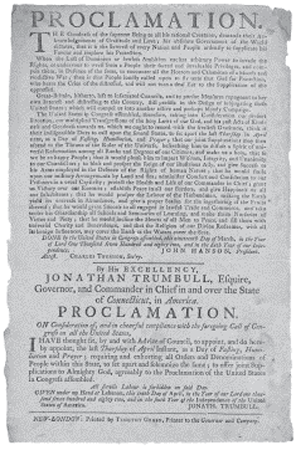
This one official organic utterance by the supreme political body of the United States is sufficient to refute and completely dispel the popular contention of atheists that the Founders were not religious men, or that they did not couple their political pronouncements with their religious beliefs.
Hence, the allegations of skeptics (who seek to expunge the Founders’ clearly Christian orientation by floating isolated allusions that seemingly discount this orientation), logically, cannot be interpreted as carte blanche dismissals of the role of Christianity in the founding of America. Indeed, they must be viewed as isolated and exceptional in contrast with the myriad declarations to the contrary (see Miller, 2008). And, to be fair, an honest attempt ought to be made to harmonize the exceptional with the typical.
THE 1796 TREATY OF TRIPOLI
Despite the fact that transparent expressions of religious attachment by the mass of the Founders are legion, a battery of revisionist historians, liberal educators, skeptics, and atheists have been working feverishly for over half a century to perpetuate their unconscionable allegation that the bulk of the Founders were irreligious men. One, if not the most, prominent ploy used to propagate the secularist’s propaganda is the Treaty of Tripoli. Atheists and skeptics, using their Web sites and books, routinely seek justification for their denial of America’s Christian roots by decontextualizing the words of this political document (e.g., Harding, 2011; Walker, 1997; Allen, 2005; Buckner, 1997; Buckner and Buckner, 1993). For example, in his book The God Delusion, British atheist Richard Dawkins declares:
The religious views of the Founding Fathers are of great interest to propagandists of today’s American right, anxious to push their version of history. Contrary to their view, the fact that the United States was not founded as a Christian nation was early stated in the terms of a treaty with Tripoli (2006, p. 40, emp. added).
In an article on Dawkins’ Web site, titled “The Enigma of America’s Secular Roots” (Haselby, 2011), Sam Haselby parrots the same sentiment. He attempts to paint as irreligious the American envoy who negotiated and signed the treaty, Joel Barlow, on the basis of Barlow’s book Advice to the Privileged Orders (1793). [NOTE: As President Washington’s appointed envoy (in 1793) to negotiate treaties with Algeria, Tripoli, and Tunis, Colonel David Humphreys ultimately delegated his responsibilities to junior agents, including Joel Barlow as well as Joseph Donaldson (Irwin, 1931, p. 84; “Treaty of Peace…,” 1846a, 8:156).]
 |
| Joel Barlow American Consul at Algiers 1795-1797 |
Regardless of Barlow’s personal religious sentiments, Haselby unquestionably misrepresents Barlow’s writing. He fails to recognize that Barlow was not condemning human religion carte blanche, let alone espousing the atheistic viewpoint—as do Dawkins and his fellow atheists. Rather, he was decrying false religion, as well as perversions and abuses of Christianity (e.g., Catholicism—pp. 60,62,69, et al.). More particularly, he condemned the “state-establishment of religion…[w]hen the Christian religion was perverted and pressed into the service of Government, under the name of the Christian Church” (pp. 61,68, italics in orig., emp. added). In the commencement of his denunciation of “The Church,” Barlow included a footnote to eliminate the very misunderstanding that atheists seek to perpetrate on others. He explained:
From that association of ideas, that usually connects the church with religion, I may run the risque [sic] of being misunderstood by some readers, unless I advertise them, that I consider no connection as existing between these two subjects; and that where I speak of church indefinitely, I mean the government of a state, assuming the name of God, to govern by divine authority; or in other words, darkening the consciences of men, in order to oppress them. In the United States of America, there is, strictly speaking, no such thing as a Church; and yet in no country are the people more religious… (pp. 53-54, italics in orig., emp. added)
Though America has always been filled with Christian churches, yet, as a nation, Barlow insisted that we have no church? How so? He meant that we have no one Christian sect assuming the role of a state church—the very malady that afflicted Britain. Yet, Christianity has been the singularly supreme religion that has always characterized the vast majority of Americans—including the vast majority of the Founders. In referring to Christianity in America, Barlow added: “they have ministers of religion, but no priests” (p. 54, italics in orig.). So according to Barlow, the problem is not religion; rather, problems arise when a corrupted form of Christianity is given the power of the federal government to persecute opposing Christian sects. He specifically affirmed that the bulk of the population of the country—including the Founders—were religious. Indeed, according to Barlow, Americans were unsurpassed in the world for their commitment to religion.
Barlow, therefore, did not use the word “church” as a blanket condemnation of the Christian church or religion. In fact, after providing an initial definition of his specialized use of the term, he repeatedly went out of his way to reiterate that definition’s very restricted meaning: “By church I mean any mode of worship declared to be national, or declared to have any preference in the eye of the law” (p. 61, italics in orig., emp. added; cf. “as I have before defined it”—p. 70). After citing the history of the Roman Catholic Church as exemplary of the kind of coercive religion that he condemned, he observes that such cruelty “has given rise to an opinion, that nations are cruel in proportion as they are religious” (p. 66). Ironically, Barlow’s observation represents the opinion of today’s atheist. However, Barlow disagreed with that opinion. In contrast, he stated: “But the observation ought to stand thus, That nations are cruel in proportion as they are guided by priests”—again accentuating the distinction between the positive and rightful influence of Christianity on society, and the unchristian cruelties inflicted by Catholic priests who are handed the reins of government (pp. 66-67, italics in orig.).
Barlow then concluded his chapter on the church by explicitly restating his specialized use of the term “church”:
In the United States of America there is no church; and this is one of the principal circumstances which distinguish that government from all others that ever existed; it ensures the un-embarrassed exercise of religion, the continuation of public instruction in the science of liberty and happiness, and promises a long duration to a representative government (pp. 75-76, emp. added).
Observe that when Barlow made his remarks, America, then as now, was saturated with churches from one end of the country to the other. Hence, his declaration that in America “there is no church” meant that there is no state religion, there is no religion (specifically, any one Christian denomination) that has been elevated by the federal government to the status of the state church. Observe further that Barlow listed as one of the positive, distinguishing characteristics of America the guarantee of “the unembarrassed exercise of religion”—the very thing that Dawkins, Haselby, and their atheistic associates constantly seek to expunge from society.
What Barlow and the Founders sought to communicate to the world was the fact that the newly established federal government had no direct religious ties to any one Christian sect; it did not establish a state church, as did England and other European countries. As Supreme Court Justice and Father of American Jurisprudence, Joseph Story, succinctly explained in his comments on the wording of the First Amendment to the Constitution:
The real object of the amendment was, not to countenance, much less to advance Mahometanism, or Judaism, or infidelity, by prostrating Christianity; but to exclude all rivalry among Christian sects, and to prevent any national ecclesiastical establishment, which should give to an hierarchy the exclusive patronage of the national government. It thus cut off the means of religious persecution (1833, 3.44.728.1871, emp. added).
This premiere Founder and expounder of the original intent of the Constitution fully recognized what the mass of the Founders believed—that Christianity fits “hand-in-glove” with the Republic they established, and its perpetuation throughout the nation was indispensable to the survival of the Republic:
[I]n a republic, there would seem to be a peculiar propriety in viewing the Christian religion, as the great basis, on which it must rest for its support and permanence, if it be, what it has ever been deemed by its truest friends to be, the religion of liberty…. Probably at the time of the adoption of the constitution, and of the amendment to it, now under consideration, the general, if not the universal, sentiment in America was, that Christianity ought to receive encouragement from the state, so far as was not incompatible with the private rights of conscience, and the freedom of religious worship. An attempt to level all religions, and to make it a matter of state policy to hold all in utter indifference, would have created universal disapprobation, if not universal indignation (3.44.724-726. 1867-1868, emp. added).
 |
| John Adams’ letter to Thomas Jefferson June 28, 1813 |
Even John Adams, under whose presidency the Treaty of Tripoli was finalized and sanctioned by Congress, and then signed by Adams himself, forthrightly affirmed the role of Christianity in the founding of the Republic. In a letter he wrote to Thomas Jefferson, dated June 28, 1813, he explained that the great foundation of the nation is Christianity:
The general principles on which the fathers achieved independence, were the only principles in which that beautiful assembly of young men could unite…. And what were these general principles? I answer, the general principles of Christianity, in which all those sects were united, and the general principles of English and American liberty, in which all those young men united, and which had united all parties in America, in majorities sufficient to assert and maintain her independence. Now I will avow, that I then believed and now believe that those general principles of Christianity are as eternal and immutable as the existence and attributes of God (“John Adams to…,” n.d., emp. added).
While serving in his official capacity as President of the United States, John Adams issued a proclamation to the entire nation that sets forth his indisputable views regarding Christianity and the nation:
John Adams’ Presidential Proclamation
March 6, 1799I do hereby recommend accordingly, that Thursday, the 25th day of April next, be observed throughout the United States of America as a day of solemn humiliation, fasting, and prayer; that the citizens on that day abstain as far as may be from their secular occupations, devote the time to the sacred duties of religion in public and in private; that they call to mind our numerous offenses against the Most High God, confess them before Him with the sincerest penitence, implore His pardoning mercy, through the Great Mediator and Redeemer, for our past transgressions, and that through the grace of His Holy Spirit we may be disposed and enabled to yield a more suitable obedience to His righteous requisitions in time to come…and that he would extend the blessings of knowledge, of true liberty, and of pure and undefiled religion throughout the world (Adams, 1799, emp. added).

Such admonitions concerning Christ, the Holy Spirit, and the Christian religion (i.e., Adams’ allusion to James 1:27) did not come from an irreligious man who rejected any connection between Christianity and the nation.
To summarize, while the Founders strenuously opposed the formation of a state-sponsored religion, i.e., the elevation of one Christian denomination above another, they firmly believed that the general principles of Christianity were part and parcel of the fabric of America, including her political and social institutions. This realization is indisputable and undeniable. We know that the Founders did not interpret the phrase in the Treaty of Tripoli the way skeptics and liberals do today, since we have a host of explicit declarations, statements, and affirmations to the contrary from the Founders themselves (Miller, 2008). But how, then, do we account for the apparent denial of this broad-based fact in the Treaty of Tripoli? Let us see.
The Wording of the Treaty Itself
Having dispelled the attempt to characterize the Treaty of Tripoli as a patent denial of the Christian character of America, we now turn to the Treaty itself in an effort to understand its originally intended meaning. The treaty is dated November 4, 1796. The disputed portion of the treaty is Article 11, which reads in full:
As the government of the United States of America is not in any sense founded on the Christian Religion,-as it has in itself no character of enmity against the laws, religion or tranquility of Musselmen,-and as the said States never have entered into any war or act of hostility against any Mehomitan nation, it is declared by the parties that no pretext arising from religious opinions shall ever produce an interruption of the harmony existing between the two countries (“Treaty of Peace…,” 1846a, 8:155, emp. added).
At first glance, the initial declaration is startling and seemingly straightforward. How does one harmonize the mountain of evidence of America’s religious moorings with this treaty’s bold declaration that “the government of the United States of America is not in any sense founded on the Christian Religion”? The answer lies in an objective consideration of the rest of the article, recognizing that the subsequent phrases clarify, define, and explain the true intent of the initial declaration.
Observe, first, that the Treaty of Tripoli in general, and Article 11 in particular, pertains specifically and exclusively to the federal government—not to the state governments or the rest of America’s social or political institutions (cf. Barton, 2000). The Founders’ discussions of the First Amendment make it very clear that the federal government was not to meddle in religious affairs, i.e., it was never to be allowed to interfere with the free exercise of the Christian religion. The Father of the Bill of Rights, George Mason, confirms this appraisal of the historical context when he offered the following wording of the First Amendment:
[A]ll men have an equal, natural and unalienable right to the free exercise of religion, according to the dictates of conscience; and that no particular sect or society of Christians ought to be favored or established by law in preference to others (as quoted in Rowland, 1892, 1:244, emp. added).
While Mason’s wording did not make the final cut, it nevertheless demonstrates the historical setting of the discussions, and the specific variables with which the Founders were grappling. The point is that the treaty was assuring the Tripolitan Muslim warlord that the government of the United States would never show hostility toward his country based on America’s intimate affiliation with Christianity.
Second, notice that while the punctuation found throughout the article varies in the published forms that have come down through history, nevertheless, none place a period after “the Christian Religion.” The article clearly intends for the reader to gain clarification regarding the import of the first clause by including the subsequent clauses. The rest of the article, in fact, elaborates and expounds on the wording in the first clause. The rest of the article answers the question: In what way or ways is the government of the U.S. not founded in any sense on the Christian religion? Answer: (1) It has no disposition to show hatred toward Muslims, their laws, religion, or peaceful status; (2) The U.S. has never waged war against a Muslim nation; and (3) Therefore, it is clear that the U.S. would never attack a Muslim country solely on the grounds of religion, i.e., the differences that exist between Christianity and Islam.
The average Muslim, even today, has difficulty reconciling America’s worldwide reputation as a “Christian nation” with her concomitant refusal to forcibly impose its religious orientation on the rest of the world—as Muslim countries, themselves, have consistently sought to do throughout history. The Bey of Tripoli, along with the pashas of the other Barbary States, unquestionably viewed American ships as fair game—legitimate objects of their attacks on the high seas—for the simple and obvious reason that America was a Christian nation. No Muslim country would have accepted as true such a sweeping repudiation of America’s intimate affiliation with Christianity. If such were the intent and meaning of Article 11, the Bey would have instantly dismissed the validity of the treaty, and such a claim would be seen as a laughable and ludicrous denial of what was obviously the case, i.e., that America was inhabited by a population of people, the vast majority of whom openly professed Christianity, and manifested that profession in all its civil and social institutions. [NOTE: The term “Bey” is a title of Turkish origin that refers to a tribal chieftain, equivalent to the English term “lord.” The similar term “Dey” was used specifically to refer to the rulers of Algiers and Tripoli. “Pasha” or “bashaw” was a comparable title of rank in the Ottoman Empire.]
Abundant historical evidence verifies this understanding. Ten years earlier, authorized by Congress to negotiate with the Barbary pirates, who continually raided American ships off the coast of North Africa, John Adams and Thomas Jefferson met in London in 1786 with the Ambassador from Tripoli. On March 28, they wrote the following letter to John Jay, who was serving as the U.S. Secretary of Foreign Affairs, reporting their conversation with the ambassador.
American Peace Commissioners’
letter to John Jay
March 28, 1786We took the liberty to make some inquiries concerning the grounds of their pretentions to make war upon nations who had done them no injury, and observed that we considered all mankind as our Friends who had done us no wrong, nor had given us any provocation. The Ambassador answered us that it was founded on the laws of their Prophet, that it was written in their Koran that all nations who should not have acknowledged their authority were sinners, that it was their right and duty to make war upon them wherever they could be found, and to make slaves of all they could take as prisoners; and that every Musselman who should be slain in battle was sure to go to Paradise (“American Peace…,” 1786).

The Tripoli ambassador clearly reflected the attitude of the Bey and his fellow citizens toward non-Muslim countries, an attitude that must be taken into account as the backdrop of the wording of Article 11 in the treaty a decade later. [NOTE: Interestingly, the only known surviving Arabic copy of the Treaty of Tripoli lacks the allusion to America not being a Christian nation.]
The Other Treaty of Tripoli
Even more telling proof that the phrase in Article 11 is misconstrued by atheists is seen in Article 14 of the subsequent treaty made with Tripoli on June 4, 1805, which reads in full:
Art. 14th. As the government of the United States of America has, in itself, no character of enmity against the laws, religion, or tranquility of Musselmen, and as the said states never have entered into any voluntary war or act of hostility against any Mahometan nation, except in the defence of their just rights to freely navigate the high seas, it is declared by the contracting parties, that no pretext arising from religious opinions shall ever produce an interruption of the harmony existing between the two nations. And the consuls and agents of both nations respectively, shall have liberty to exercise his religion in his own house. All slaves of the same religion shall not be impeded in going to said consul’s house at hours of prayer. The consuls shall have liberty and personal security given them, to travel within the territories of each other both by land and sea, and shall not be prevented from going on board any vessel that they may think proper to visit. They shall have likewise the liberty to appoint their own drogerman and brokers (“Treaty of Peace…,” 1846b, 8:216, emp. added).
The first two clauses are taken verbatim from the 1796 treaty—to the exclusion of the clause regarding America not being a Christian nation. Consequently, they do precisely what the Christian nation clause was intended to do in the earlier treaty: assure the Muslim pasha that America’s Christian orientation would not be the cause of hostilities directed against him. Tripolines were obligated not to attack Americans on account of America’s Christian connections, and the U.S. was not to attack Tripolines on account of their Islamic beliefs.
Article 14 even expresses concern that “consuls and agents of both nations” be permitted to practice their religion in their own homes. In other words, a consul or agent of Tripoli should not be hindered from engaging in Islamic worship in the diplomatic residence he occupies while in America. Similarly, any American consul or government agent living in Tripoli was not to be hindered from practicing his religion while residing in Tripoli. Pray tell—what religion would that be? Certainly not Islam, since he would hardly be hindered from practicing Islam in an Islamic nation. Obviously, both parties to the treaty automatically understood that American consuls and government agents would naturally practice Christianity.
Treaties with the Other Barbary States
This conclusion is verified further by the comparable treaties that were made with the Muslim rulers of the other Barbary States—
- Two with Tunis, on August 17, 1797 and March 26, 1799 (“Treaty of Peace…,” 1846e, 8:157-161), as well as the “Altered Articles” on February 24, 1824 (1846, 8:298-300).
- Two with Morocco, on January 1787 (“Treaty of Peace…,” 1846c, 8:100-108) and September 16, 1836 (“Treaty with Morocco…,” 1846, 8:484-487).
- Two with Algiers, on September 5, 1795 (“Treaty of Peace…,” 1846d, 8:133-137) and June 30 and July 6, 1815 (1846f, 8:224-247), as well as a “Renewed Treaty” on December 22-23, 1816 (1846g, 8:244-248).
Not one of these treaties contains the reference to America not being a Christian nation. All omit altogether any reference to the Islamic-Christian tension that naturally existed between the two nations—with one exception. Article 15 of the June 30 and July 6, 1815 treaty with Algiers addresses the issue in the following words:
As the government of the United States has, in itself, no character of enmity against the laws, religion, or tranquility, of any nation, and as the said States have never entered into any voluntary war, or act of hostility, except in defence of their just rights on the high seas, it is declared, by the contracting parties, that no pretext arising from religious opinions shall ever produce an interruption of the harmony between the two nations; and the Consuls and Agents of both nations shall have liberty to celebrate the rites of their respective religions in their own houses (“Treaty of Peace…,” 1846f, 8:224-247, emp. added).
This article paraphrases the previous two treaties with Tripoli. Like the second treaty with Tripoli, it omits the “not a Christian nation” clause. Once again, observe that the agreement inherently presupposes that the religion of Algiers is Islam and the religion of America is Christianity. But the treaty intends to reassure the Dey that America’s Christian orientation will never be the cause of hostilities on the part of America. Indeed, America’s history proves that her wars have typically been reactive and defensive, and they have pertained to non-religious matters.
The Other Treaties Include Religion
Even more historical confirmation is seen in the fact that not only do all the other treaties that were made with the Barbary States omit the allusion to America not being a Christian nation—including the other Tripoli treaty—they actually contain allusions to Christianity. For example, the January 1787 treaty with Morocco (“Treaty of Peace…,” 1846c, 8:100-108) contains the following references: “In the Name of Almighty God” and “trusting in God” (p. 100). It also refers to “the Christian powers” (in Article X, p. 102), “any Christian power” (in Article XI, p. 102), “the other Christian nations” (in Article XVII, p. 103), and “any of the Christian powers” (in Article XXIV, p. 104)—the last two references clearly implying that America is among them. Article XXV states: “This treaty shall continue in full force, with the help of God, for fifty years” (p. 104, emp. added). Several times the treaty alludes to “Moors”—the term used to refer to “a Muslim people of mixed Berber and Arab descent” in northwest Africa (American Heritage…, 2000, p. 1142)—in Article VI (p. 101), Article XI (p. 102), and Article XXI (p. 103). Article XI places “Moors” in juxtaposition to “Christians” (Article XI, p. 104), and the “Additional Article” contrasts “Moorish” with “Christian Powers” (p. 104). The September 16, 1836 treaty with Morocco contains essentially the same contrasts.
The September 5, 1795 treaty with Algiers—made just 14 months before the 1796 treaty with Tripoli that contains the “not a Christian nation” expression—includes in Article XVII assurance that the “consul of the United States of North-America…shall have liberty to exercise his religion in his own house” (“Treaty of Peace…,” 1846d, 8:135). This treaty was authorized by the same President who initiated the 1796 treaty with Tripoli—George Washington. In addition to the evidence provided by Article 15 of the June 30 and July 6, 1815 treaty with Algiers mentioned above, Article 14 of the same treaty secures the right of captive Christians in Algiers, who are able to escape and make their way to any U.S. ships, to remain on board unscathed, and no remuneration must be paid “for the said Christians” (“Treaty of Peace…,” 1846f, 8:246).
The August 17, 1797 treaty with Tunis begins with the words “God is infinite” and refers to “the most distinguished and honored President of the Congress of the United States of America, the most distinguished among those who profess the religion of the Messiah” (“Treaty of Peace…,” 1846e, 8:157). This unmistakable declaration of commitment to the religion of Christ refers to President John Adams—the very President whose act of signing the 1797 Treaty of Tripoli, the skeptics claim proves that he and the Congress repudiated Christianity! Article IX of the same treaty states: “If by accident and by the permission of God, a vessel of one of the contracting parties shall be cast by tempest upon the coasts of the other…” (p. 158, emp. added). The treaty concludes with an affirmation that the two contracting parties shall observe the terms of the treaty “with the will of the Most High” (p. 161—an expression used in both the Quran and the Bible), and the treaty is dated in both Islamic and Christian reckoning: “in the present month of Rebia Elul, of the Hegira one thousand two hundred and twelve, corresponding with the month of August of the Christian year one thousand seven hundred and ninety-seven,” followed by the signatures and seals of the Muslim leaders (p. 161). The accompanying verification by the American representatives, William Eaton and James Cathcart, claims authority for their actions on the basis of President John Adams, and closes with these words: “Done in Tunis, the twenty-sixth day of March, in the year of the Christian era one thousand seven hundred and ninety-nine, and of American independence the twenty-third” (p. 161, emp. added).
To summarize, the treaties made with the Barbary States are literally riddled with religious allusions and transparent indications of the Christian orientation of the United States in contradistinction to the Islamic orientation of the Barbary States. This fact alone proves that no treaty ever ratified by the United States would deny the Christian connections that have characterized the nation from its birth. The very idea is absurd—and such a declaration would be an outright falsehood. Those who so construe the 1797 Treaty of Tripoli are guilty of shoddy historical investigation at the very least, and outright dishonesty and flagrant bias at the very worst.
CONCLUSION
It is sad when any people become so biased in their belief system that they will latch onto a handful of misleading incidents and exploit them in an effort to legitimize that belief system. Atheists are guilty of the very malady they insist Christians suffer from—an irrational, prejudicial, mindless commitment to discredited ideas. The evidence is mammoth and decisive: the God of the Bible exists, and the Christian religion (in its pure, New Testament form) is the only belief system that He has authored for people living today (see www.apologeticspress.org). The Founders of the American Republic, with few exceptions, understood these facts and embraced them. As John Quincy Adams, son of John Adams and 6th President, declared:
From the day of the Declaration, the people of the North American Union and of its constituent States, were associated bodies of civilized men and Christians, in a state of nature; but not of Anarchy. They were bound by the laws of God, which they all, and by the laws of the Gospel, which they nearly all, acknowledged as the rules of their conduct (1821, p. 26, emp. added).
With this Christian worldview firmly fixed in their minds, they launched what indisputably has become the greatest nation in human history.
REFERENCES
Adams, John (1799), “By the President of the United States of America. A Proclamation,” Library of Congress, http://tinyurl.com/Adams1799.
Adams, John Quincy (1821), Address Delivered at the request of a Committee of the Citizens of Washington on the Occasion of Reading the Declaration of Independence on the 4th of July, 1821 (Washington: Davis & Force), http://digital.library.umsystem.edu/cgi/t/text/text-idx?sid=b80c023f0 007f89b5b95e4be026fa267;c=jul;idno=jul000087.
Allen, Brooke (2005), “Our Godless Constitution,” The Nation, February 3, http://www.thenation.com/article/our-godless-constitution.
“Altered Articles of the Treaty of Peace and Friendship, Between the United States and the Bashaw Bey of Tunis, February 24, 1824” (1846), The Public Statutes at Large of the United States, ed. Richard Peters (Boston, MA: Charles C. Little and James Brown).
American Heritage Dictionary of the English Language (2000), (Boston, MA: Houghton Mifflin), fourth edition.
“American Peace Commissioners to John Jay” (1786), The Thomas Jefferson Papers Series 1. General Correspondence. 1651-1827, Library of Congress, March 28, http://hdl.loc.gov/loc.mss/mtj.mtjbib001849.
Barlow, Joel (1793), Advice to the Privileged Orders (London: J. Johnston), third edition, http://tinyurl.com/Barlow1793.
Barton, David (2000), “Treaty of Tripoli,” Wallbuilders, http://www.wallbuilders.com/LIBissuesArticles.asp?id=125.
Buckner, Ed (1997), “Does the 1796-97 Treaty with Tripoli Matter to Church/State Separation?” http://www.stephenjaygould.org/ctrl/buckner_tripoli.html.
Buckner, Ed and Michael (1993), “Quotations that Support the Separation of State and Church,” Internet Infidels, http://www.infidels.org/library/modern/ed_buckner/quotations.html#I.
Dawkins, Richard (2006), The God Delusion (London: Bantam Press).
Harding, Ken (2011), “Our Founding Fathers Were Not Christians,” BibleTrash.com, July 5, http://freethought.mbdojo.com/foundingfathers.html.
Haselby, Sam (2011), “The Enigma of America’s Secular Roots,” The Guardian, January 3, http://richarddawkins.net/articles/572948-the-enigma-of-america-s-secular-roots; http://www.guardian.co.uk/commentisfree/belief/2011/jan/03/america-secular-roots-treaty-tripoli.
Hitler, Adolf (1939), Mein Kampf, Project Gutenberg, http://gutenberg.net.au/ebooks02/0200601.txt.
Irwin, Ray (1931), The Diplomatic Relations of the United States with the Barbary Powers (Chapel Hill, NC: The University of North Carolina Press).
“John Adams to Thomas Jefferson, June 28, 1813” (no date), The Thomas Jefferson Papers Series 1. General Correspondence, 1651-1827, Library of Congress, http://hdl.loc.gov/loc.mss/mtj.mtjbib021451.
Journals of the Continental Congress, 1774-1789 (1904-1937), ed. Worthington C. Ford, et al. (Washington, D.C.: Government Printing Office), Library of Congress, http://memory.loc.gov/ammem/amlaw/lwjc.html.
Kramnick, Isaac and R. Laurence Moore (1996), The Godless Constitution: The Case Against Religious Correctness (New York: W.W. Horton).
Miller, Dave (2005), “Deism, Atheism, and the Founders,” Apologetics Press, http://www.apologeticspress.org/APContent.aspx?category=7&article=1654&topic=31.
Miller, Dave (2008), The Silencing of God (Montgomery, AL: Apologetics Press), http://www.apologeticspress.org/store/Product.aspx?pid=51.
Miller, Dave (2009), Christ and the Continental Congress (Montgomery, AL: Apologetics Press), http://www.apologeticspress.org/store/Product.aspx?pid=45.
Miller, Dave (2011), “Is Christianity Logical? (Part I),” Reason & Revelation, 31[6]:50-59, June 3, http://www.apologeticspress.org/apPubPage.aspx?pub=1&issue=977&article=1499.
Rowland, Kate (1892), The Life of George Mason (New York: G.P. Putnam’s Sons).
Story, Joseph (1833), Commentaries on the Constitution of the United States (Boston, MA: Hilliard, Gray, & Co.), http://www.constitution.org/js/js_344.htm.
“Treaty of Peace and Friendship Between the United States of America, and the Bey and Subjects of Tripoli, of Barbary, November 4, 1796” (1846a),The Public Statutes at Large of the United States, ed. Richard Peters (Boston, MA: Charles C. Little and James Brown), http://tinyurl.com/TreatyTripoli1846a.
“Treaty of Peace and Amity, Between the United States of America, and the Bashaw, Bey, and Subjects of Tripoli, in Barbary, June 4, 1805” (1846b), The Public Statutes at Large of the United States, ed. Richard Peters (Boston, MA: Charles C. Little and James Brown).
“Treaty of Peace and Friendship Between the United States of America and His Imperial Majesty, the Emperor of Morocco, January, 1787” (1846c), The Public Statutes at Large of the United States, ed. Richard Peters (Boston, MA: Charles C. Little and James Brown).
“Treaty of Peace and Amity Between the Dey of Algiers and the United States of America, September 5, 1795” (1846d), The Public Statutes at Large of the United States, ed. Richard Peters (Boston, MA: Charles C. Little and James Brown).
“Treaty of Peace and Friendship, Between the United States of America and the Kingdom of Tunis, August, 1797, March 26, 1799” (1846e), The Public Statutes at Large of the United States, ed. Richard Peters (Boston, MA: Charles C. Little and James Brown).
“Treaty of Peace and Amity, Concluded Between the United States of America and His Highness Omar Bashaw, Dey of Algiers, June 30, and July 6, 1815” (1846f), The Public Statutes at Large of the United States, ed. Richard Peters (Boston, MA: Charles C. Little and James Brown).
“Treaty of Peace and Amity, Concluded Between the United States of America and the Dey and Regency of Algiers, December 23 and 24, 1816” (1846g), The Public Statutes at Large of the United States, ed. Richard Peters (Boston, MA: Charles C. Little and James Brown).
“Treaty with Morocco, September 16, 1836” (1846), The Public Statutes at Large of the United States, ed. Richard Peters (Boston, MA: Charles C. Little and James Brown).
Walker, Jim (1997), “The Government of the United States of America is Not, in Any Sense Founded on the Christian Religion,” NoBeliefs.com, April 11, http://www.nobeliefs.com/Tripoli.htm.
Warren, Thomas B. (1982), Logic & the Bible (Ramer, TN: National Christian Press).
The post The Treaty of Tripoli and America's Founders appeared first on Apologetics Press.
]]>The post Combatting Evolution Education appeared first on Apologetics Press.
]]>In light of ongoing debate over teaching the General Theory of Evolution in various public school systems, which we have been documenting for several years (e.g., Warren, 2011; Brooks, 2011; Deweese and Brooks, 2009), some have rightly asked what Christians can do to combat the forces of pseudoscience in this critical area. This question has compelled us to give a few suggestions to that end.
- Encourage individuals in your church/community to run for office where they can make a difference. Sheila Butt, mother of our very own Kyle Butt, was elected to office in Tennessee where she serves as a state representative. She is, therefore, in a position of potentially significant influence in this debate.
- Flood decision makers with letters from people all over your area expressing your opinions on the matter. Contact other churches to assist in a concerted effort to that end. Perhaps write several versions of letters that can be used in bulk so that people will be more likely to send them in. The more letters that lawmakers receive every day, the more likely they will feel pressure to hear our voices. Try sending our Truth Be Told and Silencing of God books (see http://www.apologeticspress.org/store/Product.aspx?pid=101). Books, especially, are hard for any of us to throw away.
- Get the local media involved. We all know how much the politicians are affected by the media.
- Host Creation/Evolution, as well as Silencing of God seminars all over the state and publicize them heavily. I recently spoke in South Carolina, where the hosting congregation used highway billboards to advertise the seminar. In fact, they spent several thousand dollars in advertising the event, including saturating their area with postcards and radio spots about the seminar. If local churches come together to host a seminar, more money could be pooled for advertising.
- Engage in consistent, fervent prayer. Host weekly Tuesday night or Thursday night prayer gatherings with Christians for the sole purpose of fighting the evolutionists’ agenda in the school system. Be sure to remember the coming elections in your prayers as well. God can easily raise up individuals who can make a significant difference in this fight if we have the zeal to plead with Him for assistance.
- Donate Creation/Evolution materials to local community and school libraries. If the next generation is taught the truth, the future will look much more promising. Hitler certainly championed effectiveness of indoctrinating youth with his agenda and such is the position of the homosexual community today, as well.
- Make sure that Christian public school teachers are equipped with materials to hand out to students who ask for information on the controversy.
- More prayer.
- Encourage everyone at your church (and others) not only to have a subscription to Christian evidences journals, such as our very own Reason and Revelation (for adults) and Discovery (for children), but to order subscriptions for friends, neighbors, grandchildren, nieces, nephews, etc. who could also benefit from the information. Some elderships have even chosen to purchase subscriptions to Discovery magazine for every young family in their congregation.
- Devote at least one quarter of Bible classes each year specifically on preparation to defend the truth (i.e., about the existence of God, the inspiration of the Bible, the importance of God in government and society, Creation/Evolution, etc.). The focus would be, not simply learning the material for themselves, but to prepare them to teach it to others. Perhaps even pair members of the congregation during the Bible class and have one person play the atheist and the other play the Christian to see if members are prepared to teach the truth at a moment’s notice—especially when caught without notes (cf., 1 Peter 3:15). Our Christian Evidences and Creation/Science bookmark reference cards would be beneficial for this option (see http://www.apologeticspress.org/store/Product.aspx?pid=282).
- Encourage parents to consider homeschooling their children or sending them them to private Christian schools. Thousands of parents throughout the country have pulled their kids out of the public school system in order to ensure that their children are being trained in the way they should go—in the nurture and admonition of the Lord, rather than of monkeys. Some families simply cannot take advantage of this possibility (especially many single parent families). And some areas of the nation are handling the subject in an appropriate way, thus eliminating the necessity of this option. However, many areas have been so infiltrated by Satan’s forces that children are being adversely affected in ways that parents do not know and have not anticipated. Yet it is still their responsibility to train and nurture their children. All parents will be held accountable for rearing their children. It is not the duty of their teachers.
- Even more prayer. Encourage your church to set their phones to remind themselves to pray every two hours of every day.
- Encourage individuals and churches as possible to support A.P. financially on a monthly/yearly basis. Combating atheism, evolution, humanism, etc. is what we do, but as a non-profit organization that relies heavily on donations, we simply cannot do it without financial support. It is undeniable that your financial support will directly affect the lives of millions!
Please do not hesitate to let us know if you have other ideas that would be effective in combatting atheism and macroevolution (contact our offices at 334-272-8558 or e-mail us at mail@apologeticspress.org). As always, thank you for your interest in and support of Apologetics Press.
REFERENCES
Brooks, Will (2011), “Does Evolution Belong in Biomedical Curricula?” Reason & Revelation, 31[3]:18-20, March, Apologetics Press, http://www.apologeticspress.org/apcontent.aspx?category=9&article=3796.
Deweese, Joe and Will Brooks (2009), “A Response to the 21st Century Science Coalition Standards of Science Education,” Reason & Revelation, 29[6]:41-47, February, Apologetics Press, http://www.apologeticspress.org/apPubPage.aspx?pub=1&issue=610.
Warren, Jim (2011), “Hart Schools Chief: Evolution is Viewed as Fact in State Test,” Kentucky.Com: State, http://www.kentucky.com/2011/12/12/1992514/kentuckys-plan-for-biology-tests.html.
The post Combatting Evolution Education appeared first on Apologetics Press.
]]>The post Founders En Masse Advocated Christianity appeared first on Apologetics Press.
]]>The failure of the average citizen to examine the facts and assess the gravity of the situation is inexcusable. In reality, the religious orientation of the architects of American civilization, and their view regarding its importance to the establishment and perpetuation of the Republic, is easily ascertainable. Rather than wade through the myriad pages and books that purport to depict American history accurately, all one need do is simply reread the organic utterances issued by the Founders as they orchestrated the founding.
Though not including all those who rightly wear the appellation “Founder,” nevertheless, the Continental Congress comprised a substantial portion of those men, and they may clearly be designated quintessential Founders (see Miller, 2009, p. 3). They certainly constitute a representative cross section of the men who brought the Republic into existence. Consider one sample among many in which the Continental Congress en masse issued a proclamation to the entire population of the country on March 19, 1782:
The United States in Congress assembled…think it their indispensable duty to call upon the several states, to set apart the last Thursday in April next, as a day of fasting, humiliation and prayer…that He would incline the hearts of all men to peace, and fill them with universal charity and benevolence, and that the religion of our Divine Redeemer, with all its benign influences, may cover the earth as the waters cover the seas (Journals of…, 22:137-138, emp. added).
The “Divine Redeemer” is Jesus Christ. Calling for Christ’s religion to “cover the earth as the waters cover the seas” is a direct allusion to two Old Testament passages—Isaiah 11:9 and Habakkuk 2:14.
The Founders insisted that the stability of the Republic depends on the Christian religion, with its moral principles and spiritual framework. They felt that though other religions may certainly be tolerated in America, the peculiar doctrines and practices of those religions must not be allowed to alter the laws and institutions of the nation. Nor must those doctrines and practices do any physical harm to Americans or violate Christian morality (e.g., polygamy, homosexuality, and abortion). The Founders would be horrified at the notion of “political correctness” and its corrosive, destructive influence. They would have difficulty believing that Americans would ever even consider allowing Sharia law to be included in our courts, schools, or government. The Founders never asked that Hinduism cover the Earth, nor Islam, Buddhism, or Atheism. Rather, they begged God to cover the Earth with the religion of Christ as thoroughly and completely as the waters cover the oceans of the world.
REFERENCES
Journals of the Continental Congress, 1774-1789 (1904-1937), ed. Worthington C. Ford, et al. (Washington, D.C.: Government Printing Office), Library of Congress, http://memory.loc.gov/ammem/amlaw/lwjc.html.
Miller, Dave (2009), Christ and the Continental Congress (Montgomery, AL: Apologetics Press).
The post Founders En Masse Advocated Christianity appeared first on Apologetics Press.
]]>The post Thanksgiving Proclamation by the First President of the United States appeared first on Apologetics Press.
]]>
Our God is truly an awesome God who deserves all praise and thanksgiving. As we prepare for a day of thanksgiving, let us take the time to reflect on all the reasons we have to be thankful, and let us honor the One who is worthy of all thanksgiving.
The first national Thanksgiving Day proclamation under the Constitution, a copy of which was sent to the executives of the States by the President in a brief form letter. Source: The George Washington Papers at the Library of Congress.
City of New York, October 3, 1789

Whereas it is the duty of all Nations to acknowledge the providence of Almighty God, to obey his will, to be grateful for his benefits, and humbly to implore his protection and favor, and Whereas both Houses of Congress have by their joint Committee requested me “to recommend to the People of the United States a day of public thanksgiving and prayer to be observed by acknowledging with grateful hearts the many signal favors of Almighty God, especially by affording them an opportunity peaceably to establish a form of government for their safety and happiness.”
Now therefore I do recommend and assign Thursday the 26th day of November next to be devoted by the People of these States to the service of that great and glorious Being, who is the beneficent Author of all the good that was, that is, or that will be. That we may then all unite in rendering unto him our sincere and humble thanks, for his kind care and protection of the People of this country previous to their becoming a Nation, for the signal and manifold mercies, and the favorable interpositions of his providence, which we experienced in the course and conclusion of the late war, for the great degree of tranquillity, union, and plenty, which we have since enjoyed, for the peaceable and rational manner in which we have been enabled to establish constitutions of government for our safety and happiness, and particularly the national One now lately instituted, for the civil and religious liberty with which we are blessed, and the means we have of acquiring and diffusing useful knowledge and in general for all the great and various favors which he hath been pleased to confer upon us.
And also that we may then unite in most humbly offering our prayers and supplications to the great Lord and Ruler of Nations and beseech him to pardon our national and other transgressions, to enable us all, whether in public or private stations, to perform our several and relative duties properly and punctually, to render our national government a blessing to all the People, by constantly being a government of wise, just and constitutional laws, discreetly and faithfully executed and obeyed, to protect and guide all Sovereigns and Nations (especially such as have shown kindness unto us) and to bless them with good government, peace, and concord. To promote the knowledge and practice of true religion and virtue, and the encrease of science among them and Us, and generally to grant unto all Mankind such a degree of temporal prosperity as he alone knows to be best.
Given under my hand at the City of New-York the third day of October in the year of our Lord 1789.
G. Washington
The post Thanksgiving Proclamation by the First President of the United States appeared first on Apologetics Press.
]]>