The post Repented “At” Jonah’s Preaching? appeared first on Apologetics Press.
]]>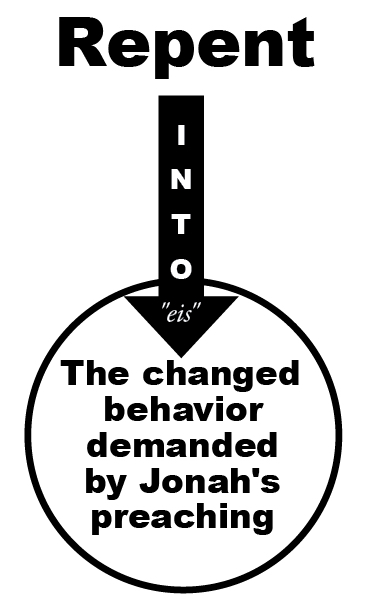
Jonah preached a succinct, simple, but demanding, message to pagan Gentiles. What was the result? Did they offer mere oral platitudes that paid lip service to religion—like the scribes and Pharisees? No, they truly repented. But, apart from Jesus informing us of their repentance, how do we know they repented, seeing that the Bible terms for repentance are not used in the Jonah account to describe their response? Because we are informed what, precisely, they did after hearing Jonah’s preaching: they proclaimed a fast, put on sackcloth, the king covered himself in sackcloth, sat in ashes, and sent forth a decree to all the Ninevites requiring abstinence from food and drink, and made loud entreaties to God (Jonah 3:5-9). Jonah 3:10 summarizes: “Then God saw their works, that they turned from their evil way; and God relented from the disaster that He had said He would bring upon them, and He did not do it.” Observe that their post-repentance activities are stylized “works” and that these extensive enactments were evidence of their repentance. Hence, they “repented into the preaching of Jonah.” Having been convinced by Jonah’s preaching to the point that they changed their thinking (i.e., repented), they then coupled their repentance with genuine compliance with the demands that Jonah laid before them. They repented into that state or condition demanded by Jonah’s preaching.1 A so-called “causal eis” does not exist.2
Endnotes
1 Jesus’ statement also constitutes an instance of the figure of speech known as “Metonymy of the Cause,” in which the cause or instrument is put for the thing effected by it. In this case, “preaching” was the instrument that Jesus mentioned, but what He was orally highlighting was the effect of Jonah’s preaching. For a discussion of this figure of speech, see E.W. Bullinger (1898), Figures of Speech Used in the Bible (Grand Rapids, MI: Baker, 1968 reprint), pp. 545ff.
2 For a discussion of the alleged “causal eis,” see Dave Miller (2019), Baptism and the Greek Made Simple (Montgomery, AL: Apologetics Press), pp. 39ff.
The post Repented “At” Jonah’s Preaching? appeared first on Apologetics Press.
]]>The post Apologetics and the Scoffer appeared first on Apologetics Press.
]]>Rather than being a disconnected hodgepodge of unrelated maxims, Proverbs constitutes a distillation of wisdom gleaned from the Law of God. Wisdom is the general subject matter of the book, but the central theme is stated in 1:7—“the fear of the Lord is the beginning of knowledge, but fools despise wisdom and instruction” (cf. 9:10; 15:33). In other words, the starting point for life and the real essence of wisdom is fear of God. True living cannot commence without first a genuine respect for God. A healthy fear of the Lord entails a reverence for God that includes obedience and submission to His will (Job 28:28; Psalm 111:10; Ecclesiastes 12:13). A person’s life cannot even “get off the ground” until a humble respect for God and His will is in place. Once the prerequisite of genuine regard for God is intact, the individual is in a position to hear God and to begin the process of assimilating God’s wisdom as it relates to a variety of life’s characteristics, including pride/humility, wealth/poverty, folly, goodness, use of the tongue, vengeance, strife, gluttony, justice, love, lust, laziness, death, friends, and the family.
A SCOFFING SOCIETY
The last half-century in America has brought sweeping cultural changes. Many of the values and beliefs of our civilization have been jettisoned or significantly altered. As one example, consider the fact that society in general is less respectful, less serious, and less self-controlled. More people tend to be flippant and irreverent. Paul spoke of the importance of being sober-minded, serious, and reverent (Titus 1:2-8). It’s as if the further our nation moves away from God and His moral precepts, the more reckless, undisciplined, uncontrolled, and irreverent people become. Eventually, nothing is sacred or worthy of respectful, cautious, careful handling.
Such is the case with the “scoffer” of Proverbs. Various forms of the term (verb, participle, noun) occur some 18 times in the book. Depending on the translation, the noun form is generally translated “scorner” (KJV), “scoffer” (NKJV, ASV, NASB, RSV), or “mocker” (NIV). In identifying the meaning of the underlying Hebrew terms, the language authorities speak of “chatterers,” “overbearing tittle-tattle,” “arrogant men,” “rebels,” “to brag, speak boastfully,” “to put on airs,” “to scoff, deride,” “to encourage scorn.”1 They also speak of ridicule, scorn, and mockery, make fun of, in association with arrogance, wickedness, licentiousness, and folly.2 Our English dictionaries define “scorn” as “contempt or disdain felt toward a person or object considered despicable or unworthy; to reject or refuse with derision.” “Scoff” is defined as “to mock at or treat with derision or scorn.” “Mock” means “to treat with ridicule or contempt; deride, jeer.” A good summary description of the “scoffer” is seen in the comment by the classic Hebrew lexicographer William Gesenius: “a frivolous and impudent person, who despises scoffingly the most sacred precepts of religion, piety, and morals.”3
Characteristics of the Scoffer
Solomon had much to say about this prideful, stubborn approach to life. Proverbs 1:20-22 (NASB) reads:
Wisdom shouts in the street, she lifts her voice in the square;
At the head of the noisy streets she cries out;
At the entrance of the gates in the city she utters her sayings:
“How long, O naive ones, will you love being simple-minded?
And scoffers delight themselves in scoffing and fools hate knowledge?”
The scoffer is in the same class with fools and the naïve—those disinterested in acquiring the wisdom and knowledge that can only come from God. A “fool” in Proverbs is not someone who is mentally handicapped; it is the person who is morally deficient because he or she rejects the approach to life advocated by God. Proverbs 9:7-8 reads:
He who corrects a scoffer gets dishonor for himself,
And he who reproves a wicked man gets insults for himself.
Do not reprove a scoffer, or he will hate you,
Reprove a wise man and he will love you.
Observe that Solomon meant that if you impart correction and reproof to someone with a prideful attitude, you are wasting your time, “casting your pearls before swine” (Matthew 7:6), and will receive only abuse, hate, and resentment in return. We so often feel like it is our duty and mission in life to correct everyone around us. This passage teaches that we need to be more judicious and discriminating regarding when to “weigh in” on a matter that arises in another person’s life. We literally must make an assessment of such a person before we offer advice (Proverbs 26:4-5).4 That assessment would have to be based on “fruit” (Matthew 7:20).
Proverbs 9:12 states: “If you are wise, you are wise for yourself, and if you scoff, you alone will bear it.” In other words, by embracing and inculcating wisdom into your life, you will receive its benefits and be rewarded. On the other hand, if you scoff at wisdom and refuse to apply God’s insight to your circumstances, you will hurt yourself by being your own worst enemy. Past generations captured this concept well in the reference to those who would “cut off their nose to spite their face.”
Proverbs 14:6 says: “A scoffer seeks wisdom and does not find it, but knowledge is easy to him who understands.” By “seeking wisdom,” Solomon means that a scoffer’s pursuit of proper thinking and insight is a useless enterprise, since he is not actually interested in finding it. For him, the pursuit of wisdom is a vain exercise. But if our heart and attitude is right, and we are sincerely and sensibly seeking God’s perspective, we will find it. When Festus accused Paul of being driven insane by learning, Paul responded: “I am not mad, most noble Festus, but speak the words of truth and reason” (Acts 26:25). Spiritual insight and the wherewithal to function effectively in this life is available to those who sincerely, genuinely desire it. As Jesus explained: “If anyone wants to do His will, he shall know concerning the doctrine” (John 7:17).
Proverbs 15:12 informs us: “A scoffer does not love one who corrects him, nor will he go to the wise.” Again, the scoffer resents constructive criticism and helpful input that would make life go better for him and spiritually prepare him for eternity. His complete lack of interest in spiritual things, and his prideful, self-absorbed attitude means that he refuses to enlist the aid of those who could help him, those who have already “been around the block.”
Rearing a Scoffer
From whence come scoffers? How do they arise? How does a person become a scoffer? Proverbs addresses these questions as well. Proverbs 13:1 reads: “A wise son heeds his father’s instruction, but a scoffer does not listen to rebuke.” The very nature and attitude of a scoffer means that he will not listen to sage counsel from parents and others who would help him. It also means that he will not receive the benefits to be gained from being disciplined—either orally or physically. That is one reason why parents must start young in the administration of corporal punishment: “Foolishness is bound in the heart of a child; but the rod of correction shall drive it far from him” (Proverbs 22:15). One of the ways to head off having a scoffer for a son or daughter is to address the scoffing attitude early on. Spanking must have as its end to alter attitude. If the application of physical pain to the posterior does not alter the attitude, perhaps you did not get the job done and more diligence is needed.
Proverbs 17:21 says: “He who begets a scoffer does so to his sorrow, and the father of a fool has no joy.” Observe that “scoffer” is put in parallel construction with “fool,” showing the close connection between the two. Proverbs has much to say about parenting. Sometimes the unwillingness of the scoffer to listen to advice and to heed wise counsel is an indication that his parents did not get the job done early on. Parents must make a child listen to them. That’s not something that comes naturally for a child. A child must be made to show respect and to be attentive to parental guidance. Children are self-absorbed and consumed in their little world, so they must be brought to reality by parents who insist/demand that the child stop his preoccupation with trivialities, look the parent in the face, and pay attention to the parent’s instructions. Such respect and honor must be taught and demanded. Proverbs also has much to say about the fact that bringing a child under control in order to instill respect for authority and receptivity to wisdom takes corporal punishment (13:24; 19:18; 22:15; 23:13-14; 29:15,17). When such is done early in the child’s life, depending on the child, it will be needed rarely as time goes by.
On the other hand, when that aspect of childrearing is neglected or omitted, the adult that results is in need of firmer measures than mere verbal rebuke: “Strike a scoffer, and the simple will become wary; Rebuke one who has understanding, and he will discern knowledge” (Proverbs 19:25). Notice that there are people in society who will not be corrected by mere oral admonition. God Himself declares that physical punishment is necessary and appropriate. Yet, our society has degenerated so far from God that they would declare such punishment as “cruel and inhumane.” Remember that Eli’s own two sons—who were not mere boys—were in need of more than the verbal reprimands their father gave them (1 Samuel 2:23-25). They were in need of physical intervention and restraint (1 Samuel 3:13). Corporal and capital punishment were authored by God (Genesis 9:6; Proverbs 13:24; Romans 13:4).
Adult Criminal Behavior
Observe also the effect that the punishment of lawless people has on others in society: “Strike a scoffer, and the simple will become wary” (Proverbs 19:25). It is a fact that punishment of the lawbreaker is a deterrent to the spread of criminal behavior. God stated that principle repeatedly in the Old Testament, and even repeated it in the New (Deuteronomy 13:11; 17:13; 21:21; Acts 5:11; 1 Timothy 5:20). The Bible teaches the corollary of this principle as well. Where there is inadequate, insufficient, or delayed punishment, crime and violence increase. As Solomon stated in Ecclesiastes 8:11—“Because the sentence against an evil work is not executed speedily, therefore the heart of the sons of men is fully set in them to do evil.” This very phenomenon is occurring even now in our country—and even in the Church. The concept is repeated in Proverbs 21:11—“When the scoffer is punished, the simple is made wise; but when the wise is instructed, he receives knowledge.” Proverbs 19:29 reads: “Judgments are prepared for scoffers, and beatings for the backs of fools.” Question: Based on such declarations, does God want scoffers punished? To ask is to answer.
Yet, our criminal justice system, beginning in the 1960s, has been turned away from the original intent of the Founders. The architects of American jurisprudence sought to emulate Bible principles and inculcate into our laws the thinking of God. But in recent years, the entire system has shifted from concern for the rights of the victim to the rights of the criminal. Our prisons are full to overflowing, and lawlessness continues to increase. The godly concept of justice has fallen on hard times. As if describing our own society, Proverb 19:28 declares, “A disreputable witness scorns justice.” “Scorns” is the verb form of the word for scoffer. Those who are either lawbreakers themselves or who “approve of those” (Romans 1:32) who are, scoff at justice. Proverbs 14:9 adds: “Fools mock at sin.” That is precisely why John Adams, Signer of the Declaration of Independence, Vice-President under George Washington, and Second President of the United States, declared on October 11, 1798—“We have no government armed with power capable of contending with human passions unbridled by morality and religion…. Our constitution was made only for a moral and religious people. It is wholly inadequate to the government of any other.”5 The greater the numbers of Americans who scoff at justice and Christian morality, the more inevitable will be our national doom.
The Heart of the Scoffer & How to Handle It
Proverbs 21:24 pinpoints the central malady of the scoffer: “A proud and haughty man—‘Scoffer’ is his name; he acts with arrogant pride.” Here is the perennial problem of us all: pride. It reared its ugly head in the Garden, and it threatens us now. The scoffer is inherently prideful. The bottom line, taproot cause of all departure from God’s will is human pride. Pride is the attribute of thinking highly of self (Romans 12:3). Pride is self-centeredness. It is approaching life from the perspective of personal desire—what do Iwant? What will make me happy? What will bolster my status? What will enhance my circumstances? No wonder John summarized the nature of worldliness in terms of the three avenues through which Satan seeks to subvert people: the lust of the flesh, the lust of the eyes, and the pride of life (1 John 2:16). Even the lust of the flesh and eyes are actually further manifestations of pride. When our flesh and our eyes desire something which we should not have, the motivation behind the fleshly lust is the desire to enhance self. Selfishness is the essence of pride. The scoffer is eaten up by it.
Proverbs 22:10 gives additional advice on how to deal with the scoffer: “Cast out the scoffer, and contention will leave; yes, strife and reproach will cease.” Let’s get direct and practical on this one. What are the elders to do with a member of the church who stirs up trouble by mocking authority, righteousness, or serious matters? What should be done when a member badmouths the elders behind their backs, and undermines their authority because of a decision they’ve made? Solomon said: “Cast him out.” Paul agreed with Solomon. He told the church at Corinth regarding an impenitent fornicator: “[W]hen you are gathered together, along with my spirit, with the power of our Lord Jesus Christ, deliver such a one to Satan…. [P]urge out the old leaven…. Therefore ‘put away from yourselves the evil person’” (1 Corinthians 5:4-5,7,13).
So very much heartache, division, and confusion has been generated in the Church over the years simply because those causing division were not handled promptly and biblically. We have not taken God’s words seriously. We’ve lacked the faith and zeal to step up to the plate and act. We do not share God’s sentiments when He says: “The devising of foolishness is sin, and the scoffer is an abomination to men” (Proverbs 24:9). We have allowed the body of Christ to be torn asunder, because we did not listen to our God when He warned us that “Scoffers set a city aflame, but wise men turn away wrath” (Proverbs 29:8).
Who Are the Scoffers Today?
Who in our day fits the description of the scoffer from the book of Proverbs? First on the list would surely be many atheists, agnostics, skeptics, and evolutionists. The world population stats show that over one billion people on the planet claim no affiliation with religion in any form. They scoff at the idea of God and those who follow Him. They believe that the Universe and life on Earth came about solely through naturalistic processes without any divine intelligence. They scoff at anyone who thinks otherwise. They believe that only the physical Universe exists with nothing metaphysical—beyond the physical. In this category would be many of the radical animal rights people and environmentalists who think that animals are people and that it’s up to humans to save the planet. The Bible assessment of such individuals is simple: “The fool has said in his heart, ‘There is no God’” (Psalm 14:1; 53:1).
Observe that the Christian apologist who defends the existence of God and the inspiration of the Bible must be prepared to recognize and cope with what it feels like to be scoffed at. For example, legion are those today who scoff at the historicity of the Noahic Flood—though the geological evidence for such a catastrophic deluge is worldwide.6 The strategy of the scoffer is to make the recipient of his scoffing to feel pressure to give up his view and accept the thinking of the scoffer. The victim is made to feel that the scoffer possesses knowledge that the victim is not privy to; the scoffer’s condescending jab creates an air of authority designed to intimidate and bully the believer into submission and gather other followers from among his audience. The approach is effective and explains why Scripture warns about scoffers so often and how to handle them. No wonder Peter explained:
…knowing this first: that scoffers will come in the last days, walking according to their own lusts, and saying, “Where is the promise of His coming? For since the fathers fell asleep, all things continue as they were from the beginning of creation.” For this they willfully forget: that by the word of God the heavens were of old, and the earth standing out of water and in the water, by which the world that then existed perished, being flooded with water. But the heavens and the earth which are now preserved by the same word, are reserved for fire until the day of judgment and perdition of ungodly men (2 Peter 3:3-7).
Modern uniformitarian “geology” was developed by scoffers as a direct counter to biblical catastrophism and the Flood. The Christian must not capitulate to such deceitful tactics. The truth outweighs the counterfeit confidence of the scoffer.
Who else qualifies as a scoffer? Those people and organizations that seek to undermine the American way of life often merit the label when they mock and belittle those individuals who seek to uphold it. By “American way of life,” I mean the Christian moral principles on which the nation was founded. Organizations such as the ACLU, AUSCS, FFR, BLM, Antifa, and LGBTQ groups are feverishly attempting to silence God in our society by systematically expunging all references to God, Christ, and the Bible from our schools, our government, and public life. In close proximity to these groups are those liberal politicians who also have made it clear that they share the same anti-Christian views.7
Two premiere, politicized moral issues, that have become prominently championed by liberal politicians, liberal media, the educational system, Hollywood, and beyond, are abortion (which includes embryonic stem-cell research) and homosexuality (which has expanded to include transgenderism). Since the 1960s, the Feminist Movement and other subversive forces, have scoffed at the traditional American values that made our nation great. They have demeaned and ridiculed the home and family as God intended. They have celebrated sexual promiscuity and demanded the right to destroy unborn babies—to the tune of more than 63 million since 1973.8 Their lust for sexual license has led to the widespread acceptance of homosexuality—a catastrophic issue in the culture war that is raging across the country.9 The decline of sexual sensibility has sparked cries for the acceptance of polygamy and other forms of sexual deviancy. All such people are scoffers who scoff at God and His plan for the home—the basic building block of humanity. The faithful must not flinch in the face of such forceful coercion.
CONCLUSION
A fitting conclusion to this brief consideration of the scoffer is found in Proverbs 3:33-35. Ironically, the Lord Himself will heap back upon the scoffer his own scoffing, even as He will bring judgment on the scoffer in the end:
The curse of the LORD is on the house of the wicked,
But He blesses the home of the just.
Surely He scorns the scornful,
But gives grace to the humble.
The wise shall inherit glory,
But shame shall be the legacy of fools (Proverbs 19:29).
ENDNOTES
1 L. Koehler, W. Baumgartner, M.E.J. Richardson, & J.J. Stamm (1994-2000), The Hebrew and Aramaic Lexicon of the Old Testament (Leiden: E.J. Brill, electronic ed.), pp. 529,533-534.
2 William Gesenius (1847), Hebrew and Chaldee Lexicon (Grand Rapids, MI: Baker, 1979 reprint), pp. 435,440; William Holladay (1988), A Concise Hebrew and Aramaic Lexicon of the Old Testament (Grand Rapids, MI: Eerdmans), p. 176.
3 Ibid., p. 435.
4 Jeff Miller (2017), “Jesus Gave Him No Answer,” Reason & Revelation, 37[10]:112-113, 116; Eric Lyons (2004), “He Opened Not His Mouth,” Apologetics Press, https://apologeticspress.org/apcontent.aspx?category=6&article=1437.
5 John Adams (1854), The Works of John Adams, Second President of the United States, ed. Charles Adams (Boston, MA: Little, Brown, and Company), 9:229.
6 Jeff Miller (2019), “Was the Flood Global? Testimony from Scripture and Science,” Reason & Revelation,39[4]:38-41,44-47.
7 History demonstrates that socialism, communism, and Marxism have shown themselves to be antithetical to Christianity.
8 http://www.numberofabortions.com/.
9 See Jeff Miller and Dave Miller (2021), Homosexuality: Scripture, Society, Science, and Psychology (Montgomery, AL: Apologetics Press).
The post Apologetics and the Scoffer appeared first on Apologetics Press.
]]>The post Sym-Bee-O-Sis appeared first on Apologetics Press.
]]>The relationship between great teammates on a basketball team is a symbiotic (sim-bee-AH-tic) relationship. A symbiotic relationship is one that is mutually helpful or dependent. A point guard is helped by having good 3-point shooters, and these shooters are helped by having a great point guard. They depend on each other to succeed.
One of the most important physical symbiotic relationships on Earth is between honey bees and various forms of vegetation. God made many kinds of plants and fruit trees, so that in order for them to bear fruit there needed to be a transfer of pollen. How could pollen get transferred from plant to plant, thus fertilizing vegetation and making the growth of fruit, vegetables, and flowers possible? God made flying insects.
 Bees are important to many kinds of vegetation (and thus to us as well, since we eat fruits and vegetables). Bees, and especially honeybees, help to pollinate everything from okra and cucumbers to watermelons and kiwi fruit.
Honey bees, however, also benefit from plants. Honey bees use the pollen from plants as a source of protein, especially for their young. Honey bees also use the nectar from flowers to make honey. So, honeybees help plants, and plants benefit honeybees—a perfect example of symbiosis.
Have you ever thought about how bees, plants, and symbiosis point to a Creator? If bees need plant life to survive, and many kinds of plant life need insects (especially honey bees) to reproduce, then both vegetation and insects needed to be created at virtually the same time. The Bible indicates that God made all plant and animal life within three days of each other. On the other hand, evolution says that everything evolved gradually over millions of years. Yet, how could flowers that needed help pollinating and bees that need pollen and nectar from flowers have been separated by millions of years and still survive? They couldn’t. In truth, the sweet symbiotic relationship between honey bees and vegetation is just another proof for Creation and against evolution.
SWEET SYMBIOSIS AMONG SAINTS
Jesus designed His Church to form symbiotic relationships among themselves and with those who are not Christians. Think about some ways in which this works.
 |
 |
 |
Some saints are very gifted public speakers and preachers. They can build up Christians by teaching God’s Word, and they can help those outside of the Church by showing them God’s plan of salvation and leading them to Christ.
Other Christians are good businessmen or businesswomen. They can earn money through their businesses and give it to the Church. The Church can then use that money to help feed poor people, give clothes and medicine to those in need, or provide shelter for those who might not have a place to stay.
There are others in the Church (such as older, retired Christians) who might have lots of free time. They can use their time to visit people in hospitals or nursing homes, or to take food to shut-ins.
Still other saints have special skills that they can use to help others. Some members of the Church are doctors who go to foreign countries and take care of sick people.
When we think about symbiosis, we should not forget that humans can be very helpful to their fellow humans. Those of us who are Christians should always be looking for ways that we can help our fellow Christians, as well as those who are not Christians (Galatians 6:10). Many times, those who are not Christians will see how we try to help people, and glorify our Father Who is in heaven (Matthew 5:16).
The post Sym-Bee-O-Sis appeared first on Apologetics Press.
]]>The post God and Money appeared first on Apologetics Press.
]]>____________________________________________________________________________
Kevin loved the 20thof November. It was his birthday. Today happened to be the 20thof November, and he was turning 12. For the past 11 years his grandmother sent him a birthday card; but not just a plain old birthday card. She gave him 10 dollars—for every year of his life! That meant he was going to get $120 today, if today was like the last 11 years. For two weeks he had been thinking about what he wanted to buy. Amazon had the coolest remote control Hummer. It was “only” $89. If he bought that, he would have a little left to buy a new video game for his Playstation®.
He put his clothes on and rushed downstairs. Just as he expected, the birthday card was waiting for him. His Dad had it in his hands, tapping it on the rail of the stairs.
“Kevin,” said his Dad. “I think I’ve got something you might want.”
“Yes, sir. That looks like my birthday card from Grandma.”
“It sure is, Son. And if I know your Grandma, this is going to be a lot of money.”
“I sure hope so,” Kevin answered with excitement.
Kevin’s Dad handed him the envelope. Kevin took it, opened it, and stared at the cash—six crisp $20 bills. It was the most money he had ever been given at one time.
Kevin turned to go back upstairs, but his Dad stopped him.
“Kevin, it’s time we had a talk.”
“About what, Dad?”
“It’s time we talked about money—and God.”
Kevin had never really thought that God and money had much to do with each other. He was interested in what his Dad had to say.
“Ok, Dad,” said Kevin as he sat down on the couch in the living room.
“Let me ask you a question son. Whose money is that $120 you are holding?”
That seemed like a very silly question. It was his money. His grandmother gave it to him for his birthday. He was surprised his Dad asked such an odd question. He looked at his Dad and said, “It’s my money. Grandma gave it to me.”
“Are you sure?” said his Dad.
Kevin thought for a minute. Was he missing something? He didn’t owe his Dad any of it. Yes, he was confident the money belonged to him.
“Yes, it is my money.”
“I thought you might say that, Kevin. But did you know it’s not your money?”
“I don’t understand,” said Kevin in a puzzled voice. “Whose money is it?”
“The Bible tells us that all things, including all the money in the world, belong to God. In Psalm 50:12 God said: ‘For the world is Mine, and all its fullness.’ When King David was collecting material for Solomon to build the temple, he prayed to God, ‘For all things come from You, and of your own we have given You’ (1 Chronicles 29:14). The money you are holding is really God’s money.”
Kevin thought about that for a minute, and realized his Dad was right.
His Dad continued: “God has given you the money to use, but it does not belong to you. God has made you a steward of His money.”
“What is a steward?” Kevin asked.
“A steward is someone who takes care of something for another person.”
“I think I’m starting to understand,” said Kevin. “Like last year when our neighbors left me in charge of feeding and walking their dog. He wasn’t my dog, but I was taking care of him for someone else.”
“Exactly, Kevin, I think you are beginning to understand.”
Kevin thought for a minute, then asked his Dad, “If this is God’s money, what does He want me to do with it?”
“That’s a great question. Let’s look at what the Bible says.”
Kevin’s Dad picked up his Bible from the coffee table and turned to 1 Corinthians 16:1-2, and read: “Now concerning the collection for the saints, as I have given orders to the churches of Galatia, so you must do also: On the first day of the week let each of you lay something aside, storing up as he may prosper….” “Do you know what that means, Kevin?”
“I think so. That means on Sundays we should give some of our money to God when we meet with the Church.”
“Very good, Kevin. You’re really picking up on this fast.”
“One thing I don’t understand, though, Dad. How much should we give? Should we give $1? $10?”
“Great question, Kevin. The verse says each person should give ‘as he may prosper.’ That means the more a person has, the more he should give. If a person has $100 and gives as he prospers, then he will give more than a person who has $20.”
“So, how much should I give?” Kevin said thoughtfully.
“Another great question, Kevin. But it is one you have to answer for yourself. In the Old Testament, the Jews were commanded to give at least 10 percent of their income. That would mean you would give $12. But we are not under the Old Testament, we obey the New Testament.”
“Does that mean I could give less than $12?” said Kevin.
“Let’s think about that. In 2 Corinthians 9:6-7, the Bible says: ‘But this I say: He who sows sparingly will also reap sparingly, and he who sows bountifully will also reap bountifully. So let each one give as he purposes in his heart, not grudgingly or of necessity; for God loves a cheerful giver.’”
“Do you understand these verses, Kevin?”
“Well, it seems like the Bible is saying that God blesses us more if we give more. And we should be happy to give and not be sad about it.”
 Kevin’s Dad patted him on the back. “That is what these verses are saying. Our lives will be better if we learn to give cheerfully. God knows that the more we give, the happier we will be. Let me show you another verse. Acts 20:35 says: “And remember the words of the Lord Jesus, that He said, ‘It is more blessed to give than to receive.’”
“Kevin, do you understand what Jesus was saying?”’
“Yes, sir. He was saying that getting money and good stuff is fun and exciting, but giving things to God and others who need them makes a person feel even better than getting things.”
Kevin’s dad closed his Bible. “I think you understand quite well, Son. I trust that you will be a good steward of God’s money.”
Kevin went upstairs to his bedroom. After a little thinking, he took $20 out of the card. He decided to give it back to God on Sunday. He used the rest to buy the remote control truck. He had fun jumping ramps in the backyard. And even though he didn’t get that new video game, he felt great about the way he had taken care of the money God had let him use.
____________________________________________________________________________
Becoming a good steward is an important part of being a Christian. In fact, in Luke 16:10, Jesus said: “He who is faithful in what is least is faithful also in much; and he who is unjust in what is least is unjust also in much. Therefore if you have not been faithful in the unrighteous riches, who will commit to your trust true riches?” Jesus was saying that the way you handle money says a lot about your spiritual life. Let’s decide to give back to God cheerfully so our lives will be blessed like God wants them to be.

The post God and Money appeared first on Apologetics Press.
]]>The post Grateful to Give appeared first on Apologetics Press.
]]> Did you know that when we fail to give to God or give to God reluctantly, we are having the same attitude that Tom had? When we give to those who are in need or give to God in the collection plate on Sundays, we are giving back to Him some of the money He lets us use, so that it can be used to help others. We should always be “ready to give” and “willing to share” (1 Timothy 6:18), “not grudgingly or of necessity; for God loves a cheerful giver” (2 Corinthians 9:7). Giving cheerfully shows our gratitude to God and our love of others. Are you a grateful giver?
The post Grateful to Give appeared first on Apologetics Press.
]]>The post "Does This Offend You?" appeared first on Apologetics Press.
]]>The fact is, however, just because a person is offended is not necessarily a reason to stop saying or doing something. Jesus often offended people, but that did not stop Him from preaching and teaching the truth. When a person takes offense at something, it often says much more about the heart of the one who is offended than it does about the person who supposedly “caused” the offense.
On one occasion, after Jesus taught about how the Pharisees had abused God’s Word, His apostles came to him and said, “Do You know that the Pharisees were offended when they heard this saying?” (Matthew 15:11). It is almost as if the apostles thought like many people today. They seemed to be indicating that, because Jesus had offended the Pharisees, He should stop teaching those ideas or change His message. Jesus, however, thought nothing of the sort. He knew that His message offended the Pharisees because of the hardness of their hearts, not because of the way the message was delivered. Jesus understood that the hearts of the Pharisees needed changing, not His message or even the way He delivered it. He responded to His apostles by saying, “Let them alone. They are blind leaders of the blind” (Matthew 15:14). Surely we can agree that the Pharisees would have been further offended by Jesus’ follow up comments. Their offense, however, was misplaced. They were blind to the truth. They should not have been offended at Jesus’ message. Jesus’ message was the truth that God had sent to set them free (John 8:32).
Mark 6:1-6 tells about a time Jesus returned to His hometown of Nazareth. He went to the synagogue and preached the Word as He often did in other places. The townspeople who heard Him murmured, “Where did this man get these things?… Is this not the carpenter, the Son of Mary, and brother of James, Joses, and Simon? And are not His sisters here with us?” The text then states, “And they were offended at Him.” The fact that they were offended did not mean Jesus had done anything wrong. It did not mean that He should have taken a different approach to preaching in His hometown. It meant only that the hearts of the hearers were calloused, sinful, and refused to recognize God’s message when it was preached. Jesus never cowered to the “I’m offended so you must stop” tactic, and neither should we.
At one time Jesus preached to a great multitude of His disciples. Many of His own disciples did not understand the message and “murmured” about Jesus’ preaching (John 6:61). Jesus then asked them, “Does this offend you?” (John 6:61). Many in our day would say that if Jesus offended the crowd, He was sinning and should change His message, change His delivery style, or re-word His statement to be less offensive. Jesus, however, responded by saying, “What then if you should see the Son of Man ascend where He was before?” (6:61). What was Jesus’ point? If the people were offended with Jesus’ message that He was the bread that came down from heaven, just think how they would react if they saw Jesus ascend back into heaven, which was what He planned to do in the near future (Luke 24:50-53).1 Not only did He refuse to quit preaching or change His message, He added something to the message that the audience would have had more problems accepting! Obviously, Jesus did not feel the need to stop preaching or change His message because His audience was offended.
It is certainly true that Christians should let their speech “be with grace, seasoned with salt” (Colossians 4:6). It is also true that Christians should avoid unnecessary offense (Matthew 17:27; 1 Corinthians 8). The Gospel, however, is exclusive and offensive to many people. Those with dishonest, sinful hearts will always be offended at the simplicity and straightforwardness of Christ’s Truth. As Christians, we should follow the example of our Lord. We must never be bullied into silence or intimidated into changing our message simply because a person or group is offended at the truth.
Endnotes
The post "Does This Offend You?" appeared first on Apologetics Press.
]]>The post Working for a Fortune appeared first on Apologetics Press.
]]>The master wisely gave the servants what he knew each one could handle. The servant with five talents traded and gained five more; the servant with two talents traded and earned two more. But the man with one talent buried his money in the ground and left it there until the master came back! After a long while, the master returned and asked his servants to explain what they had accomplished with the money he had given them. He was very pleased with the first two, and praised both of them for their good stewardship. On the other hand, the third servant explained that he had decided to bury his money until the master’s return.
 The master called that servant wicked and lazy for not using the money properly. The master then gave the one talent to the first servant, and explained that those who have much will receive even more, while those who have little will lose what they do have. With that, the master charged: “Cast the unprofitable servant into the outer darkness. There will be weeping and gnashing of teeth” (Matthew 25:30).
Jesus used this parable to teach that we cannot be lazy while waiting for the Judgment. If we do not work for the Lord, we will lose what we have and end up with nothing, just like the lazy servant. But if we work hard and remain faithful, we will gain even more, so that when Jesus returns, He will say to us: “Well done, good and faithful servant; enter into the joy of your Lord” (Matthew 25:21,23).
The post Working for a Fortune appeared first on Apologetics Press.
]]>The post Ezekiel’s Response to the Culture War of His Day appeared first on Apologetics Press.
]]>[NOTE: The following assessment by A.P. board member Frank Chesser is excerpted from his upcoming commentary on Ezekiel.]
Ezekiel 16 is a treasure house of nuggets of truth that Americans need to heed, ten of which will be addressed in this article. First, only divine revelation can enable a man to “know” his sin (vs. 2). Only by knowing God can a man know his sin. The Bible commences with God: “In the beginning God” (Genesis 1:1). It ends with God: “The grace of our Lord Jesus Christ be with you all. Amen” (Revelation 22:21). In between these bookends of divine truth is a library of sixty-six books that paint portraits of the nature of God, from whom all spiritual truths flow. Three words sum up the book of Isaiah and the whole of God’s revelation to man: “Behold your God” (Isaiah 40:9). When Isaiah beheld God in all of His glory, majesty and holiness, he saw the scope of his sin as never before (Isaiah 6:1-5).
Adam and Eve lost sight of the God they both saw and knew and plunged themselves and the world into darkness. “Wherefore, as by one man sin entered into the world, and death by sin; and so death passed upon all men, for that all have sinned” (Romans 5:12). The power of fleshly lust blinded the spiritual eyes of the righteous descendants of Seth to the beauty of God’s holiness as they gazed with delight upon the carnal daughters of Cain’s descendants and “they took them wives of all which they chose” (Genesis 6:2), acts of sin that produced a world of people void of a single righteous thought and opened the door to the global Flood. The first generation from Egypt never saw the God that Isaiah saw, and their lives testified to their spiritual sightlessness. God informed Samuel that from Egypt onward “they have forsaken me, and served other gods” (1 Samuel 8:8). They wanted a God of power that could liberate them from Egypt but not a God of holiness, justice, and wrath Whose very nature demanded, “Be ye holy; for I am holy” (1 Peter 1:16), and condemned and punished sin.
The idols that Israel brought out of Egypt were added to and multiplied, and they plagued the nation for most of its national life. Solomon allowed his love for God to be supplanted by his love for “many strange women” (1 Kings 11:1), and “his wives turned away his heart after other gods” (1 Kings 11:4). The northern kingdom inaugurated its national existence with roots in idolatry as Jeroboam “made two calves of gold, and said unto them, ‘It is too much for you to go up to Jerusalem; behold thy gods, O Israel, which brought thee up out of the land of Egypt’” (1 Kings 12:28). Israel became so enamored with lifeless pieces of wood and stone that God said, “Ephraim is joined to idols; let him alone” (Hosea 4:17), because His mercy upon them was gone (Hosea 1:6), He was no longer their God (Hosea 1:9), and He would “cause to cease the kingdom of the house of Israel” (Hosea 1:4). Except for a minute remnant, they lived their national life sightless of the God that Isaiah saw. They were powerless to know their sin because they rejected God’s revelation of Himself through the material Universe, the law, the prophets, and confirming miracles. God destroyed them in Assyrian captivity (2 Kings 17:21-23).
Under Rehoboam’s rule, the nation of Judah initiated their national life with idolatry as they “built them high places, and images, and groves, on every high hill, and under every green tree” (1 Kings 14:23). With a few exceptions, they followed king after king who led them in idol worship and all of its confederate sins. God told Isaiah that except for a “very small remnant” (Isaiah 1:9), Judah would never be able to see their sin because they refused to see Him (Isaiah 6:5-12). This very chapter is permeated with God’s condemnation of Judah’s idols and their affiliated sins. Ezekiel’s audience in Babylon was led by leaders with “idols in their heart” (14:3), who could not see and know their sin because they could not see the “glory of the Lord” that Ezekiel saw (1:28).
Second, covetousness is idolatry. Paul affirmed this truth in Colossians 3:5. Verse 3 of Ezekiel 16 illustrates it. Why does God point to Canaan as the place of Israel’s national birth? Not because they were actually born there, but because Israel coveted the gods of Canaan and the sins of the flesh that idol worship allowed. This covetous spirit inhered in Israel’s request for a king so they could “be like all the nations” (1 Samuel 8:20). God said, “they have rejected Me that I should not reign over them” (1 Samuel 8:7). This rebellious spirt was not something new in the hearts of Israel. It was Samuel’s appointment of his wicked sons as judges that opened the door for Israel to request a more formal system of government that would remove every vestige of their national distinctiveness and allow them total kinship with the heathen nations of the world.
Israel had already been living like pagans for over three centuries. When Joshua and those who served him died, “there arose another generation after them which knew not the Lord” (Judges 2:10). They did not know the Lord because they did not want to know the Lord. They were like the people of Judah, “for they proceed from evil to evil, and they know not me saith the Lord” (Jeremiah 9:3). Israel lived among the heathens in Canaan, intermarried with them, and adopted their gods as their own (Judges 3:5-7). They coveted the heathenish lifestyle that idolatry licensed. They loved their idols because they loved the “pleasures of sin” (Hebrews 11:25) that they vouchsafed to them. They “ceased not from their own doings, nor from their stubborn way” and “every man did that which was right in his own eyes” (Judges 2:19; 21:25).
Covetousness lusts, longs, yearns, and desires. It is selfishness in its purest form. It is determined to have its way regardless of the consequences. Eve desired self-rule to the ruin of her life in Eden (Genesis 3:5-6). The cities of the plain lusted for sexual sin to their utter destruction (Genesis 19). Achan “coveted” gold, silver, and a garment to the subversion of himself and his family (Joshua 7:21). David yearned for his neighbor’s wife to the detriment of his spiritual life, family, and stature in Israel and the world (2 Samuel 11-12). Amnon longed for his brother’s wife and paid for his covetousness with his life (2 Samuel 13). Solomon coveted “strange women” and strange gods (1 Kings 11:1,4-8), to his personal ruin and the ruin of Israel. A thief (John 12:6) and a traitor (John 18:2) were the products of Judas’ covetous spirit. Herod’s desire for personal acclaim led to his death on a bed of agony (Acts 12:21-23). Demas yearned for worldly pleasure (2 Timothy 4:10), Diotrephes for preeminence (3 John 9), and Israel for the gods of Canaan to the spiritual devastation of each.
Third, Israel misread God’s love, grace, and goodness. The nation is depicted as a new born infant, discarded and left to die, floundering in the blood of its birth, and void of human pity (16:4-5). God washed, cleaned, clothed, fed, loved, protected, preserved, and blessed Israel to her national maturity. Israel viewed God’s work as merit because they were fleshly descendants of Abraham and special in their own eyes. God denied repetitively their right to specialty and feelings of superiority to all other nations, but they refused to believe it. God affirmed that His spiritual blessings through Abraham embraced “all families of the earth” (Genesis 12:3), but Israel could see only themselves as recipients of God’s love and goodness. Three times in three verses (Deuteronomy 9:4-6), God asserted that they did not deserve the land of Canaan, and then reminded them that from Egypt to that moment, “ye have been rebellious against the Lord” (Deuteronomy 9:7). But nothing that God said or did in acts of judgment upon them could shake their feelings of national peerlessness.
It was God’s intention to reach Calvary with the seed of woman and Abraham (Genesis 3:15; 12:3). This was a work of pure love, grace, and goodness, and national Israel fought God every step of the way. They loathed the law of God and loved their idols. They thought they could sin with impunity (Jeremiah 7:8-10). The Old Testament closes with Israel’s corrupt priests’ horrendous accusation of God’s delighting in evildoers, robbing God of tithes and offerings, and affirming the vanity of serving God (Malachi 1-3). The New Testament opens with John the Baptist in spiritual combat with Pharisees and Sadducees yet clinging to Abraham as their spiritual savior (Matthew 3:7-9). Having pointed to the truth that makes man free, Jesus encountered this Jewish proclivity as some answered, “We be Abraham’s seed and were never in bondage to any man” (John 8:33). It took miraculous intervention (Acts 10) to convince Peter that what God said in Genesis 12:3, what Jesus said in John 3:16, and what Peter said in Acts 2:39 was the truth. Prior to embracing Christ and the Gospel, Paul considered his Jewishness as “gain” (Philippians 3:7). To this present hour, the love, grace, and goodness of God is sifted in the sieve of human reasoning.
Fourth, misplaced trust leads to spiritual ruin. “But you trusted in your own beauty, played the harlot” (vs. 15). Improper entities of trust assume many and diverse forms and all lead to spiritual decay. Moses warned Israel about displacing God with fortified walls as objects of their trust (Deuteronomy 28:32). Israel trusted in oppression and perverseness (Isaiah 30:12), military aid from Egypt (Isaiah 31:1), idols (Isaiah 42:17), wickedness (Isaiah 47:10), vanity (Isaiah 59:4), lying words (Jeremiah 7:8), the temple (Jeremiah 7:14), and in their own ways and mighty men (Hosea 10:13). God placed a curse upon “the man that trusted in man” (Jeremiah 17:5) and likened him to a shrub in the desert barely cleaving to life and without hope for betterment (Jeremiah 17:6). Paul warned about trusting in “uncertain riches” (1 Timothy 6:17).
Biblical faith involves trust and obedience. The Word of God is the basis of faith (Romans 10:17), and the faith that saves is the faith that obeys God. Jesus described faith as a work (John 6:28-29), and Paul spoke of the “work of faith” (1 Thessalonians 1:3) and the “obedience of faith” (Romans 16:26), because faith is active in its submission to the will of God. James said, “I will show thee my faith by my works” (James 2:18). The object of faith’s trust is God, not the works of righteousness that faith produces. The Pharisee was rejected because he trusted in himself and his own works instead of God (Luke 18:9-14). Misplaced trust negates Biblical faith.
Fifth, Israel abused blessings on loan from God (vss. 16-21). They honored their idols with gifts from God. They made, adorned, and paid homage to the works of their own hands with material endowments from God. Having abandoned all natural affection, they descended into the depths of human depravity by offering their children as sacrifices to their idols. God said these children were “born unto me” (vs. 20), and they have “slain my children” (vs. 21).
Israel was a steward of the blessings of God and so are all men. Stewardship does not imply ownership. A steward does not own anything. “For we brought nothing into this world, and it is certain we can carry nothing out” (1 Timothy 6:7). God allows man an accommodative usage of “my money, house, land, cars,” but these and all material things are gifts and blessings from God and on loan from God. God is the “possessor of heaven and earth” (Genesis 14:19); everything “under the whole heaven” (Job 41:11) belongs to Him; “The earth is the Lord’s, and the fullness thereof; the world and they that dwell therein” (Psalm 24:1), and all the silver and gold on Earth belongs to God (Haggai 2:8).
David pointed to the material riches that he and Israel had donated for the construction of the temple and asserted, “But who am I, and what is my people, that we should be able to offer so willingly after this sort? For all things come of thee, and of thine own have we given thee” (1 Chronicles 29:14). Joseph was the steward over Potiphar’s house and “all that he had he put into his hand” (Genesis 39:4), but not one thing belonged to Joseph. Even a man’s children belong to God. “Lo, children are an heritage of the Lord: and the fruit of the womb is his reward” (Psalm 127:3). Israel misused blessings and gifts on loan from God and so has the preponderance of humanity from time’s beginning.
Sixth, idolatry and sexual sin are twin sins. Illicit sexual conduct inheres in Ezekiel’s “eminent place” (vss. 24,31,39), his phrase “opened their feet to everyone that passed by” (vs. 25), and the “great of flesh” (vs. 26) comment that describes the fleshly lewd nature of Egyptian idolatry borrowed and made common in Israel’s own idolatrous practices. This chapter pulsates with sexual connotations. Physical whoredom follows spiritual whoredom like the night follows the day. Physical adultery is spiritual adultery’s shadow. It is idolatry’s cardinal sin. Balaam knew that idolatry and fornication were comrade sins and would bring divine judgment upon Israel that his initial efforts failed to achieve (Revelation 2:14; Numbers 25:1-9). If sexual lust in thought and act was idolatry’s only fruit, the worship of idols would yet have been as common in Israel as the rising of the Sun.
Seventh, memory failures beget ingratitude that often ends in spiritual death. The spirit of thanksgiving is as rare as was the good man in Israel (Micah 7:2). In an unsurpassed catalog of massive evils, ingratitude was at the top of the list (Romans 1:21). When a man refuses or neglects to reflect daily on the innumerable wonders of God’s love, grace, and goodness, he is paving the road to his own spiritual deterioration. Twice, Ezekiel points to Israel’s failure to remember the blessings of God in her national youth as one of the foundational reasons for her idolatry and companioned sins (vss. 22 and 43). Joseph languished two additional years in prison because the chief butler of Pharaoh did not “remember Joseph, but forgot him” (Genesis 40:23).
One negative report from ten spies drained Israel’s memory of God’s mighty miracles in Egypt onward and left them weeping all night in ingratitude and unbelief (Numbers 14:1-3). “Remember” was one of the key words that Moses used in his final sermon to the second generation from Egypt in the book of Deuteronomy. When David saw Bathsheba bathing, if he had supplanted inquiring about her (2 Samuel 11:3) with reflection and gratitude for God’s love and goodness, he would never have consummated his act of adultery. Remembering and thanking God continually for the blessings of 1 Kings 10 would have saved Solomon from the evils and consequences of 1 Kings 11. In conjunction with his wife, Jehoiada saved, protected, preserved, and aided Joash in becoming king and ruling over Judah until he died. At Jehoiada’s death, Joash forsook God, embraced idolatry, rejected the preaching and warnings of the prophets, and had Jehoiada’s son, Zechariah, stoned to death for rebuking him. Inspiration’s report of this tragedy reads, “Thus Joash the king remembered not the kindness which Jehoiada his father had done, but slew his son” (2 Chronicles 24:23-25). Memory failures and ingratitude accompany every continuous sin and sin of rebellion.
Eighth, the desires of the flesh are insatiable (vss. 28-34). Israel pursued political alliances with the heathen nations and claimed their gods as their own. Pagan nations were jealous and protective of their own gods, but Israel’s love affair with idols was indiscriminate. Multiplying gods meant multiplying opportunities for the flesh. When Syria was defeated by Israel, instead of forsaking their gods, the Syrians chose a different location for their conflict, declaring, “Their gods are gods of the hills, therefore they were stronger than we; but let us fight against them in the plain, and surely we shall be stronger than they” (1 Kings 20:23). Conversely, when Assyria’s military proved superior to Israel’s, Ahaz said, “Because the gods of the king of Syria help them, therefore will I sacrifice to them that they may help me. But they were the ruin of him and of all Israel” (2 Chronicles 28:23).
When a man’s life is void of God, it is void of reason. There is nothing rational about the flesh. It feels, but does not think. Severed from God, law, and restraints, it choses sin’s pleasures with reckless abandon. Noah’s contemporaries were dominated by the “flesh” (Genesis 6:3) and pursued its ravenous passions until their minds were empty of a single righteous thought. A lifetime of fleshly lust cannot quench the fires of its interest. It does not pause to consider its ways. It is ever open to new ways of expression. It is oblivious to shame. Were the prophets, priests, and wise men of Judah “ashamed when they had committed abomination? Nay, they were not at all ashamed, neither could they blush” (Jeremiah 8:12). The flesh does not need the darkness to conceal its baseness. It considers it a “pleasure to riot in the daytime” (2 Peter 2:13). It possesses “eyes full of adultery, and that cannot cease from sin” (2 Peter 2:14). Israel loved their gods of wood and stone because they allowed the flesh the freedom to pursue its uninhibited desired ends.
Ninth, greater responsibility is attached to superior spiritual advantages that demand a more severe judgment for sin (vss. 44-51). Jesus utilized this principle when He depicted the day of judgment as rendering a more intense degree of punishment for certain Galilean cities “wherein most of his mighty works were done, because they repented not” (Matthew 11:20) as compared with the pagan cities of Tyre, Sidon, and Sodom that did not enjoy such opportunities. Spiritual advantages abounded to the Jewish nation. Paul affirmed that Israel’s possession of the law of God was their chief advantage (Romans 3:1-2). Moses asserted that God’s statutes and judgments were so noteworthy that even the pagan nations would declare, “Surely this great nation is a wise and understanding people” (Deuteronomy 4:6) because of their possession of the righteous laws of God. Due to their unique spiritual advantages, Israel’s sin was highhanded rebellion against God.
In depicting His judgment through Babylon, God said, “Behold I am bringing such evil upon Jerusalem and Judah, that whosoever heareth of it, both his ears shall tingle” (2 Kings 21:12), and in describing God’s judgment on Jerusalem by the Roman army, Jesus said, “For there shall be great tribulation, such as was not since the beginning of the world to this time, no, nor ever shall be” (Matthew 24:21). The severity of their judgment would match the severity of their sin.
Tenth, following the darkness of the night is the comfort and solace of the day’s light (vss. 53-63). The deep darkness of sin needs the bright light of redemption. The world of Genesis 1-2 was a world of continuous light. The physical night was bathed in the light of perfection and innocence. Even the darkness of the night carried the brilliance of the day’s light in its bosom. The day closed in consummate physical and spiritual serenity and the night welcomed its return in an unaltered state. Genesis 3:6 ruined everything. The Sun was shrouded in sackcloth. Nature wept, and its tears displaced the dew of the Earth. In fig leaves, shame, and dread, Adam and Eve hid among the trees of Eden.
From the grave of despair, arose the resplendent light of redemption. The seed of woman (Genesis 3:15), of Abraham (Genesis 12:3), of Isaac (Genesis 26:4), and of Jacob (Genesis 28:14), was deposited in a small righteous remnant of Israel and Judah, secured in David (Acts 2:30), and assigned to Mary, “of whom was born Jesus, who is called Christ” (Matthew 1:16), who paid the penalty for the catastrophe of Genesis 3:6 and every subsequent sin until time’s end, and became the “author of eternal salvation unto all them that obey him” (Hebrews 5:9).
The post Ezekiel’s Response to the Culture War of His Day appeared first on Apologetics Press.
]]>The post We All Need Goals appeared first on Apologetics Press.
]]>Now think about a person going through life. This person has no goals. He is not trying to become anything important. He is not trying to get better at any skills. He does not have a goal about what he wants his life to be like. He wanders aimlessly through life never trying to reach higher or achieve anything special. Setting goals and trying to achieve them is an important part of life.
When we look in the Bible, we see that Jesus and the apostles had goals. Near the end of His time on Earth, Jesus prayed to God the Father. He said, “I have glorified You on the earth. I have finished the work which You have given Me to do” (John 17:4). Jesus had a short time on Earth. In order to finish His work, He had to set goals and work toward accomplishing them. We see this happening throughout His ministry. On one occasion, Jesus preached the Word of God to many people. They liked His message and begged Him not to leave. Jesus said that He could not stay. He told the people, “I must preach the kingdom of God to the other cities also, because for this purpose I have been sent” (Luke 4:43). His goal was to preach the Word in many cities, not just one. If He did what the people in the village wanted Him to do, He would not have achieved the goals that God had for Him.


Jesus’ followers and apostles watched Him set goals and followed His example. The apostle Paul set and achieved many goals. He traveled the world spreading the Gospel. In a letter he wrote to the church in the city of Colosse, he explained why he traveled and preached so much. He said that he and his fellow workers preached about Jesus, “warning every man and teaching every man in all wisdom, that we may present every man perfect in Christ Jesus. To this end I also labor, striving according to His working which works in me mightily” (Colossians 1:28-29). What was Paul’s goal? He wanted “every man” in the world to hear the message and become a Christian. [Note: The word “man” in this verse means mankind and includes all people who can understand the message, both men and women.] What an amazing goal!


Since Jesus and His followers had goals, we should follow their examples. What goals do you have in your life? At the beginning of each year, people often make “New Year’s Resolutions.” A resolution is something that you are going to try very hard to do. Many times, a person will “resolve” to save more money, exercise more, or send more “thank you” notes. Resolutions are simply goals that a person is trying to reach.
What are some things you would like to achieve this year? Wouldn’t it be great if you decided to read the entire Bible this year? If you read for about 15 minutes every day you could. Or maybe you could set a goal of inviting 10 people to go to Bible class or worship with you. You could make a goal that each week you will write one person a special note to thank her for what she has done for you. Deciding to pray every day would be a great goal. Whatever goals you set, remember that the purpose of your life is to glorify God, just like Jesus said He had done with His life.
The post We All Need Goals appeared first on Apologetics Press.
]]>The post Are You Working Hard, or Hardly Working? appeared first on Apologetics Press.
]]>The fact is, many people willfully choose to live lazy lives. They seem to work harder at getting out of work, or at finding ways for others to take care of them, than actually performing meaningful tasks. I once heard a group of unmarried, young mothers argue that they deserved to be taken care of financially by the federal government. Because they had chosen to commit sexual immorality and have children out of wedlock, they thought that they should not have to work to support themselves or their children. Instead, they felt like it was only right for the government to pay them to stay home with their children.


Proverbs 21:25-26 says: “The desire of the lazy man kills him, for his hands refuse to labor. He covets greedily all day long, but the righteous gives and does not spare.” The Bible certainly teaches us to help those in need (Proverbs 28:27; Ephesians 4:28; Luke 3:11). Jesus expects His faithful followers to help those who lack food, clothing, health, and shelter. Notice, however, that Jesus’ powerful teaching in Matthew 25:34-46 regarding helping the needy was taught following a story about a “lazyservant” who was cast into outer darkness for his unprofitable slothfulness (Matthew 25:26,30). Perfectly healthy people who are more than able to work, but refuse to do so, should not be assisted in their lazy lives. (Otherwise, they will have no practical reason to stop being lazy.)
 The same apostle who reminded the Ephesian elders of Jesus’ statement, “It is more blessed to give than to receive,” wrote to the church of the Thessalonians, saying, “If anyone will not work, neither shall he eat. For we hear that there are some who walk among you in a disorderly manner, not working at all, but are busybodies. Now those who are such we command and exhort through our Lord Jesus Christ that they work in quietness and eat their own bread” (2 Thessalonians 3:10-12). Paul also wrote: “Let him who stole steal no longer, but rather let him labor, working with his hands what is good, that he may have something to give him who has need” (Ephesians 4:28).
Ask yourself this: Do you deserve straight A’s in school simply because you are enrolled in a school? Not at all. If you don’t do your schoolwork you will (and should) fail. Why? Because laziness is a sin and should not be rewarded. Does a person deserve a paycheck simply because he or she declares to be an employee of a company but never actually works? Of course not.
I remember going to pick purple hull peas with my grandfather and my brother when I was about seven years old. When we finished picking the peas, we went back to my grandfather’s house. He graciously gave each of us some money for our efforts. However, when I saw that my brother received more money than me, I got mad. I thought to myself: “Hey, that’s not fair.” Then, as if my grandfather could read my mind, he said: “Andy, since you worked harder and longer than Eric, I gave you more money.” Was my grandfather a kind man? Yes. Was he right to give my brother more money than me? Indeed. Was it a hard lesson for a seven year old to learn? Yes, but I learned it and never forgot it.
Ecclesiastes 9:10 says, “Whatever your hand finds to do, do it with your might.” In Colossians 3:23-24, Paul wrote: “And whatever you do, do it heartily, as to the Lord and not to men, knowing that from the Lord you will receive the reward of inheritance; for you serve the Lord Christ.” The fact is, whether we are working in the fields picking peas, or whether we are working on a writing assignment for school, whatever our hands find to do, we should work hard, do a good job, and be thankful to God for our healthy minds and bodies that are capable of working hard.
The post Are You Working Hard, or Hardly Working? appeared first on Apologetics Press.
]]>The post Time Flies: Catch It Before It Lifts Off! appeared first on Apologetics Press.
]]>Why are we here on Earth? Did God put us here just to have fun and play? Or to get the things we want, like toys; or to do the things we want to do, like go to Disney World; or to watch the shows and movies we want to watch? No. Doing those things can be fine, but the main reason we are on Earth is to honor God and do right (Ecclesiastes 12:13-14), to help the Church that Christ died for (Matthew 6:33), and to do good to others (Galatians 6:10). Basically, we are here on Earth to love others—both God and people (Matthew 22:36-40).
So, if that is the purpose of life, how much of our time should be used in pursuit of that goal? All of it. Let me explain. We must make good use of the little time that we have on Earth to do as much good for God and others as we can. In Ephesians 6:15-16 Paul warns us to be “wise, making the best use of the time” that we have (ESV). There is nothing wrong with playing, as long as when we are doing that, we are doing it for the right reason: that is, so we can get refreshed and ready to get back to what God wants us to be doing for others. So notice that even our fun time should really be about loving others. Ourwhole life should be about that. (That understanding might even cause us to do different things with our leisure time!) When we stay busy doing what God wants us to do, we will have less time to be doing things God does not want us to do. At the same time, God says we will be happier for doing so (Matthew 5:2-12; Proverbs 16:20).
The post Time Flies: Catch It Before It Lifts Off! appeared first on Apologetics Press.
]]>The post Giving Really Is Better than Getting appeared first on Apologetics Press.
]]>It sure is fun to receive presents. But did you know that there is something much better than getting great presents? You might not believe it, but giving things to others is actually better than getting them. You don’t have to take my word for it. Jesus told us this truth. In Acts 20:35, Paul said, “And remember the words of the Lord Jesus, that He said, ‘It is more blessed to give than to receive.’” Getting presents is so much fun, it is hard to believe that it is better to give than to get. But it is true.
Have you ever watched how your parents behave on Christmas while you are opening up your presents? Do they compare their stack of presents to yours? Are they angry or jealous that they did not get as many presents as you? Of course not. The truth is, if your parents are like most that I know, they do not really even care how many presents they get, or how nice they are. They are much more interested in watching you open your presents. They have learned that it is more blessed to give than to receive.
You see, when you think only about yourself and how many presents you receive, it can cause you to become selfish and unhappy. You will constantly compare your things with other people’s, and you will become discontent with what you have. When we think only about ourselves, we can never truly be happy.
 When we look at the life of Jesus, we see how He approached life. He was not selfish. He did not think only about Himself and what He would receive from others. Instead, He spent His time on Earth thinking about what He could give to others. In Philippians 2:4-5, we read, “Let each of you look out not only for his own interests, but also for the interests of others. Let this mind be in you which was also in Christ Jesus.” By thinking about what we can give and how we can help others, we are following Jesus’ example and can be truly happy.
Think about how quickly we forget the presents we receive. If someone were to ask you what you got for Christmas last year, chances are good that you could not name even half of your presents. So many presents we receive get lost, are broken, or we quickly grow out of them. Material possessions such as iPhones, toys, and clothes can never make us happy. When we have the mind of Christ, however, and think about the interests of other, we experience a joy that is far beyond the brief happiness of getting a gift.
A man named Dan Clark once told a story about his friend Paul. Paul had a brother who gave him a brand new car. One day while Paul was walking to his car, he saw a young boy admiring it. The boy asked Paul where he had gotten the car. Paul explained that his brother had given it to him. The boy was amazed and said, “I sure wish…” Paul thought he knew exactly what the boy was going to say. Truth is, you probably think you know what he said. How would you finish that sentence if it were you? You might be just as surprised as Paul was to hear how the boy finished the sentence. He said, “I sure wish I could be a brother like that.” That boy understood Jesus’ message that it is more blessed to give than to receive.
So, make sure you have a long list this year. No, not a long list of presents that you want to get (though there is nothing wrong with wanting presents), but a long list of presents you want to give. Have you thought about what your mother would really like to receive from you this year? What present would mean a lot to your dad? Can you think about what your brothers and sisters may need or want? Are there children at your school who may not receive many presents that could use a nice, thoughtful gift from you? Are you aware of any mission works or children’s homes in other countries where kids need things? This year, try writing out the best kind of list of all: what you will give.
 |
| Suggested Resources |
The post Giving Really Is Better than Getting appeared first on Apologetics Press.
]]>The post Be Kind (Like God Is Kind) to Everyone appeared first on Apologetics Press.
]]>Although most people in the world do what “feels good” and “natural,” God wants Christians to learn from Him what goodness and kindness really is. The sort of “kindness” that the world shows is often shallow, selective, and self-seeking. Real, biblical kindness, however, is quite different.
First, godly loving-kindness often involves making sacrifices. James asked, “If a brother or sister is naked and destitute of daily food, and one of you says to them, ‘Depart in peace, be warmed and filled,’ but you do not give them the things which are needed for the body, what does it profit?” (James 2:15-16). It costs nothing to say a kind word, but to give someone something involves some measure of sacrifice and generosity.


Do you remember what the Good Samaritan did when he saw the half-dead man on the side of the road (Luke 10:30-36)? He did not merely say kind words him; he took action! He spent his time, energy, and money showing kind compassion to a man in need. The Samaritan poured his own precious oil and wine on the man’s wounds and bandaged them. He set the injured man on his own animal, carried him to an inn, and “took care of him.” Then, when the Samaritan departed the next day, he gave money to the innkeeper and said, “Take care of him; and whatever more you spend, when I come again, I will repay you” (Luke 10:35). The Samaritan was truly good and kind because his actions involved making sacrifices.
In Ephesians 4:32, the apostle Paul commanded Christians to “be kind to one another, tenderhearted.” Interestingly, Paul then directed the Ephesians’ attention to Christ, Who “has loved us and given Himself for us, an offering and a sacrifice to God” (5:2). What lesson can we learn from Jesus? That loving-kindness involves making one or more sacrifices.


Second, our kindness is not to be directed toward only certain people. Divinely defined kindness does not target one person to the neglect of another. In truth, God’s all-loving, perfectly just nature will not allow Him to be kind only to certain people. God is kind toward everyone. Peter said: “God shows no partiality. But in everynation whoever fears Him and works righteousness is accepted by Him” (Acts 10:34-35). Even though some people in the first century were considered “influential,” notice Paul’s attitude in Galatians 2:6. He said: “What they were makes no difference to me; God shows no partiality” (ESV). Regardless if people were “something” or “nothing,” Paul’s Christ-like attitude toward them was to be consistent.
James said that it is impossible to hold “the faith of our Lord Jesus Christ, the Lord of glory, with partiality. For if there should come into your assembly a man with gold rings, in fine apparel, and there should also come in a poor man in filthy clothes, and you pay attention to the one wearing the fine clothes and say to him, ‘You sit here in a good place,’ and say to the poor man, ‘You stand there,’ or, ‘Sit here at my footstool,’ have you not shown partiality among yourselves, and become judges with evil thoughts?” (James 1:1-4).
Whether rich or poor, whether family, friend, or foe (Matthew 5:43-44), with whomever we come in contact, may God help us to show real, God-approved kindness to everyone. “For if you love those who love you, what reward have you?… And if you greet your brethren only, what do you more than others?… Therefore you shall be perfect, just as your Father in heaven is perfect” (Matthew 5:46-48).
The post Be Kind (Like God Is Kind) to Everyone appeared first on Apologetics Press.
]]>The post Helping the Poor appeared first on Apologetics Press.
]]>Both the Old and New Testaments have much to say about helping the poor. A “poor” person in the Bible is defined as one who lacks food, clothes, and shelter. People in Bible times who were poor were usually widows, orphans, beggars, and those who had physical problems like being blind, deaf, or unable to walk. The poor in the Bible were not like most of the people in the U.S. who are considered poor by government standards. Most people in America have food to eat, clothes to wear, and some type of shelter. The poor in countries like India and Africa are truly poor.
We should have a sincere concern for the truly poor of the world. Wherever we have the opportunity, we should offer help to those who need clothes and food. It is so easy for us to enjoy all the different kinds of food we eat without thinking of ways to help those in the world who have little or no food. Can you think of some ways to show Christian kindness to those who have little?
God wants His people to help the poor of the world. Doing so is an important part of being a Christian: “Pure and undefiled religion before God and the Father is this: to visit orphans and widows in their trouble, and to keep oneself unspotted from the world” (James 1:27).
The post Helping the Poor appeared first on Apologetics Press.
]]>The post Is God Racist? appeared first on Apologetics Press.
]]>What, specifically, is PC? A working definition would be the belief that we should avoid language and actions that could be offensive to others, especially those relating to gender and race. For example, the word “fireman” is considered to be a “sexist” term that slights women; the politically correct term would be “firefighter.” Those who embrace PC seek to avoid any forms of expression or action that might be perceived to “exclude,” “marginalize,” or insult any group that is deemed “socially disadvantaged” or discriminated against. Hence, the PC advocate constantly uses terms like “inclusion,” “tolerance,” and “multiculturalism.”
Observe that the term “offensive” refers to the subjective feelings of the individual who deems the term to be hurtful. This definition implies that no objective standard exists by which all conduct, language, and behavior are to be measured. However, the fact is that if there is a God, and He is the God described on the pages of the Bible, then the only standard by which human conduct may be measured and evaluated legitimately is by the Word of God and the Christian moral framework depicted within its pages. If there is no objective, higher standard that transcends human opinions and to which all humans are amenable, then who is to say what is politically correct? Who can authoritatively define “compassion” and “offensive”? Suddenly, all of society is thrown into a confused hodge-podge of conflicting views on proper speech and behavior. Each person becomes a law unto himself and what offends one person is deemed by another as appropriate and valid.
Hence, PC is driven by two foundational presuppositions: (1) since no absolute truth exists, every person’s views are to be considered as equally valid and steps should be taken to facilitate his views and silence all those who disagree; and (2) the beliefs, values, and moral precepts of Christianity are to be rejected and aggressively opposed. This latter assumption explains why the PC people are so accommodating to the encroachment of Islam into American institutions (though Islam is categorically opposed to PC and those who promote it). It also accounts for the open and widespread hostility that exists in the media, Hollywood, and among liberal politicians against Christian morality. Even as Amos described his contemporaries in their quest to silence his righteous pleadings: “They hate the one who rebukes in the gate, and they abhor the one who speaks uprightly” (Amos 5:10). In their campaign to banish “hate speech,” the PC proponent is hypocritically guilty of the same. The solution? “Let love be without hypocrisy. Abhor what is evil. Cling to what is good” (Romans 12:9).
The irrationality of the PC crowd is on display in their frenzied efforts to silence candidates and their supporters who say anything that conflicts with the PC agenda. The expression of any Christian belief that labels certain human behaviors as immoral or sinful is deemed “hate speech” and “racist.” Even otherwise clear-thinking Christians can be caught up in the societal propaganda that redefines critical Bible concepts, twisting them to the service of PC, including “love,” “grace,” “hate,” and “racism.” Even if a Christian possesses deep love and concern for a person overtaken in the sin of homosexuality, or the gender confusion associated with transgenderism, merely to speak against the behavior and suggest homosexual acts to be immoral, sinful, and evil is to invite accusations of “hate” and “intolerance.” Sadly, such sentiments demonstrate the extent to which American civilization and the church itself have lost touch with Almighty God.
After all, under the Law of Moses (authored by God Himself), God required the death penalty for same-sex relations: “You shall not lie with a male as lieth a woman; it is an abomination…. lest the land vomit you out when you make it unclean” (Leviticus 18:22,28, emp. added, ESV). Question: When God identified a particular human behavior as “an abomination” that would cause the land to expel its practitioners, was He guilty of “hate speech” and being “racist”?
Two chapters later, God again declared His view of homosexuality:
If a man lies with a male as with a woman, both of them have committed an abomination; they shall surely be put to death; their blood is upon them…. You shall therefore keep all my statutes and all my rules and do them, that the land where I am bringing you to live may not vomit you out. And you shall not walk in the customs of the nation that I am driving out before you, for they did all these things, and therefore I detested them (Leviticus 20:13,22-23, emp. added, ESV).
Question: When God stated that he detested those who engage in same-sex relations, was He guilty of “hate speech” and being “racist”?
The psalmist called upon righteous people to possess the appropriate level of disdain for that which God defines as “evil”: “You who love the LORD, hate evil!” (Psalm 97:10). Solomon taught the same concept: “The fear of the LORD is to hate evil” (Proverbs 8:13). The prophet Amos articulated the same sentiment: “Hate evil, love good” (Amos 5:15). The Bible clearly teaches that Christians are not to hate anyone (e.g., Matthew 5:44-48; Luke 6:27-36). Question: When God issued these divine admonitions to hate specific actions committed by humans, was He guilty of “hate speech” and “racism”?
Have Americans, and even Christians, become so accustomed to the moral filth that is rampant across the nation that they no longer blush or possess the same revulsion that God Himself possesses? (Jeremiah 6:15; 8:12). Can we no longer identify with the psalmist when he said: “I hate and abhor lying, but I love Your law” (Psalm 119:163, emp. added)? The words of Proverbs 24:24-25 are extremely apropos: “He who says to the wicked, ‘You are righteous,’ him the people will curse; nations will abhor him. But those who rebuke the wicked will have delight, and a good blessing will come upon them.”
Rather than being caught up in the PC atmosphere of our day, Christians would do well to breathe in the Spirit of God by adopting the disposition, attitude, and thinking of Him who sits upon the throne: “[T]he cowardly, unbelieving, abominable, murderers, sexually immoral, sorcerers, idolaters, and all liars shall have their part in the lake which burns with fire and brimstone, which is the second death” (Revelation 21:8). Such forthright expressions arise from the very nature and character of deity. We would do well to adopt the same perspective, and approach our current moral and spiritual confusion with a firm reliance on the example of God. Indeed, Americans desperately need to reacquaint themselves with the God of the Bible. Failure to do so will inevitably result in national crisis and reproach—“Righteousness exalts a nation, but sin is a reproach to any people” (Proverbs 14:34).
The post Is God Racist? appeared first on Apologetics Press.
]]>The post Are You Not Much More Valuable than an Animal? appeared first on Apologetics Press.
]]>One on-line petition which seeks “Justice for Harambe,” calling for an investigation of the parents, has already received more than 500,000 signatures.4 Princeton University bioethics professor Peter Singer and animal rights activist Karen Dawn insist: “As animal advocates, we don’t automatically deem the life of a boy as exponentially more important than that of a fellow primate.”5 PETA was quick to scold the zoo even for having gorillas and other animals in captivity,6 where they are “exploited” and “gunned down.”7 PETA Primatologist, Julia Gallucci, chided: “This tragedy is exactly why PETA urges families to stay away from any facility that displays animals as sideshows for humans to gawk at.”8
For those whose minds have been shaped by the perspective of divine truth—as most American minds, for most of American history, once were—the confusion regarding the value of human beings in contrast with the animal kingdom are shocking, disturbing, and depressing. How can a civilization slump so far into outright animism, paganism, and atheism? Such should not be surprising since, once the Christian worldview is jettisoned from any society, the ideologies that will quickly fill the vacuum will inevitably be humanistic, heathen, irreligious, depraved, and idolatrous. Indeed, the half-century long descent into the abyss of moral and spiritual confusion that has characterized America is strongly reminiscent of the societal circumstances that prevailed in the Roman Empire during the first century:
[A]lthough they knew God, they did not glorify Him as God, nor were thankful, but became futile in their thoughts, and their foolish hearts were darkened. Professing to be wise, they became fools, and changed the glory of the incorruptible God into an image made like corruptible man–and birds and four-footed animals and creeping things. Therefore God also gave them up to uncleanness, in the lusts of their hearts, to dishonor their bodies among themselves, who exchanged the truth of God for the lie, and worshiped and served the creature rather than the Creator, who is blessed forever. Amen (Romans 1:22-25).
The passage proceeds to delineate the moral filth that ensues for such a people—a portrait of America’s own moral decline, including the acceptance and practice of homosexuality and other forms of sexual immorality, covetousness, and haters of God, to name a few (vss. 26-32).
The substantial infiltration of academia by evolution and atheism has resulted in precisely the social conditions that now prevail in America with regard to the nonsensical and inflated sense of importance assigned to animals and the physical environment. Any individual, who would have even a split second of hesitation to kill a gorilla (or any other animal) to save a human child, has unwittingly become a victim to the massive inundation of humanist propaganda that fails to assign the proper value to animals.
For those who believe that Jesus Christ is the Son of God, that He literally left the heavenly realm and came to Earth to atone for sin, and that He now reigns in heaven itself, and will one day bring the entire physical Universe to a fiery conclusion (2 Peter 3:1-11), the value of Harambe the gorilla is a settled matter. Jesus spoke directly and definitively—several times—to the issue.
In Matthew 6, Jesus reassured His disciples that God’s care for them meant that they need not worry unnecessarily about acquiring food and clothes. His reasoning included this admonition: “Look at the birds of the air, for they neither sow nor reap nor gather into barns; yet your heavenly Father feeds them. Are you not of more value than they?” (vs. 26, emp. added; cf. Luke 12:25—“Of how much more value are you than the birds?”).
On another occasion, Jesus challenged the disciples not to fear the hatred, intimidation, and opposition of those who would seek to deter their efforts to teach and preach His message. Why? He explained: “Are not two sparrows sold for a copper coin? And not one of them falls to the ground apart from your Father’s will. But the very hairs of your head are all numbered. Do not fear therefore; you are of more value than many sparrows” (Matthew 10:29-31, emp. added; cf. Luke 12:7). Observe that animals have some value in this world. God created them for specific purposes. However, there is literally no comparison when it comes to evaluating their status and their worth in relation to humans. Animals are expendable. But Jesus adamantly insisted that humans are much more valuable than even many animals.
On yet another occasion, Jesus answered those who sought to condemn Him for healing—on the Sabbath—a man whose hand was shriveled and deformed. The Lord’s logical prowess was piercing and penetrating: “He said to them, ‘What man is there among you who has one sheep, and if it falls into a pit on the Sabbath, will not lay hold of it and lift it out?’” This question was a reflection of Deuteronomy 22:1-4. It was part of the Law of Moses designed to promote care and concern for one’s fellow man. In an agrarian society, the preservation of farm animals was a serious matter. A family’s survival was dependent on its animals for food and clothes. So Jesus reasoned, if it is proper to intervene to save the life of a farm animal so that human beings might be provided for, “of how much more value then is a man than a sheep?” (Matthew 12:11-12). Do sheep have some value? Certainly—they are vital to providing the basic necessities of humans. But they are mere animals—they do not have souls like humans, nor were they made in God’s image like humans (Genesis 1:26).9 Jesus’ point was poignant. He was, in essence, stressing an important contrast between animals and humans. He was essentially saying, “If you see the value of preserving the life of a dumb, soulless animal for the good of humans, why in the world would you question My action which will improve the life and well-being of a human?” Indeed, Jesus demonstrated that even His religious enemies were clear thinking enough to know that animals are not even to be compared to the value of human beings.
Whatever might be said about parental responsibility to discipline their children and train them to be obedient when parents warn children of the potential dangers that exist at zoos, and whatever might be said about the value of animals—from zebras and gorillas to tarantulas and boa constrictors—nevertheless, according to Deity, human beings are of much more value. As a nation, our depraved moral sensibilities are on display when our citizens show more concern for a 17-year-old gorilla than for the 56 million innocent human babies that have been slaughtered by abortion since 1973.10
REFERENCES
1 Natalie Angier (2016), “Do Gorillas Even Belong in Zoos? Harambe’s Death Spurs Debate,” The New York Times, June 6, http://www.nytimes.com/2016/06/07/science/gorilla-shot-harambe-zoo.html.
2 Police have decided she will not face criminal charges. See Madison Park and Holly Yan (2016), “Gorilla Killing: 3-Year-Old Boy’s Mother Won’t Be Charged,” CNN, June 6, http://www.cnn.com/2016/06/06/us/harambe-gorilla-death-investigation/.
3 “Outrage After Gorilla Killed at Cincinnati Zoo to Save Child” (2016), CBS News, June 1, http://www.cbsnews.com/news/outrage-after-gorilla-harambe-killed-at-cincinnati-zoo-to-save-child/; Barbara Goldberg (2016), “Killing of Gorilla to Save Boy at Ohio Zoo Sparks Outrage,” MSN News, May 30, http://www.msn.com/en-us/news/us/killing-of-gorilla-to-save-boy-at-ohio-zoo-sparks-outrage/ar-BBtCunM?li=BBnb7Kz&ocid=U270DHP; Kimberly Ricci (2016), “People Are Furious Over The Death Of Harambe The Gorilla And Want Justice,” Uproxx, May 30, http://uproxx.com/webculture/cincinnati-outrage-harambe-gorilla-death/.
4 Sheila Hurt (2016), “Justice for Harambe,” https://www.change.org/p/cincinnati-zoo-justice-for-harambe.
5 By Peter Singer and Karen Dawn (2016), “Op-Ed: Harambe the Gorilla Dies, Meat-Eaters Grieve,” Los Angeles Times, June 5, http://www.latimes.com/opinion/op-ed/la-oe-singer-dawn-harambe-death-zoo-20160605-snap-story.html.
6 Jennifer O’Connor (2016), “Gorilla Pays With His Life for Others’ Negligence,” PETA, May 29, http://www.peta.org/blog/gorilla-pays-with-life-for-others-negligence/.
7 Angela Henderson (2016), “From Marius to Harambe: Zoos Teach That Wild Animals Are Expendable,” PETA, June 1, http://www.peta.org/blog/marius-to-harambe-zoos-teach-wild-animals-expendable/.
8 “PETA Responds to Gorilla Shooting at Cincinnati Zoo” (2016), WDRB, May 29, http://www.wdrb.com/story/32092202/peta-responds-to-gorilla-shooting-at-cincinnati-zoo.
9 Bert Thompson (1999), “Do Animals Have Souls?” Apologetics Press, http://www.apologeticspress.org/apcontent.aspx?category=11&article=582.
10 Matt Walsh (2016), “While You Were Crying Over a Dead Ape, 125,000 Babies Were Just Murdered,” The Blaze, http://www.theblaze.com/contributions/while-you-were-crying-over-a-dead-ape-125-thousand-babies-were-just-murdered/.
The post Are You Not Much More Valuable than an Animal? appeared first on Apologetics Press.
]]>The post Keep Your Heart appeared first on Apologetics Press.
]]>Solomon once said: “Keep your heart with all diligence, for out of it spring the issues of life” (Proverbs 4:23). He was not talking about our “blood pumper.” He was talking about our mind. He was saying that we must guard our thinking and be careful about what we expose our mind to. When we do something that is bad, we first had to think about doing it in our hearts. That is why Jesus said: “But those things which proceed out of the mouth come from the heart…. For out of the heart proceed evil thoughts” (Matthew 15:18-19). We must be very careful to protect our hearts from evil thoughts and desires.
If we allow our heart to dwell on bad things, our heart can become “hardened” (Ephesians 4:18). That is very bad, since a hard heart keeps a person from listening to God’s words and the words of those who love us (like parents) when they warn us about danger in our lives.
When we do wrong, we should immediately repent and show proper sorrow for our actions. Otherwise, our heart will be both hardened and “impenitent” (Romans 2:5).
We must not allow our hearts to be “trained in covetous practices” (2 Peter 2:14), which means always thinking about things that we want and we desire. Instead, we should use our minds to think of the needs of others, how we might help others, and how we can do God’s work.
We must try every day to have a “pure” heart (1 Timothy 1:5) that loves other people. And we must work to have a “true” heart (Hebrews 10:22) that seeks God and desires to obey Him. We must love God with all our heart (Matthew 22:37).
And always remember that Jesus said: “Blessed are the pure in heart, for they shall see God” (Matthew 5:8).
The post Keep Your Heart appeared first on Apologetics Press.
]]>The post Why Would God Punish America Before He Would Punish Hindu or Islamic Nations? appeared first on Apologetics Press.
]]>What is unique about America is the fact that it was borne amid an almost unanimous desire to possess the favor of the God of the Bible in the establishment of the Republic. The Founders repeatedly expressed their concern that Christianity (what they repeatedly styled “true religion”) be maintained among the citizenry in order to retain divine assistance (Miller, 2010). This basic orientation was sustained as a national attitude for over 150 years. After World War II, sinister efforts were well underway to strip God and Christianity from civil, judicial, and educational institutions (Miller, 2008).
Unlike Islamic, Hindu, Buddhist, and polytheistic, pagan countries—which do not claim to be “Christian”—America has been recognized the world over as a “Christian nation.” We have been blessed accordingly—beyond all other nations in human history. America’s origins so positioned her among the nations of the Earth that, in effect, many would see God’s reputation as “on the line.” Do we think He would allow America to jettison Christian values, flaunt moral degradation, and defiantly boast to the world that America is “tolerant” of perversion and immorality—without calling her to account before the world? As prominent Founder George Mason, often called “The Father of the Bill of Rights,” stated at the Constitutional Convention: “As nations cannot be rewarded or punished in the next world, so they must be in this. By an inevitable chain of causes and effects, Providence punishes national sins by national calamities” (as quoted in Madison, 1840, 3:1391, emp. added; of course, God’s timetable varies from human expectation, so any future retribution is unpredictable as to timing).
The Founders understood this principle emphatically. Take, for example, prominent Founding Father John Witherspoon. Serving as President of Princeton from 1768 to 1776, Witherspoon served on both the Provincial Congress of New Jersey as well as the Continental Congress (1776-1782) where he signed the Declaration of Independence. After the Revolutionary War, he was a member of the New Jersey State Assembly as well as a member of the State ratification convention for the federal Constitution. In a treatise titled The Dominion of Providence over the Passions of Men, written the same year the Founders declared their independence, this quintessential Founder insightfully observed:
It is the prerogative of God to do what he will with his own; but he often displays his justice itself, by throwing into the furnace those, who, though they may not be visibly worse than others, may yet have more to answer for, as having been favoured with more distinguished privileges, both civil and sacred (1776, emp. added).
America has been blessed with so many more privileges and blessings than other nations. But our moral decline seems to be proportional to those blessings. America has a lot to answer for. It’s only a question of time—unless a massive, nationwide, spiritual awakening is forthcoming. That is precisely what America most desperately needs—not a stronger economy, not more handouts, and not more concern for the environment. She needs to repent and fall before the God of Heaven and beg His forgiveness.
Now do not be stiff-necked, as your fathers were, but yield yourselves to the LORD; and enter His sanctuary, which He has sanctified forever, and serve the LORD your God, that the fierceness of His wrath may turn away from you (2 Chronicles 30:8).
Kiss the Son, lest He be angry, and you perish in the way, when His wrath is kindled but a little. Blessed are all those who put their trust in Him (Psalm 2:12).
But the LORD is the true God; He is the living God and the everlasting King. At His wrath the earth will tremble, and the nations will not be able to endure His indignation (Jeremiah 10:10).
REFERENCES
Madison, James (1840), The Papers of James Madison, ed. Henry Gilpin (Washington, DC: Langtree & O’Sullivan).
Miller, Dave (2008), The Silencing of God: The Dismantling of America’s Christian Heritage (Montgomery, AL: Apologetics Press).
Miller, Dave (2010), Christ and the Continental Congress (Montgomery, AL: Apologetics Press).
Witherspoon, John (1776), The Dominion of Providence over the Passions of Men (Philadelphia, PA: Town & Country), http://goo.gl/nLihJK.
The post Why Would God Punish America Before He Would Punish Hindu or Islamic Nations? appeared first on Apologetics Press.
]]>The post Swim, Shark, Swim appeared first on Apologetics Press.
]]>Christians have to keep going too. There comes a time in our life, for instance, when we have to move on from simple ideas to more advanced ones. This is what the writer of Hebrews was talking about when he mentioned people who needed to graduate from the “milk” of God’s Word to the “solid food” of God’s word (Hebrew 5:12) Everyone knows that a baby can’t live on milk forever. At some point she needs to start eating grown-up food if she’s ever going to become healthy and strong.
The apostle Paul knew a lot about growing and striving, He told the Christians in Corinth to run the rave of life as if they wanted to win (1 Corinthians 9:24). And while we’re running, Paul said, let’s not get tired of doing good “for in due season we shall reap if we do not lose heart” (Galatians 6:9). Toward the end of his life, Paul was able to say, “I have fought the good fight, I have finished the race, I have kept the faith” (2 Timothy 4:7). Each Christian should be able to say the same thing. Just as a healthy shark keeps on swimming, so a healthy Christian is one who keeps on learning and obeying God’s Word.
The post Swim, Shark, Swim appeared first on Apologetics Press.
]]>The post Wisdom's Corner: Lamp to My Feet appeared first on Apologetics Press.
]]>The Bible lands had many areas that were dry and rocky. It was hard to travel at night because of the narrow, rock-strewn paths. Without a light, you could stumble and fall. If you were on a narrow path next to a cliff, you could stumble and fall to your death.
So, the people would have a lamp with them. Sometimes it would be tied on the end of a rope, and the traveler would swing it out in front of him as he walked. The light would shine on the path, and he could see where to step.
Sometimes travelers would tie a smaller lamp to their ankles. As their foot went out for a step, the light would shine on the path so that they could see exactly where to place their foot. In this way, a traveler could have his hands free to carry a load, and yet still see where he was going.
God’s Word, the Bible, is our spiritual ”lamp.” Without His Word, we cannot see the rocks on the road of life. We might not under stand that there are things we should not do. When we do them, we stumble and fall into sin. If we do not study the Bible and obey God, we will fall to our death at the Judgment Day.
The psalmist wrote: ”Your word is a lamp to my feet, and a light to my path” (119:105). In the book of Proverbs we read: “For the commandment is a lamp, and the law a light” (6:23).
It is very important that you study the Bible and obey God. He wants you to be safe while traveling on the road of life. He wants you to reach the end of the road safely, which means getting to heaven. He does not want you to stumble or fall to your spiritual death.
The post Wisdom's Corner: Lamp to My Feet appeared first on Apologetics Press.
]]>