The post Elizabethton, TN appeared first on Apologetics Press.
]]>The post Fortress of Thutmose I Unearthed Along the “Way of Horus” Validates the Exodus Narrative appeared first on Apologetics Press.
]]>The recent discovery of a 3,500-year-old Egyptian fortress in northern Sinai has provided remarkable confirmation of both Egypt’s early imperial ambitions and the biblical record of the Exodus. The fortress, unearthed at Tell el-Kharouba and dating to the reign of Pharaoh Thutmose I, not only illuminates Egypt’s military reach but also explains why God did not lead the Israelites northward “by the way of the land of the Philistines” (Exodus 13:17).
1. Pharaoh of Moses’ Birth
Thutmose I reigned from approximately 1526-1512 B.C., the very year that Exodus 2 situates the birth of Moses.1 His daughter, Hatshepsut, born early in his reign to the Great Royal Wife Ahmose, would later become Egypt’s first great female pharaoh.2 It was almost certainly this princess—royal daughter of Thutmose I—who found the infant Moses among the reeds of the Nile and raised him as her own son in the Egyptian court.3
This makes Thutmose I the pharaoh during the infancy of Moses and the father of the woman who would shape the young Hebrew prince’s life within the palatial education of the Eighteenth Dynasty. The implications are striking: the very dynasty that nurtured Moses also constructed the fortified barriers God would later guide Israel to avoid.
2. Discovery of the Fortress
In October 2025, Egypt’s Ministry of Tourism and Antiquities announced the discovery of a vast New Kingdom fortress at Tell el-Kharouba, a site near the Mediterranean coast of northern Sinai. Excavations revealed a complex covering roughly 8,000 square meters (86,000 square feet), with a 106-meter-long (350 feet) southern wall and a zigzagging western wall designed to resist wind erosion. Eleven towers, storerooms, and ovens were found, along with fossilized dough—clear evidence of soldiers’ quarters.4
Most significant was a jar handle stamped with the royal cartouche of Thutmose I, found in the fortress’s foundational layer. This inscription anchors the structure firmly to his reign, identifying him as the pharaoh who commissioned this and other fortresses along the “Way of Horus,” a chain of garrisons stretching from the Nile Delta to Canaan.5 Archaeologists estimate the garrison held between 400 and 700 soldiers, averaging around 500 men—a formidable line of defense across Egypt’s northeastern frontier.6
3. The “Way of Horus” and the “Way of the Philistines”
This discovery directly correlates with the biblical geography of Exodus 13:17-18:
“Then it came to pass, when Pharaoh had let the people go, that God did not lead them by way of the land of the Philistines, although that was near; for God said, ‘Lest perhaps the people change their minds when they see war, and return to Egypt.’ But God led the people about, through the way of the wilderness of the Red sea.”
The “Way of the Philistines” described in Scripture is the same route Egyptians called the “Way of Horus.”7 It served as the main coastal highway between Egypt and Canaan, fortified by a dozen garrisons and supply stations. Professor James K. Hoffmeier—who excavated a similar fortress at Tell el-Borg—notes that Thutmose I “was the father of Egypt’s empire in Western Asia and likely a key player in the beginning of this defense system to which succeeding kings added more forts.”8
Thus, the very network that symbolized Egypt’s military might in Moses’ day also provides the historical backdrop for why the Israelites did not travel north. God’s decision to lead them through the wilderness and across the Red Sea was not only theological but tactical.
4. A Dynasty of Builders and Conquerors
The Eighteenth Dynasty, inaugurated by Ahmose I, was Egypt’s most powerful era. His successors—Amenhotep I, Thutmose I, Thutmose II, Hatshepsut, and Thutmose III—expanded Egypt’s reach from Nubia to the Euphrates River. Thutmose I’s own stela from Tombos in Nubia records that “His Majesty crossed the Euphrates, the first of the kings of Egypt to do so,” confirming his Asiatic campaigns.9
This period aligns precisely with the early life of Moses. Thutmose I’s daughter Hatshepsut (the “daughter of Pharaoh” of Exodus 2) would later co-rule with her half-brother and husband Thutmose II, and after his death, reign as sole pharaoh. Her reign (ca. 1483 B.C.) corresponds to Moses’ exile in Midian, while her stepson Thutmose III—the conqueror of Canaan—fits the profile of the pharaoh of the Exodus if one follows an early-date chronology (Exodus 1446 B.C.).10
The newly discovered fortress of Thutmose I, therefore, represents more than an Egyptian outpost—it is an archaeological witness to the world in which Moses was born, reared, and later led God’s people out of bondage.
5. Archaeology Illuminating Scripture
Every new discovery from Egypt’s New Kingdom adds clarity to the biblical world. The Tell el-Kharouba fortress confirms that Egypt’s northeastern frontier was heavily militarized centuries before Israel’s departure, consistent with the Bible’s description of the “way of the Philistines.”
As Kenneth A. Kitchen writes in On the Reliability of the Old Testament, “the military road from Egypt to Gaza was well-known from pharaonic times … clearly fortified and garrisoned, and not a route for untrained tribes escaping bondage.”11 Even liberal Egyptologists such as Thomas Eric Peet agree that “the writer [of Exodus] meant the great military highway that formed the chief route from Egypt to Syria.”12
For modern readers, the archaeology of the Sinai fortresses serves as a vivid reminder that Scripture’s geography and chronology align with the physical record of the ancient world.
6. Conclusion: Stones Cry Out
The fortress at Tell el-Kharouba stands as a silent monument to Egypt’s imperial might—and to God’s providential guidance. The same Pharaoh Thutmose I, who launched campaigns into Canaan and ordered fortresses along the Way of Horus, reigned when a Hebrew infant floated down the Nile into the arms of his daughter. That child would one day challenge the empire’s gods and lead his people to freedom.
Archaeology continues to affirm what faith has long held: the Bible’s history is anchored in reality. Every wall unearthed in Sinai, every seal inscribed with a royal name, and every fortress brick bears witness to the same truth—“the word of the LORD endures forever.”
[Dr. Jonathan Moore is a field archaeologist with the Shiloh Excavation in Israel, an adjunct faculty member at Freed-Hardeman University, and founder of Seeing His World, a missions-based educational nonprofit dedicated to providing academically grounded yet spiritually transformative guided experiences throughout the Bible lands (www.seeinghisworld.com).]
Endnotes
1 Kenneth A. Kitchen(2003), On the Reliability of the Old Testament (Grand Rapids: Eerdmans), pp. 308-309.
2 Joyce Tyldesley (1996), Hatchepsut: The Female Pharaoh (London: Penguin), pp. 44-45.
3 Exodus 2:1-10.
4 Egyptian Ministry of Tourism and Antiquities, Press Release, October 2025; Sonja Anderson (2025), “Archaeologists Discover 3,500-Year-Old Egyptian Military Fortress in the Sinai Desert,” Smithsonian Magazine, October 21.
5 Micah van Halteren (2025), “3,500-Year-Old Egyptian Fortress Uncovered Along the ‘Way of the Land of the Philistines,’” Armstrong Institute of Biblical Archaeology, November 10.
6 Hesham Hussein (2025), quoted in Live Science, October.
7 Thomas Eric Peet (1922), Egypt and the Old Testament (Liverpool: University Press), p. 69.
8 James K. Hoffmeier (1997), Israel in Egypt: The Evidence for the Authenticity of the Exodus Tradition (New York: Oxford University Press), pp. 116-118.
9 Tombos Stela in James H. Breasted (1906), Ancient Records of Egypt (Chicago: University of Chicago Press), 2:301-307.
10 Douglas Petrovich (2015), “Amenhotep II and the Historicity of the Exodus Pharaoh,” Bible and Spade, 28:35-43.
11 Kitchen, p. 262.
12 Thomas Eric Peet, Egypt and the Old Testament, p. 70.
The post Fortress of Thutmose I Unearthed Along the “Way of Horus” Validates the Exodus Narrative appeared first on Apologetics Press.
]]>The post Does Lack of Neutrality Prevent Us from Knowing Historical Facts? appeared first on Apologetics Press.
]]>Is it possible to know whether such a statement about ancient history is true? Relativists believe that truth always is relative to the knower, and so there are no statements of universal truths about anything (historical or otherwise). In support of relativism, some have suggested that historical facts are inaccessible to humans due to unavoidable, biased presuppositions that make all of us non-neutral observers. For example, the late Michael Oakeshott, a political historian of the London School of Economics, wrote,
We know nothing of a course of historical events apart from some system of postulates. . . . What is known is always in terms of what is presupposed. [The historian—CC] is represented as starting from a ‘bare fact,’ whereas it is safe to say that he never does so, because such a starting-place is impossible—he begins with an interpretation, which he reinterprets.2
According to this view, there is no way to break out of the cycle of interpretation and re-interpretation to get an accurate understanding of what occurred in history. Similarly, Martha Howell and Walter Prevenier, in their 2001 textbook on historical methodology, wrote “[H]istorians do not discover a past as much as they create it…. Historians always create a past by writing it.”3
In discussions of the facts of biblical history, skeptics of the Christian faith often make similar allegations that such facts are lost to the mists of time. According to the skeptics, any reassembling of a historical narrative would be hopelessly confused by biases—particularly religious ones. For example, in arguing against the knowability of the historical facts about Jesus, Robert M. Price wrote:
[I]n trying to reconstruct the past, the historian is like the futurologist, or even the humble weatherman. . . . [T]hey merely assess the current, admittedly shifting, state of the data and project what is likely to happen, baring the unforeseen, which they warn viewers may nonetheless pop up and throw their projections into a cocked hat. The historian is not projecting but rather retrojecting. . . . Anything may have happened, for all we know.4
Christians would be wise to arm themselves with a response to this kind of general skepticism of historical knowledge.
One way of responding is to notice the time-honored distinction between history and propaganda. If a skeptic can admit the distinction between responsible history and propaganda about the past, then he is prepared to admit that techniques for responsible historiography are possible. Professional historians and historical associations roundly and routinely support this distinction. For example, the American Historical Association (certainly no proponent of biblical theism), has published its “Statement on Standards of Professional Conduct.” It reads in part:
All historians believe in honoring the integrity of the historical record. They do not fabricate evidence. Forgery and fraud violate the most basic foundations on which historians construct their interpretations of the past. An undetected counterfeit undermines not just the historical arguments of the forger, but all subsequent scholarship that relies on the forger’s work.5
Notice that the AHA recognizes that there is a right way to handle historical evidence and a wrong way.
As an example of this distinction between real historical research and propaganda in practice, consider the words of the Harvard University historian Morton:
It has been shown by students of the Russian Revolution that mountains of books, newspaper, pamphlets, decrees, and documents had to be consigned to the ‘memory hole,’ mashed to pulp, or brought out in corrected editions in order to substitute for Lenin-Trotsky a new duality-unity, Lenin-Stalin.6
For another example, the Brick Store Museum of Kennebunk, Maine wrote its “Principles of Research,” and included the following statement as one of its major principles of research:
Identify Bias: Recognize that all people have bias. In primary sources, secondary sources, and in historic interpretation, be able to detect bias and evaluate it. Analyze evidence critically, and question assumptions and interpretations (even your own). Consider alternative explanations. Biases are inherent in human thinking and can influence research. Researchers should reflect on their own backgrounds, beliefs, values, and potential biases that might affect their interpretation of historical events and attempt to remove those biases.7
Recognition of the distinction between history and propaganda is not the same as the establishment of standards of historiography, but it clears the way for such standards to be established, and so they have been.8
And, in his work on defending biblical historicity, Michael Licona of Houston Christian University listed six factors that historians use to reliably mitigate bias: (1) Proper historical method; (2) Public acknowledgement of one’s horizon and methodology; (3) Peer pressure and review; (4) Submitting hypotheses to hostile experts; (5) The presence of certain minimal facts; (5) A serious effort to detach from biases.9
Conclusion
As Norman Geisler pointed out, the only way to acknowledge that one’s worldview could potentially distort how he views history is to affirm that there is aright way to view history; relativism in any area of thought is self-defeating.10 Thus those who work in history regularly seek to detect and remove biases in order to get at the truth of what happened. If, after doing so, they follow the evidence where it leads, they will come to a saving faith in the historical Jesus Christ.
Endnotes
1 Cf. Acts 1:3; 2:29-36; Romans 1:4; Philippians 3:20-21; 2 Peter 1:16-21; John 1:1-14; 1 John 1:1-4.
2 Michael Oakeshott (1952), “Book Review: An Introduction to Philosophy of History,” The Philosophical Quarterly 2[8]:277.
3 Martha C. Howell and Walter Prevenier (2001), From Reliable Sources: An Introduction to Historical Methods (Ithica: Cornell University Press), p.1.
4 Roy Abraham Varghese, et al. (2013), The Case for the Christ of the New Testament: An Adversarial Dialogue Concerning the Existence of Jesus Christ (Vienna, WV: Warren Christian Apologetics Center), p. 67, emp. in orig.
5 American Historical Association (2023), “Statement on Standards of Professional Conduct,” historians.org/wp-content/uploads/2024/05/Statement-on-Standards-of-Prof-Conduct-Jan-2023.pdf.
6 Morton White (1965), Foundations of Historical Knowledge (New York: Harper & Row), p. 268. Cited in William Lane Craig (2008), Reasonable Faith (Wheaton: Crossway), p. 236, revised edition.
7 Brick Store Museum (n.d.), “Principles of History Interpretation,” brickstoremuseum.org/wp-content/uploads/2025/01/BSM_Principles_of_Research.pdf, parenthetical item in orig.
8 e.g., C. Behan McCullagh (1984), Justifying Historical Descriptions, Cambridge Studies in Philosophy (Cambridge: Cambridge University Press).
9 Michael R. Licona (2010), The Resurrection of Jesus: A New Historiographical Approach (Downers Grove, IL: InterVarsity), chapter one.
10 Norman L. Geisler (1999), Baker Encyclopedia of Christian Apologetics (Grand Rapids: Baker), pp. 328-329.
The post Does Lack of Neutrality Prevent Us from Knowing Historical Facts? appeared first on Apologetics Press.
]]>The post Can Christians Eat Pork? appeared first on Apologetics Press.
]]>The post Can Christians Eat Pork? appeared first on Apologetics Press.
]]>The post AP in the Philippines appeared first on Apologetics Press.
]]>


This was my first trip to Asia and my first trip to the Philippines. The flight from Nashville to San Francisco was about five hours. Interestingly, I was providentially seated by an atheist on this leg of the trip who lived in a Muslim country. We talked for almost four hours about God and the Bible. In the course of the discussion, he brought up the idea of a loving God and slavery in the Bible. I happened to have an Always Be Ready book that deals with that topic in chapter eight, which I pulled out of my carry-on bag and showed him. We had a great conversation, and I was able to get his contact information, and we are in communication. After that, the flight from San Fransico to Manila took about 15 hours, with another quick flight from Manila to Ilagan. All the travel went smoothly, and I arrived in Ilagan on Friday evening, prepared to speak on Saturday at the national singing. On Friday night, however, we learned that the super typhoon Fung-Wong was coming in. Thankfully, the national singing still took place, and I spoke to several hundred members of the Lord’s Church on Saturday morning. Because the Filipinos study English from an early age in school, I did not need a translator. The Byrums had shipped over Truth Be Told and Always Be Ready books to distribute at the event. Many of the attendees came from long distances. One young man drove a motorcycle about 10 hours to attend.
After speaking Saturday morning, Dale Byrum and I flew back to Manila to get to the capital before the typhoon hit. I preached twice on Sunday morning at the Metro South church of Christ in Manila and got back to my hotel room that evening before the storm hit. While there was damage in several places in the Philippines, we were safe in Manila and the Lord answered many prayers. On Tuesday, I spoke at an Always Be Ready seminar at the Metro South congregation. Groups from numerous congregations came, some riding buses for more than six hours to be there, and then riding them back when the event ended that night. Because of some geo-fenced advertising that AP did before I got there, we had several visitors who were not associated with the Lord’s Church at all. The local brethren were rather surprised and excited to make these new contacts. We had a book signing, meal, and I preached two lessons: “The Problem of Evil,” and “Hell and a Loving God.” The event lasted from about 3:00 pm to 10:00 pm.
Overall, the trip was eye-opening for me. I had no idea that people in the Philippines access our Apologetics Press materials to the extent they do. Many of the Christians had watched countless hours of our videos (as well as those of GBN and World Video Bible School). The Bible schools and training schools used our materials in their instructions. And the local church members used our articles and written material for Bible study and evangelism purposes. It turns out about 10% of our Facebook followers are from the Philippines, and over 40,000 Filipinos have visited our website this year.
Furthermore, I was impressed by the sincerity and strength of the local Christians and congregations, the work being done by Dale and Karen Byrum, the hospitality and kindness of the Filipino people in general, the lengths the Christians would travel to be a part of spiritual activities and Christian fellowship, and the care that God continues to provide His people as they strive to further the borders of His Kingdom. The trip reminded me that God is working all over the world, and He uses the generosity and kindness of so many people to provide for the spiritual and physical needs of His Church. It was such a privilege to get to see what God is doing through AP, and the work of so many others, in the Philippines.
The post AP in the Philippines appeared first on Apologetics Press.
]]>The post Did Jesus Claim Godhood? appeared first on Apologetics Press.
]]>The post Did Jesus Claim Godhood? appeared first on Apologetics Press.
]]>The post How Did God Create the Whole World in 1 Week? appeared first on Apologetics Press.
]]>How did God create the whole world in 1 week? Could He have made it in 1 or 2 years?
Answer:
Dear Kendra,
I’m glad to see you know the Bible account of Creation. The book of Genesis says that God created everything in six days and rested on the seventh day. He did this to give humans a pattern for their week. You are right, He could have taken 1 or 2 years, or 13 billion years. The Bible tells us, however, that He only took one week. You see, God is all-powerful. He could have created our Universe in one second if He wanted. In fact, He could create a billion Universes in one second if He wanted. One reason He did it the way He did was so that humans could have the idea, from the beginning of Creation, that a week is seven days. Thanks for your good question.
The post How Did God Create the Whole World in 1 Week? appeared first on Apologetics Press.
]]>The post AP Staff Spotlight: Tommy Hatfield, General Manager appeared first on Apologetics Press.
]]>
For the past 21 years, Tommy has faithfully served as AP’s General Manager. That title might sound simple, but Tommy wears more hats in a single day than many people do in a year. From payroll and warehouse logistics to website updates and managing mass mailings, Tommy’s job description reads like a small novel.
You’ve heard the phrase “all talk, no action.” Tommy is “all action, no talk” (or very little—at least not any more than he has to).
A graduate of Faulkner University (B.A. and M.B.A.), Tommy combines intellect, resourcefulness, and Christ-like humility. He is one of the most diligent, “cool, calm, and collected” Christians you will ever meet.
Need a large shipment of books tracked and carefully unloaded with a forklift? Tommy’s on it. Something not working on the AP website? Fixed before most people even notice. Is the warehouse running out of a book that’s about to be reprinted? Tommy has already coordinated with the authors, contacted the printer, submitted the files, and arranged payment.
And while he manages all that, he also uploads content weekly to our website, troubleshoots technical issues, oversees building maintenance, and ensures (by the grace of God!) we never miss a payroll deadline. He also lays out the text of R&R every month. All while maintaining an easy-going, fun-loving, subtle sense of humor.
But beyond his remarkable Swiss-army-knife-like skill set, what has made Tommy so valuable to this work for over two decades is his character. He is a dedicated Christian—honest, principled, and thoughtful. He doesn’t seek the spotlight. In fact, he might prefer that this editor’s note never be published. (That’s just who he is: zero fanfare.) But honoring people like Tommy is important (Romans 13:7). The work of AP could not continue as it does without servants like him—quietly doing what needs to be done, never asking for recognition, and always putting the mission ahead of personal interests and praise.
The post AP Staff Spotlight: Tommy Hatfield, General Manager appeared first on Apologetics Press.
]]>The post Clarence Darrow: The Lawyer Who Couldn’t Beat the Bible appeared first on Apologetics Press.
]]>Only a few years before the Scopes trial, Darrow authored a short pamphlet titled Absurdities of the Bible. He sought to debunk Scripture through ridicule and rhetorical flair. Despite his impressive understanding of the legal system, Darrow’s approach to the Bible betrayed a conspicuous lack of familiarity with the book he aimed to discredit. His pamphlet featured a staggering amount of misinformation about the Bible, as well as theological illiteracy and a disregard for the Bible’s historical, cultural, and literary context.
What if we were to cross-examine Darrow’s treatment of the evidence? In Absurdities of the Bible, he makes the following blunders:
- Darrow used numerous logical fallacies in his pamphlet. One of his favorites is the strawman fallacy—he caricatures biblical content and treats texts as if all Christians read them with extreme literalness, ignoring genre and figures of speech. He employs ad hominem attacks, as in his description of Christians as decidedly anti-intellectual.2 Darrow makes a false analogy by highlighting miraculous birth stories outside of the biblical text, implying that the story of Jesus’ birth must be equally untrue.3 He often commits the fallacy of hasty generalization in condemning the text as morally bankrupt based on isolated and misinterpreted examples. Finally, he commits the fallacy of bifurcation—also known as the false dichotomy—in claiming that either a person uses reason and rejects the Bible or believes biblical stories at the expense of using any intelligence.4
- He claims that the Bible teaches a flat Earth,5 although it does not.6 Critics often mistakenly cite phenomenological language (describing how things appear to an observer, rather than how they objectively are; Ecclesiastes 1:5) or poetic phrases such as “the four corners of the earth” (Isaiah 11:12; Revelation 7:1; see also Ezekiel 7:2) as evidence (it should be telling that the overwhelming majority of texts that supposedly teach a flat Earth are poetic in nature).7
- Darrow’s mockery of the Balaam narrative in Numbers 22-24 mistakenly refers to the prophet as a Jew. He also refers to Asia as “a land of myth and fable and ignorance in the main.”8 Both statements could be read as ethnocentric in origin and as racially insensitive.
Darrow’s disparaging pamphlet is little more than an intellectually bankrupt screed. He often inserts details not found in the text and dishonestly exaggerates biblical details to accentuate their supposed absurdity. Darrow may have been a skilled lawyer, but when it came to understanding Christianity, he was far out of his depth. Between the Absurdities of the Bible and the Scopes “Monkey” Trial, Darrow had a winless record of 0-2 against Scripture.
For all his courtroom brilliance, the famed attorney gave little indication that he could participate in a serious engagement with the faith he so quickly dismissed.9 Darrow’s legacy is an object lesson in what happens when a sharp mind attempts to make a case without first understanding the evidence. He would have been much better served by approaching the Bible with a humble heart and diligence, sincerely desiring to know the truth.
Endnotes
1 For more information on the trial, see Eric Lyons (2025), “100 Years Later: Revisiting the Scopes ‘Monkey’ Trial,” Reason & Revelation, 45[7]:2-6,8-11, July, apologeticspress.org/100th-anniversary-of-the-scopes-monkey-trial/.
2 Clarence Darrow (1929), Absurdities of the Bible, Little Blue Book no. 1637 (Girard, KS: Haldeman-Julius), p. 5.
3 Ibid., pp. 7-8.
4 Ibid., pp. 9-10.
5 Ibid., p. 4.
6 See Justin Rogers (2017), “Does the Bible Teach a Flat Earth?” Reason & Revelation, 37[7]:74-77, July, apologeticspress.org/does-the-bible-teach-a-flat-earth-5428/.
7 The phrase “four corners of the earth” is an ancient phrase indicating “all the Earth.” It is derived from a royal title used by ancient kings in Mesopotamia. The first to refer to himself as the “King of the Four Corners of the Earth” (or “Four Quarters”) seems to have been Naram-Sin of Akkad (c. 2254-2218 B.C.). This title simply meant that Naram-Sin considered himself a universal sovereign over the entirety of the Earth. This phrase, like its biblical usage, did not communicate the concept of a flat Earth.
8 Darrow, Absurdities, pp. 6 and 9, respectively.
9 Here we might point out that Darrow debated the English writer and apologist G.K. Chesterton and appeared to have lost that debate in the eyes of many in the audience. The two met on January 18, 1931 in New York City to debate whether Christianity had been a force for good or ill in the world. Darrow took a hostile, sarcastic tone in attacking the Christian faith for its supposed historical abuses and stifling effect on intellectual progress. His attempts to bait Chesterton into getting angry failed, with Chesterton responding consistently with grace under fire. Although the debate did not produce a clear winner, much of the audience favored Chesterton, including those who did not share his spiritual perspective.
The post Clarence Darrow: The Lawyer Who Couldn’t Beat the Bible appeared first on Apologetics Press.
]]>The post If the Flood Happened, How Did Animals Get Back to Australia? appeared first on Apologetics Press.
]]>(1) A Knife That Cuts Both Ways
First, it should be mentioned that migration of animals to islands and remote places before the Flood may be an interesting question, but it is not a potential problem for the Creation model. Creationists argue that the world as God created it may have been something of a supercontinent (called Rodinia),2 potentially making travel to places that are now isolated continents or islands much easier. More likely, however, God created animals across the planet already in their designed habitats during Creation week.
After the Flood, however, how can animal dispersion be explained if God was not miraculously involved (which seems to be the implication of the text—e.g., Genesis 8:17-11:9). First, it must be conceded that, ironically, animals in such remote places are as much a problem for the evolutionary model as they are for the biblical Flood model. Whether evolution or Creation is true, animals exist in Australia, have been there for some time, and their arrival must be explained. Whatever explanation the evolutionist uses to explain the existence of animals in Australia may very well be an option for creationists as well.
(2) Closer Continents
It is also important to realize that, as with the evolutionary model, the Creation model has no problem with the idea of plate tectonics—the theory that the Earth’s crust is broken into large pieces that move relative to each other, diverging, converging, and transforming. Therefore, creationists also have no reason to reject the concept of Pangaea—the idea that all of today’s continents were once joined together in one massive continent. In fact, it was a biblical Flood believer by the name of Antonio Snider-Pellegrini who was among the first to suggest that the continents may have once been joined together into one continent3—long before Alfred Wegener, often credited with “continental drift,” was even born. Snider-Pellegrini believed that the Flood may have been the cause of the break-up of the original supercontinent and subsequent rapid movement of its pieces.4
The Pangaea concept may even be implied by the description of God’s activities given in Genesis 1:9. As is often the case, however, the problem creationists have with the conventional version of geologic history concerning Pangaea comes from the assumption of uniformitarianism—in this case, the idea that the pieces of the Earth’s crust have always been moving at the rate we observe today. While the continents are spreading on the order of centimeters per year today, if the Flood occurred, and “all the fountains of the great deep [presumably, the ocean floor] were opened” (Genesis 7:11), surely including volcanic and significant tectonic activity, the separation rate could certainly have been much quicker for a period of time. Evidence for just such an accelerated separation rate has been documented.5 By implication, immediately after the Flood, remote destinations like Australia, Antarctica, and India could have been much closer together than they are today, in keeping with Pangaea models, allowing migration to islands and remote continents before the continents were too far apart.
(3) Frozen Channels
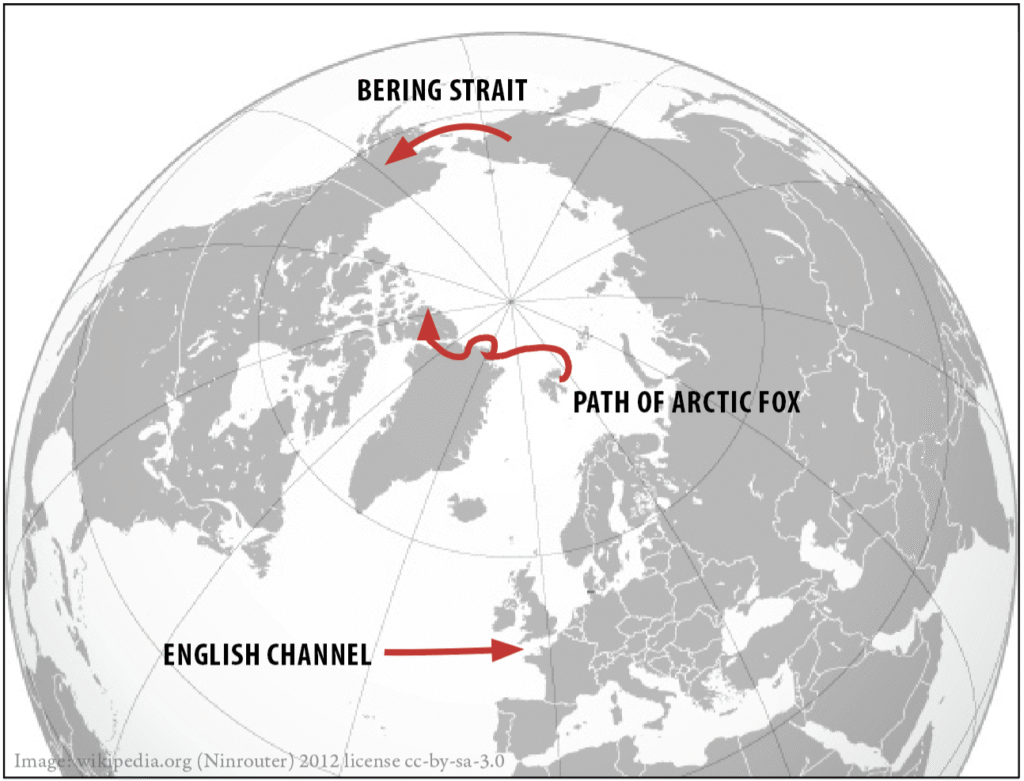
Other possibilities are also available which vindicate the biblical model. For example, according to the Flood model, a great Ice Age/Ice Advance commenced after the Flood,6 caused by warmer oceans (hence, greater precipitation) and increased volcanic activity (due to increased tectonic activity, causing cooler summers from increased volcanic aerosols and ash in the atmosphere). An Ice Age would have allowed animal migration from the Ark across frozen channels. The English Channel, as well as channels to Ireland, Iceland, and Greenland may have been frozen at the time. Significantly, a frozen channel from Russia to Alaska—the Bering Strait—would have allowed animal migration to North America. The water depth between the two is only 100-160 feet deep. With some 30% of the Earth’s continents covered with ice (as opposed to 10% today), the Earth’s sea level would have been significantly lowered making frozen channels common during the height of the Ice Age.
Ironically, in Origin of Species, glacier growth in the past was argued by Darwin to be how animals could have arrived in several remote places, including islands.7 As a modern example of animal movement across frozen channels, in 2018 scientists tracked an Arctic fox’s 76 day journey as it traveled from the far north Norway island group of Svalbard, across sea ice, the Greenland ice sheet, and Kane Basin to reach Ellesmere Island, Canada.8
(4) Land Bridges
Some Flood skeptics superficially observe on a map the location of Australia in comparison to Asia and summarily dismiss the idea of a land bridge nearly connecting Asia to Australia. However, thanks to modern technology, we know the depth of the ocean across the planet. A closer look at the water depth between the islands of the island chain that span the distance between mainland Asia and Australia reveals that the water depth is only dozens to hundreds of feet in many places along the path. Once again, during the post-Flood Ice Advance period, roughly 30% of the Earth’s land was covered with ice, significantly lowering sea level globally. In fact, secular scientists estimate that the Earth’s sea level may have been 400 feet lower at the peak of the Pleistocene Ice Age,9 which would have nearly completely opened a land path from Asia all the way to Australia.
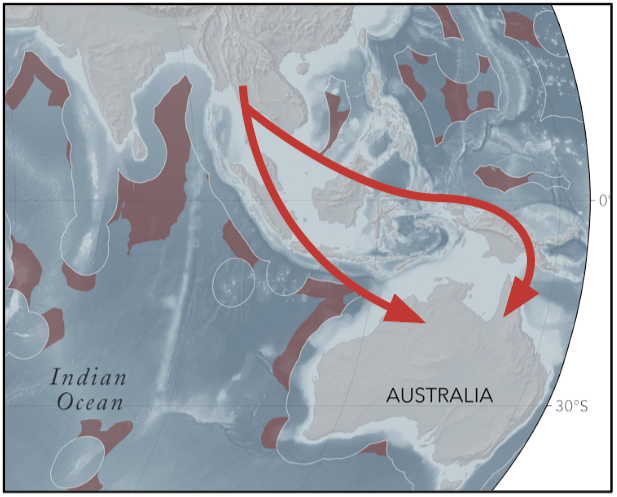
That fact has led evolutionary scientists to postulate that that is how humans reached Australia during the Ice Age.10 Gemma Tarlach, writing in Discover magazine, explained,
From the North Sea to the island-dotted tropics between Asia and Australia, from the frigid waters of the Bering Strait to the sunny Arabian Peninsula, now-submerged coastal landscapes were exposed and accessible to our ancestors at multiple times in prehistory, including key periods of human expansion across the globe. The square mileage of these areas now under the seas is equal to that of modern North America.11
Tarlach applies the same concept to the pathway between central Europe and England/Scotland during the Ice Age.
Look at a map of today’s Europe and its northern epicenters of population and commerce: London, Paris, Amsterdam, Copenhagen. Now consider that these hubs were once hinterland, mere fringes of an expanse rich in conifer forests, meadows, rivers and wetlands, all of it teeming with game. Prehistoric travelers could have walked from what’s now central Europe to northern Scotland without even seeing a coastline. As the massive glaciers and ice sheets of the…Ice Age began melting…, rising seas inundated this world. The North Sea was born.12
Bottom line: using the geography of today to draw conclusions about the past is unreliable at best, even according to many evolutionists. Humans and animals could have used land bridges to disperse after the Flood.
(5) Log “Islands”
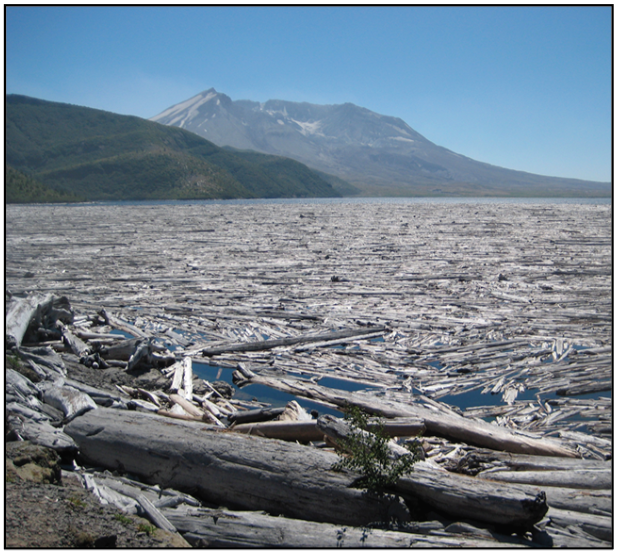
It is also likely that for some time, remnants of the great forests of the pre-Flood period would have been floating on the receding waters of the Earth until their decay was completed. As is the case from localized floods today, small “land masses” composed of trees and debris are often found floating on the water (e.g., traveling down rivers). Much larger islands of plant material and debris are found associated with larger catastrophes as well. For example:
- Such a land mass of trees can still be seen on Spirit Lake, a result of the eruption of Mount Saint Helens volcano 45 years ago.
- After the 2011 Japan tsunami, an island of debris was spotted floating across the Pacific Ocean towards the U.S. west coast. The island was 69 miles in length and covered an expanse of over 2.2 million square feet.13
But is it likely that animals would be found floating on such debris islands? Some scoff at the idea, but they only do so out of ignorance. After all, three weeks after the 2011 Japan tsunami, the Japan Coast Guard found and rescued a dog that had been floating on one of the tsunami’s debris islands.14 Such a scenario may very well explain the existence of dingoes in Australia. Graham Lawton, writing in New Scientist, even noted that,
After the 2011 Tohoku earthquake and tsunami in Japan, around 300 Japanese marine species were found on the shoreline of British Columbia having been carried on artificial debris. Some larger vertebrates, such as tortoises, crocodilians and possibly even hippos, may be able to float or swim. Of course, sceptics can’t just pour cold water on the idea. The presence of particular animals in certain faraway places still requires an explanation, so what have they got?15
Paleontological and archaeological evidence indicates that humans made it to the continent of Australia after the Flood and before Abraham.16 Lawton explained that scientists have long thought that humans could have arrived there accidentally, assuming that
[p]eople must have arrived on the currents after being washed into the sea by a tsunami or flood, perhaps clinging to a mat of floating vegetation or a raft of pumice. This so-called “sweepstake colonization” is often invoked to explain how terrestrial reptiles and mammals make it onto distant tropical islands, and it could plausibly account for the peopling of Sahul. Prevailing ocean currents are favourable and any floating castaways caught in them would have found the vast Sahul “hard to miss”, according to archaeologist Jane Balme at the University of western Australia in Perth.17
Bruce Hardy, the chair of the Department of Anthropology at Kenyan College in Ohio, agreed about the plausibility of the rafting hypothesis for human migration to isolated locations, arguing that migration could have occurred by “natural rafts drifting and leading to human occupation of some of these islands.”18 They could have “drifted to islands atop natural vegetation mats.”19 If humans could drift in such an accidental manner, why not animals?
Lawton agreed, arguing that monkeys and other animals also could have “sailed across oceans on floating islands of vegetation.”20 Colin Barras, writing in New Scientist, said, “We know…that small monkeys somehow made it across the [strong current, dangerous Wallace—JM] line to Sulawesi and clearly they didn’t use boats—in all likelihood they floated over on mats of vegetation”—possibly even dozens of the monkeys.21 In fact, Lawton noted that,
The rafting hypothesis is as old as the theory of evolution itself. In On the Origin of Species, Charles Darwin pointed out that the flora and fauna of the Galapagos Islands were clearly related to those of South America, while Cape Verde’s were distinctly African…. His point was to discredit the belief that each species was a unique, divine creation, but he inadvertently launched the idea that the inhabitants of distant islands must have somehow blown in from the mainland.22
Concerning how species (e.g., plants, seeds, and invertebrates) dispersed to oceanic islands, Darwin suggested that they could have been transported by seaweed, “floating timber,” “drifted by the prevailing currents,” or could have “floated in chinks of drifted timber.”23 The Galapagos Conservancy, discussing the “raft theory” of how species arrived on the islands, acknowledged that many must have arrived by
sea while swimming or floating, sometimes with the aid of rafts of tangled vegetation. It is likely that the ancestors of present-day Galapagos animals that are good swimmers (sea lions, sea turtles, penguins) actually swam their way to the islands with the help of some swift ocean currents. On the other hand, it is believed that many of the reptiles and small mammals (rice rats) were carried to the islands from the South or Central American mainland on rafts of vegetation. The vast majority of such rafts would have sunk well before they ever reached Galapagos, but it would have only taken a handful of successful rafts to wash ashore to explain the present reptile diversity in Galapagos.24
Caccone, et al. add that “tortoises probably reached the [Galapagos—JM] islands by rafting from South America, 1000 km to the east” using the Humboldt Current.25 A BBC Documentary on the South Pacific reasoned, “As tsunamis strike the coast, rafts of vegetation can be cast adrift. Perhaps animals were caught up in those rafts, too. Could this have been the answer to how these animals [Fijian crested iguanas—JM] made it to Fiji? After all, they are the heartiest of their kind and could have survived long sea journeys.”26
Bottom line: evolutionists cannot “have their cake and eat it, too”—either raft travel is ridiculous or it’s reasonable. In truth, if evolutionists are right, it is not at all outlandish to suppose that massive debris islands would have been found worldwide after the Flood and that animals could have been found floating on them in the years immediately after the Flood.
Migration by Swimming?
Consider: if one believes animal migration by rafting to be a ludicrous idea, what must he think when he hears the evolutionary theory that dinosaurs may have crossed to islands by swimming? Smithsonian Magazine highlighted research published in Cretaceous Research in 2021, in which scientists concluded that, since (according to the evolutionary timeline) Africa was surrounded by water when it was colonized by dinosaurs, “Swimming would have been the only way for the dinosaur to reach prehistoric Africa from Europe or Asia, reinforcing the idea that exceptional events can help species move between distant continents.”27 Referring to the same research, Phys.org noted that dinosaurs must have arrived in Africa by “water-rafting on debris, floating, or swimming,” and added the following telling statement:
Ocean crossings are rare, improbable events, but have been observed in historic times. In one case, green iguanas travelled between Caribbean islands during a hurricane borne on debris. In another, a tortoise from the Seychelles floated hundreds of kilometres across the Indian Ocean to wash up in Africa. “Over millions of years,” said [Nicholas—JM] Longrich [of the Milner Centre for Evolution at the University of Bath—JM], “Once-in-a-century events are likely to happen many times. Ocean crossings are needed to explain how lemurs and hippos got to Madagascar, or how monkeys and rodents crossed from Africa to South America.”28
While creationists would interpret the data to which evolutionists are referring differently, nevertheless, evolutionists have conceded yet another possibility for how animals could have migrated to various isolated locations.
In a more recent example that gives plausibility to the swimming option, in 2019, a small tsunami that struck the eastern coast of the U.S. during Hurricane Dorian, swept 20 cows and 28 horses from Cedar Island into the Atlantic Ocean off the coast of North Carolina. Three of the cows were later found alive over four miles away on a barrier island in the Outer Banks National Park. Apparently, the cows survived by swimming. One of the cows was pregnant while adrift and later gave birth to a healthy calf.29
Tertiary Ocean Currents—Evidence of the Rafting Hypothesis?
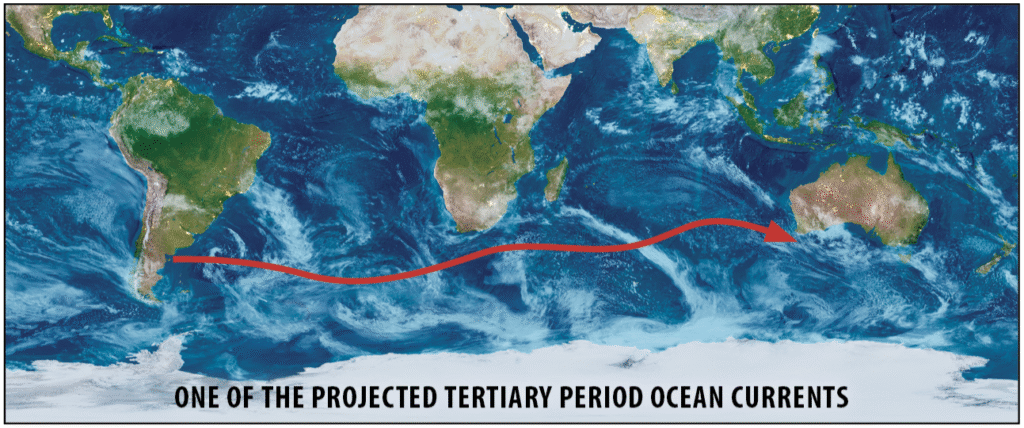
Could land animals have arrived on the Australian continent after the Flood via log mat? As added evidence of the legitimacy of that theory, recent genetic analysis suggests that Australian marsupials originated in South America before moving to Australia.30 When we look at the projections of what the ocean currents are thought to have been like during the Tertiary period (immediately after the Flood), we find that an ocean current was present, traveling directly from South America to Australia.31
Bottom line: if tsunamis are virtually certain to create floating islands of debris, what would be expected from a global Flood with rapid tectonic activity creating enormous earthquakes and subsequent tsunamis?32 If animals and humans are known to be able to travel aboard such makeshift vessels, who’s to say that such mini-“continents,” with various animals along for the ride, would not have been commonly spotted immediately following the Flood? A radically different terrestrial environment, with species clamoring to find food on the newly disheveled Earth, could have caused accelerated dispersal of the Ark’s population from Ararat to Australia before Australia had moved too far from the mainland.
One would want to be cautious not to be too quick to invoke supernatural explanations for proposed scientific problems with Bible teaching, since it can lead to scientific laziness and effectively halt scientific investigation into the great works of the Lord (Psalm 111:2).33 However, when the biblical text suggests that divine assistance may have played a role in a biblical event, it would be poor hermeneutics to dismiss the possibility without consideration. In this case, Genesis 6:20 suggests that God gathered the animals for Noah before the Flood. It is plausible, therefore, to postulate that God would have been involved, at the very least Providentially, in the dispersal of the animals after the Flood. Clearly, He had several reasonable avenues with which to do so that would not have required miraculous assistance.34
(6) Humans Brought Them
Of course, one final possibility as to how animals dispersed to remote islands like Australia would be that humans carried them. After all, evolutionists themselves argue that is precisely how some animals were able to populate certain islands.35 As noted earlier, physical evidence appears to place humans in Australia after the Flood and before Abraham, during the Babel dispersion period.36 Who’s to say they did not arrive with animals in tow?
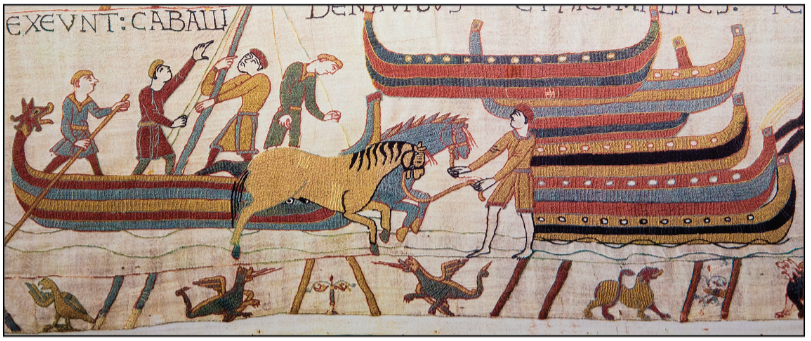
Lawton argued: “Another option, at least for more recent animal crossings, is that small creatures such as lizards were accidentally or deliberately transported by prehistoric humans. We know that our Stone Age ancestors were skilled seafarers, navigating across hundreds of kilometres of ocean to reach Japan…and perhaps even sailing from South-East Asia to Australia….”37 Granted, human transportation of animals is not available to evolutionists as an option in many instances, since they do not believe humans were on the scene yet (for example, when dinosaurs roamed the Earth). From a biblical perspective, however, humans have been on the scene “from the beginning of the creation” (Mark 10:6).
Conclusion
While post-Flood migration from the Ark to remote places like Australia has often been a charge used by evolutionists against the Bible and its account of a global Deluge, ironically, evolutionists themselves answer their own challenges with plausible options at the creationists’ disposal. Such attacks merely provide the biblical model another opportunity to prove itself to be reliable. “[S]coffers will come in the last days, walking according to their own lusts…. For this they willfully forget: that by the word of God the heavens were of old and the earth standing out of water and in the water, by which the world that then existed perished, being flooded with water…. Therefore, since all these things will be dissolved, what manner of persons ought you to be in holy conduct and godliness, looking for and hastening the coming of the day of God…?” (2 Peter 3:3b-12).
Endnotes
1 E.g., Bill Nye and Ken Ham (2014), Uncensored Science: Bill Nye Debates Ken Ham (Petersburg, KY: Answers in Genesis); Janet Kellogg Ray (2021), Baby Dinosaurs on the Ark? The Bible and Modern Science and the Trouble of Making It All Fit (Grand Rapids, MI: Eerdmans), pp. 101-103.
2 Andrew A. Snelling (2014), “Noah’s Lost World,” Answers in Genesis, https://answersingenesis.org/geology/plate-tectonics/noahs-lost-world/.
3 A. Snider-Pellegrini (1858), La Création et Ses Mystères Dévoilés (Paris: A. Franck et E. Dentu).
4 Today, creationists argue that Pangaea formed and broke apart during the Flood and, therefore, only ever existed underwater. Rodinia is thought to have been the supercontinent of the pre-Flood world. See Snelling.
5 E.g., Ross N. Mitchell, David A.D. Evans, and Taylor M. Kilian (2010), “Rapid Early Cambrian Rotation of Gondwana,” Geology, 38[8]:755-758; Brian Thomas (2010), “Continents Didn’t Drift, They Raced,” Institute for Creation Research, http://www.icr.org/article/continents-didnt-drift-they-raced/; Steven Austin, John Baumgardner, D. Russell Humphreys, Andrew Snelling, Larry Vardiman, and Kurt Wise (1994), “Catastrophic Plate Tectonics: A Global Flood Model of Earth History,” Proceedings of the Third International Conference on Creationism, ed. R.E. Walsh (Pittsburgh, PA: Creation Science Fellowship), pp. 609-621; S.P. Grand (1994), “Mantle Shear Structure Beneath the Americas and Surrounding Oceans,” Journal of Geophysical Research, 99:11591-11621; J.E. Vidale (1994), “A Snapshot of Whole Mantle Flow,” Nature, 370:16-17.
6 Michael Oard (2004), “The Genesis Flood Caused the Ice Age,” Answers in Genesis, http://www.answersingenesis.org/articles/fit/flood-caused-ice-age.
7 Charles Darwin (1859), On the Origin of Species by Means of Natural Selection, or the Preservation of Favoured Races in the Struggle for Life (London: John Murray), https://darwin-online.org.uk/content/frameset?itemID=F373&viewtype=text&pageseq=2, pp. 346-410.
8 “Argos Used to Track Fox’s 2,700-mile Journey from Norway to Canada” (2019), NOAA NESDIS, July 17, https://www.nesdis.noaa.gov/news/argos-used-track-foxs-2700-mile-journey-norway-canada.
9 United States Geological Survey (2022), “How Does Present Glacier Extent and Sea Level Compare to the Extent of Glaciers and Global Sea Level During the Last Glacial Maximum (LGM)?” January 27, https://www.usgs.gov/faqs/how-does-present-glacier-extent-and-sea-level-compare-extent-glaciers-and-global-sea-level; see also Gemma Tarlach (2019), “Return to Aquaterra,” Discover, 40[5]:56, June.
10 See Graham Lawton (2020), “Finding Sahul,” New Scientist, 245[3266]:39, January 25—Due to lower sea levels during the Ice Age, “the Sahul coast would have been significantly closer to the easternmost of the south-eastern Asian islands”; also, Christopher Bae, Katerina Douka, and Michael Petraglia (2017), “On the Origin of Modern Humans: Asian Perspectives,” Science, 358[6368]:1269, December 8; Kate Ravilious (2017), “The First Australians,” Archaeology, 70[4]:49, July/August. Uncovered land bridges are also how scientists are postulating that dinosaurs migrated from North America to Africa [Vicky Just (2020), “The First Duckbill Dinosaur Fossil from Africa Hints at How Dinosaurs Once Crossed Oceans,” Phys.org, November 5, https://phys.org/news/2020-11-duckbill-dinosaur-fossil-africa-hints.html].
11 Tarlach, p. 56; see also Colin Barras (2018), “Stone Age Sailors,” New Scientist, 238[3180]:36-37, June 2.
12 Ibid., p. 62.
13 Danielle Demetriou (2011), “Massive Floating Rubbish Islands from Japan Tsunami Spotted on Pacific,” The Telegraph, April 8, http://www. telegraph.co.uk/news/worldnews/asia/japan/8437632/Massive-floating-rubbish-islands-from-Japan-tsunami-spotted-on-Pacific.html.
14 “Japan Earthquake: One Month Later” (2011), The Atlantic: Photo, April 7, http://www.theatlantic.com/photo/2011/04/japan-earthquake-one-month-later/100041/.
15 Graham L. Lawton (2021), “On a Raft and a Prayer,” New Scientist, 252[3365/3366]:52, December 18/25.
16 Lawton (2020), p. 39. Conventional dating methods suggest that humans arrived in Australia 65,000 years ago, during the Ice Age [Danielle Demetrioue (2011), “Massive Floating Rubbish Islands from Japan Tsunami Spotted on Pacific,” The Telegraph, April 8, http://www. telegraph.co.uk/news/worldnews/asia/japan/8437632/Massive-floating-rubbish-islands-from-Japan-tsunami-spotted-on-Pacific.html]. Accounting for the continuing, though diminishing, accelerated nuclear decay in the post-Flood years [Jeff Miller (2013), “Don’t Assume Too Much: Not All Assumptions in Science Are Bad,” Reason & Revelation, 33[6]:62-70], 65,000 years correlates to a pre-Abraham date ca. 2,200-2,100 B.C.
17 Lawton (2020), p. 38, emp. added.
18 As quoted in Sam Walters, et al. (2024), “Everything Worth Knowing About Neanderthals,” Discover, 45[3]:33, May/June.
19 Ibid.
20 Lawton (2021), p. 50.
21 Barras, pp. 38-39.
22 Lawton (2021).
23 Darwin, pp. 360,391,397,399.
24 “History of Galapagos” (no date), Galapagos Conservancy, accessed February 11, 2025, https://www.galapagos.org/about_galapagos/history/, emp. added.
25 Adalgisa Caccone, et al. (1999), “Origin and Evolutionary Relationships of Giant Galapagos Tortoises,” Proceedings of the National Academy of Sciences, 96[23]:13223, November 9, emp. added.
26 “South Pacific: Castaways (Episode 2)” (2009), BBC Studios: Natural History Unit, aired May 17. The documentary also postulates that geckos may have reached the Solomon Islands by vegetation raft.
27 Riley Black (2020), “The Top Ten Dinosaur Discoveries of 2020,” Smithsonian Magazine on-line, December 22, https://www.smithsonianmag.com/science-nature/top-ten-dinosaur-discoveries-2020-180976578, emp. added.
28 Just; The saltwater crocodile is thought to have swam 60 miles from New Guinea to the Solomon Islands (“South Pacific…”).
29 Mark Price (2020), “Cow That Swam 5 Miles to Outer Banks in a Hurricane Was Pregnant. It Just Gave Birth,” The News & Observer, February 20, https://www.newsobserver.com/news/local/article239953898.html.
30 Clara Moskowitz (2010), “Marsupials Not From Down Under After All,” LiveScience.com, July 27, https://www.livescience.com/6770-marsupials.html.
31 Warren D. Allmon (2023), “Tertiary Period,” Encyclopaedia Britannica on-line, https://www.britannica.com/science/Tertiary-Period. Note that an ocean current is also thought to have been present that led from the theorized location of Ararat to South America.
32 For more information about the modern biblical Flood model accepted by most Creation geologists, see Jeff Miller (2019), “Was the Flood Global? Testimony from Scripture and Science,” Reason & Revelation, 39[4]:38-47, https://apologeticspress.org/wp-content/uploads/2021/08/1904w.pdf.
33 Jeff Miller (2024), “Is it Ever Appropriate to Say ‘God Did It’ in Response to a Scientific Challenge?” Reason & Revelation, 44[6]:11, June, https://apologeticspress.org/wp-content/uploads/2024/05/2406-web.pdf.
34 An example of a supernatural option would be the miraculous transportation of animals to remote continents/islands.
35 “Enigmatic Falklands ‘Fox’ Might Have Hitched a Ride with Humans” (2021), Nature, 599[7883]:10, November 4.
36 Lawton (2020).
37 Lawton (2021), p. 52, emp. added.
The post If the Flood Happened, How Did Animals Get Back to Australia? appeared first on Apologetics Press.
]]>The post Marine Reptiles appeared first on Apologetics Press.
]]>
ICHTHYOSAURUS
The name Ichthyosaurus means “fish lizard.” This creature grew to be about 6 feet long. It had large eyes that it probably used to see in murky waters. It was shaped much like a dolphin and had four prominent flippers that helped it be a swift swimmer. As a reptile and not a fish, it would have needed to surface and breathe air, much like dolphins and whales. Scientists have found fossil remains of this reptile that included embryos of its babies, giving us evidence that it gave birth to live babies and did not lay eggs. Interestingly, the first fossil ever found of an Ichthyosaurus was discovered by a 12-year-old girl named Mary Anning in Dorset, England in 1812. As she grew up, she found many more fossils and became a well-known fossil hunter. Just think, there are most likely lots of fossils of unknown creatures out there that have not yet been discovered. How cool would it be if one of our Discovery readers found one and was able to use the media attention to point people to the Creator?

ELASMOSAURUS
The name Elasmosaurus means “metal-plated or thin-plated lizard.” It was given this name, because it has bone plates that line its chest and hip area. When you look at artists’ drawings of this creature, you may wonder why it was not called the “long-necked lizard.” The Elasmosaurus had 72 vertebrae in its neck, which is the second-highest number of any known animal ever to live. In early artistic works showing this lizard, artists would draw its neck being very flexible, almost like a snake. Modern studies of the neck indicate that it was not very flexible but was most likely straight and somewhat stiff. This reptile was a member of a group called plesiosaurs that lived in oceans and seas. While many of these creatures were “fearfully great lizards” (which is what the word dinosaur means), they are not classified as dinosaurs. Scientists who study and name these creatures only use the word dinosaur to describe land-living reptiles that had certain types of hip structures. So, in the same way that a Tyrannosaurus rex is a dinosaur, an Elasmosaurus is a plesiosaur. And what a plesiosaur it was! It could grow to be between 30-40 feet long and weigh up to 10,000 pounds. At the end of its long neck, this lizard had a small head that contained about 40 teeth, several of which were long and sharp. It was a predator that fed on other marine animals such as fish and squid. Like the other marine reptiles, it was not a fish and did not have gills. It breathed air and would have needed to surface regularly.

KRONOSAURUS
This massive marine reptile gets its name from the mythological Greek Titan named Kronos—the “lizard of Kronos.” Like the Elasmosaurus, it is a plesiosaur that lived in the oceans and seas. It could be about 35 feet long. Unlike the Elasmosaurus, it did not have a long neck. Instead, it had a much shorter neck and a larger head. Its head composed about one-third of its entire length. Scientists believe this was an apex predator that would have been able to eat most other creatures that swam in the seas with it. The fossils that have been found suggest that it ate sea turtles, sharks, other marine reptiles, and possibly even members of its own species. Research done on the jawbones and teeth of this animal indicates that it had an extremely powerful bite. Bite force is measured in a scientific unit of force called newtons (named after Isaac Newton). The average human has a bite force of about 700 newtons. A dog, such as a pitbull, has a bite force of about 1,000 newtons. The most powerful bite force of any living animal today is that of the saltwater crocodile, measured at 16,000 newtons. Where does the Kronosaurus rank on the bite force scale? Its estimated bite force was a whopping 30,000 newtons, almost twice the force of the most powerful bite of any creature alive today. Needless to say, you would not want to have been anywhere close to this reptile’s mouth when it decided to snap its bone-crushing jaws shut.

“SEA REX”
In Dorset, England in 2023, scientists uncovered the most complete pliosaur (which is a kind of plesiosaur) skull ever found. In fact, it holds the Guinness Book of World Records top spot for that distinction. It is a 6.5-foot skull that has about 95% of its surface area fossilized and still together. One remarkable aspect of the fossil is the number of teeth it contains. It has 130 razor sharp teeth! Because of its ferocious, huge mouth and teeth, it has been named “Sea Rex,” the “T-rex” of the sea.

In the book of Job, God talks to Job about a fearsome sea creature named Leviathan. God draws attention to this animal to show Job that God made (and can control) even the largest and most dangerous beasts. God said to Job, “I will not conceal his limbs, his mighty power or his graceful proportions. Who can remove his outer coat? Who can approach him with a double bridle? Who can open the doors of his face, with his terrible teeth all around (Job 41:12-14)? Could “Sea Rex” be the Leviathan? Its huge head and massive mouth filled with 130 razor sharp teeth sound much like an animal with “terrible teeth all around.” In truth, however, we will probably never know if “Sea Rex” is the creature God was describing to Job as Leviathan. We can know, however, that God was talking to Job about a real creature that once lived, and “Sea Rex” helps us imagine what that beast may have looked like. We can also know that God created all the kinds of marine reptiles on Day Five of Creation, just one day before He created humans. And we can know that all God’s creatures are designed to bring Him glory. “Praise the Lord from the earth, you great sea creatures and all the depths” (Psalm 148:7).

The post Marine Reptiles appeared first on Apologetics Press.
]]>The post Jerusalem’s Newly Discovered Siloam Dam Confirms Biblical Engineering from Joash to Jesus appeared first on Apologetics Press.
]]>1. The Pool of Siloam in the Time of Jesus (1st Century A.D.)
In John 9:1-11, the Gospel writer recounts how the Lord Jesus anointed the eyes of a blind man with clay and told him to “Go, wash in the Pool of Siloam.” For centuries, the pool’s exact location was uncertain. Many assumed it was the small Byzantine basin near the Church of St. Saviour until 2004, when workers repairing a water pipe in the southern City of David uncovered stone steps descending into a vast plastered pool. Archaeologists Ronny Reich and Eli Shukron soon identified this as the authentic Second-Temple Pool of Siloam, the very site referenced in the New Testament.2
The stepped pool—roughly 225 feet long and 15 feet deep—was constructed during the reign of Herod the Great in the late first century B.C., at the height of Jerusalem’s expansion.3 Fed by the ancient Siloam Tunnel, the pool collected water from the Gihon Spring and served both as a public reservoir and as a massive mikveh (ritual bath) for pilgrims ascending the Pilgrimage Road toward the Temple Mount.4 Its architectural grandeur reflects Herod’s vast building program, which included the Temple complex itself. When Jesus performed His miracle there, He stood amid a system that had already been serving God’s people for over seven centuries—a line of hydraulic continuity stretching back to the time of Judah’s earliest kings.
2. Hezekiah’s Tunnel: Engineering Under Siege (Late 8th Century B.C.)
Long before Herod’s reconstruction, the same spring that fed the Siloam Pool had already been secured by one of the Bible’s most famous engineers: King Hezekiah. Facing the Assyrian invasion in 701 B.C., Hezekiah ordered the diversion of Jerusalem’s water supply into the fortified city. As 2 Kings 20:20 records, “He made the pool and the conduit and brought water into the city.” Archaeology confirms this in the Siloam Tunnel, an underground passage roughly 1,750 feet long that connects the Gihon Spring on the east to the lower valley on the west.5
Cut through bedrock, the tunnel winds in an S-shaped path and terminates near the location of the later Herodian pool. Its ancient Hebrew inscription—carved near the southern exit—commemorates the meeting of the two work crews who tunneled toward one another.6 The engineering precision required to complete such a project testifies to the royal resources and administrative capacity of Hezekiah’s reign.
By channeling water inside Jerusalem’s walls, Hezekiah effectively replaced an earlier open reservoir, transforming an external valley dam into a protected, internal water source. His system not only supplied the city during siege but also paved the way for the later Herodian expansions that pilgrims of Jesus’ day would see.
3. The Newly Discovered Siloam Dam of King Joash (Early 8th Century B.C.)
Beneath these familiar works lies an even older foundation. In 2025, Johanna Regev, Nahshon Szanton, Filip Vukosavović, Itamar Berko, Yosef Shalev, Joe Uziel, and Elisabetta Boaretto published the results of their radiocarbon analysis of mortar samples from a massive stone wall at the southern mouth of the Tyropoeon Valley.7 The results—calibrated to between 805 and 795 B.C.—place the wall firmly within the reign of King Joash (r. ca. 835-796 B.C.).8
The wall, more than 40 feet high and 26 feet thick, sealed the valley and impounded both runoff and overflow from the Gihon Spring, forming an enormous open reservoir—the earliest known Pool of Siloam. Excavations revealed that this dam and its reservoir lay within the southern extent of ancient Jerusalem, inside what became the lower City of David. By Hezekiah’s time, the area was fully fortified, ensuring that the reservoir stood within the city’s defensive walls, precisely where the later Herodian pool would be expanded in the first century B.C. This confirms a continuous chain of hydraulic development at the same site—from Joash’s dam to Hezekiah’s tunnel to Herod’s monumental pool.9
Radiocarbon dating of embedded twigs and straw produced a tight 10-year range, while paleo-climatic data from Dead Sea cores and Soreq Cave stalagmites confirmed that Jerusalem faced alternating drought and flash floods during this era. The construction of such a dam provided both flood control and long-term water storage, demonstrating advanced planning under royal oversight. In every sense, the Joash dam anticipates the later biblical account of Hezekiah’s engineering reforms.
Its discovery vindicates the biblical portrayal of Judah’s early monarchy as organized, literate, and technologically capable—precisely the kind of kingdom that could undertake monumental civic works consistent with the historical books of 2 Kings and 2 Chronicles.
4. Canaanite Foundations: Jebus, the Water Systems Before Israel
Long before Israelite kings ruled Jerusalem, the Canaanite city of Jebus—the stronghold later conquered by King David (2 Samuel 5:6-9)—had already fortified the Gihon Spring with towers, tunnels, and a rock-cut pool inside its wall. Excavations by Kathleen Kenyon in the 1960s and Ronny Reich and Eli Shukron in the 1990s revealed a monumental Spring Tower—a defensive structure enclosing access to the spring from within the city.10 This earliest water system included a stepped tunnel descending to a protected pool, ensuring access to water during siege. Although the Bronze-Age pool differs in scale and purpose from the later Siloam installations, it set the hydraulic pattern that successive builders—Joash, Hezekiah, and finally Herod—would each adapt for their generation.11
Moreover, the biblical book of Genesis identifies the city as Salem when Melchizedek is called “king of Salem” (Genesis 14:18-20), and Psalm 76:2 equates Salem with Zion, reinforcing the view that Jerusalem’s geographical identity stretches back into the early patriarchal period.
5. Continuity and Theological Significance
From the Bronze-Age foundations to the Herodian expansion, the Pool of Siloam embodies the continuity of Divine provision in Jerusalem’s history. Through every era, God’s people found both physical and spiritual refreshment in the same flowing waters of the Gihon Spring. Isaiah warned those who “refused the waters of Shiloah that flow gently” (Isaiah 8:6), while later prophets spoke of “drawing water from the wells of salvation” (Isaiah 12:3). Hezekiah’s tunnel fulfilled this prophecy in physical form—securing the city’s lifeline amid peril.
Centuries later, Jesus transformed that physical image into spiritual truth: “If anyone thirsts, let him come to Me and drink” (John 7:37). The Siloam Pool thus stands as both a technological marvel and a living parable of redemption. The recent discovery of the Joash-era dam reinforces that Scripture’s record of royal infrastructure was not theological metaphor but historical reality—its stones still bearing witness to the ingenuity and faith of ancient Judah.
Conclusion
The unveiling of the Siloam Dam beneath Jerusalem’s City of David represents one of the most significant discoveries in decades—an engineering bridge linking Joash, Hezekiah, Herod, and Jesus. Each generation modified the same life-giving spring: Joash contained it with a massive dam; Hezekiah redirected it with a tunnel; Herod adorned it with stone steps; and Jesus sanctified it with a miracle.
Modern science has now dated the earliest phase of this system with remarkable precision, confirming that Judah’s kings were capable of large-scale, organized public works as the Bible describes. The stones cry out in testimony that the biblical narrative stands—not on myth—but on measurable history. In the Pool of Siloam—past and present—the waters still proclaim the truth of God’s Word: “With joy you will draw water from the wells of salvation” (Isaiah 12:3).
[Dr. Jonathan Moore—Field Archaeologist with the Shiloh Excavation, Israel; Adjunct Faculty at Freed-Hardeman University; and Founder of Seeing His World, a missions-based educational nonprofit dedicated to providing academically grounded yet spiritually transformative guided experiences throughout the Bible lands (www.seeinghisworld.com).]
Endnotes
1 King Joash (Jehoash) reigned in Judah ca. 835-796 B.C. following a period of protection and oversight by Jehoiada the priest (see 2 Kings 11-12; 2 Chronicles 24). Crowned at age seven, he initially “did what was right in the eyes of the LORD” under Jehoiada’s guidance but later turned from faithfulness, permitting idolatry and ordering the death of the prophet Zechariah (2 Chronicles 24:20-22). He was assassinated by his servants and succeeded by his son Amaziah.
2 Ronny Reich and Eli Shukron (2005), “The Second-Temple Period Pool of Siloam in Jerusalem,” Israel Exploration Journal, 55:153-167.
3 “The Siloam Pool: Where Jesus Healed the Blind Man,” Biblical Archaeology Society, www.biblicalarchaeology.org/daily/biblical-sites-places/biblical-archaeology-sites/the-siloam-pool-where-jesus-healed-the-blind-man/.
4 Nahshon Szanton and Joe Uziel (2019), “The Pilgrimage Road: Jerusalem’s Ascent from the Pool of Siloam to the Temple,” City of David Studies.
5 Dan Gill (1983), “The Siloam Tunnel Reconsidered,” Nature 305:515-517.
6 James B. Pritchard (1969), Ancient Near Eastern Texts Relating to the Old Testament (Princeton University
7 Johanna Regev, et al. (2025), “Radiocarbon Dating of Jerusalem’s Siloam Dam Links Climate Data and Major Waterworks,” Proceedings of the National Academy of Sciences of the United States of America, 122[35], https://doi.org/10.1073/pnas.2510396122.
8 Note that radiocarbon dating does, in fact, sometimes result in ages of materials that exceed 10,000 years. Radiocarbon dating, however, is understood to be suspect for objects thought to be older than roughly 3,000-4,000 years old [cf. George H. Michaels and Brian Fagan (2013), “Chronological Methods 8—Radiocarbon Dating,” University of California Santa Barbara Instructional Development.]. Further, biblical creationists argue that radioactive decay rates were apparently accelerated during the Flood and afterward, possibly up to 1,500-1,000 B.C., making all dating techniques unreliable for ages beyond that time. For evidence of accelerated radioactive decay in the past, see Don DeYoung (2008), Thousands…Not Billions (Green Forest, AR: Master Books).
9 City of David Foundation (2025), “Monumental Dam from the Time of Biblical Kings Uncovered,” August 29.
10 Kathleen M. Kenyon (1967), Jerusalem: Excavating 2000 Years of History (New York: McGraw-Hill), pp. 31-45.
11 See “Salem (Bible),” Wikipedia, en.wikipedia.org/wiki/Salem_(Bible) (accessed September 2025); Armstrong Institute, “The Incredible Origins of Ancient Jerusalem,” armstronginstitute.org/843-the-incredible-origins-of-ancient-jerusalem/ (accessed September 2025).
The post Jerusalem’s Newly Discovered Siloam Dam Confirms Biblical Engineering from Joash to Jesus appeared first on Apologetics Press.
]]>The post Jesus: The Theme of the Bible appeared first on Apologetics Press.
]]>The post Jesus: The Theme of the Bible appeared first on Apologetics Press.
]]>The post Are Fossils on Mountains Evidence of the Flood? appeared first on Apologetics Press.
]]>The post Are Fossils on Mountains Evidence of the Flood? appeared first on Apologetics Press.
]]>