The post The 100th Anniversary of the Scopes “Monkey” Trial appeared first on Apologetics Press.
]]>Background
What precipitated such an unprecedented court case? Why all the hysteria? In the 1920s, several state legislatures in the U.S. were contemplating banning some form of the Theory of Evolution from being taught in public schools. On March 21, 1925, Tennessee Governor Austin Peay signed into law the Butler Act, which was first introduced by Representative John Washington Butler two months earlier and was the first of its kind in the country. Specifically, the Butler Act stated:
That it shall be unlawful for any teacher in any of the universities, normals1 and all other public schools of the State which are supported in whole or in part by the public school funds of the state, to teach any theory that denies the story of the Divine Creation of man as taught in the Bible, and to teach instead that man has descended from a lower order of animals.2
When the American Civil Liberties Union (ACLU) learned of the passing of the Butler Act, they quickly began soliciting in newspapers for a willing Tennessee participant in hopes of testing the veracity of the Butler Act. The ACLU wanted to represent a science teacher who had taught evolution since the Butler Act became law in Tennessee. However, the teacher they ultimately represented was far from the ideal candidate and one of the first signs that the “Scopes” Trial should never have happened.
The Unprincipled Selection of Scopes
John Scopes was a first-year math and physics teacher and football coach at Rhea County High School in Dayton, Tennessee in 1924-25. He was not the school’s biology teacher. But Scopes did substitute for the regular biology teacher (Principal William Fergeson) for two weeks in April 1925 using the previously approved textbook A Civic Biology, which indeed contained material on human evolution.3
How did Scopes become the defendant in (what many have called) “the trial of the century”? Did one or more of his students accuse him of breaking the Butler Act? Was there a parent, school administrator, or a group of vile Christians out to get Scopes (as the terribly historically inaccurate 1960 movie Inherit the Wind vividly portrayed)?4 Not at all.
The school term was already over, and Scopes was enjoying some leisure time at the tennis courts in Dayton when a few leading community members summoned him to the local drugstore. They weren’t looking to tar and feather Scopes but rather to use him as a pawn in their plan to bring some excitement and commerce to their little town. They were hoping that he had taught human evolution so that they could contact the ACLU about representing Scopes in a trial in Dayton because “such a case would put Dayton on the map and benefit business.”5
Scopes admitted, “I had been tapped and trapped by the rush of events.” This young man, with only one year of teaching experience under his belt, agreed to stand trial, saying, “If you can prove that I’ve taught evolution, and that I can qualify as a defendant, then I’ll be willing to stand trial.” If? What did he mean, “If”? Scopes admitted in his memoirs, “To tell the truth, I wasn’t sure I had taught evolution.” But the townsmen “weren’t concerned about this technicality.”6
Scopes had “expressed willingness to stand trial. That was enough.” The owner of the drugstore proceeded to call the Chattanooga News: “‘This is F.E. Robinson in Dayton,’ he said. ‘I’m chairman of the school board here. We’ve just arrested a man for teaching evolution.’” And what was Scopes’ reaction to being “arrested”? He said: “I drank the fountain drink that had been handed me and I went back to the high school to finish playing tennis with the kids…. [T]hey [Robinson and the other men] would handle the technicalities of my ‘arrest’ and bond.”7 The next day, the Chattanooga News announced Scopes’ “arrest,” which was then picked up by the Associated Press, which then became a national story. Apparently, so unusual were the circumstances surrounding Scopes’ original “arrest” and subsequent indictment that when the Court initially convened for his actual trial in July, Tennessee’s Attorney General Tom Stewart suggested, “[I]n this case, we think a new indictment be returned…. [B]oth sides are anxious that the record be kept straight and regular….”8
Legendary Lawyers
As if the selection of Scopes as the defendant in this trial was not bizarre enough, the leading prosecutor selected was a three-time presidential candidate and former Secretary of State who had not tried a case in more than 30 years. William Jennings Bryan was a very intelligent, talented, articulate individual,9 but his selection as prosecuting attorney may have had more to do with his fame than an overall commitment to facts. Dayton lawyer Sue Hicks,10 who “just happened” to be present at Robinson’s drugstore the day of Scopes’ “arrest,” no doubt called upon Bryan (a Miami, Florida resident at the time) to serve on the prosecution team, in part because of his well-known advocacy for anti-evolution legislation, but also for his sheer iconic status, which would do exactly what the leading townsmen desired—“put Dayton on the map and benefit business.”11
Upon learning that the legendary William Jennings Bryan was selected to prosecute Scopes, nationally known agnostic and trial lawyer Clarence Darrow convinced the ACLU (of which he was a member) to allow him to join the defense team as lead defender. Darrow was a fierce critic of the Bible and Christianity.12 During the Scopes Trial, Darrow referred to Bryan’s Bible-believing, Christian religion as “fool religion.”13 And in his essay, “Why I Am An Agnostic,” Darrow made his thoughts about God and the Bible crystal clear: “The fear of God is not the beginning of wisdom. The fear of God is the death of wisdom.”14 Bryan referred to Darrow as “the greatest atheist or agnostic in the United States.”15
A Court Case or a Publicity Stunt?
In one sense, the Scopes Trial was cut and dry (or at least it should have been): Had John Scopes violated Tennessee law (i.e., the Butler Act)?16 This was the central question. Judge John T. Raulston instructed the Grand Jury on the first day of proceedings, saying:
Gentlemen of the grand jury, on May 25, 1925, John T. Scopes was indicted in this county for violating what is generally known as the anti-evolution statute…. [T]he vital question now involved for your consideration is, has the statute been violated by the said John T. Scopes or any other person by teaching a theory that denies the story of the Divine Creation of man as taught in the Bible, and in Rhea County since the passage of this act and prior to this investigation. If you find the statute has been thus violated, you should indict the guilty person or persons, as the case may be. You will bear in mind that in this investigation you are not interested to inquire into the policy or wisdom of this legislation.17
Throughout the trial, Judge Raulston similarly stated:
It is not within the province of the court under these issues to decide and determine which is true, the story of divine creation as taught in the Bible, or the story of the creation of man as taught by evolution…. [T]his court is not further concerned as to its policy, but is interested only in its proper interpretation and, if valid, its enforcement…. The question is whether or not Mr. Scopes taught men descended from the lower order of animals.18
Though technically Scopes was on trial, in reality, the defense, prosecution, and media made sure that it was more of a theatrical stage to banter about freedom and “fundamentalism,”19 the Bible and evolution, secularism and Christianity. How often does a defense attorney—whose client did not plead guilty at the beginning of the trial—argue a case for seven days and then abruptly conclude (as Darrow did), “I think to save time we will ask the court to bring in the jury and instruct the jury to find the defendant guilty. We make no objection to that and it will save a lot of time and I think that should be done.”20 In what reasonable trial does the defense (a) call the prosecuting attorney to take the stand and be cross-examined, (b) admit that the prosecuting attorney (Bryan in this case) would not be very valuable as a witness (in terms of what the trial was originally about), and (c) agree that they themselves may be cross-examined, but then never give the prosecution the opportunity to do so because the defense suddenly tells the jury and judge to find their client guilty, and the trial quickly comes to an end with no closing arguments?21
Prosecuting attorney Bryan seemed strangely eager to take the stand as an expert witness on the Bible. When asked, “Mr. Bryan, you are not objecting to going on the stand?” his response was, “Not at all.”22 Perhaps Bryan sincerely wanted to try to “give a defense” of the Bible and of the freedom of Tennesseans to teach creation to the exclusion of evolution? Maybe he was mostly motivated by the genuine expectation of cross-examining Darrow and the other defense lawyers?23 Perhaps Bryan allowed pride to get the best of him? Or maybe it was a combination of all three?
Though at one point in the trial the bailiff declared, “People, this is no circus. There are no monkeys up here,”24 the Scopes Trial might accurately be described as more spectacle than substance. (A case could be made that it was more unusual and bizarre than the infamous O.J. Simpson trial 70 years later.) The New York Times reported before the trial ever began that an actress offered “the use of a trained chimpanzee to combat the law” (i.e., the Butler Act). Renowned radio announcer Quinn Ryan, from WGN Chicago, “famous for creating broadcasts that were ‘almost as good as being there,’” comically portrayed Bryan’s entrance into the courtroom as if he was a heavyweight boxer, saying, “Here comes William Jennings Bryan.25 He enters now. His bald pate like a sunrise over Key West.”26 What’s more, while inside the court, Darrow was cited for “contempt and insult,”27 blatantly insulting the judge’s integrity multiple times in one day;28 one writer described the scene outside the courthouse (even as the trial was just getting started), as “half circus and half a revival meeting.”29
Much Bigger Than Scopes
While in one sense, the Scopes Trial was simply about a statute violation, in reality, it was about something much bigger: a battle between ideas of human origins and what should be taught in public schools. Did humans evolve from animals (as Darrow passionately believed), or are we the descendants of an original man and woman supernaturally created by God, to Whom we are accountable (as Bryan was convinced is true and literally taught in the Bible)?
At various times in the proceedings, both sides referred to the anticipated future trial in an appellate court, which was expected to focus on the constitutionality of the Butler Act.30 In fact, Darrow indicated during the Scopes Trial that going to a higher court was his only purpose, saying, “What we are interested in, counsel well knows what the judgment and verdict in this case will be. We have a right to present our case to another court and that is all we are after.”31 In his 1932 autobiography, Darrow went further in stating what his purpose had been in the Scopes Trial:
My object, and my only object, was to focus the attention of the country on the progamme of Mr. Bryan and the other fundamentalists in America. I knew that education was in danger from the source that has always hampered it—religious fanaticism. To me it was perfectly clear that the proceedings bore little semblance to a court case, but I realized that there was no limit to the mischief that might be accomplished unless the country was roused to the evil at hand. So I volunteered to go.32
Alleged Proofs of Evolution in the Scopes Trial
Since the Scopes Trial was technically about whether John Scopes had violated the Butler Act—and not about the legitimacy of the law itself—Judge Raulston was “not interested to inquire into the policy or wisdom of this legislation.”33 Thus, the judge ruled that testimony from evolutionary scientists was not germane to Scopes’ innocence or guilt and thus inadmissible evidence for the jury to consider. However, the judge did allow “expert testimony” (in the form of affidavits) to be read into the trial records (making up about 20% of the overall transcript of the trial) for the benefit of the appellate court in the event Scopes was found guilty and the defense appealed the case.34
So, what proof of evolution did the “experts” give that “religious fanatics” and “fundamentalist Christians” like William Jennings Bryan missed, willfully ignored, or outright rejected in 1925? Was the creationist’s dismissal of evolution (and especially human evolution, as stated in the Butler Act) inconsistent with the available facts? Should there be, as Darrow claimed during the trial, “no question among intelligent men about the fact of evolution”?35
Comparative Anatomy
The terms “similar,” “homology,” and “comparative anatomy”36 occur some 60 times in the testimony of the expert evolutionists filed into the official Scopes Trial record on day seven of the proceedings. Known as “homology,” the comparison of similar body structures of various living organisms allegedly proves evolution. Since, for example, the flipper of a whale, the wing of a bat, the forefoot of a dog, and the human arm and hand have certain similarities, supposedly they share the same ancestor from many millions of years ago. According to this line of argumentation, the first humans were not specially designed by the Creator, but evolved from animal ancestors.
Creationists rationally and unashamedly acknowledge the many similarities that exist among the various kinds of animal life on Earth, and even between animals and humans. (Millions of living things have eyes, ears, mouths, digestive systems, respiratory systems, etc.) In truth, similarities among living things fit perfectly with the Creation viewpoint. Such similarities should be expected among creatures designed to breathe the same air, drink the same water, eat the same food, live on the same land, and generally use the same five senses to function in our physical world. But homology neither proves creation nor evolution. Similar structures are just a fact. When evolutionists (like those in the Scopes Trial) contend that homology is evidence of evolution, they are not stating a fact but are making an unproven (and unprovable) assertion.37
Embryonic Recapitulation
The terms “embryo” or “embryonic development”38 appear 40 times in the expert evolutionists’ written testimony in the Scopes Trial. According to these men, “the facts of comparative embryology” are powerful evidence of evolution39 and had been recognized by evolutionists such as Ernst Haeckel for decades. Haeckel, for example, “believed that organisms retrace their evolution as embryos, when they ‘climb their own family tree.’”40 One evolutionary zoologist in the Scopes trial alleged:
In many instances certain early stages in the development of an advanced organism resemble in unmistakable ways the end stages of less advanced organisms. There is, in fact, in the long ontogeny of members of high groups, a sort of rough-and-ready repetition of the characteristic features of many lower groups. This fact has so impressed some biologists that they have embodied it into a law, the so-called biogenetic law: that ontogeny recapitulates phylogeny. In less technical language this means that the various stages in the development of the individual are like the various ancestral forms from which the species is descended, the earliest embryonic stages being like the most remote ancestors and the latter stages like the more recent ancestors. In still other words, the concept may be stated as follows: The developmental history of the individual may be regarded as an abbreviated resume of its ancestral history.41
Supposedly, the human embryo goes through evolutionary stages of growth—through a kind of “fish stage,” “salamander stage,” and even an animal-like tail stage. One evolutionary anthropologist in the Scopes Trial stated: “Going to the human embryo we find these vestiges of an earlier condition much more developed while others appear for a time and then vanish before birth. Such a case is the free tail possessed by every human embryo, a few weeks before its birth.”42
Interestingly, more than a decade prior to the Scopes Trial, prominent British evolutionary anatomist and physician Sir Arthur Keith, admitted in his book The Human Body, “It was expected that the embryo would recapitulate [retrace—EL] the features of its ancestors from the lowest to the highest forms in the animal kingdom. Now that the appearances of the embryo at all ages are known, the general feeling is one of disappointment; the human embryo at no stage is anthropoid in its appearance. The truth is, we expected too much.”43
And what have we learned in the last century? Renowned evolutionist Stephen J. Gould wrote in 2000 in Natural History magazine:
Haeckel remains most famous today as the chief architect and propagandist for a famous argument that science disproved long ago but that popular culture has never fully abandoned…. Once ensconced in textbooks, misleading information becomes cocooned and effectively permanent, because…textbooks copy from previous texts…. We should therefore not be surprised that Haeckel’s drawings entered nineteenth-century textbooks. But we do, I think, have the right to be both astonished and ashamed by the century of mindless recycling that has led to the persistence of these drawings in a large number, if not majority, of modern textbooks.44
The so-called biogenetic law (of embryonic recapitulation), which played such a prominent part in the written evolutionists’ testimony in the Scopes Trial, was and is a farce.45
Vestigial Organs
Two sections in the expert evolutionists’ written testimony dealt with vestigial organs46—the idea that animals and humans have previously functional, but now leftover, useless structures of evolution. Allegedly:
There are, according to Wiedersheim, no less than 180 vestigial structures in the human body,47 sufficient to make of a man a veritable walking museum of antiquities. Among these are the vermiform appendix, the abbreviated tail with its set of caudal muscles…. These and numerous other structures of the same sort can be reasonably interpreted as evidence that man has descended from ancestors in which these organs were functional. Man has never completely lost these characters; he continues to inherit them though he no longer has any use for them.48
Another Scopes Trial evolutionist alleged: “Man has a vestigial tail [i.e., the coccyx—EL] composed generally of about four vertebrae so small and so short as to be entirely concealed in the flesh and muscles at the base of the spine.”49
What is the truth of the matter? Once again, the “experts” in the Scopes Trial got it wrong—very wrong! The more that doctors have learned about the human body, the more they have recognized legitimate functions of the so-called “vestigial organs.” The appendix serves an “immunological function…in the developing embryo” and “continues to function even in the adult.”50 Furthermore, the appendix “acts like a bacteria factory, cultivating the good germs,”51 serving as “a reservoir of good gut bacteria.”52 And the human coccyx is extremely important. It serves as a point of attachment for several pelvic muscles that help us stand up. And, like the shocks on a car, the coccyx is also used as a shock absorber when we sit down.53 Although the evolutionary experts in 1925 confidently asserted, “All of the lines of evidence presented point strongly to organic evolution, and none are contrary to this principle,”54 real, observable, rational, operational science has proved them very wrong.
What’s more, while “vestigial” organs are not the useless organs that many have made them out to be, suppose (for the sake of argument) that scientists did discover one or more organs in the human body that had a reduced function—or no function at all? What if the particular organ functioned perfectly in the past but not so much today? Would this actually be evidence of evolution? Not at all. The human body is a marvelous thing to study and shows amazing, complex, functional design—which logically demands a Designer (and not accidental evolution over many millions of years). However, since the first humans were on Earth, much degeneration has taken place. Many diseases and mutations have been introduced into the human gene pool. Is it possible that there could be a loss of a gene for an organ at some point, which causes the organ not to function as well as it once did—or perhaps lose function altogether one day? If so, then even if it were ever proven that a “vestigial organ” exists, such an organ would not logically prove evolution to be true. In fact, wouldn’t the presence of “vestigial organs” actually be evidence of “devolution,” not “evolution,” with organisms being more complex the farther back in time we go?55
Once again, the “evolution-is-a-fact” hype surrounding the Scopes Trial was anything but factual.56 The more we continue to learn, the more erroneous and inadequate the impotent theory of evolution is demonstrated to be. Millions of people may still believe it, but they do so more out of a religious commitment to blind faith, rather than because the evidence demands such a verdict.
Alleged Human Evolution
The evolutionary scientists in the Scopes Trial also had much to say about “evidence” for human evolution, but as with all the other “proofs” they offered, their “evidence” was either irrelevant, deficient,57 or (eventually) disproven altogether. “The dawn man of Piltdown”58 (i.e., Piltdown Man) was determined to be a forgery in 1953. (Someone had combined the skull of a human and the jawbone of an ape.) The “Java ape-man,” as one Scopes Trial scientist called him,59 was “erroneously based on the skull cap of a gibbon and fossilized teeth and thigh bone of a modern human.”60 It was not some kind of missing link! What’s more, “Rhodesian man,” “Heidelberg man,” and “Neanderthal man” (all of which were brought up multiple times by the Scopes Trial evolutionists in their affidavits) were nothing more than varieties of past humans.61 (And if we look around the planet today, there is still a great amount of observable variety within humankind. Such diversity should also be expected from the fossil record: human bones of various shapes and sizes.)
Human Evolution’s Racist Implications
Though the Scopes Trial expert evolutionists may not have been racist in their affidavits, the textbook that Scopes used (or allegedly used) to teach evolutionary theory included racist language. Under consecutive sections titled “Evolution of Man” and “The Races of Man,” Scopes’ textbook taught impressionable minds the following:
Undoubtedly there once lived upon the earth races of men who were much lower in their mental organization than the present inhabitants. If we follow the early history of man upon the earth, we find that at first he must have been little better than one of the lower animals…. The beginnings of civilization were long ago, but even to-day the earth is not entirely civilized…. At the present time there exist upon the earth five races or varieties of man, each very different from the other in instincts, social customs, and, to an extent, in structure. These are the Ethiopian or negro type, originating in Africa; the Malay or brown race, from the islands of the Pacific; the American Indian; the Mongolian or yellow race, including the natives of China, Japan, and the Eskimos; and finally, the highest type of all, the Caucasians, represented by the civilized white inhabitants of Europe and America.62
Where would such racist ideas of white supremacy originate? Not from the Bible, not from the Creator and Christ, and not from pure Christianity, Whose Author and Namesake taught that everyone is created in the image of God and has a priceless immortal soul, which Jesus loves so much that He gave His life to save. The arrogant, destructive, repulsive teachings of Scopes’ textbook are the detestable logical effects of naturalistic evolutionary ideas, including the evolutionists’ beloved hero, Charles Darwin, who was mentioned more than 20 times in the trial by Scopes’ defense lawyers and expert evolutionists. What’s more, Darwin’s book The Origin of Species was referred to in the trial as “one of the epoch-making books of all time.”63 Readers would do well to acquaint themselves with the full title of Darwin’s book: The Origin of Species by Means of Natural Selection—or The Preservation of Favoured Races in the Struggle for Life.
The fact is, Darwinian evolution, so fiercely defended in the Scopes Trial, implies that some groups of humans are closer to our alleged ape-like ancestors in their mental faculties than others. Thus, some groups of humans are supposedly superior to others. The Bible teaches exactly the opposite. There are not different species or races of men; there is just one human race—an intelligent people—that God created “in His image” in the beginning (Genesis 1-2), both “male and female” (Genesis 1:27). According to the Bible, all of humanity descended from Adam and Eve, the first couple (1 Corinthians 15:45; Genesis 3:20), and later Noah, through whom the Earth was repopulated after the Flood (Genesis 6-10). Whatever the shades of our skin, whatever the shapes of our bodies, we share equal value as human beings (Genesis 1:26-28; cf. Romans 10:12)—but not according to Darwinian evolution and Scopes’ biology textbook.
The Bible on Trial
The climax of the eight-day Scopes Trial came near the end—at the latter part of day seven. Following the defense’s lengthy submission of expert evolutionary testimony, they abruptly called to the stand to testify, of all people, the world-famous prosecuting attorney and three-time presidential candidate William Jennings Bryan. “[E]ven if your honor thinks it is not admissible in general, so we wish to call him now,” said defense attorney Hayes.64 Against the other prosecuting attorneys’ better judgment,65 Bryan seemed eager to take the stand (though admittedly, from the beginning of his questioning and throughout, both Judge Raulston and the defense attorneys led Bryan to believe that he would have equal opportunity to put Darrow and the others on the stand).66 [Had Bryan known that he would actually never have an opportunity to question Darrow or the others, he may not have chosen to testify.]67
So, what happened during Darrow’s one-sided interrogation of Bryan? In short, the renowned agnostic tried to humiliate Bryan and discredit his literal interpretation of various biblical miracles, including (1) God creating Eve from Adam’s rib, (2) the Genesis Flood, (3) the extraordinarily long day during the time of Joshua,68 and (4) Jonah surviving for three days inside of a large sea creature.
Admittedly, if no supernatural God exists, then (a) the miracles of the Bible are make-believe, (b) the Bible itself is merely a work of fiction, and (c) Bible-believing Christians are very naïve (just as Darrow wanted the world to believe in 1925). However, if an omniscient, omnipotent, supernatural Being does exist,69 then He could work any number of supernatural miracles (which are in harmony with His divine will).
- If there were no Universe, and He chose to create one, He could simply speak it into existence (Psalm 33:6-9).
- If He wanted to miraculously create a grown man from the dust of the ground and a mature woman from the man’s rib,70 such a feat would seem quite simple for God after everything else He had previously made during the creation week.
- If the same God Who made light, as well as mornings and evenings on Earth without a Sun on days 1-3 of creation (Genesis 1:3-19),71 chose to make the Sun and Moon in Joshua’s day to “stand still” (at least in some sense), such an act by the Creator of the Universe would be simple—whether we understand exactly how He did it or not. (And we don’t!) Is it possible for the omnipotent Creator, Whom the Bible says currently “upholds the Universe by the word of His power” (Hebrews 1:3, ESV), to miraculously manipulate a day on Earth to His liking? Is it possible for God to perhaps refract light or to specially create some kind of light to illuminate a part of the Earth for a longer period of time than the normal daylight hours? Though skeptics (whether in 1925 or 2025) often ridicule the idea of miracles, in truth, if a supernatural God exists, then supernatural miracles are possible—including an astronomical miracle on behalf of the Israelites when they faced the armies of the Amorites.
- If the Creator of everything on Earth chose to (1) prepare “a great fish to swallow Jonah,” (2) keep Jonah safe inside the sea creature for three days, and then (3) speak to the fish to have it vomit Jonah onto dry land, an all-powerful God could do exactly that.
- And if there were no written revelation from the Creator to humankind, He could certainly make that happen (cf. 2 Peter 1:20-21). He could ensure that writers of His choosing penned what He wanted humanity to know. If He wanted mankind to know that He created the world and everything in it, He could tell them through His divinely inspired writers. If He wanted His human creation to know about some of the miracles He worked through the millennia, again, He could communicate such information through His chosen writers.
In reality, the highly irrational position is Darrow’s atheistic (or agnostic) evolution. Naturalistic atheism contends that matter came from nothing, life came from non-life, intelligence came from non-intelligence, and complex, functional design (like that found in everything from a honeybee to the human brain) had no designer. Such commitment to naturalism is a blind faith.72 Yet it’s “fundamentalist Christians” who are portrayed as irrational73—for believing that a supernatural God could create a “whale” (or some type of sea creature)74 that could swallow Jonah. Have we forgotten that evolutionists contend that non-fish evolved into fish, some of which left the water to become dog-like creatures, and some of those dog-like creatures eventually went back into the oceans to evolve flukes, baleen, blowholes, and much more—on their way to becoming gigantic whales? This is the only “factual” story about whales that children can hear in school today, despite (1) no real evidence (only imaginative interpretations of various fossils), and (2) the law of biogenesis, which observably indicates that life reproduces after its own kind75 (i.e., fish do not become land animals and land animals do not become fish or whales).
Eight TakeAways from the Scopes Trial
- Always look to the source material for the real story. The propaganda machine was hard at work in 1925, just as it is today. We should not simply read what an evolutionist or a creationist says about a matter. Examine the actual evidence for yourself and come to honest, informed, logical conclusions, whether about the Scopes Trial, the Bible, or anything else—but especially about eternally important matters!
- Neither Scopes’ lawyers nor their “expert” evolutionists proved evolution to be true. Everything they testified about evolution was erroneous, irrelevant, or very inadequate.76
- Darrow neither disproved the Bible nor any miracle of the Bible; he merely mocked it and those who believed the evidence for its Divine inspiration and reliability.77
- Though Christian-minded Tennessean lawmakers undoubtedly meant well in 1925 when passing the “anti-evolution” Butler Act, attempting to legislate various Bible teachings is probably not the wisest course of action. After all, how has that worked out for Christians when they find themselves in the minority in the U.S. and elsewhere around the world, in this century or some other?78 Perhaps the best course of action is to kindly encourage “free and just” legislation that allows for and promotes robust study and open, honest debate in schools and society at large.
- Christians should continually pray for strength and prepare themselves to endure mocking and misrepresentations from anyone, including media propaganda. Just as Bryan and “fundamentalist Christians” were mocked in 1925, and just as Jesus was unjustly scorned and misrepresented 2,000 years ago, Christians will (at least occasionally) be unfairly persecuted (Matthew 5:10-12; 1 Peter 4:14-16).
- Regardless of how disrespectful others may be when talking about God, the Bible, Jesus, or Christians, “[l]et your speech always be with grace, seasoned with salt” (Colossians 4:6). Give honest, reasonable answers to questions in a spirit of “gentleness and respect” (1 Peter 3:15, ESV). Drastically different than the way Inherit the Wind (1960) portrayed Tennessee Christians’ hateful treatment of Darrow, in truth, the agnostic admitted near the end of the trial just how well he had been treated: “[S]o far as the people of Tennessee are concerned…I don’t know as I was ever in a community in my life where my religious ideas differed as widely from the great mass as I have found them since I have been in Tennessee. Yet I came here a perfect stranger and I can say what I have said before that I have not found upon anybody’s part—any citizen here in this town or outside, the slightest discourtesy. I have been treated better, kindlier and more hospitably than I fancied would have been the case in the north, and that is due largely to the ideas that southern people have and they are, perhaps, more hospitable than we are up north.”79
- Christians must balance being courageous with being wise. Bryan may have appeared to bravely take the stand in the Scopes Trial, but it was a foolish move on that occasion (and not because the Bible cannot be logically defended).80 Jesus wants Christians to be courageous (Matthew 10:27-28), but He also taught His followers to “not give what is holy to the dogs; nor cast your pearls before swine, lest they trample them under their feet, and turn and tear you in pieces” (Matthew 7:6). Or as the wise man said: “Do not answer a fool according to his folly, lest you also be like him” (Proverbs 26:4).
- Anyone who is interested in more information on the Scopes Trial should read Bryan’s closing argument,81 which he was not allowed to deliver due to the trial’s unusual ending. Though imperfect, Bryan makes several fundamental points for both creationists and evolutionists to seriously consider, most notably regarding morality and the afterlife.
Conclusion
The Scopes Trial was more than a legal showdown—it was a cultural clash revealing a deep divide between naturalistic and theistic worldviews, one that still exists today. Though a century has passed, the lessons remain relevant: truth matters, civility counts, and genuine Christian faith requires both courage and discernment. Let us learn from history—not to mindlessly relive battles fought in 1925, but to be honest, think clearly, stand faithfully, and speak graciously as we have opportunity to do good in 2025.
Endnotes
1 Schools that trained teachers.
2 Butler Act (1925), Tennessee Virtual Archive, teva.contentdm.oclc.org/digital/collection/scopes/id/166.
3 George W. Hunter (1914), A Civic Biology (New York: American Book Company), librarycollections.law.umn.edu/documents/darrow/Hunter_Civic_Biology_1914.pdf, pp. 194-196.
4 The witch hunt, jailing, and burning in effigy of Scopes’ character portrayed in the award-winning 1960 movie Inherit the Wind is far from reality; it is a gross mischaracterization of the facts of history that seemingly few people know. Sadly, impressionable students in countless classrooms around the U.S. watch this classic. Like the General Theory of Evolution, the facts are not on the side of Inherit the Wind, yet most students will not hear the real story about the Scopes Trial.
5 John T. Scopes and James Presley (1967), Center of the Storm: Memoirs of John T. Scopes (New York: Holt, Rinehart, and Winston), p. 61.
6 Ibid., pp. 60-61, emp. added.
7 Ibid., pp. 60-61.
8 Scopes Trial Transcript in The World’s Most Famous Court Trial: Tennessee Evolution Case (1990), (Dayton, TN: Bryan College), p. 4. NOTE: The first 319 pages of this book are a “word-for-word report” of the Scopes Trial.
9 Regardless of how historically inaccurate the movie Inherit the Wind portrayed his character.
10 Apparently the same “Sue” whom Johnny Cash sang about in “A Boy Named Sue.”
11 Scopes and Presley, p. 61.
12 Clarence Darrow (no date), Absurdities of the Bible (Girard, KS: Haldeman-Julius Publications); see also Clarence Darrow (1929), Why I Am an Agnostic (Girard, KS: Haldeman-Julius), pp. 27-40, librarycollections.law.umn.edu/documents/darrow/why_I_am_an_agnostic.pdf. See also Scopes Trial Transcript, p. 99.
13 Scopes Trial Transcript, p. 288.
14 Darrow (1929), p. 40.
15 Scopes Trial Transcript, p. 299.
16 Ibid., pp. 4,6, emp. added.
17 Ibid., pp. 202,284.
18 By “fundamentalism,” Clarence Darrow, in essence, is referring to Christians who interpreted such things as the biblical creation account, Flood account, etc., literally rather than figuratively.
19 Scopes Trial Transcript, p. 306.
20 Ibid., p. 284.
21 Ibid.
22 Ibid.
23 Ibid., p. 282.
24 “Evolution Stirs Heat in Dayton, Tennessee; Citizens Protest Sharing Trial Publicity with Chattanooga—Meeting Ends in Fist Fight” (1925), The New York Times, May 20, www.nytimes.com/1925/05/20/archives/evolution-stirs-heat-in-dayton-tennessee-citizens-protest-sharing.html.
25 “WGN Broadcasts the Trial,” www.pbs.org/wgbh/americanexperience/features/monkeytrial-wgn-radio-broadcasts-trial/.
26 Scopes Trial Transcript, p. 211.
27 Ibid., pp. 206-207.
28 “Dayton Keyed Up for Opening Today of Trial of Scopes” (1925), The New York Times, July 10, https://www.nytimes.com/1925/07/10/archives/dayton-keyed-up-for-opening-today-of-trial-of-scopes-intense.html.
29 In reality, the Tennessee Supreme court overturned Scopes’ conviction on a technicality. “Under section 14 of article 6 of the Constitution of Tennessee, a fine in excess of $50 must be assessed by a jury…. Since the jury alone can impose the penalty this Act requires, and as a matter of course no different penalty can be inflicted, the trial judge exceeded his jurisdiction in levying this fine [of $100—EL], and we are without power to correct his error. The judgment must accordingly be reversed…. The Court is informed that the plaintiff in error is no longer in the service of the State. We see nothing to be gained by prolonging the life of this bizarre case” [“John Thomas Scopes v the State, Appeal from the Criminal Court of Rhea County” (1927), Supreme Court of Tennessee, January 17, https://famous-trials.com/scopesmonkey/2087-appealdecision].
30 Scopes Trial Transcript, p. 206, emp. added.
31 Clarence Darrow (1932), The Story of My Life (New York: Charles Scribner’s Sons), p. 249, emp. added, gutenberg.net.au/ebooks05/0500951h.html.
32 Scopes Trial Transcript, pp. 6, 202. Even on day seven of the trial, Judge Raulston reminded the defense, “The question is whether or not Mr. Scopes taught men descended from the lower order of animals” (p. 284).
33 Ibid., pp. 201-280. One scientist (Dr. Maynard Metcalf) was allowed to give testimony in person, though without the jury’s presence (pp. 133-143).
34 Ibid., p. 168, emp. added.
35 And derivatives thereof, e.g., similarity, homologous, and comparative anatomist(s).
36 For more information on homology, see Jerry Bergman (2001), “Does Homology Provide Evidence of Evolutionary Naturalism?” Journal of Creation, 15[1]:26-33, April 1, https://answersingenesis.org/theory-of-evolution/evidence/does-homology-provide-evidence-of-evolutionary-naturalism/.
37 Or derivatives thereof.
38 Scopes Trial Transcript, pp. 201-280.
39 Stephen Jay Gould (2000), “Abscheulich! (Atrocious!),” Natural History, 109[2]:43.
40 Scopes Trial Transcript, p. 273.
41 Ibid., p. 235, emp. added.
42 Sir Arthur Keith (1912), The Human Body (London: Williams and Norgate), pp. 94-95, emp. added.
43 Gould, pp. 44,45, emp. added.
44 For more information on embryonic recapitulation, see Trevor Major (1994), “Haeckel: The Legacy of a Lie,” https://apologeticspress.org/haeckel-the-legacy-of-a-lie-596/. See also Elizabeth Mitchell (2020), “Recapitulation Theory: How Embryology Does Not Prove Evolution,” September 5, https://answersingenesis.org/theory-of-evolution/recapitulation-does-embryology-prove-evolution/.
45 Scopes Trial Transcript, pp. 267-268. Vestigial structures were also discussed in other parts of the written affidavits.
46 The number of vestigial organs in the human body that Wiedersheim claimed was actually 86, not 180, as asserted in the Scopes Trial—Robert Wiedersheim, (1895), The Structure of Man: An Index to His Past History, trans. H. and M. Bernard (London: Macmillan).
47 Scopes Trial Transcript, p. 268, emp. added.
48 Ibid., pp. 246-247, emp. added.
49 “The Last Word” (2003), New Scientist, 177[2381]:65, February 8. See also Warwick Glover (1988), “The Human Vermiform Appendix: A General Surgeon’s Reflections,” Journal of Creation, 3[1]:34-35.
50 Duke surgery professor Bill Parker, as quoted in Seth Borenstein (2007), “Scientists: Appendix Protects Good Germs,” www.oklahoman.com/story/news/2007/10/06/scientists-appendix-protects-good-germs/61698570007/.
51 Midwestern University (2017), “Appendix May Have Important Function, New Research Suggests,” ScienceDaily, January 9, www.sciencedaily.com/releases/2017/01/170109162333.htm.
52 “Coccyx” (2018), Healthline, www.healthline.com/health/coccyx#1.
53 Scopes Trial Transcript, p. 280, emp. added.
54 For more information, see R.L. Wysong (1976), The Creation-Evolution Controversy (East Lansing, MI: Inquiry Press), pp. 397-399.
55 If macroevolution is true (i.e., large-scale changes of one kind of creature into another, which requires new genetic information), shouldn’t human bodies be producing new, never-before-seen organs? (Which is not happening!)
56 Not really proving what they claim to prove—that humans evolved from ape-like creatures.
57 Scopes Trial Transcript, p. 278.
58 Ibid., p. 237.
59 Jeff Miller (2023), “Does the Evidence REALLY Support Human Evolution? (Part 1),” Reason & Revelation, 43[8]:88, August, https://apologeticspress.org/does-the-evidence-really-support-human-evolution-part-i/.
60 For more information, see Miller (2023), 43[8]:86-89,92-93.
61 Hunter (1914), A Civic Biology, pp. 195-196.
62 Scopes Trial Transcript, p. 215.
63 Perhaps the defense knew earlier (or all along) that they wanted to try to get Bryan on the stand, but to Bryan it was a total surprise. Bryan testified during the questioning, saying, “I didn’t know I was to be called as a witness” (Ibid., p. 293).
64 Scopes Trial Transcript, p. 284.
65 As they let their objections be known several times before and during the questioning (Ibid., pp. 284,286,288,292,299).
66 Bryan responded to the request that he take the stand by saying, “If your honor please, I insist that Mr. Darrow can be put on the stand, and Mr. Malone and Mr. Hays.” Judge Raulston replied: “Call anybody you desire. Ask them any questions you wish.” To which Bryan said: “Then, we will call all three of them” (p. 284). At one point during the questioning of Bryan, he said to Darrow: “You testify to that when you get on the stand, I will give you a chance” (p. 287). Again, the judge was expecting Bryan to have an opportunity to question Darrow, saying, “He [Bryan] wants to ask the other gentleman [Darrow] questions along the same line” (p. 288). When Bryan was on the stand, even Darrow once implied that he [Darrow] would take the stand, too, saying, “Wait until you get to me” (Ibid., p. 293, emp. added).
67 Bryan never got an opportunity to question Darrow (or deliver his closing statement) because following the questioning of Bryan, the seventh day’s proceedings ended. When the trial resumed on day eight, Darrow abruptly threw in the towel, saying, “I think to save time we will ask the court to bring in the jury and instruct the jury to find the defendant guilty” (Ibid., p. 306).
68 Joshua 10:12-14.
69 And the evidence indicates He does. See Eric Lyons and Kyle Butt (2014), “7 Reasons to Believe in God,” Reason & Revelation, 34[10]:110-119, https://apologeticspress.org/7-reasons-to-believe-in-god-5045/. See also AP’s book Does God Exist? (www.apologeticspress.org/store/Product.aspx?pid=874), as well as the “Existence of God” section of the AP website (https://apologeticspress.org/category/existence-of-god/).
70 Cf. 1 Corinthians 11:8-12; 1 Timothy 2:13.
71 Keep in mind that “the Father of lights” (James 1:17), Who is “light” (1 John 1:5), could create light easily without first having to create the Sun, Moon, and stars. Just as God could produce a fruit-bearing tree on Day 3 without seed, He could produce light supernaturally on Day 1 without the “usual” light bearers (which subsequently were created on Day 4). For more information, see Eric Lyons (2006), “When Were the Sun, Moon, and Stars Created?” apologeticspress.org/when-were-the-sun-moon-and-stars-created-1990/.
72 For more information, see Jeff Miller (2014), “There’s No Such Thing as a Naturalist,” Apologetics Press, apologeticspress.org/theres-no-such-thing-as-a-naturalist-5050/.
73 Admittedly, many who wear the name “Christian” do not reason or act like Christ (e.g., John 10:37-38) nor seem to care about speaking words of “truth and reason” (Acts 26:25).
74 See Eric Lyons (2012), “Was Jonah Swallowed by a Fish or a Whale?” www.apologeticspress.org/was-jonah-swallowed-by-a-fish-or-a-whale-2830/. See also Dave Miller (2003), “Jonah and the ‘Whale’?” apologeticspress.org/jonah-and-the-whale-69/.
75 For more information, see Jeff Miller (2012), “The Law of Biogenesis—Parts 1-2, Reason & Revelation, 32[1-2]:2-11,14-17,20-22, January & February, apologeticspress.org/the-law-of-biogenesis-part-i-4165/; apologeticspress.org/the-law-of-biogenesis-part-ii-4178/.
76 For more information, see Jeff Miller (2024), “Four Reasons to Believe Evolution Is Not True,” Reason & Revelation, 44[8]:2-5,8-11, August, apologeticspress.org/4-reasons-to-believe-evolution-is-not-true/.
77 For evidence of the inspiration of the Bible, see Kyle Butt (2022), Is the Bible God’s Word? (Montgomery, AL: Apologetics Press). See also Dave Miller (2020), The Bible Is From God: A Sampling of Proofs (Montgomery, AL: Apologetics Press) and “The Inspiration of the Bible” section of www.apologeticspress.org.
78 In one memorable scene near the end of Inherit the Wind, Darrow’s character asks Bryan’s character to imagine if the tables were turned and someone like Scopes’ character had “the influence and the lung power to railroad through the state legislature a law saying that only Darwin could be taught in the schools?” Oh, how the tables have turned!
79 Scopes Trial Transcript, pp. 225-226.
80 Darrow was not interested in truth or in helping the world learn the truth through a fair investigation. He simply wanted to try to make fun of Bryan (and Christians who believe in the inerrancy of Scripture and a literal creation of Adam and Eve, etc.). Furthermore, Darrow “fought dirty” and strategically (and dishonestly) worked things out (by abruptly throwing in the towel on the next day and asking the court to find his client [Scopes] guilty) so that Darrow never had to take the stand himself (against Bryan)—and thus the questioning of Bryan was entirely one-sided.
81 William Jennings Bryan (1925), The Last Message of William Jennings Bryan, https://archive.org/details/cain-2009-william-jennings-bryan-last-message-9781906267162/mode/2up.
The post The 100th Anniversary of the Scopes “Monkey” Trial appeared first on Apologetics Press.
]]>The post Homochirality and the Origin of Life appeared first on Apologetics Press.
]]>[EDITOR’S NOTE: The following article was written by A.P. auxiliary staff scientist Dr. Joe Deweese, who holds a Ph.D. in Biochemistry from Vanderbilt University and serves as Professor of Biochemistry and Director of Undergraduate Research at Freed-Hardeman University.]
What would it take to make a living organism from a mixture of chemicals? Researchers interested in pursuing a naturalistic origin of life (i.e., origin of life without supernatural intervention) have been exploring this question for decades. Most school students learn about Miller-Urey experiments and the mixtures of molecules formed under presumed conditions upon the early Earth.1
The general story of these experiments is that the researchers start with purified chemical components and mix them together combined with various forms of energy (e.g., sparks or light), and the chemicals are allowed to react for a time before being isolated and examined. What is the result? Yes, some molecules relevant to life can be formed, like amino acids, carbohydrates, and nucleotide bases.2 But that is not the whole story because these building blocks alone are only one piece of the puzzle.
In their book, Stairway to Life, Change Tan and Rob Stadler identify a series of 12 steps that would be required to go from non-living chemicals to a living organism.3 The steps are illustrated as a progressively complex staircase that is not simply traversed by time and chance. After the initial step of forming the building blocks of life, they point out the issue of homochirality and the challenge that it presents to the formation of complex biological molecules needed for living systems. What is homochirality and why does it matter?
To understand homochirality, one must take a quick detour into the chemistry of organic molecules. In science, organic molecules are carbon-based molecules involved in living organisms including amino acids, nucleotides,4 lipids, and carbohydrates. Organic molecules utilize carbon as the backbone element. Carbon has some very interesting properties such as the ability to bind to four different atoms at the same time in a tetrahedral structure (Figure 1A).

One of the consequences of being able to bind to four different atoms is that there can be molecules that have the same atoms but different arrangements of those atoms in 3D space (Figure 1B). This is the concept of chirality (kai-RAL-it-ee). When carbon is bound to four different atoms or groups, the carbon is known as a stereocenter, and there are rules for how these molecules are named to distinguish between “stereoisomers” or versions of the molecule that differ based upon the connections in 3D space. For instance, there are “left-handed” and “right-handed” versions of molecules like amino acids, sugars, and nucleotides. One convention for naming uses “L” and “D” to denote the two forms. The left-handed are denoted with an “L” (from levo, from the Latin laevus for left) before the name while the right-handed are denoted with a “D” (for dextro from the Latin dexter for right). For those familiar with medicine, dextrose is a common sugar solution given in IVs and is made of D-glucose (also called dextrose).
Why does this matter? L-amino acids are what are built and used by living organisms. D-ribose and D-deoxyribose (Figure 2)5 are the forms of sugar found in nucleotides (RNA and DNA, respectively) in living organisms. Thus, homochirality (i.e., the abundance of a single form like D- or L- for a given molecule) appears to be a rule for these fundamental biochemical molecules. The issue here is that in a pre-biotic system (one where life does not yet exist) there is no clear mechanism for preferentially causing the formation of one chiral form over another. This means there is no homochirality. Instead, when chemicals react in experimental systems, researchers tend to get mixtures of L- and D- forms of molecules. These mixtures are called racemic (rah-SEE-mick).
Recent work by origin of life researchers has suggested that L- and D- forms of chiral molecules have distinct magnetic properties.6 Could magnetism in the planet or in specific material deposits on the surface influence the formation of specific forms of chiral molecules? The researchers found that under intense magnetic conditions, they did see some preference in formation of crystals of a molecule in either the L- or D-form. Of course, this seems to support the possibility that magnetism can influence the formation of either L- or D-form chiral molecules. But is that the whole story?
The scenario the researchers propose for their experiment is one of a shallow lake with magnetic deposits where these RAO crystals could form being in a state where the lake could alternately dry up and refill along with deposits of minerals, sediments, and other molecules combined with the influence of magnetic fields and solar radiation.7 What the researchers did in their study was to take ribo-aminooxazoline (RAO), which can be used as a precursor of pyrimidine nucleotides, and allow it to form crystals under intense magnetic field (Figure 2). Interestingly, their approach found that even though the RAO was a mixture of L- and D- forms, they could use magnetism and get a solution where 80% (or more with certain enrichment steps) of the molecules that crystallized were of one chiral form.8
There are a few things that need to be considered here. First, the researchers start with completely pure chemicals formed under specific laboratory conditions that did not exist in any presumed pre-biotic Earth. Additionally, they used purified chemicals and a tightly controlled reaction to form the starting materials. In this case, they formed a racemic mixture of L- and D-RAO.
Second, most of what they demonstrated was a preferential crystallization under magnetic conditions. While not a perfect solution, it does get to an 80%/20% mixture. This is a 60% enantiomeric excess (ee) where ee is calculated by subtracting the minor form from the major form (80%-20% = 60% ee). They found they could further enrich this form and get the percentage to 100%, but this required carefully designed steps, which they claim could have resulted from a series of drying and refilling events of the hypothesized lake combined with other events.9
Third, the reactions are tightly controlled laboratory reactions that do not account for variables of a presumed early Earth. For a detailed discussion of the problems, see Tan and Stadler.10 One issue that needs to be pointed out is that the authors claim RAO is a key precursor in the formation of RNA nucleotides.11 While it is true that RAO can be used to form nucleotides in a laboratory setting, RNA nucleotides are not formed like this in nature.
Fourth, the magnetic field used in these experiments was ~6,000 times the magnetic field found on the Earth. The authors recognize this but suggest the key here is not the field strength but the effects of the surface used in the study, which they claim is prebiotically feasible.12
Fifth, note that no nucleosides were formed—just a crystal of a potential nucleoside precursor. Nucleosides are bases attached to the sugar ribose without a phosphate group (Figure 2). The nucleosides under consideration are the “simpler” of the nucleosides, uridine and cytidine—called pyrimidines (Figure 2). Adenosine and guanosine are known as purines, and these would likely require another synthetic pathway.13 Nucleosides that have a phosphate group attached to the sugar are called nucleotides. In living organisms, nucleotides are connected in long chains with a phosphate between each ribose for RNA or deoxyribose for DNA.

The intention here isn’t to disparage the work—it is, in fact, very relevant and interesting to explore the magnetic properties of chiral molecules. Magnetic properties of molecules have been known for a long time and serve as the basis for analytical chemistry methods like nuclear magnetic resonance (NMR) and medical applications like magnetic resonance imaging (MRI). Thus, the more we understand magnetic properties in molecules, the more potential there is to impact human health and understand the creation.
Taken together, the authors of a recent study examine a compound called RAO that can form two of the RNA nucleosides and found that with magnetism they could influence which stereoisomer of RAO formed a crystal.14 This is interesting but still does not solve the problem of homochirality or of the origin of biomolecules in living systems. Homochirality represents one among several significant chemistry challenges in the “stairway to life.”
Figure Legends:
Figure 1: Carbon Atoms and Stereochemistry. A: Ball and stick model for a molecule of methane (CH4) is shown. Carbon is in grey with hydrogen in white. There is a fixed angle between all four hydrogen atoms giving this molecule a tetrahedral structure. B: Carbon is attached to four different atoms (white, green, purple, and maroon). With four different groups, the carbon atom is chiral and can form stereoisomers or non-superimposeable mirror images. These molecules have the same components, but a different arrangement of atoms in 3D space.
Figure 2: Structures of Relevant Molecules. Structures for RAO, ribose, and some nucleosides are shown with symbols indicating stereochemistry. The solid black wedges represent groups that point toward the viewer (out of the page) while hashed wedges are groups that point away from the viewer (into the page). Red circles are meant to draw attention to an example of where molecules differ.
Endnotes
1 S. L. Miller (1953), “A Production of Amino Acids under Possible Primitive Earth Conditions,” Science, 117[3046]:528-529; S. L. Miller and H. C. Urey (1959), “Organic Compound Synthesis on the Primitive Earth,” Science, 130[3370]:245-251.
2 Norio Kitadai and Shigenori Maruyama (2018), “Origins of Building Blocks of Life: A Review,” Geoscience Frontiers, 9[4]:1117-1153, ISSN 1674-9871, https://doi.org/10.1016/j.gsf.2017.07.007.
3 C.L. Tan and R. Stadler (2020), The Stairway to Life (Minneapolis, MN: EvoRevo Books).
4 S.F. Ozturk and D.D. Sasselov (2022), “On the Origins of Life’s Homochirality: Inducing Enantiomeric Excess with Spin-Polarized Electrons,” Proceedings of the National Academy of Sciences of the United States of America, 119[28]:e2204765119.
5 S.F. Ozturk, Z. Liu, J.D. Sutherland, and D.D. Sasselov (2023), “Origin of Biological Homochirality by Crystallization of an RNA Precursor on a Magnetic Surface,” Science Advances, 9[23], DOI: 10.1126/sciadv.adg8274.
6 C. Anastasi, M.A. Crowe, M.W. Powner, and J.D. Sutherland (2006), “Direct Assembly of Nucleoside Precursors from Two- and Three-Carbon Units,” Angewandte International Edition Chemie, 45[37]:6176-6179; M.W. Powner, B. Gerland, and J.D. Sutherland (2009), “Synthesis of Activated Pyrimidine Ribonucleotides in Prebiotically Plausible Conditions,” Nature, 459[7244]:239-242.
7 Ozturk, et al.
8 Ibid.
9 Ibid.
10 Tan and Stadler.
11 Ozturk, et al.; Anastasi, et al.; Powner, et al.
12 Ozturk, et al.
13 J. Xu, N.J. Green, D.A. Russell, Z. Liu, and J.D. Sutherland (2021), “Prebiotic Photochemical Coproduction of Purine Ribo- and Deoxyribonucleosides,” Journal of the American Chemical Society, 143[36]:14482-14486.
14 Ozturk, et al.
The post Homochirality and the Origin of Life appeared first on Apologetics Press.
]]>The post Are Tuskless Elephants Evidence of Rapid Darwinian Evolution? appeared first on Apologetics Press.
]]>While various forms of evolution have been promoted for millennia,2 Charles Darwin’s version included a new feature: natural selection. Natural selection is the idea that “nature” selects the best “fit” organisms for survival, while those less suited for an environment, if they do not migrate, will tend to die off. So, if a particular variety of finch or English Peppered Moth is more suited to an environment than another variety, the better suited option will tend to survive and propagate its genes, while the less suited species will tend to eventually die out, along with its “inferior” genes. Natural selection is, by and large, a reasonable idea and does not contradict biblical Creation. Natural selection does not, however, actually change an organism. It does not have the capability of changing a single-celled organism into a human over time, as Darwin theorized it could. In the well-known words of Dutch botanist and geneticist Hugo de Vries, “Natural selection may explain the survival of the fittest, but it cannot explain the arrival of the fittest.”3
How, then, does the new, “more fit,” variety come about? Princeton University evolutionary biologists Peter and Rosemary Grant spent over 35 years studying Darwin’s famous Galapogos finches. As we have discussed elsewhere,4 Darwin noted how different shapes and sizes of beaks in finches may have contributed to the survival and flourishing of various bird varieties and the extinction of others. But where did the beak shape and size variety originate? As high school Biology textbooks correctly teach, the Grants found that “for beak size and shape to evolve, there must be enough heritable variation in those traits to provide raw material for natural selection.”5 “Heritable variation” refers to genetic variety that can be inherited from parents and expressed in the species’ offspring. In other words, parents already have the genetic variety in their genes which is then expressed in their offspring. If that potential for variety did not already exist in the genes of the parents, that variety could not be expressed in an offspring. “Without heritable variation in beak sizes, the medium ground finch would not be able to adapt to feeding on larger, tougher seeds during a drought.”6
Now to the point: elephants, along with any species on the planet, have a tremendous amount of genetic potential for variety in their offspring. Some elephants have “tusk genes” and are able to grow tusks, while the other elephants have “tuskless genes.” If poachers target elephants with tusks, obviously the elephants with tusk genes are going to tend to die out, along with the tusk genes that they have. In the meantime, the elephants with tuskless genes will tend to survive and begin thriving. The population of African elephants (and the genes they possess) will shift to predominantly tuskless, which is what scientists are finding. But did African elephants evolve?
Well, it depends upon your definition. Did the overall population of the African elephant change (“evolve”) from predominantly tusked to tuskless? Yes. Was the change Darwinian (i.e., the kind of change that could allow an elephant to grow new components and turn into something else)? No. New genetic information is required in order for a species to evolve across a phylogenic boundary into a totally different kind of species,7 and no new genetic information was introduced to the species (and there is no known natural mechanism for the generation of new genetic information8). Instead, already existing genetic information was simply expressed more often among the elephants.
Here are three key takeaways from the tuskless elephant study:
- Are tuskless elephants still elephants? Yes. They have not evolved into something else, nor will they do so given enough time.
- Has new genetic information spontaneously generated (or been created by random genetic mutations) as tuskless African elephants have begun to gain dominance? No. The genetic information already existed.
- Has progressive evolution happened? No, and, in fact, de-evolution has occurred since the tusk gene has diminished in the African elephant population (i.e., genetic information is being lost). While tuskless elephants can more easily survive death by poachers, overall tuskless elephants will be more vulnerable to other predators in the wild.
Variety among species exists. Some varieties thrive in certain environments/situations. If, however, distinctions in species must come from the genetic variety of their ancestors, where did the original genetic information originate? That’s the more important question. If the origin of information is always the product of a mind, then the genetic information for the tusks of the African elephant originated from a powerful Mind that created it.
Endnotes
1 Shane C. Campbell-Staton, et al. (2021), “Ivory Poaching and the Rapid Evolution of Tusklessness in African Elephants,” Science, 374[6566]:483-487.
2 Bert Thompson (1981), The History of Evolutionary Thought (Montgomery, AL: Apologetics Press).
3 Hugo de Vries (1905), Species and Varieties: Their Origin by Mutation, ed. Daniel Trembly MacDougal (Chicago, IL: Open Court), pp. 825-826, emp. added.
4 Kyle Butt (2006), “What Do the Finches Prove?” R&R Resources, 5[9]:33-R, https://apologeticspress.org/wp-content/uploads/2021/08/0609.pdf.
5 Kenneth R. Miller and Joseph S. Levine (2010), Biology (Boston, MA: Pearson), p. 472, emp. added.
6 Ibid., p. 473, emp. added.
7 Jeff Miller (2014), “God and the Laws of Science: Genetics vs. Evolution [Part 1],” Reason & Revelation, 34[1]:2-20, https://www.apologeticspress.org/APContent.aspx?category=9&article=4779&topic=296.
8 Ibid. Cf. Jeff Miller (2014), “God and the Laws of Science: Genetics vs. Evolution [Part 2],” Reason & Revelation, 34[2]:14-21, https://apologeticspress.org/god-and-the-laws-of-science-genetics-vs-evolution-part-2-4788/.
The post Are Tuskless Elephants Evidence of Rapid Darwinian Evolution? appeared first on Apologetics Press.
]]>The post A Naturalist's Strong Case Against Abiogenesis appeared first on Apologetics Press.
]]>On the Long-standing Failure of Naturalists to Explain the Origin of Life
- “Many ideas have been proposed to explain how it began. Most are based on the assumption that cells are too complex to have formed all at once, so life must have started with just one component that survived and somehow created the others around it. When put into practice in the lab, however, these ideas don’t produce anything particularly lifelike. It is, some researchers are starting to realise,5 like trying to build a car by making a chassis and hoping wheels and an engine will spontaneously appear. The alternative—that life emerged fully formed—seems even more unlikely.”
- “An early idea put proteins in the driving seat. In the 1950s, biochemist Sidney Fox discovered that heating amino acids made them link up into chains…. However, the proteinoids never got much further. Some researchers still hunt for lifelike behaviour in simple proteins, but the idea that proteins started life on their own has now been largely rejected.”
- “More recently, much research has focused on an idea called the RNA world…. However, biochemists have spent decades struggling to get RNA to self-assemble or copy itself in the lab, and now concede that it needs a lot of help to do either.”
- “Perhaps, then, membranes came first. David Deamer at the University of California, Santa Cruz, has championed this option. In the 1970s, his team discovered that lipids found in cell membranes could be made when two simple chemicals, cyanamide and glycerol, were mixed with water and heated to 65°C…. Nevertheless, he now accepts that this isn’t enough, because lipids can’t carry genes or form enzymes.”
- “A handful of scientists argue that life didn’t begin on Earth, but elsewhere in the universe, and that it was carried here on meteoroids and other space bodies…. The idea is called ‘panspermia’. Aside from the fact that this simply relocates the problem of how life got going, we also haven’t found evidence of life elsewhere. If panspermia were true, bacteria would be raining down on Earth from space, and neighbouring worlds like the moon would be scattered with their remains. But there is no evidence of incoming bacteria, and moon rocks are sterile. Furthermore, space is hostile to life. In experiments where bacteria were placed outside the International Space Station, even exposures of a year took a heavy toll. This leaves a window for life to travel within the solar system, but it is a narrow one: the trip from Mars to Earth would take many months at least. Travel from other stars would take millennia, so looks impossible.”
Translation: the arguments that have long been used in support of abiogenesis, and which continue to be promoted in textbooks, are all acknowledged now to be wrong based on the physical evidence.
Naturalists: “The Origin of LIfe Is Apparently More Complicated Than We Thought.”
- “The problem with understanding the origin of life is that we don’t know what the first life was like. The oldest accepted fossils are 3.5 billion years old,6 but they don’t help much. They are found in ancient rock formations in Western Australia known as stromatolites and are single-celled microorganisms like modern bacteria. These are relatively complex: even the simplest modern bacteria have more than 100 genes. The first organisms must have been simpler. Viruses have fewer genes, but can reproduce only by infecting cells and taking them over, so can’t have come first.”
- “Life can be boiled down to three core systems. First, it has structural integrity: that means each cell has an outer membrane holding it together. Second, life has metabolism, a set of chemical reactions that obtain energy from its surroundings. Finally, life can reproduce using genes, which contain instructions for building cells and are passed on to offspring…. Life’s three core processes are intertwined. Genes carry instructions for making proteins, which means proteins only exist because of genes. But proteins are also essential for maintaining and copying genes, so genes only exist because of proteins. And proteins—made by genes—are crucial for constructing the lipids for membranes. Any hypothesis explaining life’s origin must take account of this. Yet, if we suppose that genes, metabolism and membranes were unlikely to have arisen simultaneously, that means one of them must have come first and ‘invented’ the others.”
Translation: life is (in the words of intelligent design advocates) “irreducibly complex.” All necessary components for life had to be in place from the beginning, or life could not exist, making naturalistic theories for the origin of life implausible, irrational, and fideistic.
“Well, If Simple Explanations Don’t Work…”
What is the naturalists’ response to the above crushing admissions? Even though the only other “naturalistic” option “seems even more unlikely” according to Marshall, naturalists are essentially conceding the irreducible complexity of life, but are continuing to deny the decisive, rational evidence of a Designer that is demanded by their laboratory findings. If “simple explanations of how life got started don’t add up,” Marshall says, the explanations (contrary to common sense) must be complex instead. “The shortcomings of these simple models of life’s origin have led Deamer and others to explore the seemingly less plausible alternative that all three systems emerged together in a highly simplified form”: the “everything-first idea” for the origin of life. Really?
Proving the legitimacy of that “less plausible alternative,” Marshall explains, has been the pursuit of various laboratories over the last several years. While acknowledging the shortcomings of their results as well (e.g., “pieces of the puzzle are still missing,” and “It remains to be seen whether [they—JM]…can work”), Marshall admits that, nevertheless, they “are our best model yet…. Perhaps the most persuasive argument [for complexity—JM] is that the simpler ideas don’t work.” But assuming the first life was more complex makes abiogenesis even less plausible, as he admitted. How is that a good solution to the problem? Marshall continues: “As is the case with many things in life, the beginning was probably more complicated than we had thought.” (Wait, haven’t creationists been saying that all along?) Translation: since we can’t get a simple brick to make itself in order to start building a house (we’ve tried), the solution must be that the whole house, comprised of intricate design, complexity, and bricks was accidentally (and magically) manufactured all at once…without a manufacturer. Better option: Hebrews 3:4—there was a manufacturer for the house: “For every house is built by someone, but He who built all things is God.”
Endnotes
1 Jeff Miller (2012), “The Law of Biogenesis [Part I],” Reason & Revelation, 32[1]:2-11, http://apologeticspress.org/apPubPage.aspx?pub=1&issue=1018; see also, Jeff Miller (2017), Science vs. Evolution (Montgomery, AL: Apologetics Press), second edition, pp. 61-110.
2 Jeff Miller (2013), “‘Unlike Naturalists, You Creationists Have a Blind Faith,’” Reason & Revelation, 33[7]:76-83, http://apologeticspress.org/apPubPage.aspx?pub=1&issue=1125&article=2164.
3 Jeff Miller (2017), “Evolution Is Self-Contradictory,” Apologetics Press, https://apologeticspress.org/APContent.aspx?article=5468.
4 Michael Marshall (2020), “Life’s Big Bang,” New Scientist, 247[3294]:34-38. Emphasis is added throughout the following quotes.
5 New Scientist is published in the U.K., explaining the variant spelling of many words throughout the following quotes.
6 Note that scientific and biblical evidence supports a young Earth, on the order of thousands, not billions, of years. See Jeff Miller (2019), “21 Reasons to Believe the Earth is Young,” Reason & Revelation, 39[1]:2-11.
 |
|
| Suggested Resources | |
The post A Naturalist's Strong Case Against Abiogenesis appeared first on Apologetics Press.
]]>The post Science vs. the Big Bang & Evolution: A Concise Look appeared first on Apologetics Press.
]]>[NOTE: The following article is a special section within the Apologetics Press study Bible, currently scheduled to be released in 2020. In order to stay in keeping with the “concise” approach, the typical references have been omitted. The reader is referred to our Web site and monthly journal Reason & Revelation for citation of the many relevant articles on these subjects.]
Many within Christendom have attempted to create compatibility between naturalistic evolution (i.e., cosmic evolution—the Big Bang Theory plus Darwinian Evolution) and Scripture. Before even spending time attempting to reconcile Scripture with such theories, however, one should first consider whether evolution is even a rational scientific theory to begin with—supported by the evidence.
According to the Big Bang Theory, all matter and energy that comprise the Universe were originally in an infinitely dense “spec” (a singularity) roughly 14 billion years ago. That “cosmic egg” expanded faster than the speed of light for well less than one second (i.e., “inflation”), and now continues to expand indefinitely. Particles began forming in the first few seconds, atoms after 380,000 years, the first stars after 200-300 million years, and our solar system and Earth roughly nine billion years later.
According to the secular model, some 800 million years later (3.8 billion years ago), life sprang into existence on Earth and Darwinian evolution began. The initial single-celled organisms eventually evolved into multicellular organisms (and the earliest plants), which eventually evolved into invertebrates, which then evolved into vertebrates. Vertebrate fish evolved into amphibians, then reptiles, which gave rise to dinosaurs and mammals. Dinosaurs evolved into birds, and mammals ultimately evolved into primates. The genus homo, within the primate group, arrived some 2-3 million years ago, ultimately evolving into humans.
There are many problems with this “just so” story as proposed by naturalists. Here are 15 of them, some of which apply to naturalistic evolution exclusively, and some to both naturalistic and “supernaturalistic” evolution:
- The origin of laws of science: At the heart of science is man’s discovery of the laws of nature that govern the Universe, telling it how to behave. These laws exist, and yet there is absolutely no evidence from nature that such laws can “write” themselves into existence. One cannot be a naturalist and believe such a thing happens, since there is no evidence that such a thing could happen in nature. To believe that the laws of science could write themselves would require a blind “faith.”
- The origin of matter/energy: Not only would the laws that govern the Universe have to create themselves, but the physical material of the Universe would have to either be eternal or create itself. The Big Bang model asserts that the Universe began with all matter/energy in one place and it rapidly expanded eventually forming the Universe. Those who believe the matter of the Universe was the result of a quantum fluctuation must also believe in a quantum field of energy that “fluctuated.” No naturalistic model explains the origin of all matter/energy, but rather, what happened to that already existing material at the beginning. Again, upon examination of the scientific evidence from the natural realm, one discovers three relevant laws of science which prohibit a natural origin of the Universe. The First Law of Thermodynamics indicates that in nature, matter and energy do not create themselves from nothing. Energy can be converted into matter (and vice versa), but the sum total amount of matter/energy in the Universe must be constant. Either matter/energy in the natural realm were created by Something outside of the natural realm, or matter/energy are eternal. Few cosmologists today would accept the latter in light of the findings of the Second Law of Thermodynamics—entropy happens. We are steadily running out of usable energy—that is, the Universe is “wearing out” or “running down,” implying that it could not have existed forever or we would long since have exhausted all usable energy and be in a state of Universal heat death. The Law of Causality—perhaps the most fundamental of all scientific laws—indicates that every effect that we see in the natural realm always has a cause. Since the Universe is an effect, it requires a cause. Since matter/energy could not exist forever or create itself in a natural way, the Cause must be outside of (i.e., super-) nature.
- The Horizon/Flatness problems: Several decades ago cosmologists observed that the entire Universe appears to have the same temperature, implying that there had to be sufficient time for every location in the Universe to have exchanged its energy with other locations and come to equilibrium. Some places in the Universe, however, are too far from each other to have had time to exchange their energy if the Big Bang model is correct. This problem has been termed the Horizon problem. Further, based on the Big Bang model, if the Universe is billions of years old, when we examine the composition of energy in the Universe, the ratio of gravitational potential energy to kinetic energy in the Universe (i.e., Ω) should be either zero or enormous if the Universe is as old as is claimed. The evidence, however, indicates that Ω is estimated to be close to the very unlikely number one, making the Universe very close to “flat” in curvature (rather than “closed” or “open”). That discovery would seem to imply that either the Universe is not actually billions of years old, or that Ω was initially exactly one to within 15 significant figures—an occurrence so unlikely that it would appear that the Universe was finely tuned (i.e., designed).
- A lack of evidence for inflation: Inflation was invented, in part, to resolve the Horizon and Flatness problems and yet, to date, there is absolutely no evidence for inflation. Even if it were true, other problems would exist, such as what caused inflation and what caused it to stop? Although inflation is essential for the Big Bang model, accepting it amounts to grasping an irrational blind “faith,” and ironically, leading naturalistic cosmologists acknowledge that fact. Inflation theory is not science.
- A lack of evidence for dark energy: Big Bang theorists see the evidence for Universal expansion—a key observation undergirding the theory—but cannot (with their model) explain why the expansion of space appears to be accelerating, rather than decelerating, as would be expected based on the Big Bang model. In an attempt to be consistent with the blind “faith” theme of modern cosmology, dark energy was invented to attempt to explain the accelerated expansion. An enormous “fudge factor,” so to speak, was added to the cosmological equation. Presumably, an unknown, unobserved and possibly unobservable energy in space—an energy thought to make up 73% of the Universe, but which we do not know exists—is driving the accelerated expansion. The Big Bang model does not adequately explain the evidence.
- The smoothness problem: The Big Bang model relies on the fundamental assumption known as the Cosmological Principle—the idea that the Universe is uniform and homogeneous (i.e., spread out evenly). Once again, however, the actual observable evidence indicates that the Universe is not smooth, but rather, is “clumpy” (e.g., there exist stars, galaxies, clusters of galaxies, etc. that clump rather than spread out). The Universe is characterized by deviations from homogeneity. The Universe should be smooth if the Big Bang is true, but it is not.
- Missing antimatter: Energy can be transformed into matter, according to the First Law of Thermodynamics, but when it happens, an equal amount of antimatter (basically normal matter with a reversed charge on its particles) is always produced—without exception according to the laboratory evidence. So if the Big Bang is true and energy was transformed into all of the matter of the Universe at the beginning, there should have been an equal amount of matter and antimatter produced—but there clearly was not, or else when the two touched, they would have been immediately destroyed, releasing their energy. Today the Universe is virtually completely composed of regular matter. (Apparently the Big Bang did not occur.)
- The Fermi Paradox: If the Big Bang model is true, it would be inconceivable that other life—even advanced life—does not exist somewhere in the Universe with its billions of stars and even, presumably, more planets. Such life should have long ago colonized our region of the Universe, and yet there is absolutely no evidence for the existence of extraterrestrials. If one predicts that aliens should exist and should have been noticed by humans by now if the Big Bang Theory is true and that prediction fails upon examining the evidence, then the Big Bang Theory has been effectively falsified by the evidence.
- The Anthropic Principle: The “Anthropic Principle” is the term used by leading cosmologists to describe the incredibly fine-tuned nature of the Universe. Mounting evidence indicates that it seems to have been perfectly designed for life on Earth to exist. In order to by-pass the supernatural implication of the scientific evidence for design (i.e., that there must be a Designer for the Universe), many cosmologists are suggesting that our Universe is one of an infinite number within a “multiverse,” and we “happen” to live in the right one. Other cosmologists, however, point out that such a hypothesis not only requires a blind faith (having no evidence to support it, making it irrational), but it merely “moves the goal posts.” The sleight-of-hand only begs the question: what would cause the multiverse to exist—God?
- Origin of life: Even if the Big Bang happened, at some point, non-living substances had to spontaneously come to life. When we examine the evidence, however, we find that in nature, life always and exclusively comes from life—a fundamental biological rule known as the Law of Biogenesis. In order to be a naturalist, one must ignore the mountain of scientific evidence for biogenesis and blindly believe that something unnatural occurred at least once (i.e., abiogenesis). In short, one must cease to be a naturalist and become a super-naturalist like us. The problem of the first life spontaneously animating, however, is greater than is perhaps often considered. The first organism could not be simple, since it required an operating program to control its functions and also had to be equipped with a replication system, or its death would have promptly ended its evolutionary journey before it began. Absolutely no evidence exists that such a “just so” story could occur.
- Darwinian evolution (i.e., macroevolution) lacks solid evidence: After the hypothetical, original life spontaneously animated, Darwinists contend that it eventually evolved into all forms of life we see today. In order for a theory to be rational, however, it must have sufficient evidence to support it. Upon examination of the alleged evidences for evolution, however, they are found, without exception, to be either erroneous (e.g., alleged embryonic recapitulation; horse and whale evolution in the fossil record; vestigial organs and genes; transitional forms; human/chimp chromosome fusion; mitochondrial DNA; and radio-isotope dating techniques); irrelevant (e.g., natural selection, which explains the survival of the fittest, not their arrival; geographic distribution; evidences of microevolution, like “Darwin’s finches,” English peppered moths, the evolution of bacterial antibiotic resistance, epigenetics, and fruit fly evolution, which represent mere diversification within already existing kinds rather than evidence of evolution across phylogenic boundaries into distinctly different kinds of creatures); or inadequate (e.g., homologous structures and genetic similarities). Macroevolution is found to be merely a wishful dream conjured by naturalists, rather than a conclusion warranted by the actual scientific evidence.
- Origin of genetic information: A single-celled organism is substantially different from a human being, genetically speaking. In order for macroevolution to happen—evolving a single-celled organism into a distinctly different organism—nature must have a mechanism to generate new raw material or genetic information in living organisms over time. No such mechanism is known to exist. Rather, the observable evidence indicates that information is always and exclusively the product of a sender or mind. It is not generated spontaneously from nothing. Neo-Darwinists speculate that genetic mutations could be the mechanism that drives change, but according to the observable evidence, genetic mutations do not create new raw material. It’s not rocket science: without a mechanism to evolve a creature, a creature cannot evolve.
- Evidence of common ancestry lacking: A fundamental contention of naturalistic evolution is the proposition “relation through descent from a common ancestor”—all living organisms are related, however distantly. Not only is such a contention contrary to the observable evidence that life comes only from life and that of its kind (i.e., the Law of Biogenesis) and would require a mechanism for change which does not exist, but such a contention would imply that the fossil record should be replete with billions of fossils from the transitional species that link all organisms back to the original single-celled organism. Not only did Darwin himself acknowledge that the fossil record does not reveal that evidence (and admitted that the fossil record is, perhaps, the “most obvious and serious objection” which could be levied against his theory), but leading paleontologists admit it as well. For example, every alleged transitional fossil that has been discovered and attempted to be used as evidence that humans evolved from an ape-like creature has been found to be either fraudulent or inconclusive at best (without exception), even though there should be multiplied millions of those transitional fossils, making macroevolution beyond a doubt, and multiplied billions of the transitional fossils of every other species on the planet as well—a prediction which the fossil record does not bear out. Further, the fossil record is characterized by abrupt appearance of fully formed and functional species, stasis (i.e., little change of the species throughout its tenure in the geologic column, rather than evidence of change into distinctly different species), and then extinction—not evidence of evolution. The Cambrian Explosion at the base of the geologic column effectively constitutes a falsification of evolution, since the many fossilized creatures that are found there appear abruptly, fully formed and functional, exhibit complex design (e.g., the trilobite), and show no evidence of having evolved from previous life forms. Ironically, there is a paucity of fossils that are even alleged to be transitional forms, and they are all vertebrate species, which are known to represent only a minute portion of the complete fossil record (perhaps less than one percent). The bulk of the fossil record, however, is comprised of invertebrate species, and yet no transitional forms among the invertebrates are even known. Bottom line: the fossil record falsifies Darwinian evolution rather than verifying it.
- Uniformitarianism is false: At the heart of every old Earth dating technique (e.g., radioisotope dating techniques, ice core layering analysis, tree ring dating, etc.) is the assumption known as uniformitarianism—the principle that processes and rates currently observed have continued with the same rates and intensity throughout time, implying, for example, that geologic features are explainable by current processes (also implying an old age of the Earth and Universe)—“the present is the key to the past.” Once again, such an assumption does not hold up upon examination of the actual physical evidence. Catastrophic events (e.g., Mount St. Helens volcano eruptions; Mississippi River drainage; rapid canyon erosion from local flooding) are known to speed up “normal” rates and processes. Ironically, even secular geologists now acknowledge that strict uniformitarianism does not hold. The growing theory among secular scientists concerning how the dinosaurs went extinct, for example, involves a massive meteorite that struck the Earth 65 million years ago: a world-wide catastrophic event to be sure. What many geologists appear to ignore, however, is that yielding strict uniformitarianism and accepting catastrophism in any form acknowledges that all old Earth dating techniques could be flawed, since they are all based on the assumption of uniformitarianism.
- Evidence for an old Earth is lacking: In order to allow the time for cosmic evolution to occur, it is argued that the Universe must be many billions of years old. Even if it was true that time would allow cosmic evolution to occur (and there is no evidence that time has the power to bridge the many gaps in evolution that have already been alluded to), there is no solid evidence to substantiate the claim that the Universe is billions of years old. Uniformitarianism, a fundamental assumption of all evolutionary dating techniques and capable, if true, of allowing for billions of years of evolution, has already been shown to be false, and the oft’ cited radioisotope dating techniques are riddled with further erroneous assumptions. Such techniques (e.g., Rubidium-Strontium, Uranium-Lead, Potassium-Argon, and Carbon-14) assume (1) that the nuclear decay rate from parent to daughter isotope has been constant throughout time—a contention which recent scientific evidence has called into question; (2) the specimen being measured is a closed system, never having been affected by any outside force—a contention which has been observed to be illegitimate; and (3) the specimen was originally only comprised of the parent element—an assumption which has been disproved observationally time and again. Those issues are compounded by the many examples that indicate that the Earth is relatively young—far younger than the cosmic evolutionary timeline indicates.1
Conclusion: the many problems with cosmic evolution are not mere bumps in the road. They are uncrossable chasms which effectively falsify naturalism. One cannot believe in naturalism and simultaneously have a rational faith. Rather, his “faith” must be a blind one. In truth, there is no such thing as a naturalist, since every person must believe that something unnatural has occurred at least once (e.g., spontaneous generation of natural laws, matter/energy, life, and genetic information). A naturalist is really a supernaturalist in disguise, one who believes in a modern, “respectable” form of witchcraft—only without the existence of an actual witch to do the magic. The supernatural realm is demanded by the scientific evidence. One need only follow the evidence to arrive at God.
Endnotes
1 Jeff Miller (2019), “21 Reasons to Believe the Earth is Young,” Reason & Revelation, 39[1]:2-11, https://apologeticspress.org/apPubPage.aspx?pub=1&issue=1287.
|
|
| Suggested Resources | |
The post Science vs. the Big Bang & Evolution: A Concise Look appeared first on Apologetics Press.
]]>The post The Cosmological Argument for the Existence of God appeared first on Apologetics Press.
]]>The rational person will only draw conclusions that are supported by the evidence (Ruby, 1960, pp. 130-131). The evidence from the natural realm indicates that every material effect must have an adequate antecedent (or simultaneous—Miller, 2012a) cause. The mass of a paper clip is not going to provide sufficient gravitational pull to cause a tidal wave. There must be an adequate cause for the tidal wave, like a massive, offshore, underwater earthquake (“Tsunamis,” 2000, pp. 1064, 2000). Leaning against a mountain will certainly not cause it to topple over. Jumping up and down on the ground will not cause an earthquake. If a chair is not placed in an empty room, the room will remain chairless. If matter was not made and placed in the Universe, we would not exist. There must be an adequate antecedent or simultaneous cause for every material effect. If this Law of Cause and Effect seems intuitive to you, then you understand why the Cosmological Argument is powerful, logical evidence for the existence of God.
Causality and History
The Law of Cause and Effect, or Law/Principle of Causality, has been investigated and recognized for millennia. From at least the time of Plato (1966, 1:96a-b) and Aristotle (2009, 1[3]) in the fourth century B.C., philosophers have pondered causality. In 1781, the renowned German philosopher Immanuel Kant wrote concerning the Principle of Causality in his Critique of Pure Reason that “everything that happens presupposes a previous condition, which it follows with absolute certainty, in conformity with a rule…. All changes take place according to the law of the connection of Cause and Effect” (Kant, 1781, emp. added). In the nineteenth century, German medical scientist and Father of Cellular Pathology, Rudolf Virchow, affirmed that “[e]verywhere there is mechanistic process only, with the unbreakable necessity of cause and effect” (1858, p. 115, emp. added). Fast forwarding another century, our increased understanding of the world still did not cause the law to be discredited. In 1934, W.T. Stace, professor of philosophy at Princeton University, in A Critical History of Greek Philosophy, wrote:
Every student of logic knows that this is the ultimate canon of the sciences, the foundation of them all. If we did not believe the truth of causation, namely, everything which has a beginning has a cause, and that in the same circumstances the same things invariably happen, all the sciences would at once crumble to dust. In every scientific investigation this truth is assumed (p. 6, emp. added).
The truth of causality is so substantiated that it is taken for granted in scientific investigation. It is “assumed.”
This principle is not some idea that can simply be brushed aside without consideration. If the Law of Causality were not in effect, science could not proceed—it would “crumble to dust” since, by its very nature, it involves gathering evidence and testing hypotheses in order to find regularities in nature. The goal of scientific experimentation is to determine what will happen (i.e., what will be the effect) if one does certain things (i.e., initiates certain causes). If there were no relationship between cause and effect, then nothing could be taken for granted. One day gravity may be in effect, and the next day it may not, and there would be no point in studying it, since it might be different tomorrow. There would be no such thing as a “scientific law,” since there would be no such thing as a “regularity,” which is fundamental to the definition of a law of science (McGraw-Hill Dictionary…, 2003, p. 1182).
Moving farther into the 20th century, the Law of Cause and Effect still had not been repealed. In 1949, Albert Einstein, in The World as I See It, under the heading “The Religiousness of Science,” wrote, “But the scientist is possessed by the sense of universal causation” (2007, p. 35, emp. added). In The Encyclopedia of Philosophy, renowned American philosopher and professor Richard Taylor wrote, “Nevertheless, it is hardly disputable that the idea of causation is not only indispensable in the common affairs of life but in all applied sciences as well” (1967, p. 57, emp. added).
Even today, when scientific exploration has brought us to unprecedented heights of knowledge, the age old Law of Causality cannot be denied. Today’s dictionaries define “causality” as:
- “the principle that nothing can happen without being caused” (“Causality,” 2009).
- “the principle that everything has a cause” (“Causality,” 2008).
The National Academy of Science’s guidebook, Teaching about Evolution and the Nature of Science, says, “One goal of science is to understand nature. ‘Understanding’ in science means relating one natural phenomenon to another and recognizing the causes and effects of phenomena…. Progress in science consists of the development of better explanations for the causes of natural phenomena” (1998, p. 42. emp. added). Notice that, according to the National Academy of Science (NAS), there can be no progress in science without causality. The NAS, though entirely naturalistic in its approach to science, recognizes causality to be fundamental to the nature of science. It is not, and cannot rationally be, denied—except when necessary in order to prop up a deficient worldview. Its ramifications have been argued for years, but after the dust settles, the Law of Cause and Effect still stands unscathed, having weathered the trials thrust upon it for thousands of years.
The Law of Causality—A Problem for Atheism
The Law of Causality is fundamental to science, and yet it stands in the way of the bulk of today’s scientific community due to their flawed definition of “science.” In an interview in 1994, the late, famous evolutionary astronomer Robert Jastrow, founder and former director of the Goddard Institute for Space Studies at NASA, said:
As Einstein said, scientists live by their faith in causation, and the chain of cause and effect. Every effect has a cause that can be discovered by rational arguments. And this has been a very successful program, if you will, for unraveling the history of the universe. But it just fails at the beginning…. So time, really, going backward, comes to a halt at that point. Beyond that, that curtain can never be lifted…. And that is really a blow at the very fundamental premise that motivates all scientists (as quoted in Heeren, 1995, p. 303, emp. added).
The scientific community today, by and large, incorrectly defines “science” in such a way that anything supernatural cannot be considered “scientific,” and therefore science “fails” in certain areas. Only natural phenomena are deemed worthy of being categorized “science.” According to the definition, if something cannot be empirically observed and tested, it is not “scientific.” [NOTE: The naturalistic community contradicts itself on this matter, since several fundamental planks of evolutionary theory are unnatural—they have never been observed and all scientific investigation has proven them to be impossible (e.g., spontaneous generation of life and the laws of science, macroevolution, etc.; cf. Miller, 2012b).] One result of this flawed definition is highlighted by Jastrow, himself, in the above quote. Contrary to Jastrow’s statement, the laws of science, by definition, do not “fail.” They have no known exceptions. So, it would be unscientific to claim, without conclusive evidence in support of the claim, that a law has failed.
This leaves atheistic evolutionists in a quandary when trying to explain how the effect of the infinitely complex Universe could have come about “unscientifically”—without a natural cause. Four decades ago, Jastrow wrote:
The Universe, and everything that has happened in it since the beginning of time, are a grand effect without a known cause. An effect without a known cause? That is not the world of science; it is a world of witchcraft, of wild events and the whims of demons, a medieval world that science has tried to banish. As scientists, what are we to make of this picture? I do not know (1977, p. 21).
When Jastrow says that there is no “known cause” for everything in the Universe, he is referring to the fact that there is no known natural cause. If atheism were true, if the material realm is all that exists, if naturalistic science can shed light on the matter of origins, there must be a natural explanation of what caused the Universe. Scientists and philosophers recognize that there must be a cause that would be sufficient to bring about matter and the Universe—and yet no natural cause is known. The McGraw-Hill Dictionary of Scientific and Technical Terms says that “causality,” in physics, is “the principle that an event cannot precede its cause” (p. 346). However, the atheist must concede that in order for his/her claim to be valid, the effect of the Universe did not precede its cause—rather, it actually came about without it! Such a viewpoint is hardly in keeping with science.
The Law of Causality—A Friend to Creationists
Instead of flippantly disregarding the truth of the Law of Causality because it contradicts naturalistic theories, why not recognize that the highly respected, exception-less Law of Causality is not the problem? Why not recognize the fact that naturalistic theories, such as the Theory of Evolution and the Big Bang Theory, are simply not in harmony with science on a fundamental level? Why not consider an option that does not contradict the Law? If one were to follow the evidence wherever it leads, rather than defining God out of science, one is led to the unavoidable conclusion that there must be Someone super-natural that caused the Universe to be. If every material (i.e., natural) effect must have a cause, then the ultimate Cause of the Universe must be supernatural.
Every material effect must have an adequate antecedent or simultaneous cause. Notice that creationists have absolutely no problem with the truth articulated by this God-ordained law from antiquity. In Hebrews 3:4, the Bible says that “every house is built by someone, but He who built all things is God.” A house must have a cause—namely, a builder. It will not build itself. Scientifically speaking, according to the Law of Cause and Effect, there had to be a Cause for the Universe. And that is the essence of the Cosmological Argument for the Existence of God.
The only book on the planet which contains characteristics that prove its production to be above human capability is the Bible (see Butt, 2007). The God of the Bible is its author (2 Timothy 3:16-17), and in the very first verse of the inspired material He gave to humans, He articulated with authority and clarity that He is the Cause Who brought about the Universe and all that is in it. “In the beginning, God created the heavens and the Earth” (Genesis 1:1).
Emile Borel was a famous French mathematician for whom the Borel lunar crater was named (O’Connor and Robertson, 2008). He once said concerning the amazing human brain that is able to author works of literature, “Now the complexity of that brain must therefore have been even richer than the particular work to which it gave birth” (1963, p. 125). The effect of the brain’s existence, like a work of literature, must have an adequate cause. In the same way, we know that the infinite Mind behind the creation of this infinitely complex Universe had to be, and was, more than adequate for the task of bringing it all into existence (Revelation 19:6).
Uncaused Cause?
“But if everything had to have a beginning, why does the same concept not apply to God? Doesn’t God need a cause, too? Who caused God?” First, notice that this statement is based on a misunderstanding of what the Law of Cause and Effect claims concerning the Universe. The law states that every material effect must have an adequate antecedent or simultaneous cause. A law of science is determined through the observation of nature—not super-nature. Since they have not observed the supernatural realm, scientists cannot apply the scientific Law of Causality to it. The laws of nature do not apply to non-material entities. The God of the Bible is a spiritual Being (John 4:24) and therefore is not governed by physical law. In the words of skeptic Michael Shermer, executive director of the Skeptics Society and columnist for Scientific American:
If God is a being in space and time, it means that He is restrained by the laws of nature and the contingencies of chance, just like all other beings of this world. An omniscient and omnipotent God must be above such constraints, not subject to nature and chance. God as creator of heaven and earth and all things invisible would need necessarily to be outside such created objects (2006, Ch. 8, emp. added).
Recall also what Professor W.T. Stace wrote in A Critical History of Greek Philosophy concerning causality. “[E]verything which has a beginning has a cause” (p. 6, emp. added). God, according to the Bible, had no beginning. Psalm 90:2 says concerning God, “Before the mountains were brought forth, or ever You had formed the earth and the world, even from everlasting to everlasting, You are God” (emp. added). The Bible describes God as a Being Who has always been and always will be—“from everlasting to everlasting.” He, therefore, had no beginning. Recall Hebrews 3:4 again, which indicates that God is not constrained by the Law of Cause and Effect, as are houses, but rather, presides as the Chief Builder—the Uncaused Causer—the Being Who initially set all effects into motion (John 1:3).
Again, philosophers recognize that, logically, there must be an initial cause of the Universe. [Those who attempt to sidestep the need for a Cause and argue the eternality of the physical Universe are in direct contradiction to the Law of Causality (since the Universe is a physical effect that demands a cause), as well as the Second Law of Thermodynamics, which indicates that nothing physical lasts forever (see Miller, 2013).] Aristotle, in Physics, discussed the logical line of reasoning that leads to the conclusion that the initial cause of motion must be something that is not, itself, in motion—an unmoved mover (1984, 1:428). Aquinas built on Aristotle’s reasoning and said:
Now whatever is in motion is put in motion by another…. For motion is nothing else than the reduction of something from potentiality to actuality…. It is therefore impossible that in the same respect and in the same way a thing should be both mover and moved, i.e., that it should move itself. If that by which it is put in motion be itself put in motion, then this also must needs be put in motion by another, and that by another again. But this cannot go on to infinity, because then there would be no first mover, and, consequently no other mover…. Therefore it is necessary to admit a first efficient cause, to which everyone gives the name of God (1952, 19:12,13, emp. added).
God, not being a physical, finite being, but an eternal, spiritual being (by definition), would not be subject to the condition of requiring a beginning. Therefore, the law does not apply to Him. Concerning the Law of Causality, Kant said that “everything which is contingent has a cause, which, if itself contingent, must also have a cause; and so on, till the series of subordinated causes must end with an absolutely necessary cause, without which it would not possess completeness” (2008, p. 284, emp. added). An uncaused Cause is necessary. Only God sufficiently fills that void.
Consider: in the same way that dimensional space—length, width, and height—are part of the physical Universe, time, itself, is as well. In the same way that space had to have a cause, time itself had to as well: time had a beginning. That means that its Creator logically could not have a beginning. A “beginning” implies a specific timeframe that has begun. Without time in existence, there could be no such thing as a “beginning.” So the Cause of the Universe could not have a beginning since He created time, itself. In essence, there was no such thing as a “beginning” until the uncaused Cause began something. [NOTE: If time was not created, then it exists apart from God and even God is subject to it. The Bible affirms, however, that time itself was created along with the Universe when it uses the phrase “in the beginning” in Genesis 1:1.]
Consider further: if there ever were a time in history when absolutely nothing existed—not even God—then nothing would continue to exist today, since nothing comes from nothing (in keeping with common sense and the First Law of Thermodynamics; Miller, 2013). However, we know something exists (e.g., the Universe)—which means something had to exist eternally, or we would eventually get to a point in past time when nothing existed, which we have already noted cannot be. That something that existed forever could not be physical or material, since such things do not last forever (cf. the Second Law of Thermodynamics; Miller, 2013). It follows that the eternal something must be non-physical or non-material. It must be mind rather than matter. Logically, there must be a Mind that has existed forever. That Mind, according to the Bible, is God. He, being spirit, is not subject to the Second Law of Thermodynamics and can exist forever—the uncreated Creator. While usable energy in the Universe is inevitably expended, according to the Second Law, moving the Universe ever closer to a state of completed deterioration and unusable energy, God’s power is “eternal” (Romans 1:20).
Of old You laid the foundation of the Earth, and the heavens are the work of Your hands. They will perish, but You will endure; yes, they will all grow old like a garment; like a cloak You will change them, and they will be changed. But You are the same, and Your years will have no end (Psalm 102:25-27, emp. added).
The Universe exists. It cannot be eternal according to the Second Law of Thermodynamics. It could not create itself according to the First Law of Thermodynamics. Its existence requires an adequate, supernatural Cause. The Bible calls Him Jehovah.
REFERENCES
Aquinas, Thomas (1952), Summa Theologica, trans. Fathers of the English Dominican Province (Chicago, IL: University of Chicago).
Aristotle (1984), Physics in The Complete Works of Aristotle, ed. Jonathan Barnes (Princeton, NJ: Princeton University Press).
Aristotle (2009), Metaphysics, trans. W.D. Ross, http://classics.mit.edu/Aristotle/metaphysics.1.i.html.
Borel, Emile (1963), Probability and Certainty (New York: Walker).
Butt, Kyle (2007), Behold! The Word of God (Montgomery, AL: Apologetics Press), http://apologeticspress.org/pdfs/e-books_pdf/Behold%20the%20Word%20of%20God.pdf.
“Causality” (2008), Concise Oxford English Dictionary (Oxford, U.K.: Oxford University Press), http://www.wordreference.com/definition/causality.
“Causality” (2009), Collins English Dictionary—Complete & Unabridged (New York: HarperCollins Publishers), tenth edition, http://dictionary.reference.com/browse/Causality?x=35&y=25.
Einstein, Albert (2007), The World As I See It (New York: BN Publishing).
Heeren, Fred (1995), Show Me God (Wheeling, IL: Searchlight Publications).
Jastrow, Robert (1977), Until the Sun Dies (New York: W.W. Norton).
Kant, Immanuel (1781), The Critique of Pure Reason, trans. J.M.D. Meiklejohn (London: Henry G. Bohn), 1878 edition, http://philosophy.eserver.org/kant/critique-of-pure-reason.txt.
Kant, Immanuel (2008), Kant’s Critiques: The Critique of Pure Reason, the Critique of Practical Reason, the Critique of Judgment (Radford, VA: Wilder Publications).
McGraw-Hill Dictionary of Scientific and Technical Terms (2003), pub. M.D. Licker (New York: McGraw-Hill), sixth edition.
Miller, Jeff (2012a), “Simultaneous Causation,” Apologetics Press, http://apologeticspress.org/APContent.aspx?category=9&article=687&topic=57.
Miller, Jeff (2012b), “The Atheistic Naturalist’s Self-Contradiction,” Apologetics Press, https://www.apologeticspress.org/APContent.aspx?category=9&article=4225&topic=296.
Miller, Jeff (2013), “Evolution and the Laws of Science: The Laws of Thermodynamics,” Apologetics Press, http://apologeticspress.org/APContent.aspx?category=12&article=2786.
O’Connor, John J. and Edmund F. Robertson (2008), “Felix Edouard Justin Emile Borel,” The MacTutor History of Mathematics Archive, http://www-history.mcs.st-andrews.ac.uk/Mathematicians/Borel.html.
Plato (1966), Plato in Twelve Volumes, trans. Harold North Fowler (Cambridge, MA: Harvard University Press), http://www.perseus.tufts.edu/hopper/text?doc=Perseus%3Atext%3A1999.01.0170%3Atext%3DPhaedo%3Asection%3D96a.
Ruby, Lionel (1960), Logic: An Introduction (Chicago, IL: J.B. Lippincott).
Shermer, Michael (2006), Why Darwin Matters (New York: Henry Holt), Kindle file.
Stace, W.T. (1934), A Critical History of Greek Philosophy (London: Macmillan).
Taylor, Richard (1967), “Causation,” in The Encyclopedia of Philosophy, ed. Paul Edwards (New York: Philosophical Library).
Teaching about Evolution and the Nature of Science (1998), National Academy of Sciences (Washington, DC: National Academy Press).
“Tsunamis” (2000), The Oxford Companion to the Earth, ed. Paul L. Hancock and Brian J. Skinner (Oxford, U.K.: Oxford University Press).
Virchow, Rudolf (1858), “On the Mechanistic Interpretation of Life,” in Disease, Life, and Man: Selected Essays, ed. by L.J. Rather (Stanford, CA: Stanford University Press), 1958 edition.
Science vs. Evolution
The post The Cosmological Argument for the Existence of God appeared first on Apologetics Press.
]]>The post Gravitational Waves Detected: What It Means to Us appeared first on Apologetics Press.
]]>Though many of the predictions of Einstein’s general theory of relativity have been verified repeatedly over the years, making it one of the most evidence-supported theories in science, his prediction of the existence of gravitational waves was not observed for decades. According to the theory, the occurrence of certain cosmological events (e.g., “spiraling neutron stars”1) should result in “ripples in the fabric of space and time”—gravitational waves.2 Sure enough, what is thought by many to have been the collision of two black holes 1.3 billion light years away from us, “sent a shudder through the Universe” that reached Earth five months ago.3 This discovery is a great victory for science and cosmology, but what does it mean to the alleged Big Bang and the Creation model?
Essentially nothing. Some of those who have contacted us concerning the new discovery were under the impression that it overturned the verdict last year that Big Bang gravitational waves were not discovered, as had been supposed.4 Recall that Big Bang inflation (i.e., the violent, rapid expansion of the Universe immediately after the supposed Big Bang) was proposed by evolutionary cosmologists to try to fix the Horizon and Flatness problems in the cosmos, which effectively falsified the Big Bang. If Big Bang inflation was true, however, gravitational waves from the inflation event should have accompanied it, but no evidence for those waves has ever surfaced. In 2014 the claim was made that Big Bang gravitational waves were discovered,5 but within months, the claim was invalidated.6 The waves recently discovered are not said to be Big Bang gravitational waves as those from 2014 were, but rather, what we might call Black Hole Collision gravitational waves—waves from an event that is thought to have transpired, not 13.8 billion years ago at the alleged Big Bang, but rather, 12.5 billion years later. In other words, gravitational waves can come from various phenomena beyond merely a “Big Bang,” as the current discovery attests. [NOTE: We do not subscibe to the Big Bang Theory or the idea that the Universe is billions of years old. Neither are reconcilable with Scripture or science. We are just responding to the idea that the discovery of gravitational waves helps prove the Big Bang.]
While the discovery might help cosmologists more easily detect gravitational waves from the cosmos in the future, the discovery does nothing to help “Big Bangers” validate their theory. The Big Bang still stands under the dark shroud of blind faith—evidence-less conjecture. In the words of Paul Steinhardt, theoretical physicist and professor at Princeton, “the inflationary paradigm is so flexible that it is immune to experimental and observational tests…. [T]he paradigm of inflation is unfalsifiable…. [I]t is clear that the inflationary paradigm is fundamentally untestable, and hence scientifically meaningless.”7
Endnotes
1 Gibney, Elizabeth (2016), “What To Look Out For in 2016,” Nature, 529[7584]:14.
2 Cho, Adrian (2016), “Gravitational Waves, Einstein’s Ripples in Spacetime, Spotted for First Time,” Science On-line, February 11, http://www.sciencemag.org/news/2016/02/gravitational-waves-einstein-s-ripples-spacetime-spotted-first-time.
3 Ibid.
4 Miller, Jeff (2015), “Big Bang Inflation Officially Bites the Dust,” Apologetics Press, https://www.apologeticspress.org/APContent.aspx?category=9&article=5164&topic=336.
5 Miller, Jeff (2014), “Was the Big Bang Just Proven by Astronomers?” Reason & Revelation, 34[6]:81-83, June, http://apologeticspress.org/APContent.aspx?category=9&article=4817.
6 Miller, 2015.
7Steinhardt, Paul (2014), “Big Bang Blunder Bursts the Multiverse Bubble,” Nature, 510[7503]:9, June 5.
The post Gravitational Waves Detected: What It Means to Us appeared first on Apologetics Press.
]]>The post Big Bang False. Eternal Universe True? appeared first on Apologetics Press.
]]>With the announcement that there is, once again, no evidence of inflation, one might predict that a new theory would emerge that solves the problem for naturalists, by perhaps resorting to an eternal Universe instead. Sure enough, a week and two days later, Phys.org announced the results of mathematical calculations completed by Ahmed Farag Ali of Benha University and the Zewail City of Science and Technology in Egypt and Saurya Das of the University of Lethbridge in Canada. Ali and Das acknowledged and highlighted the most fundamental problem with the Big Bang Theory, which creationists have long pointed out: if it’s true, how did it all start? Where did the singularity—the cosmic egg (i.e., the ylem) that “exploded”—come from? It could not create itself, according to the First Law of Thermodynamics, and if one argues that the First Law did not exist before the ylem, how did the First Law write itself into existence along with the appearance of matter and energy? If the First Law did exist, Who made it? All laws have law makers! [See Miller, 2013 for a thorough discussion of these matters.] Ali and Das claim to have resolved the problem by calculations that indicate that there was no Big Bang anyway—no singularity (Zyga, 2015). According to them, the Universe is eternal. What does this mean for creationists?
First, we wish to highlight that Ali and Das are in agreement with us that there is a major scientific problem with the Big Bang in the origin of the ylem. It could not have created itself. Such a suggestion is unscientific and unnatural—there is no scientific evidence from nature that such a thing could happen. Simply put, it would be supernatural—witchcraft without a witch. Second, we should highlight that the work of Ali and Das has not even been verified as legitimate by the scientific community at large. LiveScience, for example, noted with regard to their theory, “If [the] new theory turns out to be true, the universe may not have started with a bang” (Ghose, 2015, emp. added). As of the writing of this article, five months have passed since the announcement of Ali and Das’ work, and neither Science, Nature, Scientific American, New Scientist, or American Scientist have even weighed in on the discussion.
Third, we note that the eternality of the Universe is not a new concept. Before the Big Bang was en vogue, eternal models were popular (e.g., Sir Fred Hoyle’s Steady State model), but in time were rejected based on the observable evidence. For example, Robert Jastrow, evolutionary astronomer and former director of the Goddard Institute for Space Studies at NASA, wrote:
And concurrently there was a great deal of discussion about the fact that the second law of thermodynamics, applied to the Cosmos, indicates the Universe is running down like a clock. If it is running down, there must have been a time when it was fully wound up…. Now three lines of evidence—the motions of the galaxies, the laws of thermodynamics, the life story of the stars—pointed to one conclusion; all indicated that the Universe had a beginning (1978, pp. 48-49, 111).
Simply put, the Universe cannot be eternal, according to the Second Law of Thermodynamics. All available scientific evidence indicates that the matter and energy in the Universe is wearing out or decaying. Everything is moving towards disorder and chaos, and we are depleting usable energy. This trek towards disorder and decay is an irreversible process known as entropy. The unavoidable truth of entropy is why perpetual motion machines are understood to be impossible machines in the Universe. If the Universe is eternal, then it is a perpetual motion machine in defiance of the Second Law—which has no exceptions.
If, however, we base our conclusions on the actual scientific evidence, we are forced to conclude that the Universe could not have existed forever, or it would be completely out of usable energy—i.e., it would be completely worn out (see Miller, 2013 for further discussion on the Laws of Thermodynamics and the origin of the Universe). So the only way the Universe could be eternal is if there was Someone outside of the Universe countering entropy by adding usable energy to it on a Universal scale. But then this discussion would cease to be a discussion of nature and would move into the realm of super-nature, which the naturalist-infested, modern scientific community refuses even to consider.
Ultimately, there is no evidence that energy or matter are coming into the Universe—hence the existence of the First Law of Thermodynamics. So the Universe could not be eternal. If one believes anyway that it is, he is doing so against the scientific evidence. Since he is drawing conclusions not warranted by the evidence, he is being irrational (Ruby, 1960, pp. 130-131). In short, he has a “blind faith.”
REFERENCES
Cowen, Ron (2015), “Gravitational Waves Discovery Now Officially Dead,” Nature.com, January 30, http://www.nature.com/news/gravitational-waves-discovery-now-officially-dead-1.16830.
Ghose, Tia (2015), “Big Bang, Deflated? Universe May Have Had No Beginning,” LiveScience, February 26, http://www.livescience.com/49958-theory-no-big-bang.html.
Jastrow, Robert (1978), God and the Astronomers (New York: W.W. Norton).
McKee, Maggie (2015), “Big Bang Discovery Crumbles to Dust,” New Scientist, 225[3007]:10, February 7.
Miller, Jeff (2013), Science vs. Evolution (Montgomery, AL: Apologetics Press).
Miller, Jeff (2014), “Was the Big Bang Just Proven by Astronomers?” Reason & Revelation, 34[6]:81-83, June, http://apologeticspress.org/apPubPage.aspx?pub=1&issue=1156.
Miller, Jeff (2015), “Big Bang Inflation Evidence Officially Bites the Dust,” Reason & Revelation, 35[6]:62-65.
Ruby, Lionel (1960), Logic: An Introduction (Chicago, IL: J.B. Lippincott).
Spencer, Herbert (1882), First Principles: A System of Synthetic Philosophy (New York: D. Appleton & Company), fourth edition.
Steinhardt, Paul (2014), “Big Bang Blunder Bursts the Multiverse Bubble,” Nature, 510[7503]:9, June 5.
Zyga, Lisa (2015), “No Big Bang? Quantum Equation Predicts Universe Has No Beginning,” Phys.org, February 9, http://phys.org/news/2015-02-big-quantum-equation-universe.html.
The post Big Bang False. Eternal Universe True? appeared first on Apologetics Press.
]]>The post Big Bang Inflation Officially Bites the Dust appeared first on Apologetics Press.
]]>
The Rise and Fall of Bogus Evidence
In March of 2014, a wave of media attention was given to an announcement by cosmologists who gathered data at the South Pole using a special telescope (BICEP2). The headlines were bold.
- “Theory No More? Scientists Make ‘Big Bang’ Breakthrough with Find” (2014, emp. added).
- “Space Ripples Reveal Big Bang’s Smoking Gun” (Overbye, 2014, emp. added).
- “Big Bang’s ‘Smoking Gun’ Confirms Early Universe’s Exponential Growth” (Vergano, 2014, emp. added).
- “Scientists Find Cosmic Ripples from Birth of Universe” (2014, emp. added).
- “First Wrinkles in Spacetime Confirm Cosmic Inflation” (Cho and Bhattacharjee, 2014, p. 1296, emp. added).
- “The recent discovery of gravitational waves emerging from the Big Bang may point a way forward” (Afshordi, et al., 2014, p. 40, emp. added).
- “Detecting primordial gravitational waves is the closest thing to a proof of inflation that we are ever going to get” (Clark, 2014, p. 34, emp. added).
Apparently, inflation was proven. The facts were in. Empirical evidence for the beginning moments of the Big Bang had finally surfaced.
Under the Big Bang model, the Universe is theorized to be expanding outward from the point in space where the cosmic egg allegedly “exploded.” During the first moments after the Big Bang, Universal expansion occurred faster than the speed of light, according to the theory, and this is known as inflation. However, no direct evidence has ever substantiated the claim that the Universe inflated in the violent way implied by the Theory—only circumstantial evidence. According to the model, gravitational waves would accompany the initial, rapid expansion immediately after the “bang,” but no direct evidence has ever surfaced for their existence. The new discovery was hailed as the “first direct evidence” of Universal inflation (“Theory No More?…,” 2014; “Scientists Find Cosmic Ripples…,” 2014; Landau, 2014).
Subsequently, we published an article responding to the claims (cf. Miller, 2014). In typical fashion, we highlighted the rashness of modern naturalists and the media, who make wild claims without adequate evidence. The announcements are loud, and the retractions tend to be soft. Sure enough, within three months, by June of 2014, the alleged findings were studied further, and the excitement of the celebration began to rapidly evaporate. Nature published an article titled, “Big Bang Finding Challenged,” arguing that the signal from the alleged gravitational waves
was too weak to be significant, studies suggest…. [T]he new analyses suggest that the twisting patterns in the CMB polarization could just as easily be accounted for by dust in the Milky Way…. [W]hen the dust is fully accounted for, the signal that can be attributed to gravitational waves either vanishes or is greatly diminished (Cowen, 2014, emp. added).
Theoretical physicist of New York University and the Institute for Advanced Study at Princeton, Raphael Flauger, examined the evidence and concluded that “there’s no evidence for the detection of gravitational waves” (as quoted in Cowen, 2014, emp. added). Based on two independent analyses of the evidence, Nature concluded, “The astronomers who earlier this year announced that they had evidence of primordial gravitational waves jumped the gun” (Cowen, 2014, emp. added). In Nature, theoretical physicist and professor at Princeton Paul Steinhardt said that “serious flaws in the analysis have been revealed that transform the sure detection into no detection” (2014). In an October follow-up, Nature reported in an editorial titled “Dust to Dust,”
More than six months after the initial announcement that scientists had found evidence of gravitational waves—echoes of the Big Bang itself—the claim is hanging by a thread. Subsequent analysis showed that much of the signal could have been contaminated by galactic dust. The predictions of Nobel prizes for the team have faded. The champagne has gone flat. Extraordinary claims, as the saying almost goes, demand more scrutiny than usual to make sure they stand up (2014, emp. added).
The other major science news magazines gradually weighed in as well, distancing themselves from the claims made by the researchers. In June, New Scientist had conducted an interview with Andrei Linde, who is credited as one of the originators of cosmic inflationary theory. Linde said “they were a bit over-optimistic, and claiming the discovery of gravitational waves may have been premature” (as quoted in Schilling, 2014, emp. added), although he was quick to allege that the growing skepticism about the gravitational waves discovery in no way disproves his theory of cosmic inflation. Then in October, 2014, New Scientist reported that the data results from the Planck telescope “suggest that dust could indeed account for the pattern BICEP2 detected” (Slezak, 2014). The article, titled “The Rise and Fall of Cosmic Inflation,” stated, “Inflation is dead, long live inflation! The very results hailed this year as demonstrating a consequence of inflationary models of the universe…may now do the exact opposite. If the results can be trusted at all, they seemingly suggest inflation is wrong” (Slezak, emp. added). David Parkinson of the University of Queensland in Australia studied the waves to determine if they were the correct kind of waves to fit inflationary theory and discovered that they were not. “Contrary to what the BICEP2 collaboration said initially, Parkinson’s analysis suggests that the BICEP2 results, if legitimate, actually rule out any reasonable form of inflationary theory. ‘What inflation predicted was actually the reverse of what we found,’ says Parkinson” (as quoted in Slezak, emp. added). Not good for the Big Bang Theory, which relies on inflation to fix the Horizon and Flatness problems inherent in naturalistic cosmological theories.
In September, American Scientist chimed in, reporting that
cosmologists say the much-heralded claim may have been premature. The findings, if true, would provide the first direct observational evidence for cosmic inflation, a theory that posits that the universe expanded exponentially during the first fractions of a second of its existence…. New observations indicate that the team may have underestimated polarization from relatively nearby dust in our galaxy. Some or all of the signal originally attributed to primordial gravitational waves could be due to effects of local dust (Burke, 2014, emp. added).
Also in September, Science ran an article titled “Evidence for Cosmic Inflation Wanes,” with the sub-title, “The biggest result in cosmology in a decade fades into dust” (Cho, 2014, emp. added). In the issue, Princeton cosmologist David Spergel said, “We’ve gone from ‘They can’t prove that it isn’t dust’ to ‘It’s probably dust’” (as quoted in Cho). Cosmologist at Johns Hopkins University in Baltimore, Maryland Charles Bennett, mercifully said, “They just got overenthusiastic, but it’s tough to know when you really have something” (as quoted in Cho, emp. added).
Nature, New Scientist, American Scientist, Science, and finally, Scientific American jumped into the fray, reporting in October concerning the alleged gravitational waves discovery that
in the intervening months, the Planck satellite has reported new measurements that indicate the Milky Way may contain more dust than assumed by the BICEP2 team. Several groups have…concluded that it is possible that dust could reproduce all (or most of) the claimed BICEP2 polarization signal. Although these developments have dampened the exuberance of many in the physics community regarding the BICEP2 result, the BICEP2 team stands by its estimates—but it now admits that it cannot rule out a dust explanation (Krauss, 2014, p. 66, emp. added).
The printers were relatively silent over the next few months until late January, 2015, when Nature announced the official demise of the gravitational waves discovery under the title, “Gravitational Waves Discovery Now Officially Dead” (Cowen, 2015, emp. added). The team of astronomers that thought they had found the waves withdrew their claim, acknowledging that what they thought was gravitational waves from the Big Bang “can be entirely attributed to dust in the Milky Way rather than having a more ancient, cosmic origin” (Cowen, emp. added).
What Can Be Learned From This Debacle?
It was fun while it lasted,” New Scientist reported in February (McKee, 2015), but what do we learn from the bumpy ride? At the risk of beating a dead horse, let us say yet again: the modern scientific (i.e., naturalistic) community and the liberal media are consistently rash in their claims to have found evidence for naturalistic theories, and sadly, the general populace is quick to believe whatever they say. By the time the retraction is made, the damage is done. Mainstream Americans, whose attention spans are shockingly short due to the many distractions in our lives, have already moved on, believing that the truth has been officially determined. Many times, the “truth” being proclaimed is contrary to the Bible. The result: more and more individuals distrust the Bible, when all the while, the story that instigated the disbelief was wrong in the first place.
Even the evolutionary scientific community has had to admit its rashness in this instance. In September, 2014, Science reported, “A beleaguered claim that appeared to reveal the workings of the big bang may instead say more about how science is done in an age of incessant news coverage” (Cho). Science, which was one of the first to announce the alleged discovery, proceeded to pass the blame to the researchers. “Some researchers say the BICEP team made its result seem much stronger than it was by announcing it in a press conference and a press release that proclaimed the ‘first direct evidence of cosmic inflation’” (Cho). The BICEP2 team returned fire, arguing that they “felt pressure from the media to stake a definite claim, [University of Minnesota, Twin Cities, cosmologist Clement] Pryke says: ‘They’re trying to translate this into something that the public can understand, and they want a yes or no’” (Cho). In line with what we have long argued, Steinhardt concurred: “The sudden reversal should make the scientific community contemplate the implications for the future of cosmology experimentation and theory” (2014). Chiding the irresponsibility of the scientific community and the media for their rashness in reporting the gravitational waves discovery, he admonished that next time,
announcements should be made after submission to journals and vetting by expert referees. If there must be a press conference, hopefully the scientific community and the media will demand that it is accompanied by a complete set of documents, including details of the systematic analysis and sufficient data to enable objective verification (2014).
We are not holding our breath that the scientific community will listen to his admonitions. First, it is critical that researchers and media gain attention for their discoveries or stories if they want to gain grant money, Nobel Prizes, or Pulitzers (and fame). And second, if solid, empirical evidence were required for every claim made by naturalists, the majority of evolutionary biological information would cease to exist, as well as all of Big Bang cosmology, modern paleoanthropology, and uniformitarian geology. Nature, acknowledging the blunder by the media in how the supposed discovery was handled, but simultaneously claiming innocence, reported a meeting in October of the Council for the Advancement of Science Writing, at which a panel of scientists and journalists would “search for ‘lessons learned by scientists and science writers involved with the BICEP2’ story” (“Dust to Dust,” p. 274).
After citing the official retraction by the BICEP2 team, New Scientist summarized the state of Big Bang inflation as it currently stands:

The discovery of the apparent gravitational waves was hailed as the “smoking gun” for a theory that the infant universe experienced an epic growth spurt known as inflation. Physicists popped corks in elation and dreamed of a Nobel prize. But 11 months later, this smoking gun has itself gone up in smoke, and researchers are nursing a hangover. “We are pretty much back to where we were before,” says Alan Guth of the Massachusetts Institute of Technology, who proposed the theory of inflation in 1981 (McKee, 2015).
So where were we before?
In the midst of the fray in 2014, Paul Steinhardt, “who helped develop inflationary theory but is now a scathing critic of it” (Slezak), wrote a stinging critique of inflation and its alleged evidence from the gravitational waves. He argued that “[p]remature hype over gravitational waves highlights gaping holes in models for the origins and evolution of the Universe” (Steinhardt, 2014). He said,
The BICEP2 incident has also revealed a truth about inflationary theory. The common view is that it is a highly predictive theory. If that was the case and the detection of gravitational waves was the “smoking gun” proof of inflation, one would think that non-detection means that the theory fails. Such is the nature of normal science. Yet some proponents of inflation who celebrated the BICEP2 announcement already insist that the theory is equally valid whether or not gravitational waves are detected. How is this possible? The answer given by proponents is alarming: the inflationary paradigm is so flexible that it is immune to experimental and observational tests…. [T]he paradigm of inflation is unfalsifiable…. [I]t is clear that the inflationary paradigm is fundamentally untestable, and hence scientifically meaningless (2014, emp. added).
And that, folks, is the state of inflationary theory—and, we might add, the Big Bang Theory, upon which it rests.
REFERENCES
Afshordi, Niayesh, Robert B. Mann, and Razieh Pourhasan (2014), “The Black Hole at the Beginning of Time,” Scientific American, 311[2]:36-43, August.
Burke, Katie (2014), “Big Bang Breakthrough Disputed,” American Scientist, 102[5]:329, September-October.
Cho, Adrian (2014), “Evidence for Cosmic Inflation Wanes,” Science, 345[6204]:1547, September 26.
Cho, Adrian and Yudhijit Bhattacharjee (2014), “First Wrinkles in Spacetime Confirm Cosmic Inflation,” Science, 343[6177]:1296-1297, March 21.
Clark, Stuart (2014), “The End of the Beginning,” New Scientist, 222[2966]:32-35, April 26.
Cowen, Ron (2014), “Big Bang Finding Challenged,” Nature, 510[7503]:20, June 5.
Cowen, Ron (2015), “Gravitational Waves Discovery Now Officially Dead,” Nature.com, January 30, http://www.nature.com/news/gravitational-waves-discovery-now-officially-dead-1.16830.
“Dust to Dust” (2014), Nature, Editorial, 514[7522]:273-274, October 16.
Krauss, Lawrence M. (2014), “A Beacon from the Big Bang,” Scientific American, 311[4]:58-67, October.
Landau, Elizabeth (2014), “Big Bang Breakthrough Announced; Gravitational Waves Detected,” CNNTech On-line, March 18, http://www.cnn.com/2014/03/17/tech/innovation/big-bang-gravitational-waves/.
McKee, Maggie (2015), “Big Bang Discovery Crumbles to Dust,” New Scientist, 225[3007]:10, February 7.
Miller, Jeff (2014), “Was the Big Bang Just Proven by Astronomers?” Reason & Revelation, 34[6]:81-83, June, http://apologeticspress.org/APContent.aspx?category=9&article=4817.
Overbye, Dennis (2014), “Space Ripples Reveal Big Bang’s Smoking Gun,” New York Times On-line, March 17, http://www.nytimes.com/2014/03/18/science/space/detection-of-waves-in-space-buttresses-landmark-theory-of-big-bang.html?_r=0.
Schilling, Govert (2014), “Making Cosmic Waves,” One Minute Interview, New Scientist, 222[2974]:27, June 21.
“Scientists Find Cosmic Ripples from Birth of Universe” (2014), Fox News On-line, March 17, http://www.foxnews.com/science/2014/03/17/major-discovery-smoking-gun-for-big-bang-expansion-found/.
Slezak, Michael (2014), “The Rise and Fall of Cosmic Inflation,” New Scientist, 224[2989]:8, October 4.
Steinhardt, Paul (2014), “Big Bang Blunder Bursts the Multiverse Bubble,” Nature, 510[7503]:9, June 5.
“Theory No More? Scientists Make ‘Big Bang’ Breakthrough with Find” (2014), Fox News Mobile, March 18, http://www.foxnews.mobi/quickPage.html?page=22995&external=2582508.proteus.fma#quickPage_html_page_22995_content_102688773_pageNum_2.
Vergano, Dan (2014), “Big Bang’s ‘Smoking Gun’ Confirms Early Universe’s Exponential Growth,” National Geographic Daily News, March 17, http://news.nationalgeographic.com/news/2014/14/140317-big-bang-gravitational-waves-inflation-science-space/#.UymgsYXDWRg.
The post Big Bang Inflation Officially Bites the Dust appeared first on Apologetics Press.
]]>The post Was the Big Bang Just Proven by Astronomers? appeared first on Apologetics Press.
]]>Under the Big Bang model, the Universe is theorized to be expanding outward from the point in space where the cosmic egg allegedly exploded. However, no direct evidence has ever substantiated the claim that the Universe inflated in the violent way implied by the Theory—only circumstantial evidence. According to the model, gravitational waves would accompany the initial, rapid expansion immediately after the “bang,” but until now, no direct evidence has ever surfaced for their existence. The new discovery is being hailed as the “first direct evidence” of Universal inflation (“Theory No More?…,” 2014; “Scientists Find Cosmic Ripples…,” 2014; Landau, 2014). Does that mean the Big Bang has been proven? No.
First, it should be emphasized that the media seems to be admitting in unison, parroting what scientists have told them, that until now there has been no direct evidence of Big Bang inflation. What does that indicate about all of those who for years have whole-heartedly proclaimed the Big Bang Theory as a proven fact? Is it not true that they were holding to a blind faith in the Theory? If so, why have so many believed in the theory and scoffed at those who believe in Creation, claiming (falsely) that creationists have a blind faith? What about all the other tenets of naturalism held onto with such vigor that scientists and journalists have yet to admit are matters of blind faith? How are we to distinguish truth from misrepresentation? We have long argued that nothing should be believed without adequate evidence (the Law of Rationality), and the Bible verifies the importance of that truth (1 Thessalonians 5:21). The Creation model is supported by solid evidence and does not have to be accepted blindly. In truth, even believing in the idea of the Big Bang after the recent discovery is still irrational. How so?
Notice that if you read the news articles carefully, ignoring the clear bias for the Big Bang Theory exhibited in the titles, you will see disclaimers about the find: “if confirmed” (“Scientists Find Cosmic Ripples…”); “The new results, assuming they’re verified…. The new results do have to be verified” (Lemonick, 2014).
Because of how potentially important these results are, they must be viewed with skepticism, said David Spergel, professor of astrophysics at Princeton University. The measurement is a very difficult one to make and could easily be contaminated. There are, as it stands, some “oddities” in the results that could be concerning, he said. “I am looking forward to seeing these results confirmed or refuted by other experiments in the next year or two,” Spergel said (Landau, emp. added).
Evolutionary astrophysicist Stuart Clark, writing in New Scientist, added his disclaimer, cautiously stating, “If the result is confirmed…” (2014, p. 34). Clark quoted several others who agree. Astrophysicist Duncan Hanson of McGill University stated, “Some sort of confirmation is definitely needed” (p. 34). Cosmologist John Peacock at the Royal Observatory in Edinburgh, UK said, “Assuming this is confirmed,” it would be quite a discovery (p. 34). Cosmologist Hiranya Peiris of the University College London noted, “[A]s a scientist, I have to be skeptical” (Clark, p. 34). Summarizing: nothing has been proven. So there is still no direct evidence of Big Bang inflation—implying that those who accept the Big Bang are still fideists.
Second, that said, actual, conclusive evidence of inflation would still not prove the Big Bang. In the words of one of the science reporters cited in the articles above, “There’s no way for us to know exactly what happened some 13.8 billion years ago, when our universe burst onto the scene” (Landau). [NOTE: Even with that admission, notice the blatant bias towards the Big Bang Theory, as though its truth is a given, when this very reporter admits in her article that the discovery in question is the first direct evidence ever found for gravitational waves, and even these results “must be viewed with skepticism.”] Clark admitted that “we can’t even be sure there was a big bang,” even if inflation is true, since “inflation effectively erases the details of what went before” (p. 35). Einstein predicted the existence of gravitational waves (the purported discovery in March) in his General Theory of Relativity years ago (Aron, 2014), as well as the idea of Universal expansion, and yet a recently discovered Einstein document highlights his resistance to the idea of the Big Bang Theory, which he at one point called “abominable” (Castelvecchi, 2014). While he accepted gravitational waves and the idea that the Universe is expanding, he was still hesitant to subscribe to the Big Bang Theory. So, clearly the Big Bang is not a required inference from expansion and gravitational waves—there could be other causes. Clark admitted, “Other theories can give rise to similar patterns, so their existence is not itself proof of inflation” (p. 34). No wonder New Scientist published a list of scientists who are skeptical and even doubtful of the Big Bang in 2004 (Lerner, 2004)—a list that has since grown to include several hundred scientists (“An Open Letter…,” 2014). In short, discovering the existence of gravitational waves says nothing about what actually caused them in the first place, and in truth, there could be many possible causes other than inflation. Consider the following example: if a three-year-old were to sneak into the kitchen and eat some chips, in all likelihood there would be crumbs on the floor. There are chip crumbs on the floor in the kitchen. So there must be a three-year-old who snuck into the kitchen and ate some chips. Really? While inflation and the existence of gravitational waves should be the case if the Big Bang model were true, the opposite does not follow: inflation would not imply that the Big Bang is true.
Clark stated, “Such a potential breakthrough is in urgent need of corroboration, not least because as things stand not everything adds up” (p. 34, emp. added). The data do not harmonize with what was expected according to the theory of inflation, and according to Hanson, the results indicate inflationists “may have to extend the cosmology” (as quoted in Clark, p. 35). Clark translated Hanson’s words: “By that he means dreaming up even more outlandish versions of inflation” to harmonize the evidence (p. 35). We might ask why, considering a plausible explanation for the origin (i.e., creation) of the Universe has been on the table for centuries, in no need of revision.
The Creation model does not exclude the idea of Universal expansion. God could have simply created the Universe in such a way that expansion happens. But the idea that the Universe was originally crammed into a little ball that exploded, rapidly inflated at a rate above the speed of light, and over billions of years morphed into the Universe we see today, complete with complexity and life, definitely contradicts Scripture (Genesis 1; Exodus 20:11). Universal expansion, however, or the existence of gravitational waves, would not inherently contradict Creation. In fact, the concept of expansion might be exactly what is being alluded to in Isaiah 40:22, 44:24, Psalm 104:1-2, and Zechariah 12:1. The Hebrew word translated “stretches out” (referring to God’s activity on the heavens) in Isaiah 40:22, for instance, is an active participle which, according to Hebrew scholars indicates “a state of continued activity”—implying that the stretching might be continuing to occur today (Weingreen, 1959, p. 66). While Isaiah compares God’s activity to that of spreading out a tent to dwell in and stretching out a curtain, cosmologists who describe expansion today describe it like the expansion that occurs as a balloon stretches out (Davis, 2010)—a very similar concept to that of setting up a tent.
Bottom line: the Big Bang has not been proven. And further, it cannot be proven, because (1) the nature of the Big Bang precludes it from being verified, and (2) because a false idea cannot be legitimately proven. It has been shown to be false scientifically (May, et al., 2003). Further, a supernatural Creator is required in the equation, and naturalism, including the Big Bang Theory, does not allow Him (Miller, 2013). In truth, God told us how the Universe was created in a Book which proves itself to be His inspired Word, and it was not through a cosmic explosion (Butt, 2007). If the Bible is inspired, it must be right. True science will never contradict it.
REFERENCES
“An Open Letter to the Scientific Community” (2014), Cosmology Statement, http://homepages.xnet.co.nz/~hardy/cosmologystatement.html.
Aron, Jacob (2014), “Einstein’s Ripples: Your Guide to Gravitational Waves,” New Scientist Physics and Math On-line, March 17, http://www.newscientist.com/article/dn25243-einsteins-ripples-your-guide-to-gravitational-waves.html#.UymnpYXDWRg.
Butt, Kyle (2007), Behold! The Word of God (Montgomery, AL: Apologetics Press).
Castelvecchi, Davide (2014), “Einstein’s Lost Theory Uncovered,” Nature, 506:418-419, February 27, http://www.nature.com/news/einstein-s-lost-theory-uncovered-1.14767.
Clark, Stuart (2014), “The End of the Beginning,” New Scientist, 222[2966]:32-35, April 26.
Davis, Tamara M. (2010), “Is the Universe Leaking Energy?” Scientific American, 303[1]:38-43, July.
Landau, Elizabeth (2014), “Big Bang Breakthrough Announced; Gravitational Waves Detected,” CNN Tech On-line, March 18, http://www.cnn.com/2014/03/17/tech/innovation/big-bang-gravitational-waves/.
Lemonick, Michael D. (2014), “Cosmic Bulletins: Two Major Discoveries Rock Science,” Time On-line, March 17, http://time.com/24894/gravity-waves-expanding-universe/.
Lerner, Eric (2004), “Bucking the Big Bang,” New Scientist, 2448:20-22, May 22.
May, Branyon, Bert Thompson, and Brad Harrub (2003), “The Big Bang Theory—A Scientific Critique,” Apologetics Press, https://www.apologeticspress.org/APContent.aspx?category=9&article=1453&topic=57.
Miller, Jeff (2013), “Evolution and the Laws of Science: The Laws of Thermodynamics,” Apologetics Press, http://apologeticspress.org/APContent.aspx?category=9&article=%202786.
Overbye, Dennis (2014), “Space Ripples Reveal Big Bang’s Smoking Gun,” New York Times On-line, March 17, http://www.nytimes.com/2014/03/18/science/space/detection-of-waves-in-space-buttresses-landmark-theory-of-big-bang.html?_r=0.
“Scientists Find Cosmic Ripples from Birth of Universe” (2014), Fox News On-line, March 17, http://www.foxnews.com/science/2014/03/17/major-discovery-smoking-gun-for-big-bang-expansion-found/.
“Theory No More? Scientists Make ‘Big Bang’ Breakthrough with Find” (2014), Fox News Mobile, March 18, http://www.foxnews.mobi/quickPage.html?page=22995&external=2582508.proteus.fma#quickPage_html_page_22995_content_102688773_pageNum_2.
Vergano, Dan (2014), “Big Bang’s ‘Smoking Gun’ Confirms Early Universe’s Exponential Growth,” National Geographic Daily News, March 17, http://news.nationalgeographic.com/news/2014/14/140317-big-bang-gravitational-waves-inflation-science-space/#.UymgsYXDWRg.
Weingreen, J. (1959), A Practical Grammar for Classical Hebrew (Oxford: Clarendon Press).
The post Was the Big Bang Just Proven by Astronomers? appeared first on Apologetics Press.
]]>The post Bill Nye/Ken Ham Debate Review: Tying Up Really Loose Ends appeared first on Apologetics Press.
]]>[EDITOR’S NOTE: Many have inquired about our thoughts on the Bill Nye/Ken Ham debate that took place on February 4th in Petersburg, Kentucky. Of course, we strongly disagree with Bill Nye’s contention that evolution is a viable model of origins, and wholeheartedly agree with Ken Ham’s proposition that Creation is a viable model of origins. However, we were disappointed in creationist Ken Ham’s decision to allow so many of Bill Nye’s questions and comments to go unanswered, thus leaving the impression that Nye’s points have merit or are unanswerable. In light of so many evidences, undeniable truths, and critical responses that were not brought to light that evening, I asked A.P. staff scientist, Dr. Jeff Miller, to prepare a response to Bill Nye’s assertions. These three men of science are certainly qualified to discuss these matters: Ham received a bachelor’s degree in applied science from the Queensland Institute of Technology in Australia and a diploma of education from the University of Queensland. Nye received a B.S. in Mechanical Engineering from Cornell University. Dr. Miller holds a Ph.D. in Mechanical Engineering from Auburn University.]
In the debate on February 4, 2014, which is said to have been viewed by over three million people Tuesday night, and another two million plus on Wednesday (“Over Three Million Tuned In…,” 2014), Answers in Genesis creationist Ken Ham squared off against Bill Nye (known to many of us as “The Science Guy”). Nye challenged Ham with several questions which he believed to be pertinent to the Creation/evolution controversy (Nye and Ham, 2014). The debate topic centered on whether or not Creation is a viable model of origins in today’s modern scientific era. Without dragging the reader through a play-by-play analysis of the entire debate, we believe several of Nye’s questions and comments that were not addressed in the debate are worthy of attention. [NOTE: Ironically, although Ken Ham did not respond to several of Nye’s points, the Answers in Genesis Web site is replete with solid responses to the bulk of Nye’s arguments, as the references in this article will attest.]
Nye’s Defense of Naturalistic Evolution
First, we wish to highlight the fact that Nye inadvertently revealed some of the weaknesses and even impenetrable barriers that prohibit the naturalistic evolutionary model from being true. Keep in mind that, regardless of the legitimacy of any attacks on the Creation model, if naturalism contradicts the evidence, then the evidence remains in support of some form of supernaturalism. In truth, however, the evidence supports the Creation model.
Evolution is a Historical Science
While Ham did not adequately address many of Nye’s points, Nye was eloquently treated to a lesson on the difference between observational and historical science, proving that naturalistic evolution and origin studies fall under the historical science category. Nye was unable to refute this claim. Nobody has ever observed macroevolution (i.e., inter-kind evolution), abiogenesis (i.e., life from non-life), the spontaneous generation of natural laws (i.e., scientific laws that write themselves), a cause-less effect, or the spontaneous generation or eternality of matter—all of which are necessary under the evolutionary model. This lack of observation proves that evolution does not fall under the definition of science, as stated by the National Academy of Sciences: “The statements of science must invoke only natural things and processes. The statements of science are those that emerge from the application of human intelligence to data obtained from observation and experiment” (Teaching About Evolution…, 1998, p. 42, emp. added). Evolutionists are notorious for reasoning that the Creation model should not be taught in schools since it cannot be observed and, therefore, is not “science,” based on the naturalistic definition of the term. The fact that naturalistic evolution is also unobservable highlights that evolutionary theory is “faith-based” in the sense that direct evidence is lacking for several of its fundamental tenets. Instead of refuting that argument, Nye’s response was, “Mr. Ham, I learned something. Thank you.” Our response: if you do not have an adequate response to that argument, and if Creation does not belong in the science classroom because many of its fundamental tenets were not observed, then evolution does not belong in the classroom either.
In truth, whichever model is the best inference from the evidence should be the one used in the classroom, even if all of its tenets were not necessarily “observed”: Creation or evolution (or some other model). There is, however, a fundamental difference between Creation and evolution. The evidence actually stands against naturalism, since we know from science, for example, that abiogenesis and the origin of matter/energy from nothing (or the eternality of matter) cannot happen naturally. Those phenomena are required by naturalism. One cannot be a naturalist and yet believe in unnatural things like such phenomena without contradicting himself. The component logical fallacy called contradictory premises (or a logical paradox) occurs when one establishes “a premise in such a way that it contradicts another, earlier premise” (Wheeler, 2014). For example:
- Premise One—Evolution is a naturalistic origin model.
- Premise Two—Evolution requires abiogenesis and other unnatural phenomena.
If evolution is purely naturalistic, can it involve unnatural phenomena and still be consistent?
On the other hand, though the creation of the Universe and the Flood cannot be observed today, the evidence points to their historical reality indirectly. In the same way forensic scientists can enter a scene, gather evidence, and determine what happened, when it happened, how it happened, who did it, and many times, why he did it—all without actually witnessing the event—humans can examine the evidence and conclude that the Universe was created. Bottom line: it is clear, regardless of the model you choose, that something happened in the beginning that was unnatural, or as Nye insinuated, “magical.” How is Creation far-fetched, as the naturalists believe, in comparison to a model that espouses magic—with no magician?
Flawed Evolutionary Dating Techniques
Conflicting Dates from a Fossilized Forest
When the research of geologist Andrew Snelling was discussed as proof that uniformitarian dating techniques are fundamentally flawed, Nye was not able to offer an adequate response. In the research, fossilized wood from deep within the Earth under Australia was carbon dated to be about 37,500 years old, while the basalt rock encompassing the wood was dated using the K-Ar method to be some 47.5 million years old (2000), though both the rock and the wood should have been the same age. [NOTE: Carbon dating is used to date organic materials, while the K-Ar method and others are used to date inorganic materials (rocks).] Nye’s attempt to explain the problem using plate tectonics was quickly refuted by Ham when he pointed out that the basalt was not above the forest, but was encompassing the forest. Nye did not respond. Snelling’s research stands as evidence against the validity of evolutionary dating techniques which Nye could not refute. The Creation model has no problem with this research, since it does not rely on uniformitarian dating techniques. [NOTE: Uniformitarianism is the evolutionary assumption that “events of the geologic past can be explained by phenomena observable today” (McGraw-Hill Dictionary…, 2003, p. 2224). Creationists believe that catastrophism is a better model for interpreting the geologic column. Catastrophism is the idea that most “features in the Earth were produced by occurrence of sudden, short-lived, worldwide events” (McGraw-Hill…, p. 342).]
Assumptions and Evolution
Nye claimed that we can know with certainty the age of the Universe based on the present. The problem with that argument for the naturalist is that since no one was there at the beginning to observe what happened or when it happened, no naturalist can actually know, as Nye claimed. Instead, assumptions have to be made by the naturalist in order to try to surmise what may have happened—namely that conditions today were also present in the past (i.e., uniformitarianism). That is quite a presumptuous assumption to be sure. Creationists argue that assumptions such as uniformitarianism and those of radiometric dating techniques are faulty and disprove the validity of those techniques (e.g., Miller, 2013a; Morris, 2011, pp. 48-71). In response, Nye said:
When people make assumptions based on radiometric dating; when they make assumptions about the expanding Universe; when they make assumptions about the rate at which genes change in populations of bacteria in laboratory growth media; they’re making assumptions based on previous experience. They’re not coming out of whole cloth.
First, we find it ironic that Nye so strongly supports evolutionary assumptions, arguing that they are valid because they are based on “previous experience.” Nobody has ever observed macroevolution, abiogenesis, the spontaneous generation of natural laws, a cause-less effect, or the spontaneous generation or eternality of matter, and yet these absurd notions are assumed under the evolutionary model. In the debate, Nye even verbally admitted that the evolutionary model has no explanation for how consciousness could come from matter. He said, “Don’t know. This is a great mystery.” In truth, of course he cannot know, because the evidence from nature says that it cannot happen naturally. His evolutionary model prohibits it (Miller, 2012b), and yet he ignores that evidence. Concerning the origin of matter, he also admitted, “This is the great mystery. You’ve hit the nail on the head…. What was before the Big Bang? This is what drives us. This is what we wanna know!” Again, the naturalistic model prohibits the eternality or spontaneous generation of matter (Miller, 2013b), though one of them had to happen under the naturalistic model. So of course it’s “a great mystery” how it could happen. In truth, it cannot happen naturally. Nature has spoken, and yet Nye and his colleagues reject the evidence in favor of their closed-minded bias towards naturalism.
These are significant questions that evolution cannot answer and that cannot be brushed aside as he attempted to do. They must be answered by the naturalist before naturalistic evolution can even be a possibility—before it should even be allowed to be taught. Without a legitimate explanation, evolution is no different from a fictional story. Life had to come from non-life naturally in the evolutionary model, and matter had to come from somewhere, and yet the evolutionist ignores those problems as though they are irrelevant and assumes there’s a naturalistic explanation for them without any evidence substantiating that assumption.
In truth, all “previous experience” in science says that none of those things (i.e., macroevolution, abiogenesis, the spontaneous generation of natural laws, a cause-less effect, or the spontaneous generation or eternality of matter) can happen. The questions that Nye and his colleagues consider “a mystery” are not really mysteries. Science has spoken on those matters and concluded that they are impossible under the naturalistic model. There are scientific laws which prove that truth (see Miller, 2013c). Accepting those things as possible flies in the face of the scientific evidence and is tantamount to a blind faith in evolution. Evolution is a fideistic religion that ignores the evidence. It has no foundation, since the evidence contradicts its foundational premises. The Creation model, on the other hand, has no problem with the evidence. The Creation model harmonizes with the evidence on all counts and only disagrees with the evolutionary interpretation of the evidence.
That said, we have no problem with the idea that present observations can be useful today and even useful in some ways for the past—but within careful limits. If it is true that, for example, the nuclear decay rates are not a simple constant, but instead are variable, depending upon environmental conditions which could have been significantly different in the past due to catastrophic events like the Flood, then it would be naïve and erroneous to make age estimates of any rock without considering the possibility of such fluctuations.
“[M]aking assumptions based on previous experience” would be incorrect since that “previous experience” did not include the Flood.
In his book, The Young Earth, Creation geologist John Morris documents modern research which casts serious doubt on several of the assumptions of evolutionary dating techniques, especially the assumption of constant nuclear decay rates (2011; see also DeYoung, 2005). For example, research by a team of scientists (known as RATE) that was presented at the International Conference on Creationism in 2003, indicates that the nuclear decay rates have not always been constant (Humphreys, et al., 2003). The RATE team had several zircon crystals dated by expert evolutionists using the uranium-lead evolutionary dating technique and found them to be 1.5 billion years old, assuming a constant decay rate. A by-product of the breakdown of uranium into lead is helium. Content analysis of the crystals revealed that large amounts of helium were found to be present. However, if the crystals were as old as the dating techniques suggested, there should have been no trace of helium left, since helium atoms are known to be tiny, light, unreactive, and able to easily escape from the spaces within the crystal structure. The presence of helium and carbon-14 showed that the rocks were actually much younger (4,000 to 14,000 years old) than the dating techniques alleged. Since these zircons were taken from the Precambrian basement granite in the Earth, an implication of the find is that the whole Earth could be no older than 4,000 to 14,000 years old. The results of the crystal dating indicate that 1.5 billion years’ worth of radioactive decay, based on the uniformitarian constant decay rate assumption, occurred in only a few thousand years. How could such a thing be possible? How can the two dating techniques be reconciled? By understanding that the rate of decay of uranium into lead must have been different—much higher—in the past. This research simply cannot be ignored by any serious, honest scientist. If the Creation model is true, then modern, historical science should be reconsidered and completely revised.
Concerning the creationist stance that nuclear decay rates were different in the past, Nye further said:
So this idea, that you can separate the natural laws of the past from the natural laws that we have now, I think, is at the heart of our disagreement. I don’t, I don’t see how we’re ever going to agree with that if you insist that natural laws have changed. It’s, for lack of a better word, it’s magical. And I have appreciated magic since I was a kid, but it’s not really what we want in conventional, mainstream science…. I encourage you to explain to us why, why we should accept your word for it that natural law changed just 4,000 years ago. Completely. And there’s no record of it.
First keep in mind that three significant assumptions that underlie dating techniques were mentioned by Ham to Nye, and Nye completely ignored two of them (i.e., that radiometric dating techniques assume a specimen was originally completely composed of a parent element, which would yield incorrect dates if daughter elements were present in a specimen from its creation. Such initial conditions would be predicted in the Creation model. The other assumption he ignored was that the specimen was completely isolated throughout its lifetime, and therefore unaffected by outside phenomena—a closed system. See Miller, 2013a for a discussion on these dating technique assumptions.). We believe they were left completely unanswered because they would be impossible for him to refute.
Second, it should be firmly understood that we would not argue that the natural laws of the past have changed. That, in fact, is a requirement of the evolutionary model, not the Creation model. The Law of Biogenesis, for example, would have to be “changed” in the past in order for naturalistic evolution to get started since all evidence indicates that life comes only from life in nature (Miller, 2012b). The Laws of Thermodynamics would have to be “changed” in the past in order to account for the origin of matter and energy, since all of the scientific evidence indicates that energy cannot be eternal and/or cannot spontaneously generate (Miller, 2013b). The Law of Causality would have to be “changed” in the past in order to account for the Universe not having a cause (Miller, 2011b). It seems that we should be challenging Mr. Nye instead: “I encourage you to explain to us why, why we should accept your word for it that natural law changed billions of years ago. Completely. And there’s no record of it. It’s, for lack of a better word, magical.”
The creationist does not argue that the laws of nature changed in the past regarding decay rates, but rather, that decay is subject to a more complex law or equation than the one being assumed today. If nuclear decay rates fluctuate based on conditions resulting from certain catastrophic events, then if all of those conditions were met today, we would argue that the same results would still occur today. In other words, the “law” for decay rates is still the same today, but is merely misunderstood and needs to be modified to be more robust. It should be able to account for the unusual effects of catastrophic activity before applying it to the past. [NOTE: While the creationist does not argue that scientific laws have ever “changed,” he would argue that laws have been temporarily suspended in the past during God’s supernatural activities (Miller, 2003). The evolutionists, however, are in the unenviable position of having to explain, not only how a law could come into existence, but how it could be re-written without a Writer.]
Energy from the Sun for Evolution
The audience asked Nye the question, “How do you balance the Theory of Evolution with the Second Law of Thermodynamics?” Nye answered that question by stating, “The Earth is getting energy from the Sun all the time, and that energy is used to make life forms somewhat more complex…. The fundamental thing…is the Earth is not a closed system. So there’s energy pouring in here from the Sun…. And so that energy is what drives living things on Earth, especially in our case, plants.” The Second Law of Thermodynamics does, indeed, present a problem for the Theory of Evolution, and Nye’s response does not adequately address the problem.
The Second Law of Thermodynamics tells us that in a closed system (like a box completely sealed), the energy and matter within that system will deteriorate and move towards disorder over time (i.e., the “entropy” of the system will increase), becoming less usable and moving from order to chaos. Evolution requires that the opposite happen—that chaos, disorder, and simplicity move towards order and complexity. Nye argued that such is possible, because the system (i.e., the box) is not closed—i.e., the Earth (our system) is receiving energy from outside, namely the Sun, allowing evolution to happen. It is true that entropy can be countered and decreased in localized areas of the Universe (while the entropy of the total Universe increases) as long as energy can be injected into those areas that moves those systems back towards order.
As an illustration, consider a bedroom. Left to itself, a bedroom will move towards a state of disorder. Only the addition of useful energy (i.e., work) can counter the entropy increase in that room. Notice, however, that not just any energy will work. If I dump energy in the form of matter into the room (i.e., if I bring in clothes or trash and dump them in the room), it will not counter entropy, but can actually increase it. Not just any “work” will counter entropy, either. If I step into the room and start jumping up and down (adding energy to the room), it will not counter entropy, but rather, will increase entropy by wearing out the carpet and expending my own energy. If I step into the room and expend energy by knocking books off the shelf, I have not decreased the entropy in the room. Only the addition of the right kind of useful energy will counter entropy in that room.
The Sun can certainly be a useful form of energy. However, it also kills things, melts things, mutates things (e.g., causing cancer), and creates deserts—generating significant entropy on the planet. Before evolution can be considered viable, evolutionists are in the unenviable position of having to explain specifically how the great Second Law can be countered and summarily brushed aside by energy from the Sun (or other outside energy source). Passing allusions to the Sun and the Earth being an open system do not answer the challenge made to evolution by creationists.
The problem is further compounded when one considers that, regardless of the energy reaching Earth from the Sun, evolution is not occurring at the genetic level—where evolution must ultimately occur. Genetic entropy is increasing at alarming rates, moving humanity towards mutational meltdown: deterioration and decay, not order and progression, are what we find at the genetic level (cf. Sanford, 2008; Miller, 2014a; Miller, 2014c). [NOTE: Evolution on a cosmic scale (i.e., Universal evolution, rather than localized Darwinian evolution on Earth) requires that an explosion billions of years ago produced the ordered Universe we have today. Since the Universe is, by definition, closed from a naturalistic perspective (i.e., the evidence indicates that there is nothing outside of the natural Universe that can add useful energy to it to counter entropy; cf. Miller, 2010), the Second Law of Thermodynamics prohibits cosmic evolution.]
Nye’s Attacks against the Creation Model
In his attack on the viability of the Creation model, Nye made several claims that were curiously left unanswered. We believe they deserve attention.
No Higher and Lower Animals Mixing in the Geologic Column?
At one point in the debate, Nye showed various pictures of fossils and the fossil record, including a trilobite picture towards the bottom of the geologic column. He claimed, “You never, ever find a higher animal mixed in with a lower one.” “When there was a big flood on the Earth, you would expect drowning animals to swim up to a higher level. Not any one of them did. Not a single one. If you could find evidence of that, my friends, you could change the world.” This, he argued, was proof in favor of evolution and against the Creation/Flood model, implying that if Creation is true, there should be evidence of “higher” and “lower” creatures (e.g., the trilobite) together in the fossil record, while if evolution is true, they should be separate.
Ironically, in 1968, William Meister discovered a human footprint with fossilized trilobites in the print (Lammerts, 1976, pp. 186-187). Of course evolutionists would not wish to concede that the print was from a human, but it is hard to brush aside the sandal stitching that is visible in the print. That alone is enough evidence to refute Nye’s claim. But what about the story Nature published in 2005 that upset standard evolutionary suppositions about the history of evolution? A small dinosaur was discovered fossilized in the stomach of a mammal too big to have yet evolved, according to the evolutionary model (Hu, et al., 2005). Did that pivotal discovery make an impact? What about the discovery of “human-like” footprints in coal veins that were supposed to have been laid down during the Carboniferous period of evolutionary geology, 248 million years before humans were supposed to be on the scene (Ingalls, 1940; Wilder-Smith, 1970)? What about the existence of “living fossils,” like the coelacanth—creatures found today that, according to the evolutionary interpretation of the geologic column, were supposed to be long extinct? Though they were nowhere to be seen in the column over the last 70 million years (according to the evolutionary timescale), evolutionists were wrong to assume that that meant they were not alive through the millennia (“Coelacanth,” 2014; “Diver Finds…,” 2014). This, of course, illustrates that just because a creature, including a human, did not leave a fossil in a particular geologic layer or layers (even those representing an alleged 70 million years of evolutionary time), it does not mean it did not then exist. Clearly, using Nye’s terminology, the coelacanth must have “swam up” the geologic column, surviving until the present day. And what about the recent discoveries of soft dinosaur tissue—proving that dinosaurs could not have gone extinct 65 million years ago as evolutionists argue, but instead lived contemporaneously with the rest of us (Boyle, 2007; Perkins, 2005; Schweitzer, et al., 2005; Schweitzer, et al., 2007)? “You never, ever find a higher animal mixed in with a lower one,” Mr. Nye? I think not. Will the truth “change the world,” do you suppose? Sadly, probably not.
Nye claims that if the Flood is true, there should be a mixing of “lower” fossils (i.e., simpler creatures) and “higher” fossils in the geologic column, because the “lower” creatures would have been trying to “swim” upward in the Flood. We are amazed that Nye would even make such a statement, as it seems to betray the fact that he does not understand the fossilization process. Only those creatures caught by, for example, mud slides in the Flood would have been fossilized. Those creatures that could “swim up” would not even have been fossilized at all, as they would have died on the surface of the waters and decayed without fossilization, as do most aquatic creatures when they die. The real question, then, becomes which creatures could get to higher ground (not higher water) easier, thus avoiding mud slides? Clearly, smaller creatures with less maneuverability (i.e., not necessarily less complexity) would be covered in the earliest mud slides, not able to move quickly enough, and therefore, be found lower in the ground. Larger, faster, and more intelligent species would tend to be able to avoid fossilization-causing phenomena longer and get to higher ground. There would tend to be, however, exceptions in the Flood model, as some creatures would run into “dead ends” and be caught in mudslides in their flight, which explains the many anomalies and mass fossil grave yards that evolutionists seem to brush under the carpet without much comment. [NOTE: It is also true that creationists do not argue that all fossils were formed in the Flood. Some may, in fact, have been formed during other localized catastrophes, although it is likely that most were formed during the Flood.] While the evolutionary scenario has no room for such exceptions, they are predicted in the Creation/Flood model.
Nye also argued: “There’s not a single place in the Grand Canyon where the fossils of one type of animal cross over into the fossils of another.” While Nye carefully qualified his assertion by focusing solely on the Grand Canyon (which may or may not have such fossils), when the discussion is opened up to allow us to consider other places where “fossils of one type of animal cross over into the fossils of another,” the Creation model is quickly vindicated, and the evolutionary model is found to be inadequate. We have documented several cases of polystrate fossils (i.e., fossils that cut through at least two sedimentary-rock layers) elsewhere, including trees, Calamites, and catfish (e.g., Thompson, 2002, pp. 224-230). Perhaps the most famous of such examples would be the discovery of an 80 foot long, baleen whale “standing on end” in a diatomaceous Earth quarry in California (Reese, 1976, 54[4]:40; Snelling, 1995). Only one such example is needed to refute the entire evolutionary uniformitarian interpretation of the geologic column and vindicate the creationists’ catastrophism approach to interpreting the column. Polystrate fossils prove that the geologic layers were laid down rapidly, not gradually over eons of time.
Attacking the Biblical Age of the Earth
Hundreds of Thousands of Years Documented in Ice Cores?
Nye argued that the Creation model claims that the Flood was some 4,000 years ago (and that Creation was only a few thousand years before that), but that there are ice cores in Greenland and Antarctica showing hundreds of thousands of years’ worth of annual ice layers. As with other evolutionary dating techniques, however, evolutionists base their dating (i.e., layer counting) on erroneous assumptions about those layers—namely uniformity: the idea that seasonal conditions were the same in the distant past as they are now. Evidence exists that indicates that multiple, assumed annual, uniformitarian “layers” can form in one year (Alley, et al., 1997). These sub-annual layers could be the result of individual storms or cyclical weather patterns that resemble annual layers (Oard, 2003).
Creation scientists argue that in the Flood model, a great ice age with turbulent weather ensued after the Flood until around 2000 B.C. (Oard, 2004c). During that ice age, multiple “layers” would have been laid down each year (as many as 1,000 uniformitarian “annual cycles” in one year). The actual annual layers over the next few centuries after the Flood, therefore, would have been much thicker and contain several of the layers evolutionists would count as separate years (cf. Vardiman, 1992; Oard, 2001; Oard, 2003; Oard, 2004a; Oard, 2004b; Oard, 2006).
As further confirmation of this possibility, there is evidence today that ice layers can form quickly and be much thicker than evolutionists’ uniformitarian estimates. World War II planes from 1942 were discovered in 1988 in Greenland, under 260 feet of ice (“World War II Planes Found…,” 1988). This illustrates that even in modern times, although the annual layer of ice in Greenland is less than one foot today (De Angelis, et al., 1997, p. 26683), an average of over five feet of ice formed over the planes every year for 46 years where they were found (“World War II Planes Found…”). Ice cores are simply not a problem for the Creation model.
Evidence against Creation from Tree Dating?
Nye argued that there are bristlecone pine trees alive today that are as much as 6,800 years old, and even a Norway Spruce tree (Tjikko) that is 9,550 years old. If so, these trees would have had to survive the Flood and possibly even precede the Creation Week—a major problem for the Creation model. It is uncertain to which bristlecone pine tree Nye refers, since the oldest living bristlecone pine to date was announced in 2013 as being 5,062 years old (Castro, 2013). Dendrochronology is the science of dating trees by counting their rings, and it is considered a very reliable science for dating wood, since today, one ring is generally known to form in a tree for every year that the tree has lived. However, if we consider the possibility of sub-annual tree ring growth (i.e., more than one ring forming each year; as well as the issues inherent in cross dating, which was used in dating the tree—“OldList,” 2013), like those that can occur in unusual seasons (Aardsma, 1993; Lammerts, 1983), such a tree could line up with the Flood model nicely. In the words of creation scientist John Morris:
As it pertains to Flood model considerations, remember that the centuries immediately following the Flood witnessed the coming of the Ice Age. All trees growing on the continents were recently sprouted, actively growing trees. The still-warm oceans rapidly evaporated seawater, thus providing the raw material for major monsoonal-type storms. Earth was ravaged by frequent and wide-ranging atmospheric disturbances, dumping excessive snowfall in northern regions and rainfall to the south. If ever there was a time when multiple rings could develop in trees, this was it. Those centuries probably produced tree ring growth that was anything but annual. Thus, far from disproving biblical history, tree ring studies provide supportive and instructive information about true history (2012).
While the work of LaMarch and Harlan (1973) prompts many to reject sub-annual tree ring growth for bristlecone pines, not all scientists accept their conclusion. Gladwin believes that bristlecone pine tree growth patterns are too erratic for dating at all (1978), and based on finding extra rings when studying bristlecone tree saplings, Lammerts argued that the bristlecone chronology could be lowered by at least 1,500 years (1983). Furthermore, the renowned expert in dendrochronology, M.G.L. Baillie, warned:
As with conventional jig-saws, some people are better at pattern recognition than others and, if the analogy is not too brutal, there are those who recognise the problems, and those who might try to force the pieces together. It has to be remembered that there is only one correct pattern: each tree has grown only once and ultimately its ring pattern can only fit at one place in time. Simply because two pieces look alike does not necessarily mean that they fit together (1982, p. 23).
If we assume that Nye was referring to cross dated trees in his tree age claims, his argument against the Creation model still fails. Cross dating is the process of successively overlapping the tree ring patterns from living and dead trees (including fossilized trees) further back in history. It is an imprecise and often subjective method to be sure, yet it is incorrectly argued that this process can create a chronology reaching back over 8,000 years (Ferguson and Graybill, 1985).
In response, first we must understand that only living trees would potentially create a problem for the Creation/Flood model, and then, only if one assumes that all trees died in the Flood, which may not be the case (Wright, 2012). The text only says that “all flesh died that moved on the Earth” (Genesis 7:21), which would not include plants. Some pre-Flood era tree species may have been robust enough to survive the turbulent waters of the Flood, and some areas of the Earth—though covered with water—may not have had as much turbulence as others. Bert Cregg of the Department of Horticulture and Forestry at Michigan State University, notes that “[m]any tree species can survive months under water” in floods (Cregg, 2011). Whitlow and Harris’ monumental work on the effect of flooding on trees revealed dozens of species that are tolerant (i.e., able to survive deep flooding for one growing season) and/or very tolerant to flooding (i.e., able to survive deep, prolonged flooding for more than one year; 1979, pp. 68-129). If some trees survived the Flood, then living trees with 6,000 or more rings would not be a problem for the Flood model. [NOTE: It is also possible that Noah brought trees on the Ark (especially those that would provide food for the passengers).]
That said, there are no living trees that can be known to be older than when the Flood occurred. The 2013 bristlecone discovery could very well be that of a tree that began to grow immediately after the Flood. Beyond that point, even if cross dating reliably revealed thousands upon thousands of tree rings—enough to cause one to question a recent Creation (i.e., six to ten thousand years ago)—we must recognize the fact that the biblical model calls for fully functional, mature trees from the first day of their existence (so that Adam and Eve, also fully grown, would have food)—which would have included tree rings, since rings provide strength for large trees (Miller, 2011a). [NOTE: The same may be said about light that is viewable on Earth from stars that are billions of light years away. Such light would have been immediately viewable on Earth by Day Six in order to fulfill God’s purpose for it, stated in Genesis 1:14. See Lyons, 2011 for a discussion on the apparent age of the Universe.] But regardless, such old dates cannot be taken as conclusive due to the potential for sub-annual tree ring growth in unusual weather like that of the world immediately post-Flood, as well as the effects of time-staggered, repeated disturbances on tree ring growth (Woodmorappe, 2009).
The tree that Nye mentioned by name, Tjikko, was dated using carbon dating (Owen, 2008), not dendrochronology, and therefore tends not even to be listed among the verified oldest trees. Carbon dating is a notoriously imprecise and suspect method due to its frequent anomalies, largely caused by its long-believed, foundational assumption that the ratio of 14C to 12C in the atmosphere has remained constant throughout history, as well as the effect of the Earth’s magnetic field on the production rate of 14C (Batten, 2002). Scientists now know that the ratio is not constant (Michaels and Fagan, 2013). So they attempt to calibrate the 14C “clock” using other techniques that are largely ineffective beyond recorded history. Archaeologists today, therefore, cannot use 14C dating as conclusive evidence in dating ancient objects because of such anomalies. So much so that evolutionists admit concerning carbon dating, “[I]t is not infallible. In general, single dates should not be trusted” (Michaels and Fagan). [NOTE: See Major, 1993 for further discussion of carbon and tree ring dating.]
Civilizations Older than the Flood?
Concerning the Bible’s relatively small, thousands of years timeframe, Nye argued, “Ya know, there are, there are human populations that are far older than that, with traditions that go back farther than that.” It is unclear to which civilizations Nye is referring, as he did not specifically state them. The most recent date for the Flood, based on biblical chronologies, would be about 2300 B.C. [NOTE: Some conservative scholars believe that date can be pushed back several hundred years and still be in keeping with the biblical chronologies.] Chinese records date to around 1600 B.C. Only legend exists from before that time (Bender, 2014). Chinese history, therefore, cannot be said to contradict the biblical model. No Sumerian king before Enmebaragesi (2700 B.C.) has been verified by archaeology (Kuiper, 2011, p. 48), though it is thought that the Sumerian language is “the oldest written language in existence,” dating back to about 3100 B.C. (Kuiper, p. 42). That date is suspect, however. According to the Encyclopaedia Britannica, as “the chronology of the first half of the third millennium is largely a matter for the intuition of the individual author. Carbon-14 dates are at present too few and far between to be given undue weight. Consequently, the turn of the fourth to third millennium is to be accepted, with due caution and reservations, as the date of the…invention of writing” (Kuiper, p. 47, emp. added).
While some scholars have dated the commencement of the first Egyptian dynasty at 5700 B.C. (long before the typical date given by creationists for the Flood), archaeologists admit that no written record actually exists from before about 3100 B.C. (and even that estimate cannot be known conclusively). While the chronology of later events than that date can often be somewhat speculative and subjective in many cases, anything dated prior to that date relies almost exclusively on tree-ring dating (which, again, could be completely erroneous due to the Flood), pottery comparison (which is laden with speculative assumptions; cf. Brantley, 1993), or radiocarbon dating—all methods influenced by evolutionary presuppositions and given to subjectivity (cf. Major, 1993). Egyptian chronology is far from being conclusively known, even though many modern Egyptologists have come to an agreement of 3100 B.C. being the date of the First Dynasty of Egypt (with Narmer depicted on the Narmer Palette, being regarded as having unified Egypt). However, the general agreement was 5000 B.C. before the 20th century, and it may change again. Some scholars, though considered by many in the archaeological community to be fringe individuals, believe that the Egyptian chronology can be collapsed another 300-600 years, bringing the Egyptian civilization commencement down to a date as recent as 2500 B.C.—still a couple of centuries before the typical young Earth Flood model (Bass, 2003). Regardless, taking into account the potential small gaps in the biblical chronologies (Lyons, 2002) easily vindicates the Flood model. [NOTE: See Bass, 2003 for an in depth discussion of Egyptian chronology and the biblical model.]
Notable is the fact that archaeology testifies through many lines of evidence that humanity appeared suddenly in history sometime around 3000 B.C. (i.e., around the time of the Flood). The civilizations were fully developed and modernized when they first appeared in history. It’s as though, like the Cambrian Explosion in the geologic column (discussed below), the civilizations were not the result of a slow, gradual evolution from ape-like humans dragging their knuckles on the ground, grunting, and carrying clubs; rather, they were comprised of individuals that were already intelligent from the onset, though who had not yet banded together to form civilizations capable of recording history for the future. The Flood had only just occurred. As with the Cambrian Explosion, this explosion of ancient history is difficult for evolutionists to explain.
Not so for the Creation model, however, which predicts just such a thing occurring. Relatively soon after the Flood, the incident at the Tower of Babel occurred (Genesis 11; Miller, 2002). Humans were already intelligent and relatively technologically capable at this time—able to construct massive boats and towers. Apparently, humanity wanted to cluster into a single, super-civilization instead of spreading out and filling the Earth as God had commanded (Genesis 9:1). So God created the different languages of the Earth, forcing humanity to divide into similar language groups and disperse throughout the Earth. Once the various groups spread out, it was only a matter of time before those groups began laying down roots, forming the ancient civilizations, and recording history.
Attacking the Flood
Animals to Australia?
Nye spent an extensive amount of time attacking the biblical Flood account. For example, he argued that kangaroos and other Australian animals could not have traveled from the Ark on Ararat to Australia, since no land bridge exists and no evidence of a past land bridge exists. Ironically, this is as much a problem for the evolutionary model as it is for the Creation model. However, as with the evolutionary model, the Creation model has no problem with the concept of Pangaea—the idea that all of today’s continents were once together in one massive continent. Such a concept harmonizes well with the description of God’s activities given in Genesis 1:9. As is often the case, the problem to creationists comes from the evolutionary assumption of uniformitarianism. While the continents are spreading on the order of centimeters per year today, if the Flood occurred, and “all the fountains of the great deep were opened” (Genesis 7:11), surely including volcanic and significant tectonic activity, the separation rate could certainly have been much quicker for many years. Immediately after the Flood, Australia, Antarctica, and India could have been much closer together, in keeping with Pangaea models, allowing migration to Australia before the continents were too far apart. Recent research by Yale University, which indicates that continental drift was once three times faster than it is today, provides support for this theory (Mitchell, et al., 2010; Thomas, 2010). The researchers concluded, “These observations suggest that either nonuniformitarian plate tectonics or an episode of rapid true polar wander occurred during the Cambrian ‘explosion’ of animal life” (p. 755, emp. added). The research not only supports the Flood model prediction about rapid continental drift in the past, but it highlights that the accelerated drift occurred in the same time period as the catastrophic event that caused the Cambrian explosion.
Other possibilities are also available which vindicate the biblical model. For example, according to the Flood model, as mentioned earlier, a great ice age commenced after the Flood, possibly allowing migration across frozen channels. It is also likely that for some time, remnants of the great forests of the pre-Flood era would have been floating on the receding waters of the Earth until their decay was completed. As is the case from localized floods today, small “land masses” composed of trees and debris can be found floating on the water (e.g., traveling down rivers). Who’s to say that such mini-, mobile “continents,” with various animals along for the ride, would not have been common immediately following the Flood? A radically different terrestrial environment, with species clamoring to find food on the newly disheveled Earth, could have caused accelerated dispersal of the Ark’s population from Ararat to Australia before Australia had moved too far from the mainland. It is also possible, based on the biblical model, that divine guidance was involved in the dispersal, similar to the divine guidance alluded to in Genesis 6:20, when God gathered the animals to Noah before the Flood. If God could miraculously bring the many, various animals to the Ark before the Flood, could He not also have dispersed them wherever He chose after the Flood?
11 New Species Each Day?
Nye argued that there are some 16,000,000 species on the planet today, and that if there was a Flood only 4,000 years ago, and only 7,000 representative species on the Ark to start with, there would have to have been 11 new species evolving every day over the last 4,000 years since the Flood. [NOTE: The Creation/Flood model proposes that not all modern species were on the Ark, since the word “kind” in the Bible (e.g., Genesis 6:20) is not equivalent to “species,” but might be closer to the modern taxonomic group, “family.” On the Ark, therefore, there would have been representative species (the biblical word, “kind”) of, for example, the “dog kind,” equipped with the genetic capability to produce all other species within that kind (e.g., coyotes, foxes, wolves, domestic dogs, etc.; See Thomas, 2012 and Ahlfort, 2011 for discussion on the origin of modern canines). Speciation (i.e., the appearance of new species) would have occurred through inter-breeding and microevolution (i.e., evolution involving only minor changes within kinds, such as beak size and color changes, staying within narrow boundaries; as opposed to macroevolution/Darwinian evolution, an unobserved phenomenon which involves change across phylogenic boundaries between kinds). Though the original number of “kinds” was much smaller than the modern taxonomic term “species,” it is true that whatever the number of kinds were on the Ark, they were also the only species of those kinds in existence at the time. All other species today had to descend from those original species. It is unclear if 7,000 is a good estimate of the number of those proto-species, but creationists are currently studying the matter (e.g., Ham, 2012).] Nye said:
So you’d go out into your yard. You wouldn’t just find a different bird: a new bird. You’d find a different kind of bird. A whole new species of bird, every day…. This would be enormous news. I mean, the last 4,000 years? People would have seen these changes among us…. We see no evidence of that. There’s no evidence of these species.
First, again, we have to question where he is getting his information concerning 16,000,000 species. Some studies have species counts as low as 3,000,000 (Zimmer, 2011). A 2011 projected estimate of species on the planet published by Public Library of Science Biology, including the Plantae, Fungi, Protozoa, Chromista, Animalia, Archaea, and Bacteria Kingdoms (i.e., including beetles and bacteria, which Nye implied were not in his estimate), is 10,960,000 (Mora, et al., 2011), not 16,000,000. [NOTE: This is an estimate, which fluctuates based on those variables being considered by the researchers. The scientific community does not agree on how many species may exist and many competing methods of calculating those estimates are available. The actual catalogued number of living species on the Earth was only 1,438,769, as of 2011 (Mora, et al.).]
All marine creatures, of course, though they are included in the 10,960,000 estimate, were not on the Ark, and their microevolution would have continued without being filtered by the animal kinds brought on the Ark. That brings the estimate down to 8,750,000 species in existence today that came from the creatures on the Ark, based on Mora and his colleagues’ study. More could most certainly be removed, considering that the estimated number of those creatures designated as “ocean dwelling” species in the study did not include other creatures that can survive in water (e.g., amphibians), but are not defined as “ocean dwelling” in the study (“WoRMS Taxon Tree,” 2014). Such creatures would not have necessarily been on the Ark.
The biblical text also does not mention Noah carrying plants onto the Ark to save them from destruction (except those that the animals and Noah and his family ate, Genesis 6:21), since they are not “flesh” (Genesis 6:19). Removing plants from the list of species brings our count down to 8,435,400, based on the study of Mora and his colleagues.
Incidentally, while Nye insinuated that the plants of the Earth would have died in the Flood, and it is certainly true that many would have, it is also true that (1) Noah could have brought seeds on the Ark; and (2) most of the world’s vegetation is underwater, and survives well in that environment. Scientists estimate that 50% to 85% of Earth’s oxygen comes from ocean plants (“How Much Do Oceans Add…?” 2013). Further, many dead plants (with their seeds intact) would have been floating in piles on the surface of the Flood waters. It is also true that studies show that seeds can survive submersion in salt water for extended periods of time (Howe, 1968). Ironically, Darwin, himself, verified several ways in which seeds can survive and be viable after extended travel in and on salt water (Darwin, 1979, pp. 352-359). [See Wright, 2012 for an in depth discussion of plant survival in the Flood, including the effect of salinity on seeds, as well as the discussion above about the survival of trees during flooding.]
It is also certain that the number of current species on the planet could be significantly reduced due to the inevitability of synonymous species (e.g., two names given to the same species—creatures originally thought to be two distinct species that are now considered one and the same, or one creature whose name has changed over time and yet both names have been counted). Mora and his colleagues noted this weakness in species estimates, explaining that “[a] survey of 2,938 taxonomists with expertise across all major domains of life…revealed that synonyms are a major problem at the species level” (2011). They believe that 17.9% of species could be synonyms, and possibly much more (as much as 46.6%). The World Register of Marine Species documents that 44.5% of all accepted marine species are synonyms (“World Register of Marine Species,” 2014). If we help Nye by accepting the smaller average amount given by Mora, et al., that only 17.9% of the remaining species are indeed synonyms, that would take 8,435,400 species down to 6,869,150 species on the Earth today and 6,862,000 new species since the Flood, based on the supposition that there were 7,000 kinds on the Ark. Such an estimate is a far cry from Nye’s estimated 16,000,000. Further, if the Flood was 4,500 years ago (which is closer to our estimate), that would bring Nye’s total from 11 new species per day down to 4 (and some estimates push the Flood back further than 5,000 years ago). If there are indeed fewer species than the researchers’ projections, more synonyms, more years since the Flood, more species that could survive outside of the Ark, and more representative kinds on the Ark, this number decreases even more. [NOTE: Though Nye did not mention it, the Creation model must also account for species that have descended from the original proto-species, but that are now extinct. It is unknown how many extinct species are in the fossil record (Evolutionists assume there will be billions because of the need for transitional creatures under the evolutionary model. That prediction has been shown to be false thus far.). It is estimated from the fossil record that “one species per million species per year” goes extinct (“The Current Mass Extinction,” 2001). If all 7,000,000 current “land” species had been in existence since the Flood (which would not have been the case), that would only add 31,500 extinct species to the count, which is negligible in our estimates. Creationist Kurt Wise, whose Ph.D. in Geology is from Harvard University, cites research indicating that at least 75% of the 250,000 species identified in the fossil record are still living, meaning that, at most, 62,500 extinct species exist in the fossil record, and likely, far less (Wise, 2009). Some of those would also be marine species and thus not added to our count. Regardless, again, this number is negligible in our calculations. Keep in mind also that much of the fossil record represents species that were in existence at the time of the Flood and before (i.e., that were killed in the Flood), but that would not have necessarily developed since the Flood. So the actual number of species that have evolved since the Flood but have gone extinct is likely much smaller.]
Further consider the fact that about half of the remaining species are insects (Hamilton, et al., 2010), including the many beetles Nye mentioned, many of which are known to reproduce quickly. Flies (Drosophila melanogaster), for example, can lay as many as 100 eggs each day, and up to 2,000 eggs in their lifetimes (Reeve and Black, 2001, p. 157). Bacteria, also included in the list of species, can reproduce even quicker. According to the American Society for Microbiology, in only 10 hours, one bacterium can propagate through binary fusion and produce ten billion bacteria (“Microbial Reproduction,” 2012). Rapid reproductive rates make the potential for rapid microevolutionary speciation more plausible, especially in the centuries immediately following the Flood. The proto-species on the Ark would have likely been chosen by God due to their immense genetic variability, which would have lent itself to rapid speciation. The speciation rate would have gradually been hampered through the localization of species communities, creating what evolutionists call niche conservatism (cf. Holt and Gomulkiewicz, 1997; Wiens, et al., 2010). [NOTE: It is also possible that many insects, other invertebrates (which comprise “95 to 99 percent of the planet’s animal species” [“Meet Our Animals…,” 2014]), fungi, protozoa, and bacteria species could survive outside of the Ark and therefore, could be removed from the list—decreasing the number of species on the Mora, et al. list by as much as 4,500,000.]
Also according to the Creation model, human lifespans were higher for several centuries following the Flood, and as with the pre-Flood era, the childbearing age ranges appear to have been longer (e.g., Genesis 11:10). The genealogies of Genesis 11 show an exponential decay rate in life spans in the centuries immediately following the Flood, while the genealogies of Genesis 5 show consistently high life spans before the Flood. This seems to indicate that the Flood dramatically changed the Earth in a way that affected its population’s health (2 Peter 3:6 describes the pre-Flood world, “the world that then existed,” as having “perished”). If the health, reproductive capacity, and lifespans of animals on Earth paralleled those of humans—and it is reasonable to assume that they did for the same reasons—then animal productivity would have also been higher before the Flood and immediately after the Flood, allowing for quicker microevolution (i.e., quicker speciation). Many new species were likely coming about throughout the world every day for centuries after the Flood, though that rate could have slowed significantly today. [NOTE: See Woodmorappe, 1996, pp. 180-213 and Criswell, 2009 for thorough discussions of the plausibility of rapid, post-Flood speciation. See also Thomas, 2011 for a discussion of recent research involving rapidly changing bird species.]
Bottom line: it is not far-fetched to argue that there could have been (and could be) multiple new species appearing around the world every day after the Flood, especially among the smaller creatures on the planet that reproduce quicker. In fact, Science magazine ran an article in 1988 highlighting the correlation between smaller sized creatures being represented by more species on Earth, which supports this hypothesis (May). As opposed to Nye’s claim, we simply would not tend to notice the introduction of many of these new species, since they would be smaller life forms. The Earth is a big place, with many things proceeding unnoticed by mankind. If, for example, four new species appear every day somewhere on (or in) this enormous planet, with a volume of 1,083,210,000,000 cubic kilometers (“Earth Fact Sheet,” 2013), at least three of the four would likely be tiny: not birds or fish as Nye suggested. The odds that any of them would happen to be in my yard, much less that I would notice them, are basically zero. And yet in spite of that, scientists are still consistently documenting 15,000 new species each year—that’s an average of 41 new species found every day (Zimmer, 2011). While many of those are certainly already existing species that scientists are simply discovering and documenting, and are not newly evolved species, who’s to say how many of them are not also newly evolved species (in the microevolutionary sense)? Either way, those species are new to us, they are being noticed, and many are making the news somewhere in the world, Mr. Nye, apparently 41 of them every day—not 11.
Amateur Ship Builders?
Nye was critical of the idea that Noah and his family, without any training as ship-builders, could build such a massive, wooden ship. It is possible (though highly unlikely) that no boat had ever been built before the Ark, since the land was possibly all one continent. It is also possible, however, that in approximately 2,000 years of history from Creation to the Flood, ships could have been built. Human lifespans consistently exceeded 900 years (Genesis 5) and humans likely had higher intelligence [since, unlike modern bodies, their bodies (and brains) were born closer to the perfect Creation and would have been much less decayed and corrupted genetically by disease and mutation]. For all we know, there could have been explorers building ships that could float from “West Pangaea” all the way around the globe to “East Pangaea.” There could have also been boats built to travel across lakes or down rivers, like the Pishon, Gihon, Hiddekel, and Euphrates rivers (Genesis 2:10-14). The Creation model does not claim that humans have become progressively “higher” and more intelligent—slowly evolving from ape-like intelligence to modern human intelligence. In fact, though technology has progressed in many ways over the past few centuries, the opposite would be the case with regard to mental capability due to several millennia of genetic entropy. Humans certainly could have built ships. If anyone on the planet in Noah’s day knew how, there is absolutely no reason to assume that Noah would not have hired him to help. It is a plausible conjecture, in fact, to assume that Noah hired many individuals to help build the Ark, and used the opportunity to preach to them as they worked (2 Peter 2:5), though to no avail (1 Peter 3:20). [NOTE: Extensive evidence exists proving that ancient man was capable of engineering feats that modern man cannot even yet reproduce (Landis, 2012).]
Further, consider the fact that Noah was 600 years old when the Flood came—ample opportunity to learn carpentry (Genesis 7:6). If we assume God did not tell Noah to study ship-building before He told him to build the Ark (although in that period of Bible history, it is clear that God spoke to family patriarchs, Hebrews 1:1, e.g., Adam, Job, Abraham, Isaac, Jacob, and of course, Noah, and we are not necessarily told about every instance of His communication with them), Noah still would have had as much as 120 years to hone his ship-making abilities before the Flood (Genesis 6:3)—much more time to perfect his skills than any shipwright today, and in fact, more time than any shipwright can even be alive today.
Of course, beyond these reasonable explanations, it is probable that God gave more explicit guidance to Noah concerning the design and construction of the Ark beyond what the text says. Who would be better to serve under as an apprentice than the omniscient Master Builder and Chief Engineer of the Universe, Who commanded Noah to build the Ark in the first place?
Not Enough Space on the Ark?
Nye argued that the National Zoo exhibits only 400 species, and yet those animals take up 163 acres. He believes that it is unreasonable to say that the Ark was capable of holding 14,000 animals in such a small place. The Ark, however, was not built as an attractive, spacious display of animals for the public, but was, rather, a basic shelter to protect the land creatures from the Flood. Rather than a zoo, a better modern parallel to the Ark might be the factory farm, which can house tens of thousands of animals under one roof. Many of the animals were likely juvenile (e.g., the larger sauropod dinosaurs), and many could have been in a hibernated state on the Ark, thus reducing the food and waste estimates. Creationists Whitcomb and Morris argue, based on the assumption of only a 17.5 inch cubit, that the Ark’s carrying capacity was equivalent to eight freight trains pulling sixty five standard box cars each (1961, pp. 67-68).
Creationist geologist and biologist John Woodmorappe conducted a thorough study of the feasibility of housing 16,000 animals (representatives from each of the genus taxonomic ranks; i.e., even more than would be represented if the family rank was used instead) in the Ark, taking into account the spatial requirements for food, water, waste disposal, heating, ventilation, and lighting, and found that the Ark was more than adequate in size to house the animals (1996). [NOTE: The dimensions of the Ark are given in cubits in the Bible (Genesis 6:15). Scholars document that this measurement was the length from the tip of the middle finger to the elbow—about 18-21 inches (Elwell, 1988, p. 2136). If, however, the average human being was larger in the pre-Flood era, due to healthier bodies and a more protected, greenhouse-like environment, the measurement of a cubit could have been larger. The hypothesis of larger sized life before and soon after the Flood is supported by the Bible’s references to enormous fruit (Numbers 13:23), dinosaur-like creatures (Job 40-41), and even very large humans (Genesis 6:4; Numbers 13:33; Deuteronomy 2:11,20; 3:11-13; Joshua 12:4; 13:12; 17:15; 1 Samuel 17:4,23; 1 Samuel 21:9,16-22; 22:10; 2 Samuel 21:19; 1 Chronicles 20:4-8). It could also explain the large size of ancient, fossilized humans, such as homo heidelbergensis. A 25-inch cubit versus an 18-inch cubit would more than double the volume of space within the Ark (1,518,750 cubic feet vs. 4,062,500 cubic feet).]
Was the Ark Seaworthy?
Nye gave the example of the large wooden ship, the Wyoming, which was built in 1909 and sank in 1924 due to the tendency of its wooden planks to “twist and buckle” on the heavy seas [“Wyoming (Schooner),” 2014]. He claimed that the Ark would have been subject to the same problems and therefore could not have survived the Flood, disproving the biblical account.
However, the Wyoming is in no way a parallel to the Ark. First consider that the Wyoming was equipped with six enormous masts and several sails. The torsion that would be generated from the wind filling those sails on the open seas would certainly be significant—most definitely causing twisting, buckling, and leakage. Sails, however, are used when the objective is for a boat to go somewhere. The Ark had no destination. It merely needed to float. So it would not have been equipped with sails, and the torsion problem would be significantly reduced.
Further, in response to Nye, Ham correctly, though briefly and vaguely, alluded to ancient boat-building practices, and the interlocking plank system of mortise-and-tenon joints. Such techniques were being used in the centuries immediately following the Flood on wooden ships 2,000 years ago in Northern Vietnam (Bellwood and Cameron, 2007), 2,800 years ago in Greece (Casson, 1991, pp. 28-29), 3,400 years ago in Turkey (Casson, pp. 28-29)—ironically, the very area where the Ark is thought to have rested after the Flood—and even 4,000-5,000 years ago in Egypt on massive, 150-foot wooden ships (O’Connor and Adams, 2001, pp. 44-45; Ward, 2001, p. 45). Mortise and tenon joints help prevent “the frame from twisting and makes it firmer, giving it added strength” (“Mortise and Tenon Joints,” 2009).
Further, it is notable that God was very specific in articulating to Noah the kind of wood he was to use. He did not give a generic statement like, “Build a wooden boat,” and God did not tell Noah to use terebinth, green poplar, almond, palm, willow, olive, fig, pomegranate, or chestnut wood, though all of these types of trees were clearly known, having been mentioned by Moses in his other inspired writings (cf. Genesis 13:18; 30:37; Exodus 15:27; Leviticus 23:40; Deuteronomy 6:11; 8:8; etc.). Instead, God specifically commanded “gopher wood.” No one knows what “gopher wood” was, and it is very possible that there is no modern equivalent, since many ancient species are extinct and since many species since the Flood would have gone through microevolutionary changes (especially degenerative evolution). The use of this type of wood was clearly significant to God, its characteristics being conducive to such an engineering feat.
Consider also that the Wyoming, in spite of its problems, stayed afloat for 15 years, while the Ark only needed to float for about one year. Even if water did by-pass the pitch that was used to seal the cracks of the ship (Genesis 6:14; which, incidentally, could have been a special sealant well-capable of preventing any leaking that might occur in such a short time), with some sort of primitive pump on board the Ark, or a system to catch any of the fresh, pre-Flood era rainwater that seeped in for drinking purposes (possibly lessening the necessary water storage space), the problem disappears. [NOTE: It is also notable that Genesis 7:16 indicates that God, Himself, sealed the Ark after its passengers boarded. God certainly would have known how to seal a vessel in a way that would prohibit leakage.]
Bottom line: nothing Mr. Nye said disproves the seaworthiness of the Ark. The Ark was a large, barge-like vessel with the correct dimensions to suit its purposes, capable of carrying its crew and supplies and of staying afloat, which is all it needed to do and all it was designed to do. Interestingly, many of the latest, largest barges have begun using a dimension ratio very close to that of the Ark. Modern super jumbo barges have a length to width ratio of 290:50, while the Ark had a ratio of 300:50 (“Barges and Towboats,” 2014). [NOTE: Consider also the S.S. Jeremiah O’Brien, a ship constructed in the 1940’s for transportation of supplies during World War II. Its dimension ratio was 441:57, compared to the Ark’s 450:75 (if one cubit equals 18 inches) (“SS Jeremiah O’Brien,” 2013).] The Chief Engineer would certainly have known what design would be necessary and effective to suit His purposes.
Why Aren’t There Grand Canyons Everywhere?
Nye argued that if the Flood created the Grand Canyon, why aren’t there other Grand Canyons all over the place? In response, first, it may be the case that the Grand Canyon was not formed by the Flood at all, but some other localized catastrophic event from the past. It is very likely, however, that the Flood was the cause. Second, there are, in fact, numerous canyons and gorges spread out all over the world. Wikipedia lists 99 on land, though the list is in no way comprehensive (“Canyon,” 2014).
Keep in mind, however, that many more canyons may not be on land. According to the United States Geological Survey, 70% of the Earth is covered in water, with 96.5% of all of Earth’s water being in the oceans (“How Much Water Is There…?,” 2013). Many, perhaps most, of the Earth’s Flood canyons and gorges are in the oceans, where they were at one time above water, but have since (due to tectonic activity, glacier melting, etc.) been covered with ocean water.
That said, should there be even more? Consider: do you remember going into your backyard as a kid and playing with the water hose? After “flooding” portions of the yard with water, did you notice miniature “canyons”—small cracks in the dirt where the water carved its way through the yard? Were they “all over the place”? No. Did they not tend to be located only in those “arid” areas of the yard where there was more dirt and less grass, whose root systems would help prevent erosion and “canyon” formation? On a large scale, the southwest United States is very much such a place. Bottom line: canyons only form in those areas that are conducive to canyon creation. They will only be “everywhere” if there are conditions “everywhere” for them to form—and there are not.
Animals were Herbivores before the Flood?
According to Genesis 1:29-30, it seems that God initially created land creatures, including birds and creeping things, to be herbivores in the beginning (although other interpretations may be possible). Nye scoffed at such an idea by highlighting the teeth of lions and their apparent carnivorous design. Ham correctly responded by highlighting the similar teeth of bears—which frequently eat vegetation. Such examples could be multiplied indefinitely, highlighting the fact that appearances can be deceiving when those appearances are used to make assumptions about the behavior or fitness of a creature. One would expect a wooly mammoth with its thick fur to be well suited for cold environments, while not being suited for warm habitats. Yet lions and tigers with their thick fur are not in Greenland or Antarctica, but rather, are oftentimes thriving in the hot, humid jungles close to the equator.
Not until Noah and his family exited the Ark are we explicitly told that God’s dietary intentions for various creatures changed. In Genesis 9:3, God personally authorized a carnivorous diet for humans, and it is possible that the same change was intended for animals, whose very nature appears to have changed after the Flood (Genesis 9:2—“And the fear of you and the dread of you shall be on every beast of the Earth, on every bird of the air, on all that move on the Earth, and on all the fish of the sea.”). Before the Flood, God’s rationale for destroying the Earth is discussed. Genesis 6:3 says that “all flesh had corrupted their way on the Earth,” and the same Hebrew words for “all flesh” are used throughout the Flood context, clearly indicating that the phrase is referring to all living land creatures—man and animals (6:13,17,19; 7:15,16,21; 8:17; 9:11,15,16,17). This may indicate that animals had been corrupted from the way God had initially planned for them and had already become carnivorous by the Flood. Either way, Nye’s insinuations are just that—not conclusive evidence against the Creation model. [NOTE: See Thompson, 2001 for further discussion.]
Nye’s Challenges to Creationists
The Creation Model Can’t Predict Anything?
According to Nye, evolutionists can use their model to predict things that can be either verified or invalidated through scientific investigation. [NOTE: Nye discussed the origin of sexuality at length, claiming that evolution predicted the emergence of sexual from asexual reproduction. In actuality, the origin of sexual reproduction is one of the glaring deficiencies of evolutionary theory. See Thompson and Harrub, 2002b for an extensive discussion on evolution and the origin of sexuality.] As an example, he discussed Tiktaalik—according to evolutionists, a missing, evolutionary link between fish and land-dwellers. [NOTE: See Morris and Sherwin, 2010, pp. 65-67,149 for a conclusive refutation of Tiktaalik’s alleged transitional status.] Such missing links should indeed exist if the evolutionary model is true, and yet Darwin, himself, admitted in The Origin of Species that
the number of intermediate varieties [i.e., transitional, “missing link” fossils—JM], which have formerly existed, [must] be truly enormous…. Geology assuredly does not reveal any such finely graduated organic chain; and this, perhaps, is the most obvious and serious objection which can be argued against this theory [i.e., the theory of evolution—JM]. The explanation lies, I believe, in the extreme imperfection of the geological record (1956, pp. 292-293, emp. added).
He hoped time would help reveal the fossils that would validate his theory. But even after 100 years of further search for tran sitional fossils, famous Harvard paleontologist Stephen J. Gould admitted, “The history of most fossil species includes…features particularly inconsistent with gradualism…[like] sudden appearance—in any local area, a species does not arise gradually by the steady transformation of its ancestors; it appears all at once and ‘fully formed’” (1977, 86[5]:14). According to Gould, there is no evidence of gradual evolution, since there are no transitional creatures. Species are fully formed when they first appear in the record.
The evidence for evolution in the fossil record, that evolutionists can even attempt to argue is in favor of evolution, is slim. So much so that evolutionary Earth scientist Phillip Donoghue from the University of Bristol said, “The origin of animals is almost as much a mystery as the origin of life itself” (2007, 445[7124]:155). The evidence in the fossil record for evolution is so sparse that evolutionist Mark Ridley admitted, “[N]o real evolutionist, whether gradualist or punctuationist, uses the fossil record as evidence in favor of the theory of evolution as opposed to special creation” (1981, 90:832, emp. added).
The Cambrian Explosion, for example, continues to plague evolutionists, since it simply does not fit the evolutionary model. In the Cambrian strata of the geologic column several life forms suddenly appear without any evolutionary history, as though they were created rather than evolved. No transitional fossils exist connecting single-celled organisms with the explosion of fully-formed creatures in the Cambrian strata. In the words of famous evolutionary biologist of Oxford University, Richard Dawkins:
The Cambrian strata of rocks, vintage about 600 million years [evolutionists are now dating the beginning of the Cambrian at about 530 million years], are the oldest in which we find most of the major invertebrate groups. And we find many of them already in an advanced state of evolution, the very first time they appear. It is as though they were just planted there, without any evolutionary history. Needless to say, this appearance of sudden planting has delighted creationists (1986, p. 229, bracketed comment in orig., emp. added).
Atheistic evolutionist Blair Scott, Communications Director of American Atheists, Inc., admitted in the Butt-Scott Debate concerning the Earth, “Now if I take the Cambrian Explosion, on its own, the logical conclusion I would draw is, ‘Wow! It was created’” (2011). Donoghue conceded, “[T]he degree to which animal evolutionary history extends beyond the Cambrian is a controversy rich in speculation but sparse in evidence” (p. 155, emp. added). ScienceDaily, reporting on research at the University of Texas at Austin, said, “This rapid diversification, known as the Cambrian explosion, puzzled Charles Darwin and remains one of the biggest questions in animal evolution to this day. Very few fossils exist of organisms that could be the Precambrian ancestors of bilateral animals, and even those are highly controversial” (“University of Texas at Austin,” 2008, emp. added). Evolutionary biologists D. Osorio, J.P. Bacon, and P.M. Whitington, writing in American Scientist, explained:
As Darwin noted in the Origin of Species, the abrupt emergence of arthropods in the fossil record during the Cambrian presents a problem for evolutionary biology. There are no obvious simpler or intermediate forms—either living or in the fossil record—that show convincingly how modern arthropods evolved from worm-like ancestors. Consequently there has been a wealth of speculation and contention about relationships between the arthropod lineages (1997, emp. added).
In truth, evolution predicts an evolutionary history in the fossil record, and the record falsifies that prediction.
Regardless, in spite of the complete failure of evolutionists in finding missing links, Nye erroneously argues that evolution predicts transitional fossils and can allegedly predict where to find them, in this case Tiktaalik being found in a swamp in Canada. [NOTE: We would be curious to hear what other such predictions have actually yielded results, in his opinion, considering not one fossil has been found which has conclusively proven to be transitional.] Nye said, “They made a prediction that this animal would be found, and it was found. So far, Mr. Ham and his world view, the…Creation model, does not have this capability. It cannot make predictions and show results…. The big thing I want from you, Mr. Ham, is can you come up with something that you can predict? Do you have a Creation model that predicts something that will happen in nature?” Ironically, the Creation model predicts that no such transitional fossils will be found when examining the fossil record, and that engaging in the pursuit of such fossils is foolish and a waste of valuable scientific capital. When creationists look at the fossil record, we expect to find fully functional, distinct species when they first appear in the fossil record, and that is precisely what we find—including the example of Tiktaalik.
An exhaustive list of predictions which can be made based on the Creation model would fill volumes, but we intentionally used the words “predict” and “prediction” regarding creationist positions throughout this article up to this point to highlight the fact that the Creation model can make many predictions. The following are a few sample predictions from the Creation model, understanding, of course, that not all creationists are in agreement with any one model:
- The Creation model predicts that matter and energy will not spontaneously generate, nor can it last forever (i.e., the Universe cannot pop into existence or be eternal), and the evidence from science has verified that truth, though naturalistic evolution must erroneously predict the possibility of one or the other (Miller, 2013b).
- The Creation model predicts that life cannot spontaneously arise in nature from non-life, and the evidence from science has verified that truth, though naturalistic evolution must erroneously predict that abiogenesis can occur (Miller, 2012b).
- The Creation model predicts that, since the Universe was designed, it will be replete with evidences of design. Proofs of complexity, planning, intent, and purpose will be seen everywhere, and nature bears this truth out (see the various Design topics under the category, “Existence of God,” at www.apologeticspress.org).
- The Creation model predicts that the Universe will appear older than it is, since God created it to be fully functional from the beginning. Daughter elements would have been in existence from the beginning, as well as mature light and tree rings (Lyons, 2011; Miller, 2011a).
- The Creation model predicts that similar designs will be found in various living things since all life shares a common Designer and since, from an engineering design perspective, optimal designs would be expected to be repeated in creatures that utilize similar habitats, have similar diets, etc. (Miller, 2014b). This prediction has proven to be valid. Evolutionists call such similar structures “homologous structures,” although they interpret the evidence as being proof of a common ancestor, rather than common Designer.
- The Creation model predicts that life will produce according to its kind, in keeping with Genesis one (God having initially created each of the original proto-species). Microevolution will occur, but evolution across phylogenic boundaries (i.e., macroevolution) will not. The evidence verifies that prediction (Miller, 2014c; Butt, 2008).
- The Creation model predicts that life forms will appear fully formed and functional in the fossil record when they appear, without an evolutionary history linking them to a single-celled organism. The fossil record verifies this prediction (see the Cambrian Explosion discussion above, as well as Thompson and Harrub, 2003b, pp. 1-98).
- The Creation model predicts that, since the Flood actually occurred, archaeology and history will provide ancient stories from independent civilizations around the world that bear witness to its occurrence, although the details of the stories will likely be different, having been corrupted over time (with the exception of the divinely guided record). The evidence verifies that prediction (Lyons and Butt, 2003).
- The Creation model predicts that, because the incident at Babel actually occurred (Genesis 11), archaeology could uncover evidence that ancient humans were capable of constructing tower-like structures. Large, ancient, tower-like structures in the Mesopotamian region, as well as elsewhere, have been discovered, including a well-preserved structure in Ur called a ziggurat. Abraham was said to have lived in Ur relatively shortly after the Babel incident (Genesis 11:28-31). The structure was thought to have been constructed near the end of the third millennium B.C. (“Ziggurats,” 2014). [NOTE: Consider also the ancient pyramids of Egypt.]
- The Creation model predicts that every organ on the human body will be shown to have a purpose, either now or in humanity’s ancient past. There will be no such thing as a vestige of our past “evolutionary history” (i.e., a vestigial organ) that has no purpose today. The latest evidence continues to verify that prediction (Bergman, 2000; Houts, 2011; Lyons, 2008; DeWitt, 2008).
- The Creation model predicts that there will be no conclusive evidence of civilizations that began before the Flood and continued to exist through and after the Flood (i.e., all nations either ended abruptly at the Flood or appeared after the Flood). As was discussed earlier, the verifiable evidences for the ancient civilizations of Sumer, China, and Egypt, for example, coincide with the biblical model’s time frame.
- The Creation model predicts that the dry land might have initially been in the form of one landmass (Genesis 1:9) that was broken up and rapidly divided (likely during and after the Flood). Evidence exists that such a landmass may have existed, and it is generally called Pangaea.
- The Creation model predicts that the Flood would have caused unusual phenomena for a brief period of time. Instead of constant nuclear decay rates, continental drift, tree ring growth, and ice core formations, for example, something akin to exponential decay rates might have been involved. [NOTE: The exponential decay pattern of life spans after the Flood (Genesis 11) supply biblical evidence for this hypothesis.] As has been discussed earlier, evidence supports such a contention.
- The Creation model predicts that humans and dinosaurs once lived contemporaneously and various lines of evidence verify that truth, including ancient drawings, stories, and figurines (Lyons and Butt, 2008).
- The Creation model predicts that dinosaurs roamed the Earth, not 65 million years ago, but in the not-too-distant past, and several lines of evidence verify that truth. Besides the evidences for the co-existence of humans and dinosaurs, there have been recent discoveries of soft dinosaur tissues which could not have survived for 65 million years (Lyons and Butt, 2008).
- The Creation model predicts that there will be evidences that the geologic column was formed rapidly through catastrophic activity, rather than over eons through uniformitarian processes, and such evidence is available and increasing in volume (cf. Morris, 2011; Thompson, 2002, pp. 224-230).
- The Creation model predicts that, since the Earth is relatively young, petrification can happen rapidly, rather than over eons of time, and recent evidence verifies that prediction (e.g., Akahane, et al., 2004).
- The Creation model predicts that smaller, less maneuverable, but not necessarily less complex, creatures will be found lower in the geologic column, and the evidence verifies that truth (e.g., the trilobite, cf. Thompson and Harrub, 2002a).
- The Creation model predicts that, since the Bible is inspired of God, science will verify its scientific claims. Science has consistently done so [e.g., the significance of the eighth day in performing minor surgery under the Law of Moses (Leviticus 12:3; Thompson, 1993a); the importance of proper waste disposal (Deuteronomy 23:12-13; Wise, 2003); the existence of oceanic recesses or trenches (Job 38:16; Thompson, 1993b); the existence of scientific laws (Job 38:33; Miller, 2012c), including the First and Second Laws of Thermodynamics (Psalm 102:25-27; Genesis 2:1-2; Exodus 20:11; Miller, 2012b) and the Law of Causality (Hebrews 3:4; Miller, 2011b); and the significance of blood in sustaining life (Leviticus 17:14; Butt, 2007, pp. 107-108)].
- The Creation model predicts that the Earth might have once been a tropical environment, even at the poles. If it is inferred that it did not rain on the Earth for hundreds of years until the Flood, but instead was watered with dew from the ground (Genesis 2:5-6), if humans had extremely long lifespans before the Flood (Genesis 5), and if the Earth was filled with herbivorous creatures (Genesis 1:29-30) before the Flood, we know the Earth was significantly different than it is now (2 Peter 3:5-6; decaying genealogies of Genesis 11). [NOTE: Some Creation scientists infer from Genesis 1:6-8 that some form of water canopy surrounded the Earth until the Flood, creating a greenhouse-like, lush, protected environment across the entire Earth and holding some of the Flood waters (e.g., Morris, 2014; Vardiman, 2003).] Recent discoveries indicate that Antarctica was “once covered in palm trees.” According to researchers, “tropical vegetation, including palms and relatives of today’s tropical Baobab trees” once grew “on the continent’s now frozen coasts” (“Antarctica Once Covered…,” 2012). Recent discoveries also indicate that Greenland was once green. ScienceDaily, reporting on research at the University of Copenhagen, said:
Ancient Greenland was green. New Danish research has shown that it was covered in conifer forest and had a relatively mild climate. The research is painting a picture which is overturning all previous assumptions about biological life and the climate in Greenland (“Fossil DNA Proves Greenland Once Had Lush Forests…,” 2007).
Though other examples could be given, these predictions meet the challenge posed by Nye.
Are You Supposed to Just Take Our Word for It?
Nye said concerning the Bible, “So, are we supposed to take your word for English words translated over the last 30 centuries, instead of what we can observe in the Universe around us?” In response, we would say, “No.”
The evidence we have discussed thus far is proof of the Creation model from “the Universe around us,” regardless of the Bible’s teachings. Further, the Bible can be known to be from God. It should not be accepted blindly without evidence (1 Thessalonians 5:21; Acts 17:11). What is true can be known (John 8:32). The reason we know the Bible should be trusted as coming from God is because of the characteristics it has that could not have been produced by humans (Butt, 2007). Such evidence proves that the Bible is divine and should be carefully considered by historical scientists. [NOTE: The Bible can also be known to have been transmitted faithfully over the centuries (Miller, 2014; Lightfoot, 2003).]
What Would Change Your Mind?
The audience asked Mr. Ham what would change his mind about Creation. Ham responded by saying, “No one’s ever going to convince me that the Word of God is not true.” We wholeheartedly disagree with such a response, as it seems to indicate that Ham is closed-minded—as though he blindly believes the Bible regardless of the evidence. This approach, again, is not what the Bible actually endorses (cf. Acts 17:11; John 8:32; 1 John 4:11). God expects us to examine the evidence and only believe those things that can be proven to be true (1 Thessalonians 5:21). Jesus even told His critics not to believe in Him if His evidence was insufficient to prove His claims (John 10:37-38; cf. Miller, 2012).
While it is true that the evidence harmonizes perfectly with the Creation model, a true biblical creationist remains open-minded towards all future evidence. If evidence could be presented which cannot be harmonized with the Bible and its Creation model, we would “change our minds.” If, for example, a case of spontaneous generation or the eternality of matter, the spontaneous generation of life, the spontaneous generation of genetic information, the spontaneous generation of complex, functional design, an organ which can be known to have never served any useful purpose for humans, proof that Jesus never lived or the resurrection never happened, a prophecy of the Bible proved to be wrong, a historical or geographical error were found in the Bible, or a legitimate contradiction in the Bible were found, we would readily change our minds.
Nye responded to the same audience question by stating the following:
We would just need one piece of evidence. We would need the fossil that swam from one layer to another. We would need evidence that the Universe is not expanding. We would need evidence that the stars appear to be far away, but they’re not. We would need evidence that rock layers can somehow form in just 4,000 years instead of the extraordinary am-. We would need evidence that somehow you can reset atomic clocks and keep neutrons from becoming protons. Bring on any of those things and you would change me immediately.
The fossil challenge was answered earlier. Evidence that the Universe is not expanding in the way the Big Bang postulates has been provided by astrophysicist Halton Arp (Thompson and Harrub, 2003a; although the creationist does not really have a problem with the idea that the Universe might be expanding—only with the idea that it was originally all crammed into a cosmic egg that exploded). Creationists generally agree that the stars are as far away as they appear, as it has no bearing on the Creation model. Evidence that the rock layers could be formed quickly has been provided elsewhere as well (Morris, 2011). Creationists would not argue that neutrons had to be kept from becoming protons. Morris highlighted research, again, that indicates that the nuclear decay rates have been different in the past (2011). Sadly, though we have “brought on” the evidence, Mr. Nye will probably not be “changed immediately,” because truth is not generally the world’s real motivation.
Nye said, “For us in the scientific community, I remind you that when we find an idea that’s not tenable, it doesn’t work, it doesn’t fly, it doesn’t hold water, whatever idiom you’d like to embrace, we throw it away. We’re delighted…. If you can find a fossil that has swum between layers, bring it on!” Again, we have done so for years, and yet there has not been a change in the thinking of the scientific community because of its naturalistic presupposition. Though naturalism contradicts the Law of Biogenesis, the Law of Causality, the Laws of Thermodynamics, the laws of probability and genetics (Miller, 2013c), it has not been “thrown away.” The reason seems to be summed up best by Richard Lewontin, evolutionary geneticist of Harvard University:
Our willingness to accept scientific claims against common sense is the key to an understanding of the real struggle between science and the supernatural. We take the side of science in spite of the patent absurdity of some of its constructs…, in spite of the tolerance of the scientific community for unsubstantiated just-so stories, because we have a prior commitment, a commitment to naturalism. It is not that the methods and institutions of science somehow compel us to accept a material explanation of the phenomenal world, but, on the contrary, that we are forced by our a priori adherence to material causes to create an apparatus of investigation and a set of concepts that produce material explanations, no matter how counter-intuitive, no matter how mystifying to the uninitiated. Moreover, that materialism is absolute, for we cannot allow a Divine Foot in the door (1997, p. 31, 2nd and 4th emp. in orig.).
Nye claims that his evolutionary colleagues and he encourage innovators and those with new thoughts, rather than consensus views. It is clear that, if that claim is true, it only applies to those innovators with new thoughts that fit into the consensus naturalistic view (Stein and Miller, 2008).
How Are Creation Scientists Using the Creation Model Today?
Ham did not respond to the challenge of how Creation scientists are using the Creation model today. In response, we would say, “Creation scientists do the same things Creation scientists always did for hundreds of years before evolution was en vogue—true science.” Long before the popularity of evolution, many of the brilliant fathers of various scientific disciplines were, in fact, creationists who approached their work from a theistic perspective (Miller, 2012d).
All areas of science involving the predictions listed above are engaged in by creationists. Creationists are also strong proponents of the booming engineering field known as biomimicry and bioinspired engineering—engineering design using Creation as the blue print to mimic—as well as cyborg research (Miller, 2011c). Recognizing that the Universe is a result of design, rather than random chance, certainly affects an engineer’s perspective in his designs. Creation geologists study the Earth and its characteristics to study the past, but do so with catastrophism and uniformitarianism on their minds, depending on the time frame being considered. Creation paleontologists study ancient humans to determine what life might have been like before and immediately after the Flood. Creation astronomers and astrophysicists study space from a creationist perspective, rather than a cosmic evolutionary, Big Bang perspective. Creation archaeologists study ancient artifacts as verification of the Bible and its chronology. Creation medical doctors study medicine and biology to help others, and engineers design with others in mind as well—a fundamental principle within the biblical model. Dozens of other examples could be cited. Bottom line: creation scientists do the same sorts of things evolutionary scientists do, except creationists do them from a biblical perspective, not wasting time, money, and manpower on erroneous naturalistic pursuits, like origin of life studies and Big Bang cosmology.
Keep in mind, however, that the bulk of scientific study has nothing to do with evolution or Creation and their predictions. Richard Dawkins admitted concerning some scientists:
They have decided, perhaps rightly, that they can do taxonomy better if they forget about evolution, and especially if they never use the concept of the ancestor in thinking about taxonomy. In the same way, a student of, say, nerve cells, might decide that he is not aided by thinking about evolution. The nerve specialist agrees that his nerve cells are the products of evolution, but he does not need to use this fact in his research. He needs to know a lot about physics and chemistry, but he believes that Darwinism is irrelevant to his day-to-day research on nerve impulses. That is a defensible position…. A physicist certainly doesn’t need Darwinism in order to do physics (1986, p. 283, emp. added).
Such examples could be multiplied.
Upon What Do You Base Your Belief?
The audience asked Ham the question, “What is the one thing above anything else upon which you base your belief?” While Ham said the Bible, we would say, “Truth.” Truth provides evidence which drives faith. The trust we have in parents or friends is based on evidence—they have proven themselves to be trustworthy. Our belief in the existence of God is based on evidence: that the Universe could not have created itself; that objective morality must come from God; that complex, functional design always, without exception, demands a Designer; that the religious inclination humans have could not have arisen from rocks and dirt. Our belief in the inspiration of the Bible is based on evidence: the scientific foreknowledge of the Bible; the unity of the Bible; the historical accuracy of the Bible; the predictive prophecies of the Bible; the lack of sustainable contradictions within the Bible. Once the Bible is accepted as inspired, the blueprint for the Creation model can be uncovered, which shapes the creationist’s perspective on science.
What About All the People on the Planet Who Don’t Accept the Bible?
Nye was critical of the idea that the Bible is right, while the billions of people who do not accept it are all wrong. The Bible is clear in its prediction that this will certainly be the case (Matthew 7:13-14). God is just (Psalm 7:11). He is fair. According to the biblical model, anyone who is sincerely seeking the truth will be able to find it (Matthew 5:6; 7:7-8), regardless of their location or life circumstances. In the context of discussing the Flood and the return of Christ, Peter explained that God is longsuffering, “not willing that any should perish but that all should come to repentance” (2 Peter 3:4-9). But as in the days of the Flood, the bulk of humanity has always chosen not to “come to repentance,” and therefore, dies in its sins (Luke 13:3). God will not force the world to become His disciples, since such an action would not be loving (and God is love, 1 John 4:8) and would be tantamount to His creating mindless robots lacking free will. Mr. Nye has the choice to accept the truth or reject it, and it will not be God’s fault if he continues to choose, as did Pharaoh in the days of Moses, to reject the truth. The same is true of the billions on the planet that reject the truth. [NOTE: Incidentally, if Nye has a problem with the biblical model because most people reject it, and so many people cannot possibly all be wrong, then why does he not have a problem with atheistic evolution, since most people reject it? According to Adherents.com, 92% of the world believes that some form of god(s) exist (“Major Religions of the World…,” 2007), implying that only 8% of the World believes in pure naturalism.]
Conclusion
Creation is not just “a viable model of origins in today’s modern scientific era,” it is the viable model. Why? Because it is true. What else could be more viable than truth? Evolution simply is not a viable model, regardless of how many proponents it has, because it cannot even answer many fundamental questions, and at the same time, it contradicts the existing evidence at every turn. Ironically, Nye quoted from the U.S. Constitution, Article I, Section 8, arguing that the Founders’ wished “to promote the progress of science and useful arts,” beckoning the audience to reject Creation because of the Founders’ wishes. An examination of the evidence, however, illustrates that the Founders’ believed in the Bible as the foundation of that scientific pursuit (Miller, 2008), and that foundation has led to the amazing nation that exists today. Sorry, kids. Bill Nye is not the true Science Guy…but the Pseudo-Science Guy (Miller, 2012a). Sadly, he is among the many skeptics that rejected Noah’s message, failed to believe in the global Flood, and missed the boat. We pray that he’ll reconsider the evidence before it’s too late.
REFERENCES
Aardsma, Gerald E. (1993), “Tree-Rings Dating and Multiple Growth Ring Per Year,” Creation Research Society Quarterly, 29:184-189, March.
Ahlfort, Katarina (2011), “Genetic Study Confirms: First Dogs Came from East Asia,” KTH Royal Institute of Technology, November 11, http://www.kth.se/en/aktuellt/nyheter/vargen-tamjdes-till-hund-i-sydostra-asien-1.269636.
Akahane, Hisatada, Takeshi Furuno, Hiroshi Miyajima, Toshiyuki Yoshikawa, and Shigeru Yamamoto (2004), “Rapid Wood Silicification in Hot Spring Water: An Explanation of Silicification of Wood During the Earth’s History,” Sedimentary Geology, 169[3-4]:219-228, July 15.
Alley, R.B., Shuman, C.A., Meese, D.A., Gow, A.J., Taylor, K.C., Cuffey, K.M., Fitzpatrick, J.J., Grootes, P.M., Zielinski, G.A., Ram, M., Spinelli, G., Elder, B. (1997), “Visual-Stratigraphic Dating of the GISP2 Ice Core: Basis, Reproducibility, and Application,” Journal of Geophysical Research, 102[C12]:26367-26381, November 30.
“Antarctica Once Covered in Palm Trees, Scientists Discover” (2012), Fox News, August 2, http://www.foxnews.com/scitech/2012/08/02/antarctica-once-covered-in-palm-trees-scientists-discover/.
Baillie, M.G.L. (1982), Tree-Ring Dating and Archaeology (Chicago: University of Chicago Press).
“Barges and Towboats” (2014), Coosa-Alabama River Improvement Association, Inc., http://www.caria.org/barges_tugboats.html.
Bass, Alden (2003), “Which Came First, the Pyramids or the Flood?” Apologetics Press, https://www.apologeticspress.org/apcontent.aspx?category=9&article=92.
Batten, Don (2002), “Does Carbon Dating Disprove the Bible?” Answers in Genesis, http://legacy-cdn-assets.answersingenesis.org/assets/pdf/radio/Carbondating.pdf.
Bellwood, Peter and Judith Cameron (2007), “Ancient Boats, Boat Timbers, and Locked Mortise-and-Tenon Joints from Bronze/Iron-Age Northern Vietnam,” The International Journal of Nautical Archaeology, 36[1]:2-20.
Bender, Mark (2014), “Chinese History,” Ohio State University, http://people.cohums.ohio-state.edu/bender4/eall131/EAHReadings/module02/m02chinese.html#top.
Bergman, Jerry (2000), “Do Any Vestigial Organs Exist in Humans?” Answers in Genesis, http://www.answersingenesis.org/articles/tj/v14/n2/vestigial.
Boyle, Alan (2007), “Finding a Dinosaur’s Soft Spots,” MSNBC, http://cosmiclog.msnbc.msn.com/archive/2007/07/24/288786.aspx.
Brantley, Garry K. (1993), “Dating in Archaeology: Challenges to Biblical Credibility,” Apologetics Press, https://www.apologeticspress.org/APContent.aspx?category=9&article=392&topic=61.
Butt, Kyle (2007), Behold! The Word of God (Montgomery, AL: Apologetics Press).
Butt, Kyle (2008), “Mutant Fruit Flies Bug Evolution,” Apologetics Press, http://www.apologeticspress.org/APContent.aspx?category=9&article=2501&topic=93.
Butt, Kyle and Blair Scott (2011), The Butt/Scott Debate: Does God Exist? (Montgomery, AL: Apologetics Press), September 29.
“Canyon” (2014), Wikipedia, http://en.wikipedia.org/wiki/Canyon.
Casson, Lionel (1991), The Ancient Mariners (Princeton, NJ: Princeton University Press).
Castro, Joseph (2013), “What is the Oldest Tree in the World?” Live Science, http://www.livescience.com/29152-oldest-tree-in-world.html.
“Coelacanth” (2014), American Museum of Natural History, http://www.amnh.org/exhibitions/permanent-exhibitions/fossil-halls/hall-of-vertebrate-origins/coelacanth.
Cregg, Bert (2011), “Flood-Tolerant Trees,” Michigan State University: Extension, http://msue.anr.msu.edu/news/flood_tolerant_trees.
Criswell, Daniel (2009), “Speciation and the Animals on the Ark,” Acts & Facts, 38[4]:10, http://www.icr.org/article/speciation-animals-ark/.
“The Current Mass Extinction” (2001), PBS: Evolution—Library, WGBH Educational Foundation, http://www.pbs.org/wgbh/evolution/library/03/2/l_032_04.html.
Darwin, Charles (1956 edition), The Origin of Species (London: J.M. Dent & Sons).
Darwin, Charles (1979), The Origin of Species by Means of Natural Selection or the Preservation of Favoured Races in the Struggle for Life (New York: Avenel Books).
Dawkins, Richard (1986), The Blind Watchmaker (New York: W.W. Norton).
De Angelis, M., Steffensen, J.P., Legrand, M., Clausen, H., and Hammer, C. (1997), “Primary Aerosol (Sea Salt and Soil Dust) Deposited in Greenland Ice during the Last Climatic Cycle: Comparison with East Antarctic Records,” Journal of Geophysical Research, 102[C12]:26681-26698.
DeWitt, David A. (2008), “Setting the Record Straight on Vestigial Organs,” Answers in Genesis, http://www.answersingenesis.org/articles/aid/v3/n1/setting-record-straight-vestigial.
DeYoung, Don (2005), Thousands…Not Billions (Green Forest, AR: Master Books).
“Diver Finds ‘Living Fossil’” (2014), Science Now, http://www.calacademy.org/science_now/archive/headline_science/coelacanth_010601.php.
Donoghue, Philip C.J. (2007), “Embryonic Identity Crisis,” Nature, 445[7124]:155-156.
“Earth Fact Sheet” (2013), NASA, http://nssdc.gsfc.nasa.gov/planetary/factsheet/earthfact.html.
Elwell, Walter A., ed. (1988), Baker Encyclopedia of the Bible (Grand Rapids, MI: Baker).
Ferguson, C.W. and D.A. Graybill (1985), “Dendrochronology of Bristlecone Pine,” Laboratory of Tree-Ring Research Final Technical Report, University of Arizona at Tucson, https://arizona.openrepository.com/arizona/bitstream/10150/246033/1/ltrr-0019.pdf.
“Fossil DNA Proves Greenland Once Had Lush Forests; Ice Sheet Is Surprisingly Stable” (2007), ScienceDaily, July 5, http://www.sciencedaily.com/releases/2007/07/070705153019.htm.
Gladwin, Harold S. (1978), “Dendrochronology, Radiocarbon, and Bristlecones,” Creation Research Society Quarterly, 15:24-26, June.
Gould, Stephen Jay (1977), “Evolution’s Erratic Pace,” Natural History, 86[5]:12-16, May.
Ham, Ken (2012), “How Many Kinds?” Answers in Genesis, http://blogs.answersingenesis.org/blogs/ken-ham/2012/11/01/how-many-kinds/.
Hamilton, Andrew J., Yves Basset, Kurt K. Benke, Peter S. Grimbacher, Scott E. Miller, Vojtech Novotny, G. Allan Samuelson, Nigel E. Stork, George D. Weiblen, and Jian D.L. Yen (2010), “Quantifying Uncertainty in Estimation of Tropical Arthropod Species Richness,” The American Naturalist, 176[1]:90-95, July.
Holt, Robert D. and Richard Gomulkiewicz (1997), “How Does Immigration Influence Local Adaptation? A Reexamination of a Familiar Paradigm,” The American Naturalist, 149[3]:563-572.
Houts, Michael G. (2011), “True Science Is the Christian’s Friend,” Reason & Revelation, 31[1]:1-7, January, http://apologeticspress.org/pub_rar/31_1/1101.pdf.
Howe, George F. (1968), “Seed Germination, Sea Water, and Plant Survival in the Great Flood,” Creation Research Society Quarterly, December, pp. 105-112, http://www.creationbotany.org/12_Plant_survival_and_the_great_Flood.pdf.
“How Much Do Oceans Add to World’s Oxygen?” (2013), Earthsky, http://earthsky.org/earth/how-much-do-oceans-add-to-worlds-oxygen.
“How Much Water is There On, In, and Above the Earth?” USGS: The USGS Water Science School, http://ga.water.usgs.gov/edu/earthhowmuch.html.
Hu, Yaoming, Jin Meng, Yuanqing Wang, and Chuankui Li (2005), “Large Mesozoic Mammals Fed on Young Dinosaurs,” Nature, 433:149-152, January 13.
Humphreys, Russell, John Baumgardner, Steven Austin, and Andrew Snelling (2003), “Helium Diffusion Rates Support Accelerated Nuclear Decay,” Proceedings of the Fifth International Conference on Creationism, ed. John Ivey Jr. (Creation Science Fellowship: Pittsburgh, PA), www.icr.org/research/icc03/pdf/Helium_ICC_7-22-03.pdf.
Ingalls, Albert G. (1940), “The Carboniferous Mystery,” Scientific American, 162:14, January.
Kuiper, Kathleen, ed. (2011), Mesopotamia: The World’s Earliest Civilization (New York, NY: Britannica Educational Publishing).
LaMarche, V.C., Jr. and T.P. Harlan (1973), “Accuracy of Tree Ring Dating of Bristlecone Pine For Calibration of the Radiocarbon Time Scale,” Journal of Geophysical Research, 78:8849-8858.
Lammerts, Walter (1976), Why Not Creation? (Grand Rapids, MI: Baker), pp. 185-193.
Lammerts, Walter E. (1983), “Are the Bristlecone Pine Trees Really So Old?” Creation Research Society Quarterly, 20:108-115, September.
Landis, Don (2012), The Genius of Ancient Man: Evolution’s Nightmare (Green Forest, AR: Master Books).
Lewontin, Richard (1997), “Billions and Billions of Demons,” The New York Review, January 9.
Lightfoot, Neil (2003), How We Got the Bible (Grand Rapids, MI: Baker), third edition.
Lyons, Eric (2002), “Terah Begot Abraham—When?” Apologetics Press, https://www.apologeticspress.org/APContent.aspx?category=9&article=900.
Lyons, Eric (2008), “Leftovers…Again!” Apologetics Press, http://www.apologeticspress.org/apcontent.aspx?category=9&article=2500.
Lyons, Eric (2011), “Common Sense, Miracles, and the Apparent Age of the Earth,” Apologetics Press, http://www.apologeticspress.org/apcontent.aspx?category=9&article=4082.
Lyons, Eric and Kyle Butt (2003), “Legends of the Flood,” Apologetics Press, http://www.apologeticspress.org/APContent.aspx?category=9&article=64&topic=303.
Lyons, Eric and Kyle Butt (2008), The Dinosaur Delusion: Dismantling Evolution’s Most Cherished Icon (Montgomery, AL: Apologetics Press).
“Major Religions of the World Ranked by Number of Adherents” (2007), http://www.adherents.com/Religions_By_Adherents.html.
Major, Trevor (1993), “Dating in Archaeology: Radiocarbon & Tree-Ring Dating,” Apologetics Press, https://www.apologeticspress.org/APContent.aspx?category=9&article=464&topic=61.
May, Robert M. (1988), “How Many Species Are There on Earth?” Science, 241[4872]:1441-1449.
McGraw-Hill Dictionary of Scientific and Technical Terms (2003), pub. M.D. Licker (New York: McGraw-Hill), sixth edition.
“Meet Our Animals: Facts” (2014), Smithsonian National Zoological Park, http://nationalzoo.si.edu/animals/invertebrates/facts/.
Michaels, George H. and Brian Fagan (2013), “Chronological Methods 8—Radiocarbon Dating,” University of California Santa Barbara Instructional Development, http://archserve.id.ucsb.edu/courses/anth/fagan/anth3/Courseware/Chronology/08_Radiocarbon_Dating.html.
“Microbial Reproduction” (2012), Microbe World, http://www.microbeworld.org/interesting-facts/microbial-reproduction.
Miller, Dave (2002), “Peleg, Pangaea, and Genesis 10:25,” Apologetics Press, http://www.apologeticspress.org/APContent.aspx?category=108&article=4636.
Miller, Dave (2003), “Modern-Day Miracles, Tongue-Speaking, and Holy Spirit Baptism: A Refutation—Extended Version,” http://www.apologeticspress.org/apcontent.aspx?category=11&article=1399.
Miller, Dave (2008), The Silencing of God (Montgomery, AL: Apologetics Press).
Miller, Dave (2012), “Jesus Said: ‘Do Not Believe Me’,” Apologetics Press, https://www.apologeticspress.org/APContent.aspx?category=11&article=4214.
Miller, Dave (2014), “Has the Bible Been Corrupted?” Apologetics Press, Audio File, http://apologeticspress.org/MediaPlayer.aspx?media=4172.
Miller, Jeff (2010), “‘The Laws of Thermodynamics Don’t Apply to the Universe!’” Apologetics Press, http://apologeticspress.org/APContent.aspx?category=9&article=3704.
Miller, Jeff (2011a), “Did the Trees of the Garden of Eden Have Rings?” Apologetics Press, http://www.apologeticspress.org/apcontent.aspx?category=9&article=4138.
Miller, Jeff (2011b), “God and the Laws of Science: The Law of Causality,” Apologetics Press, http://www.apologeticspress.org/apcontent.aspx?category=12&article=3716.
Miller, Jeff (2011c), “Autonomous Control of Creation,” Reason & Revelation, 31[12]:129-131, December, http://apologeticspress.org/pub_rar/31_12/1112.pdf.
Miller, Jeff (2012a), “Bill Nye: the (Pseudo-) Science Guy,” Apologetics Press, https://www.apologeticspress.org/APContent.aspx?category=9&article=2842.
Miller, Jeff (2012b), “The Law of Biogenesis [Part I],” Reason & Revelation, 32[1]:2-11, http://apologeticspress.org/pub_rar/32_1/1201.pdf.
Miller, Jeff (2012c), “The Laws of Science—by God,” Apologetics Press, http://www.apologeticspress.org/APContent.aspx?category=12&article=4545.
Miller, Jeff (2012d), “‘You Creationists are Not Qualified to Discuss Such Matters!’” Reason & Revelation, 32[12]:141-143, December, http://apologeticspress.org/pub_rar/32_12/1212.pdf.
Miller, Jeff (2013a), “Don’t Assume Too Much: Not All Assumptions in Science Are Bad,” Apologetics Press, http://www.apologeticspress.org/apcontent.aspx?category=9&article=4666.
Miller, Jeff (2013b), “Evolution and the Laws of Science: The Laws of Thermodynamics,” Apologetics Press, http://www.apologeticspress.org/APContent.aspx?category=9&article=%202786.
Miller, Jeff (2013c), Science vs. Evolution (Montgomery, AL: Apologetics Press).
Miller, Jeff (2014a), “Can’t Order Come from Disorder Due to the Sun?” Reason & Revelation, 34[2]:22, February, http://apologeticspress.org/pub_rar/34_2/1402w2.pdf.
Miller, Jeff (2014b), “Did Life Originate Under Ground?” Apologetics Press, http://apologeticspress.org/apPubPage.aspx?pub=1&issue=1150.
Miller, Jeff (2014c), “God and the Laws of Science: Genetics vs. Evolution [Part II],” Reason & Revelation, 34[2]:14-21, February, http://apologeticspress.org/pub_rar/34_2/1402w2.pdf.
Mitchell, Ross N., David A.D. Evans, and Taylor M. Kilian (2010), “Rapid Early Cambrian Rota-tion of Gondwana,” Geology, 38[8]:755-758.
Mora, Camilo, Derek P. Tittensor, Sina Adl, Alastair G.B. Simpson, and Boris Worm (2011), “How Many Species Are There on Earth and in the Ocean?” PLoS Biology, 9[8]:e1001127, http://www.plosbiology.org/article/info%3Adoi%2F10.1371%2Fjournal.pbio.1001127#pbio.1001127-Appeltans1.
Morris, J. (2012), “Tree Ring Dating,” Acts & Facts, 41[10]:15.
Morris, John (2011), The Young Earth (Green Forest, AR: Master Books).
Morris, John D. (2014), “Year-Long Summertime,” Institute for Creation Research, http://www.icr.org/article/long-summertime/.
Morris, John D. and Frank J. Sherwin (2010), The Fossil Record (Dallas, TX: The Institute for Creation Research).
“Mortise and Tenon Joints” (2009), Materials Technology Wood, http://www.materialstechnologywood.com/practice-joints-mortice-and-tenon.php.
Nye, Bill and Ken Ham (2014), Uncensored Science: Bill Nye Debates Ken Ham (Petersburg, KY: Answers in Genesis).
Oard, Michael (2001), “Do Greenland Ice Cores Show over One Hundred Thousand Years of Annual Layers?” Answers in Genesis, http://www.answersingenesis.org/articles/tj/v15/n3/greenland.
Oard, Michael (2003), “Are Polar Ice Sheets Only 4500 Years Old?” Acts & Facts, 32[7].
Oard, Michael (2004a), “Chapter 12: Do Ice Cores Show Many Tens of Thousands of Years?” Answers in Genesis, http://www.answersingenesis.org/articles/fit/ice-cores-thousands-years.
Oard, Michael (2004b), “Ice Cores vs. the Flood,” Answers in Genesis, http://www.answersingenesis.org/articles/tj/v18/n2/icecore.
Oard, Michael (2004c), “The Genesis Flood Caused the Ice Age,” Answers in Genesis, http://www.answersingenesis.org/articles/fit/flood-caused-ice-age.
Oard, Michael (2006), “Still Trying to Make Ice Cores Old,” Answers in Genesis, http://www.answersingenesis.org/articles/2006/12/28/still-trying.
O’Connor, David and Matthew Adams (2001), “Moored in the Desert,” Archaeology, 54[3]:44-45, May/June.
“OldList” (2013), Rocky Mountain Tree-Ring Research, http://www.rmtrr.org/oldlist.htm.
Osorio, D., J.P. Bacon, and P.M. Whitington (1997), “The Evolution of Arthropod Nervous Systems,” American Scientist, 85[3]:244-253.
“Over Three Million Tuned In Live for Historic Bill Nye and Ken Ham Evolution/Creation Debate” (2014), Answers in Genesis, February 5, http://www.answersingenesis.org/articles/2014/02/05/post-debate-news-release.
Owen, James (2008), “Oldest Living Tree Found in Sweden,” National Geographic News, April 14, http://news.nationalgeographic.com/news/2008/04/080414-oldest-tree.html.
Perkins, Sid (2005), “Old Softy: Tyrannosaurus Fossil Yields Flexible Tissue,” Science News, 167[13]:195, March 26, http://www.sciencenews.org/articles/20050326/fob1.asp.
Reese, K.M. (1976), “Workers Find Whale in Diatomaceous Earth Quarry,” Chemical and Engineering News, 54[4]:40, October 11.
Reeve, E.C. and Isobel Black, eds. (2001), Encyclopedia of Genetics, http://books.google.com/books?id=JjLWYKqehRsC&pg=PA157&lpg=PA157&dq=Drosophila+Fruit+fly+mutations&source=web&ots=V5yPPBPE6h&sig=fOkUS_qLsARelWNDqpe5uhq70mI&hl=en.
Ridley, Mark (1981), “Who Doubts Evolution?” New Scientist, June 25, 90:832.
Sanford, J.C. (2008), Genetic Entropy & the Mystery of the Genome (Waterloo, NY: FMS Publications), Kindle file.
Schweitzer, Mary H., Jennifer L. Wittmeyer, John R. Horner, and Jan K. Toporski (2005), “Soft-Tissue Vessels and Cellular Preservation in Tyrannosaurus rex,” Science, 307:1952-1955, March 25.
Schweitzer, Mary, et al. (2007), “Analyses of Soft Tissue from Tyrannosaurus rex Suggest the Presence of Protein,” Science, 316:277-285, April 13.
Snelling, Andrew (1995), “The Whale Fossil in Diatomite, Lompoc, California,” Creation Ex Nihilo Technical Journal, 9[2]:244-258.
Snelling, Andrew (2000), “Conflicting ‘Ages’ of Tertiary Basalt and Contained Fossilised Wood, Crinum, Central Queensland, Australia,” CEN Technical Journal, 14[2]:99-122.
“SS Jeremiah O’Brien” (2013), Historic Naval Ships Association, http://www.hnsa.org/ships/jobrien.htm.
Stein, Ben and Kevin Miller (2008), Expelled: No Intelligence Allowed (Premise Media).
Teaching About Evolution and the Nature of Science (1998), National Academy of Sciences (Washington, DC: National Academy Press).
Thomas, Brian (2010), “Continents Didn’t Drift, They Raced,” Institute for Creation Research, http://www.icr.org/article/continents-didnt-drift-they-raced/.
Thomas, Brian (2011), “Study Shows Bird Species Change Fast,” Institute for Creation Research, http://www.icr.org/article/study-shows-bird-species-change-fast/.
Thomas, Brian (2012), “On the Origin of Dogs,” Acts & Facts, 41[1]:16, http://www.icr.org/article/origin-dogs/.
Thompson, Bert (1993a), “Biblical Accuracy and Circumcision on the 8th Day,” Apologetics Press, http://www.apologeticspress.org/apcontent.aspx?category=13&article=1118.
Thompson, Bert (1993b), “Scientific Foreknowledge and Biblical Accuracy,” Apologetics Press, http://www.apologeticspress.org/apcontent.aspx?category=13&article=1095.
Thompson, Bert (2001), “Did Death Occur on Earth Prior to Man’s Sin?” Apologetics Press, https://www.apologeticspress.org/apcontent.aspx?category=11&article=677.
Thompson, Bert (2002), The Scientific Case for Creation (Montgomery, AL: Apologetics Press), https://www.apologeticspress.org/pdfs/e-books_pdf/scfc.pdf.
Thompson, Bert and Brad Harrub (2002a), “Creationists Fight Back! A Review of U.S. News & World Report’s Cover Story on Evolution,” Reason & Revelation, 22[9]:65-71, September, http://apologeticspress.org/apPubPage.aspx?pub=1&issue=533&article=455.
Thompson, Bert and Brad Harrub (2002b), “The Origin of Gender and Sexual Reproduction,” Apologetics Press, http://www.apologeticspress.org/apcontent.aspx?category=9&article=162.
Thompson, Bert and Brad Harrub (2003a), “Arp’s Anomalies,” Apologetics Press, https://www.apologeticspress.org/apcontent.aspx?category=9&article=1322.
Thompson, Bert and Brad Harrub (2003b), The Truth about Human Origins (Montgomery, AL: Apologetics Press), https://www.apologeticspress.org/pdfs/e-books_pdf/taho.pdf.
University of Texas at Austin (2008), “Discovery of Giant Roaming Deep Sea Protist Provides New Perspective On Animal Evolution,” ScienceDaily. November 21, www.sciencedaily.com/releases/2008/11/081120130531.htm.
Vardiman, Larry (1992), “Ice Cores and the Age of the Earth,” Acts & Facts, 21[4].
Vardiman, Larry (2003), “Temperature Profiles for an Optimized Water Vapor Canopy,” Proceedings of the Fifth International Conference on Creationism, Pittsburgh, PA, August 4-9, pp. 29-39, http://static.icr.org/i/pdf/technical/Temperature-Profiles-for-an-Optimized-Water-Vapor-Canopy.pdf.
Ward, Cheryl (2001), “World’s Oldest Planked Boats,” Archaeology, 54[3]:45, May/June.
Wheeler, L. K. (2014), “Logical Fallacies Handlist,” Carson-Newman University, http://web.cn.edu/kwheeler/index.html.
Whitcomb, John C. and Henry M. Morris (1961), The Genesis Flood (Philadelphia, PA: Presbyterian & Reformed).
Whitlow, Thomas H. and Richard W. Harris (1979), Flood Tolerance in Plants: A State-of-the-Art Review, Environmental & Water Quality Operational Studies Technical Report.
Wiens, John J., David D. Ackerly, Andrew P. Allen, Brian L. Anacker, Lauren B. Buckley, Howard V. Cornell, Ellen I. Damschen, T. Jonathan Davies, John-Arvid Grytnes, Susan P. Harrison, Bradford A. Hawkins, Robert D. Holt, Christy M. McCain, and Patrick R. Stephens (2010), “Niche Conservatism as an Emerging Principle in Ecology and Conservation Biology,” Ecology Letters, 13:1310-1324.
Wilder-Smith, A.E. (1970), Man’s Origin: Man’s Destiny (Wheaton, IL: Harold Shaw).
Wise, David (2003), “The First Book of Public Hygiene,” Answers in Genesis, http://www.answersingenesis.org/articles/cm/v26/n1/hygiene.
Wise, Kurt (2009), “Completeness of the Fossil Record,” Answers in Genesis, http://www.answersingenesis.org/articles/am/v5/n1/completeness-fossil-record.
Woodmorappe, John (1996), Noah’s Ark: A Feasibility Study (Santee, CA: Institute for Creation Research).
Woodmorappe, John (2009), “Biblical Chronology and the 8,000-Year-Long Bristlecone Pine Tree-Ring Chronology,” Answers in Genesis, http://www.answersingenesis.org/articles/aid/v4/n1/biblical-chronology-bristlecone-pine.
“World Register of Marine Species” (2014), WoRMS, http://www.marinespecies.org/.
“World War II Planes Found in Greenland in Ice 260 Feet Deep” (1988), The New York Times On-line Archives, August 4, http://www.nytimes.com/1988/08/04/us/world-war-ii-planes-found-in-greenland-in-ice-260-feet-deep.html.
“WoRMS Taxon Tree” (2014), WoRMS, http://www.marinespecies.org/aphia.php?p=browser.
Wright, David (2012), “How Did Plants Survive the Flood?” Answers in Genesis, http://www.answersingenesis.org/articles/aid/v7/n1/how-did-plants-survive-flood.
“Wyoming (Schooner)” (2014), Wikipedia, http://en.wikipedia.org/wiki/Wyoming_%28schooner%29.
“Ziggurats” (2014), The British Museum, http://www.mesopotamia.co.uk/ziggurats/home_set.html.
Zimmer, Carl (2011), “How Many Species? A Study Says 8.7 Million, but It’s Tricky,” The New York Times, August 23, http://www.nytimes.com/2011/08/30/science/30species.html?_r=0.
The post Bill Nye/Ken Ham Debate Review: Tying Up Really Loose Ends appeared first on Apologetics Press.
]]>The post Water on Mars? appeared first on Apologetics Press.
]]>What’s the Significance to the Creationist of Finding Water on Mars?
A:
If naturalistic evolution were true, it would be inconceivable that extra-terrestrial life would not exist. So evolutionists are seemingly frantic in their search for such life. In September of 2013, the journal Science reported results from the Mars rover Curiosity’s exploration of the planet (Grotzinger, 2013). Fascinatingly, water was found in the Martian soil. What does this mean for creationists? Does it prove evolution?
NOVA, funded by the National Science Foundation, said in 2005, “If life is common, then we should be able to find signs of it beyond our own little planet. Unfortunately, the evidence has been elusive” (“Ingredients for Life”). Life has not been discovered anywhere in the Universe apart from Earth, but evolutionary scientists have long hoped at least to find indirect evidences of currently or previously existing life, even if they cannot find life itself (cf. Miller, 2012).
One example of indirect evidence for extra-terrestrial life that has been glaringly absent is evidence for the existence of liquid water in space. Chris McKay of NASA’s Ames Research Center explained in 2005:
The most important requirement for life is liquid water, and that’s the defining requirement for life in terms of our solar system. There’s plenty of energy. There’s plenty of carbon. There’s plenty of other elements on all the planets in our solar system. What’s rare, and which, as far as we know, only occurs now on Earth is liquid water (“Ingredients for Life”).
While one of Jupiter’s moons (Europa) is already known to be covered with ice, a key ingredient for life is liquid water. It seems that now there is evidence that liquid water does exist in space. Soil tests taken from the Curiosity rover indicate that Mars’ soil has 2% water by weight (Landau, 2013). To evolutionists, this is a significant find, since it eliminates one of the barriers preventing evolution from being true. According to NOVA, “Mars might be too cold and dry to harbor life today, but if water was once there, then perhaps life was too” (2005).
Keep in mind that the existence of water in space in no way provides positive proof of extra-terrestrial life or of evolution, in the same way that finding carbon in space provides no proof of extra-terrestrial life or evolution. (Does finding sugar in the kitchen prove that someone made cookies with it?) To the creationist, water and organic substances are merely materials that God created in the Universe on days one and four of the Creation week that serve His purposes for the Universe. The existence of water on Mars provides no more assistance in proving evolution than the existence of dirt. They are both merely products that God placed here. Notice these admissions by one of the reporters covering the Mars story:
Curiosity is not capable of detecting life directly; it wouldn’t confirm either modern life or ancient fossil organisms. It can, however, determine if the ancient environment was habitable—which the rover told us it was—and look for organic compounds. Finding those compounds wouldn’t prove the existence of life, either, because they can come from other sources. But the appearance of organic molecules would suggest that the environment is good at preserving them…. [S]o far, Curiosity has not directly detected organics in the soil (Landau, emp. added).
So nothing has been proven concerning extra-terrestrial life by the rover study. Once again, speculation and wishful thinking still rule the day for evolutionists. Scientists are still trying to figure out if life could exist in outer space—much less that it does or did. Bottom line: while finding liquid water may mark off one of the barriers facing evolution, it is not positive proof of life. It’s just one more step towards the starting line—not the finish line. In reality, evolution still isn’t even in the race with creation.
REFERENCES
Grotzinger, John P. (2013), “Analysis of Surface Materials by the Curiosity Mars Rover,” Science, 341[6153]:1475.
“Ingredients for Life” (2005), NOVA, December 17, http://www.pbs.org/wgbh/nova/education/evolution/ingredient-life-water.html.
Landau, Elizabeth (2013), “Water Discovered in Martian Soil,” CNN Tech, October 7, http://www.cnn.com/2013/09/30/tech/innovation/mars-water/.
Miller, Jeff (2012), “Space: The Womb of Life?” Reason & Revelation, 32[6]:62-64, http://apologeticspress.org/pub_rar/32_6/1206_V01.pdf.
The post Water on Mars? appeared first on Apologetics Press.
]]>The post Did Life Originate Underground? appeared first on Apologetics Press.
]]>Scientists have discovered 19 special microbes all over the globe, as far as 3.1 miles underground. The microbes were acquired from rock fissures in such diverse locations as North America, Japan, Europe, South America, and even deep hydrothermal vents in the Caribbean (Cantor, 2013). What makes them special is that they are “more than 97% identical, or practically the same species,” according to researcher Matt Schrenk of Michigan State University in East Lansing (Cantor), even though they have been found on opposite sides of the Earth. Rick Colwell of Oregon State University in Corvallis said, “There seems to be a core group of microbes that appears again and again in all of these environments” (as quoted in Brahic, 2013). Researchers believe that such similarities point “to a possible common ancestor about 3.5 billion years ago” (Cantor). But do such similarities really prove a common ancestor?
Evolutionists have long argued that similar body structures in various organisms is proof of common descent—proof that those creatures with similar structures evolved from a common ancestor. Creationists have long argued that a common Designer is a better explanation for such similarities, as is the case in the current discovery. The evolutionary model, with its common ancestor supposition, does not fit the evidence. New Scientist explains: “Nobody knows how these cosmopolitan bugs went global” (Brahic). Colwell notes, “It is hard to come up with a single hypothesis for how the organisms spread so widely” (as quoted in Brahic). Schrenk has proposed a “controversial explanation,” according to New Scientist, that speculates that plate tectonics is responsible for spreading the microbes, but Colwell says he does not “feel comfortable saying these organisms could have spread from a location” (as quoted in Brahic). After all, Schrenk, himself, admits that “[i]t is easy to understand how birds or fish might be similar oceans apart, but it challenges the imagination to think of nearly identical microbes (10,000 miles) apart from each other in the cracks of hard rock at extreme depths, pressures, and temperatures” (as quoted in Cantor).
Under the naturalistic evolutionary model, a solution is difficult, convoluted, and far-fetched. What if, instead, the evidence were interpreted in a different, simpler, straightforward way? The microbes did not come from a common ancestor in one location that then defied reasonable explanation in spreading all over the globe. Instead, they were created in the beginning already all over the globe. Microevolution then proceeded to cause small variations in the microbes; since macroevolution is impossible, they are still “more than 97% identical, or practically the same species.” The Creation model wins the reasonable test—yet, again.
REFERENCES
Brahic, Catherine (2013), “The 19 Superbugs that Rule Earth’s Hidden Depths,” New Scientist On-line: Life, December 9, http://www.newscientist.com/article/dn24727-the-19-superbugs-that-rule-earths-hidden-depths.html#.Uu_JCrRdyHg.
Cantor, Matt (2013), “Life May Have Originated Miles Underground,” USA Today On-line, December 14, http://www.usatoday.com/story/tech/2013/12/14/newser-life-originated-underground/4022999/.
The post Did Life Originate Underground? appeared first on Apologetics Press.
]]>The post “Unlike Naturalists, You Creationists Have a Blind Faith” appeared first on Apologetics Press.
]]>“Blind Faith”—Many Have It
What is “blind faith”? What is meant by the accusation? The idea behind “blind faith” is that a person chooses to believe in something or someone (namely, God) without any supporting evidence. The portrait painted in our minds is that of a person who puts on a blindfold and steps up to a ledge. He cannot see what is beyond the ledge. He has no idea how far down the drop is—whether or not he will plummet to his death, break his legs, or simply fall down. He has no idea if there is water, a trampoline, or rocks at the bottom. He simply decides to believe that he will not die if he jumps off—that he will be safe. He has no evidence, only pure, baseless “faith.” So, he takes a “leap of faith.” Question: who in their right mind would do such a thing? Whoever has such a faith truly is naïve, an extremely emotionally, rather than rationally, charged individual, and possibly is in need of counseling, or has an agenda for having such a belief system.
Sadly many people have such a “faith.” Many people call themselves Christians, and claim to believe in the Bible, but clearly have not read it. They have a “blind faith” which, according to the Law of Rationality (Ruby, 1960, pp. 126-127), is irrational. Their belief in God is not based on the evidence, but is a blind leap into the dark without it. Philosphers call this phenomenon “fideism” (Popkin, 1967, 3:201-202). However, the biblical portrait of faith (Greek, pistis—translated equally as faith, belief, trust, or having confidence in; Arndt, et al., 1979, pp. 661-664) is not what some in Christendom have defined it to be nor what Hollywood has portrayed it to be. It is not “believing when common sense tells you not to,” as the 1947 movie, Miracle on 34th Street suggested (Seaton). It is not a “leap of faith” like Dr. Jones’ actions in Indiana Jones and the Last Crusade (Spielberg, 1989). The Bible does not advocate a “Feel, don’t think” mentality, like that encouraged by Qui-Gon Jinn in Star Wars (Lucas, 1999). Biblical faith is based on evidence (Hebrews 11:1). It is trust—comparable to the trust one has in a parent or friend—that is based on proof. We trust someone when he has proven himself to be trustworthy. When one listens to or reads revelation from God’s Word (i.e., what Bible believers call “special revelation”) and the information therein proves to be true, one develops faith in God (Romans 10:17). When one examines the evidence from the created order (i.e., what Bible believers call “general revelation”), and it points to the existence of a supernatural Being as Creator—rather than blind, random, accidental change over time—we learn to trust God based on that evidence.
In short: The biblical model of faith requires evidence. According to the biblical model, the truth of God can be known—not felt or accepted without proof—and it will set men free (John 8:32). Sincere truth seekers examine what they have been told and investigate its veracity by pondering the evidence, as did the “fair-minded” Bereans of Acts 17:11, before becoming Christians. In fact, God (through Paul in 1 Thessalonians 5:21) tells the creationist that he is expected to prove or test something before believing it—only accepting what has been proven right or good. Do such passages give the impression that the Bible advocates a blind, evidence-less faith?
Sadly, evidence-based faith is not the faith of many within Christendom. But “don’t throw the baby out with the bathwater.” Many of us base our view squarely on the evidence—such as the evidence presented below. [NOTE: See Miller, 2003a for more on the topic of “blind faith” and the Bible. Also, Miller, 2003b.]
But We Don’t
In order for a belief to not be “blind” or irrational, it needs supporting evidence. While the creationist does not claim to hold direct, observable evidence of God, since we cannot taste, touch, see, hear, or smell Him, the indirect evidence—a legitimate source of scientific evidence—is overwhelming. What supporting evidence do creationists put forth? A thorough treatment of this subject is outside the scope of this article, but hundreds of articles and books deal eloquently and credibly with the subject. [NOTE: See www.apologeticspress.org for a library of said material.]
In short, the creationist argues, among other things, that:
- The available evidence contradicts the atheistic model (cf. Miller, 2012b; Miller, 2013c), which logically leaves theism—the Creation model;
- The fundamental evidence that contradicts the naturalistic model, supports the contentions of the creation model, which never contradicts the scientific evidence;
- The existence and teachings of the laws of science demand a non-material, uncaused Cause for the Universe;
- There are numerous natural evidences in the Universe that exhibit the characteristics of intent, purpose, and complexity, which indicate a Mind behind them. Such attributes testify to the presence of intelligent design, which implies a Designer;
- Objective morality exists, which implies a higher Law that transcends mankind, which in turn demands a supernatural Author;
- A Book exists that contains certain characteristics that can only be explainable if it is what it says it is—the Word of the Creator.
These proofs, and many others, provide evidence that demands an explanation and cannot be satiated by naturalistic theories. Only supernatural Creation provides an answer in keeping with the evidence. The Creation model can hardly be deemed unscientific. Its legitimate followers cannot be brushed aside as “blind” believers. Such sweeping accusations are unfair and betray a prejudiced, stereotypical mindset, to say nothing of the fact that such accusations fall victim to the ad hominem logical fallacy (“Fallacies,” 2012).
Actually, Evolutionists Do
In truth, Creation is the reasonable choice—the one not beholden to evidence-less leaps of faith. It is not contingent on the baseless, mythical claim that aliens exist and initiated life on Earth (cf. Miller, 2013a); that abiogenesis—like magic from a fictional novel—is somehow possible (cf. Miller, 2012b); that non-humans give birth to humans, as they do in the tabloids (cf. Flew and Warren, 1977, pp. 25,45,65); or the fanciful idea that Universes spontaneously pop into existence (cf. Miller, 2013c). Indeed, atheistic evolution is simply well-packaged superstition. Creation is the option in keeping with reason and the evidence.
While some who call themselves “Christians,” do, indeed, have an unscriptural, blind faith, in truth, the same can be said of the evolutionary community—and more so. Why? (1) Because unlike evolution, the evidence does not contradict Creation but supports it, even though some have accepted Creation without that evidence; (2) because not all creationists hold to a blind faith. Some examine the evidence and draw the reasonable conclusion that a Creator exists. However, all naturalists must have a blind, evidence-less faith, since atheistic evolution is based on certain baseless, unprovable assumptions, including abiogenesis, naturalism, spontaneous generation or the eternality of matter, etc. (cf. Miller, 2013b and Kerkut, 1960 for other key, baseless evolutionary assumptions). Belief in those assumptions is purely blind. They (1) are not supported by the evidence, which classifies evolution as irrational; (2) actually contradict the evidence; and (3) even show the naturalist to be engaged in self-contradiction, which he blindly ignores when confronted with the evidence of his contradictions (cf. Miller, 2012a). It seems clear that it is the evolutionist—not the creationist—who holds to a blind faith.
Consider the following timeless quotes from various prominent evolutionists concerning the character of the naturalist’s faith:
- Robert Jastrow, evolutionary astronomer and founder and former director of the Goddard Institute for Space Studies at NASA: “At present, science has no satisfactory answer to the question of the origin of life on the earth. Perhaps the appearance of life on the earth is a miracle. Scientists [i.e., naturalists—JM] are reluctant to accept that view, but their choices are limited; either life was created on the earth by the will of a being outside the grasp of scientific understanding, or it evolved on our planet spontaneously, through chemical reactions occurring in nonliving matter lying on the surface of the planet. The first theory places the question of the origin of life beyond the reach of scientific inquiry. It is a statement of faith in the power of a Supreme Being not subject to the laws of science. The second theory is alsoan act of faith. The act of faith consists in assuming that the scientific view of the origin of life is correct, without having concrete evidence to support that belief” (1977, pp. 62-63, emp. added).
- John Sullivan, once a popular evolutionary science writer: “The hypothesis that life has developed from inorganic matter is, at present, still an article of faith” (1933, p. 95, emp. added).
- Richard Lewontin, evolutionary geneticist of Harvard University: “Our willingness to accept scientific claims against common sense is the key to an understanding of the real struggle between science and the supernatural. We take the side of science in spite of the patent absurdity of some of its constructs…, in spite of the tolerance of the scientific community for unsubstantiated just-so stories, because we have a prior commitment, a commitment to naturalism. It is not that the methods and institutions of science somehow compel us to accept a material explanation of the phenomenal world, but, on the contrary, that we are forced by our a priori adherence to material causes to create an apparatus of investigation and a set of concepts that produce material explanations, no matter how counter-intuitive, no matter how mystifying to the uninitiated. Moreover, that materialism is absolute, for we cannot allow a Divine Foot in the door”(1997, p. 31, 2nd and 4th emp. in orig.).
- G.A. Kerkut, British evolutionary physiologist: Spontaneous generation is “a matter of faith on the part of the biologist…. The evidence for what did happen is not available” (1960, p. 150, emp. added).
- Loren Eiseley, evolutionary anthropologist of the University of Pennsylvania: “With the failure of these many efforts, science was left in the somewhat embarrassing position of having to postulate theories of living origins which it could not demonstrate. After having chided the theologian for his reliance on myth and miracle, science found itself in the unenviable position of having to create a mythology of its own: namely, the assumption that what, after long effort, could not be proved to take place today, had, in truth, taken place in the primeval past” (1957, pp. 201-202, emp. added).
- Robert Hazen, evolutionary geologist who received his doctoral degree in Earth Science from Harvard University, a research scientist at the Carnegie Institution of Washington’s Geophysical Laboratory, and a professor of Earth Science at George Mason University: “I make an assumption that life emerged from basic raw materials through a sequence of events that was completely consistent with the natural laws of chemistry and physics. Even with this scientific approach, there is a possibility that we’ll never know—in fact, that we can’t ever know. It is possible that life emerged by an almost infinitely improbable sequence of difficult chemical reactions. If life is the result of an infinitely improbable succession of chemical steps, then any scientific attempt to understand life’s origin is doomed to failure; such a succession could not be duplicated in a program of lab experiments. If the origin of life was an infinitely improbable accident, then there’s absolutely nothing you or I or anyone else could do to figure out how it happened. I must tell you, that’s a depressing thought to someone like me who has devoted a decade to understanding the origin of life” (2005, emp. added).
- Fred Hoyle, distinguished atheistic British astronomer, and Chandra Wickramasinghe, professor of astronomy and applied mathematics at University College, Cardiff, Wales: “It is doubtful that anything like the conditions which were simulated in the laboratory existed at all on a primitive Earth, or occurred for long enough times and over sufficiently extended regions of the Earth’s surface to produce large enough local concentrations of the biochemicals required for the start of life. In accepting the ‘primeval soup theory’ of the origin of life, scientists have replaced religious mysteries which shrouded this question with equally mysterious scientific dogmas. The implied scientific dogmas are just as inaccessible to the empirical approach” (1978, p. 26, emp. added).
If these quotes from eminent evolutionists do not prove that naturalistic evolution is a religious faith, and a blind one at that, what would? It’s no wonder that the late Colin Patterson, senior paleontologist at the British Museum of Natural History in London, said about evolution, “One morning I woke up and something had happened in the night, and it struck me that I had been working on this stuff for twenty years and there was not one thing I knew about it. That’s quite a shock to learn that one can be misled so long. Either there was something wrong with me, or there was something wrong with evolutionary theory” (1981, emp. added). These quotes simply do not characterize true Christianity or the true Creation model—but they do characterize evolution.
Thus, it seems that the rank and file evolutionist’s self-incriminating, venomous accusations towards the creationist are well-represented by the Shakespearean quote, “The lady doth protest too much, methinks” (III.2). Be wary of the one who makes accusations the loudest and attempts to deflect attention from his own inadequacies.
Bottom line: The true model of origins will be based on the evidence. It will be the rational model. It will not contradict the evidence at every turn. So atheistic evolution is not the true model of origins.
REFERENCES
Arndt, William, F.W. Gingrich, and Frederick W. Danker (1979), A Greek-English Lexicon of the New Testament and Other Early Christian Literature (Chicago, IL: University of Chicago Press), second edition revised.
Eiseley, Loren (1957), The Immense Journey (New York: Random House).
“Fallacies” (2012), The Writing Center at UNC Chapel Hill, http://writingcenter.unc.edu/handouts/fallacies.
Flew, Antony G.N. and Thomas B. Warren (1977), The Warren-Flew Debate on the Existence of God (Jonesboro, AR: National Christian Press).
Hazen, Robert (2005), Origins of Life, audio-taped lecture (Chantilly, VA: The Teaching Company).
Hoyle, Fred and Chandra Wickramasinghe (1978), Lifecloud (New York: Harper & Row).
Jastrow, Robert (1977), Until the Sun Dies (New York: W.W. Norton).
Kerkut, George A. (1960), The Implications of Evolution (London: Pergamon).
Lewontin, Richard (1997), “Billions and Billions of Demons,” The New York Review, January 9.
Lucas, George, dir. (1999), Star Wars Episode I—The Phantom Menace, Lucasfilm.
Miller, Dave (2003a), “Blind Faith,” Apologetics Press, http://apologeticspress.org/apcontent.aspx?category=11&article=444.
Miller, Dave (2003b), “Modern-Day Miracles, Tongue-Speaking, and Holy Spirit Baptism: A Refutation–EXTENDED VERSION,” Apologetics Press, http://apologeticspress.org/apcontent.aspx?category=11&article=1399.
Miller, Jeff (2012a), “The Atheistic Naturalist’s Self-Contradiction,” Reason & Revelation, 32[5]:53, May, http://apologeticspress.org/apPubPage.aspx?pub=1&issue=1029&article=1763.
Miller, Jeff (2012b), “The Law of Biogenesis,” Reason & Revelation, 32[1]:2-11, January, http://apologeticspress.org/apPubPage.aspx?pub=1&issue=1018&article=1722.
Miller, Jeff (2013a), “Directed Panspermia and Little, Green (Non-Existent) Men from Outer Space,” Apologetics Press, http://apologeticspress.org/APContent.aspx?category=9&article=4620.
Miller, Jeff (2013b), “Don’t Assume Too Much: Not All Assumptions in Science Are Bad,” Reason & Revelation, 33[6]: 62-64,69-70, http://apologeticspress.org/apPubPage.aspx?pub=1&issue=1122&article=2153.
Miller, Jeff (2013c), “Evolution and the Laws of Science: the Laws of Thermodynamics,” Apologetics Press, http://apologeticspress.org/APContent.aspx?category=12&article=2786.
Patterson, Colin (1981), Written transcript made from audio tape of lecture presented at the American Museum of Natural History, November.
Popkin, Richard (1967), “Fideism” in The Encyclopedia of Philosophy (New York: McMillan).
Ruby, Lionel (1960), Logic: An Introduction (Chicago, IL: J.B. Lippincott).
Seaton, George (1947), Miracle on 34th Street, Twentieth Century Fox.
Shakespeare, William (2011), Hamlet, The Literature Network, http://www.online-literature.com/shakespeare/hamlet/10/.
Spielberg, Steven, dir. (1989), Indiana Jones and the Last Crusade, Paramount Pictures.
Sullivan, J.W.N. (1933), Limitations of Science (New York: Viking Press).
The post “Unlike Naturalists, You Creationists Have a Blind Faith” appeared first on Apologetics Press.
]]>The post A Book Review and Summary of John C. Sanford’s Genetic Entropy and the Mystery of the Genome appeared first on Apologetics Press.
]]>In the first portion of the book, Sanford builds an analogy for the reader to make complex genetic concepts more palatable to non-scientists. He uses the analogy of comparing our genome—the sum total of all of our genetic makeup—with an instruction manual. The DNA sequences that make up our genes, gene regulatory elements, chromosomes, etc., are compared with letters, words, chapters, and volumes. [NOTE: The term “gene” is not to be taken as synonymous with “trait.” Mendelian genetics dealt in “traits” (e.g., blue eyes) that were defined as “genes.” Our modern understanding of genetics demonstrates that while many genes impact phenotype (observable traits), genes are not the same as traits.] He builds on this analogy throughout the book using several powerful illustrations.
When we view the genome as an instruction manual, it is not hard to imagine how instructions in that manual may change simply by randomly changing letters in the manual. These changes are analogous to the random changes in our genome that are referred to as mutations. Mutations can be as simple as a single “letter” (i.e., a nucleotide) being changed or as major as the loss or duplication of an entire “book” (i.e., a chromosome). Our genome includes six billion “letters” split into 46 “volumes” (in a typical body cell; 23 chromosomes in reproductive cells). It is clear, though, that randomly changing letters in an instruction manual would not provide new and useful information.
Sanford argues that, based upon modern scientific evidence and the calculations of population geneticists (who are almost exclusively evolutionists), mutations are occurring at an alarmingly high rate in our genome and that the vast majority of all mutations are either harmful or “nearly-neutral” (meaning a loss for the organism or having no discernible fitness gain). Importantly, Sanford also establishes the extreme rarity of any type of beneficial mutations in comparison with harmful or “nearly-neutral” mutations. Indeed, “beneficial” mutations are so exceedingly rare as to not contribute in any meaningful way. [NOTE: “Beneficial” mutations do not necessarily result from a gain in information, but instead, these changes predominantly involve a net loss of function to the organism, which is also not helpful to the Primary Axiom; see Behe, 2010, pp. 419-445.] Sanford concludes that the frequency and generally harmful or neutral nature of mutations prevents them from being useful to any scheme of random evolution.
Using his analogy, imagine a manual for assembling a child’s wagon. Would randomly changing letters in the manual improve the manual? Would duplicating sections of the manual improve it? Clearly these types of changes would destroy information rather than create new information (having two copies of the same information is not necessarily of benefit, since there is no real mechanism to preserve one copy while mutating another). But Sanford extends the analogy further. He suggests that the Primary Axiom assumes that such random changes not only could change the wagon, but these random “mutations” would evolve the wagon into a car and eventually a plane, and then even a space shuttle. No one would argue that random changes in the manual for a wagon would eventually give rise to instructions for a space shuttle. However, Sanford argues this is exactly the situation with regard to our genome. If we regard “early” life forms in an evolutionary context as being the wagon, humans would easily be a space shuttle by comparison!
In the next section of the book, Sanford examines natural selection and asks whether “nature” can “select” in favor of the exceedingly rare “beneficial” mutations and against the deleterious mutations. The concept of natural selection is generally that the organisms that are best adapted to their environment will survive and reproduce, while the less fit will not. Sanford points out that this may be the case with some organisms, but more commonly, selection involves chance and luck. But could this process select against harmful mutations and allow less harmful or even beneficial mutations to thrive? According to Sanford, there are significant challenges to this notion. One major issue is the cost of selection. The cost of selection means that a portion of a population must be “spent” (i.e., removed) in order to “pay” for the selection process. To put this idea in human terms, what percentage of the population could be removed (or kept from reproducing) in order to promote selection? The numbers are exceedingly high according to Sanford—possibly higher than 50%—which would be completely unrealistic in any society today. Another issue is the “blind” nature of the process. Nature cannot “see” what potential future organisms could exist, and therefore, there is no means for selecting for or against traits to achieve any future goals. Sanford concludes that selection cannot overcome the accumulation of harmful mutations and has no real power to keep “beneficial” mutations around, due to the extreme rarity of those mutations and the fact that selection is blind. Thus, even with the ability to select—artificially or otherwise—the accumulation of mutations continues unabated.
In the final section of the book, Sanford illustrates the dire situation of the human genome. Imagine an instruction manual of tens of thousands of pages in which random changes have been made every time it is copied. Who would trust such a manual? How many changes would it take to make the manual unusable? How long before the manual no longer makes a functional product? It is a testimony to the nature of our genome that we are still alive in spite of the level of decay. Again, Sanford points to the accumulation of deleterious mutations and argues that our genomes are not evolving to something greater; we are decaying and degenerating. In other words, our genomes at one point were in far better shape than they are at present. The decay process has taken a huge toll. This process he terms “genetic entropy.” He suggests that this decay trend is not only real, but it is an inevitable result of the random, natural accumulation of mutations in our genome. Thus, not only do mutations lead to decay, they do not lead to any meaningful increase in information—which is absolutely required by the Primary Axiom. In order for organisms to evolve from one form to another, new genetic information is needed in order to provide “instructions” for building the proteins and other features of the organism. Sanford clearly establishes that any expectation of getting new, useful information from these random processes is a completely blind trust in an impotent process. His book also provides an appendix with several more arguments against the Primary Axiom, along with answers to some counterarguments.
In conclusion, Sanford’s book builds a strong case against the Primary Axiom using modern scientific information combined with powerful, yet simple, logic. His arguments are solid but written on a level that can be understood by students and non-scientists. He clarifies several misconceptions about mutations, natural selection, and the overall decay of the genome. He accurately describes the concept and reality of genetic entropy, and he concludes from that principle our dependence upon the One who designed everything. Rather than viewing life as a purposeless by-product of the Primary Axiom, Sanford argues that genetic entropy points us to our need for and reliance upon God as the Creator. Perhaps this system of genetic decay is simply one more way God reminds us of the Fall (Genesis 3) and of our complete dependence upon Him.
REFERENCES
Behe, M. J. (2010), “Experimental Evolution, Loss-of-Function Mutations, and ‘the First Rule of Adaptive Evolution,’” Quarterly Review of Biology, 85[4]:419-445.
Sanford, J.C. (2008), Genetic Entropy & the Mystery of the Genome (Waterloo, NY: FMS Publications).
The post A Book Review and Summary of John C. Sanford’s Genetic Entropy and the Mystery of the Genome appeared first on Apologetics Press.
]]>The post Don’t Assume Too Much: Not All Assumptions in Science Are Bad appeared first on Apologetics Press.
]]>A Scientific Assumption in Practice
Consider a real-world example from the engineering field. Let’s say I want to design a remote control vehicle to be used on a one mile strip of paved road. The road has been blocked off for my use, and I have maintained the road well, re-paving it when necessary. I have constructed fences around the road to keep animals off of it, and I check the road regularly to make sure that it is smooth and clear. The remote control vehicle is equipped with the necessary sensors that will allow me to keep track of its velocity and heading at all times, since I will be controlling the car from a building several miles away from the strip of road.
With all of that information, I begin developing the equations that will allow me to control the vehicle from a distance. However, the equations get significantly more complex if I do not make certain assumptions about the motion of the vehicle. So, I decide to make the assumption that the car will have 100% traction as it travels down this strip of road. In other words, I assume that it will never slide from side to side or skid—an assumption which could save me a lot of extra time and money. I check the weather report for road conditions and determine that skidding conditions are unlikely during the testing period. The assumption that I will have 100% traction, and can eliminate those variables pertaining to traction from my equations, is a reasonable one—one that will not cause significant error in my equations. There may be a few small rocks on the road, or a heavy gust of wind that might cause a very small amount of error due to my assumption, but by the end of the one mile strip of road, I can maintain, with a very high degree of confidence, that the car will likely still be on the road and very close to the location that I anticipate.
What if I were to take this same remote control vehicle, with the same assumptions in place, and use it in an off-road setting—out in the middle of nowhere, with no road, and on extremely rough terrain? Would the assumption that there will be 100% traction be a reasonable assumption in that setting—one that would not cause a significant amount of error in my equations? How likely would it be that I will know exactly where my car is by the end of one mile of off-road navigation?
Assumptions often have to be made in science, but those assumptions have to be made very carefully or the end results can be significantly affected. Invalid assumptions can cause the scientist to draw conclusions that are not in keeping with the actual evidence. The key for the scientist is to make assumptions that are reasonable and that do not significantly alter the end results. The problem is that much of the alleged evidence for evolution has been gathered under unsubstantiated, unreasonable, and even false assumptions that contradict the actual evidence.
Unreasonable Assumption 1: Abiogenesis
Consider, for instance, the assumption of abiogenesis. In 1960, G.A. Kerkut published The Implications of Evolution. Therein he listed seven non-provable assumptions upon which evolution is based. “The first assumption is that non-living things gave rise to living material, i.e., spontaneous generation occurred” (p. 6). Evolutionary geologist Robert Hazen, who received a doctorate in Earth Science from Harvard, is a research scientist at the Carnegie Institution of Washington’s Geophysical Laboratory and a professor of Earth Science at George Mason University. In his lecture series, Origins of Life, Hazen said:
In this lecture series I make a basic assumption that life emerged by some kind of natural process. I propose that life arose by a sequence of events that are completely consistent with the natural laws of chemistry and physics. In this assumption I am like most other scientists. I believe in a universe that is ordered by these natural laws. Like other scientists, I rely on the power of observations and experiments and theoretical reasoning to understand how the cosmos came to be the way it is (2005, emp. added).
The entire discipline of evolutionary biology is built on the assumption of abiogenesis. But is abiogenesis a reasonable assumption? Is there any evidence to support the assertion that life could come from non-life? Absolutely not. Quite the contrary. There has never been a scrap of empirical evidence that shows that such a thing could happen. In fact, there is a scientific law which prohibits the idea (see Miller, 2012c). The assumption of abiogenesis, upon which evolution stands, is unreasonable and should cause the scientist to scrap the idea in favor of one that does not require such an outlandish assumption.
Unreasonable Assumption 2: Uniformitarianism
What about uniformitarianism? According to the McGraw-Hill Dictionary of Scientific and Technical Terms, “uniformitarianism” is
the concept that the present is the key to the past; the principle that contemporary geologic processes have occurred in the same regular manner and with essentially the same intensity throughout geologic time, and that events of the geologic past can be explained by phenomena observable today (2003, p. 2224).
Uniformitarianism is a fundamental assumption of evolutionary geology. Much of the alleged evidence for deep time—an extremely old age of the Earth and Universe—is based on the principle of uniformitarianism. But is it reasonable to assume that all, or even the majority, of “the events of the geologic past can be explained by phenomena observable today”? How could one possibly make such an assertion? How could one know whether or not something catastrophic happened, perhaps only once in history, that would have, for instance, completely altered the geologic strata? The idea of “catastrophism,” to which creationists subscribe, allows for such phenomena, and is a much more reasonable assumption upon which to interpret geologic evidence.
Consider, as one example of the effect of catastrophic events on geologic phenomena, recent scientific discoveries concerning rapid petrification. For years it had been assumed that the process of petrification is a uniformitarian process that takes millions of years to complete. However, in 2004, five Japanese scientists published research in the journal Sedimentary Geology which casts doubt on that assumption. The team studied mineral rich, acidic water from the explosion crater of the Tateyama volcano in central Japan—water which runs over the edge of the volcano as a waterfall. Wood had fallen in the path of the water. The surprising discovery was that the wood had become petrified with silica after only 36 years as the water flowed over the wood (Akahane, et al., 2004).
As a further investigation of this phenomenon, the scientists attached pieces of wood to wire and placed them into the water flow. After only seven years, the wood had turned to stone—petrified with silica. Wood petrification had occurred due to the nearby volcanic activity as well. Using a scanning electron microscope, they found that silica petrification occurs in the same way that the wood petrification occurred in the volcanic ash near the volcano (Akahane, et al.). This single discovery completely contradicts the assumption of uniformitarianism, and yet many more could be cited. Catastrophism, on the other hand, is much more reasonable, since it allows for catastrophic events such as volcanoes, meteors, and floods.
Unreasonable Assumptions 3, 4, & 5: Basis of Dating Techniques
The Second Law of Thermodynamics tells us that the Universe is running down or wearing out. We are running out of usable energy. Matter, itself, is breaking down. Various elements break down into other elements over time, and the breakdown appears to be at constant rates today. Scientists are able to measure the rate at which parent isotopes decay into daughter isotopes with an amazing degree of accuracy. This ability is an amazing technological feat, unsurpassed in known human history. However, a major issue arises based on what evolutionary geologists do with the information that they gather from this process. Using the known decay rates of the elements they are studying, evolutionary geologists extrapolate backwards in time to try to determine how old a specimen is.
While this procedure might seem reasonable on the surface, there are significant issues with this practice. The older a specimen is said to be, the more inaccurate the dating technique is known to be. The margin of error grows higher and higher. One reason scientists are aware of this fact is because different dating techniques are often used to date the same specimen, and completely different ages result—often differing by millions of years. It is reasonable to conclude that the primary reason for this discrepancy is the effect of unrealistic assumptions that initiate the process of age extrapolation (cf. Kulp, 1952, p. 261; McDougall and Harrison, 1999, pp. 10-11; Friedlander, et al., 1981 for a discussion of the various assumptions inherent in the dating techniques). Ironically, the evolutionary geologists, themselves, acknowledge that “violations” of the assumptions “are not uncommon” (McDougall and Harrison, p. 11).
One major assumption upon which radiometric dating techniques are based is that, while a specimen might currently have various daughter elements in it, it is assumed that no daughter element existed in the specimen at the beginning of its decay. In other words, the dating technique assumes that the rock was initially completely composed of the parent element. But how could one possibly substantiate an assumption about the initial conditions of a specimen’s decay process, especially when the commencement of its decay was hundreds or thousands (or according to evolutionists, millions or billions) of years ago? Is it not possible, and even likely, that a specimen might have been initially composed of more than one element that blended together during a geologic phenomenon before that rock’s decay processes began? Is it not possible that various rocks were even created by God from the outset, composed of more than one daughter element, due to the usefulness of having those elements already in existence, rather than awaiting their emergence through decay processes? How could one possibly conclusively assert that any specimen was initially composed only of the parent element?
A second assumption upon which radiometric dating techniques are based is that the amounts of parent and daughter isotopes in a specimen have not been altered during the decay process by anything except radioactive decay. So, according to this assumption, the specimen being examined is in a closed system. In other words, the amount of the elements present in a sample have not ever been affected by outside elements. But how likely is it that in thousands of years of geologic processes (or even worse, millions of years, again, according to evolutionists)—lava flows, floods, mudslides, meteorite activity, etc.—the amounts of the various elements in a specimen have not been affected by outside forces?
Evolutionary geologists, again, recognize that this assumption oftentimes does not hold up. According to Ian McDougall, professor of geology in the Research School of Earth Sciences at the Australian National University, and T. Mark Harrison, professor of geology in the Department of Earth and Space Sciences at the University of California, Los Angeles, “Departures from this assumption in fact are quite common, particularly in areas of complex geological history” (1999, p. 11, emp. added). To suggest a closed system for a specimen that is believed to be very old is a reckless, unreasonable assumption, (1) when there is clear evidence that a closed system cannot be guaranteed, and (2) when, in fact, there is compelling evidence that ancient Earth was rocked by a global catastrophe that most certainly would have violated the “closed system” assumption (cf. Whitcomb and Morris, 1961) and created an extremely “complex geological history.”
The third assumption of such dating techniques is that, in keeping with uniformitarian principles, the nuclear decay rate of the elements being measured have remained constant throughout history. While the other assumptions can be seen on the surface to be unsustainable, the problem with this assumption might not seem as evident at first glance. One might expect that the rate of decay of various elements would be “set in stone” as it were—more like scientific laws. However, recent research by a team of scientists (known as RATE) that was presented at the International Conference on Creationism in 2003, indicates that the nuclear decay rates have not always been constant (Humphreys, et al., 2003). The RATE team had several zircon crystals dated by expert evolutionists using the uranium-lead evolutionary dating technique and found them to be 1.5 billion years old, assuming a constant decay rate. A by-product of the breakdown of uranium into lead is helium. Content analysis of the crystals revealed that large amounts of helium were found to be present. However, if the crystals were as old as the dating techniques suggested, there should have been no trace of helium left, since helium atoms are known to be tiny, light, unreactive, and able to easily escape from the spaces within the crystal structure. The presence of helium and carbon-14 showed that the rocks were actually much younger (4,000 to 14,000 years old) than the dating techniques alleged. Since these zircons were taken from the Precambrian basement granite in the Earth, an implication of the find is that the whole Earth could be no older than 4,000 to 14,000 years old. The results of the crystal dating indicate that 1.5 billion years’ worth of radioactive decay, based on the uniformitarian constant decay rate assumption, occurred in only a few thousand years. How could such a thing be possible? How can the two dating techniques be reconciled? By understanding that the rate of decay of uranium into lead must have been different—much higher—in the past (cf. DeYoung, 2005).
Evolutionists have no qualms openly acknowledging the assumptions inherent in evolutionary dating techniques, since without these assumptions in place, there would be no way to date the Earth or anything on it using science. The standard practice of geologists today, in light of this, is to “do what you can with what you have.” However, if the dating assumptions are too unrealistic to allow for an accurate date of anything, shouldn’t the dating methods be deemed untrustworthy or even abandoned, if that is where the evidence leads? It makes no sense to ignore the issues and accept evolution as fact along with its deep time proposition based on such faulty evidence. How is it scientific to use such dating methods in spite of the near certainty that they will not provide accuracy when dating extremely old specimens? In truth, because of the effect of catastrophic activity on the Earth over the centuries, the only sure way to attain the date of the Earth and its elements is through divine revelation. However, as the next assumption shows, that reasonable option has been eliminated from the table as well, due to evolutionary assumptions.
Unreasonable Assumption 6: Naturalism
According to the National Academy of Sciences, “The statements of science must invoke only natural things and processes. The statements of science are those that emerge from the application of human intelligence to data obtained from observation and experiment” (Teaching About Evolution…, 1998, p. 42, emp. added). So according to this modern definition of “science,” anything non-natural is ruled out. In other words, science must be approached through the assumption of naturalism and materialism. Therefore, God is deemed unscientific by this definition (even though He actually instituted the field of science, cf. Miller, 2012d), since He is non-natural and non-material.
Recall the earlier concurring statements by geologist Robert Hazen of the Carnegie Institution, in which he stated that he assumes that life came about through a “natural process…completely consistent with natural laws…. Like other scientists, I rely on the power of observations and experiments and theoretical reasoning to understand how the cosmos came to be the way it is” (2005). Richard Lewontin, evolutionary geneticist of Harvard University, unabashedly said:
Our willingness to accept scientific claims against common sense is the key to an understanding of the real struggle between science and the supernatural. We take the side of science in spite of the patent absurdity of some of its constructs, in spite of its failure to fulfill many of its extravagant promises of health and life, in spite of the tolerance of the scientific community for unsubstantiated just-so stories, because we have a prior commitment, a commitment to naturalism. It is not that the methods and institutions of science somehow compel us to accept a material explanation of the phenomenal world, but, on the contrary, that we are forced by our a priori adherence to material causes to create an apparatus of investigation and a set of concepts that produce material explanations, no matter how counter-intuitive, no matter how mystifying to the uninitiated. Moreover, that materialism is absolute, for we cannot allow a Divine Foot in the door (1997, p. 31, 2nd-4th emp. in orig.).
So regardless of the evidence, the bulk of today’s scientific community has agreed to wipe God and supernatural phenomena out of the definition of “science,” not because of the evidence for or against God, but because of the assumption of naturalism. Again we ask, is this a reasonable assumption?
Remember that not all assumptions in science are unreasonable. If an assumption does not significantly alter the end results, it may be a fair, legitimate assumption. However, the assumption of naturalism significantly alters one’s results—yielding completely different answers to important questions compared to the answers that would be given using an approach without that assumption in place. Further, the assumption of naturalism proves to be unreasonable, first, because it is not in keeping with the evidence, and, second, because it is self-contradictory.
According to science—the First and Second Laws of Thermodynamics—in nature, nothing comes from nothing and nothing lasts forever (cf. Miller, 2013). So according to the scientific evidence, in order to explain the origin of everything in the Universe, since it could not have naturally lasted forever or come from nothing, it had to have come from Something outside of “nature”—outside of the Universe. According to the Law of Biogenesis, in nature, life comes only from life and that of its kind (cf. Miller, 2012c). So again, according to the scientific evidence, since life could not have naturally come from nothing, it had to have come from Something outside of “nature”—outside the Universe. Naturalism does not work in explaining the scientific evidence on these points. It cannot offer an explanation for the origin of the Universe or life in keeping with the evidence. So would it not be reasonable to re-define “science” in such a way that no option is eliminated from consideration based on the faulty assumption of naturalism?
If the scientific evidence points to something, i.e., Someone, supernatural, why not be allowed as scientists to follow the evidence where it leads? Just because one cannot empirically observe something happening, does not mean that one cannot use science to determine who did what, how they did it, when they did it, where they did it, and with what they did it. Forensic scientists engage in this process every day. Indirect evidence is a legitimate source of scientific information, and the Universe is saturated with indirect evidence for the existence of God.
As an approach to science, naturalism contradicts the scientific evidence, and what’s more, it contradicts itself. The naturalist says that everything must be explained through natural processes. However, naturalism requires unnatural phenomena—like abiogenesis and the spontaneous generation or eternality of matter—in order to explain the origin of the Universe and life (cf. Miller, 2012a). Such things not only have not been witnessed by scientists, but in fact, all the scientific evidence is contrary to them. How can a self-contradictory approach to science be the very perspective that defines science? Why are simple logic and common sense being rejected by so many in the scientific community today?
Conclusion
Assumptions are oftentimes necessary in operational science, and they can be effective and productive in helping scientists to solve problems and make advancements and important breakthroughs; but assumptions must be made with caution. The evolutionary community has a strangle-hold on the minds of many in the scientific community today and, all the while, evolution is riddled with issues, many of which come down to the fundamental assumptions upon which evolution is based. Why do so many people insist on making such far-fetched, unreasonable assumptions? In the words of Scottish philosopher David Hume, “No man turns against reason until reason turns against him” (as quoted in Warren, 1982, p. 4). Many have turned against reason in spite of the evidence, since the evidence has turned against them. But why be so irrational? Why continue to hold to such a bogus, baseless, irrational theory? The reason for most of humanity’s rejection of truth throughout human history was stated succinctly by God through Paul nearly 2,000 years ago. Some people simply do “not like to retain God in their knowledge,” because His restrictions, though given for our good (cf. Romans 7:12; Deuteronomy 6:24; 10:12-13; Psalm 119), tend not to harmonize with our fleshly desires (Romans 1:20-32).
REFERENCES
Akahane, Hisatada, Takeshi Furuno, Hiroshi Miyajima, Toshiyuki Yoshikawa, and Shigeru Yamamoto (2004), “Rapid Wood Silicification in Hot Spring Water: An Explanation of Silicification of Wood During the Earth’s History,” Sedimentary Geology, 169[3-4]:219-228, July 15.
DeYoung, Don (2005), Thousands…Not Billions (Green Forest, AR: Master Books).
Friedlander, G., J.W. Kennedy, E.S. Macias, and J.M. Miller (1981), Nuclear and Radiochemistry (New York: Wiley), third edition.
Hazen, Robert (2005), Origins of Life, audio-taped lecture (Chantilly, VA: The Teaching Company).
Humphreys, Russell, John Baumgardner, Steven Austin, and Andrew Snelling (2003), “Helium Diffusion Rates Support Accelerated Nuclear Decay,”Proceedings of the Fifth International Conference on Creationism, ed. John Ivey Jr. (Creation Science Fellowship: Pittsburgh, PA), www.icr.org/research/icc03/pdf/Helium_ICC_7-22-03.pdf.
Kerkut, Gerald A. (1960), The Implications of Evolution (London: Pergamon).
Kulp, J.L. (1952), “The Carbon 14 Method of Age Determination,” Scientific Monthly, 75, November.
Lewontin, Richard (1997), “Billions and Billions of Demons,” The New York Review, January 9.
McDougall, Ian and T. Mark Harrison (1999), Geochronology and Thermochronology by the 40Ar/39Ar Method (New York: Oxford University Press), second edition.
McGraw-Hill Dictionary of Scientific and Technical Terms (2003), pub. M.D. Licker (New York: McGraw-Hill), sixth edition.
Miller, Jeff (2012a), “The Atheistic Naturalist’s Self-Contradiction,” Reason & Revelation, 32[5]:53, May, http://apologeticspress.org/apPubPage.aspx?pub=1&issue=1029.
Miller, Jeff (2012b), “Don’t ‘Throw the Baby Out With the Bathwater’: Not All Theories Are Bad!” Apologetics Press, http://apologeticspress.org/apcontent.aspx?category=9&article=4541.
Miller, Jeff (2012c), “The Law of Biogenesis,” Reason & Revelation, 32[1]:2-11, January, http://apologeticspress.org/apPubPage.aspx?pub=1&issue=1018&article=1722.
Miller, Jeff (2012d), “Science: Instituted By God,” Reason & Revelation, 32[4]:46, April, http://apologeticspress.org/apPubPage.aspx?pub=1&issue=1026.
Miller, Jeff (2013), “Evolution and the Laws of Science: The Laws of Thermodynamics,” Apologetics Press, http://apologeticspress.org/APContent.aspx?category=12&article=2786.
Teaching About Evolution and the Nature of Science (1998), National Academy of Sciences (Washington, DC: National Academy Press).
Warren, Thomas B. (1982), Logic and the Bible (Ramer, TN: National Christian Press).
Whitcomb, John C. and Henry M. Morris (1961), The Genesis Flood (Philadelphia, PA: Presbyterian & Reformed).
The post Don’t Assume Too Much: Not All Assumptions in Science Are Bad appeared first on Apologetics Press.
]]>The post More Conflicting Evidence Regarding the Alleged Age of the Grand Canyon appeared first on Apologetics Press.
]]>Science magazine reports that:
The pattern of helium concentrations in the samples suggests that substantial parts of the western portion of the Grand Canyon were already carved to within a few hundred meters of their current depth by about 70 million years ago…. That’s a far cry from the 5-million-to 6-million-year-old age suggested by previous research, and is about quadruple the oldest previous estimate from other teams for the canyon’s age (Perkins, emp. added).
Quite an abrupt change, to say the least. And many geologists are skeptical. Geologist Richard Young of the State University of New York, Geneseo said, “I like the work [this team is] doing, and a lot of the stuff they’ve done is really interesting, but there’s a lot of evidence for a young Grand Canyon” (as quoted in Perkins). Professor emeritus of geosciences at the University of Arizona in Tucson said, “this [notion of an old Grand Canyon] isn’t what most people are thinking…. The Grand Canyon is a very young-looking feature to this geologist’s eye” (as quoted in Perkins). Structural geologist of the University of New Mexico in Albuquerque thinks the new findings are “out in left field,” seeing as his team of researchers “also analyzed helium concentrations in apatites that were collected just a couple of kilometers downstream from where Flowers and Farley collected their samples in the western Grand Canyon” (Perkins). Their results, which will be published in the coming months, “bolster the notion of a young gorge [i.e., fewer than 20 million years old—JM]” (Perkins).
What are we to make of this clearly controversial discussion? First, as usual, evolutionists cannot even agree with each other over their assertions, and yet we are supposed to blindly believe them. Geologist Rebecca Flowers of the University of Colorado at Boulder, lead author of this new research, herself admits that, “If history were as simple as the popular view, the canyon’s origins wouldn’t continue to be a topic of hot debate” (as quoted in Perkins, emp. added). If the alleged evidence prompting the previous “prevailing” timeline—a timeline that had been touted as fact by most geologists for decades—is, in truth, questionable enough to potentially call for its being brushed aside due to the latest evidence, how can it be said that the evidence for the previous timeline was as substantial as had been asserted? Who’s to say that this new evidence is not also questionable, in spite of the claims of today’s geologists?
Second, evolutionary dating techniques continue to prove themselves to be suspect, since they yield completely different age results for the same specimen (in this case, a canyon), often differing by millions and millions of years. This problem, as we have discussed elsewhere (i.e., Miller, 2013), is likely due to the inherent flaws in the assumptions being utilized in evolutionary dating techniques, and is further evidence to substantiate that truth. Once again, viewing the geologic column through the lense of catastrophism (especially in light of the global Flood of Noah’s day) eliminates the continuing contradictions implied by this latest find. [NOTE: For previous articles documenting fluctuating alleged ages for the Grand Canyon, see: Butt, 2003; Butt, 2008.]
REFERENCES
“Baby Grand” (2003), National Geographic Kids, p. 7, March.
Butt, Kyle (2003), “Changing Their Tune about the Age of the Grand Canyon?” Apologetics Press, http://apologeticspress.org/APContent.aspx?category=9&article=908.
Butt, Kyle (2008), “Wrong About the Grand Canyon,” Apologetics Press, http://apologeticspress.org/APContent.aspx?category=9&article=1194.
Flowers, R.M. and K.A. Farley (2012), “Apatite 4He/3He and (U-Th)/He Evidence for an Ancient Grand Canyon,” Science, 338[6114]:1616-1619, December 21.
Hoffman, J.S. (1987), Grand Canyon Visual (San Diego, CA: Arts and Crafts Press).
Miller, Jeff (2013), “Don’t Assume Too Much: Not All Assumptions in Science Are Bad,” Apologetics Press, http://apologeticspress.org/article/1686.
Perkins, Sid (2012), “A Grand Old Canyon,” Science Now, http://news.sciencemag.org/sciencenow/2012/11/a-grand-old-canyon.html#.UQKhsjn8rsA.email.
The post More Conflicting Evidence Regarding the Alleged Age of the Grand Canyon appeared first on Apologetics Press.
]]>The post Directed Panspermia and Little, Green (Non-Existent) Men from Outer Space appeared first on Apologetics Press.
]]>If there is no God, as the atheist claims, then how did life originate? Did it spontaneously generate? More and more scientists are conceding that there’s just too much scientific evidence against abiogenesis for it to be palatable. After all, even the evolution-based biology and life science textbooks openly admit that the work of Pasteur, Spallanzani, and Redi disproved abiogenesis (e.g., Coolidge-Stolz, et al., 2005, pp. 36-37;National Geographic…, et al., 2005, p. 19; Miller and Levine, 2006, pp. 12-13). But if life did not create itself, it had to come from somewhere, and the atheist “cannot allow a Divine Foot in the door” (Lewontin, 1997, p. 31). So, where is he left? Outer space?
That is precisely what many in the evolutionary community are hoping for. Some, like distinguished British astronomer Fred Hoyle and Chandra Wickramasinghe, professor of astronomy and applied mathematics at University College, Cardiff, Wales, realizing that the import of the Law of Biogenesis cannot be ignored (see Miller, 2012a), have jettisoned abiogenesis theory in support of the alien seed theory, or “directed panspermia.” This theory speculates that life did not spontaneously generate on Earth, but rather was brought here by alien life forms 3.8 billion years ago and evolutionary development has since been directed by them (“Professor’s Alien Life…,” 2010; Hoyle, et al., 1984). Nobel laureate Sir Francis Crick, who co-discovered the double helix structure of the DNA molecule, suggested that life was sent here from other planets as well (1981). Famous atheist, theoretical physicist, and cosmologist of Cambridge University, Stephen Hawking, believes that aliens almost certainly exist, but believes humans should be leery about making contact with them, since they may raid our resources. According to him, we should use everything in our power to avoid contact. He said, “If aliens visit us, the outcome would be much as when Columbus landed in America, which didn’t turn out well for the Native Americans” (“Stephen Hawking Warns…,” 2010). Some have suggested that life simply fell to Earth from space after having evolved from the warm, wet nucleus of a comet (see Gribbin, 1981; Hoyle and Wickramasinghe, 1981). [NOTE: We have addressed this idea elsewhere (e.g., Miller, 2012b).] In Expelled: No Intelligence Allowed, well-known British evolutionary biologist Richard Dawkins, Oxford University’s Professor for Public Understanding of Science from 1995 to 2008, said concerning the possibility of intelligent design:
It could be that at some earlier time, somewhere in the Universe, a civilization evolved by, probably, some kind of Darwinian means, to a very, very high level of technology, and designed a form of life that they seeded onto, perhaps, this planet. Now that is a possibility, and an intriguing possibility. And I suppose it’s possible that you might find evidence for that, if you look at the details of our chemistry, molecular biology, you might find a signature of some kind of designer. And that designer could well be a higher intelligence from elsewhere in the Universe (Stein and Miller, 2008).
So, according to Dawkins, there could be a designer, and we could find evidence of that designer in the “details of our chemistry.” Does that sound familiar? It should. That is one of the fundamental arguments theists have made for centuries in support of the existence of God—the Teleological Argument. There is clear design in the Universe, and design demands a designer.
Ultimately, since there is no evidence for the existence of aliens, there can hardly be any evidence for their establishing life on Earth. Such an idea can hardly be in keeping with the evolutionist’s own beliefs about the importance of direct observation and experiment in science. Such a theory does nothing but tacitly admit (1) the truth of the Law of Biogenesis—in nature, life comes only from life; and (2) the necessity of a creator/designer in the equation—in this case, aliens.
However, notice: since aliens are beings of nature, they too must be governed by the laws of nature. Dawkins went on to say, “But that higher intelligence would, itself, had to have come about by some ultimately explicable process. It couldn’t have just jumped into existence spontaneously” (Stein and Miller, 2008). So, the alien creators, according to Dawkins, have been strapped with the laws of nature as well. Thus, the problem of abiogenesis is merely shifted to the alien’s abode, where the question of the origin of life must still be answered. No wonder evolutionary astrophysicist and astronomy journalist, Stuart Clark, rejects the alien seed theory. Writing in New Scientist, Clark stated that its probability is so “remote,” it should be left aside (2008, 199[2675]:30). Bottom line: A Being not governed by the laws of nature is needed to initiate life, according to the Law of Biogenesis. The Bible, a book containing supernatural characteristics, tells us Who that Being is. [NOTE: See Thompson, 2004 for more on the question of extraterrestrial life.]
REFERENCES
Clark, Stuart (2008), “Where Did Life Come From?” New Scientist, 199[2675]:30-31, September 27.
Coolidge-Stolz, Elizabeth, Jan Jenner, Marylin Lisowski, Donald Cronkite, and Linda Cronin Jones (2005), Life Science (Boston, MA: Prentice Hall).
Crick, Francis (1981), Life Itself: Its Origin and Nature (New York: Simon and Schuster).
Gribbin, John (1981), “Of a Comet Born,” Science Digest, 89[3]:14, April.
Hoyle, Fred and Chandra Wickramasinghe (1981), Evolution from Space (London: J.M. Dent & Sons).
Hoyle, Fred and Chandra Wickramasinghe (1984), Evolution from Space: A Theory of Cosmic Creationism (New York: Simon and Schuster).
Lewontin, Richard (1997), “Billions and Billions of Demons,” The New York Review, January 9.
Miller, Jeff (2012a), “The Law of Biogenesis,” Reason & Revelation, 32[1]:2-11, January, http://apologeticspress.org/apPubPage.aspx?pub=1&issue=1018&article=1722.
Miller, Jeff (2012b), “Space: The Womb of Life?” Reason & Revelation, 32[6]:62-64, June, http://apologeticspress.org/apPubPage.aspx?pub=1&issue=1032.
Miller, Kenneth R. and Joseph S. Levine (2006), Biology (Upper Saddle River, NJ: Prentice Hall).
National Geographic Education Division, Lucy Daniel, Peter Rillero, Alton Biggs, Edward Ortleb, and Dinah Zike (2005), Life Sciences (New York: McGraw-Hill/Glencoe).
“Professor’s Alien Life ‘Seed’ Theory Claimed” (2010), BBC News, February 1, http://news.bbc.co.uk/2/hi/uk_news/wales/south_east/8491398.stm.
Stein, Ben and Kevin Miller (2008), Expelled: No Intelligence Allowed (Premise Media).
“Stephen Hawking Warns Over Making Contact with Aliens” (2010), BBC News, April 25, http://news.bbc.co.uk/go/pr/fr/-/2/hi/uk_news/8642558.stm.
Teaching About Evolution and the Nature of Science(1998), National Academy of Sciences (Washington, DC: National Academy Press).
Thompson, Bert (2004), “Is There Intelligent Life in Outer Space?” Apologetics Press, http://apologeticspress.org/APContent.aspx?category=9&article=1129.
The post Directed Panspermia and Little, Green (Non-Existent) Men from Outer Space appeared first on Apologetics Press.
]]>The post Zero Energy Balance and Universes Popping Into Existence appeared first on Apologetics Press.
]]>The Problem for the Naturalist
According to the First Law of Thermodynamics, “energy can be neither created nor destroyed; it can only change forms” (Cengel and Boles, 2002, p. 166). This poses a problem for the atheist, since the energy and matter of the Universe had to come from somewhere. Hawking said:
The idea of inflation could also explain why there is so much matter in the universe. There are something like ten million million million million million million million million million million million million million million (1 with eighty zeros after it) particles in the region of the universe that we can observe. Where did they all come from? The answer is that, in quantum theory, particles can be created out of energy in the form of particle/antiparticle pairs. But that just raises the question of where the energy came from (1988, p. 129, emp. added, parenthetical item in orig.).
Evolutionary physicist Victor Stenger, in his book, God: The Failed Hypothesis, said:
[W]here does the energy come from? The law of conservation of energy, also known as the first law of thermodynamics, requires that energy come from somewhere. In principle, the creation hypothesis could be confirmed by the direct observation or theoretical requirement that conservation of energy was violated 13.7 billion years ago at the start of the big bang (2007, p. 116, ital. in orig., emp. added).
The Naturalist’s Response
Hawking believes he has an answer to this problem for the naturalist—one that is in keeping with the First Law:
The answer is that the total energy of the universe is exactly zero. The matter in the universe is made out of positive energy. However, the matter is all attracting itself by gravity…. Thus, in a sense, the gravitational field has negative energy. In the case of a universe that is approximately uniform in space, one can show that this negative gravitational energy exactly cancels the positive energy represented by the matter. So the total energy of the universe is zero (1988, p. 129).
Stenger concurs:
The first law allows energy to convert from one type to another as long as the total for a closed system remains fixed. Remarkably, the total energy of the universe appears to be zero (2007, p. 116).
So, in essence, these physicists assert that there would have been zero energy in the Universe before the alleged big bang (a theory which we do not support, cf. Thompson, et al., 2003), and then there would have been zero energy in the Universe after the big bang, since “matter energy” can be considered to be positive and “gravitational energy” can be considered to be negative. According to Hawking and Stenger, these two amounts cancel each other out, leaving zero energy in the Universe—zero energy before the bang, and zero energy after. Sound reasonable to you?
The Evidence from Science and Sense
First of all, notice that Hawking boldly proclaims two significant assumptions that cannot even remotely be verified. (1) The Universe must be “approximately uniform in space”; and (2) The “negative gravitational energy exactly cancels the positive energy represented by the matter. So the total energy of the universe is zero” (1988, p. 129, emp. added). How, pray tell, could Hawking know such things about this vast and infinitely complex Universe without being omniscient? Not only can he not know such things, but he cannot even claim such things with the meager evidence about the entirety of the Universe he has at his disposal. It is quite a leap to hold to such unverified assumptions. It is a blind faith in a proposition that cannot be established scientifically. The rational man’s beliefs are based on the evidence—not baseless speculation.
Second, notice that he says, “in a sense, the gravitational field has negative energy” (1988, p. 129, emp. added). The words, “in a sense,” are significant, because they highlight the fact that gravitational energy is not really inherently “negative.” We call it “negative” from a certain viewpoint when we have such a thing as a directional axis to compare its effect with; but, in actuality, gravitational energy is simply energy—regardless of its sign. Hawking, himself, used the term “energy” to describe gravity. Whether or not it is considered “negative” is not the question. The question in light of the First Law is, where did it come from?
Third, this line of reasoning implies that things could and should be popping into existence all around us all the time, as long as those items have enough negative gravitational energy to offset them. Particles, rocks, and infinitely complex Universes should be popping into existence, since such occurrences—according to these physicists—would not violate a natural law. But wait. That does not happen. It has never been observed to occur even once. And our common sense verifies that it will not happen. Science does not support such a hypothesis. The hypothesis is unscientific.
Fourth, consider: is there energy in the Universe today that would not have been in existence before the supposed big bang? Yes. If I were to ask Hawking and Stenger if energy exists in the Universe today, what do you suppose they would say? To ask is to answer. But the First Law prohibits the creation of energy. So, the question is not whether the energy balance before and after the big bang is still zero. The important question in light of the First Law is whether or not there is energy in the Universe today that was not there before the big bang. The answer would have to be, “yes.” In fact, there are, by Hawking’s own admission, “negative” and “positive” energies in existence. According to the First Law of Thermodynamics, they could not have created themselves. Therefore, God must exist.
In essence, Hawking and those who hold to his position are playing word games with “zero.” It is like the man who holds out an empty fist and asks a child, “What am I holding in my hand?” The child responds, “Nothing.” The man continues, “What is stronger than God?” The child responds, “Nothing.” The man then concludes, “So, what I’m holding in my hand is stronger than God.” In logic, this is known as a “fallacy of equivocation,” which the Collins English Dictionary defines as “a fallacy based on the use of the same term in different senses, esp. as the middle term of a syllogism, as the badger lives in the bank, and the bank is in the High Street, so the badger lives in the High Street” (2003, ital. in orig.; cf. Baum, 1975, pp. 477-478). While there is a Universal energy balance of zero in Hawking’s model, it does not mean that there is actually zero energy in the Universe. On the contrary, the exorbitant amount of energy in the Universe calls for an explanation that can only be given by the Creation model.
Conclusion
In the words of Stenger:
Conservation of energy [i.e., the First Law of Thermodynamics—JM] and other basic laws hold true in the most distant observed galaxy and in the cosmic microwave background, implying that these laws have been valid for over thirteen billion years [NOTE: we do not hold to this deep time supposition—JM]. Surely any observation of their violation during the puny human life span would be reasonably termed a miracle…. In principle, the creation hypothesis could be confirmed by the direct observation or theoretical requirement that conservation of energy was violated 13.7 billion years ago at the start of the big bang (pp. 115-116, emp. added).
It is truly ironic that Stenger, himself, while attempting to dismiss the necessity of the supernatural in explaining the origin of the Universe, “confirmed” the existence of God through the “theoretical requirement that conservation of energy was violated” in the beginning of time. It is sad that Stenger’s admission on this point illustrates that, prior to Hawking’s development of this argument, Stenger recognized the need for the supernatural in explaining the origin of energy, since no “scientific” argument was available. Why, sir, did you not accept God before that point? And why, sir, do you not accept Him now, since He alone can account for the existence of the awesome Universe in which we reside?
REFERENCES
Baum, Robert (1975), Logic(New York: Holt, Rinehart, and Winston).
Cengel, Yunus A. and Michael A. Boles (2002), Thermodynamics: An Engineering Approach (New York: McGraw-Hill), fourth edition.
Collins English Dictionary (2003), (New York: HarperCollins Publishers), http://www.thefreedictionary.com/Logical+fallacy%2FEquivocation.
Hawking, Stephen (1988), A Brief History of Time: From the Big Bang to Black Holes (New York: Bantam).
Hawking, Stephen (2010), The Grand Design (New York, NY: Bantam Books).
Miller, Jeff (2013), “Evolution and the Laws of Science: The Laws of Thermodynamics,” Apologetics Press, http://apologeticspress.org/APContent.aspx?category=9&article= 2786.
Stenger, Victor J. (2007), God: The Failed Hypothesis (Amherst, NY: Prometheus Books).
Thompson, Bert, Brad Harrub, and Branyon May (2003), “The Big Bang Theory—A Scientific Critique [Part 1],” Reason & Revelation, 23[5]:32-34,36-47.
The post Zero Energy Balance and Universes Popping Into Existence appeared first on Apologetics Press.
]]>The post Evolution and the Laws of Science: The Laws of Thermodynamics appeared first on Apologetics Press.
]]>The word “thermodynamics” originally was used in a publication by Lord Kelvin (formerly William Thomson), the man often called the Father of Thermodynamics because of his articulation of the Second Law of Thermodynamics in 1849 (Cengel and Boles, p. 2). The term comes from two Greek words: therme, meaning “heat,” and dunamis, meaning “force” or “power” (American Heritage…, 2000, pp. 558,1795). Thermodynamics can be summarized essentially as the science of energy—including heat, work (defined as the energy required to move a force a certain distance), potential energy, internal energy, and kinetic energy. The basic principles and laws of thermodynamics are understood thoroughly today by the scientific community. Thus, the majority of the work with the principles of thermodynamics is done by engineers who simply utilize the already understood principles in their designs. A thorough understanding of the principles of thermodynamics which govern our Universe can help an engineer to learn effectively to control the impact of heat in his/her designs.
THE FIRST AND SECOND LAWS OF THERMODYNAMICS
Though there are many important thermodynamic principles that govern the behavior of energy, perhaps the most critical principles of significance in the creation/evolution controversy are the First and Second Laws of Thermodynamics. What are these laws that, not only are vital to the work of an engineer, but central to this debate?
The First Law
The First Law of Thermodynamics was formulated originally by Robert Mayer (1814-1878). He stated: “I therefore hope that I may reckon on the reader’s assent when I lay down as an axiomatic truth that, just as in the case of matter, so also in the case of force [the term used at that time for energy—JM], only a transformation but never a creation takes place” (as quoted in King, 1962, p. 5). That is, given a certain amount of energy in a closed system, that energy will remain constant, though it will change form (see Figure 1). As evolutionist Willard Young says in defining the First Law, “Energy can be neither created nor destroyed, but can only be converted from one form to another” (1985, p. 8).
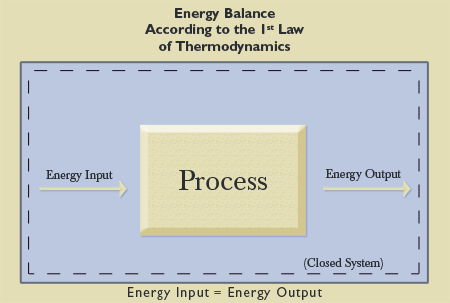 |
| Figure 1 |
This principle, also known as the “conservation of energy principle” (Cengel and Boles, p. 2), can be demonstrated by the burning of a piece of wood. When the wood is burned, it is transformed into a different state. The original amount of energy present before the burning is still present. However, much of that energy was transformed into a different state, namely, heat. No energy disappeared from the Universe, and no energy was brought into the Universe through burning the wood. Concerning the First Law, Young further explains that
the principle of the conservation of energy is considered to be the single most important and fundamental ‘law of nature’ presently known to science, and is one of the most firmly established. Endless studies and experiments have confirmed its validity over and over again under a multitude of different conditions (p. 165, emp. added).
This principle is known to be a fact about nature—without exception. One thermodynamics textbook, Fundamentals of Thermodynamics, says:
The basis of every law of nature is experimental evidence, and this is true also of the first law of thermodynamics. Many different experiments have been conducted on the first law, and every one thus far has verified it either directly or indirectly. The first law has never been disproved (Borgnakke and Sonntag, 2009, p. 116, emp. added).
That is why the McGraw-Hill Dictionary of Scientific and Technical Terms defines a scientific law as “a regularity which applies to all members of a broad class of phenomena” (2003, p. 1182, emp. added). Famous atheist, theoretical physicist, and cosmologist of Cambridge University, Stephen Hawking, concurred:
But what’s really important is that these physical laws, as well as being unchangeable, are universal. They apply not just to the flight of the ball, but to the motion of a planet and everything else in the Universe. Unlike laws made by humans, the laws of nature cannot ever be broken. That’s why they are so powerful…. [T]he laws of nature are fixed (“Curiosity: Did God Create the Universe?” 2011, emp. added).
The Second Law
In the nineteenth century, Lord Kelvin and Rudolph Clausius (1822-1888) separately made findings that became known as the Second Law of Thermodynamics (Suplee, 2000, p. 156). The Second Law builds on the First, stating that though there is a constant amount of energy in a given system that is merely transforming into different states, that energy is becoming less usable. Extending our wood burning illustration above, after the wood is burned, the total amount of energy is still the same, but transformed into other energy states. Those energy states (e.g., ash and dissipated heat to the environment) are less retrievable and less accessible (see Figure 2).
 |
| Figure 2 |
Well-known atheist, physicist, cosmologist, and astrobiologist of Arizona State University, Paul Davies, explained it this way:
[T]he celebrated second law of thermodynamics…says, roughly speaking, that in any change the Universe becomes a slightly more disorderly place; the entropy goes up, the information content goes down. This natural tendency towards disintegration and chaos is evident all around us (1978, 80[1129]:506).
This process is irreversible. Lord Kelvin stated that energy is “irrecoverably lost to man and therefore ‘wasted,’ although not annihilated” (Thomson, 1882, p. 189, ital. in orig.). This principle is known as entropy. Simply put, entropy states that nature is tending towards disorder and chaos. Will the paint job on your house maintain its fresh appearance over time? Will your son’s room actually become cleaner on its own, or will it tend toward disorder? Even without your son’s assistance, dust and decay take their toll. Although work can slow the entropy, it cannot stop it. Renowned evolutionary science writer Isaac Asimov explained:
Another way of stating the Second Law then is “The universe is constantly getting more disorderly!” Viewed that way we can see the Second Law all about us. We have to work hard to straighten a room, but left to itself it becomes a mess again very quickly and very easily. Even if we never enter it, it becomes dusty and musty. How difficult to maintain houses, and machinery, and our own bodies in perfect working order: how easy to let them deteriorate. In fact, all we have to do is nothing, and everything deteriorates, collapses, breaks down, wears out, all by itself—and that is what the Second Law is all about (1970, p. 6).
Entropy is simply a fact of nature. Entropy can be minimized in this Universe, but it cannot be eradicated. That is where engineers come in. Engineers work to discover ways of minimizing energy loss and maximizing useful energy before it is forever lost. Thousands of engineering jobs are dedicated to addressing this fundamental fact of the Second Law of Thermodynamics. Your energy bill is affected directly by it. If the Second Law was not fixed—unchanging—engineers could not develop the technology necessary to maximize usable energy, thereby lowering your energy costs.
Some engineers devote their entire careers to minimizing entropy in the generation of power from energy. All this effort is based on the principles established by the Second Law of Thermodynamics. These principles are established as fact in the scientific community. The American Heritage Dictionary of the English Language defines “law” as “a statement describing a relationship observed to be invariable between or among phenomena for all cases in which the specified conditions are met” (2000, p. 993, emp. added). Since laws are invariable, i.e., unchanging and constant, they have no exceptions. Otherwise, they would not be classified as laws. Tracy Walters, a mechanical engineer working in thermal engineering, observed:
It has been my experience that many people do not appreciate how uncompromising the Laws of Thermodynamics actually are. It is felt, perhaps, that the Laws are merely general tendencies or possibly only theoretical considerations. In reality, though, the Laws of Thermodynamics are hard as nails, and…the more one works with these Laws, the deeper respect one gains for them (1986, 9[2]:8, emp. added).
Evolutionist Jeremy Rifkin stated that “the Entropy Law will preside as the ruling paradigm over the next period of history. Albert Einstein said that it is the premier law of all science; Sir Arthur Eddington referred to it as the ‘supreme metaphysical law of the entire universe’” (1980, p. 6). Borgnakke and Sonntag, in Fundamentals of Thermodynamics, explain:
[W]e can say that the second law of thermodynamics (like every other law of nature) rests on experimental evidence. Every relevant experiment that has been conducted, either directly or indirectly, verifies the second law, and no experiment has ever been conducted that contradicts the second law. The basis of the second law is therefore experimental evidence (2009, p. 220, emp. added, parenthetical item in orig.).
Another thermal science textbook says, concerning the Second Law of Thermodynamics, “To date, no experiment has been conducted that contradicts the second law, and this should be taken as sufficient proof of its validity” (Cengel, Turner, and Cimbala, 2008, p. 266, emp. added).
IMPLICATIONS OF THE LAWS
When understood properly, the Laws of Thermodynamics apply directly to the creation/evolution controversy in precisely the same way they apply in the engineering world today (cf. Miller, 2007). In fact, these foundational truths, utilized daily by the engineering world, have eternally significant, spiritual implications in that they prove that God exists. How so?
If there is no God, the existence of the Universe must be explained without Him. The Big Bang theory claims that all matter in the Universe initially was condensed in a sphere smaller than the size of a period at the end of this sentence. That sphere exploded and helps to explain why the Universe, according to many cosmologists, appears to be expanding or inflating (see Thompson, et al., 2003, 23[5]:32-34,36-47). Even if the Big Bang were true (and it is not, cf. Thompson, et al.), this theory offers no explanation for the origin of that sphere. Evolutionist Alan Guth, a cosmologist and physics professor at M.I.T., admitted that “[i]nflation itself takes a very small universe and produces from it a very big universe. But inflation by itself does not explain where that very small universe came from” (as quoted in Heeren, 1995, p. 148). He further stated, “[A] proposal that the universe was created from empty space is no more fundamental than a proposal that the universe was spawned by a piece of rubber. It might be true, but one would still want to ask where the piece of rubber came from” (Guth, 1997, p. 273). So where could the “rubber” have come from?
The only logical possibilities for the origin of the matter and energy comprising the Universe are that they are responsible for their own existence (i.e., they popped into existence out of nothing—spontaneous generation or they always existed—eternality) or Someone is responsible for their existence (i.e., they were placed here by something outside of the Universe—Creation) (see Figure 3).
 |
| Figure 3 |
As the well-known philosopher and evolutionist from the 19th century, Herbert Spencer said, “Respecting the origin of the Universe three verbally intelligible suppositions may be made. We may assert that it is self-existent [i.e., eternal—JM]; or that it is self-created [i.e., spontaneously generated—JM]; or that it is created by an external agency” (1882, p. 30).
Possibility 1: Spontaneous Generation of the Universe
Consider the entire physical Universe as a system consisting of all mass, matter, and energy that exists in the Universe. If one believes in the Big Bang model, the system’s boundary would be outside of the blast radius of the Big Bang, or outside of the original cosmic dot that exploded. Without God (i.e., something outside of the bounds of the Universe—something supernatural), this Universe would have to be a closed system. Since our system encompasses the entire Universe, there is no more mass that can cross into our system from the outside, which necessitates our system being closed. If mass, matter, and energy could enter and/or exit the system, the system would be an open system[NOTE: The creationist contends that the Universe is an open system, since there is Someone outside of the natural Universe Who can cross the boundary and put matter and energy into the system. However, without God, the entire physical Universe as a system logically would have to be a closed system. Atheists must so believe in order to explain the Universe without God.].
Evolutionary physicist Victor Stenger, in his book, God: The Failed Hypothesis, said:
Conservation of energy [i.e., the First Law—JM] and other basic laws hold true in the most distant observed galaxy and in the cosmic microwave background, implying that these laws have been valid for over thirteen billion years. Surely any observation of their violation during the puny human life span would be reasonably termed a miracle…. In principle, the creation hypothesis could be confirmed by the direct observation or theoretical requirement that conservation of energy was violated 13.7 billion years ago at the start of the big bang (2007, pp. 115-116, emp. added).
The First Law of Thermodynamics states that in a closed system, the amount of energy present in that system is constant, though it transforms into other forms of energy. So, if the Universe as a whole initially contained no mass, matter, or energy, and then all of the mass, matter, and energy in the Universe spontaneously generated, the First Law would be violated. Without intervention from an outside force, the amount of mass, matter, and energy in the Universe would have remained constant (unchanged) at nothing. According to the scientific evidence, matter/energy could not have originally spontaneously generated. Thus, according to Stenger, the creation hypothesis is confirmed based on the scientific evidence. The initial creation of energy from nothing amounted to a miracle.
As was mentioned earlier, there are no exceptions to laws, or else they would not be laws. The First Law of Thermodynamics has no known exceptions. The Law is accepted as fact by all scientists in general and utilized by engineers in particular. Therefore, the Universe, composed of all mass, matter, and energy, could not have spontaneously generated (popped into existence on its own) without violating the exceptionless and highly respected First Law of Thermodynamics. The energy level of the Universe would not have been constant. Spontaneous generation would amount to the creation of energy from nothing (see Figure 4). The Universe could not have come into existence without the presence and intervention of a Force outside of the closed system of the entire physical Universe. The Universe therefore must be an open system that was created by a non-physical Force (i.e., a Force not composed of mass, matter, and energy) outside of the physical boundary of this Universe (above nature, or supernatural) with the capability of bringing it into existence out of nothing. That Force can be none other than a supernatural God. To develop a theory that requires the violation of that principle would be against the scientific evidence. It would be unscientific. The evidence from science indicates that matter could not and cannot spontaneously generate.
 |
| Figure 4 |
Unfortunately, though this truth is so glaringly obvious to many, there has been a recent surge of sentiment in the impossible notion that this Universe could have created itself—that something could come from nothing. British evolutionist Anthony Kenny (1980), physics professor from City University in New York, Edward Tryon (1984), and physicists Alan Guth from M.I.T. and Paul Steinhardt of Princeton (1984) are just a few who are open proponents of this notion. Stephen Hawking said, “Bodies such as stars or black holes cannot just appear out of nothing. But a whole universe can…. Because there is a law like gravity, the universe can and will create itself from nothing” (2010, p. 180). However, the truth still stands. Until the First Law of Thermodynamics ceases to be a fundamental law explaining this Universe, the spontaneous generation of this Universe from nothing is impossible.
No wonder Victor Stenger, a proponent of the idea of spontaneous generation, said, “I must admit that there are yet no empirical or observational tests that can be used to test the idea of an accidental origin” (1987, 7[3]:30). According to Stenger, the idea is “speculative” (p. 30). No solid evidence. Just speculation. Famous evolutionary astronomer, Robert Jastrow, the founder and former director of the Goddard Institute for Space Studies at NASA, said:
But the creation of matter out of nothing would violate a cherished concept in science—the principle of the conservation of matter and energy—which states that matter and energy can be neither created nor destroyed. Matter can be converted into energy, and vice versa, but the total amount of all matter and energy in the Universe must remain unchanged forever. It is difficult to accept a theory that violates such a firmly established scientific fact (1977, p. 32).
Science studies what occurs in nature, not super-nature. In nature, matter and energy can be neither created or destroyed, but “must remain unchanged forever.” This is a “firmly established fact.” Nothing comes from nothing. If a molecule will not pop into existence from nothing, a sphere containing all of the matter and energy of the entire Universe will certainly not pop into existence.
Possibility 2: Eternal Existence of the Universe
Again, considering the entire Universe as a system necessitates that it be a closed system. The Second Law of Thermodynamics states that though energy in a closed system is constant (First Law of Thermodynamics), that energy is transforming into less usable forms of energy (i.e., the Universe is “running down”). This process is irreversible. There is a finite amount of usable energy in the Universe (which explains the widespread interest in conserving energy). In the Big Bang model, that energy was originally in the cosmic egg that exploded, and now would be found within the blast radius of the original explosion. That usable energy is depleting according to the Second Law. Engineers strive to slow this inevitable depletion of energy, but it cannot be stopped.
If the Universe has always existed (i.e., it is eternal), but there is a finite amount of usable energy, then all usable energy already should be expended (see Figure 5). Yet, usable energy still exists. So, the Universe cannot have existed forever. It had to have a beginning. The eternality of matter would be the equivalent of a system with an energy input and 100% usable energy output (see Figure 6). It would be the equivalent of describing the Universe as a perpetual motion machine—a design that attempts to violate either the First or Second Law of Thermodynamics by, for instance, running forever without an energy input. No such machine has ever been designed, since such a machine would violate the laws of thermodynamics. Philip Yam, writing in Scientific American said, “Claims for perpetual-motion machines and other free-energy devices still persist, of course, even though they inevitably turn out to violate at least one law of thermodynamics” (1997, 277[6]:82).
 |
| Figure 5 |
 |
| Figure 6 |
No wonder evolutionists, themselves, have long conceded this truth. In his book, Until the Sun Dies, renowned evolutionary astronomer Robert Jastrow stated:
The lingering decline predicted by astronomers for the end of the world differs from the explosive conditions they have calculated for its birth, but the impact is the same: modern science denies an eternal existence of the Universe, either in the past or in the future (1977, p. 30, emp. added).
In his book, God and the Astronomers, Jastrow reiterated this truth:
And concurrently there was a great deal of discussion about the fact that the second law of thermodynamics, applied to the Cosmos, indicates the Universe is running down like a clock. If it is running down, there must have been a time when it was fully wound up…. Now three lines of evidence—the motions of the galaxies, the laws of thermodynamics, the life story of the stars—pointed to one conclusion; all indicated that the Universe had a beginning (1978, pp. 48-49, 111).
Evolutionist Kitty Ferguson, award-winning science writer, agreed. She said, “It’s also common knowledge that the universe isn’t eternal but had a beginning” (1994, p. 89). Any person who develops a theory that claims that the Universe could be a perpetual motion machine, is guilty of contradicting the solid evidence from science. They are being unscientific, and their unscientific mindset has resulted in an unscientific theory.
Possibility 3: The Inevitable Implication
What does the scientific evidence actually say about the matter of origins? Forget speculation, conjecture, hypothesis, and theory—wishful, hopeful thinking that there might be some way to avoid a supernatural explanation and the restrictions that Being might have on our desires. What does the evidence say?
To repeat, logically, there are only three possible explanations for the existence of matter in the Universe. Either it spontaneously generated, it is eternal, or it was created by a non-physical Being outside of the boundaries of the Universe. Atheists use the theory of evolution in an attempt to explain the existence and state of the Universe today. In order for the theory of evolution to be true, thereby accounting for the existence of mankind, either all of the mass, matter, and energy of the Universe spontaneously generated (i.e., it popped into existence out of nothing), or it has always existed (i.e., it is eternal.). Without an outside force (a transcendent, omnipotent, eternal, superior Being), no other options for the existence of the Universe are available. However, as the Laws of Thermodynamics prove, the spontaneous generation and the eternality of matter are logically and scientifically impossible. One and only one possible option remains: the Universe was created by the Creator. The scientific evidence points to the existence of God. Bottom line: God designed the laws of thermodynamics. Creationists believe them. Engineers use them. Atheists cannot harmonize them with their beloved theory.
CONCLUSION
Evolutionists claim that science and the idea of God are irreconcilable. “Only one of them can be true,” they say, “and you cannot prove there is a God.” Not all theistic models for the origin of the Universe are in keeping with science. For instance, according to Enuma Elish, the Babylonian creation account, the polytheistic Babylonians believed that matter is eternal (Pfeiffer, 1972, p. 226). This has been shown to be false. However, although not all Creation models are in harmony with the scientific evidence, one would expect the true Creation model to be in keeping with the evidence. The Laws of Thermodynamics, which science itself recognizes in its explanations of the phenomena in the Universe, were written by the Chief Engineer (cf. Miller, 2012). As expected, they prove to be in complete harmony with His existence, contrary to the claims of evolutionists. God, Himself, articulated these laws centuries ago in the Bible.
At the very beginning of the Bible, the First Law of Thermodynamics was expressed when Moses penned, “Thus the heavens and the Earth, and all the host of them, were finished. And on the seventh day, God ended His work which He had done, and He rested on the seventh day from all His work which He had done” (Genesis 2:1-2, emp. added). In Exodus 20:11, Moses wrote, “For in six days, the Lord made the heavens and the earth, the sea, and all that is in them, and rested (i.e., ceased) the seventh day.” Everything in the Universe was made in six days, and then the Lord stopped creating. Nothing else is coming into existence naturally. After the six days of Creation, the mass, matter, and energy creation process was terminated. As evolutionist Willard Young said regarding the First Law: “Energy can be neither created nor destroyed, but can only be converted from one form to another.” The thrust of the First Law of Thermodynamics was expressed in the Bible thousands of years ago, although it was not discovered and formally articulated by scientists until the 19th century.
Through the hand of the psalmist, God also stated centuries ago what scientists call the Second Law of Thermodynamics: “Of old You laid the foundation of the Earth, and the heavens are the work of your hands. They will perish, but You will endure; yes, they will all grow old like a garment; like a cloak You will change them, and they will be changed. But You are the same, and Your years will have no end” (102:25-27, emp. added). The Universe is wearing out—decaying, like an old shirt: the Second Law of Thermodynamics. Once again, the Creation model is in perfect harmony with science. The evolutionary model fails its thermodynamics test.
The inspired writer wrote in Hebrews 11:3, “By faith we understand that the worlds were framed by the word of God, so that the things which are seen were not made of things which are visible.” Paul declared in Acts 14:17, “Nevertheless He did not leave Himself without witness, in that He did good, gave us rain from heaven and fruitful seasons, filling our hearts with food and gladness.” The psalmist affirmed, “The heavens declare the glory of God; and the firmament shows His handiwork” (19:1). Paul assured the Romans, “For since the creation of the world His invisible attributes are clearly seen, being understood by the things that are made, even His eternal power and Godhead, so that they are without excuse” (1:20, emp. added). The scientific evidence points to God. There will be no excuse in the end for those who deny it.
In closing, we return to Lord Kelvin, the Father of Thermodynamics, for fitting final thoughts. In a short public speech in 1903, reported by The Times and followed up by an amending letter to the paper by Kelvin, Kelvin said:
I do not say that, with regard to the origin of life, science neither affirms nor denies Creative Power. Science positively affirms Creative Power…. It is not in dead matter that we live and move and have our being [Acts 17:28—JM], but in the creating and directive Power which science compels us to accept as an article of belief…. There is nothing between absolute scientific belief in a Creative Power, and the acceptance of the theory of a fortuitous concourse of atoms…. Forty years ago I asked Liebig, walking somewhere in the country if he believed that the grass and flowers that we saw around us grew by mere chemical forces. He answered, “No, no more than I could believe that a book of botany describing them grew by mere chemical forces”…. Do not be afraid of being free thinkers! If you think strongly enough you will be forced by science to the belief in God, which is the foundation of all Religion. You will find science not antagonistic but helpful to Religion (as quoted in Thompson, 1910, pp. 1097-1100, emp. added).
According to the Father of Thermodynamics, evolutionists are failing to “think strongly enough.” No wonder the psalmist asserted: “The fool has said in his heart, ‘There is no God’” (14:1).
REFERENCES
American Heritage Dictionary of the English Language (2000), (Boston, MA: Houghton Mifflin), fourth edition.
Asimov, Isaac (1970), “In the Game of Energy and Thermodynamics You Can’t Even Break Even,” Smithsonian Institute Journal, pp. 4-10, June.
Borgnakke, Claus and Richard E. Sonntag (2009), Fundamentals of Thermodynamics (Asia: John Wiley and Sons), seventh edition.
Cengel, Yunus A. and Michael A. Boles (2002), Thermodynamics: An Engineering Approach (New York: McGraw-Hill), fourth edition.
Cengel, Yunus A., Robert H. Turner, and John M. Cimbala (2008), Thermal-Fluid Sciences (New York, NY: McGraw-Hill).
“Curiosity: Did God Create the Universe?” (2011), Discovery Channel, August 7.
Davies, Paul (1978), “Chance or Choice: Is the Universe an Accident?” New Scientist, 80[1129]:506-508, November.
Ferguson, Kitty (1994), The Fire in the Equations: Science, Religion, and the Search for God (Grand Rapids, MI: Eerdmans).
Guth, Alan (1997), The Inflationary Universe (New York: Perseus Books).
Guth, Alan and Paul Steinhardt (1984), “The Inflationary Universe,” Scientific American, 250:116-128, May.
Hawking, Stephen (2010), The Grand Design (New York, NY: Bantam Books).
Heeren, Fred (1995), Show Me God (Wheeling, IL: Searchlight Publications).
Jastrow, Robert (1977), Until the Sun Dies (New York: W.W. Norton).
Jastrow, Robert (1978), God and the Astronomers (New York: W.W. Norton).
Kenny, Anthony (1980), The Five Ways: St. Thomas Aquinas’ Proofs of God’s Existence (South Bend, IN: University of Notre Dame Press).
King, A.L. (1962), Thermophysics (San Francisco, CA: W.H. Freeman).
McGraw-Hill Dictionary of Scientific and Technical Terms (2003), pub. M.D. Licker (New York: McGraw-Hill), sixth edition.
Miller, Jeff (2007), “God and the Laws of Thermodynamics: A Mechanical Engineer’s Perspective,” Reason & Revelation, 27[4]:25-31, April, http://www.apologeticspress.org/articles/3293.
Miller, Jeff (2012), “‘The Laws of Science’-by God,” Reason & Revelation, 32[12]:137-140, December, http://www.apologeticspress.org/apPubPage.aspx?pub=1&issue=1103&article=2072.
Moran, Michael J. and Howard N. Shapiro (2000), Fundamentals of Engineering Thermodynamics (New York: John Wiley & Sons), fourth edition.
Pfeiffer, Charles F. (1972), The Biblical World (Grand Rapids, MI: Baker Book House).
Rifkin, Jeremy (1980), Entropy: A New World View (New York: Viking).
Spencer, Herbert (1882), First Principles: A System of Synthetic Philosophy (New York: D. Appleton and Company), fourth edition.
Stenger, Victor J. (1987), “Was the Universe Created?,” Free Inquiry, 7[3]:26-30, Summer.
Stenger, Victor J. (2007), God: The Failed Hypothesis (Amherst, NY: Prometheus Books).
Suplee, Curt (2000), Milestones of Science (Washington, D.C.: National Geographic Society).
Thompson, Bert, Brad Harrub, and Branyon May (2003), “The Big Bang Theory—A Scientific Critique [Part 1],” Reason & Revelation, 23[5]:32-34,36-47.
Thompson, Silvanus P. (1910), The Life of William Thomson Baron Kelvin of Largs, Vol. 2, (London: MacMillan and Co.).
Thomson, William (1882), Mathematical and Physical Papers (Cambridge University Press).
Tryon, Edward P. (1984), “What Made the World?,” New Scientist, 101:14-16, March 8.
Walters, Tracy (1986), “A Reply to John Patterson’s Arguments,” Origins Research, 9[2]:8-9, Fall/Winter.
Yam, Philip (1997), “Exploiting Zero-Point Energy,” Scientific American, 277[6]82-85.
Young, Willard (1985), Fallacies of Creationism (Calgary, Alberta, Canada: Detselig Enterprises).
The post Evolution and the Laws of Science: The Laws of Thermodynamics appeared first on Apologetics Press.
]]>