The post Does the Garden of Eden Still Exist? appeared first on Apologetics Press.
]]>Nobody knows, so caution is in order. But there are some facts that can help us arrive at a reasonable conclusion:
- First, keep in mind that it would be easy to subconsciously assume that Genesis 2, where Eden is described, was being written “real time”—as though the writer lived alongside Adam and Eve in the Garden. In reality, however, Genesis was written by Moses roughly 2,500 years later4—long after the Flood—to an audience living in roughly 1,500 B.C.
- The grammar of Genesis 2 (in English translations) implies that at the time Moses wrote the book, several topographical markers were still available that allowed his audience to know the general vicinity of Eden. The present tense is used in English translations throughout the chapter (vss. 11,12,13,14), indicating that various physical markers existed in Moses’ time. However, unlike English, Hebrew does not actually have tense, properly speaking. Virtually all modern English translations assume Moses intended to communicate the present tense, but the Hebrew does not necessarily demand it. Moses could have been communicating past tense, implying that the rivers did not exist in his day anymore, nor the valuable resources mentioned in conjunction with the rivers. The implication would be that some of the locations/rivers mentioned by Moses may have been names passed down through the centuries, and Moses could have simply been clarifying where those legendary markers were relative to Eden. However, it would seem odd for Moses (God) to spend so much time highlighting to his audience specific, now non-existent markers and the locations of precious resources relative to those markers. No doubt, that rationale helps to explain why modern English translations assume the present tense throughout the text. Implication: the topographical markers to which Moses referred (i.e., the rivers and lands) possibly existed in 1,500 B.C., though no doubt much different in nature compared to their characteristics at Creation (and compared to their current characteristics). Note, however, that Eden itself is not said in the text to have still existed at Moses’ time, nor is the single river which became four riverheads. Instead, the four rivers themselves are described (by English translators) as existing at the time of Moses, though apparently no longer connected to one another in the way described by Moses (see below).
- The description of Eden’s location is given in Genesis 2:8-14. Though scholars have gone to great lengths attempting to nail down the identities of the lands of Havilah and Cush, they have been unable to do so conclusively, and the same is true concerning the identification of the four rivers listed by Moses: Pishon, Gihon, Hiddekel, and the Euphrates. While there are Tigris (Hiddekel) and Euphrates rivers today, it is uncertain if those are the rivers to which Moses was referring in Genesis 2. While he does mention the Euphrates River later in the Pentateuch (Genesis 15:18; Deuteronomy 1:7; 11:24), which is possibly the modern-day Euphrates River, it is not clear if the Euphrates of the pre-Flood world was the same river. As is often the case today, well-known names from previous places and times are often used elsewhere (e.g., the many names of locations in England which were used by Europeans upon moving to “New” England). To add further difficulty, Creation geologists highlight that there is no place on the Earth today where a river parts and becomes four riverheads (Genesis 2:10), implying that the surface of the Earth has drastically changed since Creation, as would be expected due to the effects of the Flood. Again, if the English translators are correct, the four rivers apparently still existed at the time of Moses, even if they do not still exist today.
- Creation geologists are nearly unanimous in their understanding of which rock layers in the geologic column represent the beginning of the Flood: the Cambrian strata at the base of the Paleozoic rock layers. Just below the Cambrian strata is an erosion surface—a worldwide geologic unconformity (the Great Unconformity) representing the commencement of the Flood. Some of the rock layers that existed (i.e., pre-Flood rock layers) prior to the erosional event (the Flood) are missing. During the Flood, enormous amounts of sediment were eroded from the pre-Flood Earth’s surface and sediment from the continents and ocean were piled on the continents, forming the bulk of the fossil record and much of the geologic column, beginning with the Cambrian strata. The Flood strata continue upward through the Paleozoic and Mesozoic rock strata, and end at either the top of those rock layers or continue a certain distance into the Cenozoic strata. Much of the Cenozoic sediment was laid down after the Flood or at the very end of it. Translation: the pre-Flood Earth surface was apparently wiped clean and, in some cases, buried under several miles of sediment. Many commentators guess that Eden is located in modern day Armenia or Iraq, but they do so, apparently, without understanding how drastic the Flood’s geologic impact would have been across the entire surface of the Earth. The area where Eden is thought by many commentators to have been located is covered with immense amounts of Flood sediment. That means that Eden, if (1) it was not first completely eroded away by the Flood (which is likely), or (2) pushed down into the mantle during the Flood (there is a subduction zone along the north/northeast side of the Arabian plate in the area where Eden is thought to have been), is now covered with roughly three to five miles of mud/sediment deposited during and after the Flood.

- With that knowledge in mind, it is difficult to imagine how the same four rivers of the pre-Flood world could have still existed after the Flood.5 Even if they did, however, river channels migrate over time as they erode the surface of the Earth and are affected by flooding and new obstacles. The Nile River, for example, is known to have migrated laterally, back and forth, over time, meandering to places that are now over three miles away from where it now migrates.6 Thus, even if the four rivers to which Moses referred could be specifically pinpointed, it is highly unlikely that they are in the same places that they were 3,500 years ago.
Bottom line: while unlikely, the four rivers that branched off of the river leaving Eden might have still existed in Moses’ day (after the Flood), but they are not the same today as they were during Moses’ day 3,500 years ago, much less after Creation week. The continued existence of Eden itself is highly doubtful, and its location—if still in existence—would be virtually impossible to find.
Endnotes
1 Eric Lyons and Kyle Butt (2015), “3 Good Reasons to Believe the Bible is from God,” Reason & Revelation, 35[1]:2-11.
2 Dave Miller (2015), “3 Good Reasons to Believe the Bible Has Not Been Corrupted,” Reason & Revelation, 35[8]:86-92.
3 Dave Miller (2020), “Genesis: Myth or History?” Reason & Revelation, 40[5]:50-57.
4 Eric Lyons, et al. (2003), “Mosaic Authorship of the Pentateuch—Tried and True,” Reason & Revelation, 23[1]:1-7.
5 The NIV translates Genesis 2:6 as “streams came up from the earth and watered the whole surface of the ground.” While the term “streams” (apparently relying on a Greek translation, verified by Akkadian and Sumerian cognates, according to Hebrew scholar Justin Rogers) is typically translated as “mist” in other translations, Hebrew scholars are uncertain about the real meaning of the word. Streams coming up from the Earth would possibly imply the existence of an underground aquifer that supplied the water for the river that watered Eden (Genesis 2:10), which separated into the four mentioned rivers. If the underground aquifer was not destroyed by the Flood (which is unlikely), it may be possible that after the Flood its waters would again reach the surface and result in the formation of other streams/rivers. It is notable that the Ras El Ain karstic springs feed the Khabour river which, today, is one of the main tributaries of the Euphrates River [Aysegul Kibaroglu (2014), “Euphrates-Tigris River Basin Report,” HARC, https://harcresearch.org/sites/default/files/Project_Documents/Reports1-EuphratesTigris.pdf, pp. 2-4].
6 John K. Hillier, Judith M. Bunbury, and Angus Graham (2007), “Monuments on a Migrating Nile,” Journal of Archaeological Science, 34[7]:1011-1015, July.
 |
 |
| Suggested Resources | |
The post Does the Garden of Eden Still Exist? appeared first on Apologetics Press.
]]>The post The Flood Explains the Fossil Record appeared first on Apologetics Press.
]]> Have you ever wondered what creatures were like before the Flood? Nobody knows for sure. Even though God made the basic kinds of life during Creation week, He built into their genes the ability to make a lot of variety as they reproduced. For example, the variety that has been bred from the original dogs (“canids”) that God made likely includes more than just the varieties of domestic dogs (from toy poodles to Irish Wolfhounds). It probably includes the wolves, coyotes, foxes, jackals, dingoes, and other canids. Because of the variety of animals we see today within each of the kinds God made, it’s hard to know what the original pair that Noah took on the ark looked like. It’s also true that the pre-Flood world “perished” in the Flood (2 Peter 3:6), making it hard to know what it was like. When we look at the fossil record, however, we can learn a lot about many of the types of life that existed before the Flood. After all, a fossil is a “snap shot” of what a life form looked like or did at a certain time in the past.
Paleontologists (scientists who study fossils) divide the fossil record into four basic sections: Cenozoic fossils (the fossils found in the topmost layers of rock on the planet—formed most recently), Mesozoic fossils below the Cenozoic, Paleozoic fossils below the Mesozoic, and finally, the handful of fossils found below the Paleozoic fossils—Pre-Cambrian fossils (the oldest). While evolutionists would argue that the fossil record was formed over hundreds of millions of years, the Bible teaches that the Earth is only a few thousand years old. Instead of a record of life and evolution over hundreds of millions of years, therefore, most of the fossil record is a record of death and God’s judgment in the one-year-long Flood. The fossil record is a worldwide graveyard.
- Creation paleontologists believe that Pre-Cambrian fossils are fossils that were formed from Creation week and the years that passed before the Flood.
- Paleozoic and Mesozoic fossils (and possibly some of the Cenozoic fossils) are believed to have been formed during the Flood a few thousand years ago.
- Many of the Cenozoic fossils probably formed after the Flood.
So, when we find fossils in the Paleozoic or Mesozoic rock layers, we are getting a glimpse of some of the amazing creatures that lived before the Flood and died in the Flood—many of which are now extinct.
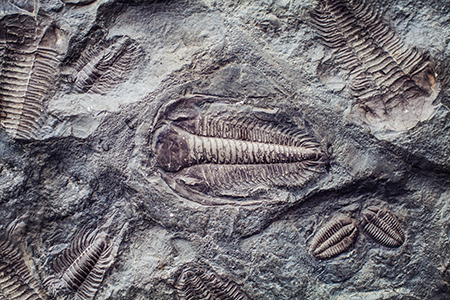 |
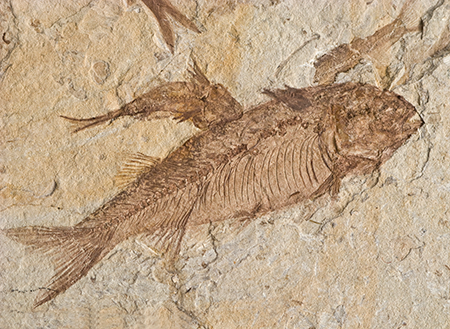 |
| Arthropod Fossil | Fish Fossil |
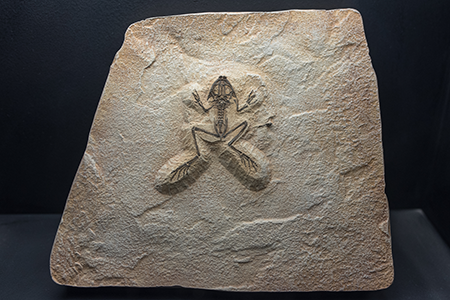 |
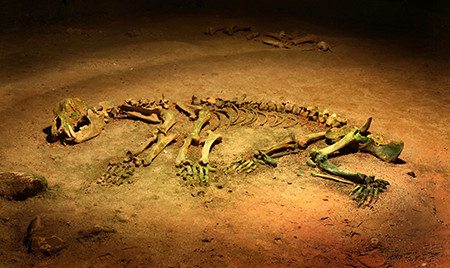 |
| Amphibian Fossil | Mammal Fossil |
When we look at the order of appearance of fossils, moving from deeper in the ground (Paleozoic) to shallower (Cenozoic), and how they are grouped, we see that the fossil record seems to record the progress of the Flood as it gradually destroyed the different areas creatures lived in (habitats) before the Flood. As we have explained in other issues of Discovery, Creation scientists today believe the Flood started at the base of the oceans when “all the fountains of the great deep were broken up” (Genesis 7:11), and eventually resulted in the flooding and destruction of the entire surface of the Earth. As we would expect, at the bottom of the Paleozoic layers (where the Flood began) the first creatures we see are ones that lived on the ocean floor (like arthropods and brachiopods), followed above those layers by creatures that swam in the sea (like cephalopods and fish). Amphibians (which can live in the water or on land) appear in the next layers (buried as the Flood moved towards the coasts of continents), followed by reptiles (which live on land near water), then birds and mammals. Many of the larger mammals we see on the planet today, as well as humans, probably lived in one habitat together that was completely destroyed in the Flood, leaving behind very little fossil evidence in Flood layers. (They are found in the Cenozoic Layers, for the most part.) For the rest of this issue of Discovery, we will look at several of the interesting life forms that lived in the pre-Flood world that are found in these fossil layers.
Isn’t it amazing that science supports Scripture so well? Sadly, in spite of the evidence, many “will turn their ears away from the truth and be turned aside to fables” (2 Timothy 4:4)—like evolution. But remember: the truth will always be made clear to those who are sincerely interested in finding it (Matthew 7:7-8). God expects us to “test all things” and “hold fast what is good” (1 Thessalonians 5:21). When we test the theories of evolutionists, looking at the physical evidence, we find that they cannot explain the evidence. Creation and the Flood, however, fit the evidence and are powerful witnesses of the power of God.
The post The Flood Explains the Fossil Record appeared first on Apologetics Press.
]]>The post Creatures Before the Flood appeared first on Apologetics Press.
]]>Brachiopods
At first glance, you might assume that brachiopods [BRAK-ee-oh-pods] are just clams, since they have two “shells” (valves) and a hinge that allows the shells to close and protect their soft insides. Upon a closer look, however, brachiopods do not have the same shape, symmetry, or inner makeup as clams. Brachiopods still exist today (they are “extant”), but they are rarely seen (being on the ocean floor, mostly) and not as common as they were in the pre-Flood world.
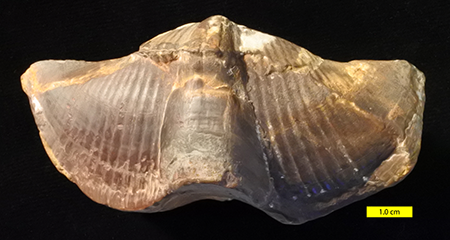 |
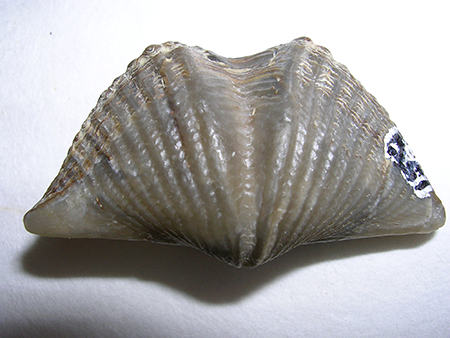 |
|
Wikipedia.org (Wilson44691) 2019 CC-by-sa-1.0 |
Wikipedia.org (Porshunta) 2019 CC-by-sa-3.0 |
Arthropods
 Also found on the ocean floor in the pre-Flood world were arthropods like some varieties of the extinct trilobite. Trilobites are among the very first creatures to appear in the fossil record, but are considered extremely complex among the invertebrates—disproving what evolution would predict. According to evolution, the creatures that appear early in the fossil record should be very simple, not complex. Trilobites were usually around one to four inches long, but some were over 12 inches long!
Cephalopods
Moving higher in the fossil record, we find the pre-Flood creatures that swam in the ocean, such as cephalopods [SEF-uh-luh-pods].
Nautiloids are cephalopods that are basically squids in a shell. The few surviving species look essentially the same as those in the fossil record (disproving evolution predictions again). A huge number of nautiloids were buried at the Grand Canyon during the Flood.
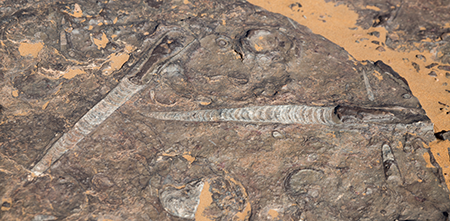 |
 |
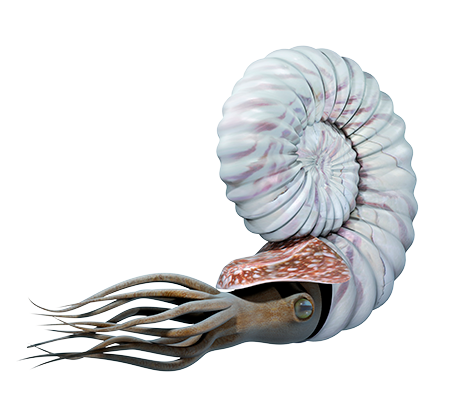 |
| Cephalopod Orthoceras | Nautiloids | Ammonites |
Ammonites are now extinct, but swam in the oceans of the pre-Flood world as well. They had a spiral shell.
Fish
 |
|
Wikipedia.org (Tim Bertelink) 2019 CC-by-sa-4.0 |
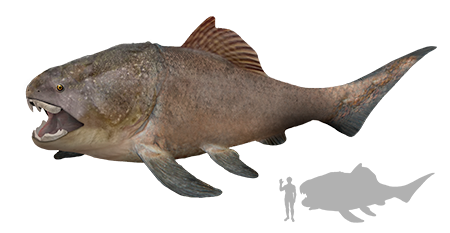
As would be expected, marine fish, such as Dunkleosteus [DUNK-lee-OH-stee-us], were buried in the Flood alongside the cephalopods. One species grew to be about 20 feet long and weighed one ton!
Bugs
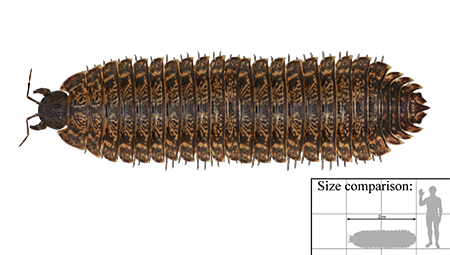
As creepy as it may sound, Arthropleura was an extinct giant millipede arthropod from the pre-Flood world. If it was a land creature, it was the largest known land invertebrate of all time, able to grow over eight feet long!
|
Athropleura |
Meganeura |
|
Wikipedia.org (Tim Bertelink) 2019 CC-by-sa-4.0 |
Wikipedia.org (Matteo De Stefano 2019-by-sa-3.0 |

Meganeurais extinct as well (thankfully!), but was basically a huge dragonfly-like insect with a wingspan that was over two feet long! Modern dragonflies have a wingspan of about two to five inches.
Amphibians
| Wikipedia.org (Matteo De Stefano 209 CC-by-sa-3.0 |
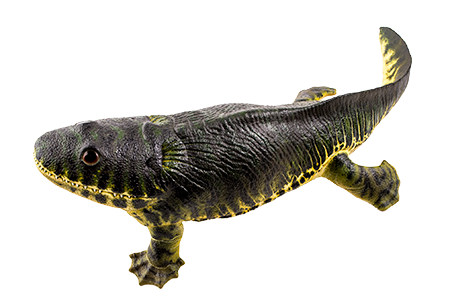 |
As the Flood began to reach the coasts, amphibians were killed and buried, since they live both in water and on land. Ichthyostega [IK-thee-AH-stuh-guh] was about five feet long, thought to be an amphibian, and is considered to be one of the first vertebrates in the fossil record that has four limbs.
Cynodonts [SIE-nuh-donts]
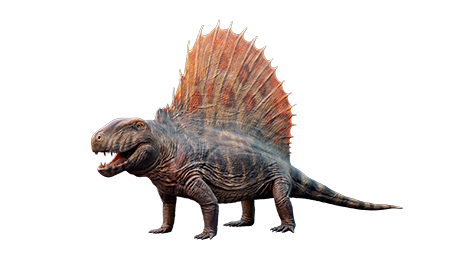
Dimetrodon[die-MEH-truh-don] is a popular creature from the pre-Flood world. Although many call it a dinosaur, scientists believe it to be neither a reptile nor a mammal, but among another extinct group of creatures called cynodonts.
 |
|
Wikipedia.org (Max Bellomio) 2019 CC-by-sa-4.0 |
Reptiles
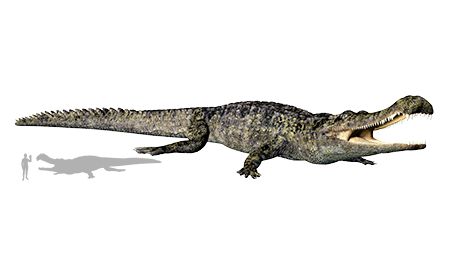 You are probably most familiar with the reptilian creatures of the pre-Flood world, like the dinosaurs, pterosaurs (flying reptiles), and the marine reptiles like plesiosaurs and ichthyosaurs—especially since we discuss dinosaurs so much in Discovery. But don’t forget the largest known crocodile from the pre-Flood world: Sarcosuchus [SAR-koh-SOO-kis] imperator. While larger crocs today can be over 20 feet long, Sarcosuchus could grow to be closer to 40 feet and weigh 17,500 pounds!
Birds
 As you might expect, birds did not show up until high in the fossil record when the Flood was already pouring over the continents. While most birds and mammals do not appear until the Cenozoic layers, there are exceptions. The first bird to show up is currently thought to be Archaeopteryx (which we have studied before in Discovery).
Mammals
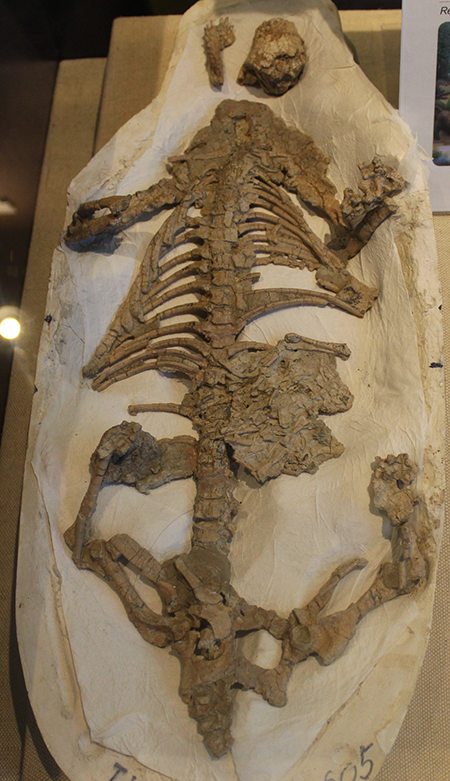
 Very few mammal fossils were preserved in the Flood rock layers, which could mean they were killed last or totally destroyed by the Flood when the original continent broke up and its pieces began moving and sinking. Repenomamus [ruh-PEN-uh-mah-miss] is extinct, but its fossils are some of the few mammal fossils that survived the Flood. It grew to be over three feet long and is pretty popular, because one of its fossils proves that its last meal was a small dinosaur! (Psittacosaurus)
 |
|
Wikipedia.org (Jonathan Chen) 2019 CC-by-sa-4.0 |
Imagine what it would have been like to live with some of these creatures, just like Noah’s family and millions of others did. Would you try to pet one or run from it? Would you have obeyed God by having dominion over the fish of the sea, over the birds of the air, and over every living thing that moves on the Earth” (Genesis 1:28), as He commanded mankind in the beginning?
The post Creatures Before the Flood appeared first on Apologetics Press.
]]>The post Fossils That Formed Before the Flood appeared first on Apologetics Press.
]]>
 |
 |
| Stromatolites | Microfossils |
Stromatolites
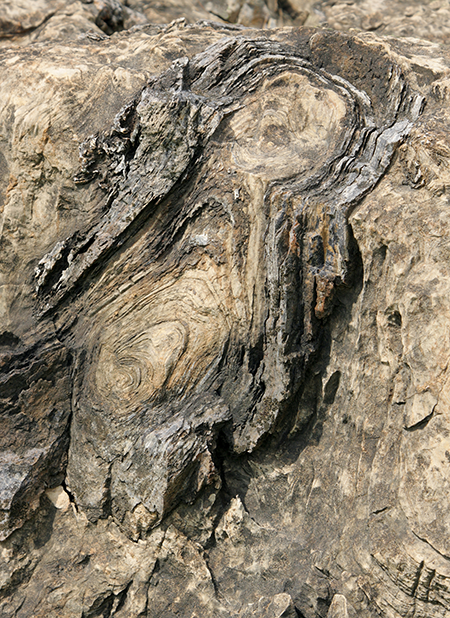
Stromatolites are layers of rock that are thought to have been formed from communities of tiny microorganisms. While today they grow to be roughly three feet in diameter, during the pre-Flood time period, they grew to be miles in diameter.
Microfossils
Microfossils (fossils that can only be studied with microscopes) of cyanobacteria have been found, which are responsible for many of the pre-Flood stromatolites. Many other kinds of bacteria fossils are also found in the oldest rocks.
What was the world like before the Flood? Not much is known since the Flood was so destructive. God only left us a few clues. We know one thing, though: when humanity turns its back on God like the people of Noah’s world did, the tolerance of God eventually “runs out” and His judgment follows. Let’s be sure to obey God and tell others how to do so, too!
The post Fossils That Formed Before the Flood appeared first on Apologetics Press.
]]>The post Are there Fossilized Plants from the Flood? appeared first on Apologetics Press.
]]>
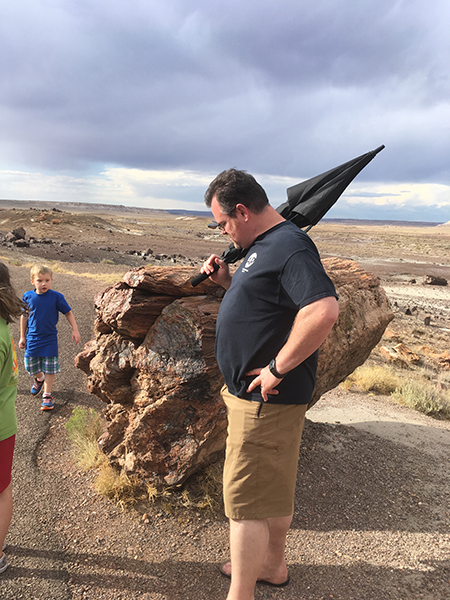 |
| Petrified log at the Petrified Forest National Park |
Great question! There are lots of plants in the Flood layers of the fossil record—from polystrate plant fossils (fossils that span more than one stratum), like calamites and tree logs, to petrified angiosperm trees (trees that produce flowers) and petrified gymnosperm trees (trees that produce seeds, but no flowers). An example that might be very helpful for you to know about if you travel to Arizona and go to Petrified Forest National Park would be Araucarioxylon arizonicum. Don’t even try to say it! What you need to know is that the petrified logs at Petrified Forest are thought to be a type of conifer tree (like pine trees or cypress trees) that could grow to be 200 feet tall and have a diameter of three to four feet! These trees were probably torn up, buried, and fossilized due to Flood activity (which included a lot of volcanic eruptions, based upon the volcanic ash in the rock layers of those logs). It is possible that they floated in by a huge Flood mudslide to the Petrified Forest where they now sit. I don’t know about you, but I’m glad I wasn’t alive to see that happen!
The post Are there Fossilized Plants from the Flood? appeared first on Apologetics Press.
]]>The post How Do Caves Form? appeared first on Apologetics Press.
]]>It is tempting to believe that caves form from rushing water that slowly wears away a rock—“eroding” it until a hole appears. But that is not the action that forms most caves. Most caves are thought to be formed by rock being dissolved by an acid—a process called dissolution (DIS-uh-LOO-shun). After a chamber is dissolved in a rock, when the water level below the ground drops or the ground itself rises (yes, that happens in some places!), an empty cave is left.
Many old-Earth geologists believe that solution caves are formed when rain water picks up carbon dioxide in the air as it falls to the ground and begins soaking into the Earth. As it seeps through the Earth, it picks up more carbon dioxide from the decaying plants in the dirt, and the water turns into carbonic (kar-BON-ik) acid—the stuff that makes your soda fizz. When that acid sinks in the ground to a kind of stone that dissolves easily (like limestone), the acid slowly dissolves the rock, forming a hole. Old Earth geologists believe that over thousands of years, the hole gets bigger, eventually forming a cave. As you can imagine, that process is very slow. How, then, can the Bible be true?
 |
 |
| Feeders | |
 |
 |
| Channels | |
Over the last several years, another kind of cave dissolution process has been studied and found to explain how many caves have formed. Instead of rocks being slowly dissolved by carbonic acid from above, they can be quickly dissolved by sulfuric acid that comes from below. This process is called hypogene (HIPE-oh-jean) speleogenesis (SPEEL-ee-oh-JEN-uh-sis). As water comes into contact with rocks that contain sulfur, dead plants and animals (which release sulfur as they decay), or hydrogen sulfide from volcanic gases, and then combine with oxygen, sulfuric acid forms. During the Flood, large amounts of hot water would have been trapped below the surface of the Earth while dirt was being piled up on continents. The water would have mixed with oxygen, as well as hydrogen sulfide from the volcanic activity in the Flood and sulfur from the dead plants and animals across the planet, making sulfuric acid. The sulfuric acid would have been trapped beneath the Earth’s surface where the pressure from the water and added dirt on the surface would have caused the sulfuric acid to move towards the surface, dissolving rock along the way. Bottom line: the Flood conditions would have been perfect for the rapid formation of solution caves.
 |
 |
| Cupola | |
 |
| Mineral Gypsum |
To show that sulfuric acid dissolution explains most solution caves, I have studied 25 caves in eight states, looking for characteristics in solution caves that would support sulfuric acid dissolution: entry holes at the base of the cave (feeders), pathways leading from the feeders to the top of the cave (channels), dome structures on the ceilings of caves (cupolas), and the presence of the mineral gypsum (which forms quickly when sulfuric acid meets lime), for example.Without exception, every solution cave I have studied has characteristics that support sulfuric acid dissolution—exactly what we would expected if the Flood happened and formed caves only a few thousand years ago.
The post How Do Caves Form? appeared first on Apologetics Press.
]]>The post Were the Giza Pyramids Built Before the Flood? appeared first on Apologetics Press.
]]>If the Egyptian Pyramids of Giza were built around 4,600 years ago1 and the Flood was about 4,400 years ago, does that mean the pyramids were built prior to and survived the Flood?
A:
 First, keep in mind that, although roughly 2,400 B.C. is generally accepted as the date of the Flood, the chronologies of Genesis 11 allow for an expansion of a few hundred years.2 Also keep in mind that dating techniques that are used to determine the age of ancient materials, such as carbon dating and tree ring analysis, rely on the assumption of uniformitarianism.3 These methods would be invalid if a worldwide catastrophic Flood occurred followed by a Flood-induced Ice Age. If the Flood actually occurred, and nuclear decay rates were accelerated during and after its occurrence for a period of time (and sub-annual tree rings were forming due to the Ice Age) as many creationists contend, all ages dating before roughly 1,000-1,500 B.C. would be inflated, giving an appearance of age beyond their true age.
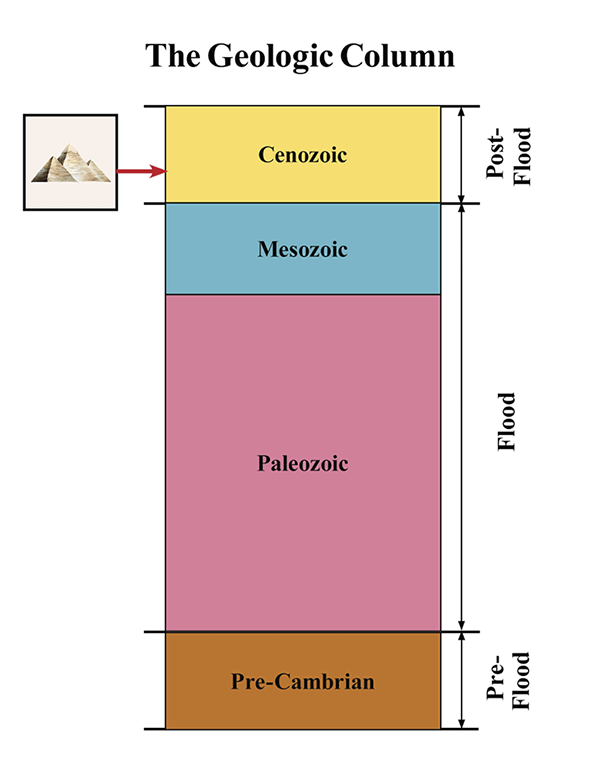
Also, when we examine the layers of rock that form the continents upon which we reside, there is little doubt that the Cambrian strata—the beginning of the Paleozoic Era—represent the commencement of the biblical Flood.4 The rock layers throughout the Paleozoic, and overlying Mesozoic layers, approximately represent the sediment that was deposited during the Flood. Above those layers are the rocks of the Cenozoic era, which were laid down after the Flood. The Giza Pyramids were built into the Cenozoic layers (specifically, the Eocene strata5) that were deposited after the Flood—implying that the Giza Pyramids were not built before the Flood. The date of their construction, as assigned by archaeologists (e.g., 2700-2500 B.C.6), has likely been inflated based on uniformitarian dating schemes.
Endnotes
1 Brian Handwerk (2017), “Pyramids at Giza,” National Geographic, March 23, https://www.nationalgeographic.com/archaeology-and-history/archaeology/giza-pyramids/.
2 Jeff Miller (2019), “21 Reasons to Believe the Earth is Young,” Reason & Revelation, 39[1]:10.
3 Mike Houts (2015), “Assumptions and the Age of the Earth,” Reason & Revelation, 35[3]:26-34.
4 S.A. Austin and K.P. Wise (1994), “The Pre-Flood/Flood Boundary: as Defined in Grand Canyon, Arizona and Eastern Mojave Desert, California,” Proceedings of the Third International Conference on Creationism, Technical Symposium Sessions (Pittsburgh, PA: Creation Science Fellowship), pp. 37-47.
5 M.M. El Aref and E. Refai (1987), “Paleokarst Processes in the Eocene Limestones of the Pyramids Plateau, Giza, Egypt,” Journal of African Earth Sciences, 6[3]:367-377, https://www.sciencedirect.com/science/article/pii/0899536287900790.
6 Brian Handwerk (n.d.), “Pyramids at Giza,” NationalGeographic.com, https://www.
Edited 4/7/22
 |
|
| Suggested Resources | |
The post Were the Giza Pyramids Built Before the Flood? appeared first on Apologetics Press.
]]>The post Does the Fossil Record Support Creation and the Flood? appeared first on Apologetics Press.
]]>
A prominent argument used in favor of Darwinian evolution and against biblical Creation, with its account of the global Deluge of Noah’s day, centers on the nature of the fossil record recorded in the layers of rock beneath and around us. Does the fossil record indeed conflict with biblical Creation?
In order for a scientific theory to be validated, it should be able to make predictions about what research would discover if the theory is true. If gradual Darwinian evolution accounts for the origin of all current species from previous, less complex species, starting with an original, simple common ancestor that was a single-celled organism, one would make certain predictions that would be verified upon examining the fossil record. For example, the fossil record should show single-celled organisms at the base of the fossil record, followed by fossils of other simple organisms. Billions of fossils of intermediary organisms would be predicted to exist that connect the single-celled organism to the next species. Every species thereafter would follow suit in its representation in the fossil record, with its own billions of transitional fossils linking it to a previous species. Further, since Darwinian evolution would predict “survival of the fittest,” with a constant upward trend in the evolution of species, extinction of any species thought to be millions of years old would be inevitable. As a new, more fit species evolved onto the scene, it would survive, pushing out its previous, less fit form.
On the other hand, if biblical Creation and the Flood are true, completely different predictions would be made concerning the fossil record. Since God initially created representatives of all kinds, rather than their evolving from previous forms, since fossil forming phenomena are rare, and since the Earth is young, the bulk of the fossil record would be, not a record of past life and evolution on a billions of years old Earth, but a record of death as the year-long Flood progressed. Few fossils would be found below the Flood layers, with many of those having likely been destroyed when the Flood began. The Flood layers, on the other hand, would be the equivalent of a worldwide graveyard—a record of the destruction of “all living things which were on the face of the ground” (Genesis 7:23).
Creationists would predict that when the Flood began, mass destruction of life occurred worldwide, and therefore the fossil record would begin with an explosion of fossil forms that were fully formed and functional, with no evidence of having evolved from previous forms. The bulk of these fossils would be in sedimentary rock, since the Flood was an aqueous event. Both simple and complex creatures would be mixed throughout the fossil record, while larger, faster, and/or “smarter” creatures would sometimes be found higher in the record, since they could more easily escape fossil forming phenomena and survive longer. If much of the Flood waters came from the oceans, as the text and scientific evidence seem to imply,1 the fossils at the base of the fossil record would be of creatures found on the ocean floor, followed by marine creatures. As the Flood waters continued to rise and the cataclysm hit the coasts, shallow water organisms and coastline creatures would be killed and buried, followed by creatures further and further inland. Marine fossils would be interspersed throughout the fossil record, since the ocean waters moving onto the land would have carried swimming creatures with them. After the Flood ended, since fossil forming phenomena are rare, those creatures that were unable to rebound after the Flood (or which were hunted, etc.) would gradually go extinct, often with no record of having even survived the Flood. While the fossils of the year-long Flood would show no evidence of change throughout the year, the layers after the Flood would be predicted to show evidence of the diversifying of creatures after they left the Ark to repopulate the Earth.
Which model’s predictions best fit the physical evidence gleaned from paleontology? Paleontologists have long acknowledged three general characteristics of the fossil record in its totality: (1) abrupt appearance; (2) stasis; and (3) extinction.2 Each of these characteristics fit the Creation/Flood paradigm well, but create an “uncomfortable paradox” for the Darwinian gradual evolution paradigm.3
Characteristic #1: Abrupt Appearance
This general characteristic refers to the fact that when fossils first appear in the fossil record, they appear fully formed without any evolutionary history. The Cambrian Explosion, for example, refers to the many fully formed creatures that abruptly appear at the base of the fossil record with no ancestors. Reporting on research at the University of Texas at Austin, UT News reported: “This rapid diversification, known as the Cambrian explosion, puzzled Charles Darwin and remains one of the biggest questions in animal evolution to this day. Very few fossils exist of organisms that could be the Precambrian ancestors of bilateral animals, and even those are highly controversial.”4 Osorio, et al., writing in American Scientist, acknowledged,
As Darwin noted in the Origin of Species, the abrupt emergence of arthropods in the fossil record during the Cambrian presents a problem for evolutionary biology. There are no obvious simpler or intermediate forms—either living or in the fossil record—that show convincingly how modern arthropods evolved from worm-like ancestors. Consequently there has been a wealth of speculation and contention.5
The late, well known evolutionary paleontologist Stephen Jay Gould admitted: “The Cambrian explosion was the most remarkable and puzzling event in the history of life.”6 Famous evolutionary biologist of Oxford University, Richard Dawkins, described the Cambrian Explosion this way:
The Cambrian strata of rocks, vintage about 600 million years [secular geologists are now dating the beginning of the Cambrian at about 540 million years—JM], are the oldest in which we find most of the major invertebrate groups. And we find many of them already in an advanced state of evolution, the very first time they appear. It is as though they were just planted there, without any evolutionary history.7
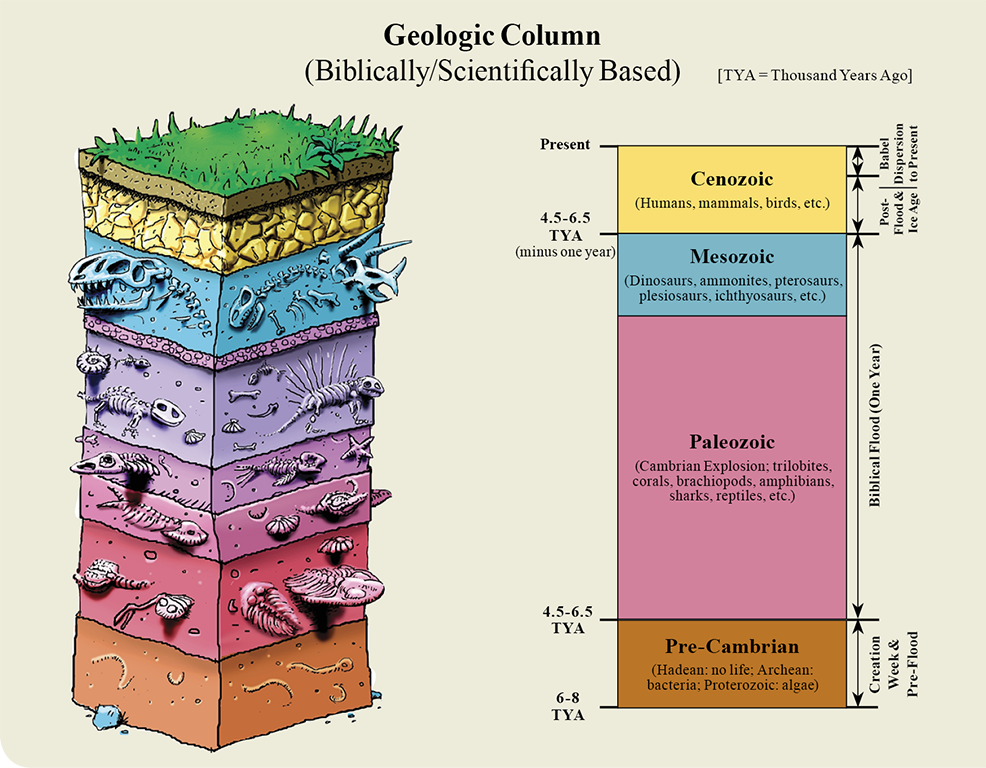
Long ago, the late, famous paleontologist of Columbia University, the American Museum of Natural History, and the Museum of Comparative Zoology at Harvard, George Gaylord Simpson, admitted: “Most new species, genera, and families, and nearly all categories above the level of families, appear in the records suddenly, and are not led up to by known, gradual, completely transitional sequences.”8 The Cambrian Explosion is an acknowledged problem for evolutionary theory—a falsified prediction—and yet the abrupt appearance of fully formed and functional species is an obvious, pervasive trait of the entire fossil record, from beginning to end.
The abrupt appearance of living organisms, however, is not the extent of the problem for evolution. Not only are the species of the fossil record fully formed and functional from the beginning of the record, but they are also complex when they abruptly appear. The trilobite, for example, is characteristic of the Cambrian strata at the base of the fossil record—a creature equipped with an extremely complex vision system, using aplanatic lenses that are more complex than the human eye, which is equipped with a single refractive lens.9 The fossil record provides no evidence for the evolution of the trilobite, and yet its complexity is stunning. Complexity at the commencement of the fossil record is a falsification of a fundamental evolutionary prediction, but coincides perfectly with Creation and Flood predictions.
Evolution would also predict that diversity would precede disparity in the fossil record. In other words, varieties of a single body type (diversity) would be found in the fossil record at its base, and over time (moving up through the record), other body types would eventually emerge (disparity). One calls to mind the well-known sketches of the evolutionary tree of life, with a single-celled organism at its base gradually giving rise to the many branches and twigs that characterize all life. The biblical Creation model predicts the opposite: God initially created distinct kinds (disparity) from which came variety and diversity within those kinds. Instead of the evolutionary tree of life, one calls to mind an orchard of trees representing distinct kinds with their branches and twigs representing mere diversification and variety within those kinds. The fossil record, once again, supports the creationist contention. Biologists have pinpointed a few dozen distinct phyla—the level of organization used to group organisms based on their basic body plans. Of the 27 phyla represented in the fossil record, roughly 20 appear immediately in the Cambrian explosion (disparity) with no evidence of having evolved.10 Variety within those phyla—species diversity—does not show up until higher in the fossil record, just as biblical Creation would predict: disparity before diversity.
Abrupt appearance of fully formed and functional, complex organisms with immense disparity is a sweeping characteristic of the fossil record. That truth is severely problematic for evolution, but it is precisely what would be predicted if biblical Creation and the Flood occurred.
Characteristic #2: Stasis
Stasis in the fossil record refers to the observation that after creatures appear in the fossil record, they remain virtually the same throughout their tenure in the rock layers.11 While Darwinian evolution would predict a gradual change of species over millions of years, the fossil record does not reflect that prediction: transitional fossils linking one species to a distinctly different species do not exist.
Gould admitted that evolutionists “have no direct evidence for smooth transitions.” He acknowledged: “All paleontologists know that the fossil record contains precious little in the way of intermediate forms; transitions between major groups are characteristically abrupt.”12 Writing in Paleobiology he explained: “The absence of fossil evidence for intermediary stages between major transitions in organic design, indeed our inability, even in our imagination, to construct functional intermediates in many cases, has been a persistent and nagging problem for gradualistic accounts of evolution.”13 “[T]he extreme rarity of transitional forms in the fossil record persists as the trade secret of paleontology. The evolutionary trees that adorn our textbooks have data only at the tips and nodes of their branches: the rest is inference, however reasonable, not the evidence of the fossils.”14
Evolutionary paleontologist Steven Stanley explained: “The known fossil record fails to document a single example of phyletic evolution [i.e., evolution of a new phylum—JM] accomplishing a major morphological transition and hence offers no evidence that the gradualistic model can be valid.”15 Evolutionary anthropologist and emeritus professor of the University of Oxford Robert Barnes acknowledged that “the fossil record tells us almost nothing about the evolutionary origin of phyla and classes. Intermediate forms are non-existent, undiscovered, or not recognized.”16 Evolutionary biologists James Valentine and Douglas Erwin wrote: “If ever we were to expect to find ancestors to or intermediates between higher taxa, it would be in the rocks of the late Precambrian to Ordovician times, when the bulk of the world’s higher animal taxa evolved. Yet transitional alliances are unknown or unconfirmed for any of the phyla or classes appearing then.”17
So clear is the lack of evidence of evolutionary transition in the fossil record that evolutionary zoologist of Oxford University Mark Ridley went so far as to say, “[N]o real evolutionist, whether gradualistic or punctuationist, uses the fossil record as evidence in favor of the theory of evolution as opposed to special creation.”18 Why? Because the fossil record does not support evolution; it supports Creation. Even Charles Darwin saw the problem in the 1800s that persists today:
[T]he number of intermediate varieties, which have formerly existed, [must] be truly enormous. Why then is not every geological formation and every stratum full of such intermediate links? Geology assuredly does not reveal any such finely graduated organic chain; and this, perhaps, is the most obvious and serious objection which can be argued against this theory [i.e., evolution—JM].19
Colin Patterson literally “wrote the textbook” on evolution. He was the paleontologist who served as the editor of the professional journal published by the British Museum of Natural History in London. In response to a letter asking why he did not include examples of transitional fossils in his book, he responded,
I fully agree with your comments on the lack of direct illustration of evolutionary transitions in my book. If I knew of any, fossil or living, I would certainly have included them…. Yet [Stephen Jay] Gould and the American Museum people are hard to contradict when they say there are no transitional fossils…. I will lay it on the line—there is not one such fossil for which one could make a watertight argument.20
Notable is the fact that when paleontologists uncover a fossil that they hope will pass as a legitimate transitional form, not only is it still controversial, but the championed fossil is inevitably from a vertebrate organism. Vertebrate fossils, however, comprise roughly only 0.0125% of the fossil record—they are virtually irrelevant indicators of whether or not evolution occurred.21 Since well over 99.9% of the fossil record is made up of invertebrate fossils, one would think that if evolution happened, transitional fossils would be easy to find among the invertebrates, especially since their remains tend to preserve more easily. Rarely, if ever, however, do evolutionists even claim to find alleged invertebrate transitional forms. If species evolve in the manner described by mainstream evolutionists, (1) transitional forms should not be difficult to find, and (2) they would be invertebrates most of the time. Neither of those predictions hold true.
Further verification that stasis—a lack of significant evolutionary change—reflects the fossil record pertains to what Darwin termed “living fossils.” Countless times over many years evolutionists have discovered fossils in strata laid down millions of years ago (according to the evolutionary timeline) that were thought to be extinct, presumably from having evolved into something else. According to evolution, species are the result of “descent with modification” from other species, so it would be virtually inconceivable that a species would remain essentially the same after millions of years. After all, according to evolution, evolution happens! “Living fossils,” however, have been discovered many times over the years. “Living fossils” (a self-contradictory notion at best) are species thought to have lived millions of years ago, that have been discovered alive in modern times, virtually the same as their fossil counterpart. Consider the following sample of living fossils with the number of alleged evolutionary years since their alleged extinctions22:
- Coelacanths (300-400 million years)
- Graptolites (300 million years)
- Tuatara (over 65 million years)
- Metasequoia tree (over 20 million years)
- Heliopora coral (over 65 million years)
- Crocodiles (over 150 million years)
- Various teleost fishes (over 100 million years)
- Sturgeons (over 65 million years)
- Bowfin fish (70 million years)
- Gar fish (100 million years)
- Pleurotomaria gastropod (500 million years)
- Neotrigonia mollusk (100 million years)
- Chambered Nautilus (500 million years)
- Neopilina mollusk (280 million years)
- Lingula brachiopod (450 million years)
- Wollemi pine trees (over 65 million years)
- Horseshoe crabs (over 400 million years)
- Monoplacophorans mollusks (over 500 million years)
Once again, the predictions of the evolutionary paradigm fall woefully short. Stasis is a verified prediction of the Creation model—not the evolutionary paradigm. A lack of transitional fossils, especially among the invertebrates, along with the prevalence of “living fossils,” supports Creation—not evolution.
Characteristic #3: Extinction
Five “mass extinction” events are said to have occurred in history, according to the evolutionary paradigm.23
- In the Ordovician extinction (445 million years ago), 60-70 percent of the Earth’s species went extinct.
- In the Devonian extinction (360-375 million years ago), up to 75 percent of the Earth’s species disappeared from the Earth.
- In the Permian extinction (252 million years ago), 95 percent of the Earth’s species went extinct.
- In the Triassic extinction (200 million years ago), 70-80 percent of the Earth’s species disappeared.
- In the Cretaceous extinction (65-66 million years ago), 75 percent of the Earth’s species went extinct.
According to evolutionists, the causes of these alleged worldwide extinction events are still unknown.
Creationists interpret the same data differently. First, the dates of the extinction events are incorrect, since they rely on radiometric dating.24 All dates in millions of years can be telescoped to the biblical timeframe upon realization that, for example, the nuclear decay rates were apparently accelerated during the Flood. The Flood likely corresponds roughly to the Cambrian through Cretaceous periods (i.e., 540 million years ago to 66 million years ago, using the evolutionary timescale). Each of the extinction events, therefore, fall within the year-long Flood that occurred a few thousand years ago. The geologic column and fossil record provide an account of the Flood’s progression.25 Hence, each of the major extinction events noted by evolutionists merely report the destruction of another of Earth’s major habitats/ecosystems as the waters of the Flood continued to rise.
Regardless of one’s explanation of the evidence, extinction—not evolution—is a major trait of the fossil record. The biblical global Flood provides a powerful explanation for why worldwide death and extinction occurred in the fossil record and, at the same time, why fossils are typically found in sedimentary rock (which is typically formed from aqueous events).
Conclusion
The fossil record is a compilation of creatures that abruptly appear, fully formed, in the rock layers of the Earth with no evolutionary history. They remain virtually the same throughout the record, and then oftentimes disappear from the surface of the Earth. Do these pervasive, endemic traits of the fossil record support the biblical accounts of Creation and the Flood, or is the naturalistic paradigm the better explanation for the origin of the fossils? Clearly, the Theory of Evolution does not fit the physical evidence. Many of its most fundamental predictions are consistently falsified through observation of the evidence left for us in the fossil record. Evolution, therefore, has been effectively falsified. Upon assessing the evidence, it seems that one must be determined to ignore it, blindly holding to naturalism, to accept evolution. Biblical Creation and the Flood fit the evidence. They happened, whether or not we appreciate their implications regarding how we should live in order to please God and receive His eternal blessings (2 Peter 3:3-11).
Endnotes
1 Jeff Miller (2019), ” Was the Flood Global? Testimony from Scripture and Science,” Reason & Revelation, 39[4]:38-47, https://apologeticspress.org/apPubPage.aspx?pub=1&issue=1293&article=2918.
2 E.g., Stephen Jay Gould (1980), The Panda’s Thumb (New York: W.W. Norton & Co.), pp. 181-182.
3 Ibid.
4 “Discovery of Giant Roaming Deep Sea Protist Provides New Perspective on Animal Evolution” (2008), UT News, November 20, http://news.utexas.edu/2008/11/20/giant_protist.
5 Daniel Osorio, Jonathan Bacon, and Paul Whitington (1997), “The Evolution of Arthropod Nervous Systems,” American Scientist, 85[3]:244, emp. added.
6 Stephen J. Gould (1994), “The Evolution of Life on Earth,” Scientific American, 271:86, October.
7 Richard Dawkins (1986), The Blind Watchmaker (New York: W.W. Norton), p. 229, emp. added.
8 George G. Simpson (1953), The Major Features of Evolution (New York: Columbia University Press), p. 360.
9 Lisa J. Shawver (1974), “Trilobite Eyes: An Impressive Feat of Early Evolution,” Science News, 105:72, February 2; Riccardo Levi-Setti (1993), Trilobites (Chicago, IL: University of Chicago Press), pp. 57-58; Richard Ellis (2001), Aquagenesis (New York: Viking), p. 49.
10 Stephen C. Meyer (2013), Darwin’s Doubt (New York: HarperCollins), p. 31.
11 Gould (1980), p 182.
12 Stephen Jay Gould (1977), “Evolution’s Erratic Pace,” Natural History, 86[6]:24, emp. added.
13 Stephen Jay Gould (1980), “Is a New and General Theory of Evolution Emerging?,” Paleobiology, 6[1]:119-130, Winter, p. 127, emp. added.
14 Gould (1977), p. 13, emp. added.
15 Steven Stanley (1977), Macroevolution (San Francisco, CA: Freeman), p. 39, emp. added.
16 Robert Barnes (1980), “Invertebrate Beginnings,” Paleobiology, 6[3]:365, emp. added.
17 James Valentine and Douglas Erwin (1987), “Interpreting Great Developmental Experiments: The Fossil Record,” Development as an Evolutionary Process (New York: Alan R. Lias), p. 84, emp. added.
18 Mark Ridley (1981), “Who Doubts Evolution?” New Scientist, June 25, 90:832.
19 Charles Darwin (1956), The Origin of Species (London: J.M. Dent & Sons), pp. 292-293, emp. added.
20 Colin Patterson (1979), Letter of April 10, 1979 to Luther Sunderland: reprinted in Bible-Science Newsletter, 19[8]:8, August, 1981, emp. added.
21 John D. Morris (1994), “Does the Geologic Column Prove Evolution?” Acts & Facts, 23[7], https://www.icr.org/article/does-geologic-column-prove-evolution.
22 John D. Morris and Frank J. Sherwin (2010), The Fossil Record (Dallas, TX: Institute for Creation Research), pp. 113-114; “Are Horseshoe Crabs Really Crabs?” (2018), National Ocean Service, June 25, https://oceanservice.noaa.gov/facts/horseshoe-crab.html; Paul Bunje (n.d.), “The Monoplacophora,” University of California Museum of Paleontology, http://www.ucmp.berkeley.edu/taxa/inverts/mollusca/monoplacophora.php.
23 “Earth’s Major ‘Mass Extinction’ Events” (2017), Phys.org, July 17, https://phys.org/news/2017-07-earth-major-mass-extinction-events.html.
24 Jeff Miller (2013), “Don’t Assume Too Much: Not All Assumptions in Science Are Bad,” Reason & Revelation, 33[6]:62-70, http://apologeticspress.org/pub_rar/33_6/1306.pdf.
25 Miller (2019).
The post Does the Fossil Record Support Creation and the Flood? appeared first on Apologetics Press.
]]>The post Where Does the Ice Age Fit in the Bible? appeared first on Apologetics Press.
]]>Why do scientists believe an Ice Age happened? As glaciers move today, scientists can see the effects of their movement. When they find those same features elsewhere, they believe that glaciers were probably once there, too. For instance, glaciers are not made solely of ice. They also have rocks, dirt, plants, and sometimes even fossils frozen within the ice. As the glacier grows (from the formation of more ice) or contracts (from melting), it moves. The rocks that are trapped within the glacier at its base scratch the Earth as the glacier moves. These scratches that run side by side are called “striations.” They occur on rocks that extend over miles and miles of plains.
Have you ever played with a toy bull dozer? What happens to the dirt as the bucket (the “blade”) scrapes the Earth? Some of the dirt gets scooped up. But what happens to the dirt that doesn’t get scooped up? The effect of your bulldozer’s movement will be piles of dirt on each side of the blade as it moved and a pile of dirt in front of it where it stopped. The same piles of dirt [called till and moraine (muh-RAIN)] are left as a glacier moves.


Based on evidences like rock striations, till, and moraine, scientists believe that as much as 30% of the Earth’s land surface was once covered with ice (as opposed to 10% today). The ice at the poles once extended much further than it does today. Scientists call this period of time the Ice Age. [Actually, many evolutionists incorrectly believe that the evidence supports several ice ages over millions of years—not just one over hundreds of years.] The evidences for the Ice Age are found in the rock layers that are found above the rock layers typically understood by Creation geologists to be the Flood layers—that is, after the Flood.

What are Bible-believers to make of such evidence? Does the Ice Age fit with the Bible? Definitely. We know that the Flood was a worldwide water catastrophe. The ocean floor apparently broke up (Genesis 7:11), releasing lots of heat and magma into the oceans. Mountain building and volcanic activity happened quickly (Psalm 104:8, ESV). The result would have been that the oceans were much warmer during and after the Flood for a period of time. Warmer water means more evaporation (liquid water turning into steam/cloud), which means more rain and snow. More volcanic activity means more ash and aerosols in the sky, which would block out more sunrays. That effect would lead to cooler summers with less ice melting each year. Until the oceans began to cool off again, the ice and snow at the poles would continue to advance, causing the Ice Age to occur over, possibly, several hundred years after the Flood. Cooler summers coupled with more moisture in the air and a “persistence” of those two features would likely have triggered the Ice Age and would explain the physical evidence. Bottom line: evidence for the Ice Age is actually evidence that the Flood happened!
As is always the case, the scientific evidence does not contradict the Bible. We may not always immediately understand the evidence we discover, but when we study further, we continue to find more and more powerful evidences that support what the Bible teaches.
The post Where Does the Ice Age Fit in the Bible? appeared first on Apologetics Press.
]]>The post An Ice Age After the Flood Explains A Lot! appeared first on Apologetics Press.
]]>For instance, when studying the fossil record, scientists have discovered that many large mammals went extinct at the end of a period where tills, moraines, and striations (we learned about these in the first article of this issue) are found in the rock layers. Immediately before the disappearance of all of those animals, strange circumstances can be seen in the fossil record. Fossils of animals that typically live in the cold (like reindeer and woolly mammoths) are found living with animals that are typically found in warm areas (like hippos). At the same time, we find “wet deserts”—areas that once were lush and rainy that are now deserts. All of these observations (and more) can be explained by an Ice Age that came after the Flood.



The extinctions only happened once, because the evidence suggests there was only one Ice Age—not several, as evolutionists claim. Cold and warm animals lived together, because (as we saw earlier in this issue) the summers were milder during the Ice Age, allowing all animals to live with each other. Wet deserts are found because there was much more rain during the Ice Age. The Ice Age explains why animals and man were able to cross to North America—likely because of the frozen channel that connected the two during the Ice Age (the Bering Strait). It explains how many of Earth’s canyons were able to be carved quickly, instead of over millions of years. The Lake Missoula flood, for instance, is believed to have happened during the Ice Age, when melting ice caused an ice dam to break, releasing large amounts of water that carved through rock quickly and easily. The Grand Canyon is also believed to have been rapidly carved in that way.
Perhaps the most powerful explanation that the idea of an Ice Age after the Flood provides is how an Ice Age got started in the first place and why it ended. While evolutionary theories fail to provide reasonable answers to those questions, the Flood helps explain both. Isn’t it fun learning about the great works that God has done on the Earth since Creation (Psalm 111:2)?
The post An Ice Age After the Flood Explains A Lot! appeared first on Apologetics Press.
]]>The post Does Science Support the Flood? appeared first on Apologetics Press.
]]>In science, when testing a theory, it is important to be able to make predictions based on your theory that can be found to support or refute your idea after studying the evidence. If a global Flood happened, what would we expect to find when studying the Earth?
 |
 |
 Dr. Jeff in Wyoming |
 Dr. Jeff in the Grand Canyon |
 Polystrate Fossil www.wikimedia.org (Michael C. Rygel) 2018 CC-by-sa-3.0 |
 Dr. Jeff standing beside Seismite |
Evidence #1 :One of the three major rock types is called sedimentary (sed-uh-MEN-tree) rock. Sedimentary rock forms when water carries dirt and sand and piles them in a place where they become compacted and cemented together. If a global Flood occurred, we would expect there to be worldwide sedimentary rock layers. Sure enough, sedimentary rock layers have been found that cover entire continents and even span multiple continents in some cases.
Evidence #2: If the Earth was once covered with water from the ocean, we would predict that marine fossils (fossils of sea creatures) would be found on land that is now dry and far above sea level, including mountains. Once again, this prediction has been proven right: marine fossils have even been found in the tallest mountain range in the world—the Himalayas.
Evidence #3: If a global Flood occurred, we would predict that many living creatures would have traveled together, stampeding, as they rushed to avoid the rapidly rising water and fast moving mudslides caused by the Flood. In many cases, the herd would have been caught and killed, leaving behind a graveyard of many fossils as testimony. As expected, many fossil graveyards have been discovered across the Earth, including dinosaur graveyards. Imagine the power that would be needed to kill thousands of stampeding dinosaurs, tear them into bits and pieces, and bury them in a single place—like the dinosaur graveyard I helped to excavate in Wyoming.
Evidence #4: If Creation and the Flood happened—rather than evolution—when we look at the beginning (or base) of the fossil record, what would we expect to find? We would predict that creatures would already be fully formed the first time they appear, rather than being in the middle of gradually evolving into something else. Once again, when we examine the fossils at the base of the fossil record, we find what scientists call the “Cambrian Explosion”—an “explosion” of fully formed creatures with no evidence of evolution. These fossils are found across the whole Earth in sedimentary rock, just like Flood scientists would predict.
Evidence #5: If evolution is true and the Earth is old, then the rock layers were laid down gradually over millions of years. If Creation and the Flood are true, then most of the rock layers are made up of materials that were laid down rapidly during the Flood, one on top of the other. The discovery of polystrate fossils supports the Flood scientists’ expectations. A polystrate fossil is a fossil that cuts through more than one (poly-) stratum (strate) of rock. Many such fossils have been discovered, proving that the strata had to be laid down rapidly in order to bury the fossil before it had time to decay.
Evidence #6: When an earthquake happens, it shakes the ground. When soggy sand is shaken in an earthquake, the layer of sand will have up and down squiggly lines that reflect the movement of the ground. If the layer of sand were to compact and lithify (turn to stone), the layer would be called a seismite (SIZE-mite). Earthquakes today leave small seismites in layers that were once wet sand. If the Flood happened, and the ocean floor broke up, we would expect sand to have been wet while major earthquakes occurred. So we would predict seismites in rock layers from the Flood. Not only have many seismites been discovered in Flood rock, but enormous seismite layers have been discovered that span many miles—apparently caused by earthquakes that were so strong that evolutionary geologists do not even know what could cause them. If the mountains formed rapidly in the Flood, however (as Creation scientists predict), it would explain why the seismites are so huge and why there are so many of them.
As we have shown in other issues of Discovery, we can know that the Bible came from God. Since it says that a global Flood happened, we can trust that it did. But the evidence for the Bible’s inspiration is not the only kind of evidence for the Flood that God has left us. Science has given us many evidences for a global Flood as well. Sure enough, the Bible said it, and science verifies it.
The post Does Science Support the Flood? appeared first on Apologetics Press.
]]>The post What Happened in the Flood? appeared first on Apologetics Press.
]]>It is true that the Bible does not give us many hints about what happened in the Flood, but it does give us more than we might have first thought. For example:
Genesis 7:11—All of the fountains of the great deep were broken up. Apparently the ocean floor broke up and began moving around as it does today—only much faster during the Flood.
Genesis 7:11—Apparently, after the fountains of the deep broke up, the “windows of heaven” opened for 40 days and nights (7:12). It is possible that the breakup of the fountains caused the rain.
Genesis 7:17-18,24—While intense rain continued for 40 days and nights, the water “prevailed on the Earth” for about five months—possibly continuing to increase the entire time (8:3).
Psalm 104:6-9 (ESV)—During the Flood, Earth’s great mountains rose and the valleys sank. That means that before the Flood, the Earth was flatter—making it easier for the Flood waters to cover the entire Earth.
Psalm 104:9—The changes that occurred on the surface of the Earth meant that a Flood like that of Noah’s day cannot ever happen again naturally. We will consider this idea more in our last section of this issue.
Genesis 8:1-3—When the fountains were stopped and the windows of heaven closed, God also caused a wind to pass over the Earth. So the water began to decrease. After several weeks, the Ark rested in a mountain range.


Amazingly, Creation scientists have discovered lots of evidence that supports what these passages say happened during the Flood. They have found many other evidences to help fill in the gaps. For example, they have found that when the ocean floor broke into many pieces (Genesis 7:11)—called plates—the plates would have begun to move quickly. Some plates would have moved apart, while others smashed into each other, causing one plate to be pushed downward (“subducted”), under the other plate, and towards the center of the Earth. That process creates mountains (Psalm 104:8). Since the mountains rose during the Flood, there is no longer enough water on Earth to cover them all, just as the Bible says in Psalm 104:9.
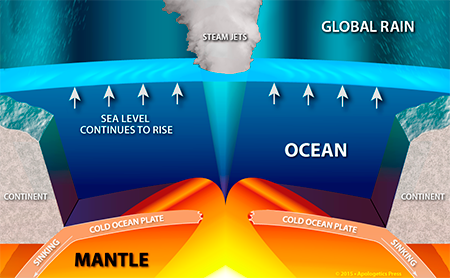
We live on the “ground”—what geologists call the Earth’s crust. Under the crust, however, is the mantle. Scientists have discovered huge piles of rock in the mantle under the places where plates subducted that are too cold to be millions of years old. Those plates were most likely pushed into the mantle rapidly only a few thousand years ago in the Flood—when Earth’s great mountains were forming rapidly.
The mantle is filled with magma—rock that is so hot that it is melted like rocky syrup. Plates that move apart leave gaps. Magma comes to the surface to fill in those gaps. Have you ever thrown water on a camp fire? When you do, much of the water is heated so hot that it turns from a liquid into a vapor called steam. When the magma touched the ocean water in the flood, the water would have turned to a vapor, too. Hundreds of miles of steam fountains (Genesis 7:11) would have been created all over the Earth in the Flood, which would have shot into the atmosphere and dropped down as rain—possibly the rain that came down for 40 days and nights (7:17-18).
As usual, there is no reason ever to doubt the Bible. If the Bible says a global Flood happened, then you can trust that it did. As scientific evidence is gathered, it will support what the Bible says every time. Psalm 111:2—“The works of the Lord are great; studied by all who have pleasure in them.”
The post What Happened in the Flood? appeared first on Apologetics Press.
]]>The post Where Did the Water Go? appeared first on Apologetics Press.
]]>As we discussed earlier in this issue, Creation scientists believe the movement of the Earth’s plates began when “all the fountains of the great deep were broken up” (Genesis 7:11). During the Flood, these plates were moving very fast—probably as fast as you can run. Today, the plates are moving slowly—about as fast as your fingernails grow. Recall that when plates move apart, magma comes to the surface of the Earth to fill the gap. Since many of the plates were moving apart from each other quickly during the Flood, more and more magma was coming onto the ocean floor. Eventually, the entire sea floor was replaced with new magma.
 |
| Shell Fossils |
One of the rules that governs heat tells us that when a material is hotter, it will expand and when it is cold it contracts or “shrinks up” (except for water). The new magma on the ocean floor was hotter than the previous ocean floor, so it would have been in an expanded state. Scientists have calculated that the new magma on the ocean floor would have raised the ocean floor by thousands of feet over several weeks, pushing water, mud, and sea creatures over the continents in the Flood (Genesis 8:3). That is why we find fossils on dry land, and even on mountains.
Eventually, the plates would have slowed down. The magma cooled and the ocean floor would have contracted, since colder materials shrink. The ocean floor, therefore, would have sunk back to the level where it started, allowing the water on the continents to go back to the oceans (Psalm 104:8).
Where is the water from the Flood? Answer: where it was before the Flood—mainly in the oceans. The next time you stand on a seashore looking at the vast, unending ocean, remember that over 4,000 years ago, that same water once covered the Earth as God’s judgment upon man’s wickedness (2 Peter 3:3-12). That same water carried Noah and his family to safety, thanks to the grace of God (1 Peter 3:20-21).
The post Where Did the Water Go? appeared first on Apologetics Press.
]]>The post Creation and the Flood: Evidence from the Fossils appeared first on Apologetics Press.
]]>One powerful tool scientists can use to gather evidence and prove or disprove a theory is called a prediction. No, I don’t mean a “prophecy.” I mean, I should be able to say, “I think my daughter Celeste took the missing cookie. If I’m right, I predict that there will be cookie crumbs on her mouth and clothes.” If I find those crumbs, my prediction has been verified, and I have evidence to support my theory (though not necessarily enough to know for sure if I am right, without more evidence). Similarly, one of the ways Creation and the Flood can be shown to be right is through verified predictions.
For example, what would we predict to find in the fossil record if Creation and the Flood are true? First, since we know fossils form during catastrophes, and the Flood was certainly a catastrophe, we would expect a lot of fossils to exist in the fossil record in the layers of rock that we think formed in the Flood. Such a worldwide catastrophe would probably wipe out most of the fossils that formed in the few hundred years before the Flood since the top few layers of rocks and dirt would have been washed away during the Flood. So moving from the bottom up in the fossil record, we would expect to find virtually no fossils at the bottom, and then we would expect to find a marker for the beginning of the worldwide Flood, followed by an explosion of fossils from those creatures that lived at the time of the Flood and died in the Flood. Since water and mud from the oceans poured onto the land during the Flood, we would expect the “earliest” fossils (the fossils at the bottom of the record) to be of creatures that are found in the oceans along the coast. As the waters rose, we would expect the creatures on the coast to be buried, followed by the creatures farther and farther inland.
 Also, since the many layers of rock from the Flood are made from the dirt/sediment that was laid down rapidly during the one-year-long Flood (not laid down over millions of years), we should not find evidence of the evolution of one type of animal into another. Instead, the fossils we find in those layers should (1) be of creatures that are already fully-formed and functional (not half-evolved) the first time they appear, and (2) when we compare a creature the first time it appears in the record with what it looked like the last time it appears, it should be virtually the same (not perfectly the same, since not all animals from the same species look exactly alike). We call this “stasis.”
We would also expect “fossil graveyards” to be found all over the world, where herds of land dwelling animals were drowned in water and rapidly buried by “a violent catastrophe”—unable to escape from the water. We would expect “polystrate fossils” to exist—fossils that cut across many layers of rock—since those layers were laid down rapidly during the Flood, not over millions of years. We would expect many examples of sea creature fossils to be found alongside land living creature fossils—since they were mixed together during the Flood. We would expect sea fossils to be found even on the mountains, since again, water from the ocean was pushed onto land, and then the mountains themselves were raised during the Flood (Psalm 104:8). Guess what? Sure enough, all of these predictions and others have been verified by examining the fossil record.


center image credit: WWW.WIKIPEDIA.ORG (RYGEL, M.C.) 2017 CC-BY-SA-3.0
What if I could provide many other verified predictions about Celeste and the cookie? Perhaps I predicted that she would have chocolate in her teeth, and I found it. Maybe I predicted that her older sister, who was watching her, either saw her or heard her getting the cookie, and I verified that prediction with her eyewitness testimony. Perhaps I simply watched Celeste’s skin, knowing that the cookies had peanut butter in them, and knowing that she has a severe allergy to peanuts. If she broke out in a rash, my prediction would be verified. Notice that verified predictions can be a powerful way to arrive at truth. Similarly, the truth of the biblical Creation model has been verified by the testimony of many evidences, including verified scientific predictions.
The post Creation and the Flood: Evidence from the Fossils appeared first on Apologetics Press.
]]>The post The Cambrian Explosion: Falsification of Darwinian Evolution appeared first on Apologetics Press.
]]>Consider Darwinian Evolution, the currently popular theory for how all life came to be, from goo to you. If life on Earth today is the result of countless tiny changes over 3.8 billion years, a clear chain of fossils extending back to that original single-celled organism should be present in the fossil record. There should be billions of fossils documenting the transitions between billions of creatures throughout the record. Yet this prediction has not been verified in the fossil record, effectively falsifying Darwinian Evolution. Decades ago, the late, famous evolutionary paleontologist of Harvard, Stephen J. Gould, acknowledged this problem. He said, “The absence of fossil evidence for intermediary stages between major transitions in organic design, indeed our inability, even in our imagination, to construct functional intermediates in many cases, has been a persistent and nagging problem for gradualistic accounts of evolution” (1980, p. 127). “All paleontologists know that the fossil record contains precious little in the way of intermediate forms; transitions between major groups are characteristically abrupt” (1977, p. 24). “[T]he extreme rarity of transitional forms in the fossil record persists as the trade secret of paleontology. The evolutionary trees that adorn our textbooks have data only at the tips and nodes of their branches: the rest is inference, however reasonable, not the evidence of the fossils” (1977, p. 13). His study of the fossil record led to his rejection of gradualistic evolution altogether.
David B. Kitts, the late evolutionary geologist, paleontologist, and professor of geology and the history of science at Oklahoma University, said, “Despite the bright promise that paleontology provides a means of ‘seeing’ evolution, it has presented some nasty difficulties for evolutionists, the most notorious of which is the presence of ‘gaps’ in the fossil record. Evolution requires intermediate forms between species, and paleontology does not provide them” (1974, p. 466, emp. added). Concerning the evolution of humans, Richard Lewontin, research professor at the Museum of Comparitive Zoology at Harvard, admitted, “The main problem is the poor fossil record. Despite a handful of hominid fossils stretching back 4m [million—JM] years or so, we can’t be sure that any of them are on the main ancestral line to us. Many of them could have been evolutionary side branches” (2008, emp. added). Evolutionist and senior science writer for Scientific American, Kate Wong, admitted, “The origin of our genus, Homo, is…[b]ased on…meager evidence…. [W]ith so little to go on, the origin of our genus has remained as mysterious as ever” (2012, pp. 31-32). Editor-in-chief of Scientific American, Mariette DiChristina, said, “Pieces of our ancient forebears generally are hard to come by, however. Scientists working to interpret our evolution often have had to make do with studying a fossil toe bone here or a jaw there” (2012, 306[4]:4). Colin Patterson literally “wrote the textbook” on evolution. He was the paleontologist who served as the editor of the professional journal published by the British Museum of Natural History in London. In response to a letter asking why he did not include examples of transitional fossils in his book, he responded, “I fully agree with your comments on the lack of direct illustration of evolutionary transitions in my book. If I knew of any, fossil or living, I would certainly have included them…. Yet Gould and the American Museum people are hard to contradict when they say there are no transitional fossils…. I will lay it on the line—there is not one such fossil for which one could make a watertight argument” (1979, emp. added). Evolutionary zoologist of Oxford University, Mark Ridley, went so far as to say, “[N]o real evolutionist, whether gradualistic or punctuationist, uses the fossil record as evidence in favor of the theory of evolution as opposed to special creation” (1981, 90:832).
One glaring area of the fossil record that effectively falsifies the predictions of Darwinian Evolution is, interestingly enough, deep in the Earth where the fossil record in essence begins. Very little is found in the Pre-Cambrian strata with regard to fossils—namely stromatolites—but beginning at the Cambrian strata, an explosion of fossils can be found. These fossils appear with absolutely no evolutionary history preserved in the fossil record. Here’s how a middle school science textbook describes the event: “During the Cambrian Period life took a big leap forward. At the beginning of the Paleozoic Era, a great number of different kinds of organisms evolved. Paleontologists call this event the Cambrian Explosion because so many new life forms appeared within a relatively short time”(Jenner, et al., 2006, p. 335, first emp. in orig.). So the Cambrian Explosion was a “big leap forward,” with “many new life forms” appearing “within a relatively short time”—i.e., they appear rapidly with no evidence of gradual evolution, as predicted by evolutionary theory. Charles Darwin even recognized the Cambrian Explosion as a problem for his theory. Reporting on research at the University of Texas at Austin, UT News reported, “This rapid diversification, known as the Cambrian explosion, puzzled Charles Darwin and remains one of the biggest questions in animal evolution to this day. Very few fossils exist of organisms that could be the Precambrian ancestors of bilateral animals, and even those are highly controversial” (“Discovery of Giant…,” 2008). Osorio, et al., writing in American Scientist, said,
As Darwin noted in the Origin of Species, the abrupt emergence of arthropods in the fossil record during the Cambrian presents a problem for evolutionary biology. There are no obvious simpler or intermediate forms—either living or in the fossil record—that show convincingly how modern arthropods evolved from worm-like ancestors. Consequently there has been a wealth of speculation and contention (1997, 85[3]:244, emp. added).
The trilobite, for example, is characteristic of the Cambrian strata—a creature equipped with an extremely complex vision system, using aplanatic lenses—more complex than the human eye, equipped with a single refractive lens. The fossil record provides no evidence for the evolution of the trilobite. No wonder Gould admitted, “The Cambrian explosion was the most remarkable and puzzling event in the history of life” (1994, 271:86).
Famous evolutionary biologist of Oxford University, Richard Dawkins, describes the Cambrian Explosion this way:
The Cambrian strata of rocks, vintage about 600 million years [evolutionists are now dating the beginning of the Cambrian at about 530 million years], are the oldest in which we find most of the major invertebrate groups. And we find many of them already in an advanced state of evolution, the very first time they appear. It is as though they were just planted there, without any evolutionary history (1986, bracketed comment in orig., emp. added, p. 229).
Atheistic evolutionist Blair Scott, Communications Director of American Atheists, Inc. admitted, “[I]f I take the Cambrian Explosion, on its own, the logical conclusion I would draw is, ‘Wow! It was created’” (Butt and Scott, 2011). Long ago, the late, famous paleontologist of Columbia University, the American Museum of Natural History, and the Museum of Comparative Zoology at Harvard, George Gaylord Simpson, admitted, “Most new species, genera, and families, and nearly all categories above the level of families, appear in the records suddenly, and are not led up to by known, gradual, completely transitional sequences” (1953, p. 360). So not only is the Cambrian Explosion a problem for evolutionary theory, but prominent evolutionists even admit it.
Now consider another theory: if the Bible is true, then according to Genesis chapter one and following, a few thousand years ago, God directly created all “kinds” of life within four days, not by evolution over four billion years. Approximately 1,650 years after that initial Creation, a global Flood ensued that is said to have destroyed all birds and land-living creatures that were not on the vessel prepared by the eight survivors of that catastrophic event (Genesis 6-9). Based on that information, creationists can develop theories about the details of what might have happened, make predictions based on those theories, and verify or falsify those predictions by studying the Earth.
Creation scientists, for example, would predict that, since the Earth is young and God did not create life through gradual evolution, very few fossils likely would have been formed prior to the Flood. Since the Flood was apparently the first major catastrophic event on the Earth, and catastrophic events are generally the cause of fossilization, transitional fossils between major phylogenic groups would be non-existent. When the Flood began, however, creationists would predict a significant marker inthe geologic column that represents the commencement of the worldwide Flood event. They would further predict an explosion of fossils above that line, representing the deaths of living creatures due to mud slides and other fossil-forming processes during the event. When we examine the Cambrian Explosion, sure enough, at the base of the Cambrian strata we find a distinct line, called the “Great Unconformity.” That line, curiously, stretches across the planet and marks the beginning of the Cambrian and underlies the explosion of life—exactly as creationists would predict to be the case if the Cambrian marked the beginning of the Flood. No wonder Dawkins said regarding the Cambrian Explosion, “Needless to say, this appearance of sudden planting [of life without any evolutionary history—JM] has delighted creationists” (p. 229). He understands the implications of the Cambrian Explosion. Indeed, it falsifies gradualistic evolution and verifies the predictions of biblical creationists.
[NOTE: For a thorough study of the Cambrian Explosion, see Darwin’s Doubt by Stephen C. Meyer.]
REFERENCES
Butt, Kyle and Blair Scott (2011), The Butt/Scott Debate: Does God Exist? (Montgomery, AL: Apologetics Press), September 29.
Dawkins, Richard (1986), The Blind Watchmaker (New York: W.W. Norton).
DiChristina, Mariette (2012), “The Story Begins,” Scientific American, 306[4]:4, April.
“Discovery Of Giant Roaming Deep Sea Protist Provides New Perspective On Animal Evolution,” (2008), UT News, November 20, http://news.utexas.edu/2008/11/20/giant_protist.
Gould, Stephen J. (1977), “Evolution’s Erratic Pace,” Natural History, 86[5]:12-16, May.
Gould, Stephen J. (1980), “Is a New and General Theory of Evolution Emerging?,” Paleobiology, 6[1]:119-130, Winter.
Gould, Stephen J. (1994), “The Evolution of Life on Earth,” Scientific American, 271:85-91, October.
Jenner, Jan, et al. (2006), Science Explorer (Boston, MA: Prentice Hall).
Kitts, David G. (1974), “Paleontology and Evolutionary Theory,” Evolution, 28:458-472, September.
Lewontin, Richard (2008), “We Know Nothing about the Evolution of Cognition,” 2008 AAAS Annual Meeting: Science and Technology from a Global Perspective. Speech paraphrased by James Randerson in The Guardian, “We Know Nothing, about Brain Evolution” (2008), February 19, http://www.theguardian.com/science/blog/2008/feb/19/thedistinguishedbiologistpr.
Osorio, Daniel, Jonathan P. Bacon, and Paul M. Whitington (1997), “The Evolution of Arthropod Nervous Systems,” 85[3]:244-253.
Patterson, Colin (1979), Letter of April 10, 1979 to Luther Sunderland: reprinted in Bible-Science Newsletter, 19[8]:8, August, 1981.
Ridley, Mark (1981), “Who Doubts Evolution?” New Scientist, June 25, 90:832.
Simpson, George G. (1953), The Major Features of Evolution (New York: Columbia University Press).
Wong, Kate (2012), “First of Our Kind,” Scientific American, 306[4]:30-39, April.
Science vs. Evolution
The post The Cambrian Explosion: Falsification of Darwinian Evolution appeared first on Apologetics Press.
]]>The post What Killed the Dinosaurs? appeared first on Apologetics Press.
]]>
 |
| Left to Right: Jeff Miller, Dewayne Bryant, Noah Icenhour (AP summer intern) |
The big question which everybody wants to answer about the dinosaurs is what happened to them? Bible believers, of course, suggest that many of them were killed in the Flood, with a few representatives surviving on the Ark, only to finally die off later (possibly from being hunted or starving from lack of enough post-Flood vegetation to support their size). Since we find dinosaurs in the geologic strata (the rock layers in the ground) that we are confident were laid down during the Flood, we know that dinosaurs were still around at the time of the Flood. And since Noah took representatives of “every beast” on the Ark (Genesis 7:13-14), we know dinosaurs would have been on the Ark (though probably young representatives). But how do we determine if most of the dinosaurs died in the Flood? That is what we were studying with Dr. Chadwick.
 |
 |
 |
| Dr. Chadwick |
Portion of upper jawbone of hadrosaur |
Fossil excavation site in Wyoming |
On the ranch where we were digging, there are five different fossil quarries (places where fossils are dug up) being excavated, and hundreds of fossils are carefully unearthed, documented with pictures and GPS, glued, and cast every year. Based on the thousands of fossils that have already been discovered, Dr. Chadwick believes that there are possibly as many as 15,000 dinosaurs represented in one layer of sediment in the bonebed. That is excellent evidence that something catastrophic killed the dinosaurs, just like we would predict if the Flood happened.


Many secular geologists (who do not believe in the biblical Flood) admit that the dinosaurs were killed and buried by water activity and even by catastrophe. They often conclude, however, that the dinosaurs died while trying to cross a river during flood season, and their corpses were washed down to a river bend where they piled up year after year. They say this would explain why there are so many fossils in one place. This explaination has problems. First, the fossils on the ranch were not found oriented (lined up) in the way they should have been if they were laid down by a river. They are randomly oriented. Further, they are not piled up, as though at a river bend. They are randomly distributed (spread out) over the entire area. The bones are also disarticulated (DIS-are-TICK-you-late-ed). In other words, the whole, intact dinosaur is not found in the area they are studying. Instead, the bones are separated—isolated from each other. If corpses were piling up on a river bend and being buried rapidly in order to preserve them for fossilization, you would expect that at least some of the remains would be articulated—that you would find partial skeletons. That is not what is found on the ranch. Second, if the corpses were being piled up, year after year, we would expect there to be separate layers of dinosaurs for each flood event, with the remains of each flood’s dinosaurs together in one layer. Again, that is not what we find. Instead of multiple layers of dinosaur fossils, the dinosaur fossils in the area are in one layer: a single graded bed, with large bones at the bottom and smaller bones higher up. That means that a single, rapid, catastrophic event was responsible for the burial of the thousands of dinosaurs in the area, just like we would predict if the Flood killed them.
Bottom line: the Bible is always right. If it says that all land animals (including dinosaurs) and humans were created on day six of the Creation week, we can believe it. When it says that there was a global Flood that wiped out most of the land and air creatures on the planet (including dinosaurs), we can believe it. The real evidence always supports God’s Word.
The post What Killed the Dinosaurs? appeared first on Apologetics Press.
]]>The post Was Indominus Rex a Real Dinosaur? appeared first on Apologetics Press.
]]>
 |
| www.wikipedia.org (YENA02) 2016 CC-by-SA-4.0 |
What lesson do we learn from this? When we read books or watch movies about dinosaurs, we should pay close attention to what is real, and what the writers are making up. For instance, we know that dinosaurs once existed because scientists have found dinosaur fossils in many places all over the world. Many times, however, books and movies tell us that these dinosaurs evolved over millions of years and never lived with humans. That is not true. There is no evidence that dinosaurs evolved. That is a made up idea, similar to the made up creature Indominus rex. God created humans on day six of Creation along with all land-living animals, including the dinosaurs.
In the Bible we read that we should “test all things” and “hold fast to what is good” (1 Thessalonians 5:21). This is especially important when it comes to information about dinosaurs. Instead of believing everything we read in a book or magazine or see in a movie, we should try to find out what is true and what is false. The truth is, God designed the amazing dinosaurs to bring glory to Him.
The post Was Indominus Rex a Real Dinosaur? appeared first on Apologetics Press.
]]>The post Grand Canyon: God's Big, Wet Cake appeared first on Apologetics Press.
]]>Have you ever seen pictures of the Grand Canyon? Did you notice that it has several layers in it, kind of like a cake? Geologists who believe the Earth is millions of years old often use the Grand Canyon as “proof” that the Bible is wrong about the Earth being young. They look, for instance, at how long it takes sand particles to build up on desert sand dunes today, and they compare that to the sandstone (rock that used to be sand) in the Canyon. From that, they determine, based on sand collection (deposition) rates today and the thickness of the sandstone layers, it must have taken millions of years for those layers to form. They add to that the assumption that in between each of those “cake” (sediment) layers, there were long periods of time where there was not much build-up of sediment—just erosion by rivers, wind, lakes, etc.
 |
| FOSSILIZED ANIMAL TRACKS (ENHANCED FOR EASIER VISIBILITY) |
There are several problems with these ideas. For example, the layers above the Great Unconformity (the line towards the base of the Canyon that most likely represents the beginning of the Flood) are all made of sedimentary rock, which are known to be made in water most of the time. Marine-shell fossils from ocean creatures are also found throughout the Canyon layers. Also, scientists have studied the fossilized animal footprints that are on the Canyon sandstone layers and have compared them to footprints that are made by creatures on dry sand and under water sand. They have found that there is no doubt that the footprints had to have been made by creatures that were under water when they made the tracks—not in a desert. Scientists also studied the difference between sand dunes that form slowly from wind in the desert and the similar sand dunes (called sand waves) that are made rapidly in the ocean by water transporting sand. The angle of the sand layers within the sandstone in the Canyon did not match the angles of desert dunes. They matched ocean sand waves, giving more evidence that the Canyon layers were formed under water.
 |
 |
| THE GREAT UNCONFORMITY | SAND DUNES |
Other scientists have determined that if a sand wave is made under deeper water, that sand wave is taller than one made under shallower water. The Canyon has sand waves that are 30-60 feet high, meaning that the water depth that formed them must have been 150-300 feet (a football field going straight up into the sky)! And what’s more, scientists are able to determine from those numbers that the water that formed the sand waves of the Canyon must have been traveling at three to five feet per second—extremely high velocities. Only tsunamis have been known to be able to create such a situation—and that’s precisely what would have occurred in the Flood.

The evidence shows that the layers of the Canyon were formed rapidly in the Flood. But was there a lot of time that passed between each “cake” layer, as evolutionary geologists argue? Imagine watching your mom make a cake. If she made one layer, put icing on it, and then immediately made another layer to go on top of the first, the two layers would connect to each other smoothly. But if she opened the kitchen window and put the cake on the window sill to cool before it hardened, and accidentally left it there open to the air for a few weeks while she went out of town, what would happen? When she came back to finish the cake and add other layers, what would the second layer look like? Some of it may have molded and disappeared from breaking down. Some of it may have been eaten by insects (or kids who walked by the window), and if it rained a lot and got the cake wet, there may even be little “river beds” in the cake where the water ran off of it. If your mom then made another layer and put it on top of the second, and you looked at the side of the cake, you would notice that the line between the second layer and the third was not smooth.
 |
| CROSS-SECTION OF A NAUTILOID (image courtesy of Shaun Greenwood) |
 Similarly, at the Grand Canyon, we can look at the lines between layers and figure out if any time passed between them. What we find is that there is no good evidence that long periods of time passed between the layers. There is evidence that there was not time between many of the layers, because the connection between the layers is very smooth. In some places, there is evidence that there was some time between layers, although not long periods. The erosion that shows that there was time in between the layers can be explained as having happened quickly, possibly before the eroded layer was lithified (turned to stone)—kind of like what you would expect if it rained on the cake while it was still a little mushy. Bottom line: there’s a lot of evidence that the Grand Canyon formed quickly in the Flood.
The post Grand Canyon: God's Big, Wet Cake appeared first on Apologetics Press.
]]>The post Directions: How to Carve the Grand Canyon appeared first on Apologetics Press.
]]>Geologists today explain that the floor of the Pacific Ocean (the ocean plate) is slowly diving (subducting) under the west coast of the United States (a continental plate), moving into the mantle. Creation scientists believe that at the beginning of the Flood, this movement occurred at much faster rates than today. That process would have caused large amounts of wet material (sediment) to pile up on the west coast, and areas of the west coast would have been pushed up (uplifted) as the ocean floor dove, including a huge, saucer-shaped area of land called the Colorado Plateau that is surrounded by mountains. Wet sediment sliding from these two places was probably responsible for some of the layers of the Grand Canyon, although some of the layers are made of material that had to have been transported from sources hundreds of miles away—proof that a major flood was needed to move the sediment that forms those layers.

After the layers were formed, something had to carve through them. Many geologists believe that the Colorado River was the culprit, carving it very slowly over 70 million years. But years ago, before the Glen Canyon Dam was built that slows the movement of the Colorado River through the Canyon, engineers found that the River was carrying 168 million tons of sediment out of the Canyon every year. Over 70 million years, 1.3 million cubic miles of sediment should have been carried to the delta at the end of the River—a volume 1,500 times that of the Grand Canyon. That sediment is not there, which proves that idea to be wrong.
 |
|
Dry Falls: a result from the Ice Age dam breach of glacial Lake Missoula www.wikipedia.org (Steven Pavlov) 2015 CC-by-sa-3.0 |
Creation scientists today believe that an Ice Age would have occurred after the Flood for several hundred years, due to warmer oceans, increased evaporation, and volcanic aerosols in the atmosphere that partially shielded the Earth from sunrays, which led to cooler summers and increased snowfall over the Earth. As the Earth gradually calmed down after the Flood, the ice that had formed over an estimated 30% of the Earth would have slowly melted, retreating towards the poles and leaving huge, icy lakes along the way. Many creationists believe at least three such lakes were left on the Colorado Plateau, and evidence supports that belief. As would be predicted from the nature of these lakes, the natural “dams” that held the water probably broke one-by-one as the ice melted, like dominoes, rapidly carving the Canyon.
 |
| Touchet Trench: This trench is located close to the Burlingame Canyon and looks very similar. |
Is there evidence that water could rapidly carve through rock? In 1926, the Burlingame Canyon near Walla Walla, Washington was carved in less than six days when engineers tried to steer abnormally high amounts of water from a canal into Pine Creek. The Lake Missoula Flood is a well-documented flood from the Ice Age. Water breached an ice dam, and 500 cubic miles of water were released within two days, cutting hundreds of feet through solid rock, creating canyons, and carving 50 cubic miles of Earth. In June 1983, heavy snow fall caused engineers to divert water from Glen Canyon into dam spillways that caused chunks of three-foot-thick, steel-reinforced concrete to be torn out of the tunnel. Tens of thousands of cubic feet of concrete were needed to fill the holes. Water has no problem cutting through rock, if there’s enough of it and it’s moving fast enough.
 |
 |
 |
|
|
Top Left: Glen Canyon spillway damage. Bottom Left: Glen Canyon Dam. Right: Glen Canyon. Image credit top left: Glen Canyon Dam Failure. U.S. Bureau of Reclamation. |
|
Contrary to what many geologists believe, the Grand Canyon can be explained well by young Earth creationists—even better than evolutionary theories. There is no reason to ever doubt what the Bible teaches about the history of the Earth. True science and Scripture will always agree.
The post Directions: How to Carve the Grand Canyon appeared first on Apologetics Press.
]]>The post Flood Evidence from Wyoming appeared first on Apologetics Press.
]]> Is there scientific proof that Noah’s Flood happened? Can we know that the Bible is right, and evolutionists and atheists are wrong? The answer is definitely, “Yes.” In June, I had the opportunity to travel to eastern Wyoming with a Creation geologist/paleontologist (Dr. Kurt Wise) for several days to study the Lance formation—several layers of rock in the geologic column that creationists believe were the last layers laid down in the Flood. Many dinosaur fossils have been found in the Lance, especially Edmontosaurus, Triceratops, and Tyrannosaurus. I was able to witness the excavation (digging up) of several Edmontosaurus fossils, and even two Triceratops skulls!
 |
| Fossilized Triceratops skull (upside down) being excavated in the Lance |
The main goal of our trip was to figure out where the dinosaur fossils in that area fit into the Lance formation. No one has been able to figure out exactly how thick the whole formation is, how many layers of each kind of dirt/rock are in it, or how thick each of those layers are. In fact, no one is sure whether or not any single layer within the Lance actually spreads out across the whole area, but has simply been worn away by water and wind over the years in certain places, separating the layers like canyons. Instead, the layers of sandstone and shale (the rock layers found in the Lance) that are found throughout the area could be separate little “lakes” of dirt layers that did not originally connect with each other. Without that information, no one can know if the dinosaur fossils are at the very top of the formation, middle, bottom, or somewhere in between. While we were able to map out several layers within the Lance formation (about 250 feet worth of thickness) and show that the layers do in fact connect with each other, it will likely take a few more trips to completely finish the job.
While exploring that 250 feet of the Lance formation, we found some amazing evidence for the Flood. First, we found a bed of fossilized clams. Clams are known to open their shells when they die, if they die in the usual, natural way. However, several of these clams had clearly been buried and killed rapidly in a way that kept their shells from opening when they died. This is proof of a catastrophic (cat-us-TROF-ik) burial, like what we would predict from the Flood, rather than a slow, uniform burial like evolution would predict.
 |
|
| Seismite | Massive fluid avulsion structures in Lance seismite layer |

The most exciting evidences for the Flood that we found were seven, separate, special layers within the Lance formation called seismites (SIZE-mites), and more will probably be found in the future. Seismites form when an earthquake vibrates a layer of sediment (like sand) that is covered with water—kind of like the soggy sand that is under water along a shoreline. When an earthquake happens, it shakes the soggy sand, and the water within it tries to escape from the sand, like magma from a volcano. If the sand were to dry out after the earthquake and turn to stone (lithify), then you cut the sandstone in two and looked at the inside layers, you would see squiggly lines that look like volcanoes, where the water had tried to get out as the sand was shaken. These are called fluid avulsion (uh-VUL-shun) structures, and they are usually only a few centimeters thick today. The seismites we found in Wyoming, however, were several meters thick, rather than a few centimeters thick. This means that (1) the whole area was once covered with a lot of water (enough to make several meters of sand soggy); and (2) several major earthquakes happened—at least seven earthquakes so huge that no human has ever experienced them (except Noah and his family, who were probably still in the Ark floating on the water). This is proof of catastrophism like would be predicted from the Flood, not uniformitarianism like evolution would predict.
 |
 |
 |
| Fossilized clam bed | Earthquake aftermath | Artwork by Lewis Lavoie |
Many evolutionists believe a meteor struck the Earth over 60 million years ago and caused the dinosaurs to go extinct. They would point to a seismite as proof of the earthquake from the impact, and point to the Chicxulub crater off the coast of Mexico as proof of the meteor. That prediction, however, does not fit the facts. Where is the evidence of multiple massive meteors hitting Earth, creating each of the seismite layers? No such craters exist. In truth, by claiming that a meteor caused such a worldwide effect, evolutionists have admitted what creationists have long believed: that uniformitarianism alone cannot explain the evidence. A global catastrophe seriously affected the Earth in the past. While meteors certainly could have played a role, a global Flood no doubt played a larger role, and it helps explain the evidence.
The post Flood Evidence from Wyoming appeared first on Apologetics Press.
]]>