The post If the Flood Happened, How Did Animals Get Back to Australia? appeared first on Apologetics Press.
]]>(1) A Knife That Cuts Both Ways
First, it should be mentioned that migration of animals to islands and remote places before the Flood may be an interesting question, but it is not a potential problem for the Creation model. Creationists argue that the world as God created it may have been something of a supercontinent (called Rodinia),2 potentially making travel to places that are now isolated continents or islands much easier. More likely, however, God created animals across the planet already in their designed habitats during Creation week.
After the Flood, however, how can animal dispersion be explained if God was not miraculously involved (which seems to be the implication of the text—e.g., Genesis 8:17-11:9). First, it must be conceded that, ironically, animals in such remote places are as much a problem for the evolutionary model as they are for the biblical Flood model. Whether evolution or Creation is true, animals exist in Australia, have been there for some time, and their arrival must be explained. Whatever explanation the evolutionist uses to explain the existence of animals in Australia may very well be an option for creationists as well.
(2) Closer Continents
It is also important to realize that, as with the evolutionary model, the Creation model has no problem with the idea of plate tectonics—the theory that the Earth’s crust is broken into large pieces that move relative to each other, diverging, converging, and transforming. Therefore, creationists also have no reason to reject the concept of Pangaea—the idea that all of today’s continents were once joined together in one massive continent. In fact, it was a biblical Flood believer by the name of Antonio Snider-Pellegrini who was among the first to suggest that the continents may have once been joined together into one continent3—long before Alfred Wegener, often credited with “continental drift,” was even born. Snider-Pellegrini believed that the Flood may have been the cause of the break-up of the original supercontinent and subsequent rapid movement of its pieces.4
The Pangaea concept may even be implied by the description of God’s activities given in Genesis 1:9. As is often the case, however, the problem creationists have with the conventional version of geologic history concerning Pangaea comes from the assumption of uniformitarianism—in this case, the idea that the pieces of the Earth’s crust have always been moving at the rate we observe today. While the continents are spreading on the order of centimeters per year today, if the Flood occurred, and “all the fountains of the great deep [presumably, the ocean floor] were opened” (Genesis 7:11), surely including volcanic and significant tectonic activity, the separation rate could certainly have been much quicker for a period of time. Evidence for just such an accelerated separation rate has been documented.5 By implication, immediately after the Flood, remote destinations like Australia, Antarctica, and India could have been much closer together than they are today, in keeping with Pangaea models, allowing migration to islands and remote continents before the continents were too far apart.
(3) Frozen Channels
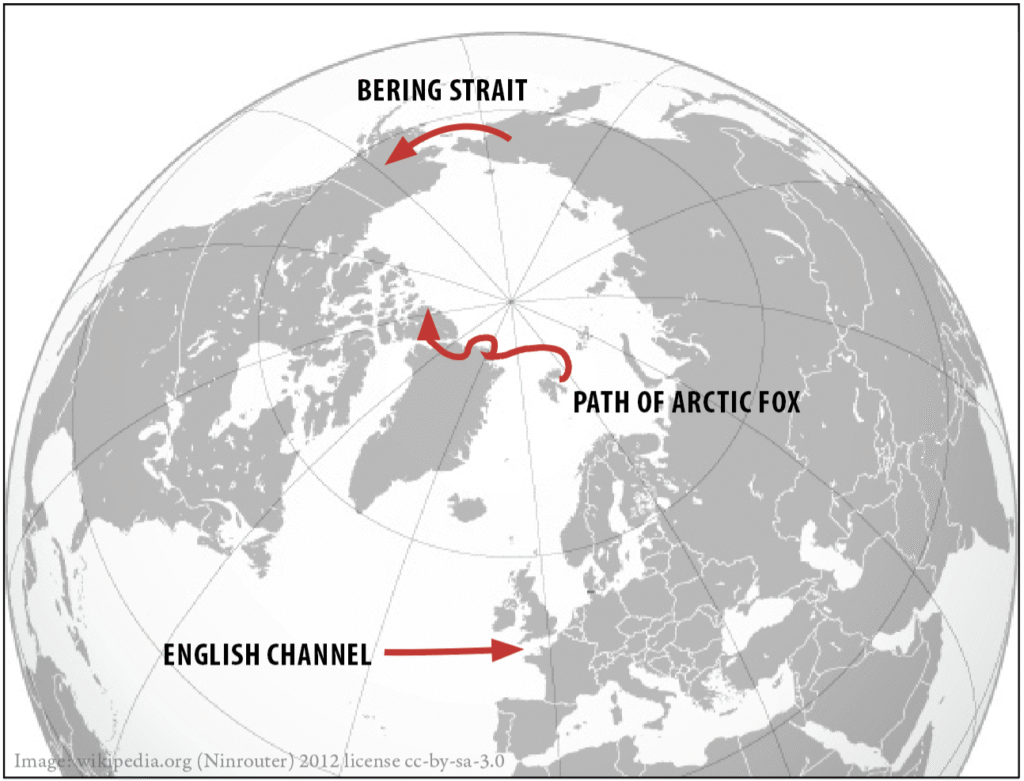
Other possibilities are also available which vindicate the biblical model. For example, according to the Flood model, a great Ice Age/Ice Advance commenced after the Flood,6 caused by warmer oceans (hence, greater precipitation) and increased volcanic activity (due to increased tectonic activity, causing cooler summers from increased volcanic aerosols and ash in the atmosphere). An Ice Age would have allowed animal migration from the Ark across frozen channels. The English Channel, as well as channels to Ireland, Iceland, and Greenland may have been frozen at the time. Significantly, a frozen channel from Russia to Alaska—the Bering Strait—would have allowed animal migration to North America. The water depth between the two is only 100-160 feet deep. With some 30% of the Earth’s continents covered with ice (as opposed to 10% today), the Earth’s sea level would have been significantly lowered making frozen channels common during the height of the Ice Age.
Ironically, in Origin of Species, glacier growth in the past was argued by Darwin to be how animals could have arrived in several remote places, including islands.7 As a modern example of animal movement across frozen channels, in 2018 scientists tracked an Arctic fox’s 76 day journey as it traveled from the far north Norway island group of Svalbard, across sea ice, the Greenland ice sheet, and Kane Basin to reach Ellesmere Island, Canada.8
(4) Land Bridges
Some Flood skeptics superficially observe on a map the location of Australia in comparison to Asia and summarily dismiss the idea of a land bridge nearly connecting Asia to Australia. However, thanks to modern technology, we know the depth of the ocean across the planet. A closer look at the water depth between the islands of the island chain that span the distance between mainland Asia and Australia reveals that the water depth is only dozens to hundreds of feet in many places along the path. Once again, during the post-Flood Ice Advance period, roughly 30% of the Earth’s land was covered with ice, significantly lowering sea level globally. In fact, secular scientists estimate that the Earth’s sea level may have been 400 feet lower at the peak of the Pleistocene Ice Age,9 which would have nearly completely opened a land path from Asia all the way to Australia.
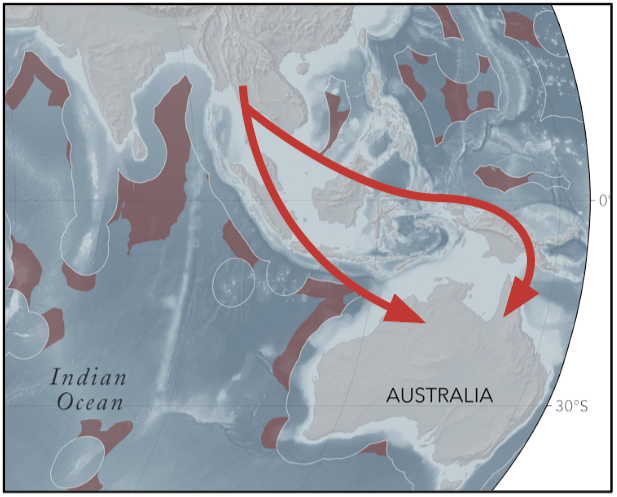
That fact has led evolutionary scientists to postulate that that is how humans reached Australia during the Ice Age.10 Gemma Tarlach, writing in Discover magazine, explained,
From the North Sea to the island-dotted tropics between Asia and Australia, from the frigid waters of the Bering Strait to the sunny Arabian Peninsula, now-submerged coastal landscapes were exposed and accessible to our ancestors at multiple times in prehistory, including key periods of human expansion across the globe. The square mileage of these areas now under the seas is equal to that of modern North America.11
Tarlach applies the same concept to the pathway between central Europe and England/Scotland during the Ice Age.
Look at a map of today’s Europe and its northern epicenters of population and commerce: London, Paris, Amsterdam, Copenhagen. Now consider that these hubs were once hinterland, mere fringes of an expanse rich in conifer forests, meadows, rivers and wetlands, all of it teeming with game. Prehistoric travelers could have walked from what’s now central Europe to northern Scotland without even seeing a coastline. As the massive glaciers and ice sheets of the…Ice Age began melting…, rising seas inundated this world. The North Sea was born.12
Bottom line: using the geography of today to draw conclusions about the past is unreliable at best, even according to many evolutionists. Humans and animals could have used land bridges to disperse after the Flood.
(5) Log “Islands”
It is also likely that for some time, remnants of the great forests of the pre-Flood period would have been floating on the receding waters of the Earth until their decay was completed. As is the case from localized floods today, small “land masses” composed of trees and debris are often found floating on the water (e.g., traveling down rivers). Much larger islands of plant material and debris are found associated with larger catastrophes as well. For example:
- Such a land mass of trees can still be seen on Spirit Lake, a result of the eruption of Mount Saint Helens volcano 45 years ago.
- After the 2011 Japan tsunami, an island of debris was spotted floating across the Pacific Ocean towards the U.S. west coast. The island was 69 miles in length and covered an expanse of over 2.2 million square feet.13
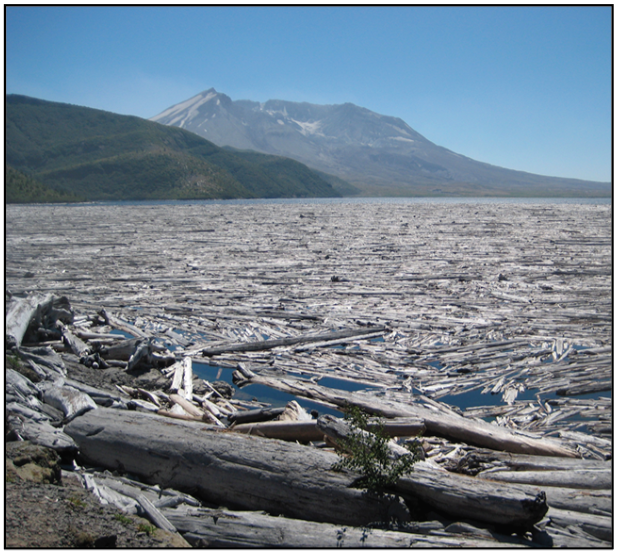
But is it likely that animals would be found floating on such debris islands? Some scoff at the idea, but they only do so out of ignorance. After all, three weeks after the 2011 Japan tsunami, the Japan Coast Guard found and rescued a dog that had been floating on one of the tsunami’s debris islands.14 Such a scenario may very well explain the existence of dingoes in Australia. Graham Lawton, writing in New Scientist, even noted that,
After the 2011 Tohoku earthquake and tsunami in Japan, around 300 Japanese marine species were found on the shoreline of British Columbia having been carried on artificial debris. Some larger vertebrates, such as tortoises, crocodilians and possibly even hippos, may be able to float or swim. Of course, sceptics can’t just pour cold water on the idea. The presence of particular animals in certain faraway places still requires an explanation, so what have they got?15
Paleontological and archaeological evidence indicates that humans made it to the continent of Australia after the Flood and before Abraham.16 Lawton explained that scientists have long thought that humans could have arrived there accidentally, assuming that
[p]eople must have arrived on the currents after being washed into the sea by a tsunami or flood, perhaps clinging to a mat of floating vegetation or a raft of pumice. This so-called “sweepstake colonization” is often invoked to explain how terrestrial reptiles and mammals make it onto distant tropical islands, and it could plausibly account for the peopling of Sahul. Prevailing ocean currents are favourable and any floating castaways caught in them would have found the vast Sahul “hard to miss”, according to archaeologist Jane Balme at the University of western Australia in Perth.17
Bruce Hardy, the chair of the Department of Anthropology at Kenyan College in Ohio, agreed about the plausibility of the rafting hypothesis for human migration to isolated locations, arguing that migration could have occurred by “natural rafts drifting and leading to human occupation of some of these islands.”18 They could have “drifted to islands atop natural vegetation mats.”19 If humans could drift in such an accidental manner, why not animals?
Lawton agreed, arguing that monkeys and other animals also could have “sailed across oceans on floating islands of vegetation.”20 Colin Barras, writing in New Scientist, said, “We know…that small monkeys somehow made it across the [strong current, dangerous Wallace—JM] line to Sulawesi and clearly they didn’t use boats—in all likelihood they floated over on mats of vegetation”—possibly even dozens of the monkeys.21 In fact, Lawton noted that,
The rafting hypothesis is as old as the theory of evolution itself. In On the Origin of Species, Charles Darwin pointed out that the flora and fauna of the Galapagos Islands were clearly related to those of South America, while Cape Verde’s were distinctly African…. His point was to discredit the belief that each species was a unique, divine creation, but he inadvertently launched the idea that the inhabitants of distant islands must have somehow blown in from the mainland.22
Concerning how species (e.g., plants, seeds, and invertebrates) dispersed to oceanic islands, Darwin suggested that they could have been transported by seaweed, “floating timber,” “drifted by the prevailing currents,” or could have “floated in chinks of drifted timber.”23 The Galapagos Conservancy, discussing the “raft theory” of how species arrived on the islands, acknowledged that many must have arrived by
sea while swimming or floating, sometimes with the aid of rafts of tangled vegetation. It is likely that the ancestors of present-day Galapagos animals that are good swimmers (sea lions, sea turtles, penguins) actually swam their way to the islands with the help of some swift ocean currents. On the other hand, it is believed that many of the reptiles and small mammals (rice rats) were carried to the islands from the South or Central American mainland on rafts of vegetation. The vast majority of such rafts would have sunk well before they ever reached Galapagos, but it would have only taken a handful of successful rafts to wash ashore to explain the present reptile diversity in Galapagos.24
Caccone, et al. add that “tortoises probably reached the [Galapagos—JM] islands by rafting from South America, 1000 km to the east” using the Humboldt Current.25 A BBC Documentary on the South Pacific reasoned, “As tsunamis strike the coast, rafts of vegetation can be cast adrift. Perhaps animals were caught up in those rafts, too. Could this have been the answer to how these animals [Fijian crested iguanas—JM] made it to Fiji? After all, they are the heartiest of their kind and could have survived long sea journeys.”26
Bottom line: evolutionists cannot “have their cake and eat it, too”—either raft travel is ridiculous or it’s reasonable. In truth, if evolutionists are right, it is not at all outlandish to suppose that massive debris islands would have been found worldwide after the Flood and that animals could have been found floating on them in the years immediately after the Flood.
Migration by Swimming?
Consider: if one believes animal migration by rafting to be a ludicrous idea, what must he think when he hears the evolutionary theory that dinosaurs may have crossed to islands by swimming? Smithsonian Magazine highlighted research published in Cretaceous Research in 2021, in which scientists concluded that, since (according to the evolutionary timeline) Africa was surrounded by water when it was colonized by dinosaurs, “Swimming would have been the only way for the dinosaur to reach prehistoric Africa from Europe or Asia, reinforcing the idea that exceptional events can help species move between distant continents.”27 Referring to the same research, Phys.org noted that dinosaurs must have arrived in Africa by “water-rafting on debris, floating, or swimming,” and added the following telling statement:
Ocean crossings are rare, improbable events, but have been observed in historic times. In one case, green iguanas travelled between Caribbean islands during a hurricane borne on debris. In another, a tortoise from the Seychelles floated hundreds of kilometres across the Indian Ocean to wash up in Africa. “Over millions of years,” said [Nicholas—JM] Longrich [of the Milner Centre for Evolution at the University of Bath—JM], “Once-in-a-century events are likely to happen many times. Ocean crossings are needed to explain how lemurs and hippos got to Madagascar, or how monkeys and rodents crossed from Africa to South America.”28
While creationists would interpret the data to which evolutionists are referring differently, nevertheless, evolutionists have conceded yet another possibility for how animals could have migrated to various isolated locations.
In a more recent example that gives plausibility to the swimming option, in 2019, a small tsunami that struck the eastern coast of the U.S. during Hurricane Dorian, swept 20 cows and 28 horses from Cedar Island into the Atlantic Ocean off the coast of North Carolina. Three of the cows were later found alive over four miles away on a barrier island in the Outer Banks National Park. Apparently, the cows survived by swimming. One of the cows was pregnant while adrift and later gave birth to a healthy calf.29
Tertiary Ocean Currents—Evidence of the Rafting Hypothesis?
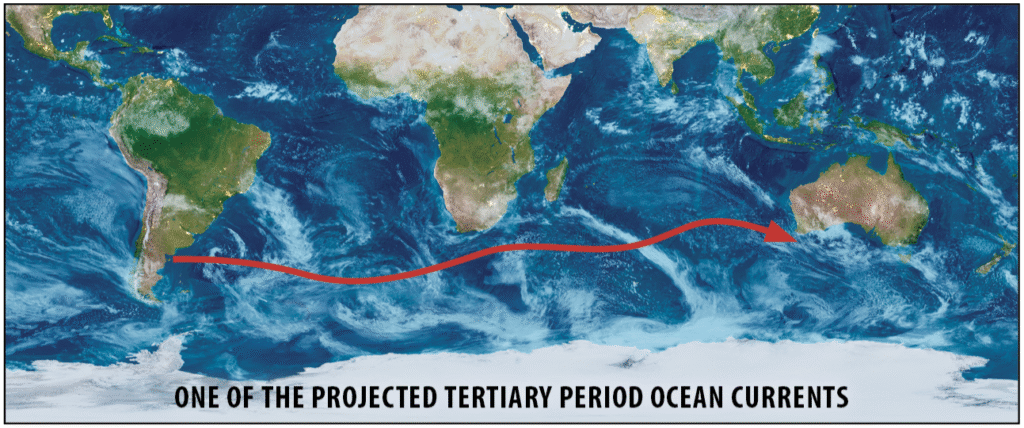
Could land animals have arrived on the Australian continent after the Flood via log mat? As added evidence of the legitimacy of that theory, recent genetic analysis suggests that Australian marsupials originated in South America before moving to Australia.30 When we look at the projections of what the ocean currents are thought to have been like during the Tertiary period (immediately after the Flood), we find that an ocean current was present, traveling directly from South America to Australia.31
Bottom line: if tsunamis are virtually certain to create floating islands of debris, what would be expected from a global Flood with rapid tectonic activity creating enormous earthquakes and subsequent tsunamis?32 If animals and humans are known to be able to travel aboard such makeshift vessels, who’s to say that such mini-“continents,” with various animals along for the ride, would not have been commonly spotted immediately following the Flood? A radically different terrestrial environment, with species clamoring to find food on the newly disheveled Earth, could have caused accelerated dispersal of the Ark’s population from Ararat to Australia before Australia had moved too far from the mainland.
One would want to be cautious not to be too quick to invoke supernatural explanations for proposed scientific problems with Bible teaching, since it can lead to scientific laziness and effectively halt scientific investigation into the great works of the Lord (Psalm 111:2).33 However, when the biblical text suggests that divine assistance may have played a role in a biblical event, it would be poor hermeneutics to dismiss the possibility without consideration. In this case, Genesis 6:20 suggests that God gathered the animals for Noah before the Flood. It is plausible, therefore, to postulate that God would have been involved, at the very least Providentially, in the dispersal of the animals after the Flood. Clearly, He had several reasonable avenues with which to do so that would not have required miraculous assistance.34
(6) Humans Brought Them
Of course, one final possibility as to how animals dispersed to remote islands like Australia would be that humans carried them. After all, evolutionists themselves argue that is precisely how some animals were able to populate certain islands.35 As noted earlier, physical evidence appears to place humans in Australia after the Flood and before Abraham, during the Babel dispersion period.36 Who’s to say they did not arrive with animals in tow?
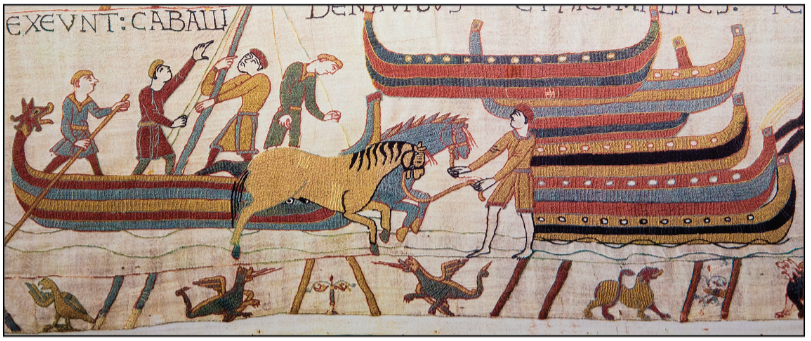
Lawton argued: “Another option, at least for more recent animal crossings, is that small creatures such as lizards were accidentally or deliberately transported by prehistoric humans. We know that our Stone Age ancestors were skilled seafarers, navigating across hundreds of kilometres of ocean to reach Japan…and perhaps even sailing from South-East Asia to Australia….”37 Granted, human transportation of animals is not available to evolutionists as an option in many instances, since they do not believe humans were on the scene yet (for example, when dinosaurs roamed the Earth). From a biblical perspective, however, humans have been on the scene “from the beginning of the creation” (Mark 10:6).
Conclusion
While post-Flood migration from the Ark to remote places like Australia has often been a charge used by evolutionists against the Bible and its account of a global Deluge, ironically, evolutionists themselves answer their own challenges with plausible options at the creationists’ disposal. Such attacks merely provide the biblical model another opportunity to prove itself to be reliable. “[S]coffers will come in the last days, walking according to their own lusts…. For this they willfully forget: that by the word of God the heavens were of old and the earth standing out of water and in the water, by which the world that then existed perished, being flooded with water…. Therefore, since all these things will be dissolved, what manner of persons ought you to be in holy conduct and godliness, looking for and hastening the coming of the day of God…?” (2 Peter 3:3b-12).
Endnotes
1 E.g., Bill Nye and Ken Ham (2014), Uncensored Science: Bill Nye Debates Ken Ham (Petersburg, KY: Answers in Genesis); Janet Kellogg Ray (2021), Baby Dinosaurs on the Ark? The Bible and Modern Science and the Trouble of Making It All Fit (Grand Rapids, MI: Eerdmans), pp. 101-103.
2 Andrew A. Snelling (2014), “Noah’s Lost World,” Answers in Genesis, https://answersingenesis.org/geology/plate-tectonics/noahs-lost-world/.
3 A. Snider-Pellegrini (1858), La Création et Ses Mystères Dévoilés (Paris: A. Franck et E. Dentu).
4 Today, creationists argue that Pangaea formed and broke apart during the Flood and, therefore, only ever existed underwater. Rodinia is thought to have been the supercontinent of the pre-Flood world. See Snelling.
5 E.g., Ross N. Mitchell, David A.D. Evans, and Taylor M. Kilian (2010), “Rapid Early Cambrian Rotation of Gondwana,” Geology, 38[8]:755-758; Brian Thomas (2010), “Continents Didn’t Drift, They Raced,” Institute for Creation Research, http://www.icr.org/article/continents-didnt-drift-they-raced/; Steven Austin, John Baumgardner, D. Russell Humphreys, Andrew Snelling, Larry Vardiman, and Kurt Wise (1994), “Catastrophic Plate Tectonics: A Global Flood Model of Earth History,” Proceedings of the Third International Conference on Creationism, ed. R.E. Walsh (Pittsburgh, PA: Creation Science Fellowship), pp. 609-621; S.P. Grand (1994), “Mantle Shear Structure Beneath the Americas and Surrounding Oceans,” Journal of Geophysical Research, 99:11591-11621; J.E. Vidale (1994), “A Snapshot of Whole Mantle Flow,” Nature, 370:16-17.
6 Michael Oard (2004), “The Genesis Flood Caused the Ice Age,” Answers in Genesis, http://www.answersingenesis.org/articles/fit/flood-caused-ice-age.
7 Charles Darwin (1859), On the Origin of Species by Means of Natural Selection, or the Preservation of Favoured Races in the Struggle for Life (London: John Murray), https://darwin-online.org.uk/content/frameset?itemID=F373&viewtype=text&pageseq=2, pp. 346-410.
8 “Argos Used to Track Fox’s 2,700-mile Journey from Norway to Canada” (2019), NOAA NESDIS, July 17, https://www.nesdis.noaa.gov/news/argos-used-track-foxs-2700-mile-journey-norway-canada.
9 United States Geological Survey (2022), “How Does Present Glacier Extent and Sea Level Compare to the Extent of Glaciers and Global Sea Level During the Last Glacial Maximum (LGM)?” January 27, https://www.usgs.gov/faqs/how-does-present-glacier-extent-and-sea-level-compare-extent-glaciers-and-global-sea-level; see also Gemma Tarlach (2019), “Return to Aquaterra,” Discover, 40[5]:56, June.
10 See Graham Lawton (2020), “Finding Sahul,” New Scientist, 245[3266]:39, January 25—Due to lower sea levels during the Ice Age, “the Sahul coast would have been significantly closer to the easternmost of the south-eastern Asian islands”; also, Christopher Bae, Katerina Douka, and Michael Petraglia (2017), “On the Origin of Modern Humans: Asian Perspectives,” Science, 358[6368]:1269, December 8; Kate Ravilious (2017), “The First Australians,” Archaeology, 70[4]:49, July/August. Uncovered land bridges are also how scientists are postulating that dinosaurs migrated from North America to Africa [Vicky Just (2020), “The First Duckbill Dinosaur Fossil from Africa Hints at How Dinosaurs Once Crossed Oceans,” Phys.org, November 5, https://phys.org/news/2020-11-duckbill-dinosaur-fossil-africa-hints.html].
11 Tarlach, p. 56; see also Colin Barras (2018), “Stone Age Sailors,” New Scientist, 238[3180]:36-37, June 2.
12 Ibid., p. 62.
13 Danielle Demetriou (2011), “Massive Floating Rubbish Islands from Japan Tsunami Spotted on Pacific,” The Telegraph, April 8, http://www. telegraph.co.uk/news/worldnews/asia/japan/8437632/Massive-floating-rubbish-islands-from-Japan-tsunami-spotted-on-Pacific.html.
14 “Japan Earthquake: One Month Later” (2011), The Atlantic: Photo, April 7, http://www.theatlantic.com/photo/2011/04/japan-earthquake-one-month-later/100041/.
15 Graham L. Lawton (2021), “On a Raft and a Prayer,” New Scientist, 252[3365/3366]:52, December 18/25.
16 Lawton (2020), p. 39. Conventional dating methods suggest that humans arrived in Australia 65,000 years ago, during the Ice Age [Danielle Demetrioue (2011), “Massive Floating Rubbish Islands from Japan Tsunami Spotted on Pacific,” The Telegraph, April 8, http://www. telegraph.co.uk/news/worldnews/asia/japan/8437632/Massive-floating-rubbish-islands-from-Japan-tsunami-spotted-on-Pacific.html]. Accounting for the continuing, though diminishing, accelerated nuclear decay in the post-Flood years [Jeff Miller (2013), “Don’t Assume Too Much: Not All Assumptions in Science Are Bad,” Reason & Revelation, 33[6]:62-70], 65,000 years correlates to a pre-Abraham date ca. 2,200-2,100 B.C.
17 Lawton (2020), p. 38, emp. added.
18 As quoted in Sam Walters, et al. (2024), “Everything Worth Knowing About Neanderthals,” Discover, 45[3]:33, May/June.
19 Ibid.
20 Lawton (2021), p. 50.
21 Barras, pp. 38-39.
22 Lawton (2021).
23 Darwin, pp. 360,391,397,399.
24 “History of Galapagos” (no date), Galapagos Conservancy, accessed February 11, 2025, https://www.galapagos.org/about_galapagos/history/, emp. added.
25 Adalgisa Caccone, et al. (1999), “Origin and Evolutionary Relationships of Giant Galapagos Tortoises,” Proceedings of the National Academy of Sciences, 96[23]:13223, November 9, emp. added.
26 “South Pacific: Castaways (Episode 2)” (2009), BBC Studios: Natural History Unit, aired May 17. The documentary also postulates that geckos may have reached the Solomon Islands by vegetation raft.
27 Riley Black (2020), “The Top Ten Dinosaur Discoveries of 2020,” Smithsonian Magazine on-line, December 22, https://www.smithsonianmag.com/science-nature/top-ten-dinosaur-discoveries-2020-180976578, emp. added.
28 Just; The saltwater crocodile is thought to have swam 60 miles from New Guinea to the Solomon Islands (“South Pacific…”).
29 Mark Price (2020), “Cow That Swam 5 Miles to Outer Banks in a Hurricane Was Pregnant. It Just Gave Birth,” The News & Observer, February 20, https://www.newsobserver.com/news/local/article239953898.html.
30 Clara Moskowitz (2010), “Marsupials Not From Down Under After All,” LiveScience.com, July 27, https://www.livescience.com/6770-marsupials.html.
31 Warren D. Allmon (2023), “Tertiary Period,” Encyclopaedia Britannica on-line, https://www.britannica.com/science/Tertiary-Period. Note that an ocean current is also thought to have been present that led from the theorized location of Ararat to South America.
32 For more information about the modern biblical Flood model accepted by most Creation geologists, see Jeff Miller (2019), “Was the Flood Global? Testimony from Scripture and Science,” Reason & Revelation, 39[4]:38-47, https://apologeticspress.org/wp-content/uploads/2021/08/1904w.pdf.
33 Jeff Miller (2024), “Is it Ever Appropriate to Say ‘God Did It’ in Response to a Scientific Challenge?” Reason & Revelation, 44[6]:11, June, https://apologeticspress.org/wp-content/uploads/2024/05/2406-web.pdf.
34 An example of a supernatural option would be the miraculous transportation of animals to remote continents/islands.
35 “Enigmatic Falklands ‘Fox’ Might Have Hitched a Ride with Humans” (2021), Nature, 599[7883]:10, November 4.
36 Lawton (2020).
37 Lawton (2021), p. 52, emp. added.
The post If the Flood Happened, How Did Animals Get Back to Australia? appeared first on Apologetics Press.
]]>The post Studying Science From a Biblical Perspective appeared first on Apologetics Press.
]]>Many people simply do not like science. They could not stand Biology, Physics, Chemistry, and Earth Science in school. Believe it or not, even though I am now a scientist, I would have agreed with them for most of my education, prior to the final science course I took in high school. There were some key concepts missing from my public school education that would have changed everything. It is one of my goals in life to help youth to have the right perspective about science, because I believe a lack of that perspective is a key factor in why 40%, and possibly as high as 80%, of Christian youth are leaving Christianity behind when they leave home for college.1
The modern naturalistic monopoly on science—I’ll admit—put a bad taste in my mouth every time I was forced to study science as a younger student in junior high and high school in public school. It was natural to equate science with evolution and other false ideas that alarmed me and challenged my beliefs. No doubt many students shared my feelings and, over the years, it has caused many people to consider science and religion to be two separate domains that do not have anything to do with each other. “Trying to harmonize the two shouldn’t be done—and couldn’t be done even if you wanted to,” they claim. To attempt to do so would be like, in the words of famous skeptic Michael Shermer, trying “to squeeze the round peg of science into the square hole of religion.” It would be a “logical absurdity” to do that, he said.2 The result of such thinking has been to convince youth that the claims of Scripture (especially those that have scientific implications, like Creation and the Flood) are “unscientific” and require a “blind,” evidence-less faith to accept them.3 Many rational-minded youth, therefore, are finding (what they assume to be) more support for a natural explanation of the Universe (rather than a supernatural one), since that’s the only “side” they hear being argued from virtually every academic mountain top. “The first one to plead his cause seems right, until his neighbor comes and examines him” (Proverbs 18:17), but few are having the opportunity to hear the case of the neighbor.
The truth of the matter is that God owns science: He is actually the One Who initially instituted and defined science and now endorses, encourages—even commands—scientific study.4 A person must conduct science, however, from the right perspective—the biblical perspective—or his results and conclusions will often be incorrect.
As most of us studied science in school, progressing from year to year, the classes and texts tended to be divided into general categories, like “Life Science,” “Earth Science,” or “Physical Science.” As we moved into high school, we probably took “Biology,” “Chemistry,” and “Physics,” and if we pursued science in college, perhaps “Geology,” “Astronomy,” “Genetics,” “Thermal Science,” etc. While it can be convenient to use such distinctions as we teach science, there is a serious drawback to doing so if we fail to step back and keep in mind the “big picture”: the ultimate purposes of science from a biblical perspective, as God intended. Having the right frame of mind about the God-given purposes of science will affect our emphasis of the subject in our lives and the lives of the youth we mentor. It will also affect the way we evangelize in some cases, and may even affect the eternal destinies of individuals in our sphere of influence.
It is important that Christian-minded parents and teachers not merely exclude un-Christian concepts while teaching (which is what many Christian schools do), but actually teach students the subjects from a Christian perspective. So, what should that look like in science?
Teaching Science from a Christian Worldview
Authority and Mandate for Scientific Study
First, keep in mind that if God does not want us to use time doing something, we should not do it (1 Corinthians 4:6)! He has objectives in mind for His followers, and we will give an account of how we use our time (Ephesians 5:16; Colossians 4:5). And so, we should consider whether God even wants us to teach our children science. Whatever we do, “in word or deed,” should be authorized by God (Colossians 3:17; Acts 4:7). Do we have God’s authority to engage in and teach science to our students?
Absolutely. In fact, according to the Bible, God Himself instituted the field of science.
- When God created human beings on Day Six and told them to “have dominion” over the Earth and “subdue” it (Genesis 1:28; Psalm 8:6-8), He was commanding mankind to do something that would require extensive scientific investigation and experimentation.
- When God, through His servant Paul, said in Romans 1:20 that His existence and some of His attributes could be learned from studying His creation, He was putting His stamp of approval on the scientific study of creation—“the things that are made.”
- When He said in 1 Thessalonians 5:21 to “[t]est all things; hold fast what is good,” He was essentially summarizing the scientific method.
- By encouraging humans to study “the works of the Lord” (i.e., the things God has done, such as Creation and the Flood of Genesis 6-9), He was endorsing science (Psalm 111:2; cf. 66:5).
Scientific Disciplines Delineated in Scripture
- When God instructed Adam to name the animals, He instituted the fields of biology and zoology (Genesis 2:19).
- When He highlighted to Job the natural laws that govern the Universe, He was encouraging the study of physics (Job 38:33; cf. Jeremiah 33:25-26; Psalm 148:5-8). Several laws of science are alluded to by implication in Scripture, including the Law of Causality (Hebrews 3:4), Law of Biogenesis (Acts 17:25; 1 Timothy 6:13; Galatians 6:7), First Law of Thermodynamics (Genesis 2:1-3; Exodus 20:11; Hebrews 4:3), and Second Law of Thermodynamics (Psalm 102:25-27).
- Job 12:8-10 emphasizes geology.
- Psalm 19:1 and Genesis 15:5 encourage astronomy.
- Numbers 19 even delineates a basic recipe for antibacterial soap—chemistry in action.
- Solomon, in his inspired wisdom, endorsed the study of biological science, encouraging the study of eagles and serpents (Proverbs 30:18-19), as well as ants, badgers, locusts, and spiders (Proverbs 30:25-28).
- Jesus encouraged botany when drawing His audience’s attention to the lilies of the field (Matthew 6:28), seeds (Matthew 13:1-9,24-30), trees and vines (Matthew 7:16-20), and grass (Matthew 6:30); ornithology by pointing to the birds of the air as an illustration (Matthew 6:26); entomology when mentioning moths (Matthew 6:19-20); and zoology when discussing sheep, dogs, and swine (Luke 15:3-7; Matthew 7:6).
- In God’s sermon to Job in chapters 38-41, He chose to humble Job and instruct him by giving him, not a Bible lesson, but a science lesson covering geology, cosmology, astronomy, physics, oceanography, nomology, optics, meteorology, and biology, including zoology, ornithology, entomology, herpetology, botany, and marine biology.
- Similarly, in Psalm 104 the psalmist used beautiful figurative language to present a science lesson covering astronomy, meteorology, geology, physics, oceanography, and biology, including mammalogy, ornithology, botany, and marine biology.
Bottom line: God founded, endorsed, and encourages science. As an educator, you are a key factor in ensuring that God’s desire (that we engage in science) is carried out—and that it is carried out with the right perspective and purpose in mind.
The Definition and Purpose of Science, According to Scripture
What is science? There are probably as many definitions as there are scientific subjects (since humans determine word definitions), but a basic definition would be, “the acquisition of knowledge through study of the natural world/Universe.” Naturalists argue that science seeks to determine natural explanations for those things we observe in nature (eliminating even the possibility of God’s miraculous intervention in any aspect of the Universe throughout history). Such a diminished perspective, however, was not how science has been viewed throughout history,5 because it neglects the definitive evidence for God,6 is irrational, and even self-contradictory.7 Instead, science seeks to acquire explanations—whether natural or supernatural—for those things we observe in nature.
The ultimate purposes of science are more important to Christian educators, since at least three of those are, first and foremost, defined by God, not man. The purpose of science is to gain knowledge (Proverbs 8:10) from observations of the natural realm (i.e., “the things that are made”—Romans 1:20) that will help humans to:
(1) subdue and have dominion over the Earth (Genesis 1:28; 9:2) so that they can live a good life (Ecclesiastes 2:24) in service to God (Ecclesiastes 12:13-14), helping others (Ecclesiastes 3:12; Galatians 6:10; 1 Timothy 6:188);
(2) learn about God—His existence and nature (Romans 1:20; Hebrews 11:6; Psalm 19:1)—by studying the things He has done (Psalm 111:2; Romans 1:20); and
(3) defend the truth against those who would seek to discredit it (1 Peter 3:15; Jude 3).
Logically, therefore, Creation and Flood Science should be the foundations upon which a student’s study of science is built, since they are the two greatest physical works God has authored throughout Earth history. Although few scientists think about their mission in such terms, most science disciplines today are focused more on the first purpose above (at least, a portion of it): subduing and having dominion over the Earth in order to live a good life. The second and third extremely important purposes are, sadly, often completely neglected, even in our Christian schools. Our parents and science teachers are charged with the critically important task of making sure our students/children can defend the truth, and know and do not forget about the great works of the Lord as exhibited through physical evidence in the Universe (like the Flood—Genesis 9:12-17). Yet, oftentimes, we fall down on the job, allowing the world around us—our children/students—to forget (2 Peter 3:3-9).
- Psalm 111:2—“The works of the Lord are great, studied by all who have pleasure in them.”
- 2 Peter 3:5-9—“For this they willfully forget: that by the word of God the heavens were of old, and the earth standing out of water and in the water, by which the world that then existed perished, being flooded with water. But the heavens and the earth which are now preserved by the same word, are reserved for fire until the day of judgment and perdition of ungodly men. But, beloved, do not forget this one thing, that with the Lord one day is as a thousand years, and a thousand years as one day. The Lord is not slack concerning His promise, as some count slackness, but is longsuffering toward us, not willing that any should perish but that all should come to repentance.”
Are you ready to teach youth science the way God intended? Do you have any high school age children, students, grandchildren, nieces/nephews, neighbors, or members of your church youth group who would benefit from a study of the biblical foundations of science in the Flood, solidifying their faith, preparing them for evangelism, and helping them to know more about God, all the while receiving course credit? Have them join me in Arizona for a life-changing experience.
Endnotes
1 Flavil Yeakley (2012), Why They Left (Gospel Advocate), p. 39; Kevin Cain (2019), “Why Are We Losing Them When They Leave For College?” Apologetics Press, https://apologeticspress.org/why-are-we-losing-them-when-they-leave-for-college-5738/.
2 Michael Shermer (2007), Why Darwin Matters: The Case Against Intelligent Design (New York: Henry Holt), Kindle edition, p. 162.
3 Contrary to the teachings of Scripture. See Dave Miller (2003), “Blind Faith,” Apologetics Press, https://apologeticspress.org/blind-faith-444/.
4 Note: While conducting science (i.e., the study of “the things that are made”) is necessary to fulfill God’s expectations, there are certainly different levels/depths of scientific study in which a person could engage. Virtually every person engages in science in various ways, even if doing so is often an unconscious decision and at a very basic level. We are not suggesting that God expects every person to become a full-time, credentialed scientist.
5 For examples of famous scientists, considered the “fathers” of various scientific disciplines, who were biblical creationists, see Jeff Miller (2012), “‘You Creationists Are Not Qualified to Discuss Such Matters!’” Reason & Revelation, 32[12]:141-143, December, https://apologeticspress.org/wp-content/uploads/2021/08/1212.pdf.
6 Dave Miller, ed. (2017), Does God Exist? (Montgomery, AL: Apologetics Press).
7 Jeff Miller (2017), Science vs. Evolution (Montgomery, AL: Apologetics Press), 2nd edition.
8 See also James 4:17 and Mark 10:45.
The post Studying Science From a Biblical Perspective appeared first on Apologetics Press.
]]>The post Is It Ever Appropriate to Say “God Did It” in Response to a Scientific Challenge? appeared first on Apologetics Press.
]]>Of course, the most obvious time that it is appropriate to say “God did it” as a response to a proposed scientific difficulty with Creation is when the Bible explicitly says He did something. From time to time, however, we might come across a new quibble, about which Scripture is silent, and to which we cannot immediately give a reasonable answer. It would be easy to respond to such quibbles by simply saying “God did it” as our answer to the problem. Such an answer, however, becomes a form of the “God of the Gaps” argument, where God is inserted to solve a problem (or as proof that God must exist in order for the problem to be solved). As we have shown elsewhere,1 the God of the Gaps Argument is not a good argument to use in favor of God’s existence.2 Quickly using “God did it” as our explanation for new quibbles could be claiming that God did things that He did not do, bearing false witness against Him (1 Corinthians 15:15; Job 13:7, ESV). It also encourages scientific laziness, when God wants us to study to be able to find and defend the truth (1 Peter 3:15; 2 Timothy 2:15), including doing science and learning about the great things He has done (Psalm 111:2), only drawing conclusions that follow from the evidence we gather (1 Thessalonians 5:21). So, how should we respond to new quibbles about which Scripture is silent?
First, we should keep in mind that, regardless of the new quibble, there is no single quibble that is capable of disproving the many evidences for the existence of God or the inspiration of the Bible. Those two fundamental planks of our faith still stand on mountains of evidence,3 regardless of any new, for example, Creation or Flood quibbles. Since the Bible is inspired by God, we know that it is true, and it clearly teaches, for example, that a global Flood occurred. So, while we may not immediately have an answer to the new Flood quibble, we know that there is an answer. We should not, therefore, allow it to concern us. Instead, we should study the subject to learn about God and His amazing work in the Flood.
Now, it is true that God can do anything as long as it is in harmony with His perfect nature. So, sometimes the answer to an unknown quibble may be that He did choose to miraculously involve Himself in the process (as He did many times throughout Bible history, according to Scripture), but we should not be too quick to assume that option if there is not scriptural evidence that would suggest it. In some biblical contexts (e.g., Genesis 1), it is clear that God is miraculously involved. So, it would be appropriate to suggest “God did it” as a possible answer to a quibble (e.g., starlight from distant stars reaching Earth rapidly during Creation week4).
Concerning Flood-related quibbles, one example of an important textual clue in the Flood narrative that suggests God’s miraculous involvement in the event is found in Genesis 8:1, where the text says that “God made a wind to pass over the earth”—suggesting that God created a wind that was not a “natural” wind during the Flood. Creation scientists and Flood critics alike have questioned how anything could have survived the Flood (creatures in the water or on the Ark) due to the amount of heat that was being generated by lava, meteorite activity, and accelerated nuclear decay. Since wind is an extremely effective way to transfer heat from an object (through convection), it is possible that the wind God made was a miraculous one that cooled the Earth during the Flood. While Creation scientists are studying other possible explanations for that particular quibble, Genesis 8:1 provides a prime example of a case where Scripture implicitly provides a Bible believer with justification for suggesting as an answer that “God did it.”
Endnotes
1 Kyle Butt (2024), “The ‘God of the Gaps’ Argument: A Refutation,” Reason & Revelation, 44[2]:2-4, February.
2 If nothing else because, as science reveals natural answers to various quibbles, God would be viewed as less and less “necessary” in the Universe.
3 See, for example, Dave Miller, ed. (2017), Does God Exist? (Montgomery, AL: Apologetics Press) and Kyle Butt (2022), Is the Bible God’s Word? (Montgomery, AL: Apologetics Press).
4 Jeff Miller (2019), “Does Distant Starlight Prove an Old Universe?” Reason & Revelation, 39[5]:58-59, May.
Does God Exist?
The post Is It Ever Appropriate to Say “God Did It” in Response to a Scientific Challenge? appeared first on Apologetics Press.
]]>The post Does the Biblical Flood Require 11 New Species to Evolve Daily Afterward? appeared first on Apologetics Press.
]]>Critics of the biblical Flood have argued that the implications of the Flood make its reality implausible. For instance, Bill Nye has argued that there are some 16,000,000 species on the planet today.1 If there was a Flood only 4,000 years ago, only 7,000 representative species on the Ark to start with, and all of the planet’s other species were wiped out by the Flood, those 7,000 representative species would have to turn into 16,000,000 species in only 4,000 years. That would mean that 11 new species have evolved every day over the last 4,000 years since the Flood. Does such an implication prove the biblical Flood narrative to be unreliable at best and mythical at worst?
One Aspect of the Flood that Nye Got Right
First, note that critics who highlight the implausibility of the Flood model in this instance are correct in one aspect. The Creation/Flood model does in fact propose that not all modern species were on the Ark, since the word “kind” in the Bible (e.g., Genesis 6:20) is not equivalent to the modern nomenclature of “species,” but might be closer to the modern taxonomic group “family.” On the Ark, therefore, there would have been representative species (the biblical word, “kind”) of, for example, the “dog kind,” equipped with the genetic capability to produce all other species within that kind (e.g., coyotes, foxes, wolves, domestic dogs, etc.2). Speciation (i.e., the appearance of new species) would have occurred through various means, including inter-breeding and microevolution (i.e., evolution involving only minor changes within kinds, such as beak size and color changes, staying within narrow genetic boundaries; as opposed to macroevolution/Darwinian evolution, an unobserved phenomenon which involves change across phylogenic boundaries between “kinds”).
Though the original number of “kinds” was much smaller than the modern taxonomic term “species,” it is true that whatever the number of kinds was on the Ark, they were also the only species of those kinds in existence when they left the Ark. All other species today had to descend from those original representative species. Based on recent creationist studies of the subject, it is unlikely that 7,000 is a good estimate of the number of those proto-species. Creation biologists currently estimate that fewer than 2,000 kinds were represented on the Ark.3 It is true, then, that a Flood believer must be able to explain how the few animal varieties on the Ark could have given rise to the multitude of species on the planet today. According to Bill Nye:
So you’d go out into your yard. You wouldn’t just find a different bird: a new bird. You’d find a different kind of bird. A whole new species of bird, every day…. This would be enormous news. I mean, the last 4,000 years? People would have seen these changes among us…. We see no evidence of that. There’s no evidence of these species.4
Does the Number of Species on the Planet Today Disprove the Flood?
In response, we first must ask where Nye and others are getting their information when they argue that there are 16,000,000 species on the planet. Some studies have species counts as low as 2-3,000,000.5 A projected estimate of species on the planet published by Public Library of Science Biology (PLoSB) including the Plantae, Fungi, Protozoa, Chromista, Animalia, Archaea, and Bacteria Kingdoms (i.e., including beetles and bacteria, which Nye implied were not in his estimate), is 10,960,000,6 not 16,000,000. [NOTE: This is an estimate, which fluctuates based on those variables being considered by the researchers. The scientific community does not agree on how many species may exist and many competing methods of calculating those estimates are available. The actual catalogued number of living species on the Earth at the time of the study was 1,438,769.7]
All marine creatures, of course, though they are included in the 10,960,000 estimate, were not on the Ark, and their diversification would have continued without being filtered by the animal kinds brought on the Ark. That brings the estimate down to 8,750,000 species in existence today that came from the creatures on the Ark, based on the PLoSB study. More could most certainly be removed, considering that the estimated number of those creatures designated as “ocean dwelling” species in the study did not include other creatures that can survive in water (e.g., amphibians and freshwater creatures8), but are not defined as “ocean dwelling” in the study.9 Many such creatures would not have been on the Ark.
The biblical text also does not mention Noah carrying plants onto the Ark to save them from destruction (except those that the animals and Noah and his family ate, Genesis 6:21), since they are not “flesh” (Genesis 6:19). Removing plants from the list of species brings our count down to 8,435,400, based on the PLoSB study. Incidentally, while Nye insinuated that the plants of the Earth would have died in the Flood, and it is certainly true that many would have, it is also true that (1) Noah could have brought seeds on the Ark; and (2) most of the world’s vegetation is underwater, and survives well in that environment. Scientists estimate that 50% to 85% of Earth’s oxygen comes from ocean plants.10 Further, many dead plants (with their seeds intact) would have been floating in piles on the surface of the Flood waters. It is also true that studies show that seeds can survive submersion in salt water for extended periods of time.11 Ironically, Darwin, himself, verified several ways in which seeds can survive and be viable after extended travel in and on salt water. 12
It is also virtually certain that the number of current species on the planet could be significantly reduced due to the inevitability of synonymous species (e.g., two names given to the same species—creatures originally thought to be two distinct species that are now considered one and the same, or one creature whose name has changed over time and yet both names have been counted). The PLoSB study noted this weakness in species estimates, explaining that “[a] survey of 2,938 taxonomists with expertise across all major domains of life…revealed that synonyms are a major problem at the species level.”13 They believe that 17.9% of species could be synonyms, and possibly much more (as much as 46.6%). The World Register of Marine Species documents that 44.5% of all accepted marine species are synonyms.14 If we, for the sake of argument, accept the smaller average amount given by the PLoSB study, that only 17.9% of the remaining species are indeed synonyms, that would take 8,435,400 species down to 6,869,150 species on the Earth today and 6,862,000 new species since the Flood, based on the supposition that there were 7,000 kinds on the Ark. Such an estimate is a far cry from Nye’s estimated 16,000,000.
Further, if the Flood was 4,500 years ago (which is closer to our estimate of the biblical timeline), that would bring Nye’s total from 11 new species per day down to 4 (and some estimates push the Flood back farther than 5,000 years ago). If there are indeed fewer species on the planet than the researchers’ projections, more synonyms, more years since the Flood, more species that could survive outside of the Ark, and more representative kinds on the Ark—all of which are possible and even highly likely in some cases—this number decreases even more.15
Further, consider the fact that about half of the remaining species are insects,16 including the many beetles Nye mentioned, many of which are known to reproduce quickly. Flies (Drosophila melanogaster), for example, can lay as many as 100 eggs each day, and up to 2,000 eggs in their lifetimes.17 Bacteria, also included in the list of species, can reproduce even quicker. According to the American Society for Microbiology, in only 10 hours, one bacterium can propagate through binary fusion and produce ten billion bacteria.18 Rapid reproductive rates make the potential for rapid microevolutionary speciation more plausible, especially in the centuries immediately following the Flood. The proto-species on the Ark would have likely been chosen by God due to their immense genetic variability, which would have lent itself to rapid speciation immediately after the Flood. The speciation rate may have gradually been hampered through the localization of species communities, creating what evolutionists call niche conservatism.19 Note that it is also possible that many insects, other invertebrates (which comprise “95 to 99 percent of the planet’s animal species”20), fungi, protozoa, and bacteria species could survive outside of the Ark and therefore, could be removed from the list—decreasing the number of species in the PLoSB study list by as much as 4,500,000.
Also, according to the Creation model, human lifespans were longer for several centuries following the Flood and, as with the pre-Flood era, the childbearing age ranges appear to have been longer (e.g., Genesis 11:10). The genealogies of Genesis 11 show an apparent exponential decay rate in life spans in the centuries immediately following the Flood, while the genealogies of Genesis 5 show consistently high life spans before the Flood. This seems to indicate that the Flood dramatically changed the Earth in a way that affected its population’s health (2 Peter 3:6 describes the pre-Flood world, “the world that then existed,” as having “perished”). If the health, reproductive capacity, and lifespans of animals on Earth paralleled those of humans—and it is reasonable to assume that they did for the same reasons—then animal productivity could have also been higher before the Flood and immediately after the Flood, allowing for quicker diversification (i.e., quicker speciation). Many new species were likely coming about throughout the world every day for centuries after the Flood, though that rate would have slowed significantly over time.21
Conclusion
In summary, skeptics argue that the Flood model requires the emergence of 15,993,000 new species in the 4,000 years since the Flood. However:
- More kinds may have been represented on the Ark.
- More years could have passed between the Flood and today.
- It is highly unlikely that there are anywhere near 16,000,000 species on the planet—there may be far fewer than 5,000,000.
- Marine creatures (as well as other water dwelling animals) should be subtracted from the list of those animals that must emerge since the Flood.
- The kingdoms Plantae, Fungi, Protozoa, Chromista, Archaea, and Bacteria should be subtracted.
- Other species could be subtracted which could survive outside of the Ark (e.g., various insects and invertebrates).
- Synonymous species must be subtracted.
Bottom line: it is not far-fetched to argue that there could have been (and could be) multiple new species appearing around the world every day after the Flood, especially among the smaller creatures on the planet that reproduce faster. In fact, Science magazine published an article in 1988 highlighting the correlation between smaller sized creatures being represented by more species on Earth, which supports this hypothesis.22 As opposed to Nye’s claim, mankind simply would not tend to notice the introduction of many of these new species, since they would be smaller life forms. The Earth is enormous, with many things proceeding unnoticed by mankind. If, for example, four new species were to appear every day somewhere on (or in) this enormous planet (with a volume of 1,083,210,000,000 cubic kilometers),23 at least three of the four would likely be tiny: not birds or fish as Nye suggested. The odds that any of them would happen to be in your yard, much less that you would notice them, are basically zero.
Keep in mind, in spite of that fact, scientists are still consistently documenting 15,000 new species each year that we had not noticed before—an average of 41 new species found every day.24 While many of those newly discovered species are certainly already existing species that scientists are now simply discovering and documenting (i.e., they are likely not newly evolved species), who’s to say how many of them are not also newly evolved species (in the microevolutionary sense)? Regardless, contrary to Nye’s claim that humans would have (but have not) noticed 11 new species emerging every day, the newly discovered species being identified today are new to mankind, they are being noticed, and many are making the news somewhere in the world—ironically, exactly what Mr. Nye said should be the case if the Flood happened. The catch, however, is that the number of newly discovered species each day is 41—not 11.
Endnotes
1 Bill Nye and Ken Ham (2014), Uncensored Science: Bill Nye Debates Ken Ham (Petersburg, KY: Answers in Genesis).
2 Cf. Brian Thomas (2012), “On the Origin of Dogs,” Acts & Facts, 41[1]:16, http://www.icr.org/article/origin-dogs/; Katarina Ahlfort (2011), “Genetic Study Confirms: First Dogs Came from East Asia,” KTH Royal Institute of Technology, November 11, http://www.kth.se/en/aktuellt/nyheter/vargen-tamjdes-till-hund-i-sydostra-asien-1.269636.
3 Nathaniel T. Jeanson (2016), “Which Animals Were On the Ark with Noah?,” Answers in Genesis, https://answersingenesis.org/creation-science/baraminology/which-animals-were-on-the-ark-with-noah/; Michael Belknap and Tim Chaffey (2019), “How Could All the Animals Fit on the Ark?,” Answers in Depth, April 2, https://answersingenesis.org/noahs-ark/how-could-all-animals-fit-ark/.
4 Nye and Ham, emp. added.
5 Mark J. Costello, et al. (2013), “Can We Name Earth’s Species Before They Go Extinct?” Science, 339[6118]:413-416; Carl Zimmer (2011), “How Many Species? A Study Says 8.7 Million, but It’s Tricky,” The New York Times, August 23, http://www.nytimes.com/2011/08/30/science/30species.html?_r=0.
6 Camilo Mora, et al. (2011), “How Many Species Are There on Earth and in the Ocean?,” PLoS Biology, 9[8]:e1001127, http://www.plosbiology.org/article/info%3Adoi%2F10.1371%2Fjournal.pbio.1001127#pbio.1001127-Appeltans1.
7 Ibid. Since 2011, roughly 1,000,000 more species are thought to have been identified [“Summary Statistics” (2022), IUCN Red List, Table 1a, https://www.iucnredlist.org/resources/summary-statistics. (Note that the IUCN Red List does not include prokaryotes.)].
8 For a discussion of how freshwater/saltwater fish could have survived the Flood, see: Andrew Snelling (2014), “How Could Fish Survive the Genesis Flood?,” AnswersinGenesis.org, June 16, https://answersingenesis.org/the-flood/how-could-fish-survive-the-genesis-flood/.
9 “WoRMS Taxon Tree” (2014), WoRMS, http://www.marinespecies.org/aphia.php?p=browser.
10 “How Much Do Oceans Add to World’s Oxygen?” (2013), Earthsky, http://earthsky.org/earth/how-much-do-oceans-add-to-worlds-oxygen.
11 George F. Howe (1968), “Seed Germination, Sea Water, and Plant Survival in the Great Flood,” Creation Research Society Quarterly, December, pp. 105-112, http://www.creationbotany.org/12_Plant_survival_and_the_great_Flood.pdf.
12 Charles Darwin (1979), The Origin of Species by Means of Natural Selection or the Preservation of Favoured Races in the Struggle for Life (New York: Avenel Books), pp. 352-359; see the following for an in depth discussion of plant survival in the Flood, including the effect of salinity on seeds: David Wright (2012), “How Did Plants Survive the Flood?,” Answers in Genesis, http://www.answersingenesis.org/articles/aid/v7/n1/how-did-plants-survive-flood. See also: Jeff Miller (2014), “Tying Up Really Loose Ends,” Reason & Revelation, 34[4]:43-44, https://apologeticspress.org/wp-content/uploads/2021/08/1404w.pdf.
13 Mora, et al.
14 “World Register of Marine Species” (2014), WoRMS, http://www.marinespecies.org/.
15 NOTE: Though Nye did not mention it, the Creation model must also account for species that have descended from the original proto-species, but that are now extinct. It is unknown how many extinct species are in the fossil record. (Evolutionists assume there are billions because of the need for transitional creatures under the evolutionary model. That prediction has thus far been shown to be false.) It is estimated from the fossil record that “one species per million species per year” goes extinct [“The Current Mass Extinction” (2001), PBS: Evolution—Library, WGBH Educational Foundation, http://www.pbs.org/wgbh/evolution/library/03/2/l_032_04.html]. If all 7,000,000 current “land” species have been in existence since the Flood (which would not be the case), that would only add 31,500 extinct species to the count, which is negligible in our estimates. Creationist Kurt Wise, whose Ph.D. in Paleontology is from Harvard University, cites research indicating that at least 75% of the 250,000 species identified in the fossil record are still living, meaning that, at most, 62,500 extinct species exist in the fossil record, and likely, far less [Wise, Kurt (2009), “Completeness of the Fossil Record,” Answers in Genesis, http://www.answersingenesis.org/articles/am/v5/n1/completeness-fossil-record]. Some of those would also be marine species and thus not added to our count. Regardless, again, this number is negligible in our calculations. Keep in mind also that much of the fossil record represents species that were in existence at the time of the Flood and before (i.e., that were killed in the Flood), but that would not have necessarily developed since the Flood. So, the actual number of species that has evolved since the Flood but have gone extinct is no doubt much smaller.
16 Andrew J. Hamilton, et al. (2010), “Quantifying Uncertainty in Estimation of Tropical Arthropod Species Richness,” The American Naturalist, 176[1]:90-95, July.
17 E.C. Reeve and Isobel Black, eds. (2001), Encyclopedia of Genetics, http://books.google.com/books?id=JjLWYKqehRsC&pg=PA157&lpg=PA157&dq=Drosophila+Fruit+fly+mutations&source=web&ots=V5yPPBPE6h&sig=fOkUSqLsARelWNDqpe5uhq70mI&hl=en.
18 “Microbial Reproduction” (2012), Microbe World, http://www.microbeworld.org/interesting-facts/microbial-reproduction.
19 Robert D. Holt and Richard Gomulkiewicz (1997), “How Does Immigration Influence Local Adaptation? A Reexamination of a Familiar Paradigm,” The American Naturalist, 149[3]:563-572; John J. Wiens, et al. (2010), “Niche Conservatism as an Emerging Principle in Ecology and Conservation Biology,” Ecology Letters, 13:1310-1324.
20 “Meet Our Animals: Facts” (2014), Smithsonian National Zoological Park, http://nationalzoo.si.edu/animals/invertebrates/facts/.
21 For thorough discussions of the plausibility of rapid, post-Flood speciation see: John Woodmorappe (1996), Noah’s Ark: A Feasibility Study (Santee, CA: Institute for Creation Research), pp. 180-213, and Daniel Criswell (2009), “Speciation and the Animals on the Ark,” Acts & Facts, 38[4]:10, http://www.icr.org/article/speciation-animals-ark/. For a discussion of research involving rapidly changing bird species, see: Brian Thomas (2011), “Study Shows Bird Species Change Fast,” Institute for Creation Research, http://www.icr.org/article/study-shows-bird-species-change-fast/.
22 Robert M. May (1988), “How Many Species Are There on Earth?,” Science, 241[4872]:1441-1449.
23 “Earth Fact Sheet” (2013), NASA, http://nssdc.gsfc.nasa.gov/planetary/factsheet/earthfact.html.
24 Zimmer.
Flooded
The post Does the Biblical Flood Require 11 New Species to Evolve Daily Afterward? appeared first on Apologetics Press.
]]>The post Does the Garden of Eden Still Exist? appeared first on Apologetics Press.
]]>Nobody knows, so caution is in order. But there are some facts that can help us arrive at a reasonable conclusion:
- First, keep in mind that it would be easy to subconsciously assume that Genesis 2, where Eden is described, was being written “real time”—as though the writer lived alongside Adam and Eve in the Garden. In reality, however, Genesis was written by Moses roughly 2,500 years later4—long after the Flood—to an audience living in roughly 1,500 B.C.
- The grammar of Genesis 2 (in English translations) implies that at the time Moses wrote the book, several topographical markers were still available that allowed his audience to know the general vicinity of Eden. The present tense is used in English translations throughout the chapter (vss. 11,12,13,14), indicating that various physical markers existed in Moses’ time. However, unlike English, Hebrew does not actually have tense, properly speaking. Virtually all modern English translations assume Moses intended to communicate the present tense, but the Hebrew does not necessarily demand it. Moses could have been communicating past tense, implying that the rivers did not exist in his day anymore, nor the valuable resources mentioned in conjunction with the rivers. The implication would be that some of the locations/rivers mentioned by Moses may have been names passed down through the centuries, and Moses could have simply been clarifying where those legendary markers were relative to Eden. However, it would seem odd for Moses (God) to spend so much time highlighting to his audience specific, now non-existent markers and the locations of precious resources relative to those markers. No doubt, that rationale helps to explain why modern English translations assume the present tense throughout the text. Implication: the topographical markers to which Moses referred (i.e., the rivers and lands) possibly existed in 1,500 B.C., though no doubt much different in nature compared to their characteristics at Creation (and compared to their current characteristics). Note, however, that Eden itself is not said in the text to have still existed at Moses’ time, nor is the single river which became four riverheads. Instead, the four rivers themselves are described (by English translators) as existing at the time of Moses, though apparently no longer connected to one another in the way described by Moses (see below).
- The description of Eden’s location is given in Genesis 2:8-14. Though scholars have gone to great lengths attempting to nail down the identities of the lands of Havilah and Cush, they have been unable to do so conclusively, and the same is true concerning the identification of the four rivers listed by Moses: Pishon, Gihon, Hiddekel, and the Euphrates. While there are Tigris (Hiddekel) and Euphrates rivers today, it is uncertain if those are the rivers to which Moses was referring in Genesis 2. While he does mention the Euphrates River later in the Pentateuch (Genesis 15:18; Deuteronomy 1:7; 11:24), which is possibly the modern-day Euphrates River, it is not clear if the Euphrates of the pre-Flood world was the same river. As is often the case today, well-known names from previous places and times are often used elsewhere (e.g., the many names of locations in England which were used by Europeans upon moving to “New” England). To add further difficulty, Creation geologists highlight that there is no place on the Earth today where a river parts and becomes four riverheads (Genesis 2:10), implying that the surface of the Earth has drastically changed since Creation, as would be expected due to the effects of the Flood. Again, if the English translators are correct, the four rivers apparently still existed at the time of Moses, even if they do not still exist today.
- Creation geologists are nearly unanimous in their understanding of which rock layers in the geologic column represent the beginning of the Flood: the Cambrian strata at the base of the Paleozoic rock layers. Just below the Cambrian strata is an erosion surface—a worldwide geologic unconformity (the Great Unconformity) representing the commencement of the Flood. Some of the rock layers that existed (i.e., pre-Flood rock layers) prior to the erosional event (the Flood) are missing. During the Flood, enormous amounts of sediment were eroded from the pre-Flood Earth’s surface and sediment from the continents and ocean were piled on the continents, forming the bulk of the fossil record and much of the geologic column, beginning with the Cambrian strata. The Flood strata continue upward through the Paleozoic and Mesozoic rock strata, and end at either the top of those rock layers or continue a certain distance into the Cenozoic strata. Much of the Cenozoic sediment was laid down after the Flood or at the very end of it. Translation: the pre-Flood Earth surface was apparently wiped clean and, in some cases, buried under several miles of sediment. Many commentators guess that Eden is located in modern day Armenia or Iraq, but they do so, apparently, without understanding how drastic the Flood’s geologic impact would have been across the entire surface of the Earth. The area where Eden is thought by many commentators to have been located is covered with immense amounts of Flood sediment. That means that Eden, if (1) it was not first completely eroded away by the Flood (which is likely), or (2) pushed down into the mantle during the Flood (there is a subduction zone along the north/northeast side of the Arabian plate in the area where Eden is thought to have been), is now covered with roughly three to five miles of mud/sediment deposited during and after the Flood.

- With that knowledge in mind, it is difficult to imagine how the same four rivers of the pre-Flood world could have still existed after the Flood.5 Even if they did, however, river channels migrate over time as they erode the surface of the Earth and are affected by flooding and new obstacles. The Nile River, for example, is known to have migrated laterally, back and forth, over time, meandering to places that are now over three miles away from where it now migrates.6 Thus, even if the four rivers to which Moses referred could be specifically pinpointed, it is highly unlikely that they are in the same places that they were 3,500 years ago.
Bottom line: while unlikely, the four rivers that branched off of the river leaving Eden might have still existed in Moses’ day (after the Flood), but they are not the same today as they were during Moses’ day 3,500 years ago, much less after Creation week. The continued existence of Eden itself is highly doubtful, and its location—if still in existence—would be virtually impossible to find.
Endnotes
1 Eric Lyons and Kyle Butt (2015), “3 Good Reasons to Believe the Bible is from God,” Reason & Revelation, 35[1]:2-11.
2 Dave Miller (2015), “3 Good Reasons to Believe the Bible Has Not Been Corrupted,” Reason & Revelation, 35[8]:86-92.
3 Dave Miller (2020), “Genesis: Myth or History?” Reason & Revelation, 40[5]:50-57.
4 Eric Lyons, et al. (2003), “Mosaic Authorship of the Pentateuch—Tried and True,” Reason & Revelation, 23[1]:1-7.
5 The NIV translates Genesis 2:6 as “streams came up from the earth and watered the whole surface of the ground.” While the term “streams” (apparently relying on a Greek translation, verified by Akkadian and Sumerian cognates, according to Hebrew scholar Justin Rogers) is typically translated as “mist” in other translations, Hebrew scholars are uncertain about the real meaning of the word. Streams coming up from the Earth would possibly imply the existence of an underground aquifer that supplied the water for the river that watered Eden (Genesis 2:10), which separated into the four mentioned rivers. If the underground aquifer was not destroyed by the Flood (which is unlikely), it may be possible that after the Flood its waters would again reach the surface and result in the formation of other streams/rivers. It is notable that the Ras El Ain karstic springs feed the Khabour river which, today, is one of the main tributaries of the Euphrates River [Aysegul Kibaroglu (2014), “Euphrates-Tigris River Basin Report,” HARC, https://harcresearch.org/sites/default/files/Project_Documents/Reports1-EuphratesTigris.pdf, pp. 2-4].
6 John K. Hillier, Judith M. Bunbury, and Angus Graham (2007), “Monuments on a Migrating Nile,” Journal of Archaeological Science, 34[7]:1011-1015, July.
 |
 |
| Suggested Resources | |
The post Does the Garden of Eden Still Exist? appeared first on Apologetics Press.
]]>The post The Flood Explains the Fossil Record appeared first on Apologetics Press.
]]> Have you ever wondered what creatures were like before the Flood? Nobody knows for sure. Even though God made the basic kinds of life during Creation week, He built into their genes the ability to make a lot of variety as they reproduced. For example, the variety that has been bred from the original dogs (“canids”) that God made likely includes more than just the varieties of domestic dogs (from toy poodles to Irish Wolfhounds). It probably includes the wolves, coyotes, foxes, jackals, dingoes, and other canids. Because of the variety of animals we see today within each of the kinds God made, it’s hard to know what the original pair that Noah took on the ark looked like. It’s also true that the pre-Flood world “perished” in the Flood (2 Peter 3:6), making it hard to know what it was like. When we look at the fossil record, however, we can learn a lot about many of the types of life that existed before the Flood. After all, a fossil is a “snap shot” of what a life form looked like or did at a certain time in the past.
Paleontologists (scientists who study fossils) divide the fossil record into four basic sections: Cenozoic fossils (the fossils found in the topmost layers of rock on the planet—formed most recently), Mesozoic fossils below the Cenozoic, Paleozoic fossils below the Mesozoic, and finally, the handful of fossils found below the Paleozoic fossils—Pre-Cambrian fossils (the oldest). While evolutionists would argue that the fossil record was formed over hundreds of millions of years, the Bible teaches that the Earth is only a few thousand years old. Instead of a record of life and evolution over hundreds of millions of years, therefore, most of the fossil record is a record of death and God’s judgment in the one-year-long Flood. The fossil record is a worldwide graveyard.
- Creation paleontologists believe that Pre-Cambrian fossils are fossils that were formed from Creation week and the years that passed before the Flood.
- Paleozoic and Mesozoic fossils (and possibly some of the Cenozoic fossils) are believed to have been formed during the Flood a few thousand years ago.
- Many of the Cenozoic fossils probably formed after the Flood.
So, when we find fossils in the Paleozoic or Mesozoic rock layers, we are getting a glimpse of some of the amazing creatures that lived before the Flood and died in the Flood—many of which are now extinct.
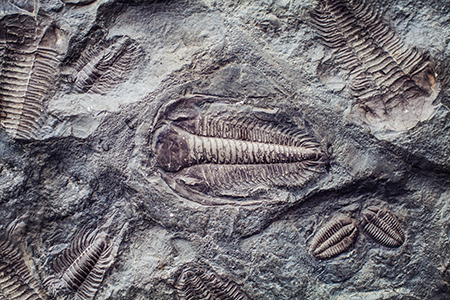 |
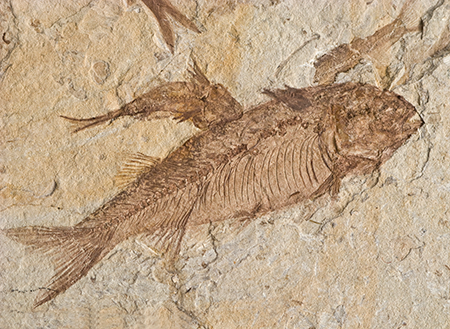 |
| Arthropod Fossil | Fish Fossil |
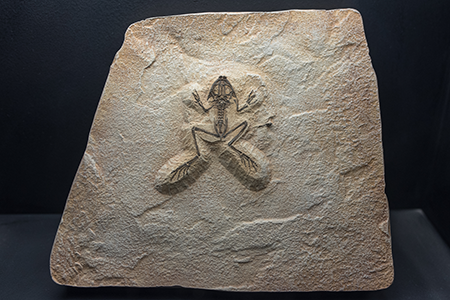 |
 |
| Amphibian Fossil | Mammal Fossil |
When we look at the order of appearance of fossils, moving from deeper in the ground (Paleozoic) to shallower (Cenozoic), and how they are grouped, we see that the fossil record seems to record the progress of the Flood as it gradually destroyed the different areas creatures lived in (habitats) before the Flood. As we have explained in other issues of Discovery, Creation scientists today believe the Flood started at the base of the oceans when “all the fountains of the great deep were broken up” (Genesis 7:11), and eventually resulted in the flooding and destruction of the entire surface of the Earth. As we would expect, at the bottom of the Paleozoic layers (where the Flood began) the first creatures we see are ones that lived on the ocean floor (like arthropods and brachiopods), followed above those layers by creatures that swam in the sea (like cephalopods and fish). Amphibians (which can live in the water or on land) appear in the next layers (buried as the Flood moved towards the coasts of continents), followed by reptiles (which live on land near water), then birds and mammals. Many of the larger mammals we see on the planet today, as well as humans, probably lived in one habitat together that was completely destroyed in the Flood, leaving behind very little fossil evidence in Flood layers. (They are found in the Cenozoic Layers, for the most part.) For the rest of this issue of Discovery, we will look at several of the interesting life forms that lived in the pre-Flood world that are found in these fossil layers.
Isn’t it amazing that science supports Scripture so well? Sadly, in spite of the evidence, many “will turn their ears away from the truth and be turned aside to fables” (2 Timothy 4:4)—like evolution. But remember: the truth will always be made clear to those who are sincerely interested in finding it (Matthew 7:7-8). God expects us to “test all things” and “hold fast what is good” (1 Thessalonians 5:21). When we test the theories of evolutionists, looking at the physical evidence, we find that they cannot explain the evidence. Creation and the Flood, however, fit the evidence and are powerful witnesses of the power of God.
The post The Flood Explains the Fossil Record appeared first on Apologetics Press.
]]>The post Creatures Before the Flood appeared first on Apologetics Press.
]]>Brachiopods
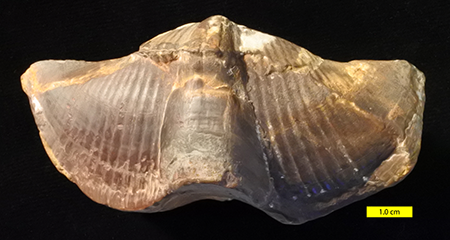
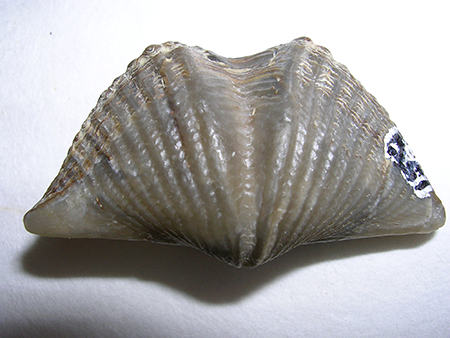
At first glance, you might assume that brachiopods [BRAK-ee-oh-pods] are just clams, since they have two “shells” (valves) and a hinge that allows the shells to close and protect their soft insides. Upon a closer look, however, brachiopods do not have the same shape, symmetry, or inner makeup as clams. Brachiopods still exist today (they are “extant”), but they are rarely seen (being on the ocean floor, mostly) and not as common as they were in the pre-Flood world.
 |
 |
|
Wikipedia.org (Wilson44691) 2019 CC-by-sa-1.0 |
Wikipedia.org (Porshunta) 2019 CC-by-sa-3.0 |
Arthropods
 Also found on the ocean floor in the pre-Flood world were arthropods like some varieties of the extinct trilobite. Trilobites are among the very first creatures to appear in the fossil record, but are considered extremely complex among the invertebrates—disproving what evolution would predict. According to evolution, the creatures that appear early in the fossil record should be very simple, not complex. Trilobites were usually around one to four inches long, but some were over 12 inches long!
Cephalopods
Moving higher in the fossil record, we find the pre-Flood creatures that swam in the ocean, such as cephalopods [SEF-uh-luh-pods].
Nautiloids are cephalopods that are basically squids in a shell. The few surviving species look essentially the same as those in the fossil record (disproving evolution predictions again). A huge number of nautiloids were buried at the Grand Canyon during the Flood.
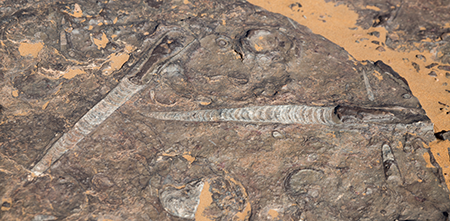 |
 |
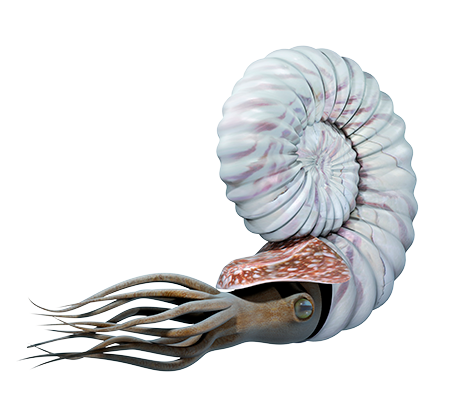 |
| Cephalopod Orthoceras | Nautiloids | Ammonites |
Ammonites are now extinct, but swam in the oceans of the pre-Flood world as well. They had a spiral shell.
Fish
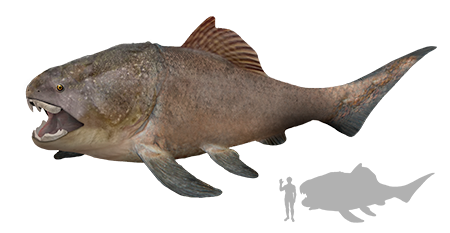 |
|
Wikipedia.org (Tim Bertelink) 2019 CC-by-sa-4.0 |
As would be expected, marine fish, such as Dunkleosteus [DUNK-lee-OH-stee-us], were buried in the Flood alongside the cephalopods. One species grew to be about 20 feet long and weighed one ton!
Bugs
As creepy as it may sound, Arthropleura was an extinct giant millipede arthropod from the pre-Flood world. If it was a land creature, it was the largest known land invertebrate of all time, able to grow over eight feet long!
|
Athropleura |
Meganeura |
|
Wikipedia.org (Tim Bertelink) 2019 CC-by-sa-4.0 |
Wikipedia.org (Matteo De Stefano 2019-by-sa-3.0 |
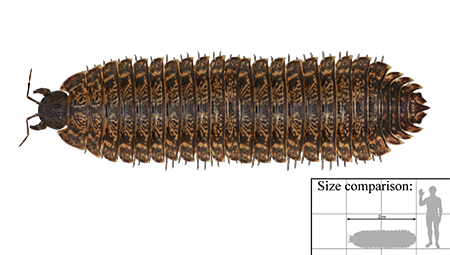

Meganeurais extinct as well (thankfully!), but was basically a huge dragonfly-like insect with a wingspan that was over two feet long! Modern dragonflies have a wingspan of about two to five inches.
Amphibians
| Wikipedia.org (Matteo De Stefano 209 CC-by-sa-3.0 |
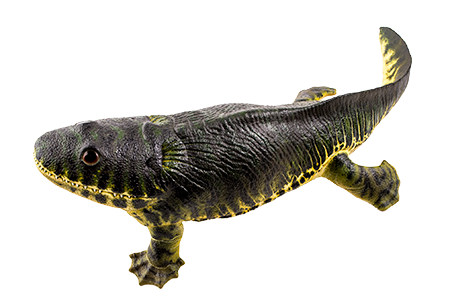 |
As the Flood began to reach the coasts, amphibians were killed and buried, since they live both in water and on land. Ichthyostega [IK-thee-AH-stuh-guh] was about five feet long, thought to be an amphibian, and is considered to be one of the first vertebrates in the fossil record that has four limbs.
Cynodonts [SIE-nuh-donts]
Dimetrodon[die-MEH-truh-don] is a popular creature from the pre-Flood world. Although many call it a dinosaur, scientists believe it to be neither a reptile nor a mammal, but among another extinct group of creatures called cynodonts.
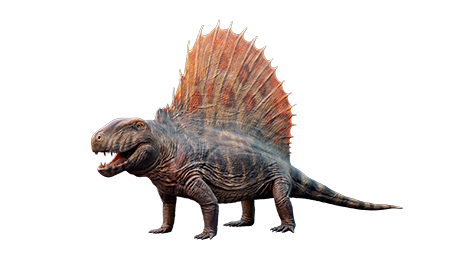 |
|
Wikipedia.org (Max Bellomio) 2019 CC-by-sa-4.0 |
Reptiles
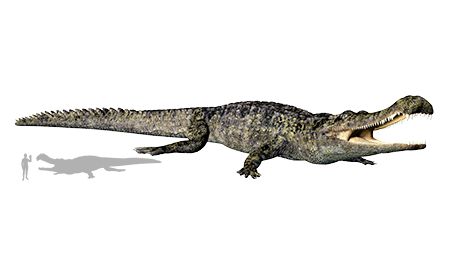 You are probably most familiar with the reptilian creatures of the pre-Flood world, like the dinosaurs, pterosaurs (flying reptiles), and the marine reptiles like plesiosaurs and ichthyosaurs—especially since we discuss dinosaurs so much in Discovery. But don’t forget the largest known crocodile from the pre-Flood world: Sarcosuchus [SAR-koh-SOO-kis] imperator. While larger crocs today can be over 20 feet long, Sarcosuchus could grow to be closer to 40 feet and weigh 17,500 pounds!
Birds
 As you might expect, birds did not show up until high in the fossil record when the Flood was already pouring over the continents. While most birds and mammals do not appear until the Cenozoic layers, there are exceptions. The first bird to show up is currently thought to be Archaeopteryx (which we have studied before in Discovery).
Mammals
 Very few mammal fossils were preserved in the Flood rock layers, which could mean they were killed last or totally destroyed by the Flood when the original continent broke up and its pieces began moving and sinking. Repenomamus [ruh-PEN-uh-mah-miss] is extinct, but its fossils are some of the few mammal fossils that survived the Flood. It grew to be over three feet long and is pretty popular, because one of its fossils proves that its last meal was a small dinosaur! (Psittacosaurus)
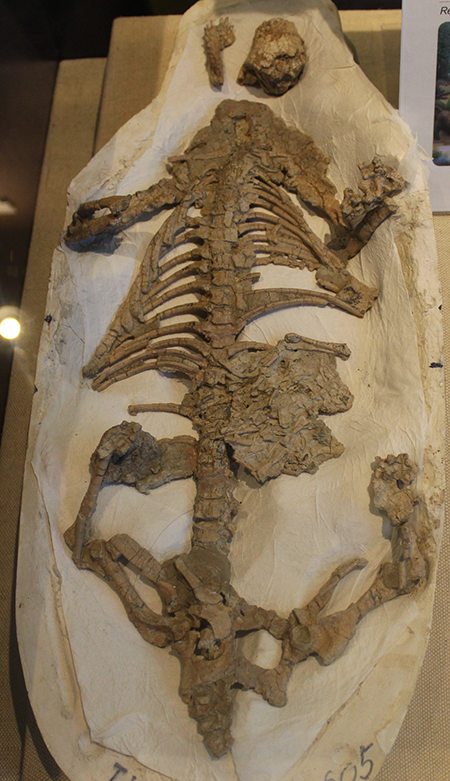 |
|
Wikipedia.org (Jonathan Chen) 2019 CC-by-sa-4.0 |
Imagine what it would have been like to live with some of these creatures, just like Noah’s family and millions of others did. Would you try to pet one or run from it? Would you have obeyed God by having dominion over the fish of the sea, over the birds of the air, and over every living thing that moves on the Earth” (Genesis 1:28), as He commanded mankind in the beginning?
The post Creatures Before the Flood appeared first on Apologetics Press.
]]>The post Fossils That Formed Before the Flood appeared first on Apologetics Press.
]]>
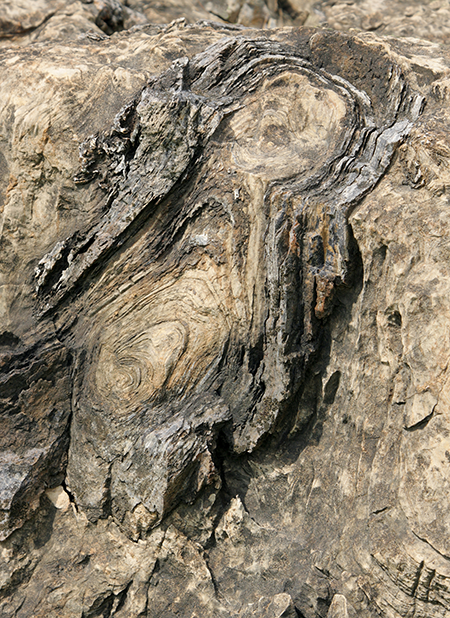 |
 |
| Stromatolites | Microfossils |
Stromatolites
Stromatolites are layers of rock that are thought to have been formed from communities of tiny microorganisms. While today they grow to be roughly three feet in diameter, during the pre-Flood time period, they grew to be miles in diameter.
Microfossils
Microfossils (fossils that can only be studied with microscopes) of cyanobacteria have been found, which are responsible for many of the pre-Flood stromatolites. Many other kinds of bacteria fossils are also found in the oldest rocks.
What was the world like before the Flood? Not much is known since the Flood was so destructive. God only left us a few clues. We know one thing, though: when humanity turns its back on God like the people of Noah’s world did, the tolerance of God eventually “runs out” and His judgment follows. Let’s be sure to obey God and tell others how to do so, too!
The post Fossils That Formed Before the Flood appeared first on Apologetics Press.
]]>The post Are there Fossilized Plants from the Flood? appeared first on Apologetics Press.
]]>
 |
| Petrified log at the Petrified Forest National Park |
Great question! There are lots of plants in the Flood layers of the fossil record—from polystrate plant fossils (fossils that span more than one stratum), like calamites and tree logs, to petrified angiosperm trees (trees that produce flowers) and petrified gymnosperm trees (trees that produce seeds, but no flowers). An example that might be very helpful for you to know about if you travel to Arizona and go to Petrified Forest National Park would be Araucarioxylon arizonicum. Don’t even try to say it! What you need to know is that the petrified logs at Petrified Forest are thought to be a type of conifer tree (like pine trees or cypress trees) that could grow to be 200 feet tall and have a diameter of three to four feet! These trees were probably torn up, buried, and fossilized due to Flood activity (which included a lot of volcanic eruptions, based upon the volcanic ash in the rock layers of those logs). It is possible that they floated in by a huge Flood mudslide to the Petrified Forest where they now sit. I don’t know about you, but I’m glad I wasn’t alive to see that happen!
The post Are there Fossilized Plants from the Flood? appeared first on Apologetics Press.
]]>The post Speleo-what? appeared first on Apologetics Press.
]]>How do speleothems form? As rain drops to the ground and seeps down towards a cave, it picks up carbon dioxide from decaying plants and turns into carbonic acid. When it reaches the limestone above a cave, it dissolves some of it and picks up calcite from the limestone. When the liquid reaches the cave air, it releases its carbon dioxide gas (like fizz coming from a soda can when you open it). The calcite “sticks” to the cave as the carbon dioxide is released and as the water drips to the base of the cave. As this process happens, the calcite gradually builds up, forming speleothems.
 |
Stalagmites are speleothems that grow upward from the floor of a cave as calcite is deposited there from drops of the liquid. |
 |
Stalactites are speleothems that hang (tight) from the ceiling of a cave as calcite is left behind before the droplet falls to the floor of the cave. |
 |
Soda straws are a type of stalactite. As a droplet hovers on the ceiling before dropping, its calcite gathers along the edges of the droplet, making a ring. When the water then drops, a calcite ring is left. If it continues to grow, it becomes a hollow tube—like a straw—that hangs from the ceiling. If the hole in the bottom of the tube ever gets clogged, the straw will begin turning into a normal stalactite. |
 |
Columns form when a stalagmite grows as a stalactite grows directly above it. Eventually, if they continue to grow, they will join, forming a column. |
 |
Cave bacon is a formation that looks like a curtain of bacon when light shines through it. It forms as droplets run in a line along a hanging surface, instead of dropping straight to the ground. Calcite builds up on the line, forming what looks like drapery. |
 |
Flow stone forms when droplets run down walls or large objects, making speleothems that look like calcite waterfalls. |
 |
Cave pearls look like…pearls. Sometimes droplets land directly on a piece of something on the floor of a cave. Calcite begins to build up the substance, and the continued droplets “polish” it, making it smooth and, oftentimes, spherical—like a ball. |
Old Earth geologists argue that some speleothems are so large that it would have taken tens of thousands of years or longer for them to form. As usual, old Earth geologists typically make such claims because they are assuming uniformitarianism is true: the belief that whatever processes and rates we see happening today in geology have always happened that same way throughout time. The problem is, uniformitarianism does not fit the actual evidence when we study speleothem growth. Many factors play a role in how fast speleothems grow, including the amount of rain at the surface, the surface air temperature, the drip rate and concentration, and the level of carbon dioxide in the soil. In the years immediately following the Flood, during the Ice Age, there would have been much more rain (faster drip rate), much higher levels of carbon dioxide in the soil from dead plants and animals (leading to more calcite in droplets), and lower temperatures (leading to wider stalagmites).
Cave tour guides will typically give an estimate of how fast speleothems grow—very slowly. The average growth of flowstone per year today, for example, is said to be 0.01 inches. Nearly every tour guide in my travels, however, highlighted that they give low growth rates like that, but they have observed much higher speleothem growth rates in their own caves. Tour guides for Squire Boone Caverns in Mauckport, IN, for example, showed me a stairwell leading down to the cave that was built in 1973: 46 years ago. At 0.01 inches of growth per year, there should have been about one half of an inch of flowstone in the stairwell. Instead, flowstone covered much of the 73-step stairwell, and it was 2-3 inches thick in several places. The size of speleothems is not a problem for the young Earth position that the Bible teaches.
The post Speleo-what? appeared first on Apologetics Press.
]]>The post How Do Caves Form? appeared first on Apologetics Press.
]]>It is tempting to believe that caves form from rushing water that slowly wears away a rock—“eroding” it until a hole appears. But that is not the action that forms most caves. Most caves are thought to be formed by rock being dissolved by an acid—a process called dissolution (DIS-uh-LOO-shun). After a chamber is dissolved in a rock, when the water level below the ground drops or the ground itself rises (yes, that happens in some places!), an empty cave is left.
Many old-Earth geologists believe that solution caves are formed when rain water picks up carbon dioxide in the air as it falls to the ground and begins soaking into the Earth. As it seeps through the Earth, it picks up more carbon dioxide from the decaying plants in the dirt, and the water turns into carbonic (kar-BON-ik) acid—the stuff that makes your soda fizz. When that acid sinks in the ground to a kind of stone that dissolves easily (like limestone), the acid slowly dissolves the rock, forming a hole. Old Earth geologists believe that over thousands of years, the hole gets bigger, eventually forming a cave. As you can imagine, that process is very slow. How, then, can the Bible be true?
 |
 |
| Feeders | |
 |
 |
| Channels | |
Over the last several years, another kind of cave dissolution process has been studied and found to explain how many caves have formed. Instead of rocks being slowly dissolved by carbonic acid from above, they can be quickly dissolved by sulfuric acid that comes from below. This process is called hypogene (HIPE-oh-jean) speleogenesis (SPEEL-ee-oh-JEN-uh-sis). As water comes into contact with rocks that contain sulfur, dead plants and animals (which release sulfur as they decay), or hydrogen sulfide from volcanic gases, and then combine with oxygen, sulfuric acid forms. During the Flood, large amounts of hot water would have been trapped below the surface of the Earth while dirt was being piled up on continents. The water would have mixed with oxygen, as well as hydrogen sulfide from the volcanic activity in the Flood and sulfur from the dead plants and animals across the planet, making sulfuric acid. The sulfuric acid would have been trapped beneath the Earth’s surface where the pressure from the water and added dirt on the surface would have caused the sulfuric acid to move towards the surface, dissolving rock along the way. Bottom line: the Flood conditions would have been perfect for the rapid formation of solution caves.
 |
 |
| Cupola | |
 |
| Mineral Gypsum |
To show that sulfuric acid dissolution explains most solution caves, I have studied 25 caves in eight states, looking for characteristics in solution caves that would support sulfuric acid dissolution: entry holes at the base of the cave (feeders), pathways leading from the feeders to the top of the cave (channels), dome structures on the ceilings of caves (cupolas), and the presence of the mineral gypsum (which forms quickly when sulfuric acid meets lime), for example.Without exception, every solution cave I have studied has characteristics that support sulfuric acid dissolution—exactly what we would expected if the Flood happened and formed caves only a few thousand years ago.
The post How Do Caves Form? appeared first on Apologetics Press.
]]>The post What Do We Know About the World of Noah Before The Flood? appeared first on Apologetics Press.
]]>What Do We Know About the World of Noah Before The Flood?
Physically:
 Based on what we read in Scripture, as well as the scientific evidence, the Earth was likely very different before the Flood. Consider these thoughts from Dr. Jeff Miller:
“When we rewind the movement of the continents in the opposite direction…we find that the continents fit together like a big puzzle that was apparently torn apart at some point in the past…
The continents are moving today on the order of centimeters per year, but what if the continents once moved much faster due to some kind of catastrophe with enough power to actually break up the ocean floor (Genesis 7:11)? Well, that is precisely what Creation scientists believe happened in the Flood.”
Spiritually:
Much like the PHYSICAL separation of land that took place on the Earth during the Flood, there was a similar SPIRITUAL separation that led to God’s decision to destroy the world in the days of Noah.
It began with the sin committed by ADAM & EVE in the Garden of Eden (Genesis 3). This sin brought lasting consequences that sent mankind on a downward spiral of spiritual corruption. CAIN continued this spiritual decline when he murdered his brother, Abel (Genesis 4:1-16). As Cain’s descendants grew in number, they also increased in their sin, to the point that LAMECH (five generations removed from Cain) took two wives and boasted about murder (Genesis 4:19,23-24). Eventually, mankind became so wicked that “every intent of the thoughts of his heart was only evil continually” (Genesis 6:5). These were the gradual, drastic spiritual changes that took place in Noah’s world that led to the Flood!



The post What Do We Know About the World of Noah Before The Flood? appeared first on Apologetics Press.
]]>The post What Do We Know About Noah’s Obedience? appeared first on Apologetics Press.
]]>Scripture:
 The Bible tells us a lot about Noah’s character and obedience:
GENESIS 6:8 – “But Noah found grace in the eyes of the Lord.”
GENESIS 6:9 – “Noah was a just man, perfect in his generations. Noah walked with God.”
GENESIS 6:22 – “Thus Noah did; according to all that God commanded him, so he did.”
GENESIS 7:5 – “And Noah did according to all that the Lord commanded him.”
HEBREWS 11:7a – “By faith Noah, being divinely warned of things not yet seen, moved with godly fear, prepared an ark for the saving of his household….”
2 PETER 2:5 – “[God] saved Noah…a preacher of righteousness, bringing in the flood on the world of the ungodly.”
These are remarkable statements about Noah, but based on what God told Noah to do, what would be some of the specifics of his obedience in the building of the Ark?
Specifics:
In order to carry out God’s commands, Noah would have had to do all of these things…and more! Just imagine how much work this would have been!
Planning, Chopping Wood, Making Lumber, Moving wood, Construction, and Making Pitch



The post What Do We Know About Noah’s Obedience? appeared first on Apologetics Press.
]]>The post What Do We Know About The Flood Itself? appeared first on Apologetics Press.
]]>“And it came to pass after seven days that the waters of the flood were on the earth. In the six hundredth year of Noah’s life, in the second month, the seventeenth day of the month, on that day all the fountains of the great deep were broken up, and the windows of heaven were opened. And the rain was on the earth forty days and forty nights” (Genesis 7:10-12).
“Now the flood was on the earth forty days. The waters increased and lifted up the ark, and it rose high above the earth. The waters prevailed and greatly increased on the earth, and the ark moved about on the surface of the waters. And the waters prevailed exceedingly on the earth, and all the high hills under the whole heaven were covered. The waters prevailed fifteen cubits upward, and the mountains were covered. And all flesh died that moved on the earth: birds and cattle and beasts and every creeping thing that creeps on the earth, and every man. All in whose nostrils was the breath of the spirit of life, all that was on the dry land, died. So He destroyed all living things which were on the face of the ground: both man and cattle, creeping thing and bird of the air. They were destroyed from the earth. Only Noah and those who were with him in the ark remained alive. And the waters prevailed on the earth one hundred and fifty days” (Genesis 7:17-24).
Scope:
Was the Flood simply a local event, or did it truly cover the entire Earth? We have seen that the Bible seems to make this quite clear, but let’s take a look at some scientific evidence for a global Flood:
1. We have found marine fossils (sea-dwelling animals) on the tops of mountains and in the middle of continents far away from the ocean. A global Flood would certainly explain how they got there.
2. The fossil record indicates that many animals—including dinosaurs—were buried rapidly by a catastrophic event. We have hundreds of fossil graveyards, some containing large groups of animals, all over the world. A global Flood would cause this.
3. There are hundreds of “Flood Legends” from all over the world, each being distinct in some way, but all sharing remarkable similarities. Wouldn’t it make sense that this would happen, since people would have been talking about the Flood before it was ever written down in the Bible?
The post What Do We Know About The Flood Itself? appeared first on Apologetics Press.
]]>The post What Do We know About the Ark Itself? appeared first on Apologetics Press.
]]>

The post What Do We know About the Ark Itself? appeared first on Apologetics Press.
]]>The post Were the Giza Pyramids Built Before the Flood? appeared first on Apologetics Press.
]]>If the Egyptian Pyramids of Giza were built around 4,600 years ago1 and the Flood was about 4,400 years ago, does that mean the pyramids were built prior to and survived the Flood?
A:
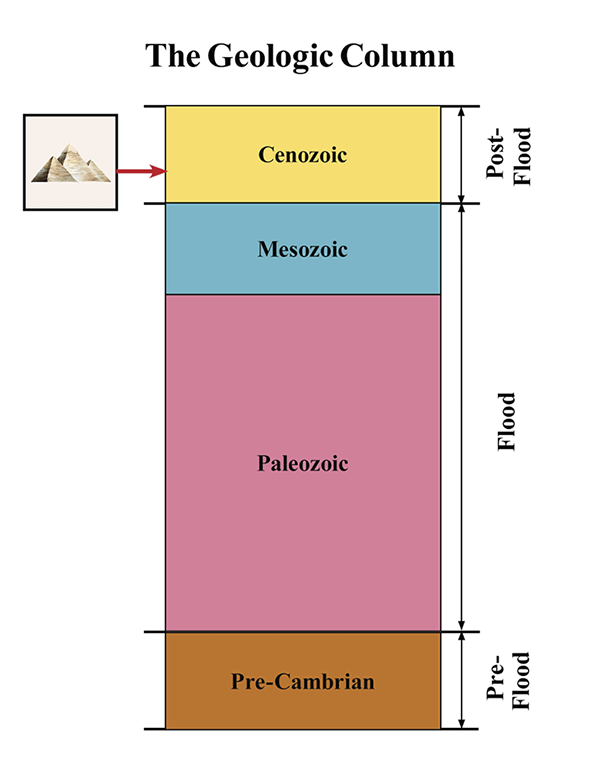 First, keep in mind that, although roughly 2,400 B.C. is generally accepted as the date of the Flood, the chronologies of Genesis 11 allow for an expansion of a few hundred years.2 Also keep in mind that dating techniques that are used to determine the age of ancient materials, such as carbon dating and tree ring analysis, rely on the assumption of uniformitarianism.3 These methods would be invalid if a worldwide catastrophic Flood occurred followed by a Flood-induced Ice Age. If the Flood actually occurred, and nuclear decay rates were accelerated during and after its occurrence for a period of time (and sub-annual tree rings were forming due to the Ice Age) as many creationists contend, all ages dating before roughly 1,000-1,500 B.C. would be inflated, giving an appearance of age beyond their true age.
Also, when we examine the layers of rock that form the continents upon which we reside, there is little doubt that the Cambrian strata—the beginning of the Paleozoic Era—represent the commencement of the biblical Flood.4 The rock layers throughout the Paleozoic, and overlying Mesozoic layers, approximately represent the sediment that was deposited during the Flood. Above those layers are the rocks of the Cenozoic era, which were laid down after the Flood. The Giza Pyramids were built into the Cenozoic layers (specifically, the Eocene strata5) that were deposited after the Flood—implying that the Giza Pyramids were not built before the Flood. The date of their construction, as assigned by archaeologists (e.g., 2700-2500 B.C.6), has likely been inflated based on uniformitarian dating schemes.
Endnotes
1 Brian Handwerk (2017), “Pyramids at Giza,” National Geographic, March 23, https://www.nationalgeographic.com/archaeology-and-history/archaeology/giza-pyramids/.
2 Jeff Miller (2019), “21 Reasons to Believe the Earth is Young,” Reason & Revelation, 39[1]:10.
3 Mike Houts (2015), “Assumptions and the Age of the Earth,” Reason & Revelation, 35[3]:26-34.
4 S.A. Austin and K.P. Wise (1994), “The Pre-Flood/Flood Boundary: as Defined in Grand Canyon, Arizona and Eastern Mojave Desert, California,” Proceedings of the Third International Conference on Creationism, Technical Symposium Sessions (Pittsburgh, PA: Creation Science Fellowship), pp. 37-47.
5 M.M. El Aref and E. Refai (1987), “Paleokarst Processes in the Eocene Limestones of the Pyramids Plateau, Giza, Egypt,” Journal of African Earth Sciences, 6[3]:367-377, https://www.sciencedirect.com/science/article/pii/0899536287900790.
6 Brian Handwerk (n.d.), “Pyramids at Giza,” NationalGeographic.com, https://www.
Edited 4/7/22
 |
|
| Suggested Resources | |
The post Were the Giza Pyramids Built Before the Flood? appeared first on Apologetics Press.
]]>The post Does the Fossil Record Support Creation and the Flood? appeared first on Apologetics Press.
]]>
A prominent argument used in favor of Darwinian evolution and against biblical Creation, with its account of the global Deluge of Noah’s day, centers on the nature of the fossil record recorded in the layers of rock beneath and around us. Does the fossil record indeed conflict with biblical Creation?
In order for a scientific theory to be validated, it should be able to make predictions about what research would discover if the theory is true. If gradual Darwinian evolution accounts for the origin of all current species from previous, less complex species, starting with an original, simple common ancestor that was a single-celled organism, one would make certain predictions that would be verified upon examining the fossil record. For example, the fossil record should show single-celled organisms at the base of the fossil record, followed by fossils of other simple organisms. Billions of fossils of intermediary organisms would be predicted to exist that connect the single-celled organism to the next species. Every species thereafter would follow suit in its representation in the fossil record, with its own billions of transitional fossils linking it to a previous species. Further, since Darwinian evolution would predict “survival of the fittest,” with a constant upward trend in the evolution of species, extinction of any species thought to be millions of years old would be inevitable. As a new, more fit species evolved onto the scene, it would survive, pushing out its previous, less fit form.
On the other hand, if biblical Creation and the Flood are true, completely different predictions would be made concerning the fossil record. Since God initially created representatives of all kinds, rather than their evolving from previous forms, since fossil forming phenomena are rare, and since the Earth is young, the bulk of the fossil record would be, not a record of past life and evolution on a billions of years old Earth, but a record of death as the year-long Flood progressed. Few fossils would be found below the Flood layers, with many of those having likely been destroyed when the Flood began. The Flood layers, on the other hand, would be the equivalent of a worldwide graveyard—a record of the destruction of “all living things which were on the face of the ground” (Genesis 7:23).
Creationists would predict that when the Flood began, mass destruction of life occurred worldwide, and therefore the fossil record would begin with an explosion of fossil forms that were fully formed and functional, with no evidence of having evolved from previous forms. The bulk of these fossils would be in sedimentary rock, since the Flood was an aqueous event. Both simple and complex creatures would be mixed throughout the fossil record, while larger, faster, and/or “smarter” creatures would sometimes be found higher in the record, since they could more easily escape fossil forming phenomena and survive longer. If much of the Flood waters came from the oceans, as the text and scientific evidence seem to imply,1 the fossils at the base of the fossil record would be of creatures found on the ocean floor, followed by marine creatures. As the Flood waters continued to rise and the cataclysm hit the coasts, shallow water organisms and coastline creatures would be killed and buried, followed by creatures further and further inland. Marine fossils would be interspersed throughout the fossil record, since the ocean waters moving onto the land would have carried swimming creatures with them. After the Flood ended, since fossil forming phenomena are rare, those creatures that were unable to rebound after the Flood (or which were hunted, etc.) would gradually go extinct, often with no record of having even survived the Flood. While the fossils of the year-long Flood would show no evidence of change throughout the year, the layers after the Flood would be predicted to show evidence of the diversifying of creatures after they left the Ark to repopulate the Earth.
Which model’s predictions best fit the physical evidence gleaned from paleontology? Paleontologists have long acknowledged three general characteristics of the fossil record in its totality: (1) abrupt appearance; (2) stasis; and (3) extinction.2 Each of these characteristics fit the Creation/Flood paradigm well, but create an “uncomfortable paradox” for the Darwinian gradual evolution paradigm.3
Characteristic #1: Abrupt Appearance
This general characteristic refers to the fact that when fossils first appear in the fossil record, they appear fully formed without any evolutionary history. The Cambrian Explosion, for example, refers to the many fully formed creatures that abruptly appear at the base of the fossil record with no ancestors. Reporting on research at the University of Texas at Austin, UT News reported: “This rapid diversification, known as the Cambrian explosion, puzzled Charles Darwin and remains one of the biggest questions in animal evolution to this day. Very few fossils exist of organisms that could be the Precambrian ancestors of bilateral animals, and even those are highly controversial.”4 Osorio, et al., writing in American Scientist, acknowledged,
As Darwin noted in the Origin of Species, the abrupt emergence of arthropods in the fossil record during the Cambrian presents a problem for evolutionary biology. There are no obvious simpler or intermediate forms—either living or in the fossil record—that show convincingly how modern arthropods evolved from worm-like ancestors. Consequently there has been a wealth of speculation and contention.5
The late, well known evolutionary paleontologist Stephen Jay Gould admitted: “The Cambrian explosion was the most remarkable and puzzling event in the history of life.”6 Famous evolutionary biologist of Oxford University, Richard Dawkins, described the Cambrian Explosion this way:
The Cambrian strata of rocks, vintage about 600 million years [secular geologists are now dating the beginning of the Cambrian at about 540 million years—JM], are the oldest in which we find most of the major invertebrate groups. And we find many of them already in an advanced state of evolution, the very first time they appear. It is as though they were just planted there, without any evolutionary history.7
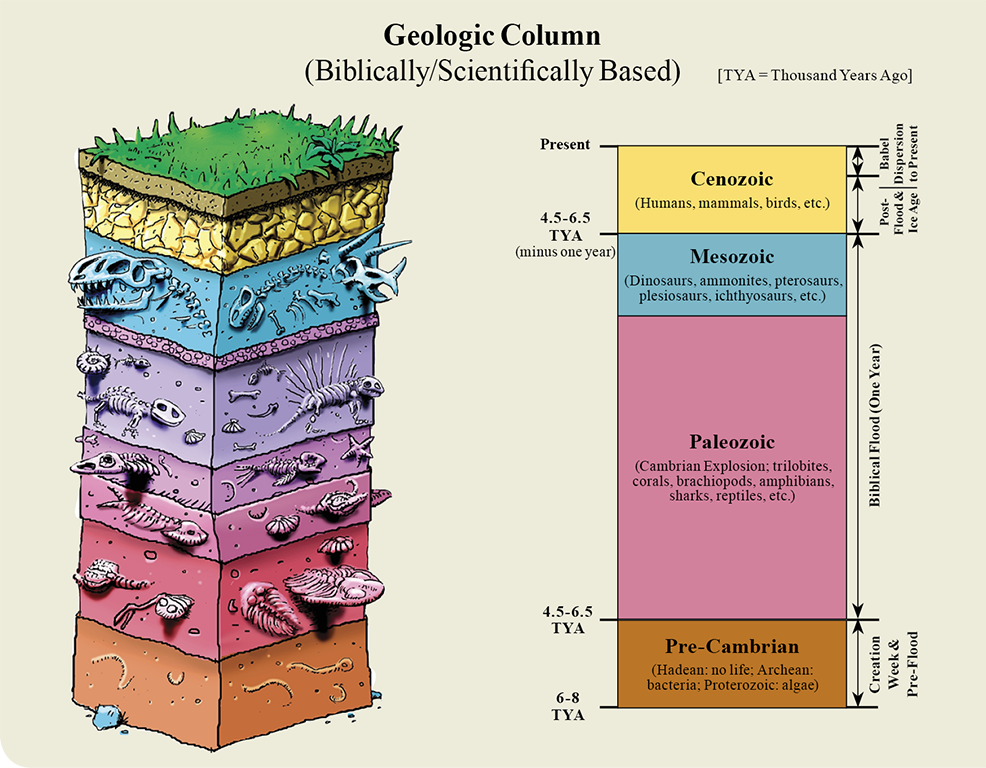
Long ago, the late, famous paleontologist of Columbia University, the American Museum of Natural History, and the Museum of Comparative Zoology at Harvard, George Gaylord Simpson, admitted: “Most new species, genera, and families, and nearly all categories above the level of families, appear in the records suddenly, and are not led up to by known, gradual, completely transitional sequences.”8 The Cambrian Explosion is an acknowledged problem for evolutionary theory—a falsified prediction—and yet the abrupt appearance of fully formed and functional species is an obvious, pervasive trait of the entire fossil record, from beginning to end.
The abrupt appearance of living organisms, however, is not the extent of the problem for evolution. Not only are the species of the fossil record fully formed and functional from the beginning of the record, but they are also complex when they abruptly appear. The trilobite, for example, is characteristic of the Cambrian strata at the base of the fossil record—a creature equipped with an extremely complex vision system, using aplanatic lenses that are more complex than the human eye, which is equipped with a single refractive lens.9 The fossil record provides no evidence for the evolution of the trilobite, and yet its complexity is stunning. Complexity at the commencement of the fossil record is a falsification of a fundamental evolutionary prediction, but coincides perfectly with Creation and Flood predictions.
Evolution would also predict that diversity would precede disparity in the fossil record. In other words, varieties of a single body type (diversity) would be found in the fossil record at its base, and over time (moving up through the record), other body types would eventually emerge (disparity). One calls to mind the well-known sketches of the evolutionary tree of life, with a single-celled organism at its base gradually giving rise to the many branches and twigs that characterize all life. The biblical Creation model predicts the opposite: God initially created distinct kinds (disparity) from which came variety and diversity within those kinds. Instead of the evolutionary tree of life, one calls to mind an orchard of trees representing distinct kinds with their branches and twigs representing mere diversification and variety within those kinds. The fossil record, once again, supports the creationist contention. Biologists have pinpointed a few dozen distinct phyla—the level of organization used to group organisms based on their basic body plans. Of the 27 phyla represented in the fossil record, roughly 20 appear immediately in the Cambrian explosion (disparity) with no evidence of having evolved.10 Variety within those phyla—species diversity—does not show up until higher in the fossil record, just as biblical Creation would predict: disparity before diversity.
Abrupt appearance of fully formed and functional, complex organisms with immense disparity is a sweeping characteristic of the fossil record. That truth is severely problematic for evolution, but it is precisely what would be predicted if biblical Creation and the Flood occurred.
Characteristic #2: Stasis
Stasis in the fossil record refers to the observation that after creatures appear in the fossil record, they remain virtually the same throughout their tenure in the rock layers.11 While Darwinian evolution would predict a gradual change of species over millions of years, the fossil record does not reflect that prediction: transitional fossils linking one species to a distinctly different species do not exist.
Gould admitted that evolutionists “have no direct evidence for smooth transitions.” He acknowledged: “All paleontologists know that the fossil record contains precious little in the way of intermediate forms; transitions between major groups are characteristically abrupt.”12 Writing in Paleobiology he explained: “The absence of fossil evidence for intermediary stages between major transitions in organic design, indeed our inability, even in our imagination, to construct functional intermediates in many cases, has been a persistent and nagging problem for gradualistic accounts of evolution.”13 “[T]he extreme rarity of transitional forms in the fossil record persists as the trade secret of paleontology. The evolutionary trees that adorn our textbooks have data only at the tips and nodes of their branches: the rest is inference, however reasonable, not the evidence of the fossils.”14
Evolutionary paleontologist Steven Stanley explained: “The known fossil record fails to document a single example of phyletic evolution [i.e., evolution of a new phylum—JM] accomplishing a major morphological transition and hence offers no evidence that the gradualistic model can be valid.”15 Evolutionary anthropologist and emeritus professor of the University of Oxford Robert Barnes acknowledged that “the fossil record tells us almost nothing about the evolutionary origin of phyla and classes. Intermediate forms are non-existent, undiscovered, or not recognized.”16 Evolutionary biologists James Valentine and Douglas Erwin wrote: “If ever we were to expect to find ancestors to or intermediates between higher taxa, it would be in the rocks of the late Precambrian to Ordovician times, when the bulk of the world’s higher animal taxa evolved. Yet transitional alliances are unknown or unconfirmed for any of the phyla or classes appearing then.”17
So clear is the lack of evidence of evolutionary transition in the fossil record that evolutionary zoologist of Oxford University Mark Ridley went so far as to say, “[N]o real evolutionist, whether gradualistic or punctuationist, uses the fossil record as evidence in favor of the theory of evolution as opposed to special creation.”18 Why? Because the fossil record does not support evolution; it supports Creation. Even Charles Darwin saw the problem in the 1800s that persists today:
[T]he number of intermediate varieties, which have formerly existed, [must] be truly enormous. Why then is not every geological formation and every stratum full of such intermediate links? Geology assuredly does not reveal any such finely graduated organic chain; and this, perhaps, is the most obvious and serious objection which can be argued against this theory [i.e., evolution—JM].19
Colin Patterson literally “wrote the textbook” on evolution. He was the paleontologist who served as the editor of the professional journal published by the British Museum of Natural History in London. In response to a letter asking why he did not include examples of transitional fossils in his book, he responded,
I fully agree with your comments on the lack of direct illustration of evolutionary transitions in my book. If I knew of any, fossil or living, I would certainly have included them…. Yet [Stephen Jay] Gould and the American Museum people are hard to contradict when they say there are no transitional fossils…. I will lay it on the line—there is not one such fossil for which one could make a watertight argument.20
Notable is the fact that when paleontologists uncover a fossil that they hope will pass as a legitimate transitional form, not only is it still controversial, but the championed fossil is inevitably from a vertebrate organism. Vertebrate fossils, however, comprise roughly only 0.0125% of the fossil record—they are virtually irrelevant indicators of whether or not evolution occurred.21 Since well over 99.9% of the fossil record is made up of invertebrate fossils, one would think that if evolution happened, transitional fossils would be easy to find among the invertebrates, especially since their remains tend to preserve more easily. Rarely, if ever, however, do evolutionists even claim to find alleged invertebrate transitional forms. If species evolve in the manner described by mainstream evolutionists, (1) transitional forms should not be difficult to find, and (2) they would be invertebrates most of the time. Neither of those predictions hold true.
Further verification that stasis—a lack of significant evolutionary change—reflects the fossil record pertains to what Darwin termed “living fossils.” Countless times over many years evolutionists have discovered fossils in strata laid down millions of years ago (according to the evolutionary timeline) that were thought to be extinct, presumably from having evolved into something else. According to evolution, species are the result of “descent with modification” from other species, so it would be virtually inconceivable that a species would remain essentially the same after millions of years. After all, according to evolution, evolution happens! “Living fossils,” however, have been discovered many times over the years. “Living fossils” (a self-contradictory notion at best) are species thought to have lived millions of years ago, that have been discovered alive in modern times, virtually the same as their fossil counterpart. Consider the following sample of living fossils with the number of alleged evolutionary years since their alleged extinctions22:
- Coelacanths (300-400 million years)
- Graptolites (300 million years)
- Tuatara (over 65 million years)
- Metasequoia tree (over 20 million years)
- Heliopora coral (over 65 million years)
- Crocodiles (over 150 million years)
- Various teleost fishes (over 100 million years)
- Sturgeons (over 65 million years)
- Bowfin fish (70 million years)
- Gar fish (100 million years)
- Pleurotomaria gastropod (500 million years)
- Neotrigonia mollusk (100 million years)
- Chambered Nautilus (500 million years)
- Neopilina mollusk (280 million years)
- Lingula brachiopod (450 million years)
- Wollemi pine trees (over 65 million years)
- Horseshoe crabs (over 400 million years)
- Monoplacophorans mollusks (over 500 million years)
Once again, the predictions of the evolutionary paradigm fall woefully short. Stasis is a verified prediction of the Creation model—not the evolutionary paradigm. A lack of transitional fossils, especially among the invertebrates, along with the prevalence of “living fossils,” supports Creation—not evolution.
Characteristic #3: Extinction
Five “mass extinction” events are said to have occurred in history, according to the evolutionary paradigm.23
- In the Ordovician extinction (445 million years ago), 60-70 percent of the Earth’s species went extinct.
- In the Devonian extinction (360-375 million years ago), up to 75 percent of the Earth’s species disappeared from the Earth.
- In the Permian extinction (252 million years ago), 95 percent of the Earth’s species went extinct.
- In the Triassic extinction (200 million years ago), 70-80 percent of the Earth’s species disappeared.
- In the Cretaceous extinction (65-66 million years ago), 75 percent of the Earth’s species went extinct.
According to evolutionists, the causes of these alleged worldwide extinction events are still unknown.
Creationists interpret the same data differently. First, the dates of the extinction events are incorrect, since they rely on radiometric dating.24 All dates in millions of years can be telescoped to the biblical timeframe upon realization that, for example, the nuclear decay rates were apparently accelerated during the Flood. The Flood likely corresponds roughly to the Cambrian through Cretaceous periods (i.e., 540 million years ago to 66 million years ago, using the evolutionary timescale). Each of the extinction events, therefore, fall within the year-long Flood that occurred a few thousand years ago. The geologic column and fossil record provide an account of the Flood’s progression.25 Hence, each of the major extinction events noted by evolutionists merely report the destruction of another of Earth’s major habitats/ecosystems as the waters of the Flood continued to rise.
Regardless of one’s explanation of the evidence, extinction—not evolution—is a major trait of the fossil record. The biblical global Flood provides a powerful explanation for why worldwide death and extinction occurred in the fossil record and, at the same time, why fossils are typically found in sedimentary rock (which is typically formed from aqueous events).
Conclusion
The fossil record is a compilation of creatures that abruptly appear, fully formed, in the rock layers of the Earth with no evolutionary history. They remain virtually the same throughout the record, and then oftentimes disappear from the surface of the Earth. Do these pervasive, endemic traits of the fossil record support the biblical accounts of Creation and the Flood, or is the naturalistic paradigm the better explanation for the origin of the fossils? Clearly, the Theory of Evolution does not fit the physical evidence. Many of its most fundamental predictions are consistently falsified through observation of the evidence left for us in the fossil record. Evolution, therefore, has been effectively falsified. Upon assessing the evidence, it seems that one must be determined to ignore it, blindly holding to naturalism, to accept evolution. Biblical Creation and the Flood fit the evidence. They happened, whether or not we appreciate their implications regarding how we should live in order to please God and receive His eternal blessings (2 Peter 3:3-11).
Endnotes
1 Jeff Miller (2019), ” Was the Flood Global? Testimony from Scripture and Science,” Reason & Revelation, 39[4]:38-47, https://apologeticspress.org/apPubPage.aspx?pub=1&issue=1293&article=2918.
2 E.g., Stephen Jay Gould (1980), The Panda’s Thumb (New York: W.W. Norton & Co.), pp. 181-182.
3 Ibid.
4 “Discovery of Giant Roaming Deep Sea Protist Provides New Perspective on Animal Evolution” (2008), UT News, November 20, http://news.utexas.edu/2008/11/20/giant_protist.
5 Daniel Osorio, Jonathan Bacon, and Paul Whitington (1997), “The Evolution of Arthropod Nervous Systems,” American Scientist, 85[3]:244, emp. added.
6 Stephen J. Gould (1994), “The Evolution of Life on Earth,” Scientific American, 271:86, October.
7 Richard Dawkins (1986), The Blind Watchmaker (New York: W.W. Norton), p. 229, emp. added.
8 George G. Simpson (1953), The Major Features of Evolution (New York: Columbia University Press), p. 360.
9 Lisa J. Shawver (1974), “Trilobite Eyes: An Impressive Feat of Early Evolution,” Science News, 105:72, February 2; Riccardo Levi-Setti (1993), Trilobites (Chicago, IL: University of Chicago Press), pp. 57-58; Richard Ellis (2001), Aquagenesis (New York: Viking), p. 49.
10 Stephen C. Meyer (2013), Darwin’s Doubt (New York: HarperCollins), p. 31.
11 Gould (1980), p 182.
12 Stephen Jay Gould (1977), “Evolution’s Erratic Pace,” Natural History, 86[6]:24, emp. added.
13 Stephen Jay Gould (1980), “Is a New and General Theory of Evolution Emerging?,” Paleobiology, 6[1]:119-130, Winter, p. 127, emp. added.
14 Gould (1977), p. 13, emp. added.
15 Steven Stanley (1977), Macroevolution (San Francisco, CA: Freeman), p. 39, emp. added.
16 Robert Barnes (1980), “Invertebrate Beginnings,” Paleobiology, 6[3]:365, emp. added.
17 James Valentine and Douglas Erwin (1987), “Interpreting Great Developmental Experiments: The Fossil Record,” Development as an Evolutionary Process (New York: Alan R. Lias), p. 84, emp. added.
18 Mark Ridley (1981), “Who Doubts Evolution?” New Scientist, June 25, 90:832.
19 Charles Darwin (1956), The Origin of Species (London: J.M. Dent & Sons), pp. 292-293, emp. added.
20 Colin Patterson (1979), Letter of April 10, 1979 to Luther Sunderland: reprinted in Bible-Science Newsletter, 19[8]:8, August, 1981, emp. added.
21 John D. Morris (1994), “Does the Geologic Column Prove Evolution?” Acts & Facts, 23[7], https://www.icr.org/article/does-geologic-column-prove-evolution.
22 John D. Morris and Frank J. Sherwin (2010), The Fossil Record (Dallas, TX: Institute for Creation Research), pp. 113-114; “Are Horseshoe Crabs Really Crabs?” (2018), National Ocean Service, June 25, https://oceanservice.noaa.gov/facts/horseshoe-crab.html; Paul Bunje (n.d.), “The Monoplacophora,” University of California Museum of Paleontology, http://www.ucmp.berkeley.edu/taxa/inverts/mollusca/monoplacophora.php.
23 “Earth’s Major ‘Mass Extinction’ Events” (2017), Phys.org, July 17, https://phys.org/news/2017-07-earth-major-mass-extinction-events.html.
24 Jeff Miller (2013), “Don’t Assume Too Much: Not All Assumptions in Science Are Bad,” Reason & Revelation, 33[6]:62-70, http://apologeticspress.org/pub_rar/33_6/1306.pdf.
25 Miller (2019).
The post Does the Fossil Record Support Creation and the Flood? appeared first on Apologetics Press.
]]>The post Was the Ark Large Enough for All of the Animals? appeared first on Apologetics Press.
]]>(1) It is true that dinosaurs would have been on the Ark. Since the commencement of the Flood in the geologic column and fossil record is clear—the “Great Unconformity” and the Cambrian Explosion, respectively—and the dinosaurs are found well above those worldwide geologic features, the dinosaurs were alive when the Flood began. As land-living creatures, therefore, they would have been represented on the Ark. Further, archaeological evidence verifies the existence of dinosaurs after the Flood.3
That said, it is virtually certain that God did not send to Noah adult representatives of the species He wanted on the Ark. Adult species require more space, food, and water, and produce more waste. Further, they would not survive as long after the Flood as would juvenile species and, therefore, would not be as well-suited for repopulating the Earth as would juvenile species. Juvenile species, obviously, would take very little space on the Ark. Even the enormous sauropod dinosaurs were likely less than seven inches in size when hatched.4
(2) It is not certain that there are 11,000,000 species on the planet. The actual catalogued number of species as of 2018 was roughly 1.8 million.5 Biologists are projecting they will eventually catalogue 11,000,000 species. Even that number, however, includes many species that would not have been on the Ark (since the text does not list them among the animals Noah brought), including the entire kingdoms Plantae, Fungi, Protozoa, Chromista, Archaea, and Bacteria. Further, many creatures found within Animalia would not have been represented on the Ark, including marine creatures and many amphibians that could survive outside the Ark, as well as many of the insects (which make up the bulk of Animalia), since they do not have the “breath of life” (Genesis 7:15) and many would not be classified as “creeping things” (7:14) according to Scripture. The number of species represented on the Ark, therefore, would have been significantly lower than 11,000,000.
(3) Noah used the “cubit” as the measurement standard for the dimensions of the Ark, which is often estimated to be roughly 18 inches—from the tip of the middle finger to the elbow.6 Some scholars estimate a longer cubit, however. The fossil record reveals that reptiles (dinosaurs), plants, insects, and marine creatures grew much larger than do most animals today. If humans also were larger in the pre-Flood era, as Homo heidelbergensis fossils may imply, the cubit could have been larger as well. A 25-inch cubit would more than double the volume of space within the Ark (1,518,750 cubic feet vs. 4,062,500 cubic feet).
(4) The text of Genesis indicates that “kinds” of creatures—not species—were brought on the Ark. As discussed elsewhere,7 the two terms are not equivalent. The designation “species” was developed relatively recently—thousands of years after Moses wrote. “Kind” is likely more closely related to the modern taxonomic terms “family” or “genus.” Much of the diversity we see within those categories—the many species of the planet—may have come about after the Flood due to the inheritable variation within the genomes of the proto-species on the Ark. Representatives of the canines, for example, were on the Ark, from which likely came foxes, wolves, jackals, coyotes, dingoes, and domesticated dogs.

Creation geologist and biologist John Woodmorappe conducted a thorough study of the feasibility of housing 16,000 animals (representatives from each of the genus taxonomic rank; i.e., even more than would be represented if the family rank was used instead) in the Ark, taking into account the spatial requirements for food, water, waste disposal, heating, ventilation, and lighting, and found that the Ark was more than adequate in size to house the animals.8
The Ark was well equipped to meet the challenge of housing thousands of animals with room to spare. Obviously, it would be expected that the Ark would be large enough for its passengers considering God knew how many species He would be sending to Noah and therefore how large the Ark needed to be—both variables that God, Himself, controlled (Genesis 6:14-16,20). As is always the case: there is no rational reason to distrust what the Bible says.
Endnotes
1 Camilo Mora, Derek P. Tittensor, Sina Adl, Alastair G.B. Simpson, and Boris Worm (2011), “How Many Species Are There on Earth and in the Ocean?” PLoS Biology, 9[8]:e1001127, https://apologeticspress.page.link/HowManySpecies.
2 Eric Lyons (2004), “How Many Animals of Each Kind did Noah Take into the Ark?” Apologetics Press, http://www.apologeticspress.org/AllegedDiscrepancies.aspx?article=656.
3 Eric Lyons and Kyle Butt (2008), The Dinosaur Delusion (Montgomery, AL: Apologetics Press).
4 Simon Jackson (1997), “Dinosaur Eggs: Sauropod Eggs,” University of Bristol: Earth Sciences, http://palaeo.gly.bris.ac.uk/palaeofiles/eggs/Types/sauropods.html.
5 “About the Catalogue of Life” (2018), Catalogue of Life: 2018 Annual Checklist, http://www.catalogueoflife.org/annual-checklist/2018/info/about.
6 Walter A. Elwell, ed. (1988), Baker Encyclopedia of the Bible (Grand Rapids, MI: Baker), p. 2136.
7 Jeff Miller (2017), Science vs. Evolution (Montgomery, AL: Apologetics Press), 2nd edition, p. 132.
8 John Woodmorappe (1996), Noah’s Ark: A Feasibility Study (Santee, CA: Institute for Creation Research).
|
|
| Suggested Resources | |
The post Was the Ark Large Enough for All of the Animals? appeared first on Apologetics Press.
]]>The post Where Does the Ice Age Fit in the Bible? appeared first on Apologetics Press.
]]>Why do scientists believe an Ice Age happened? As glaciers move today, scientists can see the effects of their movement. When they find those same features elsewhere, they believe that glaciers were probably once there, too. For instance, glaciers are not made solely of ice. They also have rocks, dirt, plants, and sometimes even fossils frozen within the ice. As the glacier grows (from the formation of more ice) or contracts (from melting), it moves. The rocks that are trapped within the glacier at its base scratch the Earth as the glacier moves. These scratches that run side by side are called “striations.” They occur on rocks that extend over miles and miles of plains.
Have you ever played with a toy bull dozer? What happens to the dirt as the bucket (the “blade”) scrapes the Earth? Some of the dirt gets scooped up. But what happens to the dirt that doesn’t get scooped up? The effect of your bulldozer’s movement will be piles of dirt on each side of the blade as it moved and a pile of dirt in front of it where it stopped. The same piles of dirt [called till and moraine (muh-RAIN)] are left as a glacier moves.


Based on evidences like rock striations, till, and moraine, scientists believe that as much as 30% of the Earth’s land surface was once covered with ice (as opposed to 10% today). The ice at the poles once extended much further than it does today. Scientists call this period of time the Ice Age. [Actually, many evolutionists incorrectly believe that the evidence supports several ice ages over millions of years—not just one over hundreds of years.] The evidences for the Ice Age are found in the rock layers that are found above the rock layers typically understood by Creation geologists to be the Flood layers—that is, after the Flood.

What are Bible-believers to make of such evidence? Does the Ice Age fit with the Bible? Definitely. We know that the Flood was a worldwide water catastrophe. The ocean floor apparently broke up (Genesis 7:11), releasing lots of heat and magma into the oceans. Mountain building and volcanic activity happened quickly (Psalm 104:8, ESV). The result would have been that the oceans were much warmer during and after the Flood for a period of time. Warmer water means more evaporation (liquid water turning into steam/cloud), which means more rain and snow. More volcanic activity means more ash and aerosols in the sky, which would block out more sunrays. That effect would lead to cooler summers with less ice melting each year. Until the oceans began to cool off again, the ice and snow at the poles would continue to advance, causing the Ice Age to occur over, possibly, several hundred years after the Flood. Cooler summers coupled with more moisture in the air and a “persistence” of those two features would likely have triggered the Ice Age and would explain the physical evidence. Bottom line: evidence for the Ice Age is actually evidence that the Flood happened!
As is always the case, the scientific evidence does not contradict the Bible. We may not always immediately understand the evidence we discover, but when we study further, we continue to find more and more powerful evidences that support what the Bible teaches.
The post Where Does the Ice Age Fit in the Bible? appeared first on Apologetics Press.
]]>The post Who's Who Among the Ice Age Animals appeared first on Apologetics Press.
]]>1.Smilodon: Better known as the saber-toothed tiger, it was roughly the size of a modern African lion, but much heavier. Its canine teeth could grow to be 8 inches in length, compared to lion teeth that are roughly 4 inches long. Because of the size of smilodon teeth, scientists believe it could open its jaws extremely wide. That would have made its bite strength weaker than modern cats, however. Small comfort when you consider the damage that could be done with those teeth, regardless of the smilodon’s bite strength.


2. Woolly Mammoth: Woolly mammoths were comparable to modern elephants in size: about 10 feet tall from shoulder to toe. African elephant tusks are roughly 6 feet long, while woolly mammoth tusks were much longer: up to 13 feet. Its thick coat of brown hair—some of which could reach up to 3 feet in length—makes the mammoth stand out in our minds. The hair and extra fat with which God designed them helped them survive in cold temperatures. The appearance of woolly mammoths is well known today, because of paleoart (drawings made by humans who saw woolly mammoths alive). Also, we know what they looked like because well-preserved mammoth carcasses have been found buried in ice. If a human took one of these hairy beasts down, he could definitely feed his family for a long time.


3. Megalonyx: More commonly known as the giant ground sloth (as opposed to modern tree sloths), it could reach the size of an ox when fully grown: 10 feet long and 2,200 pounds in weight. It was a plant-eater, also called a herbivore. The giant ground sloth grew bigger than many bears, was able to stand up on its hind legs, and had a blunt snout that looked like it just finished headbutting the last animal to come across its path. You probably would not want to try to ride it. Like the mammoths, scientists know giant ground sloths had thick hair, because well-preserved carcasses have been discovered with their hair intact.


4. Glyptodon: While we might run over a 3-foot armadillo on the highways of Texas, it would have been the other way around in the Ice Age when you ran across a glyptodon. Although it was probably of the same “kind” as modern armadillos, it could be 11 feet long and 5 feet tall, weighing in at 4,400 pounds. That’s heavier than many cars, and it was armored like a car as well. The glyptodon’s armor would have made it difficult for predators to kill and eat this Ice Age beast.
 wikipedia.org (Cropbot) 2019 CC-by-sa-3.0 |
 |
 wikipedia.org (WolfmanSF) 2019 CC-by-sa-3.0 |
The animals that existed during the Ice Age were probably more similar to those that were on the Ark. When God created all of the “kinds” of animals (Genesis 1:24-25), He created their genes with the ability to produce amazing variety within their kinds as they reproduced. From a single pair of animals could come the amazing amount of diversity that we see within the kinds today. Modern Asian and African elephants, as well as Woolly Mammoths and Mastodons are probably all part of the same kind! The Ice Age animals, however, were well-designed for a cold life. “The works of the Lord are great, studied by all who have pleasure in them” (Psalm 111:2).
The post Who's Who Among the Ice Age Animals appeared first on Apologetics Press.
]]>