The post When You’ve Heard a Lie a Thousand Times… appeared first on Apologetics Press.
]]>I suppose, more than any other question that Apologetics Press tackles, we get more criticism from atheists, evolutionists, and even many Christians from our articles and books on, and (especially!) our illustrations2 of, dinosaurs. The impression we have gotten from some through the years is: “How can you talk about God creating these animals with human beings thousands (and not millions) of years ago? Don’t you know that these animals prove evolution to be true?” Then there have been those puzzling times when Christians have been in full agreement that God indeed created dinosaurs and dinosaur-like aerial and aquatic creatures on days five and six of Creation; but then, the moment that we show an illustration of what that may have looked like, they think we’ve lost our minds.
“You can’t show a picture of a dinosaur along with a human being.”
“Wait. I thought you said you believed that God made dinosaurs during the same Creation week in which He made elephants, alligators, and human beings?”
“I do believe that. But such illustrations look silly.”
“Why do they look silly?”
“I’ve just never seen anything like that…. Plus, you don’t just show humans and dinosaurs in the same picture—you show them close together. You sometimes show people killing them or even taming them. That surely never happened.”
“Why do you think that?”
“They were terrifying creatures that humans couldn’t have gotten close to.”
“What makes you think that?”
“Everything I’ve ever read and watched.”
“I would ask that you consider two things. First, remember that ‘it’s easier to believe a lie that you’ve heard a thousand times than the truth that you’ve only heard once.’ And second, ponder on the following evidence. Then ask yourself: What should we believe and teach, and what kind of artwork should we use to illustrate biblical and historical truth?”
A Summary of the Evidence That God Made Dinosaurs Along with Human Beings
1. An omnipotent, omniscient God exists.
If a person does not believe this most-important, foundational truth, talking about the subject of dinosaurs and humans will likely be unproductive. If a person comes to believe in God based upon the evidence for His existence3, he should consider that God would have the power to create dinosaurs alongside human beings during the Creation week, if He so chose.
2. The Bible is the Word of God.
If a person does not believe this second foundational truth, a discussion of dinosaurs might be somewhat beneficial (if the unbeliever could be shown that the biblical account of Creation, etc., does not contradict true history and science), but the unbeliever would likely be much better served if he were first presented with the evidence for the inspiration of the Bible.4
3. The Bible indicates God made everything in six days (including all animals and humans).
According to Exodus 20:11, “[I]n six days the Lord made the heavens and the earth, the sea, and all that is in them, and rested the seventh day.” This statement harmonizes perfectly with Genesis 1 and everything else in Scripture. The all-powerful God of the Universe could have created the Universe in any way He desired, in whatever order He wanted, and in whatever time frame He chose. He could have created the world and everything in it in six billion years, six minutes, or in one millisecond—He is, after all, God Almighty (Genesis 17:1). But the question is not what God could have done; it is what He said He did. And He said that He created everything in six days.5 According to the inerrant, inspired Word of God, the Creator made dinosaurs and humans on the same day of Creation. Indeed, at one period in history, they lived on Earth at the same time.
4. The biblical truth that dinosaurs and humans once lived together is supported by history.
Even evolutionists have admitted that people all over the world throughout history talked about seeing reptilian creatures with scaly, hard, elongated bodies, long, serpentine necks, long tails, horned, knobby, or crested heads, some with bat-like wings, and some that went on two legs, while others on four. Although undoubtedly many of these “dragon” stories were exaggerated through the centuries (just as our adrenaline-rushing fishing or hunting stories are often exaggerated), these descriptions of “dragons” sound like dinosaurs or dinosaur-like reptilian creatures. But modern man only began learning about dinosaurs from the fossil record in the past 200 years. How could so many people from all over the world throughout history have so accurately described seeing animals that sound like dinosaurs, if they never actually did? The truth is, biblical history, including the existence of Leviathan in the days of Job (chapter 41), is in perfect harmony with what history has recorded.6
5. The biblical truth that dinosaurs and humans once lived together is supported by physical evidence.
Not only did people talk about seeing dinosaurs and dinosaur-like creatures (referred to as “dragons”) for thousands of years,7 they also illustrated these animals in drawings and carvings found all over the world.8 How could they have illustrated such animals hundreds or thousands of years before modern man ever learned about these creatures from the fossil record? Once again, the evidence supports the biblical truth that God made everything (including dinosaurs and humans) in six days.
6. Dinosaur bones have been discovered with soft tissue in them.
In the last 20 years, numerous scientists have reported unearthing a variety of dinosaur bones from around the world that contain intact protein fragments, including collagen, hemoglobin, elastin, and laminin.9 Such findings fit perfectly with the Creation model: God created dinosaurs and humans, not millions of years ago, but thousands of years ago, on the same day of Creation.
7. All million (or billion)-year-old ages of rocks and fossils are based on unproven (and unprovable) assumptions.
Evolutionists have never proved that dinosaur fossils are many millions of years old, and they certainly haven’t demonstrated that certain rocks are billions of years old. Such dates are all constructed from various assumption-based dating methods.10 They are part of evolution’s story, and are not a physical fact. Bones and fossils are physical realities; evolution’s billion-year timeline has always been just an unproven theory (and a bad one at that).
8. Human beings have interacted with all sorts of animals throughout history, so why is it so hard to believe that they also interacted with dinosaurs?
Draw a picture of a small man riding a 15,000-pound elephant, and no one has a problem with it. Publish a photograph of a woman at Sea World sticking her head inside the mouth of a massive, 6,000-pound killer whale, and most everyone today understands the reality of the situation, however dangerous. Tell your friend about the man at the circus who has tamed lions, tigers, and bears, or that you watched a TV show of a man playing with crocodiles, and that is nothing but old news. After all, Jesus’ brother James wrote 2,000 years ago what his readers knew all too well: “[E]very kind of beast and bird, of reptile and creature of the sea, is tamed and has been tamed by mankind” (3:7). Yet still, many Christians have a problem with the ancients being pictured anywhere near various dinosaurs.
Should Apologetics Press refrain from publishing illustrations of dinosaurs and humans together because “it makes us look silly”? On the contrary, since “a picture is worth a thousand words,” and since the “thousand words” upon which this picture is based are true and extremely relevant to the creation/evolution debate,11 then we believe it is very appropriate (and important) for people to hear and see the truth. May God help us to share the facts fairly, kindly, and humbly, but also boldly. Truth has nothing to fear.
Endnotes
1 Robert Lynd (1921), The Passion of Labour (New York: Charles Scribner’s Sons), p. 67.
2 https://store.apologeticspress.org/collections/promotion/posters.
3 See Dave Miller, ed. (2017), Does God Exist? (Montgomery, AL: Apologetics Press), as well as “The Existence of God” section at www.apologeticspress.org.
4 See Kyle Butt (2022), Is the Bible God’s Word? (Montgomery, AL: Apologetics Press). See also Dave Miller (2020), The Bible Is From God: A Sampling of Proofs (Montgomery, AL: Apologetics Press) and “The Inspiration of the Bible” section of www.apologeticspress.org.
5 See Eric Lyons (2014), “Creation and the Age of the Earth,” Reason & Revelation, 34[7]:86-94, July, https://apologeticspress.org/creation-and-the-age-of-the-earth-500/. For much more information on this subject, see the Creation vs. Evolution section of www.apologeticspress.org.
6 For more information on dinosaurs, dragons, history, and the Bible, see Eric Lyons (2007), “Historical Support for the Coexistence of Dinosaurs and Humans [Parts 1 & 2],” Reason & Revelation, 27[9-10]:65-68,69-71,73-76,77-79, https://apologeticspress.org/historical-support-for-the-coexistence-of-dinosaurs-and-humans-part-i-743/.
7 Keep in mind that the word “dinosaur” was not coined until the early 1840s by Richard Owen.
8 See Kyle Butt and Eric Lyons (2008), “Physical Evidence for the Coexistence of Dinosaurs and Humans [Part 1]”, Reason & Revelation, 28[3]:17-23, https://apologeticspress.org/physical-evidence-for-the-coexistence-of-dinosaurs-and-humans-part-i-2416/.
9 For more information, see Brian Thomas (2015), “Solid Answers on Soft Tissue,” Answers in Genesis, https://answersingenesis.org/dinosaurs/when-did-dinosaurs-live/solid-answers-soft-tissue/.
10 See Jeff Miller (2013), “Don’t Assume Too Much: Not All Assumptions in Science Are Bad,” Reason & Revelation, 33[6]:62-64,69-70; see also Michael Houts (2015), “Assumptions and the Age of the Earth,” Reason & Revelation, 35[3]:26-29,32-33, https://apologeticspress.org/assumptions-and-the-age-of-the-earth-5126/.
11 Dinosaurs are, after all, the “poster children” of evolution. That is, they are used as much or more than any other animal to teach and promote the errors of atheistic evolution.
The post When You’ve Heard a Lie a Thousand Times… appeared first on Apologetics Press.
]]>The post More Unfossilized Evidence of “Dinosaurs” Living in the Recent Past appeared first on Apologetics Press.
]]>
For a few years now, we have been documenting the on-going progress of one of the most powerful scientific evidences of a young Earth.1 Since evolutionist Mary Schweitzer began bringing to light soft tissue in dinosaur fossils in the early 2000s, the list of dinosaur species in which soft, stretchy tissue, collagen, blood vessels, cells, or proteins have been found has grown significantly, reaching ever deeper into the geologic column. Obviously, her research has been controversial and dismissed by many from the beginning, since all dinosaur fossils allegedly are at least 65-66 million years old—according to the evolutionary paradigm. While soft tissue could theoretically be preserved for thousands of years, if in a cool, dry, and sterile environment (which is not the environment dinosaur fossils are found in), tens of thousands…hundreds of thousands…millions…tens of millions…hundreds of millions of years? Preposterous.2 In the words of vertebrate paleontologist Philip Senter of Fayetteville State University in North Carolina, “The recent discovery of preserved cells and soft tissues in certain dinosaur bones seems incompatible with an age of millions of years, given the expectation that cells and soft tissues should have decayed away after millions of years. However, evidence from radiometric dating shows that dinosaur fossils are indeed millions of years old.”3 Rather than consider the possibility that radiometric dating methods are unreliable at best,4 Senter disregards the clear implication of the latest scientific evidences in order to hold on to a blind “faith” in an old Earth and evolution, which requires millions of years to do its “work.” Finding biomaterials in rock layers thought by geologists to be 66-252 million years old effectively falsifies evolution and the radiometric dating methods that yield absolute5 ages that high.
Schweitzer did more research in response to critics, to make sure contamination was not a factor and that her conclusions were accurate, but found the same results. Even more, other scientists added their voices to hers, separately finding biomaterials in their dinosaur fossils. Biomaterials in Tyrannosaurus rex,6 hadrosaur,7 triceratops,8 seismosaur,9 Thescelosaurus,10 and Psittacosaurus11 fossils from the Mesozoic (i.e., 66-252 million radiometric years old) rock layers have been found over the years, with more regularly being discovered. In the words of Rowan University vertebrate paleontologist Paul Ullmann and his colleagues, writing in Cretaceous Research, “Recovery of soft tissues and cells from fossil bones is becoming increasingly common, with structures morphologically consistent with vertebrate osteocytes, blood vessels, fibrous/collagenous matrix, and potential intravascular contents now recognized from specimens dating back to the Permian [i.e., 252-299 million radiometric years ago—JM].”12
Add to the thus-far-formidable list of dinosaur fossils with intact biomaterials the Mesozoic marine reptiles that have been discovered with biomaterials still intact—from mosasaurs13 to ichthyosaurs14 to plesiosaurs15—and it becomes increasingly clear that the discovery of biomaterials in these fossils are not anomalies nor examples of contamination. Studying dinosaur fossils with soft tissues still intact, University College of London bioengineer and professor Sergio Bertazzo and his colleagues, writing in Nature, highlighted that the fossils in which they found soft tissue showed no evidence of having been specially preserved by nature in any way. In other words, they were comparable to typical dinosaur fossils. They correctly reason in response that the soft tissue evidence “strongly suggests that the preservation of soft tissues and even proteins is a more common phenomenon than previously accepted.”16
As if more proof were needed to establish the inadequacy of the old-Earth, evolutionary explanation of the evidence, scientists have also found soft tissue in Mesozoic pterosaurs (ancient flying reptiles), including a Tupandactylus navigans reported in PLoS ONE in August of last year.17 Thought to have lived 100 million years ago, based on the evolutionary timescale, Nature explained that “the specimen boasts soft-tissue remains of nearly all of the reptile’s imposing head crest, which is five times taller than its skull.”18 While land-dwelling and water-dwelling creatures are more likely to be caught and preserved by fossil-forming phenomena (e.g., mudslides and lava flows), flying creatures can more easily “get above” them. The discovery of several fossilized pterosaurs,19 then, is evidence of special catastrophic activity in the past, and the fact that many are found with soft tissue still intact is evidence of that special catastrophic activity in the recent past.20
Are not such evidences strongly and obviously in favor of a young Earth? Do they not strongly suggest that the Mesozoic and Paleozoic rock layers in which dinosaur, marine reptile, pterosaur, and other fossils with biomaterials are found are not as old as geologists have long believed—thousands, not hundreds of millions of years? Though evolutionists have advanced various theories attempting to explain millions-of-years-old biomaterials in light of evolution, the theories fall woefully short of explaining the evidence.21 Only a closed-minded, blind “faith” in the evolutionary paradigm would see soft, stretchy dinosaur tissue and immediately disregard the simple (and obvious) possibility that dinosaur fossils are not as old as uniformitarian geology and radiometric dating methods claim. And yet the evidence speaks clearly: Darwinian evolution over millions of years is not an adequate explanation for the origin of the Earth’s inhabitants. By using the Bible as the foundation for scientific study, biblical creationists had it right long before Darwinian evolution and uniformitarian geology emerged in the 19th century.
Endnotes
1 E.g., Eric Lyons and Kyle Butt (2008), The Dinosaur Delusion (Montgomery, AL: Apologetics Press), pp. 153-155; Kyle Butt (2009), “Recent Hype Over Dinosaur Soft Tissue,” Apologetics Press, https://apologeticspress.org/recent-hype-over-dinosaur-soft-tissue-2745/; Eric Lyons (2009), “Controversial Collagen Confirmation Points to Creation,” Apologetics Press, https://apologeticspress.org/controversial-collagen-confirmation-points-to-creation-338/.
2 The evidence shows that fossils can form in a matter of months in catastrophic conditions [e.g., Hisatada Akahane, Takeshi Furuno, Hiroshi Miyajima, Toshiyuki Yoshikawa, and Shigeru Yamamoto (2004), “Rapid Wood Silicification in Hot Spring Water: An Explanation of Silicification of Wood During the Earth’s History,” Sedimentary Geology, 169[3-4]:219-228, July 15; Alan Channing and Dianne Edwards (2004), “Experimental Taphonomy: Silicification of Plants in Yellowstone Hot-Spring Environments,” Transactions of the Royal Society of Edinburgh: Earth Sciences, 94:503-521], but on the upper end, scientists believe that “[p]reserved remains become fossils if they reach an age of about 10,000 years,” not millions [“Fossil” (2013), National Geographic: Resource Library on-line, https://www.nationalgeographic.org/encyclopedia/fossil/].
3 Philip J. Senter (2021), “Preservation of Soft Tissues in Dinosaur Fossils: Compatibility with an Age of Millions of Years,” The American Biology Teacher, 83[5]:298-302, emp. added.
4 Jeff Miller (2013), “Don’t Assume Too Much: Not All Assumptions in Science Are Bad,” Reason & Revelation, 33[6]:62-70, https://apologeticspress.org/wp-content/uploads/2021/08/1306.pdf.
5 Geologists distinguish between relative ages and absolute ages when referring to dating geologic formations. Relative ages make mere comparisons (e.g., a deeper rock strata must be older than a higher rock strata), while absolute ages attempt to give “exact” ages (e.g., this rock is 65-75 million years old).
6 M. Schweitzer, et al. (2005), “Soft-tissue, Vessels and Cellular Preservation in Tyrannosaurus Rex,” Science, 307:1952-1955; E.M. Boatman, et al. (2020), “Mechanisms of Soft Tissue and Protein Preservation in Tyrannosaurus rex,” Scientific Reports, 9[15678], October 30.
7 M. Schweitzer, et al. (2009), “Biomolecular Characterization and Protein Sequences of the Campanian Hadrosaur B. canadensis,” Science, 324:626-631; P.V. Ullman, S.H. Pandya, and R. Nellermoe (2019), “Patterns of Soft Tissue and Cellular Preservation in Relation to Fossil Bone Tissue Structure and Overburden Depth at the Standing Rock Hadrosaur Site, Maastrichtian Hell Creek Formation, South Dakota, USA,” Cretaceous Research, 99:1-13.
8 Mark Armitage and Kevin Anderson (2013), “Soft Sheets of Fibrillar Bone from a Fossil of the Supraorbital Horn of the Dinosaur Triceratops horridus,” Acta Histochemica, 115[6]:603-608.
9 L.R. Gurley, et al. (1991), “Proteins in the Fossil Bone of the Dinosaur, Seismosaurus,” Journal of Protein Chemistry, 10:75-90.
10 Kevin Anderson (2017), Echoes of the Jurassic (Chino Valley, AZ: CRS Books), pp. 34-35.
11 T. Lingham-Soliar (2008), “A Unique Cross Section Through the Skin of the Dinosaur Psittacosaurus from China Showing a Complex Fibre Architecture,” Proceedings of the Royal Society B: Biological Sciences, 275:775-780.
12 Ullmann, et al., p. 1, emp. added.
13 Johan Lindgren, et al. (2011), “Microspectroscopic Evidence of Cretaceous Bone Proteins,” PLoS ONE, 6[4]:e19445.
14 Johan Lindgren (2018), “Soft-tissue Evidence for Homeothermy and Crypsis in a Jurassic Ichthyosaur,” Nature, 564[7736]:359-365, December.
15 Eberhard Frey, et al. (2017), “A New Polycotylid Plesiosaur with Extensive Soft Tissue Preservation from the Early Late Cretaceous of Northeast Mexico,” Boletin de la Sociedad Geologica Mexicana, 69:87-134.
16 Sergio Bertazzo, et al. (2015), “Fibres and Cellular Structures Preserved in 75-Million-Year-Old Dinosaur Specimens,” Nature Communications, 6[7352], https://www.nature.com/articles/ncomms8352, emp. added.
17 Victor Beccari, et al. (2021), “Osteology of an Exceptionally Well-preserved Tapejarid Skeleton from Brazil: Revealing the Anatomy of a Curious Pterodactyloid Clade,” PLoS ONE, August 25, https://journals.plos.org/plosone/article?id=10.1371/journal.pone.0254789.
18 “Extreme Headgear of a Plundered Pterosaur” (2021), Nature: Research Highlights, 597[7874]:10, September 2.
19 E.g., S. Christopher Bennett (2002), “Soft Tissue Preservation of the Cranial Crest of the Pterosaur Germanodactylus from Solnhofen,” Journal of Vertebrate Paleontology, 22[1]:43-48; Alexander W.A. Kellner, et al. (2009), “The Soft Tissue of Jeholopterus (Pterosauria, Anurognathidae, Batrachognathinae) and the Structure of the Pterosaur Wing Membrane,” Proceedings of the Royal Society B: Biological Sciences, 277[1679]:321-329; D. Hone, et al. (2015), “A Specimen of Rhamphorhynchus with Soft Tissue Preservation, Stomach Contents and a Putative Coprolite,” PeerJ, 3:e1191.
20 The Mesozoic rock layers in which are found dinosaurs, pterosaurs, and the aforementioned marine reptiles are thought by creationists to have been deposited during the biblical Flood (Genesis 6-9), roughly 4,500 years ago.
21 See the special Spring, 2015 Creation Research Society Quarterly issue devoted to the topic, as well as the subsequent work being conducted on the subject by the Creation Research Society (iDino2).
The post More Unfossilized Evidence of “Dinosaurs” Living in the Recent Past appeared first on Apologetics Press.
]]>The post Book Review: Baby Dinosaurs on the Ark? appeared first on Apologetics Press.
]]>Under normal circumstances, I would not write a book review that is as lengthy as the one you are currently reading. It quickly became evident, however, that the views presented in the book are held by many Christians, and there is a serious need to address them. The author of the brief review I read wrote a glowing appraisal of the book. He stated: “The last half of the book is where the author really gets humming. She describes the evidence and explains the simplicity of a scientific narrative versus the contortions of fitting the facts into the young earth creationists narrative.”2 He, like the author of the book he reviews, completely discounts the validity of Creation science and states that young Earth Creation is a “polar extreme” that “keeps our young people from realizing that one can be both a scientist and a Christian.” He and Ray both use the term “science” to mean “evolutionary science,” ignoring the vast amount of scientific evidence that stands in stark contrast to inaccurate modern evolutionary interpretations. The fact that the periodical that ran the review did so without objection likely indicates that the views of the book are widespread and need to be answered.
Science = Evolution?
Throughout the book, the author extols the values of science. She writes that science is “self-correcting,” “truth seeking,” that it “does not advocate for a position for the sake of winning,” and that it “seeks to know what is.”3 While those laudable traits certainly should be true of science, we then discover that “science” as it is presented in the book actually only corresponds to “evolutionary science.” And the reader quickly realizes that the author holds a materialistic view of science—one that does not seek to “know what is,” but one that seeks to limit “scientific” answers to only naturalistic explanations. For instance, the book says, “Science depends on reality—the natural world” (30). Additionally, the concept of “science” is often equated with evolution or evidence that supposedly proves evolution. One reads, “More troubling is the growing number of Americans who no longer believe they can accept science and also be a person of faith.” The next paragraph states: “What is happening in our public conversations and in our shared collective impressions that implies a person who accepts evolution must reject religion, and conversely, a religious person must reject science?” (19). Notice how rejecting evolution is the equivalent of rejecting “science.”4
The reader then learns that one of the primary reasons we know that accurate science must include evolutionary teaching is because no peer-reviewed journals ever publish material that refutes it. We read, “Science evidence is not considered valid unless it has been put before the broader body of scientists in the field of study” (31). In a discussion of chromosomal fusion that is presented to validate human evolution, we read that Creation scientists have responses to the information, but such responses are dismissed because “none of the articles or the research cited have (sic) been published in peer-reviewed science journals—this despite the fact many of the articles from both organizations are written by Nathaniel Jeanson, holder of a PhD in cell biology from Harvard.” The text continues, “Again—I cannot emphasize this enough—none of the articles refuting genetic evidence are (sic) published in peer-reviewed science journals. All are published in creationist journals” (166).
The suggestion is, of course, that it cannot be science if it is not published in pro-evolutionary science journals that refuse to consider anything scientific unless it offers only naturalistic explanations.5 It is ironic that Ray highlights that Nathaniel Jeanson is extremely qualified to write on the subject, but his materials continue to be rejected. It seems not to resonate with the author that maybe Dr. Jeanson’s research is rejected, not due to its lack of scientific rigor, but to a bias in the peer-review process toward any suggestion of Creation. It also becomes evident that the author has seemingly no respect for the scientific accuracy and legitimacy of any “creationist” journals and Creation scientists, even though the journals are peer-reviewed and the scientists are highly credentialed. This rejection of all things creation is immediately apparent in the discussion of the documentary Is Genesis History?, in which Ray explains that the film features “seventeen speakers from various fields.” Within a few short sentences she completely dismisses their work, in spite of the fact that many of the speakers hold Ph.D.s in the exact fields of research that they discuss, such as paleontology, geosciences, and geology, and are presenting very plausible scientific interpretations of the physical evidence.
Baby Dinosaurs on the Ark?
The book’s discussion of dinosaurs on the Ark provides an excellent example of how the author approaches conflict between evolutionary science and a Creation science approach to the world. In the author’s view, dinosaurs are separated from people by millions of years and fitting them into the Genesis account of Creation and the global Flood is problematic. She writes with notable ridicule that any literal reading of the Flood means that dinosaurs and all other kinds of animals must have been on the Ark. Since some of those dinosaurs would have been huge, what is a Creation scientist who believes in a literal reading of Genesis to do with all of this? “Baby dinosaurs solve all the problems. Baby dinosaurs make the science fit Genesis” (18). And that is how it is left. In the book’s foreword, which is written by Deborah Haarsma, the president of Biologos6, we read: “Secular scientists have only to hear about baby dinosaurs on a boat with humans to decide they can’t take Christianity seriously” (ix). Supposedly, the idea of baby dinosaurs on the Ark is so ridiculous and outlandish that there is no possible way it could be scientific, regardless of the historic evidence for dinosaur and human co-habitation7, the problems with old Earth dating methods8, and the fact that the concept of baby dinosaurs certainly does solve the “space” problem on the Ark that it addresses.
Compare that response to the book’s dealing with soft tissue found in dinosaur fossils. Around the globe, numerous dinosaur bones have been discovered that contain soft tissue. The first major discovery of this phenomenon was done by Mary Schweitzer. We are told, from an evolutionary view, that these fossils must be at least 65 million years old. Yet the tissue we find in them often retains its elasticity and suppleness. The idea that such tissue could be preserved for 65 million years defies every form of preservation ever seen in any natural environment. Yet, in one sentence, the author writes, “Most importantly, Schweitzer and others have demonstrated several processes capable of preserving soft tissues in ancient fossils” (74). No, they have not. We are informed, however, that having baby dinosaurs on the Ark to solve the “space” problem is much more unscientific and unreasonable than positing “several processes” that can preserve dinosaur soft tissue for 70 million years. The careful reader consistently finds the author promoting and accepting those concepts that seem to validate evolution, no matter how unreasonable they are, while rejecting legitimate Creation science explanations no matter how reasonable they are.
Another example of this bias is seen in the material that deals with marsupials in Australia. Under the heading “Kangaroos in Kayaks,” Ray insists that the idea of the animals on the Ark replenishing the Earth poses “a daunting re-homing project” (101). She notes that getting marsupials and monotremes to Australia is a particular challenge for Creation science, especially non-flying mammals such as kangaroos. As she discusses the creationists’ solutions to these challenges, she mentions the idea presented in Creation science literature of floating log mats on which animals could ride for long distances. She writes that Creation scientists talk about how log mats would have created “little boats on which animals could hitch a ride to far-flung points on the planet” (103). She then condescendingly states: “I’ve seen tongue-in-cheek quips about Noah ‘swinging by’ Australia to drop off kangaroos before heading back to Ararat or setting the kangaroos afloat in a dinghy, but apparently the creationist explanation isn’t far off. In order to make the science fit Genesis, we have kangaroos in kayaks” (103). At this point it would be prudent to point out the fact that ridicule is not refutation. Is there any evidence that large floating log mats (nothing like a kayak) could provide a way for animals to travel long distances over water? Actually, there is. Charles Darwin himself suggested that such might have been the case as it related to certain animals.9 Furthermore, in recent history during a catastrophic tsunami, a dog on floating debris was rescued that was thought to have survived three weeks at sea.10
Contrast the ridicule poured on the log mat idea, which we know is scientifically possible, with how the author buys wholesale the evolution of animals. In a discussion of reptiles and dinosaurs, she writes: “Some large predatory reptiles returned to an ocean life, their limbs modified as flippers to swim and hunt in the water” (114). About supposed whale evolution from land animals, she says:
Over the next ten million years, whales adapted more and more to life in the water. Nostrils moved higher and higher up the snout, creating a blowhole for breathing. The trunk elongated tremendously, and tails acquired the fluke shape seen in modern whales. In some lineages of ancient whales, teeth are reduced, and we find the first evidence of filter-feeding seen in most modern whales (127).
The material is presented like it is proven fact. What is conspicuously missing from the discussion is any legitimate proof of how such massive genetic transformations could have occurred in light of what we see happening today with genetic information. As Dr. Stephen Meyer stated, “the best and most prominent scientists defending evolutionary theory have failed to identify a materialistic process that can generate enough information to produce a new protein fold, let alone fundamentally different new forms of life.”11 Ray suggests that a kangaroo floating on a log mat presents a ridiculous scenario, but the scientifically impossible formation of massive amounts of new genetic information to change a land-living mammal into a filter-feeding whale is no problem at all.
Inaccuracies
Several statements in the book are simply inaccurate. In the discussion of supposed human evolution, Ray states: “All mitochondrial DNA comes from mom” (158). She inserts this statement to show certain supposed relationships between Neanderthals and Denisovans. We have known for several years, however, that “fathers can pass mitochondrial DNA to children in certain cases, not just mothers.”12
On another occasion, when talking about the age of the Earth, the author stated: “In determining the age of the earth and the age of the universe, scientists use multiple, unrelated approaches and methods…. All converge at the same conclusion: the earth and the universe are ancient” (65). This statement simply is not true. There are numerous scientific dating methods that point to a young Earth and Universe.13 Certainly old-age advocates dismiss them, but to state that all dating methods “converge at the same conclusion” does not represent reality.
Additionally, in a critique of the effects of the biblical Flood, Ray scoffingly summarizes the ideas about the effects of a global Flood, stating: “The ocean floor is ripped to shreds. And all of this destruction occurs within forty days and nights, solving the problem of the geologic timeframe” (87). Her assessment that biblical creationists claim that this all “occurs within forty days and nights” is incorrect. While the text says it rained for that long, it also states “the waters prevailed on the earth one hundred and fifty days” (Genesis 7:24). Furthermore, even after the waters began to subside, there is no way to determine the extent of the breaking up of the fountains of the great deep, and how long their aftereffects would have lasted. Additionally, residual water build up, mudslides, further flooding, and geologic events such as aftermath volcanic eruptions, etc., that occurred months and years after the actual Flood would most certainly have left their mark in the record of the rocks. I have never read any material from Creation scientists that suggested that all the destruction of the Flood and subsequent crust upheaval occurred within 40 days.14
Damage to the Bible
Just using what we know about verified scientific facts and discoveries, many of Ray’s conclusions about evolution can be shown to be implausible. The most profound and detrimental aspect of her book, however, can be seen in the way she deals with the Bible. Repeatedly, she forces the biblical text to conform—not to legitimate scientific discovery—but modern evolutionary interpretations. This mode of operation does prodigious damage to a reasonable scientific assessment of truth and to a proper understanding of the Bible.
Rejection of Noah’s Flood
In 2 Peter 3, the writer mentions scoffers who would come in the last days denying several aspects of God’s activity throughout human history. First, these scoffers would deny that God spoke the world into existence (3:5). Second, the scoffers would “willfully forget” that “the world that then existed perished, being flooded with water” (3:5-6). He went on to logically connect the present world with the flooded world when he wrote that the “heavens and the earth which now exist are kept in store by the same word, reserved for fire until the day of judgment and perdition of ungodly men” (3:7). Peter viewed the Flood to be a global deluge that destroyed all humanity except for those on the Ark. In his first epistle he wrote that the “longsuffering of God waited in the days of Noah, while the ark was being prepared, in which a few, that is, eight souls, were saved through water” (1 Peter 3:20). Furthermore, he understood that the coming of Christ would drastically alter the entire Earth, as the global Flood had done (2 Peter 3:10-13). According to Peter, scoffers deny a global Flood.
For those who hold that the Earth is billions of years old, that all organisms evolved from one single-celled organism, and that all the information contained in the geological record validates evolution, a global Flood is untenable. An ancient Universe and evolutionary worldview cannot reasonably exist in view of a literal, global Flood. Knowing this, Ray writes: “Noah’s flood is central to an anti-evolution narrative” (88). She is correct. A literal understanding that Noah built an Ark, saved eight people on it, and a huge Flood covered the globe cannot be reconciled with evolutionary notions about heredity, vast ages of millions of years, and uniformitarian geology. It truly is anti-evolutionary. And it is exactly what the Bible teaches.15 Just as sure as the rainbow stands as testimony that the entire globe will never be flooded again, so the “world that then existed perished, being flooded with water” (2 Peter 3:5).
In her attempt to “localize” Noah’s Flood, the author cites evidence for local floods in Mesopotamia that predate the biblical account of the Flood. She states: “Observable flood deposits in the area coincide with these accounts. It is not surprising, then, to find flood stories in the collective memories of ancient cultures in that part of the world, Israel included” (79). Let us consider her reasoning. There was an actual flood (or floods) of some sort in the area. There is physical evidence of such a flood. Legends arose based on that real, historical flood. Thus, such floods would explain why people from that area told stories about a large flood. Following her reasoning to its logical conclusion, if we found legends all over the world of a Flood, and we found physical evidence from around the world of flood activity, what should we conclude? We would be led to the conclusion, based on her assessment of the flood legends of Mesopotamia, that a real, historic Flood occurred. Evolutionary geologist Robert Schoch wrote: “Noah is but one tale in a worldwide collection of at least 500 flood myths…. Narratives of a massive inundation are found all over the world…. Stories of a great deluge are found on every inhabited continent and among a great many different language and culture groups.”16 If Ray is correct that the real flooding that occurred in Mesopotamia accounts for the legends of a flood in that area, what would account for hundreds of legends scattered all over the globe of a “great deluge” from ancient history? Any mention of these flood legends from across the globe is conspicuously absent from Ray’s discussion.
In further comments regarding the supposed “local” flood of Noah, Ray wrote: “Discoveries of flood stories more ancient than Genesis make many Christians uneasy. If your biblical interpretation requires the Noah story to be the original flood story, other ancient stories might be unsettling” (79). Yet, it is confusing why anyone’s “biblical interpretation” would require the Noah story to be the “original.” The fact that the Bible clearly depicts a global Flood says nothing about when the biblical account appears compared to others. It is not difficult to understand that if the Flood occurred in approximately 2400 B.C., and if Moses penned Genesis in about 1450 B.C., then there would be almost 1,000 years between the writing of Moses’ narrative about the Flood and its actual occurrence. It seems only reasonable that immediately following the Flood, those who descended from Noah would tell their children about it and most likely record some of their stories in writing. This fact would help account for the 500 flood legends mentioned above. Of course, the Bible believer would conclude that the Genesis account of the Flood is the only completely accurate description of the events, since it was inspired by the God Who caused the Flood.17 But the incorrect idea that the Genesis account of the Flood must be the only, or the first, account of the events has nothing to do with its accuracy.
The Order of Creation
According to modern evolutionary interpretations, events did not occur in the sequence we read about in Genesis. When the supposed evolutionary ancestor of all living organisms, an unidentified single-celled “creature,” began to branch, the branching looked different than the biblical narrative teaches. For instance, currently we are told that land-living dinosaurs evolved about 220 million years ago and were the ancient ancestors of modern birds. Yet, according to the biblical narrative, flying creatures such as birds were created on the fifth day of Creation, and land-living reptiles were created on the sixth day. Again, modern evolutionary thought insists that flowering plants arrived millions of years after certain kinds of animals, yet the biblical record clearly states that all the plants were created on the third day of Creation, two days before any living creatures arrived (Genesis 1:13-31). Recognizing this fact, Ray wrote: “The creation order in Genesis is in conflict with naturalistic history, and the conflict is insurmountable” (96). Ray’s acceptance of false evolutionary interpretations of scientific evidence forces her to inaccurately reconstruct the historic narrative of Genesis, thereby denying proper rules of interpretation.18
Rejecting Adam and Eve
The biblical account of the Creation of mankind is straightforward and simple enough for a young child to understand. God created Adam from the dust, He created Eve from Adam’s rib, and He told them to be fruitful and multiply and fill the Earth (Genesis 1:26-31). We read later in Genesis that Adam “called his wife’s name Eve, because she was the mother of all living” (3:20). According to evolution, however, Adam and Eve cannot be the parents of the human race. Evolutionary thinking says that humans are latecomers to the scene of life, evolved from lower mammals over millions of years, and were not created by God from the ground or a rib as Genesis states. After a summary of the evolutionary narrative of how humans evolved, Ray stated: “What Adam and Eve cannot be, however, are literal, genetic ancestors of all humanity” (169). Yet, the Bible writers insist that Adam and Eve were the first two humans specially created by God and the progenitors of all humanity. The genealogy of Christ makes no sense if Adam was not literally the “son of God” (Luke 3:38). Paul’s instructions to Timothy are incomprehensible unless Adam truly, literally was formed first and then Eve (1 Timothy 2:13-14). The doctrines of sin and grace hinge on Adam being a real person, who is the father of all humanity, who brought sin into the world (Romans 5:18). Christ’s justifying sacrifice extends to all the humans who stemmed from Adam (Romans 5:17). Paul further hangs the efficacy and importance of the resurrection on the historical validity of Adam when he stated, “The first man Adam became a living being. The last Adam [Jesus—KB] became a life-giving spirit” (1 Corinthians 15:45). Jesus provides a way of salvation for just as many humans as Adam is the literal and physical father of.
Would God Deceive Us?
In Ray’s attempt to accumulate evidence against a literal reading of the Genesis account of Creation and the Flood, she declares: “In addition to an intellectual cost, there is also a faith cost. A literal reading of Genesis requires an honest reflection about the nature of God” (182). She then quotes Psalm 19:1-2, and says:
If God’s creation “reveals knowledge,” is that revealed knowledge trustworthy? Is it consistent with God’s nature to fill creation with red herrings? Is it consistent with God’s nature to create a deceptive world, a world not as it appears? Is it consistent with God’s nature to mislead us? When I first began to seriously study what it means to reconcile science and faith, I learned that “God is not human, that he should lie.” The heavens reveal knowledge, and God does not lie (183).
Her point is that if we assume that all things happened in the past as they are happening now, then using certain “dating methods,” we would arrive at millions/billions of years that cannot fit into a literal understanding of Genesis. Based on this assumption, she believes that God would be deceiving us if things “looked” old but in fact were actually younger than they looked. Her accusation is based on the assumption that all things are operating now as they did in the past. God, through the inspired apostle Peter, dealt directly with this assumption in 2 Peter 3:4. As we discussed earlier, Peter explained that scoffers would hold to this uniformitarian idea, but they would intentionally reject the miraculous Creation by God and the miraculous and global nature of the Flood. We can easily understand how a Global Flood would have altered certain physical processes drastically and caused the uniformitarian assumption to be useless in arriving at an age for most (if not all) physical aspects of the Earth.
Consider how a miraculous creation ex nihilo (out of nothing) would also render the uniformitarian dating process useless. On Day 3 of Creation, the text explains to us that God created all the vegetation (flowers, trees, etc.) and “the earth brought forth grass…and the tree that yields fruit, whose seed is in itself according to its kind” (Genesis 1:12). According to Ray, in order for God to be “honest,” every tree and plant must grow at the rate that it is growing now. Thus, if her reasoning is correct, God would never “miraculously” cause a tree to appear full-grown because that would be deceptive. In addition, she would be forced to say that literally creating a sexually mature human male from the ground and breathing into him the breath of life on Day 6 would be deceptive of God, because under normal circumstances, such a man would take years to reach that level of maturity.
Her challenge, however, cannot be sustained, because we know for a fact that God has miraculously created physical realities immediately that, if viewed without the understanding of God’s work, would look like they took a long time to form. For instance, when Christ performed His first miracle in John 2, we see that water was turned to some type of grape juice within a few minutes (or seconds) (John 2:9). Yet, we know that in order to produce grape juice through natural processes, a seed must be planted, a vine must grow for many months, grapes must then form on the vine, and juice must fill those grapes after months of rain and soil nutrients are incorporated into the grapes. Would anyone dare accuse Jesus of deceiving people because He accomplished something instantly that would take months or years to occur naturally? Of course not. In fact, that is the very point being made. Christ (as God) can do supernatural things instantaneously that under normal circumstances would take months or years. Consider also the idea that natural processes require months to produce edible grain and fish. Yet, when Christ multiplied the loaves and fish for thousands of people to eat, He did so in a matter of minutes (John 6:13).
Furthermore, consider the fact that God has told us what He did at Creation. How could a person accuse God of deceiving humanity by making things “look” old, when He explains in Genesis that at Creation the Universe was “old” enough to function immediately. That would mean trees could bear fruit the day they were created; stars could be seen from Earth the day they were created; the dirt in which the plants grew would have nutrients enough to sustain the plants the day it was created; and the list goes on. If God tells you how He did things, but you refuse to accept the way He says He did it, certainly the accusation of deception cannot be sustained as it applies to God. In addition, it is not God’s fault if we assume something that He never stated to be the case. God never said that what we see now is how the world has always been, or always will be. On the contrary, He warned us that such a mindset would be used erroneously by scoffers to deceive people into believing things that would be detrimental to their faith.
Conclusion
In most cases, it is impossible to know the motivation behind why a person believes and teaches error. Ray makes a statement that does provide some insight into why many people buy into false views of both science and the Bible. She writes: “A literal Genesis means a stand against the vast majority of modern science and scientists” (182). She writes this as though it should be a motivating factor to reject the straightforward reading of the text. In truth, however, isn’t that what any Christian should expect—to stand against the vast majority of the world? Think about it: if the bulk of modern scientists are atheists or agnostics, why would anyone think that they have a correct view on origins and the existence of God? Furthermore, God has warned us that “not many wise according to the flesh, not many mighty, not many noble are called” (1 Corinthians 1:26). Arguing that we should align ourselves with the majority of modern “thinkers” flies in the face of what we see happening with Paul in Acts 17. He stood on Mars Hill preaching the Gospel to the group that the world recognized as the most erudite body of intellects alive at the time. Their reaction? Almost complete dismissal, except for a tiny minority (Acts 17:32-34).
Do the majority of modern scientists accept the resurrection of Christ? Do they accept the divine inspiration of the Bible? Do they accept the reality of a soul or the eternal destinations of heaven and hell? No, they do not. So, why would we think we need to align ourselves with “the vast majority of modern scientists” when they are so woefully mistaken about many of the most important concepts that comprise the foundation of Christianity? An acceptance and practice of true Christian beliefs and principles will be in the minority in every facet of society. As our Lord clearly warned: “If the world hates you, you know that it hated Me before it hated you. If you were of the world, the world would love its own. Yet because you are not of the world, but I chose you out of the world, therefore the world hates you” (John 15:18-20). It has often been said that most people would rather be wrong than be different. As Christians, we must embrace the reality that Jesus’ example points us to the narrow way that very few travel (Matthew 7:13).
Endnotes
1 Lee Feuerhelm (2021), Christian Chronicle, October, https://christianchronicle.org/science-vs-scripture-it-doesnt-have-to-be-that-way-biology-prof-writes/.
2 Ibid.
3 Janet Kellogg Ray (2021), Baby Dinosaurs on the Ark? The Bible and Modern Science and the Trouble of Making It All Fit (Grand Rapids, MI: Eerdmans), pp. 30-31. Throughout the review, page numbers in parenthesis without footnotes refer to pages from Ray’s book.
4 Near the end of the book, Ray states: “Please don’t confuse science with the ideas of scientism or materialism” (p. 184). By stating that she believes in God, and that science cannot answer all questions, she attempts to separate her view of science from pure naturalism. It is apparent throughout the book, however, that she does not believe that any “science” evidence can ever point to a supernatural Creator, and that all “science” agrees only with evolutionary and naturalistic processes.
5 At Apologetics Press we have answered this challenge thoroughly in “The Catch-22 of Peer-Reviewed Journals,” https://apologeticspress.org/the-catch-22-of-peer-reviewed-journals-2508/ and Jeff Miller (2020), “Creationists Aren’t Scientists. They Don’t Get Published,” Reason & Revelation, 40[6]:70-71, https://apologeticspress.org/creationists-arent-scientists-they-dont-get-published-5830/.
6 Biologos is an organization that teaches that Darwinian evolution is true and any understanding of the Bible must be interpreted to allow for it.
7 See Eric Lyons’ article “Historical Support for the Coexistence of Dinosaurs and Humans,” https://apologeticspress.org/historical-support-for-the-coexistence-of-dinosaurs-and-humans-part-ii-1247/.
8 Michael Houts, “Assumptions and the Age of the Earth,” https://apologeticspress.org/assumptions-and-the-age-of-the-earth-5126/.
9 Bob Novella (2014), “Charles Darwin Was Wrong and Now He’s Right…At Least Regarding Biogeography,” https://legacy.theskepticsguide.org/charles-darwin-was-wrong-and-now-hes-right-at-least-regarding-biogeography.
10 Alan Taylor (2011), “Japan Earthquake: One Month Later,” The Atlantic, https://www.theatlantic.com/photo/2011/04/japan-earthquake-one-month-later/100041/.
11 Stephen C. Meyer (2021), The Return of the God Hypothesis (New York, NY: Harper Collins), p. 324.
12 Anna Asvolinski (2018), “Fathers Can Pass Mitochondrial DNA to Children,” The Scientist, https://www.the-scientist.com/news-opinion/fathers-can-pass-mitochondrial-dna-to-children-65165.
13 Jeff Miller (2019), “21 Reasons to Believe the Earth Is Young,” Reason & Revelation, 39[1]:2-5,8-11, https://apologeticspress.org/21-reasons-to-believe-the-earth-is-young-5641/.
14 For a discussion of the geological implications of the biblical Flood, see Andrew Snelling (2009), Earth’s Catastrophic Past (Dallas, TX: Institute for Creation Research), Vols. 1&2.
15 Jeff Miller (2019), “Was the Flood Global? Testimony from Scripture and Science,” Reason & Revelation, 39[4]:38-41,44-47, https://apologeticspress.org/was-the-flood-global-testimony-from-scripture-and-science-5671/.
16 As quoted in Eric Lyons and Kyle Butt, “Legends of the Flood,” Apologetics Press, https://apologeticspress.org/legends-of-the-flood-64/.
17 Kyle Butt (2022), Is the Bible From God? (Montgomery, AL: Apologetics Press).
18 Dave Miller, “Genesis: Myth or History?”, Apologetics Press, https://apologeticspress.org/genesis-myth-or-history-5793/.
The post Book Review: Baby Dinosaurs on the Ark? appeared first on Apologetics Press.
]]>The post “The Closest Thing We Have to a ‘Real-Life’ Dragon” appeared first on Apologetics Press.
]]>One aspect of human behavior that spans virtually all human cultures past and present is the tendency to record facts for future generations about the natural world. When we look into the past, we find that almost every culture had stories about huge walking and flying reptiles. They were not called “dinosaurs,” of course, because the word was not invented. So, what did they call them? The word “dragon” was used frequently in the past to describe massive reptiles.1
In modern times, the word dragon has assumed a mythical connotation. Most people bring to mind fictional stories, such as The Hobbit or The Game of Thrones, and immediately assign the idea of huge flying reptiles that terrorized the ancient landscape to the realm of myth. As we uncover fossils from the past, however, we begin to understand that the stories of flying reptiles mesh perfectly with the biblical account of Creation.
In August of 2021, Jordan Mendoza wrote an article about the fossils of a huge flying reptile discovered in Australia. He began the article with this statement: “The iconic dragons from Game of Thrones may not be real, but something similar to them existed in Australia over 150 million years ago, according to new research.”2 The researchers described a huge skull from a flying reptile known as a pterosaur. The creature’s skull measures approximately three feet long and was filled with 40 knife-like sharp teeth. Researchers named it Thapunngaka shawi, which means “Shaw’s spear mouth,” in recognition of the fossil’s discoverer, Len Shaw. The reptile’s estimated wingspan was over 21 feet. Tim Richards, the doctoral candidate that Mendoza quoted, said: “It’s the closest thing we have to a real-life dragon.”
Consider these facts. We know that ancient humans described flying reptiles as dragons. We know that the Bible says all animals were made on days five and six of Creation. We know a creature that matches many descriptions of a flying dragon once lived in Australia. What conclusion should be drawn from these facts? Flying reptiles such as the Thapunngaka shawi did not live 150 million years ago,3 nor were they separated from humans by 65 million years, as is commonly taught. They were created on day five of Creation, and humans saw them and interacted with them. The multitude of dragon legends, though often embellished, represents exactly what we would expect from humans that saw a huge “spear mouth” or similar flying reptiles.
Endnotes
1 For an extensive discussion on this topic, see Eric Lyons (2007), “Historical Support for the Coexistence of Dinosaurs and Humans,” Reason & Revelation, 27[9]:65-68,69-71, https://www.apologeticspress.org/apcontent.aspx?category=9&article=743.
2 Jordan Mendoza (2021), “Researchers Find the Closest Thing to a ‘Real-Life Dragon’ Lived Over 150 Million Years Ago in Australia,” , https://www.usatoday.com/story/news/world/2021/08/11/fossils-pterosaur-australia-real-life-dragon/5568987001/, emp. added.
3 Regarding the flawed assumptions upon which the dating methods are based, see Mike Houts (2015), “Assumptions and the Age of the Earth,” Apologetics Press, https://apologeticspress.org/APContent.aspx?article=5126.
The post “The Closest Thing We Have to a ‘Real-Life’ Dragon” appeared first on Apologetics Press.
]]>The post Behemoth, the Hippo, & Egyptian Pehemu appeared first on Apologetics Press.
]]>Meanwhile, in their prestigious Hebrew and Aramaic lexicon, Koehler, et al. note that the connection “develops from non-attested Eg[yptian] pehe-mau.”4 Specifically critical of Jablonski’s work on the subject, Cheyne declares: “The view of Budde, Ewald, and most recent critics, that Behemoth is a Hebraized form of p-ehe-mou, ‘water-ox,’ is a mere fancy…. The derivation of Behemoth from a falsely imagined Egyptian word (which, by the way, leaves the final letter of Behemoth unaccounted for) is not the only specimen of Jablonski’s misdirected acuteness.”5 He then offers an extensive evaluation of the misconception. Budde also credits Jablonski for the Egyptian connection,6 and even Ewald’s allusion is tentative when he says “Behemoth appears to be the Hebrew form of the Egyptian name for the hippopotamus.”7 William Drake asserts the same view, but prefaces the assertion with “probably.”8 A.R. Fausset has “seems to be.”9
Challenges to the Egyptian derivation came as early as 1752 when Leonard Chappelow, Professor of Arabic at the University of Cambridge from 1720 to his death in 1768, insisted: “We need not with Bochart and others have recourse to the Egyptian names…as if the sound of behemoth was of Egyptian original; for the same termination is both masculine and feminine singular in Hebrew.”10 In the commentary on Job in the International Critical and Exegetical Commentary series, written by S.R. Driver and George Gray, additional issue is taken with the Egyptian derivation theory: “No more satisfactory etymology has been suggested [other than Hebrew—DM]; it would not have been surprising to find here an Egyptian term; but the known Egyptian term for the hippopotamus (rert) has no resemblance to behemah: and there is no evidence that the often cited p-ehe-mou ever existed.”11
English churchman, linguist, and editor of the Speaker’s Commentary on the Bible, F.C. Cook likewise concluded that Jablonski’s Egyptian derivation postulation is “open to grave, and indeed insuperable objection.”12 Cheyne adds “there is no philological basis for this opinion.”13 Indeed, according to distinguished professor of Old Testament John Hartley, “the suggested derivation…has never been substantiated.”14
In an article written by A.K. Eyma on the Egyptology Forum website titled “Egyptian Loan-Words in English,” “behemoth” is listed under the category “Debatable or Speculative Loans,” with the following commentary:
Used to denote a colossal animal (and hence sometimes figuratively for a colossal military or political apparatus); is a direct loan of Hebrew b:hemot (behemoth), used in Job 40:15 for some kind of very large animal. In form the word is the plural of Hebrew b:hemah “beast,” “animal,” so likely the plural serves here as a so-called ‘plural of dignity’, comparable to the Hebrew Elohim (God) and the term ilanu in the Amarna Letters. In that case behemoth just means “very great beast”. However, many scholars have suggested that it is a loan of AE p3-iH-mw (pa-ihe-mu, *pe-ehe-maw) meaning “the water-ox.” In that case the final Hebrew form would merely have been influenced by the native and similar looking behemah, so a sort of popular etymology being done on the Egyptian loan-word. I’m not convinced until someone shows me an Ancient Egyptian text mentioning a pehemu (used for example to refer to a hippopotamus). The plain Hebrew explanation seems straightforward enough to me.15
Conclusion
Neither the etymology of the word “behemoth” nor the physical description of Behemoth provided by God Himself in Job 40 match the hippopotamus. So why the continued resistance to the idea that this beast, described by God thousands of years ago, was a dinosaur?
Endnotes
1 Emil Hirsch (1906), “Leviathan and Behemoth,” Jewish Encyclopedia, ed. Emil G. Hirsch, Kaufmann Kohler, Solomon Schechter, Isaac Broydé, 8:36, emp. added, http://jewishencyclopedia.com/articles/9841-leviathan-and-behemoth.
2 William Gesenius (1847), Hebrew and Chaldee Lexicon (Grand Rapids, MI: Baker, 1979 reprint), p. 105, emp. added.
3 Franz Delitsch (1869), Biblical Commentary on the Book of Job, trans. Francis Bolton (Edinburgh: T.&T. Clark), second edition, p. 358, emp. added.
4 L. Koehler, W. Baumgartner, M.E.J. Richardson, & J.J. Stamm (1994-2000), The Hebrew and Aramaic Lexicon of the Old Testament (Leiden: E.J. Brill, electronic edition), p. 112, emp. added.
5 Thomas Kelly Cheyne (1897), “The Book of Job and its Latest Commentator, Part II,” The Expositor, 6[1]:30, July, emp. added.
6 D. Karl Budde (1896), Das Buch Hiob (Gottingen: Vandenhoeck & Ruprecht), p. 244.
7 Georg Ewald (1882), Commentary on the Book of Job (London: Williams & Norgate), p. 322, emp. added.
8 William Drake (1863), “Behemoth” in A Dictionary of the Bible, ed. William Smith (London: John Murray), p. 182.
9 Robert Jamieson, A.R. Fausset, and David Brown (no date), A Commentary on the Old and New Testaments (Grand Rapids, MI: Zondervan), p. 343.
10 Leonard Chappelow (1752), A Commentary on the Book of Job (Cambridge: J. Bentham), pp. 546-547.
11 S.R. Driver and George Gray (1921), A Critical and Exegetical Commentary on the Book of Job (New York: Charles Scribner’s Sons), p. 326, emp. added.
12 F.C. Cook, ed. (1875), The Holy Bible: Job-Song of Solomon (New York: Scribner, Armstrong & Co.), 4:140.
13 T.K. Cheyne (1899), “Behemoth and Leviathan” in Encyclopaedia Biblica, ed. T.K. Cheyne and J. Sutherland Black (Toronto: George N. Morang & Co.), 1:519.
14 John Hartley (1988), The Book of Job (Grand Rapids, MI: Eerdmans), p. 523. See also E.A. Budge (1920), An Egyptian Hieroglyphic Dictionary (London: John Murray), 1:243-245,382,428,530,531,539; 2:827,832,839,873,877,882.
15 A.K. Eyma (2007), “Egyptian Loan-Words in English,” Egyptology Forum, http://www.egyptologyforum.org/AEloans.html, emp. added.
The post Behemoth, the Hippo, & Egyptian Pehemu appeared first on Apologetics Press.
]]>The post More Scientific and Textual Evidence of Behemoth's Identity appeared first on Apologetics Press.
]]>For example, the text says that Behemoth’s strength was in its hips or loins (vs. 16). The elephant’s strength, however, is in its head (namely, its trunk) and neck. It carries roughly 60% of its weight on its front legs, not hind legs.4 Interestingly, studies have been conducted that compared the weight distributions of elephants with sauropod dinosaurs.5 Scientists have discovered that sauropods, contrary to elephants, had the opposite weight distribution, with sauropods’ center of mass being closer to the rear and having much larger hind legs compared to their forelegs.6 Did God not know where the strength of Behemoth was actually located? Or is it possible that Behemoth was not an elephant?
According to the text, Behemoth’s “bones are like beams of bronze, his ribs like bars of iron” (Job 40:18). Concerning the term translated “beams,” commentator Albert Barnes explains that, while some translate the term as “tubes,” “the more common meaning of the word is ‘strong, mighty,’ and there is no impropriety in retaining that sense here; and then the meaning would be, that his bones were so firm that they seemed to be made of solid metal.”7 The bones of hippos have a marrow cavity that makes up “55% of the total thickness” of its femurs—less than most mammals—but still helping “the animal to walk on the bottom of rivers.”8 Elephant bones have cavities with “spongy bone” in them.9 Sauropod dinosaurs, however, were unique. Many had ribs, vertebrae, and limb bones that were not hollowed-out like most animals, but solid bone.10 Hippos and elephants simply do not fit the description as given in the text. Since we can know that the Earth is young,11 that dinosaurs have existed in the past according to the fossil record, that God would have created dinosaurs alongside man on Day 6 of Creation week (Genesis 1:24-28), that dinosaurs survived the Flood,12 and that post-Flood humans saw them centuries after the Flood,13 why would scholars so vehemently reject the possibility that Job, who likely lived relatively soon after the Flood, was shown dinosaurs by God? Which creature best fits the text?
I have always scratched my head in bewilderment at the mental gymnastics many scholars will engage in to (1) deny the striking similarities that Behemoth had to sauropod dinosaurs, and (2) force the hippo or elephant into the text where they simply do not fit (engaging in eisegesis, rather than exegesis). Why not just let the evidence speak for itself?
Endnotes
1 Dave Miller (2008), “The First of the Ways of God,” R&R Resources, 7[3]:9-R, http://apologeticspress.org/pub_rar/28_3/0803.pdf.
2 Note that if Job lived towards the end of the Ice Age, which is probable, elephants as we know them may not have yet been on the scene. The elephant kind was apparently represented by woolly mammoths and mastodons at the time, which have a similar tail length and character as modern elephants (though with more hair).
3 Dave Miller (2011), “Behemoth: A Tail Like a Cedar?” Reason & Revelation, 31[12]:122-131, http://apologeticspress.org/pub_rar/31_12/1112.pdf.
4 Donald M. Henderson (2006), “Burly Gaits: Centers of Mass, Stability, and the Trackways of Sauropod Dinosaurs,” Journal of Vertebrate Paleontology, 26[4]:912, December; “Jobaria and the Elephant” (2020), Paul Sereno: Paleontologist, https://paulsereno.uchicago.edu/discoveries/jobaria_tiguidensis/jobaria_and_the_elephant/.
5 The large dinosaurs with the generally long necks, long tails, and small heads.
6 Henderson; “Jobaria….”
7 Albert Barnes (2010), Barnes’ Notes on the Old Testament, electronic database, Wordsearch Corp, emp. added.
8 J.G.M. Thewissen, Lisa Noelle Cooper, John C. George, and Sunil Bajpai (2009), “From Land to Water: the Origin of Whales, Dolphins, and Porpoises,” Evolution: Education and Outreach, 2:272-288, https://evolution-outreach.biomedcentral.com/articles/10.1007/s12052-009-0135-2.
9 “Elephant” (2002), International Wildlife Encyclopedia, Volume 6: DUG-FLO, third edition, p. 767.
10 “Dinosaur: Classification” (2020), Encyclopaedia Britanica on-line, Accessed September 23, 2020, https://www.britannica.com/animal/dinosaur/Classification; Patricia Barnes-Svarney and Thomas E. Svarney (2010), The Handy Dinosaur Answer Book (Canton, MI: Visible Ink Press), second edition, p. 64; “Sauropods” (n.d.), On-line Biology Library, Orange County Community College, http://bio.sunyorange.edu/updated2/pl%20new/36%20Sauropods.htm; Andreas Christian, Wolf-Dieter Heinrich, and Werner Golder (1999), “Posture and Mechanics of the Forelimbs of Brachiosaurus brancai (Dinosauria: Sauropoda),” Mitt. Mus. Nat.kd. Berl.,
Geowiss. Reihe, volume 2, https://fr.copernicus.org/articles/2/63/1999/fr-2-63-1999.pdf, p. 68; Samuel W. Williston (1898), The University Geological Survey of Kansas (Topeka: J.S. Parks, State Printer), volume 4: Paleontology, Part 1: Upper Cretaceous, p. 69; “Titanosauria” (2020), Wikipedia, Accessed September 23, 2020, https://en.wikipedia.org/wiki/Titanosauria; Chris McGowan (2011), Dinosaur Discovery (New York, NY: Simon & Schuster Books for Young Readers), p. 6; Mark Hallett and Mathew J. Wedel (2016), The Sauropod Dinosaurs: Life in the Age of Giants (Baltimore, MD: Johns Hopkins University Press), p. 72.
11 Jeff Miller (2019), “21 Reasons to Believe the Earth is Young,” Reason & Revelation, 39[1]:2-11, http://apologeticspress.org/apPubPage.aspx?pub=1&issue=1287.
12 Jeff Miller (2019), “Was the Ark Large Enough for ALL of the Animals?,” Reason & Revelation, 39[7]:82-83, http://apologeticspress.org/apPubPage.aspx?pub=1&issue=1299&article=2920.
13 Eric Lyons and Kyle Butt (2008), The Dinosaur Delusion (Montgomery, AL: Apologetics Press).
 |
 |
| Suggested Resources | |
The post More Scientific and Textual Evidence of Behemoth's Identity appeared first on Apologetics Press.
]]>The post Dinosaurs appeared first on Apologetics Press.
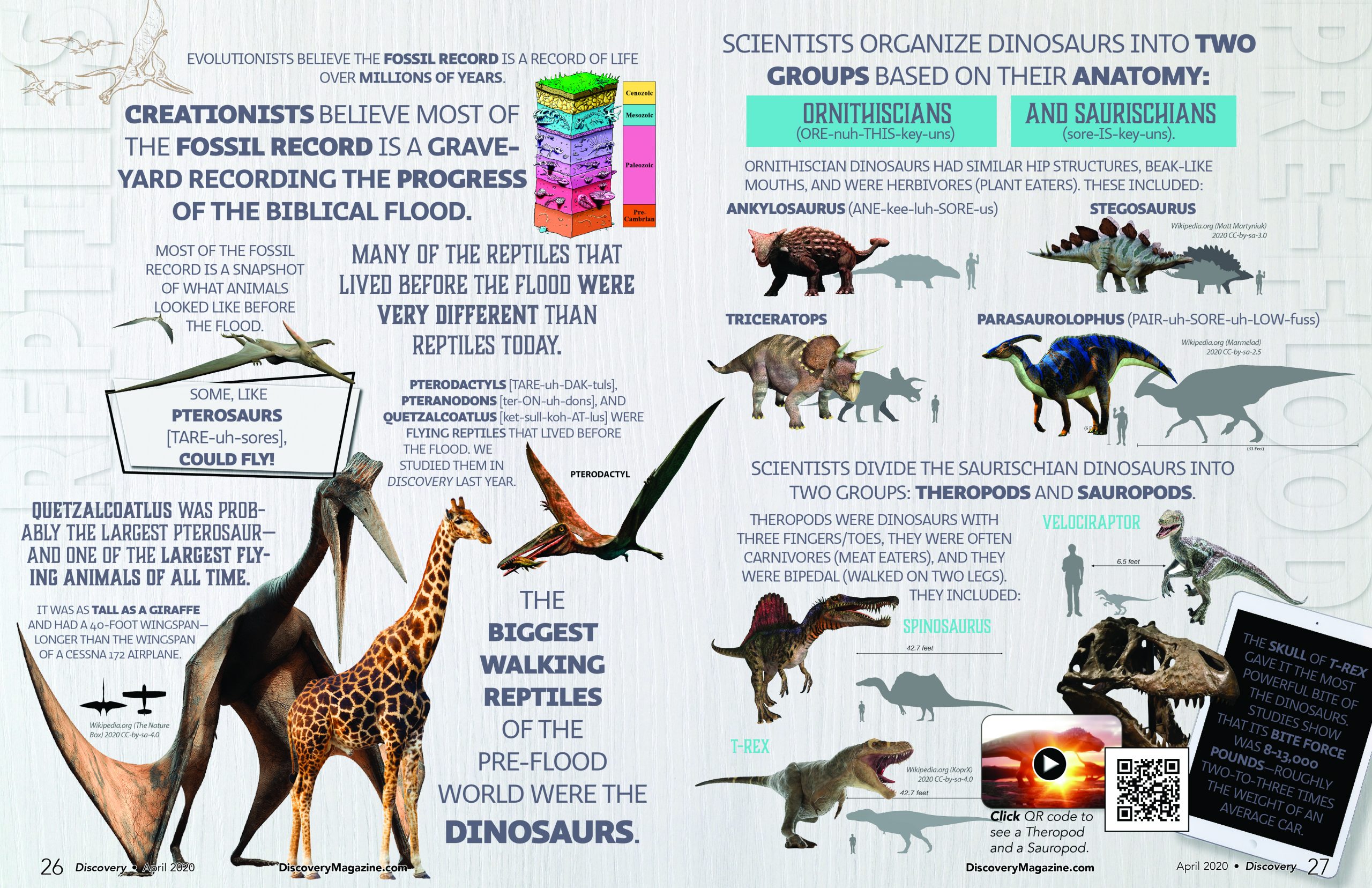
]]>The biggest walking reptiles of the pre-Flood world were the dinosaurs. Scientists organize Dinosaurs into two groups based on their anatomy:
ornithiscians (ORE-nuh-THIS-key-uns) and saurischians (sore-IS-key-uns).
Ornithiscian dinosaurs had similar hip structures, beak-like mouths, and were herbivores (plant eaters). These included:
Ankylosaurus (ANE-kee-luh-SORE-us)
Stegosaurus Triceratops
Parasaurolophus (PAIR-uh-SORE-uh-LOW-fuss)
Scientists divide the saurischian dinosaurs into two groups: theropods and sauropods. Theropods were dinosaurs with three fingers/toes, they were often carnivores (meat eaters), and they were bipedal (walked on two legs).
They included: Spinosaurus, T-Rex, and Velociraptor. The skull of T-Rex gave it the most powerful bite of the dinosaurs. Studies show that its bite force was 8-13,000 pounds—roughly two-to-three times the weight of an average car.
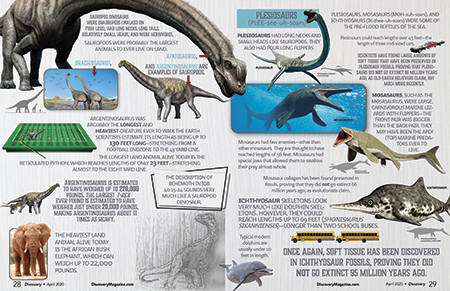
Sauropod dinosaurs were quadrupeds (walked on four legs), had long necks, long tails, relatively small heads, and were herbivores. Sauropods were probably the largest animals to ever live on land. Brachiosaurus, Apatosaurus, and Argentinosaurus are examples of sauropods. Argentinosaurus was arguably the longest and heaviest creature ever to walk the Earth. Scientists estimate its length as being up to 130 feet long—stretching from a football endzone to the 43 yard line. The longest land animal alive today is the reticulated python, which reaches lengths of only 23 feet—stretching almost to the eight yard line.
Argentinosaurus is estimated to have weighed up to 220,000 pounds. The largest T-Rex ever found is estimated to have weighed just under 20,000 pounds, making Argentinosaurus about 11 times as heavy. The heaviest land animal alive today is the African Bush Elephant, which can weigh up to 22,000 pounds.
The description of Behemoth in Job 40:15-24 sounds very much like a sauropod dinosaur.
Plesiosaurs (PLEE-see-uh-soars), Mosasaurs (MOH-suh-soars), and Ichthyosaurs (IK-thee-uh-soars) were some of the pre-Flood reptiles of the sea.
Plesiosaurs had long necks and small heads like sauropods. They also had four long flippers. Plesiosaurs could reach lengths over 45 feet—the length of three mid-sized cars. Scientists have found large amounts of soft tissue that have been preserved in plesiosaur fossils, proving that plesiosaurs did not go extinct 66 million years ago, as old-Earth believers claim, but much more recently.
Mosasaurs, such as the Mosasaurus, were large, carnivorous marine lizards with flippers—the front pair was bigger than the back pair. They may have been the apex (top) marine predators ever to live. Mosasaurs had few enemies—other than other mosasaurs. They are thought to have reached lengths of 56 feet. Mosasaurs had special jaws that allowed them to swallow their prey almost whole. Mosasaur collagen has been found preserved in fossils, proving that they did not go extinct 66 million years ago, as evolutionists claim.
Ichthyosaur skeletons look very much like dolphin skeletons. However, they could reach lengths up to 69 feet (Shonisaurus sikanniensis)—longer than two school buses. Typical modern dolphins are usually under 10 feet in length. Once again, soft tissue has been discovered in ichthyosaur fossils, proving they did not go extinct 95 million years ago. Fossilized ichthyosaurs have been found that were in the process of giving birth when they were killed, buried, and fossilized. Such fossils show (1) that fossilization does not take thousands of years (otherwise the creature would have decayed and disappeared before it could fossilize), and (2) evolutionists are wrong about uniformitarianism being true. Uniformitarianism is the idea that the present is the key to understanding the past. If we do not see something happening today (like the Flood), it must not have ever happened—according to uniformitarianism.
Fossilized ichthyosaurs in labor prove that something catastrophic, not uniform, happened in the past that is not happening today.
“The present is not the key to the past. The past (the Flood) is the key to understanding the present.” Creation Geologist Dr. Andrew Snelling
Job 41 describes a marine creature called Leviathan that was living after the Flood at the time of Job. Leviathan had closely knit scales and fearsome teeth.
Leviathan was so big and fierce that humans would flee from it rather than try to kill it. It had a strong neck and an extremely strong heart. Leviathan was able to raise itself up in an intimidating way and cause such crashings that even mighty warriors cowered. The underside of Leviathan was jagged, like sharp pieces of broken pottery, which left pointed tracks when moving across swampy ground. It was able to emit light, smoke, and even fire. The water around it “boiled.”
There is no modern animal that fits the description of Leviathan, although there are creatures that emit light (fireflies and bioluminescent creatures), electricity (electric eel), and even boiling chemicals (bombardier beetle).
Leviathan may have been an extinct marine reptile like a Mosasaurus or plesiosaur. Imagine what it would have been like to sail on the ocean with such fearsome sea beasts as Mosasaurs before the Flood!
God made humans to be able to have dominion over the creatures of the Earth, including the creatures of the sea (Genesis 1:28).
“For every kind of beast and bird, of reptile and creature of the sea, is tamed and has been tamed by mankind.” James 3:7
Studying the amazing creatures of the Earth helps us to appreciate the great works of the Lord. “The works of the Lord are great, studied by all who have pleasure in them.” Psalm 111:2


The post Dinosaurs appeared first on Apologetics Press.
]]>The post "Winged Lizards" appeared first on Apologetics Press.
]]>When Moses wrote Genesis in Hebrew, he most likely grouped animals by the way they moved, not necessarily by features such as having feathers, laying eggs, or being warm or cold blooded. So, instead of Genesis 1:21 saying “every winged bird,” it would be better translated something like “every flying creature.” When we understand this, we can see that bats (even though we classify them today as mammals) would most likely have been included in Genesis 1:21 as “flying creatures.” And it might be that ostriches, because they run on the ground, would have been created on day six as a “beast of the Earth” (Genesis 1:25). When we think more about this, we can understand that whales are mammals, but would most likely have been created on day five with sea creatures. Penguins would have been created on day five as well, though they might be included in the list of swimming animals and not the flying ones.


That brings us back to pterosaurs. These astonishing flying reptiles would have been created on day five of Creation and would have flown over the newly created land and seas. They did not evolve from any other type of animal, nor did they evolve into other animals. God created them with their fascinating traits and abilities. From the fossil record, we have discovered that there could have been as many as 100 different kinds of pterosaurs. The smallest one ever discovered is named Nemicolopterus. It had a wingspan of about 10 inches. As for the largest flying reptile ever discovered, there is some argument about that. It is between the Cryodrakon and the Quetzalcoatlus (ket-sul-ko-AT-luss). Scientists estimate that both of these flying reptiles had wingspans between 30-40 feet and would have weighed as much as 400 pounds. That means these huge flyers had wingspans longer than some airplanes! The fossils of these creatures suggest that when they landed and walked on the ground they used the elbows of their wings as front “legs” so that they walked on “all fours.” To get a good idea of how tall they would have been, imagine them standing on the ground and being slightly taller than a giraffe.
 |
 |
 |
| Pterosaurs |
Quetzalcoatlus |
Nyctosaurus REUTERS/SERGIO MORAES-STOCK.ADOBE.COM |
Many pterosaurs also had unusual bony crests on their heads or beaks. Some were small and not that visible, but others were a major part of their anatomy. The Pteranodon was a big flyer (with a wingspan of about 23 feet) that had a long crest on the back of its skull that was almost as long as its beak. One flying reptile, the Nyctosaurus, had a body about one foot long, but it had a large antler-like crest that split into two long points. This crest was several inches longer than its whole body. Some researchers believe that many of these crests may have had brightly colored skin “sails” that covered them.
Because pterosaurs are now extinct, like many other kinds of creatures such as woolly mammoths, dodo birds, and homing pigeons, we will not be able to see them in all their flying glory. But from the first week of Creation, Adam and Eve would have seen pterosaurs. Their children, grandchildren, great grandchildren, and many more generations would have seen them as well, and would surely have praised God for His awesome creations.
The post "Winged Lizards" appeared first on Apologetics Press.
]]>The post Pterosaurs & "Dragon Legends" appeared first on Apologetics Press.
]]>Dinosaur-like, flying reptiles (called pterosaurs) were first discovered in the fossil record and correctly interpreted as flying creatures in the early 1800s. Prior to that time, there is no evidence of anyone excavating and reassembling such fossils into accurate representations of these animals. Pterosaurs were simply unknown in the fossil record until about 200 years ago. (What’s more, the word “dinosaur” did not exist until the 1840s. The term is less than 200 years old!)
The 1800s were thousands of years after Creation. If dinosaurs and pterosaurs were actually created by God on days five and six of Creation, what kind of evidence might be “left behind” by ancient peoples? Let’s answer that question with another question: when you see something close-up that is quite amazing (such as a shark in the ocean or a grizzly bear in a mountain stream), what do you do the next time you see your friends? You tell them all about what you saw. It’s possible that the story of your encounter becomes a little exaggerated over time (as you tell family and friends, and as they, in turn, tell others). But part of the evidence for the existence of sharks and bears is found in the many people around the world who have seen them, interacted with them (however so dangerously), and told others about their experiences.
So what does this have to do with dinosaurs and pterosaurs? Simply that long before people began learning about them from the fossil record, people were talking about them. They didn’t call them “dinosaurs” or “pterosaurs” (since those words did not exist before the 1800s). They called them “dragons” (from the Latin word “draco” and the Greek “drakon”). A variety of “dragon” accounts go back thousands of years and have been passed down from cultures all over the world. Many of these stories were no doubt embellished over time, but consider some of the common characteristics of these animals:
- scaly, hard, elongated bodies
- long, serpent-like necks and tails
- horned, knobby, or crested heads
- some with bat-like wings (and some without)
- some with two legs and some with four
 What do these ancient descriptions sound like? Everyone knows they sound like dinosaurs or pterosaurs. In fact, a number of dinosaurs and pterosaurs that have been unearthed in recent years have been given names that include the Latin or Greek terms for dragon—including Dracoraptor, Dracorex, Cryodrakon, and Ferrodraco. Various scientists have given names to dinosaurs and pterosaurs that include the term “dragon” because they know that the physical descriptions of certain dragons and dinosaurs sound alike. In fact, when a dinosaur was dug up in South Dakota in 2003, the scientists bluntly stated, “It’s a new type of dinosaur that looks like a dragon.”
In 2007, evolutionist Ker Than admitted the following: “Of all the creatures that ever lived, pterosaurs probably most closely resemble the dragons of European legend. Reptilian and featherless, pterosaurs flew on wings of hide that were supported by a single long and boney finger. The smallest pterosaur was the size of a sparrow, while Quetzalcoatlus—named after the Aztec god—had a wingspan of more than 40 feet, making it the largest flying creature ever.”
Kids, think critically about this:
- If (as evolutionists have admitted) for thousands of years people all around the world told stories about seeing “dragons”;
- And if many dragon descriptions sound like the descriptions of dinosaurs and pterosaurs;
- And if we didn’t learn about dinosaurs and pterosaurs from the fossil record until the 1800s;
- Then it is logical to conclude (as the Bible teaches) that humans in the past once lived with these animals and passed down their sightings and interactions with them in the form of stories.
Such truths are exactly what we would expect to find if humans ever lived with dinosaurs and pterosaurs.
The post Pterosaurs & "Dragon Legends" appeared first on Apologetics Press.
]]>The post Fiery Flying Serpents appeared first on Apologetics Press.
]]> Flying reptiles are interesting to us today because they are extinct. To the people in the past, however, flying reptiles may have been more “everyday” animals, especially the smaller ones. Think about this: what animals do we see alive today that people in the future would find remarkable? I think giraffe fossils would be odd and interesting to those who have never seen one. What about an octopus or an ostrich?
The flying serpent was one of those interesting animals that lived in the past. What was this creature? We are not exactly sure. We read about it in Isaiah 30:6:
Through a land of trouble and anguish, from which came the lioness and lion, the viper and fiery flying serpent. They will carry their riches on the backs of young donkeys, and their treasures on the humps of camels.
As you read this verse, you see that animals such as the viper, lion, camel, and donkey are all listed. These animals don’t seem unusual to us, because we still have them around. In that same list we read about a “fiery flying serpent.” We no longer see snakes with wings, so this creature seems unusual or even unreal. Since it is listed along with other real animals in the verse, there is no reason to think it is imaginary or impossible. In fact, other history sources talk about flying serpents. The ancient historian Herodotus wrote in about 450 B.C. He said:
There is a place in Arabia to which I went, on hearing of some winged serpents…. The form of the serpent is like that of a water-snake; but he has wings without feathers, and as like as possible to the wings of a bat.
Wouldn’t it have been neat to have been alive during the days of Isaiah or Herodotus and see those flying serpents? Maybe hundreds of years from now, people will be talking about how cool it would have been to have lived during the time of jelly fish or the giant octopus.
The post Fiery Flying Serpents appeared first on Apologetics Press.
]]>The post Behemoth and Leviathan: Figurative or Literal? (Part 2) appeared first on Apologetics Press.
]]>
[EDITOR’S NOTE: Part I of this two-part series appeared in the May issue. Part II follows below and continues, without introductory comments, where the first article ended.]
Leviathan’s Anatomy
God next directs Job’s attention to the apex of the animal kingdom. Concerning the fifth day of Creation, Moses informs us:
Then God said, “Let the waters abound with an abundance of living creatures, and let birds fly above the earth across the face of the firmament of the heavens.” So God created great sea creatures [ha-ta-ni-neem hahg-doh-leem] and every living thing that moves, with which the waters abounded, according to their kind, and every winged bird according to its kind. And God saw that it was good. And God blessed them, saying, “Be fruitful and multiply, and fill the waters in the seas, and let birds multiply on the earth.” So the evening and the morning were the fifth day (Genesis 1:20-23).
Several translations render the boldfaced words “great sea-monsters,”1 while the Young’s Literal Translation has “great monsters,” the English Standard Version has “great sea creatures,”2 and the New International Version has “great creatures of the sea.” So we should not be surprised when we come to the ancient book of Job and read of an incredible sea creature—Leviathan (liv-yah-thahn)—that truly merits the labels “great” and “monster.”3
Examine the following outline that clarifies the structure of the chapter:
- Vss. 1-10a—Leviathan’s invincibility
- Vss. 10b-11—God’s preeminence
- Vss. 12-24—Leviathan’s anatomy
- Vss. 25-32—Leviathan’s impact
- Vss. 33-34—Leviathan’s standing
God devotes a lengthy section (34 verses in English) to this animal. In rapid fire succession, He first pummels Job with 14 rhetorical questions.4 The answer to each question is a resounding “No!” The questions spotlight the undeniable fact that Leviathan is so formidable and ferocious that humans have no hope of subduing him: “Indeed, any hope of overcoming him is false; Shall one not be overwhelmed at the sight of him?” (vs. 9). Consequently, the conclusion to be drawn is, “Who then is able to stand against Me? Who has preceded Me, that I should pay him? Everything under heaven is Mine” (vs. 11). To suggest that Leviathan is an imaginary creature, or merely a crocodile, is to completely undermine and undercut God’s argumentation.
Following the 14 questions, God proceeds to describe Leviathan’s anatomy. His outer coat, consisting of rows of scales so tight that no air can come between them, is impenetrable. His teeth are “terrible” (NKJV), “fearsome” (NIV), and “around them is terror” (NASB/RSV). While many animals have large, sharp teeth, Leviathan’s teeth surpass them all.
Four verses are then devoted to Leviathan’s ability to produce fire from his mouth and nostrils (vss. 18-21). Note the bolded words:
His sneezings (“snorting”—NIV) flash forth light, and his eyes are like the eyelids of the morning.
Out of his mouth go burning lights; sparks of fire shoot out.
Smoke goes out of his nostrils, as from a boiling pot and burning rushes.
His breath kindles coals, and a flame goes out of his mouth.
It is self-evident that “light,” “burning lights,” “sparks of fire,” “smoke,” “coals,” and “flame” are literal, while “morning,” “boiling pot,” and “burning rushes” are figurative and, accordingly, flagged by “like” and “as.” Similarly, “sneezings,” “eyes,” “mouth,” “nostrils,” and “breath” are unquestionably literal features of Leviathan’s anatomy. Yet, commentators go through convoluted contortions in order to dismiss out of hand their obvious literal import. For example, in his Commentary on Job, Homer Hailey offers this explanation:
Much of the crocodile’s time was spent on the river bank basking in the sun, when he sneezed or yawned the spray flashed as light. His eyes being like the “eyelids of the morning” may be a figure that suggests the Egyptians’ use of the crocodile’s eyes and eyelids as heralds of the dawn because of their redness as they protruded above the water, the rest of the body being submerged beneath the surface…. No doubt these impressions were drawn from the light reflected in the small bubbles from his mouth, which were viewed by the poet as “burning torches” and “sparks of fire.”5
So God sought to dazzle Job with Leviathan’s ability to blow bubbles? The fact is that many aquatic creatures spew bubbles—which is hardly impressive or a characteristic to be extolled—even as many amphibious animals release their breath with force when resurfacing. In the seemingly frantic effort to dismiss the clear import of language—apparently due to preconceived ideas or a desire to adopt intellectual sophistication—commentators dismiss the obvious and fail to reckon with the contextual flow of the section. Job would hardly have been impressed with the majesty of God and his own inadequacy due to a creature’s ability to blow bubbles or exhale air violently.
But is there precedence in nature for the production of light and chemicals in animals? Bioluminescence, fluorescence, phosphorescence, triboluminescence, and chemiluminescence entail the production and emission of light via chemical reactions by a living organism. This prolific phenomenon occurs all over the world—especially in the ocean which constitutes more than 99% of the living space on the planet. Marine biologist and bioluminescence specialist Edith Widder says: “Some 80 to 90 percent of undersea creatures make light—and we know very little about how or why.”6 If a deep sea copepod can drop depth charges that produce time-released flashes, if a Platytroctidae (tubeshoulder fish) can eject bioluminescent cells when threatened, if an electric eel can produce 500 volts of static electricity that can kill a grown human being, and if a bombardier beetle can fire a chemical “bomb” that explodes from its body at 212°F, why would it be difficult to believe that Leviathan could breathe smoke and fire?7
 |
|
The upper millstone poised on the firmly |
Leviathan’s heart (“chest”—NIV) is described as being as hard as rock and a “lower millstone.” In antiquity, the “upper” millstone was situated on top of the lower millstone and attached to a log that extended outward. The “lower” millstone was the bottom one that was firmly fixed to the floor. An ox (or other animal, or even a man—Judges 16:21) was then tied to the log and made to walk in a circle around the lower millstone as the upper stone would grind the grain (cf. Deuteronomy 25:4). Delitzsch noted that “the nether millstone, which…has to bear the weight and friction of the upper, must be particularly hard.”8 Such a comparison indicates that, again, this creature’s body was thick and impermeable. This feature is further underscored by the listing of manmade weapons that have no effect on Leviathan: sword, spear, dart, javelin, iron, bronze, arrow, and sling stones (vss. 26-29). Question: Would these weapons harm or cause a crocodile to flee in fear? Yes, they would—but not Leviathan. He “laughs” at them.
 |
|
A salt water crocodile’s underbelly |
What’s more, Leviathan’s “undersides are like sharp potsherds; He spreads pointed marks in the mire” (vs. 30)—“leaving a trail in the mud like a threshing sledge” (NIV). Potsherds are broken pieces of pottery found in archaeological excavations. Hence, the Complete Jewish Bible translates, “His belly is as sharp as fragments of pottery, so he moves across the mud like a threshing-sledge,” and the Orthodox Jewish Bible has, “Sharp shards are his under parts.” The underside of Leviathan was jagged and spiked. The underside of a crocodile is smooth. Further, the turbulent commotion that this creature causes stands out from all other sea life, even making it appear as if the ocean is churning like a boiling cauldron (vs. 31).
Lest we fail to see the forest for the trees, look at God’s own conclusion that follows from the description of the anatomical and behavioral features and capabilities of Leviathan: “On earth there is nothing like him, which is made without fear. He beholds every high thing; He is king over all the children of pride” (vss. 33-34). Every one of these declarations concerning Leviathan’s preeminent standing affirms his superiority over all other creatures: absolutely fearless, looks down on all other creatures, and excels all other animals in those features that make them proud. Such appellations do not fit the crocodile. Commenting on the phrase “sorrow dances before him” (vs. 22), Delitzsch noted: “This creature spreads before it a despondency (despair) which produces terror, and deprives of strength.”9
Other Occurrences of Leviathan
This incredible creature is mentioned in other Bible passages that further reinforce these observations. In fact, the word occurs six times in the Old Testament—twice in Job (3:8; 41:1), twice in the Psalms (74:14; 104:26), and twice in Isaiah 27:1. Do these verses treat Leviathan as a literal, historical creature that lived on the planet? Yes, they do.
Job 3:8
The other occurrence of the term in Job is where Job bemoans his painful condition by cursing the day he was born—wishing it had never appeared on the calendar. He states: “May those curse it who curse the day, those who are ready to arouse Leviathan.” Job was referring to those fellows who claim to be able to place curses on certain days and practice the magical arts to cause Leviathan to come forth from the sea. Are such fellows real? Of course, charlatans and tricksters have existed throughout history. Balaam was one such person mentioned in the Bible. The King of Moab sent a divination fee to him with the request that he curse the Israelites (Numbers 22:6-7). Job was simply saying, “Those people who claim to have the magical powers to curse people and times, let them curse the day I was born.” Of course, as is the case throughout Job’s soliloquy, he admits that the words he uttered out of his misery were rash (6:3), despairing (6:14,26), impatient (21:4) and without understanding (42:3), and that his complaint had been a rebellion against his tormented condition (23:2). So he exaggerated out of intense suffering and made rash and wild statements that he later insisted should not be held against him. But notice that whether Job believed anyone could actually curse a day or rouse a sea creature does not alter the authenticity and historicity of Leviathan. Similarly, someone in our day may claim to perform incantations that would cause it to rain. He would be a fake, but rain is real. Likewise, the magicians/cursers of Job’s day were fakes—but Leviathan was real.
Psalm 74:14
The psalmist referred to Leviathan two times. In the first allusion, he addresses God: “You divided the sea by Your strength; You broke the heads of the sea serpents in the waters. You broke the heads of Leviathan in pieces, and gave him as food to the people inhabiting the wilderness.” The psalmist speaks as if both the “sea serpents” and “Leviathan” are historically real.10 Are the “sea” and “waters” literal? Are the “people inhabiting the wilderness” real? Indeed, in this same context in which the psalmist extols God’s might and right to destroy His enemies (vs. 11), he notes that God causes streams to open up and rivers to dry up (vs. 15), and He controls day and night, summer and winter (vss. 16-17)—even as He is the only One Who can turn Leviathan into food for people. Contextually, all of these phenomena are literal features of the created order. So is Leviathan.
But what about the reference to “heads”? Isn’t that proof that we are not speaking of a literal animal, but some seven-headed, mythological monster? Hebrew scholars note that since the Hebrew term has no plural form, it can be used in a collective sense, i.e., to refer to all Leviathans.11 Hence, “heads” is an allusion to each Leviathan’s head or the heads of all Leviathans.12
Psalm 104:26
The psalmist again refers to Leviathan in another context that is clearly a literal setting:
O LORD, how manifold are Your works! In wisdom You have made them all. The earth is full of Your possessions—This great and wide sea, in which are innumerable teeming things, living things both small and great. There the ships sail about; there is that Leviathan which You have made to play there. These all wait for You, that You may give them their food in due season. What You give them they gather in; You open Your hand, they are filled with good. You hide Your face, they are troubled; You take away their breath, they die and return to their dust (vss. 24-29, emp. added).
Observe that Psalm 104 is reminiscent of the same argumentation format that God employs in Job 38-41. He begins with the inanimate realm (vss. 1-9), with its direct impact on animals and man (vss. 10-23), building to the existence of Leviathan in the sea (vss. 24-26). The other creatures mentioned in the same context are obviously literal: donkeys (vs. 11), birds (vs. 12), cattle (vs. 14), birds/stork (vs. 17), goats/rock badgers (vs. 18), and lions (vs. 21). The “earth,” “sea,” “ships,” “food,” “breath,” and “dust” are also all literal. To what do the terms “these” and “them” refer in verse 27? Who waits for God to give them their food? It is clearly the “innumerable teeming things” that fill the ocean—including Leviathan “which you have made to play there.” God did not create a fictitious, imaginary creature. He created a real sea creature that inhabited the ocean along with all the other occupants of the sea, and in His arrangement and orchestration of the created order, God provides them all with their necessary sustenance.
Isaiah 27:1
The final two allusions to Leviathan are found in the same verse: “In that day the Lord with His severe sword, great and strong, will punish Leviathan the fleeing serpent, Leviathan that twisted serpent;13 and He will slay the reptile that is in the sea.” Whereas the NKJVand NASBhas “fleeing” and “twisted” to describe the movements of Leviathan, the ASVhas “swift” and “crooked,” the NIVhas “gliding” and “coiling,” and the ESVhas “fleeing” and “twisting.” Again, these are references to a literal creature, characterized by its snakelike motions, that is so formidable that it is the Lord Who is in a position to kill it.14 Isaiah even identifies Leviathan as “the reptile that is in the sea.” The Hebrew word translated “reptile” is tan-neen—the same one used in Genesis 1:21 to identify the great sea creatures that God created on day five of Creation week.15 These, too, were real animals.
Sea Serpents
Beyond the occurrence of the term “leviathan,” the Old Testament also uses two additional, closely interrelated terms to refer to oceanic creatures: tan-neem and tan-neen. The first term generally is translated as “dragon” in the KJV. Newer translations typically use “jackal,” except in Ezekiel 29:3 and 32:2, where the creature’s habitat is obviously aquatic, so “monster” generally is employed.16 The second term is treated more loosely in the KJV, and variously translated as “whales” (Genesis 1:21; Job 7:12), “serpent,” archaic for “snake” (Exodus 7:9,10), “dragon” (Jeremiah 51:34), and “sea monsters” (Lamentations 4:3). Whereas the term “leviathan” undoubtedly refers to a particular animal species, these two terms (tan-neem and tan-neen) are generic and nonspecific like dahg (“fish”) and nah-ghahsh (“snake”). Interestingly, the prophet Amos uses this latter term perhaps to refer to Leviathan:
Though they dig into Sheol, from there my hand shall take them;
Though they climb up to heaven, from there I will bring them down;
And though they hide themselves on top of Carmel, from there I will search and take them;
Though they hide from My sight at the bottom of the sea, from there I will command the serpent (nah-ghahsh—snake), and it shall bite them;
Though they go into captivity before their enemies, from there I will command the sword, and it shall slay them.
I will set My eyes on them for harm and not for good (Amos 9:2-4).
The point of this passage is that no matter what efforts are expended by man to evade God’s righteous judgments, the disobedient will not escape, but will be punished during life on Earth. Like Jonah, who sought to flee from God by traveling in the opposite direction from Nineveh, neither Jonah nor the disobedient could escape God’s pursuit. Hence, in Amos, if the disobedient were to escape to Sheol, God would still overtake them. If they were to climb to heaven, He would bring them down. If they were to ascend Mt. Carmel and hide themselves, He would still take them into custody. If they could descend to the bottom of the ocean, God would send in His place “the serpent” which would bite them. And even if they were to be captured by enemies, they would still be unable to escape His wrath.
Observe that the locations identified by parallelism are literal: Sheol, heaven, Carmel, sea, and the enemies’ country/captivity. Notice also that the threatened punishments identified by parallelism are likewise literal: “take them” (twice), “bring them down,” “bite them,” and “slay them.” While the text does not specify the means by which God would “take,” “bring down,” or “slay them,” it does more specifically indicate the punishment for those who would flee to beneath the sea: they would be attacked and bitten by a sea creature.
Granted, Amos is speaking somewhat hyperbolically in that humans cannot dig down to Sheol, or climb to heaven, or descend to the bottom of the ocean (at that time)—although they could ascend Mt. Carmel and travel to an enemies’ country. But the fact that humans could not descend to the bottom of the ocean does not change the fact that if they could have done so in their attempt to elude God, there they would have encountered a literal serpent. The serpent is literally “there” (vs. 3) in the sea—just as the sea is literal. If the disobedient could flee there, God would have this sea creature bite them. C.F. Keil, 19th century German Lutheran Old Testament commentator, phrased it well:
[E]ven the deep sea-bottom will not shelter from the vengeance of God. God commands the serpent, or summons the serpent to bite him. Nachash, here the water-serpent, called elsewhere livyathan or tannin (Isa. xxvii. 1), a sea-monster, which was popularly supposed to be extremely dangerous, but which cannot be more exactly defined.17
Deane agreed: “Serpent (nachash, elsewhere called leviathan and tannin, Isa. xxvii. 1), some kind of sea-monster supposed to be venomous.”18
Job’s remarks, then, are all the more intriguing when, in his reply to Eliphaz, he momentarily addresses himself to God: “Am I a sea, or a sea serpent (tan-neen), that You set a guard over me?” (Job 7:12). Observe that Job’s words are calculated to show the absurdity of overpowering him via tremendous suffering—as if he was to be compared to the magnitude of the sea itself or the overwhelming power possessed specifically by the sea serpent. Considering other sea creatures, for example, fish, shrimp, dolphins, sharks, and even whales, indicates that the “sea serpent” stands out from all other species of the sea. This creature can even be named alongside the sea itself in referring to uncontrollable power. The NASB renders Job’s question: “Am I the sea, or the sea monster, that You set a guard over me?” The NRSV has: “Am I the Sea, or the Dragon, that you set a guard over me?” The NIV words it: “Am I the sea, or the monster of the deep, that you put me under guard?” Job is clearly referring to a sea creature that far surpasses its fellow oceanic occupants in ferocity and formidability.
Another relevant occurrence of tan-neen is seen in Jeremiah’s prophetic utterances in which he compares the king of Babylon to this sea creature: “Nebuchadnezzar the king of Babylon has devoured me, he has crushed me; he has made me an empty vessel, he has swallowed me up like a monster (tan-neen); he has filled his stomach with my delicacies, he has spit me out” (51:34). The NIV renders the phrase even more graphically: “Nebuchadnezzar king of Babylon has devoured us, he has thrown us into confusion, he has made us an empty jar. Like a serpent (tan-neen) he has swallowed us and filled his stomach with our delicacies, and then has spewed us out” (51:34). Whatever creature is being envisioned, it is particularly known for its ability to swallow its prey.
Still another interesting occurrence of one of the terms is found in Ezekiel where God instructs the prophet to rebuke Pharaoh, making appropriate comparisons:
Behold, I am against you, O Pharaoh king of Egypt, O great monster (tan-neem) who lies in the midst of his rivers, who has said, “My River is my own; I have made it for myself.” But I will put hooks in your jaws, and cause the fish of your rivers to stick to your scales; I will bring you up out of the midst of your rivers, and all the fish in your rivers will stick to your scales. I will leave you in the wilderness, you and all the fish of your rivers; you shall fall on the open field; you shall not be picked up or gathered. I have given you as food to the beasts of the field and to the birds of the heavens (29:3-5).
Son of man, take up a lamentation for Pharaoh king of Egypt, and say to him: “You are like a young lion among the nations, and you are like a monster (tan-neem) in the seas, bursting forth in your rivers, troubling the waters with your feet, and fouling their rivers.” Thus says the Lord GOD: “I will therefore spread My net over you with a company of many people, and they will draw you up in My net. Then I will leave you on the land; I will cast you out on the open fields, and cause to settle on you all the birds of the heavens. And with you I will fill the beasts of the whole earth. I will lay your flesh on the mountains, and fill the valleys with your carcass”(32:2-5).
In both instances in Ezekiel, this monster is obviously aquatic and, again, reputed for its power and superior influence over its environment. Of course, the precise identity of this creature cannot be ascertained, nor whether it is to be equated with Leviathan. In any case, a sea creature was well known to the ancient world and worthy of being styled a “monster,” indeed, a “great monster.” What creature known to man today could possibly deserve such descriptive labels? “Let them praise the name of the LORD, for He commanded and they were created…. Praise the LORD from the earth, you great sea creatures and all the depths” (Psalm 148:5,7).
Conclusion
God dazzled Job with real world wonders from the inanimate realm, followed by equally wondrous real world features of His animal creation, bringing His speech to a spectacular finale by climaxing with two creatures whose literal size, power, and ferocity cinched the point: God’s ways are far above man’s and no one has the right—let alone vantage point of knowledge, power, or wisdom—to question God’s superintendence of the Universe. Behemoth and Leviathan are no more imaginary, “poetic hyperbole,” or “mythopoeic” than is God.19 Behemoth and Leviathan were real, historical, living creatures.
Endnotes
1 ASV, NAB, NASB, RSV, NRSV, NEB.
2 Also the CJB and OJB.
3 Cf. “sea monster” in L. Koehler, W. Baumgartner, M.E.J. Richardson, & J.J. Stamm (1994–2000), The Hebrew and Aramaic lexicon of the Old Testament (Leiden: E.J. Brill, electronic ed.), p. 524, and “very large aquatic creature” in William Gesenius (1847), Hebrew and Chaldee Lexicon (Grand Rapids, MI: Baker, 1979 reprint), p. 433.
4 (1) Can you draw out Leviathan with a hook? (2) Can you snare his tongue with a line which you lower? (3) Can you put a reed through his nose? (4) Can you pierce his jaw with a hook? (5) Will he make many supplications to you? (6) Will he speak softly to you? (7) Will he make a covenant with you? (8) Will you take him as a servant forever? (9) Will you play with him as with a bird? (10) Or will you leash him for your maidens? (11) Will your companions make a banquet of him? (12) Will they apportion him among the merchants? (13) Can you fill his skin with harpoons? (14) Can you fill his head with fishing spears?
5 Homer Hailey (1994), Now Mine Eye Seeth Thee: A Commentary on Job (Davenport, IA: Religious Supply), p. 360, emp. added. Albert Barnes suggests that upon sneezing, “fire seems to flash from the eye” (1852), Notes, Critical, Illustrative, and Practical, on the Book of Job (New York: George Leavitt), 2:289. Once the literal, straightforward terminology of Scripture is dismissed, one must offer explanations peppered with “seems like,” “appears like,” “probably the meaning is,” “likely,” and “the description is of course to be regarded as figurative.”
6 See Edith Widder (2010), “Glowing Life in an Underwater World,” TED Talks, April, http://www.ted.com/talks/edith_widder_glowing_life_in_an_underwater_world. See also Ferris Jabr (2010), “Gleaning the Gleam: A Deep-Sea Webcam Sheds Light on Bioluminescent Ocean Life,” Scientific American, August 5, https://www.scientificamerican.com/article/edith-widder-bioluminescence/.
7 Paleontologists have discovered that some dinosaurs had large nasal passages at the top of their heads, stimulating several theories to explain their purpose, one of which is a mixing chamber for the emission of chemicals. But “the function of these crests is not widely agreed upon”—Kevin Padian and John Ostrom (2018), “Dinosaur: Classification,” Encyclopædia Britannica, August 9, https://www.britannica.com/animal/dinosaur/Classification.
8 F. Delitzsch (1976 reprint), Job (Grand Rapids, MI: Eerdmans), 2:375, emp. added.
9 Ibid. The NIV has “dismay goes before it,” the ESV has “terror dances before him,” the NASB has “dismay leaps before him,” and the New Century Version has “People are afraid and run away.”
10 The word “serpents” in this verse [tan-neen] is the same word used in Genesis 1:21 to refer to the occupants of the ocean that God created on the 5th day of Creation. These were literal sea creatures.
11 Joseph Alexander (1873), The Psalms Translated and Explained (Grand Rapids, MI: Baker, 1975 reprint), p. 316; Moses Stuart (1823), A Hebrew Grammar (Andover: Codman Press), p. 326; Heinrich Ewald (1879), Syntax of the Hebrew Language of the Old Testament (Edinburgh: T.&T. Clark), p. 226; S. Lee (1827), A Grammar of the Hebrew Language (London: James Duncan), p. 315; Bruce Waltke and M. O’Connor (1990), An Introduction to Biblical Hebrew Syntax (Winona Lake, IN: Eisenbrauns), p. 122; Gesenius (1847), p. 105; William Gesenius (1898), Hebrew Grammar, ed. E. Kautzsch (Oxford: Clarendon Press), pp. 416-418; Francis Brown, S.R. Driver, and Charles Briggs (1906), A Hebrew and English Lexicon of the Old Testament (Peabody, MA: Hendrickson, 2004 reprint), p. 97; Benjamin Davidson (1848), The Analytical Hebrew and Chaldee Lexicon (Grand Rapids, MI: Zondervan, 1970 reprint), p. 68.
12 Another syntactical option is that “heads” is an instance of the Hebrew pluralis intensivus (plural of intensity, also called plural of eminence or excellence or majesty) in which the plural expresses an intensification of the idea of the singular. In this instance, the plural “heads” is equivalent to “The Great Head.” See A.B. Davidson (1894), Hebrew Syntax (Edinburgh: T.&T. Clark), p. 18; also Aaron Ember (1905), “The Pluralis Intensivus in Hebrew,” The American Journal of Semitic Languages and Literatures, 21[4]:203, July. The plural “heads” is used in the previous sentence in conjunction with the plural term “serpents.” Using the plural “heads” to refer to a single Leviathan emphasizes the formidable, threatening, intimidating nature of the lone head of Leviathan—similar to how even common snakes (like the Cobra) have heads that surpass their slithering bodies in the way they create concern in the person who encounters it. Not only is the head more imposing than the body, it is the location from whence the snake inflicts its deadly wounds.
13 The term “serpent” (nah-ghahsh) is the normal Hebrew word for “snake.” However, since Leviathan was a snake-like sea creature, the term could naturally be used to describe its slithering, oscillating motions. See Job 26:13, Isaiah 51:9, and Amos 9:3.
14 Cf. Isaiah 51:9-10—“Awake, awake, put on strength, O arm of the LORD! Awake as in the ancient days, in the generations of old. Are You not the arm that cut Rahab apart, and wounded the serpent? Are You not the One who dried up the sea, the waters of the great deep; that made the depths of the sea a road for the redeemed to cross over?”
15 Hebrew lexicographer William Gesenius defined the term tan-neen in this verse as “a sea monster, a vast fish”—(1847), Hebrew and Chaldee Lexicon (Grand Rapids, MI: Baker, 1979 reprint), p. 869. Cf. Job 7:12.
16 Alfred Day (1939), “Dragon,” The International Standard Bible Encyclopaedia, James Orr, ed. (Grand Rapids, MI: Eerdmans, 1974 reprint), 2:873. Noting the textual variant, Gesenius defines tan-neem as “a great serpent, a sea monster”—p. 869, italics in orig.
17 C.F. Keil (1977 reprint), The Minor Prophets (Grand Rapids, MI: Eerdmans), 10:325, italics in orig.
18 W.J. Deane (1950), Amos in The Pulpit Commentary, ed. H.D.M. Spence and Joseph Exell (Grand Rapids, MI: Eerdmans), 14:176, italics and emp. in orig.
19 See also Eric Lyons (2001), “Behemoth and Leviathan—Creatures of Controversy,” Reason and Revelation, 21:1-7, January.
The post Behemoth and Leviathan: Figurative or Literal? (Part 2) appeared first on Apologetics Press.
]]>The post Behemoth and Leviathan: Figurative or Literal? (Part 1) appeared first on Apologetics Press.
]]>[Editor’s Note: This article is the first installment in a two-part series. Part II will appear in the June issue of R&R.]
The book of Job is certainly a fascinating book in the canon of Scripture. Though most of the book is written in standard Hebrew metrical verse, it clearly relates actual, historical events in the life of the patriarch Job.1 After a lengthy exchange with his three “friends,” and then the shadowy figure Elihu regarding the reason(s) for Job’s suffering, God finally breaks the silence and speaks directly to Job. Why? Why did God address Job directly in chapters 38-41? In the midst of his extreme suffering, Job needed an attitude adjustment. He said some things that cast God in a questionable light. So, he needed to have his knowledge challenged and be reminded of his finite humanity. He needed to be reminded to Whom the Universe belongs. He needed to be humbled to the extent that he no longer required an explanation or expected God to give account of Himself. After all, God is God, and we are mere humans who deserve nothing from Him (except an eternal hell which we have earned by our own behavior—Romans 6:23). Indeed, so far is He above our ability to grasp much of reality that we could not understand most of His explanations anyway (cf. Isaiah 55:8-9).
The central point of the book of Job concerns the fact that no matter what we face in this life, no matter how intense our suffering and hardship may become, when we genuinely shift our attention to who God is, we are enabled to cope with our suffering and successfully negotiate and survive the onslaughts of life.2 It is against this backdrop and context that God brings to Job’s attention two incredible creatures: Behemoth and Leviathan. Are Behemoth and Leviathan “poetic hyperbole”? Or were they actual dinosaur-like animals that are likely3 now extinct?
Most commentators seemingly refuse to consider the possibility that Behemoth and Leviathan are extinct, dinosaur-like creatures. Most think the hippo and crocodile are being described.4 Many of the English translations reflect this bias. For example, the NIV footnote for “behemoth” reads: “Possibly the hippopotamus or the elephant,” and for “leviathan” it has: “Possibly the crocodile.”5 For “behemoth” the ASV has: “That is, the hippopotamus,” and for “leviathan” it has “That is, the crocodile.”6 In stark contrast, the ESV handles the matter more in keeping with translation rather than interpretation and personal conjecture, where “behemoth” is “A large animal, exact identity unknown” and for “leviathan,” “A large sea animal, exact identity unknown.”7
Have the crocodile and the hippopotamus been recognized in antiquity as the ferocious, formidable creatures like those depicted in the book of Job? The historical fact is that humans have hunted, subdued, and killed hippos, elephants, and crocodiles for millennia. An Egyptian painted relief from the tomb of Ti and Ptah-Hotep in Saqqara (5th Dynasty) depicts the ship’s crew harpooning hippopotami.8 Similarly, in Egyptian life the crocodile was easily subdued. Egyptian pharaoh Amenemhat I makes this boast of his hunting prowess: “I hunted the lion and brought back the crocodile (a prisoner).”9 Crocodile hunting on the Nile has been a longstanding activity, as has elephant and rhino hunting.10
Rather than trying to identify these two creatures with existing animals, others suggest that the creatures are purely fictitious, mythological creatures which function as poetic vehicles for God to make His point. They must assume, therefore, that the language is figurative and, hence, use expressions like “poetic hyperbole,” “mythopoeic language,” “hyperbolic intensity,” and “mythological heightening.”11 Consequently, they are forced to deny that the language refers to literal animals. However, observe that poetic language can be used to describe literal animals. If hyperbole is used, some aspect of reality must underlie the exaggeration. There must be a literal characteristic to exaggerate. An analysis of the context helps to dispel the confusion.
CONTEXT: GOD’S ARGUMENT
Consider the contextual flow of the book of Job that elicits the allusions to Behemoth and Leviathan reflected in the following outline:
1-2 Job’s disasters
3-31 Job’s dialogues with his
three friends
32-37 Elihu’s speeches
38-41 God’s speeches
42 Job’s deliverance
The allusions to Behemoth and Leviathan occur among the speeches delivered by God to Job. The line of reasoning that God uses is surely decipherable to us. Job had been whining that life is not fair because of the pain and suffering he was enduring (e.g., 7:12-21). He intimated rather firmly that God needed to give account of His handling of the situation (e.g., 10:2). God proceeded to pummel Job with four chapters of rhetorical questions designed to remind Job that he is not in a position to question Deity, nor is God under any moral, legal, or ethical obligation to give account of Himself to Job. The central points with which God presses Job are that he does not understand nor can he control the created order, i.e., his knowledge and power.
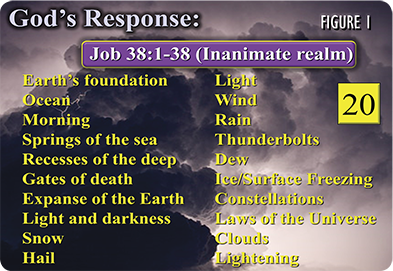 God’s initial response to Job (38:1-38) is to spotlight 20 features of the inanimate realm (delineated in Figure 1). Question: Even though the entire section is poetic, are these 20 phenomena real? Indeed, they are. Hence, the presence or absence of figurative language and poetry is not what determines the literalness of the subject matter. Consider, for example, God’s remarks concerning ice and surface freezing: “The waters harden like stone, and the surface of the deep is frozen” (vs. 30). “Waters” is literal H2O. “Harden” is also literal. “Stone,” however, is figurative (simile) and even carries a flag term to help identify it as such: “like.” When water freezes, does it transform into literal stone? No, but its hardened condition is like or reminiscent of stone. “Surface,” “deep,” and “frozen” are all equally literal. In like fashion, all 20 of the features of the inanimate realm to which God alludes are literal phenomena that literally exist on planet Earth. Their description, though expressed in figurative, poetic language, does not obscure the certainty of their literalness.
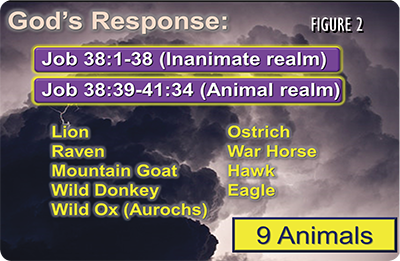 Next, God directs attention from the inanimate to the animal realm (38:39-41:34), initially parading before Job nine animals (see Figure 2 on p. 52). He alludes to a variety of attributes that characterize these animals, including their food sources, birthing cycles, undomesticated temperament, seeming treatment of their young, suitability for use in human warfare, flying ability and visual acuity, etc. These are the very characteristics that one would expect to be highlighted when alluding to each particular species being discussed. Question: Were/are all nine of these creatures real animals? Do/did they actually exist? Can we sort out the difference between the literal and figurative language used to characterize them? Most certainly. Consider these questions:
- Do lions figuratively or literally hunt prey and satisfy the appetite of their young?
- Do they figuratively or literally crouch in their dens and lie in wait?
- Do young ravens figuratively or literally wander about for food?
- Do wild mountain goats figuratively or literally bear young after a literal number of months?
- Do their young figuratively or literally grow strong on grain and depart not to return?
- Do wild donkeys figuratively or literally dwell in the wilderness and seemingly scorn civilization?
- Do they figuratively or literally roam the mountains and search for literal green things to eat?
- Was the Aurochs figuratively or literally unable to be harnessed for plowing?
- Do ostriches figuratively or literally wave their plumes as part of mating rituals?
- Do ostriches figuratively or literally leave their nest of eggs unattended?
- Do ostriches have sufficient speed to figuratively or literally outrun a horse?
- Do war horses figuratively or literally have manes, snort majestically, paw, and leap? [Note that “leap like the locust” is a figurative expression—but the leaping is literal.]
- Do they figuratively or literally face the weapons of warfare undismayed and fearlessly? [Note that “laughs at fear” is figurative.]
- Do they figuratively or literally race over the ground with rage?
- Do hawks figuratively or literally soar and stretch their wings southerly?
- Do eagles figuratively or literally make their nests on high cliffs?
- Do eagles figuratively or literally spy their food from afar?
It is self-evident that the reader is fully capable of differentiating between literal and figurative language. It is equally apparent that God referred to actually existing animals with which Job was familiar.
Summary
After dazzling Job with the wonders of the inanimate world, and nine creatures of the animal kingdom, but before He presents His final two incomparable, preeminent marvels, God paused to draw conclusions lest Job (or we) miss the point: “Will the faultfinder contend with the Almighty? Let him who reproves God answer it” (Job 40:2, NASB). Job responded: “Behold, I am vile; what shall I answer You? I lay my hand over my mouth. Once I have spoken, but I will not answer; Yes, twice, but I will proceed no further.” Job was sufficiently familiar with the natural phenomena and the identity of the nine animals that he was impacted precisely as God intended. God added: “Would you indeed annul My judgment? Would you condemn Me that you may be justified?” (vs. 8). Job was beginning to realize that he had been out of his league in daring to question God’s management of the Universe. His personal suffering, regardless of its intensity, and even if undeserved, did not merit the demeanor that he manifested toward God. To repeat the point of the narrative: Job lacked adequate knowledge/comprehension and power to question God’s knowledge and power to manage Job’s environment.
Behemoth: The First of God’s Ways
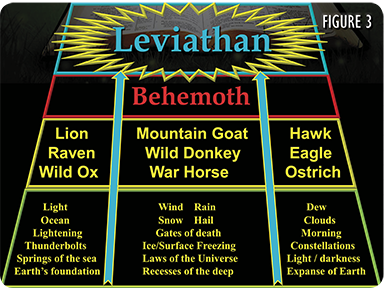 But God was not finished with him. To bring His line of reasoning to a grand culmination, God next directs Job’s attention to detailed descriptions of two additional creatures—the most magnificent, matchless spectacles of the animal kingdom. Question: if the first nine animals to which God alluded are real animals, why not Behemoth and Leviathan? And why would the identity of these two animals be so obscure or uncertain compared to the others? Look carefully at Figure 3 on p. 53 to see the way God crafted and sequentially layered His argumentation so as to climax in a superlative pinnacle.
Re-read Job 40:15-24 and answer the following questions regarding Behemoth:
- Does Behemoth figuratively or literally eat grass like an ox? [Note that Behemoth is as literal as an ox, but Behemoth is not an ox. The flag word “like” alerts the reader to the presence of a figure of speech. The two may be compared in the behavioral fact that both eat literal grass.]
- Does he figuratively or literally have strength in his hips and power in his stomach muscles?
- Does Behemoth figuratively or literally move his tail like a tree? [Note, again, that “tail” and “cedar” are literal, and “like” signals a figure of speech.]
- Does he possess literal bones and ribs?
- Are his bones literally beams of bronze, and his ribs literally bars of iron—or are his bones like beams of bronze and his ribs like iron?
- Do the mountains figuratively or literally yield food for him?
- Do the beasts of the field figuratively or literally play there?
- Does Behemoth figuratively or literally lie under literal lotus trees and in literal reeds and marsh?
- Do the literal lotus trees figuratively or literally cover him with their literal shade, and do the literal willows by the literal brook literally or figuratively surround him?
- Does the river figuratively or literally rage without disturbing him?
- Is he figuratively or literally confident in facing the literal gushing waters of a literal Jordan river?
- Does the river figuratively or literally hit him in his eyes? Are his eyes literal?
- Do men figuratively or literally seek to pierce his nose with a snare? Is his nose literal?
Read also Job 41:1-10 regarding Leviathan, taking note of the bolded words below—
- Can you draw out Leviathan with a hook, or snare his tongue with a line which you lower?
- Can you put a reed through his nose, or pierce his jaw with a hook?
- Will he make many supplications to you? Will he speak softly to you?
- Will he make a covenant with you? Will you take him as a servant forever?
- Will you play with him as with a bird, or will you leash him for your maidens?
- Will your companions make a banquet of him? Will they apportion him among the merchants?
- Can you fill his skin with harpoons, or his head with fishing spears?
- Indeed, any hope of overcoming him is in vain; shall one not be overwhelmed at the sight of him?
- No one is so fierce that he would dare stir him up.
Observe that every one of the words in bold in this latter passage have a literal import except “servant” and “bird”—and these are flagged in the text by “as” to signal metaphorical imagery.
BEHEMOTH’S ANATOMY
Observe that the point of God’s argumentation is not served if (1) Behemoth and Leviathan are imaginary animals or (2) they are actual animals, but their prominence is exaggerated, overstated, or misrepresented. The first nine animals that God urged Job to contemplate were known for their mysterious, unique, inexplicable, and independent behaviors—and God did not embellish those attributes or convey them with “mythological heightening” or “hyperbolic intensity.” Next He directs Job’s mind to His most powerful, awesome, formidable, uncontrollable creatures—in keeping with His desire to impress Job with his own feeble inability to operate, manage, understand, explain, or control his surroundings, let alone expect God to give account of Himself. The focus is on size and power. When God ordered Job to “look now at behemoth, which I made along with you,” Job would never have derived from such a forthright statement that Behemoth is imaginary. Indeed, God settled the point that if Behemoth is not real, then Job is not real. If Behemoth is “mythopoeic,” then Job is likewise “mythopoeic.” God made both of them. Since the Bible teaches that Job really lived (Ezekiel 14:14; James 5:11), it undeniably follows that Behemoth was as real, literal, and historical as was Job.
Consider three of Behemoth’s attributes that God chose to highlight: its stomach muscles, its tail, and its bones.
(1) “See now, his strength is in his hips, and his power is in his stomach muscles” (40:16). It is true that elephants and hippopotami have sizable stomach muscles—when compared to other animals living today. However, their stomach muscles do not even begin to compare with the belly muscles of Diplodocus or Amphicoelias, whose massive stomachs were larger than an entire elephant. Seismosaurus, which means “Earthquake Reptile,” was so named because it was large enough that it may actually have shaken the ground as it walked. Looking upward at its underside, alone, would have intimidated humans by its enormity, causing them to feel helpless and fearful in the face of such ponderous muscular power.12
(2) “He moves his tail like a cedar; the sinews of his thighs are tightly knit” (40:17).13 Why did God compare Behemoth’s tail to a cedar tree? To answer that question we must turn to the Bible’s definition of a cedar tree. Were the cedars of the Bible big? They absolutely were, as numerous verses demonstrate.14 These passages accentuate the cedar’s superior attributes of height, strength, stature, and majesty.15 When one examines the farcically tiny tails of the hippo, elephant, rhino, and mammoth, it is immediately evident that these animals are not under consideration. However, even a casual consideration of the tails of the larger dinosaurs—Apatosaurus, Argyrosaurus, Supersaurus, or Seismosaurus (with its prodigious tail designed to defend itself against would-be attackers)—quickly provides ample proof of the animal being described by God. Indeed, why would God call Job’s attention to an appendage of a hippo?16 If He sought to dazzle Job with His creation, would He not spotlight characteristics for which that animal is particularly distinguished? The sauropods are known for their colossal, titanic tails.
 |
| Reconstructed front foot of Ultrasauros |
(3) “His bones are like beams (tubes—NASB) of bronze, His ribs like bars (rods—NASB) of iron” (40:18). This creature’s skeletal structure was clearly framed to possess exceptional stability and strength. Compared to humans, dinosaurs were gigantic. Whereas a hippo weighs three to four tons, a rhinoceros one to two tons, and an elephant five to seven tons, Argentinosaurus weighed 80-100 tons. Such size necessarily requires a framework of sturdy, brawny bones to accommodate such weight and mass. When one examines the skeletal structure of any of the larger dinosaurs, one is immediately awed by the massive size of all its bones. An Apatosaurus femur alone was as tall as a six-foot man—with a Titanosaur femur even longer.17
Observe that the attributes selected by God to highlight the identity of Behemoth were specifically pinpointed and calculated to accentuate the unique features of this incredible creature, eliciting God’s summary statement of Behemoth: “He is the first of the ways of God” (40:19). The underlying Hebrew word translated “first” refers to size, mass, weight, bulk, force, or strength.18 God challenged Job with his inability to tame, subdue, or control this massive creature (even as Leviathan is noted for its ferocity). Look again at the phrase: “Only He who made him can bring near His sword” (vs. 19). The implication is that humans would have great difficulty bringing down this creature. The reason God directed Job’s attention to Behemoth is obvious: the gargantuan creature was of such stature and strength that only the Creator could control it. In order for God’s argument to make sense or carry any weight with Job, Behemoth must be real and of such imposing, even ominous enormity, and of such immense, powerful proportions that, without hesitation, Job would acknowledge his own helpless, measly condition before God. Neither a hippo nor an elephant would evoke such an admission. A dinosaur would. Consider the comparative chart below (Figure 4).19


Behemoth was apparently some type of dinosaur. In the words of Hebrew lexicographer Benjamin Davidson, this wild beast was “some stupendous quadruped.”20
[to be continued]
Endnotes
1 Job is consistently treated in Scripture as an actual historical personage—by both the prophet Ezekiel (14:14,20) and the New Testament writer James (5:11). See Eric Lyons (2013), “The Historicity of Job,” Reason & Revelation, 33[1]:2-4,8-11, January.
2 See Dave Miller (2015), Why People Suffer (Montgomery, AL: Apologetics Press).
3 I say “likely” in view of the fact that oceanographers tell us that 95% of the Earth’s oceans remain unexplored by humans. Despite sophisticated satellite radar mapping of the ocean floor, the “contents” of the sea are still largely unknown: “If our questions are: ‘What does it look like down there?’ or: ‘What’s going on down there?’, then the area that has been ‘explored’ is arguably even less than the 0.05% mapped so far at the very highest resolution by sonar”—Jon Copley (2014), “Just How Little Do We Know about the Ocean Floor?” Scientific American, October 9, https://www.scientificamerican.com/article/just-how-little-do-we-know-about-the-ocean-floor/. “More than eighty percent of our ocean is unmapped, unobserved, and unexplored”—NOAA (2017), “How Much of the Ocean Have We Explored?” National Ocean Service Web site, October 5, emp. in orig., https://oceanservice.noaa.gov/facts/eutrophication.html.
4 Keep in mind that knowledge of the existence of the dinosaurs in modern times occurred only in the 19th century when bones were discovered and the term “dinosaur” was coined. Hence, one would not expect earlier Bible commentators to associate Behemoth or Leviathan with dinosaurs or dinosaur-like creatures. Their efforts to ascertain the identity of these two animals was limited by their awareness of the extant, contemporaneous animal population. This unnecessary limitation continues to have its residual effects among commentators who do not seem to be able to conceptualize the ancient world of Job’s day.
Now that we know that dinosaurs existed, and that the description of Behemoth fits their physical attributes perfectly, the more perplexing question becomes: “why are commentators insistent on maintaining the belief that the hippo and crocodile are intended?” The only answer this writer can imagine is that many theologians have been adversely influenced by evolutionary propaganda—taught throughout the American public school system now for three generations—that dinosaurs went extinct over 60 million years before humans evolved and, hence, humans did not live contemporaneously with dinosaurs, and no human ever saw a living dinosaur. It is truly tragic when we allow fallible extra-biblical assumptions to trump God’s Word as plainly taught in Scripture. The fact of the matter is that the dating techniques used by evolutionists have been debunked as severely flawed, completely undermining the “deep time” assumptions on which evolutionary theory is constructed. For a concise refutation, see Jeff Miller (2019), “21 Reasons to Believe the Earth is Young,” Reason & Revelation, 39[1]:2-5,8-11, http://apologeticspress.org/apPubPage.aspx?pub=1&issue=1287; see also NASA nuclear engineer Michael Houts (2015), “Assumptions and the Age of the Earth,” Reason & Revelation, 35[3]:26-29,32-34, http://apologeticspress.org/apPubPage.aspx?pub=1&issue=1185.
5 The Holy Bible, New International Version (1978), (Grand Rapids, MI: Zondervan), p. 497.
6 The Holy Bible Containing the Old and New Testaments: American Standard Version (1901), (New York: American Bible Society), pp. 590-591, italics in orig. The RSV has “Or the hippopotamus” and “Or the crocodile.” Also the NASB.
7 The Holy Bible English Standard Version (2001), (Wheaton, IL: Crossway Bibles), pp. 534-535.
8 Ferdinand Justi and Morris Jastrow (1905), A History of All Nations from the Earliest Times: Egypt and Western Asia in Antiquity (Philadelphia, PA: Lea Brothers), 1:89, https://archive.org/stream/historyofallnati01andr/historyofallnati01andr_djvu.txt. For additional examples in the tombs of the First Dynasty in the Valley of the Kings, see www.phouka.com/pharaoh/PharoahOutline.doc.
9 G. Maspero (1873), “The Instructions of King Amenemhat to His Son Usertesen I. XIIth Dynasty,” in Records of the Past: Being English Translations of the Assyrian and Egyptian Monuments (London: Samuel Bagster & Sons), 2:14, https://apologetcspress.page.link/RecordsofthePast
10 Sir Samuel Baker (1868), The Nile Tributaries of Abyssinia, and the Sword Hunters of the Hamran Arabs (London: Macmillan), pp. 161ff.,224-225,373ff., https://apologetcspress.page.link/The-Nile-Tributaries-of-Abyssinia.
11 See, for example, The Expositor’s Bible Commentary series, representing conservative scholarship, in which Smick discusses the “mythopoeic language” he thinks characterizes the book (pp. 863ff.), claiming that in the allusions to Behemoth and Leviathan “only mythological terminology is used to present graphic descriptions of the powers of evil such as the Satan in the Prologue”—Elmer Smick (1988), “Job” in The Expositor’s Bible Commentary (Grand Rapids, MI: Zondervan), 4:1049. See also Gregory Parsons (1981), “Literary Features of the Book of Job,” Bibliotheca Sacra, 138[551]:218-220, July; Elmer Smick (1970), “Mythology and the Book of Job,” Journal of the Evangelical Theological Society, 13:106; Elmer Smick (1978), “Another Look at the Mythological Elements in the Book of Job,” Westminster Theological Journal, 40[2]:215ff., Spring; James Williams (1992), “The Theophany of Job,” in Sitting with Job: Selected Studies on the Book of Job, ed. Roy Zuck (Eugene, OR: Wipf & Stock Publishers), p. 367; R. Laird Harris (1992), “The Doctrine of God in the Book of Job,” in Sitting with Job: Selected Studies on the Book of Job, ed. Roy Zuck (Eugene, OR: Wipf & Stock Publishers), p. 165. Also G.R. Driver (1956), Canaanite Myths and Legends (Cleveland, OH: Clark).
12 An interesting side note is seen in the incident in which an elephant flipped a fully-grown mother hippo several feet into the air, showing its superior strength and agility compared to hippopotami—Tara Brady (2013), “Angry Elephant Flips Mother Hippopotamus into the Air with Its Trunk as She Tries to Protect Her Calf,” Daily Mail, November 11, http://www.dailymail.co.uk/news/article-2500717/Angry-elephant-flips-mother-hippopotamus-air-trunk-tries-protect-calf.html.
13 English translations are fairly uniform in their treatment of the terms “moves,” “tail,” and “cedar”: “Its tail sways like a cedar” (NIV); “He makes his tail stiff like a cedar” (ESV/NRSV); “He moveth his tail like a cedar” (KJV/WEB); “He carries his tail like a cedar” (NAB); “He bends his tail like a cedar” (NASB/YLT); “Its tail is like a cedar tree” (NCV); “He moves his tail like a cedar tree” (NLV); “He moveth his zanav (tail) like a cedar branch” (OJB); “He constraineth his tail as a cedar (His tail standeth up like a cedar)” (WYC). However, the English words “stiff” (ESV/NRSV) and “branch” (OJB) constitute translator interpretation and lack linguistic justification.
14 1 Kings 7:1-3; 2 Kings 19:23; cf. Isaiah 2:13; 37:24; Ezekiel 17:3,22-23; 31:3-5.
15 For more discussion, see Dave Miller (2011), “Behemoth: A Tail Like a Cedar?” Reason & Revelation, 31[12]:122-124, December, http://apologeticspress.org/apPubPage.aspx?pub=1&issue=1010.
16 The whimsical assertion that the appendage being highlighted is the hippo’s sex organ, besides being linguistically indefensible, faces precisely the same hermeneutical obstacle as the hippo’s tail: compared to a dinosaur, a hippo’s sex organ is, at the very least, quaint, if not ludicrous. See Eric Lyons and Kyle Butt (2008), The Dinosaur Delusion (Montgomery, AL: Apologetics Press), pp. 123-124; John Hartley (1988), The Book of Job (Grand Rapids, MI: Eerdmans), p. 525.
17 Amber Jamieson (2016), “World’s Biggest Dinosaur Skeleton Unveiled in New York,” The Guardian, January 14, https://www.theguardian.com/science/2016/jan/14/new-species-gigantic-dinosaur-titanosaur-unveiled-new-york. The University of Kansas Geological Survey reported: “The thigh bone of the largest species of Dinosaurs, from Wyoming, was over six feet in length, and weighed, as petrified, over 1100 pounds”—Samuel Williston (1898), “Dinosaurs,” in The University Geological Survey of Kansas, Paleontology (Topeka, KS: J.S. Parks), 4:68. The Argyrosaurus femur pictured on the front cover of this issue of R&R was unearthed in 1924 during the Captain Marshall Field Expedition by C. Harold Riggs in the San Bernardo Hills of Argentina. Specimens of this dinosaur have been found in which the femur is two meters—over six and a half feet long. The femur of an Antarctosaurus giganteus, exhibited at the Museo de Law Plata in La Plata, Argentina, is 2.31 meters—over seven and a half feet long. See Fernando Novas (2009), The Age of Dinosaurs in South America (Bloomington, IN: Indiana University Press), p. 217.
18 Dave Miller (2008), “The ‘First of the Ways of God,’” Apologetics Press, https://www.apologeticspress.org/APContent.aspx?category=9&article=2417&topic=59.
19 The question mark in the chart for the elephant’s stomach muscles flags the fact that elephants are not known for strong stomach muscles. In stark contrast, they have incredibly strong trunks composed of thousands of muscles. Likewise, the other question marks flag the fact that the hippo and elephant attributes are negligible in comparison to a dinosaur.
20 Benjamin Davidson (1848), The Analytical Hebrew and Chaldee Lexicon (Grand Rapids, MI: Zondervan, 1970 reprint), p. 68. Also Hebrew-English Lexicon (no date), (London: Samuel Bagster), p. 32.
The post Behemoth and Leviathan: Figurative or Literal? (Part 1) appeared first on Apologetics Press.
]]>The post When You’ve Heard a Lie a Thousand Times, the Illustrated Truth Can Look “Crazy” at First appeared first on Apologetics Press.
]]>I suppose, more than any other question that Apologetics Press tackles, we get more criticism from atheists, evolutionists, and even many Christians from our articles and books on, and (especially!) our illustrations2 of, dinosaurs. The impression we have gotten from some through the years is: “How can you talk about God creating these animals with human beings thousands (and not millions) of years ago? Don’t you know that these animals prove evolution to be true?” Then there have been those puzzling times when Christians have been in full agreement that God indeed created dinosaurs and dinosaur-like aerial and aquatic creatures on days five and six of Creation; but then, the moment that we show an illustration of what that may have looked like, they think we’ve lost our minds.
“You can’t show a picture of a dinosaur along with a human being.”
“Wait. I thought you said you believed that God made dinosaurs during the same Creation week in which He made elephants, alligators, and human beings?”
“I do believe that. But such illustrations look silly.”
“Why do they look silly?”
“I’ve just never seen anything like that…. Plus, you don’t just show humans and dinosaurs in the same picture—you show them close together. You sometimes show people killing them or even taming them. That surely never happened.”
“Why do you think that?”
“They were terrifying creatures that humans couldn’t have gotten close to.”
“What makes you think that?”
“Everything I’ve ever read and watched.”
“I would ask that you consider two things. First, remember that ‘it’s easier to believe a lie that you’ve heard a thousand times than the truth that you’ve only heard once.’ And second, ponder on the following evidence. Then ask yourself: What should we believe and teach, and what kind of artwork should we use to illustrate biblical and historical truth?”
A Summary of the Evidence That God Made Dinosaurs Along with Human Beings
1. An omnipotent, omniscient God exists.
If a person does not believe this most-important, foundational truth, talking about the subject of dinosaurs and humans will likely be unproductive. If a person comes to believe in God based upon the evidence for His existence3, he should consider that God would have the power to create dinosaurs alongside human beings during the Creation week, if He so chose.
2. The Bible is the Word of God.
If a person does not believe this second foundational truth, a discussion of dinosaurs might be somewhat beneficial (if the unbeliever could be shown that the biblical account of Creation, etc., does not contradict true history and science), but the unbeliever would likely be much better served if he were first presented with the evidence for the inspiration of the Bible.4
3. The Bible indicates God made everything in six days (including all animals and humans).
According to Exodus 20:11, “[I]n six days the Lord made the heavens and the earth, the sea, and all that is in them, and rested the seventh day.” This statement harmonizes perfectly with Genesis 1 and everything else in Scripture. The all-powerful God of the Universe could have created the Universe in any way He desired, in whatever order He wanted, and in whatever time frame He chose. He could have created the world and everything in it in six billion years, six minutes, or in one millisecond—He is, after all, God Almighty (Genesis 17:1). But the question is not what God could have done; it is what He said He did. And He said that He created everything in six days.5 According to the inerrant, inspired Word of God, the Creator made dinosaurs and humans on the same day of Creation. Indeed, at one period in history, they lived on Earth at the same time.
4. The biblical truth that dinosaurs and humans once lived together is supported by history.
Even evolutionists have admitted that people all over the world throughout history talked about seeing reptilian creatures with scaly, hard, elongated bodies; long, serpentine necks; long tails; horned, knobby, or crested heads; some with bat-like wings; and some that went on two legs, while others on four. Although undoubtedly many of these “dragon” stories were exaggerated through the centuries (just as our adrenaline-rushing fishing or hunting stories are often exaggerated), these descriptions of “dragons” sound like dinosaurs or dinosaur-like reptilian creatures. But modern man only began learning about dinosaurs from the fossil record in the past 200 years. How could so many people from all over the world throughout history have so accurately described seeing animals that sound like dinosaurs, if they never actually did? The truth is, biblical history, including the existence of Leviathan in the days of Job (chapter 41), is in perfect harmony with what history has recorded.6
5. The biblical truth that dinosaurs and humans once lived together is supported by physical evidence.
Not only did people talk about seeing dinosaurs and dinosaur-like creatures (referred to as “dragons”) for thousands of years,7 they also illustrated these animals in drawings and carvings found all over the world.8 How could they have illustrated such animals hundreds or thousands of years before modern man ever learned about these creatures from the fossil record? Once again, the evidence supports the biblical truth that God made everything (including dinosaurs and humans) in six days.
6. Dinosaur bones have been discovered with soft tissue in them.
In the last 20 years, numerous scientists have reported unearthing a variety of dinosaur bones from around the world that contain intact protein fragments, including collagen, hemoglobin, elastin, and laminin.9 Such findings fit perfectly with the Creation model: God created dinosaurs and humans, not millions of years ago, but thousands of years ago, on the same day of Creation.
7. All million (or billion)-year-old ages of rocks and fossils are based on unproven (and unprovable) assumptions.
Evolutionists have never proved that dinosaur fossils are many millions of years old, and they certainly haven’t demonstrated that certain rocks are billions of years old. Such dates are all constructed from various assumption-based dating methods.10 They are part of evolution’s story, and are not a physical fact. Bones and fossils are physical realities; evolution’s billion-year timeline has always been just an unproven theory (and a bad one at that).
8. Human beings have interacted with all sorts of animals throughout history, so why is it so hard to believe that they also interacted with dinosaurs?
Draw a picture of a small man riding a 15,000-pound elephant, and no one has a problem with it. Publish a photograph of a woman at Sea World sticking her head inside the mouth of a massive, 6,000-pound killer whale, and most everyone today understands the reality of the situation, however dangerous. Tell your friend about the man at the circus who has tamed lions, tigers, and bears, or that you watched a TV show of a man playing with crocodiles, and that is nothing but old news. After all, Jesus’ brother James wrote 2,000 years ago what his readers knew all too well: “[E]very kind of beast and bird, of reptile and creature of the sea, is tamed and has been tamed by mankind” (3:7). Yet still, many Christians have a problem with the ancients being pictured anywhere near various dinosaurs.
Should Apologetics Press refrain from publishing illustrations of dinosaurs and humans together because “it makes us look silly”? On the contrary, since “a picture is worth a thousand words,” and since the “thousand words” upon which this picture is based are true and extremely relevant to the creation/evolution debate,11 then we believe it is very appropriate (and important) for people to hear and see the truth. May God help us to share the facts fairly, kindly, and humbly, but also boldly. Truth has nothing to fear.
Endnotes
1 Robert Lynd (1921), The Passion of Labour (New York: Charles Scribner’s Sons), p. 67.
2 https://store.apologeticspress.org/collections/promotion/posters.
3 See Dave Miller, ed. (2017), Does God Exist? (Montgomery, AL: Apologetics Press), as well as “The Existence of God” section at ApologeticsPress.org.
4 See Kyle Butt (2022), Is the Bible God’s Word? (Montgomery, AL: Apologetics Press). See also Dave Miller (2020), The Bible Is From God: A Sampling of Proofs (Montgomery, AL: Apologetics Press) and “The Inspiration of the Bible” section of www.apologeticspress.org.
5 See Eric Lyons (2014), “Creation and the Age of the Earth,” Reason & Revelation, 34[7]:86-94, July, https://apologeticspress.org/creation-and-the-age-of-the-earth-500/. For much more information on this subject, see the Creation vs. Evolution section of www.apologeticspress.org.
6 For more information on dinosaurs, dragons, history, and the Bible, see Eric Lyons (2007), “Historical Support for the Coexistence of Dinosaurs and Humans [Parts 1 & 2],” Reason & Revelation, 27[9-10]:65-68,69-71,73-76,77-79, https://apologeticspress.org/historical-support-for-the-coexistence-of-dinosaurs-and-humans-part-i-743/.
7 Keep in mind that the word “dinosaur” was not coined until the early 1840s by Richard Owen.
8 See Kyle Butt and Eric Lyons (2008), “Physical Evidence for the Coexistence of Dinosaurs and Humans” [Part 1], Reason & Revelation, 28[3]:17-23, https://apologeticspress.org/physical-evidence-for-the-coexistence-of-dinosaurs-and-humans-part-i-2416/.
9 For more information, see Brian Thomas (2015), “Solid Answers on Soft Tissue,” Answers in Genesis, https://answersingenesis.org/dinosaurs/when-did-dinosaurs-live/solid-answers-soft-tissue/.
10 See Jeff Miller (2013), “Don’t Assume Too Much: Not All Assumptions in Science Are Bad,” Reason & Revelation, 33[6]:62-64,69-70; see also Michael Houts (2015), “Assumptions and the Age of the Earth,” Reason & Revelation, 35[3]:26-29,32-33, https://apologeticspress.org/assumptions-and-the-age-of-the-earth-5126/.
11 Dinosaurs are, after all, the “poster children” of evolution. That is, they are used as much or more than any other animal to teach and promote the errors of atheistic evolution.
The post When You’ve Heard a Lie a Thousand Times, the Illustrated Truth Can Look “Crazy” at First appeared first on Apologetics Press.
]]>The post The Design of Dinosaurs appeared first on Apologetics Press.
]]>
 This month’s Discovery contains sections from AP’s newest book about dinosaurs titled Dinosaur Field Journal. It is written in a historical fiction style in which a fictional man named Eber (pictured on the cover) traveled the world and documented the dinosaurs he saw. Since we know that God created dinosaurs on the sixth day of Creation, along with humans, then we know ancient people could have seen them. The Dinosaur Field Journal is a “glimpse at what could have been the case” in the past. It is quite possible that a man such as Eber could have lived and studied dinosaurs. As you read this month’s Discovery, think about what an amazing life that would have been.
 Let me tell you why I believe my dinosaur journal will be very important one day. As I talk to people around the world, I hear many strange things. There is an odd idea going around that there is no Creator. Some people are claiming that our world came from a big explosion many millions of years ago. They are claiming that dinosaurs were not created or designed but “evolved” and somehow came from non-living dirt or water or other substances.
This idea cannot be correct. The animals I have studied, especially the dinosaurs, are too well-designed. Any time we see design, we know there must be an intelligent designer behind it. When I ride on a horse-drawn cart, the wheels are perfectly designed to pull the cart. No one would think that the wheels evolved over millions of years. They were designed by a craftsman. When we study dinosaurs, we can see that dinosaur legs move more gracefully than wheels. Their claws help them stay balanced, and many of the dinosaurs can run faster than a wagon can go, and the dinosaurs can even jump and climb. If wagon wheels are designed, dinosaur legs certainly must have a designer.
Also, I have studied hundreds of dinosaur teeth. Many of them are serrated like saws. In my adventures, I have sometimes hidden near dinosaurs as they ate. I have watched them use their serrated teeth to cut and tear food. These teeth remind me of jagged saw blades. In our shipyards, where craftsmen build huge ships, they use different kinds of saws to cut massive tree trunks into boards. These saws take many hours to make, and they are expensive to buy. No one would think that the saws “evolved” over millions of years. They are perfectly designed to cut different kinds of wood.
Dinosaur teeth are similar to saws. They are perfectly designed. The Creator made each kind of dinosaur and equipped dinosaurs with the perfect sized and shaped teeth to eat certain kinds of food. If a saw that cuts wood can’t “evolve,” neither can saw-like dinosaur teeth.
I pray to the Creator that this idea of “evolution” does not become popular. It would be such a shame if people start to ignore the Creator’s design in nature. The Creator made the world and all creatures to show His awesome power. Humans are designed to study the natural world and be amazed at the Creator’s intelligence and ability.
Nature points us to the Creator.
If we miss that point, we have missed it all!

The post The Design of Dinosaurs appeared first on Apologetics Press.
]]>The post The Great Flood and Huge Dinosaurs appeared first on Apologetics Press.
]]>As I said, most of my readers know all about these events. Why am I repeating them here? In my research on dinosaurs, I have seen massive plant eating dinosaurs with huge bodies and long tails and necks—Brachiosaurus and Apatosaurus and others. Some people who have seen these dinosaurs, or seen my drawings of them, have challenged the Flood story. If the Flood did happen, then all the land-living animals alive today would have been on the ark. These skeptics claim that no boat would have been big enough to carry several pairs of the huge dinosaurs. They say that the stories of the Flood are just legends and that dinosaurs could not have been on a boat of any kind.
These skeptics are wrong for many reasons. First, flood stories are preserved in cultures all over the world. I have talked to over 200 people groups that tell of a huge flood. That is exactly what we would expect if a huge flood did occur and all the people now living were descendants of Noah and his family.
Second, there are evidences of the Flood all over the world. I have been on the tops of many high mountains and seen fossils of ocean animals at the very top. How could ocean animals such as oysters and fish get to the tops of the world’s highest mountains? If the world were covered in water, we would expect to find these fossils!
Third, I have studied huge bone yards filled with thousands of dinosaur fossils. These fossils were deposited by massive amounts of water and buried very quickly. I have found these bone beds in many different places around the world. A global Flood is the best explanation for them.
Finally, it would have been no problem to place even the largest kinds of dinosaurs on the ark. How is that the case? In my studies, I have found hundreds of dinosaur nests filled with eggs. These dinosaur eggs range in size from a few inches long to a little over a cubit. Even the largest dinosaurs hatch from eggs that are only about as long as my arm (from the tip of my finger to my elbow). There is nothing that says the Creator brought the largest pair of each kind of dinosaur to Noah. He easily could have brought a young, newly hatched pair to go on the ark.
It amazes me that those who do not want to think about the Creator will go to great lengths to try to disprove the truth. They will never succeed.

The post The Great Flood and Huge Dinosaurs appeared first on Apologetics Press.
]]>The post Dinosaurs from Dinosaurs appeared first on Apologetics Press.
]]>“But,” he said, “it probably formed when an energy source, such as lightning, zapped non-living substances found in water or on rocks or crystals.”
Amazed at his lack of understanding of the natural world, I asked him how such a living form could change into all the different kinds of plants and animals. He said that over millions of years, tiny changes could turn a little speck of life into the most complicated living creatures. He called this idea of small changes over time “evolution.”
There are two major problems with this “evolution.” First, for more than two thousand years humans have studied animals. In all these studies, we have discovered the “law of nature.” This “law” states that in the natural world, life gives rise to life of its own kind. This idea is called a “law” because no person in the world has ever found one exception to it.
We see this law of nature around us all the time. Farmers know that their cows give birth to baby calves; their oxen give birth to baby oxen; their horses give birth to baby horses. These animals never give birth to babies that are some other kind of animal or on their way to becoming some other kind. They are always the same kind of animal as their parents.
In my studies of dinosaurs, I have seen this law of nature be true time and again. When a Velociraptor lays a hatch of eggs, only baby Velociraptors come from those eggs. Those dinosaurs are not changing into birds, dogs, bears, or anything else. I have watched a baby Stegosaurus hatch from an egg that was laid by a female Stegosaurus. That baby was not part Stegosaurus and part bird, or part Stegosaurus and part dog. It was fully a Stegosaurus. The idea that animals could evolve over millions of years into other kinds of animals is not an idea that comes from studying the natural world.
The other problem with this idea is that it does not match the Creator’s account of Creation. The Creator explained the exact order of how He did things. He created flying creatures and birds on day five of Creation. He created land-living creatures such as dinosaurs on the sixth day of Creation. Dinosaurs could not have evolved into birds, because birds were created before dinosaurs. Furthermore, the Creator commanded all animals and plants to multiply “after their own kind.” That means no kinds of animals or plants evolved into any other kinds.


The post Dinosaurs from Dinosaurs appeared first on Apologetics Press.
]]>The post Dinosaur Field Journal appeared first on Apologetics Press.
]]>As I stood on a steep rock ledge, the pair walked in the valley below. Their scaly skin and massive spiked skulls fascinated my young mind. I watched as they lumbered out of sight. I was too far up the ridge to follow. Besides that, their large size and well-armored heads made me think they might not be the friendliest of beasts.
In my excitement, I rushed back to the village and began questioning my father. He explained that he had seen very few of these beasts during his lifetime, and none like the ones I described. The ones he had seen had no horns and had large mouths full of sharp teeth.
My curiosity drove me to talk to the other elders in the village. I learned that my elders thought there might be many different kinds of these huge reptiles, but they were rarely seen by our people.
As I grew older, the image of the beasts stayed with me. In my travels as a merchant, I asked those from other lands about them. I heard stories and rumors about large, lizard-like creatures from many I questioned.
My business was successful and I became a very wealthy man. Since I no longer had to work as I once did, I devoted myself to finding out as much about these creatures as possible.
You are holding in your hands a small part of the product of years of research. I have traveled the world, climbed mountains, crossed oceans, braved dense forests, and explored deserts.
I have seen massive graveyards of bones and discovered nests of eggs. My study of these amazing creatures has led me to the fact that they cannot be the product of accidents over millions of years.
The creator made them at the same time He made humans.
Their wonderful design shows that an intelligent Designer brought them into existence. Because of this truth, I have begun a new search. It is now my life’s goal to find out as much about the Creator as I can so that I can be pleasing to Him.
I hope a study of these fascinating creatures leads you to the same conclusion.
– Eber, of the land between the rivers


Note to the reader:
In one sense, what you are reading here is fiction. We do not have a real journal from an ancient man who travelled the world studying dinosaurs. In another sense, however, it is more than fiction. We do know that God created dinosaurs on the same day He made humans. We know that humans lived at the same time as dinosaurs and interacted with them. We know much about how big they were, what they ate, and how they may have lived.
We have evidence that ancient people were intelligent, had the ability to travel, and could write. Therefore, this journal is more a “glimpse at what could have been the case” in the past. It is quite possible that a man such as Eber could have lived and studied dinosaurs. The information about the size and shape of the dinosaurs listed is based on modern findings and fossil discoveries. We still have much to learn about the world God created, but an exploration of dinosaurs brings us closer to understanding God’s awesome power!
-Kyle Butt
The post Dinosaur Field Journal appeared first on Apologetics Press.
]]>The post Was the Ark Big Enough for Its Passengers? appeared first on Apologetics Press.
]]>First, it is important to understand that not every “species” of animal was on the Ark. Today’s idea of a “species” did not exist when Moses wrote the book of Genesis. Instead, he used the word “kinds” when telling Noah what to bring on the Ark (Genesis 6:20)—the same word that was used to describe what God made during the Creation week (1:11,21,24). The word “kind” would be closer to our word “family” or “genus” when classifying animal groups. So Noah would have probably had representatives of the single dogkind, for example—not representatives of each dog species (the coyotes, wolves, domestic dogs, jackals, etc.).
 Also, we must keep in mind that not even all of the kinds of life we find on Earth were on the Ark. For example, only those plants that were needed to feed the passengers on the Ark were brought—not representatives of all of the plant kinds. The swimming creatures were not onboard, of course, nor many insects, invertebrates, fungi, bacteria, or protozoa—all of which are included in the 11 million species that are said to be alive on the Earth.
When it’s all said and done, there were probably only a few thousand animals on the Ark, not millions nor even hundreds of thousands. The Ark was a football field and a half long, at least, and at least 75 feet wide and 45 feet tall—an enormous ship. John Woodmorappe did a study to determine whether the Ark would have been large enough to house 16,000 animals—representatives of each “kind” of creatures that would have probably been on the Ark. He took into account the space needed for food, water, waste disposal, heating, air, and lighting. He found that the size of the Ark was more than what was needed to house that many animals on such a large vessel. And what’s more, if the “cubit” (which was the unit of length that Moses used to describe the size of the Ark) was longer than 18 inches (what is often assumed to be the length of a cubit), the Ark quickly becomes even larger and more spacious.

But wait a minute…what about the dinosaurs? How could the Ark have been large enough to hold all the dinosaurs, and especially, the sauropods, like Apatosaurus? Or the large theropod dinosaurs, like T-Rex? Keep in mind two things: first, the average size of an adult dinosaur was about the size of a rhinoceros; and second, the Bible does not say how old the animals were that were on the Ark. Were you as big as you are now when you were born? It is very likely that the animals on the Ark were young, maybe even little babies. Why? Besides the fact that they would take up less space, need less food, and make less waste, it is also important to remember that the animals on the Ark would have to leave the Ark and have enough time to spread out over the Earth and reproduce after the Flood. If they were already adult animals, they would not have nearly as much time to disperse and repopulate the Earth before they died.
The bottom line is that there is no reason to disbelieve what the Bible says when it tells us the story of Noah and the Ark. The Ark was large enough to hold the passengers that God sent to Noah to put on the Ark. Obviously, since God knew what He wanted on the Ark, He knew exactly how large it needed to be to house that many animals. The dimensions He gave to Noah made sure there was enough space for everything with a ticket to board.
The post Was the Ark Big Enough for Its Passengers? appeared first on Apologetics Press.
]]>The post Why Did God Create Dinosaurs? appeared first on Apologetics Press.
]]>I love to learn about dinosaurs. They were some of the most fascinating creatures that ever lived. You have asked a terrific question. Why would God make these amazing animals? The answer is very simple. All the things God created are designed to show His power and glory. In the book of Job (40:15-24), God tells Job about a creature called the behemoth. The description of this animal, with powerful muscles and a tail that swings like a cedar tree, matches the description of a long-necked dinosaur. God was using the behemoth to show Job how powerful some animals were. He was explaining to Job that if the behemoth was huge and very strong, then God, Who made the behemoth, was much more powerful. Job understood God’s point and repented for ever questioning God’s care and power. Today, we can use dinosaurs in the same way God used the behemoth. We can tell people about their huge bodies, large teeth, thick skulls, and bony armor. Then we can explain that the God Who made them is even more powerful and amazing than they were. Thanks for the great question.
The post Why Did God Create Dinosaurs? appeared first on Apologetics Press.
]]>The post Dinosaur and Human Fossils appeared first on Apologetics Press.
]]> Step 2
 Step 3
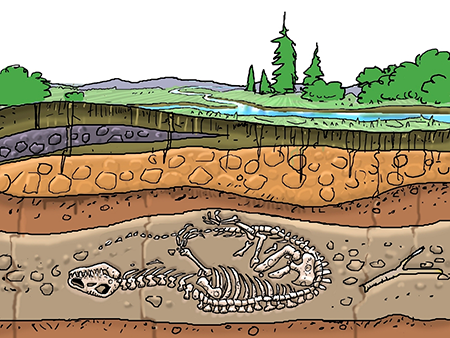 Step 4
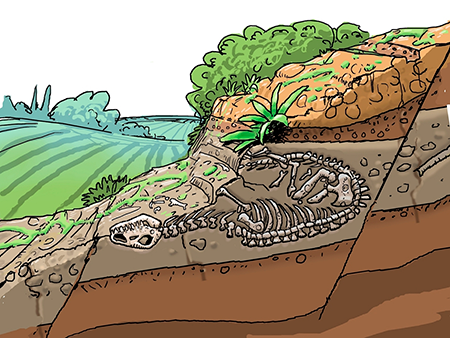
Dinosaur fossils have been found on every continent on Earth; humans have inhabited, and continue to inhabit, every continent on Earth. So, it would seem that if dinosaurs and humans really did once live at the same time (as the Bible teaches), human fossils would have been found near, or in the same strata of Earth as, dinosaur fossils. But is there evidence from the fossil record of their coexistence?
At times, questions like these appear somewhat puzzling, at least on the surface. We know from the biblical record that dinosaurs and humans coexisted (Genesis 1; Exodus 20:11). Furthermore, many ancient paintings, rock carvings, and historical references confirm they lived on Earth at the same time (as we have discussed in previous Discovery issues). Still, many wonder why dinosaur and human fossils may not have been found side-by-side in the fossil record.
Fossilization is Rare
First, we must understand that fossils are somewhat rare. That is, it is extremely rare for things once living to fossilize. Dead animals lying in a field do not fossilize. Under normal conditions, living things die then decay and rot. In order for something to become fossilized, it must be buried rapidly in just the right place (such as in a lot of mud, silt, and other fine sediments). In this “protected” environment, once-living things may last long enough to mineralize. But, normally, carcasses do not find themselves in such environments.
Not as Many Dinosaur Fossils as You Think
Although dinosaur graveyards have been discovered in various countries around the world (where thousands of dinosaur bones are jumbled together), there are fewer dinosaur fossils than most people realize. Did you know that nearly half of all dinosaur genera that have been named are based on one, single fossil specimen? What’s more, nearly 75% of the named dinosaurs are represented by five fossil specimens or less. Truly, although dinosaurs have captured the attention of scientists for more than 150 years, their fossilized remains are not as prevalent as many think.
Human Fossils are Extremely Scarce
Given the number of drawings of our alleged human ancestors that often appear in the news, you might get the feeling that human fossils are everywhere; but that is not the case. Humans actually make up a tiny portion of the fossil record. In the past few decades, scientists have become increasingly frustrated with the lack of these fossils. In fact, one scientist has admitted that “the mantra of all paleontologists” is “we need more fossils!”
Fossil “Combos”
Simply because human fossils may not have been found with dinosaur fossils does not make the case for the coexistence of dinosaurs and humans any less credible. Think about it: Where are the human fossils that have been found with the recently extinct Pyrenean Ibex? Can we prove that Dodo birds and humans once lived together by observing their fossilized remains together in a particular layer of rock? We know that they once coexisted, but can a person point to the fossil record for such information? Probably not. The truth is, the chance of finding human fossils is extremely rare. The chance of finding an exact combination of fossils is even less likely.
 |
 |
A Lesson Learned from Gingko Trees
Evolutionists believe Gingko trees were living on Earth 240 million years ago (before dinosaurs supposedly evolved). Interestingly, Gingko fossils are absent in rock layers that are allegedly many millions of years old, yet they are alive today. Thus, simply because they are absent in certain rock strata does not mean they were non-existent during the alleged millions of years it took those layers of rock to form. Likewise, simply because human fossils are missing in certain layers of rock does not mean they were not living on Earth at the time those rock layers were formed. Humans, just as easily as Gingko trees, could have been alive when the various rock layers were formed, without leaving human fossils.
Humans and the Flood
It could very well be that in the time of Noah the human population was confined mainly to the Middle East, while most dinosaurs roamed in other parts of the world. If that was the case, and the global Flood of Noah’s day was the catalyst that eventually brought about many of the fossils on Earth, then one would not expect to find many (if any) humans buried with dinosaurs.
 |
 |
Also, after the Flood, Noah’s descendants chose to “stay put” for more than a century, resisting God’s command to “fill the Earth” (read Genesis 9:1,7; 11:1-9). In contrast, the animals from the ark likely began to migrate around the world shortly after the Flood. Thus, if various fossils were formed several decades after the Flood, again, one would not expect to find human fossils with many of the animal fossils.
Conclusion
It may be that dinosaur and human fossils are never found together. Whether they are or not, the evidence for the coexistence of humans and dinosaurs at one time in the past is decisive. Nothing has ever disproved the biblical teaching that God created everything in six days.
The post Dinosaur and Human Fossils appeared first on Apologetics Press.
]]>