The post The Goldilocks Principle: The Earth Is Designed for Us appeared first on Apologetics Press.
]]>Atheistic philosopher Paul Ricci summed up the Teleological Argument for the Existence of God well when he said, “[I]t’s true that everything designed has a designer…. ‘Everything designed has a designer’ is an analytically true statement.”1 There are an infinite number of examples of design that present themselves to us when we study the natural realm—a problem for Ricci and his atheistic colleagues, to be sure. Manuel Canales, Matthew Chwastyk, and Eve Conant wrote an article in National Geographic titled “One Strange Rock: 13 Things that Make Life on Earth Possible.”2 “Earth is well equipped as a planet and ideally placed in our solar system and galaxy to support life as we know it,” they explain.3 What kinds of features make Earth so special?
- If the Earth’s rotation axis was tilted differently…: “A change in the rotation axis of the Earth…would be catastrophic. The number of the seasons would change and their duration. If the rotation axis became parallel to the orbital plane, as for Uranus, we could have winter in the Northern hemisphere for 6 months followed by summer. The Sun would set on the entire Northern hemisphere and not rise again for 6 months.”4
- If the Earth was spinning faster…: “Hurricanes will spin faster…and there will be more energy in them.”5 A faster rotation speed by only 10% would translate to so much water bulging around the equator, that all equatorial land would be flooded while the sea level at the poles would lower.6 Human and animal life would be forced to live closer to the poles, which would result in catastrophic extinctions.
- If the Earth’s orbit was closer to the Sun…: If the average distance from the Sun was “reduced by only about three-tenths of a percent,” disastrous atmospheric changes would occur, including “sea-level rise, increases in extreme weather, species extinctions and agricultural disruptions.”7 As it makes its elliptical path around the Sun, the Earth bends from its straight course “only one ninth of an inch” every 18½ miles.8 “If the orbit changed by one-tenth of an inch every 18 miles, our orbit would be vastly larger and we would all freeze to death. One-eighth of an inch? We would all be incinerated.”9 In fact, the Earth’s perfect distance from the Sun is called the “Goldilocks zone,” “where it’s not too close and not too far from the sun for water to be liquid on its surface.”10 Earth’s temperature is “not too hot or too cold.”11
- If the Earth had less water…: About 75% of the entire area of the Earth is covered by water. If there was less water on the Earth, it would suffer from the drastic temperature changes seen in deserts—extremely hot during the day and extremely cold during the night. Most of the Earth does not have this problem, due in large part to the fact that the Earth has so much water on it. Water has a high specific heat capacity, which means that water can hold a lot of heat—way more than almost any other natural substance on Earth. Water can store a lot of heat or lose a lot of heat without its temperature being drastically changed, causing it to act like an air conditioning unit for the Earth, keeping its temperature relatively constant. A different liquid other than water or less water would make Earth inhospitable for life.
- If the Earth was like other planets…: Citing the work of University of Washington’s Peter Ward, Stanford University’s Kate Maher, NASA’s Karina Yager, and the University of Idaho’s Jason Barnes, Canales and his colleagues highlighted that Earth “recycles life-friendly carbon over time,” has an “ozone layer to block harmful rays,” “a big moon to stabilize our axial wobble,” “varied surfaces [to] support many life-forms,” and a “magnetic field” that “deflects solar tempests.” Earth is “situated safely away from gas giants”—if it were closer, their “powerful gravity could cause disastrous fluctuations in Earth’s distance from the sun.” The star of our solar system—the Sun—“is a stable, long-lasting star,” as opposed to less massive, allegedly younger stars that are “often unstable and are prone to blasting their planets with bursts of radiation.” Earth has “the right stuff to host a dynamic core” (i.e., sufficient radioactive elements to generate a “churning core” and protective magnetic field that could, theoretically, last for billions of years). Earth has “giant planets that protect us from afar,” like Jupiter, whose size and gravity protect “Earth from overly frequent collisions that might trigger extinctions.” Zooming out further to the scale of the galaxy, we observe that “our sun offers protection from galactic debris,” “our galactic path steers us clear of hazards,” and “our location is far from stellar crowds,” reducing the “risks to Earth from gravitational tugs, gamma-ray bursts, or collapsing stars called supernovae.”12 Truly Earth is just right for us—as though it was made for humans.
Dozens of such examples could be illustrated.13 In the words of famous skeptic and science writer Michael Shermer, who has a monthly column in Scientific American, “The design inference comes naturally. The reason people think that a Designer created the world is because it looks designed.”14 Agreed.
Endnotes
1 Paul Ricci (1986), Fundamentals of Critical Thinking (Lexington, MA: Ginn Press), p. 190.
2 Manuel Canales, Matthew Chwastyk, and Eve Conant (2018), “One Strange Rock: 13 Things That Make Life on Earth Possible,” National Geographic, 233[3]:78-87.
3 Ibid., p. 78.
4 Sten Odenwald (no date), “What Would Happen if the Rotation Axis of the Earth Changed?” NASA Image Education Center, https://image.gsfc.nasa.gov/poetry/ask/q278.html.
5 Sarah Fecht (2017), “What Would Happen if Earth Started to Spin Faster?” Popular Science, https://www.popsci.com/earth-spin-faster.
6 Ibid.
7 Victoria Roberts (2017), “Even Tiny Changes in Earth’s Orbit Would Yield Global Catastrophe,” The New York Times, https://www.nytimes.com/2017/07/24/science/earth-orbit-sun-catastrophe.html.
8 David Peck Todd (1906), A New Astronomy (New York: American Book Company), p. 383.
9 “Everyday Science” (1981), Science Digest, 89[1]:124.
10 Canales, et al., p. 81; cf. J.R. Minkel (2007), “All Wet? Astronomers Claim Discovery of Earth-like Planet,” Scientific American, April 24, https://www.scientificamerican.com/article/all-wet-astronomers-claim/.
11 Canales, et al., p. 81.
12 Canales, et al.
13 See the various “Design” topics in the “Existence of God” category on the Apologetics Press website—www.apologeticspress.org.
14 Michael Shermer (2007), Why Darwin Matters: The Case Against Intelligent Design (New York, NY: Henry Holt), Kindle edition, p. 65, ital. in orig.
The post The Goldilocks Principle: The Earth Is Designed for Us appeared first on Apologetics Press.
]]>The post The Anthropic Principle: The Universe Is Designed for Us appeared first on Apologetics Press.
]]>The Anthropic Principles in cosmology states that the Universe as a whole appears to have been designed for humans to inhabit it. The existence of a Universe Designer still stands as the most logical explanation for its origin, and the naturalistic community cannot help but concede it.
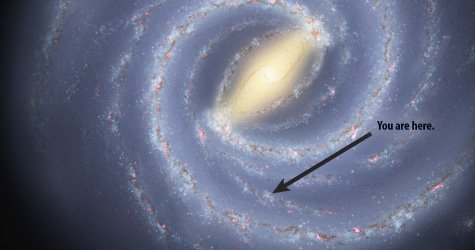
| Image credit: NASA/JPL-Caltech |
 |
The Anthropic Principle in secular cosmology is a recognition by scientists that the Universe appears to be just right for life, and specifically, humans.1 Stephen Battersby, writing in New Scientist, discusses the anthropic principle and our “Goldilocks universe,” asking, “Why does the universe have properties that are ‘just right’…?”2 In the words of Princeton professor emeritus and theoretical physicist Freeman Dyson, “As we look into the universe and identify the many accidents of physics and astronomy that have worked together to our benefit, it almost seems as if the universe must in some sense have known that we were coming.”3 Bottom line: the Universe appears to be designed for us to live in it.
Atheistic philosopher Paul Ricci summed up the Teleological Argument for the Existence of God well when he said, “[I]t’s true that everything designed has a designer…. ‘Everything designed has a designer’ is an analytically true statement.”4 There are an infinite number of examples of design that present themselves to us when we study the natural realm—a problem for Ricci and his atheistic colleagues, to be sure. While we typically examine evidences of design on Earth and our solar system, when we look at the design in the Universe as a whole, the number of evidences increases.
Naturalists: “The Universe Looks Designed!”
Consider the following points in addition to the many specific examples of design we see in the Universe. It is one thing for theists to provide positive evidences for the existence of design in the Universe, but it makes the job much simpler for theists when naturalists themselves admit evidences for design. A positive acknowledgement from hostile witnesses is powerful testimony to the truth of the theists’ position.
According to cosmologist Bernard Carr of Queen Mary University in London, when the evidence in the Universe is examined, a supernatural explanation is demanded. He warned cosmologists to accept the inevitable implications of the evidence: “If you don’t want God, you’d better have a multiverse.”5 The multiverse has, therefore, been latched onto by many naturalists to try to explain away the “difficulties” facing physicists without resorting to God. Among other issues with the multiverse idea: (1) belief in the multiverse is belief in unseen realms beyond the known, natural Universe—i.e., belief in the supernatural. How can a person be a “naturalist” and yet believe in a supernatural realm? (2) there is absolutely no evidence for the existence of the multiverse.6 Theoretical physicist, faculty member at the Perimeter Institute for Theoretical Physics, and adjunct Professor of Physics at the University of Waterloo, Lee Smolin, said, “We had to invent the multiverse,”7 and according to Lawson Parker, writing in National Geographic, it was from our “imagination.”8 The use of our imagination to determine where we came from certainly sounds like today’s “science” is moving ever further into the realm of fiction.
What kind of “difficulties” are physicists encountering that are forcing them to conclude that something outside of the Universe exists, and therefore, that they need to “invent” the multiverse to avoid God? Many have articulated well the problem. Read on to see a great lesson by naturalists on the need for a supernatural Designer of the Universe.
According to Tim Folger, writing in Discover magazine, “The idea that the universe was made just for us—known as the anthropic principle—debuted in 1973.”9 Since then, the mountain of evidence supporting the principle has drastically grown in elevation. Consider the following examples:10
- In a 2011 article, under the heading “Seven Questionable Arguments” for the multiverse, cosmologist George F.R. Ellis of the University of Cape Town, co-author with Stephen Hawking of the book The Large Scale Structure of Space-Time, discussed argument number four: “A remarkable fact about our universe is that physical constants have just the right values needed to allow for complex structures, including living things…. I agree that the multiverse is a possible valid explanation for [fine tuning examples—JM]…; arguably, it is the only scientifically based option we have right now. But we have no hope of testing it observationally.”11 [Notice that the multiverse is “the only scientifically based option,” and yet “we have no hope of testing it observationally.” Doesn’t the inability to test observationally make the theory unscientific?]
- By 2014, Ellis and Professor of Physics and Astronomy at Johns Hopkins University Joseph Silk went even further:
The multiverse is motivated by a puzzle: why fundamental constants of nature, such as the fine-structure constant that characterizes the strength of electromagnetic interactions between particles and the cosmological constant associated with the acceleration of the expansion of the Universe, have values that lie in the small range that allows life to exist…. Some physicists consider that the multiverse has no challenger as an explanation of many otherwise bizarre coincidences. The low value of the cosmological constant—known to be 120 factors of 10 smaller than the value predicted by quantum field theory—is difficult to explain, for instance.12
- John Rennie, the editor for Scientific American, noted, “The basic laws of physics work equally well forward or backward in time, yet we perceive time to move in one direction only—toward the future. Why?”13 Cosmologist and Professor of Physics at California Institute of Technology Sean Carroll, along the same lines, noted that “[i]f the observable universe were all that existed, it would be nearly impossible to account for the arrow of time in a natural way.”14 Apparently, according to naturalists, Something beyond the “observable universe” exists.
- According to Smolin,
Everything we know suggests that the universe is unusual. It is flatter, smoother, larger and emptier than a “typical” universe predicted by the known laws of physics. If we reached into a hat filled with pieces of paper, each with the specifications of a possible universe written on it, it is exceedingly unlikely that we would get a universe anything like ours in one pick—or even a billion. The challenge that cosmologists face is to make sense of thisspecialness. One approach to this question is inflation—the hypothesis that the early universe went through a phase of exponentially fast expansion. At first, inflation seemed to do the trick. A simple version of the idea gave correct predictions for the spectrum of fluctuations in the cosmic microwave background. But a closer look shows that we have just moved the problem further back in time. To make inflation happen at all requires us to fine-tune the initial conditions of the universe.15
- Tim Folger quotes cosmologist and Professor of Physics at Stanford University Andrei Linde in Discover magazine:
“We have a lot of really, really strange coincidences, and all of these coincidences are such that they make life possible,” Linde says. Physicists don’t like coincidences. They like even less the notion that life is somehow central to the universe, and yet recent discoveries are forcing them to confront that very idea…. Call it a fluke, a mystery, a miracle. Or call it the biggest problem in physics. Short of invoking a benevolent creator, many physicists see only one possible explanation: Our universe may be but one of perhaps infinitely many universes in an inconceivably vast multiverse…. Advocates argue that, like it or not, the multiverse may well be the only viable non-religious explanation for what is often called the “fine-tuning problem”—the baffling observation that the laws of the universe seem custom-tailored to favor the emergence of life…. [Andrei Linde:] “And if we double the mass of the electron, life as we know it will disappear. If we change the strength of the interaction between protons and electrons, life will disappear. Why are there three space dimensions and one time dimension? If we had four space dimensions and one time dimension, then planetary systems would be unstable and our version of life would be impossible. If we had two space dimensions and one time dimension, we would not exist,” he says…. [I]f there is no multiverse, where does that leave physicists? “If there is only one universe,” Carr says, “you might have to have a fine-tuner. If you don’t want God, you’d better have a multiverse.”16
- Stuart Clark and Richard Webb, writing in New Scientist, said,
We can’t explain the numbers that rule the universe…the different strengths of weak, strong and electromagnetic forces, for example, or the masses of the particles it introduces…. Were any of them to have even marginally different values, the universe would look very different. The Higgs boson’s mass, for example, is just about the smallest it can be without the universe’s matter becoming unstable. Similar “fine-tuning” problems bedevil cosmology…. Why is the carbon atom structured so precisely as to allow enough carbon for life to exist in the universe.17
- Theoretical physicist and professor at Columbia University Brian Greene, commenting on Professor of Theoretical Physics at Stanford University Leonard Susskind’s thinking about the multiverse, said,
[The] multiverse is a highly controversial schema, and deservedly so. It not only recasts the landscape of reality, but shifts the scientific goal posts. Questions once deemed profoundly puzzling—why do nature’s numbers, from particle masses to force strengths to the energy suffusing space, have the particular values they do?—would be answered with a shrug…. Most physicists, string theorists among them, agree that the multiverse is an option of last resort…. Looking back, I’m gratified at how far we’ve come but disappointed that a connection to experiment continues to elude us.18
- Mary-Jane Rubenstein, writing in New Scientist, said,
Here’s the dilemma: if the universe began with a quantum particle blipping into existence, inflating godlessly into space-time and a whole zoo of materials, then why is it so well suited for life? For medieval philosophers, the purported perfection of the universe was the key to proving the existence of God. The universe is so fit for intelligent life that it must be the product of a powerful, benevolent external deity. Or, as popular theology might put it today: all this can’t be an accident. Modern physics has also wrestled with this “fine-tuning problem,” and supplies its own answer. If only one universe exists, then it is strange to find it so hospitable to life, when nearly any other value for the gravitational or cosmological constants would have produced nothing at all. But if there is a “multiverse” of many universes, all with different constants, the problem vanishes: we’re here because we happen to be in one of the universes that works. No miracles, no plan, no creator.19
- The eminent atheistic, theoretical physicist, cosmologist, and astrobiologist of Arizona State University, Paul Davies, said, “How did stupid atoms spontaneously write their own software…?”20 In a more extensive discourse on the subject in The New York Times, Davies said,
[W]here do these laws come from? And why do they have the form that they do?When I was a student, the laws of physics were regarded as completely off limits. The job of the scientist, we were told, is to discover the laws and apply them, not inquire into their provenance. The laws were treated as “given”—imprinted on the universe like a maker’s mark at the moment of cosmic birth—and fixed forevermore…. Over the years I have often asked my physicist colleagues why the laws of physics are what they are. The answers vary from “that’s not a scientific question” to “nobody knows.” The favorite reply is, “There is no reason they are what they are—they just are.” The idea that the laws exist reasonlessly is deeply anti-rational. After all, the very essence of a scientific explanation of some phenomenon is that the world is ordered logically and that there are reasons things are as they are. If one traces these reasons all the way down to the bedrock of reality—the laws of physics—only to find that reason then deserts us, it makes a mockery of science. Can the mighty edifice of physical order we perceive in the world about us ultimately be rooted in reasonless absurdity? If so, then nature is a fiendishly clever bit of trickery: meaninglessness and absurdity somehow masquerading as ingenious order and rationality…. Clearly, then, both religion and science are founded on faith—namely, on belief in the existence of something outside the universe, like an unexplained God or an unexplained set of physical laws.21
In conclusion, Davies highlighted the fact that naturalists have a blind faith when assuming that the laws of science could create themselves free from an “external agency”: “[U]ntil science comes up with a testable theory of the laws of the universe, its claim to be free of faith is manifestly bogus.”22 Bottom line: there must be a rational origin of the laws of science, and there is no natural explanation for them.
In a 2014 interview with Scientific American, George Ellis gave a stinging response to theoretical physicist Lawrence Krauss of Arizona State University, who argues in his book, A Universe from Nothing, that physics has ultimately answered the question of why there is something rather than nothing. Among other criticisms, Ellis said,
And above all Krauss does not address why the laws of physics exist, why they have the form they have, or in what kind of manifestation they existed before the universe existed (which he must believe if he believes they brought the universe into existence). Who or what dreamt up symmetry principles, Lagrangians, specific symmetry groups, gauge theories, and so on? He does not begin to answer these questions.23
Quantum physicist Michael Brooks agreed with Ellis in his criticisms of Krauss’ book. Writing in New Scientist, he said, “[T]he laws of physics can’t be conjured from nothing…. Krauss contends that the multiverse makes the question of what determined our laws of nature ‘less significant.’ Truthfully, it just puts the question beyond science—for now, at least.”24 The laws of science are evidence of a supernatural Mind—a grand Law Writer.
- In Expelled: No Intelligence Allowed, Richard Dawkins said concerning the possibility of intelligent design:
It could be that at some earlier time, somewhere in the Universe, a civilization evolved by, probably, some kind of Darwinian means, to a very, very high level of technology, and designed a form of life that they seeded onto, perhaps, this planet. Now that is a possibility, and an intriguing possibility. And I suppose it’s possible that you might find evidence for that, if you look at the details of our chemistry, molecular biology, you might find a signature of some kind of designer. And that designer could well be a higher intelligence from elsewhere in the Universe.25
So, according to Dawkins, when we look at our chemistry—our molecular biology—(1) there could be evidence of design there, and (2) that design would imply the existence of a designer—a direct admission of the validity of the Teleological Argument. Granted, Dawkins does not directly endorse God as that Designer. Instead, he irrationally postulates the existence of aliens.
Ultimately, since there is no evidence for the existence of aliens, there can hardly be any evidence for their establishing life on Earth. Such an idea can hardly be in keeping with the evolutionist’s own beliefs about the importance of direct observation and experiment in science. Such a theory does nothing but tacitly admit (1) the truth of the Law of Biogenesis—in nature, life comes only from life (in this case, aliens); and (2) the necessity of a creator/designer in the equation.
However, notice: since aliens are beings of nature, they too must be governed by the laws of nature. Stephen Hawking acknowledged that the laws of physics “are universal. They apply not just to the flight of the ball, but to the motion of a planet and everything else in the Universe.”26 Evolutionary physicist Victor Stenger submitted his belief that the “basic laws” of science “hold true in the most distant observed galaxy and in the cosmic microwave background, implying that these laws have been valid for over thirteen billion years.”27 In the interview with Stein, Dawkins went on to say concerning the supposed alien creators, “But that higher intelligence would, itself, had to have come about by some ultimately explicable process. It couldn’t have just jumped into existence spontaneously.”28 So, the alien creators, according to Dawkins, have been strapped with the laws of nature as well. Thus, the problem of abiogenesis is merely shifted to the alien’s abode, where the question of the origin of life must still be answered.
Bottom line: life is evidence of design, and by implication, an intelligent designer. Writing in New Scientist, Dawkins admitted, “The more statistically improbable a thing is, the less we can believe that it just happened by blind chance. Superficially the obvious alternative to chance is an intelligent Designer.”29 Sadly, the atheist simply cannot bring himself to accept the clear cut, “obvious alternative” that is staring him in the face.
Notice: Physicists cannot help but acknowledge the evidence that undergirds the Teleological Argument for the existence of God. The Universe seems to have been perfectly designed—with detailed fine-tuning—just for us. Design demands a designer. Resorting to belief in the multiverse is a concession by naturalists that we have been right all along: there exists an “unseen realm.” But rather than concede God, naturalists invent the evidence-less, imaginary multiverse. Ironically, all the while, the multiverse is itself a supernatural option—albeit, one without any rules concerning how we should behave, making it attractive to many.
Naturalists: “The Design Around Us is Amazing—Let’s Copy It.”
One area of scientific study where scientists are, many times unconsciously but forcefully, admitting the presence of design in the Universe, is in the field of biomimetics, or biomimcry—as well as the related field known as bio-inspired design. Biomimicry is an attempt to engineer something—design something—using the natural world as the blue print. Engineers are becoming more and more aware of the fact that the world around us is already filled with fully functional, superior designs in comparison to what the engineering community has been able to develop to date.
The Web page for George Washington University’s Center for Biomimetics and Bioinspired Engineering admits, “[D]espite our seeming prowess in these component technologies, we find it hard to outperform Nature in this arena; Nature’s solutions are smarter, more energy-efficient, agile, adaptable, fault-tolerant, environmentally friendly and multifunctional. Thus, there is much that we as engineers can learn from Nature as we develop the next generation machines and technologies.”30
It would be difficult to better summarize the decisive evidence for design that is clearly evident to professional designers (engineers) when they look at the natural realm. This same mindset about nature’s design, however, is becoming widespread in the engineering community. So consequently, biomimicry is becoming a major engineering pursuit. The field of biomimicry is growing by leaps and bounds, with research centers being established all over the world, with their express purpose being to mimic the design of nature.
Some engineers are going even further. Realizing that nature’s designs are so impressive that many times we simply cannot mimic them, they are attempting instead to control nature to use it as they wish, rather than mimic it.31 Animals, for instance, possess amazing detection, tracking, and maneuvering capabilities which are far beyond the knowledge of today’s engineering minds, and likely will be for many decades, if not forever. An insect neurobiologist, John Hildebrand, from the University of Arizona in Tucson, admitted, “There’s a long history of trying to develop microrobots that could be sent out as autonomous devices, but I think many engineers have realised [sic] that they can’t improve on Mother Nature.”32 Of course, “Mother Nature” is not capable of designing anything, since “she” is mindless—but notice that the desire to personify nature and give it design abilities is telling. While mindless nature has no ability to design anything, the Chief Engineer, the God of the Bible, on the other hand, can be counted on to have the best possible engineering designs. Who, after all, could out-design the Grand Designer? In spite of the deterioration of the world and the entrance of disease and mutations into the created order, after several millennia, His designs still stand out as the best—unsurpassed by human wisdom.
Do not miss the implication of practicing biomimicry and autonomous biological control. They are a tacit concession by the scientific community that nature exhibits design. Engineers are the designers of the scientific community. When we engage in biomimicry, we are, whether consciously or not, endorsing the concept that there is design in nature. It would be totally senseless to try to design something useful by mimicking something that was random and chaotic. For the highly educated, brilliant designers of the scientific community to copy nature, proves that nature must be much more than the product of random chance and accidents.33
Design Without a Designer?
Famous skeptic and science writer Michael Shermer, who has a monthly column in Scientific American, admitted that “we perceive nature to be intelligently designed.”34 To most people, the preponderance of evidence makes that design conclusion obvious. Shermer said, “Since the most common reason people give for why they believe in God is the good design of the world, Intelligent Design creationists are tapping into the intuitive understanding most people hold about life and the universe.”35 The acknowledgement of universal design is so widespread that well-known British evolutionary biologist Richard Dawkins even admitted, “It is almost as if the human brain were specifically designed to…find [Darwinism] hard to believe.”36 Psychologist Paul Bloom of Yale University and University of Pennsylvania acknowledged, “There is by now a large body of research suggesting that humans are natural-born creationists. When we see nonrandom structure and design, we assume that it was created by an intelligent being.”37 We can’t help it, of course; as rational beings we must concede that the available evidence indicates that “nonrandom structure and design” are, without exception, the products of a designer.
With that in mind, a casual perusal of nearly any article by evolutionary biologists that discusses the complexity of various species reveals that they cannot help but intuitively acknowledge a designer. Such writings are riddled with the term “design,” apparently without the naturalistic writers following out the implications of that term. Phrases like, “This feature of the salamander is designed to do this,” are common place. Is it not true that the moment one acknowledges the existence of design, he is admitting the existence of a designer at some point—just as acknowledging a poem implies the existence of a poet? We simply cannot escape the evidence for design in nature and the reasoning ability that God has put within us that presses us to acknowledge His existence, ensuring that those who wish to find Him will (Acts 17:26-28).
Some atheists have apparently noticed the tendency of naturalists to use such terminology. So, rather than try to rectify atheistic terminology, they embrace it and simply try to redefine the word “design.” Kenneth Miller is an evolutionary biologist at Brown University and co-author of the popular Prentice Hall high school biology textbook that is used extensively in the United States. In his 2008 book, Only a Theory: Evolution and the Battle for America’s Soul, he admits that structural and molecular biologists, as they study the natural order, routinely mention the presence of design in their explorations. He, himself, though a naturalist, admits that the human body shows evidence of design, pointing out examples like the design of the ball and socket joints of the human hips and shoulders, and the “s” curve of the human spine that allows us to walk upright. In spite of such admissions, he irrationally claims that they should not be considered to be self-defeating for naturalists. According to Miller, the evidence for design in nature should be embraced. In an article published by Brown University, he said, “There is, indeed, a design to life—an evolutionary design.”38 Merriam-Webster defines an oxymoron as “a combination of contradictory or incongruous words (such as cruel kindness).”39 Another example: “naturalistic evolutionary design.”
If there is a painting, there must have been a painter. If there is a fingerprint, there must have been a finger that made it. If there is a building, there must have been a builder. If there is an engine, there must have been an engineer. If there is a creation of some sort, there must have been a creator for it. And if there is design, there must have been a…. If a person completes that sentence with any other word besides “designer,” is he not being the epitome of irrational? While we understand Miller’s dilemma as a naturalist and his desire to find a way to dismiss the incessant, forceful, ironic admissions of design by his naturalistic colleagues, he must attempt to do so through some other avenue besides merely attempting to redefine the word “design” in such a way that it does not require intent and purpose—a mind.
The silliness of irrationally postulating that the clearly designed Universe could have designed itself through evolution has not been lost to many in the engineering community. Typically, in the first semester of engineering school, an introductory course presents broad concepts about engineering. Students may learn the basic differences in the engineering fields (e.g., civil, electrical, mechanical, chemical, structural, etc.). They may spend some time considering ethical dilemmas that engineers have often faced in their careers. First-year students also usually give consideration to the design process. Even in its basic form, the design process proves to be very complex, even before considering the specialized scientific knowledge required to design a given item.
Many steps are necessary in order to get a product to the public. Consider one introductory engineering textbook’s template for the design process:40
1. Problem symptom or expression; definition of product need; marketing information
2. Problem definition, including statement of desired outcome
3. Conceptual design and evaluation; feasibility study
4. Design analysis; codes/standards review; physical and analytical models
5. Synthesis of alternative solutions (back to design analysis for iterations)
6. Decision (selection of one alternative)
7. Prototype production; testing and evaluation (back to design analysis for more iterations)
8. Production drawings; instruction manuals
9. Material specification; process and equipment selection; safety review
10. Pilot production
11. Production
12. Inspection and quality assurance
13. Packaging; marketing and sales literature
14. Product
The design process is unquestionably lengthy, technical, complex, and calculated. To claim that an efficient design could be developed without a designer is insulting to the engineering community. Where there is design—complexity, purpose, planning, intent—there is a designer.
Conclusion
Truly, the Universe is replete with decisive evidences of design. So much so, that even atheists cannot help but concede that truth. It is noteworthy that leading naturalists are unwilling to suggest that the laws of nature could create themselves.
- Physicists know there must be a supernatural origin for physics laws.41
Similarly, more and more leading scientists are acknowledging that the existence of life is no accident either.
- Biologists know there must be an intelligence behind it.42
- Engineers are so awed by the clear-cut evidences for design on the Earth that they have developed entire centers devoted to biomimicry—copying the designs that are evident in nature, effectively plagiarizing the work of God when they fail to give Him due credit as the Chief Engineer.
- Cosmologists gush with incredulity when they see the perfection of the created order as well, knowing that the “fine-tuning”43 that is evident in the Universe seems to have resulted in it being “custom tailored”44 for humans.
But how can there be “fine-tuning” if no One exists to tune in the first place? How can the Universe be “custom tailored,” and yet there be no Tailor? The Anthropic Principle—defined by cosmologists—is a blatant admission by the naturalistic community that theists have been right all along: the Universe is replete with evidences of design. If one is to be rational—drawing appropriate conclusions from the evidence—he must recognize that there are implications to realizing that the Universe is finely tuned and tailor made. The design in the Universe demands the existence of a Universal Designer and, further, the Universe was designed, specifically, with humans in mind.
Endnotes
1 Robert Lamb (2010), “What Is the Anthropic Principle?” HowStuffWorks, https://science.howstuffworks.com/science-vs-myth/everyday-myths/anthropic-principle.htm.
2 Stephen Battersby (2006), “Top 10: Weirdest Cosmology Theories,” New Scientist, August 9.
3 Freeman J. Dyson (1971), “Energy in the Universe,” Scientific American, 224[3]:59.
4 Paul Ricci (1986), Fundamentals of Critical Thinking (Lexington, MA: Ginn Press), p. 190.
5 As quoted in Tim Folger (2008), “Science’s Alternative to an Intelligent Creator: the Multiverse Theory,” DiscoverMagazine.com, November 10, http://discovermagazine.com/2008/dec/10-sciences-alternative-to-an-intelligent-creator.
6 cf. Jeff Miller (2017), “7 Reasons the Multiverse Is Not a Valid Alternative to God [Part I],” Reason & Revelation, 37[4]:38-47, http://apologeticspress.org/pub_rar/37_4/1704w.pdf.
7 Lee Smolin (2015), “You Think There’s a Multiverse? Get Real,” New Scientist, 225[3004]:25, January 17.
8 Lawson Parker (2014), “Cosmic Questions,” National Geographic, 225[4], April, center tearout.
9 Folger, emp. added.
10 Much of the following material appeared also in Jeff Miller (2017), “Atheists’ Design Admissions,” Reason & Revelation, 37[12]:134-143, http://apologeticspress.org/apPubPage.aspx?pub=1&issue=1261.
11 George F.R. Ellis (2011), “Does the Multiverse Really Exist?” Scientific American, 305[2]:42.
12 George Ellis and Joe Silk (2014), “Defend the Integrity of Physics,” Nature, 516[7531]:322, December, emp. added.
13 “Editor’s Note” in Sean M. Carroll (2008), “The Cosmic Origins of Time’s Arrow,” Scientific American, 298[6]:48, June.
14 Sean M. Carroll (2008), “The Cosmic Origins of Time’s Arrow,” Scientific American, 298[6]:57, June.
15 Smolin, p. 24, emp. added.
16 Folger, emp. added.
17 Stuart Clark and Richard Webb (2016), “Six Principles/Six Problems/Six Solutions,” New Scientist, 231[3092]:33, emp. added.
18 Brian Greene (2015), “Why String Theory Still Offers Hope We Can Unify Physics,” Smithsonian Magazine, January, http://www.smithsonianmag.com/science-nature/string-theory-about-unravel-180953637/?no-ist, emp. added.
19 Mary-Jane Rubenstein (2015), “God vs. the Multiverse,” New Scientist, 228[3052/3053]:64, December 19/26, emp. added.
20 Paul Davies (1999), “Life Force,” New Scientist on-line, 163[2204]:26-30, September 18.
21 Paul Davies (2007), “Taking Science on Faith,” The New York Times, November 24, emp. added, http://www.nytimes.com/2007/11/24/opinion/24davies.html?_r=0.
22 Ibid.
23 As quoted in John Horgan (2014), “Physicist George Ellis Knocks Physicists for Knocking Philosophy, Falsification, Free Will,” Scientific American Blog Network, July 22, emp. added, http://blogs.scientificamerican.com/cross-check/physicist-george-ellis-knocks-physicists-for-knocking-philosophy-falsification-free-will/.
24 Michael Brooks (2012), “The Paradox of Nothing,” New Scientist, 213[2847]:46, January 11, emp. added.
25 Ben Stein and Kevin Miller (2008), Expelled: No Intelligence Allowed (Premise Media), emp. added.
26 “Curiosity…,” emp. added.
27 Victor J. Stenger (2007), God: The Failed Hypothesis (Amherst, NY: Prometheus Books), p. 115.
28 Stein and Miller, emp. added.
29 Richard Dawkins (1982), “The Necessity of Darwinism,” New Scientist, 94:130, April 15, emp. added.
30 “Center for Biomimetics and Bioinspired Engineering: COBRE” (2012), George Washington University, emp. added, http://cobre.seas.gwu.edu/.
31 Jeff Miller (2011), “Autonomous Control of Creation,” Reason & Revelation, 31[12]:129-131.
32 J. Marshall (2008), “The Cyborg Animal Spies Hatching in the Lab,” New Scientist, 2646:41, March 6.
33 For specific examples of biomimicry and bio-inspired engineering, see http://apologeticspress.org/APContent.aspx?category=12&topic=66.
34 Michael Shermer (2007), Why Darwin Matters: The Case Against Intelligent Design (New York, NY: Henry Holt), Kindle edition, p. 61.
35 Ibid. pp. 39-40.
36 Richard Dawkins (1986), The Blind Watchmaker (New York: W.W. Norton), p. xi.
37 Paul Bloom (2009), “In Science We Trust: Beliefs About the Natural World that are Present in Infancy Influence People’s Response to Evolutionary Theory,” Natural History Magazine, 118[4]:18-19.
38 As quoted in: Brown University (2008), “There is ‘Design’ in Nature, Biologist Argues,” ScienceDaily, http://www.sciencedaily.com/releases/2008/02/080217143838.htm.
39 “Oxymoron” (2017), Merriam-Webster On-line, https://www.merriam-webster.com/dictionary/oxymoron/.
40 cf. Introduction to Engineering at Auburn University: Manufacturing—Industrial and Systems Engineering (2004), (Boston, MA: Pearson Custom Publishing), pp. 10,32.
41 cf. Miller, 2017.
42 cf. Jeff Miller (2013), “Directed Panspermia and Little, Green (Non-Existent) Men from Outer Space,” Apologetics Press, http://apologeticspress.org/APContent.aspx?category=9&article=4620&topic=93.
43 Folger; Clark and Webb, p. 33; Rubenstein, p. 64.
44 Folger.
 |
 |
| Suggested Resources | |
The post The Anthropic Principle: The Universe Is Designed for Us appeared first on Apologetics Press.
]]>The post Science vs. the Big Bang & Evolution: A Concise Look appeared first on Apologetics Press.
]]>[NOTE: The following article is a special section within the Apologetics Press study Bible, currently scheduled to be released in 2020. In order to stay in keeping with the “concise” approach, the typical references have been omitted. The reader is referred to our Web site and monthly journal Reason & Revelation for citation of the many relevant articles on these subjects.]
Many within Christendom have attempted to create compatibility between naturalistic evolution (i.e., cosmic evolution—the Big Bang Theory plus Darwinian Evolution) and Scripture. Before even spending time attempting to reconcile Scripture with such theories, however, one should first consider whether evolution is even a rational scientific theory to begin with—supported by the evidence.
According to the Big Bang Theory, all matter and energy that comprise the Universe were originally in an infinitely dense “spec” (a singularity) roughly 14 billion years ago. That “cosmic egg” expanded faster than the speed of light for well less than one second (i.e., “inflation”), and now continues to expand indefinitely. Particles began forming in the first few seconds, atoms after 380,000 years, the first stars after 200-300 million years, and our solar system and Earth roughly nine billion years later.
According to the secular model, some 800 million years later (3.8 billion years ago), life sprang into existence on Earth and Darwinian evolution began. The initial single-celled organisms eventually evolved into multicellular organisms (and the earliest plants), which eventually evolved into invertebrates, which then evolved into vertebrates. Vertebrate fish evolved into amphibians, then reptiles, which gave rise to dinosaurs and mammals. Dinosaurs evolved into birds, and mammals ultimately evolved into primates. The genus homo, within the primate group, arrived some 2-3 million years ago, ultimately evolving into humans.
There are many problems with this “just so” story as proposed by naturalists. Here are 15 of them, some of which apply to naturalistic evolution exclusively, and some to both naturalistic and “supernaturalistic” evolution:
- The origin of laws of science: At the heart of science is man’s discovery of the laws of nature that govern the Universe, telling it how to behave. These laws exist, and yet there is absolutely no evidence from nature that such laws can “write” themselves into existence. One cannot be a naturalist and believe such a thing happens, since there is no evidence that such a thing could happen in nature. To believe that the laws of science could write themselves would require a blind “faith.”
- The origin of matter/energy: Not only would the laws that govern the Universe have to create themselves, but the physical material of the Universe would have to either be eternal or create itself. The Big Bang model asserts that the Universe began with all matter/energy in one place and it rapidly expanded eventually forming the Universe. Those who believe the matter of the Universe was the result of a quantum fluctuation must also believe in a quantum field of energy that “fluctuated.” No naturalistic model explains the origin of all matter/energy, but rather, what happened to that already existing material at the beginning. Again, upon examination of the scientific evidence from the natural realm, one discovers three relevant laws of science which prohibit a natural origin of the Universe. The First Law of Thermodynamics indicates that in nature, matter and energy do not create themselves from nothing. Energy can be converted into matter (and vice versa), but the sum total amount of matter/energy in the Universe must be constant. Either matter/energy in the natural realm were created by Something outside of the natural realm, or matter/energy are eternal. Few cosmologists today would accept the latter in light of the findings of the Second Law of Thermodynamics—entropy happens. We are steadily running out of usable energy—that is, the Universe is “wearing out” or “running down,” implying that it could not have existed forever or we would long since have exhausted all usable energy and be in a state of Universal heat death. The Law of Causality—perhaps the most fundamental of all scientific laws—indicates that every effect that we see in the natural realm always has a cause. Since the Universe is an effect, it requires a cause. Since matter/energy could not exist forever or create itself in a natural way, the Cause must be outside of (i.e., super-) nature.
- The Horizon/Flatness problems: Several decades ago cosmologists observed that the entire Universe appears to have the same temperature, implying that there had to be sufficient time for every location in the Universe to have exchanged its energy with other locations and come to equilibrium. Some places in the Universe, however, are too far from each other to have had time to exchange their energy if the Big Bang model is correct. This problem has been termed the Horizon problem. Further, based on the Big Bang model, if the Universe is billions of years old, when we examine the composition of energy in the Universe, the ratio of gravitational potential energy to kinetic energy in the Universe (i.e., Ω) should be either zero or enormous if the Universe is as old as is claimed. The evidence, however, indicates that Ω is estimated to be close to the very unlikely number one, making the Universe very close to “flat” in curvature (rather than “closed” or “open”). That discovery would seem to imply that either the Universe is not actually billions of years old, or that Ω was initially exactly one to within 15 significant figures—an occurrence so unlikely that it would appear that the Universe was finely tuned (i.e., designed).
- A lack of evidence for inflation: Inflation was invented, in part, to resolve the Horizon and Flatness problems and yet, to date, there is absolutely no evidence for inflation. Even if it were true, other problems would exist, such as what caused inflation and what caused it to stop? Although inflation is essential for the Big Bang model, accepting it amounts to grasping an irrational blind “faith,” and ironically, leading naturalistic cosmologists acknowledge that fact. Inflation theory is not science.
- A lack of evidence for dark energy: Big Bang theorists see the evidence for Universal expansion—a key observation undergirding the theory—but cannot (with their model) explain why the expansion of space appears to be accelerating, rather than decelerating, as would be expected based on the Big Bang model. In an attempt to be consistent with the blind “faith” theme of modern cosmology, dark energy was invented to attempt to explain the accelerated expansion. An enormous “fudge factor,” so to speak, was added to the cosmological equation. Presumably, an unknown, unobserved and possibly unobservable energy in space—an energy thought to make up 73% of the Universe, but which we do not know exists—is driving the accelerated expansion. The Big Bang model does not adequately explain the evidence.
- The smoothness problem: The Big Bang model relies on the fundamental assumption known as the Cosmological Principle—the idea that the Universe is uniform and homogeneous (i.e., spread out evenly). Once again, however, the actual observable evidence indicates that the Universe is not smooth, but rather, is “clumpy” (e.g., there exist stars, galaxies, clusters of galaxies, etc. that clump rather than spread out). The Universe is characterized by deviations from homogeneity. The Universe should be smooth if the Big Bang is true, but it is not.
- Missing antimatter: Energy can be transformed into matter, according to the First Law of Thermodynamics, but when it happens, an equal amount of antimatter (basically normal matter with a reversed charge on its particles) is always produced—without exception according to the laboratory evidence. So if the Big Bang is true and energy was transformed into all of the matter of the Universe at the beginning, there should have been an equal amount of matter and antimatter produced—but there clearly was not, or else when the two touched, they would have been immediately destroyed, releasing their energy. Today the Universe is virtually completely composed of regular matter. (Apparently the Big Bang did not occur.)
- The Fermi Paradox: If the Big Bang model is true, it would be inconceivable that other life—even advanced life—does not exist somewhere in the Universe with its billions of stars and even, presumably, more planets. Such life should have long ago colonized our region of the Universe, and yet there is absolutely no evidence for the existence of extraterrestrials. If one predicts that aliens should exist and should have been noticed by humans by now if the Big Bang Theory is true and that prediction fails upon examining the evidence, then the Big Bang Theory has been effectively falsified by the evidence.
- The Anthropic Principle: The “Anthropic Principle” is the term used by leading cosmologists to describe the incredibly fine-tuned nature of the Universe. Mounting evidence indicates that it seems to have been perfectly designed for life on Earth to exist. In order to by-pass the supernatural implication of the scientific evidence for design (i.e., that there must be a Designer for the Universe), many cosmologists are suggesting that our Universe is one of an infinite number within a “multiverse,” and we “happen” to live in the right one. Other cosmologists, however, point out that such a hypothesis not only requires a blind faith (having no evidence to support it, making it irrational), but it merely “moves the goal posts.” The sleight-of-hand only begs the question: what would cause the multiverse to exist—God?
- Origin of life: Even if the Big Bang happened, at some point, non-living substances had to spontaneously come to life. When we examine the evidence, however, we find that in nature, life always and exclusively comes from life—a fundamental biological rule known as the Law of Biogenesis. In order to be a naturalist, one must ignore the mountain of scientific evidence for biogenesis and blindly believe that something unnatural occurred at least once (i.e., abiogenesis). In short, one must cease to be a naturalist and become a super-naturalist like us. The problem of the first life spontaneously animating, however, is greater than is perhaps often considered. The first organism could not be simple, since it required an operating program to control its functions and also had to be equipped with a replication system, or its death would have promptly ended its evolutionary journey before it began. Absolutely no evidence exists that such a “just so” story could occur.
- Darwinian evolution (i.e., macroevolution) lacks solid evidence: After the hypothetical, original life spontaneously animated, Darwinists contend that it eventually evolved into all forms of life we see today. In order for a theory to be rational, however, it must have sufficient evidence to support it. Upon examination of the alleged evidences for evolution, however, they are found, without exception, to be either erroneous (e.g., alleged embryonic recapitulation; horse and whale evolution in the fossil record; vestigial organs and genes; transitional forms; human/chimp chromosome fusion; mitochondrial DNA; and radio-isotope dating techniques); irrelevant (e.g., natural selection, which explains the survival of the fittest, not their arrival; geographic distribution; evidences of microevolution, like “Darwin’s finches,” English peppered moths, the evolution of bacterial antibiotic resistance, epigenetics, and fruit fly evolution, which represent mere diversification within already existing kinds rather than evidence of evolution across phylogenic boundaries into distinctly different kinds of creatures); or inadequate (e.g., homologous structures and genetic similarities). Macroevolution is found to be merely a wishful dream conjured by naturalists, rather than a conclusion warranted by the actual scientific evidence.
- Origin of genetic information: A single-celled organism is substantially different from a human being, genetically speaking. In order for macroevolution to happen—evolving a single-celled organism into a distinctly different organism—nature must have a mechanism to generate new raw material or genetic information in living organisms over time. No such mechanism is known to exist. Rather, the observable evidence indicates that information is always and exclusively the product of a sender or mind. It is not generated spontaneously from nothing. Neo-Darwinists speculate that genetic mutations could be the mechanism that drives change, but according to the observable evidence, genetic mutations do not create new raw material. It’s not rocket science: without a mechanism to evolve a creature, a creature cannot evolve.
- Evidence of common ancestry lacking: A fundamental contention of naturalistic evolution is the proposition “relation through descent from a common ancestor”—all living organisms are related, however distantly. Not only is such a contention contrary to the observable evidence that life comes only from life and that of its kind (i.e., the Law of Biogenesis) and would require a mechanism for change which does not exist, but such a contention would imply that the fossil record should be replete with billions of fossils from the transitional species that link all organisms back to the original single-celled organism. Not only did Darwin himself acknowledge that the fossil record does not reveal that evidence (and admitted that the fossil record is, perhaps, the “most obvious and serious objection” which could be levied against his theory), but leading paleontologists admit it as well. For example, every alleged transitional fossil that has been discovered and attempted to be used as evidence that humans evolved from an ape-like creature has been found to be either fraudulent or inconclusive at best (without exception), even though there should be multiplied millions of those transitional fossils, making macroevolution beyond a doubt, and multiplied billions of the transitional fossils of every other species on the planet as well—a prediction which the fossil record does not bear out. Further, the fossil record is characterized by abrupt appearance of fully formed and functional species, stasis (i.e., little change of the species throughout its tenure in the geologic column, rather than evidence of change into distinctly different species), and then extinction—not evidence of evolution. The Cambrian Explosion at the base of the geologic column effectively constitutes a falsification of evolution, since the many fossilized creatures that are found there appear abruptly, fully formed and functional, exhibit complex design (e.g., the trilobite), and show no evidence of having evolved from previous life forms. Ironically, there is a paucity of fossils that are even alleged to be transitional forms, and they are all vertebrate species, which are known to represent only a minute portion of the complete fossil record (perhaps less than one percent). The bulk of the fossil record, however, is comprised of invertebrate species, and yet no transitional forms among the invertebrates are even known. Bottom line: the fossil record falsifies Darwinian evolution rather than verifying it.
- Uniformitarianism is false: At the heart of every old Earth dating technique (e.g., radioisotope dating techniques, ice core layering analysis, tree ring dating, etc.) is the assumption known as uniformitarianism—the principle that processes and rates currently observed have continued with the same rates and intensity throughout time, implying, for example, that geologic features are explainable by current processes (also implying an old age of the Earth and Universe)—“the present is the key to the past.” Once again, such an assumption does not hold up upon examination of the actual physical evidence. Catastrophic events (e.g., Mount St. Helens volcano eruptions; Mississippi River drainage; rapid canyon erosion from local flooding) are known to speed up “normal” rates and processes. Ironically, even secular geologists now acknowledge that strict uniformitarianism does not hold. The growing theory among secular scientists concerning how the dinosaurs went extinct, for example, involves a massive meteorite that struck the Earth 65 million years ago: a world-wide catastrophic event to be sure. What many geologists appear to ignore, however, is that yielding strict uniformitarianism and accepting catastrophism in any form acknowledges that all old Earth dating techniques could be flawed, since they are all based on the assumption of uniformitarianism.
- Evidence for an old Earth is lacking: In order to allow the time for cosmic evolution to occur, it is argued that the Universe must be many billions of years old. Even if it was true that time would allow cosmic evolution to occur (and there is no evidence that time has the power to bridge the many gaps in evolution that have already been alluded to), there is no solid evidence to substantiate the claim that the Universe is billions of years old. Uniformitarianism, a fundamental assumption of all evolutionary dating techniques and capable, if true, of allowing for billions of years of evolution, has already been shown to be false, and the oft’ cited radioisotope dating techniques are riddled with further erroneous assumptions. Such techniques (e.g., Rubidium-Strontium, Uranium-Lead, Potassium-Argon, and Carbon-14) assume (1) that the nuclear decay rate from parent to daughter isotope has been constant throughout time—a contention which recent scientific evidence has called into question; (2) the specimen being measured is a closed system, never having been affected by any outside force—a contention which has been observed to be illegitimate; and (3) the specimen was originally only comprised of the parent element—an assumption which has been disproved observationally time and again. Those issues are compounded by the many examples that indicate that the Earth is relatively young—far younger than the cosmic evolutionary timeline indicates.1
Conclusion: the many problems with cosmic evolution are not mere bumps in the road. They are uncrossable chasms which effectively falsify naturalism. One cannot believe in naturalism and simultaneously have a rational faith. Rather, his “faith” must be a blind one. In truth, there is no such thing as a naturalist, since every person must believe that something unnatural has occurred at least once (e.g., spontaneous generation of natural laws, matter/energy, life, and genetic information). A naturalist is really a supernaturalist in disguise, one who believes in a modern, “respectable” form of witchcraft—only without the existence of an actual witch to do the magic. The supernatural realm is demanded by the scientific evidence. One need only follow the evidence to arrive at God.
Endnotes
1 Jeff Miller (2019), “21 Reasons to Believe the Earth is Young,” Reason & Revelation, 39[1]:2-11, https://apologeticspress.org/apPubPage.aspx?pub=1&issue=1287.
|
|
| Suggested Resources | |
The post Science vs. the Big Bang & Evolution: A Concise Look appeared first on Apologetics Press.
]]>The post Beautiful Creatures appeared first on Apologetics Press.
]]>Beauty is everywhere we look. We can’t get away from it (even when we want to).



The post Beautiful Creatures appeared first on Apologetics Press.
]]>The post Beauty Everywhere appeared first on Apologetics Press.
]]>Beauty is not only found in God’s animals and humans. It is also found in other living things He created—the plants around us. We need plants to survive, since the oxygen we breathe comes from plants. So God made sure that there are a lot of plants on the planet. But with plants, once again, God showed His love for us in another way. From the emerald green fields of Ireland to the rustic, Fall tree colors of Tennessee, beauty in the plant kingdom is everywhere.
Where do plants get their pretty colors? As with so many of the colors we see in God’s creation, pigments give them their beautiful colors. Chlorophyll (KLOR-oh-fill) is the pigment for green in plants, and other pigments add red, pink, blue, purple, yellow, and orange to the plant “painting.”
On our list of the most beautiful plants on the planet, different species of flowers probably make the list more than any other kinds of plants. Cherry Blossoms in full bloom, Birds of Paradise flowers, Bleeding Hearts, and Water Lilies are all breathtaking to see.
 |
 |
 |
 |
| Cherry Blossoms | Bleeding Heart | Water Lily | Birds of Paradise |
The post Beauty Everywhere appeared first on Apologetics Press.
]]>The post True Beauty appeared first on Apologetics Press.
]]>

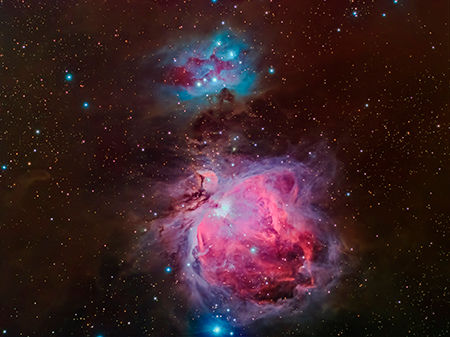
Also, why do you and I even see something as beautiful in the first place? A flower is not beautiful unless you see it as beautiful. So why do you see or hear something as beautiful? Evolutionists do not have a good answer to that question, but creationists do. A loving God exists who wants us to enjoy our life and have pleasure. So He gave us the ability to appreciate beauty.

From the microscope to the telescope, we see that God “made everything beautiful in its time” (Ecclesiastes 3:11). Beauty is not only proof that God exists, but proof of God’s love for us. Did you know that God made you beautiful, too? The most important beauty to have, however, is the beauty that we show the world that comes from inside of us when we live the way God wants us to live (1 Samuel 16:7; 1 Peter 3:4), reflecting the ultimate beauty of the Lord Jesus Christ, Who made beauty.
The post True Beauty appeared first on Apologetics Press.
]]>The post Planet Earth is Just Right appeared first on Apologetics Press.
]]> Suppose there was a boy with a messy room. He wanted it to be clean, so he put all of his clothes, electronic gadgets, and everything else in a huge pile in the middle of the floor. Underneath this pile he shoved a stick of dynamite and lit it. When the dynamite exploded, do you think it would have caused the boy’s clothes to be neatly folded and tucked nicely into their drawers? Would his jackets and hanging clothes have “exploded” onto hangers in his closet, and all his electronic gadgets placed carefully on his desk? Of course not! Huge explosions don’t cause order or design. Huge explosions cause chaos and disorder. It takes an intelligent being to put things together in an orderly way.
People who don’t believe in God say that a huge explosion (called the Big Bang) caused our Universe. The problem with this idea is that our Universe is very organized. In fact, it is put together so well that it runs better than any clock or machine that has ever been designed. An explosion can’t explain how our Universe is put together so well. Let’s look at just how well designed our Universe is.
The Goldilocks Principle
In cosmology (the study of the origin of the Universe) there is something called the Goldilocks Principle. Maybe you remember the story of Goldilocks. She went into the three bears’ house. Everything that she tried of Papa Bear’s did not work for her, and everything she tried of Mama Bear’s did not suit her, but everything she tried of Baby Bear’s was “just right.” That phrase “just right” describes exactly how things in our Universe fit together for humans to live on Earth. Our Universe is “just right” in many different ways.
The Earth’s Perfect Orbit
Many years ago, scientists thought that our Earth went around the Sun in a perfect circle. We have learned this is not true. The Earth actually travels in an ellipse. An ellipse is a round shape that is “flatter” than a circle. That means that all the points of an ellipse are not the exact same distance from the center as they are in a circle. It just so happens that the Earth’s elliptical orbit is perfect for life to exist. The Earth departs from a straight line about 1/9th of an inch every 18 miles (on average). If that distance were 1/8th of an inch, then we would get too close to the Sun, and the heat would destroy life as we know it. If the Earth departed 1/10th of an inch every 18 miles, our planet would veer too far from the Sun, and the Earth would get too cold to support life as we know it. The Earth’s elliptical orbit is “just right.”

Earth’s Perfect Atmosphere
“Atmosphere” is the word we use for the air and sky that surround the Earth. The air that we breathe is made up of several different gases. About 78% is nitrogen, about 21% is oxygen, and the remaining small part contains gases like water vapor, carbon monoxide, carbon dioxide, ozone, and argon. It just so happens that Earth’s atmosphere is perfect for life. The amount of oxygen is perfect for humans and animals to breathe. The small percentage of gases, such as carbon monoxide and ozone, filter out ultraviolet radiation waves that would harm humans and animals. In addition, the gases absorb the heat and keep the Earth the perfect temperature. Earth’s atmosphere is “just right” for life.

The Force of Gravity
There are four main forces in the Universe. Gravity is one of these forces. Gravity is the force that keeps the Earth rotating around the Sun. It is also the force that causes a ball to fall to the ground when you throw it into the air. Scientists who have studied gravity realize that it is perfect for the existence of our Universe and for the survival of life. If gravity were only a tiny bit different, our Universe would not exist as it does today. Gravity is “just right.”
Someone Knew We Were Coming
One scientist named Freeman Dyson, after looking at all the finely tuned aspects of our Universe, said: “It almost seems as if the Universe must, in some sense, have known we were coming.” Since explosions do not cause order and fine-tuning, something else must be going on. How could our Universe be put together perfectly from a huge explosion? It could not have. In fact, since our Universe works more perfectly than any finely tuned clock, we can know that an intelligent Designer created it. It was not the Universe that knew we were coming, but the God of the Universe Who designed our world specifically for humans to inhabit. Many years ago, the prophet Isaiah said that God “created the heavens, and formed the Earth and made it to be inhabited” (Isaiah 45:18). The reason our Universe looks perfectly designed is simply because it is perfectly designed by the greatest Designer ever—God!
The post Planet Earth is Just Right appeared first on Apologetics Press.
]]>The post The Moon Declares God's Glory appeared first on Apologetics Press.
]]>The heavens declare the glory of God; and the firmament shows His handiwork. Day unto day utters speech, and night unto night reveals knowledge. There is no speech nor language where their voice is not heard. Their line has gone out through all the earth, and their words to the end of the world (Psalm 19:1-4).
God told us through His servant David that we can look to the heavens, examine them from far away, and come to the right conclusion: something so big, beautiful, and well-designed must have a Creator. The heavens and the Earth testify day after day and night after night that “He who built all things is God” (Hebrews 3:4). “There is no speech nor language” of any mature person who cannot understand this truth. People may willfully choose not to believe it, but the evidence from the heavens for a Creator “has gone out through all the earth…to the end of the world.”

One of the many wonders in the heavens is the celestial (a word that means “in the sky”) object that we call the Moon. There are many moons in the Universe, but when we talk about “the Moon,” we usually mean our planet’s moon.
 Consider what the Moon does. First, it often provides light at night. Have you ever been out in the country where there are no visible manmade lights, and yet you can still see “in the dark” because there is a full Moon? Though the Moon is “the lesser light to rule the night” (Genesis 1:16), it is capable of reflecting a large amount of useful light. Along with the Sun and stars, God set the Moon “in the firmament of the heavens to give light on the earth, and to rule over the day and over the night, and to divide the light from the darkness” (Genesis 1:17-18).
Second, for thousands of years the Moon has been of great help to man in keeping track of time. Like clockwork, every 29½ days the Moon changes from totally dark to totally light—from being a “New Moon” to a “Full Moon.” The lunar calendar is based on the Moon’s cycles throughout the “year.” Many people (especially in Arabic countries) still use this kind of calendar. Not surprisingly, Moses wrote 3,500 years ago that the Moon and other celestial bodies help with tracking “days and years” (Genesis 1:14).
Third (and perhaps most important), the Moon plays a vital role in helping Earth remain a hospitable place for life to flourish. How is that? The Moon’s gravity and Earth’s gravity pull on each other. The Moon’s pull on Earth causes the movement of the oceans—making the tides rise and fall. If not for the Moon being on average 240,000 miles from Earth, this “just-right” movement of the waters would not be able to cleanse the shorelines, stir up the waters, and support the great amount of life both in and out of the water (which often depend on each other).
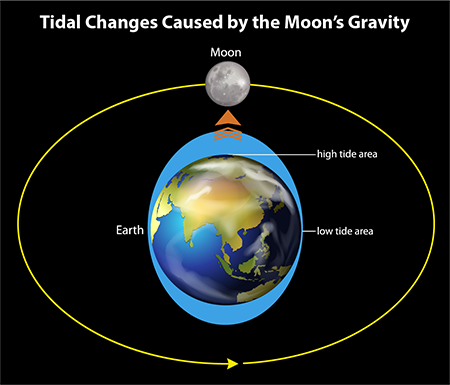
Scientists have concluded that if the Moon were 20% closer to Earth, the Earth’s tides would be so high that much of the currently inhabited lands would often be covered with several feet of water. On the other hand, if the Moon were 20% farther away, the oceans would turn into stagnant waters unable to support the billions of living things both in and out of the oceans. (Did you know that tiny plants in the oceans produce large amounts of oxygen that humans need to survive—oxygen that gets circulated by the movement of the ocean’s waters?)
Atheists admit that they do not know how the Moon came into being, but one of their “best” theories is that another planet collided with Earth billions of years ago. This accidental collision is said to have produced a large number of rocky fragments that began orbiting Earth. Eventually the remains clumped together at high temperatures. Over the years, the new celestial body of clumped material cooled and became Earth’s Moon.
Does this theory by atheistic evolutionists really make good sense? No way! Accidents don’t produce the kind of design we see in the Earth and Moon. The Moon had to have been “set” by Someone in just the right spot in the heavens to help control the movement of the Earth’s oceans. That same Someone gave the Moon its predictable pattern that it follows every 29½ days. The fact is, the amazing design of the heavens (including the Moon) “shows His [God’s] handiwork.” The Moon, like all of Creation, is a result of the mighty hand of our all-powerful God.
“O Lord, our Lord, how excellent is Your name in all the earth, Who have set Your glory above the heavens…. When I consider Your heavens, the work of Your fingers, the Moon and the stars, which you have ordained…. Lord, how excellent is Your name in all the earth!” (Psalm 8:1,3,9).
The post The Moon Declares God's Glory appeared first on Apologetics Press.
]]>The post Super Blue Blood Moon appeared first on Apologetics Press.
]]>Supermoon
The Moon travels in an elliptical orbit around the Earth. A Supermoon occurs when the Moon reaches its perigee (closest orbital distance) and thus appears larger and much brighter than usual.1
Blue Moon
As the Moon orbits the Earth in about a 29½ day cycle, it goes through various phases. Since 29½ is less than most calendar months, there occasionally will be two Full Moons in one month. The second of these Full Moons is called a Blue Moon.
Blood Moon
A lunar eclipse occurs when the Moon passes through Earth’s shadow, blocking the sunlight on the Moon. One of the first things a person might notice is the reddish color of the Moon. The red color is caused by the bending of sunlight through Earth’s atmosphere as the Moon enters Earth’s shadow and reflects only the refracted light.
Super Blue Blood Moon
On January 31st, 2018, the Moon was at its orbital perigee (Supermoon) at the time of the second Full Moon of the month (Blue Moon). Along with these events, a lunar eclipse occurred causing the Moon to appear in a reddish hue (Blood Moon). And there you have it: a Super Blue Blood Moon.
These naturally occurring events are part of the physical laws God put into place when He created the Universe. The calculable behavior of the Universe allows scientists to predict celestial events long before they occur (proving the Universe is not the product of a random accident). The beauty and complexity of such celestial events should fill us with awe toward the Designer of the Universe.
The post Super Blue Blood Moon appeared first on Apologetics Press.
]]>The post The Teleological Argument for the Existence of God [Part 1] appeared first on Apologetics Press.
]]>[EDITOR’S NOTE: This is the first in a two-part series on the teleological argument for the existence of God. Part II will appear in the March issue.]
Several years ago, astronomers from more than 30 research institutions in 15 countries worked together to select a site for a giant telescope that they hoped would read TV or radio signals from alien civilizations. Slated to cost one billion dollars, the Square Kilometer Array, or SKA, would be the world’s most powerful radio telescope. Speaking at a conference of the International Society for Optical Engineering in Orlando, Florida, project astronomers said they hoped to find “immediate and direct evidence of life elsewhere in the Universe.”1
Despite this bold venture, the scientists admitted that “such a search would have distinct limitations, to be sure.” “Distinct limitations”? Like what? For one, the scientists “aren’t sure how to recognize such signals, if they do turn up. The hope is that the signals would consist of organized patterns suggestive of intelligence, and not attributable to any known celestial sources.”2 Wait a minute. Evolutionary scientists are renowned for their condescending ridicule of creationists because those who believe in God assert that evidence of intelligent design in the Universe is proof of an Intelligent Designer. No, the evolutionists counter, the Universe got here by accident through random chance, mindless trial and error, and the blind, mechanistic forces of nature. They maintain that life on Earth owes its ultimate origin to dead, non-purposive, unconscious, non-intelligent matter. Yet they were perfectly willing to squander one billion dollars on a telescope with the speculative idea that solid proof—hard evidence—for the existence of alien life would reside in undecipherable radio or TV signals that convey “organized patterns suggestive of intelligence.”3 Atheistic evolutionists want it both ways: organized patterns prove the existence of intelligent alien design and organized patterns do not prove the existence of an Intelligent Designer. Philosophers and logicians refer to such duplicitous posturing as irrational and “logical contradiction.” Apparently, evolutionists call it “science.” Nevertheless, the basic thrust of the teleological argument for the existence of God is self-evident.
THE UNIVERSE—A “Waste of Space”?
“The cosmos is all that is or ever was or ever will be.”4 So began Carl Sagan’s immensely popular book and PBStelevision series: Cosmos. A more atheistic, humanistic, materialistic declaration could not be spoken. Sagan (1934-1996), who was an astronomer at Cornell University who lived his entire life resistant to the possibility of God and an afterlife, maintained his unbelief—in the words of his third wife—“unflinching” to the end.5 She, herself, finds comfort after his passing “without resorting to the supernatural.”6
When people reject or avoid the implications of the design in the created order—i.e., that it is logically the result of a Supreme Creator—they have inevitably “exchanged the truth of God for a lie, and worshiped and served the creature rather than the Creator” (Romans 1:25). Skeptical of the survival of the Earth at the mercy of Homo sapiens, Sagan turned his attention to an almost obsessive dedication to finding answers and solutions from life forms beyond Earth. In his own words: “In a very real sense this search for extraterrestrial intelligence is a search for a cosmic context for mankind, a search for who we are, where we have come from, and what possibilities there are for our future—in a universe vaster both in extent and duration than our forefathers ever dreamed of.”7
Less than a year after his death, Hollywood released a movie on July 11, 1997 based on Sagan’s novel Contact.8 The film’s central character, Dr. Eleanor Arroway (played by Jodie Foster), was surely the embodiment of the formative experiences, philosophical perspectives, and spiritual beliefs of Sagan himself. On three separate occasions in the film, a pseudo-intellectual remark, obviously designed to defend the naturalistic explanation of the existence of the Universe while ridiculing the Christian viewpoint, is offered up to viewers. As a child, “Ellie” asks her father if life exists out in the Universe, to which he responds: “Well, if there wasn’t, it’d be an awful waste of space.” As an adult, she converses with Palmer Joss (played by Matthew McConaughey), and, staring up at the starry Puerto Rican sky, expresses her confidence in the evolution of other life forms elsewhere in the Universe: “If just one in a million of those stars has planets, and if only one in a million of those has life, and if just one in a million of those has intelligent life, then there are millions of civilizations out there.”9 Ellie is pleasantly stunned when Joss repeats the same line that her father uttered to her when she was a child. Near the close of the film, Ellie speaks the line again to a group of school children when asked if life exists in space.
This triple declaration was obviously intended to offer a “logical” proof that, rather than looking to some supernatural Being Who is transcendent of the Universe, humans had best recognize that the only life beyond planet Earth are those life forms that have evolved (like our own) on other planets in far off galaxies. The materialist is forced to follow Sagan’s presupposition: life must exist elsewhere in the Universe since there is no God. If there is a God Who created life only on Earth, then He was guilty of poor teleological design—creating a vast physical realm that serves absolutely no purpose—and thus producing a nearly infinite realm of “wasted space.”
But wait! The Bible long ago anticipated the skepticism of the materialist astronomer. At the creation of the Universe, God said: “Let there be lights in the firmament of the heavens to divide the day from the night; and let them be for signs and seasons, and for days and years; and let them be for lights in the firmament of the heavens to give light on the earth” (Genesis 1:14-15). The luminaries that God made included the stars: “God set them in the firmament of the heavens to give light on the earth, and to rule over the day and over the night” (vss. 17-18). One very specific function of the stars that occupy space far beyond our solar system is illumination (cf. Psalm 136:9). They are “light-bearers.”10
Another very specific purpose of the vastness of space is seen in the multiple declarations regarding the infinitude of God and the evidence that points to His existence, His glory, His eternality, and His power. Paul affirmed very confidently that “since the creation of the world His invisible attributes are clearly seen, being understood by the things that are made, even His eternal power and Godhead, so that they are without excuse” (Romans 1:20). It is absolutely incredible—and, according to Paul, inexcusable—for a rational human being to contemplate the magnitude of the Universe and the vastness of space, and then to reject the only logical, plausible explanation for it all: God. We simply have no excuse for rejecting God when we are surrounded by such an overwhelming display of wonders and marvels in the created order. Indeed, atheism, evolution, and humanism are simply more sophisticated forms of the polytheism that has plagued humanity for millennia. Moses warned the Israelites of this very thing: “[T]ake heed, lest you lift your eyes to heaven, and when you see the sun, the moon, and the stars, all the host of heaven, you feel driven to worship them and serve them, which the Lord your God has given to all the peoples under the whole heaven as a heritage” (Deuteronomy 4:19). Evolutionary astronomy assigns an inflated value to the vastness of space by postulating that it can provide mankind with an alternative explanation for the existence of life—an explanation that absents God. Any such postulation ultimately amounts to idolatry.
David, too, paid homage to the glory of the Creator, as evidenced by the eloquent symphony of the majestic Universe that is played perpetually—24 hours a day:
The heavens declare the glory of God; and the firmament shows His handiwork. Day unto day utters speech, and night unto night reveals knowledge. There is no speech nor language where their voice is not heard. Their line has gone out through all the earth, and their words to the end of the world. In them He has set a tabernacle for the sun, which is like a bridegroom coming out of his chamber, and rejoices like a strong man to run its race. Its rising is from one end of heaven, and its circuit to the other end; and there is nothing hidden from its heat (Psalm 19:1-6; cf. 74:16-17; 136:7-8).
Separate and apart from the latest evidence that confirms the movement of the Sun through space,11 these verses reaffirm the fact that the created Universe loudly announces the existence of the Universe-Maker. David also declared: “O Lord, our Lord, how excellent is Your name in all the earth, You have set Your glory above the heavens! …When I consider Your heavens, the work of Your fingers, the moon and the stars, which You have ordained, what is man that You are mindful of him?” (Psalm 8:1,3). God “stretched out the heavens like a curtain” (Psalm 104:2). No wonder even a philosopher on the order of Immanuel Kant observed: “Two things fill the mind with ever new and increasing admiration and awe, the oftener and more steadily we reflect on them: the starry heavens above me and the moral law within me.”12
A third biblical explanation for the creation of the vast Universe was hinted at by God Himself in the attitude-adjusting lecture He delivered to Job: “Can you bind the cluster of the Pleiades, or loose the belt of Orion? Can you lead forth a constellation in its season? Or can you guide the Great Bear with its cubs? Do you know the laws of the heavens? Can you fix their rule over the earth?” (Job 38:31-33). Notice the action terms that are used to refer to the movement of the constellations: bind, loose, lead forth, and guide. Observe also the “laws of the heavens” and their relationship to “ruling over the earth.”13 These verses imply that the heavenly bodies, and the laws that govern them, have been deliberately orchestrated, modulated, and regulated by the Creator to serve a purpose or purposes far beyond our present understanding. The text seems to hint that Earth’s status, with its living beings, is somehow affected by the phenomena of the cosmic bodies. Even as the comprehension of scientists has been lacking through the centuries on many features of the physical realm, only eventually to discover the meaning that lay behind observable phenomena, even so our present comprehension of space is woefully inadequate to justify passing judgment on the intentionality and teleology that lie behind many astronomical phenomena.
Evolutionists have far better arguments with which to attempt to prop up their atheistic stance (the “problem of evil” being the strongest, though refutable14). The “wasted space” argument is anemic, pitiful, and hardly worthy of rebuttal. However, since they brought it to our attention, the Christian is once again reminded of the unfathomable attributes of the great God Who stands above and beyond this vast physical realm. The immensity and vastness of the Universe only spurs the rational mind to marvel at the One whose own metaphysical transcendence surpasses the visible. In the words of the psalmist: “I will meditate on the glorious splendor of Your majesty, and on Your wondrous works. Men shall speak of the might of Your awesome acts, and I will declare Your greatness” (145:5-6). “He counts the number of the stars; He calls them all by name. Great is our Lord, and mighty in power; His understanding is infinite” (Psalm 147:4-5). Isaiah agreed: “Lift up your eyes on high, and see who has created these things, who brings out their host by number; He calls them all by name, by the greatness of His might and the strength of His power” (40:26). Indeed, “the twenty-four elders fall down before Him who sits on the throne and worship Him who lives forever and ever, and cast their crowns before the throne, saying: ‘You are worthy, O Lord, to receive glory and honor and power; for You created all things, and by Your will they exist and were created’” (Revelation 4:10-11). The vast cosmos points directly and unmistakably to an awesome God.
The Revelation of God
You see, the infinite God of the Bible has revealed Himself to the human race by means of two forms of revelation: natural (or generic) and supernatural (or special). Special revelation consists of the Bible—the self-authenticating, supernatural book that God imparted to humanity by miraculously directing human writers to record His will (2 Timothy 3:16; 2 Peter 1:21).
Natural revelation consists of nature: the material realm, the created order. Since God created the heavens and the Earth, His “fingerprints” are all over it. Humans can easily recognize these fingerprints—if they are unbiased, honest, and willing to follow the evidence to its logical conclusion.
Sadly, the number of those who reject the obvious is legion. Why? They are generally unwilling to accept the implications of the existence of God: the need to bring one’s fleshly appetites and actions into harmony with the will of the Creator. But that fact does not lessen the magnitude of the evidence and its availability. Indeed, the psalmist said there is no language where the evidence for God is unavailable (Psalm 19:1-2).
Teleology
The word “teleology” comes from the Greek term teleios, meaning “complete, perfect,” taken from telos which means “end,” “outcome, result.”15 The teleological argument maintains that one proof for God’s existence is the fact that the Universe is the result or outcome of intentional design, order, and purpose. The characteristics of design in the Universe demonstrate the existence of a Designer. In addition to the passages given previously, the Bible also articulates this principle when the Hebrews writer stated this rationale succinctly in Hebrews 3:4—“For every house is built by someone, but He who built all things is God.” If houses with their sophisticated designs cannot just happen or evolve over millions of years, how could worlds? If a watch cannot occur by chance, neither can the systematic chronometers of the Universe. Their geometric precision is so superior to human invention that eclipses, planetary movements, and other astronomical phenomena can be predicted centuries in advance. The Universe is literally a finely tuned, organized machine. If we readily recognize that intelligent planning is behind all ordered design, how could nature’s intricate networks have no Planner? To observe the fantastic design in nature and then conclude there is no Supreme Designer is to behave irrationally. The evidence that surrounds us in the material Universe demands the conclusion that God exists.
Decisive Evidence
Do cars just happen? Of course not. Their multiple systems are interactive and integrated with each other in order for the automobile to operate. A mind—no, multiple minds—lie behind the creation of a car. Yet, compared to the Universe, or compared to the human body, or even compared to the inner workings of one tree leaf, a car is a crude and primitive invention. If the creation of a car demands the existence of the remarkable human brain/mind, what must be required for the creation of the human brain/mind? Obviously, something or Someone far superior to the human mind would be needed for its creation. Logically, that Someone must be the powerful, transcendent Creator: the God of the Bible.
The naturalistic explanation given by evolutionists for the existence of the created order cannot meet the dictates of logic that characterize the unencumbered, unprejudiced human mind. The more one investigates the intricacies and complexities of the natural realm, the more self-evident it is that a grand and great Designer is responsible for the existence of the Universe. In fact, the evidence is overwhelming and decisive.
The Human Body16
Take, for example, the human body, which possesses such complexity that it simply could not have evolved. Its amazing intricacies absolutely demand a mind—a higher intelligence—behind them. The development of the camera was based upon the human eye. Yet, for all we have accomplished with video and sophisticated photographic equipment, the living, full color optical system of the human eye is unsurpassed. What’s more, we possess a self-restoring, self-repairing healing system; a sensitive stereophonic auditory system; tireless muscular-connecting tissue systems; a well-engineered skeletal framework; a computerized memory-bank brain; a ventilation-insulation skin envelope which constitutes an efficient cooling system of 2000 pores per square inch of skin; and a cardiovascular system that constantly oxygenates our blood with every breath. The human body is absolute proof of God. Atheism cannot explain it. Evolution cannot logically account for it. Scientists have yet to fully understand it. Multiple lifetimes would be necessary even to begin to grasp the massive amount of evidence inherent in the human body.
The psalmist also stated, “I will praise You, for I am fearfully and wonderfully made; marvelous are Your works, and that my soul knows very well” (Psalm 139:14). Indeed, the human body itself is sufficient proof of the existence of the Divine Creator. Right now, your body is performing amazing feats of engineering, chemistry, and physics that no machine designed by man can duplicate. Great human minds have applied themselves to the task of duplicating the various capabilities of the human body. Some incredible things have been accomplished in their efforts to copy God’s Creation, but they simply cannot compare with the marvel of God’s design.
The Flagellum17
Consider yet another among the millions of amazing proofs of the reality of the Creator. Bacteria, like salmonella, have as part of their anatomy several flagella filaments extending from their cell body. These flagella are marvels of engineering—bio-nanomachines—that appear to possess the remarkable ability of self-assembly. The bacterium’s flagellum assembly process begins with the formation of an MS ring in the cytoplasmic membrane. Then a switch complex called a “C” ring is assembled on its cytoplasmic side, followed by integration of the protein export apparatus inside the ring. The export apparatus sends out flagellar proteins from the cell body to the distal end of the flagellum to grow the structure.
 Next, the “hook,” working as an efficient universal joint, extends to the outside of the cell. Then two junction proteins, Hap1 and Hap3, are attached, followed by the binding of the cap protein, Hap2, to form a capping structure under which the assembly of flagellum molecules begins to grow the flagellar filament. Flagellum molecules are then inserted successively just below the cap, and the flagellar filament continues to grow. All of the flagellar axial proteins produced in the cell body are sent into the central channel of the flagellum and transported to and polymerized at its growing end. Some 20 to 30,000 flagellum molecules polymerize to construct a 10 to 15 micrometer long filament.
The flagellar motor is similar to manmade motors—since both were built on fundamental principles set in place by the Creator. The flagellum consists of rotor and stator units in the cell membrane, including switching unit, bushing, universal joint, and helical screw propeller. To generate thrust, the rotary motor is driven by protons flowing into the cell body. The motor then drives the rotation of the flagellum at around 300 Hz, at a power level of 10-16 W, with energy conversion efficiency close to 100%. The resulting speed is up to 20,000 rpms—faster than the speed of Formula 1 race car engines. This highly efficient, flagellar motor is far beyond the capabilities of manmade, artificial motors. It is so sophisticated, that to suggest that it evolved is the height of irrationality and blind prejudice. Indeed, the evidence is decisive: there is a Designer.
The Pine Tree18
Consider the pine tree. Some 120 species and subspecies of the pine tree exist worldwide. The Ponderosa pine tree (pinus ponderosa) is one of America’s abundant tree species, covering approximately 27 million acres of land. A young Ponderosa pine has brownish-black bark that changes to a distinctive orange-brown color as the tree grows older. The bark is segmented into large, plate-like structures whose appearance has been likened to a jigsaw puzzle. This unusual design has a purpose. If the tree catches fire, these plates pop off as the bark burns. The tree, in effect, sheds its burning bark! This design, along with the great thickness of the bark, allows the tree to be very resistant to low intensity fires. Since design demands a designer, Who is responsible for this intricate design?
Another species of pine tree is the Lodgepole Pine (pinus contorta), so named since Native Americans used Lodgepole pine for the “lodge poles” in their tepees. This amazing pine tree grows cones that are slightly smaller than a golf ball, are tan when fresh, but turn gray with age. These serotinous cones remain closed until the heat of a forest fire prompts them to open. After the fire, the cones open and reseed the forest. The species literally regenerates itself—even though the forest fire kills the tree itself. Since such design demands a designer, Who is responsible for this ingenious design?
Yet another species of pine tree is the Whitebark Pine (pinus albicaulis). This tree possesses a symbiotic relationship with a bird species known as the Clark’s Nutcracker. The tree is dependent on this bird for reproduction, while the seed of the tree is a major source of food for the bird. This mutualistic relationship is further seen in the fact that Whitebark pinecones do not open and cast seed when they are ripe. The cones remain closed until the Nutcracker comes along, pries the cone open with its bill, and stores the seed within a pouch beneath its tongue. The bird then caches the seed to be used later as a food supply. Some of these seed caches are forgotten, or are not needed, thus enabling the tree to reproduce. Such amazing design—with no Mind behind it? Illogical!
Seed: The Dandelion, Tipuana tipu, and the Alsomitra macrocarpa19
When the Creator created the Universe in six literal days, He created seed on the third day:
Then God said, “Let the earth bring forth grass, the herb that yields seed, and the fruit tree that yields fruit according to its kind, whose seed is in itself, on the earth”; and it was so. And the earth brought forth grass, the herb that yields seed according to its kind, and the tree that yields fruit, whose seed is in itself according to its kind. And God saw that it was good. So the evening and the morning were the third day (Genesis 1:11-13).
God designed three main mechanisms for seed dispersal: (1) via animals (e.g., a bird eating a piece of fruit containing seed, and flying to another location where the seed passes out of its body), (2) drifting in ocean and fresh water, and (3) floating with the wind. Incredibly, each of these mechanisms points to the orchestration of a Mastermind.
Consider the ordinary dandelion. It possesses a magnificent crown of plumose hairs forming a symmetrical sphere. Upon closer investigation, this sphere is composed of numerous shafts, each equipped with its own umbrella-like canopy of intricately branched hairs. At the base of each shaft is a single seed. Each individual shaft with its canopy and single seed closely resemble the same design as that utilized in parachutes.
 As breezes blow across the surface of the dandelion, the canopy of hairs catch the wind which tugs at the shaft with its host of attached seeds, gently pulling them free from the dandelion head. The parachute-like canopy of hairs then allows the entire assembly to drift with the wind. In fact, the canopy of hairs is precisely designed to achieve flight. The length of the shaft is just right to enable aerodynamic positioning of the canopy to enable it to come to a landing in another location. The attached seed can then take root and start the process all over again. The dandelion is absolute, undeniable proof of God.
Then there is the Tipuana tipu tree (also called Rosewood), originally from South America, but now planted as a shade tree throughout the world. This tree produces achenes—a type of fruit consisting of a dry, membranous sheath that surrounds a seed. The tipu tree has a unique type of achene called a samara, which facilitates a specialized form of wind dispersal. It possesses a fan-shaped wing with a slight pitch (like a propeller or fan blade) which causes it to spin like the auto-rotation of helicopter blades when it falls. The spinning creates lift that slows descent, giving more opportunity to be carried a substantial distance from the tree by the wind, depending on wind velocity and distance above the ground. The decomposed seed spirals down to the ground to become established and perpetuate the species—an unmistakable example of flawless aerodynamic wing design.
 Also known for its ingenious aerodynamic configuration is the seed of a tenacious tropical climbing vine identified as Alsomitra macrocarpa. Also called the Javan cucumber, it hangs from trees high in the rain forest canopy in the Sunda Islands of the Malay Archipelago and the Indonesian islands. Each football-sized fruit/gourd is densely packed with large numbers of winged “Stealth Bomber” seeds. A single seed is enveloped by two transparent, papery wings, about five inches across, angled slightly back from and extending either side of the seed. Upon ripening, the wings become dry and the long edge opposite the seed curls slightly upwards.
Each one becomes airborne when released through a hole at the bottom of the gourd and sails through the air, majestically spiraling downward in 20 foot circles. The carefully designed aerodynamic features of the seed are such that it can glide great distances from its point of origin—a classic example of mechanical dispersal in the forest. Moving through the air like a butterfly in flight, it gains height, stalls, dips, and accelerates, once again producing lift—a maneuver known as phugoid oscillation. The seed’s stability in pitch and roll inspired the early aviation pioneer Igo Etrich. Scientists studying this amazing plant describe its lift-to-drag ratio and the rate of descent in these terms: “flight was so stable that samples were seen to take their optimal trimmed angle of attack with a value between the maximum gliding ratio and the minimum rate of descent.”
Evolutionists are confident in their conviction that their explanations for such marvels demonstrate nature’s independent, autonomous existence to the exclusion of God. They virtually “jump through hoops” and engage in “scientific ventriloquism” in their quest to achieve legitimacy for their atheistic bent. However, when all relevant evidence eventually comes to light, it fits “hand in glove” with the presence of the God of the Bible.
Wood20
Prior to the invention of modern plastics, what would the Creator have humans to use for suitable containers? Wood, stone, or clay, and eventually metal, pretty much exhausted the possibilities. Yet, government agencies, like the USDA and the FDA, generally have advocated the use of plastic for cutting boards and other surfaces that sustain food contact, on the grounds that the micropores and knife cuts in wood provide hidden havens for deadly bacterial organisms. As one Extension Specialist from the Department of Human Nutrition stated: “for cleanability and control of microorganisms, plastic is the better choice.”
However, the best research available on the subject suggests otherwise. Dr. Dean Cliver, microbiologist formerly with the Food Safety Laboratory and World Health Organization Collaborating Center for Food Virology at the University of California-Davis, disputed the oft’-repeated claim regarding the superiority of plastic over wood. His research findings, conducted over a period of several years, consistently demonstrated the remarkable antibacterial properties of wood.
Dr. Cliver and his research associates tested five life-threatening bacteria (Escherichia coli, Salmonella, Campylobacter jejuni, Listeria monocytogenes, and Staphylococcus aureus) on four plastic polymers and more than 10 species of hardwood, including hard maple, birch, beech, black cherry, basswood, butternut, and American black walnut. Within three minutes of inoculating wooden boards with cultures of the food-poisoning agents, 99.9% of the bacteria were “unrecoverable.” On the other hand, none of the bacteria tested under similar conditions on plastic died. In fact, leaving microbe populations on the two surfaces overnight resulted in microbial growth on the plastic boards, while no live bacteria were recovered from wood the next morning. Interestingly, bacteria are absorbed into the wood, but evidently do not multiply, and rarely if ever thrive again. In contrast, bacteria in knife scars in plastic boards remain viable (even after a hot-water-and-soap wash) and maintain their ability to surface later and contaminate foods. Treating wood cutting boards with oils and other finishes to make them more impermeable actually retards wood’s bactericidal activity. Microbiologists remain mystified by their inability to isolate a mechanism or agent responsible for wood’s antibacterial properties. Incredible, divine design.
Do these research findings bear any resemblance to Mosaic injunctions 3,500 years ago which required the destruction of pottery that had become contaminated—while wood was simply to be rinsed (Leviticus 6:28; 11:32-33; 15:12)? Dr. Cliver concluded: “I have no idea where the image of plastic’s superiority came from; but I have spent 40 years promoting food safety, and I would go with plastic if the science supported it. I don’t necessarily trust ‘nature,’ but I do trust laboratory research.” Kudos to Dr. Cliver’s honesty. What about trusting nature’s God?
Summary
Founding Father Thomas Paine was among the small handful of Founders who rejected Christianity. Yet he was not an atheist. He believed that the created order proves God exists. In fact, he considered atheists to be “fools” for their rejection of the plain evidence of creation. In Age of Reason, he explained:
Deism, then, teaches us, without the possibility of being deceived, all that is necessary or proper to be known. The creation is the Bible of the Deist. He there reads, in the handwriting of the Creator himself, the certainty of his existence and the immutability of his power, and all other Bibles and Testaments are to him forgeries. The probability that we may be called to account hereafter will, to a reflecting mind, have the influence of belief; for it is not our belief or disbelief that can make or unmake the fact. As this is the state we are in, and which it is proper we should be in, as free agents, it is the fool only, and not the philosopher, or even the prudent man, that would live as if there were no God.21
Don’t be foolish. The evidence for the marvelous, creative handiwork of God is simply staggering. The only plausible, rational explanation for the existence of human beings on this planet is God. The intricacies of the created order attest to that living God.
[to be continued]
Endnotes
1 “Sites Under Review for Telescope that Could Detect Alien TV” (2006), World Science, July 10, http://www.world-science.net/exclusives/060711_ska.htm.
2 Ibid., emp. added.
3 One is reminded of NASA’s Viking mission to Mars in the mid-seventies in which scientists eagerly declared evidence for life on Mars based on initial photos that appeared to show a “B” or even a face on a rock. Such judgments soon were deemed premature and incorrect. Cf. “‘Life’ on Mars” (2006), http://burro.astr.cwru.edu/stu/mars_life.html. Also Thomas Warren and Antony Flew (1976), The Warren-Flew Debate (Jonesboro, AR: National Christian Press), pp. 112,156.
4 Carl Sagan (1980), Cosmos (New York: Random House), p. 4.
5 Carl Sagan (1997), Billions and Billions (New York: Random House), p. 225.
6 Ibid., p. 228.
7 Carl Sagan, ed. (1973), “Introduction,” Communication with Extraterrestrial Intelligence [CETI] (MIT Press), pp. ix-x.
8 Carl Sagan (1985), Contact (New York: Simon and Schuster).
9 As cited in Ray Bohlin (1998), “Contact: A Eulogy to Carl Sagan,” http://www.probe.org/docs/contact.html. Of course, the scientific evidence does not support this conclusion—see Ray Bohlin (2002), “Are We Alone in the Universe?” http://www.probe.org/docs/lifemars.html.
10 C.F. Keil and F. Delitzsch (1976 reprint), Commentary on the Old Testament: The Pentateuch (Grand Rapids, MI: Eerdmans), 1:56; Herbert Leupold (1950 reprint), Exposition of Genesis (Grand Rapids, MI: Baker), p. 71.
11 See “StarChild Question of the Month for February 2000,” High Energy Astrophysics Science Archive Research Center (HEASARC), Astrophysics Science Division (ASD) at NASA/GSFC, https://starchild.gsfc.nasa.gov/docs/StarChild/questions/question18.html: “[T]he Sun—in fact, our whole solar system—orbits around the center of the Milky Way Galaxy. We are moving at an average velocity of 828,000 km/hr. But even at that high rate, it still takes us about 230 million years to make one complete orbit around the Milky Way!”
12 As quoted in Norman Geisler (1983), Cosmos: Carl Sagan’s Religion for the Scientific Mind (Dallas, TX: Quest), p. 59.
13 See Frank Gaebelein, ed. (1988), The Expositor’s Bible Dictionary (Grand Rapids, MI: Zondervan), 4:1037,1042.
14 See Thomas Warren (1972), Have Atheists Proved There Is No God? (Jonesboro, AR: National Christian Press). Also Dave Miller (2015), Why People Suffer (Montgomery, AL: Apologetics Press); Kyle Butt (2010), A Christian’s Guide to Refuting Modern Atheism (Montgomery, AL: Apologetics Press).
15 Barclay Newman (1971), A Concise Greek-English Dictionary of the New Testament (London: United Bible Societies), p. 180.
16 The following details were gleaned from: “The Brain Initiative” (2015), National Institutes of Health, http://www.braininitiative.nih.gov/index.htm; “The Cardiovascular System” (2008), SUNY Downstate Medical Center, http://ect.downstate.edu/courseware/histomanual/cardiovascular.html; D.D. Clark and L. Sokoloff (1999), Basic Neurochemistry: Molecular, Cellular and Medical Aspects, ed. G.J. Siegel, B.W. Agranoff, R.W. Albers, S.K. Fisher, M.D. Uhler (Philadelphia, PA: Lippincott), pp. 637–670; Brian Clegg (2013), “20 Amazing Facts about the Human Body,” The Guardian, January 26, http://www.theguardian.com/science/2013/jan/27/20-human-body-facts-science; “Fantastic Facts about the Human Body” (2008), DiscoveryHealth.com writers, HowStuffWorks.com, August 12, http://health.howstuffworks.com/human-body/parts/facts-about-the-human-body.htm; Henry Gray (1918), Anatomy of the Human Body (Philadelphia, PA: Lea & Febiger); Bartleby.com, 2000, www.bartleby.com/107/; “Human Anatomy” (2015), http://www.innerbody.com/; “Human Body” (2015), National Geographic, http://science.nationalgeographic.com/science/health-and-human-body/human-body/; Tanya Lewis (2015), “Human Brain: Facts, Anatomy & Mapping Project,” LiveScience, March 26, http://www.livescience.com/29365-human-brain.html; Marcus E. Raichle and Debra A. Gusnard (2002), “Appraising the Brain’s Energy Budget,” Proceedings of the National Academy of Sciences of the United States of America, 99[16]:10237-10239, August 6, http://www.pnas.org/content/99/16/10237; Nikhil Swaminathan (2008), “Why Does the Brain Need So Much Power?” Scientific American, April 29, http://www.scientificamerican.com/article/why-does-the-brain-need-s/; “Understanding the Brain” (no date), The National Science Foundation, http://www.nsf.gov/news/special_reports/brain/; Carl Zimmer (2004), Soul Made Flesh: The Discovery of the Brain—and How It Changed the World (New York: Free Press).
17 See Anton Arkhipov, Peter L. Freddolino, Katsumi Imada, Keiichi Namba, and Klaus Schulten (2006), “Coarse-Grained Molecular Dynamics Simulations of a Rotating Bacterial Flagellum,” Biophysical Journal, 91:4589-4597; Anton Arkhipov, Peter Freddolino, and Klaus Schulten (2014), “Bacterial Flagellum,” Theoretical and Computational Biophysics Group, NIH Center for Macromolecular Modeling & Bioinformatics, University of Illinois at Urbana-Champaign, http://www.ks.uiuc.edu/Research/flagellum/; Howard Berg (2000), “Motile Behavior of Bacteria,” Physics Today, 53[1]:24, January, http://scitation.aip.org/docserver/fulltext/aip/magazine/physicstoday/53/1/1.882934.pdf?expires=1447448109&id=id&accname=guest&checksum=4DB7CE4D03EA780CE104B9A03A1CD811; “‘Clutch’ Stops Flagella” (2008), Photonics.com, June 23, http://www.photonics.com/Article.aspx?PID=6&VID=35&IID=258&AID=34236; Tim Dean (2010), “Inside Nature’s Most Efficient Motor: The Flagellar,” Australian Life Scientist, August 2, http://www.lifescientist.com.au/content/molecular-biology/news/inside-nature-s-most-efficient-motor-the-flagellar-1216235209; Zoltán Diószeghy, Péter Závodszky, Keiichi Namba, and Ferenc Vonderviszt (2004), “Stabilization of Flagellar Filaments by HAP2 Capping,” FEBS Letters, 568[1-3]:105-109, June 18, http://www.febsletters.org/article/S0014-5793(04)00623-4/abstract; Erato Protonic Nanomachine Project, Graduate School of Frontier Biosciences, Osaka University, http://www.fbs.osaka-u.ac.jp/labs/namba/npn/index.html; Vitold Galkin, Xiong Yu, Jacob Bielnick, et al. (2008), “Divergence of Quaternary Structures among Bacterial Flagellar Filaments,” Science, 320[5874]:382-385, http://www.sciencemag.org/content/320/5874/382, http://www.sciencemag.org/content/320/5874/382; Abhrajyoti Ghosh and Sonja-Verena Albers (2011), “Assembly and Function of the Archaeal Flagellum,” Biochemical Society Transactions, 39[1]:64-69, February 1, http://www.biochemsoctrans.org/content/39/1/64#fn-group-1; Ken Jarrell, Douglas Bayley, and Alla Kostyukova (1996), “The Archaeal Flagellum: a Unique Motility Structure,” Journal of Bacteriology, 178[17]:5057-5064, September, http://jb.asm.org/content/178/17/5057?ijkey=bb6062450f68ce38ff0bb584daab03fe3ff79f1b&keytype2=tf_ipsecsha; H. Lodish, A. Berk, S.L. Zipursky, et al. (2000), “Cilia and Flagella: Structure and Movement” (Section 19.4), Molecular Cell Biology (New York: W.H. Freeman), fourth edition, http://www.ncbi.nlm.nih.gov/books/NBK21698/; Robert Macnab (2003), “How Bacteria Assemble Flagella,” Annual Review of Microbiology, 57:77-100, October, http://www.annualreviews.org/doi/abs/10.1146/annurev.micro.57.030502.090832; Saori Maki-Yonekura, Koji Yonekura, and Keiichi Namba (2010), “Conformational Change of Flagellin for Polymorphic Supercoiling of the Flagellar Filament,” Nature Structural & Molecular Biology, 17:417-422, March 14, http://www.nature.com/nsmb/journal/v17/n4/full/nsmb.1774.html; G.L.M. Meister and H.C. Berg (1987), “Rapid Rotation of Flagellar Bundles in Swimming Bacteria,” Nature, 325[6105]:637-640; Yoshio Nagata (2014), “Unlocking the Secrets of Nature’s Nanomotor,” Nikkei Asian Review, June 2, http://asia.nikkei.com/Tech-Science/Tech/Unlocking-the-secrets-of-nature-s-nanomotor; Fadel Samatey, Katsumi Imada, et al. (2001), “Structure of the Bacterial Flagellar Protofilament and Implications for a Switch for Supercoiling,” Nature, 410[15]:331-337; “Self-Assembly NanoMachine” (2008), ICORP Dynamic NanoMachine Project, Japan Science and Technology Agency, NHK Joho Network, Research Director Keiichi Namba, https://www.youtube.com/watch?v=uw0-MHI_248.
18 “Lodgepole Pine” (no date), USDA Forest Service, http://www.fs.fed.us/r1/helena/resources/trees/LodgepolePine.shtml; “Ponderosa Pine” (no date), USDA Forest Service, http://www.fs.fed.us/r1/helena/resources/trees/PonderosaPine.shtml; “Ponderosa Pine” (1995), Western Wood Products Association, http://www.wwpa.org/ppine.htm; “What Are Pine Trees?” (no date), The Lovett Pinetum Charitable Foundation, http://www.lovett-pinetum.org/1whatare.htm; “Whitebark Pine” (no date), USDA Forest Service, http://www.fs.fed.us/r1/helena/resources/trees/WhitebarkPine.shtml.
19 Trevor Armstrong, et al. (2003), “Rosewood or tipuana tree (Tipuana tipu),” Weed Management Guide, CRC Weed Management, https://www.environment.gov.au/biodiversity/invasive/weeds/publications/guidelines/alert/pubs/t-tipu.pdf; W.P. Armstrong (1999), “Blowing in the Wind: Seeds & Fruits Dispersed By Wind,” Wayne’s Word, http://waynesword.palomar.edu/plfeb99.htm#helicopters; Akira Azuma and Yoshinori Okuno (1987), “Flight of a Samara, Alsomitra macrocarpa,” Journal of Theoretical Biology, 129[3]:263-274, December 7, http://www.sciencedirect.com/science/article/pii/S0022519387800012; Y. Bar-Cohen (2012), “Biologically Inspired Technologies for Aeronautics,” in Innovation in Aeronautics, ed. Trevor Young and Mike Hirst (Philadelphia, PA: Woodhead Publishing); J.W. Dunne (1913), “The Theory of the Dunne Aeroplane,” The Aeronautical Journal, April, 83-102; “Helicopter Seed Dispersal—Tipuana tipu Samara” (2012), TheNerdyGardener, YouTube, https://www.youtube.com/watch?v=caGTvw-CRaA; J. Hutchinson (1942), “Macrozanonia Cogn. and Alsomitra Roem,” Annals of Botany, 6[1]:95-102, http://aob.oxfordjournals.org/content/6/1/95.full.pdf; K. Jones (1995), Pau d’Arco: Immune Power From the Rain Forest (Rochester, VT: Healing Arts Press); Ch’ien Lee (2015), “Alsomitra macrocarpa,” Image # cld06121913, from East Kalimantan, Indonesia, Nature Photography of Southeast Asia, http://www.wildborneo.com.my/photo.php?k=East Kalimantan, Indonesia&p=1&i=7; P. Loewer (1995), Seeds: The Definitive Guide to Growing, History, and Lore (New York: Macmillan Company), R.A. Rolfe (1920), “Macrozanonia Macrocarpa,” Bulletin of Miscellaneous Information (Royal Botanic Gardens, Kew), 6:197-199, http://www.jstor.org/stable/4118666?seq=1#page_scan_tab_contents; Tipuana tipu (no date), The Australian Government,http://www.environment.gov.au/cgi-bin/biodiversity/invasive/weeds/weeddetails.pl?taxon_id=67959; Percy Walker (1974), Early Aviation at Farnborough Volume II: The First Aeroplanes (London: Macdonald), 2:174-175.
20 Dean Cliver (2002), “Plastic and Wooden Cutting Boards,” Unpublished manuscript; Dean Cliver (2002), personal letter; Karen Penner (1994), “Plastic vs. Wood Cutting Boards,” Timely Topics, Department of Human Nutrition, K-State Research and Extension; Janet Raloff (1993), “Wood Wins, Plastic Trashed for Cutting Meat,” Science News, 143[6]:84-85, February 6; Janet Raloff (1997), “Cutting Through the Cutting Board Brouhaha,” Science News Online, Food For Thought, July 11.
21 Thomas Paine (1794), Age of Reason, Part II, Section 21, emp. added, http://www.ushistory.org/paine/reason/singlehtml.htm.
The post The Teleological Argument for the Existence of God [Part 1] appeared first on Apologetics Press.
]]>The post “Only Science” Should be Taught in Science Classrooms appeared first on Apologetics Press.
]]>Silva and his evolutionary colleagues subscribe to the notion that “science” only allows natural, observable, experimental phenomena2—no supernatural realm with a God Who miraculously created the Universe allowed. The problem with such thinking, as we have noted elsewhere,3 is that it is impossible to explain the Universe without resorting to supernatural activity—and even many naturalists acknowledge that fact.4 The origin of the laws of science, the matter/energy of the Universe, life, and genetic information, for example, have no rational explanations from a purely naturalistic perspective. They require a supernatural Cause.5 So Silva and any other naturalists who agree with him in their belief that science should only allow for natural phenomena must inevitably contradict their own position when attempting to explain several characteristics of the Universe.
Bottom line: if the scientific evidence demands the existence of a supernatural Creator, why would scientists define science in such a way that a Designer/Creator is precluded? And further, why would acknowledging that the evidence points to an intelligent Designer of the Universe “endanger” children? There are certainly answers to those questions—but it is certain that they are not rational answers, because they cannot be, according to the evidence. “For every house is built by someone, but He who built all things is God” (Hebrews 3:4).
Endnotes
1 Heslley Machado Silva (2017), “Intelligent Design Endangers Education,” Science, 357[6354]:880.
2 Teaching About Evolution and the Nature of Science (1998), National Academy of Sciences (Washington, DC: National Academy Press).
3 Jeff Miller (2012), “The Atheistic Naturalist’s Self-Contradiction,” Reason & Revelation, 31[5]:53.
4 Jeff Miller (2017), “Atheists’ Design Admissions,” Reason & Revelation, 37[12]:134-143.
5 Jeff Miller (2017), Science vs. Evolution (Apologetics Press: Montgomery, AL), revised and expanded.
|
|
| Suggested Resources | |
The post “Only Science” Should be Taught in Science Classrooms appeared first on Apologetics Press.
]]>The post Atheists’ Design Admissions appeared first on Apologetics Press.
]]>#1: “We Need to Figure Out Who Wrote the Laws of Science.”
Famous atheist, theoretical physicist, and cosmologist of Cambridge University, Stephen Hawking, clearly highly reveres the laws of science. In 2011, he hosted a show on the Discovery Channel titled, “Curiosity: Did God Create the Universe?” In that show, he said,
[T]he Universe is a machine governed by principles or laws—laws that can be understood by the human mind. I believe that the discovery of these laws has been humankind’s greatest achievement…. But what’s really important is that these physical laws, as well as being unchangeable, are universal. They apply not just to the flight of the ball, but to the motion of a planet and everything else in the Universe. Unlike laws made by humans, the laws of nature cannot ever be broken. That’s why they are so powerful.2
Hawking, in obvious awe, acknowledges that the laws of nature exist, are unbreakable (i.e., without exception), and apply to the entire Universe—not just to the Earth. But those admissions by the evolutionary community presents a major problem for atheism. Humanist Martin Gardner said,
Imagine that physicists finally discover all the basic waves and their particles, and all the basic laws, and unite everything in one equation. We can then ask, “Why that equation?” It is fashionable now to conjecture that the big bang was caused by a random quantum fluctuation in a vacuum devoid of space and time. But of course such a vacuum is a far cry from nothing. There had to be quantum laws to fluctuate. And why are there quantum laws?…There is no escape from the superultimate questions: Why is there something rather than nothing, and why is the something structured the way it is?3
Even if Big Bang cosmology were correct (and it is not), you still can’t have a law without a law writer.
In “Curiosity: Did God Create the Universe?” Hawking boldly claimed that everything in the Universe can be accounted for through science without the need of God. This is untrue, as we have discussed elsewhere,4 but notice that Hawking does not even believe that assertion himself. He said, “Did God create the quantum laws that allowed the Big Bang to occur? In a nutshell, did we need a god to set it all up so that the Big Bang could bang?”5 He provided no answer to that crucial question—not even an attempt. And he is not alone. No atheist can provide a reasonable answer to that question.
The eminent atheistic, theoretical physicist, cosmologist, and astrobiologist of Arizona State University, Paul Davies, noted Hawking’s sidestep of that question in the “round table discussion” on the Discovery Channel following “Curiosity,” titled, “The Creation Question: a Curiosity Conversation.” Concerning Hawking, Davies said,
In the show, Stephen Hawking gets very, very close to saying, “Well, where did the laws of physics come from? That’s where we might find some sort of God.” And then he backs away and doesn’t return to the subject…. You need to know where those laws come from. That’s where the mystery lies—the laws.6
Writing in New Scientist, Davies asked, “How did stupid atoms spontaneously write their own software…?”7 In a more extensive discourse on the subject in The New York Times, Davies said,
[W]here do these laws come from? And why do they have the form that they do? When I was a student, the laws of physics were regarded as completely off limits. The job of the scientist, we were told, is to discover the laws and apply them, not inquire into their provenance. The laws were treated as “given”—imprinted on the universe like a maker’s mark at the moment of cosmic birth—and fixed forevermore…. Over the years I have often asked my physicist colleagues why the laws of physics are what they are. The answers vary from “that’s not a scientific question” to “nobody knows.” The favorite reply is, “There is no reason they are what they are—they just are.” The idea that the laws exist reasonlessly is deeply anti-rational. After all, the very essence of a scientific explanation of some phenomenon is that the world is ordered logically and that there are reasons things are as they are. If one traces these reasons all the way down to the bedrock of reality—the laws of physics—only to find that reason then deserts us, it makes a mockery of science. Can the mighty edifice of physical order we perceive in the world about us ultimately be rooted in reasonless absurdity? If so, then nature is a fiendishly clever bit of trickery: meaninglessness and absurdity somehow masquerading as ingenious order and rationality…. Clearly, then, both religion and science are founded on faith—namely, on belief in the existence of something outside the universe, like an unexplained God or an unexplained set of physical laws.8
In conclusion, Davies highlighted the fact that naturalists have a blind faith when assuming that the laws of science could create themselves free from an “external agency”: “[U]ntil science comes up with a testable theory of the laws of the universe, its claim to be free of faith is manifestly bogus.”9 Bottom line: there must be a rational origin of the laws of science. In 2016, Davies reiterated, “The ballyhoo about a universe popping out of the vacuum is a complete red herring. It just dodges the real issue, which is the prior existence of the laws of physics.”10 In an article titled “Taking Science on Faith,” Davies responded to the assertion that the existence of a multiverse could account for the origin of the laws of science, saying,
The multiverse theory is increasingly popular, but it doesn’t so much explain the laws of physics as dodge the whole issue. There has to be a physical mechanism to make all those universes and bestow bylaws on them. This process will require its own laws, or meta-laws. Where do they come from? The problem has simply been shifted up a level from the laws of the universe to the meta-laws of the multiverse.11
Astrophysicist and science writer for New Scientist, Marcus Chown, wrote:
If the universe owes its origins to quantum theory, then quantum theory must have existed before the universe. So the next question is surely: where did the laws of quantum theory come from? “We do not know,” admits [cosmologist Alex—JM] Vilenkin. “I consider that an entirely different question.” When it comes to the beginning of the universe, in many ways we’re still at the beginning.12
University of Oxford physicist David Deutsch said, “Even if the answer to why there is something rather than nothing were because of how quantum field theory works, the question would become why are the laws of quantum field theory as they are.”13 Cosmologist and Professor of Physics at California Institute of Technology, Sean Carroll, writing in Scientific American, discussed the question of the origin of the Second Law of Thermodynamics: “[E]xplaining why low-entropy states evolve into high-entropy states [i.e., the Second Law of Thermodynamics—JM] is different from explaining why entropy is increasing in our universe…. [T]he real challenge is not to explain why the entropy of the universe will be higher tomorrow than it is today but to explain why the entropy was lower yesterday and even lower the day before that.”14 In other words, why is there such a thing as a law of nature, like the “Second Law of Thermodynamics”?
Theoretical physicist, faculty member at the Perimeter Institute for Theoretical Physics, and adjunct Professor of Physics at the University of Waterloo, Lee Smolin, admitted, “Cosmology has new questions to answer. Not just what are the laws, but why are these laws the laws?”15 In a 2014 interview with Scientific American, cosmologist George F.R. Ellis of the University of Cape Town, co-author with Stephen Hawking of the book The Large Scale Structure of Space-Time, gave a stinging response to theoretical physicist Lawrence Krauss of Arizona State University, who argues in his book, A Universe from Nothing, that physics has ultimately answered the question of why there is something rather than nothing. Among other criticisms, Ellis said,
And above all Krauss does not address why the laws of physics exist, why they have the form they have, or in what kind of manifestation they existed before the universe existed (which he must believe if he believes they brought the universe into existence). Who or what dreamt up symmetry principles, Lagrangians, specific symmetry groups, gauge theories, and so on? He does not begin to answer these questions.16
Quantum physicist Michael Brooks agreed with Ellis in his criticisms of Krauss’ book. Writing in New Scientist, he said, “[T]he laws of physics can’t be conjured from nothing…. Krauss contends that the multiverse makes the question of what determined our laws of nature ‘less significant.’ Truthfully, it just puts the question beyond science [i.e., beyond the natural—JM]—for now, at least.”17
In his book, The Grand Design, Hawking tried to submit a way that the Universe could have created itself from nothing without God and still be in keeping with the laws of nature—an impossible concept, to be sure. He said, “Because there is a law like gravity, the universe can and will create itself from nothing.”18 Of course, even if such were possible, he does not explain where the law of gravity came from. Professor of mathematics and Fellow in Mathematics and the Philosophy of Science at Oxford University, John Lennox concurred. He took Hawking to task over his assertion that the laws of physics alone can explain the existence of the Universe, saying,
Hawking’s argument appears to me even more illogical when he says the existence of gravity means the creation of the universe was inevitable. But how did gravity exist in the first place? Who put it there? And what was the creative force behind its birth? Similarly, when Hawking argues, in support of his theory of spontaneous creation, that it was only necessary for “the blue touch paper” to be lit to “set the universe going,” the question must be: where did this blue touch paper come from? And who lit it, if not God?19
Simply put, a more rational statement from Hawking would have been, “Because there is a law like gravity, the Universe must have been created by God.” Bottom line: the existence of the laws of science is evidence of a Designer—even atheists tacitly admit it.
#2: “We Need to Know Who Created Life.”
In Expelled: No Intelligence Allowed, well-known British evolutionary biologist Richard Dawkins, Oxford University’s Professor for Public Understanding of Science from 1995 to 2008, said concerning the possibility of intelligent design:
It could be that at some earlier time, somewhere in the Universe, a civilization evolved by, probably, some kind of Darwinian means, to a very, very high level of technology, and designed a form of life that they seeded onto, perhaps, this planet. Now that is a possibility, and an intriguing possibility. And I suppose it’s possible that you might find evidence for that, if you look at the details of our chemistry, molecular biology, you might find a signature of some kind of designer. And that designer could well be a higher intelligence from elsewhere in the Universe.20
So, according to Dawkins, when we look at our chemistry—our molecular biology—(1) there could be evidence of design there, and (2) that design would imply the existence of a designer—a direct admission of the validity of the Teleological Argument. Granted, Dawkins does not directly endorse God as that Designer. Instead, he irrationally postulates the existence of aliens.
Ultimately, since there is no evidence for the existence of aliens, there can hardly be any evidence for their establishing life on Earth. Such an idea can hardly be in keeping with the evolutionist’s own beliefs about the importance of direct observation and experiment in science. Such a theory does nothing but tacitly admit (1) the truth of the Law of Biogenesis—in nature, life comes only from life (in this case, aliens); and (2) the necessity of a creator/designer in the equation.
However, notice: since aliens are beings of nature, they too must be governed by the laws of nature. Recall Hawking’s claim: the laws of physics “are universal. They apply not just to the flight of the ball, but to the motion of a planet and everything else in the Universe.”21 Evolutionary physicist Victor Stenger submitted his belief that the “basic laws” of science “hold true in the most distant observed galaxy and in the cosmic microwave background, implying that these laws have been valid for over thirteen billion years.”22 In the interview with Stein, Dawkins went on to say concerning the supposed alien creators, “But that higher intelligence would, itself, had to have come about by some ultimately explicable process. It couldn’t have just jumped into existence spontaneously.”23 So, the alien creators, according to Dawkins, have been strapped with the laws of nature as well. Thus, the problem of abiogenesis is merely shifted to the alien’s abode, where the question of the origin of life must still be answered.
Bottom line: life is evidence of design, and by implication, an intelligent designer. Writing in New Scientist, Dawkins admitted, “The more statistically improbable a thing is, the less we can believe that it just happened by blind chance. Superficially the obvious alternative to chance is an intelligent Designer.”24 Sadly, the atheist simply cannot bring himself to accept the clear cut, “obvious alternative” that is staring him in the face.
#3: “We Have to Figure Out a Way to Explain All of This Design in Nature.”
George Ellis and Professor of Physics and Astronomy at Johns Hopkins University, Joseph Silk, wrote in 2014 in Nature: “This year, debates in physics circles took a worrying turn. Faced with difficulties in applying fundamental theories to the observed Universe, some researchers called for a change in how theoretical physics is done.”25 Ironically, the “difficulties” theoretical physicists have encountered have become considerable enough that going beyond nature is necessary. According to cosmologist Bernard Carr of Queen Mary University in London, a supernatural option of some sort is demanded. He warned cosmologists to accept the inevitable implications of the evidence: “If you don’t want God, you’d better have a multiverse.”26 The multiverse has, therefore, been latched onto by many naturalists to try to explain away the “difficulties” facing physicists without resorting to God, even though, among other issues with it, there is absolutely no evidence for its existence.27 Lee Smolin said, “We had to invent the multiverse,”28 and according to Lawson Parker, writing in National Geographic, it was from our “imagination.”29 The use of our imagination to determine where we came from certainly sounds like today’s “science” is moving ever further into the realm of fiction.
Regardless, notice that according to many physicists, something beyond the current definition of science is needed to explain certain things—i.e., the existence of the unobservable, supernatural realm is demanded by the evidence. Recall how Davies put it: “Clearly, then, both religion and science are founded on faith—namely, on belief in the existence of something outside the universe, like an unexplained God or an unexplained set of physical laws, maybe even a huge ensemble of unseen universes, too.”30
Besides the existence of the laws of physics, what kind of “difficulties” are physicists encountering that are forcing them to conclude that something outside of the Universe exists, and therefore, that they need to “invent” the multiverse to avoid God? Many have articulated well the problem. Read on to see a great lesson by naturalists on the need for a supernatural Designer for the Universe.
According to Tim Folger, writing in Discover magazine, “The idea that the universe was made just for us—known as the anthropic principle—debuted in 1973.”31 Since then, the mountain of evidence supporting the principle has drastically grown in elevation. Consider, for example:
- In a 2011 article, under the heading “Seven Questionable Arguments” for the multiverse, Ellis discussed argument number four: “A remarkable fact about our universe is that physical constants have just the right values needed to allow for complex structures, including living things…. I agree that the multiverse is a possible valid explanation for [fine tuning examples—JM]…; arguably, it is the only scientifically based option we have right now. But we have no hope of testing it observationally.”32 [Notice that the multiverse is “the only scientifically based option,” and yet “we have no hope of testing it observationally.” Doesn’t that make it not a “scientifically based option”?]
- By 2014, Ellis and Silk went even further:
The multiverse is motivated by a puzzle: why fundamental constants of nature, such as the fine-structure constant that characterizes the strength of electromagnetic interactions between particles and the cosmological constant associated with the acceleration of the expansion of the Universe, have values that lie in the small range that allows life to exist…. Some physicists consider that the multiverse has no challenger as an explanation of many otherwise bizarre coincidences. The low value of the cosmological constant—known to be 120 factors of 10 smaller than the value predicted by quantum field theory—is difficult to explain, for instance.33
- John Rennie, the editor for Scientific American, noted, “The basic laws of physics work equally well forward or backward in time, yet we perceive time to move in one direction only—toward the future. Why?”34 Carroll, along the same lines, noted that “[i]f the observable universe were all that existed, it would be nearly impossible to account for the arrow of time in a natural way.”35
- According to Smolin,
Everything we know suggests that the universe is unusual. It is flatter, smoother, larger and emptier than a “typical” universe predicted by the known laws of physics. If we reached into a hat filled with pieces of paper, each with the specifications of a possible universe written on it, it is exceedingly unlikely that we would get a universe anything like ours in one pick—or even a billion. The challenge that cosmologists face is to make sense of this specialness. One approach to this question is inflation—the hypothesis that the early universe went through a phase of exponentially fast expansion. At first, inflation seemed to do the trick. A simple version of the idea gave correct predictions for the spectrum of fluctuations in the cosmic microwave background. But a closer look shows that we have just moved the problem further back in time. To make inflation happen at all requires us to fine-tune the initial conditions of the universe.36
- Folger quotes Linde in Discover magazine:
“We have a lot of really, really strange coincidences, and all of these coincidences are such that they make life possible,” Linde says. Physicists don’t like coincidences. They like even less the notion that life is somehow central to the universe, and yet recent discoveries are forcing them to confront that very idea…. Call it a fluke, a mystery, a miracle. Or call it the biggest problem in physics. Short of invoking a benevolent creator, many physicists see only one possible explanation: Our universe may be but one of perhaps infinitely many universes in an inconceivably vast multiverse…. Advocates argue that, like it or not, the multiverse may well be the only viable non-religious explanation for what is often called the “fine-tuning problem”—the baffling observation that the laws of the universe seem custom-tailored to favor the emergence of life…. [Andrei Linde:] “And if we double the mass of the electron, life as we know it will disappear. If we change the strength of the interaction between protons and electrons, life will disappear. Why are there three space dimensions and one time dimension? If we had four space dimensions and one time dimension, then planetary systems would be unstable and our version of life would be impossible. If we had two space dimensions and one time dimension, we would not exist,” he says…. [I]f there is no multiverse, where does that leave physicists? “If there is only one universe,” Carr says, “you might have to have a fine-tuner. If you don’t want God, you’d better have a multiverse.”37
- Stuart Clark and Richard Webb, writing in New Scientist, said,
We can’t explain the numbers that rule the universe…the different strengths of weak, strong and electromagnetic forces, for example, or the masses of the particles it introduces…. Were any of them to have even marginally different values, the universe would look very different. The Higgs boson’s mass, for example, is just about the smallest it can be without the universe’s matter becoming unstable. Similar “fine-tuning” problems bedevil cosmology…. Why is the carbon atom structured so precisely as to allow enough carbon for life to exist in the universe?38
- Greene, commenting on Professor of Theoretical Physics at Stanford University Leonard Susskind’s thinking about the multiverse, said,
Susskind was suggesting that string theory augments this grand cosmological unfolding by adorning each of the universes in the multiverse with a different shape for the extra dimensions. With or without string theory, the multiverse is a highly controversial schema, and deservedly so. It not only recasts the landscape of reality, but shifts the scientific goal posts. Questions once deemed profoundly puzzling—why do nature’s numbers, from particle masses to force strengths to the energy suffusing space, have the particular values they do?—would be answered with a shrug…. Most physicists, string theorists among them, agree that the multiverse is an option of last resort…. Looking back, I’m gratified at how far we’ve come but disappointed that a connection to experiment continues to elude us.39
- Mary-Jane Rubenstein, writing in New Scientist, said,
Here’s the dilemma: if the universe began with a quantum particle blipping into existence, inflating godlessly into space-time and a whole zoo of materials, then why is it so well suited for life? For medieval philosophers, the purported perfection of the universe was the key to proving the existence of God. The universe is so fit for intelligent life that it must be the product of a powerful, benevolent external deity. Or, as popular theology might put it today: all this can’t be an accident. Modern physics has also wrestled with this “fine-tuning problem,” and supplies its own answer. If only one universe exists, then it is strange to find it so hospitable to life, when nearly any other value for the gravitational or cosmological constants would have produced nothing at all. But if there is a “multiverse” of many universes, all with different constants, the problem vanishes: we’re here because we happen to be in one of the universes that works. No miracles, no plan, no creator.40
Notice: Physicists cannot help but acknowledge the truth of the Teleological Argument for the existence of God. The Universe seems to have been perfectly designed—with detailed fine-tuning—just for us. Design demands a designer. Resorting to belief in the multiverse is a concession by naturalists that we have been right all along: there exists an “unseen realm.” But rather than concede God, naturalists invent the evidence-less, imaginary multiverse. Ironically, all the while the multiverse is itself a supernatural option—albeit, one without any rules concerning how we should behave, making it attractive to many.
#4: “We Need to Mimic All of the Design We See in Nature.”
One area of scientific study where scientists are admitting, many times unconsciously but forcefully, the presence of design in the Universe, is in the field of biomimetics, or biomimcry—as well as the related field known as bio-inspired design. Biomimicry is an attempt to engineer something—design something—using the natural world as the blueprint. Engineers are becoming more and more aware of the fact that the world around us is already filled with fully functional, superior designs in comparison to what the engineering community has been able to develop to date.
The Web page for George Washington University’s Center for Biomimetics and Bioinspired Engineering admits: “[D]espite our seeming prowess in these component technologies, we find it hard to outperform Nature in this arena; Nature’s solutions are smarter, more energy-efficient, agile, adaptable, fault-tolerant, environmentally friendly and multifunctional. Thus, there is much that we as engineers can learn from Nature as we develop the next generation machines and technologies.”41
It would be difficult to better summarize the decisive evidence for design that is clearly evident to professional designers (engineers) when they look at the natural realm. This same mindset about nature’s design, however, is becoming widespread in the engineering community. Consequently, biomimicry is becoming a major engineering pursuit. The field of biomimicry is growing by leaps and bounds, with research centers being established all over the world, with their express purpose being to mimic the design of nature.
Some engineers are going even further. Realizing that nature’s designs are so impressive that many times we simply cannot mimic them, they are attempting instead to control nature to use it as they wish, rather than mimic it.42 Animals, for instance, possess amazing detection, tracking, and maneuvering capabilities which are far beyond the knowledge of today’s engineering minds, and likely will be for many decades, if not forever. An insect neurobiologist, John Hildebrand from the University of Arizona in Tucson, admitted: “There’s a long history of trying to develop microrobots that could be sent out as autonomous devices, but I think many engineers have realised [sic] that they can’t improve on Mother Nature.”43 Of course, “Mother Nature” is not capable of designing anything, since “she” is mindless—but notice that the desire to personify nature and give it design abilities is telling. While mindless nature has no ability to design anything, the Chief Engineer, the God of the Bible, on the other hand, can be counted on to have the best possible engineering designs. Who, after all, could out-design the Grand Designer? In spite of the deterioration of the world and the entrance of disease and mutations into the created order, after several millennia, His designs still stand out as the best—unsurpassed by human wisdom.
Do not miss the implication of practicing biomimicry and autonomous biological control. They are a tacit concession by the scientific community that nature exhibits design! Engineers are the designers of the scientific community. When we engage in biomimicry, we are, whether consciously or not, endorsing the concept that there is design in nature. It would be totally senseless to try to design something useful by mimicking something that was random and chaotic. For the highly educated, brilliant designers of the scientific community to copy nature, proves that nature must be much more than the product of random chance and accidents.44
#5: “Evolutionary Design”?
A casual perusal of nearly any article by atheistic scientists when they are discussing the complexity of various species reveals that even they cannot help but intuitively acknowledge a designer. Such writings are riddled with the term “design,” apparently without the naturalistic writers following out the implications of that term. Phrases like, “This feature of the salamander is designed to do this,” are commonplace. Is it not true that the moment one acknowledges the existence of design, he is admitting the existence of a designer at some point—just as acknowledging a poem implies the existence of a poet? We simply cannot escape the evidence for design in nature and the reasoning ability that God has put within us that presses us to acknowledge His existence and ensure that those who wish to find Him will (Acts 17:26-28).
Some atheists have apparently noticed the tendency of naturalists to use such terminology. So, rather than try to rectify atheistic terminology, they embrace it and simply try to redefine the word “design.” Kenneth Miller is an evolutionary biologist at Brown University and co-author of the popular Prentice Hall high school Biology textbook that is used extensively in the United States. In his 2008 book, Only a Theory: Evolution and the Battle for America’s Soul, he admits that structural and molecular biologists, as they study the natural order, routinely mention the presence of design in their explorations. He, himself, admits that the human body shows evidence of design, pointing out examples like the design of the ball and socket joints of the human hips and shoulders and the “s” curve of the human spine that allows us to walk upright. In spite of such admissions, he irrationally claims such admissions should not be considered to be self-defeating for naturalists. According to Miller, the evidence for design in nature should be embraced. In an article published by Brown University, he said, “There is, indeed, a design to life—an evolutionary design.”45 Merriam-Webster defines an oxymoron as “a combination of contradictory or incongruous words (such as cruel kindness).”46 Another example: “evolutionary design.”
If there is a painting, there must have been a painter. If there is a fingerprint, there must have been a finger that made it. If there is a building, there must have been a builder. If there is an engine, there must have been an engineer. If there is a creation of some sort, there must have been a creator of it. And if there is design, there must have been a…. If a person completes that sentence with any other word besides “designer,” is he not being the epitome of irrational? While we understand Miller’s dilemma as a naturalist and his desire to find a way to dismiss the incessant, forceful admissions of design by his highly credentialed colleagues, he must attempt to do so through some other avenue besides merely attempting to redefine the word “design” in such a way that it does not require intent and purpose—a mind.
The silliness of irrationally postulating that the clearly designed Universe could have designed itself through evolution has not been lost to many in the engineering community. Typically, in the first semester of engineering school, an introductory course presents broad concepts about engineering. Students may learn the basic differences in the engineering fields (e.g., civil, electrical, mechanical, chemical, structural, etc.). They may spend some time considering ethical dilemmas that engineers have often faced in their careers. First-year students also usually give consideration to the design process. Even in its basic form, the design process proves to be very complex, even before considering the specialized scientific knowledge required to design a given item.
Many steps are necessary in order to get a product to the public. Consider one introductory engineering textbook’s template for the design process47:
- Problem symptom or expression; definition of product need; marketing information
- Problem definition, including statement of desired outcome
- Conceptual design and evaluation; feasibility study
- Design analysis; codes/standards review; physical and analytical models
- Synthesis of alternative solutions (back to design analysis for iterations)
- Decision (selection of one alternative)
- Prototype production; testing and evaluation (back to design analysis for more iterations)
- Production drawings; instruction manuals
- Material specification; process and equipment selection; safety review
- Pilot production
- Production
- Inspection and quality assurance
- Packaging; marketing and sales literature
- Product
The design process is unquestionably lengthy, technical, complex, and calculated. To claim that an efficient design could be developed without a designer is insulting to the engineering community. Where there is design—complexity, purpose, planning, intent—there is a designer.
Conclusion
Truly, the Universe is replete with evidences of design. So much so, that even atheists cannot help but concede that truth. It is noteworthy that leading naturalists are unwilling to suggest that the laws of nature could create themselves naturally.
- Physicists know there must be a supernatural origin for those laws.
Similarly, more and more leading scientists are acknowledging that the existence of life is no accident either.
- Biologists know there must be an intelligence behind it.
- Engineers are so awed by the clear-cut evidences for design on the Earth that they have developed entire centers devoted to biomimicry—effectively plagiarizing the work of God when they fail to give Him due credit as the Chief Engineer.
- Cosmologists gush with incredulity when they see the perfection of the created order as well, knowing that the “fine-tuning”48 that is evident in the Universe seems to have resulted in it being “custom tailored”49 for humans.
But how can there be “fine-tuning” if no One exists to tune in the first place? How can the Universe be “custom tailored,” and yet there be no Tailor? If one is to be rational—drawing appropriate conclusions from the evidence—he must recognize that there are implications to realizing that the Universe is finely tuned and tailor made. The design in the Universe demands the existence of a Universal Designer.
Endnotes
1 Paul Ricci (1986), Fundamentals of Critical Thinking (Lexington, MA: Ginn Press), p. 190.
2 “Curiosity: Did God Create the Universe?” (2011), Discovery Channel, August 7, emp. added.
3 Martin Gardner (2000), Did Adam and Eve Have Navels? (New York: W.W. Norton), p. 303, emp. added.
4 Jeff Miller (2011), “A Review of Discovery Channel’s ‘Curiosity: Did God Create the Universe?’” Reason & Revelation, 31[10]:98-107, /apPubPage.aspx?pub=1&issue=1004&article=1687.
5 “Curiosity…,” emp. added.
6 “The Creation Question: A Curiosity Conversation” (2011), Discovery Channel, August 7, emp. added.
7 Paul Davies (1999), “Life Force,” New Scientist Online, 163[2204]:26-30, September 18.
8 Paul Davies (2007), “Taking Science on Faith,” The New York Times, November 24, emp. added, http://www.nytimes.com/2007/11/24/opinion/24davies.html?_r=0.
9 Ibid.
10 As quoted in Richard Webb (2016), “Why Is There Something Rather Than Nothing?” New Scientist, 231[3089]:32, emp. added.
11 Davies, 2007, emp. added.
12 Marcus Chown (2012), “In the Beginning,” New Scientist, 216[2893]:35, December 1, emp. added.
13 As quoted in Webb, p. 32.
14 Sean M. Carroll (2008), “The Cosmic Origins of Time’s Arrow,” Scientific American, 298[6]:50, June, emp. added.
15 Lee Smolin (2015), “You Think There’s a Multiverse? Get Real,” New Scientist, 225[3004]:24, January 17.
16 As quoted in John Horgan (2014), “Physicist George Ellis Knocks Physicists for Knocking Philosophy, Falsification, Free Will,” Scientific American Blog Network, July 22, emp. added, http://blogs.scientificamerican.com/cross-check/physicist-george-ellis-knocks-physicists-for-knocking-philosophy-falsification-free-will/.
17 Michael Brooks (2012), “The Paradox of Nothing,” New Scientist, 213[2847]:46, January 11, emp. added.
18 Stephen Hawking (2010), The Grand Design (New York: Bantam Books), p. 180.
19 John Lennox (2010), “As A Scientist I’m Certain Stephen Hawking is Wrong. You Can’t Explain the Universe Without God,” Daily Mail Online, emp. added, http://www.dailymail.co.uk/debate/article-1308599/Stephen-Hawking-wrong-You-explain-universe-God.html.
20 Ben Stein and Kevin Miller (2008), Expelled: No Intelligence Allowed (Premise Media), emp. added.
21 “Curiosity…,” emp. added.
22 Victor J. Stenger (2007), God: The Failed Hypothesis (Amherst, NY: Prometheus Books), p. 115.
23 Stein and Miller, emp. added.
24 Richard Dawkins (1982), “The Necessity of Darwinism,” New Scientist, 94:130, April 15, emp. added.
25 George Ellis and Joe Silk (2014), “Defend the Integrity of Physics,” Nature, 516[7531]:321, December, emp. added.
26 As quoted in Tim Folger (2008), “Science’s Alternative to an Intelligent Creator: the Multiverse Theory,” DiscoverMagazine.com, November 10, http://discovermagazine.com/2008/dec/10-sciences-alternative-to-an-intelligent-creator.
27 Jeff Miller (2017), “7 Reasons the Multiverse Is Not a Valid Alternative to God [Part I],” Reason & Revelation, 37[4]:38-47, http://apologeticspress.org/pub_rar/37_4/1704w.pdf.
28 Smolin, p. 25.
29 Lawson Parker (2014), “Cosmic Questions,” National Geographic, 225[4], April, center tearout.
30 Davies, 2007, emp. added.
31 Folger, emp. added.
32 George F.R. Ellis (2011), “Does the Multiverse Really Exist?” Scientific American, 305[2]:42.
33 Ellis and Silk, p. 322.
34 John Rennie, Editor’s Note in Sean M. Carroll (2008), “The Cosmic Origins of Time’s Arrow,” Scientific American, 298[6]:48, June.
35 Carroll, p. 57.
36 Smolin, p. 24, emp. added.
37 Folger, emp. added.
38 Stuart Clark and Richard Webb (2016), “Six Principles/Six Problems/Six Solutions,” New Scientist, 231[3092]:33, emp. added.
39 Brian Greene (2015), “Why String Theory Still Offers Hope We Can Unify Physics,” Smithsonian Magazine, January, http://www.smithsonianmag.com/science-nature/string-theory-about-unravel-180953637/?no-ist, emp. added.
40 Mary-Jane Rubenstein (2015), “God vs. the Multiverse,” New Scientist, 228[3052/3053]:64, December 19/26, emp. added.
41 “Center for Biomimetics and Bioinspired Engineering: COBRE” (2012), George Washington University, emp. added, http://cobre.seas.gwu.edu/.
42 Jeff Miller (2011), “Autonomous Control of Creation,” Reason & Revelation, 31[12]:129-131.
43 J. Marshall (2008), “The Cyborg Animal Spies Hatching in the Lab,” New Scientist, 2646:41, March 6.
44 For specific examples of biomimicry and bio-inspired engineering, see http://apologeticspress.org/APContent.aspx?category=12&topic=66.
45 As quoted in: Brown University (2008), “There is ‘Design’ in Nature, Biologist Argues,” ScienceDaily, http://www.sciencedaily.com/releases/2008/02/080217143838.htm.
46 “Oxymoron” (2017), Merriam-Webster Online, https://www.merriam-webster.com/dictionary/oxymoron/.
47 Introduction to Engineering at Auburn University: Manufacturing—Industrial and Systems Engineering (2004), (Boston, MA: Pearson Custom Publishing), pp. 10, 32.
48 Folger; Clark and Webb, p. 33; Rubenstein, p. 64.
49 Folger.
The post Atheists’ Design Admissions appeared first on Apologetics Press.
]]>The post Saturn: A Ringed World appeared first on Apologetics Press.
]]>[Editor’s Note: Alana holds a Master’s degree in Astrophysics from the University of Alabama.]
Saturn
 Saturn is probably the most recognizable planet in our Solar System with large, bright rings encircling it. It is the sixth planet from the Sun, the second largest Gas Giant planet, and about twice as far from the Sun as Jupiter. Saturn is an intriguing planet—from its size, to its wide rings, to its diverse moons.
The Creation account in Genesis tells us that all heavenly bodies were created on the fourth day of Creation (Genesis 1:14-19). When the Bible says that God created the stars on the fourth day, this description includes all the other objects in space that we can observe, including the planets. The term “light” (vs. 14) simply means “luminous body or luminary.” To the ancient astronomers, Mercury, Venus, Mars, Jupiter, and Saturn were known as “wandering stars.” Since they appeared as lights in the sky, they were called stars, and since their relative motions differed from the majority of other objects, they were described as wandering. Actually, the Greek term translated “wandering” is where we get our English word “planet.”
The Migration Problem
Saturn, the ringed beauty, attests to God’s greatness and splendor, but it also speaks loudly against evolution. In studying distant objects, astronomers often create computer simulations to test their theories. They must take into account the physical properties of the system in question and apply the physical laws of the Universe to predict how the objects might behave.
One of these models that astronomers use is how a solar system might form. A simplified view of the evolutionary planetary theory goes something like this: Gas and dust particles surrounding a star are gravitationally bound in a protoplanetary disk. Over millions of years, these particles coalesce into planetesimals, which continue to acquire more particles over millions of years, and eventually form into full planets.1
However, when trying to explain the formation of the solar system from an evolutionary standpoint, the models fail to explain why a gas giant like Saturn has not merged or migrated into its host star before the planet had time to form. Evolutionary astronomers call this the “migration problem,” which basically states that the gravitational interaction between the protoplanetary disk and the massive gas giant cores would cause them to move rapidly toward and merge into the central star.2
The Rings of Saturn
In October of 1997, the Cassini-Huygens spacecraft was launched on its mission to Saturn. It was loaded with a multitude of equipment, cameras, and other scientific instruments that astronomers hoped would help us learn more about Saturn and its moons. By July of 2004, Cassini-Huygens had made the 890 million-mile journey to Saturn. The Cassini mission allowed astronomers to get an amazing, up close look at Saturn, its rings, and moons. In April of 2017, Cassini started its “Grand Finale” mission, making weekly passes of Saturn’s rings, and diving through a 1,200 mile space between the planet and rings, until it made its final descent into Saturn’s atmosphere on September 15, 2017.3
While all of the Gas Giants have a ring system, Saturn’s is by far the most prominent. Saturn’s rings are not solid, uniform structures, but are made of billions of particles. Looking at Saturn’s rings face-on reveals gaps within the rings. These divisions have been classified among the ring groups and labeled alphabetically in the order they were discovered. Each ring grouping orbits Saturn at a different speed.
The width of Saturn’s rings varies. At the thickest point, the main rings are just over a half mile thick, where the thinnest point can be just 30 feet. Saturn’s rings extend outward away from the planet a distance of approximately 175,000 miles, which is equal to three-fourths of the distance between Earth and the Moon.4
The ring material also varies greatly in size. The smallest particles can be tiny clumps of ice, while the largest can be bigger than an automobile. While the ring structure of Saturn is amazing to behold, the origins of the structure have continually stumped the modern scientific community. Based on their evolutionary timetables and long periods of time, evolutionary astronomers have not been able to satisfactorily answer the question of where the rings came from and cannot reconcile the rings’ “youthful” appearance and reflectivity.5 Based on their evolutionary models and constraints, the ring structure should have dissipated long ago, and the rings should be much darker than they are due to dust and particles settling on the icy chunks that make up the rings.
God’s Design
Everything God created is meant to reflect His glory. Saturn is an excellent example, as we see magnificent beauty in this Gas Giant planet and order in the structure of its rings. Evolution cannot explain the origin of the majestic planet. The only reasonable answer is that God, the Grand Designer, created this stunning planet. “Come and see the works of God; He is awesome in His doing toward the sons of men” (Psalm 66:5).
ENDNOTES
1 “Discovering Planets Beyond” (no date), Hubblesite (Baltimore, MD: Space Telescope Science Institute), http://hubblesite.org/hubble_discoveries/discovering_planets_beyond/how-do-planets-form.
2 “The Locked Migration of Giant Protoplanets” (2006), Journal Astronomy and Astrophysics, March 21, https://phys.org/news/2006-03-migration-giant-protoplanets.html.
3 “The Grand Finale Toolkit” (no date), Cassini Science Communications Team,
NASA’s Jet Propulsion Laboratory, California Institute of Technology, https://saturn.jpl.nasa.gov/mission/grand-finale/overview/.
4 Bill Dunford (no date), “Saturn: Rings,” NASA, http://solarsystem.nasa.gov/planets/profile.cfm?Object=Saturn&Display=Rings.
5 Sébastien Charnoz, et al. (2009), The Origin and Evolution of Saturn’s Rings,” in Saturn After Cassini-Huygens, ed. M.K. Dougherty, L.W. Esposito, S.M. Krimigis, pp. 537-535, https://arxiv.org/ftp/arxiv/papers/0912/0912.3017.pdf; https://www.universetoday.com/107353/where-did-saturns-rings-come-from/.
The post Saturn: A Ringed World appeared first on Apologetics Press.
]]>The post Eclipses and the Totality of 2017 appeared first on Apologetics Press.
]]>So what causes an eclipse? Although the Sun is physically 400 times larger than the Moon, it is also 400 times farther away. The Moon is approximately 240,000 miles from Earth, while the Sun is 93 million miles away. Yet from our view on Earth, the Sun and the Moon appear to be about the same angular size. This correspondence in apparent size is why we on Earth are able to experience solar eclipses. This type of eclipse (solar) is when the Moon passes exactly through our view toward the Sun, and it blocks the Sun’s light casting a shadow of darkness on Earth during the daytime.
When we consider this amazing event, we find Earth is the only planet where life can view a total solar eclipse. Mars is the only other terrestrial planet with moons. However, they are irregularly shaped and too small to eclipse the Sun. The Gas Giant planets cannot host life to view any possible eclipses. God’s design of the Earth-Moon-Sun system includes the precise correspondence necessary for such a rare and unique event to occur. Humanity has made use of eclipses throughout history to mark time and probe further the details of the Sun and Moon.
The post Eclipses and the Totality of 2017 appeared first on Apologetics Press.
]]>The post 7 Reasons the Multiverse Is Not a Valid Alternative to God [Part 2] appeared first on Apologetics Press.
]]>[EDITOR’S NOTE: Part 1 of this two-part series appeared in the April issue. Part 2 follows below and continues, without introductory comments, where the first article ended.]

Problem #4: Unscientific
As with inflation theory, the multiverse is untestable and unobservable, making it unscientific. Astrophysicist and Distinguished Professor at Johns Hopkins University Adam Riess and astrophysicist Mario Livio, previously at the Space Telescope Science Institute, stated: “Even just mentioning the multiverse idea…raises the blood pressure of some physicists. The notion seems hard to swallow and harder to test—perhaps signifying the end of the classical scientific method as we know it. Historically this method has required that hypotheses should be directly testable by new experiments or observations.”1 But observation, direct testing, and experimentation are not possible with the multiverse. Ellis, in apparent frustration, admitted:
Similar claims [about the existence of multiverses—JM] have been made since antiquity by many cultures. What is new is the assertion that the multiverse is a scientific theory, with all that implies about being mathematically rigorous and experimentally testable. I am skeptical about this claim. I do not believe the existence of those other universes has been proved—or ever could be. Proponents of the multiverse, as well as greatly enlarging our conception of physical reality, are implicitly redefining what is meant by “science”…. The various “proofs,” in effect, propose that we should accept a theoretical explanation instead of insisting on observational testing. But such testing has, up until now, been the central requirement of the scientific endeavor, and we abandon it at our peril. If we weaken the requirement of solid data, we weaken the core reason for the success of science over the past centuries.2
Krauss noted that “for many people, multiverses…are indications of how far fundamental physics may appear to be diverging from what is otherwise considered to be sound empirical science.”3 Regarding string theory, inflation, and the multiverse theory, Ellis and Silk insisted, “We agree with theoretical physicist Sabine Hossenfelder: post-empirical science is an oxymoron…. In our view, the issue boils down to clarifying one question: what potential observational or experimental evidence is there that would persuade you that the theory is wrong and lead you to abandoning it? If there is none, it is not a scientific theory.”4 Buchanan, writing in New Scientist about the multiverse, bewilderedly said,
[F]antasy is the very word that occurs to many—including some physicists—when they hear some of the ideas popular in cosmology…. [I]nflationary cosmologists have opened the speculative throttle so fully that physicists now talk routinely of such things as an infinitude of parallel universes, or a “multiverse”…. Is this still science? Or has inflationary cosmology veered towards something akin to religion? Some physicists wonder….5
By the end of the article, Buchanan’s answer was clear. “In the end, this [i.e., the multiverse—JM] isn’t science so much as philosophy using the language of science.”6
Lee Smolin is a theoretical physicist, faculty member at the Perimeter Institute for Theoretical Physics, and adjunct Professor of Physics at the University of Waterloo. In an article titled, “You Think There’s a Multiverse? Get Real,” he forthrightly argued the following:
[T]he multiverse theory has difficulty making any firm predictions and threatens to take us out of the realm of science. These other universes are unobservable and because chance dictates the random distribution of properties across universes, positing the existence of a multiverse does not let us deduce anything about our universe beyond what we already know. As attractive as the idea may seem, it is basically a sleight of hand, which converts an explanatory failure into an apparent explanatory success…. We started out trying to explain why the universe is so special, and we end up being asked to believe that our universe is one of an infinite number of universes with random properties. This makes me suspect that there is a basic but unexamined assumption about the laws of nature that must be overturned…. [T]he multiverse fails as a scientific hypothesis in spite of the fact that simple versions of inflation made some predictions that have been confirmed. The idea of inflation is plagued by the need to explain how the initial conditions were chosen…. [W]e had to invent the multiverse. And thus with an infinite ensemble of unobservable entities we leave the domain of science behind. In some sense, the multiverse embodies the unreal ensemble of all possible solutions to the laws of physics, imagined as elements of an invented ensemble of bubble universes. But this just trades one imaginary, unreal ensemble for another.7
Folger admitted, “The idea is controversial. Critics say it doesn’t even qualify as a scientific theory because the existence of other universes cannot be proved or disproved…. Does it make sense to talk about other universes if they can never be detected?… [Cambridge University astrophysicist Martin] Rees, an early supporter of Linde’s ideas, agrees that it may never be possible to observe other universes directly.”8
Naturalists routinely argue that Creation is “unscientific” and therefore should not be taught in science classrooms. After all, God cannot be directly observed, and Creation and Noah’s Flood cannot be reproduced scientifically. In truth, direct evidence for the truth of the biblical model is available9 and abundant indirect evidence exists to substantiate the biblical model as well.10 However, even if it was the case that Creation is unscientific, multiverse theory and inflation (along with the Big Bang) should, on the same grounds that naturalists use, be deemed unscientific by naturalists and left out of the science classroom. Don’t hold your breath that such rational, consistent thinking will prevail among naturalistic scientists. After all, “If you don’t want God, you’d better have a multiverse,”11 and according to Harvard University evolutionary geneticist Richard Lewontin, naturalistic scientists “cannot allow a Divine Foot in the door.”12
Problem #5: Origin of the Multiverse
For the sake of argument, let us concede the existence of the multiverse. Next question: where did the multiverse come from? Ellis noted,
Many physicists who talk about the multiverse…assume a multiverse context for their theories without worrying about how it comes to be—which is what concerns cosmologists…. Scientists proposed the multiverse as a way of resolving deep issues about the nature of existence, but the proposal leaves the ultimate issues unresolved. All the same issues that arise in relation to the universe arise again in relation to the multiverse. If the multiverse exists, did it come into existence through necessity, chance or purpose? That is a metaphysical question that no physical theory can answer for either the universe or the multiverse.13
Recall that Finkel wrote concerning the multiverse, “This is all highly speculative, but it’s possible that to give birth to a new universe you first need to take a bunch of matter from an existing universe, crunch it down, and seal it off.”14 If a Universe had to first be in existence before the new one was born, how did it all get started? And where did the “strings” of string theory come from? The multiverse theory still does not answer the ultimate question.
That ultimate question is precisely what Richard Webb titled a 2016 article in New Scientist: “Why Is There Something Rather Than Nothing?” One of the hopes about the multiverse theory is that it could explain why our laws of physics are what they are. As we have highlighted elsewhere, they certainly could not write themselves.15 In the multiverse, every possible law would be expected to happen in some Universe at some time—and possibly many times throughout eternity. But again, the ultimate question is not answered. Webb highlights that truth: “A popular idea is that all the other possible laws of physics—including no laws—exist elsewhere in a ‘multiverse’ of all possible worlds. In that case, why a multiverse?”16 Theoretical physicist, cosmologist, astrobiologist, and Professor at Arizona State University Paul Davies weighed in as well in an article titled “Taking Science on Faith”:
The multiverse theory is increasingly popular, but it doesn’t so much explain the laws of physics as dodge the whole issue. There has to be a physical mechanism to make all those universes and bestow bylaws on them. This process will require its own laws, or meta-laws. Where do they come from? The problem has simply been shifted up a level from the laws of the universe to the meta-laws of the multiverse.17
In 2011, he said, “You still have to explain the multiverse. That still has laws. You need a Universe generating mechanism.”18 According to Davies, the multiverse theory merely moves the goal post. It does not really answer the ultimate question. Michio Kaku, theoretical physicist of the City College of New York, agreed, but went even further: “[I]n string theory, there are other universes out there. There’s a multiverse of universes…. [T]he question is, ‘Where did the multiverse come from?’ You could argue, therefore, that maybe you need a god to create the multiverse, or a creator to create string theory, perhaps.”19
While there are different versions of the multiverse theory which have been suggested, according to Ellis, “[n]early all cosmologists today” accept the type of multiverse wherein “[e]ach [Universe—JM] has a different initial distribution of matter, but the same laws of physics operate in all.”20 As astronomer Shannon Hall wrote in New Scientist, the other universes of the hypothetical multiverse are “all bound by the same laws of physics” as ours. She reasoned, “At least that’s the assumption: those laws don’t change over the distances we can see, so there is no reason to think they will suddenly transform beyond them.”21 Recall again that in the multiverse model, in order to form a new Universe you “need to take a bunch of matter from an existing universe, crunch it down, and seal it off.”22 It stands to reason that if one Universe starts from another, then the same laws would apply to both, which agrees with what Ellis stated. But if that is the case, then the same laws which prohibit matter and energy from creating themselves or existing forever in our Universe23 hold in those other Universes as well.24 The origin of it all must still be accounted for. If matter and energy in our Universe come from “a neighbouring universe leaking into ours,”25 the matter in that Universe still has to have come from somewhere. In the words of evolutionary biologist of Oxford University Richard Dawkins, “Of course it’s counterintuitive that you can get something from nothing. Of course common sense doesn’t allow you to get something from nothing.”26 Reason still leads to an ultimate Creator of everything.
Problem #6: The Multiverse Admits the Existence of the Supernatural
Recall what Ellis and Silk wrote in 2014 in Nature: “This year, debates in physics circles took a worrying turn. Faced with difficulties in applying fundamental theories to the observed Universe, some researchers called for a change in how theoretical physics is done.”27 Ironically, the “difficulties” theoretical physicists have encountered have forced many naturalists to go beyond nature to try to explain. As Smolin said, “We had to invent the multiverse,”28 and according to Parker, it was from our “imagination.”29 The use of our imagination to determine where we came from certainly sounds like today’s “science” is moving ever further into the realm of fiction.
Regardless, notice that according to many physicists, something beyond the current definition of science is needed to explain certain things—i.e., the existence of the unobservable, supernatural realm is demanded by the evidence. Notice how Davies put it: “Clearly, then, both religion and science are founded on faith—namely, on belief in the existence of something outside the universe, like an unexplained God or an unexplained set of physical laws, maybe even a huge ensemble of unseen universes, too.”30
Besides the existence of the laws of physics, what kind of “difficulties” are physicists encountering that are forcing them to conclude that something outside of the Universe exists, and therefore, that they need to “invent” the multiverse to avoid God? Many have articulated well the problem. Read on to see a great lesson by naturalists on the need for a supernatural Designer for the Universe. According to Folger, “The idea that the universe was made just for us—known as the anthropic principle—debuted in 1973.”31 Since then, the principle has grown in strength. Consider, for example:
- In a 2011 article, under the heading “Seven Questionable Arguments” for the multiverse, Ellis discusses argument number four:
A remarkable fact about our universe is that physical constants have just the right values needed to allow for complex structures, including living things…. I agree that the multiverse is a possible valid explanation for [fine tuning examples—JM]…; arguably, it is the only scientifically based option we have right now. But we have no hope of testing it observationally.32
[Notice that the multiverse is “the only scientifically based option,” and yet “we have no hope of testing it observationally.” Doesn’t that make it not a “scientifically based option”?]
- By 2014, Ellis and Silk went even further:
The multiverse is motivated by a puzzle: why fundamental constants of nature, such as the fine-structure constant that characterizes the strength of electromagnetic interactions between particles and the cosmological constant associated with the acceleration of the expansion of the Universe, have values that lie in the small range that allows life to exist…. Some physicists consider that the multiverse has no challenger as an explanation of many otherwise bizarre coincidences. The low value of the cosmological constant—known to be 120 factors of 10 smaller than the value predicted by quantum field theory—is difficult to explain, for instance.33
- John Rennie, the editor for Scientific American, noted,
The basic laws of physics work equally well forward or backward in time, yet we perceive time to move in one direction only—toward the future. Why?34
- Carroll, along the same lines, noted that
[i]f the observable universe were all that existed, it would be nearly impossible to account for the arrow of time in a natural way.35
- According to Smolin,
Everything we know suggests that the universe is unusual. It is flatter, smoother, larger and emptier than a “typical” universe predicted by the known laws of physics. If we reached into a hat filled with pieces of paper, each with the specifications of a possible universe written on it, it is exceedingly unlikely that we would get a universe anything like ours in one pick—or even a billion. The challenge that cosmologists face is to make sense of this specialness. One approach to this question is inflation—the hypothesis that the early universe went through a phase of exponentially fast expansion. At first, inflation seemed to do the trick. A simple version of the idea gave correct predictions for the spectrum of fluctuations in the cosmic microwave background. But a closer look shows that we have just moved the problem further back in time. To make inflation happen at all requires us to fine-tune the initial conditions of the universe.36
- Folger quotes Linde in Discover magazine:
“We have a lot of really, really strange coincidences, and all of these coincidences are such that they make life possible,” Linde says. Physicists don’t like coincidences. They like even less the notion that life is somehow central to the universe, and yet recent discoveries are forcing them to confront that very idea…. Call it a fluke, a mystery, a miracle. Or call it the biggest problem in physics. Short of invoking a benevolent creator, many physicists see only one possible explanation: Our universe may be but one of perhaps infinitely many universes in an inconceivably vast multiverse…. Advocates argue that, like it or not, the multiverse may well be the only viable non-religious explanation for what is often called the “fine-tuning problem”—the baffling observation that the laws of the universe seem custom-tailored to favor the emergence of life…. [Andrei Linde:] “And if we double the mass of the electron, life as we know it will disappear. If we change the strength of the interaction between protons and electrons, life will disappear. Why are there three space dimensions and one time dimension? If we had four space dimensions and one time dimension, then planetary systems would be unstable and our version of life would be impossible. If we had two space dimensions and one time dimension, we would not exist,” he says…. [I]f there is no multiverse, where does that leave physicists? “If there is only one universe,” Carr says, “you might have to have a fine-tuner. If you don’t want God, you’d better have a multiverse.”37
- Stuart Clark and Richard Webb, writing in New Scientist, said,
We can’t explain the numbers that rule the universe…the different strengths of weak, strong and electromagnetic forces, for example, or the masses of the particles it introduces…. Were any of them to have even marginally different values, the universe would look very different. The Higgs boson’s mass, for example, is just about the smallest it can be without the universe’s matter becoming unstable. Similar “fine-tuning” problems bedevil cosmology…. Why is the carbon atom structured so precisely as to allow enough carbon for life to exist in the universe?38
- Greene, commenting on Professor of Theoretical Physics at Stanford University Leonard Susskind’s thinking about the multiverse, said,
Susskind was suggesting that string theory augments this grand cosmological unfolding by adorning each of the universes in the multiverse with a different shape for the extra dimensions. With or without string theory, the multiverse is a highly controversial schema, and deservedly so. It not only recasts the landscape of reality, but shifts the scientific goal posts. Questions once deemed profoundly puzzling—why do nature’s numbers, from particle masses to force strengths to the energy suffusing space, have the particular values they do?—would be answered with a shrug…. Most physicists, string theorists among them, agree that the multiverse is an option of last resort…. Looking back, I’m gratified at how far we’ve come but disappointed that a connection to experiment continues to elude us.39
- Mary-Jane Rubenstein, writing in New Scientist, said,
Here’s the dilemma: if the universe began with a quantum particle blipping into existence, inflating godlessly into space-time and a whole zoo of materials, then why is it so well suited for life? For medieval philosophers, the purported perfection of the universe was the key to proving the existence of God. The universe is so fit for intelligent life that it must be the product of a powerful, benevolent external deity. Or, as popular theology might put it today: all this can’t be an accident. Modern physics has also wrestled with this “fine-tuning problem,” and supplies its own answer. If only one universe exists, then it is strange to find it so hospitable to life, when nearly any other value for the gravitational or cosmological constants would have produced nothing at all. But if there is a “multiverse” of many universes, all with different constants, the problem vanishes: we’re here because we happen to be in one of the universes that works. No miracles, no plan, no creator.40
Notice: Physicists cannot help but acknowledge the truth of the Teleological Argument for the existence of God. Design demands a designer, and the Universe has abundant evidence of design (i.e., fine-tuning). The multiverse is a concession by naturalists that we have been right all along: there exists an “unseen realm.” But rather than concede God, naturalists invent the evidence-less, imaginary multiverse. Ironically all the while, the multiverse is itself a supernatural option—albeit, one without any rules concerning how we should behave, making it attractive to many.
Problem #7: Would the Existence of the Multiverse Actually Prove the Existence of God?
According to multiverse theory, “All that can happen, happens” somewhere in the many Universes that make up the multiverse.41 Ellis explained concerning the multiverse that “[i]n seeking to explain why nature obeys certain laws and not others, some physicists and philosophers have speculated that nature never made any such choice: all conceivable laws apply somewhere. The idea is inspired in part by quantum mechanics, which, as Murray Gell-Mann memorably put it, holds that everything not forbidden is compulsory.”42 Sokol agrees: “In the multiverse of eternal inflation, everything that can happen has happened—and will probably happen again.”43 In 2014, Lisa Grossman authored an article in New Scientist titled “Quantum Twist Kills the Multiverse: Goodbye Eternal Multiverse, Hello the End of Everything.” Therein, she explained:
In such an infinite multiverse, everything that has even a slight chance of happening is virtually certain to happen—you just need to wait long enough. Some theorists have pointed out that, taken to its logical conclusion, that includes the spontaneous aggregation of matter so that it creates self-aware, disembodied brains. It’s the same kind of logic that says an infinite number of monkeys typing randomly would eventually produce the complete works of Shakespeare. “It sounds like something a bunch of college sophomores would discuss while high. It doesn’t sound like a real scientific problem,” says Scott Aaronson at the Massachusetts Institute of Technology.44
It’s certainly a ludicrous idea—“pure speculation” in the words of Ellis45—but that is what multiverse theory suggests. Buchanan explained: “In the multiverse, every conceivable world exists, and individuals identical to you and I live out parallel lives in places we cannot have access to.”46 Gefter said that in the multiverse, “[e]very conceivable value of dark energy or anything else will exist an infinite number of times among the infinite number of universes, and any universal theory of physics valid throughout the multiverse must reproduce all those values.”47 Recall that Steinhardt, writing in Nature, criticized the multiverse concept: “Scanning over all possible bubbles in the multiverse, everything that can physically happen does happen an infinite number of times. No experiment can rule out a theory that allows for all possible outcomes.”48
Now, that said: if in the multiverse, “all that can happen happens” and “every conceivable world exists”; if “everything that has even a slight chance of happening is virtually certain to happen”; if “anything” “will exist an infinite number of times”; if “everything that can happen has happened—and will probably happen again”; if “everything not forbidden is compulsory”; then why would it not be the case that a God with the characteristics of the one in the Bible would exist in at least one of those Universes? Does the multiverse not demand that God exists? If not, why not? And if a God like the one in the Bible exists, then that God is omnipresent—He is everywhere and every-when (cf. Psalm 139:7-10; Proverbs 15:3; Ecclesiastes 12:4; 1 Timothy 1:16-17). That means that if He exists in another Universe somewhere, He must exist here as well.
Conclusion
In this article, we have intentionally quoted extensively from emeritus distinguished Professor of Mathematics and Applied Mathematics at the University of Cape Town in South Africa George Ellis since he is a well-respected cosmologist among naturalistic scientists and a key player in the multiverse discussion. Ellis thoroughly grasps why the multiverse is being championed. He understands what is at stake for naturalism, but he also understands that the multiverse theory has significant problems. Consider what he said in his critique of the multiverse in Scientific American in 2011:
Proponents of the multiverse make one final argument: that there are no good alternatives. As distasteful as scientists might find the proliferation of parallel worlds, if it is the best explanation, we would be driven to accept it; conversely, if we are to give up the multiverse, we need a viable alternative. This exploration of alternatives depends on what kind of explanation we are prepared to accept. Physicists’ hope has always been that the laws of nature are inevitable—that things are the way they are because there is no other way they might have been—but we have been unable to show this is true. Other options exist, too. The Universe might be pure happenstance—it just turned out that way. Or things might in some sense be meant to be the way they are—purpose or intent somehow underlies existence.49
It is significant that Ellis and Silk acknowledge, “In our view, cosmologists should heed mathematician David Hilbert’s warning: although infinity is needed to complete mathematics, it occurs nowhere in the physical Universe.”50 The evidence is clear: there must be Something infinite beyond the physical Universe that brought about this Universe and its laws or ordinances. There is zero evidence for a multiverse being that supernatural realm. Indeed, by cosmologists’ own admissions, the multiverse concoction “leapt out of the pages of fiction into scientific journals”; is “hard to swallow”; is a “sleight of hand”; “dodge[s] the whole issue”; is “imaginary”; and is an “oxymoron.” But on the other hand, there is ample evidence that the God of the Bible exists.51 He wrote the “ordinances of the heavens” and “set their dominion” over the Universe (Job 38:33). By His word, “the heavens were made, and all the host of them by the breath of His mouth” (Psalm 33:6).
Endnotes
1 Adam G. Riess and Mario Livio (2016), “The Puzzle of Dark Energy,” Scientific American, 314[3]:42, emp. added.
2 George F.R. Ellis (2011), “Does the Multiverse Really Exist?” Scientific American, 305[2]:40-43, emp. added.
3 Lawrence M. Krauss (2014), “A Beacon from the Big Bang,” Scientific American, 311[4]:67, emp. added.
4 George Ellis and Joe Silk (2014), “Defend the Integrity of Physics,” Nature, 516[7531]:322-323, December, emp. added.
5 Mark Buchanan (2014), “When Does Multiverse Speculation Cross into Fantasy?” New Scientist, 221[2952]:46-47, January 18, https://www.newscientist.com/article/mg22129 520-900-when-does-multiverse-speculation-cross-into-fantasy/, emp. added.
6 Ibid., p. 47, emp. added.
7 Lee Smolin (2015), “You Think There’s a Multiverse? Get Real,” New Scientist, 225[3004]:24-25, January 17, emp. added.
8 Tim Folger (2008), “Science’s Alternative to an Intelligent Creator: the Multiverse Theory,” DiscoverMagazine.com, November 10.
9 Kyle Butt (2007), Behold! The Word of God (Montgomery, AL: Apologetics Press), /pdfs/e-books_pdf/ Behold%20the%20Word%20of%20God.pdf; Jeff Miller (2014b), “Bill Nye/Ken Ham Debate: Tying Up Really Loose Ends,” Reason & Revelation, 34[4]:38-59, http://apologeticspress.org/apPubPage.aspx?pub=1&issue=1152.
10 See the following for a discussion of indirect evidence in science: Jeff Miller (2013b), “‘Unlike Naturalists, You Creationists Have a Blind Faith,’” Reason & Revelation, 33[7]:76-83, http://apologeticspress.org/apPubPage.aspx?pub=1&issue=1125&article=2164.
11 As quoted in Folger, emp. added.
12 Richard Lewontin (1997), “Billions and Billions of Demons,” The New York Review, January 9, p. 31.
13 Ellis, pp. 40-43, emp. added.
14 Michael Finkel (2014), “Our Star, The Sun, Will Die A Quiet Death,” National Geographic, 225[3]:102, March, emp. added.
15 Jeff Miller (2012), “The Laws of Science—by God,” Reason & Revelation, 32[12]:137-140, http://apologeticspress.org/apPubPage.aspx?pub=1&issue=1103&article=2072.
16 Richard Webb (2016), “Why Is There Something Rather Than Nothing?” New Scientist, 231[3089]:32, September 3, emp. added.
17 Paul Davies (2007), “Taking Science on Faith,” The New York Times, November 24, emp. added, http://www.nytimes.com/2007/11/24/opinion/24davies.html?_r=0.
18 “The Creation Question: A Curiosity Conversation” (2011), Discovery Channel, August 7.
19 Ibid.
20 Ellis, p. 38, emp. added.
21 Shannon Hall (2017), “Infinite Frontiers,” New Scientist, 233[3109]:28.
22 Finkel, p. 102, emp. added.
23 Concerning the eternality of matter/energy, some physicists have acknowledged that even the multiverse could not exist forever [Lisa Grossman (2014), “Quantum Twist Kills the Multiverse,” New Scientist, 222[2969]:9, May 17].
24 Jeff Miller (2013a), “Evolution and the Laws of Science: The Laws of Thermodynamics,” Apologetics Press, http://apologeticspress.org/APContent.aspx?category=9&article=2786&topic=57.
25 Joshua Sokol (2015), “A Brush with a Universe Next Door,” New Scientist, 228[3045]:8, October 31.
26 Richard Dawkins and George Pell (2012), “Q&A: Religion and Atheism,” ABC Australia, April 9, http;//www.abc.net.au/tv/qanda/txt/s3469101.htm.
27 Ellis and Silk, p. 321, emp. added.
28 Smolin, p. 25.
29 Lawson Parker (2014), “Cosmic Questions,” , 225[4], April, center tearout.
30 Davies.
31 Folger, emp. added.
32 Ellis, p. 42, emp. added.
33 Ellis and Silk, p. 322.
34 John Rennie, Editor’s Note in Sean M. Carroll (2008), “The Cosmic Origins of Time’s Arrow,” Scientific American, 298[6]:48, June.
35 Sean M. Carroll (2008), “The Cosmic Origins of Time’s Arrow,” Scientific American, 298[6]:57, June, emp. added.
36 Smolin, p. 24, emp. added.
37 Folger, emp. added.
38 Stuart Clark and Richard Webb (2016), “Six Principles/Six Problems/Six Solutions,” New Scientist, 231[3092]:33, emp. added.
39 Brian Greene (2015), “Why String Theory Still Offers Hope We Can Unify Physics,” Smithsonian Magazine, January, http://www.smithsonianmag.com/science-nature/string-theory-about-unravel-180953637/?no-ist, emp. added.
40 Mary-Jane Rubenstein (2015), “God vs. the Multiverse,” New Scientist, 228[3052/3053]:64, December 19/26, emp. added.
41 Ellis, p. 42.
42 Ibid., emp. added.
43 Sokol, p. 8, emp. added.
44 Grossman, p. 9, emp. added.
45 Ellis, p. 42.
46 p. 46, emp. added.
47 Amanda Gefter (2012), “Bang Goes the Theory,” New Scientist, 214[2871]:34, June 30, emp. added.
48 Paul Steinhardt (2014), “Big Bang Blunder Bursts the Multiverse Bubble,” Nature on-line, 510[7503]:9, June 5, http://www.nature.com/news/big-bang-blunder-bursts-the-multiverse-bubble-1.15346.
49 Ellis, p. 43, emp. added.
50 Ellis and Silk, p. 322, emp. added.
51 Eric Lyons and Kyle Butt (2014), “7 Reasons to Believe in God,” Reason & Revelation, 34[10]:110-119, http://apologeticspress.org/apPubPage.aspx?pub=1&issue=1175; Jeff Miller (2015b), “How Can a Person Know Which God Exists?” Reason & Revelation, 35[5]:52-53, http://apologeticspress.org/apPubPage.aspx?pub=1&issue=1189&article=2506.
Special thanks to Dr. Mike Houts (AP Auxiliary Scientist and NASA nuclear engineer) for reviewing this article and offering helpful suggestions.
The post 7 Reasons the Multiverse Is Not a Valid Alternative to God [Part 2] appeared first on Apologetics Press.
]]>The post God, Design, and Natural Selection appeared first on Apologetics Press.
]]>Sadly, many people will naively take Lawton at his word and assume, “He must be right. I guess we can’t prove that God exists.” The simple fact is, however, his “refutation” of the design argument is nothing of the sort. First, the design argument for God’s existence is an actual logical argument.
Premise 1: Anything that exhibits complex, functional design demands an intelligent designer.
Premise 2: The Universe exhibits complex, functional design.
Conclusion: Therefore, the Universe must have an intelligent Designer.
This argument for God is logically sound and observationally true. Even atheists frequently testify to the “design” in nature. For example, Australian atheistic astrophysicist Paul Davies has admitted that the Universe is “uniquely hospitable,” “remarkable,” and “ordered in an intelligible way.” He even confessed to the “fine-tuned properties” of the Universe.5 The simple fact is, to deny either premise of the design argument is to deny reality, while to deny the conclusion is to deny logic.
Second, “Evolution by natural selection, working over vast lengths of time, is [not!]6 all you need.” Certainly the fit adapt and survive, and pass along their advantageous genetic traits [example: longer legs in some animals] to their offspring, but such processes (1) cannot create complex, functional design from nothing, (2) cannot change non-design into design, and (3) do not (and cannot) change one kind of animal into another. The simple fact is, natural selection does not design anything. As evolutionist Hugo de Vries admitted long ago, “Natural selection may explain the survival of the fittest, but it cannot explain the arrival of the fittest.”7 It cannot explain the arrival of the perfectly designed “bomb-producing” bombardier beetle anymore than it can rationally explain the communication skills of the “sophisticated,” “intelligent,” “tailor-made,” color-changing Cuttlefish.8
Atheistic evolution is simply inept to deal with the reasonable arguments for the existence of God, including the logically sound design argument. To say that the design argument has “turned out to be very refutable” is simply false. And to act as if natural selection over long periods of time is the answer to the design observed in nature is equally fallacious. Such talk may sound nice in theoretical circles, but the evidence on a real observational and philosophically sound level still points to design that demands a designer. In truth, regardless of what Lawton and New Scientist say, we can know that God exists.9
Endnotes
1 Graham Lawton (2016), “Can We Ever Know If God Exists?” New Scientist, 231[3089]:39, September 3.
2 An agnostic is “a person who holds the view that any ultimate reality (as God) is unknown and probably unknowable”—Merriam-Webster On-line Dictionary (2016), http://www.merriam-webster.com/dictionary/agnostic, emp. added.
3 Lawton, p. 39, emp. added.
4 Ibid.
5 Paul Davies (2007), “Laying Down the Laws,” New Scientist, 194[2610]:30,34, June 30.
6 Parenthetical comment added.
7 Hugo De Vries (1905), Species and Varieties: Their Origin by Mutation, ed. Daniel Trembly MacDougal (Chicago, IL: Open Court), pp. 825-826, emp. added.
8 Eric Lyons (2008), “The Cause of the Cuttlefish,” Apologetics Press, http://apologeticspress.org/APContent.aspx?category=9&article=2505&topic=328.
9 See the Existence of God section of ApologeticsPress.org for a plethora of articles on this subject: http://apologeticspress.org/APContent.aspx?category=12.
The post God, Design, and Natural Selection appeared first on Apologetics Press.
]]>The post What is Space? appeared first on Apologetics Press.
]]> Orion Nebula
Have you ever thought about what space is? When we think about space, we tend to think about stars, planets, galaxies, comets, moons, asteroids, etc.—the things out there that either reflect or generate light so that we can see them. But what about all of the dark area between those objects? Scientists estimate that area makes up 96% of the whole Universe. That means that most of the Universe is space! Is there anything in that space? Is it completely empty?
First of all, outer space starts when you are only about 60 miles above the surface of the Earth. So, if you were driving up the “sky highway” at 60 mph, you would reach space in only one hour. Beyond that, you can no longer breathe, because there are not enough of the gases in the air that your lungs need. Also, we know that when sunlight hits those gases, it scatters and makes the sky look blue. Because those gases are not in outer space, outer space is black.
Sound can only travel through stuff that is made of molecules—like gases (in the air), solids (like wood), and liquids (like water). When we use our voices to talk to others, the sounds we make vibrate the molecules that are in the air in and around our mouths, which vibrate other molecules, which vibrate other molecules, and so forth, until vibrating molecules reach someone else’s ears so that we can be heard. Since molecules, like those that make up gases, are few and far between in space, sound does not carry in space. In other words, you could float right next to your best friend in space yelling at the top of your lungs, and he or she would not hear you, because there would not be enough molecules between you to carry the sound. Because there are so few molecules in space, we call it a vacuum. Space is not empty though, because it still has energy in it and because there are gases, dust, and other stuff floating around—but their molecules are very spread out.
 |
 |
| Supernova Exlosion | Aurora Borealis |
There are other things in space that we cannot see with our eyes, such as solar wind—stuff that comes off the Sun and flies through space. We can see the effects of solar wind, called auroras, near the Earth’s poles. Cosmic rays also exist in space: particles which scientists believe come from exploding stars (called supernovas). There is also a type of radiation which seems to fill the Universe, called the Cosmic Microwave Background Radiation (CMB), which causes the space throughout the whole Universe to be about the same temperature (2.7 Kelvin or -270.45 Celsius). The existence of the CMB is a problem for the Big Bang Theory to explain, but creationists have developed theories which can explain the existence of the CMB from a biblical point of view.
 |
| Milky Way |
Genesis chapter one tells us that God not only created Earth, the Sun, Moon, and other heavenly bodies—He created space (“the heavens”) as well. Space is not “nothing.” It had to be created, along with everything else in the Universe. There had to be space made for the stars to be placed in. The scientific evidence from the Universe tells us that nothing can create itself from nothing (which is called the First Law of Thermodynamics). So, the Universe—including space—had to be created by Someone outside of the Universe. “For all the gods of the peoples are idols, but the Lord made the heavens” (1 Chronicles 16:26). He clothes “the heavens with blackness” (Isaiah 50:3). We thank God that even though one day “the heavens will vanish away like smoke,” God’s “salvation will be forever” (Isaiah 51:6).
 |
| Suggested Resources |
The post What is Space? appeared first on Apologetics Press.
]]>The post Our Solar System appeared first on Apologetics Press.
]]>Earth is located in what is known as a solar system. A solar system is made up of a group of celestial bodies (such as planets, moons, asteroids, and comets) that orbit a star. Our solar system includes a star known as the Sun, and eight planets that orbit it. Those eight planets (in order of their nearness to the Sun) are Mercury, Venus, Earth, Mars, Jupiter, Saturn, Uranus, and Neptune. Jupiter is the largest of all of the planets in our solar system, while Mercury is the smallest.
Pluto used to be the smallest planet in our solar system, but a few years ago scientists adjusted the definition of the term “planet.” Ever since then, Pluto has been classified as a “dwarf planet” and is no longer considered one of the (regular) planets in our solar system.
Earth is the fifth largest planet in our solar system and is located about 93 million miles away from the Sun—just the right distance for life to flourish on Earth. It travels around the Sun—all 600 million miles—once every year. It has done this ever since God created the Sun on day four of Creation. Earth follows the specific path that God made for it. This oval-shaped path was so precisely designed by God that if our planet veered from it just one-tenth of an inch every 18 miles, instead of one-ninth of an inch, life could not exist on Earth.
But life does exist on Earth. It exists because God created our planet for the purpose of being inhabited by a variety of living things (Isaiah 45:18)—not the least of which are human beings, who have come to know the Creator of our solar system (and the entire Universe), because “the heavens declare the glory of God” (Psalm 19:1).
The post Our Solar System appeared first on Apologetics Press.
]]>The post A Shocking Gift from God appeared first on Apologetics Press.
]]>As with everything else God made, we know that electricity has important purposes for the Creation. Lightning, for example, helps to purify the air of dust and pollution, as well as turning certain gases in the air into other useful products that fertilize the Earth to help plants grow. We also know that humans—our nervous systems—have electricity running through them. Without electricity, we wouldn’t work right! Did you know that our brains use the same power as a 10-Watt light bulb?
 |
 |
Electricity is important for keeping us alive on Earth, but we also know that God created electricity to be a powerful tool for mankind. God has always been interested in humanity studying His Creation, in order to be able to “subdue it” and “have dominion” over it (Genesis 1:28), as well as to be able to come to know Him through it (Romans 1:20). “The works of the Lord are great, studied by all who have pleasure in them” (Psalm 111:2). The more we study electricity, the more we realize what an amazing and important gift from God it is.
Truly, we live better than the kings of old, because we have harnessed the power of electricity. Imagine what King Solomon might have given to be able to flip the light switch when it got dark, watch TV when he wanted to relax, turn on the air conditioner when he got hot, play a video game while riding across the country in his chariot, look at a picture of the inside of his body to find out why he wasn’t feeling well, record a battle with a camcorder or take a picture of the beautifully constructed Temple of God, surf the Internet to find the recipe for a good pizza, or hop into a car to stroll down to the nearest amusement park—all electrically powered activities. Can you imagine what life would be like today without electricity? [As an exercise, try making a list of the things you do every day that use electricity.] If you can imagine that, you will understand what life was like for people throughout thousands of years of history, up to only the last century.

How do we generate electricity? Things are made of atoms. Have you ever seen a picture or a diagram of an atom—with the nucleus in the center (kind of like the Sun), and electrons orbiting it (kind of like planets)? The electrons on some atoms are able to break free and move to other atoms easier than can electrons of other types of atoms. Materials made of atoms whose electrons can move to other atoms easily are good conductors of electricity. In other words, electricity can “pass through” them easier (metals, for example). Electricity is the flow of those electrons (called free electrons) from atom to atom. Magnets can be used to cause that flow, since magnets “push” electrons away from themselves. Have you ever used a plunger in a toilet, pushing water into the hole at the bottom, or blown through a straw, pushing air into your drink? The force you are using to push the water or the air is kind of like what a magnet does to electrons. When a magnet is moved across a coil of metal wire, it pushes the electrons in one direction, causing a flow of electricity.

Isn’t it amazing that such a simple action can give us such amazing technologies today? Aren’t you thankful that God made electricity? Without it, you probably wouldn’t be reading this right now! “He makes lightning for the rain” (Psalm 135:7). “Marvelous are [His] works, and that my soul knows very well” (Psalm 139:14).
The post A Shocking Gift from God appeared first on Apologetics Press.
]]>The post Where Do You Live appeared first on Apologetics Press.
]]>I remember growing up in Muskogee, Oklahoma on Kingston Street. Even though I haven’t lived in that house for some twenty years, I can still remember the house number-2138. We frequently talk to people about where we live. Friends, teachers, preachers, employers, and many others often ask for our address. Because of how much time we spend at home, and how much time we talk about it to others, the information is ingrained in our minds.
But how often do we talk about the bigger picture of where we live? We regularly chat about living on a particular street of one town in one state in the United States. But how much do we discuss the amazing fact that we live on the third planet from the Sun, which is located in the Milky Way Galaxy? Probably not enough. In fact, it might surprise you to learn that there are many people who don’t even know that Earth is the third planet from the Sun. I recently heard a gentleman being asked to answer a question regarding the identity of the third planet in our solar system. His response: Mars. (Mars actually is the fourth planet from the Sun.)
The planet on which we live, called Earth, is located in what is known as a solar system. A solar system is made up of a group of celestial bodies (such as planets, moons, asteroids, and comets) that orbit a star. Those nine planets are Mercury, Venus, Earth, Mars, Jupiter, Saturn, Uranus< Neptune, and Pluto. Jupiter is the largest of all of the planets in our solar system, and Pluto is the smallest. Pluto is also the most distant planet from the Sun. It is so far from the Sun, in fact, that it takes nearly 250 Earth years just for it to revolve around the Sun one time.
Earth is the fifth largest planet in our solar system and is located 93 million miles away from the Sun. It travels around the Sun-all 600 million miles-every year. It has done this ever since God created the Sun on day four of Creation. Earth follows the specific path that God made for it. This oval-shaped path was so precisely designed by God that if our planet veered from it just one-tenth of an inch eighteen miles instead of one-ninth of an inch, life could not exist on Earth.
Our solar system has one star in it (the Sun). According to astronomers (scientists who study planets, stars, and other things in space) the galaxy in which we live, called the Milky Way Galaxy, contains billions of stars. In fact, the Sun is only one of an estimated 100 billion stars in our galaxy. The Milky Way Galaxy is so large that if you could pilot a spaceship that traveled the speed of light (186,000 miles per second), it would take you about 100,000 years just to get across it.
The post Where Do You Live appeared first on Apologetics Press.
]]>