The post Biomimicry appeared first on Apologetics Press.
]]>The Kingfisher and the Bullet Train
The Shinkansen bullet trains in Japan are marvels of modern engineering. They can travel at speeds up to 200 miles per hour and provide a fast and safe way for people in Japan to travel. One problem the trains had in the past, however, was their extremely loud noise. When going through tunnels, the air pressure was so great that very loud booms sounded. These noises were louder than officials wanted them to be, so they began looking for a solution. One engineer named Eiji Nakatsu began working on the project. He wanted to find a design that would cut down on the air pressure that the train built up as it sped down the track. Interestingly, he looked to nature and did research on the beak of the Kingfisher. The Kingfisher is a bird that eats fish, as its name suggests. It has a long, pointed beak that it uses to dive swiftly into water and snatch fish from under the surface. It turns out that this beak is perfectly designed to go from one area (the air) to another area (the water) without building up lots of pressure. When engineers applied the new “beak-like” design to the bullet trains, it greatly reduced air pressure and noise, made the trains 10% faster, and helped them use 15% less energy.
Mosquito Needles
Do you remember the last time you got a shot with a needle? Shots hurt, don’t they? But have you ever come in from playing outside and realized you had several itchy mosquito bites? You did not feel the bites happen while you were playing. How was it that the mosquitoes were able to stick their “needles” into your skin and it did not feel like a painful shot? Scientists around the world, and especially at the Biomimicry Lab at Ohio State University, have realized that mosquitoes have an amazing ability to draw people’s blood without causing that painful “prick” associated with get-ting a shot. The proboscis (a word to describe the nose, which we learned about last month in Discovery) of the mosquito has been designed with several extraordinary features. First, the tip of the needle-nose is serrated (jagged like a saw) on the sides and not smooth like our needles. It might seem unusual, but mosquitoes vibrate their needle-nose and “saw” into your skin. This serrated, vibrating action makes the needle go in smoother with less pain.
In addition, the part of the nose that actually draws the blood is smaller than the outer serrated part. It is inserted after the bigger needle makes the hole. Furthermore, it is softer on the tip than the rest of the needle. This softness allows it to penetrate the skin with less pain than if it were rigid. The needle design allows the mosquitoes to use about 1/3 the amount of pressure that it would take to insert a traditional medical needle. By copying this design, medical researchers are creating needles that do the job just as well as older needles, but are much less painful. Who knew that we would be thankful for the needle-like proboscis of the pesky mosquito?
Learning from the Lotus
The common Lotus is an aquatic plant that thrives in wet, often muddy places. Somehow, this plant stays incredibly clean even in dirty, muddy environments.
How is this possible? A close look at the structure of the lotus leaf shows that the surface is very rough. Hundreds of tiny little “teeth” make the surface jagged. Of course, they are so small, that you would not necessarily feel them with your fingers. But by looking at the leaves through a microscope, researchers can clearly see these patterns. This jagged, rough surface causes the leaves to be superhydrophobic. That is a big word, but it sounds like it is spelled. The word super means “very much or above.” The prefix hydro means “water,” and phobic means “afraid of.” So, literally this material is “very much afraid of water.” What it really means, however, is that water does not “stick” to it. If you have ever seen a car just after it is waxed, or deck wood just after it is stained, maybe you have seen water bead up on the surface. The water gathers together in droplets or beads instead of spreading out on the surface. When this happens on the lotus plant, dirt and dust stick to the beads that easily roll off the leaves, keeping them clean without using any soap or scrubbing. Paint manufacturers have designed paint that, when it dries, mimics this structure to effectively reduce the need to wash or clean.
The field of biomimicry reminds us of just how brilliant our Creator is.


The post Biomimicry appeared first on Apologetics Press.
]]>The post Copying God's Design appeared first on Apologetics Press.
]]>He gave humans the ability to think and to study the natural world. Humans have studied nature for many years. And they have found that the world is perfectly designed.
Humans have also discovered that the designs in nature can be used to make things that are helpful to man. In fact, scientists often copy designs in nature.
When people copy nature, it is called “biomimicry.”The word “biomimicry” can be understood when you look at each part of the word. “Bio” means life, and “mimicry” means to copy or to imitate. So, biomimicry means that humans are looking at nature and copying God’s design.
Let’s look at some examples of science copying God’s design. Spider silk is a very strong substance produced by spiders to make their webs. Scientists have studied spider silk and learned that, pound-for-pound, it is stronger than steel.


Not only is spider silk very strong, it can also stretch. Scientists are trying to copy the design of spider silk. They believe that the design of spider silk can help humans make better clothes, stronger buildings, and safer cars.
Have you ever tried to catch a fly with your hands? If you have, you know that it is hard to do. Flies are very fast. They can change direction in the air. And they can land and take off quickly.


Flies fly better than any airplane that humans have designed. Because they are so good at flying, scientists are studying them. Scientists hope to copy the design in flies to build better airplanes.
Some scientists have even designed a robot that looks like a fly. It is very small and has tiny wings. What good is such a little robot? It could have all kinds of uses like helping to get people out of burning buildings or taking pictures of things in places that are hard for big planes to reach.
The post Copying God's Design appeared first on Apologetics Press.
]]>The post Cockleburs appeared first on Apologetics Press.
]]>George pulled a cocklebur off his dog and looked at it very closely. When he did, he saw that it had many tiny hooks. After seeing the tiny hooks, he designed two pieces of fabric. One piece had tiny hooks. The other piece had hundreds of tiny loops. When he put the two pieces of fabric together, they stuck, just like the cocklebur stuck to his dog.
Today, Velcro© is used in many different ways. Some shoes have Velcro© so that there is no need to tie them. Jackets, coats, and clothes have it so that they can be fastened even with cold hands.


Velcro© is also used in bags and purses. George de Mestral was very smart to copy the design of the cocklebur. But think about this: God designed the cocklebur. George de Mestral was simply copying God’s original design. God thought of it first.
The post Cockleburs appeared first on Apologetics Press.
]]>The post Fishy Replicas appeared first on Apologetics Press.
]]> Some fish live near cold places like Alaska or the Arctic. They swim in water that has lots of ice in it. The water is freezing cold, but the fish do not freeze. Do you know how they do it?
Scientists have found that some fish can produce special chemicals that keep the fish from freezing to death.
Have you ever tasted ice cream that is freezer-burned? It does not taste very good. Humans are trying to make the same special chemicals that some fish make. If humans could make them, they could use the chemicals in ice cream. Then the ice cream would not get freezer burned.



These special chemicals could also be used in cars and trucks to keep them from freezing during cold winters. They could also be used to keep crops from freezing. God’s design, which is found in fish that do not freeze, is amazing.
 Fish can do other neat things besides producing special chemicals. One interesting fish is called the boxfish. It is called the boxfish because it is almost square like a box. It does not look like it could swim very fast. But it can. In fact, it is so strong and can swim so fast that people who design cars are copying its design.
The boxfish has a special shape that helps it swim through the water easily. People who design cars are copying that same shape. They have found that a car shaped like a boxfish can drive on the road smoothly. This boxy shape helps the car to get better gas mileage.
Also, the boxfish has very strong skin. Scientists have copied the special skin and used it on the car. By doing this, they can make the car weigh less, but still be very strong.


The scientists who are copying the designs in fish are very smart. They have spent many years studying designs in nature. So what does that teach us about God? It teaches us that God is much smarter than humans. Humans are only copying what God invented. No scientists could ever be smart enough to invent the things that God has created.
The post Fishy Replicas appeared first on Apologetics Press.
]]>The post Mussel Glue appeared first on Apologetics Press.
]]>One type of mussel, called the blue mussel, makes very strong glue. It can stick itself to rocks or logs. When strong waves crash against the mussel, it can stay put, because of its strong glue.
The blue mussel’s glue is amazing because it sticks under water. Have you ever tried to glue something in water? Most glue does not work on things that are wet. Have you ever taken a bath with a Band-aid® on? What happened? The Band-aid® probably came off because the sticky tape does not work well in water.
Scientists are studying the glue of the blue mussel and trying to copy it. They want to copy it because glue that works when it is wet can be very helpful. Think of all the things it could do. It could be used to fix the undersides of boats. This special glue could also be used to fix swimming pools or large fish tanks.
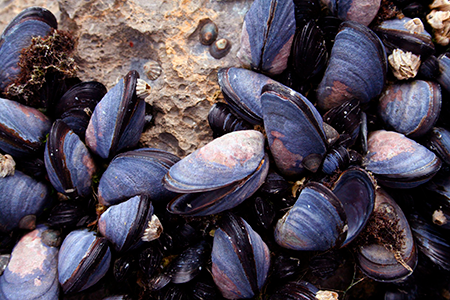 This amazing glue could also be used to glue skin together! When people get a deep cut on their skin, they often have to get stitches. Sometimes the stitches leave scars. But doctors are working with a new kind of glue that could replace stitches. Many types of glue do not work on skin because skin contains a lot of water.
When we look at nature, we see millions of wonderful designs that God created. We can copy some of these designs and use them to make our lives better. Other designs are so difficult to understand, even the smartest humans cannot figure them out or copy them. The designs found in nature teach us very important lessons. They teach us that God is much smarter than humans will ever be. They also teach us that God designed the world just right for humans to live here. God cares about us and wants us to be happy. He wants us to learn about the natural world and use it to help make our lives better. But even more than that, God designed His Word, the Bible, to help us learn how to serve Him and go to heaven.
The post Mussel Glue appeared first on Apologetics Press.
]]>The post Seal Whiskers Sensing God appeared first on Apologetics Press.
]]>The benefit of this technology over the current sonar technology the Navy uses is that seals do not have to send any sound or wave out. Their whiskers gather information based solely on what is coming in. McDermott wrote that researchers are attempting to “reverse-engineer the system” that is built into seal whiskers. Such reverse-engineering begs the question: If highly intelligent scientists are attempting—so far without success—to reverse-engineer the technology behind seal whiskers, then the original Engineer must have been more intelligent than those who are now attempting to understand the design. Such examples of humans looking to nature to find usable technology (often called biomimicry) validates the conclusion that there is a Grand Engineer behind the workings of the world. The idea that random, chance processes of evolution worked over millions of years to “design” a system such as that found in seal whiskers does not provide an adequate or rational answer. If it takes intelligence to reverse-engineer it, then it took intelligence to engineer it in the first place.
McDermott went on to state that seal whiskers are not the only natural technology that has peaked the interest of the U.S. Navy. She wrote: “The Navy, which is also funding bio-inspired work at universities, has taken a greater interest in the field in the past decade. Animals do things well that the Navy wants its underwater vehicles to do well.” When we look to the natural world that God, the Grand Engineer, designed, we can truly see that the beasts, cattle, great sea creatures, and even the whiskers on a seal bring praise to the Lord (Psalm 148:7-12).
Endnotes
1 Jennifer McDermott, “The Seal Whiskerers: Navy Looks to Sea Life for New Ships,” Associated Press, 2017, http://abcnews.go.com/Technology/wireStory/seal-whiskerers-navy-sea-life-ships-46136863.
The post Seal Whiskers Sensing God appeared first on Apologetics Press.
]]>The post Beetles that Brighten the Night appeared first on Apologetics Press.
]]>Certain click beetles commonly known as Headlight Elaters are amazing insects that can light up. Near the back corners of the second main section of the beetle (known as the thorax) are two round lights. These lights do not flash on and off, but produce a constant glow, and look similar to the headlights of a car. When they want to, these click beetles can dim or brighten their “headlights” as they see a need. For example, if they sense a potential predator, they may intensify their brightness in order to scare the possible attacker away.
No doubt, the most well known bioluminescent beetle is the firefly. Interestingly, fireflies are not flies, nor do they produce any kind of burning “fire.” In fact, one of the most impressive things about these nocturnal, bioluminescent creatures is that they can produce light without producing the heat (and great amounts of energy) that so often goes together with light.
Fireflies (also known as lightning bugs) have special chemicals in their abdomens called luciferin (lew-SI-fer-in) and luciferase (lew-SI-fer-ace), which they combine with oxygen to form a bright, heatless light. It appears that fireflies activate these chemicals for at least two reasons: (1) because they sense that they are in danger and want to warn a possible predator, or (2) because they want to attract a mate in order to reproduce.
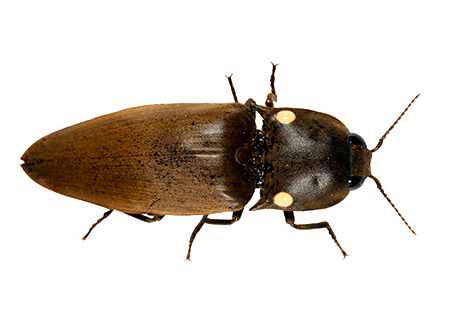 The more scientists learn about fireflies, Headlight Elaters, and other bioluminescent creatures, the more amazed they are at their complexity. Scientists have been somewhat successful at producing certain kinds of chemical light that mimic the more efficient, heatless light produced by bioluminescent creatures. However, scientists confess that light from fireflies and other creatures is still more efficient than what they have produced in laboratories. The fact is, bioluminescent bugs testify loudly to a Creator—the first Chemical Engineer.
The post Beetles that Brighten the Night appeared first on Apologetics Press.
]]>The post Rolling Over Evolution appeared first on Apologetics Press.
]]>Evidence from archaeology shows that wheels go back thousands of years. But did you know that humans did not really invent the wheel? What I mean by that is God invented creatures during the Creation week that roll almost exactly like wheels. Scientists have been studying these animals and trying to learn how to make robots that can roll like the animals do.
One of the most famous rolling creatures is the mother-of-pearl caterpillar. This little green critter does not look like anything extra special. It pokes along at the normal caterpillar pace most of the time. If it is threatened, however, it has an amazing ability to roll away from danger. It anchors its back end to the ground and pulls its body up with lightening speed. Then it curls into a round wheel shape and launches itself backwards. By doing this, it can travel 40 times faster than it normally travels. That means it can go about 15 inches in one second. For a caterpillar, that is super fast.
The Mount Lyell Salamander is another creature that really knows how to rock and roll. It spends time on the sides of hills or slopes. If it wants to go down the hill quickly, it can roll its body into a tire shape and bounce down. The way it rolls its body up allows it to be very flexible and absorb the bumps and shocks of the trip. Another animal that has the ability to roll is the mantis shrimp. It normally swims, but some species end up “stuck” on the sandy beach. In order to get back to the ocean, the shrimp can roll into a ball and somersault toward the water.
 |
| This is a salamander but not a Mount Lyell Salamander. |
Scientists at Tufts University realize what an incredible ability these creatures have to roll so quickly. These researchers have spent thousands of hours designing a robot they call the GoQBot. The scientists have tried to copy the body design and ability of the mother-of-pearl caterpillar. These engineers have done a great job creating a machine that they believe will be useful to man. Even though this robot is impressive, it is not as good or as quick at rolling as the mother-of-pearl caterpillar.


When we think about animals with amazing abilities to move, such as the mantis shrimp, rolling salamander, and mother-of-pearl caterpillar, we can see that they have been designed by an intelligent Mind. A series of chance processes of evolution working over millions of years could not have caused their remarkable skills. Instead, we see that an all-powerful, all-knowing God is behind their ingenious design. Isn’t it amazing how many different animals with interesting abilities God put in the world for us to study? We should always remember to thank Him for such variety.
The post Rolling Over Evolution appeared first on Apologetics Press.
]]>The post Dragonflies: Engineered to See More Than You Might Think appeared first on Apologetics Press.
]]> Have you ever played in front of the automatic doors at a store, seeing how close you can get to the doors before they open, or seeing if you can move so slowly that they never open or notice that you are there? Those are fun games, but have you ever thought about why the doors work that way? They have a special detector or sensor, kind of like a special camera (a motion detector), that “watches” for movement close to the doors. There are many kinds of sensors that engineers have designed—thermal sensors (that detect heat), acoustic sensors (that detect sound vibrations), pressure sensors, light sensors, magnetometers (that detect magnetic fields), and many others. Sensors are always designed by someone.
Amazingly, scientists have discovered that dragonflies are equipped with a fascinating sensor called a horizon sensor. As dragonflies move through the air with their amazing speed and ability to turn quickly, they need some way to tell whether they are angled the right way. To do this, they use three special, little eyes called ocelli (oh-SELL-eye). These are not their regular (compound) eyes that they use to see. Ocelli watch the horizon (the line between the Earth and the sky that you can see miles away from you) in order to make sure dragonflies are positioned or oriented the way they want to be. Does that sound like something that would just accidentally grow on a dragonfly one day? Or does it sound like it was intentionally designed by Someone?
 As proof that it was designed, think about this. Engineers are so amazed by the design of the dragonfly’s ocelli that they are now trying to copy ocelli design for use on their own designs, which they call biomorphic (bye-oh-MORF-ic) ocelli. Why would some of the greatest engineering minds of the world try to copy something that was the result of accidents? It makes more sense that the amazing ocelli of the dragonfly were designed by an even more amazing Engineer—God. Just as a building requires a builder, design requires a designer (Hebrews 3:4).
The post Dragonflies: Engineered to See More Than You Might Think appeared first on Apologetics Press.
]]>The post Shrewbot appeared first on Apologetics Press.
]]>

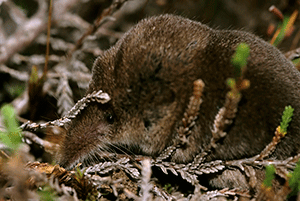
Very smart engineers who build robots have been working on a new machine they call Shrewbot. Shrewbot is a small robot fitted with whiskers. The engineers studied the Etruscan shrew’s whiskers and used them as a model for their robot. The main advantage of this “touchy” technology is that the robot does not rely on vision. Because the robot uses its whiskers instead of eyes, it can go into dark places where other robots cannot go. The people who made the robot think it might be helpful to firemen, because it could go into smoky rooms.
When scientists copy designs in nature, it is called biomimicry. We often write about biomimicry in Discovery magazine. Each new instance of this practice helps us see the intelligent design within the natural world. If brilliant scientists find complex, working designs in nature that are better than man-made designs, then the Designer of the natural world must be more intelligent than any human designer. Isn’t it neat how one of the world’s smallest mammals provides such a “big” piece of evidence for the existence of God—the Intelligent Designer?
The post Shrewbot appeared first on Apologetics Press.
]]>The post Shrewbot’s Synthetic Whiskers Detect God appeared first on Apologetics Press.
]]>Robotics experts from the Bristol Robotics Laboratory in England have been working on a new machine they call Shrewbot. Shrewbot is a small robot fitted with synthetic whiskers that mimic those of the Etruscan shew (Moon, 2012). The primary advantage of this “touchy” technology is that the bot does not rely on vision. Researchers suggest that the sense of touch will enable the bot to explore “dark, dangerous or smoke filled environments” (2012).
When scientists copy designs in nature, it is called biomimicry. At Apologetics Press, we have written several articles about this field of research (see Biomimicry). Each new instance of this practice underscores the intelligent design within the natural world. The implication is simple. If brilliant scientists find complex, proficient designs in nature that are more efficient than any man-made designs, then the Designer of the natural world must be more intelligent than any human designer. It is ironic that one of the world’s smallest mammals provides such a “big” piece of evidence for the existence of God—the Intelligent Designer.
REFERENCES
Biomimicry, /APContent.aspx?category=12&topic=66.
Moon, Mariella (2012), “How the Etruscan Pygmy Shrew Inspired a Bewhiskered Disaster Relief Robot,” http://news.yahoo.com/blogs/technology-blog/etruscan-pygmy-shrew-inspired-bewhiskered-disaster-relief-robot-154004920.html.
The post Shrewbot’s Synthetic Whiskers Detect God appeared first on Apologetics Press.
]]>The post Autonomous Control of Creation appeared first on Apologetics Press.
]]>Engineers regularly work with control systems. Autonomous control is a step beyond remote control. Remote control applications allow manual issuing of commands through some sort of transmission device (i.e., a remote controller) that controls something else (e.g., a robot or television) located some distance away from the controller. Autonomous control, on the other hand, uses a computer program to issue the commands. The computer becomes the controller, instead of a human being. It is common knowledge in the engineering community that autonomous control is a subject that is of particular interest today. From autonomous control of ground vehicles (Naranjo, et al., 2006), to autonomous missile guidance systems (Lin, et al., 2004) and aerial vehicles (Oosterom and Babuska, 2006), to autonomous aquatic vehicles (Loebis, et al., 2004) and satellites (Cheng, et al., 2009), and even to autonomous farming equipment (Omid, et al., 2010), notable success is being made in this area of technology.
The amazing thing from a Christian perspective, however, is that many engineers—the designers of the scientific community—are becoming aware of the fact that the world around us is already replete with fully functional, superior designs in comparison to what the engineering community has been able to develop to date. Biomimicry (i.e., engineering design using something from nature as the blueprint) is becoming a prevalent engineering pursuit. However, some engineers are not interested in copying creation in their designs since they simply cannot replicate many of the features that the natural world has to offer. They are realizing that the created order oftentimes comes equipped with natural “sensor suites” whose designs surpass the capability of engineering knowledge to date. Animals possess amazing detection, tracking, and maneuvering capabilities which are far beyond the knowledge of today’s engineering minds, and likely will be for many decades, if not forever. An insect neurobiologist, John Hildebrand, from the University of Arizona in Tucson, admitted, “There’s a long history of trying to develop microrobots that could be sent out as autonomous devices, but I think many engineers have realised [sic] that they can’t improve on Mother Nature” (Marshall, 2008, p. 41). Of course, “Mother Nature” is not capable of designing anything, since “she” is mindless. The Chief Engineer, the God of the Bible, on the other hand, can be counted on to have the best possible engineering designs. Who, after all, could out-design the Grand Designer? In spite of the deterioration of the world and the entrance of disease and mutations into the created order, after some six millennia, His designs still stand out as the best—unsurpassed by human wisdom.
Controlling the Living
Recognizing the superiority of the natural world, the scientific community has become interested in learning how to remotely control living creatures instead of developing robotic versions. This line of thinking certainly adds new meaning to God’s command to mankind to “subdue” and “have dominion” over the created order (Genesis 1:28). One of the ways in which animal remote control is being done is by implanting electronics in animal bodies that are subsequently used to manipulate the movements and behaviors of the creature. Hybrid creatures such as these are known as bio-robots or cyborgs. Cyborg research has been conducted since the 1950s, when Jose Delgado of Yale University implanted electrodes into the brains of bulls to stimulate the hypothalamus for control purposes (Marshall, 2008). Since then, the list of remotely controlled animals using electrode implantation has grown to include:
- sharks (i.e., spiny dogfish; Gomes, et al., 2006; Brown, 2006)
- rats (Talwar, et al., 2002; Li and Panwar, 2006; Song, et al., 2006)
- monkeys (Brown, 2006; Horgon, 2005)
- mice (“SDUST Created…,” 2007)
- chimpanzees (Horgon, 2005)
- frogs (Song, et al., 2006)
- pigeons (“SDUST Created…,” 2007)
- cats (Horgon, 2005)
- gibbons (Horgon, 2005)
- cockroaches (Holzer, et al., 1997; “Researchers Develop ‘Robo-roach,’” 2001)
Cornell University, the University of California at Berkeley, the University of Michigan, and Arizona State University at Tempe are working on developing flying insect cyborgs, including hawkmoths and green June beetles (Ray, 2010; Sato, et al., 2008; Sato, et al., 2009; Bozkurt, et al., 2008). The University of Florida in Gainesville used electrodes to remotely control rats specifically for detection of humans (for search and rescue scenarios) and explosives (Marshall, 2008). Non-invasive remote creature control projects are underway as well. M.I.T. used virtual fencing coupled with Global Positioning System (GPS) for tracking and autonomously herding cows by implementing auditory cues and shock reinforcement to keep cows within a desirable area (Correll, et al., 2008; Schwager, et al., 2008).
There is beginning to be more interest in the prospect of remotely controlling canines as well (“Grand Challenge…,” 2010). Engineers realize that dogs can traverse a variety of terrains more efficiently than humans or robots and are effective at guarding territories, carrying out search and rescue missions, as well as providing guidance for the visually impaired. They also have an amazing sense of smell that makes them capable of detecting explosives, narcotics, tobacco, pipeline leaks, retail contraband, and even cell phones and bed bugs (“Detection Services,” 2010). Since engineers have not developed a device that can compare with a canine’s ability to detect odors, the use of canines for these applications is attractive. Although other creatures, such as rats (Marshall, 2008), have a keen sense of smell, canines are more appealing, especially due to their innate ability to interact with humans. Thus, using canines for these purposes is attractive to engineers, and the ability to remotely control a canine for many of these purposes is an even more attractive goal. Many scenarios could be envisioned to illustrate cases where the presence of a dog handler alongside a canine could be an impossibility (e.g., tight areas in search and rescue operations) or undesirable (e.g., scenarios where the handler should not be visible or in harm’s way). In a recent event in Afghanistan, a bomb detection canine detected an explosive a moment too late. The canine handler lost his left leg and received other serious injuries (“Grand Challenge…,” 2010). Remote control capability or autonomous guidance likely would have significantly altered the outcome of this unfortunate event, as well as many others.
Since engineers cannot yet develop an adequate robotic solution to this problem, the Office of Naval Research funded a research project to develop such a solution—a research project I was heavily involved in at Auburn University while engaged in doctoral studies. The Canine Detection and Research Institute (CDRI) at Auburn University demonstrated that detection canines can be remotely controlled using a canine vest we developed that was equipped with a tone and vibration generator (Britt, et al., 2010). However, many cases could easily be envisioned where the canine would be out of sight from the handler (e.g., moving behind a distant building), at which time remote control capability becomes useless. Therefore, the next natural step was to automate that remote control capacity (i.e., autonomous control of the canine).
 Since canines can traverse a variety of terrains more efficiently than humans, and possess a natural array of “sensors” used to detect and locate items of interest that robots are not readily equipped with, many aspects that pose problems to unmanned ground vehicles are inherently removed with the canine. Canines can execute the low-level decision making that is necessary for rerouting their local path to avoid obstacles or unfavorable terrain. We proved with notable success that canines can be tracked using GPS, inertial sensors, and magnetometers (Miller and Bevly, 2007; Miller and Bevly, 2009a; Miller and Bevly, 2009b), as well as be autonomously guided along desired paths to distant end points (Miller, 2010; Britt, 2009). More important, this system was designed without having to develop the technology that would be required for a complete robotic solution. Instead, a pre-designed creature, already developed by the Chief Engineer, was utilized. In the interest of not plagiarizing Him, I happily reference His incomprehensible work, although, unfortunately I cannot speak for all of my doctoral colleagues.
CONCLUSION
How ironic that those who are designed, design based on the Designer’s designs, while simultaneously claiming that those designs are not designed. How could mindless rocks, dirt, gas, or slime bring about the amazingly complex designs we see in the World? Personifying inanimate materials such as these with names like “Mother Nature” does nothing but tacitly admit that some Being is in control of the natural order. The frontlines of the engineering community today—bringing about unparalleled technology, more advanced than any society in the history of mankind—cannot come close to replicating the designs around us. Engineers are forced to borrow from God’s design portfolio (oftentimes plagiarizing Him—not giving Him due credit for His designs). What a testament to the greatness of the Chief Engineer’s created order! We may be able to try to fix some of the damage that has been done to the created order due to sin and entropy, but in the words of John Hildebrand, quoted earlier, we certainly “can’t improve on” God’s design. Rather than plagiarizing Him, let all engineers know, “He who built all thingsis God” (Hebrews 3:4, emp. added).
REFERENCES
Bozkurt, A., R. Gilmour, D. Stern, and A. Lal (2008), “MEMS Based Bioelectronic Neuromuscular Interfaces for Insect Cyborg Flight Control,” IEEEMEMS2008 Conference, pp. 160-163.
Britt, W. (2009), “A Software and Hardware System for the Autonomous Control and Navigation of a Trained Canine,” Ph.D. Dissertation, Auburn University, Summer.
Britt, W.R., J. Miller, P. Waggoner, D.M. Bevly, and J.A. Hamilton (2010), “An Embedded System for Real-time Navigation and Remote Command of a Trained Canine,” DOI 10.1007/s00779-010-0298-4.
Brown, S. (2006), “Stealth Sharks to Patrol the High Seas,” New Scientist, 2541:30-31, March 4.
Cheng, C., S. Shu, and P. Cheng (2009), “Attitude Control of a Satellite Using Fuzzy Controllers,” Expert Systems with Applications, 36:6613-6620.
Correll, N., M. Schwager, and D. Rus (2008), “Social Control of Herd Animals by Integration of Artificially Controlled Congeners,” Proceedings of the 10th International Conference on Simulation of Adaptive Behavior, pp. 437-447.
“Detection Services” (2010), Amdetech: Protection Through Detection, http://www.amdetech.com.
Gomes, W.J., D. Perez, and J.A. Catipovic (2006), “Autonomous Shark Tag with Neural Reading and Stimulation Capability for Open-ocean Experiments,” Eos Trans. AGU, 87(36), Ocean Sci. Meet. Suppl., Abstract OS45Q-05.
“Grand Challenge: Smart Vest for Detector Dogs” (2010), National Aerospace & Electronics Conference, http://www.naecon.org/challenge.htm.
Holzer, R., I. Shimoyama, and H. Miura (1997), “Locomotion Control of a Bio-Robotic System via Electric Stimulation,” International Conference on Intelligent Robots and Systems, Grenoble, France.
Horgon, John (2005), “The Forgotten Era of Brain Chips,” Scientific American, 293[4]:66-73.
Li, Y. and S. Panwar (2006), “A Wireless Biosensor Network Using Autonomously Controlled Animals,” IEEENetwork, 20[3]:6-11.
Lin, C., H. Hung, Y. Chen, and B. Chen (2004), “Development of an Integrated Fuzzy-Logic-Based Missile Guidance Law Against High Speed Target,” IEEETransactions on Fuzzy Systems, 12[2]:157-169.
Loebis, D., R. Sutton, J. Chudley, and W. Naeem (2004), “Adaptive Tuning of a Kalman Filter via Fuzzy Logic for an Intelligent AUV Navigation System,” Control Engineering Practice, 12:1531-1539.
Marshall, J. (2008), “The Cyborg Animal Spies Hatching in the Lab,” New Scientist, 2646:40-43, March 6.
Miller, J. (2010), “A Maximum Effort Control System for the Tracking and Control of a Guided Canine,” Ph.D. Dissertation, Auburn University, Winter.
Miller, J. and D.M. Bevly (2007), “Position and Orientation Determination for a Guided K-9,” Proceedings of the IONGNSS, Ft. Worth, TX.
Miller, J. and D.M. Bevly (2009a), “Determination of Pitch Effects in Guided K-9 Tracking,” Proceedings of the JSDE/IONJNC, Orlando, FL.
Miller, J. and D.M. Bevly (2009b), “Guided K-9 Tracking Improvements Using GPS, INS, and Magnetometers,” Proceedings of the IONITM, Anaheim, CA.
Naranjo, J.E., C. Gonzalez, R. Garcia, and T. Pedro (2006), “ACC+Stop&Go Maneuvers With Throttle and Brake Fuzzy Control,” IEEETransactions on Intelligent Transportation Systems, 7[2]:213-225.
Omid, M., M. Lashgari, H. Mobli, R. Alimardani, S. Mohtasebi, and R. Hesamifard (2010), “Design of Fuzzy Logic Control System Incorporating Human Expert Knowledge for Combine Harvester,” Expert Systems with Applications, 37:7080-7085.
Oosterom, M. and R. Babuska (2006), “Design of a Gain-Scheduling Mechanism for Flight Control Laws by Fuzzy Clustering,” Control Engineering Practice, 14:769-781.
Ray, Neil (2010), “The Cyborg Beetle: Progress or Ethical Deterioration?” The Triple Heliz, Issue 10.
“Researchers Develop ‘Robo-Roach’” (2001), VNUnet UK: UNU–MERIT—I&T Weekly, Issue 7, United Nations University, http://www.merit.unu.edu/i&tweekly/i&tweekly_previous.php?issue=0107&issue_show=7&year=2001.
Sato, H., C.W. Berry, B.E. Casey, G. Lavella, Y. Yao, J.M. Vandenbrooks, and M.M. Maharbiz (2008), “A Cyborg Beetle: Insect Flight Control Through an Implantable, Tetherless Microsystem,” IEEEMEMS2008 Conference, pp. 164-167.
Sato, H., Y. Peeri, E. Baghoomian, C.W. Berry, and M.M. Maharbiz (2009), “Radio-Controlled Cyborg Beetles: A Radio-frequency System for Insect Neural Flight Control,” IEEEMEMS2009 Conference, pp. 216-219.
Schwager, M., C. Detweiler, I. Vasilescu, D.M. Anderson, and D. Rus (2008), “Data-Driven Identification of Group Dynamics for Motion Prediction and Control,” Journal of Field Service Robotics, 25[6-7]:305-324.
“SDUST Created Remote-Controlled Pigeon” (2007), Shandong University of Science and Technology, http://www.sdkd.net.cn/en/news_show.php?id=65.
Song, W., J. Chai, T. Han, and K. Yuan (2006), “A Remote Controlled Multimode Microstimulator for Freely Moving Animals,” Acta Physiologica Sinica, 58[2]:183-188.
Talwar, S., S. Xu, E. Hawley, S. Weiss, K. Moxon, and J. Chapin (2002), “Rat Navigation Guided by Remote Control,” Nature, 417[6884]:37-38.
The post Autonomous Control of Creation appeared first on Apologetics Press.
]]>The post Super-Strong Spider Silk appeared first on Apologetics Press.
]]> To the average person, a spider’s web looks very weak and flimsy. With the greatest of ease, a person can destroy a web. In only a second, the spider’s house is destroyed with the wave of a hand. Even Job’s uninspired friend, Bildad, mentioned the weakness of webs when he compared the unrighteous to those “whose trust is a spider’s web” (Job 8:14), who are leaning upon a house that easily perishes. So why are scientists so awestruck by the spider’s silk webbing?
 Scientists are fascinated with spider silk because it has the amazing ability to absorb a strong impact. Think about it. Spider silk is much, much smaller and lighter than the flies and grasshoppers that often fly full speed into a spider’s web. Yet the web doesn’t break. It stretches (30% farther than the stretchiest known nylon) but it doesn’t break—at least not usually. Some spiders’ webs are so strong, in fact, that they can even catch small birds, such as hummingbirds. (Yes, some spiders will even catch and eat birds.) Although it may not seem strong and tough from the vantage point of a human who easily can tear down a spider’s web, pound-for-pound, the silk from certain kinds of spiders is five times stronger than steel.
Since harvesting silk from spiders is not very practical, scientists are attempting to make artificial “spider silk” that could be used for countless things, including bulletproof vests, bridge cables, and artificial tendons. How have scientists fared so far? Although they have made some progress, one scientist admitted that despite years of research, artificial webbing “can’t even come close” to equaling the amazing qualities of spider-produced silk. Sadly, this same scientist believes that spiders just “evolved the capacity to spin silk.” Are we to believe that the mastermind behind the light, stretchy, shock-absorbing, tougher-than-steel, better-than-anything-man-made, spider webbing is mindless evolution? Absurd!
Spider webbing is God’s wonder material. That is, God designed these arachnids with the amazing ability to weave wonderful webs. Truly, “the foolishness of God is wiser than men, and the weakness of God is stronger than men” (1 Corinthians 1:25). “For every house is built by someone, but He who built all things is God” (Hebrews 3:4).

The post Super-Strong Spider Silk appeared first on Apologetics Press.
]]>The post Copying God's Design appeared first on Apologetics Press.
]]>The list of things included under the term biomimicry is very long. Recently, scientists have begun to develop a tiny flying robot that mimics a fly. Interestingly, it is about the same size and weight of a fat housefly. Many uses have been proposed for this “robofly,” including helping firefighters locate people during fires or spying on potential terrorists. Why would anyone want to copy a fly? The reason is very simple; flies are some of the most well-designed flyers in the world. Ron Fearing, the scientist behind much of the research on the robofly, said that flies are “thefighter jets of the animal world.” They can changespeed and direction in a fraction of a second, and they can even land upside down. Just try catching one with your hand to see how great they are at flying. Dr. Fearing went on to say, “There are all kinds of things nature can do that we don’t know how to do yet.”
Dr. Fearing, and many of the people who study biomimicry, concluded that these wonderful designs and structures are the result of evolution. But that does not make any sense. If humans, who are very intelligent, have not been able to create designs and structures as efficient as those in nature, then how could evolution have done it by blind chance and accident? Doesn’t it make much better sense to believe that God, the Great Designer of the Universe, created the “fighter jets of the animal world” with all of their amazing designs? Isn’t it amazing how God’s design—found in a common housefly—is better than some of the technology found in our most advanced jet planes? The apostle Paul had it right when he said that “the foolishness of God is wiser than men, and the weakness of God is stronger than men” (1 Corinthians 1:25).
The post Copying God's Design appeared first on Apologetics Press.
]]>The post The Silk "STEEL" of a Spider appeared first on Apologetics Press.
]]>Although spiders give most of us the creeps (which is why we choose to smash them rather than pamper them), these little creatures are on the cutting edge of technology; they are “jewels” to many scientists. Their silk is made up of chains of amino acids (protein)—an arrangement that is responsible for the silk’s amazing strength. Since scientists have found it too difficult to “outdo” what God created in the beginning, they have decided instead to try to use God’s special critters and the silk “steel” they produce. Believe it or not, scientists are attempting to produce spider silk on a mass scale by implanting spider-silk genes into the eggs of mother goats. With this procedure, scientists hope that the female offspring will be able to secrete the “spider silk” protein in their udders. As one scientist stated, “All we’ll have to do is milk the goats” in order to get the spider silk.
Can you imagine how useful it would be if we could produce our own spider silk? We could make soft, lightweight, bulletproof vests for policemen—vests that would absorb five times the impact of current ones. Scientists believe spider silk will one day be found in everything from non-tear sports jerseys, air bags, and fishing line to artificial tissues used by doctors to repair an athlete’s torn ligament.
Obviously, if scientists must spend thousandsof hours trying to design a way to reproduce spider silk, it makes no sense to believe that the natural silk that spiders make is a product of evolution (and non-intelligence). Spider silk is God’s“wonder material,” not evolution’s.
The post The Silk "STEEL" of a Spider appeared first on Apologetics Press.
]]>The post Antifreeze, Fish, and Ice Cream appeared first on Apologetics Press.
]]>Scientists have been studying fish that live in the sub-zero waters of the Arctic and Antarctic. They have found that fish produce their own protection against the cold. They make natural chemicals called antifreeze glycoproteins that keep their blood and tissues from freezing. Fish cannot keep from swallowing ice particles in seawater. Though scientists are not yet exactly sure how the fish do it, their in-built protection system interrupts the growth of ice crystals. Their antifreeze proteins are far more effective than anything humans have invented. Fish are not the only organisms of God’s creation that produce their own protection from the cold. Many insects and plants do the same.
Looking at how God designed fish to survive the cold is leading to the development of many wonderful things for people, including frost-protection sprays for crops, longer storage time for blood platelets, and more time to get organ donations to patients needing transplants. And that’s not all. What about those unpleasant moments when you open the freezer part of your refrigerator, only to find that your favorite ice cream has become the victim of “freezer burn”? Dessert companies are now doing experiments that they hope will be able to keep ice cream from forming those distasteful ice crystals! This is yet another case where man is copying God’s creation in order to make progress.
The post Antifreeze, Fish, and Ice Cream appeared first on Apologetics Press.
]]>The post A Sponge with Fiber Optics appeared first on Apologetics Press.
]]>But there are some problems with these cables. First, since they are glass, they can be brittle, which means they can crack and break. Digging up the cables and replacing them is very expensive. Second, in order to produce the cables, factories must use very high heat, which is also very expensive. Fiber optics are amazing, but they could use some im-provement.
That is where God’s design comes into the picture. Today, scientists have found an amazing sponge that has wonderful fiberoptic “cables.” The sponge, called the Venus Flower Bas-ket, lives in the deep waters
of the ocean. This sponge produces several fiber-optic “cables” that grow out of its base. These tiny “cables” are about as wide as a single human hair, and they grow to be anywhere between 2 and 7 inches long.
The fibers produced by the Venus Flower Basket have several advantages over the ones produced by men. First, they are produced in cool temperatures. If we humans could learn to copy this, we could save millions of dollars. Second, the fibers from the sponge are very strong and flexible, plus they do not crack and break like the ones humans produce. In fact, the fibers from the sponge are so flexible they can be tied into a knot. If our scientists could learn to make such strong, flexible fibers, we would not have to spend as much time and money repairing the fiber-optic cables.
Intelligent scientists have been working on fiber-optic cables for many years, just to get them to work as well as they do now. Yet, the Venus Flower Basket has fibers that are produced in cool temperatures, and are strong and flexible. If it takes an intelligent scientist to produce the cables we have today, that means the designer of the Venus Flower Basket must be very intelligent as well. God’s design in the sponge’s fiber-optic “cables” proves that animals like the Venus Flower Basket did not evolve.
The post A Sponge with Fiber Optics appeared first on Apologetics Press.
]]>The post Robotic Hummingbird Defies Evolution appeared first on Apologetics Press.
]]> Imagine looking out your window one morning as the birds come to the feeder and seeing a hummingbird. As you look closer, however, you realize this is no ordinary hummingbird. It hovers, moves forward and backward, and is about the same size as other hummingbirds that you have seen, but this one has some striking differences. It is made out of lightweight, synthetic material and has a camera in its stomach, which is pointing right at you, filming everything you are doing! Anyone staring at a camera-laden hummingbird droid would immediately wonder who designed the machine and why it was sent. No one would entertain the idea that the perfectly functioning robot somehow evolved from natural processes that were at work in a junkyard down the street.
While this hummingbird robot sounds more like science fiction than science, it happens to be the latest gismo produced by the California-based company AeroVironment (Watson, 2011). Watson reported that the “Pentagon has poured millions of dollars into the development of tiny drones inspired by biology” (2011, emp. added). The product of this research is a robotic hummingbird “with a 6.5-inch wing span” that weighs “less than a AA battery and can fly at speeds up to 11 mph” (2011). The device has taken AeroVironment five years to produce and cost about four million dollars.
When compared to a “real,” living hummingbird, this contraption looks clumsy. Real hummingbirds can fly 25 miles per hour, and reach diving speeds of 60 miles per hour. They normally flap their wings about 50 times per second, but can flap them up to 200 times per second. If the amazing mechanical hummingbird took millions of dollars, several years, and a host of brilliant engineers to design, what are we forced to conclude about the real thing? Whoever designed it must have been more intelligent than the combined intelligence of the entire human engineering populace, since this latest hummingbird robot represents the very best humans can do. The supposed naturalistic process of evolution could never account for a creature like the hummingbird, nor for a mechanical imitation of it. When God asked the patriarch Job, “Does the hawk fly by your wisdom?” (Job 39:26), He was stressing the fact that flying creatures like hawks and hummingbirds provide outstanding evidence that God exists, and He knows infinitely more about everything than man does.
REFERENCE
Watson, Julie (2011), “Tiny Spy Planes Could Mimic Birds, Insects,” http://news.yahoo.com/s/ap/20110301/ap_on_re_us/us_hummingbird_drone/print.
The post Robotic Hummingbird Defies Evolution appeared first on Apologetics Press.
]]>The post Morphing Flight: Beyond Irreducible Complexity appeared first on Apologetics Press.
]]>[EDITOR’S NOTE: A.P. auxillary staff scientist Dr. Fausz holds a Ph.D. in Aerospace Engineering from Georgia Tech.]
Researchers and observers have long recognized that birds and various other flying creatures change the positioning of their body structures in flight in order to perform specific maneuvers or adjust their aerodynamic profile to accommodate changing flight conditions. This adaptive orientation of body shape has been dubbed “morphing” in the popular literature. The words “morph” and “morphing” are actually digressive forms of the word “metamorphosis,” which derives from the Greek “meta” (to change) and “morfe” (form). This is an apt description of the ability that birds possess to change the form or geometry of their bodies for increased maneuverability, as well as for stable flight in a wide variety of ambient conditions.
 |
|
This eagle is pulling its feet against its body to reduce aerodynamic drag. Note also the craning of the wings (normally used to slow descent speed) and the spreading of the wing feathers to break up wing tips vortices that increase drag.
|
This capability has always been respected and often mimicked by aircraft engineers to the extent that it has been technologically possible to do so. Furthermore, bird observations have often inspired technological advancement in aircraft design and development. The Wright brothers incorporated morphing into their first successfully powered aircraft design. In a letter, Wilbur Wright described the biological observation that was the basis for this morphing design:
My observation of the flight of buzzards leads one to believe that they regain their lateral stability when partly overturned by a gust of wind, by a torsion of the tips of the wings (Wright, 1900, Image 4).
Consequently, the Wright brothers designed their first aircraft to be able to “twist” its wings for lateral stability and control, mimicking bird capability. Another well-known example of morphing in aircraft design is retractable landing gear which serves the same purpose for aircraft as when a bird pulls its feet up to its body in flight. That is, this type of morphing dramatically decreases aerodynamic drag which, in turn, increases energy efficiency for the bird of prey—which translates to fuel efficiency in aircraft. Additional “low-tech” examples of morphing include movable control surfaces used to impart forces and torques on the aircraft for maneuvering and stability, wing “slats,” “slots,” and “flaps” that extend to change the shape of the wing, providing higher lift at lower speeds for takeoff and landing, and variable “sweep” wings that allow aircraft to fly efficiently at dramatically differing flight speeds, such as in transitioning from subsonic to supersonic flight. In contrast with these examples of “low tech” morphing designs of the past, a morphing aircraft has been defined as “one that utilizes innovative actuators, effectors, or mechanisms to adapt its state substantially in order to enhance behavior and performance in addressing multiple environments” (Love, et al., 2007, emp. added). These past examples of morphing technologies were certainly innovative in their time, but are now fairly commonplace—not even considered “morphing” by some.
Nonetheless, research in new innovation for morphing aircraft is once again looking to birds for inspiration and guidance. NASA Administrator Dan Goldin stated:
NASA will open the door to a bold and revolutionary era by using technology to mimic nature. The seemingly effortless flight of birds provides the inspiration for new aircraft utilizing wings that reconfigure in flight. The vehicle changes—or morphs—from a low-speed configuration to one more suited for high speed (as quoted in Levine, 2001).
NASA is not the only organization actively pursuing aircraft morphing technology, however. A recent  article described an unmanned aerial vehicle (UAV) currently under development, called “Roboswift” as “a small, remote-controlled aircraft that changes shape to mimic the aerodynamic profile of a swift” (Simonite, 2008). A researcher at the University of Florida, also studying morphing technology for UAVs, commented:
Despite the past century of innovation in aircraft technology, the versatility of modern aircraft remains far worse than airborne biological counterparts. The shape changing accomplished by birds and bats in flight stands as one of the few examples of true morphing. As such, the aircraft community is devoting considerable attention to the study of biological systems and how they might be implemented on a flight vehicle (Abdulrahim, 2005, emp. added).
Clearly, research in aircraft technology and design continues to draw ideas and inspiration from nature’s flyers. It is also clear that our technical capabilities seriously lag behind their natural abilities.
In spite of the fact that aerospace researchers have birds and other flying creatures to show them “how it’s done,” morphing aircraft design poses some very daunting technical challenges. This fact was discussed in an article describing the Morphing Aircraft Structures (MAS) project being carried out by the Lockheed Martin company with funding from the Defense Advanced Research Projects Agency (DARPA):
Morphing technology development requires integrated research in materials, smart structures, multi-functional airframe, and adaptive control. It is necessary to evaluate these constitutive technologies in a morphing vehicle to establish requirements and assure readiness for technology implementation (Love, et al., 2007).
Another research team, funded by the Air Force Research Laboratory (AFRL) and Northrup Grumman, further stated: “Significant design challenges require advances in smart structures and materials (skins), actuation and power distribution, and feedback control of the morphing structure” (Ghandi, et al., 2007). The implication here is that morphing design is highly multi-disciplinary (structures, aerodynamics, control, etc.) and that all of these areas require additional research before the technology readiness level will be sufficient to actually build a true morphing aircraft. These examples only scratch the surface of the extreme levels of government funding and human resources that have gone into morphing aircraft research, yet there is still much work that must be done before a viable design can be realized, mainly due to the multi-disciplinary nature of the problem.
Given the substantial resources that have been poured into morphing aircraft research without yet achieving the final objective, it seems inconceivable that researchers would look at their biological inspiration and assume that the capabilities they are striving to emulate were derived from an unprompted, undirected natural process. That is, however, what often occurs. Consider what one evolutionist insisted:
This provides a cautionary note for those pursuing biomimicry, direct replication of biological features: essential aspects of those biological features may be driven by secondary characteristics or functions unrelated to the features’ primary functions. The bat wing, with all of its elegant modifications for flight, is an obvious example. It is derived from a typical vertebrate forelimb with all of the associated musculature, skeletal, and neuronal architectural characteristics that were originally developed for terrestrial or aboreal locomotion. That is, it was not designed for propulsive flight a priori as an engineered device might be, but was modified from other structures that originated for other functions (Evers, 2007, p. 10).
Dr. Evers issued a warning here to all those engaged in morphing aircraft research that are proceeding from the perspective of biomimicry (copying nature)—that they may be in fact designing structures that are not optimally suited to their purpose because they are copying from organic structures that, presumably, were not designed for the purpose they serve. Note, however, that Dr. Evers states that the bat wing was “modified from other structures that originated for other functions” (p. 10, emp. added). One might wonder how the bat wing “was not designed for propulsive flight a priori,” but the “typical vertebrate forelimb,” from which it supposedly derived, “originated for other functions.” This type of “doublespeak” is not uncommon, however, in Darwinist writings, and it belies an underlying difficulty with Darwinian thought. Nature’s machines are so good at what they do that it is difficult for even die-hard Darwinists to accept that they all arose as a result of an undirected process even while arguing that they did.
Dr. Evers’ comments also illustrate how Darwinists will often focus on the structural aspects of animal functionality when comparing characteristics of different animals. As we have already noted here, however, morphing flight is an example of a capability that involves so much more than just the structural configurations that give animals such as bats, birds and butterflies the ability to fly. Indeed, morphing flight is a highly multi-disciplinary skill. The different disciplinary facets of morphing may be broken down as follows:
SENSING
Flying creatures and machines must be able to detect or sense the condition of the atmosphere around them, as well as their own position and structural configuration, in order to be able to carry out the activity of flying in a given environment. Examples of the types of data that must be gathered include air speed, altitude, air pressure, position relative to other objects, and the position and shape of their wings at each moment (especially true if morphing is being employed). This capability can involve highly specialized sensors in aircraft such as angular rate gyros for measuring orientation, and ports along the wing for measuring air pressure. Flying animals are able to make use of typical animal sensing capabilities such as vision, hearing, and smell, but must also rely on some very special sensor systems. Examples of these special sensors in animals include echo-location in bats (Colley, 2004), a bird’s ability to sense linear and angular acceleration with its ears (Pennycuick, 2008, p. 307), and highly sensitive hair-like mechanoreceptors that allow insects to sense the approach of potential predators (Vaidyanathan, et.al., 2001). It has even been suggested, in recent research, that birds can sense the magnetic field of the Earth, providing valuable information for navigation (Brahic, 2008).
COMPUTATION
The sensor inputs from eyes, ears, etc., as well as specialized sensor systems, must be integrated and processed in the brain for biological flyers, or alternatively, the flight computer if one is considering the sensor systems of flying machines. The processing that must be carried out includes specialized algorithms for flight stability, guidance, navigation, and control. Flight stability is arguably the most important of these functions, since without stability it is impossible to remain in flight, and lack of stability in flying can easily lead to tragic results. In aircraft, flight stability algorithms are executed at the highest possible processing speeds and given top priority for processor usage. Guidance is the function that determines, to the highest possible accuracy, where the flyer is currently located, particularly with respect to where it needs to go. On the other hand, navigation compares guidance information with known geographical waypoints to compute the “best” course for the flyer to follow to end up where the guidance function wants it to go. The control function takes guidance and navigation information and generates commands for the actuation system to steer the flyer along the computed course. In biological flyers, these commands are electrical impulses from the brain that stimulate specific muscles and organs. In aircraft, the commands are also electrical signals that activate electric motors or trigger hydraulic actuation. Given the computational requirements of flight locomotion, it may not be surprising that the size of a bird’s brain with respect to its body size is, on average, 10 times that of the reptiles with whom they are assumed to share common ancestry (Jerison, 2004).
ACTUATION
Morphing flight requires highly specialized structures, but it also requires equally specialized actuators to move and position those structures. The very definition of morphing aircraft, given previously, describes an aircraft that “utilizes innovative actuators, effectors, or mechanisms” (Love, et al., 2004). Natural flyers, as well, require a specialized skeletal structure and attached musculature to perform their amazing feats of aerial acrobatics. Mujahid Abdulrahim discussed the wing craning actuator on his morphing aircraft design and the specialized bird structure that it was modeled after:
The wing craning (gull-wing) mechanism is loosely modeled after a set of parallel bones connecting the shoulder and elbow joints of a bird wing. A rotation of the shoulder joint in the vertical plane results in an extension or contraction of the entire wing. The skeletal mechanism provides a geometric ratio between the extension of the inner and outer bones. Such a mechanism allows the bird to morph into a variety of positions using a single movement. Each of the positions is largely stable and affords a unique capability within the flight envelope (2005).
The specialization of this “skeletal mechanism” for morphing flight is clearly illustrated in this narrative, and the muscles that actuate these motions would be expected also to be specialized for the task in their attachments to the skeletal structure, as well as their configuration.
So, each of these “subsystems” require specialized components to fulfill their part in enabling the wonders of morphing flight. The manner in which these subsystems interact, however, is equally critical to the success of morphing in providing a positive contribution to flight capability. The sensory outputs have to provide specific information to be useful for stability, guidance and navigation, and the computational capability has to have sufficient processing capacity and be “wired” in such a way as to operate effectively on that information. Similarly, the computation function has to possess information about actuator configuration and dynamics in order to output appropriate command signals to achieve the objective of flight stability and to successfully execute the desired motion in flight. Finally, the actuators have to possess the dynamic range, as well as force and torque magnitudes, to achieve the necessary changes in body shape and position in a timely fashion.
Multiple components of bird anatomy have been studied in the literature with respect to the irreducible complexity they possess regarding the bird’s ability to fly. For example, Matthew Vanhorn discussed the amazing complexity of bird feathers (Vanhorn, 2004), Caleb Colley pointed out how bats use their ears (hearing) for echolocation (2004), and irreducible complexity has been examined in general terms with regard to various components of bird physiology (Fausz, 2008). These discussions of the various elements of bird physiology are compelling irreducible complexity arguments when one considers the specialized requirements of flight systems (cf. Miller, 2006, 5[2]:5-R).
 |
|
This block diagram illustrates the interconnection and interdependence of the major subsystems involved in achieving advanced flight capability.
|
When these physical components are considered in a system context, however, the arguments of irreducible complexity are taken to a whole new level. As discussed, the bird’s brain must have sufficient capacity to carry out the required computations, but this capacity is useless for flight without the required sensor information or the appropriate actuation systems for carrying out the computed commands. Likewise, without the necessary brain capacity the specialized sensing and actuation components would serve no purpose, and would likely be detrimental to survival. Useful flight capability is not possible without flight stability, at a minimum, and this is only possible if the necessary sensor, computer, and actuator components are all in place. Indeed, attempting flight without stability will, with high probability, result in the death of the flyer.
The multi-disciplinary nature of morphing flight has already been discussed, but is further reflected in the following:
To lay the foundation for a truly multi-role aircraft, multidisciplinary research efforts are currently focusing on technologies that enable substantial changes to the wing configuration…. Aerodynamics analysis [sic] (including unsteady and transient aerodynamics) are also important to accurately characterize the vehicle for control surface sizing, engine compatibility, and flight-control design. Despite significant strides to develop wing structure and actuation systems, much work remains to effectively control both the morphing planform as well as the entire morphing aircraft (Ghandi, et al., 2007).
This discussion illustrates that, even in focused research, it is difficult to make sure that all aspects of a significant multi-disciplinary problem are given adequate attention. This is no less true when it comes to biological creatures capable of morphing flight.
The irreducible complexity associated with bird feathers and other components of bird physiology are enough of a challenge to the Darwinian notion of natural selection to render it impractical. However, when one considers the system level implications of morphing flight, and the necessity of simultaneous development of multiple combinations of these physical components, natural selection as an explanation for morphing flight capability is seen to be absolutely irrational. Furthermore, the difficulty of achieving this capability in flying machines, even with substantial resources focused within a significant research effort, illustrates that birds are the product of, not just design, but of an incredibly capable Designer with an unparalleled understanding of the multi-disciplinary nature of the problem. That Designer, of course, is God, who spoke to Job on this subject:
Does the hawk fly by your wisdom,
and spread its wings toward the south?
Does the eagle mount up at your
command, and make its nest on high?
On the rocks it dwells and resides,
on the crag of the rock and the stronghold.
From there it spies out the prey; its
eyes observe from afar (Job 39:26-29).
Here God describes the computational capability inherent in a hawk flying by “wisdom” and an eagle by “command.” He also indicates the tremendous acuity of the eagle’s eyes for sensing prey, as well as several other facts about the behavior of these birds. Truly, only an omniscient, omnipotent God would possess this knowledge and the ability to apply it in such wondrous works of design and creation. Few birds have more impressive morphing flight capability than birds of prey, such as hawks and eagles, making them perfect examples of the amazing design ability of the Creator.
REFERENCES
Abdulrahim, Mujahid (2005), “Flight Performance Characteristics of a Biologically-Inspired Morphing Aircraft,” 43rd AIAA Aerospace Sciences Meeting and Exhibit, January 10-13, Reno, NV.
Brahic, Catherine (2008), “Birds Can ‘See’ the Earth’s Magnetic Field,” New Scientist, [On-line], URL: http://www.newscientist.com/article/dn13811-birds-can-see-the-earths-magnetic-field.html.
Colley, Caleb (2004), “Bat ‘Vision’,” Apologetics Press, [On-line], URL: http://www.apologeticspress.org/articles/2633.
Evers, J.H. (2007), “Biological Inspiration for Agile Autonomous Air Vehicles,” Platform Innovations and System Integration for Unmanned Air, Land and Sea Vehicles (AVT-SCI Joint Symposium). Meeting Proceedings RTO-MP-AVT-146, Paper 15: 1-14. Neuilly-sur-Seine, France: RTO, [On-line], URL: http://www.rto.nato.int/abstracts.asp.
Fausz, Jerry (2008), “Designed to Fly,” Reason and Revelation, 28[2]:9-15, February, [On-line], URL: http://www.apologeticspress.org/articles/3599.
Ghandi, N., Jha, A., Monaco, J., Seigler, T.M., Ward, D. and Inman, D.J. (2007), “Intelligent Control of a Morphing Aircraft,” 48th AIAA/ASME/ASCE/AHS/ASC Structures, Structural Dynamics, and Materials Conference, April 23-26, Honolulu, Hawaii.
Jerison, Harry J. (2004), “Dinosaur Brains,” Encyclopedia of Neuroscience (CDROM: Elsevier), third edition.
Levine, Jay (2001), “The Morphing Aircraft,” The Dryden X-Press, NASA Dryden Flight Research Center, [On-line], URL: http://www.dfrc.nasa.gov/Newsroom/X-Press/stories/043001/new_morph.html.
Love, M.H., Zink, P.S., Stroud, R.L., Bye, D.R., Rizk, S. and White, D. (2007), “Demonstration of Morphing Technology through Ground and Wind Tunnel Tests,” 48th AIAA/ASME/ASCE/AHS/ASC Structures, Structural Dynamics, and Materials Conference, April 23-26, Honolulu, Hawaii.
Miller, Dave (2006), “Bee Flight Physics,” Reason & Revelation, 5[2]:5-R, February, [On-line], URL: http://www.apologeticspress.org/articles/2839.
Pennycuick, Colin J. (2008), Modelling the Flying Bird (San Diego, CA: Academic Press), first edition.
Simonite, Tom (2008), “Morphing Aircraft Mimics a Bird on the Wing,” New Scientist, March 6, [On-line], URL: http://www.newscientist.com/article/dn13419-morphing-aircraft-mimics-a-bird-on-the-wing.html.
Vaidyanathan, Ravi, Roger D. Quinn, Roy E. Ritzmann, and Troy S. Prince (2001), “An Insect-Inspired Endgame Targeting Reflex for Autonomous Munitions,” International Conference on Intelligence Robots and Systems, October, 2001, Wailea, Hawaii.
Vanhorn, Matthew (2004), “Words of a Feather,” Apologetics Press, [On-line], URL: http://www.apologeticspress.org/articles/2610.
Wright, Wilbur (1900), “Letter to Octave Chanute,” The Wilbur and Orville Wright Papers, May 13, Library of Congress, [On-line], URL: http://tinyurl.com/ybropwa.
The post Morphing Flight: Beyond Irreducible Complexity appeared first on Apologetics Press.
]]>The post “I Can’t Believe it’s Not a Butterfly” appeared first on Apologetics Press.
]]>There are over 150,000 species of moths. You can find a moth practically anywhere except Polar Regions. Moths eat nectar from the flowers they pollinate, along with other liquids. They suck food up through a tiny, but long, coiled proboscis (pro-BO-sus). A proboscis is a type of coil that comes out of the moth’s head, which functions like an elephant trunk.
The way you can tell the difference between moths and butterflies is by looking at their wings. Butterflies have more colorful wings, but most moths are a bit duller. Moths often rest with their wings open (unlike butterflies). And contrary to popular belief, if you touch the wings of a moth, it won’t die.
God designed the moth to go through four stages of development: (1) Egg; (2) Larva; (3) Pupa; (4) Adult. First, the female moth lays her eggs, usually in summer or fall. A female moth can lay as many as 18,000 eggs in its life! Most moth eggs measure less than one millimeter. A caterpillar then crawls out of the egg, and grows to its full size within a few weeks to a few months, depending on what kind of moth it is.
When the larva grows to its full size, it enters the cocoon, at which time dramatic changes occur. It could take several days to several months for the insect to finish its metamorphosis, depending on the species. When caterpillars hatch, you have…moths!
The next time you see a moth around a light, or on your favorite shirt, remember the amazing transformation process it went through to become what it is. More importantly, praise God for the creation of moths.
The post “I Can’t Believe it’s Not a Butterfly” appeared first on Apologetics Press.
]]>