The post "A Book of Jewish Fables"? appeared first on Apologetics Press.
]]>
With the widespread deterioration of interest in and respect for the Bible in the last half century in America, outspoken ridicule of the inspiration of the Bible has become commonplace in universities, the entertainment industry, and beyond. One such dismissal of the credibility of the Bible is seen in the smug exclamation: “The Bible is simply a book of Jewish fables and fairy tales.” Apart from the heartbreaking sadness in the heart of any Christian who hears such a brazen statement, the level of ignorance possessed by the speaker is appalling. After all, the United States of America was founded in the bosom of the Bible and it exerted a profound influence on American culture for nearly two centuries before it came under relentless attack by sinister forces in education, politics, entertainment, and organizations formed to undermine its influence. Nevertheless, the Bible deserves a fair consideration before being subjected to such a cavalier, unstudied dismissal.
Consider the dictionary definition of a “fable”:
- Merriam-Webster: “a fictitious narrative or statement: such as (a) a legendary story of supernatural happenings, (b) a narration intended to enforce a useful truth especially one in which animals speak and act like human beings”
- Cambridge Dictionary: “a short story that tells a moral truth, often using animals as characters.”
- Webster’s New World College Dictionary: “1. a fictitious story meant to teach a moral lesson: the characters are usually talking animals; 2. a myth or legend; 3. a story that is not true; falsehood.”
- Collins Dictionary defines “fairy tale” as “a story for children involving magical events and imaginary creatures.”
One cannot help but be reminded of the famed Aesop’s fables or the folktales of Uncle Remus and the Brothers Grimm. However, to suggest that the Bible as a literary entity may be largely characterized as fable betrays either a deep commitment to bias or an abject unacquaintance with the contents of the Bible.1
Overwhelming Evidence
An incredible array of evidences exists to demonstrate the supernatural origin of the Bible. For example, unlike fable, biblical literature is saturated with references to specific people and places that have been historically authenticated. Time and time again, when skeptics have challenged its historical claims, the Bible has been consistently vindicated. This brief article will provide the reader with a few examples (out of many) of amazing accuracy in each of six categories: history, geography, topography, science, medicine, and prophecy.
Historical Accuracy
At one time, skeptics insisted that the nation of the Hittites, mentioned so frequently in the Old Testament (nearly 60 occurrences of the term, e.g., Genesis 23:10; 26:34; Joshua 1:4), never existed. No known evidence was available to verify their historicity. This circumstance provided fodder for those who dismissed the divine authenticity of the Bible. As Wright explained in his 1884 volume The Empire of the Hittites:
Now, although the Bible is not a mere compendium of history, its veracity is deeply involved in the historic accuracy of its statements; but the Hittites had no place in classic history, and therefore it was supposed by some that the Bible references to them could not be true. There was a strong presumption that an important people could scarcely have dropped completely out of history, but the strong presumption did not warrant the unscientific conclusion that the Bible narrative was untrue. It was just possible that classic history might be defective regarding a people of whom sacred history had much to say…. The arguments against the historic accuracy of the Bible, based on its references to the Hittites, are never likely to appear again in English literature. The increasing light from Egypt and Assyria reveals to us, in broad outline and in incidental detail, a series of facts, with reference to the Hittites, in perfect harmony with the narratives of the Bible.2
It was Hugo Winckler who in 1906 excavated Bogazkale—the ancient capital of the Hittite Empire—an expansive site of over 400 acres.3 Since that time, studies of the ancient Hittites have proliferated. A veritable host of comparable discoveries could be cited that reinforce the same conclusion, including the fact that at least 63 people mentioned in the Old and New Testaments have been verified by actual inscriptional evidence.4 The New Testament writer Luke mentions 32 countries, 54 cities, and 9 Mediterranean islands, most of which have been historically verified. He even alludes to 95 people, 62 of whom are not mentioned elsewhere in Scripture, and 27 of whom were civil or military leaders.5 The Bible has repeatedly demonstrated itself to be historically accurate.
Geographically
The man who has gone down in history as the “Father of Biblical Geography” is Edward Robinson. He is credited with instigating the first serious and extensive explorations of Palestine in order to verify the Bible’s geographical accuracy.6 He succeeded in identifying nearly 200 biblical sites. Since that time, literally thousands more have been verified. For example, some scholars once considered the account of the Queen of Sheba’s visit to Solomon to be a bit of fictitious romance. However, not only has Sheba been located in southern Arabia, the Sabaean people were known for their trade exploits as reflected in the Queen’s camel caravan of spices, gold, and precious stones (1 Kings 10:2). As a book from antiquity, the Bible stands alone in the extent to which its geographical accuracy has been substantiated.
Topographically
Topography refers to the layout of land, i.e., the three-dimensional surface configuration of its physical features, including mountains, valleys, plains, elevations, etc. Incredibly, the Bible has shown itself to be topographically accurate. For example, we are informed in Genesis 12:8 that when Abraham moved from Moreh to the mountain east of Bethel, “he pitched his tent with Bethel on the west and Ai on the east.” Any map of Bible lands will confirm this configuration. In Joshua 7:2, “Joshua sent men from Jericho to Ai, which is beside Beth Aven, on the east side of Bethel.” This topographical arrangement is also easily verified. In Acts 8:26, Phillip was commanded to “go toward the south along the road which goes down from Jerusalem to Gaza.” Not only is Gaza southwesterly from Jerusalem, the elevation literally descends from Jerusalem to Gaza, from approximately 700 meters (2,300 feet) to 35 meters (115 feet). Such examples could be multiplied endlessly. The Bible is topographically accurate.
Scientifically
The Bible is also scientifically accurate—though it was never intended to function as a science book. While not written in modern scientific jargon, its passing allusions to scientific realities are represented accurately. Note the following listing of but a few scientific facts:
- The Laws of Thermodynamics: Genesis 2:1; 2:2; Isaiah 51:6; Psalm 102:26; Hebrews 1:11
- The water cycle (condensation-precipitation-evaporation): Ecclesiastes 1:7; 11:3; Amos 9:6
- Innumerable stars: Genesis 15:5; Jeremiah 33:22
- The parting of light: Job 38:24
- Trenches on the ocean floor: Job 38:16
These are but a small sampling of the Bible’s uncanny accuracy in matters of science.
Medically
The Bible manifests supernatural acquaintance with modern medical procedures that were far ahead of their time. Ancient civilizations certainly had their notions of medical thinking. But for the most part, their ideas are associated with superstition and ignorance. Not so with the Author of the Law of Moses. Consider just five:
- Avoiding communicable disease from dead bodies: Numbers 19:12
- The principle of quarantine: Leviticus 13:45-46
- Necessity of human waste disposal: Deuteronomy 23:12
- Optimum time for circumcision surgery: Leviticus 12:3
- Blood as the key to life: Leviticus 17:11-14
Prophetically
The Bible’s divine origin is particularly on display when one examines its predictive prophetic utterances. The general timeframe of the creation of the books of the Bible has been well established. A host of prophecies in the Old Testament can be demonstrated to have been spoken hundreds of years before their fulfillment. Again, here is a listing of only a few:
- The fall of Tyre: Ezekiel 26
- Zedekiah would not see Babylon: Ezekiel 12:8-13
- The destruction of Jerusalem in A.D. 70: Daniel 9:26
- The fall of Babylon: Isaiah 13-14; Jeremiah 50-51; et al.
- Babylon would be conquered by a man named Cyrus: Isaiah 44:28; 45:1-7
- The rise and fall of Alexander the Great: Daniel 8:5-8
Again, these are only a handful of the incredible number of inspired predictions that riddle the Bible, particularly the Old Testament. The Bible, in fact, contains hundreds of prophecies. Over 300 pertain to the life of Christ on Earth.
Summary
A “book of Jewish fables” or “fairy tales”? Such characterizations cannot—and never will be—sustained. No archaeologist’s spade will ever uncover the home of the seven dwarves or the palace of the wicked queen. But King Ahab’s ivory palace has been discovered and excavated (1 Kings 22:39).7 The location of the briar patch into which Brer Bear tossed Brer Rabbit never existed. But Hezekiah’s water tunnel really exists (2 Kings 20:20).8 Rumpelstiltskin, Hansel, and Gretel were not actual historical personages. But the Assyrian King Sargon II, whose historicity was initially questioned since his name occurred nowhere else in ancient literature, was found to have actually lived (Isaiah 20:1).9 Indeed, the Bible surpasses all other books in human history—which is precisely what one would expect if its Author is God. The great tragedy is that so many have dismissed the Bible on the flimsy ground of popular hearsay, depriving themselves of the marvelous self-authentication provided within its pages. Here, indeed, is the Word of God—a message from Deity Himself—announcing His desire that all people be saved in order to be with Him in heaven for all eternity, thereby avoiding the only possible alternative of endless suffering in hell.
Endnotes
1 Some have asserted that Balaam’s talking donkey in Numbers 22:28 is evidence of fable in the Bible. However, see Dave Miller and Jeff Miller (2019), “Does Balaam’s Talking Donkey Prove that the Bible is a Book of Fables?” Apologetics Press, http://apologeticspress.org/APContent.aspx?category=13&article=5660.
2 William Wright (1884), The Empire of the Hittites (New York: Scribner & Welford), pp. viii-ix. See also Sir Frederic Kenyon (1940), The Bible and Archaeology (London: George Harrap), pp. 81ff.
3 Joseph Free (1992), Archaeology and Bible History (Grand Rapids, MI: Zondervan, revised edition), p. 108.
4 Jack Lewis (1971), Historical Backgrounds of Bible History (Grand Rapids, MI: Baker), p. 178.
5 Bruce M. Metzger (2003), The New Testament: Its Background, Growth, Content (Nashville, TN: Abingdon Press), p. 171.
6 Frederick Bliss (1903), The Development of Palestine Exploration (London: Hodder & Stoughton), pp. 184-223, https://apologetcspress.page.link/The-Development-of-Palestine-Exploration.
7 Director of the British School of Archaeology in Jerusalem, John Crowfoot, directed the expedition that excavated the ancient city of Samaria from 1931 to 1935. Ahab reigned during the first half of the 9th century B.C.
8 Hezekiah lived from 715 to 687 B.C. Anticipating a possible siege of Jerusalem by the Assyrians, his engineers blocked the Gihon spring’s water outside the city and diverted it to the Pool of Siloam via a channel which they cut through stone beneath the city. An inscription verifying the work was found within the tunnel.
9 It was the French Consul General at Mosul, Paul-Émile Botta, who excavated Sargon’s palace at Khorsabad (Arabic-Dur-Sharrukin) from 1842 to 1844, bringing to light the existence of this Assyrian monarch. Sargon II reigned from 722 to 705 B.C. Cf. Jack Lewis (1999), Archaeology and the Bible (Henderson, TN: Hester Publications), p. 54.
The post "A Book of Jewish Fables"? appeared first on Apologetics Press.
]]>The post The Bible and Archaeology appeared first on Apologetics Press.
]]> Archaeology [ARE-key-AH-low-jee] is a big word. It means the study of physical remains from the lives of people who lived in the past. Archaeologists are scientists who practice archaeology. They study things such as stone tablets, ancient houses, and historic cities that have been buried for many years. Archaeology can be very exciting. Sometimes archaeologists uncover amazing treasures that were buried by kings hundreds or even thousands of years ago. At other times, “treasures” like ancient writing tablets or inscriptions are found that describe events in the past. Archaeology is important because it helps us see how things were in the past, and it helps us know what really happened.
Archaeology is also very important because it helps to show that the Bible writers always told the truth and wrote about people who really lived. The Bible writers were inspired by God to record history exactly as it occurred. While this might not sound that amazing, it is. You see, most historic books are filled with errors. That is why history books are rewritten every few years, so that the errors in them can be corrected. There is only one book that reports ancient history that has every fact exactly right—the Bible.
 |
| Hezekiah’s Tunnel |
How can archaeology help us know that the Bible is true? Suppose the Bible tells about a king in Judah who dug a large tunnel under the city of Jerusalem. If this really did happen, we would expect to see the tunnel still there, or at least see signs that it was dug at one time. Or suppose the Bible mentions ancient kings who ruled other nations. When we find inscriptions and documents from those nations, we would expect them to have the names of the kings mentioned in the Bible. In this issue of Discovery, we are going to look at some interesting archaeological finds. We are going to see that thousands of archaeological finds have shown that the Bible writers always wrote the truth. There has never been a single discovery that disproves anything in the Bible. Truly, the Bible is the perfect Word of God.
The post The Bible and Archaeology appeared first on Apologetics Press.
]]>The post Gallio the Proconsul of Achaia appeared first on Apologetics Press.
]]>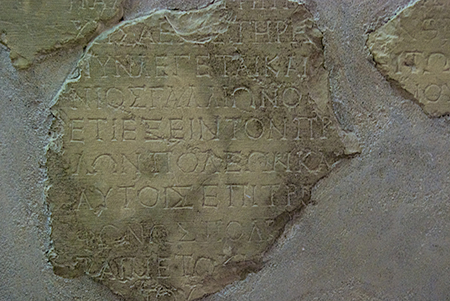 A fragment of the Gallio Inscription found in the City of Delphi
 Ruins of the Delphi Amphitheater
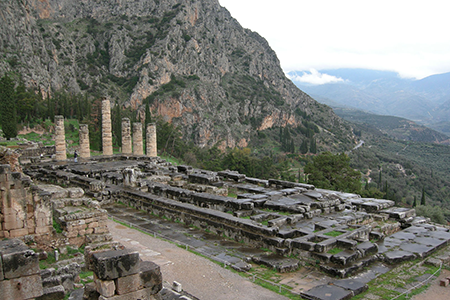 Ruins of the Apollo Temple in Delphi, Greece
In Acts 18:12, the Bibletells us that there was a man named Gallio who was the proconsul of the area of Achaia during the ministry of Paul. A proconsul is a government official similar to a governor or mayor. This piece of information is important because of a letter sent by the Roman Emperor during this time. In the city of Delphi, archaeologists found four different fragments of a letter sent by Emperor Claudius. When they pieced them together, the Emperor said in the letter that it was to “Lucius Junius Gallio, my friend, and the proconsul of Achaia.” Not only did Luke record the name of Gallio accurately, but he also recorded his political office exactly as the Emperor wrote it.
The importance of the Gallio inscription goes even deeper than that. This particular find shows how archaeology can give us a better understanding of the biblical text, especially in giving us dates and times that things happened. Because of this letter, it is possible to date the time that Gallio was a proconsul to about A.D. 51. That would mean that Paul arrived in the city of Corinth in about the year A.D. 49-50. By being able to date this part of Paul’s work, we can get a good understanding of when Paul visited other churches during his missionary journeys. Once again, not only does archaeology help show that the Bible is accurate, it also helps us to understand more about what was going on during Bible times.
The post Gallio the Proconsul of Achaia appeared first on Apologetics Press.
]]>The post The Tiny Town of Nazareth appeared first on Apologetics Press.
]]>the Basilica of the Annunciation pictured below.
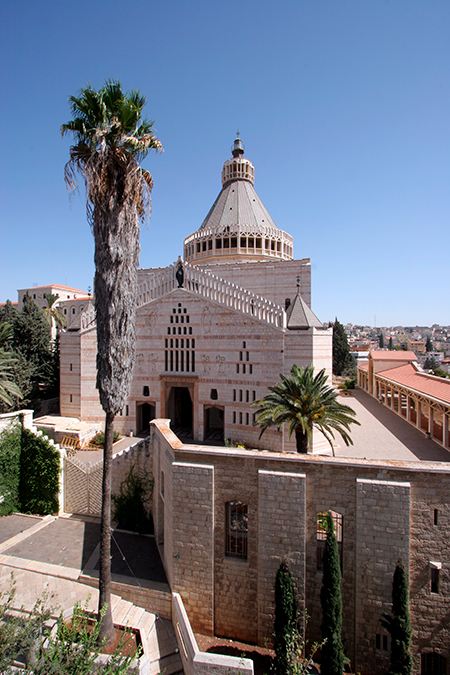
Have you ever driven through a very small town? Maybe you even saw a sign that gave the name of the town and told how many people lived there. It might have said somethinglike, Sullivan POP 688. The letters POP stand for the word “population,” which means the number of people who live there. A town that only has 688 people is very small. In fact, many churches have more people than that during a Sunday worship service. In the past, some villages were even smaller than that. They had only about 100 people or less.
When we look in the Bible, we read about a little town named Nazareth. The Bible does not tell us how many people lived there, but it was very small. In fact, it was so small that people did not think anything important could come out of the town. It did not have big crops to export to other cities. It did not have large numbers of fishermen who sold fish. Nazareth did not have rich merchants who traded goods or big businesses that made nice clothes or jewelry.
We recognize the name of this tiny village because Jesus was from there. Even though Jesus was born in Bethlehem, He grew up in Nazareth. When He began His ministry, people wondered about His hometown. How could such an amazing teacher come from such a tiny town? Philip, one of His original followers, was trying to explain to his friend Nathanael that he found the Messiah. He told Nathanael that Jesus was from the town of Nazareth. Nazareth was so unimportant that Nathanael did not think the Messiah could be from there. He said, “Can anything good come out of Nazareth?” (John 1:46). He quickly found out he was wrong, and something very good did come out of Nazareth: the Lord Jesus Christ.
| Herodian lamps, similar to the one pictured below, helped archaeologists to determine the time period of the Nazareth house. |
 |
Because Nazareth was so small, archaeologists did not find any remains of the houses or buildings for many years. Some people even said that the Bible was wrong when it mentioned Nazareth. They taught that there was no village called Nazareth during the time of Jesus. These people went on to say that the writings about Jesus in the New Testament could not be true, because they claimed Jesus could not be from a town that did not exist.
In December of 2009, however, the way the world looked at Nazareth changed. An archaeologist named Yardena Alexandre announced the discovery of a house that dated to the time of Jesus in the little town of Nazareth. This house was just where the Bible suggested the town should be. The house had two rooms and a courtyard that totaled about 900 square feet. Many houses in the USA are four or five times that large. In fact, some of you reading this article may live in homes where one big playroom is 900 square feet. The artifacts found in the house, such as pieces of pottery, show us that the people who lived there were most likely poor.
Those people who doubted the Bible were put to shame. They claimed that the Bible made a mistake when writing about Jesus being from Nazareth. They were wrong. The discovery of the small Nazareth house helped to show that the Bible does not make mistakes. Once again, archaeology provided us with even more evidence to prove that the Bible is God’s Word.
The post The Tiny Town of Nazareth appeared first on Apologetics Press.
]]>The post The Cyrus Cylinder appeared first on Apologetics Press.
]]>|
Image Credit: www.wikimedia.org(prioryman) 2013 CC-by-sa-3.0 |
 Image Credit: www.wikimedia.org (Prioryman) 2013 CC-by-sa-3.0 |
 Image Credit: www.wikimedia.org (Prioryman) 2013 CC-by-sa-3.0 |
|
Cyrus Cylinder |
In 1879, an archaeologist named Hormoz Rasam found a small clay cylinder (about nine inches long) in the ancient city of Babylon. (This cylinder is now in the British Museum). Upon the clay cylinder, King Cyrus wrote about his victory over the
 |
| Image Credit: www.wikimedia.org |
city of Babylon and his policy toward the nations he had captured. He also detailed his policy toward their various gods and religions. Cyrus explained that he sent back all the idols to the various nations. He also wrote that he rebuilt their temples. His decree that is written on the cylinder matches perfectly what the Bible predicted he would do. Cyrus decreed that the temple in Jerusalem should be rebuilt and all the exiled Israelites who wished to return had his permission and blessing to do so (Ezra 1:1-11). This little nine-inch clay cylinder is strong evidence that the Bible is 100% accurate and inspired by God.
The post The Cyrus Cylinder appeared first on Apologetics Press.
]]>The post The Isaiah Seal appeared first on Apologetics Press.
]]>[Editor’s Note: Two of the following three articles were written by A.P. auxiliary staff writer Dewayne Bryant who holds degrees from Lipscomb University (B.A. in History, M.A. in Bible), Reformed Theological Seminary (M.A.), and a Ph.D. in Biblical Studies with an emphasis in Old Testament from Amridge University. He has done additional coursework in Biblical and Near Eastern Archaeology and Languages from Trinity Evangelical Divinity School, and participated in archaeological excavations at Tell El-Borg in Egypt. He holds professional memberships in the American Schools of Oriental Research, the Society of Biblical Literature, the Archaeological Institute of America, and the International Society of Christian Apologetics.]
The discipline of archaeology serves as a source of continuing discovery and fascination. Each year, teams of archaeologists descend upon sites around the world to see what great new discoveries might be made. With each season, scholars learn more and more about the ancient world. This includes information about the Bible and the context in which it was written.
The March-June 2018 issue of Biblical Archaeology Review featured a story about the discovery of a 2,700-year-old seal impression featuring the name “Isaiah,” which also appeared to identify this individual as a prophet. The clay seal impression (called a bulla) was discovered in excavations directed by Eilat Mazar near the southern end of the Temple Mount.1 Bullae like the one bearing Isaiah’s name were used to seal documents and storage containers, but also served as receipts.
The Isaiah bulla is damaged, but a great deal of information can be gleaned from the impression. It features three registers (sections). Most of the top register is missing, but depicts what appears to be a grazing doe, a symbol of blessing in ancient Judah. The second depicts the name Yesha`yah[u] (the full Hebrew form of the name Isaiah). The final letter is missing, but no other interpretation is feasible. The final register at the bottom is damaged, but the letters nvy can be seen clearly. Unfortunately, the final letter is missing, meaning that the last word on the seal may be interpreted either as navi (“prophet”) or the proper name “Navi,” which could refer to either a person (such as a father) or a place of residence.
Taking note of the difficulties in interpreting the inscription, Mazar argues that it is unlikely that the inscription could be interpreted as “Isaiah of/from Navi” or “Isaiah, son of Navi” (if this were the case, it could not be the Isaiah of the Bible, whose father was named Amoz). Of the three possible interpretations, Mazar argues that “Isaiah the prophet” is the most likely.
Mazar’s body of work includes the discovery of numerous finds with biblical connections, including an intact bulla bearing the name “Hezekiah [son of] Ahaz, king of Judah.” In a 2015 news conference, Mazar hailed the seal as “the closest as ever that we can get to something that was most likely held by King Hezekiah himself.”2 It is worth noting that the Hezekiah seal and the recently discovered Isaiah seal were found only about 10 feet apart in the same archaeological context. As King Hezekiah and the prophet Isaiah were contemporaries, and interacted with each other (2 Kings 20:1-19), it is reasonable to assume that inscriptions bearing their names would be found in close proximity to one another.
Such discoveries are not uncommon. In fact, numerous seal impressions have been found, many of them bearing the names of figures known from the pages of Scripture. In excavations from 2005-2008, Mazar discovered two different inscriptions bearing the names “Jehucal, son of Shelemiah, son of Shovi” and “Gedaliah, son of Pashur” only a few yards apart. The prophet Jeremiah mentions that both men served as officials in the administration of King Zedekiah, the last king of Judah before the Babylonian destruction of Jerusalem in 587/586 B.C. (Jeremiah 38:1).
While some scholars urge caution in making the connection between the original owner of the Isaiah seal and the biblical prophet too hastily,3 others like Mazar are confident that the seal does, in fact, mention the beloved prophet. Robert Cargill, archaeologist and associate professor of Classics at Iowa State University and editor of Biblical Archaeology Review, stated, “if you’re asking me, I think she’s got it. You’re looking at the first archaeological reference of the prophet Isaiah outside of the Bible.”4 The fact that the Isaiah bulla was found in the same archaeological context as that of a seal impression belonging to King Hezekiah helps place the burden of proof on critics who would argue that the seal does not refer to the prophet.
While the Isaiah bulla does not prove the accuracy of Isaiah’s predictions or his inspiration as a prophet of God, it does demonstrate the accuracy of the biblical narrative and the Bible’s internal chronology. This should come as no surprise to believers, who are accustomed to seeing archaeological discoveries confirm the truthfulness of Scripture.
Endnotes
1 Eilat Mazar (2018), “Is this the Prophet Isaiah’s Signature?” Biblical Archaeology Review, 44[2-3]:65-73,92, March-June.
2 Ilan Ben Zion 2015), “Seal Bearing Name of Judean King Found in Jerusalem,” The Times of Israel, http://www.timesofisrael.com/seal-bearing-name-of-judean-king-found-in-jerusalem/.
3 Christopher Rollston (2018), “The Putative Bulla of Isaiah the Prophet: Not so Fast,” http://www.rollstonepigraphy.com/?p=796.
4 Amanda Borschel-Dan (2018), “In Find of Biblical Proportions, Seal of Prophet Isaiah Said Found in Jerusalem,” The Times of Israel, https://www.timesofisrael.com/in-find-of-biblical-proportions-proof-of-prophet-isaiah-believed-unearthed/.
The post The Isaiah Seal appeared first on Apologetics Press.
]]>The post Hezekiah Bulla: More Evidence for Bible Inspiration appeared first on Apologetics Press.
]]>An exciting new discovery adds further weight to the case for the Bible’s accuracy and inspiration. In the Old Testament, we read about a king named Hezekiah. Second Kings 18:1 says that Hezekiah was “the son of Ahaz, king of Judah.” On December 2, 2015, a press release from Hebrew University in Jerusalem explained that a small clay seal was discovered near the Temple mount. The text on the seal reads, “Belonging to Hezekiah [son of] Ahaz king of Judah” (Smith, 2015). This seal is called a bulla (bullae is the plural form). Clay bullae like this were used to seal documents. There are other such seals, but this one is the first of an Israelite or Judean king that has been discovered by professional archaeologists in situ (in the location where it was left) (Smith). Dr. Eilat Mazer and her team unearthed the bulla in a garbage heap, along with more than 30 other bullae.
The fact that the Bible is the inspired Word of God has long been a settled question (Butt, 2007). Finds like this one, however, add increasing weight to the ever growing mound of evidence that confirms the divine origin of the glorious book we call the Bible.
References
Butt, Kyle (2007), Behold! The Word of God (Montgomery, AL: Apologetics Press), http://www.apologeticspress.org/pdfs/e-books_pdf/Behold%20the%20Word%20of%20God.pdf.
Smith, Dov (2015), “First Seal Impression of an Israelite or Judean King Ever Exposed in Situ in a Scientific Archaeological Excavation,” PhysOrg, http://phys.org/news/2015-12-israelite-judean-king-exposed-situ.html.
 |
 |
| Recommended Resources | |
The post Hezekiah Bulla: More Evidence for Bible Inspiration appeared first on Apologetics Press.
]]>The post The Mosaic Authorship of the Joseph Story appeared first on Apologetics Press.
]]>
[EDITOR’S NOTE: A.P. auxiliary staff writer Dewayne Bryant holds two Masters degrees, and is completing Masters study in Ancient Near Eastern Archaeology and Languages at Trinity Evangelical Divinity School, as well as doctoral studies at Amridge University where he is a Ph.D. candidate. He holds professional membership in both the American Schools of Oriental Research as well as the Society of Biblical Literature.]
As with most of the early books of the Bible—particularly from Genesis to the early chapters of 1 Samuel—skeptics and critics label the Joseph story as the work of later authors (see Finkelstein and Silberman 2001, pp. 67-68). According to the documentary hypothesis (popularly known as the JEDP theory), the Pentateuch as a whole is composed of several different documents edited together by redactors, or editors. The Joseph story is no exception. Critics claim it is the product of multiple authors living between the 10th and 6th centuries B.C., if not later.
The Bible recognizes Moses as the author of the Pentateuch (Exodus 24:7,27-28; Numbers 33:2; Joshua 8:32; 2 Chronicles 34:14). Critics reject the Mosaic authorship of this material, with most denying the existence of Moses as well. This denial is built upon the assumptions inherent in the documentary hypothesis, whose adherents rarely take Egyptian evidence into account. The fine details of the Joseph story do not point to a Hebrew scribe writing in the 10th-6th centuries B.C. Rather, they point to an author who was intimately familiar with Egypt and who included Egyptian loanwords and other details of Egyptian culture in his work. To summarize some of the important Egyptian details in the Joseph story, consider the following points:
- Joseph is sold for 20 shekels (Genesis 37:28). Babylonian records indicate that this was the average going rate for a slave in the first half of the second millennium (Kitchen, 2003, pp. 344-345), but later rose due to inflation. The prices given in the Bible in later texts correspond to the prices at the time those texts were written. At the ancient cities of Nuzi and Ugarit in the mid- to late-second millennium, the price was 30 shekels and more, which is reflected in the Mosaic law (Mendelsohn, 1955, p. 68; cf. Exodus 21:32). Still later in the first millennium, the price went up to 50-60 shekels, which seems to be reflected in the ransom for Menahem of Israel (2 Kings 15:20). Later authors would not have been able to research these minute details in order to make the account believable, nor would anyone have thought about doing so. If the Joseph story had been written when critics claim (closer to the 6th century B.C.), the price asked by his brothers should have been somewhere around 60 shekels instead of 20 (Kitchen, 2003, p. 345; cf. Kitchen, 1995, 21[02]). If the Joseph story was written after the exile, we would expect the price to have been as high as 90-120 shekels. On a further note, Leviticus 27:4 establishes the price of 20 shekels for a male slave younger than 20 years of age (Joseph was 17—Genesis 37:2; see Wenham, 1978, pp. 264-265).
- Joseph is thrown into prison, which the Egyptians called the “Place of Confinement” (Aling, 2002, p. 99). These were rare in the ancient Near East and seem to have been found only in Egypt. The Mosaic Law never mentions prisons, and does not seem to have a close parallel to our modern concept of them. If later Israelite authors had invented the Joseph story, it would have been highly unlikely that they would have included this feature.
- Joseph likely serves as an overseer (Egyptian imy-re per) in Potiphar’s house. His service and promotion fits very well in an Egyptian context (see the discussion of relevant titles for this office, as well as Joseph’s promotion, in Hoffmeier, 1996 and Kitchen, 2003).
- Joseph is able to interpret dreams. This was a vital aspect of life in ancient Egypt. Those who did so were specialists who consulted dream books, examples of which have been discovered by archaeologists (e.g., Papyrus Chester Beatty III, currently housed in the British Museum). Joseph proves his superiority by interpreting the king’s dreams without any access to these reference works.
- Joseph is brought before pharaoh after being shaved and dressed appropriately (Genesis 41:14), something that was done in Egypt but not among Semitic peoples (see Fried, 2007). The Beni Hasan tomb painting depicts Canaanite merchants around the same time as the patriarchs wearing beards and having full heads of hair. Although pharaohs were depicted wearing beards, it is clear that these were false (whether in paintings or on statuary, a close inspection will reveal the strap along the jawline that held the beard in place).
- Jacob and Joseph are both embalmed or mummified. The text also mentions Joseph’s coffin (Genesis 50:26). Although extremely sparse, the details given in the Bible match what scholars know about the process from ancient records. The biblical text states that 40 days were required for mummification (Genesis 50:3). This seems to be a rounded number that agrees with an Egyptian text known as “The Ritual of Embalming,” which states that the beginning of the embalming process began four days after death and continued for 42 days (Brier, 1994, p. 45).
- Joseph is described as being 110 years old. We know from ancient Egyptian records that this was the ideal age at the time of death, essentially a way of saying that a person had lived a rich, full life. The Bible later records this figure at 70 or 80 years (cf. Psalm 90:10). Over half of the references to this lifespan in Egyptian literature occur during the same general period as the one in which Moses lived (Kitchen, 2003, p. 351). Thus, this number preserves an expression that appears to have been the most popular during the period in which Moses received his education.
- Linguistic clues provide important insight into when the Joseph narrative may have been put into written form. The word for the Nile River used in the text when Pharaoh discusses his dreams is ye’or rather than the more common Hebrew term nahar. The word ye’or is an Egyptian loanword for “river” that was used in the Eighteenth Dynasty (1550-1295 B.C.) onward (Sarna, 1966, p. 218). Likewise, the term for the grass eaten by the cows is akhu, another Egyptian loanword. Sarna notes that the reference to cattle may be significant as well. They were an important part of the Egyptian economy, while sheep played a minor role. The situation was reversed in Palestine.
- One of the supports for the early second millennium devotion to writing of the Joseph material is the phrase “the land of Rameses” (Genesis 47:11) which came into common use in the 13th century and fell into disuse after the 12th century (Kitchen, 1991, p. 118).
The Egyptian details of the Joseph story are what we would expect to find if someone educated in Egypt had been the one to put this story into written form (cf. Acts 7:22). Alan R. Schulman states: “It is quite clear that the person who either wrote, or wrote down, the Joseph sagas had an exceedingly intimate knowledge of Egyptian life, literature, and culture, particularly in respect to the Egyptian court, and, in fact, may even have lived in Egypt for a time” (1975, p. 236). This is precisely what we find in the Bible’s statements about the life of Moses. Put simply, the Joseph story could not have been the invention of a Hebrew scribe in the first millennium.
Taken together, the details above generate some important questions about the authorship of the Joseph story and the assumptions made by many modern interpreters. Why does the text include terms popularized in the Egyptian language during the time in which Moses would have lived? Why do Egyptian concepts fill these stories when they are absent in later texts that critics claim to have been written at the same time as the Pentateuch? Why is it that chronologically-sensitive details in the Joseph story fit well within a context of the early second millennium, while critics claim it was written in the early first millennium? These questions demand a reevaluation of the skeptic’s position, which tends to be haunted by the twin spectres of unfounded skepticism and anti-biblical bias. The Bible presents a far more believable author of this material than the contrivances of its critics.
REFERENCES
Aling, Charles (2002), “Joseph in Egypt: Part III,” Bible and Spade, 15[4].
Brier, Bob (1994), Egyptian Mummies: Unraveling the Secret of an Ancient Art (New York: Quill).
Finkelstein, Israel and Neil Asher Silberman (2001), The Bible Unearthed: Archaeology’s New Vision of Ancient Israel and the Origin of Its Sacred Texts (New York: The Free Press).
Fried, Lisbeth S. (2007), “Why Did Joseph Shave?” Biblical Archaeology Review, 33[4], July-August.
Hoffmeier, James K. (1996), Israel in Egypt: The Evidence for the Authenticity of the Exodus Tradition (Oxford: Oxford University Press).
Kitchen, Kenneth A. (1991), “Israel Seen from Egypt: Understanding the Biblical Text from Visuals and Methodology,” Tyndale Bulletin, 42[1], May.
Kitchen, Kenneth A. (1995), “Patriarchal Age: Myth or History,” Biblical Archaeology Review, 21[02], March/April.
Kitchen, Kenneth A. (2003), On the Reliability of the Old Testament (Grand Rapids, MI: Eerdmans).
Mendelsohn, Isaac. (1955), “On Slavery in Alalakh,” Israel Exploration Journal, 5[2].
Sarna, Nahum M. (1966), Understanding Genesis: The World of the Bible in the Light of History (New York: Schocken Books).
Schulman, A. R. (1975), “On the Egyptian Name of Joseph: A New Approach,” Studien zur Altägyptischen Kultur, 2.
Wenham, Gordon J. (1978), “Leviticus 27.2-8 and the Price of Slaves,” Zeitschrift für die Alttestamentliche Wissenschaft, 90.
The post The Mosaic Authorship of the Joseph Story appeared first on Apologetics Press.
]]>The post Newsweek Article’s Attack on the Bible: So Misinformed It’s a Sin appeared first on Apologetics Press.
]]>In a way, Eichenwald’s attack on the Bible is reassuring to the Bible believer for the simple reason that Eichenwald uses information that has been refuted literally for centuries. His article consists of warmed-over skepticism that has so often been easily refuted; we at Apologetics Press already have articles on virtually every subject he mentions (www.apologeticspress.org). In another way, however, his article is troubling. Why, if his arguments are so easily answered, does the author feel that they will resonate with his audience or cause others to question the Bible? The most reasonable answer seems to be that he knows his audience is ignorant of the responses to his attacks. The Proverbs writer once stated, “The first one to plead his cause seems right, until his neighbor comes and examines him” (Proverbs 18:17). To those who have not given these matters much thought, Eichenwald’s information may seem legitimate and may cause one to doubt the Bible’s inspiration. However, when one examines this information, it will be seen for what it is—a thinly veiled, inept attack against the inspired Word of God.
The “Contradictions” in the Bible
The Birth of Jesus
One of the clearest examples of Eichenwald’s errant thinking is seen in his repetitious claim that the Bible is “loaded with contradictions.” In his section titled “No Three Kings,” he contends that the accounts of Jesus’ birth in Matthew and Luke are contradictory. He writes: “Jesus was born in a house in Bethlehem. No wise men showed up for the birth…. No angel appearing to Mary…. Not born in a manger….” Then he asks the reader: “Not the version you are familiar with…? You may not recognize this version, but it is a story of Jesus’ birth found in the Gospels. Two Gospels—Matthew and Luke—tell the story of when Jesus was born, but in quite different ways. Contradictions abound.”
Is it true that the versions of Jesus’ “birth” are filled with contradictions? Not at all. Let us see how he proceeds to fabricate contradictions that are not there. First, notice how he begins his section: “Jesus was born in a house in Bethlehem.” Note that he did not provide a verse reference for that claim—for good reason: there is no Bible passage that claims that Jesus was born in a house in Bethlehem. The account in Luke makes it clear that Jesus was born in Bethlehem (2:4) and, contrary to Eichenwald’s charge, in a manger (2:7,16)—i.e., a barn-animal feeding trough. Did an angel appear to Mary? The Gospels make no such claim, and therefore, cannot be said to contradict one another. An angel appeared to shepherds in the field at the time of Jesus’ birth (Luke 2:8-13) and to Mary before Jesus was conceived (Luke 1:26-31), but this does not contradict any other passage. Did wise men come to the birth? When we turn to Matthew’s account, the chapter begins its narrative about the wise men: “Now after Jesus was born in Bethlehem of Judea in the days of Herod the King…” (2:1). How long after Jesus was born in Bethlehem? The text does not say. In fact, king Herod asked the wise men what time Jesus’ star appeared (vs. 7), and based on that information, the evil king issued a decree to kill the young males in Bethlehem who were from “two years old and under” (vs. 16). Obviously, between the time the star appeared, and the time the wise men arrived, several months had elapsed. In fact, from Herod’s calculations to kill two year olds, it could have been as much as 18 months to two years. So, the story in Matthew 2 is not even a “birth” story. The Bible makes no claim that wise men were at Jesus’ birth. The only contradiction that can be levied concerning the appearance of the wise men is not a contradiction in the Bible, but a contradiction between what the Bible says and what people have erroneously claimed the Bible says—as with the case of the appearance of the angel to Mary.
Eichenwald has committed the very mistake that he accuses so many evangelicals of committing. Early in the article he bemoans the fact that many people who call themselves Christians do not even know what the text says. Sadly, he is right. Many Christians do not study the Bible as they should. He insists that his article is “designed to shine a light on a book that has been abused by people who claim to revere it but don’t read it.” Ironically, Eichenwald’s attack is filled with heat, but very little light. His examples of obvious “contradictions” in the “birth” accounts of Jesus are attacks against information that is not even in the Bible. In an article that purports to straighten out those who are biblically illiterate, to boldly proclaim that the Bible states that “Jesus was born in a house in Bethlehem”—when the Bible nowhere makes such a statement—is inexcusable, slipshod scholarship. [For more information, see the A.P. article: “When Did Jesus Go to Egypt?” (Lyons, 2011).]
In addition, Eichenwald claims that the genealogies in Matthew and Luke trace Jesus’ bloodline through Joseph, “Except…Joseph wasn’t Jesus’ father…. Mary, the mother of Jesus, can be the only parent with a bloodline to David, but neither Gospel makes mention of that.” This allegation has been decisively answered in the A.P. article titled, “The Genealogies of Matthew and Luke.” Here is the short answer to this alleged discrepancy:
Here is the precise purpose of Matthew’s genealogy: it demonstrated Jesus’ legal right to inherit the throne of David—a necessary prerequisite to authenticating His Messianic claim. However, an equally critical credential was His blood/physical descent from David—a point that could not be established through Joseph since “after His mother Mary was betrothed to Joseph, before they came together, she was found with child of the Holy Spirit” (Matthew 1:18, emp. added). This feature of Christ’s Messiahship was established through His mother Mary, who was also a blood descendant of David (Luke 1:30-32). Both the blood of David and the throne of David were necessary variables to qualify and authenticate Jesus as the Messiah (Miller, 2003, emp. in orig.).
Isn’t it interesting that Eichenwald left out the fact that Luke’s genealogy mentions Jesus “being (as was supposed) the son of Joseph” (Luke 3:24)? By using the phrase “as was supposed,” Luke demonstrates that Jesus was not the actual son of Joseph, just the perceived one. In addition, the Newsweek author neglected to mention that in Matthew 1:16, when the text says that “Jacob begot Joseph the husband of Mary, of whom was born Jesus,” the word “whom” (in the Greek) is in the feminine form. It could only be referring to Mary. Thus, neither of the genealogies states that Jesus was born to Joseph.
Alleged Contradictions in the Resurrection Accounts
Eichenwald continues his attack on the Bible, stating that the “stories in the four Gospels of Jesus’ death and resurrection differ as well.” He asserts: “And who went to anoint Jesus in his tomb? In Matthew, it was Mary and another woman named Mary, and an angel met them there. In Mark, it was Mary Magdalene, Mary the mother of James, and Salome, and a young man met them. In John, it was Mary alone; no one met her.” Supposedly, these “differing” accounts are so blatantly contradictory that no further examination need be applied to them. When we apply proper reasoning to this allegation, however, we see there are no contradictions.
For instance, what if John mentions one Mary while Matthew mentions Mary and another woman named Mary? This difference is not a contradiction. John would have had to qualify his statement by saying that “only” Mary or Mary “alone” went to the tomb. Did you notice that Eichenwald includes the word “alone” with Mary, but the biblical text never does? Just because one writer gives additional or supplemental information does not make him contradict the other account. [For more information, see the A.P. article titled, “The Resurrection Narratives” (Butt, 2002).] Consider Eichenwald’s own statement that at the Council of Nicaea, “Constantine arrived wearing jewels and gold on his scarlet robe and pearls on his crown.” Suppose that another person were to say that Constantine arrived with numerous courtiers and was wearing boots. Would that statement be a contradiction? Not in any way. Such accusations barely deserve to be answered—if it were not for their prevalence.
Two Accounts of Creation?
Eichenwald further suggests that “biblical scholars have concluded that two Jewish sects wrote many of the books. Each prepared its version of the Old Testament, and the two were joined together without any attempt to reconcile the many contradictions” (2014). Once again, the Newsweek writer conveniently mentions only those “biblical scholars” who happen to agree with him. What about the thousands of scholars that do not agree with this specious position? As an example of these “doublets,” he states: “The next time someone tells you the biblical story of Creation is true, ask that person, ‘Which one?’ Few of the Christian faithful seem to know the Bible contains multiple creation stories…. Careful readers have long known that the two stories contradict each other.” In truth, careful readers have long known just the opposite. As Wayne Jackson concluded: “When the texts of Genesis 1 and 2 have been considered carefully, one thing is clear: an objective evaluation reveals no discrepancies, nor is a dual authorship to be inferred. Devout students of the Bible should not be disturbed by the fanciful, ever-changing theories of the liberal critics” (See the A.P. article, “Are There Two Creation Accounts in Genesis?” [Jackson, 1991; Cf. McGarvey, 1910, p. 66]). [NOTE: In his section dealing with such doublets, Eichenwald mentions that “biblical scholars” have concluded that Moses did not write the Pentateuch. The evidence, however, reveals that Moses certainly did write these books. See the A.P. article “Mosaic Authorship of the Pentateuch—Tried and True” (Lyons, 2003; cf. McGarvey, 1902).]
The article also uses the Flood story as an example of doublets causing contradictions. Eichenwald says the “water flooded the earth for 40 days (Genesis 7:17), or 150 days (Genesis 7:24).” His careless use of the Scripture is painful to endure. The text does not say in Genesis 7:17 that the Flood stopped after 40 days. It simply details things that occurred at that time, such as the waters lifting the ark off the ground. The text in Genesis 7:24 specifically says that at the end of 150 days the water began to decrease. The previous 7:17 says nothing about the complete duration of the Flood or when the waters stopped rising. [NOTE: For an exhaustive list of answers to these types of alleged contradictions, see A.P.’s Web site category titled “Alleged Discrepancies.”]
Sunday As the Christian Day of Worship
The title of the Newsweek article, “The Bible: So Misunderstood It’s a Sin,” explains much about the author’s method of bashing. He approaches the subject in light of the idea that many Christians do not read or understand the Bible. One of the author’s grievous faults, however, is that it is apparent that he does not read or understand the Bible either, and he writes in a way that betrays this fact. For instance, when discussing the Christian day of worship, Eichenwald suggests that Constantine was responsible for establishing it as Sunday instead of the Sabbath (or Saturday). He alleges:
Things that are today accepted without much thought were adopted or reinforced at Nicaea. For example, the Old Testament was clear in declaring that God rested on the seventh day, making it the Sabbath. The seventh day of the week is Saturday, the day of Jewish worship and rest. (Jesus himself invoked the holiness of the Jewish Sabbath.) The word Sunday does not appear in the Bible, either as the Sabbath or anything else. But four years before Nicaea, Constantine declared Sunday as a day of rest in honor of the sun God…. Many theologians and Christian historians believe that it was at this moment, to satisfy Constantine and his commitment to his empire’s many sun worshippers, that the Holy Sabbath was moved by one day, contradicting the clear words of what ultimately became the Bible (2014).
Notice the author’s tactic. First, he says that both the Old Testament and Jesus invoked the Sabbath (our Saturday) as holy. Then he states that the Bible never even uses the word Sunday. And, lastly, he implies that Christians were not “officially” worshiping on this day prior to Constantine, but that Constantine changed the day of Christian worship to Sunday.
Eichenwald’s assertions regarding the day of Christian worship contradict both biblical and historical fact—and are easily answered. First, he confuses the issue when he says that the word “Sunday” is not even used in the Bible, since none of our modern names for the days of the week are used in the Bible. The term “Saturday” does not appear. You will not read the terms “Friday” or “Monday” in the original text either. Such is to be expected. The real question is: did the writers of the Bible have their own designation for the day that we call Sunday? Of course they did; it was called “the first day of the week,” Saturday (or Sabbath), being the last or seventh day of their week. We could ask, then, do we read about anything in the New Testament happening on the first day of the week? Absolutely. In fact, Jesus rose early “after the Sabbath, as the first day of the week began to dawn” (Matthew 28:1). Christians were to come together to give money to support the church’s work every “first day of the week” in the city of Corinth (1 Corinthians 16:2). And the book of Acts explains that the Christians gathered to partake of the Lord’s Supper (referred to as “breaking bread”) on the first day of the week (Acts 20:7).
Early Christian writers that lived in the 2nd and 3rd centuries verify this truth. As Eric Lyons wrote in the A.P. article titled “Did Paul Want Christians to Come Together on Saturday or Sunday?”:
Ignatius wrote in his letter to the Magnesians (believed to be penned around A.D. 110) how Christians “have come to the possession of a new hope, no longer observing the Sabbath, but living in the observance of the Lord’s Day” (1:62, emp. added; cf. Revelation 1:5). And, in chapter 67 of his First Apology (written around A.D. 150), Justin Martyr noted how Christians would gather together “on the day called Sunday” to read the writings of the apostles and prophets, instruct, pray, give, and eat of bread and wine (2005; see also the A.P. article, “The First Day of the Week” [Lyons, 2006]).
Biblical scholar Robert Milligan wrote, “That the primitive Christians were wont to celebrate the Lord’s Supper on every first day of the week is evident…. During the first two centuries the practice of weekly communion was universal, and it was continued in the Greek church till the seventh century” (1975, p. 440).
In addition to these facts, Eichenwald seems to be totally unaware of the overwhelming testimony of the New Testament that the Old Testament has been fulfilled and removed. Yes, the Old Testament mandated worship on the Sabbath—for the Jews; but Christ’s death and resurrection changed the law. As the Hebrews writer so concisely observed, “In that He says, ‘A new covenant,’ He has made the first obsolete” (8:13). And again Paul wrote that the Old Law, “was our tutor to bring us to Christ, that we might be justified by faith. But after faith has come, we are no longer under a tutor” (Galatians 3:25). Christians no longer sacrifice animals as the Israelites did, they no longer celebrate the Passover, and they no longer hallow Saturday as the Holy Day. Those are vestiges of the Old Law that have been removed. For Eichenwald to misunderstand such clear and repetitive New Testament teaching is disappointing to say the least. The testimony of the New Testament and early Christian writers proves that Sunday was the Christian day of worship centuries before Constantine arrived on the scene.
Jesus and Family Values
In the first paragraph of his article, Eichenwald caricatures certain “Christian” fanatics and caustically attacks them, demanding that “they are God’s fraud’s, cafeteria Christians who pick and choose which Bible verses they heed with less care than they exercise in selecting side orders for lunch.” As we have seen throughout this review, Eichenwald is often guilty of the very tactics he condemns others for using. As an example, consider his statements concerning Jesus and family values. He wrote:
Some of the contradictions are conflicts between what evangelicals consider absolute and what Jesus actually said. For example, evangelicals are always talking about family values. But to Jesus, family was an impediment to reaching God. In the Gospel of Matthew, he states, “And every one that hath forsaken houses, or brethren, or sisters, or father, or mother, or wife, or children, or lands, for my name’s sake, shall receive an hundredfold, and shall inherit everlasting life” (2014).
Talk about cafeteria style Bible interpretation! Eichenwald conveniently fails to include the fact that one of Jesus’ dying statements was to ensure that His mother was taken care of after His death (John 19:26-27). He leaves out the fact that Jesus’ apostles insisted that husbands are called to love their wives and give their very lives to protect them (Ephesians 5:25). In addition, children are to honor their parents (Ephesians 6:1), fathers are to train and discipline their children (Ephesians 6:4; Hebrews 12:7-11), families are to financially support their own (1 Timothy 5:8), and wives are to love their husbands and their children (Titus 2:4). In addition, Jesus insisted that God is like a loving Father who longs for the return of His children (Luke 15:11-32). It is only possible to question Jesus’ and the apostles’ family values if a handful of verses are ripped from their context.
What is Jesus really saying when He mentions that His followers are to “forsake” families or homes for His cause? The easy-to-understand message here is that a relationship with Jesus must be the most important relationship in the life of His followers. That means if a spouse were to demand that a Christian participate in pagan idol worship or the spouse was going to leave, then with much sadness but firm resolve, the Christian should let the spouse leave and not join in the pagan idol worship. If Hindu parents insist that if their college son becomes a Christian they will disown him, that son should follow Christ and be disowned by his parents. We can all understand that a person should never commit murder, theft, or adultery to preserve a close relationship with family or friends. Jesus was merely stating that the relationship with Him is the most important. [See the A.P. article “Hate Your Parents—or Love Them?” Butt, 2004).]
Has the Bible Been Corrupted?
One of the longest sections of the Newsweek article deals with the idea that the Bible has been corrupted over time, that we do not really know which books belong in the Bible, and that translation errors are so plentiful that we do not have the original message. Yet these allegations have been confronted and refuted time and time again. [Cf. A.P.’s soon-to-be released video series titled, “Has the Bible Been Corrupted?” in which such assertions are debunked.] Many books over the years have masterfully answered the skeptic in this regard, including such volumes as J.W. McGarvey’s Evidences of Christianity, F.F. Bruce’s The Canon of Scripture, Bruce Metzger’s The Text of the New Testament, and a host of others. The Newsweek article manifests abysmal, inexcusable ignorance of the long established facts of the matter.
For example, Eichenwald states that we do not have the original message of the Bible because the originals are lost and the translations are filled with errors and variations. He claims that
no television preacher has ever read the Bible. Neither has any evangelical politician. Neither has the pope. Neither have I. And neither have you. At best, we’ve all read a bad translation—a translation of translations of translations of hand-copied copies of copies of copies of copies, and on and on, hundreds of times (2014).
Supposedly, according to Eichenwald, since we don’t have the originals, and our translations are from copies that were written in other languages, there is no way we have actually read the Bible.
This naïve, uninformed view of message transmission cannot be maintained in light of the evidence. Are we to believe that since we have never seen Eichenwald’s original article that he personally typed or penned, then we cannot have the information he intended to present? Is it true that since some people read the article on-line, but others in printed form, then the original message is hopelessly lost? Is it true that anyone who reads the article in a language other than English has never really read the article, since it would be a translation? What Eichenwald and other skeptics are attempting to do is suggest that it is impossible to pass information accurately from one language to another, or from one printed page to another; but that suggestion is simply not true. If it is possible for a person to copy accurately a message once, it is possible to do so twice, and so on.
When we approach the Bible, we must simply ask, “Do we have the message that the original authors penned?” When we explore that question, we discover that the books of the New Testament are the most extensively verified books of ancient history. If we deny the Bible is verified, then we are saying that it is impossible for any information to be conveyed accurately from the past to the present. The skeptics’ attack is not against the Bible, per se; it is against the idea that we can know anything from ancient history. If it is possible to know what any writer has ever penned, then the skeptic’s accusations against the Bible cannot be sustained. When Eichenwald states, “And what biblical scholars now know is that later versions of the books differ significantly from earlier ones,” he implies there are so many variations in the manuscripts that the original message has been lost. This misleading exaggeration is a typical ploy by those who wish to discredit the integrity of the text of the Bible. What’s more, when he states, “Scribes added whole sections of the New Testament, and removed words and sentences that contradicted emerging orthodox beliefs,” he unwittingly admits that scholars have been able to identify and isolate those very words and sentences! In actuality, those manuscripts wherein scribes manifested doctrinal bias are in the small minority, do not represent the mass of manuscripts, and are identifiable.
Due to length constraints, a detailed analysis of textual variants is beyond the scope of this article. However, the sincere inquirer may easily access the analyses that have been made on each passage. For example, for a thorough discussion of the last 12 verses of Mark, see Miller, 2005; Scrivener, 1861, pp. 429ff; et al. For a discussion of the manuscript support pertaining to the woman taken in adultery (John 7:53-8:11), see Scrivener, pp. 439-443; Woods, 1989, p. 162; McGarvey, 1974, p. 16; Metzger, 1971, pp. 219-222; Jackson, 2011, p. 161; et al. For 1 John 5:7, see Woods, 1962, pp. 324-326; Metzger, 1971, pp. 716-718. For Luke 22:17-20, see Metzger, 1971, pp. 173-177. Any standard text on textual criticism discusses these and many other variants (e.g., Aland and Aland, 1987). If the reader desires the truth regarding the authenticity and integrity of the Bible, the evidence is available—if the individual is willing to spend the time and effort to weigh that evidence and arrive at the proper conclusion (1 Thessalonians 5:21; 1 John 4:1).
What Eichenwald fails to divulge are several facts that completely undermine and discredit his attack on the integrity and transmission of the Bible:
- God knew that the original autographs would not survive, and that His Word would have to be transmitted through the centuries via copies. The transmission process is sufficiently flexible for God’s Word to be conveyed adequately by uninspired, imperfect copyists.
- We know how the original New Testament books read because we have three surviving classes of evidence by which to reconstruct the original New Testament: Greek manuscripts, ancient versions, and patristic citations.
- The current number of Greek manuscript copies containing all or part of the New Testament now stands at 5,795. This amount of manuscript evidence for the text of the New Testament is far greater than that available for any ancient classical author.
- The time between the writing of the original books of the New Testament and the earliest surviving copies is relatively brief.
- Although no two manuscript copies agree in every detail, the degree of accuracy achieved by most scribes was remarkably high. The vast majority of textual variants involve minor matters that do not alter any basic teaching of the New Testament. No feature of Christian doctrine is at stake.
- Suitable solutions to these differences are detectable. Even if they weren’t, the original reading is one of the extant options. And even those variants that some might deem “doctrinally significant” pertain to matters that are treated elsewhere in the Bible where the question of genuineness/certainty is unquestioned.
- We can confidently affirm that we have 999/1000ths of the original New Testament intact. The remaining 1/1000th pertains to inconsequential details.
These observations have been verified by the greatest textual critics and linguistic scholars of the past two centuries. Their conclusions have not become outdated, but remain as valid today as when first formulated. If the integrity of the text of the Bible was fully authenticated in their day, it remains so today. Consider the following statements by some of these world class authorities.
Scholarly Verification of the Purity of the New Testament Text
F.F. Bruce (1910-1990) was a biblical scholar who taught Greek at the University of Edinburgh and the University of Leeds, chaired the Department of Biblical History and Literature at the University of Sheffield, received an honorary Doctor of Divinity from Aberdeen University, and served as the Rylands Professor of Biblical Criticism and Exegesis at the University of Manchester. He wrote over 40 books and served as Editor of The Evangelical Quarterly and Palestine Exploration Quarterly. Bruce declared: “The variant readings about which any doubt remains among textual critics of the N.T. affect no material question of historic fact or of Christian faith and practice” (1975, pp. 19-20, emp. added). As if anticipating the Newsweek article, he also stated:
In view of theinevitable accumulation of such errors over so many centuries, it may be thought that the original texts of the New Testament documents have been corrupted beyond restoration. Some writers, indeed, insist on the likelihood of this to such a degree that one sometimes suspects they would be glad if it were so. But they are mistaken. There is no body of ancient literature in the world which enjoys such a wealth of good textual attestation as the New Testament (1963, p. 178, emp. added).
Bruce further insisted:
Something more ought to be said, and said with emphasis. We have been discussing various textual types, and reviewing their comparative claims to be regarded as best representatives of the original New Testament. But there are not wide divergencies between these types, of a kind that could make any difference to the Church’s responsibility to be a witness and guardian of Holy Writ…. If the variant readings are so numerous, it is because the witnesses are so numerous. But all the witnesses, and all the types which they represent, agree on every article of Christian belief and practice (1963, p. 189, emp. added).
Bruce Metzger (1914-2007) was also a scholar of Greek, the New Testament, and New Testament Textual Criticism, serving as professor at Princeton Theological Seminary for 46 years. He was a recognized authority on the Greek text of the New Testament. He served on the board of the American Bible Society, was the driving force of the United Bible Societies’ series of Greek Texts, and served as Chairperson of the NRSV Bible Committee. He is widely considered one of the most influential New Testament scholars of the 20th century. Metzger stated:
…even if we had no Greek manuscripts today, by piecing together the information from these translations from a relatively early date, we could actually reproduce the contents of the New Testament. In addition to that, even if we lost all the Greek manuscripts and the early translations, we could still reproduce the contents of the New Testament from the multiplicity of quotations in commentaries, sermons, letters, and so forth of the early church fathers (as quoted in Strobel, 1998, p. 59).
Brooke Foss Westcott (1825-1901) was a British bishop, biblical scholar and theologian, serving as Bishop of Durham and holding the Regius Professorship of Divinity at Cambridge. His colleague, Fenton John Anthony Hort(1828-1892), was an Irish theologian who served as a Professor at Cambridge. Together, they pioneered the widely recognized Greek text The New Testament in the Original Greek in 1881. They are still considered to be renowned textual critics. They forthrightly asserted:
With regard to the great bulk of the words of the New Testament…there is no variation or other ground of doubt…. [T]he amount of what can in any sense be called substantial variation is but a small fraction of the whole residuary variation, and can hardly form more than a thousandth part of the entire text. Since there is reason to suspect that an exaggerated impression prevails as to the extent of possible textual corruption in the New Testament…we desire to make it clearly understood beforehand how much of the New Testament stands in no need of a textual critic’s labours (1882, pp. 2-3, emp. added).
These peerless scholars also insisted: “[I]n the variety and fullness of the evidence on which it rests the text of the New Testament stands absolutely and unapproachably alone among ancient prose writing” (p. 278, emp. added). They add: “The books of the New Testament as preserved in extant documents assuredly speak to us in every important respect in language identical with that in which they spoke to those for whom they were originally written” (p. 284).
Benjamin Warfield (1851-1921) was a Professor of Theology at Princeton Seminary from 1887 to 1921. He is considered to be the last of the great Princeton theologians. In his Introduction to the Textual Criticism of the New Testament, Warfield insightfully observed:
[S]uch has been the providence of God in preserving for His Church in each and every age a competently exact text of the Scriptures, that not only is the New Testament unrivalled among ancient writings in the purity of its text as actually transmitted and kept in use, but also in the abundance of testimony which has come down to us for castigating its comparatively infrequent blemishes…. The great mass of the New Testament, in other words, has been transmitted to us with no, or next to no, variation (1886, pp. 12-13,14, emp. added).
Richard Bentley (1662-1742) was an English classical scholar, critic, and theologian who served as Master of Trinity College, Cambridge and was the first Englishman to be ranked with the great heroes of classical learning. He was well-known for his literary and textual criticism, even called the “Founder of Historical Philology,” and credited with the creation of the English school of Hellenism. Here are his comments on the integrity of the New Testament text:
[T]he real text of the sacred writers does not now (since the originals have been so long lost) lie in any single manuscript or edition, but is dispersed in them all. ‘Tis competently exact indeed even in the worst manuscript now extant; nor is one article of faith or moral precept either perverted or lost in them (1725, pp. 68-69, emp. added).
Sir Frederic George Kenyon (1863-1952) was a widely respected, imminent British paleographer and biblical and classical scholar who occupied a series of posts at the British Museum. He served as President of the British Academy from 1917 to 1921 and President of the British School of Archaeology in Jerusalem. He made a lifelong study of the Bible as an historical text. In his masterful Our Bible and the Ancient Manuscripts, Kenyon affirmed:
One word of warning…must be emphasized in conclusion. No fundamental doctrine of the Christian faith rests on a disputed reading. Constant references to mistakes and divergencies of reading…might give rise to the doubt whether the substance, as well as the language, of the Bible is not open to question. It cannot be too strongly asserted that in substance the text of the Bible is certain. Especially is this the case with the New Testament. The number of manuscripts of the New Testament, of early translations from it, and of quotations from it in the oldest writers of the Church is so large, that it is practically certain that the true reading of every doubtful passage is preserved in some one or other of these ancient authorities. This can be said of no other ancient book in the world (1895, pp. 10-11, emp. added).
In his monumental The Bible and Archaeology, Kenyon further stated:
The interval then between the dates of original composition and the earliest extant evidence becomes so small as to be in fact negligible, and the last foundation for any doubt that the Scriptures have come down to us substantially as they were written has now been removed. Both the authenticity and the general integrity of the books of the New Testament may be regarded as finally established (1940, pp. 288-289, emp. added).
Indeed, “the Christian can take the whole Bible in his hand and say without fear of hesitation that he holds in it the true Word of God, faithfully handed down from generation to generation throughout the centuries” (1895, pp. 10-11).
Samuel Davidson (1806-1898) was an Irish biblical scholar who served as Professor of Biblical Criticism at Royal College of Belfast and Professor of Biblical Criticism in the Lancashire Independent College at Manchester. He authored many books on the text of the Bible. Referring to the work of textual criticism, Davidson concluded:
The effect of it has been to establish the genuineness of the New Testament text in all important particulars. No new doctrines have been elicited by its aid; nor have any historical facts been summoned by it from their obscurity. All the doctrines and duties of Christianity remain unaffected.… [I]n the records of inspiration there is no material corruption…. [D]uring the lapse of many centuries the text of Scripture has been preserved with great care…. Empowered by the fruits of criticism, we may well say that the Scriptures continue essentially the same as when they proceeded from the writers themselves (1853, 2:147, emp. added).
Frederick H.A. Scrivener (1813-1891) was a prominent and important New Testament textual critic of the 19th century. Having graduated from Trinity College, Cambridge, he taught classics at several schools in southern England. His expertise in textual criticism is self-evident in that he served as a member of the English New Testament Revision Committee (Revised Version), edited the Codex Bezae Cantabrigiensis and several editions of the Greek New Testament, collated the Codex Sinaiticus with the Textus Receptus, and was the first to distinguish the Textus Receptus from the Byzantine text. In his A Plain Introduction to the Criticism of the New Testament, Scrivener admitted:
[O]ne great truth is admitted on all hands—the almost complete freedom of Holy Scripture from the bare suspicion of wilful corruption; the absolute identity of the testimony of every known copy in respect to doctrine, and spirit, and the main drift of every argument and every narrative through the entire volume of Inspiration…. Thus hath God’s Providence kept from harm the treasure of His written word, so far as is needful for the quiet assurance of His church and people (1861, pp. 6-7, emp. added).
J.W. McGarvey (1829-1911) was a minister, author, educator, and biblical scholar. He taught 46 years in the College of the Bible in Lexington, Kentucky, serving as President from 1895 to 1911. He summarized the point: “All the authority and value possessed by these books when they were first written belong to them still” (1974, p. 17).
Elias Boudinot (1740-1821) was a prominent Founding Father of America. He served in the Continental Congress (1778-1779, 1781-1784), as its President in 1782-1783, and was the founding president of the American Bible Society. In his refutation of Thomas Paine’s Age of Reason, Boudinot explained: “[T]he facts upon which the Christian religion is founded, have a stronger proof, than any facts at such a distance of time; and that the books which convey them down to us, may be proved to be uncorrupted and authentic, with greater strength than any other writings of equal antiquity” (1801, p. 239, emp. added). This Founding Father’s view of the purity of the text of the New Testament was the view of the vast majority of the Founders.
With all the kindness one can muster, these imminent, well-studied, competent, peerless scholars, whose expertise in the field of Textual Criticism is unsurpassed, are far more qualified and accurate in their assessment of the credibility, integrity, and authenticity of the biblical text than the author of the Newsweek article.
conclusion
Here is the deeply disturbing predicament of our day:
- Outstanding scholarship of bygone days fully demonstrated the authenticity and integrity of the text of the Bible, forcefully refuting the skeptics to the extent that the skeptics gained little traction in western civilization. The textual evidence that has come to light in recent decades has added even more weight to the arguments for biblical integrity.
- But in recent years, such honest biblical scholarship has been succeeded by those who do not possess the same burning desire to seek the truth, but instead want to maintain their own infidelic agenda.
- These biased unbelievers have the brazen effrontery to foist false information upon their unsuspecting victims who are completely unaware of the facts and ill-equipped to handle the onslaught.
- Due to the propaganda to which the average citizen has been subjected (in an education system that long ago abandoned the pursuit of the truth)—professors and magazine writers know they will go largely unchallenged by the bulk of society.
Indeed, it is unfortunate that such articles as Eichenwald’s even need answering. There was a time when this type of anemic propaganda against the Bible would have immediately been dismissed for the slanted, biased, foolishness that it is. IfChristians will arm themselves with the evidence, and “always be ready to give a defense” to those who are attacking the Truth, God may grant that we see those times again. [NOTE: Those who are fearful that the integrity of the text of the Bible is compromised by the reality of textual variants need to be reminded that the world’s foremost textual critics have demonstrated that currently circulating copies of the New Testament do not differ substantially from the original (see Miller, 2005a, “Is Mark…,” 25[12]:89-95; Miller, 2010).]
REFERENCEs
Aland, Kurt and Barbara Aland (1987), The Text of the New Testament (Grand Rapids, MI: Eerdmans).
Bentley, Richard (1725), Remarks Upon a Late Discourse of Free Thinking (Cambridge: Cornelius Crownfield).
Boudinot, Elias (1801), The Age of Revelation (Philadelphia, PA: Asbury Dickins), http://www.google.com/books?id=XpcPAAAAIAAJ.
Bruce, F.F. (1963), The Books and the Parchments (Westwood, NJ: Fleming H. Revell).
Bruce, F.F. (1975 reprint), The New Testament Documents: Are They Reliable? (Grand Rapids, MI: Eerdmans).
Bruce, F.F. (1988), The Canon of Scripture (Downers Grove, IL: InterVarsity Press).
Butt, Kyle (2002), “The Resurrection Narratives,” Apologetics Press, http://www.apologeticspress.org/apcontent.aspx?category=6&article=294.
Butt, Kyle (2004), “Hate Your Parents or Love Them?” Apologetics Press, http://www.apologeticspress.org/apcontent.aspx?category=6&article=781.
Davidson, Samuel (1853), A Treatise on Biblical Criticism (Boston: Gould & Lincoln).
Eichenwald, Kurt (2014), “The Bible: So Misunderstood It’s a Sin,” http://www.newsweek.com/2015/01/02/thats-not-what-bible-says-294018.html.
Ignatius (1973 reprint), “Epistle of Ignatius to the Magnesians,” The Ante-Nicene Fathers (Grand Rapids, MI: Eerdmans).
Jackson, Wayne (1991), “Are There Two Creation Accounts in Genesis?” Apologetics Press, http://apologeticspress.org/apcontent.aspx?category=6&article=1131.
Jackson, Wayne (2011), A New Testament Commentary (Stockton, CA: Christian Courier).
Justin Martyr (1973 reprint), “The First Apology of Justin,” The Ante-Nicene Fathers (Grand Rapids, MI: Eerdmans).
Kenyon, Sir Frederic (1895), Our Bible and the Ancient Manuscripts (London: Eyre and Spottiswoode).
Kenyon, Sir Frederic (1940), The Bible and Archaeology (New York: Harper & Row).
Lyons, Eric (2003), “Mosaic Authorship of the Pentateuch—Tried and True,” Apologetics Press, http://www.apologeticspress.org/apcontent.aspx?category=13&article=36.
Lyons, Eric (2005), “Did Paul Want Christians to Come Together on Saturday or Sunday?” Apologetics Press, http://www.apologeticspress.org/APContent.aspx?category=23&article=1575.
Lyons, Eric (2006), “The First Day of the Week,” Apologetics Press, http://www.apologeticspress.org/apcontent.aspx?category=11&article=2022.
Lyons, Eric (2011), “When Did Jesus Go to Egypt?” Apologetics Press, http://apologeticspress.org/AllegedDiscrepancies.aspx?article=4132.
McGarvey, J.W. (1902), The Authorship of Deuteronomy (Cincinnati, OH: Standard).
McGarvey, J.W. (1910), Biblical Criticism (Cincinnati, OH: Standard).
McGarvey, J.W. (1974 reprint), Evidences of Christianity (Nashville, TN: Gospel Advocate).
Metzger, Bruce (1968), The Text of the New Testament (New York: Oxford University Press).
Metzger, Bruce (1971), A Textual Commentary on the Greek New Testament (New York: United Bible Societies).
Miller, Dave (2003), “The Genealogies of Matthew and Luke,” Apologetics Press, http://apologeticspress.org/APContent.aspx?category=13&article=932.
Miller, Dave (2005), “Is Mark 16:9-20 Inspired?” Reason & Revelation, 25(12):89-95, December, http://apologeticspress.org/apPubPage.aspx?pub=1&issue=572&article=433.
Milligan, Robert (1975 reprint), The Scheme of Redemption (Nashville, TN: Gospel Advocate).
Scrivener, F.H.A. (1861), A Plain Introduction to the Criticism of the New Testament (Cambridge: Deighton, Bell, & Co.).
Strobel, Lee (1998), The Case for Christ (Grand Rapids, MI: Zondervan).
Warfield, Benjamin B. (1886), An Introduction to the Textual Criticism of the New Testament (London: Hodder & Stoughton).
Westcott, B.F. and F.J.A. Hort (1882), The New Testament in the Original Greek (New York: Harper & Brothers).
Woods, Guy (1989), A Commentary on the Gospel According to John (Nashville, TN: Gospel Advocate).
Woods, Guy (1962), A Commentary on the New Testament Epistles of Peter, John, and Jude (Nashville, TN: Gospel Advocate).
The post Newsweek Article’s Attack on the Bible: So Misinformed It’s a Sin appeared first on Apologetics Press.
]]>The post Bill Nye/Ken Ham Debate Review: Tying Up Really Loose Ends appeared first on Apologetics Press.
]]>[EDITOR’S NOTE: Many have inquired about our thoughts on the Bill Nye/Ken Ham debate that took place on February 4th in Petersburg, Kentucky. Of course, we strongly disagree with Bill Nye’s contention that evolution is a viable model of origins, and wholeheartedly agree with Ken Ham’s proposition that Creation is a viable model of origins. However, we were disappointed in creationist Ken Ham’s decision to allow so many of Bill Nye’s questions and comments to go unanswered, thus leaving the impression that Nye’s points have merit or are unanswerable. In light of so many evidences, undeniable truths, and critical responses that were not brought to light that evening, I asked A.P. staff scientist, Dr. Jeff Miller, to prepare a response to Bill Nye’s assertions. These three men of science are certainly qualified to discuss these matters: Ham received a bachelor’s degree in applied science from the Queensland Institute of Technology in Australia and a diploma of education from the University of Queensland. Nye received a B.S. in Mechanical Engineering from Cornell University. Dr. Miller holds a Ph.D. in Mechanical Engineering from Auburn University.]
In the debate on February 4, 2014, which is said to have been viewed by over three million people Tuesday night, and another two million plus on Wednesday (“Over Three Million Tuned In…,” 2014), Answers in Genesis creationist Ken Ham squared off against Bill Nye (known to many of us as “The Science Guy”). Nye challenged Ham with several questions which he believed to be pertinent to the Creation/evolution controversy (Nye and Ham, 2014). The debate topic centered on whether or not Creation is a viable model of origins in today’s modern scientific era. Without dragging the reader through a play-by-play analysis of the entire debate, we believe several of Nye’s questions and comments that were not addressed in the debate are worthy of attention. [NOTE: Ironically, although Ken Ham did not respond to several of Nye’s points, the Answers in Genesis Web site is replete with solid responses to the bulk of Nye’s arguments, as the references in this article will attest.]
Nye’s Defense of Naturalistic Evolution
First, we wish to highlight the fact that Nye inadvertently revealed some of the weaknesses and even impenetrable barriers that prohibit the naturalistic evolutionary model from being true. Keep in mind that, regardless of the legitimacy of any attacks on the Creation model, if naturalism contradicts the evidence, then the evidence remains in support of some form of supernaturalism. In truth, however, the evidence supports the Creation model.
Evolution is a Historical Science
While Ham did not adequately address many of Nye’s points, Nye was eloquently treated to a lesson on the difference between observational and historical science, proving that naturalistic evolution and origin studies fall under the historical science category. Nye was unable to refute this claim. Nobody has ever observed macroevolution (i.e., inter-kind evolution), abiogenesis (i.e., life from non-life), the spontaneous generation of natural laws (i.e., scientific laws that write themselves), a cause-less effect, or the spontaneous generation or eternality of matter—all of which are necessary under the evolutionary model. This lack of observation proves that evolution does not fall under the definition of science, as stated by the National Academy of Sciences: “The statements of science must invoke only natural things and processes. The statements of science are those that emerge from the application of human intelligence to data obtained from observation and experiment” (Teaching About Evolution…, 1998, p. 42, emp. added). Evolutionists are notorious for reasoning that the Creation model should not be taught in schools since it cannot be observed and, therefore, is not “science,” based on the naturalistic definition of the term. The fact that naturalistic evolution is also unobservable highlights that evolutionary theory is “faith-based” in the sense that direct evidence is lacking for several of its fundamental tenets. Instead of refuting that argument, Nye’s response was, “Mr. Ham, I learned something. Thank you.” Our response: if you do not have an adequate response to that argument, and if Creation does not belong in the science classroom because many of its fundamental tenets were not observed, then evolution does not belong in the classroom either.
In truth, whichever model is the best inference from the evidence should be the one used in the classroom, even if all of its tenets were not necessarily “observed”: Creation or evolution (or some other model). There is, however, a fundamental difference between Creation and evolution. The evidence actually stands against naturalism, since we know from science, for example, that abiogenesis and the origin of matter/energy from nothing (or the eternality of matter) cannot happen naturally. Those phenomena are required by naturalism. One cannot be a naturalist and yet believe in unnatural things like such phenomena without contradicting himself. The component logical fallacy called contradictory premises (or a logical paradox) occurs when one establishes “a premise in such a way that it contradicts another, earlier premise” (Wheeler, 2014). For example:
- Premise One—Evolution is a naturalistic origin model.
- Premise Two—Evolution requires abiogenesis and other unnatural phenomena.
If evolution is purely naturalistic, can it involve unnatural phenomena and still be consistent?
On the other hand, though the creation of the Universe and the Flood cannot be observed today, the evidence points to their historical reality indirectly. In the same way forensic scientists can enter a scene, gather evidence, and determine what happened, when it happened, how it happened, who did it, and many times, why he did it—all without actually witnessing the event—humans can examine the evidence and conclude that the Universe was created. Bottom line: it is clear, regardless of the model you choose, that something happened in the beginning that was unnatural, or as Nye insinuated, “magical.” How is Creation far-fetched, as the naturalists believe, in comparison to a model that espouses magic—with no magician?
Flawed Evolutionary Dating Techniques
Conflicting Dates from a Fossilized Forest
When the research of geologist Andrew Snelling was discussed as proof that uniformitarian dating techniques are fundamentally flawed, Nye was not able to offer an adequate response. In the research, fossilized wood from deep within the Earth under Australia was carbon dated to be about 37,500 years old, while the basalt rock encompassing the wood was dated using the K-Ar method to be some 47.5 million years old (2000), though both the rock and the wood should have been the same age. [NOTE: Carbon dating is used to date organic materials, while the K-Ar method and others are used to date inorganic materials (rocks).] Nye’s attempt to explain the problem using plate tectonics was quickly refuted by Ham when he pointed out that the basalt was not above the forest, but was encompassing the forest. Nye did not respond. Snelling’s research stands as evidence against the validity of evolutionary dating techniques which Nye could not refute. The Creation model has no problem with this research, since it does not rely on uniformitarian dating techniques. [NOTE: Uniformitarianism is the evolutionary assumption that “events of the geologic past can be explained by phenomena observable today” (McGraw-Hill Dictionary…, 2003, p. 2224). Creationists believe that catastrophism is a better model for interpreting the geologic column. Catastrophism is the idea that most “features in the Earth were produced by occurrence of sudden, short-lived, worldwide events” (McGraw-Hill…, p. 342).]
Assumptions and Evolution
Nye claimed that we can know with certainty the age of the Universe based on the present. The problem with that argument for the naturalist is that since no one was there at the beginning to observe what happened or when it happened, no naturalist can actually know, as Nye claimed. Instead, assumptions have to be made by the naturalist in order to try to surmise what may have happened—namely that conditions today were also present in the past (i.e., uniformitarianism). That is quite a presumptuous assumption to be sure. Creationists argue that assumptions such as uniformitarianism and those of radiometric dating techniques are faulty and disprove the validity of those techniques (e.g., Miller, 2013a; Morris, 2011, pp. 48-71). In response, Nye said:
When people make assumptions based on radiometric dating; when they make assumptions about the expanding Universe; when they make assumptions about the rate at which genes change in populations of bacteria in laboratory growth media; they’re making assumptions based on previous experience. They’re not coming out of whole cloth.
First, we find it ironic that Nye so strongly supports evolutionary assumptions, arguing that they are valid because they are based on “previous experience.” Nobody has ever observed macroevolution, abiogenesis, the spontaneous generation of natural laws, a cause-less effect, or the spontaneous generation or eternality of matter, and yet these absurd notions are assumed under the evolutionary model. In the debate, Nye even verbally admitted that the evolutionary model has no explanation for how consciousness could come from matter. He said, “Don’t know. This is a great mystery.” In truth, of course he cannot know, because the evidence from nature says that it cannot happen naturally. His evolutionary model prohibits it (Miller, 2012b), and yet he ignores that evidence. Concerning the origin of matter, he also admitted, “This is the great mystery. You’ve hit the nail on the head…. What was before the Big Bang? This is what drives us. This is what we wanna know!” Again, the naturalistic model prohibits the eternality or spontaneous generation of matter (Miller, 2013b), though one of them had to happen under the naturalistic model. So of course it’s “a great mystery” how it could happen. In truth, it cannot happen naturally. Nature has spoken, and yet Nye and his colleagues reject the evidence in favor of their closed-minded bias towards naturalism.
These are significant questions that evolution cannot answer and that cannot be brushed aside as he attempted to do. They must be answered by the naturalist before naturalistic evolution can even be a possibility—before it should even be allowed to be taught. Without a legitimate explanation, evolution is no different from a fictional story. Life had to come from non-life naturally in the evolutionary model, and matter had to come from somewhere, and yet the evolutionist ignores those problems as though they are irrelevant and assumes there’s a naturalistic explanation for them without any evidence substantiating that assumption.
In truth, all “previous experience” in science says that none of those things (i.e., macroevolution, abiogenesis, the spontaneous generation of natural laws, a cause-less effect, or the spontaneous generation or eternality of matter) can happen. The questions that Nye and his colleagues consider “a mystery” are not really mysteries. Science has spoken on those matters and concluded that they are impossible under the naturalistic model. There are scientific laws which prove that truth (see Miller, 2013c). Accepting those things as possible flies in the face of the scientific evidence and is tantamount to a blind faith in evolution. Evolution is a fideistic religion that ignores the evidence. It has no foundation, since the evidence contradicts its foundational premises. The Creation model, on the other hand, has no problem with the evidence. The Creation model harmonizes with the evidence on all counts and only disagrees with the evolutionary interpretation of the evidence.
That said, we have no problem with the idea that present observations can be useful today and even useful in some ways for the past—but within careful limits. If it is true that, for example, the nuclear decay rates are not a simple constant, but instead are variable, depending upon environmental conditions which could have been significantly different in the past due to catastrophic events like the Flood, then it would be naïve and erroneous to make age estimates of any rock without considering the possibility of such fluctuations.
“[M]aking assumptions based on previous experience” would be incorrect since that “previous experience” did not include the Flood.
In his book, The Young Earth, Creation geologist John Morris documents modern research which casts serious doubt on several of the assumptions of evolutionary dating techniques, especially the assumption of constant nuclear decay rates (2011; see also DeYoung, 2005). For example, research by a team of scientists (known as RATE) that was presented at the International Conference on Creationism in 2003, indicates that the nuclear decay rates have not always been constant (Humphreys, et al., 2003). The RATE team had several zircon crystals dated by expert evolutionists using the uranium-lead evolutionary dating technique and found them to be 1.5 billion years old, assuming a constant decay rate. A by-product of the breakdown of uranium into lead is helium. Content analysis of the crystals revealed that large amounts of helium were found to be present. However, if the crystals were as old as the dating techniques suggested, there should have been no trace of helium left, since helium atoms are known to be tiny, light, unreactive, and able to easily escape from the spaces within the crystal structure. The presence of helium and carbon-14 showed that the rocks were actually much younger (4,000 to 14,000 years old) than the dating techniques alleged. Since these zircons were taken from the Precambrian basement granite in the Earth, an implication of the find is that the whole Earth could be no older than 4,000 to 14,000 years old. The results of the crystal dating indicate that 1.5 billion years’ worth of radioactive decay, based on the uniformitarian constant decay rate assumption, occurred in only a few thousand years. How could such a thing be possible? How can the two dating techniques be reconciled? By understanding that the rate of decay of uranium into lead must have been different—much higher—in the past. This research simply cannot be ignored by any serious, honest scientist. If the Creation model is true, then modern, historical science should be reconsidered and completely revised.
Concerning the creationist stance that nuclear decay rates were different in the past, Nye further said:
So this idea, that you can separate the natural laws of the past from the natural laws that we have now, I think, is at the heart of our disagreement. I don’t, I don’t see how we’re ever going to agree with that if you insist that natural laws have changed. It’s, for lack of a better word, it’s magical. And I have appreciated magic since I was a kid, but it’s not really what we want in conventional, mainstream science…. I encourage you to explain to us why, why we should accept your word for it that natural law changed just 4,000 years ago. Completely. And there’s no record of it.
First keep in mind that three significant assumptions that underlie dating techniques were mentioned by Ham to Nye, and Nye completely ignored two of them (i.e., that radiometric dating techniques assume a specimen was originally completely composed of a parent element, which would yield incorrect dates if daughter elements were present in a specimen from its creation. Such initial conditions would be predicted in the Creation model. The other assumption he ignored was that the specimen was completely isolated throughout its lifetime, and therefore unaffected by outside phenomena—a closed system. See Miller, 2013a for a discussion on these dating technique assumptions.). We believe they were left completely unanswered because they would be impossible for him to refute.
Second, it should be firmly understood that we would not argue that the natural laws of the past have changed. That, in fact, is a requirement of the evolutionary model, not the Creation model. The Law of Biogenesis, for example, would have to be “changed” in the past in order for naturalistic evolution to get started since all evidence indicates that life comes only from life in nature (Miller, 2012b). The Laws of Thermodynamics would have to be “changed” in the past in order to account for the origin of matter and energy, since all of the scientific evidence indicates that energy cannot be eternal and/or cannot spontaneously generate (Miller, 2013b). The Law of Causality would have to be “changed” in the past in order to account for the Universe not having a cause (Miller, 2011b). It seems that we should be challenging Mr. Nye instead: “I encourage you to explain to us why, why we should accept your word for it that natural law changed billions of years ago. Completely. And there’s no record of it. It’s, for lack of a better word, magical.”
The creationist does not argue that the laws of nature changed in the past regarding decay rates, but rather, that decay is subject to a more complex law or equation than the one being assumed today. If nuclear decay rates fluctuate based on conditions resulting from certain catastrophic events, then if all of those conditions were met today, we would argue that the same results would still occur today. In other words, the “law” for decay rates is still the same today, but is merely misunderstood and needs to be modified to be more robust. It should be able to account for the unusual effects of catastrophic activity before applying it to the past. [NOTE: While the creationist does not argue that scientific laws have ever “changed,” he would argue that laws have been temporarily suspended in the past during God’s supernatural activities (Miller, 2003). The evolutionists, however, are in the unenviable position of having to explain, not only how a law could come into existence, but how it could be re-written without a Writer.]
Energy from the Sun for Evolution
The audience asked Nye the question, “How do you balance the Theory of Evolution with the Second Law of Thermodynamics?” Nye answered that question by stating, “The Earth is getting energy from the Sun all the time, and that energy is used to make life forms somewhat more complex…. The fundamental thing…is the Earth is not a closed system. So there’s energy pouring in here from the Sun…. And so that energy is what drives living things on Earth, especially in our case, plants.” The Second Law of Thermodynamics does, indeed, present a problem for the Theory of Evolution, and Nye’s response does not adequately address the problem.
The Second Law of Thermodynamics tells us that in a closed system (like a box completely sealed), the energy and matter within that system will deteriorate and move towards disorder over time (i.e., the “entropy” of the system will increase), becoming less usable and moving from order to chaos. Evolution requires that the opposite happen—that chaos, disorder, and simplicity move towards order and complexity. Nye argued that such is possible, because the system (i.e., the box) is not closed—i.e., the Earth (our system) is receiving energy from outside, namely the Sun, allowing evolution to happen. It is true that entropy can be countered and decreased in localized areas of the Universe (while the entropy of the total Universe increases) as long as energy can be injected into those areas that moves those systems back towards order.
As an illustration, consider a bedroom. Left to itself, a bedroom will move towards a state of disorder. Only the addition of useful energy (i.e., work) can counter the entropy increase in that room. Notice, however, that not just any energy will work. If I dump energy in the form of matter into the room (i.e., if I bring in clothes or trash and dump them in the room), it will not counter entropy, but can actually increase it. Not just any “work” will counter entropy, either. If I step into the room and start jumping up and down (adding energy to the room), it will not counter entropy, but rather, will increase entropy by wearing out the carpet and expending my own energy. If I step into the room and expend energy by knocking books off the shelf, I have not decreased the entropy in the room. Only the addition of the right kind of useful energy will counter entropy in that room.
The Sun can certainly be a useful form of energy. However, it also kills things, melts things, mutates things (e.g., causing cancer), and creates deserts—generating significant entropy on the planet. Before evolution can be considered viable, evolutionists are in the unenviable position of having to explain specifically how the great Second Law can be countered and summarily brushed aside by energy from the Sun (or other outside energy source). Passing allusions to the Sun and the Earth being an open system do not answer the challenge made to evolution by creationists.
The problem is further compounded when one considers that, regardless of the energy reaching Earth from the Sun, evolution is not occurring at the genetic level—where evolution must ultimately occur. Genetic entropy is increasing at alarming rates, moving humanity towards mutational meltdown: deterioration and decay, not order and progression, are what we find at the genetic level (cf. Sanford, 2008; Miller, 2014a; Miller, 2014c). [NOTE: Evolution on a cosmic scale (i.e., Universal evolution, rather than localized Darwinian evolution on Earth) requires that an explosion billions of years ago produced the ordered Universe we have today. Since the Universe is, by definition, closed from a naturalistic perspective (i.e., the evidence indicates that there is nothing outside of the natural Universe that can add useful energy to it to counter entropy; cf. Miller, 2010), the Second Law of Thermodynamics prohibits cosmic evolution.]
Nye’s Attacks against the Creation Model
In his attack on the viability of the Creation model, Nye made several claims that were curiously left unanswered. We believe they deserve attention.
No Higher and Lower Animals Mixing in the Geologic Column?
At one point in the debate, Nye showed various pictures of fossils and the fossil record, including a trilobite picture towards the bottom of the geologic column. He claimed, “You never, ever find a higher animal mixed in with a lower one.” “When there was a big flood on the Earth, you would expect drowning animals to swim up to a higher level. Not any one of them did. Not a single one. If you could find evidence of that, my friends, you could change the world.” This, he argued, was proof in favor of evolution and against the Creation/Flood model, implying that if Creation is true, there should be evidence of “higher” and “lower” creatures (e.g., the trilobite) together in the fossil record, while if evolution is true, they should be separate.
Ironically, in 1968, William Meister discovered a human footprint with fossilized trilobites in the print (Lammerts, 1976, pp. 186-187). Of course evolutionists would not wish to concede that the print was from a human, but it is hard to brush aside the sandal stitching that is visible in the print. That alone is enough evidence to refute Nye’s claim. But what about the story Nature published in 2005 that upset standard evolutionary suppositions about the history of evolution? A small dinosaur was discovered fossilized in the stomach of a mammal too big to have yet evolved, according to the evolutionary model (Hu, et al., 2005). Did that pivotal discovery make an impact? What about the discovery of “human-like” footprints in coal veins that were supposed to have been laid down during the Carboniferous period of evolutionary geology, 248 million years before humans were supposed to be on the scene (Ingalls, 1940; Wilder-Smith, 1970)? What about the existence of “living fossils,” like the coelacanth—creatures found today that, according to the evolutionary interpretation of the geologic column, were supposed to be long extinct? Though they were nowhere to be seen in the column over the last 70 million years (according to the evolutionary timescale), evolutionists were wrong to assume that that meant they were not alive through the millennia (“Coelacanth,” 2014; “Diver Finds…,” 2014). This, of course, illustrates that just because a creature, including a human, did not leave a fossil in a particular geologic layer or layers (even those representing an alleged 70 million years of evolutionary time), it does not mean it did not then exist. Clearly, using Nye’s terminology, the coelacanth must have “swam up” the geologic column, surviving until the present day. And what about the recent discoveries of soft dinosaur tissue—proving that dinosaurs could not have gone extinct 65 million years ago as evolutionists argue, but instead lived contemporaneously with the rest of us (Boyle, 2007; Perkins, 2005; Schweitzer, et al., 2005; Schweitzer, et al., 2007)? “You never, ever find a higher animal mixed in with a lower one,” Mr. Nye? I think not. Will the truth “change the world,” do you suppose? Sadly, probably not.
Nye claims that if the Flood is true, there should be a mixing of “lower” fossils (i.e., simpler creatures) and “higher” fossils in the geologic column, because the “lower” creatures would have been trying to “swim” upward in the Flood. We are amazed that Nye would even make such a statement, as it seems to betray the fact that he does not understand the fossilization process. Only those creatures caught by, for example, mud slides in the Flood would have been fossilized. Those creatures that could “swim up” would not even have been fossilized at all, as they would have died on the surface of the waters and decayed without fossilization, as do most aquatic creatures when they die. The real question, then, becomes which creatures could get to higher ground (not higher water) easier, thus avoiding mud slides? Clearly, smaller creatures with less maneuverability (i.e., not necessarily less complexity) would be covered in the earliest mud slides, not able to move quickly enough, and therefore, be found lower in the ground. Larger, faster, and more intelligent species would tend to be able to avoid fossilization-causing phenomena longer and get to higher ground. There would tend to be, however, exceptions in the Flood model, as some creatures would run into “dead ends” and be caught in mudslides in their flight, which explains the many anomalies and mass fossil grave yards that evolutionists seem to brush under the carpet without much comment. [NOTE: It is also true that creationists do not argue that all fossils were formed in the Flood. Some may, in fact, have been formed during other localized catastrophes, although it is likely that most were formed during the Flood.] While the evolutionary scenario has no room for such exceptions, they are predicted in the Creation/Flood model.
Nye also argued: “There’s not a single place in the Grand Canyon where the fossils of one type of animal cross over into the fossils of another.” While Nye carefully qualified his assertion by focusing solely on the Grand Canyon (which may or may not have such fossils), when the discussion is opened up to allow us to consider other places where “fossils of one type of animal cross over into the fossils of another,” the Creation model is quickly vindicated, and the evolutionary model is found to be inadequate. We have documented several cases of polystrate fossils (i.e., fossils that cut through at least two sedimentary-rock layers) elsewhere, including trees, Calamites, and catfish (e.g., Thompson, 2002, pp. 224-230). Perhaps the most famous of such examples would be the discovery of an 80 foot long, baleen whale “standing on end” in a diatomaceous Earth quarry in California (Reese, 1976, 54[4]:40; Snelling, 1995). Only one such example is needed to refute the entire evolutionary uniformitarian interpretation of the geologic column and vindicate the creationists’ catastrophism approach to interpreting the column. Polystrate fossils prove that the geologic layers were laid down rapidly, not gradually over eons of time.
Attacking the Biblical Age of the Earth
Hundreds of Thousands of Years Documented in Ice Cores?
Nye argued that the Creation model claims that the Flood was some 4,000 years ago (and that Creation was only a few thousand years before that), but that there are ice cores in Greenland and Antarctica showing hundreds of thousands of years’ worth of annual ice layers. As with other evolutionary dating techniques, however, evolutionists base their dating (i.e., layer counting) on erroneous assumptions about those layers—namely uniformity: the idea that seasonal conditions were the same in the distant past as they are now. Evidence exists that indicates that multiple, assumed annual, uniformitarian “layers” can form in one year (Alley, et al., 1997). These sub-annual layers could be the result of individual storms or cyclical weather patterns that resemble annual layers (Oard, 2003).
Creation scientists argue that in the Flood model, a great ice age with turbulent weather ensued after the Flood until around 2000 B.C. (Oard, 2004c). During that ice age, multiple “layers” would have been laid down each year (as many as 1,000 uniformitarian “annual cycles” in one year). The actual annual layers over the next few centuries after the Flood, therefore, would have been much thicker and contain several of the layers evolutionists would count as separate years (cf. Vardiman, 1992; Oard, 2001; Oard, 2003; Oard, 2004a; Oard, 2004b; Oard, 2006).
As further confirmation of this possibility, there is evidence today that ice layers can form quickly and be much thicker than evolutionists’ uniformitarian estimates. World War II planes from 1942 were discovered in 1988 in Greenland, under 260 feet of ice (“World War II Planes Found…,” 1988). This illustrates that even in modern times, although the annual layer of ice in Greenland is less than one foot today (De Angelis, et al., 1997, p. 26683), an average of over five feet of ice formed over the planes every year for 46 years where they were found (“World War II Planes Found…”). Ice cores are simply not a problem for the Creation model.
Evidence against Creation from Tree Dating?
Nye argued that there are bristlecone pine trees alive today that are as much as 6,800 years old, and even a Norway Spruce tree (Tjikko) that is 9,550 years old. If so, these trees would have had to survive the Flood and possibly even precede the Creation Week—a major problem for the Creation model. It is uncertain to which bristlecone pine tree Nye refers, since the oldest living bristlecone pine to date was announced in 2013 as being 5,062 years old (Castro, 2013). Dendrochronology is the science of dating trees by counting their rings, and it is considered a very reliable science for dating wood, since today, one ring is generally known to form in a tree for every year that the tree has lived. However, if we consider the possibility of sub-annual tree ring growth (i.e., more than one ring forming each year; as well as the issues inherent in cross dating, which was used in dating the tree—“OldList,” 2013), like those that can occur in unusual seasons (Aardsma, 1993; Lammerts, 1983), such a tree could line up with the Flood model nicely. In the words of creation scientist John Morris:
As it pertains to Flood model considerations, remember that the centuries immediately following the Flood witnessed the coming of the Ice Age. All trees growing on the continents were recently sprouted, actively growing trees. The still-warm oceans rapidly evaporated seawater, thus providing the raw material for major monsoonal-type storms. Earth was ravaged by frequent and wide-ranging atmospheric disturbances, dumping excessive snowfall in northern regions and rainfall to the south. If ever there was a time when multiple rings could develop in trees, this was it. Those centuries probably produced tree ring growth that was anything but annual. Thus, far from disproving biblical history, tree ring studies provide supportive and instructive information about true history (2012).
While the work of LaMarch and Harlan (1973) prompts many to reject sub-annual tree ring growth for bristlecone pines, not all scientists accept their conclusion. Gladwin believes that bristlecone pine tree growth patterns are too erratic for dating at all (1978), and based on finding extra rings when studying bristlecone tree saplings, Lammerts argued that the bristlecone chronology could be lowered by at least 1,500 years (1983). Furthermore, the renowned expert in dendrochronology, M.G.L. Baillie, warned:
As with conventional jig-saws, some people are better at pattern recognition than others and, if the analogy is not too brutal, there are those who recognise the problems, and those who might try to force the pieces together. It has to be remembered that there is only one correct pattern: each tree has grown only once and ultimately its ring pattern can only fit at one place in time. Simply because two pieces look alike does not necessarily mean that they fit together (1982, p. 23).
If we assume that Nye was referring to cross dated trees in his tree age claims, his argument against the Creation model still fails. Cross dating is the process of successively overlapping the tree ring patterns from living and dead trees (including fossilized trees) further back in history. It is an imprecise and often subjective method to be sure, yet it is incorrectly argued that this process can create a chronology reaching back over 8,000 years (Ferguson and Graybill, 1985).
In response, first we must understand that only living trees would potentially create a problem for the Creation/Flood model, and then, only if one assumes that all trees died in the Flood, which may not be the case (Wright, 2012). The text only says that “all flesh died that moved on the Earth” (Genesis 7:21), which would not include plants. Some pre-Flood era tree species may have been robust enough to survive the turbulent waters of the Flood, and some areas of the Earth—though covered with water—may not have had as much turbulence as others. Bert Cregg of the Department of Horticulture and Forestry at Michigan State University, notes that “[m]any tree species can survive months under water” in floods (Cregg, 2011). Whitlow and Harris’ monumental work on the effect of flooding on trees revealed dozens of species that are tolerant (i.e., able to survive deep flooding for one growing season) and/or very tolerant to flooding (i.e., able to survive deep, prolonged flooding for more than one year; 1979, pp. 68-129). If some trees survived the Flood, then living trees with 6,000 or more rings would not be a problem for the Flood model. [NOTE: It is also possible that Noah brought trees on the Ark (especially those that would provide food for the passengers).]
That said, there are no living trees that can be known to be older than when the Flood occurred. The 2013 bristlecone discovery could very well be that of a tree that began to grow immediately after the Flood. Beyond that point, even if cross dating reliably revealed thousands upon thousands of tree rings—enough to cause one to question a recent Creation (i.e., six to ten thousand years ago)—we must recognize the fact that the biblical model calls for fully functional, mature trees from the first day of their existence (so that Adam and Eve, also fully grown, would have food)—which would have included tree rings, since rings provide strength for large trees (Miller, 2011a). [NOTE: The same may be said about light that is viewable on Earth from stars that are billions of light years away. Such light would have been immediately viewable on Earth by Day Six in order to fulfill God’s purpose for it, stated in Genesis 1:14. See Lyons, 2011 for a discussion on the apparent age of the Universe.] But regardless, such old dates cannot be taken as conclusive due to the potential for sub-annual tree ring growth in unusual weather like that of the world immediately post-Flood, as well as the effects of time-staggered, repeated disturbances on tree ring growth (Woodmorappe, 2009).
The tree that Nye mentioned by name, Tjikko, was dated using carbon dating (Owen, 2008), not dendrochronology, and therefore tends not even to be listed among the verified oldest trees. Carbon dating is a notoriously imprecise and suspect method due to its frequent anomalies, largely caused by its long-believed, foundational assumption that the ratio of 14C to 12C in the atmosphere has remained constant throughout history, as well as the effect of the Earth’s magnetic field on the production rate of 14C (Batten, 2002). Scientists now know that the ratio is not constant (Michaels and Fagan, 2013). So they attempt to calibrate the 14C “clock” using other techniques that are largely ineffective beyond recorded history. Archaeologists today, therefore, cannot use 14C dating as conclusive evidence in dating ancient objects because of such anomalies. So much so that evolutionists admit concerning carbon dating, “[I]t is not infallible. In general, single dates should not be trusted” (Michaels and Fagan). [NOTE: See Major, 1993 for further discussion of carbon and tree ring dating.]
Civilizations Older than the Flood?
Concerning the Bible’s relatively small, thousands of years timeframe, Nye argued, “Ya know, there are, there are human populations that are far older than that, with traditions that go back farther than that.” It is unclear to which civilizations Nye is referring, as he did not specifically state them. The most recent date for the Flood, based on biblical chronologies, would be about 2300 B.C. [NOTE: Some conservative scholars believe that date can be pushed back several hundred years and still be in keeping with the biblical chronologies.] Chinese records date to around 1600 B.C. Only legend exists from before that time (Bender, 2014). Chinese history, therefore, cannot be said to contradict the biblical model. No Sumerian king before Enmebaragesi (2700 B.C.) has been verified by archaeology (Kuiper, 2011, p. 48), though it is thought that the Sumerian language is “the oldest written language in existence,” dating back to about 3100 B.C. (Kuiper, p. 42). That date is suspect, however. According to the Encyclopaedia Britannica, as “the chronology of the first half of the third millennium is largely a matter for the intuition of the individual author. Carbon-14 dates are at present too few and far between to be given undue weight. Consequently, the turn of the fourth to third millennium is to be accepted, with due caution and reservations, as the date of the…invention of writing” (Kuiper, p. 47, emp. added).
While some scholars have dated the commencement of the first Egyptian dynasty at 5700 B.C. (long before the typical date given by creationists for the Flood), archaeologists admit that no written record actually exists from before about 3100 B.C. (and even that estimate cannot be known conclusively). While the chronology of later events than that date can often be somewhat speculative and subjective in many cases, anything dated prior to that date relies almost exclusively on tree-ring dating (which, again, could be completely erroneous due to the Flood), pottery comparison (which is laden with speculative assumptions; cf. Brantley, 1993), or radiocarbon dating—all methods influenced by evolutionary presuppositions and given to subjectivity (cf. Major, 1993). Egyptian chronology is far from being conclusively known, even though many modern Egyptologists have come to an agreement of 3100 B.C. being the date of the First Dynasty of Egypt (with Narmer depicted on the Narmer Palette, being regarded as having unified Egypt). However, the general agreement was 5000 B.C. before the 20th century, and it may change again. Some scholars, though considered by many in the archaeological community to be fringe individuals, believe that the Egyptian chronology can be collapsed another 300-600 years, bringing the Egyptian civilization commencement down to a date as recent as 2500 B.C.—still a couple of centuries before the typical young Earth Flood model (Bass, 2003). Regardless, taking into account the potential small gaps in the biblical chronologies (Lyons, 2002) easily vindicates the Flood model. [NOTE: See Bass, 2003 for an in depth discussion of Egyptian chronology and the biblical model.]
Notable is the fact that archaeology testifies through many lines of evidence that humanity appeared suddenly in history sometime around 3000 B.C. (i.e., around the time of the Flood). The civilizations were fully developed and modernized when they first appeared in history. It’s as though, like the Cambrian Explosion in the geologic column (discussed below), the civilizations were not the result of a slow, gradual evolution from ape-like humans dragging their knuckles on the ground, grunting, and carrying clubs; rather, they were comprised of individuals that were already intelligent from the onset, though who had not yet banded together to form civilizations capable of recording history for the future. The Flood had only just occurred. As with the Cambrian Explosion, this explosion of ancient history is difficult for evolutionists to explain.
Not so for the Creation model, however, which predicts just such a thing occurring. Relatively soon after the Flood, the incident at the Tower of Babel occurred (Genesis 11; Miller, 2002). Humans were already intelligent and relatively technologically capable at this time—able to construct massive boats and towers. Apparently, humanity wanted to cluster into a single, super-civilization instead of spreading out and filling the Earth as God had commanded (Genesis 9:1). So God created the different languages of the Earth, forcing humanity to divide into similar language groups and disperse throughout the Earth. Once the various groups spread out, it was only a matter of time before those groups began laying down roots, forming the ancient civilizations, and recording history.
Attacking the Flood
Animals to Australia?
Nye spent an extensive amount of time attacking the biblical Flood account. For example, he argued that kangaroos and other Australian animals could not have traveled from the Ark on Ararat to Australia, since no land bridge exists and no evidence of a past land bridge exists. Ironically, this is as much a problem for the evolutionary model as it is for the Creation model. However, as with the evolutionary model, the Creation model has no problem with the concept of Pangaea—the idea that all of today’s continents were once together in one massive continent. Such a concept harmonizes well with the description of God’s activities given in Genesis 1:9. As is often the case, the problem to creationists comes from the evolutionary assumption of uniformitarianism. While the continents are spreading on the order of centimeters per year today, if the Flood occurred, and “all the fountains of the great deep were opened” (Genesis 7:11), surely including volcanic and significant tectonic activity, the separation rate could certainly have been much quicker for many years. Immediately after the Flood, Australia, Antarctica, and India could have been much closer together, in keeping with Pangaea models, allowing migration to Australia before the continents were too far apart. Recent research by Yale University, which indicates that continental drift was once three times faster than it is today, provides support for this theory (Mitchell, et al., 2010; Thomas, 2010). The researchers concluded, “These observations suggest that either nonuniformitarian plate tectonics or an episode of rapid true polar wander occurred during the Cambrian ‘explosion’ of animal life” (p. 755, emp. added). The research not only supports the Flood model prediction about rapid continental drift in the past, but it highlights that the accelerated drift occurred in the same time period as the catastrophic event that caused the Cambrian explosion.
Other possibilities are also available which vindicate the biblical model. For example, according to the Flood model, as mentioned earlier, a great ice age commenced after the Flood, possibly allowing migration across frozen channels. It is also likely that for some time, remnants of the great forests of the pre-Flood era would have been floating on the receding waters of the Earth until their decay was completed. As is the case from localized floods today, small “land masses” composed of trees and debris can be found floating on the water (e.g., traveling down rivers). Who’s to say that such mini-, mobile “continents,” with various animals along for the ride, would not have been common immediately following the Flood? A radically different terrestrial environment, with species clamoring to find food on the newly disheveled Earth, could have caused accelerated dispersal of the Ark’s population from Ararat to Australia before Australia had moved too far from the mainland. It is also possible, based on the biblical model, that divine guidance was involved in the dispersal, similar to the divine guidance alluded to in Genesis 6:20, when God gathered the animals to Noah before the Flood. If God could miraculously bring the many, various animals to the Ark before the Flood, could He not also have dispersed them wherever He chose after the Flood?
11 New Species Each Day?
Nye argued that there are some 16,000,000 species on the planet today, and that if there was a Flood only 4,000 years ago, and only 7,000 representative species on the Ark to start with, there would have to have been 11 new species evolving every day over the last 4,000 years since the Flood. [NOTE: The Creation/Flood model proposes that not all modern species were on the Ark, since the word “kind” in the Bible (e.g., Genesis 6:20) is not equivalent to “species,” but might be closer to the modern taxonomic group, “family.” On the Ark, therefore, there would have been representative species (the biblical word, “kind”) of, for example, the “dog kind,” equipped with the genetic capability to produce all other species within that kind (e.g., coyotes, foxes, wolves, domestic dogs, etc.; See Thomas, 2012 and Ahlfort, 2011 for discussion on the origin of modern canines). Speciation (i.e., the appearance of new species) would have occurred through inter-breeding and microevolution (i.e., evolution involving only minor changes within kinds, such as beak size and color changes, staying within narrow boundaries; as opposed to macroevolution/Darwinian evolution, an unobserved phenomenon which involves change across phylogenic boundaries between kinds). Though the original number of “kinds” was much smaller than the modern taxonomic term “species,” it is true that whatever the number of kinds were on the Ark, they were also the only species of those kinds in existence at the time. All other species today had to descend from those original species. It is unclear if 7,000 is a good estimate of the number of those proto-species, but creationists are currently studying the matter (e.g., Ham, 2012).] Nye said:
So you’d go out into your yard. You wouldn’t just find a different bird: a new bird. You’d find a different kind of bird. A whole new species of bird, every day…. This would be enormous news. I mean, the last 4,000 years? People would have seen these changes among us…. We see no evidence of that. There’s no evidence of these species.
First, again, we have to question where he is getting his information concerning 16,000,000 species. Some studies have species counts as low as 3,000,000 (Zimmer, 2011). A 2011 projected estimate of species on the planet published by Public Library of Science Biology, including the Plantae, Fungi, Protozoa, Chromista, Animalia, Archaea, and Bacteria Kingdoms (i.e., including beetles and bacteria, which Nye implied were not in his estimate), is 10,960,000 (Mora, et al., 2011), not 16,000,000. [NOTE: This is an estimate, which fluctuates based on those variables being considered by the researchers. The scientific community does not agree on how many species may exist and many competing methods of calculating those estimates are available. The actual catalogued number of living species on the Earth was only 1,438,769, as of 2011 (Mora, et al.).]
All marine creatures, of course, though they are included in the 10,960,000 estimate, were not on the Ark, and their microevolution would have continued without being filtered by the animal kinds brought on the Ark. That brings the estimate down to 8,750,000 species in existence today that came from the creatures on the Ark, based on Mora and his colleagues’ study. More could most certainly be removed, considering that the estimated number of those creatures designated as “ocean dwelling” species in the study did not include other creatures that can survive in water (e.g., amphibians), but are not defined as “ocean dwelling” in the study (“WoRMS Taxon Tree,” 2014). Such creatures would not have necessarily been on the Ark.
The biblical text also does not mention Noah carrying plants onto the Ark to save them from destruction (except those that the animals and Noah and his family ate, Genesis 6:21), since they are not “flesh” (Genesis 6:19). Removing plants from the list of species brings our count down to 8,435,400, based on the study of Mora and his colleagues.
Incidentally, while Nye insinuated that the plants of the Earth would have died in the Flood, and it is certainly true that many would have, it is also true that (1) Noah could have brought seeds on the Ark; and (2) most of the world’s vegetation is underwater, and survives well in that environment. Scientists estimate that 50% to 85% of Earth’s oxygen comes from ocean plants (“How Much Do Oceans Add…?” 2013). Further, many dead plants (with their seeds intact) would have been floating in piles on the surface of the Flood waters. It is also true that studies show that seeds can survive submersion in salt water for extended periods of time (Howe, 1968). Ironically, Darwin, himself, verified several ways in which seeds can survive and be viable after extended travel in and on salt water (Darwin, 1979, pp. 352-359). [See Wright, 2012 for an in depth discussion of plant survival in the Flood, including the effect of salinity on seeds, as well as the discussion above about the survival of trees during flooding.]
It is also certain that the number of current species on the planet could be significantly reduced due to the inevitability of synonymous species (e.g., two names given to the same species—creatures originally thought to be two distinct species that are now considered one and the same, or one creature whose name has changed over time and yet both names have been counted). Mora and his colleagues noted this weakness in species estimates, explaining that “[a] survey of 2,938 taxonomists with expertise across all major domains of life…revealed that synonyms are a major problem at the species level” (2011). They believe that 17.9% of species could be synonyms, and possibly much more (as much as 46.6%). The World Register of Marine Species documents that 44.5% of all accepted marine species are synonyms (“World Register of Marine Species,” 2014). If we help Nye by accepting the smaller average amount given by Mora, et al., that only 17.9% of the remaining species are indeed synonyms, that would take 8,435,400 species down to 6,869,150 species on the Earth today and 6,862,000 new species since the Flood, based on the supposition that there were 7,000 kinds on the Ark. Such an estimate is a far cry from Nye’s estimated 16,000,000. Further, if the Flood was 4,500 years ago (which is closer to our estimate), that would bring Nye’s total from 11 new species per day down to 4 (and some estimates push the Flood back further than 5,000 years ago). If there are indeed fewer species than the researchers’ projections, more synonyms, more years since the Flood, more species that could survive outside of the Ark, and more representative kinds on the Ark, this number decreases even more. [NOTE: Though Nye did not mention it, the Creation model must also account for species that have descended from the original proto-species, but that are now extinct. It is unknown how many extinct species are in the fossil record (Evolutionists assume there will be billions because of the need for transitional creatures under the evolutionary model. That prediction has been shown to be false thus far.). It is estimated from the fossil record that “one species per million species per year” goes extinct (“The Current Mass Extinction,” 2001). If all 7,000,000 current “land” species had been in existence since the Flood (which would not have been the case), that would only add 31,500 extinct species to the count, which is negligible in our estimates. Creationist Kurt Wise, whose Ph.D. in Geology is from Harvard University, cites research indicating that at least 75% of the 250,000 species identified in the fossil record are still living, meaning that, at most, 62,500 extinct species exist in the fossil record, and likely, far less (Wise, 2009). Some of those would also be marine species and thus not added to our count. Regardless, again, this number is negligible in our calculations. Keep in mind also that much of the fossil record represents species that were in existence at the time of the Flood and before (i.e., that were killed in the Flood), but that would not have necessarily developed since the Flood. So the actual number of species that have evolved since the Flood but have gone extinct is likely much smaller.]
Further consider the fact that about half of the remaining species are insects (Hamilton, et al., 2010), including the many beetles Nye mentioned, many of which are known to reproduce quickly. Flies (Drosophila melanogaster), for example, can lay as many as 100 eggs each day, and up to 2,000 eggs in their lifetimes (Reeve and Black, 2001, p. 157). Bacteria, also included in the list of species, can reproduce even quicker. According to the American Society for Microbiology, in only 10 hours, one bacterium can propagate through binary fusion and produce ten billion bacteria (“Microbial Reproduction,” 2012). Rapid reproductive rates make the potential for rapid microevolutionary speciation more plausible, especially in the centuries immediately following the Flood. The proto-species on the Ark would have likely been chosen by God due to their immense genetic variability, which would have lent itself to rapid speciation. The speciation rate would have gradually been hampered through the localization of species communities, creating what evolutionists call niche conservatism (cf. Holt and Gomulkiewicz, 1997; Wiens, et al., 2010). [NOTE: It is also possible that many insects, other invertebrates (which comprise “95 to 99 percent of the planet’s animal species” [“Meet Our Animals…,” 2014]), fungi, protozoa, and bacteria species could survive outside of the Ark and therefore, could be removed from the list—decreasing the number of species on the Mora, et al. list by as much as 4,500,000.]
Also according to the Creation model, human lifespans were higher for several centuries following the Flood, and as with the pre-Flood era, the childbearing age ranges appear to have been longer (e.g., Genesis 11:10). The genealogies of Genesis 11 show an exponential decay rate in life spans in the centuries immediately following the Flood, while the genealogies of Genesis 5 show consistently high life spans before the Flood. This seems to indicate that the Flood dramatically changed the Earth in a way that affected its population’s health (2 Peter 3:6 describes the pre-Flood world, “the world that then existed,” as having “perished”). If the health, reproductive capacity, and lifespans of animals on Earth paralleled those of humans—and it is reasonable to assume that they did for the same reasons—then animal productivity would have also been higher before the Flood and immediately after the Flood, allowing for quicker microevolution (i.e., quicker speciation). Many new species were likely coming about throughout the world every day for centuries after the Flood, though that rate could have slowed significantly today. [NOTE: See Woodmorappe, 1996, pp. 180-213 and Criswell, 2009 for thorough discussions of the plausibility of rapid, post-Flood speciation. See also Thomas, 2011 for a discussion of recent research involving rapidly changing bird species.]
Bottom line: it is not far-fetched to argue that there could have been (and could be) multiple new species appearing around the world every day after the Flood, especially among the smaller creatures on the planet that reproduce quicker. In fact, Science magazine ran an article in 1988 highlighting the correlation between smaller sized creatures being represented by more species on Earth, which supports this hypothesis (May). As opposed to Nye’s claim, we simply would not tend to notice the introduction of many of these new species, since they would be smaller life forms. The Earth is a big place, with many things proceeding unnoticed by mankind. If, for example, four new species appear every day somewhere on (or in) this enormous planet, with a volume of 1,083,210,000,000 cubic kilometers (“Earth Fact Sheet,” 2013), at least three of the four would likely be tiny: not birds or fish as Nye suggested. The odds that any of them would happen to be in my yard, much less that I would notice them, are basically zero. And yet in spite of that, scientists are still consistently documenting 15,000 new species each year—that’s an average of 41 new species found every day (Zimmer, 2011). While many of those are certainly already existing species that scientists are simply discovering and documenting, and are not newly evolved species, who’s to say how many of them are not also newly evolved species (in the microevolutionary sense)? Either way, those species are new to us, they are being noticed, and many are making the news somewhere in the world, Mr. Nye, apparently 41 of them every day—not 11.
Amateur Ship Builders?
Nye was critical of the idea that Noah and his family, without any training as ship-builders, could build such a massive, wooden ship. It is possible (though highly unlikely) that no boat had ever been built before the Ark, since the land was possibly all one continent. It is also possible, however, that in approximately 2,000 years of history from Creation to the Flood, ships could have been built. Human lifespans consistently exceeded 900 years (Genesis 5) and humans likely had higher intelligence [since, unlike modern bodies, their bodies (and brains) were born closer to the perfect Creation and would have been much less decayed and corrupted genetically by disease and mutation]. For all we know, there could have been explorers building ships that could float from “West Pangaea” all the way around the globe to “East Pangaea.” There could have also been boats built to travel across lakes or down rivers, like the Pishon, Gihon, Hiddekel, and Euphrates rivers (Genesis 2:10-14). The Creation model does not claim that humans have become progressively “higher” and more intelligent—slowly evolving from ape-like intelligence to modern human intelligence. In fact, though technology has progressed in many ways over the past few centuries, the opposite would be the case with regard to mental capability due to several millennia of genetic entropy. Humans certainly could have built ships. If anyone on the planet in Noah’s day knew how, there is absolutely no reason to assume that Noah would not have hired him to help. It is a plausible conjecture, in fact, to assume that Noah hired many individuals to help build the Ark, and used the opportunity to preach to them as they worked (2 Peter 2:5), though to no avail (1 Peter 3:20). [NOTE: Extensive evidence exists proving that ancient man was capable of engineering feats that modern man cannot even yet reproduce (Landis, 2012).]
Further, consider the fact that Noah was 600 years old when the Flood came—ample opportunity to learn carpentry (Genesis 7:6). If we assume God did not tell Noah to study ship-building before He told him to build the Ark (although in that period of Bible history, it is clear that God spoke to family patriarchs, Hebrews 1:1, e.g., Adam, Job, Abraham, Isaac, Jacob, and of course, Noah, and we are not necessarily told about every instance of His communication with them), Noah still would have had as much as 120 years to hone his ship-making abilities before the Flood (Genesis 6:3)—much more time to perfect his skills than any shipwright today, and in fact, more time than any shipwright can even be alive today.
Of course, beyond these reasonable explanations, it is probable that God gave more explicit guidance to Noah concerning the design and construction of the Ark beyond what the text says. Who would be better to serve under as an apprentice than the omniscient Master Builder and Chief Engineer of the Universe, Who commanded Noah to build the Ark in the first place?
Not Enough Space on the Ark?
Nye argued that the National Zoo exhibits only 400 species, and yet those animals take up 163 acres. He believes that it is unreasonable to say that the Ark was capable of holding 14,000 animals in such a small place. The Ark, however, was not built as an attractive, spacious display of animals for the public, but was, rather, a basic shelter to protect the land creatures from the Flood. Rather than a zoo, a better modern parallel to the Ark might be the factory farm, which can house tens of thousands of animals under one roof. Many of the animals were likely juvenile (e.g., the larger sauropod dinosaurs), and many could have been in a hibernated state on the Ark, thus reducing the food and waste estimates. Creationists Whitcomb and Morris argue, based on the assumption of only a 17.5 inch cubit, that the Ark’s carrying capacity was equivalent to eight freight trains pulling sixty five standard box cars each (1961, pp. 67-68).
Creationist geologist and biologist John Woodmorappe conducted a thorough study of the feasibility of housing 16,000 animals (representatives from each of the genus taxonomic ranks; i.e., even more than would be represented if the family rank was used instead) in the Ark, taking into account the spatial requirements for food, water, waste disposal, heating, ventilation, and lighting, and found that the Ark was more than adequate in size to house the animals (1996). [NOTE: The dimensions of the Ark are given in cubits in the Bible (Genesis 6:15). Scholars document that this measurement was the length from the tip of the middle finger to the elbow—about 18-21 inches (Elwell, 1988, p. 2136). If, however, the average human being was larger in the pre-Flood era, due to healthier bodies and a more protected, greenhouse-like environment, the measurement of a cubit could have been larger. The hypothesis of larger sized life before and soon after the Flood is supported by the Bible’s references to enormous fruit (Numbers 13:23), dinosaur-like creatures (Job 40-41), and even very large humans (Genesis 6:4; Numbers 13:33; Deuteronomy 2:11,20; 3:11-13; Joshua 12:4; 13:12; 17:15; 1 Samuel 17:4,23; 1 Samuel 21:9,16-22; 22:10; 2 Samuel 21:19; 1 Chronicles 20:4-8). It could also explain the large size of ancient, fossilized humans, such as homo heidelbergensis. A 25-inch cubit versus an 18-inch cubit would more than double the volume of space within the Ark (1,518,750 cubic feet vs. 4,062,500 cubic feet).]
Was the Ark Seaworthy?
Nye gave the example of the large wooden ship, the Wyoming, which was built in 1909 and sank in 1924 due to the tendency of its wooden planks to “twist and buckle” on the heavy seas [“Wyoming (Schooner),” 2014]. He claimed that the Ark would have been subject to the same problems and therefore could not have survived the Flood, disproving the biblical account.
However, the Wyoming is in no way a parallel to the Ark. First consider that the Wyoming was equipped with six enormous masts and several sails. The torsion that would be generated from the wind filling those sails on the open seas would certainly be significant—most definitely causing twisting, buckling, and leakage. Sails, however, are used when the objective is for a boat to go somewhere. The Ark had no destination. It merely needed to float. So it would not have been equipped with sails, and the torsion problem would be significantly reduced.
Further, in response to Nye, Ham correctly, though briefly and vaguely, alluded to ancient boat-building practices, and the interlocking plank system of mortise-and-tenon joints. Such techniques were being used in the centuries immediately following the Flood on wooden ships 2,000 years ago in Northern Vietnam (Bellwood and Cameron, 2007), 2,800 years ago in Greece (Casson, 1991, pp. 28-29), 3,400 years ago in Turkey (Casson, pp. 28-29)—ironically, the very area where the Ark is thought to have rested after the Flood—and even 4,000-5,000 years ago in Egypt on massive, 150-foot wooden ships (O’Connor and Adams, 2001, pp. 44-45; Ward, 2001, p. 45). Mortise and tenon joints help prevent “the frame from twisting and makes it firmer, giving it added strength” (“Mortise and Tenon Joints,” 2009).
Further, it is notable that God was very specific in articulating to Noah the kind of wood he was to use. He did not give a generic statement like, “Build a wooden boat,” and God did not tell Noah to use terebinth, green poplar, almond, palm, willow, olive, fig, pomegranate, or chestnut wood, though all of these types of trees were clearly known, having been mentioned by Moses in his other inspired writings (cf. Genesis 13:18; 30:37; Exodus 15:27; Leviticus 23:40; Deuteronomy 6:11; 8:8; etc.). Instead, God specifically commanded “gopher wood.” No one knows what “gopher wood” was, and it is very possible that there is no modern equivalent, since many ancient species are extinct and since many species since the Flood would have gone through microevolutionary changes (especially degenerative evolution). The use of this type of wood was clearly significant to God, its characteristics being conducive to such an engineering feat.
Consider also that the Wyoming, in spite of its problems, stayed afloat for 15 years, while the Ark only needed to float for about one year. Even if water did by-pass the pitch that was used to seal the cracks of the ship (Genesis 6:14; which, incidentally, could have been a special sealant well-capable of preventing any leaking that might occur in such a short time), with some sort of primitive pump on board the Ark, or a system to catch any of the fresh, pre-Flood era rainwater that seeped in for drinking purposes (possibly lessening the necessary water storage space), the problem disappears. [NOTE: It is also notable that Genesis 7:16 indicates that God, Himself, sealed the Ark after its passengers boarded. God certainly would have known how to seal a vessel in a way that would prohibit leakage.]
Bottom line: nothing Mr. Nye said disproves the seaworthiness of the Ark. The Ark was a large, barge-like vessel with the correct dimensions to suit its purposes, capable of carrying its crew and supplies and of staying afloat, which is all it needed to do and all it was designed to do. Interestingly, many of the latest, largest barges have begun using a dimension ratio very close to that of the Ark. Modern super jumbo barges have a length to width ratio of 290:50, while the Ark had a ratio of 300:50 (“Barges and Towboats,” 2014). [NOTE: Consider also the S.S. Jeremiah O’Brien, a ship constructed in the 1940’s for transportation of supplies during World War II. Its dimension ratio was 441:57, compared to the Ark’s 450:75 (if one cubit equals 18 inches) (“SS Jeremiah O’Brien,” 2013).] The Chief Engineer would certainly have known what design would be necessary and effective to suit His purposes.
Why Aren’t There Grand Canyons Everywhere?
Nye argued that if the Flood created the Grand Canyon, why aren’t there other Grand Canyons all over the place? In response, first, it may be the case that the Grand Canyon was not formed by the Flood at all, but some other localized catastrophic event from the past. It is very likely, however, that the Flood was the cause. Second, there are, in fact, numerous canyons and gorges spread out all over the world. Wikipedia lists 99 on land, though the list is in no way comprehensive (“Canyon,” 2014).
Keep in mind, however, that many more canyons may not be on land. According to the United States Geological Survey, 70% of the Earth is covered in water, with 96.5% of all of Earth’s water being in the oceans (“How Much Water Is There…?,” 2013). Many, perhaps most, of the Earth’s Flood canyons and gorges are in the oceans, where they were at one time above water, but have since (due to tectonic activity, glacier melting, etc.) been covered with ocean water.
That said, should there be even more? Consider: do you remember going into your backyard as a kid and playing with the water hose? After “flooding” portions of the yard with water, did you notice miniature “canyons”—small cracks in the dirt where the water carved its way through the yard? Were they “all over the place”? No. Did they not tend to be located only in those “arid” areas of the yard where there was more dirt and less grass, whose root systems would help prevent erosion and “canyon” formation? On a large scale, the southwest United States is very much such a place. Bottom line: canyons only form in those areas that are conducive to canyon creation. They will only be “everywhere” if there are conditions “everywhere” for them to form—and there are not.
Animals were Herbivores before the Flood?
According to Genesis 1:29-30, it seems that God initially created land creatures, including birds and creeping things, to be herbivores in the beginning (although other interpretations may be possible). Nye scoffed at such an idea by highlighting the teeth of lions and their apparent carnivorous design. Ham correctly responded by highlighting the similar teeth of bears—which frequently eat vegetation. Such examples could be multiplied indefinitely, highlighting the fact that appearances can be deceiving when those appearances are used to make assumptions about the behavior or fitness of a creature. One would expect a wooly mammoth with its thick fur to be well suited for cold environments, while not being suited for warm habitats. Yet lions and tigers with their thick fur are not in Greenland or Antarctica, but rather, are oftentimes thriving in the hot, humid jungles close to the equator.
Not until Noah and his family exited the Ark are we explicitly told that God’s dietary intentions for various creatures changed. In Genesis 9:3, God personally authorized a carnivorous diet for humans, and it is possible that the same change was intended for animals, whose very nature appears to have changed after the Flood (Genesis 9:2—“And the fear of you and the dread of you shall be on every beast of the Earth, on every bird of the air, on all that move on the Earth, and on all the fish of the sea.”). Before the Flood, God’s rationale for destroying the Earth is discussed. Genesis 6:3 says that “all flesh had corrupted their way on the Earth,” and the same Hebrew words for “all flesh” are used throughout the Flood context, clearly indicating that the phrase is referring to all living land creatures—man and animals (6:13,17,19; 7:15,16,21; 8:17; 9:11,15,16,17). This may indicate that animals had been corrupted from the way God had initially planned for them and had already become carnivorous by the Flood. Either way, Nye’s insinuations are just that—not conclusive evidence against the Creation model. [NOTE: See Thompson, 2001 for further discussion.]
Nye’s Challenges to Creationists
The Creation Model Can’t Predict Anything?
According to Nye, evolutionists can use their model to predict things that can be either verified or invalidated through scientific investigation. [NOTE: Nye discussed the origin of sexuality at length, claiming that evolution predicted the emergence of sexual from asexual reproduction. In actuality, the origin of sexual reproduction is one of the glaring deficiencies of evolutionary theory. See Thompson and Harrub, 2002b for an extensive discussion on evolution and the origin of sexuality.] As an example, he discussed Tiktaalik—according to evolutionists, a missing, evolutionary link between fish and land-dwellers. [NOTE: See Morris and Sherwin, 2010, pp. 65-67,149 for a conclusive refutation of Tiktaalik’s alleged transitional status.] Such missing links should indeed exist if the evolutionary model is true, and yet Darwin, himself, admitted in The Origin of Species that
the number of intermediate varieties [i.e., transitional, “missing link” fossils—JM], which have formerly existed, [must] be truly enormous…. Geology assuredly does not reveal any such finely graduated organic chain; and this, perhaps, is the most obvious and serious objection which can be argued against this theory [i.e., the theory of evolution—JM]. The explanation lies, I believe, in the extreme imperfection of the geological record (1956, pp. 292-293, emp. added).
He hoped time would help reveal the fossils that would validate his theory. But even after 100 years of further search for tran sitional fossils, famous Harvard paleontologist Stephen J. Gould admitted, “The history of most fossil species includes…features particularly inconsistent with gradualism…[like] sudden appearance—in any local area, a species does not arise gradually by the steady transformation of its ancestors; it appears all at once and ‘fully formed’” (1977, 86[5]:14). According to Gould, there is no evidence of gradual evolution, since there are no transitional creatures. Species are fully formed when they first appear in the record.
The evidence for evolution in the fossil record, that evolutionists can even attempt to argue is in favor of evolution, is slim. So much so that evolutionary Earth scientist Phillip Donoghue from the University of Bristol said, “The origin of animals is almost as much a mystery as the origin of life itself” (2007, 445[7124]:155). The evidence in the fossil record for evolution is so sparse that evolutionist Mark Ridley admitted, “[N]o real evolutionist, whether gradualist or punctuationist, uses the fossil record as evidence in favor of the theory of evolution as opposed to special creation” (1981, 90:832, emp. added).
The Cambrian Explosion, for example, continues to plague evolutionists, since it simply does not fit the evolutionary model. In the Cambrian strata of the geologic column several life forms suddenly appear without any evolutionary history, as though they were created rather than evolved. No transitional fossils exist connecting single-celled organisms with the explosion of fully-formed creatures in the Cambrian strata. In the words of famous evolutionary biologist of Oxford University, Richard Dawkins:
The Cambrian strata of rocks, vintage about 600 million years [evolutionists are now dating the beginning of the Cambrian at about 530 million years], are the oldest in which we find most of the major invertebrate groups. And we find many of them already in an advanced state of evolution, the very first time they appear. It is as though they were just planted there, without any evolutionary history. Needless to say, this appearance of sudden planting has delighted creationists (1986, p. 229, bracketed comment in orig., emp. added).
Atheistic evolutionist Blair Scott, Communications Director of American Atheists, Inc., admitted in the Butt-Scott Debate concerning the Earth, “Now if I take the Cambrian Explosion, on its own, the logical conclusion I would draw is, ‘Wow! It was created’” (2011). Donoghue conceded, “[T]he degree to which animal evolutionary history extends beyond the Cambrian is a controversy rich in speculation but sparse in evidence” (p. 155, emp. added). ScienceDaily, reporting on research at the University of Texas at Austin, said, “This rapid diversification, known as the Cambrian explosion, puzzled Charles Darwin and remains one of the biggest questions in animal evolution to this day. Very few fossils exist of organisms that could be the Precambrian ancestors of bilateral animals, and even those are highly controversial” (“University of Texas at Austin,” 2008, emp. added). Evolutionary biologists D. Osorio, J.P. Bacon, and P.M. Whitington, writing in American Scientist, explained:
As Darwin noted in the Origin of Species, the abrupt emergence of arthropods in the fossil record during the Cambrian presents a problem for evolutionary biology. There are no obvious simpler or intermediate forms—either living or in the fossil record—that show convincingly how modern arthropods evolved from worm-like ancestors. Consequently there has been a wealth of speculation and contention about relationships between the arthropod lineages (1997, emp. added).
In truth, evolution predicts an evolutionary history in the fossil record, and the record falsifies that prediction.
Regardless, in spite of the complete failure of evolutionists in finding missing links, Nye erroneously argues that evolution predicts transitional fossils and can allegedly predict where to find them, in this case Tiktaalik being found in a swamp in Canada. [NOTE: We would be curious to hear what other such predictions have actually yielded results, in his opinion, considering not one fossil has been found which has conclusively proven to be transitional.] Nye said, “They made a prediction that this animal would be found, and it was found. So far, Mr. Ham and his world view, the…Creation model, does not have this capability. It cannot make predictions and show results…. The big thing I want from you, Mr. Ham, is can you come up with something that you can predict? Do you have a Creation model that predicts something that will happen in nature?” Ironically, the Creation model predicts that no such transitional fossils will be found when examining the fossil record, and that engaging in the pursuit of such fossils is foolish and a waste of valuable scientific capital. When creationists look at the fossil record, we expect to find fully functional, distinct species when they first appear in the fossil record, and that is precisely what we find—including the example of Tiktaalik.
An exhaustive list of predictions which can be made based on the Creation model would fill volumes, but we intentionally used the words “predict” and “prediction” regarding creationist positions throughout this article up to this point to highlight the fact that the Creation model can make many predictions. The following are a few sample predictions from the Creation model, understanding, of course, that not all creationists are in agreement with any one model:
- The Creation model predicts that matter and energy will not spontaneously generate, nor can it last forever (i.e., the Universe cannot pop into existence or be eternal), and the evidence from science has verified that truth, though naturalistic evolution must erroneously predict the possibility of one or the other (Miller, 2013b).
- The Creation model predicts that life cannot spontaneously arise in nature from non-life, and the evidence from science has verified that truth, though naturalistic evolution must erroneously predict that abiogenesis can occur (Miller, 2012b).
- The Creation model predicts that, since the Universe was designed, it will be replete with evidences of design. Proofs of complexity, planning, intent, and purpose will be seen everywhere, and nature bears this truth out (see the various Design topics under the category, “Existence of God,” at www.apologeticspress.org).
- The Creation model predicts that the Universe will appear older than it is, since God created it to be fully functional from the beginning. Daughter elements would have been in existence from the beginning, as well as mature light and tree rings (Lyons, 2011; Miller, 2011a).
- The Creation model predicts that similar designs will be found in various living things since all life shares a common Designer and since, from an engineering design perspective, optimal designs would be expected to be repeated in creatures that utilize similar habitats, have similar diets, etc. (Miller, 2014b). This prediction has proven to be valid. Evolutionists call such similar structures “homologous structures,” although they interpret the evidence as being proof of a common ancestor, rather than common Designer.
- The Creation model predicts that life will produce according to its kind, in keeping with Genesis one (God having initially created each of the original proto-species). Microevolution will occur, but evolution across phylogenic boundaries (i.e., macroevolution) will not. The evidence verifies that prediction (Miller, 2014c; Butt, 2008).
- The Creation model predicts that life forms will appear fully formed and functional in the fossil record when they appear, without an evolutionary history linking them to a single-celled organism. The fossil record verifies this prediction (see the Cambrian Explosion discussion above, as well as Thompson and Harrub, 2003b, pp. 1-98).
- The Creation model predicts that, since the Flood actually occurred, archaeology and history will provide ancient stories from independent civilizations around the world that bear witness to its occurrence, although the details of the stories will likely be different, having been corrupted over time (with the exception of the divinely guided record). The evidence verifies that prediction (Lyons and Butt, 2003).
- The Creation model predicts that, because the incident at Babel actually occurred (Genesis 11), archaeology could uncover evidence that ancient humans were capable of constructing tower-like structures. Large, ancient, tower-like structures in the Mesopotamian region, as well as elsewhere, have been discovered, including a well-preserved structure in Ur called a ziggurat. Abraham was said to have lived in Ur relatively shortly after the Babel incident (Genesis 11:28-31). The structure was thought to have been constructed near the end of the third millennium B.C. (“Ziggurats,” 2014). [NOTE: Consider also the ancient pyramids of Egypt.]
- The Creation model predicts that every organ on the human body will be shown to have a purpose, either now or in humanity’s ancient past. There will be no such thing as a vestige of our past “evolutionary history” (i.e., a vestigial organ) that has no purpose today. The latest evidence continues to verify that prediction (Bergman, 2000; Houts, 2011; Lyons, 2008; DeWitt, 2008).
- The Creation model predicts that there will be no conclusive evidence of civilizations that began before the Flood and continued to exist through and after the Flood (i.e., all nations either ended abruptly at the Flood or appeared after the Flood). As was discussed earlier, the verifiable evidences for the ancient civilizations of Sumer, China, and Egypt, for example, coincide with the biblical model’s time frame.
- The Creation model predicts that the dry land might have initially been in the form of one landmass (Genesis 1:9) that was broken up and rapidly divided (likely during and after the Flood). Evidence exists that such a landmass may have existed, and it is generally called Pangaea.
- The Creation model predicts that the Flood would have caused unusual phenomena for a brief period of time. Instead of constant nuclear decay rates, continental drift, tree ring growth, and ice core formations, for example, something akin to exponential decay rates might have been involved. [NOTE: The exponential decay pattern of life spans after the Flood (Genesis 11) supply biblical evidence for this hypothesis.] As has been discussed earlier, evidence supports such a contention.
- The Creation model predicts that humans and dinosaurs once lived contemporaneously and various lines of evidence verify that truth, including ancient drawings, stories, and figurines (Lyons and Butt, 2008).
- The Creation model predicts that dinosaurs roamed the Earth, not 65 million years ago, but in the not-too-distant past, and several lines of evidence verify that truth. Besides the evidences for the co-existence of humans and dinosaurs, there have been recent discoveries of soft dinosaur tissues which could not have survived for 65 million years (Lyons and Butt, 2008).
- The Creation model predicts that there will be evidences that the geologic column was formed rapidly through catastrophic activity, rather than over eons through uniformitarian processes, and such evidence is available and increasing in volume (cf. Morris, 2011; Thompson, 2002, pp. 224-230).
- The Creation model predicts that, since the Earth is relatively young, petrification can happen rapidly, rather than over eons of time, and recent evidence verifies that prediction (e.g., Akahane, et al., 2004).
- The Creation model predicts that smaller, less maneuverable, but not necessarily less complex, creatures will be found lower in the geologic column, and the evidence verifies that truth (e.g., the trilobite, cf. Thompson and Harrub, 2002a).
- The Creation model predicts that, since the Bible is inspired of God, science will verify its scientific claims. Science has consistently done so [e.g., the significance of the eighth day in performing minor surgery under the Law of Moses (Leviticus 12:3; Thompson, 1993a); the importance of proper waste disposal (Deuteronomy 23:12-13; Wise, 2003); the existence of oceanic recesses or trenches (Job 38:16; Thompson, 1993b); the existence of scientific laws (Job 38:33; Miller, 2012c), including the First and Second Laws of Thermodynamics (Psalm 102:25-27; Genesis 2:1-2; Exodus 20:11; Miller, 2012b) and the Law of Causality (Hebrews 3:4; Miller, 2011b); and the significance of blood in sustaining life (Leviticus 17:14; Butt, 2007, pp. 107-108)].
- The Creation model predicts that the Earth might have once been a tropical environment, even at the poles. If it is inferred that it did not rain on the Earth for hundreds of years until the Flood, but instead was watered with dew from the ground (Genesis 2:5-6), if humans had extremely long lifespans before the Flood (Genesis 5), and if the Earth was filled with herbivorous creatures (Genesis 1:29-30) before the Flood, we know the Earth was significantly different than it is now (2 Peter 3:5-6; decaying genealogies of Genesis 11). [NOTE: Some Creation scientists infer from Genesis 1:6-8 that some form of water canopy surrounded the Earth until the Flood, creating a greenhouse-like, lush, protected environment across the entire Earth and holding some of the Flood waters (e.g., Morris, 2014; Vardiman, 2003).] Recent discoveries indicate that Antarctica was “once covered in palm trees.” According to researchers, “tropical vegetation, including palms and relatives of today’s tropical Baobab trees” once grew “on the continent’s now frozen coasts” (“Antarctica Once Covered…,” 2012). Recent discoveries also indicate that Greenland was once green. ScienceDaily, reporting on research at the University of Copenhagen, said:
Ancient Greenland was green. New Danish research has shown that it was covered in conifer forest and had a relatively mild climate. The research is painting a picture which is overturning all previous assumptions about biological life and the climate in Greenland (“Fossil DNA Proves Greenland Once Had Lush Forests…,” 2007).
Though other examples could be given, these predictions meet the challenge posed by Nye.
Are You Supposed to Just Take Our Word for It?
Nye said concerning the Bible, “So, are we supposed to take your word for English words translated over the last 30 centuries, instead of what we can observe in the Universe around us?” In response, we would say, “No.”
The evidence we have discussed thus far is proof of the Creation model from “the Universe around us,” regardless of the Bible’s teachings. Further, the Bible can be known to be from God. It should not be accepted blindly without evidence (1 Thessalonians 5:21; Acts 17:11). What is true can be known (John 8:32). The reason we know the Bible should be trusted as coming from God is because of the characteristics it has that could not have been produced by humans (Butt, 2007). Such evidence proves that the Bible is divine and should be carefully considered by historical scientists. [NOTE: The Bible can also be known to have been transmitted faithfully over the centuries (Miller, 2014; Lightfoot, 2003).]
What Would Change Your Mind?
The audience asked Mr. Ham what would change his mind about Creation. Ham responded by saying, “No one’s ever going to convince me that the Word of God is not true.” We wholeheartedly disagree with such a response, as it seems to indicate that Ham is closed-minded—as though he blindly believes the Bible regardless of the evidence. This approach, again, is not what the Bible actually endorses (cf. Acts 17:11; John 8:32; 1 John 4:11). God expects us to examine the evidence and only believe those things that can be proven to be true (1 Thessalonians 5:21). Jesus even told His critics not to believe in Him if His evidence was insufficient to prove His claims (John 10:37-38; cf. Miller, 2012).
While it is true that the evidence harmonizes perfectly with the Creation model, a true biblical creationist remains open-minded towards all future evidence. If evidence could be presented which cannot be harmonized with the Bible and its Creation model, we would “change our minds.” If, for example, a case of spontaneous generation or the eternality of matter, the spontaneous generation of life, the spontaneous generation of genetic information, the spontaneous generation of complex, functional design, an organ which can be known to have never served any useful purpose for humans, proof that Jesus never lived or the resurrection never happened, a prophecy of the Bible proved to be wrong, a historical or geographical error were found in the Bible, or a legitimate contradiction in the Bible were found, we would readily change our minds.
Nye responded to the same audience question by stating the following:
We would just need one piece of evidence. We would need the fossil that swam from one layer to another. We would need evidence that the Universe is not expanding. We would need evidence that the stars appear to be far away, but they’re not. We would need evidence that rock layers can somehow form in just 4,000 years instead of the extraordinary am-. We would need evidence that somehow you can reset atomic clocks and keep neutrons from becoming protons. Bring on any of those things and you would change me immediately.
The fossil challenge was answered earlier. Evidence that the Universe is not expanding in the way the Big Bang postulates has been provided by astrophysicist Halton Arp (Thompson and Harrub, 2003a; although the creationist does not really have a problem with the idea that the Universe might be expanding—only with the idea that it was originally all crammed into a cosmic egg that exploded). Creationists generally agree that the stars are as far away as they appear, as it has no bearing on the Creation model. Evidence that the rock layers could be formed quickly has been provided elsewhere as well (Morris, 2011). Creationists would not argue that neutrons had to be kept from becoming protons. Morris highlighted research, again, that indicates that the nuclear decay rates have been different in the past (2011). Sadly, though we have “brought on” the evidence, Mr. Nye will probably not be “changed immediately,” because truth is not generally the world’s real motivation.
Nye said, “For us in the scientific community, I remind you that when we find an idea that’s not tenable, it doesn’t work, it doesn’t fly, it doesn’t hold water, whatever idiom you’d like to embrace, we throw it away. We’re delighted…. If you can find a fossil that has swum between layers, bring it on!” Again, we have done so for years, and yet there has not been a change in the thinking of the scientific community because of its naturalistic presupposition. Though naturalism contradicts the Law of Biogenesis, the Law of Causality, the Laws of Thermodynamics, the laws of probability and genetics (Miller, 2013c), it has not been “thrown away.” The reason seems to be summed up best by Richard Lewontin, evolutionary geneticist of Harvard University:
Our willingness to accept scientific claims against common sense is the key to an understanding of the real struggle between science and the supernatural. We take the side of science in spite of the patent absurdity of some of its constructs…, in spite of the tolerance of the scientific community for unsubstantiated just-so stories, because we have a prior commitment, a commitment to naturalism. It is not that the methods and institutions of science somehow compel us to accept a material explanation of the phenomenal world, but, on the contrary, that we are forced by our a priori adherence to material causes to create an apparatus of investigation and a set of concepts that produce material explanations, no matter how counter-intuitive, no matter how mystifying to the uninitiated. Moreover, that materialism is absolute, for we cannot allow a Divine Foot in the door (1997, p. 31, 2nd and 4th emp. in orig.).
Nye claims that his evolutionary colleagues and he encourage innovators and those with new thoughts, rather than consensus views. It is clear that, if that claim is true, it only applies to those innovators with new thoughts that fit into the consensus naturalistic view (Stein and Miller, 2008).
How Are Creation Scientists Using the Creation Model Today?
Ham did not respond to the challenge of how Creation scientists are using the Creation model today. In response, we would say, “Creation scientists do the same things Creation scientists always did for hundreds of years before evolution was en vogue—true science.” Long before the popularity of evolution, many of the brilliant fathers of various scientific disciplines were, in fact, creationists who approached their work from a theistic perspective (Miller, 2012d).
All areas of science involving the predictions listed above are engaged in by creationists. Creationists are also strong proponents of the booming engineering field known as biomimicry and bioinspired engineering—engineering design using Creation as the blue print to mimic—as well as cyborg research (Miller, 2011c). Recognizing that the Universe is a result of design, rather than random chance, certainly affects an engineer’s perspective in his designs. Creation geologists study the Earth and its characteristics to study the past, but do so with catastrophism and uniformitarianism on their minds, depending on the time frame being considered. Creation paleontologists study ancient humans to determine what life might have been like before and immediately after the Flood. Creation astronomers and astrophysicists study space from a creationist perspective, rather than a cosmic evolutionary, Big Bang perspective. Creation archaeologists study ancient artifacts as verification of the Bible and its chronology. Creation medical doctors study medicine and biology to help others, and engineers design with others in mind as well—a fundamental principle within the biblical model. Dozens of other examples could be cited. Bottom line: creation scientists do the same sorts of things evolutionary scientists do, except creationists do them from a biblical perspective, not wasting time, money, and manpower on erroneous naturalistic pursuits, like origin of life studies and Big Bang cosmology.
Keep in mind, however, that the bulk of scientific study has nothing to do with evolution or Creation and their predictions. Richard Dawkins admitted concerning some scientists:
They have decided, perhaps rightly, that they can do taxonomy better if they forget about evolution, and especially if they never use the concept of the ancestor in thinking about taxonomy. In the same way, a student of, say, nerve cells, might decide that he is not aided by thinking about evolution. The nerve specialist agrees that his nerve cells are the products of evolution, but he does not need to use this fact in his research. He needs to know a lot about physics and chemistry, but he believes that Darwinism is irrelevant to his day-to-day research on nerve impulses. That is a defensible position…. A physicist certainly doesn’t need Darwinism in order to do physics (1986, p. 283, emp. added).
Such examples could be multiplied.
Upon What Do You Base Your Belief?
The audience asked Ham the question, “What is the one thing above anything else upon which you base your belief?” While Ham said the Bible, we would say, “Truth.” Truth provides evidence which drives faith. The trust we have in parents or friends is based on evidence—they have proven themselves to be trustworthy. Our belief in the existence of God is based on evidence: that the Universe could not have created itself; that objective morality must come from God; that complex, functional design always, without exception, demands a Designer; that the religious inclination humans have could not have arisen from rocks and dirt. Our belief in the inspiration of the Bible is based on evidence: the scientific foreknowledge of the Bible; the unity of the Bible; the historical accuracy of the Bible; the predictive prophecies of the Bible; the lack of sustainable contradictions within the Bible. Once the Bible is accepted as inspired, the blueprint for the Creation model can be uncovered, which shapes the creationist’s perspective on science.
What About All the People on the Planet Who Don’t Accept the Bible?
Nye was critical of the idea that the Bible is right, while the billions of people who do not accept it are all wrong. The Bible is clear in its prediction that this will certainly be the case (Matthew 7:13-14). God is just (Psalm 7:11). He is fair. According to the biblical model, anyone who is sincerely seeking the truth will be able to find it (Matthew 5:6; 7:7-8), regardless of their location or life circumstances. In the context of discussing the Flood and the return of Christ, Peter explained that God is longsuffering, “not willing that any should perish but that all should come to repentance” (2 Peter 3:4-9). But as in the days of the Flood, the bulk of humanity has always chosen not to “come to repentance,” and therefore, dies in its sins (Luke 13:3). God will not force the world to become His disciples, since such an action would not be loving (and God is love, 1 John 4:8) and would be tantamount to His creating mindless robots lacking free will. Mr. Nye has the choice to accept the truth or reject it, and it will not be God’s fault if he continues to choose, as did Pharaoh in the days of Moses, to reject the truth. The same is true of the billions on the planet that reject the truth. [NOTE: Incidentally, if Nye has a problem with the biblical model because most people reject it, and so many people cannot possibly all be wrong, then why does he not have a problem with atheistic evolution, since most people reject it? According to Adherents.com, 92% of the world believes that some form of god(s) exist (“Major Religions of the World…,” 2007), implying that only 8% of the World believes in pure naturalism.]
Conclusion
Creation is not just “a viable model of origins in today’s modern scientific era,” it is the viable model. Why? Because it is true. What else could be more viable than truth? Evolution simply is not a viable model, regardless of how many proponents it has, because it cannot even answer many fundamental questions, and at the same time, it contradicts the existing evidence at every turn. Ironically, Nye quoted from the U.S. Constitution, Article I, Section 8, arguing that the Founders’ wished “to promote the progress of science and useful arts,” beckoning the audience to reject Creation because of the Founders’ wishes. An examination of the evidence, however, illustrates that the Founders’ believed in the Bible as the foundation of that scientific pursuit (Miller, 2008), and that foundation has led to the amazing nation that exists today. Sorry, kids. Bill Nye is not the true Science Guy…but the Pseudo-Science Guy (Miller, 2012a). Sadly, he is among the many skeptics that rejected Noah’s message, failed to believe in the global Flood, and missed the boat. We pray that he’ll reconsider the evidence before it’s too late.
REFERENCES
Aardsma, Gerald E. (1993), “Tree-Rings Dating and Multiple Growth Ring Per Year,” Creation Research Society Quarterly, 29:184-189, March.
Ahlfort, Katarina (2011), “Genetic Study Confirms: First Dogs Came from East Asia,” KTH Royal Institute of Technology, November 11, http://www.kth.se/en/aktuellt/nyheter/vargen-tamjdes-till-hund-i-sydostra-asien-1.269636.
Akahane, Hisatada, Takeshi Furuno, Hiroshi Miyajima, Toshiyuki Yoshikawa, and Shigeru Yamamoto (2004), “Rapid Wood Silicification in Hot Spring Water: An Explanation of Silicification of Wood During the Earth’s History,” Sedimentary Geology, 169[3-4]:219-228, July 15.
Alley, R.B., Shuman, C.A., Meese, D.A., Gow, A.J., Taylor, K.C., Cuffey, K.M., Fitzpatrick, J.J., Grootes, P.M., Zielinski, G.A., Ram, M., Spinelli, G., Elder, B. (1997), “Visual-Stratigraphic Dating of the GISP2 Ice Core: Basis, Reproducibility, and Application,” Journal of Geophysical Research, 102[C12]:26367-26381, November 30.
“Antarctica Once Covered in Palm Trees, Scientists Discover” (2012), Fox News, August 2, http://www.foxnews.com/scitech/2012/08/02/antarctica-once-covered-in-palm-trees-scientists-discover/.
Baillie, M.G.L. (1982), Tree-Ring Dating and Archaeology (Chicago: University of Chicago Press).
“Barges and Towboats” (2014), Coosa-Alabama River Improvement Association, Inc., http://www.caria.org/barges_tugboats.html.
Bass, Alden (2003), “Which Came First, the Pyramids or the Flood?” Apologetics Press, https://www.apologeticspress.org/apcontent.aspx?category=9&article=92.
Batten, Don (2002), “Does Carbon Dating Disprove the Bible?” Answers in Genesis, http://legacy-cdn-assets.answersingenesis.org/assets/pdf/radio/Carbondating.pdf.
Bellwood, Peter and Judith Cameron (2007), “Ancient Boats, Boat Timbers, and Locked Mortise-and-Tenon Joints from Bronze/Iron-Age Northern Vietnam,” The International Journal of Nautical Archaeology, 36[1]:2-20.
Bender, Mark (2014), “Chinese History,” Ohio State University, http://people.cohums.ohio-state.edu/bender4/eall131/EAHReadings/module02/m02chinese.html#top.
Bergman, Jerry (2000), “Do Any Vestigial Organs Exist in Humans?” Answers in Genesis, http://www.answersingenesis.org/articles/tj/v14/n2/vestigial.
Boyle, Alan (2007), “Finding a Dinosaur’s Soft Spots,” MSNBC, http://cosmiclog.msnbc.msn.com/archive/2007/07/24/288786.aspx.
Brantley, Garry K. (1993), “Dating in Archaeology: Challenges to Biblical Credibility,” Apologetics Press, https://www.apologeticspress.org/APContent.aspx?category=9&article=392&topic=61.
Butt, Kyle (2007), Behold! The Word of God (Montgomery, AL: Apologetics Press).
Butt, Kyle (2008), “Mutant Fruit Flies Bug Evolution,” Apologetics Press, http://www.apologeticspress.org/APContent.aspx?category=9&article=2501&topic=93.
Butt, Kyle and Blair Scott (2011), The Butt/Scott Debate: Does God Exist? (Montgomery, AL: Apologetics Press), September 29.
“Canyon” (2014), Wikipedia, http://en.wikipedia.org/wiki/Canyon.
Casson, Lionel (1991), The Ancient Mariners (Princeton, NJ: Princeton University Press).
Castro, Joseph (2013), “What is the Oldest Tree in the World?” Live Science, http://www.livescience.com/29152-oldest-tree-in-world.html.
“Coelacanth” (2014), American Museum of Natural History, http://www.amnh.org/exhibitions/permanent-exhibitions/fossil-halls/hall-of-vertebrate-origins/coelacanth.
Cregg, Bert (2011), “Flood-Tolerant Trees,” Michigan State University: Extension, http://msue.anr.msu.edu/news/flood_tolerant_trees.
Criswell, Daniel (2009), “Speciation and the Animals on the Ark,” Acts & Facts, 38[4]:10, http://www.icr.org/article/speciation-animals-ark/.
“The Current Mass Extinction” (2001), PBS: Evolution—Library, WGBH Educational Foundation, http://www.pbs.org/wgbh/evolution/library/03/2/l_032_04.html.
Darwin, Charles (1956 edition), The Origin of Species (London: J.M. Dent & Sons).
Darwin, Charles (1979), The Origin of Species by Means of Natural Selection or the Preservation of Favoured Races in the Struggle for Life (New York: Avenel Books).
Dawkins, Richard (1986), The Blind Watchmaker (New York: W.W. Norton).
De Angelis, M., Steffensen, J.P., Legrand, M., Clausen, H., and Hammer, C. (1997), “Primary Aerosol (Sea Salt and Soil Dust) Deposited in Greenland Ice during the Last Climatic Cycle: Comparison with East Antarctic Records,” Journal of Geophysical Research, 102[C12]:26681-26698.
DeWitt, David A. (2008), “Setting the Record Straight on Vestigial Organs,” Answers in Genesis, http://www.answersingenesis.org/articles/aid/v3/n1/setting-record-straight-vestigial.
DeYoung, Don (2005), Thousands…Not Billions (Green Forest, AR: Master Books).
“Diver Finds ‘Living Fossil’” (2014), Science Now, http://www.calacademy.org/science_now/archive/headline_science/coelacanth_010601.php.
Donoghue, Philip C.J. (2007), “Embryonic Identity Crisis,” Nature, 445[7124]:155-156.
“Earth Fact Sheet” (2013), NASA, http://nssdc.gsfc.nasa.gov/planetary/factsheet/earthfact.html.
Elwell, Walter A., ed. (1988), Baker Encyclopedia of the Bible (Grand Rapids, MI: Baker).
Ferguson, C.W. and D.A. Graybill (1985), “Dendrochronology of Bristlecone Pine,” Laboratory of Tree-Ring Research Final Technical Report, University of Arizona at Tucson, https://arizona.openrepository.com/arizona/bitstream/10150/246033/1/ltrr-0019.pdf.
“Fossil DNA Proves Greenland Once Had Lush Forests; Ice Sheet Is Surprisingly Stable” (2007), ScienceDaily, July 5, http://www.sciencedaily.com/releases/2007/07/070705153019.htm.
Gladwin, Harold S. (1978), “Dendrochronology, Radiocarbon, and Bristlecones,” Creation Research Society Quarterly, 15:24-26, June.
Gould, Stephen Jay (1977), “Evolution’s Erratic Pace,” Natural History, 86[5]:12-16, May.
Ham, Ken (2012), “How Many Kinds?” Answers in Genesis, http://blogs.answersingenesis.org/blogs/ken-ham/2012/11/01/how-many-kinds/.
Hamilton, Andrew J., Yves Basset, Kurt K. Benke, Peter S. Grimbacher, Scott E. Miller, Vojtech Novotny, G. Allan Samuelson, Nigel E. Stork, George D. Weiblen, and Jian D.L. Yen (2010), “Quantifying Uncertainty in Estimation of Tropical Arthropod Species Richness,” The American Naturalist, 176[1]:90-95, July.
Holt, Robert D. and Richard Gomulkiewicz (1997), “How Does Immigration Influence Local Adaptation? A Reexamination of a Familiar Paradigm,” The American Naturalist, 149[3]:563-572.
Houts, Michael G. (2011), “True Science Is the Christian’s Friend,” Reason & Revelation, 31[1]:1-7, January, http://apologeticspress.org/pub_rar/31_1/1101.pdf.
Howe, George F. (1968), “Seed Germination, Sea Water, and Plant Survival in the Great Flood,” Creation Research Society Quarterly, December, pp. 105-112, http://www.creationbotany.org/12_Plant_survival_and_the_great_Flood.pdf.
“How Much Do Oceans Add to World’s Oxygen?” (2013), Earthsky, http://earthsky.org/earth/how-much-do-oceans-add-to-worlds-oxygen.
“How Much Water is There On, In, and Above the Earth?” USGS: The USGS Water Science School, http://ga.water.usgs.gov/edu/earthhowmuch.html.
Hu, Yaoming, Jin Meng, Yuanqing Wang, and Chuankui Li (2005), “Large Mesozoic Mammals Fed on Young Dinosaurs,” Nature, 433:149-152, January 13.
Humphreys, Russell, John Baumgardner, Steven Austin, and Andrew Snelling (2003), “Helium Diffusion Rates Support Accelerated Nuclear Decay,” Proceedings of the Fifth International Conference on Creationism, ed. John Ivey Jr. (Creation Science Fellowship: Pittsburgh, PA), www.icr.org/research/icc03/pdf/Helium_ICC_7-22-03.pdf.
Ingalls, Albert G. (1940), “The Carboniferous Mystery,” Scientific American, 162:14, January.
Kuiper, Kathleen, ed. (2011), Mesopotamia: The World’s Earliest Civilization (New York, NY: Britannica Educational Publishing).
LaMarche, V.C., Jr. and T.P. Harlan (1973), “Accuracy of Tree Ring Dating of Bristlecone Pine For Calibration of the Radiocarbon Time Scale,” Journal of Geophysical Research, 78:8849-8858.
Lammerts, Walter (1976), Why Not Creation? (Grand Rapids, MI: Baker), pp. 185-193.
Lammerts, Walter E. (1983), “Are the Bristlecone Pine Trees Really So Old?” Creation Research Society Quarterly, 20:108-115, September.
Landis, Don (2012), The Genius of Ancient Man: Evolution’s Nightmare (Green Forest, AR: Master Books).
Lewontin, Richard (1997), “Billions and Billions of Demons,” The New York Review, January 9.
Lightfoot, Neil (2003), How We Got the Bible (Grand Rapids, MI: Baker), third edition.
Lyons, Eric (2002), “Terah Begot Abraham—When?” Apologetics Press, https://www.apologeticspress.org/APContent.aspx?category=9&article=900.
Lyons, Eric (2008), “Leftovers…Again!” Apologetics Press, http://www.apologeticspress.org/apcontent.aspx?category=9&article=2500.
Lyons, Eric (2011), “Common Sense, Miracles, and the Apparent Age of the Earth,” Apologetics Press, http://www.apologeticspress.org/apcontent.aspx?category=9&article=4082.
Lyons, Eric and Kyle Butt (2003), “Legends of the Flood,” Apologetics Press, http://www.apologeticspress.org/APContent.aspx?category=9&article=64&topic=303.
Lyons, Eric and Kyle Butt (2008), The Dinosaur Delusion: Dismantling Evolution’s Most Cherished Icon (Montgomery, AL: Apologetics Press).
“Major Religions of the World Ranked by Number of Adherents” (2007), http://www.adherents.com/Religions_By_Adherents.html.
Major, Trevor (1993), “Dating in Archaeology: Radiocarbon & Tree-Ring Dating,” Apologetics Press, https://www.apologeticspress.org/APContent.aspx?category=9&article=464&topic=61.
May, Robert M. (1988), “How Many Species Are There on Earth?” Science, 241[4872]:1441-1449.
McGraw-Hill Dictionary of Scientific and Technical Terms (2003), pub. M.D. Licker (New York: McGraw-Hill), sixth edition.
“Meet Our Animals: Facts” (2014), Smithsonian National Zoological Park, http://nationalzoo.si.edu/animals/invertebrates/facts/.
Michaels, George H. and Brian Fagan (2013), “Chronological Methods 8—Radiocarbon Dating,” University of California Santa Barbara Instructional Development, http://archserve.id.ucsb.edu/courses/anth/fagan/anth3/Courseware/Chronology/08_Radiocarbon_Dating.html.
“Microbial Reproduction” (2012), Microbe World, http://www.microbeworld.org/interesting-facts/microbial-reproduction.
Miller, Dave (2002), “Peleg, Pangaea, and Genesis 10:25,” Apologetics Press, http://www.apologeticspress.org/APContent.aspx?category=108&article=4636.
Miller, Dave (2003), “Modern-Day Miracles, Tongue-Speaking, and Holy Spirit Baptism: A Refutation—Extended Version,” http://www.apologeticspress.org/apcontent.aspx?category=11&article=1399.
Miller, Dave (2008), The Silencing of God (Montgomery, AL: Apologetics Press).
Miller, Dave (2012), “Jesus Said: ‘Do Not Believe Me’,” Apologetics Press, https://www.apologeticspress.org/APContent.aspx?category=11&article=4214.
Miller, Dave (2014), “Has the Bible Been Corrupted?” Apologetics Press, Audio File, http://apologeticspress.org/MediaPlayer.aspx?media=4172.
Miller, Jeff (2010), “‘The Laws of Thermodynamics Don’t Apply to the Universe!’” Apologetics Press, http://apologeticspress.org/APContent.aspx?category=9&article=3704.
Miller, Jeff (2011a), “Did the Trees of the Garden of Eden Have Rings?” Apologetics Press, http://www.apologeticspress.org/apcontent.aspx?category=9&article=4138.
Miller, Jeff (2011b), “God and the Laws of Science: The Law of Causality,” Apologetics Press, http://www.apologeticspress.org/apcontent.aspx?category=12&article=3716.
Miller, Jeff (2011c), “Autonomous Control of Creation,” Reason & Revelation, 31[12]:129-131, December, http://apologeticspress.org/pub_rar/31_12/1112.pdf.
Miller, Jeff (2012a), “Bill Nye: the (Pseudo-) Science Guy,” Apologetics Press, https://www.apologeticspress.org/APContent.aspx?category=9&article=2842.
Miller, Jeff (2012b), “The Law of Biogenesis [Part I],” Reason & Revelation, 32[1]:2-11, http://apologeticspress.org/pub_rar/32_1/1201.pdf.
Miller, Jeff (2012c), “The Laws of Science—by God,” Apologetics Press, http://www.apologeticspress.org/APContent.aspx?category=12&article=4545.
Miller, Jeff (2012d), “‘You Creationists are Not Qualified to Discuss Such Matters!’” Reason & Revelation, 32[12]:141-143, December, http://apologeticspress.org/pub_rar/32_12/1212.pdf.
Miller, Jeff (2013a), “Don’t Assume Too Much: Not All Assumptions in Science Are Bad,” Apologetics Press, http://www.apologeticspress.org/apcontent.aspx?category=9&article=4666.
Miller, Jeff (2013b), “Evolution and the Laws of Science: The Laws of Thermodynamics,” Apologetics Press, http://www.apologeticspress.org/APContent.aspx?category=9&article=%202786.
Miller, Jeff (2013c), Science vs. Evolution (Montgomery, AL: Apologetics Press).
Miller, Jeff (2014a), “Can’t Order Come from Disorder Due to the Sun?” Reason & Revelation, 34[2]:22, February, http://apologeticspress.org/pub_rar/34_2/1402w2.pdf.
Miller, Jeff (2014b), “Did Life Originate Under Ground?” Apologetics Press, http://apologeticspress.org/apPubPage.aspx?pub=1&issue=1150.
Miller, Jeff (2014c), “God and the Laws of Science: Genetics vs. Evolution [Part II],” Reason & Revelation, 34[2]:14-21, February, http://apologeticspress.org/pub_rar/34_2/1402w2.pdf.
Mitchell, Ross N., David A.D. Evans, and Taylor M. Kilian (2010), “Rapid Early Cambrian Rota-tion of Gondwana,” Geology, 38[8]:755-758.
Mora, Camilo, Derek P. Tittensor, Sina Adl, Alastair G.B. Simpson, and Boris Worm (2011), “How Many Species Are There on Earth and in the Ocean?” PLoS Biology, 9[8]:e1001127, http://www.plosbiology.org/article/info%3Adoi%2F10.1371%2Fjournal.pbio.1001127#pbio.1001127-Appeltans1.
Morris, J. (2012), “Tree Ring Dating,” Acts & Facts, 41[10]:15.
Morris, John (2011), The Young Earth (Green Forest, AR: Master Books).
Morris, John D. (2014), “Year-Long Summertime,” Institute for Creation Research, http://www.icr.org/article/long-summertime/.
Morris, John D. and Frank J. Sherwin (2010), The Fossil Record (Dallas, TX: The Institute for Creation Research).
“Mortise and Tenon Joints” (2009), Materials Technology Wood, http://www.materialstechnologywood.com/practice-joints-mortice-and-tenon.php.
Nye, Bill and Ken Ham (2014), Uncensored Science: Bill Nye Debates Ken Ham (Petersburg, KY: Answers in Genesis).
Oard, Michael (2001), “Do Greenland Ice Cores Show over One Hundred Thousand Years of Annual Layers?” Answers in Genesis, http://www.answersingenesis.org/articles/tj/v15/n3/greenland.
Oard, Michael (2003), “Are Polar Ice Sheets Only 4500 Years Old?” Acts & Facts, 32[7].
Oard, Michael (2004a), “Chapter 12: Do Ice Cores Show Many Tens of Thousands of Years?” Answers in Genesis, http://www.answersingenesis.org/articles/fit/ice-cores-thousands-years.
Oard, Michael (2004b), “Ice Cores vs. the Flood,” Answers in Genesis, http://www.answersingenesis.org/articles/tj/v18/n2/icecore.
Oard, Michael (2004c), “The Genesis Flood Caused the Ice Age,” Answers in Genesis, http://www.answersingenesis.org/articles/fit/flood-caused-ice-age.
Oard, Michael (2006), “Still Trying to Make Ice Cores Old,” Answers in Genesis, http://www.answersingenesis.org/articles/2006/12/28/still-trying.
O’Connor, David and Matthew Adams (2001), “Moored in the Desert,” Archaeology, 54[3]:44-45, May/June.
“OldList” (2013), Rocky Mountain Tree-Ring Research, http://www.rmtrr.org/oldlist.htm.
Osorio, D., J.P. Bacon, and P.M. Whitington (1997), “The Evolution of Arthropod Nervous Systems,” American Scientist, 85[3]:244-253.
“Over Three Million Tuned In Live for Historic Bill Nye and Ken Ham Evolution/Creation Debate” (2014), Answers in Genesis, February 5, http://www.answersingenesis.org/articles/2014/02/05/post-debate-news-release.
Owen, James (2008), “Oldest Living Tree Found in Sweden,” National Geographic News, April 14, http://news.nationalgeographic.com/news/2008/04/080414-oldest-tree.html.
Perkins, Sid (2005), “Old Softy: Tyrannosaurus Fossil Yields Flexible Tissue,” Science News, 167[13]:195, March 26, http://www.sciencenews.org/articles/20050326/fob1.asp.
Reese, K.M. (1976), “Workers Find Whale in Diatomaceous Earth Quarry,” Chemical and Engineering News, 54[4]:40, October 11.
Reeve, E.C. and Isobel Black, eds. (2001), Encyclopedia of Genetics, http://books.google.com/books?id=JjLWYKqehRsC&pg=PA157&lpg=PA157&dq=Drosophila+Fruit+fly+mutations&source=web&ots=V5yPPBPE6h&sig=fOkUS_qLsARelWNDqpe5uhq70mI&hl=en.
Ridley, Mark (1981), “Who Doubts Evolution?” New Scientist, June 25, 90:832.
Sanford, J.C. (2008), Genetic Entropy & the Mystery of the Genome (Waterloo, NY: FMS Publications), Kindle file.
Schweitzer, Mary H., Jennifer L. Wittmeyer, John R. Horner, and Jan K. Toporski (2005), “Soft-Tissue Vessels and Cellular Preservation in Tyrannosaurus rex,” Science, 307:1952-1955, March 25.
Schweitzer, Mary, et al. (2007), “Analyses of Soft Tissue from Tyrannosaurus rex Suggest the Presence of Protein,” Science, 316:277-285, April 13.
Snelling, Andrew (1995), “The Whale Fossil in Diatomite, Lompoc, California,” Creation Ex Nihilo Technical Journal, 9[2]:244-258.
Snelling, Andrew (2000), “Conflicting ‘Ages’ of Tertiary Basalt and Contained Fossilised Wood, Crinum, Central Queensland, Australia,” CEN Technical Journal, 14[2]:99-122.
“SS Jeremiah O’Brien” (2013), Historic Naval Ships Association, http://www.hnsa.org/ships/jobrien.htm.
Stein, Ben and Kevin Miller (2008), Expelled: No Intelligence Allowed (Premise Media).
Teaching About Evolution and the Nature of Science (1998), National Academy of Sciences (Washington, DC: National Academy Press).
Thomas, Brian (2010), “Continents Didn’t Drift, They Raced,” Institute for Creation Research, http://www.icr.org/article/continents-didnt-drift-they-raced/.
Thomas, Brian (2011), “Study Shows Bird Species Change Fast,” Institute for Creation Research, http://www.icr.org/article/study-shows-bird-species-change-fast/.
Thomas, Brian (2012), “On the Origin of Dogs,” Acts & Facts, 41[1]:16, http://www.icr.org/article/origin-dogs/.
Thompson, Bert (1993a), “Biblical Accuracy and Circumcision on the 8th Day,” Apologetics Press, http://www.apologeticspress.org/apcontent.aspx?category=13&article=1118.
Thompson, Bert (1993b), “Scientific Foreknowledge and Biblical Accuracy,” Apologetics Press, http://www.apologeticspress.org/apcontent.aspx?category=13&article=1095.
Thompson, Bert (2001), “Did Death Occur on Earth Prior to Man’s Sin?” Apologetics Press, https://www.apologeticspress.org/apcontent.aspx?category=11&article=677.
Thompson, Bert (2002), The Scientific Case for Creation (Montgomery, AL: Apologetics Press), https://www.apologeticspress.org/pdfs/e-books_pdf/scfc.pdf.
Thompson, Bert and Brad Harrub (2002a), “Creationists Fight Back! A Review of U.S. News & World Report’s Cover Story on Evolution,” Reason & Revelation, 22[9]:65-71, September, http://apologeticspress.org/apPubPage.aspx?pub=1&issue=533&article=455.
Thompson, Bert and Brad Harrub (2002b), “The Origin of Gender and Sexual Reproduction,” Apologetics Press, http://www.apologeticspress.org/apcontent.aspx?category=9&article=162.
Thompson, Bert and Brad Harrub (2003a), “Arp’s Anomalies,” Apologetics Press, https://www.apologeticspress.org/apcontent.aspx?category=9&article=1322.
Thompson, Bert and Brad Harrub (2003b), The Truth about Human Origins (Montgomery, AL: Apologetics Press), https://www.apologeticspress.org/pdfs/e-books_pdf/taho.pdf.
University of Texas at Austin (2008), “Discovery of Giant Roaming Deep Sea Protist Provides New Perspective On Animal Evolution,” ScienceDaily. November 21, www.sciencedaily.com/releases/2008/11/081120130531.htm.
Vardiman, Larry (1992), “Ice Cores and the Age of the Earth,” Acts & Facts, 21[4].
Vardiman, Larry (2003), “Temperature Profiles for an Optimized Water Vapor Canopy,” Proceedings of the Fifth International Conference on Creationism, Pittsburgh, PA, August 4-9, pp. 29-39, http://static.icr.org/i/pdf/technical/Temperature-Profiles-for-an-Optimized-Water-Vapor-Canopy.pdf.
Ward, Cheryl (2001), “World’s Oldest Planked Boats,” Archaeology, 54[3]:45, May/June.
Wheeler, L. K. (2014), “Logical Fallacies Handlist,” Carson-Newman University, http://web.cn.edu/kwheeler/index.html.
Whitcomb, John C. and Henry M. Morris (1961), The Genesis Flood (Philadelphia, PA: Presbyterian & Reformed).
Whitlow, Thomas H. and Richard W. Harris (1979), Flood Tolerance in Plants: A State-of-the-Art Review, Environmental & Water Quality Operational Studies Technical Report.
Wiens, John J., David D. Ackerly, Andrew P. Allen, Brian L. Anacker, Lauren B. Buckley, Howard V. Cornell, Ellen I. Damschen, T. Jonathan Davies, John-Arvid Grytnes, Susan P. Harrison, Bradford A. Hawkins, Robert D. Holt, Christy M. McCain, and Patrick R. Stephens (2010), “Niche Conservatism as an Emerging Principle in Ecology and Conservation Biology,” Ecology Letters, 13:1310-1324.
Wilder-Smith, A.E. (1970), Man’s Origin: Man’s Destiny (Wheaton, IL: Harold Shaw).
Wise, David (2003), “The First Book of Public Hygiene,” Answers in Genesis, http://www.answersingenesis.org/articles/cm/v26/n1/hygiene.
Wise, Kurt (2009), “Completeness of the Fossil Record,” Answers in Genesis, http://www.answersingenesis.org/articles/am/v5/n1/completeness-fossil-record.
Woodmorappe, John (1996), Noah’s Ark: A Feasibility Study (Santee, CA: Institute for Creation Research).
Woodmorappe, John (2009), “Biblical Chronology and the 8,000-Year-Long Bristlecone Pine Tree-Ring Chronology,” Answers in Genesis, http://www.answersingenesis.org/articles/aid/v4/n1/biblical-chronology-bristlecone-pine.
“World Register of Marine Species” (2014), WoRMS, http://www.marinespecies.org/.
“World War II Planes Found in Greenland in Ice 260 Feet Deep” (1988), The New York Times On-line Archives, August 4, http://www.nytimes.com/1988/08/04/us/world-war-ii-planes-found-in-greenland-in-ice-260-feet-deep.html.
“WoRMS Taxon Tree” (2014), WoRMS, http://www.marinespecies.org/aphia.php?p=browser.
Wright, David (2012), “How Did Plants Survive the Flood?” Answers in Genesis, http://www.answersingenesis.org/articles/aid/v7/n1/how-did-plants-survive-flood.
“Wyoming (Schooner)” (2014), Wikipedia, http://en.wikipedia.org/wiki/Wyoming_%28schooner%29.
“Ziggurats” (2014), The British Museum, http://www.mesopotamia.co.uk/ziggurats/home_set.html.
Zimmer, Carl (2011), “How Many Species? A Study Says 8.7 Million, but It’s Tricky,” The New York Times, August 23, http://www.nytimes.com/2011/08/30/science/30species.html?_r=0.
The post Bill Nye/Ken Ham Debate Review: Tying Up Really Loose Ends appeared first on Apologetics Press.
]]>The post The Beni Hasan Tomb Inscription and the Patriarchal Period appeared first on Apologetics Press.
]]>[EDITOR’S NOTE: Dewayne Bryant holds two Masters degrees, and is a doctoral candidate at Amridge University. He has participated in an archaeological dig at Tell El-Borg in Egypt and holds professional membership in the American Schools of Oriental Research, the Society of Biblical Literature, and the Archaeological Institute of America.]
The patriarchal narratives of Genesis are some of the most beloved passages in the Bible. They are also some of the most heavily criticized. Before the middle of the 20th century, many scholars assumed the historicity of the patriarchs. In the 1970s, two minimalists published what is regarded by many in academia as one of the greatest of one-two punches in the history of biblical studies. John Van Seters (Abraham in History and Tradition, 1975) and Thomas Thompson (The Historicity of the Patriarchal Narratives, 1974) each questioned the historicity of the patriarchs. Their study was so influential in academic circles that, since that time, few scholars have written in support of the historicity of Abraham, Isaac, and Jacob.
Van Seters and Thompson are much like other critics who feel quite comfortable in approaching the Bible with a level of academic condescension and suspicion that is nearly unparalleled in other disciplines. Although their work was helpful in weeding out faulty assumptions and recognizing instances of misuse of archaeology, their objections go too far and are flawed. Scholars have answered them accordingly. In his book The Bible in its World (1977), Kenneth Kitchen first tackled the objections raised against the historicity of the patriarchal narratives. Others scholars have followed (see Millard and Wiseman, 1983; Yamauchi, 1994).
Ancient Near Eastern scholarship has continued to vindicate the patriarchal narratives. One particularly interesting piece of archaeological data comes from the modern village of Beni Hasan, which lies 160 miles south of Cairo. It is home to 39 monumental tombs of Egyptian officials from the Middle Kingdom Period (2050-1650 B.C.), in addition to a few tombs from the Old Kingdom Period (2686-2186 B.C.). The tomb of a nomarch (governor) named Khnumhotep II is particularly interesting for the study of the patriarchs.
The walls of Khnumhotep’s tomb contain paintings portraying scenes from his life. The most famous, however, is a depiction of a caravan from Canaan. The accompanying hieroglyphic inscription indicates that there were 37 members of this caravan. The exact purpose of their visit is debated among scholars, but most agree that it was some kind of commercial venture (Hoffmeier, 1996, p. 61).
The differences between the Egyptians and the Canaanite merchants depicted in the scene is immediately obvious. While the Egyptians wear their customary white linen kilts, the merchants wear multi-colored garments. The clothing worn by the men is a sign of their wealth. This calls to mind the passim of Joseph that sparked jealousy in his brothers (NOTE: the Hebrew word passim, or “coat,” is difficult to understand because it appears only twice in the Old Testament. While interpretations include “long-sleeved,” “multi-colored,” and “decorated,” it would appear that being multi-colored would be an attractive possibility, since to have such a garment would be quite costly). The merchants also have full heads of hair with beards. This differed from Egyptian men, who shaved their heads and faces (cf. Genesis 41:14).
The Beni Hasan tomb painting recalls two important details about the patriarchal narratives in Genesis. First, each of the patriarchs spent time in Egypt. The fact that they traveled in groups—as in the case of Jacob prior to his encounter with Esau (Genesis 33), as well as his move to Egypt with the extended family (Genesis 46)—also fits the biblical text.
Second, the fact that the merchants move relatively freely in Egypt is reminiscent of Egyptian-Canaanite relations prior to the Hyksos invasion. Prior to the arrival of the Semitic rulers known as the Hyksos (c. 1750 BC), Egyptian rulers allowed settlers from Canaan to settle temporarily in the northeastern corner of the country during times of famine (although they did build a line of forts to regulate the visits of these visitors). The border was permeable, and visits from Canaanite people were often permitted. This changed after the Egyptians drove the Hyksos from Egypt.
The Hyksos were foreign rulers who took control of the northern part of Egypt. Scholars are uncertain whether they came to power by peaceful infiltration or military invasion. What is indisputable is that this takeover engendered hatred on the part of the Egyptians. After the Hyksos had been expelled by pharaoh Ahmose I (c. 1560 B.C.), the Egyptians became somewhat xenophobic and had a particular dislike for Canaanite peoples (often calling them “wretched Asiatics”). The fact that the book of Genesis preserves this memory of Egypt’s permeable borders means that the stories had to exist prior to seventeenth century B.C., when the Hyksos invaded. Later Hebrew scribes could not have known these historical details and would have had no reason to invent them.
Although the patriarchs are not mentioned by name in any extant historical or archaeological sources, this should not be cause for concern among Christians. Archaeology rarely speaks to any single individual, especially when it comes to those who are not nationally or internationally known (e.g., kings, high-ranking political officials, and important religious figures). It also shows that the narratives in Genesis fit with the proper time period. Later scribes could not have known some of the details presented, meaning that the text of Genesis is not a later fiction as many critics attempt to claim. Far from showing the unreliability of the Bible, archaeology has proved to be one of Scripture’s strongest allies.
REFERENCES
Hoffmeier, James L. (1996), Israel in Egypt (Oxford: Oxford University Press).
Kitchen, Kenneth A. (1977), The Bible in its World: The Bible & Archaeology Today (Carlisle: Paternoster Press).
Millard, Alan and Donald J. Wiseman (1983), Essays on the Patriarchal Narratives (Winona Lake, IN: Eisenbrauns).
Thompson, Thomas (1974), The Historicity of the Patriarchal Narratives: The Quest for the Historical Abraham (Berlin: Walter de Gruyter).
Van Seters, John (1975), Abraham in History and Tradition (New Haven, CT: Yale University Press).
Yamauchi, Edwin (1994), “The Current State of Old Testament Historiography” in Faith, Tradition and History. Alan R. Millard, James K. Hofmeier, and David W. Baker, eds. (Winona Lake, IN: Eisenbrauns).
The post The Beni Hasan Tomb Inscription and the Patriarchal Period appeared first on Apologetics Press.
]]>The post The Bible is Always Right appeared first on Apologetics Press.
]]>One branch of study that helps us learn about the factual accuracy of the Bible is archaeology. The term “archaeology” [ar-key-AWL-uh-jee] means the study of physical artifacts from the lives of people in the past. Archaeologists are scientists who study archaeology. They study things such as stone tablets, ancient houses, and historic cities that have been buried for many years. When we look at discoveries from the field of archaeology, we see ancient artifacts that prove that the Bible is right.
The Cyrus Cylinder
 |
| Cyrus Cylinder |
Cyrus, king of the Medo-Persian Empire, was among the most important foreign rulers of the Israelite nation. In fact, many Old Testament prophecies talk about him. The prophet Isaiah said that the Babylonian Empire would fall to the Medes and the Persians who were led by Cyrus. Isaiah also predicted that Cyrus would act as the Lord’s “shepherd.” In fact, Isaiah recorded these words of the Lord concerning Cyrus: “And he shall perform all My pleasure, even saying to Jerusalem, ‘You shall be built,’ and to the temple, ‘Your foundation shall be laid’” (Isaiah 44:28).
 |
| Hormoz Razam |
In 1879, Hormoz Rasam found a small clay cylinder (about nine inches long) in the ancient city of Babylon. The cylinder had been produced by King Cyrus. He wrote about his victory over the city of Babylon. He also wrote about his policy toward the nations he had captured, as well as his policy toward their various gods and religions. Cyrus explained that he rebuilt the temples of the gods that the Babylonians had destroyed. He also said that he allowed the people that had been captured and taken to Babylon to return to their own cities.
Cyrus’ policy written on the clay cylinder fits perfectly with the biblical account of the ruler’s actions, in which Cyrus said that the temple in Jerusalem would be rebuilt, and that all the exiled Israelites who wished to return home had his permission and blessing to do so (Ezra 1:1-11). The little nine-inch-long clay cylinder stands as impressive testimony to the historical accuracy of the Bible.
The Gallio Inscription
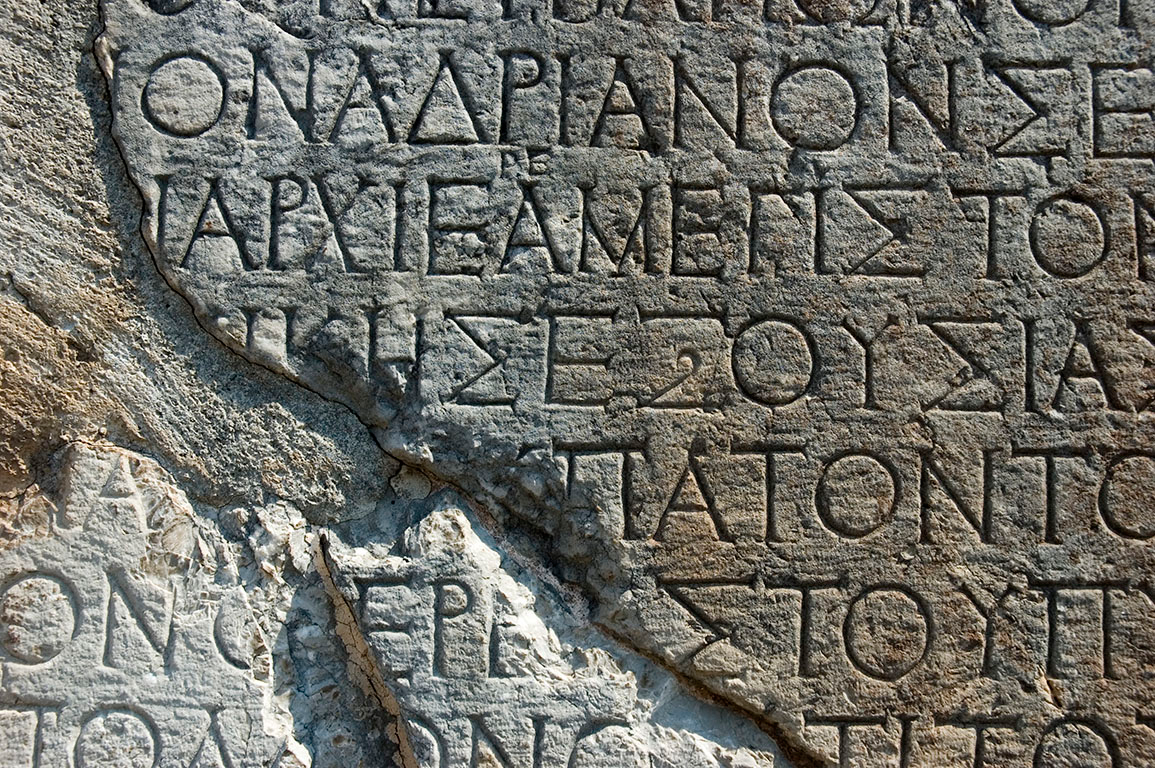 |
| A fragment similar to the Gallio Inscription found in the city of Delphi |
In Acts chapter 18 we read about a man named Gallio who was the proconsul of Achaia. Is that true? Was there really ever a man named Gallio who was the proconsul of Achaia? Around the year 1900, several fragments of a letter were discovered in the Greek city of Delphi. These were put together and found to be a letter from the Roman Emperor Claudius who lived in the first century A.D. when the book of Acts was written. Guess who the letter was written to? It was written to Gallio, the proconsul of Achaia. The Bible had been right all along.
Only a book divinely inspired by God could write about thousands of people, places, and events and be correct all the time. Truly, “all Scripture is given by the inspiration of God.”
|
||
| Ruins of the Delphi Amphitheater |


The post The Bible is Always Right appeared first on Apologetics Press.
]]>The post If fossils were formed a few thousand years ago, why are they still here? appeared first on Apologetics Press.
]]> Thanks for writing. I’m glad that you are a Discovery reader. The reason fossils can last for a few thousand years is because many of them are made out of stone. A fossil is any trace left by something that lived in the past. Animals, plants, and humans have left many fossils. In order for something to become a fossil, it must be buried very quickly. Once it is buried, water begins to seep through the dead plant or animal. That water often contains minerals, such as silica, that start to replace the cells and fibers of the animal or plant. After a while, the minerals have replaced all the cells, and you have a stone, made up of minerals, in the shape of the animal skin or bones. These stone fossils can last several thousand years. We do know, however, that the fossils are not millions of years old. I hope that answers your question.
The post If fossils were formed a few thousand years ago, why are they still here? appeared first on Apologetics Press.
]]>The post Did the Hebrew Writers Borrow from Ancient Near Eastern Mythology? appeared first on Apologetics Press.
]]>Perhaps the most dominant viewpoint in biblical studies concerning the biblical text is that the Bible contains significant amounts of mythology borrowed from Israel’s neighbors (although we should quickly add that truth is not determined by majority opinion). This presumption has dominated biblical studies for nearly two centuries. But as additional texts have surfaced, more cautious scholars have backed away from this viewpoint. Indeed, myth was once seen as pure fiction, but now scholars are beginning to realize that this may not necessarily be the case. The belief that myth may contain small nuggets of historical truth is gaining popularity, even if we recognize that tales of the gods were nothing more than the work of inventive scribes. So where does this leave the Bible? The question we must ask is this: is the Bible pure myth, or is it something else?
We must first determine what we mean by “myth.” It is a notoriously difficult term to define, and scholars use it with a variety of nuances (see Kreeft and Tacelli, 1994, pp. 212-213). Some define it as any story including the supernatural. Most separate myth from legend, with the former being stories about the gods, and the latter being stories—with varying degrees of historical truth—about human beings. In modern parlance, some use it to refer to fiction, especially the body of stories about a particular character (e.g., the mythology of Superman or Captain America). But if we look at the term as it bears on the sacred texts of the religions in the ancient Near East, it has a clearly defined usage.
In his book The Bible Among the Myths, Old Testament scholar John Oswalt notes the radical differences between mythological texts and the Hebrew Bible (2009). The Bible and ancient myth came from two fundamentally different worldviews. Although he identifies nearly a dozen different points, we will examine four in particular.
THE MORAL CHARACTER OF DEITY
In the Bible, God’s moral character is identified with holiness and righteousness. To be more accurate, it is His character that defines holiness. His attributes set the standards for behavior. They are ethically and morally pure and upright. Furthermore, since He is perfect and cannot fundamentally change (Malachi 3:6), He can become neither any better nor any worse. His goodness is celebrated throughout the Bible (Psalm 16:2; 31:19; 107:1). He cannot be tempted or tempt another (James 1:17), or look upon evil with any measure of approval (Habakkuk 1:13). Individuals mirror God’s holiness, in part through ethical living (Leviticus 11:44; 1 Peter 1:16).
The gods of the ancient Near East often commit evil acts and frequently give themselves over to debauchery. In Egyptian myth, the chaotic god Seth murders his brother Osiris and dismembers the body. In an Egyptian myth titled “The Contendings of Horus and Seth,” Seth attempts to rape his nephew Horus during a contest over who will take Osiris’ place (Lichtheim, 2006, 2:219). Rape is a common theme in the Greek myths, where women and even goddesses are violated with a frequency that would shock many modern readers. In the Atrahasis Epic, the gods are outraged because humanity is keeping them awake at night. They attempt to silence humanity through various means, including disease and famine, and finally send a flood to destroy humanity for the sake of a good night’s sleep (see Foster, 1997). The gods are not above getting drunk, either. In one Ugaritic text, called “The Myth of El’s Banquet,” the Canaanite god El (or Ilu) becomes inebriated, and on his way home meets an unidentified animal which causes him to soil himself and fall down into his own excrement (see Pardee, 1997). Such inglorious stories are nowhere to be found in the Bible about God. The God of the Bible can in no way be compared to deities of human invention.
THE VIEW OF MANKIND
The biblical account of mankind’s creation is the most complete and noble of any in ancient Near Eastern literature. Other accounts of man’s creation must be pieced together from various fragments (as in Egypt), or else depict man as little more than an afterthought (as in Mesopotamia). Regardless of the specific tradition, the requirements are clear: man is created to serve the gods, to perform services for them, and, should they fail, incur divine wrath. As Walton observes:
while Israelites viewed man as created to rule, Mesopotamians viewed him as created to serve…. The fact that the Israelites viewed man as the centerpiece of creation afforded him a certain dignity, undergirded by the fact that he was created in the image of God. In contrast, Mesopotamians did not see man as created with dignity. Human beings achieved their dignity by the function they served (1989, p. 29).
He adds that humanity was originally created “in a barbarous state,” with humanity being “an unplanned afterthought, created for the sake of convenience” (p. 30).
The biblical account of Creation is vastly different from its Near Eastern counterparts. Man is the apex of creation. He has dignity because of who he is, not what he does. He is created as a kind of governor or viceroy charged with stewarding God’s creation (Genesis 1:28). Furthermore, this creation was prepared with man in mind (cf. Genesis 1:29-30), for his use and enjoyment. Although he is also created to worship his Creator, it is not a wearisome task. The New Testament further reveals that worship is also meant for the benefit of fellow believers (Acts 2:46-47; Ephesians 5:19), in addition to giving honor to God.
THE REQUIREMENTS OF DEITY
What the gods required of humanity in other cultures could not be known with any accuracy. The most a person could do was to infer the will of the gods based on their circumstances. If all was well and life was going smoothly, then it was apparent that the person was indeed doing the gods’ will. Should they suffer misfortune or tragedy, it must have meant that the person had offended the gods. It became their task to determine which god they might have offended through omens and offer the appropriate sacrifices. This was no easy task, and could be viewed as something of a guessing game. In contrast, God clearly outlined what He expected of mankind with precision through His spokesmen. His will is revealed clearly as a matter of public record, made known through readings to the people (Deuteronomy 31:9-13). The people were warned before punishment, rebuked afterwards, and told specifically what needed to be done to please God.
HISTORIOGRAPHY
The biblical authors had a worldview by which history was viewed as linear. The past, present, and future all had great importance. Specifically, the past served as a reminder, which God makes clear is important enough to signify with memorials, such as piles of stones (e.g., Joshua 4:19-24), or the institution of the Lord’s Supper (Matthew 26:17-30; Mark 14:12-26; Luke 22:7-39). The future is also important in the biblical worldview, as we see in the prophet Joel’s concern about the coming Day of the Lord (Joel 2:1-11), or Christ’s teaching about His impending return (Matthew 24:30; 1 Thessalonians 4:16-17). The biblical writers considered all phases of time to be important.
There was virtually no understanding of history in the modern sense among the cultures of the ancient Near East. The Near Eastern view of history was cyclical and assigned little importance to the past or to the future. The ancient Greek historian Herodotus (circa 484-425 B.C.) is called the “father of history” for good reason—prior to his time there was little or no recording or analysis of the past for its own sake. Historiography, as we know it, did not exist (an exception may be seen in the Babylonian chronicles, which record the history of Babylon from the eighth century through the third century B.C.). The past had very little importance outside its use as propaganda by monarchs interested in glorifying themselves (see Oswalt, 2009, pp. 111-137).
CONCLUSION
Mythology is much more than exciting stories filled with fantastic monsters, magic, and imaginative details. It is a way of thinking—a worldview. Careful comparison of the biblical text with myth makes it clear that the Bible and ancient Near Eastern mythology are not merely different from one another—they are radically so. Even a cursory reading is enough to give most people a feeling that the Bible and myth are quite different, even if they immediately may not be able to put their finger on why. Thanks to the discovery and study of ancient texts, the differences are easy to detect. The Bible, unlike Near Eastern mythology, has an air of dispassionate objectivity that puts it in a category by itself. The Bible and ancient mythology are so different from one another that any allegations of wholesale borrowing on the part of the biblical authors must be rejected by those who handle the ancient evidence with care.
REFERENCES
Foster, Benjamin R., trans. (1997), “Atra-Hasis” in The Context of Scripture, Vol. 1: Canonical Compositions from the Biblical World, ed. William W. Hallo and K. Lawson Younger (Leiden: Brill).
Kreeft, Peter and Ronald Tacelli (1994), The Handbook of Catholic Apologetics: Reasoned Answers to Questions of Faith (San Francisco, CA: Ignatius Press).
Lichtheim, Miriam (2006), Ancient Egyptian Literature, Volume 2: The New Kingdom (Berkeley, CA: University of California Press).
Oswalt, John N. (2009), The Bible Among the Myths: Unique Revelation or Just Ancient Literature? (Grand Rapids, MI: Zondervan).
Pardee, Dennis, trans. (1997), “Ilu on a Toot” in The Context of Scripture, Vol. 1: Canonical Compositions from the Biblical World, ed. William W. Hallo and K. Lawson Younger (Leiden: Brill).
Walton, John H. (1989), Ancient Israelite Literature in its Cultural Context (Grand Rapids, MI: Zondervan).
The post Did the Hebrew Writers Borrow from Ancient Near Eastern Mythology? appeared first on Apologetics Press.
]]>The post The Death of Biblical Minimalism appeared first on Apologetics Press.
]]> It is a good time to be a Christian. Information is more readily available and accessible than ever before. Whether it appears in books, in articles in print and on websites, or in podcasts and other media formats, Christian apologists are producing vast amounts of material in defense of the Christian Faith. In the field of archaeology alone, new discoveries are unearthed every year, adding to our body of knowledge about the biblical world. Because of new information, old theories are being continually revised and refined. In some cases, this information is completely overturning critical theories.
The May/June 2011 issue of Biblical Archaeology Review is an exciting one. On the cover, some of the topics of the issue are listed, at the top of which are the words, “The End of Biblical Minimalism.” Minimalists are those who believe that only the barest minimum of the Bible is true, and then only if it can be incontrovertibly corroborated by extrabiblical evidence. This perspective is one that is eminently skeptical of the Bible. This is not how ancient documents are generally treated, which naturally raises suspicion that the Bible is being treated with a double standard for no other reason than that it is the Word of God. Speaking a little more generously than usual, minimalist Philip Davies claims that the Bible is indispensible for the historian, even though its “stories may be false, true, or a mixture of fact and fiction” (Davies, 2008, p. 5). For those who see the biblical text as a purely manmade production, the Bible is a mixture of a few facts and mostly fiction. As senior Israeli archaeologist Israel Finkelstein puts it,
The historical saga contained in the Bible—from Abraham’s encounter with God and his journey to Canaan, to Moses’ deliverance of the children of Israel from bondage, to the rise and fall of the kingdoms of Israel and Judah—was not a miraculous revelation, but a brilliant product of the human imagination (Finkelstein and Silberman, 2001, p. 1).
The article, “The Birth and Death of Biblical Minimalism” written by archaeologist Yosef Garfinkle, traces the biblical minimalist position from its inception 30 years ago to the present time, where discoveries have undermined it to the point of it becoming untenable. He focuses on one of the hot-button issues in archaeology: the existence of the United Monarchy.
For biblical minimalists, the United Monarchy is very nearly a fiction. They believe that if David and Solomon existed, they were nothing more than petty chieftains. Hoffmeier summarizes the minimalist position this way: “[I]f David and Solomon did exist, they were simply pastorialist chieftains from the hills of Judea, and the military exploits of David and the glories of Solomon were gross exaggerations from later times” (Hoffmeier, 2008, p. 87). In other words, there were no grand palaces and no royal inscriptions. In short—no kingdom.
Garfinkle focuses on one particular archaeological site called Khirbet Qeiyafa, where he serves as co-director of the dig. In ancient times, it was a heavily fortified town on the Israelite/Philistine border in Judah. This one site, as small and out-of-the-way as it is, has done a great deal to dismantle biblical minimalism. Garfinkle states: “The argument that Judah was an agrarian society until the end of tenth century B.C.E. and that David and Solomon could not have ruled over a centralized, institutionalized kingdom before then has now been blown to smithereens by our excavations at Khirbet Qeiyafa” (Garfinkle, 2011, p. 50). Discoveries at the site clearly demonstrate that a large bureaucracy was needed to construct the town. The site had massive walls, far beyond the ability of a couple of petty chieftains to construct. Also found at the site was the earliest example of Hebrew (although it is written in a different kind of script). This kind of writing could only be produced by a scribe who had been trained for government service. Since the site was in a remote location, it must have been important enough to justify sending a scribe from Jerusalem. That could only be done if there was a government of sufficient size with the resources and ability to train professional scribes. As Finkelstein himself states: “The power of the chief was limited…. The economic and military capacity of a chiefdom was severely limited” (Finkelstein and Silberman, 2006, p. 99). Khirbet Qeiyafa could not have been built, fortified, or administrated by a chieftain. It required a king.
As one of the chief proponents of the idea that the United Monarchy is largely fiction, Israel Finkelstein has developed what is called the “Low Chronology.” This approach states that whatever evidence that exists that might point to a tenth century B.C. kingdom under David and Solomon has been misinterpreted. Instead, the credit for building activity thought to have taken place during the time of the United Monarchy should go to the ninth century king Ahab instead. Though architecture can be difficult to date accurately at times, Finkelstein has yet to win many converts. With the information being unearthed at Khirbet Qeiyafa, he may even find himself losing what support he already has.
Finkelstein is commonly labeled a minimalist, although he denies that label. He does share many things in common with biblical minimalists, such as a skeptical attitude toward the Bible and a clear bias in interpreting the archaeological evidence. This goes against standard procedure among scholarship. Generally, ancient texts are given the benefit of the doubt unless sufficient reason exists to doubt their veracity. Since the Bible has a long track record of accuracy, to dismiss it out of hand shows a clear bias against it. Second, evidence should drive interpretation and lead to conclusions—not start with conclusions and interpret all the evidence to support those conclusions. Finkelstein’s skepticism points to a preconceived conclusion that seeks evidence to justify itself, which, naturally, can only be done poorly.
Radiocarbon dating provides a solid link between the ancient evidence and the biblical text. Garfinkle states: “Independent dating suggests that the kingdom of Judah rose in approximately 1000 B.C.E., as indicated by the radiometric results from Qeiyafa. The northern kingdom of Israel, on the other hand, developed around 900 B.C.E., as indicated by the radiometric dates obtained from that region. The Biblical tradition and the radiometric dating actually support each other” (Garfinkle, 2011, p. 52). [EDITOR’S NOTE: For a discussion of the weaknesses of radiocarbon and radiometric dating techniques, see DeYoung, 2005.] The radiometric dating of wood fragments and olive pits at the site indicates that the site was built in the late eleventh century and destroyed in the early tenth century. Since this is precisely the time of the reign of king David, it would appear that David ruled a well-organized kingdom.
This small site has yielded a wealth of evidence that clearly demonstrates the shortcomings of biblical minimalism, although it remains on life support thanks to the hyper-skepticism of a few noted archaeologists. Even William Dever—who is no friend to the traditional interpretation of Scripture—has fiercely opposed the minimalists, whom he calls “revisionists.” He says, “the ‘revisionists’…declare that ‘the Hebrew Bible is not about history at all,’ i.e., it is mere propaganda. For them, if some of the Bible stories are unhistorical, they all are—a rather simplistic notion” (Dever, 2001, p. 97). It is the typical case of “throwing the baby out with the bathwater”: the Bible is a religious book, therefore it cannot be historically accurate. Ongoing excavations argue otherwise.
There are many other discoveries besides those at Khirbet Qeiyafa that argue for the presence of a centralized government in ancient Israel at the time David ruled. The Izbet Sartah Inscription is an example of writing dating to the time of the judges (Hess, 2002, p. 86). The inscription seems to be a practice exercise used to learn the alphabet. This is particularly noteworthy, since Izbet Sartah was a small village in the hill country in the eleventh century B.C. Even in this small village, at least one scribe was practicing his alphabet. The same goes for tenth century inscriptions, such as the Tell Zayit Inscription and the Gezer Calendar, which also appear to be practice exercises used in training scribes. These examples of writing would never have appeared without considerable governmental organization.
In his book On the Reliability of the Old Testament, Kenneth Kitchen surveys the history of minimalism over the past two centuries. He notes that “our present-day minimalists are not a sudden, new phenomenon without precedent. It all began a long time ago, and the present efflorescence is merely a development of some 150/200 years that has in a way come to a head, but simply more scathing of others and more extreme in its views than were its precursors” (Kitchen, 2003, p. 449, italics in orig.). Emerging at a time when the study of the ancient Near East was in its infancy, it could only be expected that time would prove the minimalist’s assumptions false. As mountains of evidence have come to light, minimalism is looking more and more like a thing of the past. Biblical scholarship has a long track record of confounding the critics, and it isn’t stopping anytime soon.
Though much of the minimalists’ work is respected by other scholars, they are supremely guilty of allowing their biases to dictate their interpretation of the evidence. They make selective use of the facts and ignore or reinterpret evidence that disagrees with their position. Some of them grew up in fundamentalist homes, giving the impression that their interpretations are more the result of rejecting the faith of their early years rather than sound scholarship. This approach can be maintained only so long before the body of evidence will get to the point of being beyond their ability to manipulate. The archaeologist’s spade will continue to unearth more evidence season by season, year after year. It is only a matter of time before the minimalist position will become a relic enshrined in the museum of discarded ideas.
REFERENCES
Davies, Philip R. (2008), Memories of Ancient Israel: An Introduction to Biblical History—Ancient and Modern (Louisville, KY: Westminster John Knox Press).
Dever, William G. (2001), What Did The Biblical Writers Know & When Did They Know It? (Grand Rapids, MI: Eerdmans).
DeYoung, Don (2005), Thousands…Not Billions (Green Forest, AR: Master Books).
Finkelstein, Israel and Neil Asher Silberman (2001), The Bible Unearthed: Archaeology’s New Vision of Ancient Israel and the Origin of Its Sacred Texts (New York, NY: Touchstone).
Finkelstein, Israel and Neil Asher Silberman (2006), David and Solomon: In Search of the Bible’s Sacred Kings and the Roots of the Western Tradition (New York, NY: Free Press).
Garfinkle, Yosef (2011), “The Birth and Death of Biblical Minimalism,” Biblical Archaeology Review, 37[3]:46-53,78, May/June.
Hess, Richard S. (2002), “Literacy in Iron Age Israel” in V. Long, D. Baker, and G. Wenham, Windows into Old Testament History: Evidence, Argument, and the Crisis of “Biblical Israel” (Grand Rapids, MI: Eerdmans), pp. 82-102.
Hoffmeier, James K (2008), The Archaeology of the Bible (Oxford: Lion Hudson).
Kitchen, Kenneth A. (2003), On the Reliability of the Old Testament (Grand Rapids, MI: Eerdmans).
The post The Death of Biblical Minimalism appeared first on Apologetics Press.
]]>The post Armchair Archaeology and the New Atheism appeared first on Apologetics Press.
]]>[EDITOR’S NOTE: Dewayne Bryant holds two Masters degrees, and is completing Masters study in Ancient Near Eastern Archaeology and Languages at Trinity Evangelical Divinity School, while pursuing doctoral studies at Amridge University. He has participated in an archaeological dig at Tell El-Borg in Egypt and holds professional membership in the American Schools of Oriental Research, the Society of Biblical Literature, and the Archaeological Institute of America.]
Archaeology has an air of mystery about it. Whenever the subject is brought up, many people instinctively think of the iconic Indiana Jones and his adventures on the silver screen. Others think of buried treasure or exotic locations. In the early days of archaeology, European travelers could be seen out in the field in Victorian garb, sitting under lace umbrellas and sipping tea from fine china. The wealthy traveled with all the fineries of home, surveying the scene while native workers toiled under the hot Middle Eastern Sun. There was much less of the scientific rigor of modern archaeology. It was sometimes little more than glorified treasure hunting. Today there is much more to the discipline than romantic visions of danger, intrigue, and golden fortunes.
Archaeology is a scientific discipline requiring dozens of specializations. Despite its complexity, it has the unenviable distinction of being a field in which anyone with sufficient interest and a modicum of experience can claim to be a specialist. Popular examples include self-proclaimed experts who claim to have found chariot wheels at the bottom of the Red Sea, the real location of Mt. Sinai, and the long-lost treasures of Solomon in a hidden cave beneath the Temple Mount in Jerusalem. These claims are difficult, if not impossible, to verify, and are often accompanied by dubious proof and doctored evidence. Archaeology is a field subject to severe abuse by those with too little training and too much imagination.
The mistreatment of archaeological evidence is not the sole property of poorly trained apologists. It is also found in the writings of the new atheists. “New atheism” is much like atheism in general, except that it is exceptionally militant and intolerant of everything remotely religious in nature. The term appears to have been coined by Gary Wolf in a November 2006 article in Wired Magazine titled, “The Church of the New Believer.” In the article, Wolf says that the new atheist will “not let us [unbelievers] off the hook simply because we are not doctrinaire believers. They condemn not just belief in God but respect for belief in God” (2006). The new atheist is not merely an unbeliever, but one who promotes disbelief and has no tolerance for anyone who respects religion, whether theist, agnostic, or atheist. For new atheists, it is all or nothing. Incidentally, Wolf—though an atheist himself—ultimately disagrees with the severity of the new atheists’ approach.
The most noticeable of the current leaders in this new and virulent strain of militant atheism include Englishmen Richard Dawkins (biologist) and Christopher Hitchens (polemicist and political journalist), and American Sam Harris (neuroscientist). Their diatribes against religion are both malicious and well publicized. Virtually anything they write is going to secure a place near the top of the New York Times bestseller list. This is not surprising, since their devotees are anxious for any new criticism of Christianity, and believers want to read them to understand the new arguments facing the faithful.
The new atheists frequently appeal to subject areas outside their specialties for proof to support their claims. Such might not otherwise discredit their views, but their level of proficiency in these areas is decidedly inferior, as borne out by the numerous mistakes, misunderstandings, and logical errors that pepper their works. One of the blatant areas of abuse concerns their appeals to archaeology.
While Dawkins, Hitchens, and Harris are gifted with formidable intellects and considerable literary prowess, archaeology lies outside their realm of competency. They would do well to remember that expertise in one area does not immediately transfer into any other area of one’s choosing. Dawkins may be a highly respected biologist among evolutionists, but he is a rather poor student of the religion he so fiercely opposes. In some cases it appears almost as if he reaches for any argument, no matter how poor, to justify his extreme dislike for Christianity. Hitchens is an insightful journalist, but his impeccable prose inadequately conceals a lamentable ignorance of Christianity and the wealth of evidence supporting its claims. Harris is an up-and-coming scientist, but his skills in logic and argumentation are virtually nonexistent and have drawn heavy criticism from nearly all quarters. All three men may be gifted in their areas of specialization, but outside those areas they are like fish out of water. They seem to have gained only enough familiarity with Christianity to generate criticism that will tickle the ears of their adherents. Their attacks on the Christian faith are little more than public proofs of their inadequacy as critics.
The Responsible Use of Archaeology
Archaeology is an exciting field that brings a great deal of information to bear on the study of the Bible. At the same time, archaeologists must exercise caution in evaluating ancient evidence for several reasons. First, the ancient evidence is usually very fragmentary. Not all the evidence from antiquity made it into the ground in the first place, and if it did, the march of time frequently takes its toll on ancient artifacts. This is not surprising since artifacts deteriorate even in climate-controlled environments in state-of-the-art museums. Second, with every season new discoveries are brought to light, adding to the body of information we possess about the ancient world. The next year could well produce evidence that contradicts this year’s conclusions. Finally, the surviving evidence is piecemeal in nature, requiring archaeologists to fill in the gaps with educated guesswork where conclusiveness may be lacking. This is not to say that archaeology cannot reach definite conclusions, but only to say that those conclusions may frequently be tentative in nature. Unlike responsible scholars, the Bible’s critics frequently make grandiose appeals to evidence without the caution employed by those who understand how to evaluate the evidence.
Archaeology has been misused by those wishing to foster a skeptical attitude toward the factual reliability of the Bible. A prime example is an article published in Harper’s Magazine titled, “False Testament: Archaeology Refutes the Bible’s Claim to History.” Author Daniel Lazare writes,
Not long ago, archaeologists could agree that the Old Testament, for all its embellishments and contradictions, contained a kernel of truth…. That is no longer the case. In the last quarter century or so, archaeologists have seen one settled assumption after another concerning who the ancient Israelites were and where they came from proved false (2002, p. 39).
Lazare, a journalist with no archaeological credentials, does little more than survey the extreme left concerning the intersection of archaeology and the Bible. Yigal Levin, professor in the department of philosophy and religion at the University of Tennessee at Chattanooga, wrote a stinging response to the article in Harper’s. He states: “From his essay, I learned only that Lazare is capable of summarizing The Bible Unearthed, written by my former teacher Israel Finkelstein and his colleague Neil Asher Silverman. Like their book, Lazare’s essay is one-sided and overly dramatic” (Levin, 2002, p. 4).
The book to which Levin refers in his article is The Bible Unearthed: Archaeology’s New Vision of Ancient Israel and the Origin of Its Sacred Texts (Finkelstein and Silberman, 2001). Finkelstein’s work has drawn substantial criticism from other scholars—even those who doubt the Bible’s veracity. Virtually no archaeologists have adopted his somewhat radical conclusions, which generally deny a great deal of historicity to the Old Testament narratives. It should be noted that Finkelstein, who once held a relatively positive position on the relationship between the Bible and ancient history, now holds a minority view that finds little acceptance among even mainstream archaeologists. His work has been heavily and publicly criticized by American archaeologist William Dever, who called the book “an archaeological manifesto, not judicious and well-balanced scholarship,” adding, “it will do little to educate the public” (2001, 322:74). It is significant that Dever, one of the most widely respected archaeologists in America, states explicitly that he is “not a theist” (2005, p. xi).
A Classic Double Standard Used Against the Bible
The double standard employed against the Bible is both obvious and pervasive. One such example concerns the conquest of Canaan, which is frequently filed under the categories of fiction and myth. Joshua’s campaign is usually assumed to be fictitious, but there is a parallel example from Egypt that mirrors Joshua’s account. In 1275 B.C., the forces of Egypt under Ramesses the Great, and the Hittite Empire under general Muwatallis II, met at the Battle of Kadesh. Egyptian forces were separated into three units as they traveled northward through Canaan. Two divisions traveled farther inland, while a third made its route close to the Mediterranean coastline. The Hittites, lying in wait near the city of Kadesh, ambushed the Egyptian troops. The Hittite forces overran the first division and shattered it. The quick-thinking Ramesses hastily organized his troops and was able to fend off the Hittite offensive long enough for the third division to arrive. The reinforced troops eventually pushed back their Hittite opponents. In the end, Ramesses won a military victory, but suffered a political defeat since the Hittite Empire either retained or reclaimed lost territory in the area.
In typical Near Eastern fashion, Ramesses returned to Egypt and proclaimed a great victory. Indeed, the famous colossi at Abu Simbel were part of a monument erected near the border of Ethiopia to convince Egypt’s neighbors that Ramesses had won a decisive victory—just in case they heard otherwise. A relief depicting the battle shows Ramesses gunning down fleeing Hittite soldiers with his bow and rolling over others like speed bumps in his oversized chariot. In the written account of the battle, he credits both divine intervention and his own leadership as the main causes for the Egyptian triumph over his enemies (Kitchen, 2000, 2:37). According to the poetic version of the account, Ramesses leaps into battle while the uraeus, the serpent-shaped symbol of protection worn on the forehead of the king, blasts fire at his enemies and consumes the Hittite forces like an ancient flame-thrower.
In inscription we see several parallels between the Battle of Kadesh and the military operations carried out under Joshua as recorded in the Old Testament: (1) both leaders are dynamic military figures, (2) each is said to rely upon divine aid to defeat his foes, and (3) each credits his deity with the victory. While no scholar denies the Battle of Kadesh took place, a majority dismisses the conquest of Canaan out of hand. For Ramesses, scholars simply excise any references to the divine and accept the rest as reliable narrative. For Joshua’s account, the references to Yahweh immediately place the story in the realm of myth. No details are accepted as genuine. While there are other factors at work in this particular case (such as the debate over the available information that bears on the conquest of Canaan), it should be noted that for many people, including scholars, Scripture is virtually the only ancient literature where any mention of the supernatural immediately disqualifies any claim to historical reliability. Other ancient works are filled with magic and divine intervention, yet this fact does not stop scholars from searching them for a core historical truth. Quite the opposite is true in the case of the Bible.
Pseudo-Scholarship in the Popular Press
The popular press has been very active in its attempt to diminish the intellectual respectability of biblical faith, and the new atheists are one of the best examples. Their academic arrogance is nothing short of astounding, and only further highlighted by their lack of understanding of biblical studies. One of the most egregious examples of religious ignorance is found in David Mills’ book Atheist Universe:
It’s fairly easy to demonstrably prove that the Genesis accounts of Adam and Eve, and Noah’s worldwide deluge, are fables. It’s easier to prove these stories false because, unlike the notion of God, the Creation account and Noah’s flood are scientifically testable. Science may explore human origins and the geologic history of Earth. In this regard, science has incontrovertibly proven that the Book of Genesis is utter mythology (2006, p. 28).
Mills provides a priceless example of just how badly militant atheists misunderstand ancient literature. Within a mere paragraph, Mills uses the terms “fable,” “mythology,” and (false) “story” interchangeably. None of these terms are synonyms. A fable is a whimsical tale, usually containing a moral or teaching point, in which talking animals frequently play primary roles. Aesop’s Fables immediately comes to mind. This is quite different from the term “mythology,” which centers on stories of the gods and often has a religious or cultic function. These stories also have varying degrees of contradiction with other myths within the same corpus in which the deities are represented. Incidentally, this is also different from a “legend,” which is an embellished story about a human figure containing at least a kernel of historical truth.
Unlike myths, fables, and fictive stories, the Old and New Testaments are concerned with reporting factual details. The historical books frequently reference other sources such as the Book of Jashar (Joshua 10:13; 2 Samuel 1:18), the Book of the Wars of the Lord (Numbers 21:14), and the Book of the Kings of Israel and Judah (2 Chronicles 27:7). It appears that the divinely-guided Hebrew writers worked with sources in similar fashion to modern historians. The writers often used source material and on occasion point the reader to those sources where additional information could be found at the original time of writing (e.g., 1 Kings 14:19). Luke makes it clear that he conducted an extensive investigation of the sources in the composition of his gospel account (Luke 1:1-4). His attention to geographical detail, long recognized by scholars for its accuracy and thoroughness, is quite out of keeping with ancient myths, which had no concern for this type of information. Finally, Paul (1 Corinthians 15:5-8), Peter (2 Peter 1:16), and John (1 John 1:1-2) all offer eyewitness testimonials, presupposing their readers had the ability to verify their claims.
It is important to note that the ancients rarely believed their myths actually happened in real time and space. Actual history is of very little concern in mythology, which may come as a surprise to many moderns. It seems to be just as surprising to the critics of the Bible, who invariably equate myth with fiction. The new atheists assume that Jesus is a mythological creation of the early church, missing the point that the early Christians actually believed that He walked the Earth, performed miracles, and rose from the dead. Unlike the pagan populace of Greece and Rome, early Christians were willing to die for their convictions. This attitude made them a target for the Greek satirist Lucian of Samosata, who mocked their belief in eternal life. He wrote in “The Death of Peregrine”:
The Christians, you know, worship a man to this day—the distinguished personage who introduced their novel rites, and was crucified on that account…. You see, these misguided creatures start with the general conviction that they are immortal for all time, which explains the contempt of death and voluntary self-devotion which are so common among them… (n.d., 4:82-83).
Since martyrdom was virtually unknown in the Greco-Roman world, why did it become so common in the Christian community? Simply put, no one else believed in the exclusivity of religion. The ancients were polytheistic and inclusive. Not only were other gods recognized, but initiation in one of the mystery religions did not exclude membership in other cults. As long as one had enough money for the expensive initiation rites, he or she could be a member of any number of the secretive mystery cults in the Greek world.
In his book God is Not Great: How Religion Poisons Everything, Christopher Hitchens spends a few pages alluding to Jesus as merely one of many virgin-born, crucified messiahs (2007, pp. 22-23). Many critics have argued Jesus is nothing more than a plagiarized myth from other world religions, adapted for use by the earliest Christians. Allegedly, the virgin birth is found in Mithras worship, and other gods such as Attis and Osiris were crucified and resurrected. Critics do not appear to realize that in the mystery cult of Mithras, the god was born from a rock, and that the earliest stories come from over a century after the time of Christ (cf. Butt and Lyons, 2006). Further, Attis and Osiris were never crucified. Attis killed himself and Seth drowned his brother Osiris in the Nile River. Further, the two never truly resurrected. Attis remained in a comatose state where his hair still grew and his little finger twitched. Osiris is said to have been brought back to life but did not rejoin the land of the living. He instead remained in the underworld as the lord of the dead (the story also explains mummification, which is decidedly different from the Christian view of resurrection). One would be hard-pressed to find a true resurrection outside the Bible. All of this information is readily available in popular translations of the ancient myths that seem to have escaped the attention of Christianity’s most popular critics. In their haste to relegate the Bible to the realm of myth, the new atheists have failed to realize that the Bible records actual persons, places, and events that can be located in the archaeological record.
Embarrassment in the New Atheism
The new atheists are quite skilled at parroting critical scholars in the popular media, but give little evidence of having done any real research into the archaeological concerns surrounding the Bible. Their mistakes are so elementary that, if one did not know that they were ranked among the world’s intellectual elite, one would simply consider them part of the lunatic fringe. The dogmatic conclusions reached by Dawkins and company are unjustified for several reasons. First, none is well-acquainted with the material he cites. Their specialties lie in unrelated fields, and their conclusions are frequently unsupported or even contradicted by the archaeological artifacts. Second, none possesses a basic, reasonable knowledge of Christianity. They often make basic mistakes that could have been easily prevented by spending time doing minimal research into basic biblical teachings. Finally, they make very few attempts at formulating arguments, and those they make are peppered with logical errors and fallacious reasoning.
Apologists for disbelief have noted the criticism of their leading spokesmen and have rushed to their defense. In a blog called the “Black Sun Journal,” editor Sean Prophet writes:
The flimsiest of all the rhetorical devices used by religious writers is the accusation that atheists lack scholarship on religion. That they supposedly “don’t even understand what they have rejected.” This dismissive attitude is repeated ad nauseam in the popular media. While it’s true that few atheists have doctor-of-divinity degrees, it’s completely false that they therefore can’t understand theology (Prophet, 2008, italics in orig.).
Prophet argues that it is false that atheists cannot understand theology. Yet, he misses the fact that critics such as Dawkins and P.Z. Meyers defend their refusal to engage Christian thought, sometimes crudely, as in the case of a Meyers’s piece titled, “The Courtier’s Reply” (2006). Georgetown professor John Haught critiques them, saying, “Given all their bluster about the evils of theology, why do they wade only ankle deep in the shallows of religious illiteracy? A well-thought-out military strategy sooner or later has to confront the enemy at its strongest point, but [Dawkins, Harris, and Hitchens have—DB] avoided any such confrontation. Unlike the great leaders in war, these generals have decided to aim their assaults exclusively at the softest points in the wide world of faith” (2008, p. 63, bracketed item added). While he criticizes the supposed myth of ignorance surrounding the militant, atheist movement, Prophet appears to have as little understanding of religion as those whom he defends. Indeed, his assertion that “[r]ank-and-file atheists are far more facile with scripture than rank-and-file Christians” is so laughable and outrageous as to be absurd. A cursory survey of militant, atheist literature from those who are considered its greatest scholars quickly reveals a host of misunderstandings readily apparent to any unbiased observer.
One example of Dawkins’ many academic sins concerns the Gnostic gospels. In The God Delusion, he argues that Thomas Jefferson advised his young nephew to read the other accounts of Jesus’ life, which Dawkins claims are the Gnostic writings such as the “Gospels of Thomas, Peter, Nicodemus, Philip, Bartholomew, and Mary Magdalen” (2006, p. 95). It would be quite impossible for Jefferson to have recommended the Gnostic gospels to his nephew since they were unknown in his day. So it is with the apocryphal gospels. Those of Thomas and Philip were among the cache of documents discovered in 1945 in Nag Hammadi, Egypt. The gospels of Peter and Mary were both found in the late 1800’s. The gospel of Bartholomew has yet to be positively identified. In every case, these non-canonical writings date much later than the time of Christ and provide no evidence of offering genuine accounts of Christ’s life.
Christopher Hitchens follows in Dawkins footsteps when he misunderstands the nature of the Gnostic writings. He says that the gospels “were of the same period and provenance as many of the subsequently canonical and ‘authorized’ Gospels” (2007, p. 112). Yet, Gnostic beliefs arose shortly after Christianity, and the documents produced by Gnostics date from the second century to the fifth century and later. As a marriage between Christianity and Neo-Platonic philosophy, Gnosticism reached its height in the second and third centuries, but its incipient form is implicitly condemned in several New Testament passages (Colossians 2:9; 1 John 1:1; cf. 1 Peter 2:24).
Dawkins, Hitchens, and Harris appear to draw their notions about the supposed legendary nature of the gospel accounts from Bart Ehrman’s Misquoting Jesus: The Story Behind Who Changed the Bible and Why. All three heartily recommend Ehrman’s book and give him high praise for his journey into unbelief, which he never seems to tire of describing (2005, pp. 1-15; 2008, pp. 1-19; 2009, pp. ix-xii). The new atheists are apparently unaware that Ehrman’s work has drawn heavy criticism because of its tendency to sensationalize, overplay the evidence, and present ideas that few of his academic peers affirm, regardless of their religious orientation or lack thereof. That the trio—as non-specialists who know relatively little about Christianity—would lean so heavily on a scholar like Ehrman is, perhaps, understandable, but remains inexcusable.
Hitchens claims that the existence of Jesus is “highly questionable” and there is a “huge amount of fabrication” in the details presented in the gospel records (2007, p. 114). The only genre into which the gospel accounts could possibly be forced would be legend, but even then, there was insufficient time for Jesus to reach legendary status. As the acclaimed classical scholar A.N. Sherwin-White pointed out, it takes time for legends to accumulate about a historical person (1963, pp. 188-191). The gospel records are clearly non-mythological and give no evidence of being legendary.
The biblical ignorance of the new atheists is on full display when David Mills begs for Christians to defend why they believe in mythical creatures such as unicorns (Job 39:9-10; Psalm 22:21), cockatrices (Isaiah 11:8), and satyrs (Isaiah 13:21). He embarrasses himself when he writes:
I also find it revealing that, in the newer, modern-language translations of the Bible, these ridiculous passages of Scripture have been dishonestly excised, rewritten or edited beyond their original translation in the King James. So not only are the Great Pretenders forsaking long-honored and long-held Christian beliefs, but the Bible itself, under their supervision, appears to be experiencing a quiet, behind-the-scenes, Hollywood makeover as well (2006, p. 150).
The words rendered “unicorn” (re’em, “ox”), “cockatrice” (tsepha`, a type of serpent), and “satyr” (sa`ir, “goat”) have nothing to do with mythological creatures. In fact, these creatures did not even exist in ancient Near Eastern mythology. The last 400 years has seen an explosion in the knowledge of the biblical languages. Scholars now have the benefit of the numerous manuscripts and inscription discoveries that have greatly expanded our knowledge of the languages. The work at the ancient city of Ugarit alone has provided a wealth of information on the Hebrew language through the study of the closely related language of Ugaritic. Mills’ objection evaporates when we understand that the change in English translation is not due to a dishonest makeover, but to a better and truer understanding of how the original text should be translated. To his discredit, he mistakes dishonesty for intellectual progress, which only further underscores his unfamiliarity with the Bible and its ancient context—and his extreme prejudice.
Christopher Hitchens says the material from the Exodus to the Conquest of Canaan “was all, quite simply and very ineptly, made up at a much later date…. Much of the evidence is the other way” (2007, p. 102). Elsewhere, he says the Pentateuch is an “ill-carpentered fiction, bolted into place well after the nonevents that it fails to describe convincingly or even plausibly” (p. 104). Here Hitchens alludes to the Documentary Hypothesis which claims the books of Moses were compiled from different sources much later than the time of the Exodus. Again, Hitchens does not seem to know that recent discoveries have presented the Documentary Hypothesis with significant challenges that have yet to find plausible answers (cf. Garrett, 2000; Kaiser, 2001). While much of modern scholarship believes in the hypothesis, it must be noted that professors essentially pass on the theory to their students as a body of dogmatic teaching and rarely require them to actually question the theory (cf. evolution). Moreover, archaeology has consistently produced evidence that implies the writing of the Pentateuch is genuinely ancient.
Just when things could not get any worse, Hitchens further destroys his own credibility by claiming urban myth as fact. He states: “the Pentateuch contains two discrepant accounts of the Creation, two different genealogies of the seed of Adam, and two narratives of the Flood” (2007, p. 106). The two creation accounts are intentionally written for two different purposes and are complimentary, not contradictory. This is similar to the way in which a person might take a photograph of an object from two different angles in order more fully to explore the subject in view. Critics seem fixated on digging this old chestnut out of the wastebasket where it rightly belongs (cf. Jackson, 1991). Also, genealogies in the Bible are selective by nature, so differences in genealogical lists are inconsequential (cf. Miller, 2003). The alleged two narratives of the Flood in Genesis 6-9 refers to the artificial separation of the story into two constituent parts, which falls under the purview of the Documentary Hypothesis. This allegation, too, has been shown to be fraught with problems.
The Plausibility of the Biblical Record
Archaeology demonstrates solid connections between the biblical record and ancient history, in contrast to Christopher Hitchens’ assertion that it is an implausible record. Consider the following:
The Patriarchs
Critics often malign the patriarchs without just cause. They insist that camels were not domesticated during the patriarchal age, thus constituting an anachronism in the biblical text. Yet evidence of camel domestication appears as early as 2000 B.C. in several places in Mesopotamia, concurrent with Abraham—if not slightly preceding him (Kitchen, 2003, p. 339). Another point of confidence is the names of the patriarchs. While God selected Jacob’s name, they all highlight the Mesopotamian roots of Abraham since the names of Isaac, Jacob, Ishmael, and Joseph are all of Amorite origin (pp. 341-342). These names were at the height of their popularity when the patriarchs lived in the early second millennium and quickly fell into disuse in subsequent centuries.
A vital piece of evidence is the structure of covenants in the Bible. Covenants made in antiquity evolved over time, and each period has a distinct structure for the covenants made at various times and particular locations. Kenneth Kitchen has surveyed a wide range of covenants used from the third millennium through the first millennium B.C. (Kitchen, 2003, pp. 283-289). He found the Abrahamic covenant made in Genesis 15-17 fits securely in the early second millennium, while the covenants in Exodus, Deuteronomy, and Joshua 24 fit only in a late second millennium context.
The Life of Joseph
In the very section of the Bible that Hitchens questions is found some of the most compelling evidence for the historicity of Scripture. As Egyptologist James K. Hoffmeier demonstrates, the story for Joseph rings true with numerous details (Hoffmeier, 1996, pp. 77-98). The 20-shekel price paid for Joseph (Genesis 37:28) is consistent with the price of a slave c. 1700 B.C. Egyptian mummification took about 70 days once the period for mourning was included, which matches the time given for the mummification of Jacob (Genesis 50:3). Examples of non-Egyptians becoming viziers is known from Egyptian sources. Further, it appears that the story of Joseph was put down in writing during the 18th-19th Dynasties in Egypt, the very period during which Moses lived. This idea is borne out by the fact that the Pentateuch uses the name “Pharaoh” (Hebrew phar’oh, Egyptian per-`3) when referring to the king of Egypt. During this time, the term was a generic one referring to the king, similar to referring to the U.S. President as “the White House,” or to the British monarch as “the Crown.” Prior to this time, the name of the king was used, and afterward sources mention the monarch as “Pharaoh X” or “X, king of Egypt”—as in the case of pharaohs Shishak (1 Kings 11:40; 2 Chronicles 12:2) and Neco (2 Kings 23:29).
The United Monarchy
David’s existence has been questioned frequently. Examples of petty monarchs ruling miniscule kingdoms in the Near East find rare mention in ancient sources, yet generally their historicity is taken at face value with minimal skepticism. Even Gilgamesh, the hero of the Epic of Gilgamesh, is thought to have been a historical figure ruling in Mesopotamia between 2600-2700 B.C. based on a reference in the famous Sumerian king list. Yet, David’s historicity is viewed with extreme suspicion, even though there are references to David found in the Tel Dan Inscription and the Moabite Stone, as well as numerous references in the Hebrew Bible. Indeed, Gilgamesh is thought to have been a real person despite being the semi-divine hero in a mythical composition, which also includes such fantastic details as a beast-man named Enkidu, a divinely sent creature of destruction called the Bull of Heaven, and a plant that can grant the person who eats it eternal life. David is frequently labeled a myth despite the solid evidence in favor of his existence.
The Divided Monarchy
Archaeology has vindicated the Bible’s mention of several figures that were once thought to have been fictional. The existence of Sargon (Isaiah 20:1) was questioned until a relief bearing his image was found in the throne room of his capital city of Dur-Sharrukin (“Fort Sargon”). Belshazzar (Daniel 5:1) was likewise questioned because Babylonian documents listed Nabonidus as the last king of the Babylonian empire. Scholars uncovered ancient evidence showing that Belshazzar co-ruled with his father Nabonidus, ruling from the city while Nabonidus sat for 10 years in self-imposed exile. Balaam (Numbers 22-24) has been located in an extrabiblical source called the Deir ‘Alla Inscription written during this period (Mazar, 1990, p. 330).
The Life of Christ
Archaeology does not always mention any one individual, and in the case of Christ, more substantial evidence comes from history rather than archaeology. One significant find is the 1990 discovery of the ossuary (bone box) of Joseph Caiaphas, high priest at the time of Jesus’ trial and crucifixion (John 11:49-53). Jesus is mentioned by the Roman writers Suetonius and Tacitus, the Roman governor Pliny the Younger, and is indirectly referenced by the Greek satirist Lucian of Samosata. He is also noted in a Jewish composition from the fifth century called the Toledoth Jesu, which gives an alternate explanation for the empty tomb from a hostile source. Jesus is far from the “myth” critics claim Him to be.
The Early Church
Inscriptions have revealed the names of numerous individuals mentioned in the New Testament. Gallio, proconsul of Achaia (Acts 18:12-17), is mentioned in an inscription found at the city of Delphi. Paul’s friend Erastus (Acts 19:22) is likely mentioned in an inscription found at Corinth. Sergius Paulus, mentioned as the first convert on the island of Cyprus, was proconsul (a Roman governor) when the apostle Paul visited the island (Acts 13:7). He is mentioned in an inscription found near Paphos (Reed, 2007, p. 13).
After the evidence is surveyed, it is apparent that much of the criticism of the Bible arises—not from intense scrutiny of the evidence—but from ignorance of it. The overwhelming weight of the archaeological and historical evidence firmly places the Bible in the sphere of reality rather than myth.
Knowing Should Lead to Knowing How Much One Does Not Know
Part of the problem with secular science is that it focuses on empirical data, but has little to no interest in epistemology: the study of how human beings know what we know. This great divorce has become clearer over the past couple of centuries, and is on full display in books like The God Delusion, where Richard Dawkins commits dozens of logical errors. Many of his arguments fail because he is not conversant with religion. They also suffer from his lack of understanding how evidence outside his specialty is to be interpreted and applied.
Journalist David Klinghoffer points out: “A favorite strategy of such groups has long been to attack cartoon versions of older rival religions” (2007). He cites as evidence Dawkins’ now-infamous phrase about the God of the Hebrew Bible being “arguably the most unpleasant character in fiction: jealous and proud of it; a petty, unjust, unforgiving control-freak; a vindictive, bloodthirsty ethnic cleanser; a misogynistic, homophobic, racist, infanticidal, genocidal, filicidal, pestilential, megalomaniacal, sadomasochistic, capriciously malevolent bully” (Dawkins, 2006, p. 31). No believer in the Judeo-Christian tradition would ever agree to this assessment, nor would anyone familiar with the Bible defend it. While Prophet argues that contrarians like Dawkins should not be labeled as ignorant of religion (2008), the evidence argues powerfully against him.
The unmitigated vitriol that pervades the works of Dawkins, Hitchens, and Harris is a clear indicator that their intolerance of Christianity is not motivated by objective reason. These men give every appearance of being desperate to artificially maintain a hatred of God. They fail to demonstrate sufficient familiarity with the Bible and fail to understand the ancient evidence supporting it.
Christians everywhere should be reminded that grandiose assertions, unsupported by adequate evidence, can be dismissed safely. This is the case with much of the material produced by the new militant breed of atheism—which makes many bold claims and offers remarkably little proof. Such is certainly the case with the facts concerning the reliability and historicity of Scripture. Boisterous claims do nothing to bolster their case when Dawkins, Hitchens, and Harris find themselves contradicted by the evidence. If these three are the best that militant atheism has to offer, Christians have nothing to fear.
REFERENCES
Butt, Kyle and Eric Lyons (2006), Behold! The Lamb of God (Montgomery, AL: Apologetics Press).
Dawkins, Richard (2006), The God Delusion (Boston, MA: Houghton Mifflin).
Dever, William (2001), “Excavating the Hebrew Bible or Burying It Again?” Bulletin of the American Schools of Oriental Research, 322: 67-77, May.
Dever, William (2005), Did God Have a Wife? (Grand Rapids, MI: Eerdmans).
Ehrman, Bart (2005), Misquoting Jesus: The Story Behind Who Changed the Bible and Why (New York: HarperSanFrancisco).
Ehrman, Bart (2008), God’s Problem: How the Bible Fails to Answer Our Most Important Question—Why We Suffer(New York: HarperOne).
Ehrman, Bart (2009), Jesus Interrupted: Revealing the Hidden Contradictions in the Bible (and Why We Don’t Know About Them) (New York: HarperOne).
Finkelstein, Israel and Neil Asher Silberman (2001), The Bible Unearthed: Archaeology’s New Vision of Ancient Israel and the Origin of Its Sacred Texts (New York: Free Press).
Garrett, Duane (2000), Rethinking Genesis: The Sources and Authorship of the First Book of the Pentateuch(Geanies House, Fern: Christian Focus Publications).
Haught, John F. (2008), God and the New Atheism: A Critical Response to Dawkins, Harris, and Hitchens(Louisville, KY: Westminster John Knox).
Hitchens, Christopher (2007), God is Not Great: How Religion Poisons Everything(New York: Hachette).
Hoffmeier, James K. (1996), Israel in Egypt: The Evidence for the Authenticity of the Exodus Tradition(Oxford: Oxford University Press).
Jackson, Wayne (1991), “Are There Two Creation Accounts in Genesis?” http://www.apologeticspress.org/articles/2194.
Kaiser, Walt C. Jr. (2001), The Old Testament Documents: Are They Reliable and Relevant? (Downers Grove, IL: IVP).
Kitchen, Kenneth A., trans. (2000), “The Battle of Kadesh—The Poem, or Literary Record,” The Context of Scripture, Volume Two: Monumental Inscriptions Form the Biblical World(Leiden: Brill).
Kitchen, Kenneth A. (2003), On the Reliability of the Old Testament(Grand Rapids: Eerdmans).
Klinghoffer, David (2007), “Prophets of the New Atheism,” http://seattletimes.nwsource.com/html/opinion/2003653502_klinghoffer06.html.
Lazare, Daniel (2002), “False Testament: Archaeology Refutes the Bible’s Claim to History,” Harper’s Magazine, 304/1822:39-47, March.
Levin, Yigal (2002), “Let There Be Light,” Harper’s Magazine, 304[1825]:4, June.
Lucian of Samosata (no date), “The Death of Peregrine,” in H.W. Fowler and F.G. Fowler (1905), The Works of Lucian of Samosata (Oxford: Clarendon Press).
Mazar, Amihai (1990), Archaeology of the Land of the Bible, 10,000-586 B.C.E.(New York: Doubleday).
Meyers, P.Z. (2006), “The Courtier’s Reply,” http://scienceblogs.com/pharyngula/2006/12/the_courtiers_reply.php.
Miller, Dave (2003), “The Genealogies of Matthew and Luke,” http://www.apologeticspress.org/articles/1834.
Mills, David (2006), Atheist Universe: The Thinking Person’s Answer to Christian Fundamentalism(Berkley, CA: Ulysses Press).
Prophet, Sean (2008), “Pastor Acknowledges Arguments of New Atheism,” http://www.blacksunjournal.com/atheism/1397_pastor-acknowledges-arguments-of-new-atheism_2008.html.
Reed, Jonathan (2007), The HarperCollins Visual Guide to the New Testament: What Archaeology Reveals about the First Christians (New York: HarperOne).
Sherwin-White, Adrian Nicholas (1963), Roman Society and Roman Law in the New Testament(Oxford: Clarendon).
Wolf, Gary (2006), “Church of the Non-Believers,” http://www.wired.com/wired/archive/14.11/atheism.html.
The post Armchair Archaeology and the New Atheism appeared first on Apologetics Press.
]]>The post An Interview With Israel Finkelstein appeared first on Apologetics Press.
]]>Finkelstein has a well-deserved reputation as a critic of the Bible. He has long been accused of being a biblical minimalist, someone who believes that only a bare minimum of the Bible is historically trustworthy. Prominent minimalists in modern academia include Thomas Thompson, Philip Davies, and Niels Peter Lemche, all of whom have authored works highly critical of the historical accuracy of the Bible. Finkelstein is not as radical as the minimalists, who approach the Bible with a level of skepticism that borders on outright hostility. At the same time, Finkelstein expresses his belief that the story of David contains mere “historical germs” (Shanks, 2010, p. 51). He admits that there was a group of people called “Israel” as early as the late 13th century B.C. and that Solomon built a temple in Jerusalem, but disagrees that the Bible is historically accurate.
Although Finkelstein is not as extreme as the minimalists, he is often guilty of using the same unwarranted skepticism when reading the Bible. In the interview with Shanks, he says that he believes that he is “in the center” (p. 48) and is “more critical” (in the sense of reading the Bible with a greater level of scrutiny and discernment, p. 51) without venturing into pure minimalism, but denies that the history of major biblical events occurred as they are presented in the pages of Scripture.
Finkelstein is highly critical of those who take the Bible at face value. He says, “I do think we are in a process of liberation from an antiquated reading of the Biblical text… [Some archaeologists] still interpret the Bible very literally…. We tend to give it a more sophisticated reading. This is not to say that the Bible has no history. It means that we need to look at the Biblical material more carefully, in a more sophisticated way (p. 58).
From Finkelstein’s comments throughout the interview, it seems that by having “greater sophistication” in reading the Bible he really means “greater skepticism.” Unfortunately, this seems to be a common way of looking at the Bible. For many critics, it is read not to be understood, but to be condemned. Modern critics assume they are more advanced than the ancient authors, and approach Scripture with an air of chronological arrogance. In reality, those archaeologists and scholars who read the Bible “very literally” are in many ways interpreting Scripture just as the ancient authors intended. They are also interpreting the Bible just as scholars would interpret texts from other cultures. The biblical authors intended their work to be read so that the reader understands that their work is presenting facts that took place in real time. Few scholars in other areas of ancient history would read ancient texts with the same skepticism as Finkelstein and others view the Bible.
It has long been the case that those who read the Bible hold it to a much higher standard—it would not be unfair to call it a double standard—than other sources of information. For instance, when archaeologist Eilat Mazar discovered and identified what she considered to be the palace of David in Jerusalem based partially on her reading of the Bible (Mazar, 2006), Finkelstein and several colleagues disputed her findings (Finkelstein, et al., 2007). When the Khirbet Qeiyafa inscription was discovered, Finkelstein warned against the “revival in the belief that what’s written in the Bible is accurate like a newspaper” (Friedman, 2008). In other words, he argues that we cannot expect the Bible to report factual details with any great degree of certainty. For the last two hundred years scholars have mined ancient texts, including mythological texts, for details that might help with locating ancient sites. Finkelstein apparently believes that this cannot be done with the Bible.
Finkelstein has a brilliant mind, and is witty, engaging, and humorous in his interview with Shanks. At the same time, he also possesses a level of skepticism that finds no place among mainstream scholarship. Experts usually approach the ancient evidence with a degree of confidence, assuming that the literary and material evidence are generally trustworthy unless there is reason for suspicion. Minimalists approach the biblical evidence with an extreme degree of skepticism that they often do not employ elsewhere. They hold the biblical text to an extreme double standard, and disregard the Bible unless incontrovertible extrabiblical evidence is found that corroborates the text. If the same method were applied to reading the daily paper, minimalists would never get past the first paragraph of the lead article.
The minimalists’ approach, which Finkelstein’s resembles closely, is decried by many scholars, both theistic and atheistic. An example of the former is Kenneth Kitchen, one of the world’s foremost Egyptologists. In his book On the Reliability of the Old Testament, he spends considerable time examining the biblical minimalists and their history in the last two hundred years of biblical scholarship (2003, pp. 449-500). Specifically of Finkelstein’s book The Bible Unearthed (coauthored by Neil Asher Silberman), he says, “[A] careful critical perusal of this work—which certainly has much to say about both archaeology and the biblical writings—reveals that we are dealing very largely with a work of imaginative fiction, not a serious or reliable account of the subject” (p. 464). Concerning their treatment of the patriarchal period, which the two describe as a virtual fiction, Kitchen comments, “our two friends are utterly out of their depth, hopelessly misinformed, and totally misleading” (p. 465). Finkelstein’s and Silberman’s discussion of the exodus prompts Kitchen to remark, “Their treatment of the exodus is among the most factually ignorant and misleading that this writer has ever read” (p. 466).
As for non-Christian scholars, there are several who would oppose Finkelstein’s treatment of the Bible. One of these is William Dever, who has often described himself as an agnostic at best. Dever’s battle with Finkelstein is well-known to those in archaeological circles, as well as to readers of Biblical Archaeology Review. The two have feuded publicly in print, although Dever generally commands more respect than Finkelstein. [NOTE: In a personal conversation, a Canadian archaeologist from the University of Toronto told me in 2006 that not only does Finkelstein have a reputation for criticizing other archaeologists’ conclusions without examining their evidence, but other Israeli archaeologists have been critical and almost dismissive of him and his methods.]
Both believers and nonbelievers view Finkelstein’s approach as unwarranted. His point of view has won very few converts in archaeological circles. His skepticism borders on extremism not only because of the way he approaches the biblical text, but also because of the way he treats other scholars who disagree with him. In the end, Finkelstein may be a respected archaeologist in some circles, but he is spectacularly incorrect in his conclusions about the historical accuracy of the Bible.
REFERENCES
Finkelstein, Israel, et al. (2007), “Has King David’s Palace in Jerusalem Been Found?” Tel Aviv, 34[2]:142-164.
Friedman, Matti (2008), “Archaeolgist Says He Found Oldest Hebrew Writing,” http://www.usatoday.com/tech/science/2008-10-30-424395593_x.htm.
Kitchen, Kenneth A. (2003), On the Reliability of the Old Testament (Grand Rapids, MI: Eerdmans).
Mazar, Eilat (2006), “Did I Find King David’s Palace?” Biblical Archaeology Review, 32[1]:16–27,70, January/February.
Shanks, Hershel (2010), “The Devil is Not So Black as He is Painted,” Biblical Archaeology Review, 36[3]:48-58, May/June.
The post An Interview With Israel Finkelstein appeared first on Apologetics Press.
]]>The post Mr. Rawlinson Makes a Discovery appeared first on Apologetics Press.
]]>Mr. Rawlinson finally made his way up to the carvings. There was only a narrow ledge (about 14 inches wide) from which he could work (sometimes on a tall ladder). At times he worked in a swing suspended from the top of the cliff. It was a very dangerous task for he could have easily fallen into the valley below. He labored very hard for about four years, carefully copying most of the inscriptions.
Eventually, it was discovered that the inscriptions were not of a single language. Rather, there were three languages carved into the mountain side. They were Babylonian, Elamite, and Persian. A comparison of these languages provided scholars with the “key” they needed to unlock the cuneiform writing on many of the monuments and clay tablets of the ancient world. This important discovery helped scientists prove that many of the historical statements recorded in the Bible were absolutely correct. Therefore, archaeology supports God’s Word!
The king pictured in the Behistun carvings was Darius I, a Persian ruler who is mentioned in the Old Testament book of Ezra (Ezra 4:5,24: 5:1-17). The inscriptions, among other things, contained a tribute to some of his military victories.
The post Mr. Rawlinson Makes a Discovery appeared first on Apologetics Press.
]]>The post The Bible and Archaeology appeared first on Apologetics Press.
]]>Archaeology is also very important because it shows that the Bible writers always told the truth and wrote about things that really happened. The Bible writers were inspired by God to record certain historical facts exactly as they occurred. While this might not sound that amazing, it really is. You see, most historic books have errors. That is why history books are rewritten every few years, so that the errors in them can be corrected. There is only one book that reports ancient history that has every fact exactly right—the Bible.
How can archaeology help us know that the Bible is true? Suppose the Bible tells about a king in Judah who dug a large tunnel under the city of Jerusalem. If this really did happen, we might expect to see the tunnel still there, or at least see signs that it was dug at one time. Or suppose the Bible mentions ancient kings who ruled other nations. When we find inscriptions and documents from those nations, we would expect them to have the names of the kings mentioned in the Bible. Since many of the documents or artifacts might have been destroyed, we would not expect to find archaeological evidence to verify everything in the Bible. But we would expect to discover some artifacts that show the Bible to be accurate. In this issue of Discovery, we are going to look at some interesting archaeological finds. We are going to see that thousands of archaeological finds have shown that the Bible writers always wrote the truth. There has never been a single discovery that disproves anything in the Bible.
The post The Bible and Archaeology appeared first on Apologetics Press.
]]>The post Hezekiah’s Tunnel appeared first on Apologetics Press.
]]>Indeed there are. One archaeologist named Randall Price wrote a book titled The Stones Cry Out. In that book, he tells about the archaeologists who found the tunnel Hezekiah dug underneath the old city of Jerusalem. In fact, Randall Price includes a picture of his daughter standing in the actual tunnel. The tunnel is so easy to see that tourists can walk through it!
How Hezekiah carved this 1,750-foot tunnel through solid limestone remains a mystery, even today. However, in 1880, an inscription now known as the “Siloam Inscription” was discovered that helped fill in some of the blanks. Apparently, two crews of Hezekiah’s men, working with picks, tunneled from opposite ends and met in the middle. How these two crews met in the middle without the aid of a modern compass or other such device is still unknown. However, the fact that Hezekiah built this tunnel has been verified by archaeology. Time and time again, the Bible “checks out,” and remains the most accurate book ever written.
The post Hezekiah’s Tunnel appeared first on Apologetics Press.
]]>