Bioluminescence


Maybe you have been at a nighttime parade or a rodeo and seen little sticks or plastic swords that glow. Have you ever wondered how companies can make those things glow without using a power source such as electricity or a battery? Maybe you learned that when certain chemicals are put together, they can give off glowing light. Companies have studied this idea and used it to make millions of dollars. But did you know that God invented this idea from the beginning of His amazing Creation when He made animals that can do the same thing? In fact, God’s designs are even better than the ones used to make glow sticks.


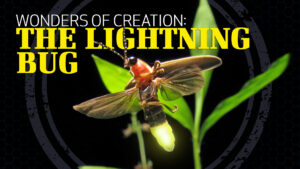
When living things such as animals or bacteria produce light, it is called bioluminescence. The prefix “bio” means “life,” and “luminous” or “luminescence” means “light.” You are probably most familiar with this phenomenon in nature because of lightning bugs. They are bioluminescent beetles. But there are many other living organisms that produce light as well.
The Fungus Gnat Larva
One of the most fascinating glowing creatures is the fungus gnat larva. This little creature hangs from the ceilings of caves in Australia and New Zealand. Thousands of them light up together to make the cave ceiling look like a starry night sky. The larva weaves tiny strings of “web” from the ceiling and attaches little drops of mucus along each string. The larva then emits a bluish light from its position on the ceiling. Flying insects are attracted to the light and fly into the hanging curtain of death. The mucus droplets trap the little insects. Some fungus gnats even have a chemical in the mucus that stuns the prey. The larva then “reels” the string up and eats the trapped victim. This amazing little larva sheds “light” on the fact that God is an awesome Creator.


A Shrimp-like Glow Shooter
Like insects on land, crustaceans fill the oceans of the world. They come in many different shapes and sizes. One very common form is the copepod [COH-puh-pod]. Many copepods are bioluminescent. They typically release their bioluminescent chemicals into the water to produce a glowing cloud of light. This luminous smoke screen distracts or blinds attackers. The copepod can then swim quickly away from danger into the darkness.
One fascinating shrimp-like copepod that God created is the Gaussia princeps. Gaussia stores its supply of chemicals in glands located on its tail. When a predator approaches this little fellow, it shoots out a stream of glowing blue goo. The predator’s attention is immediately drawn away from the copepod to the movement of the blue stream. Then suddenly the goo gives off a bright flash of white light. The flash so startles the predator that it is unable to process what is happening. The copepod is able to slip away and avoid becoming a meal.


Gaussia’s incredible ability reminds us of World War 2 Navy ships that released depth charges that would be dropped into the water close to submerged enemy submarines. A time delay allowed the ship to move away while the charges sank down to get close to the submarine before exploding. Similarly, Gaussia emits its bioluminescent fluid as it swims swiftly in the opposite direction. Just as the bluish fluid is about to disappear, the bright flash “blinds” the predator and distracts him from pursuing the little copepod.
It’s hard to believe that anyone would think that such marvelous abilities could come about by chance over millions of years. The truth is, God designed this incredible creature. After all, “The sea is His, for He made it” (Psalm 95:5).
Beetles With Built-in Headlights and More
There are more species of beetles in the world than any other kind of insect. Certain click beetles commonly known as Headlight Elaters are amazing insects that can light up. Near the back corners of the second main section of the beetle (known as the thorax) are two round lights. These lights do not flash on and off, but produce a constant glow, and look similar to the two headlights of a car. When they want to, these click beetles can dim or brighten their “headlights” as they see a need. For example, if they sense a potential predator, they may intensify their brightness in order to scare the possible attacker away.


No doubt, the most well-known bioluminescent beetle is the firefly. Interestingly, fireflies are not flies, nor do they produce any kind of burning “fire.” In fact, one of the most impressive things about these nocturnal, bioluminescent creatures is that they can produce light without producing the heat and great amounts of energy that so often go together with light.
Fireflies (also known as lightning bugs) have special chemicals in their abdomens called luciferin [loo-SI-fer-in] and luciferase [loo-SI-fer-ace], which they combine with oxygen to form a bright, heatless light. It appears that fireflies activate these chemicals for at least two reasons: (1) because they sense that they are in danger and want to warn a possible predator, or (2) because they want to attract a mate in order to reproduce.


The more scientists learn about the firefly, Headlight Elaters, and other bioluminescent creatures, the more amazed they are at their complexity. Scientists have been somewhat successful at producing certain kinds of chemical light that mimic the more efficient, heatless light produced by bioluminescent creatures. However, scientists confess that light from fireflies and other creatures is still more efficient than what they have produced in laboratories. The fact is, bioluminescent bugs testify loudly to a Creator—the first Chemical Engineer.
The Little, Light-up, Lantern Shark
The dwarf lantern shark is the smallest shark known to man. It grows to be about 8 inches long and can weigh a whopping 2 pounds. It is called a “lantern” shark, because it has special body parts known as photophores along the lower sides of its body that produce bioluminescent light. Why does this little swimming lantern need light? It can swim deep in the ocean where the sunlight does not penetrate. The light helps the lantern shark use its big eyes to see food and predators in the deep, dark waters of the ocean, and the light attracts smaller prey to the shark. Another type of lantern shark, known as the velvet belly lantern shark, has the ability to light up its spines that look like swimming lightsabers. Imagine being a fish in the deep water and seeing a speeding lightsaber headed your way!

wikipedia.org (javontaevious) 2024 CC-by-sa-3.0

wikipedia.org (ruseva/Vsevolod)2024 CC-by-sa 4.0
There is also a ninja lantern shark. It is a dark black color that blends into the deep waters where it often swims. Sometimes, however, it moves to shallow waters. The bioluminescent light it emits from its underside mimics sunlight and camouflages the shark from predators, and helps it sneak up on smaller fish it likes to eat.

Wikipedia.org (Victoria Elena Vasquez/Journal of the Ocean Science Foundation) 2024 CC-by-sa 4.0
These are just a few of the thousands of examples of bioluminescent creatures. In fact, some researchers believe that as many as 75% of all ocean creatures can produce some type of natural light. These creatures shine a bright light on the fact that we have an awesome Creator. And they can help us remember that in the spiritual sense, Jesus is the “the light of the world” and whoever follows Jesus “shall not walk in darkness, but have the light of life” (John 8:12).

REPRODUCTION & DISCLAIMERS: We are happy to grant permission for this article to be reproduced in part or in its entirety, as long as our stipulations are observed.