Is Biblical Faith a Blind “Leap”?


If you have spent time in Bible class, you have probably heard the word “faith.”It is one of the most important words in the whole Bible. It is so important that the Bible says without faith it is impossible to please God (Hebrews 11:6). If that is true, then we certainly need to know what faith is, and what it is not.
You might be surprised to learn about one very common misunderstanding of faith. Some people teach that faith is not based on evidence. They teach that “having faith” means that you have a very strong feeling in your heart about something, even if you cannot prove it is true. In fact, this is sometimes called a “leap of faith”—when a person believes something, but does not have evidence to prove it. Many people teach that this “leap of faith” is what the Bible talks about when it mentions faith.


In fact, people often contrast faith and science. They say that faith is a leap without evidence, but science is based on evidence. It is said that faith is believing in something that you cannot prove, but science is proving what you believe. This is simply not correct. Real science and real faith both require a person to use evidence to know the truth.
When we look at the Bible, we learn that biblical faith is not a “leap” without evidence or proof. In Acts 1:3, we read that after Jesus rose from the grave, “He also presented Himself alive…by many infallible proofs.” We also read that Jesus said, “You shall know the truth, and the truth shall make you free” (John 8:32). Having faith, then, does not mean we do not have evidence or that we cannot know something for certain.

What does the Bible mean when it talks about faith? One good definition of the word faith in the Bible is:
“BELIEVING IN SOMETHING GOD SAID, BASED ON EVIDENCE THAT PROVES IT IS TRUE, EVEN THOUGH YOU HAVE NEVER SEEN IT.”
Let’s look at a great example of this idea of faith.
In John 5:33-47, Jesus was talking to the Jewish leaders. He explained to them that He is the Son of God. The problem they were having is that they didn’t “see it.” When they looked at Jesus, they saw a Jewish man from a tiny village called Nazareth. To them, Jesus did not look anything like the God that is described in the Old Testament. When the Jews thought about God, they most likely thought about God’s glory. They probably thought about how the presence of God caused Mt. Sinai to quake and burn with fire and smoke (Exodus 19:18-19). They might have thought about Isaiah’s vision of God when the prophet saw God “high and lifted up” and His robe “filled the temple” (Isaiah 6:1-2).
When they looked at Jesus, they did not see that He is God’s Son. But Jesus still expected them to have faith that He is God’s Son. Jesus did not tell them just to believe without evidence. Instead, Jesus gave them four pieces of evidence that prove He is God’s son.


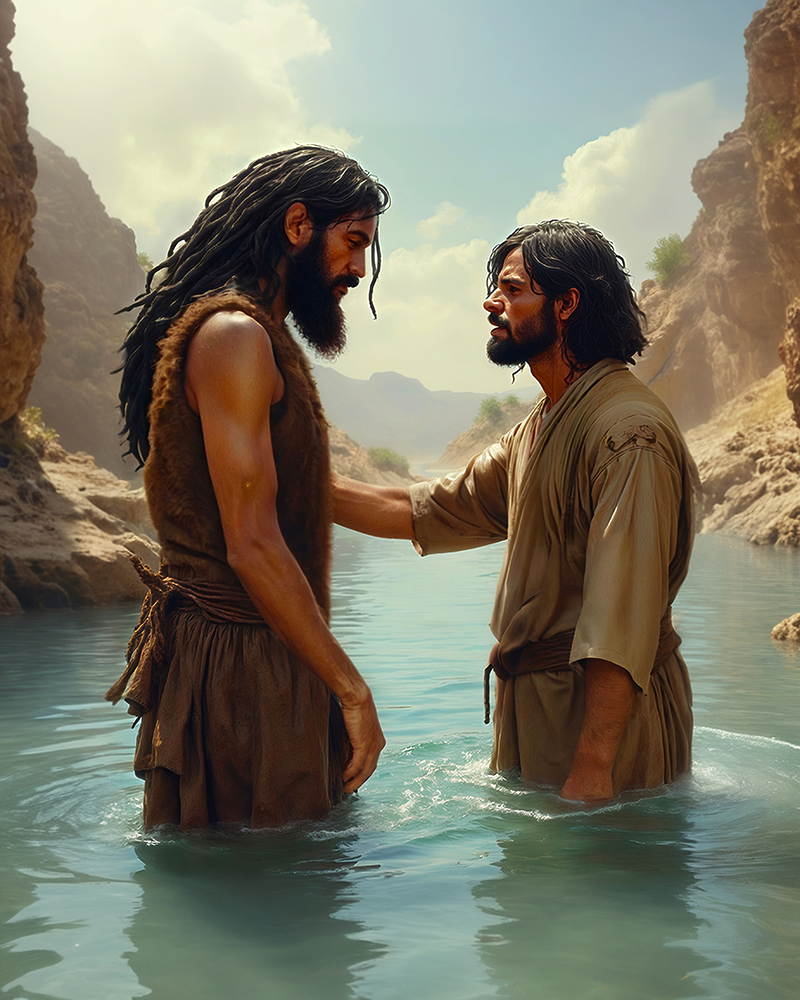

FIRST, Jesus explained that John the baptizer admitted Jesus is the Son of God. He told the Jews, “You have sent to John, and he has borne witness to the truth” (John 5:33).
SECOND, Jesus said that His miracles proved His claim that He is God’s Son. He said, “the very works that I do bear witness of Me, that the Father has sent me” (5:36).
THIRD, Jesus showed that God the Father said Jesus was His Son (5:37). Do you remember when God the Father spoke about Jesus? When John baptized Jesus, the Bible explains that God the Father spoke from heaven and said to Jesus: “You are my beloved Son, in You I am well pleased” (Luke 3:22). Jesus reminded the Jews that God the Father had said Jesus was His Son.
FOURTH, Jesus stated that the Old Testament Scriptures said He is God’s Son. Jesus said to the Jews, “You search the Scriptures, for in them you think you have eternal life; and these are they which testify of Me” (John 5:39). What did Jesus mean that the Old Testament Scriptures “testified” of Him? He meant that the Old Testament was filled with prophecies that told about the coming Messiah.
The prophet Isaiah said:
“For unto us a Child is born, unto us a Son is given’and His name shall be called Wonderful, Counselor, Mighty God, Everlasting Father, Prince of Peace” (Isaiah 9:6).
Isaiah was talking about Jesus. In fact, there are hundreds of predictions about the Messiah in the Old Testament. Jesus fulfilled all of these prophecies, which proved He is the Son of God. In 2 Corinthians 5:7, the Bible says: “For we walk by faith, not by sight.” Some people have misunderstood this verse to mean that “we walk by faith and not by evidence.” But the verse does not say we do not have evidence. It says we do not see certain things, but we can still know them to be true.

Now, let’s think about how science works. Science is also a system that is based on evidence, but many times we do not actually see what we are trying to study or figure out. Maybe you have heard of forensic science. This branch of science is used to figure out crimes. When the police go to a crime scene, they do not see the criminal. For instance, maybe a bank has been robbed. When the police show up, they dust for fingerprints, find shoeprint marks on the floor, or find a drop of DNA. They study the things that they can see—the evidence that the criminal left behind—and they learn many things about the criminal, even though they have never seen him. They know his DNA sequence, what size shoe he wears, and that he has a scar on his left thumb, because it shows up in the thumbprint they found. They are using evidence to discover things they know, but they do not see.



Let’s go back to our idea of faith and evidence. In Hebrews 11:3, the Bible says: “By faith we understand that the worlds were framed by the word of God, so that the things which are seen were not made of the things which are visible.” Remember the forensic science crime scene. The detectives looked at things they could see—the evidence—to learn about something they could not see—the criminal. The Bible says we can look at this world and “see” things about God, Who cannot be seen. What can we know about God based on this world? First, we can know that He is very intelligent, because the world is filled with amazing design. Second, we can know He is very powerful, because our Universe is very big.
There are many other things we can know about God by looking at the evidence found in the Universe and written in the Bible. What we learn, then, is that real faith and real science both use evidence. Our job in this life is to follow the evidence where it leads. If we do, it will always lead us back to God.
Doc’s Corner: Scientific Predictions
| An important part of the scientific process is the ability to make predictions. No, I’m not talking about making prophecies like those we see in the Bible. A scientific prediction is where a scientist gives the logical outcome that he would expect from his research or experiment if his theory is right. If his prediction ends up being wrong, he has falsified his theory. If it’s right, he gains support for the truth of his theory. While some scientists who don’t believe in the Bible have claimed that Bible-believing scientists can’t make scientific predictions, that is simply not true. Many scientists who believe the Bible to be true regularly make predictions that build further support for the Bible…and falsify evolutionary theories. |  |

REPRODUCTION & DISCLAIMERS: We are happy to grant permission for this article to be reproduced in part or in its entirety, as long as our stipulations are observed.