The post From Mars Hill to Golgotha: Paul’s Bridge Between Two Rocks of Judgment appeared first on Apologetics Press.
]]>On a different hill outside Jerusalem called Golgotha, another judgment would take place, not in myth but in the harsh reality of Roman crucifixion. Unlike Mars Hill, Golgotha was not a place of philosophical debate but of ultimate sacrifice, as Jesus Christ gave His life for humankind (John 3:16; Romans 5:8). In Acts 17, Paul confronts the philosophers of Athens on Mars Hill, redirecting their focus from myth and idolatry to the Creator, contrasting two rocks of judgment: one of mythical gods and one of the living God who offers true salvation through resurrection.
The Areopagus: A Place of Judgment and Inquiry
The Areopagus lies northwest of the Acropolis, 250 meters from the imposing temple complex of Athena. The rocky hill (rising over 70 feet above the agora) itself functioned as a critical institution in ancient Greece, serving as the high court of appeal for criminal and civil cases. Known in Greek as “martial peak,” the Areopagus combined its symbolic connection to Ares with a reputation for strict, impartial justice. Parties brought before this court were positioned between sacrificial remains, swearing oaths by the infernal deities. Here, truth was paramount, as testimonies were given without emotional manipulation to ensure fairness.1
By the time of Paul, Mars Hill was as much a center for philosophical debate as it was for legal cases. Athenians and foreigners alike would gather to discuss the nature of the divine and the meaning of life. On this hill, Paul encountered Epicureans and Stoics, the leading philosophical schools of his day. Epicureans, following Epicurus, argued that pleasure was life’s highest aim, though they emphasized rational, restrained pleasure rather than indulgence. They dismissed any notion of divine intervention in human affairs, seeing gods as indifferent. In contrast, the Stoics, founded by Zeno of Citium, embraced a worldview in which everything was governed by Fate, seeing virtue and emotional self-control as the pathway to happiness. Their deity was a cosmic force, bound to Fate, in stark contrast to Paul’s personal, sovereign Creator.
Paul’s Address to the Unknown God
Paul’s opening words on Mars Hill highlight the Athenians’ pervasive religiosity: “Men of Athens, I perceive that in every way you are very religious” (Acts 17:22).2 The city, saturated with idols, had even erected an altar “to an unknown god” (Acts 17:23, NIV). Paul seizes this symbol of uncertainty to declare that the God they worship in ignorance is indeed knowable—the Creator of heaven and earth, who “does not live in temples made by man” (Acts 17:24). By this, Paul directly challenges the Athenians’ pantheon, where gods were represented by lifeless stones and idols. Instead, he presents the true God, who is not confined to altars but is the source of life and breath.
The Areopagus was, therefore, not merely a location but a microcosm of the Athenian quest for truth—a place where philosophical ideas about human existence and divinity were debated with intense scrutiny. Yet, Paul insists that the Athenians’ knowledge is incomplete. His appeal climaxes with the resurrection: “He has given assurance to all by raising him from the dead” (Acts 17:31). In a city and location dominated by lifeless idols, Paul boldly introduces the reality of a living God, validated by Jesus Christ’s resurrection.
Golgotha: The Reality of Judgment and Redemption
In contrast to Mars Hill, Golgotha—meaning “Place of the Skull”—was not a place of myth but a site grounded in history, located just outside Jerusalem’s walls. Archaeological excavations led by Kathleen Kenyon3 in the 1960s revealed that Golgotha was part of a quarry used until the first century B.C., a conclusion supported by the Gospel descriptions that it lay outside the city (John 19:20). Over time, this abandoned quarry area likely became gardens or fields, as indicated by traces of plowing and other agricultural activities, corresponding to the Gospel accounts that speak of surrounding gardens (Mark 15:21; Luke 23:26; John 19:41).
The topography of Golgotha, a hill outside the city, added to its ominous reputation as a place of judgment, fitting the Romans’ practice of executing criminals in visible, public locations to emphasize the consequences of defying Rome. Excavations have further uncovered Roman-era artifacts, such as debris layers from the Jewish-Roman wars, which indicate periods of rebuilding and destruction after Jesus’ crucifixion. Golgotha was a stark, elevated outcrop that provided visibility, making it a fitting site for the climactic judgment of Jesus, where the sin of humanity was judged through His sacrifice. In sharp contrast, Mars Hill’s fame lies in its cultural associations with philosophy and legend.
The significance of Golgotha rests in its transformation from a place of death to a symbol of hope through Christ’s resurrection. Jesus represents peace and reconciliation, transforming Golgotha into a place of redemption. Here, Paul’s message at Mars Hill finds its fulfillment. He juxtaposes the silent deities of Athenian myth with the living God, declaring, “We ought not to think that the divine being is like gold or silver or stone, an image formed by the art and imagination of man” (Acts 17:29). The judgment at Golgotha is no myth; it is a testament to the divine mercy and justice enacted on behalf of all humanity.
Connecting Mars Hill to Golgotha
Paul’s message on Mars Hill is not only a critique of Athenian idolatry but an invitation to bridge two vastly different conceptions of divinity. Mars Hill represented a judicial tradition where justice was intertwined with stories of gods like Ares. While the judicial system on Mars Hill may have attempted to maintain impartiality, the Athenian justice system was based on gods who themselves made foolish choices and were driven by selfish whims. Golgotha, on the other hand, demonstrates the true impartiality and selflessness of the living God who was willing to allow His only son to die for all humankind. While the Areopagus symbolized human attempts to grapple with concepts of justice and divinity, Golgotha represented the ultimate act of divine judgment, grounded not in myth but in Christ’s real sacrifice.
Myth Versus Reality: Theological Implications
Mars Hill embodies a philosophical ideal bound to myth, a culture of gods lacking compassion or reality. Ares embodied conflict and vengeance, traits that offered no hope for humanity. While Ares was being tried for a murder that he did commit, Jesus was the victim of capital punishment, though He was innocent of any crimes. Ares was guilty (although acquitted), and Jesus was guiltless (and still condemned). Golgotha represents a profound theological truth. Where Mars Hill’s idols were static symbols of human longing and shortcoming, Golgotha stands as the culmination of God’s plan of redemption, where a man—Christ—bore the penalty of sin for all.
When Paul speaks of the resurrection, he highlights the sharp difference between Athens’ gods and the God of Israel. While the gods of Ares’ Rock remained forever silent, the God of Golgotha validated His power through the resurrection of Jesus. This cornerstone of Paul’s argument underscores that Golgotha, unlike Mars Hill, represents true justice, love, and life. “For in him we live and move and have our being,” Paul declares, quoting a Greek poet (Acts 17:28) while pointing his listeners away from their lifeless idols to the living Creator.
Paul’s words at the Areopagus accentuate the futility of worshipping lifeless stones (Acts 17:29). Here, Paul draws from Deuteronomy and Psalms, emphasizing that the God he proclaims is not an object of human invention, but the Creator who desires a relationship with humanity. The unknown god of Mars Hill finds clarity and fulfillment in Golgotha’s sacrifice. Paul’s words, “The times of ignorance God overlooked, but now he commands all people everywhere to repent” (Acts 17:30), signify the urgency of his message, encouraging Athenians to turn from myth to the reality of Christ.
Conclusion: An Invitation from Myth to Reality
In his sermon on Mars Hill, Paul bridges the cultural and theological gap between two rocks of judgment, inviting his audience to transition from myth to reality, from lifeless idols to the living God. He does not simply critique their traditions; he reveals the incompleteness of their understanding. The resurrection, central to his argument, stands as proof of God’s power over death and the true path to life. Paul’s declaration that God “does not live in temples made by man” (Acts 17:24) points away from the temples of Athens toward the living temple found in Christ.
Through Paul’s speech, Mars Hill becomes a steppingstone to Golgotha, offering an invitation to all who seek truth to move beyond philosophy and myth, finding ultimate judgment and mercy in the redemptive act of Christ. By presenting the God of resurrection, Paul calls the Athenians—and all who hear—to turn from lifeless stones to the living “cornerstone” of faith (1 Peter 2:6-8).
Endnotes
1 Lysias (6.14) described the Areopagus as the most revered and impartial court in Athens. Sophocles, in Oedipus at Colonus (947-949), portrays Creon praising the Council as a body known for its wise deliberation, while Euripides, in Orestes (1650-1652), has Apollo assure Orestes that the Areopagus would judge his case with utmost fairness. The court’s dignity and esteemed reputation are also highlighted by Aristophanes’ decision never to satirize its activities, and it was deemed inappropriate to display humor in the presence of its members (Aeschin, 1.81-84). In the 1st century B.C., Diodorus (1.75.3) ranked the Areopagus alongside Sparta’s Council as one of the finest judicial bodies in Greece [E. Harris (2021), “Areopagus,” Oxford Classical Dictionary, August 31, https://oxfordre.com/classics/view/10.1093/acrefore/9780199381135.001.0001/acrefore-9780199381135-e-703]. This respect reflects the Athenians’ high regard for the rule of law, with the Areopagus symbolizing stability and order. During his visit to Athens, the Apostle Paul addressed the Areopagus, discussing theology and denouncing false idols, leading to several conversions (Acts 17:16-34). Even in Paul’s time, the Areopagus retained its status as Athens’ most esteemed court, representing the city’s deep respect for the rule of law [Rachel Zelnick-Abramovitz (2011), “The Guardian of the Land: The Areopagus Council as a Symbol of Stability,” in Stability and Crisis in the Athenian Democracy, ed. Gabriel Herman (Stuttgart: Franz Steiner Verlag), 103-126].
2 Unless otherwise noted, all Scripture references in this article are taken from the English Standard Version.
3 Kathleen M. Kenyon (1967), Jerusalem: Excavating 3000 Years of History (New York: McGraw Hill), pp. 151-153; Kathleen M. Kenyon (1974), Digging Up Jerusalem (London: Ernest Benn Limited), pp. 227-231,261.
The post From Mars Hill to Golgotha: Paul’s Bridge Between Two Rocks of Judgment appeared first on Apologetics Press.
]]>The post What Is Rabbinic Judaism? appeared first on Apologetics Press.
]]>[EDITOR’S NOTE: The following article was written by A.P. auxiliary writer Dr. Justin Rogers (Ph.D., Hebrew Union College–Jewish Institute of Religion). Dr. Rogers is Dean of the College of Biblical Studies and Professor of Bible and Judaic Studies at Freed-Hardeman University.]
Most American Christians are undereducated on the beliefs and practices of their religious neighbors. As the American religious landscape becomes increasingly diverse, it is wise for Christians to learn about the groups that surround them. A basic understanding of the world religions makes us more sensitive to the beliefs and practices of our neighbors and equips us to reach others with our faith and to defend the Truth “with gentleness and respect.”1 We will attempt to survey in this article the foundations of one world religion, the smallest of the so-called “three major world religions,” Judaism.
Modern Judaism is only partially based on what Christians call the Old Testament.2 Personal piety came to replace sacrifice in Judaism long ago, in texts like Midrash Leviticus Rabba, which suggests a life of spiritual sacrifice is just as efficacious as a blood offering. Therefore, asking why Jews today do not sacrifice is evidence of an unawareness of their beliefs and practices. Like Christians, Jews recognize the authority of the Hebrew Bible/Old Testament, but they also recognize the validity of later traditions and texts. Just as modern Catholicism draws on centuries of traditions that Catholics affirm as authoritative, so also modern Judaism draws on traditions passed down through the centuries through the rabbis. Therefore, like Catholicism, one may legitimately speak of Scripture and Tradition as the twin pillars of modern Judaism. (It is not without significance that Geza Vermes titled his 1961 work on Jewish interpretation Scripture and Tradition in Judaism.)
Who Are the Rabbis?
The term “rabbi” means “one greater than I” and was an honorific way of referring to one’s teacher. As far as our current state of knowledge is concerned, the term dates back no further than the first century A.D., and the New Testament is the earliest text to use it. Most scholars believe the rabbis are the successors of the Pharisees, the most popular Jewish group of the New Testament era. The rabbinic literature never uses the term “Pharisee,” but there are several reasons for regarding them as the predecessors of the rabbis. First, ancient sources refer to figures such as Gamaliel and his son Simon as Pharisees, and both are claimed by the later rabbis (cf. Acts 5:34; Josephus3). Second, the Pharisaic movement was always carried by popular support, especially in Judea, whereas the two other main Jewish parties—the Sadducees and the Essenes—were either closely connected with the Temple (Sadducees) or were sectarian in nature (Essenes).4 Therefore, neither of the other two main Jewish sects had a major influence on the populace as a whole.
The main reason for connecting the Pharisees and the rabbis is that both groups considered their distinctive tradition authoritative.5 Jesus tends to agree with the Pharisees on most matters (e.g., Matthew 23:2-3), but criticizes their insistence on the authority of non-biblical tradition (e.g., Matthew 15:3; Mark 7:9). Since their tradition serves to exalt the authority of the Pharisees and the later rabbis, it is appropriate to discuss the concept in more detail.
The Rabbinic Tradition
By design, the rabbinic tradition was to be transmitted orally, not to be written. The earliest rabbis, whose opinions are recorded in the Mishna, are called the Tanna’im, or “repeaters” of the oral tradition. The rule of repetition, rather than writing, remained in effect until Rabbi Judah “the Prince” codified the Mishna in ca. A.D. 200, the first written source of Rabbinic Judaism. A rabbinic document known as Midrash Tanhuma6 questions why God initially speaks “all” the words of His law (Exodus 20:1), and then later commands Moses to “write” them down (Exodus 34:27). The rabbis explain that God initially wanted the entire Law to be delivered orally, but after Moses expressed the desire to write it down, God condescended as follows:7 “Give them the Scriptures in written form, but deliver the Mishna, the Aggada, and the Talmud orally.”8 This later Midrash expands on a common rabbinic theme, namely, that their teaching was to imitate God’s revelation at Sinai. They were to copy and read the written Law, and they were to memorize and repeat the oral law.9
The decision to write down the oral law was, therefore, seemingly a contradiction of the rabbis’ own policy. The rabbinic literature never works out the contradiction, but a number of modern scholars have offered suggestions.10 Perhaps it was simply a practical matter. One can imagine that the oral tradition eventually became too large to memorize, and different rabbis remembered different teachings in contradictory form. Therefore, writing was an attempt to standardize the rabbinic tradition, getting everyone “on the same page,” so to speak. It is also possible that the written form of the oral tradition was intended for private study to facilitate the rabbinic education. Modern scholars have analyzed the rhetoric of the Mishna in particular, finding that it is written to facilitate memorization. Ultimately, modern readers of the rabbinic literature are forced to live with a paradox: our only access to the oral law is in its written form.
Why Does the Oral Tradition Exist?
The rabbis’ own summary of the rabbinic tradition is found at the beginning of the Mishnaic tractate Pirke Avot: “be patient in judgment, raise up many students, and build a fence around the Law” of Moses (1:1). The most programmatic of these commandments is the last. One of the primary aims of the rabbinic experiment was to protect the written law from being violated. The oral law was always viewed as a complement, not a competitor, of the written Law of Moses. Some sources feature the oral law as a distinct set of traditions preserved independently,11 while others speak of the oral law as a set of authorized interpretations of the Mosaic Law and thus dependent on it.12 The latter presentation is the one that seems more plausible historically.
The rabbinic traditions were well-intended to keep people from violating biblical law. Inventing the notion of an oral law served two related purposes. First, it helped to define what the 613 biblical laws in the Pentateuch actually meant. For example, the Law of Moses instructs the Israelites to do no work on the Sabbath (Leviticus 23:3), but gives few examples of what types of work violate the Law (Numbers 15:32-36 is a rare exception). By contrast, the Mishna—the first written version of the oral law—records some 39 categories of work forbidden on the Sabbath, unpacking each in extreme detail. If one were to observe the teachings of the rabbis, he could rest assured that he had kept the Law.
Second, claiming that the oral law is traceable to Moses on Sinai serves to authorize the rabbis as tradents of the tradition, and thus as the most qualified interpreters of the Bible. In the marketplace of competing biblical interpretations, the claim to possess a stream of exceptional divine revelation would have helped the rabbis to assert their authority. The claim also ensured that no single rabbi possessed an authority of his own, for the rabbis studiously place themselves within an authorized tradition. The contribution of every esteemed sage lies in his ability to transmit accurately what he has received, not to add anything new.
What Is the Mishna?
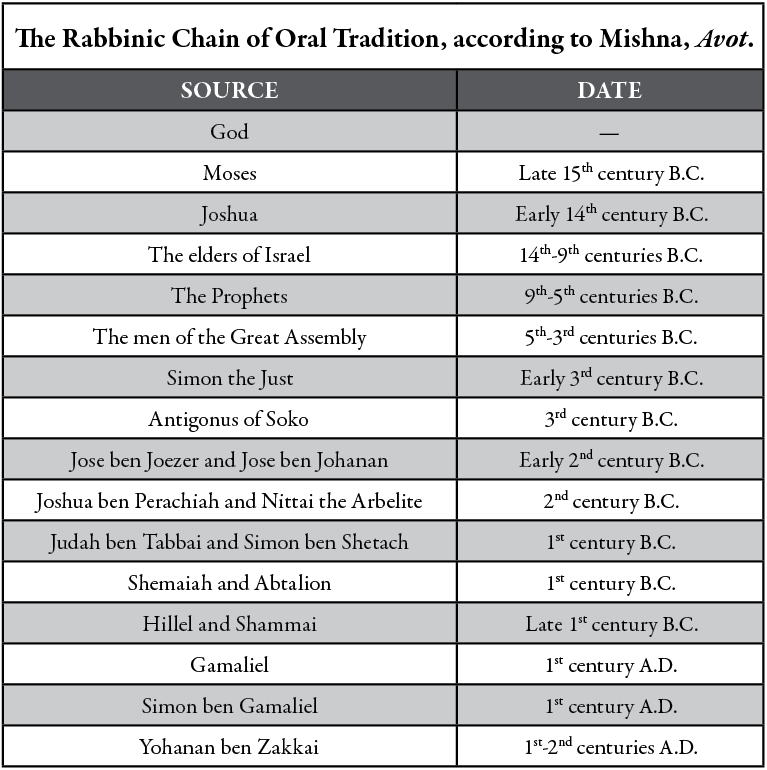
The Mishna is the first written source of Rabbinic Judaism. In this document, we have a mythical account of the origins of the Jewish oral tradition.13 We are told that, on Mount Sinai, God revealed two laws to Moses, one to be written (the Pentateuch) and the other to be passed down orally. Moses shared this oral law with Joshua, Joshua with the elders of Israel, the elders of Israel with the biblical Prophets, and the biblical Prophets with “the men of the great assembly.” From here, the oral tradition was passed on to and through various individual sages down to the time of Rabbi Yohanan ben Zakkai, who, following the destruction of the Temple in A.D. 70, became the founder of the movement known to us in the rabbinic literature.
The Mishna is divided into six divisions, known in English as “orders:” (1) Zeraim (“seeds”) on agriculture; (2) Moed (“festival”) on holidays; (3) Nashim (“women”) on regulations pertaining to the family; (4) Nezikin (“damages”) on cases and procedures in the Jewish court system; (5) Kodashim (“holy things”) on sacrificial procedures; and (6) Tahorot (“purities”) on ritual purity. These are the categorical groupings that encompass all of the laws governing Jewish life.
What Is the Talmud?
The Talmud, known as the Bavli, or Babylonian Talmud, is a commentary of sorts on the Mishna. The word Talmud is an Aramaic word meaning “teaching.”14 It includes much of the Mishna along with what is called the gemara, or “complete teaching.” Actually, the Talmud does not cover all of the Mishna. Only 36.5 of the Mishna’s 63 tractates, comprising only four of its six “orders,” receive comment.15 It is unclear why much of the content is omitted, but the traditional explanation is that some of the Mishna’s Palestinian agricultural concerns were irrelevant to the Babylonian context of the Talmud.
The Talmud was compiled around A.D. 500 and was an effort to impose the rabbinic rules of the land of Israel on the Babylonian Jewish community. There is another Talmud, known as the “Jerusalem Talmud,” compiled in the land of Israel about A.D. 400, but it has not been considered worthy of the same status as the Babylonian Talmud. The same is true of another collection of rabbinic tradition hailing from the land of Israel, the Tosefta (compiled ca. A.D. 300). Since traditional Jews regard the collection represented by the Babylonian Talmud to be inclusive of the earlier rabbinic tradition (at least, theoretically), when the word “Talmud” is used, it is usually only the Bavli that is intended.
The Talmud contains much material that is attributed to the rabbinic oral tradition but unrecorded in the Mishna, the Tosefta, or the Jerusalem Talmud. Two categories of content describe the non-Mishnaic material that is not necessarily paralleled in the earlier collections.16 First, we have what is called beraitot (or, in the singular, beraita’), which means “external content.” This material is “external” to the Mishna, but is nevertheless attributed to the tanna’im, or the sages of the Mishnaic period. Second, we have the teachings of the sages belonging to the generation after the Mishna. The rabbis of this era, who flourished in the third and fourth centuries A.D., are known as the ’amora’im, or “sayers.”
The Talmud is a monumental accomplishment, representing more than two million words of content and taking up an entire bookshelf in the standard editions. The Talmud is nearly five times longer than the entire Hebrew Bible/Old Testament, and is considered the authoritative expression of Jewish faith, though other rabbinic collections are also considered important for the tradition. For example, Jews traditionally treat the rabbinic commentaries, or Midrashim, with respect and mine them for encouraging material. Nevertheless, the Talmud remains the foundational text of Modern Judaism. As Talmud scholar Stephen Wald describes it,
The Talmud Bavli represents the growing literary achievement of this entire period of Jewish history—which is in fact often simply referred to as the “talmudic period.” It was ultimately accepted as the uniquely authoritative canonical work of post-biblical Jewish religion, providing the foundation for all subsequent developments in the fields of halakhah [Jewish law] and aggadah [Jewish theology]…. Despite manifest difficulties of language and content, the study of the Bavli has also achieved an unparalleled place in the popular religious culture of the Jewish people.17
Conclusion
Modern Judaism is founded on rabbinic Judaism, which most likely has its roots in the Pharisaic movement of the first centuries A.D. The rabbis’ foundational concept was the assertion that two laws were given on Sinai, one written and the other oral. The oral law was passed down from one generation of sages to the next so that the latest tradents of the tradition could be considered authoritative in their teaching. Therefore, if one accepted the oral tradition of the rabbis, one had to view with suspicion the teachings of all others. While the Pharisees apparently did not have as developed a notion of the oral tradition and its transmission, they nevertheless considered their traditions authoritative.
Eventually, the oral teachings of the rabbis were committed to writing, first in the Mishna (ca. A.D. 200), then in author writings of the so-called Tannaitic period. Finally, the Babylonian Talmud (ca. A.D. 500) became the greatest expression of authorized rabbinic teaching, incorporating the Mishna and many other traditions both from the Tannaitic and the Amoraic periods. It would be the Babylonian Talmud that Jews in the Middle Ages took as the final and fullest expression of their faith, and the text that continues to be shared with generations of Jews, both those training for the rabbinate and those seeking to grow closer to the God of the covenant. If Christians hope to reach their Jewish friends with the Gospel, it is helpful to know something about their history, tradition, and literature.18
Endnotes
1 1 Peter 3:15, ESV.
2 Jewish people refer variously to the Scriptures (the “Protestant” Christian Old Testament) as the Bible, the TaNaK (an acronym for the Law, the Prophets, and the Writings—the Torah, the Nevi’im, and the Kethuvim), or Mikra (“what is written”).
3 Flavius Josephus (1987 reprint), The Life of Flavius Josephus in The Works of Josephus, trans. William Whiston (Peabody, MA: Hendrickson), 190-196.
4 On the Pharisees, Sadducees, and Essenes as the three main Jewish groups, along with their characteristic teachings, see Josephus, Jewish War, 2:119-166; Antiquities, 13:171-173.
5 For the Pharisees, e.g., Mark 7:1-13; Josephus, Antiquities 13:297, 408; for the rabbis, e.g., Mishna, Avot 1-2.
6 Published by Solomon Buber.
7 All translations of ancient languages are mine unless otherwise noted.
8 Ki Tisa 17.
9 Cf. Jerusalem Talmud, Megilla 4:1.
10 See Elizabeth Shanks Alexander (2007), “The Orality of Rabbinic Writing,” The Cambridge Companion to the Talmud and Rabbinic Literature, eds. Charlotte Elisheva Fonrobert and Martin S. Jaffee (Cambridge: Cambridge University Press), pp. 38-57.
11 E.g., Babylonian Talmud, Eruvin 54b.
12 E.g., Babylonian Talmud, Menahot 29b.
13 Avot 1-2.
14 The Mishna is written in Hebrew, but the Babylonian Talmud (when it does not quote the Mishna) is written in Aramaic. Therefore, the rabbis who compiled the Talmud were bilingual.
15 The Talmud excludes all of Zeraim with the exception of the tractate Berakot and all of Tahorot with the exception of the tractate Niddah.
16 On the complex relationship between the Babylonian Talmud and earlier rabbinic material, see H.L. Strack and Günter Stemberger (1992), Introduction to the Talmud and Midrash, trans. and ed. Markus Bockmuehl (Philadelphia, PA: Fortress), pp. 197-201.
17 Stephen Wald (2007), “Talmud, Bavli,” in The Encyclopedia Judaica, ed. Fred Skolnik and Michael Berenbaum (San Francisco/Jerusalem: MacMillan/Keter), second edition, 19:470.
18 To learn more, the Sefaria website and mobile application are excellent (sefaria.org).
The post What Is Rabbinic Judaism? appeared first on Apologetics Press.
]]>The post Does the Warfare & Violence in the Old Testament Differ With the Quran? appeared first on Apologetics Press.
]]>The claim is often made by Muslims that the warfare, violence, and killing enjoined in the Quran are no different than the same enjoined in the Bible. Is this claim justified?
A:
Before turning to the Old Testament, observe that in His lifetime on Earth, Jesus clearly differed with Muhammad in His promotion of religion. Muslim scholar Mohammed Pickthall’s own summary of Muhammad’s war record is an eye-opener: “The number of the campaigns which he led in person during the last ten years of his life is twenty-seven, in nine of which there was hard fighting. The number of the expeditions which he planned and sent out under other leaders is thirty-eight.”1 What a contrast with Jesus Who never once took up the sword to inflict violence on others or encouraged anyone else to do so. The one time that one of His close followers took it upon himself to do so, the disciple was soundly reprimanded and ordered to put the sword away, with the added warning: “all who take the sword will perish by the sword” (Matthew 26:52).2 Indeed, when Pilate quizzed Jesus regarding His intentions, He responded: “My kingdom is not of this world. If My kingdom were of this world, My servants would fight, so that I should not be delivered to the Jews; but now My kingdom is not from here” (John 18:36). Hence, so far as Christianity is concerned, the use of warfare and violence to advance its teaching is strictly forbidden. All those who have done so over the last 2,000 years (e.g., the Crusades) have acted in violation of New Testament teaching. And Muhammad, whose religion has been spread by such violence, is clearly acting contrary to Jesus’ teachings.
But what about the warfare and violence affirmed and approved in the Old Testament? Consider several clear distinctions:
First, the Israelite conquest of the land of Canaan was a specific, unique moment in history that was brought on by the depravity of the Palestinian peoples at the time. Deuteronomy 7 makes clear that the reason for their destruction was their idolatry and wickedness. God did not order the Israelites to kill people for failing to convert to Judaism. He ordered them to eliminate the Palestinian population due to the fact that they were extremely degraded morally and spiritually irretrievable—a final condition that only God, not mere humans, can assess. Their iniquity had become “full” (Genesis 15:16) and they needed to be destroyed—just like the pre-Flood population (Genesis 6:5). But God has never issued an ongoing, longstanding order to conquer the world and kill all sinners or all those who disagree with Bible religion. Islam, on the other hand, seeks to subjugate the entire world (Surah 2:190-193).
Second, this side of the Cross, the God of the Bible wants the entire world to have access to the Gospel without being coerced or threatened with death. Hence, the central directive and standing order of Christianity consists of “evangelizing” the whole world. The Greek word “evangelize” means to “bring or announce good news…Proclaim, preach (the gospel).”3 While Islam seeks to coerce everyone to embrace Islam, in fact, God wants the Gospel spread throughout the world until Jesus returns (Matthew 28:20). So it would be completely counter-productive for God to enjoin extermination of people for not accepting Christ during the period of time of one’s earthly sojourn. The day of reckoning will occur at the Judgment. Islam, by definition, seeks to implement Judgment Day right now—in time, in history—literally circumventing God’s own timetable. God commands the preaching of the Gospel (Mark 16:15-16) which is intended to inform and warn people about what lies ahead after death and departure from this life.
Third, God does not want human beings to be forced to obey Him. They must be allowed to exercise their own volition while in this life—it’s their choice. Islam presumes to take it upon itself to pass final judgment prematurely, rather than allowing everyone to make their own choices as long as they are alive, and then face the eternal consequences of their choices after death—not before (Hebrews 9:27). Even on the Day of Judgment, God will not force people to submit to Him. They were given that opportunity in life. At the Judgment, He will simply consign them to the location of their choice based on how they chose to live. Again, Islam interferes with God’s will. Islam is, in fact, at odds with and counterproductive to His intentions regarding the purpose of human existence on Earth. Indeed, Islam seeks to frustrate and thwart the plan of God in which life on Earth is intended to be a probationary period in which each human being is given the opportunity to exercise his free will regarding God’s will.4 What’s more, the central reason why such a mandate to subjugate the world is incorrect is because the God of the Bible would not issue such a mandate. It would conflict with His will that humans freely choose. In this regard, Islam is in direct opposition to the very nature of Deity and the image of Himself that He placed within each person (Genesis 1:27). All humans must be permitted to make that choice without coercion. The attribute of free will was created within humans by God and He wants each person to decide for himself where he will spend eternity.
Fourth, we must understand that Israel was a theocracy, i.e., civil government was combined with the direct religious rule of God. If God were so conducting Himself today, He might issue orders to a specific country regarding the elimination of various people who behave in a morally deplorable manner—but He is not so conducting Himself. This side of the Cross, He directs the Church (the only receptacle of the saved on Earth) to focus her efforts on evangelism. On the other hand, He enjoins upon civil government in all countries the responsibility to “bear the sword” (Romans 13:4)—as punishment for those who violate the civil laws of the land. Islam has confounded God’s approach by fusing religion and state. While God desires that all people on Earth permit Christian principles to permeate their lives—which would naturally and inevitably bring Christian influence to governmental institutions—nevertheless, He does not want Christianity imposed onto a government forcibly. The Founders of America well understood this principle. The majority passionately desired that the bulk of the population remain committed to the one true God (i.e., the God of the Bible) and that Christian principles permeate the Republic, but they also fiercely protected each individual’s right to choose and practice one’s own understanding of religion.
The true practice of Islam and implementation of the Quran’s directives would inevitably result in the destruction of the U.S. Constitution and the liberties that Americans have historically enjoyed. The Founding Fathers not only recognized such an outcome, they declared forthrightly the threat of non-Christian religion to the stability and perpetuation of the Republic in contrast with the inherent congruency of Christianity with the political principles they sought to establish.5 Indeed, in his “Farewell Address,” the father of our country insisted:
Of all the dispositions and habits which lead to political prosperity, religion and morality are indispensable supports. In vain would that man claim the tribute of patriotism, who should labor to subvert these great pillars of human happiness, these firmest props of the duties of men and citizens. The mere politician, equally with the pious man, ought to respect and to cherish them. A volume could not trace all their connections with private and public felicity. Let it simply be asked: Where is the security for property, for reputation, for life, if the sense of religious obligation desert the oaths which are the instruments of investigation in courts of justice? And let us with caution indulge the supposition that morality can be maintained without religion. Whatever may be conceded to the influence of refined education on minds of peculiar structure, reason and experience both forbid us to expect that national morality can prevail in exclusion of religious principle. It is substantially true that virtue or morality is a necessary spring of popular government. The rule, indeed, extends with more or less force to every species of free government. Who that is a sincere friend to it can look with indifference upon attempts to shake the foundation of the fabric?6
Finally, it is important to recognize that the evidence demonstrates that the Quran does not possess the attributes of inspiration, but rather, shows itself to be of human origin.7 Consequently, its mandate to conquer the world is of human origin. On the other hand, the Bible can be proven, by abundant evidence, to be the inspired Word of God.8 It clearly teaches that God has given no mandate this side of the Cross for His people to engage in physical force to advance Christianity.9
Endnotes
1 Mohammed Pickthall (no date), The Meaning of the Glorious Koran(New York: Mentor), p. xxvi.
2 For an analysis of this verse, see Dave Miller (2017), God & Government (Montgomery, AL: Apologetics Press), p. 34.
3 Wilbur Gingrich (1965), Shorter Lexicon of the Greek New Testament (Chicago, IL: The University of Chicago Press), p. 85, italics in orig.
4 See Thomas B. Warren (1972), Have Atheists Proved There Is No God? (Ramer, TN: National Christian Press). Also Dave Miller (2015), Why People Suffer (Montgomery, AL: Apologetics Press).
5 See, for example, Dave Miller (2008), The Silencing of God (Montgomery, AL: Apologetics Press); Dave Miller (2010), Christ & the Continental Congress (Montgomery, AL: Apologetics Press); Dave Miller (2013), “Were the Founding Fathers ‘Tolerant’ of Islam? [Parts I&II],” Reason & Revelation, https://apologeticspress.org/APContent.aspx?category=7&article=4622&topic=44.
6 George Washington (1796), Address of George Washington, President of the United States…Preparatory to His Declination(Baltimore, MD: George & Henry Keating), pp. 22-23, emp. added.
7 See Chapters 3-6 in Dave Miller (2005), The Quran Unveiled (Montgomery, AL: Apologetics Press), pp. 51-150.
8 See, for example, Kyle Butt (2007), Behold! The Word of God (Montgomery, AL: Apologetics Press). Also Dave Miller (2020), The Bible is from God: A Sampling of Proofs (Montgomery, AL: Apologetics Press).
9 For further reading, see Robert Spencer (2007), Religion of Peace? Why Christianity Is and Islam Isn’t (Washington, D.C.: Regnery Publishing).
The post Does the Warfare & Violence in the Old Testament Differ With the Quran? appeared first on Apologetics Press.
]]>The post What is Messianic Judaism? appeared first on Apologetics Press.
]]>[EDITOR’S NOTE: AP auxiliary writer Dr. Rogers is the Director of the Graduate school of Theology and Associate Professor of Bible at Freed-Hardeman University. He holds an M.A. in New Testament from Freed-Hardeman University as well as an M.Phil. and Ph.D. in Hebraic, Judaic, and Cognate Studies from Hebrew Union College-Jewish Institute of Religion.]
“They wish to be both Jews and Christians, but are neither Jews nor Christians.” This is how the church father Jerome (ca. A.D. 345-430) characterized the “Nazareans,” one of the early Jewish-Christian groups that observed the Law of Moses while claiming faith in Jesus.1 The writings of the church fathers, in fact, regularly featured comments about early Christian sects who continued to observe the Mosaic Law. The existence of these groups should not surprise us since the New Testament already contests those who seek to impose the Mosaic Law on Christians. For example, Paul writes to the Galatians, “You are severed from Christ, you who would be justified by the law; you have fallen away from grace” (Galatians 5:4, ESV).
The tendency of some Christians to adopt the Mosaic Law, in part or in totality, has not faded with the passage of time. A modern movement, known as Messianic Judaism, seeks to return to these ancient ways. Although there is great variety in the beliefs and practices of Messianic Jews, this article shall attempt an overview of at least the key tenets of this movement.
The Attraction of Messianic Judaism
Messianic Judaism has attracted a great deal of attention in recent years. The reasons for its appeal are many. First, the atrocities of the Holocaust made the Western world in general more sympathetic to Jews and Judaism. This is exemplified by the Nostra Aetate declaration of Pope Paul VI which erases some of the most censorious anti-Semitic statements in Catholic tradition.2 Second, the appeal of Messianic Judaism is its seeming authenticity. Jesus was a Jew and lived a perfect life under the Law of Moses (Galatians 4:4).3 If we are to be like Jesus, does it not stand to reason that we too should live as He did? Would this not mean accepting the Law of Moses, adopting Jewish customs and beliefs, and speaking as He spoke?
Third, the New Testament reveals that the earliest Christians were Jewish and lived in accord with the Mosaic Law. James refers to the church as a “synagogue” (James 2:2, ASV), and it is clear that the observance of circumcision and Levitical dietary restrictions presented no problem until Peter’s vision (Acts 10:9-16). Even after the admission of the Gentiles into the church certain Jewish restrictions were still imposed (Acts 15:19-21). Fourth, Messianic Judaism is appealing because it is different. People are always interested in something new (Acts 17:21), and the novelty factor of Messianic Judaism is significant to most Christians. To some it is attractive to speak of Yeshua‘ hammeshîach (“Jesus the Messiah”) rather than “Jesus Christ”; of habberîth hachadāshāh rather than the “new covenant”; of their “rabbi” rather than their “minister.”
Fifth, Messianic Judaism is appealing because it is similar to Christianity. Most of the converts to Messianic Judaism are not Jews but Christians. Therefore, it is in the best interest of Messianic Jewish congregations to stress their similarities with mainline or evangelical Christianity. As a result, those who “convert” to Messianic Judaism do not feel as though they are abandoning one religion for another. Sixth, the premillennialist strand of evangelical Christianity insists the Jews continue to be God’s chosen people. They believe Jesus will someday establish an earthly kingdom based in Jerusalem, leading them to advocate Zionism (the political position that the state of Israel belongs exclusively to the Jewish people), which aligns their political beliefs with those of many North American Jews.
Seventh, many Protestant denominations embrace or even promote Messianic Judaism. One newsworthy example was the Avodath Yisrael congregation in suburban Philadelphia which was partially funded by the Presbyterian church of America.4 Messianic Judaism is designed in many places, then, to look simply like a more ancient and authentic Christianity. Many Christians feel they can turn to Messianic Judaism, sacrificing nothing while gaining a more genuine and biblical form of faith.
What Messianic Jews Believe
To summarize the beliefs of any religious group is a dangerous proposition. Imagine if someone were asked, “What do Christians believe?” The answers are not easy to give. Christians are incredibly diverse in what they believe and teach. While most of us recognize the problematic nature of diversity among our own religious groups, we do not apply the same perception to other faiths. For example, Christians in mostly monoreligious contexts (such as the American South) tend to think all Jews and Muslims believe and practice the same things. They do not. Attempting to characterize any movement in monolithic terms is unfair.
So we must admit that, when we study the Messianic Jewish movement, we find great diversity of belief and practice. Some Messianic Jews, for example, are unapologetically Christian, while some insist on being Jewish followers of Jesus, rejecting the “Christian” label. Some conduct worship services that feature Hebrew liturgies, while others toss in a few Hebrew terms (e.g., “rabbi,” “Yeshua”). Some accept the authority of rabbinic Jewish tradition, while others believe their authority ends with the New Testament. In other words, all Messianic Jews blend Jewish and Christian terms, traditions, and teachings, but the ratio of these elements differs greatly from one congregation to another. Nevertheless, we shall attempt to paint in broad strokes, and if the reader’s local version of Messianic Judaism happens to be different, perhaps we can be forgiven.
While some forms of Christianity have opened toward Jews and Judaism since the Holocaust, even viewing the two religions as compatible, Judaism itself has been more reluctant to sacrifice its distinctiveness. It is true that liberal strands of Judaism, such as the Reform movement, have been more open to the inclusion of Messianic Judaism than other Jewish groups,5 but no Jewish denomination has so far extended “the right hand of fellowship” to Messianic Jews. Shapiro states, “all four major denominations [Orthodox, Conservative, Reform, and Reconstructionist] agree that Messianic Jews are not acceptably Jewish, and that Jewishness is utterly incompatible with belief in the divinity of Jesus Christ.”6
This brings us to the first significant difference between Messianic Judaism and Christianity. Messianic Jews not only affirm Jesus as the Messiah, but also believe He is the Son of God. One of the oldest creedal assertions of Judaism is the Shema, which states the fundamental principle that “God is one” (Deuteronomy 6:4). Although Christians do not view the passage as contradicting the notion of “God-in-three-persons,” Jews have always used the passage to defend absolute monotheism, ruling out the divinity of Jesus. Jews generally acknowledge that Jesus was a great prophet, but definitely not the Son of God. To admit otherwise is to deny one of the fundamental confessions of Jewish faith.
Another major difference is that Messianic Jews believe the Messiah has come in the form of Jesus of Nazareth whereas traditional Jews believe the Messiah is yet to come. A seat is still reserved at the traditional Passover celebration for Elijah, who is to herald the coming of the Messiah (Malachi 4:5). Jews take seriously that the “age to come” is still future. A third difference is the authority of the New Testament. While Jews will admit Jesus into the ranks of Jewish prophets or traditional sages, they will not extend the same privilege to the apostles. They generally believe, along with much of New Testament scholarship, that Paul in particular corrupted the religion of Jesus, creating a hybrid faith that was eventually responsible for extracting the Jewish elements from Christianity. Messianic Jews, by contrast, continue to follow the teachings of the apostles.
Conclusion
David Stern, one of the primary voices within the tradition, insists that Messianic Jews are both fully Jewish and fully Christian.7 This might be possible if all the word “Jew” refers to is an ethnic identity. But the majority of Messianic Jews in the United States are not ethnically Jewish. That means these non-Jewish members of Messianic Judaism must believe they are Jewish in another way. As Ariel puts it,
Ironically, while advocating mostly conservative views on political, social, and cultural issues, this evangelical-Jewish movement is an avant-garde form of post-modern realities, in which individuals and communities exercise their freedom to carry a series of identities and struggle to negotiate between them. Such hybrids have become prevalent in contemporary Christian and Jewish communities, which, since the 1960s, often tended toward innovation and amalgamation of different traditions and practices.8
Messianic Judaism seeks a path between two faiths that have been historically opposed to one another. This is commendable in principle. Christians and Jews should engage in meaningful dialogue to learn from one another and to avoid many of the atrocities of the past.
That said, Messianic Judaism suffers from the same mistake that the ancient Christian-Jewish heresies committed. By seeking to be both Jews and Christians, they end up being neither. It is instructive that, although the four modern divisions of Judaism disagree on exactly what constitutes Jewishness, they seem united in the belief that Messianic Jews are not authentically Jewish. It is mostly the Christian world that has created and sustained Messianic Judaism, and the greatest growth has come primarily from the evangelical Christian population.
Paul understood Christ to be the “end” of the Law (Romans 10:4), and Christianity to erase the distinctions between “Jew” and “Greek” (Galatians 3:28). The author of Hebrews understood the “new covenant” to mark a different era under which the Mosaic covenant would be obsolete (Hebrews 8:7-13). For Christians who accept the authority of the New Testament, these statements leave little room for Judaism. Christianity is the great equalizer, but all must turn to Christ, for “there is salvation in no one else” (Acts 4:12). Judaism cannot accept the Messianic Jewish movement as an authentic expression of Judaism, and it seems the apostles could not accept the movement as an authentic version of Christianity. So what is Messianic Judaism?
Endnotes
1 Jerome, Epistle 112.13 (translation mine).
2 http://www.vatican.va/archive/hist_councils/ii_vatican_council/documents/vat-ii_decl_19651028_nostra-aetate_en.html.
3 The title of Geza Vermes’ 1973 monograph, Jesus the Jew, hardly raises an eyebrow today, but was quite controversial in its time. The book, among other works of New Testament scholarship, provoked the so-called “third quest of the historical Jesus,” a movement to situate Jesus properly within his first-century Jewish context. It is no accident that Messianic Judaism was born anew in the 1970s. See Geza Vermes (1973), Jesus the Jew: A Historian’s Reading of the Gospels (London: Collins).
4 Jason Byassee (2005), “Can a Jew be a Christian? The Challenge of Messianic Judaism,” Christian Century, 3:22-27, May.
5 E.g., Dan Cohn-Sherbock, and Fran Samuelson (2007), Messianic Jews (London: Palgrave Macmillan).
6 Faydra Shapiro (2012), “Jews for Jesus: The Unique Problem of Messianic Judaism,” Journal of Religion and Society, 14:2.
7 David Stern (1988), Messianic Jewish Manifesto (Jerusalem/Gaithersburg, MD: Jewish New Testament Publications), p. 4.
8 Yaakov Ariel (2012), “A Different Kind of Dialogue? Messianic Judaism and Jewish-Christian Relations,” CrossCurrents, 62:326.
The post What is Messianic Judaism? appeared first on Apologetics Press.
]]>The post Krishna, Christ, and Parallelomania appeared first on Apologetics Press.
]]>[Editor’s Note: A.P. auxiliary staff writer Dr. Bryant holds degrees from Lipscomb University (B.A. in History, M.A. in Bible), Reformed Theological Seminary (M.A.), and a Ph.D. in Biblical Studies with an emphasis in Old Testament from Amridge University. He has done additional coursework in Biblical and Near Eastern Archaeology and Languages from Trinity Evangelical Divinity School, and participated in archaeological excavations at Tel El-Borg in Egypt. He holds professional memberships in the American Schools of Oriental Research, the Society of Biblical Literature, the Archaeological Institute of America, and the International Society of Christian Apologetics.]
Charges of plagiarism are quite common among critics of Christianity. Christians may hear claims that their faith rests on a religion entirely borrowed from older faiths and mythologies. Often described as a relative late-comer to the religious scene, Christianity is alleged to have borrowed from a wide array of mythological traditions. Upon closer examination of the facts, claims of this nature are often baseless and sometimes even fraudulent.
One of the so-called “savior gods” of the ancient world is the Hindu deity Krishna. Mythicists (those who believe Jesus is nothing more than a mythical figure like Zeus, Thor, Ba’al, etc.) claim the existence of unmistakable parallels between Krishna and Jesus in the original sources. These parallels are so strong, they argue, that the only rational conclusion is that the Gospel writers recorded a tradition about Jesus that was deeply influenced by, or even plagiarized, Hindu beliefs.1
Although the description of similarities between the two persons sounds as if some connection exists, problems quickly begin to mount once readers consult the original texts. How well do these alleged parallels stand under closer scrutiny? Very poorly. Let us consider some of the most common claims found in sources from published books and articles to information on the Internet.
- “Christ is a form of the name Krishna.” No etymological connection between “Krishna” and “Christ” actually exists. Christ (christos) is the Greek equivalent of messiah (Hebrew mashiach). Both mean, “anointed one.” Krishna is an unrelated personal name, which derives from a Sanskrit term meaning “black, dark, dark-blue.”2
- “Krishna was born of a virgin.” This is a popular claim, sometimes made by atheists,3 but also by those who profess to be Christian.4 Hindu texts make it clear that his mother Devaki had already conceived seven other sons, the first six of whom were executed by the evil prince Kamsa after their births.5 Matthew states that the chaste Mary fulfills an ancient prediction of the prophet Isaiah (Matthew 1:23; cf. Isaiah 7:14).
- “Both men were born in a manger.” Contrary to songs sung at Christmastime, Jesus was not born in a manger, but rather was laid there after His birth (Luke 2:7). The Hindu text indicates that Krishna was born in a prison cell where Kamsa had imprisoned his sister Devaki and her husband Vasudeva when he learned that the couple’s eighth child (Krishna) was destined to kill him.6
- “Krishna was born on December 25, like Jesus.” Sources differ on the exact day of Krishna’s birth, which is often recognized as having occurred in the month of July. Hindus celebrate the birth of Krishna in the month of Bhadrapada (August/September). The Bible does not give a date for the birth of Jesus, which does not appear to have occurred at any time during the winter. Historian Andrew McGowan points out that the second-century author Clement of Alexandria identified several possible dates for the birth of Christ debated during his day, but December 25 is nowhere among his suggestions.7 None of the earliest estimates indicates Christ was born in December.
- “Krishna died at age thirty.” Although Jesus died in his early thirties, Krishna lived a much longer life. Common estimates place Krishna’s age at death somewhere around 100 years. A 2004 article in the Times of India reported Hindu scholars calculated that Krishna died at the age of 125.8
- “Krishna died by crucifixion.” Crucifixion appears nowhere in the Hindu texts. Krishna died after a hunter named Jara shot him in the sole of his foot with a poisoned arrow after mistaking him for a deer.9 Kersey Graves infamously claimed Krishna was crucified between two thieves, that darkness attended the event, and that he gives up the ghost and descends into hell,10 details he—or a source he used—invented out of whole cloth.
- “Krishna resurrected after three days.” After his death, Krishna’s spirit appears almost immediately.11 Being liberated from his physical body—or abandoning it—his spirit returns to the realm of the divine. Hindu pilgrims today still visit Dehotsarga (literally, where Krishna “gave up his body”),12 where they believe Krishna died. Jesus was buried in a newly cut rock tomb and later experienced a bodily resurrection that serves as a prototype for believers (1 Corinthians 15:20, 42-44). The Hindu view of Krishna’s death is much closer to Neo-Platonic philosophy than it is to Christianity.
A popular author who made similar claims to those above is the late Dorothy M. Murdock (also known by her pseudonym “Acharya S”). Her book Suns of God: Krishna, Buddha and Christ Unveiled includes a litany of supposed parallels between Christian and Hindu beliefs. Although her work is hailed by her uncritical supporters and other non-specialists as a work of unparalleled scholarship, scholars dismiss her work as the stuff of crass invention. When asked about the supposed crucifixion of Krishna, Dr. Edwin Bryant, professor of Hinduism at Rutgers University, stated, “That is absolute and complete non-sense. There is absolutely no mention anywhere which alludes to a crucifixion.”13 Murdock also claims that a number of other Hindu gods were depicted as crucified. Bryant again responded, “There are absolutely no Indian gods portrayed as crucified…. If someone is going to go on the air and make statements about religious tradition, they should at least read a religion 101 course.”14
A common problem found in the work of militant critics is the failure to adequately understand the beliefs of the religions they oppose. Critics can be inexcusably careless in their descriptions, making ancient religions appear more similar than they really are. This is often done by describing non-Christian elements of other religions using Christian vocabulary, and then marveling at the similarities between the two. In some cases (especially authors from the 19th and early 20th centuries), these parallels were made using vague interpretations, supported by evidence which was poorly understood and likely fabricated.
Despite claims to the contrary, the story of Christ in no way plagiarizes the story of Krishna. To argue otherwise is to twist and distort the teachings of both Christianity and Hinduism.
Endnotes
1 See Dorothy Murdock (2004), Suns of God: Krishna, Buddha and Christ Unveiled (Kempton, IL: Adventures Unlimited Press), pp. 160-165.
2 Vaman Shivaram Apte (1957-1959), The Practical Sanskrit-English Dictionary, http://dsalsrv02.uchicago.edu/cgi-bin/philologic/getobject.pl?c.2:1:1423.apte.
3 Christopher Hitchens (2007), God is Not Great: How Religion Poisons Everything (New York: Twelve), p. 23.
4 See John Shelby Spong (1992), Born of a Woman: A Bishop Rethinks the Virgin Birth and Treatment of Women by a Male-Dominated Church (San Francisco, CA: Harper), p. 56.
7 Andrew McGowan (2002), “How December 25 Became Christmas,” Bible Review, 18[06], http://www.biblicalarchaeology.org/daily/biblical-topics/new-testament/how-december-25-became-christmas/.
8 “Lord Krishna Lived for 125 Years” (2004), Times of India, http://timesofindia.indiatimes.com/india/Lord-Krishna-lived-for-125-years/articleshow/844211.cms.
10 Kersey Graves (1976), The World’s Sixteen Crucified Saviors; or, Christianity Before Christ (Boston, MA: Colby and Rich), pp. 229-230.
13 Mike Licona (2001), “A Refutation of Acharya S’s book, The Christ Conspiracy,” http://www.risenjesus.com/a-refutation-of-acharya-ss-book-the-christ-conspiracy.
The post Krishna, Christ, and Parallelomania appeared first on Apologetics Press.
]]>The post Who Was Muhammad? appeared first on Apologetics Press.
]]>At the age of 25, Muhammad married a 40-year-old, wealthy widow named Khadijah (cha-DEE-juh). Muhammad was able to retreat from the hustle and bustle of city life one month a year to a cave in Mt. Hira, a desert hill a few miles north of Mecca. The month was Ramadan, the month of heat. It was at this location in A.D. 610 at the age of 40 that Muhammad claimed he received a revelation from Allah. The messenger of Allah who supposedly brought him the revelation was the angel Gabriel. Muhammad claimed that over the next 23 years Gabriel brought him 114 revelations. These messages (called surahs) from Allah were eventually recorded in a book named the Quran, which means “the reading” or “the recitation.”
Within Muhammad’s hometown of Mecca is the Ka‘bah (KA-buh), a cube-shaped building that Arabs believe was built by Abraham and Ishmael. Muslims believe that an angel brought a celestial stone to Abraham, and that Abraham and Ishmael placed it into the eastern corner of the Ka‘bah. Allah then told Abraham to make a pilgrimage to Mecca. Over time, however, the Arabs grew idolatrous and used the building as a shrine dedicated to many pagan gods. Muhammad’s tribesmen were the guardians of the Ka‘bah, and hosted an annual pilgrimage made by Arabs from all over the country.
 Muhammad claimed that one night as he was sleeping, Gabriel awakened him and told him to climb onto Buraq—a heavenly horse. The two of them then flew to Jerusalem—to the site of what is now the Muslim mosque Dome of the Rock. Then they flew up through the “seven heavens” into the presence of Allah. Here Muhammad claims to have received the instruction for Muslims to offer prayer five times per day.
Muhammad soon found himself in direct conflict with the people of his mother tribe, the Quraysh (coo-RY-ish). As the ruling tribe of Mecca, the Quraysh were the guardians of the Ka‘bah and its pagan religion. Since Muhammad rejected their religion, they began to persecute him. He eventually had to flee his hometown to avoid being killed by the city leaders. In A.D. 622, he fled from Mecca to Medina. This migration is referred to by Muslims as the Hijra (HEEJ-ruh) and marks the beginning of the Islamic Calendar.
As Muhammad’s military strength began to grow, the Muslims fought their first battle with non-Muslims in the Battle of Badr. Though outnumbered, the Muslims were victorious, and reported that Allah had sent angels to fight alongside them. That same year, Muhammad claimed to receive a revelation ordering him to change the direction that Muslims face during prayer—from Jerusalem to Mecca. All Muslim mosques today have a prayer-niche called a Mihrab (MEER-uhb) that points the direction of Mecca.
Throughout these years, Muhammad and his army engaged in many battles. He also added many wives to his harem. He led a final pilgrimage from Medina to Mecca at the age of 63. In June of A.D. 632, he died of an unknown illness.
Muhammad was succeeded by Caliphs (rulers) who continued his efforts to spread Islam. During these years, a major disagreement among the Muslims resulted in a split. Some believed Muhammad’s successors should be family descendants of Muhammad. These became known as the Shi‘ites (SHEE-ites). Those who thought the Caliph could be chosen by the community became known as Sunnis.
In the meantime, Islamic armies invaded Syria and Iraq, Jerusalem, Egypt, Persia, North Africa, and Spain. In A.D. 732, Islamic forces crossed the Pyrennes Mountains and entered France. Armies that claimed to be Christian, led by Charles Martel, managed to halt the Islamic advance into Europe at the Battle of Tours. Islamic forces also pushed to the east of Arabia into India and to the edge of China, conquering Afghanistan and Pakistan, as well as parts of Asia. Eventually, various tribes from Turkey became the major force in Islam. They established the Ottoman Empire around 1453 with its capitol at Istanbul (formerly Constantinople), finally declining by World War I. Today, the false religion of Islam is reasserting its influence in the world—largely through immigration and terrorism.
The post Who Was Muhammad? appeared first on Apologetics Press.
]]>The post Was Jesus Crucified? appeared first on Apologetics Press.
]]>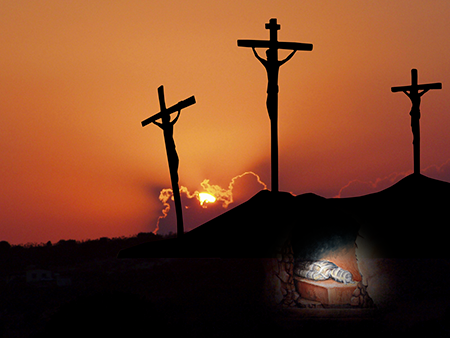 The crucifixion of Jesus was one of the saddest but most important events in the history of the world. When Christ was crucified, He took the sins of the world on Himself. Peter says that Jesus “bore our sins in His own body on the tree” (1 Peter 2:24). The crucifixion was so important that the apostle Paul wrote, “For I determined not to know anything among you except Jesus Christ and Him crucified” (1 Corinthians 2:2). The crucifixion helps us see that Jesus had power over death. He died on the cross, and three days later He defeated death and rose from the grave (Hebrews 2:14-15). If Jesus didn’t really die on the cross, then He could not rise from the grave.
Sadly, Muhammad and his teachings in the Quran deny that Jesus was crucified. The Quran states, “And because of their saying: We killed the Messiah son of Mary, Allah’s messenger—They killed him not nor crucified, but it appeared so to them and lo! those who disagree concerning it are in doubt thereof…they did not kill him for certain but Allah took him up unto Himself” (Surah 4:157-158). The Quran teaches that it only looked like Jesus was crucified, but He really stayed alive and was taken up into heaven. Therefore, the Quran denies that Jesus died, and it denies that He was resurrected.
 The apostle Paul knew there would be people such as Muhammad who would deny the resurrection. He wrote, “But if there is no resurrection of the dead, then Christ is not risen. And if Christ is not risen, then our preaching is vain and your faith is also vain…. And if Christ is not risen your faith is futile; you are still in your sins!” (1 Corinthians 15:13-17). Christ was crucified so that His blood can forgive the sins of those who obey Him. Thank God for that!
The post Was Jesus Crucified? appeared first on Apologetics Press.
]]>The post Islam and Jesus Christ appeared first on Apologetics Press.
]]> What is the answer to the math problem 2+2=__? Did you know there is only one right answer to this problem? The correct answer is 4. Let’s suppose that someone argues that the answer should be five, another person says the real answer is seven, and a third person claims the answer is nine. Just because some people disagree with the correct answer, that does not mean there are several correct answers, or that any answer is just as good as four. There is one correct answer and all the others are incorrect.
In a similar way, we could ask, how can a person be with God and go to heaven? There is only one correct answer to this question. Jesus Christ said, “I am the way, the truth, and the life. No one comes to the Father except through Me” (John 14:6). Many people say there are other ways to get to God. Some say through meditation. Others say through the teachings of Muhammad (muh-HAH-mud). Still others say by following rules in books written by councils instead of following Jesus’ words in the Bible. No matter what people say, the only way to God is through Jesus Christ.
 In this issue of Discovery we are learning about the religion of Islam. One of the main reasons we know it is not from God is because it denies that Jesus is God’s Son. Islam is a religion that was started by a man named Muhammad. He claimed to receive messages from God that he wrote down in a book called the Quran (coo-RON). When we look at these messages, however, we can know that they are not from God, because they deny that Jesus is God’s Son. In one place, the Quran says: “Praise be to Allah [this is the word the Quran uses for God] Who has revealed the Scripture unto His slave…to give warning of stern punishment from Him…and to warn those who say: Allah has chosen a son, a thing whereof they have no knowledge, nor had their fathers. Dreadful is the word that comes out of their mouths. They speak nothing but a lie” (Surah 18:1-5; a Surah is a division of the Quran, somewhat like the Bible is divided into books).
Notice that the Quran says that God does not have a Son, and anyone who says He does have a Son is lying. When we look into the Bible, however, we find that Jesus often taught that He is God’s Son. In Matthew 16, Jesus asked His disciples who they thought He was. Peter spoke up and said, “You are the Christ, the Son of the living God” (16:16). Jesus responded by saying, “Blessed are you, Simon Bar-Jonah, for flesh and blood has not revealed this to you, but My Father who is in heaven” (16:17). Notice that Jesus said that God had revealed to Peter that Jesus is God’s Son. That is the exact opposite of what the Quran teaches.


Many other places in the Bible teach that Jesus is God’s Son. In 1 John 2:22-23 we read, “Who is a liar but he who denies that Jesus is the Christ. He is antichrist who denies the Father and the Son. Whoever denies the Son does not have the Father either; he who acknowledges the Son has the Father also.” Jesus is the Son of God. One very important part of coming to God and being saved is believing that Jesus is God’s Son and being willing to confess that belief (Romans 10:9-10). Sadly, the Quran teaches the exact opposite.
There are many religions in the world that teach different things. But the only way to be right with God and go to heaven is to admit that Jesus is God’s Son and confess that belief. The Quran teaches that Jesus cannot be God’s Son. The Quran and Islam are wrong! Jesus Himself once said, “Therefore I said to you that you will die in your sins, for if you do not believe that I am He, you will die in your sins” (John 8:24). It is our prayer that all people in the world will believe that Jesus is God’s Son and obey His commandments so that they can be with God in heaven someday.
[Jesus is the Son of God: Luke 1:35, John 1:34, John 1:49, John 11:27, Matthew 27:54, John 10:36, Matthew 8:29, Matthew 16:16, John 2:22-23]
The post Islam and Jesus Christ appeared first on Apologetics Press.
]]>The post The Quran, Arabic, and Translations appeared first on Apologetics Press.
]]>Of course, this claim is unfounded and indefensible—for at least two reasons. While misunderstanding and misinterpretation certainly can occur, all linguists know that the accurate transference of meaning from one language to another is achievable. Millions of people who speak differing languages are able to communicate with each other every day. The United Nations and governments around the world regularly engage in political and economic interaction, fully capable of grasping each other’s intended meanings. The fact that misunderstanding sometimes occurs does not negate the fact that correct meanings may be conferred from one language to another, and that the participants can know that they have understood each other correctly. Was God incapable of providing the world with His Word in such a way that its meaning can be transferred into the thousands of human languages that exist? Of course, He could. If we can understand each other by overcoming language barriers—surely the originator of human language can communicate His message through multiple human languages! The claim that the Quran cannot be fully comprehended unless one reads it in Arabic is a claim that demonstrates ignorance of linguistics and the science of translation.
Additionally, the claim stands in conflict with the nature of God. The one true God would not insist that His Word remain in one language—let alone Arabic. He would not require the whole world to learn Arabic.6 In fact, this claim stands in contradiction to the Quran itself. Since it speaks favorably of the Bible, the Quran implicitly endorses the fact that God previously conveyed His will in three languages (i.e., Hebrew, Aramaic, and Greek).7 Yet, no Greek-speaking person was required to learn Hebrew or Aramaic, and no one whose native language was Hebrew was required to learn Greek. Jesus, Himself a Jew, often quoted from the Greek translation of the Old Testament. Indeed, the Septuagint translation–though imperfect–was, in fact, the primary translation of the Old Testament used by the apostles and the early church.
What’s more, the first century phenomenon of tongue-speaking in the New Testament church demonstrates that God does not favor one particular human language or expect His communication to be confined to a single language. On the day of Pentecost, Jewish Arabs were present in Jerusalem who spoke Arabic (Acts 2:11). The apostles did not expect those gathered to give priority to the Arabic language but, in fact, accommodated the wide variety of languages spoken by the pilgrims (vs. 8).8 In the church at Corinth, both the miraculous ability to speak a foreign language as well as the gift of interpretation of other languages is implicitly endorsed by God (1 Corinthians 11-14).
The very nature of God’s communicative activities militates against the notion that He would suddenly lock His Word into one language and then require everyone to learn how to understand and read that fourth language. In fact, the fixation—even obsession—that the Quran manifests toward “Arabic” (Surah 12:2; 13:37; 16:103; 20:113; 26:195; 39:28; 41:3; 42:7; 43:3; 46:12; cf. 41:44) implies a human author—one who was overly influenced by, enamored with, and subject to his restricted, limited linguistic environment.9
EndnotES
1 Fazlur Rahman (1979), Islam (Chicago, IL: University of Chicago Press), second edition, p. 40.
2 Seyyed Hossein Nasr (2003), Islam (New York: HarperCollins), p. 3.
3 Ibid., p. 45.
4 Mohammed M. Pickthall (1930), The Meaning of the Glorious Koran (New York: Mentor), p. vii.
5 J.I. Packer (1958), “Fundamentalism” and the Word of God (Grand Rapids, MI: Eerdmans), 1976 reprint, pp. 89-90.
6 In fact, at Babel, God personally authored—not one—but several original proto-languages from whence all other human languages have developed (Genesis 11:1-9). See Dave Miller, et al. (2002), “The Origin of Language and Communication,” Reason & Revelation, 22[8]:57-63, http://apologeticspress.org/apPubPage.aspx?pub=1&issue=532&article=489.
7 Though Muslims now claim the Bible has been corrupted, the fact that God originally transmitted the Bible in Hebrew, Aramaic, and Greek is not disputed.
8 For a discussion of tongue-speaking in the New Testament, see Dave Miller (2003), “Modern-Day Miracles, Tongue-Speaking, and Holy Spirit Baptism: A Refutation—EXTENDED VERSION,” Apologetics Press, http://apologeticspress.org/APContent.aspx?category=11&article=1399&topic=293.
9 NOTE: Though the Quran repeatedly claims to have been given in “pure and clear” (Surah 16:103) Arabic speech—“in the perspicuous Arabic tongue” (Surah 26:195)—the fact is that it contains several foreign, non-Arabic words. For example, Syriac words occur in the Quran, including masih (Messiah) in Surah 3:45, furqan (salvation) in Surah 2:50, and istabraq (silk brocade) in Surah 76:21. Cf. Alphonse Mingana (1927), “Syriac Influences on the Style of the Koran,” Bulletin of the John Rylands Library, [11]:77-98, available on-line at: http://answering-islam.org/Books/Mingana/Influence/index.htm; D.S. Margoliouth (1939), “Some Additions to Professor Jeffery’s Foreign Vocabulary of the Quran,” Journal of the Royal Asiatic Society (London):53-61; Anis A. Shorrosh (1988), Islam Revealed: A Christian Arab’s View of Islam (Nashville, TN: Thomas Nelson), p. 199.
The post The Quran, Arabic, and Translations appeared first on Apologetics Press.
]]>The post U.S. Presidents on Islam appeared first on Apologetics Press.
]]>“You do well to wish to learn our arts and ways of life, and above all, the religion of Jesus Christ. These will make you a greater and happier people than you are. Congress will do everything they can to assist you in this wise intention.”1
“While we are zealously performing the duties of good Citizens and soldiers we certainly ought not to be inattentive to the higher duties of Religion. To the distinguished Character of Patriot, it should be our highest Glory to add the more distinguished Character of Christian.”2
Thomas Jefferson and John Adams
“We took the liberty to make some inquiries concerning the grounds of their pretentions to make war upon nations who had done them no injury, and observed that we considered all mankind as our Friends who had done us no wrong, nor had given us any provocation. The Ambassador answered us that it was founded on the laws of their Prophet, that it was written in their Koran that all nations who should not have acknowledged their authority were sinners, that it was their right and duty to make war upon them wherever they could be found, and to make slaves of all they could take as prisoners; and that every Musselman who should be slain in battle was sure to go to Paradise.”3
John Quincy Adams
“In the seventh century of the Christian era, a wandering Arab of the lineage of Hagar, the Egyptian, combining the powers of transcendent genius, with the preternatural energy of a fanatic, and the fraudulent spirit of an impostor, proclaimed himself as a messenger from Heaven, and spread desolation and delusion over an extensive portion of the earth. Adopting from the sublime conception of the Mosaic law, the doctrine of one omnipotent God; he connected indissolubly with it, the audacious falsehood, that he was himself his prophet and apostle…. [H]e declared undistinguishing and exterminating war, as a part of his religion, against all the rest of mankind…. The precept of the koran is, perpetual war against all who deny, that Mahomet is the prophet of God.”4
Barack Obama
“Islam is not part of the problem in combating violent extremism—it is an important part of promoting peace.”5
Endnotes
1 George Washington (1779), “Speech to the Delaware Chiefs,” in The Writings of George Washington from the Original Manuscript Sources 1745-1799, ed. John C. Fitzpatrick, 15:55, emp. added, http://preview.tinyurl.com/Washington-G-1779. The author assumes that Washington’s belief in the priority of the Christian religion would apply to the Muslim as well as the Native American.
2 George Washington (1778), “General Orders, May 2, 1778,” George Washington Papers at the Library of Congress, emp. added, http://memory.loc.gov/cgi-bin/ampage?collId=mgw3&fileName=mgw3g/gwpage003.db&recNum=181. Again, it is assumed that, if Washington considered being a Christian a person’s highest glory, being a Muslim would not be so considered.
3 “American Peace Commissioners to John Jay” (1786), The Thomas Jefferson Papers Series 1. General Correspondence. 1651-1827, Library of Congress, March 28, http://hdl.loc.gov/loc.mss/mtj.mtjbib001849. The letter refers to Jefferson and Adam’s meeting with the Ambassador from the Muslim country of Tripoli.
4 Joseph Blunt (1830), The American Annual Register for the Years 1827-8-9 (New York: E. & G.W. Blunt), 29:269, emp. added, http://www.archive.org/stream/p1americanannual29blunuoft.
5 Barack Obama (2009), “Remarks by the President on a New Beginning,” The White House, Office of the Press Secretary, Cairo University, Cairo, Egypt, June 4, http://www.whitehouse.gov/the-press-office/remarks-president-cairo-university-6-04-09.
The post U.S. Presidents on Islam appeared first on Apologetics Press.
]]>The post Should the Quran be Taken Literally? appeared first on Apologetics Press.
]]>To suggest that the Bible is not to be taken literally is nonsensical. True, the Bible contains much figurative language, i.e., it includes figures of speech (e.g., simile, metaphor, hyperbole, metonymy, synecdoche, etc.)—just like our own English language (e.g., “quit cold turkey,” “stretch my legs,” “died laughing”). But figurative language still communicates meaning that can be comprehended. Do those who allege that the Bible is not to be literalized want us to interpret their allegation literally? Of course. Even if a few metaphors are “thrown” into the discussion, can we “grasp” what is being communicated? Yes, even as that question can be understood, though it contains two figurative expressions. Likewise the Bible may also be understood. It communicates literal truth. Any diligent student can ascertain the original intent of the divinely guided writers.
Though its divine origin has been decisively disputed,2 the same may be said of the Quran. It was written with a view to being understood. The host of passages that advocate violent jihad are unquestionably conveyed in contexts that demonstrate their literality. No figurative language alters the very plain meanings evident in the admonitions pertaining to physical warfare. For example, Surah 3 alludes to two literal battles fought by Muslim armies—the battle of Badr and the battle of Uhud. Consider Surah 47 in Mohammed Pickthall’s celebrated Muslim translation—
Now when ye meet in battle those who disbelieve, then it is smiting of the necks…. And those who are slain in the way of Allah, He rendereth not their actions vain. He will guide them and improve their state, and bring them in unto the Garden [Paradise—DM] which He hath made known to them (Surah 47:4-6, emp. added).3
No Muslim would deny that “those who disbelieve,” “actions,” and “Garden” (i.e., Paradise) are literal. Likewise, no true Quran-made Muslim would deny that “battle,” “slain,” and “smiting of the necks” are literal as well. This Surah is calling for Muslims to engage in literal violent warfare with unbelievers (i.e., those who do not accept Islam) by severing their heads. The sooner the politically correct, multicultural mindset faces reality, the sooner the threat posed by terrorists can be addressed in a meaningful manner.
Endnotes
1 Kyle Butt (2007), Behold! The Word of God (Montgomery, AL: Apologetics Press); Jackson, Wayne (1982), “The Holy Scriptures—Verbally Inspired,” Apologetics Press, http://apologeticspress.org/rr/reprints/holyscri.pdf.
2 See Dave Miller (2005), The Quran Unveiled (Montgomery, AL: Apologetics Press).
3 Mohammed Pickthall (no date), The Meaning of the Glorious Koran (New York: Mentor).
The Quran Unveiled
The post Should the Quran be Taken Literally? appeared first on Apologetics Press.
]]>The post The Quran and the Muslim Bomb Blast In Pakistan appeared first on Apologetics Press.
]]>Perhaps at some point, the politically correct crowd reconsider their flawed notion that “Islam is a religion of peace, and such behavior does not represent true Islam.” This naïve, inaccurate depiction is inexcusable and unbelievably bizarre in view of the 1,400-year-long history of Islam throughout the world. It is fashionable to refer to the terrorists as “extremists” and “radicalized”—implying that they do not represent true Islam and the Quran. They are characterized as being guilty of embracing a “literalist” interpretation of the Quran. But this allegation fails to face the fact that the Quranic texts that advocate violence and killing to advance Islam are clearly literal and have been so taken by the vast majority of Islamic scholars for the last 1,400 years.3 Setting aside the Hadith which forthrightly promote violence, the Quran itself is riddled with admonitions for Muslims to commit precisely the violent actions and bloodshed being committed by the Islamic terrorists.
Read Surah 47:4 from the celebrated translation by Muslim scholar Mohammed Pickthall:
Now when ye meet in battle those who disbelieve, then it is smiting of the necks until, when ye have routed them, then making fast of bonds; and afterward either grace or ransom till the war lay down its burdens. That (is the ordinance). And if Allah willed He could have punished them (without you) but (thus it is ordained) that He may try some of you by means of others. And those who are slain in the way of Allah, He rendereth not their actions vain (Surah 47:4, emp. added).4
No one should be perplexed or surprised by the incessant practice of beheadings by ISIS and all terrorists, who are in a perpetual war with Christendom. The admonition to behead others comes straight from the Quran (cf. Surah 8:12). Abdullah Yusuf Ali makes the following comment on this passage in his widely reputable Muslim translation:
When once the fight (Jihad) is entered upon, carry it out with the utmost vigour, and strike home your blows at the most vital points (smite at their necks), both literally and figuratively. You cannot wage war with kid gloves (italics and parenthetical items in orig.).5
Many other verses in the Quran forthrightly endorse armed conflict and war to advance Islam (e.g., Surah 2:190ff.; 8:39ff.; 9:1-5,29; 22:39; 61:4; 4:101-104). Muslim historical sources themselves report the background details of those armed conflicts that have characterized Islam from its inception—including Muhammad’s own warring tendencies involving personal participation in and endorsement of military campaigns.6 Muslim scholar Pickthall’s own summary of Muhammad’s war record is an eye-opener: “The number of the campaigns which he led in person during the last ten years of his life is twenty-seven, in nine of which there was hard fighting. The number of the expeditions which he planned and sent out under other leaders is thirty-eight.”7
Islam stands in stark contrast to the religion of Jesus—Who never once took up the sword or encouraged anyone else to do so. The one time that one of His close followers took it upon himself to do so, the disciple was soundly reprimanded and ordered to put the sword away, with the added warning: “all who take the sword will perish by the sword” (Matthew 26:52). Indeed, when Pilate quizzed Jesus regarding His intentions, He responded: “My kingdom is not of this world. If My kingdom were of this world, My servants would fight, so that I should not be delivered to the Jews; but now My kingdom is not from here” (John 18:36)—the very opposite of Islamic teaching and practice. Whereas the Quran boldly declares, “And one who attacks you, attack him in like manner as he attacked you” (Surah 2:194; cf. 22:60), Jesus counters, “But whoever slaps you on your right cheek, turn the other to him also” and “love your enemies” (Matthew 5:39,44). Indeed, New Testament Christianity enjoins love for enemies (Matthew 5:44-46; Luke 6:27-36), returning good for evil, and overcoming evil with good (Romans 12:14,17-21).
So why does the politically correct crowd seem intent on ignoring 1,400 years of historical reality and unmistakable declarations within the Quran itself? It would appear that such blatant disregard is rooted in a single reason: an irrational regard for pluralism and bitter disdain for Christianity’s moral principles.
Endnotes
1 Annie Gowen, Shaiq Hussain, and Erin Cunningham (2016), “Death Toll in Pakistan Bombing Climbs Past 70,” The Washington Post, March 28, https://www.washingtonpost.com/world/death-toll-in-pakistan-easter-suicide-attack-rises-to-72-authorities-vow-to-hunt-down-perpetrators/2016/03/28/037a2e18-f46a-11e5-958d-d038dac6e718_story.html.
2 Ibid.
3 Nabeel Qureshi (2016), “The Quran’s Deadly Role in Inspiring Belgian Slaughter: Column,” USA Today, March 22, http://www.usatoday.com/story/opinion/2016/03/22/radicalization-isil-islam-sacred-texts-literal-interpretation-column/81808560/.
4 Mohammed Pickthall (no date), The Meaning of the Glorious Koran (New York: Mentor).
5 Abdullah Yusuf Ali (1934), The Meaning of the Holy Quran (Beltsville, MD: Amana Publications), 2002 reprint, p. 1315.
6 cf. Martin Lings (1983), Muhammad (Rochester, VT: Inner Traditions International), pp. 86,111.


The post The Quran and the Muslim Bomb Blast In Pakistan appeared first on Apologetics Press.
]]>The post Belgium Blasts and the Quran appeared first on Apologetics Press.
]]>Read Surah 47:4 from the celebrated translation by Muslim scholar Mohammed Pickthall:
Now when ye meet in battle those who disbelieve, then it is smiting of the necks until, when ye have routed them, then making fast of bonds; and afterward either grace or ransom till the war lay down its burdens. That (is the ordinance). And if Allah willed He could have punished them (without you) but (thus it is ordained) that He may try some of you by means of others. And those who are slain in the way of Allah, He rendereth not their actions vain (Surah 47:4, emp. added).3
No one should be perplexed or surprised by the incessant practice of beheadings by ISIS and all terrorists, who are in a perpetual war with Christendom. The admonition to behead others comes straight from the Quran (cf. Surah 8:12). Abdullah Yusuf Ali makes the following comment on this passage in his widely reputable Muslim translation:
When once the fight (Jihad) is entered upon, carry it out with the utmost vigour, and strike home your blows at the most vital points (smite at their necks), both literally and figuratively. You cannot wage war with kid gloves (italics and parenthetical items in orig.).4
Many other verses in the Quran forthrightly endorse armed conflict and war to advance Islam (e.g., Surah 2:190ff.; 8:39ff.; 9:1-5,29; 22:39; 61:4; 4:101-104). Muslim historical sources themselves report the background details of those armed conflicts that have characterized Islam from its inception—including Muhammad’s own warring tendencies involving personal participation in and endorsement of military campaigns.5 Muslim scholar Pickthall’s own summary of Muhammad’s war record is an eye-opener: “The number of the campaigns which he led in person during the last ten years of his life is twenty-seven, in nine of which there was hard fighting. The number of the expeditions which he planned and sent out under other leaders is thirty-eight.”6
Islam stands in stark contrast to the religion of Jesus—Who never once took up the sword or encouraged anyone else to do so. The one time that one of His close followers took it upon himself to do so, the disciple was soundly reprimanded and ordered to put the sword away, with the added warning: “all who take the sword will perish by the sword” (Matthew 26:52). Indeed, when Pilate quizzed Jesus regarding His intentions, He responded: “My kingdom is not of this world. If My kingdom were of this world, My servants would fight, so that I should not be delivered to the Jews; but now My kingdom is not from here” (John 18:36)—the very opposite of Islamic teaching and practice. Whereas the Quran boldly declares, “And one who attacks you, attack him in like manner as he attacked you” (Surah 2:194; cf. 22:60), Jesus counters, “But whoever slaps you on your right cheek, turn the other to him also” and “love your enemies” (Matthew 5:39,44). Indeed, New Testament Christianity enjoins love for enemies (Matthew 5:44-46; Luke 6:27-36), returning good for evil, and overcoming evil with good (Romans 12:14,17-21).
So why does the politically correct crowd seem intent on ignoring 1,400 years of historical reality and unmistakable declarations within the Quran itself? It would appear that such blatant disregard is rooted in a single reason: an irrational regard for pluralism and bitter disdain for Christianity’s moral principles.
Endnotes
1 CNBC.com Staff (2016), “The Belgium Terror Attacks: Complete Coverage,” CNBC, http://www.cnbc.com/2016/03/22/the-belgium-terror-attacks-complete-coverage.html.
2 Nabeel Qureshi (2016), “The Quran’s Deadly Role in Inspiring Belgian Slaughter: Column,” USA Today, March 22, http://www.usatoday.com/story/opinion/2016/03/22/radicalization-isil-islam-sacred-texts-literal-interpretation-column/81808560/.
3 Mohammed Pickthall (no date), The Meaning of the Glorious Koran (New York: Mentor).
4 Abdullah Yusuf Ali (1934), The Meaning of the Holy Quran (Beltsville, MD: Amana Publications), 2002 reprint, p. 1315.
5 cf. Martin Lings (1983), Muhammad (Rochester, VT: Inner Traditions International), pp. 86,111.
6 p. xxvi.
 |
 |
| Suggested Resources | |
The post Belgium Blasts and the Quran appeared first on Apologetics Press.
]]>The post Is the Iglesia Ni Cristo the Church of Christ? appeared first on Apologetics Press.
]]>The Iglesia Ni Cristo claims to be the only true Church of Christ.1 It argues against both the Catholic Church’s claim to be Jesus’ true church and the Protestant idea of denominationalism. According to this group, if you are not a member of the Iglesia Ni Christo, as organized by Felix Manalo starting in the Philippines in 1914, you cannot go to heaven. Unfortunately, even though some of the practices of this group are biblical, there are several things about the group and its teachings that contradict the Bible’s teachings. This brief article will explore some of those errors.
The most obvious and most egregious error taught by the Iglesia Ni Cristo is that Jesus is not God. This is concisely worded in the “Beliefs and Practices” article in this way, “We do not believe that Jesus is God.” Even though the group teaches that Jesus should be worshiped, it does not recognize Him as divine. This erroneous belief alone is enough to show that the group cannot be the one true church of Christ. Jesus is divine.2 To deny that He is God is to deny one of Jesus’ primary teachings about Himself. The faith that led Thomas to declare to Jesus, “My Lord and My God!”3 is the same faith that is demanded of Jesus’ followers today. John understood this when he wrote, “Whoever denies the Son does not have the Father either; he who acknowledges the Son has the Father also.”4 To deny that Jesus is God is the same as denying that the Father is God.
In addition, the position of the Iglesia Ni Cristo concerning Jesus is further plagued by inconsistency. According to the group, Jesus is a man, but is worshiped.5 When we go to the Bible, those two ideas cannot be consistently maintained. The Bible reveals time and again that God alone is to be worshiped.6 The Bible also reveals that men must refrain from worshiping angels. When the apostle John fell down to worship before the feet of the angel who had revealed to him the message in the book of Revelation, the angel responded, saying, “See that you do not do that. For I am your fellow servant, and of your brethren the prophets, and of those who keep the words of this book. Worship God.”7 Angels, idols, and humans are all unworthy of the reverent worship that is due only to God. As Jesus reminded Satan: “It is written, ‘You shall worship the Lord your God, and Him only you shall serve.’”8
Unlike good men and good angels who have always rejected worship from humanity, Jesus accepted worship. If worship is to be reserved only for God, and Jesus, the One “who knew no sin,”9 accepted worship, then the only logical conclusion is that Jesus believed that He was Deity. Numerous times the Bible mentions that Jesus accepted worship from mankind. Matthew 14:33 indicates that those who saw Jesus walk on water “worshiped Him.” John 9:38 reveals that the blind man, whom Jesus had healed, later confessed his belief in Jesus as the Son of God and “worshiped him.” After Mary Magdalene and the other women visited the empty tomb of Jesus, and the risen Christ appeared to them, “they came and held Him by the feet and worshiped Him.”10 Jesus once stated during His earthly ministry, “[A]ll should honor the Son just as they honor the Father. He who does not honor the Son does not honor the Father who sent Him.”11 While on Earth, Jesus was honored on several occasions. His followers worshiped Him. They even worshiped Him after His ascension into heaven.12 Unlike good men and angels in Bible times who rejected worship, Jesus unhesitatingly received glory, honor, and praise from His creation. Truly, such worship is one of the powerful proofs of Jesus’ deity.13
Special Messengers
It is often the case that false religions such as the Iglesia Ni Cristo claim one thing, but in practice, do and teach another thing entirely. This is the case with the group’s teaching about the Bible. Throughout their literature, there are numerous statements that the Bible is the sole source of authority, and that there are no other creeds the Inglesia Ni Cristo follows except the Bible. On closer inspection, however, there actually is something more involved. The group states: “We believe that the Bible is the word of God, however, the Bible is not an ‘open book.’”14 What do they mean by the idea that the Bible is not “an open book”? They explain “those who strive to understand the Scriptures through their own worldly knowledge will never be able to come to the knowledge of the truth….” What can be done so that a person can understand the message? The person must go to “those who are sent by God.” And who would that be? Conveniently, it is the man who started their religion: “We believe that the late Brother Felix Y. Manalo is God’s last messenger.”15 Thus, while the group claims that the Bible is sufficient, in reality, it demands that the message of the Bible be coupled with the teachings of Felix Manalo.
The idea that Felix Manalo is God’s last messenger who must explain the meaning of the Bible in order for people to understand it properly is false. First, 2 Timothy 3:16-17 states, “All Scripture is given by inspiration of God, and is profitable for doctrine, for reproof, for correction, for instruction in righteousness, that the man of God may be complete, thoroughly equipped for every good work.” Notice that this passage is describing the Old and New Testaments that were written at least 1,900 years before Felix Y. Manalo. Could the Christians in the 2nd century A.D. be completely equipped for every good work before Manalo offered his opinion on Scripture? What about in 3rd century? The 4th century? Thinking through this situation, if the Scripture’s completely equipped Christians from the 1st century onward, then the idea that Manalo’s instruction is essential to understand the Scriptures cannot be correct. Either Manalo is offering more and different Scriptures (which he is not and the Iglesia Ni Christo does not even claim he is), or his teachings are unnecessary to a proper understanding of Scripture. Indeed, Paul stated it well when he explained to the Christians in Ephesus that when they read the Scripture they could “understand” Paul’s knowledge of the mystery of Christ (Ephesians 3:5). The Bible does not teach that Christians need special messengers to understand the Bible correctly. If the Scriptures completely equip a person for all good works, then it cannot logically be argued that a person needs the Scriptures and the instruction of Felix Manalo.
There are many other practices and teachings of the Iglesia Ni Christo that are specific to certain areas of the world where the group evangelizes. They often host large dinner parties and sign up many families through these meals. Depending on who you ask and where the group is working, there can be a process of some six months before a “believer” is permitted to be baptized. Many of the church’s practices are strictly enforced in ways that would be cultic in their administration.
Conclusion
The Iglesia Ni Christo is a fast-growing religious organization that claims to be the one true Church of Christ. They have beautiful buildings and a zealous spirit of evangelism. Unfortunately, this group has veered from Christ’s teachings and it is not the Lord’s church. The group does not believe or teach that Jesus is God, contrary to Scriptures. The group maintains that in order to fully understand the Bible, a person must have more than the Bible—the teachings of the Iglesia Ni Christo’s “special messengers.” This teaching, if true, would nullify the Bible’s clear statement that the Scriptures are the only necessary source to completely equip saints for every good work. While many of the group’s teachings are accurate concerning baptism by immersion and the fact that Jesus established one true church, the group’s errant teachings prove that it cannot be Jesus’ one true church.
References
1 “Beliefs and Practices,” Iglesia Ni Christo Unofficial, http://iglesianicristowebsite.blogspot.com/p/beliefs.html#.VrN1vBgrJC1.
2 Lyons, Eric and Kyle Butt (2015), “Reasons to Believe in Jesus,” https://www.apologeticspress.org/APContent.aspx?category=10&article=5192&topic=293.
3John 20:28.
6Exodus 20:3-5; 2 Kings 17:34-36; Acts 14:8-18.
7Revelation 22:9; Revelation 19:10.
8Matthew 4:10.
92 Corinthians 5:21.
10Matthew 28:9.
11John 5:23; 5:18; 10:19-39.
12Luke 24:52.
13Read Revelation 5. Also see Lyons, Eric “Jehovah’s Witnesses and the Worship of Jesus, https://www.apologeticspress.org/APContent.aspx?category=10&article=1481&topic=79
14“What We Believe and Why,” http://theiglesianicristo.blogspot.com/2013/02/the-iglesia-ni-cristo-doctrines.html.
15Ibid.
 |
| Suggested Resource |
The post Is the Iglesia Ni Cristo the Church of Christ? appeared first on Apologetics Press.
]]>The post Jehovah's Witnesses and the Worship of Jesus appeared first on Apologetics Press.
]]>
According to Jehovah’s Witnesses, “Jesus is not God,” and thus should not be worshiped by Christians. The Watchtower, a magazine published twice a month by Jehovah’s Witnesses, has repeatedly made such claims through the years. In their September 15, 2005 issue, for example, they stated quite simply that the Scriptures “show that Jesus is not God Almighty.” The Jehovah’s Witnesses’ official website (jw.org), which republishes many items from The Watchtower, briefly answers the question “Do Jehovah’s Witnesses Believe in Jesus?,” concluding, “we do not worship Jesus, as we do not believe that he is Almighty God” (2015). After all, allegedly “in his prehuman existence, Jesus was a created spirit being…. Jesus had a beginning and could never be coequal with God in power or eternity” (“What Does the Bible…?,” 2000, emp. added). The October 15, 2004 issue of The Watchtower concluded a section about Jesus not being the true God with these words: “Jehovah, and no one else, is ‘the true God and life everlasting.’ He alone is worthy to receive exclusive worship from those whom he created.—Revelation 4:11” (p. 31). Since God alone is worthy of worship, and since Jehovah’s Witnesses believe that Jesus is only an angel and not God (see “The Truth About Angels,” 1995), He allegedly should not be worshiped.
God alone is worthy of worship
There is no argument over the fact that God alone is worthy of worship. Jehovah revealed His will to Moses on Mt. Sinai, saying, “You shall have no other gods before Me. You shall not make for yourself a carved image—any likeness of anything that is in heaven above, or that is in the earth beneath, or that is in the water under the earth; you shall not bow down to them nor serve them. For I, the Lord your God, am a jealous God” (Exodus 20:3-5). Regarding the Gentiles who were sent to live in Samaria after the Assyrians conquered the Northern Kingdom of Israel, the Bible says:
To this day they continue practicing the former rituals; they do not fear the Lord, nor do they follow their statutes or their ordinances, or the law and commandment which the Lord had commanded the children of Jacob, whom He named Israel, with whom the Lord had made a covenant and charged them, saying: “You shall not fear other gods, nor bow down to them nor serve them nor sacrifice to them; but the Lord, who brought you up from the land of Egypt with great power and an outstretched arm, Him you shall fear, Him you shall worship, and to Him you shall offer sacrifice” (2 Kings 17:34-36, emp. added).
The Bible reveals time and again that God alone is to be worshiped. Luke recorded that King Herod was eaten with worms because, instead of glorifying God Almighty, he allowed the people to glorify him as a god (Acts 12:21-23). Herod’s arrogant spirit stands in direct contrast to the reaction that Paul and Barnabas had when the citizens of Lystra attempted to worship them (Acts 14:8-18). After Paul healed a man who had been crippled from his birth, the people of Lystra shouted: “The gods have come down to us in the likeness of men.” They even called Paul and Barnabas by the names of their gods (Hermes and Zeus), and sought to worship them with sacrifice. Had these two preachers had the same arrogant spirit as Herod, they would have accepted worship, and felt as if they deserved such honor. Instead, these Christian men “tore their clothes and ran in among the multitude, crying out and saying, ‘Men, why are you doing these things? We also are men with the same nature as you’” (Acts 14:15). Paul recognized that it is unlawful for humans to worship other humans, and thus sought to turn the people’s attention toward God, and away from himself.
The Bible also reveals that man must refrain from worshiping angels. When the apostle John fell down to worship before the feet of the angel who had revealed to him the message of Revelation, the angel responded, saying, “See that you do not do that. For I am your fellow servant, and of your brethren the prophets, and of those who keep the words of this book. Worship God” (Revelation 22:9, emp. added; cf. 19:10). Angels, idols, and humans are all unworthy of the reverent worship that is due only to God. As Jesus reminded Satan: “It is written, ‘You shall worship the Lord your God, and Him only you shall serve’” (Matthew 4:10, emp. added).
Jesus Accepted Worship
The dilemma in which Jehovah’s Witnesses find themselves is that they believe Jesus was a good man and prophet, yet unlike good men and good angels who have always rejected worship from humanity, Jesus accepted worship. If worship is to be reserved only for God, and Jesus, the One “who knew no sin” (2 Corinthians 5:21; 1 Peter 2:22), accepted worship, then the logical conclusion is that Jesus believed that He was deity. Numerous times the Bible mentions that Jesus accepted worship from mankind. Matthew 14:33 indicates that those who saw Jesus walk on water “worshiped Him.” John 9:38 reveals that the blind man whom Jesus had healed, later confessed his belief in Jesus as the Son of God and “worshiped him.” After Mary Magdalene and the other women visited the empty tomb of Jesus, and the risen Christ appeared to them, “they came and held Him by the feet and worshiped Him” (Matthew 28:9). When Thomas first witnessed the resurrected Christ, he exclaimed, “My Lord and my God” (John 20:28). Later, when Jesus appeared to the apostles in Galilee, “they worshiped Him” on a mountain (Matthew 28:17). A few days after that, his disciples “worshiped Him” in Bethany (Luke 24:52). Time and time again Jesus accepted the kind of praise from men that is due only to God. He never sought to correct His followers and redirect the worship away from Himself as did the angel in Revelation or the apostle Paul in Acts 14. Nor did God strike Jesus with deadly worms for not redirecting the praise He received from men as He did Herod, who, when being hailed as a god, “did not give praise to God” (Acts 12:23).
Sadly, Jehovah’s Witnesses have attempted to circumvent the obvious references to Jesus accepting worship by changing the word “worship” in their New World Translation to “obeisance” every time the Greek word proskuneo (the most prominent word for worship in the New Testament) is used in reference to Jesus. Over 30 times in the New World Translation (first published by the Jehovah’s Witnesses Watchtower Bible and Tract Society in 1950) proskuneo is correctly translated “worship” when God the Father is the recipient of glory and praise. This Greek word occurs 14 times in the New Testament in reference to Jesus, yet not once do more recent editions of the New World Translation render it “worship;” instead, every time it is translated “obeisance.” Allegedly, Mary Magdalene, the apostles, the blind man whom Jesus healed, etc., never worshiped Jesus; rather, they only paid “obeisance” to Him.
In 21st-century English, people generally make a distinction between the verbs “worship” and “do obeisance.” Most individuals, especially monotheists, use the word worship in a positive sense when talking about God, whereas “obeisance” is used more often in reference to the general respect given to people held in high regard. The American Heritage Dictionary of the English Language defines “obeisance” as “1. A gesture or movement of the body, such as a curtsy, that expresses deference or homage. 2. An attitude of deference or homage,” whereas the verb “worship” is defined as “1. To honor and love as a deity. 2. To regard with ardent or adoring esteem or devotion” (2000, emp. added). The Watchtower Bible and Tract Society agrees with the distinction often made between these words in modern English: God should be “worshiped,” while Jesus (we are told) should only receive “obeisance” (i.e., the respect and submission one pays to important dignitaries and superiors).
The Greek word proskuneo, which appears in the New Testament 60 times, literally means “to kiss the hand to (towards) one, in token of reverence” (Thayer, 1962, p. 548; see also Mounce, 1993, p. 398). According to Greek scholars Arndt, Gingrich, and Danker, this word was used in ancient times “to designate the custom of prostrating oneself before a person and kissing his feet, the hem of his garment, the ground, etc.; the Persians did this in the presence of their deified king, and the Greeks before a divinity or something holy” (1979, p. 723). Admittedly, the word “obeisance” could be used on occasions to translate proskuneo. The problem is that Jehovah’s Witnesses make an arbitrary distinction between obeisance and worship when it comes to the token of reverence that Jesus in particular was given. They translate proskuneo as “obeisance” every time Jesus is the object, yet never when God the Father is the recipient of honor and praise.
As with other words in the Bible that have multiple meanings, the context can help determine the writer’s intended meaning. Consider the circumstances surrounding some of the occasions when Jesus is mentioned as the object of man’s devotion.
- In John chapter nine, Jesus miraculously healed a man who was “blind from his birth” (vs. 1). When the man upon whom this miracle was performed appeared before various Jews in the synagogue and called Jesus a prophet (vs. 17), he was instructed to “give glory to God,” not Jesus, because allegedly Jesus “is a sinner” (vs. 24). Later, after the man born blind was cast out of the synagogue, Jesus informed him of His true identity—that He was not just a prophet, but also “the Son of God.” At that moment, the gentleman exclaimed, “Lord, I believe,” and he worshiped Him (vs. 38). Although the Greek word proskuneo was used in ancient times of paying respect or doing obeisance to people, no such translation is warranted in this passage. In the Gospel of John, this word is found 11 times. In every instance, Jehovah’s Witnesses’ New World Translation renders it “worship,” except here in John 9:38 where it is arbitrarily translated “obeisance.”
- Following a day in which Jesus miraculously fed 5,000 men (not including women and children) with only five loaves of bread and two fish, Matthew recorded how Jesus literally walked on the water in the midst of the Sea of Galilee during a violent storm, saved Peter from drowning, and then walked onto a boat where He was met with those who “worshiped him, saying, ‘Truly You are the Son of God’” (Matthew 14:33). Jesus’ worshipers did not merely pay Him the same respect (or “obeisance”) that one pays a respected ruler, teacher, or master—people incapable of such feats. On the contrary, they recognized that Jesus had overcome the laws of nature, and that His actions warranted praise and adoration—not as a man, but as the “Son of God.” If Jesus was not worthy of such praise, why did He accept it? If Jesus was not to be adored, why did the angel of the Lord not strike Him with the same deadly worms with which he struck Herod (Acts 12:23)?
- After defeating death and rising from the grave, a sign which declared Him to be “the Son of God with power” (Romans 1:4), Jesus accepted worship (proskuneo) from Mary Magdalene and the other women who went to visit the tomb of Jesus (Matthew 28:8-9), as well as all of the apostles (Matthew 28:17). Jesus was not the only one ever to be resurrected from the dead, but He was the only resurrected individual the Bible mentions as afterwards receiving praise and adoration (i.e., worship) from man. The widow’s son of Zarephath (1 Kings 17:22), the son of a Shunammite (2 Kings 4:32-35), the daughter of Jairus (Mark 8:21-24,35-43), the widow of Nain’s son (Luke 7:11-16), Lazarus (John 11:1-45), Tabitha (Acts 9:36-43), and Eutychus (Acts 20:7-12) all were raised from the dead, but none received proskuneo. The Bible never reveals any resurrected person other than Jesus who ever received and accepted worship. Jesus’ followers recognized that His resurrection was different. It verified His claims of divinity.
- The disciples worshiped Jesus again at His ascension. After recording that Jesus was “carried up into heaven,” Luke wrote: “[T]hey worshiped Him, and returned to Jerusalem with great joy, and were continually in the Temple praising and blessing God” (Luke 24:52). Notice that the word “worshiped” (proskuneo) is used in this passage along with such words as “praising” and “blessing”—words that carry a religious connotation in connection with God. This fact highlights that the use of proskuneo in this context is not merely obeisance. Also, notice that the disciples offered worship to an “absent” Savior. It would make no sense to pay obeisance to a respected individual that has departed, but makes perfect sense if, rather, the individual is God and worthy of worship. The disciples did not just bow before some earthly ruler; they worshiped their Lord Who had defeated death 40 days earlier, and had just ascended up into heaven before their eyes.
Jesus did not receive proskuneo on these occasions because He was a great teacher, or because He was viewed at these moments simply as an earthly king. Rather, all of these instances of worship were surrounded by miraculous events that were done to prove He was Heaven sent, and that “in Him dwells all the fullness of the Godhead bodily” (Colossians 2:9). There is every reason to believe that on such occasions as these, Jesus’ disciples meant to pay divine, religious honor to Him, not mere civil respect or regard that earthly rulers often receive.
Waffling on the Worship of Jesus
To the church at Philippi the apostle Paul wrote: “Therefore God also has highly exalted Him [Jesus] and given Him the name which is above every name, that at the name of Jesus every knee should bow, of those in heaven, and of those on earth, and of those under the earth, and that every tongue should confess that Jesus Christ is Lord, to the glory of God the Father” (Philippians 2:9-11, emp. added). The reference to the bowing of the knee is an obvious allusion to worship (cf. Isaiah 45:23; Romans 1:4). Such worship, Paul wrote, would not only come from those on Earth, but also from “those in heaven” (Philippians 2:10). This statement harmonizes well with Hebrews 1:6. In a section in which the writer of Hebrews exalted Jesus above the heavenly hosts, he affirmed that even the angels worship Christ. He wrote: “Let all the angels of God worship (proskuneo) Him.” The KJV, ASV, NKJV, NASB, ESV, NIV, RSV and a host of other translations render proskuneo in this verse as “worship.” How does the Jehovah’s Witnesses’ New World Translation render this passage? Unfortunately, as with all other times in the NWT when Jesus is mentioned as being the object of proskuneo, the word is translated “do obeisance,” not “worship.” Hebrews 1:6 reads: “Let all God’s angels do obeisance to him” (NWT).
Interestingly, however, the NWT has not always rendered proskuneo in Hebrews 1:6 as “do obeisance.” When Jehovah’s Witnesses’ Watchtower Bible and Tract Society first printed the NWT in 1950, the verse actually rendered proskuneo as “worship” instead of “do obeisance.” Even the revised 1961 edition of the NWT translated proskuneo as “worship.” But, by 1971, Jehovah’s Witnesses had changed Hebrews 1:6 to read: “Let all God’s angels do obeisance to him.”
The fact is, the Watchtower Bible and Tract Society has been very inconsistent in their teachings on whether or not Jesus should be worshiped. In the past few decades Jehovah’s Witnesses’ flagship magazine (November 1964, p. 671) has claimed that “it is unscriptural for worshipers of the living and true God to render worship to the Son of God, Jesus Christ” (as quoted in Rhodes, 2001, p. 26; see also The Watchtower 2004, pp. 30-31). But, “from the beginning it was not so.” Notice what Jehovah’s Witnesses used to teach in The Watchtower (called Zion’s Watch Tower in the early days) regarding whether or not Jesus should be worshiped:
- “The wise men came at His birth to worship Him. (Matt. 2) The leper worshiped Him. They in the ship worshiped Him, as did also the ruler and woman of Canaan. Yet none were ever rebuked for it…. [T]o worship Christ in any form cannot be wrong” (Allen, 1880, emp. added).
- “[A]lthough we are nowhere instructed to make petitions to him, it evidently could not be improper to do so; for such a course is nowhere prohibited, and the disciples worshiped him” (Zion’s Watch Tower, 1892, emp. added).
- “Yes, we believe our Lord Jesus while on earth was really worshiped, and properly so” (Zion’s Watch Tower, 1898).
- “[W]hosoever should worship Him must also worship and bow down to Jehovah’s Chief One in that capital organization, namely, Christ Jesus…” (The Watchtower, 1945, p. 313).
For more than half a century, Jehovah’s Witnesses taught that it was acceptable to worship Jesus. Now, however, they claim it is unscriptural. Such inconsistency regarding the nature of Christ, which is no small matter, reveals to the honest truth seeker that the Watchtower Bible and Tract Society is an advocate of serious biblical error.
Sadly, Jehovah’s Witnesses not only reject the worship of Jesus because of their belief that He is not deity, they also must deny Him such religious devotion because they teach He actually is an angel. The Watchtower has taught such a notion for several years. The November 1, 1995 issue indicated, “The foremost angel, both in power and authority, is the archangel, Jesus Christ, also called Michael” (“The Truth About Angels”). More recently, an article appeared on the Jehovah’s Witnesses official website affirming “the Bible indicates that Michael is another name for Jesus Christ, before and after his life on earth…. [I]t is logical to conclude that Michael is none other than Jesus Christ in his heavenly role” (“Who Is Michael…?,” 2015). Since, according to Revelation 19:10 and 22:8-9, good angels do not accept worship, but rather preach the worship of God, and no other, Jehovah’s Witnesses must reject paying religious praise and devotion to Jesus. But, notice (again) how inconsistent Jehovah’s Witnesses have been. In only the fifth issue of Zion’s Watch Tower magazine (originally edited by Charles Taze Russell, the founder of The Watchtower Bible and Tract Society), regular contributing writer J.H. Paton stated about Jesus: “Hence it is said, ‘let all the angels of God worship him’: (that must include Michael, the chief angel, hence Michael is not the Son of God)…” (1879, p. 4, emp. added). Thus, at one time Jehovah’s Witnesses’ official publication taught that Jesus is not Michael the archangel, and that He should be worshiped. In the 21st century, however, Jehovah’s Witnesses teach that Jesus is Michael the archangel, and that He should not be worshiped. Clear contradictory statements like these found throughout the years in The Watchtower should compel current and potential members of this religious group to question their teachings in light of the Truth found in God’s Word.
“Worthy is the Lamb”
One additional passage to consider regarding the worship of Jesus is Revelation chapters four and five. In chapter four, the scene in this book of signs (cf. 1:1) is the throne room of God. The “Lord God Almighty” is described as sitting on His throne while “the living creatures give glory and honor and thanks to Him” (4:9). Also, “the twenty-four elders fall down before Him who sits on the throne and worship Him who lives forever and ever, and cast their crowns before the throne, saying: ‘You are worthy, O Lord, to receive glory and honor and power; for You created all things, And by Your will they exist and were created’” (4:10-11). In chapter five, the Lamb that was slain is introduced as standing “in the midst of the throne” (5:6). No one argues the fact that this Lamb is Jesus—the One Whom John the Baptizer twice called “The Lamb of God” (John 1:29,36), and Whom Peter called the “lamb without blemish and without spot” (1 Peter 1:19). Regarding this Lamb, the apostle John recorded the following in Revelation 5:11-14:
Then I looked, and I heard the voice of many angels around the throne, the living creatures, and the elders; and the number of them was ten thousand times ten thousand, and thousands of thousands, saying with a loud voice: “Worthy is the Lamb who was slain to receive power and riches and wisdom, and strength and honor and glory and blessing!” And every creature which is in heaven and on the earth and under the earth and such as are in the sea, and all that are in them, I heard saying: “Blessing and honor and glory and power be to Him who sits on the throne, and to the Lamb, forever and ever!” Then the four living creatures said, “Amen!” And the twenty-four elders fell down and worshiped Him who lives forever and ever (emp. added).
In this chapter, John revealed that both God the Father and Jesus are worthy to receive worship from all of creation. In fact, Jesus is given the same praise and adoration that the Father is given. Just as God is “worthy…to receive glory and honor and power” (4:11), so Jesus is “worthy…to receive power…and honor and glory…” (5:12). Indeed, “[b]lessing and honor and glory and power be to Him who sits on the throne, and to the Lamb, forever and ever” (5:13, emp. added). Although Jehovah’s Witnesses use Revelation 4:11 as a proof text for worshiping God the Father (see “What Does God…?,” 1996, p. 4), they reject and call unscriptural the worship that Jesus rightly deserves.
Conclusion
Jesus once stated during His earthly ministry, “[A]ll should honor the Son just as they honor the Father. He who does not honor the Son does not honor the Father who sent Him” (John 5:23). Sadly, Jehovah’s Witnesses refuse to honor Jesus in the same way they honor God the Father. While on Earth, Jesus was honored on several occasions. His followers worshiped Him. They even worshiped Him after His ascension into heaven (Luke 24:52). Unlike good men and angels in Bible times who rejected worship, Jesus unhesitatingly received glory, honor, and praise from His creation. Truly, such worship is one of the powerful proofs of the deity of Christ.
References
Allen, L.A. (1880), “A Living Christ,” Zion’s Watch Tower, March, https://archive.org/stream/1880ZionsWatchTower/1880_Watch_Tower_djvu.txt.
American Heritage Dictionary of the English Language (2000), (Boston, MA: Houghton Mifflin), fourth edition.
Arndt, William, F.W. Gingrich, and Frederick W. Danker (1979), A Greek-English Lexicon of the New Testament and Other Early Christian Literature (Chicago, IL: University of Chicago Press), second edition revised.
“Do Jehovah’s Witnesses Believe in Jesus?” (2015), http://www.jw.org/en/jehovahs-witnesses/faq/believe-in-jesus/.
Mounce, William D. (1993), Analytical Greek Lexicon of the New Testament (Grand Rapids, MI: Zondervan).
Paton, J.H. (1879), “The Name of Jesus,”Zion’s Watch Tower, November, https://archive.org/stream/1879ZionsWatchTower/1879_Watch_Tower_djvu.txt.
Rhodes, Ron (2001), The 10 Most Important Things You Can Say to a Jehovah’s Witness (Eugene, OR: Harvest House Publishers).
Thayer, Joseph (1962 reprint), Greek-English Lexicon of the New Testament (Grand Rapids, MI: Zondervan).
“The Truth About Angels” (1995), The Watchtower, November 1.
The Watchtower, 1945, October 15.
The Watchtower, 2004, October 15.
The Watchtower, 2005, September 15.
“What Does God Require of Us?” (1996), Watch Tower Bible and Tract Society of New York.
“What Does the Bible Say About God and Jesus?” (2000), Watch Tower Bible and Tract Society of Pennsylvania.
“Who Is Michael the Archangel?” (2015), http://www.jw.org/en/publications/books/bible-teach/who-is-michael-the-archangel-jesus/.
Zion’s Watch Tower, 1892, May 15, https://archive.org/stream/1892ZionsWatchTower/1892_Watch_Tower_djvu.txt.
Zion’s Watch Tower, 1898, July 15, https://archive.org/stream/1898ZionsWatchTower/1898_Watch_Tower_djvu.txt.
The post Jehovah's Witnesses and the Worship of Jesus appeared first on Apologetics Press.
]]>The post Islam Says a Husband May Beat His Wife appeared first on Apologetics Press.
]]>Yet, ironically, the social liberal, who disdains Christian morality, gives a “free pass” to Islam on some of the very issues for which it has viciously opposed the Christian moorings of American society. The “women’s lib” movement of the 1960s is a glaring example. The fight for “women’s rights” and the equal status of women in the home and on the job has been a hallmark of the liberal establishment. And yet, incredibly, the Islamic world has been known since its inception to consign women to an inferior status and to exert a degrading influence on them. How many female advocates of “women’s lib” would be willing to wear what Muslim women are required to wear around the world? How many “liberated women” in America would be willing to be subjected to a polygamous husband who relegates her to one among several other of his wives? And how many American women would be in favor of implementing the Quran’s teaching regarding the right of the husband to beat his wife? Read it for yourself in Mohammed Pickthall’s celebrated Muslim translation:
Men are in charge of women, because Allah hath made the one of them to excel the other, and because they spend of their property (for the support of women). So good women are the obedient, guarding in secret that which Allah hath guarded. As for those from whom ye fear rebellion, admonish them and banish them to beds apart, and scourge them. Then if they obey you, seek not a way against them. Lo! Allah is ever High Exalted, Great (Surah 4:34, emp. added; cf. 4:11; 2:223,228,282; 38:45; 16:58-59; see also Brooks, 1995; Trifkovic, 2002, pp. 153-167).
A host of Islamic translations confirm this translation. The words in bold above are rendered in Abdullah Yusuf Ali’s translation: “refuse to share their beds, (And last) beat them (lightly).” Ahmed Raza Khan’s translation reads: “do not cohabit with them, and (lastly) beat them.” Abul A’la Maududi has “remain apart from them in beds, and beat them.” Wahiduddin Khan “refuse to share their beds, and finally hit them.” Muhamad Abib Shakir has “leave them alone in the sleeping-places and beat them.” Shaykh Muhammad Sarwar reads: “do not sleep with them and beat them.” The Saheeh International translation reads: “forsake them in bed; and [finally], strike them.” Hassan Qaribullah and Ahmed Darwish have: “desert them in the bed and smack them (without harshness).” Ali Quli Qarai’s rendering reads: “keep away from them in the bed, and [as the last resort] beat them” (Tanzil Project, 2007-2014).
As if these instructions were not enough to awaken the sensibilities of the political/moral left, consider further the penalty enjoined by the Quran for the adulterer, keeping in mind that the practice of adultery is commonplace among the anti-Christian establishment of our nation (Bonewell, 2012).
The adulterer and the adulteress, scourge ye each one of them (with) a hundred stripes. And let not pity for the twain withhold you from obedience to Allah, if ye believe in Allah and the Last Day. And let a party of believers witness their punishment…. And those who accuse honourable women but bring not four witnesses, scourge them (with) eighty stripes and never (afterward) accept their testimony—They indeed are evildoers (Surah 24:2,4, emp. added).
Are those who believe Islam ought to be accommodated and encouraged to participate fully in the political and educational framework of the nation willing to allow Sharia law to become the law of the country?
REFERENCES
Ali, Abdullah Yusuf (1934), The Meaning of the Holy Quran (Beltsville, MD: Amana Publications), 2002 reprint.
Bonewell, Kelly (2012), “Adultery: Just the Statistics,” The End of All Our Exploring, http://www.kellybonewell.com/psychology/adultery-just-the-statistics/.
Brooks, Geraldine (1995), Nine Parts of Desire (New York, NY: Anchor Books).
Tanzil Project (2007-2014), http://tanzil.net/#4:34.
Trifkovic, Serge (2002), The Sword of the Prophet (Boston, MA: Regina Orthodox Press).
The post Islam Says a Husband May Beat His Wife appeared first on Apologetics Press.
]]>The post A Question About Muslim Birthrates appeared first on Apologetics Press.
]]>“How significant is birthrate among Muslims to the spread of Islam?”
A:
Studies show that the Muslim population is growing at a faster rate than all other groups combined. In the U.S. alone, Muslims will go from less than 1% of the nation, to 1.7% in 2030—an increase from 2.6 million in 2010 to 6.2 million. Though 64.5% of U.S. Muslims today were born outside the United States, that percentage will fall to 55% in 2030 as more Muslims are born in the U.S. (Grossman, 2011; “The Future…,” 2011; cf. “The Future…,” 2015).
The significance of these facts is that the Founders of our great Republic set up the country so that the people govern themselves, i.e., they select their political leaders. The Republic they envisioned depends on the majority of the people believing in and being self-governed by the moral and spiritual principles of Christianity. [For example, examine the 15 proclamations the Continental Congress issued to the entire country during the Revolutionary War, in which they repeatedly reiterated the essentiality of Christianity to the perpetuation of the Republic, including these remarks given on October 20, 1779, thanking God in that “he hath diffused the glorious light of the gospel, whereby, through the merits of our gracious Redeemer, we may become the heirs of his eternal glory” and beseeching Him to “grant to his church the plentiful effusions of divine grace, and pour out his holy spirit on all ministers of the gospel…and spread the light of Christian knowledge through the remotest corners of the earth;…that he would in mercy look down upon us, pardon our sins and receive us into his favor, and finally, that he would establish the independence of these United States upon the basis of religion and virtue” (Miller, 2009, p. 36, emp. added). They insisted that the establishment of American independence as a new nation was based on Christianity.]
Observe that, with the origin of America being dependent on this national foundation, if a non-Christian group were to become sufficiently numerous that they were able to exert political control over the civil and educational institutions of the country, they obviously would alter the country’s way of life—including her religious institutions. In the case of Islamic domination, American constitutional law would be supplanted by Sharia law.
The Founders feared this very scenario, but felt hopeful that Americans would never allow such to happen. Contrary to the claim in recent years that the Founding Fathers of America advocated “pluralism” and equal acceptance of all religions, ideologies, and philosophies, the truth is that they feared for the future of the nation should its Christian foundation ever be compromised. Founding Father and Supreme Court Justice James Iredell, who was appointed to the U.S. Supreme Court by President George Washington, reflected this concern in the debates over the wording of the U.S. Constitution in 1788. He felt reassured that Islam would never be allowed to infiltrate America: “But it is objected that the people of America may perhaps choose representatives who have no religion at all, and that pagans and Mahometans may be admitted into offices…. But it is never to be supposed that the people of America will trust their dearest rights to persons who have no religion at all, or a religion materially different from their own” (Elliott, 1836, 4:194).
While America generally has welcomed all nationalities of people to her shores regardless of their personal beliefs, alternative ideologies and religions never were intended to be given credence or encouragement and allowed to transform her into either an irreligious or non-Christian society. Nor was it intended that American civilization be adjusted to accommodate religious principles that contradict the original foundations of the nation. America welcomes people to live in freedom within her borders—as long as they do so peaceably (see Miller, 2013, 33[3]:32). But to adjust social parameters in public life to accommodate divergent religions will weaken, not strengthen, the ability of America to sustain herself.
Founding Father Noah Webster articulated this indisputable fact in a letter to James Madison on October 29, 1829: “[T]he Christian religion, in its purity, is the basis, or rather the source of all genuine freedom in government…. and I am persuaded that no civil government of a republican form can exist and be durable in which the principles of that religion have not a controlling influence” (as quoted in Snyder, 1990, p. 253). The “Father of American Geography” Jedidiah Morse succinctly stated: “Whenever the pillars of Christianity shall be overthrown, our present republican forms of government, and all the blessings which flow from them, must fall with them” (1799, p. 9, emp. added). And Declaration of Independence signer John Witherspoon declared: “[H]e is the best friend to American liberty, who is most sincere and active in promoting true and undefiled religion [i.e., Christianity—James 1:27], and who sets himself with the greatest firmness to bear down profanity and immorality of every kind” (1777, pp. 16,33, emp. added).
It would seem self-evident that if Muslims succeed in transforming America into an Islamic nation, America will be no different from, and will look exactly like, all the other Islamic nations on Earth. What true-hearted American (or Christian) has a desire to move to such a nation?
REFERENCES
Elliott, Jonathan (1836), The Debates in the Several State Conventions on the Adoption of the Federal Constitution (Washington, D.C.: Jonathan Elliot).
“The Future of the Global Muslim Population” (2011), Pew Research Center, January 27, http://www.pewforum.org/2011/01/27/the-future-of-the-global-muslim-population/.
“The Future of World Religions: Population Growth Projections, 2010-2050” (2015), Pew Research Center, April 2, http://www.pewforum.org/2015/04/02/religious-projections-2010-2050/.
Grossman, Cathy (2011), “Number of U.S. Muslims to Double,” USA TODAY, January 27, http://usatoday30.usatoday.com/news/religion/2011-01-27-1Amuslim27_ST_N.htm.
Miller, Dave (2009), Christ and the Continental Congress (Montgomery, AL: Apologetics Press).
Miller, Dave (2013), “Were the Founding Fathers ‘Tolerant’ of Islam? [Part I],” Reason & Revelation, 33[3]:26-28,32-35, March.
Morse, Jedidiah (1799), A Sermon, Exhibiting the Present Dangers and Consequent Duties of the Citizens of the United States of America (Hartford, CT: Hudson and Goodwin), http://www.archive.org/details/sermonexhibiting00morsrich.
Snyder, K. Alan (1990), Defining Noah Webster: Mind and Morals in the Early Republic (New York: University Press of America).
Witherspoon, John (1777), The Dominion of Providence over the Passions of Men (Philadelphia, PA: Town & Country), http://books.google.com/books/about/The_Dominion_of_Providence_Over_the_Pass.html?id=HpRIAAAAYAAJ.
The post A Question About Muslim Birthrates appeared first on Apologetics Press.
]]>The post How Can a Person Know Which God Exists? appeared first on Apologetics Press.
]]>Sadly, under the banner of “tolerance,” the “politically correct” police have made significant inroads in compelling the American public, not only to tolerate, but to endorse and encourage pluralism and the proliferation of false religion in America. What was once an understood conclusion—that if evolution is wrong, then biblical Creation must be true—is now heavily challenged in America.
 |
| Nisroch: Assyrian god of agriculture |
It has become a popular tactic among atheistic scoffers to mock Bible believers by sarcastically arguing that there’s just as much evidence for the Flying Spaghetti Monster as there is for any god. Therefore, if intelligent design doctrine deserves time in the classroom, so does the doctrine of the Church of the Flying Spaghetti Monster—the Pastafarians (cf. Langton, 2005; Butt, 2010, p. 12). At the University of South Carolina, a student organization made up of Pastafarians was responsible for sponsoring the debate held between A.P.’s Kyle Butt and popular atheist, Dan Barker (Butt, 2010).
One such scoffer approached me a while back after one of the sessions of my evolution seminar—a biology professor from the local university in the city where I was speaking. His quibble was a fair one: “Even if you’re right that naturalistic evolution/atheism is false, you still haven’t proven which God exists. You haven’t proven it’s the God of the Bible. Why couldn’t it be Allah? Or [sarcastically] the Flying Spaghetti Monster?”
It is true that many times when apologists discredit naturalism and show that the evidence points to supernaturalism, they do not necessarily always take the next step and answer how we arrive specifically at the God of the Bible as the one true God. Perhaps the main reason, again, is because the answer was once so obvious that the additional step did not need to be taken. People already had faith in the Bible, and they only needed someone to answer an attack on its integrity. Upon answering it, they went back to their faith in Christianity comfortably. But as naturalism and pluralism have eroded the next generation, and Bible teaching—the impetus for developing faith (Romans 10:17)—has declined, Christianity is no longer a given.
 |
| Jupiter: Roman god of light and sky, and protector of the state and its laws |
Many in Christendom would respond to the professor’s questions by saying, “You just have to have faith. You just have to take a leap and accept the God of the Bible. You don’t have to have tangible evidence.” That reaction, of course, is exactly how scoffers want you to answer. Their response: “Aha! You don’t have proof that God exists. So why should I believe in Him? I might as well pick one that suits me better or make up my own god to serve.”
The Bible simply does not teach that one should accept God without evidence. We should test or prove all things, and only believe those things that can be sustained with evidence (1 Thessalonians 5:21). We should not accept what someone tells us “on faith,” because many teach lies; they should be tested to see if their claims can be backed with evidence (1 John 4:1). The truth should be searched for (Acts 17:11). It can be known (John 8:32). God would not expect us to believe that He is the one true God without evidence for that claim.
While there are different ways to answer the question posed by the professor, the most direct and simple answer is that the Bible contains characteristics which humans could not have produced. If it can be proven that a God exists and that the Bible is from God, then logically, the God of the Bible is the true God. It is truly a sad commentary on Christendom at large that the professor, as well as the many individuals that are posing such questions today, have not heard the simple answer about the nature of God’s divine Word.
After taking a moment to recover from the fact that he clearly had never experienced anyone responding rationally to his criticisms, the professor said, “Really? [pause] I’d like to see that evidence.” I pointed him to our book that summarizes the mounds of evidence that testify to the inspiration of the Bible (cf. Butt, 2007), and although he said he did not want to support our organization with a purchase, he allowed an elder at the church that hosted the event to give it to him as a gift.
 |
| Ganesh: Hindu god of wisdom, knowledge, and new beginnings |
If you have not studied the divine qualities of the Bible, or are not prepared to carry on a discussion with others about the inspiration of the Bible, might I recommend to you that you secure a copy of Behold! The Word of God through our web store immediately. Consider browsing the “Inspiration of the Bible” category on our website or read our Reason & Revelation article titled “3 Good Reasons to Believe the Bible is from God” (Butt and Lyons, 2015). Consider also those friends, loved ones, and even enemies that might benefit from a copy. The professor’s question is one of the most pivotal questions one can ask today, and the Lord’s army must be armed with the truth to be able to aid those seeking it.
REFERENCES
Butt, Kyle (2007), Behold! The Word of God (Montgomery, AL: Apologetics Press).
Butt, Kyle (2010), A Christian’s Guide to Refuting Modern Atheism (Montgomery, AL: Apologetics Press).
Butt, Kyle and Eric Lyons (2015), “3 Good Reasons to Believe the Bible is from God,” Reason & Revelation, 35[1]:2-11.
Langton, James (2005), “In the Beginning There Was the Flying Spaghetti Monster,” The Telegraph, September 11, http://www.telegraph.co.uk/news/worldnews/northamerica/usa/1498162/In-the-beginning-there-was-the-Flying-Spaghetti-Monster.html.
The post How Can a Person Know Which God Exists? appeared first on Apologetics Press.
]]>The post What Good Things Can You Say About Islam? appeared first on Apologetics Press.
]]>“There are 1.3 billion Muslims in the world. Islam can’t be all bad. What good things can you say about Islam?”
A:
Truth is not determined by the number of people that accept or reject it. Nor is any religion, ideology, or philosophy totally evil, false, or bad. No doubt Satan himself has some attributes that some may consider “good.” But this observation misses the point. If a religion is false, it must be rejected—even if it possesses some positive qualities. If the central thrust of an ideology is out of harmony with what both the Bible and the American Founders called “true religion” (i.e., Christianity), then ultimately it will be harmful and counterproductive to American civilization. Philosophies and religions impact life and society. If America loses its Christian moorings, dire consequences will follow—consequences that we are even now seeing in the form of increased crime, the breakdown of the home, and the dumbing down of our educational institutions. Christian principles are responsible for elevating America to the envy of the nations of the world. Remove or replace the Christian platform on which the Republic is poised and disastrous results will follow.
Is there some good in Hinduism, Buddhism, and Islam? Certainly. But that is a superfluous observation. The real question is: what has been the impact of those ideologies on the countries where their influence has prevailed? Answer: Poverty is rampant (except where the Western Christian nations have given assistance and technology—such as drilling oil wells), women are abused and mistreated, children are treated as chattel, the lower classes are treated with contempt, etc. Simply look at one of the premiere atheistic nations of the last century—Russia. Look at the most prominent Hindu nation on Earth—India. Consider the Buddhist countries of the world, from Thailand to Cambodia to Vietnam. Examine the premiere Socialist nations from Cuba to Central and South America. Look at the major Islamic nations of the world, from the Middle East to North Africa to Indonesia. Even a cursory examination of the societal conditions that prevail in all these nations causes the traditional American to shrink with horror and disgust, shocked at the extent of man’s inhumanity to man.
In stark contrast, what has been the result of Christianity’s influence on America? Christian influence has been responsible for the abolition of slavery, and the construction of hospitals, children homes, and the benevolent societies of our nation. Christian influence has created an environment that is conducive to human progress. Hence, America excels other nations in a host of categories of human endeavor. Indeed, where else in all of human history has a greater percentage of a nation’s citizenry achieved a higher standard of living? (Most “poor” in America do not even begin to compare with the poor of other nations and history.) America has orchestrated an unprecedented amount of progress—achieving what one author styled a “5,000 year leap” of technological advancement and progress in just 200 years (Skousen, 2006). Only one explanation exists for this extreme disparity: God has blessed America (Psalm 33:12).
Please give sober consideration to the words of Founding Father, Jedidiah Morse (father of Samuel Morse who invented the Morse Code), who cogently articulated the thinking of the Founders and most early Americans regarding the importance of Christianity to America’s survival:
To the kindly influence of Christianity we owe that degree of civil freedom, and political and social happiness which mankind now enjoy. In proportion as the genuine effects of Christianity are diminished in any nation, either through unbelief, or the corruption of its doctrines, or the neglect of its institutions; in the same proportion will the people of that nation recede from the blessings of genuine freedom, and approximate the miseries of complete despotism (1799, p. 14, emp. added).
Whatever “good” might be acknowledged concerning Islam and all other non-Christian religions is, in fact, irrelevant and diverts attention away from the real issue: Is it true, i.e., of divine origin, and if not, what fruit will it produce in a nation? Abundant evidence exists to know the answers to these questions. [NOTE: See the author’s book The Quran Unveiled at apologeticspress.org].
References
Morse, Jedidiah (1799), A Sermon, Exhibiting the Present Dangers and Consequent Duties of the Citizens of the United States of America (Hartford, CT: Hudson and Goodwin), http://www.archive.org/details/sermonexhibiting00morsrich.
Skousen, W.C. (2006), The 5000 Year Leap (Malta, ID: National Center for Constitutional Studies).
The post What Good Things Can You Say About Islam? appeared first on Apologetics Press.
]]>The post “Islamophobia”? appeared first on Apologetics Press.
]]>Strangely, the effort to silence the traditional Christian values that have characterized America from the beginning has been accompanied by inconsistent and self-contradictory accommodation of Islam. Immediately after 9-11, the forces of political correctness sought to minimize the obvious connection between Islam and the attack by insisting that Islam is a peaceful religion, and by promoting Islam in public schools and encouraging the construction of Mosques throughout the country. Even as Christmas cards, Christian prayer, and allusions to Christianity in American history were being challenged across the country, an elementary school in Texas permitted a girl to present an overview and show a video about her Muslim religion to her classmates; a public middle school in San Luis Obispo, California had its students pretend to be warriors fighting for Islam; and a school near Oakland, California encouraged 125 seventh-grade students to dress up in Muslim robes for a three-week course on Islam. Consider the attack by Islamic gunmen that killed 12 people at the offices of a French satirical newspaper in Paris. The event evoked reactions that sought to lay blame on “disrespect for religion on the part of irresponsible cartoonists” and “violent extremists unrelated to Islam,” rather than placing blame on Sharia law, Islam, and the Quran (McCarthy, 2015; Packer, 2015; Kristof, 2015; “All in With…,” 2015; Tuttle, 2015).
The open promotion of Islam across the country has become widespread as footbaths are being installed in universities and other public facilities, traffic in New York City is disrupted by Muslims performing prayer rituals in the streets, public school classrooms and extracurricular activities are altered to accommodate Ramadan and daily prayer rituals, and the capitol lawn is given over to a Muslim prayer service involving hundreds. Any who dare even to question these proceedings are instantly pummeled and castigated as intolerant and “Islamophobic.”
As an example, consider the nationwide brouhaha that surrounded the construction of a mosque near ground zero. Despite what the left alleged, participating in a public rally to voice opposition to the construction of a mosque was not “bashing Islam” or being intolerant and “Islamophobic.” In 1941, the World War 2 generation was not being “Japophobic” when they went to war with Japan because Japanese aircraft bombed Pearl Harbor, killing some 2,400 of our young men, and wounding a 1,000 more. Nor were they “Naziphobic” when they sought to deter Germany from its attempted conquest of Europe and eventually America. Even to suggest such is ludicrous. They were merely facing reality—an ability today’s social liberals seem to lack, coupled with their complete naiveté regarding the sinister threat posed by Islam. What if Japanese living in America had sought to erect a Buddhist temple or Shinto shrine over the wreckage of the USS Arizona?
Make no mistake, true Christians do not hate Muslims, nor harbor prejudice or ill will against them. Rather, informed Christians and Americans simply recognize the fundamental threat that Islam poses to the freedom to practice one’s Christian beliefs without fear of reprisal. Indeed, taking steps to minimize the spread of Islam is itself the exercise of First Amendment rights. It is a sincere attempt to discourage the spread of religious views that are antithetical to liberty and the Christian principles on which America was founded—and on which her perpetuation depends. The American Founders recognized this fact.
the founders on islam
Father of American Jurisprudence and New York State Supreme Court Chief Justice James Kent noted that “we are a Christian people, and the morality of the country is deeply ingrafted [sic] upon Christianity, and not upon the doctrines or worship of those imposters”—referring to “Mahomet and the Grand Lama” (The People…, 1811, emp. added). Did you catch that? The moral fabric of America is “deeply engrafted” on Christianity—not the false religion of Islam. Labeling founders of false religions “imposters” is not “hate speech;” it is simply describing reality.
James Iredell, appointed to the U.S. Supreme Court by George Washington, felt sure that Americans would never elect Muslims, pagans, or atheists to political office when he demurred, “But it is never to be supposed that the people of America will trust their dearest rights to persons who have no religion at all, or a religion materially different from their own” (1836, 4:194, emp. added). Father of American Geography, Jedediah Morse, explained the intimate connection between America’s freedom and the Christian religion:
The foundations which support the interests of Christianity, are also necessary to support a free and equal government like our own. In all those countries where there is little or no religion, or a very gross and corrupt one, as in Mahometan and Pagan countries, there you will find, with scarcely a single exception, arbitrary and tyrannical governments, gross ignorance and wickedness, and deplorable wretchedness among the people. To the kindly influence of Christianity we owe that degree of civil freedom, and political and social happiness which mankind now enjoy (1799, p. 14, emp. added).
Here is an extremely wise, insightful, and sobering admonition—if we will listen and learn. The portrait that Morse painted has not changed in the intervening 200+ years. Muslim nations across the world are still “very gross and corrupt,” with “tyrannical governments” and “deplorable wretchedness among the people.” Is that what Americans desire for their own lifestyle? Does even the politically correct crowd wish to live in such a country? They do not. Yet, they foolishly hasten the deleterious transformation of our country.
In his masterful refutation of Thomas Paine’s Age of Reason, Elias Boudinot, who served as one of the Presidents of the Continental Congress, offered a blistering assessment of Islam in its contradistinction to Christianity:
Did not Moses and Christ show their divine mission, not only by the nature and effects of their doctrines and precepts,…but also by doing good, in the presence of all the people, works, that no other men ever did…? But Mahomet aimed to establishhis pretensions to divine authority, by the power of the sword and the terrors of his government; while he carefully avoided any attempts at miracles in the presence of his followers, and all pretences [sic] to foretell things to come…. [The laws] of Mahomet and other impostors have generally been compiled by degrees, according to the exigencies of the states, the prevalence of particular factions, or the authority who governed the people at his own will. Mahomet made his laws, not to curb, but humor the genius of the people; they were therefore altered and repealed from the same causes…. [W]here is the comparison between the supposed prophet of Mecca, and the Son of God; or with what propriety ought they to be named together? The difference between these characters is so great, that the facts need not be further applied (1801, pp. 36-39, emp. added).
Ethan Allen exposed a fallacy of Islam in his discussion of the fact that the providence of the God of the Bible “does not interfere with the agency of man,” whereas
Mahomet taught his army that the “term of every man’s life was fixed by God, and that none could shorten it, by any hazard that he might seem to be exposed to in battle or otherwise,” but that it should be introduced into peaceable and civil life, and be patronized by any teachers of religion, is quite strange, as it subverts religion in general, and renders the teaching of it unnecessary… (1854, p. 21, emp. added).
He also warned against being “imposed upon by imposters, or by ignorant and insidious teachers, whose interest it may be to obtrude their own systems on the world for infallible truth, as in the instance of Mahomet” (p. 55, emp. added).
When Thomas Jefferson and John Adams were appointed and authorized by Congress to negotiate a treaty with the Muslim terrorists who continually raided American ships off the coast of North Africa, they met in London in 1786 with the Ambassador from Tripoli. On March 28, they penned the following words to John Jay, then serving as Secretary for Foreign Affairs, reporting their conversation with the ambassador:
We took the liberty to make some inquiries concerning the grounds of their pretentions to make war upon nations who had done them no injury, and observed that we considered all mankind as our Friends who had done us no wrong, nor had given us any provocation. The Ambassador answered us that it was founded on the laws of their Prophet, that it was written in their Koran that all nations who should not have acknowledged their authority were sinners, that it was their right and duty to make war upon them wherever they could be found, and to make slaves of all they could take as prisoners; and that every Musselman who should be slain in battle was sure to go to Paradise. That it was a law that the first who boards an enemy’s vessel should have one slave more than his share with the rest, which operated as an incentive to the most desperate valour and enterprize [sic], that it was the practice of their corsairs to bear down upon a ship, for each sailor to take a dagger, in each hand, and another in his mouth, and leap on board, which so terrified their enemies that very few ever stood against them, that he verily believed that the Devil assisted his countrymen, for they were almost always successful (“Letter from the…,” emp. added).
While the Founders were supportive of “freedom of religion,” they were not for encouraging false religions (i.e., all non-Christian religions) to spread in America, or to be given “equal time” with Christianity, or allowed to infiltrate civil institutions (see Miller, 2013). Consider U.S. Supreme Court Justice Joseph Story who was appointed to the Court by President James Madison in 1811, and is considered the founder of Harvard Law School and one of two men who have been considered the Fathers of American Jurisprudence. In his Commentaries on the Constitution of the United States, Story clarified the meaning of the First Amendment as it relates to religious toleration and Islam:
The real object of the [First—DM] [A]mendment was not to countenance, much less to advance Mahometanism, or Judaism, or infidelity by prostrating Christianity; but to exclude all rivalry among Christian sects and to prevent any national ecclesiastical establishment which should give to a hierarchy [of one denomination—DM] the exclusive patronage of the national government (1833, 3:728.1871, emp. added).
Samuel Johnston, Governor of North Carolina and Member of the Constitution ratifying convention in 1788, attempted to allay fears that anti-Christian ideologies may infiltrate our elected officials:
It is apprehended that Jews, Mahometans, pagans, &c., may be elected to high offices under the government of the United States. Those who are Mahometans, or any others who are not professors of the Christian religion, can never be elected to the office of President or other high office, but in one of two cases. First, if the people of America lay aside the Christian religion altogether, it may happen. Should this unfortunately take place, the people will choose such men as think as they do themselves (as quoted in Elliot, 1836, 4:198, emp. added).
John Quincy Adams, son of John Adams and distinguished for his significant contributions to the Founding era and thereafter, summarized the attitude of most Americans and Founders toward Islam in his brilliant “Essays on the Russo-Turkish War” written in 1827. In these essays, we see a cogent, informed portrait of the threat that Islam has posed throughout world history:
In the seventh century of the Christian era, a wandering Arab of the lineage of Hagar, the Egyptian, combining the powers of transcendent genius, with the preternatural energy of a fanatic, and the fraudulent spirit of an impostor, proclaimed himself as a messenger from Heaven, and spread desolation and delusion over an extensive portion of the earth. Adopting from the sublime conception of the Mosaic law, the doctrine of one omnipotent God; he connected indissolubly with it, the audacious falsehood, that he was himself his prophet and apostle. Adopting from the new Revelation of Jesus, the faith and hope of immortal life, and of future retribution, he humbled it to the dust, by adapting all the rewards and sanctions of his religion to the gratification of the sexual passion. He poisoned the sources of human felicity at the fountain by degrading the condition of the female sex, and the allowance of polygamy; and he declared undistinguishing and exterminating war, as a part of his religion, against all the rest of mankind. THE ESSENCE OF HIS DOCTRINE WAS VIOLENCE AND LUST: TO EXALT THE BRUTAL OVER THE SPIRITUAL PART OF HUMAN NATURE. Between these two religions, thus contrasted in their characters, a war of twelve hundred years has already raged. That war is yet flagrant; nor can it cease but by the extinction of that imposture, which has been permitted by Providence to prolong the degeneracy of man. While the merciless and dissolute dogmas of the false prophet shall furnish motives to human action, there can never be peace upon earth, and good will towards men. The hand of Ishmael will be against every man, and every man’s hand against him [Genesis 16:12—DM]. It is, indeed, amongst the mysterious dealings of God, that this delusion should have been suffered for so many ages, and during so many generations of human kind, to prevail over the doctrines of the meek and peaceful and benevolent Jesus (1830, 29:269, capitals in orig., emp. added).
Observe that Adams not only documents the violent nature of Islam, in contrast with the peaceful and benevolent thrust of Christianity, he further exposes the mistreatment of women inherent in Islamic doctrine, including the degrading practice of polygamy. A few pages later, Adams again spotlights the coercive, violent nature of Islam, as well as the Muslim’s right to lie and deceive to advance Islam:
The precept of the koran is, perpetual war against all who deny, that Mahomet is the prophet of God. The vanquished may purchase their lives, by the payment of tribute; the victorious may be appeased by a false and delusive promise of peace; and the faithful follower of the prophet, may submit to the imperious necessities of defeat: but the command to propagate the Moslem creed by the sword is always obligatory, when it can be made effective. The commands of the prophet may be performed alike, by fraud, or by force (29:274).
No Christian would deny that many Christians in history have violated the precepts of Christ by mistreating others and even committing atrocities in the name of Christ. However, Adams rightly observes that one must go against Christian doctrine to do so. Not so with Islam—since violence is sanctioned:
The fundamental doctrine of the Christian religion, is the extirpation of hatred from the human heart. It forbids the exercise of it, even towards enemies. There is no denomination of Christians, which denies or misunderstands this doctrine. All understand it alike—all acknowledge its obligations; and however imperfectly, in the purposes of Divine Providence, its efficacy has been shown in the practice of Christians, it has not been wholly inoperative upon them. Its effect has been upon the manners of nations. It has mitigated the horrors of war—it has softened the features of slavery—it has humanized the intercourse of social life. The unqualified acknowledgement of a duty does not, indeed, suffice to insure its performance. Hatred is yet a passion, but too powerful upon the hearts of Christians. Yet they cannot indulge it, except by the sacrifice of their principles, and the conscious violation of their duties. No state paper from a Christian hand, could, without trampling the precepts of its Lord and Master, have commenced by an open proclamation of hatred to any portion of the human race. The Ottoman lays it down as the foundation of his discourse (29:300, emp. added; see Miller, 2005).
These observations by a cross-section of the Founders of the American Republic represent the prevailing viewpoint in America for nearly 200 years. Only with the onslaught of “political correctness” have so many Americans blinded themselves to the sinister threat posed to their freedom and way of life.
When General George S. Patton was waging war against the Nazis in North Africa during World War 2, he had the opportunity to observe what Islam does for a nation, particularly the female population. In his monumental volume War As I Knew It, writing from Casablanca on June 9, 1943, Patton mused:
One cannot but ponder the question: What if the Arabs had been Christians? To me it seems certain that the fatalistic teachings of Mohammed and the utter degradation of women is the outstanding cause for the arrested development of the Arab. He is exactly as he was around the year 700, while we have kept on developing. Here, I think, is a text for some eloquent sermon on the virtues of Christianity (1947, p. 49, emp. added).
The Founders of the American republic were hardly “Islamophobic.” Rather, they wisely recognized the fundamental threat posed by the teachings of the Quran to the American way of life. As pursuers of truth, they believed Islam to be a false religion that should no more be encouraged to thrive in society than belief in Peter Pan’s Neverland. They viewed Christianity as the one true religion (see Miller, 2010). Indeed, mark it down, if Islam is given free course to alter the laws and public institutions of America, it logically follows that America will become just like the Islamic nations of the world. It is naïve and foolish to think that Islam can eventually become widespread in America and America remain the same country she has been. It is only logical and obvious to conclude that when America’s institutions are altered to accommodate Muslims, Islamic influence will, in time, dominate the nation. Then how will Christians be treated? The answer is self-evident. Look at how Christians are treated even now in Muslim countries around the world. Ask yourself this question: “Is there any Muslim country on Earth where I would choose to live?”
When clear thinking Americans examine Islam’s doctrines, and assess the behavior of its adherents over the centuries, they are merely doing what any rational person does every day with respect to a host of ideas. The honest heart naturally desires truth. Truth has nothing to fear. The God of the Bible wants truth contrasted with error so that all sincere persons can discern the truth and distinguish truth from falsehood (1 Kings 18:21; Acts 17:11; 1 Thessalonians 5:21). Christianity is inherently a religion of truth, reason, and logic (John 8:32; cf. Miller, 2011).
conclusion
“Islamophobia” is an irrelevant, concocted notion. It is a prejudicial, “red flag” word created by the left to stifle any hint of an inherent threat posed by Islam to the American way of life. In the words, again, of Agustin Blasquez: “It’s one thing to be educated, considerate, polite and have good manners, and another to be forced to self-censor and say things that are totally incorrect in order to comply with the arbitrary dictums of a deceiving and fanatical far-left agenda” (2002). As the deterioration and complete breakdown of traditional American (Christian) values climax, the destructive perpetrator—the left—is strangely eager to enable Islam to trample underfoot any Christian vestiges that remain. [NOTE: Ironically, if Islam were to take over America, many of the pluralistic ideologies championed by the left would be the first to be eliminated—from feminism to homosexuality.] To borrow the title of James Burnham’s book (1964), the suicide of the west is nearly complete. Or as D.T. Devareaux’s disturbing political cartoon depicts, Islam is happy to serve as the hammer finger on the weapon of Liberalism used by Uncle Sam (who upholds Western Civilization) to terminate his own existence (“The Art of…,” n.d.).
REFERENCES
Adams, John Quincy (1830), “Essays on Russo-Turkish War,” in The American Annual Register, ed. Joseph Blunt (New York: E. & G.W. Blunt), 29:267-402, http://www.archive.org/stream/p1americanannual29blunuoft.
Allen, Ethan (1854), Reason, the Only Oracle of Man (Boston, MA: J.P. Mendum).
“All In With Chris Hayes” (2015), “Terror Attack in Paris,” MSNBC, January 7, http://www.msnbc.com/all-in/watch/terror-attack-in-paris-381379651841.
“The Art of D.T. Devareaux” (no date), http://plancksconstant.org/es/blog1/2009/06/the_art_of_dt_devareaux.html. See “The Study of Revenge: The Polemical Artwork of D. T. Devareaux,” http://plancksconstant.org/es/blog1/2008/02/devareax.html.
Blazquez, Agustin (2002), “Political Correctness: The Scourge of Our Times,” NewsMax.com, April 8, http://archive.newsmax.com/archives/articles/2002/4/4/121115.shtml/.
Boudinot, Elias (1801), The Age of Revelation (Philadelphia, PA: Asbury Dickens).
Burnham, James (1964), Suicide of the West (New York: John Day Company).
Elliot, Jonathan, ed. (1836), Debates in the Convention of the State of North Carolina, On the Adoption of the Federal Constitution (Washington, D.C.: Taylor & Maury), second edition, http://memory.loc.gov/ammem/amlaw/lwed.html.
Iredell, James (1836), The Debates in the Several State Conventions on the Adoption of the Federal Constitution, ed. Jonathan Elliot (Washington, D.C.: Jonathan Elliot).
Kristof, Nicholas (2015), “Is Islam to Blame for the Shooting at Charlie Hebdo in Paris?” The New York Times, January 7, http://www.nytimes.com/2015/01/08/opinion/nicholas-kristof-lessons-from-the-charlie-hebdo-shooting-in-paris.html?_r=0.
“Letter from the American Peace Commissioners (Thomas Jefferson & John Adams) to John Jay March 28, 1786” (1786), The Thomas Jefferson Papers Series 1. General Correspondence. 1651-1827, http://hdl.loc.gov/loc.mss/mtj.mtjbib001849.
McCarthy, Andrew (2015), “Don’t Blame the Charlie Hebdo Mass Murder on ‘Extremism,’” National Review, January 7, http://www.nationalreview.com/article/395876/dont-blame-charlie-hebdo-mass-murder-extremism-andrew-c-mccarthy.
Miller, Dave (2005), “Violence and the Quran,” Apologetics Press, http://apologeticspress.org/APContent.aspx?category=8&article=1491&topic=44.
Miller, Dave (2010), Christ and the Continental Congress (Montgomery, AL: Apologetics Press).
Miller, Dave (2011), “Is Christianity Logical?” Reason & Revelation, 31[6]:50-59, June, http://apologeticspress.org/apPubPage.aspx?pub=1&issue=977.
Miller, Dave (2013), “Were the Founding Fathers ‘Tolerant’ of Islam?” Reason & Revelation, 33[3]:26-28,32-35, http://apologeticspress.org/apPubPage.aspx?pub=1&issue=1116&article=2128.
Morse, Jedidiah (1799), A Sermon, Exhibiting the Present Dangers and Consequent Duties of the Citizens of the United States of America (Hartford, CT: Hudson and Goodwin), http://www.archive.org/details/sermonexhibiting00morsrich.
Packer, George (2015), “The Blame for the Charlie Hebdo Murders,” The New Yorker, January 7, http://www.newyorker.com/news/news-desk/blame-for-charlie-hebdo-murders.
Patton, George (1947), War As I Knew It (New York: Houghton Mifflin).
The People v. Ruggles (1811), 8 Johns 290 (Sup. Ct. NY.), N.Y. Lexis 124.
Story, Joseph (1833), Commentaries on the Constitution of the United States (Boston, MA: Hilliard, Gray, & Co.).
Tuttle, Ian (2015), “The Rush to Blame the Victims in the Charlie Hebdo Massacre,” National Review Online, January 7, http://www.nationalreview.com/article/395912/rush-blame-victims-charlie-hebdo-massacre-ian-tuttle.
The post “Islamophobia”? appeared first on Apologetics Press.
]]>