The post Romans 10:9-10: Going Beyond Salvation Slogans appeared first on Apologetics Press.
]]>Do these beautiful words from Romans 10 mean that sinners only need to confess a belief in Jesus to be saved? Does this passage mean that repentance and baptism are unnecessary for salvation? Do these verses teach that to become a Christian, we merely “Pray this Prayer: Dear Jesus, I am a sinner. I believe that You died and rose from the dead to save me from my sins. I want to be with you in heaven forever. Jesus forgive me of all my sins that I have committed against You. I open my heart to You now and ask You to come into my heart as my personal Lord and Savior. In Jesus’ name, Amen”?2
Romans in Context
The Bible is not hard to understand,3 but we are as unlikely to properly interpret an isolated biblical statement as we are to open a random 9,000-word letter,4 skip to the middle of it, read a couple of sentences, and accurately know what the author was communicating. Someone may misunderstand the statement, “I’ve been hiding it from everyone, even my wife, for the past three months. I hope she doesn’t suspect anything,” to mean that a man is being unfaithful to his wife. In reality, the husband is going to great lengths to plan an elaborate surprise birthday party for his cherished spouse.
A visitor to a local high school may walk by a classroom where two people are intensely arguing and think, “If someone doesn’t intervene, I’m going to have to. I can’t believe the teacher is tolerating such behavior.” However, upon further investigation, the passerby realizes the two individuals are in a drama class practicing their lines for an upcoming theatrical performance. Additional information and proper context are two of the most fundamental, key components to correctly understanding anything in life. From letters to lectures and from books to news reports, additional (and especially contextual) information is vital to a fair and accurate interpretation.
Overall Context of Romans
Paul’s letter to the Christians in Rome in approximately A.D. 56-575 is all about how the perfectly holy and just Creator lovingly and powerfully saves sinners—making sinners righteous—by means of the sacrificial death and resurrection of Jesus. Apart from God’s heavenly plan to justify sinners through Jesus’ free-will sacrifice (Romans 1:16-17; 5:6-11), there is no hope for anyone (3:10,22-23), even for the Jews, the descendants of Abraham, to whom was given the Law of Moses (2:1-3,17-24; 3:9-10,19-20). Though the Law of Moses had (and still has—15:4) some great benefits,6 it cannot save lawbreakers from the eternal consequences of sin (6:23).
Justification (i.e., being found “not guilty,” but “righteous” by God our Judge) is only through faith in Jesus, not trusting in the Law of Moses (or any other law) or in one’s ability to obey it perfectly. Only Jesus obeyed the Law of Moses flawlessly (5:18-19; 8:3-4; Hebrews 4:15); only Jesus, His perfect holiness, and His death on our behalf would appease the justice of God (3:23-26; 5:6-9); and only Jesus saves, not the law (cf. Acts 4:12). “[W]hat the law could not do…God did by sending His own Son” (Romans 8:3).7 “There is therefore now no condemnation to those who are in Christ Jesus” (8:1). Indeed, Jesus “justifies” (8:33), not the Law of Moses. Yet so many first-century Jews, tragically, were putting their confidence in the Law rather than in Jesus.
Immediate Context of Romans 9-11
Paul was “an Israelite, of the seed of Abraham, of the tribe of Benjamin” (11:1), and it distressed him with “great sorrow and continual grief” (9:2) that so many of his countrymen were lost in sin. He was so grieved by their stubborn8 commitment to the Law of Moses rather than to Jesus that he selflessly wrote: “I could wish that I myself were accursed from Christ for my brethren, my countrymen according to the flesh” (9:3).
In Romans chapters 9-11, Paul detailed in no uncertain terms that, while many Jews have rejected God’s plan to save sinners through Jesus, many Gentiles “have attained to righteousness, even the righteousness of faith” (9:30), just as the Jews’ Holy Scriptures prophesied (9:25-26; 10:19-20). The death, burial, and resurrection of Jesus is God’s power to save Jews and non-Jews (1:16). “For there is no distinction between Jew and Greek, for the same Lord over all is rich to all who call upon Him. For ‘whoever calls on the name of the Lord shall be saved’” (10:12-13). Sadly, rather than receiving Jesus as the cornerstone of their salvation, most Jews trusted in their law-keeping and in their expectations of a Messiah Who would reaffirm their own righteousness. In doing so, they stumbled over the Savior and stubbornly refused to acknowledge Him as the Deliverer of their souls (9:30-33).
In the middle of this hard-hitting section9 are the beautiful, deeply meaningful words of Romans 10:9-10: “[I]f you confess with your mouth the Lord Jesus and believe in your heart that God has raised Him from the dead, you will be saved. For with the heart one believes unto righteousness, and with the mouth confession is made unto salvation.”
5 Things to Remember When Reading Romans 10:9-10
Romans 10:9-10 was not meant to be a stand-alone, all-encompassing, quick, shallow, “accept Jesus into your heart,” altar-call-type salvation incantation. Just as Israel misunderstood the purpose of the Law of Moses and the very Messiah it pointed to, many professed Christians enthusiastically quote Romans 10:9-10, yet “not according to knowledge” (cf. 10:2). When stripped from its context and reduced to more of a slogan, these verses are dangerously, if not fatally, misunderstood10 to mean that repentance and/or baptism are not required to become a Christian and that a life of continued submissive obedience to Christ may be unnecessary.
To correctly understand Romans 10:9-10, we must allow the Bible to explain the Bible11—both in Romans and within the entire biblical message of salvation. If the Bible is the inspired Word of God, then it will be internally consistent with itself about whatever it teaches,12 including about being saved from our sins and living a faithful Christian life.
#1—Recognize What Paul Is and Is Not Contrasting
In Romans 9-11, Paul is contrasting Jews and Gentiles (i.e., their rejection and acceptance of Jesus), law and faith, works and grace (11:6), as well as stumbling (in unbelief) and standing (by faith—11:20). The Jews were doing things their way while God was calling them to submit to His way—through Jesus (10:3-4). If non-Christian Jews wanted to be saved, they had to move from an unbelief and denial of Jesus…to a knowledgeable, heartfelt belief in and confession of Him.
Neither in Romans 10 nor anywhere else in Romans is Paul contrasting belief and repentance, or confession and baptism, or faith in and obedience to Jesus—as if repentance, baptism, and obedience to God are unnecessary. In Romans 10, Paul was focusing on the Jews’ rejection of Jesus, the very One they needed to acknowledge to be saved. Until they came to a proper understanding of Who Jesus was, they were lost.
To illustrate, consider the case of a doctor who must try to convince his extremely skeptical patient that he is seriously ill and needs a specific medicine that the doctor is prescribing in order to live. The doctor is not immediately concerned with the details of the treatment plan—how often to take the pills, how many at a time, what time of day, or with or without food. None of that matters if the currently stubborn patient will not first accept that he’s sick and needs the cure. Similarly, Paul knows that if Jews want to be saved from their spiritual sickness, they must first understand and acknowledge Who the Answer is: Jesus. Otherwise, nothing else matters.
#2—Consider Paul’s Parallel Use of “Faith” and “Obedience”
While Paul contrasted several ideas in Romans 10, he also utilized some notable terms and concepts in important complementary ways, specifically faith and obedience, which many “faith-alone,” “just-accept-Jesus-into-your-heart” advocates are resistant to connect. Yet Paul did. Romans 10 verses 9-10 are bookended within Romans 10 and within the letter of Romans as a whole by evidence signifying that obedience to Jesus and confessed faith in Jesus are perfectly harmonious. That is, it’s not one without the other(s); they go together. A confessed faith is an obedient faith.
Paul noted at the beginning of the chapter how the Jews “did not know the righteousness of God”; “they did not submit to God’s righteousness” (10:3, NIV). This lack of submission underscores that true faith is not merely an intellectual assent but involves a willful alignment with God’s righteousness—a submissive obedience that flows from genuine belief. The reason, for example, that the Old Testament “priests of the Lord”—Hophni and Phinehas (sons of Eli)—were said to “not know the Lord,” is because they did not submit to His sovereign Will—they “were corrupt” (1 Samuel 1:3; 2:12). Indeed, only those who sincerely submit to God are those who really know Him (i.e., believe in Him).
Later in Romans 10, Paul wrote that though the Gospel is preached, “they have not all obeyed the gospel. For Isaiah says, ‘Lord, who has believed our report?’” (10:15-16). Some 700 years before Paul, Isaiah had uttered these words, prophesying that many Jews would not believe in the Messiah when He came (Isaiah 53:1; cf. John 12:37-38). Paul noted the fulfillment of Isaiah’s words and paralleled the Jews’ disbelief with disobedience. Those who had not “believed” were those who had “not all obeyed the gospel.” The apostle John similarly connected these important concepts: “Whoever believes in the Son has eternal life; whoever does not obey the Son shall not see life, but the wrath of God remains on him” (John 3:36, ESV).
Furthermore, in Romans 1:5 Paul began this epistle exalting the resurrected Jesus, saying, “[T]hrough Whom we received grace and apostleship for obedience of faith among all the nations for his name’s sake” (WEB). Paul then concludes the epistle with the same allusion to obedient faith,13 noting that the Gospel had been “made known to all nations for the obedience of faith” (16:26, KJV). To be obedient to the faith is to believe the Gospel; to believe the Gospel is to obey Jesus. If we want to be saved, we must “obey the Gospel.”
#3—Investigate the Meaning of “Obeying the Gospel”
Indeed, in the very chapter of Romans so frequently misused to teach that a sinner must just “accept Jesus into your heart” to be saved or to “say the sinner’s prayer,” Paul references obeying the Gospel, specifically referring to those Jews who “have not all obeyed the gospel” (10:16). But what does it mean to “obey” the Gospel? Ask the average person on the street who claims an affiliation with some denomination if he or she has “obeyed the Gospel,” and you will likely get a blank stare or perhaps a suspicious, confused look. Why? It seems that very few denominations use this biblical terminology,14 much less impress upon hearers the heavenly requirement—to “obey the Gospel.”
Paul used this same terminology in his second epistle to the church in Thessalonica in a very sobering context. Referring to the return of Jesus at the end of time, Paul wrote that the Lord would be “revealed from heaven with His mighty angels, in flaming fire taking vengeance on those who do not know God, and on those who do not obey the gospel of our Lord Jesus Christ” (2 Thessalonians 1:7-8). The apostle Peter also used this language in his first epistle, asking, “what will be the end of those who do not obey the gospel of God? Now ‘If the righteous one is scarcely saved, where will the ungodly and the sinner appear?’” (1 Peter 4:17-18; cf. Proverbs 11:31). If, as Peter and Paul clearly indicate, “obeying the Gospel” is directly tied to our eternal destiny, then everyone needs to know the Gospel and how to obey it! Thankfully, Paul specifically addressed this vital subject matter earlier in his epistle to the Romans.
In Romans 6:17-18, Paul wrote about the point in time in which the Roman Christians had originally “obeyed” the Gospel (when they initially left their previous lives of sin and became children of God—servants of God). “But God be thanked that though you were slaves of sin, yet you obeyed from the heart that form of doctrine to which you were delivered. And having been set free from sin, you became slaves of righteousness.” What is this doctrinal “form” (or “figure,” “model,” or “pattern”)15 that slaves of sin “obeyed from the heart” in order to become “slaves of righteousness”—to become Christians? Is it not what Paul had only just discussed in the immediate context of Romans 6?
What shall we say then? Shall we continue in sin that grace may abound? Certainly not! How shall we who died to sin live any longer in it? Or do you not know that as many of us as were baptized into Christ Jesus were baptized into His death? Therefore we were buried with Him through baptism into death, that just as Christ was raised from the dead by the glory of the Father, even so we also should walk in newness of life. For if we have been united together in the likeness of His death, certainly we also shall be in the likeness of His resurrection, knowing this, that our old man was crucified with Him, that the body of sin might be done away with, that we should no longer be slaves of sin. For he who has died has been freed from sin. Now if we died with Christ, we believe that we shall also live with Him, knowing that Christ, having been raised from the dead, dies no more. Death no longer has dominion over Him. For the death that He died, He died to sin once for all; but the life that He lives, He lives to God. Likewise you also, reckon yourselves to be dead indeed to sin, but alive to God in Christ Jesus our Lord (6:1-11).
The Gospel is the death, burial, and resurrection of Jesus (1 Corinthians 15:1-4). And this Good News—that a holy, just, and loving God makes sinners right[eous] through Jesus’ sacrificial death and resurrection—is the “form” or “pattern” that sinners “obey.” Paul clearly outlines in Romans 6 how the Christians in Rome had “obeyed from the heart that form of doctrine”; they “obeyed” the death, burial, and resurrection of Jesus. Specifically, Paul, looking back on their obedience to the Gospel, indicated that when, as sinners, they were “baptized into Christ Jesus,” they “were baptized into His death.” “Therefore we were buried with Him through baptism into death, that just as Christ was raised from the dead by the glory of the Father, even so we also should walk in newness of life” (Romans 6:3-4). Contextually speaking, “obey[ing] from the heart that form of doctrine” is being immersed into the watery grave of baptism, dying to the old man of sin, and rising from spiritual death (through the power of Jesus’ resurrection) as a new person, no longer a servant of sin, but a slave to the righteousness of God.
#4—Acknowledge the Foolishness of Isolating Bible Verses to the Exclusion of Others
“Are you saying that all a person must do to obey the Gospel is be baptized in water?”
“Not at all.”
“But you just said that when sinners are baptized into Jesus they become Christians.”
“According to Romans 6, being immersed in water is the actual point at which sinners become followers of Christ—when we sincerely die to the old man of sin and rise with Christ as a new spiritual creation of God in Christ Jesus.”
“But what about Romans 10:9-10?”
“Great question. Let’s talk more about Romans 10 and other New Testament passages.”
If a person is using the exclusionary, “this-verse-says-it-all” interpretation method (e.g., referring to Romans 10:9-10 to suggest that “all” a sinner must do to be saved is believe and confess Jesus), then it begs the question: What about other verses that say something different?
The fact is, various verses just before and after Romans 10:9-10 emphasize faith without mentioning confession:
- 9:32—The Jews were still lost because they did not seek righteousness “by faith.”
- 9:33—“[W]hoever believes on Him [Jesus] will not be put to shame” (cf. Isaiah 28:16).
- 10:4—“Christ is the culmination of the law so that there may be righteousness for everyone who believes” (NIV).
- 10:11—Once again, Paul quotes Isaiah 28:16 in reference to salvation found only in Jesus: “Whoever believes on Him will not be put to shame.”
There is nothing about the sweet confession of Jesus in these verses in Romans, as well as in many other New Testament passages. When the Philippian jailor asked Paul and Silas in Acts 16: “Sirs, what must I do to be saved?” Paul and Silas said: “Believe on the Lord Jesus Christ, and you will be saved” (16:30-31). When the Jews in Acts 2 asked Peter and the apostles, “Men and brethren, what shall we do?” Peter said: “Repent, and let every one of you be baptized in the name of Jesus Christ for the remission of sins” (2:37-38). All of these verses are as different from Romans 10:9-10 as Mark 16:15-16, where Jesus said: “Go into all the world and preach the gospel to every creature. He who believes and is baptized will be saved; but he who does not believe will be condemned.” We should no more exclude confession from believing (based upon Romans 9:32-33, 10:4, and 10:11) than we should exclude repentance and baptism from believing and confessing (based upon an isolated reading of Romans 10:9-10).
If the Bible is the inspired Word of God,16 and if, as the psalmist said to God, “The entirety of Your word is truth” (Psalm 119:160), then human beings do not have the authority to dismiss one verse for another. We must “rightly divid[e]” and “accurately handl[e] the word of truth” (2 Timothy 2:15, NASB) and never accept one truth to the exclusion of others.
Most Bible students seem to understand the rationality and importance of this holistic approach to Bible interpretation when considering a host of biblical subjects—from the genealogy of Jesus to His sinless life. Rarely does someone quote from Matthew 1:1 and contend that David and Abraham were the immediate earthly father and grandfather of Jesus, since other verses say otherwise. Likewise, virtually no one points to Romans 3:23 and says Jesus must have been a sinner because “all have sinned.” Such verse isolation would be an egregious misuse of Scripture, as Jesus is the one exception among accountable human beings—He never sinned (cf. Romans 8:3; 5:19; Hebrews 4:15).
It is also an egregious misuse of Scripture to contend that God calls sinners to “just accept Jesus into their hearts to be saved” or to “say the sinner’s prayer.”17 The fact is, Romans 10:9-10 actually proves that “faith alone” does not save, since Paul also detailed how such faith in Jesus Christ must be confessed.18 “Believing” and “confessing” are two different things, as we learn in John 12:42-43, where “among the rulers many believed in Him, but because of the Pharisees they did not confess Him, lest they should be put out of the synagogue; for they loved the praise of men more than the praise of God.”
Remember that Paul’s emphasis in Romans 10 was on the many Jews who disbelieved that Jesus was the Messiah. Paul was pleading with them to recognize Jesus for Who He is (and Who the Law of Moses said He was; 10:4)—the Rock of our salvation, Who at that time was still “a stumbling stone and rock of offense” to the many Jews who rejected Him (9:33). Logically speaking, there was no more reason to plead with disbelieving Jews to, for example, be baptized than there is today to impress upon Muslims, Hindus, or atheists to be baptized—if they know nothing about or care nothing about Jesus. Nothing else matters until Jesus matters! Nothing else means anything until Jesus means everything!
When sinners come to sincerely believe in their hearts and confess with their mouths the Lord Jesus, then they will do exactly what Paul reminded the Christians in Rome that they had previously done on their way to becoming Christians: “[A]s many of us as were baptized into Christ Jesus were baptized into His death”; “we were buried with Him through baptism into death, that just as Christ was raised from the dead by the glory of the Father, even so we also should walk in newness of life” (Romans 6:3-4).
It’s not Romans 6 without Romans 10, any more than it is Luke 24:47 without Mark 16:16 or Acts 2:37-38 without Acts 16:30-31. These verses (and the eternal spiritual truths that they teach) are as harmonious as the different resurrection accounts of Jesus. May we never isolate one passage to the exclusion of other verses, but recognize their perfectly supplemental, complementary nature, whether about the nature of Jesus or how to become a Christian.
#5—To “Call on the Name of the Lord” Means More Than Confessing Christ or Saying the “Sinner’s Prayer”
What did the apostle Paul—the one God used to communicate the marvelous message of Romans—what did he do to become a Christian? Paul (formerly Saul the sinner) was on his way to Damascus to persecute Christians when Jesus supernaturally appeared to him from heaven. Paul asked Jesus, “What shall I do?” to which Jesus responded, “Arise and go into the city, and you will be told what you must do” (Acts 9:4-6; 22:10). Paul (demonstrating his belief in Jesus) proceeded to Damascus (with some assistance) where he fasted for three days and was “praying” (Acts 9:8-11), awaiting further instructions.
As we see throughout the book of Acts and even as Romans 10:14-15 reminds us, God always uses people to teach people the Gospel. Even in Paul’s case, God used a man named Ananias, who said to Paul: “And now why are you waiting? Arise and be baptized, and wash away your sins, calling on the name of the Lord” (Acts 22:16). Notice carefully that Ananias, God’s specially chosen messenger to Paul, did not tell Paul that his sins were washed away when Paul spoke to Jesus on the road to Damascus (Acts 9:4-6), or when he fasted for three days (9:9), or when he prayed (9:11). Even though Paul had seen Jesus, talked to Jesus, and sincerely fasted and prayed, he had not yet “called upon the Lord.” Acts 22:16 indicates that he “called upon the Lord” and had his sins washed away by the blood of Jesus when he took the final step on his way to becoming a Christian—when he was “baptized into Christ Jesus” (Romans 6:3-4).
Paul’s “calling on the name of the Lord” harmonizes perfectly with what Peter instructed the thousands of people to do in Acts 2. Peter quoted from the prophecy of Joel and told those in Jerusalem on Pentecost that “whoever calls on the name of the Lord shall be saved” (Acts 2:21; Joel 2:32). The people in Acts 2 did not understand Peter’s quotation of Joel to mean that a sinner must pray to God for salvation. Their question in Acts 2:37 (“Men and brethren, what shall we do?”) indicates such. Furthermore, when Peter responded to their question and told them what to do to be saved, he did not say, “I’ve already told you what to do. You can be saved by petitioning God for salvation through prayer. Just call on His name.” On the contrary, Peter had to explain to them what it meant to “call on the name of the Lord.” Instead of repeating this statement when the crowd sought further guidance from the apostles, Peter commanded them, saying, “Repent, and let every one of you be baptized in the name of Jesus Christ for the remission of sins” (Acts 2:38).19
In Romans 10:13, Paul (like Peter in Acts 2) also quoted from Joel 2:32: “[W]hoever calls on the name of the Lord shall be saved.” When we allow “the Bible to explain the Bible,” we will not come to the erroneous conclusion that Paul is commanding the unbelieving Jews in Romans 10 to merely “cry out to the Lord” (cf. Matthew 7:21) or to “pray the sinner’s prayer.” Rather, with Paul’s own conversion in mind (his “calling on the name of the Lord”—Acts 22:16), as well as those on Pentecost (Acts 2), we realize that in Romans 10 Paul is pleading with (especially) the Jews, who “have not all obeyed the gospel” (Romans 10:16) to “call on the name of the Lord”—that is, to “obey the gospel.” And to “obey the Gospel” is to hear and believe the Gospel (Romans 10:17), to repent of sins (Romans 6:2,6; Acts 2:38), to make the good confession that Jesus Christ is the Son of God (Romans 10:9-10), and to be immersed in water for the remission of sins (Romans 6:3-4; Acts 2:38; 22:16). This is what it means for sinners to “call upon the name of the Lord.”20
Conclusion
Romans 10:9-10, though often quoted in isolation, must be interpreted in harmony with its immediate and overall context. Paul was not offering a shallow, minimalist formula for salvation. Rather, he was urging hardened, unbelieving Jews to confess the very Messiah they had rejected. Faith and confession are foundational, essential components of salvation, but not exclusive. In Romans—and the entire New Testament—faith, repentance, confession, and baptism are presented as inseparable steps of obeying the blessed Gospel of Christ and beginning one’s all-important journey of walking in the light of the Lord (1 John 1:5-10).
Endnotes
1 And perhaps John 3:16 and Ephesians 2:8-9, which we have addressed elsewhere: Eric Lyons (2019), “‘Believing’ in John 3:16,” Reason & Revelation, 39[9]:98-101,104-107, September, https://apologeticspress.org/believing-in-john-316-5723/; Eric Lyons (2000), “Ephesians 2:8-9: Contradictory, or Perfectly Consistent,” Reason & Revelation, 40[10]:110-113,116-119, October, apologeticspress.org/ephesians-28-9-contradictory-or-perfectly-consistent-5870/.
2 This “accept-Jesus-into-your-heart” kind of prayer is typical of what you will hear and read online, in print, and in person among many denominations. This particular wording of the “sinner’s prayer” has circulated widely in social media circles in recent years.
3 Some sections may be more difficult than others, but it is not difficult to learn what the Bible teaches about how to become a Christian and how to live the Christian life. Cf. Kyle Butt (2020), “Why Is the Bible So Hard to Understand?” Reason & Revelation, 40[4]:38-41,44-47, April, apologeticspress.org/why-is-the-bible-so-hard-to-understand-5775/.
4 A typical English translation of Paul’s letter to the Romans is a little over 9,000 words.
5 In Romans 15:25-26, Paul specifically mentions his upcoming journey to Jerusalem to deliver support from Christians in Macedonia and Achaia to poor saints in Judea (cf. 1 Corinthians 16:1-3; Acts 24:17). Thus, this letter was written before that time—apparently when Paul was in Greece on his third missionary journey (Acts 20:1-3; cf. Romans 16:1-2,23; 1 Corinthians 1:14).
6 The commands of God, even commandments under the Law of Moses, are “holy and just and good” (Romans 7:12). After all, the holy, just, and good God was the Author of the Law of Moses. The Old Testament helped the Jews understand sin (3:20). What’s more, it pointed forward to Jesus, the Messiah (10:4).
7 Emphasis in Bible quotations is added unless otherwise noted.
8 Romans 2:5; 10:21; 11:7-8.
9 Chapters 9-11.
10 Cf. 2 Peter 3:14-17.
11 Cf. Eric Lyons (2018), “Letting the Bible Explain Itself,” Reason & Revelation, 38[8]:86-88,92-95, August, apologeticspress.org/letting-the-bible-explain-itself-5589/.
12 See Kyle Butt and Eric Lyons (2015), “3 Good Reasons to Believe the Bible Is From God,” Reason & Revelation, 35[1]:2-5,8-11, January, apologeticspress.org/3-good-reasons-to-believe-the-bible-is-from-god-5089/.
13 For more information, see Dave Miller (2021), “The Obedience of Faith in Romans,” Reason & Revelation, 41[3]:34-35, March, https://apologeticspress.org/the-obedience-of-faith-in-romans-5955/.
14 It may be impossible to know with certainty, but general AI inquiries suggest that such language “is not especially common in most mainstream denominations…. It is infrequently used, and sometimes absent.”
15 From the Greek “tupos,” Frederick Danker, et al. (2000), Greek English Lexicon of the New Testament (Chicago, IL: University of Chicago), p. 1020.
16 2 Timothy 3:16-17; 2 Peter 1:20-21. For evidence of the Bible’s divine inspiration, see Kyle Butt (2022), Is the Bible God’s Word? (Montgomery, AL: Apologetics Press). See also Dave Miller (2020), The Bible Is From God: A Sampling of Proofs (Montgomery, AL: Apologetics Press); Kyle Butt and Eric Lyons (2021), Defending the Bible (Montgomery, AL: Apologetics Press); apologeticspress.org/category/inspiration-of-the-bible/.
17 The “sinner’s prayer” for salvation is nowhere found in the New Testament.
18 Cf. 1 Timothy 6:12-13.
19 For more information on why different answers are given in the New Testament to the same basic question (“What must I do to be saved?”), see Eric Lyons (2004), “One Question: Three Different Answers,” apologeticspress.org/one-question-three-different-answers-646/.
20 This is not to say becoming a Christian is always synonymous with “calling on the name of the Lord.” Abraham was obviously not baptized into Christ when he “called on the name of the Lord” (Genesis 12:8; cf. 4:26). What’s more, when the New Testament describes people who were already Christians “calling on the name of the Lord” (Acts 9:14,21; 1 Corinthians 1:2), it certainly does not mean that Christians were continually being immersed in water after having been baptized to become a Christian (cf. 1 John 1:5-10). Depending on when and where the phrase is used, “calling on the name of the Lord” may be referring to (1) becoming Christians, (2) worshiping God, or (3) faithful service to the Lord. However, it is never used in the sense that all a non-Christian sinner must do to be saved is to cry out and say, “Lord, Lord, save me.” The sinner’s prayer is without biblical backing.
The post Romans 10:9-10: Going Beyond Salvation Slogans appeared first on Apologetics Press.
]]>The post Thank You for Praying for Apologetics Press appeared first on Apologetics Press.
]]>Those of us at Apologetics Press would like to express our deepest appreciation for all of you who have prayed for our work over the last 46 years. Only eternity will tell how many times God has financially blessed our work, protected us from evil forces that would work against the spread of the Gospel, and opened new doors for ministry opportunities because of your prayers. I truly believe that “those who stay with the supplies” (1 Samuel 30:24) are just as valuable and effective as those who go into the battle. While many of you cannot travel the world, write books, take eight years to complete a Study Bible project, or record videos, you can visit your favorite prayer spot and “do the work” of spreading the Gospel by praying for your preacher, the elders, Apologetics Press, other brotherhood works, missionaries, and any number of valuable spiritual works. “The effective, fervent prayer of a righteous man avails much” (James 5:17). Thank you so very much for all the prayers you have prayed for us.
In addition, if we are not on your prayer list, we implore you to put us on it. It is no mere cliché for us when we plead with you to pray for our work. God hears those prayers. He acts on our behalf, and He opens doors for our work. If Christians, couples, families, and children all over the world would pray for Apologetics Press, how much spiritual good might our loving Father facilitate in response to your prayers? Would you please pray that we have wisdom to know what materials to produce and how to produce them? Would you ask God to give us whatever resources we need to make those materials available to millions all over the world? Will you plead with God to protect our work from evil forces that try to stop the spread of God’s Truth? And would you petition our gracious Father to get our materials into the hands of all those who need them and could benefit from them? Based on the inspired words of Paul and his desire for the prayers of the church, we at AP simply echo his words when we say: “Brethren, pray for us.”
The post Thank You for Praying for Apologetics Press appeared first on Apologetics Press.
]]>The post Has the Bible Been Corrupted?—What the Scholars Say appeared first on Apologetics Press.
]]>F.F. Bruce (1910-1990)
- Greek Professor: University of Edinburgh and the University of Leeds
- Chaired Department of Biblical History and Literature at the University of Sheffield
- Honorary Doctor of Divinity from Aberdeen University
- Rylands Professor of Biblical Criticism & Exegesis at the University of Manchester
- Authored over 40 books
- Editor of both The Evangelical Quarterly and the Palestine Exploration Quarterly
“The variant readings about which any doubt remains among textual critics of the N.T. affect no material question of historic fact or of Christian faith and practice.”1
“In view of the inevitable accumulation of such errors over so many centuries, it may be thought that the original texts of the New Testament documents have been corrupted beyond restoration. Some writers, indeed, insist on the likelihood of this to such a degree that one sometimes suspects they would be glad if it were so. But they are mistaken. There is no body of ancient literature in the world which enjoys such a wealth of good textual attestation as the New Testament.”2
“Something more ought to be said, and said with emphasis. We have been discussing various textual types, and reviewing their comparative claims to be regarded as best representatives of the original New Testament. But there are not wide divergencies between these types, of a kind that could make any difference to the Church’s responsibility to be a witness and guardian of Holy Writ.”3
“If the variant readings are so numerous, it is because the witnesses are so numerous. But all the witnesses, and all the types which they represent, agree on every article of Christian belief and practice.”4
“If the very number of manuscripts increases the total of scribal corruptions, it supplies at the same time the means of checking them.”5
Bruce Metzger (1914-2007)
- Scholar of Greek and NT Textual Criticism
- Late Professor at Princeton Theological Seminary (46 years)
- Recognized authority on the Greek text of the New Testament
- Served on the board of the American Bible Society
- Driving force of the United Bible Societies’ series of Greek Texts
- Chairperson of the NRSV Bible Committee
- Widely considered one of the most influential New Testament scholars of the 20th century
“[E]ven if we had no Greek manuscripts today, by piecing together the information from these translations from a relatively early date, we could actually reproduce the contents of the New Testament. In addition to that, even if we lost all the Greek manuscripts and the early translations, we could still reproduce the contents of the New Testament from the multiplicity of quotations in commentaries, sermons, letters, and so forth of the early church fathers.”6
Brooke Foss Westcott (1825-1901)
- Biblical scholar, theologian, textual critic
- Bishop of Durham
- Held the Regius Professorship of Divinity at Cambridge
- Co-edited The New Testament in the Original Greek
Fenton John Anthony Hort (1828-1892)
- Textual critic
- Irish theologian
- Professor at Cambridge
- Co-edited The New Testament in the Original Greek
“With regard to the great bulk of the words of the New Testament…there is no variation or other ground of doubt.”7
“[T]he amount of what can in any sense be called substantial variation is but a small fraction of the whole residuary variation, and can hardly form more than a thousandth part of the entire text.”8
“Since there is reason to suspect that an exaggerated impression prevails as to the extent of possible textual corruption in the New Testament…we desire to make it clearly understood beforehand how much of the New Testament stands in no need of a textual critic’s labours.”9
“[I]n the variety and fullness of the evidence on which it rests the text of the New Testament stands absolutely and unapproachably alone among ancient prose writing.”10
“The books of the New Testament as preserved in extant documents assuredly speak to us in every important respect in language identical with that in which they spoke to those for whom they were originally written.”11
“[T]he words in our opinion still subject to doubt can hardly amount to more than a thousandth part of the whole New Testament.”12
J.W. McGarvey (1829-1911)
- Minister, author, educator
- Taught 46 years in the College of the Bible in Lexington, Kentucky
- Served as President from 1895 to 1911
“All the authority and value possessed by these books when they were first written belong to them still.”13
Benjamin Warfield (1852-1921)
- Professor of Theology at Princeton Seminary (1887 to 1921)
- Last of the great Princeton theologians
“[S]uch has been the providence of God in preserving for His Church in each and every age a competently exact text of the Scriptures, that not only is the New Testament unrivalled among ancient writings in the purity of its text as actually transmitted and kept in use, but also in the abundance of testimony which has come down to us for castigating its comparatively infrequent blemishes.”14
“The great mass of the New Testament…has been transmitted to us with no, or next to no, variation.”15
Richard Bentley (1662-1742)
- English classical scholar, critic, and theologian
- Master of Trinity College, Cambridge
- First Englishman to be ranked with the great heroes of classical learning
- Known for his literary and textual criticism
- The “Founder of Historical Philology”
- Credited with the creation of the English school of Hellenism
“[T]he real text of the sacred writers does not now (since the originals have been so long lost) lie in any single manuscript or edition, but is dispersed in them all. ‘Tis competently exact indeed even in the worst manuscript now extant; nor is one article of faith or moral precept either perverted or lost in them.”16
“Make your thirty thousand various readings as many more, if numbers of copies can ever reach that sum; all the better to a knowing and serious reader, who is into the context, are so far from shaking the faith of the Christian, that they on the contrary confirm it.”17
Samuel Davidson (1806-1898)
- Irish Biblical Scholar
- Professor of Biblical Criticism at Royal College of Belfast
- Professor of Biblical Criticism in the Lancashire Independent College at Manchester
- Authored—
- A Treatise on Biblical Criticism
- Lectures on Ecclesiastical Polity
- An Introduction to the New Testament
- The Hebrew Text of the Old Testament Revised
- Text of the O.T. & Interpretation of the Bible
- Introduction to the Old Testament
- On a Fresh Revision of the Old Testament
- Canon of the Bible
“Having shewn the various attempts made to restore [the text] to its pristine purity, we may add a few words on the general result obtained. The effect of it has been to establish the genuineness of the New Testament text in all important particulars. No new doctrines have been elicited by its aid; nor have any historical facts been summoned by it from their obscurity. All the doctrines and duties of Christianity remain unaffected…. [T]he researches of modern criticism…have proved one thing—that in the records of inspiration there is no material corruption. They have shewn successfully that during the lapse of many centuries the text of Scripture has been preserved with great care; that it has not been extensively tampered with by daring hands…. [C]riticism has been gradually…proving the immovable security of a foundation on which the Christian faith may safely rest. It has taught us to regard the Scriptures as they now are to be divine in their origin…. [W]e may well say that the Scriptures continue essentially the same as when they proceeded from the writers themselves. Hence none need be alarmed when he hears of the vast collection of various readings accumulated by the collators of MSS. and critical editors. The majority are of a trifling kind, resembling differences in the collocation of words and synonymous expressions which writers of different tastes evince. Confiding in the general integrity of our religious records, we can look upon a quarter or half a million of various readings with calmness, since they are so unimportant as not to affect religious belief…. [T]he present Scriptures may be regarded as uninjured in their transmission through many ages.”18
Frederick H.A. Scrivener (1813-1891)
- Important textual critic of the New Testament
- Member of the English New Testament Revision Committee (Revised Version)
- Graduated Trinity College, Cambridge
- Taught classics at several schools in southern England
- Edited the Codex Bezae Cantabrigiensis
- Edited several editions of the Greek New Testament
- Collated the Codex Sinaiticus with the Textus Receptus
- First to distinguish the Textus Receptus from the Byzantine text
“[O]ne great truth is admitted on all hands—the almost complete freedom of Holy Scripture from the bare suspicion of wilful [sic] corruption; the absolute identity of the testimony of every known copy in respect to doctrine, and spirit, and the main drift of every argument and every narrative through the entire volume of Inspiration…. Thus hath God’s Providence kept from harm the treasure of His written word, so far as is needful for the quiet assurance of His church and people.”19
Sir Frederic George Kenyon (1863-1952)
- Widely respected, eminent British paleographer and biblical and classical scholar
- Occupied a series of posts at the British Museum
- President of the British Academy from 1917 to 1921
- President of the British School of Archaeology in Jerusalem
- Made a lifelong study of the Bible as an historical text
“One word of warning…must be emphasized in conclusion. No fundamental doctrine of the Christian faith rests on a disputed reading. Constant references to mistakes and divergencies of reading…might give rise to the doubt whether the substance, as well as the language, of the Bible is not open to question. It cannot be too strongly asserted that in substance the text of the Bible is certain. Especially is this the case with the New Testament. The number of manuscripts of the New Testament, of early translations from it, and of quotations from it in the oldest writers of the Church is so large, that it is practically certain that the true reading of every doubtful passage is preserved in some one or other of these ancient authorities. This can be said of no other ancient book in the world.”20
“It is true (and it cannot be too emphatically stated) that none of the fundamental truths of Christianity rests on passages of which the genuineness is doubtful.”21
“The interval then between the dates of original composition and the earliest extant evidence becomes so small as to be in fact negligible, and the last foundation for any doubt that the Scriptures have come down to us substantially as they were written has now been removed.”22
“Both the authenticity and the general integrity of the books of the New Testament may be regarded as finally established.”23
“The Christian can take the whole Bible in his hand and say without fear of hesitation that he holds in it the true Word of God, faithfully handed down from generation to generation throughout the centuries.”24
Summary/Conclusions
- The nature of this subject is such that it matters not that we consider what scholars from a century or more ago have said—because if the integrity of the Biblical text was established and authenticated at that time, it remains so today.
- We can confidently affirm that we have 999/1000ths of the original New Testament intact; the remaining 1/1000th is inconsequential.
- The Bible has not been corrupted in transmission.
Endnotes
1 F.F. Bruce (1975 reprint), The New Testament Documents: Are They Reliable? (Grand Rapids, MI: Eerdmans), pp. 19-20.
2 F.F. Bruce (1963), The Books and the Parchments (Westwood, NJ: Fleming H. Revell), p. 178.
3 Ibid., p 189.
4 Ibid.
5 Ibid., p. 181.
6 Interview in Lee Strobel (1998), The Case for Christ (Grand Rapids, MI: Zondervan), p. 59.
7 B.F. Westcott and F.J.A. Hort (1882), The New Testament in the Original Greek (New York: Harper & Brothers), p. 2.
8 Ibid.
9 Ibid., pp. 2-3.
10 Ibid., p. 278.
11 Ibid., p. 284.
12 Ibid., p. 565.
13 J.W. McGarvey (1974 reprint), Evidences of Christianity (Nashville, TN: Gospel Advocate), p. 17.
14 Benjamin B. Warfield (1886), An Introduction to the Textual Criticism of the New Testament (London: Hodder & Stoughton), pp. 12-13.
15 Ibid., p. 13.
16 Richard Bentley (1725), Remarks Upon a Late Discourse of Free Thinking (Cambridge: Cornelius Crownfield), p. 68-69.
17 Ibid., p. 76.
18 Samuel Davidson (1853), A Treatise on Biblical Criticism (Boston, MA: Gould & Lincoln), pp. 147-148.
19 Frederic H.A. Scrivener (1861), A Plain Introduction to the Criticism of the New Testament (Cambridge: Deighton, Bell, & Co.), pp. 6-7.
20 Sir Frederic Kenyon (1895), Our Bible and the Ancient Manuscripts (London: Eyre & Spottiswoode), pp. 10-11.
21 Ibid., pp. 3-4.
22 Sir Frederic Kenyon (1940), The Bible and Archaeology (New York: Harper & Row), pp. 288-289.
23 Ibid., pp. 288-289.
24 Our Bible…, pp. 10-11.
The post Has the Bible Been Corrupted?—What the Scholars Say appeared first on Apologetics Press.
]]>The post Who Did Nebuchadnezzar See in the Furnace? appeared first on Apologetics Press.
]]>Full of fury, King Nebuchadnezzar ordered the furnace to be heated well beyond its usual temperature. Daniel’s three companions were then thrown into the furnace, which, in turn, resulted in the deaths of those who placed them there. The Bible then reads:
Then King Nebuchadnezzar was astonished; and he rose in haste and spoke, saying to his counselors, “Did we not cast three men bound into the midst of the fire?” They answered and said to the king, “True, O king.” “Look!” he answered, “I see four men loose, walking in the midst of the fire; and they are not hurt, and the form of the fourth is like the Son of God” (Daniel 3:24-25, NKJV).
The original manuscripts of the Bible do not typically include punctuation and capitalization. Translators must make those decisions as best they can. However, they sometimes create misimpressions by their decisions, forcing the English reader to interpret a passage incorrectly. Such is certainly the case with the words “the Son of God.” The English reader would inevitably understand the phrase “the Son of God” to be a reference to Jesus. The resulting conclusion is that Jesus made a pre-incarnate visit to the furnace to rescue Daniel’s companions.
However, surely a pagan Babylonian king would have no knowledge of Jesus Christ—let alone know what He looked like. For that matter, neither would Daniel or his three friends. While the Old Testament prophets prophesied of the coming Messiah, their understanding of His person would have been woefully incomplete, since the fulfillment of those prophecies was yet far into the future. (See 1 Peter 1:10-11.)
In addition to the fact that the manuscripts do not capitalize “son” and “God,” additional grammatical features are worthy of note. First, the Hebrew text has no article “the” before “son.” Hence, it can just as easily read “a” son of God. Second, the Hebrew word for “God” (elohim) is a generic term that must not be confused with the divine name (Yahweh/YHWH) that refers exclusively to the God of the Bible. Elohim has the same latitude of meaning as the English word “God.” The exact same word can refer to the God of the Bible, or it can be used to refer to any “god”—from the Hindu gods Vishnu and Durga to the gods of Native Americanism. The same Hebrew word for “God” is used, for example, in Exodus 20:23 to refer to “gods”: “You shall not make anything to be with Me—gods of silver or gods of gold you shall not make for yourselves.”1 God even used the term in the giving of the Ten Commandments to refer to false gods: “You shall have no other gods (elohim) before Me” (Exodus 20:3). Further, it so happens that the Hebrew term elohim is a plural noun. Hence, it can refer to “gods” plural.
It makes perfect sense, then, that what the heathen king Nebuchadnezzar intended by his declaration was that the fourth figure in the fiery furnace was like a son of the gods—i.e., a celestial being of some sort. The king, in fact, clarified his own statement after the three companions emerged unscathed from the furnace: “Blessed be the God of Shadrach, Meshach, and Abed-Nego, who sent His Angel and delivered His servants who trusted in Him” (vs. 28). Nebuchadnezzar simply considered the fourth being to be some sort of supernatural, angelic being who was sent by Daniel’s God to rescue them from the furnace.
Several English translations recognize these grammatical nuances. The 1901 American Standard Version has “a son of the gods.” A host of other translations also so translate the verse, including the ESV, NASB, NCV, NIV, RSV, WEB, and YLT. The CJB has “and the fourth looks like one of the gods.” The ISV has “resembles a divine being,” which captures the meaning perfectly.2
Endnotes
1 Such is the case in many passages throughout the Old Testament, including Exodus 12:12; 15:11; 18:11; 23:13,24,32,33; etc.
2 Again, some have suggested that the third being in the furnace was a preincarnate appearance of Jesus. While such is certainly a possibility, we cannot know with certainty. Compare, for example, such passages as Genesis 18:1 and 1 Corinthians 10:4. However, as noted, we can be certain that the pagan Babylonian monarch (as well as Daniel and the three Hebrew youths) was unacquainted with Jesus.
The post Who Did Nebuchadnezzar See in the Furnace? appeared first on Apologetics Press.
]]>The post Demon Possession and Disease appeared first on Apologetics Press.
]]>First, let us establish the fact that the New Testament clearly shows that demon possession did occur during the first century while Jesus was on Earth and during the miraculous age of the Church. On a number of occasions, we read that Jesus cast out demons. For instance, Matthew 8:16 states, “When evening had come, they brought to Him many who were demon-possessed. And He cast out the spirits with a word, and healed all who were sick.” Notice that the text makes a distinction between casting out demons and healing those who were sick. In addition, verses such as this one make a very general statement about Jesus “casting out demons.” They do not detail how it was done, whether He talked with the demon, or what other events happened during the process.
In other cases, the Bible gives specific details about the events that occurred when Jesus cast out demons. The story of Legion is one of the most well-known accounts of Jesus talking to a group of demons who begged Him to let them go into a herd of swine. Jesus complied with their request, and the herd of 2,000 pigs rushed down the hill into the water and drowned (Luke 8:26-39). Notice that in this account, the demons that possessed the man could talk, and could affect other physical entities such as the pigs when they were cast out of the man. Whatever physical effects the demons had on the man were eliminated once Jesus cast them out. The important point here is that the demon possession of the man and of the pigs brought about different physical effects. The herd of pigs did not rush down the hill to their deaths because of an extremely contagious disease that somehow instantaneously was transferred from the man to 2,000 pigs without affecting any of the other people present. The biblical writer obviously was not treating this account of demon possession as if it was the equivalent of a sickness. The writer recognized that the demons were capable of bringing about certain physical effects in the man, and different physical effects in the herd of swine.
In Matthew 4:23-24 we read: “And Jesus went about all Galilee, teaching in their synagogues, preaching the gospel of the kingdom, and healing all kinds of sickness and all kinds of disease among the people. Then His fame went throughout all Syria; and they brought to Him all sick people who were afflicted with various diseases and torments, and those who were demon-possessed, epileptics, and paralytics; and He healed them.” Notice that the text says that people had “various diseases,” and it mentions others who were “demon-possessed, epileptics, and paralytics.” Again, this verse helps us see that a person could have epilepsy or be paralyzed without being demon-possessed. The New Testament does not assume that a person was demon-possessed just because he/she had a disease or physical malady. While it was true that some people who were epileptic, blind, or mute were that way because of demon possession (Mark 9:25; Matthew 12:22), others who had those same physical maladies were not said to be demon-possessed. Take, for instance, the blind man in John 9. Jesus healed him of blindness, but the Bible says nothing about him being demon-possessed. He was born blind. So, it was not the case that the Bible necessarily associated blindness with demon possession. In fact, we read that God personally struck some groups of people in the Old Testament with blindness (2 Kings 6:18-23; Genesis 19:11). And the New Testament records that through Paul’s actions, the wicked sorcerer, Bar-Jesus, was struck blind by “the hand of the Lord” (Acts 13:11).
It becomes clear, then, that demon possession could result in certain “diseases or torments” such as blindness, deafness, and being mute, but other causes existed for those infirmities as well. Let us consider this illustration. There are several reasons why a car might swerve off the road and crash into a ditch. The driver might be texting instead of paying attention. The steering wheel might break and fail to effectively turn the car. A carjacker from the backseat might knock the driver unconscious and take the wheel and intentionally crash it. In each case, a person watching from the street sees the car veer off the road into the ditch. The effect is the same, but the cause is different. So, if we think of the carjacker as a demon who was given the ability to afflict a person’s body in the first century with some kind of disease, that would not mean that every time we see that disease, it would be caused by a demon. Other natural situations, such as physical accidents injuring the brain, might cause epilepsy. Staring too long at the Sun could cause blindness. Prolonged exposure to very loud noises could cause deafness, etc. The Bible writers often recognized various causes of physical diseases and maladies such as blindness. Demon possession was just one among many.
Thus, we see that God could have allowed demon possession in the first century in order to prove that Jesus and the Holy Spirit, through the apostles and early Church, had power over the spiritual realm as well as the physical. It makes sense that this brief period of time would have ended with the disappearance of the miraculous spiritual gifts in the Church, when the last person who was touched by an apostle and given a miraculous spiritual gift died (see Acts 8:18; Zechariah 13:1-2). Physical diseases and maladies such as epilepsy, blindness, or deafness would continue, however, since there have always been numerous natural causes for them which were not connected to demon possession.
Endnotes
1 Wayne Jackson, “Demon Possession, the Bible, and Superstition,” http://apologeticspress.org/demon-possession-the-bible-and-superstition-1154/.
The post Demon Possession and Disease appeared first on Apologetics Press.
]]>The post “Fornication” (Porneia) Defined in New Testament Greek Lexicons appeared first on Apologetics Press.
]]>Considerable confusion has existed over the years in various religious circles concerning Bible teaching about marriage, divorce, and remarriage. On one occasion, Jesus declared forthrightly in His response to inquiring Jews the sole grounds for legitimate divorce: “And I say to you, whoever divorces his wife, except for sexual immorality, and marries another, commits adultery; and whoever marries her who is divorced commits adultery” (Matthew 19:9, NKJV).1 A number of English translations render the word that Jesus used as “sexual immorality.”2 A number of others render the word “fornication.”3 Still others render it “unchastity,”4 “whoredom,”5 “unfaithfulness,”6 “immorality,”7 or “adultery.”8 Observe that while this diversity of rendering is subject to some confusion, they are in general agreement that the ground for divorce centers on sexual sin. In English, the exact nature of this “immorality” is imprecise.
That’s where Greek lexicons and other linguistic authorities are helpful. The following chart provides a general survey of how numerous Greek lexicographers have defined the underlying term porneia (in Matthew 19:9) and its derivatives over the past 200+ years:9
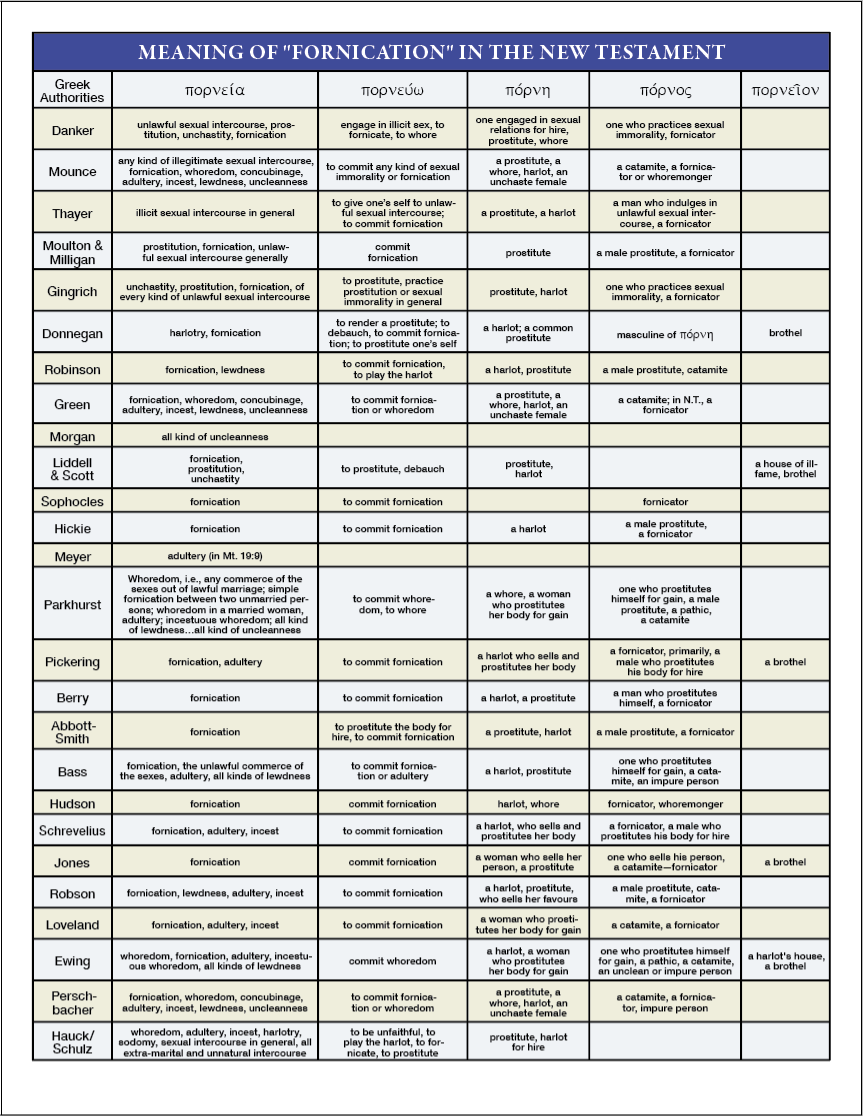
Three Observations
Three important observations are in order. First, when the lexicographers note that porneia is fornication “of every kind,” “in general,” or “a class of crimes,” they are not referring to various types of sexual activity like touching, caressing, or kissing. Rather, they are referring to multiple forms or types of sexual intercourse, including homosexuality, bestiality, and adultery. “Fornication,” therefore, is a generic or “umbrella” term that encompasses different forms of sexual intercourse. See Figure 1, which illustrates the connection between the broad term “fornication” and more narrow terms that identify specific forms of fornication.
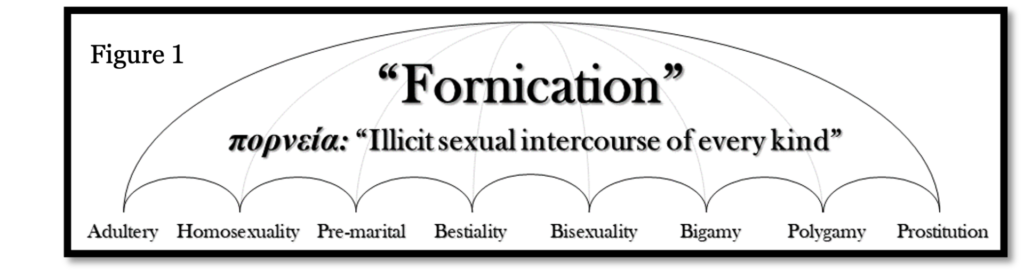
Notice, then, that “adultery” is simply a more narrow term than “fornication.”10 All adultery is fornication, but not all fornication is adultery. The eight terms listed in Figure 1 share in common the fact that each one involves actual sexual intercourse.
A second observation concerns the lexicographers’ use of terms to define porneia that are either archaic, or with the passing of time, have changed meaning. By examining older dictionaries that clarify the meanings of those English words, we can see that they further verify the intended meaning of porneia. Noah Webster’s 1848 An American Dictionary of the English Language defined “lewd” as “addicted to fornication or adultery” and “harlotry” is defined as “the trade or practice of prostitution; habitual or customary lewdness.”11 To act as a “whore” is “to have unlawful sexual commerce; to practice lewdness,” “to corrupt by lewd intercourse,” and “whoredom” is defined as “lewdness; fornication.”12 A “brothel” is “a house of lewdness; a house appropriated to the purposes of prostitution.”13 To “fornicate” is “to commit lewdness,” “fornication” is defined as “the incontinence or lewdness of unmarried persons, male or female; also, the criminal conversation of a married man with an unmarried woman” as well as “adultery” and “incest,” and a “fornicator” is “a lewd person.”14 “Unchaste” is defined as “not continent; not pure; libidinous; lewd.”15 “Continency” is defined as “the restraint of the passion for sexual enjoyment; resistance of concupiscence, forbearance of lewd pleasures; hence, chastity.”16 The underlying Greek term in Romans 13:13 rendered in various English translations as “lewdness” (NKJV), “chambering” (KJV), “sleeping around” (CEB), “beds” (DLNT), “sexual promiscuity” (MOUNCE), “debauchery” (RSV), and “sexual immorality” (ESV) is koitais from koitai, referring to the conjugal bed, and is defined as “sexual intercourse, whoredom.”17
A third observation concerns the claim by some that “fornication” refers exclusively to sexual activity between unmarried persons. It is certainly true that over time, words take on different meanings than they once conveyed. But, as we have seen, the meaning of the Greek term rendered “fornication” is decisive in its import. Even without that linguistic information, the English reader can know that the allegation is incorrect. Several passages make this fact plain. For example, the man in the Corinthian church who married his father’s wife was guilty of porneia (1 Corinthians 5:1). Likewise, John the baptizer condemned the incestuous (porneia) marriage of Herod the Tetrarch to his brother’s wife (Mark 6:17). According to Jude 7, the men of Sodom were guilty of porneia. As we have seen, homosexuality is one form of porneia. The Israelites committed porneia (ekporneusai—LXX) with the Moabite women, some of whom were undoubtedly married since they were leaders of the people (Numbers 25:1,4; 1 Corinthians 10:8). What’s more, it is evident from Matthew 5:32 and 19:9 that married people can commit porneia. To summarize, Figure 2 illustrates the broad application of the word “fornication” in Scripture.

Conclusion
The host of Greek authorities verify the fact that the Bible uses the term porneia to refer to physical sexual intercourse. Various derivatives of the word only further confirm this fact.
The older lexicons occasionally use English terms that today may not convey this singularly precise meaning. But by consulting both the drift of the context in which the terms are used as well as the English dictionaries that were contemporaneous with those Greek sources, one can conclude that those terms were intended as synonyms for physical sexual intercourse.
These synonymous terms include: “lewdness,” “unchastity,” “debauchery,” “whoredom,” “uncleanness,” “impurity,” “commerce,” “incontinence,” and “sexual immorality.”
While sinful in their own right, neither the viewing of pornography nor those sinful actions that precede sexual intercourse—which are embodied in such Bible terms as “lust” and “lasciviousness”—fall within the purview of the meaning of “fornication” in the New Testament.
Endnotes
1 Some scholars have challenged the textual legitimacy of the “exceptive” clause in this verse, but the point is moot since the clause occurs also in Matthew 5:32 where its textual legitimacy is firm. See Bruce Metzger (1994), A Textual Commentary on the Greek New Testament (New York, NY: United Bible Society, second edition), p. 38.
2 CSB, CJB, DLNT, EHV, ESV, EXB, HCSB, ISV, LEB, MEV, MOUNCE, NASB, NIV, NKJV, TLV, WEB. The CEB has the equivalent expression “sexual unfaithfulness.” The CEV has “some terrible sexual sin.” The ERV has “the problem of sexual sin.” The EXB and NCV have “his wife has sexual relations with another man.” The ICB has “his first wife has been unfaithful to him.” The NLV has “sex sins.” The RGT has “promiscuity.”
3 ASV, BRG, DARBY, DRA, JUB, KJV, TLB, MNB, OJB, WYC.
4 AMPC, NRSV, RSV.
5 GNV, YLT.
6 GW, GNT, PHILLIPS, NOG.
7 NASB1995, NET, NTE, TPT.
8 MSG, VOICE, WE.
9 Frederick Danker (2000), A Greek-English Lexicon of the New Testament and Other Early Christian Literature (Chicago, IL: University of Chicago), third edition, pp. 854-855; William Mounce (2006), Complete Expository Dictionary of Old and New Testament Words (Grand Rapids, MI: Zondervan), pp. 126,268,638-639,1251; Joseph Thayer (1901), A Greek-English Lexicon of the New Testament (New York: American Book Company), p. 532; James Moulton and George Milligan (1930), Vocabulary of the Greek New Testament Illustrated from the Papyri and Other Non-literary Sources (Grand Rapids, MI: Eerdmans, 1982 reprint), p. 529; F. Wilbur Gingrich (1965), Shorter Lexicon of the Greek New Testament (Chicago, IL: The University of Chicago Press), p. 180; James Donnegan (1836), A New Greek and English Lexicon (Boston, MA: Hilliard, Gray, & Co.), p. 1031; Edward Robinson (1836), A Greek and English Lexicon of the New Testament (Boston, MA: Crocker & Brewster), pp. 690-691; Thomas Green (1896), A Greek-English Lexicon to the New Testament (Boston, MA: H.L. Hastings), p. 152; Henry Liddell and Robert Scott (1901), A Greek-English Lexicon (Oxford: Clarendon Press), p. 1256; E.A. Sophocles (1914), Greek Lexicon of the Roman & Byzantine Periods (Cambridge, MA: Harvard University Press), p. 911; W.J. Hickie (1977 reprint), Greek-English Lexicon to the New Testament (Grand Rapids, MI: Baker), p. 157; Heinrich Meyer (1881), Critical & Exegetical Handbook to the Gospel of Matthew (Edinburgh: T.&T. Clark), 2:26; John Parkhurst (1804), Greek and English Lexicon to the New Testament (London: G.&J. Robinson), pp. 554-555; John Pickering (1832), A Greek and English Lexicon (Boston, MA: Hilliard, Gray, Little, & Wilkins), p. 741; Hector Morgan (1826), The Doctrine and Law of Marriage, Adultery, and Divorce (Oxford: J. Parker), 2:398; George Berry (1897), A New Greek-English Lexicon to the New Testament (New York: Hinds & Noble), p. 82; G. Abbott-Smith (1922), Manual Greek Lexicon of the New Testament (New York: Charles Scribner’s Sons), pp. 373-374; J.H. Bass (1844), A Greek & English Manual Lexicon to the New Testament (London: I.J. Chidley), p. 185; Charles Hudson (1892), A Critical Greek & English Concordance of the New Testament (London: Samuel Bagster & Sons), p 339; Cornelius Schrevelius (1826), The Greek Lexicon of Schrevelius (Boston, MA: Cummings, Hilliard, & Co.), p. 692; John Jones (1825), The Tyro’s Greek & English Lexicon (London: Longman, et al.), p. 1040; Charles Robson (1839), A Greek Lexicon to the New Testament (London: Whittaker & Co.), p. 387; Samuel Loveland (1828), A Greek Lexicon Adapted to the New Testament (Woodstock, VT: David Watson), p. 259; Greville Ewing (1827), A Greek & English Lexicon (Glasgow: James Duncan), pp. 714-715; Wesley J. Perschbacher, ed. (1990), The New Analytical Greek Lexicon (Peabody, MA: Hendrickson), p. 340; Friedrich Hauck and Siegfried Schulz (1982 reprint), “pornai, pornos, porneia, porneuo, ekporneuo” in Theological Dictionary of the New Testament, ed. Gerhard Friedrich (Grand Rapids, MI: Eerdmans), 6:579-595.
10 Hauck and Schulz agree: “moicheuo is narrower than porneia and refers solely to adultery” (6:581).
11 Noah Webster (1848), An American Dictionary of the English Language (New York: Harper & Brothers), pp. 593, 478.
12 Ibid., pp. 1136-1137.
13 Ibid., p. 129.
14 Ibid., p. 424.
15 Ibid., p. 1067.
16 Ibid., p. 222.
17 Thayer, p. 352; Samuel Bagster (no date), The Analytical Greek Lexicon (London: Samuel Bagster & Sons), p. 227.
The post “Fornication” (Porneia) Defined in New Testament Greek Lexicons appeared first on Apologetics Press.
]]>The post Titus 3:5 and the Washing of Regeneration appeared first on Apologetics Press.
]]>The Central Features of Salvation
Observe carefully how Titus 3:3-8 pinpoints four central features of redemption. First, we humans have been thoroughly and completely lost in sin due to our own actions (i.e., “foolish, disobedient, etc.”—vs. 3). Second, it took a kind and loving God to manifest Himself as our Savior (vs. 4). This divine initiative that was intended to save us was a clear manifestation of His mercy (vs. 5), and grace (vs. 7), and it was accomplished via Jesus Christ (vs. 6). Third, our salvation could not be achieved by human goodness or our own “works of righteousness,” i.e., works or actions that we enact in order to atone for our sin, save ourselves, and bring about our own justification/righteousness (vs. 5).2 Fourth, on the contrary, God made our salvation possible via “the washing of regeneration and renewing of the Holy Spirit” (vs. 5). A careful examination of each of these factors, together with awareness of the underlying language selected by the Holy Spirit, will clarify succinctly the role and function played by water baptism in the divine scheme of redemption. Consider the chart below.

To summarize, according to this context, Who saved us? It was “God our Savior,” “the Holy Spirit,” and “Jesus Christ our Savior.” What did they make available to us? We could be “saved,” “justified,” and have “the hope of eternal life.” Where was this salvation made possible? In and through Jesus Christ our Savior—a reference to His unique role in the scheme of redemption by His death on the cross. Why would they desire to save us? It was due to their “kindness,” “love,” “mercy,” and “grace.” When was the moment in time that God bestowed these blessings and saved us? It was at the moment of “the washing of regeneration and renewing of the Holy Spirit.”
“Washing of Regeneration” and “Renewal of the Holy Spirit”?
So the question is—to what do these two expressions refer? Baptist grammarian Robertson conceded that the “washing of regeneration” refers to water baptism.3 The vast majority of commentators, theologians, and grammarians through the centuries have agreed. Look carefully at the syntax selected by the Holy Spirit. In verse 5, dia with the genitive is used, meaning “through.” Why would “regeneration,” i.e., being cleansed of sin in order to be saved, be coupled with the term “washing”? loutrovn (loutron) refers to a bath, washing, or ablution and is used only twice in the New Testament—here and in Ephesians 5:26 where spiritual cleansing is also in view. The verb form louvw (louo) is used five times in the New Testament,4 with its use in Hebrews 10:22 paralleling Titus 3:5 and Ephesians 5:26. A related word, a)polouvw (apolouo), used only twice in the New Testament, refers in both instances to cleansing of sin at the point of conversion (1 Corinthians 6:11; Acts 22:16).5
The Bible is its own best interpreter. Since the Holy Spirit is the Author of the entire Bible, He would naturally repeat and paraphrase Himself. A careful comparison of the Titus and Ephesians verses, along with John 3:5 and 1 Corinthians 12:13, enables the reader to clarify the precise meaning of the phrase “the washing of regeneration.” The following chart illustrates this comparison:

The “washing of regeneration” of Titus corresponds with “washing of water” in Ephesians, “baptized” in 1 Corinthians, and “water” in John 3.
Observe further that the term paliggenesiva$ (paliggenesias—“regeneration”) is a compound word composed of the two Greek words pavlin (palin—“again”) and gevnesi$ (genesis—“birth”).6 One cannot help but recall the conversation between Jesus and Nicodemus pertaining to a second birth—which entailed “water” (John 3:3-7). Further, in both cases, the Holy Spirit acted as the divine agent by which the plan of salvation was communicated. He conveys the message of salvation and terms of entrance into the kingdom via human spokesmen (“earthen vessels”—2 Corinthians 4:7). Hence, “renewal of the Holy Spirit” is achieved when an individual conforms to the specifications given by the Spirit in the Gospel, i.e., he hears the message and believes it (Romans 10:17), repents of his sins (Acts 3:19), confesses Christ with his mouth (Romans 10:9-10), and is immersed in water for the remission of sins (Acts 2:38). A person is “renewed” by the Spirit when he obeys the instructions of the Spirit to undergo the “washing of regeneration,” i.e., baptism.
One final observation regarding this verse. Follow the logic: If we are not saved by “works of righteousness which we have done,” but we are saved by the “washing of regeneration,” then it follows that the “washing of regeneration” cannot be classified as a “work of righteousness.” Hence, baptism is not a “work” or “deed” in the same sense that Paul uses those terms in passages like Romans 3:28 (“justified by faith apart from the deeds of the law”) and Ephesians 2:9 (“not of works, lest anyone should boast”). Commenting on these two verses, McGarvey insightfully noted:
But by works of law in this place Paul means such acts of obedience to law as would justify a man on the ground of innocence, and make him independent of the grace manifested in pardon…. Now baptism is certainly an act of faith, deriving its propriety from a positive command; and not a work of law in the sense attached to that expression by Paul; consequently, it may be required of a believer to be baptized before he is forgiven, and yet justification may be apart from “works of law”…. [T]he works excluded from the ground of salvation are works of perfect obedience, by which, if any man had wrought them, he would be saved on the ground of merit. This would exclude grace. But remission of sins is in its very nature a grace bestowed, and not a debt paid; and whether it is bestowed on certain conditions or on no condition, it remains a matter of grace. Only in case the works done are of such a nature that the person doing them deserves salvation, can grace be excluded; and in that case there would be no remission, because there would be no sins to be remitted. So, then, if God has seen fit to require the believer to be baptized before he forgives him, forgiveness is none the less a matter of grace than if he made no such requirement.7
Baptism is necessary to and precedes salvation. It is not to be considered a “work of righteousness” that is excluded from God’s bestowal of salvation.
Endnotes
1 For a discussion of this verse, see Eric Lyons (2020), “Ephesians 2:8-9: Contradictory, or Perfectly Consistent?” Reason & Revelation, 40[10]:110-113,116-119.
2 It is a misinterpretation of Scripture to assume that, since humans do not have it within their capability to achieve their own salvation, then no action on their part is required by God. The Bible repeatedly indicates that humans are required to perform “righteous acts,” i.e., actions that God, Himself, stipulates as prerequisite to His bestowal of blessing. When Peter sought to convince the Gentiles that they, too, were acceptable recipients of salvation and entrance into the kingdom, he contrasted their ethnicity, which was irrelevant to their salvation, with their obedience, which was relevant and essential. He styled this indispensable prerequisite to salvation: “whoever fears Him and works righteousness is accepted by Him” (Acts 10:35). Obviously, Peter did not believe that anyone can merit or earn their salvation. Nevertheless, he indicated that certain “acts of righteousness” performed by humans are necessary to salvation. This is no doubt the sense intended by him on the day of Pentecost when he declared: “Save yourselves from this crooked generation” (Acts 2:40, ASV, ESV, NRSV, NIV, et al.). Observe, however, that these righteous acts are stipulated by God—not man. For a man to do what God tells him to do in no way implies that the individual is somehow achieving his own salvation or that he is being saved by “works” rather than by “grace.” Cf. 1 John 3:7,10. The righteous acts that God requires humans to do before He will impart His gracious, undeserved forgiveness based on the blood of Christ are faith, repentance, oral confession of Jesus’ deity, and baptism. See John 6:29 where Jesus stated that believing is a “work” that God requires man to perform (cf. Galatians 5:6; Philippians 2:12; 1 Thessalonians 1:3; James 2:22). See Danker—“the deeds that God desires” [Frederick Danker (2000), Greek-English Lexicon of the New Testament (Chicago, IL: University of Chicago Press), p. 390] and Thayer—“the works required and approved by God” [Joseph Thayer (1977 reprint), A Greek-English Lexicon of the New Testament (Grand Rapids, MI: Baker), p. 248]. Likewise, repentance entails “works befitting repentance” (Acts 26:20). See also the expression “obedience of faith” in Romans 1:5 and 16:26 which refers to the obedient compliance that characterizes and defines the kind of faith set forth in the book. If faith, repentance, and oral confession with the mouth (Romans 10:9-10) all constitute physical and mental actions/works that an individual must perform before he can be saved, why would anyone balk at baptism as a prerequisite to salvation—a passive act that is done to the person by the baptizer? The reason man cannot save himself by his own actions is due to his having sinned. One sin necessitates that salvation be achieved on some basis other than man’s own goodness/conduct. All his good works and obedience cannot nullify the one sin he committed. Hence, God must “step in” and orchestrate the means of forgiveness, which He did in the sending of His Son. That act is the grace of the Bible. God must then, likewise, communicate to man precisely how he may take advantage of that forgiveness, i.e., what man must do in order for God to apply the cleansing benefits of Christ’s blood to man’s sin. Faith, repentance, oral confession, and immersion in water constitute the prerequisites that God stipulates as necessary in order for Him to forgive sin as His free gift and gracious mercy.
3 A.T. Robertson (1931), Word Pictures in the New Testament (Nashville, TN: Broadman), 4:607.
4 It refers to washing feet in John 13:10, washing a dead body in Acts 9:37, washing backs that had been beaten in Acts 16:33, and the washing of a pig in 2 Peter 2:22. Its occurrence in Revelation 1:5 in the Textus Receptus is a textual variant.
5 These word counts are taken from W.F. Moulton and A.S. Geden (1978), A Concordance to the Greek Testament (Edinburgh: T.&T. Clark), pp. 97,606.
6 Wesley Perschbacher, ed. (1990), The New Analytical Greek Lexicon (Peabody, MA: Hendrickson), p. 303; Thayer, p. 474. Thayer even uses the words “new birth” to define the term, along with “renewal, re-creation” and adds “the production of a new life consecrated to God, a radical change of mind for the better, (effected in baptism)” and cites Titus 3:5. Danker, also, cites Titus 3:5 as an instance where the term means “experience of a complete change of life, rebirth” (p. 752, italics in orig.).
7 J.W. McGarvey (1892), New Commentary on Acts of Apostles (Cincinnati, OH: Standard), pp. 247-248, emp. added.
Baptism and the Greek Made Simple
The post Titus 3:5 and the Washing of Regeneration appeared first on Apologetics Press.
]]>The post Total Depravity? appeared first on Apologetics Press.
]]>Contrary to such thinking, the New Testament plainly disputes the notion of Total Depravity. In the first place, Paul clarified the onset of sin in every human being. Using himself as a prototype, he explained:
…I would not have known sin except through the law. For I would not have known covetousness unless the law had said, “You shall not covet.” But sin, taking opportunity by the commandment, produced in me all manner of evil desire. For apart from the law sin was dead. I was alive once without the law, but when the commandment came, sin revived and I died. And the commandment, which was to bring life, I found to bring death. For sin, taking occasion by the commandment, deceived me, and by it killed me (Romans 7:7-11).
Paul remained uncondemned and unspotted by sin while in the womb and thereafter following his birth. He recognized that he was not guilty before God prior to the point at which he could understand God’s commandments and realize his amenability to keep them. Prior to that point, he was too spiritually immature to be responsible for his actions.
The term rendered “revived”1 does not mean that sin existed previously and then reasserted itself. Taking “revived” in that sense would mean that Paul had a period in between that was sinless—which does not support the notion of Total Depravity. When would that have been?
Instead, Paul was saying that, prior to his coming to a realization of his sin and the application of God’s law to his life, he was not amenable to God’s law and, therefore, not counted sinful by God: “for where there is no law there is no transgression” (Romans 4:15). Practically speaking, for children there is no law—except the law of their parents. Though children may violate God’s law, e.g., lie to their parents, God’s laws do not apply to children until they reach an age of accountability.2 At that point, children reach a level of spiritual maturity and become responsible before God for their behavior.
These observations lead us to draw this conclusion: the very idea that our spirits, in the womb and in post-birth infancy, are stained with sin is an indictment of God’s justice, impartiality, and infinite goodness. Yet, the following biblical affirmations contradict the notion of Total Depravity and exonerate God for such injustice:
- Solomon forthrightly declared that our spirits came from God Himself (Ecclesiastes 12:7).
- This bestowal occurred at conception: “Thus says the LORD, who stretches out the heavens, lays the foundation of the earth, and forms the spirit of man within him” (Zechariah 12:1; cf. Hosea 9:11; Luke 1:36).3
- When Paul addressed the Athenian philosophers on Mars Hill, he declared: “for in Him we live and move and have our being…. Therefore, since we are the offspring of God…” (Acts 17:28-29).
Conclusion: Since our spirits came directly from God at conception, making us the offspring of God, to suggest that the human spirit in the womb and at conception is stained with the guilt of Adam’s sin makes God guilty of creating depraved human beings. But the Calvinistic doctrine of Total Depravity is incorrect. All human beings begin life with a spirit from God that is pure and clean.
Endnotes
1 ἀνέζησεν from αναζάω can mean “to revive, in the sense of to become vigorous” and “Metaph. to live a better life”—Charles Robson (1839), A Greek Lexicon to the New Testament (London: Whittaker & Co.), pp. 25-26.
2 Dave Miller (2002), “The Age of Accountability,” https://apologeticspress.org/the-age-of-accountability-1202/.
3 For a discussion of the commencement of life, view this video: Dave Miller (2023), “When Does Human Life Begin?” https://apologeticspress.org/video/when-does-human-life-begin/.
The post Total Depravity? appeared first on Apologetics Press.
]]>The post Sexual Feelings Are Not the Standard of Morality appeared first on Apologetics Press.
]]>Though apparently quite uncommon, a coherent conversation about sexual conduct logically begins with whether we were created by a supreme, supernatural God or whether we evolved “naturally”7 from lower animals. If we are merely evolved animals, then we can reasonably “act like the animals we are”8 and do whatever we want. But, if humanity was created by the holy God of the Bible,9 and if we are going to be judged one day according to His holy will10 (Acts 17:30-31; 2 Corinthians 5:10), then absolute objective morality exists, and humanity should humbly and fully submit to God’s will and not our own—even when (yes, especially when) His will is difficult.11
Many are resistant to God’s will for their lives because they want to feel free to express themselves sexually—however and whenever they want. In Charles Bufe’s 2022 book titled 24 Reasons to Abandon Christianity, three reasons deal with sexual matters, including “Christianity’s morbid preoccupation with sex.”12 Bufe wrote: “Since its inception, Christianity has had an exceptionally unhealthy fixation on sex, to the exclusion of almost everything else…. This stems from the numerous ‘thou shalt nots’ relating to sex.”13 Bufe went on to list 1 Peter 2:11, Galatians 5:19, and Romans 8:6. Then, after quoting 1 Corinthians 7:1,14 Bufe wrote:
In addition to the misery produced by Christian intrusions into the sex lives of non-Christians, Christianity produces a great deal of misery among its own adherents through its insistence that sex, except the very narrow variety it sanctions, is evil, against God’s law. Christianity proscribes sex between unmarried people, sex outside of marriage,…homosexual relations, bestiality,…even “impure” thoughts.15
Though we would contend that waiting until marriage to have sexual relations and practicing monogamy throughout marriage is extremely enjoyable and rewarding, such an argument is not the point of this article. The thesis of this brief article is simply that if there is no God, then animal-like sexual desires can logically be fulfilled in any way a human being chooses. However, if an omniscient, omnipotent, eternal, loving, holy, and just Creator exists, and He has revealed His sovereign will about sexual matters to humanity,16 then objective standards (which, by definition, do not change with human opinions) exist, and humans are expected (by their Creator and Judge) to submit to them.
A person may sincerely feel “this way” or “that way,” but such feelings are not an objective moral compass. Objective morality transcends the whims of countries and cultures, as well as public and private opinions, whether in this century or in some other. By definition, objective truth cannot be changed by anyone’s “personal feelings, prejudices, and interpretations.”17
Feelings, Freedom, and Human Folly
From as far back as I can remember, I have craved sugar, milk chocolate, and all manner of sweet carbohydrates. I would love to eat a dozen Krispy Kreme® doughnuts every day (especially if the alternative is broccoli, cauliflower, and Brussels sprouts). At any given moment (and especially at meal times), I much prefer immediate and unrestrained gratification over self-control. Yet, continual self-indulgence often leads to serious, long-term physical problems. Thus, I frequently find myself not eating nearly as much as I desire (and I’m still several pounds overweight!).
Children may crave revenge for some perceived (or real) wrong committed against them, but good parents do not allow their children’s retaliatory feelings and actions to run rampant. People of all ages can feel irritable and angry about all manner of things, but that doesn’t mean that God “made them that way” or that He condones continual, childlike, ill-tempered thinking and behavior. Humans from a young age may covet money and material things, and people can choose to act upon such covetous thinking by stealing from others. Yet, such feelings and use of one’s freedom do not prove that such thoughts and actions “came from God” or are morally acceptable to the Moral Law Giver.18
Similarly, humans are sexual beings with the ability to have sexual feelings and engage in sexual acts. A study of secular and biblical history reveals that people have had all manner of sexual thoughts (and fantasies), many of which have been acted out. Should children be allowed to act upon their sexual desires whenever and however they want? Is there any objective moral code that governs whether children must obey their parents’ wishes, including about sex? Do parents have any real, objective moral right to tell their 11-year-olds or 15-year-olds what they can and can’t do sexually? Are parents cruel if they forbid their children from looking at pornography? Are they unkind for prohibiting their children from having sex? If God does not exist, and objective morality is a mere fantasy, then how can parents “rightly” forbid any sexual actions that their pre-teen or teenage children desire?
If God does not exist, pornography is not a problem, fornication is not wrong, and sexual activity with the same sex is not sinful.
- If there is no God, a married man who longs and lusts for women in addition to (or to the exclusion of) his wife has every right to follow through with his desires if he so chooses. (If not, why not?)
- What if a young woman’s husband is in a terrible car accident that left him paralyzed from below the neck? Surely the wife can rightly find sexual gratification with one or more other individuals? And if she chooses to leave her quadriplegic husband permanently for a man who could fulfill all of her sexual desires, who could say that such an action would be wrong?
- And what about men and women who want more than one spouse? Who says that monogamy should be the standard while polygamy and group marriages are unacceptable?
The list of sexual scenarios could go on and on. And, the list of opinions regarding what should be acceptable and what should not be is extremely diverse and completely subjective, if…there…is…no…God.
A Person’s Objective Purpose
Many seem unaware of the biblical teaching regarding one’s purpose in life. Our purpose is not to chase physical pleasures like animals. Such impulsive pursuits are only “right” if atheism is true. As Charles Darwin wrote in his autobiography: “A man who has no assured and ever present belief in the existence of a personal God or of a future existence with retribution and reward, can have for his rule of life, as far as I can see, only to follow those impulses and instincts which are the strongest or which seem to him the best ones.”19
People tend to look for purpose in hobbies, education, employment, politics, riches, vacations, or conservation. Many seem to have as their life goal to escape old age and death. Still, more seem to have their purpose in life all wrapped up in their sexual feelings and actions with no objective moral law to guide them.
Although God created the beautiful institution of marriage between one man and one woman, the purpose of life is not to get married. Our purpose is not to have sex—whether one time or 10,000 times. Jesus, the only perfect human being Who ever lived (2 Corinthians 5:21; Hebrews 4:15), never got married and thus never had sexual relations. What’s more, the man who wrote nearly half of the New Testament books (the apostle Paul) was not married (1 Corinthians 7:8).
King Solomon foolishly and sinfully accumulated 700 wives and 300 concubines (1 Kings 11:3), yet not one of them could provide him with real, objective meaning in his life. Even though he “had everything” and “experienced it all,”20 Solomon repeatedly stressed the meaninglessness of life “under the sun” (Ecclesiastes 1:9). That is, from a purely naturalistic, earthly perspective where one is searching for abiding happiness in the physical realm, “all is vanity and grasping for the wind” (1:14).
So what is our real, objective purpose in life? Truly, it is all about God. Our purpose is to “know” Him (Philippians 3:10), “trust” Him (Proverbs 3:5-6; John 3:16), “love” Him (Matthew 22:37-39), “follow” Him (Mark 8:34), “fear” Him (Ecclesiastes 12:13-14), “obey” Him (John 14:15; 1 John 5:3), “serve” Him (1 Thessalonians 1:9), and “praise” Him (1 Peter 1:7). We are here to “glorify” Him (1 Corinthians 6:20).
Flee Sexual Immorality
Just prior to the apostle Paul’s exhortation to the Christians in the sinfully sex-crazed city of Corinth21 to “glorify God in your body,” he commanded them to “[f]lee sexual immorality” (1 Corinthians 6:18-20). Some of the Corinthian Christians had already left behind various forms of sexual immorality (e.g., fornication, adultery, and homosexuality—1 Corinthians 6:9-11), while others were in need of repentance (e.g., the man who had his father’s wife—5:1). In order to fulfill our beautifully profound and primary purpose in life (to glorify God and not ourselves), we must be willing (among other things) to leave all forms of sexual immorality behind.
Similar to how Jesus is the one way to eternal life (John 14:6), God created one beautifully approved way to have sexual relations. At the end of the Creation, after God made Adam and Eve, “God saw everything that He had made, and indeed it was very good” (Genesis 1:31). What’s more, it was good for the first married couple to be together sexually. In fact, God instructed Adam and Eve to “be fruitful and multiply” (1:28). The Bible not only extols sexual relations for reproductive purposes, but God also created a man and a woman with the physical ability to have an enjoyable sexual relationship. The Old Testament book Song of Solomon celebratesthe sexual relationship between a man and a woman. It begins by speaking of the pleasures of kissing (1:2) and proceeds to tell of the enjoyment that two intimate lovers have together. Truly, a scriptural, sexual relationship between a husband and a wife is a good, lovely, and beautiful thing to be enjoyed throughout marriage, if possible. When an eligible man and an eligible woman join together in the bonds of holy matrimony, it is “honorable” and “the bed undefiled” (Hebrews 13:4). The apostle Paul wrote: “Let the husband render to his wife the affection due her, and likewise also the wife to her husband” (1 Corinthians 7:3).
Indeed, “Marriage is honorable among all, and the bed undefiled; but fornicators and adulterers God will judge” (Hebrews 13:4). Whether people like it or not, whether people evercome to understand God’s thoughts that underlie His laws on sexual matters (cf. Deuteronomy 29:29; Isaiah 55:8-9), the fact is, the Creator of humanity has repeatedly communicated in the last will and testament of Jesus Christ that sexual desires and actions are to be limited to the marriage bed between a lawful husband and wife (Matthew 19:1-9). Paul wrote:
For this is the will of God, your sanctification: that you should abstain from sexual immorality; that each of you should know how to possess his own vessel in sanctification and honor, not in passion of lust, like the Gentiles who do not know God…. For God did not call us to uncleanness, but in holiness. Therefore he who rejects this does not reject man, but God, who has also given us His Holy Spirit (1 Thessalonians 4:3-8).
Conclusion
If there is no God, then there are no objective standards of any kind for sexual relations (or anything else). We are free to allow our animal-like instincts and passions to run rampant in thought and deed without restraint. But, if God exists and the Bible is His Word, we are subject to a strict sexual moral code.
As immortal beings who are only in this physical world for a short time, we are to “abstain from fleshly lusts which war against the soul” and, instead, “pursue [the] righteousness” of God (1 Peter 2:11; 2 Timothy 2:22). We are to put away such things as lewdness, lusts, and all forms of sexual activity outside of a God-approved marriage (Galatians 5:19-21; 1 Corinthians 6:9-11; Romans 1:18-32).
The world, who knows neither God nor His Will, will “think it strange that you do not run with them in the same flood of dissipation, speaking evil of you.” But, the sobering truth is, “[t]hey will give an account to Him who is ready to judge the living and the dead” (1 Peter 4:3-5).
May God help Christians to sincerely follow the pure Prince of Peace and keep ourselves “unspotted from the world” (James 1:27). And, may we simultaneously let God’s light shine through us that we might help precious, misguided souls to give up any and all forms of sexual immorality and submit to the Savior’s will for their lives (Matthew 5:16; 1 Peter 2:11-12).
Endnotes
1 “Morality” (2024), Merriam-Webster, https://www.merriam-webster.com/dictionary/morality.
2 “Moral” (2024), Merriam-Webster, https://www.merriam-webster.com/dictionary/moral.
3 Outside of mere human opinion.
4 Jean-Paul Sartre (1989), “Existentialism is Humanism,” in Existentialism from Dostoyevsky to Sartre, ed. Walter Kaufman, trans. Philip Mairet (Meridian Publishing Company), http://www.marxists.org/reference/archive/sartre/works/exist/sartre.htm, bracketed item added.
5 Ibid.
6 William Provine (1988), “Scientists, Face It! Science and Religion are Incompatible,” The Scientist, 2[16]:10, September 5, http://classic.the-scientist.com/article/display/8667/.
7 In reality, there is nothing “natural” about life coming from non-life nor life evolving into totally different kinds of life (e.g., birds evolving into reptiles or reptiles evolving into mammals, etc.). Evolution’s tree of life defies the scientific Law of Biogenesis and is based upon blind faith.
8 Jo Marchant (2008), “We Should Act Like the Animals We Are,” New Scientist, 200[2678]:44-45, October 18-24.
9 Visit apologeticspress.org for a voluminous amount of evidence for the God of the Bible in article, book, and video formats.
10 The New Testament (Ephesians 2:11-16; Romans 7:4; Hebrews 8-10).
11 “Submitting” to God’s Will only when things are easy is not genuine submission, but “acting”—going through the motions of “submission” because it’s easy, convenient, socially acceptable, etc. True, trusting obedience to God is most often revealed during difficult times.
12 Charles Bufe (2022), 24 Reasons to Abandon Christianity (Tucson, AZ: See Sharp Press), ebook pp. 10-11.
13 Ibid., p. 169.
14 Regarding Paul’s statement to the Corinthians that for the unmarried man, “It is good for a man not to have sexual relations with a woman” (ESV).
15 Bufe, p. 182.
16 In the Bible, which we contend the evidence indicates is from a Supernatural Source. See Kyle Butt (2022), Is the Bible God’s Word (Montgomery, AL: Apologetics Press). See also Dave Miller (2020), The Bible Is From God: A Sampling of Proofs (Montgomery, AL: Apologetics Press) and “The Inspiration of the Bible” section of www.apologeticspress.org.
17 “Objective” (2024), Merriam-Webster, https://www.merriam-webster.com/dictionary/objective.
18 Or that the Moral Law Giver is a “Moral Monster” for condemning covetousness and theft.
19 Charles Darwin (1958), The Autobiography of Charles Darwin, ed. Nora Barlow (New York: W.W. Norton), p. 94, emp. added.
20 Read Ecclesiastes 1:16 and 2:1-10.
21 The inhabitants of Corinth were so sexually immoral that the verb korinthiazo (“to Corinthianize” or “act like Corinthians”) meant to commit sexual immorality. See Henry Foster (1974), The Preacher’s Complete Homiletic Commentary on the Epistles of St. Paul the Apostle to the Corinthians (Grand Rapids, MI: Baker), pp. 6-7.
The post Sexual Feelings Are Not the Standard of Morality appeared first on Apologetics Press.
]]>The post Why Did Jesus Have to Die? appeared first on Apologetics Press.
]]>If God is all-loving and all-powerful, then why did Jesus have to die in order for God to forgive sins?
A:
The Bible reveals that God is all-loving and all-powerful, but He is not only all-loving and all-powerful. That is, God is not a mere one- or two-sided Being. God is perfect in all of His attributes, including His holiness. God is 100% pure and holy. He is holy in the absolute sense. “[T]he Lord is upright;… there is no unrighteousness in Him” (Psalm 92:15). “God is light and in Him is no darkness at all” (1 John 1:5). The psalmist proclaimed of God: “No evil dwells with You” (5:4, NASB). Not one smidgen of sin can dwell in God or with God because even an iota of evil is against His innately pure and holy nature. Indeed, the “Lord God Almighty” is “[h]oly, holy, holy” (Revelation 4:8; Isaiah 6:3).1
In addition to God’s perfectly holy nature is His infinitely just nature. God’s “work is perfect; for all His ways are justice, a God of truth and without injustice; righteous and upright is He” (Deuteronomy 32:4). The psalmist declared to God: “Righteousness and justice are the foundation of Your throne” (89:14). Unlike earthly judges who often falter in the administration of justice, God “shows no partiality nor takes a bribe” (Deuteronomy 10:17). A corrupt judge allows the guilty to go unpunished, while a just judge pronounces righteous judgment upon lawbreakers (cf. Colossians 3:25).
God’s perfect holiness makes fellowship with wickedness literally impossible. God’s perfect justice requires punishment for any evil doing. Sin is so atrocious to God that the penalty for violating His law is death—an eternal separation from Him (Romans 6:23; 1 John 3:4). Every accountable human being at some point sins against God (Romans 3:10,23). We sin and thus separate ourselves from our holy Creator. We find ourselves (of our own doing) “dead in trespasses and sins” (Ephesians 2:1). We are lost in sin, “having no hope and without God” (Ephesians 2:12). And, as sinners, we have no power to save ourselves. There is nothing we can do. There is no plan that we could devise to escape the punishment from a perfectly holy and just God. A price must be paid for sin.
THIS is why Jesus came to Earth. He did not have to; He chose to. He came to satisfy God’s own (His own) perfect holiness and justice. “Christ died for our sins” (1 Corinthians 15:3). He willingly chose to pay the ultimate price for our sins, demonstrating that God is not only holy and just; He is love (1 John 4:8)! And, “[g]reater love has no one than this, than to lay down one’s life for his friends” (John 15:13).
God’s perfect love compelled Jesus to take our punishment upon Himself. “God, who is rich in mercy, because of His great love with which He loved us, even when we were dead in trespasses, made us alive together with Christ (by grace you have been saved)…. [I]n Christ Jesus you who once were far off have been brought near by the blood of Christ” (Ephesians 2:4-5,13). “For God so loved the world that He gave His only begotten Son, that whoever believes in Him should not perish but have everlasting life” (John 3:16).
God’s perfect holiness and justice demand that “the wages of sin is death” (Romans 6:23). But thanks be to God, that is not the end of the story! (At least it does not have to be.) What does the rest of Romans 6:23 say? “[B]ut the gift of God is eternal life in Christ Jesus our Lord.” Yes, God is both “just” and “the justifier”2 of the souls of humanity through the one and only sinless answer to the sin problem—Jesus Christ (Hebrews 4:15), Whose sole purpose in coming to Earth was to save the souls of sinful humankind (Matthew 1:21; Luke 19:10).
The most illogical, heart-wrenching, and terrible thing that a lost-in-sin human being can do is spurn the invitation from our loving God to accept the free gift of eternal salvation through Jesus.3 On the other hand, the two greatest things we can do with the one physical life that we have is (1) accept and follow Jesus, Who is the “the way, the truth, and the life” (John 14:6); and (2) tell others about why our Savior came to Earth (Matthew 28:18-20; Acts 8:4; Romans 1:16).
Endnotes
1 God’s almighty (all-powerful) nature does not contradict His holiness since God’s omnipotence does not mean He can do anything and everything. Scripture is clear, for example, that God “cannot lie” (Titus 1:2; Hebrews 6:18). Thus, the Bible’s teaching on the omnipotence of God is that He can do anything (1) that is logically possible to be done (e.g., He cannot create a square circle), and (2) that is in harmony with His holy will. [For more information, see Dave Miller (2009), “Things God Cannot Do,” https://apologeticspress.org/things-god-cannot-do-1240/.]
2 Through a trusting, biblical faith in Jesus, God made us “just” (or “right”) in the eyes of a perfectly just God (Romans 3:26).
3 To learn more about receiving the gift of salvation and becoming a follower of Christ, see AP’s free booklet at https://apologeticspress.org/wp-content/uploads/2021/08/Receiving-the-Gift-of-Salvation.pdf.
Behold! The Lamb of God
The post Why Did Jesus Have to Die? appeared first on Apologetics Press.
]]>The post “Unless” One Is Born of Water? appeared first on Apologetics Press.
]]>Logicians, philosophers, and mathematicians define “if and only if” as a “biconditional logical connective between statements” and, therefore, a statement of material equivalence.1 So an “if and only if” statement indicates a necessary and sufficient condition. The logical force of Jesus’ use of “unless” is that I will enter the kingdom if and only if I am born of water and the Spirit. As an example, the statement “Unless the fruit is a banana, I cannot eat it” is logically equivalent to “I can eat fruit if and only if the fruit is a banana,” which is also logically equivalent to saying, “I can eat the fruit if the fruit is a banana, and I can eat no other fruit.”
Observe that in an exceptive clause, when a single condition is specified, it constitutes the one and only means by which the stated goal may be achieved. Respected Greek grammarian A.T. Robertson gives examples of this construction under his discussion of four classes of the conditional sentence.2 Consider the following 10 instances:
1. Matthew 26:42—“Again, a second time, He went away and prayed, saying, ‘O My Father, if this cup cannot pass away from Me unless I drink it, Your will be done.’”
Logical Force: The “cup” of crucifixion could be achieved if and only if Jesus “drank” it, i.e., endured it.
2. Mark 3:27—“No one can enter a strong man’s house and plunder his goods, unless he first binds the strong man. And then he will plunder his house.”
Logical Force: A strong man’s house can be entered and plundered if and only if the strong man is first bound.
3. Mark 4:22—“For there is nothing hidden which will not be revealed, nor has anything been kept secret but that it should come to light.”
Logical Force: Things were kept secret if and only if they would later be divulged.
4. John 3:27—“John answered and said, ‘A man can receive nothing unless it has been given to him from heaven.’”
Logical Force: A man can receive divine information from heaven if and only if God wills/allows it.
5. John 10:37—“If I do not do the works of My Father, do not believe Me.”
Logical Force: Believe Me if and only if I perform miraculous works of God.
6. John 15:6—“If anyone does not abide in Me, he is cast out as a branch and is withered; and they gather them and throw them into the fire, and they are burned.”
Logical Force: A person can avoid hell if and only if he abides in Christ.
7. John 16:7—“It is to your advantage that I go away; for if I do not go away, the Helper will not come to you; but if I depart, I will send Him to you.”
Logical Force: The Helper would come to the apostles if and only if Jesus went away.
8. 1 Corinthians 9:16—“For if I preach the gospel, I have nothing to boast of, for necessity is laid upon me; yes, woe is me if I do not preach the gospel!”
Logical Force: Paul could avoid woe if and only if he preached the Gospel.
9. 2 Timothy 2:5—“And also if anyone competes in athletics, he is not crowned unless he competes according to the rules.”
Logical Force: An athlete is crowned if and only if he competes according to the rules.
10. Revelation 2:22—“Indeed I will cast her into a sickbed, and those who commit adultery with her into great tribulation, unless they repent of their deeds.”
Logical Force: Jezebel could avoid a sickbed and tribulation if and only if she repented of her deeds.
Consider three additional biblical illustrations of this grammatical principle:3
Luke 10:6—“And if a son of peace is there, your peace will rest on it; if not, it will return to you.”
Logical Force: Your peace will return to you if and only if a son of peace is in the house.
Luke 13:9—“And if it bears fruit, well. But if not, after that you can cut it down.”
Logical Force: Cut it down if and only if it does not bear fruit.
Revelation 2:5—“Remember therefore from where you have fallen; repent and do the first works, or else I will come to you quickly and remove your lampstand from its place—unless you repent.”
Logical Force: The Ephesian Christians could avoid the removal of their lampstand if and only if they repented.
Observe that in each of these cases, the logical force of the underlying Greek is “if and only if.” Only on the sole grounds of the stated condition may the action be accomplished or avoided. Whatever other stipulations/prerequisites are given that may be equally essential (e.g., believe), nevertheless, the use of e)aVn mh\ demands that the condition stipulated by the exceptive clause be met.
John 3:5
The application of this grammatical principle to John 3:5 lies in the words selected by Jesus to clarify for Nicodemus the only way to achieve the new birth: “Jesus answered, ‘Most assuredly, I say to you, unless one is born of water and the Spirit, he cannot enter the kingdom of God.’” Jesus’ use of “unless” implies the following logically equivalent statements:
- All those born of water and Spirit may enter the kingdom.
- No persons not born of water and Spirit may enter the kingdom.
- All persons not born of water and Spirit are persons who may not enter the kingdom.
- No persons not born of water and Spirit may enter the kingdom.4
A person may enter the kingdom of God if and only if he is born of water and the Spirit. There are no other/additional ways by which one might enter the kingdom. Jesus’ use of the word “water” is an unmistakable reference to water baptism.5 Hence, a person may enter into the kingdom of God if and only if he is baptized in water. Consider the graphic below.

Notice that the logical force of “unless” necessitates that water immersion is the one and only entrance into the kingdom of Christ. Other alleged entrances into the kingdom—whether “faith only,” “accept Jesus as your Savior,” “the sinner’s prayer,” “just believe,” or predestination—are ineffectual. While faith, repentance, and oral confession all precede salvation,6 the “doorway” or entrance point into the kingdom is water baptism. Water baptism constitutes the actual threshold that enables the unforgiven individual to pass into the kingdom of Christ. Baptism is the “dividing line” between the world and the kingdom. No wonder Jesus proclaimed: “He who believes and is baptized will be saved” (Mark 16:16). No wonder Ananias announced to Paul: “Now why do you delay? Get up and be baptized, and wash away your sins, calling on His name” (Acts 22:16, NASB). No wonder Paul declared: “For by one Spirit we were all baptized into one body” (1 Corinthians 12:13). And no wonder Peter declared: “baptism now saves you…through the resurrection of Jesus Christ” (1 Peter 3:21, NASB).7
Endnotes
1 See, for example, university math professor Bruce Ikenaga’s discussion at: https://sites.millersville.edu/bikenaga/math-proof/logical-connectives/logical-connectives.html; also I.M. Copi, C. Cohen, D.E. Flage (2006), Essentials of Logic (Upper Saddle River, NJ: Pearson Education, second edition), p. 197; UHM university professor Tom Ramsey, “If and Only If,” https://www.math.hawaii.edu/~ramsey/Logic/Iff.html; Rudolf Carnap (1958), Introduction to Symbolic Logic and Its Applications (New York: Dover), p. 8; E. Mendelson (1997), Introduction to Mathematical Logic, 4th edition (London: Chapman & Hall), p. 14. See also Irving Copi (1972), Introduction to Logic (New York: Macmillan), p. 343—“exceptive propositions are most conveniently regarded as quantified biconditionals.”
2 A.T. Robertson (1934), A Grammar of the Greek New Testament in the Light of Historical Research (Nashville, TN: Broadman Press), pp. 1004ff.
3 F. Blass, A. Debrunner, and Robert Funk (1961), A Greek Grammar of the New Testament and Other Early Christian Literature (Chicago, IL: University of Chicago Press), p. 254.
4 For further discussion of the logical import of exceptive statements, see Lionel Ruby (1950), Logic: An Introduction (Chicago, IL: J.B. Lippincott), pp. 208,270; Virginia Klenk (1983), Understanding Symbolic Logic (Englewood Cliffs, NJ: Prentice Hall), pp. 350-353; Robert Sharvy (1977), Logic: An Outline (Totowa, NJ: Littlefield, Adams, & Co.), p. 38; Norman Geisler and Ronald Brooks (1990), Come, Let Us Reason (Grand Rapids, MI: Baker), p. 126; Robert Baum (1975), Logic (New York: Holt, Rinehart, & Winston), p. 55.
5 Some have suggested that “water” is being used figuratively to refer to the Holy Spirit. At least three contextual indicators suggest otherwise: (1) The word “water” is used again in the same context (18 verses later) with an obvious literal import: “Now John also was baptizing in Aenon near Salim, because there was much water there. And they came and were baptized” (John 3:23); (2) If “water” in John 3:5 refers to the Spirit, then the sentence becomes nonsensical: “unless one is born of the Spirit and the Spirit…”; (3) John alludes to a remark of Jesus in 7:38 in which “water” is used figuratively for the Holy Spirit’s impending role once the New Testament Era commenced—a role which Jesus elaborated on in chapters 13-17 which would pertain to the apostolic role in the establishment and spread of the Kingdom. Observe, however, that John had to provide an explanatory remark in order to clarify the fact. The New Testament consistently represents water immersion—literal H2O—as integral to God’s plan of salvation: Matthew 3:11,16; Mark 1:8,10; Luke 3:16; John 1:26,31,33; Acts 8:36,38,39; 10:47; Ephesians 5:26; 1 Peter 3:20-21. No wonder when it became evident to those assembled that Gentiles had the right to be saved and become Christians, Peter issued a rhetorical question: “Can anyone forbid water, that these should not be baptized…? And he commanded them to be baptized” (Acts 10:47-48).
6 e.g., Romans 10:17; Acts 2:38; Romans 10:9-10.
7 Of course, water has no saving power. Rather, the Bible teaches that God forgives a person based solely on the blood of Jesus. The question is not how God saves, but when. The New Testament plainly teaches that God forgives sin based on Christ’s blood when the penitent, confessing believer submits to water immersion. See Dave Miller (2019), Baptism & the Greek Made Simple (Montgomery, AL: Apologetics Press). Also Dave Miller (2021), “Does the Water Regenerate?” Reason & Revelation, 41[11]:131, November, https://apologeticspress.org/does-the-water-regenerate/. Some have argued that “water” in John 3:5 refers to Christ’s blood or to the amniotic fluid that accompanies the physical birth of a child. For a response to these claims, see Dave Miller (2005), “Baptism and the New Birth,” https://apologeticspress.org/baptism-and-the-new-birth-1516/. For further study, see Receiving the Gift of Salvation, https://apologeticspress.org/issue/receiving-the-gift-of-salvation/.
The post “Unless” One Is Born of Water? appeared first on Apologetics Press.
]]>The post “That’s Just Your Interpretation!” appeared first on Apologetics Press.
]]>God has given us a written revelation with the understanding that it can be correctly comprehended. This means that for every teaching, there is a meaning that God originally intended to convey. It is our task to ascertain the correct interpretation. Jesus said, “[Y]ou shall know the truth” (John 8:32). Paul said to “speak the same thing…be perfectly joined together in the same mind and in the same judgment” (1 Corinthians 1:10). Peter said, “If anyone speaks, let him speak as the oracles of God” (1 Peter 4:11). And Paul insisted that we are to be involved in “rightly handling the word of truth” (2 Timothy 2:15, ESV). When Peter wrote, “no prophecy of Scripture is of any private interpretation” (2 Peter 1:20), he verified the fact that even God’s inspired spokesmen did not express their own views, opinions, or interpretations. Rather, they were merely conveying God’s views.
So there’s no such thing as “my interpretation” and “your interpretation.” There’s only God’s meaning, and with proper study and correct reasoning, we can arrive at the truth on any subject that is vital to our spiritual well-being.1 Rather than shrug off the conflicting views and positions on various subjects and dismiss religious differences as hopeless, unresolvable, or irreconcilable, we can and must be about the business of studying and searching God’s Book (Acts 17:11; 1 Thessalonians 5:21). We must cautiously refrain from misinterpreting and misusing Scripture (2 Corinthians 4:2; 2 Peter 3:16). We must carefully consider all sides of every issue (1 John 4:1; Proverbs 14:15). We must “take heed how [we] hear” (Luke 8:18), i.e., make certain our hearts are genuinely receptive to the truth (Luke 8:15). We must realize that there are those who are “ever learning, and never able to come to the knowledge of the truth” (2 Timothy 3:7). Having given sufficient attention to these important keys to ascertaining God’s will, we can be certain of our ability to come to the knowledge of the truth that God wants us to know (1 Timothy 2:3-4).
Endnote
1 There are many things that we cannot know since God has not chosen to reveal them to us. However, we can know those things that God intends for us to know.
The post “That’s Just Your Interpretation!” appeared first on Apologetics Press.
]]>The post Why the Apocrypha are Excluded from the Bible appeared first on Apologetics Press.
]]>The term “apocrypha” comes from two Greek terms, apo (from) and kruptees (hidden), and is used to refer to books that are of uncertain authorship, obscure origin, and questioned authority. Specifically, the term refers formally to collections of books some have associated with the Old and New Testament.
Old Testament Apocrypha
The following books are typically classified as the Old Testament Apocrypha:
- Baruch
- Ecclesiasticus (Wisdom of Jesus the Son of Sirach)
- Judith
- 1 & 2 Maccabees
- Tobit
- 6 chapters added to Esther
- 1 & 2 Esdras
- The Prayer of Manasseh
- The Letter of Jeremiah
- Wisdom of Solomon
- Additions to Daniel:
- Susanna
- Bel and the Dragon
- Prayer of Azariah & the Song of the Three Young Men
Do the Apocrypha Meet the Necessary Criteria for Canonicity?
(1) Neither Jesus nor the apostles quoted from the apocryphal material. While mere quotation would not establish canonicity, it is difficult to think that the New Testament authors would consider the 15 Old Testament Apocrypha inspired but never quote from them. At least 35 of the Old Testament books are quoted in the New Testament entailing some 275 quotations. Not only are there no direct quotes from the Apocrypha in the New Testament, there are no references to incidents or characters found in the Apocrypha.
(2) Jesus alluded to the Old Testament canon by means of the well-established divisional expressions “the Law of Moses and the Prophets and the Psalms,”2 “the Law and the Prophets,”3 “Moses and the Prophets,”4 and the “Law of Moses and the Prophets.”5 These equivalent expressions were intended to encompass the “24” Old Testament books which the Jews early recognized as the only ones received from God, traditionally classified in three categories:
- Torah (Law)
Genesis, Exodus, Leviticus, Numbers, Deuteronomy
- Nevi’im (“Prophets”)
“Former Prophets”: Joshua, Judges, 1&2 Samuel (one book), 1&2 Kings (one book)
“Latter Prophets”: Isaiah, Jeremiah, Ezekiel, 12 Minor Prophets (one book)
- Ketuvim (“Writings”; Greek, “Hagiographa”)
Psalms, Proverbs, Job, Song of Solomon (Canticles), Ruth, Lamentations, Ecclesiastes, Esther, Daniel, Ezra-Nehemiah (one book), 1&2 Chronicles (one book)
These 24 books correspond precisely to the 39 books that characterize modern Bibles. Some later Jewish authorities speak of 22 books in the Hebrew Bible by appending Ruth to Judges, and Lamentations to Jeremiah.
The Apocrypha were never included in the Hebrew canon. Not until the Hebrew Scriptures were translated into Greek in the third century B.C. (the Septuagint), were they included. Prominent Jewish figures dismissed the canonicity of the Apocrypha, including Josephus, who firmly rejected them,6 and Philo, Jewish philosopher from Alexandria (20 B.C.-A.D. 50) who neither quoted nor alluded to the Apocrypha, though he frequently quoted the Old Testament. The Targums (Aramaic paraphrases of Scripture) were not provided for the Apocrypha. Being the guardians of the “oracles of God” (Romans 3:2), it is noteworthy that the Jews did not include or accept the Apocrypha with the 39 Old Testament books (although they were included in the Septuagint many years after the Hebrew canon was clearly defined).
(3) With the arrival of Christianity, early Christian writers and churches rejected the Apocrypha. The early lists of inspired books excluded them. Origen (2nd-3rd century), Athanasius (4th century), and Jerome (4th-5th century) rejected them. Even when included in listings, typically a distinction was made noting that though the Apocrypha were suitable reading material, they were not on a par with Scripture. Roman Catholicism first declared the Apocrypha as canonical at the Council of Trent in A.D. 1546, an action that passed by a narrow majority, yet, even then, rejected 1 and 2 Esdras and the Prayer of Manasseh.
(4) The internal marks of inspiration are strikingly absent. The Apocrypha writers, for example, did not actually claim inspiration. They committed historical, geographical, and chronological blunders (e.g., Judith 1:1). They contain some legend and fiction, as well as doctrinal contradictions of Scripture (e.g., Baruch 3:4). Further, they are stylistically inferior to Scripture, and the moral/spiritual level portrayed is beneath the grandeur of Scripture.
(5) The books are dated from the intertestamental period—all written long after the Old Testament books were written and the Old Testament canon closed. Some portions were even written during the Christian era.
New Testament Apocrypha
The following books are classified as New Testament Apocrypha:
- Gospel of Peter
- Revelation of Peter
- Shepherd of Hermas
- Epistle of Barnabas
- Acts of Paul
- 1 and 2 Clement
- Enoch
- Et al.
Do the Apocrypha Meet the Necessary Criteria for Canonicity?
(1) To be canonical, a book must not contradict plain doctrines of the New Testament—as the Apocrypha do.
(2) Some were obviously written to support some doctrinal preference.
(3) They deal with frivolous, unimportant, and absurd details.
(4) They contradict history.
(5) They betray evidence of an attempt to imitate New Testament books.
(6) The style is conspicuously unlike the authentic New Testament writings.
(7) They were never acknowledged as genuine by those close to the apostolic age, including Clement of Rome (1st century), Ignatius (1st century), Polycarp (2nd century), and Hermas (2nd century).
(8) Early lists of canonical books exclude them.
(9) Even enemies of Christianity, in attacking the Christian religion, quoted from New Testament books—but not the Apocrypha.
Jude’s Allusion to Enoch
“But isn’t Jude 14-16 a quotation of the apocryphal book Enoch (1:9)?” The Jude passage reads:
Now Enoch, the seventh from Adam, prophesied about these men also, saying, “Behold, the Lord comes with ten thousands of His saints, to execute judgment on all, to convict all who are ungodly among them of all their ungodly deeds which they have committed in an ungodly way, and of all the harsh things which ungodly sinners have spoken against Him.” These are grumblers, complainers, walking according to their own lusts; and they mouth great swelling words, flattering people to gain advantage.
Enoch 1:9 reads:
And lo! He comes with ten thousands of [His] holy ones to execute judgment upon them, and He will destroy the ungodly, and will convict all flesh of all that the sinners and ungodly have wrought and ungodly committed against Him.7
If Jude actually quotes the apocryphal book of Enoch, does it follow that Jude, itself, is an apocryphal book, or that the book of Enoch is inspired? Consider two possible explanations for this circumstance. First, perhaps Jude and Enoch cite a true saying from the biblical character Enoch that was preserved by oral tradition. After all, not everything that prophets and other inspired men said was divinely preserved in written form. If that be the case, Jude was simply citing oral tradition—not the book of Enoch.
Second, perhaps the most plausible explanation is that Jude did, indeed, cite Enoch—but not as Scripture. Rather, he was simply recognizing that what Enoch said turned out to be a true statement in view of the ungodly conduct of the false teachers about whom Jude was writing. Jude could regard the words which he cites as invested with some authority without giving indication of what he thought of the rest of the book. He could accept the validity of the particular incident to which he alludes without giving a blanket approval to the divine authenticity of the entire book of Enoch.
Writing by inspiration did not rule out or exclude the writer’s freedom to use uninspired sources. Rather, the Holy Spirit simply directed the writer in such a fashion that the writer used only information that was true and accurate. Though the inspired writer utilized his own vocabulary, style, educational background, etc., in the writing of Scripture, his efforts were so superintended that the finished product was what God wanted written (2 Peter 1:21). Several passages illustrate this truth:
Luke 1:1-4—Luke was permitted by God to incorporate extra-biblical source materials.
Acts 17:28—Luke first quoted from a work of Epimenides of Crete (“in Him we live and move and have our being”),[8] and then quoted from line five of Phaenomena (“we are his offspring”)—a poem on astronomy, composed by Aratus of Cilicia (cir. 315–cir. 245 B.C.).9
1 Corinthians 15:33 — Paul quoted from the comedy Thais by Greek dramatist Menander (342-291 B.C.).10
Titus 1:12-13 — Paul quoted the pagan poet Epimenides of Crete, and declared: “This testimony is true.”11
Observe that in each of these cases, the inspired writer is simply alluding to an uninspired writer’s remarks that happen to coincide with the truth being expounded. No doubt this technique was intended to facilitate a greater likelihood of receptivity to the inspired message by the audience.
Further evidence that inspired writers were guided by God to make use of other source materials is seen in the following passages:12
- Numbers 21:14—Book of the Wars of the Lord
- Joshua 10:13; 2 Samuel 1:18—Book of Jasher
- 1 Kings 11:41—Book of the Annals of Solomon
- 1 Chronicles 9:1—Book of the Kings of Israel
- 1 Chronicles 29:29—the records of Samuel the seer, the records of Nathan the prophet, the records of Gad the seer
- 2 Chronicles 9:29—the records of Nathan the prophet, the prophecy of Ahijah the Shilonite, the visions of Iddo the seer
- 2 Chronicles 12:15—the records of Shemaiah the prophet, the records of Iddo the seer
- 2 Chronicles 20:34—the annals of Jehu, the book of the kings of Israel
Conclusion
No doubt many of the apocryphal works were prompted by people’s curiosity about the voids associated with inspired writ.13 Consequently, books were produced that would have been intended to answer such questions as: “What occurred in the lives of Bible characters during those phases/periods that are not elaborated upon in the Bible?” and “What occurred during the intertestamental period when the pen of inspiration was silent?” Legion are those who have fixated on a multitude of unrevealed details of inspired history—from what Jesus was like as a toddler to what eventually happened to famous Bible characters. The satiation of human curiosity is on display in the Apocrypha.14
Endnotes
1 The material contained in this brief review of the Apocrypha was gathered from a number of useful sources, including: Gleason Archer (1974), A Survey of Old Testament Introduction (Chicago, IL: Moody Press), pp. 72-77; F.F. Bruce (1960), The New Testament Documents: Are They Reliable? (Grand Rapids, MI: Eerdmans); David Ewert (1983), From Ancient Tablets to Modern Translations (Grand Rapids, MI: Zondervan), pp. 73-83; William Henry Green (1899), General Introduction to the Old Testament: The Canon (London: John Murray), pp. 158ff.,195-200; R. Laird Harris (1977), Inspiration and Canonicity of the Bible (Grand Rapids, MI: Zondervan), pp. 131ff.; M.R. James (1924), The Apocryphal New Testament (Oxford: Clarendon Press); Neil Lightfoot (1986), How We Got the Bible (Abilene, TX: ACU Press), pp. 68-75; Bruce Metzger (1957), An Introduction to the Apocrypha (New York: Oxford University Press); Merrill Unger (1951), Introductory Guide to the Old Testament (Grand Rapids, MI: Zondervan); Henry Vedder (1908), “The Rejected Books” in Our New Testament: How Did We Get It? (Philadelphia, PA: American Baptist Publication Society), pp. 207-240; Clyde Woods (no date), “Fact Sheet: Reasons for Rejecting the Apocrypha From the Canon” (Henderson, TN: Freed-Hardeman College); G. Douglas Young’s “The Apocrypha” in Carl F.H. Henry, ed. (1972), Revelation and the Bible (Grand Rapids, MI: Baker).
2 Luke 24:44.
3 Matthew 5:17; 7:12; 11:13; 22:40; Luke 16:16; Acts 13:15; 24:14; Romans 3:21.
4 Luke 16:29,31; 24:27.
5 Acts 28:23; 26:22.
6 Josephus Against Apion, I.8.
7 R.H. Charles (1893), The Book of Enoch (Oxford: The Clarendon Press), p. 59.
8 See the three articles written by J. Rendel Harris in The Expositor (ed. W. Robertson Nicoll): “The Cretans Always Liars” (1906), October, 2:305-317; “A Further Note on the Cretans” (1907), April, 3:332-337; “St. Paul and Epimenides” (1912), October, 8:348-353.
9 G.R. Mair, trans. (1921), Callimachus and Licophron, Aratus (New York: G.P. Putnam’s Sons), p. 380.
10 John Freese (1911), “Menander” in The Encyclopaedia Britannica (Cambridge: University Press), 18:109.
11 See Endnote #8.
12 See Eric Lyons (2017), “A Flawed Assumption Many Make About Kings and Chronicles,” Apologetics Press, https://apologeticspress.org/a-flawed-assumption-many-make-about-kings-and-chronicles-5421/; (2003) “Are There Lost Books of the Bible?”, Apologetics Press, https://apologeticspress.org/are-there-lost-books-of-the-bible-66/.
13 Yet, one of the remarkable proofs of inspiration is the omissions of the Bible. See Wayne Jackson (1996), “The Silence of the Scriptures: An Argument for Inspiration,” Apologetics Press, https://apologeticspress.org/the-silence-of-the-scriptures-an-argument-for-inspiration-259/.
14 One is reminded of the Bible class children who were creating their own pictures of that day’s Bible lesson. As the teacher walked around the classroom, looking over the shoulders of the students, she asked one little boy: “Johnny, what are you drawing?” Johnny answered: “I’m drawing a picture of God.” The teacher reacted: “But Johnny, no one knows what God looks like.” Johnny retorted: “They will when I finish my picture.”
The post Why the Apocrypha are Excluded from the Bible appeared first on Apologetics Press.
]]>The post Psalm 22:9 and Infant Salvation appeared first on Apologetics Press.
]]>Does Psalm 22:9 teach that God directly intervenes in a child’s heart and mind, miraculously instilling faith in that child’s mind, causing that child to possess self-aware comprehension of what it means to trust in Him? The verse reads in the New King James Version: “But You are He who took Me out of the womb; You made Me trust while on My mother’s breasts.” The verse certainly appears—on the surface—to attribute trust being formed in David by God while David was but a nursing infant. However, Scripture often speaks figuratively of God’s involvement in the lives of human beings. In fact, in the same verse, God is depicted as removing David from his mother’s womb. Does Scripture intend for the reader to conclude that God momentarily took human form and participated in the delivery of David—perhaps the attending Physician on call? Or is David actually speaking figuratively—as indicated by the context—that God’s care had been extended to him throughout life? To state the matter emphatically and unequivocally: Though David said, “You are He who took me out of the womb,” David could not have meant that God personally, physically, and literally took David out of his mother’s womb.
A Messianic Psalm
However, there’s more to consider. Psalm 22 is very clearly a Messianic psalm. Messianic psalms often can have a dualistic application, i.e., they can refer in part to the immediate, contemporary circumstances that the psalmist is facing, while also pointing 1,000 years into the future to indicate what Jesus would endure. They can also include features, some of which apply exclusively to Jesus. Consider some of the phrases of Psalm 22:
- Verse 1: “My God, My God, why have You forsaken Me?”—quoted by Jesus on the cross, uniquely referring to His sole circumstances.
- Verses 7-8: “All those who see Me ridicule Me; they shoot out the lip, they shake the head, saying, ‘He trusted in the LORD, let Him rescue Him; let Him deliver Him, since He delights in Him!’”—again, uniquely anticipating the actual words spoken by Jesus’ enemies while He was suspended on the cross:
Likewise the chief priests also, mocking with the scribes and elders, said, “He saved others; Himself He cannot save. If He is the King of Israel, let Him now come down from the cross, and we will believe Him. He trusted in God; let Him deliver Him now if He will have Him; for He said, I am the Son of God” (Matthew 27:41-43).
- Verses 14-15: “I am poured out like water, and all My bones are out of joint; My heart is like wax; it has melted within Me. My strength is dried up like a potsherd, and My tongue clings to My jaws; You have brought Me to the dust of death”—a graphic description of Jesus’ agony and depleted condition on the cross, including the stretching of the skeletal framework which caused the bones to separate and extend, the extreme thirst and resulting dehydration (cf. “I thirst”—John 19:28), and eventual death by asphyxiation with its fatal impact on the heart and chest cavity—which may well be described as the heart melting within.4
- Verses 16-18: “For dogs have surrounded Me; the congregation of the wicked has enclosed Me. They pierced My hands and My feet; I can count all My bones. They look and stare at Me. They divide My garments among them, and for My clothing they cast lots”—additional detail that characterizes a Roman crucifixion, including the piercing of hands and feet—which David surely never experienced since crucifixion was unfamiliar to the Jews of his day. Crucifixion was a public spectacle to which Jesus was subjected. And, again, all four Gospel writers pinpoint precisely the fact that the Roman soldiers cast lots for His clothing (Matthew 27:35; Mark 15:24; Luke 23:34; John 19:24)—a circumstance that David surely never faced.
Notice that verse 9 of the psalm is “sandwiched” in the midst of these Messianic anticipations. If the verse refers exclusively to Christ, it pertains to the divine mission that Jesus fulfilled by coming to Earth to provide atonement for mankind. This mission required Him to assume human form by being physically born as a baby via a human female. That infant body was specifically “prepared” (Hebrews 10:5) by God for Jesus—not David—to indwell. Consequently, verse 9 would refer to the submissive role that Jesus voluntarily assumed in order to accomplish the divine scheme of redemption. While in the midst of performing that role, Jesus repeatedly described Himself as being under the direct involvement of the Father, even to the point of stating: “For I have come down from heaven, not to do My own will, but the will of Him who sent Me” (John 6:38). Hence, verse 9 may well refer to nothing more than the submission that Jesus reflected when He left the eternal realm and assumed human form—all under the orchestration and guidance of the Godhead.5 Accordingly, it makes perfect scriptural sense to speak of God taking Jesus in bodily form out of Mary’s womb in a state of eternal trust/compliance with the divine will to save mankind.
“Faith/Trust” or Security?
However, let’s assume that verse 9 refers to David. Was David claiming that God instilled religious “faith” or “trust” within him while in a state of infancy? Apart from whether it is sensible to conclude that an infant is capable of having trust in God—even if instilled miraculously and directly by God—is verse 9 actually stating that God did so? Are there any linguistic indicators that aid the English reader in arriving at an accurate understanding of the verse? Yes, there are.
It is true that several English translations render the verse in such a way that God is represented as making or causing the psalmist to believe/trust Him while still in infancy. But, again, such language may be nothing more than a figurative way for David to indicate that God had been with him and cared for him throughout his entire life. However, the underlying Hebrew does not fully support this rendering. The premiere Hebrew lexicographers Koehler, et al., insist that the word means “to inspire confidence.”6 Brown, Driver, and Briggs have “cause to trust, make secure.”7 Parkhurst gives as the first meaning of the word “to hang close, cling” and gives Psalm 22:9 as a verse where that meaning is intended: “causing me to cling upon my mother’s breasts.”8 Davidson notes the exact same meaning in the Hiphil stem, citing the same verse: “to cause to cling to, or hang upon.”9 As a matter of fact, these Hebrew nuances are reflected in a number of English translations. For example, several render the phrase with the word “hope,” like the KJV: “thou didst make me hope” (also the AMPC, KJ21, BRG, GNV, WYC). Others have “made me feel secure” (NET, HCSB, CSB) while others have “made me feel safe” (ERV, CEB, EASY, GW, GNT, ISV, TLB, NOG, NRSV, RSV). Still others express a comparable meaning: “you protected me when I was a baby at my mother’s breast” (CEV). “You took care of me at my mother’s breasts” (EASY). “You made me trust [have confidence in] you” (EXB). “[Y]ou cradled me” (MSG). Each of these renderings correctly captures the meaning being conveyed by the original language. Even the renderings “trust” or “faith” are not referring to religious faith—as if the psalmist was suggesting that David “accepted Jesus as his Savior” while in the womb or shortly thereafter. Rather, they are referring to the reliance on God that David realized he had enjoyed his entire life. As a baby learns to feel secure and trust his mother through the comfort of breast feeding, so David would have learned to trust God throughout his life, from beginning to end.
The classic historical treatments of the psalms given by prominent commentators over the years confirm these linguistic considerations. For example, in his popular treatise on the psalms, Princeton Theological Seminary Hebrew and Greek instructor Joseph Alexander alludes to God’s delight in David, “for it was he that brought him life, and through the perils of infancy.”10 Specifically, he insists that the phrase “made me trust” “does not refer to the literal exercise of confidence in God—which could not be asserted of a suckling, but means gave me cause to trust or feel secure, in other words, secured me, kept me safe.”11 In his acclaimed Exposition of the Psalms, H.C. Leupold, Professor of Old Testament Theology, translates the phrase, “Thou didst make me to feel safe at my mother’s breast” and notes:
In the process of birth it was God who held a protecting hand over him and delivered him. In the tender years of extreme infancy it was He again who gave to the infant’s heart that assurance of safety that comes when the little one can nestle close to its mother’s breast…. Summing it up, it is as though he had said: “During every moment of my life till now thou hast been my God and hast sustained me.”12
Observe that Leupold is saying that it was David’s mother that made him feel safe as an infant—which David then attributed to the providential care of God—not the direct intervention of God.
Albert Barnes agreed with these observations on the verse. After noting the marginal alternate reading of “Keptest me in safety,” he observes: “the idea is, that from his earliest years he had been led to trust in God.”13 However, lest one get the idea that David was speaking literally of his infancy, he adds concerning the allusion to “my mother’s breast”: “This does not mean that he literally cherished hope then, but that he had done it in the earliest period of his life.”14 Again, the word “trust” refers to the reliance and reassurance that a person can experience due to the non-miraculous care that God extends—a care that He even extends to the unrighteous (Matthew 5:45).
Summary
There’s no doubt that a child can feel a sense of safety derived from a loving mother. But that infantile awareness does not mean that the child comprehends anything more than that the same person that the child can hear and smell is the one who, more than anyone else, holds and cares for the child. Actual trust can only come as the child’s mental faculties mature enough to grasp his/her surroundings. We come to trust our parents only as we grow, develop, and become sufficiently self-aware that we can conceptualize our nurturers.
The Bible makes abundantly clear that babies are not capable of sin, nor do they inherit alleged sin from Adam. To suggest such is to place the Bible into a state of hopeless self-contradiction. Human beings must reach an age of accountability in which they are mentally, emotionally, and spiritually capable of grasping the gravity of the situation, realizing that they have reached a point in their development that they are accountable to God and personally responsible for their own behavior.15 Until that time, they are deemed by God as “safe” and not culpable for their infantile and childish condition—a condition that Jesus, Himself, spotlighted as a state of innocence (Matthew 18:3). Psalm 22:9 does not teach that babies have the capacity to believe in God or that God miraculously imparts faith into their hearts.16
Endnotes
1 The Lutheran Church Missouri Synod (2023), “FAQs about Doctrine,” https://www.lcms.org/about/beliefs/faqs/doctrine#faith.
2 Tom Eckstein (no date), “Why Should We Baptize Infants?” Concordia Lutheran Church, https://www.con35.cordiajt.org/sermons-resources/concordiajt.cfm. See also Just and Sinner (2012), “Infant Faith,” October 24, 2012, http://justandsinner.blogspot.com/2012/10/infant-faith.html.
3 For more on Calvinism, see Kyle Butt (2004), “Do Children Inherit the Sin of Their Parents?” https://apologeticspress.org/do-children-inherit-the-sin-of-their-parents-1378/; Dave Miller (2017), “Flaws in Calvinism,” https://apologeticspress.org/flaws-in-calvinism-5387/; Robert Shank (1989), Elect in the Son (Minneapolis, MN: Bethany House).
4 For the medical aspects of the crucifixion of Christ, see William Stroud (1847), Treatise on the Physical Cause of the Death of Christ and Its Relation to the Principles and Practice of Christianity (London: Hamilton & Adams), p. 153. See also B. Thompson and B. Harrub (2002), An Examination of the Medical Evidence for the Physical Death of Christ (Montgomery AL: Apologetics Press); W.D. Edwards, W.J. Gabel, and F.E. Hosmer (1986), “On the Physical Death of Jesus Christ,” Journal of the American Medical Association, 255[11]:1455-1463, March 21.
5 The translators of the NKJV so understood the verse and thus capitalized both “He” and “Me” to convey to the English reader that Jesus—not David—is under consideration.
6 L. Koehler, W. Baumgartner, M.E.J. Richardson, & J.J. Stamm (1994-2000), The Hebrew and Aramaic Lexicon of the Old Testament (Leiden: E.J. Brill, electronic ed.), p. 120. Also Selig Newman (1834), A Hebrew and English Lexicon (London: Longman, Rees, Orme, Brown & Green), p. 58.
7 R. Whitaker, F. Brown, S.R. Driver, & C.A. Briggs (2004 reprint), The Brown-Driver-Briggs Hebrew-English Lexicon (Peabody, MA: Hendrickson), p. 105, emp. added.
8 John Parkhurst (1799), An Hebrew and English Lexicon (London: F. Davis), p. 61, italics in orig.
9 Benjamin Davidson (1848), The Analytical Hebrew and Chaldee Lexicon (Grand Rapids, MI: Zondervan, 1970 reprint), p. 78, italics in orig. See also T.K. Brown (1858), A Lexicon of the Hebrew Language (Southwick, England), p. 24.
10 Joseph Alexander (1975 reprint), The Psalms Translated and Explained (Grand Rapids, MI: Baker), p. 101.
11 Ibid., italics in orig., emp. added.
12 H.C. Leupold (1969 reprint), Exposition of the Psalms (Grand Rapids, MI: Baker), pp. 199-200, emp. added.
13 Albert Barnes (2005 reprint), Notes on the Old Testament: Psalms (Grand Rapids, MI: Baker), p. 197.
14 Ibid., italics in orig.
15 See, for example, Dave Miller (2002), “The Age of Accountability,” https://apologeticspress.org/the-age-of-accountability-1202/.
16 For additional analysis of Lutheran Church doctrine, see Kyle Butt (2005), What the Bible says about the Lutheran Church (Montgomery, AL: Apologetics Press).
The post Psalm 22:9 and Infant Salvation appeared first on Apologetics Press.
]]>The post “Christ Did Not Send Me To Baptize” appeared first on Apologetics Press.
]]>I thank God that I baptized none of you except Crispus and Gaius, lest anyone should say that I had baptized in my own name. Yes, I also baptized the household of Stephanas. Besides, I do not know whether I baptized any other. For Christ did not send me to baptize, but to preach the gospel, not with wisdom of words, lest the cross of Christ should be made of no effect (1 Corinthians 1:14-17).
This passage has often been used to maintain that the role of baptism is not one of essentiality in God’s redemptive scheme. It is alleged that if water baptism was necessary and prerequisite to salvation, Paul would not have declared that his divine mission did not include baptizing people. By making this statement, did Paul mean to imply that baptism is unnecessary to the remission of sins? Did he mean that baptism is something that God would not send a person to do since it is nonessential? A thoughtful analysis of this passage, as well as the rest of the New Testament, provides the answers to these questions.
In the first place, other individuals are explicitly said to have been sent by God to baptize—including Jesus Himself. Consider the following verses.
John 4:1-2—“Therefore, when the Lord knew that the Pharisees had heard that Jesus made and baptized more disciples than John (though Jesus Himself did not baptize, but His disciples)…”
Mark 1:4-5—“John came baptizing in the wilderness and preaching a baptism of repentance for the remission of sins.”
Luke 3:3—“And he went into all the region around the Jordan, preaching a baptism of repentance for the remission of sins.”
John 1:29-33—“The next day John saw Jesus coming toward him, and said, ‘Behold! The Lamb of God who takes away the sin of the world! This is He of whom I said, “After me comes a Man who is preferred before me, for He was before me.” I did not know Him; but that He should be revealed to Israel, therefore I came baptizing with water.’ And John bore witness, saying, ‘I saw the Spirit descending from heaven like a dove, and He remained upon Him. I did not know Him, but He who sent me to baptize with water said to me…’”
John 3:22-23—“After these things Jesus and His disciples came into the land of Judea, and there He remained with them and baptized. Now John also was baptizing in Aenon near Salim, because there was much water there. And they came and were baptized.”
Examine the relevant phrases from the above passages:
“Jesus made and baptized disciples.”
“John came baptizing and preaching a baptism.”
“John went preaching a baptism of repentance.”
“Therefore I (John) came baptizing with water.”
“He who sent me (John) to baptize with water.”
“There Jesus remained with them and baptized.”
Question: Are we to pit Paul against Jesus and John? Did Jesus and John do wrong by emphasizing baptism? Do the following three statements mean that the Bible contradicts itself?
“Jesus made and baptized more disciples than John.”
“He who sent me to baptize with water…”
“Christ did not send me to baptize.”
How do we reconcile the fact that John said that Christ sent him to baptize, while Paul said that Christ did not send him to baptize? If we are to conclude that baptism is not essential on the basis that Paul was not sent to do it, by the same “logic” we should conclude that baptism is essential on the basis that John was sent to do it.
Look again at 1 Corinthians 1—
I thank God that I baptized none of you except Crispus and Gaius, lest anyone should say that I had baptized in my own name. Yes, I also baptized the household of Stephanas. Besides, I do not know whether I baptized any other. For Christ did not send me to baptize, but to preach the gospel, not with wisdom of words, lest the cross of Christ should be made of no effect (vss. 14-17).
If Paul was not sent to baptize, why did he baptize Crispus, Gaius, the household of Stephanas, and perhaps others? Did he act out of harmony with Christ’s directive to him? Why did Paul baptize as few Corinthians as possible? Because baptism is unimportant? No. He states emphatically the reason for not personally baptizing more individuals: “lest anyone should say that I had baptized in my own name” (vs. 15). Why was Paul concerned that no one say that he baptized people in his own name? The answer is just the opposite of what is typically surmised. It was because baptism is an exceedingly important action that is intimately connected to salvation.
To Be “of” Christ
Examine verses 11-13—
For it has been declared to me concerning you, my brethren, by those of Chloe’s household, that there are contentions among you. Now I say this, that each of you says, “I am of Paul,” or “I am of Apollos,” or “I am of Cephas,” or “I am of Christ.” Is Christ divided? Was Paul crucified for you? Or were you baptized in the name of Paul?
What did Paul mean when he used the expression to be “of” someone? He clearly refers to an authoritative positioning of a person beneath another. To be “of” another in this context means to have been saved by and come under the jurisdiction of that other. This relationship is inherent in the three questions Paul asks the Corinthians—questions that pinpoint essential prerequisites to being counted “of” someone:
1. Is Christ divided?
2. Was Paul crucified for you?
3. Were you baptized in the name of Paul?
First, in order to be “of” someone, that someone must accordingly be qualified for others to follow him, devote themselves to him, and place themselves under his rule, Lordship, and control. That person must be “undivided.” To be undivided means that he must have no rivals (e.g., Paul, Apollos, etc.), he must be your sole Savior Who is unique and unsurpassed by all others. His followers constitute a single body, of which He is the Head. Hence, the indivisible Christ makes no allowance for other heads or bodies. Your loyalty must be directed to Christ alone. Second, that person must be crucified for you. Third, you must be baptized into his name.
In view of these realizations, three additional questions are in order: (1) Is Jesus’ unique, indivisible status (i.e., His divine identity) essential to salvation? Certainly. (2) Is Jesus’ crucifixion essential to salvation? Absolutely. (3) Is baptism in His name essential to salvation? If the answer to the first two questions is true, the third must be as well. Since the text, by implication, answers all three of these questions in the affirmative, it further follows that a person is not “of Christ” unless and until he is baptized into His name. Baptism is so important to salvation, Paul was glad he had baptized so few, so that he did not contribute to the division afflicting the Corinthian church. Due to the divisive climate in the church at Corinth, Paul ran the risk of leaving the impression that baptism was disconnected from salvation in Christ. As Willmarth explained: “lest the faith and reverence due to Christ might be ‘divided’—and a part transferred to the distinguished administrator.”1 Far from minimizing the importance of baptism, or proving that baptism is unessential to salvation, quite the opposite is the case. First Corinthians 1:17 proves the essentiality of baptism. Without a divine Lord, His crucifixion, and water baptism, there could be no Christians. No one could be “of Christ.”
Endnote
1 J.W. Willmarth (1877), “Baptism and Remission,” The Baptist Quarterly, ed. Henry Weston (Philadelphia, PA: American Baptist Publication Society), July, 11:313.
Baptism and the Greek Made Simple
The post “Christ Did Not Send Me To Baptize” appeared first on Apologetics Press.
]]>The post Hezekiah’s Passover and Situation Ethics appeared first on Apologetics Press.
]]>One pervasive cultural phenomenon in American society is the predilection to be averse to law, restriction, and limitation. “Freedom” gradually has come to be conceptualized as freedom from restraint. Those who do not embrace a lax, casual, and open attitude toward moral value and ethical behavior are labeled “intolerant” and “mean-spirited.” Even within Christian circles, stressing the need to conform strictly to the will of God in all matters of faith and practice can cause one to be labeled a “fundamentalist.” He is set aside as an immature and pharisaical misfit who simply has never “grown” to the point of grasping the grace of Jesus. He is “judgmental,” “negative,” and lacks “compassion.” And, yes, he is a “legalist.”
Listening carefully to the majority of those who bandy about the term “legalistic,” it is soon apparent that they understand the term to refer to too much attention to legal detail. In the 1960s, Joseph Fletcher, the “Father of Situation Ethics,” pinpointed the prevailing notion of “legalism”:
In this ethical strategy the “situational variables” are taken into consideration, but the circumstances are always subordinated to predetermined general “laws” of morality. Legalistic ethics treats many of its rules idolatrously by making them into absolutes.… In this kind of morality, properly labeled as legalism or law ethics, obedience to prefabricated “rules of conduct” is more important than freedom to make responsible decisions.1
It would be difficult to underestimate the cataclysmic consequences of this thinking on the moral fiber of human civilization.
Typical of the widespread misconception that “legalism” has to do with giving too much attention to complete obedience, is the illustration given by a preacher, college professor, and prominent marriage and family therapist in a university lecture titled “Getting Ahead: Taking Your Family With You”:
I found out when you’re dialing numbers…you have to dial about eighteen numbers to get started, and then you have to dial eighteen more—you know what I’m talking about? And if you miss, what? If you miss one—just one—you say ugly things to yourself, don’t you? Because you know you blew it again. It is amazing how legalistic the telephone company is.2
In other words, if God imparts, say, 10 laws to human beings, He would be guilty of being “legalistic” if He expected all 10 of them to be obeyed.
The very idea that obedience to God’s laws would one day be viewed as negative by those who profess adherence to Christianity, and then for this obedience to be denounced as “legalism,” is utterly incomprehensible. If such thinking were to take root throughout Christendom and throughout the nation, one would expect society’s standards of morality to be shaken at their very foundation, eliciting a corresponding widespread relaxation of moral behavior. Is this not precisely what has happened to American civilization in the last 60 years? And, in turn, this cultural trait has exerted a profound influence on Christendom.
2 Chronicles 30
One incident appealed to in an effort to find biblical sanction for the notion that “seeker sincerity” takes precedence over divinely-stipulated ritual3 took place in the waning years of the 8th century B.C. when 25-year-old Hezekiah ascended the throne of Judah. Hezekiah immediately spawned a restoration movement, instituting sweeping reforms that were calculated to bring the nation back into harmony with the written will of God. One goal was to reinstate observance of the Passover. For those who recognize that obedience to God in every particular is enjoined by God throughout the Bible (e.g., Deuteronomy 6:24; 10:12-13; 30:16; 32:46; Ecclesiastes 12:13; John 14:15; Romans 6:16; 1 John 5:3), what happened on this occasion must surely raise eyebrows:
For a multitude of the people, many from Ephraim, Manasseh, Issachar, and Zebulun, had not cleansed themselves, yet they ate the Passover contrary to what was written. But Hezekiah prayed for them, saying, “May the good Lord provide atonement for everyone who prepares his heart to seek God, the Lord God of his fathers, though he is not cleansed according to the purification of the sanctuary.” And the Lord listened to Hezekiah and healed the people (2 Chronicles 30:18-20, emp. added).
The reader is left with the impression that a number of individuals from the northern tribes ate the Passover in direct violation of the Law of Moses and yet were “excused” or accepted, despite their disobedience, on the basis of their earnest, sincere hearts. On this basis, some have further concluded that this incident proves that full compliance with Bible directives (like water immersion as opposed to sprinkling for baptism) is flexible and optional (i.e., will not affect salvation status) when the “seeker” is genuine and sincere.
It is quite surprising that those who wish to relax biblical rigidity in the practice of their religion would appeal to an Old Testament text. After all, these same antinomians often have been known to denigrate the Old Testament as legalistic and lacking grace. They have insisted that God was nit-picky and strict in requiring absolute obedience under the Mosaic system, but He has altered His treatment of people in the New Testament era. They claim that Jesus brought grace and people no longer have to be so concerned about legal detail. But having detected an obscure verse inconspicuously tucked away in the history of Judah that appears to give aid and comfort to their illegalistic propensities, they are eager to brandish it as a sure weapon of offense.
However, this hasty and premature assessment of a single passage pits itself against, not only the entirety of the rest of the Bible, but against the context of the passage itself. The general context is one of restoration—going back to the Word of God, reinstating pure Mosaic religion, and recovering and reinstituting the practice of correct procedures and stipulations with regard to the Temple and its seasonal observances. If the whole point of the general context is to get the people to obey God’s precise directions, why would the same context also intend to convey that disobeying God’s laws is permissible?
The Context
As a matter of fact, God anticipated the circumstances of this incident when He spoke to Moses centuries earlier. Observance of the Passover was first enjoined upon the Israelites shortly before their exit from Egypt (Exodus 12). A year later, while at Sinai, the Passover injunction was renewed (Leviticus 23:5-8; Numbers 9:1-5). However, on this latter occasion, Moses was faced with a special circumstance that required clarification from God:
Now there were certain men who were defiled by a human corpse, so that they could not keep the Passover on that day; and they came before Moses and Aaron that day. And those men said to him, “We became defiled by a human corpse. Why are we kept from presenting the offering of the Lord at its appointed time among the children of Israel?” And Moses said to them, “Stand still, that I may hear what the Lord will command concerning you.” Then the Lord spoke to Moses, saying, “Speak to the children of Israel, saying: ‘If anyone of you or your posterity is unclean because of a corpse, or is far away on a journey, he may still keep the Lord’s Passover. On the fourteenth day of the second month, at twilight, they may keep it. They shall eat it with unleavened bread and bitter herbs. They shall leave none of it until morning, nor break one of its bones. According to all the ordinances of the Passover they shall keep it’” (Numbers 9:6-12).
This legal description contains two significant features of Passover observance that show that God built into His own Passover regulation certain exceptions to the general rule. First, if a person had recently come into contact with a corpse, that person was exempt from observing the Passover on the regularly scheduled 14th day of the first month but could instead observe it exactly one month later—on the 14th day of the second month. Coming into contact with a corpse caused the individual to be ceremonially unclean (cf. Numbers 5:2; 19:11). When this occurred so near to the approach of Passover that appropriate “decontamination” procedures could not be completed in time for the 14th day of the first month, a God-ordained postponement was permissible.4
What if a person just happened to be unclean on the 14th day of both months? It is evident that such an individual would be excused from observing the Passover for that year. This corollary follows from verse 13: “But the man who is clean and is not on a journey, and ceases to keep the Passover, that same person shall be cut off from among his people, because he did not bring the offering of the Lord at its appointed time; that man shall bear his sin.”
A second exception to Passover observance was made for the individual who was “far away on a journey.” This stipulation implied that a person conceivably could be detained, incapacitated, or otherwise prevented from appearing and observing the Passover in Jerusalem. In Hezekiah’s day, the northern tribes had been similarly “detained,” i.e., were in the process of being taken into captivity by the Assyrians (2 Chronicles 30:6; cf. 2 Kings 17:6). Many of them had, in fact, chosen simply to cease their practice of Mosaic religion. But for those who were willing to reinstate their obedience to God, the exceptions provided in the Law of Moses were designed to offer accommodation.
Observe, however, that due to the past apostasy and negligence on the part of the southern kingdom, and though Hezekiah enacted an immediate reformation when he ascended the throne, repairs to the Temple and purification procedures were not completed until the 16th day of the first month (2 Chronicles 29:17). Thus the first legal observance time for the Passover (i.e., the 14th day of the first month) had already passed. The deadline for the second and final observance for the year (i.e., the 14th day of the second month) was approaching (2 Chronicles 30:2,15). Time was of the essence! Priests and Levites worked feverishly to achieve the mandatory ritual cleansings for themselves and the people (2 Chronicles 29:34; 30:3). However, despite their valiant efforts to accomplish the feat, their attempts to meet the deadline were about to fall short:
For there were many in the assembly who had not sanctified themselves; therefore the Levites had charge of the slaughter of the Passover lambs for everyone who was not clean, to sanctify them to the Lord. For a multitude of the people, many from Ephraim, Manasseh, Issachar, and Zebulun, had not cleansed themselves, yet they ate the Passover contrary to what was written (2 Chronicles 30:17-18).
Due to the sheer number that needed to be cleansed (“multitude”—vs. 18), and due to the increased numbers resulting from the influx from the apostate northern tribes (vs. 17), those yet unclean proceeded to partake of the Passover meal in violation of Mosaic injunction. Was this clear violation of God’s Word acceptable to God? That is, did He overlook, compromise, or brush aside His own instructions? Did He intend to leave the impression that strict obedience to His commands is optional if inconvenient? Will God save and accept those who, out of ignorance or neglect, fail to comply with His stated prerequisites for salvation—as long as their hearts are seeking Him?
To answer in the affirmative to these questions is to place a single passage in contradiction to a host of other Old and New Testament passages that discredit and invalidate such a conclusion (e.g., Leviticus 10:1-3; 1 Samuel 13:12-14; 15:22; 2 Samuel 6:1-8; 1 Chronicles 15:11-15; 2 Chronicles 26:16-18; Hebrews 10:28-31; 12:25). David made this point clear when his efforts to transport the Ark of the Covenant back to its rightful location were thwarted by God. His insightful, decisive conclusion on the fiasco ought to ring loudly in the ears of the liberal element in the Church today: “we did not consult Him about the proper order” (1 Chronicles 15:13, NKJV; “We did not inquire of him about how to do it in the prescribed way,” NIV; “we did not seek him according to the rule,” ESV). Similarly, Jeroboam’s adjustment of divinely-stipulated worship protocol, specifically the change in month, was condemned as “devised in his own heart” (1 Kings 12:33).
Likewise, the immediate text contains visible evidence to the contrary as well. In the first place, the whole point of Hezekiah’s restoration movement was to bring the nation back to complete compliance with the details of the Law of Moses. Second, observe in the context how frequent are the allusions to the fact that strict adherence to God’s detailed specifications was mandatory: “at the words of the Lord” (29:15); “the commandment of the Lord by his prophets” (29:25); “set in order” (29:35); “in the prescribed manner” (30:5); “at the word of the Lord” (30:12); “according to the Law of Moses” (30:16). If obeying details does not matter, why even have a restoration? To what were they trying to restore the people—except a careful compliance with God’s instructions pertaining to Temple ritual?
Third, the context also indicates that a number of details were strictly observed in harmony with Mosaic injunction: the specific day, i.e., the 14th day of the second month (vs. 15; Numbers 9:11), the specific place, i.e., Jerusalem (vs. 1; Deuteronomy 16:5-6), the slaughter of the Passover lambs (vs. 15; Deuteronomy 16:2), roasting the meat as opposed to eating it raw or boiling it (vs. 15; Exodus 12:9; Deuteronomy 16:7), and the sprinkling of the blood by the priests (vs. 16; 35:11). If God is not overly concerned with details, why would He not show comparable flexibility on these items? Why would God insist that He be obeyed on some details and not on others? Isn’t one detail as important or unimportant as another? By today’s unbiblical notion, all their attention to detail was “legalistic.”
The Grammar
There is another factor to consider. Due to the fact that Hebrew verbs do not indicate time or tense, but rather simply completed or incomplete action, English translations sometimes have difficulty reflecting the subtleties of the grammar, in this case, the ambiguity of the tense. The text could just as easily be translated to convey the idea that the people were in the process of eating or had even completed their eating before Hezekiah prayed to God on their behalf, requesting His forgiveness for their infraction.5 In other words, thousands—perhaps tens or hundreds of thousands—of people were present at the Passover observance. There was no way for Hezekiah personally to oversee the condition of every participant. The text clearly states that those who had not completed cleansing procedures prior to eating the Passover were from among the estranged and alienated northern tribes (vs. 18)—who had been long neglectful of Mosaic institutions. It is logical to assume in such a case that, as conscientious as Hezekiah was shown to be, as soon as he learned of their violation, he would have confronted the offenders, rebuked them for their violation of the law, urged them to repent, and then he would have prayed to God on their behalf.6
In fact, this passage parallels precisely the circumstances that often characterized Israelite history. The Israelites often deviated from divine protocol, only to have intercession made for them by Moses or some other faithful leader of the people. For example, on the day after the rebellion of Korah, the congregation asserted itself against Moses and Aaron, blaming them for the tragic events of the previous day. God instigated a plague against the people. Aaron implemented atonement procedures that eventually stayed the plague—but not before over 14,000 people died (Numbers 16:41-49). On another occasion, worship violations led to another divinely-implemented plague against the population. Once again, a valiant leader, Phinehas, acted quickly to minimize punishment, but not before 24,000 died (Numbers 25:1-13). These incidents reflect affinity with Hezekiah’s Passover, in that those who ate the Passover in violation of the law—though apparently sincere—were nevertheless susceptible to divine retribution (“wrath upon them from the Lord”7), perhaps in the form of not just spiritual, but physical, plague. Indeed, Hezekiah “believed the threatened plague to be a reality.”8 Due to their sin, they certainly “had cause to fear disease and even death”9—as the law warned (Leviticus 15:31). Hezekiah’s intervention, like those by Aaron and Phinehas, meant that the Lord “healed the people” (vs. 20).10 Indeed, the Hebrew word translated “healed” is “the strict word for physical healing.”11
Summary
Those who attempt to justify disobedience today misapply this incident from Old Testament history. The practice of Judaism entailed certain logistical features that share no comparison with the practice of New Testament Christianity. For example, the Passover involved a particular place on Earth (Jerusalem), a particular time/day once a year (14th day of Nisan), and specific rituals tied to specific men who qualified as priests. Consequently, a Jew could theoretically find himself in a predicament, through no fault of his own, that would legally disqualify him from observing the Passover. How is this circumstance parallel to whether baptism is immersion or sprinkling, or whether instrumental music may be used in Christian worship, wherein individuals have either failed to study and come to a knowledge of what God requires, or they have chosen to reject New Testament teaching on the subject? If the Ethiopian Eunuch could learn the truth in short order and ask the question, “See, here is water. What hinders me from being baptized?” (Acts 8:36), people today can do the same, and will have no excuse for failing to comply with God’s will on the matter—Hezekiah’s Passover notwithstanding.
A fairer analogy with this Old Testament text would be the situation wherein a Christian traveling to worship on Sunday (in compliance with mandatory assembling with the church—Hebrews 10:25; Matthew 6:33) experiences a mechanical breakdown with his automobile, physically preventing him from arriving at the assembly in time to observe the Lord’s Supper. Or an automobile accident or serious illness might prevent assembling. These scenarios come closer to matching the variables of 2 Chronicles 30 wherein Christians (versus non-Christians) are logistically hampered from compliance.
In any case, the Bible teaches with great clarity that one must be immersed in water prior to receiving forgiveness of sin (Acts 2:38; 10:47-48; 18:8; 22:16). Until one complies with this divinely-designated prerequisite to salvation, God is powerless to apply the blood of Christ to the believer’s sin-stained spirit (Romans 1:16; John 3:5; Romans 6:3-4; Revelation 1:5). Will God make exceptions to His own requirements? Only if He contradicts what He has already said in His Word (cf. “unless” in John 3:5). Another way to ask the question is: Can God forgive a person without the blood of Christ? The unqualified response to that question from Scripture is: no. Only through the blood of Christ may sin be forgiven (1 Peter 1:2,18-19; Acts 20:28).12
God Has Not Changed
God has always required that man approach him “in truth,” i.e., according to the divine directives that He revealed to man. The only worship that has ever been acceptable to God has been that worship which has been undertaken with (1) a proper attitude, frame of mind, and disposition conducive to spirituality, and (2) faithfulness to the specific “legal” requirements that God pinpointed as the proper external acts to be performed. God has never accepted one without the other. He has, in fact, always required both—the right action along with the right attitude. Study carefully Table 1 below.13
| PASSAGE | ATTITUDE | ACTION |
| John 4:24 | Spirit | Truth |
| Joshua 24:14 | Sincerity | Truth |
| Ecclesiastes 12:13 | Fear God | Keep Commands |
| Acts 10:35 | Fear Him | Work Righteousness |
| James 2:17 | Faith | Works |
| 1 John 3:18 | Word & Tongue | Deed & Truth |
| Deuteronomy 10:12-13 | Fear/Love—Heart | Walk/Ways |
| Romans 1:9 | With my Spirit | In the Gospel |
It is a grave mistake to attempt to pit God’s Word against itself. To emphasize one dimension of obedience over the other is to hamper one’s acceptance by God. Bible history is replete with instances of those who possessed one without the other and were unacceptable to God. The Pharisees (Matthew 23:3), Ananias and Sapphira (Acts 5:2-4), and the people of Amos’ day (Amos 5:21-24) engaged in the external forms—but were unacceptable because of their insincerity. On the other hand, Paul (Acts 22:3; 23:1), Cornelius (Acts 10:1-2), and Uzzah (2 Samuel 6:6) all demonstrated genuine motives—but were unacceptable to God because of their failure to observe the correct legal forms.
Conclusion
Hezekiah’s Passover does not offer justification for violating specific worship regulations laid down by God’s Law. Nor does it offer justification for concluding that a person whose heart is turned toward God and Christ, but who has not complied with the prerequisites to salvation, i.e., belief, repentance, confession, and baptism for the remission of sins (Matthew 28:19-20; Acts 2:38; 22:16; John 8:24; Romans 10:9-10), may be saved. Those who seek to justify or excuse sprinkling for baptism, should look again at the Passover of Hezekiah’s day and ask themselves a question: Why would anyone wish to defend an action today on the basis of an action that stands as a historically long-term violation of the law, confessed to be a sin, a sin that had to be presented to God, and for which pardon had to be secured?
Endnotes
1 Joseph Fletcher (1967), Moral Responsibility (Philadelphia, PA: Westminster Press), p. 31, emp. added.
2 Paul Faulkner (1992), “Getting Ahead: Taking Your Family With You,” Freed-Hardeman University Lectureship, Cassette Tape (Henderson, TN: FHU), emp. added.
3 E.g., Rubel Shelly and John York (2003), The Jesus Proposal (Siloam Springs, AR: Leafwood); John Hicks and Greg Taylor (2004), Down in the River to Pray (Siloam Springs, AR: Leafwood).
4 NOTE: The theory that “ritualistic details” of God’s Word may be set aside, when a person is sincerely seeking from the heart, conflicts with the fact that God reconfirmed the necessity of complying with four legal details: (1) The alternate day had to be the 14th day of the second month—as opposed to just any day selected by the worshipper. As Keil observed: “The postponement of the Passover until the second month in special circumstances was provided for by the law, but the transfer of the celebration to another day of the month was not. Such a transfer would have been an illegal and arbitrary innovation, which we cannot suppose Hezekiah capable of [C.F. Keil and F. Delitzsch (1976 reprint), Commentary on the Old Testament (Grand Rapids, MI: Eerdmans), 3:455, emp. added]; (2) Only unleavened bread and bitter herbs were to be eaten (vs. 11); (3) none of the food was to be left until morning (vs. 12); and (4) The lamb’s bones were not to be broken (vs. 12). Apparently, God’s law is sufficiently inflexible as to disallow humans from excusing themselves from strict obedience. This truth is further demonstrated by the fact that, after articulating the exception to the general rule, God immediately reiterated the essentiality of meticulous compliance with His law: “But the man who is clean and is not on a journey, and ceases to keep the Passover, that same person shall be cut off from among his people, because he did not bring the offering of the Lord at its appointed time; that man shall bear his sin” (Numbers 9:13). The foreigner was likewise required to comply (vs. 14). Observe: if the liberal was correct in his assessment of Deity, such legal details would have been waived aside and God would have simply said: “These stipulations are optional. Don’t sweat the small stuff!”
5 Willem VanGemeren, ed. (1997), New International Dictionary of Old Testament Theology and Exegesis (Grand Rapids, MI: Zondervan), 4:1061.
6 To suggest that Hezekiah prayed for those who were ceremonially unclean before they ate the Passover, in order to get forgiveness before the sin was committed, is to suggest that the Medieval Catholic practice of selling indulgences was right!
7 Matthew Henry, (no date), Commentary on the Whole Bible: Joshua to Esther (New York: Fleming H. Revell), 2:1003.
8 George Williams (1960), The Student’s Commentary on the Holy Scriptures (Grand Rapids, MI: Kregel), sixth edition, p. 254.
9 Robert Jamieson, A.R. Fausset, and David Brown (no date), A Commentary on the Old and New Testaments (Grand Rapids, MI: Zondervan), p. 282; cf. Edward Curtis and Albert Madsen (1910), A Critical and Exegetical Commentary on the Books of Chronicles (New York: Charles Scribner’s Sons), p. 475.
10 cf. VanGemeren, 3:1163-1164.
11 P.C. Barker (1950), The Pulpit Commentary: II Chronicles (Grand Rapids, MI: Eerdmans), p. 361.
12 Dave Miller (2019), Baptism & the Greek Made Simple (Montgomery, AL: Apologetics Press), https://apologeticspress.org/wp-content/uploads/2022/02/Baptism-and-the-Greek-Web.pdf.
13 Taken from Dave Miller (1996), Piloting the Strait (Pulaski, TN: Sain Publications), pp. 184-185.
The post Hezekiah’s Passover and Situation Ethics appeared first on Apologetics Press.
]]>The post When Are We Saved? appeared first on Apologetics Press.
]]>[EDITOR’S NOTE: The following article was written by A.P. auxiliary writer Dr. Donnie DeBord (Th.M. and Ph.D. in Systematic Theology from Midwestern Baptist Theological Seminary). Dr. DeBord is an assistant professor of Systematic Theology and Bible at Freed-Hardeman University.]
When and how are sinners saved? Are sinners saved by faith or by works? Does God save without obedience? Faith and works are often put in contrast to one another when perhaps it would be better to understand belief and works as essential to faith. Abraham believed God’s promise in Genesis 12 and acted on faith. In Genesis 15, God reassured Abraham of the covenant. Abraham believed God and his faith was counted as righteousness (Genesis 15:6). Abraham’s faith was already proven to be an obedient faith. Paul later argued that Abraham was justified by faith without “works of the law” (Romans 4:1-12) to argue the superiority of “faith” over the Mosaic covenant, which was not given for centuries after Abraham. It seems that Paul wanted his readers in Rome to know they could be justified just like Abraham, who was justified by faith—obedient faith—without the law of Moses.1
Belief and works are two sides of the same coin. Those who are “just” or “righteous” are those who actively “live by faith” (Habakkuk 2:4; Romans 1:17; Galatians 3:11). What “matters” is “faith working through love” (Galatians 5:6). Hebrews 11:6 reminds us that to be a person of faith is to actively “draw near to God” (ESV) and then to be rewarded for seeking him. Abraham was justified by faith (Romans 4:1-3), but Abraham’s faith “was active along with his works, and faith was completed by his works.” Therefore, “a person is justified by works and not by faith alone” (James 2:22-24, ESV). To believe is to obey.
Christians are “justified by faith” (Romans 5:1) and “justified by works and not by faith alone” (James 2:24, ESV). This is no contradiction. Instead, belief and works are inseparable in the Christian life. Faith can be seen (Matthew 9:2). Christians are described as “faithful”—those who are actively living in the faith. The faithful servant is the one who is actively prepared for his Master’s return (Matthew 24:45; 25:23). Barnabas encouraged Christians to be “faithful to the Lord” (Acts 11:23, ESV).
Paul demonstrated the necessity of belief and action in Galatians 3:26-27 when he said: “you are all sons of God, through faith. For as many of you as were baptized into Christ have put on Christ.” Christians are “justified by faith,” and that justification by faith begins at baptism. The soon-to-be Christians in Acts 2 were “cut to the heart” and asked what they should do in Acts 2:37. It seems safe to say these individuals believed the truth about Jesus in verse 37. However, they were still “in sin” rather than “in Christ.” So, they were required to “[r]epent and be baptized” to receive the forgiveness of sins and the gift of the Holy Spirit. Their belief was incomplete without repentance and baptism.
Baptism is not a human work by which salvation is earned. Instead, baptism is a work of God in which salvation is bestowed. Colossians 2:11-14 shows that God is the primary worker in baptism. Christians are “buried with Him in baptism,” “raised with Him through faith,” “made alive together with Him,” and “forgiven.” The individual is baptized, but God is the one who works to bring about salvation. The struggle between belief and works is better seen as the union of trust and submission.
This union of belief and action is also demonstrated by Martin Luther in his “Treatise on Baptism.” There Luther said, “there is on earth no greater comfort than baptism, for through it we come under the judgment of grace and mercy, which does not condemn our sins, but drives them out by many trials.” Luther went on to say, “There is a fine sentence of St. Augustine, which says, ‘Sin is altogether forgiven in baptism; not in such wise that it is no longer present, but in such wise that it is not taken into account.’”2 Luther said “a man becomes in baptism guiltless, pure, and sinless…. This faith is of all things the most necessary, for it is the ground of all comfort.”3 Following Luther, it seems John Calvin also saw no contradiction between belief and obedience. Calvin said, “[T]hey who regarded baptism as nothing but a token and mark by which we confess our religion before men, as soldiers bear the insignia of their commander as a mark of their profession, have not weighed what was the chief point of baptism. It is to receive baptism with this promise: ‘He who believes and is baptized will be saved’ [Mark 16:16].”4 The premodern consensus was that God worked when individuals were baptized.
In this discussion, it is helpful to remember that neither faith nor works are meritorious acts by which salvation is earned. God “purchased [the church] with His own blood” (Acts 20:28). Paul said, “For by grace you have been saved through faith. And this is not your own doing; it is the gift of God, not a result of works, so that no one may boast” (Ephesians 2:8-9, ESV).5 Whoever desires may “take of the water of life without price” (Revelation 22:17, ESV). Salvation is received by those who believe (John 3:16) and obey (John 3:36).6 But salvation rests upon the promise and work of God. This great truth is summarized in Titus 3:4-7, as Paul taught that God “saved us” but “not because of works done by us in righteousness.” Rather, salvation is bestowed when belief is met with obedience in baptism, which is “the washing of regeneration.”
Endnotes
1 For a brief study of faith and obedience in Romans, see Dave Miller (2021), “The Obedience of Faith in Romans,” Reason & Revelation, March, 41[3]:34-35, apologeticspress.org/the-obedience-of-faith-in-romans-5955/.
2 Martin Luther, “A Treatise on the Holy Sacrament of Baptism 1519,” Works of Martin Luther, 1:62.
3 Ibid., 1:63.
4 John Calvin (1960), Institutes of the Christian Religion: Volume 2, ed. John T. McNeill, trans. Ford Lewis Battles (Louisville: Westminster), IV, xv, 2.
5 For a study on grace, faith, and works in Ephesians, see Eric Lyons (2020), “Ephesians 2:8-9: Contradictory, or Perfectly Consistent?,” Reason & Revelation, October, 40[10]:110-113,116-119, apologeticspress.org/ephesians-28-9-contradictory-or-perfectly-consistent-5870/.
6 For a study of faith and obedience in John 3, see Eric Lyons (2019), “‘Believing’ in John 3:16,” Reason & Revelation, September, 39[9]:98-101,104-107, apologeticspress.org/believing-in-john-316-5723/.
The post When Are We Saved? appeared first on Apologetics Press.
]]>The post Was Christ’s Death Retroactive? appeared first on Apologetics Press.
]]>Was Christ’s death retroactive for those who were obedient and faithful to God and had passed before the crucifixion? Or was His sacrifice not needed on their part?
A:
Christ’s sacrifice was/is certainly needed for every person of accountable age and mind who has lived on the Earth. All have sinned and therefore have earned hell by their own actions (Romans 6:23). Only the blood of Jesus can make it possible for them to be forgiven and acceptable to God.
Romans 3 explains: “for all have sinned and fall short of the glory of God, being justified freely by His grace through the redemption that is in Christ Jesus, whom God set forth as a propitiation by His blood, through faith, to demonstrate His righteousness, because in His forbearance God had passed over the sins that were previously committed, to demonstrate at the present time His righteousness, that He might be just and the justifier of the one who has faith in Jesus” (Romans 3:23-26). According to the Law of Moses, when those who were under that legal system performed the prescribed sacrifices as acts of atonement, they understood that they were forgiven. Read Leviticus chapters 4 and 5 where “he will be forgiven” is used 8 times. The psalmist summarized the appropriate attitude of the faithful, obedient Israelite: “For as the heavens are high above the earth, so great is His mercy toward those who fear Him; As far as the east is from the west, so far has He removed our transgressions from us” (Psalm 103:11-12). Or as Jeremiah expressed: “Through the LORD’s mercies we are not consumed, because His compassions fail not. They are new every morning” (Lamentations 3:22-23).
The New Testament explains that, in a technical sense, the blood of Christ was necessary for that forgiveness to occur. So how could they be forgiven before that blood was actually shed on a Roman cross in A.D. 30? Revelation 13:8 states that Jesus was “the Lamb slain from the foundation of the world.”1 Since God is an infinite, eternal Being who is not susceptible to time (in fact, He created time, and He exists outside of time), He could reckon people prior to the cross justified if they manifested obedient faith (Romans 1:5; 16:26). That is the commonality for all people throughout human history regarding the prerequisite to salvation—an obedient faith. Those who manifested that type of faith were counted by God to be justified based on the blood of Christ—even if prior to the cross.
Perhaps a useful illustration would be one I heard some years ago: Before all our instantaneous electronic capability, if a person paid his electric bill, he would write a check and mail it to the electric company. He would then consider his bill paid—if his wife asked, “Did you pay the electric bill?” he could truthfully say, “yes.” But, in actuality and technically, the check had to arrive at the electric company. They would open his envelope, remove the check and note in their records that he had sent the money. But, technically, the bill was still not actually paid. The electric company would send the man’s check to his bank. His bank would then cash the check and give that money to the electric company. At that point, the electric bill was actually and legally paid.
In like fashion, God could forgive people throughout human history as long as they engaged in the acts of faith that enabled Him to do so. But actually and legally, atonement was made by Christ on a Roman cross in A.D. 30. Nevertheless, the death of Christ was formulated in the mind of Deity in eternity prior to the creation of the Universe.
Endnotes
1 English translations treat the underlying Greek as follows: (1) “from the foundation of the world”—BRG, JUB, KJV, MEV, MOUNCE, NKJV, YLT; (2) “from the beginning of the world”—DRA, NMB, RGT, WYC; (3) “from the creation of the world”—NIV; (4) “since the foundation of the world”—DLNT, ISV; (5) “before the world was founded”—CJB; (6) “before the world was made”—NLT; (7) “before the foundation of the world”—OJB; (8) “before the creation of the world”—GW, NOG. See Greek grammarian A.T. Robertson (1960), Word Pictures in the New Testament (Nashville, TN: Broadman), 6:402.
The post Was Christ’s Death Retroactive? appeared first on Apologetics Press.
]]>The post What Must Be Confessed Prior to Baptism? appeared first on Apologetics Press.
]]>Must a preacher say something before he baptizes a person and, if so, what must he say?
A:
The New Testament does not prescribe any words for the preacher to oralize before he baptizes an individual. The New Testament accounts of conversion give no indication that words must be spoken prior to immersion—even as it gives no qualifications for the one doing the baptizing.1 Acts 2:38 (“in the name of Jesus Christ”) and Matthew 28:19-20 (“in the name of the Father and of the Son and of the Holy Spirit”) are not prescriptive, but strictly explanatory—not intended to be indications of any oral formula to be expressed. Each of the two passages provides explanation as to the design of baptism, i.e., water immersion has as its purpose to mark the point at which an individual receives “remission of sins” (Acts 2:38) and submits himself to the “name,” i.e., authority, of the Godhead, thus entering “into” (eis) that condition (Matthew 28:19).2
Preachers are certainly authorized to give explanation and/or teaching prior to the immersion—usually to make certain that the one being baptized clearly understands the significance of what is happening. Such clarifications can also benefit observers. Since this instruction is permissible any time prior to the baptism—whether a week, a day, or a minute before the actual immersion—anything said is simply further instruction that God approves. To summarize, the New Testament gives no instruction regarding what the preacher may or must say prior to baptizing an individual.
Observe, on the other hand, that the New Testament is very specific regarding the oral confession that a person must make prior to his or her baptism. The oral confession uttered by the Ethiopian Eunuch in some older translations (Acts 8:37) is a textual variant. Textual critics note that its historicity is undoubtedly accurate, even if not a part of the original text.3 However, two additional passages clarify the same thing: First, Paul stated that the “good confession” was made by Jesus Himself when He was arraigned before Pilate (1 Timothy 6:12-13). Mark’s account reads: “Again the high priest asked Him, saying to Him, ‘Are You the Christ, the Son of the Blessed?’ And Jesus said, ‘I am’” (Mark 14:61-62). This claim to be the Son of God was, in fact, the legal grounds upon which the Jews accused Him before Pilate: “The Jews answered him, ‘We have a law, and according to our law He ought to die, because He made Himself the Son of God’” (John 19:7). Other verses stress the necessity of this central acknowledgement: Matthew 16:16; 27:54; Mark 5:7; Luke 2:11; John 1:49; 20:28; Philippians 2:11. Second, Paul explicitly stated in Romans 10:9-10 the fact that a person must make an oral confession (“with the mouth”) prior to baptism: “because, if you confess with your mouth that Jesus is Lord and believe in your heart that God raised him from the dead, you will be saved. For with the heart one believes and is justified, and with the mouth one confesses and is saved” (ESV).
In each of these cases, what is being orally confessed is that the one being baptized believes in the deity of Christ. This admission is, in fact, the very heart of Christianity. Everything connected to Christ and Christianity (including the cross and atonement) relies upon and is dependent upon Christ’s person, i.e., His divinity. God took on the likeness of a human being in the flesh (Philippians 2:5-11). This explains why the Holy Spirit inspired John to write an entire Gospel account pressing that very fact. He enumerated seven “signs” by which a person could know “that Jesus is the Christ, the Son of God” (John 20:31). That is the confession God requires. It lies at the heart of what it means to be a Christian (Matthew 16:18-20). “Christians” who actually dismiss the deity of Christ are antithetical to the entire notion of being a Christian.
Hence, the oral confession prior to baptism is not confessing one’s sins, or “confessing Jesus as my Savior,” or “confessing that I’m going to make Jesus the Lord of my life.” These are certainly things that ought to be a part of one’s conversion to Christ. They would surely be included in the confession of Matthew 10:32. Should I make Jesus the Lord of my life when I become a Christian? Certainly. Should my obedience to Him be a recognition of Him as the only One who can save me? Absolutely. But these realizations are not equivalent to the oral confession that must precede baptism that “Jesus is the Christ, the Son of God.”
Endnotes
1 Kyle Butt (2011), “Who Can Baptize Another Person?” Apologetics Press, https://apologeticspress.org/who-can-baptize-another-person-766/.
2 Dave Miller (2019), Baptism & the Greek Made Simple (Montgomery, AL: Apologetics Press), pp. 14-20.
3 Bruce Metzger (1971), A Textual Commentary on the Greek New Testament (New York: United Bible Societies), p. 360.
Baptism and the Greek Made Simple
The post What Must Be Confessed Prior to Baptism? appeared first on Apologetics Press.
]]>The post Emotional Religion appeared first on Apologetics Press.
]]>[NOTE: The following was written by A.P. board member Frank Chesser.]
Sin moved from the mind of Satan to the heart of Eve, destroyed her purity and innocence, soiled her soul with consequences for life, and broke the heart of God. Sin is the soothing sound of religious error that blinds the mind and calms the heart with a false sense of security, paving the road to eternal perdition upon which the masses of the Earth will travel. Sin is a husband and father, sitting in the dark of the night, shackled with the chains of lust, as the eyes of the mind feed on pornographic images moving across the screen of modern technology.
Sin is the subverted, seductive, insidious spirit of liberalism at war with the grace of God, defying law, eroding conviction, and driving the dagger of spiritual death into the heart of faith. Sin is a small, helpless baby, a portrait of perfect purity, whose brief life comes to a violent and tragic end under the abusive hands of human depravity. Sin is a perpetual stream of death that refuses to allow solace to inhabit a single moment of time.
Sin is man’s problem. Calvary is God’s remedy. Obedience to the Gospel is God’s means of reaching the cross and appropriating its benefits. Since God is sovereign and His will is paramount, He alone has the right to specify the conditions that man must meet in order to enjoy redemption, provided by God’s grace and the blood of His Son. Jesus said, “He that believeth and is baptized shall be saved; but he that believeth not shall be damned” (Mark 16:16, KJV). What is baptism? Baptism is faith refusing to be supplanted by emotion.
God designed man with an intellect, the ability to think and reason. The Bible addresses this aspect of man’s nature. “God, who at sundry times and in divers manners spake in time past unto the fathers by the prophets, hath in these last days spoken unto us by His Son” (Hebrews 1:1-2, KJV). This text contains four great truths: God is; God has spoken; God spoke in the past by the prophets; God has spoken to us by His Son.
These four truths embrace the whole of the Bible. Hebrews quotes from or alludes to the Pentateuch, the prophets, Psalms, and Proverbs. Jesus said He had fulfilled all things “which were written in the law of Moses, and in the prophets, and in the psalms, concerning me” (Luke 24:44). The Bible in its entirety is a revelation from God. It addresses the mind. It speaks to man’s intellect.
Psalm 119, the longest chapter in the Bible, presses this truth. With few exceptions, almost every verse uses some term that describes the Word of God. Repetitiously, the psalmist implores God to “teach” him and then uses words that pertain to the mind. God addressed the mind of Israel with the law He heralded from Mount Sinai. In his final sermon to Israel, Moses called upon the nation to hearken unto the statutes and judgments “which I teach you” (Deut 4:1).
Deuteronomy 6:4-9 is God’s prototype for securing the faith of each succeeding generation. It entails parental discernment of God’s oneness, loving God with the whole of one’s heart or mind, storing up His word in the heart and diligent instruction until the mind of each child was fortified with divine truth. The Gospel speaks to the mind. It must be taught (Matthew 28:19-20). The process by which God draws man to Himself through Christ involves teaching, hearing, and learning (John 6:44-45). Christianity is a taught religion.
The fourfold profitability of inspiration in doctrine, reproof, correction, and instruction in righteousness (2 Timothy 3:16) communicates to the mind of man, enabling him to be spiritually complete, “througly furnished unto all good works” (2 Timothy 3:17, KJV). All the principles by which God relates to man necessitates the mind being taught, instructed, and trained by divine revelation.
Grace teaches (Titus 2:11-12). The teaching of grace is validated by blood. The instruction of grace in the Old Testament was ratified by the blood of animals (Hebrews 9:18-22). The tutoring of grace in the New Testament has been authenticated by the blood of Christ (Matthew 26:28). Genesis 3:6 closed the door to fellowship and communion with God. Genesis 3:15 opened the door with grace and faith reaching for the cross.
Faith accesses grace and appropriates its provisions in Christ and the cross. Saving faith is dependent for its very existence on divine revelation. Faith needs instruction. Only the Word of God can provide the instruction that produces faith that pleases God and leads to heaven. “So then faith cometh by hearing, and the hearing by the word of God” (Romans 10:17, KJV). Biblical faith is an act of the mind that has been taught and trained by divine revelation.
Agape love is an act of the mind. Jesus speaks of loving God “with all thy mind” (Matthew 22:37, KJV). Agape love shares no kinship with emotions. It is not dependent upon or affected by emotions. It is a commanded love that even embraces one’s enemies (Matthew 5:44). It relies upon divine revelation for its actions. It cannot move until it hears God speak. “If ye love me, keep my commandments” (John 14:15, KJV). Agape love listens to the teachings of grace. When it is fully educated on a given subject, it moves faith to obey God. That which avails in Christ is “faith which worketh by love” (Galatians 5:6, KJV).
Jesus summed up these truths and principles when he said, “And ye shall know the truth, and the truth shall make you free” (John 8:32, KJV). The truth is the teaching of grace. This instruction of grace has been validated by blood. This education of grace produces faith and activates love. Emotions cannot know anything. Knowledge pertains to the mind. Only the mind can discern truth—an open and receptive mind that loves truth and can perceive the truth, know the truth, obey the truth, and be liberated from the dominion of sin by the truth.
Contemporary religion has supplanted the mind with emotion. It is no longer a matter of “God said,” rather it is “I feel.” When the Bible is referenced, man responds by expressing his feelings about its meaning. Human emotions have become the lens through which the Bible is viewed and the barometer by which its meaning is determined. Emotion inheres in Christianity. But these emotions issue from a mind that has been taught and trained by the Word of God.
It is a divine imperative for man to love God with all his heart, soul, and mind (Matthew 22:37). Mark and Luke add “strength.” The soul is the depository of emotions. Jesus uses two terms—heart and mind—for the intellect, the thinking and reasoning part of man. There is a world of difference in fleshly emotions that emanate from a man’s own self-centered will and spiritual emotions that spring from a heart that has been educated by divine revelation.
The religious world is drunk on distorted emotion. Claiming angelic visitation and divine revelations, Mohammed exalted himself to the status of a prophet. He rode across the sands of Arabia with a self-deceived mind and contorted emotions, constructing a religion with a blood-stained sword. Affirming Mohammed to be a false prophet and shredding the Koran in an assembly of Muslims would provoke a violent display of unrestrained emotions. Conversely, a Muslim’s denunciation of the deity of Christ and rending of the Bible in a congregation of Christians, while heard and viewed with righteous indignation, would be met with intact and controlled emotions. Only the Gospel can conquer, restrain, and govern human emotions.
Oriental mysticism is the product of mental deception and emotional deformity. Siddhartha Gautama erected the religion of Buddhism on the sandy soil of emotion. He abandoned his family and commenced an emotional quest for peace and enlightenment. He rejected knowledge, paid homage at the idol of “feelings,” and formed a religion that is the antithesis of Christianity. Hinduism can boast of no founder, date of origin, single guide book, or distinct body of doctrine. It is a self-willed, emotionally driven religion that allows each devotee to function as his own god and follow the leanings of his own feelings.
Taoism is a Chinese religion that rejects the concepts of absolute truth and goodness and views all components of the universe as enjoying some form of mystical union or oneness.
Jainism is the religion of asceticism. Some six centuries before Christ, Mahavira, its founder, left his family, joined a monastic order and pledged to assault his body with neglect. He wandered nude for twelve years across central India in search of Nirvana, a state of complete mental and emotional severance from physical desire. In the ecstasy of emotion, he claimed victory over his body and spent the last thirty years of his life preaching the ascetic manner of life.
Confucianism is based on the humanistic philosophy of Confucius that stresses goodness, but not God, and encourages men to live together in harmony. Shintoism is a Japanese religion that originally paid homage at the shrine of nature, but later Chinese influences broadened its scope of worship and reverence to include multiple gods, country, and the emperor.
Sikhism is a religion of India founded by Nanak fifteen centuries after Christ. Claiming an emotional experience in the presence of God, Nanak stressed constant repetition of the name of God, loss of individuality, and absorption into the one God.
Catholicism is a corrupt, man-made religion that bears no semblance to New Testament Christianity. It has supplanted God with the pope, the Bible with the catechism, truth with error, and Gospel simplicity with pomp and ceremony. Rapturous emotions compel knees to bow at the feet of the pope. His presence is venerated, and the sound of his voice is perceived to be the voice of God. The presence, prevalence, and perversion of Catholicism bears witness to the power of error to deceive the mind, subvert emotions, and bar the entrance of truth.
Denominationalism and subjectivism are religious twins. Adherents of denominationalism will seldom exchange their emotional experience for truth. One such man was confronted with biblical teaching on baptism. He acknowledged what Jesus said on the subject, then asserted, “I would not give up my salvation experience for a whole stack of Bibles.” An advocate of denominationalism admitted that he could not point to a single example in the book of Acts of someone who was saved as he claimed to have been. Thirty years after his religious “experience” he was yet so enraptured with the feeling that his “experience” produced that he rejected the truth and declared his intention to go to the judgment with a few minutes of emotional excitement as the only evidence he could provide for his salvation.
The church is replete with people who have ceased to drink from the biblical well in order to drink from the well of emotion. Their minds have been conquered by the spirit of liberalism. Liberalism and emotionalism are inseparable companions. They wear the same clothes, walk in the same shoes, breathe the same air, and live by the same heartbeat. Emotionalism is liberalism’s lifeblood. Sever them and both die. “What man hath joined together let not God part asunder” is their guiding principle of life.
Liberalism had rather feel than think. Thinking involves the mind. Liberalism views the mind as its enemy. Proper mental thought about God, self, sin, and all of their related parts strips liberalism of its influence. Liberalism is concerned about the moment, the temporal, the superficial, and squeezing all the emotional excitement it can out of each humanly devised religious experience. The light of truth and proper thinking about truth exposes the folly of liberalism. Liberalism shuns the light of truth and sober thinking like roaches run from the light of day.
Liberalism cannot comprehend controlled emotions, subservient emotions, feelings under the steady influence of a mind that has been educated in the school of divine revelation. Man’s emotional being needs the guiding control of divine law. A law is a rule of conduct. A mind properly instructed by the marvelous laws, precepts, and principles of God regulates emotions and enables them to be displayed properly. A mind vacant of the discipling power and influence of the laws and principles of the Bible means the emotional aspect of a man’s nature is virtually on its own. There is no end to the folly that can result from ungoverned emotions.
Liberalism possesses no appetite for the discipline offered by divine law. Liberalism loathes law. Its hatred for law knows no bounds. It views law as cold, staid, rigid, callous, and legalistic. In its consummate form, liberalism has decreed an end to law. It has constructed a pseudo-system of grace that totally excludes law. Having driven the stake of death through the heart of law, it stands triumphant over its grave, rejoicing over the end of prohibitions, restraints, and restrictions. Emotions are now free to pursue their desired course of conduct. The present apostasy of many in the church is a portrait of liberated emotions sailing on the sea of self-will. Even a transient expression of unrestrained emotion can have devastating consequences. God instructed Moses and Aaron to speak to the rock and water would come forth to quench the thirst of Israel. One can discern the uncontrolled emotion in the voice of Moses as he cried, “Hear now, ye rebels; must we fetch you water out of this rock?” (Numbers 20:10). God declared their emotional reaction to the murmurings of Israel to be an act of unbelief (Numbers 20:12). So serious was this sin that it barred the entrance of Moses and Aaron into the land of Canaan.
One of the great purposes of the Old Testament is to mold, shape, frame, and mature the mind into a state of deep reverence, soberness, contriteness, fear, and trembling at every thought of God, truth, and the ways of God in relation to self and sin. It is a vivid portrait of the nature and traits of God with much emphasis upon the sovereignty, holiness, justice, and wrath of God. Liberalism winces at this accentuation. It refuses to be swayed by it. It is so self-centered, arrogant, and defiant that it is incapable of perceiving the truth about anything external to itself. Having been schooled in the university of emotionalism, liberalism views itself as self-sufficient and in no need of instruction from some outside source.
Jesus Christ is the personification of love. He is love in the purest and most complete form. The cross bears witness to the depth of this love for every accountable being. The love of Christ is so great it “passeth knowledge” (Ephesians 3:19, KJV). Yet, relative to impenitent sin and error, there is anger in His eyes (Mark 3:5), wrath in His heart (Revelation 6:16-17), and warnings of hell from His lips (Matthew 10:28). The emotion of liberalism cannot abide this inspired depiction of Christ.
The mind of liberalism is so full of itself there is no room for anything else. Emotions reign supreme upon the throne of its heart. Any truth inconsistent with its feelings is not allowed entrance. In the theology of liberalism, if it feels good, it is right. The emotions of liberalism scoff at the concept of biblical authority. It views “book, chapter, and verse” preaching as old-fashioned and incompatible with today’s world. It disdains the stringency in divine commands. In liberalism’s world the warm glow of contented emotions is evidence of divine acceptance.
Satan knows if he can so influence an individual to cease thinking right about God, thinking that is formed and shaped by the Word of God, he can then tap into his emotions and win the war with his soul. The tragic status of the religious world and multiplied thousands in the church testifies to the success of his efforts. Emotions that are not under the supervision of a mind that affirms “O how I love thy law! It is my meditation all the day” (Psalm 119:97) are the devil’s playground.
No biblical subject is set forth with more simplicity and clarity than the subject of baptism; yet the Bible addresses no subject that will provoke a more intense emotional response with more swiftness than when one presses the truth on this vital subject. Fleshly emotions immediately rise to the surface, and the offended commence to express their feelings on the subject.
The concern of most people is not with what the Bible asserts about baptism. It is how they feel about it. They utilize their feelings as an emotional device to assess biblical teaching. They either accept or reject a biblical declaration based on how it relates to their feelings. They often respond on how it relates to their feelings. They often respond to a clear biblical statement with the proverbial “but,” followed by an expression of their feelings as to its meaning. In all probability, there is no subject in the Bible that has been met with more “buts” than baptism. “He that trusteth in his own heart is a fool” (Proverbs 28:26). “There is a way which seemeth right unto a man, but the end thereof are the ways of death” (Proverbs 14:12). It may seem right, look right, and feel right, but if it is not the truth of God, it will lead to spiritual death.
Jesus firmly pressed that one must be baptized to be saved (Mark 16:16). He put water in the new birth (John 3:5). Inspiration avers that believers must repent and be baptized for the remission of sins (Acts 2:38). A penitent believer was commanded to be baptized so his sins could be washed away (Acts 22:16). Baptism saves us (I Peter 3:21) because it puts us in contact with the blood of Christ. What is human submission to biblical baptism? It is faith refusing to be supplanted by emotion.
The post Emotional Religion appeared first on Apologetics Press.
]]>